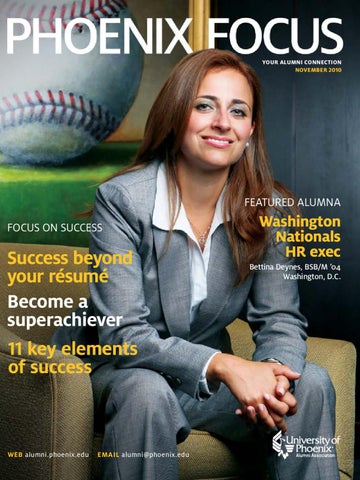
YOUR alumni CONNECTION NOVEMBER 2010
Featured AlumnA FOCUS ON SUCCESS
Success beyond your résumé Become a superachiever 11 key elements of success
WEB alumni.phoenix.edu
EMAIL alumni@phoenix.edu
Washington Nationals HR exec Bettina Deynes, BSB/M ’04 Washington, D.C.
Everyone has a story to tell. We want to hear yours. You could be in an upcoming issue of Phoenix Focus. Connections
How have personal and professional connections impacted your life? Reinvention
Have you reinvented yourself to meet the demands of a changing world? Environment
What are you doing to protect and preserve our planet? Health
How are you helping others live healthier lives? Share your story.
Email us at alumni@phoenix.edu.
Kareem Dixon, MAED/AET ’10 Co-founder, Fathers for Life Phoenix Focus October 2010 Š 2010 University of Phoenix, Inc. All rights reserved. ALU_FH1011G
let ter from the exe cutive direc tor
It’s easy to think of success in terms of material things. After all, who doesn’t want a bigger house, a nicer car, a better title or a larger raise? But actually, success can be highly personalized too.
P
PHOENIX FOCUS is produced monthly by University of Phoenix Alumni Association. Visit us at phxfocus.com. VP, Constituency Communications Kathleen Fern, MBA ’99 Executive Director Alanna Vitucci, MBA/GM ’01 Editorial Director Jenifer King Senior Editor Amanda Flatten Features Editor Lee Jonsson Editorial Assistant Bridget Gutierrez Contributing Writers Julie Wilson Andrew A. Limber Design P.S. Studios University of Phoenix Alumni Association 4025 S. Riverpoint Parkway Phoenix, AZ 85040 Contact us at alumni@phoenix.edu P 800.795.2586 F 602.643.0552
ersonally, I consider myself successful at my job, enhancing the professional, educational and community standing of all University of Phoenix alumni. In fact, a laser-like focus on my clients and stakeholders—you—is actually one of the best lessons that I learned from Mark Chagaris, BSB/A ’91, vice president of sales at 120° Venture Construction and my former boss at Countrywide (page 34). For alumna Dr. Linda Fisher-Lewis, DM ’09 (page 32), success, on the other hand, meant training for and completing the Nautica New York City Triathlon as part of CNN’s Fit Nation Challenge. University faculty member R.J. Lancaster’s book, Achieving in Times of Change—What It Takes to Become a Super-Achiever (page 12), also gives a fascinating take on success, focusing on six key traits that have been consistently identified in superachievers. Also included in this issue is a new feature discussing education in America. In College Success Starts in Kindergarten (page 18), we examine the importance of K-12 English, reading, math and science skills in preparing future graduates for success in college and beyond.
Alanna Vitucci Executive Director, Alumni Relations
Oh, and I am officially declaring Homecoming 2010 a success! Make sure you check out pages 42 to 45 for pictures and details on many of the events. The success of these networking events is the result of your participation and feedback in our annual alumni survey. The next opportunity to let your voice be heard is our 2010 Alumni Association Survey, coming to you via email in early November. As always, we want to hear from you!
Take care!
Alanna Vitucci, MBA/GM ’01 Executive Director, Alumni Relations University of Phoenix alanna.vitucci@apollogrp.edu
or visit us at alumni.phoenix.edu
alumni.phoenix.edu PAGE 3
contents / November 2010
FEATURES
6
Success beyond your résumé: experience vs. credentials
ou can get the experience you need, and communicate the Y skills and value you offer to prospective employers without hanging your hat on your credentials.
12 Become a superachiever
S uccess appears to come naturally to these power players, who effortlessly glide through schedules packed with board meetings and speaking engagements with enviable poise and confidence.
26
Featured alumna: HR exec is a hit with Washington Nationals
niversity of Phoenix “opened a new world of knowledge” for U Washington Nationals Executive Bettina Deynes.
16
Secrets to success at the “happiest place on earth”
Disney has created a culture of strong leadership, positive reinforcement for employees and exceptional training.
18
College success starts in kindergarten
As the number of students enrolling in college increases, improving K-12 core skills in English, reading, math and science becomes essential.
PAGE 4 Phoenix Focus November 2010
6
26
IN THIS ISSUE
The Buzz
Alumni announcements 36
Alumni Scholarships
Paying It Forward recipients 41
Bill Martin 30 Royal Caribbean CIO cruises ahead
Linda Fisher-Lewis 32 Rough road leads triathlete to success
Mark Chagaris 34 Management theory in action
Alumni Profiles
Your Career
11 key elements of success 20
Smart moves for managing a business 22
12
University News
A commitment to “green� 40
University of Phoenix forms alliance with ALPFA 40
Teaming with technology leaders for IT degree programs 40
Our Community
Campus news 42
Community relations 50
alumni.phoenix.edu PAGE 5
experience vs. credentials
Success beyond your résumé PAGE 6 Phoenix Focus November 2010
Companies and executives often want to hire people with the “perfect” background, whether that means the right school, degree, family background or title. People trying to advance their careers can get swept up in this thinking as they strive to amass qualifications or, conversely, blame their lack of opportunities on bad breaks. However, neither reaction is necessary. You can get the experience you need, and communicate the skills and value you offer to prospective employers without hanging your hat on your credentials.
T “ IF YOU WANT PEOPLE TO SEE YOU DIFFERENTLY, YOU DON’T JUST HAVE TO ACT DIFFERENT. YOU HAVE TO BECOME DIFFERENT.” — Rachel Weingarten, personal brand strategist and marketing expert
o be truly successful, look at what you really want, what others actually need, what value you can add, and where you can find a fit among the three. You succeed when you can provide what an employer needs and thoroughly enjoy the process of doing so. If you fall short, focus on improving your skills, abilities and experience to show that you can deliver.
The credentials trap
Just ask Tim Clark, who studied software engineering at a state school overshadowed by some of the big name technical schools. After graduating and getting his first job, he continued to work hard, studying nights and weekends to gain an advanced technical certification. When he eventually decided to leave a job and company he found odious, Clark’s solid skills and work experience got him multiple interviews in a week, followed by two job offers. The company he joined, and is still with, ITA Software—was recently purchased by GoogleTM . “Now there are nights I stay overtime because I’m enthused about what I’m working on,” he says.
Having the right credentials can make sense at times. You want an internist with a degree in medicine, and you won’t find someone practicing without one. However, top medical school matriculation doesn’t guarantee that a person possesses anything but the initials M.D. after his or her name. Often far more important to the success of patient treatment are factors such as a good bedside manner, keen diagnostic skills, attention to detail and an interest in actually healing people.
Credentials are simply those letters or certificates that people and organizations use to help them make judgments about people. A job might demand specific experience in a given field. A professional organization might require that prospective members meet education and experience requirements.
continued on page 8
alumni.phoenix.edu PAGE 7
“ Branding is the perception others have of you,” and branding is critical to stand out from others and advance. —LIz Goodgold, branding expert
continued from page 7
There are even times when we assume the need for credentials that aren’t technically necessary. For example, not all attorneys must go to law school to gain their licenses to practice. Abraham Lincoln became quite the lawyer by studying on his own and gaining admittance to the Illinois bar in 1837. Even now, 173 years later, a handful of states, including Vermont and California, still allow the practice of “reading” the law—working under a practicing attorney to gain a practical grasp of the subject—to gain the necessary legal knowledge.
Companies try to distill the characteristics of the “good” hire to save time and avoid mistakes. They try to associate backgrounds with desirable characteristics, such as high intelligence, work ethic or understanding of a company’s needs. Individuals then feel they must acquire those credentials to get ahead. Unfortunately, focusing on credentials becomes a trap for employers:
The demand for credentials is a relatively recent one. “If you go back in American history, there was the plucky myth: I can do it, I have a dream!” says personal brand strategist and marketing expert Rachel Weingarten. Did anyone ask Benjamin Franklin what college he attended?
Corporations probably started to use credentials in hiring out of expediency. An HR department responsible for delivering job candidates would want to use objective criteria when reviewing a pile of résumés. “It’s an easy weeding tool,” says branding expert Liz Goodgold.
PAGE 8 Phoenix Focus November 2010
• A résumé only speaks to where someone has been, not to how well he or she did a job. • Relying on pedigree assumes that all people with the same background are somehow the same, which ignores important distinguishing aspects of talent, inclination and personality. • A company that depends on pedigree will overlook different backgrounds and perspectives that could actually be crucial to solving business problems.
Because people want to maximize the chance of being hired, they often rely too heavily on credentials as well, which causes additional problems. If you focus overly
on the “proper” set of credentials, you only succeed in falling squarely into the group of people with similar backgrounds. However, to obtain a job, you need to do more and distinguish yourself from every other candidate, including others in the credentialed group. More importantly, when you bow to external pressures to obtain the “right” credentials, you allow others to define who you are, what you can do and what you can be. What people really need to know is that you can do what they need. “It wasn’t when I had a degree that they stopped asking [about my qualifications],” says Dr. Ted Sun, a University of Phoenix graduate, professor, author and executive development expert. “It’s when I achieved certain levels of fame or accomplishment that they stopped asking [about my degree].” Deep down, any company knows that official trappings aren’t enough. “After such a brutal and entrenched economy, you can’t walk in and wave your diploma and family connections,” Weingarten says. Companies want to feel that they made the right choice. Shattered economies and ruined businesses show that the exalted reputations of those at the top don’t necessarily mean anything.
“Branding is the perception others have of you,” Goodgold says, and branding is critical to stand out from others and advance. “I think the hardest thing to do is constantly reevaluate yourself,” Weingarten says. “Read what your competitors are doing. Learn the skills you always wanted to be doing. If you want people to see you differently, you don’t just have to act different. You have to become different.” That could mean going back to school, doing personal study in an area of interest, attending a seminar, listening to a webinar or simply practicing to improve proficiency in something you already know. “It’s hard as hell,” Weingarten says. “If it was easy, everyone would be doing it. That’s what sets you apart.” Furthermore, you must match talent and effort, and the latter is by far the more important. As inventor Thomas Alva Edison remarked, “genius is 1 percent inspiration and 99 percent perspiration.” For example, Basketball Hall of Famer Larry Bird didn’t have the greatest of natural athletic gifts, but he worked incessantly at improving his game. Still, for every Bird, many players never make the necessary effort to develop their gifts.
A clear view in and out Candidates and organizations must be complementary, each providing what the other needs. To help ensure this, the candidate must achieve three things: a realistic self-assessment, an accurate analysis of the hiring organization and mutual understanding of how the two could work well together. The first challenge is to know yourself—strengths, weaknesses and skills. You must understand what you know, what you can do, how you act and react and what you want, and there must harmony among all of those answers.
However, you have to be clever about the effort. Violinist Itzhak Perlman has said that putting in hours of practice doesn’t help if a musician can’t concentrate on proper movement of the bow, fingering the notes with the left hand and intonation. The smart violinist might work just a bit of music and keep atop everything at once, taking a 10-minute break every hour, rather than spending half a day getting tired and learning nothing. Similarly, if you want to improve work skills or knowledge, focus on what actually expands your abilities because no one other than you cares how much time it takes. continued on page 11
The demand for credentials is a relatively recent one. “If you go back in American history, there was the plucky myth: I can do it, I have a dream!”
—Rachel Weingarten, personal brand strategist and marketing expert
alumni.phoenix.edu PAGE 9
“ How do you differentiate your brand? You don’t do it by benchmarking the best.” Paying attention to what great people and companies do is important, but if that is all you do, then you can never be anything more than a good copy rather than a great original. —Dr. Kevin Freiberg, author of Nanovation: How a Little Car Can Teach the World to Think Big
PAGE 10 Phoenix Focus November 2010
continued from page 9
You must also be clever about how you evaluate yourself, says Dr. Kevin Freiberg, a management consultant and co-author of four books with his wife, including the upcoming Nanovation: How a Little Car Can Teach the World to Think Big. “How do you differentiate your brand?” he says. “You don’t do it by benchmarking the best.” Paying attention to what great people and companies do is important, but if that is all you do, then you can never be anything more than a good copy rather than a great original. For example, Goodgold wanted to work as a brand manager for a consumer packaged-goods company. She had previously served as an editor at Times Mirror. “I put together an entire portfolio based on the four key duties of a brand manager,” she said. She brought the portfolio to her interview and showed that she had already held an equivalent position. She got the job. Being genuine and finding how you stand apart means experimentation and, likely, sometimes being wrong. That is fine. If the portfolio approach didn’t work, Goodgold could have tried something different with the next company. Just remember to keep the real goal in mind. Also keep in mind the nature of real success. Dr. Sun once asked people about their goals, their barriers, the steps they needed to take and how they would feel after achieving the goals. What people really wanted wasn’t the goal, but the emotional outcomes—inner peace, happiness and contentment—that resulted from achieving the goals. The message is to focus on how you want to feel and you’re more likely to move in the right direction and enjoy the success of trying to get where you’re heading. You also need to have a clear view of what a company might want. This becomes difficult if you pay too much attention to credential demands. Do some research. Read what you can about the company—its challenges, new markets, product introductions, executive speeches and interviews. Look at market analysis reports. Examine public financial filings. Get as clear a view from the outside of what the company does well, where it fails and how it wishes to move forward. You want to find people who will listen as well as understand what you can bring to their work environment. Life is too short to work for, and with, those who don’t. And when you can actually make a difference to people who appreciate your contribution, success is guaranteed. Erik Sherman is a freelance journalist and communications consultant.
alumni.phoenix.edu PAGE 11
PAGE 12 Phoenix Focus November 2010
What it takes to become a
Driven. Ambitious. Charismatic. Impeccably dressed. We’ve all met those polished executives who command the room—along with their careers, their personal relationships and everything else in their lives.
S
uccess appears to come naturally to these power players, who effortlessly glide through schedules packed with board meetings and speaking engagements with enviable poise and confidence. What is it that makes everything they touch seem to turn to gold? R.J. Lancaster, president of The Education and Learning Institute LLC and University of Phoenix faculty member, set out to find the answer. “I’ve always been interested in what it takes to be successful in any kind of business,” he says. For three-and-a-half years, he indulged this curiosity as he interviewed and researched ordinary men and women who excelled in their professions. He published his findings in Achieving in Times of Change—What It Takes to Become a Super-Achiever, and he shares some of his top insights here.
Understand why organizations hire you. Employees know that generating revenue is king in the for-profit world, but Lancaster’s research let him in on a secret formula to ensure success. “The interviewees told me of the 2.5 factor,” he explains. “It simply means that if an organization pays you $50,000 a year, you have to generate 2.5 times that amount to pay for your position, which includes your salary, benefits and more.” continued on page 14
alumni.phoenix.edu PAGE 13
“ You have to go with your passion no matter what people tell you. And remember, education is not just about getting your diploma and GPA. It should be about finding your true purpose, passion and natural gifts in life.”
—R.J. Lancaster, author of Achieving in Times of Change: What It Takes to Become a Super-Achiever
That might sound like a tall order, but Lancaster identified many ways to accomplish this. Increasing productivity, efficiency, effectiveness and sales is a good start. You also can implement cost-saving ideas and innovative ways to do things. In addition, he suggests that employees research other organizations in their fields that are considered leaders and determine what makes them so successful.
Move every three to four years. This doesn’t mean packing up your life and renting a U-Haul truck. Rather, Lancaster advises employees not to remain in the same position for the rest of their careers. “It’s important to get to know your organization inside and out,” he adds. “Move to different departments so you have a birds-eye view of how your organization functions. Then, when opportunities present themselves, you will be in a much better place to retain your position and even catapult up the organization.”
Learn and apply business and social etiquette. Your mother was right. It is important to mind your manners. “Remember that you represent your organization 24 hours
PAGE 14 Phoenix Focus November 2010
a day,” stresses Lancaster. “People make judgments about you by your behavior, and lacking business and social skills often can ruin future advancement.”
Put your best people on opportunities, not problems. Keeping a positive perspective is key when facing obstacles, especially when you are leading others in the charge. According to Lancaster, the best employees are the ones with a passion for and a commitment to the organization’s mission and vision. “They love the challenge of something that makes them feel a part of creating something great for the organization,” he adds.
Find a mentor. Without exception, every successful man and woman Lancaster interviewed had a trusted mentor or partner. Today, it’s easier than ever to find a mentor if one hasn’t found you. Many companies and professional organizations have formal mentoring programs designed to help their employees rise through the ranks. No matter how you find a mentor, just make sure you do. “Remember,” says Lancaster, “no victory was ever won by one individual.”
Personality Superachievers make people feel good when they first meet them, which can have a profound impact on their future success in business—as well as in their personal lives. Listening skills Superachievers listen intently to others’ conversations and, more importantly, listen to what is not being said by the person’s body language. Attitude Superachievers agree that we can train people on how to do a job, but we can’t train attitude. When superachievers think about promoting someone, they look for individuals who have a sincere and positive attitude. Sense of humor Superachievers love people with a sense of humor because it can relieve stress in almost any situation. Take your job seriously, but not yourself, by using your sense of humor. Professional appearance Whether we like it or not, we are all judged by our appearance. Superachievers take great care to put their best face forward so they always make a great impression. Enthusiasm Superachievers radiate confidence and leadership by their zest for what they do personally and professionally.
Network. Superachievers know how to create—and leverage—networks to help them achieve their goals. And with today’s professional social media tools, such as LinkedIn, it’s easy to expand your network exponentially. According to Lancaster, you’ll be glad you did when the next perplexing challenge comes along. “Simply ask people in your network if they know anyone who can help,” he says, “and you’re bound the find the answers you need.”
Commit to life-long learning.
what people tell you,” he asserts. “And remember, education is not just about getting your diploma and GPA. It should be about finding your true purpose, passion and natural gifts in life.” Ryan James (R.J.) Lancaster, author of Achieving in Times of Change: What It Takes to Become a Super-Achiever, is also is a facilitator, speaker, instructor and former corporate executive. www.rjlancaster.com
This idea is familiar to University of Phoenix students and alumni, and Lancaster found it is critical to getting—and staying—successful. His advice on how to do it? “Read, read, read,” he says. “And be sure to read books on a variety of subjects to spur innovation and creativity in the workplace and beyond.” Lancaster, who considers himself a superachiever because he has learned from his mistakes and persevered, saved his greatest advice for last. “You have to go with your passion no matter
alumni.phoenix.edu PAGE 15
Secrets to success at the “happiest place on earth” World-class organizations like Disney, through training provided by its own Disney Institute, have developed effective leaders with experience designed to master the field of employee satisfaction.
E
xperience is something Disney understands well. With five destinations and dozens of hotels in operation around the world, Disney could easily lose touch with the millions of people who walk through its turnstiles every year. “Disney Imagineers go to great lengths to make the theme parks feel intimate, but it’s the cast members (Disney-speak for employees) who really make it work,” says Jeff James, vice president, Disney Institute. “A $200 million attraction won’t be fun if the cast member at the front is surly.” The question for Disney is: How do you get all of your employees to be so friendly and invested in their jobs? “We’ve actually had people ask us if we give our cast members ‘happy gas’ at the beginning of each shift,” laughs James. “The truth is Disney has worked very hard to create a culture that fosters employee engagement and trust. That leads to exceptional service and solid financial results.”
Disney calls this a “culture by design” as opposed to a “culture by default.” James explains: “Every organization has a culture, whether they realize it or not. It’s up to the leaders of the organization to determine what they want that culture to be, and then make sure it’s in place at all levels of the company.”
It starts with leadership Disney’s culture is rooted in strong leadership. By choosing leaders who understand that cast members are Disney’s greatest asset, the company improves the chances that every guest will have an exceptional experience. The average Disney guest has 64 interactions with cast members in one day at one theme park. James notes, “All of us have multiple opportunities to provide memorable customer service. Disney’s culture of service excellence is what helps us succeed far more often than we fail.” Disney cast members understand that their actions are integral to the company’s success. Leaders spend the majority of their day in the field looking for cast members who are doing things right. Positive stories and examples of cast member excellence are frequently shared with others, so that the right behaviors get recognized, rewarded, and most importantly, repeated. “We try to see every experience as a learning opportunity—even bad experiences,” says James. “There are some actions that will never be tolerated, of course, but we train leaders to avoid the ‘blame game.’”
PAGE 16 Phoenix Focus November 2010
Disney also clearly defines guest and “backstage” areas to make it easy for cast members to maintain the corporate culture. When cast members are in guest areas, they know to always follow Disney guidelines for appearance and customer service. When in nonguest areas, they can take a break and be relaxed. Cast members are asked not to eat or drink in costume, they aren’t allowed to talk on the phone or text while in guest areas, and they are asked never to wear themed costumes or nametags while off duty.
Putting it to work In addition to having great leaders in place, Disney relies on a refined recruiting and training process that screens for the right behaviors and attitudes among potential cast members, and then watches for any current employees who aren’t following the guidelines. “We have a very collaborative culture, but we also have very clear expectations that are communicated on a regular basis,” says James. Disney surveys employees every one to two years. Each survey includes sections where the employee can anonymously rate his or her leader and describe what’s working and what’s not working. Cast members also are frequently asked what motivates them—and Disney hears again and again that money alone is not it. “People want to be paid fairly, but what they want the most is recognition from their leaders and to feel pride in the work they do,” James says.
Conversely, cast members are provided training, tools and motivators to help them stay fully engaged with their current jobs. Disney cast members often get the same questions over and over every day. These questions can become tedious, and it would be easy for cast members to lose their patience and be short with guests who ask them, James says.
“ Disney has worked very hard to create a culture that fosters employee engagement and trust. That leads to exceptional service and solid financial results.”
—Jeff James, vice president, Disney Institute
“A common question at Magic Kingdom is, ‘What time is the three o’clock parade?’” he explains. “While this may seem to be a silly question, we consistently train cast members to listen and try to figure out what the guest is really asking. More often than not, the guest is looking for advice on where to best view the parade, or what time the parade will pass through a certain area of the park.” Training leaders on the importance of employee satisfaction and developing skills such as timely praise for excellent customer service are vital components in achieving an experienced and effective leadership team. The Walt Disney Company, with training provided by its Disney Institute, has proved its accomplishments time and time again, as evidenced by its high customer return and loyalty rates. This article is hosted by University Marketplace.
Training, training and more training Disney’s culture has been alive and well for more than 80 years, but it takes constant maintenance. Leaders at all levels of the company are reminded to focus on the positive work cast members are doing and to avoid the all-too-familiar trap of holding on to high-performing employees rather than offering them new opportunities. Just this year, The Walt Disney Company swapped its Chief Financial Officer and Chairman of Parks & Resorts in a move that Chief Executive Officer Bob Iger called “positive both for the executives involved and for the company as a whole.” “Over the longer term, the practice of motivating and developing cast members by providing new or expanded opportunities will help us attract and retain talented people and will serve this company well,” Iger said.
Exclusive alumni discounts Did you know that as alumni you have access to savings with many University alliance partners, including Disney? To get your discounts and savings on electronics, travel and entertainment, automotive and more, visit the Alumni Association website at alumni.phoenix.edu, click on “Benefits & Discounts” and select “University Marketplace.”
alumni.phoenix.edu PAGE 17
College success starts in kindergarten C
ollege freshmen whose elementary and secondary education has left them lacking in basic skills— about a third—have to catch up through college remedial classes that take time from major courses.
Ill-prepared for the rigors of higher education, they waste time, money and opportunities. Failure to catch up can leave students discouraged enough to drop out. And that doesn’t bode well in a society where a college degree is more important than ever. Record numbers of Americans are attending college. According to the U.S. Bureau of Labor Statistics (BLS), 70.1 percent of the 2009 class of high school graduates was enrolled in college-level courses by October of 2009. Fifty years earlier, enrollment was just 45.7 percent, says BLS economist Karen Kosanovich. Yet proficiency in core skills such as reading and math is stagnating. In 2010, only 24 percent of ACT-tested high school graduates met all four benchmarks of college readiness: 66 percent met the English benchmark, 52 percent met reading
PAGE 18 Phoenix Focus November 2010
standards, 43 percent were proficient in math and 29 percent in science. All predict college success. Students who meet benchmarks have higher college grade point averages, complete freshmen courses and have a better shot at graduating, says Cynthia Schmeiser, president of ACT’s education division. Those who don’t, falter at all levels. “It’s a continuing problem,” says David Bressoud, president of the Mathematical Association of America. “It’s discouraging that students are not being better prepared.” Part of the problem, Bressoud says, is the growing college enrollment. No longer is just the cream of the crop heading to universities. But he also blames secondary schools that push students into advanced math classes such as calculus without a proper foundation.
Further, with rudimentary language and reading skills, students often stall in middle school, says Carol Jago, president of the National Council of Teachers of English. “That’s where students need to be putting on miles as readers and writers,” she says. But growing class size she says, leaves teachers little time for individual attention or for grading numerous papers that enhance writing skills. Jago also cites a study by the Kaiser Family Foundation that found children ages 8 to 18 spend copious time with social media and hand-held communications devices—averaging seven hours and 38 minutes a day. Habitual users report getting lower grades. Now colleges and K–12 schools are working together to help students succeed. The American Diploma Project was created in 2001 to help young people “graduate from high school and get a diploma that signifies they’re ready for credit-bearing courses,” says Sandra Boyd, vice president of strategic communications
and outreach for Achieve, the education reform organization behind the project. The program will identify common core standards across the states to ensure college readiness. In the meantime, universities are improving their remedial courses. “There is a whole industry out there,” says Susan Albertine of the office of engagement, inclusion and success at the Association of American Colleges and Universities. Today’s remedial classes are being made more relevant to students’ lives and more valuable. Some are being slowed down. Composition courses, for instance, are using the “stretch” concept, giving students a year to perfect writing skills instead of one semester. That’s time well spent, Albertine says. Our nation can’t afford failure, says Albertine, refusing to blame either teachers or parents, adding, “Everybody needs to work on this problem together.” Barbara Yost is a freelance journalist in Phoenix, Arizona.
alumni.phoenix.edu PAGE 19
11
KEY elements of success
CO
CU
HU
IN
OP
mor
nfidence
telligence
In his best-selling book Emotional Intelligence, Daniel Goleman writes, “There are widespread exceptions to the rule that IQ predicts success ... at best, IQ contributes about 20 percent to the factors that determine life success, which leaves 80 percent to other forces.”
G
oleman goes on to explain, “These other characteristics are called emotional intelligence: abilities such as being able to motivate oneself and persist in the face of frustrations; to control impulse and delay gratification; to regulate one’s moods and keep distress from swamping the ability to think; to empathize and to hope.” Goleman’s book is full of assessments, tools, resources and how-tos to help guide you in finding new work that will better meet your personal and financial needs. No matter which category you fit in, however, unless you are able to
PAGE 20 Phoenix Focus November 2010
demonstrate and master a specific set of life skills and traits, you will find it difficult to find the work you want. Observing people in the workplace has yielded 11 keys elements of success. Time and again, it is apparent that those individuals who exhibit these 11 keys and use them most productively are consistently the most successful and wellliked individuals overall. The good news is that most people are born with at least some of these keys, or learned them at a very young age, and all of these keys can be developed or learned later in life.
riosity
timisim
The 11 key elements of success: 1. Confidence: an unshakable belief in oneself based on a realistic understanding of one’s circumstances; a trait that most people admire in others and strive to acquire themselves. 2. Curiosity: being eager to know and learn; always showing interest and giving special attention to the less obvious; always being the person who says, “I want to know more about … .” 3. Decisiveness: arriving at a final conclusion or making a choice and taking action; making decisions with determination even when you don’t have all the information you think you need.
DE
PE
cisiveness
rseverance
EM
RE
pathy
spect
4. Empathy: demonstrating caring and understanding of someone else’s situation, feelings and motives; always thinking about what it’s like to walk in someone else’s shoes.
8. Optimism: expecting the best possible outcome and dwelling on the most hopeful or positive aspects of a situation; believing that the glass is half full rather than half empty.
5. Flexibility: being capable of change; responding positively to change; being pliable, adaptable, nonrigid; and being able to deal with ambiguity.
9. Perseverance: having passion, energy, focus and the desire to get results. Motivation, persistence and hard work are all aspects of perseverance.
6. Humor: viewing yourself and the world with enjoyment; not taking life or yourself too seriously; being amusing, amused and, at times, even comical.
10. Respect: remembering that it is just as easy to be nice; protecting another person’s self-esteem; treating others in a considerate and courteous manner.
7. Intelligence: thinking and working smartly and cleverly; being sharp in your dealings and not “reinventing the wheel;” planning before acting; working efficiently and focusing on quality over quantity. (Important note: This is different
11. Self-awareness: a sophisticated form of consciousness that enables you to regulate yourself by monitoring yourself, observing yourself and changing your thought processes and behaviors.
from IQ, the common abbreviation for intelligence quotient.)
FL
lexibility
SE
lf-awareness
Which of these keys are among your strengths? Which of the 11 are among your weaknesses? Self-awareness, the 11th key, is really the foundation for understanding yourself. If you are not sure how self-aware you are, ask several people whom you trust which of these 11 keys they believe are your strengths and which are not. Again, while no one person possesses all of these keys in equal amounts, each of them can be developed and improved.
Julie Jansen is the author of I Don’t Know What I Want, But I Know It’s Not This. She is a career coach and consultant who is also a frequent speaker at both nonprofit groups and corporations throughout the United States.
alumni.phoenix.edu PAGE 21
Smart moves for managing a business
I
n today’s economy, stories of personal and professional failures are abundant. Tired of hearing bad news, we wanted to know how people have stayed relevant and successful. Here’s what we found out from eight business owners willing to share their secrets to success.
Ann M. Clemmer, independent demonstrator, Stampin’ Up! Ten years ago, I became a Stampin’ Up! demonstrator to bring in a little extra money. Five years ago, I got the opportunity to leave my job in the television industry. I felt that if I was ever to try this stamping job full time, this was it. The first year I did this full time, I doubled my best sales year. I’ve made it twice into the top 100 demonstrators of the United States and hope to again this year, as I bettered my best year by about 19 percent.
PAGE 22 Phoenix Focus November 2010
Secret to success: There’s always someone making money in every economy. Listening to the news can help you decide where to go, but it also can bring you down. I’ve often felt that the only “no” that counts is the last one I accept. If someone doesn’t want what I’m selling, I just keep looking for the next person who does. My mantra is that I’m only one new customer away from where I want to be.
“ In times like these, one must take calculated risks and invest wisely when seeking moneymaking opportunities.” —Rob Allen, franchise owner, ShelfGenie most recently worked in auto logistics for two years. Due to the struggling economic situation, I have been laid off twice in the last five years. Tired of peddling my résumé and given the current job climate, I decided to open ShelfGenie, a franchise that designs, builds and installs glide-out shelving solutions into existing cabinets throughout the home. Secret to success: In times like these, one must take calculated risks and invest wisely when seeking moneymaking opportunities. Opening ShelfGenie, a home-based business with little expenditures and minimal staff, has been a key element to my success as a business owner.
Candida Canfield, Dinner in Hand founder
Joshua D. Crumbaugh, Platinum Mortgage
I conceived Dinner in Hand while returning home from work on the train and realizing what a pleasure it would be to have a fresh and delicious dinner delivered to my door. Planning, testing, networking and evolving have been keys to my success. I initially tested the service on 22 families and I learned many lessons, including the need for hiring an exceptional chef.
I am the head of marketing for a regional lender. With the mortgage implosion, then the credit crunch and the recession starting, I was extremely concerned that I wouldn’t be able to hold on to my job throughout the worse crisis our industry has seen. I’m proud to say that over the past two years we have grown by nearly 1,000 percent.
Secret to success: In this economy I have learned to be flexible, be willing to kill an original concept and experiment with new ideas in order to grow.
Secret to success: I kept my job by digging in, studying my ailing competitors and learning from their mistakes, which combined with our top-notch customer service, has turned us into one of the fastest-growing lenders in our industry. Image and knowledge are everything. Whether it’s business to business marketing or applying for a position, image will make all the difference in the world.
Rob Allen, franchise owner, ShelfGenie I worked as a mental-health counselor for nearly 10 years before trying my hand as an IT professional for an Atlanta-area Fortune 100 company. I remained in that field for 23 years and
continued on page 24
alumni.phoenix.edu PAGE 23
continued from page 24
Lev Ekster, CupcakeStop I was on my way to securing a position at a law firm, but the change in the economy took that off the table. During late nights studying, I took breaks to trek to a popular bakery to wait in line for a sweet treat, but was disappointed with what was supposed to be the “best of the best” the city had to offer. I decided I could do better. Thus, the concept for CupcakeStop was born. It’s New York City’s first mobile cupcake truck that offers high-end, delicious, fresh-baked cupcakes of every variety. Secret to success: No matter how good or bad the economy is, without a good product, fair price and exceptional customer service, I don’t believe a business can be successful. I’m looking for CupcakeStop to be around for a long time, and for that goal to be reached, I know it’s necessary to be consistent and never sacrifice quality.
Karen Burns, editor I’ve had 59 jobs—fired from only one—doing everything from ditch digger to consultant. But most of my jobs involved writing. I wrote marketing materials for corporate America and then supported myself by writing brochures in English for French companies. When I moved to Seattle, I became a scientific editor, based on my lifelong love affair with grammar and on my extensive writing background. Secret to success: I spent a lot of my free time studying up on the finer points of grammar, style usage and diction, but my employer didn’t know that. A willingness to go the extra mile has always helped me. Plus, I am fanatic about meeting deadlines. I think those are two reasons I’ve always managed to find, and keep, jobs.
PAGE 24 Phoenix Focus November 2010
“No matter how good or bad the economy is, without a good product, fair price and exceptional customer service, I don’t believe a business can be successful.” —Lev Ekster, CupcakeStop
Rich Close, The Recycled Retriever I own a business called The Recycled Retriever, which started as a Web-based business from our home. My partner and I researched eco-friendly pet products on the market. We were unable to find one place that offered nothing but earth-friendly products. We developed The Recycled Retriever as a resource that pet owners could utilize knowing that the products they purchased from us were not only good for their pets, but also great for the earth. As the Web business began to grow, we decided to take the concept to a retail-store version and now have a storefront open in Provincetown, Mass. Secret to success: Taking a risk and going forward with the idea. If I didn’t try it, I would never have known whether it would be successful or not. By believing in the idea and putting it in motion, success was destined to come.
Thea Zagata, Gumdrop Cookie Shop
“ We started The Recycled Retriever as a resource that pet owners could utilize knowing that the products they purchased from us were not only good for their pets, but also great for the earth.” —Rich Close, The Recycled Retriever
Before starting Gumdrop Cookie Shop in 2007, I worked in public relations for 10 years. I left my career to start my business because I wanted to leave the fast-paced agency lifestyle and create my own schedule. I knew I wanted to start a business in baking yet still exercise my PR skills, so I wrote a business plan that helped me come up with a unique and new-to-themarket product. Secret to success: With my history in PR, I was able to do all of the publicity myself without having to spend a lot of marketing dollars. I also think finding a smart balance with where to spend your time and when to outsource is key. It’s important to apply your skills where they make the most sense.
Rachel Zupek is a writer and blogger for CareerBuilder.com and its job blog, The Work Buzz. She researches and writes about job search strategy, career management, hiring trends and workplace issues. Follow her on twitter.com/CBwriterRZ.
alumni.phoenix.edu PAGE 25
featured alumni | Bettina Deynes
Bettina Deynes, Bachelor of Science in Business/Management, BSB/M ’04 is a HR executive with Washington Nationals.
PAGE 26 Phoenix Focus November 2010
HR exec is a hit with Washington Nationals M
aybe the earthquake that momentarily shook the Maryland-Washington, D.C. area the day we first spoke with Bettina Deynes (pronounced “day-ness”), Bachelor of Science in Business with a Concentration in Management (BSB/M) ’04, was the fitting symbolic exclamation mark to what we would learn about this determined, dynamic woman. “I’ve always had very high expectations for myself,” said Deynes, vice president of human resources for the Washington Nationals professional baseball team. “From early on, it was not enough for me to achieve those expectations but to exceed them.”
It might seem almost unattainable, if not impossible, to succeed by setting the bar so high in one’s life. But Deynes, who was born in Uruguay and came to live in the United States, has reached that bar and cleared it—over and over again in many different forms.
Her unique path to success Deynes’ parents divorced when she was quite young and she was raised by her hard-working mother, who stressed the importance of education. Deynes excelled in academics and when she was 14, she won a partial scholarship to the prestigious Universitad Adventista del Plata, a private Christian institution that, at the time, was a combination high school and university, located in the Argentine province of Entre Rios, bordering Uruguay. continued on page 28
alumni.phoenix.edu PAGE 27
“Going to school for me wasn’t just about getting a piece of paper; it was about growing and getting an education.” —Bettina Deynes, BSB/M ’04
continued from page 27
“I also ‘had to work’ and was blessed because of all the jobs I could have had, I landed a good position in the school library,” Deynes said. “So I was exposed to all those books and I read, maybe, 500 of them the whole time I was there.” Soon after graduation in 1990 at just 17, she and her mother journeyed to the United States to visit relatives for a few months, then extended their visas and wound up staying permanently, settling in Maryland. Although Deynes had already completed her secondary education, she enrolled at a local high school so she could learn to speak and write English. She also got her first job in America, cleaning bathrooms in an office building. “One day, one of the supervisors said there was a position in the office and suggested I apply for it,” recalled Deynes. “I didn’t think my English was good enough to be a receptionist, but I applied anyway and got the job.” It wasn’t long after that when she met and married her husband, Elfred, a respiratory therapist and talented musician who writes and records songs. Two children later, and as she started to become established vocationally, Deynes decided to return to school at the beginning of 2001. In her typically organized and methodical manner, she began the process of extensively researching colleges and universities.
PAGE 28 Phoenix Focus November 2010
Where success has taken her From cleaning bathrooms less than 20 years ago to her current position, Deynes has seen her career grow immensely, including increasingly greater responsibilities in high level, executive positions in a variety of demanding industries. She has designed corporate strategic plans, established in-house payroll systems, engineered marketing databases and corporate communications systems, and has applied her talents in countless other ways to provide for the organizational needs of hundreds of employees. “I always knew I wanted to be in a leadership role,” says Deynes, who became vice president of human resources for the Washington Nationals (formerly the Montreal Expos) four years ago. Among other crucial responsibilities, she manages player benefits, workers’ compensation, travel visas and hires administrative staff—which often present unusual employment scenarios unique to a sports organization. “Staffing is a huge challenge because a lot of people want to work in baseball,” says Deynes. “My aim is to hire the professional, not the fan. I tell applicants that working here is a job like any other job. You’re not going to be hanging out with the players; you’re not going to be watching every game.”
Getting an education “Going to school for me wasn’t just about getting a piece of paper; it was about growing and getting an education,” she says. “I had heard about online schools, but since I had never attended college here, and was starting with zero credits, I wanted to have the experience of going to a classroom. University of Phoenix was one of the schools I researched, and it seemed to fit my life at that point since I was working full time in Columbia (Maryland) and there was a campus nearby.” Returning to the academic world was a huge commitment for Deynes, one that required not only time and money, but also a significant amount of writing, something she enjoys doing. What she could never have anticipated was the bonus that would come her way as the result of her passion for composition and her connection to the University of Phoenix. “I’ve always loved to write, but I didn’t have the confidence I needed—being that English was my second language. The staff at the University was very helpful, and in particular, the professor I started my courses with and later ended with, Robert Wiedefeld, was a major mentor.” But that part of Deynes’ story has an interesting sequel. After she successfully completed her final University of Phoenix classes online to earn her Bachelor of Science degree in Business Management, graduating with honors, she began writing a novel with Wiedefeld entitled The Wolf is Always at the Door. The book chronicles the challenges of entrepreneurs and is expected to be published in the fall of 2010.
Deynes went on to say, “I’ve had doctors and lawyers apply for jobs with us—even a CIA agent who wanted to be an administrative assistant because he was so passionate about baseball and wanted to be a part of it.” Through the years of developing her career, Deynes emphasizes that “not one successful person has made it alone.” She says she has “a very strong support system,” consisting primarily of her mother and her husband, who has taken a larger role with their three young sons by working fewer hours to be home with them. Regarding her University of Phoenix experience, Deynes said that she not only learned things she did not know before, but it gave her the confidence she needed to prove herself as a manager and a writer. “I would say to someone who might be, say in a middlemanagement position and wants to grow, that going to University of Phoenix would allow you to expand your learning and become a better leader. And you can also build up your confidence, which comes from writing and the oral presentations—and at the end of the effort, you will have a degree.” Bettina Deynes says she doesn’t want to come across as a person who is a huge success and who people should emulate. She would rather be viewed as a woman who has worked hard, valued education, and followed certain personal and professional principles that have brought realization to many of her dreams. “For me, going to University of Phoenix opened a new world of knowledge,” said Deynes. “It played a role in who I am today.”
alumni.phoenix.edu PAGE 29
alumni profiles | Bill Martin
Royal Caribbean CIO cruises ahead Bill Martin, BSB/A ’98, Royal Caribbean VP and CIO
F
or Bill Martin, Bachelor of Science in Business with a Concentration in Administration (BSB/A) ’98, a couple of lucky breaks, a razor-sharp focus and the patience of a saint add up to his current role: vice president and chief information officer (CIO) at Royal Caribbean Cruises Ltd. More than 25 years ago, Martin joined Royal Caribbean on the ground floor—literally—as a reservations agent working the phone bank. Over a quarter of a century later, he reflects on the long road to the top and the balanced approach that got him there. As CIO, Martin is responsible for all technology—both shoreside and shipboard—across all of Royal Caribbean’s five brands. “I have a 400-person organization, along with additional contractors as projects ebb and flow,” he explains. “My job is to make sure we stay up-to-date, secure and compliant.” There, he has worked on high-profile projects such as the delivery of Oasis of the Seas, the largest and most innovative cruise ship around today.
PAGE 30 Phoenix Focus November 2010
Just how did he become a top-level executive with the world’s largest cruise brand? “I’m not naïve enough to think that I didn’t catch a couple of lucky breaks along the way,” Martin says. “You have to be patient enough to wait for those breaks, and sometimes that’s tough.”
Learning the ropes Martin did more than just wait. He worked in a broad range of areas and in various capacities for the company, including stints as an accountant, a senior analyst, manager of Royal Caribbean’s revenue management systems and as head of the customer service organization. In each role, he learned more about the company and its operations, critical for someone looking to get ahead in any organization. Martin was working at Royal Caribbean for more than a decade before he decided to pursue his bachelor’s degree. “I come from a family with four children,” says Martin. “My father only finished the eighth grade, and my mother finished high school but never went on to college. So, the idea of going to work right out of high school was preeminent in my family.” Because Martin chose to enroll in college as a working professional with a family, he was drawn to University of Phoenix. There, he pursued his Bachelor of Science in Business Administration. “My degree really helped complement my working knowledge and backed it up with theory,” stresses Martin. “Whether it’s from statistics or project management or any of the other business courses I took, I still count on those theories today.”
A lesson learned: balance While Martin certainly has the natural ability—coupled with the formal education—to lead an organization, he found a little help along the way in the form of a mentor. “When I started working for him, he was a director,” he says. “Today he is the CFO. He has an incredible business mind, and he’s also the guy who taught me balance.” Balance has become the foundation for Martin’s personal and professional success. “When I first started at the company, I was what you would refer to as a workaholic,”
he admits. “But you have to strike that balance. You’ve got to be able to have that other side that is outside the office.” For Martin, this includes living a healthy lifestyle and taking the red-eye home from business trips so he can be there when his kids wake up in the morning. Martin also applies balance to managing his career. While he maintains five- and 10-year plans for himself, he doesn’t take them too seriously. “You know, life will throw you a curve ball. You swing and you miss, that’s OK. You just back up and swing again,” he says. “Your objectives can change, but there’s always something out there that you’re striving for.”
A mentor for others Martin knows the value of a mentor, and he is keen to do his part for other up-andcoming professionals. He participates in Royal Caribbean’s formal mentoring program, and he also has people come to him for advice. “I find great reward in providing people with advice or guidance,” he says. “There are people who come to me because I do exude a bit of balance and I really don’t have much of an ego. There are other times when I see high-quality people who are struggling, and I sit them down to talk about it.” To be successful in any company, Martin says it’s always important to hire employees who are a good social fit with an organization. “If they’re not, then they’re not going to be happy and we’re not going to be happy,” he says. “And that’s probably more important than the talent they bring to the table.”
Next, Martin believes the only way to maintain a high level of success in any job—especially in a technology role—is to stay current. “I read voraciously,” he says, “whether it’s the morning newspaper, business books or even some fiction. It’s amazing how much you can get out of reading.” Lastly, Martin can’t overemphasize the importance of being open with family about the requirements of your job. “I have a very understanding wife and kids, and we talk about the demands of my job and why I have to do all the things I do,” he says. “If you can establish that understanding, it is amazing how much it will help.” Keeping in line with his commitment to a balanced life, Martin also makes it a priority to stay active in his community. He serves as chairman of the board for His House Children’s Home, a foster care organization for abused and neglected kids in Miami-Dade County, Florida, where he lives. He also participates in church events. “Being involved keeps you fresh and active,” he says. Although one day, Martin would like to return to school to pursue his master’s degree, he is content with where life has taken him. “Every day, I wake up and I’m anxious to get started because I’m looking forward to all the possibilities the day presents,” he concludes. “For me, that is success because I am happy.”
“ When I first started at the company, I was what you would refer to as a workaholic. But you have to strike that balance. You’ve got to be able to have that other side that is outside the office.” —Bill Martin, BSB/A ’98
alumni.phoenix.edu PAGE 31
alumni profiles | Dr. Linda Fisher-Lewis
Rough road leads triathlete to success Dr. Linda Fisher-Lewis, MAOM ’02, DM ’09, has been teaching policing for UOPX since 2003.
I
n 2006, a motor vehicle accident forced Dr. Linda Fisher-Lewis, Master of Arts in Organizational Management, (MAOM) ’02 and Doctor of Management in Organizational Leadership (DM) ’09, to retire from her passion: a life-long, fulfilling career in law enforcement. This loss was compounded by the death of her beloved brother and father in the year that followed, leaving Dr. Fisher-Lewis feeling desolate. The 20-year veteran police officer was made of tougher stuff, though, and grew determined to take back her life.
She answered a call for entries into the CNN Fit Nation Challenge and was selected—along with five others—to train for and participate in the Nautica New York City Triathlon. This opportunity proved to be the antidote for Dr. Fisher-Lewis’s heartbreak and gave her a renewed sense of purpose in life— along with a new passion.
The first step After her accident, Dr. Fisher-Lewis gained weight during her recovery. She continued to grapple with her losses and felt a lack of direction in her life. One day, she decided it was time for a change. “I wasn’t the go-getter I used to be,” she explains. “I thought, ‘The only one who can change that is me.’” She adopted
PAGE 32 Phoenix Focus November 2010
a healthier diet and began to lose weight. After she dropped 30 pounds, she began to swim. One day, she saw that CNN was requesting video entries to join its Fit Nation Challenge. She resolved that this was her chance to make something positive out of her experiences, so she sent in a video telling her story. “I just decided that I needed to do the triathlon,” she says. “I wanted to show people they can pick themselves up when things happen to them.”
Ready, set … train CNN selected Dr. Fisher-Lewis and five others to be part of its triathlon team, dubbed the “6-Pack.” CNN followed the group— composed of others like Dr. Fisher-Lewis with inspiring stories—
“I just decided that I needed to do the triathlon. I wanted to show people they can pick themselves up when things happen to them.” —Dr. Linda Fisher-Lewis, MAOM ’02, DM ’09 during its grueling training, working up to the triathlon on July 18. “Triathlon training is different than anything I have ever done,” says Dr. Fisher-Lewis. “It includes everything from eating and drinking the right things to sleeping.” CNN provided the team members with trainers in their hometowns to help them prepare for the three components of the timed race: a one-mile swim followed by a 40-kilometer bike ride, ending with a 10-kilometer run. “At the beginning, CNN flew us all to New York City to meet with their nutritionist and trainer there,” Dr. Fisher-Lewis explains. “During the first month, we built our endurance and then began to work on speed.”
For the long haul Staying motivated wasn’t a problem for the 6-Pack, who found support from each other during their weekly conversations. “They are amazing people,” Dr. Fisher-Lewis exclaims. “Each one will inspire you.” She also found comfort in the memory of her brother, who was a lieutenant colonel in the Air Force. “I have his initials on my bike, so when I am having a hard time training, I look down and think about how he never once quit anything,” reveals Dr. Fisher-Lewis. “He would have been disappointed to see how down I had gotten, but he would have been proud of what I am doing now.” Another source of inspiration is her education. At the time of her accident, Dr. Fisher-Lewis was in the middle of her doctoral program at University of Phoenix with the intention of one day becoming chief of police. For her, the accomplishment of earning this degree showed her she could overcome any obstacle. “I remember thinking that not many people accomplish this,” she says. “I thought, ‘What is stopping me? I’ve proven I can meet this challenge; why not face all the other ones?’”
Renewed vigor This attitude has carried her through the Fit Nation Challenge. While her triathlon experience has been filled with memorable moments, one of the most poignant for Dr. Fisher-Lewis was when she had the opportunity to take a bike ride with racing superstar Lance Armstrong. “I asked him, ‘What happens when you are faced with losing your passion?’” “He told me that when you are a passionate person, you have to find another passion. If you don’t, you will become a dog chasing its tail.” Although meeting Armstrong is something Dr. Fisher-Lewis never will forget, the highlight for her has been regaining her sense of self. “When I went to New York to meet with CNN and the 6-Pack for the first time, I was scared because I didn’t know what to expect,” she admits. “I met five amazing people who forever will be friends of mine. Watching us all grow and build our confidence over the last several months has been a blessing. This experience has turned things around for me, and people who know me see me getting back to how I used to be.”
A new chapter Now that Dr. Fisher-Lewis has a triathlon under her belt—and a rekindled zest for life—it’s time for the next challenge. While her doctor finally has cleared her to return to the police force—in itself a miracle—she is setting her sights on a new career by writing a book about her experiences. “If I could do anything in the world, I would want to speak on motivational leadership,” she divulges. “I want people to realize they have the ability to change their lives.”
The Finish Line
Dr. Linda Fisher-Lewis’s idea of success? Just finishing the race, which she did with flying colors despite becoming ill after swallowing salt water during the swimming portion of the challenge. Dr. Fisher-Lewis completed her first–and the nation’s largest–triathlon in three hours and 46 minutes. “I was proud of myself for finishing and even prouder that I finished despite such adversity,” she says.
alumni.phoenix.edu PAGE 33
alumni profiles | Mark Chagaris
M
ark Chagaris, Bachelor of Science in Business with a Concentration in Administration (BSB/A) ’91, has made a career of looking at things differently. From his early days as a Xerox™ technician to his current role as vice president of sales at 120° Venture Construction, Chagaris’s knack for looking at situations through the eyes of his clients and stakeholders adds up to success. “I approach everything by asking how the other person— the customer, consumer, employee or partner—will benefit from what we are doing,” he says, “and that has made all the difference.”
Management theory in action Mark Chagaris, BSB/A ’91, vice president of sales at 120° Venture Construction
PAGE 34 Phoenix Focus November 2010
This outward-focused attitude has led him to his current role at 120° Venture Construction, a project management company that specializes in IT project and program management services. After years of working for other companies, “I caught the entrepreneur bug once again,” laughs Chagaris. “The owner asked me to come on board to market and sell his project management methodology because I have experience in all the areas that converge in this tool.” In fact, the methodology seems to be a reflection of Chagaris’s no-nonsense management style. “We offer an innovative approach to project management, and we see consistently successful outcomes with it,” he says. “Our methodology ensures that project managers never get off track and consistently deliver excellent results with their projects.”
While today Chagaris helps others maintain razor-sharp management techniques, he wasn’t always following his own advice. During his early career, “My strategy for success was to stay employed,” he admits. “I would look at a situation and think, ‘Where do people need me?’”
A shift in focus That all changed after he received his degree in 1991, several years—and management positions—into his career. His thenemployer covered the cost of his education while giving him a realworld setting in which to implement his new skills. “My manager was very supportive and gave me time during the work week to study,” he says. After graduation, he continued to work in a management role with the company but with a fresh perspective. “I didn’t know what I had been missing,” he explains. “I had always been a common-sense manager, but my degree gave me a whole new set of tools to use. And without those tools, as the saying goes, when all you have is a hammer, everything looks like a nail.” What Chagaris gained most from his education was the ability to think analytically, a skill that led him to successful leadership roles in the years that followed. He credits his statistics class at University of Phoenix, a course he wholeheartedly enjoyed. “University of Phoenix approached statistics from a practical aspect,” he says. “It wasn’t about the formulas. It was an applied class, which made it relevant.” He put these skills to the test in his next role as district base sales manager for Digital Equipment Corporation. There, he oversaw a team of 20 people and was responsible for $90 million worth of hardware and software maintenance agreements. His primary goal was to retain a percentage of their client base and to grow the base further. He was able to apply the statistics tools he learned at the University to make forecasts and identify areas of opportunity for the company. “I discovered that our revenue base
was eroding not through loss of customers but through changes in the types of services they valued,” Chagaris says. “It became the silent killer and required an innovative treatment.”
A new challenge After nearly a decade working as a management consultant for his own company and another firm, Chagaris joined Countrywide Financial in 2002 as vice president of culture management and communications for the IT group. In this position, he engaged in organizational and management development, including employee engagement. He started his job immediately following the company’s annual employee engagement survey, which revealed some communications issues. “I performed an analysis to determine the root cause,” he says. “This showed me that the middle management team was the least engaged. If they are not connected, then how can they take forward any messages to their teams? They wanted less volume and more credibility in their communications.” Chagaris created leadership development training, setting expectations and empowering these employees to do their job more effectively. “And lo and behold, the employee survey scores went up across the board and in all areas,” he adds. “We looked at things differently than they had before. It was really quite logical. Don’t keep doing what is ineffective.” Today, Chagaris is using these common-sense, critical thinking techniques to bring 120° Venture Construction to the next level through national growth, which gives him a sense of accomplishment. “Success is when I am having a positive impact on myself, my family and those I work with,” he says. His advice for alumni hoping to achieve the same thing? “Take the time to figure out how you can add value to every situation, and never stop adding to your toolbox.”
“I had always been a common-sense manager, but my degree gave me a whole new set of tools to use. And without those tools, as the saying goes, when all you have is a hammer, everything looks like a nail.” —Mark Chagaris, BSB/A ’91
alumni.phoenix.edu PAGE 35
We want to celebrate you in our alumni announcements. Share your story and be part of “The Buzz.” Email us at: alumni@phoenix.edu
PAGE 36 Phoenix Focus November 2010
Degree
Recognitions
New Job
Henderson, NV
Secane, PA
Corbett, OR
Jo Ann Prevetti, Master of Business Administration (MBA) ’08, is making strides in her career because of her degree. She is currently director of development for Olive Crest and is working as an adjunct law professor for a community college in Nevada. Prevetti says, “My MBA has afforded me unsurpassed knowledge that has taken me from behind a desk to out in the community raising funds for at-risk families and publicly speaking at national conferences.”
Denise Outlaw, Doctor of Management in Organizational Leadership (DM) ’09, was chosen to present her dissertation results at the Advances in BusinessRelated Scientific Research Conference (ASBRC), which was held in Olbia, Italy, in September. Her paper, Division Chiefs: Challenges and Successes Transitioning into Physical Leadership Roles, has also been accepted for publication in the Advances in Business-Related Scientific Research Journal (ABSRJ). Dr. Outlaw says, “My degree has opened up opportunities to speak within the U.S. and abroad.”
Ann Visscher, Master of Science in Nursing (MSN) ’05, didn’t just get one job offer, she got three. After interviewing at Oregon Health Sciences University, she was given the choice of three different positions. She decided on the adult perianesthesia unit and is currently clinical manager. “My years of experience and University of Phoenix education empowered me to step out of my usual comfort zone and seek advancement in my nursing career,” she says.
“ My MBA has afforded me unsurpassed knowledge that has taken me from behind a desk to out in the community raising funds for at-risk families and publicly speaking at national conferences.” —Jo Ann Prevetti, MBA ’08
Anchorage, AK Paul Vest, Master of Information Systems (MIS) ’10, was recently accepted into Concord Law School. He credits his experience at University of Phoenix for pushing him to pursue his education further. “For years I went through life without a sense of cause or purpose,” he says. “Now, University of Phoenix has not only enriched my life with an education that has opened my eyes not only to the world but also I have the satisfaction of knowing that I can do it and have proven all of the doubters wrong.”
continued on page 38
alumni.phoenix.edu PAGE 37
continued from page 37
Published by Alumni Single and Pregnant By Sharllette Frazier Sharllette Frazier, Master of Business Administration (MBA) ’09, never expected to become an author, just as she didn’t expect to get pregnant at the age of 20. “After becoming pregnant … I was faced with many hard decisions. Should I work full time and forget about school? I did not want to become a statistic. Though the road I chose may have taken a little longer, I overcame numerous odds,” says Frazier.
Bond and the Big Green Hill By Bridget Renee Kendall Bridget Renee Kendall, Master of Business Administration (MBA) ’09, brings Bond, an adventurous tuxedo cat, to life in Bond and the Big Green Hill. The book was written for children between the ages 3 to 5, and inspired by Kendall’s pet cat. In the book, Bond discovers a big green hill in his living room while his owner is away from home. Although scared, Bond tries to climb the green hill and eventually discovers it is actually a green couch. His
Frazier wrote Single and Pregnant to inspire other women to strive for their dreams, even if they have to take a different route to get there. Frazier has served as a marketing and communications professional, entrepreneur and motivational speaker. She is enjoying life with her now 10-yearold daughter. To learn more about the author and her book, go to www.singleandpregnant.net.
owner encourages Bond to only climb the couch when he is there to catch him if he falls. “My intention is that children will be drawn to Bond’s character and listen to the message while enjoying the illustrations and stories. Hopefully this book will be one that children and parents will treasure for years to come,” says Kendall. To learn more about the author and her book, go to www.bridgetreneekendall.com.
“ My intention is that children will be drawn to Bond’s character and listen to the message while enjoying the illustrations and stories. Hopefully this book will be one that children and parents will treasure for years to come.”
PAGE 38 Phoenix Focus November 2010
— Bond and the Big Green Hill, author Bridget Renee Kendall
Get noticed.
Alumni scholarship “pays forward” students’ education
Promote your company in our upcoming February 2011 “Connections” issue. Email your listing to alumni@phoenix.edu Deadline: December 15, 2010
alumni.phoenix.edu PAGE 39
university news A commitment to “green” University of Phoenix celebrated the official grand opening of its first LEED Gold campus in the nation, located in Meridian, Idaho. “The opening of the new University of Phoenix Idaho Campus demonstrates the University’s continuing commitment to environmental responsibility and leadership,” says Seth Mones, vice president, Sustainability Policy and Programs at the Apollo Group, parent company of University of Phoenix. “The campus’ LEED Gold certification exemplifies the University’s dedication to innovation both in education and environmental building practices.” The new facility boasts approximately 40,000 square feet of learning and administrative space. During the construction process, about 90 percent (140 tons) of the construction waste was sent to recycling facilities. Key features of the building include lighting and water efficiency and a high degree of recycled materials used in the building process.
University of Phoenix forms alliance with ALPFA University of Phoenix is teaming up with the Association of Latino Professionals (ALPFA) for those who aspire to develop careers in the business sector. Through this alliance, University of Phoenix alumni, faculty, staff and employees will receive a 50 percent discount on ALPFA’s national annual membership dues. The partnership combines opportunities for career development, professional networking and continuing education for Latinos through membership in any of its more than 39 professional chapters. For more information, go to www.alpfa.org.
PAGE 40 Phoenix Focus November 2010
University of Phoenix celebrated the grand opening of its first LEED Gold campus in Meridian, Idaho.
Teaming with technology leaders for IT degree programs University of Phoenix students now can attain college credit for the training and certification programs offered by Juniper Networks. Juniper’s network security configuration and management curricula are now part of the recognized courses and certifications accepted by the University for credit assessment, joining courseware from Oracle, Hitachi and other technology leaders that enhances the student’s background with practical insight and IT skills that translate into the workplace. “Ongoing, rapid changes in technology require today’s knowledge workers to first advance their education before they can expect to advance their careers,” says Blair Smith, Ph.D., Dean, College of Information Systems and Technology at University of Phoenix. “University of Phoenix is dedicated to providing our students with relevant studies that give them an educational edge in the workforce. As a leading provider of high-performance networking infrastructure, Juniper’s training and certification programs are a must-have for any IT professional and an invaluable addition to the student’s credentials.” Through this academic alliance, students may be eligible to receive credit toward an associate or bachelor’s degree at University of Phoenix for prior training courses, certificates and licensures completed through Juniper Networks.
Alumni scholarship “pays forward” students’ education Sisters share desire to learn
Mentee returns favor to mentor
Anusha Ramkissoon-Forte is grateful to her sister, alumna Asha Mckee, Master of Arts in Education/Curriculum and Instruction (MAED/CI) ’08, for nominating her for the Paying It Forward scholarship. Asha immigrated to the United States with a Master of Arts in Linguistics, but her degree didn’t hold much weight in the U.S. job market. She eventually graduated from University of Phoenix and is now working as an instructor in adult basic education. Understanding the importance of a college degree, Asha wanted to give the same opportunity to her sister, Anusha, who has always wanted a college degree but was unable to pursue her dream because of the high cost, as well as the demands of work and family. Thanks to her sister, now Anusha is looking forward to obtaining a Bachelor of Arts in English at the University.
University of Phoenix alumnus Aaron Knowles, Master of Management [MM] ’09, credits his professional development at a naval base in Ventura County, California, to his mentor Felicia Rodriguez. Despite a successful 22-year career as a naval base contract specialist, Felicia put her education on hold to care for her family. Now, with the help of Aaron, she doesn’t have to wait any longer. Aaron repaid Felicia for her guidance and encouragement as his mentor by nominating her for the Paying It Forward scholarship, giving her the opportunity to pursue a Bachelor of Science in Management degree.
Paying It Forward Do you know that November is National Scholarship Month? To learn more about scholarships, including the Paying It Forward® Scholarship, visit phoenix.edu/scholarships. Here you can access a wealth of information, including FAQs, tips and articles to help you find and apply for scholarship opportunities. * Must be a bachelor’s, master’s, or doctoral graduate to be eligible.
alumni.phoenix.edu PAGE 41
campus news Homecoming 2010 Seventy events, more than 9,000 alumni and guests, countless memories. From exclusive networking receptions to professional sporting games to picnics in the park, Homecoming 2010 gave alumni the opportunity to connect with fellow graduates and their local campuses. Thank you to everyone who attended. 1. Alaska Guest speaker Stedman Graham, businessman, educator and CEO of S. Graham & Associates, spoke with alumni during a luncheon. 2. Atlanta Alumni joined the fun at a tailgating event, followed by an Atlanta Falcons game. 3. Augusta The Augusta campus held a family-friendly picnic for alumni. 4. Austin The Austin homecoming event was an evening to network and hear from fellow alumni leaders in the Austin community.
PAGE 42 Phoenix Focus November 2010
5. Bay Area Around 70 alumni enjoyed the Bay Area homecoming at the San Jose Museum of Art. Dr. Jeff Kaplan, University of Phoenix alumnus and managing director of Ferrazzi Greenlight, provided a workshop on how to “Build Your Own Network.” 6. Cedar Rapids The Cedar Rapids homecoming event was filled with good times in the corn maze, pumpkin shoot and the haunted barn at Bloomsberry Farm.
11. Columbus After dinner at the Bridgewater Banquet and Conference Center, 150 alumni and guests hit the dance floor. 12. Dallas Alumni attended an exclusive VIP pregame mixer and rooted for the Texas Rangers. 13. Denver Nearly 800 alumni and guests cheered on the Colorado Rockies for an exciting night of baseball.
7. Central Valley Alumni and their families celebrated with a barbecue at Woodward Park. It was a day filled with good food, games and fun activities.
14. Harrisburg Special guest speaker and Olympic gold medalist Dominique Dawes wowed alumni at the Sheraton Hershey Hotel.
8. Charlotte Alumni reconnected with fellow graduates at an exclusive reception at the Omni Hotel. A silent auction was also held to benefit the American Cancer Society.
15. Houston Alumni mingled and danced at an exclusive reception at the Toyota Center and received a special visit from the Houston Rockets mascot, Clutch. continued on page 44
9. Chicago Alumni enjoyed dinner and fun at the world’s greatest rock ‘n’ roll dueling piano show at Howl at the Moon. 10. Columbia Guest speaker, Columbia Mayor Steve Benjamin, gathered with alumni for a night of culture and fun at the Columbia Museum of Art.
1
6
11
2
7
12
3
8
13
4
9
14
5
10
15
alumni.phoenix.edu PAGE 43
campus news
continued from page 42
16. Indianapolis The Fox and Hound was the ideal place for alumni to dine, mingle and rock out. 17. Kansas City The Kansas City campus hosted a luncheon and friendly golf tournament that benefited the American Heart Association. 18. Little Rock Alumni enjoyed dinner and networking at the Hilton Little Rock. 19. Louisville Alumni and families enjoyed guest speakers, good food and a corn hole tournament at Hogan’s Fountain Pavilion in Cherokee Park. 20. Nashville More than 100 people attended the Nashville homecoming. The event gave alumni the opportunity to network and hear from speaker Dan Miller, author of No More Dreaded Mondays. 21. New Orleans The New Orleans homecoming celebration included dinner, guest speakers and a 4D movie at the National World War II Museum. 22. North Florida Alumni spent the evening reconnecting with fellow graduates in the North Florida community. 23. Philadelphia & Delaware Alumni enjoyed a private reception and heard from General Barry R. McCaffrey, national security and terrorism analyst for NBC News.
PAGE 44 Phoenix Focus November 2010
24. Phoenix Alumni gathered for a VIP pre-game mixer and then cheered on the Arizona Diamondbacks as they took on the Los Angeles Dodgers. 25. Raleigh Raleigh’s homecoming event included mingling, dinner and dancing at the Cardinal Club. 26. Southern California Nearly 700 alumni and their families joined for a family-friendly mixer and watched as the Los Angeles Galaxy defeated the Columbus Crew. 27. South Florida Alumni cheered on the Florida Panthers for an exciting night of hockey that included an exclusive VIP pre-game mixer. 28. Western Washington The Western Washington Campus teamed up with Cascade Land Conservancy to restore the Duwahmish Riverbend Hill. A week later, alumni enjoyed a private barbecue to reconnect at a Seattle Mariners game. 29. Wichita The Wichita homecoming event was an afternoon of food, games, go-karts and bowling fun.
16
21
26
17
22
27
18
23
28
19
24
29
See more photos View alumni photo albums from Homecoming 2010 on the Alumni Association Facebook page at facebook.com/uopxalumni and click on “photos.”
20
25
alumni.phoenix.edu PAGE 45
campus news
continued from page 45
Community Service Award Winners In addition to celebrating homecoming, campuses also awarded alumni the Community Service Award. The award recognizes University of Phoenix graduates for their efforts to better the communities in which they live and work. Congratulations to the following winners: Pam Brooks, MBA ’08, Augusta
Dr. Sheryl Monaughan (right), BAM ’95, Southern California
Marjorie Boafo Appiah (center), MBA ’07, Columbia
Janice Escochea, BSB/M ’10, Phoenix
Charles Davis III (left), BSIT ’08, Harrisburg
Josette Daniels (left), MAED/CI ’08, Charlotte
Julie Farrel (left), BSB/M ’08, Chicago
PAGE 46 Phoenix Focus November 2010
Jeannette Reaux, MBA ’09, New Orleans
Brad Bulla (right), BSB/MKT ’08, Nashville
Francis Milton (left), MBA ’10, and Kareem Dixon (right), MAED/AET ’10, Western Washington
Corey Smith, MBA ’07, Idaho
Jackie Johnson, BSB/A ’09, Austin
Charmaine Barton (left), AAHCA ’09, Denver
Monique Jones (left), MBA ’09, Little Rock
Robert Kantor, MBA ’95, South Florida
Aneeka Ferrell (right), MBA/PA ’08, Louisville
alumni.phoenix.edu PAGE 47
campus news
continued from page 47
Teresa Barfield (center), AACJ ’10, Raleigh
Lloyd Benson, MBA/MKT ’09, Baton Rouge
Dr. Mohamed Bereteh (right), MBA/HCM ’05, Sacramento
Mary Jurey (center), MBA/ACC ’03, Wichita
Samantha Uhas-Johnson, AAHA ’10, Savannah
Kari Lee Harmon, AACJ ’10, Indianapolis
Terry Sells (right), MIS ’08, Oklahoma City
Shaleana Eubanks-World, BSB/M-39 ’01, Central Florida
Linda Hargis-Hebert, BSB/M ’08, Houston
PAGE 48 Phoenix Focus November 2010
Other Community Service Award winners (not pictured):
Other homecoming events around the nation (not pictured):
Edwin Montoute, MBA/TM ’03, Philadelphia
Baton Rouge Reception at Juban’s Restaurant
DawnMarie Alexander, BSHS/M ’10, Detroit Sabrina Walker, BSHS/M ’10, Jacksonville Farosha Loyde, MHA ’10, Chattanooga Shimickia Daniels, AAIT/VC ’09, Dallas Ronita Goulet, MBA/GM ’09, Las Vegas Robert Kantor, MBA ’95, Fort Lauderdale Virginia Carter, MAOM ’01, Tampa Michael Smith II, MBA ’09, Cincinnati Aaron Horner, AAB ’08, Bay Area Kristen McDonald, BSM ’08, Tulsa Stepheny Chapple, AAPSY ’10, Fort Collins David Wills, MBA ’06, Cheyenne Luke Gulbrand, MBA ’09, Madison Ethel Naseem, MBA ’04, Cleveland Elizabeth Spano, AAB ’09, Pittsburgh David Bowers, MBA ’06, Springfield Michael Uliano, BSB/A-39 ’02, Southern Virginia Susan Clark-Frith, BSN ’10, Southern Virginia Yvonne Varner, BSM ’09, New Jersey Kirsten Beier, BSB/M ’06, Portland Lovie West, BSB/M ’09, Memphis Candace Sanchez, BSIT ’09, Milwaukee Devon Moody, MBA ’06, St. Louis Sylvia Quigley, MBA ’03, Southern Arizona
Honorary Award Winners (not pictured): Neil Fischer, MBA ’02, Southern California Bertrand Roberson, BSB/A ’09, Southern California Victoria Cobb, BS/COM ’10, Phoenix Nancy Townsend, MBA ’09, Nashville Eric Parks, AAIT/VC, Denver Consuela Blaizes, BSN ’10, Raleigh Jeanna McManus, MBA ’09, Oklahoma City Byrian Ramsey, MIS/M ’07, Indianapolis Albert Smith III, BSIT ’10, Detroit Fernando Perez, MBA/GM ’09, Jacksonville Scott Garrett, BSB/ACC ’09, Dallas
Birmingham Reception at the Wynfrey Hotel Boise Family fun at Wahooz Family Fun Center Boston Reception with guest speaker Quentin Hardy Chattanooga Brunch reception Cheyenne Family fun at the Two Bar Bowl Cincinnati Reception at Mulhauser Barn in Beckett Park
Omaha Sempeck’s Bowling and Entertainment Orlando Orlando Magic basketball game and mixer Pittsburgh Reception with speaker Dr. Daniel Shapiro Portland Reception at Cornelius Pass Roadhouse Octagonal Barn Puerto Rico Reception with comedian Raymond Arrieta Reno Barbecue at the Galena Creek Park
Cleveland Reception at the Cleveland House of Blues
Sacramento Mixer and game night at Dave and Buster’s
Colorado Springs Bowling fun at Mr. Biggs Family Fun Center
Salt Lake City VIP pre-game mixer and Utah Jazz basketball game
Des Moines All Play Family Fun Center
San Antonio Dinner reception at the La Quinta Inn
Detroit Private party at MGM Grand Detroit Fort Collins Bowling fun at Chipper Lanes Las Vegas Fall celebration with pumpkin carving and costumes Madison Reception at Park Bank Building Memphis Live music and exclusive reception Merrillville Alumni reception at Avalon Manor Milwaukee Dinner reception Sheraton Milwaukee Brookfield Hotel Minneapolis/St. Paul Minnesota Vikings game and VIP pre-game mixer New Jersey Reception with speaker Dan Abrams Oklahoma City Mixer at Redpin Bowling Lounge
Savannah Exclusive reception at the Hyatt Regency Southern Virginia Reception with speaker Scott O’Grady Springfield Family fun at Campbell’s Maze Daze and Pumpkin Patch St. Louis Reception with guest speakers and St. Louis community leaders Tampa A day of activities at Busch Gardens Tucson Reception at Loews Ventana Canyon Tulsa Exclusive dinner reception at Andy B’s Washington, D.C. Reception with speaker Joe Theismann
alumni.phoenix.edu PAGE 49
community relations
University employees at the Phoenix, Arizona, corporate headquarters held the third annual “Pink-out” to sign up for the Susan G. Komen Race for the Cure.®
Thinking Pink The fight against breast cancer keeps gaining ground. Each October, University of Phoenix supports Susan G. Komen and Race for the Cure®, and this year was no exception. For the third year, University of Phoenix employees held a “Pink-out,” where they convened on corporate headquarters in Phoenix, Arizona, to sign up for the race and speak with representatives from Susan G. Komen. Throughout the nation, many of the campuses participated in local Race for the Cure® events. More than 1,000 University of Phoenix members participated in the Oct. 10 race.
PAGE 50 Phoenix Focus November 2010
Connect Technology helps feed families University of Phoenix partnered with St. Mary’s Food Bank and Feeding America to hold a virtual food drive from Aug. 30 to Sept. 10. For the second year, the food drive was held online, allowing alumni, students, faculty and staff from across the country to donate. The drive raised enough donations to provide 26,180 meals.
with fellow alumni through the Alumni Association’s LinkedIn network.
With more than 7,800 members in the University of Phoenix Alumni Association
University leaders give back in the Big Easy
LinkedIn group, you can network with alumni in your region
More than 200 University of Phoenix leaders descended upon New Orleans for the Oct. 6 Directors Conference, but it wasn’t all business. To mark the fifth anniversary of Hurricane Katrina, University of Phoenix leaders volunteered their time by decorating bookshelves and table and chair sets. Forty bookcases and 20 table and chair sets were decorated and donated to New Orleans College Prep to help rebuild its library. Campus leaders also donated approximately 15,000 books that will benefit three local schools in New Orleans.
through the many sub-groups available. Through our community, network with professionals who have similar interests and goals. Stay in touch with the UOPX Alumni Association and During the October Directors Conference, University leaders decorated tables and bookshelves that were donated to New Orleans College Prep to help rebuild its library, marking the fifth anniversary of Hurricane Katrina.
collaborate in a professional community online.
alumni.phoenix.edu PAGE 51
University of Phoenix Alumni Association 4025 S. Riverpoint Parkway Phoenix, AZ 85040
Become a
mentor
Share your professional experiences and help guide a current University of Phoenix undergraduate by participating in the Alumni Association Mentoring Program. Find more information at alumni.phoenix.edu
PAGE 52 Phoenix Focus November 2010