Walking the Talk—Why Accurate Movement Patterns Matter
By Keri Reid Eastern Director of Education and Programs
As snowsports instructors, we are visual communicators first.
Long before a student fully processes our words, they are watching us. Studying us. Trying to match what they see to what they feel. And whether we realize it or not, our movement patterns often carry more weight than our explanations.
That’s where the gap can show up.
Many of us are highly capable skiers and riders. We can navigate terrain, manage speed, and adapt to conditions in ways that reflect years of experience. But the ability to get down the hill is not the same as the ability to demonstrate ideal movement patterns—and that distinction matters.
Aligning Movement with Intent
It’s entirely possible to ski or ride at a high level while relying on movement patterns that don’t align with what we’re trying to teach.
In alpine, a common example is a sequential release of the skis into the new turn when demonstrating parallel skiing. While functional, it doesn’t reflect the more accurate and effective model of a simultaneous release, which supports higher-level development and cleaner turn mechanics.
In snowboarding, we might see an up-release where the body moves away from the equipment and uphill. Ideally, we want to see the center of mass move downhill—regardless of whether the edge change is created through extension, flexion, or retraction.
These aren’t inefficient movements in all contexts—but when they don’t match our stated intent, they can create confusion.
The Message We Send
When our demonstrations don’t align with what we’re asking students to do, we run the risk of creating doubt.
Students, especially those who rely heavily on visual cues, may notice the disconnect. And when they do, it can erode trust:
• Am I doing what they asked?
• Why doesn’t it look like what they explained?
• Which one is correct?
Developing relationships based on trust is one of our People Skills fundamentals. As instructors, one of our goals is to establish genuine rapport to make students feel comfortable, confident, and safe. Consistency between our words and our movements builds confidence.
The Work Behind Accurate Demonstrations
Accurate demonstrations don’t happen by accident.
It takes time on snow with intention. It takes a willingness to receive and process feedback. And it often takes time off snow too – building the strength and mobility to access the movements we’re asking others to make.
Being able to demonstrate accurate movement patterns is, in many ways, a reflection of where we are in our own development. It defines the zone in which we are most effective as educators.
If you get a chance for some laps in the coming months or next season, make a simple check: does what I show match what I say? Ask a trusted peer, trainer, or education staff member to watch a run, or have someone capture a quick video and compare your intent to what actually shows up: “I’m aiming to demonstrate X movement pattern – do you see that in my skiing/riding?”
At its core, this is about credibility. When what we say matches what we show, we’re walking the talk. Our demonstrations reinforce the message— and learning accelerates. <<
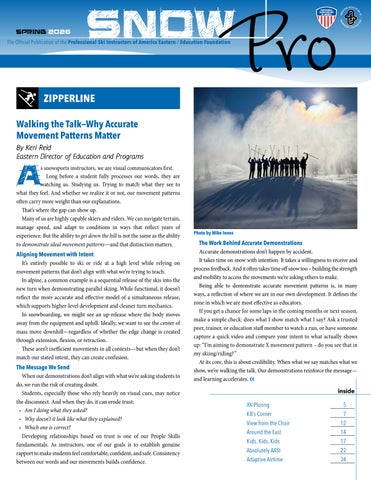
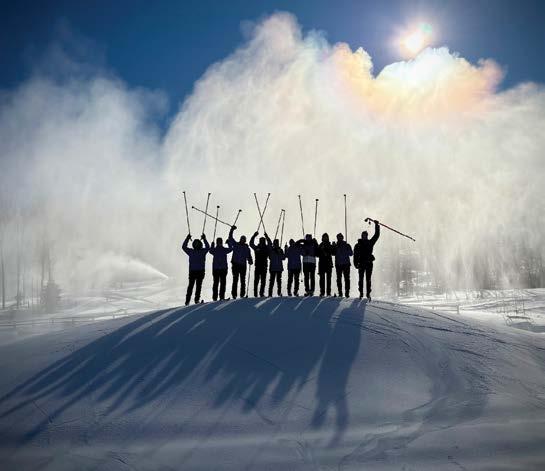
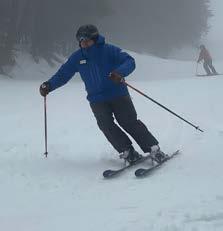
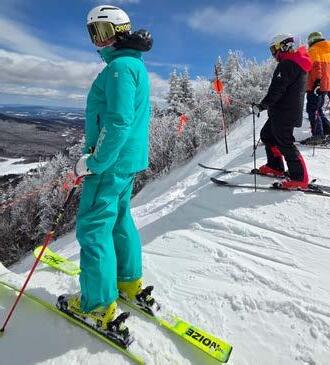
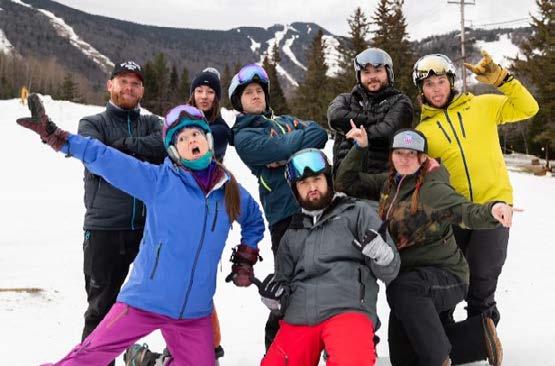
Photo by Mike Innes
Volume 52, Number 2
Kathy Brennan, Managing Editor
Karen Haringa, Assistant Editor
Mark Aiken, Assistant Editor
The official publication of the Professional Ski Instructors of America-Eastern Education Foundation 5 Columbia Circle Albany, NY 12203
Phone 518-452-6095
Fax 518-452-6099 easternsnowpros.org
General Information
Submission of articles, photos, or other items for publication is invited. Articles are not to exceed 1000 words. Receipt of submissions will be confirmed to the writer. Upcoming deadlines are published in each issue of SnowPro. Material should be sent to “SnowPro Editor” at: psia-e@psia-e.org as an MS Word document attachment.
All submitted material is subject to editing and, possibly, a writing process. Its use, whether solicited or not, is at the discretion of the editorial staff. All published material becomes the property of PSIA-E/ EF. Articles are accepted on the condition that they may be released for publication in all National and Regional publications.
The SnowPro is published three times per year by the Professional Ski Instructors of America-Eastern Education Foundation. Permission is hereby given to all National and Regional publications to copy original material from this newsletter providing credit is given to PSIA-E/EF and the author, and the material is not altered. Articles that contain specific copyright notices may not be reprinted without written permission from the author.
Note: Material published in the SnowPro which has been provided by persons not writing in an official capacity, and for official purposes, is the responsibility of the author, and is not necessarily endorsed by the Association. PSIA-E/EF reserves the right to refuse or edit all advertising
Fine-Tuning the Alpine Level III Assessment
By Chris Ericson Eastern Alpine Certification Chairperson, Alpine Examiner
Wow, what an exceptional winter across the Eastern Region. From both an operational and educational standpoint, the season will stand out as one of the most productive in recent memory. Consistent natural snowfall, sustained visitation, and strong participation levels extended well beyond traditional holiday periods, creating an environment where instructors were continually engaged in both teaching and professional development. Just as significant, this season provided repeated, real-world application of the evolving National Assessment model, allowing multiple examiner teams to evaluate its effectiveness under a wide range of conditions.
As with many recent updates tied to PSIA-AASI national alignment, this season represented a meaningful step forward in refining the assessment process. Building on last year’s single-event beta test, the Eastern Region expanded implementation of the proposed three-day assessment format across all Alpine Level III events. This broader rollout created a much deeper data set, informed by both candidate performance and examiner calibration, helping to identify where the process is effectively aligned with the National Standards and where further refinement may be warranted.
The revised structure separates the assessment into three days—skiing performance, teaching and people skills, and technical knowledge with movement analysis—allowing each area to be evaluated with greater clarity and depth. This segmentation reflects the PSIA-AASI Skills Concept and the fundamental principle that instructors must demonstrate competency not only in their own performance, but also in how they communicate, analyze, and facilitate learning. One of the most notable improvements in the Eastern implementation was the decision to separate the Teaching and Movement Analysis components into two distinct days. Historically combined, that format often limited the time and bandwidth candidates had to fully demonstrate proficiency across all assessment criteria. The updated approach provides more intentional space for candidates to meet the Assessment Criteria.
The skiing performance day focuses on technical skiing performance, and, in the East, this remained largely consistent with prior seasons in terms of task design. Candidates participated in a series of prescribed activities designed to elicit specific demonstrations of the Technical Fundamentals. These activities were conducted across varied terrain and conditions, often repeated in different environments to assess adaptability. Importantly, evaluation is not task-specific; rather, it is centered on how effectively a candidate applies the fundamentals to achieve the desired ski performance outcomes. From an assessment standpoint, this aligns directly with PSIA-AASI’s emphasis on outcome-based evaluation rather than task completion. Candidates benefit from recognizing that a single imperfect run does not define performance—what matters is the consistency and accuracy of fundamental application over time.
The Teaching and People Skills day represents one of the strongest expressions of the Learning Connection Model in the assessment process. The format is intentionally designed to mirror authentic teaching scenarios. Candidates begin by skiing with their peers, engaging in dialogue to understand goals, motivations, and performance needs. This collaborative environment allows candidates to demonstrate their ability to build trust, establish relevance, and tailor their approach—key elements of effective People Skills. As the session progresses, each candidate leads a coaching segment, typically around 30 minutes, where they must organize the group, create clear learning outcomes, and facilitate experiences that promote skill acquisition.
From an evaluator’s perspective, this module highlights a candidate’s ability to create a great learning environment using various teaching methodologies. Effective candidates demonstrate the capacity to create experiences that are movement-based, relevant, and appropriately paced. They prioritize mileage and repetition over static or overly segmented drills, recognizing that most learners benefit from guided discovery within dynamic skiing environments. Time management and group flow become critical variables; candidates who struggle often do so not from a lack of knowledge, but from an inability to efficiently structure the experience in a way that maximizes learning within the given timeframe.
The movement analysis and technical understanding day is arguably the most direct expression of the “observe, evaluate, describe, prescribe” framework that underpins PSIA-AASI’s approach to teaching and coaching. Candidates are evaluated on their ability to accurately assess skiing performance, connect observations to the Technical Fundamentals, and develop appropriate, outcomeoriented prescriptions for change. The day typically begins with group skiing, allowing candidates to gather initial observations in a natural setting. Structured activities and guided discussions follow,
providing opportunities to articulate what is seen, why it is occurring, and how it relates to desired performance outcomes.
At the highest standard, expectations extend beyond basic identification of movement patterns. Candidates must demonstrate a nuanced understanding of causeand-effect relationships, supported by biomechanics and an understanding of how skill blending influences performance. Strong candidates show clarity in their descriptions, precision in their technical language, and relevance in their prescriptions—ensuring that any recommended changes are both actionable and aligned with the skier’s goals.
Ultimately, the continued evolution of the three-day assessment model reflects a deliberate effort by PSIAAASI to more accurately evaluate the assessment processes with the same process across the entire country. By creating clearer separation between performance domains and aligning more directly with the Technical Fundamentals and the Learning Connection Model, the process is moving toward a more valid, consistent, and authentic measure of instructor competency. As this model continues to be refined through ongoing feedback and field application, it is important for candidates and educational staff alike to stay engaged, adaptable, and focused on the underlying goal—developing wellrounded professionals who can ski, teach, and analyze at the highest level across a wide range of conditions and student needs. <<
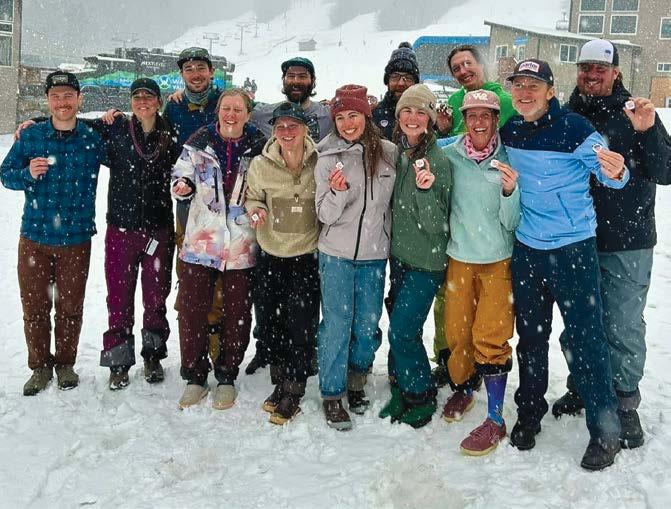
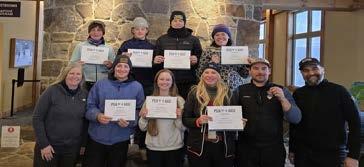
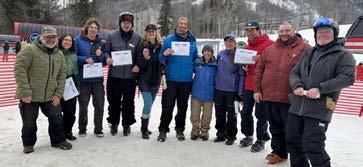
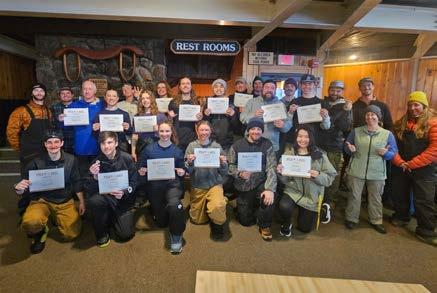
Please join us in congratulating and welcoming the newest members of the PSIA-AASI Eastern Alpine Development Team! Front Row (L to R): Luke Toritto (Berkshire East), Stephanie Zimmers (Waterville Valley), Amanda Allen (Sugarbush), Christa MillerShelley (Sunapee), Sam Curtis (Whiteface), Claudia Fetterman (Roundtop), Genevieve Pennington-Fitzgerald (Mount Snow), Jared Manville (Stratton) Back Row (L to R): Stephen Gover (Okemo), Max Sleeper (Jay Peak), Matthew Walters (Elk Mountain), Chris Carter (Killington), Charlie McNeeley (Stowe)
These individuals have earned an incredible opportunity to learn, grow, and contribute to the future of snowsports education in the Eastern Region. We are excited to support them on this journey.
CALLING ALL ARTISTS
Enter our T-shirt design contest!
Design the Eastern Region T-shirt for the 2026-2027 season. Proceeds to support the Eastern Region Education Foundation. Submission deadline is August 31, 2026, at 11pm. Voting Sept 1st to Sept 15th.
◆ All artwork submissions will become the property of the PSIA-AASI Eastern Region. Artists may submit multiple designs. Designs may be in a single color or multiple colors; however, the more complex the design, the more the T-shirts may cost. The design should be created to fit on the front or back of an adult T-shirt.
◆ Designs must be submitted in a .jpg format for voting; however, for production of the winning design, vector files such as AI, PDF, EPS, SVG, and CDR may be required. (Bitmap/Raster files such as PSD, TIFF, PNG, and JPEG of a high-resolution of 300 dpi or higher and look good at 100% view may be acceptable).
◆ Votes will be gathered in a Formsite form where all designs will be displayed.
◆ The winning artist will be announced on September 30th.
The winner will receive two free shirts and a free admission to a two-day event during the 2026-2027 season. Submit your artwork at: https://fs9.formsite.com/PSIA-AASI-E/tshirtcomp/index
Fresh Tracks in Leadership
By Kathy Brennan Eastern Region CEO
Each year, Board service helps shape the future of PSIA-AASI Eastern Region by bringing forward leaders who care deeply about our members, our mission, and the long-term health of our organization. This year, we are pleased to share updates from Zones 2 and 4, and to recognize one board member whose term is coming to a close.
Newly Elected
Eastern Region members in Zone 2 selected Julianna Collins as their new Board Representative. Julianna will begin her three-year term on the second day of the June Board of Directors Meeting.
Julianna Collins is a Snowboard Level II member from Massachusetts who is affiliated with Wachusett Mountain. A member since 2011, Julianna shared that she has “… loved this organization for over a decade and [she is] truly honored to be given the opportunity to serve this organization.”
She sees the board as playing an essential role in ensuring the organization’s long-term relevance and success within the snowsports industry by monitoring performance, supporting alignment with mission, and helping identify both opportunities and risks. She also values the collaborative relationship between the board and upper management as a key part of effective governance.
We are excited to welcome Julianna to the board and look forward to the perspective and energy she will bring to the role.
See the rest of Julianna Collins’ biography at: easternsnowpros.org/about-us/governance/elections/candidates/
Reaffirmed for Another Term
In Zone 4, Landon Figg was reaffirmed for another term as Board Representative, running uncontested. Her new three-year term will also begin on the second day of the June Board of Directors Meeting.
Landon Figg is an Alpine Level II member from Virginia who is affiliated with Wintergreen Resort. Over the past three years, Landon has served on the board and helped strengthen its work within a Policy Governance framework.
Board Governance
The Eastern Region board is comprised of the board chair, the immediate past board chair, four at-large representatives, and four member-elected representatives from one of each of four election zones:
Zone 1 (Northern New England including NH, ME and VT)
Zone 2 (Southern New England including CT, MA and RI)
Zone 3 (Mid-Atlantic including NJ, NY and PA)
Zone 4 (South including DE, MD, VA, WV, NC, SC, GA, FL and Washington D.C.)
As defined in our bylaws, an individual must be a certified level I, II or III member in their fourth year of continuous membership to be qualified to serve on the board of directors. No full-time, year-round employee of the association may hold a position on the board of directors.
Landon shared that she remains committed to the long-term success, integrity, and relevance of the organization for its members. She shared “I’m truly honored to continue serving on the board for the members of the Eastern Region. I look forward to building on our progress and achieving even greater things together.”
She believes the board’s role is to define strategic direction, articulate the outcomes the organization seeks to achieve, and provide clear oversight and accountability, while leaving day-to-day operations to management.
We are grateful that Landon has chosen to continue serving and look forward to her ongoing contributions as the board continues its work on behalf of the membership.
See the rest of Landon Figg’s biography at: easternsnowpros.org/about-us/governance/elections/candidates/
Thank You for Your Service
This June, Terry Xie will conclude his service as the Zone 2 Board Representative, completing a three-year term from June 2023 through June 2026.
We extend our sincere thanks to Terry for his volunteer leadership and service to the Eastern Region. Serving on the board requires time, thoughtful engagement, and a commitment to helping guide the organization strategically on behalf of the membership. Terry’s contributions during his term have been appreciated, and we are grateful for the care and professionalism he brought to the role.
As Terry prepares to step down from this role he shared, “It’s been an honor to serve on this board. As our industry evolves, the organization is adapting well. I’m excited for the future and look forward to staying involved in many ways.”
Please join us in thanking Terry for his service to PSIA-AASI Eastern Region.
A Word of Thanks
We thank Julianna and Landon for their willingness to serve, and Terry for the time and energy he has given over the past three years. Board service is an important part of keeping our organization strong, thoughtful, and responsive to the needs of our members.
If you run into any of these individuals, please congratulate Julianna and Landon, and thank Terry for his service. <<
In addition, the maximum representation of Education Staff on the board is 50% of the total seats. Board members, with the exception of the board chair, may serve a maximum of two three-year terms (6 years).
To support these term limits and ensure continuity on the board, a schedule has been defined to stagger the board members’ terms. Newly elected or affirmed candidates begin their three-year term during the annual fiscal-year end board of directors meeting.
In early 2027, the membership will be electing new board representatives for Zone 3, as well as selecting two At-Large board representatives. If you are interested in applying, please look for emails, articles, and social media posts with more information in the fall.
XX-PLORING
Cross Country Update: A Season of Snow and Shared Success
By Mike Innes Cross Country Examiner, Assistant Cross Country Coordinator
The 2025–2026 season across the PSIA-AASI Eastern Region will be remembered as one of the most consistent winters we’ve experienced in years. Reliable snow conditions carried us through the heart of the season, and while temperatures often leaned toward the cold side, they brought one undeniable advantage—predictable wax selection and excellent skiing surfaces.
More importantly, this season was defined by connection, learning, and growth within our cross-country community. Across a wide range of events, we saw strong attendance, enthusiastic participation, and a shared commitment to improving both teaching and personal performance.
We began the season at the Ski School Management Seminar at Mount Snow in December, marking the second consecutive year that cross country skiing has been included in this important early-season event. The morning session focused on the beginner skate experience—breaking down fundamentals and creating accessible entry points for new skiers.
In the afternoon, we shifted to a collaborative roundtable discussion centered on best practices for delivering exceptional guest experiences. Topics included lesson retention strategies, building return visits, and creative programming ideas for Nordic centers to expand offerings and generate revenue. The energy and idea-sharing set a strong tone for the season ahead.
Participation surged at many of our core events. The December gathering at Lapland Lake Nordic Center saw the highest attendance in years—an encouraging sign of renewed enthusiasm and engagement.
At the Early Season Primer hosted by Von Trapp Family Lodge and Resort in January, participants focused on refining both skiing technique and teaching strategies. These early-season touchpoints continue to play a critical role in setting instructors up for success.
The January Ski and Teach Improvement clinic at Mt. Van Hovenberg highlighted the strength of their Nordic staff and their growing connection to the PSIA community. It was exciting to see continued integration and collaboration across venues.
Cold temperatures became a defining theme of the season—but they never slowed us down.
Also in January, at the Woodstock Nordic Center, a frigid weekend concluded with a major winter storm, creating memorable conditions for the Classic/Skating Improvement clinic. Participants embraced the challenge, sharing ideas and welcoming new members into the fold.
The Instructor Training Clinic at Bretton Woods Nordic Center at the end of January continued to be a cornerstone event, helping instructors refine teaching progressions and prepare for a full season of lessons.
Meanwhile, the Video Ski Improvement Clinic in Jackson emphasized movement analysis through video—a powerful tool for observation, feedback, and technical development. Attendees left with practical strategies for analyzing and improving skier performance.
One of the most exciting developments this season was the continued growth of our Alpine/XC crossover events at Gunstock Mountain Resort and Waterville Valley Resort.
These unique events—featuring cross country skiing in the morning and alpine skiing in the afternoon—created meaningful opportunities for instructors to expand their skill sets and perspectives. We also saw a noticeable increase in Alpine-certified members participating in cross country events, strengthening the connection between disciplines and enriching the overall learning environment.
The Classic and Ski Improvement event at Waterville Valley in February stood out not just for its excellent conditions, but for its people. Each year, a dedicated group returns—bringing friends, colleagues, and new participants along with them. The sense of community continues to grow, creating an environment where learning feels both meaningful and personal.
These returning participants truly feel like family, and their continued engagement is a testament to the value and impact of these experiences.
The Level II and Level III Assessments, held at Bretton Woods on March 7-8, showcased a strong group of candidates who rose to the challenge and achieved success. Their accomplishments reflect the depth of preparation and commitment within our membership.
Across all events, a consistent theme emerged:
• Improved personal skiing performance
• Stronger movement analysis skills (observation, evaluation, prescription)
• Expanded teaching progressions and strategies
Although March brought an early warm-up, the season delivered consistency, quality snow, and exceptional opportunities for growth.
This season highlighted the strength of our community and our willingness to learn, share, and support one another. The increasing crossover between Alpine and Nordic disciplines, the return of familiar faces, and the influx of new participants all point toward a bright future.
As we transition into spring and summer, we carry forward the momentum built this winter. There is excitement around continued development, summer training opportunities, and preparing for another successful season ahead.
Thank you to everyone who contributed to making this year so impactful. Happy spring and summer—and we look forward to seeing you back on snow next season! <<
Nordic and Telemark Wrap-up
By Mickey Stone, Nordic Coordinator and Nordic Examiner
This was the season of winter storms up and down the East coast and New England. It is not every winter that Connecticut, Rhode Island, and Massachusetts receive more Nor’easter storms than Maine and the rest of New England. It was nice to see the entire East coast receive snow accumulation during the season. We also had many follow up rainstorms which are always unfortunate. We should all be very happy with our winter with changing weather patterns and the low snow year out West. We keep hanging on. Just as at the start of the season, both the East and West had similar quantities of machine-made snow throughout December.
This was ideal for early events and preseason training at Mount Snow.
The Nordic discipline ran several events: A big in-house training for Lapland Lakes, NY attracted almost 20 Cross Country members.
On the Telemark side we had a successful Academy at Killington, recognizing Tom Skeedos with the Kare Anderson Telemark Award.
The Seven Springs Early Season Primer was held this season, along with an independent Level I event. We are starting the new stand-alone Level I event as we ready ourselves for realignment with all regions. Many of these “test” events canceled due to too few Telemark and Cross Country instructors that are new to the organization in one geographical area to make an event go. In the future, we will schedule Level I events with our larger festival-type of events – the Southern and Northern Hoedowns, Level II and Level III Assessments, Eastern Academy, in-house trainings, Rallies, and the Tele Fling. We hope this will help our Level I base for the future.
This season, we ran our second Level II Assessment at Timberline in West Virginia. Eight Telemark instructors participated in two days of assessments with six successful candidates. Congratulations to all participants for taking on the challenge. Successful candidates were John Deddens, David Holladay, David Leslie, Michael Moran and Bill Kist. Congratulations to Shawn Riggle and Kurt Byrnes for organizing a well-run event. Not only did this event go, but the Southern Nordic Hoedown had double-digit numbers. These Hoedown events include Cross Country, Backcountry, and downhill Telemarking on and off-piste – truly a Nordic dream to use all the equipment in your quiver. It is time to thank, embrace, support and assist Appalachian Telemark Association in western Pennsylvania. They hub out of Seven Springs, PA, but host events all over the south, especially in the West Virginia area. They have over 30 rental setups with boots, skis, and bindings. The lack of demo or rental equipment has been the number one barrier to getting new people into our sport. Thank you to ATA! We are fortunate that we have on our Telemark Squad ATA’s Current Leader, Kurt Byrnes and key staff for ATA – Jay Nation, Shawn Riggle, Adele Wellman, Keith Rodney and Don Sensenig. KUDOS to
all of you for this important and continual line for feeding new members in our discipline.
We also held Level II and Level III Assessments and a Development Team Selection at Killington, VT in mid-March. We had three successful Level II candidates and a successful Level III candidate. Congrats to all who participated and trained for these events. There were some soft and then frozen large bumps on Ovation and Superstar for our skiing pleasure as well as rain, frozen-solid snow, lightning, and full-on sun. A great two days! Thank you Killington!
We also have the pleasure of introducing Angelo Ross as our new Telemark Development Team Member. Angelo is involved on the National
PSIA Educational Team, sits on the Educational Leadership Council as a liaison to discipline groups, teaches, and is an alpine examiner. Congratulate Angelo on the multi-disciplinary skills this man has.
In March, an Eastern Team selection was held at Stowe, Vermont. Telemark Examiner Shannon Belt of Black Mountain, Maine was selected, and he will represent the Eastern Region at the National Team selection in 2028 (see his photo with the rest of the Eastern Team on page 19).
Congratulations Shannon!
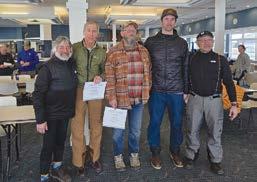
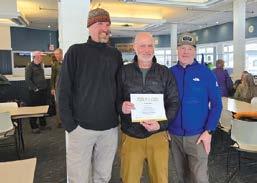
During the Killington Assessments, we honored the Eastern Region’s first Nordic Coordinator and first Eastern Nordic member on the National Team (then called the Demo Team), John Tidd. He has mentored many of us in the Eastern Region. Kathy Brennan and Keri Reid presented John with the National Lifetime Membership Award which recognizes members who have done extraordinary things in their discipline. In addition to his contributions to PSIA, John designed, manufactured, and sold Tidd Tech Design, a revolutionary and affordable crosscountry groomer; he operated Mountain Meadows XC Center near Killington for decades; and he was recently inducted into the Vermont Ski and Snowboard Hall of Fame.
Enjoy the end of the season and we hope some of you are lucky enough to extend your skiing out West or this summer Down Under. We appreciate your support of the Nordic discipline. <<
Alpine and Telemark Education Staff
(l-r) Mickey Stone, Scott Hammond, Patrick Juliano, Duncan Yarworth, and Ali Pirnar
Mickey Stone, Shannon Belt, new Dev Team member Angelo Ross, Dave Capron, Ali Pirnar
Lifetime Member John Tidd and Kathy Brennan
Shannon Belt, new Level III instructor Roy Whitaker, and Dave Capron
Southern Hoedown, Cannan Valley looking out at the Timberline Valley WV
Welcoming the Journey, Upholding the Standard
By Kathy Brennan Eastern Region CEO
Over the course of this season, we have received feedback, some thoughtful, some challenging, about the assessment experience. In particular, questions have been raised about fairness, consistency, and what it truly means to meet the standard.
These conversations matter. They matter because they reflect how our members experience our organization. They matter because they ask us to look closely at our processes. And they matter because they give us an opportunity to be clear about who we are and what we stand for.
Certifications Reflect Competency
At the heart of this conversation is something fundamental: We welcome members from a variety of backgrounds and pathways into our organization. Certification, however, reflects readiness to teach at the national standard. That distinction is important. Each certification represents a specific level of application. For example, a credential like Children’s Specialist 2 reflects the ability to adapt core discipline knowledge to effectively teach children in the intermediate and advanced zones. These designations are not just acknowledgments of experience; they reflect the ability to apply skills in specific teaching contexts.
As our Director of Education and Programs Keri Reid highlights on page 1, how we demonstrate matters. Our movements must align with our message. In the same way, certification reflects our ability to bring together skiing or riding performance, teaching, and communication in a way that supports student learning.
PSIA-AASI certification is not simply a measure of personal skiing or riding ability; it reflects competency in all facets of the Learning Connection Model (People Skills, Teaching Skills, and Technical Skills). Candidates who demonstrate mastery in these areas are certified to be able to connect with students, communicate clearly, and guide learning in ways that lead to meaningful improvement. These are the skills that define great instructors, and they are central to the standard we uphold.
We recognize that members come to this work from different starting points. Some are actively teaching every day; some make a minimum parttime commitment. Others are early in their instructing journeys, building experience and developing their skills. There is value in all. Our educational events are designed to support growth at all levels, and we want our community to remain open and accessible to those who are developing their pathway into instruction.
It is important for aspiring certification candidates to fully understand the expectations around assessments and exactly what each certification represents. An assessment is not just a milestone; it confirms that the skills required at the standard have been developed and can be applied consistently. Candidates are expected to demonstrate not only how they ski or ride, but how they teach, how they communicate, what they know, and how they adapt to the needs of others. Without a clear understanding of these expectations from the outset, the outcome can feel frustrating, especially when all elements have not yet been developed and applied with consistency.
Understanding Assessment Scores
An area that can create confusion is how assessment scores are interpreted. Our scoring system is not based on a traditional pass/fail percentage model. Instead, it reflects stages of skill development. A score of 3 indicates the required elements are beginning to appear, but not yet with consistency. A score of 4 reflects that those elements are demonstrated regularly at a satisfactory level, which is the standard required for certification.
This distinction is important. A score of 3 is not a failure in the traditional sense, it is an indication that the candidate is developing the necessary skills but is not yet able to apply them consistently in a teaching environment. In many cases, the difference between a 3 and a 4 is not knowledge, or how quickly someone can get down the hill, but experience and consistency.
As instructors, we are all working toward a level of performance where our movements, demonstrations, and communication align seamlessly with our intent. At higher levels, this means being able to adapt in real time to student needs, terrain, and conditions with clarity and confidence.
Understanding this progression helps reinforce that certification is not just about whether a skill appears, but whether it can be applied reliably in support of student learning, and the scores highlight areas where we can continue to improve.
Our Responsibility as an Organization
Our responsibility as an organization is twofold. First, we must maintain the integrity of the standard. That means being consistent and fair in how we evaluate all candidates. Our Education Staff work hard to do exactly that, and I have confidence in their commitment to upholding these expectations.
Second, we must ensure that members are well prepared and understand what is expected before they arrive at an assessment. Clear communication, thoughtful preparation, and meaningful feedback are essential to creating a positive and productive experience, regardless of the outcome.
We also recognize that perception matters. Even when standards are applied appropriately, if the experience feels inconsistent or unclear, it can erode trust. Listening to feedback, asking questions, and continuing to refine how we communicate and deliver assessments are all part of strengthening that trust.
This is not about lowering the bar. It is about making sure the path to that bar is visible, understood, and supported.
Our goal remains the same: to develop skilled, thoughtful, and effective instructors who can make a meaningful impact on the people they teach. That requires both a commitment to high standards and a commitment to helping our members grow toward them.
Thank you to those who have shared feedback, and to our staff who continue to do this work with professionalism and care. Together, we will continue to learn, adapt, and move forward. <<
KB’s 2025-26 Listening Tour Stops
Blue Hills, MA*
Cochran’s Ski Area, VT*
Gunstock, NH
Killington, VT
Lapland Lake Nordic Center, NY*
Mount Snow, VT
Mt. Southington, CT
Nashoba Valley, MA*
Pat’s Peak, NH
Stowe, VT
Stratton, VT*
Thunder Ridge, NY*
Wachusett Mountain, MA
Waterville Valley, NH
*Designates a new stop
Congratulations!
Congratulations to the following members who earned their new Level I, Level II or Level III certification or their new Children’s or Freestyle Specialist accreditation during this past season!
Alpine Level III
Christopher Anderson
Jake Crawford
Fred Dieffenbach
David Fournier
Weixun Ge
Jerry Gilliam
Gillian Hayden
Matthew Heiman
Sarah Jiottis
Michelle Leibowitz
Jennifer McAward
Brian Polizzi
Shawn Russell
Curt Schibli
Matt Seney
Moshe Silverstein
John Wells
Alpine Level II
Ian Absalom
Aaron Ackley
Dennis Alexander
Arthur Ambler
Ashlynn Anderson
Douglas Arnold
Charlie Bailey
Jacob Bausher
Kristen Berger
Brooke Bezoza
Walter Bixby
Carlos Bonetto
Brock Brown
Patrick Brown
Jamie Bryan
Noah Budnovitch
Austen Canova
Jackson Cantillon
Keith Cassidy
Siying Cheng
Daniel Compatangelo
Rob Crites
Patty Croccolo
Patrick Danahey
Patricia DeMiglio
Edward DeNicola
Christopher Dominici
Madison Dreyer
Tucker DuPaul
Marbella Duricko
Aubrey Elder
Kurt Fisher
Daniel Flores
Elizabeth Fosnocht
Ryan Galligan
Paul Gasparini
Jonathan Gleason
Finnegan Gormley
Wendy Gross
Dominic Grosso
Alanna Guilfoyle
James Halliday
Ella Haslett
James Haslett
Yu Huang
Emma Ivory
Dylan Jasulevicz
Bob Jenkins
Xiaojia Jin
Brendan Kantscheidt
Rodney Kidder
Lise Kolota
Henryk Kosmala
Travis Lane
Nick Latinski
Zachary Lindsey
Elizabeth Lobb
Katherine Lozancich
Robert Madigan
Paul McCrimmon
Gervasio Mendez
Casariego
Eric Miller
Joseph Milteer
Liz Muller
Eban Noble
Maria Ordway
Paul Palmgren
Hao Pang
Stephen Paquin
Madeline Perfetti
Mark Pest
Kelsey Poole
Stephen Pound
Devin Reston
Dabney Richardson
Jeffrey Rininger
Alex Roginski
Jonathan Ross
Zenas Savage
Hallie Scammell
Carole Scovill
Xuechan Shen
Paul Shepherd
Finn Shookenhuff
Megan Shortt
Aspyn Shriver
Dov Simons
Caleb Singer
Greg Slack
Maren Smith
Deying Song
Robert Stiling
Yafan Su
Thomas Suh
Lawrence Takken
Matt Tumavitch
Fumi Usuki
Nicholas VanDuser
David Witmer
Don Wolski
Qian Xie
Jingjie Zhang
Limin Zhang
Naram Ziady
Alpine Level I
Audrey Abucewicz
Stephen Aftosmis
Aaron Alfano
Paul Allen
Ariana Altman
Adam Anderson
Hamilton Andrews
Karl Anshanslin
Brian Appleby
Blu Arbesman
David Armor
Shannon Astholz
Oliver Finn Audley
Jean Avery
Sergei Babovich
Leyla Bac
Dawn Bardot
Nickolaos Barous
Alexander Barrick
Isabel Barton
John-Henry Barwick
Lisa Bates-Dubrow
Ellie Beard
Lucy Beardmore
Felix Begley
Bjorn Bellenbaum
Alexander Belmont
Kylie Benek
Karolina Bergstrand
Amy Berrier
Alara Bhatia
Ryan Blais
Mark Bogar
Kip Bogdahn
Fernanda Bolanos
Emma Born
Thaddeus Borowiak
Raiden Borromeo
Anne Boscarino
Scott Boucher
Stephen Boucher
Katherine Brabham
Keith Brady
Emily Breedis
Sebastian Brochu
Isis Brouwer
Audrey Brown
Hannah Brown
Tyler Brown
Jeff Bruckner
Kathryn Brunelle
Owen Budnovitch
William Buehler
April Burke
Meghan Burkett
Evan Burleigh
Kathryn Burns
Anna Bushey
Owen Byrne II
Liz Callahan
William Calohan
Jackson Cantillon
Cornelius Carelsen
Thomas Carroll
Cora Carvalho
Emma Carvalho
Ethan Carvalho
Isabella Casagrande
Michael Cassidy
Anne Castine
Henry Chamberlin
Qilong Chen
Sheng-Wen Chiu
Andrea Ciaranello
Alivia Ciarcia
Mason Clark
Jay Clarke
Malin Clyde
David Cohen
Campbell Coleman
Clara Connell
Parker Connolly
Phoebe Connolly
Evan Constantine
Olivia Conti
Erika Cook
Jack Cook
Carlena Cooper
Nathaniel Coppock
Dean Corriveau
Sean Cotton
Tony Coughran
Hailey Couling
Carole Crawford
Louis Crisci
James Crosby
Spencer Cross
LeAnn Crotts
Stephen Curry
Ryan Cutting
Daniel Dahlke
Natasha Dalton
Joy Damato
Kathleen Darcangelo
Jillian Darcy
Henry Davidson
Mattheus de Paula
Jared Deacon
Lily DeBonis
Kamryn DeLeon
George Delianides
Myla DeLoatch
David Desroches
Shea Devine
Jeffrey Dickmann
Joanne Dickson
Joshua Dilts
Dennis Doherty
Kevin Donovan
Patrick Dougherty
Caden Dufour
Jeffrey Dumars
Coleman Duncan
Audrey Dupuy
John Durant
Kay Durette
Noah Duris
Paul Durocher
George Dzupinka
Eva Ebeling
Sophia Eberly
Eva Ecker
Tim Ellis
Evelyn Embow
George Essex
Peter Eygabroad
Johanna Faltin
Aine Fannon
Beryl Farbrother
Gabriel Feldblum
Anthony Ferradino
Anthony Ferraiolo
Jeantet Fields
Lyra Fields
Fil L. Fina III
Andrew Finneran
Colin Foley
Andrew Fontana
Caleb Ford
Ryan Frank
Ivy Frignoca
Jack Futerman
Calvin Gainey
Owen Gallagher
Hannah Gaston
Shelley Gatto
Sam Gen
Daniel George
Shana Gibbs
Chris Gigler
Jennifer Gilbert
Tom Gillon
Katherine Gines
Matthew Gnoza
Kristen Gogots
JP Golderer
Andrea Goldstein
Alexandra Gonzalez
Andrew Goodwin
Jerald Gordon
Hunter Gosselin
Martin Gosselin
Maria Gran
Anthony Grande
Maurice Grant
Myles Greenberg
Sidney Greeson
Lara Grinspun
Kristin Grogan
Eric Grover
Peter Gryga
Kristy Gustafson
Andrew Gustavson
Alexander Hager
Amy Hannum
Nathaniel Hanson
William Hanson
Yue Hao
Shane Harasyko
Steven Harman
Marley Harmer
Brendan Hayes
Martin Hayes
Sarah Heaphy
Sarah Hellewell
Holly Hendricks
Colin Hennigan
Sierra Hester
Edward Heyman
Sally Higgins
Claire Himmel
Miles Hinksmon
Skylar Holliday
Haoxiang Hong
Sean Horgan
Chip Hornbeek
Darren Houle
Alden Howard
Catherine Howard
Pamela Howard
Kevin Howe
Carmen Huang
June Hubbard
Robert Huff
Anna Hughes
Jack Hunnewell
Michelle Hurteau
Kerry Hussey
Zoe Hyman
Sam Iatarola
Tera Ingraham
Chris Jackson
Adrian Jacobson
Joshua Jean-Charles
Pristine Johannessen
Matthew Johnson
Isabelle Judy
Nikash Kathuria
Samantha Kawecki
Eric Kellar
Bruce Kelly
Dylan Kelly
George Kermond
Justine Khorover
Thomas Kinney
Olha Kivalova
Kelly Klimczyk
Brenden Klink
Peter Knapp
Ky Koitzsch
Michelle Kossakowska
Kyle Kramer
Mila Krane
Peyton Krause
Stephen Kuzil
Jackson Kwaizer
Robert (Robbie) Lally
Brad Lancaster
Connie Lane
Jesse Lane
Hope Lanza
Audra Lapati
Kira Lapi
Elena Lark
Carter Larsen
Quinn LaValle
Mackenzie LeBuhn
Gary Leonard
Brian Leth
Sophia Levitt
Annabelle Levy
Connor Levy
Ethan Levy
Zeyu Li
Zijing Li
Dan Lin
Evan Lister
Chang Liu
Shu Liu
Kevin Lombardi
Stephanie London
Dustin Lumbra
Long Luo
Nora Luz
Leah Lyons
Chaoqun Ma
Huaqiang Ma
Wenxiu Ma
Claudia Mabley
Otto Mabley-Ward
Ryan MacNeille
Lucia Macor Yanez
Libby MacPherson
Alexander Mahaffy
Stephen Maloney
Thomas Maloney
Frank Manegio
Francisco
Manoukian Lopaczek
John Mansfield
Tracey Martell
Valentino Matta
Noah Matthews
Gaston Mauri
Caroline McCall
Eva McCullough
Jock McCullough
Emilie McElroy
Lillyan Medor
Maya Medrano
Rebecca Mellaly
Jake Miller
Jason Miller
Terry Miller
Daniel Mon
Annick
Monk-Goldsmith
Alexander Montesano
Austin Moody
Lauren Moon
Brian Moore
Ellie Moore
Steve Moore
Denise Moraski
Daniel Morrison
Thomas Morse
Peter Mortimer
William Mortimer
Maia Morton
Kyle Mullins
Alissa Munroe
Alvaro Murias
Rick Murphy
Wyatt Murphy
Hannah Murray
Catharine Myung
Janusz Nagiecki
Hajna Nagy
Martha Nagy-Wentz
Matthew Napolitan
Colin Nash
Elisa Needham
Ian Nevins
Jennifer Newick
Marion Nichols
Alexander Niculescu
Gavin Niemela
Mark Norell
Madi Norris
Peter North
Hannah O‘Brien
Ovidiu Ocrain
Cassidy O‘Donnell
Isidora
Orellana Severino
Michael Orr
Eboni Osavio
Nicole Osborne
James Ourand
Dixon Pack
Karen Padir
Luke Paliocha
Ariel Paliy
Joseph Palka
Chang Pan
Marissa Pane
Lex Park
Seth Park
Lyubov
Ella Peconie
Jake Pelusi
Tori Pendleton
Charles Perry
Grace Perry
Edward Persico
Maya Phillips
Joaquina
Pillado Matheu
Benjamin Pineault
DJ Plante
Isabella Pollina
Matt Pomeroy
Andrew Potter
Isabel Prado-Tucker
Agustin Mariano Prieto
Oscar Pulliam
Matthew Puryear
William Puzella
Boyu Qian
Lu Qian
Jorge Quiroz
Kelly Raynes
Katina Ready
Eva Refalo
Emma Renyi
Erin Reynolds
Katie Rich
Greg Rittler
Anthony Roberts
Stiles Rockey
Olivia Rodrigues
Peter Rodriques
Alessio Romano
Brett Rose
Roger Roth
Jonathan Royce
Dylan Russell
Daniel Ryan
Deirdre Ryan
Garrett Ryder
Sean Samagaio
Alexa Saracino
Jake Saunders
Jonah Saux
Julianna Schiefer
Martin Schiraldi
Malia Schmelzer
Bryce Schneble
Michael Schneck
Lindsay Seifarth
Hudson Seiferth
Fathima Shaikh
Jialin Shan
Madeline Sharkey
Will Sherwood
Cole Shriver
Joel Simon
Willa Skye
Anastasia Slobodnik
Grey Small
Gunnar Small
Caroline Smith
Gerard Smith
Isabella Smith
Kaitlyn Smith
Nicolas Soberon
Allison Sokoloff
Maya Soule
William Spencer
Merritt Spitzer
Lee St Onge
Lily St. Onge
Theodore Stamas
Henry Stamp
Abigail Stewart
Peter Stoepker
Joshua Stone
Jackson Stratford
Brayden Streich
Lin Su
James Sullivan
Nina Sweet
Kathy Swingley
Richard Sylva
Bartlomiej Szumilak
Xinyang Tan
Christa Taylor
Joseph Taylor
Nicholas Temnycky
Lily Thomas
Robert Thomas
Andrew Thompson
Charley Thompson
Ryann Thurmond
Marc Toyloy
George Tracy
John Tragert
Ella Tran
Leila Tran
Jordan Turner
Morgan Turner
Elie Twersky
Gavin Tynan
Markiyan Tytla
Nicole Ucher
Paul Unruh
Virginia Vatcher
James Vaughn
Sakura Velazquez
Santiago Villares
Zara Waldman
Andrea Walsh
Yang Wang
Thomas Warnick
Terry Wasserleben
Ann Watkins
Nathan Waugh
Spencer Weigand
Alec Weinberger
Jesse Weisfelner
Elizabeth Weissman
Richard Whalen
Bruce White
Nancy White
Anthony Wilhelm
George Wilk
Jillian Willard
Erik Williams
Clara Wilsher
Janet Wilson
Loretta Wilson
Everett Winslow
Mark Wnuk
Oscar Wolpert
Seamus Woodruff
Ella Wright
Changsheng Wu
Brad Wyndowe
Leyan Xu
Yunchun Xu
Xinyi Yang
Mingsong Ye
Isabella Yecies
Zhehao Yu
Sophia Zah
Joseph Zannoni
Sylvia Zawistowska
Kaijin Zhang
Liang Zhang
Yi Zhang
Junhan (“Rice”) Zhao
Ming Zhu
Tianmou Zhu
Samuel Zionts
Yurou Zou
Children’s Specialist II
Katie Ahern
Gerrianne Breck
Nathan Breece
Beth Buvarsky
Roger Cooney
Deb Fennell
Mitchell Gill
Timothy Kaul
Sarah Kneip
Elizabeth Lozinger
Connor Mahoney
Emily McCutcheon
Orion Metheny
Szymon Kucharski
Greg Kulesza
Matthew Kulik
Carolina Mendez
Lauren Mensch
Peter Merz
Paskova Anderson
Elaine Paulk
Grace Payne-Hurley
Maximilian Siciarz
Lonny Silverman
Pamela Simmonds
Zexi Wang
Zhe Wang
Finn Ward
Jocelyn Otte
Isabella Renney
Rachel Rodriguez continued on next page
Congratulations, continued
Philip Schwartz
Luke Toritto
Timothy Watson
Qi Xiong
Children’s Specialist I
Alison Aaron
Laura Adam
Carol Allen
Adam Anderson
Jonathan Anderson
Leslie Archer
Hayden Baker
Natalia Baker
Glenn Barney
Isabel Barton
Carolyn Baryluk
Gary Beck
Lila Beckwith
Shannon Belt
David Berger
Allen Bertapelle
Kendra Biery
James Boriotti
Peter Bowers
Sebastian Bravo
Theresa Brayman
Ryan Brown
Talia Bukalov
Sam Burke
Robert Burns
Ashley Bushong
Kurt Byrnes
Owen Calderwood
Manuel Camargo
Vaiana Cane
Jackson Cantillon
Bryan Carnahan
Christina Cerroni
Mike Chaloux
Grace Chamberlin
George Chapman
Sorachat Chavalvechakul
Jennifer Chen
Travis Cloud
Brian Colbert
Grant Cone
Parker Connolly
Elizabeth Cook
Demery Coppola
Rebecca Cowan
Maia Crichlow
Brent Critchfield
Wayne Curtis
Dan D’Agostino
Susan Dahlhaus
George Davison
Marco De Fazio
Emily DeCrescenzo
Robert Dell‘Amore
Jim DeMichele
Janelle DeNormandie
Lisa Dickson
Jolene Donnelly
Tyler Drisko
Deidre Dutcher
Reina Ellis
Gerry Fabrizio
Melinda Fairchild
Brandon Farhat
James Farina
Urszula Felt
Helena Ferebauer
Angeli Feri
Josh Fields
William Fink
Benjamin Finkel
Stephanie Firstbrook
Daniel Flores
Jacob Fosco
Kent Foss
Amy Fox
Jeanne Fox
Coltrane Fracalossi-Lail
Karen Fulcher Scholz
Anthony Fusco
Sonya Garvis
Brian George
Elise Gilbert
Daniel Gillogly
Adam Ginsberg
Justin Glose
Matthew Gnoza
Ariana Gomez Sanchez
Alexander Goodrich
Emilie Goodrich
William Graf Grote
Brian Grannan
Jeremy Greengas
Julia Gros
Dominic Grosso
Jonathan Gryckiewicz
Gene Gugliotta
Arthur Hadden
Steven Harman
Khurram Haroon
David Harris
Karen Hauda
Yuxiu He
Sarah Heaphy
William Herlihy
Alison Hernandez
David Hershey
Dotty Heyming
Sally Higgins
Emma Hobson
Leah Holmes
Marion Horan
Ethan Howard
Pamela Howard
Thomas Howell
Sara Hughes
Bill Hummel
Jacqueline Hutchinson
Reid Inge
Miki Inoue
Mackenzie Jack
Sheila Jacob
Marilyn Jarriel
Mike Jarriel
Bob Jenkins
Jiawei Jin
Xiaojia Jin
Dan Jochim
Hugh Johnson III
Cole Johnson
Remi-Pascal Joyeuse
Lucy Jurevics
Maris Jurevics
Diane Jutras
Jeffrey Kahn
Andrew Kapitula
John Kaul
Jafr Kazmi
Madison Kelly
Christopher Kickham
Garrett Kieffer
Olha Kivalova
Don Kluchinski
Isaac Knox
Steven Knudson
Alexander Kohmann
Hayden Kolb
Chuck Kolbe
Annie Elizabeth Kreiser
Ryan Kresge
Malika Labossiere
Valerie LaFreniere
Derek LaHouse
Mountakha Latif
Daniel Leinweber
Tanya LeRoith
Jaki Levy
Mark Lewis
Yiran Liu
Christine Long
Theodore Longsworth
Krista Loring
Ursula Lovell
Katherine Lozancich
Daniel Ludwig
Long Luo
Otto Mabley-Ward
Michael Maguire
Tristan Magnuson
James Maloney
John Mansfield
Vincent Marcello
Gail Marchetto
Charles Marino
Marina Marten
Saige Martin
Gregory Mastrianni
Sophia Maurer
Rowan McGrath
Antje Mckee-Courcy
Michael McMahon
William McMinn
Gervasio
Mendez Casariego
Arthur Menichini
Lauren Mensch
Michael Meroski
Jonathan Merritt
Jonathan Meserve
Kayla Messina
Mirabelle Meyers
Antonia Millas
Molly Montague
Lisa Morin
Ralph Mosios
Dylan Mulligan
Philip Mumford
Grace Murray
Keith Myers
Zachary Nailon
Bethany Neumann
Carl Nicklas
Alexander Niculescu
Robbie Niemeyer
James Noel
Donald Nolett
Peter North
Sofia Nystrom
Patrick O‘Boyle
Sarah O‘Connell
Cassidy O‘Donnell
Jack Opie
Michael ORourke
Sam Orseno
David Ozahowski
Cheryl Paine
Hao Pang
Chloe Panzer
Naomi Parekh
Dolan Patrick
Melissa Patterson-Meador
Agustin Pedregal
Daisy Pelszynski
Mark Perschel
Randal Pfleger
Sophia Pisarski
Emily Pogozelski
James Polen
Mark Politano
Daniel Price
Jackson Price
Santiago Prieto
Thomas Putnam
David Radeschi
William Reese
Brennan Reiner
Sara Rhuda
Harrison Rice
Joe Richter
James Riddle
Garett Rinehard
Jasmine Rochon
Lee Rose
Harris Rosenblatt
Ian Roulat
Kent Royer
Larry Rubin
Mark Russell
Behnam Saberi
Samantha Safara
Jake Saunders
Bernhard Scholz
John Scott
Jeff Sears
Christopher Selena
Marikje Shelmandine
Xinyi Shen
Finn Shookenhuff
Jake Smith
Amelia Snyder
Dongchang Song
Dorothy Staub
Thomas Stellato
Brianna Stephenson
Karen Stevens
Sean Stoerrle
Stacie Street
Mark Syracusa
Bartlomiej Szumilak
Dietmar Tannheiser
Deborah Taricano
Jeremy Taub
Robert Torgov
Gregory Townsend
Marc Toyloy
Brian Trimby
Timothy Trout
Brandon VanDuser
James Vaughn
Joaquin Vazquez
Martha Veselka
Barbara Gail Warden
Lindsey Wat
George Watson
Michael Whinston
Mary Whitney
Nyssa Wilkinson
Erin Wilsey
Eric Wilson
Allen Withers
Mimi Wong
Amos Wu
Rich Wuerthele
Walter Wunderly
Acer Xu
Hao Yan
Jialu Yan
Elizabeth Yates
Milad Zarrin
Jason Zelman
Haiyan Zhang
Liang Zhang
Naram Ziady
Cross Country Level III
Sten Winborg
Cross Country Level II
Brendan Doran
Cross Country Level I
Timothy Ainsworth
Ethan Ball
Erika Breton
Matthew Brower
Robert Dadekian
Brendan Doran
Eric Kizak
Lance Law
Ronald Lessard
Kurt Magnus
Christopher Makowicki
Rebekah Mills
Katherine O‘Neill
Marijke Ormel
William Skelton
Griffin Smith
Freestyle Specialist III
Finn McGillicuddy
Jonathan Ross
Freestyle Specialist II
Aidan Chapdelaine
Steve Dushenko
Forest Jade
Luis Reyes
Annan Riordan
Maxwell Sleeper
Heather Macdonald
Niemann Pest
Grace Wall
Kyle Steinmetz
Freestyle Specialist I
Devin Ables
Chris Adamcik
Jeremy Armentrout
Klara Awodey
Emily Barton
Colin Bayer
Alan Bibalo
Nicholas Bogue
Bryan Bremer
David Conklin
Kyle Constantine
Ian Corbett
Chaucer Countryman
Addison Craven
Maia Crichlow
Natalie Custer
Najier Daniels
Kiyoshi Dustin
Eva Finkel
James Foley
Lucas Frisina
Kathleen Gembczynski
Matthew Gnoza
Thomas Gregory
Alanna Guilfoyle
Cassidy Hickey
Owen Hickey
Jackson Hinman
Zachary Jakub
Andrew Kapitula
Andrew Kruger
Andrew Lassen
Christina Lefebvre
Jinyun Li
Wentong Li
Jeffrey Lown
Daniela Macia
Robbie Niemeyer
Sam Orseno
Jayden Ouellette
Jake Pelusi
Robert Perry
Sam Phippen
Mindy Pistacchio
Ryan Potter
Jackson Price
John Price
Anthony Roberts
Ian Roulat
Jeffrey Simson
Arturo Stanig
Kellen Sullivan
Gage Suscietto
Kevin Tam
Brandon Valley
Charles Walters
Jeff Wojtkiewicz
Michael Zoesch
Snowboard Level III
Zechariah Barton
Derek Blodgett
Tyler Boback
Brian Evins
Luke Irmiter
Stephen Loquet
Finn McGillicuddy
Snowboard Level II
Jacobus Bentley
Ian Divoll
Meredith Dowling
Brenden Harrington
Andrew Kruger
Avela Krull
Qianou Ma
David Martin
Chad Miller
Angelo Santoro
Ceirra Valley
Tony Vasile
Snowboard Level I
Devin Ables
Caleb Anderson
Luca Arrigoni
Alexander Baptista
Nicholas Baptista
Clayton Barger
Todd Bayley
Gunnar Best
Chloe Boily
Bryce Bowers
Owyn Boyle-Haines
Bailee Brand
Christian Brocard
Timothy Brown
Shane Bulick
Jialun Cai
Maya Canton
Jess Carfello
Silas Casertano
Chris Cavallaro
Jessie Chen
Yuang Chen
Nathan Cherry
Laura Clarke
Giavonna Coco
Yasmine Colebank
Bob Conner
Kim Conroy
Jesela Cooper
Chaucer Countryman
Matt Dease
Sida Dong
Amanda Elam
George Essex
Ray Feliciano
Helena Ferebauer
Zachary Froshour
Henry Gallo
Kewei Gao
Longfei Gao
Victoria Gao
Noah Gautier
Chuting Gong
Ryan Green
Jianing Guo
Yuqing Guo
Zihan Hang
Paul Hansen
Yue Hao
Rob Hardman
Ashlyn Hartman
Grady Hearn
Austin Hendrickson
Amy Herrmann
Cassidy Hickey
Owen Hickey
Ryan Hinman
Kuan Yu Hsieh
Michael Hunter
Taydan Jackson
Jessie Jin
Alek Johnsen
Josey Kassab
Sam Kaurin
Chase Keesler
Colin Kernick
Ethan Ketron
Dan Klebes
Kamryn Krause
Laila Kravitz
Zachary Kremzar
Barrett Krumrine
Emily Lam
George Leininger
Nick Lestrade
Hagen Leuthe
Jiayue Li
Junyan Li
Zhenan Li
Minghui Liang
Garrett Lingle
Rongxuan Liu
Shiyuan Liu
Yiran Liu
Makayla Longley
Christopher Mack
Felix Mallaby-Kay
David Marceau
Evan Marsh
Lenard Martinez
Angus McDonald
Stephanie McGinnis
Joren McSorley
Christian Melendrez
Peter Metcalfe
Ethan Miao
Brigid Mitchell
Tori Mullins
James Muncie
Robbie Niemeyer
Madi Norris
Marc Oleynick
Tyler Ortiz
James Ourand
David Owyang
Zachary Pearson
Jonathan Peck
Valentino Pella
Kaylee Pellerin
Rhoda Peterson
Clint Petteys
Sam Phippen
David Reynolds
Diana Roher
Caroline Rooney
Adam Ruiz
Tacia Savage
Kandiss Schrader
Felipe Sferco Barba
Andrey Shcherbakov
Hannah Shreffler
Oliver Silberstein
Jeffrey Simson
Shaun Soeder
Brennan Sparks
Carl Stoll
Kayla Stoll
Jing Su
Matthew Sullivan
Kevin Tam
Aolin Tan
Gabriel Tebangin
Izabel Ter
Jemma Thomas
Kaleb Thornton
Clayton Thorpe
Alan Tiu
Armand Tognan
Kevin Tong
Travis Toole
Ann Truelove
Joseph Vigue Jr
Evan Vomacka
Alyssa Walker
Mengkuo Wang
Joseph Waters
Chase Werner
Noah Wolfel
Julia Woolston
Jonathan Wright
Yun-Yun Wu
Tianqi Xia
Zhongling Xia
Boyang Xiao
Yahui Xiao
Yuman Xie
Jiazheng Xiong
Chenxi Xiu
Siheng Xu
Tianyang Xu
Yifan Yang
Sing Hin Wisley Yiu
Jamie Yu
Qiang Yuan
Bianca Zhang
Wenhan Zhang
Yurou Zou
Telemark Level III
Roy Whitaker
Telemark Level II
John Deddens
Scott Hammond
David Holladay
Patrick Juliano
David Leslie
Michael Moran
William Speakman
Duncan Yarworth
Telemark Level I
Kyiel Arad
Michael Breeden
Patrick Callery
Jeffrey Cavalancia
Shane Coverdale
Joe Dawley
Steven Fulkerson
Laura Jenks
Brett Long
Wojciech Maliszewski
Abram Marr
Louis Marshall
Kate Obrien
Nathan Post
Wayne Remington
Declan Reynolds
Dermot Reynolds
Ingrid Roe
Christa Ross
Brian Sangster
Michael Sheinkman
Tanya Sheinkman
Charles Swart
Eric Tolbert
Joseph Van Linn
Duncan Yarworth
Adaptive Level II
Ryan Semke
Adaptive Level I
Theresa Brayman
Glen Carbutt
Anne Castine
Natasha Dalton
Kathleen Darcangelo
Chris Dayton
William Degan
Kevin Donovan
Daniel Flores
Andrew Fontana
Tim Grant
Nathaniel Hanson
Shane Harasyko
Megan Hoogmoed-Davis
Kerry Hussey
Matthew Kulik
Stephen Kuzil
Laurent LaFontaine
Carter Larsen
Ana LoConte
Alexander Marshall
Kelly Marshall
Patricia McCowan
Rory McGloin
Brian Moore
Steve Moore
Daniel Morrison
Kyle Mullins
Nathan Post
Alan Rechetelo Teixeira
Karen Riley
Deirdre Ryan
Beck Sinclair
Stephanie Spencer
Warren Stred
James Sullivan
Amalia Vossoughian
Zara Waldman
Anthony Wilhelm
Adaptive Snowboard
Level I
Paul Celello
Nicholas Lucarelli
Yurou Zou
Julie Ensiki
Aidan McCowan
Geoffrey Wilkinson
Brian Storm
VIEW FROM THE CHAIR NATIONAL REPORT
A Season for the Books
By Katie Brinton Eastern Board Chair, Alpine Examiner
This winter felt like one for the books. While the story was tough out West, with weather challenges and thin coverage, here in the East, we had a different experience. Many of our ski areas saw long stretches of cold with consistent snowfall. January and February felt bottomless where I am in southern Vermont. And then, it shifted.
A March warm-up melted much of our natural snow coverage away. One week we were sliding in the trees. The next, it felt like spring (and mud season) had arrived all at once.
Like many of you, I squeezed as much time on snow as long as I could, holding onto the rhythm of winter just a little longer (the occasional March flurries brought me back to that headspace every time I thought, “Perhaps I should pull out the gardening tools?”). I participated in Last Laps at Killington, our final event of the season. The current forecast? Sixty degrees and sunny. A far cry from the negative temps of peak midwinter. Last Laps was a good way to close things out—on snow, with members.
It’s been a busy winter. Busy enough that the board didn’t hold its winter meeting until late March. When we did connect, we had a full agenda and no shortage of meaningful discussion. We spent time on operations, including new endowment and development planning, and we took a closer look at member sentiment as well as planning happening at the National level. We had a conversation around the labor market, and what it might mean for our members and for how we prioritize resources moving forward.
We also looked ahead. Committee priorities were refined, and we began shaping ideas for the fiscal year-end meeting, including potential panel guests and a mission alignment workshop. That next meeting, scheduled for the final weekend of May at Mountain Creek in New Jersey, is our biggest of the year.
From a Policy Governance perspective, this is where our work comes together. It’s our most comprehensive review of the CEO’s performance, where we monitor progress on the Ends (our goal statements) and assess compliance with financial and executive limitations, the operational guardrails that guide how the organization runs. It’s a chance to step back and look at the data in context. Are we serving members in the ways we intend? Are our priorities aligned with where the industry, and our membership, are headed?
Those conversations matter. They help shape strategic direction. They influence spending priorities. And they often set the course for committee work in the coming year, as well as the CEO’s operational planning with her team.
In short, it’s a biggie. And it comes at the right time. Because this really has been a remarkable winter, but one that reminds us how variable our environment can be, and how important it is to stay adaptable, thoughtful, and connected as an organization.
As we wrap the season, I’m looking forward to continuing that work with the board, our staff, and all of you. <<
National Report
By Eric Jordan Alpine Examiner
National Board Representative
What an incredible season we experienced here in the East. The energy across our mountains and in our locker rooms was truly at an all-time high. You could see it not only among our instructors, but also in the faces of our guests—there’s simply nothing like great snow in the East. It’s safe to say our colleagues out West were a bit envious of the conditions we enjoyed this winter.
Speaking of the West, our National Staff in Lakewood, Colorado, worked diligently throughout the season to deliver exceptional service to our members. Collaboration between the national office and the regions continues to strengthen, and that effort is clearly paying off. Members across the country are benefiting from a higher level of support and responsiveness.
As mentioned in previous updates, the transition to a dedicated in-house IT team has proven to be a significant success. We’ve seen a meaningful reduction in system issues, improving access and reliability for our members. This enhanced stability has also supported our regional partners, as our shared systems are critical to their operations. We will continue to invest in our technology infrastructure to ensure a seamless and efficient experience moving forward.
Looking ahead, Interski 2027 is now less than a year away, and we are excited to welcome the global snowsports community to Vail, Colorado. This is truly a can’t-miss event—space is still available for the inspire pass and stay tuned for additional announcements throughout the summer and fall.
That’s all for now. As always, please don’t hesitate to reach out with any questions or feedback. I can be reached at enj5050@ yahoo.com <<
Zone 1 Report
By Ben Debenedictis Alpine Examiner, CS2, Zone 1 Representative Stowe, VT
PSIA-AASI Zone 1 (Northern New England: Maine, New Hampshire, and Vermont) was the place to ski and ride this season. We enjoyed some of the best snow conditions anywhere in the country.
December started strong with record-breaking snowfall at my home mountain, Stowe. While snowfall totals tapered off later in the winter, the season notably lacked our typical mid-winter thaw. Dry, cold snow was the norm—and it made for an outstanding season across the region.
Throughout the winter, I had many conversations with members about our rapidly evolving industry. The needs and expectations of ski and ride school guests are becoming increasingly diverse, with several clear trends emerging. At larger destination resorts, the “family private”—a lesson that includes several family members of varying ages and abilities—has become the norm. Meanwhile, smaller resorts continue to rely on tried-and-true children’s group lessons and half-day or hour-long private lessons as foundational products.
Here at Stowe, we are seeing more families seeking shared experiences centered on fun and connection rather than purely technical skill development. In this environment, instructors with exceptional people skills have truly thrived. I feel fortunate that our organization places such a strong emphasis on people skills—because that’s exactly what our guests are asking for.
Zone 1 also hosted both a Development Team tryout and an Eastern Team selection this season. Congratulations to everyone who stepped up and put themselves out there to be tested alongside our most talented snow pros. It is exciting to see so many new faces on both the Development Team and the Eastern Team, and I am especially encouraged by the strong female representation on both.
Thank you for engaging in professional development with PSIA-AASI this season. I encourage you to stay connected over the summer—the off-season is the perfect time to formulate a plan and set goals for the year ahead. For me, fitness will be a major focus, and I can’t wait to get back out on the bike.
Have a wonderful summer! <<
Zone 3 Report
By Aleks Smith Alpine Examiner, CS2, FS1, Zone 3 Representative Whiteface, NY
AZone 2 Report
By Xusong “Terry” Xie Alpine Examiner, Snowboard Level 1,
CS2, FS1, Zone 2 Representative Okemo, VT
It’s been an honor to serve on the PSIAAASI E Board of Directors as the Zone 2 Representative over the past three years. I’m grateful for the many dedicated people I’ve had the opportunity to work alongside during my time on the board.
As PSIA-AASI continues through important transitions, including national alignment efforts and other changes, I believe PSIA-AASI E is adapting thoughtfully and positioning itself well for the future.
The 2025–2026 season was an awesome winter across the East, and it was great to see so much energy, participation, and passion throughout our membership.
I’d also like to welcome Julianna Collins as the new Zone 2 Representative. I’m confident the board will benefit from her perspective and contributions, and I wish her great success in the role.
Thank you for the opportunity to serve. <<
s I reflect on this season, it was a busy one for me and my family. Between November and April, members of my family collectively visited and skied 27 resorts—from Maine all the way to the Pacific Northwest. How is that possible? We have two ski-racing kids, and my husband and I are both PSIA-AASI Education Staff members!
It was simply a great season for the East and Zone 3. I can’t remember a season with as much snow as this one. Temperatures stayed cold, and we escaped the typical January thaw. Each time a family member reported home on the conditions, we unanimously agreed that the East was in the best shape! I had the opportunity to ski with many members this season at educational events. It was great to hear about their experiences in the organization, along with their thoughts on how we can gain—and retain—membership. I also hosted a Zone 3 meeting, and although attendance was low, we were able to have meaningful discussions and generate ideas that I relayed back to the office. The more we, as a board, engage with the membership, the more insight we gain to help set the strategic direction members want.
Regarding the organization’s alignment efforts, Zone 3 ran a Level III exam at Whiteface using the new format. I’ve heard positive feedback about the changes and look forward to expanding this format to the Level II process next season.
It’s time to put away the gear and take inventory of what purchases you need to make on pro offers for next season. Communicate with your Snowsports Director about your commitment level to teaching next season. Buy any season passes you need while early-season rates are still available. And start planning your summer reading list of snow-sliding literature—PSIA-AASI technical manuals are always a great choice.
Take a moment to recognize everyone who passed exams, put themselves out there, and showed up for educational events. That kind of effort matters. No matter the outcome of an exam, you learned, you progressed, and you’re a stronger instructor because of it. A shoutout goes to all those who tried out for the Development Team and the Eastern Team. Great job!
Have a great summer! <<
AROUND THE EAST
At-Large Board Report: Making Cents of Spring
By Shannon Rucker Alpine Level II, Snowboard Level I, CS2, FS1 Mount Snow, VT
Spring is a difficult season for me: the end of snow season, the start of allergy season and, now that I live in Vermont, the start of mud season (followed by black fly season). I am working to change how I view spring using Sweetgrass Production’s 2013 ski/ snowboard movie ‘Valhalla’ as my north star. In Valhalla, a man named Conrad journeys to rediscover the freedom of his youth. “There will always be brilliance, awe, and magic running through life for those who wish to see it,” he says.
Sometimes that brilliance, awe, and magic are more easily discovered at a slower pace – things like budding trees, a lazy Sunday, and other offseason kinds of wonders.
In spring, I slow down and find time. Time to think. Time to analyze thoughtfully. Time to make progress on things that take a back burner in the winter when there is snow and teaching.
Likewise, spring is when your Board of Directors finds time to ramp up our work for the Eastern Region.
One of the jobs of the Eastern Board of Directors is to set management parameters and limitations for our CEO (which are laid out in our policy handbook available on the Eastern website) and to monitor the CEO’s compliance and performance within those parameters and limitations. I currently serve as the Board Treasurer and Chair of the Finance Committee. The Finance Committee ensures the integrity of financial reporting, internal controls, and risk management practices, while verifying the effective allocation of resources to achieve the organization’s goals.
The committee reviews the CEO’s budget annually; we receive and review financial reporting tri-annually; and we review the results of the annual audit.
How do we review the budget? We assess the costs and revenue amounts against our historical performance, watching for big spikes or drops. We ensure that costs are allocated to expenses that support our members and organizational ends. We compare financial reporting throughout the year against the budget and ask for explanations for unexpected variances.
What does it cost to run our organization? Approximately $2,450,000$2,500,000/year.
Of these costs, just under $2,000,000 (or about 80 percent) are program related expenses – you know, the ones that make the magic happen! Education staff pay and expenses and the SnowPro newsletter. The remaining 20 percent is the cost to make the doughnuts: insurance, the office lease, payroll services, office payroll, etc. This ratio is typically considered responsible when 75% or more is spent on programming. We monitor this ratio closely.
So how much revenue do we bring in? In a typical year, dues and event fees generate around $2,400,000-$2,450,000.
Some math-minded folks may notice this is less than our average annual costs. Our goal is to generally have 75 percent of our budget go toward programming. Our investment income fluctuates with the market but helps bridge the gap. In three of the last four years, we’ve made between
$97,000 and $166,000 in investment income. In 2022, we had a $105,000 loss. Additionally, we have experienced some ‘one-off’ drivers such as the employee retention tax credit we received last year.
Are these margins normal? Not for profit organizations like PSIA-AASI Eastern intentionally budget close to break-even because our primary goal is delivering services for members (education, training, and certification) instead of turning a profit. Our CEO and office staff work diligently to find efficiencies, reduce costs, and identify new revenue streams while managing (typically rising) costs. The goal: more services and value for members.
How do we strike a balance? The Board, CEO, and office staff seek to balance ensuring great member experience (for example, sometimes running an event with low signups or sending Ed staff members to our furthest geographic outliers) and controlling costs. Currently in the East, we benefit greatly from our resort partners donating lift tickets for our events – without those, we would see a large spike in event fees (and we are so grateful for your support, partner resorts!). One of our organizational Ends (End number 1.3, specifically) states: “Members consistently receive exceptional service, benefits, and value for their membership across the PSIA-AASI organization.” The Board constantly evaluates this balance, and member accessibility and value are two of the most common topics in Board discussions!
How else do we ensure our well-being? We hire an independent auditor to review our financials annually. We review and participate in internal controls like approval thresholds (such as setting a $20,000 limit on maximum expenditures and reviewing account activity). We ensure our 990 tax exemption form is filed annually. We regularly craft and review policies related to reserves and investments.
In Spring, skiers and riders tune our gear, repair what winter has worn down, and prepare for the seasons ahead. Similarly, your Board approaches our financial stewardship with the same care and discipline. We recognize that every action has a season, and each year allows a renewal of focus and time for thoughtful analysis. Behind every event, every exam, every issue of SnowPro, and every member experience is a deliberate effort to ensure our organization remains strong, sustainable, and ready for the future. The brilliance, awe, and magic we create together on snow is possible in part because of thoughtful planning off snow. As we move into this new season, your Board remains committed to protecting the foundation that allows that magic to continue for years to come.
Monday – Thursday 8:30 AM – 4:30 PM May 22 to Labor Day
New Scholarship Funds Expand Opportunities for Members
We are proud to announce the establishment of two new endowed scholarships through the PSIA-AASI Eastern Education Foundation – expanding opportunities for members to pursue certification, grow professionally, and stay engaged in our community: the A. Dale Schaefer Alpine Level II Scholarship Fund and the Matt Erickson Memorial Scholarship.
Recognizing that a strong pipeline of Level III candidates begins with supporting members as they achieve Level II certification, Dale Schaefer has generously funded a second endowment – the A. Dale Schaefer Alpine Level II Scholarship Fund. This fund will provide a $1,000 annual scholarship to an Alpine Level II assessment candidate affiliated with Kissing Bridge, HoliMont, Buffalo Ski Center, or Holiday Valley, helping to offset assessment fees and related expenses.
This additional contribution reflects Dale’s continued commitment to advancing professional development within our snowsports community.
A second endowed scholarship has been created in memory of Matt Erickson, a beloved Children’s Center Manager at Stratton. The Matt Erickson Memorial Scholarship Fund was made possible through the generosity of Matt’s family, friends, colleagues, and many of the families he taught or supported through the Stratton Cub Club program.
Attending Matt’s Celebration of Life in March, it was clear that his impact on the Stratton community—and the young people he inspired—will endure for years to come.
The Matt Erickson Memorial Scholarship will provide several scholarships each season to instructors primarily engaged in teaching children snowsports. Priority will be given to instructors affiliated with Stratton and Mohawk. If funds remain available, additional awards may be extended to instructors from Bromley, Mount Snow, Magic Mountain, and the Hermitage Club. These awards are merit-based and will be determined by the Eastern Region Scholarship Committee, with input from the donor or donor representatives as appropriate. By growing our endowed scholarship
funds, we are working to reduce financial barriers and ensure more members can access the education and certification opportunities that matter most to them.
These new funds join a wide range of existing scholarship opportunities, supporting members across disciplines, career stages, and areas of focus:
• Member Scholarship –Any member, any discipline
• CE Burbridge Memorial Scholarship –Adaptive events
• Eastern Employees Scholarship –Eastern Region employees
• James Kapp Memorial Scholarship –Telemark events
• James Leader Memorial Scholarship –Vermont-affiliated members (priority to Killington employees)
• NextCore Scholarship –Members ages 14–39
• Russell Fleming Memorial Scholarship –Supporting racial diversity
• Terry Fund Scholarship – Children’s events
• William Hetrick Editorial Scholarship –SnowPro contributors
• Women’s Scholarship – Women members
• A. Dale Schaefer Level III Fund –Level III candidates from Kissing Bridge, HoliMont, Buffalo Ski Center, or Holiday Valley (priority to Alpine)
• NEW! A. Dale Schaefer Alpine Level II Fund – Alpine Level II candidates from the same resorts
• NEW! Matt Erickson Memorial Scholarship – Candidates from Stratton, Mohawk, and southern Vermont pursuing children’s education and certification
The scholarship application period opens in the fall, with a deadline of November 1, 2026. To learn more, visit our website.
We extend our deepest gratitude to Dale Schaefer and the Stratton community for creating these lasting legacies of learning and leadership. Their generosity creates opportunities for our members, supporting growth today while strengthening the future of our profession.
If you’ve benefited from scholarships in the past, or would like to help create opportunities for others, we invite you to learn more about supporting the Eastern Education Foundation. <<
Thank You, 2025-2026 Host Resorts!
We would like to extend a big “Thank You” to the following area resorts who hosted, or offered to host, one or more of our events this past season. Their generous support continues to assist us in providing members with quality programs at the best possible value!
Adaptive Sports Partners of the North Country
Attitash Mountain
VT Adaptive at Bromley
Bear Creek
Beech Mountain
Belleayre Mountain
Berkshire East
Big Bear
Big Snow American Dream
Blue Hills
Blue Knob
Blue Mountain
Bousquet
Bretton Woods
Bretton Woods XC
Bromley
Bryce Resort
Burke Mountain
Camelback
Campgaw
Cannon Mountain
Cataloochee
Catamount
Cranmore
Crotched Mountain
Dartmouth Skiway
Elk Mountain
Gore Mountain
Greek Peak
Gunstock
Gunstock XC
Hermitage Club
Hidden Valley
Holiday Valley
HoliMont
Hunt Hollow
Hunter Mountain
Jack Frost
Jackson XC
Jay Peak
Jiminy Peak
Killington
King Pine
Kissing Bridge
Lapland Lake XC
Laurel Mountain
Liberty Mountain
Loon Mountain
Mad River Glen
Maine Adaptive at Sunday River
Maple Ski Ridge
Massanutten
McIntyre
Mohawk Mountain
Montage Mountain
Mount Abram
Mount Peter
Mount Snow
Mount Southington
Mount Sunapee
Mount Van Hoevenberg
Mountain Creek
Mountain Sports Lab
New England Disabled Sports at Bretton Woods
Notchview XC
Ober Gatlinburg
Okemo
Peek‘n Peak
Pico Mountain
Plattekill
Powder Ridge
Ragged Mountain
Saddleback
Seven Springs
Shawnee Mountain
Ski Butternut
Ski Roundtop
Ski Sundown
Smugglers Notch
Snowshoe Mountain
Song Mountain
Stowe
Stratton
Stratton Nordic Center
STRIDE at Jiminy Peak
Sugarbush
Sugarloaf
Sugarloaf Outdoor Center XC
Summit Adaptive Sports
Sunday River
Timberline (WV)
Trapp Family Lodge
Tussey Mountain
Wachusett
Waterville Valley
Waterville Valley Nordic Center
Whiteface
Whitetail
Willard Mountain
Windham Mountain
Wintergreen
Wintergreen Adaptive
Winterplace
Wisp
Woodstock Inn XC
CALLING ALL FUTURE PROS
What did these future Snow Pros look like on the very first day they slid on snow?!
Ben Anderson, 3 years Blue Hills, MA
Share your child’s or grandchild’s very first day they ever slid on snow, submit their image: https://fs9.formsite.com/PSIA-AASI-E/FuturePro/index
Thank you to everyone who submitted a picture, we love seeing your future snowsports enthusiasts enjoying the very first day they slid on snow.
KIDS, KIDS, KIDS
Children’s Update
By Bonnie Kolber Head Coach Eastern ACE Team, Snowboard Examiner Member,
PSIA-AASI National Children’s Task Force
Ihope everyone had a fun and snowy winter! By the time you read this most resorts will be closed, although it is possible that we may still be squeezing out a few days with the snowmaking at Killington or the stellar snowpack up at Jay Peak (over 400 inches!).
Whatever you are up to now, you certainly kept the Children’s Education Staff busy this winter! Almost 300 individuals took part in Children’s Specialist 1 events, and 23 children’s pros stepped up to be assessed at the Children’s Specialist 2 level. We ran a full Children’s Trainers Track alongside the Snowsports Management Seminar early in the season plus a good number of purely educational events between CS Preps, Children’s Focus events, Eastern Children’s Academy and Mini-Academy, and Children’s Instructor Spring Rally.
Looking forward to next season, we are planning to host a tryout for the Children’s Education Staff. If you or someone you know is passionate about teaching children and sharing expertise with other instructors, consider the seed planted! Candidates must have a Level III certification in any discipline
and be able to ski or ride consistently at that level, along with a CS2 credential. Knowledge of other disciplines is beneficial, as teaching children applies universal concepts across different equipment on snow. Keep an eye on the SnowPro for more detailed information in the Fall, we’re looking forward to seeing you or your favorite children’s instructor/trainer there!
Teaching children well is both an art and a science that comes with its own rewards and challenges. The understanding and application of developmental theories, teaching models and learning styles, and techniques to make connections with children while meeting both their and their parents’ goals are specialized skills. Congratulations to all who earned their Children’s Specialist pins this winter, and to all those who came out and shared their hard work and dedication to this craft. Whatever the outcome of these events, we see you and appreciate you, and recognize that you are, literally, the future of our industry.
Take good care over the summer. The off-season is a great time to brush up on reading and keep the wheels turning for winter. Whether hiking or biking, paddling or gardening, there are always opportunities for progression and application of the Learning Connection Model. Check out articles you may have missed in 32 Degrees and review the Teaching Children Snowsports manual. Dive into some of the theorists you want to know more about. Look for trends and indicators that align – or don’t align – with the PSIA-AASI CAP Model if you work with children in the summer, or when hanging out with the young people in your life. Enjoy, and hope to see you next time the snow flies! <<
Josephine Buser, 2 years Bear Creek, PA
Mila Lichter, 3 years Liberty Mountain, PA
Hunter Hoeffner, 17 months Stratton, VT
Jasper Pound, 2 years Thunder Ridge, NY
>> kids, kids, kids, continued
Rethinking Children’s Lessons Through an Adaptive and Cognitive Diversity Lens
By Norm Staunton
Adaptive Examiner, Alpine Level III, Telemark Level II, Snowboard Level I, Children’s Specialist II
This article grew out of an on-snow collaboration between the Eastern Region Adaptive and Children’s Education Staff at Snowsports Management Seminar. Collaborators included Ed Meltzer (Adaptive Education Staff), Bonnie Kolber, (Snowboard examiner and Children’s Education staff head coach), Evan Vomaka (Children’s Education Staff), and the author.
Most children’s lessons operate on an unspoken assumption: if instructors understand the CAP Model and follow a sound progression, most kids will fall into place. In practice, that assumption rarely holds. Cognitive diversity – not cognitive “typicality” –is the baseline. Children process information differently, regulate emotions differently, and engage for different reasons. Whether or not a child has a formal diagnosis is secondary; the variation is already present in every group.
When instructors treat cognitive variability as the norm rather than the exception, lessons become more effective, more inclusive, and easier to manage. The goal is not to memorize profiles or labels. The goal is to develop teaching habits that naturally accommodate different ways of thinking, feeling, and learning.
What follows are core concepts that support that shift.
• How We Think Shapes How We Teach. Every instructor brings a preferred way of processing information to the hill. Some rely on imagery, others on rhythm or verbal explanation. Some think in movement and sensation, while others default to structured logic or step-by-step sequencing. These preferences quietly shape how we teach. The key principle is simple: if we always teach from our own cognitive comfort zone, we unintentionally exclude students who process differently. A cue that feels clear to one child (or to us) may be inaccessible to another.
Instruction improves when we intentionally vary how we communicate— using visual, rhythmic, tactile, spatial, and interpersonal cues—so that more students have an entry point into the task.
• Multiple Intelligences: Expanding Access, Not Categorizing Kids. Howard Gardner’s theory of Multiple Intelligences is often misunderstood as a way to label learners. In practice, it is far more useful as a lesson design tool as the below examples detail:
▷ Spatial thinkers respond to turn shapes and visual targets.
▷ Musical thinkers connect to rhythm and timing.
▷ Bodily-kinesthetic learners learn through sensation and movement.
▷ Interpersonal learners benefit from partner work and peer modeling.
▷ Logical thinkers engage with cause-and-effect and sequencing. This approach is not about assigning a child a single intelligence. It is about designing activities that activate several pathways at once, reducing the chances that any student gets stuck. For example, take railroad tracks. Set three or four cones down a green run as “stations.”
Students are train conductors and the goal is leaving two clean tracks in the snow between each station. At each station they stop, look back uphill, and check their tracks. The cones and visible tracks engage spatial thinkers. The steady tipping motion between stations — paired with a chant like “tip, tip, tip” — engages musical and rhythmic learners. The sensation of edge engagement is the bodily-kinesthetic pathway. Skiing it in pairs and comparing tracks at each station brings in the interpersonal learner. And the cause-and-effect loop — tip the skis, leave tracks,
check, adjust, try again — lands for the logical thinker. One activity, one piece of terrain, multiple ways in.
• Discovery-Based Teaching Builds Agency and Reduces Resistance. Many behavior challenges in children’s lessons come from two sources: cognitive overload or lack of control. Cognitive overload occurs when too much information is presented at once; lack of control shows up when students feel they have no voice in the lesson.
Discovery-based teaching—guided discovery, convergent discovery, and problem-solving—addresses both. Discovery does not mean giving up structure. It means offering “bounded choices,” such as:
▷ Choosing a line or starting point
▷ Deciding which version of a task to try first
▷ Selecting the order of activities.
A bounded choice is a decision the instructor pre-frames so that every available option still moves the lesson forward. The student gets real agency; the instructor keeps control of the learning outcome. The boundary is set by the instructor; the choice belongs to the student. For example, working on edging with a group of seven-year-olds on a green pitch, instead of saying “follow me and do railroad tracks,” the instructor might say: “We’re going to work on tipping our skis onto their edges. You can pick how. Option one: ski down and try to leave train tracks in the snow behind us. Option two: ski through the cones and tip the skis without turning. Option three: play ‘tall and small’ and tip the skis when we get tall. Which one do you want to start with?” All three tasks develop edging. The child chooses the entry point. The instructor still owns the goal, the terrain, and the progression.
These small decisions increase buy-in and improve emotional regulation. Agency is not an indulgence; it is a practical teaching strategy.
• Scaffolding: Supporting Learning Without Overwhelming. Scaffolding refers to breaking skills into manageable steps and providing temporary support until the learner can succeed independently. This matters because children’s working memory—the amount of information they can process at once—is still developing. Without scaffolding, frustration often comes not from difficulty, but from complexity.
Common scaffolding strategies include:
▷ Breaking tasks into smaller parts
▷ Modeling before asking students to try
▷ Introducing one cue at a time
▷ Setting tasks up for early success
▷ Gradually removing support as confidence grows
A well-scaffolded task creates success early, reduces frustration, and allows instructors to adjust pacing in real time. When scaffolding is strong, behavior issues often resolve on their own.
• Structure Supports Emotional Regulation. Predictability is one of the strongest supports for emotional and cognitive stability in children. Simple tools and practices like offering choices, frontloading schedules and expectations, offering regular breaks and minimizing changes to plans can provide some of that predictability.These tools help by:
▷ Clarifying expectations
▷ Simplifying transitions
▷ Reducing uncertainty
▷ Giving overwhelmed children a safe way to pause
▷ Creating consistency across learning styles
Structure does not limit creativity. It frees mental space for play, exploration, and learning.
• CAP characteristics are Dynamic, Not Fixed. The CAP Model—Cognitive, Affective, Physical—is foundational, but it is most effective when used dynamically rather than diagnostically. Children do not stay in one developmental “zone” throughout a lesson. Cognitive stamina changes. Emotions fluctuate. Physical readiness shifts with fatigue, confidence, and terrain. Effective CAP integration requires continuous adjustment. In practice, this may look like:
▷ Shifting teaching style when focus narrows
▷ Increasing structure when emotions rise
▷ Reducing verbal input when fatigue appears
▷ Changing terrain to rebuild confidence or add challenge
Real children move between CAP zones constantly. Our teaching must move with them.
• Inclusive Teaching Benefits Everyone. When lessons are designed to work for children with diverse cognitive profiles, all students benefit:
▷ Neurotypical children receive clearer information and more autonomy.
▷ Quieter children gain more entry points.
▷ High-energy children benefit from movement-based learning.
▷ Anxious children gain predictability and choice.
▷ Children with processing differences experience success rather than frustration. This is not “adaptive teaching” as a separate category. It is simply effective, studentcentered teaching, applied with intention. The real goals are return visits and long-term engagement. Success in children’s instruction can be measured with a few simple questions:
▷ Did the child feel safe?
▷ Did the child feel successful?
▷ Did the child have enough control to stay engaged?
▷ Did they want to come back?
Teaching through an adaptive and cognitive diversity lens strengthens all of the above – it helps students feel safe, it creates successes, it promotes engagement, and it makes students want to return.
Join us in celebrating and supporting the 2026 Eastern Team, a group of pros selected to represent our region at the 2028 National Team Tryout. From left to right: Ben DeBenedictis, Nate Gardner, Quinn Ferguson, Frank Cartwright, Luke Martin, Ray Gilmore, Shannon Belt, Luke Toritto, Steve Franklin, Eze Usle, Bethany Yellis, Ian Boyle, Ali Spaulding and Meghan Kelsey
Our job is not to produce technically perfect skiers in an hour or a day. Our job is to create experiences that make children excited to slide again. When we teach with cognitive diversity in mind, that outcome becomes far more likely—for every student, every day. << PSIA-E Education
Board Chair
Katie Brinton Vice Chair
Stephen Gover
Shannon Rucker
Congratulations 2025 Inductees into the West Virginia Snowsports Museum Hall of Fame:
Congratulations 2025 Inductees into the West Virginia Snowsports Museum Hall of Fame:
PSIA-AASI
Mike Cavallaro
Mike Cavallaro
Kim Williams
Kim Williams
Monica Williams
Monica Williams
The Eastern Region of PSIA-AASI is proud to support excellence in snowsports education and celebrates the achievements of this year’s inductees.
The Eastern Region of PSIA-AASI is proud to support excellence in snowsports education and celebrates the achievements of this year’s inductees.
Go with a Pro Eastern Region
Recognizing Excellence in 2025–2026
The Eastern Region is committed to recognizing members who make meaningful contributions to our organization, profession, and the broader snowsports industry. These contributions take many forms: leadership at our resorts, innovation in education, mentorship of fellow instructors, and a lifetime of dedication to learning and teaching.
While some Eastern awards will be announced later this year, we are proud to recognize the following individuals whose contributions have already been celebrated during the 2025–2026 season.
If you know a member whose impact deserves recognition, we encourage you to submit a nomination: https://fs9.formsite.com/PSIA-AASI-E/ Member-Award-Nomination/index
Eastern Snowsports Management Awards
Snowsports Leader of the Year
Steve “Posi” Positano, Mount Southington, CT
Steve “Posi” Positano, a 32-year member with Alpine Level III, Children’s Specialist 2, Snowboard Level I, and Telemark Level I certifications, has built a legacy of leadership at Mount Southington through his focus on innovation, staff development, and guest experience.
In an environment often challenged by high turnover, Posi has created a strong, enduring culture, one that is embraced by both new and returning instructors. His commitment to continuous improvement is evident in the evolution of programs for children, adults, and community outreach, as well as his ability to maximize limited terrain through creative and effective program design.
Posi is known for taking a holistic approach to the guest experience, collaborating across departments, from rentals and ticketing to grooming and facilities, to ensure a seamless and high-quality experience. At the same time, he invests deeply in his staff, fostering connection, ongoing training, and a shared sense of purpose.
His leadership extends beyond his home resort, supporting initiatives that broaden access to snowsports and strengthen the instructor community. Through his vision, dedication, and impact, Posi exemplifies what it means to lead in our industry.
Double Diamond Award
Adam Tresselt, Ski Butternut, MA
Adam Tresselt, a 26-year member with Alpine Level III, Snowboard Level I, and Freestyle Specialist 1 credentials, is recognized for his people-centered leadership, commitment to innovation, and ability to build a strong, inclusive team culture at Ski Butternut.
Stepping into leadership following a long-tenured predecessor, Adam earned the trust and respect of his staff through thoughtful listening,
clear communication, and a genuine desire to improve the program for both instructors and guests. His approach emphasizes that every team member plays a role in the success of the school, fostering both accountability and collaboration.
Adam has implemented meaningful operational improvements, including the use of technology to streamline scheduling and increase efficiency, allowing supervisors to spend more time on snow supporting instructors. He has also created opportunities for emerging leaders, intentionally developing the next generation of snowsports professionals.
Known for his positive energy and commitment to continuous improvement, Adam has enhanced both the instructor experience and the overall quality of the guest experience. His leadership reflects the innovation, growth, and impact recognized by the Double Diamond Award.
National Lifetime Membership
Alison “Ali” Cummings, Stratton Mountain, VT
Alison “Ali” Cummings, a 42-year member with Alpine Level III, Children’s Specialist 2, and Telemark Level II certifications, and a longtime Alpine Examiner, has had a profound and lasting impact on children’s education and instructor development within PSIA-AASI.
Over more than four decades, Ali has served as an examiner, educator, mentor, and visionary leader. Her influence can be seen in many of the foundational elements of how we teach children today. As a member of the Junior Education Team (JETs) for 11 years, she helped author the first children’s manuals and develop instructional approaches that reshaped how our industry understands and teaches young learners.
Ali’s leadership continued through her role in developing key programs and frameworks, including the Advanced Children’s Educator (ACE) Team and early models that evolved into the Children’s Specialist credential. Through this work, she created meaningful pathways for instructors passionate about working with children, elevating the importance of children’s education and helping develop future leaders within the organization.
A respected examiner and mentor, Ali has influenced generations of instructors, many of whom credit her guidance and leadership as instrumental in their own growth. She has also been a consistent advocate for women in snowsports, contributing to national initiatives such as the Women’s Summit and helping to foster a more inclusive and supportive professional community.
Her commitment to the profession remains as strong as ever. Ali continues to share her insight as a member of the Eastern Examiner Team, bringing a teaching philosophy that emphasizes movement, engagement, and adapting to the needs of today’s learners.
In recognition of her extraordinary contributions, the Eastern Region established the Alison Cummings Years of Service Award, honoring longterm dedication within the ACE Team. Her legacy lives on through the countless instructors she has mentored and the many children who have discovered a love of snowsports through the systems and approaches she helped create.
National Lifetime Membership
John Tidd, VT
John Tidd, a 52-year member with Telemark Level III, Cross Country Level III, and Alpine Level I certifications, has been a pioneering force in the development of Nordic and Telemark education within PSIA-AASI and across the snowsports industry.
Beginning his teaching career in the late 1960s, John quickly became one of the early leaders shaping Nordic instruction in the Eastern Region. As a founding member of the Eastern Professional Ski Touring Instructors (EPSTI), he helped produce the first instructional manual for Nordic skiing in the United States, laying the groundwork for what would become PSIA-AASI’s Nordic certification and education programs.
John played a critical role in integrating Nordic disciplines into the broader organization. Following the merger of EPSTI and EPSIA, he served on the Eastern Board of Directors, helping to expand the organization’s perspective beyond an alpine-only focus and ensuring Nordic instruction had a lasting place within PSIA-AASI.
As a member of the Eastern Nordic Examiner staff, John helped train and evaluate generations of instructors, reinforcing high standards while mentoring others in the craft of teaching. His influence extended nationally as well, serving two terms on the PSIA National Demonstration Team and representing the United States internationally at Interski.
Beyond education, John’s innovative spirit shaped the sport itself. Through his company, TiddTeck, he designed and distributed ski grooming equipment that transformed trail preparation for centers across the East, making Nordic skiing more accessible and sustainable for countless communities. He also played a key role in advancing Telemark education, supporting the development of certification pathways and hosting the first Telemark exam in the Eastern Region.
For more than five decades, John has exemplified the values of innovation, education, and service. His legacy lives on in the growth of Nordic and Telemark disciplines, the instructors he has mentored, and the many skiers who have benefited from the systems and tools he helped create.
National Lifetime Membership
J. Michael “Toons” Bridgewater, VT
J. Michael “Toons” Bridgewater, a 44-year member with Alpine Level III and Children’s Specialist 2 certifications and a former Alpine Examiner, was awarded National Lifetime Membership posthumously in recognition of his enduring contributions to snowsports education and professional instruction across multiple PSIA-AASI regions.
Throughout his career, Toons exemplified a deep commitment to developing instructors and strengthening the culture of education within the organization. As a longtime member of the Education Staff in both the Eastern and Rocky Mountain regions, he helped generations of instructors refine their skills, elevate their teaching, and uphold the highest standards of the profession.
His leadership extended beyond on-snow training. Toons served three terms as an Eastern Board Representative and spent seven years as Chair
of the Eastern Education Staff, where he played a key role in fostering a culture of excellence, collaboration, and accountability among his peers. His advocacy for national certification consistency helped strengthen alignment across regions and elevate the member experience.
Toons’ influence also reached into the broader snowsports industry. He collaborated with Rossignol North America on the development of early shaped-learning skis and taught at leading resorts including Sugarbush and Snowmass, contributing to the evolution of modern ski instruction.
Known for his technical expertise, leadership, and generosity of spirit, Toons has left a lasting impact on the instructors he mentored and the programs he helped shape. His career reflects a combination of innovation, service, and dedication that embodies the very best of PSIA-AASI, and his impact will continue to be felt for generations to come.
National Recognition of Eastern Members
We also extend our congratulations to Eastern members who have been recognized at the national level. Their contributions continue to strengthen our organization and support the advancement of snowsports education across the country.
• Bill Irwin — National Lifetime Achievement Award
• Karen Dolan — Distinguished Service Award
The National Awards and Recognition Committee also recognized the following Eastern Region members posthumously with Distinguished Service Awards in honor of their lasting contributions to our profession:
• Freddie Anderson
• Bill Hetrick
• Gordon Robbins
• Stu Campbell
Closing
From emerging leaders to lifetime contributors, these recipients represent the many ways members shape our organization and our industry. Their impact reminds us that leadership in PSIA-AASI is not defined by a single path, but by a shared commitment to learning, giving back, and helping others grow.
Please join us in congratulating these outstanding members, and in celebrating the many ways our community continues to inspire excellence in snowsports education. <<
We’re excited to announce the newest member of the Adaptive Development Team, Chris Ujvagi from Canaan Valley! Pictured from L-R: Ed Meltzer, Chris Ujvagi, Kathy Brennan and Geoff Krill
Spring Season Wrap Up
By Brian Donovan AASI-E Coordinator and Examiner PSIA-AASI Snowboard National Team Member
Greetings AASI East family! Well, it’s that time of year again as the 2025-2026 winter is now in our rear-view mirrors. You are all part of the largest region in PSIA-AASI, and we have so much to reflect on.
Some personal takeaways from this winter – AASI East is a special community to belong to! I feel it’s important to summarize a few key learnings that stand out to me:
• Community: Belonging to AASI East reinforces to me that we are part of something bigger than ourselves or our resorts. This community continues to grow and get better, and that is driven by all of you! What did you see that proves that?
• Progression: Every member of the AASI East community is on their own personal and professional development journey. It doesn’t matter if you joined PSIA-AASI this season, you have been certified for years, or you’re somewhere in the middle. What progression did you see in your journey this season?
• Professionalism: AASI instructors are pros! It’s humbling to see how talented and passionate this community is! What pro in your Snowboard School inspires you and have you told them?
• Pride: Being an AASI member matters and is something you should be proud of! What is your proudest accomplishment from this season? Assessments and Preps. It was a busy winter with AASI Assessments and Assessment Prep events. Here are some quick details from this past winter throughout the Eastern Region:
• We had 32 Level I Assessment groups – That’s a whole lot of instructors looking to get certified! Keep encouraging instructors in your Snowboard School to get certified!
• We had 5 Level I College groups. That’s more 5-day college groups than we’ve ever had before!
• We hosted 3 virtual Level I webinars. Members are engaging with the online webinars to better understand the Level I Assessment process. Thanks for helping to get the word out!
• We had 5 Level I Prep groups. More members are participating in Level I Preps than ever before! This helps more people show up to the Assessments prepared and ready to go!
• We had Level II Assessment Preps at Hunter Mountain, NY, Greek Peak, NY, Timberline, WV, Holimont, NY, and Bromley, VT. We try to spread out the preps to the geographic reaches of our Region to help make them accessible to everyone!
• We had Level II Assessments scheduled at Killington, VT, Blue Mountain, PA, Jay Peak, VT, and Holimont, NY. This is a continued effort to make Level II Assessments accessible but still hosted at resorts with appropriate terrain.
• We had Level III Assessments scheduled at Killington and Stowe, VT. We have smaller sign-ups for Level III Assessments than any other events on the schedule. Level III host resorts must offer consistent access to steep terrain, moguls, trees, groomers, park features, and lifts that reliably access all those terrain zones.
• We had over 115 groups in events on the mountains together this winter. That’s a lot of education and certification! Thank you for being active and engaged. Modular Assessments. We hosted our second season of modular Level III Assessments and our first season of modular Level II Assessments. That’s right – we are officially running modular assessments for both Levels II and III! These included separate module days for:
• 1-Day Movement Analysis & Technical Understanding (MA/TU) Assessment
• 1-Day Teaching Assessment
• 1-Day Riding Assessment
Level II at Jay Peak
AASI Level I at Loon, NH
FS1 at Jay Peak, VT
Photos of some of our Assessment Events
This new format allows candidates to focus on individual parts of the Level II and III Assessments and allows successful candidates to bank individual modules that they pass. You can take the modules in any order and we’re seeing a large uptick in participation at Assessments with the new modular system as candidates are able to narrow their focus on individual pieces of the assessments and take less time away from work and life to participate in smaller module chunks. One of the goals of the modular assessment system is to focus on accessibility, flexibility, and participation growth. By giving members the flexibility to break the Level II and III Assessments up into modules and the ability to bank successful modules, we hope this flexibility translates to certification being more accessible for all of you! And with that flexibility we’re seeing participation numbers growing.
Congratulations to newly successfully Level III certified members who you can find listed on page 11 of this issue – Zechariah Barton (Blue Mtn.), Derek Blodgett (Okemo), Tyler Boback (Sugarbush), Brian Evins (Blue), Luke Irmiter (Okemo), Stephen Loquet (Stowe), and Finn McGillicuddy (Hunter) – our new Level III Snowboard pros.
Were you unsuccessful at an assessment? I’ve been there. It’s a huge let-down, but I have some advice.
• Process it: Take time to process the outcome. You put a ton of energy and effort into taking your assessment. Putting yourself out there and going through the process is a huge step to take, so be proud.
• Reflect: Look back at your assessment forms. Look at the scores and read the feedback. Read the 6-point scale and the words attached to the numbers on the scale.
• Identify: Pick spots where you were below the Standard to focus on to improve as a rider and instructor.
• Review: Visit the Performance Guides located here: https:// thesnowpros.org/get-certified/snowboard/. Re-visit the Eastern Region Assessment Guides located here:
▷ Level I – https://easternsnowpros.org/download/ed/snowboard-ed/ AASIAssessmentGuideI.pdf
▷ Level II – https://easternsnowpros.org/download/ed/snowboarded/AASIAssessmentGuideII.pdf
▷ Level III – https://easternsnowpros.org/download/ed/snowboarded/AASIAssessmentGuideIII.pdf
• Make a Plan: Connect with trainer(s) at your home mountain to make a training plan using your assessment forms and the materials available to you.
And remember: your outcome at a certification assessment does not define you. Assessment is just one step in your journey towards continually learning and improving.
Opportunities and Events to Get Involved, Develop, and Grow.
1. Eastern Snowboard Team tryouts. We hosted a PSIA-AASI Eastern Team selection at Stowe, VT in March for Eastern Level III members who are interested in trying out for the PSIA-AASI National Team in 2028. Congratulations to Ian Boyle of Jay Peak, VT and Steve Franklin of Stowe, VT (see photo on page 19) for being chosen as members of the Eastern Team that will train towards National Team tryouts in 2028.
2. Development Team tryouts next spring. We will be hosting an AASI-E Development (“Dev”) Team Tryout next spring (Keep an eye on the 26-27 Winter Event Schedule for a location and date). We are continuously seeking talented, passionate, and inspirational AASI members to join the AASI-E Education Staff. The two-day tryout process will be open to any AASI Level III certified snowboard instructor. Think you or someone you know has what it takes? There are some important things you should note:
▷ Do you have enough time and energy in your life to apply for a new job?
▷ We are seeking inspiring instructors, clinicians, riders, and AASI members!
▷ We are seeking leaders within their own Ski/Snowboard Schools.
▷ You should want to share your knowledge and experience with others as all members continuously strive to improve our snowboarding skills and ability to teach others.
▷ Remember: being part of the Education Staff is about working with the membership to help them get better at teaching snowboarding and at riding their snowboards (it’s not about YOU...it’s about the people standing in front of you!); the only difference is that your students are instructors.
▷ If you or someone you know should be at this tryout next spring, let them know!
3. Didn’t have an event near you this year? Here are some key things to know: Make certain your Ski and Snowboard School Directors submitted the event bid requests this spring! These bid requests are used over the summer to schedule events at resorts that have the appropriate terrain. The Eastern Region continues to explore rotating through different resorts to host Level I Assessments and Level II Assessments and Preps each season. We cannot host events at every mountain that asks (due to location and terrain available at the resort), but we use the event requests to help structure the Event Schedule each season.
4. Why didn’t my resort get a Level I Assessment this year? Will we get one next season? We rotate Level I Assessments around to different resorts each season that have requested them. We aim to have a Level I Assessment scheduled within 1.5 hours travel distance for all PSIA-AASI Eastern Region Member Schools. If your resort didn’t get one this season, make sure your Ski and Snowboard School Director requests to host one next season, and you might just see that happen on your home turf! Don’t forget about AASI this summer! Just because the snow is gone doesn’t mean the stoke is!
• Summer Events at Big Snow, NJ. We’re working with Big SNOW to host events this summer. Keep an eye on your email inbox for dates and details!
• Pay Your Dues by June 30th. Take advantage of the First Chair dues rates. It’s quick, easy, and will save you money by renewing by June 30th.
• Join the AASI East Facebook Group. Stay connected all year long by joining the unofficial AASI East Facebook group.
• Explore E-Learning opportunities available on www.thesnowpros.org (another good reason to pay your dues on time!). Sign up for some of the free or CEU E-Learning opportunities available to you through our national website.
• Check out podcasts such as:
▷ PSIA-AASI First Chair podcast https://soundcloud.com/snowpros
▷ All I Really Need to Know About Life I Learned from Snowboarding podcast https://open.spotify.com/show/165HW0QxdL2AFlsmpCOt AA?si=474536666e1749a9
A heartfelt thank you! As we wrap up this season, I want to say THANK YOU. Your dedication, energy, and love for snowboarding make AASI East the amazing community that it is. Thank you for teaching. Thank you for riding. Thank you for inspiring others with your passion for snowboarding. Thank you for being a part of the AASI East family! I hope you have an amazing summer, and I can’t wait to see you next season! <<
Why the FS1 is the Best Certificate in PSIA-AASI
By Peter Novom National Team Member, Eastern Region Freestyle Head Coach
I’ve been a freestyle examiner for seven years. Everyone always wants to know one thing about the Freestyle Specialist 1 (FS1) certificate: how difficult is FS1? The answer: the FS1 is very attainable, and most instructors can do this with a little bit of training.
Before I go into these details, I think it is important to understand how valuable the certificate actually is. I’ll answer this question with another question… How many students actually want to go in the terrain park?
Answer: Basically every single kid! And in most ski resorts, children make up 80 percent of lessons. And if you’ve ever taught a full day kids lesson, you know that they often remember one exciting critical moment from that lesson. As a terrain park instructor, I often spend most of my day teaching important and useful ski mechanics and tactics. But, if they did their first box today, that’s what they’re going tell their parents about at the end of the day. That FS1 certificate is as valuable as the Level I certification. Perhaps it’s even as valuable as the CS1.
How hard is the Freestyle Specialist 1?
Candidates need to understand, demonstrate, and teach in four main areas. And the goal is to be able to introduce some basic understanding of how to use each zone and be able to coach some tricks in each zone.
• Boxes/rails
• Jumps
• Flatland
• Transitional features
In each of these zones, we expect you to be comfortable demonstrating, performing movement analysis, and coaching beginners towards the building blocks of freestyle. There is some risk involved. However, all of the features are extra small and small. That requires some athleticism, but in my opinion, no more so than carving at speed or navigating trees. Here is a link to the national standards and performance guide guides: https://thesnowpros.org/getcertified/freestyle-specialist/, scroll down to get
to the Freestyle Performance Guide which has a detailed trick list and the Freestyle Certification Standards. Some of the highlighted and necessary tricks are sliding a box sideways (AKA a board slide for snowboarders) or 180 spins over a small jump.
Are my tricks good enough?
Just like any of the assessments, we use the 1-6 scale to score. To pass you need 4s in each of these zones. We look for consistency and purposeful athletic moves. For example, one of the ways we assess the board slide is to ask how you will exit the box in advance – are you going to come off forward or switch (backwards)? If you have strong enough ownership of the trick, you can predict that before the attempt. You do not need to do this every attempt, simply most of them during the assessment moments of the event.
How much learning can occur during an FS1?
The FS1 is an assessment-based certificate. That means it is a mixture of assessment and learning. We are clear when we are in these modes, so that you understand. It’s not generally recommended that you sign up for FS1 without terrain park experience Learning will occur, but in a two-day event, we can fill in a few gaps and help you take ownership of a trick from some familiarity to a more predictable skill level. If you were entirely new to this, I suggest taking a two-day prep course first. A lot of learning can occur in two days. And if the prep is a few weeks or more before the assessment, you can practice what you learned before your assessment.
Is the FS1 valuable at my snowsports school?
Taking people into the terrain park involves managing some risk. Resorts love when you have a certificate showing competence in the park. And it’s a great tool for rewarding students after their hard work on skiing or riding basics. You can make a quick impression and ensure that they come back to ski with you and play at your home resort. Also, the FS pins are the coolest pins in the industry! So don’t wait any longer. Take a freestyle prep course or your FS1. Be the best instructor you can be! <<
In Memoriam
Matthew A. Erickson II
Submitted by Tony Bailey
I want to take a moment to honor and remember Matt Erickson, our longtime Cub Club supervisor, who sadly passed away in January.
Matt was a PSIA Level II Alpine and Telemark ski instructor who was part of the Stratton Mountain Sports School for 25 years, an absolute cornerstone of our Stratton community. He gave everything to Stratton, and we’re all better because of it. Matt used to joke about how, 20 years ago, he was “dragged” down to Cub Club, sat at a desk, and told to fix it. And fix it he did.
Matt brought the structure and organization the program needed, and through years of hard work, he turned Cub Club into something truly special, a program that has produced not only incredible athletes but also incredible people. Matt loved to say that Cub Club was the trunk of the seasonal program tree, that all kids start in Cub Club before branching out to our other programs. He embraced this so much that he even had his name tags changed to read “The Trunk.”
But Matt’s impact went far beyond the program itself. He was a mentor. I had the privilege of watching him guide coaches through challenges, helping them grow into the best versions of themselves. He was steady, thoughtful, and always there when someone needed support.
In recent years, Matt focused on “futureproofing” Cub Club. He trained coaches to uphold the standards he created, mentored leaders, and worked closely with Cub Club leaders Kristi, Katie, and Val to make sure they had the tools to keep things running strong. While his passing was unexpected and far too soon, I know Matt would be proud of the team he built and their ability to carry on his vision.
A scholarship has been started to honor Matt and his legacy. More details will be coming soon. Matt, we miss you. Thank you for everything, the lessons, the laughter, and the legacy you leave behind.
In Memoriam tributes can be viewed at easternsnowpros.org/in-memoriam <<
James A. Zagryn
James Zagryn (1946-2026) passed away in May. James was a 38-year member of PSIAAASI and held his Alpine Level II. He instructed at Ski Sundown, CT. You can view his complete online memorial at easternsnowpros. org/in-memoriam <<
FAQs:
How do I get my Membership Card?
We’re in the middle of renewal season and one of the most frequently asked questions this time of year is: How do I get my Membership Card?
All members have easy access to their digital membership card which is always updated.
• Go to members.thesnowpros.org and sign in.
• Click on My Membership Card to see your card.
• You can download your card and save it on your computer or phone.
• We encourage members to use the digital card to save resources.
• Members on quarterly auto pay will need to use the digital membership card.
If you would like a physical membership card and you are not on quarterly auto pay:
• When you renew your dues, make sure you Opt In to receive a physical membership card which will be sent by mail.
• If you forgot to opt in when you renewed your dues, please call the Eastern office at (518) 452-6095 and we will request a card for you.
• Usually, new physical cards are mailed from the National office in Colorado at the end of the summer.
• If you join or renew after the summer, the National office prints and sends cards once a week.
Education Credits (CEUs): What You Need to Know
Why Are Continuing Education Units (CEUs) Important?
Continuing Education Units (CEUs) are essential for our certified members to maintain their credentials. Earning CEUs helps ensure that you stay informed about evolving teaching techniques and fosters consistency in training, certification standards, and a common language across all eight regions—while also keeping your skills sharp and supporting your continued growth, no matter your current level.
Who Is Required to Earn CEUs?
CEU requirements apply exclusively to Certified members. Registered, Alumni, and Lifetime members are exempt from these education requirements.
How Many CEUs Do You Need?
To find out how many CEUs you need to earn this season, simply log in to members.thesnowpros.org
Understanding the CEU Policy
• Minimum Requirement: Certified members must earn at least six (6) CEUs each membership season, which runs from July 1 to June 30.
• Extra Credits: If you earn more than six CEUs in a season, you can transfer up to six CEUs to the following season.
• Inactive Status: Failing to meet your CEU requirements by the end of the season (June 30) will result in your education status changing to Inactive.
• CEUs can be earned in any discipline and in any region.
What this Means for You
Every Certified member must earn six credits (a 1-day event or the equivalent) each season or twelve credits (a 2-day event or the equivalent) every other season. At the end of every season, your account will be reviewed to determine if you’ve met the CEU requirements, if not:
• Status Change: Your education status will become Inactive
• You will incur a Lapsed CEU Prepayment fee on your dues renewal statement. The Prepayment fee can be applied in its entirety toward any Eastern qualifying event in the coming season that awards CEU credits.
• Returning to Active Status: To regain your active certification, you must complete all missed CEUs plus the current season’s requirements, up to a maximum of 24 credits. Note: Missed CEUs must be made up before any additional credits can be transferred to the following season.
What If You Haven’t Earned Your Required Credits in Several Seasons?
If you fail to earn the minimum CEUs over four years, your membership category will change to Alumni.
Alternative Options for Earning Credits
If participating in an on-snow event isn’t feasible, there are plenty of alternatives available! We offer numerous online courses, webinars, indoor events, and other credit earning opportunities throughout spring, summer, and fall. Additionally, you may be able to earn Outside Credits by attending events related to teaching skiing or snowboarding, hosted by other organizations. For more information about available options, please check your emails or contact our office at contact@easternsnowpros.org or (518) 452-6095.
EDUCATION FOUNDATION NEWS
The PSIA-E Education Foundation expresses its sincere appreciation to the following members who have contributed at least $50.00 to the Eastern Education Foundation through the annual dues “add-on” program and standalone donations from May 1, 2025, to May 11, 2026. Since no dues or program fees go to the EF, contributions are the primary source of support for the Foundation and its scholarships. Thank you!! <<
Education Foundation Donors
Mark Absalom
Ronald Adinolfi
Gregory Allen
American Online Giving
Michael Andrasak
Chris Angelback
William Atkinson
Robert Bacon
Baird Foundation
F Michael Bannon
Terrence Barbour
Marsha Baretta
Craig Baum
Jodi Bedson
Alexandra Bellisario
Gordon Bennett
Bruce Bennett
David Berger
Bernstein Foundation
Chad Bernstein
Wayne Berthiaume
Tom Bird
BirdieBlue
John Bisson
Leonard Black
Blackbaud Giving Fund
Stephanie Blair
Ross Boisvert
James Boriotti
Ernest Bourassa
Ilona Brandt-Tom
Gerrianne Breck
Michael Bridgewater
Gary, Brina & Tziona Breitbart
Kathryn Brinton
Charles Brown
Sharleen Brown
Paul Buccheri
Thessaly Bullard
Anonymous
Owen Byrne II
Kurt Byrnes
Robin Calitri
David Calzolano
Andrew & Abby
Capalbo
Russell Carr
Mark Carvlin
Anonymous
Kenneth Cevoli
Craig Chapman
Thomas Chase
Yewon Cheon
Brian Chiappinelli
MaryLu Cianciolo
Malin Clyde
Lindsey Coe
Daniel Cole
Robbin Comiski
Peter Comiski
Eugene Connell
Barbara Costello
Coviello Family
Daniel Cowdery
Kathryn Cowdery
Ross Cowieson
Rob Crites
Ned Crossley
Ralph Currey
Anonymous
Barbara Dangelo
Paul D’Antonio
Lauren Dassatti
Peter Davidson
Chris Dayton
Robert DelBoca
Barbara DeLuca
Patricia DeMiglio
Robert Desormeau
Robert Deutsch
Domenic DiDonato
David Douchkoff
Richard Downing
Rina Drake
Dan Earley
Catherine Egan
Bill Eichorn
Sharon Eichorn
Sheila Diener Elser
David England
Brad Erickson
Chris Ericson
Herb Eschbach
Judy Estes
Dennis Fahey
Gault Farrell
Deb Fennell
Jessica Fey
Suzanne Fiore
Tara Fisher & John Oh
Ryan Flanagan
Terri Foster
Amy Fox
Jeanne Fox
Dale Fox
Robert Freibaum
Craig Frey
Lucas Fritz
Gail Gabriel
Nicole Gakidis
Robert Gallo
Carlie Parsoff Gehl
Mark Gemmiti
Katherine Giannini
Pinar Gnepp
Howard Goldman
Joe Gorberg
William Graham
Joseph Granja
David Greenleaf
Russell Greway
Michael Gualano
Thomas Haas
Finley Habib
Robert Hailer
Scott Hammond
Douglas Hammond
Ron Hapken
Don & Karen Haringa
Khurram Haroon
Raymond Harwood
Donald Herr
Joseph Hill
Kathi Holbert
Anonymous
Caroline Honorowski
Hudson Valley
Ski Club, Inc
Walter Jaeger
Pristine Johannessen
Murray Johnson
Lynn Johnson
Kirk Jordan
Joel Kahan
Thomas Kajah
Donald Kaiser
Timothy Kaul
Eric Kelley
William Kelley
Garrett Kieffer
Alison Klein
Betsy Knapp
Richard Knight
Kyle Kober
Jeff Koltay
Jennifer Kosich
Laurie Kosich
Susan Kramer
Adam Krause
Benjamin Krause
Samuel Krause
Jake Kriney
Brian Kroll
Laurent LaFontaine
Heather Lansing
S. Larkin
Christopher Lauricella
Keith Lawrence
Anonymous
Susan Lehnes
Michelle Leibowitz
Roger Lichtman
Mark Lindberg
Karen Lineweber
Caroline Linz
Mia Liu
Horst Locher
Joseph Loga
Karl Loh
Kristine Lotoski
Timothy Lucey
Matthew Lyerly
Stephen Maire
Laura Mammarelli
Richard Marron
Luke Martin
Karen Martinez
Steven Massee
Michael McCabe
Anonymous
Stephen McGrath
James McHale
Marcia Meirowitz
Erik Milz
Megan Mitchell
Robert Montbach
Darsey Moon
Stephen Moore
Patricia Morgan
Robert Morse
Annie Mortara
Ryan Moyer
Henry Mui
F. Jay Nation
Donald O‘Connor
Anonymous
Carissa O‘Gara
Anne Olcott
Julio Olimpio
Josh Olson
Sarah O’Sullivan
Anonymous
David Parker
Joanne Penn
Nicholas Pera
Alex Petisi
Phelps Family
Ali Pirnar
David Pollak and Family
Charlotte Post and Corbin, Lucy,
Georgie & Houdini
Chase
Cay Rabinowitz
John Randall
Kristan Robertshaw
Thomas Rose
Pamela Rosen
Harris Rosenblatt
Christa Ross
Chris Roundy
Larry Rubin
Jeremy Russell
Mikhail Sagal
Alexandra Saltis
Kelly Saux
A. Dale Schaefer
Etai Scharf
Matt Seney
Stefan Sevi
Kevin Shea
Pat & Dick Simmermacher
Brian C. Smith
Joseph Smith
Edgard Soares
Emily Spiker
Sharon & John Spina
Elizabeth Starr
Robert & Alexandra Stevens
Daniel Stiglitz
Rick Svencer
Charles Swart
Tom Swist
Kristy Szemetylo
Garry Tank
Michael Thomas
Alexander Thomson
Christopher Tierney
Jennifer Tousignant
Paul Trapp
Pui Yee Tse
Brooks Tuttle
Barb Vargoshe
Ric Vargoshe
Mark Vignola
Marcus & Simone Viscidi
James Wagner
Chris Wasileski
Shawn Watkins
John Wells
Melanie Werenczak
Paul Werner
Teryn Wernick
Hal Westwood
Sherman White
Judah Whitney
Elizabeth Whitten
John Wilson
Kerri & Peter Wolcott
Joseph Yanushpolsky
Anonymous
Brian Zipp
Nicholas Zygmont
YOUR TURN
The Your Turn section is an opportunity for members’ voices to be heard. Submissions are welcomed and are subject to editing (and in some cases the opportunity for the author to workshop a piece with editorial staff). Opinions expressed may not reflect the views of PSIA-AASI or all of its members.
Learning and Level III
By Chris Anderson Alpine Level III, CS2 Greek Peak, NY
Note from CEO Kathy Brennan: Over the course of a season, we hear from members about their experiences—what’s working, what’s challenging, and how they’re navigating their own development. Some of those experiences take time to fully process. Perspectives evolve, understanding deepens, and what may have felt frustrating in one moment can take on new meaning later. The article that follows is one member’s reflection on that kind of journey. I’m grateful he was willing to share it.
Henry David Thoreau detailed his frightening and humbling experiences on the side of Mt. Katahdin in The Maine Woods, a collection of essays, in the mid-19th Century. Beaten back from ever obtaining the summit, he wondered, “Who are we? Where are we?” It was a journey for him of discovery, one where he saw himself differently afterwards through opening his mind to what his senses and experiences were trying to teach him, particularly about the most existential questions. He could have focused on his failure to reach the summit, but for Thoreau, that was not the point. It was, rather, coming into “contact” (his word) with the mysteries of the world, including his part in it.
Few of us instinctively reflect so deeply as Thoreau, least of all me. I am a goal-oriented, task-driven, linear path between points A and B kind of guy. I set an objective, and I expect to obtain it, through hard work and knowing “the right way” to get there.
But what happens when I don’t make it, when I had “the plan,” but the plan does not work out? Usually, to be honest, I get frustrated and look for where the blame can be cast, sometimes towards others, and, often, towards myself. It is not fun. My next step is usually to work even harder, and plow ahead to try again, not unlike the battlefield commander who keeps sending his best troops straight into the center of the enemy lines. Thus, I can’t say that I naturally pause to reflect on the
nature of the experience, like Thoreau does, but instead practice reflection only to figure out how to break the enemy lines or obtain the summit.
Such an approach worked for me for decades, with a few notable exceptions, in which cases I usually dismissed the objective deciding it was not worth it, that the process was flawed, that such-and-such was to blame, or maybe, that I simply was not able to do it. But then, I came upon this mountain called PSIA Level III. After flying up through my Levels I and II and Children’s Specialist 1 and 2, I expected Level III to be similar: here is a mountain, simply work hard to climb it, and you will succeed.
I failed my first Level III skiing assessment. I thought I should have passed. What was up with that? So, I trained harder and passed my second time. I was very thankful, but honestly, I did not “learn about learning.” I merely was a better skier, and it reinforced my “just work harder” mantra. That would get me in trouble soon enough.
I took the teaching assessment, feeling like I was super prepared. I thought I nailed the assessment, but, um, no. I was not even able to listen to the feedback, as I thought something simply unfair had occurred. I thought I knew.
The second time I took the teaching assessment, I did the same kind of preparation, worked even harder, this time basically memorizing the technical manual, having even more progressions prepared, and attending the Level III Teaching College. Again, I thought I nailed it on exam day, and when my name was not called, I was beyond frustrated. I was livid and let people know it. Kathy Brennan, in particular, listened and responded to my feedback and complaints, for which I was and am very grateful, especially as I reflect back and realize how groundless many of my complaints were.
I was so focused on outcome, and my process of climbing that mountain that I never thought that perhaps I was not on the right trail. I was only circling the mountain around and around, near the bottom, in fact, and I missed the other trails towards the summit. I could not see them because I was convinced I was on the right path.
After this experience, I did a lot of soulsearching on whether to finish Level III. Then I received an email last fall from PSIA-E. It
explained that, because of national alignment, the Teaching assessment was being split into two parts: a Movement Analysis & Technical Understanding module and a Teaching module. Because of this change, previous Teaching assessments were reviewed, including my 2023 results, and I was credited for attaining the Teaching segment, thus leaving only MA/Tech to finish. Other times in my life, when my “Charge!” approach repeatedly failed, I just gave up. This time, it was different: I tried again, but with a radically opposite mindset.
Changing attitudes and approaches can be difficult, especially after a lifetime of habit, but in stepping back for a couple of years from the climb, I realized that I was not enjoying this journey at all, which given the brevity of life, the appearance of gray hairs (and less hair) on my head, and the pleasure I usually get from learning, was completely illogical. I realized that the summit was not the point; rather, the point was to bring myself into contact with every aspect of skiing that I could and to see what I could learn. The funny thing is, the more I learned, the more I realized “Holy @#$%, I don’t know anything!” As a result, I worked harder than I have ever worked for any exam, watching MA videos, webinars, reading the technical manual for the umpteenth time, using CARV, and spending a lot of MA time on snow.
Mostly, I learned about learning. I went to the exam, feeling like I did my best in preparation, but knowing there was a whole lot more to learn. During the exam, I enjoyed myself, and I was thankful for the beautiful day and the chance to spend it with fantastic examiners and peers. I let the day flow. I released the stress of canned answers and just talked about what I saw, understood, and what could help. Afterwards, I did not think I passed, because I knew that mountain was still out there. There was no way I ever reached the summit, or indeed, would ever reach it. And that was OK.
When my name was called, and I was given my Level III certificate and pin, I was in an absolute state of shock. I thought, “No way, I don’t deserve it. I am not good enough, don’t know enough to be a Level III.” And to this day, I think the same thing. But my pin sits on my dresser, and I look at it in wonder every day. And I think, “Who am I? Where am I?” The answer is that, as far as I can tell, I am just scratching the surface of being a ski professional, and I am heading towards the great unknown, perhaps a little wiser. <<
Making the Investment Pays Off
By Jay Barranger
Alpine Level III, Children’s Specialist 1
Catamount
Mountain, NY
After spending a season as a trainer in southern Massachusetts and seeing some recent results at assessments, I have some reflections to share as I review the past season and look forward to the next. Training somehow seems to take a backseat during the busy winter season. It begins with the busy Christmas period. Early in the New Year, seasonal programs start, followed immediately by MLK weekend, which is always all hands on deck. Seasonal programs and school programs ramp up again, then it’s President’s Week. And before you know it, it’s March and the busy exam period. On top of that is the fact that many of us work as parttime instructors. So just how and when do you get the training you need?
If the SnowPro came out earlier, I’d tell you to start in the spring while the lifts are still spinning. (Maybe by press time there will still be a resort or two open!) Whenever you participate in an assessment and don’t meet the standard, figure out why. Reach out to the evaluators immediately after the assessment, if possible, or as soon as you can. They want everyone to be successful and are generally more than willing to share what you need to work on to be better prepared. Also, be sure to print out a copy of your recent Assessment Form so that you and your trainer/mentor can review it. Start now to set a plan in place for active training for next season that includes the following:
• Work with your local trainers or Ed Staff close by to get a better understanding of what is expected in your performance of the assessment activities. Form a study group to discuss and explore the fundamentals. Note: don’t just study the Technical Skills; People Skills and Teaching Skills carry just as much weight. For the Technical Fundamentals, you need to know how body movements affect ski and board performance, as well as what movements, drills, or exercises will enhance the desired performance. Regarding the Fundamentals, you need to do more than just be able to recite them. Candidates need to understand them and be able to explain them in a simple, understandable manner.
• Get in shape in the off season! In my opinion, most candidates who do not achieve the
certification level they are looking to attain in the skiing portion of the Alpine evaluation are weak in two critical fundamentals: Control the relationship of the Center of Mass to the base of support to direct pressure along the length of the skis and Control the skis rotation (turning, pivoting, steering) with leg rotation, separate from the upper body. In addition to a possible lack of understanding, this may be the result of a lack of core strength and flexibility. Work hard in the off season to get in better shape! Sue Kramer’s book “Be Fit to Ski” is an excellent resource.
• When next season rolls around, ski as often as you can! And watch video of your own skiing. Attend early-season PSIA-AASI events, especially those geared toward certification or in areas that you are weak. Use the knowledge gained from those events to plan your training. Find like-minded individuals to train with, either at your home mountain, close by, or find a mentor. The PSIA-AASI Eastern region has an excellent mentor program available. Maybe you need to hire a coach to ski with you and guide you on how to strengthen your weaknesses. Does your local area or a neighboring resort have night skiing? If yes, ski at night! Maybe you can ski with your mentor 1 or 2 times a month, if not maybe you can send them videos. Speaking of video, get someone to shoot you skiing the assessment activities and your personal skiing. Video does not lie! Sometimes people don’t fully understand what they are hearing when movements aren’t as they should be. Video of your skiing and riding helps clear that up.
• Watch good, sound video by reputable organizations or people. The PSIA-AASI Matrix is very helpful, as are most videos of or by our National Team members. There are others as well, just be careful to make sure they align with what PSIA-AASI is promoting and looking for!
To improve your skiing and teaching, regardless of certification results, you need to be willing to make an investment of time, effort, and –often – money.
• Time. Take it and make it; you will need time to work on and strengthen your weaknesses!
• Effort. you need to put in the effort to get in shape (remember skiing and riding are sports), seek out help, and work on improving!
• Money. You need to attend events, especially in the areas needing improvement, possibly hiring a coach or skiing at other areas (or at night to make the time).
Making the decision to make these investments may well pay dividends in the long run! <<
Fifteen Years and Fifty Weeks: My Journey to Alpine Level III
By Craig Baum
Alpine Level III, CS2, Advanced Educator Seven Springs / Hidden Valley, PA
I started skiing on a little hill outside Pittsburgh called Boyce Park where my father pulled me up by my poles and I slid down the most gradual slope in a small wedge. It wasn’t until our first trip to Stowe when I was eight that I had formal ski school lessons with a pro. It was the greatest week. My college-age instructor dragged me all over Mt. Mansfield and Big and Little Spruce. I learned a ton and had a blast. As I grew up, I continued to learn on family trips to Stowe and, eventually, to Vail. By the time I got to Penn State, skiing was in my blood. I joined the Penn State Outing Club ski patrol at Tussey Mtn. and became a Senior National Ski Patrol member in my last year. North Huntingdon, Pennsylvania 2009. Fast forward two decades. I had taught my wife and two kids to ski, and we had enjoyed weekend ski getaways over the years. I was busy and had already had two of a total of six spine surgeries, but I wanted skiing to be a regular and purposeful part of my life. I remembered what that collegeage instructor had given me back in 1971 and I thought I could give back in the same way to future generations of skiers.
Foggy Goggle, Seven Springs, PA, winter 2009. In my first season as a PSIA member and instructor at Seven Springs, I sat down at the Foggy Goggle with senior staff members. They promised to work with me to achieve my Level I and II certifications. After that, they said they would help me train for level III. They said it was every PSIA member’s duty to continue to strive for Level III until either your body would physically not allow you to do the tasks anymore, or you died. There was no plateauing. There was no quitting. They also said – and I echo this to anyone thinking about advancing as a snow pro – to achieve your certification goals, it is important to formulate a plan.
North Huntingdon, Pennsylvania and The Laurel Highlands of Pennsylvania, Seven Springs, Hidden Valley, and Laurel Mountain 2009-2019. I went home and reviewed the certification pathway in earnest. I bought Core Concepts, the Vail Teaching Adults Manual, and the Children’s Instruction Manual. I studied and implemented them in my teaching. I decided to pursue what is now called the Advanced Educator curriculum while I was pursuing Level II certification. I thought I could earn Level III by year 7 to 10. Instead, it ended up taking me 15 years and 50 weeks.
I achieved Level I at the end of that first season. Sidetracked by spine and knee surgeries, Level II took a bit longer. I passed the skiing test, passed my Children’s Specialist I, and after a failed attempt, finally passed my Level II teaching in March 2015. By the end of winter 2019, I had achieved Level II and completed the requirements of the Advanced Educator curriculum, earning my CS2 at Whitetail.
Sunday River, Whiteface, Killington, Mt. Sunapee, Okemo, and more, winters 2020-2024. I passed the online exam and took the Alpine Level III Prep clinic as prerequisites to the Level III skiing assessment. I thought I was skiing well enough, so I went to test at Sunday River. Turns out, I had not practiced the assessment activities enough and wasn’t blending all five of the technical fundamentals of alpine skiing at the Level III standard. The following winter I took the Prep clinic at Whiteface and started to implement the changes needed to succeed. I tried the test at Killington and again did not pass. The examiners said I needed to bend the ski more, to be more dynamic. The next winter, I went to the Level III Prep at Mt. Sunapee and skied with ed staff members at Okemo. I’d improved but knew I still wasn’t ready. I made a calendar note to sign up for the test the following year–February 2025.
I cannot stress enough how important the examiners, clinicians, and mentors I skied with in these prep clinics were to my professional skiing development. Just as it takes a village to raise a child, it takes a village willing to give their time to a ski instructor aspiring to achieve Level III.
My advice to candidates pursuing advanced certification is to plan, read and incorporate the manuals in your day-to-day teaching, help kids have fun, enjoy what you are doing, and realize it is a marathon not a sprint. Most importantly,
practice your own skiing with the best – like those on our Eastern Ed staff and national team. Spend time in clinics and prep classes with them, listen to them, and do what they tell you to do. Jay Nation said that I never gave him “any lip,” and I always tried to implement whatever task, exercise, or skill he wanted me to try. Also, remember that you are never too old to learn. I recently recalled to Angelo Ross: it is just in the last few years that I have learned the nuances of the dynamic, short radius turns required of the Level III standard.
Hunter Mountain, New York, and Western Pennsylvania, January - February 12, 2025. The next winter’s January prep event was fantastic. I felt really energized coming out of it. I mentioned to clinician Brian Smith that I had marked the Level III assessment in February on my calendar. “I’d keep that appointment,” he said. I went home, continued to fine-tune things over the next month, and went to Hunter for the exam. It was a bluebird day. Examiners Christopher Ericson and Erik Barnes and all the other candidates made for a wonderfully collegial group, and it made the day fun. I finally achieved the standard and achieved Level III.
Glaciers, Hidden Valley Pennsylvania, February 15, 2025. The evening of my first day back teaching, I saw Angelo. “So now that you are a Level III, you understand enough to really start to learn about a ski turn,” Angelo said. “Do you have a plan for the next certification in telemark or to try for Dev Team?” I told him I did not, but only time would tell. <<
Inspirational Teaching in Snowsports
By Marc Angelillo
Alpine Level III, Snowboard Level I, CS2, FS1, At-Large Board Member Sugarbush, VT and Stowe, VT
Inspirational teaching creates an environment where students feel welcomed, safe, and engaged, allowing them to recognize and develop their potential. By fostering a positive group atmosphere and aligning instruction with individual goals, instructors can elevate both performance and participation. When students feel supported and included, they are more likely to engage fully and take ownership of their learning.
In snowsports, effective instruction goes beyond technical development. It is an opportunity to influence confidence, mindset, and long-term engagement in the sport. Each lesson becomes an
experience shaped by connection, encouragement, and purposeful guidance.
Intentional teaching begins with understanding the student. By identifying individual goals, motivations, and concerns, instructors can tailor experiences that are relevant and meaningful. Establishing this connection early builds trust and creates a foundation for progress. When trust is present, students are more willing to explore new movements and step outside their comfort zones.
Recognizing and building on existing strengths is a key component of effective coaching. Every student brings unique abilities—whether physical, cognitive, or emotional. Highlighting these strengths promotes confidence and encourages active participation in the learning process. This approach supports student-centered learning and increases motivation.
Clear and effective communication is essential. Using concise directions, positive language, and appropriate tone helps create an environment where students feel capable and supported. Feedback should be specific and actionable, reinforcing success while guiding improvement. Encouragement, when delivered authentically, helps transform uncertainty into confidence.
Appropriate pacing is also critical to student success. Learning requires time for repetition, reflection, and refinement. Providing opportunities to practice and “rinse and repeat” allows students to internalize movements and develop consistency. Acknowledging progress—especially small successes—reinforces learning and builds self-efficacy.
Understanding how students process information further enhances the learning environment. By adapting to different learning styles and maintaining a low-pressure atmosphere, instructors can reduce anxiety and increase focus. This supports more efficient skill acquisition and a more positive overall experience.
Ultimately, the goal of inspirational teaching is not only to develop skilled skiers and riders, but to create confident, motivated individuals who maintain a lifelong connection to snow sports. Through intentional instruction, strong communication, and meaningful connection, instructors can elevate both performance and experience, creating lasting impact both on and off the mountain too! <<
Saying Goodbye to Albert: Fear, Trust, and the Lesson that Started my Instructor Journey
By Laura Toma Alpine Level I, Adaptive Level I Gore Mountain, NY
During a beach vacation on the Jersey shore with my two kids, I – a single mom at the time –met my future husband, a lifelong skier. My children, then 9 and 6, hadn’t traveled much, and skiing wasn’t even a distant dream. It was too expensive, too cold, and too impractical. Beach people don’t usually become ski people.
Fast-forward 22 years: I’m an Alpine and Adaptive Level I instructor who coordinates adult lessons at Gore Mountain and who volunteered at the Double H Ranch for several years. How did it happen?
My husband (then fiancé) Mike wanted us to learn to ski. I agreed, cautiously.
My expectations were low, my worries high. Would we like the cold? The snow? The falling? I already knew one thing for certain: I hate cold! Give me sunlight over frostbite any day. But I’m athletic, and I follow instructions well – so I said yes.
My first lesson took place at Maple Ski Ridge in Schenectady, New York, where Mike lived. Calling it a mountain is generous; really it’s a learning hill. Friendly. Forgiving. Unintimidating.
I did fine—better than fine, actually. While many beginners learn using the pizza-andFrench-fries progression, I went straight to parallel. My instructor Gina decided I was capable. I enjoyed the feeling of control, of learning something new. I left thinking, “Maybe I can do this.”
That small success led to a much bigger leap. Mike had a work meeting scheduled at Whistler-Blackcomb, BC. He suggested we all go. He arranged lessons for me and for my children. My kids, brand-new skiers, would take a three-hour semi-private, and I would have a three-hour private.
Skiing requires a small ecosystem of logistics: rentals, lift tickets, layers of clothing I didn’t yet own. I borrowed what I could. None of it fit quite right. Managing my own gear was challenging enough—adding two children, their rentals, their boots, their clothes, and their nerves felt nearly impossible.
Mike saw it. He stepped in. He promised to handle the kids, dropping and picking them up from lessons – so I could focus on mine. That kindness alone should have made me cry.
But the tears came later.
I met my instructor, Don Dixon, on a cold morning. I was bundled, my scarf pulled up over my face, more armor than warmth. I was hiding—not just from the wind, but from something I had never admitted out loud. I am afraid of heights. More accurately, I am afraid of falling from a great height!
I had never told anyone this. Single parents don’t indulge fears; we manage them quietly, so our children never see the cracks. I didn’t want my kids to inherit my anxiety, so I buried it.
Maple Ski Ridge hadn’t tested it. Whistler did.
The mountains were vast – terrifying really. Nothing felt contained. The trails unfolded endlessly. The views were stunning in a way that made my knees weak.
I uncomplainingly followed Don’s instructions. I didn’t hesitate (outwardly). So he took me to beautiful catwalks, open faces, and breathtaking vistas that I was certain would be the place I died.
For three hours, I said nothing. No breaks. No interruptions. Just obedience, silence, and inner panic. When it was over, I skied back to the hotel and arrived before my kids. Inside, I was shaking.
When Mike returned with them, the room filled with joy. My children were euphoric –laughing, talking over one another, glowing with pride. “Best day of our lives!” they said. “We can’t wait for tomorrow.”
I slipped into the bedroom and closed the door. Tears came fast and hard, sobs I couldn’t control. Mike followed, held me, and told me gently that it was okay if I didn’t like skiing. I could get a massage. Sit by the fire. Read a book. I had tried. That was enough.
Through tears, I finally said it: “I’mmmmm aaaaffffraaaaid of heiiiiightsssss.” He didn’t push. He didn’t minimize. He listened.
That night, after sleep quieted the fear, something else surfaced – stubbornness. The quiet kind that had gotten me through single parenthood.
The next morning, I went back to Don Dixon. I told him everything.
He was upset with himself. I told him he couldn’t have known. I had hidden too well. He explained that because I followed instructions so precisely, he assumed I wanted what most guests want: the views, the scope, the adventure.
“I want to try again,” I said. “But this time with full disclosure.” Don smiled and said lifechanging words.
“You have Albert,” he said.
“Who?” I asked.
“Albert is the little troll,” he said, “who sits at the side of the trail and whispers, ‘This is too steep. You’re going to fall. You’re going to die.’”
I nodded, tears threatening again. “Yes,” I said softly. “I definitely have Albert.” Don knew exactly what to do.
He took me to a bowl – wide, steep, but visually calm. No cliffs. No trees closing in. Just snow. White space. Control. He worked with me where no one else was watching and taught me something essential: agency – taking responsibility for my actions rather than feeling like a passive victim.
How to hockey stop. How to slow down. How to stop when I wanted, not when the trail demanded it. Control replaced panic.
Then, slowly, we expanded.
When he saw my legs stiffen, he would stop and say, “See Albert? Tell him goodbye.”
“Goodbye, Albert,” I’d say. “I’m okay. I’ll see you later.” And then I’d ski on.
By the end of that lesson, I had returned to the places that had undone me the day before, this time with skill, understanding, and enough confidence to continue.
I’ve tried over the years to find Don Dixon again, without success. I want to tell him I never quit skiing. Ten years later, I became an instructor myself. More than that—I became an adaptive instructor, working with people facing chronic and life-threatening illnesses, injury, uncertainty, because fear doesn’t just live in the mountains.
When a student freezes, I tell them about Albert.
And sometimes, I hear them say it—quietly, bravely, out loud. “Goodbye, Albert.”
Because Albert never really disappears. We just learn we don’t have to listen to him. <<
Ralph Perlberger – A Story of Persistence, Optimism, and Luck
By Leslie Surprenant Alpine Level II, Children’s Specialist 1 Hunter Mountain, NY
A piercing shot of wind swirled the snow as our chair crested the Otis Quad’s unloading ramp at New York’s Hunter Mountain. My jacket thermometer registered five degrees below zero. Biting wind made it feel like negative thirty. Our skis squeaked in the cold, dry snow as we glided down the ramp to a stop near Ralph and three other hardy souls. Most guests were sheltering in the lodge, some jockeying for a spot near the fireplace. Ralph Perlberger was not among them. Proud of Ralph and his grit, I introduced him to the women from the weekly women’s clinic I was coaching.
It was Ralph’s 95th birthday and, true to his philosophy of skiing in every snow condition and weather, he and his wife, Carol, and two ski instructor friends, David Raindorf and Steve Cohen, were readying for their run. “When I grow up, I want to be Ralph,” David once told me. “Ralph is my idol,” said Steve.
I announced that it was his birthday, and Ralph grinned as we sang “Happy Birthday,” our voices muffled by frozen face masks. He thanked us, then led the way down West Side Glide, an intermediate trail winding among pines and hemlocks. Ralph is an inspiration,” said Hunter Ski and Ride School Manager Victoria Mercado. “He’s not only skiing, but teaching! Skiing and riding keep you young. When I watch Ralph ski, I can’t believe he’s 95. His energy, skill, and
passion on the mountain defy his age. It’s an absolute pleasure to work alongside him.”
Ralph’s love of skiing began he was studying economics at Stanford. His father sent him and his two older brothers to Sun Valley, Idaho during winter break. He was hooked, skiing at every opportunity, even while earning his law degree at Harvard.
Ralph, his two brothers, and his mother emigrated from Amsterdam in the Netherlands to the United States in February 1946, after World War II. His father had left Amsterdam for New York to arrange for his family’s immigration, arriving on May 10, 1940, the day Nazi forces invaded the Netherlands. Nine-year-old Ralph and his family were taken from their home and imprisoned in Westerbork in the Netherlands then transferred by railroad cattle car to the Bergen-Belsen death camp in Germany in April 1945. Despite suffering through typhus and typhoid fever, Ralph was certain he and his family would survive. He credits his parents for his confidence, security, and hope. Early on, he even thought he’d have quite a story to share with friends, once the war ended.
Ralph’s father didn’t know if his family had survived. At the war’s end, he learned his family was in the Russian-occupied village of Trobitz, Germany, having arrived there on the “Lost Transport” train, one of three trains on which the Nazis sent 7500 Jewish prisoners intended to be exchanged for German prisoners. The “Lost Transport” traveled for two weeks, stopping and rerouting due to destroyed tracks, never reaching its destination. It finally stopped on a destroyed bridge over the Elster River, just outside Trobitz. Russian troops liberated the train’s prisoners on April 23, 1945. Hundreds had died of typhus and hunger enroute. During the five months the family’s visa applications were pending, Ralph’s father sent them Red Cross packages of food and hygiene products. Once reunited, the family made its home in New York City. Ralph learned to speak English and excelled in school while his father got to know his family again.
After decades of skiing and lessons in Taos, Europe, and at Hunter Mountain in New York’s Catskills, an advertisement caught Ralph’s eye in 2002: for $85 he could ski at Hunter for a weekend of instructor training and candidate selection. If selected as an instructor candidate,
another weekend of training and final selection was free. He was among those chosen to become instructors, yet he realized he had much to learn. Now a PSIA Alpine Level II instructor, he insists the best advice he received came from fellow ski instructor and PSIA alpine examiner, Charlie Knopp: “Lift your inside hip!”
Beloved by Hunter’s ski and ride school community, Ralph’s colleagues express awe and appreciation. “Ralph has a special place in my heart,” said Luca Arrigone. I shadowed him as a new instructor and was inspired by his patient, gentle and knowledgeable way with beginners. He still proudly wears the Hunter uniform which shows his love for, and dedication to, the sport and teaching.”
Ralph especially loves helping adult intermediates. He asks students to describe how they make their skis turn. “I don’t know,” most respond. “I just turn.” Ralph observes that many of these skiers turn using leg rotation on flat skis. He believes many intermediates lack the fundamentals of maintaining center of mass over base of support (stance), directing pressure to their outside skis, and controlling edge angles. He coaches skiers to feel their shins against the tongue of their boots during all turn phases. When skiers lean back, he asks them to stop and notice how their quads feel. Most say, “tired” or “burning.” He directs them to notice where their bodies are in relation to their feet, reminding them to keep shin contact with the front of their boots. Ralph says every student improves, has fun, and thanks him. (Some even tip.)
Hunter’s ski instructors’ ages span eight decades. Ralph’s advice to the youngest instructors? “Keep at it and don’t give up!” he said. “Don’t let anything stop you. Ski in all conditions and all weather.”
Now in his twenty-fourth year of instructing, he has no plans to quit. “Maybe someone above is watching over me,” he said. Major League Baseball player, Satchel Paige, inspired him, saying, “Don’t look back; something might be gaining on you.” For Hunter skiers, that “something” might be Ralph Perlberger. <<
Hunter Mountain’s Ralph Perlberger, photo credit: Amy Wilson
More Than A Pin
By Kathy Brennan Eastern Region CEO
Every once in a while, a child will point at my jacket and ask a simple question:
“What are those pins?”
It usually happens in the lift line or near the lesson meeting area. The question is innocent, but it opens the door to a conversation I always enjoy. I explain that each pin represents something I’ve worked hard to earn, a certification that reflects time spent learning how to teach skiing and help people improve. Often, their parents are listening too, and suddenly that small question becomes an opportunity to explain what professional instruction really means. That tiny piece of metal becomes a way to tell a much bigger story.
Many of our members have shared they would like to see PSIA-AASI do more to market our organization to the general public. The reality is, we could never spend enough to meaningfully impact the broader market. But there is something powerful we already have, something simple, visible, and personal - our pins.
Each one represents hours of clinics, miles traveled, early mornings, nervous assessments, and a commitment to getting better at the craft of teaching. They reflect not just a moment of achievement, but a process of growth.
And yet, as a community, we have an interesting relationship with them.
For newer instructors, earning that first pin can feel like a major milestone, something to be proud of, but sometimes they hesitate to wear their pin until they’ve reached a higher level. For more experienced instructors, the opposite can be true. As people progress to Level III, they may be less likely to wear their pins at all. In a profession that values humility, many feel their work should speak for itself, or that wearing multiple pins may feel like drawing attention.
Some members proudly wear every pin they’ve earned. Others choose just one. Some keep extras and move them from jacket to jacket. Others attach them to helmets or goggle straps. And occasionally, a pin is passed from one instructor to another as a token of encouragement before an assessment. There is no single right way.
I’ll admit, I was once someone who didn’t wear my pins. It felt a little like bragging. Over time, though, I began to see them differently. I’ve come to think of them less as a statement about me, and more as a way to represent our profession.
That perspective has influenced some of my choices. I have several pins now, and I don’t always wear all of them. But there is one I make a point to include, my Children’s Specialist pin. That credential reflects a group of instructors whose work is incredibly important, yet at times can feel underrecognized. Wearing that pin is a small way to show pride in that accomplishment and in the value of teaching children.
When we choose to wear our pins, something interesting happens. Guests notice. Kids ask questions. Parents listen. And in those small, unscripted moments, we have the chance to share what it means to be a professional instructor, not just someone who can ski or ride well, but someone who has invested in learning how to teach.
Every pin tells a story, of a mentor who encouraged us, a clinic that changed how we see our sport, an assessment that pushed us to grow, or the satisfaction of reaching a goal we thought was out of reach. Whether you
wear your pin every day or keep it tucked safely away, it represents something meaningful.
But when we do choose to wear them, those small pins quietly tell the public something important - teaching snowsports is a profession built on dedication, learning, and pride in helping others discover the joy of sliding on snow.
How do you wear your pin?
Whether your pin is on your jacket, helmet, goggle strap, or other gear, we’d love to see how you wear it. Send us a photo at photos@easternsnowpros. org or tag us on social media using #easternsnowprospride. We may feature your photos in an upcoming issue of SnowPro <<
Anniversary/Service Pins
If you are due for a 10, 20, 30, 40, 50 or 60-year anniversary/service pin this coming season, please be aware that they are normally sent after the first of the year.
Back to the Levee, a NextCore Reflection
By Matt Lyerly
Alpine Level II, CS1, FS1
Shannon Rucker
Alpine Level II, Snowboard Level I, CS2, FS1
In the words of Don Mclean, ‘A long, long time ago – I can still remember’…
In September 2018, then-Eastern CEO Michael Mendrick proposed forming NextCore to the Eastern Board of Directors as an advisory group of young members (aged 16-36) to provide input, participate in program development, and promote change representing the “next core of members” for the Eastern Region.
A few weeks ago, we stumbled across the photo featured here that sparked the idea for this article: as two of the initial members of this advisory group, what better time than spring to reflect on that group, its experiences, and where some of our former members are now.
The Beginning
Shannon: I remember when we started none of us were certain about what an advisory group entailed. Our first few Zoom calls felt a bit like venting sessions where we sort of were looking for an “adult” to guide us. At some point, we shifted and became our own adults (which in hindsight was the whole point) and began forming committees to tackle areas of opportunity. We initially centered efforts around freshening our social media presence through campaigns (#WCW, #TeamThursday, and #FitFriday) as well as the creation of the PSIA East Facebook group (which was a total steal from AASI East – shoutout to Brandon Cook and Dave Hirschberg).
Matt: I remember how exciting it was to connect with more of our peers on some of those early zoom sessions. I think we all knew there had to be more folks like us out there, but we didn’t have a central point person until then. Luckily, Katherine MacLauchlan took on that role. In fact, having that connection point was a major underpinning of the mentorship program we started as well. I think that based on the accomplishments AND the credentials of folks in the photo, Next Core was a good investment.
Personal Takeaways
Shannon: NextCore really pushed me to develop my People Skills just as they were being introduced to our organization: developing relationships built on trust, engaging in meaningful two-way communication, and learning to
navigate the emotional, behavioral, and motivational aspects of a group project. Honing these skills helped me be successful not only as an instructor and within our organization, but also as a people manager in my other profession. A lightbulb moment was how valued I felt as a member when the National Board invited us to speak at their meeting at Sugarbush – it really drove home the importance of these skills.
Matt: For me, the meeting at Sugarbush was when I thought we/NextCore had arrived. I thought the national leadership really gave us a unique platform to present ourselves and to show the importance of investing in the young population in PSIA-AASI. I believe we influenced some of their future decision-making. The other big takeaway for me – like you mentioned already – was that being in a position of influence and leadership, has paid so many dividends for my path as a snow pro. Not so much on snow but rather on the admin and program-building side of things, especially with our mentorship program. It’s safe to say that without a chance to participate in NextCore, I wouldn’t have had the same opportunities to serve. <<
NextCore members in December 2021. From top left, clockwise, Michael Breeden (now an alpine Dev team member), Emily Absalom (now a Staff Trainer at Ski Big Bear), Matt Lyerly (former Chair of NextCore and now mentorship program lead), James Billingslea (now an alpine Dev team member and Director of Ski and Ride School at Liberty Mtn), Brandon Bock (now an alpine Dev team member), Shannon Rucker (now the Eastern Board treasurer and a Staff Trainer at Mount Snow), Troy Maby (former Ski and Ride school supervisor at Elk Mountain and recipient of the Shred AASI award in 2021), and Stephanie Zimmers (now an alpine Dev team member)
at
Beyond Command and Task: Creative Teaching to Meet Students Where They Are –and Actually Move Them Forward
By Norm Staunton Adaptive Examiner, Alpine Level III, Telemark Level II, Snowboard Level I, Children’s Specialist II
Picture this: you’ve got a strong intermediate skier who can link turns on blues but locks up on steeper terrain. You demonstrate. You cue. They try. They tighten up. You cue again. The lesson ends with incremental progress at best, and a student who felt managed rather than taught.
Now ask yourself honestly — how many styles from PSIA’s teaching framework did you actually use in that lesson?
PSIA’s teaching model draws directly from Mosston and Ashworth’s Spectrum of Teaching Styles — eleven distinct approaches spanning a continuum from fully teacher-directed to fully learner-directed. The framework is clear: no single style is best. The right style is the one that matches the learning objective and where the learner is right now. That’s not a soft opinion. It’s the core claim of the framework, and it’s backed by decades of motor learning research.
In practice, most of our teaching — and most of what gets modeled in assessments — lives in the first two styles: Command and Task. Those two styles are genuinely valuable. They’re just not the whole story. See the graph below, top. Styles A through E are reproduction styles — the learner is replicating a known pattern. Styles F through K are production styles — the learner is generating new movement solutions. Both zones are legitimate and necessary. The key is knowing which zone serves your student right now.
Match style to learning stage
Fitts and Posner’s model of motor learning (graph below, bottom) gives us a useful map. Learners move through three stages — cognitive, associative, and autonomous — and each stage has very different needs. Teaching style should follow that progression. This table outlines which teaching styles match specific stages of motor skill acquisition.
The critical insight: continuing to apply Command style to an associative
or autonomous learner doesn’t just fail to help — it actively interferes. You’re adding cognitive load at the exact moment the learner’s nervous system is trying to build internal feedback loops. The more you prescribe, the less they develop the self-awareness that will make them a better skier when you’re not standing next to them.
Remember, the goal isn’t a student who skis well in your presence; it’s a student who skis well when you’re not there..
How
To Actually Use The Other Styles — On Snow
Here’s where the framework stops being theoretical. These are real teaching moves you can drop into a lesson today, ordered C through H (because everyone already uses A and B – command and task).
Style C Reciprocal (peer feedback)
• Best for small groups of associative stage learners. Give one student a specific observation criterion — one thing to watch for. Have them ride up with their partner and give feedback based only on that criterion. You step back and observe both. The observer learns as much as the skier.
• For example, say, “Watch your partner’s hands through the turn. When do they move? Tell them what you see — not what to fix, just what you see.”
Style D Self-check (internal assessment)
• Best for autonomous-stage learners who are building self-awareness. Give the learner a specific criterion and ask them to assess themselves against it after each run. You provide the standard; they do the comparing. This shifts the locus of evaluation from external (instructor) to internal (learner) — which is exactly where it needs to live for long-term development.
• For example, say, “After each circle ski, rate your edge engagement on the first three turns — one to five. Don’t ask me. You tell me. What did you feel?”
Style E Inclusion (self-selected challenge)
• Best for mixed-ability groups, adaptive contexts, and anxiety management. Design a task with multiple entry points. Instead of “ski this pitch,” offer three versions of the same challenge. The learner picks where to start and
manages their own challenge level. Especially powerful in adaptive contexts where ability and energy can shift run to run. This is a form of Differentiated Instruction.
• For example, say, “I’m going to show you all three ways to approach this section. Pick the one that feels like the right amount of challenge for you right now — not too easy, not overwhelming.”
Style F Guided Discovery (sequence to an insight)
• Best for intermediate skiers who are breaking through plateaus. Also, for skiing fearful terrain. Design a question sequence that leads the student to discover a specific movement principle on their own. This takes preparation — you need to know exactly what insight you’re guiding them toward and build questions that make that insight feel inevitable. The student who arrives at it themselves owns it in a way that “told” knowledge never produces.
• For example, say, “Before we make a turn, just point your pole down the fall line. Now go. What did that do to your body position? What happened to that scary moment at the top of the turn?”
Style H Divergent Production (multiple solutions)
• Best for advanced skiers, variable terrain, creative movers. Pose a problem without a single correct answer. Ask the learner to generate options. There is no wrong movement here — only movements that work better or worse for a given condition. This builds adaptability, not just technique. Particularly effective on varied terrain where no single solution is always right.
• For example, say, “Find me three different ways to get through this bumpy section. They don’t have to look the same. Show me what’s possible — then we’ll talk about what you noticed.”
A Note On Adaptive Teaching
In adaptive contexts, style selection isn’t just good pedagogy — it’s necessity. A student with a traumatic brain injury may not be able to process Command-style sequences under physical exertion. A student who is blind has no access to visual demonstration — Guided Discovery through proprioceptive questioning becomes the primary tool. A student managing high anxiety often needs Inclusion style to restore a sense of control, because Command style can amplify the performance pressure that’s already shutting them down.
Every adaptive instructor knows that one approach doesn’t fit all bodies. That principle applies everywhere — adaptive or not. The spectrum exists because learners exist on a spectrum.
Where To Start
Pick one style you don’t currently use. Just one. Build a single lesson segment around it before your next teaching day. Know in advance which student it’s for, to which skill area you’ll apply it, and — if you’re using a discovery style — exactly what insight you’re guiding the learner toward.
Then pay attention to what happens. Not just to the student’s movement, but to their engagement. Students who are active participants in their own learning look different from students who are waiting to be corrected. That difference is visible, and once you see it you won’t want to go back.
The framework is already in your certification materials and fundamentals. The research behind it is solid. The only thing left to do is apply it in one of your Learning Partnerships. <<
References:
Mosston, M. & Ashworth, S. (2008). Teaching Physical Education. Fitts, P.M. & Posner, M.I. (1967). Human Performance. Tomlinson, C.A (2017) How to Differentiate Instruction in Academically Diverse Classrooms
PSIA-AASI (2018) Teaching Snowsports Manual
Put a Ribbon Around It: Celebrating the 2025-2026 Season
By Ed Meltzer Eastern Adaptive Coordinator,
PSIA-E Adaptive Examiner
Alpine Level III, Children’s Specialist II
The 2026 Adaptive season was one to celebrate—a year defined by growth, momentum, and meaningful progress. From rising participation to expanded educational impact, the program continues to move forward with purpose and energy.
A Season of Momentum
This year brought an exciting surge in participation and engagement. With 33 events hosted, total participation climbed to 213, the highest in recent years. This marks a strong upward trend from 157 participants in 2025 and 171 in 2023, signaling a clear resurgence and growing enthusiasm within the PSIAAASI instructor community.
In large part, both the number of events and participation levels have been influenced by PSIA’s partnership with Move United (formerly Disabled Sports USA). Move United is a national adaptive sports nonprofit that supports member organizations, particularly veteran-focused programs. Many adaptive programs apply for educational grants, which help fund training events and professional development opportunities for their instructors. By placing Move United clinics directly on the calendar rather than treating them as private events, visibility increased—and so did attendance. Paired with timely, targeted in-season communication, participants stayed informed, connected, and eager to show up.
Expanding Impact Through Education
This season we offered two new courses, Adaptive Training Strategies for Instructor Success - 1 Day and Adaptive Tethering Fundamentals (Alpine & Snowboard). We also revised the Adaptive FUNdamentals of Teaching Neurodiverse Athletes clinic. With this new content, members had a variety of choices to fulfill their CEU requirements. As a result, the number of members attending CEU clinics reached an impressive 140, up significantly from 81 in 2025 and 112 in 2024. This growth highlights not only increased participation, but also a deepening commitment to learning and professional development across the region. The good news is we have more new content coming for the 2026-2027 season!
Progress with Purpose
While the season brought plenty of wins, it also offered valuable insights into areas for continued improvement:
• Event cancellations decreased to 24, a notable improvement from previous years, though still an opportunity for greater efficiency.
• Streamlining processes—such as transitioning assessment video submissions to a more collaborative platform like Google Drive—could enhance workflow and accessibility for staff.
• Assessment participation at Levels II and III saw a dip, consistent with past trends, but efforts are underway to strengthen the pipeline through Level I instructors and the new Assessment-Based Certificate (ABC) format.
Smarter, Stronger, More Efficient
Encouragingly, participant efficiency improved, with the average participantto-event ratio rising to 6.45 (up from 5.06 in 2025). This reflects better event utilization and stronger attendance across the board, a sign that Adaptive education is not just growing, but becoming more effective.
Looking Ahead
The 2026 season reinforced a clear takeaway: intentional planning and thoughtful communication drive results. With participation on the rise and educational offerings expanding, the foundation is stronger than ever.
With momentum on our side and a clear path forward, the future of Adaptive education within PSIA-AASI looks bright. This season wasn’t just successful—it set the stage for even greater impact in the years ahead. <<