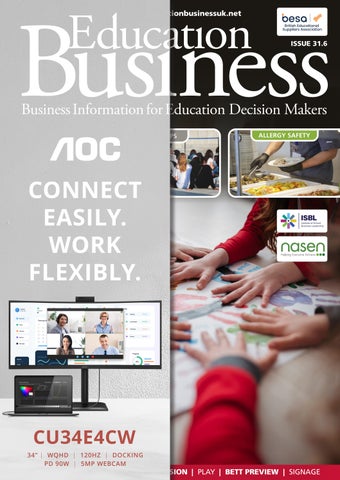
www.educationbusinessuk.net
A member of
ISSUE 31.6
Business Information for Education Decision Makers MARTYN’S LAW
TRIPS
ALLERGY SAFETY
SEND
THE SEND REFORMS Key proposals, immediate priorities and practical next steps explained
PLUS: FIRE SAFETY | ACADEMY CONVERSION | PLAY | BETT PREVIEW | SIGNAGE
www.educationbusinessuk.net
A member of
ISSUE 31.6
Business Information for Education Decision Makers MARTYN’S LAW
TRIPS
ALLERGY SAFETY
SEND
THE SEND REFORMS Key proposals, immediate priorities and practical next steps explained
PLUS: FIRE SAFETY | ACADEMY CONVERSION | PLAY | BETT PREVIEW | SIGNAGE
Cornerstone deliver a consistent approach to assessing the structural condition and indoor atmospheric environment of the buildings where people live, work and learn and, without a full understanding of the likely causes of reported damp, condensation and mould, these issues persist during colder months. Our extensive experience includes investigating root causes, providing bespoke recommendations for cost-effective long term solutions has helped reduce both case numbers and associated costs through more informed, proactive decision-making based on a clearer understanding of all contributing factors. To support those managing and occupying affected buildings, our CPD-accredited Damp, Condensation and Mould workshops explain the conditions mould needs to grow, how it behaves once established, and the steps occupants, caretakers and building owners can take to maintain effective property heath. Workshops cover how to remove mould effectively once the cause has been identified, helping to reduce the risk of it returning alongside providing a clear understanding of the difference between damp and mould, supporting competent decisions and helping to avoid inappropriate, costly and repeat remediations.
To learn more of Cornerstone or discuss any issues with an expert, contact us now:
Web: www.cornerstone-ltd.co.uk and ‘enquire today’ www.propertyhealth.co.uk Email: enquiries@cornerstone-ltd.co.uk Call: 0345 846 0955 / 023 9200 9270
Comment
Editor’s Comment Education Business 31.6
Welcome to E Business Information for Education Decision Makers
with us on Linkedin: LINKEDIN Connect @education-business
P ONLINE P MOBILE P FACE-TO-FACE
Business Information for Education Decision Makers
www.educationbusinessuk.net
To register for your FREE Digital Subscription of Education Business magazine, go to www.educationbusinessuk.net/digital-subscription or contact Public Sector Information, 226 High Road, Loughton, Essex IG10 1ET. Tel: 020 8532 0055
PUBLISHED BY PUBLIC SECTOR INFORMATION LIMITED
226 High Rd, Loughton, Essex IG10 1ET. Tel: 020 8532 0055 Web: www.psi-media.co.uk EDITOR Angela Pisanu PRODUCTION MANAGER & DESIGNER Dan Kanolik PRODUCTION CONTROL Deimante Gecionyte ADMINISTRATION Shanelle Alfred WEB PRODUCTION Freya Courtney ADVERTISEMENT SALES Gary Bryant, Raj Chohan, Oliver Southgate PUBLISHER Karen Hopps
Issue 31.6 | EDUCATION BUSINESS MAGAZINE
Business Information for Education Decision Makers
3
Better Breaktimes Start Here
LONG-LASTING, AFFORDABLE FUN!
Safe. Durable. Budget-friendly playground equipment for schools.
See real Wickey PRO projects in action
E Watch how outdoor spaces are transformed into places children love to play
EN 1176 Compliant Certified commercial playground equipment suitable for educational environments.
Exceptional Value for Money
Built for Daily Use Robust timber, HDPE and stainless-steel construction backed by a 10-year warranty.*
Stretch limited school budgets further without compromising quality.
Designed for schools that need more from their outdoor spaces. Creating an engaging playground should not require sacrificing budget, safety or durability.
Planning a playground upgrade? Scan to explore the education range.
Wickey PRO helps schools, academy trusts and education providers create active outdoor environments with commercial-grade play equipment designed for high-traffic educational settings. Every solution is developed to deliver high play value, long service life and outstanding value for money.
EN 1176 Compliant
10-Year Warranty*
*Applies to wood, HDPE and stainless-steel components.
Commercial-Grade Play Equipment
Engineered in Germany
wickey.co.uk/pro
Contents
Contents Education Business 31.6 15
24
ACADEMIES
33
MARTYN’S LAW
45
SEND
56
SEND
59
SCHOOL LEADERSHIP
69
BETT PREVIEW
75
FIRE SAFETY
85
SIGNAGE
93
ALLERGY SAFETY
28
PLAY
Education Business magazine
PASTORAL CARE
51
SEND
66
SCHOOL BUSINESS LEADERSHIP
80
GROUNDSCARE
107
TRIPS
www.educationbusinessuk.net Issue 31.6 | EDUCATION BUSINESS MAGAZINE
Business Information for Education Decision Makers
5
Regulate, Reflect, Ready
E
✓
video here
✓
Mindful Mats are perfect for
✓
✓ ✓ ✓ ✓
ts.co.uk actionmal mats mindfu
2 3
1
2
1
2
2
1
3 uk s.co. nmat ats actioindful m m
Intentional self-regulation activities Increasing independence Improving concentration Enhancing emotional intelligence
2
rning a e l e v i Act chers a e t y b created
k o.u ts.c s ma l mat ion act indfu m
d
n an o i t a c u Ed ources 1
es
r fitness perfect for
Action
e Mats ar
nd Health a g in e Well-b
✓ ✓ ✓ ✓
✓
bject Core-su support Social on interacti
✓ ✓
tion Coopera rk Teamwo nguage Every la
✓
✓
™
✓ ✓ ✓
cy a r e m u Embed n ars Early Ye
s
r a e Y y l r For Ea ™
™
ple k and sim are quic Lessons . and run g to set up engagin a n fu nd re a s n Lesso . eal to all and app ths in an liver ma e d s n o Less ve way. innovati
fect for
re per i Mats a
Min
✓
ment Develop ation Coordin
rs Numbe s Pattern ces Sequen
✓ ✓ ✓
✓ ✓ ✓ ✓
Agility Ability
✓ ✓
07
T
169 8 2 6 4 1 el: 0
k
.co.u s t a m n • actio
News
POST-16 EDUCATION
Colleges urged to help tackle NEET crisis The Education Secretary Lucy Powell has issue a call to action to colleges across the country to get young people who aren’t in education back through their doors to give them more opportunities. This is ahead of Alan Milburn’s final report on the NEET crisis, which shone a light on the lack of responsibility and incentives across the system for getting young people back into learning or work. The Education Secretary has called on colleges to connect with employers and provide young people with meaningful work experience that can create a route into a job, rather than waiting for long-term reform. She asked for them to bring forward ideas and plans to urgently make this vision a reality across the country, proving to young people that change can happen. In return, the Education Secretary pledged to work with the sector to break down the barriers that can make it harder or riskier for colleges to take those young people on. This includes providing significantly more flexibility on the number of hours of English and maths required of young people who are NEET and returning to education and allowing for remaining hours to be delivered through one-to-one and small group support. It also includes changing how schools, colleges and others are measured, recognised, and rewarded, including better recognising progress in English and Maths and disincentivising premature exam entries...
CONTINUE READING
MOBILE PHONES
Strengthened guidance on mobile phone use in schools Strengthened guidance on the use of mobile phones in schools has been published by the government, and makes clear that schools should go beyond ‘not seen, not heard’. While most schools set out that phones should be not seen and not heard, only 16 per cent of secondary pupils say phone rules are followed all of the time, and with the rapid increase in technology take-up and emerging evidence, pupils, schools and parents need more clarity. The guidance will give every school clearer backing to keep phones inaccessible and helping parents and pupils understand what a truly phone-free school day means. Education Secretary Lucy Powell said: “Children should not be using smartphones at any point during the school day, full stop. That’s why we’re strengthening our guidance to take the next leap towards truly phone-free schools. “Schools are already leading the way. We’re backing heads and teachers with a clear message for parents and pupils: school is for learning and friendship, not scrolling.” Dame Rachel de Souza, Children’s Commissioner for England said: “I welcome strong action to stop phones distracting pupils and disrupting the school day. I know most headteachers already restrict phone use in their schools and I would like to see support for all heads to apply this important policy... CONTINUE READING
Issue 31.6 | EDUCATION BUSINESS MAGAZINE
Business Information for Education Decision Makers
7
Flat Roofs
Be Compliant, Never Compromise.
Attention to detail ensures your Bauder flat roof solution performs exactly as your building demands
Our results deliver the difference. Competency matters to us, it is what builds trust, reliability, and long-term success in every flat roof project we deliver.
Interested? read more
We support you throughout, from funding application to roof completion, so you are assured that our guidance and solutions are always accurate, compliant and effective.
Get in touch because the success of your flat roof starts here. 01473 257671 bauder.co.uk/contact us
News
SECURITY
New tools to support schools preparing for Martyn’s Law The Security Industry Authority (SIA) has released a new planning tool to support the schools and colleges as they prepare to comply with the new legislation. Martyn’s Law, which is expected to come into force in spring 2027, aims to keep people safe by ensuring that publicly accessible premises and events are better prepared against acts of terrorism. The SIA is urging all schools and colleges in scope to use the new planning tools to start to prepare for the incoming legislation. Developed with the support of volunteers from premises and events and the SIA’s protective security partners, there is a new planning tool for those in the standard tier to work through what procedures they have or will put in place to comply. For schools, who will always be in the standard tier, the focus is on helping them think through how they will put in place appropriate procedures for evacuation, lockdown, communications and invacuation (moving people to safe areas within a premises) in the event of a terrorist attack. When Martyn’s Law comes into force, premises and events in scope will need to notify the SIA they are in scope. Schools will not need to send any compliance documents at that point unless asked to do so. The SIA is inviting feedback on the tools...
CONTINUE READING
CURRICULUM
Plans to make early secondary school more engaging As part of the government’s review of the National Curriculum, more will be done to make Key Stage 3 more engaging, exciting and distinct part of child’s experience, as evidence suggests that too many children are switching off from school in their early teens The government is therefore planning to make the first three years of secondary school count, by restoring Key Stage 3 as a distinct three-year phase. The new National Curriculum, due to be published in full later this year, will see over-crowded content slimmed down and better sequenced across all school stages to create more space for deeper understanding and richer experiences, and to ensure more children are stretched and make progress. This will come with higher expectations on core knowledge and skills needed for the future, like oracy and confident speaking, reading fluently and reading for pleasure, and numeracy. There will also be a more engaging offer in subjects like drama, PE, music, and modern foreign languages, alongside technical and digital skills. It also comes with new expectations on schools to stop the increasingly widespread practice of encroaching on Key Stage 3 with an ever earlier focus on GCSEs. Exams and assessments are a vital part of school life, but the pressure to prepare for GCSEs early is growing. Public First Global for the International Baccalaureate found that more than half of teachers say GCSE courses are dominating the first three years of secondary... CONTINUE READING
Issue 31.6 | EDUCATION BUSINESS MAGAZINE
Business Information for Education Decision Makers
9
IT leasing reinvented IT Departments enjoy robust support, pre-config, plus accidental damage cover.
The Bursar appreciates our flexible, budget-friendly solution. Students and teachers love the latest tech.
1:1 Parental Schemes
Protective Case
School DaaS Solutions
£1
per student per day
Autopilot Deployment & Pre-config
Lifetime Warranty
devices for education by HardSoft 0203 970 4994 | devicesforeducation.co.uk
News
NUMERACY
Report calls for ways to improve numeracy skills A House of Lords committee is calling for a national drive to improve maths skills across all generations, warning that poor numeracy is holding people back in education, employment and everyday life. More than eight million adults in the UK have numeracy skills below the level expected of a nine-year-old, prompting calls for urgent action to tackle what has been described as an intergenerational cycle of poor maths skills. In a new report, Making it Count: Numeracy for Life, the cross-party House of Lords Numeracy for Life Committee sets out a series of recommendations aimed at improving numeracy from early childhood through to retirement. The report raises particular concerns about the prospects of young people who fail to achieve the required standard in GCSE mathematics. It warns that a two-tier education system risks emerging, with lowerachieving pupils becoming trapped in a cycle of repeated GCSE resits. Only one in five 16 to 19-year-olds who resit GCSE mathematics achieve a Grade 4, according to the report. The committee says this can create significant barriers to further education and employment, while restricting future earning potential and opportunities to participate fully in society. Among its proposals, the committee wants parents and carers...
CONTINUE READING
CATERING
Free school breakfast clubs helping parents work longer Free breakfast clubs in schools across England are helping parents get to work on time, reducing stress for families and supporting children’s social development, according to new research commissioned by the Department for Education (DfE). The study, conducted by Ipsos Mori, surveyed 5,487 parents across 321 schools offering free breakfast clubs. Researchers also carried out interviews with parents and observed provision in eight schools to explore how the clubs are used and the benefits they provide. Enabling parents to work longer hours was the most commonly reported reason for using the clubs, cited by 53 per cent of respondents. Child enjoyment was the second most common motivation, at 43 per cent, followed by the convenience of easier school drop-offs, reported by 35 per cent. Parents expressed high levels of satisfaction with the provision, with at least 67 per cent satisfied across all aspects surveyed. Safety received the highest satisfaction rating, at 94 per cent, followed by flexibility of attendance at 92 per cent and the space provided at 90 per cent. However, some parents wanted improvements, with eight per cent dissatisfied with the variety of food available and the same proportion wanting clubs to start earlier... CONTINUE READING
Issue 31.6 | EDUCATION BUSINESS MAGAZINE
Business Information for Education Decision Makers
11
News
ASSESSMENT
More top news stories from www.educationbusinessuk.net
Disadvantaged children less likely to get top marks in SATs
Anti-fraud lesson resources for schools in England: READ MORE
New IPPR research shows that disadvantaged pupils are nearly three times less likely to achieve the highest marks in SATs taken by Year 6 pupils in English state schools. The disadvantage gap has reached its highest level since the pandemic, according to Department for Education (DfE) data released in September. The new IPPR analysis finds that in 2026, just four per cent of disadvantaged pupils met the higher standard in reading, writing and maths (combined), while 11 per cent of other pupils met the higher standard. Researchers find that the content of Key Stage 2 assessments routinely assumes cultural experience and background knowledge that pupils do not equally have. In previous years, tests have included writing tasks which refer to skiing or foreign travel, for example. The IPPR argues that judging primary schools against a single national benchmark creates perverse incentives and a narrowing of the curriculum that significantly affects disadvantaged pupils. Their previous polling shows that 93 per cent of teachers felt that preparation for SATs has an impact on the breadth of curriculum in primary schools, with 77 per cent reporting more time being spent on tested subjects when preparing for SATs. The authors propose moving towards a fairer, more reliable system in response. These include introducing an independent ‘statutory and ...
CONTINUE READING
12
Business Information for Education Decision Makers
Homework risks widening educational inequalities, study warns: READ MORE Laptops make children more engaged with education: READ MORE Enhanced training and support to prevent antisemitism in schools: READ MORE MAT finances improve, but nearly a third face low reserves by 2029: READ MORE Rise in safeguarding referrals linked to neglect : READ MORE CATERING
School catering providers risk failing without funding According to new research, school meal services are under growing financial pressure, with 71 per cent of catering providers who responded to a survey stating they were not confident their service could keep going financially in three years’ time. The research from APSE and The School Food People found found that a primary school meal was usually priced at £2.75 to £3.20, while the estimated cost of providing it was commonly £3.25 to £4.25 and sometimes more. The reported cost of providing a meal is often higher than its price. To cover shortfalls, respondents cited subsidies from schools (59 per cent), higher meal prices (37 per cent), changes to menus or portions (26 per cent), council subsidies (19 per cent) and reducing staff numbers (15%) as solutions. That full cost includes more than just the food: it can also include staff pay, energy, transport, kitchen equipment and meeting food standards. The survey answers did not match up closely enough to calculate one exact funding gap across the sector. Brad Pearce, chair of The School Food People, said: “School caterers want to serve healthy, appealing meals and meet higher standards. But many cannot keep making up the shortfall through subsidies... CONTINUE READING
BUSINESS INFORMATION FOR EDUCATION DECISION MAKERS | www.educationbusinessuk.net
Advertisement Feature
Nuclear fusion: a fast ion technology? Bruno Sangré Ferrière explores technologies aimed at using high speed ions to achieve nuclear fusion of ions penetrating matter, could indeed leave room for surprises revealing higher yields.
How did you become interested in the world of fusion? Today, much of the research on nuclear fusion focuses on tokamaks, very hightemperature chambers in which a plasma is confined by magnetic fields. This technique, while interesting in theory, still requires temperatures and pressures far exceeding those found in the sun. Nuclear fusion, however, allows for the release of considerable energy from relatively little material, compared to fossil fuels. I therefore became interested in this mechanism to understand the factors that prevent it from occurring under ‘normal’ conditions. Upon beginning my calculations, I found that the energy released by nuclear fusion could indeed be on the order of 10 times the kinetic energy of ions projected onto atoms, necessary to overcome their electrical repulsion. However, aware of the friction between the ions and the matter into which they are projected, I factored this in and found nuclear efficiencies of only a few per cent. Nuclear efficiency is the ratio between the nuclear energy released by a reaction and the energy consumed to enable such a reaction. This last figure confirmed my calculations. I then decided to extend my research beyond deuteriumtritium fusion, which has a reputation for a maximum efficiency. The complexity of the calculations, incorporating differences in mass of the fusing elements, their respective sizes and the law governing the loss of kinetic energy
What happened next? I then entered into my computer the masses and characteristics of elements and isotopes light enough to fuse rather than decay like uranium. Next, I recalculated all these pairs of isotopes colliding with each other, some in gaseous, solid, or liquid form, others as electrically charged ions propelled at high speed. These ions are typically accelerated in a vacuum by electrically powered particle accelerators. I also varied the ion speeds to find the velocities beyond which the nuclear efficiency began to decrease. I found efficiencies of five per cent for boron-10 fusing with lithium-6! But these yields are not sufficient? This is not necessarily true. The Faraday efficiency of some batteries, for example the Li-ion battery, is around 99 per cent, showing that chemical energy can be converted into electrical energy with only one per cent loss. One per cent is also an efficiency that some Tokamaks struggle to achieve! However, I continued my research, seeking to eliminate the kinetic energy losses of ions that did not react because they had been sufficiently decelerated while passing through the material to fuse, or because they had been produced. The yields then increased to close to 12 per cent, but with different isotopes, i.e., different ions, for example, by projecting nitrogen or sodium onto deuterium. Have you filed any patents? Yes, indeed, I have filed patents on these techniques, with one already agreed in South Koea and another one the US. M FURTHER INFORMATION
https://m-cr.fr/
Issue 31.6 | EDUCATION BUSINESS MAGAZINE
Business Information for Education Decision Makers
13
For all your school essentials. We’re behind every page.
Inject affordable colour printing into your classrooms with the lowest running costs on the market. RISO printers give you: • Colour printing from 1p per page • Ultra-reliable performance • Speeds up to 180ppm • 91% less energy usage That’s what we call top marks.
Book a discovery meeting with our team to see how RISO can save your school money, time, and energy.
Visit RISO.co.uk
We’re behind every page
Academy Conversion
Joining a MAT: what schools should know before making the move With increasing numbers of schools considering academy conversion and joining existing multi-academy trusts (MATs), deciding whether (and which) trust to join is one of the biggest strategic decisions. Tina Morris, a director in the education team at law firm Schofield Sweeney provides advice on what schools should consider before making the move Whether due to financial pressures, government policy or the sheer appeal of access to better resources, an increasing number of schools are exploring the possibility of converting to academy status and joining a multi-academy trust (MAT). Enticed by potential benefits such as access to stronger leadership, teaching practices, curriculum development and school improvement support, as well as specialist expertise in areas such as SEND and safeguarding, it is easy to see why such a move is appealing. There are also opportunities to share costs for functions such as HR, payroll, IT and legal services providing greater financial and operational resilience. As the support offered to schools from the ever-depleting resources within local authorities declines, these advantages can be increasingly attractive.
But there are some disadvantages that this transformation can bring too which must be fully understood, most notably a loss of independence, and schools must give thorough consideration to those implications and carry out extensive due diligence before making a commitment. Joining a MAT is a long-term strategic decision and should be considered as such. School leaders and governors should ensure that the move supports the schools’ long-term vision and priorities and, most importantly, will improve the standard of education pupils receive. The educational philosophy, approach to the curriculum and general values, culture and ethos of the MAT should be aligned with those of the schools’, and leaders should consider its reputation, perception among parents, staff E Issue 31.6 | EDUCATION BUSINESS MAGAZINE
Business Information for Education Decision Makers
15
Designed to support inclusion and learners with SEND, empowering everyone. Foster inclusion in your educational setting, support students with SEND, and create better learning conditions for everyone with Hushoffice acoustic pods.
hushoffice.com/education
Seeking legal advice early in the process will help schools navigate the due diligence process, identifying potential complications at the outset to avoid delays and ensure the transition runs as smoothly as possible
Governance and Independence The first factor to consider is governance and independence. One of the biggest changes when a maintained school converts to academy status and joins a MAT, is the transfer of responsibility from the school’s governing body to the academy trust board. Schools need to understand what this will mean in practice, particularly in terms of how much independence they will retain and who will be responsible for making decisions. While schools may continue to have local governing bodies, the powers delegated to them can vary considerably between trusts. The arrangements should be clearly documented through a scheme of delegation, which sets out which decisions are made by the trust board, its leadership team and individual schools. Governors should also establish how decisions relating to staffing, budgets, curriculum, policies and school improvement will be made if the conversion does go ahead.
Finance The financial health of the MAT is another hugely important area to consider, and schools should make sure they thoroughly review its accounts and future plans to establish whether it is in a strong position before going ahead with any merger. Economies of scale are another area to consider. Often cited as one of the main benefits of joining a MAT, schools should spend time assessing whether the merger of shared functions such as HR and Finance will offer genuine savings vs their current expenditure. Leaders should also be clear on important factors such as how much of the school’s funding will be retained centrally, what services it will cover and how budgets will be allocated moving forwards.
Academy Conversion
F and the local community, and its track record when it comes to educational standards and results. Alongside these strategic considerations, if the MAT is considered a good fit, there are a number of legal and practical issues that schools will need to address. Seeking legal advice early in the process will help schools navigate the due diligence process, identifying potential complications at the outset to avoid delays and ensure the transition runs as smoothly as possible.
Employees Converting to academy status and joining a MAT has a number of implications for staff too. When a maintained school converts to an academy and joins a MAT, employees will transfer to the MAT under the Transfer of Undertakings (Protection of Employment) Regulations (TUPE), which protect their existing employment rights and terms and conditions. Schools and MATs will need to review existing employment arrangements and identify any outstanding disputes, disciplinary matters, grievances or potential claims, as responsibility for employment liabilities will generally transfer to the MAT. Pension obligations must also be considered, including requirements relating to the Teachers’ Pension Scheme and Local Government Pension Scheme. Alongside legal requirements, schools should consider how the move will affect staff in practice. Will existing leadership and management structures remain in place? What opportunities will there be for E Issue 31.6 | EDUCATION BUSINESS MAGAZINE
Business Information for Education Decision Makers
17
wide contracts in place and intends to bring the school into those arrangements.
Contracted Services Another important consideration is how operational and support services such as ICT, finance, HR and estates management will be delivered. Schools need to understand whether these functions will be managed centrally by the MAT or if they will continue to have responsibility for some services. Services currently provided by the local authority may not be offered to the academy sector and will therefore terminate on conversion, these will need to be identified and contingencies put in place to allow for continuity of provision following conversion. Existing contracts for outsourced services such as catering, cleaning, utilities, IT systems and facilities management will also need to be reviewed as some may transfer to the academy trust through a Commercial Transfer Agreement, whilst others may need to be renegotiated or terminated. All existing agreements should be reviewed to identify any contractual restrictions, outstanding liabilities, notice periods and potential termination costs. This is particularly important where the MAT already has trust-
Property and land Another key area to look at is property and land, as ownership and occupation arrangements can be complex and may affect how quickly a conversion can proceed. Schools should start by establishing who owns their land and buildings and understanding what arrangements will need to be made to allow the academy trust to occupy and use them. Community schools typically operate under a long-term lease from the local authority following conversion, while foundation, voluntary aided and church schools may require more complex arrangements involving trustees, foundations or diocesan bodies. Existing leases, licences and shared-use agreements should be reviewed, alongside any restrictions affecting school land. Other issues to consider include rights of way, sports facilities that are used by the local community, caretaker accommodation, third-party occupation and any Private Finance Initiative (PFI) contracts. Any unresolved land or property issues can significantly delay the conversion process, so it is important to identify these at an early stage. E
Academy Conversion
F professional development? How will staff be supported through the transition?
19
MAKING BUSINESS A PLEASURE SINCE 1966
Protect your building & maintain fire safety.
Yeoman Shield, is a leading specialist in wall and door protection systems. We provide high-quality solutions designed to minimise damage, reduce maintenance costs, and extend the life of your building interiors.
Wall, Door and Corner Protection Hand & Crash Rails Bed Head Protectors
In addition, we offer expert fire door services nationwide, including inspections, installations, maintenance, and remedial work, ensuring safety, compliance, and peace of mind.
Full Turnkey Service
www.yeomanshield.com
Fire Door Services Nationwide Installation or Supply only
Installation Available
0113 279 5854
Nationwide Delivery
info@yeomanshield.com
Academy Conversion
F The legal Journey The exact legal process of converting to an academy and joining an MAT will depend on the type of school involved and its current status. Community schools will need to begin by obtaining necessary approvals and consulting with relevant stakeholders such as staff, parents and other interested parties. Depending on the type of school, consent or involvement may also be required from the local authority, diocese, foundation or trustees. Schools must also consider their responsibilities under the Equality Act 2010, including whether the proposed changes could have a disproportionate impact on particular groups. The next stage will then involve putting the necessary legal agreements in place. For maintained schools converting into a MAT, these will typically include a Supplemental Funding Agreement, setting out the terms under which the academy will operate and receive funding from the Department of Education, alongside the MAT’s Master Funding Agreement. A Commercial Transfer Agreement will also usually be required to deal with the transfer of assets, contracts and liabilities, together with the necessary staff transfer arrangements and property documentation. Joining a MAT can have many benefits but it is not a decision that should be rushed into or based solely on financial gains. Taking
proper advice at the outset to ensure all bases are covered can be equally as important as ensuring vision, values and expectations are clearly aligned, in order to ensure any change will deliver real educational benefits and help them to achieve their long-term objectives. M FURTHER INFORMATION
www.schofieldsweeney.co.uk Tina Morris, a director in the education team at Schofield Sweeney
21
Space to Perform.
Inspiring the next generation through exceptional indoor sports facilities. From schools and colleges to universities, Collinson Tensile designs and delivers high-quality, permanent indoor sports buildings that create opportunities for students to train, compete and thrive all year round. With over 20 years of experience, we provide innovative, cost-effective building solutions for multi-sport halls, indoor football, tennis, padel and other sports facilities. Designed for education. Built for generations.
Football | Rugby | Tennis | Padel
Why choose Collinson Tensile? Year-round sports provision – Facilities designed for use in all seasons.
Natural daylight – Bright, welcoming environments for students and staff.
Flexible multi-sport spaces – Accommodating PE, training, competitions and community use.
Cost-effective construction – Efficient structural solutions and economical foundations.
Large clear-span interiors – Up to 100m without internal columns.
Long-term value – Durable, permanent buildings designed for decades of use.
Let’s create space for the next generation. 01995 676680
www.collinsontensile.co.uk Richard Brown rb@collinsontensile.co.uk
Collinson Tensile is helping schools, colleges and universities transform their sporting facilities through innovative, highperformance tensile fabric buildings designed to deliver exceptional sporting environments for generations to come
Advertisement Feature
Creating inspiring sports facilities for the next generation
to operational school and university campuses. Unlike temporary fabric structures, Collinson Tensile buildings are engineered as permanent facilities, designed to withstand demanding UK weather conditions while offering excellent durability and low maintenance requirements.
With over 20 years of specialist experience, Collinson Tensile has established itself as a leading UK provider of permanent tensile sports buildings, delivering facilities for educational institutions, community organisations and professional sports clubs throughout the UK and Ireland. From tennis, football and rugby to netball, hockey, padel and equestrian facilities, Collinson Tensile provides versatile building solutions that enable educational establishments to maximise participation, improve sporting opportunities and offer year-round access to high-quality facilities. A smarter approach to sports buildings Combining precision-engineered steel structures with advanced architectural membranes, Collinson Tensile buildings offer impressive clear-span spaces without internal columns, maximising usable playing areas and providing flexibility for individual sports or multi-sport applications. The translucent roof membrane allows natural daylight to illuminate the interior, creating a bright, welcoming environment while helping reduce reliance on artificial lighting during daylight hours. Off-site manufacturing and efficient construction techniques can also significantly reduce installation programmes and disruption
Trusted across education and professional sport Trusted by colleges, universities, Premier League football clubs and professional rugby organisations, Collinson Tensile brings the same proven building technology and engineering expertise to educational facilities as it does to elite sporting environments. The company’s extensive experience enables it to work collaboratively with educational establishments, architects and project teams, developing tailored solutions that balance sporting performance, site requirements and available budgets. Investing in the future of sport With increasing emphasis on physical activity, student wellbeing and community engagement, investment in accessible, high-quality sporting facilities has never been more important. Collinson Tensile offers educational establishments an opportunity to create inspiring, future-proof sporting environments that support students, athletes and local communities for decades to come. M FURTHER INFORMATION
www.collinsontensile.co.uk 01995 676 680
Issue 31.6 | EDUCATION BUSINESS MAGAZINE
Business Information for Education Decision Makers
23
Martyn’s Law
Martyn’s Law: what the new legislation means for schools Laura Gibb, executive director for Martyn’s Law at the Security Industry Authority, outlines why this new legislation matters and what it will mean for education settings that fall within its scope Laura Gibb, executive director for Martyn’s Law, Security Industry Authority
24
Terrorists have targeted a wide range of people and places in recent years. Our current threat level is ‘severe’ which means an attack is highly likely. It is not always possible to predict where in the UK an attack might happen, or the type of premises or events that could be impacted. Martyn’s Law will reduce the risk of harm by ensuring more premises and events are better prepared if it does. Named after Martyn Hett, one of the 22 people killed in the Manchester Arena attack, Martyn’s Law aims to make people safer by ensuring premises and events have appropriate plans in place to respond to acts of terrorism. This new legislation is thanks to Martyn’s mother Figen Murray OBE and her campaign team for their tireless efforts to secure these public safety improvements. As the regulator, we are working closely with the Home Office to build awareness of
the incoming legislation, the requirements for those in scope, and how we intend to operate. Which schools will Martyn’s Law apply to? The most important first step for any school is to ascertain whether Martyn’s Law will apply to you. Martyn’s Law typically divides premises and events into tiers based on the number of people who might reasonably be expected on site at the same time, with different requirements for each – the standard tier (200 to 799
Martyn’s Law
Once Martyn’s Law comes into force, you’ll be required to notify the Security Industry Authority that you are in scope of the law people) and the enhanced tier (800+ people), which also covers qualifying events (800+). However, mindful of the work that schools do already to prepare for critical incidents, schools receive special consideration under the new law. School settings will never come under the enhanced tier. This means even if there are more than 800 people present at your school at busier times, you will still be in the standard tier, even if you are hosting a bigger event on site, such as a fete, open evening or sports day. This special consideration applies across all early years, primary, secondary and further education settings but does not apply to higher education. Martyn’s Law does not apply at all to schools which never have more than 200 people on site. What to do if you’re in scope If you are in the standard tier, when Martyn’s Law comes into force you will be expected to have appropriate public protection procedures in place to reduce the risk of physical harm if a terrorist attack were to happen at your school or in the immediate vicinity. E
Business Information for Education Decision Makers
25
Martyn’s Law
26
F This isn’t necessarily about installing expensive new security systems. It’s about having sensible, proportionate plans that your staff and pupils understand and can act on. Most schools and colleges are already well-prepared because of the wider safety procedures already in place for things like a fire or emergency lockdown. There are four procedures you need to consider. The first is evacuation: how you plan to get people away from danger by moving them out of the premises. The second is invacuation: how you might move people to a place within the school where there’s less risk, rather than trying to get everyone outside. The third is lockdown: how you secure the premises to stop anyone entering or leaving. The final procedure is communication: how you make sure that if something happens, information reaches everyone on the premises promptly and clearly. We will be producing planning tools that should help you think through what you can put in place to comply in these four areas. What you do will depend on the nature of your school and the resources you have available. The focus is on identifying what procedures are appropriate for your school, and then putting those into place as far as is
Business Information for Education Decision Makers
reasonably practicable. It means weighing up how effective the procedures are likely to be in reducing the risk of harm against the cost, time and difficulty of putting them in place. Notifying the Security Industry Authority Once Martyn’s Law comes into force, you’ll be legally required to notify the Security Industry Authority (SIA) that you are in scope of the law. You will also need to tell us who the “responsible person” is for your school. The responsible person is the individual, organisation or company with control of the premises, meaning that they have the right and ability to make decisions about their management and use. For most schools, this will be the governing body or the academy trust. For pupil referral units, this will be the local authority. What to expect With any new legislation, there is often apprehension – what will it mean? How will the regulator ensure compliance? Our approach will be proportionate, supportive and robust. We will soon publish more details on this following an extensive consultation on our draft section 12 guidance.
What to do now While you won’t be able to notify the SIA that you are in scope until Martyn’s Law comes into
force, there’s plenty you can do now to prepare. You can confirm who your responsible person is, and consider your evacuation, invacuation, lockdown and communication arrangements now so you’re not starting from scratch when the law comes into effect. The Home Office section 27 guidance sets out what you need to do. It’s never too soon to put better security plans in place. To help you prepare, there’s more information on gov.uk. The Department for Education will also be producing information for the education sector, Resources including videos, flowcharts and free e-learning modules are also directly accessible via ProtectUK. We’re also currently inviting those who are in scope to help test and develop our systems and processes. We need volunteers to help us test the online notification service we are currently developing. It’s an opportunity to feedback prior to launch and to shape the way we regulate as well as a practical opportunity to get to grips with what will be legally required. Anyone interested should sign up now. L
Martyn’s Law
Determining whether a school complies with the requirements of Martyn’s Law will be done on a case-by-case basis taking into consideration the specifics of the school and whether the decisions of the responsible person make sense for that school. If we do decide an on-site inspection is required, we’ll aim to contact the responsible person first. This helps us have an informed conversation about the steps they’ve taken to comply with Martyn’s Law. Where we find potential non-compliance, we’ll work with the responsible person, for example, by referring them to guidance, offering regulatory advice or potentially signposting to someone with suitable protective security knowledge. If a school does not meet its Martyn’s Law duties, we can issue a compliance notice which tells the school what needs to change. A penalty notice might then be issued if we are confident, based on the evidence available, that a school is still not meeting, or has not met, its requirements, which might result in a fine.
FURTHER INFORMATION
www.gov.uk
27
Pastoral Care
When schools become part of the solution to youth homelessness Earlier this year, Prince William visited Bournemouth, Christchurch and Poole to see how one secondary school is working with The Royal Foundation’s Homewards programme to prevent homelessness for young people and their families Preventing homelessness starts long before someone loses their home. It means recognising the warning signs early, ensuring people know where to turn for help and putting support in place before difficulties escalate into crisis. With daily connections to young people and their families, schools can play a critical role in making that early intervention possible. Earlier this year, Prince William visited Bournemouth, Christchurch and Poole (BCP) to see how one secondary school is working with The Royal Foundation’s Homewards programme and Shelter to put this approach into practice, from embedding specialist housing support within the school to identifying young people who may need additional help and equipping pupils with practical knowledge about their housing rights.
28
Business Information for Education Decision Makers
Reaching families before crisis point In BCP, 429 young people aged 16 to 24 were homeless or at risk of homelessness in 2024/25, but the factors that can ultimately lead to homelessness often emerge much earlier. Family breakdown, housing pressures and mental health challenges can all contribute, while support often arrives only once a family is already in crisis. The Bourne Academy has been working with Homewards and Shelter’s @Home pilot, to place a Housing Rights Worker within the school. Their role is to provide housing advice and support to pupils and families who may be experiencing difficulties but are not accessing or aware of existing services, while also increasing understanding of housing rights among staff and students.
Pastoral Care
With daily connections to young people and their families, schools can play a critical role in making that early intervention possible For Mark Avoth, Principal at The Bourne Academy, raising awareness is an important part of preventing problems from escalating: “One of the most important things we’ve learned through our work with Homewards and Shelter is that preventing homelessness isn’t just about housing, it’s also about awareness, understanding and removing stigma. Too often, families struggle in silence because they don’t realise support is available or don’t see their situation as something they should ask for help with.” The impact of making that support more visible has been striking. Since Prince William’s visit in March, more than 25 families who had not previously disclosed housing difficulties to the school have come forward for support. As Principal Avoth explains: “By challenging perceptions of what homelessness looks like and encouraging people to seek help sooner, Homewards is helping us reach families at the point where prevention can make the greatest difference.” Spotting the warning signs earlier This focus on prevention extends beyond families already experiencing housing problems. The Bourne Academy is also involved in Upstream, a school-based earlysupport programme which uses a digital survey covering wellbeing, resilience, school and housing to identify pupils who may be at risk of homelessness or dropping out of education. The model uses young people’s own experiences to identify where support may be needed, rather than relying solely on problems already visible. Those identified can then receive tailored one-to-one support, which can include help with family conflict, relationships, housing and education. Upstream is based on Australia’s Geelong Project, which reduced youth homelessness by 40 per cent and early school leaving by 20 per cent. It is now being piloted across five Homewards locations in the UK, with hundreds of young people completing the survey and 158 receiving support.
The school is also helping young people prepare for greater independence. Sixthform students have taken part in tenancy workshops to increase their understanding of their housing rights, while a new 14–16 Curriculum Team is developing tailored pathways for pupils at risk of becoming NEET (not in education, employment or training). Making schools part of a wider system The experience in BCP is not about asking teachers to become housing experts. Instead, it demonstrates what can happen when specialist support is brought into a setting where young people and families already have established relationships. Preventing youth homelessness does not mean taking responsibility for solving housing problems. It means recognising the contribution schools can make to a wider system: noticing difficulties earlier, creating trusted routes into professional support, building young people’s understanding of their rights and making it easier for families to ask for help. The positive impact from these interventions show the potential of bringing the right support into places young people already know and trust, helping to address difficulties earlier and prevent them from escalating into homelessness. L FURTHER INFORMATION
For more information on the Homewards programme, visit www.homewards.org.uk Issue 31.6 | EDUCATION BUSINESS MAGAZINE
Business Information for Education Decision Makers
29
For Primary Schools
For Secondary Schools
PERSONALISED READING SUPPORT FOR EVERY PUPIL Identify Gaps Target Support Accelerate Progress
EEF-Proven Effective
Unlock reading success for every pupil with Lexia’s personalised, adaptive literacy programmes. With solutions for both primary and secondary schools, Lexia targets the skills that matter most, from phonics and fluency to vocabulary, grammar and comprehension.
A recent effectiveness trial by the Education Endowment Foundation (EEF) found pupils made an additional 2 months reading progress with Lexia.
+2
additional months progress
PROVEN EFFECTIVE
IDENTIFY GAPS
TARGET SUPPORT
ACCELERATE PROGRESS
Deliver evidence-based reading support backed by rigorous independent research.
Pinpoint the skills pupils need to develop with targeted assessment, reducing testing time.
Give every pupil the right support and practice suited to their individual needs.
Build essential reading skills to help pupils access the curriculum and move forward.
SEE THE DIFFERENCE IN JUST 30 DAYS Discover how Lexia can support progress in your school. Scan the QR code or get in touch to enquire about a 30-day trial.
0191 482 1939
www.lexiauk.co.uk
info@lexiauk.co.uk
SEND
Keeping pace and place with the SEND reforms The proposed SEND reforms offer a significant opportunity to strengthen inclusion and improve outcomes for children and young people. Sam McFarlane, education officer at nasen, explores the key proposals, immediate priorities and practical steps for the future There is much to welcome in the proposed reforms set by the two key documents driving change: ‘Every Child Achieving and Thriving’,’ and ‘SEND Reform: Putting Children and Young People First’. The overall direction for all children and young people in education is positive, especially those with Special Educational Needs and Disabilities (SEND). The proposed reforms place pupil belonging and participation at the centre of an inclusive approach that supports achievement and wider wellbeing of all pupils. The white paper, Every Child Achieving and Thriving (DfE, 2026), considers all pupils who are disadvantaged or at risk of marginalisation within school life, rather than focusing solely on pupils with SEND. The SEND reforms consultation seeks to address the inadequacies and inefficiencies of the current system, through what
appears to be a dramatic ‘overhaul,’ of practice, systems and processes. Together, both documents point towards a stronger needs-led system in which all children and young people are enabled to succeed within an education system designed for them. This broader understanding of inclusion recognises that children and young people may experience barriers for multiple and overlapping reasons, which includes but is not limited to additional needs. The explicit recognition of this complexity by central government is significant and, if translated effectively into practice, could strengthen inclusive provision across all schools and settings. The ambition for a stronger SEND system and more inclusive schools, comes at a time when the existing system has repeatedly been described as being “in crisis”, with the resulting E
33
SEND
As many elements remain at the proposal stage, schools should avoid making premature changes to their SEND departmental plans, and continue to work under the current guidance and legislation F pressures acutely felt by many teachers, school leaders and parents and carers. Reform is therefore necessary and has the potential to be beneficial. However, the speed and breadth of the proposals may be difficult to navigate for those expected to understand, prepare for, and implement them in real time. As many elements remain at the proposal stage, schools should avoid making premature changes to their SEND departmental plans, and continue to work under the current guidance and legislation which is presented in the SEND Code of Practice, 2015. There is certainly a feeling that the education system has entered into a unique time of opportunity and challenge, requiring schools and settings to remain informed while responding carefully and proportionately as the reforms develop.
What is changing, and when? In February 2026, the government published the white paper Every Child Achieving and Thriving alongside the SEND reform consultation, Putting Children and Young People First. Together, the documents place inclusion firmly at the centre of educational policy and practice. The white paper sets out a ten-year vision for schools and settings, with a strong focus on inclusion, pupil engagement, belonging and participation in learning communities. The consultation, which closed in May, moves into the practical detail by setting out how schools, settings and local authorities might translate that ambition into meaningful everyday practice for children and young people with special educational needs and disabilities. Drive to inclusion The reforms include measures at different stages of development. It is therefore important to distinguish between proposals that remain under consideration and changes that are already in effect or expected soon. The principal theme across the SEND reforms is a deliberate, system-wide move towards a more consistent national approach to inclusion. Central to this is the development of National Inclusion Standards (NIS), intended to create a shared understanding of inclusive practice across all settings. The proposed digital resource library would illustrate what a E Issue 31.6 | EDUCATION BUSINESS MAGAZINE
Business Information for Education Decision Makers
35
Different expertise. Shared vision. Greater impact. Together. A well-designed acoustic solution contributes to calmer, clearer, more inclusive spaces. Bringing together professional expertise, lived experience and a shared commitment to inclusion. Working collaboratively to identify environmental barriers and create calmer, more accessible spaces where everyone can participate, belong and thrive.
VIDEO SPACE
Education
Lived Experience
Acoustic Expertise
Charities
Understanding the realities of teaching, learning and inclusion.
Listening to the people who experience our environments.
Bringing acoustics into the conversation from the outset, ensuring other investments achieve their intended impact.
Working together to widen access and opportunity.
Research
Design
Partnerships
Communities
Using evidence to inform decisions and evaluate impact.
Creating thoughtful, practical and accessible solutions.
Connecting expertise to turn shared ambitions into action.
Creating environments that support participation and belonging.
Inclusive environments. Meaningful change.
Let's start the conversation. Scan to arrange your FREE acoustic survey.
SEND
F universal offer could include, clarify ordinarily available provision and identify evidence-based interventions that may be effective. This represents a constructive step towards greater consistency and high-quality support for pupils. However, the standards remain in development. Schools should continue to follow the current statutory framework and guidance while monitoring further announcements. Action for now The Inclusive Mainstream Fund (IMF) is already in place, with the government providing £400 million each year for three years to support schools in strengthening inclusive provision for all pupils. Following the first release of funding between May and June last year, schools may already be determining how it should be allocated and used. The funding is linked to a new requirement for schools and settings to develop an Inclusion Strategy. This should explain how the IMF is being used and set out, through a clear assess, plan, do, review approach, alongside how barriers to pupils’ engagement, belonging and achievement will be identified and removed. The immediate action is clear: schools and settings need to develop and publish their Inclusion Strategy by 31 December 2026. Leaders should direct the responsibility for this work, review how the funding is being used, and allocate sufficient time for the strategy to be agreed and published. The DfE has provided supporting guidance here.
Coming down the track Further changes may follow, although much of this work remains in development. Schools and settings do not yet need to change their practice in response to these proposals; the current priority is to understand what may be forthcoming and to continue operating within the existing framework. One proposal would replace the four broad areas of need with five areas of development: executive function; motor and physical; sensory; social and emotional; and speech and language. Reframing needs as areas of development may represent a positive move away from medical and deficit-based models of disability. Here, the challenge will be to translate this ambition into effective practice and to become familiar with a revised SEND Code of Practice, which the DfE has acknowledged will be necessary. Schools should therefore monitor this proposal rather than make changes at this stage. Further information on the five areas of development is available here. The proposals also include new Individual Support Plans (ISPs): digital, accessible records setting out each child or young person’s areas of development, the barriers affecting their engagement and participation, and the adaptations and adjustments required. ISPs would be linked to a renewed graduated response model, progressing from universal support to targeted, targeted plus and specialist support. As this remains a E
37
A NEW CURRICULUM. A SMARTER PLATFORM. MORE SUPPORT FOR YOUR SCHOOL. 2028 Guarantee What will the new Dimensions curriculum offer your school? • • • • • •
A curriculum that is 2028 ready Built-in tools for instant lesson adaptation Save countless staff hours Manage your school’s curriculum in one place Save money with more functionality built in Subject leader coverage at the touch of a button
• • • • • •
Build your own curriculum from over 64 themes units Thousands of new high-quality resources Assessment and tracking built in Our 4 Cs philosophy embedded throughout Home Zone: a dedicated space for linking home and school An easy-to-follow teaching sequence
Contact us Scan the QR code or type in: https: //dimensionscurriculum.co.uk
SEND
F proposal, schools and settings do not need to introduce ISPs at present. The practical step is to monitor developments and consider how effectively current plans record pupils’ barriers, needs, adjustments and support. It is likely that many schools and settings already have documents akin to ISPs already in place, so the work here will be to align and amend what is already happening with the standardised practice required when the ‘ask,’ is confirmed and statutory. There are no immediate changes to the Education, Health and Care Plan (EHCP) system, although changes could come into effect from September 2030. One proposal is to develop Specialist Support Packages (SSPs), which would underpin EHC Plans for children and young people with the most complex needs and aim to provide timely, effective access to highquality education and support. For now, schools and settings should continue to follow the existing EHCP process and statutory guidance while monitoring further announcements about SSPs and the proposed changes from 2030. Although the volume of information currently in circulation may seem considerable, schools and settings are not expected to respond to every proposal immediately. The key priority is to remain informed while focusing on the action already required: developing and publishing an Inclusion Strategy by 31 December 2026. In relation to the wider SEND reforms, careful monitoring remains the most appropriate approach. Until further requirements are confirmed, schools
and settings should continue to work within the current statutory framework and prepare thoughtfully for the changes ahead. M FURTHER INFORMATION
www.nasen.org.uk
Support for New! Comprehension Resources Inclusive Practice Adapting to every learner
Spellzone adapts to all abilities - age six to adult. Students follow tailored learning pathways at their own pace, on any device. Explore our new comprehension activities alongside thousands of spelling word lists, games and worksheets, all designed to support learning and help close attainment gaps. Time-saving reporting tools enable teachers to monitor progress, evaluate activity and inform targeted support with ease. Free trial
Written by a dyslexia specialist
& first-year discount
The online English spelling resource
www.spellzone.com
spellzone_education-business_nov26_125mmx86mm.indd 1
16/10/2026 09:54:46
Issue 31.6 | EDUCATION BUSINESS MAGAZINE
Business Information for Education Decision Makers
39
Our services for schools At SEN Legal, we provide expert legal advice tailored to the unique challenges faced by schools and colleges in relation to special educational needs and disabilities (SEND). Our in-depth understanding of education law enables us to provide practical, effective solutions that help schools protect funding, reduce unnecessary administrative burdens and focus on what matters most – supporting students.
We can advise on SEND consultations and funding disputes
Judicial review claims and proceedings
Non-payment of fees by local authorities
Disability discrimination & reasonable adjustments
Top-up funding and delegated budgets Annual reviews and EHCP-related matters
SEND legislation, case law, EHCNA and SEND tribunal training
Contact SEN Legal today on 01284 723952 to discuss how we can help.
School training packages SILVER
Our training packages offer a tiered, fixed-fee service designed specifically for educational settings, providing clear, actionable guidance on legal responsibilities, best practice and risk reduction.
GOLD
PLATINUM
training package
training package
training package
£700 (+VAT)
£1,950 (+VAT)
£3,000 (+VAT)
One two-hour training session covering:
Three two-hour training sessions covering:
Five two-hour training sessions covering:
✓ The EHCP Process*
✓ The EHCP Process* ✓ Annual Reviews ✓ Statutory Consultations
*Including EHC needs assessments, the EHCP itself and an overview of the SEN Tribunal.
Bespoke packages are also available on request. For more information, please call us on 01284 723952
✓ The EHCP Process* ✓ Annual Reviews ✓ Statutory Consultations ✓ Reasonable Adjustments,
Disability Discrimination and Exclusions
✓ Independent Review Panels
www.senlegal.co.uk
Advertisement Feature
Why should schools seek specialist legal support with SEND matters?
Richard Nettleton, associate solicitor & director, SEN Legal
Specialist legal advice can help school leaders navigate complex legal responsibilities when supporting pupils with SEND. Here’s why Schools carry significant legal duties towards children and young people with special educational needs and disabilities (SEND). Schools must identify pupils with SEN, use their “best endeavours” to secure appropriate support, involve parents and pupils in planning, and follow the graduated Assess-Plan-Do-Review approach. Where needs are complex, provision is disputed, or a local authority’s decisions affect funding or placement, the legal and financial consequences can be substantial. Common pressure points Schools may need advice when parents request an assessment, when an Education, Health and Care Plan (EHCP) is being drafted or reviewed, or when provision and placement are contested. Disputes can arise over top-up funding, fee payment, and whether a local authority has properly met its financial responsibilities. Schools may also require assurance that a consultation, particularly one affecting provision, placement or funding, has been carried out lawfully and fairly. Schools must consider reasonable adjustments under the Equality Act 2010 and specialist advice can help them respond proportionately and reduce the risk of successful claims. Finally, where decisions are challenged as unlawful, early legal advice can help a school understand its exposure, respond appropriately, and identify the most efficient route to resolution.
on the lawfulness of consultations and related funding issues; support where local authorities have not paid fees or have not met funding obligations; advice on Disability Discrimination and reasonable adjustments; support with Annual Reviews and EHCPrelated issues; advice on potential Judicial Review claims and proceedings; and training on SEN legislation, case law, EHC needs assessments and SEND Tribunal matters. What is the practical benefit? The value of legal support is not simply a legal defence. What legal support does is help school leaders make timely, well-evidenced decisions, reduce avoidable escalation, secure appropriate funding, and maintain focus on delivering effective provision for pupils. Legal advice emphasises practical solutions and efficient routes to redress, aiming to free schools’ time and resources to support students. For schools facing an emerging dispute, an unexpected local authority decision, or uncertainty about SEND duties, early specialist advice can turn a reactive problem into a managed, strategic issue. M FURTHER INFORMATION
www.senlegal.co.uk
What type of legal advice might schools require? Schools, colleges and academy groups may need the following legal support: advice Issue 31.6 | EDUCATION BUSINESS MAGAZINE
Business Information for Education Decision Makers
41
An approach to behaviour that prioritises the helpful feelings of everyone within the dynamic Therapeutic Thinking has emerged over the past decade as an evidence-informed approach to behaviour in schools. Developed by Angela Wadham and Adam Hayes, the programme builds on extensive experience in education. It is grounded in attachment, trauma and ACEs theory, and evidence-based behaviour research. It reframes behaviour as communication of unmet need and prioritises the creation of safe, therapeutic cultures in which children and staff can thrive.
Why LAs, MATs and schools choose Therapeutic Thinking Evidence-informed approach Attachment and trauma-aware practice Strengthens Inclusive practice Graduated approach to teaching and responding to behaviour Creating safe, therapeutic cultures in which children and staff thrive
Learn More
Advertisement Feature
Transform your school culture: become a Therapeutic Thinking relational practices tutor Winner of the nasen Resource for SEND 2026 award. Empower staff, support vulnerable learners, and embed sustainable, relational approaches across your educational setting In today’s classrooms, fostering behaviour management is no longer enough. To build safe, inclusive, and thriving learning environments, schools need compassionate, evidenceinformed approaches that address the root causes of distress and disengagement. Therapeutic Thinking invites senior leaders, pastoral heads, SENCOs, and educational professionals to join our three-day Relational Practices Tutor training course. Why relational practices matter| Relational practice shifts the focus from reactive behaviour management to proactive, relationship-based support. Grounded in psychological theory and practical application, this award-winning approach helps educators understand behaviour as communication. By attending this course, you will gain the tools and confidence to lead long-term, positive cultural change within your setting or across your local authority. What the three-day course delivers This comprehensive train-the-trainer programme equips delegates with both deep theoretical insight and actionable, stepby-step implementation tools. Over three interactive online days, you will explore: Core psychological principles: Understand the connection between trauma, attachment, stress, and classroom engagement. Effective analysis tools: Master practical frameworks to assess risk, plan interventions, and support pupils with complex needs. Train-the-trainer resources: Gain comprehensive resources and strategies to deliver high-impact Relational Practices training to your own staff team. Whole-school implementation: Learn how to embed relational approaches into school policy, culture, and daily practice.
Who should attend? This course is designed for professionals seeking to lead change in their organisation, including: headteachers and senior leadership teams (SLT); SENCOs and inclusion leads; pastoral support managers and behaviour leads; and local authority and advisory teachers. The impact on your school By training a Relational Practices Tutor inhouse, your setting benefits from reducing the need for external consultants. You will create a safer, more empathetic school community where both pupils and staff feel supported, valued, and ready to succeed. Upcoming online cohorts & booking Elevate your school’s approach to behaviour and emotional well-being. Places are limited to ensure an interactive virtual learning experience. Format: Online course (three days) Certification: Certified Therapeutic Thinking Relational Practices Tutor Next Course: 1-3 December 2026 Book your place for Dec 2026 on Humanitix Future Dates: 9-11 March 2027 and 22-24 June 2027 Follow our Humanitix Host Page to be notified as soon as future cohorts open for booking. M FURTHER INFORMATION
For general enquiries, please email enquiries@therapeuticthinking.co.uk.
Issue 31.6 | EDUCATION BUSINESS MAGAZINE
Business Information for Education Decision Makers
43
Your new favourite classroom
Transform your school with beautiful, eco-friendly, customisable learning spaces
We specialise in small standalone buildings with single, double and triple classrooms: • Seven ready-to-build designs catering to different needs. • Simple, non-disruptive building process. • Adaptable to your requirements. • Sustainable materials, built to last.
Free bespoke design service
See what can be built at your school, with a full cost estimate.
01582 805440 info@vertisbuildings.com vertisbuildings.com/eb
SEND
How school adaptations can break down barriers With the government seeking to increase the number of pupils with SEND educated in mainstream schools, it is vital that schools assess the physical barriers within their estates and identify any adaptations needed to create more accessible and inclusive learning environments The physical environment can have a significant influence on how children and young people experience school. For pupils with special educational needs and disabilities (SEND), seemingly everyday features such as noisy corridors, crowded entrances, harsh lighting and busy circulation routes can create barriers to learning, independence and participation. Anxiety and sensory processing differences can contribute to feelings of overwhelm and emotional dysregulation, particularly when pupils are exposed to environments that are difficult to navigate or manage. These challenges can affect more than the school day itself, with heightened anxiety and distress sometimes continuing at home and influencing a child’s readiness to return to school the following morning.
However, many of these barriers can be reduced through thoughtful adaptations to the education estate. Inclusive design is not about applying a single blueprint to every school. Instead, it involves understanding the needs of individual pupils and communities, identifying where the built environment is creating difficulties and developing flexible solutions that can evolve as those needs change. For local authorities (LAs), responsible bodies (RBs) and school estates teams, this means considering accessibility and inclusion as fundamental elements of estate planning, rather than treating adaptations as isolated projects or retrospective fixes. Importantly, inclusive adaptations do not necessarily require major capital investment. E
45
ImpressiveWalls by Impression Graphics
Make every wall an inspiration. Bespoke graphics that celebrate your school and transform your learning spaces.
Let's talk about your school Hello@ImpressiveWalls.co.uk 01252 364 674 ImpressiveWalls.co.uk
Protection Solutions Designed for SEND Environments
3
C E L E B R AT I N G
YEARS PROTECTING DOORS, PEOPLE & PLACES
Door Protection l Wall Protection l Handrails & Grab Rails l Anti-Ligature & Vision Panels
Built for demanding environments. Designed around people. • Impact resistant – helps reduce maintenance costs • Viable Long-term solution • Supply & installation service • Dedicated technical team
Scan QR code to visit our website E: sales@intastop.com T: 01302 364 666
46
Business Information for Education Decision Makers
BUSINESS INFORMATION FOR EDUCATION DECISION MAKERS | www.educationbusinessuk.net
F Repurposing existing rooms, improving outdoor spaces or making relatively modest changes to circulation areas can deliver meaningful improvements. Here, we examine some of the advice given in the government’s Inclusive Education Estates guidance. Understanding where barriers exist The starting point for effective inclusive design is understanding how the existing environment affects pupils’ access, participation and independence. Whole-setting accessibility assessments can help schools identify both immediate adjustments and longer-term improvements. These should consider the experience of moving through and using the entire site, rather than focusing solely on individual buildings or classrooms. Physical access is an important consideration, including external and internal routes, entrances, drop-off points, path widths, surface finishes, level changes, ramps, doors, stairs and lifts. However, accessibility extends well beyond the ability to move around a building. Everyday routines can also create significant challenges. Busy corridors, queues, congested school gates and transitions between lessons may be particularly difficult for pupils who experience anxiety or sensory overload. The sensory environment should therefore form a central part of any assessment. Lighting and glare, acoustics, background noise, temperature, smells, clutter and predictability can all influence how comfortable and settled pupils feel. Access to nature, shade and shelter should also be considered.
SEND
Repurposing existing rooms, improving outdoor spaces or making relatively modest changes to circulation areas can deliver meaningful improvements Other important areas include clear and consistent signage and wayfinding, suitable assistive technology and curriculum equipment, and the accessibility of specialist teaching spaces such as science laboratories, food technology rooms, art studios, music rooms, workshops and PE facilities. Personal care provision must also support privacy, dignity and independence, with appropriate access and equipment. Emergency arrangements are another essential consideration. Schools should review how pupils can evacuate safely and independently, taking account of individual needs and involving children, young people and their families where appropriate. Evacuation chairs must be provided where specified in a Personal Emergency Evacuation Plan (PEEP). Putting pupils at the centre of design One of the most important aspects of successful adaptation projects is listening to the people who experience the environment every day. Children and young people can often identify particular triggers, pressure points and difficulties that adults may overlook. Their experiences should therefore inform decisions about what needs to change and how spaces should be designed. Parents and carers, teaching staff and school leaders can also provide valuable insight into how the environment affects pupils throughout the school day. Schools may benefit from involving specialists, including occupational therapists (OTs), speech and language therapists (SaLTs), educational psychologists (EPs), and specialist or advisory teachers. Their expertise can help schools interpret individual needs and identify appropriate adaptations. This collaborative approach helps ensure that improvements are not simply attractive additions to the school estate, but practical solutions that respond to genuine barriers. E Issue 31.6 | EDUCATION BUSINESS MAGAZINE
Business Information for Education Decision Makers
47
MAKING SEND MAKING SEND REFORM REFORM PRACTICAL PRACTICAL BDSIP: Trusted partners with a proven track record in inclusive school improvement
Magnifying potential. Building inclusive cultures. Connecting schools to share what works. Improving outcomes for every learner. Through coaching, leadership development and professional learning that strengthens inclusive practice.
Join the Join the conversation conversation
Explore how BDSIP is helping schools strengthen practice
bdsip.co.uk
020 8227 2636 info@bdsip.co.uk
OUR MISSION IS SIMPLE: TO HELP TO SAVE AND IMPROVE LIVES Barrington International products include:
Ligature cutters Cut resistant gloves Safety bedding Pocket Radar handheld units Metal detector wands Our safety products are designed to prevent harmful sitations and to ensure swift and easy prevention of danger. Other products are there simply because they WORK and we like them! We also pride ourselves on being able to source specialist items which may be difficult to locate.
Elevate student life skills with our wrap-around PSHE support Everything your school needs for personal development education. Award-winning resources, accredited CPD training and expert support in one wrap-around package for ages 4-18. Extrensive RSHE compliant resource library 240+ original videos Benchmarked pupil-voice surveys Accredited staff CPD
10% SUMMER26 discount code “Hands down the best resources I’ve seen; we will be resubscribing” (PSHE lead, UK Secondary school) DOWNLOAD FREE SAMPLES
www.barringtoninternational.co.uk 01985 850845
info@barringtoninternational.co.uk
Registered Office: Holway House, Whatcombe, Blandford, Dorset DT11 0NZ
48
Business Information for Education Decision Makers
BUSINESS INFORMATION FOR EDUCATION DECISION MAKERS | www.educationbusinessuk.net
chameleonpde.com
schools, demonstrating the potential to make meaningful improvements without undertaking extensive building work. All participating settings have reported benefits, including calmer classrooms and fewer incidents of emotional dysregulation. Pupils have also been returning to lessons more settled and ready to learn. Other reported improvements include better communication and social interaction, increased emotional regulation, greater parental confidence and positive feedback from school staff. The programme has also strengthened collaboration between SEND leads, special educational needs co-ordinators (SENCOs), teachers and external specialists. In some cases, improved facilities have created opportunities for greater community use of school buildings.
SEND
F Case study Wakefield Council provides an example of how local authorities can use targeted capital funding to improve inclusion across mainstream education settings. Its High Needs Capital Grant programme, established in 2021, supports schools and other education settings across the area to create more supportive environments for children and young people with SEND. Grants typically range from £5,000 to £50,000. During 2025-26, the council identified that many schools had busy corridors and unsuitable outdoor areas, with limited or no dedicated quiet spaces. These conditions were contributing to anxiety and incidents of emotional dysregulation among pupils. In response, it prioritised support for secondary school pupils with social, emotional and mental health (SEMH) needs, allocating funding to seven schools. The funded projects focused on creating spaces that could support sensory stimulation, emotional regulation and opportunities for pupils to retreat from overwhelming environments. Rather than relying on expensive newbuild solutions, schools were encouraged to make use of existing opportunities, including converting unused rooms into more suitable spaces. Projects were developed quickly and flexibly, with children and young people, staff, parents and specialist professionals involved throughout the design and development process. Since the programme began, Wakefield Council has allocated more than £2.1 million to over 70 education settings. More than £970,000 has been invested in repurposing existing spaces across 35
Building-in flexibility As schools and local authorities continue to respond to changing pupil needs, inclusive design needs to be considered as an ongoing process rather than a one-off exercise. The needs of individual children can change over time, while the profile of a school’s pupil population may also evolve. Spaces should therefore be designed or adapted with sufficient flexibility to accommodate different activities, levels of sensory stimulation and opportunities for independent use. This means looking beyond immediate accessibility improvements and considering how the wider estate can support inclusion in the longer term. Ultimately, an inclusive school should enable pupils to participate in as much of school life as possible, without unnecessary physical, sensory or environmental barriers. L
Business Information for Education Decision Makers
49
Outstanding specialist further education Leading to more independent, fulfilling futures. Set in the heart of Sherwood Forest, Nottinghamshire, Portland College combines Ofsted Outstanding learning with high-quality residential support to help young people prepare for adulthood with confidence. Our personalised programmes support independence, communication, employability, well-being and essential life skills, with access to specialist education, therapeutic support such as our hydrotherapy pool, enrichment activities in our Newstart Theatre and Sports Centre, modern accommodation and our fully accessible Woodland Adventure Zone. Contact us today to discuss suitability, referrals or to arrange a visit.
Scan the QR code to find out more:
Students described Portland as a happy, inclusive place where they enjoy friendships, sensory supports, and meaningful learning experiences. Ofsted 2023
l a u t r i V n Ope Day
Start your Portland journey with our latest Virtual Open Day! Sign up to the online open day on Wednesday 9th December and our Admissions team will showcase our wonderful woodland campus and residential facilities.
T: 01623 499111 E: admissions@portland.ac.uk www.portland.ac.uk
SEND
Sensory considerations for the school environment Sensory processing challenges are common among children and young people with SEND. Therefore, schools should identify and assess the sensory barriers that can prevent pupils from thriving and achieving Sensory processing differences are often experienced by children and young people with conditions such as autism spectrum disorder (ASD), sensory processing disorder (SPD), attention deficit hyperactivity disorder (ADHD) and developmental co-ordination disorder (DCD). They may be particularly sensitive to certain sensory experiences or, conversely, less responsive to them. These differences can affect how they experience everyday stimuli, including sounds, light, textures and movement. As part of its SEND reforms, the government has an ambition for more SEND children and young people to be taught in mainstream schools. This would help keep more children in their local communities, have a unified education system rather than parallel systems that segregate children, and help take demand away from state special school places, where there is a severe lack of spaces.
Part of the reforms ask schools to consider their physical environment and the sensory issues that could be a barrier for some children. Another part of the reforms is for more schools to have an “inclusion base”, the new term for a “SEND unit”. An inclusion base is a dedicated, physical space inside a mainstream school where children and young people can go when mainstream classrooms become overwhelming, as well as access specialised teaching, therapy, or pastoral support while remaining part of the school community But sensory considerations should involve the entire school day and environment, not just confirmed to a certain area. Sensory design For many children with SEND, the way they experience light, sound, touch, movement and visual information can have a significant E Issue 31.6 | EDUCATION BUSINESS MAGAZINE
Business Information for Education Decision Makers
51
1. Better Speech Intelligibility Reducing reverberation and background noise means the teacher’s voice stays clear and pupils spend less cognitive effort decoding what’s being said.
2. Lower Cognitive Load A quieter classroom means less effort spent filtering out background noise, leaving more attention available for the lesson.
3. Reduced Sensory Overwhelm
Read our guide to SEND classroom acoustics
Softening hard, reflective surfaces cuts down the sharp, echoing sounds that can make a classroom feel overstimulating and harder to concentrate in.
SCHOOL & CLASSROOM
Acoustic solutions for inclusive learning spaces BOOK A FREE SURVEY
Google Rating
020 7858 1030
info@resonics.co.uk
resonics.co.uk
Based on 82 reviews
SEND
Noise-cancelling or noisereducing headphones can be particularly helpful for children who find background noise difficult to manage
F impact on their ability to concentrate, communicate and feel comfortable. Some children may be particularly sensitive to certain sensory experiences, while others actively seek additional sensory stimulation to help them regulate their emotions and remain engaged. Often, small, thoughtful adjustments to the classroom layout, lighting, furniture and teaching approach can make a considerable difference. Creating calm and comfortable spaces All schools should have a quiet, low-stimulation area where children can retreat when they feel overwhelmed or need time away from classroom activity, such as an inclusion base or a calm corner of a classroom. These calm corners should be welcoming rather than clinical, with comfortable seating, soft furnishings and carefully selected resources. Beanbags, floor cushions, supportive chairs and soft blankets can help create a reassuring atmosphere, while tactile cushions, stress balls and fidget toys offer opportunities for sensory exploration and self-regulation. Noise-cancelling or noise-reducing headphones can be particularly helpful for children who find background noise difficult to manage. Calming visual displays, emotion cards and simple breathing prompts can also support children in recognising and communicating how they feel.
Getting the lighting, noise and visual environment right Lighting deserves careful consideration. Harsh fluorescent lighting, glare and flickering bulbs can be uncomfortable for children with sensory sensitivities. Schools should maximise natural daylight wherever possible, use blinds to control glare and consider adjustable lighting or desk lamps to create more comfortable working conditions. Some inclusion bases may benefit from a dedicated sensory lighting area, incorporating soft colour-changing lights, illuminated panels or fibre-optic features. However, lighting should always be adaptable. Flashing lights and constantly changing colours can be overwhelming for some children, so the ability to adjust or switch off sensory features is essential. Visual clutter should also be kept to a minimum. Although colourful classroom displays can be engaging, too much information competing for attention can become distracting or overwhelming. A calmer approach, using organised displays, clearly labelled storage, simple signage and consistent colour coding, can help children understand their surroundings and navigate the space more independently. Providing the right sensory tools A well-resourced classroom or inclusion base should offer a range of sensory tools that children can access according to their individual needs. Fidget toys, stress balls, textured fabrics and tactile objects can help some children manage restlessness and maintain concentration. Sensory cushions and wobble seats can provide additional movement opportunities. Items such as weighted lap pads or blankets may offer calming proprioceptive input for some children. However, weighted resources require careful consideration of individual suitability, safe use and appropriate supervision. Advice from occupational therapists or other relevant professionals should be sought where necessary. E Issue 31.6 | EDUCATION BUSINESS MAGAZINE
Business Information for Education Decision Makers
53
ELIMINATE THE WAIT to begin SLCN support
Teaching First gives education teams the training, tools and ongoing Speech and Language Therapy support to identify needs, begin appropriate intervention and monitor progress, with clear routes to specialist SLT input when needed. Built by Speech Therapists
See how Teaching First could work in your school
Supports Inclusive Mainstream Fund priorities
Teaching First
Smart, High-Efficiency, Lower-Cost, Replacement Of School Gas Water Heating
®
Hybrid Electric Water Heating For Education New Builds & Low-Carbon Transition
Award Winning | Low Carbon | Cost Effective
- HEAT PUMPS - SOLAR THERMAL - ELECTRIC BOILERS - CYLINDERS - HYBRID PLANT ROOMS - GAS WATER HEATERS -
01252 551 540 adveco.co 54
Business Information for Education Decision Makers
BUSINESS INFORMATION FOR EDUCATION DECISION MAKERS | www.educationbusinessuk.net
Taking learning outdoors Outdoor spaces can be particularly valuable for children who find conventional classrooms difficult. Direct access to a secure, purposeful outdoor area should be considered when
planning an inclusion base. A garden or outdoor learning space can provide a different sensory experience, offering fresh air, natural movement, opportunities for exploration and a connection with the environment. A mud kitchen, for example, can provide an opportunity for imaginative play using water, soil, natural materials and childsized utensils. Children can experiment with mixing, pouring and measuring while developing communication and social skills. Growing and gardening projects can be equally rewarding. Planting seeds, watering vegetables, observing growth and harvesting produce help children develop responsibility, sequencing and fine motor skills. They also provide natural opportunities to explore science and mathematics. Schools could introduce wildlife projects, creating bird feeders, bug hotels and mini-beast habitats to encourage observation, patience and curiosity about the natural world. A simple outdoor movement trail, incorporating stepping stones, balance activities and visual markers, can provide opportunities for physical development and sensory feedback.
SEND
F Creating purposeful sensory projects Beyond the basic design features, schools can introduce creative projects that give children opportunities to explore their senses, develop independence and take ownership of their learning environment. A sensory garden, for example, can combine different textures, colours, scents and sounds while providing opportunities for gardening, observation and outdoor learning. Raised beds can make planting more accessible, while carefully selected plants can introduce children to different smells, textures and seasonal changes. A sensory exploration table can be adapted regularly, introducing activities involving water, sand, natural materials, light and construction resources. Children might investigate how different objects feel, compare textures, explore floating and sinking or experiment with mixing colours. These activities can be linked to the curriculum, encouraging communication, early mathematics, scientific understanding and fine motor development. A sensory story corner is another valuable project. By combining books with tactile objects, puppets, sound effects and visual resources, teachers can bring stories to life and create more accessible reading experiences. Children can touch, listen, look and interact with the story, helping to develop communication and early literacy skills.
Designing for the future Good SEND design is not about creating a separate world for children with additional needs. It is about creating a school environment in which more children can participate, feel valued and belong. The Department for Education’s guidance on inclusive education estates, alongside the principles set out in the British Standards Institution’s PAS 6463: Design for the mind – Neurodiversity and the built environment, provides useful reference points for schools planning new or refurbished provision. L
55
School Leadership
Sustainable leadership for sustainable schools Former headteacher and ASCL pay & conditions specialist, Dr Chris Ingate, discusses why school leadership has reached a sustainability crisis – which is concerning for the future of school improvement and the outcomes of young people As a former headteacher, I look back fondly to a career which was incredibly rewarding but challenging at the same time. Leading a school in the twenty-first century is finely balanced, but since the pandemic, at ASCL, we are seeing record numbers of members contact our hotline with concerns about their working conditions. These range from stress, exhaustion, and an inability to sleep along with associated physical and mental health issues – and in some cases, early retirement. Why is this happening? There are a number of underlying factors. Public sector funding has not kept pace with the cost-of-living increases. School finances are unable to balance the books. There have been job losses in senior positions – so those left have to carry more. Workload, therefore, for school leaders has been incrementally and in some cases, exponentially growing. Moreover, schools are now seen as the fourth emergency service due to underfunding in
56
Business Information for Education Decision Makers
other public services. This and changing nature of children’s needs, with one in four now having SEND, means that the needs of the curriculum are far more demanding. These issues are reflected in our surveys. Our 26,000 members tell us that the job is now far less about improving the quality of teaching and learning. Instead, the pressures of budget management, compliancy, behaviour management, safeguarding and unnecessary bureaucracy prevail. Any sense of progress is hampered by constant political meddling and a tsunami of legislative changes, including the Schools’ White Paper and the Employment Rights Act. Furthermore, a high-stakes accountability climate, including an antagonistic Ofsted Inspection system creates ‘football manager syndrome’ of hiring and firing – one that the new Secretary for Education, Lucy Powell, has asked for an urgent review.
BUSINESS INFORMATION FOR EDUCATION DECISION MAKERS | www.educationbusinessuk.net
Vulnerabilities in early school leadership In addition, there are also generic career-stage frailties with school leadership. Hargreaves and Fink (2006), in their seminal work on Sustainable School Leadership, outlined that induction and early years were vulnerabilities for any new school leadership position. In order to cope, they claimed that school leaders should distribute leadership and spread the load. However, in order to do this, you have to build capacity first which is fine if you inherit strong senior and middle leaders but this is more often not the case. Evidence shows that if you can overcome these early hurdles, leadership effectiveness builds over time, as does job satisfaction until it is time to move on. At this point, the biggest Achilles heel kicks in. The responsibility of planning for change at the top rests with Governors and Trustees, a body of lay people trusted with this most important task. And of course, ‘nothing succeeds less well in education than succession planning.’ (Hargreaves & Fink, 2006). Twenty years on from this research, these issues still prevail but now there is this mountain of additional responsibilities and additional demands outlined above making the job so much more complex and less endurable. These findings have been echoed in the recent Sustainable School Leadership Research Report by Greany et. al (2026). Following a three-year project involving a national survey, the report concludes by making some constructive recommendations for policy makers in England, Scotland and Northern Ireland. The report concluded that there is not a leadership pipeline crisis yet – but there is a sustainability crisis. The proportion of heads who said they were ‘mostly’ or ‘sometimes sinking’ ranged from nearly a third in Scotland (30 per cent), to around one in five in England (22 per cent) and Northern Ireland (19 per cent) with a third of leaders in each system describe themselves as ‘mostly surviving’.
If leadership is faltering, then so will the capacity of schools to improve, which will ultimately affect the outcomes of young people
School Leadership
To compound the issues, stress and capacity are unevenly distributed. Schools which serve more challenging communities find it increasingly difficult to recruit teachers and school leaders. Data shows that attrition rates are also higher. Despite the emphasis on inclusion, schools whose intake represent a ‘broad church’ are often penalised in terms of public performance tables which has a knockon effect on Ofsted Inspections judgements.
Within the research, there were reservoirs of positivity – leading a school should be a privilege but all too often it can feel like a burden. The wider concern is that if leadership is faltering, then so will the capacity of schools to improve which will ultimately affect the outcomes of young people. This should cause alarm at a community, regional, national and political level. What can be done? At ASCL, we have decided to take a proactive position, working with serving practitioners, leading academics and policymakers to begin to identify strategies to improve sustainability. Following a symposium on 13th October, we have identified a number of strategies to help build back capacity. This will be the focus of my next article for Education Business. L FURTHER INFORMATION
www.ascl.org.uk
Dr Chris Ingate, former headteacher and ASCL pay & conditions specialist
57
To Watch ore! M Learn
Every Device. Always Ready. Smart charging solutions for schools and universities across Europe — trusted by educators, loved by IT teams.
Find us at Bett 2027 in London, 20 to 22 January. OUR SOLUTIONS FOR EDUCATION
FEATURED
HIGHLIGHT
Joey™ Charging Cart
Revolution ™ 32 Charging Station
The classroom favourite. An open-basket design means no
Fixed, powerful, space-saving. Wall-mountable and built for
tangled cables — slide devices in, plug in, and go. Mobile,
scale — ideal for secondary schools, colleges, and universi-
lockable, and built for the reality of busy school life.
ties with growing 1:1 device programmes.
Stores & charges up to 30 or 40 devices
Charges 32 devices simultaneously
Charging & Storage for every classroom!
Carrier 20/30/40
iQ 10
Putnam 8 / 16
Carrier 10 / 15
Bolt
CarryOn
Ready to make classroom device management easier? EXPLORE CLASSROOM OPTIONS
For European schools & universities www.lockncharge.com/eu
Bett 2027
What’s on at Bett 2027? The UK’s leading education technology event, Bett, returns to London’s ExCeL from 20-22 January 2027, bringing together educators, technology specialists, policymakers and industry leaders to explore the innovations and ideas transforming education Now in its 42nd year, Bett’s expansive exhibition continues to provide a platform for edtech companies large and small – from global technology companies and established education brands to emerging start-ups. Visitors will have the opportunity to discover solutions for education settings of all types and sizes, addressing challenges across the sector and catering for a range of budgets. The speaker programme will bring together visionary educators, technology pioneers and policy influencers to examine the issues shaping the future of learning. This year’s theme, ‘Light the Way’, centres on giving people the confidence, skills and opportunities to take their next steps in education and technology. The Arena As Bett’s flagship stage, The Arena will host some of the event’s biggest conversations, bringing together influential figures from education, government, technology and beyond to debate the ideas and developments shaping tomorrow’s classrooms.
Among the highlights is an exclusive conversation between Sandi Toksvig OBE and Baroness Mary Bousted, exploring how education can nurture confident, curious and compassionate learners in an increasingly uncertain world. Drawing on their experience as advocates for education, equality and lifelong learning, the pair will challenge conventional thinking around artificial intelligence (AI), creativity, inclusion and the future of learning. The discussion will consider what it really means to prepare young people for the future, looking beyond the jobs they may one day do to the wider contribution they will make to society. Another Arena session will see EdTech expert and Chair of Hampton Academies Trust Al Kingsley join Danielle Lewis-Egonu, CEO of Cygnus Academies Trust and founder of SenseCheck Studio, for a candid discussion about her journey into system leadership and the principles underpinning her approach. Aimed at trust CEOs, headteachers, governors and senior leaders, the session will explore the experiences and decisions that have shaped Danielle’s perspective on education leadership. E Issue 31.6 | EDUCATION BUSINESS MAGAZINE
Business Information for Education Decision Makers
59
Advertisement Feature
Every EdTech plan starts with a charged device As a new school year starts, so does the roll out of new devices. Here’s the case for getting the unglamorous bit right first – consistent and secure charging
A new school year has a way of exposing things. New timetable, new intake, and somewhere a fresh batch of devices coming out of its boxes. Whatever the rollout is this time, the promise is the same, that this year the technology finally works properly. Here is the uncomfortable question to ask before any of it. When the new technology arrives, will the devices it runs on actually be charged? And will the kit you own still fit them? It sounds trivial, and it isn’t. Ask any school IT technician what eats their week and it’s rarely the exciting new platform. It’s the pile of laptops that came back flat, the cart that never came back to the right room, and the iPad that went home and hasn’t been seen since. A school running a 1:1 programme moves hundreds of devices daily, and every one is a small bet that somebody remembered to plug it in. Across a school year, the hours lost start to look like a budget line.
60
Business Information for Education Decision Makers
School leaders see the same problem from a different angle. Technology spend is hard to defend to governors when the outcomes fall short, and nothing undermines confidence in an EdTech strategy faster than a lesson that can’t start. Whatever you have planned this year only delivers if the foundations underneath it hold. The good news is that the foundations are the easy part to fix. A well-specified charging cart or charging station gives every device a consistent, secure home and takes the guesswork out of overnight charging. Schools managing shared devices or loan programmes can add cloudmanaged smart lockers, giving IT teams visibility of every bay and who has what. LocknCharge has been helping schools get this right since 1998. The range covers the way schools actually work, with mobile carts for fleets that move, fixed stations for spaces that don’t, and smart lockers for devices that need oversight. The carts take almost any device, Chromebook, laptop, tablet, or MacBook, with or without cases, and their baskets and racks swap out as your fleet changes, within the published dimensions. All of it is reliable, secure, and straightforward to set up. While the term is still young, take an hour to look at the layer underneath it. If every device in the building had a home, a charge, and a plan, how much further would the rest of your technology go? M FURTHER INFORMATION
Find the right setup for your school at www.lockncharge.com/eu
BUSINESS INFORMATION FOR EDUCATION DECISION MAKERS | www.educationbusinessuk.net
Teaching and Learning Theatre The Teaching and Learning Theatre will focus on the research, strategies and classroom practices helping educators improve outcomes for all learners. Sessions will explore a range of topical issues, including AI literacy, curriculum innovation, student voice and evidence-informed teaching. Confirmed speakers include Miles Berry, professor of computing at the University of Roehampton, and Amelia King, director of digital transformation at Dulwich College. From embedding AI across the curriculum to involving students more directly in the design of their learning experiences, the programme will offer practical ideas and approaches that delegates can take back to their schools, classrooms and trusts. Higher Education Theatre With universities facing rapid technological and structural change, the Higher Education Theatre will examine the challenges and opportunities reshaping the sector. The programme will cover topics including agentic AI, AI-resilient learning, inclusive digital design, research-led innovation and the future of university teaching.
Among the highlights of Bett is an exclusive conversation between Sandi Toksvig OBE and Baroness Mary Bousted, exploring how education can nurture confident, curious and compassionate learners in an uncertain world
Bett 2027
F Topics will include the importance of stewardship over strategy, creating a sense of belonging, the ethical questions facing modern leaders and the belief that children should be recognised as people in their own right, rather than simply adults in waiting.
Speakers include Vivienne Stern MBE, chief executive of Universities UK, who brings more than 25 years’ experience of working in higher education policy and politics. She will be joined by Dr Ann Thanaraj, head of AI innovations and associate professor at Teesside University, who will bring expertise in the development and application of emerging technologies in higher education. Policy in Practice New for Bett 2027, the Policy in Practice Theatre will explore how decisions made at policy level translate into practical change across education. Bringing together policymakers, researchers, education leaders and innovators, the programme will address issues including AI, evidence-based EdTech, system-wide transformation, inclusion and skills development. Among the confirmed speakers is Dr Fiona Aubrey-Smith, founder of PedTech and E
61
Advertisement Feature
Could this be the biggest shift in school online safeguarding for a decade? As AI, encrypted services and evolving DfE requirements reshape online safeguarding, could a new approach help schools protect pupils more effectively while reducing complexity? As online safety requirements evolve, schools and MATs have little choice but to introduce additional systems to address emerging challenges. A filtering platform here. A monitoring solution there. Device management from one provider. Reporting from another. Education institutions are managing a burgeoning collection of products, contracts and support relationships in a battle to keep pupils safe online. Yet the digital world is changing. The rise of encrypted services, cloud-based applications and, AI-powered tools creates new challenges for schools. In addition, DfE filtering and monitoring standards continue to evolve, requiring schools to demonstrate that their protections remain effective in a changing digital landscape. But, says David Tindall, CEO of Schools Broadband: “adding more layers of technology is not the answer.” He says “School leaders are seeking the opposite. They want fewer systems to manage, fewer suppliers to coordinate, and greater visibility from a single source of truth.” That shift in thinking is what inspired Digi Campus, a new online safeguarding platform from Schools Broadband, that brings filtering, safeguarding, monitoring, reporting, device inventories and management into a single platform managed through one console, providing one unified view of digital safeguarding estates. But that’s not all that’s unique about Digi Campus. As AI tools become commonplace, and KCSiE 2026 treats AI as a discrete safeguarding issue, conventional approaches to achieving filtering compliance face new challenges. Encrypted environments such as AI assistants for example, create safeguarding gaps that traditional filtering struggles to address.
62
Business Information for Education Decision Makers
Digi Campus however, is one of the first platforms in the industry to have generative AI filtering and monitoring capabilities, designed to safeguard in a world that extends beyond websites alone. It provides visibility into the prompts pupils enter into AI tools, helping schools understand how platforms are being used and identify safeguarding concerns that might otherwise remain hidden. Developed to strengthen safeguarding while reducing staff workload, Digi Campus uses sentiment analysis to minimise unnecessary alerts and provides clear contextual evidence for schools’ annual filtering and monitoring reviews. Importantly, Digi Campus represents a broader shift in philosophy. Rather than schools managing multiple disconnected technologies, Schools Broadband’s solution is about consolidation: one platform, one support team and one place to manage online safeguarding. For school leaders balancing operational efficiency, pupil safety and DfE filtering and monitoring compliance this could be one of the most significant developments the sector has seen in years. M FURTHER INFORMATION
For live demonstrations visit BETT stand SH61, Excel, 20-22 January 2027 01133 222 333 | info@schoolsbroadband.co.uk
BUSINESS INFORMATION FOR EDUCATION DECISION MAKERS | www.educationbusinessuk.net
Bett 2027
F director of One Life Learning. Working closely with schools, trusts, professional learning providers and EdTech companies, Fiona champions a pedagogy-first approach to technology, emphasising the importance of putting teaching and learning needs ahead of the technology itself. Also joining the programme is Dr Ugne Marija Andrijauskaite from the Research Council of Lithuania. She is involved in the EDU project, which promotes researchbased innovation in education and supports the development of evidence-informed digital tools and practices for schools. Innovation Theatre The Innovation Theatre will showcase emerging technologies and pioneering approaches that are challenging established ideas about what is possible in education. Delegates can explore developments in AI, immersive learning, accessibility, spatial computing and game-based pedagogy, with contributions from innovators working at the forefront of educational technology. One of the confirmed speakers is Zahra Razi from Reach University in the United States, whose areas of specialism include AI integration, integrated computer science education and K-12 curriculum innovation. The sessions will offer an insight into how emerging technologies could influence teaching, learning and curriculum development in the years ahead.
SEND Theatre With inclusion and accessibility continuing to be major priorities across education, the SEND Theatre will highlight the people, practices and innovations helping to create more supportive learning environments for every pupil. The programme will explore a broad range of issues, including neurodiversity, accessibility, communication, behaviour and the potential for AI to support learner engagement and agency. Among the confirmed speakers are Dr Lucy Caton from the University of Greater Manchester and Cate Marsden from Woodbridge Trust. Cate brings more than 25 years of experience in education and specialises in SEND leadership. Their sessions will draw on research, practical strategies and real-world examples to examine how schools can break down barriers to learning, better support individual needs and improve outcomes for children and young people. With dedicated spaces covering everything from classroom practice and SEND to higher education, policy and technological innovation, Bett 2027 promises a wide-ranging programme for education professionals looking to understand what comes next. Across the three days, delegates will have the opportunity not only to discover the latest technology, but also to hear from the people putting it into practice and shaping the future direction of education. M FURTHER INFORMATION
www.uk.bettshow.com Issue 31.6 | EDUCATION BUSINESS MAGAZINE
Business Information for Education Decision Makers
63
Advertisement Feature
What gamified learning asks of the classroom display Competitive play and game mechanics are moving out of enrichment clubs and into the timetable. Paul Butler, UK regional sales director at AOC, looks at what that shift means for the screens schools and colleges specify Gamification in education has been discussed for well over a decade, and until recently the conversation was almost entirely about software. Points, badges, streaks, adaptive learning platforms that adjust difficulty in real time. The hardware sat in the background, assumed to be whatever was already on the desk. That assumption is now being tested. Esports has moved into formal qualifications, with BTEC-level courses running in colleges across the UK and school competitions drawing in thousands of pupils. Games design, animation and interactive media sit alongside them on the curriculum. Meanwhile, mainstream subject teaching increasingly leans on simulations, timed challenge formats and classroom response systems that live or die on how quickly the screen reacts.
64
Business Information for Education Decision Makers
The result is a set of demands that ordinary office displays were never designed to meet. Where standard displays fall short A 60 Hz panel with a slow response time and a mediocre coating is adequate for a spreadsheet. Put a class of fourteen-yearolds in front of it for a timed competitive exercise and the gaps show quickly. Motion blur and ghosting during fast onscreen movement makes competitive formats frustrating and, in games design courses, is actively misleading about how the finished work will look. Screen tearing, where the frame rate and refresh rate fall out of step, with no adaptive sync to smooth it out, can occur. Input lag that undermines any activity where timing is part of the assessment could also happen. There’s also the issue of fixed-height stands
Advertisement Feature
that force pupils of very different sizes into the same posture for a full lesson, as well as eye strain across back-to-back sessions, particularly in rooms with poor control over daylight. None of these are edge cases in a gamified classroom. They are the everyday conditions. What the specification should cover AOC’s view, drawn from working with esports venues, further education providers and specialist system integrators across Europe, is that four things matter more than headline resolution. The first is refresh rate and response time. 144 Hz upwards with a 1ms response is now the practical baseline for anything competitive. It also future-proofs the room against the next intake’s expectations. The second is adaptive-sync. VESA’s generic adaptive-sync support removes tearing without the price premium that proprietary alternatives carry. The third consideration is ergonomics. Height, tilt, swivel and pivot adjustment, plus VESA compatibility for bench-mounting in tight computer suites. A shared machine is used by five or six different bodies a day. The final consideration is eye comfort. Flicker-free backlighting and low blue light modes, certified rather than merely claimed, for rooms where pupils are on screen for extended periods. Colour accuracy belongs on the list too, and it is the one most often overlooked. An esports suite in a college is rarely only an esports suite. The same room usually hosts media production, graphic design and video editing, so a panel that handles fast motion but renders colour poorly solves one problem and creates another. One room, four different jobs AOC’s gaming range is designed around exactly this overlap. High refresh rate panels with wide viewing angles and consistent colour reproduction, fully adjustable stands as standard on the models most often specified for education, and a three-year warranty that matters when the buyer is a trust or college rather than an individual. Energy consumption is the other consideration that tends to arrive late and hurts. A suite of thirty displays running six hours a day is a standing line on the budget, and the difference between an efficient panel and an indifferent one compounds across a replacement cycle. AOC publishes consumption
Paul Butler, regional sales director at AOC and Philips Monitors Paul Butler has worked in the global displays industry for over 35 years, specialising in technical display solutions. For the past decade, he has led AOC and Philips Monitors in the UK/Ireland, driving innovations in LCD technology, professional gaming monitors, and USB-C docking solutions across both business and consumer applications. figures for every model rather than leaving procurement teams to work them out. The conversations we are having with colleges have changed. Nobody asks us for a gaming monitor or a design monitor any more. They ask what will still be fit for purpose when the timetable for that room changes in eighteen months. M FURTHER INFORMATION
Further information is available at aoc.com
Issue 31.6 | EDUCATION BUSINESS MAGAZINE
Business Information for Education Decision Makers
65
School Business Leadership
School business leaders and their strategic role School business leadership has evolved. Support and development must now catch up, says Natalie Highfield, senior policy officer at school leaders’ union NAHT School business leadership has undergone a profound transformation over the past decade. Schools and trusts now routinely rely on school business leaders (SBLs) to lead on finance, estates, governance, procurement, HR, compliance, technology, risk management and organisational sustainability. SBLs are no longer simply managing operational functions – they have a key strategic leadership role, contributing to organisational plans and joining other senior leaders in shaping direction. Government expectations increasingly reflect this. SBLs are continually being asked to assume new responsibilities and lead increasingly complex areas of management. But while school business leadership has become a strategic leadership profession, recognition, support and investment in development opportunities have not always kept pace with that reality. This needs to change, both for the happiness and job satisfaction of SBLs and the benefit of schools.
66
Business Information for Education Decision Makers
If anything, continuous professional development (CPD) for SBLs has regressed with the removal of funded Level 7 apprenticeship routes, earlier this year. This ended a practical and accessible progression pathway for aspiring and current senior leaders, just as they are being asked to take on more strategic responsibilities. It created opportunities that would otherwise not have existed at a time when school CPD budgets are under pressure, offering SBLs advanced leadership development while still working. As one member told us: “Had the apprenticeship funded route not been open to me, I would not have undertaken any training of this kind, as our shrinking CPD budgets would never have been able to allow a senior leader to take part in a costly two-year development package.” The member described the programme as transformative for them and their school, leading to significant changes in workforce planning, people strategy and organisational development.
School Business Leadership
DfE-funded leadership bursaries, including Level 4 and Level 7 programmes are often over-subscribed, demonstrating the continued demand for highquality leadership development. Effective leadership development benefits both individuals and organisations. It helps attract talented people into SBL roles, supports career progression and encourages experienced leaders to remain in post. Schools and trusts, in turn, benefit from stronger leadership capacity and expertise. While there are clear pathways for other school leadership roles, with funded support, these are often less obvious for SBLs. We need a focus upon achieving greater parity. Professional development is not a luxury. It is an investment in the leadership capacity schools and trusts need. The loss of development pathways would be concerning at any time. However, it is even more worrying when you consider that the current SBL workforce is showing real signs of strain amid significant workload and wellbeing challenges. Our own evidence suggests many school business leaders are becoming less satisfied in their role, while large numbers report harm to their wellbeing, stress levels and work-life balance. Our 2022 report School Business Leadership In Crisis? laid bare how government policy following the pandemic left many SBLs feeling mistreated, distrusted and unsupported, with increasing pressure impacting their wellbeing. Of nearly 400 SBLs surveyed, almost a fifth (19 per cent) were planning to leave the profession within a year, with more than half (56 per cent) intending to quit within three years. It is unclear how many of these did indeed pack their bags, but the pressures facing the profession have only increased since then. Of the near 250 SBLs who completed our annual pay workload and wellbeing survey in June, almost two-thirds (64 per cent) said they were ‘less satisfied’ (35 per cent) or ‘much less satisfied’ (29 per cent) with their role than at the same time the previous year. More than half (53 per cent) said they were unlikely (32 per cent) or very unlikely (21 per cent) to recommend school leadership as a career goal, and more than a quarter (26.5 per cent) had accessed professional support for their mental health and wellbeing over the previous 12 months.
No wonder schools are facing difficulties retaining and then replacing experienced SBLs. Where these challenges exist, reducing opportunities for professional development and career progression risks making them harder to address. Investment both in CPD for SBLs and tackling the drip-drip of new requirements adding to increasingly unrealistic workload expectations on them and all school leaders is vital. NAHT’s We Demand Better campaign calls on the government to work with the profession to identify and remove unnecessary bureaucracy, duplication and administrative burdens. Doing so would have huge benefits for SBLs and NAHT has consistently pressed the government to reappraise their role to allow them more headspace to think strategically. The question is no longer whether school business leaders are important. Schools and trusts have answered that. It is whether the government thinks about and invests in ensuring that current recruitment challenges are addressed and the next generation of SBLs are better supported. This matters more than ever right now, and would be a win-win for SBLs, schools, and with them, children’s education. M FURTHER INFORMATION
www.naht.org.uk
Issue 31.6 | EDUCATION BUSINESS MAGAZINE
Business Information for Education Decision Makers
67
chfireltd.co.uk 01268 293199
enquiries@chfireltd.co.uk
C & H Fire Protection Ltd, based in Basildon, was established in 2020 with a commitment to delivering high-quality fire protection solutions across the education sector.
Our experienced team provides the design, installation and maintenance of dry and wet risers, sprinkler systems, fire hydrants, fire alarms, emergency lighting and fire extinguishers, helping schools, colleges and universities maintain safe and compliant learning environments.
Accreditations & Memberships BAFE SP101, SP105 & SP203-1 Accredited LPS 1048 Approved ISO 9001:2015 Certified CHAS Accredited Constructionline Gold Approved Safecontractor Approved Proud Members of BAFSA & IFEDA
Trusted Fire Protection. Protecting people, property and education.
Fire Safety
Once a school fire is out, the disruption is just beginning A run of school fires over the summer and into the autumn term has left communities dealing with disrupted education, temporary accommodation, and the long tail of recovery. And while the buildings can eventually be repaired, the lost learning is harder to recover, writes Tom Roche, secretary of the Business Sprinkler Alliance Earlier this year, there were fires at Brooklands Primary in Ipswich, Ledbury Primary School, King Edward VI Community College in Totnes, and the Bower Park Gymnastics Centre in Collier Row, Essex. One detail is worth pausing on. Brooklands Primary was fortunate: the fire took hold at the start of the Easter holiday, when the building stood empty and there was no immediate scramble to find somewhere for several hundred children to learn the next morning. Move that fire forward or back by even a week, and the story looks very different. Further along the spectrum sits the Promise School in Okehampton, a specialist school for children with special educational needs, destroyed by fire in February. Pupils returned to face-to-face teaching in midMarch, spread across three different sites, while a permanent rebuild is planned. The long tail of recovery can stretch even further. Fen Drayton Primary in Cambridgeshire suffered a roof fire in August 2024. A new extension to the school’s reception area was
officially opened on 10 October this year, more than two years after the fire. For a school of around 100 pupils, two full academic years lived under the shadow of a single incident. A disrupted start to term Those fires played out across the spring. But if anything, the summer brought a sharper illustration of the same problem. At Thomas Bullock Primary Academy in Shipdham, Norfolk, a fire on 13 August caused extensive damage to the Church of England primary school. The cause was ultimately traced to an unlikely source: refracted light from a Perspex canopy in the school’s reception outdoor area. The result, however, was all too familiar. Families were informed that children would begin the autumn term remotely on 3 September while temporary accommodation was arranged on site. Staff met with loss adjusters and worked to make the building safe. For new reception children, home visits already agreed with parents went ahead as planned, E
St Marys School fire
69
Fire Safety
F but the first days of school life looked very different from what their families had anticipated. In Barrow, parents at Ormsgill Nursery and Primary School were told the school would open as normal following a fire on 21 August. A more fortunate outcome, but one that still required rapid reassurance to a community already braced for further disruption. Further north in the Scottish Borders, the impact was more significant. A fire on 25 July at Newtown Primary in Newton St Boswells caused £240,000 of damage and left the school unusable for months. A teenager has been charged over the blaze, but an equally troubling detail emerged: internal doors had been left open, allowing smoke to spread far more extensively than it might otherwise have done. Pupils began the new term in temporary accommodation at Scottish Borders Council headquarters, with nursery children relocated to a nearby primary school. The incident has since prompted a safety review across all schools and council-owned facilities in the Scottish Borders, examining fire doors and the proximity of bins to buildings. The pattern behind the headlines This is the pattern we keep returning to. A fire does not need to destroy an entire school to force it to close. A blaze in a roof void, an attached gymnasium, or a temporary classroom next to the main site can still mean days or a week or more of disruption to education while damage is assessed and the site made
Ravensdale School fire
70
Business Information for Education Decision Makers
safe. If the fire is within the main school building, that disruption can be prolonged. The latest Risk Protection Arrangement provisioning report, covering claims data up to December 20251, gives us seven years of evidence on this. Across that period the average reported fire claim has run at around £450,000, though the figure swings significantly year to year, from as little as £70,000 to over £800,000 depending on the severity of incidents reported. Early figures for the current academic year 2025/26 are not encouraging either, with claims averaging close to £1 million each, albeit across a small number of incidents and likely to move as they develop. These are significant sums. But they only capture what can be valued in pounds: buildings, contents, temporary building, transport and IT equipment. What the report cannot capture is the cost to pupils whose lessons are interrupted, to teachers managing logistics on top of an already full workload, and to families and communities waiting for things to feel normal again. None of these figures make one think that school fires are all small and insignificant. Earlier this year the National Fire Sprinkler Network published a report that calculated that the impact of damage and temporary buildings following school fires across England could be as high as £120 million. The cost the data cannot see We are becoming more comfortable, as a society, with putting a value on education.
A question of resilience With fewer than one in ten new schools in England built with sprinkler systems
With fewer than one in ten new schools in England built with sprinkler systems installed, serious questions must be asked about whether enough is being done to protect educational buildings
Fire Safety
The Department for Education has rightly celebrated efforts to recover lost learning, with research suggesting that each lost day of education can reduce a pupil’s lifetime earnings by around £750. Across a school of several hundred children, even a brief closure quickly becomes a six-figure impact before any structural damage has been assessed. Consider Thomas Bullock. Children beginning the school year learning remotely from home, reception starters navigating an already uncertain first week in an unfamiliar setting. None of that appears in a claims report. Nor does the anxiety of parents of a child with special educational needs trying to maintain routine while their school is divided across three temporary sites, as families at the Promise School discovered. Nor the pressure on staff at Newtown Primary, preparing lessons for children sitting in a council chamber rather than a classroom. When we look at the Newtown fire, another detail stands out. Internal doors left open turned a contained fire into a buildingwide smoke incident. That single failure multiplied the damage and the disruption. Fire protection is not only about suppression; it is about designing and managing buildings so that when a fire occurs, its consequences are as limited as possible.
installed, serious questions must be asked about whether enough is being done to protect educational buildings. We know sprinklers work. At Sketty Primary School in Swansea, a fire in January 2025 was quickly controlled by the sprinkler system. The school was able to reopen the next day with minimal disruption. In contrast, fires at St Michael’s Primary in South Gloucestershire and Otley Primary in Ipswich, one month earlier and without sprinklers, caused severe damage, displaced pupils, and fragmented learning across temporary accommodation and online provision for weeks. The difference was not luck. It was resilience built in, or not, at the design stage. Building Bulletin 100, the fire safety guidance for schools, was written in 2007 with a clear principle: the real damage from a school fire is not always the dramatic headline blaze, but the lingering disruption that follows. It set an expectation that a school should be operational within 24 hours of a fire, other than the room in which it started. That expectation has not been formally revised since. In the meantime, the DfE have changed this emphasis with a technical manual. This means schools continue to be built without the protection and vulnerable to damage that impacts the continuity of education. We are not arguing that every fire warrants a full rebuild, or that every school presents identical risk. But the recurring shape of these stories – fire breaks out, school closes, pupils and staff scramble – suggests we still have not found a way to value continuity of education as highly as we value the building itself. The physical damage is visible, quantifiable, and insurable. The impact on children is harder to measure and easier to overlook. That needs to change. L FURTHER INFORMATION
www.business-sprinkler-alliance.org Issue 31.6 | EDUCATION BUSINESS MAGAZINE
Business Information for Education Decision Makers
71
Advertisement Feature
Industry Insight: School caretaker recruitment and retention School caretakers are often the unsung heroes of education settings, with their work spanning safety, security, compliance, maintenance and much more. So what are the key factors schools should consider when recruiting a caretaker? Nick Orde-Powlett, managing director and founder of TIB Services, investigates
and pupils. They will also often spot a problem, and take corrective action, before anybody else is even aware of the issue. When that role is performed well, teaching staff and senior leaders can concentrate on education rather than worrying about whether a contractor has arrived, a compliance check has been completed or a building issue has been resolved. In that sense, an excellent caretaker doesn’t simply maintain the building; they help create the safe, welcoming and well-run environment that allows proper education to take place.
What role do school caretakers play in ensuring the smooth and effective running of an education setting? The role of a school caretaker is often underestimated. They are the people who quietly make sure a school can function safely and effectively every single day. They are frequently the first person on site in the morning and often among the last to leave. Their responsibilities can encompass security, health and safety, statutory compliance, maintenance, contractor management, emergency response and the day-to-day condition of the school estate. A good caretaker becomes part of the school community. They know the buildings, understand how the school operates and develop relationships with both staff
72
Business Information for Education Decision Makers
What are the key factors schools should consider when recruiting a caretaker? Schools need to look beyond practical maintenance skills alone when recruiting caretakers. Some of the best school candidates we have encountered have come from backgrounds which did not include any formal experience in the role. These have included the military, emergency services, policing, engineering and skilled trades. What makes these candidates particularly effective is their combination of practical skills, reliability, initiative and sound judgement. Schools should also remember that caretakers operate in an environment involving children and young people. Candidates therefore need to understand the importance of safeguarding, recognise their responsibilities within a school environment, and know how
BUSINESS INFORMATION FOR EDUCATION DECISION MAKERS | www.educationbusinessuk.net
Advertisement Feature
to identify and report concerns appropriately. Safeguarding should be embedded in their approach to the role from day one. Robust vetting, including the appropriate DBS and employment checks, should sit alongside safeguarding knowledge and an understanding of the standards expected when working within education. At TIB, we use a team of ex-police officers to undertake our interviews. We believe that this adds an additional layer of security not often afforded to hiring organisations. Finally, recruit for the school you are becoming, not just the immediate vacancy. Estates roles increasingly involve compliance, technology, security and contractor management, so adaptability and willingness to learn are becoming increasingly important. With changes in legislation, such as Martyn’s Law, how important are caretakers and site managers in maintaining school safety, security and compliance? The importance of school caretakers and site managers is undoubtedly increasing. Martyn’s Law reflects a wider expectation that organisations understand their premises, prepare for emergencies and ensure people know how to respond. Caretakers and site managers are exceptionally well placed to contribute to that preparedness, because few people understand the physical school environment better. They know the access points, gates, buildings, alarm systems and evacuation routes. They are often involved in controlling contractors and visitors and can play an important role in lockdown, evacuation and other emergency procedures. More broadly, the caretaker role now sits at the intersection of safeguarding, security, health and safety and estates compliance. Schools therefore need to recognise that the knowledge and training required of a modern caretaker or site manager has evolved considerably. Specialist recruitment, such as that offered by TIB, provides reassurance that all of these factors have been taken into consideration. . How can schools better retain good caretakers once they are in post? We believe that the first, and most crucial step, is recognising the value that a competent caretaker offers to an educational establishment. In our experience, caretakers can sometimes feel peripheral to the wider school team, despite
Nick Orde-Powlett, managing director and founder, TIB Services Nick Orde-Powlett is managing director of TIB Services, the UK’s specialist provider of caretakers and estates staff to the education sector. As a GCA-approved supplier, TIB Services has supported thousands of schools nationwide, helping educational establishments to recruit skilled, KCSIE-vetted professionals for temporary cover and permanent site roles.
carrying enormous operational responsibility. Appropriate recognition and involving them in decisions affecting the estate can make a considerable difference to their morale. Pay and conditions naturally matter, but retention isn’t purely financial. In fact, only 33 per cent of our candidates stated that money was a motivating factor for them. The vast majority simply wanted to contribute to their community and find a rewarding working environment. Good candidates are more focused on manageable workloads, clear expectations, the correct tools and resources to do their job and support from senior leadership. Ultimately, when schools genuinely invest in their site teams, the benefits are felt far beyond the estates department. M FURTHER INFORMATION
tibservices.co.uk Issue 31.6 | EDUCATION BUSINESS MAGAZINE
Business Information for Education Decision Makers
73
The B rit is
n & Graphics As Sig
tion cia so
h
Signage
Wayfinding done well Craig Brown, chairman of the British Sign and Graphics Association, explains why thoughtful signage, accessibility and long‑term design are essential to building trust, safety and confidence in public buildings Finding your way around a public building should not feel like a test of endurance. Yet many of us have walked into a school, hospital, council office or transport hub and felt a moment of uncertainty about where to turn next. Wayfinding is one of those public services that is barely noticed when it works well and keenly felt the moment it does not. It shapes how people move, how they feel in a space and, importantly, how they judge the competence of the organisations that serve them. After more than four decades in the sign industry, I have seen public wayfinding evolve from bold and highly visible signage to systems that try to blend into architectural design. There is nothing wrong with wanting signage that complements its surroundings, but aesthetics can sometimes take precedence over function. When that happens, visitors are left scanning walls or corridors for information that is too subtle, too small or simply missing. We should
never forget that wayfinding exists for the newcomer rather than the regular occupant. A building manager who has worked in a place for five years does not see the environment in the same way that a first-time visitor does. The value of starting with the basics Most of the problems we see start at the very beginning of a project. A clear brief should specify the typefaces, colours, materials, mounting heights and the logic behind the directional flow. Too often that detail is not captured or, if it is, it is not passed on to future contractors. Public buildings rarely remain static. Departments shift, rooms are repurposed and functions change. When this happens, new suppliers come in, often using different materials and making their own interpretations of the system. Over time, fonts change, colours drift and signs are placed at inconsistent heights. All of this erodes clarity and trust. A visitor will not consciously analyse typography, but they will recognise when the environment feels muddled or inconsistent. A well-planned system prevents this. Procurers should insist on a detailed design manual and should be prepared to invest in it. This is not an optional extra. It is the foundation that keeps a wayfinding scheme coherent over its lifespan and makes it possible for different contractors to produce signage that looks and feels like part of a single system. Common mistakes and how to avoid them One of the most frequent errors is designing a system through the eyes of people who already know the building. They are tempted to minimise signage because they believe the route is obvious. A visitor does not enjoy that advantage. They need clear confirmations at decision points such as stairwells, lifts and corridor intersections. They need signs placed at a height that is easily readable whether they are standing, seated or using a wheelchair. E Issue 31.6 | EDUCATION BUSINESS MAGAZINE
Business Information for Education Decision Makers
75
MARTYN'S MARTYN’S LAW LAW
MESSAGING MESSAGING FOR FOR SAFER SPACES MESSAGING FOR SAFER SAFER SPACES SPACES
STAY WHERE YOU ARE
YOU ARE HERE
Emergency in progress. Lock doors and await further instructions.
If asked emergency YOU ARE HERE YOU AREby HERE
EVACUATE
EMERGENCY OVER
services, share your location.
IfIf asked asked by by emergency emergency services, services, share share your your location. location.
Return calmly. Speak to a member of staff if you feel anxious.
Leave by the nearest exit. Do not panic
UNLIMITED LICENSES A high-end solutions. An affordable daily price. SCHOOLS 20-SCREEN EXAMPLE
£1.37/day Per school
COLLEGES & UNIVERSITIES
about 7p per screen/day
50 SCREEN EXAMPLE
from £5.48/day Per campus
About 11p per screen/day
999 999 Dhruv Education
Dhruv Education Education Dhruv dhruv.org.uk/education dhruv.org.uk/education
dhruv.org.uk/education Explore Dhruv Education
Explore Explore Dhruv Dhruv Education Education
Watch on YouTube
Watch Watch on on YouTube YouTube
Signage
One of the most frequent errors is designing a system through the eyes of people who already know the building F And they need simplicity. Overcomplication is the enemy of good wayfinding. Hospitals offer an instructive example. Many now use coloured zones supported by simple alphanumeric identifiers. This dual approach helps people who respond better to visual cues while also supporting those with colour vision deficiencies. Combining colour with a zone such as Red A or Blue C on a contrasting background helps avoid confusion and gives people more than one cognitive anchor as they make decisions about where to go. Readability is another area where a small adjustment can make a considerable difference. Signs set in uppercase may look tidy, but mixed upper and lower case is easier to read at distance and helps users identify word shapes more quickly. These small design choices matter because they allow people to make decisions before they arrive at the sign itself. Designing for everyone Inclusivity has rightly become a central consideration. Public spaces must serve people with limited vision, reduced mobility, learning differences and language barriers. Technology is giving us new tools to do this well. I recently saw
a system that included a discreet button with an embedded processor. When pressed, it gave spoken instructions about the user’s location and how to reach nearby destinations. It could also be updated remotely if departments moved or information changed. It demonstrated how thoughtful technology can support people who cannot rely solely on visual cues. This is not about replacing traditional signage. It is about enhancing it. Raised text can help those who cannot read braille, and braille itself still has an important role to play. Only a minority of blind people read braille, but those who do rely on it, and tactile lettering benefits a much wider group. The real question is about proportion. There is no point adding tactile surfaces to hanging signs that sit three metres above head height, because no one will ever be able to touch them. The investment should go into the places where people can reach and use it. Sustainability and longevity Sustainability is more than a matter of recycled content. In many respects, the most sustainable sign is the one that lasts longest. Materials such as aluminium, particularly when sourced through established recycling streams, have a long life and can be refurbished or adapted when a building changes function. Some tactile materials, by contrast, degrade more quickly due to constant hand contact and exposure to oils from the skin. Public authorities should consider whether components can be reused elsewhere in the building and whether standardised profiles E Issue 31.6 | EDUCATION BUSINESS MAGAZINE
Business Information for Education Decision Makers
77
Signage
F will make future adjustments easier and cheaper. The objective is to avoid a system becoming obsolete within a few years. If a sign can be dismantled, cleaned, refinished and redeployed, that extends its life and reduces environmental impact. The growing role of digital technology Digital and interactive signage is becoming more common in transport hubs and city centres. Screens offer flexibility because information can be updated instantly. They are, however, expensive to maintain. When a screen fails, it usually has to be removed and replaced rather than repaired in situ. This raises a critical procurement question. Should local authorities hold spare units or should suppliers guarantee replacement within a fixed time frame It is better to agree this at the start rather than deal with expensive surprises later on. Technology will continue to evolve. Viewing angles have improved significantly in recent years and further progress is likely. Touchscreens remain problematic in certain settings, particularly in healthcare environments where hygiene is a concern. Voice-enabled interfaces may offer a safer and more intuitive solution in the long term, although they raise privacy issues in places such as GP surgeries. Safety, compliance and the importance of clarity Wayfinding is not only about convenience. It is a safety issue. During an evacuation, people need unambiguous guidance to reach an exit. These signs are governed by strict health and safety standards and are designed as pictograms to avoid language barriers. The familiar running
78
Business Information for Education Decision Makers
figure can be placed at either end of a sign to indicate the direction of travel, although many people are unaware of this. Compliance with these standards is vital, especially following national tragedies that have prompted greater scrutiny of building materials and fire safety. A building that communicates clearly in an emergency builds confidence in everyday situations too. People feel more relaxed when the environment is well marked, logically organised and visually consistent. Even small touches, such as using colour thoughtfully or integrating artwork and patterns, can lift the atmosphere and make civic spaces feel more welcoming. Why good signage builds public trust Public trust is not built solely on policy or service delivery. It is also shaped by the physical experiences people have when they walk into a government building. A well-designed wayfinding system signals competence, care and respect for the public. A disjointed system suggests the opposite. Clarity, consistency and accessibility are not technical concerns. They are markers of how well institutions understand and support the people they serve. When wayfinding is done well, it fades into the background and allows people to focus on their purpose for being in the building. When it is done poorly, it becomes the story. The public sector has an opportunity to treat signage not as an afterthought but as an essential part of the civic experience. Good wayfinding helps people feel confident, safe and welcome. That is a goal worth investing in. L FURTHER INFORMATION
www.uksigns.org
Advertisement Feature
A consistent approach to damp and mould With significant experience investigating and reporting concerns regarding damp, condensation and mould in all types of buildings, Cornerstone have applied their evidence-based knowledge into a unique Property Health App
Designed to be embraced by all, from owners and occupiers to managers and landlords, the app delivers timely guidance for what, where and why, in a recognisable format. We are encouraged by early feedback indicating its simplistic yet informative use. Lesley Jackson, head teacher and Nick Newton, site manager at St John the Evangelist RC Primary School in Bolton used the app to inspect their school building. They commented: “This is a very easy-touse app especially for a non-specialist.” “Using it encouraged us to insect the whole school.” “A case number is useful for referring back to a specific report.” “When mould was noted, the app enabled us to upload images that guided us through questions and visual prompts.” “The assessment was instant.” “I immediately saw how this tool could
support our day-to-day responsibilities with managing a busy school environment.” “The report gave a summary of problems along with why it may have occurred.” “I would definitely recommend the Property Health App for homes as well as other public buildings.” “All information is free with three levels of paid premium upgrade options if you need an expert.” Indeed the app is free and, with immediate guidance, is a clear proactive tool for the annual damp, condensation and mould issues experienced in all buildings. Landlords and tenants can secure uniform guidance and reasoning aimed at cost effective solutions – for the long term. Our specialist services available include CPD damp & mould training; CPD ventilation training; expert independent damp & mould surveys; expert independent ventilation adequacy surveys; and structural permeance testing. M
Time to change from a reactive process to a proactive process FURTHER INFORMATION
Tel: 0344 846 0955 enquiries@cornerstone-ltd.co.uk www.cornerstone-ltd.co.uk www.propertyhealth.co.uk
Issue 31.6 | EDUCATION BUSINESS MAGAZINE
Business Information for Education Decision Makers
79
Groundscare
Why schools need to rethink the role of their grounds team From protecting sports facilities to tackling climate challenges, skilled grounds teams are essential to schools. The GMA explores why investing in grounds staff and giving them a voice can deliver long-term benefits For many schools, sports pitches, playing fields and outdoor spaces are among their most valuable assets. They support participation, wellbeing, competitive sport, and community engagement, while also helping to shape first impressions for prospective families. Yet the professionals responsible for maintaining these facilities are often excluded from strategic discussions. According to the Grounds Management Association (GMA), schools that achieve the best outcomes are typically those where senior leaders, bursars, heads of sport and grounds teams work together with a shared understanding of objectives and priorities. The traditional view of grounds staff as solely operational is becoming increasingly outdated. Modern grounds managers
80
Business Information for Education Decision Makers
contribute to budgeting, procurement, health and safety, environmental management, and long-term estate planning as well as day-today maintenance. Their expertise can help school leaders make informed decisions about facility use, investment and development. When grounds professionals are involved early in planning discussions, they can provide evidence on facility condition, maintenance demands, usage levels and the risks associated with underinvestment. This allows schools to move away from reactive spending and towards a more strategic approach to managing valuable assets. Investing in people, not just facilities Schools rightly invest substantial sums in sports facilities, but the quality of those
BUSINESS INFORMATION FOR EDUCATION DECISION MAKERS | www.educationbusinessuk.net
Climate change raises the stakes The increasingly unpredictable nature of UK weather is making skilled grounds management more important than ever.
Periods of drought, extreme rainfall and fluctuating temperatures can all have a significant impact on sports surfaces. Extended dry spells can lead to hard playing surfaces, thinning grass cover and greater wear, while intense rainfall can create drainage problems and disrupt sporting activities. As a result, grounds teams need a growing understanding of climate resilience. Knowledge of soil health, sustainable turf management, water conservation and biodiversity is becoming essential. Training in data-led maintenance planning, moisture monitoring systems, smart irrigation technologies and other digital tools is also increasingly valuable. The challenge is no longer simply responding to adverse weather events. Schools need professionals who can anticipate risks, plan ahead and build resilience into long-term maintenance strategies.
Groundscare
facilities ultimately depends on the people maintaining them. Training and professional development are among the most costeffective ways to improve standards and protect long-term investments. Today’s grounds managers need a much broader skillset than turf management alone. Alongside technical expertise, they require strong communication, leadership, and financial management skills. They increasingly need to engage with senior leaders, influence decision-making, manage budgets and present compelling business cases for investment. In fact, some of the most common skills gaps within the profession are not technical at all. Leadership, strategic planning, budgeting, and stakeholder engagement are often areas where additional development can help grounds teams contribute more effectively to the wider organisation. Continuous professional development also helps staff keep pace with evolving legislation, sustainability requirements, new technologies and changing best practice. Schools that create a culture of learning are better positioned to improve standards, increase efficiency and future-proof their facilities.
Communication matters One of the simplest ways schools can improve facility performance is through better communication. Grounds teams need visibility of the full demands being placed on facilities, not just formal fixtures. Training sessions, tournaments, open days, community use and other events all affect how pitches and outdoor spaces should be maintained and managed. E
81
Groundscare F Regular dialogue between sports departments, estates teams and senior leaders enables maintenance programmes to be planned more realistically and helps facilities recover effectively between periods of intensive use. It also supports more accurate budgeting and better-informed decision-making. Winning the talent challenge Like many sectors, grounds management faces significant recruitment and retention challenges. The GMA’s workforce research identifies concerns around attracting new entrants, retaining experienced staff, and replacing an ageing workforce approaching retirement. For schools, this means workforce planning must be viewed as part of the wider estate strategy. Competitive pay remains important, but it is not the only factor influencing recruitment and retention. Increasingly, employees are looking for career development opportunities, professional recognition, and clear progression pathways. Investment in qualifications, apprenticeships, CPD and leadership development demonstrates that a school values its people and is prepared to invest in their future. Staff who can see a long-term career path are more likely to remain engaged, motivated, and committed. Importantly, schools should focus not only on how many people they employ, but whether those individuals share a clear understanding of the standards and outcomes they are working towards. A well-trained, aligned team can often achieve more than a larger workforce without clear direction.
82
Business Information for Education Decision Makers
A strategic investment The most successful schools increasingly recognise that grounds management is about much more than maintaining grass. High-quality outdoor spaces contribute to pupil wellbeing, participation and safety. They protect significant estate investments, enhance reputation and support the overall educational experience. Skilled grounds professionals play a crucial role in delivering those outcomes. As schools face rising expectations, tighter budgets and the growing impact of climate change, the case for giving grounds teams a stronger voice has never been clearer. The schools that treat their grounds professionals as strategic partners, and invest accordingly, are likely to see benefits that extend far beyond the boundary of the playing field. Find Out More Schools looking to improve the quality, resilience and long-term value of their sports facilities can access practical guidance, training, professional development opportunities and industry best practice through the GMA From workforce planning and benchmarking tools to climate resilience resources and accredited training programmes, the GMA helps schools develop the skills and knowledge needed to get the most from their outdoor spaces. M FURTHER INFORMATION
To learn more, visit www.thegma.org.uk
BUSINESS INFORMATION FOR EDUCATION DECISION MAKERS | www.educationbusinessuk.net
Advertisement Feature
Transforming operations. Strengthening education As ISBL celebrates 30 years of professionalising school business leadership, its National Conference 2027 will give colleagues the insight, practical support and connections needed to shape the profession’s next chapter
School and trust business professionals now influence sustainability, culture, risk, investment, transformation and the learning environment experienced by every pupil. Yet they are doing so amid growing financial pressure, workforce change, compliance demands, artificial intelligence adoption, SEND reform, estates challenges and rising expectations of organisational performance. Taking place on 25–26 February 2027 at the Hilton Birmingham Metropole, the ISBL National Conference will bring the profession together under the theme Transforming Operations. Strengthening Education. It is more than an anniversary celebration: it is a chance to step back, understand the bigger picture and explore how continuous operational improvement can build capacity to deliver resilient, sustainable schools and trusts. Practical answers for today’s challenges Across two days, practitioners, experts and influential voices will examine what leaders should prioritise, what must change and how operational improvement can release capacity for teaching and learning. The focus is transformation grounded in practice – not change for change’s sake, but improvement that can be implemented and sustained. Delegates can build a personalised learning journey across finance, leadership, HR,
procurement, estates, SEND and inclusion, communications, career development, AI, digital and data. Main-stage sessions will challenge thinking; seminars will provide specialist depth; workshops will turn complex issues into practical action; and panels and practitioner labs will share honest experience of what worked, what changed and what was learned. Aligned with the ISBL Professional Standards, the programme offers purposeful continuing professional development for operational leaders and specialists. OpEx™ for Education will run throughout, connecting culture, people, productivity, systems and data, and continuous improvement to help organisations create capacity, manage risk and strengthen outcomes. Why you should be there? The value extends beyond the formal programme. Kick-off meetings and informal spaces will help first-time attendees, regional leaders and senior leader Fellows connect, while breaks, the exhibition, drinks reception and anniversary gala dinner create opportunities to compare approaches, find trusted recommendations and build lasting professional relationships. Whether you lead operations in one school, across a group or throughout a growing trust, you will leave with clearer priorities, practical ideas, fresh perspectives on change and a stronger professional community around you. M FURTHER INFORMATION
Book your place at ISBL National Conference 2027 and help shape the profession’s next chapter: www.isbl.org.uk/events-conf-national2027 Issue 31.6 | EDUCATION BUSINESS MAGAZINE
Business Information for Education Decision Makers
83
Advertisement Feature
Education
Start every day one step ahead Before the bell even rings, the day is already moving. Access Evo works alongside your team, helping turn what needs to happen today into what you do next.
THE RISK? SURFACED. THE ROUTINE? HANDLED. THE INFORMATION? READY. YOUR TIME? BACK. “It feels like you’ve got another member of staff.” Hear from LET Education Trust about how Access Evo is changing the way their teams work.
84
Business Information for Education Decision Makers
BUSINESS INFORMATION FOR EDUCATION DECISION MAKERS | www.educationbusinessuk.net
Allergy Safety
Why school catering must fortify allergy awareness Natasha’s Foundation, the UK’s food allergy charity, explains how Benedict’s Law has shone a spotlight on allergy awareness and training in school catering With around two children in every classroom living with food allergies, many school catering teams already work hard to ensure all pupils can eat safely. Yet while some schools are well prepared to manage food allergies in general, others fall behind. The introduction of Benedict’s Law and new statutory guidance, Allergy safety in schools, means that many school caterers must now shoulder far greater responsibilities around allergy awareness and staff training. What Benedict’s Law means for school caterers Benedict’s Law, which came into force in September 2026, followed the death of Benedict Blythe in 2021.
Benedict was a five-year-old boy who lost his life to food allergy at school after mistakes were made by staff. Sadly, Benedict’s story is not an isolated tragedy. Statistics reveal that one in five anaphylaxis deaths among school-age children occur in school. Campaigning by the Benedict Blythe Foundation, with the support of politicians and charities including Natasha’s Foundation, the UK’s food allergy charity, resulted in the introduction of Benedict’s Law and the new Department for Education (DfE) guidance. This has brought in a raft of robust new mandatory allergy safety measures in schools across England. Schools are now required to stock spare adrenaline auto-injectors (AAIs) for use in E Issue 31.6 | EDUCATION BUSINESS MAGAZINE
Business Information for Education Decision Makers
85
Allergy Safety
Benedict’s Law and the DfE’s new guidance now requires schools in England to stock spare AAIs, which can deliver life-saving medication in the event of anaphylaxis F an emergency and to ensure all staff undertake allergy and anaphylaxis training at least once a year. This includes all staff who could be on the school site at the same time as pupils, including every adult involved in catering and mealtimes – from chefs to lunchtime supervisors. Whole-school allergy awareness and shared responsibility While Benedict’s Law and new statutory guidance have introduced the most powerful allergy protections ever seen in schools in England, for most school caterers it builds on preexisting practice. School caterers were already obligated to manage food allergies when preparing, serving and selling food under Government and Food Standards Authority (FSA) rules. These apply
86
Business Information for Education Decision Makers
whether food is made on the school site or sourced from outside. This involves providing full allergen information, taking proper steps to avoid cross-contamination and ensuring all staff have “appropriate” allergy and allergen training. Under Natasha’s Law, introduced in 2021 after campaigning by Natasha’s Foundation in the wake of the death of 15-year-old Natasha Ednan-Laperouse in 2016, any pre-packaged foods for direct sale (such as sandwiches) in school canteens must also clearly highlight the presence of any of the UK’s top 14 allergens. Natasha died from an allergic reaction after eating a baguette containing sesame, to which she was allergic, but which wasn’t listed as an ingredient on the label. Nadim and Tanya Ednan-Laperouse OBEs, Natasha’s parents, founded the Foundation in her name to work to support everyone affected by food allergy. Natasha’s Law allows pupils with food allergies to more safely grab food “on the go” during the busy school day. However, with the advent of Benedict’s Law and the new statutory guidance, full allergy awareness and anaphylaxis training is now a non-negotiable for every single person involved in school catering.
Managing AAIs and reporting incidents Benedict’s Law and the DfE’s new guidance now requires schools in England to stock spare AAIs, which can deliver life-saving
medication in the event of anaphylaxis, the most severe kind of allergic reaction. These emergency AAIs should be accessible within five minutes, at all times. School catering staff therefore now need to be familiar with the safe storage and management of AAIs, and to be prepared to deploy them without delay in a crisis. The new guidance also stipulates that schools must create a strong system for recording and responding to serious food allergy incidents and “near misses”. Catering staff will need to know how to recognise and report these, as well as to flag seemingly more innocuous incidents such as children sharing food. Even when neither pupil has a known food allergy, fostering an allergen-safe culture can prevent incidents in the future.
Allergy Safety
As the people responsible for sourcing, creating and serving snacks and meals to pupils, school catering teams have a uniquely important role to play when it comes to food allergy management and safety. But Benedict’s Law makes it clear that allergy management is also a collective responsibility. Schools must mount a whole-school allergy safety policy under a named senior leader, which should be published somewhere public and easily accessible (generally, the school website). In practice, this whole-school allergy awareness approach means that school catering teams must practice clear communication and consistent procedures in cooperation with the wider teaching staff. Exactly what this looks like will vary, depending on the set-up of each school and kitchen. But it could involve, for example, office and kitchen staff joining up to double check the weekly meal choices of pupils with food allergies.
Navigating the pressure on school catering teams Rustling up nutritious meals that children and young people will want to eat, while paying strict attention to food allergies, other food hypersensitivities and religious or cultural needs, is no easy task. Factor in budget cuts and ever higher costs for ingredients, suppliers and staff, and it’s no wonder that many school caterers feel squeezed. Natasha’s Foundation recognises the pressure that all school staff, including catering teams, are under. Its educational arm, Allergy School, provides free training, resources and support to schools and other education settings. To help schools comply with Benedict’s Law, it has launched a free online training course, Allergy and anaphylaxis training for schools, which all school staff – including catering staff – can complete to comply with the new requirements. More than 240,000 school staff have already completed this fully accredited and convenient training. Coinciding with the government’s free breakfast club rollout in 1,400 further primary schools across England, Natasha’s Foundation has also released free allergy training for all staff involved in delivering breakfast clubs. This new course is fully compliant with Benedict’s Law but can be helpful to all schools serving breakfast, right across the UK. Supporting school caterers in the devolved nations The powerful new protections introduced under Benedict’s Law have not yet been extended to E Issue 31.6 | EDUCATION BUSINESS MAGAZINE
Business Information for Education Decision Makers
87
Allergy Safety
F schools in Wales, Ireland and Scotland, leaving children and young people living in these nations at greater risk of potential harm. Natasha’s Foundation is pushing for the adoption of Benedict’s Law beyond England, because one in 13 children lives with food allergies right across the UK and they all need equal protection. No child must be left behind because of where they live. Through Allergy School, Natasha’s Foundation is proud to work with school caterers across Scotland, Wales and Northern Ireland, offering free resources and support - including Welsh-language assets. Nadim and Tanya are also ambassadors for LACA, The School Food People, working closely with school caterers across the UK to improve food allergy awareness. Nadim and Tanya said: “School caterers face a daily juggling act, creating nourishing and appealing food for hundreds of pupils while keeping the one in 13 children with food allergy safe. “Robust allergen management and awareness training can help them do this with greater confidence. Benedict’s Law has taken an incredibly important step in the right direction, but the protections it brings must
School caterers face a daily juggling act, creating nourishing and appealing food for hundreds of pupils while keeping the one in 13 children with food allergy safe be extended to all children living with food allergy in the UK, no matter where they live. “We are pleased to offer training, support and allergy awareness education to settings at every stage of learning, from early years providers right through to higher education settings and out-of-school clubs. “By working together, we can keep all children with food allergies safe and fully included at school.” L FURTHER INFORMATION
To find out more about Natasha’s Foundation, please visit www.narf.org.uk. To find out more about Allergy School and the free training it offers, visit www.allergyschool.org.uk
Nadim and Tanya Ednan-Laperouse OBEs
88
Business Information for Education Decision Makers
Advertisement Feature
Five questions schools should ask before replacing their multifunction printer network Schools produce lesson plans, learning materials, letters, reports, safeguarding records, finance documents and exam materials. With so many demands placed on them, school printers need to be easy to use, secure and reliable Before replacing a device or MFP network, schools should ask questions that go beyond price and printing speed. These considerations align with the four pillars of Fujifilm’s “Born Ready” approach: Smart, Secure, Sustainable and Dynamic. 1. How does the school use print? Start by looking at where printing takes place and who uses each device. Print demand may rise during exams, admissions, reporting periods or the start of a new term. Unerstanding these patterns helps schools avoid paying for unused capacity or selecting devices that cannot handle busy periods. 2. How will information be protected? Sensitive data handled daily includes personal documents, confidential files and exam materials. User authentication, encryption and secure print release help protect this information and prevent sensitive printouts being left unattended. For Fujifilm, Secure means protecting information throughout the print and scan process. 3. Will it make everyday tasks easier? Schools should look at where routine document tasks take up staff time. One-touch scanning, saved settings and direct routing to digital destinations can reduce repeated tasks. For Fujifilm, Smart means removing friction from everyday tasks to give teachers and office staff valuable time back.
printer will cost to run. Schools should evaluate energy, toner and servicing over a device or network’s lifespan. For Fujifilm, Sustainable means reducing waste and resource use while helping schools control ongoing budgets. Apeos features include default double-sided printing, which can cut paper consumption by up to 50 per cent, secure print release to reduce uncollected waste, and Super EA-Eco toner technology, which reduces fusing temperatures to cut energy consumption. 5. Can it support changing needs? Pupil numbers may grow, departments may move and different sites may need to work together. Schools should consider compatibility with existing systems, cloud services and print-management software. For Fujifilm, Dynamic means supporting changing requirements through a choice of devices and configurations. Its Apeos portfolio includes A3 and A4 colour and monochrome printers, with multifunction models offering copying and scanning. A clear picture of these requirements gives schools a basis for comparing suppliers and choosing equipment that supports work. M FURTHER INFORMATION
For more information contact Gary Organ Head of DT (Device Technology) UK gary.organ@fujifilm.com or visitfujifilm.com Visit us on Linkedin or watch our video.
4. Can it reduce waste and control costs? The purchase price doesn’t show what a Issue 31.6 | EDUCATION BUSINESS MAGAZINE
Business Information for Education Decision Makers
89
Advertisement Feature
Industry Insight: Benedict’s law – a school leader’s guide to transforming allergy safety As school leaders, safeguarding sits at the heart of everything you do. From September 2026, the safeguarding landscape in England evolves with the implementation of Benedict’s law, formally introduced under the Department for Education’s Allergy safety in schools statutory guidance
Named in memory of five-year-old Benedict Blythe, who tragically died from an allergic reaction at school in 2021, this legislation establishes a national benchmark for allergy management in education settings. At The Safer Food Group, we understand that statutory changes can feel daunting – particularly those with such serious outcomes. Below, we break down the practicalities, challenges, and cultural factors needed to help senior leadership teams lead this transition with confidence. What are the practical steps that school leaders must undertake? The government’s Allergy safety in schools statutory guidance defines six core actions leaders must take in order to keep allergy sufferers safe: 1. Publish an allergy policy: Allergy management can no longer be covered within a general medical conditions policy. Schools must maintain a dedicated allergy policy, reviewed annually and published on the school website. 2. Appoint a named SLT allergy lead: A member of the senior leadership team must hold explicit responsibility for policy implementation, risk management, and oversight. 3. Organise whole-staff training: Training is no longer restricted to designated first aiders. Every staff member regularly on site, including teachers, teaching assistants, catering teams,
90
Business Information for Education Decision Makers
midday supervisors, and support staff must complete appropriate allergy awareness and emergency response training. 4. Hold individual healthcare plans (IHPs): Every pupil with an allergy that impacts their school day must have an up-to-date IHP detailing triggers, symptoms, and emergency protocols. 5. Maintain emergency adrenaline autoinjectors (AAIs): Schools are required to hold spare, in-date AAIs on site for emergency use if a child’s personal pen fails or an unexpected reaction occurs. 6. Establish near-miss and incident reporting: Formal reporting mechanisms must record, review, and learn from all allergy-related incidents and near-misses to identify potential gaps in risk assessments that must be filled. What are the unique challenges faced by schools when strengthening allergy safety within their settings? Education settings are not static environments, and foods or other allergens are not restricted to a single area or time period. Although a school can employ strict controls in the dining hall, managing allergens used in classroom activities or brought in by pupils presents a far greater challenge. A robust policy must ensure every area and activity is safe, see box for examples.
BUSINESS INFORMATION FOR EDUCATION DECISION MAKERS | www.educationbusinessuk.net
Potential allergen risks
Classrooms
Craft materials (dried foods, food packaging, egg boxes), food technology ingredients, shared reward snacks, unlabelled birthday treats.
Playgrounds & corridors
Food shared from packed lunches, discarded snacks, tuck shops.
Bathrooms
Hand soaps and wipes containing wheat, dairy, soy, or nut extracts.
Handovers / after school
Lack of allergy information communicated between teams when shifting from main teachers to club staff.
Allergies cause considerable anxiety for pupils. A strong policy protects children without excluding them from activities or singling them out in ways that lead to isolation or bullying. Furthermore, clear and transparent communication of your procedures builds essential trust with parents. What are the key considerations when implementing an allergy awareness training programme for staff? Generic allergy awareness courses focus on food preparation, but school staff need to understand allergy safety in broader, more unpredictable situations. Training must be specific and relevant to the everyday challenges experienced in an educational setting. The Safer Food Group’s Allergy awareness in schools course has been written specifically to meet the DfE statutory guidance. Delivered online, it can easily be taken as part of a comprehensive training day alongside policy briefings and practical first-aid sessions using dummy AAI pens. Acting fast can be the difference between life and death in an anaphylactic crisis. Clear, comprehensive training ensures your team can spot the signs of a reaction and deal with them confidently and competently.
Advertisement Feature
Location / activity
process without fear of reprisal. Whilst riskassessment should be as comprehensive as possible, near-misses are vital learning opportunities that prevent future emergencies. Confidence: A lack of understanding creates reluctance to step in and challenge dangerous practice. Good training, regular communication, and clear responsibilities support staff to make the right decisions and keep children safe. M FURTHER INFORMATION
www.thesaferfoodgroup.com Clare Grantham, course & content writer, The Safer Food Group Clare Grantham is course & content Writer at The Safer Food Group. Drawing on postgraduate training in education alongside catering and hospitality experience, Clare turns complex food safety regulation into practical, engaging training, helping school and business leaders translate statutory guidance like Benedict’s Law into real-world safeguarding practice.
What are the key ingredients for creating a lasting culture of allergy safety within schools? Inclusion: Educate students about food allergies in age-appropriate ways. Fostering empathy among peers drastically reduces the risk of accidental exposure and helps prevent allergy-related bullying or isolation. No-blame culture: Encourage staff to report close calls or perceived failures in policy or
91
Specialists in Educational Outdoor Playground Equipment for Schools, Academies and Councils. Educational Play Environments has been the go-to expert for superior school playground equipment and installation across the UK since 2011. Our mission is clear: deliver top-notch, safe playground solutions with a personal touch. Our commitment to excellence is reflected in every project, whether it’s early years outdoor play areas, outdoor equipment, or inclusive play spaces with playground equipment for disabled students. Our designs focus on durability, safety, and fun, ensuring every child enjoys their playtime to the fullest. As proud members of the Association of Play Industries (API), we guarantee that our playground designs, from vibrant playground markings to engaging playtime equipment, meet the highest standards of safety and quality. Explore our range of educational outdoor school playground equipment and see why schools repeatedly choose us for their outdoor play needs.
Safe
Durable
Fun
Inclusive
Call us: 0808 168 2032
educationalplayenvironments.com
Request a brochure
Play
Inclusion begins at playtime: designing spaces where every child can belong As the SEND reforms renew the focus on inclusion, Dr Amanda Gummer, Chair of the Association of Play Industries, explores how thoughtful playground design can create more opportunities for every child to play, participate and belong The Department for Education’s SEND reforms put inclusion firmly on the agenda. Alongside investment, staff training and new expectations for mainstream settings, the government has published guidance on inclusive education estates, including outdoor spaces. This is welcome. But inclusion will not be delivered by policy documents or ramps alone. It will be felt in the moments of a school day: whether
a child can reach the playground, join a game, find a calm place, take a manageable risk, or simply choose how to spend a break. A playground is not an optional extra to learning, nor a reward for children who have completed their work. It is an important setting for movement, friendship, imagination and selfdirected activity. If some pupils cannot use it, or are present but cannot participate on their E
Business Information for Education Decision Makers
93
Creating Inspirational Playgrounds for Schools and Nurseries
“
The transformation of the outdoor space is absolutely incredible! We had high hopes, but the outcome is even better than we could have imagined, creating a vibrant and engaging space where our students now love to play and learn.
“
H. Slack | Headteacher
Our services Click here or scan the QR code to view our range of products
01252 515199
Free Design Consultation Proud Uk Manufacturer Installed by Our Experienced Team Comprehensive After Care Service
sales@fawns.co.uk
www.fawns.co.uk
Play
A step-free route is essential for some children, but access also depends on sensory demands, predictability, communication, confidence and choice
F own terms, the school day is not equally accessible. The DfE’s reform programme describes an ambition for every setting to offer a stronger universal level of support, with earlier help and more inclusive mainstream environments. Its June 2026 guidance, Inclusive education estates, asks those planning and managing education sites to assess inclusion across buildings and outdoor spaces. This gives schools a practical opportunity: connect accessibility planning to how pupils actually experience their whole site, rather than treating the classroom as the only space that matters. Understanding access That work must start with a broader understanding of access. A step-free route is essential for some children, but access also depends on sensory demands, predictability, communication, confidence and choice. A child may reach the playground and still find it overwhelming. Another may need a clear route into a game, a place to pause, or an activity that does not depend on speed, balance or spoken negotiation. Needs vary between children and can change from day to day. Inclusion is not a single piece of equipment or a separate “special” corner; it is a thoughtful range of ways to take part. E Issue 31.6 | EDUCATION BUSINESS MAGAZINE
Business Information for Education Decision Makers
95
E
Play
Schools need partners who understand inclusive design, can ask the right questions, explain trade-offs and help them plan for installation, inspection and maintenance perspectives can reveal barriers that a plan or checklist misses. Ask not only “can you get there?” but “what can you do there, with whom, and how much choice do you have?”
F The first practical step is to ask pupils and families what helps and what gets in the way. Listen to disabled children and those with SEND directly, using communication methods that work for them. Include teaching assistants, lunchtime staff and site teams: they see where bottlenecks form, which areas are avoided and when support is needed. A short walk around the site with these
More than one way to play Next, design for different kinds of participation. A usable play space offers more than one way to move, explore and interact. It might combine open routes and stable surfaces with varied textures, planting, loose parts, sensory features, quieter edges and social places to sit. It can offer active, energetic play alongside opportunities for imaginative or collaborative play. Equipment should be selected as part of a wider environment, not as a token solution. The aim is not to make every activity suitable for every child; it is to make sure that every child can find meaningful options and is not routinely left watching. E
Business Information for Education Decision Makers
97
Outdoor Spaces that support
Learning, Wellbeing and Inclusion For 20 years, Muddy Faces has helped schools make the most of their outdoor environments. From innovative storage and outdoor furniture to Forest School resources, Outdoor Blocks and loose parts, we provide practical solutions that encourage exploration, creativity, movement and learning.
FOREST SCHOOL RESOURCES
SHEDS & STORAGE
OUTDOOR FURNITURE
OUTDOOR CLOTHING
LOOSE PARTS
10%
Receive our 20th celebratory catalogue Sign up today
Visit our website to see our full range Shop now
discount Use code EBM10 Valid until 31st Dec 2026
Play
F Choice matters as much as access. Some children seek movement and noise; others need lower stimulation or a predictable retreat. Quiet space should not become a place where pupils are sent away from their peers. Ideally, a calmer area remains connected to the social life of the playground, allowing a child to watch, rejoin or play alongside others. Visual cues, routes and consistent routines can make the environment easier to understand. Staff can support play without taking over, helping children negotiate entry into games and adapting rules so that participation does not depend on one narrow set of skills. This is also where inclusion and play value meet. Risk-free does not mean barrier-free. Children need opportunities to test what they can do, build confidence and develop physical competence. The right level of challenge will differ, and safe design should allow progression and choice rather than eliminating challenge altogether. A well-planned space gives children room to try, pause and try again, with supervision and support proportionate to the activity and the individual. Overprotection can exclude as surely as poor access if it removes all opportunity to act independently. Review what you have Schools do not need to begin with a major capital project. Before buying equipment, review what is already there: routes, gates,
Equipment should be selected as part of a wider environment, not as a token solution. The aim is not to make every activity suitable for every child; it is to make sure that every child can find meaningful options surfaces, shade, seating, storage, supervision and the way the timetable allocates outdoor time. Small changes may remove significant barriers. Marking a clear route, relocating loose equipment, adding places to sit or creating a quieter activity zone can improve everyday use. Where investment is needed, plan it against the school’s accessibility plan and estate priorities, so that improvements are joined up and maintained rather than added as isolated features. That planning should include the whole school community. Playgrounds can be divided by age, ability or behaviour in ways that unintentionally limit who meets whom. Consultations should include pupils who are less likely to put themselves forward, and should not assume that one representative can speak for every child with a particular E Issue 31.6 | EDUCATION BUSINESS MAGAZINE
Business Information for Education Decision Makers
99
PLAY
LEARN
EXPLORE
ting a e r C hter Brig ounds gr r y a l P gethe To
THRIVE
YOUR COMPLETE TURNKEY PLAYGROUND PARTNER From design and British manufacturing to installation, inspection, maintenance and repairs.
BESPOKE DESIGN & CONSULTATION
BRITISH MANUFACTURING
PROFESSIONAL INSTALLATION
INSPECTION, MAINTENANCE & REPAIRS
INCLUSIVE PLAY SOLUTIONS
Tailored solutions for your space
High-quality, in-house fabrication
Experienced, directly employed teams
Keeping play spaces safe for years to come
Play for every child
CLIMBING & ACTIVITY EQUIPMENT
TRIM TRAILS & FITNESS
SEE PLAYQUIP IN ACTION
Real Projects Our Process
Discover how we design, manufacture and deliver inspiring outdoor play spaces.
www.playquip.co.uk
01206 825869
BESPOKE PLAY SOLUTIONS
Happy Schools Inspiring Play Spaces
enquiries@playquip.co.uk
OUTDOOR GYMS & ACTIVE PLAY
Play rn Lea lore p x E rive Th
PROUD TO DEIGN & MANUFACTURE IN BRITAIN
Play
F diagnosis. Try ideas out, observe how they work in real conditions and revisit them. A design is not inclusive simply because it was described that way at procurement; its success depends on whether children can use it, enjoy it and return to it. There is a clear role for the play sector here. Schools need partners who understand inclusive design, can ask the right questions, explain trade-offs and help them plan for installation, inspection and maintenance. API members work to standards covering safety, professional conduct and inclusive design. The sector should be ready to demonstrate what those commitments mean in practice: listening
For school leaders, a useful test is simple: when the bell goes, can every child access a meaningful choice of ways to spend their break, with dignity and as much independence as possible? to children, offering a range of solutions, being transparent about limitations and helping schools make sound decisions within budgets. E
101
Play F No supplier can guarantee inclusion through a catalogue; good outcomes require collaboration with the school and its community. A more focused agenda The reforms create momentum, but the underlying responsibility is not new. Schools already have duties under the Equality Act 2010, including to improve the physical environment over time so disabled pupils can access the benefits, facilities and services the school provides. The reforms and estate guidance can help turn that responsibility into more deliberate planning. They should not reduce inclusion to a compliance exercise, or imply that children must wait for new funding before reasonable barriers are addressed. For school leaders, a useful test is simple: when the bell goes, can every child access a meaningful choice of ways to spend their break, with dignity and as much independence as possible? The answer will depend on the child, the environment, the support available and the day itself. Progress comes from asking, observing and adapting – not from expecting one design to fit everyone. If the SEND reforms are to make inclusion part of everyday education, the playground belongs in the plan. It is where belonging is practised, friendships can start and children can experience agency beyond the classroom. Making it accessible is not a specialist add-on. It is one practical way to make the promise of inclusion visible, and valuable, to every child. L FURTHER INFORMATION
The link between playground play and mental health revealed Young children who spend more time playing in playgrounds are happier and have better mental health, according to new analysis of one of Britain’s leading studies of children’s play. For the first time, data has been examined from the British Children’s Pre-School Play Survey specifically to understand the role playgrounds play in children’s lives. The findings – from leading play expert Professor Helen Dodd and commissioned by the Association of Play Industries – reveal that playgrounds are not only the number one place for young children to play away from home, but that more frequent playground play is associated with better wellbeing and fewer emotional difficulties. The research found that 83 per cent of children aged two to four use a playground at least once a week during spring and summer, while more than two-thirds do so even during autumn and winter. Playgrounds are the number one place for young children to play away from home, with children spending an average of 139 hours a year playing in them. Young children who spend more time playing in playgrounds are happier, while more frequent playground play is associated with better mental health and wellbeing, including fewer emotional difficulties. Read the report here.
www.api-play.org
102
Business Information for Education Decision Makers
BUSINESS INFORMATION FOR EDUCATION DECISION MAKERS | www.educationbusinessuk.net
Advertisement Feature
Inclusive play spaces that work for every pupil Outdoor spaces in special schools must meet a huge range of physical, sensory and learning needs, often in the same playground. Harlow Fields School and College shows what’s possible Dedicated space for profound needs For pupils with profound and multiple learning difficulties, a separate area features wheelchair-accessible equipment set into smooth, level wetpour, so every child can take part.
Association of Play Industries research shows only 36 per cent of schools consider inclusivity when choosing outdoor play equipment, and 70 per cent lack specialist equipment for children with additional needs. Getting the design right is the difference between pupils joining in and watching from the sidelines. Harlow Fields is a community special school in Essex for pupils aged 3 to 19, supporting children with autism and moderate, severe, and profound and multiple learning difficulties. In a project completed in September 2024, Caloo delivered almost £270,000 of work across the school, each area designed around its pupils. A sensory adventure for primary pupils At the heart of the primary playground is the Sensory Journey, a fully accessible, ramped play unit built from responsibly sourced European Redwood. A tactile sensory tunnel, scramble net, wave ramp, interactive maze and musical elements let children of all abilities explore together. Around it, a boat-themed multiplay, dome climber, accessible roundabout, wheelchair swing and inclusive swing offer something for every child. Sensory and communication panels support pupils who communicate in different ways, a SUDS bond track loops the space and a large shelter offers a calm place to pause.
Learning beyond the classroom The upper school playground was resurfaced in colourful acrylic-painted tarmac with a track design, thermoplastic markings, play panels and a timber gazebo. Its “stop, look, listen” crossing markings are used to teach road safety before pupils go out into the community. New fencing around the MUGA completes the space. “Staff have noticed that pupils are engaging more with the equipment and with each other, which is massive for our pupils in terms of their communication,” says the school’s head of Upper School. “The overall transformation has been huge.” Get started Since 2007, Caloo has completed over 10,000 projects across the UK, designing, supplying and installing playgrounds, outdoor gyms, MUGAs and safety surfacing for schools, academies and multi-academy trusts. Find out how Caloo design for SEN settings and schools, browse case studies, or contact Caloo today. M FURTHER INFORMATION
www.caloo.co.uk
Issue 31.6 | EDUCATION BUSINESS MAGAZINE
Business Information for Education Decision Makers
103
E
Product available through Smart Play UK. Installation shown completed by others.
What we offer
Playground design, equipment, safety surfacing and outdoor learning spaces, alongside inspections, repairs and ongoing maintenance. Whether you’re refreshing an existing area or planning a complete transformation, we’ll help you make the most of your space and budget.
How we work We listen first, understand your priorities and offer practical ideas, honest advice and clear pricing. You’ll work directly with me, supported by experienced designers and trusted installation teams.
Meet Smart Play UK
How we’re different
Personal service. Thoughtful design. Plenty of play. I’m Greg, founder of Smart Play UK. We help schools and nurseries create inspiring outdoor spaces, with personal support from the first conversation through to installation and beyond.
Customer focus is at the heart of everything we do. Our client portal brings your designs, quotations, documents and project updates together in one place, offering complete transparency and simplifying the process. We keep things friendly, collaborative and playful – because creating a space for children should be enjoyable too.
Let’s talk about your outdoor space. www.smartplayuk.co.uk
contact@smartplayuk.co.uk
01737 457733
Advertisement Feature
A playground that works for your school Creating the right playground for your school means balancing pupils’ needs, available space and budget. Smart Play UK helps schools turn ideas into practical, inclusive play spaces Greg Smart, founder & managing director, Smart Play UK
A playground project often starts with a simple ambition: give children more opportunities to play. Turning that ambition into the right scheme takes thought. Different ages, abilities, available space and budgets all need consideration, alongside the practical realities of installation and ongoing maintenance. For schools, the challenge is knowing where to start. Is the priority a new climbing unit, more inclusive activities, a quieter social space or improvements to worn surfacing? A successful project begins by understanding how pupils use the space today and what would make the biggest difference. At Smart Play UK, we help schools explore those questions and develop a practical route forward. We bring together playground design, equipment supply, installation, surfacing, inspections and repairs, giving schools one point of contact throughout their project. Play to fit the school’s needs Choice is central to our approach. As an independent playground contractor, we work with a selected network of manufacturers and specialists. This allows us to consider different equipment ranges, materials and surfacing options, building a proposal around the school’s needs rather than restricting the design to a single catalogue. That flexibility also matters when an existing playground needs attention. Some
spaces need a complete rethink; others can be transformed through targeted repairs, improved surfacing or a few carefully chosen additions. Understanding what can be retained helps schools direct their budget towards improvements that offer the greatest benefit. Inclusive play is part of that conversation from the outset. Access, routes through the playground and opportunities to join in all influence how welcoming a space feels. Physical challenge, imaginative play, sensory experiences and places to sit and talk can each contribute to a playground that supports more children. Project visibility Clear communication matters just as much as the finished design. Our client portal gives schools a central place to access project information, documents and updates, helping them keep track of progress and share information with colleagues. It brings greater visibility to a process that can otherwise feel unfamiliar. We also consider how works will fit around school life, discussing access, installation arrangements and handover early so expectations are clear. Whether you are planning a new play area, reviewing an inspection report or gathering ideas for future funding, an early conversation can help establish priorities. A few photographs and an outline of what you hope to achieve are often enough to get started. M FURTHER INFORMATION
Contact Smart Play UK to arrange a free initial consultation www.smartplayuk.co.uk or email contact@smartplayuk.co.uk
Issue 31.6 | EDUCATION BUSINESS MAGAZINE
Business Information for Education Decision Makers
105
NOT ALL SCHOOL MINIBUSES ARE CREATED EQUAL NO D1 LICENCE NEEDED
See what makes Minibus Lite different
•
No D1 licence required*
•
15 & 17-seat options
•
Whole Vehicle Type Approved
•
Clever lightweight design
•
Exclusive Lite2Go ramp
YOUR NEXT SCHOOL MINIBUS STARTS HERE Call us today or visit our website
www.gmschoolminibus.co.uk | 01626 834333 *No D1 licence required for eligible drivers aged 21 or over who have held a full Category B (car) licence for at least two years. Subject to vehicle weight,
106driver eligibilityBUSINESS INFORMATION FOR EDUCATION DECISION MAKERS | www.educationbusinessuk.net and applicable DVLA regulations, including restrictions on driving for hire or reward. Business Information for Education Decision Makers
School Trips
Overseas school trips offer students more than you might expect An overseas school trip brings classroom learning to life, broadens horizons and gives young people the chance to develop confidence, independence and resilience. Justine Lee from the School Travel Forum explains how to get the most from your trip Young people are growing up in a world that is changing faster than ever, and the skills that will serve them best are often the ones a textbook can’t teach: empathy, adaptability and the confidence to meet unfamiliar people and places with curiosity. An overseas school trip builds all of these. It broadens horizons and minds, while developing language skills, problem-solving and a richer sense of history and culture. Like any learning beyond the classroom, an overseas visit puts lessons in context. What pupils have studied at school becomes something they can see, hear and handle. For many students it may also be the only chance they get to visit that country or try that activity. Taking a group overseas can feel daunting, but the effort pays off in ways that go well beyond the itinerary, and helps prepare young people for adult life.
New perspectives Visiting another country shows students the historical, political and social context behind the place. Reading about a wartime beach, a cathedral or a border is one thing; standing there is another – the subject matter stops being abstract. Talking with people they’ve never met, perhaps in another language, challenges assumptions and widens their worldview. Away from the familiar routines of home and school, students begin to understand different cultures and ways of living, and to empathise with them. Learning to communicate Whether it’s a language trip, a sports tour or a historical excursion, students will need to make themselves understood. Buying sweets, ordering a hot chocolate or asking the way might seem small, but each exchange builds confidence and independence. E Issue 31.6 | EDUCATION BUSINESS MAGAZINE
Business Information for Education Decision Makers
107
Make learning an adventure.
SCHOOL TRIPS STEAM · Computer Science Geography · Scuba Diving
SAFE. SECURE.. SUPPORTED Included with every
We take the safety and wellbeing of your students seriously, with experienced leaders, trusted partners and comprehensive protection, so you can focus on what matters most: unforgettable learning experiences.
trip:
Group travel and medical insurance
Full risk assessments
£5m public liability insurance
Full risk
ay d o t e ir u q n E
033 000 111 45
Full risk timeto@thinkoutsidetheclassroom.world Full risk www.thinkoutsidetheclassroom.world
100% financial protection
24 hour support
Discovering new interests New places, people and situations can spark something. A museum, a workshop or a conversation with an instructor can be the moment a young person finds a passion, or sees a career they hadn’t thought of. It’s also a chance to try things the school timetable rarely allows, and to discover they’re good at something nobody had thought to test. Seeing each other differently A trip changes the dynamic between pupils, and between pupils and teachers. Quieter students often step forward when the usual pecking order of the classroom no longer applies. Friendships form across year groups and social circles. Teachers see a different side to the young people they teach, and pupils see their teachers as people too. Those relationships tend to carry
Away from the familiar routines of home and school, students begin to understand different cultures and ways of living, and to empathise with them
School Trips
F For language learners, the effect is particularly striking. In the classroom, a mistake costs a mark; abroad, the stakes are real and the reward is immediate, because the person on the other side of the counter either understands them or doesn’t. Pupils who have been reluctant to speak often find that being understood, even imperfectly, is the thing that gets them talking.
back into the classroom, where trust built on a long coach journey or a missed connection can make the difference to how a pupil engages with a subject, and with school itself. Being away from home A trip might last a few days, a week or longer. Whatever the length, it takes students out of their comfort zone, and they learn practical skills as they go. Unfamiliar routines make them more adaptable. Getting themselves ready for each day, and filling their own downtime, makes them more self-reliant. Looking after their own spending money teaches budgeting in a way a classroom rarely can. Then there is the unplanned. A delayed train, a lost bag or a menu nobody can read are small problems, but solving them together, with support close by, builds resilience and E
109
EDUCATION BUSINESS UK READER OFFER
£500 OFF
YOUR NEXT SCHOOL TRIP Planning your next school trip?
Request a quote with The School Tour Company and receive £500 off your school’s tour when you book. 1,000+ school groups every year Trusted by 600+ schools Curriculum-focused, tailor-made school trips One dedicated tour planner from enquiry to return home
READY TO START PLANNING? Scan the QR code or visit our website for a quote
QUOTE: EDUCATION BUSINESS to claim your £500 saving*
Our exciting multi-activity residential trips offer diverse learning experiences which empower young people to take on new confidence-boosting challenges, and succeed outside the classroom.
Follow us
01244 722651 schooltourcompany.co.uk info@schooltourcompany.co.uk
*T&C’s apply
Inspiring Outdoor Adventure Trips £100 OFF
SPECIAL OFFER ON 2027 RESIDENTIAL TRIPS
Per p e
rson
Use code EBM100 All-inclusive - activities, food, accommodation & travel. Offer valid until 16th Jan 2027 *T&Cs apply. For NEW BOOKINGS ONLY and on selected weeks
Scan for details
£100 OFF PER PERSON
01202 677272 rockley.org/school-trips
110
Business Information for Education Decision Makers
BUSINESS INFORMATION FOR EDUCATION DECISION MAKERS | www.educationbusinessuk.net
School Trips
F independence. Time away from routine, and sometimes from screens, also gives students room to be present, to notice where they are, and who they’re with. Employers value all of these skills, yet the standard school day offers few chances to develop them. Memories that last Teachers want to create moments pupils will remember, ones that make them feel
good and deepen what they know. Time spent with friends, without their families, in a new country is exactly that. It’s easy to underestimate how much it matters to them. Planning an overseas visit How do you make sure the trip runs smoothly? School Travel Forum was set up more thank two decades ago to give teachers confidence when booking a school trip, by upholding best practice in health and safety. Gill Harvey, School Travel Forum CEO, explains why booking with a specialist school travel or tour provider makes all the difference. “Organising an educational visit or tour is very different to booking a family package holiday,” says Gill. “There is more to consider – from appropriate transport to child protection to booking activities and excursions and financial protection. As well as simplifying what can be a complex process, our members provide schools with complete assurance regarding safety management. “Our members are also members of either ABTA or ABTOT, giving schools financial protection and ensuring your trip continues should there be any problems with the travel provider.” Many members are former teachers, so they understand that a trip should fit into the wider learning a school offers. “Our members also provide resources to help teachers prepare their students for their forthcoming trip,” Gill continues. “They work with teachers to build the trip that meets their E Issue 31.6 | EDUCATION BUSINESS MAGAZINE
Business Information for Education Decision Makers
111
School Trips F desired outcomes – recommending the best excursions and places to visit, and will provide further resources to help embed learning once the group returns to the classroom.” Teachers can also turn to their local Outdoor Education Adviser. Advisers bring extensive experience of organising visits and learning outside the classroom, and they offer resources to help you and your students get the most from a trip. Their National Guidance sets out what to consider when planning off-site visits, from when you need parental consent to staff-to-pupil ratios. And many schools also have an Educational Visits Coordinator who can help advise and share ideas. Getting the most from a trip The learning doesn’t start at departure or end on landing. Trips tend to deliver most when the purpose is clear from the outset – whether that’s conversational confidence in French or a firmer grasp of a history unit. These specific outcomes shape the choice of destination and activities far better than a general sense that it will be good for them. Preparing pupils
112
Business Information for Education Decision Makers
beforehand, with some background on the place and a few key phrases, means they arrive ready to take it in rather than simply see it. Afterwards, bring the experience back into lessons while it’s fresh, through presentations, written reflections or a display for parents. Planning ahead can help keep costs down so more students can benefit. Talk to parents and carers well in advance, spread payments where you can, and ask providers how the trip can be made accessible to every pupil, so that the students who stand to gain most aren’t the ones left at home. A good school trip is about more than coaches turning up on time and flights leaving as planned. Done well, an overseas visit lets students learn in the real world, brings a subject to life, builds confidence and strengthens friendships, and leads to better engagement back in the classroom. Students come home more independent and resourceful, with memories that stay with them. L FURTHER INFORMATION
www.schooltravelforum.com
BUSINESS INFORMATION FOR EDUCATION DECISION MAKERS | www.educationbusinessuk.net
Product Finders
BETT PREVIEW SCHOOLS BROADBAND 01133 222 333 info@schoolsbroadband.co.uk
www.schoolsbroadband.co.uk
Schools Broadband delivers specialist connectivity, web filtering, digital monitoring and cyber security services exclusively for education. Trusted by thousands of UK schools and MATs, we help schools strengthen safeguarding, improve cyber resilience and simplify compliance through award-winning, education-focused solutions and expert support.
BETT PREVIEW THINK OUTSIDE THE CLASSROOM 033 000 111 45 timeto@thinkoutsidetheclassroom.world
www.thinkoutsidetheclassroom.world
Educational visits, redefined. Make learning an adventure for your students! Think Outside The Classroom is a provider of inspiring educational residential trips for schools. Run by educators, with a special focus on STEAM, Geography and Scuba Diving, we know what teachers, students and parents need. Meet us at stand FS53!
DESIGN & BUILD YEOMAN SHIELD 0113 279 5854 info@yeomanshield.com
www.yeomanshield.com
Yeoman Shield provides wall and door protection solutions to reduce impact damage in hightraffic areas. Our range includes wall protection, corner guards, handrails and door protection, helping extend building life and lower maintenance costs. We offer supply-only or full installation, plus fire door inspections, installations and maintenance and remedial services.
Issue 31.6 | EDUCATION BUSINESS MAGAZINE
Business Information for Education Decision Makers
113
Advertisers Index
ADVERTISERS INDEX
The publishers accept no responsibility for errors or omissions in this free service Action Mats
6
Intastop
46
Adveco
54
ISBL
83
LexiaUK
32
AOC
Cover Wrap, 64
Barrington International
48
LocknCharge
Bauder
8
Marbeuf Conseil et Recherche
13
BDSIP
48
Muddy Faces
98
Brightspeech
54
Nessy Learning
34
C & H Fire Protection
68
Playquip
100
Caloo
103
Portland Charity
50
Chameleon PDE
48
Resonics
52
Collinson Tensile
22
RISO
14
Rockley
110
Cornerstone Management Services
IFC, 79
58, 60
Crescent Purchasing
30
SEN Legal
40
Daisy Education
BC
Simple Acoustics
36
Dhruv Education
76
Smart Play UK
104
Dimensions Curriculum
38
Spellzone
39
Educational Play Environments
92
Talk Straight & Schools Broadband
EU Signs
74
The Access Group
84
Fawns
94
The Safer Food Group
90
Fujifilm
89
The School Tour Company
110
GM Coachwork
106
Therapeutic Thinking
42
HardSoft
10
Think Outside the Classroom
Harlequin Floors
18
TIB Services
72
Hushoffice
16
Vertis
44
ImpressiveWalls
46
Wickey
4
Inspect & Repair
96
Yeoman Shield
62, 113
108, 113
20, 113
© 2026 Public Sector Information Limited. No part of this publication can be reproduced, stored in a retrieval system or transmitted in any form or by any other means (electronic, mechanical, photocopying, recording or otherwise) without the prior written permission of the publisher. Whilst every care has been taken to ensure the accuracy of the editorial content the publisher cannot be held responsible for errors or omissions. The views expressed are not necessarily those of the publisher. ISSN 1470-0735
Education Business is a member of the Independent Press Standards Organisation (which regulates the UK’s magazine and newspaper industry). We abide by the Editors’ Code of Practice and are committed to upholding the highest standards of journalism. If you think that we have not met those standards and want to make a complaint please contact Angela Pisanu or Polly Jones on 0208 532 0055. If we are unable to resolve your complaint, or if you would like more information about IPSO or the Editors’ Code, contact IPSO on 0300 123 2220 or visit www.ipso.co.uk
114
Business Information for Education Decision Makers
BUSINESS INFORMATION FOR EDUCATION DECISION MAKERS | www.educationbusinessuk.net
Business Information for Education Decision Makers
SIGN UP FOR YOUR FREE DIGITAL SUBSCRIPTION
VISIT OUR WEBSITE HERE
Build mathematical confidence from Reception onwards Every pupil develops mathematical understanding differently. DreamBox Maths supports by: Meeting pupils at the right level, adapting challenge and support Building deeper mathematical understanding through interactive learning and problem solving Spotting gaps and misconceptions early, with clear insight to target support
46% → 73%
Year 4 pupils achieving the expected standard in maths increased from 46% to 73% after introducing DreamBox Maths. Wargrave Church of England Primary School
Book your free 4-week pilot Click here to get started
0191 389 6078 I daisyeducationuk.com I info@daisyeducationuk.com