


















Smart charging solutions for schools and universities across Europe — trusted by educators, loved by IT teams.

We make device storage and charging easier for every classroom.
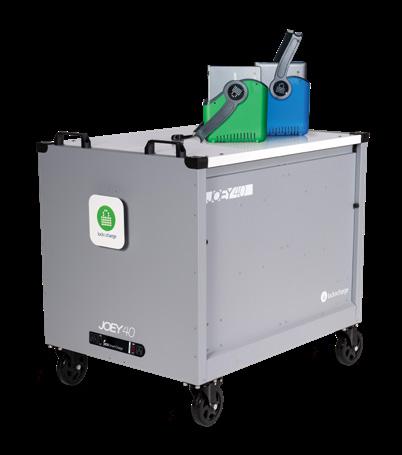

The classroom favourite. An open-basket design means no tangled cables — slide devices in, plug in, and go. Mobile, lockable, and built for the reality of busy school life.
Stores & charges up to 30 or 40 devices


Fixed, powerful, space-saving. Wall-mountable and built for scale — ideal for secondary schools, colleges, and universities with growing 1:1 device programmes.
Charging & Storage for every classroom!









Ready to make classroom device management easier?
















Periods of change can be challenging for many pupils, whether moving from KS2 to secondary or preparing for life beyond the classroom. The right support can make a lasting difference.
Academy21’s DfE-accredited Online Alternative Provision supports schools to help pupils manage change, build confidence and stay engaged with learning at key transition points.
Our transition support helps students thrive in and beyond school with:
Targeted KS2 curriculum to support KS2 to KS3 transitions
Support for Year 7s settling into secondary school
Confidence building, wellbeing support and emotional readiness for students throughout Years 5 to 13.
Academic support through key transitions
Preparation for next steps beyond KS4
Learn more:
Watch our Transitions webinar


Visit: academy21.co.uk/transitions
Talk to us: contact@academy21.co.uk
DfE Number: 000/1004


The Children’s Wellbeing and Schools Act has come into force, bringing with it a number of changes to safeguarding, school standards, pupil welfare, and the cost of living.
Part of the changes include a new Single Unique Identifier for children, currently being piloted, which aims to improve information sharing between agencies, while a legal duty will require services to share data on child safety and welfare. Schools will also play a role in new “Children Not in School” registers, with local authorities tracking all pupils, including those educated at home.
Multi-academy trusts will face dedicated inspections for the first time, and all trusts will be required to follow the national curriculum as well as national teacher pay and conditions. A revised admissions framework is also intended to ensure school places are better aligned with local demand.
From September, schools will be legally required to limit branded uniform items to three (excluding ties), a move designed to cut costs for parents. At the same time, eligibility for free school meals will expand to an additional 500,000 children, while more than 2,000 free breakfast clubs are set to open.
Further measures directly affecting schools include a requirement to enforce national guidance restricting mobile phone use during the school day, and new provisions for allergy safety, with schools expected to stock emergency allergy pens.


Primary school children in the North East are set to benefit from early AI and digital skills, following a £750,000 investment in the government’s TechFirst programme by the North East Combined Authority.
This will include ‘discovery days’ and local businesses engaging with schools to outline career paths and explain the wider benefits of artificial intelligence.
This follows £1.5 million invested by the government in the North East through the programme, as part of a wider ambition to help one million young people from across the UK to benefit directly from the growth of AI, rather than being left behind.
For the first time, the North East mayor and government have also agreed a regional target – with 80,000 local students in the North East to benefit from the training until 2029.
This will be further complemented by commitments to support 1,000 local teachers to confidently teach AI while the Authority will deliver 150 local work placements, giving young people real experience and reasons to stay and work in the North East.
Technology Secretary Liz Kendall said the AI Growth Zone is about more than technology – it is about ensuring growth reaches every part of the region. She praised the ‘stronger partnerships, new opportunities for local communities, and shared sense of purpose’ developing in the area since the Taskforce’s launch in September...
Attention to detail ensures your Bauder flat roof solution performs exactly as your building demands

Our results deliver the difference. Competency matters to us, it is what builds trust, reliability, and long-term success in every flat roof project we deliver.

We support you throughout, from funding application to roof completion, so you are assured that our guidance and solutions are always accurate, compliant and effective. Interested? read more Get in touch because the success of your flat roof starts here.
The government has announced two new education programmes that will help children in some of England’s most under-served communities.
From this September, Mission North East and Mission Coastal will bring expert support into classrooms and new opportunities beyond the school gates for children in the North East, Hastings and Scarborough – communities where too many young people have been held back with persistently low results.
The programmes will give the most disadvantaged children the mentoring, careers support, and enrichment opportunities they need to achieve and thrive.
The North East has the lowest exam results of any region in England at 1.9 points below the national average of 46.0 in Attainment 8. In Hastings, disadvantaged pupils average just 26.0 and in Scarborough around 27.
Across the country, disadvantaged White British pupils are being consistently let down, scoring 30.9 against 48.6 for their better-off peers.
Expert practitioners will work directly with leaders and teachers, building teacher capacity and raising standards. Schools will work together in local clusters, learning from each other rather than tackling challenges alone.
Education Secretary Bridget Phillipson said: “I grew up in the North East and know the challenges families face. I want every child there, and in coastal communities like Hastings and Scarborough, to have the same opportunities I was lucky enough to have...


The Sutton Trust has launched a free ‘hub’ of resources to support schools in making their admissions policies fairer.
This is in response to evidence of social segregation in high performing state schools and a lack of awareness of the issue from teachers.
The Sutton Trust began working directly with schools to introduce fairer admissions practices in August 2023. Since then, 118 schools have joined the Fair School Admissions Pledge.
The Sutton Trust has now developed a Fair School Admissions framework, drawn from this evidence and practical experience, which sets out recommendations for how government and school leaders can work collaboratively to make admissions more inclusive.
The Sutton Trust believes that the use of Pupil Premium priority in admissions has significant potential to reshape the admissions landscape. Through its Fair Schools Admissions project, the Trust has seen 22 schools introduce a Pupil Premium priority, an increase of over 50 per cent in the number of secondary schools doing so nationwide, with the Hub now making these materials available to thousands more schools.
The recent Schools White Paper sent a clear directive that schools should become more inclusive and set a target to halve the disadvantage gap by 2035. However, Sutton Trust data shows that wealthier pupils are 50 per cent more likely to access top performing schools than those eligible for Free School Meals, even if they live in the catchment area...

According to new polling, schools are continuing to cut back on staff, subjects and SEND support as they struggle with squeezed finances.
The survey of 1,105 teachers by the National Foundation for Educational Research (NFER) for the Sutton Trust, reveals many senior leaders reporting cuts to teaching assistants (71 per cent), support staff (49 per cent) and teaching staff (30 per cent).
Four in 10 senior leaders (43 per cent) reported cuts to support for pupils with SEND. These cuts were particularly acute in primary schools (45 per cent vs 25 per cent for secondaries). This underlines the urgent need for action on staffing capacity if mainstream schools are to educate more pupils with SEND.
Around three in 10 secondary school leaders continue to report cuts to subject choices at GCSE (30 per cent), and at A Level (28 per cent). Forty-nine per cent of all school leaders reported making cuts to IT equipment, 47 per cent to trips and outings and 32 per cent to sports and other extracurricular activities. Again, the scale of these cuts was more drastic for primary schools, which were also twice as likely to report cuts to sports and extracurricular activities than secondary leaders (34 per cent vs 15 per cent).
Meanwhile, ahead of a government consultation on the funding model for disadvantaged pupils, views on the pupil premium have barely improved since last year...


The government has announced the locations of 19 new Technical Excellence Colleges, backed by £175 million investment in skills training in priority areas.
This is the second wave of technical excellence colleges and will focus on advanced manufacturing, clean energy and defence, as well as digital and technologies.
It is estimated that almost 600,000 additional workers will be needed by 2030 in these key sectors.
The £175 million investment will support the highest-quality teaching, improved courses and access to specialist equipment.
From Durham to Plymouth, the newly awarded colleges are strategically located to align with local industry demand, helping drive regional growth and train a skilled workforce where it is needed most.
Prime Minister Keir Starmer said: “I want every young person to know there is a clear route into well-paid work, whatever their background. These colleges put technical skills front and centre, opening up high-quality jobs in the industries driving Britain’s future.
“We are backing talent across the country, strengthening our workforce and making sure opportunity is built into the system – not left to chance.”
This builds on the first wave of Technical Excellence Colleges announced in August 2025, where investment of £100 million is already beginning to support improvements in facilities, teaching and employer partnerships...


The government has set out plans to reform its School Food Standards, alongside a nine-week consultation on the changes.
The new standards have been developed alongside nutritionists and public health experts and will apply to all breakfasts and lunches served by schools.
Under the plans, schools will no longer be able to offer unhealthy ‘grab and go’ options like sausage rolls and pizza every day, while deep fried food will be banned completely. Fruit will also need to be served instead of sugar-laden treats for most of the school week.
The government also plans to put in place a new national enforcement mechanism to monitor the new standards and ensure they are applied consistently. Full details will be announced this September, with enforcement in place from September 2027.
The changes come as data shows that one in three children are leaving primary school overweight or obese, while tooth decay from diets high in sugar is the leading cause of hospital admissions for kids aged five to nine. What’s more, parent polling revealed three quarters are concerned by the food their children are eating.
The government also wants every school to appoint a lead governor to be responsible for school food, as well as asking every school to publish their food policy and menus online. There will be a phased approach for some...

Bursary scheme to remove barriers to STEM education: READ MORE
ISBL evolves into the Centre for Education Operational Excellence: READ MORE
Upgraded free school meal checker launched: READ MORE
Ofsted framework unfairly penalises inclusive schools: READ MORE
Call for evidence into antisemitism in schools: READ MORE
The government is launching a new programme to support schools in areas of high knife crime to improve pupils’ safety on their way to and from school.
The £1.2 million ‘Safety In & Around Schools Partnership’ will train school leaders on knife crime risk and support schools to develop local solutions to improve pupil safety, which could include mentoring support for high-risk pupils and deploying chaperones on school routes.
Schools will be selected using innovative hyperlocal mapping which will identify areas where knife crime is at its highest during school commuting hours. This new national mapping technology, developed by the Home Office, can identify the highest knife crime hotspots down to a precision of 0.1 square kilometres. Using microgeography, the police can pinpoint the specific streets and times when knife crime occurs.
More intensive and tailored support will be provided to up to 50 of these schools in areas with the highest rates of knife crime to increase schools’ ability to understand the local drivers of violence and take steps to prevent children from getting involved. This includes increased access to local support services, as well as ensuring vulnerable children have a trusted adult they can turn to and develop essential social and emotional skills that can keep them safe...
Research from Teaching Vacancies has revealed a clear shift in what teachers value most when choosing a job. School culture, wellbeing and values are now outweighing traditional drivers such as pay and location. Tanya Bentham, deputy director of talent at Lift Schools, explains how schools looking to attract and retain high‑quality staff should present their ethos – and why it matters as much as the role
Each year, thousands of teachers across England consider their next career move. During this peak recruitment period, I see a wide range of applications, so I’m always
a particular school. How do teachers make decisions in a crowded recruitment market? And what can schools do to stand out?
To give us an insight into this decision-making process, Teaching Vacancies commissioned


new, national research* into the job-seeking habits of teachers. The findings are clear: culture now comes first.
Two thirds (66 per cent) of teachers surveyed said that a school’s culture and values are the most important factor when deciding on a new role, ahead of location (55 per cent) and pay (47 per cent). While practical considerations still matter, many teachers are prioritising how a school feels to work in, how staff are supported and whether leadership aligns with their own values.
This is particularly true for early career teachers, who polled above the average in citing culture and values as the most important factor. Many are balancing the excitement of securing their first post with questions about workload, support and wellbeing. For this group, clear signals about a school’s ethos, leadership approach and commitment to staff development can make a decisive difference.


While location and pay remain important, they are no longer the sole drivers of decision‑making. Teachers are increasingly looking beyond the basics to assess whether a role will be sustainable and fulfilling in the long term
While location and pay remain important, they are no longer the sole drivers of decision-making. Teachers are increasingly looking beyond the basics to assess whether a role will be sustainable and fulfilling in the long term. For schools, this insight presents both a challenge and an opportunity. Recruitment is about more than advertising a vacancy. It is about being honest about what it is like to work in your organisation, how staff are supported and why your school is a place where teaching careers can thrive.
Teachers want reassurance that schools recognise the day-to-day challenges of the role and are committed to supporting staff through them. A positive culture is reflected in the everyday experience of working in E

F a school, from manageable workloads to supportive line management and opportunities to develop professionally.
Making school culture visible
Many schools offer excellent support for their staff but do not always translate their internal culture into something tangible for jobseekers. Being specific about key aspects of working life helps candidates quickly understand whether the school is a good match. This could include explaining how workload is managed, how mentoring and induction are delivered or how staff can access support. Simple, concrete examples make a meaningful difference because they help applicants picture themselves in the role. When teachers have multiple options, clarity and transparency can be the deciding factor. Schools that communicate their culture clearly are more likely to attract candidates who align with their ethos, leading to stronger matches and better retention.
Supporting candidates to present their strengths
Writing a personal statement is often cited as one of the most stressful parts of applying
for a teaching role, especially for early career teachers. Often, strong candidates can undersell themselves or feel discouraged before they have even secured an interview.
From this spring, all roles listed as ‘suitable for ECTs’ on Teaching Vacancies give applicants access to the Personal Statement Builder. Developed using expert insights, it guides candidates on how to articulate strengths, reflect on placement experience and understand what schools are looking for.
As a result, candidates feel fully supported from application to hiring, and clearer, more authentic statements reach hiring managers.
Why this matters for schools Clearer, more confident applications make it easier for hiring teams to assess suitability and potential, particularly when recruiting early career teachers.
When candidates articulate their skills and values, schools are more likely to identify individuals who align with their culture and long-term needs. This saves time for hiring teams, improves shortlist quality and leads to stronger outcomes for both parties.
There is also a wider system benefit. By reducing barriers and anxiety in the application
process, more teachers may feel encouraged to apply for roles that suit them, supporting a healthier and more dynamic recruitment market.
These new research findings underline that improving teacher recruitment is not just about increasing the number of vacancies advertised or applicants reached. It is about improving the quality of the match between schools and teachers.
For schools, this means being honest and proactive about what they offer, from leadership style to workload expectations. For candidates, it means having access to the right guidance and support to present themselves with confidence and make career decisions that help them thrive.
As recruitment activity intensifies, the message from teachers is clear: culture, values and wellbeing are no longer secondary considerations. They are central to how teachers choose where to work.
Schools that recognise this - and reflect it in how they recruit - will be better placed to attract and retain the teachers they need. M

*Research conducted by Teacher Tapp in December 2025, surveying more than 7,300 classroom teachers and middle leaders.



The Department for Education has updated guidance on restrictive interventions, introducing stricter duties on recording, reporting, and seclusion.
At Training with Pride, we help schools meet these expectations with confidence. Our trauma-informed approach empowers staff to stay regulated, reduce restraint, and respond effectively to distress.
We support you to ensure lawful, proportionate interventions, strengthen statutory reporting, and provide inclusive support for all pupils.
Every school leader understands the visible impact of a missing teacher. What is less often acknowledged is that the same level of disruption occurs when a caretaker is absent. The difference is that it manifests operationally rather than academically, yet the consequences are just as far‑reaching. Nick Orde‑Powlett explores the issue

In what ways are school caretakers crucial to the successful running of an education setting?
Caretakers are the operational backbone of a school. From the moment the gates open to the final lock-up at the end of the day, they ensure that the environment is safe and ready for learning. Without them, the small but essential tasks quickly accumulate into larger problems. We see this consistently across the schools we support. Routine maintenance is delayed and issues that would normally be resolved in minutes escalate into costly repairs. More importantly, the burden shifts. Senior leaders and teaching staff find themselves pulled into operational matters, diverting time away from curriculum, staff development, and pupil outcomes.
A well-functioning site team does more than maintain a building; it creates the conditions for education to thrive. Caretakers ensure that classrooms are usable and the school presents itself as a safe, professional environment for pupils, staff, and visitors. Their role is not peripheral, it is fundamental.
What are the key considerations to take into account when recruiting caretakers?
One of the most common mistakes we see is an overreliance on job titles rather than transferable skills. Schools often look for candidates who have “done the role before,” but this can limit access to a much wider and highly capable talent pool.
In reality, the most effective caretakers are those with practical problem-solving ability and the right mindset. Backgrounds in the military, emergency services and skilled trades often produce candidates who excel in school environments. These individuals are used to responsibility, can operate under pressure, and bring a strong sense of discipline and accountability.
Equally important is cultural fit. Schools are unique environments that require patience, adaptability, and an understanding of safeguarding responsibilities. A candidate may have strong technical skills, but without the right attitude and values, performance gaps can emerge.
There is also a practical consideration around time. As outlined in our earlier work,
in-house recruitment can absorb significant leadership capacity, often up to 30 hours per hire, with vacancies lasting several weeks or more. Schools must weigh this cost carefully and consider whether a more strategic approach would reduce disruption.
What steps can be taken to enhance the image and appeal of school caretaker roles, encouraging more people to apply?
If the conversation begins and ends with pay, schools will continue to struggle to attract candidates. While fair remuneration is essential, it is rarely the sole motivator, particularly for the growing pool of over-50s professionals.
What we are seeing, and what our data consistently supports, is that purpose is a far more powerful driver. Many candidates are not looking for “just a job.” They are looking for a role that offers structure, community, and the opportunity to use their skills in a meaningful way.
Schools can significantly improve attraction by reframing how they present these roles. Instead of focusing purely on duties, adverts should highlight impact. This is a role that directly contributes to the safety and wellbeing of children. It is a position of trust, responsibility, and community value.
Language matters. Phrases such as “supporting a safe learning environment” or “playing a vital role in the daily life of the school” resonate far more strongly than a list of maintenance tasks.
How can schools better support and retain caretakers once they are in post?
Recruitment is only part of the equation. Retention is where long-term stability is built.
In many schools, site staff operate behind the scenes, yet their contribution is constant. Recognition, inclusion in wider school conversations, and clear communication can make a significant difference to engagement and morale.
Workload should also be considered carefully. When vacancies occur, remaining staff are often stretched, leading to burnout and, ultimately, further turnover. Forward planning is key to avoiding this cycle.
Finally, offering a sense of progression or development, even in a role that is often seen as static, can improve retention. Whether through additional responsibilities, mentoring

Nick Orde-Powlett, managing director and founder, TIB Services
Nick Orde-Powlett is managing director and founder of TIB Services, an awardwinning recruitment service, providing reliable, KCSIE-vetted site staff for temporary and permanent roles. They provide national & local coverage through a candidate network of over 13,000 and are trusted by 2,600 schools, with a 97 per cent “excellent” rating.
opportunities, or involvement in wider estates planning, giving caretakers a sense of ownership strengthens commitment. Ultimately, schools that invest in supporting their caretakers not only retain valuable staff but also build safer, more resilient environments for their entire community. M

The DfE has outlined a long‑term goal that all schools should join or form a Multi‑Academy Trust (MAT) in its recent white paper. For leaders outside a MAT structure, this may raise concerns. Paul Banks, CEO at the Chelmsford Learning Partnership, challenges some of common misconceptions about becoming part of a MAT

The ‘Every Child Achieving and Thriving’ white paper, published earlier this year, unveiled the government’s major plans for the future of our schools. The changes promise to overhaul the education system over the next decade, with key proposals aimed at SEND, curriculum, and most importantly for this article, multi-academy trusts (MATs).
As the CEO of a MAT made up of 11 schools in Essex, I was intrigued to see the government’s plans to have all schools join a MAT. However, this is not the first time such an ambition has been set out. The former Conservative government made similar recommendations in a series of white papers – most recently in 2022 – which called for all schools to be part of a ‘strong’ MAT by 2030. Against this backdrop, Bridget Philipson’s proposal has prompted renewed debate, particularly amongst school leaders outside a MAT structure,

many of whom are expressing concerns about what this change may mean for their school, career and their day-to-day work.
Whether through LinkedIn posts or during face-to-face conversations, I have encountered a number of persistent misconceptions amongst school leaders. These concerns are understandable, but they also highlight a clear gap between policy intent and sector understanding. If the government is serious about its ambitions, far more needs to be done to provide clear, factual and accessible information – both to address the practical questions leaders have and to challenge some of the enduring myths surrounding MATs.
To bridge this gap, I hope to provide clear, transparent guidance in this article on what the changes will mean for schools as the government progresses with its plan, highlighting some of the opportunities, addressing the key concerns and challenging some of the most common misconceptions along the way.
Myth – Schools lose their character and autonomy when under a MAT
The belief that once a school joins a MAT, it is unable to act independently and loses all autonomy and individual character is a common misconception I hear from school leaders.
Yes, trusts provide strategic oversight, but individual schools will often retain autonomy over many core aspects. Once within a MAT, trust leaders work closely with school senior leaders to improve operational
A common misconception is that MATs primarily exist to support struggling schools. While trusts can, and do, provide significant support, this view overlooks the full breadth of benefits they offer to all schools, including those already performing well
efficiency and enhance underperforming areas. However, much of what defines each school’s distinct character remains. Culture and identity play a vital role in building a sense of belonging and inclusion, and these qualities are valued and preserved rather than replaced when a school joins a MAT.
Autonomy varies from trust to trust, and is covered in the schemes of delegation, an essential document that can be read to fully understand the delegation of governance to CEOs, board committees and governing bodies. Because of the potential for variation, it’s essential to do due diligence and ensure the trust is right for your school.
It is also worth noting that the white paper’s recommended shift to a broader curriculum means MATs will need to ensure consistency across schools, which could lead to some changes to teaching, in the form of schools adopting trust-wide curriculum frameworks, coordinating enrichment programmes or centralising digital strategies.
Myth – Schools have little control over whether a trust is the right fit for them
Just as no two schools are the same, no two MATs are either. When MATs receive funding to cover their schools, decisions around centralised functions (such as estate management, human resources and IT), will split funding differently, depending on the MATs policy of allocating funding to each school and what functions are carried out centrally. So, even two trusts that oversee the same number of schools can operate in vastly different ways due to their individual contexts and student cohorts. Therefore, it is imperative that school leaders undertake comprehensive research into a trust’s background to assess whether it will be the right fit. E

F I’d recommend face-to-face meetings and visits to the trust’s schools. This will allow you to speak with staff, headteachers and governors to answer any queries you have. This is greatly beneficial in understanding what autonomy looks like in practice and the changes that will be implemented as the school joins the MAT. For example, one of our priorities during transition is operational alignment and streamlining systems, such as HR and payroll, to improve efficiency and reduce costs. So, a school visit could consist of a discussion around how successful the change to services was delivered and whether they had seen a benefit from the reallocation of resources.
You will quickly get a more comprehensive picture of the impact the trust could have on your school, alongside firsthand testimonials from those who have undergone the process.
Myth – There’s no reason for wellperforming schools to join a MAT
A common misconception is that MATs primarily exist to support struggling schools.
While trusts can, and do, provide significant support, this view overlooks the full breadth of benefits they offer to all schools, including those already performing well.
Centralised services within a trust can strengthen leadership, enhance professional development, and enable more efficient resource sharing. This allows schools to access programmes and schemes that they may not be able to access independently. Another key benefit is robust continuous professional development (CPD). Trustwide CPD sessions, leadership pathways and cross-school collaboration enable staff to broaden their experience, taking on roles such as senior leaders or executive headteachers across schools, or contributing to trust-wide improvement. These often underappreciated benefits even address ongoing recruitment and retention challenges, helping to build a cohesive, motivated and aspirational culture that strengthens even the most successful school after joining.

Myth – Schools lose control and face wholesale changes as soon as they join a trust
Following the legal transfer of a school into a trust, the immediate priority will be to embed the school into the MAT and assess its most pressing needs, enabling targeted and effective support. Schools joining a trust should typically expect immediate engagement through on-site support and leadership development, but this does not mean that there will be immediate operational changes.
For example, when one of our secondary schools joined our trust, our central Trust team worked closely with the school’s leadership team to support improvements in the quality of teaching and learning. Through collaboration, this led to the introduction of a trust-wide framework for teaching and learning that established a shared foundation for classroom practice.
Curriculum development is typically another common focus. For the same school, we
assigned an executive headteacher to draw on their expertise to refine its curriculum to support knowledge progression. Through this, the team recognised the importance of ensuring a strong classroom environment and worked with leaders to update its behaviour policy to ensure consistency across classrooms. These interventions resulted in stronger Ofsted outcomes and improved student achievement.
Joining a trust can feel like a significant and sometimes daunting step, but with a clear understanding of the process and careful consideration whether a trust is right for your school, it can be a highly positive and beneficial experience. Schools should take the time to identify a trust that aligns with their values and culture and provide meaningful support for staff, students and the wider community. L
Paul Banks is chief executive officer of Chelmsford Learning Partnership, a successful multi-academy trust in Essex. As a former headteacher of two secondary schools and chairperson of the Association of Secondary Headteachers in Essex (ASHE), Paul has more than 28 years of experience in the education industry.

University print demand doesn’t follow a steady pattern – it surges at critical moments like during enrolment and exams. So how can you build resilient, scalable print environments that perform under pressure?
Unlike offices, universities don’t print at a steady pace. In fact we’d be hard-pressed to imagine an environment with greater seasonal variance. During enrolment, exam season or final assessments, demand for printing can skyrocket overnight, putting enormous pressure on infrastructure, especially if that infrastructure is not designed to flex. This creates bottlenecks, just when students need their network most.
The solution in our experience, is not just about adding more devices or licenses. It’s about building a resilient ecosystem that can absorb stress during the busiest weeks of the year. A year-round solution that can accommodate your worst-case scenario. So if a university comes to us and says, ‘At enrolment time, we know we’re printing a million pages a month’, then that’s what we need to build.

We’re not yet in that amazing world where everything is paperless. With every new tech jump, people talk about the paperless office, but it always seems to be just around the corner, so our reliance on paper is still high. That’s especially true for our higher education clients, where we’ve noticed three key moments that drive the heaviest, servergrinds-to-a-halt kind of print demand.
The first is enrolment season. When thousands of new students arrive, the administrative load tends to peak. ID cards, onboarding packs and numerous forms generate the bulk of campus printing, and they’re often concentrated in just a few days. That concentration is what tends to make servers and print queues struggle.
Another moment is pre-exam cramming – or maybe pre-exam ‘studying’ is a more charitable word, but you know what we’re talking about. As exams approach, students print notes, practice papers and tons of reference material; often late at night or in the days immediately before the first test.
Another key moment is final assessments and thesis submissions. The most intense server demand always comes at the end of term. Entire cohorts submit essays, portfolios and research projects simultaneously. For postgrad students, thesis printing alone can strain even commercial-grade equipment.
These patterns might be predictable, but that doesn’t make them any more simple to manage. And many institutions still fail to plan their print infrastructure around them.
Re-thinking scalability. More than a buzzword?
In IT circles, “scalability” is a buzzword that often gets thrown around. (We’re guilty of this ourselves.) But in the university print context, true scalability means elasticity, flexibility and resilience: the ability to ramp up capacity quickly during peak demand, then scale back during quieter periods.
Unfortunately, most universities don’t scale their print environments dynamically. They provision capacity to survive the inevitable spike, sure, but then run under-utilised the rest of the year. Kind of like driving a tank as your daily commuter vehicle. It’ll come in handy one day, but the rest of the time it’s overkill.
The thing is, no university wants to risk students missing deadlines or staff scrambling for workarounds because a printer queue failed at crunch time. Which means scalability in higher education isn’t so much about efficiency, but about resilience when the pressure is on. Being able to service the volume of jobs, be it print, scanning, or photocopying.
What scaling actually looks like behind the scenes
So, scaling print management isn’t just a matter of buying more printers. Across your network, several layers of architecture determine whether a university can handle load surges or not, as the case may be.
Throughput matters: The number of jobs per minute is often a bigger challenge than the number of users. A hundred students printing 20-page documents at once is very different from a slow trickle of single-page jobs.
Load balancing: Network load balancers distribute traffic across multiple servers, making sure no single node becomes a bottleneck. This makes a big difference when hundreds of students are simultaneously trying to print coursework.
Cloud or hybrid provisioning: Modern platforms also allow IT teams to spin up additional resources in the cloud when demand spikes, then scale back afterwards. This elasticity reduces the need for expensive permanent infrastructure, while maximising your system’s overall resilience.
What that allows you to do, from a scalability aspect, is recognise a peak and replicate an existing server to create two or three additional print servers. And with the use of a load balancer, these get added instantly, allowing you to quickly and easily expand your print capacity.
Turner, regional customer success manager, PaperCut

As far as an end user’s concerned, they’re just printing to the same location they always were.
In a high-pressure environment, performance isn’t just about raw capacity. It’s about the user experience when every second feels critical. Often the delays we’re talking about might only be a few seconds, but when you’re trying to print something, one or two seconds feels like an eternity. And when multiplied hundreds of times they cause visible queues and mounting user frustration.
Performance tuning (in other words, optimising job spooling, authentication speed and release responsiveness) is how you deliver a seamless experience under pressure. Universities that fine-tune their systems avoid that negative spiral where slowdowns trigger panic, complaints and manual workarounds.
Build for the worst, plan for the best Smart universities, in our experience, are the ones that plan for both their busiest and quietest periods. Then, design a print environment to dynamically scale between those two extremes so they’re only paying for what they actually need.
Scalability in university print management is not about expansion for its own sake. It’s about resilience. Building a cost-effective environment that holds steady during the stress tests that matter most. M

Discover the Action Packed range
Action Mats resources use movement in unique ways that help children develop oracy and numeracy skills, to be fit and healthy, and to learn self-regulation techniques. Activities are shown using simple and fun graphics printed onto each mat, that engage all children, being particularly beneficial to SEND and EAL children. Activity plans and guidance for use, are accessed online.


Designed for KS1 and KS2, the Action Packed range is perfect as a PE resource for cardio fitness circuits or group PE activities, as well as for After School and Breakfast Club activities.
Discover the Mini Mats range
Unlocking the power of movement and helping to make PE lessons and active learning, fun and engaging for EYFS – Mini Mats is a multifunctional learning tool.

Discover the Mindful Mats range
Mindful Mats helps schools practice mindfulness with children using selfregulation activities, that can help improve a child’s emotional wellbeing – helping them focus and promoting effective learning.



The government’s schools white paper outlines plans to reform the SEND system, with proposals including a tiered approach to support, increased involvement from health professionals, and funding to make mainstream school more inclusive. We explore the changes
The government’s schools white paper sets out its long-awaited plan to reshape the SEND system, with earlier intervention, greater inclusion in mainstream schools and stronger input from health professionals at its core.
Demand for specialist provision has reached its highest level in decades, while increasing numbers of children are being educated in alternative provision or at home due to unmet needs. Yet with the right support in place, many children and young people with SEND can thrive in mainstream settings alongside their peers.
At the heart of the proposed reforms is a shift away from a system that is often slow, reactive and dependent on statutory assessments. Instead, the government aims to embed SEND support within mainstream education, ensuring help is available earlier, more flexibly and without families having to fight for it.
Backed by significant investment, including £1.6 billion to make mainstream schools more inclusive – the reforms prioritise early identification and intervention. Schools will be expected to meet commonly occurring E

Meet the latest UK requirements for recording and reporting restrictive interventions and seclusion to parents — accurately, consistently, and on time — with IRIS Adapt.
✔ Capture every incident correctly
Ensure all physical interventions and restrictive practices are:
• Logged in real time
• Structured using consistent, policy-aligned forms
• Fully detailed and defensible
✔ Meet same-day reporting expectations
Quickly generate and share clear incident reports with parents:
• Access records instantly
• Automatic custom email notification to parents (no parent app required)
✔ Maintain a complete audit trail
Every action is automatically recorded:
• Time-stamped entries
• Staff accountability
• Secure, centralised records
So you can demonstrate compliance with confidence.
✔ Turn compliance into insight
Go beyond reporting with powerful analytics:
• Identify patterns in interventions
• Monitor frequency and risk
• Inform behaviour strategies and support plans
Where accurate recording and transparent reporting are critical.
F needs through adaptive teaching, calm and supportive environments, and targeted group interventions.
When announcing the reforms, Prime Minister Keir Starmer said that the right support should never be a battle. He said: “No more ‘one size fits all’ system that only serves children who fit the mould. Instead, families will get tailored support built around their child’s individual needs, available on their doorstep.”
Central to the reforms is a new layered model of support, structured across three levels: Targeted, Targeted Plus and Specialist.
Targeted support will focus on early, evidence-based interventions delivered within mainstream schools. Where needed, this can be enhanced through “Targeted Plus”, drawing on expertise from education, health and care professionals via the new Experts at Hand service, as explained later.
For children with more complex needs, Specialist support will provide a higher level of provision. This will be underpinned by nationally defined Specialist Provision Packages, which will also form the foundation of Education, Health and Care Plans (EHCPs).
Regardless of the level of support, every child identified with SEND will have a schoolbased Individual Support Plan. Developed
The reforms prioritise early identification and intervention. Schools will be expected to meet commonly occurring needs through adaptive teaching, calm and supportive environments, and targeted interventions
in partnership with parents, these plans will outline day-to-day provision, adjustments and intended outcomes, ensuring support remains responsive as needs evolve.
Ofsted will also be assessing a school’s use and quality of Individual Support Plans.
EHCPs will remain but an assessment will be made in three years’ time whether children’s needs can be better met with an Individual Support Plan in mainstream. This does not apply to children in special schools.
The new £1.6 billion Inclusive Mainstream Fund over three years will give schools and other education settings direct responsibility over funding, enabling them to plan for E



FAST, ACCURATE IDENTIFICATION ON ONE DIGITAL PLATFORM
TARGETED, EVIDENCE‑BASED SLCN INTERVENTIONS
ONLINE TRAINING TO BUILD STAFF CONFIDENCE
CLEAR REPORTS SHOWING PROGRESS AND NEXT STEPS
Speak to our friendly Help Desk team for advice on which package is right for your setting 0333 577 0784 helpdesk@speechlink.co.uk


Find out where Speech & Language Link can strengthen SLCN support in your setting.
Helping SENCos and SEND leaders make a real difference.
Speech & Language Link support thousands of settings from early years to secondary, building staff confidence in identifying and supporting language needs.


The new £1.6 billion
Inclusive
Mainstream Fund over three years will give schools and other education settings direct responsibility over funding, enabling them to plan for commonly occurring needs and encourage earlier and more effective support
F commonly occurring needs and encourage earlier and more effective support.
Rather than relying on formal diagnoses, schools will be able to invest in early interventions, such as language development programmes, small group support, staff training and adaptive teaching. This includes programmes like NELI (Nuffield Early Language Intervention) and ELSEC (Early Language Support for Every Child) which help strengthen language development and early communication skills.
Schools will be expected to demonstrate how they are prioritising inclusion. This includes publishing an Inclusion Strategy and embedding inclusive practices across teaching, curriculum design and the wider school environment.
A key feature of the reforms is closer collaboration between education and health services. The new ‘Experts at Hand’ support will help children for whom specialist input is essential to help them thrive in mainstream education or the specialist system.
Through the Experts at Hand initiative, schools will gain faster and more flexible access to professionals such as speech and language therapists and educational psychologists. E


Equal Education is an award-winning social enterprise that connects qualified teachers with under-resourced learners to provide specialist tuition. We bridge gaps in access by building trusted, trauma-informed relationships that turn systemic barriers into pathways for long-term success
Qualified Teache delivered exclusi
Holistic Growth: social-emotional
Tailored Learning needs and E H CP
Robust Safeguar attendance, sess
Inclusive Tech: M provided for safe

Empower your learners - visit:





Funding will support the creation of specialist bases within schools, as well as physical adaptations such as sensory spaces, improved ventilation and accessible facilities

F This approach aims not only to provide timely specialist input, but also to build confidence and expertise among school staff. Over time, it is expected to reduce reliance on formal referrals by enabling earlier, preventative support within mainstream settings.
To fund this support, the government will invest £1.8 billion over the next three years. £1 billion will fund expert professionals to work directly with mainstream schools, improving early support without requiring an assessment or referral, while £800 million will build the capacity of mainstream schools through expanding outreach from specialist and alternative provision settings.
Crucially, schools will be able to use the Experts at Hand offer for pupils, regardless of whether they have an EHCP.
For pupils with the most significant needs, Specialist Provision Packages are intended to bring greater consistency to support across the country. These nationally defined, evidencebased frameworks will outline the interventions, resources and standards required.
EHCPs will continue to guarantee legal entitlement to support, but will be more closely aligned with these standardised packages, while Individual Support Plans will detail how provision is delivered day to day. E

Prepare your students for success with assessments that mirror the format and challenge of national tests.
BENCHMARK attainment with reliable, age-standardised data. TRACK progress across the year with termly Autumn, Spring, and Summer tests.
PREDICT performance and identify specific learning needs for targeted intervention.
Discover NTS Reading & Mathematics hachettelearning.com/assessment












Sunken Trampolines have launched the first high performance, Rebound Therapy in ground trampoline. All UK made, available in a size to fit your space and with a selection of structural lid options to allow multi purpose use. Visit sunkentrampolines.co.uk for more details.
A key feature of the reforms is closer collaboration between education and health services. The new ‘Experts at Hand’ support will help children for whom specialist input is essential to help them thrive in mainstream education or the specialist system
F Designing schools for inclusion Alongside system reform, investment in school infrastructure aims to make mainstream settings more accessible.
The DfE is investing £740 million in 202526 to create 10,000 more mainstream school and college places for children and young people with SEND.
Funding will support the creation of specialist bases within schools, as well as physical adaptations such as sensory spaces, improved ventilation and accessible facilities. These changes are intended to ensure more children can attend local schools and participate fully in school life, with the right support available on site.

However, according to a recent NAHT member survey, almost half of leaders said specialist SEND facilities such as dedicated classrooms, sensory rooms and outdoor spaces were not fit for purpose (41 per cent) or closed (three per cent), highlighting the scale of the challenge.
In a recent NFER blog, Matt Walker, senior research manager noted that for inclusion bases to succeed, they need strong integration into everyday school life, collaboration between E


•
•
•
•
•





















F base staff and classroom teachers, sufficient funding and specialist staffing - as well as a whole-school commitment to inclusion. This would allow inclusion bases to enhance what schools already do well. But without them, they risk reinforcing separation rather than inclusion.
In the DfE’s School and College Voice survey from January 2025, less than three quarters of mainstream school leaders agreed or strongly agreed that their school could effectively support children with SEND or learning difficulties and disabilities despite many teachers being keen to expand their knowledge.
Recognising the pressures on staff, the government is investing in SEND training for teachers and school leaders. From 2026, all staff will have access to updated training materials, supported by a revised SEND Code of Practice that places greater emphasis on inclusion.
There will also be a new digital solution for handling complaints that will aim to simplify the process, improve coordination between multiple bodies, improve complaints data collection, and stop complaints being escalated through multiple avenues in parallel.
The DfE has said it will set out new mutual expectations for complaints handling with clear timeframes and update guidance to make clear to parents and the sector which organisation is best placed to consider specific complaints, to reduce complaints going to multiple organisations at once.
Overall, the white paper aims for a more proactive, inclusive and joined-up system, one designed to identify needs earlier, support children more effectively in mainstream schools and reduce the burden on families navigating the process.
As Helen Hayes MP, chair of the Education Committee, summed up: “While the current system may be broken, it is not beyond repair.” M
FURTHER INFORMATION
Read the whitepaper here.
An inclusion base is a specialist area within a mainstream school that provides additional support and tailored teaching for children and young people with additional needs.
These spaces are designed to be flexible and adaptable to different levels of need. They may be used for smallgroup support, such as helping pupils with reading and writing, or for children who find the main school environment overwhelming. Inclusion bases can also provide more specialist support, including teaching a modified curriculum or offering one-to-one personal care.
The government’s long-term aim is for every secondary school to have an inclusion base, with a similar number of places available across primary schools.

Whether enhancing classroom engagement, supporting administrative workflows, or helping institutions reduce their environmental impact, Epson delivers technology designed with education in mind
Epson’s commitment to education extends beyond technology. We work closely with schools, colleges, and universities to understand their challenges and develop solutions that offer long term value. Our eco conscious approach means institutions can make meaningful progress toward sustainability goals, while our reputation for reliability ensures consistent performance across busy, high demand environments. With intuitive interfaces and minimal maintenance requirements, Epson devices reduce operational complexity and help IT teams support their institutions more efficiently.
Whether enhancing classroom engagement, supporting administrative workflows, or helping institutions reduce their environmental impact, Epson delivers technology designed with education in mind. Our solutions empower educators, streamline school operations, and create more inspiring, inclusive learning environments for students.
Epson is proud to partner with educational institutions across the UK to build a smarter, more sustainable future for learning– one classroom at a time. M
FURTHER INFORMATION
To learn more about how Epson can support your technology needs contact education@epson.co.uk



The government’s £3 billion SEND investment marks a major shift towards more inclusive education in mainstream schools. But delivering meaningful change will rely not only on funding, but on effective procurement, specialist partnerships and smart planning
In December 2025, the government announced a significant £3 billion investment for mainstream schools with the aim to create 50,000 new SEND (Special Educational Needs and Disabilities) spaces across the country. This investment has proposed to reduce the long travel times many SEND pupils currently face due to lack of specialist education in their area. This article will be exploring the investment, outlining funding specifics, and detailing how Procurement Services can support schools looking to maximise on this initiative.
The Department for Education (DfE) has highlighted that children with SEND often do not have access to support or specialist facilities close to their homes. This investment aims to improve the support system they currently receive and make sure every child in need has easy access to inclusive education. The goal from the government is to improve day-to-day experiences for pupils

and families, while reducing local authority transport and placement budgets.
As reported in the DfE press release, nine per cent of SEND students are travelling in single occupancy vehicles such as taxis. The government funding will be used to improve and expand current establishments to adapt to specialist areas and needs. This will enable local authorities to respond more quickly to rising demand and make better use of the buildings already embedded within communities.
The foundation for this longer-term development is embedding inclusion into the design and function of school estates. For schools, trusts and local authorities, this means SEND provision is increasingly becoming a core estates consideration, not a standalone or specialist add-on.
The £3 billion capital investment is designed to support a wide range of improvements across the education estate. This includes ensuring calm rooms, sensory spaces, and smaller group areas, as well as autism friendly and ADHD friendly environments. Schools are also expected to make adaptations that allow children to learn in mainstream settings while accessing specialist support.
A significant proportion of the funding will be used to expand specialist provision, including
Capital funding enables local authorities and schools to invest in specialist facilities and adapted learning environments, supporting a wider range of needs within mainstream and specialist settings
the development of new special schools and the enlargement of existing specialist settings.
The programme also places emphasis on targeted capital improvements rather than large-scale new builds alone, including retrofitting and remodelling existing buildings so they can be more flexible to changing needs. For many local authorities, adapting existing schools is a faster and more cost-effective way to increase capacity, particularly where demand is already outpacing available provision.
SEND capital investment is no longer just about adding new buildings to the estate, but about re-shaping existing schools and spaces so they can support a wider range of needs, now and in the future.
The SEND capital investment will be felt differently across the system, but its impact may already be beginning to shape decisions for schools, trusts, parents and local authorities. The shift away from new-build free schools and towards adapting existing provision presents both opportunities and challenges that need to be carefully managed.
For schools and academy trusts, the investment creates a clear opportunity to improve inclusive provision within mainstream settings. Capital funding enables local authorities and schools to invest in specialist facilities and adapted learning environments, supporting a wider range of needs within mainstream and specialist settings.
At the same time, an increased reliance on mainstream settings to deliver SEND provision means schools will need more than physical space alone. Creating specialist zones and delivering high-quality SEND support requires skilled staff, ongoing training and sufficient time to embed changes. E
F For families, the potential benefits are clear. The expansion of local SEND provision increases the likelihood of children accessing support closer to home, reducing travel time and disruption to daily routines. Purpose-designed environments, built with specialist needs in mind, can also make a meaningful difference to pupils’ comfort, engagement and ability to learn.
As the SEND capital programme moves from policy into delivery, schools, academy trusts and local authorities may begin facing increasing operational complexity. The desired outcomes depend on having the right procurement routes, specialist expertise and delivery partners in place. Our extensive selection of education solutions offer compliant, flexible routes to procure for the full range of services required to deliver SEND capital projects. From early-stage planning and professional services, through to adaptation and ongoing estate support, our frameworks are designed to help organisations move at pace while remaining fully compliant with public sector procurement regulations. Our DfE approved Education Management Systems framework closely aligns with this initiative by enabling schools and local authorities to strengthen the systems that underpin effective SEND provision. It
covers a comprehensive range of solutions from data management, safeguarding, attendance tracking and SEN support tools. The framework helps organisations manage information more efficiently and respond more effectively to pupil needs.
Our Sensory Equipment and Associated Services framework can support the creation of inclusive, specialist environments tailored to pupils with SEND. The framework provides access to a comprehensive range of solutions, from the design and installation of sensory rooms and spaces to outdoor sensory gardens and hydrotherapy facilities, enabling schools and local authorities to deliver fully integrated, sensory-focused environments.
And for schools or local authorities looking at how to finance capital purchases, our DfE approved Financial Leasing Solutions framework provides access to competitively priced, high quality and compliant routes. We understand a funding initiative of scale can place pressure on procurement teams. For many organisations, capacity can become stretched. If this is the case, Procurement Services can help. Our contract and procurement management solutions are designed to support teams at every stage, from planning and procurement through to contract management and delivery. We can help reduce administrative burden, improve visibility and ensure projects remain on track while achieving best value. L


distributed leadership can expose anxieties around power, delegation and accountability. Although schemes of delegation are common, they do not always clearly articulate decision rights or accountability lines. Strengthening these frameworks is a practical way in which governance leadership can enable integration.
Drawing on the ISBL, National Governance Association and NAHT report on the Three Strands of Leadership, this analysis explores how shared leadership can work in practice, and how business and operational thinking can support sustainable delivery.
The report argues for a distributed leadership model in which governance, educational and business leadership operate as equal and interdependent partners. It challenges the historic “hero headteacher” model, suggesting it is increasingly unsuited to today’s multi site, highly regulated and financially constrained education system. Instead, the paper calls for integrated leadership to enable coherent strategy, robust accountability and resilient operations.
Within this model, governance leadership sets mission, values, risk appetite and oversight; educational leadership translates strategy into teaching, learning and improvement; and business leadership ensures operational excellence across finance, HR, estates, IT and procurement. Fragmentation between these strands weakens outcomes, while purposeful integration improves performance and organisational resilience. While the conceptual case is compelling, the challenge lies in turning these principles into practical action, particularly when striving for operational excellence that genuinely supports education.
Three key barriers stand out. First, culture and role clarity remain significant obstacles. Moving from hierarchical leadership to genuinely
Second, skills and capacity vary across boards and leadership teams. Some lack operational expertise, while others have limited exposure to educational or curriculum led planning. Approaches such as Integrated Curriculum Financial Planning (ICFP) provide a structured way to connect curriculum, finance and workforce decisions over the medium to long term. For specialist settings, this extends to provision financial planning across multidisciplinary teams. These conversations help leaders better understand each other’s constraints and priorities, enabling more effective resource deployment.
Finally, accountability and measurement can become blurred in distributed models. Cross functional KPIs risk creating confusion, particularly in the context of SEND funding pressures, workforce wellbeing and increasing sustainability risks. Clear role definition and a shared commitment to overarching objectives are essential to make cross strand working effective.
Trusts and schools should codify roles and decision rights, embed ICFP as an annual cross strand process, and balance operational efficiency with pedagogy and wellbeing. When used thoughtfully, the three strand model offers a credible, practical framework for aligning strategy, operations and educational purpose – provided process never eclipses people or learning. M
Find out more about the report here






Helping Schools, Colleges and Universities to become more energy effi cient.





Significantly reduce Legionella contamination risks.
Increase combustion efficiency of gas, oil, and LPG, reducing energy costs by up to 15% and reducing emissions.
Improve heat transfer capability of heating system water, offering savings of up to 22% in fuel costs.



Educational estates are under growing pressure from rising energy costs, ageing infrastructure, and increasingly strict environmental and compliance requirements. While many institutions focus on visible upgrades, some of the most significant inefficiencies remain hidden within water and heating systems – quietly increasing operational costs year after year
The hidden cost of limescale and system inefficiency
In hard water areas, limescale is a major but often overlooked driver of inefficiency. It accumulates over time, leading to premature failure of taps, valves, appliances, and heating components. It also restricts water flow, increases strain on systems, and can raise energy consumption by up to 40 per cent in affected heating elements.
Beyond cost, limescale contributes to water wastage through leaks and inefficiencies, and can increase Legionella risk by creating favourable conditions for bacterial growth.
A non-invasive solution with immediate impact
Aqua Energy Solutions provides advanced, non-invasive technology designed to improve system performance without disruption, downtime, or plumbing modifications.
The system works continuously to improve water quality, break down existing limescale within weeks, and extend the lifespan of critical infrastructure. It also reduces maintenance requirements and supports existing Legionella control strategies.
With energy prices remaining high, efficiency gains are critical. Aqua Energy Solutions delivers proven improvements, including up to 15 per cent fuel savings (gas, oil, LPG systems); up to 16 per cent improvement in heat transfer
efficiency; and combined energy savings of over 20 per cent in many heating systems. These reductions are achieved without compromising performance or requiring invasive installation.
Tackling system contamination at the source
Alongside limescale, magnetite and corrosion deposits reduce system efficiency and reliability. Aqua Energy Solutions helps dissolve and control limescale buildup; convert corrosion into removable particles; enable water-based cleaning without harsh chemicals; and restore system efficiency within weeks.
For schools, colleges, and universities, this approach delivers immediate and long-term value: reduced operating costs, extended asset life, improved sustainability performance, and minimal disruption to daily operations.
In a constrained funding environment, improving hidden system efficiency is one of the most practical and impactful steps estates can take. M









































































The second Education Business LIVE Conference & Exhibition took place at London’s Old Billingsgate on 26 March with an strong conference programme tackling some of the most pressing issues facing education – from SEND reform and teacher training to artificial intelligence and school inspections
Bringing together school leaders, trust executives, policymakers and suppliers, the second Education Business LIVE delivered a comprehensive mix of keynote speeches, panel discussions and practical sessions, alongside a vibrant exhibition floor and the co-located Education Business Awards.
A strong focus on leadership
The conference opened with a keynote from Matthew Burton, known for Channel 4’s Educating Yorkshire, who reflected on his leadership journey at Thornhill Community Academy. Matthew emphasised the importance of embedding a strong school ethos at the E







F heart of every staff member’s practice, while also recognising the human side of teaching. He highlighted the need to understand individual personalities and actively support staff wellbeing, particularly on the challenging days the profession inevitably brings.
His address set the tone for a programme heavily focused on leadership, operational effectiveness and system-wide improvement.
An early session brought together Stephen Morales of the Institute of School Business Leadership and Emma Balchin of the National Governance Association, who explored how schools can build effective organisational structures. Their discussion emphasised the importance of clear processes, strong leadership and robust productivity monitoring.
Later sessions, including contributions from Astrea Trust CEO Rowena Hackwood and Dr Mary Bousted, Chair of the Teaching Commission, examined how leadership frameworks translate into day-to-day practice, offering insights from across multi-academy trusts.
SEND and inclusion high on the agenda
Special educational needs and disabilities (SEND) provision emerged as one of the event’s central themes. Sessions brought together voices from across the
The conference opened with a keynote from Matthew Burton, known for Channel 4’s Educating Yorkshire, who reflected on his leadership journey at Thornhill Community Academy
sector, including Samantha Twiselton of Sheffield Hallam University, who discussed the current SEND landscape and what schools can expect going forward.
Heba Al-Jayoosi, assistant headteacher and inclusion leader at Mayflower Primary School, shared practical insights on integrating SEND learners and Ali Durban MBE, co-founder of Gesher School, spoke about her experiences as a SEND parent and establishing a specialist school in London.
With the government investing £3.7 billion to create more accessible school buildings and put in place Inclusion Bases, Terry White, chair of the Association for Learning Environments, gave practical advice on implementing inclusive design in mainstream schools.
The speakers then re-joined for a panel discussion which combined policy context E


Use code EB12AE online before 31st July 2026 to receive 10% off all orders








Alongside the conference programme, the exhibition floor showcased a wide range of suppliers spanning technology, facilities management, catering, SEND provision, and more
F with practical application, covering inclusive classroom design, mainstream integration and system-wide challenges.
Adam Sproston, Senior His Majesty’s Inspector for SEND and Inclusion at Ofsted, took an afternoon session to provide insight into how SEND will feature in new inspection frameworks. He explained how inspections will look and feel different, with context further taken into account, a more collaborative approach, a clear focus on wellbeing, and clear recommendations on what to do to improve.
Teacher recruitment and retention were addressed through sessions led by James Coleman of the National Association of SchoolBased Teacher Trainers, alongside further contributions from Samantha Twiselton.
Discussions concluded with the message that rigorous training needs to be balanced with the development of “human skills” such as emotional intelligence and problemsolving, as these are critical to long-term teacher retention and classroom success.
Beyond policy and pedagogy, the event placed strong emphasis on operational challenges. There was a session on procurement, featuring contributors including Kevin Draisey, head of procurement operations for the DfE’s Get help buying for schools. Kevin offered practical advice on improving efficiency and reducing financial risk.
Other speakers included David Kershaw, government advisor and digital transformation specialist; Peter Melville, chief operating officer at South West Essex Community Education Trust, Jack Horton, customer engagement manager at Crescent Purchasing Consortium, and Clare Delaney, managing director at Place Group. E

Try LOQT free.
A software solution that pauses distracting apps during school hours and supports healthier habits at home.
Most schools have a phone policy. The harder problem is enforcement. Teachers policing pockets, phones in toilets, notifications buzzing through bags. Research from the University of Birmingham confirms that school-only restrictions tend to displace phone use rather than reduce it. Students compensate at home.
LOQT fixes that automatically. During school hours, distracting apps are paused on pupils' devices. Calls, texts, and medical apps remain available at all times. No pouches. No lockers. No staff time spent chasing it.
Parents can extend the same restrictions to homework, mealtimes, and bedtime from a single platform. Privacy is protected by design. No messages, browsing history, or personal content is monitored.
Early days but some really encouraging findings. Most interesting, the decrease in phone use outside of school.
“
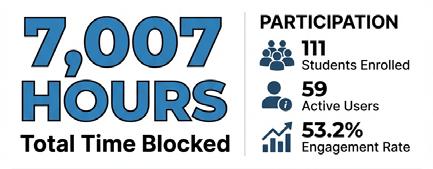
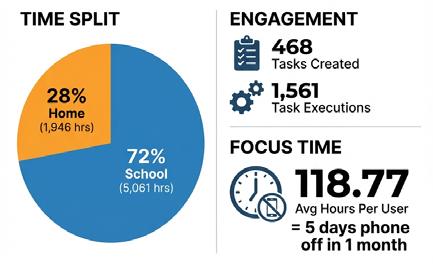
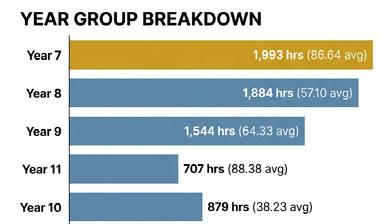
At Thornden School in Hampshire, 59 active pupils generated 7,007 hours of phone-free focus time in just four weeks. 28% of that occurred at home. Thornden has since continued using the app.




F Estates management was another key focus, with a theatre session delivered in partnership with the National Alliance of School Premises Management and sponsored by Cornerstone.
Stuart McGregor, NASPM’s director of operations and Chris Coyle, NASPM’s operations manager, alongside headteacher Paul Jackson, spoke about compliance, health and safety responsibilities, and risk management – highlighting the often complex realities of maintaining school infrastructure.
MAT inspections and flexible working
With multi-academy trust (MAT) inspections on the horizon, a dedicated session explored how trusts can prepare without increasing administrative burden. Speakers including Warren Carratt, CEO of Nexus Multi Academy Trust, Rowena Hackwood, CEO of Astrea Trust, Gail Brown, CEO of Ebor Academy Trust, and Rebecca Daulman from Agora Learning Partnership, emphasised readiness, impact and proportionality over compliance-driven approaches.
Flexible working also drew significant attention, reflecting wider workforce pressures. Speakers included Kelly Hannaghan, director at Mind Work Matters; Emma Wigmore, chief executive officer at The Diocese of Chelmsford Vine Schools Trust, Dr Mary Bousted, Chair of the Teaching Commission, and Warren Carratt. They discussed how schools can
With multi‑academy trust inspections on the horizon, a dedicated session explored how trusts can prepare without increasing administrative burden
balance staff wellbeing with operational needs - an issue increasingly shaping recruitment and retention strategies.
AI and digital transformation take centre stage
Artificial intelligence and education technology formed one of the most forward-looking strands of the conference. Delivered in partnership with techUK, sessions explored how schools can adopt AI tools safely and effectively. Opening remarks came from Austin Earl, education & EdTech lead at techUK and chair of the EdTech Advisory Panel on AI in Education. He explored how research-led certification can help schools adopt AI tools with confidence, ensuring they are safe, effective and ethically grounded.
Speakers included Rob Peters from the NGA, Chris Goodall, head of digital education at the Bourne Education Trust, and Dr Madiha Khan, director of consulting services at EDUCATE Ventures Research. The session E

PURE Coaching provides people with a safe space to work through PURE-ly their own agenda: a marked difference from traditional top-down management meetings It is a deeply empowering dynamic, which benefits leaders, staff and students alike

Nurture the professional development and personal wellbeing of your staff through better conversations.
Coaching Accreditation Programme Individual Leadership Coaching









Positive Impact on Personal Wellbeing
Positive Impact on Professional Performance
Worthwhile Investment of Time Believe roll-out will positively impact Retention
F was chaired by Edtech legislator, Jim Knight, The Rt Hon Lord Knight of Weymouth.
Alongside this, a session on digital maturity examined how education leaders, government and industry partners can work together to drive coherent progress. Contributors included Elizabeth Anderson, CEO of the Digital Poverty Alliance, and Cheryl Shirley, director of digital learning at LEO Academy Trust.
Austin Earl also chaired a panel session which considered how the education sector can respond to the challenges of digital transformation at a time of fragmentation, funding pressures and rising expectations.
A talk on building AI-ready teams for better student support services also took place, in association with consultancy redk. This allowed delegates to watch first-hand how AI helps solve common student problems quickly while making management easier.
School food policy also featured at Education Business LIVE, with sessions addressing anticipated updates to standards and expanding provision.
Trisha Jaffe, chair of the Osborne Cooperative Academy Trust, whose former school featured in the original Jamie’s School Dinners documentary in the early noughties, spoke about her experience of the show and how it sparked the revolutionary improvement of school food.

Myles Bremner, CEO from Bremner & Co and former director of the government’s School Food Plan, gave the policy context about what’s changing in school food, as well as expanded Free School Meals and breakfast provision expansion.
Alongside the conference programme, the exhibition floor showcased a wide range of suppliers spanning technology, facilities management, catering, SEND provision, and more. Live demonstrations and networking opportunities provided delegates with practical insights and opportunities to share best practice.
Roundtable discussions added a more interactive element, allowing smaller groups to explore topics such as wellbeing, sustainability and inclusion in greater depth. E






The day concluded with the Education Business Awards, now in its 17th year, recognising excellence across more than twenty categories. Hosted by Educating Yorkshire’s Matthew Burton, the ceremony celebrated achievements in leadership, SEND provision, technology and school operations.
The winner of Outstanding Progress in the Primary School sector was Wootton Primary School in Northamptonshire, which

was recently judged as Outstanding across all five key inspection areas by Ofsted.
Ark Alexandra Academy in East Sussex won the award for Outstanding Progress in the secondary school sector, in celebration of its clear improvement in the quality of education, leadership, and student outcomes.
The Outstanding Progress award in the independent school sector was presented to Guildford High School in Surrey, recognised for its broad, stimulating curriculum that encourages intellectual curiosity and resilience.
Individual recognition was also celebrated on the day. The EB Leadership Award in the Primary sector was awarded to James Parkinson, headteacher at De Lacy Primary School in West Yorkshire. James was recognised for transforming a school that was once facing significant challenges, into one that now delivers high-quality education and strong outcomes for pupils.
Meanwhile Robert Bell, headteacher at Consilium Evolve – an alternative provision school in Sunderland – scooped the EB Leadership Award in the Secondary sector. Robert was applauded for making an outstanding contribution to inclusive leadership and tailored support for vulnerable learners.
See the full list of winners here . M
Respond swiftly to local birthrate changes
Rapid classroom deployment for immediate needs
Relocate facilities to match evolving student numbers
Lower risk and cost versus traditional permanent builds
Maxi Space has become a trusted partner for schools and education providers by helping them deal with one of the sector’s ongoing challenges: securing the right space at the right time. Through modular solutions, the company has supported education settings in remaining operational and adaptable in the face of change

So far, Maxi Space has helped schools respond to unexpected disruptions and growing changes by delivering high quality learning spaces that can be brought into use quickly and with minimal impact on daily school life. This has allowed schools to continue operating, avoid prolonged disruption, and keep students learning in familiar, on site environments.
A key part of this impact is the way innovation is applied. At Maxi Space, innovation is practical. Modular buildings are designed to bring usable, well finished space to the site efficiently, using controlled factory production to achieve consistent quality and a precise fit. Modules arrive ready to install and ready to use, helping schools access space quickly without compromising on build standards.
Flexibility is built in as standard. Modular spaces can be reconfigured, expanded, or relocated as needs change, supporting both short term requirements and longer term planning. Strong insulation and durable finishes ensure these buildings perform well in busy school environments daily. With a 20 year life guarantee, schools also
gain confidence that their investment will continue to deliver value over time.
Looking ahead, Maxi Space continues to focus on helping education providers remain adaptable as conditions change. With shifting demands on space and evolving school estates, modular construction gives schools a practical way to plan without being tied to long term building commitments. Ongoing innovation supports this forward looking approach. By using site feedback, data led design decisions, and hands on testing, Maxi Space continues to refine layouts, materials, and build methods to improve performance, usability, and reliability. The aim is not just to deliver space quickly, but to make it easier for schools to manage, adapt, and rely on that space over its full lifespan.
Supported by an end to end service model that covers early consultation and design through to installation, maintenance, and relocation, Maxi Space works as a long term partner to education providers. By combining flexibility, consistent quality, and practical innovation, the company is well placed to continue supporting schools with space that meets today’s needs and is ready for what comes next. M
333 444 0290









The government’s new Education Estates Strategy sets out a decade‑ long plan to rebuild, renew and modernise schools and colleges across England, with major investment aimed at creating high quality, safer, more inclusive and climate‑resilient learning environments.
The government has launched a new longterm strategy to modernise England’s education estate, backed by £38 billion in capital investment over the next decade. The Education Estates Strategy sets out an ambitious programme to improve, renew and rebuild schools and colleges so that children and young people can learn in high quality, safe, inclusive and climate-resilient environments.
At the heart of the strategy is a commitment to end what ministers describe as the “patch and mend” cycle that has left many schools grappling with deteriorating buildings, leaking roofs and ageing infrastructure. Instead, the government says it wants to deliver a more proactive and sustainable approach to estate management, while creating learning environments fit for modern education.
The strategy is built around three core pillars: managing the estate more effectively, improving and renewing existing buildings, and rebuilding facilities where needed most.
A decade of renewal
Education Secretary Bridget Phillipson described the plan as a “turning point” for schools and colleges across England. “For too long, schools and colleges have been forced to patch and mend buildings that have already deteriorated – spending their time worrying about leaking roofs instead of focusing on what matters most: giving every child the best possible education,” she said.
The investment package includes significant funding for maintenance, rebuilding, digital infrastructure and sustainability improvements, E

F alongside measures designed to improve accessibility and inclusion for pupils with SEND.
A key theme running through the strategy is the need for more effective estate management. The government plans to introduce clearer standards, improved data collection and new digital tools to help schools and responsible bodies take a longer-term approach to managing buildings and land.
Central to this will be the launch of a new digital platform, Manage Your Education Estate. The service will bring together estate guidance, funding programmes, data and tools in a single location, helping responsible bodies access support more easily and communicate directly with the Department for Education.
Schools and trusts will also be expected to provide annual returns demonstrating how they are meeting updated School Estate Management Standards, while pilots beginning in 2026-27 will test more consistent approaches to collecting estate data nationwide.
The government also wants schools to make better use of surplus land and underused buildings, particularly in areas experiencing falling pupil numbers. Pathfinders will explore how excess space could support wider community services, including family hubs, health services and youth provision.
One of the most significant areas of investment is focused on improving the condition and resilience of existing buildings.
The government says it will invest almost £3 billion annually in maintenance and renewal funding by 2034‑35, giving schools and colleges greater certainty for long‑term planning
The government says it will invest almost £3 billion annually in maintenance and renewal funding by 2034-35, giving schools and colleges greater certainty for long-term planning. A new programme will replace the current Condition Improvement Fund from autumn 2028, removing the need for schools to submit complex funding bids.
Alongside this, a new £710 million Renewal and Retrofit Programme will tackle major condition issues such as leaking roofs, failing heating systems and flood resilience. The programme is designed to extend the life of school buildings by between 15 and 40 years, while also supporting decarbonisation and climate adaptation measures.
The rollout will begin in the East Midlands, Yorkshire and the Humber, and the South East from this spring, before expanding nationally by 2029.
Climate resilience is another major focus. New guidance and investment will support energy efficiency improvements, solar power installations and measures to address overheating and flooding risks. The government also plans to expand its Sustainability Support Programme to all education settings. E











The strategy places strong emphasis on inclusion and accessibility, with ministers signalling a major shift towards more inclusive mainstream provision.
The government expects every secondary school to eventually provide an inclusion base, which are dedicated spaces offering targeted support for pupils who may struggle in busy classroom environments. These spaces, often already operating as SEN units or pupil support hubs, are intended to bridge the gap between mainstream and specialist provision.
Schools may create these areas through refurbishment or by repurposing existing classrooms, supported by new government guidance on adapting buildings for SEND provision.
To support wider accessibility improvements, the government has committed at least £3.7 billion in high needs capital funding between 2025-26 and 2029-30. This funding can be used by local authorities to adapt mainstream schools and expand specialist provision where required.
Recognising the increasing importance of digital learning, the strategy also includes £325 million to expand the Connect the Classroom programme and improve broadband connectivity in hard-to-reach schools.
An additional £300 million investment aims to help tackle the digital divide and ensure classrooms have the infrastructure needed to support modern teaching methods and technology-enabled learning.
The largest single area of investment is the School Rebuilding Programme, which will receive almost £20 billion through to 2034-35.
The programme aims to rebuild more than 750 schools and sixth-form colleges across England, prioritising buildings in the worst condition and areas where future pupil demand is expected to grow. More than 500 schools are already part of the programme, with a further 250 expected to be selected by early 2027.
New school buildings will be designed with sustainability, accessibility and adaptability in mind. Updated design standards will seek to improve air quality, increase access to outdoor space and nature, and create healthier learning environments overall.
The strategy also commits to permanently removing Reinforced Autoclaved Aerated Concrete (RAAC) from schools and colleges. By 2029, every education setting not undergoing full rebuilding is expected to be RAAC-free.
With the launch of this strategy, the government has shown its commitment to breaking the “patch and mend” cycle. L


In today’s education environments, buildings are working harder than ever. From early years settings to universities, corridors, classrooms and communal areas experience relentless daily use. With increasing pressure on budgets and compliance, maintaining safe, durable and welcoming spaces has become a key priority. This is where specialist protection and fire safety solutions play a vital role
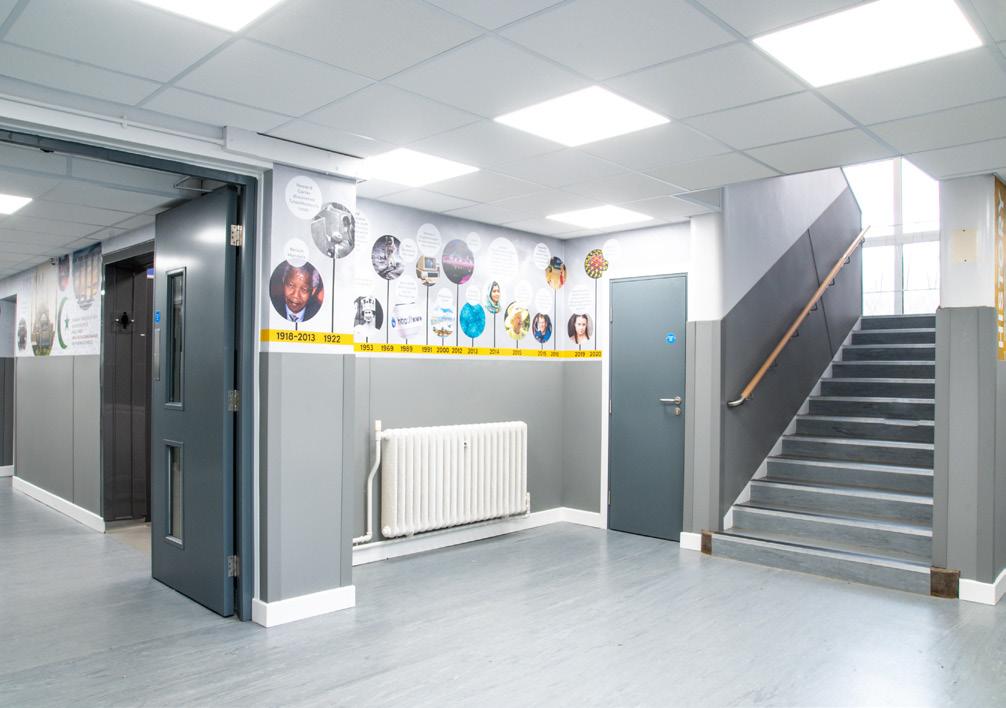
Wall and door protection is often overlooked until damage becomes visible – but in hightraffic education settings, prevention is far more cost-effective than repair. Scuffed walls, dented doors and worn corners not only impact the appearance of a facility, but can also lead to ongoing maintenance challenges and disruption. Installing purpose-designed protection systems helps safeguard surfaces from impact, significantly reducing lifecycle costs while maintaining a clean, professional environment for students and staff.
For many education providers, the focus is shifting towards long-term resilience. Durable wall protection, corner protection and door protection systems offer a practical solution – particularly in busy corridors, dining areas and circulation spaces where wear and tear is inevitable. These systems are designed not just
for strength, but also to complement interior aesthetics, supporting a more positive and wellmaintained learning environment. Handrails also play an important role in improving safety and accessibility within schools, and can be seamlessly integrated alongside protection systems as part of a cohesive approach.
Alongside physical protection, fire safety remains a critical consideration. Fire doors are a fundamental part of any building’s passive fire protection strategy, yet their importance is often underestimated. Regular inspections, maintenance and correct installation are essential to ensure compliance and, more importantly, to protect lives.
Specialist providers such as Yeoman Shield are supporting education estates nationwide by combining both disciplines – offering wall and door protection systems alongside dedicated fire door services. With options for supply only or full installation, this integrated approach simplifies project delivery while ensuring consistency in quality and compliance.
For schools, colleges and universities, the benefits are clear: reduced maintenance costs, improved safety standards, and environments that are built to withstand the demands of modern education. As the sector continues to evolve, investing in robust, preventative solutions is no longer a luxury – it’s a necessity. M

Identi-Cryer helps keep your school community safe.
It delivers clear, easy-to-understand voice alerts during emergencies like lockdowns or invacuations. Created specifically for schools, the Identi-Cryer system combines both sound and visual warnings with a bright, noticeable design.
With up to seven customisable messages and simple installation that doesn’t require special wiring, it’s a flexible solution that fits seamlessly into your school's existing safety systems.

“A full lockdown is in operation”





Used in schools throughout the UK, Identi-Cryer is a trusted choice, with real-life case studies available.
It’s a dependable solution for schools that need clear communication, reliability, and straightforward setup without compromise.

Delivers clear fully customisable voice messages which also supports SEND pupils.
Staff can access an app to manage notifications and false alarms.
Easily installed as a standalone system or integrated into an existing fire alarm system.
For more information on Identi-Cryer, or for a free site survey get in contact:

Check out our product range

Sign up for our webinars

As Martyn’s Law is due to come into effect in 2027, educational settings will be required to strengthen their preparedness for potential terrorist threats. So what does this new legislation mean for schools?
Martyn’s Law, officially known as the Terrorism (Protection of Premises) Bill, received Royal Assent in April 2025, introducing new legal duties for publicly accessible premises to strengthen their preparedness for potential terrorist threats. It was born from the Manchester Arena bombing, which claimed the lives of 22 people, including 29-year-old Martyn Hett.
Educational settings are within scope of the legislation, which comes into effect in 2027. This will require schools, colleges, early years providers and further education institutions to implement practical safety measures to reduce harm in the event of an attack.
Martyn’s Law introduces a tiered framework for public venues based primarily on capacity, but schools are treated differently under what is described as “special consideration.”
Regardless of how many pupils or staff are on roll, all schools fall within the standard tier. This reflects the recognition that schools already operate within well-established safeguarding and health and safety systems. As a result, even large schools or academies with more than 800 students are not expected to meet enhanced tier requirements, which are reserved for largescale venues such as arenas and stadiums where more intensive security infrastructure is E
F appropriate. Higher education institutions do not receive this exemption and will instead be categorised according to their capacity.
At its core, the law focuses on ensuring that schools have clear, workable procedures in place for responding to an incident, as well as a ‘responsible person’ to lead the procedures. This includes the ability to evacuate individuals safely from the premises, to move people into safer internal areas if a threat is outside, and to initiate a lockdown that secures classrooms and restricts movement across the site.
Communication is also a central requirement, with schools expected to have reliable ways of alerting everyone on site to danger. Whether through public address systems, alarms or simpler methods, communication must be fast, clear and effective under pressure.
Crucially, Martyn’s Law does not require schools to undertake specialist counterterrorism training or carry out detailed threat assessments. Instead, it emphasises awareness and preparedness, ensuring that staff understand the procedures relevant to their roles. Free continuing professional development
Regarding the status of large events on school premises, such as concerts, sports days or summer fairs, the legislation clarifies that educational premises are excluded from the definition of “qualifying events”
training is available through ProtectUK, which provides guidance tailored specifically to education settings and other public venues.
Regarding the status of large events on school premises, such as concerts, sports days or summer fairs, the legislation clarifies that educational premises are excluded from the definition of “qualifying events.” This means that even when attendance exceeds 800 people, schools remain within the standard tier and are not required to introduce additional security measures solely because of crowd size. E




GAME DAY AT RECORD SPEED.
• QUICKLY AND AUTOMATICALLY SCREEN GUESTS with their backpacks and bags
QUICKLY AND AUTOMATICALLY SCREEN GUESTS with their backpacks and bags
EXTREMELY HIGH THROUGHPUT with near-zero nuisance alarms
• EXTREMELY HIGH THROUGHPUT with near-zero nuisance alarms
• DETECTS HANDGUNS AND MASS CASUALTY THREATS, such as high caliber assault weapons

DETECTS HANDGUNS AND MASS CASUALTY THREATS, such as high caliber assault weapons and IEDs
THREAT DETECTION

• QUICKLY AND AUTOMATICALLY SCREEN GUESTS with their backpacks and bags
• EXTREMELY HIGH THROUGHPUT with near-zero nuisance alarms
• DETECTS HANDGUNS AND MASS CASUALTY THREATS, such as high caliber assault weapons and IEDs
• EASY TO RELOCATE AND QUICK TO INSTALL: Less than 1 minute setup time INDOOR AND OUTDOOR OPERATIONS


08:31:08

Superior Detection and Throughput
High Discrimination of Non-Threat Items
Exceptional Immunity to external interference
Compliant with the strictest Security Standards for weapons detection
New mechanical structure with high protection degree
Unmatched Reliability
Aesthetic, Compact and Light Weight
Rapid Installation

• QUICKLY
•
•
•
•


F Further clarity arrived in October 2025, when the government published detailed guidance for schools. More recently still, broader advice for all premises covered by the law was published by the government. These materials are designed to make compliance straightforward and proportionate, avoiding the need for costly consultancy or specialist services.
Commenting on the guidance, Figen Murray, mother of Martyn Hett, described it as an important step forward in helping organisations

understand what is required and take meaningful action to improve public safety.
She said: “This represents another significant milestone for the Martyn’s Law campaign and will provide the clarity for venues and events within scope to begin to implement proportionate measures set out within Martyn’s Law.
“We must now ensure everyone is aware of what is required and to make public spaces more secure from the impact of a terrorist attack, so no family has to endure the lasting pain that mine and 21 others have gone through.”
How prepared is the education sector?
Research involving more than 1,200 education professionals by software development company Little Green Button found that 44 per cent were unfamiliar with Martyn’s Law, while nearly a third were unaware of any preparations being made within their own institutions.
More than half of respondents felt their school was not ready to manage a lockdown or major security incident, and a significant majority highlighted a lack of funding as a barrier to improving safety measures.
Although enforcement of the new duties is not expected until early to mid-2027, the window for preparation is narrowing. With clearer guidance now available, schools should begin to ensure their procedures are robust, well understood and ready to be implemented. This should also build on the safeguarding structures already in place, helping to protect both staff and students across the UK. L





InEvac is tested, certified and ready for anything.
• Live and recorded voice alarm.
• Audible, silent, and lockdown alarms.
• Resilient and discrete emergency staff comms.


• Delivered in a flexible, scalable EN54-16 certified system.
InEvac is easy to trust. Contact us for expert guidance on your lockdown challenge.





InEvac is designed for fire alarm engineers. Join our installer programme. Please visit:
There’s already a wild west of products for Martyn’s Law. How should you approach purchase decisions when the government appointed regulator, the SIA, has yet to issue its guidance (at time of writing) but the clock is still ticking down to implementation?

Vox Ignis is a life safety audio communication technology specialist. We spend a lot of our time running and contributing to the international standards bodies that create laws and guidance for fire and life safety communication systems. Our advice for any organisation that is confused about the technical, moral, legal and financial choices you may face when looking for technology to help with Martyn’s Law policy would start with:
1. Martyn’s Law compliant products
There is no such thing, there is no product standard or code and there is no part of Martyn’s Law that gives guidance on services or products. If someone uses this phrase they don’t understand the Law they are claiming to provide solutions for. Throw them out of your building.
2. You must have a technology solution
Technology may support your Martyn’s Law policy (the document that helps make you compliant) or it may not, it depends on many aspects of your site and policy from size and
risks to training resources and competence etc. Until the SIA has produced more guidance you should not panic buy. A system could range from a whistle to something like InEvac, a complete life safety comms solution. It is very unlikely the government nor SIA will endorse any technology. Your assessment and related defendable decisions remain key. A new British Code of Practice covering voice communications technology in terrorist incidents is in development but is at least a year away.
3. Can any technology deliver defendable purchase decisions?
Products approved for fire use are supported by many codes and standards and years of use and, in our view, do help make defendable technology decisions. However, a terror incident is likely to be significantly different to a fire event and a Martyn’s Law system may be required to manage lockdown, evacuation and invacuation and communication simultaneously. A different sounder on your fire system is a quick stop-gap but is probably not up to this major task for many reasons that require more explanation.
4. Conversations not sales
If you’d like an informal discussion, CPD or technical discussion, we’d be happy to help. M

Alex Dave, safeguarding lead at edtech charity LGfL – The National Grid for Learning, shares practical guidance to help schools develop a clear, effective AI policy that strengthens safeguarding and supports staff to help ensure AI is used safely across the school community
Artificial intelligence may already be embedded in most schools, whether formally adopted or not. It can appear in search engines, MIS platforms, classroom tools and communication systems. Alongside this, generative AI (GenAI) is increasingly being used by pupils and staff which could, if used informally or without clear guidance and oversight, lead to safeguarding and data protection issues.
For most school leaders, the question is no longer whether AI will be used, but how it’s managed.
Why does having a policy on AI matter? Safeguarding is a primary concern for all schools. Pupils may already be engaging with Gen-AI tools outside of school, at increasingly young ages. Without guidance, they may be exposed to misinformation, inappropriate content, data misuse and unsafe interactions.
Gen-AI also presents opportunity. It can reduce workload, support accessibility, and enhance teaching and learning. However, these benefits tend to only materialise when its use is structured and intentional.
Without a clear policy, practice could become inconsistent. Some staff may interpret its use differently, pupils may become over reliant on AI, face safety, ethical and data protection risks. Expectations around assessment and behaviour may also become unclear which could lead to weakened safeguarding, academic integrity and staff confidence.
The scope should apply to all staff, pupils, governors, trustees and any relevant external users. It should cover all uses of AI, including teaching, learning, assessment, administration and communication, both on and off site when linked to school activity.
It should also recognise that AI is already embedded in everyday digital tools and not limited to standalone platforms.
To frame the policy as enabling safe innovation rather than appearing prohibitive, the intent should be explicit: to safeguard pupils and staff; ensure ethical and responsible use; support learning and workload efficiency; and to prepare pupils for an AI-enabled world. E
A strong policy is underpinned by clear principles with Safeguarding central to all decisions involving AI.
When using AI to make automated decisions that impact children and families, it is highly recommended that it is clearly communicated to the families which provides assurance that any decisions made are not reinforcing any bias, e.g. using AI to split children into classes.
Data protection is critical. Personal or sensitive information must not be entered into Gen-AI systems without the explicit consent of the Data Subjects and after conducting a Data Protection Impact Assessment (DPIA).
Applying critical thinking is key as outputs may be inaccurate, incomplete or biased and should always be verified. Human judgement remains essential to any outcome.
The policy should define how Gen-AI will be used in context. This includes defining its purpose of use (i.e. workload reduction or learning support) and when Gen-AI can be used and when not. It should also include who is permitted to use AI, any age or role-based restrictions, and expectations for responsible use.
It should also reflect reality as AI may already be in use informally. The goal is to bring its use into a safe, structured framework rather than eliminate it.
Stakeholder engagement is also important. Staff, pupils and parents may have differing views and levels of understanding. Involving them supports clarity and trust.
AI intersects with many existing policies and should not be stand alone. It should align with safeguarding and child protection; data
protection legislation; behaviour and acceptable use policies, as well as assessment and examination policies. It should also align with staff conduct policies and complaints policies.
Data protection is particularly important. Schools must ensure transparency and compliance with data protection legislation, specifically around automated decision-making and profiling.
Clear accountability is essential. Governors and trustees provide oversight and ensure compliance. Senior leaders define strategy, approve tools and ensure consistent implementation. The Designated Safeguarding Lead manages safeguarding risks and incidents linked to AI use. Meanwhile, the Data Protection Officer ensures legal compliance and oversees DPIAs, and technical staff configure filtering, monitoring and system security.
However, all staff are responsible for using only approved AI tools, protecting personal sensitive data, checking AI outputs for accuracy and bias, modelling safe practice, and reporting concerns. Without roles clearly defined, risks may increase and oversight may become challenging and fragmented.
A formal approval process is essential for safe use. The policy should state that only approved Gen-AI tools may be used for school purposes and that new tools must not be introduced without permission and assessment.
To create a high benchmark, the DfE’s Gen-AI Product Safey Standards should be utilised when assessing any tools. Assessment considerations include data protection, in-tool filtering and monitoring, emotional attachment, cognitive offloading, and mental health.

Clear reporting routes are essential. The policy should outline how to report safeguarding concerns involving AI and the misuse of AI tools
It is recommended that the tools are reviewed regularly due to the ever-evolving changes in Gen-AI. Schools should consider how they make this list of tools available to all staff, including supply staff and visitors (e.g. a Social Worker wanting to use a Gen-AI note taking tool).
Filtering and monitoring are key safeguarding controls. Schools should confirm that gen-AI tools are blocked by default and approved tools are allowed by exception to certain user groups. They should also ensure that filtering is regularly tested and reviewed on all school owned devices (on and off site).
This is not a one-time setup. Gen-AI tools and risks can evolve quickly.
Analysing monitoring data is a powerful tool, using them can help inform staff training, curriculum planning and safeguarding responses.
Clear reporting routes are essential. The policy should outline how to report safeguarding concerns involving AI and the misuse of AI tools, e.g. a pupil uses Gen-AI to complete a piece of work without permission or using Gen-AI to create harmful fake imagery. It should also include how to report data protection incidents.
For issues to be addressed early, it should explain how incidents are recorded

and escalated in-line with safeguarding and data protection procedures.
The policy should define expectations for artificial intelligence. For pupils, this means when use is permitted, how use should be acknowledged, expectations for independent work, and limits on over-reliance.
For staff, this should define appropriate use in planning and resource creation, boundaries around assessment and feedback, intellectual property considerations, and responsibility for checking outputs.
Developing AI literacy in pupils helps their knowledge and skills to enable them to critically understand, evaluate, and use AI systems and tools safely and ethically.
Schools should provide ongoing support to use AI safely and effectively for staff, governors and trustees. This should include professional development on artificial intelligence, training on bias, data protection and ethical risks, as well as support in evaluating GenAI outputs critically. There should also be guidance for classroom application.
AI capability is not static, therefore it’s recommended that training is ongoing, rather than one-off.
LGfL’s AI Policy Toolkit supports schools in developing a safeguarding-led approach to AI, explains what to include, key risks and how to align AI with existing expectations.
It is designed to be flexible rather than prescriptive, allowing schools to adapt it to their own context.
Please explore the toolkit and access selfservice training here .
AI is already helping to shape education and by ignoring it, may increase the risk rather than eliminating it.
A clear AI policy helps to provide control, consistency and safeguarding assurance. It supports staff, protects pupils and ensures AI is used purposefully and responsibly. The goal is not to avoid AI, but to manage it well. M
FURTHER INFORMATION lgfl.net
Hideki Hashimura explains how to utilise AI so it creates faster, more personalised and seamless connected student experiences
AI is high on the agenda for universities, particularly in student services. From your perspective, what are the key benefits of integrating AI into student services?
The most immediate benefit is speed and consistency. Students today expect fast, clear responses across multiple channels – email, chat, messaging, even voice. AI helps institutions meet those expectations by automating high volume, repetitive enquiries and routing more complex issues to the right teams quickly.
But the bigger benefit comes from creating systems that deliver in-context-learning for the AI. When AI is properly integrated into CRM platforms, case management systems and knowledge bases, it allows service teams to understand where each student is in their journey. That means support interactions are no longer isolated transactions; they become part of a continuous experience.

We’ve seen this very clearly in our work with some of the universities we work with, cases like the European University of Madrid, Arden University or University of Cambridge. By centralising student service workflows, automating routing and creating a shared knowledge base, teams reduced fragmentation and manual handling. The result wasn’t just efficiency—it was more reliable, consistent service for students and staff.
AI also brings significant value internally. Tools like AI copilots help agents surface relevant knowledge instantly, suggest responses and reduce the administrative burden of case handling. That allows human teams to focus on high value interactions where empathy, judgement and experience really matter.
Many institutions struggle to move beyond pilots. How can educational institutions ensure their student service teams are AI ready and equipped to use these tools effectively?
This is where most initiatives succeed or fail. AI readiness is not a technology challenge – it’s an organisational one.
First, institutions need to prepare their people. AI changes the nature of service roles. Routine Tier 1 interactions become automated, while staff move towards more specialist responsibilities: complex case handling, service design, AI supervision and knowledge management. That shift requires clear role definition, training and strong change management.
Our work with Arden University is a good example. Arden needed to scale its corporate learning operations without adding complexity. By redesigning CRM workflows and implementing targeted automation, we improved operational efficiency and visibility, while enabling teams to work more effectively with the system rather than around it.
Second, processes must be redesigned. AI delivers value when it is embedded directly into workflows – admissions processing, case routing, document handling – not when it sits alongside them. Institutions that rethink their processes around AI human hand offs see faster adoption and faster time to value.
Finally, technology choices matter. Integration is far more important than novelty. Platforms that connect service, CRM, knowledge and communication channels allow AI to learn from real interactions and improve over time. Many universities are realising that partnering with established vendors allows them to focus on outcomes, not infrastructure.
What potential risks should student service teams consider when implementing AI?
There are several risks, and ignoring them is one of the reasons so many AI projects stall. A common issue is deploying tools that look impressive in demonstrations but don’t fit real operational contexts. If AI is not aligned with how teams actually work day to day, adoption quickly collapses.
Trust and security are also critical in education. Student services handle highly sensitive academic, financial and personal data. Institutions must ensure strong governance, transparency and clear boundaries around automation. Students and staff need to understand when AI is involved and where human oversight sits.
Another risk is over automation. AI is excellent at handling high volume, transactional interactions, but it should never replace human judgement in areas such as wellbeing, academic support or complex escalations. The strongest service models treat AI as an augmentation layer, not as a replacement for people. Finally, weak knowledge management can severely limit AI effectiveness. AI systems rely on well structured, up to date knowledge. Institutions that underinvest here often see inconsistent or unreliable results, which can quickly erode confidence.
How can the use of AI in student services ultimately enhance the student experience and outcomes?
When AI is implemented in context, the impact on student experience is profound. Students benefit from faster responses, clearer guidance and consistent service throughout their journey – from recruitment and enrolment

Hideki Hashimura, digital strategy officer, redk
Hideki Hashimura is digital strategy officer and founding partner at redk, with over 20 years’ experience in digital strategy, CRM and customer experience. He works closely with organisations to design and deliver scalable, customer centric technology solutions that drive measurable outcomes across education and other sectors.
through to graduation and beyond. They don’t feel passed between departments or forced to repeat information, which builds trust and confidence in the institution.
For service teams, AI reduces operational friction and cognitive load. That creates space to focus on proactive support – identifying students who may be at risk, intervening earlier and providing more personalised guidance. Over time, that directly supports retention, satisfaction and academic outcomes.
What the experiences of Arden University and the University of Cambridge show is that AI success isn’t about adopting technology for its own sake. It’s about creating AI ready service organisations where people, processes and platforms evolve together.
In education, AI’s role is not to replace human connection, but to strengthen it – by enabling student service teams to deliver responsive, personalised and sustainable support at scale. M
Get up to £47,500* cashback for trading in your old Lenovo devices
*Up to £190 per device • 250 device limit • Terms and conditions apply
Ageing devices, often written off as obsolete, can still deliver meaningful financial returns when handled strategically. Here’s how
School IT leaders are caught in a difficult position. Device refresh cycles planned months in advance are now colliding with a hardware market that looks nothing like the one those plans were built around. Global manufacturers have reallocated a significant share of production capacity toward AI-specific chip architectures, causing knock-on effects that have been felt across the entire mid-market device landscape.
DRAM and SSD costs are at a three-year high. Standard laptop orders now take up to nine months to fulfil. And while hardware prices have risen sharply, school budgets have not moved to compensate. For schools with ageing fleets, the longer a refresh is deferred, the wider the gap becomes and the more value quietly drains from legacy hardware sitting in storerooms, depreciating with every passing month.
The asset schools are sitting on Legacy devices represent a recoverable financial asset that most institutions are not actively realising. Lenovo’s ConnectEd programme provides schools, colleges and universities with a structured route to unlock value from end-of-life hardware, offering up to £190 cashback per device.
A school recovering value from 100 redundant devices could generate up to £19,000 – not ring-fenced for a specific technology purchase, but available as flexible funding to spend according to the institution’s own priorities. That flexibility matters. Unlike many trade-in schemes or grant mechanisms tied to conditions, Lenovo ConnectEd does not dictate how recovered funds are used. Schools have applied it toward after school programmes, classroom resources, furniture
and playground equipment, as well as operational costs that would otherwise have drawn from an already stretched budget.
The UK is already the second largest contributor of e-waste per capita globally, with roughly six million tonnes of discarded electronics generated annually – and only around a third of it is officially collected for responsible recycling. Lenovo ConnectEd operates on a zero-landfill commitment: devices are refurbished for a second life where possible, or responsibly recycled where not. Every device is data-wiped to industry standard before leaving the institution, giving data protection officers a verifiable audit trail in line with UK GDPR obligations.
In a year when every line of the school budget is under scrutiny, recovering meaningful value from hardware already owned, while meeting compliance obligations and sustainability goals, is one of the more straightforward wins available to school IT leaders. The case for acting on it has rarely been stronger.
As a Tier 1 edtech supplier and Lenovo Education Partner, Getech is offering schools a free audit of their IT estate to help administrators calculate the value of their end-of-life devices. M
FURTHER INFORMATION
For more information, contact the Getech team at team@getecheducation.com

With more than 18,000 students studying the Esports BTEC qualifications, the UK video games industry driving over £7 billion in consumer spending, and the Esports World Cup featuring a record $75m prize pool, competitive gaming is more prominent than ever. The British Esports Federation runs through the opportunities and benefits for schools


What started out in bedrooms and halls full of computers has gone on to become a billion-dollar industry.
Esports (or electronic sports) is the act of playing video games competitively to spectators, either online or in-person.
For years it has bubbled underground, with small amateur tournaments offering PC equipment as prizes, but now it has plenty of professional gamers making a living out of playing at the highest level, in games like League of Legends, Counter-Strike, Rocket League and more.
Beyond this, it’s really starting to hit the mainstream. The International Olympic Committee (IOC) has experimented with esports with side events, and the annual Esports World Cup in Saudi Arabia now has a prize pool of more than $75m spread across multiple games and competitions. And the broader video games industry is worth more than £7bn in the UK alone, or around £200bn globally. That makes it well over twice as large as the film and music industries – combined.
Esports are also hugely popular with young people, with around a third of 18–29-year-olds reporting high interest, according to data from YouGov’s Global fan profiles. It’s frequently

British Esports has spoken about the impact of esports on neurodiverse individuals. Esports has created an inclusive environment that harnesses their strengths, such as attention to detail, strategic thinking and hyperfocus
ranked as the second most popular sport for young males to watch after football, surpassing traditional physical sports like rugby and tennis.
Then there are the major esports tournaments and world championships in various different game titles, with the most-skilled gamers doing battle on the biggest of stages often for prize pools stretching into the millions of pounds.
But esports isn’t just about the pro level. Like traditional sports, there are multiple tiers, including grassroots tournaments and collegiate activities, offering several opportunities and benefits to schools.
Like sports, the esports industry requires professionals including commentators, marketers, broadcast producers, coaches, reporters, video creators and social media managers, to name a few. There are now a range of qualifications to give students highly transferable digital skills and the knowledge to thrive within these roles – and in industries beyond.
Today, there are some 18,000+ young people that have studied the various Esports BTECs developed by the British Esports Federation in partnership with Pearson, which include Level 1 to Level 3 variants, Higher Nationals and more. British Esports has also partnered with the Leadership Skills Foundation to deliver esports leadership qualifications for those aged 11+, allowing younger people to take their initial steps onto the esports career pathway. These various qualifications help build digital literacy and cognitive skills, as well as decision making, dexterity, creativity, concentration, leadership and communication, strategic thinking and STEM skills. Not only that, but esports can also lead to improved student wellbeing and attendance levels, as found in British Esports’ work in Alternative Provision Schools. E

F Beyond this, British Esports hosts an annual Education Summit, has a large presence at the Bett Show each year and has a partnership with Sunderland College to help deliver the BTEC in Esports programme from British Esports’ very own National Esports Performance Campus in Sunderland.
Jason Frost, curriculum manager for creative arts & media at Burnley College, which competes in the Student Champs, concludes: “Esports is the fastest-growing new course in our college’s history and the Student Champs has been fantastic for us – we now have ten teams competing on a weekly basis. Every student has a job – it could be admin, commentating, competing… those skills you really need, communication, leadership, teamwork, suddenly these kids who couldn’t look you in the eye when you walked through the door are excelling in all these things.
“Whatever we’d invested in esports initially, we got back in that first year. And we’ve gone on to invest in another three rooms. We also started offering the HNC qualification in esports and have a new room in the university block. We’re going from strength to strength - we’ve gone from 20 students to about 150 students in two years.
“So I would say to SLT (senior leadership teams), you need to be thinking about this – you need to be thinking about esports.”
The British Esports Student Champs, organised by national body the British Esports Federation, allows students aged 12+ to represent their secondary schools, further education colleges and alternative provision schools across the UK to compete with one another.
This is the largest amateur grassroots esports tournament for students, and features games including League of Legends, Rocket League, VALORANT and Overwatch 2, plus multiple tiers for students of all ages and abilities, as well as inclusive tournaments for women and marginalised genders. There’s a PUBG MOBILE tournament for smartphone and tablet gamers, too, and a Student Racing League with Williams Esports.
Participation in these team-based tournaments also allows students to develop transferable skills such as teamwork, leadership communication and problem solving, as well as future-ready digital and STEM-based skills. It also allows students to make friends, have fun and enjoy themselves doing something they love.

Almost 200 institutions compete in the Student Champs today, with more than 1,250 teams and 6,000 students taking part overall each year. An annual live grand final event takes place at the end of each season.
British Esports has also spoken about the impact of esports on neurodiverse individuals. Esports has created an inclusive environment that harnesses their strengths, such as attention to detail, strategic thinking and hyperfocus. With esports and education, it adds an element of interest to an otherwise regular qualification, allowing students to stay engaged and increase productivity.
With esports being such a communitydriven activity, the ‘build it and they will come’ strategy can pay off.
Why not identify a tech-savvy teacher at your school who is perhaps a gamer themselves, and encourage them to experiment with the IT equipment to get some games going on existing PCs?
Engaging with students and holding an esports club or team tryouts can foster a sense of community and competitive spirit.
You don’t need super high-tech computer rigs, flashy lighting or expensive setups, either.
Participation in these team ‑ based tournaments also allows students to develop transferable skills such as teamwork, leadership communication and problem solving, as well as future ‑ ready digital and STEM ‑ based skills
Start simple, research what else you might need, and most of all, have fun with it.
The British Esports Federation also offers support services to provide expert advice and tailored end-to-end solutions for organisations in the education sector, from esports facility design to esports curriculum planning and development at all FE and HE key qualifications stages, to funding advice, staff and teacher CPD, training and certification, educational day trips and workshops at our Sunderland facilities, and more.
To find out more about esports and get your school involved, to contact us at britishesports.org/contact-us or set up a meeting via education@britishesports.org. M
britishesports.org
Esports and gaming are rapidly transforming classroom engagement, offering schools new ways to build digital skills and boost participation.
Paul Butler, regional sales director at AOC and Philips Monitors, explains how the right strategy and technology can unlock their full potential
What are the key benefits of integrating esports and gaming into the classroom environment?
The perception of gaming in education has shifted dramatically. What was once dismissed as a distraction is now recognised as one of the most effective tools for engaging students who might not thrive in traditional academic settings. Esports programmes bring together teamwork, strategic thinking, communication, and digital literacy in a format that speaks directly to how young people already interact with the world.
Our work with institutions like Wiltshire College and Ireland’s National Esports Centre has shown that when students have access to structured competitive programmes, they become genuinely invested in their learning. Faculty consistently report improved attendance and stronger participation. Esports also build cross-curricular skills naturally. Students develop an understanding of broadcasting, event management, content creation and data analysis without it ever feeling like a conventional lesson. It is an inclusive pathway too, welcoming students of different backgrounds and abilities in ways that traditional sports sometimes cannot.
How can schools ensure that esports and gaming initiatives are well-structured and aligned with meaningful educational outcomes?
Structure is everything. The most successful implementations we have supported are those where the school has clear objectives from the outset. In education, it is becoming
a lot more important to do esports properly and in the right way. That means treating it with the same seriousness as any other subject or extracurricular programme. Organisations like the British Esports Federation offer valuable frameworks, including accredited BTEC qualifications and structured tournament pathways through their Student Champs programme. Schools should also think beyond competitive gaming itself. The best facilities we have worked with incorporate dedicated zones for different disciplines: competitive play, content creation, broadcasting, and media production. At Wiltshire College, for example, the 150-seater arena serves both competitive play and digital media education, with shoutcasting rooms and production spaces alongside the gaming stations. That kind of thoughtful design ensures that the investment delivers broad educational value rather than simply providing a space to play games.
To what extent does having the right screens and equipment impact the successful implementation of esports in the classroom?
It makes an enormous difference. Students notice immediately when they are working with professional-grade technology versus budget equipment, and that recognition directly affects their engagement and sense of being taken seriously. When Lancaster & Morecambe College upgraded their esports provision with our monitors, their team went on to reach the Overwatch Division 1 Elimination round at the British Esports
Student Champs. The students described the equipment as a vast improvement that received enthusiastic feedback across the team.
That said, not every classroom needs a high-end gaming display. This is where a versatile range like AOC’s B3 Series comes in. Spanning Full HD, QHD and 4K resolutions across 24-inch and 27-inch IPS panels, the B3 Series offers options for every use case. The Full HD models deliver excellent value for general computing labs. The 4K models provide 163 pixels per inch for creative and design courses. And the newer Q24B36X and Q27B36X announced this year bring a 144 Hz refresh rate, QHD resolution and AdaptiveSync together, handling both productivity and gameplay. USB-C connectivity with 65W Power Delivery on selected models simplifies shared workstation management, while Flicker-Free technology and LowBlue mode protect students’ eyes during extended sessions. The key is matching the right specification to each use case rather than applying a one-size-fits-all approach.
With schools and colleges expected to meet six core digital standards by 2030, how important is it for schools to regularly review and update their IT equipment?
It is absolutely critical. The DfE’s six core digital standards covering broadband internet, wireless networks, network switches, cyber security, filtering and monitoring, and digital leadership set a clear benchmark for every school. As of 2025, only 16 per cent of schools report 1 meeting these standards in full, which tells you how much ground still needs to be covered.
Display technology should be part of that conversation. Monitors are often treated as an afterthought in procurement, yet they are the single piece of equipment that every student and member of staff interacts with throughout the day. Outdated screens with poor ergonomics and limited connectivity hold back both productivity and wellbeing. Regular review cycles allow schools to benefit from improvements in panel technology, connectivity and energy efficiency. The B3 Series, for example, includes VESA mount compatibility, built-in speakers, eco-friendly packaging, and height-adjustable stands on selected models, making institutional deployment straightforward. Schools that take a proactive approach to refreshing

Paul Butler has worked in the global displays industry for over 35 years, specialising in technical display solutions. For the past decade, he has led AOC and Philips Monitors in the UK/Ireland, driving innovations in LCD technology, professional gaming monitors, and USB-C docking solutions across both business and consumer applications.
their display assets will be better equipped not just to meet the 2030 standards, but to deliver modern learning environments that students and staff deserve. M
1. https://www.gov.uk/government/news/no-child-leftbehind-in-plans-to-narrow-the-digital-divide-in-education FURTHER INFORMATION
www.aoc.com/uk

While solar and wind dominate today’s clean energy landscape, a new wave of under‑explored technologies could unlock scalable power.
Bruno Sanglé‑Ferrière explains the opportunities and the challenges
Have all methods of energy generation truly been explored, or is there still potential in emerging technologies?
Clearly not. The exploitation of fuel producing endothermic reactions cycle, Thermophotovoltaics and fusion energy out of accelerated particles, are clearly under-researched.
It is for instance still difficult to find data and working schemes for endothermic reactions cycles for the production of pure hydrogen, in the scientific literature, despite many trials and studies of the schemes and
obvious potential use for conversion of heat into hydrogen.
On the Thermophotovoltaics, experiments have been done where, using organic semiconductors harvesting infrareds from ambient atmosphere do create a large voltage difference between the faces of the material. However, like usual photovoltaics where organic/plastic cells have a lower yield than silicium ones, calculation show that classical semiconductor layers of appropriate thickness engineered as “quantum wells” can also harvest infrared beams. But no such prototype has been developed!

Finally, a lot of science around nuclear fusion seems to remain hidden for obvious security reasons, but also the science of the behaviours of Ions travelling at high speed in matter is not taught much, probably because it is not a technic used a lot, save for eye surgery, and that science when combined show that two digits yield nuclear energy creation can be obtained.
What are the main barriers –technical, financial, or regulatory – that limit the exploration and development of new energy sources? The limits are not really technical as engineers would know how to build the above energy tools out of existing technologies: high temperature fuel cells, chemical reactors and plants are well mastered devices and tools, but also thin layer deposition of semiconductors already exist and there are some small plants doing it, mainly for the R&D purpose and semiconductor electronics. And finally, the most complex tool for high energy ion generation: cyclotrons – are a commodity, being for instance, installed in many hospitals.
What current research or innovations are you currently working on to create clean energy?
I have filed and, for some of them, already obtained patents in these three technologies, showing how such technics should be orchestrated and that they are novel. I am also working on the modelling of the chemical process for extracting pure hydrogen from the endothermic reaction. This would bring me a step closer to the implementation of a prototype.
How can collaboration between industry, academia and government accelerate the development of alternative energy technologies?
Academia can provide engineers mastering each of the used technologies; industry can provide hardware necessary to them; and governments can provide funding and regulation – though indeed funding could come from venture capital of the private sector.
Why is it important to continuously innovate in the area of clean energy?
Unfortunately, as everyone knows, the world is suffering from global warming. Even though photovoltaics and wind harvesting can help, these are a bit

Bruno Sanglé-Ferrière, director, Carrousel Digital and Marbeuf Conseil et Recherche
Bruno Sanglé-Ferrière is director of Carrousel Digital and Marbeuf Conseil et Recherche, companies based in Paris specialising in digital security and energy. Marbeuf Conseil et Recherche, Carrousel Digital and Bruno SangléFerrière have published and obtained numerous patents, in particular allowing data communication with entangled photons, the electronic signature based on single-use keys, the secure transfer of documents and money from card to card, indoor Geolocation, and quantum Lidar but also in energy, notoriously on chemical recycling of heat in hydrogen fuel cells.
Bruno Sanglé-Ferrière is a graduate of the Ecole Centrale Supelec and worked as a UK hedge fund manager, before getting involved in technology.
insufficient, notably because they are still expensive and need energy storage facilities which add a lot to their cost and resources footprint. Research in the three above techniques may yield energy harvesting devices that collect energy 24/7, thereby reducing drastically its storage cost and probably accelerating its deployment through the serial production of individual devices that can be purchased by individuals and small consuming industrial actors. M
FURTHER INFORMATION
https://m-cr.fr/


I N D B R E A KS
B E T T E R C O N D I T I O N S . B E T T E R P L A Y .

O u r t e n n i s w i n d b r e a k s r e d u c e
w i n d i n t e r f e r e n c e , i m p r o v e p r i v a c y
a n d m i n i m i s e v i s u a l d i s t r a c t i o n s ,
h e l p i n g p l a y e r s p e r f o r m a t
t h e i r b e s t .
M a n u f a c t u r e d f r o m U V - s t a b i l i s e d ,
w e a t h e r - r e s i s t a n t m a t e r i a l s a n d
a v a i l a b l e i n s t a n d a r d o r b e s p o k e
s i z e s t o s u i t y o u r f a c i l i t y .



M i n i m i s e w i n d i n t e r f e r e n c e f o r m o r e c o n s i s t e n t p l a y i n g o p t i o n s L i m i t g l a r e a n d d i s t r a c t i n g b a c k g r o u n d s f o r i m p r o v e d f o c u s a n d v i s i b i l i t y



C r e a t e p r i v a c y b e t w e e n c o u r t s a n d p r o t e c t p l a y e r s f r o m o u t s i d e d i s t r a c t i o n s S t a n d a r d o r b e s p o k e s i z e s w i t h a r a n g e o f c o l o u r s a n d f i x i n g s y s t e m s a v a i l a b l e
S p e a k to ou r te a m fo r exp e r t a dv i c e
a n d a n o - o b l i g at i o n q u ote.
1 4 5 2 5 s a l e s @st u a r tc a nva s c o u k w w w st u a r tc a nva s c o u k

The government has confirmed the continuation of the Inclusion 2028 grant programme, reinforcing its commitment to creating more inclusive opportunities in PE, school sport and physical activity for children and young people with Special Educational Needs and Disabilities (SEND)
Led by Youth Sport Trust alongside a consortium of partners, Inclusion 2028 supports schools across England to embed inclusive practice through sport, play and physical education. The programme aims to ensure that every young person, regardless of ability or additional need, can access meaningful opportunities to participate, lead and thrive. The extension of the programme comes amid growing calls for greater inclusivity in school sport. Research highlighted through ParalympicsGB’s Equal Play campaign found that just 25 per cent of young people with SEND regularly participate in PE and school sport. Meanwhile, one in three disabled children take part in less than 30 minutes of physical
activity per day during term time, compared with 21 per cent of non-disabled children.
Despite this, demand for support remains high. According to the programme, 90 per cent of parents of disabled children say physical activity is important to their child’s wellbeing, yet fewer than half feel they receive enough support to help their child stay active.
Inclusion 2028 aims to address these barriers by helping schools create accessible and inspiring environments for PE, sport and physical activity. The programme focuses on sustainable, longterm change through collaboration with schools, delivery partners and young people themselves. E

Sportsafe’s DBS-registered, RPII-qualified engineers ensure top safety and compliance, with nationwide coverage never more than 90 minutes away Our electronic reporting system provides remedial work quotes within 2 working days, and an inspection certificate is issued upon a pass or completion of required repairs All remedial work is backed by a 12month workmanship warranty for your peace of mind
We offer a broad variety of sports and fitness installations to suit all your needs: from tennis courts, MUGAs and line markings to basketball goals, climbing frames and division nets
We can do it all.
Get an exclusive 15% off your next online order with us, using code EDUCATION15.

Established in 1997, Sportsafe provides the professional supply, installation, inspection and maintenance of sports, fitness and play equipment



F Schools participating in the programme can access a range of support measures, including targeted interventions, tailored CPD opportunities, inclusive sports festivals and practical resources designed to adapt activities to meet the needs of all learners.
The programme also places a strong emphasis on youth leadership, creating opportunities for pupils both with and without SEND to lead inclusive activities and shape school sport provision.
A key part of the programme is the network of Lead Inclusion Schools operating across England. These schools act as local champions for inclusive practice, providing guidance, training and examples of best practice to help other schools build confidence and capability in inclusive PE and sport.
The network is made up of 54 schools –spanning primary, secondary, and specialist settings – and empowers educators to create environments where every young person can thrive. These schools support practitioners to develop the knowledge, confidence, and skills needed to plan and deliver high-quality inclusive physical education, school sport and physical activity opportunities for all students.
Ninety per cent of parents of disabled children say physical activity is important to their child’s wellbeing, yet fewer than half feel they receive enough support to help their child stay active
Supporters of the programme say the benefits extend well beyond increased participation in sport.
For pupils with SEND, schools report improvements in confidence, self-esteem, wellbeing and social integration, alongside increased active minutes that contribute to better physical and mental health.
For teachers and schools, the programme provides access to free e-learning, local CPD and practical tools that help staff adapt activities and build more inclusive environments. Schools involved in the initiative have also reported wider whole-school benefits, including E



F improved behaviour, stronger feelings of belonging and positive impacts on attainment.
Inclusion 2028 builds on the achievements of the previous Inclusion 2024 programme, which delivered large-scale engagement across schools nationwide.
According to programme figures, almost 6,800 school staff received CPD training through Lead Inclusion Schools, while 837 inclusive festivals reached more than 1,500 schools and engaged over 15,800 pupils, 86 per cent of whom were pupils with SEND.
More than 30,000 pupils with SEND attended inclusive events, while over 2,400 young leaders were trained to deliver inclusive activities, including many young people with SEND themselves.
The programme also supported specialist training initiatives, including water safety training delivered by Swim England to improve confidence in supporting pupils with SEND during water-based activities.
Schools involved in the programme reported increases in the number of pupils
with SEND achieving recommended daily activity levels, alongside greater enjoyment, engagement and confidence in PE.
A commitment to equal access
Ali Oliver, CEO of the Youth Sport Trust, welcomed the continuation of the funding. She said: “This reinforces a commitment to inclusive opportunities in PE and the call from the British Paralympic Association for ‘equal play’ for every child.
“Together with our Inclusion 2028 consortium partners and Youth Sport Trust Lead Inclusion Network, we have seen the impact this programme has made since 2017, and this sustained investment helps educators transform curricular and extra-curricular opportunities so all children can experience the life-changing benefits of PE, sport and play.”
As schools continue to place greater emphasis on inclusion, wellbeing and pupil engagement, the continuation of Inclusion 2028 signals a broader recognition of the role sport and physical activity can play in supporting both educational outcomes and wider personal development for all learners. L

As schools respond to new enrichment expectations, Matt Healey, adventure lead at the Field Studies Council, explores how outdoor learning can help young people build resilience, confidence and the skills to thrive in an unpredictable world
School leaders are navigating a period of significant change. Enrichment, agency and equitable access are no longer peripheral concerns, they are central to national policy.
The DCMS Youth Strategy sets out a tenyear ambition to improve young people’s access to nature and high-quality activities that support wellbeing, belonging and aspiration. Alongside this, the government’s response to the Curriculum & Assessment Review calls for a more coherent curriculum with stronger fieldwork, oracy, disciplinary thinking, climate education and a new national enrichment entitlement.
The scale of ambition here is significant. Schools are being asked to treat enrichment as a core entitlement rather than an optional extra, to design curricula that connect knowledge with lived experience and to help young people develop the confidence to navigate an uncertain world.
Outdoor learning and residential school trips can help schools meet these new enrichment goals and organisations working across the outdoor sector are well placed to support school leaders as they look to embed adventure and access to nature into their timetables.
At Field Studies Council, we have been delivering outdoor and environmental education to schools for more than 80 years. Our adventure-learning approach to day trips and residentials offers senior leaders a practical way to meet the government’s enrichment offer. It gives schools a shared language for challenge, resilience, cross-curricular learning and personal development. Rather than removing uncertainty for young people, our goal is to encourage them to embrace and conquer it. By challenging young people to try new activities in different environments and landscapes, our tutors aim to make the unfamiliar inhabitable through structure,

guidance and reflection. We call this process ‘Domesticating Monstrosities’ and our approach to it is best defined as ‘Teaching with Monsters’.
For school leaders, this approach can be a strategic lever to strengthen curriculum intent, support implementation, enhance personal development and build a wholeschool culture where challenge is not feared but understood, navigated and valued.
What the “monster” really represents
Every teacher knows the moment when a pupil pauses and says quietly: “I’m not sure I can do this.” That moment – where risk, hesitation, curiosity and possibility meet –is the heart of ‘Teaching with Monsters’.
A student visiting one of our three sites in Wales commented after a day in the mountains: “I thought the monster was the fog. But it was actually the feeling of not knowing what to do next. Once we talked about that, the fog didn’t matter anymore.”
Uncertainty itself isn’t overwhelming but facing it without language or support is. Our adventure learning approach and underlying ‘Teaching with Monsters’ philosophy give students the tools to articulate unfamiliarity, break down complex tasks and move forward with confidence. When adults treat uncertainty as normal and navigable, learners experience challenge as something they can manage and grow through rather than avoid.
Schools often work hard to reduce unpredictability so that learning feels controlled and orderly. Yet both national policy documents
Senior leaders should resist the urge to eradicate uncertainty for students – it is, after all, a capability they need to help them cultivate
are unambiguous: young people must develop the dispositions needed to navigate an unpredictable world – resilience, judgment, critical thinking, decision-making and agency. Another student experiencing the Welsh hills with us reflected: “The hardest part wasn’t the fog, it was admitting what I didn’t know. Once we said it out loud, we could actually start thinking.”
Senior leaders should resist the urge to eradicate uncertainty for students – it is, after all, a capability they need to help them cultivate. Schools that help pupils understand, articulate and navigate uncertainty prepare them not only for exams and post-16 pathways but for adulthood, employment and civic life. There is no better environment in which to experience unpredictability than the great outdoors. Teachers tell us that what students develop during their time with us doesn’t stay in the hills – teachers see the same language and behaviours back in the classroom.
The recent Curriculum Review outlines an ambitious programme – a revised national curriculum, digital curriculum maps, strengthened disciplinary thinking, revitalised arts and music, stronger fieldwork and climate education and improved transition into KS3. For many schools, delivering these changes simultaneously may feel daunting. But a Teaching with Monsters approach offers a single, unifying way of thinking about teaching and learning that can help tie all of these strands together.
When learners name what feels unfamiliar, identify next steps, work in structured roles and reflect consistently, they are already practising the thinking skills that underpin every subject. Geography fieldwork becomes a place to practise evidence-led decision-making. English uses the same reflection structures to deepen oracy and written explanation. This creates a shared language of learning across subjects, supporting curriculum intent, implementation and impact. E


outdoors but is designed to live on in the everyday habits, language and thinking of every learner who experiences it.
By 2028 all schools will be expected to deliver a core enrichment entitlement across civic engagement, arts, nature/outdoor education, sport and wider life skills. For senior teams, the challenge is ensuring enrichment is meaningful, equitable, safe and curriculum-connected. The Field Studies Council adventure learning framework helps deliver this coherently. Its structures reduce behavioural risk, support staff confidence and ensure young people learn not just through activities
experience predictable and teachable.
The Youth Strategy and Curriculum Review both raise concerns about participation gaps, particularly for disadvantaged pupils, SEND learners and young people at risk of disengagement. The ‘Teaching with Monsters’ theory that we deploy outdoors is designed to work for every learner. It doesn’t assume prior experience or cultural capital – instead it builds on behaviours anyone can learn: naming what feels unfamiliar, breaking tasks into steps, listening carefully, making considered decisions and reflecting honestly. As one student told us: “I used to think I was bad at new things. But I realised I just didn’t have a way of starting.”

Another reflected: “I didn’t learn how to avoid uncertainty. I learned how to move through it.”
That is exactly what ‘Teaching with Monsters’ gives every young person – and it is what the Field Studies Council’s new adventure learning programme of residentials is built to deliver. M
www.field-studies-council.org


Food provision is moving up the agenda for schools. The consultation on updated School Food Standards, alongside the expansion of free school meals and breakfast clubs, is bringing new focus to how catering is structured and managed



The challenge is delivering consistent quality while maintaining control of cost, clear visibility of spend, and confidence in the suppliers behind it.
The Government Commercial Agency’s (GCA) Buying Better Food and Drink framework provides a compliant route to market and brings structure and simplicity to food procurement.
“Schools are dealing with rising demand on catering services while still needing to account for every pound of spend,” says Alison Eastwood, Head of Public Sector Operations at Entegra. “What we hear consistently is the need for clearer oversight of suppliers and pricing, without adding to the administrative burden. Buying Better Food and Drink gives schools a practical way to manage these pressures with greater transparency and control.”
Entegra delivers and manages the framework for schools, providing day-to-day support across procurement.
The framework offers access to a fully compliant supplier base, including national providers and SMEs, with the option to nominate preferred local suppliers to support social value within their communities.
Schools can use it for a single category or across their full catering requirements, working with one supplier or several. This flexibility allows procurement to be shaped around priorities such as cost, sustainability, supplier mix, and quality.
Ordering, pricing, and spend are managed in one place, giving schools a clear line of sight for reporting, audit, and decision-making. Plus, central billing functionality reduces the volume of invoices and simplifies reconciliation, freeing up time for finance teams.
One school group recently reviewed its procurement through the framework. Entegra led a full review of supplier selection, product choice, and pricing, forecasting a 41 per cent reduction in food costs.
As schools respond to increasing demand, a structured and flexible approach to procurement can help maintain control while supporting high-quality food services and positive outcomes for pupils.
To find out how Buying Better Food and Drink could support your school, visit the website or request a short introductory call with the Entegra team.


With more children in the UK falling out of love with writing, creative writing urgently needs a rethink. Cleyoh Soa explores how playful, immersive and pressure‑free storytelling can transform pupils into confident, imaginative young writers
Teaching in Hagwons, private after-school academies in Korea, was an exciting yet challenging experience that left me unprepared for the long, gruelling teaching hours that young (many reluctant and exhausted) students had to sit through. Luckily, I eventually came across an unconventional academy with a completely different educational belief and system.
Their ethos was simple and breathtaking: no homework for kids!
Teachers had 100 per cent creative freedom to teach or adapt the curriculum as they wished. This fun and energetic approach felt like Disney for both teachers and students. My jaw dropped when my manager announced I would be in charge of solely teaching fiction writing. A dream opportunity, since I love writing children’s stories.
The real challenge came when I was assigned to teach ‘Group B’ second graders, meaning a
group of eight-year-olds who were seriously falling behind with their English writing. On my first day, most walked through the door dragging their feet, feeling defeated at the thought of writing stories. I had to work extra hard to first boost their self-belief and then improve their writing skills. Little did they know that I had endless tricks up my sleeve.
By the second term, their transformation was unrecognisable, so much so that one of my students won first place in the academy’s writing competition for two consecutive years.
My time in this academy felt like an unexpected reset button. I had to unlearn everything I thought I knew about teaching and creative writing, and instead show children how professional writers bring stories to life. It dawned on me that creative writing is one of the most powerful subjects we can offer children. It

gives them the freedom to build entire worlds, solve problems, and think creatively; all at once. So why is it so often restricted in the classroom?
The shocking problem
When I returned to the UK, I became increasingly concerned to hear that literacy levels were at an all-time low. In recent years, the UK Department for Education reported that around 27 per cent of pupils did not meet the expected standard in reading, writing, and maths by the end of primary school.
Teachers work tirelessly; as a result, creative writing lessons often become structured, rushed, and focused on getting things “right.” There is rarely enough time to explore what makes writing powerful, such as how to hook a reader. Even key story arcs such as the ‘Man in a Hole’ and the Hero’s Journey are barely introduced.
Why kids say they can’t write, and how you can fix it?
Writer’s block can be challenging even for adults. For children, it can feel paralysing. One of the most effective ways to avoid this is to help them warm up their imagination first, with what I call ‘Imagination Stretches’. Just like in the gym, creativity needs activation. Asking simple, sometimes silly, story-starter questions can help ideas brew during brainstorming.
Themed experiences
At Hopskoch Academy, an immersive creative writing experience inspired by my time teaching
Creative writing is one of the most powerful subjects we can offer children. It gives them the freedom to build entire worlds, solve problems, and think creatively – all at once. So why is it so often restricted in the classroom?
in Korea, we have developed a system that invites children to write for fun. Our sessions are built around themed experiences. Children don’t walk into the classroom as students, but as Secret Story Agents tasked with a mission to save the future of imagination. Other adaptable themes are: Pirates, Astronauts and Under the Sea. When the whole class is part of a shared mission, writing becomes less about comparison and more about collective creativity.
To take this further, introduce a common villain for the class to defeat. Children love to feel like heroes. The more stories the children create, the weaker the villain becomes. Almost instantly, something will shift. You’ll see it in their energy and their willingness to contribute. They are no longer just writing; they are on a mission!
The funny trick is that writing lessons should never start with writing. That should be the final step, after a series of activities and games that spark their imagination. For example, when teaching the importance of a strong opening, turn it into a movement-based debate. Clear your classroom and lay down a rope to divide the class into two. Read out a series of story openings. Students can jump on the left side if they think the opening is weak or on the right if they think it is strong. Once students have made their choices, they debate with the other side and suggest ways to improve the opening. If we shift the creative writing experience to be immersive, playful, and purposeful, we can unlock something magical in our classrooms. We are not short of creative children; we simply need to give them the space, the tools, and the permission to create. L
Cleyoh Soa is a creative writing teacher and the founder of Hopskoch Academy
The Northern Education Show is back, bringing together education leaders, governors and school professionals for a completely free, CPD‑accredited event at the Bolton Stadium Hotel
Taking place on Thursday 25th June, this one-day event offers a unique combination of expert-led sessions, practical workshops, and networking opportunities, all under one roof. Whether your focus is leadership development, curriculum impact, safeguarding, or staying ahead of education policy, this show provides actionable insights to help schools thrive.
The day opens with an inspiring Keynote Address from acclaimed teacher, writer, and storyteller Hywel Roberts. His session, “Botheredness: Making Curriculum Matter Through Professional Imagination, Autonomy, and Joy,” explores how curiosity, teacher autonomy, and joy can transform learning experiences. By prioritising what truly matters


in the classroom, schools can move beyond mere compliance to create meaningful, engaging education that fosters both student investment and professional satisfaction. Following the keynote, delegates can select from a wide range of concurrent workshops, designed to address the most pressing challenges in education today. There is a session on supporting students awaiting autism assessments, where Rachel Berry, specialist SEND teacher, and Cate Marsden, director of external partnerships, share practical strategies to reduce challenges and promote wellbeing for students awaiting assessments.
The topic of maximising value for pupils will see the Department for Education present its programme to help schools get the most from their budgets, ensuring more resources reach the frontline to improve outcomes for children.
Clare Wilson from Education Data Hub will lead the session on cybersecurity essentials for schools, delivering clear, actionable guidance on protecting your school’s digital environment, aligned with DfE Digital 6 Core Standards.
Meanwhile, Huw Lloyd from CPI International will take the session titled ‘minimising restrictive interventions’, where he will explore strategies to safeguard pupils while complying with updated statutory guidance, supporting a safer and more humane approach to behaviour management.
New this year is a Behaviour Clinic hosted by CPI International, offering school leaders an interactive, problem-solving environment to address complex behavioural challenges. This clinic allows attendees to bring reallife scenarios and receive expert guidance, evidence-based strategies, and practical tools to implement immediately. It’s a rare opportunity to engage with specialists in a hands-on, collaborative format, designed to enhance both staff confidence and pupil outcomes.


The event also features over 70 exhibitors, showcasing the latest resources, tools, and solutions for schools. From edtech providers and curriculum specialists to learning support services and wellbeing programmes, the exhibition offers delegates a chance to explore innovations that can enhance teaching, learning, and school operations. The exhibitor hall provides a perfect opportunity to network, discover new products, and bring back actionable ideas to your own school or trust.
Workshops continue throughout the day, covering topics such as early years language development, inclusive classroom practice, financial literacy education, safeguarding, and Ofsted updates. Jo Olsson, Senior HMI at Ofsted, will share the latest insights into inspection frameworks, priorities, and expectations, helping leaders prepare strategically and ensure compliance while driving improvement.
In the afternoon, delegates can also attend sessions on wellbeing and staff support, including a talk titled ‘simple steps to reduce stress and help your team thrive’, which offers practical tools to combat burnout and embed wellbeing into school culture. There are also workshops on safer recruitment in the age of AI, equipping leaders to navigate emerging challenges in hiring and safeguarding.
The day concludes with a closing keynote from Matthew Burton – headteacher of Thornhill Community Academy, featured in Educating Yorkshire, providing inspiration and practical strategies for embedding learning and innovation into school communities.
Delegates enjoy free lunch, £20 travel support, and complimentary parking, with no restrictions on the number of attendees E

F per organisation. This makes the event an ideal CPD opportunity for leadership teams, supporting both individual development and whole-school improvement.
The Northern Education Show is more than just a conference; it’s a hub of professional development, innovation, and collaboration. With its combination of high-quality keynote addresses, targeted workshops, a vibrant exhibition, and the new behaviour clinic, the event equips education professionals with the knowledge, strategies, and connections needed to navigate today’s complex educational landscape.
Whether you’re looking to inspire your curriculum, improve school operations, support staff wellbeing, or understand the latest Ofsted expectations, the Northern Education Show offers practical, evidence-based solutions that can be implemented immediately. Don’t miss this opportunity to network with peers,
explore cutting-edge resources, and gain insights that will help your school thrive. Spaces are limited, so make sure to register early and secure your place at this flagship northern education event. M
FURTHER INFORMATION
www.northerneducationshow.uk
AND MARKERS
01789 731548
sales@postsandmarkers.co.uk

www.postsandmarkers.co.uk
Warwickshire-based Posts and Markers, a subsidiary of Sportsmark with over 20 years of expertise, manufactures durable, weatherproof demarcation solutions and boundary posts for equestrian, sporting, educational and residential use. The company offers in-house, personalised post-and-rope or chain systems, including reflective verge markers and respect barriers.

Yeoman Shield provides wall and door protection solutions to reduce impact damage in hightraffic areas. Our range includes wall protection, corner guards, handrails and door protection, helping extend building life and lower maintenance costs. We offer supply-only or full installation, plus fire door inspections, installations and maintenance and remedial services.
Folding partitions are versatile space-dividers ideal for offices, schools, and event venues. These movable walls offer acoustic insulation, flexible layouts, and sleek finishes. Options include top-hung or floor-supported systems, glass or solid panels, and fire-rated designs. Easy to operate and store, they transform spaces with style and efficiency.

turf@farol.co.uk farol.co.uk
Farol Ltd is a leading John Deere dealership serving the turf and groundcare sector across Central and Southern England. We partner with schools, sports clubs and local authorities to supply and support equipment. Our offering spans mowers, compact tractors and utility vehicles, plus specialist machinery from Major, Wiedenmann, GreenTek, Turfco and Club Car, supported by expert advice and aftersales care.
© 2026 Public Sector Information Limited. No part of this publication can be reproduced, stored in a retrieval system or transmitted in any form or by any other means (electronic, mechanical, photocopying, recording or otherwise) without the prior written permission of the publisher. Whilst every care has been taken to ensure the

Business is a member of the Independent Press Standards Organisation (which regulates the UK’s magazine and newspaper industry). We abide by the Editors’ Code of Practice and are committed to upholding the highest standards of journalism. If you think that we have not met those standards and want to make a complaint please contact Angela Pisanu or Polly Jones on 0208 532 0055. If we are unable to resolve your complaint, or if you would like more information about IPSO or the Editors’ Code, contact IPSO on 0300 123 2220 or visit www.ipso.co.uk



9TH, 10TH, 11TH JUNE 2026
Join the free Online International Reading Conference 2026a high-impact event designed to boost reading outcomes and inspire confident, lifelong readers. Click here to register for free

ACCELERATING READING GROWTH
STRENGTHENING READING STRATEGIES Join our outstanding speaker line up and host Baasit Siddiqui as they discuss: Are you a teacher ready to transform the way your students learn to read?
CULTIVATING A READING CULTURE