NOVEMBER 2026
Volume 1 | Edition 2
Leading with
CLARITY
LEADERSHIP MAGAZINE
DO YOU HAVE CLARITY OF VISION? DEFENSIVENESS vs. CLARITY FROM IDEA TO IMPACT: Growing with
CLARITY
THE 7 PILLARS OF EXCEPTIONAL LEADERSHIP A Conversation with Brooke Rogers, Senior Executive Director, Pegasus Senior Living of Mesa
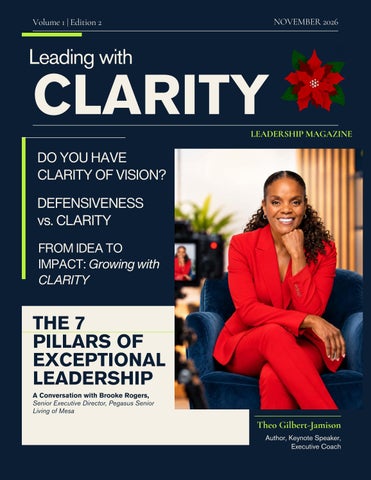
Theo Gilbert-Jamison Author, Keynote Speaker, Executive Coach
Leading with CLARITY Magazine
Table Of Contents 04
06
About this Magazine
CLARITY of Vision
Helping Leaders Create Greater Clarity, Alignment, and Results
Are You Truly Clear, or Just Assuming Your Team Is?
10
14
CLARITY is Not Defensiveness
The 7 Pillars of an Exceptional Leader
Are You Seeking Understanding or Protecting Yourself?
A Conversation with Brooke Rogers, Sr. Executive Director, Pegasus Landing of Mesa
19 Celebrating Our Recent Executive Coaching Graduates Strengthening Self-Awareness, Leadership Effectiveness, and Turning Insight In Action
21 From Idea to Impact Growing with CLARITY Using CLARITY to Launch, Grow, and Sustain a New Initiative
04 Our purpose is to provide leaders with relevant, accessible, actionable information they can immediately apply within their departments, teams, and organizations.
ABOUT THIS MAGAZINE Leading with CLARITY Magazine is a monthly leadership
1. Clarity of Vision
publication created to help executives, managers,
2. Leadership Alignment
emerging leaders, and organizations replace confusion,
3. Accountability and Ownership
complexity, and chaos with greater clarity, alignment,
4. Results-Driven Execution
accountability, and results.
5. Intentional Communication 6. Team Alignment and Empowerment
Each issue provides practical leadership insights, proven
7. Your Leadership Legacy
strategies, thought-provoking questions, and easy-toapply tools that help leaders strengthen their
Through featured articles, leadership case studies,
effectiveness and create healthier, more successful
executive interviews, reflection exercises, assessments,
teams and organizations.
and practical action steps, Leading with CLARITY Magazine helps readers examine how they lead,
The magazine is grounded in the CLARITY Framework
communicate, make decisions, establish expectations,
and its Seven Pillars of Exceptional Leadership:
and hold themselves and others accountable.
05
Leading with CLARITY Magazine
A Message From The Editor Throughout my leadership journey, I've learned one powerful lesson: Vision without Action is simply a dream. Exceptional leaders don't just communicate a compelling vision—they bring it to life through alignment, accountability, intentional communication, and resultsdriven execution. That's why this month's focus, CLARITY of Vision, is especially meaningful to me. When leaders provide a clear sense of direction and connect everyday actions to a greater purpose, they create an environment where people feel empowered to contribute, grow, and succeed. In this issue, we explore the importance of Clarity vs. Defensiveness, spotlight Brooke Rogers, a leader who truly exemplifies The 7 Pillars of an Exceptional Leader, celebrate our recent Executive Coaching Graduates, and share the exciting Growth of CLARITY and its expanding impact. My hope is that these articles provide practical insights, inspiration, and a few moments of personal reflection that challenge you to elevate your leadership effectiveness. Remember, CLARITY isn't just about knowing where you're going. It's about inspiring others to get there with you!
Theo Gilbert-Jamison Editor-in-Chief
06
07
Do You Have CLARITY of Vision?
Let me start with a simple question… If you stepped out of the room today, could your team clearly articulate your vision, your top priorities, and what success looks like—without your help? While most leaders believe the answer is yes. In reality, the answer is often… not quite.
What Is Clarity of Vision? Clarity of Vision is the ability to define and communicate a clear, compelling picture of where you’re going, what matters most, and what success truly looks like. It’s not just about having a vision. It’s about ensuring your team understands it, believes in it, and can act on it without constant direction.
Because here’s the truth: If your vision only lives in your head… it’s not leading anything. When clarity is strong, teams move with confidence and purpose. When clarity is weak, teams hesitate, second-guess, and often head in different directions—even when they’re trying their best.
Why This Matters More Than You Think Our research shows that only about 30% of employees understand their organization’s strategy and how their role contributes to it. That means more than half of your team could be working hard… but not necessarily working on the right things. And that’s not a performance problem. That’s a clarity problem.
08 The Real Impact of Clarity (or Lack of It) When Clarity of Vision is strong, everything begins to align. Teams understand what matters most, priorities become easier to manage, and decision-making speeds up. People feel more confident because they’re not guessing, they’re executing with purpose. Energy is focused, and results follow. But when clarity is missing, even talented teams struggle. People fill in the gaps with their own interpretations. Priorities shift. Effort increases, but impact decreases. And over time, frustration builds not because people don’t care, but because they’re not
How to Strengthen Clarity of Vision
clear. And here’s the hard truth. Your team doesn’t
Improving Clarity of Vision doesn’t require a complex
create confusion… they respond to it.
strategy, it requires intentional leadership. Start by simplifying your vision. If it’s too complicated to explain
A Real Leadership Moment I remember working with a leader in my Executive Coaching practice, who was incredibly passionate about her organization’s future. She could describe the vision beautifully, clear, inspiring, and compelling. But her
in a few sentences, it’s too complicated for your team to execute. Clarity thrives on simplicity. Then, communicate it consistently. Not once. Not occasionally. But regularly—across meetings,
team? Not so much.
conversations, and decisions. Your team needs to hear it
During a training session, I asked a few of her direct
Remember, it takes 21 times to form a habit!
reports to describe their team vision and top priorities. Their answers were… all over the place. Some focused on growth. Others on operational efficiency. A few mentioned things that hadn’t even been discussed
often enough that they can repeat it without hesitation.
Next, connect the vision to everyday work. People don’t just need to know the vision, they need to see how their role contributes to it. That’s where clarity becomes real.
recently.
Also, create space for open dialogue, asking your team to
And, she was surprised. She said, “But I’ve shared this
everything you need to know about how clear you’ve
with them multiple times.” And she had. But sharing is not the same as ensuring clarity. So we made a simple
reflect the vision back to you. What they say will tell you been.
shift.
And finally, reinforce it through your actions. Remember
She started reinforcing the vision in every team meeting
behavior doesn’t match your vision, your words lose
and, more importantly, in her 1-on-1 conversations. She began asking: “How does your work connect to our
your team watches what you prioritize. So, if your credibility.
vision?” “What does success look like in your role this
Final Thought
quarter?” And, “Where do you need more clarity from
Clarity of Vision is NOT about what you say once, it’s
me?”
about what your team understands and can act on consistently. Because at the end of the day… Your team
Within weeks, everything changed. The vision didn’t
will never outperform your clarity. And, “When the vision
change, the clarity did! And once the clarity improved,
is clear, the path becomes possible.”
alignment and execution followed.
09
10
Are You Seeking Understanding or Protecting Yourself?
One of the most common communication mistakes in
seeking understanding, and start making assumptions.
organizations is the tendency to confuse a desire for clarity with defensiveness. A leader asks a question about a new initiative and is labeled "resistant." An employee requests additional direction before moving forward and is viewed as "challenging authority." A team member seeks to understand expectations and is accused of being "defensive." Unfortunately, when organizations mistake healthy clarification for defensiveness, they create an environment where people stop asking questions, stop
The result is often confusion, frustration, misalignment, and poor execution. The irony is that the very questions leaders and employees stop asking are often the questions that could have prevented problems in the first place. The difference between seeking clarity and being defensive may seem subtle, but understanding that difference can dramatically improve communication, accountability, and organizational performance.
11 The Hidden Cost of Mislabeling Clarification as
Notice the difference. The person isn't arguing. They
Defensiveness
aren't blaming. They aren't resisting. They are
When people fear being perceived as defensive, they often choose silence over understanding.
attempting to gain understanding. Their goal is not selfprotection. Their goal is effective execution.
Instead of asking: "Can you help me better understand what success looks like?" They remain
A Real-World Example
quiet.
Imagine a leader provides a new direction to their team:
Instead of saying: "I'm unclear about the priority.
"Beginning next month, we need to improve response
Can you clarify?" They make assumptions.
times to our customers." One employee responds: "Can
Instead of asking: "What specifically would you like
you help me understand what response-time goal we're
me to do differently?" They walk away confused.
targeting and how we'll measure success?" Another employee responds: "Well, we've never had a problem
The result is predictable: Miscommunication increases;
before, and we don't have enough staff anyway."
Expectations become unclear; Accountability weakens; Frustration grows; and Performance suffers.
The first response seeks clarity. The second response demonstrates defensiveness. One opens the door to
Organizations that value CLARITY create psychological
alignment. The other creates barriers.
safety around asking questions. They understand that understanding should never be confused with resistance.
How to Tell the Difference When evaluating whether a conversation is rooted in
What Defensiveness Actually Looks Like
clarity or defensiveness, ask yourself four simple
Defensiveness is not the pursuit of understanding.
questions. These distinctions may seem small, but they
Defensiveness is the protection of ego. When people
dramatically impact the quality of communication.
become defensive, their primary goal is often to justify,
1. Is the Person Seeking Understanding or
explain away, avoid responsibility, or protect themselves
Justification? People seeking clarity want
from criticism.
information. People being defensive want validation. 2. Are They Looking Forward or Looking Back? Clarity
Defensive responses often sound like: "That's not my
focuses on what should happen next. Defensiveness
fault." "Nobody told me." "Well, everyone else does it too."
focuses on explaining why something already
"I was only doing what I was told." "You're always
happened.
criticizing me." The focus shifts away from solving the problem and toward self-protection. Defensiveness typically closes communication. Clarity opens communication.
What Seeking Clarity Looks Like Seeking clarity is driven by a desire to understand, improve, align, and execute effectively. Clarity-focused questions often sound like: "Can you help me better understand your expectations?" "What outcome are we trying to achieve?" "Can you provide an example?" "Which priority takes precedence?" "What does success look like?" "How should I handle this situation if it happens again?"
3. Are They Curious or Combative? Curiosity invites conversation. Combativeness shuts it down. 4. Is the Goal Improvement or Self-Protection? Clarity seeks progress. Defensiveness seeks protection.
12 Why Leaders Often Misinterpret Clarifying
Step 3: Ask Better Questions - Questions shift
Questions
conversations from conflict to collaboration.
Many leaders unintentionally view questions as challenges. Why? Because questions can feel uncomfortable. A leader may interpret: "Can you explain the rationale behind that decision?" As "I disagree with
Ask: "What specifically concerns you?" "What expectations did I miss?" "What would success look like moving forward?"
your decision." But those are not the same thing.
Step 4: Focus on Solutions - Defensiveness lives in
Strong leaders recognize that thoughtful questions are
why something happened, focus on what can be
often signs of engagement, not resistance. In fact, employees who seek clarification are often more committed to success because they want to fully
excuses. Clarity lives in solutions. Instead of explaining improved next. Step 5: Take Ownership - Nothing accelerates clarity
understand expectations before moving forward.
faster than accountability. A simple statement such as: "I
Organizations with the strongest cultures encourage
what I'll do differently moving forward." instantly changes
questions because questions create alignment.
understand where the confusion occurred, and here's the tone of the conversation.
Alignment creates accountability. Accountability drives results.
The CLARITY Connection Within the CLARITY Framework, this distinction is
Turning Defensiveness into Clarity The good news is that defensiveness can be transformed
critical. Leaders who create a culture where questions are welcomed strengthen: Leadership Alignment
into productive dialogue.
because expectations become clearer; Accountability &
Step 1: Pause Before Responding - Defensiveness is
Intentional Communication because understanding
often an emotional reaction. Clarity is a thoughtful response. When you feel yourself becoming defensive, pause and ask: "What am I trying to protect right now?" Step 2: Become Curious - Replace the need to defend with the desire to understand. Instead of saying: "That's not what happened." Try: "Help me understand your
Ownership because assumptions are reduced; improves; and Team Alignment & Empowerment because people feel safe seeking clarification. Organizations that confuse clarification with defensiveness often create silence. Organizations that celebrate clarity create alignment. And alignment creates execution.
perspective."
Bottom Line The next time someone asks a question, resist the urge to immediately assume they are being defensive. They may simply be trying to understand. Likewise, when you feel the need to defend yourself, pause and ask whether your goal is protection or understanding. Because one of the most powerful leadership questions you can ask yourself is: "Am I trying to be right, or am I trying to gain clarity?" The answer may determine the quality of your communication, your relationships, and ultimately your results. In organizations that thrive, clarity is not viewed as resistance. It is viewed as responsibility.
13
14
The 7 Pillars of an Exceptional Leader A Conversation with Brooke Rogers, Senior Executive Director, Pegasus Landing of Mesa What does exceptional leadership look like in practice? It isn’t simply about holding a title, managing a team, or achieving financial results. Exceptional leadership is about creating clarity, establishing expectations, building trust, holding yourself and others accountable, communicating intentionally, and leaving people and organizations better because you were there. Brooke Rogers, Sr. Executive Director of Pegasus Landing of Mesa in Arizona, demonstrates these qualities in the way she approaches leadership every day. Brooke’s journey in senior living began at just 16 years old. During the past 27 years, she has served as a healthcare worker, CNA, med tech, nurse, and ultimately moved into operations and executive leadership. Even when she attempted to pursue another field, she found herself returning to senior living. When we examine Brooke’s leadership philosophy through the lens of the 7 Pillars of Exceptional Leadership, a clear pattern emerges.
1. Clarity of Vision Brooke’s vision is straightforward: create the best possible experience and a home-like environment for residents while ensuring the team remains aligned with Pegasus Senior Living’s core values of Passion, Caring, Accountability, Teamwork, and Financial Stewardship. She believes people cannot successfully follow what they do not understand. “When people know the goal, understand their role, and know what success looks like, they can move forward with purpose rather than uncertainty.” That is CLARITY of Vision in action.
15
2. Leadership Alignment Great leaders understand that before they can align their teams, they must first align themselves. For Brooke, that begins with understanding what her senior leaders expect from her. Rather than assuming, she asks questions and seeks clarification. Her philosophy is simple: “I want to know what they expect of me, so I can
metrics. Reviewed weekly, these plans help identify successes and areas of opportunity. For Brooke, accountability isn’t about catching people doing something wrong. It is about ensuring people understand what is expected and have the tools to succeed.
deliver.” Alignment doesn’t happen automatically. It
4. Results-Driven Execution
requires intentional conversations and a willingness to
CLARITY without execution is simply good intention.
seek understanding before moving forward.
Brooke’s team focuses on measures reflecting both business outcomes and organizational culture, including
3. Accountability & Ownership Brooke believes exceptional leaders lead by example, and accountability begins with herself. Just as she holds her directors accountable, she holds herself to an even higher standard. “I never want my leader to question my values, my work ethic or the quality of my work,” she explains. Her team also uses Operational Improvement Plans (OIPs) to clarify expectations, responsibilities, and key
occupancy, resident and employee satisfaction, retention, compliance and quality measures, financial performance, and accountability. Metrics are reviewed weekly through OIPs, monthly during director meetings, and quarterly through strategic meetings. During quarterly sessions, leaders establish departmental goals and discuss how they can help one another succeed. This creates a powerful shift from “my results” to “our results.”
16 5. Intentional Communication Brooke believes communication must be frequent, transparent, and intentional. Her team uses stand-up
CLARITY -- The Framework for Clear Direction, Stronger Teams, and Lasting Impact
meetings, OIPs, monthly meetings, face-to-face conversations, and email to remain connected. “I don’t believe there is such a thing as overcommunication.” Her goal is for team members to understand what is happening throughout the community and how they can support one another. Communication isn’t simply the transfer of information, it is a leadership tool for creating alignment.
6. Team Alignment & Empowerment Exceptional leaders recognize that results are achieved through people. Brooke believes her directors are in their roles for a reason and should be trusted to do their jobs. She is equally intentional about recognition. Directors receive unexpected handwritten thank-you cards and personalized birthday and Christmas gifts based on their “Favorite Things” lists. Recognition
Leading with CLARITY
extends throughout the community through
As our conversation concluded, Brooke brought
appreciation cards, Employee of the Month, a “snack
everything back to two fundamentals: doing what is right
shack,” and other gestures. These simple actions
and making expectations clear. “Do the right thing all the
communicate a powerful message: I see you. I value
time. It doesn’t matter if it is easy or not, you can never go
you. Your contribution matters.
wrong doing the right thing!” And when leading your team, set expectations and communicate them clearly.
7. Your Leadership Legacy Ultimately, leadership isn’t simply about what we accomplish. It is about what remains because of how we led. When asked how she hopes to be remembered, Brooke didn’t mention occupancy, financial performance, awards, or titles. She talked about character.
People cannot be successful if they don’t know what is expected of them. Brooke Rogers clearly demonstrates that The 7 Pillars of Exceptional Leadership aren’t theoretical concepts. They are DAILY leadership choices. Create a clear vision. Align with expectations. Own the results. Execute with discipline. Communicate intentionally. Empower your
“I hope my legacy is one of integrity, compassion, accountability, and servant leadership, where people knew I cared deeply, led fairly, and never compromised on doing what was right for our residents and community.”
people. And build a legacy worth remembering. Because exceptional leadership isn’t defined by what we say about leadership. It is demonstrated by how we lead -- one decision, one conversation, and one person at a time.
17
18
19
Congratulations to Rodger Martens, Life Enrichment Partner at Pegasus Landing of Mesa, and Shae Scarseletta, Memory Care Director at The Landing at Queensbury, on successfully completing the Pegasus Senior Living Executive Coaching Program! Completing the program represents much more than attending a series of coaching sessions. It reflects a commitment to growth, self-awareness, accountability, and becoming a more intentional and effective leader. Throughout their coaching journeys, Rodger and Shae embraced opportunities to reflect on their leadership strengths, identify areas for continued development, apply new approaches, and take greater ownership of the impact they have on their teams and communities.
Developing Leaders Since 2020 In 2020, Pegasus Senior Living partnered with Performance Solutions by Design, Inc. to create and launch a customized Executive Coaching Program designed to develop emerging leaders and strengthen the organization's leadership pipeline. Since its launch, almost 100 emerging executives and leaders have successfully completed the program,
investing in their professional growth while developing the skills, confidence, and leadership effectiveness needed to make an even greater impact. Rodger and Shae now join this growing group of graduates. While completing the program is an important milestone, the leadership journey continues. The real measure of success is how they apply what they've learned to lead their teams, strengthen relationships, achieve results, and positively influence the people they serve. Please join us in congratulating Rodger and Shae on this well-deserved accomplishment! Keep growing. Keep leading. Keep making a difference.
Could Executive Coaching Strengthen Your Leadership Pipeline? If your organization is looking for a practical way to strengthen leadership effectiveness, retention, and succession planning, Performance Solutions by Design, Inc. can create a customized, energizing, and resultsoriented Executive Coaching Program aligned with your organization's unique needs. Contact us today at info@psbydesign.com to learn more. It would be our pleasure to assist.
20
21
From Idea to Impact
Every successful initiative begins with an idea. But an
That problem established our purpose. A clear purpose
idea alone is rarely enough. The real challenge is moving
becomes the anchor that keeps an initiative focused as
from inspiration to implementation, and ultimately to
new opportunities and distractions emerge.
sustainable impact.
2. Create a Framework Before Creating Activity That journey requires CLARITY. What began as a simple
Once the purpose is clear, give the idea structure. For
realization that too many leaders and organizations
CLARITY, developing a practical leadership framework
struggle with confusion, complexity, and chaos has
became the foundation for everything that followed. Too
evolved into the CLARITY Leadership Framework,
often, organizations confuse activity with progress.
workshops, assessments, executive coaching resources,
Meetings are scheduled, materials developed, and
employee and personal development programs, and
initiatives announced before everyone understands
Leading with CLARITY Magazine.
what success looks like.
This growth didn't happen overnight. It resulted from
A strong framework establishes priorities, expected
intentional decisions, continuous learning, and a
behaviors, guiding principles, and measurable
commitment to creating meaningful value. And, here are
outcomes. And structure makes an idea easier to
six lessons from that journey.
communicate, implement, and scale.
1. Start with CLARITY of Purpose Before asking, "What should we create?" ask, "Why does this need to exist?" CLARITY began with a recognizable problem: leaders and organizations often struggle NOT because they lack talent or commitment, but because expectations, priorities, communication, accountability, and desired results are unclear.
22 3. Build, Test, Learn, and Refine
6. Build Sustainability Into the Initiative
New initiatives don't have to be perfect before they're
Launching something is exciting. Sustaining it requires
introduced. They need to be clear enough to test. As
discipline. Many initiatives begin with enthusiasm but
CLARITY evolved into workshops, assessments, and
lose momentum when priorities shift, accountability
coaching resources, pilot programs provided invaluable
weakens, or attention moves elsewhere. Long-term
opportunities to gather feedback and strengthen the
success requires clear ownership, measurable
experience. BUILD → TEST → LEARN → REFINE
outcomes, progress reviews, continuous improvement, and consistent communication.
Rather than waiting for perfection, develop a strong first version, introduce it to real users, listen carefully, and
Celebrate accomplishments. Address gaps. Reinforce
improve. Remember, feedback isn't evidence of failure.
expectations. Keep people connected to the purpose.
It's an opportunity for improvement.
Sustainability must be designed—not assumed.
4. Move from Validation to Visibility
From an Idea to an Impact
Once an initiative demonstrates value, people need to
The growth of CLARITY reinforces an important
know about it. CLARITY expanded beyond pilot testing
principle: Successful initiatives grow through a series of
into keynote presentations, public workshops,
clear, intentional decisions.
marketing campaigns, thought-leadership articles, and eventually Leading with CLARITY Magazine.
INSIGHT → FOUNDATION → BUILD → VALIDATE → SHARE → GROW → AMPLIFY → MULTIPLY
Too many worthwhile initiatives remain hidden because leaders invest heavily in creating them but insufficiently
Above all, don't allow growth to create the very
in communicating their value. So, tell your story. Share
conditions you're trying to eliminate: confusion,
results. Educate your audience. Demonstrate the
complexity, and chaos. Because the greater the
problem you're solving. Remember, visibility creates
CLARITY of purpose, priorities, expectations,
opportunities for credibility, engagement, and growth.
communication, accountability, and results, the greater your opportunity to turn a promising idea into
5. Expand Without Losing the Core
sustainable impact. That's the power of Growing with
Growth creates opportunity—but it can also introduce
CLARITY!
complexity. As CLARITY evolved, its principles were adapted into five experiences: Elevating the Customer Experience with CLARITY Leading with CLARITY – Leadership Effectiveness Working with CLARITY – Employee Effectiveness Living with CLARITY – Personal Growth, and CLARITY for Youth – Developing Future Leaders Different audiences. Different applications. One central philosophy. Sustainable growth means extending the value of your original idea without losing the principles that make it effective. Before expanding, ask: "Does this opportunity strengthen our purpose—or distract us from it?"
This Month’s Featured Cheat Sheet
24
More About This Magazine Leadership Does Not Have to Be Unnecessarily Complicated... When leaders clearly communicate the vision, align people around shared goals, establish meaningful expectations, and reinforce accountability, they create an environment in which employees can perform at their highest level. Each monthly issue of Leading with CLARITY Magazine is designed to challenge readers to consider one essential question: Are you leading with CLARITY, OR unintentionally creating confusion, complexity, and chaos?
What Readers Can Expect Every issue of Leading with CLARITY Magazine will include a thoughtful collection of leadership content,
Who Should Read this Magazine? Leading with CLARITY Magazine is designed for: Executives and Senior Leaders Department and Division Heads Mid-Level Managers and Supervisors Emerging and High-Potential Leaders Human Resources and Organizational Development Professionals Business Owners and Entrepreneurs Leadership Coaches, Consultants, and Facilitators Anyone committed to becoming a more intentional and effective leader
including: Practical strategies for strengthening leadership effectiveness Guidance for improving communication, alignment, and accountability Insights connected to the Seven Pillars of Exceptional Leadership Realistic workplace scenarios and organizational case studies Leadership reflection questions and selfassessments Tools leaders can immediately use with their teams Interviews and perspectives from accomplished leaders Action steps for producing sustainable results Information about CLARITY workshops, coaching, keynotes, and resources
25
Contact us today to schedule a CLARITY Strategy Session or to learn more about our Executive Keynote, CLARITY Leadership Workshops, or Executive Coaching. It would be our pleasure to partner with you!
Performance Solutions by Design, Inc. Website: www.psbydesign.com Email: info@psbydesign.com