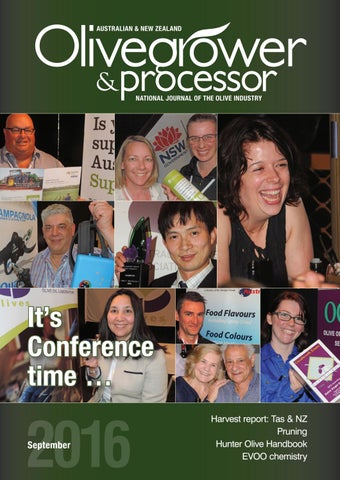
It’s Conference time ‌
2016 September
Harvest report: Tas & NZ Pruning Hunter Olive Handbook EVOO chemistry
the new kneading era is called Protoreactor Pieralisi
capolinea.it
®
High quality Maximum efficiency Low investment
With the Protoreactor®, Pieralisi Group achieves a new record in the olive oil extraction machine industry. It is a disruptive innovation in the worldwide olive oil market that revolutionizes the traditional kneading process granting important advantages in the batch and industrial processing. Higher quantity and quality of the processed product due to the sensible reduction of the kneading time and the automatic management of the capacity, time and temperature. Energy savings thanks to the reduction of the processing time and heat losses. Lower costs in the investment with the same processing capacity thanks to the evident elimination of the kneading basins. The extracted oil results contain more polyphenols and better organoleptic profile. This is a technological revolution that leads Pieralisi’s customers in the new kneading era.
OFFICIAL AUSTRALIAN AND NEW ZEALAND AGENTS NSW-QLD-ACT-VIC Town & Country Tractors & Machinery Pty.Ltd. 18 Airds Rd - Minto, NSW 2566 Phone 02 98248444 - Fax 02 98246670 paul@tctractors.com.au - tornado@pacific.net.au Contact: Paul Blasutto, 0419 273668
SA-VIC W.E. Ware & Co. Pty.Ltd. 19 Papagni Avenue - Newton, SA 5074 Phone 08 83653200 - Fax 08 83653187 warrick@weware.com.au Contact: Marjorie Ware and Warrick Philpott
Via Don Battistoni, 1 60035 Jesi (AN) Italy Phone +39 0731.2311 Fax +39 0731.231239 info@pieralisi.com www.pieralisi.com
WA Agito Group 7 Tacoma Circuit - Canning Vale, WA 6155 Phone 08 9334 9200 enquiries@agito.com.au Contact: Glenn Simmons, 0427 359723
Contents
In this issue... Incorporating Australian Olive Industry Journal Published by Ryan Media Pty Ltd Publisher Hartley Higgins General Manager Peter Muscet Editorial Gerri Nelligan Advertising Maria Stephenson sales@olivegrower.com.au Production Simon Miles Subscriptions A one-year subscription (four issues) is $38.00, and includes a copy of the Australian and New Zealand Olive Industry Directory. Subscriptions commencing July 1 2014 will receive a copy of the 2015 Australian and New Zealand Olive Industry Directory. Please pay by cheque or credit card to Ryan Media. Visit www.olivebiz.com. au to subscribe. Circulation subs@olivegrower.com.au Contributions Articles and other contributions are welcome and will be published at the discretion of the editor. Photographs are best received as jpg files via email or should be high-quality prints or transparencies. Please indicate if articles and pictures are to be returned. Printing Lane Print & Post Adelaide Ryan Media Pty Ltd ABN 85 085 551 980 630 Regency Road, Broadview South Australia 5083 Phone +618 8369 9555 Facsimile +618 8369 9501 Website www.olivebiz.com.au ISSN 1448-5486 Conditions The opinions expressed in Olivegrower & Processor are not necessarily the opinions of or endorsed by the editor or publisher unless otherwise stated. All articles submitted for publication become the property of the publisher. All material in Olivegrower & Processor is copyright © Ryan Media Pty Ltd. All rights reserved.No part may be reproduced or copied in any form or by any means (graphic, electronic, or mechanical including information and retrieval systems) without written permission of the publisher. While every effort has been made to ensure the accuracy of information, the published will not accept responsibility for errors or omissions, or for any consequences arising from reliance on information published.
INDEPENDENT & AUSTRALIAN OWNED
September 2016 Issue 101
News Olive Industry Strategic Investment Advisory Panel appointed
4
Australia gains National Organic Mark
5
China Project update
6
Profile Alan Smith, Shalumar
8
Harvest reports Tasmania 9 New Zealand
10
Pruning Pruning: the Coonalpyn grove two years on
14
The Australian Olive Industry Conference & Trade Exhibition Conference provides essential industry knowledge
17
Exhibitors … supporting the Australian olive industry
20
Renewed focus on judges training
24
Grove management Hunter Olive Handbook
25
Chapter 12: ‘We are what we Measure’
26
New Zealand Conference focuses firmly on market share
28
Presenters 29
Feature – Sensory analysis Sensory analysis in olive oil – part 1: negative attributes
31
Feature – EVOO chemistry Acidity in Extra Virgin Olive Oil
32
Pests & Diseases ONZ focus on grove diseases
34
Products & Services Flexible, customised packaging solutions: OOPS
35
Olives & Health Health Round-up
36
What’s On/Advertiser index
38
Cover: In this edition, we preview the informative programs on offer at The Australian National Olive Industry Conference & Trade Exhibition and the Olives NZ Conference 2016, the industry’s premier information and networking events. Issue 101 • September 2016 • Australian & New Zealand Olivegrower & Processor • 3
News
Gerri Nelligan Editor
Harvest is over but it’s still a busy time for our industry, as both Australia and New Zealand gear up for their respective national conferences. Opportunities for networking and education, our industry conferences provide an opportunity to share and learn, and to gain important information we can use to improve quality and productivity into the future. They’re also a (rare) chance to catch up with old friends and meet new ones, to share experiences and solutions – and to celebrate the best we produce at the annual AOA and ONZ national awards dinners. Fun and valuable times indeed – do your best to be there! We preview both of the conferences in this edition, along with our annual harvest report from Tasmania and New Zealand,
our southernmost and more cool climate regions. Tasmania had a pretty interesting time this year, albeit with some great results, while New Zealand growers in general are smiling long and wide, after a bumper harvest across most growing regions. It’s great news after last year’s disappointing result and, as always, the reflections of our grower contributions provide thoughtful insight into the hows, whys – and most often the ‘maybe that’s why’s – of cropping and yield rates. There’s also a review and sample of the Hunter Olive Handbook, a great new industry resource produced by and for small grove owners, our annual update on the Coonalpyn grove rejuvenation project, and feature articles on sensory analysis and understanding polyphenols. Along with the Health Round-Up, showcasing the latest in research around the myriad health benefits of EVOO, Olivegrower Profile, industry calendar and other regular features, there’s plenty to keep you busy until Conference time. Enjoy the coming spring warmth, and best of luck for a prolific flowering and fruit set. Editor Gerri Nelligan and the OG&P team.
Olive Industry Strategic Investment Advisory Panel appointed The olive industry Strategic Investment Advisory Panel (SIAP) has been appointed by Horticulture Innovation Australia (HIA) and future project planning by the group is now underway. The appointment of panel members was a rigorous process, which included a nationally advertised call for Expressions of Interest and an independent selection process based on the needs of the industry investment program. The members are: Leandro Ravetti, Tim Smith, Lisa Rowntree, Paul Miller, Grant Wylie, Rita Bikins, Kevin Withear, Peter Herborn, Michael Harbison and Robert Spooner-Hart. HIA will also be seeking advice of other olive industry experts as required. The process Industry SIAPs come together periodically to identify projects and research which would benefit the industry, which are sent out to tender by HIA. This replaces the previous process, under which projects would be proposed and presented directly by researchers to RIRDC and approved for funding. Investment Plan review SIAP member and Australian Olive Association (AOA) CEO Lisa Rowntree said the panel has now held its first meeting, identifying the responsibilities of the group and providing input into the industry Strategic Investment Plan (SIP). “Ownership of the SIP rests with the SIAP, so that was a crucial first step for the panel,” Rowntree said. “We’ve now reviewed the SIP and it has gone back to Hort Innovations with a number of suggestions. The AOA Board also reviewed it at their May meeting, and levy payers will have
an opportunity to further review and comment on the plan. “Once the plan is finalised, we can say to HIA ‘These are the top areas that need looking into: prepare the project briefs for these and put them out to tender’, as the investment of levy funds is now driven by the plan. The SIAP is jointly responsible for identifying the RD&E needs of industry and it is good that there are a wide variety of business models represented on the SIAP. “The complete flip of how research is determined and undertaken is happening across all horticultural industries, not just ours.” Targeted research Rowntree said the new process is certainly different from the pool of money that was previously available for research projects, and that it provides the opportunity for researchers to do really valuable work. “It has stopped research for research’s sake, and it’s targeting what the industry really needs,” she said. “In short, it’s now an organised structure saying ‘These are the gaps, let’s fill them’. “For example, there’s a lot of R&D that is still current and good but getting growers to take it up has been a really big problem. That’s one area that we really need to fix, and no doubt one we’ll be working on in the first phase of strategic project funding.” The olive industry SIAP held its second meeting as we went to print. We’ll report on outcomes and further activity in the December edition of Olivegrower & Processor.
4 • Australian & New Zealand Olivegrower & Processor • September 2016 • Issue 101
News
Australia gains National Organic Mark After nearly 12 years of discussion and two years of hard work, the Organic Industry Standards & Certification Council (OISCC) and the Organic Federation of Australia (OFA) have announced the introduction of the new Australian National Organic Mark. Like the US and EU organic Seals, this logo will become the international trademark for organic certified product from Australia and is being used to develop equivalencies with our largest and nearest trading countries. The South Korean equivalency is currently nearing completion, the China equivalence has begun side-by-side analysis, and the US and Australian governments have started discussions. OFA Chairman Adam Willson said the Mark will provide substantial efficiencies, which are expected to translate into a huge boost for the Australian organic industry. “Certification costs will be minimised and consumers will find it easier to locate organic food in supermarkets and organic retail outlets,” he said. “When the US introduced the National Seal in late 2002, the industry grew from $US8.4B to $US43.3B by 2015 - a year on year growth of 13.4%pa. At the same rate of growth, if the Australian organic market is worth $2B in 2016 it could could grow to at least $3.3B by 2020. Benefits Willson said the Mark will bring a number of benefits, for both the industry and consumers: Reduced certification costs Many producers and processors have multiple certifications to access different country markets – e.g. US National Organic Programme (NOP), Japan (JAS), South Korea, China and EU. Each of these not only entail a fee but also need a separate audit, taking costly time away from the business. With the National Organic Mark enabling equivalencies with each of our trading countries (an acceptance of each country’s organic standards), an operator will only have to be certified with one of the six Australian accredited certifying bodies to gain access to export markets. Visual marketing Countries throughout Asia recognise government endorsed National Organic
Marks and by adopting other countries logos, as we do when certified through the NOP, JAS or EU, we are in effect marketing their products. The Australian National Organic Mark will create a new impetus for consumers wanting food from the “cleanest continent in the world”. Logo consistency Rather than looking for one of six certification logos, the consumer will be directed to one, increasing consumer awareness of - and demand for - organic food. Protecting “organic” The introduction of the National Organic Mark will help improve the legislative environment to protect the organic industry. As a Certification Trade Mark (CTM) underpinned by the ACCC, the Mark is the first step in recognising the word “organic” and protecting the industry against fraud.
Rules of use The National Organic Mark is owned by OISCC and registered as a trademark through IP Australia. It is now available for use, with key rules including: • only on certified organic products that comply with the National Organic Standards • products/goods must contain minimum 95% certified organic ingredients • only to organic business certified through nationally accredited certifiers Ausqual, Australian Certified Organic, Demeter, NASAA Certified Organic, Organic Food Chain and Safe Food QLD • voluntary and free to use, under licence agreement • can be applied to products under equivalency. For more information and full rules of usage see the Organic News section of the OFA website: www.ofa.org.au. The official launch of the National Organic Mark will be held on Wednesday, 30 November in The Great Hall, Parliament House, Canberra, at a networking dinner for over 400 Australian organic businesses showcasing regional organic foods and drinks. Contact media@ofa.org.au for full details and to get involved.
26-28 Altin Street GRIFFITH NSW 2680 Ph: 02 6964 3328 Fax: 02 6964 4334 www.liftek.com.au sales@liftek.com.au
Toyota Industrial Equipment
USED EQUIPMENT, CAN TRANSPORT AUSTRALIA WIDE.
Bin Tipper
Issue 101 • September 2016 • Australian & New Zealand Olivegrower & Processor • 5
News
China Project update Chris Mercer, Program co-ordinator, The Olive Route
Co-ordinator Chris Mercer continues our quarterly updates on The Olive Route program, facilitating extra virgin olive oil exports to China. By the time this article goes to press, the final OL14003 Milestone Report will have been submitted to Horticulture Innovation (Hort Innovation) and, subject to any questions or requests, the research project Essential Work to Facilitate Increased Exports to China, Removing Roadblocks and Enhancing Competitive Advantage will have concluded. That report will be published on the Hort Innovation website (www. horticulture.com.au). Project achievements So what did this project achieve for the olive industry and what have we learned? In the closing stages a brief questionnaire was sent out to the 102 people who have interacted with the project at some stage (mainly the roadshow workshops in March last year, but also the single export training workshop in April this year). After a few days we have had 13 responses, listing how respondents found the project to be beneficial. No particular drawbacks or wastages were highlighted. Also, interest was expressed in further export training workshops, subject to convenient locations and timing. Participant feedback The main message coming back from growers and producers is that they appreciate the methodology that has been developed; the information and knowledge conveyed; and how the sessions have opened people’s eyes to the possibilities of export in today’s connected world, especially for smaller businesses. Blueprint for the future In fact the ‘methodology’ evolved as we went along. Somewhat to our surprise we ended up with a blueprint that we believe can be extended to other ‘whole food’ industries and also to markets in other countries. This blueprint will be tested by Australian Food Integrity Certification Services, a company established as a privately-funded enterprise by a core group of organisers and participants. Chinese consumer survey Other benefits to the industry include the Chinese consumer survey, which revealed some surprises and confirmed other expectations, but which overall enabled us to touch reality and establish that our target market in China is very receptive to trying and using high quality, authentic EVOO, even at higher prices. Laboratory work The laboratory work enabled progress to be made on our understanding of phthalate infiltration and also of laboratory test requirements and why so many tests are required by the Chinese authorities. The work on developing a “sister laboratory” in China was one of the major successes of the project and will give us access to cheaper laboratory testing and audits, as well as significant co-operation and collaboration opportunities.
Working together Looking back over the past eighteen months, one of the things that has become apparent to this author is that we can be most effective when we work together as an industry. No matter whether the participants plan to go into the export market or not, everybody who came along learned new things that hopefully will benefit their businesses one way or another; and on the other hand gave enthusiasm, creativity and constructive criticism to the project. The belief is that with such a well co-ordinated and ‘pragmatically creative’ approach, we can provide EVOO to China that meets or exceeds consumer desires, expectations and entitlements, hence enabling us to sell our olive products at the price levels so richly deserved. A Western Australian grower and EVOO producer, Chris Mercer is the president of Olives WA and a member of the AOA board. Any levy payers invested in joining the pioneers along The Olive Route can contact him via chris@westerngroves.com for more information. We’ll update with news of the program’s next phase in future editions of Olivegrower & Processor.
6 • Australian & New Zealand Olivegrower & Processor • September 2016 • Issue 101
PHONE: 03 5272 9500 lab@modernolives.com.au modernolives.com.au
News
Alan Smith, Shalumar OG&P: How long have you been involved in the olive industry and what is your involvement? AS: We have been involved for 13 years with our farm Shalumar, having acquired an established grove of 450 trees. The olives and our black angus cattle are our retirement project. We have replanted half the grove to replace the table olive varieties: the disease pressure in the Lower Hunter has proven to be too great, anthracnose kept spoiling beautiful Manzanillas just prior to harvesting. With 450 trees and the help from friends at harvest time we do most of the work on the grove ourselves. The mainstay variety is Frantoio, with a few Leccino and a few Koraneiki, also a substantial planting of Coratina to replace the Manzanillas. Olive Lace Bug is becoming an increasing problem, and these days our 40 Koroneiki seem to bear the brunt of these attacks. The Frantoio have proven to be a bit erratic. Planted in the 1990’s with quite possibly uncertain parentage, they exhibit a variety of growing habits. Under Marcello Berlanda’s guidance, with extra fertilizer and water, half of them do seem to like to produce a lot of water shoots and leaf. However 2016 proved an acceptable year and we have 250 litres of very nice EVOO to market. In recent years I have become the Treasurer of the Hunter Olive Association, as well as Co-Convenor of the Hunter Olive Show with Steve Mitchell. The olive show has widened my circle of contacts, with entries from all across Australia. OG&P: What are your major markets and why? AS: We call ourselves a micro business, selling at markets and to a few local businesses. OG&P: How did you become involved in the olive industry? AS: We targeted the lower Hunter Valley for our farm location, and olives
yield from our groves. Project Revival run by Marcello Berlanda under the auspices of the Hunter Olive Association has been a boon in this respect. The knowledge of this project is now incorporated in the Hunter Olive Handbook, just released on Amazon as an e-book (see page 26 for a sample chapter of the handbook). The second issue is getting a decent price for our EVOO. OG&P: What are the best ways to tackle those issues? AS: Project Revival has addressed the first issue. We all look to the AOA to fight the fight on EVOO standards. and the romance of olives appealed to us. Equally we did not want to get tangled up in the grape growing business. We visited Shalumar and fell in love with its olive trees and its aspect looking at the Watagan Mountain range. In retrospect, of course, ignorance is a kind of bliss. Over the years we have become increasingly involved in the Hunter Olive Association and the Hunter Olive Show. Our members get on well together, and there is good sharing of experience. OG&P: How do you see the local industry positioned in the current global market, both in terms of its importance and comparative policies/standards? AS: We are so small that these kind of issues pass right over our heads, although it is most frustrating to observe the poor standard of imported oil labelled as EVOO. The non-compliance allows ridiculously cheap pricing of this product due to the lack of enforcement of the quality standards. There needs to be more supply chain responsibility by our major supermarket chains in this area. OG&P: What do you see as the most significant issues facing the Australian and/or New Zealand olive industries at present? AS: For many of us in the Hunter Valley, the issues are getting a decent
8 • Australian & New Zealand Olivegrower & Processor • September 2016 • Issue 101
OG&P: What are your thoughts on the Australian olive oil standard? AS: I am quite happy with it, but also see that effectively enforcing any of the standards in place would be helpful. It is a pity that there is not agreement on a world standard. OG&P: What are your hopes for the industry into the future? AS: My hopes for the future revolve around the major players with over at least 30,000 to 40,000 trees continuing to create and nurture their brands, such that Australian EVOO stands on the world stage in the first rank. OG&P: And finally, what do you see as the realistic outcomes for the industry in the near future? AS: It is a sad reality that I tell my customers, if I had more trees I would lose more money! This is something that we need to face. Stopping the dumping of poor quality and inappropriately labelled EVOO in Australia has to be a first step. I do appreciate the complexity of the European olive oil politics but we need to keep plugging away to raise standards. More information: www.shalumar.com and see our review of the Hunter Olive Handbook on page 25 of this edition.
Harvest report
Harvest report: Tas & NZ In this edition, we wrap up our annual round-up of the harvest around Australia and New Zealand with an overview from our southernmost growers across Tasmania and New Zealand.
Tasmania Tasmanian growers have had a roller-coaster ride this year, with last year’s olive-friendly weather replaced by droughts, storms and flooding rains. Not to mention damaging winds at flowering. Despite all that, the news is actually very good. Abbotsham - Cradle Coast Cradle Coast Olives’ Carol and Tony O’Neil had a pretty good harvest last year. Olive-friendly weather made for aboveaverage crops throughout the region, with high quality fruit and outstanding oil percentages. The drier summer and autumn kept pests and diseases at bay, so the only major issue was damage from early severe frosts on some groves. This year hasn’t been quite as friendly, with conditions ranging from drought to floods and major storms. It was also a later harvest, with fruit still being crushed when we spoke with Tony in mid-July. “It was a dry, warm summer and spring – any non-irrigated groves would have been feeling the pinch,” he said. “And there have been no significant frosts as yet but we had some extreme flooding events which inundated some groves, luckily with little deleterious impact. We’ve also had some significant storm events with hurricane force winds, which resulted in some losses of fruit – particularly the larger varieties like Sevillano and Verdale.” Flower and fruit set across the region was, O’Neil said, generally good. “Some groves were a little patchy – again, that’s possibly from irrigation deficiency – but generally yields are up, with most producers having an ‘on’ year,” he said.
… groves in the central north and northwest, and in the south (of Tas), have been coming in three to four weeks earlier than usual. - Tony O’Neil, Cradle Coast Olives
Harvest timing is also somewhat inconsistent this year. “Harvesting commenced at the usual time on the east coast, beginning on 2 May, but other groves in the central north and northwest, and in the south, have been coming-in three to four weeks earlier than usual,” O’Neil said. “So we commenced on 2 May and we expect to finish on 1 August.” As with last year, however, the drier conditions have brought good news in terms of pests and disease. “There’s been very little evidence of scale or peacock spot this year, which is possibly a direct result of the dry spring and summer,” O’Neil said.
ABBOTSHAM
NEW NORFOLK
“There’s also been no sign of anthracnose, after a minimal appearance last year.” There’s good news too in the oil yield figures – although once again, not for everyone.
There’s been very little evidence of scale or peacock spot this year, which is possibly a direct result of the dry spring and summer. - Tony O’Neil, Cradle Coast Olives
“To date the yield overall is down slightly this year at 13%, possibly due again to the impact of non-irrigated groves. That said, later harvests are producing unheard of yields of 22% and above,” O’Neil said. And as for 2016 quality, the news there is positive too. “Oils from the early harvest are typical Tassie quality high complexity, fruity and good balance – definitely award winners!” O’Neil said. “And while the later harvest lacks the wow factor we’ve come to expect of Tassie oils, they’re nevertheless very nice fruity oils.” New Norfolk – Ashbolt Farm Anne and Bob Ashbolt and their neighbours also had more conducive weather last year, with a warm but dry winter and
Issue 101 • September 2016 • Australian & New Zealand Olivegrower & Processor • 9
Harvest report
spring followed by a mild summer and good April rains. Even the usual winter snap held off, replaced by a more gradual onset of cold weather. Like their northern peers, however, cropping was inconsistent, with some groves laden and others sparse. Winds at flowering and fruit set were the culprit – although luckily, the final outcome was still an above-average yield for the region.
Then, just as harvest approached, drought conditions were replaced by flood! – Anne Ashcroft, Ashcroft Farm
This year couldn’t be more different, as Anne eloquently described for us: “The 2016 olive harvest year is almost over at time of writing (20 July), with increasing numbers of Tasmanian olive trees reaching maturity. But a veritable smorgasbord of weather conditions created what can only be described as an ‘all over the place’ olive result for some groves due to Tasmania’s fickle weather and climatic zones. “Southern Tasmania saw both very warm and very cool weather. Temperatures were well above average throughout summer (Hobart was the hottest capital city in Australia on Christmas Day, reaching 36C!}. Rainfall for the year was below average in most areas until well into autumn. “The higher September to December temperatures created drought conditions in the south of the state. And, in combination with low humidity and strong winds, meant low to no fruit set
for some southern groves. “But for those whose fruit did set, yields were way up on normal due to the warmer autumn conditions (the second warmest on record for Tasmania). In the Derwent Valley we had only a few cold days and mild temperatures lasting well into May (unprecedented since we planted our olives in 1998). Then, just as harvest approached, drought conditions were replaced by flood! It felt like a return to winters of old - rain, rain and more rain prevented the start of harvest for many growers, including us. “The timing of the earlier varieties was three weeks earlier than usual but the later varieties’ maturity was pretty close to previous years. The quality of the olives presented was great, with only a couple of growers experiencing minimal scale and sooty mould. “So, the good news is this year may be close to the best growing conditions yet for many growers. We have had some amazing yields, with 10L/tree across our main varieties in the latter part of the season. “The yin and yang between southern groves was also evident in the volumes pressed. Despite many of our regular groves without any olives to press, we pressed double the tonnage of previous years - because a few larger growers had exceptional yields. “And yes, the oil yield from the tonnes pressed was also variable - from 10% to 23%. “In summary, the only constant this year between southern Tasmanian growers was that the quality of the oil is good to very good across all groves this year. If global warming only meant no early frosts, I would say – bring it on. It is a pity it is not that simple.” Anne Ashbolt
New Zealand The 2015 harvest was a disappointing one across much of New Zealand, with a difficult season and early frosts taking a heavy toll on crops. We’re pleased to report that 2016 is a very different story: a gentle growing season saw cropping levels up in all major growing regions and produced beautiful flavoured, high-quality oils. Auckland - Salumeria Fontana Olive Press After two great years in a row, the 2015 harvest was a disappointing one for many in the Auckland region. Crops were down overall but with huge variations, as were oil yields, which ranged from 12% to an impressive 22%. On the upside, minimal pest and disease issues made for great quality oil, which was remarkable for a complete lack of bitterness.
We were pushed to the limit and it was a long season – we pressed from April 9 to 14 July, every day. – Greg Scopas, Salumeria Fontana Olive Press
This year the region returned to form, with heavy crops across the board – and a long, hard processing season for Salumeria Fontana Olive Press owner Greg Scopas. 10 • Australian & New Zealand Olivegrower & Processor • September 2016 • Issue 101
Auckland
Harvest report
The scene was set with good flowering and fruit set in most groves, followed by an unremarkable growing season. “It was possibly a bit wetter than the previous year but rainfall varies in the Auckland area and I wouldn’t say it was extreme in any way. Certainly no major storms or anything dramatic,” Scopas said. “And I think maybe overall we were down on the sunshine hours, so it was just not hot enough for long enough. But other than that, nothing outstanding happened.” As a result, Scopas said, there was “a lot of fruit” and it came in over a long period. “At my place, for example, we took 1.5 tonnes last year and six this year. Other places that last year would have done seven tonnes crept up to around 12. There was quite a big jump,” he said. “We were pushed to the limit and it was a long season – we pressed from April 9 to 14 July, every day. We also started a little bit earlier – maybe a week or so. “And it just went on and on. There was more fruit on the trees and it seemed to take longer to ripen. Often here it doesn’t ripen that quickly but that was more so this year.” The heavy crop also negatively affected oil yields – but in some varieties only. “If you pick a tree that’s really heavily laden, a lot of the fruit is really small or it hasn’t not ripened on the northern side, so your yields can suffer a bit,” Scopas said. “Leccino was quite low – although that’s normal in this area – and the best we got was about 13.5%. But I’m a fan of picking Leccino earlier anyway: it malaxes better and there’s less chance of it becoming an emulsion than when it’s very ripe. You also get problems with Anthracnose and there was plenty
of that this year, with Leccino especially. As soon as it gets started, my advice is to just leave it and some did leave crop on this year because there was too much disease. “On the other side, the highest yield we put through was about 23%, which is pretty high for New Zealand. There would have been half a dozen easy. A lot of them were first timers who’d just bought an established property, so they didn’t realise how lucky they were. I warned them it won’t happen every year!” As for quality, Scopas said there’s plenty for every taste this year.
… the highest yield we put through was about 23%, which is pretty high for New Zealand. – Greg Scopas, Salumeria Fontana Olive Press
“I would put the flavor as pretty mild in general – which is quite nice because I favour the more delicate oils personally. But it did vary, and we did a very nice early season Frantoio which was a stunning mixture of that pepperiness with a bit of bitterness. It sticks in my mind even now.” So all up Scopas summed it up as “perfect season”. “There’s a lot to celebrate and a lot of people enjoyed the fact they had a lot of fruit,” he said. “There’s a good vibe around this year and that’s a nice change from last year - people were quite relieved. But we did nothing different than what we did last year here and we got a much better crop: it’s just what the season brings. And good news.”
A N N01I4
1964–2
NEW MM20/85 Olive Harvester Italian designed and manufactured for global olive growers. Heavy duty welded steel chassis with sprung driver’s seat, antiskid aluminium checker plate floorboard.
Front lifting arms with self-levelling system, dual attachment mounting points with rapid connect hydraulic fittings. Powered by reliable, fuel efficent ISUZU 4 cylinder turbocharged diesel - 3106cc, 63 Kw, 85 Hp, water cooled. All hydraulic operations are controlled by a single electro-hydraulic joy-stick, with a safety “dead man” switch. Maximum road speed of approx. 20 Km/hr.
For more information contact Chris Iacono
Unique Patenetd Hydraulic System:
Double transmission pump with variable delivery 40cc+40cc, and hydraulic motors for each wheel with independent hydraulic steering.
Multifrequency, multi-capacity, constant pressure oil system with variable eccentric mass shaker head. Concave shaped trunk clamp – self-centering with anti-barking single arm clamp system Maximum trunk capacity 350mm.
Distributed and supported in Australia and New Zealand by
Hunter Valley Enterprises
1/25 Beaconsfield Pde Lindfield NSW 2070 Phone: +61 2 9416 3698 Mobile: +61 (0)412 256 616 email: chris.iacono@bigpond.com
Issue 101 • September 2016 • Australian & New Zealand Olivegrower & Processor • 11
Harvest report
Bannockburn
Bannockburn - Cairnmuir Olives The 2014-15 olive growing season in Central Otago was difficult, to say the least. A cold spring, late flowering, hot dry summer, unseasonal snowfall, heavy rain and freezing polar blast all combined – along with bird damage – to decimate the crop. Cairnmuir Olives’ Steve Clark summed it all up beautifully with his words: “Who would be a farmer … but like most farmers, we are looking forward to a better season next year.” We’re happy to say they got it, as Clark describes for us: “What a difference a year can make! The weather during the 2015 harvest was particularly severe with significant losses of fruit to both frost and birds. During the 2016 harvest the weather was positively balmy, with the average daily maximum temperature about 4C above the long term average. “The 2015-16 season started with a prolonged dry period, with only 16mm of rain in October and November. December was wetter with 41mm of rain but with no rainfall exceeding 9mm. January was even wetter with 76mm of rain but February, March and April were very dry, necessitating constant irrigation. Ironically, during the latter half of May there were 11 rainy days, causing delays to harvesting while the canopy and fruit dried out.
What a difference a year can make! - Steve Clark, Cairnmuir Olives
“The growing season was probably the warmest we have experienced in our 16 years of growing olives in Central Otago. From October through June the average daily maximum temperature was at or above the long term average by up to 5C. As autumn and early winter approached the minimum daily air
temperatures remained above zero until June and even then the lowest daily minimum was only -2C, providing ideal conditions for ripening and for harvesting. “Flowering commenced mid-December, which is about normal. The weather was favourable during flowering, with only a few minor rainy periods. The fruit set on the Frantoio was particularly heavy, which seems to be the case year on year, but fruit set on the Leccino was patchy with some trees having a heavy crop and others very little. Leccino does seem to be prone to biennial bearing and 2015-16 was clearly an offyear. “In the past Central Otago has been free of pests and diseases, but in the last year or two black scale has started to become a serious pest. Where the canopy has become large and dense a micro climate conducive to the scale has been created. Control of the scale by spraying has to be timed accurately to be effective and heavy pruning to open the canopy to sunlight will be the favoured control strategy. Fortunately we don’t have ants in Central Otago to compound the problem with the scale and honeydew.
The quality of the fruit presented for pressing was excellent; possibly the best we have seen in 16 years of pressing olives. - Steve Clark, Cairnmuir Olives
“As already mentioned, autumn this year was very warm, accelerating the ripening of the olives. We picked our Pendolino starting 28 April, which is about three weeks earlier than usual. Apart from about a week of frosts in early June, the warm weather continued throughout harvest, making the task very pleasant. Picking in jeans and a T-shirt made a welcome change from the heavy cold weather clothing normally required. “The quality of the fruit presented for pressing was excellent; possibly the best we have seen in 16 years of pressing olives. The olives were plump with near optimum moisture content, making the presser’s job that much easier. With the warm weather there was none of the wrinkling brought on by the cold that is usually seen in Central Otago olives. “Because of the risk of frost damage, Central Otago growers pick relatively unripe fruit and thereby take a hit on oil recovery. Oil recovery this year was slightly down on last year, ranging from 8.4% to 14.9% by weight, averaging 11.6% overall. The previous year averaged 12.2% overall. As to be expected there was considerable variation from grove to grove. “By and large the quality of the oils this season has been excellent. A number of them have already been submitted for chemical and sensory assessment and all of them so far have qualified as extra virgin. In our own case the single varietal oils have had excellent flavour, intense fruitiness and medium bitterness and pungency. “To top off an excellent harvest, sales demand is looking very good.” Steve Clark
12 • Australian & New Zealand Olivegrower & Processor • September 2016 • Issue 101
Harvest report
“And we haven’t seen that variability of last year, where we had some blocks with no fruit and others with a record crop.” Harvest timing was similar to last year, however. “We had a hot summer last year and a good one this year, so we expected it to be early, but while it started a few days early, it then but settled into a pretty normal harvest window for us,” Armstrong said.
Nelson
We saw some big variations in percentages, from the lowest of about eight on some varieties through to about 25%. - Roger Armstrong, Beulah Olives
Nelson - Beulah Olives A warm, dry summer in 2014-15 brought variable crop yields across the Nelson region, ranging from record to none. It also made for later maturity and a longer harvest, above-average oil yields – up to 22.5% in mid-late season – and beautifully flavoured, high quality oils. The good weather was repeated this year but luckily the crop variability wasn’t, making for what Beulah Olives’ Roger Armstrong described as an “excellent” result. “We had a very nice summer this year, and rainfall was spread right across the season,” Armstrong said. “We don’t get a lot of wind – this is probably the calmest part of the country – so generally there was a good fruit set across the groves. And that translated into a bumper crop.
Quite surprising, there was no biennial effect really at all. - Roger Armstrong, Beulah Olives
“Most of the groves produced well, so quantity is good,” Armstrong said. “We had one or two blocks which had an off-year last year and they came on this year, and blocks that had a good year did again this year. Quite surprising, there was no biennial effect really at all.
“It was probably a bit longer than usual but that’s most likely to do with volume more than anything. Maturity seemed to slow a bit, so the fruit we’re harvesting at the moment (late July) is still in very good condition.” Also similar was the issue of pests and/or diseases: they simply don’t have them in Nelson. “No problems - nothing of any issue at all. We don’t get any,” Armstrong said. “Nelson’s got a very easy climate generally and we’re in a wind shadow as well, tucked in and away from it. It gives us a very gentle climate and keeps those potential issues at bay.” Armstrong said one aspect of particular interest this year was the swinging variation in oil yield percentages across the region. “We saw some big variations in percentages, from the lowest of about eight on some varieties through to about 25%,” he said. “Most groves around here are on hilly ground and there’s been quite marked variabilities of percentages depending on locality in the grove. The heavy ground on the flats is damper, with a different soil structure, and when we’ve had rain the ground hasn’t dried out. The percentages there have been quite low, whereas up on the ridge lines, particularly in the coastal area, the soil tends to dry out quicker and percentages are better from there. “It’s been interesting: when you’re processing as many different areas as we do patterns really do start to emerge.” There’s no variation, however, in the quality of the region’s 2016 oils. “The quality is always there. The location, and certainly our climate, generally gives really good oil,” Armstrong said. “And particularly off our hills. They’re well known for producing very good flavours in any fruit – apples, berry fruits - whatever is grown here, the flavours are always quite exceptional.”
Did anything interesting happen in your grove this year, or did your oil surprise you in yield or flavour? Share your experiences with us – we may find some interesting patterns emerging. Send your information to Olivegrower Editor Gerri Nelligan at: wordsync@bigpond.com.
Issue 101 • September 2016 • Australian & New Zealand Olivegrower & Processor • 13
Pruning
Flowering on the second year growth was very good this year and growth for the next season is also good, showing great potential for a larger crop again next year.
Pruning: the Coonalpyn grove two years on In September 2014 we spoke with olive grower and grove project manager Jim Rowntree about the importance of pruning, focusing on his rejuvenation project on a neglected Coonalpyn grove. This time last year we looked at how the grove had responded to the initial severe pruning, so now it’s time to see what’s happening after another 12 months of TLC – and importantly, what the 2016 crop was like. The background In 2014, Jim Rowntree undertook a major pruning project at the Starcomgistic Australia grove in S.A.’s south-east. Having taken over management of the grove following a change of ownership, Rowntree found it in an extremely poor state: little water and/or fertiliser had been applied during the previous two seasons and the trees hadn’t been pruned for several years. As a result, the trees’ canopies were too big for the amount of water and nutrients they were getting, so they were defoliating and dying back, with minimal fruit. The trees were also too tall to fit through the harvesting machine, which meant what little crop they did have was at the top of the tree and the harvester couldn’t reach it anyway. The decision was made to forego the 2014 crop and prune heavily, with Rowntree and his team taking the trees back to around one-third of their original size. There wasn’t a lot of greenery left but, together with a good watering and nutritional regime, it gave the trees what they needed at the time – canopies open to air and light, and a chance to regain their health. Mulching of the cuttings on site also provided an opportunity to improve soil carbon in the grove, for further long-term improvements in tree health. A year later The grove responded well and quickly, but the timing of the takeover meant much of the fruiting wood – and the 2015 growing season - was lost. That meant a small crop last year,
with the pay-off of dramatically improved tree health and substantial new growth. The increased health also impacted positively on the grove’s resistance to pests and disease, with no evidence of the anthracnose which had previously been rife in the grove. And the now-manageable tree size provided a good run-through for the machine harvester, making for an easy and efficient harvest. This year Crop level Another year down the track, Rowntree says the trees are looking “very, very good” and cropped well this year despite challenging weather conditions. “It was an interesting year, in that we had a frost which occurred through the south-east in the middle of September which affected flowering. It went through my place as well, and everyone’s crops were lower than expected,” he said. “It was an inversion frost that affected the trees in varying degrees of severity from total loss of crop to just lowering the fruit set on the outer extremities. There was a lot of area that is normally not frost prone that was frost affected. In these areas, the frost didn’t take the whole crop, just lowered it – there was good fruit inside the tree, the frost burned off the flowers only on the outer extremities.” While that was disappointing, Rowntree said the trees themselves showed that the rejuvenation project is working well. “The flowering seen on the second year growth was really
14 • Australian & New Zealand Olivegrower & Processor • September 2016 • Issue 101
Pruning
Benefits of pruning: • control of foliage to reduce shading and nutritional needs • increase airflow to reduce disease • encourage flowering/fruiting • reduce alternate bearing • access to fruit for harvesting • limit damage (trees and machinery) during harvesting.
good – when trees are heavily pruned, the theory is that in the second year the new growth will flower. I have seen this theory to be correct and then in another year, I have seen the second year growth not flower much at all. The different seasons have an effect on this and different varieties react differently,” he said. “We ended up getting about two-thirds of the crop that we would have liked. This was due to both the frost and some of the potential wood not flowering. “Growth for the next season has been good, which means there is the potential for a larger crop again next year, weather permitting.” Pests and diseases The grove’s newfound health status also held pests and diseases at bay once again this year. “The climate here is very good for olives, so a decent pruning that lets more light in and increases air flow makes the trees healthier. That makes them more resistant to pests and diseases, and we also saw a big improvement in the quality of the fruit,” Rowntree said. “Later during the harvest season we were starting to see a touch of anthracnose on the Barnea. It is a very vulnerable variety. There have been many different approaches to try and minimise this problem, such as extra Calcium foliar sprays
Harvesting efficiency Machine harvesting on the grove was also a good news story this year, Rowntree said. “The trees did fit the harvester much, much better – in fact, beautifully, he said. “When your trees are too big, there’s too much damage to the trees and to the harvester, the tops of the trees are not picked and there is too much costly downtime. This year’s harvesting went very well and was all done on time – in fact, we had to stop for a week to allow the Frantoio variety to ripen more.” Pruning Rowntree said there was no need for further mechanical pruning this year, despite all the vigorous new growth. “With these bigger varieties, you cut them low enough so you
TREEPRUNING
in summer, copper sprays etc. The seasons make a difference as well, and this year the temperatures remained quite warm right into May. This was great for anthracnose, but bad for the grower. “Part of our management strategy is accepting that anthracnose spores will always be in the orchard. So apart from the spraying protocols, we harvest the vulnerable varieties first and start as early as possible to try to have the most susceptible varieties harvested before the anthracnose can cause a problem.”
SLASHING
Use Ledgard products all year round in your orchard for Almonds Stone Fruit heavy pruning, light trimming, skirting & slashing. Use Ledgard products all year round in your orchard for heavy pruning, light trimming, skirting & slashing. Contact us forContact more us information, brochures, demodemo link link & dealer details. for more information, brochures, & dealer details.
PO Box 435, McLaren Vale SA 5171– Phone: 08 8323 ledgardpruning.com sales@ledgardpruning.com McLaren Vale Phone: +619001 8 8323 9001
www.ledgardpruning.com • sales@ledgardpruning.com
Issue 101 • September 2016 • Australian & New Zealand Olivegrower & Processor • 15
Pruning
afford to take any organic matter away. It’s just too valuable for long-term improvement – and it’s free.”
The Rowntrees captured this great depiction of the effects of frost at flowering on their Coonalpyn grove.
get three years and sometimes four years before you need to do that same side of the tree again,” he said. “The opposite side of the trees will be the next cut, however exactly when that will be comes down to a judgement depending on how the tree is growing. The trees will be pruned back to a similar point each time from now on, and regular pruning is vital. “The type of variety also dictates where you prune them back to and the frequency. With Arbequina, for example, when you cut them back you’ll have most of that wood fruiting by the second year, whereas Picual I find are slower to come back into crop. It’s like a game of golf: you have to play the ball where it lies.”
Management plan With the grove growing well, Rowntree says they’ll just keep doing what they’re doing over the next year – along with a bit more pruning, by hand this time. “We’ll be keeping up a good water supply, keeping the fertiliser targeted to what the trees need at that time of year, and we will prune the suckers around the trunks this year,” he said. “We had to prune the trees first and get the tops in shape, but there’s still a bit more pruning to be done around the base of the tree. As far as the canopy is concerned, though, we’ll just let them go for the moment and we’ll probably get two more years until we have to do them again – we’re hoping so, anyway. “From where this grove was at the time we took over to where it is now, I wouldn’t change anything we’ve done to this point. What’s been done is what was needed and it was the quickest way to get this orchard back into production – the production this year was third-best of any of the orchards in the area. “And that’s how it needs to be. Production needs to come up fast. The margins in this game are not big enough to allow low crops. Many of the costs are similar whether you get a big crop or marginal crop, so you need to get the big crop if you’re going to have a viable grove.” More information: Jim Rowntree, Longridge Olives, mob: 0407 619 090 or e-mail jim@longidgeolives.com.au.
Biennial bearing Whether the heavy pruning has helped even out the cropping pattern is yet to be seen, Rowntree said. “That’s an interesting one. Considering that the whole state was low this year, that possibly means it was an off-year and that may have had a bit of an impact on the flowering,” he said. “But the effects of biennial bearing are mitigated by having one side of the tree regenerating with new wood. It doesn’t completely stop it but it certainly does help. “Either way, I’m expecting next year will be a really good one – unless we have a really unfavourable weather event, of course.” Soil health With their very light sandy soils, Rowntree’s team always mulches prunings, as well as any grasses slashed during the season, right where they grow, aiming to slowly build up the soil organic matter. He says it’s a management practice he’d recommend to anyone with “challenging” soil types. “Our soil is very poor quality in our part of the upper southeast – really just sand – and when we first planted groves in the area, there was very little organic matter in the soil at all,” he said. “So we don’t take anything out. All the tree cuttings and weeds have always stayed on the soil, and that has all broken down and helped improve the soil a lot - but it does take many years to develop something you’d call a nice soil, so I’m still waiting. “However, our soils are much better than they were; which helps the fertiliser to stay in the root zone and it also helps with the soil’s water retention. With our sandy soils you really can’t
Here’s a reminder of the poor condition of the grove when Rowntree took over management in late 2013.
16 • Australian & New Zealand Olivegrower & Processor • September 2016 • Issue 101
The
Australian Olive Industry Conference & Trade Exhibition
Conference provides essential industry knowledge Essential Knowledge for Modern Olive Producers … the theme of this year’s AOA National Conference & Trade Exhibition is exactly what producers are looking for: the musthave industry knowledge which will help them grow great olives, produce great oil – and then sell it! AOA CEO Lisa Rowntree said this year’s topics address many of the common issues facing growers, and also take a look at what is happening in the industry around the world. Keynote speakers EVOO composition The Conference answers some of the more technical questions about EVOO composition and quality, with presentations on smoke point, polyphenol content and shelf life. Another is by keynote speaker José Antonio Amérigo on Understanding the health-promoting phenolic compound OLEOCANTHAL and other healthy compounds found in EVOO. A retired physician, Dr Amerigo promotes preventative medicine through nutrition – in particular, the use of high phenolic olive products - as the best way to “cure” disease. “We’re incredibly lucky to have Dr Amerigo at this year’s event,” Rowntree said. “He’s one of the leading experts in oleocanthal and will be talking about its specific health benefits, as well as other healthy compounds found in EVOO. And not only why oleocanthal is so great but also how we can talk about it with consumers. It’s a presentation not to be missed!” Marketing Selling EVOO is another big issue for our industry, so keynote speaker Georgia Rasmussen will share her knowledge and experience in marketing with her presentation Driving Sales & Branding through Direct to Consumer Channel Strategies. With over 20 years’ experience as a business manager, Georgia has built and managed successful consumer direct marketing businesses in both the USA and Australia, and Rowntree said she has a lot of really relevant information to share. “Georgia will be looking at the various options that growers can use to sell their products: cellar door, online sales, farmers markets and others. There’s no one-size-fits-all, so this will help producers gain a more realistic perspective on what’s right and practical for their business.”
“Back to basics” grove management practices The program also has a strong emphasis on grove management practices, including mechanical harvesting of table olives and when to consider rejuvenating or changing your olive grove. Many of these more practical aspects will be covered during the panel sessions on Day 2, a format Rowntree said proved to be a hit last year. “The panels provide an opportunity for delegates to listen then discuss and ask questions, with much more interaction between the delegates and the speakers. This format really suits the topics, which are all “back to basics”, educating growers on how they can make the most of what they’ve got,” Rowntree said. “Industry statistics tell us that the average production of L/ha is very low, around 600L-1000L, when we should be aiming for closer to 2000L/ha for irrigated orchards. “Some growers are already achieving that rate, or close to it, so we know that it is achievable. The Conference topics are aimed at how we can empower growers with knowledge to help them get more olives off their tree and extract more oil from them. Things like helping to understand the importance of good soils and healthy trees, and really practical – but a little more radical - contemplations, like if you want to produce less, pull trees and put inputs into fewer trees. “The aim is to provide accessible, relevant information which producers can use to set better processes in place. Benchmarking is going to be important for growers and we’re looking at benchmarking ‘like’ business with each other to get a good understanding of where improvements can be made. Boundary Bend Field Day That information will continue at the field day at Boundary Bend, which feedback marked as a highlight of the 2015 program. Groups will be given an in-depth tour of the Modern Olives Nursery and Laboratory as well as a tour through the impressive olive oil storage, bottling and dispatch area of Boundary Bend Olives. Rob McGavin will give a presentation about the company and discuss their decision to change their major cultivar at the Boundary Bend groves. “This is an opportunity to see best practice in action,” Rowntree said, “particularly the session on changing olive cultivars and replanting, where they’ll talk about why and how they did it.
Issue 101 • September 2016 • Australian & New Zealand Olivegrower & Processor • 17
The
Australian Olive Industry Conference & Trade Exhibition
“I feel there are a number of growers who will have to consider this option: have I got the right varieties and are they working or do I need to make some drastic decisions and changes? “This will be an incredibly valuable session for those at that time of reckoning.” AOA activity The program also includes the official launch of the Strategic Investment Plan for the Australian Olive Industry, an overview of the AOA Consumer Education and Awareness Campaign and the AOA Annual General Meeting, making it the ideal opportunity to hear about the major activities being undertaken by your national industry body. Exhibition moves inside An important change this year, Rowntree said, is the format for the industry Trade Exhibition. “Everybody’s going to be together this year, with the expo set up inside around the edge of the Conference room,” she said. “So delegates will have morning and afternoon tea, and lunch, with the exhibitors. Having all the exhibitors in the room also means that they’ll be able to hear the presentations and can benefit from learning more about the industry they support. “We’re also providing the sponsors with the opportunity to run a short “infomercial” at the beginning and end of each break, so they can reach the delegates as a group. “We’ve made a conscious effort to value-add for our
exhibitors, whose support is so crucial to the event. We’ve had a record number of sponsors this year, which is a sign of a more positive way forward.” EVOO & Table Olive Awards Arguably one of the most exciting elements of the Conference program is The Australian National EVOO & Table Olive Awards Presentation Dinner, being held on the Monday evening at the Waterfront Restaurant, Novotel Geelong. Rowntree said a number of changes have been made to this year’s Competition, including a range of new classes and new entry limits, so it’s sure to be a hotly-contested field. “There’ll also be a display and sampling of Gold winning oils at the Awards Dinner, with Head Judge Shane Cummins on hand to speak with producers about the winning oils and what made them stand out – a fantastic opportunity to gauge how your oils compare to gold winning oils,” she said. So all up, it’s set to be a great time had by all. “Our industry has been through a pretty hard time but there are lots of new players, and a renewed sense of enthusiasm, so we’re looking forward to a great informative and interactive Conference this year.” The AOA National Conference & Trade Exhibition is being held in Geelong, Victoria from 3-5 October 2016. Full details and information at: www.nationaloliveconference.com.au.
18 • Australian & New Zealand Olivegrower & Processor • September 2016 • Issue 101
w w w. w w. n antai o t inoanlaolloi vl ievceocnofnefreernecnec.ec.ocm om . a.ua u The The Australian Australian
National NationalOlive OliveIndustry IndustryConference Conference and andTrade TradeExhibition Exhibition GEELONG GEELONGVIC—3, VIC—3,4 4&&5 5OCTOBER OCTOBER2016 2016 Mon Mon 3 Oct 3 Oct Conference Conference Day Day 1 &1 AOA & AOA Awards Awards Dinner Dinner Tue Tue 4 Oct 4 Oct AGM AGM Breakfast Breakfast & Panel & Panel Sessions Sessions Day Day 2 2 Wed Wed 5 Oct 5 Oct Tour Tour & Presentations & Presentations @@ Boundary Boundary Bend Bend Facility Facility in in Lara. Lara. Bottling Bottling rsers ek ka ae ep pS S e e t t o o N N yey KeK
Visit Visit thethe website website for for more more andand to view to view thethe thethe FULL FULL CONFERENCE CONFERENCE PROGRAMME PROGRAMME Four Four Informative Informative Panel Panel sessions sessions on:on:
MARKETING MARKETING KeyKey Note Note Speaker Speaker
GEORGIA GEORGIA RASMUSSEN RASMUSSEN Driving Driving Sales Sales & Branding & Branding through through Direct Direct to Consumer to Consumer Channel Channel Strategies. Strategies. HEALTH HEALTH KeyKey Note Note Speaker Speaker
JOSE JOSE ANTONIO ANTONIO AMERIGO AMERIGO Understanding Understanding the the HealthHealthpromoting promoting phenolic phenolic compound compound Oleocanthal Oleocanthal andand other other healthy healthy compounds compounds found found in EVOO. in EVOO.
1. The 1. The linklink between between on-farm on-farm practice practice / sustainability / sustainability andand accessing accessing markets. markets. 2. Common 2. Common major major pests pests andand diseases diseases andand practical practical / / effective effective management management solutions. solutions. 3. The 3. The pros pros andand cons cons of organic of organic olive olive growing growing - A- A growers growers perspective. perspective. 4. When 4. When to consider to consider grove grove rejuvenation rejuvenation andand what what areare thethe options? options?
Plus Plus more more essential essential information information at the at the BOUNDARY BOUNDARY BEND BEND FIELD FIELD DAY DAY MAJOR MAJOR SAVINGS SAVINGS FOR FOR MEMBERS MEMBERS
The
Australian Olive Industry Conference & Trade Exhibition
Exhibitors
... supporting the Australian olive industry
Abeve
Abeve pronounced “a bevvie” (short for ‘a beverage’), was formed in 2005 to provide quality processing equipment into the wine, beer, cider, juices and food industries at affordable prices. Staffed by experienced and knowledgeable personnel and supported by technicians based in Australia and from Europe. Abeve provides the best combination of sales and service. Phone: 1300 768 976 Website: www.abeve.com.au
working lives and into retirement. We’re run only to benefit members, which means low fees, no commissions paid to financial planners and a history of strong long-term performance. We also have a team of Regional Managers on hand to help employers understand super and meet their obligations. They live and work in rural and regional Australia and they understand the needs of employers. Phone: 0400 979 942 Website: www.austsafe.com.au
Deltagen Australia
Costante Imports
AustSafe Super
AustSafe Super is the industry super fund for rural and regional Australia. Since 1988, we’ve been committed to looking after our members’ super throughout their
larger olive grove. So do yourself a favour and visit 377-379 Bell St in Preston Victoria, hop online and visit our website, or give us a call. You won’t be disappointed. Phone: 03 9484 7948 Website: www.costanteimports.com.au
Costante Imports is an established and trusted family-owned business with over 48 years of experience. They are always up to date with the latest trends, and are always willing to lend an ear and offer professional, friendly advice. While visiting their vast store in Preston, or their web site, you will find every need met, whether it is for the small hobbyist or the
20 • Australian & New Zealand Olivegrower & Processor • September 2016 • Issue 101
Deltagen Australia is proud to offer Biogras L, a high performance, cost competitive, enzyme preparation for olive oil extraction which complies with FSANZ regulations and is GM-free. Formulated to optimise enzyme activity, it offers improved extraction and separation, reduced residual oil and faster decantation. Biogras L is suitable for use in organic products and has been a proven performer worldwide for over 10 years. Phone: 03 9801 7133 Website: www.deltagen.com.au
The
Eclipse Enterprises
Eclipse Enterprises (Australia) Pty. Ltd has been an importer, wholesaler and distributor of professional horticultural equipment for over 30 years. We have been a primary supplier to the Olive Industry during that time. Our Brands and Partners include CAMPAGNOLA srl who pioneered pneumatic olive harvesters, secateurs and loppers and are now better known for their award winning Alice Electromechanical Olive Harvesters. CAMPAGNOLA are also reinvigorating the electric secateurs market with the new EVO Pony and Cobra. Phone: 08 8351 8611 Website: www.eclipseenterprises.com.au
Gulmen Digital Machinery & Supplies
Since 2001 our team and expertise has grown with our client base, we have been actively involved in the sales and of servicing all types of Machinery from pre-
Australian Olive Industry Conference & Trade Exhibition
press to finishing and specializing in the Rotary Printing Machines and ancillary equipment. Our primary objective is to deliver quality service, reliability and value to our printer customers in the label and packaging industries. We are an accredited agent and Installer of these machines, so our customers achieve prompt service; these machines are by far up there with the most innovating Label machine manufacturers in the world. Phone: 03 9314 0511 Website: www.gulmenengineering.com.au
Horticulture Innovation Australia
Horticulture Innovation Australia is the grower-owned industry services body for Australia’s $9 billion horticulture industry. Hort Innovation invests more than $100 million in research, development and marketing programs annually. Our vision is to grow the future of Australia’s horticultural industries, while on our mission to increase the productivity, farm gate profitability and global
competitiveness of Australia’s horticulture industries. Phone: 03 9691 3525 Website: www.horticulture.com.au
Melpat International
Melpat are an Australian-owned, familyoperated business, and have been in operation for over 25 years. We supply a range of premium-quality protectant fungicides, as well as full Technical Service including advice on disease management. The full range of copper formulations are available through Melpat and they are in a position to offer objective advice as to what formulation best suits each growing region. These specific recommendations result in improved disease control – optimising expenditure and ultimately resulting in better yields. The product range is available through a wide range of retail outlets in every state and territory. Phone: 08 9312 3200 Website: www.melpat.com.au
OIL TESTING SERVICE
– Wagga Wagga
Your first choice for analysis you can trust. Quality Criteria and Adulteration Testing n n n n n
jn 13651 08-2015
n
Peroxide value Free fatty acid UV absorption Fatty acid profile Polyphenols Rancimat*
n n n n n n
Pyropheophytins Diacylglycerols Trans fatty acids Sterols Stigmastadienes Waxes
n n n n n
Triacylglycerol (ECN42)* Moisture and volatiles* Insoluble impurities* Aliphatic alcohols* α-tocophenols
*Not accredited by NATA
IOC Accredited Sensory Laboratory AOCS Approved Chemist
AOA Code of Practice
Oil Testing Service Locked Bag 700 Wagga Wagga NSW 2650
For more information contact 1800 675 623 or 02 6938 1957 wagga.csu@dpi.nsw.gov.au
Free fatty acids, peroxide value, UV absorption and sensory analysis
n
www.dpi.nsw.gov.au For the IOC and AOCS Period of Recognition, please refer to the website
Issue 101 • September 2016 • Australian & New Zealand Olivegrower & Processor • 21
The
Australian Olive Industry Conference & Trade Exhibition
modern
olives Modern Olives
Modern Olives have established a NATA accredited commercial olive oil laboratory at our facility in Lara, VIC. Using the most advanced instruments available, and the most experienced and qualified team we can provide a comprehensive range of olive and olive oil tests that are required for chemical and sensory quality, authenticity and labeling purposes. Our objective is not only to provide the analytical results but also to work together with you trying to solve your specific needs with an integrated approach. The laboratory is available to all growers and oil traders who require their fruit and oil tested. Phone: 03 5272 9500 Website: www.modernolives.com.au
NSW Department of Primary Industries
The NSW Department of Primary Industries Oil Testing Service (OTS) is part of the Australian Oils Research Laboratory, based in Wagga Wagga, NSW. The OTS provides accredited testing services for olive oil quality, adulteration, and organoleptic (sensory) analysis, based on the latest technology and testing required to determine if olive oil meets the Australian Standard
AS5264-2011, as well as export requirements for China and the U.S. Our chemical testing laboratory and organoleptic panel are able to undertake competitively priced testing of oils and olives with a prompt turnaround time. Your first choice for analysis you can trust. Phone: 02 6938 1957 Website: www.dpi.nsw.gov.au
Where other inputs seek to protect against productivity loss by killing pests or curing diseases and nutrient insufficiencies, Seasol gives a productivity increase by naturally stimulating tree health and crop development. It supports strong rootsystem development and increases plant stress tolerance. In addition, Seasol is a natural product that is non-toxic in normal use, so it has no withholding period or field re-entry restrictions at all. Seasol is safe, easy to use and is manufactured in Tasmania to the highest quality standards. Phone: 03 9729 6511 Website: www.seasol.com.au
Olive Oil Packaging Service
Olive Oil Packaging Service (our friends call us OOPS) are the pioneers of bag in box packaging for olive oil. OOPS is the one place stop for all your bag in box packaging needs. We can pack your oil on site at our packaging shed – just drop off the oil and we do the rest. We can also supply you with everything you need to pack oil yourself. Bag in box is the safe modern way to pack olive oil so give us a call today. Phone: 0428 829 024 Website: www.facebook.com/Olive-OilPackaging-Service-181045115264450/
Seasol
Seasol is a natural bio-stimulant that can be used to help optimize plant health.
22 • Australian & New Zealand Olivegrower & Processor • September 2016 • Issue 101
Tornado Pumps & Sprayers P/L
Tornado Pumps & Sprayers P/L specialise in supplying equipment and machinery for olive growers, from growing through to processing. We have been appointed as agents for the full range of Sicma (Italy) olive harvesters. We are Pieralisi (Italy) trained in sales, installation and service of olive processing equipment for QLD, NSW, ACT and VIC. Pieralisi is one of the world’s largest manufacturers of high technology olive processing equipment. Our workshop is fully equipped for your servicing needs and spare parts are readily available. Phone: 02 9603 8600 Website: www.tornadosprayers.com.au
Supplying the Olive Industry We won’t be beaten on price
Tornado Harvester -
Australian Distributor
• P.T.O attatchment to tractor • Fully remote controlled • Automatic umbrella opening • Automatic unloading of fruit, quick, efficient • Tornado is available complete with tractor • netting • pruning tools ELECTRIC • bottles • harvesting equipment PRUNER • caps • capping machines • pumps • storage tanks Portable/compact net catcher for olive picking
ENOLMATIC BOTTLE FILLER Adjustable/ auto cut off Up to 150 bottle p/hr
12 volt battery harvester OLIVE HARVESTER
Max power 500w Attach to 12v battery
Ph: (03) 9484 7948 – Fax: (03) 9484 7940, 377-379 Bell St, Preston VIC 3072 Email: sales@costanteimports.com.au
www.costanteimports.com.au
The
Australian Olive Industry Conference & Trade Exhibition
Renewed focus on judges training The 20th anniversary of The Australian National EVOO and Table Olive Competition is being celebrated with a number of exciting and innovative changes, including new classes, entry levels and testing criteria. For the first time ever, judges’ comments will also qualify as organoleptical assessment for Code of Practice (COP) signatories, providing a major benefit for entrants. It’s fitting, therefore, that the changes have been accompanied by a renewed focus on judges training, instigated by new AOA head judge Shane Cummins. Part of that training is what Cummins calls “distance education”. Four times each year judges will be provided with The with a different industry expert three samples to evaluate, providing a lesson on those samples – for example, organoleptic faults. It’s also about benchmarking, Cummins said, and a renewed emphasis on consolidation of the aims the industry has been working towards, to constantly and consistently improve standards in Australia. “The training and skills, while we’re putting them in place for the judges, we’re also trying that will to find a format include and encompass the industry,” he said. “All the shows in Australia are great events, and provide opportunities to put our product out there. The judging
reference this year has been developed in consultation with all of those shows, to work out how we can enable everybody to look at the opportunities that the judging process presents for marketing and for promotion. “We have great judges here who bring some magnificent skills to the table. What we need to do is transfer those skills back to the rest of the industry and make them available to everyone: we need to get people talking about olive oil, understand descriptors and using the information to explore the potential of their olive oil. “In short, the judges training is about recognizing judging as an incredibly valuable industry–wide learning tool.” To that end, Cummins recently sent a letter to members of The Australian National EVOO competition’s judging team. It sums up both the plans and the potential for industry collaboration on quality improvement. AOA CEO Lisa Rowntree said that, in short, the letter acknowledged the skills and experience judges brought to the table and talked about the format for providing refresher courses and ongoing training for judges. The Australian National Competition is also casting the net wider to include more Associate Judges from chefs, food writers, media and youth as part of Kent Hallett’s Young Judges Program. The Australian National Competition is also looking at incorporating The Code of Practice into the judging process by utilizing recognition of prior learning (RPL) to rank judges as either Level 1 or 2. In addition, New Zealand’s Margaret Edwards has been invited as a guest judge and will deliver a short presentation prior to the judging of the flavoured oils.
Australian Olive Industry Conference & Trade Exhibition
Mon 3 Tue 4 Wed 5 OCTOBER 2016
BIOGRAS L INCREASING YIELD
Essential Knowledge for Modern Olive Producers High yield Extraction Enzymes from our Spanish sister company Biocon Español. Specifically formulated for the cold press olive oil process.
For full details of the 2016 Competition changes, go to www. australianolives.com.au/article-detail/the-australian-nationalevoo-competition.
We recommend staying at:
Novotel Geelong
For further information and pricing contact:
14 Pacific Place Kilsyth VIC 3137 +61-3-9728 3038
GEELONG,
Victoria
www.deltagen.com.au | info@deltagen.com.au
10-14 Eastern Beach Rd, Geelong VIC 3220 For accommodation reservations call (03) 5223 1377. When booking be sure to mention that you are with the ‘Olive Conference’ to take advantage of the generous discount & rooms we have on hold for our delegates - if you don’t you might be told there are no rooms available!
24 • Australian & New Zealand Olivegrower & Processor • September 2016 • Issue 101
Grove management
Hunter Olive Handbook Gerri Nelligan, OG&P Editor
Practical, user-friendly information and advice based on real-life experience: that pretty much tops the wish-list for most smaller growers. Wish no more, dear readers, because that’s exactly what the Hunter Olive Association has compiled in its recently-released Hunter Olive Handbook.
Background Launched in July, the Hunter Olive Handbook is the end result of a long-term project undertaken by the Hunter Olive Association (HOA). Two consecutive years of poor grove performance had seen growers across the region with low crop yields – or no crop at all - and the decision was made to investigate the cause, with the aim of providing some practical solutions. Project Revival saw grove consultant Marcelo Berlando work with 10 member growers on a study of the effects of grove practices, inputs and outputs on yields. The results form the basis of the Hunter Olive Handbook, which documents the findings of the study and suggests practical and strategic initiatives for improvement based on the collated evidence. It is, in essence, 130+ pages of practical, user-friendly information and advice based on real-life industry experience – and in my opinion, a “must-have” for any current or potential small-scale olive grower. Team effort AOA President and Hunter Valley grower Peter O’Meara was involved in the project and is the Editor of the handbook. He said the result is a credit to the many who played a part, both in the grove and in compiling the information. “The handbook was a team effort and took a while to pull together,” he said. “It is designed to be a practical reference guide for smaller growers and, while most of the numeric content is based on data observed in the Hunter, all of the generalised data and commentary is applicable anywhere. “This book is both a primer as well as a handy reference book for smaller growers, and the HOA member initial response is positive in terms of its value as a hands-on tool for problemsolving and improvement. “It is an educative handbook for those growing olives and for those who are thinking about doing so. The guidelines are practical, factual and concise, and aim to provide easilyreferenced information and guidance to small grove owners, who make up the majority of Australia’s olive growers. “We hope it will educate and inspire other growers to build more productive groves, and help strengthen the olive industry both within the Hunter region and beyond.” The content Comprehensive in every sense of the word, the handbook is divided into 13 chapters under five main topics:
The Fundamentals starts, literally, on the ground, looking at establishing and maintaining a productive olive grove. Olive varieties are a major focus, reflecting the varietal issues identified in the study and the importance of ensuring both purpose and site suitability. Grove Management moves on to the “house-keeping” topics of irrigation, inputs, pruning and pests and diseases, providing information on requirements, causative factors, programs and strategies respectively. It’s all straightforward and practical, and those having problems with pests and diseases will find the images provide invaluable assistance with identification. Harvesting and Processing are each self-contained chapters, covering timing, equipment and process options, and the considerations involved in each. Processes for oil and table olive fruit are covered separately, providing much-needed information for those joining the move towards table olive production. Annual Activity Schedules is a substantial topic, reflecting the increasing recognition that – in contract to many growers’ initial beliefs – olives are not a “no input” or even a “low input” crop, but need ongoing and consistent management practices in order to produce viable yields. From an annual calendar of grove activities, through production and revenue benchmarks and on to record keeping, it’s a detailed “follow the dots” to how to improve your grove business. Strategic Considerations draw the handbook to its close, setting out the critical elements of a commercially viable
Issue 101 • September 2016 • Australian & New Zealand Olivegrower & Processor • 25
Grove management
enterprise and asking the all-important question: “Are you positioned to be a serious grower?” It raises some tough but crucial questions – and, like the rest of the chapters, provides relevant and practical information to assist in finding the answers.
Do I need it? That’s easy: if you want help in growing healthy trees with a good yield, and running a commercially viable grove and/or brand, all set out in a user-friendly, practical reference, then the answer is an unequivocal yes.
The handbook is now available as an e-book for AUD29.95 or USD24.95 on Amazon - www.amazon.com.au. Printed copies can also be ordered from Alan Smith at treasurer@hunterolives.asn.au: the cost including mail delivery is $65 incl GST, supplied on a collated order of 10 books.
The launch and grove workshop were well attended by HOA members and guests including (front and centre, L-R): HOA Treasurer and host Alan Smith, HOA President Patrice Newell, joint technical editor Marcelo Berlanda and AOA President Peter O’Meara, (far left) Olives NSW President Mike Thomsett. Workshop launch The Hunter Olive Handbook was officially launched on July 10 at the Shalumar grove of Hunter Olive Association treasurer Alan Smith. Around 30 HOA members – including new Olives NSW President Mike Thomsett - attended the event, which built on the practical nature of the project with a half-day grove workshop. Smith said joint technical editor Marcelo Berlanda used the handbook as a template to talk about a range of management issues in the grove. “He focussed in particular on different techniques and considerations for pruning olive trees – a hot topic at this time of year,” he said. “Many questions were asked and our members got a lot out of it. It was an excellent day. “Grove meetings are a format that we’re planning to do more of under our new President Patrice Newell, and combining this one with the handbook launch made for a very positive and informative event.”
... and here’s a taste of what’s inside the handbook:
Chapter 12:
‘We are what we Measure’ Systematic collection of information is the key to appropriate management decisions. Measurement not only generates information on its own, but also makes growers focus attention on the most important factors that affect performance. It allows growers to determine where they are in the context of olive production process and what they should be aiming for. Record keeping also makes growers accountable. Without measurement they have no formal understanding of their grove and the factors affecting production; without this evolving knowledge the results are usually wasteful and can be disastrous. In the study we discovered that many growers were not keeping decent records so they struggled to identify actions and outcomes over time. We are not advocating elaborate measuring systems. Simple spreadsheets are more than adequate ways of
recording electronically. What is important is that the recording of data is done in a consistent and deliberate manner. What records should be recorded and measured? Grove details It is important for growers to document grove details. The number of trees and the area planted can be used for the economic assessment of the grove. The age of the trees is important to establish if the varieties are underperforming and whether they should be replaced/grafted with more productive varieties or cultivars that are less susceptible to a particular pest or disease. • Grove Name • Olive Tree variety
26 • Australian & New Zealand Olivegrower & Processor • September 2016 • Issue 101
Grove management
• Date of Planting • Number of Trees by variety • Number of Hectares by variety A site map is also useful as a guide for where varieties are measured. Flowering and Yield Records Keeping records of dates of bud-burst and full bloom are important when managing irrigation, fertiliser application and pest and disease control. It is also helpful to record the date when the Maturity Index (MI) 39reaches 3.5 for each variety as this information combined with the yields can help predict the optimum harvest window. MI is a guide to help growers determine time for harvesting. It is based on the colour of the fruit and the flesh (see Chapter 4 Harvesting for more information). The following table is an example of flowering and yield records: Olive Tree Variety
Date of Bud Burst
Date of Full Bloom
Maturity Index
Yield kg/ tree
Yield kg/ha
Frantoio
20/08/2013
20/09/2013
15/04/2014 (3.4)
7
2500
Coratina
25/08/2013
25/09/2013
25/04/2014 (4,6)
12
4500
Irrigation Soil moisture levels should be recorded by growers on a weekly basis. A good manager monitors Soil Moisture Levels (SML) twice per week and before and after an irrigation event, that is, rain and trunk (scheduled) irrigation. This information is important for the efficient and economic scheduling of irrigation and to also ensure that the trees are not affected by water stress (Refer to Chapter 4 on Irrigation for more detailed information). It is suggested that a Soil Moisture Monitoring (SMM) system that includes automatic data logging should be considered. Irrigation System Specifications: • Water source: River/Bore/Dam and Capacity/Allocation • Pump Capacity: l/s - m /h 3 • System capacity: mm/h • Optimum working pressure: PSI/kPa • Valve flow rate: l/h • Dipper flow rate: l/h Emitter distance: mm • Sprinkler flow rate: l/h Chemical Use The recording of the usage of chemicals used in the grove to control weeds and to monitor pest and diseases is of high importance. Having a suitable recording method is essential to ensure growers do not forget to collect valuable information. It can also help growers to identify issues with the spraying equipment and dosage. Among the most important data required, we recommend collation of the following: • Permit Number/Expiry Date: for example -PER14908 / 31 MARCH 2020 • Chemical Name/Expiry Date: for example - AERO FUNGICIDE / NOV2020 • Chemical Strength: for example - 550 g/kg METIRAM and 50 g/kg PYRACLOSTROBIN • Withholding Period: Harvest: DO NOT harvest for 21 DAYS after application • Recommended Rate as per Label: 200 g product / 100 L • Maximum Residue Limit (MRL) 40
Recommended Fundamentals for Spraying Records: Chemical
Pest/ Disease/ Weed
Product Dose
Volume/ha
Total Hectares
15/09/2015
AERO
Anthracnose
200g/100l
2,000l
2.5
10kg
20/10/2015
Dimethoate
Lace Bug
75ml/100l
1,500l
2.5
3.750l
20/4/2015
GALLEON
Fruit Loosening
135ml/100l
2,000l
2.5
6.750l
Date
Total Used
Soil and Leaf Analysis Growers should take leaf samples in January every year. Please refer to ‘Chapter 5 Fertiliser Program and Information’ for full details. With the data obtained from the leaf tests it is possible to identify deficiencies before they have a major impact on yields. Harvesting For the purpose of future planning it is important to record the harvesting details. See below an example using three olive varieties, dates harvested and yield. The yield is of course dependent on the number of trees and the Maturity Index of the olives when harvested (please refer to Chapter 4 Harvesting for more information). Olive Variety
Date Harvested
Yield in kilograms
Frantoio
15th April 2015
7200
Coratina
18th April 2015
9100
Koroneiki
30th April 2015
4400
Maturity Index (MI): http://www.oliveoilsource.com/page/harvest-timing#index Maximum Residue Limit: is the maximum amount of chemical residue legally permitted in foods. This limit acts as an indicator of the correct use of pesticides. http://www.ecpa.eu/faq/what-maximum-residue-level-mrl-and-how-are-they-set 39 40
Olive Nursery Specialising in High Density Olive Groves and propagators of tissue cultured rootstocks for fruit and nut trees.
Arbequina I-18 Arbosana I-43 Koroneiki
Leaders in high density groves around the world with more than 35,000 Ha
AGROMILLORA AUSTRALIA, PTY LTD JV PO Box 5047, Mildura Vic 3502 Please Call: Alan Saunders 0458 291 888 asaunders@agromillora.com.au
www.agromillora.com.au or www.olint.com
Issue 101 • September 2016 • Australian & New Zealand Olivegrower & Processor • 27
New Zealand
Olives NZ Conference 2016 Saturday 15 & Sunday 16 October 2016
Increasing the Market Share for NZ Extra Virgin Olive Oil Wellington
Conference focuses firmly on market share The Executive of Olives New Zealand is single-minded about the focus of this year’s national conference: achieving a greater market share for New Zealand’s quality home-grown EVOO. The Olives NZ Conference 2016 will be held in Wellington on Saturday, October 15, in conjunction with an Organoleptic Assessment Seminar on the Friday, the New Zealand Extra Virgin Olive Oil Awards Dinner on the Saturday evening and a National Field Day at Wairarapa on the Sunday. Olives NZ EO Gayle Sheridan said Conference 2016 has the same title as the Olives NZ Sustainable Farming Fund Project, Increasing the Market Share for NZ EVOO, highlighting the importance of the initiative in ensuring a viable future for the industry’s predominantly small producers. “There will be two main focuses – addressing grove productivity and marketing initiatives,” she said. “Following on from a bumper harvest in most regions, the challenges we face are the opportunities to grow markets for NZ EVOO and then maintaining the level of production to service the evolving markets. If we can meet those challenges and identify the practices and business models needed to sustain them, then we will ensure that the high-quality EVOO our growers produce provides a profitable return for those producers now and into the future.” Speakers Heading the speaker list is Boundary Bend founder Rob McGavin, discussing marketing initiatives for EVOO. He’ll unpack how Boundary Bend increased its market share for Australian EVOO to 80% and talk about their marketing direction for the future. A researcher and lecturer at the School of Allied Health at La Trobe University, Melbourne, Elena George will share the latest research findings on the health benefits of the Mediterranean Diet – and why it may just be our secret weapon in the marketing war. Sheridan said Olives NZ President Andrew Taylor will also provide an overview and update on the Focus Grove Project, as well as the other key activities currently being undertaken by Olives New Zealand on behalf of members. “Complementing this will be a Panel discussion addressing the biggest challenges facing olive groves in the Southern Hemisphere,” Sheridan said. “This will include not only Focus Grove Project participants but also our international guests from Australia and South Africa, SHD producer and grove manager Jim Rowntree and producer and EVOO judge Reni Hildenbrand.”
The 2015 Best in Show award was won by Robinsons Bay Grove Blend, produced by Chris and Annette Moore of Akaroa.
Award presentations This year will see a change in procedure, with presentation of the NZ EVOO Awards Bronze, Silver and Gold medals now the “closing ceremony” of the Conference. Presentation of the major awards will remain the main event at the Awards Dinner, which will once again be held post-Conference on the Saturday evening at the prestigious venue of the New Zealand Parliament. “We want to make the awards dinner more of a celebration,” Sheridan said. “It was starting to get too busy and rushed, so by presenting the medals at end of the conference program, it allows us to give full credit to those awards and also gives us more time to present the major ones in the evening. We all need to celebrate a bit and there’s not a lot of time in life usually, so we decided to make sure it happened at the Awards Dinner.”
28 • Australian & New Zealand Olivegrower & Processor • September 2016 • Issue 101
New Zealand
Olives NZ Conference 2016 Saturday 15 & Sunday 16 October 2016
Increasing the Market Share for NZ Extra Virgin Olive Oil Wellington
Tasting seminar As an adjunct to this year’s Conference program an Organoleptic Assessment Seminar is being held on Friday, 14 October. Run by 2016 NZ EVOO Awards Head Judge Reni Hildenbrand, from South Africa, Sheridan said the seminar will have two parts. “Firstly, it will involve blind tasting and assessing of award winning oils from 2016 – what makes the difference between Bronze, Silver and Gold award winning oil, and how could Bronze or Silver oil be lifted to Gold? “Secondly, it will involve tasting and assessing table olives, with attendees invited to bring along samples of their table olives for blind tasting and assessment. “Given Reni’s extensive experience as both an awardwinning producer and international judge, each element of the seminar offers producers an exceptional opportunity to learn and gain insight into how they can further improve the quality of their products.” Field day The weekend finishes on the Sunday with the National Field Day at Wairarapa. Sheridan said a great program is being planned by the Regional Group, and participants can expect a valuable day full of practical, hands-on activities in the region. As always, bus transport to and from the Conference venue has been arranged, making for a relaxed and enjoyable day with plenty of opportunity to speak with other attendees. Sheridan said the event is planned as both an educative weekend of shared knowledge and learning, and also a chance to relax away from the hard work of running a grove and olive business. “The excellent presenters and our usual high standard of exhibitors will extend knowledge of the olive industry and provide invaluable information for moving forward in the industry,” she said. “Friday evening’s drinks in the bar is always a great time to up with old friends and make some new ones. And of course the Awards Dinner on the Saturday night at Parliament will be a smart affair, with a chance to ‘frock up’ and plenty of time for celebrations.”
Conference Presenters Elena George Elena George is a lecturer in the School of Allied Health at La Trobe University, Melbourne and is involved in research on the Mediterranean Diet. She also provides advice on nutrition, heathy eating and on the diseases that can be aided by the Mediterranean Diet. Elena will present compelling research results that will have you all become converts! Rob McGavin Rob McGavin and Paul Riordan established Boundary Bend Olives in 1997, with the first trees being planted in 1999. The company has five sites around Victoria; incorporating 6100 hectares of groves across three sites including 2 large processing plants, an office and harvester manufacturing facility in Mildura, a bottling and packaging facility in Lara and a marketing office in Melbourne. Boundary Bend Olives produces from its own groves approximately 70% of Australia’s olive oil and have about 80% of sales of Australian extra virgin olive oil. Boundary Bend Olives is a consistent award winner in prestigious international competitions. Rob is currently Boundary Bend’s largest shareholder and CEO. Andrew Taylor Andrew has grown horticultural crops such as avocados, kiwifruit, pip fruit and summer fruit for more than 30 years. For
The Olives NZ Conference 2016 and Organoleptic Assessment Seminar are being held at the James Cook Grand Chancellor in Wellington, on 15-16 October, followed by the Wairarapa Field Day on 17 October. Registrations close on 28 September, with full program details and booking forms available on the Olives NZ website: www.olivesnz.org.nz. Participants can expect a valuable day full of practical, hands-on activities at the Wairarapa field day.
Issue 101 • September 2016 • Australian & New Zealand Olivegrower & Processor • 29
New Zealand
Olives NZ Conference 2016 Saturday 15 & Sunday 16 October 2016
Increasing the Market Share for NZ Extra Virgin Olive Oil Wellington
more than 10 years Andrew has provided horticultural advice, harvesting and pruning contract services to the olive industry and now work full time with olives in much of the North Island. Andrew lives on a 53 ha property just outside Napier with his wife and two sons where they grow olives, apples and graze stock. Andrew has been President of Olives New Zealand since 2009 and had previous to that been a member of the Executive. Andrew will give an update on current Olives New Zealand key activities: Certification, Awards, Marketing, the Japan Export Pilot and the Sustainable Farming Fund Project.
Focus Grove participants: John Dunlop – Kakariki Olives, Nelson John and Helen Dunlop own Kakariki Olives which is a 3,000 tree grove, located in Nelson. Established in in 1999, with planting spread over a two year period, the grove consists of mainly Tuscan varieties, with a few Kalamata, Picual and Picholene trees. John has been involved with the Nelson branch of Olives New Zealand since joining in 2001 and is currently Chair. As well as being a grower, John installed an olive processing plant this year. Craig Leaf-Wright – Leafyridge Olives, Wairarapa Leafyridge Olives, situated near Masterton in the beautiful Wairarapa region of New Zealand, is owned and managed by the Leaf-Wright family. The grove was established in July 1999 with the 31 acres being progressively planted over the following 3 years. The olive grove has 3650 trees comprising varieties from Italy (Frantoio, Leccino, Pendolino), France (Picholene) and Spain (Manzanillo, Picual). Craig is Chair of the Wairarapa Branch of Olives New Zealand as well as being Vice President and Treasurer for Olives New Zealand. Check out www. leafyridge.co.nz for more information.
South African producer and expert Reni Hildenbrand is this year’s head judge and a member of the discussion panel. Discussion Panel International guests: Reni Hildenbrand – Hildenbrand Wine and Olive Estate, South Africa. Reni owns the Hildenbrand award winning wine and olive estate in Wellington, South Africa. Reni has received recognition for her contribution to the South African industry with the award of Achiever of the Year in 2008 and 2013. Reni presents olive and olive oil tasting courses and is co-author of the book “Olives and Oil in South Africa”. You can read more about Reni and her Hildenbrand Estate at www.wine-estatehildenbrand.co.za. Jim Rowntree – Longridge Olive Estate, South Australia Jim is the Director of award winning Longridge Olives which is currently the largest Super High Density Grove in Australia. Longridge Olives is a 100% family farm owned by the Rowntree Family and is comprised of over 87,000 trees of specially selected varieties that suit the SHD model. These include Picual, Barnea, Arbequina, Arbosona, Koroneiki and FS17. You can read more about Longridge Olive Estate at www. longridgeolives.com.au.
Bob Marshall - Aquiferra, Hawke’s Bay After moving from Auckland, Bob and his partner Shona bought a block of bare land on the edge of the Ngatarawa Triangle in Hawke’s Bay and in 2003 planted a grove of Leccino, Frantoio, Pendolino, Picual and Koroneiki olives. With only 650 trees they are a small producer, but successfully market their oil (‘Aquiferra’) at markets and to a number of restaurants. Bob has been Chair of the Hawke’s Bay Branch of Olives New Zealand since 2009. Find out more at www. aquiferra.co.nz. Mike Ponder – New Zealand Olive Pioneer, Marlborough Mike Ponder and his wife established Ponder Estate Olive Grove in 1988 and are acknowledged as pioneers in the development of New Zealand’s olive oil industry. Ponder Estate comprised 5,000 trees on the outskirts of Blenheim and from 1995 was recognised internationally as producing some of the world’s best EVOOs. Mike was (and still is) fanatical about quality, best practice and believed that New Zealand had a unique opportunity to produce olive oils of exceptional standards because of the cooler climates, small scale operations, modern cultivars and growing techniques. Mike was involved in the establishment of the New Zealand Olive Association, fore runner of Olives New Zealand, and served as President. He now combines a lifestyle of author, painter, olive and grape grower and cattle breeder.
30 • Australian & New Zealand Olivegrower & Processor • September 2016 • Issue 101
Feature - Sensory Analysis
modern
Double grid hammer crusher
olives
By Claudia Guillaume Modern Olives laboratory
Sensory analysis in olive oil – part 1: negative attributes Are all the oils the Collec<ng same? the fruits The short answer is no. All of them could start with the same raw material (olive fruit) and finish as a very different product. Let’s see why that could happen. Understanding all the steps involved in the production process will help to minimise mistakes that will lead in a nonextra virgin olive oil at the end.
Step 3: washing the fruit Make sure that you wash the fruit properly to avoid dirt (earthy defect) and too many leaves (leafy defect) passing through to the hammer mill.
Step 1: before starting Double grid hammer crusher Make sure that you have properly cleaned all the equipment involved in the process, even if it is new. Also test the water that will be used in the process: it has to be potable and free of Double grid hammer crusher trace metals. If you don’t do this important preparation work, you will potentially already have an oil with a fusty defect Fruits in the washing equipment (poor cleaning of the used equipment) or metallic defect (poor cleaning of the new equipment). Step 2: collecting the fruit
Double grid hammer crusher
Step 4: crushing the fruit This is where the cleaning of the equipment is crucially important. If the crusher is not properly clean your oil could develop a fusty taste (from paste/olive left from previous season) or metallic taste (new crusher not properly washed). It is always recommended to put the first batch of the season in a separate vessel/ tank. By doing this you will eliminate both of these potential problems.
Make sure the fruit is at its optimal condition for harvest (via oil and moisture Collec<ng the fruits test by NIR) and process the fruit at Step 5: olive paste into the malaxer Olive paste in first malaxer soon as you can. Two As we continue the process there are two factors to control negative things could here: time and temperature. If we don’t manage those factors happen here: we will have defective oils - heated/burnt defect, boiled 1. Environmental vegetables defect - unbalanced oils and last (but not least) poor conditions or disease in the fruit could cause: quality oils. the fruits a.Collec<ng frost defect Olive paste first mand alaxer b. woody/dry defect (when the trees suffer water stress) Step 6: olive paste into thein decanter vertical separator Olive paste in first malaxer c. musty defect (when the fruit is infected by in anthracnose These are the final steps to get the oil ready for storage. Fruits the washing equipment or olive fly) d. w et wood (when the fruit is affected by tuberculosis or olive knot) Fermentation process could occur. This happens when the fruit is not processed soon after harvested, causing: a. fusty defect b. winey/vinegary defect c. musty defect Fruits in the washing equipment The diagram below shows how the fruit deteriorates as the storage time increases (this depends highly in the environmental conditions as well):
in the washing equipment Issue 101 • September 2016 • Australian & New Zealand Olivegrower & Processor • 31
Olive
Feature - Sensory Analysis / EVOO chemistry
Biogenesis of Fusty, Winey and Musty •S torage day 0: Bacteria, yeast and moulds are present on fruits.
By Richard Gawel www.aromadictionary.com
•S torage day 1-2: Pseudomonas and Clostridium (bacterias) contribute to beginning of the texture loss (skin breakdown) FUSTY • Storage day 3-4: Growth of Acetobacter (bacterias) transforms ethanol produced by yeasts WINEY/ VINEGARY • Storage day 5 or more: development of Aspergillus and Penicillium (moulds) MUSTY
Step 7: storing the oil This is a critical step and its importance is generally underestimated. If you have done all the hard work to achieve a fantastic oil, it makes sense to store it properly and make sure that will be extra virgin olive oil until it reaches the consumers’ home. Good practice here will help to maintain the quality of the oil that you have achieved from day one. So practices needed here include: a. proper cleaning of the tanks b. ensuring adequate temperature of the tank farm (≈ 18 ºC) c. after filling tanks with oil, replace the oxygen from the headspace with nitrogen d. remove/separate the sediments from the bottom of the tanks.
Acidity in Extra Virgin Olive Oil This is one in a short series aimed at explaining the whys, the how and the what (and the what-nots) of analyses that are commonly applied to extra virgin olive oil. We’ll continue the series in the December 2016 and March 2017 editions. This article is about the most universal olive oil chemical analysis of them all – ‘Free fatty Acidity’ – or known to most of us as ‘Acidity’. What is Free Fatty Acidity? Every fat molecule, including that in olive oil, is comprised of three smaller parts called fatty acids that are connected
BAD storage conditions Name: Free Fatty Acidity or FFA.
Acidity
Better known as: ‘Free Acidity’ or simply ‘Acidity’.
Peroxide value
Shelf life
What does it measure? The level of breakdown of the fats in extra virgin olive oil.
Rancid and or Muddy defects
Analysis debuted: Circa 1890.
Category of the oil (EVOO to VOO or Ordinary or Lampante ...)
Use by olive oil producers: Universal
If anything goes wrong during storage, you will end up with a defective oil (rancid and/or muddy defect), with higher free fatty acid and peroxide values than it started with, and by consequence a lower shelf life. Importantly, you’ll also then have a lower grade oil than you originally produced, which most likely will need to be sold (if you can) at a lower price. Claudia Guillaume is the Manager of the Modern Olives Laboratory and has over 10 years’ experience in olive oil testing. She is a qualified Food Scientist and post-graduate olive oil specialist, an approved AOCS chemist and was a technical member of the Australian Standard for Olive Oil (AS 5264-2011) committee. She has extensive experience in olive oil analysis and sensory evaluation, and is internationally respected as an expert in the field. More information: www.modernolives.com.au. Don’t miss the December edition of Olivegrower & Processor for part two of this feature, where Guillaume looks at how to identify defects and differentiate between fusty, musty and other negative characteristics.
Degree of difficulty: Easy. Can be done using basic lab equipment and little technical expertise. Official Iimit for extra virgin status: < 0.8%. Unofficial limit strived for by good EVOO producers: <0.2%. Direct effects of high readings of FFA: • lower smoke point (the temperature at which the oil starts to smoke when heated) • greasy mouth-feel/aftertaste • shorter shelf life. Typical indirect effects of high FFA: • reduced positive flavours and/or greater defective fermented like flavours. Common causes of high FFA: • delays between harvesting and processing • diseased/damaged olives particularly due to olive fly infestation and anthracnose (fungus) • bruising of olives during harvesting followed by processing delays • olives harvested from the ground • frozen/frosted olives.
32 • Australian & New Zealand Olivegrower & Processor • September 2016 • Issue 101
Feature - EVOO chemistry together. Figure 1 is the typical fat molecule found in olive oil – three monounsaturated fatty acids called oleic acid linked together.
Figure 1: EVOO Nirvana. A perfectly formed and intact fat typical of olive oil.
However, having 100% perfectly intact fats like those shown in Figure 1 molecules is “fat Nirvana”. Sort of like that place that the “Watchtower” magazines portray – where humans live in perfect harmony with dopey lions and really small monkeys (both of which are likely to kill you at any given moment but, somehow reassuringly, for different reasons). But getting back to the point, extra virgin olive oil is a natural product, and therefore is less than perfect. Individual fatty acids can be chopped off the fat molecule if the olives are riddled with fungussy olive pestilence, are being gouged upon by olive fly maggots, bruised and battered during harvesting, or (more typically, and less dramatically) if the olives are left to even slightly decay in the interim between olive harvest and processing.
Figure 2: Formation of free fatty acids. The Pacman represents a lipase enzyme, but if you like, you can think of it as a Pacman.
Nature has devised a few ways of busting up intact fat molecules to form free (aka single) fatty acids. Her chopping utensil of choice are enzymes called lipases. They are found in the olive fruit, but in good fresh, undamaged olives the lipases are harmlessly locked up in the olive cell away from the fat molecules that they desperately want to destroy. But when the olive cells are damaged in any way, the enzymes are able to escape from their compartments, and in frenzied attacks dismember the intact fat molecules freeing up fatty acid molecules (Figure 2). The more diseased the olive, or the longer the time gap between olive harvesting and processing, the more enzymatic activity and the higher the free fatty acidity. Common misinterpretations/misrepresentations of FFA in olive oils “FFA is a good indicator of olive oil quality”: Sort of right. Free fatty acidity is widely acknowledged as a good index of general olive oil quality. While this is generally true, I have
tasted many examples of higher FFA extra virgin olive oils that taste just fine, and conversely I have tasted many low FFA oils that are woefully defective. Take, for example, what is possibly the worst tasting defect in olive oil called muddy sediment. It has a foul (for olive oil) taste of parmesan cheese, baby vomit, salami, band-aids, horse stable and fetid milk (and combinations of these). An olive oil can pick up these characters from short term exposure to the particulate olive sediment that remains after oil extraction and which later falls to the bottom of a tank. The aroma compounds that contribute to this defect are very potent. Therefore whilst leaving the oil on the sediment may result in only a small break down of the fat (resulting in a small increase in FFA), this small increase in FFA can be accompanied by a large reduction in flavour quality. “Refined olive oils have high FFA”: Very wrong! Paradoxically, nothing is further from the truth. Refined olive oils (i.e. those labelled as pure, light and ‘olive oil’ ) have essentially zero FFA. Yep, zero. The confusion probably arises from the fact that badly made olive oils (i.e. oils with very high FFA’s) are those destined for refining in the first place. The major purpose of the refining process is to remove the free fatty acids. This is effectively achieved by adding caustic soda, which converts the free fatty acids to soap which can then be physically removed from the oil. “The FFA of an EVOO increases substantially during storage”: Wrong again. The production of free fatty acids from intact fat molecules is process that mostly involves the action of enzymes found within the olive which act in the presence of water. Once an olive oil has been properly extracted from the olive and most of the water has been removed (<0.1% remaining), further degradation in the bottle leading to higher FFA is very unlikely. Typically, a properly processed EVOO with a low FFA of 0.2% at the time of processing may get up to between 0.22% and 0.25% after 12 months of storage. Ok, that’s a 10-20% increase, but when you consider that your typical inexpensive supermarket purchased EVOO from the EU typically starts at 0.60-0.80%, the 0.02-0.05 increase in FFA due to storage is inconsequential. “You can’t taste acidity in olive oil”: Got that one right. The free fatty acids are so weak that they don’t have the ability to bother our otherwise very busy acid taste receptors. “If the FFA of an olive oil is X% measured as oleic acid, this means that the olive oil contains X% oleic acid”: NO, it does not mean that. The “measured as oleic acid” is simply a unit of measurement. For a few anally-retentive lipid chemists it may seem important, but in reality, whichever fatty acid equivalent (pick one, any one), it really has bugger all effect on the final result. So everyone can ignore the “measured as” bit without any loss of meaning. That’s of course unless you are an anallyretentive lipid chemist … Source: Slick Extra Virgin: informed and accurate information about extra virgin olive oil - www.aromadictionary.com/ EVOO_blog (case sensitive) About Richard Gawel: a consultant taster and blender for Australian olive oil producers, Gawel is both a scientist and an internationally-recognised olive oil judge. He headed Australia’s first IOC-recognized export tasting panel, conducts seminars and workshops in olive oil tasting, blending and judging, and has published numerous scientific papers on olive oil assessment.
Issue 101 • September 2016 • Australian & New Zealand Olivegrower & Processor • 33
Pests & disease
Vera Anthracnose. Image: Dr Vera Sergeeva.
Peacock spot. Image: Dr Vera Sergeeva.
Vera Anthracnose on barnea. Image: Dr Vera Sergeeva.
ONZ focus on grove diseases One of the biggest issues facing olive groves in New Zealand is disease management. In particular Peacock Spot, Cercosporiose and Anthracnose. These diseases impact on tree health and crop load. Disease management has been researched and addressed in New Zealand with other fruit crops and it is believed that their solutions will also apply for olive trees. This is a hypotheses being tested with the Olives New Zealand Focus Grove Project and a Fact Sheet is scheduled to be issued first quarter of 2017 based on the results. However, preliminary results from early adopters of the disease management program being carried out by the study groves show that this has been effective and has achieved the desired results. The management program and early results were discussed at the Focus Grove Field Days held in late 2015 and Olives NZ is happy to share the recommendations with the wider industry. Please note the detail relates to New Zealand grove conditions.
The recommendation is to spray with Manzate every 21 days and then again before rain and after 20mm rain. Manzate is the most cost-effective product on the market. Application rates are 3kg per Ha per 1000 litres of water. The specific product is Mancozeb 750 WG, manufactured by Agronica. At the Focus Grove Field Days an estimate was that this product costs less than 10c per tree per application. An air sprayer is the only effective form of application on mature trees. If you don’t have one and can’t borrow/hire one then you need to use a contractor with the appropriate equipment. Sprayer calibration and penetration (through effective pruning) are also critical and both need routine checking. The Olives NZ approved withholding period (WHP) for this product is 30 days. Our thanks to Olives New Zealand for their permission to share this information. More: www.olivesnz.org.nz.
Ugly little critters, aren’t they? Get rid of them with
Reflections Cercosporiose. Image: Dr Vera Sergeeva.
Now in an improved ecoSolution the most trusted solution for control of scale insects
For more information, visit www.sumitomo-chem.com.au or scan the QR code here: Admiral® is a registered trademark of Sumitomo Chemical Co. Ltd.
For Australian growers The AOA also provides information on its website regarding disease management, including a list of the current chemical permits for olive diseases. As at 6 July 2016, they are: Pyraclostrobin + Metiram (Aero) and Azoxystrobin (Amistar) for Anthracnose(WHP for both 21 days) and Copper (Copper present as Cupric Hydroxide, Cuprous Oxide, or Tribasic Copper Sulphate) for fungal rots and spots including Peacock Spot and Anthracnose (WHP 1 day). There are also a number of registered (on label) copper oxychloride crop protectant products approved for use on olives (WHP 1 day). Further information and links to other disease management resources can be found on the AOA website: www.australianolives. com, and Plant pathology expert Dr Vera Sergeeva provides an extensive library of images for identification of diseases on her website: www.olivediseases.com.
34 • Australian & New Zealand Olivegrower & Processor • September 2016 • Issue 101
Products & Services
Flexible, customised packaging solutions Flexibility is an important thing in our industry, where producers vary hugely both in size and market access. That’s the recognition behind the flexible, customised packaging solutions provided by industry specialists Olive Oil Packaging Services (OOPS to most of us!). Owned and run by Kent and Ann Hallett, OOPS has looked after the packaging needs of Australian and New Zealand producers for more than 15 years. That experience, along with their own as boutique producers, means they understand the very different needs – and budgets – of their customers. Full service + DIY options With that in mind, OOPS offers both a full olive oil packaging service and also provides all the necessary materials for producers to do their own packaging. “DIY packaging is much more economical, and people who live a considerable distance away often find it’s not financially viable to send the oil to Riverton, then have us send the packaged oil back to them,” Kent Hallett said. “Very small producers also generally want to pack their product as they need it, and that gives them the option of working out the size of packaging that is more appropriate for their particular market. For instance, I’ve got one client who does two farmers markets: at one people only want 2L casks and at the other 1L casks. Someone in that situation would buy the materials and then, as the year progresses and they see how the demand is moving, they can pack whatever size packs they need as they need them. That saves paying to have a whole pile of each packed then having lots of one left over, and also means less storage of final packaged product.” Bag-in-box OOPS introduced the bag-in-box to EVOO and that’s still a mainstay of their business. They provide boxes, bags and taps, the latter in both traditional twist tap and push button winestyle tap options. Boxes come in four sizes - one, two, four and 10 litres in generic colours of black and white, which can then be customised. “A significant part of our service these days is having the boxes pre-printed with the customer’s label,” Hallett said. “For very small producers that’s usually far too expensive but we keep the cost down by accumulating customers’ orders and having them done together. Even with several different designs in one order we still get significant economies of scale, so a 500 unit order becomes affordable when we send that through as part of a 10,000 unit order. “We can also organise the artwork and the printing, so it’s all pretty stress-free and easy. “And no order is too small. People’s first question is often ‘What’s your minimum quantity?’ and they’re amazed that the answer is ‘One’. We refuse to do less!” Re-usable bulk packaging For larger bulk orders OOPS also supplies 20L, 200L, 250L and 1000L bag-in-drum containers.
“The 20L drum is fantastic for food industry,” Hallett said. “The drums are re-usable, so you can supply the bagged EVOO in the drum, then when it’s empty take the drum away, put a new bag of EVOO in it and return it to the customer. The changeover cost is incredibly cheap because they’re only replacing the bag, which is a quarter of the total unit cost. “And not only does it save a lot of money, it also fits perfectly with EVOO’s clean and green product credentials. As does the fact that our boxes and bulk containers are manufactured in Australia, and the bags in New Zealand, keeping the food miles low.” The larger drums are ideal for shipping bulk oil, or for storing several different oils for future blending, with the replacement bag reducing the cost of re-use by more than 50%. Made of heavy duty spun fibre, they are strong enough to stack four high when full but are a completely recyclable natural product. The 1000L drums also have a moisture-resistant treated wooden base, making them ideal for storing outside for short periods, and are fumigated and stamped for export compliance. Export experts Which is something OOPS knows a lot about, as they also provide a complete container-to-ship service for exporting clients. “Some people send their oil and branding to us, we arrange the packaging, pack it and then make all the necessary arrangements to export it. We even get it to the port, so it arrives on the docks with all the necessary documentation ready to be loaded onto the ship.” For more information contact Kent Hallett at OOPS on mob: 0428 829 024 or email oops@aussiebroadband.com.au.
Issue 101 • September 2016 • Australian & New Zealand Olivegrower & Processor • 35
Olives & Health
Health Round-up Continuing our regular round-up of the latest relevant health research from around the world, to keep you up to date and in the know…
Olive oil aids bladder cancer treatment Using olive oil as a carrier has been found to assist in the mycobacterial treatment of bladder cancer, according to a new study by the Universitat Autònoma de Barcelona, Spain. Treatment with the mycobacterium M bovis bacillus Calmette-Guerin (BCG) is an effective treatment routinely used for high-risk non-muscle–invasive bladder cancer and carcinoma, however around five per cent of patients develop serious side effects, including BCG infection. Recent research has found a safer alternative in M brumae, with no incidences of infection noted in either human or animal treatment trials. M brumae have a high lipid content in their cell walls, however, which causes them to clump when placed in the water-based solutions commonly used in bladder cancer
treatments. This is thought to interfere with the interaction of the mycobacteria-host cells and reduce their anti-tumor effects. In this study the researchers substituted olive oil for water as the carrier, which improved the opportunity for the mycobacteria to reach the bladder lining, and mice treated with the olive oil-suspended M brumae had a significantly higher systemic immune response than those treated with the waterbased suspension treatment. “These results highlight the potential of the olive oil-based emulsion as a promising delivery vehicle for the mycobacterial treatment of bladder cancer,” the researchers concluded. Source: www.oncologynurseadvisor.com.
Med diet with EVOO beats low fat for weight loss Fat is not bad when you’re trying to lose weight … when it comes in olive oil, that is. Researchers in Spain have found that, contrary to popular belief, a high-fat diet based on olive oil in fact results in greater weight loss and less adipose fat gain than a low-fat eating regime. The research was carried out through the PREDIMED study, a five-year parallel-group, randomized and controlled clinical trial undertaken in primary care centres affiliated to 11 hospitals in Spain. The 7447 subjects (men aged 55–80 and women aged 60–80) all had type 2 diabetes or at least three cardiovascular risk factors and most were overweight or obese. Each was randomly assigned one of three interventions: the Mediterranean diet supplemented with extra-virgin olive oil (Med + EVOO, n=2543); the Mediterranean diet supplemented with nuts (Med + nuts, n=2454); or a control diet of reduced dietary fat (n=2450). No recommendations were made regarding energy restriction or physical activity.
The researchers measured bodyweight and waist circumference at baseline and then yearly for five years. At the end of this period participants in all three groups had marginally reduced bodyweight and increased waist circumference. Bodyweight reduction was 0·43kg in the Med + EVOO group and 0.08kg in the Med + nuts group, compared with the control group, and waist circumference reduction was 0·55cm in the Med + EVOO group and 0·94cm in the Med + nuts group, compared with the control group. They therefore concluded that: “A long-term intervention with an unrestricted-calorie, high-vegetable-fat Mediterranean diet was associated with decreases in bodyweight and less gain in central adiposity compared with a control diet. These results lend support to advice not restricting intake of healthy fats for bodyweight maintenance.” Source: www.thelancet.com.
Choose olive oil to reduce stroke risk There’s more evidence that choosing olive oil over other fats and oils can lower the risk of stroke, by protecting against causative factors including high blood pressure and high cholesterol. A study by the University of Bordeaux, France, published in the journal Neurology, looked at the olive oil consumption of 7,625 participants aged 65 and older. Researchers initially recorded how often each subject used olive oil, either in cooking or as a dressing, placing them into three intake categories: none, moderate (use in cooking or dressing) and intensive (use in both cooking and dressing). They then and compared this with their incidence of stroke over a five year study period, and found that that the risk of stroke risk was 41%
lower in people in the intensive group, compared to those who never consumed it. Results from a sub-group whose plasma levels were measured for oleic acid also equated higher levels with a lowered stroke risk. The researchers noted that the choice of olive oil over other less healthy fats is most likely at least partly responsible. “Oleic acid could prevent strokes by a substituting effect. Increasing oleic acid consumption is associated with a decrease of saturated fat intake, thus beneficially impacting lipid profile,” they said. Source: www.oliveoiltimes.com; www.todaysgeriatricmedicine.com.
36 • Australian & New Zealand Olivegrower & Processor • September 2016 • Issue 101
Olives & Health
EVOO best for fish frying Researchers at the University of the Basque Country, Spain have concluded that extra virgin olive oil is the best choice for frying fish – for both health and flavour. The study, printed in the journal Food Research International, looked at the changes which occurred in fish lipids and oil during shallow-frying, using two different fish species, two different oils and two types of equipment: European sea bass and gilthead sea bream; extra virgin olive oil and refined sunflower oil; a frying pan and a microwave oven. The researchers then used proton nuclear magnetic resonance imaging (H-1NMR) to examine the resulting changes in the lipid (fat) composition of the fish and of the frying oil. The results showed that all three elements - equipment, oil used and fish species - could influence human health, however the greatest impact was with the cooking oil used. The study confirmed a migration of lipidic compounds between the oil and the fish when frying, linked to the proportion of each component in the original lipidic medium –
in other words, each became enriched by the fatty acid groups present in a higher concentration in the other. So the EVOO took in omega-3, linoleic, omega-1 acyl groups and saturated fats and the fish took in oleic acid from the EVOO, while the same thing happened with the sunflower oil and linoleic acid, its major lipid component. It also found that pan-frying caused greater oil thermooxidation than microwave-frying, however only when the fish was cooked in sunflower oil. As some of the compounds produced by oxidation compounds are considered toxic – and can also negatively affect food flavour - the researchers concluded that the healthiest option for frying is extra virgin olive oil: “Regarding aldehyde formation, extra-virgin olive oil is safer and more suitable than sunflower oil for shallowfrying.” Sources: www.scienceworldreport.com; www.acsh.org.
… and veggies too! A Universidad de Granada study has found that vegetables also benefit from being fried in olive oil, and are in fact more healthy than when boiled. Published in the journal Food Chemistry, the study aimed to determine the effect of various cooking methods on the antioxidant qualities of vegetables commonly eaten in the Mediterranean diet, and particularly the resulting amounts of phenolic compounds. They cooked 120gm cubes of four types of vegetables potato, pumpkin, eggplant and tomato – using three different cooking methods: fried in EVOO, boiled in water, or boiled in a mixture of water and EVOO. The moisture, fat, dry matter and total phenol contents (TPC) of the raw vegetables were measured before cooking via each method and compared with the respective contents after cooking. They also measured antioxidant capacity. The researchers found that deep frying and sautéing in EVOO led to increased fat content and TPC, as the vegetables were enriched with EVOO phenols transferred from the oil.
Vegetables prepared with EVOO therefore contained phenols not identified in the raw forms. Both types of boiling (in water and water/EVOO) reduced the phenol levels. They also found that, while all the cooking methods conserved or increased the antioxidant capacity, it increased more when the vegetables were prepared in oil only, and did not increase when cooked in water with added EVOO. They concluded that “… frying in EVOO was the technique with the highest associated increases of phenols and can therefore be considered an improvement in the cooking process … If the concentration of phenols found in the raw ingredients is high to start with, the overall concentration level is further increased if EVOO is employed during the cooking process, while boiling does not significantly affect the concentration levels.” Source: www.sciencedirect.com; www.ugr.university.
Olive oil protects eyesight Indian researchers have shown that a diet rich in olive oil is also good for your eyesight. Olive oil has been found to vastly improve the absorption and antioxidant quality of lutein, a naturally-occurring carotenoid which collects in the retina and protects against damage caused blue light absorption. Published in the journal Food Research International, the study examined the effects of administering 200 micromolars of lutein to lutein-deficient mice, using nine different carrier oils: olive oil, coconut oil, groundnut oil, soybean oil, sunflower oil, rice bran oil, corn oil, palm oil and fish oil. The results found that, compared to the control group, the highest plasma lutein levels (82%) occurred when olive oil was used. Coconut oil was a distant second best at 68%. The
accumulation of lutein in the eyes was also highest with olive oil (117%), as was accumulation in the liver (120%). The researchers attribute this to olive oil’s ability to transport lutein to target tissues, as it increases intestinal absorbtion of lutein by an incredible 167%. They concluded that the results “… may have implications in the nutritional and biomedical applications for choosing a suitable dietary lipid for improving lutein bioavailability to protect the eyes from the progression of AMD (agerelated macular degeneration) and cataract in the elderly population.” Sources: www.longevitylive.com; www.nutraingredients.com.
Issue 101 • September 2016 • Australian & New Zealand Olivegrower & Processor • 37
What’s on your calendar of olive events
What’s on
2016 Aug
August 28 HOA EVOO Appreciation - Lovedale, NSW. www.hunterolives.asn.au
Oct
August 30 2016 Royal Adelaide Olive Awards Dinner Adelaide, SA www.olivessouthaustralia.com.au
Sept
October 3 2016 National EVOO & Table Olives Awards presentation - Geelong, Vic www.australianolives.com.au October 3-5 2016 AOA National Olive Industry Conference & Trade Expo – Geelong, Vic www.nationaloliveconference.com.au
September 2 Entries close, 2016 National EVOO & Table Olives Comp – Adelaide, SA www.australianolives.com.au
October 7 Entries close, Hunter Olive & Olive Products Show - Hunter Valley, NSW www.hunterolives.asn.au
September 5 Entries close, 2016 NZ Royal Easter Show Olive Oil Comp – Auckland, NZ mikecundy22@gmail.com
October 14 Olives NZ Sensory Assessment Seminar – Wellington, NZ www.olivesnz.org.nz
September 5-9 Sol D’Oro International EVOO Comp/Sthn Hem – Melbourne, Vic www.solagrifood.com
October 15 Olives NZ Conference and NZ EVOO Awards Dinner www.olivesnz.org.nz
September 8 Award presentation, Perth Royal Olive Show - Perth, WA www.perthroyalshow.com.au
October 15-17 11th China International Olive Oil Exhibition - Beijing, China www.eoliveoil.com
September 12-15 Fine Food 2016 - Melbourne, Vic www.finefoodaustralia.com.au
Nov
September 15 Entries close NZ EVOO Awards – Auckland, NZ www.olivesnz.org.nz September 20-23 Master Milling Course - UC Davis, California USA www.registration.ucdavis.edu September 18 HOA Table Olive Appreciation - Lovedale, NSW. www.hunterolives.asn.au
November 2-4 Extra Virgin Olive Oil Savantes - New York, USA www.savantes.com November 17 Awards Presentation, Hunter Olive & Olive Products Show - Hunter Valley, NSW www.hunterolives.asn.au November 22-25 Extra Virgin Olive Oil Savantes – Melbourne, Australia www.savantes.com
Subscribers can access an online version of each print issue
w w w.olivebiz.com.au
38
v
Australian & New Zealand Olivegrower & Processor • September 2016 • Issue 101
w w w.olivebiz.com.au
THE PREMIER OLIVE INDUSTRY WEB PORTAL • Latest industry news • Buyers guide of industry suppliers • Industry event calendar • Online access to Olivegrower & Processor and the Olive Industry Directory
AUSTRALIAN & NEW ZEALAND
MEDIA
INDEPENDENT & AUSTRALIAN OWNED
&
NATIONAL JOURNAL OF THE OLIVE INDUSTRY
BRAUD W O R L D ’ S #1 *
*SP-only
NEW
BRAUD 9090 X
New Harvesting Head, Perfect 80% of European work quality
Market (or s) Olive Grove use Braud
Hopper capacity
Olive Tunnel
• 2x2000 Litres • Weight repartition
• Totally respectful of the canopy and preparation for shaking
Harvest Quality
Self aligning Noria
• Olive fruit integrity • Crop cleanliness
• Trunk respect • Perfect seal
Optimized design
Ideal for “Super Intensive” olive Groves
BRAUD A
U
S
T
R
A
L
I
A
Totally Australian owned
Ring Ashley or Angelo for demonstrations or any participating New Holland dealer.
Ashley Barratt – 0419 833 606 Angelo Dicesare - 0408 856 418
Summertown Ph (08) 8139 7200 Adelaide Ph (08) 8139 7250 Narracoorte – (08) 8762 0123 www.braud.com.au