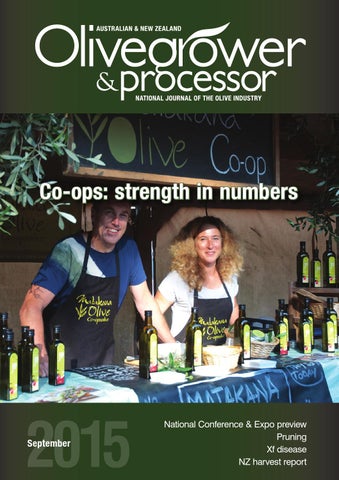
Co-ops: strength in numbers
2015 September
National Conference & Expo preview Pruning Xf disease NZ harvest report
LEOPARD
the evolution of dmf technology The third era for olive oil extraction
The only two-phase decanter that produces a dry husk similar to that from a 3-phase decanter and that recovers the pulp of the husk, “pâté”, ideal for composting and animal feeding. The pâté is no longer a waste but an added value to the mill. TOP QUALITY oil extracted without adding water By far the HIGHEST YIELD achievable on the market today Very low water and energy consumption
Via Don Battistoni, 1 60035 JESI An Phone +39.0731.2311 Fax +39.0731.231239 info@pieralisi.com www.pieralisi.com
D E D I C A T E D
I N N O V A T O R S
OFFICIAL AUSTRALIAN AND NEW ZEALAND AGENTS ■ NSW-QLD-ACT Town & Country Tractors & Machinery Pty. Ltd. Cr Airds Rd & Sussex St Minto Nsw 2566 Phone 02 96038600 - Fax 02 98246670 paul@tctractors.com.au Contact: Paul Blasutto, 0419 273668
■ SA W.E. Ware & Co. 19 Papagni Avenue, Newton, SA 5074 Phone 08.83653200 - Fax 08.83653187 weware@weware.com.au Contact: Marjorie Ware and Warrick Philpott
■ WA Scottech Oilfield Services 12, Monash Gate Jandakot, WA 6164 Phone 08.94177800 - Fax 08.94975470 patrick@scottech.net.au Contact: Patrick Kradolfer
Contents
In this issue... Incorporating Australian Olive Industry Journal Published by Ryan Media Pty Ltd Publisher Hartley Higgins General Manager Elizabeth Bouzoudis Editorial Gerri Nelligan
News Progress on The Olive Route 4 Olive Exposium 15
6
Seasonal forecasting R&D project
8
Australia Organic Mark a step closer
8
Strong demand for US organic certification
8
Harvesting
Advertising Maria Stephenson sales@olivegrower.com.au
New Zealand Harvest Report
Production Naomi Fry
Facing Challenges and Seizing Opportunities: the way forward
Subscriptions A one-year subscription (four issues) is $38.00, and includes a copy of the Australian and New Zealand Olive Industry Directory. Subscriptions commencing July 1 2014 will receive a copy of the 2015 Australian and New Zealand Olive Industry Directory. Please pay by cheque or credit card to Ryan Media. Visit www.olivebiz.com.au to subscribe. Circulation subs@olivegrower.com.au Contributions Articles and other contributions are welcome and will be published at the discretion of the editor. Photographs are best received as jpg files via email or should be high-quality prints or transparencies. Please indicate if articles and pictures are to be returned. Printing Lane Print & Post Adelaide Ryan Media Pty Ltd ABN 85 085 551 980 630 Regency Road, Broadview South Australia 5083 Phone +618 8369 9555 Facsimile +618 8369 9501 Website www.olivebiz.com.au
September 2015 Issue 97
9
AOA National Conference preview 12
Marketing Olives + beef = healthy profit
17
Pruning Pruning: the Coonalpyn grove one year one
18
Grove Management Chemicals and the GHS - don’t be left behind
22
Pests & Diseases Concerns spread about Xf disease
24
Olive Business Strength in numbers (co-operatives in focus)
28
Olivegrower Profile Kerry Hart - Azzuro Groves, New Zealand
32
International Events SIMEI 2015
35
Olives & Health Health round-up
36
Product & Services
37
What’s on/Advertiser index
38
ISSN 1448-5486 Conditions Opinions expressed herein are not necessarily those of the editor/publishers; information is published in good faith and we do not accept responsibility for damage which may arise from any possible inaccuracies. All rights reserved, none of the contents may be used in any other media without prior consent of the publishers. Published by Ryan Media Pty Ltd.
Cover: M atakana Co-operative members David and Isabella Sullivan taking their turn at the co-op’s farmers market stall. Issue 97 • September • Australian & New Zealand Olivegrower & Processor • 3
News
Gerri Nelligan
Editor
An industry working together, sharing strengths, knowledge and experience ... that’s a recurring theme in this edition. It’s been a tough few years for our industry of late and it’s great to see so many positive initiatives aimed at turning that around. We look at two great industry events happening in the next few months, both aimed at bringing the industry together and sharing information on how we can do things better.
And doing things together is one way some growers do that. Our feature article on co-operatives shares great insight into the group business model via the experiences of two successful New Zealand co-ops – how they work (and why they sometimes don’t!) and why they’re a more viable business option for many very small growers. We also report on the 2015 New Zealand harvest, update on the Coonalpyn Grove pruning project and take an in-depth look at the Xylella fastidiosa disease crisis in Europe. This is an important biosecurity issue all growers need to be aware of – please take the time to read our coverage. All that and plenty more – happy reading! Editor Gerri Nelligan and the OG&P team.
Progress on The Olive Route In the June edition of Olivegrower & Processor we looked at The Olive Route, a new AOA-backed program facilitating extra virgin olive oil exports to China. We spoke with co-ordinator Chris Mercer for an update on how the program is progressing. When the June article was written the project was in the research phase: information workshops had been completed and the R&D phase was moving forward with work on the minimization of phthalates, China market research, production of the export handbook and export code of practice, and refining of laboratory testing regimes. Research Mercer said work on those elements has continued steadily, particularly the research into the Chinese market. “The Chinese consumer survey has now been completed and, pleasingly, has validated the key project assumptions in terms of competitive advantage and our pricing model,” he said. “The key take-away from the survey is that authenticity is a vital influence on purchasing decisions. “We got high ratings for attributes like “delivered in original condition”, “extra virgin olive oil guarantee” and “(proven) origin of oil”. Then came “freshness” and “taste”, then further down the rankings were attributes relating to presentation and bottle shape. This is in exact conformance with the focal points of the program. “Secondly, we were delighted at the response to our pricing model, which shows the value which Chinese consumers attach to product integrity and quality. “The lab work is still at an early stage, with background work now underway. Team members are also surveying Chinese laboratories to identify a suitable partner.” Marketing Mercer said work on the marketing mechanism within China has also progressed well. “We have developed a leading edge concept which we are very excited about. We have taken social media marketing several steps further in terms of content, reach and appeal,” he said. “We are keeping it under wraps at the moment, because the ideas might have commercial value to others. We need to be the first off the blocks with it.”
Export handbook An export handbook, setting out the procedures and regulations for compliance, is an integral part of the program and was initially expected to be introduced at a training workshop held in conjunction with the National Conference in September. Mercer said the detailed information required means that will occur slightly later now. “The export manual is in skeleton form and needs further work, which is scheduled to conclude in October. This means the training course will now be held later in the year and not in conjunction with the conference in September,” he said. “However I will be speaking about The Olive Route at the conference, and will indicate then the progress and the direction that the export manual is taking.” The Chinese economy Finally, we asked Mercer for an update on the market for Australian EVOO and whether it had been affected by the by the downturn in the Chinese economy. He said the demand on which the program is based remains strong, and if anything has continued to grow. “Based on a limited survey in Shenzhen, supermarket prices remain high for virgin and extra virgin olive oils, and there is plenty of room on the shelves for Australian product. Shenzhen is a bit special though, because the western city (Shekou) has been declared a “pilot free-trade zone” and everything is booming there,” he said. “In the rest of the country, there is still plenty of money around and a middle class which is growing rapidly, even taking into account any fundamental economic slowdown. “With careful central management, we should see domestic demand continue to increase so that the money continues to go around, with decreasing dependence on exports.” If you missed the information workshops and would like more information on The Olive Route program, please contact Chris via: chris@westerngroves.com. We’ll also keep you updated on progress with the project in future editions of Olivegrower & Processor.
4 • Australian & New Zealand Olivegrower & Processor • September 2015 • Issue 97
News
Olive Exposium 15 Stepping back in time ... while moving firmly ahead. That’s pretty much Olive Exposium 15 in a nutshell. Being held in Sunbury, Victoria in November by The Olive Centre’s Amanda Bailey, the two-day event aims to re-live the field days of old while focusing on the issues currently facing the industry. “We used to have regular field days but, for whatever reason, they just don’t happen now. So my aim is really to have an event that will bring the industry together in that same relaxed, informal way, and to reinvigorate that culture that we used to have,” Bailey said. “We all used to go out and have fun but over the years the industry has changed – some have left, others have joined – and we seem to have lost some of that togetherness. And people tell me they want to get together more often. “So this is a chance to have another one of those fun learning experiences again.” Practical program There’s a serious side to it too, with a presentation program reflecting the issues Bailey hears about on a day-today basis. “A lot of the topics reflect what my clients are asking me about, and saying they can’t find answers to,” she said. “It pointed to the need to address those issues in an environment where we can all learn together - and from each other. My aim is that wherever attendees are in the industry – struggling with issues on how to grow, right through to how to market - there’ll be something they can pick up and take with them. “I want them to get together, have fun and also progress their groves with the new information they take away.” “The lore of the olive” Bailey said that sharing of knowledge is reflected in the focus of the event, “lore of the olive”. “The word “lore” means “a body of traditions and knowledge on a subject or held by a particular group, typically passed from person to person by word of mouth”, she said. “The Exposium will bring together a varied range of people to discuss the latest issues surrounding the industry. More importantly, the practical program will help growers gain the
know-how to progress, change and realise greater potential from their grove and business.”
Topics and speakers New presentations are still being finalised but the program is already packed with interesting and salient topics, including: • growing olives in changing climates • strategies to manage the top five olive pests and diseases • understanding smoke point • health claims, health benefits and the food code • olive oil as a natural food flavour enhancer • exporting premium products • how to take on the food service industry Keynote speaker is food expert Lyndey Milan, a key influence in the Australian food scene for 30 years. “Lyndey has the ability to change perceptions about foods, and to open people up to trying new ones,” Bailey said. “She’s incredibly knowledgeable about EVOO and really knows how to work with it. Her presentation Olive Oil as a food flavour enhancer and ways to use EVOO that are matches made in heaven will show producers how to really showcase their olive oil - new ways of presenting their oils to customers that will give a big wow factor. “It’s marketing in a very hands on way, via new recipes – created just for us – which will entice customers to love our products and keep them coming back for more.” Another program highlight will be David Jamieson from Austrade, focusing on how producers can compete on quality and value rather than price. “He’ll look at leveraging Australia’s credentials for clean, green, ethical and safe foods, which is one of our strongest opportunities in the current export
6 • Australian & New Zealand Olivegrower & Processor • September 2015 • Issue 97
market in particular,” Bailey said. “It’s just one of the opportunities I think we’re missing at present – as is the food service sector. We haven’t even scraped the surface there. I have growers who’ve said they can’t get into the food industry but sometimes it’s just the way they’re trying to do it. That’s reflective of a common negative attitude in the industry at present, with people saying you can’t make money. You can, just maybe not in the way you’re doing it now. “That’s why we’re looking at such a diverse range of topics: there are plenty of opportunities out there, it’s just about finding the right ones for your business. It’s not one-size-fits-all – but your size IS out there.” Bailey said the program has a strong focus on giving growers tools they can use in their own operations. “For example, we’ve got a wave of new ‘foodies’ out there who don’t know what rancid oil is, and also don’t know a really good oil. Richard Gawel’s presentation Why knowing how to taste olive oil can be beneficial to your business will show how knowing the positive and defective characteristics of olive oil can be beneficial when explaining the virtues of your product to customers. “The aim is to empower growers with the knowledge to provide their customers with a better understanding of their product.” Each session ends with a Q&A segment, which Bailey describes as “ideas sessions”. “They’ll be open sessions where ideas can get tossed around and explored. Everyone will have the ability to talk to the speakers, and to benefit from the conversations and concepts that come out of those discussions.” The event will also include a networking evening with in-grove demonstrations, hosted by Burder and The Olive Centre. “Again, it’s a throwback to the old field days: a barbie, some beer and wine, providing a relaxing chance to get together and just talk about things,” Bailey said. Olive Exposium 15 is being held on 26-27 November 2015 at Pitruzello Estate, Sunbury, Victoria. For further information, program details or tickets, go to: www.oliveexposium.com.
OLIVE EXPOSIUM Pitruzzello Estate, Sunbury VIC| 26 - 27 november | Hosted By
2015 EXPOSIUM OVERVIEW This world-class event is not to be missed if you are an olive grower, olive oil or table olive producer. Come and experience our practical program where you can gain the know-how to progress, change and realise greater potential from your grove.
Topics include: Ó Growing olives in changing climates and agricultural impacts Ó Strategies to managing the Top 5 olive pests and diseases Ó understanding smoke points in olive oil and other cooking oils Ó Health claims, health benefits and the food code Ó Olive Oil as a natural food flavour enhancer Ó exporting premium products Ó How to take on the Food service industry in a different way Ó Plus much more….
The program offers a broad range of topics. No matter where you are in the industry... we still have so much to learn!
o f a t o n This is one exposium you can
m o t rd
! s is
Ó
For more information or to make a booking, please contact:
PH: 07 4696 9845 or Email: sales@theolivecentre.com.au
www.oliveexposium.com
News
Seasonal forecasting R&D project The Rural Industries Research and Development Corporation (RIRDC) will manage a farmer-focussed seasonal forecasting research project funded as part of the Australian Government’s R&D for Profit program. The Government will provide $1.8 million to fund the three-year R&D project Improved Use of Seasonal Forecasting to Increase Farmer Profitability. The project aims to bridge the gap between seasonal climate forecasts and on-farm business decisions to improve the productivity and profitability of Australian farmers by: • identifying the critical information requirements relating to seasonal climate risks for primary industries by sector, type of decision, and region; • enabling farmers to use the unrealised potential in existing seasonal climate forecasts by developing tools, information and training to skill farmers in understanding and using seasonal forecasts in farm business decision making; • improving the seasonal forecasting capabilities of Australia’s primary forecasting model (POAMA/ ACCESS) by analysing and reducing the main errors that negatively impact the quality of seasonal predictions for use by farmers. The four key practical outcomes of the project will be: • defining the critical seasonal climate risk information needed by Australian farmers; • getting as many farmers as possible to understand how useful seasonal climate forecasting can be and how they can incorporate these forecasts into business decision making;
• the development of seasonal climate information tailored to individual needs; • the improvement of seasonal climate forecasting skills in agricultural areas. The RIRDC says the outcomes of the project will provide real and practical tools to assist Australia’s farmers to better utilise seasonal climate forecasts. “Climate is arguably the biggest driver of agricultural production in Australia, particularly as Australia has the most variable climate of any inhabited country,” managing director Craig Burns said. “While there have been significant improvements in one to 10-day weather forecasts, this project addresses seasonal climate forecasts and how farmers should use them. We know that this broader timeframe is most important to farmers. “It’s been shown that an effective way of addressing drought is to equip farmers to understand climate variability and how to use forecasts in business decision making, and that’s the main goal of this project.” RIRDC is the managing agency for the project, which will also be funded through partner contributions to a total value of $3.5 million. RIRDC’s project partners include Horticulture Innovation Australia Ltd, the body which manages the olive industry levy and funding. Don’t miss our coverage ofthe latest climate change information, including a comprehensive look at the El Nino weather pattern and its effects on agriculture, in the December edition of Olivegrower & Processor.
Australia Organic Mark a step closer The Organic Industry Standards and Certification Council (OISCC) has submitted to IP Australia a logo for the Australia Organic Mark. Comprising members of certifying organisations, the OISCC is the board dealing with issues relating to the National Organic Standards. Upon confirmation that the mark has been accepted by IP Australia, it will then be placed on the OISCC website for the appropriate submission period. Preparatory approval has already been gained to launch the National Organic Mark at a dinner at Parliament House, aiming to gain as much media focus as possible.
The Organic Federation of Australia believes that, once implemented, the introduction of a National Organic Seal has the potential to increase sales overseas by up to 45% per annum, as well as providing buyer security and seller credibility within the overseas sector. We’ll update on the status of the mark as the processes progress. To find out more, or get involved, contact OFA chairman Adam Willson at: chair@ofa.org.au.
Strong demand for US organic certification The number of operators seeking organic certification for the United States through Australian Certified Organic (ACO) has increased by 25% since 2013, the organisation says. The National Organic Program, or NOP, is run by the United States Department of Agriculture and is an increasingly popular international organic accreditation. ACO was one of the first international certification bodies to gain NOP accreditation and has over 270 clients accredited to the scheme. Producers can apply for NOP certification when they apply for ACO certification.
ACO chief certifier Michael Baker said products being certified to NOP are not necessarily being exported directly to the States. “A lot of manufacturers are requiring suppliers to certify to a number of different standards, not just one. We’re seeing Asian companies in particular requiring suppliers to have NOP so that products have broad market access,” he said. For more information about NOP certification call 07 3266 5996 or email info@aco.net.au.
8 • Australian & New Zealand Olivegrower & Processor • September 2015 • Issue 97
Harvest
New Zealand Harvest Report In this edition, we finish up our annual round-up of the 2015 harvest with coverage of the season across three regions of New Zealand. A bumper harvest across the country in 2013 was followed by a varied one last year, with some growers again reaping great rewards but a difficult season for others. The 2015 harvest has, unfortunately, steered well towards the latter.
Auckland After two great years in a row, the Auckland region had a dramatic change with the 2015 harvest. It’s meant a comparatively quiet season for Salumeria Fontana Olive Press owner Greg Scopas, who grows and processes his own olives for oil, and also provides contract pressing services to other growers across the region. “It was very different this year, and very disappointing for a lot of people – two-thirds of my clients just didn’t pick,” Scopas said. “Normally we’d process for 100 farms and we would have done 30-35 this year. Overall we only processed about a third of our normal volume.” The reasons behind the dramatically low harvest are a bit of a mystery, with
no major weather events or other clues to explain it. And it wasn’t across the board. “It seemed like a pretty okay sort of summer. Nothing extraordinary about it,” Scopas said. “We did get some big winds around flowering, so whether that was the reason for the poor harvest I’m not sure. Otherwise rainfall was pretty normal and everything seemed pretty manageable. And flowering looked okay but just didn’t translate into fruit on the trees. “Having said that, though, it was patchy, with huge variations from grove to grove. Some of them held their own very well – they might have had six to seven tonnes last year and got eight or nine this year – but then there were others who normally do around five tonnes and did one to two this year.”
Auckland
Issue 97 • September 2015 • Australian & New Zealand Olivegrower & Processor • 9
Harvest
A heavy snowfall in late May signalled the early arrival of winter in Central Otago and, combined with subsequent heavy frosts, caused considerable damage to olive crops.
Yield was also varied across groves and sub-regions. “We don’t use any talc or enzymes but yields went from a low of about 12% to about 22%. That was the best,” Scopas said. “That was from a grove about an hour out of Auckland, so definitely because it’s warmer there. If you come an hour back down and to the east coast, the best would have still been under 20%.” Scopas said the 2015 harvest timing was similar to last year, starting earlier than usual, but that, not surprisingly, it was nowhere near as long as 2014’s long run. “Timing-wise it was probably about the same as last year but it was over
and done within a matter of weeks. Probably four to five,” he said. “There was just very little fruit to get off.” The one positive of that was a lack of pests and disease to deal with. “Pests and disease didn’t seem to be a big issue this year - they didn’t have much fruit to pick on,” he said. “There was a little bit of anthracnose around but it was limited.” And as to the all-important question of quality? “I’m pretty happy. If anything I’d say a little bit better than last year, a little bit more flavour,” Scopas said. “But interestingly, there’s almost a
complete absence of any bitterness. The only oil that we processed which had any was out of this zone. I think that’s because the fruit was small and the pit to flesh ratio high; you get a lower percentage of tannins in the pulp. That’s the discussion I had with one or two Italian growers anyway. “Apart from that, all the other oils have lovely peppery characteristics and flavour. Quite delightful, I have to say. “Put together with the scarcity factor, the guys that we make oil for will definitely sell all their oil this year.”
Bannockburn A record crop for Central Otago growers in 2013 was followed by a much smaller one in 2014 – but with the silver lining of a significant increase in oil recovery, which more than made up for the reduced quantity of fruit. The 2015 harvest results were more like last year’s in general, but getting there was a whole lot harder than usual. We’ll let Steve Clark, of Cairnmuir Olives, tell it in his own words: “To state that the 2014/15 olive growing season was difficult would be an understatement. The season had it
Bannockburn
10 • Australian & New Zealand Olivegrower & Processor • September 2015 • Issue 97
all: cold spring, late flowering, hot dry summer, beautiful autumn weather, an unseasonal snowfall, heavy rain and a freezing polar blast. “Rainfall was reasonably consistent through much of the early part of the season, with a good rainfall in February when it was definitely needed. May and June were much wetter and cold, which penalised those growers that hadn’t completed their harvest in early June. “Frosts came early this year, in late March, which while they didn’t appear to damage the olives, certainly caused
Harvest
damage in the vegetable garden. An early snowfall on the surrounding mountains in early April lead to frosts that probably caused the light damage noted at harvest. While the olives hadn’t been completely frozen a reasonable number had suffered burns to the surface of the fruit. “Then a heavy snowfall on 25 May, which deposited about 100mm through the grove, signalled the arrival of winter, even though the harvest had only just begun. The subsequent frosts caused considerable damage to the Frantoio in our northern block in an area that had barely been touched by frost in 15 years. A severe polar blast in late June produced air temperatures down to -9C and finished off the Frantoio and Leccino in our southern block. As I’m writing this (13 July) the temperature is forecast
to drop to -11C overnight.” And it wasn’t just the weather they had to contend with. “Bird damage has been much more severe this year, as a result of the heavy snowfalls in the mountains driving the birds down into the valley. By the latter half of June they had pillaged any Frantoio that the frosts hadn’t damaged,” Clark said. “The combination of frost and bird damage has dropped our oil production to under 60% of our target. Other growers who had completed their harvests in early June fared much better, although bird damage was still an issue for some.” Overall, it’s far from the outcome they were hoping for – but, like most growers, are philosophical about it. “For us it has been a very disappointing
harvest, particularly since, despite flowering being delayed by some two weeks, the fruit set had been excellent. The Frantoio in particular had a very heavy crop. The Leccino, which had had an off season in 2013-14, also carried a very good crop,” Clark said. “But average oil recovery was slightly up on 2014, and significantly up on 2013, so that went some way to compensate for the lack of fruit. “And the quality of the oil is good but, with the air temperatures experienced during harvest and in the lead up to harvest, I suspect that the oil will be only of bronze award quality. “Who would be a farmer … but like most farmers we are looking forward to a better season next year.”
Nelson The Nelson region had a bumper season in 2013, followed by a much smaller crop in 2014. A dry, warm summer brought an early flowering and good fruit set, however heavy rain and frosts around harvest time reduced the crop substantially. Beulah Olives owner and local processor Roger Armstrong said this year repeated the warm, dry weather pattern but that crop results were generally variable. “The weather was the best we have had for a number of years, apart from potential frost problems during the harvest. The summer was longer and dryer than usual, which also gave us a later maturity and longer harvest,” he said. “However fruit set seemed variable on different groves, which translated into variable crop loadings around the district. Some blocks had record crops, while others had little or no fruit worth harvesting.” The end result, however, is a positive one.
Nelson
“Oil yields generally were excellent compared with normal seasons. We saw lows of 8% early in the season and up to 22.5% in the mid to late season,” Armstrong said.
“Oil quality is also looking great, with a mainly dry harvest bringing out some great flavours.” Kakariki Olives owners John and Helen Dunlop agreed, describing their 2015 oils as “quite well balanced and robust, as you would expect in a dry season”. They also noted that it had generally been an “on” year for Nelson growers, in terms of the biennial bearing patters experienced by many NZ growers. “And while we certainly had a drier summer than usual, which made for great harvesting conditions, early frosts in some of the colder regions did cause some initial concerns,” they said. “The late May-early June harvest time necessary in the frost prone areas, combined with the later than usual maturing and the heavy crop, did result in some lower than usual percentages. Thankfully these picked up considerably toward the end of June.”
Micro-Talc FC 8 – contact details In the June edition of Olivegrower & Processor, we featured Micro-Talc FC 8, a new talc grade for high-efficiency olive processing. Unfortunately, the contact details provided for the agent, Brenntag, were incorrect. Anyone wanting more information, or to order, should contact:
Brenntag Australia Pty Ltd +61 3 9559 8333
info-aus@brenntag-asia.com
Brenntag New Zealand Ltd +64 9 275 0745
info-nz@brenntag-asia.com Issue 97 • September 2015 • Australian & New Zealand Olivegrower & Processor • 11
Facing Challenges and Seizing Opportunities: the way forward The theme of this year’s Australian National Olive Industry Conference & Trade Exhibition is a clear call to action: Facing Challenges and Seizing Opportunities is indeed what we have to do, meeting the hurdles faced by a comparatively small, highcost industry and building on the opportunities presented by our reputation for high-quality products and label integrity. The program is varied, with topics ranging from exports and sales to grove management. Groves rate the strongest emphasis, however, with presentations including tree rejuvenation, nutrition, pruning, biosecurity, density and biological production. Healthy, productive trees AOA CEO Lisa Rowntree said that emphasis is in response to grower feedback, and also a recognition of the importance – and value - of healthy, productive trees. “Our aim is to make growers more profitable. We know that healthy, well-maintained trees produce more and if growers are getting more olives off their trees, they’re going to be more profitable,” she said. “But many growers need to better understand the tree they’re dealing with, its needs and how to provide for them. For example, people complain of sprays not working but sometimes it’s the timing that’s the problem. Often growers are inefficient because they don’t understand and if they understood things better they’d make better decisions. “We did ‘back-to-basics’ a few years ago and it was popular, and we’re still hearing there’s a need for that kind of information. There’s a lot of info out there; the struggle is to get people to read it.” Engaging format Which is where the conference format comes in, Rowntree said. “We introduced this format last year and it worked brilliantly. The delegates sit at tables while the speaker presents and then the tables discuss it among themselves, and formulate questions to clarify or challenge the information. There’s then Q&A time, when everyone presents their questions and gets answers. “It really engages everyone and pulls so much more out of the topic: the delegates extract even more detail out of the speaker, which ensures that people go away with a full and clear understanding of the information presented. “It also results in much greater interaction between the delegates, during both the breaks and the presentations. They hung around and talked more, discussed events in their groves, and shared suggestions or solutions. It was exactly what we wanted to happen, and the feedback on the format was incredibly positive.” Keynote topics The keynote speaker is Dr Catherine Itsiopoulos, Associate Professor in Dietetics and Human Nutrition at LaTrobe University. An expert in the Mediterranean Diet, Dr Itsiopoulos will present scientific evidence as to why the diet is the most effective for long-term health and weight management. Rowntree said the topic builds on the success of education efforts to date, and aims to empower growers to promote EVOO’s health benefits. “Dr Itsiopoulos gave a speech at the Dieticians Association conference and it was fantastic,” she said.
“She explains things really well, and provides really useful information which will enable delegates to feel confident in the information they provide to consumers. That will help them spread the word that the Med Diet - with EVOO - is the way to go for lifelong health.” Proving the smoke point Another program highlight is an update on new Australian research into olive oil smoke point. “The incorrect message that you can’t heat EVOO comes up repeatedly, and it’s a myth we need to dispel. So we’ve commissioned research that we hope will provide producers with the scientific evidence that they can refer to whenever they need to,” Rowntree said. “There’s no point in the AOA trying to dispel this myth, because other oil producers would say we have a vested interest, but with an accredited Australian lab doing the research we can say ‘Here are the irrefutable results, listen to them’. We intend to flood the media with scientific information and hopefully end the debate once and for all. “At the conference the lab will present the methodology used and report on where they’re at. The results are going to be conclusive, very scientific, and hopefully achieve an outcome that will mean growers will be able to use the FFA of their oil and put a sticker on the bottle stating what the smoke point is. “And no doubt it will prove that the better quality of the oil, the higher you can heat it, so will be another benefit for those producing higher quality oil.” Trade exhibition As always, olive industry service providers will also be showcasing their equipment and services to the conference attendees. “The trade exhibition is a great opportunity to see the latest in products and machinery, from grove equipment to packaging products, and to speak with industry-specific services providers,” Rowntree said. “It’s a chance to discuss your individual needs one-on-one, and to get behind the companies that support our industry. This year we’ve increased exhibitor access, with an extended trade session on the first day, daily morning, lunch and afternoon tea sessions, and exhibitor demos on field day, so there’ll be plenty of time to make connections and get all the information you need.” Field day The event concludes with a field day at Boundary Bend, including tours of the grove and production facility, and presentations on pruning, processing and olive oil quality. “This is an incredible opportunity for growers to talk to experts in their field, and to gain practical knowledge about key areas of oil production and understanding quality. It’s our quality that sets our product apart, so this will be an invaluable opportunity,” Rowntree said. The 2015 National Olive Conference & Trade Exhibition runs from September 14-16 in Mildura, Victoria. See the full program and register at: www.nationaloliveconference.com.au.
12 • Australian & New Zealand Olivegrower & Processor • September 2015 • Issue 97
The National Olive Industry Conference & Trade Exhibition 14th, 15th & 16th SEPTEMBER 2015 MILDURA Victoria - 14, 15, 16 Sept 2015
Excellent Programme
Information on the World Olive Oil Industry Health Benefits of the Mediterranean Diet Smoke Point and Phthalates Research Biological Growing Techniques, Super High Density,
Field Day plus Workshops
Tour of Australia’s Largest Olive Company Practical Pruning in the Grove Processing Plant Tour and practical tips on how to process oil Understanding Olive Oil Quality.
Equipment Demonstrations and Supplier Exhibitions T I C K E TS AVA I L A B L E AT T H E D O O R
W W W. N AT I O N A L O L I V E C O N F E R E N C E .C O M . A U
}
Exhibitor Profiles AustSafe Super
AustSafe Super is the industry super fund for rural and regional Australia. For over 25 years we’ve been committed to looking after members super, as well as helping employers understand their super obligations. We currently look after 140,000 members and 14,000 employers, with $1.9 billion in funds under management and are growing every day. Phone: 0400 979 942 Website: www.austsafe.com.au
Costante Imports
Costante Imports is an established and trusted family-owned business with over 44 years of experience. They are always up to date with the latest trends, and are willing to lend an ear and offer professional, friendly advice. While visiting their vast store in Preston, or their web site, you will find every need met, whether it is for the small hobbyist or the larger olive grove. So do yourself a favour and visit 377-379 Bell St in Preston Victoria, hop online and visit our website, or give us a call. You won’t be disappointed. Phone: 03 9484 7948 Website:Olivegrower_ING_90x130mm_stampa.pdf www.costanteimports.com.au 1 03/08/2015 16:54:59
Increase your yield!
IMAGINE PERFECTION energysaving
tion
n
traditio
nce forma
per
innova
C
M
Y
CM
MY
CY
...AND DISCOVER THAT IT EXISTS ALREADY In the wide range of Pieralisi olive oil plants there is the right solution for every need. From the small one to the large one all Pieralisi plants are constructed with the same quality standards and always ensure excellent performance.
Now Available - Biogras L Pectinase Enzyme from our
Spanish sister company Biocon Espanol. Specifically formulated for the cold press olive oil process, improves quality and meets all the NASAA organic oil processing requirements.
For further information and pricing contact:
Deltagen Australia Pty Ltd 31 Wadhurst Drive Boronia VIC 3155
CMY
Ph.03 98017133 Fax. 03 9887 0019
K
www.deltagen.com.au info@deltagen.com.au
D E D I C A T E D
I N N O V A T O R S
Via Don Battistoni, 1 60035 JESI An Italy Phone +39.0731.2311 Fax +39.0731.231239 info@pieralisi.com www.pieralisi.com
OFFICIAL AUSTRALIAN AND NEW ZEALAND AGENTS
NSW-QLD-ACT
Town & Country Tractors & Machinery Pty.Ltd. Cr Airds Rd & Sussex St Minto Nsw 2566 Phone 02 96038600 - Fax 02 98246670 paul@tctractors.com.au Contact: Paul Blasutto, 0419 273668
SA
W.E. Ware & Co. 19 Papagni Avenue, Newton, SA 5074 Phone 08.83653200 - Fax 08.83653187 weware@weware.com.au Contact: Marjorie Ware and Warrick Philpott
WA
Scottech Oilfield Services 12, Monash Gate Jandakot, WA 6164 Phone 08.94177800 - Fax 08.94975470 patrick@scottech.net.au Contact: Patrick Kradolfer
Deltagen is the Australian distributer for Megazyme Test Kits & Analytical, for the Agricultural & Food Manufacturing Sector
14 • Australian & New Zealand Olivegrower & Processor • September 2015 • Issue 97
Deltagen Australia Affordably servicing the wine-making, brewing and olive oil industries for 20 years
Deltagen Australia
Deltagen Australia is proud to offer Biogras L, a high performance, cost competitive, enzyme preparation for olive oil extraction which complies with FSANZ regulations and is GMfree. Formulated to optimise enzyme activity, it offers improved extraction and separation, reduced residual oil and faster decantation. Biogras L is suitable for use in organic products and has been a proven performer worldwide for over 10 years. Phone: 03 9801 7133 Website: www.deltagen.com.au
NSW Department of Primary Industries
The NSW Department of Primary Industries operates an oil testing service as part of the Australian Oils Research Laboratory, based in Wagga Wagga. We provide accredited testing services for olive oil quality, adulteration, and organoleptic (sensory) analysis. The laboratory also provides all testing required in determining if olive oil meets the Australian Standard AS5264-2011. Our chemical testing laboratory and organoleptic panel are able to undertake competitively priced testing of oils and olives with a prompt turnaround time. Your first choice for analysis you can trust. Phone: 02 6938 1957 Website: www.dpi.nsw.gov.au
Eclipse Enterprises
Eclipse Enterprises (Australia) Pty. Ltd has been an importer, wholesaler and distributor of professional horticultural equipment for over 30 years. We have been a primary supplier to the olive industry during that time. Our brands and partners
include Campagnola, who pioneered pneumatic olive harvesters, secateurs and loppers and are now better known for their award winning Alice electromechanical olive harvesters. Campagnola are also reinvigorating the electric secateurs market with the new EVO Pony and Cobra. Ph: 08 8351 8611 Web: www.eclipseenterprises.com.au
FB*PROPAK
FB*PROPAK’s Olive Oil business arm (formerly AOOS – Australian Olive Oil Supplies) has been in operation since 1966. We have worked with many prestigious olive oil growers and processors, and are the agent for a number of leading international suppliers. Our extensive equipment range includes processors, harvesters, washing and de-leafing equipment, tanks and storage, packaging and bottling, filters, pumps and accessories. Our experienced in-house technicians provide specialist installation, training, after sales service and parts. Phone: 03 9924 4050 Website: www.fbpropak.com
MEA
MEA manufactures a range of environmental monitoring systems for use in agriculture. Our range of soil moisture monitoring products includes the popular GDot and the new “Plexus”. Our weather stations can provide valuable data to assist in costeffective irrigation scheduling. “Soil Moisture and Climate Monitoring with Certainty”. Phone: 08 8332 9044 Website: www.mea.com.au
We won’t be beaten on price
Supplying the Olive Industry 12 volt battery harvester
Tornado Harvester -
OLIVE HARVESTER Australian Distributor
• P.T.O attatchment to tractor • Fully remote controlled • Automatic umbrella opening • Automatic unloading of fruit, quick, efficient • Tornado is available complete with tractor
• • • •
netting • bottles • caps • pumps •
pruning tools harvesting equipment capping machines storage tanks
Max power 500w Attach to 12v battery
ELECTRIC PRUNER
Portable/compact net catcher for olive picking
ENOLMATIC BOTTLE FILLER Adjustable/ auto cut off Up to 150 bottle p/hr
Ph: (03) 9484 7948 – Fax: (03) 9484 7940, 377-379 Bell St, Preston VIC 3072 Email: sales@costanteimports.com.au
www.costanteimports.com.au
Issue 97 • September 2015 • Australian & New Zealand Olivegrower & Processor • 15
Modern Olives Laboratory Services
Dorato Amenduni
OCP
Olive Oil Packaging Service
Modern Olives established a NATA accredited commercial olive oil laboratory using the most advanced instruments available, and the most experienced and qualified team. We can provide a comprehensive range of olive and olive oil tests that are required for chemical and sensory quality, authenticity and labeling purposes. The laboratory is available to all growers and oil traders who require their fruit and oil tested. Phone: 03 5272 9500 Website: www.modernolives.com.au
Organic Crop Protectants (OCP) has been operating in Australia since 1991. OCP are a leading manufacturer and distributor of crop protection and nutritional products for growers who are focused on Integrated Pest & Disease Management and improving the health of their soils. OCP was established to develop crop protection and crop nutritional products that are non-hazardous to the user and the environment with a view to promote the expansion of biologically sustainable agriculture in Australia. The company continues to rigorously test their products for consistency, safety and efficacy to maintain their reputation for quality products backed by a high level of infield technical support. Phone: 0488 717 515 Website: www.ocp.com.au
Passion and devotion for the olive oil industry, technological and human resources investments: this is the secret of Amenduni Nicola Spa. Our business policy is based on a continuous and regular flow of information and updates. In this way the company has experienced a quick and uncontested expansion in the world market. “Always looking ahead and conquering new territories”. Phone: 0417 985 566 Website: www.amenduni.com
Olive Oil Packaging Service (our friends call us OOPS) are the pioneers of bag in box packaging for olive oil. OOPS is the one place stop for all your bag in box packaging needs. We can pack your oil on site at our packaging shed - just drop off the oil and we do the rest. We can also supply you with everything you need to pack oil yourself. Bags and boxes from 1 litre to 20 litres. Preprinted boxes available with your own brand and label. We are agents for Multipac bulk olive oil containers from 250-1,000 litre. Bag in box is the safe modern way to pack olive oil so give us a call today. Phone: 0428 829 024 Website: www.facebook.com/Olive-Oil-Packaging-Service
16 • Australian & New Zealand Olivegrower & Processor • September 2015 • Issue 97
Marketing
Olives + beef = healthy profits Quality, flavour and health benefits: along with freshness, they’re no doubt the three most important elements of Australian and New Zealand EVOO. And our best marketing tools, providing persuasive reasons why EVOO is incomparable among fats and oils, and why our local products are superior to others. Consumers are increasingly understanding the difference, and that it’s worth paying that little bit more for the high quality, flavour and health benefits of fresh, local EVOO. A group of Japanese food producers has taken it one step further, taking two high quality, flavoursome local products and creating a third. The end result is more sought-after than both combined – and a food marketers dream. “Sanuki Wagyu” or “olive beef” is a true celebration of regional produce, representing two of the Kawaga region’s most renowned products. It also reflects Kawaga’s agricultural history, another strong element of the product’s marketing story. The olive story Sanuki is the former name of Kagawa, where farmers began growing olives over 100 years ago. In 1908 Japan conducted its first tests on growing olives, planting imported saplings at three locations. Shodoshima Island in Kagawa was the only place where they survived and is hence celebrated as the birthplace of olive cultivation in Japan. Indeed the olive is used as a symbol of the Kagawa region. The beef story Cattle farming has an even longer history in Kagawa, stretching back to the year 700. The favourable climate of the warm Seto Inland Sea region saw the industry thrive and in 1882 Shodoshima became the first place in Japan to start fattening beef. In the early 1900s Kagawa-farmed beef was in high demand by consumers in the cities of Kyoto, Osaka and Kobe, who called it “Sanuki Wagyu”. Generations of knowledge and skill, combined with ongoing improvement efforts, have since contributed to the development of fattening technology and the production of consistently high-quality “Sanuki Wagyu”.
Feeding dried olive pressings to this guy makes him – and the meat he produces – more healthy, not to mention looking after the environment.
factors. Data analysis conducted by the Kawaga Prefecture found umami (flavour) elements 1.4-1.5 times higher than regular Japanese beef, antioxidant levels 1.7-2 times higher and meat tenderness 1.2 times greater. This data forms an integral part of the marketing and promotion of Sanuki Wagyu. Quality assurance As with our EVOO, the producers of Sanuki Wagyu know the importance of quality assurance, both in terms of the product and its authenticity. All processes are strictly controlled, starting with the olive feed product, which must be approved by the Sanuki Wagyu Brand Committee. The committee also determines when and how much the cattle are fed. In addition, only purebred cows fattened in Kagawa can bear the Sanuki Wagyu brand, which is backed by gold and silver seals guaranteeing quality and taste. The seals reflect the Japan Meat Grading Association’s carcass trading standards, which rank Sanuki Wagyu at grades A and B for yield and at Grade 5, 4 (Gold Label) and 3 (Silver Label) for meat quality.
The “Olive Beef” story Sanuki “Olive Beef” was created through the fusion of these two historic industries and is lauded as “a combination completely unique to Kagawa”. Developed in 2011, the beef is produced using cattle bred in Kagawa and fed on the remains of the region’s pressed olives, providing meat with “phenomenal flavour” and also a solution to the industry-wide issue of olive waste disposal. Product development But the process wasn’t just as simple as dumping olive pressings in a paddock and seeing cows eat it – in fact, cattle won’t eat olive pressings in their raw state. It was discovered, however, that they’re pretty partial to the stuff when it’s dried, when the sugar content produces a caramel scent to the resulting feed product. Another component also adds to the “secrets” behind the development of Sanuki Wagyu. Olives are known to contain high levels of oleic acid which, when introduced into the meat via the cattle feed, improves both the health benefits and taste
The result is a premium product in high demand both in Japan and increasingly across the globe. Sanuki Wagyu is already being exported to Singapore, Thailand, Macau and France, and recent promotion in New York will undoubtedly see its reach extended even further. That’s incredible success in a relatively short time. Thinking about adding beef cattle to your mix, anyone? Our thanks to the Sanuki Sanchiku Promotion Committee for providing the information for this article. To find out more, go to: http://www.sanchiku.gr.jp/whats/olive/en.
Issue 97 • September 2015 • Australian & New Zealand Olivegrower & Processor • 17
Pruning
Pruning: the Coonalpyn grove one year on In September last year we spoke with olive grower and grove manager Jim Rowntree about the importance of pruning, focusing on his latest grove rejuvenation project. A year down the track, we look at how the grove has responded to the severe pruning undertaken as part of the process. The background In 2014, Jim Rowntree undertook a major pruning project at the Starcomgistic Australia Grove (formerly called Coonalpyn Olives), in South Australia’s south-east olive growing region. Rowntree had taken over management of the grove following a change of ownership and found the grove “very run down”: little water and/or fertiliser had been applied during the previous two seasons and the trees had not been pruned for several years. Given the state of the grove, the decision was made to forego the 2014 crop and prune heavily. “It was really a combination problem – a lack of fertiliser, lack of water and lack of pruning. Together it meant the trees’ canopies were too big for the amount of water and nutrients they were getting, so they were defoliating and dying back. If tree growth and the supply of nutrients and water available are out of whack, they’ll start to limit each other, and the tree’s health will suffer,” Rowntree said at the time. “That poor state of health meant the crop was also very light, and the
trees had grown so tall they wouldn’t fit through the Colossus harvesting machine. That meant that what little crop they did have was going to be right at the top of the tree and the harvester wouldn’t get it off anyway.” Big chop, small crop So Rowntree and his team pruned heavily, taking the trees back to around one-third of their original size. They responded well and quickly, but the timing of the grove takeover meant they lost a good deal of the growing season. Subsequently, Rowntree predicted only a light crop for the 2015 season, aiming instead for a significant one in 2016. Things have pretty much gone to plan so far. “The 2015 crop was never going to be big,” he said. “The fruiting wood was really all that was there in 2013, prior to the change of ownership, and we cut a lot of that off in December and January 2014. “When the trees are that big, and then you cut off an entire side, you take off a lot of wood. We had stumps up to 75mm, so we’d taken all the green off and were
just left with the sticks. Then we also went over the top and pruned them from 6m down to 2.8m, with just a little bit of greenery left on one side. That made a lot of openings for light to get in, which was what was needed at that stage. “The amount of growth we achieved until May was good but it was too immature to flower, so we got a little bit of crop off but only very a small amount. The trees did what they could with the small bit of greenery that remained, and the crop that did set, did well. “But importantly, there’s now a lot of new growth on the trees, which is promising. The trees look like trees again and if all that growth flowers we should get a good crop in 2016. That said, some varieties flower prolifically straight away, others don’t, and in the past we’ve seen them just choose not to flower. “We’re hoping that won’t happen here, though, and we’ve got our fingers crossed for a busy harvest in 2016.”
shaping your trees’ future • SHREDDING & PRUNING • SPRAYING & MULCHING • GPS GROUND PREPARATION • ORCHARD REMOVAL & CLEARING
Contact John Gallard (08) 8582 1671 sales@gallardservices.com.au 20 Penny Field Road, Glossop SA 5344
www.gallardservices.com.au 18 • Australian & New Zealand Olivegrower & Processor • September 2015 • Issue 97
Pruning
A lack of fertiliser, water and pruning combined to create a very poor state of health in the Coonalpyn trees, which were defoliating and dying back when Rowntree took over management of the grove.
Harvesting efficiency The inability to machine harvest was another reason for the grove’s “big haircut” in 2014. “With a grove of this size you have to machine harvest but the trees were just too big and we couldn’t get the harvester over them,” Rowntree said. “As I said last year, it really comes back to fruiting foliage per hectare, and keeping that in a manageable size to fit your type of harvester.” Which is why it was a different story this year. “We didn’t harvest the whole orchard; we prioritized some low-lying areas where the trees were in better condition and had some crop on them. It wasn’t economical to harvest the rest of the orchard. We took off about 170 tonnes and had a good run with the Colossus,” Rowntree said.
“In a large grove, it’s an absolute necessity to keep the canopies within the capabilities of the harvesting machine, which means that routinely you’ll need to cut the tops off to ensure they fit through. We run the pruning saws across the top to keep the canopy manageable: new leaves will grow between January and May but they won’t have decreased flowering or low fruit set.” Alternate bearing The trees’ woeful nutrition-deficient condition had also seen them become very alternate bearing, a tendency which Rowntree says can be positively influenced by good pruning practices. He said it’s still too soon to see any definite outcome from last year’s big chop, and that ongoing management – and fate – will be the most important factors in the aim to even out the annual cropping pattern.
“When they decide to crop, just about all the trees will crop and that will help set the fruiting pattern straight away. We’ll probably get two crops in a row and that should regulate the biennial bearing again,” he said. “But if a season gets a really heavy fruit set then the tree can’t grow evenly and tends to become alternate bearing. In other cases we’ve seen alternate bearing caused by lack of water and/or nutrition. “It’s something we’ll be monitoring, ensuring we keep the delivery of water and nutrition as close to the target as we can, and will take into consideration the tree cropping pattern next time we choose to take off a side of the tree – which will possibly be 2017. “But this is horticulture: you can plan as much as you like but then the climate or something else gets you. You’ve just got to monitor constantly and tailor your grove management as things progress.”
Issue 97 • September 2015 • Australian & New Zealand Olivegrower & Processor • 19
Pruning
Healthy soil, healthy trees Rather than remove the prunings, Rowntree’s team mulched all the cuttings on site and left them in the grove to improve soil carbon. While it’s also relatively early days in the breakdown process, the trees have responded well already. “Keeping the cuttings where they are is the best way to improve the soil. That’s all mulching down nicely and the trees are starting to respond to that extra soil carbon now for sure,” he said. “But as that decomposes it can actually cause a lack of nitrogen, as the bacteria use it to break down the mulch. So we’re also keeping an eye on nitrogen levels and we may have to put more on to compensate. “We haven’t noticed any problems with it to date, though. The trees are looking so much healthier, and in shape, now. It’s really pleasing to see how quickly they’ve come back.” Pests and disease That increased health has also impacted on the grove’s resistance to pests and disease. Pests and disease are a common issue with overgrown trees, with reduced airflow and stress leaving them vulnerable to attack. The Coonalpyn grove had previously suffered
badly from anthracnose but Rowntree found no evidence of any this year. “They’re nice and clean and healthy now. The big prune has worked incredibly well. As soon as you take all the excess canopy off they look so much better, because they’re getting plenty of airflow and light penetration,” he said. “There’s a better balance between root growth and canopy growth too. When that’s out of balance you tend to have tree health issues, and they become susceptible to pests and diseases, but when you prune them back into shape they get a lot healthier quite quickly. “One of the varieties, Barnea, is more susceptible to anthracnose, especially when the trees are nutritionally depleted or there is too much moisture around. Part of our management plan includes foliar sprays and fertilizer applications, which will help, but at the end of the day Barnea is a susceptible variety and if there’s any sign of anthracnose, the best option is to harvest the fruit as quickly as you can. “The threat of anthracnose is always present, so you’ve got to understand your grove and the varieties. We know airflow is crucial on that particular grove. If you get a really bad year, you’ll struggle with
any of the control measures and once anthracnose has taken hold there’s not really anything you can do. Anthracnose is a naturally-occurring fungus and once the spores are in the orchard floating around that’s pretty much it. “In my opinion it’s more important to implement strategies to deal with it than try to eradicate it. The amount of chemical you’d need for full-on eradication would not good for the environment and you probably wouldn’t win the battle anyway. The withholding period for many of the chemicals used to treat anthracnose is restrictive too, which means you probably wouldn’t be able to process your fruit anyway.” Machine vs hand pruning All these positive results have obviously come at a cost, however, as pruning is a time-consuming task. Given the exorbitant cost of hand-pruning, Rowntree chose to machine prune the Starcomgistic grove, which he says is the most practical – and viable – method for a grove of this size. And it’s money well spent. “Machine pruning is generally very cost-effective,” he said. “It probably cost $7000-$8000 to do
TREE PRUNING Stone Fruit
Almonds
SLASHING
Use Ledgard products all year round in your orchard for heavy pruning, light trimming, skirting & slashing. Contact us for more information, brochures, demo link & dealer details. PO Box 435, McLaren Vale SA 5171 Phone: 08 8323 9001 ledgardpruning.com sales@ledgardpruning.com
Use Ledgard products all year round in your orchard for heavy pruning, light trimming, skirting & slashing.
Contact us for more information, brochures, demo link & dealer details.
McLaren Vale – Phone: +61 8 8323 9001 www.ledgardpruning.com • sales@ledgardpruning.com 20 • Australian & New Zealand Olivegrower & Processor • September 2015 • Issue 97
Pruning
Progressive cutting control equipment • Cutting head maintenance free (Pat. ES1058462U).
• Cutting trigger • AIR SOFT Handle
2,200.00
$ Hard pruning and good water/nutrition management have seen the trees respond well, with plenty of healthy new growth – and the prospect of a good crop in 2016.
our home block of 20 hectares, which is not a huge cost when you divide it back per tree. The Starcomgistic grove did cost a lot more than usual because it was so overgrown, and needed extra passes and more mulching. Personally, I don’t see the need to prune more often than once every two years, and probably every 2-3 years, so at $400 hectare that’s less than $1 per tree. “Hand pruning would cost many times that amount and would take a lot longer, and you’d have to ask yourself if the results would be any better? However for some growers having the perfectly pruned tree is important, so machine pruning would not suit them. Probably the only thing wrong with machine pruning is when the branches sprout too many new shoots, but once they’ve gone through the harvester they break off, so there’s a natural attrition. “In all reality, when you get to a commercial level of olive production, you really can’t prune by hand. It’s just too big a job. The olive oil price is also not high enough to justify the cost of hand pruning. So I think, for our situation, we’re probably going about pruning the right way. “My experience is, though, that it probably doesn’t matter that much: as soon as you give the tree a chance to grow, get some shoots, then they’ll f lower on those, wherever they are.”
Benefits of pruning: • • • • • •
INC GST
• Cable Connection/Ball join shears (Pat. ES1062628U)
Professional pruning equipment AGRICULTURE
Supplied with:
2 types of cutting blades to cover all your needs OPTIMA for vines, peach, apple, linden, pine, mulberry trees etc. Ø 40mm. PLUS for harder wood such as olive, orange, kiwi, plum, jujube trees etc. Ø 35mm
EXTENDERS AVAILABLE
NEW LCD Screen
• Cut meter • Level Battery • Consume intensity • Management historic
Autonomy: Until 16 hours by type of cultivation.
Battery lithium (up-to 16-Hours)
control of foliage to reduce shading and nutritional needs increase airflow to reduce disease encourage flowering/fruiting reduce alternate bearing access to fruit for harvesting limit damage (trees and machinery) during harvesting
More information: Jim Rowntree, Longridge Olives, mob: 0407 736 070 or e-mail jim@longidgeolives.com.au.
FLOWER THINNING Equipment Available
BRAUD A
U
S
T
R
A
L
I
A
Totally Australian owned Branches Gepps cross: naracoorte: summertown:
08 8139 7200 08 8762 0123 08 8390 3017
Issue 97 • September 2015 • Australian & New Zealand Olivegrower & Processor • 21
Grove Management
Many chemicals are associated with chronic health issues and better information can help raise awareness about handling. The new GHS will communicate hazard information better and to a broader audience.
Chemicals and the GHS – don’t be left behind WorkCover NSW
A new international system of chemical classification and labelling is on the way and it will affect anyone in Australia who manufactures, buys, sells or uses hazardous chemicals. That’s most grove owners and olive oil/ product manufacturers. So all of us who use hazardous chemicals need to get on board now with changes that will be in force by 31 December 2016. The GHS stands for the Globally Harmonised System of Classification and Labelling of Chemicals. It replaces the current Approved Criteria for Classifying Hazardous Substances and the Australian code for their labelling. Better labelling information The changes affect the way information on chemicals is communicated. Craig Day is a farmer, contract sprayer and trainer for chemical accreditation, and believes better information will help him avoid exposure to the chemicals he works with. Day says he is ready for the transition and has already devised a strategy to both educate his students and to help steer his business through the transition period. “I knew it was coming and I hope it will tighten up the rules and close the gaps in the current labelling system,” said Craig. “I’m hoping that there’s a clearer link between what’s on the label and the safety data sheet (SDS); that the info on the new labels picks up some of the
hazards that are buried in the SDS.” Both labels and the SDS will look different and are expected to communicate hazard information better and to a broader audience. Chemical approvals Agriculture and veterinary chemicals will still need approval by the Australian Pesticides and Veterinary Medicines Authority (APVMA). However, the addition of GHS Hazard Statements to these labels will complement the APVMA risk assessment process and improve hazard communication for all users. Standardisation The United Nations initiated the GHS for this reason, as a way to standardise hazard communication
22 • Australian & New Zealand Olivegrower & Processor • September 2015 • Issue 97
across countries. To date over 65 countries have adopted or are in the process of adopting the GHS. The changes There will not only be changes to classifications of the chemicals themselves, but to the language and organisation of labels and the SDS, with new signal words, hazard statements and precautionary statements. Perhaps the most noticeable change will be the pictograms. There are now nine diamonds surrounded by a red border, with two new symbols for those that affect human health and one for environmental hazards. Handling advice The GHS labels will advise on how to safely handle, dispose of and store
Grove Management
these products. Many chemicals are associated with chronic health issues and better information can help raise awareness about handling. “It’s sobering to get someone to sit down and read the SDS on these chemicals. They have to know a range of different information in case of a spill and most of my students’ reactions are, ‘I didn’t know it was really that toxic’,” said Day. “There are plenty of people in the rural environment who suffer from long latency illnesses. We hear about bladder cancer and clusters and I know plenty of people who have had eye injuries from not wearing the right protection. “I do wonder why so many in the rural environment suffer Parkinson’s disease, and of course the organophosphates story is one that worries me. Not many people get their annual health checks done. People’s awareness at present is quite low.” User-friendly The new language used is simpler and more direct, and provides information that will protect chemical users and their environment. Developed over 10 years by international experts in areas ranging
at our register and re-print our SDS and labels,” he said. “That way when we receive new supplies we will have already changed over, and will have the right SDS and register to go with it. “I anticipate that companies preparing next years’ cropping chemical now are also implementing the new labelling system – at least they should be at this stage.”
from toxicology to fire protection, the GHS is hazard-based rather than riskbased and aims to regulate hazardous chemicals throughout their whole life cycle - that is, from the point of manufacture through to safe use and environmentally acceptable disposal. Start planning now Day said his plan of action involves taking an inventory of his stock and, where possible, purchasing GHS compliant goods now, to help avoid re-labelling later. “We will run down our supply in the interim, finish what we can, and then look
If you’re in the olive industry you can’t afford not to be in Australia’s only olive journal
Checklist If you are a chemical manufacturer or supplier, or if you work with hazardous chemicals, you should: • identify deadlines • conduct an inventory • assess your readiness • implement your transition plan. Remember, any new stock you buy from 1 January 2017 must be GHS compliant (both labels and SDS). Check with your manufacturer or supplier if they are carrying GHS compliant stock before you place an order, especially for larger purchases you order now. For more information on the GHS visit workcover.nsw.gov.au.
AUSTRALIAN & NEW ZEALAND
&
NATIONAL JOURNAL OF THE OLIVE INDUSTRY
Australia’s leading olive journal
With Olivegrower & Processor you can target a selling message for your product or service to reach both the Australian and New Zealand olive growing and processing markets. For professional assistance and advice on your advertising needs call Maria Stephenson on +618 8369 9513
In Print & Online Phone: + 618 8369 9513 Email: sales@olivegrower.com.au Member of
Issue 97 • September 2015 • Australian & New Zealand Olivegrower & Processor • 23
Pests & Disease
Concerns spread about Xf disease Concern around the spread of Olive Quick Decline Syndrome (OQDS), caused by the bacterial infection known as Xf, is continuing to grow in olive producing countries across Europe. Global travel makes transfer of the disease to our own shores a serious possibility, so it is of paramount importance that growers here forewarned and forearmed. Here we look at the disease, how it is transmitted and measures we should be adopting to identify and minimise any outbreak. Xylella fastidiosa is the search term of the year among olive growers in Europe. The bacterium is the cause of Olive Quick Decline Syndrome (OQDS), the disease which has decimated groves in Apulia, Italy and left the region an enforced exclusion zone. Action is increasingly being taken by government authorities to help contain the outbreak, both within Italy and across the wider European Union. Much has been published on the outbreak and subsequent actions, including official releases from the EU and various member governments, with the salient facts as follows: • “olive quick decline syndrome” (OQDS) appeared suddenly in 2013 in the Apulian province of Lecce; • it spread rapidly across many thousands of hectares; • symptoms vary but include drying, scorching and wilting of foliage, and eventual tree death; • the bacterium Xylella fastidiosa is the main agent and is transmitted by sap-feeding insects; • the presence of Xylella fastidiosa in Lecce groves was officially confirmed by Italian authorities at the end of October 2013; • this is the first time the presence of this disease has been recorded within the EU; • the Xylella fastidiosa strain present in Lecce has never been detected in grape vines or citrus trees growing next to or within contaminated olive groves. This disease has, however, been confirmed in other plant species, including almond, oleander and oak trees.
One of the early symptoms of Xf disease is leaf die-back.
Xylella fastidiosa Xylella fastidiosa is a bacterial disease which is transmitted by xylem-sapfeeding insects. It has a very wide natural host range (more than 150 species), some of which are crops of economic relevance (including grape vines, citrus, olives and stone fruits). There are several Xylella fastidiosa (Xf) subspecies, which generally infect different hosts.
What happened then ... In November 2013 the European Food Safety Authority (EFSA) published an initial statement on the disease, its transmission and risk reduction options. An audit carried out in Italy in February 2014 confirmed the rapid spread of the disease across Lecce and provides other facts about the outbreak, including the increased vulnerability of older trees: • many of the decimated trees in the Lecce infection area were 200-500 years old, while on younger trees (up to 20 years old) “only a few branches show symptoms if Xf is present”; • experts believe eradication of the disease in the outbreak area is not achievable, due to a number of factors; • diseased trees left in place are also likely to be a reservoir of infection, with the audit determining that “unless action is taken, further rapid
24 • Australian & New Zealand Olivegrower & Processor • September 2015 • Issue 97
spread of the disease must therefore be anticipated”. In fact, the only current control of this disease is by removal and burning of infected trees and eradication of the carriers via pesticide application. What’s being done Given the economic ramifications of the disease, authorities across the EU have moved to both control and understand the outbreak. In February this year, the EFSA warned that the outbreak could spread to olive groves across Europe. It published a study examining the risk to plant health posed by Xf across the EU and identified possible risk reduction methods (view online at www.efsa.europa.eu). At this time the European Commission (EC) also adopted the first emergency measures to prevent the spread of the disease across the EU. A ban prohibiting the movement of plant materials from all susceptible species from the Lecce provincial region had been in place since the disease was formally identified. A survey of the entire region to identify infested areas, and set up buffer and security zones, was undertaken, and regulations were introduced requiring member states to hold annual surveys for the presence of Xf in their territory, with results reported to the EC. More detailed emergency prevention measures were subsequently introduced in July and a second audit was carried out in November, which confirmed the situation had worsened dramatically since February.
Issue 97 • September 2015 • Australian & New Zealand Olivegrower & Processor • 25
Pests & Disease
In October experts from across the globe gathered in Gallipoli, where the first incidence of Xf had occurred, for a symposium on the disease. Aimed at improving management of the outbreak, the program included in-grove identification, and detection training. This was the first of many stakeholder and official EU meetings and working groups held since on the topic, including another international conference on Xf in Spain in February this year. Further more stringent measures have since been put in place across the EU, including strict eradication measures, containment of the entire Lecce province and a proposal for the systematic removal of all infected plants in the Lecce demarcation zone. And in April Italian forestry officials removed a number of infected olive trees in the Salento region of Puglia, a move which – not surprisingly – saw emotional protests from local growers. Italy has also declared its first national emergency for a plant disease, and is clearing other known host plants in relevant areas. Additionally, an insecticide spraying program aims to control the primary carrier of Xf, the spittlebug Philaenus spumarius, commonly found in European olive groves. A third audit was subsequently carried out in June 2015, this time extending outside Puglia to the regions of Liguria and Tuscany. Research Research is currently being undertaken into possible control measures, along with the sequencing of the Xf genome. Researchers have already identified genetic markers suggesting that the disease arrived in ornamental coffee plants and oleander exported from Costa Rica to Europe, leading to a recommendation for the banning of imports of such plants.
Ugly little critters, aren’t they? Get rid of them with
Now in an improved ecoSolution the most trusted solution for control of scale insects
For more information, visit www.sumitomo-chem.com.au or scan the QR code here: Admiral® is a registered trademark of Sumitomo Chemical Co. Ltd.
Most recently, the EU announced that a call for research on Xylella fastidiosa has been included in the Work Program of HORIZON 2020, aiming to “promote a comprehensive package of activities to increase knowledge on the bacterium and develop options for its prevention and control along with tools for risk assessment and plant health policies.” Disease spread In March this year Italian authorities notified the EC of new outbreaks outside the demarcated area, in the northern part of Lecce and in the neighbouring Brindisi province. In mid-April Xf was detected for the first time in France, found on an ornamental coffee plant in a market in suburban Paris. Government officials said the plants had been imported from Central America, the suspected source of the Apulian outbreak. And in July the discovery of Xf on the French island of Corsica was confirmed, although luckily on myrtle-leaf milkwort plants in the south, rather than the island’s 7000 hectares of northern olive groves. Are we doing enough? Authorities say only one strain of Xf is prevalent in Europe and has until recently been restricted to the Apulia region, where it was purportedly under control. While the ban on movement of plant materials is in place, illegal transportation could nonetheless see it spread to other countries in the EU, causing significant crop damage and loss. Pests and nursery stock carrying Xf are significant concerns in this regard, and governments are becoming increasingly vigilant in their efforts to protect their agricultural crops. In Malta, for example, while to date no signs of OQDS or Xf have been found, the Plant Health Directorate is conducting ongoing inspections on possible host species. These include olives and other commodity crops, and cover groves, orchards, public areas and open fields, and also propagation stock, particularly that from Italy. The outbreak is also causing concern in another part of the globe altogether. The Californian industry is on high alert, as scientists have revealed that the Xyella fastidiosa bacteria has been present in the state for more than a century. While found on olive trees, it has not to date caused disease in groves. This is possibly due to the involvement of different subspecies of Xf, but it’s all too close to comfort for California’s olive growing community. Protecting our industry So what if the disease was brought here to Australia and/or New Zealand. Xf cannot currently be controlled and, given our abundant insect populations, would no doubt spread quickly. That’s particularly the case with Australian olive groves, where trees are closer together. Jim Rowntree manages several large groves in South Australia and believes that prevention, vigilance and quick action are vital to our defence. “The ease of global travel these days means that any number of overseas diseases have a greater potential to make it to our shores. It is up to all of us to do our bit to ensure it doesn’t happen, but if it does happen then we need to act quickly to contain, manage or eradicate it,” he said. “It’s of paramount importance that growers make themselves aware of how Xf is transmitted, and follow all the recommended orchard biosecurity practices. At this time all we really know is that the bacteria are spread by bugs and that the possibility of the
26 • Australian & New Zealand Olivegrower & Processor • September 2015 • Issue 97
Pests & Disease
disease spreading to other EU countries is high. It is not known if and how bugs might carry the disease to Australia but we all need to be vigilant. I’ve heard that in parts of Italy they are burning and bulldozing affected orchards in an attempt to get the disease under control. “If you suspect your grove has this disease then the first thing would be to know how far the disease had spread and immediately quarantine those areas from all machinery and people. Then the appropriate people would need to be notified - the AOA and Plant Health Australia. “We don’t know how easily this disease could be transmitted to Australia but we are fortunate to have some of the strictest quarantine laws of any country. We need to ensure that we and visitors undertake basic biosecurity practices: it certainly makes you think twice about letting visitors from overseas onto your orchard.” The Phylloxera experience Rowntree believes we’ve got a head start, however, in the wine industry’s proven control measures for Phylloxera. “There are things we’d have to put in place if we saw the slightest evidence of the disease here and, along with the information prepared by our olive industry, we could also look at the biosecurity measures put in place in vineyards,” he said. “Limiting the movement of vehicles, plant and equipment between properties, for example, would help to stop contamination. At the moment, the truck which carts my fruit carts fruit from many other orchards in the region as well. The fruit bins are circulated across all of the orchards during harvest. The fruit bins could be washed and sterilized at the plant before going out to the properties, which would also help. “Where I am in the South East, orchards are fairly isolated from each other, so any potential outbreaks of any disease would be easier to quarantine. However, because Xf is carried by bugs, more research would have to be done on the specifics bugs so that they could be eradicated. “It’s fortunate that Apulia is currently the only confirmed outbreak in olive groves in the EU, but that could easily change. Growers need to take responsibility for educating themselves about potential biosecurity issues. There is lots of information out there about on-farm biosecurity, it just takes all of us olive growers to read it.”
Want to know more? On July 17 the European Commission published a factsheet on Xylella fastidiosa, along with a map of the emergency measures in place around the Lecce outbreak and a timeline of the EU’s actions against the disease. To view the information in full go to: www.ec.europa.eu, click on the English version of the website and search for ‘Xylella’. Images of disease symptoms on olive trees can be found on the European and Mediterranean Plant Protection Organisation (EPPO) site: www.eppo.int under the Plant Quarantine link. We’ll also look at grove biosecurity practices, and the resources available to growers, in the December edition of Olivegrower & Processor.
Sources: www.agric.gov.mt; www.ec.europa.eu www.oliveoiltimes.com; www.newssciencemag.org.
Australian olive pest and disease specialist Dr Vera Sergeeva is familiar with Xylella fastidiosa from her time working with grapevine diseases, and in November 2014 inspected an olive grove in Western Australia with similar symptoms to those of Xf.
Xf scare in WA Sydney-based olive pest and disease expert Vera Sergeeva is familiar with Xylella fastidiosa from her time working with grapevine diseases. The strain which attacks grapevines is known as Pierce’s disease. Sergeeva said that while Xf has not to date been recorded in olives in Australia and New Zealand, an unknown disease with symptoms not unlike those of Xf has been found here. “In November last year (2014) I was invited to visit an olive grove in Western Australia with similar symptoms as Xylella fastidiosa,” she said. “A quarter of the trees had suddenly died. There was also an episode of partial deaths in 2005, but this time it seemed to have come back with a vengeance. The grower thought it might be Verticillium, although the results of tests carried out in 2005 were inconclusive. “The trees recovered from the earlier episode, however not to their previous healthy state, and some appeared to be very slow growing. “This time the affected trees died rapidly. They all had black tissue coming up through the trunk, the trunks were a mottled grey colour on the outside and some had small pimply lumps as well. None of the trees which defoliated showed any signs of regrowth, and other trees were showing signs of tip dieback. “Around 30 trees were affected in 2005 but this time it was more like 200, in varying degrees of decline. The main variety affected is Barnea, however they also lost some Frantoio and Manzanillo.” Sergeeva’s concern led her to organise testing for various pathogens, however the results were again inconclusive. “I requested PCR testing for viruses and diseases caused by Xylella fastidiosa and Verticillium,” she said. “The analysis report received from AGWEST stated that: “Although it is good news that no Verticillium or other fungal pathogens were detected, the mystery remains as to why the trees have died.” “Until we identify the cause – and with the threat of Xf travelling to Australia – I cannot stress enough the need for growers to be vigilant in looking for symptoms in their groves. If similar symptoms of dieback are found, they can contact me and email images so we can identify the cause as quickly as possible.” Dr Sergeeva can be contacted at: sergeeva@tpg.com.au.
Issue 97 • September 2015 • Australian & New Zealand Olivegrower & Processor • 27
Olive Business
Growing and selling their olives together has been a satisfying – and successful – enterprise for Koru Olives co-operative members (from left) Julie Mays, Beth Raines and Anne Marshall.
David and Isabella Sullivan at the co-op’s Matakana farmers market stall, where their EVOO is popular among both locals and tourists.
Strength in numbers We make great olive oil in this part of the world but our high labour and equipment costs make it hard for the average small grower to run a viable olive business. Joining forces via a co-operative can provide huge benefits but it’s not a model which suits everyone. Olivegrower spoke with members of two successful New Zealand co-operatives about how – and why – theirs work so well.
Koru Olives
Koru Olives is a collaboration of three Northland grove owners, Julie Mays of Oliven am Meer, Beth Raines of Manu Korihi and Anne Marshall of Strathview Olives. A co-operative in the fullest sense, the three harvest together, process together and market the oil under one label. The bulk of their sales are through their stand at the local farmers market, which they staff between themselves on a roster basis. How it began The three groves were originally part of an estate of 40 groves, all planted in 2001 by a production company and sold to individual owners. All the oil was pressed by and sold to the company, so when it ceased operating several years ago, the growers had to find another avenue for selling their oil. “So the three of us had known each other for some time, and that friendship then developed into growing and selling our olives together” Julie said. “We were four originally, and were selling our oil once a month to the local community through a building centre. They’d let us use their premises and we’d set up just outside their front door. “Then we heard there was a new purpose-built market starting in Kerikeri, about 70kms from where we are, so we applied for a stall. It’s called the Old Packhouse Market and runs every Saturday morning. It’s an indoor/outdoor market, and we were lucky to get an inside stall. “That was in October last year, so just less than a year now, and it’s been very worthwhile. It’s a wonderful market.” How it works The women describe Koru Olives as “a very loose co-operative”, based on open discussion and practical decision-making.
“We don’t have rules and regulations. We just do what needs to be done between us. We sit down, we discuss and to date we’ve managed to all agree,” they said. “We speak pretty openly: get it out there, say what we think and find a solution. You have to listen to everyone’s point of view – but not too many. Often there are too many people in co-operatives, with diverse opinions, and you can never get everyone to agree.” The women believe three is the ideal number – for their co-op, at least. “The beauty of having the three of us is that we have two of us working two Saturdays in a row and then you have the third off, so you’re not having to do every single week. And if you want to go away, we’re covered there,” Julie said. “We share some other things too, and have individual roles as well. We get together and bottle the oil, and we label together. Then Anne keeps a stock of the bottles, let’s us know when we need to order more, and packs the oil up ready for the market each week, while Beth makes olive leaf tea and I make olive oil soap. We also send our oil to a woman who makes olive oil creams for us, and we’re introducing our olive oil in special packaging for dog health.” One of their biggest tasks, however, is producing their lemon agrumato oil – a winning product in every respect. “That’s probably our biggest seller. There’s a bit of competition out there but a lot of people like ours better, and at the Auckland Easter Show last year we got Class Champion. It now takes at least half our oil because we sell so much. We’re not sure what it is, but it’s a good thing. “We also got a Silver for our EVOO from Olives NZ last year, which was very important to us.”
28 • Australian & New Zealand Olivegrower & Processor • September 2015 • Issue 97
Olive Business
Matakana members Clive Harrison and Michael Mann take their turn on the co-op’s bottling machine.
Koru Olives is a truly hands-on co-operative, with neighbours and friends gathering to cut lemons for their flagship Agrumato Olive Oil. Catching up over the task this year were (clockwise from left): Jan Jones, Sarah Wale, Marcia McScorley and Julie Mays.
The benefits The Koru women believe their shared business provides them with a multitude of benefits. “One is that it gives you a focus about your olives and your olive products, far more than before. We have to look at other markets, and whether we can improve,” they said. “It’s also good meeting with other people – especially when everyone’s on the same wavelength. “Then there’s the satisfaction of a job well done and people liking our products. It’s very rewarding at the markets where people are coming back a second, third and fourth time, and we all get to know each other.” The bottom line So has it worked for the various members, both financially and in terms of time/effort, compared with operating as individual producers? “Definitely. The cost of each one of us doing the whole process would be much greater – and we’d be competing against each other too. It’s much nicer to be working together and sharing the costs. And we do have a little bit of financial gain, which is always satisfying,” they said. “We’ve also had a lot of help from Olives New Zealand, who provide merchandise such as calendars, health benefits cards etc for their members. Being able to buy those has kept the costs down for us, and meant that we can afford to provide our customers with these extras. “We made the Christmas cake from the calendar last year, took it to the market and gave tastings out to try. People appreciate those sorts of things – and then they realise you can make it with olive oil, so buy more. It’s really worked for us.”
Is it for everyone? The women said they’d definitely recommend co-ops to other small growers, but with some provisos. “Do it, but choose carefully who you’re going to be working with. And keep it small. I think if your co-op gets too big you lose control of it,” Julie said. “With EVOO, it’s important to get your oil processed together, so there’s a standard and a consistent quality of product. “And I think the fact that there’s only three of us helps with sales too. Our customers enjoy coming and always seeing one of the three of us there. “When we first started we did wonder how we’d get on with it but the social benefits have really made a difference – we really enjoy it. We have complete trust in each other and we know we’re on the same wavelength.”
Olive oil tank specialist & engineers Fermenter tanks Rotary fermenters Variable capacity tanks Pallet tanks Storage tanks
IRRIGATOR TANKS FLAT BOTTOM VARIABLE CAPACITY
We won’t be beaten on price Suppliers of: • Filters • Cavity wrap • Crushers • Fittings • Presses • Industrial catwalk • Valves
Importers & Exporters
Ava i l a b l a l l s i ze e s
Self Discharge Fermenter also available For more information:
Cosme — Australia Stainless Steel Fabrications Pty Ltd Wine Tank Specialist 19 Lasscock Road, Griffith NSW 2680 Australia Ph: +61 02 6964 1155 Fax: +61 02 6964 5336 E-mail: cosme1@bigpond.com.au Home page: www.cosme.com.au
Issue 97 • September 2015 • Australian & New Zealand Olivegrower & Processor • 29
Olive Business
The Matakana co-op recently built a shed on one of the properties, providing a central point for oil storage, bottling and packaging.
Matakana Olive Co-operative The Matakana Olive Co-operative works on a slightly different basis, harvesting individually and then combining their oils for sale as under the one label. Like Koru Olives, they have a roster for their local farmers market, which remains an important local sales outlet. How it began The co-operative was formed in 2005 by a group of 14 semi-retired lifestyle growers. It was a point-of-sale grouping only, with each grower independently managing their crop: all members had individual properties and harvested individually but all olives were processed at the same point. This led, said current member Michael Mann, to “some pretty interesting dynamics”. “People came and went, sold their properties, and pulled out. When we joined five years ago there were 12 active members and now there are six,” Mann said. “It was set up was because there were a lot of olives being grown in the area and it was good to have a single selling point. The members all took what they wanted for their own use and the rest became co-op oil.” How it works Mann bought into the co-op when he and his wife, Sally, purchased their eight acre grove from an original member, and said it has changed significantly since then. “There’s been a recalibration, a bit of a changing of the guard, so now we have three directors who deal with the running of the co-op on an operational basis. “The other members all contribute and it’s pretty collaborative, as it’s also relatively small now. “The mechanics are the same though: we harvest by ourselves and the fruit is taken to the same processor. He tells us what our individual weight is, and the oil yield, and how many litres of J5, Leccino or whatever you produced is recorded under your name. We say how much we want for ourselves and the rest of it becomes co-op oil. It then gets sold by the co-op and you get paid for your percentage of the total.” Much of those sales have been via the local farmers market, however Mann said that’s changing now. “On a Saturday morning the farmers market gets busloads of tourists, so we run our stall there on a roster basis. But we also sell through other local outlets and we supply a number of local restaurants with bulk oil. In recent times we have expanded the
sales, now going further afield with supplying restaurants and building on that side of things. “But we produce 2000-3000 litres a year and therefore remain a boutique operation. We don’t market our product through supermarkets; our market is the more premium food outlets and independent operators.” Mann said the decision to use an independent processor is also an important one in terms of quality. “It ensures that the quality of each oil is independently evaluated, and it’s also more economical than the co-op having all that money tied up in machinery. Then together we manage the storage, bottling and distribution and work, keeping it low– key and focused on ensuring we deliver a quality product. There have also been other changes. “We’re starting to look after ourselves a bit more in terms of storage. We used to have a facility at the processing plant where we could store our oil but we now have purpose-built shed on one of the properties. It’s a central point where everyone’s processed oil comes back to, and we all go there and do bottling,” Mann said. “We also do get together and harvest on some properties now. “But it’s all very relaxed. We wanted to make it more of a co-operative co-operative: we don’t have too many official meetings, we just get together when we do our bottling etc, and a few of us decide what we’re going to do and pass that info on. With smaller numbers it’s easier to communicate but we’ve still got the support of each other. “And while David and I are in our mid-50s, the other guys are all seriously retired – late 60s, 70s – so they don’t want to organise any more. They’re happy to contribute by being there for bottling, maintenance on the machines, fill in at the market etc – and they’re happy to leave running the co-op to a smaller group. Because we’re all on the same page, we all seem to agree anyway.” Teething pains Mann said, based on prior co-op records, there were definitely issues along the way but that the current grouping works incredibly well. “I suppose it could be encapsulated in that there were different ideas in what should be done. Sometimes that led to tense discussion and on some occasions people left the co-op because there couldn’t be agreement,” he said. “So the first five years were a teething process and now
30 • Australian & New Zealand Olivegrower & Processor • September 2015 • Issue 97
Olive Business
it’s settled: everyone’s on the same page. We’ve won lots of national awards and our focus is making really good olive oil, rather than making huge amounts of money. “Possibly the only thing we still need to deal with is that we sell our oil slightly cheaply but we’ll address that over the next few years. We’re in the process of re-jigging things and price point will be a part of that.” The benefits Mann said that from his own perspective, the interaction with other growers is the best part of being in a co-op. “I got involved knowing nothing and have had great mentoring,” he said. “When we got the property there was quite a bit of rectification needed and I’ve done all that - with help. I was a full time lawyer until the beginning of this year and I initially butchered the trees when I pruned them, and then one of the others came in and helped me learn to do it properly. “The older guys will never push themselves in front of you and tell you what you need to do but they’ll dash around if you ask. It’s really nice.” Then there are the structural benefits. “You have a certainty in terms of processing costs and systems. You’ve also got a brand, which is really, really important – and it’s a good brand. Now that we’ve recalibrated we’re moving away from being a group of guys just doing it and we’re moving the marketing along, now that we’ve got our common goals identified.
Choose carefully who you’re going to be working with. And keep it small. – Koru Olives
“Another is that we’ve all got different strengths. One member is the CFO of large company, I’m a lawyer/ administrator and Murray, the other director, had a career in horticulture. Another member, Isabella, drives our marketing and sales – pretty well on a full-time basis, Clive runs our books and accounts, and the other members all have experience that make things tick over really well.
The first five years were a teething process. Now it’s settled: everyone’s on the same page.
– Matakana Olive Co-op
Those varied skills are really valuable, and our different personalities make meetings robust and a lot of fun. The bottom line So does the co-op model also work, both financially and in terms of time/effort, for Matakana’s various members? “Yes,” Mann said, emphasising that that is due to the ‘fit’ of the current members. “It does because of the way we’ve set it up. For example, there are a couple of our people who have no oil for the co-op this year. That just means we rely on other growers’ oil production, which helps smooth out the seasons and ensures we have oil for sale. Growers who may not have oil in any one year don’t have to leave the co-op, and the brand that they sell through will still be there next year. Our constitution provides for that. “That said, the profit distribution cycle wouldn’t work for anyone who wanted a regular monthly income. Luckily we’re all set up to work with that, and it means that all of the costs are covered as the sales come in, before any money goes out.” Mann said he’d also recommend the co-operative model to other small growers – again, with provisos. “Absolutely, but they have to have a clearly defined system: consensus as to why they’re doing what they’re doing and a good constitution that can be relied on when the going gets bad,” he said. “When everything’s good it’s fine but when you get someone who wants to do things differently than the others do, there’s got to be a set of rules which enables issues to be addressed in a fair and equitable manner, and a process with enables matters to be resolved not just hang in limbo. And it’s got to be clear and unambiguous. We see it as a collective, not a business.” More information: www.matakanaolivecoop.co.nz; www.theoldpackhousemarket.co.nz.
Issue 97 • September 2015 • Australian & New Zealand Olivegrower & Processor • 31
Profile
Kerry Hart Azzuro Groves, Waiheke Island, New Zealand OG&P: How long have you been involved in the olive industry and what is your involvement? KH: We planted our first trees in 2000 and established the olive mill and retail store in 2008. OG&P: What are your major markets and why? KH: Eighty-five percent of our sales are through our store and tasting bar (on the farm). We also distribute to retailers on Waiheke Island, in Auckland, Bay of Plenty, Wellington and Queenstown. We have just started exporting to Japan. OG&P: How did you become involved in the olive industry? KH: We had available land and needed another venture to defray tax from my IT consulting practice. When we learned more about the olive industry and began processing our own fruit and producing medal winning oil we became really passionate about it.
™
Rigid Products Flexible People
The NEW Anti-Glug Pouring System difference
The New Anti-glug product the perfect solution for olive growers and processers. • Has been researched, developed and tested to best suit Australian conditions and requirements
• • • • •
Smooth continuous flow of liquids – no splatter Reduced spills & unnecessary waste Safer pouring & improved handling Eliminate workplace hazards Avoid messy & time consuming clean-ups
Call us to receive a 10% discount with your first purchase Melb T: (03) 8353 6200 Qld T: (07) 3807 9779 www.classplastics.com.au
OG&P: How do you see the local industry positioned in the current global market, both in terms of its importance and comparative policies/standards? KH: The local industry is handicapped by the importance of dubious quality olive oil from Europe, labelled as EVOO but failing all of the tests that we have to pass. The prices in the supermarkets are less than cost for us and we have avoided them for that reason. The NZ Government isn’t interested in “truth in labeling” and has ignored the NZ industry attempts at establishing a level playing field. The quality of olive oil on Waiheke is very high, proven by us consistently winning gold and silver at the Los Angeles competition over the last three years. We pulled out of Olives New Zealand because they weren’t interested in pushing the government on the EVOO labelling controversy.
Consolidation of small groves under a well-established brand has the potential of shoring up the supply side and concentrating the marketing effort under that brand. OG&P: What do you see as the most significant issues facing the Australian and/or New Zealand olive industries at present? KH: The dumping of European low quality oil, mostly counterfeit labelling, in clear glass bottles at low prices. The importers are getting away with this but we live in hope that the class action being taken in the US against Lupi and another brand will flow on to Australia and NZ.
32 • Australian & New Zealand Olivegrower & Processor • September 2015 • Issue 97
Profile
OG&P: What are the best ways to tackle those issues? KH: Actively lobby government and get as much media exposure as possible, so that the public is informed that they are being ripped off and being deprived of the benefits of real EVOO. Go for the politicians, particularly around election time, and capitalise on the fact that there is a growing tendency to examine the labels and determine what’s in the products that people buy.
The wine industry in NZ has provided a wonderful example of what can be achieved when you focus on quality and the uniqueness of our products. OG&P: Are there any things you think we’re doing particularly well or badly? KH: I can’t speak for Australia but Olives NZ needs to be a lot more pro-active in this regard. OG&P: What are your thoughts on the Australian olive oil standard? KH: It’s the same as NZ but at least some of your supermarket chains have adopted it. The biggest supermaket group in NZ is Australian owned (Woolworths) and they are dumping Australian products on the shelves of their NZ stores – e.g. cheap and nasty Australian wines are dominant at Countdown stores.
The local industry is handicapped by the importance of dubious quality olive oil from Europe, labelled as EVOO but failing all of the tests that we have to pass.
Companies like Boundary Bend have succeeded because of their scale and their focus on quality. The wine industry in NZ has provided a wonderful example of what can be achieved when you focus on quality and the uniqueness of our products. OG&P: And finally, what do you see as the realistic outcomes for the industry in the near future? KH: Some growers will get out of the game because they don’t have a long term vision about their brand and can’t see how they can get market penetration without a huge marketing investment. Consolidation of small groves under a wellestablished brand has the potential of shoring up the supply side and concentrating the marketing effort under that brand. On Waiheke Island there is a proliferation of smaller groves that, if pulled under a single marketing umbrella, could change the economics substantially. Investment is needed, along with leadership and passion, to get to that state. For more information on Azzuro Groves go to: www.azzurogroves.com.
Get all the LATEST NEWS on the OLIVE INDUSTRY delivered straight to your inbox To subscribe and for more information visit www.olivebiz.com.au
Olive Nursery Specialising in High Density Olive Groves and propagators of tissue cultured rootstocks for fruit and nut trees.
We were delighted when we saw the labelling standards developed by the Australian and New Zealand group that created them. But they haven’t been adopted in NZ because the NZ Grocery Council is funded by the major importers who have a vested interest in dumping sub-standard, falsely labelled olive oil on the NZ market. OG&P: What are your hopes for the industry into the future? KH: That the buying public will wake up and realise that they are being deprived of top quality EVOO and that you can cook with it (most believe that EVOO is only used for dressings). More education by the olive industry would make olive oil production a lot more sustainable. The crap that comes in from Europe undermines the industry here and makes it uneconomic for the small growers.
The NZ Government isn’t interested in “truth in labeling” and has ignored the NZ industry attempts at establishing a level playing field.
Arbequina I-18 Arbosana I-43 Koroneiki
Leaders in high density groves around the world with more than 35,000 Ha
AGROMILLORA AUSTRALIA, PTY LTD JV PO Box 5047, Mildura Vic 3502 Please Call: Alan Saunders 0458 291 888 asaunders@agromillora.com.au
www.agromillora.com.au or www.olint.com
Issue 97 • September 2015 • Australian & New Zealand Olivegrower & Processor • 33
26TH EDITION INTERNATIONAL ENOLOGICAL AND OLIVE OIL EQUIPMENT EXHIBITION
ORGANIZED BY
WORLD LEADER IN WINE TECHNOLOGY 3 rd —6 th NOVEMBER 2015 Fiera Milano (Rho) Italy info@simei.it / simei.it
International Events
Oil takes centre stage at SIMEI 2015 This year’s edition of SIMEI will feature an increased focus on olive oil, covering all aspects of the industry. Taking place from 3-6 November at Fiera Milano, Italy, the biennial exhibition will feature new technologies, in-depth discussions, presentations, studies and more. Olive oil has always been part of the SIMEI event but the organizers have chosen to elevate its coverage in 2015, in response to the rapid increase in interest in the sector in recent few years. Looking to create a program rich in ideas and information for those within the sector, event organiser Unione Italiana Vini has renewed the historical collaboration with olive oil expert Luigi Caricato, who will this year work together with industry organisation Olio Officina. The olive oil program is both comprehensive and varied, including eight workshops covering specific themes. Two will be run each day, with topics including: • packaging innovation, emphasizing its importance in maintaining organoleptic qualities • technological improvement of oil presses • solutions for preserving and transporting oils • oil waste management • labelling and capping • marketing, focusing on positioning for the large-scale retail trade • sensory analysis
“It is on this premise that SIMEI 2015 will devote a very relevant part to this market and to the technological innovations that will improve it in the next years. “The professionals of the sector should join forces to re-launch the sector by enhancing the excellent quality of the raw material and the amazing potential offered by technology to make the most of them. SIMEI will be the occasion for all the operators to take stock of the situation, highlight critical issues and opportunities and define the guidelines for the future.” About SIMEI SIMEI (the International Enological and Bottling Equipment Exhibition) is a biennial trade show in wine technology and the only international exhibition which presents, at the same time, machinery, equipment and products for production, bottling and packaging of liquid food and beverages. SIMEI 2015 will take place on 3-6 November at Fiera Milano, Italy. More information and registrations: www.simei.it.
Packaging innovations and marketing for the olive oil sector are two major focal points of SIMEI 2015. All photography: Jim Fortune.
Other, more relaxing, features include a new concept oil bar and an exhibition of pictures/cartoons related to oil technologies. SIMEI organisers said the disastrous 2014 harvest had “brought Italian olive growing to its knees” and they have therefore set a goal for 2015 of recovery within the industry. “Italian olive growing has experienced difficulties for the past few years, reaching a peak in the 2014-15 season when only 204,558 tons of oil production was registered. This equates to only around half of the quantity exported by Italian companies in the same period, to which the very relevant amount destined for domestic use is to be added,” they said. “To compensate for the shortage, 660,000 tons of oil had to be imported. It is a critical situation which has to be faced by targeted investments in agriculture. Issue 97 • September 2015 • Australian & New Zealand Olivegrower & Processor • 35
Olives & Health
Health round-up Continuing our regular round-up of the latest relevant health research from around the world, to keep you up to date and in the know…
Med diet with EVOO reduces uterine cancer risk A new study has found that eating a Mediterranean diet provides women with a 57% reduction in the risk of developing cancer of the uterus. Funded by three Italian and Swiss health organisations, the study was published recently in the British Journal of Cancer. Researchers analyzed three European case-control studies, examining a total of 1,411 women with confirmed cases of uterine cancer and a control group of 3,668 patients. Members of the control group were comparable but without the disease, to identify factors which may contribute to the disease process. A Mediterranean Diet Score (MDS) of the nine key dietary components of the diet (including consumption of olive oil rather than butter and lard) was collated for each of the participants. The women who regularly consumed at least six of the diet’s components were found to have a 46% reduction in the risk of
uterine cancer, compared with a 34% reduction in risk for those who ate only five MDS components. There was no significant reduction in disease risk for those who consumed fewer than five MDS components. Relating the protective effect to the Mediterranean diet’s high levels of fibre, antioxidants, phytochemicals and unsaturated fatty acids, the researchers concluded that: “Our research shows the impact a healthy balanced diet could have on a woman’s risk of developing womb cancer. This adds more weight to our understanding of how our everyday choices, like what we eat and how active we are, affect our risk of cancer.” So spread the word: let’s make more of our dietary fat intake from fresh, local EVOO, and lower cancer rates! Source: oliveoiltimes.com.
… and prostate cancer too A diet rich in olive oil is also linked with a reduction in DNA damage linked to the development of prostate cancer, the second most common cancer in men worldwide. A new study by the University of Auckland, published in the journal Nutrients, highlights the known affects of dietary fat intake on the risk of prostate cancer, particularly via the promotion of oxidative stress. Normal cells may become cancerous when oxidative stress leads to DNA damage. Consumption of trans and and saturated fats has been strongly associated with prostate specific antigen (PSA) levels, increased prostate cancer risk and death due to prostate cancer, while eating monounsaturated and polyunsaturated fatty acids has been associated with a reduction in the risk of developing, or dying from, prostate cancer. Working on these associations, 20 men with prostate cancer were placed on a modified Mediterranean diet (MMD) which included a weekly intake of seeds, extra virgin olive oil and oily fish. Butter was replaced with an olive-oil based spread,
other dairy and red meat intake was reduced, and processed meats were removed altogether. At the end three months, DNA damage was identified using alkaline comet assay, a biomarker for the assessment of the influence of food on cancer. The researchers found that increased adherence with the MMD resulted in a decrease in DNA damage, and also showed an inverse association between olive oil intake and DNA damage. An increased consumption of dairy and red meat, however, resulted in an increase in DNA damage. Higher levels of whole blood monounsaturated fatty acids and oleic acid in particular were associated with decreased DNA damage, while high levels of omega-6 polyunsaturated fatty acids were associated with increased DNA damage. They concluded that dietary changes to a modified Mediterranean eating regime including olive oil and fish can be beneficial in decreasing DNA damage in men with prostate cancer. Source: oliveoiltimes.com.
Olive oil helps control diabetes In the June edition we reported on the effectiveness of olive oil as a topical treatment for diabetic foot ulcers. It’s also known to assist in the control of diabetes itself and new research helps shed light on how it does so. Fat cells throughout our bodies produce hormones which regulate and balance various metabolic processes. Adiponectin is among the most important, associated with insulin regulation and antiinflammatory effects, however adiponectin is suppressed in people with diabetes, obesity and heart disease through mechanisms involving chronic inflammation and oxidative stress. Italian researchers have found that the anti-inflammatory
and vasculo-protective properties of virgin olive oil, believed to come from the elements hydroxytyrosol (HT) and oleic acid (OA), can reverse this process and improve adiponectin levels in affected people. The study, published online in the journal Plos One, found that oleic acid and hydroxytyrosol in olive oil, at nutritionally relevant concentrations, prevented the reduction of adiponectin in stressed fat cells, therefore improving insulin sensitivity and blood sugar regulation. Source: www.plosone.org.
36 • Australian & New Zealand Olivegrower & Processor • September 2015 • Issue 97
Products & Services
Australia set to embrace mechanisation in olive orchards
Agromillora, the world’s largest fruit, nut and olive tree nursery, recently announced its expansion in the Australian market with the acquisition of a substantial nursery facility in Mildura, Victoria. The acquisition adds to Agromillora’s existing facility in Waikerie, South Australia, which is primarily focussed on olive production. The Agromillora Group was founded in 1986 in Barcelona, Spain. It has since expanded into 10 countries and now employs over 1000 people. This year Agromillora expects to supply around 60 million trees. Its olive trees are marketed under the internationally recognised OLINT brand. In the olive industry, Agromillora is best known for having pioneered the Super High Density (SHD) system for mechanisation of olive orchards. SHD olive production systems are now standard industry practice in all major olive producing countries. The SHD system uses high density planting formats to achieve full mechanisation of pruning and harvesting with commercially available equipment. Not only does this method substantially reduce farm costs, it also accelerates production and increases the volume and quality of the output. SHD systems were first developed
around 25 years ago in response to feedback from Spanish growers who were frustrated with the inefficiency and cost of operating olive orchards at low density. Agromillora responded by evaluating the concept of farming olives in a method similar to wine grapes. Overthe-row machine harvesting of wine grapes (a system trialled and perfected in Australia) had been proven to be much more efficient than manual harvesting, and Agromillora felt these efficiencies could also be achieved in olives. Over the years additional benefits have been identified in the SHD system for olives. Machine hedging has greatly reduced pruning costs, and the introduction of new olive varieties and orchard management techniques have allowed for increased yields and improved consistency in bearing. Additionally, the picking speed offered by harvesting machines, combined with the machine-harvested olives having no contact with the ground, increases the chance of the oil meeting extra virgin specifications, resulting in higher margins for SHD growers. Agromillora group general manager Jordi Mateu said that Agromillora’s expansion in Australia was a high priority for the Spanish group. “Australia is very well positioned to
play a key part in food production for the Asian region,” he said. “With land and water resources becoming increasingly scarce, it is important that growers choose their farm management systems wisely.” “We believe that primary production in Australia has become a very important economic sector and we are pleased to be expanding in Australia at this exciting time. “Australians are known for their ingenuity and innovation. We are delighted to be offering Australian farmers the opportunity to implement our high density systems, and look forward to a long and productive relationship supporting Australian agriculture”. Xavier Rius, the Technical Manager of Agromillora Group, is a keynote speaker at the upcoming Olive Exposium to be held in Melbourne on 26-27 November 2015. Xavier will be highlighting the benefits for Australian farmers considering implementing Agromillora’s Super High Density systems. Nursery enquiries to Alan Saunders, General Manager, Agromillora Australia, mob: 0458 291 888; or more information online at: www.agromillora.com/eng or www.olint.com/en.
Issue 97 • September 2015 • Australian & New Zealand Olivegrower & Processor • 37
your calendar of olive events
What’s on
2015 Sep
September 10 2015 Perth Royal EVOO Competition Awards Dinner – Perth, Australia admin@oliveswa.com.au
Oct
September 14 Australian National EVOO & Table Olives Competition Awards Dinner - Mildura, Vic www.australianolives.com.au September 14-16 2015 AOA National Conference & Trade Exhibition – Mildura, Vic, Australia www.nationaloliveconference.com.au
October 23 Fleurieu Fiesta! Olive Awards Presentation Dinner - Fleurieu Peninsula, SA www.fleurieufood.com.au
Nov
September 19-October 5 Olive oil study tour to South America ceo@australianolives.com.au
Oct
November 3-6 Simei Exhibition – Rho, Italy www.simei.it November 11-13 Extra Virgin Olive Oil Savantes Program – Modena, Italy www.savantes.com
September 22 ONZ Judging EVOO and Flavoured Oils Seminar - Auckland, New Zealand www.olivesnz.org.nz September 25 Entries close, Fleurieu Fiesta! Olive Awards Fleurieu Peninsula, SA www.fleurieufood.com.au
October 3 2015 Olives NZ EVOO Competition Awards Dinner - Wellington, New Zealand www.olivesnz.org.nz
November 26-27 Olive Exposium 15 - Sunbury, Victoria www.oliveexposium.com
Mar
2016 March 5-8 10th Olio Capitale Expo - Trieste, Italy www.oliocapitale.it
October 1-4 UC Davis Master Miller Class – California, USA www.olivecenter.ucdavis.edu
To subscribe and for more information visit www.olivebiz.com.au
Advertiser index Client
Page
Client
Page
33
Fb Propak Pty Ltd
Australian Olive Association
13
Gallard Hedging & Mulching
18
Axiom Australia
26
Leda Farm Equipment
39
Braud Australia
21
Modern Olives
16
Class Plastics Australia
32
Olive Oil Packaging Service
31
Cosme Australia
29
Pieralisi MAIP Spa
2
Costante Imports
15
Pieralisi MAIP Spa
14
Deltagen Australia PTY LTD
14
Sandhurst Fine Foods
25
Dorato Amenduni
14
Simei
34
Task Automotive/Ledgard
20
Agromillora Australia
DAS LABS, DPI NSW Eclispe Enterprises Aust Pty Ltd
38
v
9 19
The Olive Centre
Australian & New Zealand Olivegrower & Processor • September 2015• Issue 97
40
5, 7
No.1 olive harvester in the world
2nd HAND COLOSSUS OLIVE HARVESTERS 2 AVAILABLE Sale price from
$250,000
For all enquiries r please contact ou friendly team at Leda **Financing and payment terms available** 20 CORBETT AVE, BURONGA PO BOX 2405, MILDURA 3502 PH: (03) 5023 4828 FAX: (03) 5022 8400
CONTACT FOR ENQUIRIES HENRY HIGGINS: 0409 411 060 henry@leda.net.au
www.leda.net.au
FB*PROPAK’s Olive Oil business arm (formerly AOOS Australian Olive Oil Supplies) represents leading international suppliers OMT, TEM, Della Toffola, Oliomio, SIEM, Framax and more. Our extensive range includes processors, harvesters, washing and deleafing equipment, tanks and storage, packaging and bottling, filters, pumps and accessories.
We have worked with some of Australia’s most prestigious olive oil growers and processors. Customers benefit from the latest technologies combined with the best local know-how. Our experienced in-house technicians provide specialist installation, training, after sales service and parts. To find out how FB*PROPAK can help your business, call our head office or visit our website fbpropak.com
Latest Olive Oil Packaging Bottle, bag or bulk ... we have the solution!
Efficient Olive Processing Technology Extensive technical support and back-up OMT X15 System Environmentally friendly Efficient waste stream management Minimal water usage Patented ‘No vertical separator’
Unique milling system Compact 2 and 3 phase technology Double extraction technology Easy use touch screen or manual operation
Oliomio Processor Compact & portable Single phase power Affordable & energy efficient
OMT X15 complete set up
24-26 National Boulevard, Campbellfield, VIC 3061 T +61 3 9924 4050 F +61 3 9924 4051 W fbpropak.com E info@fbpropak.com