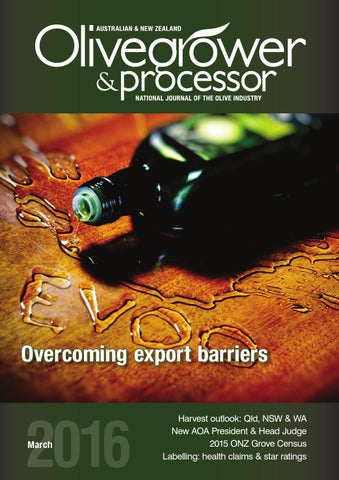
Overcoming export barriers
2016 March
Harvest outlook: Qld, NSW & WA New AOA President & Head Judge 2015 ONZ Grove Census Labelling: health claims & star ratings
LEOPARD
the evolution of dmf technology The third era for olive oil extraction
The only two-phase decanter that produces a dry husk similar to that from a 3-phase decanter and that recovers the pulp of the husk, “pâté”, ideal for composting and animal feeding. The pâté is no longer a waste but an added value to the mill. TOP QUALITY oil extracted without adding water By far the HIGHEST YIELD achievable on the market today Very low water and energy consumption
Via Don Battistoni, 1 60035 JESI An Phone +39.0731.2311 Fax +39.0731.231239 info@pieralisi.com www.pieralisi.com
D E D I C A T E D
I N N O V A T O R S
OFFICIAL AUSTRALIAN AND NEW ZEALAND AGENTS ■ NSW-QLD-ACT Town & Country Tractors & Machinery Pty. Ltd. Cr Airds Rd & Sussex St Minto Nsw 2566 Phone 02 96038600 - Fax 02 98246670 paul@tctractors.com.au Contact: Paul Blasutto, 0419 273668
■ SA W.E. Ware & Co. 19 Papagni Avenue, Newton, SA 5074 Phone 08.83653200 - Fax 08.83653187 weware@weware.com.au Contact: Marjorie Ware and Warrick Philpott
■ WA Scottech Oilfield Services 12, Monash Gate Jandakot, WA 6164 Phone 08.94177800 - Fax 08.94975470 patrick@scottech.net.au Contact: Patrick Kradolfer
Contents
In this issue... Incorporating Australian Olive Industry Journal Published by Ryan Media Pty Ltd Publisher Hartley Higgins General Manager Elizabeth Bouzoudis Editorial Gerri Nelligan Advertising Maria Stephenson sales@olivegrower.com.au Production Luke Westle, Simon Miles, Sandra Noke Subscriptions A one-year subscription (four issues) is $38.00, and includes a copy of the Australian and New Zealand Olive Industry Directory. Subscriptions commencing July 1 2014 will receive a copy of the 2015 Australian and New Zealand Olive Industry Directory. Please pay by cheque or credit card to Ryan Media. Visit www.olivebiz.com. au to subscribe. Circulation subs@olivegrower.com.au Contributions Articles and other contributions are welcome and will be published at the discretion of the editor. Photographs are best received as jpg files via email or should be high-quality prints or transparencies. Please indicate if articles and pictures are to be returned. Printing Lane Print & Post Adelaide Ryan Media Pty Ltd ABN 85 085 551 980 630 Regency Road, Broadview South Australia 5083 Phone +618 8369 9555 Facsimile +618 8369 9501 Website www.olivebiz.com.au ISSN 1448-5486
March 2016 Issue 99
News Olives SA members ‘Meet the President’
4
User-friendly workshop on processing best practice
5
China Project update
6
Just here for the oil
8
Meet the president: Peter O’Meara
10
Xf disease update
13
Olive Exposium shares the lore
14
Harvest Outlook Queensland 16 New South Wales
18
Western Australia
20
Profile Michael Harbison, Nangkita Olives
22
Feature The oils that changed (my) world
24
New Zealand 2015 ONZ Grove Census
26
Olive Business Carrots and sticks: new rules on food health claims
29
Industry comment on Health Star ratings
30
Country of Origin Labelling – NZ exports to Australia
31
Overcoming export barriers
33
How safe is your workplace?
35
Product & Services The perfect pour for EVOO – online 24/7
What’s on/Advertiser index
36
37
Conditions The opinions expressed in Olivegrower & Processor are not necessarily the opinions of or endorsed by the editor or publisher unless otherwise stated. All articles submitted for publication become the property of the publisher. All material in Olivegrower & Processor is copyright © Ryan Media Pty Ltd. All rights reserved.No part may be reproduced or copied in any form or by any means (graphic, electronic, or mechanical including information and retrieval systems) without written permission of the publisher. While every effort has been made to ensure the accuracy of information, the published will not accept responsibility for errors or omissions, or for any consequences arising from reliance on information published.
INDEPENDENT & AUSTRALIAN OWNED
Cover: Learn how Gourmet Lovers overcame export barriers to grow a successful international business in our Olive Business feature. Issue 99 • March 2016 • Australian & New Zealand Olivegrower & Processor • 3
News
Gerri Nelligan Editor
taking its toll in some regions and groves, while leaving others unscathed. A common factor, however, is a lack of water, with drought or unseasonal dry conditions challenging many growers once again this year. Once you’ve caught up on the crop outlook in our annual harvest report, meet the AOA’s new President and Head Judge, and hone up on the new rules on health food claims and star ratings. Plenty to read while those olives ripen …
Harvest is looming in some parts of Australia, and it’s time to finalise equipment and labour, and lock in your processing. It’s looking like another unpredictable one, with weather
Editor Gerri Nelligan and the OG&P team.
Olives SA members ‘Meet the President’ It didn’t have the hype of a US inauguration celebration but a good time was certainly had by all when the Board of Olives South Australia (OSA) hosted a ‘Meet the President’ event on February 21. The guest of honour was, of course, the new president of the AOA, Peter O’Meara, who was formally appointed to the role in late November. OSA President Michael Johnston said that a change of national president after 15 years provided a good impetus for a get-together, coinciding with O’Meara’s visit for the February AOA Board meeting. “While a few of us had met Peter through his activities as the AOA’s New South Wales director or as Hunter Valley president, most of the Board and SA industry members hadn’t made his acquaintance yet. We wanted to give him a warm SA welcome to the role, so felt it fitting that we should entertain him on his first official visit to our state as the national president,” Johnston said. “We had around 26 OSA members and committee to a small but very friendly BBQ at my home, which provided a great chance to get together and catch up pre-harvest. “It was held at relatively short notice, and many of our growers live a considerable distance away, so it was wonderful to see such interest from the members, some of whom we haven’t caught up with for some time. People came from the mid-north, the Riverland, the Fleurieu Peninsula and the southeast, so we had a good spread of members from right across the state.” Johnston said there was no shortage of conversation at the event, with discussions covering a wide range of industry topics. “Peter O’Meara spent time talking with Richard Gawel about olive competitions and Jim Rowntree about processing and pruning, and there were discussions among the members about the coming harvest in terms of quantities and quality,” he said. “It was a great opportunity for us all to see what’s happening across the state, and compare the geographical differences, because they do vary greatly from north to south. Even when you’re having a tough year, it often helps to know that it’s not just your grove that’s been affected - and those conversations can also help to identify causes and possible future solutions. “I think the growers felt that this was something we hadn’t done for quite some time and that it was well worth the effort. It’s definitely given us food for thought for future member functions.”
OSA President Michael Johnston impressed fellow board member Michelle Wirthensohn with his cooking skills at the event.
Johnston also provided a warm SA welcome to the new national President with a taste of the state’s other great liquid!
4 • Australian & New Zealand Olivegrower & Processor • March 2016 • Issue 99
News
User-friendly workshop on processing best practice Best practice from grove to storage was the aim of a processing workshop run in the Hunter Valley in early March. Hosted by new AOA president Peter O’Meara, the workshop was presented by Jim Rowntree, processing plant manager at SA’s largest processing facility and owner/manager of multiaward winning 80-hectare super high density and traditional olive groves in the state’s south-east. Aimed at both processors and growers, the workshop attracted delegates from as far afield as Tasmania, all keen to learn more about how to improve their grove and processing practices. “The local associations wanted a course for growers to help them achieve the best quality fruit they can, and then to understand more about the process of making olive oil and how their grove practices influence how their oil turns out,” AOA CEO Lisa Rowntree said. “So we put a workshop together to provide them with a good understanding of what happens when EVOO is processed, where all the variations are, how to tweak the machine to get the best yield and the benefits of using enzymes.” The full day workshop provided a comprehensive overview of all stages of processing and storage, starting from fruit in the grove. Processing topics covered included: harvesting for quality oil/fruit ripeness; use of harvesting aids; fruit condition(s); containers and transport to mill; receival area and crushing; malaxing and processing aids management; and horizontal and vertical centrifugation. These were reinforced with a real-time demonstration of processing trials. The focus then moved to oil storage, covering: tank cleaning and waste management; transport and storage containers; settling and racking-off; and long-term storage. And importantly, it was totally user-friendly. “The information was presented in a really practical way: these are the things that can go wrong; this is why; and this how you can make sure it doesn’t happen to your oil,” Rowntree said.
“And Jim’s a grower and processor himself, so his presentation was in laymans terms, specifically untechnical. It was informal and interactive, with the opportunity to ask questions all the way through and lots of discussion between the attendees. “Lunch was great in that respect too, as they got to sit down and discuss the various issues they’d been having with processing. “It really was a fantastic day and the feedback has been great, particularly that it was that real ‘back to basics’ information that people need. “We had lots of positive comments on how much people got out of it, and there’s strong interest in us holding it again in other regional areas. We’re already planning workshops in Tasmania and Victoria, although they’ll have to wait until after the harvest, and we’re keen to hear from anyone who’d be interested in us holding one in their regional area.” To register your interest in attending the course, or hosting one in your regional area, contact Leana at: secretariat@ australianolives.com.au.
Issue 99 • March 2016 • Australian & New Zealand Olivegrower & Processor • 5
News
China Project update Chris Mercer, program co-ordinator
In the June 2015 edition of Olivegrower & Processor we looked at The Olive Route, a new AOA-backed program facilitating extra virgin olive oil exports to China. Co-ordinator Chris Mercer continues our quarterly updates on how work on the program is progressing. This update focuses on three work packages in the levy-funded project OL14003: Essential work to facilitate increased exports to China, removing roadblocks and establishing competitive advantages. Export Handbook and training The Export Handbook is now complete and we are getting ready to introduce it to those growers who are interested in utilising this resource. There are seven chapters, stretching over 60 pages. We are currently arranging the first “training workshop” on the handbook, to be held in Melbourne on Saturday, 2 April and/or Monday, 4 April. Further workshops can be organised later as required. Any growers who are interested in attending these or future workshops should contact their state AOA representative. The Export Code of Practice module The Export Code of Practice is a bolton module to the existing Code, which is itself under review. This is all part of an effort to make the entire Code more approachable, more attainable and more valuable. The Export Code urges growers and producers to adopt a continuous improvement style approach to grove and mill practices. The logic goes all the way back to the basic precept that we are trying to sell a relatively small quantity (in market terms) of olive oil in China, so we want to sell that quantity at the best possible price. To do this we must have the most interesting and highest quality oils. Good oil comes from good groves and well run mills. Therefore we have designed the Export Code to give a flexible and incremental approach to achieving best practice. Phthalate minimisation The Modern Olives laboratory is now planning to garner samples from various stages of the production process, and from a number of locations across Australia, during the coming harvest. If you would like to volunteer to provide samples, please contact me (chris@ westerngroves.com). We already have
Chapter 1
Introduction
(boring but brief)
Chapter 2
Your Mission
(labelling, branding, how the market works and how to excel in it)
Chapter 3
Commercial Structure
(how we plan to commercially implement The Olive Route)
Chapter 4
Grove Questionnaire
(the questions which will inform your lab test regime)
Chapter 5
In Pursuit of Quality
(the Export Code of Practice module)
Chapter 6
Operational Requirements
(details and procedures)
Chapter 7
The Spirit
(teamwork and a call to arms!)
two locations in Victoria so we are looking for NSW and SA producers in particular, where atmospheric phthalates are presumed to be more prevalent. Observations This author might be somewhat biased concerning the usefulness of the OL14003 project, but I do believe that the outcomes have excellence. The journey has also been a lot of fun and I would like to share two tangential observations that I have made along the way. Food safety in China Firstly, food safely regulations in China will get ever more stringent. Furthermore, China is less likely to be bullied by large agri-businesses in the same way that other governments are. Remember that both Google and Facebook are absolutely banned and unreachable in China and firms who tried the under-the-table route, like Glaxo Smith Kline, have paid a heavy price. The concerns of the populace regarding the safety of their food is paramount. Therefore Australian horticulture needs to get ready for tougher regulations and reduce chemical use, starting now and yes, that even includes glyphosate. We might anticipate flags being raised in typically oblique social media-speak: “although the World Health Organisation has declared glyphosate as ‘probably carcinogenic in humans’, many others
say that it is completely safe and will not become the DDT of the 21st century”! Marketing and social media Secondly, it will not be enough to display our products magnificently on Chinese e-commerce platforms. We need a very clever, well-paced social media campaign to reach our target market and educate people as to the benefits of our wonderful oil. The campaign must build on conversations that are already happening and find cascades to the maximum number of “influencers” and “followers”. Only then will that “sold this month” counter start to tick over. At The Olive Route we are ready and waiting to get this program underway. Thanks for reading - I hope to see some of you at the April training workshop in Melbourne. A Western Australian grower and EVOO producer, Chris Mercer is the president of Olives WA and a member of the AOA board. For more information on The Olive Route program, please contact Chris via: chris@westerngroves.com. We’ll also continue our progress updates in future editions of Olivegrower & Processor.
Samples wanted To continue the project work on phthalate minimization, the Modern Olives laboratory needs fruit and oil samples during various stages of the coming harvest from groves in NSW and SA. To volunteer to provide samples, please contact Chris Mercer at chris@westerngroves.com.
6 • Australian & New Zealand Olivegrower & Processor • March 2016 • Issue 99
A GENTLE SQUEEZE IS ALL YOU NEED ENZYMES AND OLIVES
© Novozymes A/S · Customer Communications · No. 2015-19656-01
If you want more from your olives you should treat them gently. Using an enzymatic solution gives you a higher yield of tastier, more colorful, and more shelfstable olive oil. Novozymes Pectinex® Ultra Olio lets you bypass the harshest mechanical treatment and gives you a higher yield of free-run oil. Pectinex® Ultra Olio also increases your decanter or press capacity and reduces your waste. Want to learn more? food&beverages@novozymes.com or go to www.novozymes.com Novozymes Australia Pty Ltd. PO Box 4942 · NORTH ROCKS NSW 2151 · Australia Tel. +61 2 9630 8466 · Fax +61 2 9683 1170 Contact: Tony Bryan Email: tony@novozymes.com
The Olive Centre · Australian Distributor 74 Castle Road · Cabarlah QLD 4352 Tel. +61 7 4696 9845 · Fax: +61 7 4696 9914 Contact: Amanda Bailey Email: amanda@theolivecentre.com.au
Nutura – Functional Food Ingredients New Zealand Distributor 24 Poland Road · Wairau Valley Auckland 0627 · New Zealand Contact: Delores Eiman Email: delores.eiman@nutura.co.nz
Feature Profile
Just here for the oil AOA national competition head judge Shane Cummins, Long Paddock Olive Rustlers
In the December edition we welcomed Wagga Wagga producer Shane Cummins as the new head judge of the AOA National EVOO Competition. We wanted to get to know him better, so we asked Cummins to tell us more about his life in olives and his thoughts on judging. When pushed hard, he even shared a little about himself ...
My life with olives I picked my first olive tree in 2001. It took three days to pick. A mate and I got 156kg off that tree. Aunt Clara brought that tree back from the Garden of Gethsemane in 1890 and that was the first time the olives had been turned into oil. The oil is still the most beautiful thing I’ve ever tasted, thus starting a lifelong addiction. From then it’s been a long journey through flavour, taste and aroma. I’m part of the Long Paddock Olive Rustlers. We first entered shows in 2005, and got one gold medal, one silver medal, one bronze medal and a lecture from Richard Gawel. Our oils were stunning, our label was crap. And he was disappointed because we hadn’t shown all of our oils. In 2006 we showed 11 oils in Canberra: got five bronze, three silver, three gold, Best in Class and Best in Show. And in Richard Gawel’s notes it said we were part of setting a standard for Australian EVOO of rich, ripe, fruity and vibrant. Nelson Quinn and Chuck L’Heureux walked over and congratulated us. Fortunately nobody asked us how we did it. To this day we’re still trying to put that into words. Our dream is to take out the best oil of show at every show in Australia, in one year, with a different oil at each show, because we can. Maybe it’s just a dream but it keeps us going. I’ve mucked that up by taking the head judge gig, though, because Long Paddock Olives Rustlers can’t enter the national show now.
I qualified for the panel in Wagga in 2007 and started show judging in 2008. The journey’s meant that I’ve worn out a couple of pairs of boots – it’s been a big one. In another life I’m a landscaper and I do a lot of paving. My new life as head judge The role of head judge: if the truth be known, I’m just here for the oil. In Mort Rosenblum’s book Olives (the life and lore of a noble fruit) he quotes his mate James Lemoyne, to whom he had mentioned olives: “I eat 30 or 40 a day. When I ate my first olive I knew I was tasting the heart of the world. When I first tasted extra virgin olive oil, it felt like the very blood of the warm, rich earth.” So for me, it’s all about the oil. Oh, and I’ve met some great people along the way. Judging is about co-operation and competition. In this olive business, none of us can do it alone. The seasons of judging For me the role is seasonal. Encouragement This now is the season of encouragement. Of revving people up to go out there and pick their best olives, and to use these olives to make the best oil that they can.
Purchasing OIL CAPS made easy • Aluminium oil caps • Plastic oil caps • Pull spout pourers European and Australian made
1. Log onto www.closuresonline.com.au 2. Choose product, colour & quantity 3. Checkout for fast delivery
Closures Online 359 Lower Dandenong Road Dingley Vic 3172
8 • Australian & New Zealand Olivegrower & Processor • March 2016 • Issue 99
M: +61 426 875 855 E: sales@closuresonline.com.au W: www.closuresonline.com.au
Feature Profile
Cummins qualified for the Wagga Wagga tasting panel in 2007 and has been show judging since 2008, at both regional and national level in Australia and also at the New Zealand national show.
For marketing, first you need products. Then a label, that becomes a contract with your customer. Then a description of yourself, your trees, your hopes, your ambitions, your oils. A description of hope and pride and joy. Then prepare for packaging, and your packaging has to get all of this in and on the bottle. The new one to include is your QI code - and somebody else will have to tell you about that. All I know is that it comes under the banner of potential, and potential is what we are here to explore. And to me the potential of Australian extra virgin olive oil is taste, flavour and aroma … taste, flavours and aromas. Harvest The next season, starting soon, is harvest and I hope to catch up with as many people as possible to talk about dreams, to look at trees, to help harvest, to taste oils and just to enjoy. Judging The season after is judging season and we are working towards that now. The job is to do the best job we can by your oils, and a spectrum of Australian judges have met and proposals are to go before the board of the Australian Olive Association. Some judges will be called forth, associate judges invited. We are planning to make space for observers (board members, growers, chefs, consumers, journalists) to sit in on the process, to whit competition and co-operation, and some young judges. Those interested will need to contact Leana Head at the AOA to enquire. Presentation And then there is the presentation season, when we reward those oils and their human representatives. And because it’s about the oils, I will refer to them by their descriptors. In the judging process, judges look for the words that will identify and describe an oil. Generally the more complex an oil is, the more its descriptions evolve, and in the hands of the judging panel leaders these words become the poetry of extra virgin olive oil and part of your package. Conference Next is the conference season and at the national conference oils from the AOA show are going to have their own booth. At each break there will be two oils to taste and as you’re
sitting down, I’ll tell you the medal and descriptor of each. People will keep their own scores, scores will be cumulative and I don’t know about a prize but I’m hoping there will learning. Selling Then there will be a selling season, where you have to get your package out and go for it, changing the world one olive at a time. Cummins and his judging team have some great new plans for the national competition. We’ll bring you further details of the changes and innovations in coming editions of Olivegrower & Processor.
FINEWELD STAINLESS STEEL Manufacturers of Quality equipment for the Olive Industry > Storage and Settling Vats > Variable Capacity > Transportable Tanks > Olive Receival Bins > Conveyor Systems > Installations > Valves > Manways > Fittings
www.fineweld.com.au CARRUM DOWNS VICTORIA 3201 Ph: 03 9775 0339 Fax 03 9775 0338
Issue 99 • March 2016 • Australian & New Zealand Olivegrower & Processor • 9
Feature Profile
Meet the president: Peter O’Meara Australian Olive Association President Peter O’Meara, owner Adina Vineyard and Olive Grove
Background Academic life Peter O’Meara’s life as a student was a diverse one, eventually seeing him graduate with a BA, Dip.Ed., M.Ed from Sydney University and then from lnsead Business School in Fontainebleau, France. Meanwhile, he squeezed in roles as a pilot officer in the Sydney University Squadron and also a musician, playing sax and clarinet to support himself through his studies. Career After leaving university O’Meara taught in a high school in Sydney for two years, then joined IBM as a systems engineer. He worked his way through the ranks to become sales manager of IBM in Australia, then moved to the US as Director of Operations for Southern Europe. He was subsequently appointed Director of Entry Systems, with responsibility to launch the famous IBM PC throughout the world bar the US.
Increase your yield! Now Available - Biogras L Pectinase Enzyme from our
Spanish sister company Biocon Espanol. Specifically formulated for the cold press olive oil process, improves quality and meets all the NASAA organic oil processing requirements.
For further information and pricing contact:
Deltagen Australia Pty Ltd 31 Wadhurst Drive Boronia VIC 3155
Ph.03 98017133 Fax. 03 9887 0019
www.deltagen.com.au info@deltagen.com.au Deltagen is the Australian distributer for Megazyme Test Kits & Analytical, for the Agricultural & Food Manufacturing Sector
Deltagen Australia Affordably servicing the wine-making, brewing and olive oil industries for 20 years
In the December edition we announced the appointment of Peter O’Meara as the new AOA President. Having welcomed O’Meara so briefly to the position, it’s now time to find out more about the man leading our national organisation into the future. Starting with some background, we look at what he brings to the role and then grill him with a few probing questions.
He returned to Australia in 1983 with various executive responsibilities and was appointed to the board of IBM Australia in 1987. Subsequent assignments saw him based in the US for a total of seven years, and a further year in Hong Kong. In 1991 O’Meara left IBM to establish a new company (Lexmark) in Asia Pacific, where he held the position of President of Lexmark Asia Pacific. In this role he was on the boards of seven companies throughout Asia. He subsequently moved to the US once again, as worldwide director of marketing for Lexmark, and then spent three years in Paris, where he ran Lexmark’s services business in Europe. Most of these executive roles in IBM and Lexmark involved multi-billion dollar corporate responsibilities, together with management of many (mainly professional) people. O’Meara retired from Lexmark and returned to Australia in 2003. Farming and community While living in Europe, O’Meara enjoyed the opportunity to pursue one of his lifetime passions by learning a great deal about the French wine industry. It led to him and his wife Helen buying the 130 acre Adina Vineyard in Lovedale, in the Hunter Valley, where they now live. The property has some 40 acres of vines and over 2000 mature olive trees. Since taking over the property, Peter and Helen have substantially upgraded the facilities, developing a new cellar door complex incorporating a restaurant, 4-star tourist accommodation and a day spa. The vineyard has established a good reputation for producing excellent estate wines, and in recent years Adina has developed into an important wine and food tourism destination in Lovedale. The olive business In addition to wine and accommodation, the O’Mearas developed an olive processing facility handling the production of extra virgin olive oil, table olives and other olive products. Along with its own production, Adina provides harvesting and processing services to other olive producers in the Hunter Valley, which in 2012 necessitated a new, larger Pieralisi olive mill. This mill expanded the olive processing capacity in the valley several times over and was a very significant development for the local industry, solving a previous shortage of processing capacity in the Hunter. O’Meara says his ambition is that this new facility will become a centre of excellence for olives in the Hunter Valley. To that aim, Adina provides a range of services and products for both growers and consumers, and is a focal point for educational and promotional activities to enhance the status of the olive industry in the Hunter Valley.
10 • Australian & New Zealand Olivegrower & Processor • March 2016 • Issue 99
Feature Profile
Industry leadership In 2013 O’Meara was elected President of the Hunter Olive Association and has led this enthusiastic and active industry group since. During this time the association has undertaken an extensive study across the region to better understand the issues of improving olive quality and yields in the area, and has also re-established the Hunter Olive Show, now the only regional olive show in New South Wales. O’Meara is also active in the wine community and for two years was President of the Lovedale Vigneron Association. His election as President of the AOA Board has now seen him resign from both of these positions, however he remains a keenly interested member of both local industries. What he brings to the role Management experience O’Meara has extensive national and international experience in managing teams, and negotiating with high level executives in business and government. He has also chaired seven boards and been a member of 10, which he says has made him well aware of board responsibilities, and the need for integrity, teamwork and delegation. “I have been in senior management roles for much of my corporate life which, along with extensive management training, has equipped me well in terms of people management, teamwork, communications and presentation. My voluntary involvement with numerous organisations within the Lovedale region has since extended that experience to the community level.” Industry knowledge and experience Having owned an olive grove for 12 years, and developed a substantial olive harvesting and processing business servicing the Hunter Region, for the past two years O’Meara has been President of the Hunter Olive Association. Adina is a signatory to the AOA Code of Practice and the processing facility is HACCP certified. “All of these activities have given me solid exposure to the issues within and faced by the industry at the regional level.” Vision O’Meara believes that his vision is one of his strengths. “In my corporate career I have been exposed to many situations where a ‘big picture’ view was essential. Some were more significant than others, but a number were very transformational. “Typically I was also entrusted with implementation responsibilities as well, which gave me experience of bringing those visions to fruition.” Multi-disciplinary experience While most of his corporate life was in the technology sphere, O’Meara’s various high-level managerial positions encompassed a wide range of responsibilities, including tactical budgeting and strategic planning, organisational structure, staffing and reporting through to market development and import/export. Communication skills Along with years of corporate negotiation, O’Meara has presented at conferences and other events, and more recently has been the “go-to man” for ABC Newcastle radio on all things olive-related, honing his live-to-air interview skills. He’s as comfortable speaking with politicians and government officials as he is with olive and grape growers and the consumer public on which our industry relies.
Olivegrower Q&A OG&P: You obviously have the experience and skills for the position, and the industry involvement, but why did you want to take on the role of AOA President? PO’M: W hen initially approached, I declined because I felt I was too busy already. However after reflection I decided that maybe I could make a difference by working inside the national body, so that’s why I responded to the Request for Nomination. I am also fortunate in that I have exposure to the wine industry and I believe we can learn a lot from that industry in terms of market segmentation, product quality and product pricing. OG&P:What’s your leadership ‘style’? PO’M: I like to set goals, get consensus, agree strategy then delegate responsibility for implementation. I am keen on measuring progress. I seek to be open and diplomatic when dealing with others, but can be direct when the situation requires. OG&P: What is your vision for the AOA? PO’M: Frankly I am in a steep learning curve and still developing that in the national role. My focus is on domestic matters while Paul Miller continues with his international role. I strongly believe in shared goals and shared leadership with the board, and this was a key agenda item which we discussed in depth at the February board meeting. Of course a lot of pre-work has been done by the board, and we also conducted a survey of members in December to help us establish priorities. There is a strong focus on product quality, grower skills, technology transfer, market access and industry profitability. Globally I think we need improved unity and cohesiveness. We are a relatively small industry and internal dissention needs to be minimised. OG&P: How important do you see grower/producer input is into the work of the AOA? PO’M: Very important. We are a body working for the interests of members. Communication and transparency are key. OG&P: Do you have any tasks you’d like to get underway immediately? PO’M: My personal first priority is to meet as many members I can, to understand better their issues. I have already started down this path. OG&P: Where would you like to see the industry in, say, five years? PO’M: I would like Australian extra virgin olive oil to be recognised as the international leader in product quality. We have the basic infrastructure in place to achieve that via the Australian Standard and the Code of Practice. We need all serious growers – large and small - to endorse, use and comply with the standard and by so doing command premium prices for a premium product. OG&P: And then in 10? PO’M: Building on the five year goal, I would like to see both small and large producers achieving sustainable profitability via improved grove productivity, better market access both nationally and internationally, and getting a proper financial result for a top quality product. We look forward to working with O’Meara in his role as AOA President and will continue to update on AOA activities in coming editions of Olivegrower & Processor.
12 • Australian & New Zealand Olivegrower & Processor • March 2016 • Issue 99
International News
Xf disease update Concern around the spread of Olive Quick Decline Syndrome (OQDS), caused by the bacterium Xylella fastidiosa, continues across olive producing countries. In the December edition we provided an update on the crisis and looked closely at grove biosecurity practices to reduce the risk of infection here. In this and future editions we’ll continue to update on the situation across the globe. What’s happened since? Despite the swift reaction to July’s confirmed discovery of Xylella fastidiosa (Xf) on Corsica, the bacterium has continued to spread across the island. Two new infected zones were identified in January and again action was immediately taken to destroy infected plants. Concern is understandably high among the island’s olive growers, with a total of more than 230 confirmed infections recorded at the end of January – an increase of 40 in that month. The Olive Oil Times reports that, given the 10km designated buffer zone around each infected area, 40% of Corsica’s land mass is now involved in the protective action against the disease. Legal action Meanwhile, the issue continues to take the legal road in Italy, the site of the initial outbreak of OQDS/Xf in Puglia. Government-enforced destruction orders of infected and surrounding trees have been challenged and placed on hold, in particular by an order of the Lazio regional administrative court (TAR) prohibiting the culling of healthy trees only 100 metres from infected ones. As a result only around half of the 3,000 olive trees ordered to be felled have to date been removed. In December, public prosecutors in Lecce also launched an investigation of 10 people – including leading plant researches and agricultural department heads – citing actions including: “spreading of a plant disease, willful violation of the provisions on the environment, fake material committed by public officials in public documents, fraudulent misrepresentation and the destruction or disfigurement of natural beauty.” The link between Xf and the dessication disease is being questioned, as is the effectiveness of felling for eradication of the disease and the use of chemicals as yet untested for the purpose and situation. At around the same time, the European Commission (EC) commenced proceedings against Italy, stating that “Italy is not fully respecting the obligations in the plan to eradicate Xylella”. The action followed an inspection by the Food and Veterinary Office, from which the EC concluded that “Italy is not implementing all its commitments on eradication, containment and surveillance of Xylella” and that “the eradication of diseased trees has not been sufficient to reassure the EU that Italy is doing all it should to contain the outbreak”. Sanctions, fines and more widespread embargoes could follow should Italy not meets its obligations to the EU control measures.
New protective measures In December an agreement was reached by the European Parliament, Council and Commission on protective measures against plant pests, focusing on “a more proactive approach towards plants and plant products imported from third countries, as well as towards the early detection and eradication of pests found in the EU territory”. Introduced largely as a response to the Xf contagion, the EU says the new rules “will ensure a robust, transparent and sustainable regulatory framework for plant health focussing on the early detection and eradication of any pests found in EU territory”. This was followed in late January by an announcement of €11.5 million in funding to support survey programmes for plant pests in 22 Member States in 2016, with 15% of the budget dedicated to Xylella fastidiosa. Californian concern And concerns are growing outside of the European direct risk zone. A January informational meeting of the Olive Oil Commission of California (OOCC) included a presentation “Evaluation of Olives as a Host of Xylella fastidiosa (Xf) in California” by Rodrigo Krugner, a research entomologist at the USDA Agricultural Research Service. As reported by US industry consultant Alexandra Kicenik Devarenne in The Olive Oil Times, “Krugner’s work isolating the pathogen X. fastidiosa from olive trees, thought to be responsible for a disease called Olive Leaf Scorch in California, led to an unexpected and fascinating finding: when healthy olive trees were inoculated with the pathogen, there was no higher incident of Olive Leaf Scorch in the inoculated plants than there were in the un-inoculated plants. If X. fastidiosa is a factor in Olive Leaf Scorch in California, it is only a part of a much bigger picture. “Also important was a look at the different strains of Xf. There are two strains found in California: X. fastidiosa subsp. fastidiosa, and X. fastidiosa multiplex. The Xf strain causing Olive Rapid Decline Complex in Puglia is X. fastidiosa pauca; the pauca strain has never been found in California. “Krugner pointed out that in Italy they have a disease, and they have a bacterium, but no causal relationship has yet been demonstrated. The reason it is being called a “complex” is that there are likely multiple factors that result in the disease.” Sources: www.oliveoiltimes.com; www.europa.eu.
Found symptoms? If you see anything unusual in your grove, call the Exotic Plant Pest Hotline on 1800 084 881 or the Emergency Animal Disease Watch Hotline on 1800 765 888. Alternatively, contact the AOA on (08) 8573 6545 or ceo@australianolives.com.au. Anyone finding symptoms of dieback similar to those of Xf can also send images to Sydney-based olive pest and disease expert Dr Vera Sergeeva for rapid identification of any outbreak. Email to sergeeva@tpg.com.au.
Issue 99 • March 2016 • Australian & New Zealand Olivegrower & Processor • 13
Industry Event
Olive Exposium shares the lore In the December edition we looked briefly at the 2015 Olive Exposium, which was held just days before layout. Let’s look a little closer at the event, and what some of the delegates took away from it. The event Olive Exposium 15 was a new event on the industry calendar, presented by The Olive Centre’s Amanda Bailey. Themed “lore of the olive”, Bailey said she wanted “a fun learning experience, reflecting the field days of old while focusing on the issues currently facing the industry”. The two-day program was jam-packed, with a comprehensive range of topics covering industry issues from grove management through to marketing – and then on into the kitchen. Speakers came from across the globe, headed by keynote speaker and renowned Australian food personality Lyndey Milan. Milan has long promoted EVOO use in Australian kitchens, and shared her passion for its flavour and versatility through a series of mouth-watering recipes - which were then made available to delegates. Other key speakers included Professor Paul Vossen from California, EVOO judge, scientist and Slick Extra Virgin blogger Richard Gawel, and New Zealand producer Nalini
Baruch, who shared the journey and secrets of Lot 8’s export success through product innovation. Many of the topics reflected Bailey’s day-to-day discussions with customers, so were aimed at problem solving and helping growers achieve higher productivity. Among them was a presentation by Marcelo Berlando on how to increase grove profitability, which was then built on by a field session in the Pitruzello Estate grove. The inaugural event achieved an enthusiastic response, with more than 150 delegates on each of the two days coming from across Australia and beyond. From the delegates … Melissa Jacobson from Mt William Olive Grove was one of the more local delegates, and was enthusiastic about both the format and the information provided. “A lot of the people were about the same size as us, so it was a gathering of predominantly small growers. The information was really, really good and I really enjoyed it,” she said.
14 • Australian & New Zealand Olivegrower & Processor • March 2016 • Issue 99
Industry Event
“I particularly liked the session actually out in the grove, and going through the issues they were having. That was very good. You could relate to your own grove and the issues you were having. “The information about the smoking point of oil was really well presented too, and it’s such an important issue. That was really value-adding by educating the user. “My highlight presentation, though, was Lyndey Milan – she was fantastic. I love a good chef!” And Jacobson agreed with the description of a comprehensive program. “It did cover all bases, although some of those bases were above what very small growers were able to achieve. For us, going was about networking and getting sources of information that we could come back to. Also ideas on how we could market differently as well. “Retailing is so hard, particularly when you’re really small, so it’d be good to have a network where you could pull people together. For a conference to achieve its goal, everyone should be able to sell their oil, so maybe something like that could be organised at the next event.” “But it was motivating and it gave inspiration. To hear other stories of people in a similar situation, and find out what they’re doing, that’s what we need. That sharing of information was great.” John Arthur travelled from New Zealand for the Exposium, tempted largely by the concept of a field day style event where people gathered to share information. “It was a good concept. We have field days here but they’re not very well attended,” he said. “So going over and seeing an Australian grove and Australian
point of view and Australian experts in their field – as well as internationals – was very relevant. “There were two speakers I specifically came across to see, Marcelo Berlanda and Paul Vossen. We have a problem here of alternate bearing and lack of production, and I was hoping to get some clues there. In fact, probably my only negative about the event was that those two speakers weren’t on for long enough. I wanted to pick their brains a bit more. “I did get answers to some of the questions I had, though, through discussions with people staying in the hotel – Rob Spooner-Hart, Paul Vossen and Len Teseriero. For me that opportunity to get together and talk was just important as the presentations.” Arthur is also a fan of the “back to basics” idea of the event. “The basic stuff has to be brought back in, and people shown how to get good production consistently from their grove,” he said. “It may be good to have a course where you do all the basic stuff on one day and the high-faluting stuff the next, so people can pick and choose to suit the level they’re at. That would give more opportunity of covering the challenges the various parts of the industry are facing, as we’re not all the same in terms of what we need help with. “This one tried its best to cover everything but it’s almost impossible to cater to such a diverse range of industry needs. “But I had a great time and I’d say please do it again in two years’ time, with all the back to basics stuff which is so relevant to what’s affecting growers. That’d definitely suit me.” More information: www.oliveexposium.com.
Issue 99 • March 2016 • Australian & New Zealand Olivegrower & Processor • 15
Harvest outlook
Harvest outlook In our annual round-up of the harvest outlook around Australia and New Zealand, in this edition we see how the season is looking in Queensland, New South Wales and Western Australia. As usual, we’ve revisited the growers we spoke with last year to see how this year compares.
Queensland Edina Olives, Gin Gin Neville Smith has had a devastating run, with no commercial crop for the past six years. Four years of floods were followed by a drought and heatwaves in 2014, which saw the local olive association eventually fold. Then last year olive lace bug hit. “We didn’t have a crop in 2015 either, as the lace bug got into the trees and just about demolished them,” Smith said. “So we got into the severe pruning and burning – you can spray all you like but once they’re that bad, it’s the only way. You cut right down to the main trunk and branches, and that way you get rid of them. And then you’ve got to be pretty quick spraying the new growth if you see them on that.” Smith said that his ideal action would have been to prune the entire grove at once, to ensure complete eradication of the pests. It’s been a slower process than planned, however, due to a shortage of seasonal labour. “Since the government changed the laws around backpackers we don’t get them here anymore, so I have to do it all on my own. It’s a big job, and I’m 70 now,” he said. “We used to rely on the backpackers here: we got three or four a year through and now we get zero. Minister Dutton is responsible for us being in this predicament. They just don’t think things through properly.” Smith said he started the severe pruning in June last year, just before winter, and has completed about two-thirds of his grove. With 600 trees still to prune, he says it’s a case of “slowly but surely”, with the weather also causing setbacks. “It’s been too wet in January and February this year, and we can’t get in with the machine, so we’re waiting for the paddock to dry out a bit so we can get in and burn the prunings,” he said. As always when we’ve spoken with him, however, Smith remains positive about the future for his grove. “Next season, 2017, we’re hoping to get a new crop. We’ll have a lot of new growth, and that’s what they fruit on,” he said. “In fact, we’ve already got a lot of growth. They’re looking really good, the ones I’ve pruned. “Interestingly, there are one or two with a bit of lace bug on them but they’re on the old growth - I left a couple with a bit of old growth to see what would happen. “It’s the old story: bugs don’t like to attack healthy trees.” Worendo, Darlington Rob and Sue Overell had a similarly bad run, with storms and fluctuating rainfall taking their toll over several years. In 2015, however, things were a little better and rain “at the right time” saw them harvest an acceptable, if somewhat patchy, crop. 2016 has seen a different weather pattern but a similar outcome overall. Flowering was, the Overells said, “Wonderful – the best ever,” until those storms once again took their toll. “Unfortunately, late spring and summer storms were heavy
and much flower/fruit loss was the result,” they said. On the upside, regular rain was good for their olives, with no need for irrigation in the grove. Hot and humid conditions were another major influence, however, possibly contributing to the lace bug infestation they’ve experienced this year. It’s a rarity in the Overells’ normally problem-free grove, where the only usual threat is large flocks of white cockatoos, and luckily didn’t affect all of their trees. “We just had our worst ever invasion of lace bug in the Frantoios but the Manzanillos are okay,” they said. “So we had a couple of tonnes last year and it looks like this year will be about the same.” Quality, they say, is “looking good so far” and harvest timing looks set for later this month. “We’re expecting it to be the end of March or early April, which is the norm,” they said. “Last year we harvested mid-March, which was a little earlier than usual but gave a good quality oil.” And it’ll definitely be all over by Sunday, May 8, when the Overells once again host the annual Arts in the Olives Festival, a Mother’s Day tradition on the local calendar.
Gin Gin Palm Tree Darlington
Rash Valley Olives, Palm Tree The last five years have been a rollercoaster for Roger and Shirley Harrison. Their Palm Tree grove produced well in 2012 and 2013, then had only a sixth of the average crop in 2014 and virtually none in 2015. Unfavourable weather
16 • Australian & New Zealand Olivegrower & Processor • March 2016 • Issue 99
BRAUD W O R L D ’ S #1 *
*SP-only
NEW
BRAUD 9090 X
New Harvesting Head, Perfect 80% of European work quality
Market (or s) Olive Grove use Braud
Hopper capacity
Olive Tunnel
• 2x2000 Litres • Weight repartition
• Totally respectful of the canopy and preparation for shaking
Harvest Quality
Self aligning Noria
• Olive fruit integrity • Crop cleanliness
• Trunk respect • Perfect seal
Optimized design
Ideal for “Super Intensive” olive Groves
BRAUD A
U
S
T
R
A
L
I
A
Totally Australian owned
Ring Ashley or Angelo for demonstrations or any participating New Holland dealer.
Ashley Barratt – 0419 833 606 Angelo Dicesare - 0408 856 418
Summertown Ph (08) 8139 7200 Adelaide Ph (08) 8139 7250 Narracoorte – (08) 8762 0123 www.braud.com.au
Harvest outlook
during pollination was the culprit in 2014, while a massive early season hail storm left no question as to what happened the following year. But from less than 200kg then, the Harrisons at least have a reasonable crop this year. “It’s not the biggest harvest we’ve ever had, but enough to give the press a good workout,” Roger said. The Harrisons keep meticulous records, so know precisely when this year’s better harvest started forming. “We had good flowering, with the first appearing on 4 October, which is pretty much average. Over the last 10 years, the ‘first flowers’ date in our grove has ranged from 17 September to 15 October,” Roger said. “Fruit set was also quite good - not spectacular but quite respectable. The couple of rows on the western side nearest a line of tall gum trees are quite poor, and even though there’s about 20 metres of clear ground between the olive trees and the gums, I think the olive trees are feeling the competition.” The good flower and fruit set were then backed up by more gentle weather, both at the time and throughout the 2015-16 growing season. Luckily that’s meant they haven’t had to water, which would have meant a lot more work during the summer heat. “Apart from a few hottish days (around 33C) in the past month, we’ve had a mild summer,” Roger said. “And with the exception of a dry July and early August, rainfall was good, with tensiometer readings showing no stress on the trees. Spring and summer rainfall also has been quite adequate, so we’ve not had to resurrect our irrigation system. “As a bit of background, when we established the grove in 2002, we laid 25mm poly-pipe mains down each row. The grove is on a slope, facing north, with a fall from top to bottom ranging from slight to moderate. We buried the poly at about 15-20cm, and offset from the little trees by about 25cm. Each tree had a length of dripper tube plugged into the mains. We decided to go underground to allow us to mow across the rows, as well as down the rows. “Unfortunately, the root system gradually crushed the poly, so to re-establish the irrigation system, we’d need to lay fresh mains above ground and complete the mulching of the entire rows, instead of a three-metre square around each tree. A winter job...”. Like many growers, the Rash Valley grove has been visited by olive lace bug this year, but control and good management practices limited the potential damage. “This is our first invasion of olive lace bug for a couple of years, but luckily it was easily dealt with,” Roger said. “And we’ve done our best to ensure the trees are in the best condition to battle any infestation. In accordance with the recommendations of our leaf and soil analysis consultant, we manually applied lime, sulphur, boron and other minerals/ trace elements during the season, as well as delivering and spreading a healthy amount of semi-composted mulch to each tree. It was a good workout!” So it’s satisfying that this year’s crop will give Rash Valley’s loyal customers another taste of their ‘old favourite’, even if it’s still in limited quantities. And it’s likely to be just as good as ever. “As we lost our crop last year to the early season hail storm, ‘anything’ this year will be much appreciated,” Roger said.
“So birds permitting between now and harvest in late March/April, we should do OK quantity-wise. And in terms of quality, the fruit is looking great.” Colour change had also begun when we spoke with the Harrisons in late February, with purple fruit just showing in some trees, however it was still too early to set a concrete harvest date. “Harvesting, as always, will be a compromise between allowing the fruit to ripen fully vs losses to birds,” Roger said. “Also, given our harvesting/pressing cycle and limited workforce (two), the harvest extends over about three or four weeks, so we’ll be starting earlier than if we could take off the crop in one fell swoop. Best guess at this stage is a start in late March.”
New South Wales
Rylstone Razorback
Rylstone Olive Press, Rylstone Bad weather during fruit set has been an ongoing issue for Rylstone Olive Press, with annual hot, dry winds and lack of rain reducing production right across the region. So it’s good to hear that, having been disappointed over the past years, their 8,000 tree grove has fared much better this year - once again influenced by weather conditions. Flowering was, said Joanne Patterson, “really good this year”. “We had brilliant flowers with reduced hot winds this year. There were a few warm winds and storms but the flowers seemed to hold pretty good through it all.” That translated into an equally good fruit set, which has been nurtured since by much kinder weather throughout the growing season – so far at least. “We’ve had a good lead up to the season,” Patterson said. “We had good rainfall before Christmas and again in January, which gave us a good amount of fruit on the trees. It was above average rain for both months so that gave the trees a nice Nitrogen fix. “The biggest factor is that we didn’t get the hot winds we’ve had in past years. But we still have six weeks to go. “Until then, we need some more back up rain – 50mm would be good, but not all in one downpour. If we get at least 50-100mm over the next six weeks and the season continues to be milder as it is at the moment, we’ll do better this year.” Rain is the all-important factor, Patterson said, because while
18 • Australian & New Zealand Olivegrower & Processor • March 2016 • Issue 99
Harvest outlook
Rylstone has some irrigation systems they simply don’t have the water to put through it. Yet they’re still paying for it. “It’s really frustrating: this year they’ve come up with more water levies for the capacity of water held in dams but nobody has that capacity because the dams are dry,” she said. “So they’re whacking us for water we don’t have and definitely aren’t using. “But irrigating is always a tricky one anyway. There are a couple of new growers in the area and they have some water they can splash around, but then it’s about coming up with that happy medium - enough water that the trees hold their own but not to overstimulate them so if we do have the hot winds they go into shock.” Rylstone’s grove hasn’t had any major pest and disease issues this year, unlike some other growers in the region. “We haven’t been hit by lace bug as we monitor all the time,” Patterson said. “We were hand spraying on the hot spots through flowering and that controlled it early on, and we’ve just kept monitoring constantly. One local organic grower has thrown up his hands this year – he had a lovely crop, then a great big swarm of lace bug hit and just finished it off. It’s devastating for him.” So overall, more rain is needed to maintain grove health but they’ve produced “a reasonable crop, up definitely” in quantity this year, Patterson said. And it’s looking like ripening a little earlier than the norm, although the harvest overall seems likely to pan out for the Rylstone team. “We normally don’t start processing until Anzac weekend but because we cover such a wide area for processing, we’ll be going from early April through to the end of May at this stage, if the fruit holds on the trees.” Razorback Olive Grove, Razorback Danny Fahri’s experience is more like a see-saw, with a run of good harvests followed by disappointing ones. It’s not the usual biennial fruiting issue, however, but extremes of weather – generally prolonged hot and dry conditions taking their toll every second year. This year has followed true to form, the decent crop and mild weather of 2015 – which also saw a surprising amount of rain – chased by the unkindest of weather, and subsequently “not much of a crop” this year. And this is despite the severe pruning of 50% of his trees last year, which had then thrived after all the rain and looked set to produce a bumper 2016 harvest. “It’s been a miserable year, really,” Fahri said. “We had a bit of rain, but that came when the flowers were on so we didn’t get much pollination. So beautiful flowering but no fruit set. “And then we’ve had the heat. This year has been the hottest since I’ve been up here, and that’s 18 years.” Yet Fahri said he hasn’t irrigated this year. “We’ve got irrigation but they don’t need it anyway because they’re established now,” he said. “And if they’ve got no fruit, what’s the point anyway.” The lack of fruit hasn’t changed Fahri’s usual practices of vigilance and good grove management, however, which have once again ensured no major pest or disease problems in his grove. The dry conditions have also helped keep olive fly away, having been a major problem for the region during 2015’s unseasonal rains. “The lace bug is around this year but that’s the usual thing, and it’s only a problem if you don’t get on top of it straight away,” Fahri said. “We did one week of careful checking and spraying, because if you don’t get early it spreads all over the farm. Unfortunately it’s a native bug – they don’t have it overseas – so it’s probably always going to be around. You just have to be vigilant and keep it under control.” So the end result, Fahri says, is “Some fruit – enough to press but not a lot and lot less than usual. I’ll be lucky if I get a tonne this year. “But it’s looking good, and with less fruit the oil will probably better.” As for harvest timing, it’ll once again be the opposite of last year’s experience of a later, rainy harvest 2015. “It’s so dry I’d say it’ll only be a couple of weeks more. That’s a week to Issue 99 • March 2016 • Australian & New Zealand Olivegrower & Processor • 19
Harvest outlook
two weeks earlier this year,” Fahri said, “and it’ll be pretty quick because there’s not a lot to get off. “And I’m not the only one. It looks like it’s going to be one of the worst years ever around here, as two weeks ago the rest of the growers got hit by really bad hail. I talked to one guy the other day who had a really good crop and the hail damaged probably 90%. “But there’s nothing you can do about the weather. I just hope for a good crop next year.”
Western Australia Sherwood Springs, Mumballup Mumballup grower Ian Wildy is in an enviable position – literally. His grove, south-west of Donnybrook, yields consistently good crops, thanks to the region’s generally ideal olive-growing climate. Production will be significantly lower this year, however, on some of his grove at least. “My run of steady cropping will take a hit this year because I have machine pruned 50% of the grove,” Wildy said. “But it is still looking reasonable on the un-pruned trees.” Flowering and fruit set in the grove were, as usual, unchallenged by the weather events faced by many others, however Wildy did notice a slight change from the norm this year. “We had reasonable flowering on the un-pruned trees, and the flowering period was more variable between varieties than usual,” he said. “Fruit set was then also reasonable.” There’s also been a variation in the usual rainfall pattern throughout the growing season, which sees average rains in winter, spring and summer in most years. “We had a very dry winter – only about 60% of our annual average winter rain,” Wildy said. “And then some hot spells during summer but luckily that doesn’t seem to have had a deleterious effect. “We’ve therefore had to irrigate but we irrigate each year anyway, so that’s no different really this year.
Donnybrook Mumballup “One consequence of the dry winter, however, was insufficient run-off to flush the dam that supplies the water for irrigation. Water supply is not a problem but quality is as a result of lack of flushing, and a build-up of microcrustacea in the water is causing the filters to block much more quickly than normal.” Pest and disease issues have seen a change in Wildy’s grove practices this season, although more as a preventative measure. “There were some signs of anthracnose developing on fruit at harvest time last year. As a precautionary measure I have followed the AOA’s recommendations for spraying with
TREEPRUNING
SLASHING
Use Ledgard products all year round in your orchard for Almonds Stone Fruit heavy pruning, light trimming, skirting & slashing. Use Ledgard products all year round in your orchard for heavy pruning, light trimming, skirting & slashing. Contact us forContact more us information, brochures, demodemo link link & dealer details. for more information, brochures, & dealer details.
PO Box 435, McLaren Vale SA 5171– Phone: 08 8323 ledgardpruning.com sales@ledgardpruning.com McLaren Vale Phone: +619001 8 8323 9001
www.ledgardpruning.com • sales@ledgardpruning.com
20 • Australian & New Zealand Olivegrower & Processor • March 2016 • Issue 99
Harvest outlook
Mumballup (WA) grower Ian Wildy’s run of steady cropping will take a hit this year, following machine pruning (above right) of 50% of his grove.
Amistar and followed up with copper oxychloride,” he said. “It’s too early to tell whether it has been 100% effective but I would reasonably expect so. “And a side benefit of the machine pruning was to prune off small outbreaks of olive lace bug. The prunings were then pushed up and burnt, rather than mulched as in previous years.” So as expected, quantity will be down this year, due to both the severe pruning and because “fruit/tree volume looks a little lighter than last year”. Luckily there’s no expectation of an effect on quality, however, and harvest timing looks like also sticking to the norm. “Our quality is fairly consistent year on year and we have no reason to expect any different this year,” Wildy said. “And we expect that harvest will be late May/early June as usual.” Preston Valley Grove, Donnybrook Mick Ryan is in a similar position: his Preston Valley Grove harvests are also generally pretty consistent, with satisfactory crops each year. His 2015 yield was substantially up on 2014, and other growers in the region also saw much better crops, despite a very long, hot and dry summer across the south west of WA. This year is, unfortunately, a different story, with inclement
weather wreaking havoc from early in the season. Flowering was generally good, Ryan said, until storms and high wind events caused loss of flower across the grove. Fruit set was therefore “not so good because of flower loss”. This was then exacerbated by a drier-than-normal growing season throughout 2015-16. “In 2015 we had only 600mm, compared to the norm of 800-900mm,” he said. “And the summer has been hot and windy, so without reasonable soil moisture, water has been an issue. We’ve had to irrigate for the first time in four years.” On the positive side, they’ve had no pest and disease issues this year – a common experience in hotter, drier years, it seems . The end result, Ryan said, is that he’ll definitely be down in quantity but with no detriment to quality. “The crop this year looks very light, I believe down by 20-30%,” he said. “But the fruit looks OK, so I expect quality should be as per normal.” And timing looks like following this year’s common pattern, with an earlier harvest than usual. “At this stage we’ll probably a start a week or so earlier than normal, around mid-April. But we normally harvest through to late June,” Ryan said.
NATIONAL HARVESTERS MECHANICAL HARVESTING Hayley & Ian Mead
We Make It Easy For You! • Free on site consultations • We’ll help you maximise your yield • Extensive industry knowledge at your disposal
• Flexibility • Professional job with modern technology guaranteed • We can sell & transport your oil
WE HARVEST A VARIETY OF ORCHARD CROPS INCLUDING:
OLIVES • PISTACHIOS PRUNES • CAROBS CITRUS
BOOK NOW FOR THE UP & COMING SEASON. DON’T MISS OUT, CALL US TODAY.
NATIONAL HARVESTERS Mobile: 0427879125 Email: nationalharvest@internode.on.net Issue 99 • March 2016 • Australian & New Zealand Olivegrower & Processor • 21
Profile
Michael Harbison, Nangkita Olives OG&P: How long have you been involved in the olive industry and what is your involvement? MH: I was one of five syndicate members who established Nangkita Olives in early 1998. I first took an active role in managing the grove in 2011 and bought out the other members’ interests in 2012. I now manage and work the grove jointly with my neighbour, Tony Stevens. Tony Stevens has taken a leading role in the Nangkita Grove from the very beginning. At Nangkita Olives we currently have 8000 mature trees, of Koroneiki, Kalamata, Frantoio, Leccino, Pendolino and Barnea varieties. We are presently planting 300 new Koroneiki, to replace some troublesome UC13a’s. In a good year we harvest 250 tonnes and make about 50,000L of oil. Our focus is to make the best oil we possibly can, by attention to cleanliness and health of the fruit on the tree and by rigorously managing all the steps from the tree to the final sale.
My strategy has been to achieve premium prices by making our bulk oil attractive to buyers because of the independent accolades it has received. I have avoided establishing a retail brand as my past experience in the food industry has taught me how hard that can be. Nevertheless, the clamour from friends and family to obtain our oils means we will probably do some small scale bottling next season. OG&P: How did you become involved in the olive industry? MH: My parents and siblings have pickled and crushed olives for as long as I can remember. I produced my first packaged oil in 1998, to promote the historic olive groves in the Adelaide Parklands. When invited to join an olive syndicate at the height of the “olive boom” I didn’t expect to make the sort of profits promised, but readily agreed because I love olives.
To get the sales we want at the price we need, I think every Australian has to be told and has to believe that Australian EVOO is the product they need, for frying and everything else
OG&P: What are your major markets and why? MH: Currently, we only sell unbranded, bulk oil as individual varieties. This year Nangkita Olives won nine gold medals in Australian competitions. The Koroneiki, Frantoio and surprisingly the Kalamata oil, each won a Best of Show or Champion gold. Our other varieties have all won silver or bronze this year too.
OG&P: How do you see the local industry positioned in the current global market, both in terms of its importance and comparative policies/standards? MH: I think the speculative investor syndicates have been sideswiped out of the industry by the rising Australian dollar, but the people who remain have a deeper and more genuine interest in olives and olive oil. We are fortunate that the major
22 • Australian & New Zealand Olivegrower & Processor • March 2016 • Issue 99
industry player, Boundary Bend, is such an exemplar in innovation and quality. Other industry players need only adopt the Boundary Bend values, with their own local twist, to be on the right track. OG&P: What do you see as the most significant issues facing the Australian and/or New Zealand olive industries at present? MH: For individual growers, price is still the major issue. Each grower has to find their way out of the cellar in this respect. However, I think there is also a possible “second wave collapse” still to come if the number of harvesting, crushing, pruning and other service providers shrinks much more. Convenient and competitively priced access to these services is a pre-requisite to operating any olive grove. In the marketing area, I am distressed to see a burgeoning range of “phony” olive products soaking up consumers’ rising interest in olive oil. This increasing interest should be expressed as more sales of premium Australian EVOO. Of particular concern to me in this respect are the margarines which “pretend” to be olive oil. OG&P: What are the best ways to tackle those issues? MH: I think we all need to fight the Good Fight. Our association, the AOA, does a great job in lobbying and campaigning for us but in this era of social media, misinformation and competition are “Hydras” or many headed monsters. We all need to take to our keyboards to fight for Australian EVOOS’ place in consumers’ minds.
Profile
To get the sales we want at the price we need, I think every Australian has to be told and has to believe that Australian EVOO is the product they need, for frying and everything else. OG&P: Are there any things you think we’re doing particularly well or badly? MH: I think that individuals are producing good oil and olives and that our association has done good work in establishing standards. What we are not doing well is aggregating as an industry. When everyone was establishing their groves, there was an energetic fellowship of idea and source exchange. However, I don’t think we have carried that co-operation through to the marketing stage.
What we are not doing well is aggregating as an industry In South Australia, we are working pretty hard as a state association to remedy this. We have a vigorous program on consumer awareness and education, involving as many growers as possible, and we combine this with grower training and networking too. OG&P: What are your thoughts on the Australian olive oil standard? MH: I think the standard is a good achievement, but it is just one “brick in the wall”. We need to fight as an industry to educate consumers about the standard
Provided necessary services continue to be affordable and available, I think the industry will settle down fairly quickly and begin a new and more sustainable growth phase
and to stamp out misrepresentation and labelling abuses. OG&P: What are your hopes for the industry into the future? MH: I hope to see the dream realised of Australian EVOO and olive products dominating the Australian market and achieving equally large export volumes. OG&P: And finally, what do you see as the realistic outcomes for the industry in the near future? MH: Provided necessary services continue to be affordable and available, I think the industry will settle down fairly quickly and begin a new and more sustainable growth phase. This will require active co-operation between growers, but the renewed interest in working together is a good sign that it will happen. More information: www.nangkita.com.au.
OIL TESTING SERVICE
– Wagga Wagga
Your first choice for analysis you can trust. Quality Criteria and Adulteration Testing n n n n n
jn 13651 08-2015
n
Peroxide value Free fatty acid UV absorption Fatty acid profile Polyphenols Rancimat*
n n n n n n
Pyropheophytins Diacylglycerols Trans fatty acids Sterols Stigmastadienes Waxes
n n n n n
Triacylglycerol (ECN42)* Moisture and volatiles* Insoluble impurities* Aliphatic alcohols* α-tocophenols
*Not accredited by NATA
IOC Accredited Sensory Laboratory AOCS Approved Chemist
AOA Code of Practice
Oil Testing Service Locked Bag 700 Wagga Wagga NSW 2650
For more information contact 1800 675 623 or 02 6938 1957 wagga.csu@dpi.nsw.gov.au
Free fatty acids, peroxide value, UV absorption and sensory analysis
n
www.dpi.nsw.gov.au For the IOC and AOCS Period of Recognition, please refer to the website
Issue 99 • March 2016 • Australian & New Zealand Olivegrower & Processor • 23
Feature
The oils that changed (my) world Richard Gawel, EVOO judge, blender and educator
Having recently retired as head judge of the Australian National EVOO Awards after 15 years at the helm, Richard Gawel shares his list of the five oils which seriously rocked his tasting world during this time, and why. It’s a stellar line-up and proves that, when it comes to outstanding quality, size and name really don’t matter. 15 years and 3,000 oils later … here’s my pick of the top five Australian extra virgin olive oils that somehow changed what I thought about Australian extra virgin olive oils. I used the following criteria for my selection: • in my opinion of world class standing; • the production of the oil was in some way a turning point in the development of the Australian extra virgin olive oil industry; • earlier or later versions of the same oil (i.e. made from the same variety by the same producer in a different season or seasons) also won top award honours in major Australian competition/s with >100 entries. They are, in chronological order: Year: 2000 Brand: Pecas Variety: Frantoio Style: Robust Acidity: 0.21% Region: Adelaide Hills, SA Grower: Chris Pegg Miller: unknown Best of Show, Australian National This oil changed my perception of what the Australian olive industry could achieve. Before then, I had been advised by a bunch of both European but (mostly) Australian food experts that we still had decades to catch up with European quality. This oil proved them wrong. Made from high quality, hand sorted (yes, hand sorted) cool climate Frantoio fruit from Hahndorf in the Adelaide Hills, the oil displayed the complex grassy and floral rose petal notes that are only seen in the best oils made from that variety. This oil was perhaps the forerunner in demonstrating that the best of this variety can only be achieved in cooler regions of Australia (something that many Australian growers unfortunately found out the hard way). A later version (2002) won Best of Show at the Royal Adelaide. Year: 2004 Brand: Rylstone Olives Variety: Picual Style: Medium Acidity: 0.09% Region: Rylstone, NSW Grower: Unknown Miller: Rylstone Olive Press (Jayne Bentivoglio) Best of Show, Royal Canberra
Awarded Best of Show at the Australian national competition a record three times, Gawel says Cradle Coast Olives’ South Australian 2015 Verdale was so good that he predicted 20 minutes into judging that it would go on to win top honours – which of course it did!
In 2005, the oils made by this producer from fruit from the region around Rylstone, NSW won multiple gold medals and notably, Best of Show awards at Royal Perth, Royal Adelaide, Royal Canberra and the Australian National. As a group they rate as the most highly awarded Australian extra virgin olive oils of all time. However, the oil from this producer which to my mind stands out as one of the best came from the previous year. The Best of Show winner at the Royal Canberra, it showed the potential of what was to become the most successful variety in terms of winning show awards in Australia - Picual. Before then, Picual had been much maligned (primarily because of its imported supermarket reputation) but this oil demonstrated to me how good it could get. Specifically, the oil showed the typical tomatolike characters of the variety but was complexed with citrus fragrance. The quality of the oil came from its freshness, fruit complexity and harmony of characters. Year: 2006 Brand: Wooloomooloo Olives Variety: Koroneiki Style: Mild Acidity: 0.10% Region: Gulgong, NSW Grower: Wooloomooloo Olives Miller: Wooloomooloo Olives (Ruth Sutherland) Best of Show, Royal Canberra; Gold Medal and Best Mild Oil of Show, Australian National
24 • Australian & New Zealand Olivegrower & Processor • March 2016 • Issue 99
Feature
This oil stood out to me as being the best mild oil made in Australia to that time. Made using an unusual Sinolea method, whereby the oil is extracted by passing blades through the paste and removing the droplets off the blade, the oil had a wonderful vibrancy and freshness. Its complexity was driven by its varietal fruitiness rather than bitterness or pepperiness. It showed what great quality fruit and careful milling could achieve, particularly in the creation of the popular milder style of oil.
This oil changed my perception of what the Australian olive industry could achieve
Year: 2013 Brand: Cobram Estate Variety: Hojiblanca Style: Medium Acidity: 0.15% Region: Boort, VIC Grower: Boundary Bend Ltd Miller: Boundary Bend Ltd (Pablo Canamasas) Best of Show, Australian National 2013; Premiere Class, Tokyo International; Best of Class Medium, Los Angeles International. Boundary Bend is by far and away Australia’s largest producer but their sophisticated olive production and milling processes, and general expertise, were demonstrated in the quality of this outstanding oil. In 2009 they released their first Hojiblanca (which they themselves introduced into Australia), which won the Best of Show award at the Australian National Competition that year. Made using low malaxation temperatures, this oil and others from the same variety have earned Best of Show in two Australian Nationals, runner up in another, Best of Show in Royal Sydney and Perth, and multiple gold medals and Best of Class honors elsewhere including major international competitions. But the 2013 was in my opinion the best of them. It was a stunning oil in the Spanish flavour profile of green and ripe tomato, citrus and subtle complex exotic fruits. The complexity and vibrancy of this world class oil was exemplary. It also raised the bar as to what the best Australian oils can achieve. Cobram Estate’s Hojiblanca varietals have earned multiple Best of Show and Best of Class awards across the globe in recent years, and Gawel believes the 2013 harvest was the best, describing it as “exemplary in complexity and vibrancy”.
Year: 2015 Brand: Cradle Coast Olives Variety: South Australian Verdale Style: Medium Acidity: 0.2% Region: Northern Tasmania Grower: Cradle Coast Olives Miller: Cradle Coast Olives (Tony O’Neill) Best of Show, Australian National 2015. This producer had won the best Australian extra virgin olive oil in the national competition with this variety on two previous occasions, with the first going back to 2009. But in my final year of chairing the Australian national, one oil was presented to me by the judging panel as a gold medal winner within the first 20 minutes of judging. I (perhaps arrogantly) predicted to the chief steward that this oil was so good that it would go on to win the best of show. And through the multi-stage best of class comparison process, whereby every gold medal oil is compared head to head against each other (18 oils in this case) by the 20+ judges, it did just that. With only a few hundred litres made, I had to think long and hard about its entry onto this list. However that previous
Rylstone’s Olive Press’s 2005 oils rate as the most highly awarded Australian EVOOs of all time but Gawel says the company’s 2004 Picual stands out as one of the all-time best.
great pedigree, together with the extraordinary complexity of this particular oil which was easily the best of them, it had to make the list. Made from a variety not widely grown, but in my opinion highly underrated - ‘South Australian’ Verdale - the oil has fresh grassy and (typical for Tasmanian oils) wet moss and minty characters. Apart from its quality, another reason for inclusion on this list is that it is an oil that has shown a consistent flavour and taste profile from season to season. That is a unique sense of place that few producers have been able to achieve. More EVOO facts, information and opinion can be found on Gawel’s website Slick Extra Virgin at: www.aromadictionary. com.
Issue 99 • March 2016 • Australian & New Zealand Olivegrower & Processor • 25
New Zealand
2015 ONZ Grove Census Harvest data collated in the annual Grove Census conducted by Olives New Zealand provides valuable information for the industry, highlighting regional and varietal variations and flagging issues for future action or investigation. As a snapshot of the 2015 harvest across the country, it makes interesting reading and provides plenty of food for thought.
Northland
Overview The 2015 harvest year was challenging in most regions, with many groves reporting no harvest. Other groves had to harvest a ‘grove blend’ for economies of scale. These factors have impacted on the data able to be reported on a regional and tree varietal basis. Responses by region The 2015 harvest census had a response rate of 52% (96 out of 186 groves) compared with 56% in 2014. As in 2014, only one of the five super groves responded. This is disappointing as collectively the five super groves represent 30% of the trees in the database and therefore could impact significantly on the reports produced. Crop by region There was significant variation in the crops harvested within all regions when looking at the lowest and highest crop loads. This has resulted in low average harvests across many regions, with only Kapiti, Nelson and Hawke’s Bay being near an average of 10kgs per tree. Hawke’s Bay produced the best average harvest at 13.98kgs per tree harvested. In relation to the highest producing crops reported, Hawke’s Bay, Kapiti, Nelson and Wairarapa all had individual figures greater than 20kgs per tree.
Auckland Waiheke
Hawkes Bay Kapiti Wairarapa Nelson
Canterbury Central Otago
Crop Range (kg) 22.80
Wairarapa
1.3 7.6 1.27 0.43 1.04
Waiheke Northland
12
0.36
3.15 22.67
Nelson
3.32
9.18 22.81
Kapiti
1.2 9.74 21.62
Hawkes Bay
4.65 13.98 9.67
Central Otago
2.56 4.95
Canterbury
3.05
0.27 1.38
Auckland
0.57
0
8.43 3.15
10
5 Highest
15 Lowest
26 • Australian & New Zealand Olivegrower & Processor • March 2016 • Issue 99
20 Average
25
New Zealand
Comparative Harvest 2014 and 2015 (Kg per tree) 25
20
15
10
5
0 Auckland
Canterbury Central Otago Hawkes Bay
Kapiti
Nelson
2014 Average Harvest
Average crop 2014 vs 2015 Only two regions showed an increase in average crop harvested in 2015, Kapiti and Nelson. This no doubt reflects the challenging harvest across most regions this year.
Region
Northland
Waiheke
Wairarapa
2015 Average Harvest
Top individual crop by region Leccino has been the best cropping variety across most regions in 2015, followed by Picual. It is also pleasing to see that four regions saw crops harvested of in excess of 20kgs per tree. Top individual crops have changed in the majority of regions from 2014 and the poor 2015 harvest year is apparent in the crop harvested.
2014
2015
Kgs
Variety
Kgs
Variety
Auckland
18.93
Koroneiki
8.43
Leccino
Canterbury
35.33
Koroneiki
3.05
Pendolino
Central Otago
9.35
Leccino
9.67
Leccino
Hawkes Bay
35.54
Frantoio
21.62
Leccino
Kapiti
17.1
Leccino
22.81
Leccino
Nelson
11.57
Leccino
22.67
Picual
Northland
30.65
J5
12
Frantoio
Wairarapa
25
Picholene
22.08
Picual
2016 Edition OUT NOW
PRINT & ONLINE Access via www.winetitles.com.au/widonline NEW 2016! CONTRACT WINEMAKERS To order your copy: Ph: +618 8369 9522 E: orders@winetitles.com.au Visit: www.winetitles.com.au Issue 99 • March 2016 • Australian & New Zealand Olivegrower & Processor • 27
New Zealand
Average Yield Percentage by Region 2015 and 2014 20 18 16 14 12 10 8 6 4 2 0
Auckland
Canterbury
Central Otago
Hawkes Bay
Kapiti
2015
Average oil yield by region There has been a slight improvement in oil yield percentage in six out of nine regions able to be measured. The three regions where average yield went down in 2015 were Auckland, Canterbury and Northland (marginally). Best average yield by variety There was an improvement in average oil yield for six out of the nine most reported varieties. These were Picholene, Picual, Barnea, Leccino, Frantoio and Koroneiki.
Nelson
Northland
Waiheke
Wairarapa
2014
The lowest average yield in 2015 was for Manzanillo (7.8%) and the highest was for Picholene (16.05%). Olives New Zealand thanks all growers who returned their 2015 harvest data, contributing to this valuable comparative tool. A higher percentage of grower census returns would give the data even greater accuracy, therefore input from all growers is an important element of the project. We urge all growers to participate in the 2016 ONZ Grove Census, the results of which will be published in the March 2016 edition of Olivegrower & Processor.
Average Yield by Variety 2015 and 2014 18 16 14 12 10 8 6 4 2 0
J5
Manzanillo
Picholene
Picual
Barnea
2015
28 • Australian & New Zealand Olivegrower & Processor • March 2016 • Issue 99
Pendolino 2014
Leccino
Frantoio
Koroneiki
Olive Business
Carrots and sticks: new rules on food health claims Charles Fisher - Principal, FoodLegal On 18 January 2013, a new Standard 1.2.7 was introduced into the Australia New Zealand Food Standards Code (Food Standards Code) to regulate the use of health and nutrition content claims on behalf of food products. The changes to the regulatory framework were so significant that a three-year transition period was given to the food industry to achieve compliance. With that period now over, many food companies are scrambling to ensure their products are compliant while others are exploring how to best take advantage of the new Standard to set their products apart in the marketplace. This article examines two particular elements of the new Standard, namely self-substantiated health claims and the Nutrient Profile Scoring Criterion (and the latter’s impact on Health Star front-of-pack labelling). Packaging compliance mandatory now With the transition period now at an end, “on the shelf” compliance with Standard 1.2.7 has become mandatory. Many food products with a longer shelf life will have stock in trade for long periods of time. Such products ought to have already amended their labels or are at risk of regulatory enforcement action. Claims that were once very common among food products are now arguably in breach of the new Standard 1.2.7. For example: • any product claiming to be “rich in antioxidants” is arguably in breach of Clause 12 of Standard 1.2.7 despite this claim being used across the food industry for a long period of time; • vegetable oils may no longer be able to claim to be “cholesterol free” if they contain too many saturated fats; • full cream milk may no longer be permitted to claim that it “contains calcium and Vitamin D which is good for your bones” because it does not meet the requirements of the Nutrient Profile Scoring Criterion (NPSC).
New health ratings on food products still leave consumers ill-informed, according to food lawyer Charles Fisher.
For these reasons and many more, industry members ought to be ensuring they have amended their packaging and marketing materials for compliance with Standard 1.2.7. Carrots and sticks The making of specific health claims on behalf of food products was provisionally banned under Transitional Standard 1.1A.2 while Food Standards Australia New Zealand (FSANZ) developed Standard 1.2.7. This Standard took well over a decade to develop and as a result changed radically from draft to draft. One of the most significant changes in the development of Standard 1.2.7 was arguably a change of purpose or intent of the Standard. It changed from creating the framework within which the food industry could safely inform consumers about the health benefits of food products to creating a market-driven incentive to make consumers eat healthier. This directive was handed down to FSANZ by the Ministerial Council (made up of Health and Primary Industry Ministers) when rejecting an earlier draft of Standard 1.2.7. And so the NPSC was introduced into Standard 1.2.7 and is now law. The NPSC is a nutritional profile that a food has to meet before it is allowed to make health claims. It is a regulatory line in the sand between what the government believes to be “healthy” and “not healthy”. It does not matter that eating dark chocolate might have provable health benefits; if it does not
meet the NPSC, it is not allowed to say them. Perhaps to compensate or to deal with industry pushback against the introduction of the NPSC, another late development of Standard 1.2.7 was the introduction of self-substantiated health claims. Earlier drafts of Standard 1.2.7 only permitted health claims that had been vetted and approved by FSANZ (a similar situation that exists in Europe and the United States and that exists for medicinal products in Australia). But the final draft that has now become law permits food companies to substantiate and make health claims on behalf of their products (so long as they meet the NPSC) without the input or approval of the government. These two elements of the new regulatory framework created by Standard 1.2.7 are the titular carrot and stick that this article will now assess in greater detail. Is the carrot bigger than expected? To make a self-substantiated health claim in compliance with Standard 1.2.7, a company ought to conduct a scientific systematic review proving the relationship between the food and the health effect. FSANZ must then be notified of the claim before it can be used in marketing materials. Any selfsubstantiated health claim must not refer to a serious disease or condition or a biomarker of a serious disease or condition. It took well over a year for this regulatory avenue to first be used. Food companies were perhaps reluctant to
Issue 99 • March 2016 • Australian & New Zealand Olivegrower & Processor • 29
Olive Business
be the first which could attract both regulator and competitor scrutiny. However, since 2014, there have been a number of notified food health relationships. Now that Standard 1.2.7 has become mandatory, there will no doubt be a flood of notified claims that had previously been commonplace but would now be non-compliant without conducting a systematic review and notifying FSANZ. For example, without any such notification, any claim about caffeine and mental performance would arguably become non-compliant. If the expected flood of notifications takes place, it is highly unlikely that they will be monitored or reviewed by regulators. Budgets are being cut and food regulators focus on food safety, not marketing law compliance. Even if a particular claim looked suspicious, would a food regulator have the resources and the expertise to review the systematic review and definitively hold whether or not the evidence was sufficient? Many issues could be referred to the Australian Competition & Consumer Commission (ACCC) for potential misleading and deceptive conduct. However, if these claims are being made through a legislated permission, how likely is the ACCC to take action? It is up to industry to monitor its own competition and – where necessary – report particular claims to regulators. Australia is one of the first jurisdictions in the world to have such a straightforward regulatory pathway to market the health benefits of food products. Multinational food businesses may well use Standard 1.2.7 to test consumer take-up of proposed claims before undertaking the more arduous regulatory requirements of the EU or US. Given the potential lack of resources to monitor health claims, there could be some pushing of the boundaries. As the enforcers of Standard 1.2.7 themselves stated when making submissions during the development process: “The draft Standard will be difficult to enforce or comply with in both practical and resource terms; and places unreasonable cost burden on industry or consumers. Current food regulation is not designed to deal with this and proportionate enforcement tools would be needed” (Victorian Department of Health).1
Food companies should have reviewed what systematic reviews they needed to conduct ahead of January 2016 and also be aware of what outlandish claims they may be competing against in the near future if regulation and enforcement of Standard 1.2.7 does not become better funded. The consequences of the stick Given the government’s concern for diet-related illnesses, the imposition of the NPSC was not surprising. Any attempt to define in legislation what makes a food “healthy” or not was always going to be controversial: “The line drawn between the foods that are eligible or not is inevitably arbitrary to some extent due to the complexity and changing nature of
the (Australian) food supply, and individuals and organisations widely differing and subjective views as to what constitutes a ‘healthy’ food.” 2 In this instance, the regulators have taken a whole of diet paradigm (that we should be eating more fruit and vegetables and less energy, salt, sugar
Industry comment on Health Star ratings The Australian olive industry has provided feedback on the Health Star rating system, however the response has to date not been positive. Therefore, Australian Olive Association (AOA) CEO Lisa Rowntree says, it’s unlikely any EVOO producers will be adopting the voluntary ratings on their packaging under the current system. “The olive industry isn’t going to take part in the Health Star ratings until the anomaly is fixed,” Rowntree said. “We create this wonderful product with all the proven health benefits yet it scores less than a packet of potato chips. That’s crazy. “And there are so many anomalies. For example, natural yoghurt is getting fewer stars than a packet of licorice – 1.5 compared to 2.5 – what does that say to children? And Milo only got 1.5 stars until they said you should make it with skim milk, and then it went to 4.5. “You only have to walk around the supermarket to see the outcome. There are parents who don’t have a lot of knowledge about nutrition, and don’t do a lot of research, and their children who see chips and junk foods with the ratings and say “I can have It, Mummy, because it’s got four stars”. “The system is flawed, misleading and wrong on so many levels. The messages it’s giving out are incorrect and we don’t want to have anything to do with it. If it becomes mandatory we’ll fight hard at that time but while voluntary, we can’t see any benefits in making food information even more confusing for consumers. “They should have called it a sugar, fat and salt rating – maybe, because that’s what it measures – but to call it health rating is just wrong.” And Rowntree says that, while some recognition has been made of anomalies within the system, our industry’s voice is once again being ignored. “The dairy industry had to fight hugely to get dairy products to have a higher star rating than Diet Coke. Seriously, it originally rated higher in terms of a healthy food! Luckily the outcry was too much of a PR disaster, so they said that “with the dairy situation, we’re now taking into consideration that this is good fat”. “Yet we’re giving them reams of evidence that EVOO should be getting a higher rating than other oils because of its proven health benefits but they’re just not interested. “When you look at the millions of dollars wasted on this system, and what we could have done with even a fraction of that in terms of education about our truly healthy product, it’s simply another of this government’s disastrous attempts to do something useful.”
30 • Australian & New Zealand Olivegrower & Processor • March 2016 • Issue 99
Olive Business
and fat) and applied it to individual foods. Therefore foods that may be a necessary part of a healthy diet when consumed in small quantities may well fall foul of the NPSC and not be permitted to make health claims without significant reformulation. The NPSC perpetuates views on “healthy” eating that are already being found to be incorrect. For example, many studies are now realising that all saturated fats may not be bad for you, only some. In fact, consuming some fatty foods has been shown to reduce risk of heart disease and obesity more than their reduced fat counterparts. The NPSC also does not distinguish between types of fruits and vegetables or how they are prepared. For that reason, deep-fried potatoes in chip/ French fry form nearly always pass the NPSC due to their vegetable content.
In fact, considering only Standard 1.2.7 and ignoring consumer protection laws, Standard 1.2.7 allows you to claim “Eating lots of hot chips can reduce your risk of coronary heart disease.” Health Star ratings The flaws in the NPSC would not be such an issue if the only thing at stake was permission to make health claims. However, the NPSC is also the foundation of the new voluntary Health Star ratings to be included on the front of packs. Government pressure to give consumers easy labelling information regarding the healthiness of the food choices has led to wide industry take up of this voluntary scheme. But the flaws in the NPSC have carried over into the Health Star ratings calculator, which has been developed by the Federal Department of Health
and is not part of any food regulation at this point. The Health Star ratings calculator has the same anomalies as the NPSC, as well as new ones created by trying to turn a line into a 10-point spectrum. As the Australian vegetable industry group AusVeg submitted, if celery, lettuce, and pumpkin are not five star foods, what should be? Fast food hot chips can get four to four-andhalf stars. There are many anomalies in this system and many food companies will be punished by it by incorporating the NPSC into the Health Star rating. However, unlike the NPSC, the Health Star ratings calculator is not written in legislation. It is more flexible and the Department of Health is seeking industry feedback on identifying anomalies so that the Health Star rating can be a fairer reflection than perhaps the NPSC is.
http://www.foodstandards.gov.au/code/proposals/documents/P293_SD1.pdf FSANZ - Final Assessment Report for Proposal P293 - Attachment 6, p 30. http://www.foodstandards.gov.au/code/proposals/Documents/ P293%20Health%20Claims%20FAR%20Attach%206%20FINAL.pdf This article first appeared in the July 2015 edition of the Law Society of South Australia Bulletin and was reprinted with permission of the Law Society of South Australia. The government’s Health Star rating calculator and guide for industry can be found online at: www.healthstarrating.gov.au. 1 2
Country of Origin Labelling – NZ exports to Australia
Olives NZ Conference and NZ EVOO Awards Dinner – save the date
While we’re on labelling issues, Olives New Zealand has shared this great advice on Country of Origin Labelling for producers exporting to Australia, originally sent to members in its February newsletter. Australia already has mandatory CoOL for food. Food from New Zealand is mostly in compliance with the existing rules. However, under proposed new rules, labelling will be required to follow a standardised format, with greater prominence as to whether food products are made in Australia through use of the “Australian Made Australian Grown” kangaroo icon. Also required will be more and clear information on whether a product is GROWN IN or PRODUCED IN the specific country. Members who export to Australia need to ensure that they keep up to date with the proposed changes and implementation timetable. A copy of the Australian Consultation Regulatory Impact Statement (Item 1), is available at www.consult.industry.gov. au/cool-taskforce/cool. There are a number of additional documents available at the link that you may also find helpful.
The 2016 Olives New Zealand Conference will be held at the James Cook Hotel, Wellington on Saturday, October 15. A Sensory Assessment Seminar will also be held in conjunction with the event, led by the 2016 NZ EVOO Awards Head Judge, Dr Antonio Guiseppe Lauro from Italy. The seminar will also be held at James Cook Hotel. We’ll bring you further details as they become available but for now, lock those dates in your diary and keep an eye out for airfare specials!
Issue 99 • March 2016 • Australian & New Zealand Olivegrower & Processor • 31
Organics
Wymah Organic Olives & Lamb farm is certified by Australian Organic and therefore meets the standards required to meet organic export requirements. Image: Adventures of Pye and Molives
Whole-chain certification a must for organic exporters Certifier Australian Organic(ACO) has notified its exporting clients that Australian Department of Agriculture regulations for exports of organic products are now being enforced by EU import authorities. The regulations detail that all stages of the supply chain must be certified, therefore where manufacturers/importers/ exporters/wholesalers are purchasing certified organic products or ingredients, they must ensure the supplier is also certified. For ease of explanation, Australian Organic provided the following examples: Example 1: A certified processor purchasing imported organic ingredients from an importer. In this instance the importer is still required to be certified. This is despite the importer purchasing the organic ingredient from a certified supplier in Europe and the importer providing the certified processor with their European supplier’s organic certificate. Even though the importer is only acting as an agent and not physically handling the product, they still need to have organic certification. Example 2: A wholesaler purchasing certified organic fresh produce and selling to other certified operators or exporting. The wholesaler is also required to be certified. ACO said its inspectors will be looking for evidence that all stages of the organic chain are certified at annual and unannounced inspections. The regulations The Export Control (Organic Produce Certification) Orders were issued in June 2015 and distributed to approved certifying organisations, as follows: Purpose 1. To advise that all stages of the organic chain, including importers and wholesale traders, must be inspected and certified for organic products that are then exported from Australia to Europe. Background 2. Department of Agriculture is the Australian central competent authority responsible for the export of prescribed goods, including products labelled as organic or biodynamic. 3. The legal instrument for exporting products certified as organic and biodynamic is the Export Control (Organic
Produce Certification) Orders. The basis under which exports of these goods can occur is compliance with the National Standard for Organic and Biodynamic Produce or importing country requirements. 4. To maintain integrity of the organic produce, all organic operators (including importers, wholesalers, retailers and exporters of certified products) must be inspected and certified by approved certifying organisations. Instruction 5. The department advises of the requirement for inspection and certification of all stages of the organic chain, including importers or wholesale traders involved in exports of Australian organic plant and plant products to Europe. 6 The approved certifying organisation must ensure all organic operators who intend to export Australian products labelled as ‘organic’, ‘bio-dynamic’ (or words of similar intent) are certified and inspected to confirm the operators’ activities comply with the National Standard for Organic and BioDynamic Produce or importing country requirements. Action 7. Approved certifying organisations to: Document and implement a procedure for the inspection and certification of all stages of the organic chain; and Immediately notify the department when issues affecting market access and organic certification arise; and Maintain accurate records of all inspections and certifications. 8. Note the Department of Agriculture will audit this policy and procedure for the inspection and certification of operators involved in the organic import and export system. Sources: This information was contributed by Australian Organic, incorporating Australian Certified Organic (www. aco.net.au) and Organic Growers of Australia (www. organicgrowers.org.au). For more information go to www. austorganic.com. Export Control Orders: www.agriculture.gov.au.
32 • Australian & New Zealand Olivegrower & Processor • March 2016 • Issue 99
Olive Business
Overcoming export barriers Theo Arapoglou, Managing director, Gourmet Lovers
Having overcome the export barriers commonly faced by many Australian SME’s, Gourmet Lovers’ Theo Arapoglou shares the company’s journey, so that others can learn from their export experience. Our story Gourmet Lovers is a Melbourne-based company specialising in the production, marketing and sales of Australian extra virgin olive oil and infused olive oils. Since 1997, we have been using Australia’s best quality olives to produce our extra virgin olive oil and infused oils, which use balsamic vinegar, sundried tomatoes, herbs and spices. The pathway It was a case of building a brand around the product. All of our oils are marketed under the name EVOO – Extra Virgin Olive Oil – and so the brand communicates the quality of the product. Given that extra virgin olive oil is known as a high-quality product, consumers automatically recognise EVOO to be of superior quality, which has helped us to make a promise of product quality through the brand. And we have worked hard to build our brand, and to ensure we succeed in our goal to establish a product with high levels of brand loyalty and lifetime appeal. In 2005 we identified that there was a downturn in the Australian retail sector. To combat the impact on our business, we started to investigate opportunities abroad. By the beginning of 2006 we had successfully completed our first export order to the Netherlands. In 2009 we started exporting to Taiwan and South Korea. From there we expanded into other South East Asian markets including Japan, and today we have added the USA, Canada, and the UK to our ever-expanding export business, which now accounts for approximately 80% of our total revenue. Overcoming export barriers While our export journey may sound straightforward, we had to learn quickly and overcome a number of hurdles. For any small to medium sized enterprise (SME), taking the first steps towards exporting can be daunting and for Gourmet Lovers it was no different. Geographic limitations The first barrier we encountered was geography. Australia’s location in relation to some of the markets we identified as suitable for our olive oil made things very difficult, both in terms of obtaining accurate and timely data on the market place, and the cost of shipping. We addressed the geographic barrier by investing in technology and communication. We utilised the internet to bridge the gap between Australia and our target markets. We also invested in a comprehensive communication system to enable us to effectively manage our suppliers and clients. Secondly, we leveraged our networks – in particular our
Melbourne-based Gourmet Lovers has taken its range of extra virgin olive oil and infused oils to the world, with exports now accounting for 80% of total revenue.
relationship with Costco. Once we had established a good working relationship with Costco in Taiwan, we focussed on good communication to strengthen our relationship and then we leveraged Costco’s international networks – this was key for our expansion into other export markets. Financing As an organisation we didn’t have the expertise or resources to identify which markets were most appropriate for our olive oil products, and what the financial requirements and implications would be on us as a business. Initially, we sought advice from Austrade, the Australian Government’s trade commission. They were able to provide key information about the olive oil industry in different countries and helped facilitate initial conversations. However, we quickly realised that we needed a full time business development manager within the company to drive how we identified potential export markets and the financial viability of any opportunities for us as a business. This
Issue 99 • March 2016 • Australian & New Zealand Olivegrower & Processor • 33
Olive Business
resource gave us independence at an early stage, and looking back, is one of the best decisions we made. The second financial barrier we met was access to finance to fund our expansion. When we won multiple contacts with Costco in the USA, Canada, and the UK in 2015, we did not have the financial ability to cover the cost of such an increase in the supply chain. We were faced with a significant increase in the cost of materials, manufacturing and delivery before receiving any sales revenues in these new markets. Our bank had been very supportive throughout our export journey but was unable to increase our current loan facility to the level we required to meet the steep rise in orders we had received. However, Efic, the Australian Government’s export credit agency, were able to provide us with a $300,000 Export Contract Loan, which allowed us to increase production to meet the Costco contracts earlier than we would have otherwise been able to. This allowed us to pay for the creation of glass bottles and delivery of our olive oil up-front. Efic was also able to process our application for financial support faster than our bank would have been able to, which allowed us to take advantage of the Costco opportunity. The funding process was seamless and very fast. Sustaining relevancy The third barrier we had to overcome was how to remain relevant in the marketplace. People often talk about the barriers of entering a new market, but just as important is how you first secure your standing in the market and then
create sustainable growth. This is an often forgotten barrier to exporting. We overcame this challenge by making the decision to employ people in our key export markets, to focus on marketing, research and building and maintaining relationships. We found the only way to truly understand a foreign market is to have people placed in it, to monitor consumer data and trends, the economic outlook in key sectors, buyer sentiment and the extent to which we were building brand loyalty. This gave us a much better understanding of the market place and the olive oil industry, and the ability to remain relevant. Lessons from our export journey If there’s one thing I could stress to other Australian SMEs thinking about expanding abroad, it is the essential need to be a great communicator. When I look back on our export journey, I would say this has been more important than any other factor. At Gourmet Lovers we have also prided ourselves in how we take the time to really get to know our clients. Our expansion strategy has always sought to align new markets and new buyers with our company culture and focus. This process is made easier through understanding your clients and really getting to know their needs. Communication is key.
More information: www.gourmetlovers.com.au; www.efic.gov.au.
All of Gourmet Lovers’ oils are marketed as EVOO, so the brand communicates the quality of the product. 34 • Australian & New Zealand Olivegrower & Processor • March 2016 • Issue 99
Olive Business
How safe is your workplace? Statistics from Safe Work Australia have raised the alarm that many employees may be disregarding or are uneducated in good OHS practice. The figures are alarming, both in terms of worker welfare and the detrimental effects to business, with the cost of workplace industry claims recorded at over $60 billion per year. Here are seven practical steps to reduce OHS hazards in the agriculture industry, particularly relevant during the olive harvesting, processing and pruning seasons. In Australia, work-related injuries and illnesses have been known to cost our economy more than $60 billion dollars in a single year*, representing 4.8% of GDP. In 2010-11, of the 175,050 employees in Australia’s agriculture, forestry and fishing industries, more than 3600 made serious claims as a result of workplace injury. As a result of these alarming figures, Australian risk management training provider SAI Global has designed an online scenario-based safety training course that meets critical criteria for OHS hazard audits, Online Auditing OHS Management Systems. “Inadequate risk plans can increase the rate of workplace injuries, and are mostly the result of a lack of resources and expertise,” said OHS trainer Ray Bedson. “Employers can’t ignore the risks to their employees - a shoulder injury can cost an organisation $400,000 in accident compensation and prosecution costs, and a back injury over $1 million.” SAI Global offers seven steps to developing an effective plan for identifying and reducing workplace risks: Commit A risk plan can’t be carried out once and put aside. It’s an ongoing commitment. All employees – not just OHS and risk managers – must be on board over the long term. In an organisation of 100 employees, a risk or OHS manager may need to commit 80 hours per month, while remaining employees may need to commit another 120 hours per month collectively. Communicate At least monthly, ask employees to recall any previous injuries and incidents – including near misses – and discuss why these happened. Encourage them to be vocal about potential hazards and the things that make them nervous, particularly where operational changes have taken place. Some employees don’t see the risks in the same way you might, so another tactic is to follow and observe an employee’s work for a few hours, and have discussions around safety – you will soon get a clear snapshot for potential hazards. Extremely busy managers can try to spot all hazards in a 30-minute walk through a work area, discuss with those who might be affected, and repeat the exercise every week until a thorough scope of the workplace has been made. Record Note all the identified hazards on a Workplace Inspection Checklist – any employee can perform this in their own area. Writing it down makes it harder to ignore, and it lets your team know you’re considering solutions to any issues.
Prioritise Use a Hazard Identification, Risk Assessment & Control (HIRAC) format to score each risk from negligible to extreme. In doing this, take into consideration the likelihood of an incident occurring and the level of consequence that this could have. This will allow you to prioritise your actions. Note: HIRAC or Risk Assessment forms are available from your relevant industry association or statutory Work Safe or Work Cover authority, and are best filled out by HR, safety or OHS coordinators, with the assistance of safety representatives who have a bit of knowledge. Control and consult It is best to implement a control that will eliminate the risk altogether, or minimise it through an engineering solution such as noise reduction. Note them down on the HIRAC form. Consult again with employees to ensure everyone agrees. Getting them involved will help ensure they implement the controls when the time comes. Monitor and review: to determine if your processes and controls are effective, and reducing incidents, review them at least monthly. Compare the number of incidents and their level of significance. If there has been no improvement, it’s time to re-think your plan. Train new employees Awareness is the first step in controlling hazards, employees who are new to the workplace, inexperienced or untrained are particularly at risk. Investing in their training and development can do more than just protect your business financially and legally - it can save their life. There is no real ‘secret’ to optimum workplace safety. In fact, the most effective OHS risk management systems are practical, logical, and simple to implement and understand. Don’t develop overly detailed plans with confusing forms – these discourage use and, before you know it, workplace hazards are ignored. “In my 30 years’ experience in the industry, best practice OHS-risk management plans identify existing known hazards, measure and rank them, and outline simple and practical controls,” Bedson said. “They are developed by managers who understanding their workplace surroundings and received comprehensive training on implementing OHS management systems. Every plan should simplify company processes and bring them into real-life situations.” SAI Global’s self-paced course can be accessed online from the most remote areas, making it ideal for locationbased industries. It focuses not only on the core auditing skills, but also on communication and reporting, which can help lead auditors maximise success. For more information visit www.saiglobal.com/ohs. *Source: Key Work Health and Safety Statistics, Australia, 2012 - www.safeworkaustralia.gov.au.
Issue 99 • March 2016 • Australian & New Zealand Olivegrower & Processor • 35
News
Closures Online’s stylish and elegant new pourer is made of non-reactive food safe metal, providing the perfect pour for your quality EVOO.
The perfect pour for EVOO – online 24/7 Enquiries have been coming thick and fast for the past six months from clients looking for after-market pourer options. So responding to customer needs, in April the girls at Closures Online will add a beautiful new pourer to their wide range of olive oil packaging products. Stylish and elegant, the new pourer is made of non-reactive food safe metal, so ensures protection from chemical or flavour taint. And its design is ideal for olive oil, sales and marketing manager Paige Costello says. Features “We tried heaps of different pourers and found this one to be just the right length and width for olive oil,” she said. “We also thought it was more elegant than some of the other styles – which definitely fits the EVOO message – and we were able to source it at a great price. All up, it’s simply the perfect pour for your oil or dressing.”
Features The pourer is also a great cost-efficient addition to premium olive oil gift packs or value-adding sales at market stalls, taking the EVOO offering to another level by providing a quality serving option. Early response has been incredibly positive, Costello says, the combination of quality design and practicality hitting the spot with discerning clients. “In particular, clients are happy with the low minimum order of 100pcs,” she said. “For small businesses especially, all outlay is a challenge, and being able to keep that at a minimum while adding a new marketing tool is a bonus.” Closures Online For Closures Online owners Paige, Tara and Britni Costello, business is about all about providing quality, costefficient caps and closures for the olive oil industry. And making purchasing
oil caps as easy and convenient as possible. “Purchasing oil caps online is a great option for people who are sometimes unable to order during normal business hours,” Paige said. Closures Online “There are only so many hours in any day and sometimes there’s just no time to make that extra phone call, even when you need products urgently.” Closures Online’s user-friendly website shows the full range of oil closures available, and the wide variety of cap sizes, colours and material combinations make it easy to find the ideal match for your brand. Closures can also be custom-printed to order to truly personalise your products. All products are sourced from leading manufacturers, ensuring quality and reliability, and no order is too large or small, with competitive pricing for all and quantity discounts for larger orders.
The new olive oil pourer is available in carton batches of 500, with a minimum order of 100. To add a touch of class to your EVOO, flavoured oil or other product, jump online and order yours today at www.closuresonline.com.au.
To subscribe and for more information visit www.olivebiz.com.au
36 • Australian & New Zealand Olivegrower & Processor • March 2016 • Issue 99
your calendar of olive events
2016 Mar
Apr
March 19 Olives New Zealand AGM – Wairarapa, New Zealand www.olivesnz.org.nz
May 8 2016 Fleurieu Olive Harvest Open Day – Nangkita Olive Grove, South Australia www.nangkita.com.au
March 24-28 Royal Easter Show – Auckland, New Zealand www.eastershow.co.nz
May 8 Arts in the Olives Festival Worendo Olive Grove, Qld www.artsintheolives.com
March 24-27 Alimentaria International Food and Beverages Exhibition – Barcelona, Spain www.alimentaria-bcn.com
May 16 Applications close, JOOP Japan Olive Oil Prize 2016 – Tokyo, Japan www.jooprize.com
Jun
April 7-8 Olives NZ Processing Practice Seminar – Auckland, NZ www.olivesnz.org.nz April 11 Registrations close, Olive Japan EVOO Competition – Tokyo, Japan. www.OliveJapan.com
June 6 Award ceremony, JOOP Japan Olive Oil Prize 2016 – Tokyo, Japan www.jooprize.com June 22-24 Extra Virgin Olive Oil Savantes – New York, USA www.savantes.com
April 12 Olive d’Or SIAL Canada – Quebec, Canada www.sialcanada.com
July
April 14-16 New York International Olive Oil Competition – New York, USA www.nyoliveoil.com
July 15 Sthn Hemisphere entry deadline, LA International EVOO Competition – Los Angeles, USA www.fairplex.com July 8-9 Open Marche, Olive Japan 2016 – Tokyo, Japan www.OliveJapan.com
April 17 - Practical Sensory Science Seminar, Olive Japan – Tokyo, Japan. www.OliveJapan.com
July 18-20 – The Olive Oil Conference – Chicago, USA www.oliveoilconference.com
April 25-28 Alimentaria International Food and Beverages Exhibition - Barcelona, Spain www.alimentaria-bcn.com
May
What’s on
July 20 - North American Tasters and Tasting Team Challenge - Chicago USA www.oliveoilconference.com
May 5-7 SIAL China 2016 – Shanghai, China www.sialchina.com
Advertiser index Client
Page
Client
Page
Australian Olive Association
11
National Harvesters
Deltagen Australia
10
Novozymes Australia
7
Dept of Trade & Investment, Regional Infrastructure & Services NSW
23
Olive Oil Packaging Service
5
Eclipse Enterprises Aust
19
Pieralisi MAIP Spa
2
Fineweld Stainless Steel
9
Ledgard/Task Automation
20
Modern Olives
15
21 & 38
8
closures online The Olive Centre
23
Braud
17
Sicma
40
Australian & New Zealand Olivegrower & Processor • March 2016 • Issue 99
37
BUSINESS FOR SALE—CONTRACT Editorial HARVESTING
Olive Marketplace
BUSINESS FOR SALE
CONTRACT HARVESTING
The Australian and New Zealand
Ol ive ind us tr y
d i re ct Or y EARS BL IC AT ION FOR 10 Y PREMIER ANNUAL PU
Harvest timing
Brands of Growers & Producers • Producer • Australian & New Zealand Directory Retailers & Distributors Guide • Contract Processors • • Directory of Suppliers • Buyers’ • Olive Writers & Media , Teaching & Research Institutions • Organisations, Marketing Organisations
10th Annual edition OWNED INDEPENDENT & AUSTRALIAN
2015
how to pick the
2015 March
:
‘sweet spot’
Harvest outlo ok Part 1 Vale Richard Whiting
Organics Making EVO O chemistry simple
NOW IN PRINT AND ONLINE
Currently harvesting olives, pistachios, almonds, & carobs with loyal clients in QLD, NSW, VIC & SA. 2 x COE Shaker/Receiver plus bulk out equip — self propelled bank out/bin carrier & bulk reservoir cart
Login with your subscriber code at www.olivebiz.com.au For further details contact subs@olivegrower.com.au
2 x Gregoire G133v Straddle Harvesters Abundance of spare parts OPPORTUNITY TO EXPAND THIS OPERATION
Please contact Ian on 0427879125 if interested Other equipment on offer includes 2008 Volvo Prime Mover, 45ft tri-axle semi trailer, 2012 Mazda BT50 d/c ute, 2010 Nissan Navara d/c ute, tool trailer, workshop & land with wash bay.
OGP Noticeboard Small-batch processor register going online Harvest 2016 is getting closer … thanks to all the smallbatch processors who have contacted us with their details; they’re now on our register, which we’re referencing already to connect processors with people wanting to utilize their services this year. The register will soon have even greater reach, as we’re taking it online to be accessible 24/7 by subscribers through our Olivebiz website. The FOE and Olivegrower team regularly have enquiries about small-batch processors – both ‘home’ olive growers wanting to produce their own oil and growers with reduced
crops. Our register aims to include all processors willing and able to process small batches of olives, so please send your details to editor Gerri Nelligan at wordsync@bigpond. com. Please include contact and pricing details, minimum quantities required, and whether you will crush individually or on a “mix and percentage” basis. We’ve had a great response so far, and have already been able to refer growers to processors, so send us your details – it could mean valuable additional work for your business.
Photo sought for 2016 Olive Industry Directory cover Fancy yourself a budding photographer? Have some images of olive oil, olives, olive trees or an olive grove that you would love to see on the cover of the olive industry’s premier print directory? If the answer is yes, please email your photos
to Olive Industry Directory manager, Raquel Williams, at directory@olivegrower.com.au no later than 31 March 2016 – and if your image is selected, you will receive a two-year subscription to the Olivegrower & Processor magazine.
38 • Australian & New Zealand Olivegrower & Processor • March 2016 • Issue 99
w w w.olivebiz.com.au
THE PREMIER OLIVE INDUSTRY WEB PORTAL • Latest industry news • Buyers guide of industry suppliers • Industry event calendar • Online access to Olivegrower & Processor and the Olive Industry Directory
AustrAliAn & neW ZeAlAnd
MEDIA
INDEPENDENT & AUSTRALIAN OWNED
&
nAtiOnAl JOurnAl OF tHe Olive industry