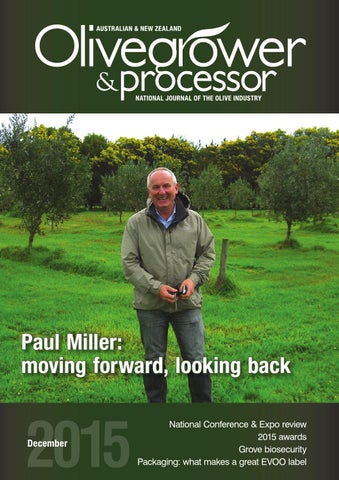
Paul Miller: moving forward, looking back
2015 December
National Conference & Expo review 2015 awards Grove biosecurity Packaging: what makes a great EVOO label
IMAGINE PERFECTION energysaving
on
adition
tr
ance
perform
ti innova
...AND DISCOVER THAT IT EXISTS ALREADY In the wide range of Pieralisi olive oil plants there is the right solution for every need. From the small one to the large one all Pieralisi plants are constructed with the same quality standards and always ensure excellent performance.
Via Don Battistoni, 1 60035 JESI An Phone +39.0731.2311 Fax +39.0731.231239 info@pieralisi.com www.pieralisi.com
D E D I C A T E D
I N N O V A T O R S
OFFICIAL AUSTRALIAN AND NEW ZEALAND AGENTS ■ NSW-QLD-ACT Town & Country Tractors & Machinery Pty. Ltd. Cr Airds Rd & Sussex St Minto Nsw 2566 Phone 02 96038600 - Fax 02 98246670 paul@tctractors.com.au Contact: Paul Blasutto, 0419 273668
■ SA W.E. Ware & Co. 19 Papagni Avenue, Newton, SA 5074 Phone 08.83653200 - Fax 08.83653187 weware@weware.com.au Contact: Marjorie Ware and Warrick Philpott
■ WA Scottech Oilfield Services 12, Monash Gate Jandakot, WA 6164 Phone 08.94177800 - Fax 08.94975470 patrick@scottech.net.au Contact: Patrick Kradolfer
Contents
In this issue... Incorporating Australian Olive Industry Journal Published by Ryan Media Pty Ltd Publisher Hartley Higgins General Manager Elizabeth Bouzoudis
December 2015 Issue 98
News Move for levy split to support marketing
4
Planning the way forward
5
China Project update
6
Olive Exposium a resounding success
8
Awards
Editorial Gerri Nelligan
Nangkita tops Fiesta! Awards … again
9
Record entries for Hunter Olive Show
9
Advertising Maria Stephenson sales@olivegrower.com.au
Double triple treat
10
New AOA national EVOO competition Chief Judge: Shane Cummins
19
Production Naomi Fry Subscriptions A one-year subscription (four issues) is $38.00, and includes a copy of the Australian and New Zealand Olive Industry Directory. Subscriptions commencing July 1 2014 will receive a copy of the 2015 Australian and New Zealand Olive Industry Directory. Please pay by cheque or credit card to Ryan Media. Visit www.olivebiz.com.au to subscribe. Circulation subs@olivegrower.com.au Contributions Articles and other contributions are welcome and will be published at the discretion of the editor. Photographs are best received as jpg files via email or should be high-quality prints or transparencies. Please indicate if articles and pictures are to be returned. Printing Lane Print & Post Adelaide Ryan Media Pty Ltd ABN 85 085 551 980 630 Regency Road, Broadview South Australia 5083 Phone +618 8369 9555 Facsimile +618 8369 9501 Website www.olivebiz.com.au ISSN 1448-5486 Conditions Opinions expressed herein are not necessarily those of the editor/publishers; information is published in good faith and we do not accept responsibility for damage which may arise from any possible inaccuracies. All rights reserved, none of the contents may be used in any other media without prior consent of the publishers. Published by Ryan Media Pty Ltd.
Feature Profile My story with the AOA - Paul Miller
13
Miller’s new role
16
New AOA President: Peter O’Meara
16
People News Gawel drops ‘chief’ from judging role
17
Olivegrower Profile Westerly Isbaih, ALTO Olives
20
AOA Conference and Expo Review 2015 AOA National Conference
22
Irrigation Ways to save water: best practices for watering trees
26
Bottling, Labelling & Packaging What makes a great EVOO label?
28
Pest & Diseases Xf disease: the importance of biosecurity practices
32
Olive Business HALAL certification for olive oil
34
Olives & Health Health round-up
36
Product & Services Rebuild option makes Ledgard the value choice
What’s on/Advertiser index
37
38
Cover: Former AOA President Paul Miller has had a change of roles, becoming the organisation’s international ambassador. Paul shares the story of his 14 years at the helm of the Australian industry in this edition of Olivegrower. Image: John Wholley. Issue 98 • December • Australian & New Zealand Olivegrower & Processor • 3
News
Gerri Nelligan
Editor
It’s a time of change for the Australian industry, with new faces and processes heralding further growth and development both nationally and on the global stage. Exciting stuff, which will build on the great work done already in ensuring the consistent quality and reputation of our locally-produced EVOO and olive products. New Zealand too has exciting projects underway, particularly with the ONZ Focus Grove Project now charging ahead. Providing practical research “in the grove”, the information which results will assist growers in increasing both quality and yield – and therefore viability. Of course some of the changes come with a little sadness and in this edition we celebrate “life changes” for two of Australia’s most respected long-term leaders, Paul Miller
Best wishes for a safe and restful festive season - the OG&P team in his role as AOA President and Richard Gawel, stepping down from the position of Chief Judge of the national EVOO competition. Both have made their mark on the industry, and heavily influenced its course along the road to quality and the respect it now holds. We are proud to be able to celebrate their contributions in this edition. Its jam-packed pages also include features on the New Zealand and Australian national EVOO and table olive competitions, the AOA National Conference and Trade Exhibition and plenty more to keep you busy throughout the holidays. Best wishes for a safe and restful festive season, and a fruitful start to the new year. Editor Gerri Nelligan and the OG&P team.
Move for levy split to support marketing We’re making great olives and EVOO in Australia – but still finding it seriously difficult to sell them. Marketing has been identified as one of the key priorities for our industry into the future, leading to a move to split the national Olive Levy into two separate funds. In August the board of the Australian Olive Association contacted both members and the wider industry to gauge support for a proposal to split the levy into separate funds for Research, Development & Extension (RD&E) and Marketing purposes. The proposal would see a proportion of the current $3 per tonne levy allocated for increased generic marketing of both the olive products produced by Australian growers and of Australia as a producer of premium extra virgin olive oil. AOA CEO Lisa Rowntree said that in the past a voluntary Consumer Awareness and Education collection mechanism existed, however this process has not resulted in sufficient funds to undertake the meaningful work needed to support and grow sales. “The consistently high quality and freshness of our local products is being recognised by consumers, but we’re only reaching a very small proportion at present,” Rowntree said. “We believe that the time is right to approach government and seek to split the levy to include a proportion of money for marketing, so we can get information and education about the quality and health benefits of Australian EVOO and olives out there to the general public. “Previous targeted marketing campaigns have been very successful, resulting in both increased understanding about the importance of freshness in EVOO quality and, importantly, increased sales for many producers. We want to grow those efforts but to do that, we need to fund them. “We’ll be marketing the Australian olive industry as a whole and olive products produced by Australian olive levy payers,
and therefore the levy is the most practical - and equitable way to do that.” Rowntree said it should be noted that the Commonwealth, via Horticulture Innovation Australia (HIA), cannot dollar-match levy funds collected for marketing; therefore the proportion of the olive levy funds collected for RD&E would continue to be dollar-matched while the marketing component would not be. “We believe, however, that there are other opportunities for marketing funds to be dollar-matched through various other Commonwealth funding initiatives,” she said. The topic was discussed at the National Olive Industry Conference and Trade Exhibition in September, following a preference call conducted prior to the event. This gave industry members the chance to support the levy split and nominate an amount to be apportioned for marketing (options of $2, $1.50 or $1 of the $3/tonne levy currently collected) or to not support the split, with all olive funds collected to remain available only for RD&E purposes. Rowntree said response to the proposal was predominantly positive, with 93% of respondents in support of the levy split. The $1.50/tonne apportionment to marketing was the most popular option. Discussion at the conference was also largely in favour of the move and the AOA is now moving forward with its approach to government, to determine whether the change is feasible. We’ll bring you updates on the proposal in coming editions of Olivegrower & Processor.
4 • Australian & New Zealand Olivegrower & Processor • December 2015 • Issue 98
News
Planning the way forward It’s busy times for the AOA board at present, with major planning and restructuring happening across the organisation. Setting it all up were three planning days held in November, covering the industry Strategic Investment Plan (SIP), formerly known as the R&D Plan, the AOA Strategic Plan (aka business plan) and olive biosecurity. AOA CEO Lisa Rowntree said all were highly constructive, comprehensive meetings, providing a great path forward for the industry. “A Strategic Investment Plan outlines where levy payers want to see their levy funds spent. The AOA’s meeting with HIA was to determine how best to ensure we get levy payer input into this process. We’ve refined how that can best happen and will be providing further information to levy payers in the near future to secure their input,” she said. “The Strategic Plan – which is what we used to call our business plan – was constructed during the planning meeting facilitated by Ian Plowman. The AOA Board members determined the goals, objectives and strategies for the Association. “The main focus was looking at where we want to be in 2020 and what measures we can take to achieve that vision. There is a real and valuable opportunity to help the Australian industry to improve its performance and build its value in the economy.” “With Xf and other issues currently hot topics, the biosecurity planning day was also a high priority. The meeting was facilitated by Alison Saunders from Plant Health Australia, and
involved both AOA directors and invited pest/disease and plant specialists from around Australia, all of whom have an interest in olive biosecurity planning. “It follows on from last year’s SARP meeting but was more focussed on the pests and diseases that we don’t want to see in Australia, and how we can help growers to keep a look out for the first signs and then what to do if something is found,” Rowntree said. “There are some pests and diseases that we already have in Australia that are not economically feasible to eradicate, which become a management issue. There are some, however, like specific strains of XF, that we don’t have and don’t want, and it is the responsibility of all growers to be vigilant. “All up, we had three very significant meetings, reaching very important conclusions about the way our organisation will operate, and interact with other governmental and specialist organisations, into the future. “Whilst the days were long, lots of good outcomes were achieved. We are fortunate that the AOA Board is made up of a good mix of large and smaller growers and service providers to the industry. The directors are intelligent, multi skilled and passionate, and we’ve been able to achieve a good and positive direction over the three planning days.” We’ll update on the planning initiatives and their outcomes in the March edition of Olivegrower & Processor.
The Board and Staff of the AUSTRALIAN OLIVE ASSOCIATION would like to thank all our wonderful members for their ongoing support. We wish you all a SAFE & MERRY CHRISTMAS and HAPPY NEW YEAR Please note the AOA office will be closed from Monday 14th December 2015 through to Monday 18th January 2016 . Emails will be checked periodically throughout this time.
Issue 98 • December 2015 • Australian & New Zealand Olivegrower & Processor • 5
News
China Project update Chris Mercer, program co-ordinator
In the June edition of Olivegrower & Processor we looked at The Olive Route, a new AOA-backed program facilitating extra virgin olive oil exports to China. Co-ordinator Chris Mercer continues our quarterly updates on how work on the program is progressing. Things are very exciting! The OL14003 project: Essential work to facilitate increased exports to China, removing roadblocks and establishing competitive advantages, is really getting into its stride. The Milestone 104 was submitted at the end of October and we are well on track for the next milestone at the end of January. The project has three sections, containing a total of nine work packages which were approved for R&D Levy funding: Qualify (7), Win (1) and Sustain (1). Below is a brief update, correct as of mid-November 2015. 1. Qualify 1.1 Producer roadshow - completed 1.2 Consumer research - completed 1.3 Export requirements to China Paul Miller has done a lot of work pulling together all the legal requirements for food and edible oils imported into China. This includes the various standards for edible oils plus olive oil in particular, as well as contaminants and residues. This work will be the foundation of our Grove Questionnaire, which will enable intelligent design of lab test requirements, tailored to each grove. I have been keeping abreast of the ever-developing e-commerce scene and have been working closely with Australia Post, who are now in the vanguard of developments. Australia Post are the only postal company worldwide to have a joint venture with China Post. This JV is called Sai Cheng and Chris has visited their facilities in Shekou, near Shenzhen. Sai Cheng have provided the project with comprehensive quotations and procedures for various e-commerce channels into China. 1.4 Phthalate infiltration research Paul Miller has also been working closely with a worldwide network of scientists trying to eliminate phthalate “noise” from laboratory measurements. This information has also been fed back to the team at Modern Olives so that they might solidify their position as one of the leading laboratories worldwide for the accurate assessment of phthalate and other contamination in olive oil. This has delayed the farm profiling work somewhat, but we are confident that we can catch that up during early 2016. 1.5 Export laboratory services The Australian Oils Research Laboratory (AORL) at Wagga Wagga has now created a series of synthetic ring samples for emulation of defects for use in sensory training. The Wagga sensory panel has also been revitalised and placed on a more sustainable footing. Coming up will be the work on costing and cost reduction considerations for export test packages.
1.6 Export Code of Practice This is still germinating. Initial thoughts were to focus on the journey “from berry to bottle”, but we might seek quality practices which are wider than that. We are also considering whether to create a “tier 2” product with a tightened specification. Input or suggestions are very welcome while we work our way through this. 1.7 Export handbook The skeleton is complete and most of the content has been assembled. It is now a question of attaching the right flesh to the right bones. The manual will probably be ready in mid-December, so the training course might best be scheduled now for January. Participants will be consulted as to their best times. 2. Win 2.1 Enable partner technologies Of the partner technologies which were identified in the original proposal, we weren’t totally happy with the thermal wrap for cold chain management. Subsequently we have identified a partner who has a superior cold chain wrapping solution and we are now working with him on postal package, carton and pallet configurations. The plan is still for export certified products to be thermally packed, before they leave the grove storeroom. 3. Sustain 3.1 Sister laboratory in China Paul Miller and AORL’s Jamie Ayton and Anna Fang have visited our prospective partner laboratory in Huangzhou, and have agreed on the program for this lab to be ready to check olive oil quality in China in time for our planned first Olive Route exports next year. We believe that not only will this provide the project with a testing and audit capability on the Chinese mainland; but also it is a step towards getting our high standards established in the official Chinese scientific community and olive oil trade. This includes the specific measurements relating to olive oil quality over time, which are an essential part of the Australian Standard. From here So we are well on our way with the ground work and everybody is working very hard to make this project tangibly successful and of benefit to all levy payers, either directly to exporters or via flow-through effects domestically. A WA producer, Chris Mercer is the president of Olives WA and a member of the AOA board. For more information on the program, contact Chris via: chris@westerngroves.com. We’ll also continue our progress updates in future editions of Olivegrower & Processor.
6 • Australian & New Zealand Olivegrower & Processor • December 2015 • Issue 98
BRAUD W O R L D ’ S #1 *
*SP-only
NEW
BRAUD 9090 X
New Harvesting Head, Perfect 80% of European work quality
Market (or s) Olive Grove use Braud
Hopper capacity
Olive Tunnel
• 2x2000 Litres • Weight repartition
• Totally respectful of the canopy and preparation for shaking
Harvest Quality
Self aligning Noria
• Olive fruit integrity • Crop cleanliness
• Trunk respect • Perfect seal
Optimized design
Ideal for “Super Intensive” olive Groves
BRAUD A
U
S
T
R
A
L
I
A
Totally Australian owned
Ring Ashley or Angelo for demonstrations or any participating New Holland dealer.
Ashley Barratt – 0419 833 606 Angelo Dicesare - 0408 856 418
Summertown Ph (08) 8139 7200 Adelaide Ph (08) 8139 7250 Narracoorte – (08) 8762 0123 www.braud.com.au
News
Olive Exposium a resounding success A fun learning experience, reflecting the field days of old while focusing on the issues currently facing the industry. That was the plan for Olive Exposium 15, a new event on the industry calendar presented by The Olive Centre, and it didn’t disappoint. Organiser Amanda Bailey said the event was exactly the gathering she’d been aiming for, bringing together a wide cross-section of industry participants to discuss the issues currently being faced. “We planned a really practical and varied program, based on the issues I hear about on a day-to-day basis. A lot of the topics reflected what my customers are asking me about, and saying they can’t find answers to,” she said. “So the focus was firmly on helping growers gain the knowledge they need to solve those problems, and to progress, change and realise greater potential from their grove and business. “The speakers responded to that challenge brilliantly, provided all that information - and way more!” Response to the event was enthusiastic, with delegates coming from across Australia and beyond, including New Zealand, Taiwan, the USA and Italy. Final numbers topped 150 on each of the two days, making for lively and interactive networking and discussion throughout the event.
The Olive Centre’s Angela Wood was one of the exhibitors at the Exposium. Image: Mike Lamond, Good Fruit & Veg.
Wagga Wagga grower Bruce Spinks during the Exposium field session. Image: Mike Lamond, Good Fruit & Veg.
Bailey said feedback post-event has been “overwhelming”, with her inbox inundated by comments like: “It was a thoroughly professionally run event with a wealth of information available”; “Program topics comprehensive, interesting and helpful. Great to see chefs/cooks as well as others. Networking was also very beneficial. A great “show” with nice touches”; and “… a good cross section of topics were covered. There was something for everyone, which is a significant achievement with such a diverse audience. I really commend your efforts to offer a genuine, independent forum to discuss how we can work together for the benefit of the total industry.” It’s no surprise, therefore, that she’s already contemplating the next one! We’ll bring you a comprehensive overview of the event in the March edition of Olivegrower.
TREEPRUNING
SLASHING
Use Ledgard products all year round in your orchard for Almonds Stone Fruit heavy pruning, light trimming, skirting & slashing. Use Ledgard products all year round in your orchard for heavy pruning, light trimming, skirting & slashing. Contact us forContact more us information, brochures, demodemo link link & dealer details. for more information, brochures, & dealer details.
PO Box 435, McLaren Vale SA 5171– Phone: 08 8323 ledgardpruning.com sales@ledgardpruning.com McLaren Vale Phone: +619001 8 8323 9001
www.ledgardpruning.com • sales@ledgardpruning.com
8 • Australian & New Zealand Olivegrower & Processor • December 2015 • Issue 98
Awards
Nangkita tops Fiesta! Awards … again Winners of the 12th Fiesta! Olive Awards, organised by Fleurieu Food, were announced in October. Nangkita Olives took out the coveted Vince Scarfo Best of Show Trophy for its Koroneiki EVOO, making it two in a row after the same oil’s win in the 2014 competition. Best Table Olive went to Finniss Estate Kalamata olives, produced by the Australian Olive Company. A new award introduced for 2015 was the Chef’s Choice oil award, which was also taken out by Nangkita Olives’ Koroneiki. Recognising the versatility of olive oil in the kitchen, the award involved local chefs sampling the entries and selecting their preferred style. The people’s choice Punter’s Pick awards from the Willunga and Victor Harbor Farmer’s Markets were both won by Trainor Frantoio Oil, a first time entrant, while Best Packaged Oil went to Primo Estate Joseph First Press. Chief judge Briony Liebich said the competition continues to grow in recognition and importance among the region’s producers. “This year saw a doubling of the entries received for the 2014 competition, with 41 oils and 22 table olive products entered,” she said. “Judges awarded five Gold, 14 Silver and 15 Bronze
Chief judge Briony Liebich handed over a bundle of awards to Michael Harbison’s Nangkita Olives, which took out the Fleurieu Fiesta! Best of Show award for the second year in the row for its Koroneiki EVOO.
medals in the olive oil classes, with two Gold, six Silver and four Bronze medals awarded in the olive and paste categories, reflecting both the consistently high quality of Fleurieu olive products and the exceptional quality of the 2015 harvest across the region.”
Fleurieu Fiesta major awards Vince Scarfo Trophy for Best in Show EVOO - Nangkita Olives Koroneiki Emmanuel Giakoumis Award for Best Table Olives - Australian Olive Company Finniss Estate Kalamata Willunga Farmer’s Market Punter’s Pick EVOO - Trainor Frantoio Victor Harbor Farmer’s Market Punter’s Pick EVOO - Trainer Frantoio Olives SA Best Packaged Extra Virgin Olive Oil - Primo Estate Joseph First Press
Record entries for Hunter Olive Show Organisers of the Hunter Olive Show had a busy time this year, with a record number of entries received for the 2015 competition. An increase of more than 25% from 2014 saw entries from across Australia for every category, totalling 45 olive oils, 28 table olives, seven tapenades and three soaps. Convenor Alan Smith said that, as the only regional show in NSW, the competition aims to be affordable and provide quality feedback to entrants, no doubt one of the reasons for its growing popularity. Smith noted that, while local producers once again did well, this year’s winners also included many outside the Hunter Valley, reflecting the region’s “poorer season”. Head olive oil judge Peter Olson said quality was impressive
this year, however, with an improvement in the mild class and consistent high quality in the other classes. A total of 26 medals were awarded. Table olive head judge Steve Mitchell said the wide range of varieties in all classes and a generally good standard of entry “challenged the judges and made for a very interesting and enjoyable day”, with 27 of the 28 entries receiving awards, including four gold medals from three classes. The Best of Show award was a tight and difficult decision between four entries, no doubt reflecting the growing emphasis on table olive production within the local industry. Full results: www.hunterolives.asn.au.
2015 major awards Pieralisi and Town & Country Trophy for Most Successful Exhibitor - Alto Olives, Crookwell, NSW The Olive Centre Trophy for Best Olive Oil of Show - Paringa Ridge, Mornington Peninsula, Victoria Hunter Bottling Company Trophy for Best Olive Oil of Show from Hunter Valley Fruit - Adina Vineyard and Olive Grove, Hunter Valley Ace Ohlsson Trophy for Best Infused Oil of Show - Adina Vineyard & Olive Grove, Hunter Valley Adina Vineyard & Olive Grove Trophy for Best Table Olive of Show - Bellbird Premium, Hunter Valley Plasdene Glass-Pak Trophy for Best Table Olive of Show from Hunter Valley Fruit - Bellbird Premium, Hunter Valley Hunter Irrigation and Water Solutions Trophy for Best Tapenade or Olive Spread of Show - Adina Vineyard and Olive Grove, Hunter Valley. Issue 98 • December 2015 • Australian & New Zealand Olivegrower & Processor • 9
Awards
Double triple treat Winning Best of Show three times is a remarkable occurrence but two producers doing it in our respective national industry competitions is, let’s face it, seriously freaky. But that’s exactly what happened at the 2015 AOA and Olives NZ National EVOO Competitions, with Tasmania’s Cradle Coast Olives and Akaroa’s Robinsons Bay both taking the coveted top award for the third time. Given this phenomenon, we felt the need to look closer at just how these producers are achieving such consistently superior results – and luckily, they were happy to share some of their ‘secrets’ with fellow Olivegrower readers. Let’s start with a bit of background on each producer. The producers Robinson’s Bay, at Akaroa on New Zealand’s Banks Peninsula, is owned by Chris and Annette Moore, who also run an associated bed & breakfast business, The Olive Grove. They purchased the established grove in 2006 and produce EVOO, along with a range of infused olive oils and a small amount of table olives. Cradle Coast Olives is owned and operated by Carol and Tony O’Neil, who planted the first olive trees on their 15 hectare property, at Abbotsham on Tasmania’s north-west coast, more than 15 years ago. They produce a range of extra virgin olive oils, which they process themselves at their boutique contract processing facility. The winning oils While both producers won Best of Show for the third time this year, neither gained all three wins with exactly the same oil. Robinsons Bay’s winners – all blends - have seen the greater variation. “It’s changed every year. We’ve always done a blend, and when you blend you get greater complexity and can blend in different flavour profiles,” Chris Moore said. “We have five different varieties on the grove - Manzanillo, Nabali, Frantoio, Leccino and Barnea – so each year the flavour profile is slightly different, depending on the season. “Over the past five years we’ve used Manzanillo oil as our base and then added in one or two of the others. Never more than three, though, as any more than that and it’s too complex, with the flavours competing with one another. We’ve found the Manzanilla takes up other flavours quite easily, whereas other oils don’t. “This year we added Nabali and a wee bit of Barnea, mainly for its butteriness. Cradle Coast’s winners, on the other hand, were almost triplets – just not quite all identical. “They were all the same varietal – South Australian Verdale – from our grove,” Carol O’Neil said. “In 2007 and this year it was unblended but in 2011 there was just a smidgeon of Paragon added.” The importance of ‘terrior’ Both producers agree that the location and climate of their groves is an important factor in the exceptional quality of their oils, although they differ in opinion on the impact of the soil. “I think where we are is very important,” Moore said. “We’re inside an extinct volcano, and the Akaroa area has a very Mediteranean climate, which no doubt plays an important part.
Cradle Coast Olive’s Carol and Tony O’Neil celebrated their third AOA Best of Show win this year, all for their South Australian Verdale varietal EVOO. Photo: Mike Lamond, Good Fruit & Veg.
“It’s a proven area for growing high quality olives and producing high quality EVOO. “I wondered about the soil, so after we won again this year I got it tested, but I got the results back and there’s nothing fantastic there. It’s just plain soil, nothing special in it at all. “We get regular rainfall through the year, though, and then it dries out around January for three to four months, which is perfect for the olives. So we don’t ever have to irrigate: the rain might be late but it won’t let you down. “We’re also close to the sea, and about 50m above sea level, so we don’t experience much in the way of frost and the night-time temperature very rarely goes to zero. “It’s just a really good climate for olives.” O’Neil, however, rates their soil well up on the importance list. “I believe our red basalt soils with heaps of organic matter give us the cutting-edge, and contribute to the complexity and harmonious balance of our oils,” she said. “Our grove sits in a valley bisected by a permanent creek – cold in winter and a heat sink in summer. Our red soil ‘ferosols’ are of
10 • Australian & New Zealand Olivegrower & Processor • December 2015 • Issue 98
Awards
world-class quality because of their free drainage and good structure. And the relatively high organic matter is a good PH buffer, so that the natural acidity is not detrimental when countered with lime applications. “So I can’t put a value on the importance of our location.” Nature AND nurture While Moore says they “don’t think we do anything different than anyone else” and O’Neil that “being not sure of what the norm is may be the secret”, each has practices they follow which they believe contribute to the consistently high quality of their oils. “Naturally we strive for best practice with every process from the paddock to the palate, and are fastidious when it comes to timeliness and hygiene when pressing,” O’Neil said. “We are not overly fussed with rigorous pruning etc, but very much strive for a biodynamic approach to fertilising, with the ultimate aim of maintaining the soil as a living organism. “In relation to processing, we attempt to maintain malaxing temperatures at 24 degrees or below. We are also fortunate in having plenty of top quality spring water
Chris and Annette Moore won their third ONZ EVOO Competition Best of Show award this year with their Robinson’s Bay’s Blend EVOO. Photo: Akaroa Mail.
Issue 98 • December 2015 • Australian & New Zealand Olivegrower & Processor • 11
Awards
available for irrigation and for washing etc. when processing. “Best practice cannot be overrated – there are no short cuts when it comes to harvesting and processing. Some might call us fanatical, we call it fastidious.” The Moores don’t process their own olives but have a similar approach to grove management – although with a major change around harvest time this year. “To be honest, I do as little as possible in the grove and let nature take its course,” Moore said. “For fertiliser, we have sheep in the grove for five months a year. They come out six months before harvest. “But this year we had our grove machine harvested for the first time. It was fantastic: made a huge difference to our physical well-being and benefitted our production as well. “With only two to three people, it’s previously taken up to 24 days but we did it in four this year – each variety was done in a day. And as we harvested in such a short period of time, the oil was a lot more consistent in terms of flavour. “Even better, because we were able to start later, when the olives were at their best, our yield was up. That was great – and pretty well paid for the cost of the machine harvesting. “It was easy, cost-effective and made a huge difference to the oil flavour. I encourage people to do it all the time now.”
“At the moment we feel a little bit chuffed,” Moore said. “I say that very humbly: it is obviously a big thing to win three of the past four years, and it shows we’re doing something right, but all the other growers produce great EVOO too. We just feel part of the big family really, and have done a little bit better than some of the other people.”
Recognition So what do our winners feel about being named best among their peers nationally three times now? “It’s incredibly satisfying on the one hand but totally surreal on the other,” O’Neil said. “Hopefully it motivates other ma and pa boutique growers to persevere.”
Sage advice So what advice do they have for other producers wanting to emulate their achievements? “We’re great believers in blending, and the key thing there is to trust your own instinct and judgment, Moore said. “And machine harvesting – absolutely – for that very consistent flavour profile and increased oil yield.” “Be proud of your product and share the story. Religiously strive for best practice and results will follow,” O’Neil said.
FINEWELD STAINLESS STEEL Manufacturers of Quality equipment for the Olive Industry
The sales spin-off That recognition for their efforts is undoubtedly one of the benefits of the producers’ multiple wins but they say it’s also made an incredible difference to the usually tough task of selling their EVOO. “Our awards over the years constitute our main form of advertising, to the extent that we are now in the enviable position of not having to chase sales,” O’Neil said. While Moore said their local profile has “never been higher”. “Most people now know about Robinsons Bay. We’ve also just had a two-page article in the Christchurch press, the Zest foodie section, and had an amazing amount of feedback from that,” he said. “And over the past five years Robinsons Bay has become a trusted brand for EVOO – or dare I say it, for high quality EVOO.”
More information: www.cradlecoastolives.com.au; www.theolivegrove.net.nz.
> Storage and Settling Vats > Variable Capacity > Transportable Tanks > Olive Receival Bins > Conveyor Systems > Installations > Valves > Manways > Fittings Alto Olives’ Robert Armstrong: Best Table Olive of Show, AOA Awards.
www.fineweld.com.au CARRUM DOWNS VICTORIA 3201 Ph: 03 9775 0339 Fax 03 9775 0338
2015 AOA and ONZ National Competition Results You can find details of the major class and trophy winners of the Australian Awards on page 19, and the New Zealand Awards on page 31.
12 • Australian & New Zealand Olivegrower & Processor • December 2015 • Issue 98
Feature Profile
My story with the AOA Paul Miller – President, Australian Olive Association 2001-2015
In October AOA President Paul Miller announced he was stepping down from the position, heralding one of the most significant changes in industry leadership in years. Miller has held the position since 2001, a time of incredible growth, learning - and more recently influence – for our industry, and he’s played a major role in helping to build the reputation for guaranteed quality and trust that Australian EVOO now holds across the globe. Here Miller shares the story of his years as AOA President and his hopes for the industry into the future. I became a director of the AOA in 2000 with Ian Rowe as President and succeeded him in 2001. I was ably supported by Chuck L’Heureux as AOA Secretariat for nearly 10 years. As President I have tried to get out amongst the members as much as I could. I have really enjoyed my times at the many, many regional and state meetings over the years. I have also connected with government from the beginning and feel the AOA’s relationship with the Australian government through DAFF and RIRDC has been one of my achievements. DAFF advised me on our quality strategy for olive oil and supported it with funding and attendance at Codex Alimentarius and many other meetings. DAFF also facilitated contact with other bodies such as DFAT, Customs, the ACCC and FSANZ. Federal Ministers for Agriculture I dealt with included Peter McGauran and Tony Burke. I obtained significant funding support for the Certified Australian Extra Virgin from the former, underpinning the Fresher is Better campaign alongside the development of the olive industry Code of Practice. I am particularly proud of the Code, which six years later has expanded to cover table olives and, unlike most other such programs in the olive world, checks quality off the retail shelves. Tony Burke took these initiatives further and through work I did with DAFF co-funded the work by Standards Australia to develop the Australian Standard for Olive Oils and Olive Pomace Oils, AS 5264-2011. It was good day in July 2011 when AS 5264-2011 was published after many years of work, and this is something else that I am particularly proud of. I cannot mention AS 5264 without acknowledging the superb work by Leandro Ravetti. I chaired and steered the committee that oversaw the development of the Standard and alongside me Leandro made a lot of the really good work happen. I had a long association with RIRDC and chaired the Olive Industry R&D Committee from 2004 to 2013. Roslyn Prinsley and Alison Saunders were close colleagues in the research that gave us the knowledge we now utilize. Roslyn initiated the brilliant and sadly short-lived New Rural Industries Australia, which I chaired throughout its operation from 2009 to 2012. RIRDC and DAFF initiated two reviews of the olive industry representative structure that linked to the work on the Code of Practice. I take credit for some of this, alongside other AOA members who worked long and hard in the mid to late 2000s to create the structure we now enjoy. Since 2013 we have been with HAL (now HIA) for R&D. Coming into HAL just as it had to transition to HIA has not been easy. Lisa Rowntree has been at the front of this work and has done excellent work. In my opinion HIA has done a good job of getting to where it is now, given its difficult politically-charged brief.
We also formed and then disbanded the partnership companies Australian Olive Expo and The Olive Press along the way, and I was a director of both. They had their pluses and minuses but having the annual Conference and Expo in Canberra for five years was undoubtedly of value. Of the 15 AOA annual conferences I have presided over two are standouts to me. The first was in 2002 in Adelaide, when Lisa Rowntree and her Olives SA team put on a superb upbeat event. There was lots of optimism at that time and we had Fausto Luchetti, then Executive Director of the IOC, there. The second standout conference was in Wangaratta. This was just after AS 5264-2011 was published and also just after Tom Mueller’s book Extra Virginity was released. Tom came and gave an amazing talk, as did Manuel Paras Rosa, Dean of the University of Jaen, and Alexandra Kicenik Devarenne. Rod Mailer, a longstanding expert and colleague, introduced me to the American Oil Chemists Society (AOCS) and the Euro Fed Lipid society (EFL). I am a founding member of both the AOCS Expert Olive Oil Committee ) and the EFL Division of Olive Oil. I am also a member of the Olive Oil Commission of California Research Committee and the United States Pharmacopeia Olive Oil Authenticity Expert Panel. I represented AOCS at the pivotal EC meeting on the Authenticity of Olive Oil in 2013 in Madrid. It has been apparent since the early 2000s that the issue of quality, fraud and mis-labelling of olive oil is a global problem. DAFF advised me to tackle this complex problem from every angle I could think of and to take new opportunities as they came along. There is a misconception amongst some in new olive producing countries that this is a uniquely ‘them and us’ problem (EU/Mediterranean versus new producers), or at least that the solution lies with new producers lining up against the EU and IOC. This view is wrong. No doubt the EU has been asleep at the wheel and this has allowed this problem to grow. However, the many active producers, scientists and consumer advocates who work where it all began - where about 60% of the world’s olive oil is consumed - have not been idle. I am hopeful that recent EU activities are a sign that the EU is taking this problem more and more seriously and that Brussels is taking action. It is a big task; the large industrial packers of olive oil have become vested in a flawed and dishonest trade and they lobby and work to protect the status quo. On the other hand, the EU has immense power and recent action in Italy, work out of Brussels, and emerging dialogue and efforts in many other parts of Europe are encouraging. We have played a small but important role in this welcome change in the home of olive oil.
Issue 98 • December 2015 • Australian & New Zealand Olivegrower & Processor • 13
Feature Profile
In 2005 I attended the most important of the many meetings I have been to regarding olive oil quality and authenticity, a seminar at the Eurolipids International Fair for Fats and Oils in Frankfurt. I met Christian Gertz, heard him speak and returned very excited. I felt I had an answer. Rod Mailer and Leandro Ravetti were skeptical and far less enthusiastic. I persisted, they came around, and after years of work we have the improved technology within the Australian standard that has now made its way into the standards of South Africa and California, as well as into regular practice in the trade. Christian Gertz deserves a special mention. He is a forthright, intelligent, warm and generous scientist. In May 2008 I organized a Hot Topic Session on olive oil standards and methods at the AOCS meeting in Seattle. Later that year I managed to get TV exposure on the 7.30 Report, using the network of the AOA Board to get in front of the ABC. I have long thought that the battle to improve the value of high quality olive oil would be won or lost in the USA. I started going there frequently from about 2004, making connections and speaking at meetings including the California Olive Oil Council. The COOC came to the 2008 AOCS session in Seattle. I think this was a turning point for them. The COOC and the OOCC have utilized our information and research over the years and have kept working on olive oil standards and testing in California along with UC Davis; work we continue to support. I take some credit for the California Department of Food and Agriculture (CDFA) standard on olive oil that was put into California law last year. I am sure this would not have happened without my work in the USA and elsewhere, supported by the AOA. There are of course many people in California who worked hard to make the CDFA standard happen and it has some unique aspects, particularly on labelling, but our role in the process is clear - even our typos from AS 5264-2011 made it into the CDFA document.
In 2009 I worked on the committee of the International Society for Fat Science conference on fats and oils in Sydney. Christian Gertz attended, along with many other internationals, and we had important seminars about olive oil. Claudia Guillaume starred and Rod Mailer was chair. Things were hotting up by then and those from the EU and IOC opposed to our work did themselves no favors with their aggressive and churlish behaviour at this meeting. Rod Mailer was awarded the prestigious Farrer medal at this meeting. In Rod’s distinguished career he won several awards. I am pleased that I recommended him for some of these awards. At the institute at Wagga Wagga, the Australian Oils Research Laboratory (AORL), Jamie Ayton and his team now continue the critical work on olive oil and I enjoy working with them. We are indebted to NSW DPI for their support of the industry over the last 20 years. Early in my presidency Richard Gawel recommended moving the AOA sensory panel to AORL and this has proven a very good move. After 2012 the hard work began on the implementation of AS 5264-2011. We have worked to increase its use in the trade and to have the standard put into law. This has been a frustrating process and the work continues. It is noteworthy, however, that the major supermarkets now use AS 5264-2011 as the standard for all their private label products. This is a major achievement by the AOA. I also want to acknowledge Aldi, who I convinced to adopt both the Code of Practice and AS5264-2011 as soon as they became available. The AOA did a lot of direct consumer work in Australia after the Certified Australian Extra Virgin symbol was launched and as I worked with our team on this, it was clear this was popular and effective for both producers and consumers. Since I started as President Australian olive oil production has increased from 350 tonnes (T) in 2001 to 19,800T in 2015. We now export about 4,000T per year and consumption has risen from 30,000T in 2000 to over 40,000T in 2015. Table
14 • Australian & New Zealand Olivegrower & Processor • December 2015 • Issue 98
Feature Profile
olives consumption in Australia has risen from 14,000T in 2001 to 21,000T in 2015, with about 4,000T now produced in Australia. The standout high volume olive oil producer in Australia has become Boundary Bend, with its technical arm Modern Olives. With 70% of production and the lion’s share of the supermarket trade in Australian olive oil, this company has come to dominate the Australian scene and we are very lucky that Boundary Bend has always had such a quality focus. We are also fortunate that the people within Boundary Bend have been willing to share information and research with the AOA and the wider industry. I thank Rob McGavin, Paul Riordan, Tim Smith, Claudia Guillaume and especially Leandro Ravetti for their assistance and support over many years. This journey would not have been possible without such a supportive major producer. My global experience has enabled me to compare what we have done with other olive industry organizations. I am satisfied that the AOA under my leadership has achieved more than any other such national industry organization in the world since 2001. Of course there is plenty of room for improvement, and planning is underway, but we should not forget that we have done some very good things. The future In my opinion the main challenge and opportunity for the AOA now is to build on all the previous work to improve the profitability of its members. Global economic conditions, government indifference, climate, unfair competition, consumer ignorance and lack of producer and supply chain skills all still impact adversely on our industry. We can work directly to change some of these factors using extension, R&D and the collective skills within the AOA. We need more work in market development domestically and in export. The Australian market can improve and I am hopeful that the USA will improve as a market for quality oil as the retailers work out that there is money in genuine quality. Also that Japan will keep expanding and that China will develop as a destination for high quality niche products. Food fraud, quality and authenticity are increasingly on the agenda. Perhaps the EU will take the lead on olive oil. Australia needs to keep working internationally to help positive change occur. I think we will soon see more truthful labelling of olive oil – extra virgin, virgin and refined olive oil should become the three main consumer choices. We need to keep abreast of new technology and I believe that the AOA and the industry can do that well, in partnership with HIA. I would like to see work to generate knowledge on olive oil and food – the synergistic interaction that improves both culinary quality and the health and nutritional outcomes for human beings. Experts like Catherine Itsiopoulos are natural partners. Such work underpins the notion that olive oil is a whole food, that the whole is greater that sum of its complex health giving parts, and that the best health, nutrition and lifestyle outcomes are from consuming olive oil and other good food. We should be wary of reductionist research and PR that focuses only on individual components. The genetic manipulators will home in on this, using new technology to make other foods higher in whatever olive oil component has been singled out, but they cannot imitate the whole, its history or how olive oil works with food.
Miller on stage at the 2014 American Oil Chemists’ Society meeting in Texas, with AOCS technical director Richard Cantrill and fellow Australian Rod Mailer. Photo: AOCS.
I applaud the promotion of Australian olive oil that is about Australia’s sunlight, lifestyle and clean air and at the same time I would like to see the long wonderful Mediterranean heritage of olive oil respectfully acknowledged in the background. For the AOA, I hope it continues to have its many roles – leadership, extension, promotion, service provision, R&D, advocacy, networking and a good connection for olive producers. As I finish my term as President I think of Les Parsons, Ian Rowe, Bruce Haig and Wendy Ambler before me. I hope that they are happy with where we are now – of course never satisfied ☺ In closing this article, I thank the current Board, the many past Board and committee members and all my friends in this fine organization. In particular I thank Lisa (CEO since November 2011), Peter, Chris and Leana - the executive management team. Lisa in particular deserves special recognition for her input during all my time as President; for OSA, for the AOA, for the industry and as a trusted, forthright and capable colleague. I wholeheartedly welcome Peter O’Meara as the new AOA President with my full support. I can assure all my colleagues in the AOA that nothing has changed in my commitment to work to achieve real value for the excellent olive products made by you, the olive producers of Australia, and that I will keep doing this for as long as I can. Paul The full version of Paul’s reflections on his years as AOA President can be accessed now via Olivegrower’s online presence, the Olivebiz website. An historical snapshot of the Australian industry over the past 15 years, it’s fascinating reading – go to: www.olivebiz.com.au.
Issue 98 • December 2015 • Australian & New Zealand Olivegrower & Processor • 15
Feature Profile
Miller’s new role While he has passed on the President’s baton, Paul Miller will remain an active part of the Australian industry, taking up a new role as the AOA’s international ambassador, President Emeritus. AOA CEO Lisa Rowntree said the new position will see Miller continue to take the message about Australia’s highquality EVOO to the world, while also building on his work advocating for better standards and truth in labelling across the global industry. “It’s a voluntary position, utilising Paul’s vast experience
and international contacts, but also ensures we don’t lose all that experience and the benefits it brings to the AOA and the members we represent,” she said. “In that context, there may also be future projects we think Paul would be best to run and, where it would benefit the Australian industry, we may support him to do so. “Paul has been an integral part of taking the Australian industry to the place of quality and respect we are in now, so the opportunity to have him continue as our ambassador is ideal.”
AOA president Paul Miller attended the Senate Subcommittee on California’s Olive oil Industry and Emerging Products’ hearing on Challenges facing California’s Olive Oil Industry, along with Extra Virginity author Tom Mueller. In his new role as ambassador, he will continue to advocate for better standards and truth in labelling across the global industry.
New AOA President: Peter O’Meara Following a comprehensive process to identify the ideal candidate, the AOA board has appointed Peter O’Meara as its new President. AOA CEO Lisa Rowntree said O’Meara has a strong business pedigree and many years of experience in leadership roles and board management. “He has also owned an olive grove in the Hunter Valley for the past 12 years, and has helped provide services to hundreds of growers in the area,” she said.
“Peter is inclusive, generous and passionate about the industry. Under his leadership we will continue to position Australian olive growers as producers of high quality, safe and authentic olive products. Peter wants to see all olive growers profitable and positive about their future.” We’ll introduce Peter in more detail in the March edition of Olivegrower & Processor.
16 • Australian & New Zealand Olivegrower & Processor • December 2015 • Issue 98
People News
Gawel drops ‘chief’ from judging role After 15 years at the helm of the Australian National EVOO Competition, chief judge Richard Gawel has retired from the role. Gawel made the announcement at this year’s national industry conference, taking many – including himself – by surprise. “I actually made the decision at the awards dinner, and told them then and there,” he said. “I was counting the number of years that I’d been chairperson of the competition. I counted 15 and went “Hell, I’ve been doing this for a very long time”. “Renewal is good. It’s healthy. And I thought it was really important to have change after that long. No matter how good you are – or how good you think you are – the time comes when you need to step aside and let someone else do their thing.” Scientific approach A scientist by profession, Gawel said he joined the olive oil fraternity by chance in 1997, when he was approached to run the industry’s first official olive oil tasting panel. “At that stage I was working as lecturer in sensory science at Adel University, working with wine, and I thought “why not?”. The two have a lot in common: varietal characters, faults and defects, stylistic differences,” he said. “I thought it sounded pretty cool, so I became involved and met a whole bunch of fabulous people. That’s what kept me going. And they were the pioneers: it was great to work with them and find out what they were doing. I loved it.” Improving quality Gawel instigated awards in South Australia and nationally in 1997, developing processes aimed at improving both knowledge and quality. “Through my involvement in the wine industry I knew about the wine show system, and in the 60s and 70s in particular you could see this enormous increase in wine quality because of the peer review system from the wine shows,” he said. “In those days there were so many defective oils – although people thought they were making great oils – so I saw that we needed that sort of system. In the first national competition, for example, 40% of the oils were defective. In those days almost everything was made with a mat press, and producers back then didn’t appear to understand the importance of processing really quickly. “I knew the wine show system had worked in a positive sense for the wine industry, so thought a similar process could do the same for increasing olive oil quality.” Gawel says he believes it achieved that aim. “People’s understanding and knowledge of how to make good olive oil progressed as the industry grew and, while I can’t precisely say the show system caused it, I do think in the early days it was responsible for really large improvements,” he said. “We’d get back to small producers and give them information about the problems in their oil and what it might be due to, and they’d go away and work on those things. Now with 200 oils we get five defective oils and maybe five that are a bit dodgy. Better to best “I think we’ve gone beyond that now, though, and in recent years the focus has changed from ‘better’ to ‘best’. Now if
Gawel says the best part of the chief judge’s job is handing out the awards to the proud and deserving winners.
you look at the oils that win Best of Show they are really world class oils. Other producers are looking at those top oils and they’re now the benchmark: this is where all the good producers are at and what they’re doing, and that’s what we all have to aim to achieve. “So the olive oil competition system around Australia demonstrates that we care about quality. That it’s not about grades, we’re just worried about the top end – the world class oil vs the stunning oil – whereas in some parts of the world they’re still talking about ‘when does crap become complete crap?’. If you focus on that, that’s what the consumers will focus on, but here top end is all you hear about and all the consumer hears about, which is good. “So by running these competitions, we’re giving a message to consumers that our oil is already great and giving them confidence that it’s just going to keep getting better.” Promotional spin-off Gawel says the competitions also helped raise the public profile of locally-produced oil. “Back in 1997-98 there was no mechanism to promote the concept of extra virgin olive oil being made in Australia – Boundary Bend wasn’t even there and there were certainly no advertising campaigns. If you asked the average Australian about Australian EVOO they’d say ‘What?’. “The competitions gave us an opportunity to get Australian EVOO out there. They ran stories on the channel 7 news, and the ABC was always really good on both TV and radio, so it was a really good opportunity to promote the industry. “We didn’t design the competition for that but the end result was that people finally realised Australians were making EVOO, not just the Spanish and the Greeks. That was one of the big positives that came out of the early competitions.”
Issue 98 • December 2015 • Australian & New Zealand Olivegrower & Processor • 17
People News
Rewarding effort Along with improved oil quality, Gawel says competitions provide much-needed reward for the effort which goes into growing good olives and producing great oil. “The competition process has also encouraged producers, and given them confidence in a really difficult environment,” he said. “The number of times I’ve seen someone who’s put their retirement fund into an olive grove and they’ve won a silver medal somewhere … it’s given them confidence they’ve done the right thing. “These are hard working people giving their all and a medal really sustains them, because they know that effort is producing real quality.”
some questions, maybe taste a couple of the oils which got close and see if they want to review them. “The last thing you want is an exhibitor who’s got a really world-class oil given to a panel which is too timid about giving gold medals. So I will promote, with their permission, really high silvers to golds, if I think they’re as good as the other panels. “Some will dispute that approach but there is, and always will be, panel to panel variation and you are the only person with an overview, and therefore the ability to even that out. That’s an important part of being the chair.” The point score The actual allocation of points is also a complex process, combining set criteria with individual judgement. “To be fair, it’s a bit of both. The criteria we use in our competitions are really broad: fresh, flavoursome, complex and usable. The interpretation of those obviously varies from judge to judge,” Gawel said. “What that means is that any oil from anywhere could tick those boxes and win a gold medal – and does. At some competitions in the world there are certain varieties that win all the time but in our competitions we get the whole fruit salad of varieties winning – although some do better on average than others. “But if you keep those criteria fairly broad it allows oils from lots of different places and varietals to win if they’re grown well and made well.” The good and the bad
Gawel at work during judging of the 2014 Australian national EVOO competition.
The complexities of judging But deciding which oils get those medal is not always an easy process, especially as part of a judging panel. “The judging process and presiding process are really different. I only get to see the really good and contentious stuff,” Gawel said. “As a rank and file judge in international competitions, though, it’s as easy as the other judges let it be. You can get really good panels where everyone’s open minded and respectful of everyone else’s opinions, and that’s easy. When you’ve got one judge who’s got their opinion and that’s it, it’s really difficult. They can’t handle that someone has a dissenting point of view, and I’ve seen people walk out and go home. But you don’t see that in Australian competitions.” One reason for that, Gawel said, is the effort put into selecting our judging panels. “It’s actually a pretty easy process if you get the judging teams right,” he said. “A lot of people don’t realise that the teams are carefully selected in terms of their level of experience, and in some ways their personalities as well. You want them to work as a team, so the worst thing you can have is one dominant judge and two who are really timid: you may as well take the scores of the dominant judge and negate the other two. “If you don’t get the dynamics right, as a chairperson it’s pretty hard work: you’re always trying to break deadlocks. “You also have to get some form of consistency across the panels, and that’s another part of my job. If you see a panel with no gold medals and everyone else has three or four, there’s a reason. They may be a bit timid, say, so I’ll go along and ask
As with any job, Gawel says there are both fun – and not-sofun – elements to the role of chief judge. “The best part is handing out the awards. I say that with hand on heart because that’s what it’s all about. It’s such a great feeling when you announce an award and the winning exhibitor responds with …‘Really – me?’. “It’s just great to do that,” he said. “The least favourite is when we work out the best in classes and best in competition and I have to sit that one out. It’s a quirky Australian thing, I suppose, but in one of the first competitions I chaired I thought that I’d had quite a lot of say in the initial judging process. So when they were lined up next to each other and ranked from absolute best to less best, I realised I’d had my say already so I stepped back. And that has remained the protocol since. “Standing back at the ‘pointy end’ of the judging can be frustrating at times but that’s the way things are done. You’re itching to have your say but you don’t. “Every now and then, though, you get two oils that are tied on the ranks and so you have a count-back, and the oil with the most number one rankings wins. One year two oils got the same rank total and then the same number of ones and the same number of twos. The rules say only at that stage do I have a say – and that’s the only time I’ve ever had a chance to input.” The best As he steps down, Gawel cites the national competition itself as the greatest achievement of his years as chief judge of the national competition? “I’ve been involved in all the competitions and we started off with a pretty basic model. It’s been constantly tweaked with feedback and I think we’ve now got the most sophisticated and fairest competition in the world. I say that with confidence.
18 • Australian & New Zealand Olivegrower & Processor • December 2015 • Issue 98
People News
“I look at other shows and, particularly with the best in competition award, I think we do it better than anyone,” he said. What he’s learned And Gawel’s advice for the next chief judge? “Choose the panels carefully, because the interaction between the judges is crucial for the success of the process.” “Get involved in the organisation. Every time there’s a new AOA board they are looking for improvements– but most have not judged or been present at a competition. They all have the greatest of intentions to improve it but they don’t realise the system is actually pretty evolved: we’ve tried most things over 18 odd years, and kept what works well and discarded the rest. “So keep involved with the organisation of the competition and make sure the good ideas get through. “Most importantly, though, tread very softly because the judges are the judges. It’s very tempting to always go ‘They think this oil is great, I don’t think it’s as good’ but if you trample on them, they’ll think ‘Why are we here? Why doesn’t he just judge them all?’. Tread gently and only trample when you have to – which should be very rarely.” What next? While he’s vacating the top position, Gawel says he’ll still be a regular face on the judging scene. “I’ve already volunteered to be one of the rank and file judges at the Australian national competition, which means I’ll finally get to be part of the process in saying which get the top gongs,” he said. “It’s a breath of fresh air to be sitting at the table and doing the actual thing, and I’m more than happy to be ‘just’ a judge – it’s a lot of fun.”
New AOA national EVOO competition Chief Judge: Shane Cummins Taking up the position of Chief Judge of the AOA National EVOO Competition is Wagga Wagga producer Shane Cummins, of Long Paddock Olive Rustlers fame. AOA CEO Lisa Rowntree said Cummins is passionate advocate for the industry, and a respected judge both in Australia and New Zealand, and brings enthusiasm and new ideas to the Australian National. “Shane is one of those unassuming characters that is often overlooked. When you spend time with him and listen to his ideas, however, you quickly realise that there is a lot going on and he has a good grasp of the issues,” she said. “I’ve been very impressed with his intelligence, patience, wit and enthusiasm for olive oil judging over the years, so when the opportunity arose to appoint a new head judge, I had no hesitation in offering the role to Shane.” We’ll introduce the new Chief Judge in more detail in the March edition of Olivegrower & Processor.
2015 AOA EVOO and Table Olive Competition Results The 2015 EVOO and Table Olive Competition attracted a total of 208 entries, 24 for table olive categories and 184 in the olive oil categories. In the EVOO Competition, judges were impressed with the quality of this year’s oils, with 19 Gold, 68 Silver and 68 Bronze certificates awarded. While there were eight faulted olive oils and two were disqualified, only 18 exhibits did not receiving a medal. The 2015 Table Olive Competition also reflected the increasing skills of our local producers, with 6 Gold, 8 Silver and 7 Bronze certificates being awarded and only three exhibits not receiving a medal. Major awards across the oil categories were spread fairly evenly across Tasmania (3), New South Wales (2) and Victoria (3), while table olive awards went to South Australian (3), New South Wales (2) and Victorian (1) producers.
2015 National EVOO and Table Olive Awards major category winners Best of Show Best Table Olive of Show Best Oil of Show
Alto Olives, NSW Cradle Coast Olives, TAS
EVOO Champion of Class Awards Class 1: Delicate Class 2: Medium Class 3: Robust Class 4: Non-Packaged Class 6: Flavoured Oils
Rochford Hall Olive Oil, TAS - Koroneiki, Frantoio, Arbequina Cradle Coast Olives, TAS - SA Verdale Mount Bernard Olives, VIC - Picual New Mediterranean, NSW - Coratina Mount Zero Olives, VIC - Lime
Table Olive Champion of Class Awards Class 11: Green Olives Class 13: Black Olives Class 14: Kalamata Olives Class 15: Wild Olives Class 16: Dried Olives Class 18: Flavoured Olives
Alto Olives, NSW Talinga Grove, SA The Australian Olive Company, SA The Australian Olive Company, SA Salute Oliva VIC Alto Olives, NSW
EVOO Best of State Awards New South Wales South Australia Tasmania Victoria Western Australia
Scarlett Grove Longridge Olives Cradle Coast Olives Maluka Estate Frankland River Olive Company
Issue 98 • December 2015 • Australian & New Zealand Olivegrower & Processor • 19
Profile
Westerly Isbaih, ALTO Olives OG&P: How long have you been involved in the olive industry and what is your involvement? WI: I have been involved in the industry since 2007, which is when I underwent my course in olive oil assessment with Dr Richard Gawel, organised by the AOA. I was then invited to be an associate judge for the AOA national show, and I have been judging at various shows nationally ever since. I currently work as the sales and marketing manager for the family business, ALTO Olives. We currently have approximately 20,000 olive trees on our property and we grow 14 different varietals, mainly of European origin. We also grow the Australian colonial varietal, Hardys Mammoth. We produce premium extra virgin olive oils and naturally brined table olives. OG&P: What are your major markets and why? WI: Our major markets would currently be foodservice in NSW, Victoria and Queensland. We sell via distributors to both the foodservice and retail sectors nationally but the majority of our sales are to the foodservice sector and, due to the sheer volume of foodservice outlets in Sydney and Melbourne, much of our product ends up there. We have also dipped our toes into the export market, which we will pursue more seriously in the near future.
We need to make people want to eat EVOO all the time, because it’s delicious AND so very good for you. OG&P: How did you become involved in the olive industry? WI: I have always loved food and I actually started my career in food as a chef, but quickly decided that long hours in a commercial kitchen wasn’t exactly my cup of tea. I then went on to work in wholesale and distribution, at the high end, boutique end, of the market, for a company in Sydney that supplied gourmet, artisan produce to some of the best restaurants and retailers in town. I loved the part of the business where I got to work with some amazing Australian producers and help them get their products seen and tasted by chefs and retailers that appreciated the quality of what they were doing. It was a logical progression to focus on olives and olive oil, as my Dad had planted groves on the family farm during this time. I loved the history of the olive, the fact that really was an ancient and noble fruit that had sustained many generations of people across the globe. Also in the context of food, the fact that olive oil is delicious, healthy, sustainable to produce etc. What’s not to love? 20 • Australian & New Zealand Olivegrower & Processor • December 2015 • Issue 98
Profile
OG&P: How do you see the local industry positioned in the current global market, both in terms of its importance and comparative policies/standards? WI: I think it would be fair to say that Australia is positioned brilliantly in the current global market, and not just in EVOO production but in our food production practices in general. Our standards are very high and therefore the quality of what we tend to produce is equally high. To have four Australian oils win ‘Best of Class’ at the New York International Olive Oil Competition is indicative that we are doing something right in terms of our olive oil production and practices.
I am not sure that we have quite figured out how to market ourselves in the best way just yet. OG&P: What do you see as the most significant issues facing the Australian and/or New Zealand olive industries at present? WI: Competing with cheap, and often totally rubbish, imports. Also the lack of understanding by the general consumer about EVOO. There is still a very misguided perception that an EVOO that comes from Italy will be better than one that was produced here on Australian soil. There is so much educating that still needs to be done! OG&P: What are the best ways to tackle those issues? WI: Educate! Educate! Educate! And do it in a way that is fun, interesting and memorable. OG&P: Are there any things you think we’re doing particularly well or badly? WI: I think that in general we are making very, very good oils. I know because as a judge I get to taste so many of them. I am not sure that we have quite figured out how to market ourselves in the best way just yet. Having said that, I know that it is not an easy thing to do!
Educate! Educate! Educate! And do it in a way that is fun, interesting and memorable. OG&P: And finally, what do you see as the realistic outcomes for the industry in the near future? WI: I think realistically, both short and long term, we need to focus on what we do well, stay positive and continue fighting the good fight. There is a momentum building with consumers becoming more aware about what ‘real food’ is. EVOO is most definitely a part of that movement and it is where we should be focusing our efforts. This will become more of a prevalent issue over the next decade. Bad food is making people sick and, without being too blunt, it’s killing us. We should be viewing EVOO in the greater context of what is happening with food, ie a shift towards wholesome, natural, real foods, and away from highly processed food like products (which still unfortunately line a large amount of supermarket shelf space). EVOO is basically the poster child for ‘real food’ when you think about it. We need to make people want to eat EVOO all the time, because it’s delicious AND so very good for you. I believe that we will be able to achieve this but it takes time. Many foods and food fads have come and gone but the olive, and olive oil, has survived and even thrived through the millennia. I think there is somehow a lesson for us in that … More information: www.alto-olives.com.au.
Olive Nursery Specialising in High Density Olive Groves and propagators of tissue cultured rootstocks for fruit and nut trees.
To have four Australian oils win ‘Best of Class’ at the New York International Olive Oil Competition is indicative that we are doing something right in terms of our olive oil production and practices. OG&P: What are your thoughts on the Australian olive oil standard? WI: It is important and should be supported and promoted by us all. OG&P: What are your hopes for the industry into the future? WI: That we continue to innovate, grow and produce the best extra virgin olive oils, which will hopefully continue to receive the well deserved recognition of our global peers. That we support each other and remain positive in order to achieve the conversion of our population from refined oils, seed oils, and imported olive oils, to the beautifully produced Australian and NZ extra virgin olive oils that we are all working so damn hard to make.
Arbequina I-18 Arbosana I-43 Koroneiki
Leaders in high density groves around the world with more than 35,000 Ha
AGROMILLORA AUSTRALIA, PTY LTD PO Box 5047, Mildura Vic 3502 Please Call: Alan Saunders 0458 291 888 asaunders@agromillora.com.au
www.agromillora.com.au or www.olint.com
Issue 98 • December 2015 • Australian & New Zealand Olivegrower & Processor • 21
AOA Conference & Expo Review
2015 AOA National Conference Shane Cummins, Long Paddock Olive Rustlers
A member of Wagga Wagga-based EVOO producers the Long Paddock Olive Rustlers, Shane Cummins is also a respected olive oil judge and an interested attendee of industry ‘think-tanks’. As a change from our usual postevent run-down (somewhat factual and dry in comparison, on reading this!), here Cummins give us a wonderfully honest reflection on this year’s AOA national industry conference and expo, and the information shared – including his personal ratings of some of the major presentations. Why are we there? Off to Mildura to the national olive oil conference ... contemplating some of the changes facing the industry – the impact of water valuation, market oversupply, economics. We need a reality check. Day 1 At the venue, the Mildura Golf Club, there are plenty of familiar faces: met (AOA president) Paul Miller in the carpark, then my old mate Gayle Sheridan, executive officer of Olives New Zealand. Had the great opportunity of introducing Gayle to people she has dealt with for years and never seen in person. It was a pleasure also to see ONZ president Andrew Taylor there. Welcome to Australia, Andrew.
The Conference We sit down and start. Stand up and change tables. So much for a comfort zone! This became the mantra for two days. What a delight – so many people to meet. Once again I’m faced with the trick question of conferences: who am I, and what am I doing here? Then presenting this information to the table. Presentations World olive oil market Nick Healey from Boundary Bend presented on the world olive oil market. This was a board-level presentation and a welcome to reality. He covered world olive oil pricing and Boundary Bend’s position in the game. Score: 10/10.
22 • Australian & New Zealand Olivegrower & Processor • December 2015 • Issue 98
AOA Conference & Expo Review
Subsequently during smoko there was plenty of chatting and questions. One especially: how come Boundary Bend is giving that level of information? Proven health benefits of the Mediterranean diet Dr Catherine Itsiopoulos described the changing shape of people – we’re getting wider and rounder – and the parallel increasing cost of healthcare – it’s grown dramatically, and continues to do so. Get the connection? She looked at the positive impact on overall health of polyphenols, from extra virgin olive oil and also other foods like peas, wine, herbs and spices. In particular, why we need to upgrade from the “meat and two vegies” dietary habit and to change the ratio of meat to vegies from 1:2 to 1:4. Eating four parts vegetables to one part meat is going to provide a variety of polyphenols, and a way healthier population. Hope plenty of them come from EVOO, though. It was a brilliant, simple, flowing presentation. Score: 10/10. Pest and disease management Dr Robert Spooner Hart laid out a program for dealing with black spot. The number one message that came out of it: observation!! Buy a 1x10 hand lens (aka a magnifying glass), look and observe. Score: 10/10. Research on smoke point in olive oil Jamie Ayton from the NSW DPI oil research lab updated us on the research being carried out on the smoke point of olive oil. Smoke point is the temperature at which oil or fat produces a continuous wisp of smoke.
This was just the introduction and this is a topic to watch. Score: 10/10. The side question to this was: who in the room cooks with extra virgin olive oil? And who doesn’t? The answer was 50/50, and both sides were passionate. I, who does, took the opportunity to tell half the room that they were wrong ... and for once everyone agreed with me. Score: 5/10. How to rejuvenate groves Marcelo Berlanda talked about how to rejuvenate groves in a region – specifically, the Hunter Valley region. This was a challenging presentation. The information was based on a co-operative effort by growers in the region, which had experienced poor fruit and oil quality, and a lack of consistency. He worked through the steps needed: • prune to: reduce the canopy size and water usage; increase the leaf to wood ratio; and promote new healthy growth. • divide the grove into manageable sections. • compost on a yearly basis under the tree canopy. • improve water efficiency: sprinklers are 50% efficient, drippers 95%. • be realistic about unproductive varieties. • establish reference points and then monitor weekly. • improve overall management of the grove – get serious about it. And importantly, realise that water stress is the main limiting factor in olives – and try to deal with it. Score: 20/10.
We won’t be beaten on price
Supplying the Olive Industry 12 volt battery harvester
Tornado Harvester -
OLIVE HARVESTER Australian Distributor
• P.T.O attatchment to tractor • Fully remote controlled • Automatic umbrella opening • Automatic unloading of fruit, quick, efficient • Tornado is available complete with tractor
• • • •
netting • bottles • caps • pumps •
pruning tools harvesting equipment capping machines storage tanks
Max power 500w Attach to 12v battery
ELECTRIC PRUNER
Portable/compact net catcher for olive picking
ENOLMATIC BOTTLE FILLER Adjustable/ auto cut off Up to 150 bottle p/hr
Ph: (03) 9484 7948 – Fax: (03) 9484 7940, 377-379 Bell St, Preston VIC 3072 Email: sales@costanteimports.com.au
www.costanteimports.com.au
Issue 98 • December 2015 • Australian & New Zealand Olivegrower & Processor • 23
AOA Conference & Expo Review
Awards presentation/networking evening A river cruise. A superb meal. A presentation of Gold Medals and major awards. Some sadness in the room, however, as there was no presentation of Bronze and Silver Medals. Results had been published, but a very interesting question emerged: there is a proud moment in receiving an award among peers. Also news of the retirement of Richard Gawel as Chief Judge of the national competition. The evening was a salute to the trees, the season and the people involved. Day 2 Presentations continue The Olive Route Chris Mercer presented on The Olive Route project, aiming to facilitate exports and sales to China. Chris is magnificently on-song and technology is unfolding as he speaks. This is a story to watch and support. Score: 11/10. **Note: Pthalates is going to be an issue - more later. Recovery from natural disasters A chat around the table and collectively we had experienced most, including the unspoken economic disaster. The message which emerged was never be afraid to seek and/ or ask for advice. Score: 10/10. The effects of Pthalates in olive oil This topic was discussed by Paul Miller, Chris Mercer and Claudia Guillame (how blessed we are to have Claudia!). We
Increase your yield! Now Available - Biogras L Pectinase Enzyme from our
Spanish sister company Biocon Espanol. Specifically formulated for the cold press olive oil process, improves quality and meets all the NASAA organic oil processing requirements.
For further information and pricing contact:
Deltagen Australia Pty Ltd 31 Wadhurst Drive Boronia VIC 3155
Ph.03 98017133 Fax. 03 9887 0019
www.deltagen.com.au info@deltagen.com.au Deltagen is the Australian distributer for Megazyme Test Kits & Analytical, for the Agricultural & Food Manufacturing Sector
Deltagen Australia Affordably servicing the wine-making, brewing and olive oil industries for 20 years
Activities and table-swapping were an innovative – and popular – part of the 2015 conference program.
heard explanation of the issue and the latest research. There was questioning of the Standard in this regard and defining of the problem. More information came in Claudia’s presentation later. Score: 20/10. Organic growing methods Rowan Berecry shared his journey toward organic horticulture. Steps along the way included: compost; desalinated seawater; anions and cations (soil health); raising pH; glyphosate lock-up; brix 20-23 or brix 17. I wanted to ask Rowan for an explanation on these things but the room was buzzing. Meanwhile, I had a lovely time reciting the mantra: healthy soil, healthy plants, healthy animals, healthy people. Important takeaway messages were that soil as a biologically healthy medium is vital; and that soil as a neutral medium to plant in has to be chemically activated. Score: 20/10.
The support from exhibitors was very impressive – what a great variety and such a great range of products. Olive tree density around the world Paul Miller’s presentation on this topic was really good – and great preparation for Leandro Ravetti. First he presented on the nutritional needs of olives, and then moved into co-hosting the tour of Boundary Bend. Boundary Bend tour They had a busload of industry people questioning the concept of one-minute pruning. And then a busload of industry people witnessing one-minute pruning done in 60 seconds. We saw, or talked about: planting, re-planting, grove management, not planting in frost zones, irrigation, fertigation, scale, bogging a Colossus in an irrigation wetspot (laughter), bogging a Colossus, a dozer and a crane (more laughter), more dozers, more cranes. Then there was process management from the weighbridge and harvest management by the processing plant. We also heard that oil quality is constantly monitored by repetitive tasting by all staff, up to 20-30 times a day each. Tim and Ryan joined us for the rundown on the history of the company and the tour of the plant. We had BB’s multiskilled staff dropping everything and making us welcome.
24 • Australian & New Zealand Olivegrower & Processor • December 2015 • Issue 98
AOA Conference & Expo Review
Then we had Claudia again with a presentation on the faults of olive oil and how the tastes of the faults reflect the various parts of the process. And how their identification should help in the rapid correction of said same faults. The big comment at lunch at Boundary Bend: “Isn’t the oil beautiful”. Odd bits I’ve missed Somebody had checked to see if extra virgin olive oil is a healthy food. No, it is the healthiest food. Somebody else explained that, depending on how you cook, you may lose polyphenols while cooking – so you still have plenty! I probably never got to explain my theory that extra virgin olive oil is an ingredient, rather than just a base to cook with. And as an ingredient, it becomes a matter of how each oil fits with what you are cooking. I got a chance to speak with Jim Rowntree and told him I was enjoying the grove rejuvenation pruning story (Olivegrower & Processor, Sept 2014 and Sept 2015 editions) and the different chapters as they were wrote. Said I’m looking forward to the next instalment, waiting to hear what happens from here. **the approach Leandro was advocating was radically different: two or three cuts to drop the foliage back into the hedge line, waiting until the fruit on top of the tree pulls the branches down, then trimming the tops leaving most of the fruit. Credits And in the background all this time was Leana, working happily and with a fierce determination, successfully making sure that all went well. Thanks to the AOA. And many, many thanks to Boundary Bend, for being above and beyond expectation. Thanks also must go to all the sponsors and exhibitors, who pay for the privilege of providing us with all this incredible information. Without their support the event wouldn’t happen: let’s make sure we return the favour by utilising the great services they offer – a strong industry supports its own.
A one-minute pruning demonstration was a memorable element of the Boundary Bend tour held as part of the conference program.
All up the event was a sharp, neat, impressive act - world’s best practice. Should be repeated next year, and let’s invite the world to attend. More information and pictures from the event: www.nationaloliveconference.com.au.
Gayle Sheridan, executive officer Olives New Zealand Olives New Zealand executive officer Gayle Sheridan also attended the 2015, along with several other New Zealand producers, and was impressed with both the format and content of the event. She also shared her thoughts with Olivegrower & Processor. “The interactive way in which the conference was run encouraged discussion among the attendees and it was great to learn more about the industry from the growers themselves. “I thought Dr Catherine Itsiopoulos as keynote speaker was an inspired choice: such a compelling story about the latest health benefits research that challenges us all to use to promote EVOO. “Another inspiring presentation was on The Olive Route project for China. Very ambitious but within the reach of the Australian industry. “The support from the exhibitors was very impressive - what a great variety and such a great range of products. It made me very envious. “For me the wow factor was added to the conference with the Boundary Bend field day. Wow in every way, from the facility, the operations, the grove and management practices shared so freely, presentation on olive oil quality by Claudia Guillaume and the ‘sock it to them’ presentation by Rob McGavin. “I am hoping that Catherine and Rob will be able to come over to the Olives New Zealand conference in October 2016, as they had such exciting stories to tell.” Issue 98 • December 2015 • Australian & New Zealand Olivegrower & Processor • 25
Irrigation
Ways to save water: best practices for watering trees Responsible horticultural property owners want to know about the best ways to save water, while still keeping trees irrigated and healthy. So here are some tips for watering trees at various lifecycle stages. The effects of drought With many states still experiencing drought conditions, it’s important to recognise the role that low amounts of precipitation play in the loss of trees. During past drought situations record tree loss was noted in the affected areas, in both production and public/domestic situations. When people stopped watering their grass in response to the drought, they didn’t realise the impact that would have on their trees and the consequences were severe. Watering newly planted trees When a tree is first planted, most of its roots are still located inside the original root ball. The tree should be watered in a way that encourages the roots to grow outside of the root ball, so that the roots will become established in the soil. With a newly planted tree, watering the soil under the tree canopy will keep the root ball and its surrounding soil moist enough to boost healthy root growth. Irrigation experts recommend doing this twice per week in moderate climates, and increasing to three times per week when the weather is hot and dry. In the case of a steady rain shower that soaks the ground, this can be counted as one day of watering. Any rain that occurs is one of the best ways to save water, while still ensuring the root ball gets the moisture it needs to grow. Watering established trees The growing season for trees is late spring to early summer, and it can take up to two growing seasons for a tree to become established. Once the tree has become established, the recommended watering practices change. The tree will need less frequent watering, and the technique used to deliver the water will be adjusted as well. For established trees, water in a circular motion around the dripline. The dripline is the wide band around the outer reaches of the tree’s canopy; an established tree should be watered several feet around its dripline, to ensure that the roots (which have grown past the dripline at this point) get all the water they need. When it comes to ways to save water while irrigating established trees, here are three valuable tips: 1. Soak the entire area under the canopy. When it comes to watering trees, allowing water to soak deep into the soil near the roots is preferable to spraying the surface. Soaking the soil when watering trees will reduce the frequency of watering applications needed. 2. Avoid watering the tree trunk. Too much water on the trunk, or the area directly adjacent to the trunk, can increase the risks of tree rot and disease. Having a drip system installed can keep the water deep in the soil where it belongs – and it can deliver the preferred soaking method described above.
3. Use technology designed to reduce water waste. The right irrigation technology can help maximize water efficiency and minimize wastage. Sensor technology Utilising sensing technology is one of the best ways to save water while irrigating trees. Adding a sensor or weather station to your irrigation system can lead to more accurate watering schedules and application of water. Other tree watering technology Technology that regulates tree watering practices doesn’t end with sensors. Another important practice in tree irrigation is preventing water run-off, and there is technology that can help accomplish that too. Modern systems include an irrigation controller that allows users to automatically program their watering schedules, including any drip systems that are being used to irrigate trees. The capabilities of the controller are enhanced by adding sensing devices, such as rain sensors and weather stations that can prevent scheduled watering during or just after periods of rainfall. This effectively reduces overwatering and the chances of water wastage due to run off. It is also possible to have multiple schedules in the controller. One way this can be helpful is that users can water areas with varying water needs at the frequency that each soil type or terrain requires. There are many ways to save water, while still keeping trees irrigated for maximum health and fruit production. Use these best practices for watering your trees and you’ll be doing yourself, your grove and the environment a favour. This information was provided by Toro Australia – www.watersmart.toro.com;www.toro.com.au.
26 • Australian & New Zealand Olivegrower & Processor • December 2015 • Issue 98
EVEN FLOW TO HELP
OLIVES GROW
Toro Waterbird® PC Olive Sprinkler Engineered and manufactured in Australia to provide improved water application for under tree irrigation.
Non-PC Sprinker Features • Highly visible UV stabilised red stake provides easy identification • Self-cleaning pressure compensating mechanism provides uniform flow for undulating terrain • Aerofoil shaped frame improves distribution • Available in five colour coded flow rates (36, 47, 55, 70 and 90Lph)
For more information, phone 1300 130 898
toro.com.au
Toro Waterbird® PC Olive Sprinkler
Bottling, Labeling & Packaging
What makes a great EVOO label? Finalists in the Olives New Zealand Best Label award reflected four very different design styles, providing an ideal opportunity to explore the art of label design. It’s an important element of successful marketing which all producers can gain from, so we asked award judge Anthony Chiappin for the lowdown on what makes a great EVOO label. ONZ Best Label award Sophistication was the key to success in the Olives New Zealand Best Label award, presented as part of the 2015 New Zealand Extra Virgin Olive Awards in October. The award was introduced in 2013 to recognise excellence in label design, based on factors including shelf appeal, print quality and design, and this year was won by Waiheke Island producer Number 29. The judge Judge of the 2015 award was Anthony Chiappin, a visual artist, brand creative director and lecturer in art and design. A qualification in visual communication/ illustration and an early career in illustration and visual arts led Chiappin to a 25-year practice in graphic design, and he now also shares that experience with students at ideaschool, the Eastern Institute of Technology in Hawke’s Bay. His long and varied career has provided Chiappin with a unique perspective on label design, and the ability to apply both artistic and commercial considerations to the process. It’s no surprise, therefore, that his shortlist for the ONZ award encompassed four totally different label styles, each with
its own design strengths – and in some cases, also weaknesses. The important elements That’s because, Chiappin says, there are so many variables to good label design. “It’s difficult to summate the important elements of design as a generality, as a label needs to be specific to its market and to its brand,” he said. “Nevertheless, a well-designed label pulls in all the hallmarks of design principles such as white space and choice of font, in that it needs to communicate in an instant what it is, where it’s positioned, the quality, and the value associated with the place of making and contents. “It needs to be considered on all levels to the enth degree: positioning on bottle to suit bottle shape, colours, wrap parameters - for example single wrap or back and front - label texture and quality of stock, quality of print, brand position to market considering the graphic design components, posing the question “what do we do to make this ‘special’?”. Also how the brand name is positioned on the level of communication. Is it about terroir or something else, for example? “There are so many aspects of fine tuning, balancing the design aspects to
2015 ONZ Best Label Award judge Anthony Chiappin is a visual artist, brand creative director and lecturer in visual arts and design, based in Hawke’s Bay.
the brand. And overall, is it a brand or does it belong to a brand in itself, where ultimately the label is only a small aspect to the entirety, yet still delivers?” The front line Complicated stuff – but imperative to consider, as label design is integral to a successful brand, Chiappin says. “It’s one of the most important aspects because it is the front line generally,” he said. “Once purchased, word of mouth is everything. Yes, the contents must match
AMAZING OFFER FOR FULL PROCESS FACILITY! Dorato (Amenduni) on behalf of our client are pleased to offer a complete Amenduni Process line together with associated equipment which in total comprises a complete “Factory”of equipment from receiving hoppers through the line to storage tanks. The plant has only operated for 3 seasons totalling no more than 600 tons per season in the interim it has remained dormant. With a leased client the unit was last operated in the 2013/14 season and was inspected by us and operated with an Amenduni trained Technician for this season. The plant is in very good condition and all inspections invited. We sell the plant and equipment as is and any prospective customer should acquaint himself with the plant and equipment on offer as no warranties are given or implied. The customer should allow in his financial calculations for the cost for disassembly, removal and associated costs relating to this aspect. The complete plant as listed below is initially on offer as a complete package, this offer will hold good until the 24th December 2015 thereafter items of equipment will be sold separately and offers of interest in this aspect will be accepted in the interim. There are two photos displayed with this ad however we can send individual photos of machinery on request. The price for the package as listed below is A$490000.00 +GST or best offer based on the clauses above. No item of equipment or machinery will be allowed to be removed until the price is paid in full,or satisfactory payment guarantees are in place. The equipment is listed as follows:
• Complete Amenduni 5ton/hour Process line from Primary crusher to separator as supplied by factory.
• One forty tonne hopper with air operated gate and lazer display level warner and siren.
• One two tonne receiver hopper
• One Talc powder dispenser
• Four 25000 litre stainless steel, gas sealed, self cleaning olive oil storage tanks.
• One 4000l/p/h olive oil pump with hoses and fittings.
• One 8 metre food quality conveyor
• One Fruit washer and leaf blower
• Three 4000 litre stainless steel olive oil storage tanks
• One pip separator and piston pump
• Two 1000 litre olive oil storage tanks
• One Pip boiler and pump
• One olive fruit testing machine with crusher
• Twenty five holding bins
• One 15000 litre stainless steel olive oil mixer
• Fifteen Pickling tanks
• One bin tipper (for chep bins)
28 • Australian & New Zealand Olivegrower & Processor • December 2015 • Issue 98
With the complete plant all cables, stainless piping and valves etc etc. Further information is available by contacting the sole agent for this sale Contact Dudley Johnson email: inyati@westnet.com.au or telephone: 0417985566 or 08 95247885
Bottling, Labeling & Packaging
The NZ Best in Class line up shows the wide variety of label styles adopted by EVOO producers across the country.
that too, but a great label is something which is talked about. Either it’s beautiful and elegant and has a feeling of trust or it’s funny or irreverent in a smart way, or the message is clever. “And label designs work because they have been worked. Sometimes they work because they have come from market research, but that is not always the be all and end all – in fact, from my experience some of the best label designs have actually been destroyed by market or focus groups.”
The bottom line Of course the most important element of label design is its ability to generate sales. “Label design often is all about the bottom line, and it should be, whether it is for an FMCG (fast-moving consumer goods) product or a boutique product with a bespoke attitude,” Chiappin said. “The proof of this lies in whether the designer or brand director has looked at the target audience and understood the uniqueness of each sector.”
The food factor While some elements of label design are generic, Chiappin says the design of food labels differs from other products in many aspects. “It needs to be fresh through use of colour, choice of font and image. Also the choice of stock can affect the look and feel,” he said. “Key words need to be used which the consumer can buy into - in this case Extra Virgin and the olive varietal. Where it’s from is often important, as it
Issue 98 • December 2015 • Australian & New Zealand Olivegrower & Processor • 29
Bottling, Labeling & Packaging
denotes quality, and other factors like use by and production dates can provide important but subtle messages which the producer needs to get across. “Hand-picked and/or hand-made, if that is the case, is also important to display, either through image or text. And quite often the best food labels tell a story, as the importance of narrative is emblematic in the formula of this sector. “All of these are important considerations for EVOO labels in particular. Overall this sector is about quality and this needs to be reflected.” The ‘never do’s What doesn’t differ, however, are the things which simply shouldn’t be part of label design. “Unfortunately there are so many more examples of this than anything else,” Chiappin said. “To a trained eye, I can see when a designer of worth has touched a label or not. Here I get back to my first message: that it is important to distinguish between just a label and how a label might work within the umbrella of a brand. This is a massive discussion in itself and probably beyond this article. “So, what not to do: • never work outside of the brand philosophy; • never try to be too clever for clever’s sake: creating a simple elegant label design is the hardest thing to do, as every element is there because it has a reason for being there; • being ‘funky’ or buying into the graphic design trends of the day so it looks like everything else. How do you then differentiate based on the brand’s architecture, which either exists or you are bringing into being?
™
Rigid Products Flexible People
•
• •
Rating EVOO labels Chiappin says there are plenty of things EVOO producers are doing really well when it comes to label design, and others they are doing badly, including many of those mentioned above. He’s listed some of the most important: What we do well • •
“Number 29: Sophistication at the core of the brand look and feel. Great design and brand identity at the fore to use absolute simplicity and a change of direction in olive oil non-traditional branding. The choice of grey label on a unique choice of bottle, which instantly differentiates the case for artisinal practice at a bespoke level. In particular, I felt this design could easily be incorporated into a smaller national nonmainstream market and equally at an international level of excellence. Obvious design choice and direction.”
This product has been designed with the olive growers & processers in mind Australian conditions and requirements
What we do badly • • • •
• • • • • •
Smooth continuous flow of liquids – no splatter Reduced spills & unnecessary waste Safer pouring & improved handling Eliminate workplace hazards Avoid messy & time consuming clean-ups Suitable for food grade
Go to our website for an online demonstration Melb T: (03) 8353 6200 Qld T: (07) 3807 9779 www.classplastics.com.au
u nderstanding the worth of their product by choosing to work with design studios in the first place; a dopting some kind of brand element, whether in-house through the design studio or hiring a consultant such as myself, and understanding the worth of this extra cost. You can see this in the labels I have chosen in this year’s competition.
From this experience come labels which just simply ‘do the job’. They have great shelf presence and for EVOO, a sense of quality and sophistication.
Introducing Our Patent Ant-Glug Pouring Container
• Has been researched, developed and tested to best suit
re-branding for all the wrong reasons. Is it a case of having to or because you have a new marketing manager who thinks you have to for no specific reason or to make their mark? using black, or a home printer; and never ever use your brother-in-laws friend because he or she happens to be good at drawing or produces the newsletters at the firm he works for.”
• • • •
not caring about the label, as opposed to the potentially amazing product they have in the bottle; catering to differentiating markets with the same label. This subtlety is quite often overlooked; labels which have no shelf presence, based on the above; wrong everything, from not using a designer to handprint jobs, bad choice of type, pixelated images or images which make no sense; labels which are too garish or dominant; labels which are too hard to read or shout, which for this market is a shout in the wrong direction; bad placement on the bottle; trying too hard to be trendy and missing the boat, and overall just really badly designed, with no sense of feeling or research behind them; bad, uninviting names which have no relevance or connection to anything.
Lots to contemplate: grab your label and compare – you may find you have some work to do.
30 • Australian & New Zealand Olivegrower & Processor • December 2015 • Issue 98
Bottling, Labeling & Packaging
2015 Kiwi Labels Trophy for Best Label - finalists judging results Name
Shelf appeal
Print quality
Design
Total
Siminovich
5
4
5
14
Man ‘O’ War
5
5
4
14
Number 29
5
5
5
15
Old French Road
3
4
4
11
2015 NZ EVOO Awards This year was the 15th year of the NZ EVOO Awards and the high level of quality shone out across the entries, with all entries receiving awards - 11 Gold, 37 Silver and 21 Bronze Medals. Even further proof of that quality was the intensely close competition for the top awards: only two points separated the two highest scoring entries for Best in Show, while there was only half a point between the two highest scoring entries for Best Boutique. Whew! Head judge Peter Olson summed up this year’s outstanding production brilliantly, saying: “I have been involved in the assessment of olive oils from Australia, California and New Zealand this year. The oils entered in the New Zealand Extra Virgin Olive Oil Awards are some of the best extra virgin olive oils I have tasted this season.”
Only one point divided the judge’s scores for the Number 29 and Siminovich labels, making the ONZ 2015 Best Label award a tight competition.
2015 NZ EVOO Awards Major Category Results Best in Class Boutique Mild Single Varietal Medium Single Varietal Medium Blends Intense Blends Intense Single Varietal
Simunovich Koroneiki Gabbani Frantoio Man o’War Wairarapa Gold Old French Road Manzanilla
Commercial Medium Single Varietal Medium Blends Intense Blends Intense Single Varietal
Simunovich Frantoio Robinsons Bay Grove Blend 2015 Number 29 Loopline Picholine
Flavoured Oils Citrus
Juno Olives Lemon Agrumato
Best Processor The Olive Press
Best Label Number 29 Issue 98 • December 2015 • Australian & New Zealand Olivegrower & Processor • 31
Pests & Disease
Xf disease: the importance of biosecurity practices Concern around the spread of Olive Quick Decline Syndrome (OQDS), caused by the bacterium Xylella fastidiosa, continues across olive producing countries. In the September edition we look at the disease, how it is transmitted and measures we should be adopting to identify and minimise any outbreak. Here we update on the situation in Europe and look more closely at grove biosecurity practices, and the resources available to growers. What’s happened since? July’s confirmed discovery of Xylella fastidiosa (Xf) on the French island of Corsica was acted on immediately, with infected milkwort and any other susceptible plants within a 10 metre radius destroyed. All vegetation within a kilometre of the infection zone was inspected and the island’s 7000 hectares of olive groves were given the all-clear. New outbreaks of Xf have since been found in the AlpesMaritimes region of France, however these have been identified as a sub-species which does not affect olive trees. Protection zones have been set up around the outbreaks, and affected plants destroyed. The French government has also provided emergency funds for measures to control the outbreak and study the origin, transmission and risk factors of the disease. In November the European Commission announced new funding of €7 million, made available through the EU’s Horizon 2020 research and innovation scheme, for research into the prevention, detection, and control of Xf. Meanwhile, in Italy, the site of the initial outbreak of OQDS/ Xf which decimated groves in Puglia, the issue has become a legal one. Olivegrowers are fighting government-enforced destruction orders, aimed at eradicating the disease via removal of both infected trees and those surrounding them. Protecting our industry
when welcoming overseas visitors, good hygiene is essential to minimise the risk of introducing an exotic pest or disease to your olive grove. Australia is fortunate to be free of many olive pests that hamper olive production in other countries. If you, or a visitor, travel to rural properties or agricultural areas overseas, there is a risk that you could spread pests on your return. In particular, Peacock Spot, Olive Fly, Olive Tree Decline (Xylella fastidiosa), Olive Knot and the glassy-winged sharpshooter are olive pests and diseases that we do not want in Australia. Whether you are holidaying overseas, undertaking training activities on-farm, or part of a trade delegation, great care should be taken not to introduce exotic diseases to Australia on your return. The risk is greater if you visit farms, rural villages, participate in field days or attend markets where produce or animals are sold. Did you know: You don’t even need to bring items back with you to risk introducing a new pest to Australia? Pests and disease agents can hitch a ride on the things you are wearing. Weed seeds can lodge in clothes and shoes. Fungal spores can stick to clothes, hats, shoes, hair and personal items like watchbands.
Global travel makes transfer of the disease to our own shores a serious possibility, so it is of paramount importance that growers here forewarned and forearmed. Xf cannot currently be controlled and, given our abundant insect populations, would no doubt spread quickly if brought here to Australia and/ or New Zealand. So the answer is prevention, and we’ve got a great resource in a comprehensive, practical guide to grove biosecurity prepared by the AOA and sent out to its members.
How to protect your olive grove
Tips for travellers returning from overseas
Tips for travellers returning from overseas or for growers receiving overseas visitors. When returning to Australia after travelling overseas or
• Always comply fully with quarantine border restrictions. Declare any food, plant material or animal products that you are carrying to biosecurity officers when you arrive in Australia.
32 • Australian & New Zealand Olivegrower & Processor • December 2015 • Issue 98
Pests & Disease
• Wash clothes and clean your footwear. Where possible, this should be done before you pack to return to Australia, otherwise immediately on your return before stepping onto your olive grove. Footwear should be disinfected where possible using a disinfecting agent, diluted bleach or an alcohol/water mix. • If you have been somewhere that poses a particularly high risk, such as an area you know is infested, consider leaving your clothing and footwear behind. Better to be safe than sorry. • On arrival back in Australia wipe down non-washable items such as suitcases, camera bags, watchbands and belts with disinfectant. Remind family members, employees or others travelling with you to take these precautions too. Simple on farm Biosecurity measures Many olive growers share equipment such as tractors and harvesters, be it by lending equipment or using contractors. Sharing of equipment may increases your chances of bringing an unwanted pest/disease or weed onto your olive orchard Equipment hygiene Diseases, pests and weeds can enter a farm and be spread by equipment and vehicles, either directly or in plant material, soil or manure. It is important to maintain equipment hygiene and ensure all vehicles that visit your property are clean and well maintained. Vehicle tyres, undercarriages, grills, floors and trays can carry diseases, pests and weeds in soil, plant material and manure.
Xylella fastidiosa Xylella fastidiosa is a bacterial disease which is transmitted by xylem-sap-feeding insects. It has a very wide natural host range (more than 150 species), some of which are crops of economic relevance (including grape vines, citrus, olives and stone fruits). There are several Xylella fastidiosa (Xf) subspecies, which generally infect different hosts.
and disinfect all containers, tools and equipment, and store away from potential contaminants. The regular use of a suitable disinfectant is important and most effective when applied to a visually clean surface. Make sure surfaces to be disinfected are free from soil, manure, plant and animal residues. Contractors Before letting a contractor onto your olive orchard, take a minute to inspect their machinery. Rotting olives and leaves stuck in the crevices of machines may transmit unwanted pests and disease to your property. Ensure that the contractor has thoroughly cleaned all areas of their machine prior to entering your orchard. Invest in a high pressure cleaner if necessary. Five minutes spent inspecting machinery and cleaning your equipment could prevent costly and time consuming pest and disease/weed management in the future. Dedicated equipment for high risk areas It may be most practical to assign equipment (including tools, clothing, and footwear) for use in disease, pest and weed affected areas. The equipment used in infected or infested areas should not be re-used in clean areas, and vice versa. More information AOA Olive Biosecurity Plan:www.australianolives.com.au/ article-detail/bio-security; www.farmbiosecurity.com.au. Plant Health Australia information about exotic pest threats to olives: www.planthealthaustralia.com.au/industries/olives. What to declare when entering Australia: www.agriculture.gov.au. Information on biosecurity in New Zealand: www.gia.org.nz. Source: this information is based on a fact sheet produced for the Grains Farm Biosecurity Program and reproduced with permission of the Australian Olive Association.
Found symptoms? Vehicle access Knowing who has entered your property allows possible sources of diseases, pests or weeds to be tracked. Also, limiting the number of vehicle access points to your property will limit the potential disease, pest and weed entry sites and allow you to monitor these areas closely. Equipment hygiene and storage Bin, rakes, tools, snips, harvesting equipment and tractors can carry or harbour diseases, pests or weeds. Regularly clean
If you see anything unusual in your grove, call the Exotic Plant Pest Hotline on 1800 084 881 or the Emergency Animal Disease Watch Hotline on 1800 765 888. Alternatively, contact the AOA on (08) 8573 6545 or ceo@australianolives.com.au. Anyone finding symptoms of dieback similar to those of Xf can also send images to Sydney-based olive pest and disease expert Dr Vera Sergeeva for rapid identification of any outbreak. Email to sergeeva@tpg.com.au.
Issue 98 • December 2015 • Australian & New Zealand Olivegrower & Processor • 33
Olive Business
HALAL certification for olive oil The AOA has received enquiries about whether olive oil is required to be HALAL certified if it’s sold into Muslim countries or to Muslims in Australia. To clarify the issue for its members, the AOA spoke with HALAL Australia, and has agreed to share the official advice received. Objective There is increasing interest in whether or not olive oil needs to be HALAL certified. In this document we aim to provide advice to members of the Australian Olive Association about whether or not HALAL Certification is required. What is HALAL? HALAL simply means permitted or lawful. So when we are talking about HALAL foods it means any foods that are allowed to be eaten according to Islamic Sharia law. This means that for any food to be considered HALAL it must comply with the religious ritual and observance of Sharia law. What is HALAL certification? This means that food has been subjected to an approved certification system which guarantees to consumers that nothing in the food has any forbidden components. HALAL certificates are issued, for a fee, by a certifying body. What is haram? The opposite of HALAL is haram (forbidden). Food can be forbidden under Islam if it includes: blood; alcohol; meat or any products from a forbidden animal, including pigs and any carnivorous animals or birds of prey; meat or any products of an animal which has not been slaughtered in the correct manner in the name of Allah. Muslims must also ensure that all foods (particularly processed foods), as well as non-food items like cosmetics and pharmaceuticals, are HALAL. Frequently, these products may contain animal by-products or other ingredients that are not permissible for Muslims to eat or use on their bodies. Advice to members The AOA has sought clarification from a food technologist with HALAL Australia. According to this Food Technologist, EVOO is NOT required to be HALAL certified. The process
just another reason
of making EVOO - i.e. picking the olive, squeezing it and extracting the juice - means that there is no religious or ethical requirement that it be HALAL certified. Other considerations Islam is the world’s second largest religion with around 1.57-1.90 billion adherents, making up over 23% of the world population. If you intend to sell your Australian EVOO into Muslim countries or into regions where Muslim people are customers via a wholesaler or direct, you need to consider that Muslims may not understand how olive oil is made and may reject your product if it doesn’t have the HALAL symbol. If you choose not to carry the HALAL symbol for particular markets, it may be sufficient to spend time with your customers/wholesalers educating them about how olive oil is made, to ensure that they are comfortable that there is no need to obtain certification. Summary We are informed that Australian Extra Virgin Olive Oil is NOT required to be HALAL certified for religious and/or ethical reasons, however some buyers may still require it for certain markets. Disclaimer: The information provided is general information only, and although care has been taken to ensure the accuracy, completeness and reliability of the information provided, the AOA assumes no responsibility for the consequences of use of such information. In no event shall the AOA be liable for any direct or any indirect, special or incidental damage resulting from, arising out of or in connection with the use of the information. More information: www.HALALaustralia.com.au.
to love Fridays
To subscribe and for more information visit www.olivebiz.com.au 34 • Australian & New Zealand Olivegrower & Processor • December 2015 • Issue 98
Olive Business
Chemicals and permits for use on olives The latest list of all horticultural permits that have been issued by the Australian Pesticides and Veterinary Medicine Authority (APVMA) can be found on the APVMA website, through the Permit Search portal. The AOA is reminding all growers that prior to using any chemical, they should refer to the APVMA website to ensure the chemical has approval for use within your state. The permit information will also specify the approved application rate, application timing, and any with-holding period. The AOA has initiated many of the permit applications and renewal applications for chemicals commonly used by our industry, and funded the application fees for these, to ensure access to necessary grove treatments for its members. Residue trails In a number of cases APVMA have required that a residue decline trial be conducted. A number of trees are sprayed, and fruit is collected at days 1, 7, 14, 21 and the fruit then analysed to confirm that the residue levels decline within the approved withholding period. Such trials cost several thousand dollars for each chemical and have also been funded by the AOA on behalf of the industry. On the basis of the submitted data, the APVMA may establish a maximum residue limit (MRL). This is the legal limit which defines the maximum level of residue permitted by law on agricultural commodities. The MRL allows the
treated commodity to be legally sold in Australia and it is also a tool which allows state Departments of Agriculture to detect misuse of chemical products through compliance monitoring. The MRL may also be important in highlighting any resulting trade implications when treated commodities are destined for export markets. Maximum residue limits (MRL) The AOA also advises growers that while a pesticide may be applied legally under an APVMA minor use permit, there can be a significant delay until the MRL is gazetted by the APVMA and is then adopted in the Australia New Zealand Food Standards Code. Until this occurs the MRL may not be recognised and a zero tolerance may be imposed for residues of the pesticide resulting from its use according to the APVMA permit. In the absence of an MRL in the Food Standards Code, the use of the pesticide according to the permit may result in the suspension of the produce in the marketplace. It is therefore important for growers planning to use a particular chemical to check the FSANZ website, to confirm whether an MRL has been established by the Australia New Zealand Food Standards Code – www.foodstandards.gov.au. Further information on pesticide and chemical residues can be found on the APVMA website: apvma.gov.au.
Fraud-fighting closures feature at SIMEI
Packaging innovations and marketing for the olive oil sector were two major focal points of SIMEI 2015, held in Milano, Italy in November. Oganisers increased the emphasis on olive oil for this year’s edition of the biennial event due to the rapid growth of the sector in recent years. The olive oil program included eight workshops, covering topics including packaging innovation, technological improvements in processing machinery, preserving and transportation, oil waste management, large-scale retail trade marketing and sensory analysis. Labelling and capping were hot topics among the packaging offerings, building on the increasing need for food safety security via anti-tamper packaging. One product of particular interest was the Vega ‘anti top-
up closure’, created to ensure the content cannot be modified without the packaging being opened or altered. A simple and innovative closure which works with a proprietary bottle shape, the anti top-up function also means the container cannot be re-used after emptying. This function supports the European Mongiello Law, which bans the re-use of oil bottles in restaurants and other food service situations. And just as importantly right across the globe, the closure protects producers from the negative effects of a poor quality oil being served in a bottle bearing their brand. The manufacturer also states that because of its simple nature, the Vega closure can also be applied to normal oil bottling lines without needing to change bottling machine, bottle or capper. Vega bottle closures are distributed in Australia by Cospak www.cospak.com.au. About SIMEI SIMEI (the International Enological and Bottling Equipment Exhibition) is a biennial trade show in wine technology and the only international exhibition which presents, at the same time, machinery, equipment and products for production, bottling and packaging of liquid food and beverages. The next SIMEI event will be held from 11-15 September 2017 at Fiera Milano, Rho Milano, Italy. More information: www.simei.it.
Issue 98 • December 2015 • Australian & New Zealand Olivegrower & Processor • 35
Olives & Health
Health round-up Continuing our regular round-up of the latest relevant health research from around the world, to keep you up to date and in the know…
EVOO best for lower blood sugar and cholesterol When it comes to lowering post-meal blood sugar and cholesterol, EVOO beats other fats hands down. That’s the conclusion of a study by Italian researchers, who believe it may explain the link between the Mediterranean (Med) diet and a lower risk of cardiovascular disease. Published in the journal Nutrition and Diabetes, the study tested the effect of adding EVOO to a Med diet based on fruits, vegetables, grains, fish and only limited dairy or red meat. During two separate tests, 25 healthy people were given a typical Med lunch plus either 10g of EVOO or 10g of corn oil. Blood tests carried out before and two hours after the meals found that, as expected, blood sugar rose in all participants after eating. However, the increase in blood sugar was far less in those adding EVOO than those adding corn oil.
This reflects existing research linking EVOO to elevated levels of insulin, which helps convert glucose into energy, however it remains unclear why post-meal levels of low-density lipoprotein (LDL – aka ‘bad’ cholesterol) were also lower for the EVOO group. The researchers also found significantly higher levels of two kinds of LDL after meals with corn oil compared with those after EVOO meals. They therefore believe it confirms the ability of a Med diet containing EVOO to lower blood sugar and LDL cholesterol after meals, a process which “may be useful to reduce the negative effects of glucose and cholesterol on the cardiovascular system.” Source: www.reuters.com.
Olive leaf extract an alternative to statins A daily dose of olive leaf extract can decrease cholesterol levels similarly to the effects of statins, a new Turkish study has found. Published in Phytotherapy Research, the study evaluated the effects of the olive leaf extract on serum lipid profile and early changes of atherosclerosis in cholesterol-fed rats. Elevated levels of low-density lipoprotein (LDL) and total cholesterol are major risk factors for atherosclerotic cardiovascular disease, globally the most common cause of death. Rats were fed 2% cholesterol-enriched or standard feed for eight weeks, with some in each group also receiving oral doses of olive leaf extract at 50 or 100 mg/kg body weight/day. Others received atorvastatin at 20 mg/kg/day.
Analysis of resulting serum lipid profiles showed an increase in both total cholesterol and LDL levels in the cholesterol-fed rats, however those levels were significantly decreased in those also receiving either olive leaf extract or atorvastatin. The researchers credit the compound oleuropein, known for its anti-inflammatory, antioxidant and anti-artherogenic actions, for the effect, and concluded that “because the olive leaf extract attenuates the increased cholesterol levels, it may have beneficial effects on atherosclerosis”. Sources: Phytotherapy Research (www.onlinelibrary.wiley. com); www.nutraingredients.com.
EVOO in-utero sets up for better life New research has shown that a diet rich in olive oil has a positive effect on the development of the unborn child, and may also improve their adult brain function. In a joint study by the Federal University of Santa Maria and the University of Milan, researchers evaluated the influence of different diets on the offspring of two groups of rats. One received a diet enriched with 20% olive oil (OOED), while the other ate a standard diet (CD). Their pups were measured at major developmental stages - pregnancy, lactation and postweaning until adulthood – for oxidative and molecular brain parameters and weight. All achieved positive results for levels of prefrontal cortex and hippocampus. At adulthood, animals in the group OOED showed less brain lipid peroxidation (oxidative cell damage) and higher levels of glutathione sulfhydryl groups (protective antioxidants) in the prefrontal cortex and lower brain levels of reactive species in the hippocampus. The consumption of OOED during pregnancy
and lactation significantly also increased the prefrontal cortex expression of trophic molecules, which play an important role in neuronal plasticity and cognitive function. In addition, one group of rats had its diet changed from CD to OOED at three weeks of age and, in a particularly noteworthy finding, recorded higher weights at adulthood than those originally on the OOED diet. The research was based on existing knowledge of the significant incorporation of fatty acids into the fetal brain during rapid gestational development, and olive oil’s favorable fatty acids profile. The results saw the authors conclude that: “This research supports the evidence that a diet rich in monounsaturated fats during the prenatal period makes the brain more plastic, more dynamic and therefore, probably, more resistant to any negative environmental stresses in adult life.” Source: oliveoiltimes.com.
36 • Australian & New Zealand Olivegrower & Processor • December 2015 • Issue 98
Products & Services
Build to last, the Ledgard cutter bar can be rebuilt at a fraction of the cost of a replacement.
Rebuild option makes Ledgard the value choice
The Ledgard cutter bar is known as a product that won’t let growers down. But did you know the legendary piece of pruning equipment can be refurbished at a fraction of the cost of a replacement? “You don’t have to buy a new one. We can rebuild them,” said Ledgard Pruning Systems owner John Harnett. “A grower who has one of our bars that is getting to the end of its working life, or people who pick them up second-hand, can have them serviced. “A cutter bar costs about $6000 brand new and 90% of the build is done in our McLaren Vale workshop. But to rebuild one, even in the worst case, is only going to be about half the cost of buying a new one and if it doesn’t need new blades, the rebuild can be done for around $1000. That’s a pretty good indication of the strength and reliability of the Ledgard pruning bar and makes the Ledgard choice a very economical solution. “For bigger growers who might have been looking at their options and weren’t sure they could afford to go to a new bar, it becomes a really easy commercial decision,” Harnett said. Ledgard Pruning Services has been working with horticultural growers for 25 years, since Trevor Ledgard combined his engineering skills and his grape growing knowledge to develop a local mechanical pruning option. Specialist equipment for other industries followed as the equipment was adapted to other fruit crops. “My brother James actually helped Trevor develop the cutter bar and bought the first two machines,” John said.
The McLaren Vale company has now supplied thousands of pruning machines across Australia, and export markets have been established and grown. “There wouldn’t be an olive growing region in Australia where you wouldn’t find a Ledgard cutter bar in action,” Harnett said. Harnett knows the Ledgard cutter bar is the most expensive on the market but says its proven long life – at least 10 years and the option to rebuild should be factored into the price. “Once a bar is returned to us to be rebuilt we completely strip it. We take everything off and get it back to bare metal,” he said. “Every nut, bolt and grease nipple – every mechanical part is replaced. The blades are either resharpened or replaced, depending on their condition. And four or five days later it comes out of the paint shop looking brand new. “These machines can be rebuilt because they were designed and built to be tough, and they are certainly known as products that won’t let you down. Trevor, who designed them, is renowned as being thrifty and innovative, so his attitude is that if you need a one-inch bolt you use a one-and-a-half to give you extra strength and endurance. The competition might be half the weight and cheaper, but they don’t last like a Ledgard because they are built lighter.” The heavy-duty Ledgard Pruning system is made in a range of sizes from 0.8m to 2.4m, with pivot types to suit all grove requirements, and there are no limitations in mounting to the frames and tractors of your choice. “Designed for both winter pruning and summer trimming, the Ledgard cutter bar pruning system is simply the best dual system available,” Harnett said. For more information, contact Ledgard Pruning Services on ph: +61 08 8323 9001 or email: sales@ledgardpruning.com. **Note: Ledgard Pruning Services now also incorporates Task Automation – see their ad on page 8 of this edition**
Issue 98 • December 2015 • Australian & New Zealand Olivegrower & Processor • 37
your calendar of olive events
2016
What’s on
Jan
January 17-19 Winter Fancy Food Show – San Francisco, USA www.specialtyfood.com
Mar
March 24-27 Alimentaria International Food and Beverages Exhibition – Barcelona, Spain www.alimentaria-bcn.com
Feb
February 23-26 SALIMA 2016 International Food Fair Brno, Czech Republic www.bvv.cz/salima
Apr
April 12 Olive d’Or SIAL Canada – Quebec, Canada www.sialcanada.com April 14-16 New York International Olive Oil Competition – New York, USA www.nyoliveoil.com
February 24-26 Extra Virgin Olive Oil Savantes - Modena, Italy www.savantes.com
Mar
April 25-28 Alimentaria International Food and Beverages Exhibition - Barcelona, Spain www.alimentaria-bcn.com
March 2 World Olive Oil Exhibition – Madrid, Spain www.oliveoilexhibition.com March 4-13 Melbourne Food & Wine Festival – Melbourne, Australia www.melbournefoodandwine.com.au March 5-8 10th Olio Capitale Expo - Trieste, Italy www.oliocapitale.it March 24-28 Royal Easter Show – Auckland, New Zealand www.eastershow.co.nz
May
May 5-7 SIAL China 2016 – Shanghai, China www.sialchina.com
Jun
June 22-24 Extra Virgin Olive Oil Savantes – New York, USA www.savantes.com
July
July 15 Sthn Hemisphere entry deadline, LA International EVOO Competition – Los Angeles, USA www.fairplex.com
March 19 Olives New Zealand AGM – Masterton, New Zealand www.olivesnz.org.nz
To subscribe and for more information visit www.olivebiz.com.au
Advertiser index Client
Agromillora Australia Australian Olive Association Axis Industrial
Page 21
Fb Propak Pty Ltd
Page 40
5
Fineweld Stainless Steel
12
20
Hunter Bottling Company
31
7
Braud Australia
Client
Modern Olives
22
Costante Imports
23
Olive Oil Packaging Service
29
Class Plastics Australia
30
Pieralisi MAIP Spa
2
Deltagen Australia PTY LTD
24
Task Automation
8
Dept of Trade & Investment, Regional Infrastructure & Services NSW
11
Dorato Amenduni
28
38
Toro Australia
Australian & New Zealand Olivegrower & Processor • December 2015• Issue 98
27
w w w.olivebiz.com.au
THE PREMIER OLIVE INDUSTRY WEB PORTAL • Latest industry news • Buyers guide of industry suppliers • Industry event calendar • Online access to Olivegrower & Processor and the Olive Industry Directory
AUSTRALIAN & NEW ZEALAND
MEDIA
INDEPENDENT & AUSTRALIAN OWNED
&
NATIONAL JOURNAL OF THE OLIVE INDUSTRY
FB*PROPAK’s Olive Oil business arm (formerly AOOS Australian Olive Oil Supplies) represents leading international suppliers OMT, TEM, Della Toffola, Oliomio, SIEM, Framax and more. Our extensive range includes processors, harvesters, washing and deleafing equipment, tanks and storage, packaging and bottling, filters, pumps and accessories.
We have worked with some of Australia’s most prestigious olive oil growers and processors. Customers benefit from the latest technologies combined with the best local know-how. Our experienced in-house technicians provide specialist installation, training, after sales service and parts. To find out how FB*PROPAK can help your business, call our head office or visit our website fbpropak.com
Latest Olive Oil Packaging Bottle, bag or bulk ... we have the solution!
Efficient Olive Processing Technology Extensive technical support and back-up OMT X15 System Environmentally friendly Efficient waste stream management Minimal water usage Patented ‘No vertical separator’
Unique milling system Compact 2 and 3 phase technology Double extraction technology Easy use touch screen or manual operation
Oliomio Processor Compact & portable Single phase power Affordable & energy efficient
OMT X15 complete set up
24-26 National Boulevard, Campbellfield, VIC 3061 T +61 3 9924 4050 F +61 3 9924 4051 W fbpropak.com E info@fbpropak.com