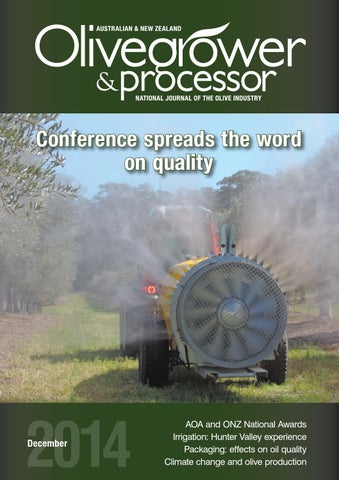
Conference spreads the word on quality
2014 December
AOA and ONZ National Awards Irrigation: Hunter Valley experience Packaging: effects on oil quality Climate change and olive production
IMAGINE PERFECTION energysaving
on
on
traditi
ance
perform
Contents
In this issue... Incorporating Australian Olive Industry Journal Published by Ryan Media Pty Ltd
ti innova
Publisher Hartley Higgins General Manager Elizabeth Bouzoudis Editorial Gerri Nelligan Advertising Chas Barter sales@olivegrower.com.au
...AND DISCOVER THAT IT EXISTS ALREADY In the wide range of Pieralisi olive oil plants there is the right solution for every need. From the small one to the large one all Pieralisi plants are constructed with the same quality standards and always ensure excellent performance.
Production Luke Westle Subscriptions A one-year subscription (four issues) is $38.00, and includes a copy of the Australian and New Zealand Olive Industry Directory. Subscriptions commencing July 1 2014 will receive a copy of the 2015 Australian and New Zealand Olive Industry Directory. Please pay by cheque or credit card to Ryan Media. Visit www.olivebiz.com.au to subscribe.
■ WA Scottech Oilfield Services 12, Monash Gate Jandakot, WA 6164 Phone 08.94177800 - Fax 08.94975470 patrick@scottech.net.au Contact: Patrick Kradolfer
Sergeeva speaks at international congress
6
Streamlining export supply chain
7
Awards Behind the scenes at the AOA 2014 National EVOO Awards
8
Profile Roger Harrison, Rash Valley Olives
11
Irrigation & Water Saving Irrigation: the Hunter Valley experience
14
Packaging Packaging influences on olive oil quality
16
AOA National Conference review National Conference a quality event
20
New Zealand 25
NZ Heart Foundation backs EVOO over coconut
27
ISSN 1448-5486
■ SA W.E. Ware & Co. 19 Papagni Avenue, Newton, SA 5074 Phone 08.83653200 - Fax 08.83653187 weware@weware.com.au Contact: Marjorie Ware and Warrick Philpott
5
Merchandise shares the EVOO secret
Website www.olivebiz.com.au
OFFICIAL AUSTRALIAN AND NEW ZEALAND AGENTS
California passes new olive oil standards
Contributions Articles and other contributions are welcome and will be published at the discretion of the editor. Photographs are best received as jpg files via email or should be high-quality prints or transparencies. Please indicate if articles and pictures are to be returned.
Phone +618 8369 9555 Facsimile +618 8369 9501
■ NSW-QLD-ACT Town & Country Tractors & Machinery Pty. Ltd. Cr Airds Rd & Sussex St Minto Nsw 2566 Phone 02 96038600 - Fax 02 98246670 paul@tctractors.com.au Contact: Paul Blasutto, 0419 273668
4
23
630 Regency Road, Broadview South Australia 5083
I N N O V A T O R S
NZ proves small is beautiful at LA competition
ONZ Awards
Ryan Media Pty Ltd ABN 85 085 551 980
D E D I C A T E D
News
Circulation subs@olivegrower.com.au
Printing Lane Print & Post Adelaide
Via Don Battistoni, 1 60035 JESI An Phone +39.0731.2311 Fax +39.0731.231239 info@pieralisi.com www.pieralisi.com
December 2014 Issue 94
Conditions Opinions expressed herein are not necessarily those of the editor/publishers; information is published in good faith and we do not accept responsibility for damage which may arise from any possible inaccuracies. All rights reserved, none of the contents may be used in any other media without prior consent of the publishers. Published by Ryan Media Pty Ltd.
Grove Management Olive production: you win some, you lose some
28
Soil amendment reduces pesticide leaching
30
Pesticides: think before you spray
31
Talking points Grove management: how to produce more than 8T/ha
32
Table Olives AOA Certified Australian Table Olive compliance arrangements
Product & Services
34
35
Olives & Health Health round-up
36
What’s on/Advertiser index
38
Cover: T ornado Town & Country Tractors demonstrated their foliar sprayer at the 2014 AOA National Conference field day Issue 94 • December • Australian & New Zealand Olivegrower & Processor • 3
News
News
Gerri Nelligan
Editor
Another year gone, and another olive harvest, both good for some and more challenging for others. While that’s just the way it is with horticulture, it makes it pretty tough going for those copping the rough times. But we’re a resilient lot in the olive industry and it’s great to see that those
challenges are increasingly being met with efforts to overcome them, predominantly via a sharing of knowledge and experience. And what better way to learn than “been there, done that” information from our peers. Along with targeted research from industry experts, it’s undoubtedly the way forward. We’ve got plenty of that inside this edition, from a run-down of the information presented at this year’s AOA national olive industry conference and expo to global research on the benefits of soil amendment. And don’t miss the great article from Hunter Valley grower Mike Wilson on the lessons he’s learned about irrigation over the past 20 years, and expert reports
on the effects of both packaging on olive oil quality, and climate change on future olive production. Lots of great stuff to read – and learn from! There’s also a wrap-up of the respective national awards competitions, a look at Olives NZ’s fabulous range of merchandising products and our usual round of columns and features. All up, plenty to keep you busy over the holiday season, while you’re (hopefully) relaxing and taking some well-deserved time out. Best wishes for a safe and happy Christmas, and a great start to the New Year, from all of us at Ryan Media. Editor Gerri Nelligan and the OG&P team.
NZ proves small is beautiful at LA EVOO Competition The New Zealand industry may be a comparatively small one but it punched well above its weight at this year’s Los Angeles Southern Hemisphere Extra Virgin Olive Oil Competition, taking out 13 Gold, four Silver and two Bronze medals. Cementing the country’s growing reputation for EVOO excellence, however, was the incredible achievement of Best of Class in five categories. The proud award winners were: Azzuro Groves Gold + 2 Silver medals Divinity Olives – Bronze Man O’War – Gold + Silver Kennedy Point – Gold Matiatia Grove – 3 Gold, 2 Best of Class + Silver Moutohora Estate – Bronze Number 29 – Gold Rangihoua Estate – 3 Gold + Best of Class Whangape Grove, Gold + Best of Class Virtuo – 2 Gold + 1 Best of Class. In summing up New Zealand’s success at the competition, we couldn’t put it better than ONZ EO Gayle Sheridan: “It’s great to see so many entries from
New Zealand with such an abundant tally of medals. “It all adds to the reputation of New Zealand as a top class producer on the global stage,” she said. … and their Aussie counterparts? Having made their mark previously at the LA competition, Australian producers were keen to keep their reputation for excellence on track too. They didn’t disappoint, gaining fantastic results once again this year with a total of 13 Gold and 13 Silver medals, and another four Best of Class awards. Australian winners were: Alto Olives – Gold + Silver Cape Schanck Estate Best of Class, 3 Gold + Silver Chapman River – 2 Best of Class + 2 Gold Cobram Estate Best Of Class, four Gold +2 Silver Oasis Olives - Gold + Silver Rylstone Olive Press – 2 Gold. Entry and result overview The 2014 Los Angeles Southern Hemisphere EVOO Competition received 139 oils from 66 producers
4 • Australian & New Zealand Olivegrower & Processor • December 2014 • Issue 94
California passes new olive oil standards In late September the California Department of Food and Agriculture (CDFA) passed a motion to approve stronger standards for olive oil produced in California. The result of months of industry lobbying and government debate, the standards place legal regulations on oil quality and purity, and clarify labelling for consumers. AOA CEO Lisa Rowntree said the move will benefit both consumers and the industry. “This decision is not only good for consumers in the USA, but also helps strengthen the competitiveness of California’s olive oil industry,” she said. “These new standards clearly communicate to consumers the quality and authenticity of product being produced in California. They will make olive oil labels understandable to the average consumer by removing misleading terms that sound positive but really indicate a lower quality product. “For example, terms such as ‘pure’, ‘light/lite’ and ‘extra light’ are now prohibited. The standard also makes it clear for consumers that there are two types of olive oil: the natural products such as extra virgin olive oil and the industrial manufactured refined olive oils. “These are important steps forward in ensuring that customers can confidently buy an olive oil based on the
information on the label.” T he move is par ticular significant to our local industry, as the standards, which took effect in California law on 26 September 2014, are based on the Australian Standard for Olive Oil and Olive Pomace Oils AS5264-2011. Currently a voluntary regulation, Rowntree said the AOA and industry members across the country are continuing to lobby to have the Australian standard mandated. “The AOA congratulates its Californian colleagues and the Government of California for their dedication to the protection of consumers. “We hope that one day the same dedication will be apparent in Australia and that our standard, which is already having positive effects in regard to both quality and label reform, will have the added strength of the law behind it.”
across seven countries. There were a total of three Best of Show awards (mild, medium and robust), 17 Best of Class awards, 48 Gold Medal awards, 45 Silver Medal awards, and 20 Bronze Medal awards. Oils from Uruguay and Chile took out the Best of Show Awards, with the Alonso Coratina from Chile also taking the Marco Mugelli Award. This year’s Southern Hemisphere competition received extra virgin olive oils from Argentina, Australia, Chile, New Zealand, Peru, South Africa and Uruguay. Between them Australian and New Zealand oils took home nine out of the 17 Best of Class Awards - an impressive result indeed. Congratulations to all of our local producers on a fantastic outcome. You made us all very proud! Issue 94 • December 2014 • Australian & New Zealand Olivegrower & Processor • 5
News
News
Sergeeva speaks at international congress
Well-known olive industry expert Dr Vera Sergeeva was recently invited to speak at the International Horticultural Congress in Brisbane. An Australian-based international plant pathology consultant, Dr Sergeeva addressed the congress on the role of botanical pesticides in
future agricultural crop protection. Sergeeva told Congress attendees that more than 800 species of plants exhibit biocide activity useful in controlling pests and diseases in horticultural crops. The essential oils and plant extracts have antifungal, antibacterial and repellant properties, key components in plant protection. She stressed that while a number of scientific reports highlight the importance of plant extracts and essential oils as botanical pesticides, current data on the topic is very limited, and that further investigation in harvest and field conditions is needed in order to progress their usage and determine both efficacy and safety for horticulture crops. Sergeeva also raised the issue of the effects of some botanical pesticide
products on biodiversity, given the generally small percentage of essential oil and/or plant extract content ‘Though some products are beneficial for pest control, they only contain 5% of essential oils from plant material’, she said. ‘We don’t know what the other 95% is comprised of, and whether those chemicals are safe for the environment or could be harmful to human populations.” Dr Sergeeva also runs a website providing information to olive growers on identification and management of pests and diseases - www.olivediseases.com. And see page 31 of this edition for her article on the issues surrounding � pesticide use.
To subscribe and for more information visit www.olivebiz.com.au
Streamlining export supply chain Agricultural export company WinWorld Australia has launched the Nourifarm Direct Platform, which it says will assist Australian farmers looking to sell their produce internationally. WinWorld managing director George Wang said the Nourifarm Direct model manages and streamlines the supply-chain from farm gate to table, supporting Australian farmers to gain traction in international markets and helping maximise returns on export sales. WinWorld say the Nourifarm Direct Platform will significantly reduce export costs, increase quality and affordability of Australian agriproducts abroad, and protect produce, via management of the entire supply chain. In a partnership with Australia Post, WinWorld will provide a monitored logistics solution into China. “Applying Australian standards of food transportation to third-party transport providers (including China
Post), Nourifarm Direct will ensure that Australian produce maintains its quality and reliability under the watchful eye of a trusted Australian organisation,” Wang said. “Current export models typically see several companies employed along the supply chain to distribute Australian agri-products overseas. The impact is twofold: not only can it substantially erode potential returns for Australian farmers, it also makes Australian exports less attractive in international markets like China where they are competing against countries offering the same products at considerably cheaper prices. “Australian produce is held in high esteem in Asian markets, but Australian exporters have often struggled to gain a strong foothold in them because of high pricing. By taking control of the end-to-end process, we will eliminate the middle suppliers that eat into Australian farmers’ hip pocket.” The Nourifarm Direct platform in fact takes ownership of the product at
the farm-gate and maintains ownership until it reaches the Chinese wholesaler, the simple structure greatly reducing the costs involved. By reducing the number of times product changes hands throughout the journey to Chinese retailers, Wang says Nourifarm Direct will also increase quality assurance of export produce and ensure the integrity of Australian produce is retained once it enters the Chinese market – for example, avoiding contamination risks by employing carriers specifically designed for, and designated to, the sole transport of produce and agriproducts. In October the Nourifarm Direct Platform delivered its debut shipment of UHT long life milk to China, and will be delivering fruits and nuts, bee products, water, cereals, olive oil, meat and wine by February 2015. For more information go to: www. winworld.com.au/nourifarm-direct� platform.
New DNA test for olive oil fraud Detectives use it, doctors use it … and now it seems the olive oil industry is making valuable use of DNA. Chemists at the US Department of Agriculture (USDA) have developed a testing regime based on oil plant DNA, aimed at ensuring that product labelled and marketed as olive oil is actually that. Along with substitution with lower grades of olive oil, fraudulent practices within the olive oil industry commonly involve the addition of cheaper-to-produce canola and sunflower oils. The USDA’s Agricultural Research Service (ARS) new testing process uses polymerase chain reaction (PCR) technology to identify the DNA – or DNAs - present in an oil, thus detecting the presence of canola and/or sunflower oil within product labelled as olive oil only. The new ARS testing regime is seen as an improvement on the previous use of DNA testing for olive oil authenticity, as its accuracy allows detection of other oils making up as little as five percent of the total content. The “DNA barcodes” used for the isolation of the various plant/oil DNAs also have a wider scope for identification, as each contains data from multiple specimens of each plant. Source: www.teatronaturale.com.
6 • Australian & New Zealand Olivegrower & Processor • December 2014 • Issue 94
Issue 94 • December 2014 • Australian & New Zealand Olivegrower & Processor • 7
Awards
Awards
Behind the scenes at the 2014 National EVOO Awards
Major results: 2014 Australian EVOO & Table Olive Competition
Best EVOO of Show - Redisland, VIC Best Table Olives of Show - A ustralian Olive Company, SA
Acknowledging the winners is an important part of any competition but so are the facts and figures behind the event, which give credence to the results and provide essential information for improvement to the entrants. So this year we’re taking a more technical look at the Australian National EVOO Awards. Flavoured oils were among the standouts at this year’s Australian National Extra Virgin Olive Oil Competition, rewarding the industry’s concerted effort to perfect these highly marketable but sometimes difficult products. In his results summary, chief judge Richard Gawel said the flavoured oil classes “continue to improve in overall quality, being true to their stated flavour and with a fresh oil base”. “In particular, there were some high quality flavoured oils of the Alluim type, which is a difficult genre to master,” he said. “Hopefully we will continue to see further improvement in this commercially important class of olive oils.” Overview of quality Gawel said the Australian National Competition is unique and provides an annual overview of quality across the industry. “It attracts entries from a diverse set of olive growing regions and from all sectors of the industry: from Australia’s largest and most technologically sophisticated producers, to some of the smallest and most passionate family owned concerns,” he said. “The competition therefore is a good indicator of the quality progression of our industry.” And it seems that across the board, that quality progression is upwards,
}
South Australian producer Australian Olive Company took top honours in the 2014 table olive competition. Collecting their Best Table Olives of Show trophy at the awards presentation were Franca and Corrado Galimberti.
The Best EVOO of Show award went to Victorian producer Redisland. Obviously excited by the win were (from left) Redisland’s Rob McGavin, Daniella Zaparenkov, Natalia Ruiz and Tim Smith.
with the major awards spread across small, large and medium producers. It’s a reflection of the increase in knowledge among our industry and “best practice” management being undertaken, no doubt as a result of both experience and the dedication of Australian growers, producers and service providers as our industry strives to forge a reputation for exceptional quality EVOO. That said, the competition is an opportunity to identify both positive and negative quality trends on an annual basis, and importantly to learn from the latter.
FINEWELD STAINLESS STEEL Manufacturers of Quality equipment for the Olive Industry > Storage and Settling Vats > Variable Capacity > Transportable Tanks > Olive Receival Bins > Conveyor Systems > Installations > Valves > Manways > Fittings
www.fineweld.com.au CARRUM DOWNS VICTORIA 3201 Ph: 03 9775 0339 Fax 03 9775 0338
8 • Australian & New Zealand Olivegrower & Processor • December 2014 • Issue 94
On the upside, Gawel noted that the average peroxide value of oils this year (6.6 meq/kg) was significantly lower than the 7.2 recorded last year, as was the UV measure of primary oxidation (1.802 in 2013, 1.76 in 2014). The average polyphenol level at 280mg/kg was at the upper end of the long term range, while the average free fatty acidity (FFA) was 0.23 % (median 0.20%), the same as in 2013. “However, the average FFA recorded at this competition has generally increased over the last five years from a very low 0.19% (median 0.15%) in 2010,” Gawel said. “From an industry perspective this trend is somewhat disappointing and the reasons are unclear, given that the distribution of entry types have not appeared to have significantly changed over this period.” Gawel also noted that a number of oils displayed an underlying muddy sediment character (smoky, salami, cheesy, barn-yard, medicinal), suggesting a lack of attention to detail during bulk storage. His comments in this regard are timely, given the focus on correct storage at the recent AOA national olive conference. }
The figures 2014 EVOO chief steward Leana Head said that, while entrant numbers were down on 2013, entry numbers were consistent with previous years. “Considering the varied crop across the country this year, we were delighted to receive 186 oil entries from 91 exhibitors,” she said. “There was a 13.4% decrease in entries compared to the 215 of 2013, however only a 1.5% decrease on 2012’s 186 entries, which indicates that 2013 was an exceptionally good year for a lot of growers. }
Best of Class EVOO Class 1 Delicate - Olive Twist, VIC Class 2 Medium - Redisland, VIC Class 3 Robust - Mount Bernard Olives, VIC Class 4 Non-Packaged - Nangkita Olives, SA Class 5 Ultra Boutique - Cradle Coast Olives, TAS Class 6A Citrus Flavoured - Alto Olives, NSW Class 6B Other Flavoured - C obram Estate, VIC Top State EVOO Awards NSW - East Ridge Olive Grove SA - Longridge Olives TAS - Ashbolt Farm VIC - Rusty Gate Estate WA - Chapman River Olives Best of Class Table Olives Class 11 Green Olives - Alto Olives, NSW Class 14 Kalamata Olives - The Australian Olive Company, SA Class 18 Specialty Olives - The Australian Olive Company, SA
CB5140
13x6
CB6004 - Dept of Trade & Investment, Regional Infrastructure & Services NSW - CB Dept of Trade & Investment, Regional Infrastructure & Services NSW NSWD02
Issue 94 • December 2014 • Australian & New Zealand Olivegrower & Processor • 9
Awards
Profile
Roger Harrison, Rash Valley Olives Roger and Shirley Harrison own Rash Valley Olives, a boutique olive grove at Palm Tree, north of Toowoomba in Queensland. They’re hands-on in their 540-tree grove and process their own awardwinning EVOO on-site.
“The average number of entries per exhibitor was the same as 2013, at 2.0, however there was a decrease from 107 exhibitors in 2013 to 91 this year. This may have been caused by the combination of earlier competition dates and the unusual weather patterns in some areas which resulted in late harvests.” Results There was, however, an increase in the percentage of medals awarded this year, with 80.1% of oils obtaining medals compared to 74.4% in 2013. That meant 149 medals awarded in total, including 75 bronze, 54 silver and 20 gold. • Class 1 - 12 oils entered: 8 medals (6 bronze, 1 silver, 1 gold) • Class 2 - 79 oils entered: 67 medals (36 bronze, 19 silver, 12 gold) • Class 3 - 43 oils entered: 35 medals (14 bronze, 17 silver, 4 gold) • Class 4 - 11 oils entered: 10 medals (5 bronze, 4 silver, 1 gold) • Class 5 - 16 oils entered: 12 medals (7 bronze, 4 silver, 1 gold) • Class 6 - 24 oils entered: 10 citrus infused, 14 ‘other’: 16 medals (7 bronze, 7 silver, 2 gold). Of the remaining oils, four failed the organoleptic analysis and two were disqualified due to FFA’s of 1.3, which exceed the 0.8 limitation for ‘extra virgin’ classification. The judging process Head described the judging process as intense, with both stewards and judges keen to ensure the integrity of the competition. “Once again, a thorough scrutiny of entries took place this year. On numerous occasions olive varieties, oil volumes,
locations of oil, labelling and classes entered were questioned and investigated to confirm entry validity,” she said. “Judges never get to see a producer’s commercial label, however as chief steward I had to sight a copy to satisfy the entry condition that all exhibits must be commercially packaged and labelled for sale in the Australian marketplace at the time of entry. Entries simply could not be accepted until a copy of the commercial label was provided. “Then once each entry was accepted, I decanted a portion of oil off for testing, sent in a plain bottle only identifiable by a unique code known only to me. This code is also used during judging and is the only identification the judges ever get to see. “At no point is anyone but myself aware of which code relates to which entered oil.” Judge Gerri And I can vouch for the transparency of the judging process itself. I was honoured to be included as an associate judge this year and, while more than a tad nervous about my technical abilities – or rather lack thereof – it was both a rewarding and enlightening experience. The expertise of the judges I worked with, and their exceptional knowledge and generosity in guiding me, was particularly notable, but no more so than the transparency and unbiased nature of the judging process. From the total anonymity (ID code aside) of the oils to the constant physical scrutiny of the judges and score sheets, the process was a professional one all the way. Our national competition is indeed a true, representative comparison of the oils entered into each class, undertaken by dedicated industry experts committed to rewarding excellence and providing valuable constructive feedback. I’ll share an account of my experiences in the March edition. Olivegrower & Processor Editor, Gerri Nelligan
10 • Australian & New Zealand Olivegrower & Processor • December 2014 • Issue 94
OG&P: How long have you been involved in the olive industry and what is your involvement? RH: We planted our small grove of 540 trees in 2002. It was planned as the first stage, with a further 400-500 trees to be planted at a future time, such that on my retirement from full-time work in Brisbane, we’d have a variety of trees and “nearly” enough to be commercially viable. Having been “retired” now for a couple of years, I’m happy not to have proceeded with stage 2 (Shirley was wise to talk me out of it!) as 500+ trees is quite enough to harvest, prune, weed and manage when there’s a workforce of only two. We’re located on the Eastern edge of the range just north of Toowoomba, at about 2100 feet elevation, and while our winters can get quite cool, we needed trees which would do well at the warmer end of the temperature scale which olive trees require. Fortunately, at the time we planted, there was sufficient knowledge of different varieties which had been planted in our climate to suggest which were likely to do best. We elected to go for oil varieties, and put in 80% Frantoio and 20% Correggiolo. Despite having warm, wet summers and cool, dry winters, they do very well here. As the trees matured, production levels also ramped up, with the exception of this year, which has been the worst we’ve encountered. This was most likely due to unsuitable conditions during pollination, severe re-shaping pruning over the past two years, and perhaps an off-year as well. We have storage capacity of 3000L and I expect to utilise a lot of that next year (my enthusiastic optimism coming through there!)
Getting our own press (an Oliomio 350) was an expensive addition to our equipment inventory which we initially had not planned on doing, however it became clear that we needed our own extraction equipment in order to have total control over our operation. OG&P: What are your major markets and why? RH: We’re waaaayyyyy too small to contemplate supermarkets, and they have overcrowded oil shelves and intimidating pricing policies anyway, so our sales are through our website, farm-gate visits, local markets and a few local deli/coffee shop type outlets. Word-of-mouth works wonders when you have a quality local product.
it became clear that we needed our own extraction equipment in order to have total control over our operation. OG&P: How did you become involved in the olive industry? RH: We’ve had the 16ha block for over 30 years, with cattle on agistment for half that time. When the cattle owners had to give the game away, we wanted to plant some sort of tree crop/plantation, and coincidentally at about that time, a flyer arrived in the mail box promoting olive growing. One thing led to another, we did tests for soil suitability, drainage, and water availability, and off we went with much excitement and perhaps a naive
expectation of how easy it was going to be to get into the olive oil business! OG&P: How do you see the local industry positioned in the current global market, both in terms of its importance and comparative policies/standards? RH: The industry in Australia is settling nicely, I think. The work ethic, capital, and enthusiasm required has sorted out many who entered and found the going too tough, and the knowledge base has expanded enormously. Australia has acquired a clean, green image as a food producer, and like the inevitable comparison with the wine industry, we’re seen, I believe, as a serious player with high standards (probably too high in some countries’ eyes). OG&P: What do you see as the most significant issues facing the Australian and/or New Zealand olive industries at present? RH: Cheap imports of varying levels of authenticity and quality is a major issue. Another issue is education - not in the schoolmaster with the cane type - but a gentle approach to inform our local customers of the differences between the plethora of confusing labels they’re confronted with, that freshness is so important, and that our extra virgin olive oils are equal to the best anywhere. Different flavour profiles and chemical make-up, perhaps, but every bit as good. We must also be vigilant, as every society includes unscrupulous individuals who seek to profit in any way they can, with no regard to the potential damage to reputation they can inflict on what is seen as a trustworthy industry. }
Issue 94 • December 2014 • Australian & New Zealand Olivegrower & Processor • 11
Profile
Even flow to help olives grow
As a small producer, we cannot compete on price, but we sure can compete on quality.
OG&P: What are the best ways to tackle those issues? RH: Random sampling and testing of olive oils, and not just imports either. With financial pressure a global phenomenon, we need to keep local producers honest too, so we don’t “shoot ourselves in the foot”. Education? Getting the right messages to children about nutrition, good eating, junk foods, benefits of EVOO etc. A lot of this is a broad approach to a healthy population which I believe could best be tackled on a Federal Government level through various
The industry in Australia is settling nicely. The work ethic, capital, and enthusiasm required has sorted out many who entered and found the going too tough, and the knowledge base has expanded enormously.
agencies, but everyone in the industry can play their part. Encourage tours of your enterprise, talk to groups, visit schools, and for producers big and small, face-to-face contact with end users at markets, food fairs, and the like is an excellent way to sell our message. OG&P: Are there any things you think we’re doing particularly well or badly? RH: Whether it’s the “Fresh Is Best” campaign, or whatever reason, my experience is that more folk are becoming very interested in what they’re putting in their mouths, and where it comes from. For EVOO producers, this is a welcome trend - to be seen to be producing a health-giving product, with the associated freshness and low foodmiles which come with that. As a small producer, we cannot compete on price, but we sure can compete on quality. OG&P: What are your thoughts on the new Australian olive oil standard? RH: When other producing country’s organisations start getting twitchy about
12 • Australian & New Zealand Olivegrower & Processor • December 2014 • Issue 94
our new standard, my take is that they resent our interference in their timehonoured way of doing things, or maybe even that they fear their members will be disadvantaged by the provisions, or even perhaps might have trouble in meeting the standard/s. OG&P: What are your hopes for the industry into the future? RH: I hope the industry can continue to supply a larger proportion of the local EVOO consumption, and that the effort required to export to new markets will pay off for those who pursue that course. OG&P: And finally, what do you see as the realistic outcomes for the industry in the near future? RH: With ongoing consumer advice and education, and continuing research into growing/extraction methods, we have many reasons to feel confident that the industry will continue to grow, and be seen as a world-class mainstream food producer. More information: www.rashvalleyolives.com.au
Toro Waterbird PC Olive Sprinkler ®
Engineered and manufactured in Australia to provide improved water application for under tree irrigation. Self-cleaning pressure compensating mechanism provides uniform flow for undulating terrain. Available in five colour coded flow rates (36, 47, 55, 70 and 90Lph).
For more information, phone 1300 130 898 or visit toro.com.au
Non-PC Sprinkler
Toro Waterbird® PC Olive Sprinkler
Irrigation & Water Saving
Irrigation & Water Saving
Irrigation: the Hunter Valley experience
irrigate. There is still the pervading feeling that ‘olives don’t need irrigating’. This seems to stem from a visit to Italy or Greece and seeing gnarled old trees in the driest of conditions. Sure, olives will survive a drought better than many trees, but to fruit and to be productive they need water. I know of one grove in the Hunter where pooling of water after the construction of a road led to one tree at the end of a row getting significantly more water than the rest of that row. The same nutrition, the same pest problems, just more water. Far from being waterlogged, it is twice the size of the rest of the row and bears a significantly bigger crop. So long as the soil can dry out, it doesn’t seem to be a big problem.
Mike Wilson
Belarna Grove, Broke Fordwich, Hunter Valley Background The Hunter Valley has a relatively young olive industry, with most of the planting taking place in the 1990s and early 2000s. This is similar to many other of the recently-emerged olive production area in Australia, where many groves were planted in that same boom time period. Now, 20 years on, we can look back at what went wrong. Irrigation and Hunter soil One of the biggest problems we have had to face and fix relates to irrigation. Abundant optimism saw many groves of around 1000 trees established on soil that was perhaps best not used for olives. The Hunter is famous for its wine and all really good soil had been identified and planted with grapes many years ago. Some fairly marginal land was also planted
with grapes, so what was left over for olives tended to be poor – heavy clay in many cases, high salt soils with low pH (typically around 5 to 5.6) with poor drainage. Soil preparation usually involved spreading lime to raise the pH, gypsum to break up the clay, ripping the soil to half a metre with a D6 dozer and discing the ameliorants in. If time permitted a cover crop would go in and be ploughed in, but not always. Water supply Fairly typically a farm dam was the water supply. A high level of suspended particles in the dam water often meant a significant filtration system was required. Water would typically be pumped underground in a 50mm main to the grove, to be split into 19mm or 25mm laterals running underground along the ripped line
where the trees were to be planted. Rainbird, Netafim or other similar spray systems were installed, and trees planted. Problems arise What could possibly go wrong? Well, assuming the filter was working properly, first cab off the rank would be algae growing inside the spray heads so every time you turn on the pump the first couple of hours were spent unclogging spray heads. Then the little plastic bits of the spray heads tend to break so need replacing, or the little black ants set up home there. Some sprays didn’t put out much water – usually a lump of hard clay pressing on the spaghetti tube, or the little barbed joiner had come loose, usually underground. Dig it up, fix it, move on to the next. What else? How about foxes biting through the dripper }
Straight from the soil to you
Plexus wireless networks put accurate, up to date soil moisture data in the palm of your hand. Plexus lets you create monitoring networks for properties of any size. Readings are viewed on the Green Brain website using your smart device or internet-connected computer. With data available 24/7, Plexus helps you replace guesswork with certainty. To find out more about how we can help you grow smarter call us on 08 8332 9044 or visit mea.com.au.
14 ME20526_130x185_PlexusMag_FA.indd • Australian & New Zealand Olivegrower & Processor • December 2014 • Issue 94 1
31/07/2014 12:25:47 PM
In-line dippers have proved to be the best option in many groves. Two runs, one either side of the row, provides water directly to the soil in a fairly continuous strip, with decent soil penetration in most cases.
tubes to get to water? Damage from pickers standing on spray heads? Next door’s cattle getting in … ... and more Then the trees started to grow – and the roots started to press on the laterals and tubes, so the irrigation stops running. Dig it up, fix it, move on. This would have all been fine, if we had understood how much water we were wasting with sprays – especially on a hot, dry and windy day! On many an occasion I had run the irrigation for a couple of hours, then dug down to see how far the water had penetrated, to discover not far at all. I learned to carry a large screwdriver to stick in the ground around the drip line – if it wouldn’t penetrate, then the soil was too dry and we needed to irrigate. Rough and ready, but it works. The move to drippers Eventually we started to move to drip lines on the ground rather than sprays. In many cases these were old vineyard drip lines (and therefore cheap or even free) and by running a line of plastic drip line a metre or so out from the trunks and soaking a whole strip directly, rather than losing it to evaporation, we started to make progress. Just be a bit more careful with the slasher, and you will be okay. Once you have un-wrapped a length of dripper pipe from a slasher blade a few times you learn that one.
In-line drippers In-line dippers have proved to be the best option in many groves. Two runs, one either side of the row, provides water directly to the soil in a fairly continuous strip, with decent soil penetration in most cases. Drippers will still block but, as there are a whole host of them in the row, the odd blocked one isn’t that big a problem. Damage from grass cutting is perhaps the most common problem with this technique but if you are prepared to keep a strip of clear soil under the trees with herbicide, and keep the drippers within this cleared area, it works pretty well. Seasonal rainfall In the Hunter we have a rainfall pattern dominated by dry winters and wet summers – the three wettest months are usually January, February and March. This isn’t so bad, as it tends to take the pressure to irrigate off in the height of summer. Not always, though: we still do get those lovely 44 degree days with a hot, dry westerly wind and humidity of about 8%. Simply, there is not much you can do other than run the irrigation overnight and hope. And it may be time to upgrade from the firefighter pump by the dam to something more reliable? Quantity for quality Perhaps the biggest problem facing growers in the Hunter is how much to
What 20 years has taught me about irrigating olives My advice to a new grower is: •
•
•
•
•
spend time getting the soil to be as good as it can be as that is really hard to fix later buy a bigger pump and filter than you think you will need, and go 3-phase electric if possible go with above ground drippers – 4 litres per hour spaced at about 300mm is fine run two lines per row (you don’t have to run both from the outset) and keep the under-tree area clear and don’t plant Manzanillo.
Mike Wilson is the owner of Belarna Grove, an olive company in Broke Fordwich NSW producing premium quality olives, oils and gourmet vinegar. For more information on Belarna Grove, and Broke Fordwich, go to: www.brokefordwich.com.au.
Issue 94 • December 2014 • Australian & New Zealand Olivegrower & Processor • 15
Packaging
Packaging
Report
Glass is a well-researched packaging material for olive oil. Dark glass provides better protection from light than clear glass, but both offer better protection for the oil than plastic materials. Clear glass has higher consumer acceptance than colored glass, but photo-oxidation takes place more easily in clear glass, so it would be advisable to either almost completely cover clear glass packages with a label or UV blocker, or to also include a cardboard case for the bottle. Disadvantages of glass include its fragility and heavy weight. Parallel comparison between different colored glass containers (i.e., amber and green) is lacking in published olive oil research. Aluminum packaging for olive oil has not been studied extensively. Aluminum provides protection from light and oxygen, but high cost can be a disadvantage. It is best to coat the interior of aluminum packages with a food-grade enamel coating to prevent toxic aluminum ions from migrating into the oil and diminishing oil quality. Tinplate cans have been recommended by some researchers because tinplate blocks light and oxygen while also offering the advantage of being lightweight. Other researchers have found tinplate to be inadequate, which may be due to some of the studies using oils that had degraded in quality while sitting on sediment. It is not advisable to refill tinplate cans because these containers corrode and release compounds over time that accelerate oxidative reactions, thus leading to a much lower shelf life for the oil.
Packaging influences on olive oil quality: A review of the literature Selina Wang,PhD, Xueqi Li, Rayza Rodrigues and Dan Flynn
Extra virgin olive oil is a fresh juice extracted from olive fruits. As with other fruit juices, the freshness and flavor quality of olive oil diminish with time, and the rate of deterioration is influenced by packaging type. To maximize shelf stability, the ideal packaging material would prevent light and air penetration, and the oils would be stored in the dark at 16 – 18 °C (61 – 64 °F). Table 1 indicates how chemical components in olive oil influence the shelf life of the oil. Table 1. How chemical components in the oil can influence shelf life Chemical component
Effect on the shelf life
Fatty acid profile
High level of polyunsaturated fats such as linoleic acid and linolenic acid shortens shelf life; high level of saturated fats such as stearic acid and palmitic acid helps to prolong shelf life.
Free fatty acidity
Free fatty acids promote oxidation and shorten shelf life.
Peroxide value
High level of peroxide value shortens shelf life.
Trace metals
Trace metals promote oxidation and shorten shelf life.
Oxygen
Oxygen promotes oxidation and shortens shelf life.
Moisture
Moisture promotes oxidation and shortens shelf life.
Phenolic content
Phenolics are antioxidants and help to prolong shelf life.
While a high quality olive oil under ideal storage conditions can be stored for months, even years, without becoming rancid, oxidation ultimately will lead to rancid flavors and aromas. There has been extensive research interest in commercial olive oil packaging that assesses impact on shelf life, especially in the past ten years. In this review, we summarize the current literature on commercial packaging for olive oil, highlighting the advantages and disadvantages of various types for oil stability, price, weight, } durability, consumer acceptance and sustainability. 16 • Australian & New Zealand Olivegrower & Processor • December 2014 • Issue 94
Stainless steel provides excellent protection from oxygen, light, humidity and microorganisms and is the best bulk storage option for olive oil producers. However, its high cost and heavy weight may make it less suitable for commercial packaging. Plastic materials have the advantages of being lightweight and durable. A major disadvantage of plastic materials is their porosity, which permits the penetration of air and humidity. Light penetration is an additional disadvantage
of clear plastics. Migration of small molecules from plastic can diminish oil quality and food safety. At one time, polyvinyl chloride (PVC) was a popular packaging material for edible oils, but these containers were supplanted by polyethylene terephthalate (PET) because harmful vinyl chloride monomers (VCM) in PVC would dissolve during storage. PET is more resistant to oxygen and fat permeability than other plastic materials. Adding radical scavengers and/ or oxygen barriers to PET will enhance protection of the oil, although these improvements would increase costs (by about 17 percent just for the oxygen barriers). Coated paperboard is highly effective in protecting olive oil quality by blocking oxygen and light. Consumer acceptance for the packaging is mixed, although the packaging is used by some high-volume brands. Bag-in-box packaging consists of a strong plastic bag (with layers of metalized film or other liners) inside of a corrugated-fiber box. The type of plastics used for the bag can influence the shelf life of the oil. Bag-in-box packaging shares similar advantages and disadvantages with coated paperboard, providing excellent protection from light and oxygen, inexpensive, lightweight, but not reusable. This packaging has been used for decades in the wine industry, though it’s becoming more common in commercial packaging for olive oil in the food service sector. It has the potential to be one of the best commercial packaging options, but has not been the topic of published research. }
Purchasing OIL CAPS made easy • Aluminium oil caps • Plastic oil caps • Pull spout pourers European and Australian made
1. Log onto www.closuresonline.com.au 2. Place your order for fast delivery
Closures Online 359 Lower Dandenong Road Dingley Vic 3172
M: +61 426 875 855 E: sales@closuresonline.com.au W: www.closuresonline.com.au
Issue 94 • December 2014 • Australian & New Zealand Olivegrower & Processor • 17
Packaging
Packaging
Table 2. Advantages and disadvantages of olive oil packaging materials Material
Advantages
Disadvantages
Colored glass (amber/green)
• Widely used in beverage and food containers and better than plastic and clear containers1 • Protection from both oxygen and light • Easy to sterilize, reused glass bottles provide cost benefits with an effective recycling system,2 eco-friendly
• Breakable and heavy: low resistance to mechanical damage, difficult in transportation and storage3 • Plastic closure may be a weak point of the package4 • Expensive
Clear glass
• Widely used in beverage and food containers • Protection from oxygen, good option for dark storage • Consumers appreciate transparent glass because they can see the oil color, some industry evidence that clear glass sells better than colored glass • Easy to sterilize, reused glass bottles provide cost benefits with an effective recycling system2, eco-friendly
• Light can penetrate thus accelerating oil oxidation – can be improved by supplying the clear glass with a cardboard case or by covering the glass with label • Breakable and heavy: low resistance to mechanical damage, difficult in transportation and storage3 • Plastic closure may be a weak point of the package4 • Expensive
Aluminum
• Can indicate a premium product • Used as aluminum alloys with Mg, Mn and Si/Mg to increase the resistance to mechanical damage5 • Protection from both oxygen and light • Best with food-grade enamel coating (usually polymeric materials)4 • Lightweight • Recyclable and eco-friendly
• Not well-studied • Toxic aluminum ions can migrate into food product and cause alterations in product quality if not enamel coated4 • More expensive than other packages
Tinplate cans
• Protection from oxygen and light • Semi-good resistance to mechanical damage3 • Used in retail (0.25 - 5 L) • Suitable for lithographic labeling5 • Lightweight and compact • Recyclable and eco-friendly
• Reusing tinplate packages can lead to corrosion as well as release compounds that accelerate oxidative reactions, thus leading to a shorter shelf life for olive oil (4 - 5 months) compared to using new cans (about 1 year)6 • Some studies showed olive oils in tinplate cans were less stable than those stored in clear PET or clear glass containers7 • Low consumer acceptance because most consumers judge oil by color and absence of turbidity8
• Mostly used for storage tanks and oil tankers which are used for the transportation of olive oil5 • Excellent protection from oxygen, light, humidity and microorganisms1 • Highly resistant to mechanical damage and corrosion3 • Reusable, recyclable, & eco-friendly
• Heavy • Expensive for commercial packages
• Extensively used in beverage and food containers • Better than PVC and PE for olive oil5 • UV absorbers can be added to the plastic matrix to help prevent light penetration,4 and oxygen scavengers can be added to prolong shelf life10 • Good resistance to mechanical damage3 • Clear PET allows consumers to observe oil color • Lightweight • Inexpensive • Recyclable, economical, & eco-friendly
• Reusing is not recommended because toxic component bisphenol A (BPA) might be released during reuse process11 • Clear PET allows light to penetrate thus accelerating oxidation4 • A porous material thus permits the penetration of humidity and gases1
Stainless steel
PET (polyethylene terephthalate)
PVC (polyvinyl chloride)
• Popular in many countries, e.g. Greece, Italy, and France12 • Good protection from oxygen • Moderate resistance to mechanical damage3 • Adaptable to all types of closure • Suitable for personalized design features13 • Lightweight • Inexpensive • Recyclable, eco-friendly
• Vinyl chloride monomers (VCM), dioctyl phthalate (DOP), and dioctyl adipate (DOA) can migrate into oil during storage, so PVC should not be used without a coating, which is usually polyvinylidene chloride (PVDC)1,5 • Bad protection from light • Has been supplanted by PET1 • PVC bottles are a contaminant to PET bottle recycling, thus its recycling is controversial14
PP (polypropylene) PS (polystyrene) PE (polyethylene)
• Good resistance to mechanical damage3 • Inexpensive • Lightweight • Recyclable, eco-friendly
• Not suitable for olive oil storage due to high oxygen permeability15 • PS leads to the least-stable olive oil among plastic materials16
Coated paperboard (e.g., Tetra-Brik®)
• Used in some Mediterranean countries. Greater protection from oxygen and light than glass and plastic containers, significantly prolongs shelf life up to 2 years,1 efficient in maintaining antioxidants17 • Allows producers to have efficient logistics, lower possibility of rupture during transportation1 • Suitable for lithographic labeling • Lightweight • Inexpensive • Recyclable, economical and eco-friendly
• Not widely used • Low consumer acceptance because most consumers judge oil by color and absence of turbidity8 • Non-reusable
Bag-in-box
• Similar advantages as coated paperboard, though more durable • Becoming more common and popular, especially for food service sectors in the US • Lightweight • Inexpensive
• Similar disadvantages as coated paperboard • The type of plastics used in the bag can impact shelf life • Has not been studied in literature
References
choice of container affects olive oil quality - a review, Packaging Technology and Science 15:147-154.
1. Piscopo A, Poiana M (2012) Packaging and Storage of Olive Oil. in Muzzalupo I (ed) Olive Germplasm - The Olive Cultivation, Table Olive and Olive Oil Industry in Italy, pp. 201-222.
7. Dabbou S, Gharbi I, Brahmi F, Nakbi A, Hammami M (2011) Impact of packaging material and storage time on olive oil quality, African Journal of Biotechnology 10:16937-16947.
2. Yamato Y (1990) Glass Containers. in Kadoya T (ed) Food Packaging. Academic Press, San Diego, pp. 117-145.
8. Moyano MJ, Heredia FJ, Melendez-Martinez AJ (2010) The Color of Olive Oils: The Pigments and Their Likely Health Benefits and Visual and Instrumental Methods of Analysis, Comprehensive Reviews in Food Science and Food Safety 9:278-291.
3. Kiritsakis AK (1998) Olive Oil From the Tree to the Table, 2nd edn. Food & Nutrition Press, Inc., Trumbull. 4. Piergiovanni L, Limbo S (2009) Packaging and the Shelf Life of Vegetable Oils. in Robertson G (ed) Food Packaging and Shelf Life: A Practical Guide. CRC Press, Boca Raton, pp. 317-338. 5. Kiritsakis A, Kanavouras A, Kiritsakis K (2002) Chemical analysis, quality control and packaging issues of olive oil, European Journal of Lipid Science and Technology 104:628-638. 6. Tsimis DA, Karakasides NG (2002) How the
9. Martin-Polvillo M, Albi T, Guinda A (1994) Determination of Trace-Elements in Edible VegetableOils by Atomic-Absorption Spectrophotometry, Journal of the American Oil Chemists Society 71:347-353. 10. Del Nobile MA, Bove S, La Notte E, Sacchi R (2003) Influence of packaging geometry and material properties on the oxidation kinetic of bottled virgin olive oil, Journal of Food Engineering 57:189-197. 11. Talk E (accessed Reusing Plastic Bottles Can Pose Serious Health Hazards. http://environment.about.com/ od/healthenvironment/a/plastic_bottles.htm
12. Kanavouras A, Hernandez-Munoz P, Coutelieris FA (2006) Packaging of olive oil: Quality issues and shelf life predictions, Food Reviews International 22:381-404. 13. Kanavouras A, Hernandez-Munoz P, Coutelieris F, Selke S (2004) Oxidation-derived flavor compounds as quality indicators for packaged olive oil, Journal of the American Oil Chemists Society 81:251-257. 14. Anderson P (accessed Message in a Bottle: The Impacts of PVC on Plastics Recycling. http://www. healthybuilding.net/pvc/PVCBottleRecyclingReport.pdf 15. Pristouri G, Badeka A, Kontominas MG (2010) Effect of packaging material headspace, oxygen and light transmission, temperature and storage time on quality characteristics of extra virgin olive oil, Food Control 21:412-418. 16. Tawfik MS, Huyghebaert A (1999) Interaction of packaging materials and vegetable oils: oil stability, Food Chemistry 64:451-459. 17. Mendez AI, Falque E (2007) Effect of storage time and container type on the quality of extra-virgin olive oil, Food Control 18:521-529.
Stone Fruit
Almonds
Use Ledgard products all year round in your orchard for heavy pruning, light trimming, skirting & slashing. Contact us for more information, brochures, demo link & dealer details. PO Box 435, McLaren Vale SA 5171 Phone: 08 8323 9001 ledgardpruning.com sales@ledgardpruning.com 18 • Australian & New Zealand Olivegrower & Processor • December 2014 • Issue 94
Issue 94 • December 2014 • Australian & New Zealand Olivegrower & Processor • 19
National conference a quality event Quality was the theme of the 2014 AOA national olive conference and the program delivered, exploring the importance of both the quality of our products and the industry’s practices in producing and marketing those products. AOA CEO Lisa Rowntree said this year’s presenters covered a wide range of topics around quality, starting with current consumer and market expectations. “The data Tim Smith presented on the increase of Australian product sales is a sign that consumers want a better product and are understanding more about what makes that quality,” Rowntree said. “The information on the Code of Practice and market surveillance also showed that the industry is firmly focused on maintaining a quality edge and market difference. We’re still finding both imported and domestic product which fails the Australian standard but overall there’s been a big improvement.” Quality communication Two very different areas of quality were explored by Westerly Isiah of Alto Olives, both focusing on the importance of good communication. “The presentation from Westerly was wonderful in
Increase your yield! Now Available - Biogras L Pectinase Enzyme from our
Spanish sister company Biocon Espanol. Specifically formulated for the cold press olive oil process, improves quality and meets all the NASAA organic oil processing requirements.
For further information and pricing contact:
Deltagen Australia Pty Ltd 31 Wadhurst Drive Boronia VIC 3155
Ph.03 98017133 Fax. 03 9887 0019
www.deltagen.com.au info@deltagen.com.au Deltagen is the Australian distributer for Megazyme Test Kits & Analytical, for the Agricultural & Food Manufacturing Sector
Deltagen Australia Affordably servicing the wine-making, brewing and olive oil industries for 20 years
explaining what a great product we’ve got and how to tell the story,” Rowntree said. “Westerly and Alto have done that brilliantly in a video which she shared with the delegates. It’s incredibly well done, with great music and scenery, and beautifully reflects the values they have for their brand. “It was a great way to show people how they can tell their own story. We’re growers who love what we do and who make a high quality product; we’ve just got to get better at telling our story. “Westerly also talked about how to talk to chefs about olive oil, and use language they would understand. You need to use different terms than you would at a farmers market talking to a consumer and, having been a chef herself, she was spot on about the words that will make an impact. “She also talked about things like choosing the best time to approach them – for example not during prep time – and the importance of pricing your product to meet their needs. Most importantly, she talked about how busy chefs are and the need to keep it succinct, so they don’t shut off and stop listening.” Practical elements The conference then moved to the practical elements which growers often struggle with, including pruning and storage. “Many growers don’t understand that they have to prune to get the growth, and that ongoing canopy management can counteract biennial bearing and minimise machinery damage at harvest. They don’t like the time and expense involved, but pruning really is imperative for a grove to be viable,” Rowntree said. “And storage is something we really needed to talk about again. Market surveillance is finding that the oil which doesn’t meet the standards is not being stored properly. Growers need to know how to communicate the importance of storage to retailers, as that poor storage is negatively affecting the quality reputation of EVOO.” Still out in the grove, Dr Vera Sergeeva spoke about tackling disease in a more wholistic way. “Vera’s talk was about the concept that increasing the health of your trees will really help decrease the incidence of disease,” Rowntree said. “People who have been practising it for years are really starting to see the difference now, with a lot less disease in their groves. There was a lot of discussion, and people with experience were able to share anecdotal evidence. That’s gold in terms of opening people up to the concept, growers sharing their experience is not just talking theory – “if a real person has done it, then it may be worth doing.”
20 • Australian & New Zealand Olivegrower & Processor • September 2014 • Issue 93
}
Workshops This year’s program also included several workshops, which Rowntree said were very well received. “We’ve had lots of great feedback on the workshops and demonstrations, especially the one on processing: there were lots of questions, particularly on enzymes and how to get the best out of your machinery,” she said. “It also gave exhibitors the chance to run through their machinery and show growers how they worked. People really enjoyed that day, and got a lot of out of it, and I think it’s something we could expand on in the future. “Richard Gawel’s presentation on blending was another great practical session. He gave delegates oils and they had to blend quantities to match a blend he gave them. It was a really interesting exercise and people enjoyed the challenge. “He also reiterated that using a good oil to improve a bad oil just doesn’t work – it just ruins a good oil. It was a really practical message, based around keeping our quality up: sell your good oil as good oil and we’ll figure out what to do with the other stuff later.” Also on the practical side was a presentation on websites and social media marketing by The Olive Centre’s Amanda Bailey, which Rowntree describes as “a huge topic”. “Growers had many varying degrees of understanding - some already knew a lot and wanted to take it further, while others had so little knowledge they needed her to start from the beginning. That made it difficult to cover at just one level,” she said.
The presentation by Alto Olives’ Westerly Isbaih focussed on the importance of good communication, both with consumers and the food industry – an as yet largely untapped market for our industry.
“Amanda did a great job, though, and social media is an increasingly important marketing area, so we’re looking at how we can do it better next time. Covering social media and websites separately, and with separate beginners and advanced workshops, might be the way to go.” Table olives were another major focus this year, with both production techniques and marketing covered. “Mimmo Lubrano, CEO of Sandhurst Fine Foods, spoke about the types and quantity of table olives that his company is looking for. They’d love to stock Australian olives but he doesn’t have any reliable suppliers,” Rowntree said. “Existing table olive producers would have left with a much better idea of what retailers need, and it will give some other
growers the confidence to make the move to table olives. “What people came away with is that there is a market for Australian table olives and they could actually make some serious money out of it if they try. Labour is certainly a challenge but with the advances in mechanical harvesting is making table olive production more viable. People just need to get their heads around how to do it.” New format Rowntree said planning for this year’s conference also focused heavily on the opportunity for open communication, which was “100% worthwhile”. “The format allowed for more interaction between presenters and }
2014 EDITION OUT NOW! PRINT and ONLINE To order your copy Call +618 8369 9522 VISIT www.olivebiz.com.au MEDIA
INDEPENDENT & AUSTRALIAN OWNED
Issue 93 • September 2014 • Australian & New Zealand Olivegrower & Processor • 21
Olives NZ Awards
delegates, and also among the delegates themselves,” she said. “We had 15-20 minutes of presentation, then 15-20 minutes of table discussion. That was then followed by another 15-20 minutes of questions and answers, focusing on the areas where people wanted more information and answering questions which had arisen. “Right from the beginning it just worked beautifully. People really got into it and loved it. Combined with the table set-up and workbooks, people were able to really take the information in and hopefully retain it. “People also said they got to meet other delegates and connect, and they’ll now keep that contact and will share information in the future. Networking is one of the most valuable tools a small industry like ours can use,” Rowntree said. Industry expo The industry expo is another important element of the annual conference, bringing together the latest in industry products and technology. This year’s featured 18 exhibitors and provided the opportunity for growers to speak with product and service
First timers take top honours in ONZ EVOO Awards
Justin Clarke (MEA) and Michael Johnston (OSA President) obviously enjoyed discussing the latest in soil moisture monitoring equipment at the trade expo.
providers about their individual needs and circumstances. Rowntree said the addition this year of the workshop day allowed some exhibitors to showcase their machinery in operation, and helped increase the time available for exhibitors and delegates to interact. “Exhibitors always want more time with delegates and this went part way to finding a solution,” she said. “We can’t have the
exhibitors in the presentation room because of the noise, so we’ll certainly do that again next year, and we’ll keep looking for other ways to increase delegate interaction and face time. “Finding that happy medium is always going to be a challenge but we certainly appreciate our exhibitors, and know that they are the backbone of the annual � event.”
NATIONAL HARVESTERS MECHANICAL HARVESTING
First time entrants Loopline Olives from Masterton took out the 2014 Best in Show award at this year’s Olives New Zealand Extra Virgin Olive Awards. Their Picholine also took out Gold and Best in Class in the Commercial Medium Single Varietal Class. Owners Mark and Kate Bunny ventured into olives in 2009 but said they hadn’t been ready to enter previously. This year, however, they felt that two of their four oils were worth the effort, so entered see how their judgement fared against the professionals. The result, however, came as a complete shock. “We were like stunned mullets,” Mark said. “First we got a silver medal and Kate was under the table texting the kids, she was so excited. Then suddenly we get a gold medal, and then it went on with Best in Class and Best in Show. We were completely beside ourselves by the end of the night and totally unprepared, so we didn’t even say thank-you to the right people.” As far as the secret behind the oil’s quality goes, however, Mark said he just wishes he knew. “A lot has got to do with climate, soil conditions, those sorts of things.
First time entrants Loopline Olives from Masterton took out the 2014 Best in Show award for their Picholine single varietal. Owners Mark and Kate Bunny accepted their award from chief judge Franca Camurati.
But I’m from a sheep and beef background, so I know not to put things off and I try to be methodical with grove management,” he said.
We Make It Easy For You! Hayley & Ian Mead
• Free on site consultations • We’ll help you maximise your yield • Extensive industry knowledge at your disposal • Flexibility • Professional job with modern technology guaranteed • We can sell & transport your oil
WE HARVEST A VARIETY OF ORCHARD CROPS INCLUDING:
OLIVES PISTACHIOS PRUNES CAROBS CITRUS
BOOK NOW FOR THE UP & COMING SEASON. DON’T MISS OUT, CALL US TODAY.
NATIONAL HARVESTERS Mobile: 0427879125 Email: nationalharvest@internode.on.net
22 • Australian & New Zealand Olivegrower & Processor • December 2014 • Issue 94
The Best Boutique award went to Canterbury producers Niall Holland and Jan Whyte of Old French Road, for their Old French Road Blend. The award was presented by 2014 chief judge Franca Camurati.
“Keeping on top of care in the grove, then following the product through and making sure all the processes – getting pressed, storage, containers etc – are all up to scratch; I think that’s probably also got a lot to do with it.” And all that effort has paid off, as the win has had a dramatic effect on Loopline’s sales. “It’s mostly through the website, and we’ve had orders from all over the country,” Mark said. “It’s also made it easier for us to get into some of the retail markets. We can say to the retailers that our oil was judged the very best in New Zealand this year, and that really holds weight. “We’ve more than doubled sales on last year, and we’ll absolutely be entering next year – in fact, probably putting more oils in. “We entered as a learning curve, and to benchmark, not expecting anything f lash out of it but it’s been fantastic to know that what we’re doing, we’re doing really well.” }
Issue 94 • December 2014 • Australian & New Zealand Olivegrower & Processor • 23
New Zealand
New Zealand
Merchandise shares the EVOO secret
Bill Hey accepted the Imerys Talc Trophy for Best Processor, awarded to The Olive Press, Wairarapa and presented by Paul Foster-Bell MP.
MP Paul Foster-Bell MP hosted this year’s awards dinner at Parliament, providing a rare opportunity for industry member to ‘frock up’ away from the grove and bottling shed.
Other top winners included Akaroa producers Old French Road Olive Grove, which won the Best in Boutique Category and Best in Class in the Boutique Intense Blends Class with their Old French Road Blend. They also won Best in Class in the Boutique Intense Single Varietal Class with their Old French Road Frantoio. The mr labels and print Trophy for Best Label was won by Juno Olives, while the Imerys Talc Trophy for Best Processor went to The Olive Press, Wairarapa. Medals this year were spread across New Zealand’s growing regions, with 30 going to Wairarapa, 13 to Kapiti, 10 to Auckland, 5 each to Canterbury and Northland, 4 to Nelson, 2 each to Bay of Plenty, Marlborough and Waiheke Island and 1 to Hawke’s Bay. This equated to 11 Gold Medals, 57 Silver Medals and 6 Bronze Medals, a total of 74 medals. Olives New Zealand EO Gayle Sheridan said this year saw a boom number of entries, reflecting the growing realisation of the importance of the awards. “Everyone wants a gold, as they realise that means they’ll be sold out by Christmas,” she said. “But the oil has to be up to spec. It’s not like there’s a ratio of oils awarded, it’s just each judged its own merits. And while we had good entries, we had less golds than last year and 20% of entries didn’t get medals. “Hopefully people can learn from that – what can I do to lift my oil up to gold? – as every entrant gets a summarised version of their results, with comments from the judges. “So it’s also educative, with an opportunity to gain some insight on ways they may be able to improve. “We see the awards as both awarding excellence but also helping people learn what they can do better. Both of those elements are just as important.” See all results at the ONZ website: www.olivesnz.org.nz/ awards.
You can’t sell a secret. That describes in a nutshell one of the biggest issues facing our industry – getting our story out there to consumers. It’s also the motivation behind a range of merchandising products produced this year by Olives New Zealand (ONZ) and now available to members. ONZ executive officer Gayle Sheridan said the products have been an instant hit with both members and the public, and have proven the value of the effort involved. “Sales are going really well. In fact, the first order of 1000 woven bags sold out in a couple of weeks and we’ve had to re-order,” she said. “Feedback has also been really good. The public really like the bags and also the health benefits cards, which have proven really helpful for producers in getting that information across. “The recipe cards are in great demand too: they’re all easy dishes for the home cook and when people want to know something to do with EVOO other than salad dressing, they give them some great ideas.” Sheridan said the decision to produce the merchandising ONZ merchandising products Woven bags Woven carry bags promoting the OliveMark and what it means. Hold four 250ml bottles or three 500ml bottles or a 5 litre can. Pack of 50 bags - $68.50.
Karen Juno of June Olives proudly accepted the mr labels and print Trophy for Best Label from event host Paul Foster-Bell MP. Major awards 2014 Best in Show: Loopline Olives Picholene, Wairarapa Boutique Intense Blends: O ld French Road Blend, Canterbury Boutique Intense Single Varietal: O ld French Road Frantoio, Canterbury Boutique Medium Blends: R iver Grove South Grove Blend, Wairarapa Boutique Medium Single Varietal: O live2Oil Frantoio, Wairarapa Commercial Mild Blends: M outohora Grove Blend, Bay of Plenty Commercial Mild Single Varietal: K ilrae Olives Extra Virgin Olive Oil, Wairarapa Commercial Medium Single Varietal: L oopline Olives Picholene, Wairarapa Best Label: Juno Olives Best Processor: The Olive Press, Wairarapa
24 • Australian & New Zealand Olivegrower & Processor • December 2014 • Issue 94
products is part of meeting one of the ONZ executive’s main objectives. “Our priorities are productivity - growing more olives; processing - improving and capacity; and marketing – if I’m producing more oil, how am I going to sell it?,” she said. “Our members are already struggling with their story and the competition from supermarkets. The reality is that the majority of our industry is just not suited to supplying supermarkets in terms of quantity and price, and our main sales channels are markets and direct selling to specialty stores – niche markets. “Productivity can do something about getting pricing down, but it will always be a niche product, so our members need tools to differentiate their EVOO as a boutique product and priced accordingly. The merchandise is about providing those tools, to help them to better market into those niche areas.” }
Health benefits cards A3 cards promoting key health benefits and other facts about EVOO. Plastic self-standing brochure holder also available. Pack of 50 - $20; pack of 200 - $70; brochure holder - $5. Olivemark balloons Balloons printed with the OliveMark – great for display and also for kids. Pack of 50 - $25. Cup/stick holders also available. Pack of 50 -$11. 2015 recipe calendars Featuring an illustrated recipe using NZ EVOO for each month (entrees, mains, desserts and special occasions). Ideal as gifts and at Farmers Markets, to sell individually or bundle with products. Pack of 5 -$81.50; Pack of 10 - $126.50. Recipe pads Set of eight tear-off pads of 50 leaflets. Each pad has a different recipe from the recipe calendar, with photo on the front and recipe on the reverse. Pack of eight pads - $29. Simply The Best DVD Resource to use at markets, food shows, stores or your on grove shop. Two versions available: short version does not feature any brands; full version sponsored by the featured brands Short version $25; full version $5. Issue 94 • December 2014 • Australian & New Zealand Olivegrower & Processor • 25
New Zealand
New Zealand
The merchandise reflects ONZ’s recognition the importance of good marketing to both a viable business and the New Zealand industry overall. “It’s absolutely critical. You can’t sell a secret,” she said. “It’s also about having credibility, and having something like the health benefits card, where the information is referenced to the International Olive Council report, is really important. The same goes for breaking the myths, like you can’t cook with olive oil. It’s knowing what to say and then being able to substantiate it: getting those messages out to consumers in a professional way gives producers an edge, both with consumers at farmers markets and in their conversations with wholesale customers. “Some people struggle a little with that side of their business, so we identified it as an area where we can give them the support they need.” Increased sales Sheridan said the merchandise is also directly increasing sales and brand recognition. “People are really pleased to have the material, as they were grappling with how to up-sell or bundle things together,” she said. “At a food show in Auckland in June, one of our members had the balloons and said their stall really stood out. They said the two elements of something to give out and something to draw attention really worked for them. “We’ve also had one grower do a tasting at Wellington’s biggest food store recently. They cooked the Christmas cake from the calendar and had the recipe cards to give
NZ Heart Foundation backs EVOO over coconut The ‘superfood’ fad has taken its toll on our industry, with coconut oil being touted as the new fab fat. It’s great news, therefore, that the New Zealand Heart Foundation has published dietary advice to the contrary ... The New Zealand Heart Foundation is advising Kiwis to continue using unsaturated plant oils like olive oil, rather than switching to coconut oil. The Foundation says there is widespread misinformation about the health benefits of coconut oil, and claims of it being a ‘superfood’.
out too, as a way of up-selling their product. It’s simple really: give people more to do with your product and they’ll want to buy more of it.”
So if it does well in terms of sales, we’ll certainly continue doing it and grow the number of chefs with a strong relationship to NZ EVOO.”
Food industry access The calendar in particular is also raising the profile of NZ EVOO within the food industry. Sheridan said the recipes for the 2015 calendar were sourced from chefs being supplied by ONZ EVOO Awards Best of Class winners, so were already using NZ EVOO. They’re now spreading the word, and competition is growing for inclusion in future versions of the calendar. “More food industry people have seen it and are saying “this is great, I’d like to be part of it next time”,” Sheridan said. “It’s providing another access to that important market sector, which is one area we’ve been struggling to reach in the past.
More to come? With the current range proving a knockdown success, Sheridan said ONZ will continue to look at other products with marketing potential for its members. “Postcards, and perhaps tea towels, with EVOO information are other suggestions we’ve had and may be something for the future,” she said, “depending on feedback on the things we have already, and where people want to go from here. “It’s still early days but we’re very pleased with how well the merchandise is meeting our aims, both to increase product sales by value-adding and also raise the profile of NZ EVOO.”
Are you listed? Be part of the Industry’s premier annual publication.
MEDIA
INDEPENDENT & AUSTRALIAN OWNED
Contact Ryan Media on +61 8 8369 9555 or email directory@olivegrower.com.au
26 • Australian & New Zealand Olivegrower & Processor • December 2014 • Issue 94
Dispelling the myths The Foundation recently commissioned Dr Laurence Eyres, New Zealand’s leading specialist in oils and fats, to prepare a paper Coconut Oil and the Heart. He summarised the existing literature on coconut oil and its impact on heart health, and found nothing which disputes the fact that coconut oil raises cholesterol. He concluded that the claims for coconut oil’s healthiness simply don’t stack up. “Traditionally, coconut oil hasn’t been
recommended because it is extremely high in saturated fat,” he said. “This advice remains, despite the large number of marketing claims to the contrary.” Dr Eyres said switching to coconut oil is likely to lead to less favourable lipid profiles and potential increased risk of coronary heart disease. “Consumers using a lot of coconut oil would be well advised to either limit its use, or to blend in unsaturated coldpressed oil such as olive, avocado or canola oil. Although it may be a better choice than butter, coconut oil cannot be recommended as a suitable alternative to non-hydrogenated vegetable oils.” MCTs aren’t MCTs Dr Eyres says the research often quoted to support the use of coconut oil is largely
based on animal studies or interpreted from research on medium-chain triglyceride (MCTs) oils. However, the triglycerides in coconut oil cannot be classed as MCTs, as they contain different types of fat and the larger triglycerides in coconut oil are handled differently by the body. The lauric acid in coconut in fact “acts like a longchain fatty acid in every aspect of digestion and metabolism”. Dr Eyres says this means the research cited is therefore not relevant. NZHF advice NZHF’s Delvina Gorton said the organisation’s advice is that, based on current evidence, it is still preferable to use unsaturated plant oils over coconut oil. View the report at: www.heartfoundation.org.nz.
Distributors wanted for WA olive products Two Western Australian olive businesses are heading on a new path, now under the guidance of Zagro Asia. A publicly listed group in Singapore with 60 years of experience in the agribusiness industry, Zagro has an industry presence in more than 70 countries worldwide. The company has decided to selectively invest in the agri-farming of non-commoditized products, with olive farming identified as one promising avenue. The 7000-tree Wickham Olive Grove at Gingin has been purchased by the company in Western Australia and will continue to produce a range of high quality Kalamata table olives and olive oil. Following organic practices and free from chemical application, Wickham Grove is the only olive producer in Western Australia producing Kalamata olives exclusively in its own processing plant. Zagro has also taken a strategic interest in Eagle Vale Olives, in the Chapman Valley north of Perth. A family run business for 20 years, the owners felt it was time for another company who share the same aspirations and passion to expand Eagle Vale Olives to an international level. The business produces a quality range of olive products, from table olives, tapenade and infused olive oils to award winning extra virgin olive oil. Zagro Asia are now looking for importers and distributors for these high quality olive products, and welcome enquiries from interested parties. Wickham Olive products are ideal for importers wanting to value-add and package themselves, while Eagle Vale Olive products are packaged ready for sale. Enquiries may be directed to contact@wickhamolive.com or eaglevaleolives@westnet.com.au, or for more information go to: www.wickhamolive.com and www. eaglevaleolives.com.au. Issue 94 • December 2014 • Australian & New Zealand Olivegrower & Processor • 27
Grove management - R&D
Grove management - R&D
Climate change is a hot topic at present, in particular the effects on agriculture and food crops. Australian olive growers have had a run of tough years recently, with floods, droughts and winds decimating crops across the country, and many are questioning the role climate change may be playing. So what can we expect into the future? In this special feature, we bring you some of the latest research into the likely effects of climate change on olive and olive oil yields.
Photo courtesy of Alvesgaspar
Lower fly infestation is likely to mean increased yield, better oil quality and less need to spend money on control measures. Effect on profit and cultures As a result of the changes in olive yield and fly infestation, net profit would rise most in Greece, Turkey and the Balkans, followed by France and Italy, the Iberian Peninsula and North Africa. The Middle East, Egypt and most of Israel-Palestine could see profits go down, according to the study. In the Iberian Peninsula, Italy, France, Greece, Turkey and the Balkans roughly one-fifth of the olive-growing area could see drops in net profit. Onefiftieth of the olive area in North Africa and four-fifths of olive-growing land in the Middle East may experience decreasing profits. “This is important because olive culture has historically played an important role in rural development and poverty alleviation in marginal areas across the Basin,” said Ponti. “[Olive’s] economic and social viability and its persistence are important for preventing soil loss, especially on sloping land, combating
Olive production: you win some, you lose some
desertification, reducing fire risk, and conserving biodiversity under global climate change.” Study methodology To come up with the results, Ponti and colleagues from ENEA, CASAS Global and the University of California Berkeley used a regional climate model that included the effects of topography and the Mediterranean Sea along with daily data from an A1B climate change scenario. Olive yield and olive fly infestation levels, meanwhile, came from physiologically-based demographic models that allowed for the weatherdriven biology of interacting species. Previous studies of the effects of climate change on heterothermic species have used ecological niche modelling to examine a species’ geographic range, based on average weather data for areas where it currently lives. “Our mechanistic, ecosystem modeling approach is sufficiently detailed to be realistic, and yet complexity is kept to a minimum by linking all organisms in the food web - including humans and their economy - using the same basic model built on the physiological analogy that all organisms are consumers and
all have similar resource acquisition functions and allocation priorities,” said Ponti. “Complexity enters the model at the conceptual level, and hence the computational capacity required for running the model is minimal.” Prototype The researchers believe their finescale bio-economic approach provides a realistic prototype for assessing climate change impacts for other Mediterranean crops and their pests. “The biological and economic effects of climate warming are expected to be far greater on more heat- and droughtintolerant crops such as grape and wheat, and especially in areas that will experience increased aridity,” said Ponti. This article is reprinted with permission of environmentalresearchweb and can be found at: http:// environmentalresearchweb.org/cws/ article/news/56790. The team reported the results in PNAS, Proceedings of the National Academy of Sciences of the United States of America: www.pnas.org.
For Sale
Olive Orchard in Mexico
Liz Kalaugher
Editor, environmentalresearchweb www.environmentalresearchweb.org Climate change is likely to alter how species interact as well as the individual species themselves. With that in mind, a team from Italy and the US has modelled how a temperature rise of 1.8°C will affect olive plants and the olive fruit fly (Bactrocera oleae) around the Mediterranean Basin, which produces 97% of the world’s supply of olive oil. “Near-term climate warming will affect the profitability of olive differentially across the Basin, creating economic winners and losers,” said Luigi Ponti of the ENEA, the Italian National Agency for New Technologies, Energy and Sustainable Economic Development, and Center for the Analysis of Sustainable Agricultural Systems Global (CASAS Global), US. “In marginal areas, climate change may increase the risk of abandonment of small farms that play a critical role in conserving soil, maintaining biodiversity and reducing fire risk.” Early bloom Rising temperatures will cause olive plants to bloom up to 18 days earlier, the team found, and boost the numbers of olive flies inland and at higher elevations. The abundance of fruit
flies depends on factors such as the timing of olive fruiting, how much fruit is available, and temperature. Today, olive fruit flies tend to be most common in mild coastal areas as they do not cope well with cold winters or very high temperatures. Olive plants, meanwhile are tolerant of drought but limited by frost and high temperatures. Around the Med, three-quarters of olives are grown in areas of subtropical dry forest, 16% in the subtropical steppe neighbouring the Sahara Desert, and 9% in marginal places such as colder temperate zones, subtropical mountain ranges or deserts under irrigation.
Located in Mexicali near the USA border. 2,500 ha with 1,205 ha planted (208 trees/ha - 8x6 m). Varieties: Nevadillo, Mission, Coratina, Manzanilla, Carolea, Leccino, Frantoio, Pendolino, N del Belice, and Biancollila. Production in 2013 was 950 tons of table olives and 160,000 liters of oil. Includes: Two, 2-phase Pieralisi lines, capable of processing 7 tons per hour and sixteen stainless steel, climate controlled tanks located in Mexicali with bottling line – capacity 530,000 liters
Changing yields, lower fly infestation Under a temperature rise of 1.8°C, the research indicated, there’ll be a 4.1% increase in total olive yields across the Mediterranean Basin. Predicted yields in North Africa remain low, while the Middle East could see yields decline by 9.5%. Fly infestation is likely to decrease on average by 8% across the region, with Italy and France seeing a drop of nearly 6%, the Iberian Peninsula experiencing little change, and large declines expected in hotter regions of the Middle East, North Africa, Greece, Turkey and the Balkans. }
“Don Amaro” and “Piacere” retail brands. Six irrigation wells produce 1,872,000 L/hour of excellent quality water (with low salts - pH 7.3). Well-drained sandy soil, 2+ m deep with no impervious layers. Dessert climate with high summer heat, moderate winters.
Contact: Eduardo Ferrara (walotv@live.com)
Issue 94 • December 2014 • Australian & New Zealand Olivegrower & Processor • 29
28 • Australian & New Zealand Olivegrower & Processor • December 2014 • Issue 94 CB6045.indd 1
3/12/14 3:21 PM
Grove management - R&D
Grove management
Soil amendment reduces pesticide leaching Amendments are frequently added to agricultural soils to increase organic matter content. A joint Spanish-US study examined the influence of alperujo olive mill waste on the availability and leaching potential of triazine herbicides in soils. The results support the suggestion that the use of organic amendments in soils can reduce the amounts of pesticide available for leaching to groundwater and for run-off to surface water, providing important opportunities for environmentally responsible olive producers. Pesticides and leaching Studies in Europe and the US have shown that the use of pesticides involves a potential risk of surface and groundwater contamination. However, because pesticides help ensure an abundant and affordable food supply, their use has increased worldwide. Triazine herbicides such as atrazine, cyanazine, simazine, and terbuthylazine are commonly used for weed control in crops including olives. While their use has decreased in Europe over recent years due to legislative restrictions, pesticides remain an environmental issue as residues have been detected in surface and ground waters. The study The availability of two triazine herbicides, terbuthylazine and atrazine, were studied in two different sandy soils, one from Sevilla, Spain, and the other from Minnesota, USA. The effect of aging on herbicide sorption and bioavailability was also studied. Note: Sorption is a physical and chemical process by which one substance becomes attached to another. In the context of environmental pollution, a molecule (often a persistent organic pollutant) is said to be bioavailable when “[it] is available to cross an organism’s cellular membrane from the environment, if the organism has access to the chemical.” (Wikipedia)
Method Soils were amended with alperujo, olive waste solids, at a rate of 3-5% (w:w) in laboratory studies. Apparent sorption coefficients for the triazine herbicides were calculated as the ratio of the concentrations of each herbicide sequentially extracted with water, followed by aqueous methanol, at each sampling time. These data showed greater sorption of terbuthylazine and atrazine in amended soils as compared to non-amended soils, and an increase in the amount of herbicide sorbed with increasing aging time in nonamended soils. The triazine-mineralizing bacterium Pseudomonas sp. strain ADP was used to characterize triazine bioavailability. Less mineralization of the herbicides by Pseudomonas sp. strain ADP was observed in soils amended with alperujo, as compared to the non-amended soils, and, despite the increase in sorption with aging in unamended soils, herbicide mineralization also increased in this case. This has been attributed to Pseudomonas sp. strain ADP first using alperujo as a more readily available source of Nitrogen as compared to the parent triazines.
Senior author Alegria Cabrera, from the Instituto de Recursos Naturales y Agrobiologia de Sevilla, Spain.
Result summary In summary, addition of alperujo to the soils studied was shown to increase triazine herbicides sorption and hence to reduce its availability and potential to leach. The results support the suggestion
Sourced with permission from: Availability of triazine herbicides in aged soils amended with olive oil mill waste - Cabrera A, Cox L, Koskinen WC, Sadowsky MJ. Journal of Agricultural and Food Chemistry 2008, Vol 56, 4112–4119.
Guidelines for organic exporters Exporting organic products is not always an easy process, and requirements can change without notice. To help guide producers through the process, NASAA Certified Organic, an accredited Australian and International organic certifying body, has produced an information booklet, downloadable from their website. IS7.2 Organic Export Certificates: Guidelines for Exporters was produced to assist NASAA’s exporting clients, whether based in Australia or overseas, in becoming acquainted with the particular requirements applying to organic export. NASAA says it is important to note that required export
Dr. Vera Sergeeva
Consultant Specialist, Olive Pests & Disease Email: sergeeva@tpg.com.au
Plants, insects, bacteria, fungi and other organisms are a natural part of the environment. Some can benefit people, while others are pests that you may need or want to control. Growers can choose from various methods to control a pest. Using pesticides is one method but the question of using dangerous chemicals is always an issue in agriculture.
that the use of organic amendments in soils can reduce the amounts of pesticide available for leaching to groundwater and for run-off to surface water. This occurs by increasing the organic matter content of the soil and enhancing herbicide sorption, thereby decreasing availability for both transport and degradation processes. Addition of organic amendments, however, does not protect against the leaching of highly water-soluble compounds or prevent the degradation of pH-sensitive compounds.
documentation varies substantially depending on whether the goods are produced in Australia or outside Australia, and that conditions relating to documentation for exports to countries other than the EU may change without notice. “Exporters/operators should check and confirm overseas importing requirements for organic as well as general produce labelling laws in the destination country well in advance of export and any request for documentation for export of certified produce,” NASAA recommends. The document can be downloaded from the Resource Centre on the NASAA website: www.nasaa.com.au.
30 • Australian & New Zealand Olivegrower & Processor • December 2014 • Issue 94
Pesticides – think before you spray
Toxicity Toxicity is the ability of a chemical to cause harm to health. Just as the more common chemicals are given toxicity rating labels of CAUTION, WARNING or DANGER, so are chemicals from botanical and mineral-bearing sources: generally CAUTION means low toxicity, WARNING means moderately toxic and DANGER means highly toxic. Potential harm If you deal with pesticides you have a responsibility to ensure that your actions do not cause harm to the environment, other people and/or their property, or yourself. There are many ways this occurs: Pesticides can cause stress to the plants which they were developed to defend; Many pesticides are toxic to beneficial insects, birds, mammals, amphibians, or fish. Pesticides affect earthworms, symbiotic mycorrhizae, and other organisms in soil; Humans can be exposed to toxic pesticides through inhalation (breathing), introduction into the mouth (via spray or hand contact), or absorbtion through the skin. Pesticide residues While pesticides help protect our food supply, many people are concerned about pesticides on the food they eat. Small amounts of pesticide residues may stay in or on our food after application:as pesticides ‘break down’ over time, generally very little residue is left by the time the food is consumed. Pesticide residues can persist through to the harvest stage, however, making the contamination of the produce possible. Contact pesticides Many pesticides are contact pesticides. Contact pesticides have to reach their target directly to be effective, which means they must be absorbed through the external body surface or exposed plant tissue. Systemic pesticides Systemic pesticides can be moved (translocated) from the
site of application to another site within the plant or pest where they become effective. An example is insecticides, which are absorbed by foliage and translocated throughout the plant where they kill chewing or sucking insects. Other issues Pesticide resistance: over time, pests can develop a resistance to any pesticide used. For example, resistance to the strobilurin fungicides in anthracnose populations has been reported. Cost: some pesticides are very expensive. Storage and use: correct usage and storage of pesticides and fungicides are important. Always read the product label before applyication. If fungicides have been subjected to freezing and heating in an outside storage area, they may lose their efficacy. After only a year under conditions where a product might heat up over 30 degrees C, it can lose viability and may even change physically or chemically. Disposal: these products may not, however, necessarily be less toxic than the original product. It is important, therefore, that unwanted or old pesticides that cannot be safely or legally used, be disposed of correctly via controlled options available in your region. Alternative pest management The control of pests using pesticides and fungicides raises serious concerns around environmental quality and pesticide resistance, which have dictated the need for alternative pest management techniques. It’s a subject worth looking into, and there’s plenty of good information available on the web.
Bin Tippers, Produce Bins and Crates
A.I.M. Forward Bin Tipper The solution for tipping safely and efficiently. Quick and Easy fitting and removal on any standard forklift. Megabin The quality plastic cubic bin for your handling & storage needs. Available as Vented or Solid Bins.
Crates Wide range available
Contact us for your solution
Ph: 02 6964 4688 18 Battista St, Griffith, NSW 2680 www.aimsales.com.au info@aimsales.com.au
Issue 94 • December 2014 • Australian & New Zealand Olivegrower & Processor • 31
Talking Points
Talking Points
Grove management: how to produce more than 8T/ha Amanda Bailey
The Olive Centre ph: 07 4696 9845 amanda@theolivecentre.com.au www.theolivecentre.com
Each and every grower in the industry has different results in their grove. Why, when olive trees are so hardy? And why are some making a decent profit, while others are struggling to meet costs? The motivation for most growers is either lifestyle or commercial production and you need to determine which side of the fence you sit on. If you are in commercial production read on, make notes and then put them into action. If you have a lifestyle property, you’ll probably find this interesting as a comparison with your current situation.
after only a portion of your grove at the optimum level or even taking part of your grove out. We don’t suggest pulling trees out willy-nilly but it may be part of the consideration mix and a practical management decision for the long-term benefit of your grove and business. To help identify the best way forward, get some professional advice from a specialist olive consultant.
Viability With traditional olive growing, according to olive expert Marcelo Berlanda, a grove should aim for 8T/ha to be viable. A very well-run grove would be aiming to push the benchmark to 10T/ha and, if you’ve done everything absolutely right, with the best varieties and grove management practices, you should be able to push the benchmark up to 12T/ha. That sounds like a very high aim, but it is possible.
Spend the money Growers often don’t act on advice, however, because they are not prepared to spend the money on their grove to turn it around. The bottom line is that in any business you need to spend money to make money. To bring a low-functioning grove up to where it should be will entail increased costs for watering, inputs, spray regimes and pruning, just to name a few. But without making those changes you will find nil or minimal crop returns. The definition of insanity is doing the same thing over and over again and expecting different results! The same goes with equipment. While good tools can be expensive, they’ll save you money in the long-term through improved efficiencies and reduced labour costs.
Why managing an olive grove can cost you lots more than necessary In grove management, decisions are made every day. But have you asked yourself whether they’re the right ones? Every decision you make in your grove costs you money and the hope is that you will reap the rewards with a flood of oil or an abundance of table fruit. However, for many groves in Australia this is not the case. I’d like to look at some of the reasons and compare with the benchmarks. Why do hardy olives need water? Olive trees are comparatively drought-tolerant and usually a tree will survive on very little water. To achieve good, consistent cropping rates, however, water is mandatory! In fact, water is the number one factor in achieving a viable crop. It is increasingly being discovered, however, that many groves aren’t equipped with the minimum requirement of 3ML/ha and some have many more trees than they are equipped to handle in terms of water. The end result is that, while you might have nice looking trees, the reality of cropping to any decent level is fairly minimal. Re-think your priorities In this circumstance you may need to re-plan and re-prioritise what your grove needs. This may mean looking
Improve existing usage We also find that some growers have great existing infrastructure on their groves which they are not utilising to its full extent. Fertigation and irrigation systems are common examples. Before you make any costly changes, take a good look at your property and infrastructure, and see if you can increase your efficiency with what you’ve already got. Crop returns: what’s acceptable? I’ve had reports from some growers that parts of their groves have not yielded any returns for 10 years. That’s a long time. Let’s look at what is financially acceptable in terms of overall crop returns. As a general rule in farming, it’s acceptable to lose a crop in one out of every five years. If you haven’t produced anything for two to three years, you have a problem. Once identified, it should take two years to sort out any major issues. After this time you should get a consistent crop if you have the correct amount of water and grove } management practices in place.
32 • Australian & New Zealand Olivegrower & Processor • December 2014 • Issue 94
Should I prune? We often hear of growers who have pruned their trees heavily and set production back. The question is, was this necessary? Pruning in the correct way can actually increase your yield if done correctly. Once again, the right advice is paramount and can save – or make – you money in the long-run. Act – now!! If you notice a pest or something strange happening with your trees, chances are it is not going to go away by itself, or quickly. In fact, a severe pest infestation can take two full seasons to correct. The best advice here is to ensure you monitor and sort out any issues as soon as possible, so the problem doesn’t get out of hand. Best practice is always to deal with the problem before it escalates, while it is minimal (and cheaper) to fix. Test for quality In a recent grower survey, we found that over 36% of respondents don’t test their oil quality. Yet almost every grower in the industry labels their product as EVOO. Whether it’s verification for consumers, or if something were to go wrong somewhere down the line, the certificate of quality from the lab is like having an insurance policy in place. The importance and value of testing cannot be stressed enough: even the most basic tests can be used to verify that your product meets the quality mark. Knowledge is power We all want to see a viable and successful local olive industry, yet the average Australian boutique grove seems to be well under the acceptable benchmarks. If your results are not what you expected, the costs needed to correct the scenario in terms of production levels and possible returns may not be that great – especially if you act now. Look at how you compare to the benchmarks. Is there something that can be worked on this year? And if you’re not sure how to go about it, go and get some advice – and then act on it. Because when it comes to finding answers to problems, it’s not about what you know, � it’s about what you don’t know. Checklist for successful grove management •
review your current practices
•
ask questions, and get answers from reputable parties (there are more professed experts than actual experts)
•
make or update your business plan
•
identify your budget
•
prioritise your plan, particularly in terms of expenditure
•
concentrate on the best performing areas
•
test to verify your labels are correct
•
use the right tools for the task at hand, and spend the money on good ones
•
act fast: don’t wait till a problem becomes a big one
We’ve got the olive industry covered Simei highlights new industry trends
2014 March
Packaging Harvest outlook NZ Grove Focus Project Cooking: EVOO vs coconut oil
Subscribe to the Olivegrower & Processor and receive FREE: Olive Industry Directory & Friday Olive Extracts (fortnightly olive industry enewsletter) PLUS online acess to each print issue and Directory online at olivebiz.com.au.
Published quarterly to the largest subscription circulation base, the Australian & New Zealand Olivegrower & Processor offers producers the latest news, case studies, R&D, market information and products & services from leading industry professionals.
Subscribe today online: www.olivebiz.com.au Phone: +618 8369 9522 Email: subs@olivegrower.com.au NATIONAL JOURNAL TO THE OLIVE INDUSTRY Member of
INDEPENDENT & AUSTRALIAN OWNED
Issue 94 • December 2014 • Australian & New Zealand Olivegrower & Processor • 33
News Olives Table
Product & Services News
AOA Certified Australian Table Olive compliance arrangements
Only product meeting
New soft hand grip gives Felco 7 supreme comfort
Peter McFarlane
McFarlane Strategic Services AOA Code of Practice administrator
Table olive producers who are signatories to the Australian Olive Association (AOA) Code of Practice have product testing obligations (annual) which may be satisfied through the provision of product testing results from a NATAaccredited laboratory, or through participation in the AOA National Table Olive Competition (or other complying competitions). From 2014 the AOA will require signatories to provide, as a minimum, evidence of testing for the following parameters in accordance with The Voluntary Industry Standard for Table Olives in Australia (RIRDC 2012). Table olives in brine - natural (unpasteurised): brine tested Minimum sodium chloride (NaCl): 6% Maximum pH: 4.3 Minimum lactic acidity: 0.3% Microbiological criteria - Escherichia coli: not detectable (<3 cfu/g) Table olives in brine - treated with sodium hydroxide (NaOH) (unpasteurised): brine tested Minimum sodium chloride (NaCl): 5% Maximum pH: 4.0 Minimum lactic acidity: 0.5% Microbiological criteria - Escherichia coli: not detectable (<3 cfu/g) Table olives in brine (pasteurised): brine tested Maximum pH: 4.3 Microbiological criteria - Escherichia coli: not detectable (<3 cfu/g) Microbiological criteria - Lactobacillus: < 103 cfu/g Table olives not in brine - dehydrated/shrivelled (unpasteurised): olives tested Minimum sodium chloride (NaCl): 10% Microbiological criteria - Escherichia coli: not detectable (<3 cfu/g) Table olives not in brine - dehydrated/shrivelled (pasteurised): olives tested Microbiological criteria - Escherichia coli: not detectable (<3 cfu/g) Ref Section 3, Table 2: Physico-chemical characteristics of packing brine or juice after osmotic balance. Ref Section 9: Microbiological criteria for table olives offered for retail sale to the public. Note: All testing must be undertaken by a NATA-accredited laboratory.
the above specifications may carry the Certified Australian Table Olives CTM logo (above). The above testing requirements will be applied to future AOA National Table Olive Competitions. Other table olive competitions are also encouraged to adopt the above standards. Table olive testing services The AOA is currently seeking expressions of interest from NATA-accredited laboratories to provide the above packages of testing services to satisfy the organisation’s Code of Practice compliance and National Table Olive Competition requirements. To date the following laboratories are approved by the AOA to provide table olives physio-chemical and microbiological testing services: Modern Olives Laboratory Services PO Box 92 Lara, Victoria, 3212 - AUSTRALIA P: +61 (0) 3 5272 9500/F: +61 (0) 3 5272 9599 E: lab@modernolives.com.au W: www.modernolives.com.au South Australian Analytical Laboratory (SAALS) 51-53 Lavinia Street, Athol Park, SA 5012 - AUSTRALIA P: 1300 386 811/M: 0413 428 428 E: lab@saals.com.au W: www.saals.com.au
A recent innovation from Felco of Switzerland is a new, rubberised soft-grip finish on the rotating handle of the renowned Felco 7. This highperformance model is recommended for those who prune for extended periods and have a need for an ergonomic design that offers supreme comfort in the hand. Felco is looking to push the boundaries of excellence for rotating handle tools and the re-designed Felco 7 is just one example. The rotating handle minimises cutting effort by increasing cutting force as the handle rotates, and the geometry of the handles has been altered to improve cutting effectiveness. Meanwhile, the new finish of the handle is softer to the touch and therefore easier on the hands. The Felco 7 also features an angled
cutting head with a hardened steel screw-mounted anvil blade, forged aluminium handles, a cushion stop
The high-performance Felco 720’s ergonomic design and soft-grip handle make it ideal for extended pruning.
Felco 820 makes light work of olive pruning
Medvet 115 Sherriff Street Underdale SA 5032 - AUSTRALIA P: 0419 470 845 E: jkirkwood@medvet.com.au ALS Food & Pharmaceutical 22 Dalmore Drive, Scoresby VIC 3179 - AUSTRALIA P: +61 3 8756 8111/F: +61 3 9763 1234 W: www.alsglobal.com **Note: the Voluntary Industry Standard for Table Olives in Australia (RIRDC 2012) is available online at: www.rirdc. infoservices.com.au/items/12-111. For more information contact Code of Practice administrator Peter McFarlane on mob: 0418 839 836 or email: peter@mc.com.au.
34 • Australian & New Zealand Olivegrower & Processor • December 2014 • Issue 94
for wrist protection, a sap groove and a wire-cutting notch. All parts are replaceable for extended tool life.
The powerful operation and large cutting capacity of the Felco 820 make light work of pruning harder wood and mature trees.
The Felco 820 is recommended for a wide range of pruning applications and is well-suited to harder woods such as olive. Its powerful operation easily handles dry wood and, coupled with its large 45mm cutting capacity, makes it ideal for use on mature trees. The straight drive mechanism ensures clean, accurate cuts with no twist, regardless of cutting diameter. The curved cutting head ensures that the tool is not pushed back when making larger cuts, reducing operator fatigue, while rapid opening and closing ensure time-saving and productivity. Another feature of the Felco 820 is half-opening on the go. Simply double-pressing the trigger activates the semi-open mode, saving valuable time with small and medium-scale cutting. The Swiss-made Felco 820 also features a comfortable, backpackstyle harness, forged aluminium body, fast charge LiPo battery and simplified maintenance procedure. The Felco 820 and Felco 7 are available now at Felco dealers nationally. Contact Felco for stockist information on 1800 730 257.
Issue 94 • December 2014 • Australian & New Zealand Olivegrower & Processor • 35
Olives & Health
Olives & Health
Health round-up Continuing our regular round-up of the latest relevant health research from around the world, to keep you up to date and in the know…
How can you mend a “broken” heart? With oleate Researchers have found that oleate, the fat found in olive oil, could help a diseased heart pump blood more effectively and use body fat as fuel. It is known that overloaded or failing hearts are unable to store or process fat, therefore limiting the availability of energy supplies for our body’s most important muscle. Subsequent the heart is unable to perform at normal functioning level, and toxic fat deposits are left to clog up arteries. Using isolated rat hearts with two forms of damage, a study published recently in the journal Circulation tested the effects of carbohydrate mediums containing one of two major dietary fats, oleate or palmitate (from palm oil). They measured the resulting turnover level of intramyocardial triglyceride (TG), a rich source of long-chain fatty acids used in various important metabolic processes.
Oleate maintained or elevated TG turnover in both types of damaged hearts, while palmitate resulted in a reduced TG turnover in both types. Normal transcript levels of several target genes were also induced by oleate, the metabolic effects resulting in a 25% improvement in contractability by oleate over palmitate in one damage type. The researchers believe that oleate helps the body produce enzymes which break down fat so the heart is once again able to absorb it. “These genes are often suppressed in failing hearts, so the fact that they can restore beneficial gene expression, as well as more balanced fat metabolism, plus reduce toxic fat, just by supplying hearts with oleate is a very exciting finding,” they said. Source: www.paktribune.com.
… and EVOO phenols Another European study has proven that the regular consumption of olive oil can improve heart health even in those who don’t follow a Mediterranean diet. Published in November in the American Journal of Clinical Nutrition, the study examined the effects of olive oil phenols on heart health. The trial involved 69 healthy volunteers, all of whom were not regular consumers of olive oil. Allocated to one of two testing groups, each received a daily dose of 20ml of olive oil containing either a high or low level of phenols. After six weeks the researchers determined the existence and levels of a range of target peptides present in the
volunteers’ urine samples. Peptides are naturally-occurring biological molecules which form chains of amino acids when proteins are broken down, which are indicators of diseases including diabetes, kidney disease and coronary artery disease. The results showed that both groups had a lower propensity for coronary artery disease post-trial and that “In the population studied, any olive oil, low or high in phenolics, seems to be beneficial. The fatty acids are probably the main contributors to the observed effect.” Source: oliveoiltimes.com.
Med diet decreases risk of mouth cancer A recent study has found eating olive oil as part of a Mediterranean diet lowers the risk of developing mouth cancer. Published in the British Journal of Cancer, the study involved an analysis of data from a study carried out between 1997 and 2009 in Italy and Switzerland, including 768 confirmed oral and pharyngeal cancer cases. Adherence to the Mediterranean diet was measured using the Mediterranean Diet Score (MDS) and two other scores. The researchers found that those adhering to a Mediterranean diet over a 12-year period had a significantly lowered risk of mouth cancer, perhaps as great as half the normal rate. The favourable effect was apparently stronger in younger subjects,
in those with a higher level of education, and in ex-smokers, although it was observed in other strata as well. The results are backed up by the rate of mouth cancer seen in Italy, which is among the lowest in all of Europe - despite an overall increase globally. The study also noted that the risk for mouth cancer drops with increased adherence to the Mediterranean diet. This is thought to be related predominantly to the higher percentage of unprocessed fruits and vegetables consumed, already known to benefit oral health via a lower incidence of gum disease.
Olive oil makes even fried food healthy(ier) The myth has been busted: fried food isn’t always that bad for you. Or not as bad as we thought, anyway, if it’s been fried in olive oil. A study published in the Journal of Agriculture and Food Chemistry analysed the repeated deep frying and pan frying of foods in four different refined oils: olive, corn, soybean and sunflower. Each oil was heated ten times, after which the researchers measured a number of chemical parameters to evaluate their subsequent status. The refined olive oil had the highest resistance and lowest
deterioration of quality compared to all of the others. The highest level of deterioration occurred in the refined sunflower oil. While the study results relate to refined olive oil, which does not contain many of the healthy nutrients and antioxidants found in extra virgin olive oil, the research shows that any olive oil is a healthier alternative for repeated frying to other common cooking oils such as corn or soybean. Source: http://bovis-oliveoil.gr.
… and helps heal burns faster An Iranian study has found that combining olive oil and sea buckthorn creates a potent healing agent for fullthickness burn wounds. The study, published online by PubMed, evaluated the healing effects of a number of substances - silver sulfadiazine (SSD), sea buckthorn, olive oil, and 5% sea buckthorn and olive oil mixture - on full-thickness burn wounds with respect to both gross and histopathologic features. Full-thickness burns were induced on 60 rats, which were then were divided into five groups and treated with sea buckthorn, olive oil, a 5% sea buckthorn/olive oil mixture, SSD, and normal saline (control) respectively. They were observed for 28 days and the wounds’ healing process was evaluated. The researchers found that wound contraction occurred faster in sea buckthorn, olive oil, and the sea buckthorn/
olive oil mixture groups compared with the SSD and control groups. The volume of the exudates was also controlled more effectively in wounds treated with the sea buckthorn/ olive oil mixture, which also displayed more developed wound repair. Purulent exudates (inflammatory fluids/pus) were observed in the control group, but the others did not show infection. They concluded that “sea buckthorn and olive oil individually are proper dressings for burn wounds and that they also show a synergetic effect when they are used together” and that “ a sea buckthorn and olive oil mixture could be considered as an alternative dressing for full-thickness burns because of improved wound healing characteristics and antibacterial property.” Source: www.ncbi.nlm.nih.gov.
… even when eaten! Another recent Iranian study found that olive oil also assists in the healing of burn wounds when administered orally. Studying the effect of olive oil consumption on clinical outcomes and wound healing of thermally injured patients with hospital stays, the researchers worked with 100 patients with 10–20% total body surface area burn wounds, categorized as deep second degree and more. Each was randomized to receive either olive oil or sunflower oil as the oil in their diet and was evaluated daily for wound infection, sepsis and healing of the grafted skin. The duration of hospitalisation and rates of admission to intensive care
were also compared for the two groups. Results showed a significant, positive difference in both the duration of wound healing and duration of hospitalisation in the olive oil group versus the control group. No difference was seen in levels of ICU admission, wound infection and occurrence of sepsis between two groups. The researchers concluded that providing an oral diet with olive oil in burns patients may accelerate wound healing and decrease the duration of hospitalisation. Source: www.sciencedirect.com.
To subscribe and for more information visit www.olivebiz.com.au
Sources: www.dentalhealth.org; www.nature.com/bjc/journal.
36 • Australian & New Zealand Olivegrower & Processor • December 2014 • Issue 94
Issue 94 • December 2014 • Australian & New Zealand Olivegrower & Processor • 37
your calendar of olive events
2014 2015 Feb Mar
The Olivegrower
& Processor
Cobram takes New York
Apr
February 25-27 Extra Virgin Olive Oil Savantes – Manhattan, New York www.savantes.com March 7-10 Olio Capitale Top Quality EVOO Expo – Trieste, Italy www.oliocapitale.it
March 28 Olives New Zealand AGM & Conference – Auckland, NZ www.olivesnz.org.nz March 29 Olives New Zealand Advanced Processor Course – Auckland, NZ www.olivesnz.org.nz April 14-16 New York International Olive Oil Competition – New York, USA www.nyoliveoil.com
2014 Olive Industry Directory features:
April 16-18 China International High-end Health Edible Oil and Olive Oil Expo – Beijing, China www.en.oilexpo.com.cn April 18-19 Olive Japan – Tokyo, Japan www.olivejapan.com
May
May 6-7 SIAL China – Shanghai, China www.sialchina.com
2014 June
May 15-17 Eleotechnia Mediterranean Exhibition of Olive and Olive Oil – Athens, Greece www.eleotechnia.com
June
June 1-30 Hunter Valley Wine and Food Month – Cessnock, NSW, Australia www.visitnsw.com
July
July 4-5 Montalto Olive Abundance Festival – Red Hill, Vic, Australia www.montalto.com.au
Promote your olive industry event here: send details to Olivegrower editor Gerri Nelligan at wordsync@bigpond.com and we’ll add them to the calendar – it’s FREE.
• Updated olivegrower and processor listings • Supplier listings • Buyers’ Guide – one-stop supply shop • Organisations • 2013 overview from industry organisations
ORDER FORM + SPECIaL OFFER CROSS OPtIOn SELECtED
aUSt (includes GST)
nZ
International
2014 Directory* OnLy
$29.70
$29.70
$35.00
Subscription to Olivegrower & Processor (4 issues) + 2015 Directory (published May 2015)
$38.00
$52.00
$56.00
SPECIaL OFFER – VaLUE PaCK!! $49.00 $62.00 Subscription to Olivegrower & Processor + 2014* Directory Value + 2015 Directory *While stock available, offer valid until 30/04/15. All prices include postage and are in Australian Dollars.
Cheque enclosed (Australian dollars payable on an Australian bank) or Charge my
Number
Client
Page
Client
Page
31
Hunter Bottling Company
6
Australian Olive Association
5
Ledgard
19
Address
Axis Industrial
25
MEA
14
Closures Online
17
Mexican Olive grove for sale
29
Deltagen Australia Pty.
20
Modern Olives
7
Dept of Trade & Investment, Regional Infrastructure & Services NSW
9
National Harvesters .
22
Dorato
40
Olive Oil Packaging Service
18
Eagle Vale Olives
29
Pieralisi MAIP Spa
2
Fineweld Stainless Steel
8
Toro Australia
13
Wickham Olive Grove
27
Visa
for Money!
Mastercard (no other cards accepted)
Card Verify Code*
Name
A.I.M Sales
Expiry ____________________
Company Postcode Tel
Signature
Fax Date
Purchasing a subscription/Directory entitles you to free registration on our e-newsletter Friday Olive Extracts. For our records, please indicate your involvement with the olive industry Olivegrower Educator Distributor Administrator Supplier Processor Student Retailer
Olive Investor Other __________________
Return with payment to: Ryan MEDIa Pty LtD, 630 Regency Road, Broadview, South Australia 5083 *The Card Verify Code is the last three digits on the back of your card.
MEDIA
INDEPENDENT & AUSTRALIAN OWNED
Australian & New Zealand Olivegrower & Processor • December 2014• Issue 94
$66.00
Please find enclosed my cheque for/or charge my credit card $ for • copy/copies of the 2014 Olive Industry Directory subscription(s) to the Olivegrower & Processor (including my 2014 Olive Industry Directory). OR • value pack(s) including subscription to the Olivegrower & Processor + 2014 Directory + 2015 Directory OR •
Advertiser index
38
Processing Harvest report NZ conference Neuromarketing: science sells
May 6-9 Expoliva International Fair of Olive Oil and Allied Industries – Jaen, Spain www.expoliva.com
March 22-25 Enolitech International Exhibition – Verona, Italy www.enolitech.it
v
magazine delivers practical information and covers every topic from grove to bottle, plus the latest industry news and views.
December 14-15 Fete de l’Huile d’Olive d’Air-en-Provence – Aix-in-Provence, France www.visitprovence.com
March 12-13 World Olive Oil Exhibition – Madrid, Spain www.oliveoilexhibition.com
Apr
What’s on
Ph +618 8369 9522 Fax +618 8369 9501 Email subs@olivegrower.com.au Website www.olivegrower.com.au ABN 85 085 551 980