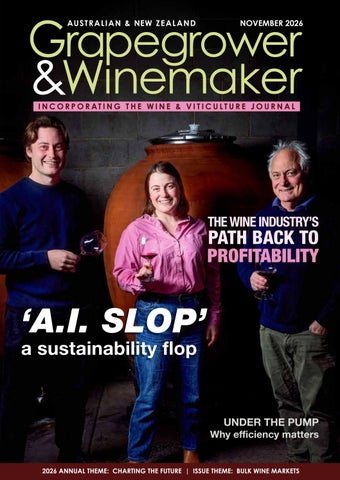
NOVEMBER 2026
I N C O R P O R AT I N G T H E W I N E & V I T I C U LT U R E J O U R N A L
‘A.I. SLOP’ a sustainability flop
UNDER THE PUMP Why efficiency matters 2026 ANNUAL THEME: CHARTING THE FUTURE | ISSUE THEME: BULK WINE MARKETS
my view
My View
Restoring value across the wine industry
Drawing on his long experience in the grape and wine sector and his current role as Executive Officer at Riverland Wine, Andrew Weeks examines the pressures facing the Riverland and the wider Australian wine industry, arguing that recovery will require renewed profitability, support for transition and stronger industry cooperation. The Riverland is not alone in dealing with the most severe downturn in living memory, but it is the region I am working in and the region where I have most experience. I started in the role of Executive Officer at Riverland Wine in April this year after a lifetime in various roles in the wine industry. I remember the heady days of rapid expansion at the end of the last century, when as a vineyard manager I would complete the development of 40 hectares of new vineyard before calling wineries to see who would offer a 10-year contract. That seems unbelievable in the current times. As global markets began to decline, so did returns along the supply chain. I recall one of the higher value wines with Riverland fruit in the “Semi Premium” category retailed for $15 per bottle domestically in 2000. That same brand now sells for less than $10 per bottle, 26 years later. I have heard from winemakers who are active in different markets that retail prices for wines in overseas outlets have not materially moved in 10 years. This is terrible, but this is the point. It is the depressed market for wine that is the main cause of low winegrape returns, not wine companies sitting on millions of dollars and being selfish. Unfortunately, when things first headed south some grower advocacy groups wanted to “take on the wineries” and demand a bigger slice of a dwindling pie, thus trying to demonstrate value to members through confrontation. The root cause of the loss of value to growers has been the loss of value of wine. Any recovery will need focus on rebuilding value, and as it is a global trend, sheeting home blame to parts of our own sector is unrealistic and futile. The increasing success in China provided welcome optimism for a while, and we saw encouraging firming of fruit 14
Grapegrower & Winemaker
The root cause of the loss of value to growers has been the loss of value of wine. Andrew Weeks
and wine markets as China expanded until the tariffs hit in 2020. There is a common view that the loss of the Chinese market was the main cause of the current predicament, with much blame heaped on the government at the time. I have the view that the China market success masked the long-term structural imbalance in the wine sector, and while excellent for business in the medium term, it was really delaying the inevitable. The current oversupply is global, and is affecting all wineproducing countries, including those who said nothing about investigating the source of the COVID pandemic. The fact that the immediate impact from tariffs froze trade immediately and that it was so huge and so sudden is what really hurt. There was no tapering off, but instead markets disappeared almost overnight, and with our industry geared to average production of 1.8 million tonnes, and the loss of our largest and most lucrative export market. Global demand for wine is dwindling across a young cohort that is drinking www.winetitles.com.au
less, and many would for some reason prefer a matcha than sourcing their antioxidants from a glass of fine Australian wine. Go figure. At the time of writing, I read that California has increased the area of vineyard removal from a planned 50,000 acres to around 100,000. To put this in context, that is around double the area of the entire Riverland region coming out of production. France, Italy, Spain and other traditional wine producers are feeling the pinch with vineyard removals and distillation programs planned for the excess wine inventory. And then there is the assault on individual freedoms, logic and reason by the anti-alcohol lobby. Far from claiming success at the global reduction in alcohol consumption and putting their feet up, anti-alcohol groups are as active as ever. It seems incongruous that in the City of Churches, with an entrenched wine culture and the economy benefiting from wine and tourism, we would have trams painted with messages dissing wine as a cancer risk. I hope no-one was standing in direct sunlight or eating bacon while reading those messages. This timing is comically bad but does not have a patch on the looming introduction of container deposit legislation about to be imposed in South Australia during the current desperate times. SAWIA estimates that each 10-cent deposit on a bottle costs a wine company double that and will effectively add around $200 per tonne to the up-front cost of fruit for making wine destined for domestic sale. Logical arguments about the tiny fraction of wine bottles in the public litter stream, high administrative costs and unintended consequences was not enough to carry the day in the long run. Moreover, the $200 per tonne increase is more than growers are receiving for growing fruit sales. November 2026 – Issue 754
grapegrowing
Learning from old vines and caring for ancient soils at Château Tanunda Soil & Vineyard Management
Château Tanunda, officially established in 1890, is home to some of the oldest ungrafted vines on the planet. Serving as the first winery established in the Barossa Valley and having its first vineyard planted back in 1843, the site is undeniably an icon of the region. Journalist Kyra Trussell travelled to the Château and spoke with senior winemaker Jeremy Ottawa on how the winery manages caring for the health of its old vines whilst simultaneously preserving and celebrating the history of the site.
B
eneath a sky full of grey clouds, pregnant with the promise of a rain shower sooner or later, Château Tanunda stood like a defiant beacon for the crowds of curious tourists on that Friday afternoon in early October. Senior winemaker Jeremy Ottawa joked that the grounds are the ‘most public’ private property around. It’s not hard to see why so many enjoy wandering and snapping photos of the property. Whilst intimidating in stature, the Château’s appearance does deceive, for the atmosphere of this grand architecture is nothing short of warm and welcoming. November 2026 – Issue 754
“There are hard times in the industry, but there’s always a positive vibe here,” Ottawa aptly put it. The tasting room is adorned with barrels full of aging wine, glass panes fitted into brick walls that allow for glances into family cellars, and old winemaking artefacts placed out in the open for visitors to feel. A true ode to the art of winemaking history itself, wrapped in a large red brick bow. He described the winery’s overall house style as “traditional wines, just with a modern feel”. www.winetitles.com.au
The winemaker revealed that when he started at Château Tanunda six years ago, his plan was to maintain the traditional aspects of winemaking in order to honour the history of the site. And honouring that legacy through the winemaking starts in the vineyard, where the deep root systems of centuryold grapevines remain nestled securely within ancient soils today. Ottawa shared that maintaining these well-matured vines requires time, effort and a little bit of experimentation. “It’s much like the winemaking, it’s not one rule fits all: it’s lots of playing around, Grapegrower & Winemaker
19
grapegrowing
Influence of clonal selection on Cabernet Sauvignon vineyard performance and wine attributes in Margaret River By Richard Fennessy¹, Yu-Yi Liao¹ and Ben Nestor² Abstract Cabernet Sauvignon is a cornerstone of Western Australia’s red wine production, particularly in the Margaret River wine region. Despite the availability of over 20 clones, the region has historically relied on a narrow genetic base. This study evaluates the viticultural and oenological performance of 12 Cabernet Sauvignon clones with origins from Western Australia, South Australia, Bordeaux, and California over 4 seasons (2021–2025) at a trial site within the Margaret River wine region. The findings ¹Department of Primary Industries and Regional Development Western Australia, PO Box 1231 Bunbury Western Australia 6231 2 Department of Primary Industries and Regional Development Western Australia, 1 Nash Street Perth Western Australia 6000
38
Grapegrower & Winemaker
demonstrate significant clonal variation in yield, vegetative growth, bunch weight and bunch numbers, offering valuable insights for producers seeking to optimise vineyard performance and wine style under changing climatic conditions.
1. Introduction A grapevine clone is a vegetative progeny from a single ‘mother vine’, which has been selected based on varietal identity and desirable traits (Solomonyan et al. 2025). Clonal selection has the potential to influence vineyard performance and wine quality hence important for producers to understand clonal attributes when considering new plantings or reworking existing vines. Cabernet Sauvignon accounts for approximately 40% of red wine www.winetitles.com.au
production in Western Australia (WA), while in the Margaret River wine region it accounts for almost 50% of red varieties crushed (Agricultural Produce Commission Western Australia 2024). From an economic perspective, the Wine Australia vintage survey dashboard (Wine Australia n.d.) reports the calculated average value paid (excluding any potential bonuses) at the weighbridge for Cabernet grown in WA in 2024 was $2,252 per tonne. The Agricultural Produce Commission Western Australia (2024) reports 7,276 t of Cabernet harvested during the 2024 vintage, this represents at farmgate value of $16.39 M. This demonstrates the significant value of the variety, however, clonal diversity remains limited, with November 2026 – Issue 754
winemaking
Winery Pumps
The power of pump performance Reducing energy use while protecting wine quality
Centrifugal pumps are the workhorses of Australian wineries, but their operation has implications for both energy costs and wine handling. Engineering consultant Ian Jeffery examines the challenges and opportunities for improving pump performance.
W
inery pumps consume a significant amount of electricity, and the way they are operated can affect both energy costs and wine quality. Research¹ has established that pumping consumes 10–20% of a winery’s electricity demand. The Green Energy South Australia figures also indicate that, “Energy costs, on average, account for 15% of total winery operational cost”. Winery pumps can be divided into two groups: centrifugal pumps and positive displacement pumps (Mono, peristaltic, gear and lobe pumps, etc.). This article deals exclusively with centrifugal pumps, which can be operated at reduced speeds to achieve significant reductions in electrical power demand.
Centrifugal pumps Centrifugal pumps are the dominant pump design across most industries. They also represent the single largest consumer of electricity globally. Their life-cycle November 2026 – Issue 754
cost (LCC) is typically dominated by energy consumption, which can account for 90% of the total, while the initial purchase price ranges from 5–20%. Winery and food-industry centrifugal pumps are designed to move large volumes of low-viscosity liquids safely and efficiently. They are among the more expensive centrifugal pump designs. Core functional specifications • Manufactured from high-grade, corrosion-resistant materials, usually AISI 304 or 316L stainless steel. • Electropolished internals with low surface roughness to eliminate microscopic crevices where bacteria could thrive.
AT A GLANCE ● Pumping accounts for 10–20% of winery electricity demand. ● Energy represents an average 15% of total winery operational costs. ● Centrifugal and displacement.
positive
● Halving centrifugal pump speed can reduce power demand by around 80%. ● Allow pump speed to be adjusted to suit the application.
• Hygienic certification compliant with leading global food-industry standards.
● Slower, gentler pumping can minimise shearing and turbulence.
• Fully compliant with automatic CIP (clean-in-place) and SIP (sterilise-inplace) systems.
● Gravity-flow winery design can reduce reliance on pumps
www.winetitles.com.au
Grapegrower & Winemaker
45
sales & marketing
Corrina Wright, winemaker and director at Oliver's Taranga Vineyards
The Wright take on how Fiano’s breaking into the mainstream By Kyra Trussell
W
ith Fiano Day held last month, Grapegrower & Winemaker took a trip to McLaren Vale and sat down with Corrina Wright, winemaker and director at Oliver’s Taranga Vineyards, to learn more about 70
Grapegrower & Winemaker
the alternative white that’s causing quite the buzz.
encouraging consumers to learn more about the category.
Last year, Oliver’s Taranga Vineyards worked with Mastermind Consulting to develop the inaugural Fiano Festa and Fiano Day with the intention of
“We thought there were about 80 producers, but we’ve now found that there’s about 300 producers of Fiano across Australia,” Wright explained.
www.winetitles.com.au
November 2026 – Issue 754