Es
australian
ta
bl
is
he
d
19
MANUFACTURE • TECHNOLOGY • DESIGN • CONSTRUCTION VOLUME 36 ISSUE 4 ● JULY | AUGUST 2026
TIMBER
LANDMARKS
AT SCALE
BLUE GUM GLULAM plans proceed
UNLOCKING the potential of MMC
77
L AMINATING SPECIALISTS SMART SOLUTIONS FOR SMART TIMBER PEOPLE
AUTOMATED / MANUAL PRESSES PU GLUE APPLICATING MACHINES HAND APPLICATORS PU PUMPING SYSTEMS
WE GUAR ANTEE Q U A L I T Y & I N N O V AT I O N (03 ) 9702 793 3 10 0% AUSTR ALIAN O W N E D A N D O P E R AT E D
MPBENGINEERING.COM.AU
CONTENTS CONTENTS australian
JULY |AUGUST 2026
Volume 36 – Issue 4 Incorporating Australian and New Zealand Timberman Established 1977 MANUFACTURE • TECHNOLOGY • DESIGN • CONSTRUCTION
News.............................................................4-11 Timber Built Offsite ...................................... 14-19 Profile ........................................................ 16-17 Conferences................................................. 18-21 Associations ............................................... 22-25 Front Cover:
13
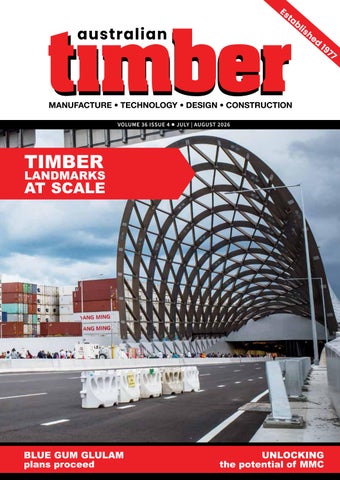
The “nets” on Melbourne’s West Gate Tunnel Project are three large-scale, 38-metretall timber lattice structures framing the entry and exit portals of the twin tunnels. Designed by Wood Marsh, these web-like architectural arches reference Indigenous fishing traditions and maritime cargo nets, while functionally filtering sunlight to help drivers’ eyes adjust. Story pages 12, 13.
Publisher and Chief Executive: Hartley Higgins General Manager: Robyn Haworth Editor: Bruce Mitchell b.mitchell@ryanmediapl.com.au Advertising: Jamie Richardson j.richardson@winetitles.com.au Adelaide Office +61 (08) 8369 9514
16
Production & Creative Services: Robyn Haworth Timber classifieds: j.richardson@winetitles.com.au Adelaide Office +61 (08) 8369 9514 Subscriptions: subs@forestsandtimber.com.au Adelaide Office +61 (08) 8369 9500 Subcription rates Free Accounts: Adelaide Office +61 (08) 8369 9500
20
Postal Address: 630 Regency Road, Broadview South Australia 5083 Phone: +61 (08) 8369 9500 Melbourne Office: Suite 207/19 Milton Parade, Malvern VIC 3144 Phone: +61 402 494 041 Find us on Facebook @AustralasianTimber Website www.timberbiz.com.au Conditions
XX 24 V36N4
w w w.ti m b e r b iz . c o m . a u
The opinions expressed in Australian Timber Magazine are not necessarily the opinions of or endorsed by the editor or publisher unless otherwise stated. All articles submitted for publication become the property of the publisher. All material in Australian Timber Magazine copyright 2022 © Ryan Media. All rights reserved. No part may be reproduced or copied in any form or by any means (graphic, electronic, or mechanical including information and retrieval systems) without written permission of the publisher. While every effort has been made to ensure the accuracy of information, the publisher will not accept responsibility for errors or omissions, or for any consequences arising from reliance on information published.
AUS T RAL I A N T IM B ER M A GA Z IN E
MEDIA
INDEPENDENT & AUSTRALIAN OWNED
JU LY | AU GU ST 2 0 2 6
3
NEWS
Editorial
Portland, in the heart of the Green Triangle, has had an interesting economic history. What began as a whaling station soon developed into the economic hub for the wool and meat industry. Later, the construction of an aluminium smelter promised renewed prosperity, a promise which was never really fulfilled. But the completion of the Hardwood Timber Manufacturing Hub Feasibility Study which confirms the viability of a world-class engineered timber manufacturing facility for the city heralds the dawn of a new era. The prospect of producing engineered wood from Blue Gum promises much. Portland could create up to 74 full-time ongoing jobs and 150 construction jobs through this type of timber. As Timber Towns Victoria points out, the significance goes beyond Portland. The project shows how value-adding to plantation resources can replace the native forest supply no longer available in Victoria, reduce Australia’s reliance on imported product, support national housing targets, and strengthen sovereign manufacturing capability. Precinct Chair Russ Hughes said the project represented a “once-in-ageneration opportunity for regional Victoria”. It’s an inspirational game-changing move for everyone.
4
Colin MacKenzie Award launched to recognise legacy
T
imber Queensland has launched the Colin MacKenzie Award to strengthen timber design and construction capability. The Colin MacKenzie Award for Technical Excellence in Timber Application and Use is a new national initiative recognising outstanding technical achievement and leadership in the use of timber across Australia’s building and construction sectors. The award was launched at a WoodSolutions event, Queensland Timber: Trajectory Award Winning Exemplars Showcasing the Way to Modern Construction, that brought together leaders from the forest and timber, engineering, architectural and construction industries. This initiative responds to widespread calls from industry to formally recognise Colin MacKenzie’s legacy following his passing on 24 March 2025 and to continue the work he championed in lifting capability, innovation and confidence in the use of timber across Australian construction. Widely regarded as “The Timber Expert”, the award reflects Mr MacKenzie’s lasting contribution to advancing timber as a highperformance, compliant and fit-for-purpose construction
w w w.ti mberb iz . c o m . a u
The late Colin MacKenzie.
material across a diverse range of applications, from buildings to infrastructure and beyond. Timber Queensland CEO Mick Stephens said the award is intended to recognise those delivering real technical impact across the sector. “The award is intended for engineers, architects, designers, builders and researchers who are delivering real technical impact and helping to strengthen capability across the sector,” Mr Stephens said. “This is not limited to building projects it recognises the full breadth of timber innovation, including infrastructure, engineered solutions and other applications that demonstrate excellence in using or enabling the use of timber.” Mr Stephens said the award will focus strongly on outcomes that contribute to advancing industry knowledge and practice. “Judging will focus on technical merit, innovation, and the contribution a
AUS T RAL I AN T I M B ER M A GA Z IN E
project or individual makes to improving knowledge, collaboration and sustainability in timber use,” Mr Stephens said. “It will also consider alignment with Colin’s vision for timber as a highperformance, compliant and fit-for-purpose construction material.” A national judging panel comprising respected leaders from across engineering, design and specification will assess entries, ensuring a strong emphasis on technical rigour and industry relevance. “We are honoured to have Professor Benoit Gilbert, Griffith University, Rob Mansell, National Specification Manager, Hyne Timber, Dr Andrew Magub, Principal, Architectus, Kim Harris, Technical Advisor, AKD and Matt Smith, Senior Technical Consultant, Timber Queensland join the inaugural selection process,” Mr Stephens said. By recognising leading projects and individuals, Timber Queensland said the initiative will help drive greater confidence in timber and support the continued development of capability across the industry. Further details about the application and judging process are available at https://www. timberqueensland.com.au/ colin-mackenzie-award
JU LY | AU GU ST 2 0 2 6
V36N4
NEWS
Gippslanders paying the price at Opal
L
abor has repeatedly failed timber workers and ignored respected forest scientists who support a properly managed and sustainable native hardwood industry, according to Shadow Forestry Minister Darren Chester. Commenting on Opal’s announcement that more than 80 people are to lose their jobs at Opal’s Maryvale Mill in Gippsland, Mr Chester said hardworking Gippslanders were continuing to pay the price for the Labor-Greens decision to shut down Victoria’s native hardwood timber industry.
“The announcement of a further 84 job losses at the Maryvale Mill is devastating news for the workers, their families and the wider Latrobe Valley community,” Mr Chester, the Member for Gippsland, said. Opal has previously cut jobs at the mill and experienced a number of shutdowns. In its statement, Opal said the mill had suffered substantial losses following the Victorian Government’s failure to meet its contractual obligations under the Wood Pulp Agreement. The company commenced
legal action in late 2025 over the government’s failure to supply wood in accordance with that agreement. “The Maryvale Mill suffered substantial losses due to the Victorian government’s failure to meet its contractual obligations under the Wood Pulp Agreement,” its statement said. In September last year, Opal commenced proceedings against the state government for $402m in damages. “The end of white paper production has significantly changed the operational footprint of the mill, and the
site has been working hard to right size its operations as a kraft and recycled paper manufacturer,” the statement read. Mr Chester said the announcement demanded immediate action from the state and federal governments to develop a properly funded economic transition plan in genuine consultation with local workers, businesses and community leaders. “Driven by its dependence on Greens preferences in metropolitan seats, Labor has abandoned bluecollar workers in regional communities,” he said.
KOMATSU FORKLIFTS - BUILT FOR TIMBER, TRUSTED BY PROFESSIONALS Komatsu Forklifts are built tough for timber handling. Delivering exceptional lifting power, stability, and precision, they make moving heavy, irregular timber loads safer and more efficient. With wet disc brakes and hydrostatic drive available on select models, you’ll enjoy improved fuel efficiency and lower operating costs. Count on Komatsu Forklifts for reliability, quality and durability in the harshest environments.
Contact us today To discover how Komatsu Forklifts can transform your timber operations.
SCAN HERE TO SEE OUR FH SERIES IN ACTION
Forklift Australia
V36N4
w w w.ti m b e r b iz . c o m . a u
AUS T RAL I A N T IM B ER M A GA Z IN E
1300 814 769 JU LY | AU GU ST 2 0 2 6
5
NEWS
Tilling ends 63 years of family ownership
A
fter more than 63 years of family ownership, one of Australia’s respected timber businesses is preparing to begin a new chapter. The Tilling family has announced the sale of the Tilling Group to Claymark Australia, with the acquisition completed on 31 July, 2026. While ownership is changing, the family views the transition as a way of continuing the legacy established by founders Norm and Judy Tilling and supporting the future of the business. For Tilling SmartFrame Managing Director Glenn Tilling, the announcement marks a significant milestone in a journey that began more than six decades ago. “Since its beginnings in 1963, the Tilling Group has had many significant landmark events, and (this) announcement is one of them,” Mr Tilling said. The story began in November 1963, when Norm and Judy Tilling opened a small timber factory in Eltham. From those early days, the business built its reputation on serving local builders and merchants with timber products defined by reliability, quality workmanship and a personal approach to service. What started as a modest operation was grounded in long hours,
6
The Tilling Group started with a small timber factory in Eltham.
determination and a deep commitment to doing the work well. As the decades unfolded, that small Eltham factory began to grow beyond its original footprint. During the 1970s and 1980s, the business expanded its timber import operations and developed an international supply chain, strengthening Tilling Timber Imports and building capability that reached far beyond its local beginnings. In 1990, a new chapter of growth opened with the establishment of the Newcastle (Carrington Wharf) bulk receiving yard, significantly enhancing import and distribution capacity and extending the business’s national reach. Innovation continued
w w w.ti mberb iz . c o m . a u
through the 1990s. In 1994, the business was appointed exclusive Australian distributor of Willamette Valley Lumber Company’s LVL and I-joist products, bringing engineered timber solutions into the Australian market. In 1995, the SmartFrame engineered wood brand was launched, further shaping the direction of the business for years to come. As demand for engineered timber solutions grew, manufacturing operations were relocated to Kilsyth to support increasing value-added production and evolving industry needs. Through each stage of expansion, the business continued to evolve while holding closely to the values established at its beginning. Those values were formally recognised in 2021, when Norm and Judy Tilling were named industry icons by NTHA. In 2023, the business marked 60 years in operation, and
AUS T RAL I AN T I M B ER M A GA Z IN E
leadership transitioned to Managing Director Glenn Tilling, continuing the family stewardship into its next generation. Today, Tilling stands as a manufacturer and wholesaler of engineered wood products. Its SmartFrame, FrameSmart, Architectural Products and SmartFrame Design Centre divisions support builders, designers and timber merchants across Australia with engineered timber solutions, technical expertise and support. Despite decades of growth and change, Mr Tilling said the relationships built along the way remain at the heart of the business. “The relationships we have built with our trading partners, particularly our customers, have been central to Tilling’s success and have shaped the Tilling Group into what it is today. “The Tilling family and I sincerely thank you for your support and the journey we have shared over the years.”
JU LY | AU GU ST 2 0 2 6
V36N4
NEWS
NSW passes prefab building work Bill
P
refabAUS has welcomed the passage of the New South Wales Building Bill through Parliament, describing the inclusion of a clear definition of prefabricated building work as a significant milestone in modernising Australia’s building regulatory framework. The amendment recognises the growing role that prefabricated and manufacturing-led construction will play in addressing housing supply, improving productivity and affordability, and strengthening Australia’s sovereign building capability. Executive Chairman
of prefabAUS, Damien Crough, said the legislation acknowledges that construction is evolving and that regulation must evolve alongside it. “This is a significant step forward for New South Wales and one that recognises how buildings are increasingly being manufactured as well as constructed,” he said. “The Bill doesn’t create a separate regulatory pathway or reduce compliance requirements. Instead, it provides greater certainty for industry, regulators, certifiers, financiers and consumers by clearly recognising prefabricated building work within the legislation.”
Mr Crough said the reform demonstrates that governments can embrace innovation while maintaining high standards for building quality and consumer protection. “Good regulation should enable innovation, not create uncertainty. This amendment provides a clearer legislative foundation for modern construction methods while maintaining the rigorous building standards that Australians rightly expect.” The reform reflects several years of collaboration between industry, government, regulators and research organisations to ensure Australia’s building
legislation keeps pace with innovation. Through its Building the Future We Want – Smart Building Industry Roadmap 2023–2033, submissions to governments and regulators, and ongoing engagement with industry, prefabAUS has consistently advocated for regulatory frameworks that recognise modern construction methods while maintaining confidence in Australia’s building system. Mr Crough said the passage of the Bill demonstrated what could be achieved when governments and industry worked together.
25
WORK
SAFER. STORE MORE.
ENHANCE THE SAFETY, STORAGE & EFFICIENCY OF YOUR LOGISTICS WITH COMBILIFT For almost 3 decades, Combilift has been revolutionising the way companies handle and store goods. Our pioneering product range of multidirectional, sideloafers, articulated and pedestrian forklifts, straddle carriers and container loaders allows you to manoeuvre long loads safely, reduce aisle widths and increase the amount of space available for storage.
Contact Us Today To find out how Combilift can help you unlock every inch of your storage space.
combilift.com Australasian timber Mag 185x130 Chris REv 4.2.indd 1
V36N4
w w w.ti m b e r b iz . c o m . a u
AUS T RAL I A N T IM B ER M A GA Z IN E
JU LY | AU GU ST 2 0 2 6
7
20/07/2026 12:43:15
NEWS
Multinail founder FTMA’s Inaugural Industry Icon Award recipient
F
TMA Australia has awarded its inaugural Industry Icon Award to Multinail founder Peter Taylor. The award was created to honour individuals connected to the supplier side of the industry whose leadership, innovation and long-term commitment have had a lasting impact across the broader frame and truss sector. While the FTMA had originally intended to introduce the award in 2024, the association felt strongly that the inaugural recipient needed to be Mr Taylor. However, with Mr Taylor unable to attend at the time, the decision was made to wait until he could be present in person to accept the honour. It was a fitting decision for an individual many
Multinail founder Peter Taylor with FTMA CEO Kersten Gentle.
within the industry believe has made one of the single greatest contributions to the development of the Australian frame and truss sector. In the late 1970s, Mr Taylor was managing
Sanford Truss Australia. Differences with corporate owners, combined with encouragement from customers who valued his integrity and technical expertise, led him to strike out on his own. He believed
Daily Timber News FIRST WITH INDUSTRY NEWS STRAIGHT TO YOUR INBOX
M A S T E R S O F T H E FO R E S T
T I R E S FO R H A R V E S T E R S A N D FO R WA R D E R S
NOKIAN TYRES Forest King F2 is absolutely the best choice for CTL machines using tracks or chains. NOKIAN TYRES Forest King TRS 2 is an optimum solution where traction and selfcleaning is everything. Both tires have excellent durability and performance in the most demanding forestry work.
N O K I A N T Y R E S .C O M / FO R E S T RY
8
Subscribe for FREE at timberbiz.com.au w w w.ti mberb iz . c o m . a u
AUS T RAL I AN T I M B ER M A GA Z IN E
the strong relationships he’d built would carry him forward. Those plans were quickly disrupted when a competitor acquired Sanford Truss outright, removing what would have been an early customer base almost overnight. “It was a tough struggle — by the time Sanford Truss was purchased, I was already committed. I had a choice to drop everything or keep pushing forward,” Peter recalls. Founded in 1979 by engineer Peter Taylor, Multinail began with a simple but powerful idea: support timber fabricators with better products, better service, and genuine partnership. What followed was not an easy road — but one that shaped the
JU LY | AU GU ST 2 0 2 6
V36N4
NEWS company’s character and culture for decades to come. At a time when the market was a duopoly, his vision helped create greater competition for manufacturers throughout Australia. That decision not only changed the nail plate market but helped strengthen the industry as a whole. By creating healthy competition within the sector, his contribution encouraged continued innovation, investment and improvement across manufacturing technology, engineering capability, software, automation and customer support. The benefits of multiple
V36N4
it has taken more than 45 years for another company to attempt entering the nail plate market demonstrates just how difficult and significant Mr Taylor’s original achievement truly was. Following the presentation, Mr Taylor delivered a brief acceptance speech before introducing
Workers assemble a floor cassette at Multinail.
strong suppliers operating within the industry have been felt for decades and continue to shape the modern frame and truss sector today. What Mr Taylor built through Multinail Australia extended far beyond simply creating a successful
w w w.ti m b e r b iz . c o m . a u
a powerful tribute video
business. He helped establish a long-term Australian company grounded in technical excellence, strong relationships and genuine support for manufacturers across the country. As acknowledged during the presentation, the fact
AUS T RAL I A N T IM B ER M A GA Z IN E
produced by the team at Multinail Australia. The video highlighted his career within the Australian frame and truss industry, showcasing not only the growth of Multinail, but the enormous influence he has had on the evolution of the sector over many decades.
JU LY | AU GU ST 2 0 2 6
9
NEWS
Study confirms viability of Blue Gum glulam opportunity for Portland
P
ortland is set to be home to Australia’s first Blue Gum gluelaminated timber facility. Grown in sustainable plantations across the Portland region, Blue Gum is currently processed into woodchips for wood pulp and paper markets internationally. The Future Portland Hardwood Timber Manufacturing Hub feasibility study shows that Blue Gum could be used in-higher value construction products. Portland could create up to 74 full-time ongoing jobs and 150 construction jobs through this type of timber. Member for Western Victoria Jacinta Ermacora announced the completion of the Future Portland Hardwood Timber Manufacturing Hub feasibility study and the Future Portland dashboard. This was made possible by more than $500,000 from the Portland Diversification Fund. The findings will help the next stage of Portland’s Precinct development, backed by $1.75 million from the Victorian State Government, as well as funding from the Federal Labor Government. Glenelg Shire Council Mayor Karen Stephens said the completion of the Hardwood Timber Manufacturing Hub
10
Tim Woods from Industry Edge, the Member for Western Victoria Jacinta Ermacora and Bill Bell, Gunditj Mirring Traditional Owners Aboriginal Corporation at the feasibility study announcement.
Feasibility Study, alongside Council’s Future Portland Project, demonstrated a proactive approach to understanding and preparing for future opportunities across Glenelg Shire. Portland is at the heart of the Green Triangle – Australia’s largest sustainable plantation forestry region, which stretches across the Victoria South Australia border. The new study will explore what could become Australia’s largest plantation hardwood and softwood processing precinct, with a hardwood peeling trial already underway. More than $50 billion has been delivered through the Allan Labor Government over the past decade to make our regions even better places to live, work, visit and study. Precinct Chair Russ
w w w.ti mberb iz . c o m . a u
Hughes said the project represented a “once-in-ageneration opportunity for regional Victoria”. “This feasibility study demonstrates that the Green Triangle has a high quality planta on resource available, industry capability and strategic location to become a leading centre for engineered timber manufacturing,” he said. “Phase one of The Precinct has built a compelling investment case that creates greater value from our sustainably grown hardwood planta on resource while delivering long-term economic and manufacturing benefits for Victoria, and indeed the nation.” The project builds on more than five years of research managed by the GTFIH and supported by the Federal Government,
AUS T RAL I AN T IM B ER M A GA Z IN E
focused on deriving more local value from traditionally exported wood fibre resources, both softwood and hardwood. Mr Hughes said the Victorian Government’s commitment had been instrumental in progressing the project from concept to investment readiness. “The Victorian Government has been a key partner throughout this journey, helping transform an ambitious idea into an investment-ready project that strengthens regional manufacturing, creating skilled local jobs for future generations,” Mr Hughes said. The next stage of The Precinct – supported by major Australian industry partners, funding from Australian Forest & Wood Innovations and additional funding support from the Victorian Government – will focus on the development of Laminated Veneer Lumber. Work is also ongoing to attract investment and advance detailed development planning for the site. Green Triangle Forest Industries Hub Independent Chair Dr Ruth Schubert said the completion of the Advanced Timber Manufacturing Hub Feasibility Study was an important milestone for both the Green Triangle and its communities.
JU LY | AU GU ST 2 0 2 6
V36N4
NEWS
MBA begins search for new CEO
M
aster Builders Australia’s National Board has announced that longserving CEO Denita Wawn will conclude her tenure with the organisation once a successor has been appointed. Ms Wawn joined Master Builders in 2016 and became CEO in March 2017, becoming the first woman to hold the role since the organisation’s federation in 1890. A tireless advocate for the building and construction industry, Ms Wawn has consistently stood up for members and held governments to account,
Master Builders CEO Denita Wawn.
regardless of their political persuasion. Ms Wawn’s policy and campaign achievements include: Working with governments and the union to keep the industry, its
businesses and workers operating during the pandemic 19 lockdowns, and to secure incentives, including HomeBuilder, to sustain building activity Leading Master Builders’ successful federal election campaigns, including the 2019 campaign that challenged the then Opposition’s positions on capital gains tax, negative gearing and the ABCC Campaigning against elements of the 2023 Closing Loopholes legislation, helping secure a government backdown on laws that would have restricted independent contracting
Working with Government and Opposition to secure a bipartisan approach to the administration of the CFMEU. Beyond these achievements, Ms Wawn has led national advocacy on housing supply, affordability, workforce shortages, women’s participation, building safety, productivity and the industry’s role in meeting Australia’s housing and infrastructure needs. The National Board has appointed a recruitment firm to lead the search for the next CEO with the process to commence immediately.
A CUT ABOVE
Do you crosscut timber packs +/- 1 mm accuracy? Or cut structural timber, panel product (MDF & LVL), paper rolls ? Or produce pallet dimensions or studs on fixed lenghts?
HOLTEC has a solution for you!
For more information contact:
V36N4
w w w.ti m b e r b iz . c o m . a u
AUS T RAL I A N T IM B ER M A GA Z IN E
JU LY | AU GU ST 2 0 2 6
11
TIMBER BUILT OFFSITE TIMBER
BUILT OFFSITE
W
Timber landmarks at scale: West Gate Tunnel Timber Nets
hen the West Gate Tunnel Project opened, it introduced an unmistakable timber signature at the entrances: large glulam ‘net’ structures that frame the entries and exits. They operate as sculptural landmarks and as transitional light filters, easing driver adjustment to sudden changes in brightness as vehicles move in and out of the tunnel environments. As part of the delivery scope, Red Stag TimberLab was responsible for the structural design, manufacture, and international logistics of all three distinct net structures: North Portal, South Outbound, and South Inbound. Each structure varied in geometry and span, tailored to its specific tunnel interface and site condition. The North Portal is the largest of the three, stretching 121 metres in length and rising up to 39 metres high to accommodate dual-direction traffic. Big infrastructure tends to default to concrete and steel. The timber nets demonstrate a different proposition: timber deployed as a primary structural material, engineered to a scale and complexity that remains uncommon in
12
Australian road projects. CREATE’s role on the project was to provide specialist timber design for the gateway structures, transforming the original architectural concept into a refined and buildable solution. The design features large timber arches combined with triangulated infill members, forming a distinctive lattice gateway for vehicles entering and exiting the tunnel. The structures consist of large inclined glulam arches spanning the roadway, providing the primary lateral and vertical support. These arches are supported by a triangulated arrangement of glulam struts that tie the timber structure back to the tunnel structure. Infill struts provide longitudinal stability and additional in-plane shear stability through diaphragm action across the whole structure. The arches are designed as fully continuous. Large moment splice connections allow multiple parts to be connected to form each arch, because the finished size and shape is too large for manufacturing or transport as a single element. The struts are treated as having pinned connections at each end
w w w.ti mberb iz . c o m . a u
Curved timber elements prior to the fit with the steel node. Picture: Red Stag TimberLab.
where they meet the arches, and the arches are connected through pinned connections to the concrete supporting structure. Each gateway structure is unique in geometry, scale and interfacing conditions with the surrounding tunnel and ventilation infrastructure. Red Stag TimberLab contracted CREATE Architects & Engineers to provide full structural and geometric design services, and CREATE worked with Red Stag throughout the many concepts and design schemes
AUS T RAL I AN T IM B ER M A GA Z IN E
considered over several years during tendering and preconstruction phases. Delivering a structure of this complexity requires the design and fabrication process to be tightly integrated. Red Stag TimberLab developed prototypes to test-fit key connections and refine CNC detailing early in the process. Additional factory fit testing was completed to ensure fitment of site-applied elements. Significant innovation was made with the introduction of a new adjustable steel
JU LY | AU GU ST 2 0 2 6
V36N4
TIMBER BUILT OFFSITE press system for the manufacture of curved glulam elements. Previously taking multiple days per press cycle, the new system enabled daily turnaround, dramatically improving efficiency and throughput. Each arch segment, some as large as 1400 × 300 mm and 30 m long, was pressed over depth and machined at Red Stag’s Auckland facility using 5-axis CNC technology to maintain millimetre precision of shape across the element. Radiata Pine was used throughout, H3.2 treated and bonded with resorcinol glue, finished with CD-50 preservative systems for added durability. Over 830 timber elements and 500 tonnes of steel brackets and fixings were manufactured and test-fitted off-site before dispatch. Factory assembly included full bracket installation and detailed QC processes, ensuring seamless site assembly and minimised on-site risk. Installation proceeded arch-by-arch, starting from the rear of each portal. After each arch was installed, infill struts and survey checks followed. This staged approach enabled precision assembly alongside active roadways and live work zones. Although the forms read clearly at speed, they represent a significant effort in design coordination, digital modelling, fabrication integration and construction planning. The completed gateway forms stand as a lasting testament to the collaboration between V36N4
architects, engineers and fabricators. For the timber industry, the project is a reminder that high-performance engineered wood is not limited to buildings. When design, fabrication, logistics and construction sequencing are treated as a single system, timber can take its place in the most complex and publicly visible parts of the built environment. Timber’s role in Australian infrastructure is expanding. Projects at this scale remain pioneering. The West Gate Tunnel portal structures demonstrate what becomes possible when structural design, fabrication, logistics and installation sequencing are treated as one integrated delivery system. Wind engineering appropriate to the scale of the asset. The structures were treated as winddominant, with wind tunnel testing carried out using 1:200 3D printed models to refine global and local pressures. Digital fabrication and prototyping as risk control. Connection prototypes, CNC detailing development, and factory fit testing reduced site uncertainty and supported repeatable assembly. Manufacturing innovation enabling curved mass timber at scale. A new adjustable steel press system enabled daily turnaround for curved glulam elements, supporting the production program. Complex logistics and staged installation delivered deliberately. A hybrid
w w w.ti m b e r b iz . c o m . a u
The steel press system used to bend the timber. Picture: Red Stag TimberLab
shipping approach (including part-charter shipping for oversized elements) and an off-site Melbourne staging facility supported an arch-byarch installation sequence with survey checks at each step. As Australian cities
AUS T RAL I A N T IM B ER M A GA Z IN E
continue to invest in major infrastructure, the West Gate Tunnel Timber Nets demonstrate that mass timber can credibly operate in the most visible and demanding public projects, provided the delivery method matches the ambition.
JU LY | AU GU ST 2 0 2 6
13
TIMBER BUILT OFFSITE TIMBER
BUILT OFFSITE
NSW unlocking the potential of Modern Methods of Construction
T
he NSW State Government is set to turbocharge the way homes are built in NSW, by unlocking the potential of MMC and lifting productivity in the building sector. An Expression of Interest (EOI) opened for businesses in early July to establish or expand a manufacturing facility in NSW to produce prefabricated building components or largescale modular housing, specifically for higher density housing types, including developing designs from the mid-rise pattern book. The EOI is the first stage of a two-stage procurement process, and proposals will be assessed on commercial readiness, demonstrated capability and capacity to deliver at scale. Successful proponents will need to demonstrate commercial readiness, technical capability and a proven track record delivering a range of building types, including mediumdensity housing. A key focus will be the ability to deliver mediumdensity homes from the NSW Government Pattern Book designs – creating a faster, more consistent pathway to get more homes built. Successful proponents could also provide components for a range of government projects, including schools
14
The NSW State Government is backing a modular terrace project at Landcom’s Schofields development.
and hospitals. The program is part of a broader reform agenda to remove barriers to construction, support industry to deliver collaborative and innovative housing solutions, as well as foster a greater focus on MMC in government procurement. It follows the opening of the Housing Innovation in Construction Fund and Housing Innovation Network Grants Program, representing almost $4 million in investment to help grow the local MMC sector, commercialise new technologies and bring more innovative manufacturers into the NSW housing market. The NSW Government
w w w.ti mberb iz . c o m . a u
is investing $32.3 million over the next four years to modernise the building approvals system, integrate it into the NSW Planning Portal and pilot AI tools to speed up licence application processing. This includes $1.6 million to establish a new regulatory framework and introduce a national certification system for MMC, giving industry the confidence to invest and helping unlock faster, smarter construction across NSW. The Government says it has heard industry calls for greater research and collaboration to enhance innovative building practices. The program aims to grow local manufacturing,
AUS T RAL I AN T IM B ER M A GA Z IN E
strengthen supply chains, create skilled jobs and accelerate the delivery of more homes across the state. The NSW State Government will consider supporting the development of the facility through financial support, through the provision of suitable land, by agreement to purchase output from the facility, including housing and other public facilities, as well as considering alternative proposals where these represent value for money for taxpayers and will support the development of a sustainable industry in NSW. As part of the broader plan, the State Government continued page 15
JU LY | AU GU ST 2 0 2 6
V36N4
TIMBER BUILT OFFSITE TIMBER
BUILT OFFSITE
Homes of the future being delivered through TAFE
T
he first accredited, long-form Prefabrication Installation qualification delivered through Melbourne Polytechnic’s Future of Housing Construction Centre of Excellence has been launched in Victoria. The Certificate III in Prefabrication Installation will train students for careers building prefabricated homes. Students will receive hands-on training and flexible blended learning. The qualification was developed in consultation with industry through the Future of Housing Construction Centre of Excellence. It will be hosted at Melbourne Polytechnic’s Heidelberg West campus. “The Certificate III in Prefabrication Installation is the first-of-its-kind in Australia, established to from page 14 is also backing a modular terrace project at Landcom’s Schofields development. The nine architecturally designed terraces are being delivered using MMC, with large sections of the homes built off-site before being transported and installed at the development in Sydney’s north-west. Landcom CEO Alex Wendler said the Schofields V36N4
Executive Director of Commercial, Sustainability and Infrastructure at Melbourne Polytechnic Gabriel Solorzano Torres , Damien Crough (prefabAUS), Minister for Skills and TAFE Colin Brooks, Member for Ivanhoe Anthony Carbines, Skills and Training Minister Andrew Giles, Alex White (Vic TAFE Association), and Director of Centre of Excellence Education, Melbourne Polytechnic, Philip Wyles at the Future of Housing Construction Centre of Excellence launch.
industry. Victoria is already home to more than 200 companies specialising in MMC, spanning design, manufacturing, transport, assembly and installation. Alongside the new Certificate III qualification, the Centre of Excellence is already delivering four industry-designed short courses. These help existing workers and businesses adopt modern methods of construction. The $50 million Centre of Excellence is jointly funded by the Federal and State governments.
prepare workers with the right tools and confidence needed for a career in modern methods of construction,” Melbourne Polytechnic CEO Frances Coppolillo said. The Centre of Excellence is a national hub for training, research and innovation across Australia’s building development would help the company better understand how MMC can support the delivery of diverse and affordable housing communities across NSW. “The outcomes of this trial will help inform how Landcom uses MMC in future projects as we continue working to increase housing supply where it’s needed most,” he said.
w w w.ti m b e r b iz . c o m . a u
AUS T RAL I A N T IM B ER M A GA Z IN E
JU LY | AU GU ST 2 0 2 6
15
TIMBER BUILT OFFSITE TIMBER
BUILT OFFSITE
PanelTech: Two days to lock-up and a mission to prove it
I
n a market where imported SIPS panels arrive one at a time and builders remain deeply sceptical, an emerging Melbourne manufacturer is assembling complete wall sections in-factory and erecting entire homes in 48 hours — then daring the industry to look away. PanelTech exists because a property developer got tired of waiting. Founded in 2024, the Victorian SIPS manufacturer grew out of a partnership with Miravour Property Group, whose director had watched traditional build programs blow out from eight months to twelve — and decided there had to be a faster way. For founder James Coghlan, that frustration became a business case. “He was a forwardthinking developer who was willing to get involved with this construction method,” Coghlan says of the relationship that gave PanelTech both its founding capital and, crucially, a guaranteed pipeline of work at the Cobblebank estate, 33 kilometres west of Melbourne’s CBD in the fast-growing City of Melton — more than 300 lots that would become the company’s proving ground. PanelTech positions itself as a “kit of parts” company rather than
16
PanelTech’s fully assembled wall sections go into place.
a modular builder — a distinction Coghlan is keen to draw. Where modular delivers completed volumetric units, PanelTech manufactures complete wall sections pre-cut for windows, doors, and services, then ships them flat-packed for crane installation. The approach preserves design freedom while capturing off-site speed. The company claims to be the only Australian manufacturer delivering SIPS as fully assembled wall sections. Imported panels, constrained
w w w.ti mberb iz . c o m . a u
by shipping container dimensions, must be installed one at a time. PanelTech’s locally manufactured sections allow entire walls to be dropped onto bottom plates in a single crane lift. “It’s not physically intensive,” Coghlan explains. “You’ve got a crane lowering walls, you’re nailing off — as opposed to some of these panels that can be upwards of 70 kilos each. I wouldn’t want to be the tradie lifting 70-kilo panels for eight hours a day.” At the heart of the operation sits a milliondollar Spanish lamination machine that bonds EPS foam cores to structural skins using hot-melt adhesive, producing up to 180 panels per day on a single shift — enough
AUS T RAL I AN T IM B ER M A GA Z IN E
for two to three complete homes. Architectural drawings are translated into a SIPS takeoff specifying every panel size, cut list, and service core, with electrical and plumbing pathways cored directly through the foam in the factory. From there, panels move to cutting and assembly, where they’re built into complete wall sections, flat-packed onto pallets in installation sequence, and loaded onto crane semitrailers — numbered walls, stacked in erection order, with a floor-plan guide any competent crew can follow. Coghlan is refreshingly candid about what still needs work. The transition from lamination to assembly remains a bottleneck — cutting is manual, and nailing is done
JU LY | AU GU ST 2 0 2 6
V36N4
TIMBER BUILT OFFSITE with traditional guns from a ladder. Conveyor systems, automated cutting, and railmounted nailing machines are on the horizon for investment. “We’ve spoken with government bodies about trying to get some sort of incentive to invest in that,” he says. “We’ll see what happens.” The Cobblebank development has been PanelTech’s laboratory and showroom in one. Rather than playing it safe with the flat-roofed boxes the market associates with prefab, Coghlan pushed his architects toward gable roofs, skillion roofs, and vaulted ceilings — deliberately challenging perceptions. “A lot of people have walked into these houses, had a look at these massive vaulted ceilings, and thought, okay, this is great,” he says. “Once the house is ready, you wouldn’t know the difference (from a traditional build), apart from the fact you can feel [the insulative and acoustic properties] when you’re in there in terms of livability.” The numbers tell their own story. Five homes completed, with a sixth imminent. Slab to lock-up achieved in two days. A target total build program of three months, against the eight-to-twelve-month traditional benchmark. And a minimum 7-star energy rating straight off the production line, without solar or additional measures — at a time when many conventional builders V36N4
are struggling and spending heavily to meet that same threshold. “They can put three claims in the space of a week,” Coghlan says. “There’s no having to delay because we’re not cash positive. With our construction method and enclosed structure, you can send in the internal trades the following day – meaning no onsite delays and builders with predictable programs.” With Australia short approximately 90,000 tradespeople, PanelTech’s system has been deliberately designed to lower the skills barrier. A site crew needs just one qualified carpenter to lead; apprentices learn the numbered-wall installation process on the job. The company also employs qualified carpenters in its factory, bridging site knowledge and manufacturing quality, and is exploring a dualrole model where factory staff travel to the site for installation, reducing reliance on scarce, expensive site labour. Longer term, Coghlan has ambitions to develop SIPS installation as a TAFE course module in partnership with prefabAUS, a formal training pathway that could feed both PanelTech’s growth and the broader Smart Building workforce pipeline. Current capacity sits at around 100 homes per year, with plans to scale to 200 by FY26. Coghlan
w w w.ti m b e r b iz . c o m . a u
Inside the PanelTech factory in Melton, Victoria.
sees medium-density
their own curiosity, others
townhouses as the greatest
pushed by clients who’ve
growth opportunity — the
seen the time-lapse footage
repetitive box-on-box geometry plays directly to SIPS’ strengths. Interstate expansion across the eastern seaboard is the fiveyear vision.
and want in. It’s early days, and Coghlan knows it. But at Cobblebank, the evidence is going up in two days flat — and it’s getting
Three to four builders
increasingly hard for the
are now working with the
industry to look the other
product, some drawn by
way.
AUS T RAL I A N T IM B ER M A GA Z IN E
JU LY | AU GU ST 2 0 2 6
17
CONFERENCES TIMBER
BUILT OFFSITE
M
Conference to explore prefab industry transformation and innovation
ore than 200 industry participants from across the entire value chain are expected to attend this year’s OFFSITE 2026 hosted by prefabAUS. The event, from September 2 to 3 in Melbourne, will be exploring efficiency, capability, industry transformation and innovation, blind spots, governance and regulation and sustainability. It will also look at what impact does building smarter have on each of these areas, and how this all ties together to build smarter homes and infrastructure. The event has served as the peak industry body for prefabricated building in Australia since 2013 and is the premier event for the prefabricated building industry in Australia. The expected attendees at OFFSITE 2026 include builders, manufacturers, architects, designers, engineers, government representatives, regulators, researchers, and industry leaders. The event’s program is designed to explore various themes related to smart building. These themes include efficiency, capability, industry transformation and
18
National Sales Executive, Clayton Development Group (USA) Ramsay Cohen
innovation, blind spots, governance and regulation, and sustainability. Discussions will focus on the impact of smarter building practices on these areas and how they contribute to the development of smarter homes and infrastructure. Industry experts from Australia, the United States, Germany, and Sweden will cover topics including modern methods of construction, government relations, building codes, automation and robotics, supply chain challenges and housing supply. Speakers will include: • National Sales Executive, Clayton Development Group
w w w.ti mberb iz . c o m . a u
Global Head of Prefab, ARDEX Group (Germany) Tobias Schaefer.
(USA) Ramsay Cohen, whose work focuses on changes to zoning laws and regulations that impact modern manufactured and offsite homes, paving the way for more attainable and sustainable housing options. Clayton Homes is the largest builder of manufactured housing and modular homes with over 350 home centres in the US; it’s combined revenue across all its divisions is $US50 billion a year. • Global Head of Prefab, ARDEX Group (Germany) Tobias Schaefer who has 16 years experience in onsite and offsite construction, spanning technical advisory and international business development roles. His expertise focuses on modern methods of construction
AUS T RAL I AN T IM B ER M A GA Z IN E
Chief Operating Officer, Randek Robotic Division (Sweden) Ola Skogland.
and prefabrication. He leads a global prefabrication business development team that collaborates closely with prefab companies and the wider ecosystem across Europe, the Americas, Asia, and Australia. • Chief Operating Officer, Randek Robotic Division (sweden) Ola Skogland who has 30 years’ experience in advanced industrial automation, including mechanical engineering, product development and project management of large-scale projects. Randek is one of the world’s leading suppliers of highperformance machines and complete systems for effective house manufacturing. • Chief Executive Officer, Director & CoFounder, Modscape
JU LY | AU GU ST 2 0 2 6
V36N4
CONFERENCES + Modbotics, Jan Gyrn who has led has led Modscape + Modbotics from its founding to become a leader in Australia’s modular construction industry. With extensive experience across modular design, construction and architecture, he brings a solid understanding of complex projects at scale, paired with strategic thinking required to translate ideas into successful outcomes. • Chief Executive Officer, Timber Development Association, Andrew Dunn who has 41 years of experience in the building industry, with the last 36 years within the timber sector and 26 years as CEO of TDA. Technically based, he has represented the industry on numerous committees from Standards Australia, Industry Standards, the Building Industry, the Government and timber industry boards and panels. He has co-chaired two international timber
industry networks on promotion and marketing and the fire-safe use of timber buildings. Recently, he has led the Future Framing Initiative. • Head of Modular, Kapitol Group, Andrew Morrison who brings more than 20 years’ experience across Australia’s property and construction sectors. He leads Kapitol’s national modular strategy, embedding volumetric modular construction as a core delivery capability across Build-to-Rent, student accommodation, hotels and data centres — driving productivity, certainty and quality at scale. • Founder and CISO, LEAP Strategies, Grant Crough, who with a dual computing and engineering background, works at the sharp end of a risk most prefab firms have not yet priced: the moment an unmanaged AI tool or offshore data dependency in your
supply chain quietly disqualifies you from a government contract. He will be joined by Head of Marketing, LEAP Strategies, Kimberley Ustariz-Clark who will make that case for the prefab sector. Over twenty years in France gave her fluent French, a serious cooking habit, and the art of disagreeing politely. • Director Modern Methods of Construction, Australian Department of the Treasury, Katie Foxley who has held senior roles at the Australian Building Codes Board (ABCB), where she contributed to National Construction Code reforms including a focus on energy efficiency. She currently leads the development of a national voluntary certification scheme to support prefabricated construction and help unlock improved housing supply and affordability outcomes. • Senior Manager (Building), Standards
Australia, Nayan Das, who currently works within the Building Sector at Standards Australia and sits on the National Building Product Coalition (NBPC) on behalf of Standards Australia. • Senior Industry Development Manager - Freight, Rail and Construction, GS1 Australia and Secretariat, National Building Products Coalition, Michiel Ruighaver, who has nearly 30 years in roles across manufacturing, construction, rail, freight, and solution provider sectors. His deep understanding of supply chain challenges and opportunities stems from decades of engagement across diverse industries, enabling him to connect global technical standards with practical, realworld implementation. OFFSITE 2026 is being held at Pullman Melbourne on the Park, 192 Wellington Parade, East Melbourne VIC 3002
The national magazine for the forests and timber industry Subscribe at timberbiz.com.au V36N4
w w w.ti m b e r b iz . c o m . a u
AUS T RAL I A N T IM B ER M A GA Z IN E
JU LY | AU GU ST 2 0 2 6
19
CONFERENCES
Exploring AI transition towards timber automation
T
he Innovatek WoodTECH 2026 conference series, held in Rotorua, New Zealand (18–19 June) and Brisbane, Australia (23–24 June), explored the transition towards automated sawmilling and lumber manufacturing technologies for the forest and wood processing sectors. More than 25 international speakers from Europe and North America presented practical case studies to sellout audiences, demonstrating how AI, automation and advanced manufacturing technologies are being adopted across the Southern Hemisphere’s sawmilling industry. The pace of investment was highlighted by Niagara Sawmilling’s recent announcement of a NZ$115 million sawmill development at Invercargill, incorporating some of the latest wood processing technologies available. The exhibition floor was a major drawcard at both
Matthew Lumsden from AE Gibson and Sons and Shibui Advisory provided novel insights into ensuring your business, people and tactics are delivering what you need to keep your business thriving
events, featuring a record number of specialist wood technology suppliers. Close to 500 delegates attended the conference series, with the comprehensive expo giving mill managers and operations leaders the opportunity to compare firsthand the latest advancements from companies including
australian
MANUFACTURE • TECHNOLOGY • DESIGN • CONSTRUCTION
Finnos, Comact, HewSaw, DO2 and SiCam Systems. The presence of more than 25 international speakers helped bridge the gap between global innovation and local operational reality. The 2026 programme was themed ‘Automation, AI & Action’, reflecting the industry’s rapid transformation.
Sessions focused on the transition towards increasingly autonomous manufacturing, with technologies designed to maximise production, improve recovery and reduce manual intervention through advanced scanning, robotics, AI and integrated control systems. World-first autonomous
Scan to subscribe for FREE or visit timberbiz.com.au
Now fully digital and delivered to your inbox
20
w w w.ti mberb iz . c o m . a u
AUS T RAL I AN T IM B ER M A GA Z IN E
JU LY | AU GU ST 2 0 2 6
V36N4
CONFERENCES wood manufacturing operation: Tony Johnston, Executive Director of Wood Engineering Technology (WET), outlined his company’s journey from concept to commercial production of optimised engineered lumber. His team has developed and patented a world-first manufacturing system, now operating at its largely autonomous production facility in Gisborne.
GLOBAL WOOD MANUFACTURING PERSPECTIVES: Representatives from European technology leaders LINCK and Springer demonstrated how modern sawmills are achieving higher throughput with fewer operators, highlighting the evolution towards the “one operator, maximum output” model. Engineering tomorrow’s timber resource: Forest & Wood Products Australia (FWPA) outlined strategies to strengthen timber’s position within the built environment, highlighting the important role engineered wood products will play in reducing construction emissions. This was complemented by Griffith University research demonstrating how younger plantation-grown blue gum—traditionally destined for pulp production—can instead be converted into highperformance laminated V36N4
veneer lumber (LVL) and glued laminated timber (GLT), expanding the future structural timber resource.
OPERATIONAL EXCELLENCE: François Barton shared practical insights into maintaining safety, engagement and operational performance as manufacturing environments become increasingly automated. Drawing on a case study from ASX-listed drilling contractor Mitchell Services, he explained the company’s “4-Ds” framework—Dumb, Difficult, Dangerous and Different—which empowers frontline workers and leaders to identify operational risks before incidents occur.
PRECISION TIMBER RECOVERY & AI: Nick Barrett, President of SiCam Systems, and Jyri Smagin, CEO of Finnos Oy, presented case studies showing how AI-powered scanning, optimisation and closedloop size control are reducing waste, improving recovery and lowering maintenance costs. Nick’s extensive experience with quality control systems continues to make his presentations a popular feature of Innovatek’s events in both New Zealand and Australia.
ROBOTICS: Patrick Sasseville, CEO of DO2, showcased
w w w.ti m b e r b iz . c o m . a u
the latest developments in robotic systems that combine advanced vision technology with intelligent control systems for planer mills. His company’s solutions are being adopted by wood manufacturers around the world to improve productivity and consistency.
WORKFORCE RESILIENCE: Lance Burdett provided practical strategies for maintaining focus, resilience and decisionmaking in increasingly complex manufacturing environments. A former lead crisis negotiator with the New Zealand Police, Lance drew on more than two decades of frontline experience to explain how understanding the brain’s response to stress can help individuals better manage conflict and improve workplace performance.
APPLIED TECHNOLOGIES BASED ON LOCAL LOG CONDITIONS: Nik Moore (Tui Technology) and Brian Russell (Contempo Lab) presented local case studies demonstrating how AI solutions can be validated against experienced timber graders using real production data. Their presentation highlighted the importance of combining artificial intelligence with decades
AUS T RAL I A N T IM B ER M A GA Z IN E
of human expertise to ensure automated quality assessments accurately reflect the characteristics of local species such as radiata pine.
BIOCHAR PRODUCTION: Melissa Rebbeck, Business Development Manager at Metamorf Engineering, presented Australian case studies demonstrating how wood manufacturers are turning wood waste into value through pyrolysis technology. By producing biochar, renewable energy and carbon removal credits from manufacturing residues, these systems generated significant interest among sawmillers looking to improve both sustainability and profitability.
GOVERNMENT SUPPORT: The conference concluded with a workshop hosted by Te Uru Rākau – New Zealand Forest Service and the Bioeconomy Science Institute, providing processors with practical guidance on innovation funding pathways and commercialising new technologies. The session, led by Joe Murray Cullen alongside Henri Bailleres from the Bioeconomy Science Institute, highlighted opportunities to accelerate investment and industry collaboration.
JU LY | AU GU ST 2 0 2 6
21
ASSOCIATIONS australian
Timber veneers suit all Looking Back climates MANUFACTURE • TECHNOLOGY • DESIGN • CONSTRUCTION
2023
Colin Taranto, NTHA Trainer and a seasoned professional with 38 years’ experience in the timber industry, has been awarded the prestigious title of Vocational Education Training (VET) Trainer of the Year in the NSW Training Awards - North Coast and Mid North Coast Region. The awards acknowledge outstanding achievements in the vocational education and training sector. Mr Taranto’s exceptional skills and dedication have earned him the opportunity to now compete at the state level.
2020 THE family-owned 138-yearold Hyne Timber company is continuing to call for government support to direct Australian saw logs destined for China to its mill in Tumbarumba. Chief Executive Officer Jon Kleinschmidt said employees and the community were concerned about the mill’s future following last summer’s bushfires which decimated 40 per cent of Hyne’s local log supply. Hyne Timber has confirmed at least 441,000 cubic metres of plantation pine can be made available to the mill over the next three years. But, with no Australian customer, the timber is exported to China.
2015 THE prevalence of nonconforming building products is a major concern for the Queensland building and construction industry with widespread use putting homeowners at risk. An Australian Industry Group survey found 92% of builders had been offered faulty materials or products.
22
T
PETER LLEWELLYN Technical representative, Timber Veneer Association of Australia
he Timber Veneer Association’s technical information line is sometimes asked about the suitability of timber veneers for different climates, particularly the moist tropical regions. The short answer is that veneers can be used in almost any climate, having achieved wide usage around the world. The longer answer is that a few basic precautions will help to ensure a long and satisfactory service life. For example, veneered panels must have a veneer applied to the back surface to ensure stability of the panels. Otherwise, the panel will be “unbalanced” and may warp under changes in the humidity of the surrounding environment. The backing veneer need not be of the same quality as the face veneer, for example where the back will not be seen, such as under a tabletop or on the back of a wall panel. In other circumstances a high-quality veneer may be preferred both sides, as on a wardrobe door where the inner surface will be visible
w w w.ti mberb iz . c o m . a u
A walnut veneer room divider in Queensland. Picture: Suzanne Hunt Architect
at times. This is a matter for agreement between specifier and supplier. As well as utilising backing veneers, panels should be sealed both sides, particularly in high humidity environments such as tropical climates and/or zones of high humidity within buildings. Sealing both sides not only enhances panel stability, but also prevents moisture entering the panel which may cause staining of the veneer. If the panel is edge-stripped either by edge-banding or with glued-on matching solid wood, this will serve to seal panel edges. Otherwise, if edge strips are not required, polyurethane can be used to seal the edges of substrates such as MDF. Combined with the moisture-excluding properties of polyurethane on fronts and backs an all-round seal will be achieved. Of course, the satisfactory
AUS T RAL I AN T IM B ER M A GA Z IN E
performance of veneered panels also assumes suitable site conditions. Veneered panels are not suitable where there will be direct contact with water, and the use of exhaust fans is recommended in high humidity areas such as bathrooms. The TVAA website provides a range of guide documents, including a data sheet on veneers in humid service conditions which can be found here: https:// timberveneer.asn.au/wpcontent/uploads/2021/12/ Discolouration-of-Veneers. pdf. With correct specification and some commonsense on-site precautions timber veneers will give long and trouble-free service. Further information on specifying veneered panels can be found on TVAA members’ websites or by phoning the TVAA Infoline on 1300 303 982.
JU LY | AU GU ST 2 0 2 6
V36N4
ASSOCIATIONS
Finally, we may have the tool government has been waiting for
F
or years, Australia’s forest and wood products industry has argued that timber has a vital role to play in reducing the carbon footprint of our built environment. The science has been there. The evidence has been there. The international research has been there. Yet despite Australia’s commitment at COP28, alongside 16 other countries, to increase the use of timber in construction as a practical way of reducing emissions, meaningful policy change has been slow to follow. At FTMA Australia, we have often asked ourselves one simple question. Why? Perhaps the answer is that governments have lacked the practical tools needed to confidently compare the carbon impacts of different construction systems and make informed policy decisions. If that is the missing piece, then we believe we are about to change that. FTMA Australia is incredibly proud that our National Research & Technical Manager, Rhianna Robinson, will lead the newly funded Australian Forest and Wood Innovations (AFWI) research project, Timberled Decarbonisation V36N4
KERSTEN GENTLE Executive Officer FTMA Australia
of Australian Housing, in partnership with the University of the Sunshine Coast’s Centre for Sustainable Futures. This isn’t simply another research project. It has the potential to become one of the most important pieces of work undertaken for Australia’s lightweight timber framing industry. The objective is straightforward, create an easy-to-use, evidencebased embodied carbon calculator that enables meaningful comparisons between construction systems and demonstrates the long-term carbon benefits of timber housing. Importantly, this is not about promoting one product over another. It is about giving governments, builders, designers, regulators and consumers access to credible, transparent information that allows better decisions to be made. For too long, discussions around embodied carbon have been complicated, inconsistent and often
w w w.ti m b e r b iz . c o m . a u
inaccessible to the people making decisions. This project aims to change that. When someone chooses a timber framed home, they are not simply selecting a structural system. They are choosing a building material that stores carbon throughout the life of the building while avoiding many of the emissions associated with more carbon-intensive alternatives. Being able to clearly measure and communicate those benefits has enormous implications. If governments genuinely want to reduce emissions from Australia’s built environment, they need practical tools that quantify those outcomes. We believe this project will provide exactly that. It also comes at a critical time. Australia faces the dual challenge of building hundreds of thousands of new homes while simultaneously reducing national emissions. Those two objectives should not compete with each other. They should work together. The lightweight timber frame and truss industry already manufactures the structural backbone of around 80 per cent of Australia’s detached
AUS T RAL I A N T IM B ER M A GA Z IN E
housing. Every day, manufacturers across the country are delivering prefabricated structural systems that are efficient, renewable and capable of supporting faster, more sustainable housing outcomes. Imagine the impact if governments could clearly see the emissions reductions achieved every time timber replaces
FTMA is recognised as the trusted representative body and unified voice for all timber frame and truss manufacturers in Australia, whilst strengthening the connection with the broad supply chain.
JU LY | AU GU ST 2 0 2 6
FTMA thanks our dedicated partners and encourages you to support those who support your industry Principal Partners
Strategic Partners
Supporting Partners
For a full list of the conditions of membership and a downloadable application form visit:
ftmanews.com
23
ASSOCIATIONS higher embodied carbon materials. Imagine if housing policy, procurement decisions and planning incentives were supported by robust Australian evidence rather than assumptions. That is why FTMA Australia is so excited about this project. It has the potential to move the conversation beyond opinion and into measurable outcomes. The project also reinforces the growing leadership role our industry is playing in research and innovation. Having FTMA Australia’s own National Research & Technical Manager leading a nationally significant AFWI project demonstrates that our industry is not simply responding to
change, it is helping drive
We congratulate Rhianna
FTMA National Research & Technical Manager Rhianna Robinson, and Tom Petty Co-founder of CarbonTrace.
it. Rhianna Robinson brings extensive technical knowledge, practical industry experience and an unwavering commitment to ensuring research delivers real outcomes for manufacturers and the broader timber sector.
on leading this important work and acknowledge the outstanding collaboration between the University of the Sunshine Coast, Australian Forest and Wood Innovations, CarbonTrace, project partners and everyone who contributed to bringing the
project together. The real work begins now. Over the coming months the research team will engage with industry, government and technical experts to develop a practical tool that has the potential to influence policy, support better building decisions and help Australia honour its international commitment to reducing emissions through greater use of timber. At FTMA Australia, we believe this project represents more than research. It represents an opportunity to give decision-makers the evidence they need to put timber at the centre of Australia’s low-carbon housing future.
Daily Timber News FIRST WITH INDUSTRY NEWS STRAIGHT TO YOUR INBOX
M A S T E R S O F T H E FO R E S T
T I R E S FO R H A R V E S T E R S A N D FO R WA R D E R S
NOKIAN TYRES Forest King F2 is absolutely the best choice for CTL machines using tracks or chains. NOKIAN TYRES Forest King TRS 2 is an optimum solution where traction and selfcleaning is everything. Both tires have excellent durability and performance in the most demanding forestry work.
N O K I A N T Y R E S .C O M / FO R E S T RY
24
Subscribe for FREE at timberbiz.com.au w w w.ti mberb iz . c o m . a u
AUS T RAL I AN T IM B ER M A GA Z IN E
JU LY | AU GU ST 2 0 2 6
V36N4
ASSOCIATIONS
Understanding WHS codes of practice in Australia
W
HS codes of practice help employers meet safety obligations under Australian law. They are an essential ingredient for workplace safety compliance. Regardless of your industry, you are obligated to provide employees and visitors with a healthy and safe workplace. This includes compliance with work health and safety regulations, as well as risk management. As a business in the timber products industry, it can be challenging to understand the different laws and requirements for work health and safety (WHS). This is where codes of practice come in. The WHS codes of practice are detailed guides designed to help you achieve the standards of WHS laws. These make it easier to understand what to do, and how to get there.
What is the code of practice? A code of practice is a practical set of guidelines to manage health and safety risks outlined in the WHS Act. These are generally developed by state and territory governments, as well as industry groups and interested parties. It’s important to keep in mind that codes of practice can vary depending on the V36N4
Brian Beecroft CEO, TTIA
state or territory’s WHS regulations. SafeWork NSW has a list of up-todate codes of practice that employers need to abide by, in line with state and federal legislation. Other State safety regulators have similar resources. Which industries have codes of practice? Codes of practice aren’t in effect until they have been approved by the safety Minister and Safe Work Australia. There are currently 31 model codes of practice in place, which include: • Abrasive blasting • Confined spaces • Construction work • Demolition work • Elevating work platforms • Excavation work • First aid in the workplace • Hazardous manual tasks • Healthcare and social assistance industry • How to manage and control asbestos in the workplace
w w w.ti m b e r b iz . c o m . a u
• How to manage work health and safety risks • How to safely remove asbestos • Labelling of workplace hazardous chemicals • Managing electrical risks in the workplace • Managing noise and preventing hearing loss at work • Managing psychosocial hazards at work • Managing risks in stevedoring • Managing the risk of fatigue at work • Managing risks of hazardous chemicals in the workplace • Managing risks of plant in the workplace • Managing the risk of falls at workplaces • Managing the risk of falls in housing construction • Managing the work environment and facilities • Managing risks of respirable crystalline silica in the workplace • Preparation of safety data sheets for hazardous chemicals • Safe design of structures • Sexual and genderbased harassment • Spray painting and powder coating • Tower cranes • Welding processes • Work health and safety consultation,
AUS T RAL I A N T IM B ER M A GA Z IN E
cooperation and coordination
Codes of practice and legislation Codes of practice are a useful tool for employers, but they don’t have the same legal force as the WHS Act. As an employer, you can’t be prosecuted simply because you failed to follow the code of practice examples. However, codes of practice are designed to be used with the WHS Act and regulations to attain a safe workplace. Employers with a duty of care should follow the code of practice example, unless there’s a better alternative course of action. However, following an alternative course of action can come with risks. If a workplace incident occurs, failure to comply with codes of practice could be used as evidence against an employer. TTIA has a fully functioning in-house WHS unit headed up by Ken Hocking, which is there to support TTIA Members nationally. We have the long-term experience in the timber products industry and proven record both in safety management, documentation, training, and legal resources. If you require further information, contact Ken Hocking on 0418 280 335 or the TTIA Office on (02) 9264 0011.
JU LY | AU GU ST 2 0 2 6
25