australian
MANUFACTURE • TECHNOLOGY • DESIGN • CONSTRUCTION
VOLUME 36 ISSUE 3 ● MAY | JUNE 2026
• 5North’s mission to rewire Australian housing
• Moving from AI hype to mill floor reality
• Timber to grace Australia’s newest cathedral
MANUFACTURE • TECHNOLOGY • DESIGN • CONSTRUCTION
VOLUME 36 ISSUE 3 ● MAY | JUNE 2026
• 5North’s mission to rewire Australian housing
• Moving from AI hype to mill floor reality
• Timber to grace Australia’s newest cathedral

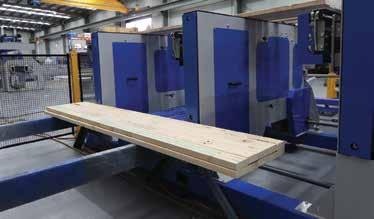
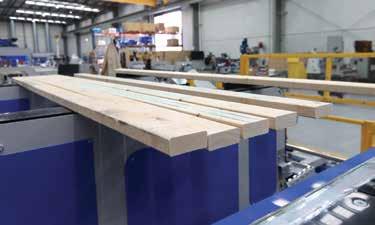
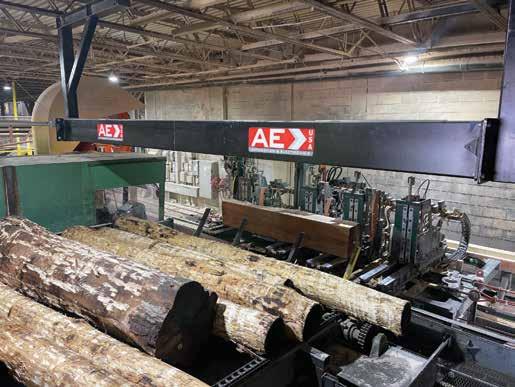
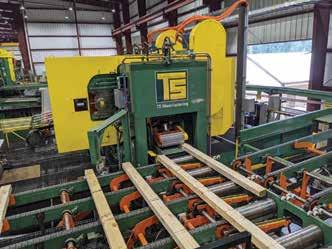
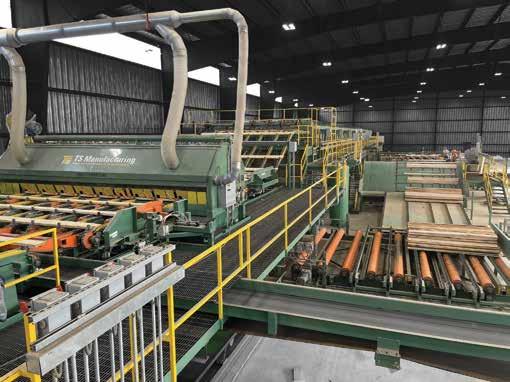
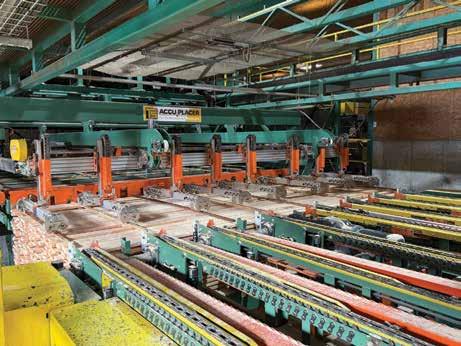
The Stacker is the perfect solution to continuously stack timber into packs all day long without any supervision. The machine is ideally suited to any Moulding, Ripsaw, Finger Jointing, or Stud Cutting Line and will improve productivity and safety. The automated Stacker is a robust, reliable, economical and user-friendly solution to stacking timber.
FEATURES
• Ability to have heads moveable
• Can be paired with a Pack Outfeed conveyor for improved throughput
• Timber length from 1.5m – 12m+
• Fillet/Sticks optional
• Touch screen operation

• Pack Tallying
• Integrated selfdiagnostics system
• Internet ready for remote diagnostics
• Heavy and robust construction
• Ships fully assembled
MAY | JUNE 2026
Volume 36 – Issue 3
Incorporating Australian and New Zealand Timberman Established 1977
Front Cover:
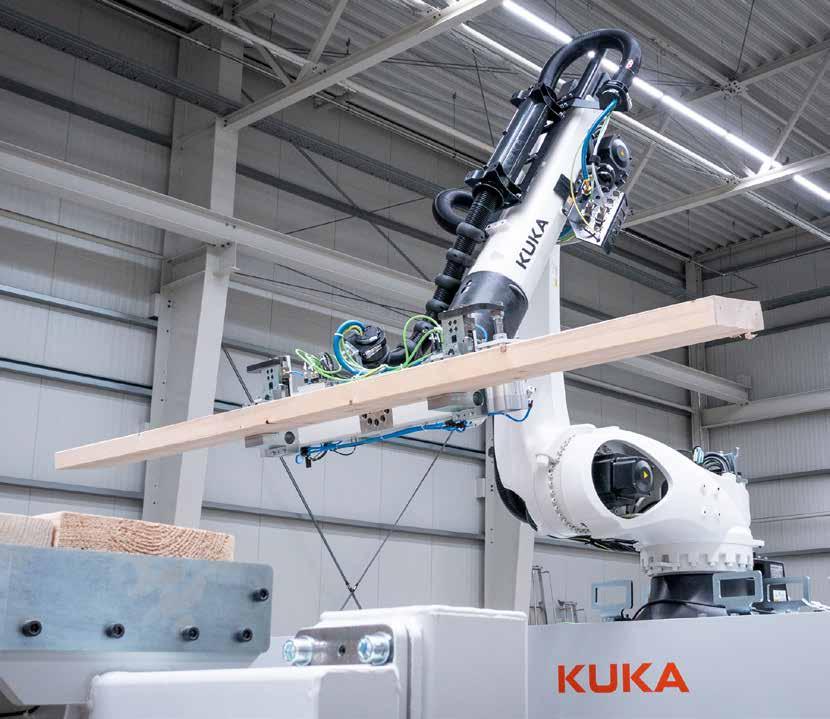
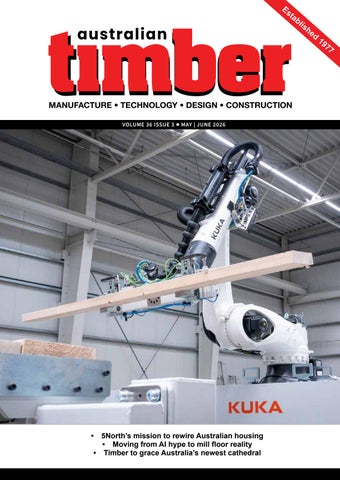
5North has created an advanced manufacturing business in Adelaide’s northern suburbs that is installing one of the most sophisticated robotic prefabricated panel production lines in the world, with first saleable product targeted for August 2026. Story pages 12, 13.
Publisher and Chief Executive: Hartley Higgins

8 10 14

General Manager: Robyn Haworth
Editor: Bruce Mitchell b.mitchell@ryanmediapl.com.au
Advertising: Jamie Richardson j.richardson@winetitles.com.au
Adelaide Office +61 (08) 8369 9514
Production & Creative Services: Robyn Haworth
Timber classifieds: j.richardson@winetitles.com.au
Adelaide Office +61 (08) 8369 9514
Subscriptions: subs@forestsandtimber.com.au
Adelaide Office +61 (08) 8369 9500
Subcription rates Free
Accounts: Adelaide Office +61 (08) 8369 9500
Postal Address: 630 Regency Road, Broadview South Australia 5083
Phone: +61 (08) 8369 9500
Melbourne Office: Suite 207/19 Milton Parade, Malvern VIC 3144
Phone: +61 402 494 041
Find us on Facebook @AustralasianTimber Website www.timberbiz.com.au
Conditions
The opinions expressed in Australian Timber Magazine are not necessarily the opinions of or endorsed by the editor or publisher unless otherwise stated. All articles submitted for publication become the property of the publisher. All material in Australian Timber Magazine copyright 2022 © Ryan Media. All rights reserved. No part may be reproduced or copied in any form or by any means (graphic, electronic, or mechanical including information and retrieval systems) without written permission of the publisher. While every effort has been made to ensure the accuracy of information, the publisher will not accept responsibility for errors or omissions, or for any consequences arising from reliance on information published.
Australian architects it would seem are increas ingly choosing timber in their plans for many good reasons.
Using timber supports sustain able construction while meet ing high standards of quality, performance, and environmental responsibility.
And it is commendable that they are seeking out PEFC certified timber.
The Programme for the En dorsement of Forest Certification (PEFC) is one of the world’s larg est forest certification systems, ensuring that timber products come from responsibly managed forests and verified supply chains. PEFC certification provides architects with confidence that the timber they specify has been sourced in a way that protects bi odiversity, conserves ecosystems, and supports local communities. Australian architects value PEFC certified timber for its transparency and traceability. The chain of custody certification sys tem allows stakeholders to track timber products from the forest to the finished building material. This reduces the risk of using ille gally harvested or unsustainably sourced wood.
The Australian Forest Products Association is already calling for the Federal to strengthen sanctions against Russian timber products, warning that current measures are failing to prevent Russian timber from entering the Australian market through third countries.
By selecting PEFC certified timber, Australian architects can create attractive, durable buildings while contributing to sustainable forest management and support ing the transition to a lower car bon built environment.
The Inala Infill Apartments, designed by Baber Studio, has been awarded House of the Year at the 2026 Greater Brisbane Regional Architecture Awards – the highest honour across all residential project categories.
The award recognises the project’s leadership in cross‑lam inated timber (CLT) construction, low‑carbon delivery, and high‑per formance social housing, outper forming expensive new house projects and large multi‑residential “green tower” developments re cently completed in Brisbane.
Led by Kim Baber, Principal Architect of Baber Studio and Project Leader/Chief Investigator within the ARC Advance Timber Hub, the project demonstrates how mass timber systems and modern methods of construction (MMC) can deliver cost‑effective, scalable and climate‑positive housing outcomes without com promising architectural quality or resident wellbeing.
Key project members include Free Range Landscape Archi tects, Hyne Timber and XLam, and Kane Constructions.
At the core of the project is the use of structural mass timber, with CLT forming the primary floor and roof system. Concrete and steel were deliberately limited to areas where they were function ally unavoidable, such as the ground slab, lift core and select structural elements. This material substitution reduced total carbon emissions for the project by 173.4 tonnes of CO2, equivalent to taking 37 cars off the road for one year. The entire building required only 2 hectares of forest, which could be regrown in Australian plantation forests in approximately 18 minutes.
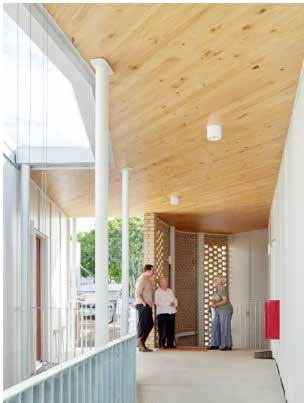
At the core of the Inala Infill Apartments project was the use of structural mass timber. Picture: Christopher Frederick Jones
The building incorporates ap proximately 247 m³ of engineered timber, including CLT, glue‑lami nated timber (GLT) and laminated veneer lumber (LVL). Importantly, the CLT manufacturing process enables the transformation of low‑structural and/or appear ance‑grade timber into high‑per formance structural panels, maximising resource efficiency while supporting domestic timber supply chains.
Inala Infill Apartments provides a clear example of how MMC and prefabricated timber systems can de‑risk delivery and improve productivity in mid‑rise residential projects. XLam CLT panels, man ufactured to precise dimensions using computer numerical control
(CNC), minimised waste and ena bled rapid on‑site assembly.
A key outcome was construction speed: installation of the CLT floor panels took just two days, compared with the six days origi nally programmed, allowing early removal of cranes and reducing overall construction costs and site disruption. These efficiencies highlight the commercial advan tages of mass timber for projects operating under tight budgets and delivery timelines.
The award reinforces a growing industry message: when com bined with thoughtful design and modern methods of construction, mass timber can redefine how housing is delivered in Australia.
Tasmania’s forest and timber industry is calling for a stronger commit ment to locally sourced timber and downstream manufacturing as the State prepares to deliver a major pipeline of housing and infrastructure projects.
The Tasmanian Forest Products Association (TFPA) said Tas mania had a major opportunity to build in a way that balances environmental responsibility with economic growth, regional jobs and long term community benefit.
TFPA Chief Executive Officer
Nick Steel said Tasmania’s fu ture should be built on balance, using renewable local materials, supporting sustainable industries and ensuring more value stays within Tasmania.
“If Tasmania is serious about building more homes and major projects, we should be using more Tasmanian timber,” Mr Steel said.
“It’s renewable, it stores car bon, it supports regional jobs and manufacturing, and it keeps more economic value here in our State rather than importing materials.”
Mr Steel said local timber and downstream processing would play a critical role in helping Tas mania deliver future housing and major projects while reducing transport emissions and sup porting sovereign manufacturing capability.
“Every extra step of processing undertaken in Tasmania means more jobs, more investment and more opportunity staying here,” he said.
“The story of forestry is not just what happens in the forest, it’s what happens afterwards in manufacturing plants, work

shops, transport businesses and construction sites across Tasmania.”
Mr Steel said the industry want ed to work collaboratively with Government on what it is calling a Tasmanian Timber Guaran tee, a long term commitment to greater certainty around project pipelines, procurement pathways and the role local timber can play in public construction and housing delivery.
“Tasmania is talking about major housing programs, urban renewal and significant infra structure investment, including projects like the Macquarie Point Stadium,” he said.
“But right now there is not enough certainty around how local timber and local manufac turing capability fit within that pipeline.”
“That certainty matters because businesses make investment decisions years ahead. Industry needs confidence to invest in ad vanced manufacturing capability, workforce growth and appren ticeships.”
Neville Smith Forest Products (NSFP) CEO Andrew Walker said businesses like Neville Smith demonstrated the broader
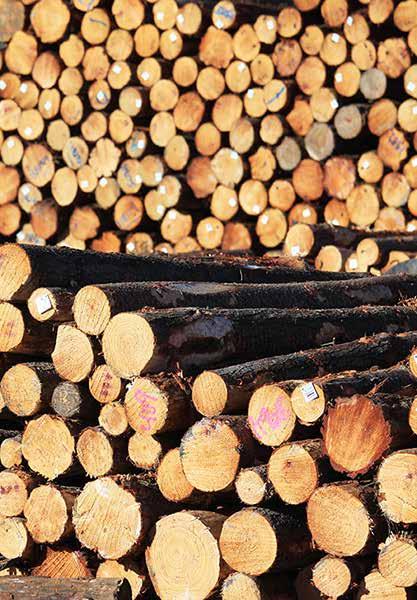
social and economic contribution of Tasmania’s timber industry.
“When people walk through operations like this, they see advanced manufacturing, skilled jobs and Tasmanian products helping build homes and infra structure,” Mr Walker said.
“But they also see businesses investing in people and commu nities.”
Mr Walker said NSFP worked closely with parts of the disability sector and vulnerable mem bers of the community to help create meaningful employment pathways.
“That’s something we’re incred ibly proud of,” he said.
“These industries are deeply connected to regional Tasmania and provide real opportunities for people who can sometimes struggle to access secure and meaningful work.”
Mr Walker said rising fuel, freight and operating costs con tinued to place pressure on re gional manufacturing businesses and reinforced the importance of strengthening local supply chains.
“The opportunity is here for Tasmania to lead with renew able materials, lower carbon construction and a stronger local manufacturing base,” he said.
Across Australia’s leading architectural projects, a clear trend is emerging: architects are not only choosing timber for its performance and aesthetic appeal, but increas ingly insisting on PEFC certified materials.
The 2025 Timber Design Awards, sponsored by Respon sible Wood, the PEFC national member for Australia, highlighted how certification has become integral to delivering credible, future ready architecture.
At its core, the preference for PEFC certified timber is about confidence and accountability. Architects are responding to growing expectations around sustainability, transparency, and compliance. Certification provides independently verified assurance that timber is responsibly sourced and traceable throughout the sup ply chain critical in meeting ESG requirements and aligning with green building frameworks. For many projects, this decision is closely connected to environ mental sensitivity and place based design. At the Nebraska Resi dence on Bruny Island, certifica tion was essential due to the site’s ecological significance.
As Lara Maeseela explains: “Choosing certified timber was particularly important because of the site’s high ecological value, surrounded by protected white gum forests and habitat for the Forty spotted Pardalote. Us ing certified timber allowed the building to sit lightly within its environment, demonstrating that thoughtful design can coexist with

conservation and protect natural habitats.”
This reflects a broader shift: certification enables architects to translate environmental intent into verifiable action, ensuring design decisions support conservation outcomes.
Certified timber also strengthens regional supply chains and local industry. Projects such as KROSS HOUSE and the First Building at Bradfield City Centre which was recognised at last year’s Timber Design Awards prioritised locally sourced materials, supporting domestic forestry while reducing transport emissions.
At Bradfield, certification enabled scale and flexibility. As the design team notes: “We prioritised locally sourced timber, with the aspiration of using 100% Australian product, to help build capacity in the local industry.”
Certification provided a frame work to integrate both Australian and international timber within a single trusted framework demon strating how PEFC supports large, complex projects without compro mising sustainability standards.
Performance is another key driver. Certified timber is not se lected at the expense of technical
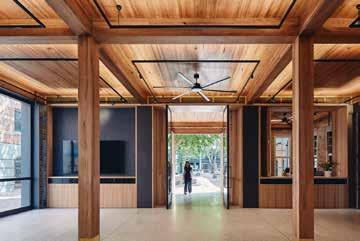
requirements it enhances them. In projects such as Boot Facto ry, engineered timber systems improved structural performance, fire resistance, and acoustics, while enabling prefabrication and construction efficiency. Certifica tion ensures materials meet both technical and ethical expectations, giving architects confidence in their specifications.
PEFC certified timber also plays a vital role in low carbon and cir cular construction. Timber stores carbon, reduces embodied emis sions, and supports prefabricated systems designed for disassembly and reuse. Certification ensures these benefits are grounded in responsibly managed forests, di rectly linking climate performance with sustainable forestry practices. Beyond performance, timber carries strong cultural and expe riential value. In the Consulate General of Malaysia in Melbourne, it is central to the architectural narrative.
As Cheah and Saw Architecture explain: “Certified timber ensured the project’s use of timber was
both culturally meaningful and environmentally responsible, aligning this symbolic material with contemporary sustainability expectations. It ensured traceabili ty, durability, and ethical procure ment, reinforcing the project’s broader commitment to long term environmental stewardship.” Here, certification reinforces not only environmental outcomes, but also the integrity of architectural expression.
Together, these projects show that the choice of Responsible Wood/PEFC certified timber is driven by a convergence of fac tors: verified sustainability, supply chain transparency, performance reliability, carbon accountability, and cultural relevance.
For Australian architects, certifi cation is no longer optional – it is essential. As timber construction continues to scale, PEFC certi fication ensures this expansion remains grounded in responsible forest management, supporting a built environment where design excellence and environmental stewardship go hand in hand.
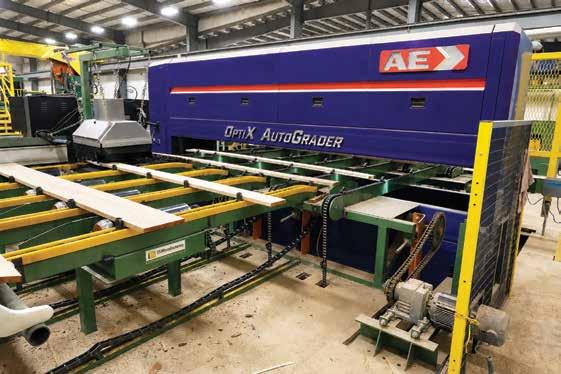
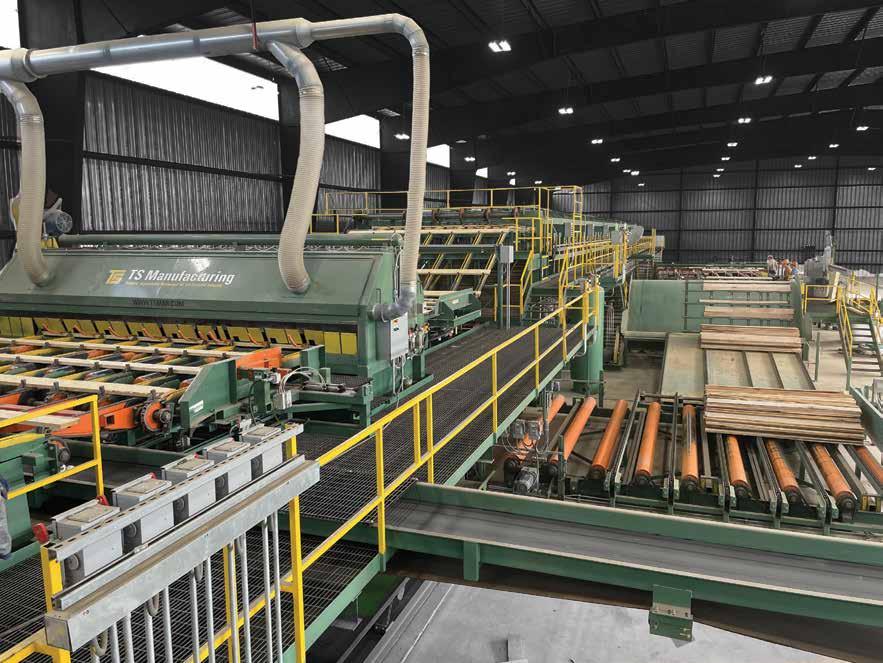
With more than 40 inter national technology leaders now confirmed to exhibit, WoodTECH 2026 is set to be one of the largest show cases of wood processing for the Southern Hemisphere.
It also highlights a massive re gional push toward autonomous, “zero light” manufacturing.
The sheer scale of the upcoming series, which takes place in Ro torua (18 19 June) and Brisbane (23 24 June), underscores a pivotal moment for the sector.
As mills across Australia and New Zealand face rising costs and fluctuating markets, the focus has shifted from incremental improve ments to a total technological overhaul.
The event has moved beyond its traditional role as a conference; it has become a southern hub where the world’s most advanced AI, robotics, and scanning compa nies are landing to demonstrate how ‘digital twins’ and autono mous systems are performing in real world mill environments.
WoodTECH 2026 is being organised around the theme of “Sawmilling and Wood Processing Innovations: Improving Productivi ty and Advancing Operations.”
This theme reflects the growing demand for more efficient man ufacturing processes, greater automation, improved resource utilisation, and higher quality wood products. As global markets continue to evolve, timber pro ducers face increasing pressure to enhance productivity while maintaining sustainability and environmental responsibility. The conference aims to address these challenges by showcasing practical solutions and emerging technologies.
A major focus of the Brisbane conference will be technological innovation within sawmills and

wood processing facilities. Dele gates will learn about the latest developments in sawing systems, automated production lines, opti misation software, scanning tech nologies, and artificial intelligence applications. Industry experts will demonstrate how modern technol ogies can increase recovery rates, reduce waste, improve product quality, and lower operating costs. Sessions are expected to provide real world case studies illustrating successful technology implementation in wood manufac turing operations. The conference programme will also examine
advances in wood treatment products and timber preservation technologies. As demand grows for durable and sustainable wood products, manufacturers are seek ing innovative treatment methods that extend product life while meeting environmental standards. Presentations will highlight new preservation techniques, chemical treatments, and quality assurance systems that support long term timber performance in construc tion and industrial applications. Another key topic will be kiln drying and moisture manage ment. Effective drying process es are essential for producing high quality timber products and minimising defects. Experts will discuss modern kiln technologies,
process optimisation strategies, energy efficiency improvements, and monitoring systems that help manufacturers achieve consistent product quality. These sessions are particularly relevant as rising energy costs continue to drive interest in more efficient drying solutions.
The exhibition floor is a major drawcard this year, featuring a record number of confirmed product and service suppliers. This massive assembly allows mill managers and operations leaders to compare, first hand, the latest advancements from companies like Finnos, DO2, and SiCam Systems.
Detailed programme information can be found at woodtech.events
DAY ONE
TUESDAY 23 JUNE 2026
SESSION 1: Accelerating Wood Innovations Through Applied Technologies
12:10pm
Keynote Address
Driving Innovation and Indus try wide Progress in the Forest and Wood Products Sector. Ian Blanden, Head of Research, Development & Extension, Forest & Wood Products Australia
12:35pm
Optimization in 2026: How Data, AI, and Smarter Control are Rede fining Performance.
1:00pm
One Operator. Zero Light. Maxi mum Output.
1:30pm
The Next Generation of Ad vanced, Highly Efficient Machines and Production Lines for the
Woodworking Industry.
2:00pm
Advanced Sawmill Optimization through 360° Transverse Log Scanning and Multi sensor Quality Grading.
SESSION 2: Advances in Mill Automation and Optimising Technologies
3:40pm
Real world Results: Closed Loop
Size Control’s Impact on Mill Recovery and Maintenance
4:10pm
AI Powered Revolutionising Scan ning Technology
4:40pm
Robotics: An Innovative Approach Combining Vision and Control for Planer Mills
5:00pm New Technology Workforce
5:30pm
Q&A Panel
DAY TWO
WEDNESDAY 24 JUNE 2026
SESSION 3: Process Automation in Sawmilling Operations: Case Studies
8:30am
Splinters to Structures: Taking Bluegum from Pulpwood to Engi neered Wood Products
9:00am
Flying Bandsaw M|One: Active Bandsaw Blade Guidance System
9:30am
Commercialising Technologies — The Hidden ROI of Good Decision making
9:50am
Q&A Panel
SESSION 4: Step Change in Wood Processing: AI & Other Technology Innovations
10:40am
Technology Showcase, Trimble Forestry, Tanguay Machinery,
Metamorf
11:00am
Transforming Sawmills through Data driven Decisions 11:30am
Safe and Secure Storage Solu tions for Mill wide Wood Residuals 12:00pm
Modern Treating Plant Technology in the Wood Industry: Automation, Legislation, and ProcessMaster Pro
12:20pm
Machine Learning How it can be applied in the Australasian Timber Industry 12:40pm
Q&A Panel
1:00pm Lunch & Networking 1:45pm: Conference Concludes
Australia’s building industry is being squeezed from all sides, with fuel price volatility now driving rapid and unpredictable cost increases across projects, supply chains and labour.
David Reid Homes Group is warning the sector is facing mounting pressure, with Manag ing Director Matt Jackson saying costs are now shifting so quickly that builders as well as many other industries, are struggling to keep pace.
“Costs are changing by the day,” Mr Jackson said. “This is no longer a slow increase. It’s constant movement and it is putting enormous pressure on builders trying to deliver projects responsibly.”
Mr Jackson said the building in dustry, like many sectors, is being heavily impacted by rising fuel costs, with flow on effects across materials, transport and trades.
“Fuel touches everything in construction,” he said. “It impacts deliveries, logistics, product costs,

site visits and every trade getting to and from jobs.”
He said the result is a com pounding cost burden that many are finding difficult to navigate.
“You’re not just dealing with one cost increase. You’re dealing with multiple layers of cost increases hitting at once.”
Mr Jackson said apprentices and young tradespeople are among the most exposed, with many travelling long distances daily to get to worksites.
“They’re the ones driving across
cities, across regions, just to get to work,” he said. “They don’t have the financial buffer, and they’re being hit the hardest.”
He warned the pressure on younger workers could have long term implications for the industry.
“If we don’t support young tradies, we risk losing the next generation of skilled workers.”
Mr Jackson said reputable builders are increasingly being forced to absorb rising costs to protect clients, putting pressure on margins.
“There are a lot of good, honest builders doing the right thing, trying to deliver projects at agreed prices but when costs keep shifting, that becomes incredibly difficult,” he said.
Mr Jackson said there needs to be greater scrutiny across the supply chain to ensure cost increases are justified and not driven by opportunistic pricing.
“If the government is serious about cost of living pressures, then it needs to look closely at what’s happening across building and supply markets,” he said.
“There has to be accountability. Price gouging needs to be ad dressed and stopped.”
He said unchecked cost in creases ultimately flow through to homeowners.
“When suppliers increase prices without transparency, it doesn’t just hurt builders, it pushes up the cost of housing for everyday Aus tralians. This is an issue across many industries at the moment.”
The Australian Forest Prod ucts Association wants the Federal Government to urgently strengthen sanctions against Russian timber products, warning that current measures are failing to prevent Russian timber from entering the Australian mar ket through third countries.
In a recent submission, AFPA has highlighted serious concerns that increasingly large volumes of Russian timber products are being rerouted through countries such as China before being imported into Australia and used in housing and construction.
AFPA Acting CEO Richard Hyett
said stronger action must be taken to protect Australian timber manufacturers and the integrity of Australia’s forestry and wood products market.
“The latest evidence suggests significant volumes of Russian timber continue to find their way into the Australian market, despite existing sanctions,” Mr Hyett said.
“We estimate up to 100,000 cu bic metres of timber imported into Australia each year could contain Russian material, which means up to 15,000 new homes built each year may include Russian timber.”
AFPA’s submission to a Senate inquiry recommended several
key actions be taken by the Government, including extending the current 35 per cent tariff to all products containing Russian materials regardless of where they are imported from, introduc ing Country of Origin labelling, as well as launching anti dumping investigations into those products, and increasing border compliance activity to identify and stop re routed timber imports before they enter the Australian market.
“Australia has become a target for Russian products because, unlike the European Union, the United States and other trading partners, Australia has taken very
limited action to address Russian timber being rerouted through third countries,” Mr Hyett said.
“Local timber manufacturers continue to face unfair competition from often inferior imported prod ucts that can be sold at prices well below market value. This is cost ing Australian businesses market share and placing pressure on local jobs, economic growth and investment.
“Enforcing stronger sanctions would also support Australian manufacturers, uphold our inter national commitments and ensure a level playing field for domestic producers.”
The first Roman Catholic Cathedral in Australia in over a century to be mas ter planned from its inception as a complete, integrated cathedral precinct and featuring timber framing has been marked with the appointment of an interna tional award winning architect.
The Cathedral Precinct Project, in the Diocese of Broken Bay, has appointed Níall McLaughlin Architects led by recent recipient of the Royal Institute of British Architecture Royal Gold Medal), Níall McLaughlin. The Royal Gold Medal is one of the highest international architectural hon ours.
London based architect McLaughlin will work alongside Australian executive firm Hayball during the construction that will
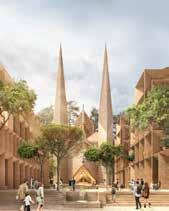
feature timber framing and sand stone structures inspired by the region’s Hawkesbury River Ne pean River watershed and local bluffs.
The Project will transform the Waitara 7.7 hectare site into a landmark spiritual and civic
destination, providing a spiritual focal point for the faithful in the Diocese which covers an area of 2,763 square kilometres across the three Deaneries from the upper Central Coast, the North Shore, and Northern Beaches.
Celebrating its 40th anniver sary since being proclaimed a Diocese in April1986 by the then Pope John Paul II, Broken Bay now serves around 250,000 Catholics.
Níall McLaughlin Architects (NMLA) was selected to design the Precinct following an invited international process by the Diocese under the leadership of the Most Rev Anthony Randazzo DD JCL.
A London based Irish architect and a professor at The Bartlett
School of Architecture, Níall McLaughlin is recognised for his focus on material, craft, light and form, and the relationship between buildings and their surroundings.
The architectural vision draws deep inspiration from the Hawkesbury River watershed that unites the Diocese’s 26 parishes. The design envisions a congregation ebbing and flow ing beneath a forest of timber framing, contained by sandstone structures of local bluffs and caves.
Environmental stewardship is also key; the existing Blue Gum High Forest will be preserved as a public amenity, featuring new roof gardens to promote biodiversity.


ALICIA BROWN
North founder Wayne Hughes was running along the Linear Trail beside the River Torrens in Adelaide when he noticed the tents.
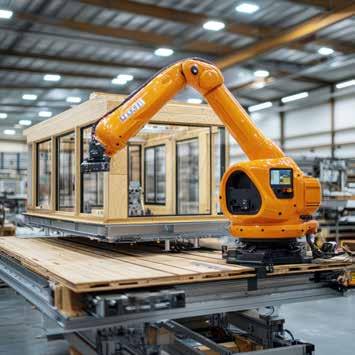
First one or two, then more — ap pearing week after week along the riverbank in a city that had never seen rough sleeping at this scale. Hughes and his wife, Nicola, who both volunteer at a local soup kitchen, found the conversation around them echoed their own concern — but nobody seemed to know where to start. “Everyone felt strongly that something needed to be done,” he recalls. “And so my wife and I thought about what’s driving this. We think it’s housing. What can we do differently?” What followed was three years of research, risk taking, and 5North was born from what Hughes describes as a “this is dumb, we should just use robots” revelation. The result is an advanced man ufacturing business in Adelaide’s northern suburbs that is installing one of the most sophisticat ed robotic prefabricated panel production lines in the world, with first saleable product targeted for August 2026.
The seeds were planted during the pandemic. Hughes, watching material price volatility and labour shortages bite the construction sector, began researching how other countries drove housing sup ply differently. “Sadly, a lot of the answers are abroad for this sort of thing,” he says. “I believe the solution lies on the supply side.” The original plan was to import prefabricated components from in ternational factories — 5North had signed exclusivity arrangements with several overseas fabricators

— then invest in domestic robotics. But the research kept pointing to ward a more ambitious path. “We realised the change needed to be quite radical,” he says. “It was never going to be basic machinery with some tradespeople under roof.”
That path led to KUKA, the German robotics and automation giant. In December 2024, 5North signed a proposal with KUKA and spent the following eight months in intensive engineering sessions — Tuesday and Thursday nights, four hours at a time — adapting the technology for Australian res idential construction. “They had incredible expertise in robotics automation,” Hughes explains, “but they knew very little about residential construction here in Australia.”
The collaboration was acceler ated by circumstance. When a UK based modular manufactur er — which had ordered KUKA robotics before winding down its operations in late 2024 — folded, 5North approached KUKA about re engineering the existing brand new hardware for Australian con ditions. “That allowed us to bring our manufacturing horizon forward quite significantly,” Hughes says. The hardware suited their purpos es, though the software had to be completely reworked. “You build differently in the UK than you build here.”
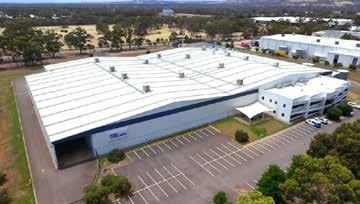
The 5North Advanced Manufacturing Facility sits on a 46,000-square-metre site north of Adelaide.
The 5North Advanced Man ufacturing Facility sits on a 46,000 square metre site in Edin burgh, near the RAAF base north of Adelaide, with around 12,000 square metres of production space under roof.
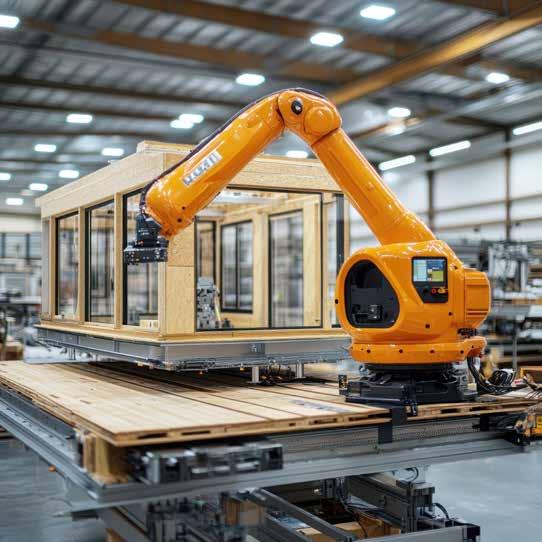
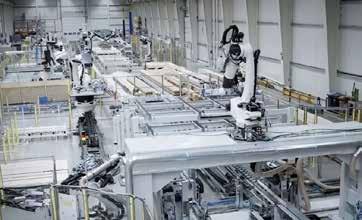
At its heart is a 104 metre robotic production line with 14 industrial robots across six automated sta tions. Australian produced radiata pine passes through a Hundegger automated saw, processing around 4,000 cuts per day. Pre cut timber feeds into framing stations; sheet ing products into sheeting stations; carpenters prepare sub assem blies for windows and doors. The robots then frame, square, glue, sheet, fasten, route, and mill each panel before it discharges into four integrated mechanical, electrical, and plumbing lines, where opera tives complete services work. The average cycle time is 10 minutes per finished panel, with a maximum throughput of 37.2 square metres of completed product per cycle. On a standard 38 hour, four day working week across 48 weeks, the facility can produce components for approxi mately 1,000 homes per year. With
a three shift operation, that rises to around 3,000.
Hughes is emphatic on one point: 5North is not a builder. It is a specialist supplier of prefabricated wall, floor, and ceiling components to builders, developers, and hous ing programs.
“If we were the builder with a capacity of 3,000 homes per year, that would make us one of the largest builders in the state overnight,” he says. “Which is completely ridiculous as a viable business model. To be impactful and to offer the industry the oppor tunity to be more impactful as well, we wanted to work with a wider range of clients.”
Clients bring their own designs. 5North’s DfMA team, led by Ales sandra Yokota, value engineers those designs for manufacturing efficiency, sometimes with remark ably subtle interventions. Hughes describes one project in which reducing the height of a first floor external wall by 28 millimetres had a profound impact on costs and site speed. In another, moving an internal staircase just 23 millime tres unlocked significant manufac turing efficiencies. Once designs are optimised, they are converted into machine language that feeds
a Siemens platform driving the robotic line.
The output ranges from basic framing through to fully clad panels with external cladding, battens, membrane, insulation, first fix electrical and windows and doors hung, the scope determined by what each builder wants from the factory versus the site. On pricing, 5North has entered the market at parity with traditional procurement.
“The difference is time and certainty,” Hughes says. “You put a piece of wood on our line, ten minutes later, you have a panel.”
5North was established by a group of South Australian private investors, supported by the Com monwealth Bank — remarkable, Hughes notes, for a business that is, by any measure, a startup.
“I cannot say enough about CBA really walking the walk” on social licence, he says. The company’s environmental commitments are backed by third party audits against ESG metrics, and 5North is commissioning Australian spe cific lifecycle assessment data to complement its existing UK bench marked performance claims of more than 80 per cent less embodied carbon and 90 per cent less waste.
The timber based material sys tem is deliberate.
“You don’t get much in the way of sequestered carbon and whole of life embodied carbon from steel as you do in timber,” Hughes explains. “If you’re going to go down this path of industrialisation, you may as well pick up all of the different benefits.” The company is commit ted to local content procurement, sourcing Australian produced pine, and engaging supply chain part ners on issues such as formalde hyde in sheeting products.
5North are equally deliberate about the workforce. “We’re abso lutely not about replacing trades,”
he says.
“Carpentry is a huge part of our building industry. Carpenters should be working with timber — that’s what they do.”
The factory model shifts repet itive, physically demanding work into a controlled environment, while qualified trades on site focus on skilled installation. The four day working week is a deliberate choice — and 5North sees the model as opening doors that tradi tional construction has kept closed.
Three of 5North’s five senior lead ers are women — not by design, Hughes says, but by hiring the right person for the right job.
5North is already working with developers and builders in South Australia, including those on the SA Housing Trust’s panel, and is involved in active tenders.
The company has engaged with Renewal SA and community hous ing providers through the Housing Australia Future Fund. 5North are circumspect about naming clients — NDAs are in place — but confirm the business has engaged with government at all levels to communicate its advanced manu facturing investment in the state.
The national ambition is clear.
“We’re not set up like the US, where you could drive three hours in any direction and hit another big city,” he says.
“If you’re going to be real about cost, when you add freight on, you’re starting to not be real. If you’re going to be real about ESG and you want to freight things across the country, that is not the best way to look after your carbon footprint.”
The answer is more factories. 5North’s goal is at least three additional facilities on the ground by 2030 — a timeline the 5North team describes as “a scary goal” that “really focuses the mind.”
Crucially, the engineering work in Adelaide is already shortening lead
times: “The timeframe for factory two, three, or four to production is almost half of where we started.”
5North recently joined prefabAUS — a decision Hughes describes as straightforward. “They’ve been influential and successful in driving change already. Having people out there who have got your back, advocating on your behalf as an in dustry — all credit to prefabAUS.”
Asked what one thing 5North would change, Hughes points

beyond the build itself to the plan ning, consents, and approvals that precede it. “Let’s make it simpler to get to construction,” he says — a message that echoes prefabAUS’s own advocacy priorities.It speaks to a founder who sees the venture not as a silver bullet, but as one essen tial part of a larger transformation.
“5North will never be the silver bullet, and we’re not pretending to be,” he says. “But we have a part to play. ”
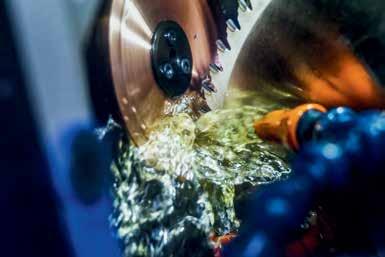
At Leitz Australia and New Zealand, our fully equipped workshops can expertly sharpen any brand of tooling to Leitz international quality standards.
We will restore your tools to as-new condition with Leitz precision grinding technology - extending their life, improving performance and reducing waste. Keep your tools working like new. Talk to your Leitz representative today.
ALICIA BROWN
ustralia’s Smart Building sector has made significant strides in demonstrating that offsite construction can deliver homes faster, with less waste and lower carbon.
But as the industry scales, a critical piece of the puzzle remains largely unexplored: what do the people who actually live in these buildings think about them?
That’s the central question driving Prefab Rehab, a multi year research project led by, Senior Re search Fellow at RMIT University’s Post Carbon Research Centre.
Funded by an Australian Research Council DECRA grant, the project examines how offsite construc tion and MMC are reshaping the production and lived experience of

apartment housing across Australia and Europe.
Dr Dorignon’s interest was sparked during an international re search project with Master Builders Victoria in 2022 2023 examining construction industry innovation and emerging models of industrialised
building, during which she observed that the challenges surrounding offsite uptake were increasingly in stitutional and systemic, rather than purely technical. “What interested me most were the institutional arrangements that were missing but needed to achieve greater uptake,” she explains. “I wanted to look not from a barrier perspective, but at all the different elements that are part of the system.”
The project spans four countries — Australia, Sweden, the UK and France — each representing a different stage of offsite maturity.
Sweden offers a case study where offsite construction has become an established part of the housing system; France demonstrates how embodied carbon regulation and industrial policy can accelerate
adoption; and the UK provides cautionary lessons about over reli ance on government procurement without broader private market uptake.
What sets Prefab Rehab apart is its focus on residents. Dr Dorignon notes that existing research on resident experience is limited and drawn from older stock.
“I want to bring residents back into the conversation as essential ac tors, not the passive end user,” she says. “They’ll live in these buildings for 50 or 60 years. It matters for designers, builders and manufac turers to understand how people experience what they’ve built.”
prefabAUS members interested in participating in the research can contact Dr Louise Dorignon at Louise.dorignon@rmit.edu.au
n a remarkable convergence of policy activity, Queensland, New South Wales and Victo ria have each made landmark commitments to Modern Methods of Construction — removing long standing barriers and confirming that prefabricated construction is now central to Australia’s housing policy agenda.
Queensland fired the opening shot on 21 January 2026, when the Queensland State Govern ment released its response to the Queensland Productivity Commis sion’s Final Report into construc tion industry productivity.
The findings were stark: produc tivity in the sector has declined 9 per cent since 2018, equating to 77,000 fewer homes, and labour productivity has grown just 5 per cent over the past 30 years, against 65 per cent across the broader economy over the same period.
The government agreed or agreed in principle to 51 of the report’s 64 recommendations. For the Smart Building sector, the most significant commitments include the permanent removal of Best Practice Industry Conditions (BPICs) from procurement policy — already enacted in January 2026 and projected to save tax payers up to $20.6 billion over five years — alongside a commitment to performance based, produc tion neutral procurement that removes a structural bias against MMC in government projects. On regulation, the government explicitly acknowledged the QPC’s advice to equalise the playing field between conventional construction and MMC. It committed to partic ipating in the ABCB’s voluntary manufacturer certification scheme (expected to be delivered in 2028) and engaging with the National Competition Policy reforms. A TAFE Queensland training review
will also ensure MMC skills are appropriately represented in workforce programs — critical as Queensland scales its 50 per cent MMC target for government pro jects ahead of the 2032 Olympic and Paralympic Games.
For years, one of the most frustrating barriers facing NSW prefab manufacturers has been a piece of legislation designed for caravans. Under Section 68 of the Local Government Act 1993, manufactured homes intended as permanent dwellings have been classified as ‘moveable dwellings’ — a framework built for holiday parks, not high quality modular homes.
The result has been inconsistent council assessments, financing complications, and approvals uncertainty that has deterred investment.
That is now set to change. The NSW State Government’s Building Productivity Reforms, announced November 2025 and due before NSW Parliament in 2026, will for mally recognise prefabricated and modular building work as ‘building work’ under law, mandating compliance with the Building Code of Australia and replacing the patchwork of inconsistent council approvals with a single statewide pathway. The reforms also intro duce clear rules for manufacture, supply, transport, delivery and installation; a new licensing frame work for key roles; and consumer
protections including statutory warranties and prescribed pro gress payment structures. NSW Building Commissioner James Sherrard described the chang es as providing “long needed clarity” for the sector. Critically, the reforms are expected to improve access to finance. By requiring a contract in place and BCA compli ance, banks will have the certainty needed to lend against prefab ricated homes — addressing a structural barrier prefabAUS has long identified as central to sector growth. The reforms arrive along side NSW’s commitment to 80 per cent prefabricated components in its housing pipeline by 2031.
Victoria made its own landmark contribution in December 2025, publishing ‘Shaping the Future of Construction in Victoria: Modern Methods of Construction’ — a formal government statement that consolidates a suite of MMC commitments into a single policy framework. For prefabAUS members, the document is con crete evidence that the Industry Roadmap is working. Multiple Roadmap recommendations are now reflected in Victorian policy:
MMC has been formally named a driver of outcomes in the Victorian Industry Policy; the 2024–25 State Budget has funded regulatory reform aimed at achieving parity with traditional construction; the Domestic Building Contracts Act 1995 has been amended to recognise projects with moderate and high proportions of MMC, with regulations to adjust progress payments accordingly; and the $50 million Future of Housing Construction Centre of Excellence at Melbourne Polytechnic’s Hei delberg campus is now underway as the first national hub for MMC training, skills and applied re search. Government procurement across schools, health infrastruc ture, social housing and regional worker accommodation continues to be deployed as a lever to build market confidence at scale.
Taken together, these devel opments represent exactly the systemic change that prefabAUS’s advocacy has been working toward.
As prefabAUS Executive Chair man Damien Crough has noted, the sector is “winning nationally, and winning state by state”.
Queensland, NSW and Victo ria have each, in their own way, confirmed that Smart Building is no longer asking for a seat at the table — it has one.
Accoya has had a presence in Australia for almost a decade now, with more joiners and manufacturers now regularly working with Accoya, not just because of its performance, but also because it helps reduce call backs and remedial work, according to Accsys Technologies Head of Marketing Laura Keily.
Accoya wood is made by Accsys at its plant in Arnhem, in the Nether lands. Accsys transforms fast grow ing, certified sustainable wood into Accoya wood through its proprietary acetylation process.
The result is a high perform ing product with sustainability credentials that exceed those of man made, intensely resource de pleting and heavily carbon polluting alternatives.
“Accoya is now widely specified on high end residential and coastal projects for cladding, decking, windows and doors, where long term performance and durability are critical,” Keily said.
She said a key driver of this uptake had been Accoya’s industry leading warranties, 50 years above ground and 25 years in ground, even without the use of surface coatings, which give specifiers, builders and homeown ers a high level of confidence in long term outcomes.
“From a trade perspective, more joiners and manufacturers are now regularly working with Accoya, not just because of its performance, but because it helps reduce call backs and remedial work. Its reliability on site allows professionals to deliver consistent results and protect their reputation,” she said.
“Over the past decade, distributors have also significantly improved stock availability across Australia, making it easier for manufactur ers to source Accoya quickly and reliably.”
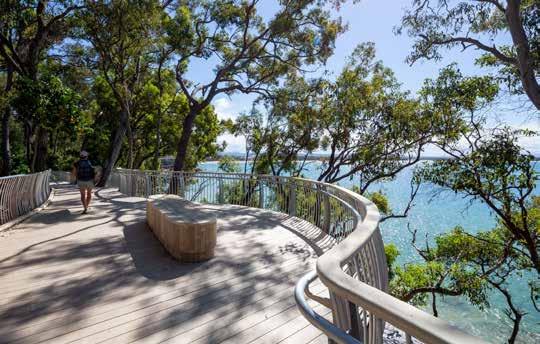
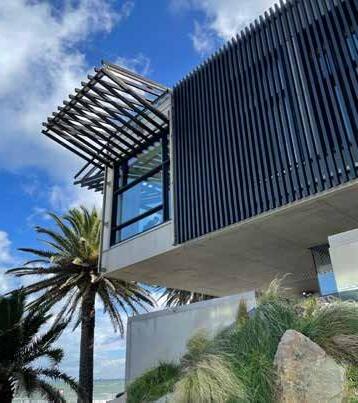
Two great examples of Austral ian projects that really show how Accoya performs when it’s put to the test in real world conditions are the Noosa Park Road Boardwalk in Queensland and Stokehouse in Melbourne.
“The Noosa Boardwalk is a particu larly strong case study,” Keily said.
“More than seven years after completion, it’s still performing ex actly as intended in a tough coastal environment.
“As you would expect, the timber has weathered naturally over time, but structurally and functionally the boardwalk remains in excellent condition.
“The design still looks great, it’s comfortable underfoot, and it continues to meet the needs of both the community and the surrounding environment with minimal mainte nance.”
Stokehouse was another stand out, now approaching 10 years in service, and it demonstrated how Accoya could deliver long term performance in a highly exposed, design led hospitality setting.
“In both cases, these projects highlight the value of investing in
a high quality, durable timber from the outset, particularly in harsh Aus tralian conditions where longevity, stability and reduced maintenance really matter,” Keily said.
Keily said the next year is focused on continuing to build momentum around the Accoya Decking Collection, particularly
as the market prepared for the upcoming decking season. This included supporting the lo cal supply chain, improving avail ability, and ensuring designers and installers have the technical guidance needed to confidently specify Accoya for outdoor appli cations.
Mathews Timber is a family owned and operated timber merchant, supplying a wide range of local and imported timber species to industry and retail throughout Australia.
Australian Species
■ Tasmanian Oak
■ Blackbutt
■ Spotted Gum
■ Jarrah
■ Messmate
■ Tasmanian Blackwood
International Species
■ European Beech
■ European Oak
■ Jelutong
■ New Guinea Rosewood
■ Western Red Cedar
■ Burmese Teak
■ Wenge
American Species
Tulipwood
Mathews Timber are importers and distributors of Accoya and Accoya Color Grey - a modified wood, delivering a remarkable level of performance and made to last
“We also offer a wide range of machining services including dressing, custom moulding and laminating”.
858 Nudgee Rd, Northgate QLD 0477 555 724 salesqld@mathewstimber.com.au
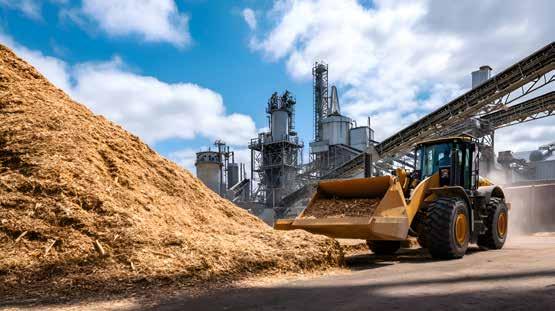
In September a practical group of industry leading speakers will deliver innovative case studies and new opportunities at Inno vatek’s Residues to Revenues (R2R) conference.
Running in Brisbane this popular forest and wood technology event brings industry leaders together for networking and learning about new developments that are now valuing wood byproducts more than ever before.
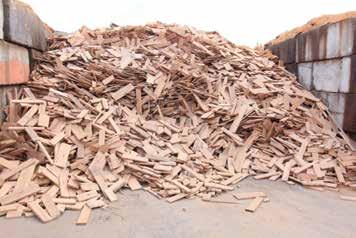
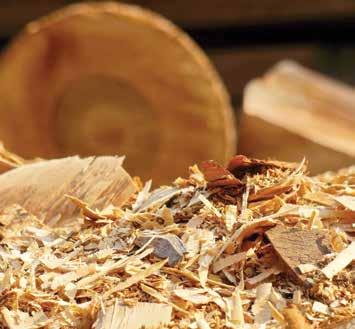
With increasing financial pres sures facing our forest and wood products sector its essential for forestry and energy professionals seek new ways to convert wood byproducts from logging and saw milling into profitable and climate positive bioenergy applications.
The Innovatek event provides new insights into emerging bio mass markets, connects suppliers with industrial energy users, and showcases innovative technolo gies for efficient residue recovery and processing in Australasia. With new processes being com mercialised now, wood residues are being sought for liquid fuels and carbon positive products that bring credits and new product markets never before available.
Speaker highlights:
Biomass for Energy: The Red bank Power Station Transforma tion by Mike Haywood, General Manager, Verdant Earth Technol ogies
Residues to Liquid Fuels: Bridg ing the Gap by Miriam Blaine, Process Engineer, HAMR Energy
Turning Waste Into Wealth: Pyrolysis Technology for Biochar, Energy and Carbon Removal
Revenue by Melissa Rebbeck, Business Development, Metamorf Engineering
Biocarbon, The GreenChar Roadmap: Utilising Waste Biomass for Industrial Metals
Production by John Mellowes,
Co Founder & Chief Engineer
Miriam’s presentation for HAMR Energy An emerging low carbon liquid fuels industry, including shipping and aviation, presents a compelling new market for underutilised forestry biomass — one that needs feedstock at scale and on long term contracts.
Forest managers across Austral asia forest plantation sectors are well placed to supply.
One obstacle has been a lack of validated data on residue chemis try, collection logistics and carbon intensity needed to underpin com mercial supply agreements.
Drawing on HAMR Energy’s Fibre to Fuels research program, conducted with CSIRO, university partners and forestry partners across three Australian forestry hubs, her presentation outlines what we are learning and what it means for those across the forestry sector looking to access this opportunity.
Key reasons to attend R2R Conference:
Understand High Value Markets: Learn how to transform forestry residues, slash, and manufactur
ing waste into high value bioener gy and renewable products.
Networking and partnerships: Connect with forest owners, contractors, wood processors, and large industrial energy users switching from fossil fuels to biomass.
Case studies of new technolo gies: Access real world examples of in field chipping, residue pro cessing innovations, and regional supply chain models.
Address high energy costs: Dis cover how to navigate increasing energy demand and moderate fuel costs for wood manufacturing.
Expert insights: Hear from global and local experts regarding the future of the bioeconomy and regulatory drivers influencing the industry.
Comprehensive exposure:
The event includes both expert speakers, practical technologies and vendors with innovative new processes on our indoor exhibits machinery used in wood chipping, residue handling and processing.
For Australian forest managers and sawmillers there have been positive developments in the ap
plications for wood residues.
The multi day conference is heavily focused on demonstrating some of the potential high value bioeconomy operations. Key focus areas include:
Bioenergy & Biofuels: Replac ing fossil fuels, modern sawmill energy systems, and supplying biomass to industrial heat and energy users.
Value Added Bioproducts: Commercial scale methods to transform low value wood and bi owaste into high value ingredients like chemicals, glues, bioplastics, and natural fibres.
Supply Chain & Logistics: Solu tions for residues recovery, woody biomass supply and demand, and biomass resource pricing
The conference is designed for those in the forestry, wood pro cessing, and bioenergy industries to move from simply disposing of waste to creating sustainable revenue streams
We have the potential to trans form the forestry sector into a provider of biofuels, bioenergy and a range of renewable bio products. This event helps forest
owners and managers, harvesting contractors, sawmills and wood manufacturing companies better understand the real value of wood residues and the opportunities in supplying this growing market.
Other biomass technology speakers include:
Regional Biomass Manufacturing Platform, by Curtis Gibson, Man aging Director, A&E Gibson
A&E Gibson has completed the design and build of an innovative conveyor system for Seata Group, providing an integrated material handling solution suited to the demands of Seata’s pyrolysis and gasification process. It forms an important part of Seata’s pilot plant in Glenn Innes, NSW. This plant promises to play a critical future role in renewable gas, biofuels and biochar areas.
Seata’s core innovation is combining two well established industrial principles — thermal looping and chemical looping
— into a single unified process.
growing biosolids and organic
With increasing financial pressures facing forest and wood products sector it is essential that new ways be found to convert wood byproducts from logging and sawmilling into profitable and climate positive applications.
Instead of burning biomass (which releases CO2), the system uses a recirculating heat carrier to break down organic material without combustion. This produces two valuable outputs at once: clean syngas for energy, and biochar for carbon storage.
Curtis’ presentation will demon strate how we can solve for the
Cost rises stemming from the timber harvesting industry and haulage fees are being bled down the line as a result of fuel supply issues.
Harvest and haulage contractors in the forestry sector and finished goods transporters are passing on cost increases, with Wanga ratta’s Alpine MDF juggling a cost increase of $100k $150k a week.
In the first five weeks of the fuel crisis, CEO James Anderson said the business absorbed the flow on cost as much as they could but now they are passing on 33% 50% of the increase to customers.
“They are increases that we’ve been working with our customers on, but we’re still absorbing more than half of it, recognising that the consumer can’t absorb all the cost increases that get passed through
from every sector,” he said. “It will impact people who go to, for ex ample, Bunnings and will impact people building housings and will in turn increase prices.”
Alpine MDF’s business model has remained status quo on the employment and production front and there was no view to change this in the foreseeable future.
“We’re a long term committed employer, so a short term change won’t see us impacted in this respect,” Mr Anderson said. “If the fuel crisis continues into longer term it could impact some busi nesses more than others.
“The more the consumer is impacted by costs, at some point in time that will impact their buying behaviours, then they stop invest ing and consuming building based products.”
waste streams across Australia and provide a case study with our customer on how this was achieved.
This ‘Residues 2 Revenues’ Conference is also a great place to network with your industry col leageues with mutual interests in lifting productivity for foresters and millowners alike for using wood
The next issue of Australian Tim ber will highlight more biomass technology speakers spearhead ing further innovations including:
Jacob Kohn, CEO & Co founder, Futurity Bio Ventures
Gareth Forde, Principal Engi neer, All Energy
Ben Crispe. Managing Director, Suncoast Green Energy
Lachlan Esplin & Tony Esplin, RTG (Recycling Technology Group)
Roger Timms, Managing Direc tor, ACORA
Christian Jirkowsky, General Manager, Polytechnik Biomass Energy
New initiatives from major forest owners partnering with large en ergy users and state development authorities.
For details see: https://innovatek. co.nz/event/residues2reve nues 2026/
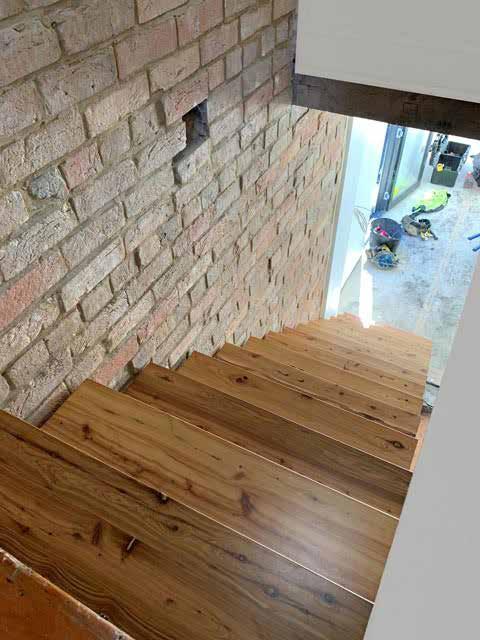
How does a coastal blackbutt, spotted gum or ironbark log become the flooring, staircase or decking in an Australian home?
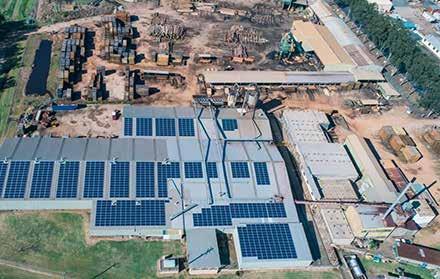
A new video from the North East NSW Forestry Hub answers that question across two sites of the one family business: the Marshall Notaras mill on the Clarence River at South Grafton, and Marshall’s Timbers at Cardiff. It follows two of the brothers behind them, Paul and Bruce Marshall.
Nick Cameron, the Manager of the North East NSW Forestry Hub, said the Marshall video adds a processor’s and retailer’s perspective to the Hub’s growing video series on the people behind NSW native timbers.
“The Marshall story shows how deeply native timber is woven through family businesses on the North Coast. It takes decades of experience to know how to handle an Australian hardwood log properly, and the care this family puts into every stage, from tagging logs on arrival through to advising a retail customer on the right species, is exactly what the Hub wants Australians to see,” Cameron said.
Paul Marshall, Director of Marshall Notaras Hardwoods, has watched the Australian hardwood industry for most of his working life. The Marshall family’s involvement in timber processing
stretches back 55 years. For the last 25 of those, they were the Notaras mill’s largest customer before taking the business over themselves.
“It’s been a succession. We were the Notaras family’s biggest customer for 25 years,” Paul said in the video. “We’re very proud of that fact, to be given the opportu nity to take the business to bigger
and better things.”
The mill processes a range of Australian eucalypts. Coastal blackbutt, grown on the east side of the Great Dividing Range, is the predominant species, alongside red and grey ironbark, white mahogany and spotted gum. All are sawn into the section sizes used in the flooring, joinery and staircase markets. Every log is
tagged and graded on arrival, and boards are tracked through milling, planing, and kiln drying.
“New South Wales hardwoods, especially from the north coast, are probably the best timbers in the world, the hardest, most durable and long lasting,” Paul Marshall, Director, Marshall No taras Hardwoods, South Grafton.
“We’ve got a great product, sustainably sourced through our wood supply agreement with New South Wales Forestry,” he said. “New South Wales Forestry should be commended on their harvesting processes. I think we’re world leaders in harvesting. There are wildlife corridors and habitat areas. Everything is taken into consideration prior to any harvesting going on.”
Inside the mill gate, a system follows each log through to the end user.
“We’ve got a chain of custody on our logs, pretty much from the forest, as the forestry logs arrive, to the end user,” Paul added. “At any time during our timber milling, planning or flooring manufactur ing process, we can track our boards.”
That Cardiff arm is run by Paul’s brother Bruce Marshall, whose outlet specialises in Australian hardwood decking (the num ber one product line), alongside 19 mm strip flooring, parquetry, joinery and staircase materials,
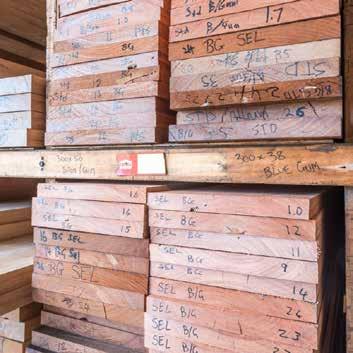
structural hardwoods, lining boards and claddings.
“Kiln drying is used basically to bring the product down to a more stable product that’s suitable for all different types of applications,” Bruce said. “In its green form, or unseasoned, it just doesn’t perform at its optimum.”
Every board is graded to Aus tralian standards: select, stand ard or pioneer grade. “We’re very proud that all our timber is graded exceptionally high and to those standards,” he said.
Resource recovery is central to the Marshall operation.
Short offcuts from the dry mill are reworked into parquetry blocks (glued into block or her ringbone patterns for the flooring market), and sawdust from the saws is redirected to local chick en farms and stables.
“Recovery is paramount to us. It’s the most important part of the sawmilling process,” Bruce said. “It’s just getting the best out of that natural resource. We’re here to preserve, conserve and look after the New South Wales for ests, and to do the best we can
for that natural product.”
Both brothers point to edu cation as a growing part of the job, helping buyers understand the differences between coastal species and matching the right timber to the application: “The species that everyone knows is blackbutt. But there are a lot of other good options out there that we’re trying to educate our customers on,” Bruce said. “Understanding the application and giving the right advice for what they’re looking for is very important.”
“Ninety per cent of the time, people would prefer to buy Australian made, Australian products. What we have here is unique worldwide, and we are very proud of it. There are a lot of other sawmillers and family businesses, such as ourselves, that do a remarkable job out there, and we should be very passionate to support timber and wood products for the future,” Bruce added.
According to Cameron, Marshall Notaras is the type of business that keeps timber flow
ing from the forest to the family home. “Every log tagged, every offcut turned into parquetry, every customer given the right species for the job. That’s the detailed knowledge our native timber industry is built on, and that’s what this video series is about,’ Cameron stressed.
The new video adds to a grow ing library of videos produced
by the North East NSW Forestry Hub profiling the people who grow, harvest, process and craft NSW native timbers. Earlier instalments featured Coffs Har bour Hardwoods, Ironwood Ta ree, Machin Sawmill and Kyogle fine woodworker Garan Hale. See the video at https://vimeo. com/1184730684?fl=pl&fe=cm
MORE than $108 million in funding will be allocated to timber manufacturing companies across the country to encourage more value adding and further innovation in the industry. The Federal Govern ment yesterday announced the successful recipients of the Accel erate Adoption of Wood Processing Innovation grant program. These grant recipients will undertake a wide range of projects which will see the implementation of upgraded and innovative work practices across various industries, including production of activated carbon, housing and construction, packaging, and culturally significant timbers to higher end markets.
AN Australian company that has developed technology to turn wood waste into timber that looks and performs like 100 year old tropical hardwood has entered an agreement with Bosch to globalise the product.
At the heart of technology is a pat ented process using a water based, formaldehyde free “Nano glue” that biomimics the structure of a natural tree in just one day.
THE 2015 HIA CSR Australian Housing Awards were unveiled at the residential building industry’s prestigious Awards ceremony at the Gold Coast Convention & Exhibition Centre with Western Australian builder Gransden Construction being adjudged winner of HIA CSR Australian Home of the Year. The project also won the award for the Australian Custom Built Home of the Year, partnered by Stramit Building Products. Judges were impressed with the execution of the build and the mate rial combination, and described this home as an exemplary master piece.
Forest & Wood Products Australia has released a new industry standard de signed to strengthen confidence in timber construction by improving how mechanical fasteners and connection systems are tested and characterised across Austral ia’s timber sector.
The new FWPA Standard (T01) establishes a nationally consistent approach for testing mechanical fasteners and connectors used in timber structures, supporting more reliable structural design, stronger product confidence and greater innovation in modern timber construction.
Developed through an FW PA funded research project man aged by the Engineered Wood Products Association of Australa sia (EWPAA) and undertaken by the ARC Advance Timber Hub at the University of Queensland, the Standard responds to an impor tant industry need for contempo rary, robust and practical testing methodologies.
As timber construction systems continue to evolve, including greater use of engineered wood products such as glue laminated timber (GLT), laminated veneer lumber (LVL) and cross laminated timber (CLT), the performance of connection systems is increas ingly critical to structural reliability and market confidence.
FWPA Standard T01 provides a clear pathway for manufacturers, testing laboratories, engineers, universities and certifiers to gen erate stronger and more consist ent performance data for timber joints and fastener systems.
FWPA Standard T01 establishes standardised methods to deter
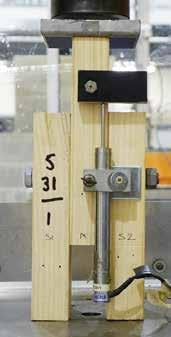
mine key connection performance characteristics, including:
• Strength, stiffness, ductility and slip performance of timber joints
• Testing methods across sawn timber and engineered wood products, including GLT, LVL, CLT and plywood
• Procedures for both lateral and axial loading scenarios, including identification of governing failure modes
• Standardised testing of indi vidual fasteners and complete connection assemblies
• Generation of characteristic de sign values suitable for structural design under AS 1720.1
Importantly, the Standard is intended to support industry as an alternative to AS 1649 (2025) for de termining characteristic capacities of commonly used timber connection types until that standard undergoes further comprehensive revision.
Rather than replacing existing Australian Standards, FWPA
This Standard reflects extensive technical review and industry collaboration, providing a stronger foundation for testing and characterising timber connection systems used across both traditional and engineered wood products - ARC Advance Timber Hub
Standard T01 is designed to com plement them; helping improve consistency, reduce uncertainty and support more efficient timber connection design.
Connection systems are funda mental to the performance and scalability of timber buildings, particularly as Australia sees growing interest in prefabrication, mass timber construction and higher value engineered wood applications.
By improving the way connection performance is characterised, FWPA Standard T01 will help in dustry generate clearer, more ro bust design data, enabling greater confidence in timber connection systems and supporting innova tion across the built environment.
The Standard is expected to be particularly valuable for timber manufacturers, product developers, testing laboratories, researchers, structural engineers and certifiers seeking dependable performance data to support prod uct development and compliant structural design.
Introducing Simon Williamson, the new Chair of FTMA’s Na tional Safety Council. Simon has a background in manufacturing, transport, construction and project manage ment, underpinned with a passion for safety. Simon continues this passion through the NSC and via his consulting business, helping members and small to medium business’s navigate and comply with their workplace health and safety obligations.
Q: Simon, can you start by telling us a bit about your background and how you came to where you are today?
Absolutely. I’m based in North east Victoria, just outside Wanga ratta, and my career has spanned manufacturing, construction and project management. I’ve worked on large scale civil construction projects—things like rail duplica tions, gas pipelines and fibre optic infrastructure.
In 2015, I established a consult ing business, Management and Safety Solutions, to help small and medium sized businesses navigate workplace health and safety obligations. Interestingly, one of my clients was Alpine Truss, where I later became Gen eral Manager. I worked closely with the business for about six years before stepping into that leadership role and guiding its transition into the Metcash Group. What really set me on this path was an early experience on a worksite. Someone asked me if I was a “responsible person” under the Mines Act. At the time, I didn’t fully understand what that meant. When I looked into it, I realised I was legally responsible for all of our workers across multiple sites. That moment was a turning point it pushed me to upskill, gain formal qualifications in workplace health and safety, and ultimately

KAT WELSH Editor \ Communications
shape my career in this space.
Q: Why are you so passionate about workplace safety?
My passion comes from direct experience. I’ve seen incidents happen, and I don’t want to see them repeated. Safety isn’t just about compliance it’s about people. Businesses aren’t just about profit they’re about the individuals who work within them. If you don’t look after your people, your business won’t flourish. There’s still a mindset in some workplaces that safety is a box ticking exercise. I strongly disagree with that. Safety is about culture. If you want to be an em ployer of choice and a responsible corporate citizen, you need to be known for prioritising safety not just meeting minimum standards.
I’ve seen firsthand the conse quences of poor safety practices, including serious injuries like am putations. These are life changing events, not just for the individual but for the entire workplace. The reality is, many incidents are pre ventable with the right systems, training and leadership in place.
Q: You’ve mentioned the idea of safety as culture rather than com pliance. Can you expand on that?
Culture starts at the top. Lead ership sets the tone. If managers and business owners don’t model safe behaviours, employees won’t take safety seriously either.
Safety culture is about consisten cy, accountability and leading by example. It’s also about rejecting the idea that injuries are “just part
of the job.” Too many businesses accept minor injuries as inevita ble cuts, near misses, or worse. That mindset needs to change. With proper systems and training, most incidents can be avoided.
Q: What are you hoping to achieve in your role as Chair of FTMA’s National Safety Council?
My goal is to help members move from compliance based safety to culture driven safety. That means providing practical tools, resources and access to expertise so businesses can build effective safety systems.
We’re not just talking about poli cies on paper we’re talking about real, implementable solutions. That includes documentation, training pathways, and connect ing members with subject matter experts who can support them.
Another key focus is collab oration. Larger organisations often have highly mature safety systems we need to find ways to share that knowledge with smaller operators so the entire sector can improve.
Ultimately, lifting safety stand ards across the industry benefits everyone from workers to em ployers to the broader community.
Q: What can FTMA members, and the sector, expect from you and the Safety Council?
First and foremost, I’m ap proachable. Members can come to me with safety questions or concerns, and if I don’t have the answer, I’ll connect them with someone who does.
The Safety Council is also about collective insight. We have rep resentation from businesses of all sizes, and that diversity helps us identify common challenges and opportunities across the sector.
In addition, I’m available for site visits and discussions around safety practices and compliance. Through my consultancy, I can
also offer more in depth support things like hazard identification, risk assessments, safety audits, gap analyses, and the develop ment of tailored safety manage ment systems.
Q: Finally, what’s the key message you’d like to leave with FTMA members?
Safety is not a burden it’s an investment. When you prioritise safety, you’re investing in your people, your reputation and your long term success.
The businesses that embrace safety as part of their culture not just a compliance requirement will be the ones that thrive.”


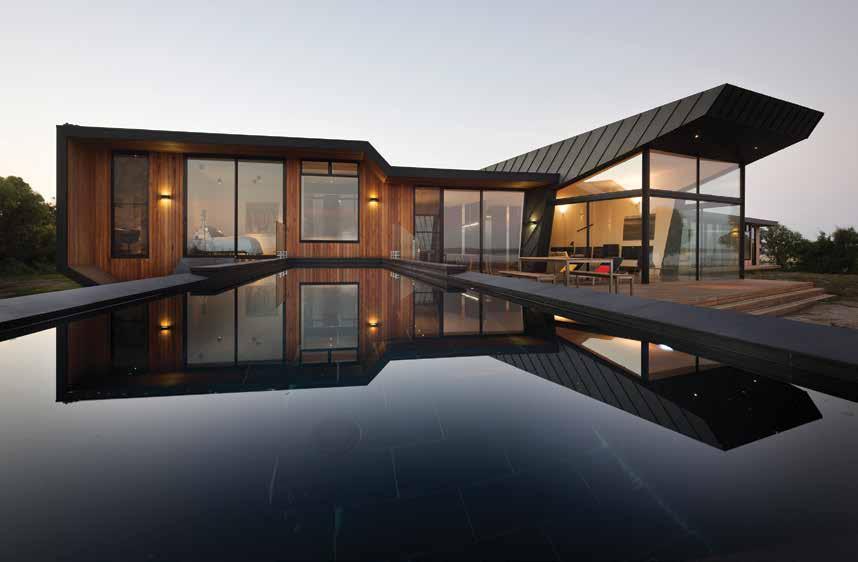
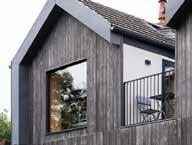
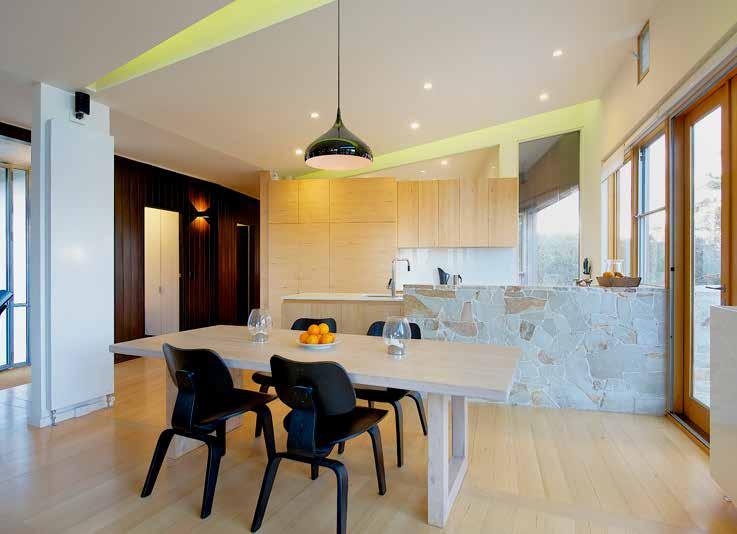
In designing what Marcus O’Reilly Architects describe as a “contemporary farmhouse”, timber was chosen as the pre dominant material in at least a dozen applications.
These uses included everything from frame structure to cladding, flooring, and decorative veneers, through to bespoke bedheads and robes.
Timber materials were selected particularly for their sustainable qualities according to the archi tects.
“Low embodied energy mate rials with a low carbon footprint were used wherever possible,” said O’Reilly.
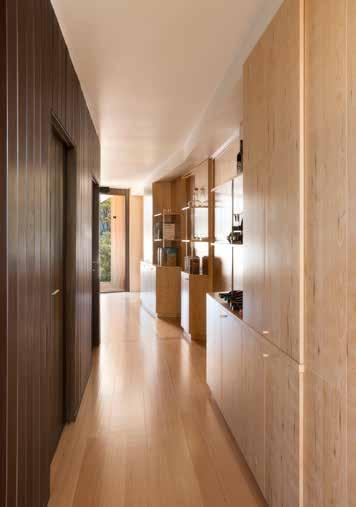
It’s inside the house that timber makes its most striking appear ance in the form of Tasmanian sassafras veneer.
As a timber, sassafras can either grow a soft, clear pale straw colour or ‘black heart’, that is, with a dark heart shaped streak. Far more rarely it grows as it has been used here – with very small dark flecks.
The architects considered the unusually flecked veneer to be the outstanding aspect of the joinery in the house. Kitchen storage, wine cellar cupboards, shelves and bookcases were all veneered with slice cut sassafras, as well as wall linings in the passage where a light colour was needed.
Getting a spread of uniformly sized flecks is possible but only by hand selecting bundles of veneer from logs with the required degree of flecking. In this case cabinetmaker David Emery travelled to Tasmania to select the veneer. The veneers were sliced in Tasmania and laid onto an MDF substrate.
The light blond and dark flecked veneer was accentuated by

PETER LLEWELLYN Technical representative, Timber Veneer Association of Australia
coupling it in places with ebonized spotted gum wall linings, along with ebonized oak to the lower cupboards. The light sandstone used throughout the house has the same mix of hues as the veneer, once again picking up the colour but varying the texture.
The veneer was finished with two pack water based polyure thane with a low VOC (Volatile Organic Compound) rating. This brought out the natural colour of the sassafras while providing a hard wearing surface.
The “contemporary farmhouse” was shortlisted for the Australian Timber Design Awards.
Medical certificates are generally accepted as proof of illness, but there are limited circumstances where employers may challenge their validity. This article explains what evidence is required and the risks employers need to manage.
In a recent question by a business an employee who applied for three weeks’ annual leave several months ago which was refused due to operational requirements. The employee has subsequently been absent claiming personal leave for the period originally requested as annual leave. The employee has contacted his immediate supervisor and claims to have a medical cer tificate covering the absence. The supervisor suspects the employee is overseas on a holiday, as do his work colleagues. If the employee does produce a medical certificate, can the company challenge its validity, or must it be accepted as irrefutable proof of the employee’s claimed illness? To successfully challenge the medical certificate’s accuracy in this case, the employer would need to confront the employ ee with evidence of the activities that contradicts the medical certifi cate. The onus is on the employer to produce evidence that refutes the accuracy of the medical certificate. Another employee’s hearsay would not amount to reasonable evidence, unless more substantial evidence is forthcoming which proves the employee was overseas during the claimed period.
Production of a medical certificate is generally regarded as irrefutable proof that the employee was unfit for work because of the stated illness or injury.
It should be noted the employee has a number of statutory pro tections under the Fair Work Act. These include unfair dismissal and action under general protections which relates to the employee exer


Brian Beecroft CEO, TTIA
cising a workplace right (personal/ carer’s leave) or dismissal due to a temporary absence from work due to illness or injury. The onus of proof in a “general protections” claim lies with the employer.
The AMA Guidelines for Medical Practitioners on Certificates Cer tifying Illness 2011: Revised 2016 states that the usual requirements for a medical certificate are:
• name and address of the medical practitioner issuing the certificate;
• name of the patient;
• date on which the examination took place;
• date on which the certificate was issued;
• date(s) on which the patient is or was unfit for work
Guideline 2.4 states that “where a third party (such as an employer) contacts the doctor to verify the veracity of a medical certificate (e.g. to determine if it is fraudulent in any way), the doctor should verify the third party’s identity, ask for a copy of the certificate and confirm the ve racity of the certificate. The doctor should not provide any other infor mation about the patient without the patient’s express consent.”
The AMA Guidelines also provides the following requirements in relation to the issuing of a carer’s certificate:
• a carer’s certificate may be
required by a third party where an individual needs to take time away from a particular activity to care for the patient (often an immediate family member) who is sick or injured.
• only the patient’s treating doctor should issue a carer’s certificate.
• the treating doctor has a responsibility to ensure that the patient requires or required care by the carer, but it is not the treating doctor’s responsibility to determine who may qualify as a carer.
There have been instances before industrial courts and tribunals where the employer has successfully chal lenged a medical certificate which was used by the employee as evidence in respect of an absence from work due to personal illness, thereby ultimately justified the dismissal on the grounds of serious misconduct.
An employee who produced a medical certificate as proof of illness was not dismissed unlawfully because of temporary absence from work due to illness when the employer discovered he attended a football match on that day. (Ander son v Crown Melbourne Ltd [2008] FMCA 152 (3 March 2008)).
The (then) Australian Industrial Relations Commission found that an employee who manually altered the medical certificate to claim ad ditional sick leave, was dismissed by the employer, was guilty of mis conduct and amounted to a serious breach of an employee’s duty of honesty and constitutes a valid rea son for dismissal. (Tina Louise Sulis v Woolworths Limited [2009] AIRC 791; (29 September 2009)).
An employee, who had a plausible reason for the alteration of a medi cal certificate, and the employer did not carry out a proper investigation
of the facts, was deemed to have been dismissed unfairly. The issue of the medical certificate was used by the employer as a pretext to dismissal because the employee had been on light duties. (Ham mond v Australian Red Cross Blood Service Sydney [2011] FWA 1346 (4 April 2011)).
An employer who dismissed an employee who presented a false medical certificate in claiming one week of personal/carer’s leave was deemed to have a valid reason for the dismissal. The employee’s manager checked the surgery and was informed the doctor had neither seen the employee nor provided the medical certificate. The employee’s employment was terminated be cause her dishonest and fraudulent conduct had breached the bank’s standards according to its code of conduct. The employer had notified the employee of the reason for the termination and had given the em ployee an opportunity to respond to it. (Then) Fair Work Australia was satisfied that the employer had no option but to terminate the employment because it had lost its trust in the employee because of her dishonesty. (Tokoda v Westpac Banking Corporation [2012] FWA 1262 (14 February 2012))
An employee who altered a medi cal certificate so she could return to work sooner than a doctor ordered has been fairly dismissed for serious misconduct. The Fair Work Commission concluded that the chef had engaged in misconduct by falsifying the medical certifi cate, even though it had caused the employer no harm and given herself no advantage. Altering a medical certificate could under mine an employer’s confidence in such important documents. The employer had a valid reason for dismissing her. (J v Alpha Flight Services Pty Ltd [2016] FWC 4259 (18 July 2016)).