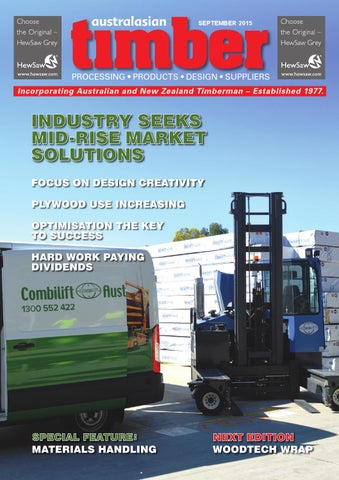
SEPTEMBER 2015
PROCESSING • PRODUCTS • DESIGN • SUPPLIERS Incorporating Australian and New Zealand Timberman – Established 1977.
FOCUS ON DESIGN CREATIVITY PLYWOOD USE INCREASING OPTIMISATION THE KEY TO SUCCESS HARD WORK PAYING DIVIDENDS
MATERIALS HANDLING
WOODTECH WRAP
Why we put a lot of effort into the nail grid? It‘s simple. That you don‘t have to. www.egger.com/osfloor
Your benefits having a nail grid: saving time during fitting and installation, practical grid size, safety and precision during the construction process. All of that with EGGER OS’FloorTM, the high performance T&G structural flooring board. Available from: Meyer Timber, Hyne Timber, Dindas, Le Messurier, Victorian Timber Wholesalers and Independent Building Supplies N.Z.
NEWS
Industry seeks mid-rise market solutions Symposium calls for collaboration and cooperation
F
OR MANY timber processing players the 2015 Frame topics, presentations and mix of delegates will be seen as a watershed in recognising the need for change in marketing the industry’s future. And it has not taken long for industry leaders to pick up on the challenge and gather in Melbourne (11 August) to openly discuss market development ideas for the rapidly expanding mid-rise market for wood products and building solutions. With the aim of commencing what will no doubt be a longer engagement process on these challenges, more than 70 manufacturing industry leaders, association management, architects, builders, developers, foresters, importers and consultants gathered at the allwood Library at the Dock, Docklands, Melbourne, to d discuss the options. The Symposium started with Tim Woods of IndustryEdge covering market trends in multi- residential construction, which now accounts for close to 50% of all of Australia’s housing approvals. He stressed the opportunities in the trend to urban density within larger cities and the consequent growth in midrise apartment construction. Although official data focuses on buildings of four or more storeys, many of these buildings are mid-rise or up to eight storeys and are particularly suitable for timber buildings. “Investors are funding apartment growth but they are not the only participants. First home buyers are hanging tough in the market, but they are buying smaller residences, including apartments in mid-rise urban infill apartment blocks,” he said. “The alterations market, from a wood perspective, will decline over time as housing investment migrates to apartments,” he added.
of lightweight timber members and massive timber construction, if agreed to in November this year by Australian Building Codes Board. In informing and specifying to industry and consumers, FWPA dealt with ‘evidence based wood facts’. A recent survey indicated that 75% of consumers associate wood with the term ‘environmentally friendly’ while 36% of Australian residents had seen the FWPA sponsored ‘wood naturally better/Planet Ark’ advertisements. Ric pointed to the need for change in building codes to grow market share with proposed new building code changes to 25 metres or eight storeys, for apartments, offices and hotels. Timing is critical as building code changes will now only be considered every three years, the next opportunity being 2016 and then the next opportunity in 2019. “Fire during construction on timber construction sites remains a challenge but this applies to all types of building systems,” he said. Ric said the FWPA would continue to develop valuable working relationships such as with Planet Ark, maintain consistency and brand awareness and provide tools and guides for timber use, which must be simple. He then introduced via Skype Canadian industry consultant Kelly McCloskey who spoke on a number of North American timber marketing models to develop new products in a phased approach to respond during residential construction downturns. McCloskey said lessons learned included the lack of product knowledge of design companies, lack of know how in application and not being comfortable with the different product applications.
Raising awareness
This involved risk premiums being added to client cost estimates. Benchmarking and technical transfer were vital. McCloskey said he looked for ‘wood champions’ such as schools and community centres. “Seeing is believing, so you need demo projects, particularly with Government proposals,” he said. Other lessons learnt from these programs showed they must have critical mass, plus engage distribution channels and do it often. “We also found it was a matter of the projects coming first and people second; they had to appeal to all technical folks involved, but engineers were the key people,” he added. He said the programs resulted in a timber mid-rise breakthrough in Canada
Ric Sinclair summarised the work and responsibilities of Forest and Wood Products Australia (FWPA), which is funded by levy payers including importers, and Government contributing 45% of the annual budget spend, primarily used for industry R&D and marketing. Ric covered FWPA’s research and market development role in support of the imperative to find ways of lifting awareness of timber construction options. He reminded the symposium that the Proposal for Code 1 (PfC) to the National Construction Code (NCC) would make it easier to build midrise buildings (up to eight storeys) out
magazine
Semptember Vol.23, No.6 www.timberbiz.com.au
and the US but emphasised expanding the wood marketing was a marathon and not a sprint. Alastair Woodard of TPC Solutions then challenged the workshop with the need for greater collaboration across all sectors. These new building types offer a totally new market opportunity with competition being other building materials such as steel and concrete.
Postal Address: 630 Regency Road, Broadview, South Australia 5083 Phone: (08) 8369 9555 Fax: (08) 8369 9501 Publisher and Chief Executive: Hartley Higgins Suite 103, 486 Whitehorse Road, Surrey Hills, Victoria, 3127, phone (03) 9888 4822
Continued on page 4
Innovation
Are you looking to better your business? The Innovation Skills Program assists businesses across our industry value chain to be innovative, increase efficiency and profitability.
Call us today
03 9321 3500 www.forestworks.com.au
This program has been produced with the assistance of funding provided by the Australian Government through the Department of Education and Training.
ABN 39 946 785 543 ACN 130 528 291
General Manager: Elizabeth Bouzoudis Editorial: John Hudswell j.hudswell@ryanmediapl.com.au Adelaide: (08) 8369 9512 Out of office: (08) 7127 6370 Advertising: J on Bryden j.bryden@ryanmediapl.com.au Melbourne: (03) 9888 4834
AUSTRALASIAN TIMBER
Mechanisms for capturing these opportunities required an industry working together, acting collectively and collaboratively, and looking for new supply chain dynamics for ‘systems based’ delivery, particularly prefabricated systems. They also had to add value along
SkillsProgram
Wood champions
australasian
Incorporating Australian and New Zealand Timberman – Established 1977.
¢ C o-hosts and presenters at mid-rise market symposium in Melbourne: Alastair Woodard (TPC Solutions), Tim Woods ( IndustryEdge), John Halkett (general manager Australian Timber Importers Federation), Michael Hartman (CEO ForestWorks), Rob de Fegely (national president Institute of Foresters of Australia), Ric Sinclair (managing director Forest and Wood Products Australia) and Gavin Matthews (manager processing Australian Forest Products Association).
Timber classified: j.bryden@ryanmediapl.com.au Melbourne: (03) 9888 4834 Production: Luke Westle Subscriptions: subs@forestsandtimber.com.au Adelaide: (08) 8369 9522 Accounts: Adelaide: (08) 8369 9555
Conditions: Opinions expressed herein are not necessarily those of the editor/publishers; information is published in good faith and we do not accept responsibility for damage which may arise from any possible inaccuracies. All rights reserved, none of the contents may be used in any other media without prior consent from the publishers. Published by Ryan Media Pty Ltd.
MEDIA
INDEPENDENT & AUSTRALIAN OWNED
SEPTEMBER 2015
3
NEWS
International News Briefs State-owned plywood business for sale
Poland has expressed interest in selling the State-owned plywood manufacturer Sklejka Orzechowo SA (formerly OZPS). Sklejka Orzechowo is one of the last domestic timber enterprises fully owned by the State Treasury. The privatization process is associated with long litigations that have lasted since 1991. The first attempt to privatize the company was taken in 2011, and only in OZPS been commercialized and transformed into a joint stock company. Currently, the Polish Ministry of Treasury intends to sell 85% of the company shares.
Redwood out of favour According to a representative from one of the main redwood markets in Beijing some 12 stores selling redwood products have closed and only two remained open as of the end of July. It has been reported that demand for redwood‘ products has cooled considerably and sales by the well-known, large redwood enterprises are slow and well down from a few years ago. The smaller manufacturers of redwood‘ have been particularly affected by the market downturn. While there is some demand for high-end redwood furniture analysts estimate that 50% of the furniture sold today is of woodbased panels and that these products dominate the market.
Waste not, want not
WallGoldfinger, a maker of high-end corporate furniture in Randolph, Vt., is turning waste products into profits for other Vermont businesses and further reducing its impact on the environment. Call it recycling, upcycling, reusing or waste diversion, whatever the title, the concept is simple. Products like pieces of plywood, medium density fiberboard (MDF) and veneer too small to use on WallGoldfinger’s expansive boardroom tables and other products are being set aside for woodworking-related companies or organizations rather than ending up in a landfill. The wood products waste goes to ReSOURCE, a Burlington, Vt.-based non-profit focused on providing environmental services, poverty relief, and education and job skills training. Last year the program diverted 16,531 pounds of waste from the landfill to ReSOURCE which operates a building materials store in Burlington. Raw materials from WallGoldfinger go to the store and are used by staff, volunteers and trainees to produce what the non-profit calls Waste-Not-Products sold in the store. 4
New good work design handbook online
S
AFE WORK Australia has launched a new handbook to help businesses meet their obligations under the work health and safety laws, reduce worker injury rates, and improve their productivity and bottom line. Safe Work Australia Chief Executive Officer Michelle Baxter said that that well-designed, healthy and safe work allowed workers to have more productive lives, which in turn drives business efficiency. “Principles of Good Work Design shows businesses how to go about designing out hazards before a worker gets injured, which delivers tangible savings by avoiding the costs associated with incidents that result from poor work design practices,” she explained. “It is often easier and more costeffective to address hazards and risks during the planning and design stage. This applies to the places we work in, the things we use at work, as well
as to how we design organisational structures, roles and tasks.” A Safe Work Australia initiative under the Australian Work Health and Safety Strategy 2012–2022 and led by Comcare and WorkCover Queensland, the handbook contains information about the ten principles of good work design and how they can be applied to any workplace, business or industry. Principles of Good Work Design is a ‘living’ electronic document that will be updated regularly with links to case studies and practical examples from businesses that have successfully applied the good work design principles. “The handbook complements a range of existing resources available to businesses and work health and safety professionals,” said Ms Baxter. “Failure to consider how work is designed can result in poor risk management and lost opportunities to innovate and improve the effectiveness
¢ S afe Work Australia Chief Executive Officer Michelle Baxter
and efficiency of work. Good work design can radically transform the workplace in ways that benefit the business, workers and clients.” Principles of Good Work Design is available on the Safe Work Australia website.
Industry seeks mid-rise market solutions
Continued from page 3
the supply chain and make the process ‘simple’ for designers and builders. The workshop then went into open discussion with participants responding to the session chair Rob de Fegely posing questions on opportunities, and how the industry might respond to drive change.
Learn from the global experience John Halkett (Australian Timber Importers) said that while the local industry was starting late it could learn from global experience such as seen in North America and from international companies like Stora Enso. Kersten Gentle (FTMA) suggested change can be driven by associations. “If we look at the forestry business, it is sustainable; but processing requires a review which needs to be facilitated,” she said. “We have a powerful industry when we work together but we have not done this for a long time,” she added. Rob de Fegely asked the workshop participants if they thought the concept represented a real opportunity to which there was a majority show of hands. Tim Woods said that with the expected growth in residences in next 30 years, proposed changes to meet the needs can’t be implemented without real collaboration. “There is also space for importers. And some industry players may not want to divulge information but they must change,” he said. Evan Rolley (Ta Ann) suggested the industry needed to be more practical and find flagship examples which will require funding. Jack Bowen (Bowens Timber & Building Supplies) suggested that builders needed to be part of the program and his firm would be prepared to be involved leading it. “We need supply chain change and collaboration” Andrew Dunn of Timber Development Association (NSW) commented that projects are here now but there is a lack of systems available. “We need supply chain change and collaboration. The key thing is to understand the customers need,” he said.
¢ The all-wood Library at the Dock, Docklands, Melbourne.
”The Forte building project demonstrated that they saw a solution, identified the drivers and made it happen. Timber offers different solutions and is cost effective,” he added Kevin Ezard (Frame Australia) commented that this time around the market wants it, as expressed recently by the Property Council. He called for more industry collaboration in order to reach out to the market. “The industry can’t deliver as it does not have the skills,” he said. He cited the Parkville project that did not need fixed cranes or concrete pouring and resulted in construction savings of 25%. Andrew Daley, project manager for Lend Lease on the Dockland Library building, said that collaboration played a big part in its construction. Constructed in the UK it was 30% lightweight, involving design and sub-contact fraternity that relied on collaboration. “But in Australia, we had to combine industry construction codes which took the architect six weeks to check,” he said Michael Hartman of ForestWorks questioned how collaboration might work and proposed a structured project approach of alliances with a need for experts and leaders. “This project will need people, money, a framework and collaboration,” he said. Peter Ward from Drouin West Timber and Truss told the Symposium that his firm had already invested heavily in new technology and stressed the need to get the right feedback on future manufacturing requirements.
AUSTRALASIAN TIMBER
SEPTEMBER 2015
Still a challenge to get builders across the line “Where are the next projects? It is hard to get project builders across the line as it’s still a challenge to get builders to accept change. But we are starting to see growth in the number of unit developments,” he said. John Hayden said he felt the technical approach was the key for a broad range of solutions, and then all the industry could use them. Architect Adrian Coleiro stated his issue was pushing through the process on timber construction, highlighting the need to have a fire engineers check out plans. Stephen Dadd suggested that change would come slowly. “Other materials changes had taken years to evolve in use and acceptance, such as metal roofs and plaster board,” he said. John Simons suggested there was a need for a field force with skills to kick start advice to advisers intending to use timber. Alastair Woodard argued that the timber industry needed to get in first at a building concept stage. “Engineers will talk clients out of timber. The best wood solutions - not just the product - need to be put in early on a project so they are specified,” he said. The meeting concluded with agreement that an industry- wide working group would be recruited to explore the opportunities discussed and take the process forward. www.timberbiz.com.au
NEWS
Spotlight on plywood Australia’s rising consumption of plywood is increasingly being fuelled by imports, even as consumption of other products languish. t a glance A Tim Woods is Managing Director of IndustryEdge, Australia’s leading market analysis firm in the forestry and wood products sector. The firm is publisher of the monthly Wood Market Edge and the biannual Forest & Wood Strategic Review. The 2015 edition of the Strategic Review has just been released. Go to www.IndustryEdge.com.au or call +61 3 5229 2470.
F
OR THE year-ended June 2014, IndustryEdge analysis demonstrates, as reported in the recently released Forest & Wood Strategic Review, that apparent consumption of plywood in Australia was 546.5 km3, a rise of 6.1% on the prior year. As the chart below shows, demand has grown in Australia, over the last decade, by an average 3.5% per annum. The significance of this stable growth is important for two reasons. The first, immediately apparent in the above chart, is that a significant proportion of demand is met by imports. In 2014, that proportion was 52.5% or 287.2 km3, with all of the major grades or formats of plywood being well represented in the imports. The second element of that stability is less obvious and is reflected in the simple chart below, showing relative growth rates of the major timber building products over the last decade. It exemplifies, in the
simplest possible way, that of all of the relevant timber building products, plywood is on the rise. In the context of growing demand, and of course, the current housing boom, the differential growth between timber building products is cause to pause for thought. As the ‘high rise’ proportion of domestic housing grows, many traditional timber building products (eg. Sawnwood) have found they have little role in the new housing formats. Not so for plywood, which includes engineered timber beams such as LVL and other products that compete well against their high rise competitors, aluminium, steel and even concrete. The driver for their growth has demonstrably been innovation that can be wrapped up in the concept of plywood products being part of the pantheon of ‘engineered’ products. The implication is that their success is directly linked to the extent to which they have been transformed in order
to deliver a solution for a specific purpose or need. IndustryEdge is regularly asked for updated data on plywood production and wood panels opportunities in Australia. There is a general recognition underlying most of those information requests, that plywood production represents an opportunity that has been under-exploited. Yet, as the industry often discusses, few of these assessments end in investment. Ta Ann’s new facility, at Smithton in Tasmania, is the exception. While it is true that many more investments are considered than proceed in any situation, we need to examine the conditions that lead to the negative conclusions, as much as those that lead to the positive conclusions and result in an investment proceeding. Regular challenges to expansion of plywood production in Australia, expressed by industry, include the disaggregation of adequate volumes of suitable wood supply and concerns about security of access to supply. The latter is primarily a concern about resource from native forests, but is not exclusively so. The other issue regularly commented upon is the extent of aggressive, price driven and sometimes sub-standard competition from imports, especially from Asia. It is a common refrain, but it is all the more significant because there are regular investigations that demonstrate just how low quality some of the imported products are. Others point to domestic production that has grown 3.9% per annum over the last decade (slightly ahead of the pace of consumption growth). The argument goes that investing to reduce the impact of imports is the starting point, and not the end
“Whichever option you prefer, the data suggests that there are opportunities for plywood production in Australia.” of the process. For the challenges of imports to dissipate, the domestic industry must have capacity to supply the market that is capable of winning market share. This is not just a question of product standards and specifications, though it certainly is that, it is also a question of sheer capacity and investment to deliver it. Whichever option you prefer, the data suggests that there are opportunities for plywood production in Australia. What is most significant is that they may be better options than exist for traditional sawnwood products. We welcome your opinion: Email your feedback to j.hudswell@ryanmediapl.com.au
Sawnwood Consumption Growth Rates v EWP Consumption Growth Rates: 2004 – 2014 (% pa)
Australian Apparent Consumption of Plywood: 2004 – 2014 (ktpa)
Source: ABS, EWPAA & IndustryEdge estimates
Source: EWPAA, ABS, ABARES and IndustryEdge
6
AUSTRALASIAN TIMBER
SEPTEMBER 2015
www.timberbiz.com.au
Join the prefabrication revolution We know that, when it comes to carbon in the atmosphere, timber is on the side of the angels.
To discuss how you can be involved, contact us today.
But we also know that, by using the right equipment and techniques, prefabrication using timber adds good money to the bottom line while making building cheaper.
Laurie Martin, General Manager laurie@austimber.org.au
If you have consulting expertise, equipment, software systems, fastening systems or any other offering that can help improve prefabricated construction system manufacture, be part of the AUSTimber2016 house construction demonstration and seminar project.
Norm Nelsen, Sales Director norm@austimber.org.au
Do it now and secure the first reward for taking action to boost your sales in 2016.
Sponsored by
Supported by australasian
I n c o r p o r a t i n g A U S T R A L A S I A N F O R E S T L O G G E R & S AW M I L L E R
www.austimber.org.au
NEWS
Flight Timbers now under Timberlink umbrella
F
LIGHT TIMBERS’ New Zealand sawmilling assets have been sold to Timberlink Australia. The agreement forms part of a larger transaction by Flight Group, including the sale of its Flight Forests plantation assets of approximately 4,200 hectares of freehold land and radiata pine softwood plantations, located in the Marlborough region of New Zealand’s South Island, to New Forests. New Forests is a Sydney-based fund manager with more than $A2.5 billion in assets under management including more than 620,000 hectares of forests, rural land and conservation investments in the Asia-Pacific region and the United States, on behalf of institutional investors. The change in ownership of Flight Timbers was expected to take effect on 1 September 2015. Completion of the purchase of Flight Forests was subject to approval by the Overseas Investment Office. Flight Group is a diversified manufacturing business (www.flight. co.nz) with two key operational divisions, Flight Plastics Limited and Flight Timbers. Flight owns a mill and timber remanufacturing operation in Blenheim, in the South Island of New Zealand. Flight Group has performed a strategic review of its operations, and following this transition will focus investment on in its Plastics and Resort Contracts businesses. Timberlink Australia, which was formed in February 2013 from the sale of Gunns Limited’s softwood sawmilling assets in Australia as a result of receivership, view the acquisition as a key step in their plans for future growth and diversification of the Timberlink business.
Timberlink Australia/ NZ Chief Executive Officer Ian Tyson, said: “Timberlink has been on a journey to ensure our future competitiveness and sustainability as a softwood manufacturing business in today’s global market. The Flight acquisition enables business diversification in terms of market, customers and products whilst leveraging from the company’s current capability and experience with radiata pine sawmilling and sales in Australia. “The current Flight sawmill assets are sound and provide a strong base from which to improve and grow the business. Timberlink plans to undertake significant business investment, including additional capital expenditure in the order of NZ$10m over the coming two to three years. This will strongly position the business for an exciting and successful future.” The sale announcement was good news for all involved. Both parties (Flight and Timberlink) are pleased that the change in ownership includes the ongoing employment of all Flight Timbers employees and contractors, based at the Blenheim mill. The new entity will operate as Timberlink New Zealand, a subsidiary of Timberlink Australia, and the site’s current management team will remain in place. Romon Spiers will continue to be the site General Manager, reporting to Timberlink’s CEO, Ian Tyson. The Flight brand will continue to be used for up to 12 months of operation. During this period the company will be developing plans to rebrand as Timberlink New Zealand, along with any other associated product brands if required.
Mr Spiers said: “We believe that the business value that can be created through Flight Timbers and Timberlink Australia coming together will form a more compelling and even stronger offer to serve all current customers in the target markets and also help the new improved business to achieve its growth plans for the future. Key to this will be maintaining and growing the Timberlink business in all of its markets – New Zealand, Australia, Japan and South East Asia.”
David Brand, CEO of New Forests, said that, “New Forests has demonstrated that the model of aligning the plantation resource with the processing facility reduces risk and will steadily create value. The agreement to acquire Flight Forests and Timbers by New Forests and Timberlink respectively gives stakeholders an opportunity to gain exposure to a mature, well-managed plantation estate with access to domestic processing plant managed by Timberlink.”
Timberlink Australia Timberlink Australia (www. timberlinkaustralia.com.au) is a leading radiata timber products manufacturing business. The business has two sawmills at Bell Bay (Tasmania) and Tarpeena (South Australia) that manufacture Australian grown plantation pine, has sales and distribution teams based in Perth, Adelaide, and Melbourne and has a sales team based at the Bell Bay mill. Timberlink Australia was established by New Forests, an Australian fund manager, to operate as part of a diversified investment portfolio of forestry plantations and businesses. The aligned interest of New Forests’ plantation resources with Timberlink’s processing capacity enables the company to have a long term committed approach to its business and customers. Timberlink Australia produces fit-for-purpose indoor and outdoor structural timber for building Australian new homes and renovation projects, and exports sawn timber to a number of countries in the Asian region. Flight Timbers The Flight sawmill site in its current form has been developing since the 1950s with all processes located on this one site since 2005. Operations include value adding treatment and remanufacturing plants. Flight Timbers currently produces a range of radiata plantation pine products including clear grades, finger jointed, furniture, framing and industrial grade timber for predominantly New Zealand, Australian and Asian markets.
TIMBERMAN, August 2012 – 6
FRAME AUSTRALIA
FRAME AUSTRALIA
buildingSmart with BIM J
OHN MITCHELL, chairman of buildingSmart Australasia looked around the room at the FRAME conference in Melbourne and asked if anyone knew what BIM was. Did anyone use BIM? The silence was telling. Certainly there were people in the audience who had some knowledge while some like Claudelle Taylor of the Leighton Group had experience with BIM but mostly the audience was struck dumb. As Mitchell went on to say, the building industry is not renowned for its affinity with and use of high tech computer software programs but it is time. Other industries have already embraced similar systems, and other countries are embracing Building Industry Modelling (BIM). So what is Building Industry Modelling? “BIM is 3D object model that is like a building database, easily visualized,” said Mitchell. “We can extract significant intelligence out of it.” Currently there is a lack of integration along the supply chain linking parties and between project phases but it’s not impossible to fix. As Mitchell said other industries such as the Australian Air Conditioning Manufacturers Association has already started supply chain integration. Other issues that plague the building industry are its reliance on the lowest bid strategy rather than a value for money proposition. There is poor understanding of optimized and properly documented designs. According to Mitchell the “Getting it Right” study in Queensland in 2005 identified this problem. That was seven years ago and it still lingers.
There is also inadequate and ineffective use of technology and a lack of appreciation of the benefits of open communication. In 2010 Mitchell’s organization commissioned a survey with the Commonwealth’s help that looked at adopting BIM in the Australian construction sector.
Implementation Plan. The starting point was the outcomes of the MESH conferences in Brisbane, Melbourne and Sydney in early 2011. The roadblocks are these: • Lack of model building protocols • Little product data for BIM object libraries • Legal and insurance impediments
We do need it, we need to build better, we need to make better use of resources. “The economic potential is extraordinary, extraordinary, a $4 billion potential per annum - $4 billion productivity potential per annum, this mirrors many other studies around the world,” said Mitchell. “We do need it, we need to build better, we need to make better use of resources, we need to be more efficient and deliver higher value for money.” The lessons from the 2D CAD current technology are clear, after 20 years there are still no common guidelines, no consensus in either government or industry and the documentation instead of improving is deteriorating. “There is significant risk if we do not align with international BIM developments – it’s a worldwide turn to BIM,” said Mitchell. buildingSMART Australasia was commissioned at the end of 2111 to undertake the development of a BIM
• Poor standards for information exchange • Inconsistencies in information handover protocols • Skills gaps • Lack of strategic research focus • Industry resistance to process change The participants at the stakeholder consultation workshops conducted by buildingSmart proposed key recommendations. First and foremost was that a BIM adoption roadmap should be completed. Commonwealth, State and Territory governments should be encouraged to require full collaborative BIM for their building procurements and they should develop procurement processes and assistance packages to encourage its adoption. Legal and technical instruments needed to support the introduction of BIM should
7 - August 2012, TIMBERMAN
Lend Lease lends its might to CLT be developed and aligned with relevant international codes and standards. We must think globally. Education is a must to enable the industry to meet the demands of technology for new workers and re-training for those already in the industry. Easy access must be facilitated to building product manufacturer’s certified information for use in all types of modelbased applications through an Australian on-line BIM products library. Open standard data exchange protocols should be established that support collaboration and facilitate integration of the briefing, design, construction, manufacturing and maintenance supply chain throughout the entire life of a built facility. Governments around the world are seeing the advantage of BIM as it can be used to support automated code checking, ensure buildings meet environmental and energy performance requirements, make certain asset and management information is available at all tiers of government for operational, maintenance, fiscal and strategic planning. The global construction software industry is well advanced in the change to BIM. All the major vendors Graphisoft ArchiCAD, Nemetscheck Allplan and Bentley Triforma have IFC certification, and now Autodesk Revit has committed to IFC compliance. Only by adopting BIM, by accepting new processes and by sharing information will the building industry stay competitive.
A
FTER LISTENING to Andrew Neiland from Lend Lease it was difficult to understand why it has taken so long for Australia to embrace CLT, and even harder to understand why it has taken the major construction companies this long to make it all add up. Initially it seemed odd that Neiland, who comes from the accounting side of the Lend Lease business, was presenting to a timberoriented audience at the Frame Australia conference. That soon passed as he recounted the reductions that Lend Lease faced through the use of CLT in its new multi-storey Forte apartment building in Melbourne. Admittedly it won’t be just reduced costs – but that’s the main take-away point, the other reductions relate to significantly lower construction noise, less occupational health and safety issues, and a smaller environmental footprint. The big cost reduction will come courtesy of reduced construction time, reduced truck movements, less labour, reduced building weight leading to reduced foundation requirements and more. “It’s lightweight, timber is roughly a fifth the weight of concrete,” said Neiland. “[with precast concrete] you only get a couple of pieces on a truck and that’s about it, you can truck a vast number of CLT panels in one go, so get a huge reduction in truck movements. “In terms of how the site looks the general comments we have from our construction teams is clean, and how quiet and how orderly the site is,” said Neiland. “One mobile crane, a couple days of CLT ready for installation and a crew of four guys putting it into place - very quiet and efficient process.”
Victoria Harbour was the instigator Melbourne’s Victoria Harbour has been a development hot spot for some time and Lend Lease was trying to make the most of the limited land available. On North Wharf the company was faced with a problem. “The building conditions are not great, it’s on silt so we looked for a lightweight construction solution and came up with CLT,” said Neiland. “That was most viable option and we found a lot more benefits than just light weight. So they assembled a team of designers and engineers to go and have a look at it. “They saw the opportunity immediately – for an all expenses paid trip to Europe.” It paid off, representatives from Lend Lease visited 14 projects in Europe, they visited the CLT producers and met with architects who had worked on similar projects and came away very impressed. “They came away very impressed that it was a proven solution where the owners and occupiers really enjoyed the outcome, and really enjoyed living in these buildings,” he said. Due diligence on the project took three years to complete. What Lend Lease did discover and what the company has brought into play with the Forte construction in Bourke Street, Melbourne – only a few doors down from Lend Lease HQ – is that using CLT is a design process. “It’s not taking a concrete building and replacing concrete with timber, it’s a new process. It’s about completing all your design up-front rather designing as your going,” said Neiland. “It’s about a factory process where you sign off on the drawings, you work out all the crane movements, you work out the logistics, the truck movements then you manufacture. By doing
this we are minimizing waste and reducing errors and building faster. “If you design it well it will last, if you design it poorly it won’t.” Australia’s building code doesn’t take into account timber buildings taller than three storeys so for Forte Lend Lease had to undertake a fire engineered solution and that’s not something that everyone can do. It may be a barrier to highrise CLT construction in Australia unless it is addressed. Forte is nine storeys tall (with a ground floor retail area) with 23 apartments and four townhouses. Lend Lease was faced with a certain amount of dismay when it came to fire approvals. “Melissa Chandler who is our building codes expert said it was the most interesting conversation she’s ever had with the fire brigade in her life. “Saying we’re building 10 storeys of timber, the lift well, the fire stairs and we’re leaving the fire stairs exposed timber. The look on their faces was priceless. We convinced them it was a good idea,” said Neiland. “We did the fire testing of the CLT panels with the CSIRO to achieve our approvals. “While it is not of a size that requires sprinklers we are installing sprinklers for this one,” he added. As the ground floor is to be a retail space that floor is designed very differently to the apartments and so it is mounted on a concrete slab which was laid in February this year. The CLT installation started in June and it is anticipated that it will take eight weeks to put up and should be finished in August. The whole building should be finished in October this year. Neiland said that for his company it wasn’t just about building a building in CLT it needed to be a step change in sustainability and that is
certainly what has happened. This will be the first 5-star green star building built in a residential environment. Each apartment is dual aspect and will take 25% less energy to heat and cool compared with a typical apartment, which equates to roughly $300 a year saved. All apartments will have a smart meter to link to an in-home display, which shows real time and historic data on energy consumption. Not only that, but simply by using timber 1451 tonnes of carbon is saved (cradle to site). Like every new idea there were challenges, the biggest was the logistics of shipping a building from Europe to Australia. KLH in Europe is the manufacturer of CLT for the Forte construction and so the panels had to be shipped to Australia and then stored awaiting installation. Out it came – 485 tonnes of timber, 759 CLT panels shipped in 25 containers in two ships. Lend Lease then did some other due diligence on the project, at 32.17 metres tall was it the tallest timber building in the world? “We came across Nikolai (Sutyagin) who was friendly old chap in Russia who was lonely and in 1992 he started to build a timber house for himself. He went a couple of storeys up and just kept going and he didn’t stop until he got to about 44 metres. “So we couldn’t go out with the claim that it is the tallest timber building so we modified it with a clause that it’s the tallest apartment timber building,” said Neiland. For the future Neiland said that Lend Lease is considering building up to 50% of its residential apartments using CLT. “For us Forte is not a one-off demonstration building,” he said. You can see live webcam vision of the Forte building under construction at http://www. forteliving.com.au
1300 880 335 aalhyster.com.au
Combilift Long Loads Forklift
We offer a full range of internal combustion on and ve range battery electric lift trucks, a comprehensive nne to 50 of LPG, petrol & diesel units, from 1.5 tonne tonne reach stackers.
3 Machines in 1: Forklift, Sideloader, Reach Truck Safer product handling Saves space – saves time Handles long loads safely Semi rough terrain
Adaptalift Hyster offer a complete range:
Pallet Trucks
The same industry-leading news, views and ad’s you’re reading in this issue are now available on-line as well. While we know print is the most convenient form for reading in the yard, lunchroom or highlighting an important point for the next reader, we also know that many of our readers want to go straight to websites or send emails or links from the articles and ad’s they’re reading.
Reach Trucks
Combilift
Order Pickers
Counterbalance
Big Trucks
Aisle-Master
Agria
Customised Materials Handling
MA100004DN
Hyster Counterbalance Forklift ift
Now available on-line ...and covering New Zealand
Visit www.timberbiz.com.au/atm today to view your copy online
MEDIA
I N D E P E N D E N T & FA M I LY O W N E D
8
AUSTRALASIAN TIMBER
SEPTEMBER 2015
www.timberbiz.com.au
NEWS
Showroom proving a big winner for association and industry By Eric Siegers Executive Officer Timber Merchants Association
A
S MANY of you know I’m a great believer in the fact that the TMA showroom is a great benefit to the Timber industry. Consequently, I’m often asked to validate this perspective in light of the diversity of channels now available to marketers and sales organisations. Its simple. When it comes to the home, people like to engage with the products they are going to purchase. Research undertaken reaffirms this time and again. For instance AT Kearney confirms that when it comes to the home over 90% of people want to get up close and personal with products such as timber flooring, decking and even insulation at the initial stages of
discovery and fulfilment. As the home is the biggest investment most people make I suppose this is not entirely earth shattering. But how does this confirm that the TMA showroom is relevant. The good news is that since 2004 TMA has recorded visitors to the centre and we have found that regardless of the changes in communications channels, nearly 20% of people undertaking a renovation visit the centre. That’s a brilliant example of how relevant the centre is – regardless of the advancements made since 2004! Articles by manufacturers of products to the home such as Moen, confirm the importance of a having some sort of partnered display. They said in an article earlier this year that “If you’re a construction pro lacking a great showroom partner, you’re missing out”. What they mean is having products that work together such as kitchen hardware and benches in a showroom means that you are able to capture more people to your product. To this end the TMA is a big winner with “up and coming” hardware manufacturer Trio joining us along with the already strong showing
Expanded program for Frame Australia 2016 THE FRAME Australia 2016 Conference and Exhibition, now in its 18th year, will be held on 23 May at Park Hyatt Melbourne with the theme “Building construction with prefabricated timber and engineered wood”. “The 2016 event will be the largest ever held with more than 400 delegates expected from the combining of topics from both the successful Frame 2014 and 2015 conferences,” said Kevin Ezard, Director, Frame Australia Conference and Exhibition. Kevin said the expanded program would have parallel sessions in the one day format to cover the range of emerging developments in building design and prefabricated timber and wood construction across Australia. “Inner-urban population density growth and spiralling demand for medium-rise dwellings has opened new opportunities for prefabricated timber in both multi-residential and commercial building construction. Anticipated changes next year to the National Construction Code deemed to satisfy provisions allowing timber buildings up to 8 levels will greatly increase potential for designers and builders to utilise timber, and generate a further increase in demand for prefabricated systems,” Kevin said.
Manufacturing technologies and plant automation (Parallel session) • New concepts and technologies emerging in truss and frame manufacturing plants • Estimating and detailing both locally and overseas – what are the pros and cons? • Plant productivity improvements from automation – will robotics be the next step forward? • Discussion forum with speakers and panel members Lunch break
of timbers for the kitchen environment. This only enhances the experiences and strengthens the message to the community that timber is the product to renovate with. Given that the TMA is able to get a strong following with the community it begs us to ask two questions: How can we continue to make it stronger? How can we expand this positive experience to other states (in particular NSW) The value to the industry is the positive connection it builds with the community by providing a much needed “call to action” for our planet’s most sustainable resource, but also a great business opportunity to strengthen the role of the independent merchants that otherwise find it difficult to make the investment in large showroom space to build customer relationships. A lot can be done. I think it’s time to understand the importance of product engagement with the consumer and the ultimate relationship with the supply chain so that we do serve community, consumer and business better.
Prefabricated panel systems production and supply (Parallel session) • Developments in production and delivery of Prefab and Modular construction systems • Will BIM/CAD/CAM be the future for integration of design, prefabrication and supply? • Growth in supply of pre-assembled wall panel & floor cassette systems for housing • Discussion forum with speakers and panel members Afternoon break
Timber buildings for faster construction and lower cost (Parallel session) • Design and build options to lower building costs in multi-residential timber construction • National review of recent timber building projects and benefits achieved by developers • Customer and regulator attitudes to timber in residential and commercial construction • Discussion forum with speakers and panel members
The future for timber and wood building system solutions (All delegates) • What would encourage greater use of timber and wood in building design and construction? • What are the likely future dynamics of building market demand and timber supply capabilities? • Will collaboration by the supply chain simplify the process and achieve ‘systems based’ delivery? • Discussion forum with speakers and panel members Conference Closing Hospitality
The Draft sessions program is: Opportunities for wood products in building construction (All delegates) • Creative architectural design and engineering innovation in wood construction • The ‘drivers’ for increased timber and wood in residential and commercial buildings • Global and local growth projections for supply of timber and engineered wood products • Discussion forum with speakers and panel members Morning break Building design and engineering developments (Parallel session) • How high can we go? Will you be ready for the NCC height changes in May 2016? • Structural engineering solutions and current design projects using timber and CLT. • The process of design, supply and construction for prefab timber building systems • Discussion forum with speakers and panel members
www.timberbiz.com.au
AUSTRALASIAN TIMBER
SEPTEMBER 2015
9
BUSINESS PROFILE
¢ Theodore Kerlidis.
¢ A nthony Uahwatanasakul.
Focus on design creativity and sustainability
S
OUTH MELBOURNE-based k20 Architecture’s passion lies in public and community based projects and the brilliant results of their work can be seen throughout Victoria. They provide their clients with a tailored level of service focused on delivering projects with design, sustainability and performance excellence. Established in 2004, k20 Architecture have expertise in a range of project types from community and childcare centres to sporting pavilions and heritage conservation. They deliver a full scope of professional consulting services with project construction values ranging from $50k to $100M. Each project k20 Architecture undertake is led by founding directors Theodore Kerlidis and Anthony Uahwatanasakul. Theodore has more than 15 years’ experience designing community buildings with a focus on design creativity and sustainability with an end user focus. Anthony has experience with government, sporting, institutional, healthcare, residential and community
projects and is Green Star Accredited. Their methodology for delivering projects is open and engaging with the aim of incorporating their client’s needs to create sustainable, innovative and exciting community facilities and hubs. k20 Architecture is carbon neutral and delivers projects with maximum specification of Australian and locally sustainably sourced content. This includes materials and labor to promote locally sourced and manufactured materials with a lower ‘carbon footprint’. All of their projects incorporate ESD principles and one of their most recent projects, Hindmarsh Shire Council Offices, won the 2014 People’s Choice Award and was a finalist in the following categories: sustainability, public or commercial building and engineered timber products. We feature a few of k20 Architecture’s superb projects (all photographs used © k20 Architecture):
Ballarat Regional Soccer Facility k20 Architecture sourced recycled and local timber to assist with carbon sequestration Timeline: 2010-2015 BALLARAT REGIONAL Soccer Facility is a new landmark regional soccer facility at Morshead Park, Ballarat. It provides leading edge sporting and social facilities for elite level soccer and A level games. Earlier this year Ballarat Regional Soccer Facility was selected from a national pool of soccer sports facilities to host the Asian Cup and Bahrain is set to establish the facility as their base training facility. The facility makes up the first section of a larger master plan for the transformation of the site into a stadium. The facility has been designed to enhance the spectator’s experience and bring the viewer closer to the playing pitch. Additionally, the coach’s boxes are transparent with the grand stand elevated above the ground level to create a direct viewing line to
10
AUSTRALASIAN TIMBER
SEPTEMBER 2015
the main event. The internal function and catering facility has important social and economic benefits to the club and broader community. The facility includes a two star FIFA rated turf playing pitch, synthetic training ground, grand stand with 500 seated capacity, conference and catering facility for 200 people, external viewing decks and players change rooms, media rooms, and sports administration facilities. The Stockade wall enabled the facility to be built in sections and is reflective of Ballarat’s rich cultural history. The building was designed to ensure there was no overshadowing impact to the playing pitch and to maximise view lines across the grand stand and the interior function facility. ESD initiatives- Passive solar design features include high level extended eaves to reduce heat load on the building, double glazing throughout and high levels of insulation. Natural ventilation incorporates thermal chimneys providing stack effect cooling, and mixed mode heating & cooling through the underfloor air-plenum. k20 Architecture sourced recycled and local timber to assist with carbon sequestration, resulting in a reduced carbon footprint. Locally sourced and manufactured materials and components achieve approximately 80% of local content outcomes. Environmentally preferred materials and fittings include low energy light fittings, low VOC paint, durable finishes for lower maintenance and longevity, carpet with 40% recycled content and certified cradle to cradle 100% recyclable with an adhesive minimisation installation system. The grandstand seating is made of recycled plastic while the timber is used from shading to external glazing. The grandstand was manufactured using off the shelf pre-built concrete construction planks. www.timberbiz.com.au
BUSINESS PROFILE
Port Melbourne Football Club Sporting and Community Facility The timber cladding both interior and exterior serves a dual purpose Timeline: 2013-2015 Completed in 2015, Port Melbourne Football Club Sporting and Community Facility is a single storey community and multi-function space which expresses the dynamic simplicity of the “modern shed,” with handcrafted authenticity reflecting its surrounding industrial context. The project delivers a new sports facility and cultural hub for Port Melbourne Football Club and provides function rooms and a bar with a capacity for 200 people, a commercial catering kitchen, bar, conference, meeting facilities and administration space. The project was jointly funded by AFL, AFL Victoria and Sports & Recreation Victoria and was delivered within a tightly controlled fixed budget. The building was designed and delivered for $2,400/sqm. The construction efficiency rate was achieved as k20 Architecture value managed the design- in turn enabling a high level of design innovation. The design solution around this high efficiency rate included: – open trussed ceiling – open ceiling grid system incorporating customised lighting using off the shelf items – Perforated feature panels doubled as acoustic treatments – material selection preferences locally made by off the shelf building materials and adopting full timber construction methodology k20 Architecture rationalised the precinct’s supply services and obtained Authority’s approvals to power, water, gas and sewer lines to the precinct. This included negotiating cost effective outcomes and solutions for Council. Timber was used with free form simplicity throughout the building to create a dynamic and highly sustainable building that Council and Community could afford. Other materials or construction methods would not have been able to deliver the same amount of floor space, functionality and volume or quality of outcome. In addition to this, the building provides universal access with a new street access off Ingles Street to the sporting precinct via an accessible timber cladded pathway. The pavilion is made up of two parts. The front part of the pavilion is clad in stringy bark and shaped around the program of social spaces with the rear part clad in corrugated sheeting. The interior is lined with plywood stained black which doubles up as part of the structure. This approach of using plywood and timber as both structure and finish enabled a highly efficient construction cost outcome, whilst delivering the pavilion’s exemplary sustainable credentials. The timber cladding both interior and exterior serves a dual purpose to conceal and reveal the program within as well as retain the amount of glazing required as budget constraints for the project meant that glazing was devoted primarily to the viewing space. The building is unique in its honesty and reflective of its context. Its interior appeals to the open trussed roof of the Norm Goss Grandstand, whilst its www.timberbiz.com.au
external shape is reflective of the styles and shapes that pervade the precinct. The ‘V’ form was adopted as a subtle reference to the buildings purpose as home to VFL and its form was used to enable the building to lift and rise to secure view lines through the building to connect people with the game. ESD initiatives- The building construction methodology adopted sustainably sourced timber- a high carbon sink material, and was designed to provide high levels of local content and local labor. Timber is used throughout the structure and the cladding systems are designed to provide cost effective outcomes using standard off the shelf locally sourced materials and components. The project was in turn designed to enable local labor to skillfully assemble and construct the building relying equally on locally available technology. Contaminated soil on the site was re-used and re-blended to clean fill status. The soil was relocated to other parts of the site thereby diverting landfill impacts whilst reducing the associated costs of relocating soil as contaminated soil. This reduced landfill impacts and costs associated with disposing of contaminated soil. The project was designed around the retention of all healthy trees and those trees which were assessed as unhealthy by Council’s Arborist where removed to make way for the building. Each tree in turn was replaced with 7 new trees that were planted across the site. The project achieved an exemplar rating using the STEPS score card. The building included low energy light fittings, sustainable plywood linings and extensive use of plywood in place of plasterboard, with the use of plasterboard limited to the administration offices. Sustainably sourced materials sections included modular carpet tiles with 90% post-consumer content backing, certified by CRI Green Label Plus. Engineered timber flooring with low maintenance and low VOC coating suited to chemical free cleaners were also adopted. Further ESD initiatives included incorporating underground rain water tanks for toilet cisterns and landscape irrigation, solar hot water units, exhaust systems with makeup air, low energy nd high performing mechanical supply air conditioning systems. The building is highly insulated, exceeding minimum standards and included double glazed thermally broken glazing systems.
Spotted Gum
Suppliers Involved: Builder name: 2Construct Engineer name: Macleod Consulting Fabricator name: 2Construct Carpentry Team Photographer: Peter Bennetts Photography Timber Supplier: Carter Holt Harvey Timber Used: Hyspan LVL Radiata Pine Plywood/ Black stained plywood Ecoply AUSTRALASIAN TIMBER
SEPTEMBER 2015
11
BUSINESS PROFILE
Hindmarsh Shire Council Offices Central to the system success is a custom-built glulam structure and a ventilation innovation by k20 Architecture Timeline: 2011-2014 THIS TECHNOLOGICALLY advanced, sustainablyfocused new Civic and Administration Centre is located in the rural setting of Nhill, Victoria. The building was inspired by the town’s identity as a hub of wheat production with steel storage silos and agricultural sheds dotting the landscape. The precinct re-uses the existing 1960’s building and encapsulates it within its new contemporary built form. The new center’s form and restrained material palette of timber, steel and glass gives subtle references to the local agricultural context; utilising the craftsmanship of the folded metal inherent in the silos in the form of locally sourced steel and zinc finishes along the building’s exterior. The project is the development of Hindmarsh Shire Council’s new corporate offices and Civic Centre, accommodating 70 staff with expansion capability for up to 100. The building provides a level of environmental comfort and finish which enables employees to work in a climate of professionalism more than equal to that found in a capital city. Hindmarsh Civic Centre also incorporates community-use facilities, multi-functional spaces, council chambers, Vic Roads services and meeting and interview rooms. ESD Initiatives- k20 Architecture utilised a number of innovations to deliver an outcome that would not only minimise embodied energy and energy loadings within the building, but also reduce carbon output for the life of the project and provide an enhanced internal environment for its inhabitants. With a 5-hour drive to the nearest capital city, the remote rural setting and harsh climatic conditions were intrinsically linked to the
design as well as the development of sustainable design innovations. The extreme high and low temperature ranges experienced in the region requires the building’s thermal performance to be at the forefront of its design. Central to the system success is a custom-built glulam structure and a ventilation innovation by k20 Architecture that combines a traditional Under Floor Air Distribution (UFAD) system with a bespoke underground thermal chamber and earth pipe heat exchange system. The process begins outside where fresh air is drawn into a series of underground thermal PVC pipes. This air then travels through the pipes and receives natural thermal treatment, heating or cooling the air from the earth before entering the building’s UFAD for further treatment. Once the air reaches the UFAD it then travels through various insulated displacement plenums and is then distributed, at floor level, through occupantadjustable floor grilles. The air displacement system used for the Hindmarsh Council’s corporate offices is just one of the many sustainability measures adopted by k20 Architecture using the Green Star rating system to inform the design. The building also incorporates LED lighting systems throughout; 72 solar panels; recycling of over 80 per cent of the existing building’s materials; a primary structure of sustainably sourced laminated timber beams; zoned mechanical system; passive solar design, cross-flow ventilation principles and zoned motion-detection lighting.
Clearance Sale
Mt Beauty Timber Industries Pty Ltd is seeking to clear all sawmilling plant & equipment from our site at Mount Beauty in N/East Victoria. Most items priced under $20,000 List of items include; • Gibson Log Carriage with McKee Load Deck • Twin Circular Log B/Down Unit & Outfeed • Macsim Sizing Carriage with Loading Deck • 72” Klamath Band Saw • Isles Forge 54” Band Resaw & Roundabout • Grey Circular Saw Bench & Infeed • Sumner Multi Saw Edger • 48” Precision Chipper and Chip Screen • Twin Saw Board Dock/End Trim System • Board Unscrambler • Terex Log Loaders with Buckets • Armstrong Band Saw Sharpener & Tensioner • Sawdust Blowers & Cyclones • Stainless Steel Reconditioning Chamber • Ingersoll Rand SSR 2000 10L Air Compressor • Transfers, Rollcases, Trolleys, Blowers & more
To view all items and prices visit our website at www.mtbeautytimber.com or contact Bruce on 0428 361497 or mbtimber@bigpond.com 12
AUSTRALASIAN TIMBER
SEPTEMBER 2015
www.timberbiz.com.au
MATERIALS HANDLING
Combilift Australia – growing towards a total solution provider
O
VER THE past three years the Combilift range in Australia has been very fortunate in experiencing a very healthy increased growth year on year. “This has been part of our strategy,” says Chris Walker, General Manager. “Sometimes the standard selection of materials handling equipment may not be suitable for a customer’s application. More and more we’ve had customers coming to us asking for solutions to moving long or awkward loads. Combilift Australia was created to select the best niche equipment and act as an importer, dealer and service provider into the Australian market,” he said so this explains why Chris is so passionate about the products and services they provide. “Being able to offer our customers products very few companies in Australia offers is extremely exciting; especially for applications where they thought there was no solution. “Now with 15 core products in the range and variants available for each one, the products have been handpicked due to their reliability and performance. We understand that there is no one forklift that will work for all applications. Even in the same industry, our customers are all very different in their application
needs, whether it is the location and environment, available working space, or product being moved, all of these factors need to be taken into account to select the best machine for the job. A lot of the time this could be a standard Forklift, however, for those times when a standard forklift won’t work we are very happy to be able to offer our range of customised solutions.” Continued on page 14
¢ It’s service with a smile
Long Loads? Confined Space? Operate safer and efficiently with Combilift Australia. Combilift Multi-Directional Forklifts are designed to safely handle long loads in confined areas. With a capacity range up to 35,000kg and the ability to operate both inside and out, struggling with difficult and long loads is a thing of the past.
DEDICATED SERVICE AUSTRALIA WIDE
1300 552 422 combilift.com.au www.timberbiz.com.au
AUSTRALASIAN TIMBER
SEPTEMBER 2015
13
MATERIALS HANDLING
Combilift Australia – growing towards a total solution provider Continued from page 13 Designed and manufactured in Ireland, the Combilift range first came into Australia in late 2001. Made up of a range of equipment including multidirectional units and side loaders, Combilift machines are perfect for long and awkward loads. The advanced maneuverability and smaller working area required has made Combilift a massive hit with Australian businesses. “The timber industry has long been the stalwart of the Combilift customer base and without this support Combilift would not be the business in Australia that it is today, for which we are extremely grateful. The very first unit Combilift ever produced was the C4000 which gained early acceptance from timber customers and forms a large part of our sales and is still very much the machine of choice today for many of our Combilift customers,” said Chris. The Combilift Australia range is continually expanding, with equipment from the smallest product in the range the new Combi WR (Walkie Reach Stacker). The Walkie Reach allows the operator to work in very narrow aisles, while also increasing visibility of the pallet being moved. At the opposite end of the range is the very large Combilift Straddle Carrier, which allows for handling of large shipping containers or heavy awkward loads up to 70,000 kg in tight spaces “I often wonder what innovations will come along from the factory. We always seem to have something to get our teeth into year on year. Combilift invests a huge part of its turnover in R&D and the continually expanding range is a testament to this commitment,” comments Chris. “For The Australian market without doubt our current focus area is the new branch and service network that Combilift Australia is well down the road of setting up.
¢ The big movers ... Straddle Lifts are yet another offering from Combilift.
“The ongoing growth has also highlighted the requirement for a well-trained and dedicated service network throughout Australia. “In the past six months Combilift has opened branches in Oxley in Queensland, Huntingwood in New South Wales, Truganina in Victoria and Welshpool in Western Australia. From these branches we have based our Area Sales Managers. We carry a large amount of dedicated local spare parts stock and run our new service technicians complete in their new Ford Transit service vans. “Each Technician has undergone training on the Combilift range and carries a large amount of dedicated Combilift parts in the service vans – allowing us to respond quickly and have the right tools and parts on hand to complete the job. “I’m very pleased where we are right now,” says Chris, “but there is still much more we want to achieve. We want to continue our success in the multidirectional and niche load handling market and increase our market share even further with the Combilift range. We have a passionate bunch of people driving Combilift Australia’s success both in-house and from our very loyal factory and we show no signs of slowing down.”
14
AUSTRALASIAN TIMBER
SEPTEMBER 2015
www.timberbiz.com.au
MATERIALS HANDLING
Komatsu adds to its impressive range of heavy duty mid to large size forklifts
K
OMATSU HAS long been known as premium manufacturer of heavy duty equipment built to withstand the harshest work environments. “Komatsu’s mid to large size forklifts are built with the underlying philosophies of quality, reliability and lower cost of ownership which makes them ideally suited to demanding industries such as timber construction, recycling and steel,” said Jack Socratous, National Product Support, Training & Marketing Manager, Komatsu Forklift Australia. Komatsu Forklifts’ new range of 4-5 ton Hydrostatic forklifts is no exception. “In fact, it raises the bar to a whole new level,” he says. The new hydrostatic drive FH series diesel powered pneumatic tyre forklift features many of the innovations introduced on Komatsu’s class-leading construction equipment – with the potential to greatly reduce owning and operating costs. Available in capacities of 4, 4.5 and 5 tonnes, the new FH series forklifts feature Komatsu’s exclusive HST hydrostatic drive system, advanced CLSS closed-centre load sensing hydraulic system and the KOMTRAX remote monitoring and tracking system. Power comes from a Komatsu SAA4D95LE-5 turbocharged common rail diesel rated at 50.8 kW, that is
Interim Tier 4 and EU Stage 3A emissions certified, without sacrificing power or productivity. According to Jack, the FH series has been designed around the highly reliable, field-proven drive and control components used for many years in Komatsu construction equipment. “The FH series’ electronically controlled HST drive system has a proven record of quality and reliability over years of use in Komatsu construction equipment including wheel loaders and dozers,” he said. “And the hydraulic system uses Komatsu’s CLSS variable displacement pump technology, again a proven and highly efficient hydraulic system, used in Komatsu’s hydraulic excavators, graders and other equipment.” All FH Series models are powered by a Komatsu designed and manufactured diesel engine, featuring advanced engine technologies to achieve superior fuel economy, reduced environmental impact, and outstanding controllability. “Combined, all these new features on our new FH series forklifts will dramatically reduce overall operational costs,” said Jack. “The HST and CLSS systems, together with the Komatsu SAA4D95LE-5 diesel work in harmony to achieve significant fuel economy, especially in tough, high-cycle operations where fast-paced
loading, unloading, and directional changes are demanded by operators.” Other features of Komatsu’s new FH series forklifts include: • Spacious operator compartment with full suspension seat • Tilting and telescoping steering console with a small diameter steering wheel and spinner knob • Fully hydrostatic power steering • Airtight wet disc brake system, for exceptional overall durability and low operational costs • Adjustable auto engine shutdown system, eliminating needless idling – saving fuel and operational costs • Adjustable ‘Turtle’ control switch with four different control speed settings for precise speed control in tight working situations. “Komatsu’s new FH series offers a perfect blend of power, performance,
efficiency and operator comforts, allowing the operator to handle the toughest applications while maximising efficiency and productivity,” Jack said. “With excellent controllability and handling ease, we believe the FH series forklift is the best possible choice for the most difficult and demanding applications. “And the tougher the application, the greater the cost savings generated by the efficiency and operational excellence of this new line. “It offers the potential to have a dramatic effect for users looking to reduce their overall operational costs,” he said.
For more information:
www.komatsuforklift.com.au 1300 814 769
NEW KOMATSU FORKLIFT LINE OFFERS COST-SAVING INNOVATIONS & FEATURES >> Superior fuel economy due to common rail turbocharged diesel engine, electronically-controlled hydrostatic transmission & variable displacement pump with clss
>> Durability and reliability from passed down from field proven earthmoving technology
>> Controllability & safety with features
such as ramp control, factory speed limiting, no low speed creep & smooth directional changes without releasing accelerator pedal
>> Fitted with Komtrax machine management system
Baumann Sideloaders Komatsu Forklift Australia is also the Australian distributor of Baumann Sideloaders. Baumann’s range has been specifically designed to handle long loads minimise aisles. Baumann’s 4 wheel design & patented self-levelling deck makes them the most stable sideloader on the market. For many years Baumann has been a popular choice in the Australian timber, steel, aluminium and other manufacturing industries. www.timberbiz.com.au
AUSTRALASIAN TIMBER
ALL ENQUIRIES: 1300 814 769 SEPTEMBER 2015
15
MATERIALS HANDLING
Manitou announces NTP Forklifts Australia as new dealer for Sydney
M
ANITOU AUSTRALIA has signed a long term distribution agreement with NTP Forklifts Australia to handle the sales and service of Manitou rough terrain materials handling products in Sydney and Greater Sydney Region including Newcastle and Wollongong. Stuart Walker, Managing Director, Manitou Australia commented: “From the outset, the Manitou Group has focused on deploying reliable and powerful networks locally. To keep pace with the ever-changing market we continue to invest in our network with the aim to ensure our business is meeting our customers’ expectations and provide the best innovative solutions delivering increasing value for its customers. “With the appointment of NTP Forklifts Australia in Sydney we are further cementing our position as the Australian market leader.” Damien Garvey, CEO of NTP
Forklifts Australia added: “NTP Forklifts Australia has had a 30 year association with the Manitou product. We have an in-depth knowledge of this world class product in both sales and after sales support, and have grown up with Manitou in the Australian rough terrain market from its infancy. “NTP Forklifts Australia has been involved in selling and maintaining the complete range of Manitou equipment, from 2.5 tonne rough terrain forklifts to 25 tonne telescopic handlers and everything in between. Additionally, we have always offered our customers a range of operating options such as short and long term hire, or straight out purchase to meet their project requirements. “We are very excited about the addition of the Manitou product to our NSW operation which now completes our ability to support the product throughout the eastern and southern States of Australia.”
¢ S tuart Walker, Managing Director, Manitou Australia: "Keeping pace with the ever-changingful networks locally. To keep pace with the everchanging market". Damien Garvey, CEO of NTP Forklifts:“NTP Forklifts Australia has had a 30 year association with Manitou."
Manitou Australia offers the world’s largest range of Telescopic Handlers with capacities up to 40,000kg and lift heights to 33 metres, Forklifts, including Rough Terrain models, Access equipment and truck mounted forklifts. Manitou Australia has its Head Office at Alexandria, NSW where it handles its commercial and customer
support activities including spare parts and technical training centre. NTP Forklifts Australia has offices in NSW, Victoria, South Australia, Queensland and WA. http://www. ntpforklifts.com.au/ Manitou Australia Pty Ltd. Phone: (02) 9517 3174 Email:s.walker@manitou-group.com
¢ MI70.
Comfort, reliability, efficiency ... and big capacity, too! EARLY THIS year the Manitou Group announced the expansion of its industrial forklift range with the introduction of eight new models. These big capacity models are now available to the Australian market after successful release in Europe in May 2015. These new models come from 5T to 10T for diesel-powered trucks, to 5T to 7T for gas-powered ones. These have been designed around users’ needs for simplicity, comfort, reliability and efficiency, all at the lowest operating cost, in line with MI guidelines since the launch of the concept. The new models benefit from the special Manitou design applied to MI trucks, which built the reputation of ManitoU products. This design allows a roomy and refined operator’s compartment for a pleasant and safe working environment. Its f luidity guarantees better handling and visibility. Access to the cab has been improved through many adjustments: handle to step up easily to the compartment, non-slip steps on both sides, tilting cylinders under the f loor to increase space. The visibility has been increased to assure an optimum safety with a wide mast opening, an open-work roof and profiled rear pillars for reversing. Wide space in the compartment and standard equipment such as contoured seat with seatbelt, wide f loor with molded f loor mat and panoramic rear-view mirror, offer an excellent working space for the operator. 16
The new models integrate Cummins QSB 3.3L stage 3A (or 3B according to the regions) for diesel version and PSI 4.3L for gas-powered version, which means reliable engines, references in their category for high performance.
The MIs are also equipped with Powershift transmission for optimal reliability. The standard inching function guarantees a jerk-free approach, optimizes duty cycle times and includes an end-ofstroke braking function.
¢ MI70 cab, and at work
AUSTRALASIAN TIMBER
SEPTEMBER 2015
www.timberbiz.com.au
MATERIALS HANDLING
There’s virtually no limit to this machine’s capabilities
B
OMAQ’S NEW rough terrain BMP Series 4WD Forklift isn’t restricted by work choice. “With a single model it can complete almost any task assigned,� says designer/founder Antonio Martinez, and that includes timber yards. The New Bomaq is designed to work well and work almost anywhere ... and with ease! The design of the B30MP series is slightly different to the norm, but as Antonio says, it’s all part of the package. “ The design is not the first stage of a product, though. “ First you have to define what you want the product to do and, in which way and with pre-determined performances. For this I took the data of the main competitors, but also from the industrial forklifts, like Linde and Toyota. Out of this I made a list of characteristics that the product would have to match: like size, turning radius, height, weight, power, ground clearance. “Once you have the initial data you have to allocate the main components you need to achieve the performances defined: axles, engine, pumps, cylinders, cabin size etc. “With all the main components, it’s time for the CAD system to work, and to integrate all of them and still match the characteristics defined in the first stage,� says Antonio. And he’s quick to admit that at this point you have to go back to steps 1, 1 and 3 again and again. “ Once design is finished, and everything seems to match the parameters, you have to simulate, and calculate once and once again, until you are 200% sure everything is perfect. “Once the prototype is done, is the previous steps have been done properly, a few things should be changed for serial production; most of them come from the assembly... and this is how we do it,� he says. The knowledge from Mast has had a strong influence, and we can say the Bomaqs have more than 10 years of customers testing, but not as Bomaq’s name. “We have done traction tests (for checking the
diff locks in 4WD), noise measurements, vibration measurements, transmission approval by Linde, temperature and cooling tests (I think here we reach 45 degrees Celsius in summer). “However, I think that if the product is assembled OK the main thing is to control the quality of the parts used so that no problems can occur later. “Just one example of one of the extra things we do is we wash every hose used in the machines, no matter if the supplier tells us they are clean. Why? If one hose has any particle inside it can damage the pumps very easily and the cost would be huge. We have a machine that flushes water with a cleaning product, and we wash all the hoses before assembling them. Also with the tanks, so we are sure no dirt is inside the units and the pumps will work in the best way possible.� There are two BMP cabin heights available: 2100mm as standard, and 1990mm as an option for special applications, like basements or low height spaces. The units feature both compact size and turning radius: 3.030mm length (to fork carriage), 1.475mm width and 2.550mm turning radius, allowing the operator to have great manoeuvrability to work inside
1 3 0 0 5 3 6 2 7 6
u a . m s.co
ft
kli r o f row
enc l . w ww
¢ Designer/founder Antonio Martinez
buildings or in areas with restricted space or goods on the ground ... “like in the timber industry,� says Antonio. Great multipurpose performance, thanks to the 4WD assisted rear axle, and the 250 mm of real and uniform ground clearance, the unit can work as an industrial unit on rough terrain or off-highway applications. “The range has a great variety of options to adapt the units to each customer’s needs -- different tyre patterns, air conditioning, cabin heater, LED lighting, rear view sensors or camera,� Antonio says. The machines are both comfortable and easy to use, there’s good visibility, and the steering is quite soft -only a couple of turns to each side to go from top left to top right no matter what the ground conditions are. “The Linde transmission permits easy driving. It can change from forward to reverse without touching the brake; in fact the brake is only used for emergency situations, or when working on slopes for retention,� he says.  The engine and major components and filters easily accessible for common maintenance and inspection. Antonio said there are five keys in the heart of a Bomaq: The engine . .. “Perkins, because of their reliability and simplicity. “The transmission... “Linde, the best and toughest available from my point of view: 0 problems after 8 years using it at Mast�. The hoses ... “We work with Parker and Manulli, two of the best options in the market.� The valves and gear pump... “Parker, the best option available.� The mast ... “Liftek-elecar, supplier of Toyota.�. Antonio says Bomaq prides itself on listening to customers. “We will never lose the essence of manufacturing products designed and wanted by the market.� Bomaq is distributed in Australia by Lencrow Materials Handling.
The ONLY Multi-purpose Rough Terrain Forklift on the market
< L <
Lencrow Has All Your Handling Solutions! Call Us Today!
Australian Owned - Family Operated - 39 Years Providing Materials Handling Solutions 1300 536 276
www.lencrowforklifts.com.au Exclusive Australian Bomaq Supplier
www.timberbiz.com.au
AUSTRALASIAN TIMBER
SEPTEMBER 2015
17
MATERIALS HANDLING
The key is to offer customers what they have been demanding ANTONIO MARTÍNEZ, the managing director of Bomaq Industries SL of Murcia, Spain, is a man of many talents. He’s the founder of a relatively new forklift manufacturing business that has released a new multi-purpose rough terrain forklift that covers almost all the bases. Here, in a question/answer interview, we learn a little more about the man behind the new-look forklift. Q: Tell us a little about yourself. Paint a picture of your experience, what motivates you and who inspires you. I think I’ve been an engineer since the very time I was born. While other friends enjoyed playing with the toys and cars, I enjoyed disassembling them, and checking what was inside... The best gift for my birthday or Christmas could be a tool set, a battery, some switches and lights... I finally studied Industrial Engineering, and I can say that my job is my hobby; I really enjoy designing machines that can do a useful work in the best way possible. Great part of my career took place at Mecano Continental (Mast Explorer manufacturer), for about 10 years I learned a lot from customers, and from my old boss (Francisco Sánchez). One of the most important things that you don’t learn at the University is to listen: listen to your boss, listen to your mates, listen to the customers & to the market. If you listen you get a lot of information, some is good, some is bad, but it’s up to you to decide what you do with it. If you don’t listen and make your own world (products, companies,...), you are out of the game. Some times Engineers have the problem of dreaming too much without listening to the market, and at the end, you have to please the market and find your place in it if you want to success. I think that’s the key of a small company like mine today, to offer what the biggest don’t do. Inspiration is difficult to find sometimes, and it depends on what you refer. My personal inspiration and mostly the main thing for what I’ve decided to go ahead with this is my family; I think that without them I would have left to Germany to find a job, but I want to create something for their future, as things are worse everyday for the youngest.
Q: Bomaq – it’s a new-ish product. Can you outline the research and development phase; how the concept came to life? If you want to find a place, and your resources are very limited, you have to bring something new, something never seen before, but taking care of not going too far away of the competitors, because sometimes things that are too different create the opposite reaction. From my experience with Mast I worked in after sales, engineering, design, production, ... And in 10 years (if you listen) you can take a lot of useful information. This is the key of the Bomaq product, to offer customers what they have been demanding from a Rough Terrain forklift truck: ergonomics, design, simplicity, compact size, manoeuvrability, easy of use & maintenance, ... I can’t say I have created the best product in it’s
18
¢ B omaq’s new rough terrain BMP Series 4WD Forklift isn’t restricted by work choice.
category, but I’ve tried to give an answer to 10 years of complaints & suggestions. There are many competitors, for whom I have a great respect, like Ausa, Manitou, Piquersa, Agria, JCB, Likftking... Surely you know more than me, but if you do the same than the others, at the end it will be a price fight, and a small company like mine would be surely lost, as I don’t have the purchasing capacity of any of the ones mentioned before. Another important key in the design of the Bomaq is the use of the latest technology in CAD available. I spent more than 3000 EUR in a computer 2 years ago (the most powerfull cad station yet), which helps me (1 engineer), to simulate almost everything of the machine. This way I can do the work of 10 engineers, and with a better coordination, as everything is in only 1 brain, and don’t have to share or adapt my job to the other 9 technicians. Tools are very important to develope a job; sometimes things get very difficult for not having the appropiate tool to do the job. I’ve applied this also to the assembling, creating
AUSTRALASIAN TIMBER
SEPTEMBER 2015
toolings and even a TV screen with assembling steps detailed to prevent mistakes. Something so simple as having 2 screens on your computer can make you increase your productity up to 50%, and reduce mistakes of translating by mind information from one application to another; cost: 100 EUR.
Q: Who was part of your team and how did they influence the project? I began alone, with the support of my family, and now I’ve hired one person for assembling (former Mast production responsible), and another person for the papers (invoices, notes, taxes, contracts,...). So right now we are 3 people working directly at Bomaq. I know we are few, but costs have to be under control, and resources have to be optimized to the maximum, while we grow. I think next movement will be to hire a electrical assembler, because I’m still doing all the wiring and fuse box of the machines by myself, and then an engineer for after sales and spare parts support.
www.timberbiz.com.au
FLOORING AWARDS
The best of the best receive ultimate recognition
A
USTRALIAN TIMBER Flooring Association Awards For Excellence winners ranged from a floor renovation in a 25-yearold family home in Perth and a new $60 million private residence at Point Leo, to the commercial flooring of 2014’s ‘Best Tall Building in the World’ in Sydney and recycled timber from end-of-life power poles and bridge timbers installed at a hotel in Surfers Paradise. A special function in Melbourne marked the occasion when the best of the best in a number of categories received the ultimate recognition. Winners of Australian Timber Flooring Association Award For Excellence were: Pacific Floors (Melbourne, Victoria) Won the Australian Timber Flooring Association’s Manufacturing Factory Finished Floor of the Year Award for a timber floor installed into a new $60m private home at Point Leo, Victoria. NS Timber Flooring (Brisbane, Queensland) Won the Australian Timber Flooring Association’s Recycled Site Installed, Floor of the Year Award for a floor that used recycled timber from end of life power poles and bridge timbers, and was installed at the Watermark Hotel, Surfers Paradise Boulevard, Surfers Paradise, Queensland. SE Timber (Sydney, NSW) Won the Australian Timber Flooring Association’s Commercial Site Installed Floor of the Year Award for a floor installed into One Central Park in Sydney. This building was declared the Best Tall Building in the World in 2014 by the Council on Tall Buildings and Urban Habitat (CTBUH). Aarrans Timber Flooring Solutions (Perth, WA) Won the Australian Timber Flooring Association’s Residential Site Installed Floor of the Year Award for a timber floor installed in the owners’ 25-year-old home that recently underwent a much-needed renovation. Tim Osbourne from Harmony Timber Floors (Mermaid Beach, Queensland) Tim Osbourne won the Australian Timber Flooring Association’s Apprentice of the Year Award. Tim’s employer Harmony Timber Floors describes him as a true asset to the company, developing from a store cleaner to one of their top installers working on premium projects with top builders. Jules Burgess from Marques Flooring (Nerang, Gold Coast) Jules Burgess won the Australian Timber Flooring Association’s Employee of the Year Award. Part of the flooring industry for the past four years, Jules sets a great example for other women in an industry dominated by males. Sharon Hooker from NS Timber Flooring (Brisbane, Queensland) Sharon Hooker won the Australian Timber Flooring Association’s Sales Representative of the Year Award. Sharon’s attention to detail and effortless grace under pressure led her employer, NS Timber Flooring to nominate her for the Australian Timber Flooring Association’s Sales Representative of the Year Award. www.timberbiz.com.au
The following ATFA members were recognised as Vanguards in 2014/15:
¢ P acific Floors (Manufacturing Factory Finished Floor of the Year Award).
¢ S E Timber (Commercial Site Installed Floor of the Year Award).
¢ NS Timber Flooring (Recycled Site Installed, Floor of the Year Award).
¢ A arrans Timber Flooring Solutions (Residential Site Installed Floor of the Year Award).
NS Timber Flooring (Brisbane, Queensland) NS Timber Flooring won the Australian Timber Flooring Association’s Showroom of the Year Award from a pool of eight quality entries. NS Timber Flooring presented a recently reconstructed showroom featuring stunning examples of industry craftsmanship in solid Rosewood, dark tones of Roasted Peat through to light blonde species such as White Mahogany. Marques Flooring (Nerang, Gold Coast) Marques Flooring won the Australian Timber Flooring Association’s Distributor of the Year Award for the fourth successive time. Owner Alberto Marques has built a strong reputation for excellence delivering exemplary
service and advice to the timber flooring industry. RP Quality Floors (Adelaide, South Australia) RP Quality Floors won the Australian Timber Flooring Association’s Contractor of the Year Award. A deserving recipient, the company has been operating for 15 years and is known for their exemplary business practices. Harmony Timber Floors (Mermaid Beach, Queensland) Harmony Timber Floors won the Australian Timber Flooring Association’s Innovative Product of the Year Award for their veneer surface engineered wood floor combining unique patterns in real wood with the easy installation of click floors.
AUSTRALASIAN TIMBER
SEPTEMBER 2015
Robert Clague – NS Timber Flooring Cameron Luke – Lagler Australia Paul Kiely – Planet Timbers John Hollis – Oakdale Industries Brett Scarpella – Loba Australasia Adrian Weeks – JB Floor Sanding Warren Fletcher – Fletcher Floors Peter Berndt – Apex Floor Sanding Chris Stringer – Creative Floor Solutions Bill Durkowyak – Sydney Flooring Glyn Taylor – Embelton Flooring Brad Marston – B&C Timber Flooring Phil Mowbray – Enviro Floors Anthony Aquilina – Aquilina Timber Floors Peter Kozno – Adelaide Timber Floors Grant Whitehead – A R Timber Flooring Tony Kellman – Synteko Gerrard Carr – Aussie Boards Jim Hilston – Hilston Wood Floors Wanda Wu – Wonderful Floor Glenn Beebe – Budget Floor Sanding Roy Miller – Roy Miller Cork Tiling Chris Lowry – Westin Timber Alberto Marques – Marques Flooring John Hudson – Timber Flooring Concepts Daniel Jones – Awesome Timber Floors Mark Church – Cork & Timber Flooring Co Norbert Mackovic – Eurostyle Floors Tony Bryers – Town & Country Flooring Andrew Griffith – Griffo’s Floorsanding Ivan Kirton – Kirton Fine Parquetry James Schulhin – James Schulhin Floors Josh Triplett – Timber Flooring Group Robert Kopp – RA Kopp Building Steve Rizio – Vic Hardwood Floors Gerry Madigan – Mr Floorsander Chris Hunter – HQ Flooring James Shephard – Northern Timber Construction Rajesh Kumar – Excellent Floors Russell Deen – Lionsgate Floors David Dobinson – Fusion Floors Louis Xuereb – Solid Creations Ivi Sims – FRSDA Jon-Paul Holst – Mint Floors & Shutters Mark Jolley – Quicksand & Polish John Elasi – Floormania Sam Marafioti – Parquetry Flooring Co Christine Coates – Coates & Associates David Smith – Qld Timber Flooring Tony Powell – AJ & PA Powell Barry Olszak – Abcor Phil Holgate – TAMSA Daniel Boone – Daniel Boone WFT Peter King – Floorcraft
19
RACKING
Small footprint but big capacity storage
O
HRA CANTILEVER racking creates high density storage capacity on a small footprint thanks to the sturdy but slim hot-rolled steel profile construction. The world-renowned OHRA systems with the patented boltless slot-in arm assembly enables the cantilever to move freely on impact, protecting products and racking from damage. The height-adjustable arm can be easily adapted to any goods stored. Cantilever racking in particular is the ideal storage system for long, heavy and bulky materials in the timber trade. “Everything is designed to allow continuous storage levels without interfering intermediate uprights which enable various product sizes and assortments to be stored on one level,” says OHRA Australia’s Eddie Jackson.
Flexible boltless heightadjustable cantilever arms protect product and racking from forklift truck impact damage. “OHRA cantilever racking is made to order to fit your warehouse and product storage requirements. Finished with a top quality epoxy powder coating, our heavy duty racking systems can be used for both indoor and outdoor storage needs. It really is one stop shopping! “We can custom-build your warehouse using our racking system with roof and wall cladding and provide you with the right storage solution for your product range,” he says. “ Choose a quality Germany-made product that has been honed for over 60 years. It’s hot-rolled steel of the highest quality standard S235JRG2 yields elastically and, as opposed to sheet metal, retains its static properties in the hard day-to-day business in the storage facility. “ OHRA cantilever rack is the only racking in the world where the arms move both vertically and horizontally,” says Eddie. It doesn’t matter what size or space you have and what you want stored or stacked, OHRA is sure to have a system that fits the bill perfectly.
The client is key in MECA racking success
M
ECA Racking Solutions Australia’s depth of experience in design, development, and installation have established it as an industry leader, evidenced in its achievements and repeat business from many of its clients. From low density storage system to the largest distribution centres, MECA’s systems have been -- and are still -- in strong in demand. A meticulous business approach with the key parameter being the client is MECA’s key to its success. As Manager John Harrison says: “ We deliver superior results through aligning ourselves with our client’s goals, being ‘on time and on budget’ to deliver the most efficient system to ensure the delivery to our client’s business is seamless and a positive transformation.” And that’s not just a throwaway line, either, John is justifiably proud of MECA’s standing in a demanding industry. “ Our clients benefit from the very best expertise, innovation, and our in-depth understanding of warehousing drivers, and how to add value,” he said. “You will have one point of contact from the start to finish of your job. The person you meet and brief on day one will be there at all stages of the project, from concept, to design and pricing, right through to installation to ensure the job is completed to your specification,” he says. It’s smooth sailing from inquiry to commissioning. “We assist in coordinating all required services including design and upfront cost planning/ estimating management. By adeptly managing the site construction teams and subcontractors, and with long term and daily management of all services, we direct installation and administer sequencing, quality assurance and documentation, while managing authority approvals. Our superior upfront planning and ongoing coordination results in the delivery of a quality product, often ahead of program. “Whilst our project teams are set up with highly experienced personnel, they value and draw from an even greater pool of experience in our global subject matter experts,” said John. “Our detailed reviews of project complexities enable us to identify key project issues ahead of time and plan to avoid any impact they might cause. “We understand the need to balance and consider cost constraints and the importance of minimising ongoing operational costs to our clients.” The MECA systems that are applied to your warehouse or storage requirement prioritise the efficient working of your warehouse distribution or storage function. Creating a more ordered and well-organised warehouse area will allow your business to expand capacity and workflow function. All MECA products are designed to withstand the heaviest of work cycles and is designed to the unique project requirements. All of MECA’s products are thoroughly tested for strength and safety. MECA modular frames provide greatest flexibility allowing reconfiguration of your storage facility at any time and with great ease should your needs for warehouse solutions change or grow. The MECA systems have an extensive range of arm, shelf, and base combinations to suit all types of applications. MECA prides itself on a 5-star quality product delivered to you on brief, on budget and on time; from the initial 5-stages of paint treatment applied to each component of rack to the best practice service provided to you, MECA is synonymous with a quality offering.
• Cantilever Racking & Shelving Systems • Long Span Shelving • Mezzanine Shelving & Racking Systems • Pallet Racking & Storage
OHRA Racking Australia Pty Ltd 44 Heaths Court, Mill Park, Victoria 3082 Ph: 03 9436 8919 Fax: 03 9436 9040 E: info@ohraracking.com.au
• Rack Clad Warehouse
www.ohraracking.com.au 20
• Pigeon Hole Racking Systems
AUSTRALASIAN TIMBER
• Tyre Storage Racks • Vertical Racks
SEPTEMBER 2015
www.timberbiz.com.au
RACKING
AUSTRALIA’S
R A C K I N G
NO.1
S O L U T I O N S
CANTILEVER SUPPLIER
PROVIDING A SUPERIOR STORAGE SOLUTION • • • •
BUILT WITH INNOVATION & CREATIVITY MODERN WAREHOUSE DESIGN CONSULTATION & INSTALL PROJECT MANAGEMENT
DELIVERED TO YOU FROM A RICH HISTORY OF EXPERIENCE TO GIVE YOU A BETTER STORAGE SOLUTION.
Freecall 1300 661 198 | www.mecaracking.com.au www.timberbiz.com.au
AUSTRALASIAN TIMBER
SEPTEMBER 2015
21
WoodTECH
Optimisation the key to success WoodTECH 2015 runs in Melbourne on 16-17 September and again in Rotorua on 22-23 September.
M
ODERN DAY sawmill machine centres collect vast amounts of information about logs, lumber, breakdown solutions, downtime, productivity and more. However, more technology has not made life any simpler for mill managers. In fact, it has become more difficult to keep track of whether the technologies are being utilized properly or not, especially as machines are now much too fast for visual inspection. Current machine-level optimisers are applied to machine centres but they lack a coordinating “command centre” that ensures they are working in unison to maximize sawmill production. Opportunities exist to utilize this information to identify problems and to improve production and value recovery in real-time. A current project from the Canadian research organisation, FPInnovations set out to develop real-time production planning tools for sawmills to evaluate the current state of production and to identify and rectify production issues quickly. Two software
tools have been developed to date: a realtime target volume monitoring tool, and a real-time historic production tracking tool. Further details can be found from FPInnovations. A range of other new tools that can be used by local sawmills to improve machine centre productivity will be outlined to New Zealand and Australian companies as part of the WoodTECH 2015 – Sawing, Scanning and Mill Optimisation series. These include:New tools and technologies that can be used to increase lumber yields, improve grade recoveries and get higher production speeds out of your saw-lines. How best to lower the service or maintenance requirements of equipment and reducing the sawing costs of your sawmilling operation. Practical guidelines on selecting and running saws. How you can harness the collective power of saw-doctors, maintenance teams and production personnel on site.
Solutions-based business is backed by the best Acora will this year be attending WoodTECH with its partners Gilbert, DO2, Carbotech and EWD. “We see WoodTECH as an opportunity to present personally some relevant and novel developments to our clients,” said Acora Managing Director Roger Timms. Gilbert - Heidi will be on hand to offer advice on the latest technological developments from Gilbert with their highly successful and accepted Pull Through Planer Technology – with two Gilbert machines running in Australia now with such great success Heidi is on hand to discuss the application of Gilbert technology through their new machines or retro-fitting to existing planers and explain how Gilbert is not only for high speed, but for accurate sizing, great finish, high uptimes and safe operating procedures. DO2 – Francis will be on hand to explain in detail this innovative approach to pack wrapping, they have enjoyed rapid market acceptance in North America and Francis will explain the work they have done with their RapidWrapper to offer the same savings and quality for the Australian and New Zealand market. Carbotech – with heavy duty toughness built in and high quality engineering, Mathieu will be on hand to go into details that set them apart as market leaders in North America. Robust construction, high speed, quality product and competitive price. EWD – Thomas will be at the show having recently been out for the installation of the impressive EWD profiling gang being installed here – a combination of leading edge design and engineering this profiling gang is part of the EWD range well suited for Radiata Pine. Visitors will find the cant to cant f lexible saw pattern of particular interest. 22
“At Acora we have consistently expanded our operation to include world class design, project management, manufacturing and spare parts. Our focus is on solutions, not just selling a range of equipment. We prefer to analyse a client’s problems or requirements and then recommend a specific solution,” said Roger. Roger will be on hand at WoodTECH to discuss any project requirements your business needs. Gilbert – high precision super reliable planers DO2 – automatic unattended pack wrapping, Carbotech – robust, well engineered and competitive sorting and handling equipment EWD – super precision, bandmills, carriages, gang saws and edgers
¢ Installation of Gilbert Planer at Caboolture
AUSTRALASIAN TIMBER
SEPTEMBER 2015
¢ Pan Pac Screw Feeder
¢ Unloading Golden Eye at Tumut
www.timberbiz.com.au
CO
R
ENE
Q U A L I T Y & I N N O VAT I O N
ACORA together with GILBERT, DO2, CARBOTECH and EWD offer single item solutions to complete projects. Come and see us at Woodtech 2015 in Australia & New Zealand.
EWD is Europe’s number 1 supplier for Edger Optimizer Technology and high performance Bandsaw Technology with FBS Flying Bandsaw Technology. Acora's local knowledge is always on hand and with EWD's depth of engineering, we offer a great solution for your operation.
With almost 30 years experience in North and South Americas, Europe and Australasia, CARBOTECH specializes in the wood handling equipment for greenmill and planer mill industries. Headquartered in Canada, Carbotech always engineer and manufacture its equipment to bring their clients higher efficiency, speed and durability. Frompartner of your growth. turn-key projects to production line upgrades, Carbotech can be a proud partner of your growth.
PO Box 122 11 Government Road, Eden NSW 2551, Australia
Achieve Premium Lumber! For almost 30 years, GILBERT has been the market leader in the design and manufacturing of sawmilling equipment. From moulding and splitting applications to high speed planer mills, the Gilbert Planer is the most versatile machine. It is the fastest planer in the world and produces a very beautiful lumber finish. Gilbert has helped customers worldwide reduce their mill costs by improving their: Productivity, Wood Quality, Mill Efficiency and Safety.
DO2 Rapid Wrapper is a high tech product proven since 2009. Wrap your timber packs automatically, increase quality and reliability. If you operate a sawmill, you have to consider this automated system – bundles tracking, no operator, payback in less than 6 months!
Tel: +61 (0)2 6496 1222 Fax: +61 (0)2 6496 3097 Email: info@acora.com.au
WoodTECH
Entire company product range utilised in state-of-the-art headquarters
A
CUTTING edge design of two four-storey buildings connected by an atrium is the new EGGER headquarters. Back in 2008 the first of now four EGGER administration buildings was built. Then the brief included an environmentally friendly design, employing EGGER products, with an open and healthy atmosphere in the company’s innovative style. Seven years later the fourth building was completed with the distinctive EGGER look. The entire company product range is used, including those from furniture and interior design, wood construction and laminate flooring sectors. The architecture focused on the extremely durable OSB 4 Top board, manufactured in the EGGER Wismar plant. The maximum 11.40 x 2.80 m board size is used as a reference point for the design of the modules and ultimately the buildings, with the exterior taking on a characteristic chessboard pattern. Every module consists of five elements and offers the maximum flexibility for space – depending on the needs of the building. The proportionally light construction, following the box girder principle, is particularly efficient and
suitable for large span widths. The resulting low loads can be distributed over a few wooden pillars. At the same time, the design-related boxes can be used for piping (ventilation, exhaust air, heating, cooling and water, as well as electrical systems), and are easily accessible. Thanks to the high degree of prefabricated wood construction, the buildings were completed in only 12 months from the ground-breaking ceremony. The EGGER headquarters consists of two four-storey buildings connected by a glass atrium. On the ground floor, there is a generous reception area and an employee restaurant where meals are freshly prepared. There are also training and seminar rooms. On the upper levels, there are enough offices for 250 EGGER employees, as well as the plant management and company management. Creating a modern and healthy work environment was a key focus during planning. The entire design is centred on functionality and interaction. Offices, meeting rooms and common areas are open plan, to invite communication and discussion. At the same time, acoustically efficient furniture reduces reverberation times.
WEINIG WORKS WOOD Machines and systems for solid wood processing in WEINIG quality
S4S and profiling
Ripping / cross cutting
Windows and doors
Finger-jointing
Automation
Scanner technology
Furniture
Tenoning
Tool / grinding systems
Optimization
Surface sections
Coping
¢ T he EGGER headquarters in St. Johann in Tirol. ¢ The open roof structure allows light to flood into the building. ¢ The OSB staircase is located in the middle of the atrium.
When designing the atrium, EGGER was firmly focused on creating a lively place. Instead of building two separate buildings, EGGER wanted to create a large, connected building, with a lightfilled atrium in the middle. Thanks to the greenery, it has the feel of an inviting, public space that can be used throughout the year. This is where customers and business partners meet, as well as employees from all departments and the company management. This is why the atrium is for many the heart of the EGGER headquarters. By using EGGER wood-based materials from furniture and interior design, wood construction, as well as the laminate flooring sectors, the planners employed EGGER’s entire product range. This included laminate flooring, OSB boards, timber, laminate, MDF, compact laminates, Eurodekor, ProAcoustic boards, furniture elements, Eurolight lightweight boards, as well as a large selection of decors and textures. A furniture range was developed especially to offer suitable solutions for all office situations, from the individual workstation to the large open office. A complete system was created with the melamine-faced boards Eurodekor, Eurolight lightweight boards, as well as Compact Laminates in matching decors and colours. Good room acoustics were achieved by using decorative, soundabsorbing ProAcoustic boards in furniture and built-in cabinets.
Your expert www.weinig.com
WEINIG OFFERS MORE
24
AUSTRALASIAN TIMBER
In addition to functionality and aesthetics, the safety of the headquarters plays an important role. The basement is made of reinforced concrete and is a separate fire compartment. The ground floor and the atrium represent another fire compartment, with the kitchen being a separate sub-compartment. The three levels on top together form an additional fire compartment. In addition to the atrium’s OSB central staircase and elevator, there are two external stair towers made of steel. These are separated from the atrium with fire resistant glazing and provide safe and short escape routes in emergency situations. Flashover protection is provided from the ground floor to the first floor via an overhanging balcony. Additional sprinklers on the two interior façades prevent the fire from spreading from one building section to another. The balconies on the other levels are stylistic elements and also simplify the cleaning and maintenance of the building. Environmentally friendly technologies were used in the new building to ensure sustainability, which is one of the EGGER brand values. Due to passive house components with very high insulation values, the building complies with the low-energy house standard. It is heated with district heat from the EGGER St. Johann plant and cooled with groundwater cooling. The EGGER products used for the construction are 100% recyclable and also consist of recycled materials.
Products used EGGER OSB 4 TOP, Compact Laminate with a black and a white core, Eurolight, laminate, Eurodekor, OSB Combiline, MDF, ProAcoustic and ABS edges Products used IN DETAIL Wood construction: EGGER OSB 4 TOP 30 mm, 22 mm and 18 mm (perspective ceilings, walls and balconies) EGGER OSB 4 TOP Tongue & Groove 18 mm (floor construction) www.egger.com Photographer Christian Vorhofer, copyright EGGER. SEPTEMBER 2015
www.timberbiz.com.au
WoodTECH
Comact at the forefront of mill technology
C
OMACT IS a North American leader in the design and manufacturing of wood processing equipment. The company offers the most comprehensive range of products on the market, featuring everything from mechanical equipment all the way to artificial vision for optimisation, not to mention automation and controls. Thanks to its greater capability in sawmill design, manufacturing and delivery, it is one of the largest companies of its kind in the world. Comact is equipped to deliver fully-automated production lines and manufactures equipment meant to meet the requirements of worldwide clients both in the softwood and the hardwood processing businesses.
Comact underscores 10th anniversary of GradExpertTM! Imagine your mill has been running for 10 years without any wood grader. This is what has been going on at Resolute Forest Products in Thunder Bay (Ontario, Canada) since they trusted Comact and acquired the very first GradExpertTM, which started running in 2005. The GradExpertTM is an automated grader made to optimise geometric and vision defects found in boards without any human intervention. This breakthrough in the field of scanning and optimisation has created a new trend for grading wood in planer mills and has substantially increased their corresponding profitability. It is now feasible to have a consistent performance 24 hours a day thanks to grading solutions which take into consideration your specific grade criteria as well as how you prioritise your products! The GradExpertTM is a combination of high-tech electronic components made to detect the geometry and the appearance of the piece of wood. Then, the system associates this piece with a grade according to these features and the given grade definition. Highresolution cameras provide a clear, accurate image of wood fiber. This accuracy is enhanced by the reading provided by the triple tracheid detection system, which measures fibre angle to thus identify defects, such as knots, decay, wood grain deviation, and pith. This information is paired with the geometric data gathered by the laser heads and light curtain, which incidentally is a technological development designed by the Comact team of engineers. The high accuracy of the data acquired by the system’s electronic components has been made possible thanks to the fact that the Comact system offers transverse configuration. Doing so provides greater board stability through the scanner, regardless of speed (up to 260 LPM). Besides providing a more accurate measurement of the board curves, transverse configuration ensures that 100% of boards will have a solution comparable to that of linear systems.
www.timberbiz.com.au
3D Pro laser heads for linear optimisation In 2014, Comact introduced the all-new 3D Pro laser head for linear optimisation. 3D Pro laser beams scan the piece so as to produce a geometric reconstruction which accurately reflects its composition. Owing to a scanning rate, which can vary from 300 Hz all the way to 5,000 Hz depending on the application, the 3D Pro is faster, more accurate, and more thorough than laser heads of the preceding generation. A specialized 3D Pro model is also available with tracheid effect for the purpose of detecting vision defects occurring at secondary breakdown and edging. The 3D Pro now comes as the standard linear scanning device for Comact. Thanks to its versatility, this head is perfectly suited for log scanners as well as scanners for cants or boards to edge. Since these heads are precalibrated, they are simple to install and require very little maintenance. The all-new 3D Pro generation can also be installed on scanners of previous generations and thus give them a second life.
Com e
mee t us
at W o
odTE CH 2
015
FROM LOGS TO LUMBER ONE SOURCE FOR COMPLETE & INNOVATIVE SOLUTIONS
Comact Optimised Log Bucking System Over the last year, Comact has noticed an uptick in the market for Optimised Log Bucking Systems. Though such systems may represent quite an investment, they allow sawmills to optimize their raw material right from the very beginning of the process and thereby benefit from increased fibre profitability. This renewed interest comes from the installation of a Comact Optimised Log Bucking System in the Southern United States in 2015, which, by the way, will be followed by several other similar installation projects within the next two years. Therefore, Comact has grasped the opportunity to update the technology offered with this type of system. Among the most noteworthy improvements, there is the introduction of 3D Pro laser heads—described earlier—used for scanning logs. The system comes with either shifting or fixed saws along with a lineal or transverse configuration in order to best suit client requirements. Its rugged design for southern yellow pine and high-speed applications ensures accurate positioning of stems so they are optimised according to the client’s specific criteria.
SERVIPLUS
418 227-2727 Eastern Canada 418 228-8911
Southern U.S. 843 563-7070
Western Canada 250 562-2727
Western U.S. 360 225-1350
sales@comact.com
Comact’s OSC: the steadiest way to feed a profiling sawline 2015 is the year that marked the comeback of the Comact Optimised Sharp Chain. This primary breakdown feed system is equipped with a heavyduty sharp chain to provide unparalleled log stability and thereby ensure perfect log positioning when profiling sideboards. The OSC features real-time optimisation with true-shape optical scanners to allow real-time log rotation control and correction. For more information, please contact us at +1 418-228-8911 or at sales@ comact.com. You may also wish to visit the website at www.comact.com. AUSTRALASIAN TIMBER
RELIABLE PRODUCTIVITY SEPTEMBER 2015
25
WoodTECH
Multi-sensor transverse quality scanner for planed or rough lumber grading, in green, dry or planer mills
T
HE GOLDENEYE 900 Multi-Sensor Quality Scanner in transversal transport features color cameras, laser scattering, grain deviation and 3D dimension scanning in transversal feeding. The Goldeneye 900 series provides – depending on the supplied modular multi sensor channels – full 3D profile lumber scanning, light/shadow image processing, full HD color image processing, polarizing scatter processing. The application fields of this reliable scanner can be both for planed and rough lumber grading and can be integrated for the optimization process of a trimming & sorting line of green, dry or planer mills. Goldeneye 900 Multi-Sensor Transverse Quality Scanner identifies wood defects in a reliable and objective way from all four sides at the same time with no need to turn boards. Value optimization before kiln drying, before secondary wood processing or further manufacturing is possible since Goldeneye 900 grades planed as well as rough lumber. The scanner detects and localizes all types of knots as well as cracks, discoloration, pitch pockets, wanes, curvature and other dimensional defects. This allows customers to automate, streamline and optimize all further production steps. The value optimization software implements customer specific grading, trimming and sorting rules. “The Goldeneye 900 reduces costs in planning, installing, commissioning and servicing. Our optimization boosts both recovery and value, in transversal green and dry sorting lines. Parameters and grading rules can be refined together with our engineering teams in order to get the most out of your production,” says Microtec CEO, Federico Giudiceandrea. Goldeneye 900 provides accurate 3D reconstruction as well as precision and reliability in determining quality of the surface of green and dry boards in
transversal transport. The seamless integration of color and laser scanners into one multi-sensor system delivers a gapless view on the surface of lumber. The optimization software enables individual management of real and virtual optimization parameters for peak recovery. The evaluation of the gathered information is made by Microtec’s renowned powerful algorithms in order to maximize recovery of further production processes. ¢ H eated, hermetic and dust-free aluminum housing.
¢ 3 D dimension scanning, laser scattering, color and strength grading.
World leading wood scanning solutions. The ultimate lumber grader. Goldeneye scans, grades and classifies your lumber to optimize chop processing, trimming and sorting to increase quality output and resale value. Award winning design and functionality is combined with the most accurate scanning results achievable. For 35 years Microtec’s Multi-Sensor Quality Scanners have been the driver of the wood processing industry, with innovation, experience and more than 1,500 systems installed worldwide. More world leading scanning solutions at www.microtec.eu Goldeneye Multi-Sensing: ⤬ Color analysis ⤬ 3D laser triangulation ⤬ Laser scattering ⤬ Grain deviation scanning ⤬ X-ray scanning
Brixen
26
Venezia
Linz
Vancouver
Melbourne
microtec.eu
AUSTRALASIAN TIMBER
SEPTEMBER 2015
www.timberbiz.com.au
WoodTECH
Southern Cross Engineering Group’s strategic partnership with technology leader MiCROTEC THE SOUTHERN Cross Engineering (SCE) Group recently formed an important partnership with MiCROTEC, a major European technology company who are world leaders in the field of opto-electronics, a system for the non-contact scanning of logs and timber in either wet or dry mill timber processing. They have been setting the direction and benchmarks in this market since 1980. MiCROTEC originates from and still has its Head Office in Brixen, in the South Tyrol region of Italy - a region where timber processing has a long history and tradition. Over the years, the company has achieved several technological milestones and has undergone steady
growth, a process helped by strategic offices located in Venice, Linz and Vancouver. MiCROTEC states, quite simply, that there is no process in timber processing that cannot be rationalised, improved or speeded up by using MiCROTEC technology. The SCE Group have partnered with MiCROTEC in the Australasian region to supply scanning and optimising solutions for a wide range of processing applications. Recent installations include multisensor Goldeneye 300 scanners for Waitete Sawmills Ltd and R H Tregoweth Ltd of Te Kuiti and OTC Timber at Otorohanga.
“MiCROTEC is the new benchmark for noncontact scanning and optimisation,” said SCE Group General Manager Craig Phillips. “The link that has now been formed between SCE and MiCROTEC is a formidable tool for resolving timber processing problems.”
Reputation for simplicity and reliability
F
OR MORE than a decade, JoeScan has supplied 3-D laser scan heads to sawmill optimization vendors around the world. With their ease of use, stability, 5-year warranty and 10year product support policy, JoeScan scanners have earned a reputation for simplicity and reliability. JoeScan continuously enhances its scanners while preserving the quality that has remained at the forefront of its technology since Joey Nelson founded the company in 1999. Most recently, JoeScan released the JS-25 X-Series, which includes five models that provide flexibility in scanning solutions – standard and extended-range, wide-angle, and two- or three-laser configurations. The scan heads can be used in a variety of applications, including transverse, lineal, and shortinfeed lineal systems. With the release of its JS-25 X-Series scan heads, JoeScan more than tripled the scan rate of its previous scanners. The JS-25 X-Series captures up to 850 profiles per second. When scanning moving objects, the faster laser exposure can result in higher accuracy. What’s next for the company? “I want to continue building JoeScan’s quality culture of engineering solid, reliable products and systems,” says Joey, president and founder of JoeScan. At the same time, he values innovation and creativity. “Balancing innovation with our quality culture is key to JoeScan’s future success,” he explains.
t Wo V isit us a
For more information: Visit JoeScan at WoodTECH – Sept. 16-17, 2015 +1 360 993 inCall Melbourne, Australia / Sept. 22-23, 2015 in or 0069, visit www.JoeScan.com Rotorua, New Zealand. email sales@joescan.com.
¢ JoeScan continuously enhances its scanners.
odTECH!
www.timberbiz.com.au
AUSTRALASIAN TIMBER
SEPTEMBER 2015
27
WoodTECH
Systems approach to serving customer needs
S
IGNODE AUSTRALIA & New Zealand manufacture load containment and protective packaging systems that have been engineered specifically for a variety of customer applications. They include systems that protect customer products, streamline their production and improve their profits. Signode products and equipment are used throughout the world in a broad range of industries to secure everything from wool bales and timber to steel coils and corrugated cartons. What makes Signode unique is its systems approach to serving their customers’ needs. Signode works to: • Provide customers with the correct packaging materials to secure their products. • Design and build the special application equipment to apply these materials safely, efficiently and effectively. • Support all of the product applications with direct sales, technical and engineering resources, operator training, field maintenance and repair services. As the leading worldwide manufacturer and distributor of protective packaging systems and accessories, Signode is uniquely positioned to provide customers with a single source for all of their protective packaging needs. When combined with a national team of experienced service technicians, Signode has an unmatched ability to provide customers with lower “total cost of ownership” solutions for their protective packaging needs.
Australian Made Signode is an Australian manufacturer of plastic (PET) and steel strapping products. The company has been manufacturing plastic and steel strap in Australia for over 30 years, specialising in highperformance solutions for a wide range of industries. In addition the company also provides a range of industrial packaging consumables, strapping hand tools, automated load containment solutions and technical support in its Signode Automation team
(consultancy, engineering and service). Of particular importance to Signode is its reputation as a specialist provider of load containment systems. ”The benefits of buying Australian-made are sometimes not that obvious, but our customers can be assured that the Signode products they use have been manufactured using quality materials to exacting standards and are rigorously tested,” says Mr Andrew Dallison, MD Signode Australia & NZ. With over 40 years’ experience in the timber industry, Signode prides itself on an extensive customer portfolio of wood product industry leaders in both Australia and New Zealand. “Our close and longstanding relationship with our customers provides firsthand industry experience and insight, this enables us to better address the industrial packaging needs of our timber industry customers,” says Geoff Upton, Australian & NZ Sales and Marketing Manager at Signode. “Our experience and close customer relationships provide a catalytic for many of the exciting engineering and R&D projects we have currently running” adds Mr Upton. “Of particular interest to the timber industry is our brand new Modular Designed Timber Press which tackles head on many of the challenges our customers have experienced over the years,” adds Mr Upton. Signode’s in-house Engineering Team is at the heart of this new innovation which provides customers with an alternative to traditional all-encompassing models. “For years we have listened to our customers tell us that they want a ‘customised solution’, they no longer want to pay for components of equipment which they don’t need so this gave us the idea of a Modular Design. The new Signode Modular Timber press enables Signode to customise the Timber Press and integrate only the components required by the customer. This enables us to provide a more specialised solution and provide customers with a more affordable option.” The new Signode Modular Timber Press provides improved pack integrity and reduced equipment downtime. Customers can expect:
¢ PET manufacturing plant in Derrimut VIC.
• Innovative modular design to maximise productivity • Models to suit light, medium and heavy duty applications • Includes the latest strapping head technology • Economical electric platen drive technology • Hydraulic platen drive & robotic batten applicator options • Low cost of ownership through reduced maintenance In addition to the new Modular Design Timber press, Signode also offers a range of automated timber wrap solutions for the unitization and wrapping of products including timber.
MODULAR TIMBER PRESS TIMBER AND PANEL PACKAGING SYSTEM Signode offers innovative value added packaging solutions to the Timber Industry. Signode’s product range includes strapping for unitisation and wrapping for product protection. The newly released Modular Timber Press provides improved pack integrity and reduced equipment downtime. • • • • • • •
NEW TECHNOLOGY
Innovative modular design to maximise productivity Models to suit light, medium & heavy duty applications Includes the latest strapping head technology Economical electric platen drive technology Hydraulic platen drive available Robotic batten applicator optional Low cost of ownership through reduced maintenance
Signode also offers a range of automated Timbr Wrap solutions. Call today to ask us about our complete range of timber packaing systems. VISIT US AT WOODTECH AUS & NZ 2015 AUS 1800 685 824 | NZ 0800 744 663 | SIGNODE.COM.AU 28
AUSTRALASIAN TIMBER
SEPTEMBER 2015
www.timberbiz.com.au
WoodTECH
Wooden prefabricated elements a quick solution for additional space at schools
T
IMBER-FRAMED module and prefabricated element engineering is a fast-growing solution for public construction in Finland. Cities and municipalities have discovered that timber-framed modular units on finance leasing are the best solution for urgent space requirements when building schools, day-care centres or sheltered housing for the elderly. The foundations of these movable buildings are quick to build and the elements are easy to transport and quick to install on site. “For the city of Espoo, the crucial factor in choosing timber-framed elements was the speed of the construction and the fact that the industrial prefabrication of the components produces an exact result in dry factory conditions,” says Esko Halmesmäki, Project Manager at the City of Espoo. According to Elementit-E Oy’s Managing Director Veli Hyyryläinen, buildings constructed using modular engineering meet all the building codes and are equivalent to permanent buildings. “Modular engineering requires a strong structure because the building has to be movable, and guaranteeing that the elements fit well together requires great dimensional accuracy. The number one competitive advantage of modular construction is its speed and the maintenance support performance the customer receives.” This new construction practice is also based on the fact that cities and municipalities rent the school premises for a definite time from the company supplying the elements. Especially school and day-care centre construction are fields where temporary and additional premises are required urgently due to renovation or an increase in school population. Advantages of speed and timeliness The schools are implemented as moveable spaces whose designed service life as rented premises spans
from five to 20 years. Later, the buildings can be moved to a new place. This is a very practical and cost-effective solution for cities and municipalities, as they don’t need to tie up capital in the building. “In the finance leasing model, the city or municipality can then continue renting, use the call option and acquire the premises for themselves at an affordable price. If they don’t have a use for the premises, we buy them back at their residual value,” Hyyryläinen explained. According to Hyyryläinen, one of the most important advantages of timber construction with elements is the dry chain. “With our turnkey contract, we ensure weather protection and implement the construction dry chain from start to finish. We bring the ready modules to the construction site well packed and weather protected and only install in dry weather. “Our construction process is a logistic system where bringing the modules to the cramped construction site is carefully coordinated with installation. The 700 square metre Matinkylä school in Espoo was put up in just four days and the whole school was completed in two months.”
result in an energy efficient, draught-proof building with ventilation and electrical engineering that are guaranteed to work, we supervise the whole project and the functionality of the end product. There are several individual component suppliers in Finland, and therefore the construction risk arises from the assembly of the different components and fitting them together. This risk can be eliminated by applying a comprehensive turnkey project system,” Hyyryläinen says.
Turnkey project system ensures quality
Healthy, safe and ecological buildings
Hyyryläinen explains that the company utilises the turnkey project principle in its construction. This ensures that the project progresses according to Elementit-E Oy’s proven system. “To guarantee the turnkey project system, we form a network in the locality with the other companies involved and within this network we implement the whole project from design to heating, plumbing and air conditioning and from electrical installation to final installation and commissioning the premises to the customer on a turnkey basis. “When a customer wants the turnkey project to
According to Halmesmäki, the ecological goals of construction are a significant factor when choosing the mode of building. “The current social dialogue, the city’s own targets and consumers’ awareness of the whole lifecycle of construction is guiding buyers in a more ecological direction.” “Ecological and environmentally friendly aspects must be taken into account more and more in construction. Also, the user’s perspective must be considered more and more right from the planning and design stage, especially when the building will be used as a preschool, day-care centre or school,” Halmesmäki says.
¢ 700 square metre school put up in four days
HewSaw Pty Ltd • 1/21 Birkett Place • South Geelong VIC 3220 • www.hewsaw.com • For further information: Sam Rowe • sam.rowe@hewsaw.com • +61 (0) 418 561 023
www.timberbiz.com.au
AUSTRALASIAN TIMBER
SEPTEMBER 2015
29
WoodTECH
Machinery concentrates on achieving high recovery
A
RI AB was founded in 1918 and Vislanda Sawmill machines in 1964. The two companies merged in 2002 and the name was changed to AriVislanda AB with the speciality being circular saw technique for both companies. Worldwide there are many sawmills using equipment from AriVislanda systems installed in all the radiata pine countries including Australia, Chile and New Zealand. “It highlights the fact that we have a great deal of experience in the systems required for different production requirements you may need,” says Thomas Wästlund, AriVislanda AB Marketing Manager. “The key question for us has always been high recovery which is obtained by handling the logs as individuals, i.e. each log is different and must also be treated as that. If the log not is handled correctly in the primary sawing group
the result can never be optimal,” Thomas said. In the beginning of 90´s Ari developed a log rotator of rotor type for a high accuracy in the log rotation process. Ari was also one of the first companies to start curve sawing with circular saws. This is today used in many sawmills around the world. From 2002 to today continual development has gone towards doublearbour log edgers replacing earlier log edger types with big sawblades. It is also possible to get these machines with “built-in” profiling to eliminate board edger’s in the line, if a profiler is also added in secondary breakdown. “As mentioned previously, AriVislanda is a pioneer when it comes to curve sawing which is important for the recovery in the secondary breakdown. “For many years we have supplied so called mechanical curve sawing,i.e.
guidance of the cant is following the outer part of the cant by various hydraulic pressure to the mechanics. Today it is possible to have controlled cant guidance where the cant is scanned with high resolution laser scanners and the cant is guided through a second canter with servo controlled side rolls. “From beginning of 2014, AriVislanda has also started manufacturing log handling equipment as a company based on earlier Interlog and Kentab technique was acquired. AriVislanda can today offer log sorters, logintakes and equipment belonging in this area of products. From March this year, AriVislanda is cooperating with Peter Cooper of HOLTEC Timber Technology, as our representative for Australia and New Zealand. We will be present at WoodTech 2015 in Melbourne and Rotorua and everyone is invited to see us there.
Export award highlights never-say-die attitude AUTOMATON & Electronics won the engineering innovation category at this year’s Bay of Plenty ExportNZ Awards for log processing technology. The company has revolutionised log processing by using the latest camera and laser technology and has increased yields by at least 5% over other technologies, according to the judging panel. The award was a strong endorsement of the Tauranga-based company’s success in developing its export business after suffering from the effects of the global financial crisis. “The recession really made us lift our game because at the time our domestic market was shrinking,” said managing director Brian Smith, who co-founded the business with Tony Cable in 1986. “We saw 35 sawmill closures in Australasia over a five-year period.” Although Automation & Electronics continues to work with a number of New Zealand sawmills, and to provide process automation control systems for other New Zealand companies, including Dominion Salt and Bay of Plenty kiwifruit cool stores, the focus internationally has been on solid wood processing systems. The firm had already begun partnering in 1998 with Wellingtonbased Windsor Engineering Group, which specialises in timber drying kilns and related products. In 2006 the two companies founded Windsor Technology Inc in the US. The new venture provides a range of lumber drying systems, peeler log conditioning systems, sawmill control and automation and in-kiln moisture content measuring systems. Automation & Electronics has about 15 people working for it in the Bay, with 3 staff members in the US. A&E directors are Brian Smith (managing director) and Glen Purcell (engineering director). The company specialises in design, programming and development of industrial control solutions and 30
¢ The crew and the craft ...
software for the solid wood processing industry throughout Australasia and the US and also provides installation services in Papua New Guinea, South Africa and Chile. Key specialised products include 3D Laser scanning integrated into a full 3D model to optimise saw log breakdown and yield the best recovery from a log. The system incorporates innovative simulation features. “We use lasers to profile logs or boards in a sawmill to build up a 3D image of it then we run optimisation software, which considers all of the probable fits based on value or volume, then generates a solution,” said Mr Smith. Darryl Robinson, sawmill manager for Tenon Manufacturing Limited, a major Taupo-based wood products processor, said the bar was constantly rising when it came to optimising log recovery. Tenon uses an A&E Log View optimisation package on its Head Rig log breakdown. “Every little bit of recovery helps in the sawmilling process,” he said. “Automation & Electronics has helped us and a lot of sawmilling companies around New Zealand with their systems and scanning equipment.” AUSTRALASIAN TIMBER
SEPTEMBER 2015
www.timberbiz.com.au
WoodTECH
Thirty years of carriage scanning experience showcased
“
THERE IS something to be said for being in business for a long time, especially in our industry. Sawmill equipment companies start up; they succeed or fail, get rolled into other companies, change identities and philosophies. Though we are relatively unknown in Australasia, Lewis Controls, located in Cornelius, Oregon, USA, was founded in 1971,” says Marv Bernhagen, Vice President / Chief Operating Officer. “Originally set up as a partnership between two engineers this small but successful company was purchased 10 years later by another company with a long (almost 100 years at the time) history, Corley Manufacturing of Chattanooga Tennessee. Corley was looking for a partner to provide their own version of a new and exciting technology that was about to hit mainstream sawmills. Scanning, Optimization and Control would become commonplace over the next decade and Corley/ Lewis was poised to take advantage.” Corley Manufacturing makes a wide range of mill equipment but specializes in equipment associated with the carriage. As part of a comprehensive carriage Line they can supply everything from the log deck to the outfeed including bandmills, slabbers, log turners and drives. With the acquisition of Lewis they completed the package. Mills could now go to a single source for all of their carriage needs. In the late 1970s and early 1980s linear positioner technology had advanced to the point of universal acceptance. One of the Lewis Co-Founders, Bob Lewis, was a true pioneer in that field. Accurate and independent knee movement was possible and the first simple computer controls with photocell scanners followed. Many of the systems that Lewis installed in the 1980s and early 1990s are still running and still supported today. One of the keys to the long career shared by many of these systems was found in the design of the computer cabinet itself, starting with the computer. The Multibus computer was a true industrial design with wide solid connections for the CPU that could withstand severe vibration and shock. Adding to the robust nature of the product, Lewis designed the cabinet to eliminate heat. Heat was, and still is, the enemy of electronics. Keeping the product simple and rugged was always a Lewis design goal. Like all technology, advances in scanning combined with increasing computer speeds, memory capacity and data storage drove the industry forward. At that point, Lewis was faced with a decision. “Many companies in the scanning business were taking the new 3D scanners, installing multiple PCs and marrying them to their old obsolete industrial computers. It made for a fast entry to the market but was it really the correct long term decision for the customer? “Lewis, on the other hand, chose a different route,” said Marv. After a two year design phase, the Readyscan 1 was released in 2001. Design began in the late 1990s ending in a product release in 2001. “Originally offered in Photocell or 3D models, the difference between the Readyscan I and the competition was that the Readyscan was the first system to rely on a single Windows computer to collect and edit scan data, calculate solutions and move setworks. Data transfer time between computers and setworks was all but eliminated,” he said. “The result was a system that could scan a log, optimize it and move it into position very quickly with minimal knee movement, and no need for the carriage to stop – EVER. Using the LMI L4 series of scan heads, Lewis replicated the Readyscan I system over 100 times before introducing the Readyscan II in late 2009. “Going back to their roots of a fast, simple and rugged product, the Readyscan II combines the speed of the Readyscan I with the features that made the old photocell systems tough. The Windows
computer we use has no moving parts. The program is stored on a solid state hard drive and duplicated on a thumb drive. The unit is shock mounted. Power supplies are high efficiency models and produce very little heat. Ethernet is the communication tool used throughout the cabinet. Installation wiring is simplified and remote service access is available through Network or Broadband communication. “Scanners have improved as well,” says Marv. “Currently offered with the LMI Chromascan
www.timberbiz.com.au
AUSTRALASIAN TIMBER
At a glance Lewis Controls was formed in 1971 by Dick Girouard and Bob Lewis. These gentlemen were ahead of their time. Many innovations that are commonplace in sawmills today such as hydraulic linear positioner cylinders, and many elements of modern scanning and optimization technology were integral parts of their early work. From their efforts a company has evolved that is young, vibrant and dedicated to providing innovative technology. We’ve managed to do this while maintaining the high standards of startup quality and service response that our customers have grown to expect and appreciate. Over the last 40 years or so while other controls companies in the sawmill industry have come and gone, been bought, sold, merged and have changed management structure, Lewis remains one constant that the industry can count on.
2440 series of sensors, cross section data is doubled over our older 3D systems. So is scan intensity. Dark logs no longer blind the scanners and these systems collect data twice as fast. With an attractive five year warranty on Chromascan sensors, over 100 Readyscan II’s have been sold and installed worldwide since 2009. “Throw in Lewis Controls extras like free software upgrades for two years and a program offering a full set of spares is at no charge for one year and I believe you will see that the new choice may be a good choice,” Marv said. SEPTEMBER 2015
For more information:
visit Lewis Controls at WoodTECH. www.lewiscontrols.com
31
WRAPPING - STRAPPING
World-leading strapping solutions
R
LB IS one of New Zealand’s leading Strapping & Packaging suppliers with a well established reputation for excellence. “We’ve earned that reputation through our commitment to providing customers with expertise, innovation, unique packaging and strapping solutions, and safety products across all industry sectors,” says Mike Button, Sales and Marketing Manager. “We’re family owned and operated, and have been for close to 100 years. It makes a difference. We pride ourselves on our people and our relationships
with our customers – they sit at the heart of our business. Throughout our long history we’ve always retained our founders’ spirit (RL Button), priding ourselves on our personable approach, integrity and customer focus. “We’ve grown from a Wellingtonbased company with a local focus to a national supplier with a physical presence in Auckland and Christchurch and sales and service presence throughout New Zealand. Today, we look after national contracts that span the length of the country.” RLB have developed a niche within
The Strapping Specialist. We're one of New Zealand's preferred strapping suppliers, offering the total strapping proposition. > Market Leading
the New Zealand timber industry and the downstream construction sector. “This is primarily due to our expert understanding of strapping, strapping tools and machinery, and servicing. From this base we have also become trusted advisors for all packaging and strapping consumables used in these industries – from timber wrap, customised films, marking and coding products, to safety work-wear, and personal protective equipment. We also have decades of supply presence within sawmills, large format network stores, trade building suppliers, and frame and truss sites across the country. “We’re one of New Zealand’s most preferred strapping suppliers, offering customers everything they need including the leading strapping brands and equipment. RLB is one of the only suppliers that offer the total strapping proposition through our three core pillars: Market leading consumables Leading systems & tooling The best onsite / offsite servicing “Through our partnerships we are able to bring global leading technology to New Zealand. There is no greater testament to this than our recent partnership with TITAN that sees us deliver innovative strapping tools and equipment as the exclusive New Zealand distributor,” says Mike.
Consumables
Systems & Tooling
> The Best Onsite
& Offsite Servicing
32
info@rlbpackaging.co.nz
For more information:
call 0800 850 060, visit rlbpackaging.co.nz or email info@rlbpackaging.co.nz www.lewiscontrols.com
Complete new range of wrappers, strappers and tapers
> Leading
0800 850 060
Designed and made in Germany, TITAN Strapping tools are at home the world over, spanning the globe from Europe to Australasia. TITAN are a century old family-run company that are leading the way with strapping tool innovation that comes directly from their own production complex at the company headquarters in Schwelm Germany. Enabling independence in the areas of research and development, tool manufacture, production of equipment and heads, assembly, spare parts and custom machine engineering. The TITAN tool portfolio includes strapping hand tools, battery operated PET tools, pneumatic strapping tools, strapping systems and heads. Whether it’s for round pack, flat pack or lifting and lashing applications, RLB has you covered with the TITAN product range. Contact us today to discuss a free tool demonstration and recommendations on a companywide tooling program which can include leasing options, loan tooling, site training, regular servicing and maintenance.
rlbpackaging.co.nz
AUSTRALASIAN TIMBER
FROMM PACKAGING Australia has added 13 new tools and machines to its extensive range. The additions include four pallet wrapping machines, three carton sealing machines, two strapping machines and four new strapping tools, all of which have just arrived in Australia. Fromm has a number of research and development plants around the world which focus on improving key elements of its equipment. “The launch of 13 new machines is our way of demonstrating our commitment to providing the Australian market with the finest equipment the world has to offer. Our new range focuses on improving three key areas – ease-of-use, durability and economical design,” says Jacob Ross, Marketing, Fromm Packaging Australia. “Most of our new machines feature plug-and-play, one-touch operation, requiring minimal or no experience to operate. We’ve also incorporated features that increase the durability and life-span of our equipment to better suit industrial Australian conditions,” he said. “Additionally, and perhaps most importantly, highly economical designs have stripped away unnecessary functionality across the board, keeping build costs low without affecting quality or end-results. Economical design is the secret behind offering the highest quality equipment at the lowest prices,” Jacob said. For more information: sales@fromm-pack.com.au or website fromm-pack.com.au SEPTEMBER 2015
www.timberbiz.com.au
ASSOCIATIONS
Developing a supply chain training program By Kersten Gentle Executive Officer FTMA Australia
F
TMA AUSTRALIA has been working with Bryan Moroney and his team in AusIndustry Entrepreneur Development which is a Federal Government initiative within the Department of Industry Business. In early August Bryan and his colleague Emily Morton joined Adam Mumford and I for a tour of Dahlsens Craigieburn frame and truss plant to ensure a better understanding of the manufacturing undertaken by the frame and truss industry. FTMA Australia will be working with AusIndustry to develop a supply chain training program which will target key business skills within the industry as well as explore the collaboration across the supply chain as our industry moves further down the advanced manufacturing pathway. In the meantime, however, the AusIndustry Entrepreneur Development program offers a wide range of services and programs for small to medium enterprises in Australia. This is the former ‘Enterprise Connect’ program and even though FTMA’s focus is on fabricators the program is available to a wide range of businesses across the whole supply chain of the timber industry. The best place to start is with the Business Evaluation Service where an
AusIndustry Business Adviser will work with you to assess your business, research the environment you work in and create a plan of action you endorse and are ready to implement. The Business Advisers guide you at your own pace to implement the plan, providing you with access to the wealth of information, networks and resources at their disposal. The Business Advisers are drawn from industry sources who will spend quality time on-site with you to gather information for your Business Evaluation. The Business Adviser will use their industry experience combined with diagnostic tools to investigate key areas of your business and will work with people throughout your business to develop practical advice specific to the needs of your business. Their guidance is designed to help you build skills into your business, identify new business opportunities and to ensure you have everything you need to continue to do so long after the service ends. AusIndustry Entrepreneur Development strives to build your business opportunities through insight and skills on a foundation of independent industry advice and best of all the service comes at no cost to your business. Once this business evaluation is done, your business can access dollar-for-dollar funding up to $20,000 to implement opportunities identified in the plan. There are key criteria’s that your business will need to meet including but not limited to: • Have an annual turnover or operating expenditure within the following thresholds: • between $1.5 million and $100 million;
or • between $750,000 and $100 million for applicants from Remote Australia or Northern Australia. • Be solvent. • Have operated in Australia and filed business activity statements showing ongoing trading in at least three consecutive years. I encourage FTMA Members who are interested in having a fresh set of eyes look over your business and identify ways to increase efficiency to give me a call and I will connect you directly with the right person. For others interested in this program please visit http://www.business. gov.au/advice-and-support/EIP/Pages/ default.aspx
New Timber Standard The new AS 1720.5:2015 Timber structures – Nailplated timber roof trusses, prepared by the TM-010 Timber Structures and Framing committee, has now been published and is available for purchase via the SAI Global website at the following link: http:// infostore.saiglobal.com/store/Details. aspx?ProductID=1816623 Boris Iskra the National Manager of Codes and Standards for FWPA, explained that the need for this Standard arose with a request from Standards Australia following the release of the South Australian Coroner’s report (2005)
into the Riverside Golf Club roof truss collapse with one of the recommendations being the need for a timber truss design standard. The development of the AS 1720.5 was coordinated by FWPA and jointly funded and developed by Pryda, MiTek, Multinail, and Frame & Truss Manufacturers Association with support from Standards Australia. Peter Juniper of Juniper Consulting was engaged to assist and work through proprietary ‘technical differences’ and develop a collaborative draft which was then submitted to the responsible Standards Australia committee (TM-010) to undergo the formal Standards Australia consensus processes. In summing up Boris expressed that this has been a milestone project that demonstrated the broader industry’s ability to work collaboratively in areas of common interest and public good and he formally thanked all the collaborators for their valuable contribution to the development of this important design standard. FTMA Australia would like to give a special thank you to Boris Iskra, Peter Juniper, Robert Tan (MiTek), Matthew Smith (Multinail), Afzal Laphir (Pryda) and Nick Livanes (FTMA Standards Representative) for their excellent work on this standard and also recognise the work of the Australian Standards TM010 Committee.
SuperStream deadline Brian Beecroft Chief Executive Officer Timber Trade Industrial Association
¢ T our at Dahlsens Craigieburn: Adam Mumford, Dahslens (orange jacket) and AusIndustry representatives Bryan Moroney and Emily Morton. GOLD
SILVER
SPONSORS
SPONSORS
High Income Threshold 2015 -16
BRONZE SPONSORS
Australasia
MEDIA
INDEPENDENT & AUSTRALIAN OWNED
www.timberbiz.com.au
MEDIUM TO large employers (those with 20 or more employees) must complete their SuperStream implementation by no later than 30 June 3015. This deadline has now been extended by the ATO to 31 October 2015. For small employers with 19 or less employees, SuperStream implementation started on 1 July this year and implementation must be completed by 30 June 2016. Employers needing more assistance can contact First Super on 1300 360 988 or the Australian Taxation Office on 13 10 20.
AUSTRALASIAN TIMBER
The high income threshold for those claiming unfair dismissal has increased to $136,700 from 1 July 2015. When the Fair Work Act was introduced in 2009 the cap was $108,300. Employees who earn more than the threshold are not entitled to compensation or reinstatement under the Fair Work Act 2009 unfair dismissal provisions unless that employee is covered by a modern award or an enterprise agreement. The following payments are included in the high income threshold: • Wages; • Salary sacrifice amounts; • Agreed value of non-monetary benefits (e.g. mobile phone, computers, etc); Other payments that can be determined in advance, e.g. regular overtime. Payments that cannot be determined in advance, e.g. reimbursements and SEPTEMBER 2015
superannuation contributions made by the employer on behalf of the employee, are not included when calculating the high income threshold.
Senate Rejects Government’s Fair Work Unions Bill
The federal government’s bill to impose financial management requirements on trade unions was narrowly defeated in the Senate on 17 August. This was the second time the Fair Work (Registered Organisations) Amendment Bill 2014 has been voted down, with cross bench senators combining with Labor and the Greens to narrowly defeat the government 34-33. The bill would also have increased civil penalties and introduced criminal penalties on officers who breach their duties. The bill’s defeat hands the government a double-dissolution option, although it is unlikely to be used at this time. TTIA will keep Members informed of any further developments.
Fair Work Information Statement (FWIS)
Employers are reminded that when taking on new employees, apart from issuing them with the normal letter of appointment, the National Employment Standards state that all new employees should be provided with a current copy of the FWIS. An up-to-date copy is available on the TTIA website, or Members are welcome to request a copy by email on ttia@ttia. asn.au 33
ASSOCIATIONS
Flooring adhesives and poor performance David Hayward, ATFA Technical Manager, takes a look at adhesives in the timber flooring industry and points out some things that need to considered with both product and installation.
David Hayward ATFA Technical Manager.
I
RRESPECTIVE OF whether it is solid timber, engineered or perhaps bamboo flooring there are a range of adhesives that are used to provide part or at times all the fixing. One of the most common types of flooring adhesive is the moisture cured polyurethane which often comes in ‘sausages’ or ‘pails’ and are referred to by the industry as either the ‘non foaming’ type and the ‘foaming’ type. The ‘non foaming’ type is more flexible and cures to a rubbery like material and is able move to an extent when flooring expands or contracts. The foaming type is more rigid and can have the benefit of filling voids beneath the floor and subfloor reducing the incidence of drummy spots. Due to aspects such as this, some contractors prefer one over the other. Also entering the market are the polymer adhesives which too are flexible and like the polyurethane adhesives also moisture curing (from small amounts of water in the air, subfloor or product). Moisture curing adhesives, particularly in Europe, the USA and to a lesser degree in Australia are also being used which have properties to act as a moisture vapour retarder and with acoustic attenuating properties. So over the years we have seen many advances in flooring adhesives and we can be sure to see further developments in the future.
In most cases when we adhesive fix floors there are no issues and we go from job to job without thinking too much about it. But all products and fixing methods have their limitations so don’t get lulled into a false sense of security. All flooring products differ in terms of their expansion and shrinkage properties under changes in atmospheric humidity and all flooring products also differ in the forces they generate when it comes to expansion. We need to remember that adhesive fixed floors differ in nature to nail down floors. When a floor is nailed down the floorboard is able to slide over the subfloor it is fixed to. Although the two are connected they act somewhat independent of each other. However, when we full bed adhesive fix a floorboard, it and the subfloor become one. The expansion properties of the floorboard differ from that of the subfloor and the adhesive can transfer very high forces between floor and subfloor. Have you ever seen an engineered floor take on a crowned shape when laid in humidity conditions that are too high? The crowned shape occurs because the face lamella expands more than the core layer it is glued to and the board arches. This is shown in the first photo. Now when we full bed adhesive fix solid timber flooring on to say a plywood subfloor we are in effect creating an ‘engineered’ product that is the width of the plywood sheet. Just like the face lamella on the engineered floor the timber flooring expands more than the plywood beneath it. Consequently, if humidity conditions are too high the sheet subfloor can buckle off the joists. Photo 2 (Below right) demonstrates the result. Now even though these failures occurred it does not mean that floors cannot be laid in high humidity environments. However, greater care
Stephen takes on a new venture
AFTER NINE years as Sustainability Manager with the Timber Development Association in New South Wales Stephen Mitchell has moved on and started his own business – Stephen Mitchell Associates. He started out with very little knowledge of timber, however, after a lot reading and talking with of timber people who know a lot more than I did I learnt something new every day, enough to be fairly useful anyway. “Looking back at my time with Association I am proud of the projects I completed for the timber industry. “I was originally employed to handle timber waste reduction and recycling projects and help manage 34
industry response to CCA treated timber listing as a waste of concern by a number of Governments. The industry responded and we have seen a huge increase in the amount of waste timber recycled into fuel, animal bedding and mulch materials around Australia. Governments have also developed a much better appreciation of the diversity of wood treatments and the large amount research and market development projects we did, all available on www. timberstewardship.org.au. These have underpinned a much more supportive approach by Governments in working with industry rather than applying a big stick. “I also undertook a whole heap more diverse projects as industry needs developed. I’m particularly pleased with my final project – co-developing the Environmental Product Declarations (EPDs) for Australian sawn softwood, sawn hardwood, particleboard, MDF and plywood. These declaration documents. With these EPDs the Australian timber industry finally has some credible and verified claims about the environmental impacts of their products – particularly their ‘better than carbon neutral’ footprint. The EPDs can be used by every Australian producer of timber in their own marketing. They can also be used by Forest and Wood Products Australia members to assist buyers of their timber to claim credits under the Green Star building rating
is needed with choice of product, species and installation method. Note that engineered flooring manufacturers generally have a humidity range suited to their products and that recommended installation practice can also vary depending on environmental conditions. Low and medium density solid timber cannot generate the same expansion force as high density timbers. With solid timber the installation practice may include acclimatisation to reduce expansion forces after installation. So it is important to think about each job, the species and fixing method to be used. It is also important to realise that particularly when adhesive fixing high density solid flooring the forces pass through the adhesive to the subfloor. It is not just the fixing of plywood subfloors to joists that is important but the likes of plywood subfloors to concrete slabs or if direct to slabs the integrity of the slab surface and any levelling compound used. One further aspect to note is that adhesive fixing of solid timber will also restrain the boards from expanding greater than with say nail fixing. This then generates greater pressure at board edges within a floor. Under such pressure a floor can be more prone to peaking (boards with a cupped appearance having raised board edges) and that high feature grade floors may also be more prone to shearing through the likes of gum veins. It is important to realise that that we can lay many different types and sizes of timber floors because we have adhesives. However, it is also important to understand what the effects are of using adhesives with different flooring products and the limits of those products and the adhesives being used. It is important to follow manufacturer instructions and use industry recognised practices.
system,” he says. “I’m also proud of the tools I developed with the timber industry to assist timber importers and domestic processors comply with the anti-illegal logging legislation. A Gottstein Fellowship in 2013 and research in US and Europe greatly informed this work and helped make the freely available tools (via www. timberduediligence.com.au) really useful to over 550 companies to date. These tools are also the basis for the Australian Timber Importers Federation’s (ATIF) legality compliance toolkit. I will continue working with ATIF on this to help wood product importers undertake the due diligence steps needed to comply with the anti-illegal logging laws. Seeing the need for adapting the tools and templates people’s particular circumstances is one of the reasons why I have set up my own business to carry on this work assisting companies and conducting independent research. “My involvement in the inspirational and technical presentations delivered to specifiers in NSW and ACT as part of Forest and Wood Product (FWPA) Australia’s great WoodSolutions program was also a source of satisfaction. I ended up given over 200 presentations to over 2,000 architects and engineers in NSW, Canberra and Adelaide. WoodSolutions is an excellent program and I have seen the interest in specifying timber, particularly in commercial and multi-residential projects, rise astronomically in the last few years. I’ve seen specifiers’ knowledge and confidence in
AUSTRALASIAN TIMBER
SEPTEMBER 2015
using timber rise steeply. The last WoodSolutions seminar I organised for TDA attracted over 170 architects, engineers and developers. I am still amazed basic knowledge about natural durability and preservative treatment has just not been taught to designers at university level. “Preparing the magazine for the Timber Design Awards was also a real eye-opener in terms of seeing and what designers are doing with timber around Australia. It was also an eye-opener seeing how much money some people have to spend! Being inspired by this was also the reason I have used so many timber products in my own renovation. I last counted 12 different wood products and species of sawn timber, from 4 countries – used internally and externally, in my small renovation. It is great to put all my knowledge into practice – and save a bit of money too! “I’m looking forward to continuing to help people in the timber industry and helping increase capacity to take advantage of timber’s natural environmental advantage,” he said. Stephen Mitchell Associates has been established to provide technical and education consulting services in the areas of: • Due Diligence for Illegally Logged Wood • Waste Reduction and Recycling • Sustainable and Green Building. Stephen can be contacted on stepmit61@gmail.com or 0432 860 100. www.timberbiz.com.au
ASSOCIATIONS
Hard work is certainly paying dividends
Let there be no confusion IT HAS been brought to the attention of Wood Products Victoria that Chilean Eucalyptus regnans, imported into Australia and distributed in Victoria, may be confused for, or inadvertently misrepresented as, the local Victoria Eucalyptus regnans marketed as Victorian Ash. The distribution and use of Chilean E. regnans is certainly not an issue. What is important however is the overarching issue that the actual species of a product is clearly identified and promoted so as not to be confused as an alternative species; this is critical to ensure proper fit-for-purpose application within the market. This is particularly important where applications are dependent on known timber species properties; such as: structural properties to AS 1720.1 Timber Structures, Part 1 Design Methods for structural applications; species density properties to meet specific bushfire attack level (BAL) requirements for use in bushfire-prone areas as per AS 3959 Construction of Buildings in Bushfire-prone Areas; and the Group Number and Critical Radiant Heat Flux performance in commercial building wall, ceiling and floor fit out applications.
By Colin Fitzpatrick Chief Executive Officer Timber & Building Materials Association (Aust.) Ltd
W
E ARE very pleased with the amazing progress being made in Queensland with trainee and apprentice placements at record highs and an above budget financial result being achieved for the 2014/15 fiscal year . These results are totally due to the efforts of Qld manager Alicia Oelkers, field officer Brian Cook and office administrator Brooke Caracciolo. Their hard work is certainly paying dividends.
Fitec Australia The first meeting of the new Fitec Australia board was held in Brisbane on July 31. The board members are Andrew Bone (Bone Timber SA), Ian Halliday (ex Harper Timber NSW), Mark Lourigan (Hyne Timber Qld), Jim Burgess (DAF Qld) and Danny Lake (Wesbeam Qld). Under the leadership of general manager June Dunleavy, a Fitec strategy meeting was held in Sydney in May and a strategy to move forward nationally was implemented.
TABMA South Australia State Manager Alicia Oelkers has announced the appointment of Tony Scarinci to the position of senior field officer. Tony commenced with TABMA on July 6.
South Australia Forum As previously announced TABMA has been working closely with the SA government and is now the conduit between our industry and government in SA. To this end a forum was held in Adelaide on May 27 and attended by 35 persons representing a cross section
of industry and government. Pertinent industry matters were discussed and many issues resolved.
TABMA National Awards and Industry Dinner Led by Ian Halliday and Alicia Oelkers, judging for the 2015 TABMA national awards commenced on August 5. The award categories are Best Frame & Truss Fabricator, Best Timber Merchant, Best Building Materials Centre, Wholesaler of the Year, Most Innovative Member, Sales Representative of the Year, Host Employer of the Year, Trainee of the Year, Apprentice of the Year and Member of the Year. This year the Awards Dinner will be held in Sydney at Dockside, Cockle Bay on Friday November 6. We are extremely grateful for the financial support being shown by major sponsors: Gunnersen Meyer Timber ITI Swan Le Messurier John Cook & Sons ATS Timber Without the support of these companies the Dinner would not be possible.
Head Office Premises TABMA has renegotiated the lease on our premises at 486 Pacific Highway, St Leonards, NSW for another 2 years at a very competitive rate. Our offices are very centrally located on the lower North Shore and are only 15 minutes from the Sydney CBD.
Source: TMA Splinters Newsletter
Timber veneered board meets BCA fire requirements By Peter Llewellyn Technical Representative/Timber Veneer Association of Australia (TVAA) THE BUILDING Code of Australia divides materials into four groups with respect to their fire resistance, Material Group 1 having the highest fire resistance while Material Group 4 has the lowest. The BCA’s Specification C1.10 sets out the locations where each Material Group is required, which varies according to whether or not a sprinkler system is installed. Generally, materials in Groups 1 and 2 are required in areas such as public corridors, while only Group 1 materials are permitted in more critical areas such as fire-isolated exits and lifts. When designing commercial buildings specifiers are urged to make sure the products they call up are properly tested and certified. Commonly available veneers applied to a particleboard or MDF substrate fall into Material Group 3. However, members of the Timber Veneer Association of Australia can supply fire retardant treated MDF with a variety of veneer species that meet the BCA’s Group 2 requirements. Tests have been carried out to Australian Standard
requirements on behalf of the TVAA, and also by individual TVAA members. Some veneer species have even been tested to Group 1 level, and more species are expected to be included in this group as further tests are conducted. “Specifiers and/or certifiers wishing to obtain assurance that timber veneered board products comply with the BCA’s fire resistance requirements can obtain copies of test reports from the TVAA, or from TVAA members who handle the relevant products”, said Association President Rod Sharp. Mr Sharp also emphasised the importance of ensuring that products supplied to site match what has been specified and display the relevant grade markings.
For more information:
www.timberveneer.asn.au, or via the Association’s technical information line 1300 303 982.
New Low Odour Technology
®
t uc n od tio Pr ova Inn
Vacsol® Azure LO
The market leader in dry-after timber preservatives, just got even better.
✓ Genuine Low Odour solvent carrier technology ✓ No masking agents or added deodorisers ✓ Convert your existing CCA plant, today! To find out more phone: 1300 650 636
Vacsol® and Tanalised® are registered trademarks of Arch Wood Protection (Aust) Pty Ltd, A Lonza Company.
¢ A licia Oelkers.
www.timberbiz.com.au
AUSTRALASIAN TIMBER
SEPTEMBER 2015
©2015 Lonza
35
Researched for Truss Plants – Built for Truss Plants – Demanded by Truss Plants
Fully automated and computerised Linear saw. Optimisation features to completely minimise waste. Truss, Frame & Floor members are automatically cut, marked and sorted.
www.multinailmachinery.com
• Half the labour requirements of two pull arm saws for the same volume cutting
• Same output as two automated pull arm saws – but with added Mitre cut capabilities!
• Same easy to learn and use Multinail Machinery operator software!
• Same operator skill level required as for any automated pull arm saw!
A precision Linear Saw for the cutting and marking of Truss, Frame and Floor members
MAC Saw Do more with less