Es
ta
australian
bl
is
he
d
19
77
MANUFACTURE • TECHNOLOGY • DESIGN • CONSTRUCTION VOLUME 36 ISSUE 5 ● SEPTEMBER | OCTOBER 2026
MAKING A STATEMENT Timber Design Awards preview
$150M PREFAB PLANT PLAN
HYNE UNLOADS XLAM
WOODWORKING EQUIPMENT SMART SOLUTIONS FOR SMART TIMBER PEOPLE
T WIN HEAD HORIZONTAL BAND RESAW HP-66 Large horsepower Seimens saw wheel motors drive the blades allowing for heav y duting cutting.
Two head saw configuration Digital controllers allow accurate saw wheel positioning Automatic blade tension is controlled by a hydraulic cylinders Variable feed speed by electric motor and inverter
The conveyor belt is driven by a high per formance gearbox and electric motor setup. Adjustable feed speed allows f lexibility to saw hard or sof t wood.
WE GUAR ANTEE Q U A L I T Y & I N N O V AT I O N (03 ) 9702 793 3 10 0% AUSTR ALIAN O W N E D A N D O P E R AT E D
MPBENGINEERING.COM.AU
CONTENTS CONTENTS australian SEPTEMBER/OCTOBER 2026
Issue 5 – Volume 36
MANUFACTURE • TECHNOLOGY • DESIGN • CONSTRUCTION
7
10
14
XX 18 V36N5
w w w.ti m b e r b iz . c o m . a u
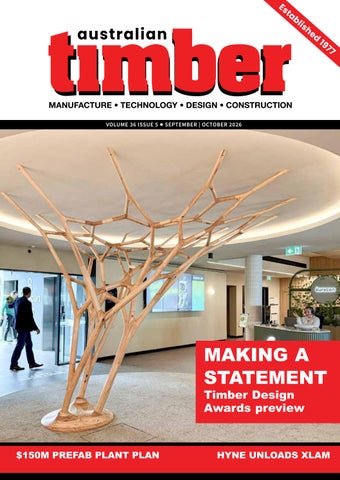
Incorporating Australian and New Zealand Timberman. Established 1977. News ............................................................4-9 Timber Design Awards...................................10-11 Timber Built Offsite.......................................12-16 Engineered Wood .........................................18-19 Associations ................................................22-23 Front Cover: The Foundation Tree stands in Aurecon’s Docklands office, built to honour their late colleague Jeffrey Robinson and the values he worked by: collective ambition, sustainable innovation, and partnerships that outlast the project that started them. The timber is our Tasmanian Oak. Not the select-grade logs you’d expect behind something this precise, but the resources that usually get passed over. The Foundation Tree has been shortlisted in the Australian Certified Timber category at this year’s 27th Australian Timber Design Awards. Story pages 10, 11. Publisher and Chief Executive: Hartley Higgins General Manager: Robyn Haworth Editor: Bruce Mitchell b.mitchell@ryanmediapl.com.au Advertising: Andrew Everett a.everett@ryanmediapl.com.au Adelaide Office (08) 8369 9517 Production & Creative Services: Sophie Franklin Timber classifieds: a.everett@ryanmediapl.com.au Adelaide Office (08) 8369 9517 Subscriptions: subs@forestsandtimber.com.au Adelaide Office (08) 8369 9500 Subcription rates Free Accounts: Adelaide Office (08) 8369 9500 Postal Address: 630 Regency Road, Broadview South Australia 5083 Phone: (08) 8369 9500 Melbourne Office: Suite 2262, 442 Auburn Rd, Hawthorn VIC 3122 Phone: (03) 9810 3262 Find us on Facebook @AustralasianTimber Website www.timberbiz.com.au Printed by Lane Print, Adelaide, SA Conditions The opinions expressed in Australasian Timber Magazine are not necessarily the opinions of or endorsed by the editor or publisher unless otherwise stated. All articles submitted for publication become the property of the publisher. All material in Australasian Timber Magazine copyright 2022 © Ryan Media. All rights reserved. No part may be reproduced or copied in any form or by any means (graphic, electronic, or mechanical including information and retrieval systems) without written permission of the publisher. While every effort has been made to ensure the accuracy of information, the publisher will not accept responsibility for errors or omissions, or for any consequences arising from reliance on information published.
AUS T RAL I A N T IM B ER M A GA Z IN E
MEDIA
INDEPENDENT & AUSTRALIAN OWNED
SEPT EM BER | OC TOBER 2 0 2 6
3
NEWS
Editorial It’s probably no accident that Australian Sustainable
MMC requires skills evolution, not workforce disruption Association (HIA) has welcomed the release of
Mr Hermon said.
Australian Timber Design Awards
T
and evidence-based approach,”
and Sustainability Awards.
examining the workforce and skills
adoption remains at varying
In all, eight projects featuring
implications of Modern Methods
stages across different
ASH product received a total of 13
of Construction (MMC), saying the
construction sectors and regions.
nominations.
findings confirm that innovation in
Future workforce reforms should
They include the University
home building can be supported
be informed by actual uptake
of Tasmania’s The Forest, the
through evolution of existing skills
Tonsley Technical College and
and training pathways rather than
Flinders Factory of the Future in
wholesale workforce disruption.
Adelaide, the Canberra Institute of
MMC encompasses a
Technology, Grace Village Early
range of innovative approaches
Learning Centre in Blacktown,
to designing, manufacturing
the O Pavilion, Macquarie Park,
and delivering buildings,
NSW, the Swift Walk Arcade,
including prefabrication,
Kensington, Victoria, The
modular construction, advanced
Cutaway, Bangaroo, NSW, and
manufacturing techniques and
Ora House, Caulfield, Victoria.
other offsite production methods.
The 27th Australian Timber
While these approaches
Design Awards shortlist celebrates
represent a shift in how homes
timber projects big and small –
are built, the report highlights that
and the results are breathtaking.
the industry’s existing workforce
More than 60 entries have
and training systems are well
Hardwoods and its MASSLAM product are featured in multiple nominations across this year’s
“The report adopts a sensible
he Housing Industry
BuildSkills Australia’s new report
“It recognises that MMC
than the creation of entirely new occupational pathways. “This is an important
be adopted.”
This is an important finding because it recognises Australia’s building workforce already possesses many of the foundational skills required to support MMC
already possesses many of the foundational skills required to support MMC,” Mr Hermon said. “The challenge is less about creating a whole new workforce and more about ensuring workers, supervisors, designers and manufacturers can build on their existing skills and apply them in new ways.” HIA welcomed the report’s
across 13 categories in the 2026
four priority reform areas, which
adoption of these methods.
focus on practical workforce
“HIA has long argued that
development measures that
interior fit-outs, furniture and joinery, sustainability, and timber products including Australian certified, recycled and engineered timber. Since 2000, the Australian Timber Design Awards have provided a showcase of how timber can be used in so many ways from small projects to a complete re-fit of the Sydney Opera House. But Kylan Low, the awards organiser says some of the most impressive entries are also those that use timber in simpler, more understated ways such as Wilson’s Cottage by Casey Brown Architecture, No doubt the awards will continue to inspire in 2026.
4
how quickly these methods may
Australia’s building workforce
placed to accommodate growing
commercial and public buildings,
rather than assumptions about
finding because it recognises
been whittled down to finalists awards, spanning residential,
and demonstrated skills needs
MMC is not about replacing
can be implemented alongside
workers, but about changing
industry adoption.
where and how work is
These priorities include:
undertaken across the building
• Upskilling professional and
HIA said the report also reinforces the importance of maintaining flexible training arrangements allowing industry to respond to innovation without creating unnecessary complexity
and construction supply chain,”
paraprofessional occupations
said HIA Executive Director Future
involved in design, engineering,
within the vocational education
Workforce, Mike Hermon.
project management and
and training system.
“The report makes it clear
construction delivery.
“As Australia seeks to
that as the industry adopts new
• Supporting structured learning
lift productivity and increase
construction methods, the need
and training arrangements for
housing supply, MMC will play
for skilled workers does not
proprietary MMC systems and
an important role alongside
disappear. Instead, tasks may
products.
traditional construction methods,”
shift between construction sites,
• Improving labour market
Mr Hermon said. “The key message from this
manufacturing facilities, design
signalling to help industry and
functions and supply chain
training providers respond to
report is that innovation and
operations.”
emerging demand, rather than
workforce development can
creating entirely new training
progress together. The industry’s
pathways prematurely.
workforce remains central to
The report finds that existing vocational and professional training frameworks can largely
• Monitoring MMC adoption rates
delivering the homes Australia
support MMC adoption through
and workforce impacts before
needs, regardless of whether
targeted upskilling, skills
considering broader reforms
construction occurs entirely
deepening and adaptation of
to qualifications and training
onsite, offsite, or through a
current qualifications, rather
structures.
combination of both.”
w w w.ti mberb iz . c o m . a u
AUS T RAL I AN T I M B ER M A GA Z IN E
SEPT EM BER | OC TOBER 2 0 2 6
V36N5
NEWS
Inside XLAM’s CLT factory at Wodonga in Victoria. Picture: XLAM
Hyne looking to unload XLAM
T
The Group says XLAM
manufacturer, delivering some of
for a new owner for its
expressions of interest from
remains very well positioned
Australia and New Zealand’s most
XLAM Cross Laminated
A formal process to seek
he Hyne Group is looking
suitably qualified parties within
to benefit from the growing
innovative and award-winning
Timber manufacturing business.
Australia and New Zealand,
adoption of ‘Modern Methods of
timber buildings while genuinely
The Group says that while
as well as North America and
Construction’ and demand for
advancing the use of sustainable
Europe has begun.
innovative building solutions.
construction,” he said.
XLAM has been the southern
In 2019 XLam announced the
These include prefabricated
“Our clear preference is
leading manufacturer of CLT, the
shutdown of its manual, capacity-
and modular building systems,
to see XLAM continue under
division’s specialist focus on the
constrained manufacturing site
hybrid timber construction and
new ownership, preserving
in Nelson, transitioning supply
vertical building extensions, where
its manufacturing capability,
for New Zealand customers
the strength-to-weight advantages
specialist expertise and the
to its automated plant in
and carbon storage benefits of
opportunities it creates for our
Wodonga, Australia.
Cross Laminated Timber continue
people, customers and the
to build market share and market
broader construction industry.
hemisphere’s pioneer and
commercial construction sector has limited alignment with the Hyne Group’s continued targeted expansion in Australia and New Zealand, nor does it fit with the long-term strategy of the Group’s parent company, James Jones & Sons Ltd. The Group says a strategic review assess all scenarios has begun, but the preferred outcome is to secure a new owner with
At the time the company said the operations are no longer considered commercially
“XLAM is a highly respected
penetration. XLam has supplied cross-
business with world-class
sustainable and that “a new
laminated timber (CLT) and
manufacturing capability,
business model” would “usher in
glue-laminated timber (GLT) to
experienced technical expertise
a more commercially competitive
more than 1,000 mass timber
and an enviable portfolio of
and sustainable way for the
projects across Australia and
landmark projects. We believe it
company to supply CLT to
New Zealand.
offers a compelling opportunity
Hyne Group Chief Executive
for an organisation whose long-
Officer Jim Bindon said the Group
term strategy is centred on mass
facility was supported by
remained optimistic that a suitable
timber, prefabricated and modular
the Australian Government
purchaser could be found while
construction, and the commercial
through a $2.5m grant from the
being transparent with employees,
construction industry.”
Timber and providing specialised
Commonwealth Government
customers and stakeholders about
design and engineering services
Next Generation Australia
the process.
that support sustainable, carbon-
Industry Grants, and a $450k
storing construction throughout
grant from the Victorian Regional
XLAM team has established
government throughout this
Australia, New Zealand and the
Development Authority to support
the business as Australia’s
process and will provide further
broader southern hemisphere”.
job development.
leading Cross Laminated Timber
updates as appropriate.
the “capability, passion and commitment to build on XLAM’s strong foundation, continuing to manufacture Cross Laminated
V36N5
the market”. Construction of the Wodonga
w w w.ti m b e r b iz . c o m . a u
“Over the past 14 years, the
AUS T RAL I A N T IM B ER M A GA Z IN E
The Hyne Group says it will work closely with employees, customers, suppliers and
SEPT EM BER | OC TOBER 2 0 2 6
5
NEWS
FWPA appoints O’Reilly-Wapstra as new CEO
F
orest and Wood Products
development portfolios. She
(TFFPN) where she oversaw
Australia has appointed Dr
replaces Andrew Leighton who
significant membership growth
Julianne O’Reilly-Wapstra
has joined OneFortyOne as CEO
and governed the Tasmanian
as its new Chief Executive Officer.
She currently serves as a
Regional Forestry Hub—as well
Dr O’Reilly-Wapstra brings
Non-Executive Director on the
as Director of the ARC Training
more than two decades of senior
Board of Australian Forest and
Centre for Forest Value.
executive, board, and operational
Wood Innovations (AFWI), having
leadership experience across
previously led the successful
commence work as CEO on
$101.5 million federal funding
1 December and relocate to
negotiation to establish the
Melbourne to lead the FWPA team
national research institute.
in delivering its national Research,
the forestry, research, and government sectors.
Dr Julianne O’Reilly-Wapstra
She joins FWPA from the
Her previous positions include
Dr O’Reilly-Wapstra will
University of Tasmania, where
large team, managing complex
Development & Extension (RD&E)
she currently serves as Dean of
operations, and directing
Chair of the Tasmanian Forests
programs, promotional activities,
Natural Sciences, overseeing a
substantial research and
and Forest Products Network
and standards development.
Dorries moves to ATIF
F
ormer Responsible Wood
products industry, along with
as they navigate the increasingly
CEO Simon Dorries
extensive expertise in certification,
complex and evolving compliance
has been appointed the
standards, and compliance
landscape for imported timber and
Australian Timber Importers
through his work with Responsible
engineered wood products.
Federation’s new General
Wood and the Engineered
Manager, commencing next
Wood Products Association of
that Mr Dorries’ experience,
month.
Australasia (EWPAA).
leadership, and industry
Mr Dorries resigned from
The ATIF Board believes
The Board says it is confident
relationships will provide
Responsible Wood at the
his deep industry knowledge
significant value to the Federation
start of September after more
and practical understanding
and its membership.
than 11 years.
of certification frameworks will
Mr Dorries replaces Natalie
He has had more than 35
enable him to effectively support
Reynolds who resigned
years of experience in the forest
ATIF members and stakeholders
in early July.
New leadership at Timberlink
T
ATIF General Manager Simon Dorries.
imberlink has appointed
industry through leadership,
Sarah Bellman as its new
governance and industry
in Timberlink’s National
Chief Executive Officer
advocacy roles, as Chair of the
office in Scoresby, Victoria
following the retirement of Paul
Cement Concrete and Aggregates
and will commence on 16
O’Keefe.
Association in Victoria and South
November 2026.
Ms Bellman joins Timberlink
Australia and Director of the
with extensive strategic,
Institute of Quarrying Australia.
customer and operational
“The Board is confident
leadership experience across
that Ms Bellman’s combination
the manufacturing, mining, and quarrying sectors.
and Heidelberg Materials
of manufacturing and heavy industry experience together
Ms Bellman will be based
“I am honoured to be joining Timberlink who play a vital role in the use of sustainable building materials and supporting Australian manufacturing in regional communities. I look
Throughout her career,
Australia, most recently as
she has earned a reputation
General Manager, Southern
for strengthening operational
Region, she brings a proven
capability, delivering sustainable
track record of leading complex
commercial growth, and leading
operations and achieving strong
organisational performance,
commercial results.
supports Timberlink’s strategy and
Mr O’Keefe will remain with
Ms Bellman has also made
growth ambitions,” Ken Boundy,
Timberlink to support an effective
of executive leadership
a significant contribution to the
Chairman of Timberlink Australia
transition until he retires as
experience at Hanson Australia
broader construction materials
& New Zealand said.
planned in mid-December 2026.
high-performing teams. With more than a decade
6
w w w.ti mberb iz . c o m . a u
with her proven ability to lead customer delivery, operational excellence and drive
AUS T RAL I AN T I M B ER M A GA Z IN E
forward to working with our dedicated team, customers and partners to build on the company’s strong legacy and drive future growth,” Ms Bellman said.
SEPT EM BER | OC TOBER 2 0 2 6
V36N5
NEWS
NSW challenged to become national leader in construction productivity
N
SW has the opportunity
and creating the conditions for
to become Australia’s
government and contractors
benchmark for
to solve challenges together
construction productivity and
before they become disputes,”
project delivery, but achieving
said Ms Crookes.
that will require changes to
“If we want to lift productivity,
procurement, risk allocation and
procurement has to be shorter,
the way government and industry
smarter and more focused on
work together, delegates at
outcomes. The opportunity is
Foundations and Frontiers 2026
to spend less time in extended,
heard.
duplicative competitive processes
Addressing the Australian
and more time in genuine
Constructors Association’s (ACA)
development phases where
flagship industry forum in Sydney,
the right people are around the
NSW Treasurer Daniel Mookhey
table early.”
outlined his vision for improving
“The next phase of NSW
project delivery, strengthening
infrastructure investment
industry capability and ensuring
gives us a real opportunity
taxpayers receive greater value
to think differently about how
from the state’s significant
work is packaged, sequenced
infrastructure investment program.
NSW Treasurer Daniel Mookhey at Foundations and Frontiers forum hosted by Australian Constructors Association.
and delivered.
followed a challenge from industry
more realistic about risk and more
repeatable assets or similar
leaders that while NSW is one of
consistent in our requirements,”
standardisation, more modern
said Mr Mookhey.
methods of construction
The Treasurer’s address
Australia’s largest construction markets, it should also aspire to be one of the nation’s most attractive places to deliver major projects. The challenge was taken up by NSW Treasurer Daniel Mookhey, who outlined the NSW Government’s vision for improving project delivery, strengthening industry capability and ensuring taxpayers receive greater value from the state’s significant infrastructure investment program. Sending a message to contractors, the Treasurer said government is looking for innovation that can be scaled and repeated across projects, not demonstrated once and set aside. “Government is the
“We must engage industry
“We want greater
and innovation that can be
earlier, make decisions faster and
repeated across projects—not
resolve genuine claims without
demonstrated once and then
allowing every issue to become
forgotten,” said Mr Mookhey.
an adversarial contest. We must look beyond the lowest apparent tender price and ask whether a bid is credible, deliverable and represents value over the full life of the asset. “For too long, an unhealthy
The discussion today reinforced that productivity is no longer simply a construction issue.
model took hold in parts of the
scopes, we should be looking for ways to standardise, build momentum and give industry the confidence to invest in industrialised construction, offsite manufacture and digital delivery.” ACA CEO Peter Colacino said improving productivity had become one of Australia’s most important economic challenges. “The discussion today reinforced that productivity is no longer simply a construction issue. It’s a cost-of-living issue, a housing issue, and an economic
construction industry. Contractors bid low to win the project.
“Where the pipeline includes
The Treasurer later joined
The tender price became the
ACA President Annabel Crookes
opening offer. Once construction
for a fireside discussion examining
began, claims, variations and
the role government, contractors
renegotiations became the route
and project owners must play
back to profitability.”
in improving productivity and
issue,” said Mr Colacino. Foundations and Frontiers 2026 has brought together more than 450 leaders from construction, government, consulting and the supply chain under the theme Smarter.
In setting a vision for
delivering better project outcomes.
client. That gives us power, but it
the industry the industry, the
“Genuine partnership starts
also gives us responsibilities. We
Treasurer pointed to the role
well before contracts are signed.
reforms and proven approaches
must develop projects properly
of industrialisation and modern
It means bringing industry in early
that can improve productivity and
before taking them to market.
methods of construction in
to help shape the problem, being
lift project delivery performance
driving the change.
transparent about the pipeline
across Australia.
construction sector’s largest
We must be clearer about scope, V36N5
w w w.ti m b e r b iz . c o m . a u
AUS T RAL I A N T IM B ER M A GA Z IN E
Stronger. Together. The forum focuses on identifying practical
SEPT EM BER | OC TOBER 2 0 2 6
7
NEWS
Laminated Veneer Lumber under construction at Wesbeam in Western Australia.
Building the future - Australia’s next timber opportunity is engineered
A
The latest analysis by
Formally reported imports reached
construction market is
IndustryEdge shows, in
254,065 cubic metres in 2025–26,
changing with the shift
2025–26, Australia imported
growing from 167,229 cubic
toward engineered wood products
$1.941 billion of major wood
metres in 2024–25 compared with
creating new opportunities to
products, an increase of 10.8
95,919 cubic metres in 2022–23
deliver more value locally, in our
per cent, or $189 million, on the
– a three-year increase of more
regional communities.
previous year. Engineered wood
than 160 per cent. It’s estimated
products accounted for $676.9
total LVL imports will exceed
million of that total, up 6.2 per
300,000 cubic metres annually in
cent. This occurred despite a
the near term.
ustralia’s housing
The strongest housing growth is no longer concentrated in detached homes. In 2025, townhouse approvals increased by 20.5 per cent, while approvals for four-to-eight-storey buildings
That matters because these buildings require construction systems that can deliver greater consistency, precision and productivity. They create an opportunity for products that can be engineered, standardised
increased by 70.5 per cent. By
and manufactured off site before
comparison, house approvals
being assembled efficiently on
increased by just 1.9 per
site. Engineered wood products
cent. These figures point to
are increasingly part of that
a construction market that is
opportunity. But the market data
becoming more reliant on multi-
shows that Australia is currently
residential, mid-rise and higher-
meeting much of its growing EWP
density formats.
demand through imports.
8
w w w.ti mberb iz . c o m . a u
relatively modest increase in
The value of those imports
housing approvals and otherwise
reached $159.9 million in
unremarkable demand conditions.
2025–26. Yet the average import
In other words, the increase
price fell to $629 per cubic metre,
cannot be explained simply by a
down from $821 the previous
construction boom. It points to a
year and $1,294 in 2022–23. That
deeper shift in the products being
combination: rapidly increasing
specified, purchased and used in
volumes and falling prices, is
Australian construction.
significant. It suggests that
The clearest example is
overseas manufacturers are not
the growing consumption of
simply supplying a temporary
Laminated Veneer Lumber - LVL.
shortfall, they are establishing
AUS T RAL I AN T I M B ER M A GA Z IN E
SEPT EM BER | OC TOBER 2 0 2 6
V36N5
NEWS a stronger position in the
made from timber, but the trend
increasingly demanded by the
Australian market.
is clear - Australia is increasingly
Australian market.
LVL is not the only engineered
importing complete or partially
New, higher-value markets for plantation-grown fibre,
This approach does not
providing Australian builders and
replace Australia’s export role.
developers greater access to
Exports will remain an important
genuinely sustainable and locally
shift extends beyond the
part of the forest industry’s
manufactured products is driving
656,014 cubic metres in 2025–26,
import bill. Every engineered
contribution. The Green Triangle
decision making for The Precinct.
up from 525,599 cubic metres
timber product manufactured
will continue to participate
Importantly, this is positioning the
the previous year. MDF imports
overseas represents value
in international commodity
Green Triangle to respond to a
reached 183,547 cubic metres,
that has been created outside
markets. The opportunity is
Australia. The engineering,
to complement those exports
market that is already changing.
compared with 122,921 cubic metres in 2024–25. In both cases,
capital investment, manufacturing
or manufactured wood product
completed dwellings.
experiencing this pressure. Plywood imports increased to
import volumes rose sharply while average import prices fell. Taken together, the figures show an important change in Australia’s timber market. The rise of engineered wood products is not a distant prospect: they are already being consumed at significant and growing volumes. The market is rapidly forming now, but the majority of the manufacturing capacity supplying the demand is being delivered offshore. That is the central issue Australia needs to confront. At a time when housing delivery is under pressure from system and labour shortages, construction costs, productivity constraints and limited capacity, more must be done with less. Engineered timber, prefabrication, standardised components, advanced manufacturing and latest technologies all have a role to play in making construction more predictable, cost effective and efficient. The growth in prefabricated building imports provides further evidence of this transition. Imports of prefabricated building products
The significance of this
expertise, production jobs and associated supply-chain activity are captured in another country
by developing higher-value, domestic manufacturing capability delivering solutions for Australia’s dwellings.
The growth in townhouse and mid-rise dwelling demand shows Australia’s housing mix is moving beyond the detached house. The rapid increase in LVL imports
before the product arrives on
shows that engineered wood
Australian-shores.
products are becoming a more
Australia already possesses
important part of the material
one of the foundations required
mix. The rise in prefabricated
to participate in this market more
building imports and the growing
effectively - the raw material, and
emphasis on prefabrication in
it comes at scale. The country has
Australia, shows that construction
a substantial plantation estate, an established industry and decades of expertise in growing, harvesting, transporting and processing timber. The Green Triangle, spanning south-west Victoria and south-east South Australia, is one of the strongest examples of this capability. The region has world recognised plantations, the forestry businesses and expertise, the transport infrastructure, the
… overseas manufacturers are not simply supplying a temporary shortfall, they are establishing a stronger position in the Australian market
is increasingly incorporating manufacturing models. These trends are not separate. They are different expressions of the same transition: buildings are becoming more reliant on systems, components and products that can be designed, engineered and manufactured with greater precision before they are installed on site. From LVL, Plywood, MDF and prefabricated components, all the data is
ports and the international supply
showing a rising trend. It shows
chains. It does not need to create
no sign of slowing.
a resource base from scratch. It
The Precinct development
has the opportunity to connect
provides a pathway to deliver
that existing capacity and existing
this market need. It offers the
wood processing facilities, to the
potential to connect a significant
next stage of market development
plantation resource with a
for manufacturing underpinned by engineered wood products. This is the opportunity behind
increased by 52.6 per cent in
growing market for engineered That distinction and the diversified value chain matters
wood products and prefabricated construction components.
2025. Prefabricated buildings and
The Precinct. It is not simply a
for regional economies.
modular building products were
proposal to manufacture another
Manufacturing engineered wood
already demonstrating where
worth $333 million in imports
timber product. The central
products locally helps retain
the opportunity lies – it’s
during the year, while imports
proposition is to establish a more
more value within the domestic
time for the sector to deliver
in the first four months of 2026
complete regional value chain,
economy, creates more skilled
the answers, extending and
had already reached almost
one that connects plantation-
jobs and supports businesses
defending Australia’s sovereign
$226 million. If that pace were
grown fibre with engineered wood
in engineering, technology,
manufacturing capability to
maintained, it would equate to
products, building component
maintenance, transport, logistics
an annual value of around $678
manufacturing and, ultimately,
million. Not all these products are
the construction systems
V36N5
w w w.ti m b e r b iz . c o m . a u
and construction – additional service industries.
AUS T RAL I A N T IM B ER M A GA Z IN E
Australia’s market is
deliver on one of society’s essential needs: locally produced housing solutions.
SEPT EM BER | OC TOBER 2 0 2 6
9
AUSTRALIAN TIMBER DESIGN AWARDS
The Cutaway, Barangaroo by fjcstudio, is a finalist in the Fitout – Commercial & Public category.
Timber makes a statement in 2026 awards shortlist
F
rom a monumental timber
we’ve not seen before,” Low says.
garage into a three-bedroom
‘forest’ at a major cultural
“So that’s very, very impactful.”
family house using 95 per cent
The Forest by Woods Bagot,
timber, almost all of it reclaimed
venue to a recycled-timber
from the site and nearby buildings.
family home and a sculptural
a finalist in the Sustainability
Tasmanian Oak tree, the 27th
category, uses adaptive reuse to
Low further highlights the
transform an existing site for the
Aesop skincare shop at Canberra
shortlist celebrates timber projects
definitely an exciting one. It’s an
University of Tasmania, retaining
Centre by Thor’s Hammer, a
big and small – and the results
uptick [in quality] and, more than
much of its original structure
finalist in the Recycled Timber
are breathtaking.
ever, it’s difficult for the judges to
while incorporating mass timber,
category. It uses reclaimed
Australian Timber Design Awards
More than 60 entries have
work out what is a winner because
salvaged timber and hempcrete to
Australian hardwood to create
been whittled down to finalists
comparing these things is … the
reduce its environmental impact.
an immersive retail space, with
across 13 categories in the 2026
whole challenge.”
The New Sydney Fish Market
recycled timber parquetry and
Among the standout projects
by 3XN, in association with BVN
shingle cladding extending from
commercial and public buildings,
is The Cutaway, Barangaroo by
and ASPECT Studios, is another
floor to ceiling.
interior fit-outs, furniture and
fjcstudio, a finalist in the Fitout –
highlight, with its sweeping
joinery, sustainability, and
Commercial & Public category.
20,000sqm engineered timber
high-quality timber in a shop
timber products including
The major underground cultural
roof – the largest of its kind in
fit-out,” Low says. “It often gets
Australian certified, recycled and
and events venue beneath
Australia – defining the new
value-engineered away, but the
engineered timber.
Barangaroo Reserve in Sydney
waterfront market.
Aesop project achieves it in a
awards, spanning residential,
“It’s very tricky to get really
features a striking timber fit-
But Low says some of the
really, really beautiful way. It’s
organiser, says this year’s entries
out, with 13 sculptural timber
most impressive entries are also
a very evocative project. We try
are among the strongest in
‘trees’ wrapping around existing
those that use timber in simpler,
and push up projects that we
its history.
concrete columns and rising up
more understated ways.
think deserve more attention and
Kylan Low, the awards
“There are many, many
to 17 metres.
One example is Wilson’s
should be emulated.”
“Projects like The Cutaway,
Cottage by Casey Brown
overall winners in previous years,
Barangaroo, are really setting a
Architecture, a finalist in the
introduction of a dedicated Sports
but the race is so tight that anyone
standard and pushing timber into
Recycled Timber category. The
and Recreation award category,
could be up for it,” he says. “It’s
the public realm in a way that
Kiama home transforms an old
recognising timber projects
projects that would have been
10
w w w.ti mberb iz . c o m . a u
AUS T RAL I AN T IM B ER M A GA Z IN E
This year also sees the
SEPT EM BER | OC TOBER 2 0 2 6
V36N5
AUSTRALIAN TIMBER DESIGN AWARDS such as the Adelaide Aquatic
of Canberra’s original Anzac
craftsmanship that’s poured into
Centre by JPE Design Studio,
East building.
the really organic form.”
Warren and Mahoney and Karl
For Low, the awards provide
The 2026 judging panel is led
Winda Telfer. The project uses
an opportunity to consider where
by Archer Office founder Tomek
engineered timber throughout its
timber comes from too, not simply
Archer, whose Boot Factory
major aquatic spaces, including
what can be made from it.
project won the Grand Prix at
some of Australia’s largest timber
“This year, for the first time in
beams, while delivering a highly
a long time, we’ve given people
sustainable, all-electric facility.
the opportunity when they submit
“We’ve always had a decent
to elaborate on where their
representation of sports halls and
wood comes from,” he says. “Of
multipurpose units, ranging from
course, the Australian Certified
canopies to large buildings and
Timber Award is [also] specifically
swimming halls,” Low says. “But
focused on projects that
until this year, they haven’t had
demonstrate excellent practice in
their own dedicated category.”
chain-of-custody responsibility.”
At a much smaller scale, the
A finalist in the Australian
the awards in 2025. He is joined by Yann Frampton of HASSELL, The New Sydney Fish Market by 3XN, in association with BVN and ASPECT Studios.
Victoria Judge of SJB Architects, Amy Smith of Arup and Nick Hewson of Arboralis, bringing
JPE Design Studio and
expertise across architecture,
Charles Sandford.
interiors, sustainability and
Made from 97 CNC-machined Tasmanian Oak components,
structural engineering. The winners will be announced
the sculptural foyer piece
at the awards gala at Sydney’s
demonstrates how timber can
Museum of Contemporary Art
awards also recognise furniture
Certified Timber category is The
and joinery projects like the Anzac
Foundation Tree, an arresting
Park East Concierge Desks by
tree-inspired installation in
Thor’s Hammer in Canberra. The
Aurecon’s Melbourne office at
commands the space it’s in,” Low
sculptural timber desks are made
Docklands, created through a
says. “It sort of asks the people
be pushed into sophisticated, futuristic forms. “It’s a piece of joinery that
in The Rocks on 21 October, with around 120 guests expected to attend. Find out more at the Australian
from recycled Blackbutt and Blue
collaboration between Aurecon,
who enter it to slow down and
Timber Design Awards website,
Gum and reinterpret the façade
the University of Melbourne,
pay attention and observe the
wwwtimberdesignawards.com.au
V36N5
w w w.ti m b e r b iz . c o m . a u
AUS T RAL I A N T IM B ER M A GA Z IN E
SEPT EM BER | OC TOBER 2 0 2 6
11
TIMBER BUILT OFFSITE TIMBER
B U I LT OFFSITE
Inside Australia’s growing prefab manufacturing base
ALICIA BROWN EDITOR SMART BUILDING REVIEW
I
n 1975, Kodak engineer Steve Sasson built the first digital camera, an eight-pound device
that recorded grainy black-andwhite images onto a cassette tape. Kodak’s own labs went on to accurately predict the pace of digital improvement decades in advance. Yet Kodak was nearly wiped out by the digital revolution in photography.
Modscape’s Essendon Fields facility is being expanded to 55,000 square metres with a second robotic cell expected to double automated output by mid-2027.
The problem wasn’t foresight; it was that a filmless camera threatened the high-margin film, paper, and chemicals business By the time Kodak moved into digital, other companies had already done so. Traditional construction companies in Australia may be approaching evidence is in where some of the country’s largest property developers and construction companies are now investing. In May 2026, Wesfarmers, best known for Bunnings and Kmart, entered residential construction for the first time, forming a 50:50 joint venture with Built Group to establish Built Living. The venture’s first factory, north of Perth, is designed to produce more than 2,000 apartments a year using Design for Manufacture and Assembly, with first output targeted for 2028. A few months earlier, Japan’s Sumitomo Forestry acquired 51 per cent of Metricon, Australia’s largest detached-home builder, making it the country’s largest builder group by housing starts.
12
PanelTech is already assembling
opportunities across high-rise
complete wall and roof sections
student accommodation, build-to-
for homes at Cobblebank, where
rent, and hotels.
a guaranteed pipeline of more
In a parallel tender for a
that funded the company.
a similar turning point, and the
$4 billion in volumetric modular
Metricon itself builds
production run, with individual
modular alternative returned a
homes reaching lock-up in as
seven-month program saving and
little as 48 hours. A two-home
ten per cent more beds through
pilot manufactured offshore is a
a more efficient structural form,
trial; PanelTech’s commitment
with construction costs ranging
is production.
conventionally, so this is less a
from cost-neutral to ten per
direct capacity data point than
cent cheaper.
a signal: a global housing and
than 300 lots underpins its
43-storey Melbourne tower, its
Jan Gyrn, co-founder of Modscape and its automation
None of this is Australia
arm Mybotics, put it bluntly at
forestry conglomerate with deep
inventing something new.
Offsite26: “I don’t think Australia
prefabrication expertise is now
It’s some of the country’s
has a capacity issue. The
consolidating major Australian
largest capital allocators and
issue is we’ve got the wrong
building capacity under one roof.
head contractors concluding,
procurement model.” His point is
independently and at the
that government demand tends
pilots. At Tullamore in Melbourne,
same time, that industrialised
to arrive in batches of “five to 20
four homes built with prefabricated
construction is where the
houses,” priced and procured as
wall and floor panels were 23
industry is heading.
a construction project rather than
per cent faster than four identical
LOOKING OVERSEAS
a manufactured asset, denying
Mirvac, meanwhile, has run
conventionally built homes, with labour hours down 11 per cent, high-risk work such as scaffolding down 42 per cent, and on-site waste down 50 per cent. And it isn’t only developers testing the model; head contractors are pricing it at the portfolio level too. Kapitol Group has spent the past 12 months conducting feasibility studies on roughly
w w w.ti mberb iz . c o m . a u
That urgency hasn’t yet
manufacturers the volume that
reached everyone making
makes factory economics work.
sourcing decisions. Metricon
PrefabAUS’s own Industry
recently piloted two homes at
Roadmap, published in 2023,
Truganina, built from panels
flagged this risk: import
manufactured offshore and
competition was low because the
assembled on-site in 20 business
market was immature at the time,
days. The contrast with local
but demand growth could see
capacity already under contract is
that share captured by imports
worth noting: Melbourne-founded
unless awareness and capability
AUS T RAL I AN T IM B ER M A GA Z IN E
grew together. Three years on, SEPT EM BER | OC TOBER 2 0 2 6
V36N5
TIMBER BUILT OFFSITE
5North’s Advanced Manufacturing Facility near Adelaide, a 104-metre robotic line with 14 industrial robots, is designed to produce components for around 1,000 homes a year.
awareness has moved faster than
Essendon Fields facility is being
existing capacity; better utilisation
projections of 30,000 jobs. And
the Roadmap anticipated, but the
expanded to 55,000 square
alone, without new factories, could
the $50 million Future of Housing
underlying risk hasn’t gone away.
metres with a second robotic cell
nearly double current output. The
Construction Centre of Excellence
The message for developers
expected to double automated
barrier the study identifies isn’t
at Melbourne Polytechnic, a
is straightforward: before
output by mid-2027; the company
technology or capability; it’s the
commissioning overseas, it’s
is now replicating that model at
same demand-certainty problem
partnership with prefabAUS,
worth finding out what’s already
a second, 50,000-square-metre
raised throughout this article.
running at capacity down the road.
factory in Queensland. ATCO’s
Capacity is also being built
four Australian facilities state
at the ecosystem level. New
a combined capacity of more
South Wales’ $400 million
than 3,000 modules a year, and
BlueScope-TAFE partnership is
experimental. Providence
Hutchies Modular has delivered
developing 200 hectares in the
Lifestyle Group, chaired by
more than 25,000 modules from
Illawarra for education, training
former Fleetwood CEO Brad
three facilities to date. Sync, part
and industrial development, with
Denison, now delivers around
of Melbourne’s Hepburn Group,
30 homes a month from a
has delivered close to 35,000
library of just 16 standardised
bathroom pods nationally and is
designs, and operates its own
now investing in automation as
steel framing factory, in-house
it expands into Queensland and
building company, and funds
New South Wales. JMB Modular’s
management. In Melbourne,
new Shepparton facility can take
light-gauge steel framing now
modules to 95 per cent factory
underpins 60 to 65 per cent of
fit-out in under eight weeks, and
SAW Constructions’ townhouse
OFFSITE in Western Australia is
pipeline through its partnership
midway through a four-year, $150
with Dynamic Steel Frame, to
million-plus expansion aimed at
the point that SAW is planning to
compressing project completion
bring frame rolling in-house. Once
from 26 weeks to 12-14.
volume and standardisation reach
CAPACITY SITTING IDLE
Vertical Integration and Real Numbers This shift is structural, not
a certain point, owning more of
Just how much headroom
the manufacturing chain stops
exists in that installed base is
being a novelty and starts being
now being measured directly.
the obvious next step.
Queensland’s first state-level
The named manufacturers
MMC baseline study, led by
back this up with real numbers.
prefabAUS Research Director Dr
5North’s Advanced Manufacturing
Tuan Ngo, mapped almost 300
Facility near Adelaide, a
companies across the state’s full
104-metre robotic line with 14
spectrum of MMC. MMC currently
industrial robots, is designed to
delivers around 5 to 6 per cent
produce components for around
of Queensland’s roughly 45,000
1,000 homes a year on a four-
to 50,000 annual dwellings, but
day work week, rising to 3,000
surveyed manufacturers report
across three shifts. Modscape’s
using only around half of their
V36N5
w w w.ti m b e r b iz . c o m . a u
is training the workforce this capacity will need, developing what Executive Chairman Damien Crough calls the “super tradie”: a multi-skilled worker moving fluidly between construction trades and manufacturing.
continued page 15
Australian Made Compression Router Cutters Leitz Australian-made compression router cutters combine 150 years of tooling expertise with premium carbide, German manufacturing standards and industry leading grinding technology. Up to 40% longer edge life. Engineered for Australia. Manufactured in Melbourne. LEITZ. WE SHAPE THE FUTURE. www.leitz.org/en-au
AUS T RAL I A N T IM B ER M A GA Z IN E
Contact us: sales@leitz.com.au 1300 135 127
SEPT EM BER | OC TOBER 2 0 2 6
13
TIMBER BUILT OFFSITE TIMBER
B U I LT OFFSITE
A
$150m joint Euro-Australian prefabricated plant plan
ustralia’s Syncorana
$150 million capable of scaling
Group and Steco
to produce three thousand
Centar from Bosnia
prefabricated homes per annum
and Herzegovina have signed
using advanced European
a landmark Joint Venture
manufacturing technology
Agreement to establish Steco
adapted to Australian standards
(Australia) Pty Ltd, a new
and market requirements.
company that will introduce highquality prefabricated homes in Australia and Oceania. The partnership combines Syncorana’s strategic vision for Indigenous economic development including housing manufacture and building and workforce training with Steco’s thirty years of experience in the design and manufacture of prefabricated housing systems. Syncorana is an Australian company focused on developing innovative housing, advanced manufacturing, early childhood education, workforce training and artificial intelligence solutions. Steco Centar is a Bosnia and Herzegovina-based manufacturer of prefabricated building systems with extensive experience in the design, engineering and manufacture of innovative construction technologies for domestic The joint venture represents a significant step towards establishing an advanced manufacturing facility capable of supporting Australia’s
A distinguishing feature of the proposed Australian facility will be the inclusion of Syncorana’s registered training organisation Living Planit/Dreamtime Institute
Prefab panels being assembled at a Steco Centar factory in Europe.
of Training and Management - designed to become a national
This initiative will assist in
through our training centre of
centre of training excellence
addressing Australia’s housing
excellence, and using technology
for prefabricated construction,
supply challenges while
and artificial intelligence to build
advanced manufacturing and
contributing to national economic
a smarter and more sustainable
modern building techniques.
development and increasing
housing industry.
The integrated training
participation by Aboriginal
“Importantly, this initiative
facility is intended to support
and Torres Strait Islander
will provide meaningful training
the development of a highly
peoples in the construction and manufacturing sectors.
and employment pathways for
skilled Indigenous and nonIndigenous workforce capable of
“The joint venture marks a
manufacturing, assembling and
defining milestone in the evolution
installing prefabricated building systems for the Australian market. The venture will seek to supply a broad range of construction markets including residential housing, Indigenous affordable and social housing, early childhood learning and aged care centres, workforce accommodation and commercial developments. It complements Syncorana’s Indigenous housing strategy planned
growing demand for affordable,
for implementation via its
sustainable and high-quality
national network of Indigenous
housing solutions. The new facility
partnerships. Steco also intends to
is designed to create highly
of Syncorana,” Carlton Taya, Chief Executive Officer and Managing Director, Syncorana Group, said. “Our partnership with Steco Centar brings together proven international manufacturing and building expertise with an Australian vision to transform the way homes are built. “Australia is facing one of the most significant housing supply challenges in its history. Through this joint venture we intend to establish advanced manufacturing capability that can deliver highquality prefabricated housing faster, more efficiently and at scale,” Mr Taya said.
skilled jobs, strengthen sovereign
collaborate with strategic
manufacturing capability and
partners, government, institutional
is about much more than
support long-term industry growth.
investors, developers and
manufacturing. It is about
“Importantly, this partnership
Aboriginal and Torres Strait Islander peoples, apprentices, school leavers, veterans and workers seeking to transition into advanced manufacturing and modern construction.” “We are delighted to be partnering with Steco Centar, a world leader in prefabricated housing manufacture and look forward to building a longterm business that delivers value for our shareholders, customers, government partners and Indigenous communities across Australia.” Steco Centar chairman Milenko Stevanović said his company had spent many years developing innovative building technologies and manufacturing systems. “We believe Australia
builders and community housing
creating skilled jobs, supporting
represents an exciting opportunity
parties intend to establish a
providers to expand the use
Indigenous economic
to apply our experience to one of
local manufacturing operation
of prefabricated construction
participation, developing the
the world’s most dynamic housing
systems throughout Oceania.
next generation of workers
markets,” he said.
Under the agreement, the
at an estimated cost of around
14
w w w.ti mberb iz . c o m . a u
AUS T RAL I AN T IM B ER M A GA Z IN E
SEPT EM BER | OC TOBER 2 0 2 6
V36N5
TIMBER BUILT OFFSITE Continued from page 13 WHERE THE GAPS GENUINELY REMAIN
Australian industry. There’s a lot of
ambitious public policy. Not for a
Put together, the picture is
None of this means the task
intelligence in the supply chain.”
minute. Organic growth alone will
one of a sector already carrying
On 28 May 2026, federal Housing
not be enough for Smart Building
Minister Clare O’Neil announced
meaningful, demonstrable
Roadmap, now approaching the
to make its rightful contribution
a $39.3 million commitment to
to solving Australia’s triple crisis
midpoint of its 2023-2033 horizon,
expand System 600 nationally,
of housing supply, affordability
was candid at the time that
funding pilot projects, technical
and construction productivity.
running multi-shift, light gauge
production and assembly carried a
training for councils and certifiers,
What’s needed is an explicit,
steel partnerships carrying the
“large capability and capacity gap”
and supply chain development.
sustained commitment to Smart
bulk of a builder’s pipeline,
requiring urgent, concerted effort.
Taken together, the industry’s
Building as a national mission,
a state-level baseline study confirming half of that capacity
is solved. PrefabAUS’s Industry
manufacturing capacity: robotic production lines, factories
The evidence above suggests
live concerns at Offsite26,
with targets, timelines and priority
that the gap has narrowed faster
around finance, nationally
projects, recognising offsite Smart
than the Roadmap’s authors
consistent regulation, and
Building as a priority sector for its
could have anticipated. But it’s
strategic procurement to build
potential to deliver on productivity,
notable that the Roadmap rated
a demand pipeline at scale, are
affordability, reindustrialisation,
capital and corporate names in
procurement and supply chain
themselves telling. These aren’t
decarbonisation, resource
the country. The housing task
integration as a low to medium
the teething problems of a fringe
efficiency, circular economy
doesn’t require Australia to build
gap, and “very near” to closing;
activity; they’re the constraints of
objectives, and social inclusion.
that’s the link still lagging furthest
a sector approaching real uplift
this capability from nothing. It
Achieving those gains means
behind where it should be, and
and scale-up.
the ability to actually make
requires developers, investors
precisely where System 600, the
THE ARGUMENT
things here, with strong core
currently sits unused, now being joined by some of the largest
and government looking here first, recognising, connecting
Building 4.0 CRC’s “kit of parts”
But the sector’s remarkable
research project, is focused. As
recent growth must not lull the
long-term policy commitment to
and scaling what already exists,
the project’s Daryl Patterson puts
government or industry itself
a future built and manufactured
before the decision is made for
it, “We have a lot of capacity in the
into reducing effort toward more
in Australia.
the industry rather than by it.
manufacturing capability: a
25
WORK
SAFER. STORE MORE.
ENHANCE THE SAFETY, STORAGE & EFFICIENCY OF YOUR LOGISTICS WITH COMBILIFT For almost 3 decades, Combilift has been revolutionising the way companies handle and store goods. Our pioneering product range of multidirectional, sideloafers, articulated and pedestrian forklifts, straddle carriers and container loaders allows you to manoeuvre long loads safely, reduce aisle widths and increase the amount of space available for storage.
Contact Us Today To find out how Combilift can help you unlock every inch of your storage space.
combilift.com Australasian timber Mag 185x130 Chris REv 4.2.indd 1
V36N5
w w w.ti m b e r b iz . c o m . a u
AUS T RAL I A N T IM B ER M A GA Z IN E
SEPT EM BER | OC TOBER 2 0 2 6
15
20/07/2026 12:43:15
TIMBER BUILT OFFSITE TIMBER
B U I LT OFFSITE
M
ModHomes program delivers 280 prefab homes in Tasmania
ore than 280 modular
housing supply and getting people
State, with a further 271 units our
delays and greater efficiency,
homes have now
into safe, secure and affordable
construction pipeline.”
and it also helps us manage
been delivered under
homes sooner,” Mr Vincent said.
the Tasmanian Government’s ModHomes Program. The ModHomes Program is a Tasmanian Government initiative
The modular homes being built by Podmatrix will soon
and materials and making
working hard to deliver more
be delivered to the State’s
homes for Tasmanians under the
North West, where the State
more efficient use of labour
ModHomes Program.
Government is delivering 13
managed by Homes Tasmania to
“Seeing the factory in action is
units in Romaine.
fast-track social and affordable
a great example of how we can
Two of the units have already
housing using pre-fabricated
think differently about housing
been installed, with the rest to be
modular construction.
delivery – and, importantly, how
installed in coming weeks.
Housing and Planning Minister Kerry Vincent said the State
costs by reducing wasted time
“The team at Podmatrix is
we can get more homes on the ground faster.
“Increasing our housing supply is a key part of our 2030 Strong
and resources. This approach also supports jobs, skills and training opportunities for Tasmanians, helping grow the skilled construction workforce needed to meet future housing demand. “This shows what is possible
Government was continuing
“Every home completed is
Plan for Tasmania’s Future. The
to expand modular housing
another place to call home for
ModHomes Program is helping
when government, industry and
construction to deliver more high-
Tasmanians,” Mr Vincent said.
deliver that,” Mr Vincent said.
skilled workers work together to
quality homes for Tasmanians.
“Our Government has
Building homes in a factory
build more homes, faster, without
“Modular construction is an
already delivered more than
provides significant advantages,
compromising on quality,” Mr
280 modular homes across the
including reduced weather-related
Vincent said.
important part of increasing
New standard contract for prefab homes
P
refabAUS has launched
Modern Method of Construction’s
a new standard form
(MMC) unique parameters has
contract for prefabricated
contributed to slowing the broader
homes, designed for use across
adoption of prefab housing
the industry and available
in Australia.
to builders, manufacturers,
“For too long, prefabricated
customers and lenders –
construction has been constrained
regardless of which lender
by contracts designed for
provides the finance.
traditional, site-based delivery,”
The contract, developed
standard form contract provides
Commonwealth Bank of Australia,
the clarity and structure needed to
addresses a key barrier to the
better support how these homes
growth of prefabricated housing:
are delivered, helping unlock
existing contracts are designed for
investment, improve productivity
traditional construction, not homes
and scale the growth of the
that are manufactured offsite.
modern construction industry
PrefabAUS Executive Chairman, Damien Crough, said
16
w w w.ti mberb iz . c o m . a u
Mr Crough said. “This new
through sponsorship by the
in Australia.” The new contract is designed
the absence of a dedicated prefab
to better reflect how prefab
construction contract that aligns
homes are built – in factories
payments and financing to factory-
and delivered in weeks, rather
built timelines and recognises
than months.
AUS T RAL I AN T IM B ER M A GA Z IN E
SEPT EM BER | OC TOBER 2 0 2 6
V36N5
SAWMILL TECHNOLOGY
AI defect detection for engineered wood
R
aute has deployed
recovery and inefficient use of
AI enhanced defect
energy in downstream stages.
detection in production
Raute’s analyzers are
environments to improve how
industrial systems used to
veneer, plywood and LVL
measure, grade and classify
production lines identify and utilize
veneer and panels at different
raw material.
stages of production. They
The solution enables earlier and more consistent production decisions, helping mills improve recovery, reduce waste, and optimize energy use. In veneer based engineered wood production, defect detection has a direct impact on how efficiently raw material can be utilized. It influences grading, clipping, routing and repairing
provide real time quality data to support production decisions across the process. By combining visual defect detection with measurements such as moisture and strength properties, analyzers
Visual and moisture properties can be analyzed with individual or integrated analyzers.
create a consistent foundation
defects more consistently under
AI based defect detection in Raute
for data driven and increasingly
different wood species, surface
analyzers is built on more than 50
automated production.
characteristics and production
years of analyzer development
conditions. The systems generate
and extensive experience from
strengthens this role. By
detailed defect maps for individual
veneer processing across
AI enhanced defect detection combining industrial machine
sheets, supporting more precise
over 50 wood species. This
decisions throughout the process.
vision with deep learning models
and repeatable decisions.
provides a strong foundation for
When detection is inaccurate
developed specifically for
or inconsistent, it leads to unnecessary waste, reduced
Demand for this capability is
applying the same approach to
veneer based engineered wood
growing as manufacturers work
both commonly used and more
production, analyzers can identify
with a wider mix of raw materials.
specialized materials.
Real-Time Visibility
for Real-World Timber Operations TimberSmart delivers fully integrated Enterprise Resource Planning and mobile solutions that streamline operations from log intake to dispatch. We help sawmillers, wholesalers, and re-processors run more efficiently with real-time data, greater visibility, and reduced manual processes.
Connect people, processes and technology with real-time data and industry-specific functionality— creating greater visibility across your entire operation. PRODUCTS • TimberSmartOne ERP - end-to-end operations • Forestry, Log & Inventory Management • Sawmilling, Wholesaling & Manufacturing • Finance Integrations & TimberXchange (EDI)
SERVICES • Consulting & Implementation • Mobile Apps & Handheld Scanning • Custom Development & Integrations • Data, Reporting & Hardware Solutions
See TimberSmart in action, talk to our team today. Call Us: +61 3 9034 3377 1300 664 064 Email: sales@timbersmart.com.au Website: www.timbersmart.com.au
V36N5
w w w.ti m b e r b iz . c o m . a u
AUS T RAL I A N T IM B ER M A GA Z IN E
SEPT EM BER | OC TOBER 2 0 2 6
17
ENGINEERED WOOD
Unlocking the economics of mass timber: Insights from three case studies
R
eliable cost data has long
relied on experienced consultants,
been a barrier to wider
early collaboration with the
adoption of mass timber
Authority Having Jurisdiction, and the use of a prefabricated
construction.
envelope and modular clip-
While factors such as
on balconies.
construction efficiency, tenant
While mass timber carried
appeal, and the potential for lower embodied carbon have
in hybrid mass timber (CLT
reinforced the approach. As one
higher costs in categories such
made mass timber increasingly
floors with steel columns) over a
of the first BC Builds projects, it
as CLT panels and steel columns
attractive to some project
3-storey concrete podium.
showcases government interest in
compared to concrete, it showed
Stakeholder alignment,
scalable, repeatable mass timber
savings in project staffing and
have consistently asked a
embodied-carbon reduction, and
solutions for affordable housing.
indirect construction costs,
more pragmatic question: How
municipal readiness made mass
Key risks for this project
narrowing the overall premium.
does mass timber pencil out?
timber a voluntary but strategic
included design coordination
The hybrid structural system and
Uncertainty around cost has
choice for this project. Strong
with MEP systems, course of
modular speed walls shortened
remained the most persistent
support from the City of North
construction insurance premiums,
the anticipated superstructure
hesitation point.
Vancouver and alignment with
schedule optimization and
schedule and prefabrication
provincial housing priorities further
supplier deposits. Risk mitigation
reduced onsite labour needs,
teams, owners and developers
A new Mass Timber Business Case Studies published by WoodWorks BC, a market development program of the Canadian Wood Council, begins to answer this question by presenting three real projects where developers shared detailed cost, schedule, and design information. Collectively, these studies illuminate how mass timber performs under real market conditions, comparing each project to conventional construction materials and demonstrating how strategic design choices and risk management can bring mass timber into cost parity across multiple building types. AFFORDABLE RENTAL HOUSING North Van Phase 2 is an 18-storey mixed-use building developed by Catalyst Community Developments Society on land leased from the City of North Vancouver. The project includes 179 affordable rental homes built atop the new North Shore Neighbourhood House, with the upper 15 storeys constructed
18
North Van Phase 2 is an 18-storey mixed-use building with the upper 15 storeys constructed in hybrid mass timber over a 3-storey concrete podium. Picture: Integra Architecture Inc.
w w w.ti mberb iz . c o m . a u
AUS T RAL I AN T IM B ER M A GA Z IN E
SEPT EM BER | OC TOBER 2 0 2 6
V36N5
ENGINEERED WOOD an important benefit in a tight
compared to about $262 per
labour market.
square foot for the light wood
The mass timber tower
frame option. In practical terms,
achieved near cost equivalency,
this made the two approaches
with a difference of ~1.6% or $8
cost-neutral, despite the mass
per sq.ft when compared to a
timber structural package
concrete alternative. The full case
being roughly 22 percent
study provides a detailed mass
more expensive than light
timber vs. concrete proforma,
wood framing.
comparing the tower levels
When combined with the
(Level 4 and up).
potential schedule advantage of
OFFICES
up to five months under typical
The Exchange is a six-storey
supply conditions, these results
commercial building in Kelowna
indicate that future projects
that showcases a pragmatic,
should look beyond structural
regionally grounded approach
premiums alone and consider how
to mass timber construction.
mass timber can deliver broader
The building was conceived as
benefits, including construction
a flexible office development
efficiencies, earlier occupancy,
capable of accommodating a
and strong market interest in
range of tenant configurations,
distinctive, low-carbon office
with exposed wood serving as a
environments.
key differentiator in a competitive
MARKET RATE RENTAL HOUSING
leasing market. The project uses a
Parcel 19.1, proposed by
hybrid structural system consisting of glulam columns and beams
Wesgroup Properties for the
paired with site-fabricated nail-
River District in Vancouver, is
laminated timber (NLT) panels.
a 19-storey hybrid mass timber
This strategy delivered enhanced
tower containing 17 storeys of
architectural appeal.
mass timber over a two-storey
From a development
concrete podium. Supported by
perspective, mass timber was
a large master-planned context,
selected to elevate marketability,
the project includes approximately
meet municipal sustainability
240 strata and rental homes, plus
goals, and offer comparable
an urgent care centre at grade. Wesgroup saw mass timber
insurance rates to a light-woodframe alternative. Exposed
as an investment in the future
timber was viewed as a strategic
of sustainable construction. The
investment in tenant appeal,
strategy emphasized long-term
which proved true when the
R&D benefits, the desire for
project achieved a 6–22 percent
“Made in Canada” solutions,
lease premium over comparable
and alignment with sustainability
office space in Kelowna. This
commitments across its portfolio.
decision also aligned strongly with
Key risks included regulatory
community expectations for low-
approval for a tall hybrid structure,
carbon development.
coordination of mechanical and
From a cost perspective, the
electrical systems around CLT
The Exchange is a six-storey commercial building in Kelowna that showcases a pragmatic, regionally grounded approach to mass timber construction. Picture: Jason Harding, courtesy naturallywood.com
A key takeaway from this case is that the above-grade mass
rise context which is an important milestone for the industry.
timber structure achieved cost
Taken together, these three
parity with concrete, excluding
case studies provide something
underground work. This was
the mass timber sector has long
made possible through targeted
needed: transparent, real-world
design refinements, including a
cost comparison data. More
simpler building form, a larger
importantly, they show that cost
floorplate, and the shift from
parity is achievable, sometimes
balconies to Juliet railings, which
already within reach and often
together lowered costs by about
attainable through design
$25,000 per unit.
optimization, prefabrication, and
The team deployed strategic
collaborative project delivery.
material sequencing to secure
For developers exploring mass
competitive insurance rates,
timber, the message is clear: with
by delaying on-site arrival
the right team, strategy, and risk
of the mass timber following
management, mass timber is
analysis compared the mass
floor panels and maintaining
timber pro forma, the realized
competitive costs in a large-
completion of the concrete
not only viable but increasingly
mass timber costs, and a light
scale urban tower. Early and
work. Prefabricated curtain wall
competitive across building types,
wood frame comparable across
transparent engagement with
panels also compress the overall
from affordable housing to office
the same gross buildable area
the City of Vancouver proved
schedule. Strong municipal
space to tall residential towers.
of 41,275 ft². The realized
essential, and the team explored
collaboration, strategic design
mass timber building landed at
both Canadian and European
revisions, and rigorous evaluation
Wood Council go to https://
approximately $263 per square
suppliers to evaluate sizing, cost,
of suppliers allowed mass timber
cwc.ca/wood-design-building-
foot in direct construction costs,
and transportation constraints.
to be cost competitive in a high-
magazine-sign-up/
V36N5
w w w.ti m b e r b iz . c o m . a u
AUS T RAL I A N T IM B ER M A GA Z IN E
For more from the Canadian
SEPT EM BER | OC TOBER 2 0 2 6
19
CERTIFICATION
What you need to know about chain of custody certification ttaining sustainable
A
It signals to clients
timber certification is
and stakeholders that your
an important step for
commitment to sustainability
anyone interested in contributing
extends beyond compliance;
to environmentally responsible
it demonstrates a proactive
practices in construction and working with wood or forest products. This certification guarantees that timber products come from sustainably managed forests, promoting responsible resource use while protecting the ecosystems in which these trees grow. Understanding the certification process and its benefits is crucial for builders, contractors, and consumers who want to make a positive impact on the environment.
approach to environmental
HOW CERTIFICATION WORKS
stewardship. This can be
Sustainable timber certification
especially appealing to clients
involves a rigorous verification
looking for builders who share
process that assesses whether
their values and commitment to
timber is sourced from forests
protecting the environment.
managed according to strict
The benefits of this
environmental, social, and
certification extend beyond
economic criteria. Certification is
aesthetics and marketability.
typically conducted by recognised organisations that evaluate forest management practices to ensure compliance with sustainability standards. This process supports the preservation of forests and
The Maryborough Fire and Rescue Station in Queensland is the Southern Hemisphere’s first mass timber fire station, utilizing 500 cubic metres of PEFC and Responsible Wood-certified locally grown plantation pine.
fosters transparency in the timber supply chain, providing
consumers with confidence that their choices support responsible forestry. Among the most recognised certification schemes in Australia are Responsible
leads to improved quality and durability in your projects. Many sustainably sourced timber products are known for their strength and resilience, frequently outperforming conventional materials. This choice means that you make an environmentally responsible decision while
Wood and the Program for
investing in high-quality materials
the Endorsement of Forest
that contribute to the longevity of
Certification (PEFC).
your building or project. Engaging
These organisations have
Providing independent and expert certification of engineered wood products.
Using certified timber often
with chain of custody certification
established comprehensive
also has broader positive impacts
criteria for sustainable forest
on local communities. WHAT NEXT?
management, ensuring that certified timber is harvested in a way that maintains ecological balance and protects the rights
Achieving sustainable forest management and chain of custody certification is vital to promoting
of local communities. Choosing
responsible building practices and
timber products with these
protecting our environment.
INDEPENDENT EXPERT RELIABLE IMPARTIAL RIGOROUS TYPE 5 JASANZ ACCREDITED
certifications allows you to support
By understanding the
sustainable practices that promote
certification process and its
the long-term health of forests and
numerous benefits, you can make
their surrounding environments.
informed choices that align with
ADVANTAGES
your sustainability goals and
with environmental goals and
sustainable wood options
B: + 61 7 3250 3700 E: inbox@ewp.asn.au W: www.ewp.asn.au
enhances your project’s credibility.
and their advantages, please
In a market where consumers
download the Responsible
increasingly prioritise eco-friendly
Wood Prospectus – Choose
options, using certified timber can
Certified at https://www.
provide a competitive advantage.
responsiblewood.org.au/
20
w w w.ti mberb iz . c o m . a u
Acquiring sustainable
contribute to a healthier planet.
timber certification aligns
For further insights into
AUS T RAL I AN T IM B ER M A GA Z IN E
SEPT EM BER | OC TOBER 2 0 2 6
V36N5
CERTIFICATION
Finding ways to demonstrate responsible sourcing of timber
A
s demand grows
to make project certification
for lower-carbon
clearer, more consistent and
construction,
more practical.”
transparent supply chains and
The new standard introduces
robust sustainability reporting,
several important developments,
organisations are increasingly
including applicant projects,
looking for credible ways to
multi-project certification and
demonstrate responsible sourcing.
greater flexibility for organisations
The new PEFC Project
managing multiple developments.
Sourcing standard provides
It also uses terminology and
an independent, third-party
requirements designed specifically
certification framework that
for construction projects
enables organisations to
while aligning with leading
demonstrate that forest and
green building rating systems
tree-based materials used within
around the world.
construction and infrastructure
Jonathan explained that these
projects have been responsibly
changes make certification more
sourced and are supported by
accessible while maintaining the
verifiable evidence.
robust, independent assurance
To explore the opportunities
that organisations increasingly
presented by the new standard,
need to support responsible
PEFC recently brought together
sourcing claims.
experts from Australia, Japan,
From the contractor’s
Timber Square in London is a sustainable mixed-use development located in Bankside that serves as a landmark for PEFC Project Certification. Picture: Hufton & Crow / Bennetts Associates
“Project certification needs
outlined how growing use of
to be committed before, not
mass timber construction and
after, a project.”
increasing availability of PEFC-
Singapore, and the UK to share
perspective, Kevin Hill, Managing
practical insights and real-
Director of Nautilus Innovation,
world examples. The webinar
demonstrated how project
how project certification is already
provided a practical introduction
certification creates value
supporting construction projects in
to the new PEFC Project
throughout the construction
different markets.
Sourcing standard, explaining
process, drawing on examples
how it supports responsible
from hospitality developments
Secretary General of PEFC Japan
sourcing, material traceability
across Asia and the Middle East.
(SGEC/PEFC Japan), shared how
The webinar also highlighted
Makiko Horio, Deputy
certified materials are creating new opportunities for project certification. Drawing on experience from projects including the London Olympic Village, HMS Victory and Timber Square in London,
and sustainability reporting while
As organisations seek to
Japan has become the world’s
showcasing certified projects from
communicate the environmental
leading market for PEFC Project
John explained how feedback
around the world.
benefits of timber construction,
Sourcing certification, with 33
from developers, contractors and
Kevin emphasised that evidence
certified projects ranging from
certification bodies helped shape
under increasing pressure to
has become just as important
schools and public buildings
the revised standard.
reduce carbon emissions, improve
as ambition.
to commercial developments
“We’ve listened to the users
and the Austrian Pavilion at
and hopefully have provided some
Expo 2025 Osaka.
real practical solutions.”
The construction sector is
material traceability and meet the
“People don’t believe what you
requirements of green building
tell them anymore. They want to
rating systems and sustainability
see evidence.”
reporting frameworks.
She explained that while the
The revised standard includes
He described PEFC Project
motivations vary between public
Sourcing certification as providing
and private sectors, responsible
consultant and lead author of
the trusted evidence trail needed
sourcing is becoming increasingly
the new PEFC Project Sourcing
to support sustainability claims,
important across both.
standard, explained that the
carbon reporting and responsible
revised requirements were
sourcing communications.
across both private and public
Kevin also stressed the
sectors, with a strong focus on
project owners to continue
importance of considering
locally sourced certified timber.”
communicating their certified
In the UK, John Kirkby,
status after construction has
Jonathan Tibbits, sustainability
developed specifically to meet these evolving needs. “At its core, the move to a standalone standard was intended V36N5
certification from the outset of a project.
w w w.ti m b e r b iz . c o m . a u
“Project certification is used
Executive Director of PEFC UK,
AUS T RAL I A N T IM B ER M A GA Z IN E
new mechanisms that make certification more practical, including continuous multiproject certification and improved trademark provisions that allow
been completed.
SEPT EM BER | OC TOBER 2 0 2 6
21
ASSOCIATIONS australian
MANUFACTURE • TECHNOLOGY • DESIGN • CONSTRUCTION
Looking Back 2023 Dr Alastair Woodard has a stark warning for the timber building industry – steel is definitely a threat. “There’s no doubt about it,” the General Manager of Wood Products Victoria told a Frame and Truss Manufacturers Association seminar in Adelaide. He said responses to a survey of the top 500 builders nationally said that the five biggest possible threats to the timber brand were price stability, supply, lack of skilled trades, increased regulation and building and engineer sign-off. 2020 CoVid-19 has meant conferences, exhibitions, seminars and symposiums have been cancelled, postponed or rescheduled. To fill that void, Australasian Timber Magazine with Frame Australia will publish a Timber Construction Forum in its September issue in a one-off virtual event for 2020. 2015 Advanced materials scientists have developed a technique to make softwood tougher than hardwood, and build in UV and termite protection. The Flinders Centre for NanoScale Science & Technology in South Australia is working with the Australian company 3RT to advance the concept of strand woven bamboo (itself an Australian invention), which is now a common flooring material around the world. The process glues offcuts of wood and then compresses them to create a new product that is denser, harder and more durable than the original and has greater aesthetic appeal.
22
The Blackbutt room divider designed for the for the McNally House project.
Blackbutt veneer lining for ‘pocket doors’
W
hen architect Eva-
the kitchen as well as audio
Marie Prineas,
visual equipment for the lounge.
principal of Studio
It also conceals ducting for the air
Prineas, wanted to divide up PETER LLEWELLYN Technical representative, Timber Veneer Association of Australia
a large room, space was at a premium. There wasn’t room to swing doors to the storage unit that was to separate the open plan living area from the main hallway. The solution was to utilize
bring out the natural colour of
‘pocket doors’. These are doors
the blackbutt, and provide wear
that open up and slide away into
resistance, without an excessively
a cavity. Sometimes a pocket
shiny surface.
door slides into a wall cavity, but
According to the ArchDaily
in Studio Prineas’s design for the
website, pocket doors were
McNally House the doors slide
popular in Victorian architecture,
into the sides of the unit.
but fell out of fashion in the
Studio Prineas chose blackbutt
mid-1920s. In recent years, a
veneer from Briggs Veneers to
renewed interest in space-saving
line the pocket doors. Combined
and design-forward solutions has
with a full-length skylight, the light-
brought pocket doors back into
brown blackbutt veneer introduces
the limelight.
conditioning system. Blackbutt – so named for its appearance when trees are singed by bushfire – produces a pale brown veneer, relatively consistent in grain and colour but with the variability of a natural wood product. The Timber Veneer Association advises specifiers to view samples before making a selection, preferably with a finish applied, since even a clear finish tends to emphasise and slightly darken the colour. Or better still, visit a veneer supplier where larger veneer ‘leaves’ or sheets can be inspected. The websites of TVAA
Studio Prineas’s veneered
members also show the many
a bulky, monolithic structure.
‘pod’ with its pocket doors has
applications of timber veneers.
The veneer was finished
multiple functions. On one side
Links can be found on the TVAA
with Aquacoat, part of the MRF
it’s a display wall and storage
website www.timberveneer.
range of water-based coatings.
facility. On the other it houses
asn.au by clicking on the tab
A matte grade was specified to
fridges, pantry and storage for
‘Who We Are’.
warmth into what could have been
w w w.ti mberb iz . c o m . a u
AUS T RAL I AN T IM B ER M A GA Z IN E
SEPT EM BER | OC TOBER 2 0 2 6
V36N5
ASSOCIATIONS
Can personal/carer’s leave be taken in advance?
A
ANNUAL LEAVE COMPARISON
common query on the
dealing with personal/carer’s
TTIA Members’ Hotline
leave in advance. This means the
Unlike personal leave, some
is exactly when can
matter is generally left to employer
modern awards and enterprise
personal/carer’s leave can
discretion, unless addressed in a
agreements explicitly allow annual
be accessed, when it can be
policy or enterprise agreement.
leave to be taken in advance. This
advanced, and how a business
MANAGING LEAVE IN ADVANCE
highlights that leave in advance is
should manage leave shortfalls
If an employer agrees to
under the Fair Work Act.
provide paid personal/carer’s
Accrual of personal/
leave in advance, it should
carer’s leave: Under s.96 of
Brian Beecroft CEO, TTIA
the Fair Work Act 2009 (Cth), paid personal/carer’s leave a year of service and is based
the employee meets evidence
on the employee’s ordinary
requirements.
hours of work.
The Fair Work Act does not
Full-time employees accrue the equivalent of 10 days per year. Importantly, there is no minimum period of service required before employees may take leave as soon as it accrues. In this scenario, after
in writing and specify how any negative leave balance
accrues progressively during
accessing the entitlement and
document the arrangement
expressly provide for or prohibit taking paid personal/carer’s leave in advance of accrual. In practice an employer may agree to allow an employee to take leave in
will be treated. Recovering advanced leave from final pay can be legally complex. Under s.324, deductions from wages must be authorised, and be principally for the employee’s benefit. Therefore, recovery may be possible only if there is clear written authorisation
advance. This is a discretionary
otherwise, deduction from final
arrangement, not an entitlement.
pay may be unlawful.
Providing leave in advance is
generally a matter of agreement, not automatic entitlement. Employees can access paid personal/carer’s leave as it accrues, with no minimum service requirement. Where insufficient leave is available, employees may take unpaid carer’s leave. Employers may agree to provide personal/carer’s leave in advance but are not required to do so any advance arrangement should be clearly documented, particularly regarding repayment. Taking a careful and documented approach helps minimise payroll risks and compliance issues. TTIA has a fully functioning
Where paid leave is
permitted, but employers are not
in-house IR department, backed
insufficient, employees are
obliged to do so. What about
up by the industry’s key and most
entitled to 2 days of unpaid
modern awards and agreements?
experienced Legal Officer. Should
of paid personal/carer’s leave
carer’s leave per permissible
you need assistance with any
(depending on hours worked).
Most modern awards (including
occasion. This entitlement
legal matter, contact Janet Gilbert
one month of service, the employee would have accrued approximately 0.8–0.9 days
The balance of the absence
the Clerks – Private Sector Award
applies regardless of length of
by email: janetgilbert@ttia.asn.
would ordinarily be taken as
2020 and Timber Industry Award
service and once paid leave has
au or phone the TTIA Industrial
unpaid carer’s leave, provided
2020) do not contain provisions
been exhausted.
Hotline on (02) 9264 0011.
More news... more often with Daily Timber News The leading industry news service for forest management and timber products, brought to you FREE by Australia’s leading industry publications.
Daily Timber News australian
www.timberbiz.com.au
I n c o r p o r a t i n g A U S T R A L A S I A N F O R E S T L O G G E R & S AW M I L L E R
MANUFACTURE • TECHNOLOGY • DESIGN • CONSTRUCTION
Subscribe for FREE at timberbiz.com.au V36N5
w w w.ti m b e r b iz . c o m . a u
AUS T RAL I A N T IM B ER M A GA Z IN E
SEPT EM BER | OC TOBER 2 0 2 6
23
MARKETING
Putting timber back in the conversation
T
he timber industry has a
evidence-based information
technical knowledge and
to help the built environment
strong story to tell and for
about timber’s role in the built
educational resources developed
access practical, reliable
generations, timber has
environment and ensure the
through WoodSolutions.
information about timber.
helped deliver Australian homes,
benefits of timber remain visible in
Topics include:
schools and commercial buildings.
conversations.
•
Renewable forestry
that role by bringing together
Today, it continues to play an important role in meeting some of the industry’s biggest challenges, from delivering more housing to reducing embodied carbon and improving construction efficiency. Yet the conversation around building materials is often influenced by advertising campaigns and misconceptions.
This campaign builds on
The campaign helps turn
•
Carbon storage
research-backed content in a
trusted information into practical
•
Construction efficiency
format that is easy to share,
content that can be used across
•
Thermal performance
understand and apply.
the industry, giving businesses,
•
Structural capability
manufacturers, suppliers and
•
Sustainability outcomes
By working together, the industry can help ensure timber
industry stakeholders the
The campaign provides
remains part of the conversation
confidence to communicate
industry with resources to share
about Australia’s housing future,
timber’s benefits consistently
through their own channels.
sustainability goals and built
and accurately.
The goal is simple: create
environment.
Over 14 weeks, the campaign
greater awareness of timber
collaboration with FTMA Australia,
will highlight a series of key topics
through consistent, evidence-
Download the resources at
has Launched Let’s Put Timber
that showcase the value of timber.
based messaging.
https://www.woodsolutions.com.
That’s why WoodSolutions, in
Each week focuses on a
Back In The Conversation. The campaign is designed to help industry share clear,
Every conversation matters.
As Australia’s leading resource
au/publications/timber-framing-
different benefit of timber framing,
for timber design and construction
resource-library and start sharing
drawing on trusted research,
information, WoodSolutions exists
with your networks.
KOMATSU FORKLIFTS - BUILT FOR TIMBER, TRUSTED BY PROFESSIONALS Komatsu Forklifts are built tough for timber handling. Delivering exceptional lifting power, stability, and precision, they make moving heavy, irregular timber loads safer and more efficient. With wet disc brakes and hydrostatic drive available on select models, you’ll enjoy improved fuel efficiency and lower operating costs. Count on Komatsu Forklifts for reliability, quality and durability in the harshest environments.
Contact us today To discover how Komatsu Forklifts can transform your timber operations.
SCAN HERE TO SEE OUR FH SERIES IN ACTION
Forklift Australia
24
w w w.ti mberb iz . c o m . a u
AUS T RAL I AN T IM B ER M A GA Z IN E
1300 814 769 SEPT EM BER | OC TOBER 2 0 2 6
V36N5