MAY 2015
Conference and Exhibition 1 June 2015 Park Hyatt Melbourne
PROCESSING • PRODUCTS • DESIGN • SUPPLIERS
Incorporating Australian and New Zealand Timberman – Established 1977.
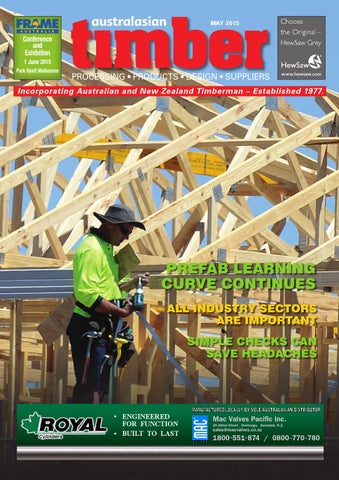
PREFAB LEARNING CURVE CONTINUES ALL INDUSTRY SECTORS ARE IMPORTANT SIMPLE CHECKS CAN SAVE HEADACHES
• ENGINEERED •
FOR FUNCTION BUILT TO LAST
Mac Valves Pacific Inc. 20 Alfred Street , Onehunga, Auckland, N.Z.
sales@macvalves.co.nz
1800 - 551 - 874 / 0800 -770 -780
BE PART OF THE BIGGEST INDUSTRY EXPO IN AUSTRALIA ...and Get 10% up front on your investment! AUSTimber2016 will give you a world-class context of demonstrations, conferences and field trips in which to tell your story face to face with thousands of forestry and timber industry people from across Australia. It’ ll be bigger than ever before with a major focus on timber processing and prefabrication. With a strong communications program through our industry media partners, Ryan Media and a television advertising campaign on WIN in the major timber regions around Australia, AUSTimber2016 will attract serious wood products industry people to Traralgon, Victoria throughout the week of 11-16 April, 2016.
Traralgon is in Latrobe City – home of Australia’ s first Wood Encouragement policy. Check out our website for updates and general information but contact us direct to receive our current prospectus and to discuss how you can use this event to meet and mix with the industry people who can help you meet your sales targets. Do it now and secure the first reward for taking action to boost your sales in 2016. Book and pay for your exhibition space at AUSTimber2016 before 30 June, 2015 and get a 10% discount on the rate. Email our General Manager Laurie Martin on: laurie@austimber.org.au
Expo days will run on Friday 15 and Saturday 16 April, 2016. Sponsored by
Supported by MEDIA
INDEPENDENT & AUSTRALIAN OWNED
www.austimber.org.au
Australasian Timber News
3 - May 2015
NEWS
Major boost for Australian-made recycled paper
A
USTRALIA’S ONLY premium wastepaper recycling and de-inking plant has opened in Victoria’s Latrobe Valley, with Australian Paper announcing that the $90 million facility at Maryvale Mill had started producing recycled copy paper and would soon extend into envelope and printing papers. “This plant will take up to 80,000 tonnes of wastepaper out of Australia’s landfill each year which is enough to fill a tennis court to more than twice the height of the Eureka Tower. We are committed to meeting the growing demand for premium, local recycled paper,” Peter Williams, Chief Operating Officer, Australian Paper, said. “It is a vital part of our future operations and we thank everyone who has made this investment in regional Victorian manufacturing possible. “We received project funding from the Federal and Victorian Governments and letters of support for the project from Planet Ark, Green Capital and a number of our key customers. “We applaud this initiative, it is a great win for recycling and it creates green jobs when we are seeing a decline in Australian manufacturing in other areas,” said Paul Klymenko, CEO of Planet Ark. “The Australian Government has specified that it will purchase 100% recycled papers from 1 July this year and we are hopeful that all Government
Departments, Federal and State, will recognise the sustainability advantages of Australian-made 100% recycled paper over imports when making their purchase decisions,” Mr Williams said. “The environmental benefits of this project are significant. Importing recycled paper made overseas only adds to Australia’s landfill and also generates significant sea-freight emissions. In contrast, removing 80,000 tonnes of wastepaper from Australia’s landfill saves up to 200,000 tonnes of carbon emissions every year, which is equal to taking more than 70,000 cars off Australia’s roads. “The current Australian market demand for recycled content office papers is only one third of the new plant’s capacity, so we need everyone’s help to lift the demand for Australian-made recycled content paper and do the right thing for our local environment,” Mr Williams said. The construction phase of the plant has supported almost 1,000 Australian jobs and the ongoing operation will provide flow on employment for around 250 people, mostly in the local manufacturing and wastepaper collection industries. Information on Australian-made recycled paper is available at: Australian Paper’s Recycling Plant and Rethink Australian Recycled Paper.
n Take a closer look.
Are you looking to better your business? The Innovation Skills Program assists businesses across our industry value chain to be innovative, increase efficiency and profitability.
n The Australian Paper Recycling Plant.
Big getting bigger while the small disappear INDEPENDENT HOME improvement retailers are going out of business at a rapid rate. Almost six years after Woolworths’ entry into the $45 billion home improvement market triggered an aggressive competitive response from Bunnings, the fallout is being borne by small and family-owned hardware retailers operating independently or sourcing stock through buying groups such as Danks, which is now owned by Woolworths, and Mitre 10, which was acquired by Metcash in 2008. According to DGC Advisory’s 2014 home improvement market report, the number of independent hardware stores has fallen 12.6% to 15,948 in
the past two years, and the number of stores in buying groups has fallen by 8.2% to 1570. Over the same period, Wesfarmers’ Bunnings has increased store numbers by 24 to 324, including trade centres, lifting its share of the market from 16% to 17.7%, while Woolworths’ loss-making Masters chain has opened 34 stores, giving it an estimated share of 1.7%. Woolworths has also acquired at least 45 Home Timber & Hardware and Thrifty-link stores once owned by independent retailers, while Metcash’s Mitre 10 has established 52 ‘joint ventures” with hardware retailers who otherwise might have quit the industry.
australasian
magazine Incorporating Australian and New Zealand Timberman – Established 1977.
May Vol.23, No.3
Postal Address: 630 Regency Road, Broadview, South Australia 5083 Phone: (08) 8369 9555 Fax: (08) 8369 9501 Publisher and Chief Executive: Hartley Higgins Suite 103, 486 Whitehorse Road, Surrey Hills, Victoria, 3127, phone (03) 9888 4822
Call us today
1800 177 001 www.forestworks.com.au
This program has been produced with the assistance of funding provided by the Australian Government through the Department of Education and Training.
ABN 39 946 785 543 ACN 130 528 291
General Manager: Elizabeth Bouzoudis Editorial: John Hudswell j.hudswell@ryanmediapl.com.au Adelaide: (08) 8369 9512 Out of office: (08) 7127 6370 Advertising: N orm Nelsen n.nelsen@ryanmediapl.com.au Melbourne: (03) 9888 4820
Timber classified: n.nelsen@ryanmediapl.com.au Melbourne: (03) 9888 4820 Production: Luke Westle Subscriptions: subs@forestsandtimber.com.au Adelaide: (08) 8369 9522 Accounts: Adelaide: (08) 8369 9555
Conditions: Opinions expressed herein are not necessarily those of the editor/publishers; information is published in good faith and we do not accept responsibility for damage which may arise from any possible inaccuracies. All rights reserved, none of the contents may be used in any other media without prior consent from the publishers. Published by Ryan Media Pty Ltd.
MEDIA
INDEPENDENT & AUSTRALIAN OWNED
May 2015 - 4
News Briefs Sale will lead to closures Carter Holt Harvey has entered a conditional agreement to sell its Kopine and Bestwood units to New Zealand Panels Group in a move that the FIRST Union says will lead to the closure of manufacturing plants in Wiri and Rangiora with the loss of around 40 jobs. CHH is owned by New Zealand billionaire Graeme Hart. NZ Panels is 39.27% owned by Australian private equity fund Crescent Capital, and is a supplier of particle board products supplied by Japanese-owned Juken Nissho.
Workers back Australian products AROUND 80 Carter Holt Harvey mill workers in Myrtleford have shown their support to a union campaign calling for tougher timber import laws. The CFMEU together with the Engineered Wood Products Australia Association (EWPAA) is calling on the Federal Government to create an agency to monitor and prevent substandard forestry products coming into Australia. CFMEU assistant national secretary forest and forest products division Alex Millar said the CFMEU needed to get workers on board. Mr Millar said over 50 per cent of engineered wood products are imports, and don’t comply with Australian standards. “We are now asking the government to follow through and put policies in place which ensure imports meet the requirement through vigorous testing. -Myrtleford Times
Dwelling Approvals March to new record New home building approvals hit yet another all-time record high during March, said the Housing Industry Association, the voice of Australia’s residential building industry. “Strong activity in the high density segment helped propel dwelling approvals to unprecedented levels in March,” said HIA Senior Economist, Shane Garrett. “New home building continues to benefit from the exceptionally low level of interest rates, as well as strong population growth over recent years in the key home buyer age group.”
China’s plywood exports up 29% in 2014 China’s plywood exports in 2014 totalled 13.22 million cubic metres valued at $5.814 billion, up 29% in volume and 16% in value. The average price for exported plywood was $410 per cubic meter, ITTO reported. China’s 2104 fibreboard exports amounted to 3.41 million cubic metres valued at $1.631 billion, up 46% in volume and 38% in value and the average price for exported fibreboard was $479 per cubic metre. China’s particleboard exports totalled 380, 000 cubic metres valued at $139 million, up 45% in volume and up 57% in value. The average price for exported particleboard was $366 per cubic metre.
New era for collaboration APA-The Engineered Wood Association was approved for membership in the Canadian Wood Council (CWC) at a recent meeting of the CWC Board of Directors. While APA has had a long-standing membership for glulam products, this new and expanded membership includes APA’s wood structural panel interests. This represents a new era for collaboration on technical and market activities of mutual interest for the members of both organizations,” said CWC Chair Kent Fargey.
Australasian Timber News
NEWS
Have van, will travel!
A
FTER FOUR decades of working for and with the timber industry Norm Nelsen is about to bring that chapter to a close. It’s now a case of “have van will travel” for Norm and his wife Lilian as the Ryan Media advertising rep for Australasian Timber takes well-earned retirement. Norm will continue as a consultant to the magazine until the end of May. Norm and Lilian are already well travelled but, as Norm says, “there’s still a lot we want to see”. Norm’s “timber connection” started back in 1975 when he worked for Wills Timber. He later moved to Canberra with Leopold Barnett. Next was a stint with Corinthian Industries (“they were a brilliant company”). Norm and his family (children Brad and Fiona) moved back to Melbourne and he joined Delta Timber then decided to go it alone so he formed Norm Nelsen Timber Agency, importing from South East Asia, North America and Europe.
The introduction of GST brought about a change to his business with the Malaysian suppliers deciding they would cut out the “middle bloke” and market direct. Norm joined JustUandMe Publishing with his first job with that group at AUSTimber 2004 in Albury. He worked as a sales rep for the Forest Logger & Sawmiller magazine and the then Australian Timberman. In September 2007 Norm joined Ryan Publications after it bought Australian Timberman [now Ryan Media which has since re-badged the publication to Australasian Timber]. “I’ve met and dealt with a lot of wonderful people along the way,” says Norm. He and Lilian have just sold their house in The Basin and are getting a new house built at Warragul for their retirement years. But, as Norm says ... “we’ve got a lot to see and a lot to do and we’ve got to do it while we can. So, we’ll be hooking up the Jayco Journey to the Territory and be
hitting the road first”. His friendly demeanor and his knowledge of the timber industry will certainly be missed. We wish Norm and Lilian all the best for their retirement years.
n N orm Nelsen set to take wellearned retirement.
Innovative edging technology improves wood utilization and streamlines production PRICE PRESSURE and the high cost of raw materials and labor are having a major impact on the sawmill industry. When it comes to new investments, therefore, the wish list is headed off by equipment that can improve wood utilization and resource efficiency or automate processes. Edging offers considerable optimization potential, and many interesting innovations from sawmill equipment manufacturers and their partners can be explored at LIGNA 2015 from 11 to 15 May. One way to boost productivity is to lower processing times. Modern, high-performance automated edging systems with peak capacities of 70 boards per minute or 20,000 boards per shift will be on display in Hannover. This requires accelerating the boards to speeds that manual systems simply cannot achieve, so automation is essential. Nowadays this starts with the separation of the raw boards, which is monitored by sensors in highend systems. Innovative technology is also making major strides in the feed area. Flexible technologies allow boards and planks to be fed into the system unsorted and with various thicknesses. Large systems are equipped with power-driven alignment heads that set new standards for acceleration and availability. Other manufacturers achieve higher throughput by separating the edging and trimming operations. In the past, sawmills used individual saws in various combinations, but now automated package solutions are becoming increasingly common along with gangsaws. Customers can choose from modular systems with various degrees of configurability. The main requirement for any modern system is optimal trimming of the raw boards, which is decisive for subsequent wood utilization and requires perfect measuring of the input material. Depending on the available space in the plant, this is done either laterally or longitudinally. The basic objective is to trim as little wood as possible on both sides of the board, but enough to produce clean edges. Surface optimization is handled by optical sensors. Laser-based or camerabased systems are commonly used, depending on the optimization goal, and 3D measuring systems are increasingly replacing two-dimensional views of the wood. Modern methods also enable measurement from both above and below, eliminating the time-consuming task of manual board turning by the operator. The
board contour and the condition of the wane side can be determined optimally for edging with this method, even with twisted boards. The measurements taken are stored by means of software and sent on to the CNC controller, which in turn adjusts the cutting widths of the integrated circular saws so the boards are edged according to specification. Outline projection allows the planned trimming geometry to be show on the board by laser beams, so that operators can respond to visible defects in the wood, such as knots, and alter the cut if necessary at the press of a button. Fully automated systems make these corrections automatically. For the subsequent trimming operation, manufacturers offer circular saws with two or more adjustable saw arbors. In some cases, the two outer saw heads additionally have mounting sockets to enable processing of very wide material. Manufacturers also offer innovative solutions for trimming and sorting the edged lumber. For example, slat splint separators are now facing competition from the edger outfeed technology that quickly and efficiently separates splints and trims laths and boards in the same operation, without any interruption of the material flow. This eliminates the need for troubleprone splitting wedges. Along with optimized volume output, value maximization is becoming increasingly important. Modern edging systems, such as those on show at LIGNA 2015, offer added potential by easily integrating high-performance scanner systems. With suitably adjusted throughput speeds, lumber can be assessed according to many parameters and sorted by grade. This is now being done to very high standards. For example, color cameras allow visualization of blue stain in the wood and fine distinctions in defect detection. Scanner data can also be used to optimize production with respect to customer-specific target specifications. Preliminary costing, simulation of production runs and production data acquisition are other potential benefits.
We welcome your opinion: Email your feedback to j.hudswell@ryanmediapl.com.au
Interest rates at 30 year lows and getting easier to access. After 25 years in finance if someone would have told us a few years ago that a 7% interest rate was way too high we would have wondered which planet they came from. But that is the reality in today's market. We are now seeing on a daily basis motor vehicles and equipment financed at interest rates between 4.5% and 5.5%. These rates are not the concoction of dealer based "sponsored" headline rates being supported by internal discounting on a “recommended retail” machine price, they are main stream rates.
+ Specialists in equipment finance
But what does all of this really mean in $ terms?
+ Competitive rates
A $50,000 car financed in 2012 on a 5 year by Nil residual term at 7% was $985 p/m, today at 5% it is $940 p/m which is $2,500 less over the entire loan and on a fleet of 10 cars it adds up. A $500,000 machine financed in 2012 on a 5 year by Nil term at 7% was $9850 p/m, now at 4.75% it is $9350 p/m which is a whopping $30,000 less over the entire loan. All things being equal these are savings that should drop straight to the business owners’ bottom line. If you can save $10,000 a year in finance costs and your usual profit margin is 5% that is equal to adding another $200,000 in turnover to achieve the same outcome. Table 1 provides a “ball park” indication of monthly payments on these historically low rates over various terms and residuals:-
+ Offices Australia-wide + Easy ‘end to end’ process + 25 year track record + Pre approved funding limits arranged
Contact our local Finlease rep in your state: NSW
Michael Abberton 0488 480 463
QLD
Phil Horton
0408 776 220
SA
Neil Styles
0404 050 697
VIC
Alex Charilaou
0407 460 144
TAS
Mark Sealy
0418 120 838
WA
Michael Larkin
0432 823 037
1300 346 532 finlease.com.au
We now live in the world where many loans can be secured without going through the process of lengthy finance submissions. The simple fact of being in business for two years, with a clean credit history and being a property owner will secure an immediate approval for vehicles or most equipment up to the value of $150,000 per individual item. Even more remarkably, this same criteria will also secure approvals on multiple assets up to $500,000 each, where they are replacing or upgrading other machines coming to the end of their existing finance including the allowance for a 125% increase in monthly payments. These new style of Fast Track facilities are provided at the historically low rates and are ideal for business owners who wish to spread their debt across a broader range of financiers without the hassle of submitting multiple complex finance applications.
Australian Credit Licence Number: 390584
er ster fast && fa
better than aaabank bank better than than better bank >>
Today’s ease of finance.
NEWS
May 2015 - 6
Dates for 2015 15-17 May
Brisbane Timber & Working With Wood Show, Showgrounds.
26-28 May 2015
7-11 September 2015
XIV World Forestry Congress. Durban, South Africa. http://www.fao.org/forestry/wfc/en/
16-17 September 2015
WoodTECH, Melbourne. http://www.fiea.org.nz/pix/ FIEA%202015%20Events%20Planner.pdf
CIOSTA 2015 Conference: Environmently Friendly Agriculture And Forestry For Future Generations. St. Petersburg, Russia. http://ciosta2015.org/
22-23 September
1 June 2015
22-25 September 2015
Frame Australia Conference. Park Hyatt Melbourne.
1-5 June 2015
Biannual Research Group 7.01.00 meeting. IUFRO. Nice, France.
1-4 June 2015
23rd European Biomass Conference and Exhibition. Vienna, Austria. http://www.eubce.com/
8-12 June 2015
Tree Biotechnology 2015 Conference: Forest: the importance to the planet and society. Florence, Italy. http://www.treebiotech2015.it/
12 June 2015
Research Group Meeting “Forest Products and Communities” at the 58th International Convention of the Society of Wood Science & Technology. IUFRO. Jackson Lake Lodge, Grand Teton National Park, Wyoming, United States. ttp://swst.org/meetings/ AM15/index.html
12-14 June
Sydney Timber & Working With Wood Show, Sydney Showgrounds.
16-21 June 2015
Vienna International Wood Products/Markets Conference, Expo & Tours Savoyen Hotel Vienna. info@woodmarkets.com
18 June 2015
NSW Combined ITAB Conference, Sydney
24-25 June 2015
HarvestTECH. Steep Slope Harvesting (Improving Safety and Productivity in Forest Harvesting). Rotorua. http://www.fiea.org.nz/pix/FIEA%202015%20 Events%20Planner.pdf
22-26 June 2015
IUFRO WP 7.03.10 Methodology of Forest Insect and Disease Survey in Central Europe “Fluctuation of Insect and Diseases”. San Michele All’adige, Italy.
29-30 June 2015
HarvestTECH. Steep Slope Harvesting (Improving Safety and Productivity in Forest Harvesting). Melbourne. http://www.fiea.org.nz/pix/FIEA%20 2015%20Events%20Planner.pdf
6-9 July 2015
WoodTECH, Rotorua. http://www.fiea.org.nz/pix/ FIEA%202015%20Events%20Planner.pdf
19th International Nondestructive Testing and Evaluation of Wood Symposium. Rio De Janeiro, Brazil. http://abendieventos.org.br/wood_symposium/ index.php
September - October 2015 (still in planning) Possible London Timberland-Agriland Investment Conference in September-October 2015 would be in conjunction with Arena. London UK. For further information contact Julie Bell at admin@dana.co.nz.
27-September - 3 October 2015
“Forest and Ecosystem Science Education”, to be held during the 2nd International Festival of Science, Technology, Engineering and Mathematics (STEMfest). Saskatoon, Canada. http://stemstates. org/stemfest-2015.html
5-6 October 2015
DANA 2 - Day Latin American Timberlands Investment Conference followed by a 2-day field trip to the Porto Alegre region of Southern Brazil to visit CMPC eucalyptus nursery/tree improvement/plantation forest operations/new pulp mill at Guaiba; and to Tanac black wattle nursery/tree improvement/plantation forest operations/woodchip export facilities/a major new export woodpellet plant. DANA has the full support of Aldo de Cresci Neto, Founding Partner of Gasparini, De Cresci e Nogueira de Lima Advogados; and Jefferson Mendes, Director Poyry Latin America, in holding this Conference. Sheraton Sao Conrado, Rio de Janeiro, Brazil. For further information see the website danariotimberland2015.com, or contact Mariela Ferrari at mferrari@danariotimberland2015.com.
6-7 October 2015
Timber Expo. NEC Birmingham. Two-day show covering latest products, innovations and developments in the UK and international timber industry. http://www.timber-expo.co.uk
7-8 October, 2015
Canada Woodworking West, at TRADEX in Abbotsford, British Columbia. www.CanadaWoodworkingWest.ca.
21-24 October 2015
Scientific cultivation and green development to enhance the sustainability of eucalypt plantations. Nanning City, Guangxi Province, China.
4th International Conference on Forests and Water in a Changing Environment. Kelowna, BC, Canada. http:// www.forestandwater2015.com/
12-14 November 2015
27-29 July
17-19 November 2015
Australian Timber Trainers Association (ATTA) Annual Workshop. Creswick, Victoria.
11-12 August 2015
DANA 2- day New Zealand Forest Industry Sector Conference. Te Papa Conference Centre Wellington, New Zealand. For further information visit dananz2015. com, - or contact Mariela Ferrari at mferrari@dananz2015. com, or Julie Bell at admin@dana.co.nz.
11-13 August 2015
Ecology, silviculture and management of spruce species in mixed forests . Edmonton, Alberta, Canada. phil.comeau@ualberta.ca
13-14 August 2015
DANA 2- day Australian Forest Industry Sector Conference, which follows on immediately from the DANA Wellington NZ meeting. Melbourne, Australia (venue to be confirmed). For further information visit danamelbourne2015.com, or contact Mariela Ferrari at mferrari@danamelbourne2015.com.
Master Builders National Conference and Exhibition, Jupiters, Gold Coast.
Central Asia Machinery. Atakent International Exhibition Centre, Almaty, Kazakstan
17-19 November 2015
Woodtec Estonia. Estonian Fairs Centre, Tallinn, Estonia
18-19 November 2015
ForestTECH. Rotorua. http://www.fiea.org.nz/pix/ FIEA%202015%20Events%20Planner.pdf
20 November 2015
VAFI Annual Industry Dinner, Crown Melbourne. Contact Jillian Roscoe on 03 9611 9000 or jroscoe@ vafi.org.au
24-25 November 2015
ForestTECH, Melbourne. ttp://www.fiea.org.nz/pix/ FIEA%202015%20Events%20Planner.pdf
2-3 December 2015
Fifth International Workshop on the Genetics of HostParasite Interactions in Forestry: Novel challenges and opportunities for resistance to pests and pathogens. Orléans, France.
Inaugural DANA 2-day Global Log Trade Conference including a ½ day field trip to the major log export port of Longview, Washington State. World Forestry Centre, Portland Oregon, USA. For further information see the website logtradetrends.worldforestry.org, or contact Sara Wu at swu@worldforestry.org, or contact Dennis Neilson at dana@dana.co.nz.
23-30 August 2015
2016
23-28 August
Sustaining Ecosystem Services in Forest Landscapes - Concepts, Research, and Applications. Tartu, Estonia. http://iufrole2015.to.ee/
24-27 August 2015
XVII International Plant Protection Congress (IPPC). Berlin, Germany. http://www.ippc2015.de/
2-3 September 2015 (still in planning)
[Possible] DANA 2-day African Continent Timberlands (and perhaps Agriculture Land) Investment Conference followed by a 1-2 day field trip. To be held in the week prior to the major World Forestry Congress Conference in Durban which is on 7-11 September 2015. DANA is advised that it has the full support of the World Forestry Congress Secretariat in holding this Conference. Durban South Africa. For further information contact Julie Bell at admin@dana.co.nz.
Australasian Timber News
February-March 2016 (still in planning) Possible DANA 2-day Timberland and Agriland Investment Conference in Tallinn, Estonia.
11-16 April 2016
AUSTimber (Australia’s premier forestry and timber event), Latrobe City, Victoria. austimber.org.au
16-18 May 2016
DANA 1-day (Extended) Central America Timberland Investment and Wood Trade Conference, followed by a 1-day field trip to teak plantations and processing plants. To be held in partnership with La Asociación Nacional de Reforestadores y Afines de Panamá (ANARAP). Panama City, Panama. For further information contact Dennis Neilson dana@dana. co.nz.
Nano wonder wood has unlimited potential
S
CIENTISTS FROM Edinburgh Napier University and Sappi have developed a low cost way to turn wood into a wonder material that could be used to build greener cars, thicken foods and even treat wounds. It means Sappi will be able to produce the lightweight material on a commercially viable basis – and without producing large volumes of chemical waste water associated with existing techniques. The energy-saving process will be used in a new nanocellulose producing pilot plant to be erected by Sappi. Sappi is a global company focused on providing dissolving wood pulp, paper pulp and paper based solutions. “Nanocellulose, extracted from wood fibres, has a number of unique optical, barrier and strength properties,” said project coordinator Math Jennekens, R&D director at Sappi Europe. “Unlike other lightweight, highstrength materials based on fossil fuels it is completely sustainable, making it very desirable as a new material for various industrial and transport applications.” The versatile material has previously been produced by intensively processing wood pulp to release ultra-small, or ‘nano’ cellulose fibres – each so small that 2000 could fit inside the width of a single strand of human hair. But the Edinburgh Napier research team said that they have been able to drastically reduce the amount of energy needed to power the process, as well as the need for expensive chemicals. “What is significant about our process is the use of unique chemistry, which has allowed us to very easily break down the wood pulp fibres into nanocellulose,” said Professor Rob English, who led the research with his Edinburgh Napier colleague, Dr Rhodri Williams. “There is no expensive chemistry required and, most significantly, the chemicals used can be easily recycled and reused without generating large quantities of waste water. “It produces a dry powder that can be readily redispersed in water and
Briefly ... • Completely sustainable • No expensive chemistry required • Biomedical applications leaves the nanocellulose unmodified – effectively making its surface a chemical ‘blank canvas’ and so more easily combined with other materials. “The ability to bring all these attributes together has so far eluded materials scientists working in the field. It is very exciting.” Nanocellulose produced at the proposed Sappi plant could be used in a wide range of industrial and everyday products and devices because of the way they can improve the properties of materials they are combined with, said Professor English. “It could be used to thicken waterbased products such as paints, foods and concrete,” he said. “Or when it’s used in plastics to make a composite it can replace glass fibres, which is very attractive in the production of the next generation of lighter, fuel-efficient vehicles. “Because of its low oxygen permeability it could also be a possible replacement for plastic films in packaging. “Then there are also applications for it in containing films in lithium batteries and touch screen displays. And as cellulose is inherently biocompatible and bio-absorbable, there is considerable potential in biomedical applications such as wound dressings and regenerative medicine.” Group Head Technology, Sappi Limited Andrea Rossi said a pilot production plant was being planned for towards the end of this year. “Commercial interest in nanocellulose is growing at a phenomenal rate following predictions of a possible 35 million tonnes per year market by the 2020s,” said Professor English. “And so the key challenge now is very much in business development and understanding the value offered by nanocellulose in our target markets.”
Building code saves home builders THE RELEASE of the National Construction Code (NCC) free online is a welcome start to the new year for home builders. “The code is an essential tool for builders and designers and the ability to access it online will make business that little bit easier,” said the Housing Industry Association’s Kristin Brookfield, Senior Executive Director, Building, Development and Environment. “Compliance with the NCC is a legal requirement, so free and easy access to code should be the standard, as with other regulations. “Making the code free online will also save hundreds of dollars each year for builders and contractors.” The changes will also see the code move from an annual to a three year review cycle. “Limiting changes to the code will also give builders and home buyers certainty about the rules, and help to reduce the red tape involved in getting house plans approved,” said Ms Brookfield. “The next challenge is to give the industry open access to the hundreds of Australian Standards that are referenced by the NCC.” The maintenance of the NCC over 20 years has been a result of successful collaboration between all levels of Government and industry. The Australian housing industry congratulates all involved for this latest initiative that will reduce costs and red tape for builders and home buyers.
FLOORING
Australasian Timber News
7 - May 2015
A few simple checks can save a lot of headaches Assessing the flooring product and the subfloor are two simple precautions that should be taken prior to laying any timber floor. David Hayward, ATFA Technical Manager explains that there are however many occasions where this has not happening and has resulted in some serious problems down the track.
David Hayward ATFA Technical Manager.
O
N MANY occasions when floor problems have been viewed, in the back of your mind you think, this did not need to happen. On closer examination of such issues it is quite apparent that if a few simple checks had been undertaken prior to laying, then the problem would not have occurred. Starting with the flooring, the moisture content has to be checked from a number of boards in each of the packs supplied and results recorded along with the cover widths. Not only does this enable you to assess moisture content variability but in conjunction with the site location it enables you to assess whether the floor is likely to expand or shrink after installation, and thereby apply the installation method to suit. Moisture contents in the expected range and minimal cover width variation is a good indication that the flooring meets required standards. Some pre-finished imported flooring has also been supplied at very low moisture contents and should not be exempt such checks. Smaller sections of boards should then be fitted together and checked that there is not excessive slop in the tongue and groove, nor excessive misalignment of the tongue and groove. Such aspects can make a floor difficult to fit together and excessive movement at the T&G joint can result in floor issues such as delamination of the coating at board joints and squeaking. Similarly, if the undercut (or relief) on the bottom side of the board is large this can be conducive to peaking if the floor expands after installation. When there is a concern with the product, inform the supplier, as sorting a problem out sooner rather than later, can save everyone time and money. The second area to consider is the assessment of the sub-floor irrespective of whether it is plywood, particleboard, concrete or flooring that has been laid on joists over a sub-floor space. If it is not dry, does not remain dry or moist conditions are not prevented from reaching the floor, then moisture related problems such as excessive expansion and cupping will occur. Although moisture assessment methods in concrete, plywood and particleboard are not always easy to assess, the weather conditions and time that the sub-floors have been down should be known and along with experience this can assist in the assessment. Similarly, moisture meters can be
used in the solid timber of bottom plates as a further guide. But don’t take chances particularly with low lying slabs or sheet flooring that may have had for example evidence of recent wetting. Similarly, the exterior of the house should be quickly checked for possible issues that could affect slab moisture or in the case of closed in subfloor spaces, that ventilation requirements are as required and that the space is unlikely to experience seepage or water beneath. Although the flooring may be laid during drier periods it is necessary to think of what conditions will be like during heavy rain or persistent wet weather. Question the owner about such aspects if an existing dwelling. The integrity of the sub-floor, particularly slabs, and their ability to accept adhesives is one further area where checks are necessary. With slabs, anything that has affected the surface integrity or has been applied or spilt on the slab could result in poor adhesion and subsequent failures. Ask questions, prepare the slab properly and test the adhesion out in places if considered necessary. Assessing the product, the sub-floor and general site conditions experienced throughout all four seasons prior to installation is paramount to the success of timber floors and failure in any one of these areas is a common source of problems that do eventuate some time down the track. However, with a bit of forethought and testing such problems do not need to happen.
We welcome your opinion:
Email your feedback to j.hudswell@ryanmediapl.com.au
p ATFA 3.2 Excessive T&G tolerance. q A TFA 3.1 Coating delamination due to board movement at end matched joint.
Solomon Islands Timber delegation seeks opportunities A GROUP of Solomon Islands timber exporters and government officials recently visited Australia and New Zealand to increase understanding among exporters and importers of market requirements and opportunities for Solomon Islands sawn timber. The delegation met importers, government officials and the New Zealand Timber Importers Association at Pacific Islands Trade & Invest office in Newmarket. Sixty percent of Solomon Islands sawn timber is sold to markets in Australia and New Zealand. At present, the vast majority of Solomon Islands timber is exported to China as unprocessed round logs, with wide recognition of the unsustainable level of harvesting. This delegation, however, focused on promoting exports of sawn timber, as part of a wider
goal of adding value to timber exports. Sawn timber exports from Solomon Islands are valued at over SBD 80 million or around USD $9.5 million per year, and the industry employs more than 1000 people. The mission was funded by the Pacific Horticultural & Agricultural Market Access (PHAMA) program as a follow-up to market studies conducted in 2014. Based on those studies, the Solomon Islands Timber Industry Working Group recognised the need to better understand market requirements in Australia and New Zealand, and made the trade mission a priority. The eight member delegation consisted of five private sector timber exporters, two officials from the Solomon Islands Ministry of Forestry and Research and a PHAMA representative.
A key part of the mission focused on importers and exporters exchanging information relating to market requirements for timber legality and quality. Markets in the EU and the United States have already introduced the requirement to demonstrate the legal origin of imported forestry products. Australia implemented similar legislation in November 2014, while New Zealand (which currently has a voluntary code of practice) could also follow suit. Other equally important discussions included opportunities to improve timber quality and presentation, processing and end-product requirements, supply, consistency and potential markets for alternative species.
May 2015 - 8
INSURANCE
Australasian Timber News
Why credit insurance should be a key priority for the timber industry Organisations in the timber industry without credit insurance have little protection against bad debt and damage to their cash flow. At a glance
By Mark Hoppe Managing Director of Atradius, ANZ.
A
USTRALIA’S $7.5 billion timber industry faces international competition, a high cost base, ongoing political debate and falling commodity prices. Timber merchants can reduce stress and risk by considering credit insurance, which protects the business from bad customer debt and unexpected losses. Credit insurance can reduce timber business’s exposure to unnecessary trading risks. Sawmills, plantations and offices are often the first assets businesses insure. However, one of the largest assets on the balance sheet, trade receivables, is commonly left uninsured and vulnerable to risk. The average business receivables asset makes up about 30 to 40 per cent of the ledger, meaning that, without appropriate credit insurance, the business is at high risk. Regardless of how well a business knows its market and buyers, insolvency and payment default are significant commercial risks that can affect cash flow, profitability and confidence. Yet many industries, including timber, have been slow to understand why credit insurance is important and the benefits it offers. Taking out cover can be the difference between continuing to operate
• Slow to understand why credit insurance is important • Impossible to predict the future when trading on credit terms • Credit insurance providers have access to live data on millions of businesses which helps the business be better informed to make strategic decisions. or closing down if customers fail to pay. Businesses often make the mistake of relying on long-standing customer relationships for assurance against default risks. However, it is impossible to predict the future when trading on credit terms, and risking cash flow based on gut-feelings can significantly damage the business. There are many reasons why a customer may be unable to pay, and many are beyond their control, including political intervention, currency exchange issues, terrorist attacks or natural disasters. Even if the buyer has been dealt with for many years, or they are a well-known enterprise, the business can never be in a position to predict the future and gamble on it. Being credit insured safeguards the company against risks that could otherwise cripple your business. Having credit insurance safeguards the company against risks and guarantees the business is covered for losses, regardless of whether they are the customers’ fault. For the timber industry in particular, credit insurance provides security. For example, it can protect businesses from unpaid invoices from suppliers. A major supplier going into insolvency could paralyse a timber manufacturing
business without credit insurance to cover for the unexpected losses. For small timber businesses in particular, credit insurance cover can provide a valuable extension to the company’s credit management practices, and help ensure the business’s revenue and bottom line are protected. When small timber businesses fail to perform credit checks on all of their buyers, they can approve high-risk customers as trading partners. A credit insurance provider can help mitigate the risk of unreliable customers by providing valuable insights and knowledge about customers. A good trade credit insurer will add value to businesses of all sizes, have a thorough understanding of the timber and forestry sector, and act as the business’s eyes and ears on the ground. They can check that prospective customers are stable, creditworthy and have a reputation that meets the required standards. Credit insurance providers have access to live data on millions of businesses which helps the business be better informed to make strategic decisions. Businesses covered by credit insurance are able to focus on sales and business growth, while reducing any
Wooden get any better than this! Those attending the recent ForestWorks sponsored and organised 7th Annual Industry Development Conference in Canberra were given a gentle reminder of what makes wood good. Included in the information pack for delegates was the “old school” wooden ruler, wood pencils and even a wood covered pencil sharpener, all wrapped in a neat fold-all, plus a tie-pin with the message SUPPORT OUR SUSTAINABLE FOREST INDUSTRY. Speakers at the conference received a wooden drink coaster ... but it wasn’t just ANY coaster, these certainly had a story! The coaster story started its life as part of a 112 year-old sequoia tree and is steeped in Creswick’s timber history. Planted in 1902 by the second district forester, John Johnston, the tree was measured 65 years later by Victorian School of Forestry student Peter Fagg. Yet mere coasters are not the only beneficiaries of this one tree. Trees die of old age and need felling for safety purposes as happened to
this one on November 7, 2014. The recovered sequoia timber is being used as cladding and lining in the revamped Creswick Community Hub. Whilst the wood is now being used in projects around Creswick, the stump site houses a memorial carving of the first local forester, John La Gerche, celebrating his renown for rehabilitating and protecting forests. This is an example of one tree, its recycling, reuse and
redistribution in an eco-friendly and community minded way. However our communities have plenty of trees for projects like this available across Australia, we just need our communities to value wood and see in trees a future beyond its old age. u Special tie-pin q Not just ANY coaster. y Something old is new again.
negative impact that non-payment might have on their bottom line. This gives the organisation a clear advantage over competitors, protects profits and provides peace of mind. Credit insurance policies can cover domestic businesses, international businesses or both against the risk of non-payment if a buyer becomes insolvent or is otherwise unable, or refusing, to pay. They generally cover 90 per cent of invoice value (less policy excess). Contrary to the beliefs of many decision makers, credit insurance is affordable for organisations because the cost is calculated on business turnover. Business’s premiums are calculated based on the forestry and timber sector and consider the business’s individual variables including trading history, historical debt loss, and customer base. This ensures affordable and transparent policy pricing, which allows the timber business to effectively budget for cover. The timber industry is under enough pressure from outside forces. Having to deal with non-payment of invoices, regardless of the cause, is something these businesses just don’t need. And some timber businesses may never recover from unpaid debts. If business owners realised how easy and affordable it was to protect themselves against these risks, they wouldn’t hesitate to do so.
We welcome your opinion: Email your feedback to j.hudswell@ryanmediapl.com.au
FRAME AUSTRALIA SPECIAL
Australasian Timber News
9 - May 2015
A career based on wine and wood, and personal passions for boats and cars Kevin Ezard, the name synonymous with Frame Australia
J
UST MENTION Frame Australia and the name that immediately springs to mind is Kevin Ezard, and it’s no wonder, he’s been associated with it for almost two decades. However, there’s a lot more to Kevin than just frames and prefabrication. In a special for Australasian Timber, we learn more about the man, his work, his life. “To summarise my personal life outside of family, it has primarily revolved around a career based on wine and wood, and personal passions for boats and cars,” says Kevin. He attributes his interest in cars from his father Wal, who started as a coach builder with Kellow-Falkner handmaking bodies for Rolls Royce vehicles to customer specification. “He then ran a crash repairs business until retirement, when he turned to restoring vintage cars, often with just a chassis where a complete new body would be hand-made to produce a virtually new car,” Kevin recalls. After completing Mechanical Engineering at Caulfield Institute of Technology Kevin’s first position was as a junior engineer at General Motors Holden in the vehicle design department, followed by an engineering role with a road machinery equipment manufacturer. “I then joined a Repco manufacturing subsidiary as product engineer for engine components, where we developed and tested engines for a wide range of vehicles including road and track racing cars, including the world champion Repco Brabham Formula One V8 engine.” An early interest for Kevin was membership of the Society of Automotive Engineers Australasia, which later developed into organising automotive engineering conferences in the Pacific region. This activity evolved into membership of FISITA, the peak world body for automotive engineering, which required travel to conferences and meetings in the 20 member countries. “I became Vice President of FISITA and organised the 1982 world congress in Melbourne, which drew many international leaders in the automotive industry from UK, Europe, Japan and North America. The speakers program was in multiple sessions, all with simultaneous translation in three languages – English, French and German.” His next move was to Unichrome, an international company specialising in energy recycling of various waste products such as scrap vehicle tyres and sewage sludge, but in Australia the main market opportunity was for heat energy systems that used waste wood and sawdust to generate heat and/or power. Entry to the timber industry “This was my entry into the timber industry by installing furnace systems in a range of sawmills and timber processing operations around Australia, one of which was the Ezard sawmill at Swifts Creek.
“I later joined the Ezard family timber business in their Alpine Ash building materials supplies operations in Gippsland, subsequently becoming involved with marketing and sales from the Swifts Creek sawmill. “For the next decade my role was marketing of Ezard Timber products and we developed new markets for F17 structural KD hardwood around Australia. I do recall saying that a ballpoint pen was called a Biro, and that a piece of structural hardwood would eventually be called an Ezard. And so it came to be. “Apart from the marketing role, in the latter years I also managed Swifts Creek during a period of change to higher technology, and improvements in processing of kiln dried hardwood products. One of these developments was installation of a sliced veneer production facility based on the Japanese concept of a linear slicing machine, offering high recovery of veneer from small sawn timber flitches. “Veneer production was initially focused on export, and sales were achieved in North America and Europe due to their preference for back sawn feature veneers, which was the predominant cutting pattern at the green sawmill,” Kevin said. The start of Ezard Marketing In 1990 the consultancy Ezard Marketing started with a client base mainly in the timber and building materials sector, which went on to create long-term associations with a wide spectrum of companies involved in prefabrication, timber and building materials, timber production, engineered wood products, manufacturing, distribution, and new technologies. “More recently the consultancy has provided Forest and Wood Products Australia with marketing and investment plans to increase market consumption of wood products. “These include wood being preferentially specified in building construction, and use of timber frame and wood construction systems in markets other than detached housing to include multi-residential, commercial, public and industrial buildings,” he said. The origins of Frame Australia go back to the 1990s when the Building Components Manufacturing Conference (BCMC) in USA was the only event for truss and frame fabricators to catch up with the latest equipment and technologies. USA venue for early events Every year a contingent of 20 or more from Australia would head over for the three-day event, followed by an organised tour of truss plants in North America, and have a lot of fun at the same time. “Greg King and I attended BCMC events during the 1990s and discussed the possibility of running it in Australia, but felt it should embrace structural timber and building topics in addition to manufacture of trusses and frames. “The first event was held in 1998
n Kevin Ezard, Conference Director, Frame Australia Pty Ltd.
at Southbank in Melbourne, and it has continued for 17 years with a constantly evolving program primarily on manufacture of pre-fabricated timber framing for detached housing. “Some time ago Greg left to concentrate on his business, and I wanted to expand the conference to encompass the complete supply chain of prefabrication from the timber and wood products and prefab manufacturing, to design and construction of both residential and commercial buildings. “While the detached housing market will always be a major component of Frame, I felt the real growth
opportunities for timber products were in larger buildings for medium density multi-residential and commercial developments in the range of 3 to 5 storeys, and high rise up to 10 storeys. “This led to having a “between year” Frame Australia with conference topics primarily for delegates from building design and construction on June 1, 2015, with the theme ‘Building with engineered wood construction systems’,” said Kevin. Plans for the 2016 event are a two-day conference with separate topic themes of prefab timber manufacturing, and building with prefab timber, to be held in May.
Building with engineered wood construction systems Find out why the global trend in multi-residential construction has moved to timber and engineered wood, and how it is emerging in Australia. See the future with increased height of timber buildings for faster construction times, improved safety, and enhanced sustainability. Learn from local and international experts with extensive experience in timber design and building at presentations and discussion forums. Join with delegates interested in using timber and engineered wood systems to network and share information. Visit displays of new building products and systems along with emerging technologies for residential and commercial construction.
SPEAKERS PROGRAM: • Sustainable solutions for future building construction • Building codes and engineering design • Prefab construction system benefits • Timber building projects and the supply chain
REGISTER NOW
Principal Supporter
Go to www.frameaustralia.com now for on-line registration and for more event details
Frame Australia 2015 Conference and Exhibition Monday, June 1, Park Hyatt Melbourne
FRAME AUSTRALIA
May 2015 - 10
Australasian Timber News
Frame Australia 2015 Speaker Sessions The Frame 2015 conference sessions will focus on the design and construction of residential and commercial buildings utilising prefabricated timber and engineered wood construction systems. The speakers program is comprised of four separate topic sessions, with expert presenters and a forum discussion with the speakers and additional panel members. Building with engineered wood construction systems Session One / 8.30am
Sustainable solutions for future building construction
Session Chair - Jennifer Cunich, Executive Director, Property Council of Australia
Timber: Productivity powerhouse and planetary panacea?
Fire safety engineering in timber buildings
As the building industry grapples with unprecedented global challenges – hyper urbanisation, dwindling resources and climate change among them – timber and engineered wood products (EWP) are emerging as a sustainable solution. Project teams are embracing timber and EWP as an environmentally-sustainable and renewable material, and using it to build faster, cheaper and more sustainably than ever before. So how can new systems approaches to timber create new opportunities, accelerate construction times, reduce costs and create stronger value chains? More than a panacea, timber and EWP is emerging as a productivity powerhouse and an industry game changer. Speaker: Tony Arnel, Global Director Sustainability,, Norman Disney & Young, and former Chair, World Green Building Council
Building tall timber buildings in Australia
Australians are generally early adopters of new ideas, but we have been slow to embrace the potential for large scale timber construction in the residential and commercial property sectors as seen in parts of North America and Europe. Our geographical separation from the current marketplaces for such product has allowed us to test the efficacy of current technology and systems, producing conceptual solutions to address our unique issues of environment, building procurement and cost. What are these ideas and solutions and what will release this logical and systematic approach to next generational buildings in the Australian market? Speaker: James Fitzpatrick, Managing Partner + Head of Design, Fitzpatrick+Partners Architects
Innovation in residential and commercial building
International expansion of timber and wood construction is rapidly progressing with tall buildings in Canada, USA and other countries. This is creating new thinking in how to achieve faster construction times to improve financial returns, whilst improving safety and sustainability outcomes. In Australia, the scale adoption of medium to large size engineered timber projects is set to grow. Speaker: Andrew Nieland, Head of Timber Solutions Property, Lend Lease
Discussion forum: David Waldren, National Executive
Design Manager, Grocon Group Robert Pradolin, General Manager, Business Development, Australand Property Group
Morning break Session Two / 10.50am
Building codes and engineering Session Chair - Bill Wong, Associate Professor, Department of Civil Engineering, Monash University, and past Chair of the Structural Victoria Branch Committee, Engineers Australia
Building height changes to the NCC (BCA)
seeks to permit timber-framed/massive timber building systems in the NCC-BCA and increase the allowable building height to 25m to enable construction of timber buildings up to 8 storeys utilising DtS solutions. Lightweight multi-residential buildings in Canada and other countries allow timber and wood construction to be used on sites where rapid, cost-effective and lightweight building systems are desired. Speaker: Boris Iskra, National Manager - Codes & Standards, Forest & Wood Products Australia (FWPA)
BCA changes now accept 3 storey timber-framed deemedto-satisfy (DtS) requirements for Class 2 & 3 buildings with provisions in the NCC-BCA. A submission to the ABCB
Understanding fire science and fire safety in tall timber buildings, with case studies of holistic building design and fire safety solutions for mid- and high-rise timber building construction. Emphasis on systems that achieve costeffective design and documentation for multi-residential and commercial building projects. Examples of designs in a range of timber construction systems that ensure high performance levels to achieve code requirements and customer satisfaction at the lowest cost. Speaker: Robert Gerard, Engineer, Fire Engineering, ARUP Sydney
Structural design of timber framed multi-level construction
This presentation aims to provide an overview of the factors and benefits behind constructing multi-level buildings using timber framing. Using the recently completed Australand “The Green” project as an example of how a 5 level building can be designed and constructed using timber framing in a prefabricated system. This system was proven to be an economical solution for both time and cost when compared to similar concrete framed buildings. Speaker: Mark Paterson, Associate Director - Structural, Irwinconsult Engineers
Fixing systems for timber construction
Research and development of high technology connecting solutions for timber building construction has led to innovative structural screws and products for connecting, supported by intuitive software enabling design and calculation of complex connections. A major benefit of specialised fixing systems is that connections in exposed locations can have an attractive visual appearance. Speaker: Albino Angeli, Technical Director, Fixings, Rotho Blaas, Italy
Discussion forum: Robert Nestic, Structural Engineer,
Tim Gibney & Associates and Timber Imagineering (Archie) Archav Jalilian, Senior Engineer, STRUCterrre Consulting Engineers
Lunch break Session Three / 1.30pm
Wood construction system benefits Making timber office building construction a realistic value proposition
Timber construction is moving beyond domestic buildings and into multi-storey construction. Getting traction in the market place requires a transfer of knowledge and methods to help industry uptake this technology and to assess it relative to the existing methods they use. This presentation reports on an R&D project for a 9 level prototype office building designed in timber, including core themes that address structural, MEP, fire, sound and construction process requirements. The work also compares timber construction with conventional reinforced concrete construction. Speaker: Prof. Perry Forsyth, Professor of Construction Management, Faculty of Design Architecture and Building, University of Technology Sydney
your
perfect partner
to design and build with
wood
Benefits from prefab and modular building systems
A review of innovative designs using modular and prefab construction with advanced manufacturing techniques for medium-density dwelling projects utilising off-site components to improve safety, reduce site access problems, and lower construction time and cost. Evaluation of the building methods and benefits achieved, along with improved financial feasibility for inner and outer urban building construction. Speaker: Damien Crough, Business Development Manager, Hickory Group, Founding Director and Chairman of PrefabAUS
Principal Supporter:
Event Supporters:
Market opportunities for timber and wood buildings
The future potential for timber and engineered wood building systems can be analysed by market statistics that indicate future levels of activity by developers and builders in construction of multi-storey residential and commercial buildings. Analysis shows where the opportunities for both suppliers and builders will deliver major benefits in the building process. Speaker: Jack Haber, Managing Director, Tecbuild Systems
trees
wood
paper
Beyond the cutting edge of technology in engineered timber buildings
Overview of recent and current building development projects in Australia to demonstrate the scope of timber and engineered wood systems presently available, and a projection of future possibilities for timber and wood in residential and commercial construction. Speaker: Andrew Dunn, CEO, Timber Development Association
Discussion forum: Roger Hogg, Quantity Surveyor, RICS Building Cost Information Service
Afternoon break Session Four / 3.50pm
Timber building projects supply chain Session Chair - John Simon, Deputy Chairman, Forest & Wood Products Australia, and CEO, Simmonds Lumber
Insight to the process of design and supply
The introduction of products such as Cross Laminated Timber, timber floor cassettes, and other prefabricated/ modular timber systems have opened the door of opportunity into the commercial construction market, but the need to truly understand the design and supply process to effectively deliver these products has never been more critical. Finding the right tool to complete a job is the easy part, learning how to use it is the challenge. Speaker: Rob De Brincat, Business Manager, Tilling SmartStruct
How CAD/CAM technology has advanced timber fabrication
Information technology and digital fabrication has become standard operating practice with 3D CAD software to interface between common Architectural and Engineering software packages and a production environment. New possibilities presented by digital CAD/CAM fabrication provide a powerful component of BIM modelling, and a highly flexible and accurate manufacturing process for prefabricated engineered wood products and components for cost effective solutions in commercial construction using timber for complex applications. Speaker: Andrew Van Houtte, Australasian Sales Manager, Nelson Pine NZ
Labour skills and training for prefabrication
A review of labour requirements in other countries using prefabricated construction has provided assistance in developing programs for future availability of labour with skills required for on-site building and off-site manufacturing. These training programs are being developed for trade education and up-skilling of domestic housing trades, with plans to meet the projected growth in labour demand for higher level timber and wood construction, which will enable safer building sites by significant reduction in risk factors, particularly in risk of falls. Speaker: Philip Alviano, Sustainable Building Advisor, Master Builders Association (VIC)
australasian
Current and future engineered wood products
Globalisation has brought a world economy to Australia in the construction industry, with the economic and social climate driving more resource efficient and sustainable products in structural timber. By assessing these technologies in conjunction with local knowledge we can determine the right products to import and how they supplement the existing suite of engineered timber in the market. Speaker: George Dolezal, Principal Engineer, Meyer Timber
Discussion forum: Kase Jong, Estimating Manager,
solutions
Event Supporters
products
support
contact Rotho Blaas Australia PTY LTD: www.rothoblaas.com - silvia.pugnaloni@rothoblaas.com - phone: +61 0481 249 196
Australand Property Group Jarrod Kerrins, Project Manager, Timberbuilt Solutions
5.30pm Closing Hospitality Sponsor TimberTrader News
magazine
FRAME AUSTRALIA
Australasian Timber News
11 - May 2015
Still on learning curve with prefab high-rise buildings “There are more engineering requirements and technically there are more things that the builders need to know.”
M
ID-RISE wood construction is finally coming to Ontario, but don’t expect it to be an overnight success, say experts. Structural engineer David Moses says while prefabrication will result in better quality control and quicker installation than conventional construction methods, the building and design community will be on a learning curve. “Once the whole team is up to speed, then the speed of construction will accelerate,” says Moses, principal of MSE structural engineers. The structural engineer, who specializes in timber engineering and wood buildings, engineered a
prototype mid-rise for Great Gulf Homes called Hot Condos which is nearing completion in Mississauga, Ont. While it is only four storeys tall, because it was built prior to changes to the building code Jan. 1, 2015, the wood condo was developed around the engineering and design principals of a six-storey wood building. It was prefabricated for quality control and quicker installation, he says. “I think the idea of it and being prefabricated in that way definitely is precedent setting. It has helped on the supplier side understand what the requirements (for midrise) are.”
Engineered wood building conference
THE NATION’S leading experts in timber and engineered wood construction will discuss the rapidly evolving trend to ‘Building with engineered wood construction systems’ at the Frame Australia 2015 conference and exhibition on Monday 1 June at Park Hyatt Melbourne. In just a few years, major developers and builders in Australia have emerged as potential world leaders in utilising timber and engineered wood in construction of multi-residential and commercial buildings. Andrew Dunn of the Timber Development Association said “the Australian construction industry was actually outpacing other countries in the growth of timber buildings, with some 30 major developments nationally being either planned, or have commenced construction. “We see this trend continuing with prefab timber and engineered wood construction systems gathering wide support in residential buildings of medium density 3 to 5-storeys, and high rise up to 9 and 10-storeys,” Andrew said. A highlight at the conference is prominent architect James Fitzpatrick who will discuss utilising CLT construction over nine levels high for a boutique hotel development in Sydney, and other benchmark projects featuring engineered wood construction. A number of recently completed projects in both lightweight and mass timber will be discussed for comparison of costs, speed of construction, and building performance for residential and office buildings by Australand and other developers. Topics will include building codes and engineering design to provide specialised information for building designers and other professionals, in conjunction with cutting edge technologies for construction systems. Principal Supporter of the event is FWPA’s WoodSolutions Program, a major resource for designers and builders in providing access to information on timber products and technical data to assist in specification. Eileen Newbury of FWPA explained: “The conference program will provide comprehensive hands-on information that will assist designers attain the benefits available from building with timber and wood in residential and commercial developments.” For more information on the Frame Australia 2015 conference and exhibition visit the website www.frameaustralia.com.
n Australand Property Group development in Parkville named ‘The Green’, which is a five- storey residential apartment building in prefab timber frame construction that will be a topic at the conference. It is currently the tallest timber frame apartment building in Australia.
He says shop drawings guide builders through the erection process, helping to pinpoint interferences and locate additional hardware placement. He says six-storey wood construction is more onerous than four-storey wood construction because it falls under Part 4 of the building code, not Part 9 which covers three and four-storey wood frame structures. “There are more engineering requirements and technically there are more things that the builders need to know.” Moses points out that from what he has heard about the British Columbia experience (that province passed legislation allowing six-storey wood buildings in 2009) is that first-time builders working with prefabricated systems took much longer to complete their projects. Moses says in Europe six-storey cross-laminated timber buildings are erected a storey a week. “I don’t see any reason why we couldn’t be seeing those numbers here as well” as the industry gains experience with the new model. He says there are a number of questions developers and architects often ask MSE about mid-rise engineering. One concerns shrinkage, which affects many design decisions, including cladding type, interfaces with stairs, elevator shafts and balconies.
While the mid-rise wood market has taken off in B.C., Moses is optimistic that it will do the same in Ontario — particularly in the Greater Toronto Area (GTA). “It could also kickstart our forestry sector so it is a good news story that way.” MSE is looking at a number of projects in the GTA and it is working with developers at pre-feasibility stages. One of the speakers at the symposium, Bill Birdsell, said collaboration between all parties involved in the project is important to ensuring project success in the new arena of wood midrise. “You need to get all of the people . . . from your investors through to your subtrades talking together from the same songsheet as to what the benefits of this are,” says Bill Birdsell, pastpresident of the Ontario Association of Architects (OAA). Architect Robert Ciccozzi, who has extensive experience designing wood frame mid-rises in B.C., said that fourstorey wood frame structures run about $150 a square foot while six-storey costs $160-$190 — depending on location and level of finish. He expects the numbers to drop to $175-$180. Concrete, by comparison, is about $230 a square foot. Source: Daily Commercial News
WEINIG WORKS WOOD Machines and systems for solid wood processing in WEINIG quality
S4S and profiling
Ripping / cross cutting
Windows and doors
Finger-jointing
Automation
Scanner technology
Furniture
Tenoning
Tool / grinding systems
Optimization
Surface sections
Coping
Your expert www.weinig.com
WEINIG OFFERS MORE
May 2015 - 12
FRAME AUSTRALIA
Australasian Timber News
Riding high with Rothoblaas New possibilities for multi-storey wooden buildings
R
OTHOBLAAS WAS founded in 1991 in Alto Adige, near Bolzano, distributing manual woodworking machines for carpenters. At that time, wooden structural work mainly consisted of the construction of roofs, assembled using nails. For 24 years the history of wood construction and that of Rothoblaas have been entwined, with the company focusing on the needs of the market while also developing solutions able to help it evolve from both a technical and quality perspective, guiding it towards a genuine “construction revolution�. Nowadays this gives us the possibility to build multi-storey buildings entirely out of wood, with excellent energy efficiency, lower costs, reduced construction time and the utmost architectural freedom. Over these last 24 years the growth in wood construction has also meant growth for Rothoblaas: the machine dealer added the manufacturing of screws to its portfolio, with the introduction of the HBS screw onto the market in 2004, a true revolution for the sector thanks to its mechanical properties, fast initial grip, easy driving and dimensions which allow fixing of wooden elements of significant depths. Over the years, its awareness of important issues has also increased, such as the quality of living offered by buildings and the safety of the buildings themselves. Controlling water-vapour transfer through walls and roof, acoustic performance, ensuring the building envelope is airtight and improving earthquake and fire resistance are challenges for every carpenter and designer who aims for excellence in their work. This is why, in 2007, Rothoblaas introduced its first
www.skookum.co.nz
info@skookum.co.nz
line of membranes, which today also includes strips, systems to ensure air tightness, to improve durability, to achieve soundproofing and to improve thermalinsulation performance. Rothoblaas believes in its dreams, and strives to make them a reality. Years of experience with fastening systems and waterproofing has led to the development of Zenit: not just a product line, but a collection of complete solutions that establish new quality standards in roof construction. Membranes with tear resistance 10 times better than the market standard, strips with improved adhesive characteristics, increased width and anti-slip properties, as well as various accessories to make sure the details are just right and to ensure perfect joints on the worksite. Rothoblaas also developed screws able to halve thermal bridges and provide structural stability in any conditions and with any type of insulation. At the same time, around the beginning of the new millennium, a new technology began to be used in wood construction: the cross lam. Rothoblaas was the first to develop, produce, certify and offer products specially designed for this type of construction. And today it is still Rothoblaas who leads a whole sector at the global level: X-RAD, officially presented in August 2014 at the World Conference on Timber Engineering (WCTE) in Quebec City, Canada, is a revolutionary construction system that aims high. Theoretically there is no limit on the number of floors for these buildings, taking wood to the top of every skyscraper. The level of prefabrication has increased while maintaining
+64 9 276 2402
www.skookum.com.au
current construction standards, assembly time has decreased by 30%, the number of structural nodes is also decreased, while offering increased plasticity, protecting against earthquakes. Rothoblaas, the right partner for anyone designing and building in wood. We will be present at the FRAME AUSTRALIA 2015 on the booth number 21. We would be very pleased to meet you there and to show you our products.
darreno@skookum.com.au
FREEPHONE 1800 600 053
NEWS
Australasian Timber News
13 - May 2015
Environmentally safe wood flame retardant
R
ESEARCH AT Stony Brook University (NY) has found an environmentally safe way to make wood flame retardant. A Stony Brook University Materials Science Professor guided an undergraduate and two Long Island high school students as they developed a patent-pending, environmentally sustainable way to render the wood used in construction flame retardant—and 5x stronger—using natural materials. “Our Office of Technology Transfer and Industry Relations has already gotten interest from several companies regarding possible license,” says Miriam Rafailovich, who oversaw the research. Rafailovich is Distinguished Professor in the Department of Materials Science and Co-Director of the Program in Chemical and Molecular Engineering at Stony Brook University. The work took place at the Garcia Centre for Polymers at Engineered Interfaces at Stony Brook as part of the Garcia Research Scholar Program. “The students were the primary drivers in this work; I guided them in addressing the pertinent questions,” Rafailovich says. The research was initiated by Tehila Stone, a former student in the Garcia program. Stone worked as an undergraduate mentor at Stony Brook this past summer with the high school students, Daniel Kim and Noah Davis. Davis, a senior at Earl L. Vandermuelen High School on Long Island, says he has always been interested in math and the sciences. “This led me to look for research programs over the summer. I learned about the Garcia Program, and the focus on polymer-based engineering immediately drew my interest.” Kim, a senior at Smithtown High School West—also on Long Island—says “the Garcia Program was the optimal choice for access to a quality lab and great mentorship.” The team started off with a simple 2x4 from Lowe’s; the flame retardant is a phosphor-based material safe for the environment. The researchers engineered a compound that impregnates wood’s natural structure, forming a wood-plastic composite that exceeds UL 94 V-O criteria for safety of flammability. “The breakthrough was in the formulation of a compound that extinguishes a flame without decomposing into toxic byproducts,” Rafailovich says. That’s ideal for the construction industry. “What interested me the most was that it could be used to safeguard homes and buildings. The idea that the world can really benefit from flame retardant wood was my greatest motivation for this project,” said Kim. The interdisciplinary effort involved Dr Marcia Simon, Professor and Director for Graduate Studies in the Department of Oral Biology and Pathology at the Stony Brook University School of Dental Medicine. Simon is also Director of the Living Skin Bank, and helped design the toxicology testing and evaluate EPA reports. “The students chose to use resorcinol bis(diphenyl phosphate) (RDP), which the EPA has declared a preferred substitute for halogenated flame retardants,” Simon says. “Preliminary data in our laboratory confirms that when RDP is reacted with
cellulose, or clays, such as was done by the students, it is safe and non-cytoxic. Although the finished product is safe, in vitro tests suggest that the unreacted RDP liquid, used in industrial plants, can be cytotoxic and should be handled with care.” Davis certainly feels that way. “Dan and I worked with different chemicals and beakers to measure out volumes; we used heating ovens to create reactions between the wood and chemicals; after the wood samples were created, we tested their properties with the UL-94 flame test and an Izod impact test. While I already had a large interest in science before the program, the experience only furthered that interest. I currently want to study biomedical engineering, and see this as a direct result of my experiences within the program.”
n T he research team in the lobby of Stony Brook University’s College of Engineering and Applied Sciences headquarters (from left): Marcia Simon, Professor and Director for Graduate Studies in the Department of Oral Biology and Pathology at the Stony Brook University School of Dental Medicine and Director of the Living Skin Bank; Noah Davis, a senior at Earl L. Vandermuelen High School in Port Jefferson, NY; Miriam Rafailovich, Distinguished Professor in the Department of Materials Science and CoDirector of the Program in Chemical and Molecular Engineering at Stony Brook University; Daniel Kim, a senior at Smithtown High School West in NY; and Yichen Guo, PhD candidate, flame retardant polymer nanocomposites and a mentor in the Garcia Research Scholar Program. Not pictured is Tehila Stone who initiated the research, currently an undergraduate at Princeton University, and also mentored Davis and Kim in the Garcia program last summer.
World leading wood scanning solutions. The ultimate lumber grader. Goldeneye scans, grades and classifies your lumber to optimize chop processing, trimming and sorting to increase quality output and resale value. Award winning design and functionality is combined with the most accurate scanning results achievable. For 35 years Microtec’s Multi-Sensor Quality Scanners have been the driver of the wood processing industry, with innovation, experience and more than 1,500 systems installed worldwide. More world leading scanning solutions at www.microtec.eu Goldeneye Multi-Sensing: ⤬ Color analysis ⤬ 3D laser triangulation ⤬ Laser scattering ⤬ Grain deviation scanning ⤬ X-ray scanning
Brixen
Venezia
Linz
Vancouver
Melbourne
microtec.eu
May 2015 - 14
DESIGN
Australasian Timber News
Three-storey ‘general store’
T
HE AMERICAN Hardwood Export Council (AHEC) has partnered with designers Kolman Boye and furniture-makers Benchmark to create a towering structure of food plates in a commission for Wallpaper* Handmade 2015 called the Rotunda Serotina. The Danish/Swedish architects Kolman Boye were invited by Wallpaper* to design a candy-store concept for doling out free savoury biscuits from local bistro T’a Milano. Wallpaper* teamed up the designers with Benchmark, a company which has almost unparalleled knowledge of wood, to build the structure in collaboration with the American Hardwood Export Council. The Rotunda is constructed entirely of American cherry, Prunus Serotina. The architects, who in this particular project found inspiration in skeletal structures, were further influenced by the old-fashioned general store. Here, they have taken apothecary shelving to extreme heights. “Something really strong was needed for the huge venue,” says Victor Boye Julebäk, who leads the architecture practice with Erik Kolman Janouch. “Maybe we went a little over the top.” English furniture-makers Benchmark worked alongside the designers from day one. Sharing Kolman Boye’s respect and enthusiasm for traditional Japanese joinery techniques, Benchmark has used square peg joints, cutting hundreds of square holes, not easy, but a strong component of Japanese joinery. “In total we made 3,084 separate pieces connected by 1,008 joints to make up the ‘skeleton’ of the Rotunda together with 528 trays for the surface layer, all assembled without the use of nails, screws or glue. It is a wonderful piece of cabinet making and a tribute to the skills of our craftsmen who have used their fine techniques on such a grand scale,” explains Sean Sutcliffe, co-founder of Benchmark. The vast columns of shelves are arranged in a cylindrical shape so that a single ladder can slide around inside the structure to scale every shelf. Each shelf in the Rotunda holds rows of
cherry snack trays that visitors can take home as limited edition samples from the exhibit. For visitors not used to seeing the striking pale-pinkish red timber in their surroundings, the emergence of Prunus serotina will be a revelation. Gone are the traditional reddish, highly lacquered connotations of cherry. The contemporary porous appearance of the wood fits in beautifully with the current vogue for raw, rugged timber. The architects liken the structure to a set of “bones” and the serving trays as “skin”. “We liked the idea of giving away the skin so only the bone remains. It’s very beautiful, almost choreographic, the way pieces of the cherry are taken away by the public so you can see the structure slowly disintegrate. Like those huge gas holders that slowly empty.” American black cherry, which grows extensively in Pennsylvania, New York, Virginia and West Virginia, is one of the world’s fastest-growing temperate hardwoods. It regenerates naturally and ages to a striking, rich reddishbrown colour, yet it is still being vastly underutilised. “Cherrywood, from a craftsman’s point of view, works beautifully and finishes to a gorgeous silky texture. As a fruit wood, it has been prized through history and should be prized now. It has become a victim of fashion which the forestry industry can ill afford given its 100-year planting and cropping plan,” says Sean Sutcliffe. He adds “Rotunda Serotina continues our work on Life Cycle Assessment, which we hope will be taken on widely in the furniture making industry.” “If you look around Australia you’d be forgiven for thinking that all that’s in America’s hardwood forests is white oak, ash and walnut“ says Rod Wiles, Director of the American Hardwood Export Council, Oceania. “Establishing a balance between market demand and the dynamic of the forest is essential to achieve true sustainability.” Cherry’s sustainability means it will likely always be available to bespoke and industrial furniture makers. Designers on AHEC projects talk about
its durability and pliability – it turns well on a lathe and steam-bends with ease. During the manufacturing process, the teams record all material inputs and energy consumption allowing them to assess the environmental impact for each object, using data from AHEC’s Life Cycle Assessment (LCA) research for 19 American hardwood
species. Life Cycle Assessment is a scientific tool that helps industry to establish environmental frameworks that have real meaning and assess true sustainability. The result will present the cradle-to-grave impact of creating transporting and installing the entire structure for six impact categories, including global warming potential (GWP), or carbon footprint.
n P roud project partners (from left to right) Victor Boye, Erik Kolman, Sean Sutcliffe (Benchmark Furniture) and David Venables (AHEC) (Jon Cardwell Photograhpy).
n R otunda Serotina takes over Benchmark workshop (Jon Cardwell Photograhpy)
p C hecking the tolerances (Petr Krejci q Photography)
p On the floor of Benchmark Furniture assembling the ladders (Jon Cardwell Photograhpy)
MPBENGINEERING.COM.AU WOODWORKING EQUIPMENT Smart solutions for smart timber people
MPB Engineering has a solution for you: Custom Sorting/Stacking Lines Infeed and Outfeed Systems Return Conveyor Systems Fingerjointers and Laminating Presses Automated Stackers/Unstackers Machinery: Endmatchers, Bandsaws, Cut-off Saws, Vacuum Coaters etc WE GUARANTEE QUALITY & INNOVATION
(03) 9702 7933
100% Australian Owned and Operated
May 2015 - 16
AUSTRALIAN TIMBER DESIGN AWARDS
Australasian Timber News
Australian Timber Design Award past overall award winner Jackson Clements Burrows - Edward River House 2006
Award recognised importance of exploring timber as a fundamental material of architecture
J
ACKSON CLEMENTS BURROWS are a design focused studio based in Melbourne committed to the delivery of site sensitive architecture which is socially and environmentally sustainable. The practice currently employs approximately 50 staff and has delivered a diverse range of residential, multi-residential, commercial, institutional and urban design projects throughout Australia and overseas. JCB’s work has been widely published in print and digital media and they have been recognised with numerous Australian Institute of Architects and Industry Awards The Edward River House was briefed as an expansive rural farmhouse. Unusually the clients requested the primary living areas to be located on the first floor to provide access to expansive river views. The clients wanted the building to sit comfortably amongst the riverfront landscape and to embrace a range of
environmental considerations. When asked what the award meant at that time, the reply was ... “The Australian Timber Design award was important for our practice in that it recognised our application to the importance of exploring timber as a fundamental material of architecture. Since completing the building we have extended our exploration of timber throughout a range of residential, commercial, institutional and multiresidential buildings. “The award increased the recognition of our architecture through extensive media exposure of the Edward River House.” n S ome of the more recognisable timber projects that Jackson Clements Burrows have completed since the award year include: St Kilda Promenade redevelopment, Hampton House, Trojan House, Cape Schanck House, Keast Park Community Pavilion, Ross Place Offices.
Australasian Timber News
AUSTRALIAN TIMBER DESIGN AWARDS
17 - May 2015
Australian Timber Design Awards 2015 By PETER LLEWELLYN Technical Representative Timber Veneer Association of Australia (TVAA)
E
NTRIES FOR the 2015 Australian Timber Design Awards close on 26 June. The Timber Veneer Association of Australia (TVAA) has strongly supported the Timber Awards in past years and is again sponsoring an award for excellence in the use of timber veneers. Previous competitions have attracted outstanding examples of the use of timber veneers, and architects and interior designers are urged to enter their best work in this year’s Awards. TVAA President Rod Sharp emphasised the importance of focussing on veneers when entering in this category. “A building might make excellent use of other materials as well as timber veneers, but it’s the veneers we are interested in” Rod said. “Make sure your photographer captures the veneers, rather than just composing an artistic shot.” Veneer merchants and suppliers of veneered board who may have worked with designers during the past year should encourage them to enter the Awards. “Everyone in the industry must be on the lookout for outstanding projects,” Rod said. “Winning an award helps to give the designer a higher profile and, of course, encourages excellence in design,” he added. Entries can be lodged on line on the Timber Awards website at www. timberawards.com.au just by clicking on the tab that says “Entry”. For more information contact Peter on 1300 303 982
Award entries close 26 June ENTRIES FOR the prestigious Australian Timber Design Awards close on 26 June. Application categories have been expanded to ensure coverage of all types of projects making exemplary use of timber in their design including: • • • • • • • • •
Residential Class 1 – New Building Residential Class 1 – Alteration or Addition Multi-Residential Public or Commercial Building Interior Fit-out – Residential Class 1 Interior Fit-out – Commercial Landscape Stand-Alone Structure Furniture or Joinery
Once an Application Category has been chosen a project can then be entered into a Distinction Category: Sustainability, Rising Star and Small Budget as well as Timber Product categories. The winner will be announced at the Australian Timber Design Awards presentation evening in mid-September in Melbourne.
n W inner 2014 Timber Awards, Office Fitout Category featuring Decorative Sliced Veneers - The Quays, Docklands By McBride Charles Ryan - Image by Dianna Snape.
Tanalith® Ti Insecticide
Next generation framing treatment
®
✓ Effective against termites and EHB ✓ Easy to use with spray or dip systems ✓ Low odour ✓ Low cost ✓ Guaranteed **
To find out more phone: 1300 650 636 * Excluding Mastotermes Darwinienis. **Refer to Tanalised® Termite Resistant Structural Wood Products Limited Guarantee for details. Tanalith® and Tanalised® are registered trademarks of Arch Wood Protection (Aust) Pty Ltd, A Lonza Company. ©2015 Lonza
May 2015 - 18
FINANCE
It’s a First -- Full financial advice service delivered to members
F
IRST SUPER, the industry super fund for workers, their families and communities in the timber, pulp and paper and furniture and joinery industries, is now offering a full, face-to-face financial advice service - delivered to where members live! The service has been rolled out to First Super members in South Australia. It is delivered through an arrangement with superannuation financial services provider Industry Fund Services, and an independent financial planning dealer group, Infocus Wealth Management. It will be a fee for service offering to members. Under the arrangement, Infocus’ Financial Advisers based in Adelaide will travel to locations around South Australia to meet members at their homes or workplaces.
“We wanted to help our members, no matter where they live, have access to the best possible advice about their finances in retirement.” “Everyone deserves a secure financial future, but getting access to the right financial advice can be challenging for many people who may not have the time or resources to find - and travel to - a good financial planner,” First Super CEO Bill Watson said. “We want to help our members get easier access to the right financial advice. “This is a unique offering. We believe that no other super fund provides a personalised financial advice service delivered to where their members live. “This new service provides our members with the convenience of a Financial Adviser coming to them, and the peace of mind in knowing they will not be at risk of receiving conflicted financial advice. “Our members can rest assured that as an Industry Super fund acting in members’ best interests, we’ve done the due diligence in selecting the right Financial Advisers for our members.” Mr Watson said the service would particularly benefit First Super’s members. “Being an industry fund for the forestry and timber products sector, many of our members live in regional areas. We wanted to help our members, no matter where they live, have access to the best possible advice about their finances in retirement.” Initially, the service is being rolled out in South Australia, with plans to extend to other States.
Specifically designed to cater to members First Super was formed on 1 July 2008 after three industry super funds came together: The Furniture Industry Retirement Superannuation Trust (FIRST), the Pulp & Paper Workers’ Superannuation Fund (PPWSF) and the Timber Industry Super Scheme (TISS). As at 30 June 2014, First Super had more than 72,000 members and $2 billion in members’ funds. “We use our size and strength to negotiate low investment management fees and all profits are returned to members, not shareholders,” said Chief Executive Officer Bill Watson. “We’re proud of our industry heritage which means we design products and services to meet the needs of employees in the timber, pulp and paper and furniture and joinery industries, and we support and invest in the communities in which they work and live.”
n F irst Super Chief Executive Officer Bill Watson chaired the ForestWorks Innovation in Practice session of the recent 7th Annual Industry Development Conference in Canberra.
Australasian Timber News
$9m to accelerate wood products market UNDER THE USDA Forest Service 2015 Wood Innovations Program, Agriculture Secretary Tom Vilsack has announced funding for innovative projects in 23 states -- one led by WoodWorksWood Products Council and several that will leverage WoodWorks’ technical and market expertise. “It is gratifying to see increased recognition that strong markets for forest products, not only provide incentives for private landowners to keep forested lands forested, but the funding needed to protect forest health and stimulate rural economies.” Secretary Vilsack announced the award of over $9 million to expand and accelerate wood energy and other wood product markets. These federal funds will leverage $22 million in investments from partners, resulting in a total investment of $31 million. The WoodWorks-led project, Blast-Resistant Testing for Massive Timber Exterior Wall, will provide test data to determine the inelastic and ultimate properties of cross laminated timber (CLT) for blast resistance and progressive collapse design. Based on preliminary analysis, CLT has the potential to resist both blast effects and progressive collapse, which are requirements in the Minimum Antiterrorism Standards of the Unified Facilities Criteria. This project is intended to generate the dynamic testing data necessary to confirm its viability. WoodWorks will also provide partnership support for the following funded projects: Utilization of Low-Value Lumber from SmallDiameter Logs Harvested in Pacific Northwest Forest Restoration Programs in Hybrid Cross Laminated Timber Core Layers – University of Oregon Expanding the Use of Wood Building Products in South Carolina – Clemson University Montana’s Building More with Wood Program – Montana Department of Natural Resources & Conservation A Cross Laminated Timber Educational Building and Awareness Building Campaign – Utah State University + WoodWorks-Wood Products Council (www. woodworks.org) provides free project assistance as well as education and resources related to the code-compliant design, engineering and construction of non-residential and multi-family wood buildings. WoodWorks technical experts offer support from design through construction on a wide range of building types, including mid-rise/ multi-residential, educational, commercial, retail, office, institutional and public.
Tall storey: wood building height goes up “We may see a new iteration, a new form of condo town home coming out of this new legislation” THERE’S BIG news for Ontario’s building industry that could have a major impact on how town homes and midrise condos are built. Since January 1, revisions to the Ontario building code allow wood-frame construction for residential and office buildings up to six-storeys in height. The building industry has been pushing for this for quite some time, with the allure of a 10 to 15% price advantage over traditional construction costs and a much-needed boost to Ontario’s sluggish lumber industry. “We’ve seen these (town homes) done
traditionally with wood frame, and perhaps with the advent of the building code change to allow for up to six-storey wood construction, we may see a new iteration, a new form of condo town home coming out of this new legislation,” says Paul Golini, co-founder of Empire Communities. “We now have Ontario building code regulations in place that enable this kind of construction,” said Ann Borooah, chief building official at the city of Toronto. British Columbia and Quebec lead the way in this type of construction. B.C. increased the maximum height for wood-frame residential construction from four to six-storeys in April 2009. Ontario has been limited to four-storeys n Prodigy is Adera’s second six-storey wood frame condo at the University of British Columbia.
since 1992.
Why we put a lot of effort into the nail grid? It‘s simple. That you don‘t have to. www.egger.com/osfloor
Your benefits having a nail grid: saving time during fitting and installation, practical grid size, safety and precision during the construction process. All of that with EGGER OS’FloorTM, the high performance T&G structural flooring board. Available from: Meyer Timber, Hyne Timber, Dindas, Le Messurier, Victorian Timber Wholesalers and Independent Building Supplies N.Z.
FINANCE
May 2015 - 20
Australasian Timber News
Two really easy steps to get the best out of your bank and home loan lender
Mark O’Donoghue, principal of Finlease, talks to Australasian Timber about getting the best out of your bank and home loan lender.
I
WOULD like to start this article by providing a basic concept that money is a raw material no different to fuel, tyres or groceries. It is a commodity offered by many who are prepared to compete against each other to secure you as a client who uses their product. In the process of seeking your patronage they will need to do (within reason) what it takes to secure that patronage whilst still being a reasonable outcome for them. As we all know the dynamics of market pressure and competition creates the most favourable outcome for customers. I do understand that many business owners and individuals may not be entirely confident that they have the best outcome for their banking relationships and home loans. Although they may be quite exceptional in their own areas of expertise such as logging and haulage, their knowledge of finance and what can be seen as a reasonable arrangement may be not as robust. So, here are the two really easy steps:-
Company banking arrangements
If a business owner is unsure that they have the best facility in terms of interest rates, covenants and security levels required, there is a very easy way to test this. Simply have one or two of the other banks pitch for your business. A brief meeting and the provision of some basic financial information is all that those
Home loans
n Mark O’Donoghue.
banks require. They will do the work to pitch for your business. You can then review those alternate arrangements and either renegotiate your current position with your existing bank or migrate to the alternative bank should you so desire. This small investment in time will either confirm to you that your present facilities are within market, give you the knowledge to negotiate a better outcome and/ or change to a better banking structure. This small investment in time may save you thousands over the longer term.
Now Timberbiz gives you more industry information to build your business Featuring: § Latest industry news and archives § Forest and timber trades and services directory § Online access to leading industry publications, Australian Forests and Timber News and Australasian Timber § Industry events calendar § Forest and timber industry jobs site Discover the benefits of visiting Timberbiz for all your information needs: § Up-to-date industry news and events calendar ensures you don’t miss out on important industry developments § Trades and services directory saves you search time § Find relevant candidates through industry specific jobs site
Visit Timberbiz today for all your industry information needs. .com.au
Ryan Media Pty Ltd 630 Regency Road, Broadview SA 5083 Phone: +61 8 8369 9555
In order to share this very simple tip, I need to share with you the fact that despite being a 25 year veteran of finance, I was blissfully unaware that I was paying too much for my home loan. I became aware, quite by accident, that the home loan provider that I was using was offering a lower rate of interest on a home loan identical to mine. When I rang them, they confirmed to me that the lower rate was “an offer to new clients”. Upon my expressing concern that being an existing client with five years of loyalty simply meant that I was paying a higher interest rate, they informed me that they would provide the lower rate of interest as a part of their “client retention program”. I will spare you the details of my emotional response and simply summarise my second easy tip to get the best out of your home loan lenders and that is to make a note in your diary every three months to compare (via a simple internet search) what your home loan lender is providing to new clients to ensure you continue to get the best rate for your home loan. Five minutes of your time every now and then can save some real dollars. One final comment, it may be time to look at fixing the interest rate for 3 to 5 years on a portion of your home loan. Although we are still in a low rate environment, when the economy improves, home loan rates are the first thing to go up and the fixed rates go up quickly when it is about to turn. So it is worthwhile considering locking in some of your debt at these historical low rates. Food for thought.
ASSOCIATION NEWS
Australasian Timber News
Superannuation changes: the Small Business Clearing House Brian Beecroft Chief Executive Officer Timber Trade Industrial Association
T
HE FEDERAL Government has announced that it will expand access to the Small Business Clearing House (SBCH) to all businesses with an annual turnover of less than $2 million. This means that from 1 July 2015 employers whose turnover is less than $2 million or who employ 19 or fewer employees may be eligible to use the SBCH. Large employers (20 or more employees) have until 30 June 2015 to be compliant with the requirements of the SuperStream Data and Payments Standard (the Standard); small employers have until 30 June 2016. The Standard requires employers to make their superannuation payments on line and send their superannuation contributions data and payments electronically in a standard message format. This means that most employers will have to upgrade their payroll software and use a third party clearing house to distribute data and funds in accordance with the electronic requirements of the Standard. The SBCH is a free online clearing house service which has been set up by the Federal Government to allow small employers to pay superannuation contributions in one transaction to a single location and to be compliant with the requirements of the Standard. It is administered by the Australian Tax Office and further information on this issue can be obtained from their website.
Federal Court decision regarding payment of annual leave on termination of employment A recent decision has considered the entitlement of employees to payments such as annual leave loading on any untaken annual leave paid out on termination of employment and has determined that, where applicable, payments such as annual leave loading should be included in payments made on termination.
Background
Section 90(2) of the Fair Work Act 2009 (Cth) (Act) provides that untaken annual leave must be paid out on termination of employment. The section also provides that when this happens, an employee must be paid “the amount that would have been payable to the employee had the employee taken that period of leave.” In Centennial Northern Mining Services Pty Ltd v Construction, Forestry, Mining and Energy Union (No 2) [2015] FCA 136, the Federal Court of Australia considered the meaning of the obligation in s 90(2). The court’s consideration arose in the context of a dispute about the validity of a clause in the Centennial Northern Mining Services Enterprise Agreement 2011. The clause in question had the effect of providing employees with less pay for untaken annual leave on termination of employment when compared to annual leave taken during employment. This was because, among other things, annual leave loading was payable on leave taken during employment but not on termination of employment. In the dispute the union argued that the clause was inconsistent with s 90(2) of the Act because it meant that employees being paid for untaken annual leave on termination of employment did not receive the amount that would have been payable
Wood first policy in New Zealand ROTORUA LAKES Council in NZ has adopted a Wood First Policy and action plan. The policy, aimed at encouraging use of wood products and supporting the district’s vital wood industry. Rotorua was the founding city of the world’s plantation forestry industry. The concept of growing ‘wood crops’ was first developed in Rotorua in the early 20th century, and is now a world-wide practice. Today, Rotorua sits at the heart of New Zealand’s forestry and wood industry, which has a significant impact on the district’s economy. Approximately 40% of the country’s wood is harvested within a 100 kilometre radius of the city. The wider industry is the district’s largest direct employer, contributing an estimated 9% of Rotorua’s GDP. Rotorua District Council’s new Wood First Policy has three key broad objectives: 1. F acilitating and encouraging the use of wood as a preferred, sustainable building material for all projects in the district; 2. R equiring wood to be used in all council building projects; and 3. Actively supporting and advocating for wood and the wood industry – locally, regionally and at a national level.
had the employee taken that period of leave. The union’s argument was that if, for example, annual leave loading was payable for annual leave taken during employment, s 90(2) operates to require that it must also be payable on untaken annual leave on termination of employment. By contrast, the company argued that s 90(2) related only to the minimum entitlement to annual leave in the Act and not to additional payments such annual leave loading which were derived only from the agreement. It sought a declaration that its enterprise agreement did not beach the Act. The Court accepted the union’s argument and declined to grant the company declaratory relief.
Implications for employers
This decision means that employees who receive additional payments such as annual leave loading for annual
21 - May 2015
leave taken during employment must also receive these payments on untaken annual leave upon termination of employment, even where a modern award, enterprise agreement or contract provides that a lesser payment is applicable on termination of employment such as the Timber Industry Award 2010 does in certain circumstances. The Fair Work Amendment Bill 2014 currently before Parliament seeks to repeal section 90(2) and an appeal of this decision was filed on 19 March 2015. The TTIA will keep Members informed about the proposed changes to the Fair Work Act and the appeal decision.
We welcome your opinion: Email your feedback to j.hudswell@ryanmediapl.com.au
Whittakers Timber Products at Greenbushes Western Australia has now completed all production on site, everything is now on the market and must be sold. View our website www.whittakersequipmentsale.com.au All plant & equipment is being offered at super low prices on an as is where is basis! The Company Directors say, “SELL IT ALL” Complete near new 2006 MEM sawmill 1 x band saw head rig and carriage 3 x one man bench saws 1 x 6 blade edger 3 x fault dockers Assorted green mill transfer decks, chain and spares Complete automated stacking line Comprehensive saw shop 1 x complete fulgrum 525HP chipping plant 4 x 120m3 HB conventional kilns (installed 2006) Kiln sawdust/thermal oil heating system 3 x Weinig 22B moulders including infeed/outfeed system 4 x manual up-cut fault dockers Assorted dry mill outfeed decks 2 x MPB endmatchers max width 150mm 1 x MPB endmatcher max width 200mm 1 x optimizing docker Grecon/Dimter 350 model Tool grinding shop, assorted heads and profiles Assorted dust extraction systems including cyclones and all pipe Assorted forklifts from 2.5ton to 17 ton (14 x machines in total) 4 x Loaders with log grabs, standard bucket and oversize chip bucket Compressors, air storage vessels, air line and refrigerated dryers Huge inventory of smaller items View our website www.whittakersequipmentsale.com.au or telephone Chris on (08) 9459 6877 – mobile 0409 083 977 or Geoff on (08) 9302 2022 – mobile 0409 302 200
ASSOCIATION NEWS
May 2015 - 22 GOLD SPONSORS
Australasian Timber News BRONZE SPONSORS
SILVER SPONSORS
Australasia
MEDIA
INDEPENDENT & AUSTRALIAN OWNED
No industry sector is more important than any other; we have to work as one By Kersten Gentle Executive Officer / FTMA Australia CONGRATULATIONS MUST go to ForestWorks for organising yet another great Industry Development Conference in Canberra and of course in conjunction with AFPA hosting the Gala Dinner at Parliament’s Great Hall. The conference numbers were down on past conferences, which is disappointing as this is the only National Conference that brings together all links of the industry chain, a chain that over the years has become corroded and, in my opinion, has been fractured in some sections. During my 20+ years in the industry I have worked with most sectors of the industry and I have a true appreciation of each of the seven sectors within our industry but unfortunately this is becoming rare. Each sector does not exist without the other. From the all-important foresters who plant and manage our forests to the expert harvest and haulage contractors who deliver the logs to mills every sector is as important to each other. There is no top and there is no bottom and no sector is definitely more important than the other. Yes, I’m whinging but I am doing so as I’m passionate about the whole of the timber industry and live in a timber community. Forget about the greens doing damage to our industry, if the sectors don’t work together, don’t engage with each other or only care about their bottom line then the whole of industry will suffer.
Some sectors of the industry presented on the future of the Forest & Fibre Industry which left me perplexed. What happened to the Forest, Paper & Wood Products Industry? When I questioned one of the presenters I was informed that timber had baggage and the way forward was looking at new products such as the exciting products from the fibre harvested – not the timber. Where does that leave the frame and truss industry? Do we build fibre frames & trusses? Do others who currently sit in the ‘timber products’ area produce fibre floors, fibre windows, fibre doors and so on. It is ridiculous and makes me wonder if we have a future in this industry or need to realign ourselves with manufacturing or construction. By all means call it the Forest, Fibre & Wood Products industry but our industry ‘title’ should not be changed by one or two sectors of the industry but through consultation of all the industry. This comes to the recently released A Strategic Direction Issues Paper titled Meeting Future Market Demands by the Forest Industry Advisory Council. This document asks key questions about our industries future including vision, market trends, emerging uses and markets, innovation, research, industry skills and training. It is important that as many sectors in the industry read this paper and makes a submission by Friday 5th June, 2015. To access this document visit: www. agriculture.gov.au/fiacissuespaper and
n Phil McCormack (McCormack Hardwood Sales) with Shelena and Edward Serrano of Vekta Automation.
ensure your voice is heard. There were many positives from the conference and dinner. The second half of the conference focused on the outstanding achievements through ForestWorks Innovation Working Groups that are really making a difference. FTMA Australia chaired the Frame & Truss Innovation Working group and we are already saving fabricators money with one NSW fabricator looking at halving their timber waste costs which is fantastic. Furthermore the NSW Government is excited about the recovery of waste timber products and is looking at a significant project resulting in further savings for fabricators. The Dinner at Parliament’s Great Hall was a great networking event with a wide range of industry representatives
mingling with politicians and key departmental staff with the highlight once again being the address by Tony Abbott, Prime Minister of Australia. This is significant as it shows our forest, paper and wood products industry is important as it supports tens of thousands of jobs nationally. There was also discussion surrounding Australia’s ability to meet the demands for the growing housing market with claims that much of the growth is being met by imported timber. I do not believe this is the case with Australia producing 1.3 million m3 of domestic structural timber compared to imports of approximately 630,000m3‑ and this figure isn’t specifically structural timber. Continued next page
n ( l-r)Andrew Bricknell (MiTek Australia), Paul Colless (Calco Timber & Truss), Justin Flanagan (Calco Timber & Truss), Peter Owen (Owentruss Pty Ltd) and Mark Smiles (MiTek Australia).
n A shley & Noni Price from Key Building Components with TTIA President Alan Stewart (centre).
ASSOCIATION NEWS
Australasian Timber News
When the ‘chips’ are down! By Eric Siegers Executive Officer Timber Merchants Association
So let’s confront the power of the digital economy, and train our employees on all aspects of products and services as well as customer focus.
I
WAS reading an article about product innovation when it comes to potato chips. A pretty commoditised product and without a doubt a highly competitive market, so read with interest when they basically are selling a product that is able to see a 500% to 1000% increase in price over its raw material price. That’s a pretty impressive increase for any product and is something that we in the timber industry don’t enjoy. What was most interesting in the article was the need to create a sense of value so that customers would continue to perceive their products as one to buy. Given the bad press on potato chips I can understand the need to constantly innovate and continue to improve the sense of value. It was the discussion on value that connects this article to so many other articles I have read. The products that are able to make good profits and give a sense of value are those that constantly innovate, and challenge the perceptions of their products in a proactive way. From potato chips to cars those companies that constantly adapt to their marketing environments are the constant winners and the ones that are able to command higher prices (and profits). What is interesting is that so often I hear in the timber discussions that the “customer just won’t pay the prices” or “the Australian market won’t bear the price”. I’m starting to think we are self-limiting when it comes to building value in our products. We tend to go to the bottom rung of pricing too quickly because we fear we will miss the sale if we don’t. In a country where people pay a ridiculous amount for high end cars, I think it’s time we begin to show our true value and use this to build a stronger more profitable industry. But where to begin, in a market driven by a wide range of customer expectations and a diverse number of channels there is no set rule any more, and that’s part of the paradigm shift and part of the opportunity. In my humble view we need to do a better job at recognising that the customer is able to
connect with our industry and individual businesses at any number of different touch points; and each point is an opportunity. Yes, it means we need to get our digital responses perfected, but also and probably more importantly, we need to get our staff ready as well. By way of example, how many of your staff actually know how to interact with a customer? In this economy, it’s now becoming evident that everyone needs to be able to at least recognise and be able to interact with a customer. This requires two basic things; an understanding of the company’s strategic direction and importantly some basic training on products, services and customer interface. Not easy given the diverse range of products out there and the commitment that they require, but if we want to build value it’s my long held belief that this is at least a starting point. The driver to this is the idea that a happy customer is a retained customer, the more customers have access to and involvement with their suppliers the more chance there is for them to engage directly with your process. Everyone must be on the same page and able to carry a consistent message and effort. Sophisticated customers are becoming the norm not the exception and it means that for a business to survive we have to step up. Interestingly the big benefit of having trained staff in products and customer service is that customers are retained. Research after research shows that retained customers lead to a profit increase as much as 5%. There’s a fundamental reason for this, a retained customer is a cheaper customer to maintain. A retained customer is usually able to accept higher prices because of the increased sense of value achieved. When you are spending more time and effort on your existing customer as opposed to always fighting for new ones, you save money. Finding new customers is always much more expensive than holding on to existing ones. So let’s confront the power of the digital economy, and train our employees on all aspects of products and services as well as customer focus. From an industry perspective the more happy customers there are, the more likely they will be advocates for the industry and how will that change the environmental debate? The TMA offers a number of different courses, from the timber knowledge course, management training, and will be implementing a number of workshops through August that seek to connect merchants with the trades in a far more proactive manner. The success of those workshops in August will determine if we translated them to a monthly program for the industry. Stay tuned. Lots is happening!
We welcome your opinion: Email your feedback to j.hudswell@ryanmediapl.com.au
No industry sector is more important than any other; we have to work as one
23 - May 2015
TABMA Awards judging starts in July By Colin Fitzpatrick Chief Executive Officer Timber & Building Materials Association (Aust.) Ltd AS PREVIOUSLY advised, the 2015 TABMA Awards and Timber Industry Dinner will be held in Sydney at Dockside, Cockle Bay, on Friday November 6. Already most major suppliers have committed to sponsorship for which we are extremely grateful. The evening is shaping up as a great event with top entertainment, a special guest and attendees from overseas and every State of Australia. Under the guidance of lead judge Ian Halliday, judging for the awards, which are national, will commence in July.
Fitec
Following the resignation of Tim Isaacs, we are pleased to announce the appointment of June Dunleavy to head up Fitec. June, who has a strong RTO and GTO background, commenced with us on April 13 and is committed to expanding Fitec on a national basis. June will report to myself.
Canadian Forest Industry Delegation
On April 1 a meeting was held at the Consulate General of Canada in Sydney to introduce Chuck Dentleback, President & CEO of the Canadian Lumber Standards Accreditation Board, Rick Jeffrey, President & CEO, Coast Forest Products Association and CEO Canada Wood along with Barry Ford, General Manager Canada Wood Group. The meeting, where TABMA was represented by Kevin Kelly of Timber Tallying, discussed emerging trends and enhanced timber product trade opportunities with Canada.
TABMA SA
In a slight reorganization of reporting structures, our SA field officer, Jim Dickens will now report to our Qld Manager and National Recruitment Manager, Alicia Oelkers. As well, TABMA board member and SA chairman, Andrew Bone will take a greater role in working with Alicia and Jim. Andrew’s input will be of great assistance to us moving further forward in SA.
Victoria
As a result of close associations with Home Hardware, ITI Australia, the Big River Group and Woodhouse Timber and under the guidance of our Steve Cunningham, TABMA has begun the recruitment and placement of trainees and apprentices in Victoria. This is a major step forward for the TABMA group and is indicative of our growth.
Proudly Made in Australia for over 20 years PORTABLE SAWMILLS
®
Continued from last page
Every fabricator knows we have a timber shortage and there is no doubt we need imported products and it is important from a frame and truss industry perspective that those imports are fit for purpose ... which they are. Australian timber producers do have an enormous opportunity in front of them to build capacity to bridge the gap in timber shortage to meet the housing needs by 2050 where it is estimated we will need 6 million cubic metres to sustain our housing demand. More plantations need to be planted now to meet our growing demand, otherwise we need to ensure we have a secure imported timber industry that not only meet Australian standards but can be supplied to fill the gap. Of course any Australian would say grow more plantations, support more new jobs but let’s not be short sighted and attack our imported products when we can’t meet our current demands, let alone meet our future demands.
CONTACT US FOR YOUR
FREE DVD PACK!
For more information contact us: E: info@lucasmill.com.au P: 03 5728 7283 | W: www.lucasmill.com
Researched for Truss Plants Built for Truss Plants Demanded by Truss Plants
Do you want to step up your wall frame production?
Wall Frame Line
ABN 52 060 402 860 155 Burnside Rd 路 Stapylton QLD 4207 路 Australia T: +61 (0)7 3297 3280 路 F: +61 (0)7 3382 0741 E: enquiry@multinailmachinery.com 路 W: www.multinailmachinery.com
Multinail Machinery Pty Ltd
www.multinailmachinery.com
For more information please visit