DECEMBER 2014
PROCESSING • PRODUCTS • DESIGN • SUPPLIERS Incorporating Australian and New Zealand Timberman – Established 1977.
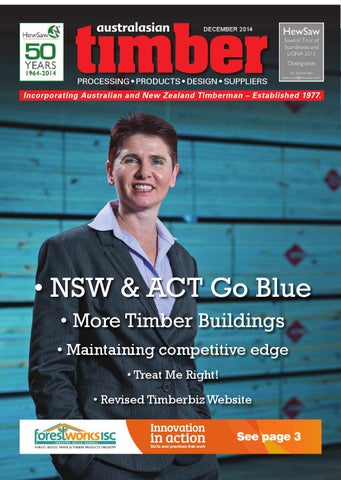
• NSW & ACT Go Blue • More Timber Buildings • Maintaining competitive edge • Treat Me Right! • Revised Timberbiz Website See page 3
Wholesale suppliers of quality pine & hardwood. Timber preservation treatment facilities include, LOSP, CCA, MicroPro, H2f A full range of pine product is available ex stock, including framing, landscape, treated hardwood, F7 sections, export & domestic pallet, battens & all structural grades. Since 1978 Tarmac has grown to provide a reliable supply of quality product at competitive pricing, call for best service. 113 Beatty Rd Archerfield QUEENSLAND 07 3277 5011 51 Kinkaid Ave Nth Plympton SOUTH AUSTRALIA 08 8295 8356 Tarmac Sawmilling 2902 Old Tenterfield Rd Busby’s Flat NSW
sales@tarmac.com.au
www.tarmac.com.au
NEWS
AUSTRALASIAN TIMBER MAGAZINE
3 – December 2014
‘Wood Encouragement’ policy to put Latrobe City Council on world stage I N AN Australian first, Latrobe City Council is introducing a ‘Wood Encouragement’ policy. If adopted, the draft policy will see Latrobe City join other nations driving timber for social, environmental and industry development reasons. Wood First or Wood Encouragement policies already operate in countries including Canada and France. The draft policy aims to promote the use of wood as the preferred material in both the construction and fit out of Council buildings and infrastructure. Latrobe City Council’s mayor, Councillor Sharon Gibson, said that if the policy was adopted it would be a clear signal of Council’s view. “Our area is one of Australia’s most important ‘fibre baskets’. Trees, wood and fibre provide for 1325 jobs within the municipality either directly or indirectly and inject over $800 million into the regional economy every year. “This draft policy will allow us to drive hard to attract wood-related development and research into our community. Wood is the most environmentally friendly, carbon friendly resource available and we are one of the mainstays of the industry nationally. “There will, of course, be cases when wood will not be the most suitable material, or be just one of a mix of materials put forward. That is why this draft policy encourages, rather than mandates, the use of wood for Council projects. “The draft policy has been open for public comment from 6 November and we are very keen to hear from our community about how it can be improved. Our goal is to ensure that wood is carefully considered from the moment architects, designers and builders consider bidding for a Council
project – anything from a new major building to a series of bus shelters,” Cr Gibson said. “In response to Council’s support for the forest and wood products industry and its advanced manufacturing opportunities, the major international industry event, AUSTimber2016, will be held in the city
Latrobe City Council is to be congratulated for leading our nation. The reasons political decision makers are taking this stance is simple. Timber and timber products are completely renewable, biodegradable and as they store carbon, play a positive role in reducing greenhouse gas emissions. In Latrobe City Council’s case the benefits are clearly economic as well.” Nationally, forestry and forest product industries provide some 80 000 direct jobs and about 200 000 indirect. These jobs are generally clustered around regional areas in Tasmania, South east Queensland, the Green Triangle of South Australia and Victoria, Gippsland, northern and southern NSW, Central Tablelands and the Tumut area of NSW, and Southwest WA. Mr Hampton said, “It is my hope that all councils in these areas will follow the lead of Latrobe City Council and adopt their own wood encouragement policies.” The draft Wood Encouragement Policy is open for public comment until 5 December.
Latrobe City is open for business and will highlight to those new and existing enterprises the potential of tapping into the advantage of our skilled workforce for the first time. This event will no doubt see a huge influx of visitors to our region which in turn will have a positive flow-on effect on our economy,” Cr Gibson said. “This will demonstrate to the world that Latrobe City is open for business and will highlight to those new and existing enterprises the potential of tapping into the advantage of our skilled workforce and our abundant supply of raw material,” she said. The Chief Executive Officer of the Australian Forest Products Association, Ross Hampton, travelled to Morwell to address the Councillors at the Council Chamber. “This is a forward thinking Council led by Mayor, Councillor Sharon Gibson,” he said. “All over the world in countries such as Canada and France, Governments are making the decision to change their tender processes to better accommodate timber.
Gottstein Trust – training opportunities THE GOTTSTEIN Trust is offering a Forest Science Course in February 2015 that encompasses the topics covered in forestry degree.This “taste of forestry” provides anybody working in the industry with an understanding of method and logic behind forest planning and is designed specifically for those who do not have a formal forestry background.While covering topics from “the importance of forestry worldwide” to “how to measure a tree” the course is presented in an informative and interactive way with discussion encouraged between the presenters and participants.Leading Australian authorities on each subject have been appointed to present their topic and do so with great enthusiasm. “Extremely valuable, very enjoyable”,
To have a say visit www.latrobe.vic.gov. au/insertlink or call 1300 367 700 for more information.
Revised Timberbiz website
RYAN MEDIA has re-developed www. timberbiz.com.au in response to a growing demand for readily available information accessible via the internet. As well as online access to Australian Forests & Timber News and Australasian Timber, also featured on the site are: current industry news, upcoming events, forest and timber related jobs and a directory of forest and timber related suppliers. Access to all features are freely available and anyone looking for key industry personnel now have a very affordable, easyto-use platform for posting jobs. Jobs will be tweeted @timberjobs and posted on Daily Timber News for maximum exposure to those in the forest and timber industries Ryan Media general manager Elizabeth Bouzoudis said that providing quick access to information is vital for any business today. “We’re delighted to be able to provide businesses with a one-stop-shop of products that relate to their specific industry. There’s no longer a need to scroll aimlessly through pages of Google ranked websites”, she said “Timberbiz with its industry publishing reach, contains all the latest news and product information in one web domain,” she added. Ms Bouzoudis said with loyal readership of its long-standing forest and timber publications, Ryan Media is confident that Timberbiz will continue to grow as an invaluable business tool. “We look forward to receiving feedback and continuing to develop the site to ensure it meets the needs of those operating in the forest and timber industries, “she said. For further information contact 08 8369 9599 or subs@forestsandtimber.com.au.
Innovation Skills and practices that work 25 March 2015, Canberra
Register now! The 7th Annual Industry Development Conference, followed by the Industry Gala Dinner hosted by AFPA and ForestWorks at Parliament House.
www.forestworks.com.au/2015IDC
" G reat range of topics and speakers. I learned a huge amount. Excellent networking. I want more” and “A very valuable and informative program for beginners in forestry” These were some of the comments received at the conclusion of the first Gottstein Forest Science Course held in February 2013. The Gottstein Trust also runs a Wood Science Course in alternate years to the Forest Science Course.This week long Wood Science course is a good introduction to the forest and wood products industry in Australia and covers all aspects of processing wood.The next Wood Science Course scheduled for February 2016. Gottstein Fellowships, Industry Awards and Scholarships to people working or studying in the wood and forestry industries are also offered annually for individuals to pursue projects that are relevant to them and to the industry as a whole.
This program has been produced with the assistance of funding provided by the Australian Government through the Department of Industry. ABN: 39 946 785 543
NEWS
December 2014 – 4
50 years of service coming to an end AFTER 50 years in the timber industry Gareth Lazarides has decided to take things a little easier and he will go into semi-retirement at the end of this year and his business, Lazarides Timber Agencies, will be wound down by the end of December. “We expect we will be holding an auction to sell off remaining stock and machinery in early December,” said Gareth. It was hoped that he would have been able to sell the business so that there was no interruption to supply to his clients, however, this did not eventuate so Gareth is holding discussions with other merchants in an effort to have an outlet to supply his clients, in particular our woodcraft clients as he is aware there is no outlet for this type of service on the north side of Brisbane.
Gareth will continue to trade timber but mainly supplying the wholesale market in pack lots as he will be operating from a much smaller warehouse. He will be contactable on his normal office phone number until the end of January. In 1964 Gareth started as a general trainee with a well known timber company and stayed with them until 1983. During this time he learnt a great deal about the industry and developed a passion for everything timber. Gareth left his employer in 1983 to establish a ‘one man’ timber trading company. He pursued his own business with ambition and in 1989 established Lazarides Timber Agencies. Gareth’s son Troy joined the business in 1993 and played a major role in the
AUSTRALASIAN TIMBER MAGAZINE
Self-paced training for motion controllers D
n Gareth Lazarides.
Lazarides Timber Agencies expansion. Gareth and his son Troy extended sincere thanks to all their clients for their support and friendship over the years. “It has been a privilege to be of assistance to you all.”
ELTA COMPUTER Systems now has an additional self-paced training option for the company’s RMCTools software and RMC controllers, which are targeted for high-performance servo-electric and hydraulic motion control. With this new training option, customers can learn at their desks and at their own pace in any time zone and any location worldwide. To make it easy to use, Training Videos can be viewed anytime at no charge. These free training videos are designed to introduce and teach the basics of the RMC75 and RMC150 motion controllers using RMCTools software. Delta’s RMCTools software features flexible User Programs with an extensive command set, including robust mathematical expressions, setup wizards, automated loop tuning wizards and an intuitive plot manager for graphical diagnostics. As a next step (for a small charge) one can schedule time, receive a written training exercise packet to use with the videos, and connect to a dedicated RMC motion controller located at Delta for hands-on exercises. For a complete listing of these and other
training options, including web-based and instructor-led classroom trainings, go to www.deltamotion.com/education. The free training videos are at free training videos. “The new easy-to-use self-paced training allows customers in academia and industry to learn at their own convenience and discover the power of Delta RMC motion controllers for applications demanding precise control and traceability for position, speed, pressure or force,” said Steve Nylund, Delta’s CEO. For more than 30 years, Delta has been a supplier of motion controllers, color sensors, and other industrial products that enable OEMs and integrators to build better machines and get to market quickly. Delta’s Family of RMC Motion Controllers are used for hydraulic, pneumatic and electric closed-loop control in a wide array of single and multi-axis control and testing applications. For more information contact Bill Savela, Delta Computer Systems, Inc. 1818 SE 17th Street, Battle Ground, WA 98604. Phone 360-254-8688, fax 360-254-5435, or email technicalsales@deltamotion.com Editor: Your personnel may indicate SelfPaced Training for inquiry identification.
For more than 30 years, Delta has been a supplier of motion controllers, color sensors, and other industrial products
Squeeze more from existing machines.
australasian
magazine Incorporating Australian and New Zealand Timberman – Established 1977.
December Vol.22, No.8
Make RETROFITS easy as 1,2,3. 1. Connect efficiently to transducers and fieldbuses. Simulate to speed setup and testing.
Postal Address:
2. Control electric, hydraulic and pneumatic closed-loop motion smoothly and precisely.
630 Regency Road, Broadview, South Australia 5083 Phone: (08) 8369 9555 Fax: (08) 8369 9501
3. Optimize swiftly with motion wizards and graphs for more throughput and machine life.
Publisher and Chief Executive: Hartley Higgins Suite 103, 486 Whitehorse Road, Surrey Hills, Victoria, 3127, phone (03) 9888 4822 General Manager: Elizabeth Bouzoudis Editorial: John Hudswell j.hudswell@ryanmediapl.com.au Adelaide: (08) 8369 9512 Out of office VOIP (08) 7127 6370 Advertising: Norm Nelsen n.nelsen@ryanmediapl.com.au Melbourne: (03) 9888 4820 Timber classified: n.nelsen@ryanmediapl.com.au Melbourne: (03) 9888 4820
Production: Luke Westle
RMC75 and RMC150 Motion Controllers
Subscriptions: subs@forestsandtimber.com.au Adelaide: (08) 8369 9522 Accounts: Adelaide: (08) 8369 9555
• 1, 2, or up to 8 axes • User programs control
position and pressure/ force
Conditions: Opinions expressed herein are not necessarily those of the editor/publishers; information is published in good faith and we do not accept responsibility for damage which may arise from any possible inaccuracies. All rights reserved, none of the contents may be used in any other media without prior consent from the publishers. Published by Ryan Media Pty Ltd.
1-2 Axis
•
Wizards for quick, easy setup and tuning
•
EtherNet/IP, PROFINET and PROFIBUS connectivity
Multi-axis
South Pacific Distributors Australia
CMA Electro-Hydraulics Engineers Pty http://c-mclellan.com.au/
MEDIA
INDEPENDENT & AUSTRALIAN OWNED
New Zealand
Engineering Computer Services http://www.ecs.net.nz/
deltamotion.com
NEWS
AUSTRALASIAN TIMBER MAGAZINE
5 – December 2014
Designers predict more timber buildings T
HE COMPLETE supply chain for timber and wood products, prefabrication and building materials has a major opportunity from the emerging new market of buildings designed in timber and engineered wood construction. According to Rod Pindar, a principal at Fitzpatrick + Partners, the Australian building design industry will move towards timber construction in coming years. He said in an interview for Architecture & Design: “We’d like to see buildings get built in timber, we’d like to see multi-storey commercial buildings built in particular. “The more that people start to understand the possibilities (of timber) and the more the detailing and knowledge of how to price it, how it works on site, it’s only going to be used more and more.” The Frame 2015 conference and exhibition in Melbourne will discuss the reasons for greater use of timber in design of residential and commercial buildings, which is now moving forward in Australia. Conference Director Kevin Ezard said the 2015 conference theme would be ‘Building with engineered wood construction systems’ to meet the increasing
interest from designers and builders. “There has been a global trend to greater use of timber in construction, and Australia is now under way with timber buildings up to 5 and 7-storeys planned for completion in the next few years. “Commercial builders considering timber and wood for multi-residential construction are finding these systems can be a lower cost option by up to 25% compared to traditional steel and concrete. “Delegates attending Frame Australia will learn from case studies and analysis of these building systems, and also visit exhibition displays for new building products and information on the latest developments and new technologies. “Companies in the supply chain to building markets are invited to visit the Frame Australia website for details of the opportunities to participate in this unique event,” he concluded. For more information on Frame Australia 2015 visit the website www.frameaustralia.com n Library at Docklands -- three level all-timber building by Lend Lease.
Innovation is the key to LSW Group’s continued success A NEW treatment method is helping to put an all-Australian owned and operated metals heat treatment company.- and the largest manufacturer of knives for the.timber industry -- at the forefront of the business. The LSW Group has just released its revolutionary new Chipper Knife, the ‘Extra Hard Chipper Knife’ which is made from high carbon, high chromium vanadium steel and cryogenically treated by its “CRYOTUFF” method. “We are proud to state that this is a world first technology, developed by the LSW Group in Australia,” says principal Wayne Ellis. “This will be a mate to our famous ‘Extra Hard Counter Knives’ that are used throughout Australia and Asia. We are also using this technology in some of our Flaker Knives,” he said. The Group started in the fifties in a small factory in Auburn in Sydney’s western suburbs and began to expand rapidly from 1999 purchasing one of Australia’s largest
machine knife companies and commercial metals heat treatment company, growing to now having 16 companies in the Group. “Unlike our local competitors we are a wholly-owned Australian manufacturing company,” says Wayne with pride. The Group has two manufacturing facilities in Bankstown as well as facilities in Yennora and Unanderra and Seven Hills, and a sales office as well as a distributor in Malaysia servicing the Asian market. The Group recently appointed an agent in Taiwan to service the Chinese market. “Our strategic plan is to be a major player in the Asian market and also to look for possibilities worldwide. “The acquisition of Chapman Saws gives us an opportunity to offer our customers the total range of products within the timber industry as they are also an Australian manufacturer of quality saws. “We service most of the timber mills throughout Australia and with a sales and
n The LSW Cryotuff Knife after Freezing.
n CNC Operator setting up to make Extra Hard Chippers.
marketing branch in Penang, Malaysia we export into Asia and China and also export to New Zealand and Papua New Guinea. “We are continually expanding. At present we encompass 16 companies, all interrelated within the engineering field including fabrication, machining, welding, hardfacing, abrasives, bandsaw blades, saws, precision
and repetition engineering, waterjet cutting, toolmaking .. and the list goes on. “Our product range also covers the timber trade as we specialize in a full range of knives (chipper, flaker knives and parts, serrated back and solid planer knives, planer heads) machine components, abrasives and saws,” said Wayne.
December 2014 – 6
BUSINESS PROFILE - HYNE
AUSTRALASIAN TIMBER MAGAZINE
Major investment to maintain competitive edge H
YNE TIMBER,.Australia’s largest private timber producer, is about to spend several million dollars on new scanning technology at its Tumbarumba mill in south-west New South Wales in.a bid to capitalise on a resurgence in building
activity. Over the next three months approximately $2.3 million will be spent on log and board optimisation – scanning technologies that help the mill make better decisions about how the timber is cut. Over the next three to six months an additional $1.2 million will be spent on process improvement and upgrades – technology that makes the mill more efficient. Hyne Timber has also invested over $1.5 million in training for all its employees. “This investment is part of a program called Business Excellence. All employees at Tumbarumba are undertaking training for either Certificate III or IV in Competitive Systems and Practices qualifications and Certificate III in Forests and Forest Products,” said Manufacturing Manager Chris Skeels-Piggins. “There are also a number of apprenticeships in engineering and electrical fields. We recognise as an organisation that we need to invest in our staff to secure our future, and consequently the future of the mill and Tumbarumba. When you are such a large employer in a small community, this comes with a responsibility to ensure we are doing everything we can to keep young, local people in the community by providing diverse career opportunities for them,” he said. “Over the past 10 years the timber industry has undergone a great deal of rationalisation, with many mill closures across Australia, it is important that Australian mills are competitive on a global stage, and the current investment in the Tumbarumba mill is testament to this. “As we are a framing mill, any increase in housing markets has a direct impact on the profitability and the volumes we can put through the mill,” Skeels-Piggins told ABC Rural. “Even our capital focus, over the next six to twelve months, is all about making sure we can put more volumes through, more efficiently, to enable us to better optimise the timber and make better sawing decisions.”
n Aerial view of.Tumbarumba Hyne Mill.
Film-makers “saw” something special at Tumbarumba HYNE TIMBERS’ taste of Hollywood was a wrap when filming of ‘The Daughter’ finished in the Tumbarumba Mill. Starring Geoffrey Rush and Miranda Otto, the moviemakers not only selected the Hyne Timber mill as one of their filming locations, but also employed 25 Hyne Timber staff as ‘extras’. Hyne Timber Manufacturing Manager Chris SkeelsPiggins described the experience as a career highlight and an exciting opportunity for the mill and Tumbarumba, “The film makers wanted a sawmill for some of their scenes, ideally set upon a scenic backdrop in country New South Wales. “While initially, we couldn’t think of anything worse than accommodating a film crew in an active mill, the opportunity for Hyne Timber to support a project bringing all these people to the town of Tumbarumba far outweighed any challenges. “The crew were great to work with and it didn’t disrupt operations at all. We opened the mill especially on a Saturday with our trained Hyne staff employed as extras. This meant all health, safety and environmental requirements were met while our employees joined in the film-making fun.
“The Director decides how much of what they filmed at Hyne Timber will make the final cut but hopefully the beauty of the area at the very least will be well represented and on show to the world. “Meeting Geoffrey Rush isn’t something you get to do every day. My only regret is that I didn’t get to meet Miranda Otto,” Chris said. Bruce Wright, Site Services Manager at the Tumbarumba Mill, assisted with the recruitment of the extras and coordination of the film crew, “The whole crew including the directors and the stars were great to work with. Nothing was too much trouble from managing security at the gatehouse to getting all the shots done. “All our staff employed as extras described the experience as a great day out.” “It always helps popularity when fantastic food is provided from their catering van too!” Bruce said. While little is known about the movie ‘The Daughter’ at this early stage of production, it is a family drama written and directed by Simon Stone inspired by Norwegian playwright, Henrik Ibsen’s ‘The Wild Duck’ (1884).
n Manufacturing Manager Chris Skeels-Piggins and Geoffrey Rush. Photo: Hyne Timber n The scenic beauty around the mill. Photo: Hyne Timber n Film crew at work. Photo: Hyne Timber
AUSTRALASIAN TIMBER MAGAZINE
BUSINESS PROFILE - HYNE
7 – December 2014
n Family with a blue-framed dwelling going up.
Why NSW & ACT go Blue S
INCE 1 September 2014, the Hyne Timber NSW and ACT teams only distribute graded timber that is treated for termite resistance. The demands throughout Australia for Hyne treated timber such as T2 Blue are increasing in accordance with customer demands. This isn’t surprising given that builders want to use termite resistant treated timber as their guaranteed product of choice.More than 300,000 homes have been built using it with no reports of termite damage. Queensland and other States are quickly recognising the benefits of Hyne treated Timber such as T2 Blue (T2 Red for areas north of the Tropic of Capricorn and T3 Green for external use). Tim Masterton, Purchasing Manager with Masterton Homes based in Warwick Farm, NSW, said they started offering Hyne T2
n A Blue house.
Blue to their customers back in 2009. “We have a reputation to protect and therefore we want to use the best quality product to build peoples’ homes. “We are a family owned business and our target market is families. We are all about helping them achieve the Australian dream of owning their own home. “I would only use Hyne T2 Blue to build my own home. That says enough, really. “We ensure the same high quality build for all our customers that we would use for ourselves. “The increased cost of using Hyne T2 Blue to build a home is very minimal compared to using untreated timber or continually having to treat for termites every year. “Treatments only go so far and the only real protection for timber is to treat the timber itself. “Timber remains a building product of choice
given its price, strength, availability, ease to use and resize, not to mention the eco benefits compared to products such as steel,” Tim said. The NSW and ACT Region Manager for Hyne Timber, Jackie Porter-Kay said that ever since 1882, Hyne Timber had been successfully leading the way in terms of innovation, customer needs and sustainable future. The position of the company in 2014 maintains the same vision. “In my opinion, the future of the building industry is T2 Blue treated timber. It’s guaranteed and it’s low cost insurance. “Quality home builders such as Masterton Homes have already identified the long term ramifications of using untreated timber and are only using T2 Blue. “NSW companies such as Bay Timber only supply T2 Blue and have been
instrumental in converting their major builders such as Eden Brae Homes, Metricon Homes and Montgomery Homes. “As Hyne Timber ensures the increased demands throughout Australia are met, merchant retailers, truss and frame manufacturers and builders need to ensure they are also moving into this space as homeowners become increasingly aware of the benefits of using termite resistant timber.” Jackie said. The Hyne Timber range of structural, engineered and industrial timber products includes a variety of termite resistant timbers that are guaranteed against termite damage for 25 years. Hyne T2 Blue is manufactured in Australia using Australian plantation pine meaning that this renewable product is both good for the environment and the local economy. The H2F treatment is
n NSW and ACT Region Manager for Hyne Timber, Jackie Porter-Kay.
n Blue packs being loaded.
an envelope treatment that repels termites using the same chemicals as found in flea collars and other insect
repellents. It is totally non toxic to mammals and can be cut, notched and disposed of in normal landfill.
December 2014 – 8
WOOD INNOVATIONS
AUSTRALASIAN TIMBER MAGAZINE
Integrating innovative thinking into a wood product business Case Study – Taking a New Prefabricated Lightweight Timber Ground Floor System to Market Dr Alastair Woodard TPC Solutions Pty Ltd
A
t the recent Wood Innovations conference held in Melbourne at the Bayview Hotel, Dr Alastair Woodard of TPC Solutions presented a case study: Taking a New Prefabricated Lightweight Timber Ground Floor System to Market. When he opened his talk he was quick to point out that he speaks very fast, this was no exaggeration since he packed as much into his presentation as it would take another person two sessions to complete. Hence this is a long but informative representation of what he discussed. Innovation and the norm. As Dr Woodard said this case study is an excellent example of not just innovation but just as importantly industry collaboration. “Innovation is the mechanism that allows businesses to change their products and services to adapt to the growth in the market place,” he said. “Innovation requires new ways of working, better collaboration and improved skills. “I’d like to take you on a journey of investigation, exploration and change.” He said that his journey started with a question: why were builders no longer constructing elevated timber sub-floors – particularly on sites where this option was simply far superior? “We’ve always produced timber sub-floors … it was the first construction system until we lost out to concrete slabs,” he said. According the Dr Woodard, Wood Products Victoria approached the market about three years ago to ask why builders continually use concrete slabs despite them not offering the right solution in every situation. The feedback was really good, it was consistent but without any surprise. Wood Products found that the concrete slab is the norm and builders simply don’t consider or think about anything else. “The building industry likes what the concrete slab offers, it’s really simple for them,” said Dr Woodard. “So if we want to compete with that we have to supply and install.” Builders in Australia prefer slab-on-ground to suspended timber floor systems because; Slabs represent over 95% of the new residential market in some states Builders today are used to, and want – one contract to deliver a working platform, on a site, on a specific date, for a specific cost. Builders have concerns with traditional built-on-site joist and bearer timber systems particularly because: • Multiple trades and contracts are required • There are longer construction periods compared with the slab-on-ground system. The challenge So this is the challenge for the successful take-up of easy-toinstall, cost effective lightweight timber ground floor systems, which is what Dr Woodard’s case study centres on. The key issues to address include: Offering a total system that includes the prefabricated timber floor, the supporting system (with a number of options depending on site conditions) and a simple, effective and quick installation process Developing an approach that has broad supply channel potential – an approach that does not require specialists to deliver, it must secure engagement and participation by the frame and truss sector to design/fabricate/install the system so that this provides a whole new value-added chain A product line to manufacturers and a next step towards further prefabrication offerings (fully finished wall systems, fabricated roof modules etc). “It’s hard to get hard numbers, the FWPA is
working on that, but anecdotally particularly in the eastern states about 95% of new residential constructions are on a slab,” said Dr Woodard. “The builders don’t really like how we build the timber floors they think there’s too many trades involved. “Someone has to come and excavate strip footings, someone pours concrete, if it’s a brick veneer you’ve got to build the brick sub-wall then someone comes and does brick piers or stumps depending on what state you’re in, then lays floor joists, then we lay bearers, then we lay flooring – now we’ve got a flat surface. “The concrete guys do that in one contract we’ve done it in multiple ones. They don’t like that, plus they think it takes a lot longer, we don’t think it does but that’s their perception.” What builders want is one contract, and a working platform on a specific date for a specific cost – that was the clear message. If the timber industry wants to complete in that marketplace then what has to be on offer is an easy to install, cost effective floor system. What came out of the research was that builders have to be offered a total floor system not just the panels, one that includes the piers and footings in the ground. What’s the market? What is happening currently is that concrete slabs are being used everywhere, even when they are the least appropriate construction method because it’s the norm.
Dr Woodard pointed to a house set against a massive hillside describing how ridiculous it was to build a concrete slab construction on this type of house block. “You can’t believe that anyone thought this was good construction practice let alone the poor consumer who got this house,” he said. “Have a look at the back wall, the cut and fill, those retaining walls are the height of the second storey windows. “The cost today of a house and land package is worth so much, half the cost of this land is worth nothing, you can’t do anything with that backyard. You can’t believe the council allowed them to do that, yet you see it all the time.” So one area where a prefabricated cassette ground floor system would work is on sloping blocks, another he pointed out was in flood prone areas where the house can be raised. And yet another was building on reactive clays. “For those in Victoria the two greatest zones are to the south and to the west, which is all highly reactive clay,” he said. “Waffle pod slabs have been introduced in the past 10 years. For those from Victoria they’ve been in drought for 15 years. So really the dirt they’ve been building on has seemed like rock but now that the moisture has come back that soil is moving all over the place. “So those waffle pods are flexing and they’re getting
cracks. Cracks in walls, doors are jamming, there’s all sorts of problems for those people. “This is something we would pitch against on a flat site and clearly on those reactive clays there’s real benefits in being able to come back and adjust the house into shape afterwards.” How does it work? A flat site is not a big market for this but there are opportunities, however, builders all loved the concept on a sloping site where you have adjustable steel piers. “There’re a couple of those on the market Uni-Pier and Advanta-Pier,” said Dr Woodard.“They both operate on the same system. “You can also get adjustable tops and we think they are going to be the critical ones for the reactive clays. They’re very simple to adjust.” The concrete guys can’t do anything to make adjustments, added Dr Woodard. He said that his aim was to keep to the KIS principle (Keep It Simple) so quite simple footing systems were employed such as concrete piers or conventional strip footings. To test the system it was taken from the drawing board and run as a full sized house project with Bowens. “We found them to be a really good partner because they do sub-floors already,” said Dr Woodard. “So we got good feedback. The house design was pretty simple. “They were going to do it with stumps, which would have been about 45 times to ground, with our system and nine panels we only went 16 times to ground. “This is on a reactive clay and the geotechnical engineer said those footings have to be at about two metres below the ground surface. It was quite a saving just in the foundation system.” Installation happened in February 2013 in Heathcote north of Melbourne on reactive clay and a slightly sloping site. “The most important thing is the initial set out since you have to get those piers in exactly the right place as if they are in the wrong place you don’t want to be hanging around with a panel on a crane.” According to Dr Woodard, installing the stumps was very quick, maybe five minutes a stump, and they were leveled off using the simplest of items, a level. It all went really quickly. “In this instance the truck was able to get close to the site and the crane on the back of the truck was used to lift the panels into place. From the first panel you can line up all the others. “It all went very smoothly, probably half a day to do the piers and half a day to do the panels. That meant it was just one day to do the floors. At the end of that project the team developed a technical advisory manual, which has been written for the frame and truss manufacturers that introduces the concepts of the system, and shows them how to select and optimise the appropriate system. “There’s some good information on design, some information on fabrication and installation, and then the Heathcote case study. “Normally with the FWPA project documents are made publicly available, in this instance we asked the FWPA to restrict the access … we didn’t want this out there so someone could have a go at it do it badly and wreck the whole system before we had chance to take it to market,” explained Dr Woodard. “We wanted a logical marketing implementation phase. That’s the stage we’re at, at the moment.” The low hanging fruit “A couple of years ago the frame and truss sector was really struggling, the market was down,” explained Dr Woodard. “Too many of them, all undercutting jobs, no one was making bucks on it. They had about 98% of the roof frame market and 80% of the wall frame market that’s probably all they’ll get because out here we still like to stick build. There was no potential to move. “So when we pointed out that they had none of the ground floor market they were pretty interested, that was the key - bringing them in and getting them involved.” It was important to implement a strategy to manage the introduction of the system so that the industry could provide a high quality solution from the get go. Activities have included the development of a detailed implementation program and related actions. Stakeholder funding and support was sought while information seminars for frame and truss manufacturers were provided in Queensland, New South Wales and Victoria. From there innovative and high quality frame and truss continued on page 9
WOOD INNOVATIONS
AUSTRALASIAN TIMBER MAGAZINE
9 – December 2014
Innovation in Australian wood product enterprises
A
GOTTSTEIN Fellowship was awarded to Dr Georgiana Daian to investigate innovation in workplaces
n Dr Georgiana Daian - Research Officer ForestWorks.
related to the forest and wood products industries. Dr Daian is the Research Officer at ForestWorks and is constantly looking to identify ways to improve business performance in the forest and wood products industry in Australia. “I found this project to be very enlightening,” said Dr Daian, “the main finding being that there are NO secrets to being an innovative company.Rather, it is a commitment to innovation across an organisation that is articulated through clear strategies and supported by creating an engaging, learning and trusting work environment at all levels through an organisation.” Dr Daian interviewed several innovative companies
in Australia and in Finland to discover their “secrets of success”. The companies involved included Hyne Timber, Metsa Wood (Finland), UPM – the BioFibre Company (Finland), Siparila (Finland).from the wood and forest product sectors and FE Techonologies and the Geelong Food CoProducts Cluster from the non-timber sector. Despite the differences in industries the learnings regarding innovative practices was similar across the companies. “The forest and wood products industry has the ability to become an industry of the future – with an ability to convert renewable wood into micro-cellulose fibre feedstock for composites and other advanced materials,
engineered timber structures for buildings, unlimited interior and exterior wood component designs, and renewable energy. “There are many opportunities for innovation,” she said, “but businesses need to think outside of box, develop big aspirations, and engage the whole workforce to manage those aspirations.”. Dr Daian recommended that small to medium enterprises need to undertake the following actions to become innovative: Devise a simple business strategy that is focused on growing as a leader in the sector; Communicate the strategy closely and passionately with employees; Learn from the best and
partner with the best; Make leadership skills a priority for investment across the organisation; Set up a framework to explore all ideas across the organisation, and implement the good ones; and Create opportunities for learning and networking for management and staff alike. “While there are no secrets to becoming an innovative company it does take much passion and determination to achieve this,” the Dr said. “Traditional wood products companies will not be able to grow unless they view their market offerings differently.Novel and unique features must be developed for traditional products and services to ensure the expansion and future of a
Integrating innovative thinking into a wood product business continued from page 8
manufacturers were indentified nationally for participation in the program. A market implementation group (MIG) was convened with representatives from the three nailplate manufacturing companies – Pryda, Multinail and MiTek as well as frame and truss manufacturers – three from NSW, three from Queensland, one from Tasmanian and seven from Victorian. “Certain priority generic activities need to be address including an assessment of the different State requirements for licensing, OH&S, crane usage and insurance. “Alongside this it was important develop an independent business case and value proposition, and to be able to provide assistance with individual job designs. The nailplate manufacturers had to develop prefabricated floor design tools. “Benefits had to be put before builders and consumers so that they were convinced of the advantages and a marketing and promotion package developed with the usual marketing tools such as a website, brochures, workshops etc. “As we look to take this to market and we’re not doing that at the moment,” said Dr Woodard. “This is the market development and training phase with the industry to get their skills up. “We won’t compete with the waffle pod slab on a stable site -- it’s just too cheap. What we’re focusing on is sloping sites, flood zones and reactive clays. “To give you a feel for what that’s worth in Victoria for every 1% market share gained it’s worth $2.5 to $3 million a year in new timber sales that we don’t get at the moment. If you extrapolate that nationally for every 1% it’s probably $10m to $12 million. “We want to capture that low hanging fruit initially. Then we reckon builders will pick it up on the flat sites.
“If you take this to a builder the first thing they say is how much is it going to cost per square metre compared with concrete? And it isn’t that comparison,” said Dr Woodard. “We’ve done studies with builders to see the advantages from their perspective. “The nailplate companies have started to develop design tools themselves. We need to give them time to do that and we’re about to move into a phase of marketing and promotions. “ The plan is to take it to the builders, specifiers and the broader frame and truss sectors. The Pryda group has really embraced this and has a team called the instinct team, they’ve started upgrading software so you can design a cassette system onscreen. According to Dr Woodard they have some great simulations on their website. In terms of frame and truss manufacturers this project has moved much quicker than was expected with two companies in Victoria having installed dedicated lines. “What we always knew about taking this cassette floor to market is that it would be difficult to get the ground floors but it would easy to get the upper floors,” said Dr Woodard. “What we said to the frame and truss guys was you’re building your skills, you can say for a second storey we can give you the upper floors as cassette floors. “What this allows is the frame and truss guys to build the skills to produce these and demonstrate to the builder the advantages of a cassette build. That’s what’s happened.”
a number of steel poles into the ground. Once they’re in place you can adjust them. “What the Drouin and Heathcote projects prove more than anything is not simply that the system works but that the companies working with the system are innovating, and innovating fast. Taking the system seriously, investing in its future. “This will mean a whole new product line for the frame and truss industry opening new doors for a wide range of timber products including sawn, LVL, i-beams, floor trusses, particleboard and plywood.
company. The best place to develop these products is within a company and joint ventures through working with suppliers and customers to determine what they really want.”. Dr Daian continues to work on the knowledge sector of the forest and wood products industry through her role with ForestWorks.“I am very grateful to both ForestWorks and the Gottstein Trust for providing me the opportunity to undertake this project,” Dr Daian said. Dr Daian’s full report can be accessed on http:// www.gottsteintrust.org.The Gottstein Trust calls for Fellowship applications each year in September.
“They will be able to deliver high quality products because they will be manufactured in a controlled factory environment with reduced material waste. It won’t be just internal floors either, the concept is indoor-outdoor offering prefabricated timber decks and screens. “There are opportunities too for additional value-add such as pre-ink-jetting wall frame positions, pre-cutting holes for plumbers, preinstalling plumbing pipes, fittings or shower bases, pre-fitting waterproof flooring and linings, and for upper storey cassette floors pre-installing guardrails.
Doin’ it Drouin A small company in Victoria, Drouin West Timber and Truss embraced the system and put it to work on its Corinella project and delivered a ‘dirt to lock in’, in under six days. Pryda had been working with a company called SureFoot to market a non-concrete footing system; it doesn’t use any concrete in the ground it uses a steel plate and you drive
Metriguard 7200 Stress Grading Machines • Two (2) only machines (mechanical only) • MSR stress grading up to 914 m/min
• Lumber widths (63.5 mm to 290 mm) • Lumber thickness (30.5 mm to 45.5 mm) • No controls
Phone: +1-604-575-0046 – www.cmesales.com
HEWSAW-DELTA
December 2014 – 10
AUSTRALASIAN TIMBER MAGAZINE
Figure 2. At the Bombala mill, two RMC150 motion controllers, manufactured by Delta Computer Systems, are visible in the cabinet at the center of the picture.Each RMC150 can control and synchronize up to eight motion axes simultaneously. A standard PC can be used for programming.
Integrated HewSaw sawline relies on coordinated motion control By Brad Smith Delta Computer Systems Inc.
H
EWSAW sawlines, manufactured by Veisto Oy of Mäntyharju, Finland, are known for their high level of integration.For example, the company’s Trio line (Model number SL250 3.3 – see Figure 1) combines a chippercanter, cantsaw/edger and curve-sawing ripsaw/edger to deliver the maximum yield per log, while still minimizing the physical footprint of the sawline.One mill operator with this requirement is Dongwha Timbers, a South Korean company that installed a HewSaw line in a new mill in Bombala, NSW, to replace the company’s mill that was closed in Victoria a few years ago due to fires in the region. Developing a highly-integrated sawline for maximum productivity poses some technical challenges for the system integrator.For the Dongwha mill, the integrator was Tui Technology of Whangarei, NZ, the approved HewSaw integrator in the region. Among the challenges was coordinating the operation of all of the motion axes, more than 80 of them, in the combined machine in order to eliminate bottlenecks, while enabling the line to implement a unique cutting strategy
for each log.To accomplish this, the sawline incorporates two stages of scanning/ optimizing using scanner/optimizer support from Prologic+ of Saint-Georges (Québec) Canada, while the following are being controlled simultaneously: •
Feed roll positions
•
Cutting tool positions
•
Separating knife positions
•
Controlled curve sawing of cants
•
Geared motion of edging heads with the board to provide skew for higher recovery
As with virtually all sawmills these days, such operational flexibility is key in order to maximize recovery from available feedstock.The Bombala mill processes pinus radiata (Monterey Pine), a fastgrowing medium density softwood that can have imperfections which are corrected by the movable saws. The descriptive term for the process
implemented by the HewSaw line is “scan and set,” where every log can be a different size and the system can adjust to provide a completely different cutting strategy for
each log. “In the old days, every log would be virtually the same,” said Aaron Taitoko, Engineer at Tui Technology. “Now that we’re processing each log with a unique
Figure 1. The HewSaw Trio line similar to the one installed at the Dongwha Timbers mill in Bombala NSW combines three sawing stations to maximize productivity from each log.
University collaborates with Museum of Old and New Art for Australian Timber Design Workshop THE UNIVERSITY of Tasmania’s School of Architecture and Design will collaborate with the Museum of Old and New Art (MONA) for the 2015 Australian Timber Design Workshop (ATDW). During the ATDW participants will design, fabricate and construct a pavilion for a Tasmanian primary school. “This workshop continues the University’s long tradition in excellence in timber design and in
learning by making through an exciting collaboration with MONA,” co-organiser Dr Jon Shanks said. The ATDW provides a hands-on learning opportunity for those interested in the digital design and fabrication process associated with mass customised manufacture of architectural timber structures. The program specifically caters to undergraduate architecture and engineering students and will run from February
2 to 13, 2015. “Multiday learning-by-making workshops provide participants with a unique opportunity to work with experienced timber design professionals and make full use of the fantastic workshop facilities available at the University including our new 6-axis KUKA robot,” Dr Shanks said. “The skills participants learn will be useful in architectural, engineering and design practice and are equally relevant to
students in these or similar disciplines.” The ATDW has a varied and exciting program. Workshop participants will design, fabricate, construct and install a live project utilising a range of solid timber and engineered wood products. Workshop co-organiser Architect Peter Booth added that “the beauty of this workshop is that participants will be working on a real problem and have to produce a real building
for a real community client”. Learning will be through both practical hands-on tasks and online. Participants will have access to on-line lectures and learning resources prior to the workshop. These will provide a background into the design project brief, timber material characteristics and precedents. Students from other universities are encouraged to apply through crossinstitutional enrolment.
n Dr Jon Shanks.
AUSTRALASIAN TIMBER MAGAZINE
cutting strategy, we need to be really confident about tracking logs through the line.And in order to keep the gap between logs as short as possible, we need to perform the optimizing calculations and move the saws as quickly as possible.”. To affect precise saw positioning and cutting required control of both position and pressure/force applied in moving the hydraulic axes. ”One of our technical challenges involved monitoring the net force being applied by the hydraulic cylinders that controlled the riving knives on the back of the saws,” said Aaron. “We need to limit the amount of force that’s being applied by the knives to guide the boards that are split off by the edging tools so to give the riving knives freedom to move if they have to during the cut.” With the need for synchronizing multiple motion axes and controlling force as well as precision in mind, Tui Technology and Veisto selected RMC motion controllers manufactured by Delta
HEWSAW-DELTA Computer Systems, Inc. of Battle Ground, Washington State in the U.S.A dozen of Delta’s RMC150 multi-axis electrohydraulic motion controllers (see Figure 2) manage the motion of all positioning and cutting equipment under supervisory control by a PLC. Both the chipper-canter and the ripsaw have curved cutting capabilities. The rip saw can cut a curved block in order to provide boards that dry straight, but the chipper-canter can also move to cut a curved cant out of a straight log and vice versa.“You cannot have too much curve at the ripsaw,” said Aaron. “You waste a lot of wood if you can’t cut to the curve of the log, and maximizing recovery is the key to running a profitable operation.” The edger in the HewSaw Trio line can also move in order to cut boards on an angle to maximize recovery. Curved cutting is supported by Delta motion controllers via standard features for producing curving motion profiles.
One such feature is the ability to execute spline functions.The log scanner provides a set of motion target points for the cut and the Delta controller “connects the dots” via its spline function to move the saw’s position smoothly through the specified curve. “Using functions such as splines, we were able to build a high-level of functionality into the motion controller’s programs and thus produce desired results with a minimum amount of direction from the PLC,” said Aaron.The PLC controls machine sequencing, tracking each piece of lumber through the machine and commanding the axes to move at the appropriate times. It can predict how long each step is going to take, allowing performance of the system to be scaled as required, and can speed up or slow down the line as it needs to, with each motion controller synchronizing the axes for which it is responsible. The block diagram of a typical HewSaw curve saw (Figure 3) illustrates that the motion of five axes needs to be coordinated in order to ensure that the saw blades precisely follow the curvature of
11 – December 2014
the log.Part of the machine development process is tuning the motion to optimize how the machine works.To simplify this task, the Delta Computer Systems RMCTools software has a feature called the Plot Manager that enables the user to graphically display the motion of any of the system’s axes versus time.Plot Manager graphs compare the actual motion of the system with the system’s optimal target motion, and when the motion is tuned perfectly, the actual and target curves overlap. To simplify the tuning process, RMCTools includes an automated Tuning Wizard that allows designers to tweak control loop gains via a slider bar on the screen of an attached PC. For maximum productivity, integrators of complex multi-stage sawlines, such as the one installed at Dongwha’s Bombala mill, depend on synchronized motion control and motion controllers with special capabilities for curved motion and position and pressure control.For ease of development, it helps if the motion controller is also supported with a powerful set of programming, graphics and tuning tools.
Sawmill Tour will be something special
Figure 3. Each machine on the sawline has multiple motion axes that must be controlled.Above is a block diagram showing the axes involved in the curvesawing ripsaw, the last saw in the line.
HEWSAW will soon be closing registrations for its Sawmill Tour of Scandinavia and LIGNA 2015.Open to Australian and New Zealand operators, the tour promises to be an excellent overview of the best Scandinavian operations, with a focus on efficiency and productivity.Sawmills will be inspected in Sweden and Finland, including some of the newest and most productive sawmills. This will be followed by a week at the LIGNA 2015 Fair in Hanover, Germany.The Tour represents excellent value with accommodation; internal flights and coach travel, transfers, meals and entrance to LIGNA included, as well as access to some industry specialists and guest speakers. For further information, contact Sam Rowe on +61 418 561 023 or sam.rowe@ hewsaw.com
TIMBER TREATMENT
December 2014 – 12
‘Treat me right’ W
ITH SO many timber treatment options available on the market today choosing which product will best suit the application and which products to stock) can be a trial. There are some good resources, which provide general guidance, available on the internet from timber associations and treatment chemical suppliers like Osmose. www.osmose.com.au.Particularly considering product liability in an evermore litigious society, It is well worth scratching the surface to discover exactly which product is the best ‘fit for purpose’! The Tarmac Group of timber companies has been built with timber preservation at its heart. Founded in 1978 by Kenneth Wait, it remains under his ownership and control. Initially CCA treatment of landscape sections, round posts and structural sawn section fulfilled the bulk of requirements, but over the years more processes and infrastructure have been added. ACQ treatment is offered as a more ‘environmentally favorable’ option and for use, where legislation requires, such as decking, handrail and playground equipment, H2f or ‘blue’ marketed by Tarmac as ‘SafeFrame’ treatment ,is applied at Tarmac facilities via a spray line. This envelope treatment is effective for use on structural framing to deter termites. Indeed in particular geographical areas this treatment is a requirement. LOSP treatments have become more and more popular over the past 10 years. Tarmac has state-of-the-art LOSP treatment facilities for H2 & H3 requirements, predominately MGP structural framing and some F7 structural sections. The ease of this treatment and the sectional stability are positive factors
contributing to LOSP popularity (no redrying is required as the preservative is borne by white spirit rather than water) There has been some negative press regarding VOC (volatile organic compounds) flashing off, leaving a nasty smell and questionable environmental effects. The governmental approvals are all in line so we can use this product with confidence, however it should be noted that the guarantee offered by our chemical supplier is for 25 years, this should be taken into consideration in matching the timber product to the end user application. The days of treating fence posts with sump oil or creosote may be near an end, but the tried and tested CCA product still stands above others for durability. A 50 year guarantee is offered for this product indicating a service life far beyond that of other treatments. It is definitely worth doing some of your own research and selecting your product carefully. Tarmac has a strong emphasis on quality assurance, product compliance and technical backup. Tarmac has a national presence in the timber wholesaling arena with South Australia, Victoria, Western Australia & Northern Territory all serviced by our team in SA. Tarmac Qld supply the eastern states from Far North Queensland to Canberra and inland. The continued focus on service delivery ensures superior product with honest, timely liaison. Despite variable market conditions, Tarmac has continued to develop and adapt to evolve with our customers requirements. The green sawmill in Nth NSW has helped provide the stability and reliability that only a resource back supplier can offer. We hope that you will consider contacting Tarmac for any of your timber requirements.
New timber treatment facility at Narre Warren A MAN with timber treatment experience spanning more than three decades has now started yet another business in this field in Australia. Alston Rodrigo is owner/operator of Auslak International (which exports timber to South East Asia -- mainly Sri Lanka), AH Fencing & Timber (a wholesale and retail company) and his latest venture Auslak Timber Treatment in Narre Warren. TimTechChem Australia was involved from the start and produced all the documentation for gaining the consent approvals with local council and EPA Victoria for Auslak. TimTechChem also project managed the installation on behalf of Auslak. “The plant was sourced from IWT in Europe primarily due to the fact that they were looking for work and the strong Australian dollar made it economically viable -- despite the freight component -- and is the latest design with touchscreen interface. It is dual preservative (CCA and TTQ) with the best automated changeover system I’ve seen which is not surprising given the number of preservatives and colours systems they work with,” said Ian Clarke of TimTechChem. “We pride ourself on good old fashioned service while still offering the latest in treatment technology and processing,” he said. After graduating at the University of Sri Lanka in 1974, Alston
was appointed as a trainee executive at Ceylon Pencil Company (Timber Division). “One of my major projects was setting up a wax impregnation plant to improve the cutting quality of the wood. It was the first such plant tobe built in Sri Lanka at that time,” he recalls. Alston then joined Ceylon Paint Industries ( Berger Paint Sri Lanka) as a plant manager. “When I migrated to Australia in 1984 my position was a technical director of the company. “Since I’ve been in Australia I have qualified in Timber Technology as I gained a Diploma in Timber Technology at Dandenong TAFE and Forestry School at Creswick. I am also a certified member of the Institute of Wood Science. “ Since 1984 I have been involved in timber industry in Australia as a timber treater, wholesaler, retailer and exporter. “ I have the experience of setting up five timber treatment plants in Australia. Meanwhile, I set up my own treatment plant which was called “Superior Treated Timber Pty Ltd” in Victoria. “At the moment I am the owner operator of three companies. Auslak International Pty Ltd which exports timber to South East Asia (Mainly Sri Lanka), AH Fencing & Timber Pty Ltd which is a wholesale and retail company and my new venture setting up a timber treating plant in Narre Warren, Victoria which is known as Auslak Timber Treatment Pty Ltd.
AUSTRALASIAN TIMBER MAGAZINE
AUSTRALASIAN TIMBER MAGAZINE
ENGINEERED WOOD
13 – December 2014
AFPA technology group inspects EWPAA laboratories in Brisbane M
EMBERS OFf the AFPA solid wood processing technology committee took advantage of a Brisbane meeting recently to inspect the Eagle Farm office and laboratories of the Engineered Wood Products Association of Australasia. The technical committee is a subcommittee of the Australian Forest Products Association’s processing chamber. The committee discussed current technical issues in solid wood processing focusing on the Plantation Timber Certification Scheme, a voluntary certification program for MGP and F graded timber administered by the EWPAA and accredited by JAS-ANZ. “This provides the same level of scrutiny as other engineered wood products such as LVL, I-beams and plywood,” said Andy McNaught, EWPAA technical manager, who is directing the program. “Uptake of the
scheme has been excellent with most major producers on board, including the most recent participation by Colac-based AKD Softwoods.” Membership of the scheme entitles mills to have their AFS chain of custody certification and Australian wood packaging certification completed at no extra cost. Audits for the three certification schemes are integrated to minimise disruption to mill staff and production. “This means EWPAA now provides technical and general input on behalf of the industry to standards development,” Mr McNaught said. “The bottom line is that producers of solid structural timber can now be part of a rigorous JAS-ANZ accredited product certification scheme that gives consumers the confidence to consider MGP and F graded timber as a true engineered product.”
the same level as our LVL and plywood programs so users can be totally confident that the material they are buying is an engineered product – and the EWPAA brand confirms this.” JAS-ANZ accreditation was established in 1991 by the Australian and New Zealand governments to strengthen the trading relationship between the two countries and with other countries.
Mr McNaught said the plywood and LVL industries had always valued the services of EWPAA and the value of the EWPAA brand was something the solid timber industry wanted to embrace. “Users of the program appreciate the value of EWPAA’s input, both at an audit level and a technical representation level and they see this as value for money,” Mr McNaught said. “What we’ve done is to pitch it at exactly
n (Far right) EWPAA laboratory technician Christian Hamlyn (second from left) explains bond evaluation of plywood to visiting wood processing technology committee members Geoff Stringer of Hyne, Kim Harris, Carter Holt Harvey Wood Products Australia, and Carl Angus, AKD Softwoods. n (Right) EWPAA technical manager Andy McNaught (left) shows samples tested for formaldehyde emissions to Nick Livanes, Koppers Performance Chemicals, and Gavin Matthew, manager processing, Australian Forest Products Association.
Designed to reduce labor and material costs
AMERICAN-BASED LP BUILDING Products recently expanded its Simply Better family and launched the new LP SolidStart Simply Better Stud in the United Kingdom market. This straighter, more consistent product is more uniform in size with superior dimensional stability and offers the exceptional performance builders across the globe have come to expect from LP’s wide selection of engineered wood products. The new stud is a straighter, more consistent product that is more uniform in size, with superior dimensional stability and offers the exceptional performance builders across the globe have come to expect from LP’s wide selection of engineered wood products. “Simply Better Studs create a more stable wall by dramatically improving straightness and stability,” said Al Huber, International Sales Manager for LP Building Products’ EWP division. “And because they are not subject to knots, wane or excessive warping, every piece can be used. This reduces not just waste, but also the risk of ‘call backs’ associated with shrinkage and movement.” As an added advantage, the straightness of Simply Better Studs can reduce the need for a mid-height wall noggin normally used with timber studs. Through an innovative manufacturing process, the Simply Better Stud’s uniformity can help minimize costly plasterboard cracks, nail popping, wall rippling and skirting and cornice gaps. It installs like traditional timber, but because it is straighter and available in long lengths it is ideal for framing taller partition walls. As part of the Simply Better Stud family of products, the new LP SolidStart Simply Better Stud helps reduce labor and material costs for the builder as well. Louisiana-Pacific Corporation is a leading manufacturer of quality engineered wood building materials including OSB, structural framing products, and exterior siding for use in residential, industrial and light commercial construction.
MOULDER INFEED & OUTFEED > Heavy duty and Durable construction
Automatic
Infeed Table
> Dual hydraulic drive rollers > Excellent value > Must have for any moulder, bandsaw, saw, or feed through machine.
Foamed wood is effective insulator AN EFFECTIVE new form of insulation created entirely from wood has been created by researchers at the Fraunhofer Institute for Wood Research, WKI in Braunschweig, Germany. The new insulation – which is essentially foamed wood – could serve as a petrochemical-free, environmentally friendly alternative to the toxic insulations currently in widespread-use, according to the researchers. “Our wood foam can be used in exactly the same way as conventional plastic spray foams, but is an entirely natural product made from sustainable raw materials,” says Professor Volker Thole of the WKI. This new wood foam can produced via a rather simple process. All that you have to do is grind wood up into a very fine
consistency (till the tiny wood particles become a slimy mass), and then add gas to expand it into a frothy foam that is then force-hardened. This hardening process is aided by many of the naturally occurring substances in the wood itself. Alternately, there are other methods that can be used to create the final product. The researchers are currently continuing their work by experimenting with different types of wood – aiming to determine which tree species work the best. They are also working to develop suitable processes for mass-producing wood foams on an industrial scale. The researchers note that the material also could potentially be used as packaging – potentially replacing the petrochemical-based material expanded polystyrene.
MPB Engineering also supply: > All material Handling equipment > Moulders > Fingerjointing lines > Bandsaws, Endmatchers, Saws.....All woodworking machinery.
MPB ENGINEEERING 30-32 South Link, Dandenong South Victoria 3175 Ph: 03 9702 7933 sales@mpbengineering.com.au
December 2014 – 14
MERGER
AUSTRALASIAN TIMBER MAGAZINE
Merger paves way for stronger organisation T
HE MERGER of New Zealand’s Wood Processors’ Association and Pine Manufacturers Association’ into the Wood Processors and Manufacturers Association of New Zealand (WPMA) was celebrated at the official launch in Wellington. The idea for the link-up was seeded a few years back but it’s really been the effort of both boards led by Chairs Brian Stanley and Tom Boon over the last 18 months that has resulted in an association that powerfully links up the whole value chain for wood-based products: sawmillers, panel makers, pulp and paper makers, packaging providers, construction component fabricators, bio-chemical and bioenergy producers and the vital support industries that make up one of New Zealand’s biggest manufacturing and exports sectors. It was an impressive gathering with representatives from all parts of New Zealand’s manufacturing and primary industries and also from Government departments that are the industry regulators, trade facilitators, science and technology investors and skills providers. As Brian Stanley, WPMA Chair, remarked “we are here to speak to the whole of NZ Inc. and not just ourselves - a real change in the way we operate”. The main point of Brian’s presentation was to highlight that “we are the only major industry that is based on a totally renewable natural resource, that can create new jobs and attract new investment to the regions while protecting the environment”. And he strongly suggested “he New Zealand Government move beyond its less than ankle deep involvement in our industry and pay serious attention to the wood processing and manufacturing sector in negotiating and maintaining trade relations. “To me it is common sense that the Government aligns its public policy interests to promote the best overall outcome for New Zealand. It is logical therefore that New Zealand should follow the lead of Japan, Franceand British Columbia in taking a Wood First Approach.” He introduced the idea that the wood industry was “Renewing New Zealand” and challenged other sectors to make the same comprehensive claims. “Government must create a level playing field between
sectors here in NZ particularly in terms of environmental protection,” he said. Japan has been a longstanding customer for New Zealand wood and is a major investor and innovator in the sector. The Ambassador for Japan to New Zealand, Yasuaki Nogawa, gave the keynote speech.[See his full address on this page] He talked about the scale of the Japan/New Zealand relationship in the wood sector, the cultural affinity the Japanese have for wood, the value of wood in providing resilience to natural disasters and the plans for future large scale building in wood, not least the construction of facilities
to accommodate the Tokyo Olympics in 2020. Japan needs no convincing that wood is good and that New Zealand is a trusted supplier. Vice Chair Tom Boon concluded by outlining what the CEO of a member company now expected from WPMA: 1) advocate for a level playing field in international trade, 2) up to date building standards that recognise that wood is a superior construction material and 3) that wood and the wood industry must be promoted through the NZ Wood Industry Story. The function was hosted by Deloitte.
nS taff photo: Technical Manager.Jeff Parker, Executive Assistant Jeanette Sutherland, CEO Dr Jon Tanner, Chair Brian Stanley, Promotions Manager Debbie Fergie, Vice Chair Tom Boon.
Keynote address by Japanese Ambassador to New Zealand
T
HE RELATIONSHIP between New Zealand’s and Japan’s wood industries goes back over 50 year and I would like to express my sincere respect and gratitude to those who planted that seed and nurtured it into the very strong and stable relationship we have today. For the past half century, New Zealand and Japan have been great partners in the wood industry. In 1965, New Zealand exported 400,000 (four hundred thousand) cubic metres of logs and sawn timber to Japan. Today over 10% of Japan’s imported logs come from New Zealand and New Zealand and Japan have a long-standing, stable and amicable relationship, which is mutually beneficial for both countries. Recently, Oji Holdings Corporation and the Innovation Network Corporation of Japan made a significant investment of more than 1billion dollars to acquire the Carter Holt Harvey’s pulp, paper and packaging business in New Zealand. Oji has been an active member of the wood industry in New Zealand since 1971and an investment of such size without fail demonstrates that New Zealand and Japan have established and deepened such a strong relationship of mutual trust over many generations. Wood products are receiving more and more attention in Japan and an example of this is the Wood First Act passed in October 2010 which will increase the use of wood for public buildings, many of which are currently non-wooden buildings. The government will also promote the use of wood buildings among local government and the private sector, aiming to have a ripple effect on housing and other types of buildings in order to increase the general demand for wood. Although the Wood First legislation does not make wood buildings compulsory, wood is increasingly being utilized for government buildings and warehouses and its uses are growing wider with some previously unheard of examples such as large wooden cow barns and wooden guardrails. Wood is also used for school buildings and since 1985 many schools and their interiors have been built with wood. In 2012, 20% of all the new public school buildings were made of wood, and 69% of non-wooden public schools enhanced their interiors with wood. Another way to promote wood is the Wood Use Points
Program which started in April last year. This program encourages the use of wood in housing and interior and exterior work by giving out points to those who use wood or buy wooden products. Consumers can use those points for local agricultural products or gift vouchers, and the points can also be donated to help the conservation of forests. As some of you may know, New Zealand wood was not initially eligible in this scheme; however, from July this year, Radiata pine from New Zealand became eligible. These initiatives are based on the philosophy that the conservation of forests not only ensures the production of wood and employment but also protects water sources and biodiversity as well as countering climate change. It is also worth noting that approximately 13,000 of the temporary houses built after the Great East Japan Earthquake in 2011 were wooden houses and a survey of those who live in these houses highly appreciate the nature of wooden houses, saying that they are fond of the smell, feel and warmth of wood and that wooden houses have low dew condensation. Additionally in the disaster-affected areas, wood is being extensively used in houses and buildings as part of the new urban planning processes. Historically, Japan is a country full of wooden architecture. Built in the 7thcentury, Horyuji (or the Temple of the Flourishing Law) is widely acknowledged to be one of the oldest wooden buildings in the world and there are many other old wooden buildings in Japan including Kinkakuji (the Temple of the golden Pavilion) in Kyoto. Such heritage buildings need to be repaired and rebuilt every 100 years; however recently it has become increasingly difficult to obtain timber of the appropriate width and length required for repairing these heritage buildings and to help with this Japan has begun growing trees over 200 to 400 years in our national forests. Designing and executing such long-term plans is one of the characteristics of the wood industry. While it is important to cherish old traditions, the wood industry in Japan is also looking at embracing the latest technologies such as Cross Laminated Timber (CLT). While it will take a bit more time for CLT to be approved
n Japanese Ambassador to New Zealand Yasuaki Nogawa.
under Japan’s building Standard Law, a pilot construction design using CLT was completed in March this year and in its new Growth Strategy announced in June this year the Japanese Government articulated that design methods using CLT will be developed by 2016. I think we can expect to see many buildings constructed using CLT in Japan in the foreseeable future. It is also worth mentioning that there is currently a discussion around using wooden construction for the summer Olympics and Paralympics to be held in Tokyo in 2020 and the ruling Liberal Democratic Party, has discussed the possibility of building an Olympic stadium using wood, so future developments could be very interesting. Another innovative technology being developed in Japan is called cellulose nanofibre materials, which was also mentioned in the Government’s New Growth Strategy. Many of the technologies of nanocellulose are still being developed; however, many research institutes and paper manufacturing companies as well as electronics, automobile and cosmetic companies are working to advance research and development of these materials, and we can hopefully start to see some practical applications in 5 to 10 years time.
AUSTRALASIAN TIMBER MAGAZINE
HIGH SPEED PLANNING
15 – December 2014
The next generation in high speed planing
TimberLink Installation progresses Gilbert 6 roll planer. Runs from 100 to 1200 metres per minute There has been a recent revolution in the world of high speed planing due to innovative development and precision engineering by Gilbert Products of North America – these planers are rapidly setting new standards in planer performance and due to this unique design and concept, are very applicable to planning radiata pine at high speed. The Gilbert Planer is truly revolutionary in it’s design – it was developed by Gilbert after many years of working on repairs to existing planers in the field when they decided they could do a better job – Gilbert spent five years on developing their machine (1995 to 2000) and released the first planer high speed planer in 2000 – since then they have sold more the 50 planers worldwide. The innovation comes from a ground up design, fabricated to precise standards in Gilberts ultra modern facility – a whole planer frame is entered into the CNC tunnel and machined to precise tolerances. Perhaps the greatest innovation is the Pull Through Technology • The planer runs with a gap so does not need a bridge. • Because of this, there is no end to end impact between boards, and this is the biggest causes of break-ups within a planer, particularly with Radiata Pine. • CNC closed loop control of all of the heads, means positioning is precise and fast – to set the size, measure the actual size of the piece coming out of the planer, input this on the screen and the planer automatically corrects the head position – only one piece needs to be measured. • Skip adjustments can be made in the fly. • The machine is extremely robust and precise, a consequence of this is they can run fast – up to 1200 mpm. But many machines have been bought for their accuracy, reliability and ease of use, not for speed • Uptime is extremely high, Gilbert guarantee 95% uptime! • The machine is flexible, it can be used as a planer and a moulder – from complex profiles to decking to splitting and changeover is very quick, there are Gilbert owners that make 8-12 changes in a shift.
Pull Through Technology Gilbert’s unique “Pull-Through” modular design is based on the foremost European technology that has been proven to reduce downtime significantly. Coupled with a range of options including the Gilbert Infeed Table, Powered Bridge and the Gilbert Automatic Cutterhead Positioning System the Gilbert planing system can be tailored specifically to any application and will significantly increase the quality of timber produced. The planer runs with a gap between each piece of wood and wood can be observed traveling through the planer. Using the pull through technology each piece of wood is drawn through independently of each other regardless of the space between each piece. Benefits of this system include reduced stops in production and elimination of offset defects. This becomes particularly important when you consider the jamb-ups that occur in planers due to brittle wood from over drying and large knots, the conventional system of running one board into the next, causes breakage of timber in the planer. This results in significantly less downtime (95% uptime is common with Gilbert Planers.) Timber can be seen passing through the planer the operator is able to remove broken pieces at all times.
Gilbert also supplies the infeed and outfeed units; Compact layout shown on drawing below. Only a one metre bridge between the feed table and planer. Will fit in an existing and small
Fully Electric Planer To ensure a steady speed and precision feeding, the Gilbert Planer is powered by an electric motorization allowing a high feed speed of up over 900m per minute. The feed rolls are
n Gilbert Planer and Acora Handling Equipment and Enclosure at CHH Caboolture
powered by heavy duty drive shafts utilization self contained casing to reduce maintenance. This unique, environmentally aware system improves production, eliminates downtime and there is no need for hydraulic oil. With such diverse benefits as low maintenance, elimination of offset defects and unequalled feed speeds the Gilbert Pull Through Planers are worth a closer look!
nM otorization for the Gilbert 6 roll planer, One motor for all 6 feed rolls on planer. Less KW, more torque.
ENE
CO
layout. Allows for more space after the planer to slow the wood down. The feed table is a very sturdy and reliable unit with specially designed pineapples, to give positive feeding without tearing the wood and the slow down belts have automatic positioning for each section that is run by the mill and the optional addition of ‘chicken pluckers’ to hold the wood to the slowdown belt.
R
A
CORA IS currently installing a Gilbert 850 mpm planer and Acora Handling equipment at TimberLink’s Tarpeena mill which will join the successful installation last year of a Gilbert Planer and Acora handling equipment at Carter Holt Harvey’s Caboolture plant, which has been running exceptionally well for almost year now giving the plant record uptimes and product quality.
Q U A L I T Y & I N N O VAT I O N
• For 30 years, GILBERT has been the market leader in the design and manufacturing of planermill equipment with over one hundred installations. • From moulding applications to high speed mills, the Gilbert Planer is very versatile and is the fastest planer in the world. • AcoRA and GILBERT together offer single item solutions to complete turnkey projects.
n Versatile and easily changeable controls
AcoRA’s local knowledge is always on hand and with GILBERT’s depth of engineering, we offer a great solution for your operation.
Thank you for your trust!
n Internal layout
PO Box 122 11 Government Road Eden NSW 2551, Australia
Tel: +61 (0)2 6496 1222 Fax: +61 (0)2 6496 3097 Email: info@acora.com.au
ASSOCIATION NEWS
December 2014 – 16
GOLD SPONSORS
SILVER SPONSORS
AUSTRALASIAN TIMBER MAGAZINE
BRONZE SPONSORS
MEDIA
INDEPENDENT & AUSTRALIAN OWNED
It’s important to know how each section of the industry works By Kersten Gentle Executive Officer FTMA Australia
I
N AUGUST this year ForestWorks held an Innovation Skills Forum for members of FTMA Australia, Timber Merchants Association and Victorian Association of Forest Industries.At the meeting a discussion between fabricators and VicForests staff resulted in a field trip for the board to the Hardwood Forests of Victoria’s Central Highlands and a mill tour at Reid Bros Sawmill. In conjunction with this event the board came together at the RACV Club in Healesville for a 5 ½ hour board meeting focusing on the future of the association and concluded the evening with a presentation by VicForests on the management of Victoria’s hardwood forests. The quote of the night for me, was when told that Mountain Ash trees grow upwards of 65 metres, someone asked if that’s how tall they grow then why can’t we get anything greater than a 6 metre length?.It was a fantastic evening with a small group allowing plenty of discussions on what hardwood products best suit the needs of the prefabrication sector. VicForests accompanied the board members to a tour of the Toolangi State Forest where the first stop was a harvesting coupe. There is no doubt a harvesting coupe is less than attractive, however, by the time the board members walked the coupe, understanding the strict management tools put in place and then visited a regeneration area showing how magnificently the forest is regenerated the board was impressed with the science that goes in to sustainably managing the native hardwood forests. From the forest the group travelled to Yarra Junction to visit Reid Bros Sawmill where they saw the beautiful Ash timber. Viewing the log yard, to the logs being sawn and the kilns and finally the final product and the glulam process to maximise the use of all the timber demonstrated the excellence in the milling sector and also the difficulty they go through. By the time the logs are received at the mill they need to be paid for within 30 days, however, the sawmiller has to process the logs, air dry the timber, kiln dry the timber, re-process the timber and after 18 months to two years they finally get a return on their dollar.Wow, that is what you call hard business. Too often across the timber supply chain there is a lack of
FOR SALE!!
New firewood processing equipment from Whitlands Engineering
Free Call 1800 702 701
www.superaxe.com.au
n ( L-R). Scott Arnold (VicForests), Michael Read (Keith Timber & Hardware), Glenn Lawrenson (McCormack Hardwood Sales), Clive Martella (MB Prefab Framing), Peter Reilly (Dindas Australia), Phil McCormack (McCormack Hardwood Sales), Shelena Serrano (Vekta Automation), Raymond Gurney (Prefab Technology), Phil Ladson (Multinail), John Oulton (Pine Design Truss & Timber) and Bruce McTavish (VicForests).
understanding of how each sector works and how each sector affects another, so thanks to ForestWorks for bringing us together, as it was of great value to the board to better understand the hardwood sector. A special thank you to Rowan Reid of Reid Bros Sawmill, Scott Arnold and Bruce McTavish of VicForests, Sue and Robyn McKinnell of Dindi Sawmills, Brett Bould and Daniel Wright of Australian Sustainable Hardwoods for joining the FTMA Australia Board on this educational tour. It’s hard to believe another year has gone.For me it’s a year I look forward to seeing the end of as it has been a difficult one health wise.I would like to take this opportunity in wishing all sectors of the Timber Industry a Merry Christmas. To all the fabricators, the year has been a better one than expected for most and hopefully 2015 will see business continue to improve and stability delivered to the sector.I wish all Fabricators and their staff a Merry Christmas and a prosperous and Happy New Year. I hope you have time to relax with family and friends and enjoy your holidays.Stay safe and I look forward to continuing to work with the industry in 2015.
n VicForests Bruce McTavish explains the science behind the harvesting of a coupe.
n ( L-R) FTMA Board Members John Oulton (Pine Design Truss & Timber), Phil Ladson (Multinail) and Peter Reilly (Dindas Australia).
n Reid Bros Director, Rowan Reid explains the quality Ash products.
AUSTRALASIAN TIMBER MAGAZINE
ASSOCIATION NEWS
17 – December 2014
David Hayward, ATFA Technical Manager, stresses the importance of assessing what lies beneath the timber floor.
What lurks beneath can be most important!
“MY JOB was to lay the floor, surely I couldn’t have been expected to”.. are words sometimes heard when a floor fails and this is irrespective of whether the flooring is solid or engineered, on joists or direct stuck to a slab. Nobody wants a problem floor and failures that relate to inappropriate sub-floor conditions often result in highly expensive repairs. In such instances there will always be conjecture, as so often the building element or conditions that affected the floor was not directly related to the installation of the floor. However, the stance that it was only ‘my job to lay the floor..’ is a dangerous one to take, as invariably, irrespective of the merit of the argument, the installer is likely to get drawn into a lengthy and at times costly debate. There are a number of common problems that are initiated from beneath floors and it is important that we understand these and can take the steps to avoid these situations. To an extent we covered those relating to slabs in a previous issue where we considered slab moisture, the height of slab above ground level and the integrity of the surface in terms of cleanliness
and soundness. However, particularly with floors on joists there are a number of specific areas that cause us grief which we will focus on. Wet conditions beneath a floor are a common source of problem. There are situations where some give little regard to runoff into the sub-floor area after the floor has been laid, even though there had been clear signs of this during the earlier part of the building process. There are those that gain a false a sense of security from particleboard or plywood flooring that they are fixing to and which hides what is beneath. Long term moisture will pass through these sheet floors. These aspects must be considered and just as important is the ventilation that is provided to the sub-floor space.Ventilation provides conditions beneath the floor that are similar to external conditions and this is important. While there are many floors that perform with less than the desired amount of ventilation anything that causes higher than normal levels of humidity in the subfloor space, which is then trapped due to insufficient ventilation, will be manifested in expansion related problems and cupping in the timber floor. Special attention required Special attention is required when house foundations are cut into the surrounding land causing part of the subfloor area to be below the ground level, around part of the dwelling.While all may seem fine at the time of floor installation the possibility of seepage must be considered. There are many instances of
For membership services, the placement of apprentices, OH&S audits, staff recruitment, debtors control & collection. Contact TABMA on 02 9277 3100.
this causing problems with floors. The sub-floor space must be dry, remain dry and be well ventilated and if this rule is not followed then at some stage you will experience a problem floor to deal with, there is no doubt about this. Again the stance can be that these aspects are the builder’s responsibility and they are, but it is the installer that has accepted what has been provided when laying the timber floor and for this reason the installer becomes part of the problem. The second area we need to cover is the fixing of particleboard and plywood floors onto joists. Timber flooring is often adhesive bonded and secretly fixed to sheet sub-floors. When this is done, a composite panel is produced similar in some ways to engineered flooring. With a natural increase in moisture content, the flooring will expand more than the sheet floor it is bonded to and due to the composite nature, the panel will try to arch over the width of the sheets. Hence, if the fixing of the sheet floor to the joists is not sufficient, it can result in buckling with separation of the sheet floor from the joists. Most floors and particularly those of lower density timbers do not experience any problems as they generally do not have sufficient strength. However, if the sheet flooring is not fixed strongly to the joists and the flooring is of higher density species, then under conditions where the floor expands it can result in the buckling of the sheet flooring off the joists. Incorrectly sized nails, poor adhesive bonding of the sheet floor to the joist, an insufficient number of fixings and the incorrect screw type in steel joists are all reasons why the fixing strength between the sheet floor and joists can be inadequate. Also realise that nail fixing to pine joists will have significantly less holding power than to hardwood joists. Sheet flooring generally has more fixings around the perimeter than in the main body of the sheet. Due to the arching of the sheet floor that can potentially occur, what is of greater importance to resist buckling of the sheet is the fixing in the main body of it. Considering all aspects Again, a floor installer would say they did not lay the sheet floor and that you cannot see what size fixing was used, however it is considered that the prudent floor installer will have considered these aspects along with the flooring species being laid and climate in the area and had the opportunity to raise possible concerns
with the builder prior to laying the floor. In the situations outlined above, whether it is perhaps seepage into a subfloor space or the incorrect screw type into a steel joist, floor failures do occur. When
problems occur everybody is quick to try to hide from the issues. However, it would be better for the installer, their clients and the industry if a more thorough assessment was made of what may ‘lurk
beneath the floor’ before commencing installation. ATFA can be contacted via our website www.atfa.com. au by phone 1300 36 1693 or email admin@atfa.com.au
Public Holidays Calender 2015 2014
Christmas Day Boxing Day New Year’s Day
Thursday 25 Dec. 2014 Friday 26 Dec. 2014 Thursday 1January 2015
*When Australia Day (26 January) falls on a Saturday or Sunday, the following Monday is declared the public holiday.
2015 ACT
New Year’s Day Australia Day Canberra Day Good Friday Easter Saturday Easter Monday Anzac Day Queen’s Birthday Family & Community Day Labour Day Christmas Day Boxing Day
Thursday 1 January Monday 26 January Monday 9 March Friday 3 April Saturday 4 April Monday 6 April Saturday 25 April Monday 8 June Monday 28 September Monday 5 October Friday 25 December Monday 28 December**
*When Australia Day (26 January) falls on a Saturday or Sunday, the following Monday is declared the public holiday. **Substitute for Saturday 26 December.
NEW SOUTH WALES
New Year’s Day Australia Day Good Friday Easter Saturday Easter Sunday Easter Monday Anzac Day Queen’s Birthday Labour Day Christmas Day Boxing Day Additional Day
Thursday 1 January Monday 26 January Friday 3 April Saturday 4 April Sunday 5 April Monday 6 April Saturday 25 April Monday 8 June Monday 5 October Friday 25 December Saturday 26 December Monday 28 December**
*When Australia Day (26 January) falls on a Saturday or Sunday, the following Monday is declared the public holiday. **When 26 December (Boxing Day) falls on a Saturday, there is to be an additional public holiday on the following Monday.
NORTHERN TERRITORY
New Year’s Day Australia Day Good Friday Easter Saturday Easter Monday Anzac Day May Day Queen’s Birthday Picnic Day Christmas Day Boxing Day
Thursday 1 January Monday 26 January Friday 3 April Saturday 4 April Monday 6 April Saturday 25 April Monday 4 May Monday 8 June Monday 3 August Friday 25 December Monday 28 December**
*When Australia Day (26 January) falls on a Saturday or Sunday, the following Monday is declared the public holiday. **When Boxing Day falls on a Saturday, the following Monday is declared the public holiday.
QUEENSLAND
New Year’s Day Thursday 1 January Australia Day Monday 26 January Good Friday Friday 3 April Easter Saturday Saturday 4 April Easter Monday Monday 6 April Anzac Day Saturday 25 April Queen’s Birthday Monday 8 June Labour Day Monday 5 October G20 Leaders’ Summit 2014 (Brisbane area only) Friday 25 December Christmas Day Boxing Day Saturday 26 December Monday 28 December *When Australia Day (26 January) falls on a Saturday or Sunday, the following Monday is declared the public holiday.
SOUTH AUSTRALIA
New Year’s Day Thursday 1 January Australia Day Monday 26 January March pub. holiday Monday 9 March Good Friday Friday 3 April Easter Saturday Saturday 4 April Easter Monday Monday 6 April Anzac Day Saturday 25 April Queen’s Birthday Monday 8 June Labour Day Monday 5 October Christmas Eve Thursday 24 December** Christmas Day Friday 25 December Proclamation Day Monday 28 December*** New Year’s Eve Thursday 31 December**** *If 26 January falls on a Saturday the public holiday transfers to the following Monday; if 26 January falls on a Sunday, that day and the following Monday will be public holidays. **24 December - in South Australia is a part-day public holiday from 7pm to 12 midnight. ***26 December - in South Australia if that date falls on a Saturday the public holiday transfers to the following Monday. ****31 December - in South Australia is a part-day public holiday from 7pm to 12 midnight.
TASMANIA
New Year’s Day Australia Day Eight Hours Day Good Friday Easter Monday Easter Tuesday Anzac Day Queen’s Birthday Christmas Day Boxing Day
Thursday 1 January Monday 26 January Monday 9 March Friday 3 April Monday 6 April Tuesday 7 April** Saturday 25 April Monday 8 June Friday 25 December Monday 28 December
*When 26 January is a Sunday, the following Monday becomes the public holiday. **Restricted public holiday in Tasmania. Observed by some awards/agreements and the State Public Service. To check award, ring Fair Work Infoline on 131394.
VICTORIA New Year’s Day Australia Day Labour Day Good Friday Easter Saturday Easter Monday Anzac Day Queen’s Birthday Melbourne Cup Christmas Day Boxing Day
Thursday 1 January Monday 26 January Monday 9 March Friday 3 April Saturday 4 April Monday 6 April Saturday 25 April Monday 8 June Tuesday 3 November** Friday 25 December Saturday 26 December Monday 28 December***
*Substitute for Sunday 26 January. ** All of Victoria unless alternate local holiday has been arranged by non-metro council. ***Monday 28 December additional day.
WEST AUSTRALIA
New Year’s Day Thursday 1 January Australia Day Monday 26 January Labour Day Monday 2 March Good Friday Friday 3 April Easter Monday Monday 6 April Anzac Day Saturday 25 April* Monday 27 April* West. Australia Day Monday 1 June Queen’s Birthday Monday 28 September** Christmas Day Friday 25 December Boxing Day Saturday 26 December* Monday 28 December* *Where two dates are listed for a public holiday, please check your award or agreement or call Wageline on 1300 655 266 to determine which of the two days is the relevant public holiday. **Non-metropolitan local authorities in WA may celebrate the Queen’s Birthday Public Holiday on an alternative date; see Regional dates for the Queen’s Birthday public holiday.
ASSOCIATION NEWS
December 2014 – 18
AUSTRALASIAN TIMBER MAGAZINE
It’s more than just an association By Colin Fitzpatrick Chief Executive Officer Timber & Building Materials Association (Aust.) Ltd
W
ITH SO many associations in the timber industry and as a result of requests, I thought it worthwhile to outline where TABMA sits and our goals and ambitions. Firstly, TABMA was founded in 1940 in Sydney and remained NSW based up until the early 2000’s when it broadened its reach to Queensland and in 2006 to WA. Today TABMA has representation in virtually every State and is still growing. TABMA has six operating divisions. These are, not necessarily in order: TABMA Membership Services For a modest annual fee, members have access to the many services and benefits offered such as staff recruitment, trade credit insurance,
general insurance, discounts on fuel, assistance with CoC certification, legal advice, technical advice, website design, an annual industry dinner incorporating the TABMA awards etc, and now through a recent alliance with the Timber Trade Industrial Association (TTIA), TABMA is able to provide industrial relations advice on a fee for service basis. Initially this IR service is only available in Queensland, South Australia and WA. TABMA Workforce & Career Development TABMA is a registered group training organization (GTO) that employs trainees and apprentices and places them with host employers. TABMA WCD currently has almost 200 trainees and apprentices placed in nearly every Australian state.
Fitec Pty Ltd In early 2014 TABMA merged with Fitec Inc which is a registered training organization (RTO). The fundamental difference between a GTO and an RTO is that an RTO provides the training for the trainees and apprentices employed by the GTO. Fitec has been converted to a Pty Ltd organization and is now a wholly owned subsidiary of TABMA (Australia) Limited. Fitec has been basically Queensland based but it is TABMA’s plan to grow its reach into NSW and other states. Building Trade Credit (BTC) Building Trade Credit was established in 1984 as a credit information bureau. BTC supplies comprehensive statistical credit information about entities that receive/
Spotted gum veneer The Quays to success! The Quays is a massive project “housing the number of people you might find in a country town”. Timber is sometimes left out of such large high rise projects, but was specifically chosen for The Quays to help to humanise the interior, in particular the residents’ lounge. Spotted gum veneer was used extensively, with smaller areas of American white oak and Tasmanian oak. Seating was designed with crown cut and
Timber Tallying Pty Ltd Timber Tallying was established in 1948 and operates a timber break bulk handling and discharge service for importers bringing in timber from Canada and the US West Coast. The operation is based at Port Kembla, NSW. TABMA Managed Funds For many years TABMA has held different investment properties to support our association’s operations and activities. Property investment was liquidated in 2011 as a defensive move and surplus funds were deposited in a mix of rolling short and long term deposits and then in 2013 to a low risk comprehensive portfolio investment account
specifically tailored to suit TABMA’s conservative risk adverse profile. The investment is managed by a licensed financial advisor reporting to management and a board investment committee. The Future TABMA employs over 200 personnel Australia wide including trainees and apprentices. Head Office is at St Leonards, a lower north shore Sydney suburb. TABMA has 11 directors representing three States and meet on a bi-monthly basis. The board adheres to a strict Code of Conduct to ensure that it acts transparently and responsibly as custodians of members’ assets. The board and
management believe that “standing still is the same as going backwards” so with this philosophy TABMA is continually looking at growth opportunities as well as consolidating the position we already hold. Christmas We take this opportunity of wishing all readers a very Merry Christmas and we hope you enjoy the break and come back ready for a great 2015.
TPAA elects new president
AT THE Timber Preservers Association of Australia annual general meeting while there were some changes ‘at the top’ there was also the wise retention of several experienced and long-serving people who indicated their willingness to continue their on-going contributions. This will prevent “wheel reinvention” alongside enthusiasm generated by fresh ideas and approaches. Garrie James, of Outdoor Timber Wholesale, is the TPAA’s new.President. Outgoing President Wayne Lewis, of Koppers Wood Products, was elected Vice President. Following a three-month trial period in the National Secretary’s chair - a “both-ways” trial - Jack Norton was appointed to that position for the next 12 months.
By Peter Llewellyn Technical Representative Timber Veneer Association of Australia JUDGING OF the 2014 Australian Timber Design Award has now been completed and the winners announced. Winner in the Timber Veneers category was the residents’ lounge in The Quays development, located in Melbourne’s Docklands. The Quays provides one, two and three bedroom apartment living and the residents’ lounge offers boardroom facilities, a cinema lounge and a private dining room. Architects McBride Charles Ryan (MCR) point out that
supply goods and services in the building and construction industry.
quarter cut spotted gum, random matched, with solid spotted gum edging for wear resistance. Boardroom panelling also features crown cut spotted gum veneer. MCR Architects particularly commented on the flexibility that timber veneer provided, allowing for full expression of the design aesthetic – natural, stained black, or stained red, timber veneer suits many moods.
Other Members of the 2014/2015 National Board are: Elias Akle – Koppers Performance Chemicals Australia
Phillip Burke – Australian United Timbers Ian Clarke – TimTechChem International
Tim Evans – I ndependent Verification Services
Lewis Fisher – Fishers Timber Preservation Andy Forster – Southeast Pine Treatment Gerard Gardner – iTreat Timber
Harry Greaves – Harry Greaves Consulting Angelo Hrastov – Lonza Wood Protection
Max Jelleff – Jelfor Timbers
David Marlay – Marketing & Timber Export Solutions
Pat Shelton – Shelton Timber Treatment Andrew Sneddon – Tamworth Treated Timbers Cameron Scott – Kop-Coat Australia
Opportunities for the year are boundless By Eric Siegers Executive Officer / Timber Merchants Association IT’S FANTASTIC to see so much happening in industry; the opportunities we face are both frightening and exhilarating.The joy of being an association is that we can take a dispassionate overview of the influences of the market and see opportunities that sometimes are hard to see in the day-to-day running of a business. The digital revolution is truly creating an environment that means we all have to step up and view our business models differently and while some are tempted to think bigger is better, in the response to the big box stores, the research is showing us that being responsive to customers and helping them to work through the decision making process is now the keystone to success. Whether it’s a builder or a consumer, people don’t want to travel far to understand what products they can use and are becoming less motivated to travel for a purchase. This creates opportunities that the industry has never seen before. This makes an industry focused showroom all the more necessary as research is clearly demonstrating that as people test out ideas the last thing they wish to discuss is supply and delivery. Only once the project is defined by the builder or consumer then do they make decisions about products and the need to find the most local provider. While it sounds simple this means we need to help businesses be as visible as possible to potential customers whether that be the consumer or business to business.Realising all opportunities is becoming more and more important to survive in the realities of this new economy. The opportunities for the coming year are boundless, and I truly believe if we concentrate our energies on achieving the wealth that is represented in them, we can face the New Year with optimism and gusto. As the year draws to a close, and the memories of those we have lost linger let us hold our loved ones close, raise our hearts and glasses to the joy of the season and celebrate in the happiness of friends, family and colleagues that make our lives richer every day.
ASSOCIATION NEWS
AUSTRALASIAN TIMBER MAGAZINE
19 – December 2014
Superannuation increases delayed until 2021 By Brian Beecroft Chief Executive Officer Timber Trade Industrial Association
T
TIA HAS previously advised employers with regard to the gradual increase to superannuation contributions.The latest change to that scenario occurred when the Senate passed legislation that will freeze the employer compulsory superannuation guarantee contribution at 9.5% until 2021, and abolish the Low Income Superannuation Contribution in 2017. The laws are part of a package of reforms contained in the Minerals Resource Rent Tax Repeal and Other Measures Bill 2014. The super guarantee contribution increased to 9.5% on 1 July 2014 and was due to increase to 10% from 1 July 2015 with further increases up to 12% in 2019. Now from 2021, the 9.5% rate will increase by 0.5% each year until it reaches 12%. Scheduled Superannuation Guarantee Contribution Increases:
Financial Year Commencing
New Law
Old Law
1 July 2014
9.5
9.5
1 July 2015
9.5
10
1 July 2016
9.5
10.5
1 July 2017
9.5
11
1 July 2018
9.5
11.5
1 July 2019
9.5
12
1 July 2020
9.5
12
1 July 2021
10
12
1 July 2022
10.5
12
1 July 2023
11
12
1 July 2024
11.5
12
12
12
Year starting on or after 1 July 2025
If you are a TTIA Member, please contact the Association with any queries re superannuation on (02) 9264 0011.
Annual leave closedown guidelines Many employers at this time of the year will be beginning to plan their annual Christmas closedown.The entitlement for an employer who wishes to direct employees to participate in an annual close-down is the applicable modern award or enterprise agreement. The majority of modern awards which prescribe annual close down for annual leave purposes provide that the employer must give affected employees one month’s notice of the intention to close down. If your employees under the Timber Industry Award 2010 comprise all or the majority of employees in the organisation, this notice requirement would indeed apply – Clause 33.8(a). Members should be aware that a close down for annual leave does not necessarily involve the whole
FOR SALE weinig powermat 400 6 head 230 wide 2009 model $60k. robinson 8x4 6 head push feed fully tooled and working $6k. wood mizer horizontal band resaw. holytek 800 band resaw with feeders two available $5k each. robinson 12x6 head push feed chrome beds 2 machines $6k the pair. dankhardt 5 head suitable for spares or project. weinig profile grinder 929 $1800. holytek multi ripsaw 50 hp with blades and spacers $12k. kuphlermuhle 2 head planer 500x200 $5k. motivity sander 1350 wide 4 year old triple belt $25k. barker sanders 600 and 900 wide from $3500. sicar 1100 wide twin belt $13k. electric motor and variable speed drive unit. dryer dehumidifer inits new units 6 available. sawdust blower 13 inch paddle fan.
Contact: Jim Wills Phone: 02 9907 3699 Mobile: 0418 646 440 Email: jim@sawmillservices.com Website: www.sawmillservices.com
of an employer’s business – it may only apply to a section, e.g., if the production area closes down at Christmas, the maintenance section may perform routine work on production machinery. As the provision for annual close-down for annual leave purposes is not a ‘standard’ term in modern awards, an employer should check the applicable modern award to determine the specific requirements for close down or contact the TTIA hotline on (02) 9264 0011. The terms of the applicable modern award determine whether employees with insufficient accrued annual leave can be sent on leave without pay during the close down. Clause 33.8(c) of the Timber Industry Award provides that an employee who has not accrued sufficient annual leave to cover part or all of the close down is allowed paid leave for the period for which they have
accrued sufficient leave and unpaid leave for the remainder of the close down. In the case of an award/agreement-free employee, the Fair Work Act states that an employer may require an award/agreement-free employee to take a period of paid annual leave, but only if the requirement is reasonable. The one month provision – as in many awards – provides general guidance in relation to annual close-down, although the employer should notify affected employees as soon as possible once the decision to close has been made. Christmas greetings As the festive season approaches, TTIA staff would like to extend our best wishes to all readers and thank you for your continued support of the Association.
Yes – It’s true, Whittakers Timber Products is closing down! Our Sawmill at the Greenbushes site in Western Australia has already closed and the dry mills and kilns will close towards the end of this year. All plant & equipment is being offered at super low prices on an as is where is basis! The Company Directors say, “SELL IT ALL” Complete near new 2006 MEM sawmill 2 x other comprehensive hardwood mills 3 x moulding lines 15 x conventional kilns Kiln sawdust/thermal oil heating system 2 x optimising docker lines 2 x chipper lines Loaders & forklifts Edgers Cherry picker, scissor lifts Tool grinding shop Log debarkers Compressors Gang saws Maintenance work shop equipment & spares Weigh bridge Large clam shell storage bin Dust extraction systems Comprehensive sawshop Office equipment & furniture Huge inventory of materials handling gear Everything must go! We are even selling the buildings! View our website www.whittakersequipmentsale.com.au or telephone Geoff on (08) 9302 2022 – mobile 0409 302 200 or Chris on (08) 9459 6877 – mobile 0409 083 977
Researched for Truss Plants – Built for Truss Plants – Demanded by Truss Plants
Fully automated and computerised Linear saw. Optimisation features to completely minimise waste. Truss, Frame & Floor members are automatically cut, marked and sorted.
www.multinailmachinery.com
• Half the labour requirements of two pull arm saws for the same volume cutting
• Same output as two automated pull arm saws – but with added Mitre cut capabilities!
• Same easy to learn and use Multinail Machinery operator software!
• Same operator skill level required as for any automated pull arm saw!
A precision Linear Saw for the cutting and marking of Truss, Frame and Floor members
MAC Saw Do more with less