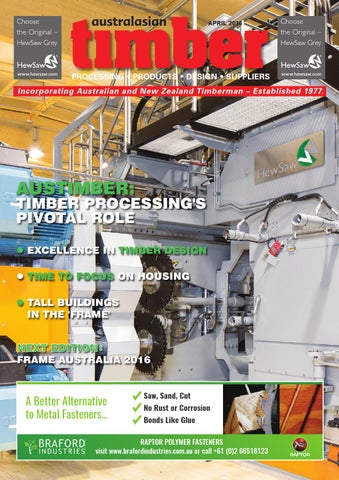
APRIL 2016
PROCESSING • PRODUCTS • DESIGN • SUPPLIERS Incorporating Australian and New Zealand Timberman – Established 1977.
AUSTIMBER:
TIMBER PROCESSING'S PIVOTAL ROLE l EXCELLENCE IN TIMBER DESIGN l TIME TO FOCUS ON HOUSING l TALL BUILDINGS IN THE 'FRAME'
FRAME AUSTRALIA 2016
A Better Alternative to Metal Fasteners...
Saw, Sand, Cut No Rust or Corrosion Bonds Like Glue
RAPTOR POLYMER FASTENERS visit www.brafordindustries.com.au or call +61 (0)2 66518123
Why we put a lot of effort into the nail grid? It‘s simple. That you don‘t have to. www.egger.com/osfloor
Your benefits having a nail grid: saving time during fitting and installation, practical grid size, safety and precision during the construction process. All of that with EGGER OS’FloorTM, the high performance T&G structural flooring board. Available from: Meyer Timber, Hyne Timber, Dindas, Le Messurier, Victorian Timber Wholesalers and Independent Building Supplies N.Z.
NEWS
Is Australian timber destined to be the building material of first choice or ... I am a big proponent for increasing the use of timber building products in modern construction. But, I am concerned that simply promoting the goodness and cleverness of timber building products as the industry’s main raison d’être are not sufficient. I am concerned the industry lacks a precompetitive strategy to make a difference. This article uses my industry observations to make this case.
T
HE DISCUSSION must start by taking an agnostic disposition to the use of timber in modern construction. In my view the timber building products industry must first make its case based on how well they understand their customer needs and then, what timber offers. In March 2015 the Forest Industry Advisor Council produced a Strategic Directions Issues Paper. Issue 5 discussed Consumer and Community engagement. The theme of this chapter was a proposition that “a high level of forest certification should be a major market advantage for Australian forest products domestically and abroad.” But does anyone care? The Strategic Directions Issues Paper may have more usefully identified the real elephant in the room holding the industry back. In my view, that issue is the discord amongst the main players in the Australian timber industry. That discord is such that serious proposals about shaping a more prosperous future for the industry would not make it to the starters block.
Distrust and animosity The animosity and distrust amongst the industry’s key players is the industry’s biggest challenge. It’s the biggest constraint to Architect, Professor Alex de Rijke’s vision for the 21st century to be about engineered timber. Rijke addressed the Parliamentary Friends of Forestry and Forest Products 2015 Industry Dinner in Canberra. Friends I ask? A respected industry practitioner recently shared this observation with me; “I think the industry’s public efforts to date have primarily been about exploring technical possibilities as opposed to saying – what is the job that has to be done?” These comments accord with those from a recent interview I had with the CEO of a major timber products company. I was enquiring about the marketing strategy for a new engineered timber product. His response was, “we just want to build a nice little business and go from there, price points give you options once you have a plant, you can then feed speed
and quality” he said. I’m not sure. I asked this CEO what market did he have in mind for his product. I asked if his product responded to any specific job that had to be done. There was nothing specific. I suggested that his product may fit into a value chain proposition for school buildings and a strategy to make timber products a ‘first choice’ in that market. I expressed a view that achieving a ‘wood first’ position in future education buildings would only be possible if there was a systemic solution to the making, and function of school buildings that was attractive to clients.
This is the second of two discussions by David Chandler about the changes that lay ahead in the global construction market. They aim to provide a context for what this means for southern hemisphere timber building products. This article offers ideas that the Australian and New Zealand wood industry may consider for a more prosperous future in that marketplace.
Collaborative strategy I tendered a view that this would require a collaborative industry strategy. He responded that this would never happen, ‘there is no trust’. He is not alone in these views. This CEO’s view on marketing timber to schools was that, if there were multiple vendors with similar products, then Forrest Wood Products Australia could run a series of promotional seminars for education clients and designers and hand out competitor brochures. I then asked if his products responded to any preferred dimensions that would make it easy to incorporate them into school designs. His answer was that engineered wood and timber could really be any dimension, so any specific preference was not necessary. Oh. So, back to Consumer and Community engagement. I do not believe that making a case for timber can be driven by emotional buy-in to sustainability and forest certification alone. There are too many competing public interests for this appeal to change client buying intentions. But, I think a pre-competitive strategy aimed at optimising the use of timber products in school buildings is a worthy and potentially viable aspiration for the Forest and Wood Products Association to take on. Collaboratively. Such a strategy would need to understand the way school buildings may be designed to incorporate timber along with steel
australasian
¢ David Chandler
and concrete in making procurement and assembly of school building more effective. The challenge here is that designers prefer to offer bespoke designs to their clients.
Recalibrate business models Designers are wedded to the proprietary nature of their designs and that each use should involve a full engagement to conceptualise and document every building. In a way the timber industry responds to this situation by trying not to offend that preference. That’s why engineered wood products are held out as being infinitely flexible, and exotic. But that’s not what the industrialisation and globalisation of construction is about. The future of construction is about organising the many parts that make up buildings from as many standardised sources as possible, and making the sum of those parts meet client needs. There is no room to equivocate about this reality. Clients need to get more for less. That is what every industry that has gone on the smarter, better, safer, faster and cheaper journey has negotiated. Designers and contractors who intend to be part of construction’s future will need to recalibrate their business models to
deal with this inevitability. This will not limit good design and bespoke solutions that enable buildings to ‘fit-in’ with their surrounds. But it will require a changed mindset from the whole of construction’s value chain. These disciplines have not limited other industries where the best compete, by delivering their customers amazing products and services, but increasingly using common core components.
School building design I Googled to see what there was on the generics for school building design, and how these may translate into a ‘timber first’ strategy for those buildings. There is a lot of stuff to help inform an industry that was intending to embark on such a strategy. It was apparent that most school buildings could be designed around a grid of 7.2 metres by 7.2 metres or multiples there-of. The circulation corridors look to have a regular pattern of 2.7 metres wide. This is not surprising. Hospitals tend to work well using an 8.4 metre grid, and there are similar disciplines which favour other building types. You do not need to be a rocket scientist to imagine that a 900mm multiple might offer the timber Continued on page 4
Publisher and Chief Executive: Advertising: J on Bryden Subscriptions: Hartley Higgins j.bryden@ryanmediapl.com.au subs@forestsandtimber.com.au Suite 103, 486 Whitehorse Road, Melbourne: (03) 9888 4834 Adelaide: (08) 8369 9522 Surrey Hills, Victoria, 3127, Accounts: Timber classified: phone (03) 9888 4822 Adelaide: (08) 8369 9555 j.bryden@ryanmediapl.com.au INDEPENDENT & AUSTRALIAN OWNED General Manager: Melbourne: (03) 9888 4834 Postal Address: Elizabeth Bouzoudis 630 Regency Road, Broadview, Production: Luke Westle Editorial: John Hudswell FRONT PAGE PHOTO: Metsä Sawmill in Vilppula, Finland, South Australia 5083 j.hudswell@ryanmediapl.com.au showing access to sawblades. HewSaw photo. HewSaw will Phone: (08) 8369 9555 Adelaide: (08) 8369 9512 be at AUSTimber. Read more on page 14 (part of our special Fax: (08) 8369 9501 Out of office: (08) 7127 6370 AUSTimber feature). Conditions: The opinions expressed in Australasian Timber Magazine are not necessarily the opinions of or endorsed by the editor or publisher unless otherwise stated. All articles submitted for publication become the property of the publisher. All material in Australasian Timber Magazine copyright © Ryan Media. All rights reserved. No part may be reproduced or copied in any form or by any means (graphic, electronic, or mechanical including information and retrieval systems) without written permission of the publisher. While every effort has been made to ensure the accuracy of information, the published will not accept responsibility for errors or omissions, or for any consequences arising from reliance on information published.
MEDIA
magazine Incorporating Australian and New Zealand Timberman – Established 1977.
April Vol.24, No.2 Established 1977 www.timberbiz.com.au
AUSTRALASIAN TIMBER
APRIL 2016
3
NEWS
International News Briefs Boyer Mill celebrates 75th Anniversary
Norske Skog’s Boyer Mill recently celebrated its 75th Anniversary. The mill started production in February 1941 and since that time has produced nearly 13 million tonnes of paper and provided thousands of jobs to four generations of Tasmanians. The mill is one of Tasmania’s major industries and injects over AU$175 million each year into the State’s economy in wages, salaries and expenditure on local goods and services. General Manager Rod Bender said while it was fantastic to celebrate the mill’s achievements it was even more important to acknowledge the contribution of all the men and women who have contributed to that success over the past 75 years.
Brazilian wood-based product exports declined 6.6% in January 2016
In January 2016, Brazilian exports of wood-based products (except pulp and paper) declined 6.6% in value compared to January 2015, from $187.5 million to $175.2 million, ITTO reported. However, pine sawnwood exports increased 13.5% between January 2015 ($17.8 million) and January 2016 ($20.2 million). In terms of volume, exports increased 33.5% year on year in January from 76,400 cubic metres to 102,000 cubic metres. Tropical sawnwood export volumes in January 2016 fell almost 11%, from 27,900 cubic metres in January 2015 to 24,900 cubic metres in January this year. There was an even sharper fall in the value of exports (-21%) from $15.3 million in January last year to $12.1 million this year.
Fact-finding visit is a success
Staff from a Shropshire-based builders’ merchant have been learning more about the products they sell – with an overseas trip to their very source. Nine employees from Tudor Griffiths Group, which is based in Ellesmere, travelled to Sweden to visit a hi-tech sawmill that processes the wood for the Europe, Middle East and North Africa markets. The trip to the Arbor Forest Products site in Braviken was set up to give timber traders an insight into how the products they sell are produced. The team visited the forests where Whitewood and Redwood trees are planted, grown and harvested, as well as the sawmill itself to see the timber being prepared for distribution. They also learned more about the regulations that govern the management of forests producing wood to Forest Stewardship Council and Programme for the Endorsement of Forest Certification standards.
Tree-mendous clothing idea
Nordic pulp makers are developing clean ways to turn birch and pine trees into clothes or sofa covers to help revive their industry and meet demand from fashion and furniture firms for alternative textiles to cotton. There has been no Nordic production of viscose, the main textile fibre from timber, since the last manufacturer stopped nearly a decade ago, partly on environmental grounds. But a 2011 spike in cotton prices contributed to increased global demand for viscose and lyocell, the other major textile fibre from wood pulp. Production is dominated by Austria’s Lenzing, India’s Aditya Birla and China’s Sateri. Three Nordic mills export dissolving pulp, the product that can be turned into textile fiber. The industry would like to see textile fibre factories set up at home that will meet environmental rules and appeal to local firms such as IKEA and Hennes & Mauritz which want to project a green image. 4
Is Australian timber destined to be the building material of first choice or ...
Continued from page 3
products industry and interesting new building block. 900mm in effect becomes the new 600mm. A door width. I then imagined how Forest and Wood Products Australia might engage a few specialist designers of school buildings to come together and develop an industrialised approach to future school building formation and procurement. A sort of BIM meets DfMA convention. I imagined how some practical construction assembly expertise could be added to make sure that the off-site and on-site processes could be optimised to reduce on-site fabrication, to speed up construction by 40 percent, to reduce injury and rework, to reduce waste and lower the embodied energy that was needed to make new school buildings. And to work with clients to understand how future school building may need to adapt, how an integrated supply chain could collaborate to make components that had low maintenance costs and reduced the cost of building operations. And what might be done to create an exciting new school building ‘persona’ where timber products and finishes were preferred by users.
Influencing the next generation I then imagined how a whole new generation of school buildings may positively influence the next generation of wood customers. How those buildings may embody walking the talk about sustainability, responsible sourcing and the importance of forests. And, to excite the next generation about
the new technologies emerging from the use of wood fibres and how products like future computer chips made of fibre will lower the dependence on less sustainable products. How wood fibre is generating new industries, products and jobs. How students may embrace these opportunities. How they may innovate and turn their ideas into new enterprises that have a powerful place in tomorrow’s global economy. How they could use collaborative classroom technology to build regional networks that last a lifetime. And, how important re-growth forests were, and why more need to be planted. Now. I imagined how every student could be given a App that allowed them to design and assemble their own school building. And how the parts of those buildings may be sourced, how they come together and the infinite variations that are possible using those parts. I imagined every school having a 3D printer that used wood fibre in everything it made.
I imagined ... I imagined how today’s social media and marketing technologies could be used to tell this story everywhere. How school children could simply click a QR Code on any component that made up their school building and see how it was made and how it was sourced. I could imagine how grandparent’s day could have a new dimension. Real time sharing of knowledge and excitement. How this may lead to engaging the experience and ability of parents and grandparents to encourage innovation,
entrepreneurism and maybe, to invest. I imagined how such a narrative could be presented to the Parliamentary Friends of Forestry and Forest Products 2016 Industry Dinner. I imagined how such a presentation could justify a national policy buy-in committing to a ‘wood-first’ strategy, enabling timber products to make up 60 percent of new school buildings by 2020. And how that strategy may help seed Australian and IndoPacific leadership in developing new construction industry value chain opportunities. But then I was brought back to reality by my CEO interview, and how just handing out competitor brochures would fall short in such an achieving this aspiration. See: http://www.education.ie/en/ School-Design/Design-Guidance/ Room-Layouts.html ¢ David Chandler OAM, is a construction and housing industry expert. He is an Adjunct Fellow specializing in Modern Construction at Western Sydney University’s School of Computing, Engineering and Mathematics. More information at www.davidchandler.com.au ¢ Notice: This article was commissioned by Forest and Wood Products Australia. It may not be reproduced without approval. Any partial use of this article must be accredited to FWPA and the author.
Fraudulent workers compensation claims By Stephen Booth and Lisa Qiu Coleman Greig Lawyers EVERY EMPLOYER in Australia is required to hold an insurance policy which covers their workers for injuries at work. Most workers compensation claims are genuine and legitimate, and this will generally be evident, especially if the worker has suffered a physical injury. Sometimes, employers will question whether the worker is genuinely suffering from an injury, or at least an injury as serious as is claimed, or if they’re just playing the system. Of course, neither employers nor lawyers can second guess medical assessments. However, that doesn’t mean that as an employer, you just need to accept each claim as it comes, without question. Your best course is to fully brief your insurer and to be actively involved in investigation and management of the case, if you believe there is no injury or that it is being exaggerated. It also doesn’t mean that employees who submit fraudulent workers compensation claims always get away with it. Recently, in the case of R v Allred, the Supreme Court of the ACT imprisoned a worker for two years for submitting a fraudulent workers compensation claim to Government insurer Comcare, ordering the worker repay $64,418.62. Mr Allred, an employee of the ACT Ambulance Service, injured his back on the job in 1991. He AUSTRALASIAN TIMBER
APRIL 2016
received fortnightly payments from Comcare for 20 years. In order to continue receiving compensation, Mr Allred had to submit medical certificates to Comcare about once a year, demonstrating that he was still suffering from his injury and unable to work. However, a Comcare investigation including surveillance and a Federal Police search of his home showed that he had in fact been self-employed as a taxi driver from April 2007 to December 2010, earning approximately $120,000 a year, while still receiving benefits of about $72,000 each year. Had his income as a taxi driver been disclosed to Comcare, he would only have been entitled to about $7,000 each year. Mr Allred not only failed to disclose the fact that he could work, and that he was receiving income other than his workers compensation payments, he also lied to Comcare by stating that he wasn’t working, was unable to work, and wasn’t receiving any income outside of his Comcare payments. The custodial sentence in this case serves as a strong reminder that fraudulent workers compensation claims are not to be taken lightly. The content of this article is intended to provide a general guide to the subject matter. Specialist advice should be sought about your specific circumstances. www.timberbiz.com.au
MPBENGINEERING.COM.AU
VACUUM COATERS Smart solutions for smart timber people
Vacuum Coating advantages: Lower priming costs and increase profit margins Increased speed of painting/priming timber & MDF mouldings Repeatable finish on MDF and timber mouldings Superior finish of priming/painting on timbera & MDF boards Free up your workforce to complete other tasks Reduced waste of your paint and stain products JBN0048
38x6 & INNOVATION WE GUARANTEE QUALITY MPB Engineering
(03) 9702 7933
100% Australian Owned and Operated
NEWS
What’s On 2016 4-6 April 2016 Dubai Woodshow, Dubai World Trade Centre. 6-8 April 2016 Nagoya Protocol Compliance Committee CBD. Montreal, CANADA 11-16 April 2016 AUSTimber (Australia’s premier forestry and timber event), Latrobe City, Victoria. www.austimber.org.au 11–16 April 2016 Sustainable Supply Chains for the Timber Economy of the Future 2016 (in conjunction with AUSTimber 2016) – Traralgon, Victoria, Australia. mbrown2@usc.edu.au 21-23 April PERCEPTION | PREDICTION | ACTION: Managing risk in uncertain times, Freiburg, DE. 25-29 April 2016 IUFRO All-Division 7 Conference: Global change and forest health - climate change, biological invasions, air pollution, forest pathology, forest entomology, and their interactions. Istanbul, Turkey 25-29 April 2016 Twentieth meeting of the Subsidiary Body on Scientific, Technical and Technological Advice. Montreal, Canada 28-30 April 2016 Architects 2016 National Architecture Conference. Theme How Soon Is Now. Adelaide Convention Centre. 2-6 May 2016 First meeting of the Subsidiary Body on Implementation. Montreal, Canada 9-11 May 2016 Advances and Challenges in Managerial Economics and Accounting. Vienna, Austria. 12-13 May 2016 7th International Conference on Biosystems Engineering. Tartu, Estonia 13-15 May 2016 Wood Guangzhou 2016. Poly World Trade Centre. Pazhou.Guangzhou. http://www. muyezhan.com/index.php?lang=en 16-18 May 2016 DANA 1-day (Extended) Central America Timberland Investment and Wood Trade Conference, followed by a 1-day field trip to teak plantations and processing plants. dana@dana. co.nz. 16-19 May 2016 Gene Conservation of Tree Species - Banking on the Future. Chicago, IL. To facilitate the exchange of the latest information, research, and action on the genetic conservation of tree species, especially those species at risk from stressors such as insects, diseases, drought, and development.
XLam appoints new CEO
A
S CROSS laminated timber increasingly excites architects and builders alike, XLam’s growth strategy across Australasia continues with the appointment of its new Chief Executive Officer. Robin Jack, XLam’s co-founder, Director and retiring CEO, joined the XLam Board’s world-wide hunt for his own replacement. Mr Jack said they were focused on finding the right person with extensive experience in the prefabricated construction industry to join the team and lead XLam into an exciting future. “I look forward to the 14th March when I will proudly hand over CEO duties to my appointed successor, Gary Caulfield. “Gary brings us a wealth of world class, innovative construction and exemplary leadership experience. He has successfully delivered major prefabricated construction projects in New Zealand and overseas, including involvement in finance, legal, design and site management. “He knows the construction industry inside out from the perspective of our clients, and this will help us enormously as our involvement with larger commercial projects continues to grow. “We share genuine passion for prefabrication, demonstrated by Gary’s extensive experience and election as a past Chairman of PreFabNZ. “I am thrilled to have secured the services of Gary to lead the company forward, and he will have the support of a highly capable team spearheaded by Sam Leslie, Rob De Brincat, Neil Dodunski and Peter Steadman. The company is in good hands,” Mr Jack said. Those close to Robin Jack know that he has long planned to see XLam move into a new growth stage under a new CEO during 2016, even promising his wife he would step down as CEO by March 2016. His strategic growth plans for XLam and his personal plans are on track while he will retain a keen interest as a Director on the XLam Board. XLam’s Chairman, Martin Kriewaldt has accepted Mr Jack’s notice of retirement as CEO while welcoming his ongoing involvement as a shareholder and Director on the Board. “Mr Jack is a successful entrepreneur with exceptional foresight,” Mr Kriewaldt said. “XLam started as a conversation involving Robin and his brother Ian over a coffee table in 2010. Robin Jack brought a wealth of experience to that coffee table as the long-standing Managing Director of New Zealand’s largest supplier of timber processing machinery. “His hard work, experience and entrepreneurial spirit paid off with the establishment of the Southern Hemisphere’s only cross laminated timber manufacturing plant. “Without doubt, Mr Jack, in partnership with his brother Ian, has furthered the capabilities of locally manufactured timber in construction. “As XLam continues to grow in New Zealand and Australia, Robin, as a Director, will provide valuable influence to its future, while supporting the new CEO,” he said. Mr Kriewaldt expressed his thanks and appreciation to Robin for his years at the helm of XLam, driving
¢ Gary Caulfield, the new CEO of XLam.
¢ Outgoing CEO, Robin Jack
operational innovation and strategic expansion, “I’m sure all the employees, clients and friends of XLam will join me in thanking Robin for his hard work throughout the years of trials, testing, sales and partnerships,” Mr Kriewaldt said. Technical information, case studies, photos and the long list of benefits of using CLT for construction are detailed on the XLam website. To learn more about our XLam’s CLT visit xlam.com.au / xlam.co.nz.
Chair-man of the board! MORE OFTEN than not, pieces of furniture are made up of several pieces of materials all designed, cut, engineered and formed to fit into one coherent whole. The Economical Chair by Korean product designer Seungji Mun is a unique project in the sense that it is made out of a single piece of material with nothing left over or scrapped. The Economical Chair is designed to reduce industrial waste by making use of every inch of a single piece of 4’ x 8′ international standard plywood with no material loss. The simple yet elegant design of the chair allows for four chairs to be made out of the piece of plywood without scrapping any bit of the material. The chair is made out of a square piece of plywood for the backrest that curves under a second rectangular piece that serves as the seat. The legs of the chair are 6
made out of two long pieces curved accordingly to create proper support. All the pieces of plywood are curved through a plywood bending technique. The Economical Chair is the second model in the designer’s Four Brothers project, which aims to reduce industrial waste. The Four Brothers collection consists of four uniquely-designed chairs that are also produced from a single piece of wooden plate. Each chair has a different aesthetic but all four can be produced from a single piece of wood. The project aims to make mass production of the chairs simple, low-cost and without wastage of materials. Seungji Mun studied product and furniture design at Kaywon School of Art and Design in South Korea. He is only one of many designers who are also working toward creating eco-friendly furniture that not only minimize or eliminate industrial waste, but also AUSTRALASIAN TIMBER
APRIL 2016
use materials that are environment-friendly and/or biodegradable. Earlier this year, we were introduced to designer Jean Louis Iratzoki’s Kuskoa Bi Chair, which is the first bio-based biodegradable chair in the market. www.timberbiz.com.au
NEWS
A Crate way to show woodworking prowess!
T
WO STUDENTS from the Australian National University (ANU), School of Art and a highly skilled, Benalla-based woodwork hobbyist, shared a prize pool of $6,000 by winning Create from a Crate - a national, environmentally focused woodwork competition where Australia’s most talented woodworkers, designers and makers take up the challenge of making a beautiful object or furniture piece from two rough and discarded timber pallets. Twenty-year-old student Jeremy Brown, who impressed the judging panel with a sleek, light framed chair he created through hand-cut joinery, was overjoyed by winning first prize. Taking second prize was veteran Create from a Crate entrant David Hall, who has produced items for a number of previous exhibitions. He described the process for making his entry as a ‘sometimes frustrating, but ultimately rewarding exercise’. His Stack of Crates Cabinet is a finely crafted piece that connects with the original use of the timber and incorporates the timbers damages and flaws into considered design features. Clare Solomon, from ANU, came third, with one of the exhibition’s more unexpected entries, a satchel bag constructed using traditional fine woodworking techniques. The President of The Victorian Woodworkers Association, Jerome Wielans, said. it was inspiring to see a new generation of woodworkers
take out prizes alongside one of the association’s most highly skilled and experienced members. “With the current interest in handcrafting and bespoke design, this year’s exhibition showcased a greater number of emerging designers and craftspeople. With their work sitting alongside some of Australia’s most respected and award-winning woodworkers, the 2016 Create from a Crate Exhibition has incredible breadth.” Every year hundreds of thousands of crates and pallets containing goods and components from all over the world are imported into Australia. Much of this packaging ends up in landfill and it is estimated that over 500,000 tonnes of timber waste is disposed of each year in Victoria - enough to fill the MCG one and a half times. Exhibition co-organiser and timber recycler Ward Petherbridge from Waste Converters is often overwhelmed by the sheer magnitude of timber packaging waste discarded in Victoria. “’We recycle around 20,000 tonnes annually and this is just the tip of the iceberg. Much of the timber processed at our site is from exotic timber species such as oak, cherry, maple and elm. I found it depressing that these quality timbers get pulverised into low-grade mulch, so I approached the Victorian Woodworkers Association about hosting the exhibition.” The 2016 Create from a Crate Judges included award-winning woodworker
¢ C lare Solomon, from ANU, came third, with one of the exhibition’s more unexpected entries, a satchel bag constructed using traditional fine woodworking techniques.
Damien Wright, Walker Street Gallery’s Visual Arts Coordinator David O’Halloran, contemporary sculptor and academic Dan Wollmering, and timber recycler Ward Petherbridge. The Australian National University provided a grant to allow five students to enter Create from a Crate and attend the opening.
Softwood timber supply crisis in Australia
AUSTRALIA FACES a huge gulf between the supply of domestically produced softwood timber and consumer demand that will result in more new Australian homes being built from imported timber. New analysis by the Australian Forest Products Association (AFPA) highlights the growing gap between supply and demand for softwood timber products. This shortfall is estimated to be a gulf of up to 1.8 million cubic metres of softwood timber per year by 2035. AFPA Chief Executive Officer Ross Hampton said the gulf equates to 128,000 new homes per year that could, and ideally should, be constructed out of Australian timber. Ron Adams, Managing Director of Wespine Industries in Western Australia, said: “Our sawmill can only work at 70% of its operating capacity due to the lack of available timber and over the longer term this may have to reduce even further.” Mr Jon Kleinschimdt, CEO of Hyne Timber in Queensland, said: “It’s a basic formula: We will need more trees in the future to increase production and remain competitive in a global market.” Plantations in Australia represent more than 80% of wood harvested by the Australian forest products industry. However, investment in new plantations in Australia has come to a standstill. Plantations are vital to downstream industries and many domestic processing plants are not at capacity due to the lack of available timber resource. Establishing new plantations to produce timber for new houses is now vital.
Create from a Crate is a collaboration between The Victorian Woodworkers Association and timber packaging recycler Waste Converters. Exhibition supporters include Walker St Gallery & Arts Centre, The Sustainable Living Festival, Banyule Council, Hatch Contemporary Art Space & Effective Freight Management.
LOAD CONTAINMENT AND PROTECTIVE PACKAGING SYSTEMS
Load Containment Solutions
Signode offers the most innovative packaging solutions to the Timber Industry. Our product range includes strapping systems for all applications and wrapping for product protection. STRAPPING PRODUCTS FOR ALL APPLICATIONS • Signode Polyester Strapping 9mm-32mm suitable for all applications • Full range of Signode steel strapping products Apex, HSA & Magnus
STRAPPING SYSTEMS & HAND TOOLS
• Battery operated hand tools for steel & polyester strapping • Pneumatic and manual strapping tools • Inline fully automatic strapping systems
SIGNODE AUTOMATION • Consultancy • Engineering • Service
www.signode.com.au
PROVIDING INNOVATIVE SOLUTIONS TO THE TIMBER INDUSTRY www.timberbiz.com.au
AUSTRALASIAN TIMBER
APRIL 2016
7
WOOD INNOVATIONS
Wood treatment and innovations focus for May Tech series
T
ECHNOLOGIES TO treat timber with the aim of increasing its durability, reducing its environmental impact and improving its appearance and performance have been the principal focus of two-yearly technology updates for Australasian wood producers. Providing options for better integrating treated wood products with other building materials has also increasingly been a focus as new building and construction systems are being rolled out. The biennial programmes have been designed by this regions specialists in wood products technology transfer, the Forest Industry Engineering Association (FIEA). The programme in question is the very popular Wood Innovations series. By definition, an innovation is something new - a new product, a new service or a new way of doing things. An innovative company tends to be an early adopter of new concepts, products and technologies. It tends to focus on the future and positions itself to adapt to an ever changing environment. “As the name of this year’s technology series suggests, innovation, particularly in timber treatment and wood modification, is the principal focus for Wood Innovations 2016 scheduled for both Australia and New Zealand,”
¢ Brent Apthorp, FIEA Director.
says FIEA Director Brent Apthorp. [Rotorua 24-25 May, Melbourne 31May-1 June] Two years ago the Wood Innovations series provided a timely insight into new and emerging timber preservative formulations, innovative wood treatment processes, changing standards, international developments and issues impacting on local operations along with
Fluid Transfer & Paint System Specialists
Adhesive applicator and paint-line suppliers to the timber manufacturing industry.
Master agents for:
opportunities for growth. “This year, keynote presentations on new wood preservatives and antisapstain systems are being given by Konrad Tittler, President, Diacon Technologies, Canada, Hans Ward, President, Protection Products/Dr Ron Clawson, Global Technology Director, Kop-Coat, USA, Trevor Innes, Technical & Environment, Timberlink Australia/New Zealand and Peter Carruthers, Marketing Manager, Arch Wood Protection” says Mr Apthorp. Alternate wood products to timber treated with wood preservatives are also increasingly making themselves known in the marketplace. Wood plastic composites and modified wood products are a commercial reality, are already being produced in commercial quantities locally and can offer a genuine alternative to more traditional treated timber products. Wood Innovations 2016 will be providing local companies with an update on this rapidly growing market. The scope for expansion for existing wood producers or new businesses is considerable. The global wood plastic composites market for example is expected to reach US$5.4 billion in 2019, expanding at a compounded annual growth rate of around 11% over the next four years. The greatest growth for these products is being projected
to be in the Asia Pacific region. Duncan Mayes, VP R&D & Technology, Stora Enso, Finland, Bror Moldrup, CEO, IWT Moldrup, Denmark, Jeremy Warnes, Business Development Manager, Scion, New Zealand, Ben Campbell, Technical Director, Abodo, New Zealand and Ron Eddy, Managing Director, TimTechChem International, New Zealand will be presenting on opportunities around wood modification and composites for local wood producers. Rather than being seen as a threat, there are real opportunities for local companies to diversify their current operations from the outset. Early adoption of new technology – formulations, treatment processes and new timber products – will provide companies with both product and market diversification. In most instances it will complement existing operations and provide the company with an early competitive advantage. Full details on the event including programmes for both events can be found on the event website, www. woodinnovations.events. To build on the expected turnout of timber treatment companies and suppliers in Melbourne, the Timber Preservers’ Association of Australia (TPAA) will be running both their technical and Council meetings the day before the conference, on Monday 30 May.
‘Condition, pump, measure, apply’
®
W A Stroud Limited 14G Vega Place, Mairangi Bay Auckland, New Zealand
To find out more phone: 1300 650 636
www.strouds.co.nz AUSTRALASIAN TIMBER
The market leader in dry-after timber preservatives, just got even better.
✓ Genuine Low Odour solvent carrier technology ✓ No masking agents or added deodorisers ✓ Convert your existing CCA plant, today!
For further information: Michael Hill Phone: +64 275 673 047 or michaelh@strouds.co.nz
8
New Low Odour Technology
t uc n od tio Pr ova n In
Vacsol® Azure LO
Vacsol® and Tanalised® are registered trademarks of Arch Wood Protection (Aust) Pty Ltd, A Lonza Company.
APRIL 2016
©2015 Lonza
www.timberbiz.com.au
HOUSING
Time for a federal focus on housing supply
“
THE NATIONAL new home building sector has made an outstanding contribution to overall economic activity in Australia over the last four years, as the latest Housing Industry Association National Outlook*- released 16 March - clearly demonstrates,” said HIA Chief Economist, Dr Harley Dale. “Without this contribution from residential construction the domestic economy would have been considerably weaker than has turned out to be the case over recent years.” “Looking beyond the current cycle, a strong focus on housing supply and policy reform is crucial to Australia’s future economic and social prosperity as we look to successfully house a growing and ageing population, along the way reducing pressures on the nation’s burgeoning health budget,” said Harley Dale. “Australia will fail to achieve this objective without federal government leadership and involvement in housing policy reform, including strategic planning for the future housing and residential infrastructure requirements of our growing and ageing population.” “Tinkering with negative gearing and capital gains tax provisions doesn’t represent real reform, but risks damaging confidence towards the housing industry at a crucial juncture in the cycle. A key finding in the latest HIA National Outlook is that a peak in new home building activity will be followed by a significant cyclical downturn extending to 2017/18.” New dwelling commencements are forecast to decline from a record peak of 220,000 last year to a trough of around 160,000 in 2017/18, while the
growth in residential property prices will continue to slow. “The outlook for renovations investment, which is recovering from a 12 year low, is looking a little brighter,” said Harley Dale. “Having grown by just 0.9 per cent during the 2014/15 financial year, renovations investment is forecast to grow by 2.8 per cent in 2015/16. Growth is anticipated to increase by a further 1.7 per cent in 2016/17, with activity then projected to see modest yet steady increases out to the end of the decade.” “This outlook for the renovations
sector doesn’t look like shooting the lights out, but it is considerably more promising than what we have faced for some years now,” concluded Harley Dale. “As with the new home building outlook, if we delve below the national surface there will continue to be a wide divergence in conditions for renovations activity across states and
Changing CGT won’t fix housing’s woes CHANGING CAPITAL Gains Tax (CGT) isn’t the answer to address housing affordability and supply problems, according to the Housing Industry Association (HIA). “Improving housing affordability and home ownership rates needs to be a focus of all parties in the upcoming federal election,” says HIA Chief Executive Industry Policy and Media, Graham Wolfe. “The announcement by the Opposition that it intends to halve the capital gains discount on investment properties will, in our view, not achieve these objectives. “Reducing the CGT discount, which is an important measure to recognise the net present value of an asset, will push investment away from Australia’s housing sector. “The Henry Tax review rightly concluded that addressing the supply side impediments to new housing had to be the priority focus, including: reducing stamp duty; alleviating land supply restrictions; addressing onerous planning controls; and delivering housing infrastructure in an equitable and timely manner,” said Mr Wolfe www.timberbiz.com.au
ATS
Advanced Timber Systems
“Research conducted by Independent Economics on behalf of the HIA – using a model also applied by the Commonwealth Treasury - confirmed that restricting access to negative gearing for residential property would reduce investment in housing, erode housing affordability and put upward pressure on rents,” he said. “The priority for tax reform of housing must be to reduce the tax burden on new home buyers. The level of taxation on a new house and land package can be up to 44% of the final price, which far outweighs the positive benefits to investment in new housing to support the rental market, of the current CGT or negative gearing regimes. “Now is a pivotal time for investment in new housing, which has implications for affordability and the broader economy, with starts expected to decline over the year ahead. Any changes to taxation with respect to housing must be aimed at boosting housing supply, and reducing the overall tax burden on the sector,” said Mr Wolfe. AUSTRALASIAN TIMBER
territories over coming years.” HIA’s National and State Outlooks are Australia’s most comprehensive housing report card, encompassing renovations activity, new home building, policy updates, global and domestic economic analysis, and dedicated state and territory housing databases.
61 Briggs Road, Raceview QLD 4305 Ph: 07 3288 8170 Fax: 07 3288 8176 Email: info@timbersystems.com.au Web: www.timbersystems.com.au
APRIL 2016
9
TIMBER DESIGN AWARDS
Entries now being taken for Australia’s premier timber design awards
E
ntries Are now open for the 17th Annual Australian Timber Design Awards. The awards, are distinguished by a proud heritage of innovation and achievement. This much-vaunted national competition is open to architects, landscape architects, building and interior designers, and engineers. There is an array of categories available to cover all types of timber projects and use of timber products. Entries close 30 June with winners being announced. in Sydney at the awards presentation night in September. Entry is open to architects, builders, building designers, engineers, and students. That is, to anyone involved in the design or building of suitable architectural structures or elements. Where the original design concept provider is not the entrant, please nominate who the original concept designer (company) is. And if the designer is from two or more companies, please provide their
details as well. If you are not the original designer or if the design was a collaborative effort, please also consider that they may have entered as well. Please check with them to ensure that two entries have not been made (where two entries are received for the same project, the entrants will be asked to combine the entry and to determine how the designers are to be acknowledged). Entries must be based on projects that make significant use of timber. Projects must be architectural structures or elements of architectural structures; this may include furniture or joinery. Suitable projects include new buildings, alterations and additions, renovations, interior fit-outs, landscaping and standalone timber structures such as bridges, foreshore developments or sculptures. Furniture and/or joinery may be entered into the Furniture and Joinery category. See the list of entry categories on the entry page.
¢ 2 015 winner ... John Wardle Architects & NADAAA in collaboration Melbourne School of Design - The University of Melbourne
Projects must be completed by the date of entry and not prior to July 1, 2013. All projects must be located in Australia. A project that has previously been entered into the Australian Timber Design Awards may be entered again. It may not, however, be considered for any entry category into which it was previously submitted. The 2015 Australian Timber Design Award was awarded to John Wardle Architects and NADAAA for the
Melbourne School of Design, an inspiring example of complex green design. The three-storey Melbourne School of Design is a showcase of the very best that can be achieved with structural timber. LVL engineered box beams and coffers span its 20 metre wide atrium, acting both as sun shades and structural restraints. Judges were effusive in their praise for the manner in which the timber framed and lined building envelope is suspended from two of the overhead LVL beams.
Now that’s what you call a ‘green’building! EURATLANTIQUE IS a vast 800,000 square metre-masterplan centered on Bordeaux’s Saint-Jean Railway Station. The program was created in light of a new high speed train connection with Paris, and seeks to establish Bordeaux as a leading European city. As part of the development, Sou Fujimoto has teamed up with French practice laisné Roussel to propose a series of timber towers that climb to a total height of 50 metres. Titled ‘Canopia’, the mixed-use scheme includes residential units, offices, and retail outlets. Measuring 17,000 square metres, the project comprises four towers each densely populated with trees and other vegetation. Commercial space is housed at lower levels, with apartments stacked 10
above. Private balconies become larger as the building ascends, providing more room for greenery and plantation. This culminates in four rooftop gardens, each with their own distinct atmosphere. The terraces are connected with the remainder of the scheme horizontally, as well as vertically, allowing users to navigate between gardens and towers. “What sets this project apart is the proposal for a collection of themed rooftop gardens connected by walkways,” explains the design team. “Particular attention has been paid to delivering quality shared spaces, both on the fringes of the site with the terrace gardens, or at the heart of the development with the green oasis.” Residents are thus given access to a series of gardens: an agricultural space with vegetable allotments, fruit
trees, vines, a compost area, water reservoirs, a winter garden, a terrace for the restaurant, and a rooftop playground. The wooden frame is constructed from silver fir or spruce beams and posts, with floors made from crosslaminated timber. Glulam bars are incorporated into the frame to help stabilize the tower. Apartments offer inhabitants at least one private balcony — many include more — or even an external terrace that wraps around the entirety of the residence. At ground level, a park sits at the centre of the scheme, encouraging pedestrian movement across the site. This configuration is also an attempt to ensure that the development exists comfortably within its context, attracting passersby from the adjacent tram stop.
AUSTRALASIAN TIMBER
APRIL 2016
www.timberbiz.com.au
Australia’s biggest Forest products Expo is on again! Traralgon, Victoria 11-16 April, 2016 * Over 80 brands exhibiting at the world famous Expo * Speakers from countries as diverse as Canada, Japan, Brazil, Malaysia, South Africa, Chile and New Zealand at the international Sustainable Supply Chains for the Timber Economy of the Future conference * Industry field trips to venues ranging from steep terrain logging to the largest hardwood mill in Australia, the largest pulp and paper mill in Australia and highly specialised plantation and sawmilling sites * The Wood - the Intelligent Alternative seminar covering the exciting manufacturing opportunities presented by the new National Construction Code coming into play at the start of May * The traditional Welcome Dinner (this time featuring David Foster as MC) with its charity auction offering a range of interesting lots looking to beat the record result achieved at AUSTimber2012. * The Komatsu Forwarder competition with a prize of $2,500 to go with the bragging rights of being the best operator * The VicForests Wood Chop with a variety of events including cross-cut sawing, tree climb and Production Hot Saw racing * Two hour drive from Melbourne To book your tickets and search local accommodation, go to www.austimber.org.au Sponsored by:
Supported by:
AUSTIMBER 2016
Timber processing sector plays pivotal role
A
USTIMBER IS internationally renowned as a world-class forest expo and the organisers are looking to build on that reputation in the processing sector at AUSTimber2016. And the reason, according to AUSTimber General Manager Laurie Martin, is simply because of the interconnection of all sectors of the timber industry and the role the event plays in furthering that connection with the general public. “If we can encourage more people to consider new technologies to add further value to the wood fibre grown in this country there is the possibility we can help grow the entire timber industry in Australia,” he said. Laurie explained that the first step was to work with Latrobe City, hosts of the event, to help them see the economic sense of encouraging the development of the sector in their region. “The council was aware they needed to encourage manufacturing enterprises in a carbonconstrained world and, given the major contribution the timber industry already makes to the local economy, they quickly saw the benefits that might
Where and when Schools Field Trips 11-12 April. VICAL (Victorian Certificate of Applied learning students from Years 11-12) excursions to certified sustainable plantation, certified sustainable timber products producer, productive native forest coupe, and Australian Paper. Sustainable Supply Chains conference 12-13 April from 8am. Latrobe Performing Arts Centre, Grey Street, Traralgon. AFCA Hall of Fame Dinner 13 April. Premier Function Centre, Traralgon Industry Field Trips 14 April Industry-led initiatives for safety issues 14 April 3-5pm. Macfarlane Burnet Room, Traralgon Service Centre. ForestWorks will host this session about the opportunities for industry-led initiatives to manage safety issues facing the industry.
accrue by adopting a policy similar to the Wood First policies already in place in Canada and Japan. “Latrobe City became the first municipality in Australasia to ¢ L aurie Martin develop a Wood Encouragement policy with a number of others on both sides of the Tasman having either now adopted or actively considering such policies in their own area.” “By appealing to the interests of local government, we are looking to open up new avenues for reference sites (public buildings), tap into any possible economic development support for new manufacturing clusters and encourage planning departments to look for ways to encourage rather than discourage the greater use of timber in construction,” Laurie said.
Wood – the Intelligent Alternative (seminar) 15 April 10am-1pm. Traralgon Recreation Reserve Exhibition and Demonstration field days at two active sites 15-16 April - The Traralgon Showgrounds Manufacturing site will have a marquee sites for exhibiting and demonstrating the latest developments in timber processing equipment, systems and connectors for pre-fabrication manufacturers, displays of timber and panel products and treatments for designers, as well as a model display demonstrating the construction possibilities afforded by the use of massive timber. The Flynn Creek In-forest site (accessible only by buses leaving the Showgrounds site) will feature outdoor static sites, in-forest displays, live harvesting and forwarding/ skidding demonstrations, live in-field chipping demonstrations and exhibitions, truck & trailer test drives and a practical safety workshop.
Major projects in Canada and Australia CARBOTECH IS heading full force into 2016 with two major contracts in Quebec and Australia. Carbotech is the chosen supplier for Arbec Forest Products in Quebec and Timberlink in southern Australia for major projects. Major modifications to the Arbec sawmill stacking line in Parent, Quebec, consist of installing Carbotech’s cutting-edge, high-speed, dual-forked stacker and its row preparation. Carbotech will also be installing its fully automated stick placer system in order to optimize stacking efficiency. The equipment installation will be completed by Carbotech later this year. Carbotech will be installing two optimized trim lines at Timberlink’s Mount Gambier sawmill facility in early 2017, and has partnered with the Australian company, Acora, in order to offer a turnkey project. Acora specializes in the sale and installation of equipment for planer mills and sawmills. In terms of control and optimization, Carbotech will work for the second time on Australian soil in conjunction with MPM Optimization of Vancouver, Canada. Specifically, the project consists of installing two parallel trim lines each including an unscrambler, a pneumatic 12
lug loader, an Optigate positioning system and a Carbotech dual-access lineshaft trimmer. Under new ownership and boasting a new management team, Carbotech’s main goal is to be attentive to clients’ needs by offering highly efficient solutions for sawmill and planer mill lumber handling. Having reinforced their presence on a local and international level over the past year, these orders early in 2016 serve only to solidify, once and for all, the efforts made by Carbotech’s customer service and engineering departments. Carbotech specializes in maximizing production operations and efficiency for highspeed sawmill and planer mill lumber handling. Working continually to develop new ideas and patents, Carbotech is a guaranteed one-ofa-kind partner in this market. They have an amazing workforce of 100 employees that they can rely on no matter what. Their mission over the past 30 years has focused on the following four principles: speed, precision, know-how and toughness. Carbotech has a number of business partners, parts & service distribution centres as well as mechanical intervention centres to cover their markets around the world. AUSTRALASIAN TIMBER
APRIL 2016
Wood – the Intelligent Alternative Friday 15 April, 2016 – 10am-1pm, Traralgon Recreation Reserve
P
LANNING, MANUFACTURING and constructing with timber offers exciting new design opportunities while also providing enormous economic benefits. This seminar will provide Local Government officers and commercial developers alike, insights into capitalising on the potential that timber provides for sustainable, economic development.
Making it simple The economic benefits of constructing buildings up to 25 metres (eight storeys) using timber. What the new National Construction Code (coming into practice on 1 May) will allow without the need for additional approvals. Presented by Dr Alastair Woodard, structural engineer and Vic Program Manager, WoodSolutions.
Brave new world A presentation on the use of prefabricated timber components to retrofit an existing building. Exploration of the use of 5-axis machined Cross Laminated Timber panels to achieve apartments with greater space, light and economy than achieved using concrete and steel. Presented by representative/s of Independents’ Group (IG) Fellowship program - RMIT
Applying what we know The use of prefabricated Frames and Trusses is very common in single unit house construction but the potential for mid-rise frames, panels and trusses is great. Presented by Mr Daniel Scheibmair, Pryda
European efficiency meets tight market demands CLT has major benefits for major buildings but, at the human level, it also enables economic delivery of low-rise social housing. Presented by Mr Erkki Valikangas, Stora Enso
There is still room for the artisan It’s not all about being big. Small scale, bespoke production for prefabricated construction can yield good economic outcomes. The development of the prefabricated house that won the 2014 Australian Timber Design Awards’ Excellence in Timber Design - Small Budget Project category. Presented by Ms Sunny Wilder, Wilder Coyle Furniture and Design
Go on, inspire me! Building owners, developers and local authorities are seeing the benefit of creating innovative timber buildings to address the issues of cost, speed, environmental concerns and community aesthetics. Examples of Australian and international projects which exemplify these qualities, and have the potential to assist the expansion/creation of timber-based, advanced-manufacturing enterprises. Presented by James Fitzpatrick, Managing Partner Fitzpatrick+Partners - architects To register for this seminar, go to www. austimber.org.au/wood-the-intelligentalternative/
www.timberbiz.com.au
AUSTIMBER 2016
Gilbert introduces the new S-Series Planer ACORA WILL be at AUSTimber this year with their representatives from overseas. Gilbert is proud to introduce the new S-Series Planer. Ideal for small to mid-sized lumber operations, the S-Series Planer is designed to run at feed speeds from 50 to 400 MPM and is the ultimate machine to produce value added products. The S-Series is the latest addition to Gilbert’s high-performing line of planers. “This new model offers the same renowned Gilbert technology in a smaller machine,” said Heidi Danbrook, Sales Manager Planer Division. “Many customers have expressed that they do not require a high speed planer line but they would like the higher quality finish, increased accuracy and decreased setup times that newer model planers can offer.’’ With the S-Series Planer, Gilbert reaches out to many different types of clientele, specializing in value added manufactured wood products like moulding and millwork, remanufacturing, finger jointing, cedar and small to mid- sized lumber operations. The S-Series uses the unique-toGilbert “Pull-Through” technology for high running uptime and productivity. The same Automatic Cutterhead Positioning System is installed to control all cutterheads and axes for efficient changeovers and higher grade finished lumber. Its compact design can fit very well into existing layouts. “We look forward to two successful start-ups of the S-Series Planer this spring in Curitiba, Brazil,and are very thankful to work with two new
¢ Gilbert high-performing S-Series Planer.
Brazilian customers,” added Ms Danbrook. For over 30 years, Gilbert has been a leader in the design and manufacturing of forestry, sawmilling, construction equipment and snow groomers: nearly 100 Gilbert planers have been installed worldwide. The company, located in Roberval, Canada, employs more than 100 workers dedicated to offering the best planer technology on the market.
Mathieu from Carbotech will also be on site to present the latest projects that Carbotech have completed and to assist with any queries clients have on the latest developments in trimming, lug loading, board positioning, sorting and stacking lines, fast/slow / hardwood/softwood. And Francis from DO2 will be returning to catch up with the customers who have shown so much interest in their innovative package
wrapping system and to update on their latest developments. “We are still finalizing some other displays and suppliers, but we assure you of a really interesting display booth and some warm hospitality, so please drop by and say hello,” said Acora Managing Director Roger Timms.
Tried and trusted for over 30 years!
The same industry-leading news, views and ad’s you’re reading in this issue are now available on-line as well. While we know print is the most convenient form for reading in the yard, lunchroom or highlighting an important point for the next reader, we also know that many of our readers want to go straight to websites or send emails or links from the articles and ad’s they’re reading.
MEDIA
Now available on-line Visit www.timberbiz.com.au/atm today to view your copy online
I N D E P E N D E N T & FA M I LY O W N E D
www.timberbiz.com.au
AUSTRALASIAN TIMBER
APRIL 2016
13
AUSTIMBER 2016
HewSaw’s major presence at AUSTimber2016
A
T AUSTIMBER 2016, HewSaw Pty Ltd will be presenting with a double booth in the Main Pavillion. This year, HewSaw will be joined by Francois Giguere of Prologic Plus from Canada, Aaron Taitoko of Tui Technology Ltd from New Zealand and Keijo Lamminen of Nordautomation Oy from Finland. Sami Helminen (Senior Project Engineer and Area Manager from HewSaw) will be joined by Sam Rowe (Regional Sales Manager for Australia and New Zealand) and Peter Haintz (Operations Manager for HewSaw Pty Ltd). Any potential projects can be discussed with the HewSaw team, as HewSaw build single pass sawmills and complete sawlines from 40,000m3 pa to 1,000,000m3 pa log input capacity and more; high value recovery from small logs or larger logs up to 550mm. AUSTimber 2016 is the ideal location to explore opportunities at the HewSaw booths (21 and 32) as the complimentary knowledge of visiting experts can add a lot of value to the discussion. Nordautomation are experts in design and construction of log sorting lines, sawmill intakes, and residue handling and Sales Director Keijo Lamminen has visited Australia and New Zealand previously and is familiar with the species and conditions.
Aaron Taitoko will be able to fully present the impressive capability of Tui Technology to completely automate any project and offer valuable insights to process improvement, safety systems and latest control options. Prologic Plus can also present log sorting, sawing and trimming scan solutions from simple to complete 3D Tru-Shape scanning and optimisation hardware and software to really extract as much recovery as possible from any project. Information on some new HewSaw sideboard grading and optimisation will be discussed, as well as online edging and multi-sawing, and sawing centre cants with on-line splitting of all or outer boards with the HewSaw CRS system. HewSaw is a third generation family owned company, based in Mäntyharju, Finland, that celebrated its 50th anniversary in 2014. Always keen to innovate, HewSaw expanded its manufacturing operations opening a new, modern 2,000m2 fabrication facility representing a €2,500,000 investment on February 8.
www.hewsaw.com
Choose the Original www.hewsaw.com ¢ M arkku Rautio, Managing Director of HewSaw, opens the new fabrication facility - out of the dark and into the light
¢ Metsä Sawmill in Vilppula, Finland, Scan zone
¢ S imple opening ceremony of new facility
¢ Metsä Sawmill in Vilppula, Finland. Access to sawblades
14
AUSTRALASIAN TIMBER
¢ BSW Sawmill in Scotland
APRIL 2016
www.timberbiz.com.au
AUSTIMBER 2016
Getting equipment finance right The hidden dangers of concentration risk By Mark O’Donoghue
M
ANY BUSINESS owners are blissfully unaware that financing equipment through their existing bank usually has that equipment debt “bootstrapped” to any other securities the bank may hold (such as properties and other owned assets within the business). This bootstrapping typically comes in two forms:1. Cross Collateralisation Clauses (which sees all debt with the bank secured by all security held by the bank) 2. General Security Agreements (GSA) which is the new term for the old Fixed and Floating Charges or Registered Equitable Mortgages (REM). Which means the bank owns all assets of the business under this GSA. Typically the banks do not go out of their way to tell business owners about these overarching securities, however it is most often the reality and a simple company search will tell a business owner if a GSA is in place over their business. Finally, the sleeping dragon in this situation most often rears its head when a business looks to change banks and the outgoing bank insists upon all equipment finance being paid out and the penalties incurred on contracts which are early to mid-term at that point. As an indication of those penalties, the cost to terminate a $1 million equipment loan which is one year into a five year transaction is typically in the order of $40,000. In a world where there are a dozen or so competitive banks and financiers keen to finance equipment in its own right without this bootstrapping, a company’s existing bank is probably the worst place to have their equipment debt. The existing bank does have a role to play in funding working capital such as overdrafts as well as property based requirements and under these circumstances, the bank having the benefit of property equity via mortgages over properties is completely relevant and commercially acceptable. The provision of a GSA to a bank should only ever be granted by a business as a last resort as it is in effect the granting of a mortgage to the bank over the entire company.
following is worth noting:At 6% the payments are $13,530 p/m At 5% the payments are $12,935 p/m The difference of $595 p/m over the 60 month term is $35,700. To put this into perspective, where a business has a net profit margin of 5%, an additional $700,000 in turnover is required to offset this additional $35,700 cost, so attention to the cost of finance is always a worthwhile exercise.
Keeping the cash under control As any prudent business owner would know, the prospect of significant additional work comes with its own challenges. At face value, increased turnover and greater profit through a combination of gross margin and improved economies of scale paint an attractive picture at a basic P&L level, however there is much to control through this process. As an equipment financier in Capital Intensive Industries with 25 years under our belt, we are acutely aware of the challenges that come with opportunity. The 60 - 75 day cash lag that exists between paying for the additional machines (and labour to operate them) and physical payment for the work in your account is one of these challenges. There are several simple levers that can be used to minimise this significant gap:Finance new machinery with monthly payments in arrears instead of in advance, this is commonly available through financiers and immediately reduces that component of the cash gap by 30 days. Look to refinance any existing equipment over an extended time (being
mindful of its effective life in your fleet and its market value, both now and at the end of any subsequent debt period). A large number of financiers are now happy to refinance machines within 12 months of existing contract termination. The benefit to the business owners is that any early termination cost is minimal in the final 12 months and current interest rates are typically 2% lower than the interest rates of the initial transactions. This structure is particularly attractive where residuals or balloons are present on the existing facilities as they typically need to be refinanced later anyway. Prudently done, companies can see existing outgoings reduced substantially providing “head room” within existing cash outflows to take on additional equipment with minimal cash flow pain. Quality used equipment including private sales can easily be financed, saving businesses significant dollars on the cost of new equipment. Care does need to be taken around ensuring clear title on private sale assets, including company searches on the vendor to ensure there is no dedicated debt on the asset or overarching GSA by their bank. A simple PPSR search will show up on any interests held on those assets being sold. Major refurbishments of existing plant can also be financed on a term equipment debt, no different to repowering the engines of an aircraft where the value of the aircraft is substantially increased through this process. Where company principals are contemplating increased overdraft facilities, this should be addressed sooner than later as it easier to do it in a planned timely way than in a hurry later when cash is tight. If you are not sure if your bank is being as assistive
¢ M ark O’Donoghue is the founder and CEO of Finlease.
as they should, simply ask a couple of other banks to pitch for your business, they will do all of the work and usually provide attractive alternatives. You can then go back to your bank, ask them to improve their offer or lose your account. Finally, if all other areas of flexible low-cost debt are tapped out, the prudent short to medium term use of a debtor discounting facility has a place for expanding businesses to bridge the cash flow gap until such times as the cash from profitable increased trading hits the bank account. Please do not use delayed payments to the ATO as the quasi overdraft as this has a high likelihood of ending badly. Not only from the perspective that the ATO is significantly ramping up collection activity and liquidating an increasing number of companies, but also from a financing perspective as lowcost lenders are increasingly refusing to finance companies with tax arrears.
Spreading the risk Many businesses spread their equipment debt across three or four financiers as this creates a stable platform of supportive lenders for future growth as well as creating competition between those financiers to ensure competitive structures and rates are provided. This can be done by the client or through the use of a capable finance broker. Remember, these lenders have no other asset as hard security other than the equipment they have financed.
The true effect of interest rates In this increasingly competitive environment where business owners are constantly squeezed on margins, any saving in expenses is beneficial. Based on a simple $1 million debt over a five year term with a 40% balloon, the www.timberbiz.com.au
AUSTRALASIAN TIMBER
APRIL 2016
15
ENGINEERED WOOD
Latest Accoya-clad structure is bee-utiful!
A
CCOYA®, THE world-leading modified wood manufactured by Accsys Technologies, has been used to create a giant beehive structure in the Netherlands. The beehive, also known as a melarium, was designed as an art structure and centre to be used and enjoyed by the public, scientists, beekeepers and bees. The structure contains nine beehives. In total, 14m3 of Accoya was used for the melarium, which comes from the Latin name for honey. A significant proportion of Accoya was used as a sheet pile wall in front of a steel frame. The Accoya was then perforated with over 3000, 50mm round holes, which represent the lenses of a bee’s eye. The building, based in central Delft, was commissioned by the province of South Holland in north-western Netherlands. The beehive is now a key landmark within the surrounding countryside and it’s hoped that it will encourage communication and participation by the local community. The project’s designer, David Veldhoen explains: “The melarium is a very special building, and came with a unique set of challenges. Combining
steel and wood in construction can be complicated and the building required a wood product that was as maintenance free as possible and one which could easily be constructed around the frame. “Accoya was the only choice for us. With no requirement for ongoing maintenance it means that there is no need for any regular application of paint or wood treatments. The wood itself naturally repels fungus and rot and is indigestible to most insects. The unusual shape meant that we needed a versatile product, and Accoya was the only product able to achieve this.” Bees from the building use one row of open holes in the Accoya façade to travel to the nearby nature reserve. The unique building is complemented by a public staircase for visitors which includes a glass window overlooking the bees and beekeepers. There is also a roof terrace on top of the building which provides views over the nature reserve. Laura Ladd, head of marketing for Accsys Technologies, said of the project: “The Accoya melarium is one of the more unique projects that we have seen Accoya specified for. Accoya is long lasting and dimensionally stable,
allowing it to fit easily with the steel frame. Accoya was the only viable choice of wood for this development and was more suitable than tropical hardwood. The final effect is very impressive and perfectly demonstrates what can be done with Accoya.” Accoya is non-toxic, providing a perfect natural environment for bees. The process of developing Accoya adds nothing to the wood that doesn’t already occur naturally. Created using a propriety process which applies the latest acetylation technology, Accoya is a highly durable wood product, which is suitable for a wide range of applications and treatments to be applied easily for long-lasting effect. Accoya’s unique modification process creates one of the most advanced modified wood products on the market delivering outstanding levels of performance, stability and durability. Accoya wood is distributed through Agora, Britton Timber and Matthews Timber in Australia. Recent field and lab testing conducted by the Australian Forest Research Company (AFRC) in Melbourne shows that Accoya offers exceptional durability against termite and fungal decay.
Trade Barriers - It’s what you can’t see that really hurts! ALL THE talk right now is about how export industries in New Zealand benefit from the removal of tariff barriers. Tariff barriers to overseas trade are generally easy to see and their impacts are well understood. The TPPA has done a good job of identifying tariffs and knocking them out. That said, until much more attention is paid to eliminating non-tariff barriers the full benefit of free trade agreements will not be attained. “Non-tariff barriers are effective in restricting access to foreign markets because they are not directly visible and are hard to quantify,” says Brian Stanley, Chair of the Wood Council of New Zealand (Woodco). “This makes them very tricky for exporters to tackle.” Woodco has just released a report that points to the non-tariff barriers that NZ wood product exporters are up against. The study finds that even when tariffs are low or non-existent, the barriers that remain to NZ wood exports are significant. The removal of these non-tariff barriers will potentially 16
have higher gains for the NZ economy than the removal of tariff barriers. Non-tariff barriers overseas protect domestic markets and artificially stimulate exports. They can emanate, for example, from government laws, regulations and policies. NZ exporters will recognize them as red-tape all adding significantly to the cost of doing business overseas. As tariff barriers fall so non-tariff barriers multiply in their place. The WTO has recently estimated that the number of trade-restrictive measures in effect in 2015 is now around three times greater than the number operating in 2010. “Non-tariff barriers are only growing in number and costing NZ industry millions of dollars. We need the NZ Government to pay urgent attention to overcoming these,” added Mr Stanley. NZ’s forest and wood sector is particularly exposed to non-tariff barriers in international markets. With 86% of the world’s forests publically owned it is no surprise that overseas governments are heavily AUSTRALASIAN TIMBER
APRIL 2016
involved in subsidising their forest growing and wood processing sectors. “In NZ, where forestry and wood processing has been in private hands for decades we have relied upon new technology, efficiency and scale to maintain a competitive edge. “I am very concerned that there is, however, a limit to how far these technical measures can take the NZ industry when up against an international playing field that is forever tilting against you. “As an industry we are continuing to run faster to keep pace with competitors in countries where state subsidies and a myriad of other support measures are the norm. We urge our trade officials to read and act upon this report. We must go into trade negotiations with a much more comprehensive understanding of the impact of non-tariff trade barriers and how to remove them,” Mr Stanley said.
www.timberbiz.com.au
FRAME
Frame 2016 coincides with tall timber buildings
A
USTRALIA’S GROWING urban population is having a major impact on property development from increasing density of living in inner and middle suburbs within our cities, encouraging construction of mid-rise and high-rise multi-residential apartments to meet demand. Commercial property developers are seeking more efficient methods to meet the challenges of construction in this competitive sector, with a solution emerging from the utilisation of timber and engineered wood construction systems. A major breakthrough for the construction sector to consider taller timber buildings is the 2016 National Construction Code, which includes provisions for the use of both lightweight and mass timber construction up to an effective building height of 25m (up to eight storeys), effective from May this year. In a coincidence of timing, the national conference Frame Australia 2016 is being held on 23 May at Park Hyatt Melbourne with the theme “Building construction with prefabricated timber and engineered wood”. Presentations will cover the NCC code changes and new opportunities, with topics for both major sectors of prefabricated timber and engineered wood; and building design and construction; held in parallel sessions to enable a one day program. “Timber and wood construction is a
viable alternative to current systems, due to much faster construction, site safety improvements, less complexity on site, and lower overall construction costs,” said Conference Director Kevin Ezard. Kevin said the global trend was for greater ‘off-site’ construction using prefabricated and/or modular building components and units manufactured for assembly on-site, to remove trade-based work on-site to factory production of buildings, particularly for multiresidential projects. Prefab and modular systems of construction are well developed in Europe, with most countries increasingly using production-line manufactured housing, with the pre-fab concept expanding to a very wide range of building components and subassemblies. Some countries in Europe produce from 25% to over 50% of all housing with fully closed wall and roof systems, which due to the superior quality of factory built houses in some markets are sold at a premium price due to the acknowledged quality levels and savings from lower energy usage. A similar trend is under way in Australia and the past year has seen a rapid rise in acceptance of prefabricated systems for housing and multiresidential construction. With the large volume of off-site and prefabricated construction in Europe, the main global equipment suppliers based there are currently providing the majority of production line equipment
Frame conference attracts designers BUILDERS AND designers are enthusiastic about the future possibilities with taller timber buildings to apply from May 1 in the National Construction Code, which is a major breakthrough for the timber and construction sectors. The major national event Frame Australia Conference and Exhibition will be held just three weeks later on Monday 23 May at Park Hyatt Melbourne, and attendance is expected to be an all-time high with delegates already registering to attend. The conference theme “Building construction with prefabricated timber and engineered wood” speaker sessions will cover the vast potential for timber building systems in multi-residential construction, with presentations by architects, engineers, developers and builders, along with speakers on engineered timber and prefabrication. Program highlights include Australia’s largest timber apartment projects currently underway, how to save 25% in construction costs, automated and robotic manufacturing of prefabricated timber frames, and the latest on fully panelised floors and walls for housing. Speakers from Europe, Canada, USA and local experts will present in parallel sessions on building design and construction topics, and www.timberbiz.com.au
on timber prefabrication topics, to enable a one day event program. Conference director Kevin Ezard said “It will be a fantastic program with a wide range of subjects including creative architecture, engineering solutions, timber construction systems and cost comparisons, plus the latest in prefabrication of lightweight timber and mass timber CLT buildings”. “Our Principal Supporter will again be WoodSolutions in their role of providing technical advice and assistance to designers and builders considering the construction benefits from these new timber building systems now emerging in Australia”. Kevin added “The exhibition booths at Frame 2016 will provide suppliers a unique opportunity to showcase their market offer and interact with delegates from building design and construction; engineered wood; and timber prefabrication systems. “The Frame event plays a pivotal role in bringing together the complete supply chain of timber and prefabrication with building design and construction to develop communication and relationships for future business opportunities,” he concluded.
for local manufacturing plants. Commercial developers and builders in Australia are now investing in manufacture of prefabricated off-site construction systems, which is resulting in a sharp rise in new manufacturing facilities to produce panellised wall and floor systems using lightweight timber and mass wood systems. Currently in NSW and Victoria there are six highly automated prefabrication plants either operating or under construction for manufacture of closed panel walls to be delivered to site as completed elements with windows and external cladding, fully lined plasterboard internal walls, complete with plumbing and electrical connections. These moves are combining to create a new long term opportunity for timber and wood construction systems to meet the changing needs of commercial building markets, and create a growth trend for increased use of currently available timber and engineered wood products. Kevin said expert international speakers would present on new technologies in automated manufacturing and prefabrication of complete wall frames and panellised floor and roof systems that are common in Europe and North America, and rapidly gaining popularity in Australia. “And I am very pleased WoodSolutions will continue its role as exclusive “Principal Supporter” for this year’s conference, to assist in expanding
awareness of new timber building systems emerging in Australia, for the benefit of all designers and specifiers. “We have some exhibition booths still available for Frame 2016 to provide suppliers a unique opportunity to showcase their market offer and interact with delegates from building design and construction; engineered wood; and prefab timber systems.” For details visit the website www. frameaustralia.com or contact Kevin Ezard on 0419 538 638 or email kevin@frameaustralia.com
Building construction with prefabricated timber and engineered wood Frame Australia offers delegates insight into the future for timber in construction and new markets emerging. Register now at the Early Bird rate and save $100 • The future is timber construction systems – built faster, cheaper, and higher than ever before. • Global and local experts discuss timber buildings up to 8 storeys from National Code changes from May this year. • Automated plants now producing completed floors, walls and roofs for dwelling completion in just days. • Visit displays of new timber and wood systems, latest digital technologies, innovative manufacturing, and more. For Speakers Program details visit the website www.frameaustralia.com
REGISTER NOW AND SAVE $100 Early Bird rate ends on Friday April 29
For details visit the website www. frameaustralia.com or contact Kevin Ezard at kevin@frameaustralia.com AUSTRALASIAN TIMBER
Principal Supporter
Frame Australia 2016 Conference and Exhibition Monday 23 May, Park Hyatt Melbourne APRIL 2016
17
FRAME
Frame 2016 speaker highlights
S
PEAKERS FROM Europe, Canada, USA and local experts will present at the Frame Australia 2016 Conference and Exhibition with delegate attendance expected to be an all-time record high in 18 years of the event. The conference theme “Building construction with prefabricated timber and engineered wood” speaker sessions will include the rapidly emerging potential for timber building systems in multiresidential construction. To be held on Monday 23 May at Park Hyatt Melbourne, presenters will include architects, engineers, developers and builders, along with speakers on engineered wood and manufacturing for prefabricated and panelised dwellings. The conference will commence with Dylan Brady of Decibel Architecture who has demonstrated outstanding innovation and fresh thinking in creative timber design, and will present a number of projects harnessing the power of technology, craft and materials.
Program highlights include the new CSR Velocity plant for manufacture of production-line housing with fully completed floor, wall and roof systems ready for assembly on site in days instead of months, presented by Ray Thompson, General Manager Innovation & Market Development for CSR Building Products. Another interesting presentation will outline details of a fully automated panelised manufacturing plant for residential buildings currently being installed by NSW builder Strongbuild for both lightweight and mass timber mid and high-rise developments, including Australia’s largest CLT timber apartment project later this year. Delegates will look into the future with 3D software for CAD/CAM digital fabrication in timber frame and mass timber construction by Laurent Decosterd, President of Cadwork Canada, who will show how software can share digital information in order to create a 3D model ready for
pre-fabrication, and be also used for installation. With the large number of speakers at the 2016 conference, sessions will be held in parallel for building design and construction topics, and for timber prefabrication topics to enable a one day event. Conference director Kevin Ezard said: “Our Principal Supporter for 2016 will again be WoodSolutions in their role of providing technical advice and assistance to designers and builders considering the construction benefits from timber building systems”. “Frame plays a pivotal role in bringing together the complete supply chain of timber and prefabrication with building design and construction to develop communication and relationships for future business opportunities,” he said. For details visit the website www.frameaustralia. com or contact Kevin Ezard at kevin@ frameaustralia.com
Diverse studies chosen by three new Gottstein fellows Visits to NZ, Europe, the USA, Japan and Brazil A BUILT environment specialist, an architect and a resources policy expert have been awarded Gottstein fellowships for 2016 in a selection process by board members of the educational industry trust fund. The three applications were successful after interviews by Gottstein trustees in Melbourne: •P erry Forsyth, professor, built environment, University of Technology Sydney. •G avin Matthew, manger, processing, Australian Forest Products
Association, Canberra. •K im Baber, architect, Baber Studio, Brisbane. Prof. Forsyth, who has a strong mix of research, teaching, academic, managerial and practical experience obtained in the construction industry over a 35-year period, will use his fellowship to study timber design, construction, manufacture and assembly in Canada, the US, Germany and Austria, looking at future housing needs. Gavin Matthew’s focus at AFP includes policy development, contract
Building construction with prefabricated timber and engineered wood A display booth at Frame Australia offers a unique opportunity to access new markets for timber in construction. Booths are still available – but hurry book now!! • Unprecedented opportunity from building code change to increase sales of timber and building materials • Developers and builders can achieve up to 25% cost saving by using faster timber construction systems • Building designers enthusiasm to utilise more timber in creative designs with improved sustainability • A unique event to engage with delegates in building design, residential construction, timber and prefabrication For Exhibitor/Sponsor information visit the website www.frameaustralia.com
administration and coordination, industry statistics and economic analysis, certification and standards review. His attention is also on federal government and industry policies on the forest, wood and paper products supply chain. With a degree of Bachelor of Science (Forestry), Mr Matthew’s Gottstein fellowship study will examine genetic modification research and deployment in plantation forestry in New Zealand and Brazil. ‘Innovative timber structures using multi-axis machining of embers’ is the study theme on visits to Japan and Switzerland by Kim Baber, who with his wife Monique runs an architecture and design practice at their Baber Studio in Brisbane’s West End. Mr Baber has performed lead roles for a range of large-scale commercial and institutional buildings as well as significant urban design and master planning projects. In 2012, he completed his Masters by Design (Architecture Department, UQ), and now regularly lectures at the School of Architecture, University of Queensland. The Joseph William Gottstein Memorial Trust Fund was established in 1971 as a national education trust to promote the development of Australia’s forest products industry through the pursuit of excellence in people, processes and products. The fund recognises Bill Gottstein, a forest products research scientist with CSIRO who was tragically killed in 1971 while photographing a treefelling operation in New Guinea The Gottstein Trust provides financial support to people wanting to
further their education, develop new skills and continue contributing to the industry through their professional development. Over the years, more than 100 fellowships have been awarded to members of the industry, many of whom now have senior responsibility for many forestry or forest products organisations. Four new Gottstein trustees were introduced at the Melbourne meeting – John Simon, chairman of Forest and Wood Products Australia, Suzette Weeding, general manager, forest management, Forestry Tasmania, Jason Wilson, general manager, Auswest Timbers, and James Malone, CEO, Wesbeam. They join Brian Farmer, CEO, HQPlantations Pty Ltd (chairman), Ric Sinclair, managing director, Forest and Wood Products Australia, Nils Gunnersen, executive director, Gunnersen, and Glenn Britton, managing director, Britton Timbers. The Gottstein interviews coincided with a special Gottstein-Forest Industry Advisory Council dinner in Brisbane and the Gottstein Wood Science Course, one of the most successful since its inception in 1978. The course, coordinated by former CSIRO scientist Dr Silvia Pongracic, continues to attract delegates from different sectors with different levels of understanding and background of the industry. Applications are now open for the 2017 Gottstein fellowships. Contact the secretary, J.W. Gottstein Memorial Trust Fund, PO Box 330, Hamilton Central, Q 4007 or visit www. gottsteintrust.org
Principal Supporter
or contact Kevin Ezard kevin@frameaustralia.com mobile 0419 538 638
Frame Australia 2016 Conference and Exhibition Monday 23 May, Park Hyatt Melbourne 18
¢ Perry Forsyth
AUSTRALASIAN TIMBER
APRIL 2016
¢ K im Baber
¢ Gavin Matthew
www.timberbiz.com.au
FRAME FRAME 2016 CONFERENCE – SPEAKERS PROGRAM 1 - Timber and wood in building construction “Building construction with prefabricated timber and engineered wood” (Topics for all delegates) “Shaping Design for Timber-Real Creative Solutions” Dylan Brady, Conductor, Decibel Architecture “Trends and opportunities in prefabricated building system developments” Ray Thompson, General Manager – Innovation & Market Development, CSR Building Products “Engineered wood in building construction and new product developments” (Speaker to be confirmed) Discussion forum with speakers and panel members
Morning break 2A - New developments in taller timber buildings (Design & Building topics) “How high can we go? A review of current and new NCC timber building height increases to apply in May” Andrew Dunn, CEO, Timber Development Association (NSW) “Cost comparisons and design considerations for an 8 storey timber apartment building” Richard Smith, MBM Construction consultancy “Initiatives for designers and builders to assist the specification of timber construction systems” Eileen Newbury, Marketing & Communications Manager, Forest & Wood Products Australia
Discussion forum with speakers and panel members
2B - Manufacturing technologies and plant automation(Timber & Prefabrication topics) “Panelised construction system benefits for mid and high-rise residential developments” Adam Strong, Managing Director / Partner, Strongbuild. “New concepts and international technologies emerging in prefabrication plants” Charlie Hutchings, Managing Director, Hundegger Australasia “Plant productivity improvements from automation to increase output and lower costs” Randek speaker, Sweden (TBC) Discussion forum with speakers and panel members
Lunch break 3A - Engineering & management of timber building construction (Design & Building topics) “Engineering solutions for timber and wood mid-rise and high-rise building construction” Barry Young, Director, Taylor Thomson Whitting (TTW) “Advancements in design and construction of mid-rise wood framed buildings in the past 20 years” Joe Polder, Territory Manager-Orange County California, Simpson Strong-Tie North America “The planning process required for design, supply and construction of timber buildings” Jarrod Kerrins, Project/Production Manager, Timberbuilt Solutions.
New phase underway for timber prefabrication
S
PEAKERS AT Frame Australia this year will be confirming the building construction trend to far greater levels of prefabrication than we could have imagined only a few years ago, which will permanently change prefabricated timber frame building concepts in line with global developments. The acceptance of production-line and panelised systems for housing has grown rapidly, and in Europe is becoming the primary system with adoption in many countries ranging from 25% to over 50% of all homes built. Construction of detached dwellings in Australia is gradually moving into this new phase with fully completed floors and walls being manufactured in automated plants and delivered to site ready for assembly with all cladding, windows, doors, plaster, and even electrical and plumbing ready for connection. Prefabrication plants in Victoria and NSW are currently producing these ‘closed panel’ systems with other states to follow. Estimates of growth in productionline panelised systems for housing construction in Australia range from 10% to 20% in the next decade, which will have a significant long-term impact on current suppliers of prefabricated timber frames. Furthermore, over the past decade the growth in construction of detached housing has levelled, and apart from the
Building construction with prefabricated timber and engineered wood Frame Australia offers delegates insight into the future for timber in construction and new markets emerging.
Discussion forum with speakers and panel members 3B - Prefabricated panel systems production and supply (Timber & Prefabrication topics)
Register now at the Early Bird rate and save $100
“Developments in production, supply and installation process for prefab panel systems” Hansbert Ott, Managing Director, HOMAG / Weinmann, Germany
• The future is timber construction systems – built faster, cheaper, and higher than ever before.
“The future is 3D software for CAD/CAM digital fabrication in timber frame and mass timber construction” Laurent Decosterd, President, Cadwork Canada.
• Global and local experts discuss timber buildings up to 8 storeys from National Code changes from May this year.
“New concepts in pre-assembled closed wall panel & floor cassette systems for dwellings” (speaker to be confirmed)
• Automated plants now producing completed floors, walls and roofs for dwelling completion in just days. • Visit displays of new timber and wood systems, latest digital technologies, innovative manufacturing, and more.
Discussion forum with speakers and panel members
Afternoon break
For Speakers Program details visit the website www.frameaustralia.com
4 - The future for timber building systems (Topics for all delegates) “Think differently and find innovative solutions for multi-residential timber construction” (Speaker to be confirmed)
REGISTER NOW AND SAVE $100
“Future supply of timber and engineered wood products to Australian markets” Erkki Valikangas, Head of Overseas Business Development, Stora Enso Building Solutions Australia.
Frame Australia 2016 Conference and Exhibition Monday 23 May, Park Hyatt Melbourne
Discussion forum with speakers and panel members
Conference Closing Hospitality AUSTRALASIAN TIMBER
Principal Supporter
Early Bird rate ends on Friday April 29
“Creative architectural design with timber in sustainable buildings for the future” Geoff Croker, Principal, FJMT Studio (Francis-Jones Morehen Thorp Architects).
www.timberbiz.com.au
recent spike in demand, dwelling starts are predicted to be in long term decline for single family dwellings, mainly due to changing consumer lifestyles and the preference for higher density living within inner urban zones, following trends set in other developed parts of the world. During this period, construction of mid-rise and high-rise multi-residential apartments has grown rapidly, and is basically keeping up with the increase in population within our cities which is predicted to continue for the next decade or more. This change will provide a new business opportunity for existing plants to not only supply timber frames but a large share of the building materials as well, which will require a strong commitment to business expansion. However there is a major market volume requirement emerging that will need to be supplied, and if current timber frame prefabricators are unable to meet the demand it will lead to developers and builders creating their own prefabrication facilities. This is already occurring with a number of prefabrication plants either in start-up mode or under construction for production later this year, which will be presented in detail at the Frame Australia conference on May 23. If you would like to know more on this topic, just register on-line at www. frameaustralia.com before April 29 for Early Bird rate, and save $100.
APRIL 2016
19
FRAME
24-storey wood construction landmark to be built in Vienna
C
ONSTRUCTION OF the world’s tallest wood high-rise will begin this spring in Vienna, Austria. When completed in 2017, the HoHo building will have 24 storeys. Today, the tallest wood high-rise is a 14-storey residential building under construction in Bergen, Norway. According to architect Rudiger Lainer, technical and financial readiness of wood construction makes it possible to realise the project. “Our innovative goal is to realise synergy in architecture, ecology and the building’s usage value for its residents and other occupants. In addition, wood offers an important visual and tactile impact. “The starting point is to realise the building as efficiently as possible. We combine wood construction with concrete construction and with this synergy we strive for the best possible solution from the standpoint of building regulations, quality, cost-efficiency, fire safety and flexibility,” Lainer explains. To ensure cost-efficiency, RLP Architects wanted to use wood structures as a starting point in the most effective possible floor plan solution. The towers are hybrid structures. Concrete stair towers reinforce their cores, where the lift and installation shafts are also located. Offices and other spaces around the stair tower are wood structures that bear their own weight. The aim has been to utilise the best features of each material according
to load-bearing capability, fire safety as well as comfort in households and other spaces. This has enabled meeting the important functional requirements for a tall building, including strict construction regulations. About 74% of the structures above the foundation are wood.” “Wood is a natural choice in Austria, because more of it grows than is used. Wood is cost-effective, it saves resources, it has high acceptability and wood surfaces create a natural atmosphere in indoor spaces. We have developed a technical wood construction system that enables construction of tall buildings,” Lainer stresses.
Goal is a long life-cycle, ecology and economy The wood high-rise is located in Seestadt Aspern northeast of Vienna by the Seepark park. RLP Architects Rüdiger Lainer+Partner is developing a new city block in a central location. Lakeside buildings are lower and those farther away are taller, which Lainer says is an important element in the lake’s silhouette. “Of course it’s not just a question of how the area looks from farther away, but also of what everyday life is like in a tall wood building in the block. “Solid wood, prefabricated modules enable a facade design with very diverse expressions. Alternating open and
Building construction with prefabricated timber and engineered wood A display booth at Frame Australia offers a unique opportunity to access new markets for timber in construction. Booths are still available – but hurry book now!! • Unprecedented opportunity from building code change to increase sales of timber and building materials • Developers and builders can achieve up to 25% cost saving by using faster timber construction systems • Building designers enthusiasm to utilise more timber in creative designs with improved sustainability • A unique event to engage with delegates in building design, residential construction, timber and prefabrication For Exhibitor/Sponsor information visit the website www.frameaustralia.com
Principal Supporter
or contact Kevin Ezard kevin@frameaustralia.com mobile 0419 538 638
Frame Australia 2016 Conference and Exhibition Monday 23 May, Park Hyatt Melbourne 20
“Solid wood, prefabricated modules enable a facade design with very diverse expressions.” closed surfaces offer both views and privacy. The appearance of the facade is reminiscent of bark, and fits in well with Vienna’s Seestadt Aspern,” Lainer says of the project. According to Lainer, the building’s multifaceted uses and the flexibility of its structures complement each other. In addition to flats, the building will house a spa, offices and restaurants. “Structures that can be combined and diversity of room spaces created the building’s high usage value. We can make changes later to how the building is used, depending on the market situation and occupants’ needs. “The flexible and user-friendly floor plan division gives the building a long usage life. A long life cycle is an important factor in efficient sustainability when the aim is to find a balance between economy and ecology,” Lainer says. “Use of room space is usually inflexible due to fixed, massive walls. We want a flexible construction system and passive building status.” Lainer’s goal is to construct a building where people can experience wood. “Wood is part of the space’s atmosphere, which promotes the occupant’s well-being. The fundamental idea of the building is that we don’t want to follow a trend, and materials’ basic characteristics are emphasised. For occupants and passers-by, this tall wood building will become part of everyday life. Our goal is for the building to be experienced as humane, and the lights there won’t go out at six p.m.” RLP Rüdiger Lainer+Partner Architects was established in Vienna in
1985. With more than 30 completed projects, the office has broad-ranging experience with office and residential building construction, renovation of old buildings, converting loft space into flats, industrial construction, entertainment centre construction as well as school and kindergarten construction. RLP has realised leading projects in urban development, structural concepts, served as the primary designer in projects and as a construction coordinator. The HoHo building’s primary contractor is Cetus Baudevelopment GmbH, whose chief engineer is Caroline Palfy. The Kerbler group is investing about 65 million euros in the project. The total surface area of the building is 25,000 square metres, of which 19,500 square metres will be rented.
“Wood is costeffective, it saves resources, it has high acceptability and wood surfaces create a natural atmosphere in indoor spaces.”
Robots to boost production output GATOR MILLWORKS will soon unveil a new state-of-the-art 4645m2 inventory storage and retrieval system. The new, Germanmade automated Intellistore system will manage the company’s wood inventory, increase productivity and make its old forklift operations obsolete, says company president Chad Foster. Wood will be moved by a large robotic arm outfitted with suction cups under the new system. A series of rails will be attached to the walls of a 140m2 fenced-in area, where no workers can reach, for the arm to move about, Foster says. The arm will carry plywood from the stacks to the receiving end of panel saws for cutting. There will also be designated drop zones outside the fence where new materials will be unloaded and placed for the system to bring inside the fenced-in storage area. Foster says the system eliminates
AUSTRALASIAN TIMBER
APRIL 2016
the need for employees to oversee the inventory in the warehouse and also ensures pieces of plywood needed for each work day are ready each morning. It even stacks the wood so that the pieces needed first are at the top of the pile. For example, if the company has an order for a white oak shelf and the white oak plywood is buried beneath a hundred other pieces of plywood, then the automated system will work overnight to move each piece of plywood until it reaches the white oak and places those pieces at the panel saw where the wood will be cut. “So when you come in the next day for your shift, that material is ready to go,” Foster says. Gator Millworks is a fullservice architectural woodworking company that handles both residential and commercial jobs.
www.timberbiz.com.au
ASSOCIATIONS
Congratulations to all in bringing about NCC2016 changes
T
HERE HAS already been plenty of news about the exciting changes to the National Construction Code which comes in to effect on 1 May 2016 relating to the use of timber in building systems in Class 2, Class 3 and Class 5 buildings up to 25 metres in height which is approximately eight stories. These changes have come about after much work by the timber industry, led by FWPA and like-minded groups like Wood Products Victoria and FTMA Australia congratulates all who were involved in achieving this great result. This is an outstanding result for the whole of the timber industry supply chain and definitely opens up more doors for the frame and truss sector with their light weight systems. In the past buildings could be built past three stories but the red tape involved for architects to get it done was daunting to say the least. The new changes which will make it easier for the industry of course has to be sold to the designers, architects, engineers and builders and FTMA is pleased to see the amazing work being done, again led by FWPA and a wide range of timber producers. This is an issue that has to be worked on across the supply chain so we all know what we are capable of and how we can assist each other and it is great to see the collaboration and innovative thinking by the industry which will create opportunities for everyone. This isn’t all about CLT meeting the demand to build in timber but the lightweight systems from the frame
and truss sector will play a big role and FTMA will be working with fabricators, timber suppliers and nail plate companies to address any barriers for our sector in meeting this new demand which of course will open up more opportunities for us. There are exciting times ahead and once again FTMA recognises the outstanding job of FWPA.
www.timberbiz.com.au
Executive Officer FTMA Australia
AdvantageCard program. This is the only independent, multi trader program with a 10 year history and sales of over $1billion. The program allows partners to reward and recognise their best customers and staff by offering rewards which assists in retaining customers in to the future. Information on the program has
AdvantageCard
I previously mentioned the benefits of the new program that FTMA Australia has created for members with Vantis Limited. Vantis Limited equips and empowers aspirational building industry people to become professionals through online education, loyalty, rewards and finance. These services are delivered through leading edge technology that contributes to trade professionals and suppliers achieving financial independence. Through the FTMA relationship with Vantis which is exclusive to FTMA Members we have developed a holistic financial product and services package tailored for trade suppliers and their customers. These services are focused on business financial and working capital as two issues which contribute to hamper business growth. Working with members, Vantis will tailor a solution that addresses these challenges and contributes to growing the members business. Attached to this program is a loyalty and rewards program through the
been forwarded to members and if you want to find out how you can be part of this program which benefits both the customer and whilst helping you build your business and ensuring early payment upon delivery of products, please contact Kersten Gentle on 0418 226 242 or via email at kersten@ ftmaaustralia.com.au.
FTMA Australia is an independent, national organisation representing fabricators of and suppliers to the timber prefabricated truss and wall frame industry in all Australian States & Territory’s providing a unified voice, to protect and advance our multi-billion dollar industry FTMA Austrlia thanks our dedicated supporters and encourages you to support those who support your industry
Australasia
Spate of falls incidents prompts SafeWork warning SAFEWORK NSW is urging businesses and workers across the State to take extreme care after two workers were killed and eight others seriously injured in falls from heights since the beginning of the year. On 31 January, a 62-year-old asbestos removalist died when he fell approximately eight metres while removing sheets from a factory roof at Greenacre and on 7 January, a 73-yearold Newcastle builder died when he fell approximately 1.3 metres from a mobile scaffold while repairing a property at Hamilton East near Newcastle. Other incidents included a 62-year-old barman at a Manly golf club suffering a fractured skull after falling from a ladder while attempting to clean gutters and a 33-yearold labourer at Orange breaking his leg after falling approximately three metres while removing sheeting from a roof. Executive Director of SafeWork NSW, Peter Dunphy said working from heights was hazardous and businesses needed to have safety systems in place. “These incidents highlight that a fall, even from a relatively low height, can result in serious injury or death,” Mr Dunphy said. “Tragically, most of these incidents could have been prevented had safe work systems such as safety harnesses or work platforms been used. “During 2013/14 there were 4,170 workers compensation claims for falls from heights at a cost of more than $49 million.
By Kersten Gentle
“We’re urging NSW businesses to review their safety systems so that no more workers are injured.” Under NSW work health and safety laws, workplaces must have safety systems in place to prevent workers falling from heights. Businesses must provide workers with information, instruction, training and supervision in risk control procedures and workers are required to follow those procedures. Businesses can prevent falls from heights by: • Carrying out work on the ground or on a solid construction; • Providing a fall prevention device such as a secure fence, edge protection, working platforms or covers; • Providing a work positioning system which includes any plant or structure, other than a temporary work platform, that safely holds a worker in a work position; and • Providing a fall arrest system such as an industrial safety net, catch platform or safety harness system. “Whether it’s making sure a step ladder is positioned properly or that a new worker is inducted and aware of the risks, everyone in needs to work together to prevent falls from heights,” Mr Dunphy said. For more information on safely working with heights, including the free publications Safe working at heights, and the Code of Practice: Safe Work on Roofs Parts 1 and 2, visit www.safework.nsw. gov.au or call 13 10 50. AUSTRALASIAN TIMBER
open the door to great machinery and design
AWISA 2016
6-9 July 2016 Melbourne Convention & Exhibition Centre South Wharf Melbourne
the show for wood and panel processing AWISA 2016 is the international exhibition of machinery, materials, fittings and services for the Australian and New Zealand cabinet, joinery, furniture, fit-out, timber and panel industries.
www.awisa.com APRIL 2016
21
ASSOCIATIONS
TTIA and TMA commit to joint workplace health and safety initiatives Brian Beecroft Chief Executive Officer Timber Trade Industrial Association IN A sign of further industry Association co-operation at a senior level in the timber products industry, Timber Trade Industrial Association (TTIA), the national federally registered association and provider of Industrial Relations and Workplace Health & Safety (WHS) services to the industry, has met with management of the Timber Merchants Association (TMA) in an historic move to co-ordinate a workplace health and safety campaign for Victorian Timber merchants. The campaign will involve complimentary initial safety checks for Members followed by a comprehensive offer of safety audits and safety management systems at well below commercial rates. The campaign will involve membership visits throughout the TMA membership area and strategic safety seminars where both Associations will outline the key safety messages in our industry and how to respond to incidents at the workplace.
Emma Watt, Manager, Industrial & Employee Relations, of the TMA, stated: “This is a great opportunity for the two key registered Associations in the timber retail area to jointly co-operate and share services to support the push for better WHS practices in our sector. We see this latest development as driving a better safety culture in an important sector of the industry. We are attracted to the fact that TTIA has long term in-house staff in the safety field who know the industry and have the necessary expertise to drive a best practice safety culture in the retail/ merchant sector.” From a TTIA viewpoint, it further establishes the TTIA WHS inhouse unit as an important national resource for timber employers, and further demonstrates the benefits of like-minded Associations working together on vital workplace issues. It is particularly pleasing that the Associations agreed to invite key personnel to future Board meetings to further co-operation on key industry matters like workplace safety. It’s a clear sign that co-operation between key industry associations no longer stops at the Murray River and the border. Victorian timber merchants wanting to access this joint service are invited to contact Emma on 0411 708 073 or Brian at TTIA on 02 9264 0011.
Industry forum in South Australia
Why information is currency By Eric Siegers Principal, The Market Bytes
T
HE BIGGEST challenge any business has in this digital age is to understand the customer. There are numerous articles and blogs in the digital space that say the consumer has changed. I would be one to agree with that viewpoint. But, as I have learned, if we are not careful we will end up eating our own heads off in trying to respond to that sense of urgency that seems to be pervading everything that comes from the blogosphere and the digital environment. The big advantage of the TADC (i.e. the timber advice and display centre) is that it has a lot of research and data (that lay well concealed in its archives) that can help us have a great deal more confidence about what we can do, and what we should be focusing on to understand the customer and establish real time responses and services. Data and research is a critical element of what we have done over the years and it will continue to be an important element moving forward. And data we have lots of it. We just need to make sense of it. First and foremost the data points to one intrinsic fact, that when it comes to the home for consumers, access to information is key. In the digital age information is everywhere. Reading and accessing information on line is one thing talking to someone is as much confirmation as it is integrating experience into the overall analysis. This is perhaps why the TADC gets so many people contacting us as their
project evolves. In fact we are edging close to 25% of the renovators in Victoria contacting us. For the timber market this is a significant proportion of people wanting information and provides a guide as to how we move into the future. The market sees us as a hub for information and this provides us with insights that can be used to align the distribution chain to the needs of the market in a far more focused way. The fact so many consumers, architects and builders contact us on a daily basis for information indicates we are a bell weather for the industry. The research confirms this. Historical trends of activity in the centre were reflective of trends in the market some months later. To have an anecdotal bell weather that can then be substantiated with additional research is a powerful tool for those who elect to use it. So, as we progress with the changes in the centre and building on the hub role the centre play using research to offer insights to architects, builders, merchants and of course consumers will be front and central to what we are doing. This builds more information as to what products and services are needed and so for the TADC and industry information will really be a form of currency that we at the centre will use much more. If anyone would like us to share what and how this information can be used please do not hesitate in contacting us at the centre.
By Colin Fitzpatrick Chief Executive Officer Timber & Building Materials Association (Aust.) Ltd ON MAY 25 TABMA will, in conjunction with PIRSA (Primary Industries & Regions South Australia), be holding an industry forum at West Beach, Adelaide. The forum will include relevant speakers from our industry and will be attended by representatives of the SA government as well as those representing forestry, retail, frame & truss fabricators, importers and merchants. Further details and how to register to attend will be advised as the date approaches.
held in Brisbane on Saturday October 15. Early bookings can be made by calling the TABMA Queensland office on 07 3254 3166.
Timber Industry Dinner
New location for TABMA head office
Friday October 7 is the date for this year’s national timber industry dinner and the venue is again Dockside, Cockle Bay, Sydney. Sponsorship is available and further details will be announced in coming months. TABMA Queensland Awards Judging for the 2016 TABMA Queensland awards will be commencing shortly and the winners will be announced at a dinner to be 22
FITEC TABMA’s training division is experiencing exponential growth under the leadership of June Dunleavy with over 150 trainees throughout NSW and Queensland now registered to be trained over the coming months.
As our current St Leonards building is to be demolished, the TABMA Australia head office will be moving premises in April. Our new address is Level 1,154 Pacific Highway, St Leonards. Our telephone and fax numbers will be unchanged.
UTAS appoints new Architecture/Design head Architect Kirsten Orr is the new head of the UTAS School of Architecture and Design. She has spent 20 years working at the University of Technology, Sydney (UTS), and completed her PhD at the University of New South Wales. Her most recent role with UTS was as an associate professor and the chair of the construction technology curriculum in the School of Architecture. Kirsten continued practising as an architect up until six years ago. “The University of Tasmania has one of the preeminent architecture and design schools in the country. That’s a reputation I want to grow and build on,” she said. Her areas of interest include architectural history, fabrication technologies, prototyping and innovation in materials.
AUSTRALASIAN TIMBER
APRIL 2016
www.timberbiz.com.au
ASSOCIATIONS
Fire hazard requirements for veneers By Peter Llewellyn Technical Representative Timber Veneer Association of Australia
T
HE BUILDING Code of Australia (BCA) volume 1 specifies fire hazard requirements for wall and ceiling linings in Class 2 to 9 buildings: refer Specification C1.10 Fire Hazard Properties, clauses 4 to 7. The BCA exempts certain items such as timber-framed windows, timber handrails, skirtings, door skins, cupboards, shelving or similar. The BCA also exempts paint, varnish, lacquer (other than nitro-cellulose lacquer) and adhesives.
Wall and ceiling linings (including timber veneers) Specification C1.10 divides materials into four Material Groups according to their fire hazard properties, with Material Group 1 being the most ‘fire resistant’ and Material Group 4 the least ‘fire resistant’ when tested in accordance with AS ISO 9705 “Fire tests – Full-scale room test for surface products” or by prediction after testing in accordance with AS/ NZS 3838 “Method of test for heat and smoke release rates for materials and products using an oxygen consumption calorimeter.” Untreated timber and timber veneered board products generally fall into Material Group 3. Fire retardant treatment of the substrate is required for timber veneered products to achieve Material Group 1 or 2. Wall and ceiling linings must meet different requirements according to the building type, location within the building, and according to whether the building is sprinklered or not. Wall or ceiling linings in buildings not fitted with a sprinkler system must be of Material Group 1, 2 or 3, depending on the Class of building and the location within the building. Linings must have a Smoke Growth Rate (SMOGRA) not
more than 100, or an average specific extinction area less than 250 m2/kg. Exova Warringtonfire has issued the following opinion (Report RIR 45982.9): “Timber veneers 0.5mm to 0.85mm thickness, and density greater than 500 kg/m3, may be applied to each side of particleboard substrates having a dry density of nominally 700 kg/m3, and MDF having a dry density of 560 kg/m3 to 740 kg/m3, without detrimentally affecting the Material Group Number or Average Specific Extinction Area”. Minimum thickness of the particleboard or MDF substrate must be 6mm. Some veneer species with a density less than 500 kg/m3 have been individually tested to ensure their compliance. Details are available from the Timber Veneer Association. Authoritative references for determining species densities include Wood in Australia by K.R. Bootle and Australian Standard 1720.2 Timber Properties.
¢ Bedfordale House 2015
¢ Credit Suisse 2012
Group 1 or 2 materials Generally, materials in Group 1 or 2 are required in areas such as public corridors and lifts; while only Group 1 materials are permitted in more critical areas such as fire-isolated exits. Some veneer/substrate combinations have been tested to Group 1 level, and more are expected to be included in this group as further tests are conducted. Check availability with your TVAA member before specifying. For further information phone TVAA’s Infoline on 1300 303 982, email your query to info@ timberveneer.asn.au, or visit the TVAA website at www.timberveneer.asn.au
¢ Garangula Gallery 2015
www.timberbiz.com.au
AUSTRALASIAN TIMBER
APRIL 2016
23
Supporting Multinail Truss Plants to reach new heights 1
2
"T1" TIMBER ROOF TRUSSES
TRUSS TO BE DESIGNED TO SUPPORT WALKWAY LOADS LOAD OF COLUMN C3 HANGS FROM ROOF TRUSS. DEAD LOAD = 15KN LIVE LOAD = 29KN
30 x 10mm FLAT BAR FIXED TO MODULE WALL TOP PLATE & BLOCKING ABOVE BRACING WALL WITH M10 x 100mm COACH SCREWS
30 x 10mm FLAT BAR FIXED TO MODULE WALLS WITH M10 x 100mm COACH SCREWS @ MAX 600CRS
ROOF 14800
LOAD BEARING WALL
LOAD BEARING WALL C3
INDIVIDUAL UNIT MODULES REFER S06 30 x 10mm FLAT BAR FIXED TO MODULE WALL TOP PLATE & BLOCKING ABOVE BRACING WALL WITH M10 x 100mm COACH SCREWS
D S08
30 x 10mm FLAT BAR FIXED TO MODULE WALLS WITH M10 x 100mm COACH SCREWS @ MAX 600CRS
TENSION ONLY MEMBER
LEVEL 3 12040
D82331 ABSORBER STRIPE, 800mm LONG x 100mm WIDE BY ROTHOBLAAS OR SIMILAR APPROVED. C3
INDIVIDUAL UNIT MODULES REFER S06
TENSION ONLY MEMBER
30 x 10mm FLAT BAR FIXED TO MODULE WALL TOP PLATE & BLOCKING ABOVE BRACING WALL WITH M10 x 100mm COACH SCREWS
30 x 10mm FLAT BAR FIXED TO MODULE WALLS WITH M10 x 100mm COACH SCREWS @ MAX 600CRS
LEVEL 2 9000
D82341 ABSORBER STRIPE, 800mm LONG x 100mm WIDE BY ROTHOBLAAS OR SIMILAR APPROVED. C3
INDIVIDUAL UNIT MODULES REFER S06
B S13
B2 BR1
B6
C1
C1
BOL
BOL S2
GROUND 2500 PC1
PC1
P2
SECTION 1 1 : 50
LEVEL 1 5960
BR1
B6
01 S01
TENSION ONLY MEMBER
P2