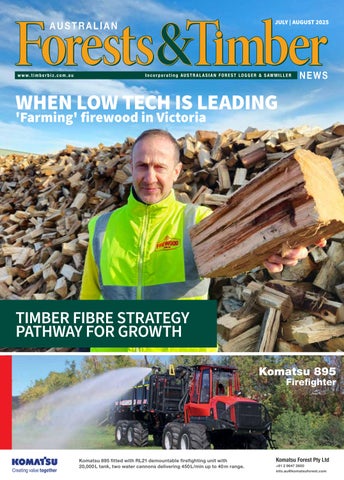
JULY | AUGUST 2025
www.timberbiz.com.au
I n c o r p o r a t i n g A U S T R A L A S I A N F O R E S T L O G G E R & S AW M I L L E R
WHEN LOW TECH IS LEADING 'Farming' firewood in Victoria
TIMBER FIBRE STRATEGY PATHWAY FOR GROWTH
News
THERE IS A NEW KI NG I N T HE FOREST N EW S I ZE 3 0. 5 ”
AVA I L AB L E N OW Nokian Tyres Forest King F2 comes with a new size,
N O K I A N T R FO R E S T 2
and a new performance – direct replacement for heavy, powerful harvesters and forwarders.
Find your nearest dealer: N O K I A N T Y R E S .CO M / FO R E S T K I N G F 2
2
Australian Forests & Timber News July | August 2025
www.timberbiz.com.au
News
Timber Fibre Strategy a timely pathway for growth
●Minister for Agriculture, Fisheries and Forestry Julie Collins.
T
he Federal Government will invest $300 million in the future of the forestry industry as part of a Timber Fibre Strategy which sets out a pathway for the future growth of the industry. The Timber Fibre Strategy sets out 128 ambitious actions for industry and governments to help build a sustainable, world leading sector with products that are in demand domestically and internationally. The Strategy’s development was led by the Government’s Strategic Forest and Renewable Materials Partnership and guided by close consultation across the forestry sector. The Timber Fibre Strategy charts a course for the forestry industry to embrace the future and help solve challenges facing the forestry industry, and the nation. A key opportunity identified in the Strategy is for the forestry sector to play a bigger role in tackling Australia’s housing challenges and delivering on the Government’s ambitious housing agenda. The $300 million investment includes: • Over $100 million for transformative research, development and innovation for the timber industry through Australian Forest and Wood Innovations, • Over $100 million to support the medium and long-term sustainability of our wood processing sector through the Accelerate Adoption of Wood www.timberbiz.com.au
●AFPA CEO Diana Hallam.
Processing program,
Innovation
• Over $73 million to expand Australia’s future wood supply through the Support Plantation Establishment program, and $10 million in the industry’s training needs through the Forestry Workforce Training Program. The Strategy also includes six priority areas and sets out 128 actions which cover and address key issues facing the sector: • Building sovereign timber fibre manufacturing capability and capacity • Meeting demand for timber fibre resources • Healthy forests, actively managed • Attracting and engaging people and other industry enablers • Supporting and growing regional communities • Innovating the timber fibre value chain The Government will work closely with the industry, and with states and territories, to respond to the Strategy. The Strategy has been wide welcomed by the timber industry, AFPA CEO Diana Hallam said the delivery of a Timber Fibre Strategy was a key commitment of the Labor Party at the 2022 Federal Election. “So we’re happy that it’s come to fruition after three years of work from the Strategic Forest and Renewable Materials Partnership that
●AFWI Executive Director Dr Joseph Lawrence.
●Forestry Australia president Dr Michelle Freeman.
●Australian Forest Contractors Association CEO Tim Lester.
was created to inform its development,” she said. “We welcome (the) recognition that the strategy points to a bigger role for the forestry sector in tackling national housing challenges and the Government’s housing agenda. “This is a major issue of the times and we stand ready to increase our contribution to the national effort,” Ms Hallam said. “Australia and other countries around the world are seeking to replace more emissions-intensive building materials with sustainable timber to achieve their climate targets. “More recognition of the environmental benefits of timber will ensure the industry can grow and succeed, sustaining many local jobs and boosting regional economies,” she said. “A strong future for both plantation and native forestry along with the rest of the supply chain in processing and manufacturing is key to the Timber Fibre Strategy. AFPA will work with all levels of government and industry stakeholders to progress the Strategy’s actions going forward.” AFWI Executive Director Dr Joseph Lawrence said the strategy highlights the importance of science-informed innovation in addressing challenges such as housing supply, fibre availability, and the transition to a low-emissions economy. “The Timber Fibre Strategy recognises the need for coordinated, researchbacked solutions to support the future of Australia’s for-
est and wood products sector,” Dr Lawrence said. “AFWI is committed to delivering practical, transformative solutions that helps meet the evolving needs of industry and Australia more broadly.” “Our role is to ensure that research investment supports innovation across the full value chain, from growing and processing, to product development and market end use.” The strategy identifies six national priorities for the sector: building sovereign manufacturing capability and capacity; meeting demand for timber fibre resources; healthy forests, actively managed; attracting and engaging people and other industry enablers; supporting and growing regional communities; and innovating the timber fibre value chain. These priorities closely align with AFWI’s focus – AFWI’s research is strongly informed by the needs of industry and shaped through ongoing collaboration with stakeholders. “We’re fuelled and ready to help turn the vision of the Timber Fibre Strategy into action,” Dr Lawrence said. Dr Michelle Freeman, President of Forestry Australia, said the Strategy provides a clear signal that science-led forest management and a resilient forest sector are central to Australia’s future. “As the professional association representing forest scientists and professionals, we are particularly encouraged by the Strategy’s
strong emphasis on science, good ecological practice and evidence-based decision-making,” Dr Freeman said. “It rightly recognises that active, well-informed forest management is vital for healthy, resilient forests — and that these forests provide essential benefits not just for the wood products sector, but for biodiversity, communities and the climate.” Forestry Australia said the Strategy represents a roadmap to capitalise on the vast opportunities held within the forest sector to support healthy forests, solve the housing crisis and deliver a future made in Australia. It builds on the Australian government’s recent welcome investments in research, development and future workforce capacity — including $10 million for the Forestry Workforce Training Program, and support through the Support Plantation Establishment Program. “Forestry Australia is proud to be delivering the Women in Forestry and Forest Industries Mentoring Program as part of the Forestry Workforce Training Program investment — a practical initiative supporting diversity, professional development and the next generation of forest sector leaders.” “We commend the Government for backing innovation, skills and long-term capacity,” Dr Freeman said.
Australian Forests & Timber News July | August 2025
Continued page 8 3
News JULY\AUGUST 2025 Issue 4 – Volume 36 Established 1991 News 3-12 My View 9 Milestones 12 Logging profile 16-17 Drone Technology 18-19 Silviculture 20 Transport 25 Chainsaws 26-27 Mill profile 29 Front Cover: Keilor-based Firewood.com.au's ‘Micky’ Spillane mills firewood for use in Melbourne and interstate. Story Page 29 Publisher and Chief Executive: Hartley Higgins General Manager: Robyn Haworth Editor: Bruce Mitchell b.mitchell@ryanmediapl.com.au Adelaide Office: (08) 8369 9521 Advertising: Jamie Richardson j.richardson@winetitles.com.au Adelaide Office: (08) 8369 9514 Creative Services: Robyn Haworth Trader classifieds: Jamie Richardson Adelaide Office: (08) 8369 9514 Subscriptions: subs@forestsandtimber.com.au Adelaide Office: (08) 8369 9500 Subcription rates One-year (6 editions) $44.65 Two-years (12 editions) $77.65 Accounts: ar@winetitles.com.au Adelaide Office: (08) 8369 9500 Postal Address: 630 Regency Road, Broadview South Australia 5083 Phone: (08) 8369 9500 Melbourne Office: Suite 2262, 442 Auburn Rd, Hawthorn VIC 3122 Phone: (03) 9810 3262 Website www.timberbiz.com.au Printed by Lane Print, Adelaide, SA
Conditions
The opinions expressed in Australian Forests & Timber News are not necessarily the opinions of or endorsed by the editor or publisher unless otherwise stated. All articles submitted for publication become the property of the publisher. All material in Australian Forests & Timber News copyright 2024 © Ryan Media. All rights reserved. No part may be reproduced or copied in any form or by any means (graphic, electronic, or mechanical including information and retrieval systems) without written permission of the publisher. While every effort has been made to ensure the accuracy of information, the published will not accept responsibility for errors or omissions, or for any consequences arising from reliance on information published.
MEDIA
INDEPENDENT & AUSTRALIAN OWNED
4
‘Timber in July’ draws bipartisan backing M ore than 70 guests — including Ministers, Shadow Ministers, MPs, CEOs and industry stakeholders — gathered at Parliament House in Victoria for ‘Timber in July’, a showcase of the growing importance of Victoria’s plantation and wood fibre industry to the state’s economy, housing supply and climate goals. Hosted by the Victorian Forest Products Association, the annual event highlighted the industry’s critical role in sustainable construction, regional jobs, and advanced manufacturing, with strong bipartisan engagement across the political spectrum. Speaking at the event were both the Minister for Agriculture Ros Spence, and the Shadow Minister for Agriculture, Emma Kealy, signalling shared political support for the future of timber and wood fibre in Victoria. VFPA CEO Andrew White said the bipartisan support at the function demonstrated the growing momentum behind the industry’s efforts to address some of the state’s biggest challenges including housing shortages, climate change and regional economic development. “It’s encouraging to see genuine cross-party support for the plantation and wood fibre industry,” Mr White said.
“This is an industry that’s ready to help deliver more homes, cut carbon emissions, and support advanced manufacturing jobs in Victoria—particularly in our regional communities,” he said. Mr White said the announcement by Ms Spence of funding more Trees on Farms was also a welcome step forward. The new program is offering grants of up to $80,000 for landholders to plant trees on their property – providing long term solutions including boosting shade and shelter for livestock, improving stock and crop production, offsetting carbon emissions or generating income through carbon credits. Landholders will also be able to generate additional income through timber production, including from harvested wood products or use the timber for onfarm uses such as firewood and fence posts. An additional grants program – the Trees on Farms Incubator Program – is offering planting service providers and forestry professionals up to $50,000 to support landowners who might be contemplating planting trees on their property. This service will help landowners develop tailored, implementationready project plans to
●Shadow Minister for Agriculture Emma Kealy with VFPA CEO Andrew White and Minister for Agriculture Ros Spence at “Winter In July” at Parliament House in Victoria. align with their property and planting goals, while providing education, training and upskilling for tree planting and management activities. “We’re pleased to see a growing recognition of the role that farmers and agroforestry can play in supporting sustainable timber supply, improving farm productivity and delivering environmental outcomes,” Mr White said. “With the right policy settings and incentives, integrating trees into farming systems can provide a win-win for agriculture, regional communities and the environment.” At the event, guests had the opportunity to hear directly from the CEOs of Vic-
toria’s leading plantation managers and timber manufacturers, explore engineered wood products and wood samples, and experience the latest in construction technology through VR headsets demonstrating timber-built housing. “Whether it’s new housing, bioproducts like low-carbon fuels, carbon markets or sustainable packaging, the opportunities for growth in the wood fibre sector are enormous— and today showed that Victoria’s political leaders recognise this,” Mr White said. “Timber in July is a reminder that smart policy and long-term vision can unlock major benefits for Victoria’s economy and environment."
Vic Government gives with one hand, takes with the other
V
ictoria’s State Government is a story of chaos that just keeps giving, or more usually taking. It’s decision to shut down the native timber industry in 2024 for example meant that access to native hardwood was denied to everyone. No native timber for houses, paper, fence posts, firewood – the list goes on and on. Take firewood. The government removed firewood
coupes from licensed contractors and refuses to extend public collection periods. But rather than reopen parts of the forests for firewood it wants to offer Victoria’s farmers $80,000 to plant more trees on their farms. Why? Well, the State Government says the scheme
would help to boost timber supply, increase biodiversity and prevent soil erosion. And it says landholders would also be able to generate additional income through timber production, including from harvested wood products or use the timber for on-farm uses such as – wait for it firewood and fence posts. The VFPA says the program is a good thing. VFPA CEO Andrew White said it was pleasing to see a growing recognition of the
Australian Forests & Timber News July | August 2025
role that farmers and agroforestry can play in supporting sustainable timber supply. Victoria banned native timber harvesting to – amongst other reasons – protect endangered species. Won’t the “endangered species” also see these government-funded plantations as possible ideal habitat? And won’t that mean that harvesting of those trees will be banned – again? www.timberbiz.com.au
Key FeaturesNews Tigercat durable design Timed knife arms and triangulated feed
573
Wireless head communication Best suited to trees in 40-60 cm diameter range Dasa D7 fully optimized system (StanForD compatible) 305 cm colour touchscreen (Windows 10) Back or lower knife option
TAKE CONTROL Introducing the Tigercat 573. A powerful, triangulated three-wheel drive harvesting head with
positive control and precise measuring. Versatile for roadside processing and in-stand harvesting. Excellent performance and productivity in medium to large sized timber.
Contact Onetrak today.
www.onetrak.com.au
www.timberbiz.com.au
www.tigercat.com
Australian Forests & Timber News July | August 2025
5
News
Decarbonising freight transport, starting in South Australia E fforts to decarbonise freight transport in the South East of South Australia are being accelerated through a State Government supported project aimed at helping the State’s forest industries to reach net zero targets. The State Government is investing $200,000 towards the Decarbonising the Freight Task – Driving to Net Zero project, a joint South Australian Forest Products Association (SAFPA) and Tabeel Trading Nominees venture. The funding, provided under the South Australian Wood Fibre and Timber Industry Master Plan, supports the State Government’s vision of decarbonising forest freight to further reduce carbon emissions across one of the hardest-to-abate sectors – heavy freight transport. Minister for Forest Industries Clare Scriven said at a time when economies around the world and in Australia are seeking to decarbonise, the forest industry has a key role to play. “Electrification of the freight network is a fantastic potential opportunity, obviously South Australia, Australia more broadly and around the world is trying to decarbonise and move towards net zero here in SA and decarbonising the freight task is a significant part of that,” she said. “Through Tabeel Trading and South Australian Forest Products Association’s proposed project they are going to be looking at what is needed for that to be able to occur. “We know that electric vehicles are the way of the future, the question is ‘can they be applied to the forest industry and if so, how soon?’ “Having a vision to be a future-focused, circular industry with globally recognised skills and innovation will ensure that our forest industries are
6
ideally placed to grow and thrive in the coming decades, benefitting all South Australians.” The project will include new technologies aimed at reducing reliance on diesel, with the end goal to decarbonise forestry’s freight trucks through electrification, which will deliver substantial carbon savings. Funding will support stage one of the project by developing an evidencebased decarbonisation roadmap for South Australia’s forest freight fleet, detailed cost-benefit analysis of alternative freight technologies including the modelling of emission reductions, a freight logistics and charging/ refuelling infrastructure blueprint and policy, regulatory and investment recommendations aligned to state and national climate targets and Master Plan priorities. Subject to the findings from stage one and the availability of vehicles and infrastructure, stage two will see the project progress to a live demonstration phase to validate modelling results under operational forest freight conditions. South Australian Forest Products Association chief executive Nathan Paine said the project has the potential to drive transformative change, supporting the decarbonisation of heavy vehicles not only in forestry but right across South Australia, the nation and even globally. “This is almost stage two of the industry looking to decarbonise, stage one was Fennell Forestry’s electric log truck trial and that showed some really great promise,” he said. “This next piece is really about industry coming together and figuring out what that next road map is for decarbonising. “It is not just looking at electrification, it is also looking at the other alternative fuels as the trajectory towards electrification
●Mt Gambier-based Fennell Forestry has been running electric logging truck trials since 2023. … this project funded by Minister Scriven is looking at everything from biofuel to alternative renewable diesel. “The learnings and solutions we develop will not just help our industry – they can accelerate decarbonisation throughout the broader heavy vehicle freight sector. “Importantly, we are also involving Primary Producers South Australia as the peak state farming organisation, the South Australian Freight Council and the South Australian Road Transport Association so obviously we will start in the Green Triangle with the forest industries but we want to make sure the benefits and the learnings are shared across the state and across the industries. “Stage one is envisaged to take up to twelve months and then the ambitious plan is to get some trucks on the road in about 12 months’ time. “We would have liked them a little bit earlier but speaking to OEM manufacturers like Scania there
is significant demand for these trucks in Europe and actually getting us into their production schedule is important but that conversation is already under way.” Tabeel Trading Nominees (TTN) general manager Adrian Flowers added that TTN’s trucks travel over 3.3 million kilometres every year meaning even modest improvements in emissions can deliver significant carbon savings. “This project is not just about understanding how electric trucks operate in our region; it’s about creating a practical roadmap for how South Australia – and indeed Australia – can decarbonise freight in complex regional operations,” he said. “Australia is a big place and as soon as you move away from the cities and the distances that we travel, the overall net weight that we fall on our heavy vehicle combinations, it is much higher than what it is anywhere else in the world so the sheer size and distance that we trav-
Australian Forests & Timber News July | August 2025
el is probably the biggest obstacle we need to overcome. “Here in the South East of South Australia we’re very, very fortunate the distance between our resource; the forest, and to our various mills here locally enables us to come up with strategic plans to limit the distance, get creative about what our shifts look like in our trucks and that will eliminate some of those challenges.” The Decarbonising the Freight Task project aligns with the Master Plan’s goal of developing a clean and green circular economy. The South Australian Wood Fibre and Timber Industry Master Plan, launched in February 2024, was developed by the Forest Industries Advisory Council of South Australia (FIAC-SA) as part of a State Government election commitment to provide a vision to further grow and develop South Australia’s $3b forest industry. - The SE Voice www.timberbiz.com.au
PERFORMANCE ENHANCED FORESTRY
News
WELCOME TO THE H SERIES High-performance engine, powerful booms and enhanced hydraulic power delivers unmatched productivity and fuel efficiency. Active Frame Lock provides stability and a larger working area. The 220-degree cabin rotation offers flexibility and visibility. A range of high performance attachments maximises your productivity.
Still looking for more? Advanced analytics and global data sharing is delivers real-time metrics to support site planning and operator assistance.
1396JHNDRE
H Series Harvesters… time to get ahead of the game.
deere.com.au/en/forestry/h-series www.timberbiz.com.au
Australian Forests & Timber News July | August 2025
7
News
ABARES report highlights role native forests play A new ABARES report, Australia’s native forests and wood production, highlights the important role Australia’s diverse native forests play in helping to combat climate change, providing a home to many flora and fauna species, and providing high quality wood products. Australian Forest Products Association CEO Diana Hallam said the report reaffirmed what Australia’s native forestry industry lives and breathes by – that sustainably harvesting timber for wood production is essential to create everyday products. And she said it also reaffirmed that sustainable native forestry is not ‘deforestation’. ABARES Executive Director Dr Jared Greenville said sustainable wood harvesting ensures the longterm productive capacity of forests is not compromised and long-term environmental values are upheld. “Sustainably managed native forests and sustainable harvesting ensures that trees are regrown after harvesting, unlike deforestation,” Dr Greenville said. “Between 2008 and 2021, Australia’s forest area increased by 2.8 million hectares, with most of this increase due to native forest regrowing and reduced first-time
Now fully digital and delivered to your inbox
Scan to subscribe for
FREE or visit timberbiz.com.au 8
clearing. “Around 0.05 per cent of Australia’s native forest area is sustainably harvested annually from our publicly owned multiple-use forests. “This small proportion supports the creation of sustainably produced wood products that are used by Australians for residential construction, flooring, power poles, packaging and more. “These wood products also help to combat climate change by offering a substitute for carbon-intensive products, such as concrete and steel.” The report states that the total amount of carbon stored in Australia’s native forests in 2021 was 19,205 million tonnes, an increase of 27 million tonnes since 2016. “Forests regrowing after harvesting absorb carbon, and carbon can potentially be stored in harvested wood products for many decades,” Dr Greenville said. “Most sustainable wood harvesting uses selective techniques to identify single trees or small groups of trees for harvest. The remaining trees provide an ongoing source of food and a safe habitat for biodiversity, and a seed source for the regrowing forest.” Ms Hallam said the report demonstrates the important role of
sustainable native forestry for essential products, the economy, jobs, environment and the climate. “AFPA welcomes this ABARES report which reaffirms what our native forestry industry lives and breathes by – that sustainably harvesting timber for wood production is essential to create everyday products like house-frames, decking, flooring, furniture, power poles, pallets, packaging and paper,” she said. “It also reaffirms that sustainable native forestry is not ‘deforestation’ because every harvested tree is replaced, and that our native production forests support diverse and unique biodiversity and have an important role to play fighting climate change, through the creation of carbon friendly products and active forest management. “Importantly, the report shows our total national forest area grew by 2.8 million hectares from 2008 to 2021 and that the total area of multiple-use public native forests, where wood harvesting is permitted, has more than halved since the mid-1990s to 4.3 million hectares, or just 3.3 per cent of Australia’s total native forest area in 2021.” Ms Hallam said the percentage of accessible area had reduced even
further to just 2.1 per cent off the back off forced industry closures in Victoria and Western Australia. “This should help put to rest activist claims that our sustainable industry is destroying forests, something that couldn’t be further from the truth. It’s worth noting that in the European Union around 84 per cent of natural forests are available for harvest and wood production,” she said. “The report also raises the challenge around decreasing wood supply from our forests over the past 20 years, a trend that is worsening from those state based industry closures. We know imports, often with supply chain sustainability issues, are increasingly being forced to fill the gap between supply and demand. “Furthermore, we welcome the report’s recognition that plantations cannot replace native sawlog supply.”
Continued from page 3
parts of the industry can work together to deliver healthy forests, thriving regional communities and successful businesses. “Pleasingly the document acknowledges the importance of forest services businesses as critical participants in the supply chain, and that their success is key for a sustainable and growing timber fibre sector. “We also note the acknowledgement of the role played by forestry certification, such as AFCA’s world-leading ForestFit standard and certification scheme, to support responsible and ethical supply chains while also providing assurance of environmental, social and economic sustainability. “Our congratulations to Minister Collins and the members of the Strategic Forest and Renewable Materials Partnership for this significant piece of work. “AFCA looks forward to continuing to work with government and industry colleagues to
achieve the aims of this Strategy and keep delivering the sustainable products that Australians want and need.” “Our forest products sector has a unique opportunity to provide sustainable, high-quality, carbon-sequestering products that Australians need,” the Minister for Agriculture, Fisheries and Forestry Julie Collins said. She said the $300 million investment was already delivering on some of the objectives outlined in the Strategy. But she said the Government understands there is more that can be done. “I’m excited to use the Timber Fibre Strategy to work with the industry, and with states and territories, to maximise the benefits of this investment, and to leverage other opportunities across government to lift the productivity of the forestry sector.
The Strategy acknowledges the vital role that healthy forests and carbon-storing wood products play in meeting Australia’s emissions reduction targets and addressing climate change — a recognition warmly welcomed by Forestry Australia. “Forests and forest science are key to a climate-positive future. We look forward to continuing to work with government and stakeholders to deliver the best possible outcomes for forests, people and the planet,” Dr Freeman said. Australian Forest Contractors Association CEO Tim Lester said the Strategy recognised that future success will draw together products, production and people. “The Strategy highlights that there are opportunities and challenges facing the sector. It also shows how governments and all
Australian Forests & Timber News July | August 2025
www.timberbiz.com.au
My View
Co-ordination key to protection against fires W hile the upcoming fire season is may not be high on many people’s priority list, now is the time to start preparing for next summer. It’s something our private estate forest guardians well know, and why they’ve been busy over the past months and years preparing for any fire threat. In a similar vein, government agencies, such as Sustainable Timber Tasmania (STT), have spent countless hours and many hundreds of thousands of dollars protecting our public estate. It’s a wise investment. Fire doesn’t discriminate. It doesn’t know the difference between private plantations, managed regrowth
www.timberbiz.com.au
MY VIEW
Nick Steel
forests, our protected forests or our towns. That’s why it’s imperative that all those responsible for our vast tracts of forest – from the guardians of our parks and reserves, our public forest managers and our private estate
owners -need to have the ability to share information and work in a coordinated manner when fire threatens our forests and communities. We’ve already shown that public and private estate managers can work together to protect Tasmania when the current government expanded the use of the Tasmanian Government Radio Network (TasGRN) to include our private estate forestry businesses last summer. It makes sense to grant access to our businesses. Between them, our working private forest custodians manage and protect over 400,000 hectares of land across the state, much of it close to regional towns.
The success of the 202425 fire season proves that the new incoming government, no matter its colour, should make the sharing of the network a permanent arrangement during times of fire threat. Similarly, our private estate managers have invested millions in world-leading fire detection software, which uses strategically placed cameras to identify and pinpoint any fire outbreaks as soon as possible. That means we can stop any fire threat quickly – ensuring the protection of our estate, our parks and reserves, and the community at large. We know that STT have invested in similar technologies, and we believe Tasmania can be better pro-
Australian Forests & Timber News July | August 2025
tected if the information our systems gather can be pooled – to get a better understanding of the holistic fire threat across the state. Make no mistake, protecting our forests and communities against the threat of fire is a battle – and the key to winning any battle is to have access to the most complete information of the threat… something sharing resources can provide. Tasmanian government agencies are already coordinating responses, and the forestry industry is keen to play its part in keeping Tasmanians and our forests safe. Nick Steel is the Chief Executive Officer of the Tasmanian Forest Products Association.
9
News New JD forestry dealer
H
utcheon & Pearce has been appointed the authorised John Deere dealer for Construction & Forestry equipment across Northern Victoria and the majority of New South Wales, excluding the Northern Rivers, Moree and Inverell regions. The expansion builds on Hutcheon & Pearce’s 70-year legacy supporting Australian agriculture and compact construction equipment. With a strong regional footprint of 20 branches, the family-owned business is now extending its trusted service and support to customers in the construction and forestry sectors. “As we enter this new chapter, we want to reassure customers that we’re fully committed—and fully equipped—to support the needs of the construction and forestry industries,” said Arron Hutcheon, CEO at Hutcheon & Pearce. “We’re no strangers to industries where reliability, responsiveness, and performance are critical.” To support this expansion, Hutcheon & Pearce is investing significantly in training, tooling, infrastructure, and recruitment. Customers will benefit from one of the largest field service teams in the region, including: • 230 qualified technicians
Are our current plantation Philip Hopkins
G
OVERNMENT plantation policy is working, with softwood supplies to increase by 30 per cent by midcentury in a boon for local housing construction, according to a new consultant’s analysis. The expansion will occur despite the plantation estate declining in area since its peak in 200809, says the analysis by Greenwood Strategy Solutions and Esk Spatial, a forestry and carbon specialist.
Greenwood’s managing director, Pat Groenhout, said the plantation peak had been achieved through the rapid expansion of hardwood plantations through Managed Investment Schemes (MIS), tax incentives and aided by the federal government’s Plantations for Australia: The 20220 Vision policy. This was designed to treble the size of the plantation estate to three million hectares, but did not help the softwood sector.
“The unsustainable nature of the MIS sector has meant that the million hectares established between 1997 and 2009 has subsequently reduced in size by about one-third,” Mr Groenhout said. “Softwood plantation area has remained around one million hectares through the entire period.” (Figure 1) The MIS policy collapsed but institutional support for the plantations remained reasonably solid and bipartisan, but large-
scale plantation expansion always occurred with active government policy. “The post-WWII expansion of the softwood plantation estate was largely achieved through the provision of low-interest loans from the Commonwealth to the states,” Mr Groenhout said. The principle of government backing was continued by both the Morrison and Albanese governments. Morrison’s 2018 ‘Billion Trees’ policy created regional forestry
●FIGURE 1: Australian plantation area expanded rapidly from the mid-1990s until it peaked in 2009. Softwood plantation area has remained around one million hectares through the entire period. Hardwood plantation area has declined by about one third since it peaked (Source: ABARES, 2024)
• Over 100 mobile service vehicles • A fleet of mobile service trucks • Remote machine monitoring and support via TECSight In addition to fast access to genuine John Deere parts, remanufactured components, and A&I aftermarket solutions, Hutcheon & Pearce offers dedicated TECSight support and onsite Technical Field Specialists who will work alongside customers to optimise machine performance and uptime. Hutcheon & Pearce’s first day of trading in Construction and Forestry will be Friday 1st August 2025. 10
●FIGURE 2: The majority of new plantations funded by the Support Plantation Establishment program are being established in NSW (Source: DAFF, 2025). Australian Forests & Timber News July | August 2025
www.timberbiz.com.au
News
BRIEFS
settings delivering?
FSC chairman
The Forest Stewardship Council Australia and New Zealand has appointed James Felton-Taylor as the new Chairman of its Board of Directors. Mr Felton-Taylor is a longstanding advocate for responsible forest management. As the owner and Managing Director of Australian Sustainable Timbers (AST), he leads the first company in Australia to achieve FSC certification for native forest operations. Based on the North Coast of New South Wales, AST is known for its commitment to regenerative forestry and the sustainable use of private native forests.
Board appointment
●FIGURE 3: The area of new plantations has increased year on year since the 600 mm rule was removed and with the support of Commonwealth Government grants (Source: Clean Energy Regulator, 2025) hubs and removed the 600mm rainfall barrier for plantations to take part in the Australian Carbon Credit Unit (ACCU) scheme. An ACCU represents one tonne of carbon dioxide equivalent (tCO2e) that has been avoided or sequestered through approved emissions reduction or carbon removal projects. Albanese’s plantation program set aside $74 million in grants, which requiring dollar-for-dollar co-contributions from developers. This paved the way for potentially 37,000 ha of new, long-rotation commercial plantations. Mr Groenhout said the total plantation area had declined as hardwood sites were converted back to agriculture, while some were converted to softwood plantations. However, in 2022-23 softwood plantations increased noticeably, apparently driven by the federal policy. Analysis showed that new (greenfield) plantations increased from about 3000ha in 2018 to more than 12,000ha in 2024. “Assuming (conservatively) that net stocked area is about 60 per cent of gross area, that reflects an increase in the producwww.timberbiz.com.au
tive plantation estate of 24,000ha since 2018,” he said. The Albanese program so far had provided about $28.5 million, establishing 14,654 ha (stocked area) of new plantations (12,000ha softwood and 2600ha hardwood) since 2023. “The ACCU scheme data indicate 24,000ha (gross) over 2023 and 2024, which is 14,000 ha net, applying the 60 % adjustment from project area to stocked area, which appears to align with the ACCU scheme data for those years,” he said. Mr Groenhout said another $45 million was available until June 2027. If fully used, that could result in another 23,000 ha of long rotation plantations added to the estate in the next two years. The total additional 37,000ha would increase the total national plantation area by 2.3% over the next four years, partly offsetting any further reduction in the conversion of hardwood back to agriculture. “If we assume an average growth rate of 15 cubic metres per ha per year for those plantations and rotation length of 30 years, this could also support about 555,000 m3 per year of additional soft-
wood log, including about 330,000 m3 of saw log,” he said. Further, Mr Groenhout said that since 2017, 46,600 ha of short rotation hardwood had been converted to long rotation pine. “Assuming the same (conservative) stocked to gross area ratio of 60%, that represents 29,000 ha of additional productive softwood plantation area,” he said. There were good reasons for hardwood plantation owners to convert to pine: hardwood chip export prices and demand were increasingly volatile and unreliable; converting to long rotation hardwood was not rewarding due to difficulties in calculating ACCU criterea; and in Victoria there are big and costly challenges monitoring koalas in hardwood plantations. “Therefore, the trend of conversion to softwood is likely to continue. We estimate over the next decade the total production area to be converted to pine could reach 230,000 across Tasmania, Victoria, South Australia an Western Australia,” he said. This trend was important for house construction. “That could mean an
additional 3.5 million m3 of softwood log products available each year, compared to 2023 production, by the middle of the century, of which about wo million m3 would be saw log,” he said. Mr Groenhout said half the Albanese funding had gone to NSW and 82% was for softwood plantations, with most conversions to long rotation pine in Victoria, Tasmania and WA, and practically none in Queensland (Figure 2) . There was little activity in South Australia due to water regulations and licensing limits, and most forest is already softwood. Summing up, Mr Groenhout said new and converted softwood plantations could increase softwood supply by about four million m3 per year in total. “This represents about a 30% increase softwood log supply levels. If this is achieved, which now seems quite possible, it can be argued that Australia’s plantation policy settings are working,” he said. “Lessons have been learned..... this policy regime is expanding its capability to grow the houses needed to support our growing population.”
Australian Forests & Timber News July | August 2025
Forico’s Sustainability Manager Simon Cook has been elected to the Board of the Forest Stewardship Council Australian and New Zealand (FSC ANZ). Over the decades, Simon has built a distinguished career promoting sustainability and robust certification in forest management across both hemispheres. In his current position at Forico, Simon has played a key role in ensuring Forico’s plantation estate and natural forest areas are managed with a focus on sustainable stewardship.
Asset management
SFM has been retained as the ongoing asset manager of the Limestone Estate following the estate’s acquisition by OneFortyOne from New Forests. SFM will support the transition of the estate’s hardwood plantation areas, in line with OneFortyOne’s vision for expanded softwood supply to domestic processors, to the extent this is made economically viable through the generation of carbon credits.
Three-year plan
Sustainable Timber Tasmania has released the annual update to its Three-Year Wood Production Plan 20252026 to 2027-2028 for feedback. The plan identifies forest coupes in Tasmania’s public production forests that are available across a three-year period from which a schedule of harvesting, roading and regeneration operations will be developed. It can be accessed on Sustainable Timber Tasmania’s website at www.sttas.com.au 11
Milestone
Milestone reached for SA’s timber industries
T
here was a timber trail to Mount Gambier in June as 250 guests gathered to mark a significant milestone. The South Australian Forest Products Association hosted (SAFPA) a dinner to celebrate 2025 marking the 150th anniversary of the South Australian forest and timber industries. SAFPA chief executive Nathan Paine said as the birthplace of Australia’s commercial plantation estates, South Australia’s forest and timber industry leaders, along with the Premier, Assistant Minister for Agriculture, Fisheries and Forestry, Minister for Forest Industries, State politicians, local members of parliament, mayors and members of the community, gathered to celebrate the shared history and to highlight the contributions the industry has made to the national and cultural identity. “This celebration is more than a dinner, it is a oncein-a-generation opportunity to stand behind an industry that has shaped regional communities, driven economic growth and delivered environmental benefits for 150 years,” he said. “From the first hectare of trees planted in 1875 in the Bundaleer Forests in the Mid-North, the industry has grown to 176,000 hectares, directly and indirectly employing over 21,300 jobs, processing fibre that builds our homes, the pallets that move consumer products from manufacturer to shop, the pulp and appear products that are used in our everyday lives 12
●SA Premier Peter Malinauskas, OneFortyOne chief executive Wendy Norris, SAFPA Governing Council Chair Tammy Auld, SA Primary Minister Clare Scriven, Assistant Agriculture Minister Anthony Chisholm, AFPA CEO Diana Hallam, OneFortyOne executive general manager Cameron McDonald and SAFPA CEO Nathan Paine at the anniversary dinner. from toilet paper to cardboard boxes, to the potting mix that grow our fruit and vegetables. “South Australia’s forestry plantations are the foundation of our state’s future. Our state has long been at the forefront of innovation and sustainable forest management, and the 150th celebratory dinner marks a proud reflection of the industry’s enduring success and it’s growing importance to the State’s economic value chain, regional development and environmental sustainability.” Mr Paine said, along with the environmental and sustainable benefits of the industry, the 150th anniversary dinner highlighted the importance of those who have dedicated their career to the industry. “Their commitment, passion, drive and innovative practices have shaped South Australia as a leader in forest management, timber production and re-
●SA Premier Peter Malinauskas and SAFPA Governing Council Chair Tammy Auld address the dinner in Mount Gambier. search,” he said. “A special thank you to our major partner, OneFortyOne, and the Department of Primary Industries and Regions for their generous
support of this event. South Australia has an incredible community of forest and timber managers, employees and supporters, and it’s a milestone opportunity to
Australian Forests & Timber News July | August 2025
celebrate and acknowledge the legacy and future opportunities of South Australia’s forest industries.” -
The SE Voice www.timberbiz.com.au
News
© 2025 Trimble, Inc. All Rights Reserved.
Forest-to-Customer Supply Chain Visibility
Trimble connects the entire supply chain to ensure every link is optimised for efficiency, every connection is seamless, and sustainability is embedded every step of the way. Trimble Connected Forest® digital workflows connect and optimise the raw materials procurement process. Trimble helps enhance transparency, reduce human error and drive new efficiencies that enhance productivity and profitability. Learn more at: trimble.com/forestry email forestrysales@trimble.com or call our Trimble ANZ office: +64 27 285 5250. www.timberbiz.com.au
Australian Forests & Timber News July | August 2025
13
News
Whitely farewells STT after 40 years service S ustainable Timber Tasmania CEO Steve Whiteley has retired following the conclusion of his current term. STT’s General Manager Operations Greg Hickey took over as acting Chief Executive Officer effective from July 1. STT chairman Rob de Fegely said Mr Whiteley had successfully guided the organisation through a period of significant transformation. “His vision and commitment have been instrumental in positioning the organisation for long-term success,” Mr de Fegely said. “On behalf of the Board, I extend our sincere thanks for his outstanding contribution.” Mr de Fegely said that Mr
●Retiring Sustainable Timber Tasmania CEO Steve Whiteley. Hickey brings extensive experience in Tasmania’s forest industry and is exceptionally well-placed to lead the organisation dur-
ing this transition. “Supported by the Executive Team, Mr Hickey will provide stability and direction as the Board
undertakes a national recruitment process for a permanent Chief Executive Officer,” he said. “Sustainable Timber Tasmania enters this new chapter with strong momentum and remains focused on delivering sustainable outcomes for Tasmania’s public production forests, while continuing to provide value to the Tasmanian community.” Australian Forest Products Association CEO Diana Hallam paid tribute to Mr Whiteley. “On behalf of Australia’s forest industries, I congratulate Steve on his career that has included more than 40 years of dedicated service to STT, the broader industry, as well as service
as an Independent Director on the AFPA Board since 2018,” she said. “It was clear to me when I joined AFPA last year as someone new to the industry, that Steve was a wellrespected industry leader who provided a steady hand, vision and commitment to the management of STT, as well as quality advice to the rest of the industry through his role on the AFPA Board. “It’s no surprise to me that Steve’s leadership has been instrumental to positioning STT for long-term success and I particularly thank him for his advice, insights and contribution with regards to Tasmanian forestry and human resources matters for AFPA.”
More news... more often with Daily Timber News The leading industry news service for forest management and timber products, brought to you FREE by Australia’s leading industry publications.
Daily Timber News australasian
www.timberbiz.com.au
I n c o r p o r a t i n g A U S T R A L A S I A N F O R E S T L O G G E R & S AW M I L L E R
magazine
Subscribe for FREE at timberbiz.com.au 14
Australian Forests & Timber News July | August 2025
www.timberbiz.com.au
News
Doing timber business in Qld T he 2025 Doing Timber Business in Queensland Conference, themed From Paddock to Pre-Fab, invites landholders, producers and the forest and timber industry to explore how timber, carbon and cattle can work better together to boost resilience, productivity and profitability on Queensland farms, while delivering wood supply for our future building needs. With day one co-hosted by Timber Queensland and AgForce Queensland, the conference brings together practical insights, new market signals and emerging investment models that promise to unlock fresh value and opportunities for farmers and forest managers alike. The two-day event – on September 2 and 3 - covers everything from silvopastoral systems to modern construction innovations driv-
ing demand for local timber supply. “Our Doing Timber Business in Queensland conferences have earned a prestigious reputation for quality - and 2025 raises the bar again,” said Timber Queensland CEO Mick Stephens. “We are very pleased to welcome Australian Retirement Trust, a long-term supporter of both Timber Queensland and AgForce, as Gold Sponsor of the event,” he said. “This is a rare chance for all of our partners to engage with the full timber value chain, from the paddock through to prefabricated innovation,” he said.
560 TREE HARVESTER
The conference will examine Timber Queensland and AgForce Queensland’s shared vision for sustainable land use, industry resilience and long-term investment in regional Queensland. Firmly focused on building farm resilience, day one explores how integrating trees and grazing enterprises can benefit land, stock and the bottom line. Sessions cover opportunities under the Queensland Future Timber Plan, the impacts of new EU deforestation and illegal logging rules, and findings from MLA’s “Steak n Wood” silvopastoral trials. Financial modelling, certification and
tools like AgCarE, a tool that provides an evaluation of agriculture and natural capital on a property, will also be presented. The day concludes with the Carving out Connections: Steaks and Stumps Industry Dinner, proudly sponsored by Rivers Insurance—a relaxed opportunity to connect with peers and carve out ideas over great local fare. The evening will include remarks from Primary Industries Minister Tony Perrett. Day two shifts to timber innovation and construction markets, showing how the demand for sustainable materials is expanding timber’s role in Australia’s building sector. Sessions highlight timber’s role in addressing housing supply, modern methods of construction, and updates on mid-rise timber building codes and design standards. Case studies include a
leading-edge social housing project using engineered timber. In the afternoon, delegates will take part in a guided site tour program, proudly sponsored by Hyne Timber, including visits to a mass timber building, a hybrid prefab construction facility and a development showcasing traditional truss and frame construction. “This event brings together growers, producers, processors, builders, investors and innovators to shape the future of Queensland’s forest and timber industries,” said Mick Stephens. “It’s a rare opportunity to see the full picture of where the industry is heading and take part in two days of discussion, insight and action.” Explore the full program and register now at www. timberqueensland.com. au/event-details/from-paddock-to-pre-fab-doing-timber-business-in-queensland-2025-conference
Born to slay Aussie wood
The Woodsman Pro 560’s compact size and high-performance features let you work more efficiently and with greater agility. Perfect for thinning, harvesting smaller wood, or operating in tight spaces - you simply won’t find a better tool for the job.
Sales: +64 7 348 1286 E: info@ensign.co.nz woodsmanpro.co.nz
Scan QR Code for full specs and features
Australian distributor enquiries welcome ENGINEERING SERVICES ROTORUA LTD / NZ
www.timberbiz.com.au
Australian Forests & Timber News July | August 2025
15
Logging profile
Storm blows Scott straight into forestry W hen a massive storm tore through the top of New Zealand’s South Island in 2008, it left a legacy that was more than just devastation – it encouraged 22-year-old Scott Reed to step into the forestry industry. Within a year he was on the ground working to recover fallen timber in a corporate estate, and setting the stage for what would become a thriving family business built on resilience, smart decisions, and dependable gear. By 2010, Scott had progressed into harvesting in Council forests and private woodlots within a two-hour radius of Nelson, in the heart of the South Island’s timber region, and Reed Contracting Nelson Ltd has gone from strength to strength since. Eighteen years on, Scott
and his wife Chelsea employ 11 staff and two harvesting crews working across the top of the South Island, cutting radiata pine which is destined for domestic timber in the shape of pruned, sawlogs, Laminated Veneer Lumber (LVL) and peelers, as well as feeding the export market that ships out of Port Nelson. The crews have been working in some difficult terrains over the past six months, Scott said, which makes the reliability and comfort of their plant and equipment critical. The Reeds have invested in three new pieces of John Deere forestry kit, a 648L-II Grapple Skidder, a 768L-II Bogie Skidder and a 959MH Tracked Harvester, and Scott has been impressed by the stability and ease of use of the new machines. The Continuously Variable Transmission (CVT)
●Scott Reed, from Reed Contracting, with his John Deere 768L-II Bogie Skidder.
of the 648L automatically senses its load before de-
livering more torque, and eliminates the need to shift
gears, shortening the learning curve for new operators
2025
STATE OF THE INDUSTRY F oresty Now ADREPORT
IN AUSTRALIAN FORESTS & TIMBER NEWS COMING Sept/Oct 2025 16
Australian Forests & Timber News July | August 2025
www.timberbiz.com.au
Logging profile and helping experienced drivers to maximise productivity. The 768L features balanced bogie axles that deliver outstanding traction and flotation in wet and muddy terrain, while the long and wide undercarriage of the 959 combines with a levelling system that maximises stability on steep slopes, with a standard 9.12m boom. “We’re really enjoying the new skidder and the operator comfort, especially the latest one, the sixwheeled bogie. It’s great to drive and the stability is unreal, just the ability to work on uneven slopes with it is excellent,” Scott said. “The levelling machine, the 959, obviously articulates off the base and levels the top half of the machine out, so it’s ideal for working on steep slopes. A lot of our work is winch-assist with a felling machine and the 959 has been a very capable machine for what we’ve done.” To finance their investment in new machinery, Scott and Chelsea approached their local dealership, Drummond & Etheridge in Nelson, about making an application through John Deere Financial. They were pleased with how straightforward the process turned out to be. “At the time we were purchasing equipment, some of the other creditors and finance companies were
quite expensive but a lot of the machine companies were putting out some really good rates. “It was literally a no brainer to go with John Deere Financial, and they were super competitive in subsidising our purchases. It definitely fitted our operation and it’s been a real advantage,” said Scott. “We applied online and the process was reasonably straightforward. They may have asked for a bit more detail in parts, but I think it’s definitely beneficial to go the extra mile and provide enough information to get the more competitive rate.” Also reassuring for the Reeds is John Deere’s reputation for reliability in the local industry. “John Deere’s got a strong foothold in the forest industry here. We purchased our first John Deere skidder in 2012, a 648H, and it was a really reliable machine. It’s now owned by a local operator and still goes well with 15,000 hours on it. “So they really stand the test of time,” said Scott. “Obviously going down the route for the harvester we did a lot of research and heard a lot of good feedback on the 959s and the previous model, the 909s. I can’t fault it, and the back-up’s been really good throughout, both with the skidders and the harvester.”
●Stability of the 768-II Bogie Skidder on uneven slopes. And while the forestry industry is in “a bit of a lull” at the moment, with fluctuations in export markets and local sawmills doing it tough, Scott still enjoys the problem solving and challenges that the industry presents. “We enjoy the sense of achievement from harvesting timber. You
REDUCE DOWNTIME. INCREASE PRODUCTIVITY.
Our service and support team are on hand to keep your operation running at peak efficiency.
need to be resilient, but the work and the people are really good. And choosing the right equipment has been a game changer for us,” he said. He’s also happy they decided to go with John Deere Financial. “It sort of feels as if they’re in it with you,” he said.
MORBARK 3400XT HORIZONTAL GRINDER Fitted with a pin and plate hammermill, 34’’ top feed roll, chain type feeder, Caterpillar C18 (765HP) engine and Caterpillar 320L tracks. Easy change grate system and remote control allowing for monitoring and adjustment of the engine and other machine parameters from the safety of your loader or excavator. 2400XT, 3000XT and 6400XT models also available.
1800 182 888 | lincom.com.au | sales@lincom.com.au | OFFICE LOCATIONS | QLD | N QLD | HUNTER REGION | NSW | VIC | WA
www.timberbiz.com.au
Australian Forests & Timber News July | August 2025
SA L E S | H I R E | S E RV I C E | PA RTS
17
Drone technology
Flying high after 10 years of UAV research T his year marks a decade since Scion adopted unmanned aerial vehicles (UAVs) as a research tool – forging a path towards more effective forest management. A pioneer in the field of UAV research, the Crown Research Institute bought its first drone in February 2015. Since then, UAVs have become a key tool for aerial data capture, for use in high-definition mapping and monitoring of forests. Scion also uses them for 3D modelling, sample collection, sub-canopy data captures and various types of imaging across multiple programmes. It is the only Crown Research Institute with Civil Aviation Authority Part 102 higher tier certification, which enables it to undertake UAV activity outside what standard operational licences allow. Scion scientist Robin Hartley says UAVs add a lot of value to the organisation’s research. “We regularly capture highdefinition LIDAR for measuring trees,” she said. “We can get ultra highresolution maps of stands and trials, we are capturing spectral and thermal data to understand more about tree physiology remotely, and we’re working with companies to develop UAV spray systems specific to forestry needs. We’re also exploring niche areas such as sub-canopy flying for characterising
stem and branch structure and collecting upper canopy samples.” The autonomous systems team has worked with other teams across Scion and industry over the past 10 years to enable them to adopt UAV technologies. “There is plenty of potential for UAVs to be used for other purposes within research and commercial forest management, too, such as forest inventory, phenotyping and manual applications such as spraying and planting,” Robin says. It all started in 2012, when research group leader David Pont was a scientist monitoring the development of UAVs and miniaturised laser scanning technologies. By 2015 a commercially available scanner had been matched to a drone from Aeronavics, a NZ-based UAV company working with the Hollywood film industry. At the time, a geomatics team was being formed at Scion that comprised scientists with expertise in airborne LiDAR. A state-of-theart LidarPod weighing 3kg was bought from Scotland, and the Scion team ordered the largest UAV they could find to carry it. This UAV gave Scion a modern way to laser scan forest stands. Scion staff Toby Stovold, Kane Fleet and Marie Heaphie (who has since left the organisation), learned to fly a small UAV, which meant when the larger craft arrived they were ready to deploy it
for forestry research. The wider industry took notice as the technology continued to develop. Several forestry companies have since invested in trials and built their own in-house UAV capacity. The strong industry adoption was highlighted in a 2020 study that showed 83 percent of forestry companies in NZ use UAVs to capture aerial imagery, compared to none in an earlier 2013 survey. Scion also helped set up the Tools for Foresters (TFF) industry initiative, which connects researchers and foresters using UAVs
in forests to share research, knowledge and resources. This helps enhance UAV technology development and encourage adoption of these tools. Timberlands inventory manager Michael Wilson says Scion’s work with UAVs over the past decade has helped shape how his company uses the technology in forest management operations. “Scion’s work helped us see what was possible with drone technology – from precision aerial mapping to advanced canopy analysis – and gave us the confidence
to invest in UAVs ourselves. It’s hard to imagine modern forest management without them now,” he said. Robin says Scion continues to work with forest managers to develop systems that are relevant and cost-effective. “A recent survey showed a 20 percent increase across some key UAV uses that have been developed and promoted through TFF.” Scion’s autonomous systems team is focused on advancing techniques for the capture and use of LiDAR, photogrammetry and thermal and multi-spectral imagery.
Senior scientist named Forester of the Year
D
r Dean Meason, a senior scientist with the Scion group of the Bioeconomy Science Institute, has been named New Zealand Institute of Forestry’s 2025 Forester of the Year. The award recognises Dean’s outstanding contribution to forest hydrology research, which has provided insights that are
18
shaping the future of forestry and water management around New Zealand. From 2019 - 2024, Dean led Scion’s Ministry of Business, Innovation and Employment-funded Forest Flows research programme, which provides a more accurate picture of what’s happening to the water in New Zealand’s forests and helps inform
regional freshwater policy development and land-use decisions in a changing climate. Post-2024 support from Forest Growers Research is focussed on developing a forest hydrology toolkit for foresters. Dean and his team have further MBIE funding (through the Catalyst fund) to collaborate with NASA’s Jet Propulsion Laboratory
and the University of Massachusetts at Amherst on continued research. This new programme, focussed on the Aupōuri Peninsula’s Te Hiku region (Northland), will use data from NASA satellite missions to find a new way to accurately measure water use for different land uses and how it varies across the region. This research will provide
Australian Forests & Timber News July | August 2025
new insights for freshwater management at scales previously not thought possible. Dean has a PhD from the University of Hawaii, a Master of Science from the University of Georgia in the US and a forestry science honours degree from the University of Canterbury. He has been with Scion since 2009. www.timberbiz.com.au
Drone technology
Eyes in the sky safeguarding our forests U niversity of Canterbury researchers are using drones and satellite remote sensing to track the health of eucalyptus trees from above and protect the future of New Zealand’s plantation forests. Originally from Nepal, Te Whare Wānanga o Waitaha/ University of Canterbury PhD candidate Shiva Pariyar is breaking new ground with remote sensing research that could help reduce economic and environmental losses caused by pest damage in non-native eucalyptus species. “In New Zealand, plantation forestry is dominated by Pinus radiata (pine), which needs chemical treatment to make the timber durable,” Pariyar explains. “To avoid the environmental risks of chemicals leaching into the soil and water, New Zealand Dryland Forest Innovation (NZDFI) has introduced naturally durable eucalyptus species as a more sustainable alternative.” However, these eucalyptus trees, imported from Australia, are vulnerable to paropsine beetles, also known as leaf-chewing beetles, and other pests. “Leaves are the most important part of the tree. Damage or defoliation significantly reduces the tree’s ability to photosynthesise, affecting their growth and forest productivity.” One of his supervisors,
Associate Professor Steve Pawson, says New Zealand cultivates over 15,000 hectares of eucalyptus, with the impact of paropsine beetles varying widely depending on the severity of the attack and the type of eucalypt production system. “Potential yield loss is estimated at $10 million per year, with control costs currently estimated at $1 to $2.6 million,” he says. Using drone-mounted light detection and ranging (LiDAR) and multispectral sensors, and high-resolution satellite imagery from trial sites across Marlborough and North Canterbury, he is developing a new model to detect and quantify the spatial extent, intensity, frequency and timing of eucalyptus defoliation both at the individual tree-level and across entire landscapes. “Human eyes can’t always pick up subtle changes in canopy greenness or stress levels, but the technology we use can. Ground-based measurements are costly, time-consuming, labour intensive and often impractical in remote or dangerous environments. “Without timely and accurate information, forest managers are unable to respond to insect outbreaks effectively that may cause long-term ecological and economic damage. My research outcome supports forest managers and policy
●University of Canterbury PhD candidate Shiva Pariyar is using a Global Navigation Satellite System to collect tree locations. makers to take both proactive and reactive measures to improve forest health and vitality of eucalyptus plantation.” His research supports the expansion of targeted plantations of 100,000 hectares of naturally durable eucalyptus in New Zealand by 2050. “If the trial is successful,” says Pariyar, “this model could be used not just here but globally—wherever eucalyptus is planted as a sustainable alternative to chemically treated pine.
“I wanted to build on my skills in the field of remote sensing and technology. And luckily, I found this opportunity at UC to explore and expand my theoretical knowledge and practical understanding including recent technologies. “UC has given me all the facilities that I need, including learning how to operate drones. Now I can prepare flight plans, fly drones and analyse data for future use.” Pariyar is currently participating in the Research
Student Showcase, an annual event for postgraduate students that offers valuable training workshops, great prizes, and the opportunity to present their research to a broader audience. His project is supported by the UC Doctoral Scholarship, NZDFI, and the School of Forestry, with supervision from Dr Vega Xu, Associate Professor Steve Pawson, Professor Justin Morgenroth, and Dr Ning Ye at UC’s School of Forestry.
Now fully digital and delivered to your inbox
Scan to subscribe for FREE or visit timberbiz.com.au www.timberbiz.com.au
Australian Forests & Timber News July | August 2025
19
Silviculture
Controlling gorse on private land is tricky C ontrolling gorse on private land is never as simple as it sounds - and in a forestry context, its aggressive nature and environmental impacts mean landowners need more than good intentions. Successful management of Tasmania’s highly invasive woody weed, Gorse (Ulex europaeus), in private forests demands adherence to regulations, coupled with a strategic, ecologically informed approach and a clear vision for future land use. Private Forests Tasmania Forestry Specialist Dion McKenzie said landowners need to be aware of regulatory requirements when undertaking gorse control in forested or woodland environments. Dion said no gorse program should begin without consulting the Forest Practices Act 1985. Any operation that clears, pushes over or otherwise destroys trees capable of reaching five metres is a forest practice and usually needs a certified Forest Practices Plan (FPP). “If gorse control will remove, damage or kill native vegetation - even indirectly - it may be deemed tree‑clearing,” Dion said. “Undertaking forest practices without an approved FPP can trigger compliance action by the Forest Practices Authority (FPA), including fines and remediation orders. “A phone call to a Forest Practices Officer before you start can save you money and grief.” Resources such as the Gorse Management Leaflet - available via the Forest Practices Authority - offer practical advice and regulatory guidance. A simple flow chart on the FPA website helps landowners decide whether their job is exempt. Dion said gorse is highly flammable, aggressive in its spread, and tenacious in seed survival, it can choke out native vegetation, hin20
der forest operations, and elevate fire risks. “Firstly, it’s a prolific flowerer that can produce seed even when young and older plants generate enormous seed banks,” Dion said. “Secondly, those seeds have a hard coat and can survive in the soil for decades. “In a forestry context, gorse can limit access for any monitoring or active management such as pruning, and it can also increase the fire hazard significantly as it is highly flammable.” He said these traits mean any control method - whether mechanical, chemical, or fire - must be supported by an extended follow-up plan. Dion said fire can in fact promote seed germination, meaning it may need to be used cautiously and only at the right time in the control process. Forestry consultant Alex Tabor said successful gorse control comes down to having a long-term management plan. Alex works with private landowners across Tasmania, helping them avoid unintended damage to native ecosystems when tackling weeds. “Getting rid of gorse is not actually the end goal. You need to have a clear vision for what you want that land to look like when the gorse is gone,” she said. “Woodland environments where gorse is present are often already under threat, and overly aggressive removal of gorse - particularly using fire - can worsen the situation. “If you burn it too early, the gorse burns so hot you can kill all your trees, make the infestation worse, and possibly breach the Forest Practices Code.” From a practical forestry perspective, gorse also presents logistical and operational problems. “Selecting tree species that grow rapidly and are
●Landowners need to be aware of regulatory requirements when undertaking gorse control. suited to the site can give them a competitive advantage,” Dion said. “Good weed control during establishment and rapid early growth is essential. “A species with a dense canopy will shade out the understorey and reduce gorse germination over time. “Active managed planted forests can be a good option for assisting with gorse management and making land productive again.” The Gorse National Best Practice Manual is a science‑based guide to helping manage gorse and key actions in developing a control plan include: • Define problem areas through property or control area mapping using aerial photos, existing maps, or hand-drawn visuals. • Determine and map control priorities – Rank infestations by priority, assess legal and ethical responsibilities, align with regional plans, and use overlays or GIS to map priorities and eco-
logical considerations over a minimum fiveyear control plan. • Determine integrated gorse management options by assessing available resources, legal requirements, potential impacts on neighbours, and planning for initial control, follow-up, and ongoing monitoring. • Develop a financial plan by estimating management and labour costs for each infestation, budgeting for both shortand long-term control, considering available financial support, and including future follow-up actions. • Develop a long-term, flexible gorse control schedule that enables annual follow-up, considers seasonal effectiveness and labour availability, and integrates with broader land management activities. • Monitor and document gorse control efforts by mapping progress, recording methods and costs, checking for regrowth or new outbreaks
Australian Forests & Timber News July | August 2025
annually, and taking repeat photos to assess effectiveness over time. • Conduct annual followup of treated infestations using the most suitable method, as regrowth and new germination are likely to occur. Alex said many landowners underestimate the time and cost involved in gorse control, which she labelled and “open-ended problem”. “For major infestations, landowners should plan for a five-to-10-year control program, followed by ongoing maintenance to prevent re-establishment,” Alex said. “Budget on at least five to ten years of staged control, then lifelong surveillance. “Follow-up maintenance isn’t just once or twice – it’s ongoing, and it must be tailored to what’s coming back each time. “People often let gorse infestations go on for decades. Once you lose the diversity in these ecosystems, it’s hard to restore it. “The earlier you get in, the less intensive and expensive it will be.” www.timberbiz.com.au
UNMATCHED DURABILITY, VERSATILITY AND ATTACHABILITY The all-new, two roller Waratah H216 made to tackle the toughest, crooked timber to the straightest post wood and everything in between. Simple adaption to various wheeled and tracked carriers with optimal topping saw, full rotation, TimberRite and simple connectivity to multiple other carrier control systems. Sharpen up your front end, get all those branches off clearly and get on with more productivity with Waratah Red Performance Harvesters. waratah.com
Harvesters
Waratah unveils new H427 head W aratah Forestry Equipment introduced its new H427 harvester head - built for extreme forestry conditions - at FOREXPO 2025 in Mimizan, France in June. The H427 delivers strong performance, durability and precision for harvesting large timber on steep and rugged terrain. Designed for today’s demanding forestry jobs, Waratah’s H427 is a powerhouse built to handle big wood with confidence and control. “The H427 is purpose-built to meet the demands of high-production harvesting in larger timber conditions,” said Brent Fisher, product marketing manager for Waratah. “Its design enhances operational efficiency, ensures long-term durability and simplifies maintenance, supporting reliable performance in the forest.” Featuring a top saw, strong frame and optional HD tilt frame, the H427 delivers reliable performance and productivity. Its high feed force and 760 mm (29.9 in.) maximum cut capacity
●Waratah’s H427 is built to handle big wood with confidence and control. make it ideal for harvesting largediameter timber. Updated measuring systems im-
World Leading Forestry Chains and Tracks
www.chaffeyschains.com.au
03 6491 1686
26 Claude Road, Sheffield TAS 7306 22
prove length and diameter accuracy for efficient, high-output processing. With an operating weight from 1680 kg (3,704 lb.), the H427 offers agility with the durability and stability needed for the most demanding applications. Its efficient, powerful control valve and optimized four-roller feed arm geometry ensure consistent productivity on wheeled and tracked carriers. The four-knife delimbing system delivers consistent, clean results, while simplified service access and
a streamlined design help reduce downtime in the field. The durable H427 offers long-lasting reliability in high-impact forestry applications. As with all Waratah products, the H427 comes with easily accessible support for dealers and customers, as well as genuine Waratah parts with an industry-leading warranty. The Waratah H427 will be available to customers in the United States, Canada, Europe, Australia, New Zealand, Africa, Brazil and Latin America starting in early 2026.
New track carriers
Tigercat has released two new track carrier models based on the new sloping tail platform for steep terrain harvesting operations. Both the L857 feller buncher and LH857 harvester are powered by the efficient Tigercat FPT N67 engine. Power is delivered to the track drives via a refined, efficient open loop hydraulic system, providing high tractive effort and excellent performance on steep slopes. The sloping tail platform takes ground based steep terrain logging to the next level. Optimized weight distribution and low centre of mass, along with Tigercat’s patented super duty leveling undercarriage provide the operator with comfort, stability and confidence on steep terrain. The sloped tail profile provides increased leveling capability to 26 degrees, and better cable clearance
Australian Forests & Timber News July | August 2025
in winch assisted applications. For roadside processing applications, the sloping tail with its ability to clear obstacles allows the LH857 to work more effectively on smaller, congested landings. Other enhancements include further improvements to service access, and in-tank hydraulic filtration for extended service intervals. The side opening engine enclosure completely exposes the engine and most hydraulic components. When open, the enclosure roof serves as a safe, spacious and convenient work platform. The harvester can be equipped with several Tigercat boom and harvesting head options including the 573 and 575. The feller buncher is well suited to the 5702 and 5702-26 felling saws and 5185 fixed felling saw. www.timberbiz.com.au
Harvesters
JD’s new harvester/head combo at Forexpo J
ohn Deere set a new standard in logging in 2024 by launching the first H Series forest machines that took productivity and joy of work to new heights. Now, the range of large size-class machine models is expanding with the eight-wheeled harvester 1470H 8W. Together with a new harvester head H427, the biggest eightwheeler makes a superior duo for harvesting big trees on steep slopes and difficult terrain. The combination was also the highlight of the John Deere booth at the Forexpo exhibition in France in June. Significantly higher productivity and lower fuel consumption per harvested cubic meter have been the key benefits of the H Series harvesters, in comparison to previous models. The high performing engines have 10% more power and torque, and the improved hydraulics offer more hydraulic power and higher work pressure for feeding, while the optimized system also ensures balanced fuel economy. Compared to the six-wheeled 1470H, the eight-wheeled model brings even more tractive effort to slopes. The powerful H9 boom, introduced in association with the H Series in 2024, supports the performance of the new model in the most demanding challenges. The cylinder-operated active frame lock of the H Series harvesters enhances stability and makes it easier to work with the boom sideways, offering the operator a remarkably larger working area. The eight-wheeled 1470H maximizes stability with its optimal weight distribution. Whether working on steep slopes or flat ground, the machine stays perfectly balanced, allowing the operator to work with both ease and precision. From intuitive interfaces to ergonomic designs and from the quiet cabin to accessible service points, every aspect of the new machine is crafted to enhance the operator’s experience and ease of use. The rotating and levelling cabin with an increased 220-degree rotating angle is standard in the H Series harvesters and offers an excellent view to the working area. www.timberbiz.com.au
●With a new harvester head H427, the 1470H 8W makes a superior duo for harvesting big trees on steep slopes and difficult terrain. H Series harvesters feature a new rear chassis and new placement of the engine, pumps and hydraulic oil and fuel tanks. Together with noise-isolating materials in the cabin interior, these solutions make the working environment pleasantly quiet. The H Series comes with more and better-quality lighting for increased visibility around the working area. The back of the machine has been lowered, so rear visibility has also improved significantly. Intelligent Cabin Key is a personal remote key to unlock the machine door and turn on the PC and TimberMatic control system with operator-specific settings. It can also be personalized for service personnel and trailer drivers. TimberMatic H automation supports a superior logging performance by offering the operators a visually improved, intuitive user interface. The on-screen view only shows the info relevant to the workflow while a new secondary display shows the base machine functions and cameras. Intelligent Boom Control IBC makes boom control precise, fast and easy, letting the operator focus on controlling the harvester head rather than the boom joint movements. The configurable button joysticks make everyday work easier.
2025 Nominations Now Open February 21 - August 7
Nominate and Celebrate someone who deserves to be recognised for their contribution to the Timber Industry in 2025. 2025 AWARD CATEGORIES Sawmilling & Processing Excellence Award Operations - Harvesting & InField Chipping Excellence Operations - Silviculture & Plantation Management Logistics Excellence - Operations, Marshalling & Timber Haulage Trainee / Apprentice of the Year Award Timber Legend Award Safety Excellence - Individual Award Safety Excellence - More than 30 Staff Safety Excellence - Less than 30 Staff Environment & Sustainability Award Industry Support Services Award
KEY DATES
February 21 - Nominations open August 7 - Nominations close September - Judging Process October 24 - GTTIA Gala Dinner Awards Night
Australian Forests & Timber News July | August 2025
23
Harvesters
Komatsu PC300FX Harvester put to test in Tasmania K omatsu Forest Australia has spent the past five to six years refining and expanding the range of Komatsu Hydraulic Excavators specifically for forest applications. Designed in close collaboration with the Komatsu Osaka Factory, the newly developed Xtreme Series base models include the Komatsu PC270HW, Komatsu PC300HW, and Komatsu PC400HW tailored for demanding forest environments. The Komatsu excavators have unique compensated load sense hydraulic systems which are very suitable for the many different forest applications. Coupled with the Xtreme Series updates they accommodate grapples, felling heads, processors, and harvester attachments offering comparable productivity to traditional purpose-built machines but at a significantly lower capital cost. Since their rollout in late 2020, these factorydeveloped solutions have received strong positive feedback from customers in New Zealand. Komatsu Forest provides the following factory-developed and local options to address forestry requirements : 1. High-Wide Undercarriage : Reinforced 850mm high-wide track frame, featuring heavyduty slew guards, robust track skids, and motor covers with 600mm single or double-bar grousers. 2. Forest Boom Sets: Developed in Japan and refined in Australia, the WG (Working Gear) boom sets accommodate a wide range of grapples, harvesters, and directional felling heads.Forestry Cabin: The Komatsu Forest cabin engineered in Japan or the option to install EMS or Active cabins from NZ 3. Bump Rails: Factoryfitted Komatsu Forest 24
design for added protection. 4. Heavy-Duty Panels: Available in various configurations to meet specific forestry requirements. 5. Standard Cooling Package: Standard cooling system with an auxiliary hydraulic cooler for reliable thermal performance. 6. Gullwing Canopy (FXexclusive): Hydraulically operated canopy enables easy access to engine and hydraulic components. 7. Advanced Cooling Package (FX-exclusive): Purpose-built AKG forestry cooling kit with a side-by-side layout and hydraulic reversing fan. 8. IQAN Control System (FX-exclusive): The MD5 IQAN system with 8” screen allows full customization of machine settings, delivering enhanced control, reduced fuel consumption, and greater flexibility. The IQAN machine control system was developed locally to suit Australian conditions with the following features and advantages: • Electric Joysticks: Personalized crane speed settings for multiple operators. • Servo Foot Pedals: Original Komatsu pedals retained for reliability due to foot contamination; pressurebalanced for track, crane, and attachment control in feller bunchers. • Integrated IQAN System Control: Manages the engine, main hydraulic pump, and valve bank for optimised performance and lower fuel burn. • Attachment Flow Control: Fine-tuned individual flow settings for each attachment function. • Forestry Cooling System: Regulates the system with automated hydraulic reversing fan to maintain optimal machine temperature. Developed over three
●Developed over three years in New Zealand’s challenging big-wood conditions, the Komatsu PC300FX has evolved from the PC300HW and now stands as the flagship of the PC Xtreme Series. years in New Zealand’s challenging big-wood conditions, the Komatsu PC300FX has evolved from the PC300HW and now stands as the flagship of the PC Xtreme Series. With seven units already in operation and three more on order, the PC300FX comes equipped with all standard forestry features, including the exclusive gullwing canopy, advanced cooling system, and IQAN controls. In early July, Komatsu Forest provided a new Komatsu PC300FX fitted with a SouthStar GS 600 Harvesting Attachment to several Tasmanian contractors to assess the suitability for the tough Tasmanian forest conditions. While there are two shovel logger versions working in Victoria, this will be the first harvester version in Australia. The Tasmanian contractors enlisted for the trial were Mech Log, Triple H Contracting and JCH Harvesting with the PC300FX working in their existing contracts for three days per site.
Mech Log Site Scottsdale site: Clearfall pine operation with average stem size 0.7m3. Calibration of the harvester took time, but once operational, the PC300FX demonstrated impressive build quality and features. Anthony Brown noted that while the FX couldn’t match the production rates of his existing purpose-built harvesters, its competitive price makes it an attractive option for smaller-volume contracts. Triple H Harvesting Branxholm Site; Clearfall pine operation with average stem size 1.0m3 Manuel Hall appreciated the opportunity to trial the PC300FX and was impressed with the setup. He operates purpose-built harvesters and believes it doesn’t match them in production. Operating the PC300FX he averaged 57 trees per hour and commented it would be ideal as a roadside machine or smaller contract. JCH Harvesting Derby Site; Clearfall pine operation with stem size ranging 1.0 – 1.2 m3 stem size. Jake Huges praised the
Australian Forests & Timber News July | August 2025
quality of build and the smoothness of the controls. He believes it would excel in a roadside operation and has a definite market opportunity for in forest contracts up to about 20 degree slopes. They produced approximately 1,500m3 over the three day trial. He highlighted the machine’s excellent value compared to purpose-built machines. David Oliver from Komatsu Forest set up the machine at each site. Based on operator feedback, he noted a preference for Sure-Grip levers, common on the contractors existing machines. While the PC300FX was fitted with the KF standard EME controls which took time for operators to become accustomed. According to Brett Jones MD Komatsu Forest, the PC300FX was developed to provide a more affordable harvester or feller buncher option in response to the rising cost of purpose-built forest machines. It offers the same core features and functionality, excluding the levelling system but at a much more competitive price. www.timberbiz.com.au
Transport
New Log Haulage Code focusing on promoting safety T he National Heavy Vehicle Regulator has released a new Code of Practice focused on assisting industry to improve safety outcomes in the transportation of logs. The new Log Haulage Industry Code of Practice (LHC) provides guidance for businesses involved at each level of the forest log haulage task. The Australian Forest Contractors Association has welcomed the release of the new Code of Practice. “Safety is the number priority for all of us in the timber industry. Having this Code to provide guidance for everyone within the Chain of Responsibility is a practical development in a complex operating and legal environment,” AFCA CEO Tim Lester said. “Importantly the Log Haulage Code is not a compliance document and it does not create any new obligations. It does step through the stages of log haulage operations to describe key risks that may need to be addressed and propose steps that businesses could take in response depending on their role in the chain. “AFCA worked with the NHVR and other industry partners to make sure contents of the Code was relevant to industry and the advice it provides is practical.
www.timberbiz.com.au
“There are considerations at every stage of log haulage activities, from contracting and scheduling, route planning and navigating forestry and public roads, through to receival and delivery. “By working together we can make sure we protect drivers, other road users, trucks and loads to make sure haulage is both safe and efficient and so everyone gets home safely at the end of the day. “Our thanks to all AFCA members who provided input and guidance for the development of the Code. We will continue to work with NHVR and forest services business to increase awareness of the Code and opportunities to mitigate and address risks,” Mr Lester said. Acting Chief Safety and Productivity Officer Kelli Walker said that the LHC offered a practical guide for anyone conducting business in the forestry sector. “We’re extremely pleased to release the LHC after working closely with the Australian Forest Contractors Association (AFCA) and the Australian Forest Products Association (AFPA),” she said. “These associations, along with industry representatives, stakeholders and vehicle and equipment manufacturers, helped to recognise key issues in log haulage,
●The new Log Haulage Code is not a compliance document and does not create any new obligations but does step through the stages of log haulage operations to describe key risks that may need to be addressed. such as the risk of vehicle rollover, and load loss. “This new Code strikes a balance between detailed recommendations and practical information, to help an industry which operates in many different environments, with different kinds of products.” The LHC provides guidance for any operator whose business: • Owns a forestry area where logs are harvested, • Harvests or stockpiles logs for transport,
• Loads, operates or contracts heavy vehicles to transport logs, or • Manages a facility such as a mill where logs are delivered. Ms Walker said with heavy vehicles forming an essential part of the forestry industry, the NHVR and its partners were committed to helping improve safety outcomes. “Achieving both productivity and safety in the log haulage industry means every person and business
Australian Forests & Timber News July | August 2025
is required to play their role in mitigating and addressing risks,” she said. “It’s fantastic to know the LHC will assist industry to do so and help ensure all workers get home safely at the end of the day. The NVHR will work further with industry associations and participants to roll out information and awareness of the Code, in a project funded by a Heavy Vehicle Safety Initiative grant.
25
Chainsaws
How long does a chainsaw accreditation last David McElvenny
‘
If a statement of attainment is meant to last forever, why should I have to do a chainsaw refresher and re-assessment in units I already hold?’. It’s a good question, and one that’s often asked by chainsaw operators who are sent away for periodic refresher training. From the perspective of the national VET (vocational education and training) system, the original accreditation does indeed last forever in the sense that there is no expiry date, and the statement of attainment always remains valid evidence of having achieved the units of competency listed on it. However, holding a unit of competency in a skill is not the same thing as maintaining ‘current competency’ in that skill. There are various parties who have a strong interest in ensuring that a chainsaw operator maintains their skills at an industry-approved level and stays safe while they’re working. These include the operator’s employer, the workers compensation insurer and any other parties who carry a level of liability for the operator’s actions. In the event of a workplace accident, it also includes the Work Health and Safety regulator (WorkSafe or SafeWork, depending on the state or territory). One of the first questions that a WorkSafe inspector will ask the employer when they’re investigating a serious accident is: ‘How did you ensure that the worker was properly trained to do that task, and what evidence can you provide that their skills were up-to-date and being monitored?’ The easiest way for the employer to satisfy this ‘duty of care’ obligation is to have a recent statement of attainment on hand to prove that the worker was formally trained (or refreshed) and independently assessed by an industry expert. This is the role of a registered training organisation (RTO), which in turn answers to its own government regulator to ensure its assessment processes are rigorous and in compliance with the standards. How often should a chainsaw operator be re-assessed to demonstrate that they’re maintaining ‘current competency’ in their skills? There is no legislative requirement for re-assessment, so the rule of thumb used by most organisations is every three to five years. The rationale is that if an operator starts to fall into bad habits with their techniques or forgets how to do
26
certain cuts because they rarely use them, a refresher course within three to five years will mitigate that problem. Note that maintaining currency in skill level doesn’t necessarily mean that the operator must always hold the latest units of competency, which are identified by a competency code and title, such as: FWPCOT2275 Fell trees manually (basic). Some units change often – in fact, over the last couple of years the FWP tree falling competencies have been updated several times. Other units stay unchanged on the national register for many years, such as AHCMOM213 Operate and maintain chainsaws. Competency codes change whenever significant updates are made to the units’ content material. Sometimes updates are the result of industry feedback on the assessment criteria, such as changing views on how many trees should be felled in an assessment demonstration to verify that a candidate is competent in that skill. Other times the updates relate to new government policies, such as introducing language, literacy and numeracy levels as performance benchmarks. So just because a unit of competency is updated, it doesn’t mean that the hands-on skills have changed for operators actually doing that task in the field. At any rate, each time an operator attends a refresher course and is re-assessed by an RTO, the latest unit will be listed on their statement of attainment. The need for periodic refresher training doesn’t just apply to chainsaw competencies, of course. Other units used by tree workers and timber industry personnel are also refreshed regularly, with the period of time varying depending on the risk profile of the task and the duties of the worker. Some companies like to refresh first aid and CPR (cardiopulmonary resuscitation) competencies every year for personnel required to hold those units. EWP (elevating work platform) aerial rescue and tree climbing rescue competencies are also typically refreshed every year. In the same vein, refresher training and re-assessment doesn’t even need to be limited to formal units of competency. Any skill that a business considers essential to its operation or survival can be refreshed and re-assessed internally on a regular basis. For example, many sawmills like to reassess their timber graders periodically using a supervisor or key operator as the
●There are various parties who have a strong interest in ensuring that a chainsaw operator maintains their skills at an industry-approved level and stays safe while they’re working. designated assessor. Some businesses also run annual fire extinguisher refresher courses for their emergency response team, so that the workers have the confidence to respond quickly and effectively in the event of a real emergency. Refresher training and re-assessment of a worker’s skills is good for everyone who has a vested interest in the performance of that operator. For the worker themselves, it’s a formal recognition of their continuing ability to do the job competently. For the employer, it
Australian Forests & Timber News July | August 2025
gives them the peace of mind that they’re fulfilling their ‘duty of care’ responsibilities and maintaining a well-trained workforce. And for any other parties with an interest in the company, it helps to provide an assurance that their trust and investment is well placed. David McElvenny is the CEO of Building Learning (www. buildinglearning.com.au) and Workspace Training (www. workspacetraining.com.au). www.timberbiz.com.au
Chainsaws
Look up in the sky, it’s a chainsaw drone U niversity of Canterbury (UC) research team UC Vision has spent the last eight years developing unmanned aerial vehicles (UAVs or drones) that can use precise tools in complex, dynamic environments. Led by UC Computer Science Professor Richard Green and UC Mechanical Engineering Professor Dan Zhao, the team demonstrated their prototype chainsaw drone to industry representatives. Professor Green says the new drone is a breakthrough with potential to make trimming trees around power lines and pylons safer and more efficient without the need for ladders and scaffolding. “Last year we developed a drone that was capable of carrying a pruning tool, but we’ve refined and adapted the technology to attach a chainsaw that allows thicker branches to be cut. “We believe this tool will be
transformative across a range of different industries where jobs are inaccessible and hazardous for humans, making them safer, more cost-effective and more efficient. This includes arboriculture, electricity infrastructure industry and civil construction.” The technological challenges of the project included accurate estimation of the drone’s motion and the branch it is going to cut, as well as achieving the aerodynamics and precise control required for the drone to cut branches autonomously in a wide range of dynamic environments, Professor Green says. Other researchers involved in the project, funded over five years by a $10 million grant from the Ministry of Business, Innovation and Employment, include UC Senior Research Engineer and UAV expert Dr Sam Schofield and University of Auckland Mechanical Engineering
Strengthening safety in small-scale forestry
N
ew Zealand's Forest Owners Association and Forest Industry Contractors Association are leading a joint initiative to strengthen safety and representation in small-scale forestry. Key stakeholders recently met ( jointly organised by FICA and the Forest Owners Association (FOA)), to address health and safety challenges faced by small forest and woodlot owners. This collaborative initiative reinforced the understanding that small forestry operations have unique risks and operational realities that need greater recognition within the Forest Industry Safety Council (FISC). A key discussion point was the prevalence of manual tree felling, which is estimated to be significantly higher—around 60%—in small forestry operations, compared to just 15% in Small-Scale Forestry Initiative corporate estates. While the exact figures remain unclear,
www.timberbiz.com.au
participants agreed on the importance of gathering accurate data to inform industry-wide safety strategies. Through this joint effort, FICA and FOA are trying to ensure that small forest owners have a platform to discuss their needs. Meeting attendees collectively concluded that representation from this sector on the FISC Committee would be a vital step forward. To advance this, Joe Akari (CEO of FISC) will follow up to explore next steps, with further communications to come. This meeting—made possible through the combined leadership of FICA and FOA—marks a significant milestone in the ongoing effort to enhance safety and inclusivity across all areas of the forestry industry. It reflects a strong commitment to ensuring that small-scale operators receive the representation and support necessary for success.
●Professor Richard Green and Dr Sam Schofield with the new chainsaw drone they’ve developed as part of the UC Vision research team project. Professor Karl Stol. The team is working in collaboration with a number of Kiwi UAV experts, international researchers,
and UAV manufacturers and users. Professor Green hopes to have the chainsaw drone ready for commercialisation next year.
Skills, Knowledge, Performance
SPecialiSt training for the foreSt and timber ProceSSing induStrieS Wood Machinists
Forest Products Diploma
Saw Technicians
Workplace Assessments
Certificates II, III and IV
Sawmilling, including portable sawmilling
OH&S and Environmental Care
Grading
Chainsaw Courses
Timber Drying
Pole saw
Truss Fabrication, Estimating and Detailing
SES and Fire Services Chainsaws, Rescue Saw, Pole Saw
Forest Growing and Management
Australian Forests & Timber News July | August 2025
for course Programs
03 5345 2018
www.timbertrainingcreswick.com.au
rto id 4168 27
Workplace Safety Looking Back 2022
VicForests is establishing a program to encourage the expansion of farm forestry to help meet critical future timber and fibre requirements. Commencing soon in Gippsland, the objective of the 2022-23 grants program is to create farm forestry demonstration sites across the region. These will model the establishment and maintenance of suitable timber tree species and planting regimes that best integrate with the conditions and the unique elements of the participating landholder’s property.
2019
The latest proposed enhancements to the Tasmanian Forest Practices Code (‘the Code’) have been released by the Forest Practices Authority (FPA) for public comment. The Code provides standards and guidance to ensure the ongoing viability of Tasmanian forests balanced with reasonable environmental protections. The latest enhancements include guidance for land owners wishing to establish and harvest trees along waterways (riparian zones) for agroforestry and riparian rehabilitation. There is also a new section on native forest management (silvicultural) systems which will provide a single standalone reference and reduce reliance on external documents.
2014
A remote controlled treeto-tree ‘swinging’ robot designed to improve the safety of steepland forestry has been recognised with a national engineering award from the Institution of Professional Engineers (IPENZ). The device has been developed by Scion in partnership with the University of Canterbury, with funding received from Scion, Future Forests Research and the Ministry for Primary Industries’ Primary Growth Partnership program. The tree-to-tree robot can be manoeuvred remotely between trees without it touching the ground using grippers attached to each of its two arms, providing a mobility platform for steepland forests that can eventually be used to perform tasks. 28
SafeWork SA campaign targeting forestry S afeWork SA is launching a series of industry-specific compliance campaigns targeting the forestry sector. From 1 July 2025, the campaigns will include site visits and compliance audits to detect and deter unsafe workplace behaviour. The agency’s presence on worksites is increasing with 4486 recorded site visits and 4038 statutory notices issued in the first nine months of this financial year. Forestry and logging plantations in South Australia cover more than 168,000 hectares. The industry employs about 5,200 full-time workers and is forecast to grow by about 10 per cent over the coming years, contributing $210 million in additional income and creating 1,500 jobs. The industry supports a thriving number of downstream businesses including sawmills, wood processing, paper and pulp manufacturing, furniture and cabinet making and construction. However, SafeWork SA says the industry faces significant challenges such as environmental concerns, climate change, regulatory pressures, and labour shortages. Key policies and strategic plans that govern the sector include: • South Australian Wood Fibre and Timber Industry Master Plan. • State specific legislation related to timber harvesting along with national standards. • Sustainable forestry initiatives. The 2025-26 SafeWork SA campaign will focus on the forestry and logging industry, and its downstream businesses, including sawmills and wood processing and paper and pulp manufacturing. SafeWork SA says that between July 2015 and September 2024 there were 480 workers’ compensation
claims, mostly from the logging sector. The main injury mechanisms were body stressing and falls, trips and slips – accounted for 59 per cent of the injuries in these claims. Common injuries included traumatic joint/ligament and muscle/tendon injuries, wounds, lacerations and amputations. The majority of claimants were machine operators and drivers. SafeWork SA says there were 3313 workers’ compensation claims for downstream industries during the same period, with the highest claims in log sawmilling and wooden structure fitting. SafeWork SA says common injuries included body stressing and being hit by moving objects. Significant occupations at the time of injury included cabinet makers, paper and pulp mill workers, and sawmill or timber yard workers. The 12-month campaign will begin in July 2025 and will target businesses with a history of high workers’ compensation claims. It will include worksite inspections and audits to identify non-compliance and assist in educating the businesses on their Work Health & Safety (WHS) duty of care to meet their statutory obligations. SafeWork SA’s 2025-26 forestry and logging industry compliance campaign will focus on the following common logging industry WHS risks: • Falling Objects • Trees and Branches: Workers are at risk of being struck by falling trees or branches during felling operations. • Machinery-Related Accidents • Chainsaws and Heavy Equipment: Injuries can occur from the use of chainsaws, feller bunchers, harvesters, and other heavy machinery.
The SafeWork SA campaign will focus on common logging industry risks including extended working hours and physically demanding tasks. often operate on uneven, slippery, or steep terrain, increasing the risk of falls. • Falls from Heights: Workers falling from plant ie trucks whilst loading/unloading • Transport and Handling Accidents • Heavy Vehicles: Accidents can happen during the transportation and handling of timber, involving trucks and other heavy vehicles.
• Pesticides and Fuels: Exposure to chemicals used in forestry operations, such as pesticides and fuels, can pose health risks. • Fire Hazards • Bushfires: The risk of bushfires is a significant concern, especially during dry seasons. • Working Alone
• Environmental Factors
• Isolation: Workers often operate in remote areas, which can delay emergency response in case of an accident.
• Weather Conditions: Extreme temperatures, wet conditions, and delayed emergency response times can pose significant risk.
SafeWork SA’s 2025-26 forestry and logging industry compliance campaign will focus on the following common down-stream industry WHS risks:
• Exposure to Noise and Vibration: Prolonged exposure to loud machinery and vibrations can lead to hearing loss and musculoskeletal disorders.
• Manual Handling
• Manual Handling • Heavy Loads: Workers often carry heavy loads, which can lead to musculoskeletal injuries such as back strains and sprains. • Fatigue
• Falls and Slips
• Long Hours: Extended working hours and physically demanding tasks can result in fatigue, increasing the likelihood of accidents.
• Rough Terrain: Workers
• Chemical Exposure
Australian Forests & Timber News July | August 2025
• Safe use of plant, including adequate guarding • Inspection and testing of electrical equipment • Appropriate lock out provisions on items of plant • Emergency Procedures • Traffic Management • Maintenance of plant • Training and Supervision • PPE • High risk work licensing SafeWork SA’s 2025-26 compliance campaigns will include audits aim to ensure that high-risk work (HRW) is being carried out safely and competently. www.timberbiz.com.au
Mill profile
When low tech is leading the way Keith Smiley
I
n the heart of Melbourne’s firewood supply industry stands Firewood.com.au, a familyowned enterprise led by Michael and Andrew Spillane. With over five decades of experience, the Spillanes have cultivated a reputation for delivering high-quality, sustainably sourced firewood to households and businesses across the region. Firewood.com.au is rooted in the Spillane family’s dedication to environmental stewardship and community service, with Michael Spillane developing innovative techniques for sustainable resource management, and applying automated means to control, in a flexible sawmill, that can handle dried plantation timber sourced from Victoria, and red gum from New South Wales. Michael’s father Rick, and grandfather before them, laid the foundation for this firewood industry. “We see ourselves as farmers because we work with natural products and we are weather dependent; and with hotter temperatures, our product doesn’t sell as much. Our mulch is made from fully recycled green waste onsite and domestic soils are made up of organic material. Our sister company, the Green Centre, is where we started selling firewood to domestic delivery around Melbourne, of one to 2 tonne of firewood, later expanding into a bigger operation, producing all the bags of cut timber and kindling, selling to 1500 service stations and to Bunnings Hardware. “The growth of our business may look like a return to low tech but the number of people revisiting the wood fire burner has been phenomenal. Especially since Covid when people first bought toilet paper, and secondly, firewood, for wood heaters which have played a huge part to give people warmth and ambience. It’s a huge industry. “All our wood is sustainable and this has been main-
www.timberbiz.com.au
ly driven by Bunnings who asked for these improvements in dried content. We mill in Melbourne and ship it across Australia while we cut out the weaker tree and leave the other trees. Firewood.com.au produces over 15,000 tonnes of firewood and products each year, mainly from plantation timber which they control-dry themselves. “We do the thinnings, where we cut the whole tree, and a percentage of the plantation to let the others get more sunlight, taking only the weaker tree. We control the size and the moisture content, drying it the way it should be dried. The firewood industry is notoriously fickle and you get what you get, but now that we are the manufacturer we can dry it to the standard. We don’t kiln dry like they do in New Zealand – and we can spread our timber out, and cut it smaller, making it easier to dry. “Our figures are a drop in the ocean from what is harvested; there’s still an excess of timber out there and we can source it quite easily. The plantation timber is straight timber and although the end product is low tech, the process is definitely not low tech, giving us high output. We purchase a large quantity of logs which we process on Italian-made Pezzolato machinery, which is semiautomated, and mainly produced at Diggers Rest, so we don’t have to rely on others.” The company uses other timbers like redgum, hardwood, bags of firewood for home delivery, and for kindling. Bags from their wholesale division include hardwood log disposal, native hardwood log supply, bulk sawdust, and bulk hardwood biofuel; catering to both residential and commercial clients. “To the best of my knowledge, there’s no one else using plantation timber, as a domestic product in bulk. We work with the plantation companies, and it’s easier for us. There’s not that much of an outlet for plantation timbers, other than if its pulped or chipped or wherever it
●Firewood purchases logs which are processed on Italian-made Pezzolato machinery which is semi-automated.
●Firewood’s Michael ‘Micky’ Spillane. might go. “We are still building up relationships with plantation timber, despite Victoria being red-gum centric for firewood. We’ve transitioned to plantation for over 5 years – it burns the same, ultimately a fantastic product,” said Michael. Michael Spillane is techsavvy, open and candid about his life and the business, expressing humour and genuine concern for planet earth. The Spillanes have kept the family together, knitted by the desire to exceed, one for the other, and for the greater community in supplying
quality product, on time. “People used to give me Micky Spillane detective books, so I have many in the house – but young people are not aware of my namesake, and yet, strangely, a lot of people call me Micky. “The timber industry has a future and sales of fire places or ‘bush TV’ are huge in number. There’s plenty more consumers and we are always expanding in a market share we can grow. We also want to make the best possible product for consumers. “Our experience with Bunnings has been excellent – they are extremely
Australian Forests & Timber News July | August 2025
professional – they even come out and look at our operations, and no one else does that, said Michael. “Forestry is extremely well managed: we are constantly offered timber from Asia which has zero regulation and in shutting down native forests, we’d have to buy from overseas with greater impacts, something misunderstood by critics. None of us have egos in our family and we’ve never had a fight, and admit when we are wrong, probably part of why we see the future brightly.” 29
Classifieds
Sell your used equipment, advertise your tender, offer your real estate or find your next employee. For rates and deadlines call Jamie Richardson on (08) 8369 9514 or email: j.richardson@winetitles.com.au
Forest-to-Customer Supply Chain visibility Trimble Connected Forest®
Komatsu 951 Harvester Fitted with a S172 harvesting head Base carrier is a 2017 model and the head is 2019 fitted in 2022.
Harvester: 15,800 hours
$120K + GST
Komatsu 895 Forwarder 2017 model
Forwarder: 13,500 hours
$100K + GST ono
Both machines are currently working near Tumbarumba but will be decommissioned on June 30, 2025.
Ph: 0427 598 602 E: admin@shanbelogging.com.au
Visit forestry.trimble.com
SHANBE LOGGING
AUSTRALIAN FORESTS & TIMBER NEWS
Classifieds
BUY • HIRE • SELL
Australian Forests & Timber News has been the go-to market place to sell new new and second hand equipment for over 30 years. It’s a one-stop-shop in print and online for fast results.
For advertising opportunities contact Jamie Richardson T: +61 (8) 8369 9514 E: j.richardson@winetitles.com.au
30
Australian Forests & Timber News July | August 2025
www.timberbiz.com.au
NEW ATTACHMENTS NEW ATTACHMENTS NEW GRAPPLES
WARATAH 624HX Available Now
Available Now with topping saw and/or Adaption to Other Control Systems
WARATAH H216
WARATAH H219X
WARATAH FL100
WARATAH H425X
WARATAH 623C
WARATAH 622B SIII
WARATAH H212
Waratah .360 Grapple
Waratah .420 Grapple
360RS and GV12 Combo
Waratah .520 Grapple
Haglof Digitape $780.00
Oregon ¾ chain Joiners 25pk $58.00
Suregrip Overlay Pads $33.00 ea
Danfoss Proportional Solenoid Hirschmann - $820.00
Oregon saw Bars, Replaceable Tip 75cm $180.00, 82cm $240.00
Saw Proximity Sensors NPN @ PNP $68.00
Suregrip Handle Shell Kit $60.00
Digital Caliper kit with Bracket 600 or 800mm: $6150.00
Available now with topping saw and/or Adaption to Other Control Systems
ATTACHMENT PARTS partscatalog.waratah.com
$6326.39
Available Now
$7202.05
Available Now
Available Now
$10,000.00
Available Now
Available Now
$9778.25
Prices are less GST and limited time for the month of this publication
24/7 on 03 9747 4200
www.timberbiz.com.au
Distributors of:
Australian Forests & Timber News July | August 2025
31
Komatsu 931XC / 951XC
NEW Thinning & Clear Fall Harvesters from Komatsu Forest The Komatsu 931XC & 951XC provide considerable advantages logging in steep terrain and soft ground. The compact eight-wheel design with high underlying tractive force and unique interaction between engine, control system and power transmission combine to provide; • Great climbing ability & stability • Excellent manoeuvrability • Low ground pressure Komatsu Forest Pty Ltd. 11/4 Avenue of Americas Newington NSW 2127 Australia T: +61 2 9647 3600 E: info.au@komatsuforest.com