I n c o r p o r a t i n g A U S T R A L A S I A N F O R E S T L O G G E R & S AW M I L L E R AUGUST 2015 • P: (03) 9888 4834 • www.timberbiz.com.au
Pellet Power It's heating up page 11
Innovators Attract Elphinstone International Does It Again! page 21 Audience page 16
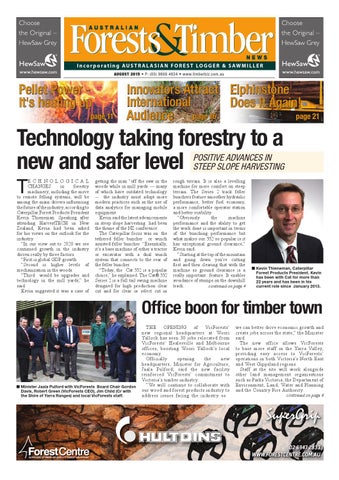
Technology taking forestry to a new and safer level
POSITIVE ADVANCES IN STEEP SLOPE HARVESTING
T
E C H NOL O GICA L CHANGES in forestry machinery, including the move to remote felling systems, will be among the main drivers influencing the future of the industry, according to Caterpillar Forest Products President Kevin Thieneman. Speaking after attending HarvestTECH in New Zealand, Kevin had been asked for his views on the outlook for the industry. “In our view out to 2020 we see continued growth in the industry driven really by three factors. “First is global GDP growth. “Second is higher levels of mechanization in the woods “Third would be upgrades and technology in the mill yards,” he said. Kevin suggested it was a case of
getting the man “off the saw in the woods while in mill yards --- many of which have outdated technology -- the industry must adopt more modern practices such as the use of data analytics for managing mobile equipment Kevin said the latest advancements in steep slope harvesting had been the theme of the NZ conference. The Caterpillar focus was on the tethered feller buncher or winch assisted feller buncher. “Essentially, it’s a base machine of either a tractor or excavator with a dual winch system that connects to the rear of the feller buncher. “Today, the Cat 552 is a popular choice,” he explained. The Cat® 552 Series 2 is a full tail swing machine designed for high production clear cut and for clear or select cut in
rough terrain. It is also a levelling machine for more comfort on steep terrain. The Series 2 track feller bunchers feature smoother hydraulic performance, better fuel economy, a more comfortable operator station and better visibility. “Obviously the machine performance and the ability to get the work done is important in terms of the bunching performance but what makes our 552 so popular is it has exceptional ground clearance,” Kevin said. “Starting at the top of the mountain and going down you’re cutting first and then clearing that with the machine so ground clearance is a really important feature. It enables avoidance of stumps on the downhill track. continued on page 4
¢ Kevin Thieneman, Caterpillar Forest Products President. Kevin has been with Cat for more than 22 years and has been in his current role since January 2013.
Office boon for timber town
¢ Minister Jaala Pulford with VicForests Board Chair Gordon Davis, Robert Green (VicForests CEO), Jim Child (Cr with the Shire of Yarra Ranges) and local VicForests staff.
THE OPENING of VicForests’ new regional headquarters at Woori Yallock has seen 30 jobs relocated from VicForests’ Healesville and Melbourne offices, boosting Woori Yallock’s local economy. Officially opening the new headquarters, Minister for Agriculture, Jaala Pulford, said the new facility reinforced VicForests’ commitment to Victoria’s timber industry. “We will continue to collaborate with our wood and forest products industry to address issues facing the industry so
we can better drive economic growth and create jobs across the state,” the Minister said. The new office allows VicForests to base more staff in the Yarra Valley, providing easy access to VicForests’ operations in both Victoria’s North East and West Gippsland regions. Staff at the site will work alongside other land management organisations such as Parks Victoria, the Department of Environment, Land, Water and Planning and the Country Fire Authority.
continued on page 4
OUT PULLS THE OTHERS
Pull a full drag up a steep grade with the new Cat ® D Series Skidder and feel the power. Tires stay on the ground, so it won’t dance with you on turns. Six-speed transmission, lock-up torque converter and independent front and rear differential locks give you more control. Advanced hydraulics speed up cycle times and lift more. Watch your drag through tall windows in cool, quiet comfort with seat-mounted grapple joysticks at your fingertips. Runs cool and debris can’t find a home. Tilting cab opens up a whole new world of service access. Lower operating cost and more productivity — that’s what the new D Series is built to deliver. The D Series comes with Product Link™ to track fuel, idle time, maintenance and more. Look to your Cat dealer for financing and all the machines you need for sustainable harvesting and land management, forestry road construction, hauling and millyard. Total support from one source. www.cat.com/en_AU
© 2015 Caterpillar. All Rights Reserved. CAT, CATERPILLAR, BUILT FOR IT, their respective logos, “Caterpillar Yellow,” the “Power Edge” trade dress as well as corporate and product identity used herein, are trademarks of Caterpillar and may not be used without permission. www.cat.com www.caterpillar.com
Proud Supporter of
In the news
APLE exports Esperance wood chips to China By Haley Baker
E
SPERANCE’S FIRST shipment of wood chips to China mark the beginning of a long-term trade agreement that could pump millions into the local economy through employment and business opportunities. Over the next five to seven years, 300,000 tonnes of eucalyptus wood chips a year will be exported from Esperance to various ports of Southern China to be used as paper. The first shipment followed years of planning between the Australian Plantation Log Exports (APLE) and the Esperance Port Sea and Land (EPSL). APLE managing director Brett Davison said his company had a long term trade agreement with buyers in China which would provide lengthy security for Esperance locals and tree farmers. “This project will provide considerable benefit to the landowners, associated businesses and provide significant employment opportunities within the region,” he said. Mr Davison said there was at least 8 million tonnes of trees around Esperance and farmers who owned land with large Eucalyptus trees were set to benefit if they joined the project. “Once the property [a farm] is cleared of the Eucalyptus trees the value of the farm increases and allows the farm
Death of SA timber icon
MOUNT GAMBIER businessman and timber icon Adrian de Bruin has died while walking around the Blue Lake. Mr de Bruin, 70, had recently been recognised as a Member of the Order of Australia for significant service to business and regional development. He still lived in Mt Gambier where he had been since arriving in Australia from Holland as a nine year old boy in 1955. He was a proud local community member committed to the future growth and development of Mount Gambier and the entire Limestone Coast, maintaining the region boasted untapped potential for both business and lifestyle opportunities ... "a wonderful place to call home". www.timberbiz.com.au
to generate money through crops and livestock.” The idea of exporting wood came about when Mr Davison heard that Eucalyptus trees within Esperance were going to be burned down. “We were made aware of the resource in Esperance three years ago - it was a stranded resource [had no where to go]. “We came down and asked the Port their thoughts on how they would like to see wood chips exported - and the rest is history.” The first shipment of wood chips will be exported to Rizhao, China, and two other southern ports in China will also be receiving stock. Mr Davison, who could not be happier with the result, said APLE was also donating a percentage of every tonne of wood chips to the Rotary Club of Esperance. “We finally did something that everyone said we couldn’t.” One farmer reaping the rewards by contracting his Eucalyptus trees to APLE is Oake Marsh Farm owner Andrew Middleton. “We were one of the first tree farms. We planted here in 1999, 2000 and 2001 in which we put in a total of about 700 hectares of trees.” “Ever since Elders forestry folded up, it seemed like a shocking waste of burning the trees down and APLE were keen to get going.” Mr Middleton said he would rather see trees being utilised rather than
destroyed so agreed to the harvest which began last September. “A few years back we had no income so we had to do something with the trees,” he said. “If the land isn’t producing anything then it costs money. So rather than spending money on tree removals we decided to make some money.” “We think we have around 100 hectares of chips so that’s $1000 a hectare.” Mr Davison believed the Port of Esperance had the potential to establish itself as a wood shipping port and looked forward to the industry’s future in the town. “APLE believes that Esperance has the opportunity to become as good as all the other wood ship ports such as Albany and Bunbury,” he said. Across the other side of the nation, the first 36,000 logs salvaged from HQ Plantations’ cyclone Marcia-damaged forests at Byfield have been loaded at Gladstone, Queensland, bound for China. More than 1 million tonnes of timber from trees damaged during the cyclone will be exported. This is the first time timber has been exported through Gladstone as logs. About 80% of HQP’s 12,000 ha of plantations at Byfield was destroyed and damaged by cyclone Marcia in February. Replanting has commenced. Haley Baker, Esperance Express/ Fairfax Media www.esperanceexpress. com.au
Off the shelf solutions, customised for your mill For over 100 years, we’ve been engineering solutions for the timber industry. In that time, we’ve designed and built a range of equipment proven to improve mill productivity. But we’ve yet to meet a client who didn’t need some modifications to make even the best equipment fit their particular space and needs. Contact us for a quote to make your mill even more productive.
• manufacturing • sawmilling equipment • log carriages • resaws • multisaws and board edgers • automatic sorters and stackers • transfers and conveyors. Complete turnkey projects.
Australian Forests & Timber News
From major start-ups to retro-fits, if you want professional service and advice, contact us.
AE Gibson & Sons Phone 02 6559 4001 Email: info@aegibsonman.com.au www.aegibsonman.com.au
August 2015
I n c o r p o r a t i n g A U S T R A L A S I A N F O R E S T L O G G E R & S AW M I L L E R
August 2015 Issue 5 Vol. 24
When it comes to firewood and the latest technology, just talk to David Burder, CEO Whitlands Engineering. More on page 18
Features IndustryEdge 8 Bio 9-13 ABARES Report 14 HarvestTECH 16 WoodTECH 17 Firewood 18 Chains 19 Harvesting 20 Haulage 21-23 Finance 24 Head-Lines 28 AUSTimber 29
MEDIA
INDEPENDENT & AUSTRALIAN OWNED
Publisher and Chief Executive: Hartley Higgins General Manager: Elizabeth Bouzoudis Editor: John Hudswell Advertising: Michael Dolphin Production: Luke Westle Advertising: m.dolphin@ryanmediapl.com.au Melbourne Office (03) 9888 4834 Trader classified: m.dolphin @ryanmediapl.com.au Melbourne Office (03) 9888 4834 Editorial: j.hudswell@ryanmediapl.com.au Adelaide Office (08) 8369 9512 Subscriptions: subs@forestsandtimber.com.au Adelaide Office (08) 8369 9522 Subcription rates One-year (8 editions) $55 Two-years (16 editions) $95 Accounts: Adelaide Office (08) 8369 9555 Postal Address: 630 Regency Road, Broadview South Australia 5083 Phone: (08) 8369 9555 Fax: (08) 8369 9501 Melbourne Office: Suite 103, 486 Whitehorse Road, Surrey Hills, Victoria, 3127, phone (03) 9888 4822 Conditions: Opinions expressed herein are not necessarily those of the editor/ publishers; information is published in good faith and we do not accept responsibility for damage which may arise from any possible inaccuracies. All rights reserved, none of the contents may be used in any other media without prior consent from then publishers. Published by Ryan Media Pty Ltd. Print Post No. PP 767324/00002
3
In the news
In Brief
International forestry geneticists head to Rotorua REGISTRATIONS HAVE opened for a forest genetics conference in Rotorua next March that is expected to attract around 200 delegates from all over the world. Scion is hosting the Forest Genetics for Productivity Conference (FGFC 2016) on 14-18 March 2016 as part of the International Union of Forest Research Organisations (IUFRO) calendar of events. Port goes on the market The Triabunna mill wharf, which is accessible only through private property, is on the open market. Tasports has confirmed a commercial property agent has been engaged to lead an Expression of Interest (EOI) process, that will start online and will be followed up with newspaper advertisements. The only deep-water port on Tasmania's east coast has been sitting idle since the former Gunns woodchip mill closed in 2011. Winter planting under way Around 4.5 million pine seedlings will be planted in 4200 hectares of State-owned plantations near Tumut, Batlow and Tumbarumba during Forestry Corporation of NSW's annual winter planting program. Forestry Corporation of NSW's Silviculture Manager Roger Davies said around 130 contract staff had been brought on board for planting season statewide. "Each winter we re-establish around 8,500 hectares of pine plantations across NSW and about 40 to 50 per cent of these are in the Tumut region," Mr Davies said.
continued from page 1
Technology taking forestry to a whole new and safer level “The 552 also has a unique rear design which virtually eliminates the interference experienced with competitive machines at the base of the slope. Again, If you think about this application you’re starting at the top and you’re going down into a valley and so you see the draw of a winch interfering with the rear of the machine that can potentially cause damage to the machine.” Overall, Kevin was positive about the advancements already made in steep slope harvesting and paid tribute to New Zealand for leading the world in this area. “What’s coming down the pike in the next 5-10 years is remote operated machines and potential autonomous machines. There are several examples that show where actual machines are in tests around the world in remote operated bunchers. “Obviously cutting on the slopes is more dangerous than cutting on the flat so if you can take the man off the saw and the man out of the cabin on a buncher then that makes for a safer environment to fell trees. “However, there’s a lot of issues to work through yet,” Kevin said. Another crucial factor in the operational bottom line is fuel efficiency
and Kevin said Cat had concentrated on achieving emissions compliance while at the same time delivering significantly better fuel efficiency. Obviously it’s been successful as the feedback Cat has received from customers has been exceptionally positive. “It’s important to understand that emissions compliance has really consumed most of the R&D budgets on forestry machines. The last three emission changes have been really short time cycles requiring very significant changes to the engines and installations “At Cat our focus has been on delivering industry leading fuel efficiency to help our customers. Typically, 40% of their costs in the woods is on fuel. Fuel savings help operators to be more competitive,” he said. For Kevin, the visit to New Zealand proved highly beneficial and he’s planning to come back Down Under for AUSTimber (Traralgon 11-16 April) next year. “I understand the last one in 2012 was quite well attended and we’re expecting even better attendances at next year’s show based on what we’re hearing from customers and from the industry,” he said.
¢ Cat 552 in action.
continued from page 1
VicForests’ Woori Yallock office a boon for timber town The site will integrate corporate and regional roles covering field-based work such as forest planning, surveying, harvesting, road and regeneration tasks, as well as sales, stakeholder engagement, finance and management. “The timber industry remains an important part of the Yarra Valley region and we want the community to be reassured that we are here for the long term,” said VicForests’ Chief Executive Officer Robert Green. As Australia’s largest supplier of high quality hardwood sawlogs, Victoria’s forest and wood products industry brings significant value to the state in terms of employment, income and the expenditure it generates in Victorian communities, particularly in regional areas. About 380 businesses are directly involved in the growing, services to forestry, and primary processing sectors of Victoria’s timber industry, providing rural, regional and metropolitan jobs for 21,000 people. Victoria exported $684 million worth of forest products in 2013-14, while forestry businesses using Victorian timber generated up to $1.78 billion in business expenditure in 2011-12. Since its establishment, VicForests has generated more than $1 billion in timber sales, achieved almost $16 million net profit and returned total dividends to the state in excess of $5.3 million.
Forestry advisor quits Former Legislative Council member Sue Smith resigned as deputy chair of the Ministerial Advisory Council. Council members had been banned from speaking to the media after Mrs Smith publicly called for Forestry Tasmania to be dismantled and its assets sold. Just two days later Resources Minister Paul Harriss said Mrs Smith had reversed her position and supported retaining Forestry Tasmania. 4
Australian Forests & Timber News
August 2015
www.timberbiz.com.au
ALL WORK AND NO PLAY. SOUNDS ABOUT RIGHT.
When you get up and running, we know how important it is to keep running. That’s why Waratah is determined to keep you working by providing second-to-none customer support. Whether you need a simple recalibration or you’re really up aganist it, you can contact our service team through our 24/7 contact lines. No matter what time you need us, we’ll find a solution that keeps you working. And earning
Melbourne
24/7 Hotline 03 9747 4200
Bunbury WA
24/7 Hotline 08 9726 0411
www.waratah.net
In the news
Biomass included in RET A win for sensible policy making
T
HE REINSTATEMENT of native forest wood waste in the Renewable Energy Target (RET) has been described as a nobrainer and a chance for Australia to catch up to the rest of the world. “The science is clear when it comes to the environmental benefits and we now have a genuine opportunity to reduce carbon emissions in this country," said Senator Richard Colbeck, Parliamentary Secretary to the Minister for Agriculture. “Australia is catching up to the rest of the world by recognising the value of utilising wood biomass as a renewable energy source, including wood offcuts, branches and residues,” he said. Senator Colbeck said that research published in Future Science found that carbon emissions can be reduced by up to 96% by replacing coal generated electricity with wood biomass. The Intergovernmental Panel on Climate Change (IPCC) also recognises the environmental benefits of biomass and has made the following statement: “In the long -term, a sustainable forest management strategy aimed at maintaining or increasing forest carbon stocks, while producing an annual sustained yield of timber, fibre or energy from the forest, will generate the largest sustained mitigation benefit.” The Australian Forest Products Association (AFPA) welcomed what it termed a common sense policy. The vote was supported by crossbench Senators Day, Lambie, Leyonhjelm, Madigan, Muir, Wang and Xenophon.
Vital support "This cross-bench support was vital in voting down an amendment put forward by the Australian Labor Party and supported by the Greens and Senator Lazarus to stop the
reinstatement of native forest wood waste in the RET," said AFPA Chief Executive Officer Ross Hampton. “Until we grow square trees we will always have a large amount of residues and offcuts from our sustainable harvesting and processing operations. Bark and branches are left on the forest floor, providing mountains of kindling for mega bushfires, or pushed into piles to rot away. At sawmills the offcuts and sawdust pile up and add costs to small regional businesses. Now, with
“Those who voted against the legislation have nothing to fear; the notion that forests would ever be harvested for biomass is economic nonsense as there is no sense in a sawmiller incurring costs of approximately $140 tonne to purchase, cut, snig, haul and chip a native forest log to receive around $20 tonne for the chip.” renewable energy certificates once more available for what is so clearly a renewable resource, these residues will be able to be put to a better use. "We look forward to seeing proposals for small scale powerplants, which will enable regional communities with a sawmill, for example, in its midst to convert from coal or gas fired power to bioenergy - reducing greenhouse gas emissions. “The use of native forest wood for the primary purpose of generating renewable electricity is not eligible for renewable energy certificates under this legislation. The use of offcuts and by-products of sustainable forestry operations to generate renewable electricity makes sense. "After all, what could be more sustainable and environmentally friendly than using a waste product to generate electricity, noting that our forest industries plant more than sixty million trees every year?. “The very same legislation was in place for a decade until 2011 (including for three years under Labor) without any harmful effects. Our national forest industries will remain amongst the most tightly regulated and carefully managed in the world and continue their work in growing a sustainable industry for generations,” said Mr Hampton.
No-brainer
¢ Ross Hampton, AFPA
6
from legal and responsibly managed forests certified by the Australian Forestry Standard (AFS) and the Forest Stewardship Council,” he said. “It makes common sense to use offcuts, sawdust and bark that is otherwise left as fuel for bushfires or left to rot as fuel for a green energy industry." Rod said Australia’s tightly regulated and carefully managed native forestry industry would ensure
Rod McInnes, CEO of Timber Queensland, said this legitimate use of a biomass waste product was a no-brainer for a society that is trying to move away from dirty energy and increase the use of renewable power. “The waste can only come
that, as legislated, the use of native forest wood for the primary purpose of generating renewable electricity is not eligible for renewable energy certificates. “Those who voted against the legislation have nothing to fear, the notion that forests would ever be harvested for biomass is economic nonsense as there is no sense in a sawmiller incurring costs of approximately $140 tonne to purchase, cut, snig, haul and chip a native forest log to receive around $20 tonne for the chip,” he said. “The passage of this legislation was a great victory for Tasmania. Our state had been punished by deeply floored mainland RET laws which forced our biggest employers to effectively pay tens of millions of dollars in extra taxes – even though those businesses mainly use Renewable Hydro Energy," said Independent Senator for Tasmania Jacqui Lambie.
Jobs in jeopardy "This endangered and put in jeopardy the direct and indirect jobs of tens of thousands of Tasmanian workers associated with iconic companies like Bell Bay Aluminium, Norske Skog, Grange Resources and Nyrstar," she said. "These companies are collectively worth more than $2 billion to the Tasmanian economy and are responsible for half of Tasmania’s exports by value - and the old RET laws almost shut them down. I was proud to play a role in formulating the new RET laws and ensuring their passage through the Australian
Australian Forests & Timber News
August 2015
¢ AFTN spelled out the reasons for RET change in the June issue.
Senate because it exempted our heavy manufactures from the unfair RET penalties, thereby protecting 10,000 direct and indirect Tasmanian workers' jobs. "In addition the legislation also allowed the inclusion and reinstatement of forest wood and bio-waste into the new Renewable Energy Target Scheme. This again secures the jobs of hundreds more Tasmanian workers in our forestry and timber industries," said Senator Lambie.
¢ Helen Murray, TCA
Timber Communities Australia (TCA) said the change in legislation restored genuine wood waste biomass, sourced from legally and sustainably managed native forest or sawmill operations, as an eligible bioenergy feedstock, alongside other types of wood waste material. "This is a commonsense outcome that is good news for timber communities. "Potentially innovative bioenergy pathways for using existing wood waste from responsible and legally compliant operations are no longer closed off for local communities across Australia," said TCA National Coordinator Helen Murray. TCA is pleased there are controls to ensure only genuine waste is utilised. We welcome your opinion: Email your feedback to j.hudswell@ryanmediapl.com.au www.timberbiz.com.au
! days e t a d on 015 i e t a h r ave t monst 2-13 2
S
de gust 1 t a c u Tiger mania, A s in Ta
L855C fitted with 5185
FELL-SHOVEL-BUNCH WITH TIGERCAT New to the Australian market are the versatile Feller/Shoveller options with the Tigercat 5195 Directional Felling Head or the Tigercat 5185 Fixed Rotation Bar-Saw Head mounted to the ever popular levelling 855C carrier. These machines are now working in Australia with outstanding feedback. Enjoy the benefits of the base machine and felling head being delivered from factory ready to work. Fell and shovel wood off steep slopes to the landing and watch your overall productivity increase.
LS855C fitted with 5195
TASMANIA
NEW SOUTH WALES
SOUTH AUSTRALIA
VICTORIA
WESTERN AUSTRALIA
11 Midland Highway, Brighton
208-216 Snowy Mountains Highway, Tumut
17 Crouch Street North, Mount Gambier
226-228 FrankstonDandenong Rd, Dandenong South
12 Sherlock Way, Davenport
Give us a call or visit our website to see how we can be of help.
1300 727 520 – WWW.ONETRAK.COM.AU
INDUSTRY EDGE
Softwood harvest and sawnwood production throw up different results The softwood harvest increased only modestly in 201314, defying expectations of larger growth, but still fast diverging from the declining hardwood harvest. At the same time, sawn softwood production and consumption are at or near their peak, setting new records. By Tim Woods
At a glance
A
U S T R A L I A’ S ROU N DWOOD removals – the national harvest of all species – totaled 22.9 million m3 in 2013-14. While the harvest was higher than the prior year 0.3%, the result was lower than IndustryEdge expected. This was largely due to a small decline in the softwood harvest. The decline appears to have been driven by downstream capacity constraints, coming amidst a housing boom. Regardless, research and analysis undertaken for the 2015 Forest & Wood Strategic Review shows the softwood element of the harvest accounting for 57.6% of the total. A decade ago, softwood extractions accounted for 55.1% of a total harvest of 26.5 million m3. In total, the annual harvest, by species and expected utilization, is displayed in the following chart. Compared with 2012-13, the total Australian harvest in 2013-14 increased just 70.0 km3 (0.3%). On first examination, this outcome seems low, especially given the strength in new dwelling commencements that commenced in mid-2013, as the Australian Dollar started its relatively long period of depreciation. Closer examination reveals several factors that are suppressing a larger total national harvest: The harvest from native forests continues to decline and has fallen by an average 7.2% per annum over the decade to the end of June 2014. Despite the strength of the plantation hardwood harvest (almost all of which is destined for the international pulpwood market), total hardwood 8
Tim Woods is Managing Director of IndustryEdge, Australia’s leading market analysis firm in the forestry and wood products sector. The firm is publisher of the monthly Wood Market Edge and the biannual Forest & Wood Strategic Review. The 2015 edition of the Strategic Review has just been released. Go to www.industryedge.com.au or call +61 3 5229 2470. extractions fell to 9,713 km3, down 18.4% from a decade ago. In 2013-14, the total softwood harvest was 13,185 km3, down 2.6% or 350 km3 on the prior year. Despite the rise in housing commencements, the data supplied to IndustryEdge by softwood log producers shows a small decline in saw and veneer log production and a larger fall in pulp log production. A variety of factors can explain this situation, however the broad consensus appears to be that sawn softwood capacity is nearing peak utilization. Expectations are that the harvest for the financial year about to end will be modestly higher than in 2013-14, pushed up by strong demand, improved competitiveness against imports and hard won operational efficiencies. Imports of sawn softwood
products have grown strongly over the last year. To understand how imports are interacting with domestic production, IndustryEdge deploys softwood sales data available from Forest & Wood Products Australia. In conjunction with import and export data for the same month, the sales data provides a snapshot of apparent consumption. Though it is imperfect as a measure of actual consumption, our approach is consistent and thus, the trends will be of interest. In April 2015, reported sales of softwood products totaled 203.5 km3, a decline from the prior month and 3.7 km3 lower than the monthly average of the last year. For the year to the end of March 2015, apparent consumption was a record 3,061.7 km3. It is important
¢ Apparent Consumption of Softwood Products: Jul ’13 – Apr ‘15 (km3) Source: ABS and Forest & Wood Products Australia Note: Production is actually ‘sales’ volumes from the month
Australian Forests & Timber News
to emphasise this point. Year to date softwood product consumption has increased for each of the last seventeen consecutive months. The last eleven have been records. The sawn softwood sector is booming. For the year to the end of April 2015, imports totaled 881.3 km3, more
than 100 km3 higher than for any prior year. Imports are higher, but so too is domestic production, as the above data shows. The following chart from the Forest & Wood Strategic Review shows production of sawn softwood by state. Whether we use up to date FWPA sales data or long-term historical production data collated by IndustryEdge’s field research program, it is difficult to escape the conclusion the sawn softwood sector is nearing the limits of its capacity. That is a cloud, but it is wrapped around a solid softwood consumption lining.
¢ Roundwood Removals from Australian Forests by Type: 2004 – 2014 (Mm3) Source: ABARES & IndustryEdge research and estimates
¢ Production of Sawn Softwood by State: 2004 – 2014 (km3) Source: ABARES, ABS & IndustryEdge research
August 2015
www.timberbiz.com.au
BIO
Woodchips and biomass markets in the spotlight
T
HE INTERNATIONAL Woodfibre Resource and Trade Conference will be held 2-4 November in Savannah, GA, and will feature speakers from more than a dozen countries. "It will be a chance to learn more about international markets for woodchips and biomass fibre, including overseas pulp mill developments, wood-based panel producers and demand for pellets and woodchips for energy production," said Bob Flynn, Director, International Timber. "The focus will be to bring together all those involved in the supply chain of international trade in woodfibre. Attendees will include forest owners, woodchip and pulp log suppliers, woodchip and wood pellet buyers, transportation companies, consultants and others." Highlighted are just two of the speakers and their topics: Port handling logistics for woodchips and wood pellets The USA is by far the biggest supplier of biomass (wood pellets) to Europe and is also the biggest supplier of softwood chips to the Atlantic and Pacific markets. A key part of the international woodfibre supply chain is the logistics for receiving, storing, and loading chips and pellets for export. Frank Peeples, Jr, President of East Coast Terminal, Co., will speak on the topic of port handling logistics. East Coast Terminal was founded by Frank’s father in the late 1970s. They exported pine chips to Scandinavia in the early 1980s and hardwood chips to Japan in the 1990s. Today, the facility is the third largest terminal for loading wood pellets for export and also loads pine chips for export to Turkey. South African woodchip exports jumped 32% in 2014! After years of steady decline, exports of hardwood chips from South Africa increased in 2014 to their highest level since 2010. While Japan has been the primary destination for hardwood chip exports from South Africa, it was the emergence of a new woodchip market in India www.timberbiz.com.au
in the second half of 2013 that led to the big jump in exports in 2014. The leading supplier of woodchips from South Africa is NCT, which accounted for 77% of woodchip exports in
2014 from its facilities in Richards Bay and Durban. Danny Knoesen, export marketing manager for NCT, will discuss “Africa Woodchip Supply and Outlook”.
¢ Woodchips for fuel.
SP 591 LX
Purpose built for harvesting and debarking of plantation grown eucalyptus.
The SP 591 LX is purpose built for harvesting and debarking of plantation grown eucalyptus. It offers an unrivalled productivity, feed speed and debarking efficiency. Together with the over all super duty design that guarantees also maximum reliability and uptime the SP 591 LX truly offers all you need for a profitable harvesting operation.
Head Office Victoria Randalls Equipment Company 8 Wallace Avenue, Point Cook, Melbourne VIC Contact: Peter Randalls Ph: 03 9369 8988
Randalls Equipment Company Pty Ltd
Email. randalls@randalls.com.au www.randalls.com.au
Australian Forests & Timber News
August 2015
Western Australia (NEW) Randalls Equipment Company 9B Charles Street, Albany WA
Contact: Adam Bremmer Ph: 0437 059 477
9
BIO
Biomass energy – Trending Technology Sohum Gandhi General Manager ENERGENCE
B
IOMASS ENERGY systems are slowly but surely increasing their share in worldwide renewable energy production. State of the art plants pave the way for greater uptake as they successfully prove the reliability, safety, performance, and positive environmental impact of the technology. In Australia the perception still remains a little cloudy with some disbelievers strongly supporting the tried tested and true fossil fuel energy players. With 85% of the Australian power generation share from coal and gas, these big players will be around for a long time to come. However, biomass from waste and sustainably managed sources is making an impact and will inevitably become a major player in reaching the renewable energy targets in this country and abroad. In this brief article we take you to four different biomass energy plants comprising of equipment and services from Energence (Australia) and Polytechnik (Austria). These energy plants are all success stories from the point of view of financial return, performance, reliability, carbon reductions and cleanliness of emissions.
L'Oreal, Spain
¢ Zealandia Horticulture, NZ
L’Oreal in Burgos, Spain 25 September, 2014, L’Oreal opened a new biomass plant at their haircare product manufacturing facility. This trigeneration plant supplies the factory with thermal energy, cooling capacity and electricity. In conjunction with investment in photovoltaic panels, this project will make their site carbon neutral from 2015 into the future. Biomass fuel in the form of forestry and sawmill residue is sourced in the nearby Castile and Leon region. System at a glance: • 4.8 MW Polytechnik thermal oil boiler with moving grate • 600kWe/2600kWth ORC Turboden 6 CHP • 20,000 MWhrs thermal energy production per annum • 12,000 tonnes annual biomass consumption • Factory consumes 70% of this energy / 30% sold to neighbouring businesses
Airbus Industries in Toulouse, France At this Airbus site over 10,000 employees manufacture and assemble a wide range of planes from the A320 to the A380 and including the A350 assembly line and paint shop. In 2010, a more environmentally conscious management decided to investigate alternatives to their existing fossil fuel gas boilers. The fuel is a mixture of local forestry residue and sawmill waste ranging from 20 – 55% moisture content. System at a glance: • 13.5 MW Polytechnik saturated steam boiler plant • 22,000 tonnes annual biomass consumption • 12,000 tonnes CO2e reduction per annum • Emission limit for particulates is 20 mg/m3 (guarantee) and during normal operation the plant achieves 2 to 8 mg/m3 • CO levels, which is the main indicator for complete and efficient combustion is practically zero and the plant efficiency is over 90% 10
¢ A irbus Industries, France
¢ Gippsland Greenhouse Produce.
• Ash used by local farmers as fertiliser • Cost savings in comparison to gas on the order of 50%
Zealandia Horticulture in Christchurch, NZ Zealandia are specialist wholesale growers of annuals, houseplants, and commercial seedlings. Currently they have 2.5 hectares under glass and are set to expand. The plant is running on hogged wood pallets from a local supplier, although the system can accept hog fuel, bark and sawdust with up to 60% moisture content. Zealandia also has a 1000m3 insulated heat storage tank to buffer the load swings. The primary reason for this investment was because their old wood fuelled system had high emissions and couldn’t meet the EPA requirements. Furthermore it did not have the output capacity to manage their future expansion plans nor did it have the fuel flexibility of the current system. System at a glance: • 1.6 + 2.5 MW hot water plant • Regional emission limit for particulates is 230 mg/ m3. During normal operation this plant achieves 50 mg/m3 • Efficiency > 90%
Gippsland Greenhouse Produce near Warragul, Australia This glasshouse grower produces top quality eggplants year round within their 2 hectare protected cropping facility. Originally this business used brown coal briquettes to heat the environment but installed a biomass system in 2014 to accommodate a 1 hectare expansion and the state government’s Australian Forests & Timber News
August 2015
ban on coal briquettes. Now their thermal energy needs are fully independent from fossil fuels and they economically source renewable forestry and sawmill residue from around the local area. System at a glance: • 2.0 MW hot water plant • 3500 tonnes annual biomass consumption • 80,000 tonnes CO2e reduction lifetime (based on 25 years) • Production of one million kilograms of eggplant per annum These four plants are just a few of the great renewable energy systems that are being implemented around the globe and within Australia. There are many more examples like this where biomass systems are beating emissions standards, reducing CO2 pollution, providing financial incentive and last but not least exceeding performance criteria for the business purposes that they serve.
About the Author: Sohum Gandhi has a Bachelor of Engineering degree from the University of Victoria, Canada. Since 2004, he has been working within the Australian energy industry. As the General Manager of Energence, Sohum has partnered with Polytechnik Biomass Energy to bring Australian Industry international standard biomass energy systems. Energence installed projects to date offset many thousands of tonnes of CO2 emission annually, and save clients millions of dollars in fossil fuel costs. You can contact Sohum Gandhi – email: sohum@energence.com.au or website: www.energence.com.au www.timberbiz.com.au
BIO
Pellet power ... it’s certainly heating up! By Tony Esplin
B
IOMASS PELLETS have been used in Europe as an energy source for many years. Most homes have pellet stoves (or heaters) that use pellets as their fuel source. Pellets work well as a fuel source because they have a high energy density and they flow. Electricity flows. Gas flows. Oil flows. Pellets flow. Firewood doesn’t flow. Energy that flows can be automatically controlled and regulated. The newer generation pellet heaters from Europe are packed with functionality. They can be turned on via WIFI with a phone app. They are digitally controlled so when the room temperature reaches its target temperature the heater will back off and maintain the room temperature by regulating the pellet flow with a mini internal auger drive that feeds the pellets. They are also available in some pretty cool designs. Pellets are stored in a hopper at the rear of the heater. So why hasn’t this fantastic product taken off with more heater sales? It’s been a classic chicken and egg situation. Pellet heaters need a regular supply of pellets. Pellet manufacturers have been reluctant to commit to new investment if there is little or no market (except overseas export markets for bulk sales).
All that is about to change and here’s why: The market for pellet manufacturing equipment can be divided into two; large commercial producers of more than 1.0 Tonne / hr production and smaller scale producers of less then 1.0 Tonne / hr production. Their motivation for pellet production is vastly different. The larger producers have an organic waste stream in the form of shavings, sawdust etc. Typically these are the larger producers like sawmills and door manufacturers. They would make a significant capital investment of between MM$1 - $8 depending on the production volume. Their target markets will be mainly bulk export. The type of equipment that suits this operation are large pellet mills like the CPM heavy duty industrial equipment range. The smaller producers (< 1.0T/hr production) produce biomass waste as a part of their manufacturing operations and it is a costly exercise to dump this material. Sydney waste dumping prices are approaching $140 / Tonne for waste. Their objective is to save waste costs and productively utilize their waste biomass. A small scale Nova equipment pellet press production line is perfectly suited to this sized operation. A 200kg / hr production line complete with raw material fuel hopper, screw conveyor, hammer mill, conditioning silo, pellet press, pellet storage silo and packaging line
all PLC controlled will cost around $210,000. Before committing to any investment get your raw material tested first to make sure the pellet quality is good enough! Poor pellets may as well be lumpy sawdust – they wont sell. Good ones will always be in demand. With an energy density four times that of firewood / kg it’s no surprise that green thinking consumers now want to use pellets as a fuel source. With the increasing demand for the new generation style of pellet heaters the future for pellets has finally started to warm up! Tony Esplin is Director of Eden-based Recycling Technologies Group. tony@ recyclingtechgroup.com.au
WOOD WASTE PELLETS
50kg - 1000kg/hr production capacity Turnkey Installations including Storage silo Hammer mill Conditioning silo Pellet mill Cooling tower Storage silo Screw Conveyors Packaging Line PLC controlled and tailored to suit your waste volume & type.
Call RTG to discuss making Class AA pellets from your waste. Italy’s No. 1 Pellet Equipment Manufacturer - Nova.
02 64961133 www.recyclingtechgroup.com.au Eden | NSW
www.timberbiz.com.au
Australian Forests & Timber News
August 2015
11
BIO
Recipe for a great wood pellet By Tony Esplin
G
REAT WOOD pellets don’t just happen; there is a little bit of science and a little bit of passion behind making a wood pellet great. (A bit like the difference between a good passion fruit sponge cake and an awesome one!) There are seven things that make great wood pellets. Let’s look at what we have got to work with. Species, moisture content, particle size, pressure, transportation, equipment suppliers and packaging. Species: Pinus radiata wood waste actually makes a very good wood heating pellet. The energy content is around 18 MJ/ kg. This is around three times the energy content of unseasoned firewood. Australian gums also make a really nice pellet; they are a nice brown colour and the energy content is excellent. If you are considering an alternative biomass source I highly recommend getting your pellets tested before committing to any scale production facility. You want to make sure they deliver the heat output for the consumer. Moisture content: this is the number one critical factor. M.C. needs to be between 8 – 10% after hammer milling. Remember that hammer milling will dry the material by up to 1%. If the material is shredded up stream this will also cause it to dry out. So, theoretically you can start with a m..c of around 12% and arrive at the pellet mill at 9 – 10% after
shredding and hammering. Sometimes we have to inject water spray to raise the m.c. to the desired level to be in the target zone. If the fibre is too dry it will not hold together after pelletising. Too wet and it will crumble into small pieces. I recommend a humidity detector in the silo with a live digital read out so you can correlate this back to the control tests of the fibre m.c. Particle size: Start with this as small as possible. The larger the starting size the higher the energy consumption required in the hammer mill to smash it to the right size. A 6mm diameter pellet will require a 5mm screen on the hammer mill. If you start with a typical wood chip 30 x 20 x 8mm you will require a bigger hammer mill which also means more horsepower to drive it. Shavings will smash up easier than woodchips and require less horsepower. But if you have bigger chips then invest in a larger hammer mill. The width of the die needs to be suited to the species. This can only be accurately worked out from testing. Trying to drive hardwood through a thicker die designed for softwood will consume excess horsepower unnecessarily. The pressure needs to be high enough to release the natural lignin binder in the fibre which will hold the pellet together during the long journey to the consumer. But too high pressure will waste energy. The design of the roller
shells and the die have a significant influence on the pellet quality. There is a lot of engineering science to get this bit just right. Top end manufacturers have this engineering “artwork” all sorted. After going to all this trouble to make a great pellet you don’t want to destroy it by having an aggressive mechanical transportation method for your pellets in your production line. The target size for pellets is between 15 – 25mm long. A small percentage of pellets in the mix down to 8mm is OK – but anything shorter than this becomes waste. So don’t bust up your pellets with aggressive conveying systems. Equipment supplier: High end suppliers have correctly designed equipment that is system matched. Quality metallurgy is used in the dies and rollers to prevent premature wear, mixing and dosing equipment is correctly engineered to ensure a well blended and correct m.c. raw material. Dust explosion risks are addressed. However, all this costs money. There is NO cheap way to make quality pellets. So be prepared to invest a few extra CapEx dollars wisely and you will be rewarded with reliable equipment and factory backed experience and support. Packaging: If you are selling bulk volume this does not apply. If you are selling in typical 15kg size bags to the end consumer you want
¢ A typical Die used to make the pellets. The raw material is forced through the holes to compress and out the other side pellets are produced.
¢ These are pellets made from Australian hardwood mill waste from Eden, NSW, using a Nova N-Mini 22kW press.
your pellets to present like a AA grade engineered pellet. Prior to packing they need to cool down. The pellets need breathable packaging that will not absorb moisture. They need to be stored inside and kept dry in their journey to the end user.
Attention to detail in every aspect of the pallet production process will result in a great pellet. Constant monitoring during production will ensure your pellets are AA grade and the market demand for these will only get stronger over the coming years.
Bioenergy Australia Conference in Launceston AUSTRALIA’S PREMIER bioenergy conference, Bioenergy Australia 2015, will be held at the Hotel Grand Chancellor Launceston, Tasmania, from 30 November to 1 December with a technical tour on 2 December. The program will cover policies and programs, projects and project development case studies and emerging opportunities. The conference will consider the many facets of bioenergy, including having some 80+ presentations on: • Biomass resources and supply chain aspects • Conventional and advanced liquid biofuels • Algae and other future feedstocks • Pyrolysis, hydrothermal processing and biochar 12
• • • • •
iogas production and utilisation B Energy-from-waste Heat and power Biorefining and biochemicals Overarching aspects of bioenergy, such as policies, finance and investment, markets, life cycle emissions and sustainability.
In past years this conference has been attended by 200-300 delegates and we expect a similar good attendance this year. The program will include a trade exhibition and technical posters and include a tour to bioenergy facilities in the region. Abstracts for the Conference should be submitted to The Association Specialists further details on submitting an abstract for
Australian Forests & Timber News
August 2015
the Bioenergy Australia Conference 2015 Tasmania can be found at https://tas.currinda. com/register/event/1246. The due date for abstracts is 28 August. Speakers and Poster Presenters will be given significantly discounted rates to attend the event. A key part of the Annual Conference is a oneday Technical Tour - a visit to several sites of bioenergy interest to see and learn first hand from those who are active players in the bioenergy sector in Australia.
www.timberbiz.com.au
WHATEVER BIO
Burning wood: an opportunity for renewable power and heat expensive transportation over long distances and subjects plant operators to supply risk. Smaller-scale SRC systems require less wood but are less efficient when not combined with heat production. SRC systems in Europe are commonly smallscale systems selling heat locally, which improves both the system efficiency and financial return. The decentralised energy production possible with bioenergy provides significant local benefits of economic and energy resilience. If the east coast LNG export plants lead to the widely forecast increases in the cost of gas, woody biomass thermal systems will become increasingly cost-competitive.
By Mark Brown (Professor of Forestry Operations at University of the Sunshine Coast) and David Coote (PhD Candidate, Melbourne School of Land and Environment at University of Melbourne)
B
URNING SOME wood waste from native forests will be counted as renewable energy under revisions to the Renewable Energy Target (RET) passed late in June. Environmental groups and the Greens have criticised the move as possibly encouraging the logging of native forests. Burning wood waste was included in the Renewable Energy (Electricity) Act (2000). Under the Renewable Energy (Electricity) Regulations 2001, harvesting native forest just for energy generation was explicitly not eligible. Until 2011 some wood waste from native forest harvesting was eligible. The latest revisions reinstate some native wood waste under the legislation with the restrictions that existed until 2011. The RET legislates that, by 2020, 33,000 gigawatt hours of electricity must be generated by renewable energy. This includes wind, solar, hydro, tidal and various bioenergy sources. The scheme works through the creation of certificates for energy generation, and the requirement for liable entities to purchase these certificates. The latest revisions cut the RET from 41,000 GWh to 33,000 GWh and make burning wood waste from some native forest harvesting eligible for certificates under tight restrictions. However, as recognised in the relevant legislation and as shown by developments in Europe, burning wood waste from a variety of sustainable sources offers great potential as another source of renewable heat and electricity.
How it works Sources of wood allowed under the RET include residues from plantation, timber-processing facilities, construction waste and some native forest residues. The recently amended legislation clearly defines eligible feedstock for energy from native forest must be a residue resulting from an existing operation producing highvalue timber products. This legislation is similar to the regulatory regime dating back to 2000 and which applied until 2011. www.timberbiz.com.au
Does it have to come from forests? ¢ A community-scale woody biomass thermal energy system in Austria. Author provided
Despite this legislative support the Bureau of Resource and Energy Economics reports that the annual average energy from wood in the ten years before and after 2000 declined from 106.9 petajoules to 99.7 petajoules. For a number of economic reasons large-scale electricity generation from woody biomass in Australia has not seen significant uptake. It’s useful to examine briefly woody biomass energy generation here and overseas.
The European story Woody biomass comprises the largest renewable portion of global primary energy. While wood energy makes a small contribution to Australia’s fossil-fuel-intensive energy supply, modern wood energy plants in Europe make a large contribution in countries with ambitious renewable energy and decarbonisation targets. These include Sweden, Finland, Germany and Austria. Most woody biomass energy systems in Europe generate thermal energy. Thermal energy can be used for household, commercial, industrial and agricultural purposes. European thermal systems can operate with very high efficiency at scales from household to supplying district heating systems and industrial steam for entire towns. Both the authors have visited regional towns in Finland that are heated by wood in areas where temperatures may go as low as
-35C. While Europe has extensive subsidies for renewable heat, there are no subsidies for woody biomass heat in Australia. Smaller-scale thermal systems are becoming more common in Australia. Recent installations include the Beaufort Hospital near Ballarat, a public swimming pool and a number of commercial greenhouses. These communityscale systems use small quantities of wood in the range of hundreds to thousands of tonnes per year. At this small scale, the wood can come from a variety of sustainable local sources. In addition to being a renewable energy, it can play an important role in regional development.
Heat and power from wood Wood can be used to generate just electricity or heat and electricity in a combined heat and power plant. Most electricity from wood is generated in Steam Rankine Cycle (SRC) plants (SRC is the technology used in most largescale coal-fired power plants). These SRC systems are relatively inefficient at producing electricity compared to the energy stored in the wood. This system efficiency can be greatly improved in a combined heat and power plant by making direct use of some of the heat generated. This further favours smaller installations tailored to a local need. Large-scale SRC systems require hundreds of thousands of tonnes of wood per year. This would require
Australian Forests & Timber News
August 2015
Even with the intensified deployment of bio-energy in Europe the material used for energy production is usually a residue of commercial operations to produce timber or fibre from wood. Dedicated woodlots and shortrotation woody crops are also used to supplement European biomass supply in relatively small quantities. Some wood pellets used in Europe are manufactured from diseased or pest-affected trees in North America. Other northern hemisphere sources of whole trees for energy such as otherwise non-commercial species are contentious and unlikely to be economically viable without large subsidies. Some commercial European energy generators have questioned this use on sustainability grounds. Northern hemisphere experience suggests that woody biomass energy systems can make a significant contribution of lowcost, low-carbon energy using offthe-shelf, commercially available technology. -- As published on The Conversation Disclosure Mark Brown receives funding from Forest and Wood Products Australia and Australian forest industry companies. He is affiliated with Bioenergy Australia, IEA Bioenergy - Task 43 and the Institute of Foresters Australia. David Coote in the past has done small consulting jobs in renewable energy. He may do more such work in the future. He is affiliated with the Institute of Foresters Australia and several farm forestry networks. 13
ABARES REPORT Australian forest and wood products statistics September and December quarters 2014: Research by the Australian Bureau of Agricultural and Resource Economics and Sciences
Forest industries rebuild and strengthen
A
CTIVITY IN Australia’s forestry sector recovered strongly in 2013–14 after weak performance in 2012–13, with many key indicators exhibiting robust growth between these periods, according to the latest ABARES report. The volume of logs harvested in Australia increased by 12% in 2013–14, to reach 25.3 million cubic metres (Figure 1; Table 1). This was led by a 31% increase in the volume of hardwood plantation logs harvested over the year (to 6.9 million cubic metres). Both native forest and softwood log harvest also increased (by 7.5% and 6.0%, respectively). Overall, the value of logs harvested in 2013–14 reached almost $1.8 billion, the highest gross value of log production since 2010–11. In 2013–14 the values of hardwood plantation logs harvested ($464 million) and softwood (plantation and native cypress) logs harvested ($970 million) were the highest values recorded in Australia for these log types. Some forest growers benefited from higher log prices in 2013–14. Hardwood plantation log prices (valued at milldoor; comprising stumpage, harvest and transport costs) increased by 4.4% and softwood plantation log prices increased by 9.6% in 2013–14. The average price of native forest logs declined slightly in 2013–14, although the price of these logs has increased relatively strongly since 2010–11, exceeding the rate of growth of plantation logs (Figure 2). Hardwood plantation log harvest volume growth was strongest in Tasmania, South Australia and Victoria. Softwood plantation harvest growth increased in all states aside from Tasmania, with strongest growth in South Australia (Table 1). Despite declines in native forest harvesting in Western Australia and New South Wales, in aggregate Australia recorded an increase in the volume and value of native forest logs harvested in 2013–14. This was led by a 43% increase in the native forest volume harvested in Tasmania, to 1.1 million cubic metres in 2013–14. However, native forest log prices declined on average by 13% in Tasmania in 2013–14 and the native forest volume harvested in the state is less than one-quarter of the volume harvested in 2003–04. The strong growth in log harvest corresponded to increased activity in many of Australia’s forest-based industries. In 2013–14 sawnwood production is estimated to have increased by 4.7%, wood-based panels production increased by 3.5% and paper and paperboard production was 0.7% higher, relative to 2012–13. The growth in sawnwood production resulted from growth in softwood (including native cypress) sawnwood production, which was up 6.3% over the year, while hardwood sawnwood production (mainly using logs from native forests) fell by 3.6%. Softwood sawnwood production has fluctuated over the past decade and is currently above the average volume of production recorded between 2003–04 and 2013–14. Hardwood sawnwood production has exhibited a consistent decline over the same period and production in 2013–14 was 44% below that in 2003–04. This reflects both the diverging supply trends of softwood and hardwood sawlogs over the decade, as well as the different drivers of demand for these products.
Figure 1 Volume of logs harvested, by forest and log type, 2003–04 to 2013–14
Note: Softwood includes native cypress pine. Log harvest includes saw and veneer logs, pulplogs and other logs such as poles, piles and fencing.
Table 1 Volume of logs harvested, by state, forest type and selected years 2003–04 (’000 m3)
2008–09 (’000 m3)
2009–10 (’000 m3)
2010–11 (’000 m3)
2011–12 (’000 m3)
2012–13 (’000 m3)
Hardwood native
1 906
1 441
1 355
1 080
1 119
914
883
Hardwood plantation
142
228
216
174
108
98
66
Softwood
3 356
3 766
4 324
4 828
4 518
4 397
4 449
Total
5 404
5 435
5 895
6 082
5 745
5 409
5 398
Hardwood native
2 027
1 779
1 860
1 844
1 549
1 332
1 407
Hardwood plantation
250
601
641
768
1 689
1 789
2 188
Softwood
3 769
3 890
3 570
3 752
3 381
3 560
3 806
Total
6 046
6 270
6 070
6 363
6 620
6 681
7 401
Hardwood native
411
328
267
275
276
256
Hardwood plantation
0
1
1
1
5
3
Softwood
2 543
1 749
2 023
1 791
2 125
1 627
1 758
Total
2 955
2 077
2 291
2 067
2 406
1 886
2 024
Hardwood native
0
0
0
0
0
0
Hardwood plantation
8
166
69
287
416
481
Softwood
2 698
2 030
2 494
2 379
1 887
1 972
2 373
Total
2 706
2 195
2 563
2 666
2 303
2 452
3 079
Hardwood native
538
495
437
468
499
451
Hardwood plantation
799
2 590
2 639
3 060
2 543
2 557
Softwood
973
1 009
901
924
843
733
Total
2 310
4 093
3 977
4 452
3 885
3 742
4 052
Hardwood native
5 202
3 697
2 670
2 659
1 039
795
1 133
Hardwood plantation
620
1 161
991
934
304
353
1 085
Softwood
1 249
870
1 106
1 306
1 194
1 262
1 125
Total
7 071
5 728
4 767
4 900
2 538
2 410
3 344
Hardwood native
10 090
7 739
6 589
6 326
4 482
3 748
4 029
Hardwood plantation
1 819
4 746
4 555
5 224
5 066
5 281
6 911
Softwood
14 589
13 314
14 418
14 981
13 949
13 551
14 358
Total
26 498
25 799
25 563
26 532
23 497
22 580
25 298
Forest type
2013–14 (’000 m3)
New South Wales
Victoria
Queensland 263 2
South Australia 0 705
Western Australia 343 2 864 845
Tasmania
Australia
Note: See AFWPS Summary Table 8A for detailed notes and sources. Excludes firewood removals. Softwood includes native cypress pine. Includes logs from private and public forests. New South Wales includes Australian Capital Territory. Total for Australia includes Northern Territory. Sources: ABARES; Australian Bureau of Statistics; forest industry associations; private industry; state and territory forest services
14
Australian Forests & Timber News
August 2015
www.timberbiz.com.au
A NEW GENERATION OF
FOREST MACHINES NOW IN AUSTRALIA!
RANDALLS EQUIPMENT COMPANY is proud to be associated with PONSSE Plc Finland by introducing the full range of PONSSE forestry machines to Australia. PONSSE is the world leader in supplying the logging industry with productive and environmentally friendly cut-to-length harvesting systems. CONTACT US FOR MORE INFORMATION RANDALLS EQUIPMENT COMPANY PTY LTD email: randalls@randalls.com.au www.randalls.com.au HEAD OFFICE VICTORIA Randalls Equipment Company 8 Wallace Avenue, Point Cook, Melbourne VIC Contact: Peter Randalls Ph: 03 9369 8988 WESTERN AUSTRALIA (NEW) Randalls Equipment Company 9B Charles Street, Albany WA Contact: Adam Bremner Ph: 0437 059 477
FORWARDERS: From 10.000 to 20.000 kg load capacity. HARVESTERS: PONSSE offers a full range of wheeled harvesters for the most challenging logging conditions. Six impressive models that range from the Beaver to the heavyweight Bear, including the new and very impressive ScorpionKing. The product range includes both six and eight-wheel harvesters in all size categories. Application ranges from harvesting softwood saw logs to harvesting & debarking eucalypt pulpwood.
A logger´s best friend www.ponsse.com
HARVESTECH
Forest innovators attract international audience
T
HE HARVESTTECH 2105 international conference that focused on logging machinery designed for steep slope forest harvesting attracted more than 400 delegates to Rotorua, the heart of New Zealand forestry. “We targeted forest contractors and managers from around the world . The response has been fantastic. They were here to see how our innovative local contractors have come up with novel solutions for safe and productive harvesting machines,” said Forest Industry Engineering Association (FIEA) director Brent Apthorp. Large groups of senior forestry leaders and contractors and company owners from Chile, Australia, USA and Canada and every one of the major forest companies in Australasia and South America attended the FIEA-hosted event. “Over the past few years our New Zealand forest contractors tackled problems no one else was prepared to. They’ve made mechanised forest harvesting safe on a range of steep slopes by tethering the machines. Now they’ve done it, the world has arrived here on our doorstep to see how they’ve cracked it.” Every one of the major manufacturers of forestry equipment sent senior engineers and top managers from USA and Canada to see the leading edge in Rotorua. The most innovative contractors have tackled both safety and productivity at the same time. They did it to solve their own local terrain issues but now it looks set to spread around the world. “Two local contractor-developed harvesting equipment systems have become so popular they’re now getting export orders. This Kiwi-
developed technology is set to spread around the world where people have the same steep slope challenges. It takes intensive training alongside the technology for it to succeed in new terrain. The remarkable change is that treefelling has become much safer thanks to the new technologies that have been put in place,” he said. HarvestTECH 2015 was a two-day technology conference for practical loggers and machinery developers. The large international audience saw not just Kiwi innovations but other technologies being developed in Europe, North America and places like Chile. The Forest Industry Engineering Association is just one of the many forest and wood product associations and conferences run by local company Innovatek Limited. Brent Apthorp and John Stulen are recognised conference innovators in the forest industries. The company started in Rotorua and now has offices in Dunedin and Melbourne. Innovatek director John Stulen, who also represents the Forest Industry Contractors Association (FICA), says many of his members have been leaders in these steep slope logging technologies. Underlying these innovations has been a change of heart by the big forest management companies – in fact Hancock Forest Management set a challenge to their contractors and these innovations have been a big part of their response. “This conference proves we’ve got some of the most innovative and leading edge thinkers and developers of technology right here in our own forests,” said John.
YOU’ VE GOTTA GO WITH GOTTSTEIN The educational TRUST you can TRUST ..
.. to help develop the future leaders in Australia’s forest and wood industries.
Founded in 1971 to recognise the services of the late CSIRO scientist Bill Gottstein, the Trust has awarded more than 200 fellowships, most involving overseas travel. Select someone in your business now to apply for a Gottstein Fellowship or Scholarship in 2016 under the Joseph William Gottstein Memorial Trust and give them the chance to further their experience, education or training either within or outside Australia. Project topics are listed on the Gottstein website (www.gottsteintrust.org). Candidates will be selected on the value of the project. Applications for each category will be considered by the Trustees and promising applicants will be selected for interviews in October 2015. Further details at www.gottsteintrust.org or from the Secretary. The closing date for applications is September 18, 2015. Applications should be forwarded to: Jim Bowden, Secretary, J. W. Gottstein Memorial Trust Fund, PO Box 330, Hamilton Central, Q 4007, or email gottsteinsecretary@bigpond.net.au 16
Australian Forests & Timber News
August 2015
www.timberbiz.com.au
WOODTECH
New ways to boost the bottom line
T
HE LINE-up of speakers and presenters at this year’s WoodTECH 2015 reads like a who’s who of the scanning, sawing and optimization industry. The highly-credentialed crew will be highlighting everything new that helps operators boost their bottom line. Ronald McGehee. Ron is a leading innovator and well known in sawmilling circles around the world. He has more than 30 patents and numerous inventions to his credit. After finishing University Ron, working for Ukiah, became a one-man engineering and sales “department” for lumber mills throughout North America and Canada. Ron’s first design breakthrough came in 1982, when he invented and patented a lubrication system that eliminated the need to water-cool circular saws. The small Ukiah shop grew into a multi-million-dollar business, which Ron’s father sold to Harvey Industries in 1987. To this day, all sawmill manufacturers supply a lubrication system based on Ron’s invention. He sold the successful Maxi-Lube system and founded the McGehee Equipment Company, where he designed a revolutionary cutting machine. In 1998, Ron sold this company to CAE Inc. and remained with CAE McGehee for three years, as President. In 2004, Ron founded 2RS in order to bring a new linear edger to market. His newest venture, WaneShear Technologies, was formed in order to build a revolutionary new edger that can process lumber at a rate of 60 pieces per minute, regardless of piece length. The first WaneShear, hailed as the world’s highest-production edger system, was shipped to Alabama in May 2012.
www.timberbiz.com.au ATM_2015-08_USNR.indd 1
Stephen Falk: Switchback is a Canadian company specializing in getting teams working together – reducing injuries, improving communication and shifting negative cultures within a crew, site or company. They have worked wonders with forestry crews in B.C. and were rated top presenters at this year’s Forest Industry Safety Summit that ran in both New Zealand and Australia. The objective for Steven and Switchback at this year’s WoodTECH 2015 is to get both management and production staff to better understand how to harness the “power” of teamwork within the mill environment. Joe Shields: Joe is well known to local wood processors. He works alongside the service and engineering departments of sawmills around the world to reduce both maintenance and downtime. Specializing in edgers, gang saws, bandmills, planers and chipper systems, Joe has concentrated on alignment and system diagnostics for service trips to mills around the world. Joe will be joined by Harry Penn, also from USNR, a world renowned specialist on bandmill operations. Together they’ll be providing a special interactive session for local mills on saw alignment, maintenance and troubleshooting. • Rob de Fégely, Director, Margules Groome Consulting, Australia • Armin von Grebmer, Chief Sales Officer, MiCROTEC, Italy • Joey Nelson, President, JoeScan, USA • Benoit Carpentier, President, ScanMeg, Canada
Australian Forests & Timber News
August 2015
• David Gourde, Technical Sales Support Manager – Equipment, Comact, Canada • Mat Thomsen, Optimisation Engineer, Hyne Timber, Tumbarumba • Kenneth Westermark, Sales Manager, HewSaw, Finland • Thomas Wastlund, Export Manager, AriVislanda AB, Sweden • Carl Thomas, International Sales, USNR, Canada • Carl Baines, International Representative, Brunson Instrument Company, UK • Steve Addington, Alignment Specialist, Brunson USA • Warren Bird, President, California Saw & Knife Works, USA • Garry Elliot, Technical Control, Thode Knife & Saw, Australia • Nick Barrett, President, SiCam Systems, Canada • Marty Verry, CEO, Red Stag Group • Andy Archer, Secondary Processing Manager, Red Stag Timber • Mike Shatford, MD/Ben Blower, Sales & Marketing Manager, Design Energy • Marcus Nalter, Program Manager Construction & Manufacturing, WorkSafe NZ The event will be running in Melbourne on 16-17 September and again in Rotorua on 22-23 September. Further information on the series can be found on the event website, www.woodtech.events.
17
7/17/2015 2:37:15 PM
FIREWOOD
Powerful partnership produces preferred product
A
S THE temperature drops across Australia The trommel rotates steadily and powerfully, and cozying up to log fires becomes the churning the wood and separating unwanted waste. winter pastime, production is hotting up at The waste material is neatly discharged along the Whitlands Engineering for the Rex Trommel; the waste conveyor into a skip, leaving the clean, highlatest high-speed firewood cleaner able to process quality firewood to move along a nine and a half almost a cubic metre of wood per minute. metre conveyor into a truck ready for market. First-rate technology and power supplied by At the muscular heart of the Rex Trommel is a a superior Yanmar engine make this machine Yanmar 3TNV76 diesel engine. The 20 kW, three a game-changer cylinder engine for the firewood “We expect our engineering to last for supplied by Power industry. Combining Equipment - can easily a traditional ‘trommel’ years and years so we needed an engine cope with the weighty to match our high quality.” drum with input and demands of cleaning output conveyor belts; firewood, and was the Whitlands’ creation is stunningly simple in chosen by Whitlands Engineering, who always use design and purpose-built for separating dirt and Power Equipment and the trusted Yanmar engines in kindling from wood to ensure only the highest- their products, for its quality and reliability. quality firewood is delivered to market. “We expect our engineering to last for years “Our Rex Trommel is proving to be very popular and years,” explains David Burder, “so we needed with businesses that produce large quantities of an engine to match our high quality. We believe firewood,” beams Whitlands Engineering CEO, the Yanmar 3TNV76 does exactly that – it’s a top, David Burder. “Cleaning wood is not new. But top engine, and perfect for the job. It’s no good what we’ve done at Whitlands is develop a machine our engineering lasting 20 years if the engine using high-class engineering, robust materials and keeps failing, so we’re happy to work with Power a powerful and reliable engine to ensure the wood Equipment to produce long-lasting, quality is cleaned quicker and better, producing only the products.” best quality firewood which retailers prefer.” With firewood needing to be cut before it’s cleaned, Impressively, the powerful machine is easy-to- the self-contained and wheel-mounted Rex Trommel use and easy-to-move; newly-cut firewood mixed compliments the full Whitlands ‘Rex’ range, which with unwanted waste such as dirt, grass, stones and consists of log saws and firewood processors. kindling is simply tipped into a ‘hopper’ at the back “We’re the country’s leading specialist of the Rex Trommel. Once the machine is switched manufacturer of firewood processors and wood on, the floor of the hopper comes to life – slowly splitters, and Power Equipment is the country’s feeding the load into a large metal trommel drum. leading supplier of diesel engines – so it’s a powerful The three metre long, 1.2 metre wide trommel partnership.” is the belly of the beast, made up of strong metal With every State in Australia now being home to bars set wide enough apart to allow smaller waste a Whitlands ‘Rex’ product complete with Yanmar products to fall freely from the load, while keeping engine, and four Rex Trommels sold already this hold of the market-grade firewood. year – it’s sure to be a successful partnership as well.
¢ T he Rex Trommel is powered by a superior Yanmar 3TNV76 engine.
¢ T he ‘belly of the beast’ churning firewood and separating unwanted waste.
Yanmar: Yanmar Japan was founded in 1912 and developed the world’s first commercially viable small diesel engine in 1933. Within Australia Yanmar diesel engines have a reputation for reliability, durability and dependability and are essential in the rationalisation and modernisation of agriculture, fishing and industry around the world. Yanmar remains the number one brand in loose diesel engine sales 1-125kWm, with a wider goal to promote quality of life by providing machines that use energy with the utmost efficiency and value. Power Equipment: Power Equipment is the exclusive and authorised Australian, New Zealand, Papua New Guinea and South Pacific Distributor of Yanmar Marine and Industrial diesel engines, JCB DieselMax, MASE diesel marine and RV generators, Gori high quality folding sailboat propellers, PSS Shaft Seals and Northern Lights Gen Sets. The company has an excellent reputation as a high quality supplier of diesel engines, and has the expertise and experience to assist with virtually any diesel engine application whether it be marine or industrial. Whitlands Engineering: When David Burder, CEO of Whitlands Engineering, needed to split 12 tons of timber each year for his home heater, the handy ol’ axe didn’t quite cut it. Uninspired by what was already on the market, it took David almost two years to design what is now known as the Superaxe; 19 years on, David’s company – Whitlands Engineering – has evolved into a specialist designer and manufacturer of firewood processing equipment for domestic – right through to bulk operations.
¢ “Our Rex Trommel is only a couple of years old, but it’s proving to be very popular with businesses that produce large quantities of firewood.” David Burder, CEO Whitlands Engineering.
18
¢ Waste material is neatly discharged along the waste conveyor into a skip.
Australian Forests & Timber News
¢ W hitlands’ creation ensures that only the highest-quality firewood is delivered to market
¢ T he Rex Trommel cleans firewood at great speed, separating dirt and kindling from its load.
August 2015
www.timberbiz.com.au
CHAINS
Clark Tracks’ haggis links
C
LARK TRACKS recently introduced a new concept in the design of the track link system. The new Haggis Link has been designed to give maximum resistance to twisting allowing the track to run straighter and giving greater life to the track. The outside of the link has a large flange which overlaps the track end plates to stop the track link from moving sideways. The link system has been trialled in Europe for some time now with great success and excellent feedback from the end user, and we are now delighted to make this track link system available in Australia. “We developed the Haggis link to combat a rare problem that every track manufacturer occasionally suffers from, in that the link system can sometimes twist and start to cause premature wear. Why this happens we are unsure, and have done a lot of research into it,” said Garry Henderson, Production Manager, Clark Tracks. “What we have found so far is that it does happen in different terrains and
applications with as yet no apparent common factor. “The design of the Haggis link prevents this twisting from happening, keeps the track running straight and maximises the life of all the track. It was trialled in the UK for two years with great success prior to being released into Europe for trialling where we have only had positive reviews. “Such is the success of the Haggis link, we have now released it worldwide, and currently have customers who insist that this is the only link they will take,” said Garry. Clark Tracks, based in Dumfries, Scotland, manufactures a range of forest machine tracks to suit all terrains and all machine types. B A Viccars Pty Ltd is the Australian distributor for Clark Tracks and Chaffey’s Chains is their agent in Tasmania. “With more than a quarter of a century of experience Clark Tracks has built a solid business based on durable products and friendly customer service,” says Brian Viccars.
¢ After a lot of research the Haggis Link has been trialled with outstanding success and is now available.
Manufactured to endure the most extreme & demanding terrains
Terra
Grouser
Rocky
Flotation
TXL
TXCL
Clark Tracks specialise in providing a wide range of forest machine tracks to suit numerous applications for the worldwide forestry market that we serve.
CLARK TRACKS high performance for maximum work life
www.clarktracks.com
B.A. Viccars Pty. Ltd P. 61 (02) 4295 5881 Mobile: 0418 266 731 vchain@chainpro.com.au
Tasmania Chaffey’s Chains Mobile: 0428 140 466 admin@chaffeyschains.com.au
World Leading Forestry Chains www.chaffeyschains.com.au for more details and your nearest dealer We are distributor dealers for: Stud & Ring Chains • Forwarder Tracks & Components • Loader Quarry chains • Four Wheel Drive chains •
For all your traction & protection requirements please call: John Treloar – 0428 140 466 Jodie Bassett – 0448 880 984 Adam Hampson – 0409 977 567 (Fitter)
CHAFFEY’S
CHAINS
The premier forest and timber industry web portal Latest industry news Buyers guide of industry suppliers www.timberbiz.com.au
Australian Forests & Timber News
August 2015
Industry event calendar Employment postings 19
HARVESTING
Cat® track feller bunchers and harvesters upgraded for faster, smoother harvesting
C
AT® TRACK feller bunchers and track harvesters, designed with the best combination of lift capacity, swing torque and track power, have recently been upgraded to boost efficiency, performance and productivity in the woods. Four models, which can be configured as feller bunchers or harvesters, are available to suit diverse logging applications and environments around the world. All models have been upgraded with the new Cat PRO (Parallel Reach Operation) System, which gives operators the ability to complete a smoother, more fluid harvesting motion. One joystick either extends or retracts the work tool by combining both the main and stick boom functions. For feller buncher configurations, the head is kept level as well. By combining these functions in one joystick, the operator can efficiently move the head in a planar, parallel motion relative to the ground. “The Cat PRO System makes operation much easier, especially for new and less experienced operators. They can learn the machine more quickly and boost their speed and productivity because of the simplified joystick movements needed to fell a tree,” said Jared Dunn, product application specialist for Caterpillar Forest Products. “The simplified movements also can increase efficiency for seasoned operators and lessen operator fatigue. The system can be turned on and off easily with a button on one of the joysticks or a button on the display.” The Cat PRO System is adjustable for differing applications and varying slopes. Through a few minor adjustments, the trajectory of the boom and the head tilt on a feller buncher configuration can be modified for applications on steeper slopes. The machines also have new enhanced power management software tailored for the unique engine-hydraulic interactions in a forestry application. “This software delivers a higher level of machine performance in the track feller buncher and harvester product lines,” Dunn said. “Operators tell us performance and therefore efficiency has greatly improved.” LED lights as standard equipment is another upgrade to the full line. “LED lights perform better than halogen in night time operations and are favored by customers around the world,” Dunn explained. “They are more energy efficient, have a longer life span and greatly improve visibility at night.” The line consists of two near-zero tail swing feller
¢ Cat 541 Series 2 with SATCO head.
bunchers, the Cat 521B and 522B, and two full tail swing machines, the Cat 541 Series 2 and Cat 552 Series 2. The 522B and 552 Series 2 are levelling machines. As part of the upgrades, the 541 Series 2 has been re-engineered to increase hydraulic flow to the stick and main boom cylinders to boost the speed and overall productivity of the machine. On average, cycle times are now 18% faster, while maintaining excellent lift performance. “The 541 Series 2 — especially with this update — is well-suited for harvesting lodgepole pine in western Canada and working in high-production eucalyptus plantations where boom speed is critical,” Dunn said. The Series 2 and B Series machines are equipped with the 226 kW (303 hp) Cat C9 ACERT™ engine. The C9 is a common engine design with a proven track record of reliability and durability in the woods. A high capacity cooling system and ondemand reversing fan help to optimize performance, durability and fuel efficiency. Two or three hydraulic pumps, depending on the configuration, power the hydraulics to give loggers the performance they need. “The strong hydraulics and the combination of swing and lift capacity helps increase production, while the machine’s balance between lift and tipping load capacity provides for
excellent stability,” Dunn said. “The strong swing torque also gives the operator the ability to swing large loads uphill.” Large structures such as swing bearings and booms have been designed for longer life and durability. The tracks and all undercarriage rolling components are high-grade to extend track life, cut repair costs and increase stability. The 552 Series 2 features 345 excavator-size chain for increased durability on steep slopes. Other models have 330 track chain and rolling components. All machine models are offered with the option of star carrier rollers, which help with track retention and debris shedding in uneven terrain. Both the B Series and Series 2 machines have a full 889mm (35 in.) of ground clearance from front to back. “Strong drawbar pull, along with this ground clearance and the ‘open tunnel’ undercarriage design, makes for a highly manoeuvrable machine that easily climbs steep slopes and clears obstacles such as large stumps and rocks,” Dunn said. Both levelling models also feature a unique three cylinder levelling system, which is the only one in the industry that provides two way simultaneous function throughout the full range of motion. The design of this system reduces stress loads into the carbody and roller frames.
MACHINE SPECIFICATIONS 521/522 B Series
541/552 Series 2
Gross Power @ 1,800 rpm 226 kW (303 hp)
226 kW (303 hp)
Lift capacity @ X reach
6,100 kg @ 6.2m* (13,500 lbs @ 20.5 ft*)
9,400 kg @ 6.6 m* (20,700 lbs @ 21.5 ft*)
Swing torque
87 kNm (64,500 ftlbs)
100 kNm (74,000 ftlbs)
Tractive effort ratios
1:1.19 - 1:1.21
1:1.1 – 1:1.3
Track Pitch
216 mm (8.5 in)
216 mm (8.5 in)
Ground clearance
889 mm (35 in)
889 mm (35 in)
Fuel tank size
856 L (226 gal)
1181 L (312 gal)
*Feller buncher configurations only
20
¢ Cat 541 Series 2 delimbing.
Australian Forests & Timber News
August 2015
www.timberbiz.com.au
HAULAGE
Elphinstone does it again!
E
L P H I N S T O N E ENGINEERING is renowned for transport solutions for logging operations. So how did they solve the problem of transporting logs on rail wagons and make the rail wagons more productive for return journeys? Graeme Elphinstone began designing and building Elphinstone log trailers in 1977 and with that began a history that has spanned the best part of 40 years in designing and building log transport solutions. When the opportunity arose to design a frame to sit on a standard container rail wagon to carry timber products in one direction, fold the bolsters down and stack the frames so that shipping containers could be transported on the return journey Graeme set about designing yet another innovative solution. Traditional log transport rail wagons have fixed bolsters that do not allow for productivity on return journeys. Elphinstone’s Easyloader logging trailers use a folding peg and bolster assembly. Graeme saw no reason why this tried and proven technology could not be used in a solution for carting logs on standard container rail wagons. The Roadrailer is a frame and bolster assembly connected to a
¢ The first 8 TasRailers stacked on semi to be delivered.
standard rail wagon by twist locks. The frame has fork pockets for ease of moving the frame on and off the rail wagon; loaded or empty. Being able to raise and lower the bolster assemblies by a simple hand operated hydraulic pump allows the frames to be stacked up to 6 high in one container position on a standard container rail wagon. TasRail is Tasmania’s only freight railway business, established as
a State-owned company in 2009. In 2014, TasRail commissioned Elphinstone to produce 40 of the Roadrailer units for their Tasmanian operations. This was an exciting project for TasRail, having secured a contract for the haulage of logs by rail after an absence of 10 years. The units have been named TasRailers for this order. This project was made possible through grant funding under the $100
million Tasmanian Jobs and Growth Plan that evolved from the changes in the forest industry. Graeme said recently: “We were delighted to work with TasRail on this project. To have the opportunity to find an innovative solution to increase TasRail’s carrying capacity was particularly exciting for me”. For TasRail, the design of the TasRailers enables the company to continued on page 22
LEGENDARY POWER, PERFORMANCE & PRODUCTIVITY www.dressta.com
ROADING QUARRY SITE PREP AT HOME IN THE BUSH TAS (ONETRAK)
NSW (ONETRAK)
SA (ONETRAK)
VIC (ONETRAK)
WA (ONETRAK)
QLD (TERREQUIPE)
130 Brighton Road, Brighton
208-216 Snowy Mountains Highway,Tumut
17 Crouch Street North, Mount Gambier
226-228 Frankston-Dandenong Rd, Dandenong South
12 Sherlock Way, Davenport
1 Featherstone Street Parkhurst
1300 727 520 WWW.ONETRAK.COM.AU www.timberbiz.com.au
Australian Forests & Timber News
07 4936 3577 WWW.TERREQUIPE.COM.AU
August 2015
21
HAULAGE
Hauling sawmill residues made easier
L
USTY EMS used the opening day of the Brisbane Truck Show to launch its new trailer combination named “Stag Walking Floor”. The new model combines the benefits of the brand’s best-selling Stag B-Double combination and its Walking Floor® trailer. Lusty EMS says it will deliver significant benefits to waste and bulk transfer operators in the form of increased capacity, payload and profit. On hand to discuss the innovation, General Manager of Tippers at manufacturer, MaxiTRANS, Craig Wallace, said that the Stag
Walking Floor was part of a concerted effort by the company to provide new and exciting innovations to the waste and bulk transfer market. “What our customers constantly advise us is that they are looking for innovations that can make their life easier and which can deliver more profits back into their business,” said Craig, and the Stag Walking Floor achieves both those things, coming with the ability to unload both trailers without unhooking, combined with increased capacity and lower tare weight than a standard Walking Floor B-Double.
¢ The entire B-Double combination in operation.
“Historically, B-Double Walking Floor combinations have not been popular due to the need to have to unhook the B-trailer in order to unload the A-trailer,” Craig said. “The benefit of our popular Stag B-Double tipper combination is that the body of the A-trailer sits over the suspension, meaning in a jack-knifed position, it can be unloaded without unhooking. “We’ve applied that same concept to our Walking Floor model, meaning in this new model both trailers can be unloaded or ‘walked out’ continued next page
¢ On show at the Show.
continued from page 21
Elphinstone does it again! transport logs on its standard intermodal rail wagons, leading to improved productivity and asset utilization. “We are fortunate to have a group of people who have learnt their skills through our involvement in the logging industry. The dedicated team at Triabunna worked extremely long hours to finish this project in the timeframe. The outcome was gratifying for both organisations,” said Graeme. The Elphinstone Roadrailer is set to revolutionise how logs are traditionally transported on standard container rail wagons and offers an innovative and cost effective way to increase productivity and carrying capacity on rail routes. An added advantage is the Roadrailer can also be transported by road on skeletal trailer. The innovation continues in the Elphinstone stable with the production of specialist trailers to cart electricity poles. Elphinstone designed two versions of the pole trailer to meet a growing market demand. The first is a single pole trailer designed to be towed by a standard pole installation truck and can include a purpose-built dolly to suit 22
trucks that are already running at maximum weight on the drive. The second unit is an extendable pole trailer designed for carting various length poles including large concrete electricity poles. Built in either tandem or tri-axle these units can extend to cater for poles ranging in length from 6.0 metres to 30.00 metres. These units are very flexible in their carrying capacity and have proven to be a versatile addition to Elphinstone trailers. Both the Roadrailer and the pole trailers have specially designed bolster systems and use Elphinstone manual or air load binders (winches). Elphinstone continues to produce their award winning products including further developing their Easyloader B-Double trailers and other configurations by working closely with customers to ensure that the product they build is manufactured to meet the demanding requirements of log transport. While the equipment built for Antarctica has traditionally been for French and Australian expeditioners, other countries are now recognising the value of dealing with an Australian manufacturer who has the knowledge and expertise to produce products that will last in
¢ TasRailers in use
the harsh Antarctic environment. Elphinstone’s have concentrated on their logging trailers, on-vehicle weighing systems, transportable platform weighbridges and Antarctic equipment as their core products for many years. The opportunity to produce equipment such as the Roadrailer and pole trailers was a
Australian Forests & Timber News
August 2015
welcome addition to the innovative and cost effective solutions that epitomises everything Elphinstone does. With offices in Tasmania and Victoria, Elphinstone is well placed to meet the needs of the specialist log transport industry whether by road or rail. www.timberbiz.com.au
HAULAGE continued from last page
without unhooking. That translates into a significant saving of time and effort, which in turn means more loads per day and more profits for the operator.” Craig says that the Stag Walking Floor combination can carry 134m3, up to 44m3 greater volume over the most common alternative, a single 45 foot Walking Floor trailer, along with a notable increase also over a conventional B-Double. “It’s also up to 2 tonne lighter than a standard Walking Floor B-Double, so the benefits are significant,” he claimed. The combination also boasted a number of features such as EBS brakes, hydraulic tarps, reversing sensors and electronic ride height, which Craig said are offered as
optional extras for customers. The display trailer belongs to Cornwall Logging, who put the full combination to work directly after the show to cart woodchips and sawdust, but Craig said the possibilities for the combination extended to many other applications, including waste and refuse. Cornwall Logging is a Maryborough (Queensland) based transport company, specialising in hauling sawmill residues such as woodchip, sawdust and bark products. They carry these products predominantly to MDF (medium density fibre board) factories such as Laminex and Carter Holt Harvey. The company delivers in excess of 400,000 tonne per annum
with a fleet of 11 trucks each with walking floor single and B-Double trailers. The company decided on the Stag Walking Floor B-Double due to its ability to unload quickly, without unhooking, along with tare weight and additional cubic capacity. Each of these advantages were driving factors in the purchase for the company over a standard Walking Floor B-Double. Lusty EMS was acquired by MaxiTRANS in 2003 and subsequently received significant capital investment to improve operational efficiency, manufacturing capacity and safety to become one of Australia’s leading tipper brands.
¢ Tipping out of the tag trailer and the lead trailer, without unhooking.
AnothEr PrECision ProduCt, thE
Powered by a Cummins 600 HP or CAT 580HP engine, this machine produces more than 75 tons per hour and is totally dedicated to biomass.
Contact: Andrew or John Ph: 03 5156 4243 Fax: 03 5156 4125 Email: info@jondod.com
To see it in action, go to www.youtube.com/watch?v=IJ9cPHrHyQ8. www.timberbiz.com.au
Australian Forests & Timber News
August 2015
23
FINANCE
The most common mistakes when financing equipment
R
OHAN FORD, CEO of Linx Australia Group, has been involved in the transport and forestry industries for over 25 years. Here he shares his experience on the most common mistakes people make when financing equipment. Not understanding what and where to find the most appropriate finance products. People can be unaware of exactly what is available to them, and what may, or may not be, the most appropriate for their respective capital purchase. The majority of the time, people will go straight to their banker, or mortgage broker, who set up their home loans. This is not necessarily the best course of action when trying to obtain the most appropriate capital finance for their transport/forestry equipment. Choosing a specialist finance broking firm instead, which can do all the shopping for you, might be a better option, as they have access to a variety of different finance companies and banks. They can ensure finance facilities at a number of institutions are maintained, and rates and securities are kept to a minimum. Not accessing the most appropriate avenue for finance. Locating an independent professional who is familiar with your industry and your operation is very important. Those brokers/ bankers will already be prevalent in the forestry industry and well known to industry suppliers and accountants. Not being able to articulate what they want and why. Unfortunately, some operators think they can save some money by trying to do this themselves. Although this may be timely, it can lead to them agreeing to a poorly structured and expensive finance facility. Brokers well versed in the industry can easily articulate what an operator is trying to achieve and how they plan to achieve this.
The same industry-leading news, views and ad’s you’re reading in this issue are now available on-line as well. While we know print is the most convenient form for reading in the cab, lunchroom or highlighting an important point for the next reader, we also know that many of our readers want to go straight to websites or send emails from the articles and ad’s they’re reading.
INDEPENDENT & AUSTRALIAN OWNED
24
Cheapest is not necessarily the best. Often a more appropriately structured finance facility will be more effective than a cheaper interest rate. Not choosing the best equipment. People will often source a machine based on their perceived finance repayments. Whilst the finance is important, the machine will be the item assisting with completing the job. Accordingly, it is important to try and match the two as best as possible. Often new equipment can have the same monthly repayment as an older one….if structured correctly. Structuring the finance contract incorrectly. It is very important to structure the finance contract in line with the proposed function it will be doing. If a machine is to be double shifted, then it is proposed the finance should be structured more aggressively to help ensure a positive equity position. Assuming banks are looking after your best interests. People will often take the path of least resistance and not push their exposure levels to a point that restricts the bank from increasing their working capital positions. Not ensuring work arrangements are aligned with finance terms. It can be difficult to align the finance contract to the work arrangements, particularly when you need a new asset for a three year job. There are other ways to help ensure you can “get out” of an asset when the work ceases…..at the same time as keeping the repayments at a manageable level. By applying an appropriate balloon, you can provide further flexibility to continue with that asset in the event work arrangements are extended.
¢ Rohan Ford, CEO of Linx Australia Group
Utilising professionals to help manage your finance facilities. Assisting with rolling balloons, ensuring payouts are not loaded with early termination fees, and troublesome assets can be replaced at call. Working with a specialist finance broking firm can ensure the best on-going outcomes.
Now available on-line Visit www.timberbiz.com.au/aft today to view your copy online Australian Forests & Timber News
August 2015
www.timberbiz.com.au
Meet the team beyond the ordinary! Eco Log gives you the ultimate in harvesters and forwarders the Eco Log 590D Harvester and the Eco Log 594D Blue Forwarder Eco Log
590D
Meet the ultimate in harvesters the Eco Log 590D Harvester - never retreat!
With its 326hp power plant, versatile boom configurations and exceptional clear view with the crane mounted on the cab – the 590D has been bred for high-productivity and ultimate reliability. See our other harvesters: the 550D, 560D, 570D and the 580D for the complete range.
With 300hp, 19.5 tonnes of loading capacity and 24.5 tonnes of tractive effort, the Eco Log 594D dominates all other forwarders. The Eco Log 594D Blue Forwarder with its massive 19,500kg loading capacity rules the forest. See our other forwarders: the 554D, 564D and the 574D for the complete range.
Meet the ultimate forwarder the Eco Log 594D Blue - the beast-of-burden! Contact Johan from Scandinavian Forestry on (02) 6947 4505 or 0408 614 503; or visit our website: www.scanforestry.com Lot 10, Snowy Mountains Highway, Tumut NSW 2720
Eco Log
594D Blue ÂŽ
THE ESSENTIALS
Tips for loggers from Caterpillar and Cat dealers
Telematics – Your link to equipment cost savings
T
O REMAIN machines it is a standard c o m p e t i t i v e , feature. Telematics successful loggers installed by the OEM as are always trying to find standard equipment will ways to boost production often be less expensive or reduce expense. To than a retrofit, and it is put it more simply, either certainly hard to beat the sell more or spend less. convenience. However, a The key to finding ways quick search of the Internet to do either is more will turn up aftermarket information. Telematics, telematics vendors that can or remote reporting of provide varying degrees equipment information of information on your through satellite or cellular equipment. service, can generate the At its heart, a telematics information a business system includes hardware needs to sell more and and software that together spend less. provide information Many forestry equipment ranging from the location manufacturers now offer a of your equipment all telematics option onHIGH-QUALITY-TOOLS their the way MADE up toIN complete equipment, and on GERMANY some diagnostics of all machine
components, including fault codes, event codes, preventive maintenance due, and so on. Many of these systems include a controller installed on the machine that communicates via a satellite link to the vendor or manufacturer’s computers. The equipment owner is then able to access the information on a website from anywhere in the world, even using a smartphone. Some telematics systems use cellular service rather than satellite; this can be less expensive depending on options, but it may provide less reliable communication due to gaps in cell coverage.
AKE Knebel GmbH & Co. KG Hölzlestraße 14 + 16 D-72336 Balingen | Germany Web: www.ake.de
Phone: Fax: E-mail:
(49) 7433 / 261- 0 (49) 7433 / 261- 100 info@ake.de
High Quality Tools for Forestry & Saw Milling Of all the tools AKE has been producing the wood processing tools are the ones that particularly contributed to AKE’s reputation as a high-quality tool manufacturer.
Circular saw blades for pre-cutting
We are offering the most suitable solutions for saw milling requirements, for wet wood as well as dry wood: • Hoggers and profiling technology • Circular saw blades for pre-cuts and finish cuts • Tools for further processing • Accessories, such as, for example, clamping sleeves, spacer rings and riving knifes
Saw body coating for longer service life
At its heart, a telematics system includes hardware and software that together provide information ranging from the location of your equipment all the way up to complete diagnostics of all machine components, including fault codes, event codes, preventive maintenance due Some ways that telematics can help you spend less on your equipment: Reduce idle time: For an average size machine, idle time is the equivalent of throwing a two dollar coin out the window every minute. With VisionLink™, the user interface for Caterpillar’s telematics system Product Link™, a Cat customer learned an operator had run a mid-size dozer for 40 hours one week, with 16 of those hours running at low idle. With the dozer consuming about five litres of fuel per hour at low idle, and with diesel fuel costing roughly $1.50 per litre, the operator cost his company $120 that week. More importantly, he added 16 unproductive hours to the machine clock, and the machine will be due for its next scheduled service sooner. Eliminate catastrophic failures: If the telematics system is capable of “talking” to the machine’s electronics, it can report Level 2 and Level 3 fault codes, emailing them directly to the owner or fleet manager. Recently, a Cat customer had a machine with three Level 3 fault codes for the transmission overheating. Not only did he receive three email notifications, Caterpillar personnel called the customer by phone to ask him to shut down the machine. The problem was corrected, and catastrophic failure of the transmission was avoided. The customer found the operator had
deliberately overridden the fault codes and continued to operate the machine. Fleet tracking: You know where every machine is. No more wasted trips to refuel a machine that isn’t there. No more phone calls to five different people trying to track down a machine that’s due for service. Uptime: Most telematics systems can track the operating hours of a machine, and many have a maintenance tracking feature. No more missing a scheduled service and, for example, running with dirty air filters. Preventive maintenance can more easily be done regularly, on schedule, and at a time that does not interfere with production. Cost per hour calculation: Telematics capable of tracking fuel consumption and maintenance intervals can help figure how much it costs to keep a machine productive. Armed with this information, you can make better decisions about whether to rebuild a machine coming to the end of its life or to purchase a new one. If you invest in a new machine, you’ll have good data to decide what size, make or model machine to buy. Like any information you gather about your business, telematics only provides value if you act on it. If your equipment came standard with telematics, you are already a long way toward selling more and spending less.
Our exclusive representative in Australia:
AKE Australia Pty. Ltd.
Find more products at www.ake.de/en/products
26
359 North Road Caulfield South, Victoria 3162 Phone: (03) 9576 9150 Fax: (03) 9576 9176 Email: akeaustralia@bigpond.com www.akeaustralia.com
Australian Forests & Timber News
August 2015
www.timberbiz.com.au
// G A M E C H A N G E R S
John Deere M Series Tracked Harvesters and Feller Bunchers The strongest most productive forestry machines we’ve ever offered have arrived. Designed with customer input the M Series are proven game changers. For more information visit www.hcma.com.au/game-changers Sold and supported by Hitachi Construction Machinery Australia
HEAD - LINES
Built to go the distance in demanding conditions
K
OMATSU'S 398 head is designed and "We currently have two 398 Komatsu built for large timber. Whether it's Forest heads matched to two 450 leveling selective harvests, clear cuts working machines. as a harvester, or processing pre-felled "We bought the machines to work in timber, the 398’s well thought out design the hills of the Strzelecki’s in big timber is based on tried-and-tested components and they're currently working in up to 20 and a strong main fame. It handles timber degrees slopes falling their own wood with averaging up to 585mm (23”) in diameter. an average tree size of .9. The three driven rollers, four motor "When they arrived we were very “carry” style feed system grips stems on impressed by their productivity and feed three sides, while a powered centre roller speed. reduces friction for greater feed power and "We had some measuring troubles at the speed. Traction control senses and controls start but we worked with Komatsu Forest to roller spin for improved log quality. identify the problem and fix it. The true value of any unit is expressed "Now we are getting a very good run out when those who of them. They are use them and rely a good match with "The thing that really impresses me the 450 carrier. on them don't hesitate in offering the most about the 398 is its actual They have around validation, so, 5000 hours on ability to punch above its weight." we asked three both machines highly respected now and, as I have operators their views on the Komatsu 398. said, they perform very well." "We began working in the softwood Paul Rosin, with a strong background plantations in 2002, with one set of machines in head design and construction as well, (one harvester and one forwarder). We has two 398s in operation. One, a prehave since expanded our company and production prototype, has been on the go have three sets of machines working at the for almost four years, and the second has moment," explained Jill Wescombe from been operational for almost 18 months. Tumbarumba-based Shanbe Logging. " I've driven the first one since we bought "We contract to Visy and currently it. It's been fine and it hasn't given men any have two of the sets of machines that are grief at all. All we've done is re-edged some working mainly in FCNSW forests doing delimb knives and a measuring wheel ... first thinning. that's it.... because it wore out, that's all!" "The third set is working in a clear Now, what about the standout points? fall operation. It's a Komatsu XT450L "First, the hose routing is a very simple harvester fitted with a Komatsu 398 head, design. I've had very few hoses fail on a which we purchased last August. machine "The main reason we purchased this "Second, the power to weight. Like the harvester and head was price. It was the head, in my opinion -- obviously coming best priced option that was available at the from a background of having built a fair time. few harvesting heads over the years -- the " Since purchasing, though, the head thing that really impresses me the most has proved to be exceptional, both in about the 398 is its actual ability to punch increased production (speed of the head) above its weight. and in increased accuracy. The measuring "It's a 23 to 24 inch size head but basically system on this machine is superb, with very since I've had the machine it's been in wood little error. that's suitable for 24 inch plus," says Paul. "The operator has increased his "The biggest benefit for me as an operator production with this machine as well," Jill is the fact that the machine I can actually do said. mature clear fall and then move into smaller " We recently had to briefly move this stem sizes like UCF and still maintain high harvester into a T1 operation and we levels of productivity because its so agile. thought that it might prove to be a bit too "The head's structural integrity has never big – but it worked just as well in the T1s as been compromised. With the pre-production it does in the clear fall. head we haven't had any structural issues to "We are also happy with the information date and I can't see that happening. From that we can download from the onboard my background of building heads I cant computer system. This allows us to work see any deficiencies in the actual structural out exactly the production that we are aspect of the machine or the head. achieving from each block that we work in. "Another strong point is its measuring "We are currently operating at Carabost, accuracy. NSW, in a private block of softwood. "Plus it's got a rear delimb knife which "We would be more than happy to is good; handy for the bigger trees (delimb recommend this combination of harvester ing). and head to anyone working in the softwood "Basically, the overall design of the head forests," she said. is quite simple and quite effective and we Ricky Leeson, MD of Rosedale-based haven't had any hydraulic cylinder issues; Leeson's Logging & Cartage, is another haven't had any failures in that respect." operator with a wealth of experience and With the final word on the 398, Paul says he, too, didn't mind giving a viewpoint on ... "it's been very good in regard to usability the Komatsu 398. plus the uptime; it's very reliable".
28
Australian Forests & Timber News
August 2015
www.timberbiz.com.au
AUSTIMBER
Knowledge is the foundation of success
B
UILDING ON over 85 years’ experience in training and education, Federation Training provides high quality education to communities and business across Gippsland and South East Victoria. With expanded course offerings from Certificate I to IV through to Diploma and Advance Diploma, Federation Training offer a diverse range of programs and specially designed learning environments at each of the nine campuses. As the largest provider of Forestry training in Victoria, the Federation Training Forestry Management Department prides itself on offering relevant, up-to-date training to students. Federation Training
offers a range of short courses which are all designed specifically to provide students with the industry-ready skills. Each course has a large focus on the development of practical skills so students are given the best possible training to hit the ground running for a career in the forestry industry. The courses on offer include: • Forest Plant Training • Forest Operators License • Tree Felling • Chainsaw Maintenance and Operation • 4 Wheel Driving Skills Each of these short courses are delivered from the Lakes Entrance campus. Students have access to a live timber harvesting
¢ Forest plant training.
coupe where their practical skills can be perfected in a real-world environment. Forestry teacher Kevin Nunn has worked with the Department for 22 years and understands how vital it is that students have best possible training for a career in their chosen field. “We have such a large focus on ensuring our
students are industry ready once they graduate, so all of our training and straight assessments cover a range of machines in civic construction and harvesting sectors”, Mr Nunn says. Courses are run parttime and are structured to include both face-to-face theoretical learning, as well as in-field experience.
Existing skills and experience that students have may provide credit towards the completion of the courses. The Federation Training connection with the forest and timber industry has seen the organisation already book a site in the Value-Adding segment of AUSTimber 2016.
¢ Learning on site.
Tough, Professional Tools Australia-wide delivery!
Cant & Peavey Hooks
PARQUET AND WOOD FLOORING MANUFACTURE
Surplus to the needs of the Embelton Flooring Group, the long established Windsor/Embelton parquet and wood flooring manufacturing facilities in Taree NSW are now offered for sale.
Tough US made logging tapes 15m - $105, 25m - $125 30m + diameter - $154
27 Kanangra Drive, Taree
CENTRAL FACTORY & LAND OPPORTUNITY
Situated just minutes from the Taree CBD, this well-known local timber processing mill and manufacturing plant has been in operation for over 40 years. This Freehold site is now offered for sale including: • 1.55HA of central land over 3 titles • Large yard racking and storage • Manufacturing & Administration buildings • Zoned R1 General & Residential with 1200m2 approx. existing Usage Rights • Freehold sale with vacant possession
Contact: Dan Schultz 0408 653 022 AUCTION ON ROOMS 11.00AM SATURDAY SEPTEMBER 12TH 233 Victoria Street, Taree www.timberbiz.com.au
shultzcommercial.com.au
(02) 6551 3552
Australian Forests & Timber News
40cm - $165, 50cm - $170 65cm - $180, 80cm - $220 102cm - $280 127cm - $310
US made Logrite Cant and Peavey hooks - aluminium handles stronger and easier to use than timber. 42” - $245, 60” - $300. Log stand to suit - $85
Spencer Logging Tapes
AUCTION
Haglof Tree Calipers Strong, lightweight Swedish made aluminium tree calipers
Diameter/Girth Tapes
Large range of steel and fibreglass diameter tapes from $20
Tree Planting Equipment
Clinometers & Height Meters
Suunto Tandem Nikon Compass/Clino Forestry Pro $320 $580 Also stock Haglof Vertex IV/Laser, Haglof CI/ECII and Silva clinometers
Pro-Pruner
Swedish made Pottiputki tree planters Models 45/55/63/75 The most advanced New Zealand Kidney trays, planting belts, lopper available. Designed specifically Bushpro spades & Hamilton planters for lift pruning of pine & eucalypts. Up to 65mm cut - $250 Also Razorback, Felco & Barnel Tel: 02 9417 7751 Fax: 02 9417 7426
August 2015
Over 1600 products at
www.forestrytools.com.au or call for our 2015 catalogue
PO Box 870 Willoughby NSW 2068
29
Classifieds
Sell your used equipment, advertise your tender, offer your real estate or find your next employee. For rates and deadlines call Michael on (03) 9888 4834 or email: m.dolphin@ryanmediapl.com.au
Clearance Sale
FOR SALE
1999 Timberjack 480C with grapple and winch. Needs some repairs to articulation otherwise GC. 15,000 hrs $18000.00 (incl. GST) ONO Romsey Victoria Brad 0428534943
MUST BE SEEN TO BE BELIEVED Once in a lifetime opportunity to purchase a complete near new M.E.M. Sawmill in excellent condition. This mill was commissioned in 2005/2006 at a cost of $7,400,000.00 This Mill consists of the following:-
ALL THE ABOVE AND MORE FOR ONLY $1,500,000 To view this mill on line please visit www.whittakersequipmentsale.com.au and watch this mill in action via the attached video link. For full list of plant and specifications of this mill please contact: Chris on (08) 9459 6877 – mobile 0409 083 977 or Geoff on (08) 9302 2022 – mobile 0409 302 200
FOR SALE - CHAINBAR OILS 200L - $286 + FREIGHT 1000L AVAILABLE (SAMPLES CAN BE SUPPLIED) MADE FROM GEAR OILS
PH: 0408 921 669
CEMPAC
• Gibson Log Carriage with McKee Load Deck • Twin Circular Log B/Down Unit & Outfeed • Macsim Sizing Carriage with Loading Deck • 72” Klamath Band Saw • Isles Forge 54” Band Resaw & Roundabout • Grey Circular Saw Bench & Infeed • Sumner Multi Saw Edger • 48” Precision Chipper and Chip Screen • Twin Saw Board Dock/End Trim System • Board Unscrambler • Goldsmith & Vollmer Saw Sharpeners • Armstrong Band Saw Sharpener & Tensioner • 120M3 Solar kilns x 2 • Stainless Steel Reconditioning Chamber • Ingersoll Rand SSR 2000 10L Air Compressor • Transfers, Rollcases, Trolleys, Blowers & more
To view all items and prices visit our website at www.mtbeautytimber.com or contact Bruce on 0428 361497 or mbtimber@bigpond.com
- For Sale -
• Log docking system (in-line) with air conditioned control cabin • Rosser head debarking system (in-line) with air conditioned control cabin • Automated log step feeder • In-line log scanner • Teletwin with air conditioned control cabin • Full computerised cutting system • Cobra 6 multi saw edger (6 x moving saws) with air conditioned cabin • Comprehensive end trim docking system • Manual fault docker • Semi-automated sectional size stacking system • Comprehensive waste end with separation of sawdust via blower and solid waste through a screened Nicholson chipper • Full electrics including transformer, power distribution boards for large and small power • Full pneumatic system including champion 85kw rotary screw compressor with refrigerated dryer, receiver and air lines • CCTV system throughout the mill • Full set drawings and auto CAD disk for machinery and foundations • State of the art saw shop complete, inclusive of band, circular and tipped circular for maintaining, tensioning, sharpening and repair • Impressive array of spares and parts.
Mt Beauty Timber Industries Pty Ltd is seeking to clear all sawmilling plant & equipment from our site at Mount Beauty in N/East Victoria. Most items priced under $20,000 List of items include;
FOR SALE
2001 Western Star 4900FX Prime Mover with 1995 Kennedy Hydroylic B folding B double trailers. Truck powered by CAT C-15 with 18 speed Road Ranger gearbox. Complete service history available upon request. Trailers have air winches. The unit is ready to go. Unit price - $120,000 + GST. 2000 Western Star 4900FX with a Cummins Signature with 18 speed Road ranger gear box. Truck is B double rated. Complete service history is available upon request. Trailer is a 1997 Kennedy hydraulic folding drop deck trailer with air winches. Price for full unit $90,000 + GST. 1995 Kennedy B double. It comes with air winches, Skid plate, ball race including load cells and cab guard all ready to bolt onto a prime mover. Price is $70,000 + GST 1997 Kennedy fold-a-skel with air winches. Comes with skid plate, ball race including load cells and cab guard. Price is $45,000 + GST.
(02) 6496 1433 or jodi@cempac.com.au
For more information contact: Ricky Leeson (03) 5199 2768 or 0438 834 382
| 9 Storey Avenue EDEN NSW 2551
2007 Valmet 378 hardwood head Has straight motor shelves to do export softwood as well. 6000hrs. All controls, computer hand pieces and large amount of spares. $55,000 + GST
Fully Bunded Fuel tank 26,000L (inside a 55,000L tank) Fully approved reduced price $15,000 Plus GST
1984 M.A.N 8x8 320HP, 15 spd R/R gearbox & Prentice 410E Loader (4155 Hours) Reg: 1AS-5J2
$180,000 + GST
30
2005 Kennedy / 2001 Low trans 2001
2001 Evans Mini B-Double 19M
19M Mini – B-Double C/W all truck gear, air winches, auto-grease, pacific scales, can tow two or three axles B trailer.
Low tare, pressure gauges, alloy wheels and pins, EXTE bolsters. C/W truck head board.
$50,000 + GST
$30,000 + GST
Australian Forests & Timber News
August 2015
www.timberbiz.com.au
Log on Today!
Visit www.timberbiz.com.au/dtn to sign up today.
Ph: 0266 447 262 | E: sales@masmith.com.au
FOR SALE
Forest Equipment Specialist
Nicholson 54” 6 knife chippers including electric motors, knife grinders, vibratory infeed and rotary screens 5ft & 7ft. All as is or fully refurbished.
Whittakers Timber Products at Greenbushes Western Australia has now completed all production on site, everything is now on the market and must be sold.
Going to Auction with Graysonline early August.
Caterpillar 325C Excavator
Tigercat H845B Harvester
$55,000 inc. GST
$103,565 inc. GST
View our website www.whittakersequipmentsale.com.au All plant & equipment is being offered at super low prices on an as is where is basis!
CLEARANCE
Milling & Processing Machinery
The Company Directors say, “SELL IT ALL” Complete near new 2006 MEM sawmill
1 x band saw head rig and carriage 3 x one man bench saws 1 x 6 blade edger 3 x fault dockers Assorted green mill transfer decks, chain and spares Complete automated stacking line Comprehensive saw shop 1 x complete fulgrum 525HP chipping plant 4 x 120m3 HB conventional kilns (installed 2006) Kiln sawdust/thermal oil heating system 3 x Weinig 22B moulders including infeed/outfeed system 4 x manual up-cut fault dockers Assorted dry mill outfeed decks 2 x MPB endmatchers max width 150mm 1 x MPB endmatcher max width 200mm 1 x optimizing docker Grecon/Dimter 350 model Tool grinding shop, assorted heads and profiles Assorted dust extraction systems including cyclones and all pipe Assorted forklifts from 2.5ton to 17 ton (14 x machines in total) 4 x Loaders with log grabs, standard bucket and oversize chip bucket Compressors, air storage vessels, air line and refrigerated dryers
Biesse Rover 30 twin head Point to point automatic machine centre. $28,000+GST
Timberjack Skidder 460D
Timberpro 840B Harvester
$44,000 inc. GST
$187,000 inc. GST
Dankeardt multisaw
$18,000+GST
30kw, (takes up to 8 blades).
Profiled moulding sander High capacity, multi head, give away
Timberjack Skidder 560D
Hyundai R250LC-7HC
$77,000 inc. GST
$104,500 inc. GST
Sawdust blower
$10,000+GST $8,500+GST
with cyclone, approx. 30KW
4 Tonne Side loader forklift Perkins Diesel $9,000+GST-
Hyundai R210LC-7 Excavator
Kobelco SK260LC-8
$72,500 inc. GST
$77,000 inc. GST
Huge inventory of smaller items
View our website www.whittakersequipmentsale.com.au or telephone Chris on (08) 9459 6877 – mobile 0409 083 977 or Geoff on (08) 9302 2022 – mobile 0409 302 200
Austral Timber Group Contact: Ken Baker 0438 643 992 or ken.baker@ubteam.com
Tigercat 1075 Forwarder
Dressta Dozer TD14M
$220,000 inc. GST
P.O.A
FOR
– For sale – FOR SALE SKIDDER - H 67
Cat 315 with LogMax 5000 head 35,700 hrs $30,000
BUNCHING GRAPPLES
If you are looking for a heavy-duty grapple that will sort, bunch and load all day, every day, then you need a Rotobec. Onetrak offers the complete range of Rotobec Bunching Grapples, Heavy-Duty Log Grapples and Multi-Stem Grapple Saws. Give us a call for more information.
1300 727 520
www.onetrak.com.au
Australian Forests & Timber News
$70.000 inc GST
2005 950 Kenworth approx 1million kms; 600hp Gen 2 Cummins; Big Foot CTI and in excellent condition.
SALE 3 sets of 19m mini B trailers
Valmet 860 34,700 hrs $25,000
1 x 38ft Vawdrey drop-deck B trailer
Both well maintained and go well but no further use. Contact John: 0428 525 734 www.timberbiz.com.au
Grapple Ranger-Skidder with logging winch 7172hrs.
August 2015
EXTE air winches and EXTE bolsters.
ALL REASONABLE OFFERS CONSIDERED
Contact: 0427 584 564
31
The real BIGContinuing forwarder… Evolution
XT430-3
XT430L-3
XT445L-3
XT460L-3
NEW Komatsu XT-3 Series Komatsu’s next generation XT-3 Series Track Feller-Bunchers and Harvesters offer significant improvements by providing increased: • Operator Comfort
New Market Leading Cabin
• Productivity
New Digital IQAN-MD4 Control System
• Durability
New Design Undercarriage
• Reliability
Upgraded Implement Pump
• Cost Reduction
Lower Fuel Consumption
In addition a new model; XT460L-3 with 37% increased lift capacity over old XT450L-2. Komatsu Forest continues to set new standards in forest machines plus local factory support offering real benefits for contractors.
www.komatsuforest.com.au
Komatsu Forest Pty Ltd. 11/4 Avenue of Americas Newington NSW 2127 Australia T: +61 2 9647 3600 E: info.au@komatsuforest.com