N w
E N u L I .a N om O j.c W .afd
w
O
w
MAY 2017
RURAL MACHINERY, IMPLEMENTS, PARTS, VEHICLES AND TECHNOLOGY
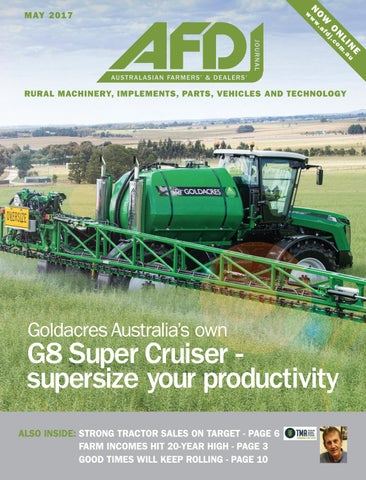
Goldacres Australia’s own
G8 Super Cruiser supersize your productivity ALSO INSIDE: STRONG TRACTOR SALES ON TARGET - PAGE 6 FARM INCOMES HIT 20-YEAR HIGH - PAGE 3 GOOD TIMES WILL KEEP ROLLING - PAGE 10
Hydraulics & Control Systems
COMPLETE HYDRAULIC SOLUTIONS Southcott is an innovative, reputable solution provider and a market leader in the hydraulics industry. Our engineers have successfully designed, installed and commissioned various major projects throughout Australia in many diverse industries.
Whatever Your Project Industries today work under the harshest conditions 24/7, therefore reliable, consistent and efficient products are required for today’s machinery to minimise down time. With a distribution network of 10 offices, 3 manufacturing facilities, electronic division and over 150 distributors nationally gives Southcott the market advantage. Southcott are an Australian supplier and manufacturer of hydraulic components and fluid connectors. With an extensive range of Hydraulic components, Gates hydraulic hose, Child & Gates couplings to meet all your requirements.
SAFETY ✚ QUALITY ✚ RELIABILITY www.southcott.com.au Adelaide 08 8228 2411 • Sydney 02 9838 9033 • Newcastle 02 4964 2123 Brisbane 07 3375 4499 • Emerald 07 4988 1800 • Mackay 07 4952 4056 • Melbourne 03 8551 0500 Laverton 03 9371 9000 • Perth 08 9454 9311 • Tasmania 03 6427 0908
MAY 2017 I N TH IS IS S U E 3 FARM INCOMES 6 TMA NEWS 8 CONTRACTOR PROFILE 12 MARKETS 15 WHAT’S NEW 18 FIELD DAYS GUIDE 22 SPRAYERS 24 ENGINES 25 IRRIGATION 30 SEEDING 32 TILLAGE AND CROPPING 34 ADVERTISER INDEX
Australasian Farmers’ & Dealers’ Journal Established 1984 Publisher & Managing Editor Hartley Higgins General Manager Elizabeth Bouzoudis
11
Editorial David Upton Email: edit.afdj@ryanmediapl.com.au Advertising Manager Sue Craig Ph: 0407600282 Email: s.craig@ryanmediapl.com.au Creative Services Luke Westle Email: prod.afdj@ryanmediapl.com.au
21
Circulation Email: admin.afdj@ryanmediapl.com.au Subscription One year subscription within Australia: $33 (inc GST) for four issues, Overseas: $66 (inc GST) for four issues. Phone: (03) 9810 3262 or email to subscribe: admin.afdj@ryanmediapl.com.au
8
31
FRO M THE EDI T O R Australian farmers are in a purple patch, as highlighted by new figures from the country’s official forecaster (pages 4 and 5). Average farm cash income across the country is tipped to reach a 20-year high of $216,000 in 2016-17, up by almost $60,000 from just two years earlier. Given the exceptional season of 2016-17, it is easy to assume the latest projection for farm incomes is a bit of an aberration. But the surprising story in the latest ABARES numbers is the good times are expecting to keep rolling for the next five years (page 10). Sure, incomes will be lower next year if we have an average season, but the average income over the next few years is expected to be a significant step up from typical levels before the bumper season of 2016-17.
It seems that farmers have already cottoned on, with a new survey from CBA revealing a big lift in confidence. Many more farmers are planning to lift their investment both on and off farm over the next year. Low wheat prices do not seem to be deterring investment, although even on that front there is some positive news, with forecasters tipping a slight increase by the end of this year. All this is great news for Australia’s farm machinery dealers. As TMA’s Gary Northover reports (page 6), tractor sales are heading for another strong year. Sales in the first quarter of 2017 reached 2,802 units, a 4.7% increase over the same quarter last year. That kind of sales growth is hard to find in any other industry at the moment. David Upton, Editor
Printing Lane Print & Post Adelaide, South Australia Ryan Media Pty Ltd ABN 85 085 551 980 630 Regency Road, Broadview, South Australia 5083 Phone: (08) 8369 9500 Fax: (08) 8369 9501 Email: info@winetitles.com.au Melbourne Office Suite 2262, 442 Auburn Rd, Hawthorn Victoria 3122 Phone: (03) 9810 3262 Email: admin.afdj@ryanmediapl.com.au Website: www.afdj.com.au ISSN 1442-4983 Conditions The opinions expressed in Australasian Farmers' & Dealers' Journal are not necessarily the opinions of or endorsed by the editor or publisher unless otherwise stated. All articles submitted for publication become the property of the publisher. All material in Australasian Farmers' & Dealers' Journal is copyright © Ryan Media Pty Ltd. All rights reserved.No part may be reproduced or copied in any form or by any means (graphic, electronic, or mechanical including information and retrieval systems) without written permission of the publisher. While every effort has been made to ensure the accuracy of information, the published will not accept responsibility for errors or omissions, or for any consequences arising from reliance on information published.
NEWS Broadacre farm incomes hit 20-year high Australia’s official farm forecaster predicts the best financial returns in 20 years for broadacre farmers thanks to record winter trains and buoyant livestock prices. The Australian Bureau of Agricultural and Resource Economics and Sciences (ABARES) says farm cash income for Australian broadacre farms is projected to average $216,000 per farm in 2016–17, the highest recorded in the past 20 years. ABARES Economist Tom Jackson said the forecast followed record winter grain production, high prices for beef cattle and good prices for sheep, lamb and wool. “When broadacre farms are separated into the beef, sheep and cropping sectors, it’s clear that farms in all three of these sectors have had a very good run in the past few years,” Mr Jackson said. Average farm cash income for cropping farms is forecast to rise 25% to $398,000 per farm in 2016–17. “Farm cash income is expected to rise 27% for sheep farms to average $133,000 per farm, and 2% for beef farms to average $163,000 per farm. “All three sectors are forecast to have the highest average farm cash income recorded in the past 20 years.”
RURAL MACHINERY, IMPLEMENTS, PARTS, VEHICLES AND TECHNOLOGY
DON’T MISS AN ISSUE
Subscribe today Essential reading for Agmachinery Industry professionals. The easiest way to subscribe is to visit us online at
www.afdj.com.au/subscribe 630 Regency Road, Broadview, South Australia 5083 INDEPENDENT & AUSTRALIAN OWNED
4
www.afdj.com.au
Beef prices have nearly doubled in real terms over the past three years to levels not seen since the late 1970s. Lamb prices have also been growing strongly, increasing by around 50% over the past four years. “When you add in relatively high wool prices, this explains why sheep returns are the best we’ve seen for the past 20 years, and why sheep farms are continuing to do as well as beef farms, even during a boom in cattle prices,” Mr Jackson said. “However, not every industry is performing as strongly. Farm cash income for dairy farms is projected to decrease to average $105,000 a farm in 2016–17. “This is around 13% below the average for the 10 years to 2015–16 and results from lower milk production and continued low farmgate milk prices.” Mr Jackson said the forecasts demonstrated that Australian agriculture was a strong and resilient sector, with farms continually innovating, investing and getting better at what they do. “The investment that farmers are making in innovation and productivity will become increasingly important as global competition increases,” Mr Jackson said. The farm profitability analysis was presented in March at ABARES Outlook 2017 in Canberra, which had the theme Innovation in agriculture - capturing the opportunities. Farmers around the country can learn more about ABARES’ forecasts and analysis through a series of Regional Outlook conferences from May to October. The conferences will include local speakers who will discuss strategies for growth, along with case studies from producers taking innovative approaches in their businesses. The dates and location are as follows; South Australia Renmark 3 May Northern Territory Darwin 5 July Victoria Ararat 26 July Tasmania Devonport 23 August Western Australia Kununurra 20 September Queensland Toowoomba 4 October New South Wales Tamworth 25 October
AUSTRALASIAN FARMERS’ & DEALERS’ JOURNAL - MAY 2017
NEWS Victoria, SA and Queensland benefit most in record year The benefits of Australia’s exceptional 16, which highlights just how well the season were spread unevenly around the agricultural sector is travelling in South country, according to new analysis on Australia 2016-17 farm incomes by ABARES. Queensland farmers are also going Victorian broadacre farmers enjoyed through boom times. Average cash the biggest growth, with average farm income is expected to lift by 18% from cash income jumping by 68% from $187,700 in 2015-16 to $222,000 in $80,300 in 2015-16 to an estimated 2016-17, which is about 140% above $135,000 in 2016-17. The sharp the 10-year average to 2015-16 and the rise reflects a large increase in wheat best result in 20 years. and barley production and increased New South Wales lifted by 12% from production of pulse crops, which are $180,900 to $203,000. expected to more than offset lower Results in Western Australia and prices. Northern Territory made clear the Growth in Victorian farm cash impact of soaring livestock prices income was more than three times the on average cash incomes for many national growth figure of 18%, but Australian farmers. In the West, where Victorian farmers still have a lot of huge cropping operations dominate ground to catch up before their cash the broadacre scene, average farm cash income reaches the national average of income rose by a modest 9% from $216,000. $312,700 to $340,000. On the cattleSouth Australia was the next best rich stations of the Northern Territory, performer by state. Average broadacre average farm cash income rose by 3% to cash income improved by 19% from $2,098,000, but this followed a 147% $216,400 in 2015-16 to an expected jump in the previous year. $258,000 in 2016-17. This is about Tasmania was the only state where TABLEabove 2 Financial performance of allto broadacre by state, to 2016–17 80% the 10-year average 2015- industries, broadacre farmAustralia, income2014–15 went backwards Measure
Farm cash income 2014–15
Unit
$
2015–16p
Rate of return excluding capital appreciation b
Farm business profit a 2016–17y
$ RSE
2014–15 2015–16p
$
$
2016–17y
$ RSE
in 2016-17, down 3% from $147,800 in 2015-16 to an estimated $103,000 in 2016-17. This reflects a reduction in beef cattle and sheep turn-off as farms rebuild their herds and flocks in response to improved seasonal conditions. While significantly lower, the 2016-17 figure is still about 27% above the 10-year average to 2015-16 The latest figures highlighted the superior financial returns being generated by specialist cropping farmers, who are forecast to achieve an impressive rate of return of 6.8% in 2016-17. This is for large farms, and excludes growth in the value of land. While large sheep and beef farmers are expected to do slightly better in 2016-17, with returns of 7.0% and 7.6% respectively, the five-year figures show specialist cropping has been the best game on the land over the medium term. Over the five years ending 201415, large specialist cropping farmers achieved an average annual return of 5.7%, compared to 4.9% for sheep and average per farm only 2.0% for beef.
2014–15 2015–16p
Rate of return including capital appreciation
2016–17y
2014–15
2015–16p
$
%
%
RSE
%
%
%
RSE
180,900
(6)
203,000
27,390
95,300
(11)
106,000
1.6
3.0
(8)
3.0
3.4
11.9
(31)
98,210
80,300
(10)
135,000
–16,580
–33,100
(22)
48,000
0.3
–0.1
(171)
2.1
6.1
4.7
(16)
Queensland
116,030
187,700
(8)
222,000
–48,540
71,600
(23)
144,000
–0.1
2.2
(14)
3.3
1.8
8.4
(7)
Western Australia
317,490
312,700
(9)
340,000
137,530
168,000
(17)
165,000
3.7
4.1
(12)
3.9
4.5
5.6
(11)
South Australia
228,650
216,400
(9)
258,000
84,750
79,900
(21)
118,000
2.9
2.5
(13)
3.1
9.8
10.2
(18)
Tasmania
144,490
147,800
(9)
103,000
24,940
11,500
(142)
30,000
1.4
1.0
(38)
1.4
3.2
4.5
(17)
Northern Territory
823,580
2,032,400
(16)
2,098,000
455,360 1,222,800
(15)
2,051,000
3.0
6.3
(8)
9.5
9.2
14.9
(5)
Australia
159,420
182,500
(3)
216,000
24,190
68,600
(9)
112,000
1.5
2.4
(6)
3.1
4.5
8.6
(14)
156,780
125,100
(11)
105,000
63,110
–10,200
(215)
–48,000
3.2
1.3
(39)
0.3
6.5
5.8
(26)
Victoria
ABARES Agricultural commodities – March quarter 2017
Dairy industry Australia
a Defined as farm cash income plus build-up in trading stocks, less depreciation and the imputed value of operator partner and family labour. b Defined as profit at full equity, excluding capital appreciation, as a percentage of total opening capital. Profit at full equity is defined as farm business profit plus rent, interest and lease payments less depreciation on leased items. p Preliminary estimates. y Provisional estimates. RSE Figures in parentheses are standard errors expressed as a percentage of the estimate provided. Source: ABARES Australian Agricultural and Grazing Industries Survey and Australian Dairy Industry Survey
153
Financial performance of all broadacre industries, by state, Australia, 2014–15 to 2016–17 average per farm MAY 2017 - AUSTRALASIAN FARMERS’ & DEALERS’ JOURNAL
5
Farm performance: broadacre and dairy farms, 2014–15 to 2016–17
140,970
New South Wales
TMA NEWS Tractor sales on target for another strong year Australian Tractor Sales 11720
12000
TMA News
By Gary Northover, Executive Director TMA
10000 8000 6000
March was another strong month for Sales of Agricultural Equipment across Australia as the expectation of a repeat of last year’s levels materialise. Indeed, conditions across the sector are very healthy. The southern states have enjoyed a “green” summer, dams are generally full and the recent autumn rains have arrived at an ideal time for the future growing season. Tractor sales for the month of March went just past the 1,000 unit mark in what was another very strong month for the southern states. It was this time last year that the crisis in the dairy industry was unfolding with dramatic consequences for tractor sales. With
There are still challenges being felt in the industry. Whilst supply is seen as good, pressure remains on input costs as manufacturers across the board deal with rising prices for everything from steel to tyres.
6
4000
2675
2802
2000 0
2007
2008
2009
2010
2011
2012
2013
2014
2015
2016 Q1 2016Q1 2017
early tractor sales from 2007 to last quarter. Y
confidence returning, we have seen a resultant bounce in sales, particularly in the under 40 Hp category. Sales of tractors in this category are 13% up on the same time last year which has contributed to overall sales in Victoria being up 15% on the same time last year, South Australian sales are up a very healthy 31% and Tasmania is also up 16% on last year. Not surprisingly, the tropical weather being experienced in Queensland and NSW has had an impact on sales with WA reporting another healthy month, following the recent state election, to be back in line with the same time last year. The month was also notable for a solid volume of large tractor sales, particularly in the >200 hp category which are now 7% up on the same time last year. We reported last month that overall sales were tracking comfortably above $1billion on an annual basis and this level is being boosted each month with a combination of strong support for larger tractors and the ever popular “leisure” market. Sales of combine harvesters have started to pick up, but more importantly, the forward order book is once again at peak levels. Dealers
are reporting extremely busy levels of activity both in the sales and support areas and whilst last year’s harvest season was generally considered a little late, the autumn break has been very short lived. Whilst Baler sales were quiet, they too are a product line that has experienced every strong demand and on a 12 month basis are 18% up on the previous 12 months. The sale of out front mowers remains very strong and is indicative of the activity being enjoyed by all short-line and implement suppliers across the board. There are still challenges being felt in the industry. Whilst supply is seen as good, pressure remains on input costs as manufacturers across the board deal with rising prices for everything from steel to tyres. Despite this, optimism in the market remains high. The TMA was once again present at Farmworld which celebrated their 50th Anniversary at Lardner Park and we awarded two (2) prizes, the Powered Machine Category which was won by the Massey Ferguson 5700 series tractor and the Unpowered Machine prize which was picked up by Kuhn for their Lexis 3000 sprayer.
AUSTRALASIAN FARMERS’ & DEALERS’ JOURNAL - MAY 2017
DEUTZ DRIVE HAS ARRIVED! Our customers told us they wanted a product that was more cost-effective, easier to assemble with less maintenance and low fuel consumption. We listened and developed DEUTZ DRIVE – a plug and play fully assembled Power Pack package which has been designed and built in Australia. Beautifully designed, it can be customised to suit any stationary platform. It’s no wonder everyone is talking about it.
The engine company. DEUTZ Australia
|
www.deutz.com.au
|
deutzoz@deutz.com
|
03 9549 8400
AG CONTRACTOR Narromine’s Patrick White driven to succeed By Keith Smiley
Farmer and contractor Patrick White is a driven man, with a wealth of experience and a tenacious appetite to grow his business. On a wet early May, Patrick explains how easy it had been to transition from cattle farming in Bullengarook near Gisborne in Victoria to his current holdings in Narromine, New South Wales. “We ran cattle, a self replacing herd and sold them off when they were about 9 months old but you couldn’t get a return because the country was worth too much. Money was tied up. Our 130 acres in Victoria bought us 3,000 acres in Narromine,’ Patrick said.
Although the rainfall in Narromine was lower at 21 inches compared with about 30 inches in Victoria, ‘Alvaholme’ proved a good buy even on 1994 prices when they made their big move. Friends of his parents had suggested the area because of its ‘good country’, priced at only $180 per acre, still relatively cheap and with an infrastructure in place. The property had not been used for two years, so the soil was in a healthy condition. In partnership with his dad, Patrick and his wife Leanne could readily see there was room for expansion but would be content for the moment, running with merinos, breeding for fine wool and later growing oats for their grazing. Before they began contracting for others, the Whites planted barley, field peas, chick peas, lupins, canola and other resistant
varieties. They rotate their land and vary what they sow depending on market prices and some stubborn chemically resistant plants. “Ryegrass in recent years has been difficult but we are gradually working it out. Rotation is definitely working and we are not losing the battle,” explained Patrick. Patrick gained his harvesting and knowledge of contracting by working off farm for many years. While establishing clients in the area, they had been building up their own machinery, investing in harvesting equipment and turning a healthy profit. They initially contracted out their harvesting and later moved into seeding which they still maintain. While undergoing these changes, Patrick said they bought two more farms, one to the
Plenty of green in the garage at Patrick White’s Harvesting. 8
AUSTRALASIAN FARMERS’ & DEALERS’ JOURNAL - MAY 2017
AG CONTRACTOR
Harvest time. south and one in the north, around 2,000 acres in total, about the same time as leasing two farms, of 1,800 acres all up. Nowadays they have a few important clients that trust their ability and timeliness, which is of the essence, given the unpredictable and damaging weather of recent times. “We’ll sow anything; cereals, grains, on thousands of acres, at times employing sub contractors but mostly with employees of Patrick White Harvesting, which includes our immediate family.” By purchasing all John Deere equipment they were guaranteed a ‘good fit’ and a one point of call if repairs were required. They use a JD 8360 tractor and a JD 4940 self propelled sprayer among other complementary parts. While the equipment has paid for itself many times, they could not fault the service and reliability of Deere parts. Patrick gave an example of a motor breaking down and being picked up, replaced and delivered back to them within a day or so. “We began with Red machines but felt Deere were built heavier, stronger, to get a good run out of them. Our decision to buy them was also based on a one point of call, if you had troubles, Deere were there
very quickly. All the parts fit from headers to tractors.” The seeding bars, however, are made in Forbes by Noel Tobin. These high-speed, no-til discs do the job, producing better yields. The Tobin disc will plant through sticky soils, rocks, trash and stubble. Patrick has encountered sticky black soils in the area and the no-til discs have proved a boon to production, while the scrapers remove the mud, enabling a smooth flowon of disc cutting and seeding. They love their Deere configuration, which works for them: “The greenstuff works better,” said Patrick, describing Deere’s corporate colour and is obviously sold on their products. Patrick also confesses to using a German-built Amazone spreader in his mix. It allows adjustment and the spreading of all commercial types of fertiliser. The varied home and contracting operations come at a price as Patrick almost circles the clock seven days a week. He is driven by an overarching desire to better himself and the business, rather than ‘tread water’ as he put it. While he has always been ambitious, Patrick still takes a shot at making something better or easier to use. This extends to his breeding program of lambs, or fattening bought lambs and selling them to the abattoirs, including sales to Thomas Foods in Tamworth, a billion dollar international company. The Whites also sell their lambs in Cobram, Victoria and closer to home in Dubbo’s saleyards. There is little time for play since Patrick hung up his rugby boots but he squeezes in a little dirt bike riding in fierce competition, which is another example of going forward in the extreme. The Narromine Agricultural Show Committee keeps his heart at work, promoting the district’s finest. The town is 40 kilometres west of Dubbo in New South Wales, with the Macquarie River running parallel to the Mitchell Highway named after the explorer. Narromine is an Aboriginal word meaning honey person. The future bodes well for the Whites as they gear up for the next challenge,
atrick flying high in dirt motorcycle P race
indicating a desire to expand their operations which might include the acquisition of more land for cereals. “We are opportunistic; looking for something to turn a profit and be good for the business.” Patrick accepts the importance of being conservative while he puts the three kids through private school. While the area has produced mainly good seasons, Patrick can remember times of severe weather, causing him to work through the night to save his own crop or that of his clients. At 40, Patrick has recently invested in feed lotting for fattening of the lambs, for their local operations. Promotion comes from word of mouth or by reputation as contractors, gained over the years. Patrick and Leanne encourage their three children, Chelsea, Melanie and Lincoln, to appreciate country life, and the kids love to get involved. Narromine’s famous might be cricketer Glenn McGrath, runner Melinda Gainsford-Taylor or even Disney animator Adam Phillips, but Patrick White holds another beacon to success.
MAY 2017 - AUSTRALASIAN FARMERS’ & DEALERS’ JOURNAL
9
NEWS Good times to keep rolling until at least 2021-22 Beyond the headlines about this year’s record bumper grain crop is even more good news; Australia’s official farm forecaster expects the good times to keep rolling for the next five years. In its March 2017 quarter outlook for agricultural commodities, the Australian Bureau of Agricultural and Resource Economics and Sciences (ABARES) makes it clear that, while this year was well above average due to exceptional rains, the next five years should produce a significant improvement in incomes for most farmers compared to the five years leading up to this year’s record. The story about good times rolling on is best told by a chart of actual results for the past five years, along with this year’s expected result and forecasts by ABARES for the next five years. The chart shows this year (2016-17) represents an impressive peak in farm production and net cash income for Australia’s farmers. The gross value of Australian farm production this year is forecast to jump by 8.3% compared with the previous year to a record $63.8 billion. Total value of farm production is then forecast to fall by 5.7% in 2017–18 in real (inflation-adjusted) terms to $60.2 billion, but this is still better than the $59.8 billion achieved in 2015-16 (the last year before the peak caused by the exceptional rains of 2016-17). The strong outlook for 2017-18 is
ABARES forecasts higher incomes beyond the 2016-17 boom. underpinned by ABARES’ forecasts of a 2.8% increase in export prices, compared to growth of only 0.8% in 2016-17. Export prices in Australian dollar terms are forecast to rise in 2017–18 for wool, dairy products, sugar, wine, lamb, barley, canola, rock lobster and mutton. Export prices for cotton and chickpeas are forecast to fall. Prices for beef and veal, wheat and live feeder/slaughter cattle are forecast to remain around the same as in 2016–17. The most significant feature of the chart is the prediction that the good times for Australian farmers will keep rolling until at least 2021-22. The value of farm production in the this forward period is expected to flatten out at a significantly higher level
Export prices in Australian dollar terms are forecast to rise in 2017–18 for wool, dairy products, sugar, wine, lamb, barley, canola, rock lobster and mutton.
10
compared to the five years before this year’s record result. The best way to measure this is in terms of five-year averages, and compare the five years before the 2016-17 record with ABARES’ forecasts for the five years after it. Average annual gross farm production in the five years to 2021-22 is expected to climb to $59.8 billion, 9% higher than the average of $54.9 billion in the five years to 2015-16. Average annual net cash income is expected to improve at an even faster rate, up by 13% from $20.5 billion in the five years to 2015-16 to $23.1 billion in the five years to 2021-22. Digging deeper into ABARES’ analysis reveals a significantly better expected growth for livestock compared to crops, reflecting their respective price outlooks. The average annual gross value of crop production is expected to fall by 1% from $29.4 billion in the five years to 2015-16 to $29.0 billion in the five years to 202122. By contrast, the average annual gross value of livestock production is expected to increase by 21% from $25.5 billion to $30.8 billion.
AUSTRALASIAN FARMERS’ & DEALERS’ JOURNAL - MAY 2017
NEWS Agri investment intentions hit record levels Farmers are planning to capitalise on their recent strong financial performance by boosting their investment on and off farm. The confident mood of farmers is captured in a new investment intentions survey by the Commonwealth Bank part of its bi-annual Agri Insights survey. The survey was conducted with 1,600 famers in January and February. The results show farmers are preparing to boost spending and realise opportunities by hiring more staff, getting their families more involved and by using more contractors and advisers. Investment in the beef, wool and lamb sectors in particular is expected to strengthen dramatically on the back of strong prices and record grain harvests, and intentions in the dairy sector have rebounded, too. This sentiment has pushed the CommBank Agri Insights Index to its highest level since the research began in 2014. The current National Index is 12.3, up 2.8 points on this time last year and two points ahead of the previous high, recorded in May 2015. Commonwealth Bank’s Executive General Manager of Regional and Agribusiness Banking, Grant Cairns, said sustained high prices in several
Overall, our survey points to a very buoyant Australian agri sector and we look forward to supporting our customers to achieve their business goals.
commodity sectors were helping to drive optimism and spending intentions, with livestock producers leading the charge. “Our survey shows that record numbers of beef, wool and lamb producers intend to expand operations this year, while dairy intentions have recovered strongly in the past six months. The results are likely underpinned by continuing high prices for wool and lamb, plus ongoing strong demand for Australia’s high quality beef,” he said. The survey found 15% of beef producers plan to expand their enterprise in the coming year, up from 12% this time last year and setting a new record for the measure. At the same time, a record 18% of wool producers say they’ll expand their enterprise. This is up 20% on this time last year, when overall intentions in the sector were contractionary. Mr Cairns says the strong general investment sentiment will not stop at the farm gate. “We’re expecting to see a solid knock-on effect as farmers implement their investment plans.
Strong market conditions look set to translate into increased employment opportunities and farmers are also looking at off farm investment in addition to boosting their spend on their farming operations,” he said. A record 7% of farmers say they will increase their use of consultants and advisers, compared with 5% this time last year, while 10% say they will increase their use of contractors. Additionally, a record 9% say they will increase employee numbers, nearly double the 5% who said they would do so at this time last year. Nearly a third of farmers (29%) plan to boost tech investment and one in four (25%) will increase investment in plant and equipment. At the same time, 18% plan to increase off farm investment, up seven percentage points on this time last year. “Overall, our survey points to a very buoyant Australian agri sector and we look forward to supporting our customers to achieve their business goals,” Mr Cairns said.
MAY 2017 - AUSTRALASIAN FARMERS’ & DEALERS’ JOURNAL
11
MARKETS Commodity prices keep firming: NAB By Phin Ziebell NAB Agribusiness Economist
S WRAP
NAB’s rural commodities index in April continued on its long upward trend from the trough of 2012. Overall, the index rose 4.1% in April, reflecting higher beef, lamb, chick pea and vegetable prices. While sugar and pork prices fell and grains were mixed, these falls were not enough to offset the strong gains elsewhere. At a state level, NSW was up 3.7% while dairy-heavy Victoria rose 4.0%. Queensland with its large cattle industry saw the index rise 5.3%, the biggest monthly gain since June 2016. Graindependent Western Australia was up 1.7% and South Australia rose 2.7%. Tasmania saw prices jump 5.6%.
of Queensland and NSW has boosted restocker interest for cattle, pushing prices higher. If drier weather returns (as is forecast by the Bureau of Meteorology) there may be a faster downside in saleyard prices.
Production The outlook for production remains somewhat mixed. Last year, winter crops had a generally spectacular season, with a record 35 million tonnes of wheat harvested. It will be extremely difficult to match this again this season. While the much drier outlook for the coming year is likely to see downward pressure in the 2017-18 season, better than expected rainfall in autumn has left grain growers in a better position than had been forecast previously. ABARES forecasts point to lower production for major proteins in 2016Prices 17 but a rise in 2017-18. We continue to The NAB Rural Commodities Index is an index of 28 agricultural The outlook for the coming year is see some pressure in line with a need to commodities weighted by the relative size of each commodity in the highly dependent on the course of the rebuild herds and flocks. For dairy, low Australian agricultural sector. Australian dollar, although we still expect prices are the primary driver for lower In the indicator, we state-level indicators, theaddition A$ to fall to to 70 USnational cents at the end milkpublish production. reflecting the particular composition for each state. We have further of 2017, providing some upside towards expanded the index this for the first time detailed the end of the year. We see themonth, 70 cent releasing Wheat regional price indicators (see page 4). We will furtheracross buildparts on of and mark as a low point for the A$, with the Freak snowstorms the US improve these regional indicators as the year progresses. currency to remain around that level well (mainly Oklahoma, Kansas and Colorado) into 2018. have seen uncertainty about the state of Weather will also be a key driver of the hard red winter wheat crop surge. livestock prices. Good rain across parts Prices initially jumped over 6% as traders
processed the news. Nonetheless, global wheat supplies remain abundant and it is too early to assess the damage in the US. It is unlikely that prices will sustain a rally unless supplies tighten. Australian wheat prices will depend heavily on the AUD, with our forecast of 70 cents by the end of the year contributing to our forecast that wheat prices will rise around 12% this year. If the A$ does not fall, upside for local prices will be more limited. The dry outlook since early this year gave us much concern about the prospects for the 2017-18 season, although many areas have been lucky enough to enjoy a strong autumn break, with rainfalls sometimes well above average. The slightly lower prospect of El Niño in the BoM forecast track is also a positive, although international models still point to the event occurring in spring this year. El Niño events seldom deliver above average crops in Australia. In the coming weeks Overall, the index rose 4.1% in April, reflect we will release our initial forecasts for chick pea and vegetable prices. While sugar Australian production.
PRICE UPDATE: NAB’S RURAL COMMODITIES INDEX
NAB RURAL COMMODITIES INDEX
NAB rural price commodities index = - Agriculture price index, 2010=100 Agricultural index, 2010 100 170
National QLD TAS
160
NSW WA
VIC SA
150 140 130 120 110 100 90 2010
2011
2012
2013
2014
2015
2016
2017
grains were mixed, these falls were not eno gains elsewhere.
Other crops
AtPrices a state level, Newgrains South Wales was up 3. for most coarse remain Victoria rose 4.0%. Queensland mired in much the same situation as with its larg index 5.3%, biggest monthly wheat.rise Strong globalthe supply has seen prices gain si dependent Western Australia was tumble and the outlook is broadly similar up 1.7% a 2.7%. Tasmania saw prices jump 5.6%.
to wheat for the coming year. Canola remains a stand-out, with prices holding up much better. The price premium MONTHLY AUDseePRICE CHANGES – SELECT for canola could higher Australian Monthly average price change plantings this year. We have been cautious around the trajectory of chickpea February 2017 pricesMarch 2017 for some time (they exceeded A$1,200/ tonne last year following two poor Indian Wheat ▲ 0.1% monsoon seasons). With the return of ▲ 3.7% more favourable to India last▼ 2.9% Beef ▼ conditions 1.5% year, prices receded to the A$800 range, Dairy ▼ 5.6% ▼ 11.0% but they have jumped this year, again Lamb ▲ 5.9% surpassing A$1,000/tonne. Although it▼ 1.8% is fair to say that expectations around Wool ▲ our 2.5% ▲ 6.2% chickpea prices have not materialised, it is Sugar ▼ 3.3% unlikely that these prices are sustainable.▼ 11.0% Nonetheless, chickpeas Cotton ▲ 0.7% are likely to remain ▲ 2.5% more expensive than alternative crops this season.
Source: NAB Group Economics, ABARES, Meat and Livestock Australia, Australian Pork, Ausmarket Consultants, Australian Bureau of Source: NAB Group Economics, ABARES, Meat and Livestock Australia, Australian Pork, Ausmarket Consultants, Australian Bureau of Statistics, Bloomberg Statistics, Bloomberg and Profarmer.
3
12
Rural Commodities Wrap
AUSTRALASIAN FARMERS’ & DEALERS’ JOURNAL - MAY 2017
NEWS Durums outshine bread wheat by up $1100/ha Durum varieties have achieved gross margins of up to $1100 a hectare more than common bread wheat varieties in South Australian Grain Industry Trust funded trials in the past two years. The results from five trial sites across SA in the project Growing durum demand in SA: gross margin sensitivity analysis trials, were used to calculate the gross margin, yield and quality grades of four bread wheat and four durum varieties. University of Adelaide Head of Agricultural Science, Associate Professor Jason Able, said the aim of the trials had been to demonstrate the feasibility of durum as an alternative high-value crop, especially in areas it had not traditionally been grown such as the western Murray plains. “Two of the recent durum varieties, DBA-Aurora and WID802, achieved a gross margin more than $1100/ha higher than the gross margin of the best yielding bread wheat in the Coonalpyn and Roseworthy trials respectively,” he said. “DBA-Aurora’s gross margin at Coonalpyn was $2035/ha, with a yield equivalent of 6.3t/ha and DR1 quality. The best performing bread wheat at Coonalpyn was Emu Rock, and while it achieved a slightly higher yield of 6.7t/ha equivalent, the gross margin was $912/ha. “A similar result was found at the Roseworthy trial site where WID802’s gross margin was only slightly higher than DBA-Aurora achieving $2176/ha, with a yield of 7.3t/ha at a price of $400/t equivalent. Trojan, which yielded 7.8t/ha and earned a price of $208/t had a gross margin of $1095/ha. “Given the price spread and the ability of some durum wheat varieties to yield comparable in many areas to the best bread wheat varieties, it is not surprising that across all the trial sites in both 2015 and 2016, the gross margin for durum was higher than the bread wheats.” Trial sites include Yeelanna on the lower Eyre Peninsula, Wandearah in the Upper North, Sanderston in the western Murray Plains, Roseworthy in the Mid North, and Coonalpyn in the Upper South East. The durum varieties in the trial are DBA-Aurora, WID802, Yawa, and Tamaroi, and the bread wheats are Cobra, Mace, Trojan and Emu Rock.“While the 2016 season was perhaps somewhat of an anomaly when compared to many seasons past, it has showed us that with good management it is possible for growers to economically achieve very high yields and good protein levels with the latest durum wheat varieties,” Dr Able said.“We also learnt that if durum is sown into the right paddock with a good history, such as we had at Sanderston, high yields and good quality can be achieved with very little nitrogen added.“We always knew it was going to be difficult for bread wheat varieties to achieve similar gross margins with prices staying close to $200/t, and durum contracts up around $400/t, or $330/t plus on the open market. The price spread for 2015 and 2016 has been strong, and while there may be a slight contraction in the durum price for 2017, we still expect gross margins to be attractive over the bread wheat varieties.”
NEWS BRIEFS AFGRI expands in WA JOHN Deere dealership group AFGRI Equipment this week expanded its operations with the acquisition of Ratten & Slater, Esperance. The deal also includes Ratten & Slater branches at Gnowangerup and Albany, effectively giving Afgri 15 branches in WA and the largest network in Australia. The John Deere dealer network in WA has now been reduced to four, with Ag Implements (six branches) and Harvey Farm Service (two) the only other two remaining in the Wheatbelt. The other John Deere dealer is Vanderfield in Kununurra. AFGRI Equipment is the largest John Deere dealership in the southern hemisphere with more than 30 branches in Africa and Australia.
Tractors still most dangerous QUAD bikes may be considered to be the leading cause of on-farm injuries and deaths, but it is the tractor that accounted for more fatalities in 2016. The University of Sydney Australian Centre for Agricultural Health and Safety reported there were nine tractor related on-farm deaths last year. Mobile-plant machinery also caused nine, while quad bike incidents resulted in six deaths.
Graincorp rides crop boom Australia’s largest east coast grain business Graincorp has reported a three-fold increase in profit in the first half of its latest year. The company’s underlying net profit after tax soared to $100 million in the six months to 31 March, compared to $32 million in the previous corresponding period. The company said average receivals per site jumped to 70,000 tonnes, up from 40,000 tonnes in the previous harvest. Shareholders shared in the profit boom, with the interim dividend doubled to 15 cents per share.
MAY 2017 - AUSTRALASIAN FARMERS’ & DEALERS’ JOURNAL
13
NEWS Case support through all seasons Like every farmer, David McGennisken knows you’ve got to roll with the punches. And like every farmer, he’s taken plenty and stayed standing – from droughts through to the tragic accidental death of his brother and business partner, Robert, in 2010. Starting in 1974, Manooka Farms near Horsham in western Victoria has always been a McGennisken family operation and was taken over by David and Robert in 2000. Now run by David and Sharon, Robert’s widow, the 3500-odd hectare Manooka operation produces barley, canola, wheat, beans, lentils, peas, oaten hay and vetch hay and brings in livestock to eat out the remnants of crops until the time comes to sell the stock and put the new crops in. A dedicated Case IH man since Manooka Farms acquired its first header almost 30 years ago, the business now relies on many Case IH machines, purchased through local Horsham Case IH dealer O’Connors Farm Machinery. Along with the performance of all his ‘red gear’, David said he was pleased with the support he had received from CNH Industrial Capital over the decades – and specifically through recent droughts. “CNH Industrial Capital has been good about that…really good…I’ve had no hassles at all with them. They are very
good in the sense they understand we’ve had two droughts in a row; last year was just a shocker, a real shocker – in a lot of areas we didn’t strip anything. “Basically it started off quite wet and we put the fertiliser on and were looking for a good average season; we got to about the first week of July and it just stopped raining - it’s got to rain here until October and our crops were dead by September. “We’ve had two shockers in a row and in our little business…we’re not that big…it costs us probably about one and a half million dollars a year to put our crops in, so that hurts. “It’s very good knowing that in the background we have CNH Industrial Capital saying that as long as you’ve got a certain amount of equity in the machines, we can work it out,” David said. “To me, it means I can sleep easier at night because you’re not stressing out that you’ve got to go back to the bank and drag your feet in the door and put your hand out and they’re going say you’ve got to sell something…it’s not like that. “It’s much better; CNH Industrial Capital will say look, you’ve got heaps of equity so we’ll roll it on this year…and if you have another bad drought, because you’ve got that equity you might be able
anooka Farms' Case IH fleet near Horsham, Victoria. Photo courtesy of M O’Connors Farm Machinery. 14
( L-R) Sam McGennisken, David McGennisken and Matt McGennisken, of Manooka Farms. Photo courtesy of O’Connors Farm Machinery.
to do two years and then we’ll reassess things. It takes the stress out of farming, knowing you have a company behind you that understands the nature of your business and will actually work with you to find a good solution,” David said. As happy as he has always been the relationship with his Case IH dealer, O’Connors Farm Machinery, and CHN Industrial Capital, it wasn’t until his brother Robert passed away that David realised how deep that relationship truly went. “The year of Robert’s accident, they stepped up and actually lent us a brand new header to do our harvest and that was absolutely fantastic of them. For what they did for us, well, words can’t express our gratitude.” CNH Industrial Capital has offered equipment finance to the Australian market since 1979 and has a proud heritage of strong ties with the agricultural community. Having worked closely with Australian farmers for nearly 40 years, CNH Industrial Capital understands the need for flexible financial solutions and collaborates with every customer to understand their unique goals, challenges and outlook on the future and tailor financial packages that meet their business needs and circumstances.
AUSTRALASIAN FARMERS’ & DEALERS’ JOURNAL - MAY 2017
NEWS Breakthrough weed machine set to hit market A machine that pulverises weed seeds as grain crops are harvested has begun commercial manufacture in Australia. Invented in SA, the Seed Terminator can be retrofitted to new and used John Deere, CASE IH and New Holland Class 7, 8 and 9 harvesters and will retail for under A$100,000. The Seed Terminator uses a multistage, hammer mill to kill weed seeds, spreading the sawdust-like debris behind the header. Nine prototypes were built and tested across nine different geographies in SA, WA, NSW and Victoria with different crop types, soil types and moisture contents during the recent 2016/17 harvest. Tests by The University of Adelaide’s Weed Science Research Group from last year showed a greater than 90% kill of rye grass seeds using the machine at 2700 RPM. The Grains Research and Development Corporation estimated in 2016 that weeds cost Australian grain growers about $3.3 billion annually, with yield losses of 2.76 million tonnes. The GRDC also estimated herbicide resistance costs farmers $187 million a year for herbicide treatment and other weed management practices. Seed Terminator inventor and Kangaroo Island farmer Nick Berry and his business partner Mark Ashenden are also developing prototypes for the North American market that they hope to test in the 2017 northern hemisphere harvest. The team is working with a company in Adelaide to manufacture the mill while the drive system is being built in Western Australia. They have received more than 90 expressions of interest to buy one of the 2017 limited release Seed Terminators in time for the next Australian harvest. The machines will be available from September.
Seed Terminator inventor Nick Berry with one of his machines. Ashenden, the company’s commercial director, said the Seed Terminator was a “colour-blind solution” that could be fitted to major header brands including John Deere (green), CASE (red) and New Holland (yellow). He said the key to cost saving was the development of their patent pending mechanical drive paving the way for commercialisation. “The design of the mill to effectively kill the seeds is the critical piece – it requires a purpose built mill and a purpose built drive to match whatever colour machine you want to put it on,” Ashenden said. “We’ve already attracted interest from Canada, the United States and Europe … wherever grain is grown, this could be part of the answer.” Farmers involved in the prototype testing were given the option to purchase their machine and all were sold. The 2016/17 prototype trials were conducted on John Deere (STS9760, 2xS680), CASE IH (7120, 8010, 8120, and 9240) and New Holland (CR8090) headers. The 2017 harvest program will also include a prototype fitted to Claas
Lexion harvester to increase farmers’ options. “It worked everywhere across the country and while there were drive system challenges that were overcome critically the multi stage hammer mills didn’t miss a beat,” Ashenden said. Domestic manufacturing targets north of 100 machines have been set for 2018, depending on demand. Ashenden said the “one-pass solution” pulverised seeds and spread the nutrient rich debris 10-12 metres either side behind the harvester to act as a fine mulch for soil improvement. He said it would likely result in increased yields because there would be significantly fewer weeds to compete with crops for nutrients. “It should reduce fertiliser costs, could reduce chemical costs but will significantly reduce your time because you don’t have to go around collecting it to burn. The Seed Terminator ticks all the environmental boxes – it can’t be a bad thing to reduce chemicals, reduce burning and reduce costs for a farmer. It’s not the Holy Grail but it’s a pretty strong part of the solution.”
MAY 2017 - AUSTRALASIAN FARMERS’ & DEALERS’ JOURNAL
15
NCENEWS 1923.
all tractors revolutionised farming productivity with their affordability,
ultitude of farming tasks. Farmall still remains one of the most trusted
New Case large square balers
, with the support of Case IH, the famed Farmall brand has been
nal performance with new, cutting-edge technology, Farmall will once
performance on the land. Delivered through the skilled Case IH dealer
Casecan IHoffer, hasthe unveiled its new ly Case IH dealers iconic Farmall rangeseries offers you provenoperations
of large square balers for theCase Australian port. Visit www.caseih.com to find your nearest IH dealer. market, designed for the toughest crop types in the most challenging of conditions. The Case IH LB434 XL series retain the features and adaptability of the current LB434 units, while introducing a range of new attributes to get the job done more efficiently, and is available to producers in two models: the LB434S XL (Standard) and LB434R XL (Rotor Cut). The new balers feature an 80cm longer bale chamber (31%), wider panel widths to reduce material accumulation behind twine boxes, upgraded platform and hand railings, and new active bale eject system, while retaining 48 plunger strokes per minute, wide pick-ups and six double-tie knotters. “It all adds up to a unit perfectly designed for large-scale hay and forage
with a lot of ground to cover and a short time to do it,” Tim Slater, Case IH Product Manager for Hay and Harvest said.
In lengthening the bale chamber, bale density has increased by up to 10% over previous models, with a more stable bale density in various operating conditions, and better bale shape. The longer bale chamber also means bales exit the bale chute closer to the ground for a more gentle drop,
minimising the risk of twine breakages. “Greater density means more crop per bale, decreasing bale count as well as reduced handling, wrapping and transportation costs — helping producers economically reach new markets,” Mr Slater said. Structurally, the LB434 XL Series has been strengthened to accommodate the additional weight to the rear from the extended bale chamber, and the plunger has been upgraded to handle the higher anticipated loads from the increased density. The overall width of the new models increases to 2.8m over the outside of the panels excluding the wheels, while the overall width including wheels and pick-up wheels remains under 3m. The increased space between the side frame and the twine boxes helps to reduce crop accumulation and provides more space on the maintenance platform.
Kirovets returns to Australia Wimmera farmers got the chance to see the Kirovets 744R at work, with the Russian brute put to work ahead of a 60foot seeder bar on a Dimboola property. It was a demonstration organised by Craig Milne, who is importing the tractors through the Australian Productivity Council. He said about 20 people came to see it in action during on the day, including former Belarus owners. “We had some old ex-Belarus drivers there (who) commented that the Kirovets was better made,” Mr Milne said. Kirovets came into Australia a few decades ago under the Belarus brand and Mr Milne said after visiting the factory a year ago he thought there was scope for a return.
16
‘The advances have been evolutionary, but the real changes have been at the factory, where the production standards are now worldclass,” he said. But he said he did not expect the Kirovets to take much market share from major players in terms of specification. “We’re not competing against the market leaders in terms of refinement the Kirovets is a simple and functional machine,” he said. “The Kirovets use mechanical systems and only one computer (on the engine) - basically an old design, but modernised where needed. “It’s a robust tractor with a locking axle so it’s fairly efficient and pulls very well and it’s about 60% of the price of
an equivalently powered tractor, but you do lose some of the features.” In current form, it has a constantmesh, hydromechanical transmission (16 forward/eight reverse within four ranges) operated with floor-mounted levers. The 428hp that went through that transmission at the demonstration was supplied by a 12.8-litre, six-cylinder Mercedes-Benz turbo-diesel engine, though they can also come with a 17.5-litre, V8 Tutaevsky power-plant. “The Mercedes engine was a talking point during the demonstration with its flat torque response,” Mr Milne said. “It’s not a big engine at 13 litres, but it worked very well.” - The Weekly Times
AUSTRALASIAN FARMERS’ & DEALERS’ JOURNAL - MAY 2017
NEWS Deere completes launch of 6R series
performance und your operation
T he new top of the range John Deere 6250R tractor.
John Deere is launching two new top of the range six-cylinder tractor models rated at 171 kW (230 hp) and 186 kW (250 hp) (97/68 EC), designed to meet the needs of contractors and arable farmers in Australia. The 6230R and 6250R will complete the line-up John Deere 6R Series ng and baling hay plusofhigh-speed tractors. nd 6R Series Tractors are big machines 6230R and 6250R has set high With a JohnThe Deere PowerTech™ engine, standards for transport, operator s, and an available John Deere loader, acceleration on the road e you wantcomfort for theand work you need to thanks to an engine boost 37.2 mfortably in the ComfortView™ Cab of with kW (50(TLS™) hp) with Link Suspension andIntelligent hydraulic Power disk (IPM). nd control.Management Best of all, these tractors are The flagship 6250R tractor provides up re dealer. Stop in and get a great all-round to 223 kW (300 hp) when required with g Runs Like a Deere.™ a very light vehicle weight of 9.3 tonnes, and delivers more power than any other tractor in this weight class, along with a power density of 31 kg/hp. The high maximum permissible weight of 15 tonnes also allows a 5.7 tonne payload, which means the tractor is able to transport heavier loads. Both these new tractors are powered by a 6.8 L PowerTech PSS engine with
dual turbochargers and advanced DPF and SCR technology, which responds very quickly to changing loads while consuming less fuel and meeting demanding Final Tier 4 (FT4) emission standards.
The upgraded AutoPowr transmission delivers maximum efficiency, with 100% mechanical power available at 3.5 km/h for heavy draft operations, 11 km/h for light draft work, 22.5 km/h for heavy transport and 47.2 km/h for light transport duties. Once running at maximum road speed, RPM automatically drops and 50 km/h is maintained at 1630 RPM and 40 km/h at 1300 RPM, which results in JohnDeere.com.au/ Allrounder lower fuel consumption on the road. The tractors also feature an all-new CommandPRO joystick, available as an optional extra, which introduces a new
dimension in ergonomics and versatility to John Deere tractors. Top speed can be reached with just one push, and 11 programmable buttons are available for the hitch, PTO, SCVs, AutoTrac controls etc. The 6230R and 6250R tractors also feature a high level of operator comfort. The intelligent hydro-pneumatic cab suspension (HCS Plus) system offers more driving comfort and isolation from noise and vibration. Better traction and up to 10% more power applied to the ground are provided by the new self-levelling TLS Plus Triple-Link Suspension system on the front axle. This automatically adjusts sensitivity and suspension rate, and synchronises with hitch sensing to compensate for power hop under heavy draft conditions. Less arm movement and significantly less steering effort is required by the Variable Ratio Steering (VRS) system, which can be activated and deactivated from the tractor’s CommandCenter control console.
MAY 2017 - AUSTRALASIAN FARMERS’ & DEALERS’ JOURNAL
17
2017 ANNUAL FIELD DAYS Up-to-date comprehensive Field Days Events Calendar. Also available at www.afdj.com.au. To lodge your event contact Debbie Schnelle Phone: (03) 9810 3262 or Email: admin.afdj@ryanmediapl.com.au MAY 2017
JUNE 2017
4-6 Agfest Field Days Quercus Rural Youth Park 415 Oaks Road, Carrick, Tasmania 1300 243 378 admin@agfest.com.au www.agfest.com.au 5-6 Agrotrend Field Days Bundaberg Col Reynolds Bundeberg Recreation Precinct, Queensland Opposite Bundaberg Airport 0488 197 400 event@agrotrend.com.au www.agrotrend.com.au 5-7 Tocal Field Days Carol Cairney 815 Tocal Road, Paterson, New South Wales 02 4939 8820 fielddays@tocal.com www.tocalfielddays.com 12-13 Riverina Field Days Roly Zappacosta Griffith Showground, Griffith, New South Wales 02 6962 1180 roly@coroclub.com.au www.riverinafielddays.com
6-8 Farmfest Field Days Kate Nugent Kingsthorpe Park, on the Warrego Highway, 20 kms west of Toowoomba, Queensland 02 6768 5800 farmfest@fairfaxmedia.com.au www.farmfest.com.au 14-17 New Zealand National Agric Field Days Mystery Creek Events Centre, 125 Mystery Creek Road, Hamilton, North Island, New Zealand. +64 7 843 4499 via website www.fieldays.co.nz
JUNE/JULY 2017 30 June - 1 July Farm Fantastic Outdoor Expo Leanne Carius Caboolture Showgrounds, 140 Beerburrum Road, Caboolture, Queensland 07 5428 1851 admin@farmfantasicexpo.com.au
JULY 2017
17-18 Civenex Hawksbury Showgrounds, Richmond New South Wales (02) 8267 3005 cott.Leighton@ipwea.org www.civenex.com
5 BCG Future Farmers Expo Ciara Cullen Birchip P - 12 School, Birchip, Victoria (03) 5492 2787 info@bcg.org.au www.bcg.org.au
18-19 North Queensland Field Days Townsville, Queensland 0427 998 203 nqfd2243@tpg.com.au www.nqfd.com.au
6-8 Ag-Grow Emerald Field Days 6 klm east of Emerald on the Capricorn Highway, Queensland 07 4982 4244 admin@aggrow.com.au www.aggrow.com.au
19-20 Mildura Field Days Joanne Clutterbuck SuniTAFE Field, Benetook Ave, Mildura. Victoria 0487 021 122 info@mildurafielddays.com.au www.mildurafielddays.com.au 24-26 Rotary FNQ Field Days Lesa Pershouse Mareeba District Rodeo Association, Kerribee Park, Mt Abbott, Queensland 0427 998 203 info@fnqfielddays.org.au www.fnqfielddays.org.au
18
14-15 Mudgee Small Farm Field Days Steve Garland Mudgee, New South Wales 02 6372 3899 info@arec.com.au www.arec.com.au 30 Ballarat Sheep Show Cathryn Sutton Ballarat Show Grounds, Ballarat, Victoria 03 53381877 admin@ballaratshow.org.au
31 Ballarat Ram Sale Cathryn Sutton Ballarat Show Grounds, Ballarat, Victoria 03 53381877 admin@ballaratshow.org.au
AUGUST 2017 2-3 Mallee Machinery Field Days Andrew McLean 2 km south of Speed on the Sunraysia Hwy Victoria 03 5084 1320 mmfd@bigpond.com www.mmfd.com.au 16-17 Mingenew Expo Kym McGlinn Midlands Rd, Mingenew, Western Australia 08 9928 1138 bookings@mingenewexpo.com.au wwww.mingenewexpo.com.au 22-24 Commonwealth Bank AGQUIP Field Days Kate Nugent 8 kilometres west of Gunnedah on 134 Blackjack Road, Gunnedah New South Wales 02 6768 5800 agquip@ruralpress.com.au www.agquip.com.au 30-31 Dowerin GWN7 Machinery Field Days Jeanne Friend Dowerin, Western Australia 08 9631 1021 info@dowerinfielddays.com.au www.dowerinfielddays.com.au
AUGUST/SEPTEMBER 2017 30 August - 1 September Queensland Beef Expo & Farming Field Days Toowoomba ShowgroundLot 1 Glenvale Road, Glenvale, Queensland 1800 671 588 07 4634 7288 www.beefexpo.com.au
SEPTEMBER 2017 6-7 Newdegate Machinery Field Days Anne Bishop Newdegate, Western Australia 08 9871 1655 0427 712 065 nfday@westnet.com.au www.nfday.com.au
AUSTRALASIAN FARMERS’ & DEALERS’ JOURNAL - MAY 2017
GUIDE
Pin me up and never miss an event
8-9 Berry Small Farm Field Day Paul Anderson Berry Showgrounds, Victoria Street, Berry, New South Wales 02 4446 0465 www.berryrotary.org.au 13 BCG Main Field Day Ciara Cullen Curyo Farm - Location TBC 03 5492 2787 info@bcg.org.au www.bcg.org.au 15-16 Riverland Field Days Tim Grieger 52 Field DayDrive, Barmera, South Australia 08 8588 2311 0409 099 122 mail@riverlandfielddays.com.au www.riverlandfielddays.com.au 19-21 Henty Field Days Belinda Anderson Henty-Cookardinia Road Henty, New South Wales 02 6929 3305 0427 712 065 hmfd@telstra.com www.hmfd.com.au
27-28 South Gippsland Dairy Expo Deane Kennedy Korumburra Showgrounds, cnr South Gippsland Hway & Charles St, Korumburra. Victoria 03 5659 4219 0419 878 055 deanne@jaydee.net.au www.dairyexpo.org.au
13-14 Wandin Silvan Field Days Nan Cleven Wandin East Recreation Reserve, Wandin, Victoria 0429 428 537 info@wandinsilvanfielddays.com.au www.wandinsilvanfielddays.com.au
26-28 Yorke Peninsula Field Days located at Paskerville Elaine Bussenschutt PO Box 162, Kadina, South Australia 08 8827 2040 ypfd@netyp.com.au www.ypfielddays.com.au Biennial
21-22 Murrumbateman Field Days Bill Chapman Lot 19, East St.Murrumbateman, NSW 02 6227 5895 admin@mfdays.com www.mfdays.com
27 "Kilfera" Field Day Clive Linnett "Kilfera", Ivanhoe, New South Wales 02 6995 1315 0428 951 315 kilfera1@bigpond.com Biennial
26-28 Australian National Field Days - including the Horse Exhibition Jayne West 563 Borenore Road, Borenore, NSW 02 6362 1588 info@anfd.com.au www.anfd.com.au/
OCTOBER 2017
NOVEMBER 2017
3-5 Elmore & District Machinery field Days John Giffin Elmore Events Centre,48 Rosaia Rd Elmore (03) 5432 6176 info@elmorefielddays.com.au www.elmorefielddays.com.au
10-12 Ballarat Spring Show Cathryn Sutton Ballarat Show Grounds 03 5338 1877 admin@ballaratshow.org.au
Riverland Field Days – 15 & 16 September 2017 Barmera, South Australia – Farming, Horticulture & Business 0409 099 122 • admin@riverlandfielddays.com.au • www.riverlandfielddays.com.au
Talk to us about how we can help grow your business Trusted and recognised - covering news, information and products from manufacturers, importers, suppliers and dealers, producers and contractors, plus their industry representative bodies for 32 years. Industry guide for Field Days, expos and rural conferences. Targeted distribution. Editorial Ph: 08 8369 9555 Email: edit.afdj@ryanmediapl.com.au
Advertising Ph: 0407 600 282 Email: s.craig@ryanmediapl.com.au
MAY 2017 - AUSTRALASIAN FARMERS’ & DEALERS’ JOURNAL
19
F I E L D D AY S E X P O G U I D E
Full house at CRT FarmFest Strong confidence and optimism about the future of primary industry in Australia is reflected in the full house sign going up at Queensland’s premier primary industry field days, CRT FarmFest. More than 2,000 companies will be participating at CRT FarmFest 2017, confirming the Darling Downs-based field days as the biggest and most successful annual agricultural event in Queensland. CRT FarmFest runs Tuesday, Wednesday and Thursday, June 6, 7 and
8, 2017, at Kingsthorpe, 20km west of Toowoomba off the Warrego Highway. More than 60,000 visitors are expected at the giant event, which plays a vital role in Australian agriculture, showcasing and demonstrating a vast range of new products and services, highlighting new technology and innovation and providing information to professionals on the land. FarmFest organisers, Fairfax Rural Events, Group Manager, Kate Nugent, said visitors to this year’s event would be pleasantly surprised at the number of improvements.
“The simple grid pattern of the purposebuilt FarmFest site makes it one of the best in Australia for visitors and includes special areas for demonstrations which, this year, includes a new Drone Zone with additional activity planned, will be bigger than ever.” Traffic management updates will enhance the event’s car parking arrangements – with courtesy shuttle buses in the car parks to help visitors make their way to the entrances on to the static display grid. Other equally important improvements include an expanded site area on the northern side of the display grid, as well as new sites along Livestock Way (near Demonstration Area 1), more seating, more shade, toilet facility upgrades and the best steak sandwiches. This year sees many new agricultural companies participating at CRT FarmFest, along with the many significant larger machinery companies. “This year it’s on course to be one of the best. Because of its size, diversity and national positioning, CRT FarmFest offers unmatched marketing opportunities,” Ms Nugent said.
Farm inventions wanted at Henty Farm inventors, backyard tinkerers and students are urged to enter their innovative ideas for the Agri-Innovators Award at the 2017 Henty Machinery Field Days on 19 to 21 September. The entries must meet the criteria of having a practical onfarm application, be based on an original idea of the entrant and not be in full-scale production at the time entry. Last year’s inaugural entries ranged from a hand tool to a slip-on fencing tray and automated bale feeder from farmers in north east Victoria, southern NSW and the NSW southern tablelands. The 2016 winners were Pat and Margaret Daniher, of Girral, with the remote controlled Daniher Belt Feeder, an easy solution to feeding out fodder off the back of a ute. HMFD chief executive officer, Belinda Anderson, said the decision to renew the farm innovation concept was made after inventors were left disappointed with the demise of the NSW Farm Inventor of the Year Awards in 2015.
20
A perennial favourite with the Henty Machinery Field Days visitors, the awards had provided the launching pad for scores of backyard tinkerers, budding entrepreneurs and enterprising visionaries. Mrs Anderson said Agri-Innovators was aimed at tertiary and university students, farmers, backyard tinkerers and innovators. “Entries can be any agribusiness invention, ranging from a mobile phone app or computer software program to the largest tillage machinery,’’ she said. “This year’s entrants will receive exposure to the agricultural market place and the opportunity to network with potential manufacturers.’’ The 2017 Henty Machinery Field Days will feature more than 1200 sites and over 800 exhibitors on the permanent 105ha site. For entry forms, contact the HMFD office on 0269 293 305 or email admin@hmfd.com.au
AUSTRALASIAN FARMERS’ & DEALERS’ JOURNAL - MAY 2017
F I E L D D AY S E X P O G U I D E
Registrations for Elmore Field Days closing soon Friday the 26th of May is the closing date for Exhibitor site bookings for the 2017 Elmore Field Days to be held from 3 to 5 October at the Elmore Events Centre. The prospectus for this year’s event can be found on the website and expressions of interest for new exhibitors can also be lodged online. In accord with the established procedure, any sites that will become available for new exhibitors will be based on their relevance to the agricultural machinery and services theme, which is the backbone of the Elmore Field Days. Elmore Field Days President, Derek Shotton, said the committee and staff were excited about this year’s event. “We are looking towards another strong level of support from our
exhibitors with our visitors having plenty of reasons to come to the Elmore Field Days in October to investigate all the new equipment, technology and services options now available.”
Elmore Field Days
Prospective new exhibitors should contact the Elmore Field Days office on 03 5432 6176 or see the website www.elmorefielddays.com.au for more information.
ONCE A YEAR OPPORTUNITY
TO VISIT QUEENSLAND’S PREMIER PRIMARY INDUSTRY FIELD DAYS
WARREGO HIGHWAY, KINGSTHORPE PARK, TOOWOOMBA, QUEENSLAND TUESDAY JUNE 6 9am - 5pm
EXHIBITOR REGISTRATIONS CLOSE: 26th May 2017 October 3rd, 4th & 5th 2017 www.elmorefielddays.com.au
WEDNESDAY JUNE 7 9am - 5pm
THURSDAY JUNE 8 9am - 4pm
2017
Here’s your once a year opportunity to see over 2000 rural companies showcasing the latest in agricultural equipment and technology. Featuring active demonstrations, livestock area including competitions and breed displays, heavy horse ploughing competition and a huge lifestyle shopping arcade.
GENERAL ADMISSION $5; CHILDREN UNDER 12 FREE FREE PARKING PROUDLY SUPPORTED BY
ORGANISED AND PROMOTED BY
02 6768 5800 • www.farmfest.com.au farmfest@fairfaxmedia.com.au
MAY 2017 - AUSTRALASIAN FARMERS’ & DEALERS’ JOURNAL
21
SPRAYERS Goldacres sets a benchmark in fuel efficiency Goldacres is Australia’s own manufacturer of world-class sprayers, with a host of inbuilt technology that deliver benefits such as industry-leading fuel efficiency. One of the company’s trump cards is mechanical drive, which is more suited to broadacre agricultural sprayers. Mechanical drive is a simple, low maintenance, flexible drive system that has been proven over hundreds of thousands of operational hours across Australia. Goldacres mechanical drive has an extremely narrow leg profile and can provide an “on the go” track width adjustment system (G4 & G6 series), which can be in metric measurements made to suit Australian farming requirements. The fuel economy reports on Crop Cruisers are extraordinary. With the G6 series, operators consistently record usage as low as 11 litres per hour in good conditions and below 30 litres per hour in extreme conditions. This adds up to great fuel savings compared to the big-engine hydraulic drive machines. The efficiencies of the mechanical drive is one reason for this fuel economy. Mechanical drive allows the engine to run at much lower revs than hydraulic drive systems, which need huigh engine revs
resulting in increased fuel consumption. Fuel efficiency also comes from the low gross weight engineered into Goldacres equipment. The Crop Cruiser is up to 30% lighter than other machines in the class and this, combined with an efficient drive system and lower engine rev requiremen,t delivers an extremely fuel efficient sprayer. An efficient drive system and low gross weight also allows Goldacres to use a smaller engine, but still enjoy the highest power to weight ratio in their class with all models. G6 & G8 Crop Cruisers use the 6.7L Cummins tier 3 diesel engine along with an Allison automatic transmission, while opting for the 4
cylinder Tier 3 QSB 4.5L with Allison 2500 series package for the G4 selfpropelled machine. The efficiencies of a Goldacres machine extend into the areas of maintenance and resale. There are two other important areas of saving in a mechanical drive. Firstly, the drive does not require maintenance to the same levels as a hydro. Frequent changes of expensive oil and filter systems, and adjustments are not required. Secondly, and most importantly, the resale value of Crop Cruisers remains high as potential buyers understand that they are not going to be faced with reconditioning costs of hydrostatic drives.
Lower water rates with Spray-Air THE popular Miller Nitro, frontmounted self-propelled sprayers are now set to become a little more popular following the addition of an optional Pommier aluminium boom to suit larger operators. Miller’s Australian distributor, McIntosh Distribution, is excited to add the Pommier option to the boom range available with the manufacturer’s latest Nitro 6000 Series sprayers to help satisfy demand from larger growers and contractors. The Pommier 48.5-metre B3 Mega aluminium boom is used with a specific
22
Miller centre frame and comes with standard hydraulic anti-yaw. “We are now very pleased to offer the Pommier option with all new Miller 6000 series Nitro sprayers,’’ said Jon Bent with McIntosh Distribution. “In addition to the other Miller factory options of the proven mono boom, steel truss booms to 41.15m and the Miller Spray-Air boom, the Pommier boom means we can now support all farmers’ requirements.’’ The Pommier B3 Mega boom is already well proven in field performance and reliability. The aluminium boom
also offers significant longevity and maintenance benefits in terms of corrosion resistance, with surface oxidisation protecting the aluminium. Jon said limited stocks of the Pommier option would be available for delivery from May 2017 for orders being placed now.
T he Pommier 48.5-metre B3 Mega boom is now available as an option with Miller Nitro 6000 series sprayers to help satisfy demand from larger growers and contractors.
AUSTRALASIAN FARMERS’ & DEALERS’ JOURNAL - MAY 2017
SPRAYERS Agrifac sets world spraying records in WA Agrifac Machinery has gone deep into WA wheat country to set two world records with its Condor Endurance sprayer. On March 2, at the farm of Karolyn, Tony and Brendan Mason, 35 km east of Perenjori in Western Australia, the Condor Endurance completed 2,638 hectares of summer spraying in nonstop 24 hours, at an average of almost 110 ha per hour. The spraying marathon included one hour in which the machine sprayed 150.7 hectares, setting a second world record. The Mason’s own a 51 metre Condor Endurance. They are right at the edge of the Midwest region with nothing but bush and salt lakes beyond them. Water is scarce in the area with very low annual rainfall of 270mm. The head of Agrifac in Australia, Mark Slater, said he much appreciated the Mason family’s support in conducting the world record attempt. Mark said Agrifac did little preparation leading up to the event. The demonstrator 48 metre HTA Condor Endurance was close by a week before and after a few phone calls, it was all set for this week. The timing was right and the Mason’s were keen to support us
in setting a new world record for 24hr spraying. The target was to beat the previous record of 1032 hectares. Mark and his brother Ben set off from Perth at 3am to arrive at the Mason’s before 7.30am on 1 March. Mark prepared the machine while Ben started mapping the field boundaries before a quick team briefing. To make it official they invited Jim Gilmour, a local JP to adjudicate the record. Jim dropped his arm to start the clock at exactly midday. By midnight, they had already done 1,376 hectares.
The record is even more special when we take into account that the fields were not all smooth going and regular shaped. “We had a bit of everything from trees, power poles, tight corners, gradual slopes and some bumps too. We wanted to make it as real as possible! In total there were 15 fields with a 10-minute drive between the two blocks. I did drive into the wrong field in the middle of the night which cost us a little time,” Mark said.
MAY 2017 - AUSTRALASIAN FARMERS’ & DEALERS’ JOURNAL
23
e
y
ENGINES Call 1300 1 HONDA for specialist Honda dealers honda.com.au
Honda hosts field day at Lancefield winery
notice.
Following a successful Honda Operator Engine Manufacturers (OEM) partner’s event in the Yarra Valley in 2016, this year’s showcase 15/10/12 3:12 PM to present selected Honda powered products to the industry press was held at Glen Erin Winery at Lancefield. As the world’s largest engine manufacturer, Honda provides over 130 Australian manufacturing companies with Honda engines to power their products. Agricultural publishers saw a range entech has developed a range of popular inverters and generators. Bridgette G of diverse product demonstrations of Date (pictured) said power price hikes had increased demand in unit. pumps, air compressors, generators, cleaning, construction and agricultural equipment. latest engine features including The Cyclone air cleaner uses Honda, which plans to fuel efficiency, less vibration and a spinning design to collect air manufacturer over 165,000 OEM improved air cleaners for its petrol particles for efficiency and improved engines this year, promoted its and gas operating units. environmental outcomes.
en Donovan demonstrated Red B Gums latest log splitters, featuring faster cycles, optional table and splitter auto return. 24
shley White demonstrated mobile A
ary Fooks of Blue Sky Alliance. G
phone controlled Davey pump which can be remotely operated for up to two hours on a standard tank of petrol.
AUSTRALASIAN FARMERS’ & DEALERS’ JOURNAL - MAY 2017
ENGINES Gary Fooks of Blue Sky Alliance talked to attendees about legislation to be introduced later this year to govern new standard engine emissions. The exposer draft of the new law is based on certification, not emission levels. “Final imports of current standard engines will stop 30 June 2018 and their final sales will be allowed up to 30 June 2019 to provide for the orderly clearance of existing engines by the industry,” he said. uik Corp has designed and manufactured its Greenpro range of small farm Q equipment covering spaying, pasture harrowing and light cultivation. Pictured are Kwik Corp’s Chris Coren and Tristan Kinston.
Deutz Australia launches latest innovation
Deutz Australia has confirming its has gone into building Deutz Drive position as leaders in engine technology has delivered a superior product that and design with the launch of Deutz confirms Deutz as the leaders in Drive. building world-class engines. Deutz DRIVE is a turnkey engine Some of the main attractions of package that has been designed locally Deutz Drive include: and specifically for the Australian Complete Power-Pack solution for market and conditions. It is the latest industrial and agriculture applications. in the successful Deutz Australia PowerComplete with: mounting feet, Pack series. engine mounted exhaust system, Deutz Australia managing director, muffler & aircleaner and a wide Craig Chamberlin, said this latest selection of engine control panels. Australian innovation was a result of Total finger protection & guarding customers told us they wanted a product that was more cost-effective, extensive Our discussions and feedback from system that complies with Australian easier to assemble with less maintenance and low fuel consumption. the agricultural and industrial sectors. standards. We listened and developed DEUTZ DRIVE – a plug and play fully assembled “Our customers told us that they Compact design with standardised Power Pack package which has been designed and built in Australia. wanted a product that was more costcomponents and exactly specified designed, it can be customised to suit any stationary platform. effective, Beautifully simpler and easier to use. connection points. It’s noand wonder everyone is talking about it. So we listened developed a plugCost effective offering reduced The Deutz DRIVE Power-Packs are and-play option which customers can installation work and cost allows a based on the engine proven 912company. and 914 customize to meet their specific needs,” faster assembly time. The for air-cooled engines, on the he said. DEUTZ Australia | www.deutz.com.au series Frameless and flexible design which | deutzoz@deutz.com | 03 9649 8400 “Essentially we are supplying a 2011 series for air-oil-cooled engines, allows for an individual use. product that doesn’t have to be reand on the 1013 series for waterLong-life engine with 3 years cooled engines. engineered or require extra money to be warranty. They have been designed for outlaid to ensure our customers end up Very economical thanks to low fuel long-term durability, are extremely with the product they need. consumption, long oil change intervals “Deutz Drive takes all this hassle and economical due to their low fuel and low maintenance requirement. cost away by allowing customers to consumption, long oil change intervals vert Australasian Farmers & Dealers Journal FRONT COVER VERSION.indd 1 7/02/2017 3:43 pm and low maintenance. couple our engine to their stationary For more information, please contact The design is slick, sophisticated platform, quickly and efficiently,” Mr Lisa Pititto on 0412 311 320 or at and compact. The craftsmanship that Chamberlin said. lisa@purplehat.com.au
DEUTZ DRIVE HAS ARRIVED!
MAY 2017 - AUSTRALASIAN FARMERS’ & DEALERS’ JOURNAL
25
IRRIGATION Technology revolutionises the irrigation industry One of the statesmen of Australia’s irrigation industry, Ian Baines of IB International, talks to AFDJ about a technology revolution and how customers can make the most of new industry landscape for irrigation equipment. Q: Many believe the irrigation industry in Australia has changed more in the last five years than it changed in the preceding 30 years. You’ve been working throughout this period. Would you agree with this? A: In terms of supply chain management absolutely I would agree with this. Like all industries, technology has brought about major changes in the ways we buy and sell, product quality and access to information, and irrigation is no different.
Q: Many irrigation companies themselves have been sold to larger international companies. How has this affected the levels of product quality and service in our irrigation industry? A: We are in a global trade world. There is a lot to be addressed by all of us to ensure that Australia’s place in this trade world is secure. There are too many variables to discuss here, however, now is the time to learn as much as possible and make the right choices. I believe this is the time of opportunities. Unfortunately, this is also the time of high-risk decision making. Our strategy
Brown Brothers strengthens partnership with Layne Bowler verticle turbine pumps Layne Bowlers history can be traced back to 1882 when the inventor Mahlon Layne drilled his first well and found himself in need of a pump to deliver the water from his well. He also understood that the pump he required would need to be different from all existing pumps of that time. In 1903 Mahlon Layne and entrepreneur P D Bowler got together and created the Layne Bowler Company in the Mississippi basin where they manufactured vertical turbine pumps for use in cased wells or where the water level is below the practical limits of surface pumps. From these humble beginnings Layne Bowler pumps are now installed in all parts of the world. Layne Bowler Pump Company Inc. was established in Ankara, Turkey in 1965, where the innovation and engineering development never stopped with Layne Bowler continuing to introduce new pump ranges. Layne Bowlers premises in Ankara covers 42,000sqm where their qualified engineers and experienced technicians continue to serve the energy, industrial, municipal and agricultural markets. Brown Brothers Engineers is the exclusive Nationwide Distributor for Layne Bowler vertical turbine pumps in both Australia and New Zealand and carries a comprehensive range of pump components including column and shafting. Our
26
engineering facilities allow us to promptly build the Layne Bowler product. Our Melbourne facility has full testing capabilities to meet your requirements. The installed population continues to grow across Australia and New Zealand. For your vertical turbine pump requirements contact Brown Brothers Engineers today on 1300 4 BBENG (1300 4 22364) or at www.brownbros.com.au
L ayne Bowler vertical turbine pumps designed primarily for heavy duty, continuous operation in irrigation, municipal and industrial applications.
AUSTRALASIAN FARMERS’ & DEALERS’ JOURNAL - MAY 2017
IRRIGATION at IB International has always been ‘best products, best support’. But we don’t work in isolation. We choose to work with leading manufacturers worldwide. We work with dealers across the country who are there on the spot to assist farmers and industry managers. We work with big business and small business. We work hard to ensure that our network equates to a reliable, high quality, accountable one for our customers. Our goal is to bring our customers the best products at the best price, and ensure everyone involved works with us to offer the best service. When you work with the best people you pressure each other to perform to your best. Q: So accountability is the measurement? A: Yes. I believe so. You can tell by the reliability and accountability
whether a business is a good business to put your faith in or not. It is easy to see prosperity through monopolisation versus prosperity through good business products and service. We want to prevent the former and encourage the latter. Q: How can working with IB International improve quality and performance for farmers and industry managers? A: Technology is high on the agenda. Access to international markets is important. Our network proactively seeks higher and higher efficiencies, which resu lts in better products and better service, and either maintenance of pricing or better pricing in some instances. Our prices have not actually moved much over several years, largely because of better systems and communications, even while some
commodities have indicated higher movements. Another important area we address is logistics and access to product. We help our customers with logistics. This is a big part of our business. Working globally requires expertise in this area and having the right partners in your network. The best support on the ground is very important. We know that there are many dealers who really look after their customers and we support those dealers to access other parts of the supply chain. We are here for our dealers, we even run emergency out of hours assistance. We are a family business. We have a great core team and we have extended teams. I am very proud of being able to offer the best products and the best support anywhere in our irrigation industry. I believe many readers know us well, and to those who don’t I hope we can work together soon.
MAY 2017 - AUSTRALASIAN FARMERS’ & DEALERS’ JOURNAL
27
IRRIGATION Upton launches linear move irrigators Corowa NSW based Upton Irrigation has released a new range of Australian designed and locally manufactured Linear Move Irrigators with extensive features and options that are designed to fulfil a range of applications. The new Upton Linear Move irrigators are available as a low profile version giving a crop clearance height of 1.8 metres that will be ideal for recreational turf farms and vegetable growing applications, or a higher clearance version that will be suited to broadacre or row cropping applications with an extended under pipe clearance of 3.2 metres. The new irrigators are offered with extensive choices including a hose drag water feed or a self contained and carried pump system that will access a parallel channel feed water supply system. The hose drag version employs the Australian made Crusader lay flat hose in diameters from 75 to 150mm. The Upton Linear Moves are designed to be towable from one watering position to the next or can pivot if required. Designer and builder Paul Upton said he has made extensive use of non-corroding materials including high grade aluminium and stainless steel pipe work. “Our first two new Upton Linears are already at work. One is working at the All Saints Winery adjacent to the Murray Valley Highway at Wahgunyah. It is currently watering the pasture of the area that All Saints use as their polo field and to host their major events including their Days on the Green music events. “This irrigator is watering an area with dimensions of 126 metres in width by a length of 260 metres or about 3.3 hectares per run, but the machine is then pivoted to water an adjoining identical area. “The second new Upton Linear Move is being used by a specialist vegetable grower who concentrates on spring onion production at Tocumwal. “It is watering a field area of 75 metres in width by 410 metres in length and the grower can reverse it back over the same ground as well as towing it to two more adjacent blocks of the same size,” Paul said. The irrigators are designed for low pressure, highly efficient water distribution. Both current machines employ low pressure Nelson Sprinklers that are designed to give a wide throw watering pattern. Paul said that the design uses industry-proven products with as high a local Australian content that it is possible to achieve. “Irrigators with specialist demands like vegetable growers and turf farms have up until now been forced to purchase US designed and built Linear Moves with pretty much limited flexibility.
28
Simone Upton from Tamworth checks out the Aussie Smart Poly pump with Honda power for transferring liquid fertilisers, preventing ground contamination and chemical wastage.
“We have elected to build a Linear that uniquely meets the features our growers want and at an affordable price in Australian dollars whereas imported machines priced in US dollars have always been expensive and with their purchasers often exposed to exchange rate variations.” Founded in Corowa in 1944, the family0owned third generation Irrigation and engineering company has built and installed hundreds of mobile irrigators all over Australia that are used to water a very diverse range of crops.
AUSTRALASIAN FARMERS’ & DEALERS’ JOURNAL - MAY 2017
IRRIGATION New pump handles corrosive fertilisers Farmers are being urged to check nitrogen levels in soils ahead of sowing. One accepted strategy to combat a nitrogen deficiency is top dressing with liquid fertilisers soon after sowing, early in the season to maximise yields. Liquid fertilisers give better coverage than granular and offer the ability to custom brew the mix to maximise yields. However, they are corrosive and need to be handled with the right equipment. One Australian company, Aussie Pumps, has developed a range of pumps for safe, fast and efficient pumping of liquid urea-based fertilisers. “We set out to come up with a product that was resistant to corrosion, had the right elastomers to prevent leaks and that wouldn’t react with the chemical being pumped,” said Aussie Pumps’ Brad Farrugia. “Our poly pumps are endorsed by Incitec Pivot for use with their Easy N fertiliser,” he said. The Aussie Poly Pump range is developed specifically for agchem applications, and offer 2” and 3” self-priming centrifugal engine drive pumps that are cost effective, efficient and reliable. The pump is made from 30% glass filled polyester, a polycarbon material developed in the USA for NASA, and is virtually corrosion free. The 2” pump will handle up to 835 litres per minute, while the 3” version will handle up to 1010 litres per minute of flow. Both versions are available with petrol, electric or diesel drive. Farrugia said applying nitrogen at the right time was crucial for maximising yields. “Farmers looking to maximise spraying times are choosing the high-flow 3” version for better efficiency. We even make a hydraulic drive version that can be plugged into the sprayer’s hydraulic system for fast fill ‘on the go’” he said. Genuine Honda-powered poly pumps are now offered by Aussie with a four year engine warranty at no extra charge to clients. “This extra warranty gives added piece of mind to users, and is absolutely free” said Farrugia. Close-coupled electric motor drive versions in either single phase or three phase are also available. All Aussie electric drive Poly Pumps are fitted with a unique “Protek” device. The Protek system fits between the pump and the motor. In the event of a seal failure, the Protek system traps the liquid to prevent it entering the motor via the shaft. The Viton or EPDM elastomers are compatible with most liquid fertilisers. Chemically resistant stainless steel fasteners are standard “Farmers are buying these pumps faster than we can build them. That’s great, because the more we build, the cheaper they become. It brings our costs right down and we can pass these savings on,” Farrugia said.
Further information on Aussie Poly pumps for liquid fertilisers and agricultural chemicals is available on the Australian Pump website (www.aussiepumps.com.au) and from Aussie Pump Gold Distributors throughout Australia.
MAY 2017 - AUSTRALASIAN FARMERS’ & DEALERS’ JOURNAL
29
SEEDING Improved monitoring systems ensure sowing success ONE of the most reliable airseeder zone blockage monitors on the market has now been complemented by an improved wireless blockage and flow monitor. It’s an option that Western Australian grower Murray Hall, Brookton, was keen to adopt, as an already avid user of the original Farmscan 1020 zone blockage monitor in his seeding system. Murray and his brother, Ian, crop 3200-hectares to wheat, barley, canola, oats and lupins on their Hillroy Farms property plus leased land, which together totals 6000 hectares. They also run about 21,000 sheep and lambs. Dedicated to maximising efficiency in their enterprise, the Halls are currently using a Morris 9445 air cart with Input Control Technology (ICT) and a 17-metre (57-foot) Concept bar, also for greater tyne breakout pressures. The air cart incorporates two 7700-litre tanks and a 5000L liquid fertiliser tank. The Halls are sowing at a rate of 80 kilograms/ha with most seeds, with canola sown at a rate of 2.5-3.5kg/ha. Having had an unfortunate history with seed and fertiliser blockages, Murray said
estern Australian grower Murray Hall W 30
they invested in one of the first wireless blockage monitors five years ago. When they upgraded their seeding system last year, he said they easily transferred the monitor into the new rig, as they still wanted the “back-up’’ that it provided. Developed by Intelligent Agriculture Solutions and exclusively distributed in Australia by Farmscan Ag, the latest wireless blockage monitor is an acousticbased system that provides quick and accurate notification of blockages anywhere in the drill. The system is based on Farmscan’s original Airseeder Blockage Monitor Kit, which was developed more than 40 years ago and remains a popular product today. With the latest wireless blockage monitor, sensors are fitted to each hose and a master Electronic Control Unit (ECU) is attached to each main distribution head. The wireless blockage monitor uses a unique iPad interface that shows every tube clearly on the screen. In the case of a blockage, even partial, the line is highlighted in red and an audible alarm sounds. It accurately diagnoses
partial blockages of both seed and fertiliser anywhere in the system. “Initially we bought the monitor for a different machine, because we had trouble with different styles of blockages on that machine. Fog is a big problem here, but we also use a lot of potassiumrich fertiliser, which also gives us a lot of blockage problems,” Murray said “We’ve got sensors at every seed head and one or two at every fertiliser run. It picks up fertiliser issues as well as seed blockages. In one case we had a roller blocked with a mouse and the monitor picked that up. “The grain tanks are so big these days that it can be difficult to pick up the subtle differences of one blockage for a long time, but this has eliminated that issue and backs up our ICT system for us. The two systems work really harmoniously together.’’ Murray said they had hardwired cameras sitting just inside the bin, but throughout the season they inevitably failed due to wiring issues because of the constant flexing between the tractor and the bar and the bar and the bin. Subsequently, the idea of being able to incorporate wireless cameras, such as the Farmscan Ag Rugged Wi-Fi IP camera, through the blockage monitor was very appealing. It’s a feature that Farmscan Ag WA/ SA Sales Manager Ray Gilham expects will increase demand for the product, for which he receives many enquiries about weekly. “I’ve spoken to plenty of growers who are frustrated with hardwired cameras, so being able to use wireless cameras through the blockage monitor using an app, without having another screen in the cab, is going to save a lot of time and effort,” Ray said. “The blockage monitor itself is a simple, versatile, reliable product and that’s what people love about it – even non-Apple users like myself find it easy to navigate.”
AUSTRALASIAN FARMERS’ & DEALERS’ JOURNAL - MAY 2017
SEEDING Depth control paired-row system sets up top crops ONE of the top performers in recent Murray Plains cropping competitions in South Australia attributes his success to perfect depth control and water harvesting resulting from his seeding rig, as well as its paired-row sowing system. Geoff Simons operates an 1820-hectare cropping program near Mannum and in the 2015-16 season produced the runner-up canola crop in his local competition, falling short by just 0.5% in yield. Geoff and his wife, Heather, also grow wheat, barley, oats and vetch for hay, and lupins and triticale as feed for their cows. About 45 hectares of lucerne is also grown under pivot irrigation. Their dairy cows are run over about 140 hectares. A contract hay baling business, trading as GD and HJ Simons, is also run for the local area and has been covering about 1215ha. Located in a 200-250 millimetre rainfall zone, the family’s property features red sandy loams through to darker, heavier soils with rubble underneath – good drainage country for lucerne. The Simons sowing unit was previously an International airseeder and John Deere 1010 bar, but several years ago they upgraded to a 12.3-metre Morris C2 Contour drill and Morris 7240 air cart with three tanks and a small seeds box. Geoff said they previously had some problems direct drilling, but not since they had the Morris system, even in country that had not been cropped for seven to eight years. He said the trash flow was reasonably good. Fertiliser is delivered directly behind the Primary Sales knife points, which have so far tallied about 6070ha. The independent openers and true “one-to-one’’ parallel linkage with the Morris C2 Contour drill means seed depth is maintained no matter
Daryl Sparks (right), of WD Lewis and Co at Karoonda in South Australia, caught up with Mannum grower Geoff Simons during the recent harvest.
the country it traverses. It maintains a constant opener angle relative to the soil and a constant opener depth relative to the packer wheel. It also creates an undisturbed seedbed or shelf for the seed, and, with the positive packing pressure from the press wheel, it achieves the seed-to-soil contact required to give the seed every opportunity to germinate. “The following press wheel is excellent and germination is great from the perfect depth control and good water harvesting. You can really pick the rows,’’ Geoff said. “Even in stony country, it does well pushing seed into the soil.’’ He said despite the drier conditions
in recent seasons, some crops had averaged 3.5-4t/ha, down to 1.5-2.5t/ ha in places. “The Mallee has got a lot of potential. Some growers are averaging 4t/ha crops.’’ Geoff said local Morris dealer, WD Lewis and Co at Karoonda, had provided great service and support for the family’s sowing rig. He said he was now targeting future cropping improvements in several areas, including higher sulphur nutrition for crops, summer spraying to conserve moisture and assist crop competition against weeds, and yield mapping and adoption of other precision agriculture systems.
MAY 2017 - AUSTRALASIAN FARMERS’ & DEALERS’ JOURNAL
31
TILLAGE & CROPPING Kuhn on the art of hay-making As the weather starts to cool down across the country, it is a timely reminder for haymakers to consider their haymaking essentials. Over the years, haymaking has become a very accurate process combining art and science with the use of mechanical instruments and the right judgement particularly when it comes to timing. “Changes in technology and improvements in machinery - particularly the introduction of conditioners - have given haymakers more flexibility, but timing is still one of the most crucial factors in making quality dry hay,” says Mr Bruno Fetiveau, Managing Director KUHN Farm Machinery. “Haymakers not only need to time haymaking to coincide with the right stage of plant growth and weather conditions, they also need to ensure they have time to inspect and service their machinery ready for harvest to avoid any unnecessary delays – delays which can never be made up.” When making good quality hay, deciding when to start mowing is an important decision. Firstly because it needs to be done around the most reliable weather forecast and secondly because the ultimate goal of haymaking is to capture the nutrients in grass.
32
While the maturity of the grass will be the deciding factor for when to start mowing, Mr Fetiveau says it is important to cut earlier in the season when the weather is less likely to be challenging and when the plants are putting most of their energy into vegetative growth so their subsequent nutritional value is at its greatest.
“By cutting earlier in the season using a combination of rear-mounted and frontmounted mower conditioners with oval shaped cutting disc like the KUHN FC 3125 DF and FC 10030 DF, haymakers will be rewarded with an increase in the nutritional value of their hay.” To preserve this nutritional quality Mr Fetiveau encourages haymakers to only use mower conditioners that incorporate steel finger conditioners and rubber or steel rollers, as well as centralised cutting height adjustment, like the KUHN FC 4060 TCS 4m trailed mower conditioner.
“These mower-conditioners reduce drying time and adapt perfectly to different types of terrain, in turn helping preserve the crop’s nutritional quality which promotes high quality forage.” For some haymakers ‘tedding’ is the next step in their haymaking process and again timing is crucial. At its most basic ‘tedding’ is the art of lifting and separating hay to speed up the drying time. This process saves time and provides haymakers with greater flexibility that can result in higher quality forage. “Depending if the mowed swath is dry on the top, hay mowed in the morning could be tedded that same afternoon,” says Mr Fetiveau. “Sometimes a second tedding is required to speed up the drying process, but it’s important not to ‘overted’ as this can destroy the leaves and lower the quality of the hay.” Once the hay is almost dry, it’s ready for raking and according to Mr Fetiveau, this is possibly the most critical step in the haymaking process. “More leaf loss can be caused by improper raking than by any other step in the haymaking process so when haymakers are raking, it’s important to use a rake that can follow ground contours and pick up the whole crop without contaminants and not roll the windrows too tightly.” There are several different types of rakes available for haymakers, including single-rotor, double rotor central delivery, side delivery and four-rotor hydraulic versions. When the hay is completely dry and in windrows, it is ready to be baled. Haymakers have a choice between square and round bales when baling. Square bales are generally used to feed in small batches, and are particularly good for storage and handling, while round balers are significantly cheaper and less susceptible to weather.
AUSTRALASIAN FARMERS’ & DEALERS’ JOURNAL - MAY 2017
TILLAGE & CROPPING Fodder exports break records Australian fodder exports hit almost one million tonnes for the first time in 2016 and strong growth has continued in 2017. Chief executive of the Australian Fodder Industry Association (AFIA), John McKew, said fodder exports had climbed even higher in 2017, reaching almost 300,000 tonnes in the first three months of the year. Fodder exports for March 2017 totalled 108,572 tonnes, the highest monthly volume on record since the Australian Bureau of Agricultural and Resource Economics and Sciences (ABARES) began collecting data in July 2014. Eastern Asia remains the major market for Australian fodder with Japan, Australia’s largest fodder market, accounted for 45% of total exports for the first three months of 2017 followed by China with 22%. Other major buyers included South Korea (21%) and Taiwan (7%).
Last year, exports fell just shy of the one million tonne mark, with 988,175 tonnes going out. “We are certainly seeing very strong demand continue for Australian fodder products from our traditional export markets at the start of 2017,” Mr McKew said. But it was not just traditional buyers of Australian hay that have been making inquiries. “There has been interest in Australian fodder from relatively new markets such as the Middle East and India,” he said. Saudi Arabia will end its experiment with producing irrigated fodder next year, meaning demand there was likely to grow, while Mr McKew said there had been preliminary discussions with India. “Counting buffalo milk, India is the world’s largest dairy producer so it is certainly an area of interest for us in the future. We are entering an interesting
period for the world fodder industry and I think Australia could be a big beneficiary of changes with new markets opening up.” “We know about their massive population and the growth of the middle class there. In many ways, it has the potential to mirror the massive growth in fodder exports we have seen to China in recent years, especially when you consider there is already a mature market for dairy products there, unlike China.” He said processors were operating at full capacity, with some exporters commenting a lack of addition capacity was the only thing holding back further exports.
MAY 2017 - AUSTRALASIAN FARMERS’ & DEALERS’ JOURNAL
33
ADVERTISER INDEX AUSSIE PUMPS.................................................................. 29
RIVERLAND FIELD DAYS................................................... 19
www.goldacres.com.au
www.riverlandfielddays.com.au
BROWN BROTHERS ENGINEERS AUSTRALIA PTY. LTD..... 35
SOUTHCOTT HYDRUALICS............................................... 2
www.brownbros.com.au
www.southcott.com.au
CASE IH ..........................................................BACK COVER
TRAILCO IRRIGATION........................................................ 33
www.caseih.com
www.trailco.com.au
DEUTZ AUSTRALIA............................................................. 7
www.deutz.com.au ELMORE & DISTRICT FIELD MACHINERY FIELD DAYS.... 21
www.elmorefielddays.com.au FARMFEST.......................................................................... 21
www.farmfest.com.au GOLDACRES.................................................FRONT COVER
www.goldacres.com.au IB INTERNATIONAL............................................................ 25
www.ibinternational.com.au
T
IN
PR & NE
LI
ON
NOW AVAILABLE AS AN APP
Search the app store for North East Media or visit afdjdigitaledition.com.au Australia’s longest published specialist tractor and farm machinery journal linking dealers, manufacturers, importers with farmers, horticulturalists and farm contractors.
SUBSCRIBE TODAY at www.afdj.com.au/subscribe INDEPENDENT & AUSTRALIAN OWNED
34
T: +61 8 8369 9501 | E: admin.afdj@ryanmediapl.com.au www.afdj.com.au
AUSTRALASIAN FARMERS’ & DEALERS’ JOURNAL - MAY 2017
Lowara has an extensive range of pumps and pressure systems suitable for the man on the land. Stock Water Supply
Boosting Water Supply
Irrigation Water Supply
Household Water Supply
Reliable, high performance, quality materials, and the widespread Lowara support network make these pumps an ideal selection for rural water supply systems.
R
eliability, flexibility and savings were paramount in our brief to find the correct pump set. Brown Brothers Engineers have a proven track record in all these areas, our decision was quite an easy one.
The system has proven to be all it promised and more with all areas now irrigated with consistent pressures and uniformity; our irrigation window has decreased also even with the Greens now on the same cycle as the tees, fairways and approaches. I have no hesitation in recommending Lowara or Hydrovar as your next pump set. - Mark Jennings, Box Hill Golf Club, Victoria
Contact your local Lowara dealer about supplying your next pump and water supply system.
04/15
Ph: 1300 4 BBENG www.brownbros.com.au DELIVERING PUMPING SOLUTIONS
BETTER FLOTATION. IMPROVED MANOEUVRING.
MORE FLEXIBILITY. If soil conditions often make short planting and harvesting windows even shorter, the new Case IH Magnum Rowtrac can help you start sooner, work longer and enjoy higher yield potential. Its agronomic design means reduced compaction and a better growing environment for your crops. To find out more about this revolution in track technology, visit www.caseih.com or talk to your local Case IH dealer.
36
AUSTRALASIAN FARMERS’ & DEALERS’ JOURNAL - MAY 2017