w
FEBRUARY 2015
N w
O
w
W
.a
fd
O j.
N
J OURNAL
co L I N m E .a u
AU ST RALASIA N FA R M E R S’ & D E A LE R S ’
RURAL machinery, implements, parts, vehicles and technology
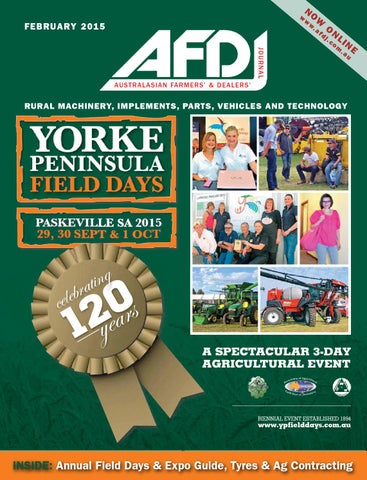
PASKEVILLE SA 2015 29, 30 SEPT & 1 OCT
g n i t bra
0 s r a 2 e y 1
cele
A SPECTACULAR 3-DAY AGRICULTURAL EVENT As
soc
Fi e
f i a t i on o A g r i c u l t u r
al
sia ld D a y s o f Au s t r a l a
BIENNIAL EVENT ESTABLISHED 1894
www.ypfielddays.com.au
INSIDE: Annual Field Days & Expo Guide, Tyres & Ag Contracting
IT’S ALL ABOUT SERVICE!!
We do not need to stock every catalogue item in each of our eleven local warehouses We could bank millions by cutting back on these fully stocked local distributor centres
YOU KNOW WE WOULD NOT DO IT AS OUR BUSINESS IS ALL ABOUT SUPPORTING OUR AUSTRALIAN COUNTRY DEALERS!!!
F E B R U A RY 2 0 1 5 - IN THIS ISSU E 8
Australasian Farmers’ & Dealers’ Journal
Feature Interview
Established 1984
22 Annual Field Days & Expo Guide
Publisher & Manager Editor Hartley Higgins
34 Ag Contracting
General Manager Elizabeth Bouzoudis
36 Tyres
Editorial Andrew Mole
50 Advertiser Index
Email: edit.afdj@ryanmediapl.com.au Advertising Manager
R EGU L A R S 8 News
47
Sandie Velkovska Ph: (03) 9888 4822 Email: s.velkovska@ryanmediapl.com.au
22 Field Days Calendar
Creative Services
42 What's New - TMA
Maria Baker
48 Law Review 49 Rural Finance
Email: prod.afdj@ryanmediapl.com.au Circulation Email: admin.afdj@ryanmediapl.com.au Subscription One year subscription within Australia: $33 (inc GST) for four issues, Overseas:
40
$66 (inc GST) for four issues.
34
Phone Cathy Johnson (03) 9888 4822 or email to subscribe:
FROM THE EDITO R
admin.afdj@ryanmediapl.com.au Printing
Seasons might have been all over the shop in 2014 but that news – good or bad – has all but paled into insignificance as everyone, from politicians and economists to farmers and agricultural suppliers, watch the Australian dollar’s freefall. At the time of writing it had collapsed a staggering 20 per cent against the US dollar in just a matter of months after its sustained bull run saw it well and truly outdistance parity to become one of the world’s darling currencies. But while it was an unexpected and incredible boon for the tourism industry it almost crippled Australia’s farming exports and buyers ran for cover – and other, cheaper markets. The full extent of its impact can be seen in regional towns such as Echuca, in northern Victoria, where food processor Simplot lost major contracts to the US because of the exchange rate. It was a body blow from which the company is still fighting to recover and an unsettling harbinger of the sudden impact a fluctuating currency can have on an industry which has little defence against its vagaries.
By the time the dust settled in 2014 it turned out to have not been a bad year for machinery sales. But currency aside, in one of the most transparent and open interviews in years, Landpower director Merv George told Australian Farm Dealer Journal about where he sees the Australasian machinery industry heading in the next few years. An assessment he has based on his extensive history in the northern hemisphere agricultural industry and he says the massive changes in the industry there are on their way Down Under. I doubt there has been a more direct response to the question about the future of any segment of rural industry and Mr George’s detailed answers are a must read. His interview was so far reaching and so long we have had to break it into two parts, with the final instalment in our next issue. Make sure you don’t miss either part. Andrew Mole, editor edit.afdj@ryanmediapl.com.au
Lane Print & Post Adelaide, South Australia Ryan Media Pty Ltd ABN 85 085 551 980 Suite 103, 486 Whitehorse Road, Surrey Hills, Victoria 3127 Phone: (03) 9888 4822 Fax: (03) 9888 4840 Email: admin.afdj@ryanmediapl.com.au Website: www.afdj.com.au
ISSN 1442-4983 Conditions Opinions expressed herein are not necessarily those of the editor/ publishers; information is published in good faith and we do not accept responsibility for damage which may arise from any possible inaccuracies. All rights reserved, none of the contents may be used in any other media without prior consent of the publishers. Published by Ryan Media Pty Ltd.
News Russian government triggers a shakeup of global wheat marketing JUST as a weakened Australian dollar makes Australian agricultural commodities some of the world’s most attractive, the marketing landscape is being rewritten almost faster than anyone can keep up. The Americans are flexing their economic ‘aid’ muscles, reportedly giving the financially-embattled Egyptian government a $100 million dollar aid donation. Provided it is used to buy US wheat. Russia has already started throwing up trade barriers against all exporters with a new tax almost certain to take it out of the world marketing arena. And that, it seems, is only the start. In the past three years the Russians have imported 2.1 million tonnes of wheat, although total imports have declined in each one of those years. Now the Russian government seems determined to almost force wheat selfsufficiency on the country’s producers.
One of the world’s largest wheat exporters, Russia has denied it was considering grain export curbs as an option to balance domestic demand during the 2014-2015 marketing season. Plum Grove’s Tyson Fry is suggesting that is just the start with the Russians, and in a recent market analysis said rumours of further trade restrictions have emerged from Russia, with an announcement from the country’s agriculture minister expected soon. Fry also said Stats Canada estimates that December 31 all-wheat stocks totalled 24.8 million metric tonnes. “This is down 13.5 per cent from the same period last year – but is still the second largest figure recorded in 18 years,” Fry said. “South Korea also jumped into the market in mid February taking a cargo of Aussie wheat,” he said. “It totalled 40,000 tonnes of ASW at $US246/mt FOB, while a further 10,000
tonnes of Hard wheat was valued at $US262/mt FOB.” At the same time Archer Daniels Midland Germany (formerly Toepfer International here) said the Russian tax came in at a rate of 15 per cent plus 7.5 euros, adding about 35 euros a tonne ($48/t) to the price of wheat. The export tax was expected to remain in place until at least the end of June. ADM Germany said Russia had exported 17 million tonnes of wheat by midJanuary, but was only expected to ship another 1.5 to 3.5 million tonnes during the rest of the export season. While European wheat stocks are about 16 million tonnes, much is poor or feed quality, with Europe from England to Hungary and the Czech Republic, all battered by wet weather last growing season. But a large part of the wheat was feed quality, with France, Germany, England, Hungary and the Czech Republic all hit by wet weather last harvest.
GM canola set for another record planting THE latest independent report published by the International Service for the Acquisition of Agri-Biotech Applications (ISAAA) shows biotech crop acreage increased again in 2014. The ISAAA report shows 2014 was the 19th year of successful commercialisation of biotech crops with more than 187.5 billion hectares of biotech crops planted since 1996 across 20 developing and eight industrialised countries representing more than 60 percent of the world’s population. This 100-fold increase makes biotech crops the fastest adopted crop technology in recent times. “This report confirms the importance of Australian farmers being able to choose to use new, innovative, safe and approved technologies to remain globally competitive, meet the requirements of increased food demand and farm sustainably on limited arable land,” said CropLife Australia chief executive officer Matthew Cossey. According to Monsanto, Australian Roundup Ready canola plantings here will increase to 503,436ha this year.
4
“Modern farming using biotechnology will play a crucial role in food, feed and fibre production in Australia and this report highlights the need to ensure non-science based and unnecessary costly regulation doesn’t hold Australia back from reaping the benefits and being a world leader in innovation,” Cossey said. “This is further evidence that state moratoria on genetically modified crops is completely unnecessary and it is time for all state moratoria to be repealed.” In Australia, planting of genetically modified (GM) herbicide tolerant canola increased by around 50 per cent to 352,125ha in 2014, with the fastest rate of adoption in WA. “Australian farmers, like farmers all around the world, recognise the enormous agronomic, economic and environmental benefits that come with the use of agricultural biotechnology innovations. “The repeal of state GM moratoria will unshackle Australian farmers and allow them to compete on a level playing field in what is an aggressively competitive global market,” he said.
AUSTRALASIAN FARMERS’ & DEALERS’ JOURNAL - FEBRUARY 2015
Clean Radiators Save Fuel!
Suitable for tractors, headers and harvesters, industrial excavators and wheeled equipment, trucks and forestry equipment. The Cleanfix Fan System has applications in farming, earthmoving, recycling, transport and mining.
Look for n ing deal ew ers!
Burder AgAttachments Mike Tahin | Phone: 03 57222343 cleanfix@burder.com.au
Authorised Australian Distributor
News Victoria shines in the 2014 machinery market Agriview’s Alan Kirsten takes a look backwards in the ag machinery business and says except for Victoria there were few highlights for 2014, in what has proved to be another tough year. AS usual it was a mixed year in 2014 for new machinery sales. Sales of new tractors were below 2013 levels for most months of the year. By the end of November the market was down by around 6 per cent and that was where the industry expected the market to end up by the end of the year. However December took everyone in the industry by surprise when the market delivered a record December result of 1276 tractors. This unexpected outcome
6
pushed the end year market to within 1.5 per cent of the 2013 result, all up 10,403 tractors were sold in 2014, just 155 fewer than in 2013. Power demand varied considerably in 2014, with the under 40 horsepower engine for the lifestyle market remaining strong and demand lifted by 4 per cent to 2688 units. The utility tractor in the 40100hp segment retreated by -7 per cent to 3569 units but in the end this was almost offset through a 5 per cent lift in the
100-200hp row crop market, which realized sales of a healthy 2597 units. The broadacre 200hp plus market recorded a -6.9 per cent decline in sales with 1549 units sold, 114 fewer than in 2013. Around the states saw demand in Queensland drop by just under 15 per cent due to the continuing poor seasonal conditions that prevailed for most of the year. In total there were 2162 tractors sold, which was 371 fewer than in 2013. However, demand in NSW fared better, with the market there falling by just under 5 per cent from 2929 units in 2013 to 2792 in 2014. Victoria was the stand out of the three east coast states with the market increasing by a whopping 13.4 per cent to 2896 units. This was the best result received for that state in more than 20 years. Demand in Tasmania slipped by 7 per cent to 286 units and in South Australia it retreated by 6.7 per cent to 927 units. In the Northern Territory sales held at 2013 levels with 122 tractors sold. Western Australia was the other good news story with the market growing by just under 9 per cent to 1217 tractors – which was 97 more than in 2013. This was the second best result for the state in the past 25 years, bettered only by 2009 when 1301 tractors were sold.
Moving onto the combine harvester market, in 2014 it retreated for the third year in a row, with only 621 new machines sold, 81 fewer than in 2013. Although this figure was not wholly unexpected as the hangover of second hand machines held by dealers dampened their appetites to trade further on new sales. The baler market continued its journey back into positive territory with a strong 24.2 per cent lift in sales. In total there were 771 balers sold, this was the best result since 2009 when 857 were sold. Round baler sales lifted 11.4 per cent to 490 units, small square balers lifted 42 per cent to 81 units and large squares lifted just under 53 per cent to 200 units. Looking ahead into 2015 the machinery industry we are predicting that new sales will be slightly down on 2014’s results despite the fact last year’s winter crop ended a lot better than most people expected. The falling Australian dollar will also be a significant help for exports and the recent rains in central and southern Queensland and northern NSW will see the return of confidence in those areas but it will not be enough to drive further growth in demand. Contact: Alan Kirsten Agriview P: 03 9372 0645 E: alan.k@agriview.com.au
AUSTRALASIAN FARMERS’ & DEALERS’ JOURNAL - FEBRUARY 2015
m.au
o.co c e r a b www.
G N I EAD
L
N I D L R O W E H Y! T
G O L O HN
C E T O T
P
ARD U G FT
A
O SH T P E
S
VE
LE ENT
PAT
LEA E R R
SE A E L E RD R A U R EVE HAFT G L T S N PATE GLE PTO E AN D I W
EEL ED FREEWH IN B M O C .P 150H TCHES SAFET Y CLU
LY XTERNAL E D R A D S E STAN EXCLUSIV ABLE DRIVE TUBE S A E CUSHION GR
PATENT UPLING O C E U Q TOR
MADE IN
A I L A R T AUS
FEATURE INTERVIEW Landpower boss delivers strong industry message There are few bigger names in the Australian agricultural machinery landscape, and with a more impressive CV, than Landpower’s Merv George. In this first part of a two-part interview with Mandy Parry-Jones he has some stern warnings and strong advice for the future of the Australasian machinery industry. MERV George started his time in ag machinery in his native New Zealand, working as a management trainee in the late 1960s for the Claas importer. Like most people in those days you worked up the ranks training under various bosses and various departments. The company was AM Bisley, a privately owned importing business. “It had some retail businesses and some owned dealerships so we had retail stores and separate dealers,” George said. “It’s the way the model worked, because that’s the way it was." “I worked my way through that business and then became South Island manager. We had four retail stores and an independent wholesale business, so that's the way the model was; we were able to sell products to dealers.” Very few dealers at that time had a full line up of product so ingenuity became the mother of invention and dealers cross-pollinated." “I’d like to describe it like a cuckoo; it doesn’t make its own nest it lives in someone else’s,” George said. “What we did was we were able to sell our combine harvesters and round balers through competing dealers that didn’t have our product." “For example you could have a John Deere or Case dealer or New Holland dealer that didn’t have a combine and they could sell a Claas combine beside a John Deere tractor.” "By far this was the most straightforward way to get everything done and dusted and that’s how it worked for quite some time, right through the ’70s and ’80s." It was a time when dealers were more connected and less competitive, more open and co-operative but that changed. 8
Merv George is pictured at Landpower’s Claas HQ with Catriona Claas. Photo: Mandy Parry-Jones
An ambitious bloke, George was given the chance to move further up the ranks but it meant moving away from New Zealand and across the ditch to Australia. “In terms of my personal growth I took a job I was offered, the sales manager’s role for Claas Australia based in Albury,” he said. “So in 1984 I moved my family and came across to Australia and was exposed to the Australian market.” Through the period 1984 to 1989 George lived in Australia where the Claas product was going through distribution channels that were mixed. Some were Claas dealers but most dealers had to have a mix of different brands in order to survive. “We weren’t seen as an enemy to each other,” George said. “We would have shared a dealership. That happened through the 1980s but later in the ’80s it became more difficult because manufacturers demanded exclusivity.” So if dealer had say John Deere then he
couldn’t sell any other brands; then to add a little complexity a lot of companies started to merge and the results were initially confusing. “When David Brown existed it made just tractors then it married into the Case network and it became Case IH. Then the Case network became CNH – you ended up with multiple brands all coming under the one manufacturing conglomerate. “The Italians bought Case and New Holland and rolled it into one big group and had two distribution networks. One would have Case tractors and Case combines; the other would have sold … New Holland and New Holland combines and then you were excluded from those businesses” George said. Australia throughout the late 1980s and the 1990s had dealerships directed to become exclusive regardless of their personal preferences. If you took on
AUSTRALASIAN FARMERS’ & DEALERS’ JOURNAL - FEBRUARY 2015
a brand you couldn’t sell a competing brand. It changed the dealership landscape forever. “I was then offered a job in the UK in 1989, so while my family had just settled and become Australians, we then all moved again,” George said. “I was offered the sales director’s job for Claas UK, and when I arrived there Claas UK had independent dealers who were dealing with Case and all the competitors and there was a mixture of things." “What happened quite quickly was that we were thrown out of a lot of those dealers – like the cuckoo again – because they had competing products and the manufacturers would say you can’t sell the Claas combine because you've got a Case combine.
There’ll be fewer customers, underneath that there’ll be fewer dealers so that means in itself the service for the customer will be further away. There will not be a dealer in every town in Australia in the future. “We ended up with having to set-up a network of dealers that were our own.” Finding new dealerships was very difficult because there weren’t any around to buy up, so George was forced to start them from scratch. “We had to start our own,” George said. “We had to start a new distribution channel, which in the early ’90s had fewer dealers. We didn’t want to recreate the old model with a dealership in every town because they fought each other and the biggest competition was the same brand in the next town." “We ended up establishing about 20 dealers throughout the UK and Ireland that were Claas focused dealerships, that didn’t compete with each other and were different in that they had big territories. We had one or two outlets that would cover the whole of a county.” Previously there had been almost 200 dealers covering the UK and when George finally left in 2002 there were just 30.
CORPORATE FARMING
“I’d seen that whole change occur,” he said. “What I’d also seen in that time was the migration of, and it’s happened a lot faster there than it has here, the growth of corporate farming … so there’s large farming companies that exist in Europe.” In Europe the corporations come in and rent farming land allowing the farmer to remain in his house. They simply rent the land and manage it; in fact they manage a whole raft of farming properties; it’s all about profit and loss, there’s no tie with the land or emotional attachment. 10
NEWS BRIEFS Don’t take your local dealer for granted.
THE Tractor Machinery Association reports 20 years ago there were approximately 2000 farm machinery dealerships scattered throughout Australia selling more than 10,000 new tractors annually – many of which were small family businesses with one outlet, maybe even two. Today we have 649 dealers remaining in Australia, selling the same amount of numbers of equipment at a significantly higher price – and only half are single outlet businesses. The cost of being a farm machinery dealership has quadrupled in that time as machinery becomes larger and more expensive, and the average number of tractors sold in that same 20-year period has increased from 3.5 tractors per branch to 18.4 tractors today.
Cover cropping demo grows.
THE start of March normally sees the only activity in the paddock application of soil toners such as gypsum or lime or a spot of late summer spraying, should farmers be lucky enough to have received February rain. However, The Land says Wimmera farmer Tom Dunstan is sowing a series of cover crops across the state as part of a Victorian No-Till Farmers Association (VNTFA) project. The concept behind the trials was to improve soil health through retaining a cover over the summer fallow period. The VNTFA, together with five Catchment Management Authorities (CMAs) and the Victorian Department of Resources, came up with the idea for the trials following presentations from American soil health experts on the benefits of cover cropping in the US.
JD lays off 900 in US
MORE than 900 John Deere factory workers have been laid off as the company downsizes its manufacturing operation. The Weekly Times said Deere & Company announced several factories in Iowa and Illinois would be affected by what they’ve described as “workforce adjustments”. The changes will place approximately 910 employees on indefinite lay-off. Deere said the workforce adjustments reflected the economic forecast included in the company’s November 2014 earnings report as the company continues to align the size of its manufacturing workforce to market demand for products.
AUSTRALASIAN FARMERS’ & DEALERS’ JOURNAL - FEBRUARY 2015
CREATING VALUE AT EVERY POINT OF TRANSFER
When a new piece of agricultural equipment is delivered by WWL to the dealer, it’s not just another handover. It’s the last in a series of transfers designed to perfection. It’s about precision and efficiency at every step. And it’s about combining local expertise with a truly global network. Whether you need reliable shipping from A to B or solutions to optimise your outbound supply chain, we work with you to create value at every handover. Through this approach we help our customers reduce inventory costs and increase delivery precision from factory to dealer. Find out more about how we can create value together at bit.ly/WWLcases
George said then was that once the large companies took over there was less demand for used equipment. “We ended up with used combines everywhere and when you live in a land mass like Europe you’ve got potential to sell somewhere else,” George said. “So I set up a business in the mid ’90s which is known in Australia now as Combine World. “I created that business because we had a need to sell our used combines around the rest of world. We exported used combines out of Britain to 36 different countries around the world. “We were the first company to go to the farm machinery show in the UK offering secondhand equipment.” This light bulb moment turned out to be very successful and worked a treat in Europe where could be sold secondhand equipment to less well-endowed countries such as Russia, the Ukraine and Greece. When George moved back to Australia in the early 2000s, this country was going through the same developments. “I came back to work for Landpower, who is the Australasian importer for a range of products – a house of brands. Landpower is the Claas importer but also Amazone and a range of other products. “It put a house of brands together and it wanted to establish its own distribution network in Australia”, he said. Landpower has been doing that around Australia and New Zealand since that time with 35 company-owned or privately owned dealerships that are based on the same model as in the UK – Harvest Centres. All they do is sell Landpower products. While the Australasian operation has utilised the same model as the UK, the land masses that make up Australasia are very different. New Zealand is perhaps closer in both land size and climate to the Continent. “I think the challenges in Australia are the climate of the country; and it is so variable, there’s a drought somewhere in Australia all the time, and distance because it’s so different to all other markets I’ve worked in because distance is a real issue,” George said. “The size of the industry is about $2b in sales and all the main manufacturers are here." “What’s happened however, from 1994 until today, the dealership numbers of retail outlets has come from over 2000 to about 600. “So it’s dropped dramatically and I can see that continuing, but probably not at the same pace. “There’s no question the number of dealers in Australia is going to continue to drop.” George quesitioned what this means from the farmer’s point of view? "The farm in Australia is clearly getting bigger so there will be fewer farmers but bigger farms and larger arable farms." He said there will be fewer farms in private hands and more in the hands of corporate farmers. "That’s already occurring in the cattle industry but it’s also occurring in the dairy industry with private investors as well as Chinese investors." "That’s happening big time right now in the Victorian market and the growth in that sector is enormous." “There’ll be fewer customers, so there’ll be fewer dealers and that means in itself the service for the customer will be further away,” 12
NEWS BRIEFS Robotic tractors getting closer
HITACHI Zosen Corporation, Hitachi and Yanmar have been commissioned to conduct a study on the effective use overseas of advanced positioning signals from Japan's QuasiZenith Satellite System (QZSS). The study seeks to verify advanced positioning signals transmitted from the QZSS can be used in precision farming in Australia. Specifically, demonstration tests will be conducted using the advanced positioning signals to control a self-steering robotic tractor and perform actual farm work in a paddy field.
Improved outlook for summer crop
Average, to above-average, rainfall in summer cropping regions has increased planting opportunities and improved yield prospects for dryland summer crops. ABARES executive director Karen Schneider said total summer crop production in 2014-15 was forecast to remain largely unchanged at about 3.7 million tonnes, despite the total area planted to summer crops falling by a forecast 7 per cent to 1.05 million hectares. “Summer cropping regions in NSW and Queensland have had good rainfall in December and January, a marked improvement on unfavourable spring conditions,” Schneider said. “As a result, improved yields are expected to offset the decline in total summer crop planting area.” Schneider said the drop in total planting area is largely the result of an expected 46 per cent decline in the area planted to cotton, to about 210,000ha. The area planted to rice is forecast to fall by 7 per cent in 2014–15 to about 71,000ha, reflecting reduced supplies of irrigation water in NSW. Total Australian winter crop production is estimated to have fallen 13 per cent in 2014–15 to 38.2 million tonnes.
Three ATV deaths this year
A 60-YEAR-old northeast Victorian cattle producer has become the latest fatality from an ATV accident. WorkSafe Victoria has reported the man was mustering cattle on his farm near Tallandoon this afternoon when the ATV he was riding rolled. A spokesman for WorkSafe Victoria said the man died at the scene. An inspector from WorkSafe Victoria is on their way from Wangaratta to investigate the incident. It is the third Australian ATV death this year, with a man killed in Tasmania on January 1 and a seven-year-old boy killed at Walgett, NSW.
AUSTRALASIAN FARMERS’ & DEALERS’ JOURNAL - FEBRUARY 2015
Lowara has an extensive range of pumps and pressure systems suitable for the man on the land. Stock Water Supply
Boosting Water Supply
Irrigation Water Supply
Household Water Supply
Reliable, high performance, quality materials, and the widespread Lowara support network make these pumps an ideal selection for rural water supply systems.
R
eliability, flexibility and savings were paramount in our brief to find the correct pump set. Brown Brothers Engineers have a proven track record in all these areas, our decision was quite an easy one.
The system has proven to be all it promised and more with all areas now irrigated with consistent pressures and uniformity; our irrigation window has decreased also even with the Greens now on the same cycle as the tees, fairways and approaches. I have no hesitation in recommending Lowara or Hydrovar as your next pump set. - Mark Jennings, Box Hill Golf Club, Victoria
Contact your local Lowara dealer about supplying your next pump and water supply system. Melbourne Sydney Brisbane (03) 9793 9999 (02) 9671 3666 (07) 3200 6488
01/15
Email: info@brownbros.com.au
Christchurch Auckland (03) 365 0279 (09) 525 8282
Web: www.brownbros.com.au
DELIVERING PUMPING SOLUTIONS
George said. “There will not be a dealer in every town in Australia in the future." “Let’s use Horsham as an example, or Ballarat; those service centres in the future will have to cover a 150km radius. They’ll be distant. The farmer will not see the flagpole of service at the end of his driveway.” Dealerships in Australia have been privately owned by individual entrepreneurs and have evolved over a time span of some 50 or 60 years. That evolution was during a time when dealerships started with out a lot of money. "Now owners are getting towards retirement age, or even past it, and are looking for new owners to sell their business to," George said. “They face two challenges. One is finding an owner to fund the business and many of the businesses are $10m or bigger and you need about 30 per cent of the revenue of the business as a credit line." “So in an average business in a small town that’s turning over $10m you need $3m to actually be able to fund it. There’s very few buyers for these businesses." “The other problem they have is that not very many of them would have invested in new technology to manage their business because they can’t afford it, as it’s a low margin business." “So computer systems when we looked at individual dealers don’t exist in the way they should.” According to George dealerships that are at most risk are single branch businesses, have not implemented the infrastructure changes needed to keep abreast of current technology and advances in business practices. The owners have been so busy keeping their business afloat that they have failed to even up-skill themselves, not keeping up with computer literacy or even with accounts. “They can’t find a buyer because they’ve got to find someone with $3-4m worth of credit even if they give the business to them with no goodwill,” George said. Selling a long-term business without a portion of the price being for goodwill is a big ask. However, the real challenge in most of these businesses is in the back room, in the spare parts bins. 14
“They all like to give the best possible service and end up with a spare parts inventory that’s grown, and grown, and the stock is never written down because it’s that old,” George said. “That’s a time bomb in there with 3-4-5 hundred thousand dollars worth of parts that are probably worth $6 a tonne." “Selling those dealerships is a problem,” he said. Over the past two or three years large conglomerates like Rocky Mountain and Titan have bought these dealerships. These companies have Case or John Deere franchises or other franchises in Canada and America and they have expanded into New Zealand and Australia, buying strategically.
significant shifts in our industry – there will be substantially fewer dealers and I think it could lower to half the number we have today; it could come down to 300." “The company I’m employed by as a director has established 35 dealers across Australasia, and it’s brought its key products of Claas, Grimme potato harvesters and Amazone cultivation equipment here." “We’ve created dealerships; some are privately owned by us, some of them are owned individually by entrepreneurs and what we’ve tried to do is make sure our business’ ERP systems go into every one of those dealers," he said. “We’ve tried to make sure even with the
There will be substantially fewer dealers and I think it could lower to half the number we have today it could come down to 300. “These people would come in and buy several stores and run them as part of their own businesses and they might own 200 retail stores in Canada, America, New Zealand or Australia,” George said. “The whole management – they can bring computer systems they can bring finance – and the local people are no longer the entrepreneur; the local man becomes the store manager who works for a big conglomerate and the idea of entrepreneurial 24/7 service is probably diminishing", he said. “I see that as significant change. Those people that can’t sell, their only buyer would be these offshore buyers or shut the doors and walk away but for the farmer it will be a different animal.” George said the big corporate farmer of the future will be dealing with a company that is owned by publicly listed companies in America. As with all publicly listed companies they will be at the mercy of shareholders and have demands for return on shares. “They buy in bulk from the suppliers and they will be leveraging the suppliers,” George said. “So for the farmer we can talk about
private entrepreneur he has the latest and best business management systems; that he applies a certain range of KPIs (key performance indicators), and that he writes down his spare parts stock.” George said Landpower works hand-inhand with the dealers to ensure they have the latest management skills and business systems, and to make sure the territory they have affords a viable business. “There’s a finite amount of revenue for a business that’s operating in a broadacre market – it needs to be at $25m to $35m at least,” George said. “One operating in a hay machinery market could be $15m or $20m. “They’ll invariably be multi-branch, they’ll have our tools of management and we also finance them. “We give them management skills, we train them and we do the management accounts for them.We bring finance to them and we train the managers to try to make them the best we can, to really focus on the needs of today.” • Next issue Merv George talks about the value of education in agricultural Australia.
AUSTRALASIAN FARMERS’ & DEALERS’ JOURNAL - FEBRUARY 2015
What’s New Stockpost XL – high performance, low price tag
expensive,” he said. “We challenged ourselves to come up with a product that combines both quality and strength while putting it at a price point that is affordable. “Intermediate steel posts can be driven with arguably less effort. We’ve designed
ly Austra ud
n lia
Providing INNOVATION in agriculture for over 37 years!
ow
n
ed
www.farmscanag.com
d
Wires is a great alternative to bulky timber posts or high-priced big steel posts.
te
The new Stockpost XL from Whites
the XL post with three equal legs for added stability.” The Stockpost XL is available in refastenable ute packs of 50, making it an affordable fencing option as well as being easy to use. “The ute packs don’t require any tie wires, so they’re very easy for farmers or contractors to use. The pack of 50 means they don’t necessarily have to make a big upfront outlay for stock,” Gray says. The Stockpost XL range is available in 180cm, 210cm, and 240cm lengths and bituminous black or hot dipped galvanised coatings. Contact: Con Calagis Whites Group Pty Ltd Marketing manager T: 02 8602 0014 E: ConC@whitesgroup.com.au
Pro
HIGH quality, durable intermediate posts are a critical component of effective farm fences, according to Whites Wires national product manager Brian Gray. Whites Wires has recently launched the Stockpost XL intermediate post as an affordable alternative to timber posts or expensive big steel posts. Intermediate, or big steel posts, are used to help shore up long runs of fencing much in the same way as large diameter timber posts have on many fences around the country. Brian says the new product will help resellers give farmers and fencing contractors exactly what they have been looking for. “This new line was developed on the back of customer feedback. They were telling us that good timber posts were becoming scarce and big steel posts can often be very
& oper
a
SPRAY SEED
Rugged Display with Touchscreen OTHER HARDWARE REQUIRED
1
CONTROLLER MANY APPLICATIONS
SPREAD
ALL NEW 7000 SERIES - CALL NOW FREECALL 1800 327 672 • EMAIL sales@farmscanag.com • WEB www.farmscan.ag
FEBRUARY 2015 - AUSTRALASIAN FARMERS’ & DEALERS’ JOURNAL
15
What’s New E Agri leads effort to future-proof agriculture AN assessment of the sustainability of traditional farming processes and methodologies has prompted new agribusiness company, E Agri, to develop a new technology and environmentallyfocused platform aimed at making food and horticulture production more accessible, attractive and efficient for urban communities. According to E Agri’s environmental spokesperson, Rob Gell AM “our objective is to enable people to grow fresh, organic food in city environments and encourage better utilisation of unconventional but potentially valuable production areas such as factory roof tops for farming”. “We are also focused on providing the safest, highest-quality food solutions to minimise environmental and carbon cost impacts through ‘food miles’ while allowing consumers to access fresh food from their local environment, year round, regardless of climate and free of pollutants.” The diverse team behind E Agri Co. is made up of industry leaders from across agriculture, education, technology, and sustainability. According to Gell, who has more than 20 years as an environmental consultant, the farming solution offered by E Agri Co is a positive step in the right direction.
“With natural resources becoming scarce, efforts to produce more efficiently and profitably are in high-demand,” Gell said. “Through commercially proven, hydroponic and sustainable horticulture systems, we are now in a position to deliver new turn-key solutions to generate significantly lower cost, higher yielding crop per square metre of land than can be achieved with either traditional horticulture or conventional hydroponic approaches. “We believe the types of technological advancements being developed by E Agri will help cement Australia’s position as a provider and innovator of sustainably produced, highquality food globally,” he said. Unlike competitors, promising to offer high-tech, new age solutions and infrastructure, E Agri can point to proven success through its collaboration with partner Australian Fresh Leaf Herbs (AFLH), one of Australian’s leading producer and distributors of sustainable fresh herbs. According to AFLH managing director and Australian Young Farmer of the Year (2011) Jan Vydra, E Agri’s technology has helped the company grow the business in the past four years. Recognised as one of Australia’s fastest start-ups, AFLH went from producing 2000 units to more
E Agri is allowing consumers to
access fresh food from their local environment, year round, regardless of climate and free of pollutants.
than 100,000 units a week using the hydroponic, cloud-based system. “Utilising new technology including cloud computing has let us maximise resources and conserve water and energy through smart phone and tablet devices,” Vydra said. “The software assists with everything from where we plant and monitoring water levels through to documenting the quality of the produce from the moment it leaves the farm gate to the time it lands at the retailer distribution centre. “Through E Agri we have been able to generate higher yields from available land, minimise environmental impact and run a profitable business from start up in 2008,” he said.
Aussie launches a blaster breakthrough AUSSIE Pumps has launched a new 3000 psi engine drive pressure cleaner designed to set a new standard in cleaning power and value for money. Called the Aussie 30 Scud, the new machine will change the way farmers, civil contractors and even tradies think of portable engine drive pressure cleaners. Designed for Australian conditions, the machine is a breakthrough in terms of performance and price. “We call it a ‘pocket battleship’,” Aussie Pumps product manager Hamish Lorenz said. “The machine packs more punch yet uses substantially less horsepower than other 16
3000 psi machines on the market,” he said. The Scud 30 is built for Australian users in a compact well designed frame trolley with four 10” pneumatic tyres and steel wheels. The heart of the machine is a “Big Berty” Bertolini triplex pump developing 3000 psi performance from a dynamite Honda 6½ HP petrol engine. It is backed by Aussie’s ‘3 + 3’ warranty with Honda’s three-year engine warranty matched by Bertolini’s three-year pump end warranty. The machine also offers integrated detergent injection to speed the cleaning process, enabling the operator to apply non caustic chemicals to the job at low
The new Honda-powered Aussie
Scud 30 high pressure water blaster sets a new standard for safety and value.
pressure and then to blow the dissolved dirt or grease off at a full 3000 psi pressure.
AUSTRALASIAN FARMERS’ & DEALERS’ JOURNAL - FEBRUARY 2015
What’s New Narva lights up market with new LED beacons NARVA’S new range of Eurotech 12/24V dual voltage LED beacons have been designed specifically for the commercial and construction industries with a choice of two sizes on offer. More compact than other alternatives in the market, the Eurotech beacons provide an affordable solution for high quality light output and durability. A benefit of using the latest Eurotech beacons is their ability to perform two light functions in one, being able to both flash and rotate, and offering the option of six adjustable flash patterns thanks to advanced LED technology. Narva’s Eurotech LED beacons are more affordable than traditional heavy-duty LED beacons, while still providing an impressive light output and high end
build quality. Furthermore they meet the heavy vehicle regulation 2013, number 77, making them suitable for on road use. Buyers can choose from two sizes, a low profile option (P/No. 85254A) and a standard height (P/No. 85260A) alternative, both available with a flange base. The flange base units allow alternative and synchronised operation of up to four strobe units. The low profile option is also available in two additional mounting configurations: a magnetic base (P/No. 85258A), which features a 12/24V cigarette plug with an on/off switch and pattern selector for easy scroll through operation, or a flexible pipe mounting base (P/No. 85256A) with a DIN style connection.
New Hi-Tech Narva Eurotech LED
beacons and marketed as being cost effective and versatile
Narva’s Eurotech beacons are available from leading automotive and transport outlets throughout Australia, starting from $170+gst.
FEBRUARY 2015 - AUSTRALASIAN FARMERS’ & DEALERS’ JOURNAL
17
What’s New You reap what you sow – and how you sow AS growers bring in their crop and tally their results for the season, they should remember the decisions they made before they even planted their seed had an impact on the growing cycle, said Flexi-Coil brand leader Steve Mulder. “Producing a high quality, high yield crop is the sum of many parts,” Mulder said. “Ultimately, where you finish your season depends very much on how you started it. “One of the most important decisions you will make in your season is when and how to sow your crop, including which equipment to use. “You only get one chance to plant each seed so it’s worth doing everything you can to give every seed the very best chance.” Mulder said the best equipment manufacturers follow the same principles as the best growers, constantly refining their processes and making continual upgrades. “At Flexi-Coil, research and development has been part of our DNA since the company launched in the 1950s, because we understand how critical seeding is to the growing season,” he said. “From the evolution of the flexible frame on cultivators and drills to single cylinder depth control on our ST820 precision cultivator, we’ve been helping growers do better with each passing season.” Mulder said growers cannot overestimate the importance of depth control at seeding. Sowing too deep can delay or stifle emergence, while sowing too shallow can lead to seed damage from herbicide uptake. “Seasonal differences in depth and availability of moisture should influence decisions about depth of sowing, and the task should not be left to chance,” Mulder said. “You need very precise and accurate placement and appropriate seeding rates if you want the best results,” he said. “Flexi-Coil has built its reputation on superior ground following capacity and repeatable depth accuracy, because it really matters.”
LOOKING BACK TO PLAN FORWARD
Mulder said at this time of year, growers should review what they did during the season and how it might have affected their results. 18
Flexi-Coil has been helping growers do better with each passing season. “There will always be factors that are outside our control – that’s the nature of farming,” he said. “But it’s good to cast a critical eye over those things that we can control. “Taking the time to review what you did and how it played out can have a direct impact on your bottom line so it’s worth doing.” He recommended dividing the season into stages and assessing how each stage went, from planning to seedbed preparation, sowing, growing and harvest. “The planning stage is about reviewing yield maps, completing soil testing, choosing the right variety and ensuring you have access to quality, disease-free seed. “Get these decisions right, and you’re setting yourself up for the best possible start. “Once you’ve decided what to grow, seedbed preparation becomes the next focus. “Ensuring good seed soil contact is vital for successful crop establishment. “Grower groups are a good place to start for growers looking for advice relevant to their district.” Choosing the right time and the right method for sowing is the next decision point. Mulder said this was the point where your seeding equipment really mattered. He said just getting the seed into the ground is not enough. “If you’re investing in quality seed and crop management, you should be investing in
the best sowing technology, too,” Mulder added. “You should also make sure your equipment is not only the best for the job but is well supported. “The seeding window each season is very short. “You need the right expert advice on hand and rapid parts availability. “With 50 highly-trained dealers across the country, Flexi-Coil can deliver that.” Once the seed is in, the focus should switch to crop nutrition. Farming is much more technical than even 20 years ago and every grower should be assessing paddock nutrient status and developing a detailed crop nutrition plan for the season. Mulder said no matter what this season delivered, growers should be thinking about what they’ll change and what will stay the same the following season. “If your season was not stellar then of course you’ll be thinking about what you can do differently next time, but even if your season was good, it’s worth assessing what you can do to make it even better,” he said. “Making well-researched choices and choosing the most accurate equipment will help you make the most of whatever the next season sends your way.” Contact: Steve Mulder P: 02 9673 7807 E: steve.mulder@cnh.com
AUSTRALASIAN FARMERS’ & DEALERS’ JOURNAL - FEBRUARY 2015
When there’s water to move, only the No.1* will do...
FEBRUARY 2015 - AUSTRALASIAN FARMERS’ & DEALERS’ JOURNAL
19
What’s New Long rolls make fencing a shorter job LONGER fencing rolls make the job quicker and the fence more robust, according to Jo Eldridge and Tony Kelly, who have used more than a hundred Whites Wires Stiff Stay 500m rolls as they changed their operation from cattle to sheep production. The couple have recently fenced close to 50km at their new and existing properties at Tottenham, near Dubbo in NSW. Together with their neighbours Greg and Heather Weber who are part owners of one of the properties, they looked to Whites Stiff Stay for a faster and more robust solution. They made the switch from cattle to sheep a couple of years ago in an effort to achieve better gross margins and improved cashflow. They chose to cross the wool-shedding Wiltipoll with the new Australian White, to create a breed that would not need shearing. Currently they have about 17,000 sheep, including lambs, and achieved a lambing rate of 153 per cent with their first drop. Understandably they are delighted with the way their new venture is going so far. One of the big challenges of the change from cattle to sheep has been upgrading fencing to suit their new operation. Their fencing supplier recommended Whites Stiff Stay 500m rolls for ease of use and the fence design, which features tight cross-over knots to lock the wires in place and resist buckling and sagging. “The existing fence was fine for cattle but no good for sheep because they just go straight through or under the wires,” Eldridge said. “So we’ve been pulling out the cattle fencing and replacing it with Stiff Stay. We’ve done a lot of boundary fencing on both properties and over time we’ll break up the middle of both properties, too. “The Stiff Stay has been amazing for 20
Tony Kelly from Tottenham, near Dubbo in NSW uses Whites Stiff Stay 500m fencing rolls because they are designed to resist sagging and buckling.
keeping wildlife out. The roos are actually digging to get in now. Where we used to see 100 kangaroos on the paddock now we’ll see four or five.” She said neighbouring farmers and even the local bus driver who passes each day have been astonished at how quickly the fences have been going up. “We just need to bang in the posts, roll out the 500m of Stiff Stay and then replace the roll. It’s very quick and easy,” she added. “It makes for a stronger fence, too, because there are less joins, which are always the weakest points.” Like many Stiff Stay customers, Eldridge and Kelly have found it easy to manage the larger rolls, which weigh about 200kg. “We’ve built a bar for the back of our tractor so there’s no lifting the rolls. Even our contractor has started using our fencing method,” Eldridge said. She and Tony have used more than 100 rolls of Stiff Stay so far, with their first Stiff Stay fences built about a year ago. “So far we’ve been thrilled to bits with it. We absolutely love it. We’ve had some in the ram paddock for about
12 months and we expected the fence to shift a little because the sheep rub against it but so far it hasn’t budged at all.” Stiff Stay is made in Albury by Whites manufacturing partner Frauenfelder. Clean, smooth knots protect stock from injury and make installation safer, while deflection of the wires at the joint holds the high tensile line wires and vertical wires in place, stiffening the fence when suspended from the posts. Stiff Stay is available in a range of wire configurations. The vertical pickets can be spaced at 50mm, 75mm, 100mm, 225mm and 300 mm. The line wires can be spaced at a minimum of 100mm to 1.2m high and can maintain that minimum spacing of 100mm to a maximum height of 2m. Stiff Stay is available as heavy galvanised product with 2.8mm edge wires and 2.5mm high tensile line wires and 2.5mm vertical wires. It is also available in standard galvanised. Contact: Con Calagis Marketing Manager T: 02 8602 0014 E: ConC@whitesgroup.com.au
AUSTRALASIAN FARMERS’ & DEALERS’ JOURNAL - FEBRUARY 2015
What’s New Armour for your eyes always a must ON THE worksite your most valuable tools are your eyes – and you need to protect them. But it’s hard to find a pair of comfortable, form fitting safety glasses that won’t break the bank. Enter the Ugly Fish Armour, the safety eyewear that protects your eyes like you would the rest of your body. Built for comfort and durability, the Armour range from Ugly Fish is perfect for all workers no matter how Ugly a job. With shatterproof lenses and an antifog/anti-scratch coating; the glasses are certified to Australian safety standards. Featuring polycarbonate de-centred safety lenses, the Armour glasses eliminate distortion and prevent distracting magnification, reducing the chance of making mistake and causing injury. They are also available in polarised and photo-chromic lenses. One of the most popular and versatile products in the extensive safety range from Ugly Fish, the Armour comes with a detachable ventilated positive seal, which has the ability to shelter your eyes from harsh winds, dust and other air-born particles on the worksite, making them a no brainer for Aussie workers. Not only are the lenses tough, but so are the frames; Armour frames come with a TR-90 wraparound sports frame that is highly flexible, stress resistant and lightweight. And much like the lenses, the frames are designed for maximum impact resistance and any harsh environment. Contact: Luke Dean-Weymark P: 0412 356 727 E: luke@menatworkcomms.com.au
The Selecta Motion Activated Security Camera with Wi-Fi upgrade provides a
watch and recording function in day or night conditions over all types of farm or rural property assets, driveways, gates, buildings, machinery or livestock.
Rural property theft now reaching alarming levels ALARMING levels of theft from farm and rural properties with the main targets being rolling equipment, tools, machinery (especially chainsaws and welders), stored fuel and livestock continue to frustrate property owners. Key targets seem to be virtually anything of value that is unsecured or can be easily removed. For example, police report recent thefts at Strath Creek in central Victoria confirm three properties had been raided with losses calculated as four chainsaws, two welders, assorted power and other tools, kitchen appliances, a quad bike, step ladders and scaffolding and personal items. At one property, where the house and shed had a forced entry while the owners were absent their loss was calculated as $6000. Silvan Australia through its Selecta merchandise division offers a range of inexpensive solutions to farm and even general property security or livestock monitoring including their new movement activated Wi-Fi compatible
12 Mp Selecta day and night security camera. A Selecta security camera is a low fuss, easy to employ day or night use asset protection aid suitable for indoor and outdoor use and can complement other deterrents including warning signs, simple or sophisticated locking systems, warning alarms and dogs. The Selecta day and night security cameras are motion activated and include no-glow infra-red for night vision with a range from fifteen to twenty metres. The cameras also have a multi photo capacity with the capacity to take from one to three photos every time it is triggered. The cameras have a camouflage colour scheme, designed to help keep the cameras hidden from view. It is bundled with an 8 GB Wi-Fi SD card enabling automatic file transfer of the information recorded to Apple and Android phones or tablets. Contact: Silvan Australia P: 1300 745 826 E: info@silvan.com.au
FEBRUARY 2015 - AUSTRALASIAN FARMERS’ & DEALERS’ JOURNAL
21
2015 FIELD DAYS CALENDAR Up-to-date comprehensive Field Days Events Calendar. Also available at www.afdj.com.au. To lodge your event contact Cathy Johnson P: (03) 9888 4822 – admin.afdj@ryanmediapl.com.au February 2015 11-13 Sungold Field Days Louise Thomas At Allansford, about 12 km east of Warrnambool, VIC 03 5565 3142 sungoldfileddays@wcbf.com.au www.sungoldfielddays.com.au 20-22 Seymour Alternative Farming Expo Colin Stray Goulburn Valley Highway, Seymour, VIC 03 5799 1211 admin@seymour-expo.com www.seymour-expo.com
February/MARCH 2015 27-1 ActewAGL Royal Canberra Show Gary Ashby Exhibition Park, Canberra, ACT 02 6241 2478 ceo@rncas.org.au www.rncas.org.au
March 2015 3 King Island Show Tanya Arnold Currie Show grounds Currie, TAS 03 6462 1346 tanya_arnold@bigpond.com www.ascti.com.au 3-5 Wimmera Machinery Field Days Murray Wilson Wimmera Events Centre at Longerenong near Horsham, VIC 03 5384 7210 info@wimmerafielddays.com.au www.wimmerafielddays.com.au 6-7 Wagin Woolorama WA 08 9861 2242 tradefair@woolorama.com.au www.woolorama.com.au
22
11 Tillage & Cropping Demo Day Few minutes drive east from Elmore along the Midland Highway, VIC 03 5432 6176 info@elmorefielddays.com.au www.elmorefielddays.com.au 20-21 South East Field Days Lyn Crosby Yakka Park, Lincoln, SA 08 8766 7001 sefds@bigpond.com www.southeastfielddays.com.au 26-29 Farm World Mark Cockerell Burnt Store Road, Lardner Park, Warragul, VIC 03 5626 1373 office@lardnerpark.com.au www.lardnerpark.com.au
May 2015 1-2 East Gippsland Field Days Peter Treasure Bairnsdale Aerodrome, Bairnsdale, VIC 03 5153 1398 0427 878 645 info@egfielddays.com www.egfielddays.com 1-3 Tocal Field Days Coral Cairney Tocal Road, Tocal, NSW 02 4939 8827 fielddays@tocal.com www.tocalfielddays.com
April 2015
7-9 Agfest Field Days Carlee Lee Quercus Rural Youth Park, on Oaks Road between Carrick and Bracknell, TAS 03 6331 6154 admin@agfest.com.au www.agfest.com.au
11 The Weekly Times Rural Lifestyle Expo Cnr Creswick Road & Howitt Street, Wendouree, VIC 03 5338 1877 info@rurallifestyleexpo.org.au www.rurallifestyleexpo.org.au
8-9 Riverina Field Days Ffiona Beverley Griffiths Showground, Griffiths, NSW 02 6964 8811 riverinafielddays@bigpond.com www.riverinafielddays.com
27-28 Karoonda Farm Fair Karoonda, SA 08 8538 2860 info@farmfair.com.au www.farmfair.com.au
15-16 Agrotend Field Days Bundaberg Col Reynolds Bundaberg Recreation Precinct Opposite Bundaberg Airport, QLD 0417 749 958 www.agrotend.com.au
APRIL/MAY 2015 26-8 Sydney Royal Easter Show Sydney Showground, Sydney Olympic Park, Sydney, NSW 002 9704 111 www.eastershow.com.au
22-23 Mildura Field Days Diane Johnstone SuniTAFE Field, Benetook Avenue, Mildura, VIC 0487 021 122 dianne@mildurafielddays.com.au www.mildurafielddays.com.au
AUSTRALASIAN FARMERS’ & DEALERS’ JOURNAL - FEBRUARY 2015
2015 FIELD DAYS CALENDAR 22-23 Deni Innovations Expo Andrew Richardson Murray Valley Industry Park. Off Todd Road, Deniliquin. NSW 0407 503 978 www.deniinnovationsexpo.org.au 27-28 Rotary FNQ Field Days Lesa Pershouse Mareeba District Rodeo Assoc, Kerribee Park, Mt Abbott, QLD 0427 998 203 info@fnqfielddays.org.au www.fnqfielddays.org.au
June 2015 2-4 Farmfest Field Days Kingsthorpe Park, on the Warrego Highway, 20 kms west of Toowoomba, 02 6768 5800 farmfest@ruralpress.com.au www.farmfest.com.au 10-13 New Zealand National Agric Field Days Myster Creek Events Centre, 125 Myster Creek Road, Hamilton, North Island, New Zealand +647 843 4499 www.fielddays.co.nz 18-20 Primax Primary Industry Exhibition Bruxner Highway, Casino, NSW 07 5531 4600 info@primex.net.au www.primex.net.au
JuLY 2015 2 BCG Grains Research Expo Birchip P12 School, Campbell St, Birchip, VIC 03 5492 2787 info@bcg.org.au www.bcg.org.au 7-9 Ag-Grow Emerald Field Days 6km East of Emerald on the Capricorn Highway, QLD 07 4982 4244 admin@aggrow.com.au www.aggrow.com.au
11-12 Mudgee Small Farm Field Days Mudgee, NSW 02 6372 3899 www.mudgeefielddays.com.au 14-16 WineTech 2015 Matthew Moate Adelaide Showgrounds, Wayville, SA 0448 882 019 eo@wisa.com.au www.kjex.com.au/Winetech.html 17-18 Australian Wool & Sheep Show Andrew Ternouth Prince of Wales Showgrounds Holmes Road, Bendigo, VIC 03 5439 5094 secretary@sheepshow.com wwww.sheepshow.com 24-26 Farm Fantastic Outdoor Expo 530 Punicestone Road, Caboolture, QLD www.farmfantasticexpo.com
August 2015 3-4 Sheepvention Hamilton Showgrounds, Hamilton, VIC 03 5572 2563 info@hamiltonshowgrounds.com.au www.hamiltonshowagrounds.com.au 5-6 Mallee Machinery Field Days Andrew McLean 2 km south of Speed Sunraysia Hwy, VIC 03 5084 1320 mmfd@bigpond.com www.mmfd.com.au 18-20 Commonwealth Bank AGQUIP Field Days 8 kilometres West of Gunnedah on Blackjack Road, Gunnedah NSW 02 6768 5800 agquip@fairfaxmedia.com.au www.agquip.com.au 26-27 Dowerin GWN7 Machinery Field Days Dowerin, WA 08 9631 1021 info@dowerinfielddays.com.au www.dowerinfielddays.com.au
SEPTEMBER 2015 1-3 Heritage Bank Ag Show Damon Phillips Toowoomba Showgrounds, Toowoomba, QLD 07 4634 7400 admin@agshow.com.au www.agshow.com.au 2-3 Newdegate Machinery Field Days Anne Bishop Newdegate, WA 08 9871 1655 nfday@westnest.com.au www.nfday.com.au 4-13 Adelaide Royal Show Adelaide Showgrounds, Goodwood Road Wayville, SA 08 8210 5211 info@adelaideshowground.com.au www.theshow.com.au 9 BCG Main Field Day In The Field - Location TBA 03 5492 2787 info@bcg.org.ay www.bcg.org.au 11-12 Berry Small Farm Field Day Berry Showgrounds, Victoria Street Berry, NSW 02 4403 0300 berry_rotary@gmail.com www.berryrotary.org.au 17-18 Mingenew Expo Kym McGlinn Midlands Rd, Mingenew, WA 08 9928 1138 secretary@mingenewexpo.com.au www.mingenewexpo.com.au 18-19 Riverland Field Days Tim Grieger Sturt Highway (Short St) Barmera, SA 0409 099 122 fieldays@riverland.net.au www.riverlandfielddays.com.au
FEBRUARY 2015 - AUSTRALASIAN FARMERS’ & DEALERS’ JOURNAL
23
F I ELD DAYS SE C T I ON
2015 FIELD DAYS CALENDAR 22-24 Henty Machinery Field Days Cookardinia Road Henty, NSW 02 6929 3305 admin@hmfd.com.au www.hmfd.com.au 23-24 South Gippsland Dairy Expo Contact: Deane Kennedy Korumburra Showgrounds, cnr South Gippsland Hway & Charles St, Korumburra, VIC 0419 878 055 www.dairyexpo.org.au 25 25th "Kilfera" Field Day Clive Linnett "Kilfera" Ivanhoe, NSW 02 6995 1315 0428 951 315 kilfera1@bigpond.com
26-3 Perth Royal Show Robin Bartlett Perth Showgrounds, Garlands Road, Claremont, WA 08 6263 3100 info@raswa.org.au www.perthroyalshow.com.au 29-1 Yorke Penninsula Field Days Elaine Bussenschutt Copper Coast Highway, Paskeville, SA 08 8827 2040 ypfd@netyp.com.au www.ypfielddays.com.au
OCTOBER 2015
SEPTEMBER/OCTOBER 2015 20-1 Royal Melbourne Show RASV Administrator Melbourne Showgrounds Epsom Road Melbourne, VIC 03 9281 7444 customerservice@rasv.com.au www.royalshow.com.au
6-8 Elmore Field days 48 Rosaia Road Elmore VIC 03 5432 6176 15-18 Royal Geelong Show Administration Geelong Showgrounds, Breakwater Road East Geelong, VIC 03 5521 1707 info@royalgeelongshow.org.au www.royalgeelongshow.org.au
16-17 Wandin/Silvan Field Days Wandin East Recreation Reserve Wandin, VIC Contact: Nan Cleven 0429 428 537 17-19 Murrumbateman Field Days Murrumbateman, NSW 02 6227 5895 admin@mfdays.com www.mfdays.com 21-24 Royal Hobart Show Hobrt Showgrounds, Howard Street, Glenorchy, TAS 03 6272 6812 admin@hobartshowground.com.au www.hobartshowground.com.au/show/ 21-24 Australian National Field Days 563 Borenore Road Borenore, NSW T: 02 6362 1588 info@anfd.com.au www.anfd.com.au
NOVEMBER 2015 13-15 EQUITANA Melbourne Showgrounds, VIC Definitive Events 03 8698 2000 info@equtina.com.au www.equitana.com.au
AUSTRALASIAN FARMERS’ & DEALERS’ JOURNAL
NOW AVAILABLE ONLINE FOR MORE READERS AND INCREASED BUSINESS
Visit www.afdj.com.au today to view your copy online 24
AUSTRALASIAN FARMERS’ & DEALERS’ JOURNAL - FEBRUARY 2015
F I ELD DAYS EXPO G U I DE
Riverina Field Days – from strength to strength THE Riverina Field Days evolved from a field day which had previously been held at Yanco from 1988 to 2006 and was owned and operated by local Griffith media interests WIN Television and Radio 2RG, Griffith. In July 2006 these companies decided not to be involved and a decision was made to try and find a business or company who would be prepared to take the event to Griffith in order to make it viable once more. Since the drought hit in 2000 it became increasingly evident that it was no longer viable at Yanco. The event is now held at the Griffith Showgrounds under the auspice of the Coro Club. Initially the arrangement was a joint venture between the Coro Club and the Griffith Showground Trust but subsequent situations made a joint venture impossible and the Coro Club eventually took over complete control
of the event and now pays a generous fee to the Trust for the use of the grounds. Ffiona Beverley, who had been employed by WIN Television solely to organise the field day at Yanco, agreed to go with the Riverina Field Days and
The Riverina Field Days also has a unique point of difference – it is the only field day held in the Murrumbidgee Irrigation Area is your first point of contact. There is a great deal of infrastructure in place at the Griffith Showgrounds such as permanent toilet facilities,
sealed roads in many areas as well as seating and trees for shade. There is a permanent bar facility as well as three buildings able to provide exhibitors with undercover areas, thus saving them marquee hire. With a new venue, new owners, new sponsors and the organiser based in Griffith a new name was deemed appropriate and the Riverina Field Days was born. But the ‘new’ field days did keep the same dates as Yanco – the second Friday and Saturday in May. There is plenty of room at the Griffith Showground to accommodate exhibitors. The main arena is set out in rows and there are also small (6m x 6m) sites on the inside perimeter as well as other areas with access to power. Moving the event to an area which a much larger population base has also seen a marked increase in crowd
FEBRUARY 2015 - AUSTRALASIAN FARMERS’ & DEALERS’ JOURNAL
25
F I ELD DAYS EXPO G U I DE
Millions of dollars of machinery, agricultural and rural products were on display in the centre of the main arena at the eighth field days last year, with smaller exhibitors taking up sites on the inside perimeter from the southern end around to the northern end numbers.Whilst both media companies have nothing to do with the organisation of the Riverina Field Days they have pledged their support through advertising. The Riverina Field Days also has a unique point of difference – it is the only field day held in the Murrumbidgee Irrigation Area (MIA). Millions of dollars of machinery, agricultural and rural
celebrating
120 years
products were on display in the centre of the main arena at the eighth field days last year, with smaller exhibitors taking up sites on the inside perimeter from the southern end around to the northern end. Organiser Ffiona Beverley said the exhibitors were to be congratulated on the time and effort put into their displays and said she had received many positive comments from members of the public. “Sponsor of the event, the Wine Grapes Marketing Board, has already approached us regarding their continued sponsorship of the event for 2015 and 2016 and we are delighted with their support,” Beverley said. “New exhibitors should be aware the previous year’s exhibitors have first option on their sites,” she said. “But after January 31 all vacant or un confirmed sites are up for grabs and new exhibitors are placed on a ‘first in’ basis. “All intending exhibitors should complete a form and return as soon as possible – payment will not be required until you are placed and a tax invoice sent.” Dates for the 2015 Riverina Field Days are May 8 and 9. Contact: Ffiona Beverley P: (02) 6964 8811 or 0428 630 057 E: riverinafielddays@bigpond.com
Australia’s Oldest Field Days Next Biennial Event 29, 30 September & 1 October 2015 Prospectus now available. Enquiries to the Administrator: Elaine Bussenschutt OAM,
PO Box 162 Kadina SA 5554. Phone: 08 8827 2040 Fax: 08 8827 1011 Email: ypfd@netyp.com.au Web: ypfielddays.com.au
South Australia’s Premier Rural Event 26
AUSTRALASIAN FARMERS’ & DEALERS’ JOURNAL - FEBRUARY 2015
F I ELD DAYS EXPO G U I DE
Rural Youth Tasmania behind the continued success of Agfest Now in its 33rd year, Agfest attracts more than 700 exhibitors and 65,000 patrons, drawn to Tasmania’s one-stop-shop for agricultural needs with many machinery, equine, sheep, beef, dairy, cropping and mixed farming demonstrations and exhibits. Agfest is an event organised by the volunteer members of the Rural Youth Organisation of Tasmania, who spend countless hours organising and working to ensure everyone enjoys the Agfest experience, this year being held on May 7, 8 and 9. Rural Youth is made up of volunteers aged between 15-30. Not all members live or work on farms, in many instances the only thing they have in common is they are young people interested in developing themselves, meeting new people and having fun. Rural Youth has access to wide range of training, interstate and international study tours, leadership and mentoring, awards and individual and team competitions such as Young Farmer of the Year competition. In 2014 the Agfest committee made the decision to support a charity each year by offering it a free site at Agfest. Of the 12 expressions of interest received for this year,
Agfest is organised and run by members and past members of Rural Youth Organisation of Tasmania Inc. Life Without Barriers was selected. "All charities are worthy of support, but the committee unanimously chose Life Without Barriers because it supports the client, their families and the community as a whole", said chairman Amanda Bayles. Agfest has something for everyone – from new machinery, new vehicles, heritage displays, craft pavilions and locally sourced
food and wine. It is open from 8am to 5pm daily. Presold tickets are available from Coles Supermarkets statewide during the month of April. Contact: Rural Youth Organisation of Tasmania Inc Agfest Organising Committee P: 1300 AGFEST (1300 243 378) E: admin@agfest.com.au
The Lucindale Lions Club welcomes everyone to the 37th annual South East Field Days Which this year will be staged on March 20 and 21 at Yakka Park, Lucindale. As well as the big-ticket agricultural equipment that will be on display, there will be three general interest pavilions which will include a vast array of items including clothing, shoes, craft and jewellery. This year the Yakka/Aussie Flavours pavilions will also feature Callum Hann – previous Masterchef contenstant – and business partner, Themis Chryssidis. Callum and Themis will be conducting
hands-on cooking classes using locally sourced ingredients as part of their Sprout Cooking School program. Attendees will be entertained throughout the duration of the show with something for every taste and age, from rock band The Pulse to the hi-octane Can Am team stunts; or snake awareness demonstrations, fashion parades and a host of other events, all detailed in the Field Days program. During the Field Days the Lucindale Lions Club will be presenting a $100,000 donation to the Naracoorte hospital for
its CT Scan unit. Since the Field Day’s inception its organisers, the Lions Club, has donated more than $2 million to local and international charities, clubs and organisations. The official Field Days program can be downloaded at http://www. southeastfielddays.com.au/ or collected at the gate upon entry. Wifi hotspots will be available at the main eating areas for those wishing to access the program online. Contact: Lyn Crosby P: (08) 8766 7001 E: sefds@bigpond.com
FEBRUARY 2015 - AUSTRALASIAN FARMERS’ & DEALERS’ JOURNAL
27
F I ELD DAYS EXPO G U I DE
Wimmera Machinery Field Days the original star HELD every year in the first week of March - this year from March 3-5 inclusive - at Longerenong near Horsham in Victoria the Wimmera Machinery Field Days is arguably the largest broadacrefocused Field Days in the southern hemisphere and one of the biggest agricultural and agribusiness trade and industry shows in the country. The WMFD is described as a modern showcase of the latest developments in machinery equipment, technology and services. Each year the field days attracts tens of thousands of patrons and exhibitors from across the country (and overseas) and generates millions of dollars in trade across a broad cross-section of agricultural industry and rural business. Conservative estimates suggest the three days also generate more than $50 million in direct trade and there is more than $200 million dollars of machinery and agricultural equipment on display. Organised by Rural Youth Tasmania
7,8,9 MAY 2015
The WMFD provide agricultural companies, businesses and organisations the chance to make strong and viable connections with the public and is a proven successful method of direct marketing. Field Days manager Murray Wilson said "large-scale agriculture trade shows such as the Wimmera Field Days provide a unique forum for people and businesses to gather and discuss farm-technology and new developments, create networks, socialise, rekindle friendships and business relationships and stay in touch with industry advances". "With more than 600 exhibitors expected it is pleasing to note nearly all available site are booked and there will be some new and exciting features planned to ensure a great event in March" he said. A volunteer committee consisting of farmers and regional agribusiness representatives combines to manage the not-forprofit event each year and have maintained a long-term charter to foster innovation and development in primary production and agribusiness. The WMFD is an event for the people and for the region's major industry helping to grow and secure agriculture into the future for the Wimmera region of Victoria. Contact: Murray Wilson P: 03 5384 7210 E: info@wimmerafielddays.com.au
Quercus Park, Carrick
AUSTRALIA’S PREMIER RURAL EVENT
700 exhibitors, 17 catering sites and 10,000 car parks!
Beef Expo 4WD demonstrations Agricultural Machinery displays Heritage displays Kids Ag Awareness Program (KAAP) Dairy Tas LegenDAIRY Expo Sheep dog trials Ag demonstrations Ag Artwear competition Central Arena displays Equine Avenue Unique Tastes Pavilion Tasmanian Arts and Crafts Pavilions Marine and Boating Displays including new for 2015... the Yamaha Super Tank
HAVE A FIELD DAY! 28
AUSTRALASIAN FARMERS’ & DEALERS’ JOURNAL - FEBRUARY 2015
F I ELD DAYS EXPO G U I DE
WineTech returns to Adelaide with an exciting new format in 2015
WineTech, the Australian wine industry’s premier trade show, will return to Adelaide in 2015 in a dynamic new format. WineTech 2015 will be hosted by Wine Industry Suppliers Australia Inc. (WISA) in conjunction with experienced exhibition organiser, Kym Jones Exhibitions. WISA is an independent not for profit incorporated association, established in 2000. Its membership is comprised of suppliers to the Australian Wine Industry. In 2013, WineTech was presented in Sydney in association with the Australian Wine Industry Technical Conference. However, with the view of placing the focus of the event on
suppliers, WISA has chosen to host the 2015 exhibition in Adelaide as a dedicated, stand-alone event. WISA Executive Officer, Matthew Moate, said “A standalone trade show would concentrate on showcasing the diverse range of products and services available to the wine industry and present a commercially focussed program of events targeted at decision makers.” “Held in the Goyder Pavilion at the Adelaide Showground on 14, 15 and 16 July 2015, WineTech will be showcasing the latest innovations and developments along with proven products and services supporting the Australian and international wine industry,” Mr Moate said. “We are working to ensure the event in 2015 will provide the very best opportunities for suppliers and customers to engage directly to discuss products and services for our industry.” “In addition to the dynamic trade show aspect of WineTech, there will be a strategic workshop, seminar and social program to value add to the experience.”
FEBRUARY 2015 - AUSTRALASIAN FARMERS’ & DEALERS’ JOURNAL
29
F I ELD DAYS EXPO G U I DE
It is important for small and medium-sized wineries to have access to consumers via such programs and initiatives. This seminar will offer a unique insight into the changing technology available to wine producers to market and sell their products “WISA is passionate about presenting a creative and informative trade focussed event with the primary objective of assisting exhibitors and visitors to enhance their businesses”, Mr Moate concluded. Kym Jones, Managing Director of Kym Jones Exhibitions, said he was delighted to have secured a long-term partnership with WISA and to add WineTech to the company’s stable of events. “This is an exciting development and we will be working with WISA to elevate the profile and presentation of WineTech as the most informative and influential trade show for the benefit of suppliers and key operators in the wine industry,” he said. WISA announced in January that Sam Willard, the Senior Business Development Manager – Digital Development & Innovation with the Woolworths Liquor Group, was confirmed as a key note speaker. “Sam has almost 20 years’ experience in the hospitality and wine industry. He heads up Dan Murphy’s Connections program, which allows the retailer to meet customer demands by offering a wider range of products specifically from the boutique end of the market” said WISA Executive Officer, Matthew Moate. “It is important for small and medium-sized wineries to have access to consumers via such programs and initiatives. This seminar will offer a unique insight into the changing technology available to wine producers to market and sell their products,” The seminar forms part of a content program covering Wine Tourism, Industry Succession Planning, Export and Marketing topics. Bookings and pricing for the seminars will be available in the coming months.
• Expose your business to over 8,000 visitors • Range of powered and un powered sites available in various sizes • New family entertainment zone • Re-vamped Market Row • The region's best local singers and musicians
For further information on WineTech 2015 visit www.winetechaustralia.com.au, or contact Matthew Moate on 0409 783 221. 30
AUSTRALASIAN FARMERS’ & DEALERS’ JOURNAL - FEBRUARY 2015
F I ELD DAYS EXPO G U I DE
Anzac approach at Wagin Woolorama LAST year Make Smoking History Wagin Woolorama permitted children to enter the showgrounds free and offered free side show rides. This year, in appreciation of the significant role that seniors have played in the development of Wagin, the Agricultural Society is offering free entry to age pensioners. Normally they would pay $10 if not a member of the Society. With the 2015 focus on Anzacs and the Anzac Centenary, the Committee took the view it would like to express its appreciation for those who have seen many seasons of life. Historians of the 10th Light Horse
Brigade will attend the show in soldiers' uniforms of the Great War and there is planned to be a book launch at the show, the focus of which is local interest in the Gallipoli campaign of World War 1. The free entry is extended to age pension card holders only. The adult gate fee is $20. People holding a Seniors Card, or a Disability Pension Card or Health Care Card, or any other card, do not qualify for the concessional entry. Pensioners must present their card at the gate to take up the offer of free entry. The Ag Society has only three real income sources - trade fair site fees, sponsorship and gate takings. To offer free entry to
a sector of the population is a generous offer, that, it is hoped, will be reflected in increased people at the show. Sponsorship from the state government, via the Royalties for Regions, and administered by the Department of Agriculture, allows the Committee to allow children under 16 accompanied by an adult to enter the 2015 show free. Students otherwise will pay $5 to enter the grounds. Date for the show are Friday 6 and Saturday 7 March 2015; two days of county style fun. It's not often that you can get something for nothing.
A country ambassador through and through CHLOE Radford, at home amongst glysophate, trislurin, paraquat, vaccines and drenches, will find herself, come March 2015, in an entirely new role. 27-year-old Chloe, farm supplies sales manager at Elders Wagin, has been appointed Rural Ambassador at Wagin's 112th agricultural show. Not new to the agricultural show scene, Chloe is excited about the challenges and opportunities the role holds. She loves country living and loves country shows. In her mind, Chloe has always associated Wagin with Woolorama. Having grown up in Kojonup, Chloe is familiar with farming and rural community strengths. She believes the community working together is so important in overcoming the struggles small towns face. From childhood Chloe has participated at Wagin Woolorama, one of ten shows she competed at annually in hacking events. She sees the Make Smoking History Wagin Woolorama as a great event for the town, brining in dollars and new people, and she says the rodeo as a grand finale is fantastic. Her own achievements at agricultural
shows are substantial, including many championships. Her first championship was in 2000 in the working stockhorse class. She's proud of her horse too. It was named State Champion Mare of the Year for 2014, as she was in 2013 and 2012. In addition to being WA's State Champion Rider, Chloe's biggest most recent personal achievement is to be named National Champion Young Adult Judge (for 17-25 year olds). Chloe, passionate about opportunities for young people, loves to see a young person riding and doing well. She describes horse riding as “my art” and says there's something extraordinary about getting a 500kg animal to do what you ask it to. For country style fun, Chloe lists horses, family, barbecues with friends and social gatherings as her favourite activities. The Rural Ambassador at the show is required to promote the rural lifestyle and to be a good role model for others. Zone finals are held in July and state finals in August to determine who will represent WA at the national competition. Some agricultural knowledge is
expected, as is a desire to see country communities celebrate their strengths. A spokesperson for the Wagin Ag Society said that Chloe was well qualified to fulfil the role well and would be an asset to this year's event, given her engaging personality, track record and compatibility with the country show scene.
Chloe Radford has been appointed Rural Ambassador at Wagin's 112th agricultural show.
FEBRUARY 2015 - AUSTRALASIAN FARMERS’ & DEALERS’ JOURNAL
31
F I ELD DAYS EXPO G U I DE
Golden anniversary for Tocal College TOCAL College, a driving force behind the Tocal Field Days (May 1-3) will celebrate its 50 years of education on the Tocal property at Paterson in the Hunter Valley with a number of activities including a ‘Back to Tocal’ weekend on July 25-26. The College has grown to be one of Australia’s largest and most diverse agricultural colleges. Its operation was transferred to the NSW Department of Agriculture in 1970 and it continues to be operated by the NSW Government through the Department of Primary Industries. In 2006 the original College was consolidated with the former Murrumbidgee College of Agriculture to form Tocal College and it now delivers programs throughout NSW. Tocal has gained an enviable reputation
in agricultural education with a particular focus on farming and land management. It now provides training including skills recognition in around 20 courses with up to 400 people graduating each year. The College plans to celebrate its 50th anniversary through a number of activities including a Back to Tocal weekend – an opportunity for past staff, students, industry and community members to visit Tocal and renew friendships and acquaintances. The weekend will be a joint initiative of the College, CB Alexander Foundation, Tocal Ex-students Association, Friends of Tocal and Tocal Field Days. These organisations have contributed to make Tocal what it is today. The College is fortunate to be located on the wonderful Tocal estate, one of the first land grants in the Hunter Valley with
the Indigenous name of the locality now being the name of the College. We understand Tocal meant plenty or big in the local dialect of the Gringai Clan of the Wonnaruah people. Updates can be followed on the College’s Facebook page. The celebration of 50 years is important for the College but for the local and wider community who have been so supportive of the College for the past 50 years. Ongoing contact for the event can be made through registering with Robyn Papworth on 02 4939 8865 or by entering your details on the right of this page. A number of other initiatives are also proposed for the 50th anniversary year. Updates can be followed on the College’s Facebook page.
YP Field Days has reached a remarkable 120-year milestone FROM early beginnings in 1895, when the most innovative agricultural machinery and implements of that period were demonstrated at field trials held regularly on private farming properties, these forerunner field trials have now evolved into the highly acclaimed Yorke Peninsula Field Days. Now proudly celebrating its 120th year the next threeday biennial event will be held at the permanent site on the Copper Coast Highway at Paskeville, SA, on September 29 and 30 and October 1. This multi-million dollar showcase of agricultural machinery and products is recognised as one of Australia’s major agricultural field days. YP Field Days administrator Elaine Bussenschutt said the event continues to maintain the organising committee’s primary focus “to promote and develop the interests of agriculture and agriculturists”. “With, at all times, the future of the agricultural industry remaining at the forefront of our overall planning and presentation,” Bussenschutt said. 32
“Our aim to achieve our high goals of providing an exceptional environment in which to present a three-day event where agricultural innovation and excellence in its displays, demonstrations and products is foremost and clearly evident,” she said. “Features of the 2015 event will include demonstrations and extensive displays of the latest agricultural machinery and equipment, technology, services, innovations and current techniques, all located on the field days permanent 34ha site at Paskeville. “The vast display provides an excellent opportunity to view and compare a comprehensive range of products designed for effective, efficient farming and rural practices. “And the high interest being received from both new and existing agricultural exhibitors continues to provide great optimism and an excellent indication of the value and benefit placed on exhibiting at this prestigious field days event. “All exhibitors have excellent opportunities for face-to-face communication with their target audience
as well as marketing potential and generations of future business,” she said. The YP Field Day biennial event always has a strong community commitment with outstanding support given by local community organisations and individuals who complement the workings of this field days event and who contribute in numerous ways to make it so successful. Bussenschutt said hundreds of volunteer hours are provided by YP Field Days members. “With more than 750 exhibitors on site and an estimated attendance of at least 35,000 visitors the Yorke Peninsula Field Days organising committee is once again confident this three-day event, which will also feature comprehensive general interest displays and merchandise including a lifestyle program with excellent guest speaker presentations, designed to be of great appeal and interest to both rural and urban families,” she added. Contact: Elaine Bussenschutt OAM P: 08 8827 2040 E: ypfd162@gmail.com
AUSTRALASIAN FARMERS’ & DEALERS’ JOURNAL - FEBRUARY 2015
RADIAL
star quality maxx value Established in 1976, Starmaxx is based in Turkey supplying OEM’s globally and supplies 70 countries around the world. The Starmaxx brand is built upon experience, quality products, advances in technology and superior production. It’s these qualities that set our tyres apart and make Starmaxx the best choice for your agricultural application.
Call 1800 453 121 for your nearest authorised dealer
FLOTATION
IMPLEMENT
BIAS
TR110 TRACTOR RADIAL Features and Benefits
LUG TO CASING REINFORCEMENT • Extends tyre life • Exceptional strength and performance
EXTRA SHOULDER THICKNESS
HIGH NATURAL RUBBER COMPOUND
• Long lasting tyre life
• Increased protection against foreign objects
• Great for row crop applications
• Ultra high cut and chip resistance
UNIQUE TREAD DESIGN
SUPERIOR LUG DESIGN
• Outstanding self cleaning ability
• Curved design for excellent traction and ride comfort
FREE Stubby Cooler! log on to www.tyremax.com.au/cooler
the best choice
FRONT
Fill out and submit the information form and we will post your very own
Starmaxx Stubby Cooler... Quote Promo Code: AF010 FREE OF CHARGE!
AG CONTRACTING Cut rate contractors can damage farms David Palmer takes a look at the high-pressure world of contracting and catches up with one of the industry’s high-profile veterans who has been there, done that Farmers who employ gumboot or parttime agricultural contractors on a nod, a hand shake, and a ‘she’ll be right mate’, are risking their farms according to retired agricultural contractor Len Smyth. Len Smyth, based at Scotsburn near Ballarat, Victoria, spent 30 years as an agricultural contractor and for the first half of that time did business on no more than a hand shake. “But business done now by professional agricultural contractors should not be started just by a hand shake. “If a problem gets to court, the judge or magistrate will say: ‘Show me the contract’. “But if the parties can’t, it will be a case of ‘see you later’. “For some time before I did my last quotes, the document I gave my customers was 16 pages long,” he said. Len has been secretary of the Australian Agricultural Contractors Association Inc. for 30 years and remains in that role. The Association started on August 5, 1944 in Shepparton, Victoria as the Victorian Hay Press Owners Association and is the oldest in the Southern Hemisphere. He said the 16 pages he handed to clients was derived from Association experience and covered such things as a written quote, code of conduct, conditions of service and contract of engagement and copies of his high risk licences. Len said when a contract combination was a gumboot contractor and a lifestyle city-based farmer; the result could be disastrous, unless there are written instructions and contract. So he has little time for what he calls gumboot contractors, or people who hold down a nine to five job, then for example bale a neighbour’s paddock after work, whether it is ready or not. “They often don’t give a continental if the 34
Large self-propelled boom sprayers like this Victorian-made Goldacres unit
are being used by a number of Australian Agricultural Contractors Association members says secretary Len Smyth. Here he studies one on display at the recent Grassland Society of Southern Australia annual conference in Ballarat.
hay’s wet; they just bale it,” he said. “Our guys are conscious of biosecurity and spreading weeds and diseases so they all clean their machines when moving from one farm to another”. “Just setting up a machine properly, is really the work for a professional,” Len said. “For example, many people using conditioners in fodder crops don’t know how to set them up properly and the conditioner gets the blame when it’s actually the operator. “And the proper settings don’t just vary from job to job, they can change within a paddock,” he said. Len was a specialist hay and silage contractor and as an agricultural contractor wondered how many times
he had encountered unmarked obstacles with his machines. He said part of his engagement document put the onus on farmers to clearly mark stump holes, rocky outcrops, bore lines or other obstacles. “I said that if they didn’t do it and I had an accident they would pay. “But it only happened once when a guy forgot to roll up an electric fence. “It was a heavy crop, I couldn’t see [the wire] and it went straight through the mower and stalled everything. “It was a $50,000 mower conditioner so I rang the dealer and he sent a serviceman out to fix it.” About $2000 later Len was back in action and the dealer sent the account straight to the client who paid it.
AUSTRALASIAN FARMERS’ & DEALERS’ JOURNAL - FEBRUARY 2015
He said he also made a point of telling customers to make sure their insurance policies would cover them for such an eventuality “which they often wouldn’t bother to rectify”. Len said the most challenging part of his job was convincing farmers their crops were not ready to bale. “But I only had one occasion where I baled it against my convictions and the five by four round bales went as flat as a tack. “Fortunately the man was honourable and paid even though he had instructed me to complete the contract prematurely.” Legal action against Agricultural Contractors Association members has only arisen about half a dozen times during Len’s tenure as Association secretary. He said most of those taking actions were absentee landlords. Len Smyth said he was fortunate to have the best group of customers possible.
“I had a small client list of about 20 and I think I retained them by being honest, being there when I said I’d be there and not trying to do too many jobs. “I wouldn’t rush the work and I’d give them good weights in their bales. “I wasn’t the cheapest but I did my honest best; if the product wasn’t ready to be baled, I’d sit there sometimes for hours until it was and my customers appreciated that,” he said. Agricultural Contractors Association branches hold four meetings a year around the country. Apart from members comparing notes and raising issues, Len said the meetings brought members up to date with VicRoads regulations and WorkSafe activities. For example how tractor and implement registrations and codes of conduct are changing. Len said another major advantage of belonging to the Association was gaining access to an agricultural contractor
specific asset finance management spreadsheet. Members could use it on the AACA Inc. website and it will allow them to accurately calculate the viability of their businesses and prepare accurate job quotes. For potential customers, pages were available from the website or in hard copy from the Association or many agricultural retailers, which made it easy for them to record quotes from different member contractors for different jobs. For the best part of half a century until last year, the Association had published suggested guide contract prices for various jobs in different regions but has withdrawn them. “And that is because we found the general farming community, when they see those prices, they say ‘they are rip-off merchants; I can’t afford those prices’ and then we get the gumboot contractors undercutting our prices by 20 per cent or whatever.”
LuK tractor clutches: Every field should have one.
Schaeffler Group Automotive Aftermarket
Complete Clutch Range
Heavy soil, heavy weights to pull, steep fields, various agricultural machinery – LuK‘s broad spectrum of tractor clutches not only covers all tractor models but also every imaginable use. In addition, LuK offers numerous solutions for torsion damping in the drive train. Here LuK has been the leader in innovation for years.
With a LuK tractor product you get it all: performance, durability and comfort in all operating conditions. For further information please contact: Phone: +61 (2) 8977 1038 Fax: +61 (2) 9452 4242 Email: LuK-AS.au@Schaeffler.com
S c h a e f f l e r A u s t r a l i a P t y. L t d . | A u t o m o t i v e A f t e r m a r k e t | P O B o x 2 3 4 | F o r e s t v i l l e N S W 2 0 8 7 | A u s t r a l i a
anzeige_austral_halbe_traktoren.1 1
30.09.2008 12:15:49 Uhr
FEBRUARY 2015 - AUSTRALASIAN FARMERS’ & DEALERS’ JOURNAL
35
TYRES Tyre pressure and fuel efficiency Managing tyre pressure is an essential means of achieving fuel efficiency in tractors and other heavy farm machinery. NSW Farmers says the general rule is lower pressure in the paddock and higher pressure on the road. Adjusting tyre pressure for paddock work helps to optimise traction and minimise soil compaction. Tools to facilitate tyre pressure management include wireless monitors and central tyre inflation systems. MONITORING and adjusting tyre pressure are essential tools for achieving fuel efficiency in heavy farm vehicles. Farm machines operate under a wide range of load, speed and ground-surface conditions. Adjusting tyre pressure to account for these differences can result in fuel savings in the range of 5-15 per cent (Intelligent Energy Europe, 2012). In Australia, however, many farmers keep their tyre pressures on one setting – for example ‘30 psi all round’ – thus missing the fuel savings that can be made by implementing good practices around tyrepressure management.
‘LOW IN THE PADDOCK, HIGH ON THE ROAD’ Reducing tyre pressure in the paddock reduces fuel consumption, enables better traction on soft soil, reduces soil compaction and extends tyre life. Lowering tyre pressure also lowers track height, which may improve the efficiency of connection to implements (the most efficient towing link, for example, is one that is on the same level). By contrast, higher tyre pressures on the road reduce rolling resistance. The basic rule is: Lower tyre pressure in the field to reduce tractive power demand, track depth and soil compaction. Use higher tyre pressure on the road to reduce rolling resistance. In a field trial it was shown deflating tyres from road to field pressure used 14 per cent less fuel. If you’re using 30, 40 or 50 litres per hour you can knock off four to five litres of fuel (Dallimore, 2013). 36
TREAD SOFTLY FOR TRACTION EFFICIENCY
The key factors in fuel-efficient tractor set-up are wheel configuration, ballast, tyre selection and tyre pressure. If you’ve dealt with the other factors, adjusting tyre pressure is a powerful tool for achieving tractive and fuel efficiency in the paddock. A softer, less inflated tyre will spread the weight, connecting more gently with the soil; too flat a tyre, however, will ‘grab’ too much, putting strain on the engine. When fine-tuning tyre pressure, it is important that you observe the results by using a traction monitor or by inspecting tyre prints.
WHEEL AND TYRE CONFIGURATION
Double and triple wheel configurations help spread the load and enable lower tyre pressure for given gross machinery weights, but limits on track width may rule out such wheel configurations on your farm. Seek configurations of wheels and tyres that give you the most scope to operate at low tyre pressures and that maximise wheel-to-ground contact in the paddock. It is essential that the tyres you run can operate safely and efficiently at the lower range of their rated tyre inflation pressures.
IDENTIFY TARGET TYRE PRESSURES
The first step is to identify optimal target tyre pressures – for your machinery and your main operating conditions. This will help to ensure your pressures are the right ball park.
Load and inflation tables are available from tyre manufacturers and online, as are tyre pressure calculators that you can download onto your computer, smartphone or other mobile device. Combine this research with your knowledge of what works for your particular operations to develop a table that documents target pressures for the main duties of each machine or trailer. Many farm machines and trailers must be moved between jobs on roads or tracks with hard surfaces. For transfers involving significant distance and speed, increasing tyre pressure to recommended road pressures will both save fuel and extend tyre life (NSW Farmers 2013).
PLANNING AND IMPLEMENTATION Setting the tyre pressure for given field conditions correctly comes with experience and careful observation. It also involves commitment by those operating the machinery. Developing a practical implementation plan may entail discussion with your operators, agreeing on how often to measure and adjust tyre pressures, and printing out agreed pressures for given situations and for events that routinely trigger pressure changes (posting them as notes in the cab). We recommend that you monitor results to see if you are getting the expected fuel savings and performance benefits. The physical task of deflating and inflating tyres in the field can be timeconsuming, so your tyre-pressure plan should be practical to implement.
AUSTRALASIAN FARMERS’ & DEALERS’ JOURNAL - FEBRUARY 2015
The ‘when’ and ‘how’ of adjustment is therefore an important consideration. Fortunately, new technologies that make tyre-pressure optimisation simpler to achieve are becoming available. Tyres that are overinflated will dig deeper, increasing soil compaction, and will provide less effective traction (NSW Farmers 2013)
ADJUSTING PRESSURE FOR THE PADDOCK
As a starting point, inflate tyres to the lowest recommended pressure for the weight carried per tyre: If the axle load changes, adjust the tyre inflation pressures accordingly. To determine load per tyre, divide the total axle weight by the number of tyres per axle, taking into account extra weight on the rear axle due to mounted equipment. For optimum performance, set all tyres on a given axle to the same pressure. Observe traction outcomes and readjust accordingly. Check the inflation pressure often, preferably when the tyres are cold, such as in the morning. Gauge readings can be one to three psi higher when the tyres are warm.
MEASURING PRESSURE
Make sure you and any staff members
Managing your tyre pressure correctly – in the paddock and on the road – can deliver fuel savings as high as 15 per cent says NSW Farmers.
understand how to measure tyre pressure and keep a tyre gauge in each cab. Several options are available to enable operators to monitor tyre pressure easily. Manual tyre gauges are a cheap and adequate solution for many machines. Use a high-quality gauge that is easy to read, accurate, consistent and graduated in at least one psi increments. Gauges designed for use on off-road tyres are recommended. Wireless tyre pressure monitors provide remote measurement of tyre pressure
to the operator and are relatively inexpensive. They allow the operator to see an in-cab display of all tyre pressures at one time. They may also include alarms that can be pre-set at desired tyre pressures. For example: a four-tyre monitor from Tyredogs will cost between $300 and $500, with DIY installation (Tyredog, 2013). Central tyre inflation (CTI) systems provide pressure monitors and allow tyres to be inflated and deflated from the cab using an on-board air compressor.
Aussie ups its Kubota production AUSTRALIAN Pump Industries, Australia’s leading portable, engine drive pump builder, has dramatically ramped up production of Kubota diesel powered pumps. The machines, built at the company’s 2.5ha site in Castle Hill, set a new benchmark in quality, performance and value. “We committed to a cost down program that delivers top value to our customers, especially farmers facing difficult conditions this season,” Aussie Pumps’ product manager Brad Farrugia said. “These pumps are phenomenal. We use the 6HP and 9.5HP OC series Kubota engines. These deliver great torque, economy, and power.
The Kubota OC series engines use the ACTV (Advanced Cooling Three Vortex) system. The combustion chamber is oil cooled and the cylinder air cooled. The ACTV system ensures the engines are quieter, have minimal vibration and run cooler. These benefits result in longer engine life and lower maintenance costs. The range of Kubota powered high pressure and high flow pumps include the award winning Aussie Fire Chief. The Aussie Fire Chief is regarded as Australia’s best engine drive portable fire pump. Information on the new Kubota product range is available frotm Aussie
As the volume of production of
Kubota pumps goes up, the cost comes down and Aussie gets even more competitive in the domestic and overseas markets.
Pump Gold Distributors or online at www.aussiepumps.com.au.
FEBRUARY 2015 - AUSTRALASIAN FARMERS’ & DEALERS’ JOURNAL
37
New business, new strategy and the right products AUSTRALIAN Axles and Wheels Pty Ltd is a new business with a strategy and plan to offer the Australian agricultural industry an alternative in the supply of axles, wheels, tyre and wheel assemblies and other products. Australian Axles and Wheels products are designed and manufactured to serve in the most challenging environments. A spokesman said continuous research, development and testing – and commitment to engineering and design excellence – is at the heart of its growing reputation for outstanding products and service “Our products are designed and engineered using computer simulation (Finite Element Analysis), and where possible in-field experience then confirming the capabilities,” the spokesman said. “The benefits are strength and durability, reduced weight and performance under challenging load capacities,” he said. “Our comprehensive portfolio of towed agricultural implement wheels includes diameters from 8” to 38”
38
and widths from 7” to 27” in standard, internationallyaccepted rim profiles “We are also a key dealer for ADR Axles, supplied globally to major agricultural OEMs. “Our axle range includes products designed specifically for Australian trailed applications as well as specialised machinery and include as standard the ADR soil seal to ensure our axles and bearings offer long term durability in damaging environments.” He said as part of the company’s growing list of products and services Australian Axles and Wheels has selected a range of associated products to complement its axles and wheels. “Our range of products stand alone in the Australian market both for its high quality and for the variety of products available,” he added. “Indeed, high quality is the mainstay of our product offering.” For more information on the company’s products visit www.axlesandwheels.com.au.
AUSTRALASIAN FARMERS’ & DEALERS’ JOURNAL - FEBRUARY 2015
TYRE TECHNOLOGY FOR BEST RESULTS
FREE VREDESTEIN BASEBALL CAP! log on to www.tyremax.com.au/freegift Fill out and submit the information form and we will post your very own
VREDESTEIN BASEBALL CAP!
FREE OF CHARGE! Quote Promo Code: AF014 while stocks last. TRAXION+
FLOTATION TRAC
STRENGTH, INNOVATION AND RELIABILITY
FLOTATION +
FLOTATION PRO
A world-renowned market leader in Europe, Vredestein have been making premium quality tyres for more than 100 years.
All Vredestein tyres are backed by extensive research and development and stringent quality control. The Vredestein Agricultural Range is typified by safety, durability, practicality and unbeatable traction. If you need smart, rugged and reliable tyres for your agricultural application, trust Vredestein for matchless performance.
TRAXION+ FEATURES & BENEFITS
• Traction zone • Comfort zone • Nonparallel tread lugs Optimal self-cleaning properties. • Large contact surface Reduced soil compaction. Minimal rutting. • Rounded shoulders Prevent turf damage.
• Traction zone: Excellent traction & long tyre life. • Comfort zone: Optimal comfort and safety during transportation.
For more information or to find your local stockist Ph: 1300 120 120
Kiwis keep a farming tradition alive and ploughing along... Mandy Parry-Jones drops in on the little township of Geraldine, in New Zealand’s South Island, which is home to a remarkable piece of Australasian agricultural history and an absolute must for anyone who has ever ploughed a paddock ROUGHLY 150km south of Christchurch on New Zealand’s South Island is the little rural town of Geraldine. With its lovely shops; including a boutique chocolate maker. But what is particularly special about the town, and possibly all New Zealand, is its tractor display. In 1967 during a vintage rally held by the Young Farmers Club an idea took shape to establish a farm machinery museum in the town. According to Max Millar,
secretary of the Geraldine Vintage Car and Machinery Club, one or two foundation members are still around (and the club now has 80 members). When the foundation members said they would start a collection they weren’t kidding. Initially there were just 10 or 12 tractors, now there are more than 100. Added to which is a host of complementary farming equipment – and history. “In 1969 the Morrison brothers had a big department store in Geraldine and were the local Morris and Nuffield agents and Jack Morrison was very keen on vintage cars,” Millar said. “So they built a museum which allowed people to look through the windows at them. “The machinery club used the rest of the museum for displaying their machinery and tractors.”
HARD TO MISS
With its tractor parked outside the front door it would be hard to miss the tractor
museum in the small Kiwi town of Geraldine on the South Island. Other pictures on this page and the opposite page show some of the golden oldies featured in the display.
It’s hard to miss the key building at 178 Talbot Street since it sits on the main road near the southern entrance to the town and the large, brightly-painted tractor on the footpath is something of a giveaway. Each of the windows facing the street is covered with
either the museum’s name or a black and white drawing of a vintage car. Nip around to the side entrance and you’ll find a room chock-ablock with small sized memorabilia and the desk where you pay your $NZ10 entry fee. From there a left turn will take you to the main car museum but if you want to focus on the farm machinery then head out back to the sheds.
Farmers come here all the time, they come in and drool over what they bought new or what dad bought new. There are seven fully-stocked farm sheds on the site, some overflowing with tractors and farm machinery though there are some house cars, motorbikes and other items. All up there’s more than 2000 items on display. “It’s so diverse we have the tractors, the cars and the motorbikes, as well as bits like thrashing machinery and a lot of household memorabilia and that’s what attracts a lot of people,” Millar said. “There’s lawn mowers and rotary hoes, as well as old washing machines ... there’s even an old honey extracting machine. It’s quite diverse. “Oh, yes, we’ve also got an aeroplane.” However, it is predominantly a farm machinery museum but even so the club has been forced to slow down its collecting habits. “We still do add to the collection, but we’re running a little short of space now,” he said.
LIVING HISTORY
One of the most important tractors on display is a 1913 Sanderson & Mills brought into New Zealand by a Mr Sercombe. According to folklore, and it may well be true, it took him two days to drive it from the wharf in Timaru to Geraldine – a staggering trip of just 36km. It is now considered the oldest working tractor in New Zealand. To keep the collection interesting the club ensures it has a broad spectrum of tractors from the 1913 Sanderson & Mills to machinery built in the late 1960s, and you’d be hard put to not find just about one of every brand on display. Most of the tractors have information sheets attached, certainly all of the important vehicles do. These sheets describe the tractor and what made it special as well as the year it was built, where it was built, its weight, horsepower and who owns, owned or donated it. As an example there’s a US built 1926 Twin City tractor that is said to have replaced 8-9 horses and “built to do the work – not to meet a price”. “Farmers come here all the time, they come in and drool over
what they bought new or what dad bought new,” Millar added. As you move from shed to shed you see displays vary greatly from obviously arranged presentations to sheds where so much has been crammed inside it is difficult to move, from clean and painted tractors to rusty hunks of farm machinery. Sometimes keeping items unrestored is a bonus as you are guaranteed of seeing the working original. There’s no website for the Geraldine Vintage Car and Machinery Museum but they have a Facebook page which is regularly updated.
FEBRUARY 2015 - AUSTRALASIAN FARMERS’ & DEALERS’ JOURNAL
41
What’s New - TMA News Freefalling dollar not as scary as it sounds Tractor and Machinery Association supremo Richard Lewis writes Australia’s plunging dollar may be brilliant news for exporters and not so bad for anyone importing and/or buying farm machinery in the next 12 months WHAT does a falling currency do to machinery pricing? It is the big question on the lips of every machinery importer and every farmer anywhere in Australian thinking about upgrading their plant. After the Reserve Bank’s February decision to lower rates, some pundits are tipping an Aussie dollar in the vicinity of 72 US cents in the near future. As it stands, our currency has devalued 20 per cent against the US dollar during the past few months, and against most other major currencies by 10 per cent or more. With more than 90 per cent of Australian farm machinery imported from countries around the world, the obvious question is not whether prices for machinery will rise, but by how much. The impact of a falling currency also impacts the price of parts for this imported equipment, and many importers and OEMs have already increased parts pricing by 5 per cent – or more. However, to keep some perspective, parts pricing for most companies has not moved for four years or more and one large US manufacturer is claiming parts pricing today in real dollar terms is similar to that of 2001. So what about machinery prices? There is a bit of a back story to pricing in Australia at the moment, with the US and some parts of Europe experiencing dramatic slumps in farm machinery sales,
TMA director Richard Lewis with factories laying off staff and decreasing production levels due to lower demand levels. This has meant there is surplus inventory around the world at the moment and companies will be looking for markets where there is some demand for the gear. As you will read in Agriview’s column, Australian tractor sales held up well last calendar year and all reports are that there has been a bright start to this year’s sales. So Australia would have to be considered one of those markets where the factories may look to place some of this surplus production – in short there is still a healthy demand for machinery in Australia, but a sharp rise in pricing will quickly kill off this demand.
Pricing will have to increase but with factories eager to move inventory, I suspect that when it gets to the pointy end of the deal, buyers will not see much change in the price. In other words, the sticker price will go up, but the market price will remain relatively constant as buyers look to do a deal with their dealers. A sustained devalued currency will eventually have an effect on longer-term pricing of machinery, but thankfully those Australian manufacturers will be cheering from the rooftops as their products become more competitive against their imported competition. A reduced interest rate will also reduce the cost of the debt against the farm machinery, which will help to offset any increases in price. The upside hopefully will be the increased farm gate income received from a falling dollar – so all in all nothing to panic about as the upside far outweighs the downside of a falling Aussie dollar. My advice would be to get in early to grab the best pricing available before any longer term effects of a devalued currency sets into machinery pricing. Contact: Richard Lewis Tractor and Machinery Association P: 03 9867 4289 E: richard@tracfin.com.au
AUSTRALASIAN FARMERS’ & DEALERS’ JOURNAL
NOW AVAILABLE ONLINE Visit www.afdj.com.au today to view your copy online 42
AUSTRALASIAN FARMERS’ & DEALERS’ JOURNAL - FEBRUARY 2015
RADIAL
star quality maxx value Established in 1976, Starmaxx is based in Turkey supplying OEM’s globally and supplies 70 countries around the world. The Starmaxx brand is built upon experience, quality products, advances in technology and superior production. It’s these qualities that set our tyres apart and make Starmaxx the best choice for your agricultural application.
Call 1800 453 121 for your nearest authorised dealer
FLOTATION
IMPLEMENT
BIAS
FRONT
LUG TO CASING REINFORCEMENT
TR110 TRACTOR RADIAL
• Extends tyre life
Features and Benefits
• Exceptional strength and performance
EXTRA SHOULDER THICKNESS
HIGH NATURAL RUBBER COMPOUND
• Long lasting tyre life
• Increased protection against foreign objects
• Great for row crop applications
• Ultra high cut and chip resistance
UNIQUE TREAD DESIGN
SUPERIOR LUG DESIGN
• Outstanding self cleaning ability
• Curved design for excellent traction and ride comfort
FREE STARMAXX BUCKET HAT!
Log on to www.tyremax.com.au/freegift Fill out and submit the information form and we will post your very own
the best choice
STARMAXX BUCKET HAT... FREE OF CHARGE! Quote Promo Code: AF013 while stocks last.
FEBRUARY 2015 - AUSTRALASIAN FARMERS’ & DEALERS’ JOURNAL
43
RURAL INNOVATION Discs bring benefits at Streatham farm VICTORIAN no-till cropper Scott Blurton is beginning to see the benefits a disc seeder is bringing to his operation, three years after he first trialled the machinery. His Streatham farm Tara spans 2800ha and has been no-till since 2007. Soils are predominantly grey loam over “fairly hostile” sodic subsoil. Scott, wife Anne and sons Oscar and Sam grow wheat, barley, canola and legumes comprising lupins, beans and some clover. The farm operates on a 12.2m controlled traffic (CTF) system, with everything in 12.2m multiples. Both the seeding bar and header are 12.2m in length, while the boomspray and header are both on 36.6m.
THE CONVERSION TO DISC SEEDERS
In 2012, Scott undertook a trial where he sowed half of the farm using a tyned implement with knifepoints and presswheels and the other half using a disced implement. It was the first time Scott had used a disc seeder and he was pleased with the results. “That year the results from the disc seeder were good, probably better than the tynes in that there was more even germination,” Scott said. “From that point we’ve been using discs. The disc seeder is just a cheaper machine to run more generally, from purchase cost right through to diesel usage. “We also find it a lot more productive. On our 12.2m controlled traffic farming system,
At a glance: • Three years into using disc seeder • Able to sow on-time without definitive season break • More even germination of crops
we have gone from seeding 8ha an hour with tynes to 12ha with the discs, purely because we are able to travel faster.” Scott cites another reason they pursued a disc seeder was because they have stony country and, in his own words, he “didn’t want to spend another 20 years picking up rocks”.
Streatham, Victoria, grower Scott Blurton in a paddock that had a “biological primer” sown to it over summer, which was desiccated in April and inter-row sown to Oxford barley with his John Deere 1890 disc seeder, which is emerging nicely
44
AUSTRALASIAN FARMERS’ & DEALERS’ JOURNAL - FEBRUARY 2015
TIMELY SOWING The greatest benefit Scott has found from using the disc seeder is being able to sow timely, with or without a decent enough break in the season. “Last year we had a very dry start and had between 60 per cent and 70pc of the crop in with no rain at all, then we had 20mm of rain,” Scott said. “It was great to be able to sow so timely and get the evenness in germination, which means we’re not waiting for straggler plants to come up so we can spray. “Being able to sow the crop on time last year was great, otherwise we would’ve been a month behind. “That benefit shines through even more so in years with dry finishes. “Now that I’m committed to discs, I couldn’t go back to tynes. We are sowing 2800ha and sowing it when we want, which also works out better for staff as we’re not running around the clock. “And if you look back over the last 10 years the biggest driver of yield is time of sowing, and all our crops are going in ontime and doing well with a disc seeder.” Scott has a John Deere 1890 on 30.5cm row spacings. The only modifications he has made since buying the disc seeder is installing residue managers to clear rows and help prevent hairpinning. However, having recently installed implement steering to keep the disc
seeder on the same guidance line as the tractor – to improve inter-row sowing – Scott hopes to do-away with the residue managers once that system is fine-tuned and working properly.
WEED AND SLUG CONTROL
While it is only early days, Scott envisages the farm will be using fewer chemicals as a result of using disc seeders. He said there is not the same ryegrass germination as there was in a tyned system, and he has noticed less and less weed germination as the farm moves further away from full tillage. “I think the less you can disturb the soil, the less weed germination you get, which is why I want to get rid of the residue managers,” he said. “It makes a lot of sense because we’re not destroying the biology in the soil and pulling up clods of dirt. We have previously had a lot of trouble with slugs and I think the lack of clods is helping to keep the slugs under control. “Being able to sow early while the soil is warm helps the plant to outgrow the slugs.”
SUMMER CROPPING AND ‘CROP PRIMERS’
To target a problem the farm has with shallow root depth, Scott has been experimenting with deep rooted summer and cover crops such as sunflowers, corn,
millet and turnips. They are sown as a “cocktail” or “biological primers” following harvest in summer, and this year Scott let them grow right up until late-April before desiccating them and sowing the winter crop. That way, Scott said, they are keeping the soil alive and active all year-round. It is this aspect of farming – cover crops and crop primers – that has Scott particularly excited about the future. Over the past two years Scott has also grown summer crops to harvest in sunflowers and corn. While they have not been hugely successful crops due to the dry summers he has experienced, he is slowly seeing the same benefits he is getting in the cover crop cocktail. Those crops are bringing up nutrients that have been leached from years of continuous winter cropping, making for healthier cereals and legumes in the winter program. In the long run, Scott is hoping to see significant yield benefits to his winter crops as a result of the summer cropping program. Scott is also a committee member of the Victorian No-Till Farmers Association, which he said has been beneficial to him as a knowledge source. “That has opened doorways for me, with access to a lot of farmers both locally and overseas,” he said. “It enables you to pick the brains of other farmers and learn new things.”
Here’s a tough performer that’s built to last With a longer running time and the same performance, the CDRA8850H 1/2” 18V lithium cordless hammer drill from Snap-on Tools is sure to make technicians more productive and efficient in the workshop. The sleek and sturdy hammer drill has been designed to maximise performance, with the new 4.0Ah lithium battery lasting 33 per cent longer than previous models. “The Snap-on 8850H has the features to make it more productive and powerful
than ever, so it works long and hard, all day,” said Snap-on product manager Adam Scott. “But it feels easy to use, thanks to the cushion grip and ergonomic design. It’s built tough, but it’s not tough on the user.” The hammer drill has all the power for the tough jobs, plus the precision and ease of handling you need. Contact: Snap-on Tools P: 1800 810 581 W: www.snapontools.com.au
The Snap-on hammer drill feels
easy to use, thanks to the cushion grip and ergonomic design. It’s built tough, but it’s not tough on the user
FEBRUARY 2015 - AUSTRALASIAN FARMERS’ & DEALERS’ JOURNAL
45
New 7000 Series from Farmscan Ag SINCE 1976 Farmscan Ag has developed, acquired and employed industry leading technologies, innovations and innovators to help Australian farmers become among the world’s most efficient producers via a complete range of electronics to steer, map, monitor and control spraying, spreading, planting and harvesting machinery. And 2015 marks the release of the new 7000 suite of products being introduced into the Australian and more recently a successful overseas market launch at EIMA Italy in November last year. The all-new 7000 series of controllers from Farmscan Ag allows for complete control of your spraying, spreading and seeding application rates. Replacing the 24V1 and Canlink series of controllers, the 7000 range is not only innovative and robust; its reliable hardware makes this a formidable and versatile product. The on-screen ‘Tile’ and ‘Tab’ layout allows the user to customise their view on the 4.3” colour touch screen.
If you don’t like what the company has chosen for the front screen you can simply change it to show as much or are as little as you want. Couple this with the ‘smart switch’ option and you’ll have control over any implement. The first release from the 7000 suite is the 74V1 spray controller. It has the same great features as the previous 24V1 plus many more. The 7500 takes over from the older Canlink series this coming seeding, along with the 7300 spreader monitor and controller. The new UniPOD series has also been released as part of the 7000 suite of products. The UniPOD is a versatile and reconfigurable ECU (Electronic Control Unit) which allows for connections to control spray, seeding, spreading, guidance and steering. Contact: Jason Allen P: 1800 327 672 E: jallan@farmscanag.com
The 7000 series of controllers
from Farmscan Ag has been designed to control spraying, spreading and seeding application rates.
Part of the 7000 series suite, the
UniPOD is a reconfigurable Electronic Control Unit allowing connections to control spray, seeding, spreading, guidance and steering.
Aussie Pumps deliver nitro hit
Simone Upton checks out the
Aussie Smart Poly pump with Honda power for transferring liquid fertilisers, preventing ground contamination and chemical wastage.
FARMERS adding a ‘nitro’ boost to crops can realise increased yields up to 0.5 tonnes per hectare subject to sub-soil moisture levels 46
according to modelling done by the Grains Research and Development Corporation. Recent rain in the eastern and southern states provides ideal conditions for this nitro hit. Aussie’s ‘Smart Pump’ is configured specifically for the pumping of liquid fertilisers. These nitrogen based liquids are aggressive and will literally ‘eat alive’ conventional aluminium or cast iron pumps. When it came to choosing an engine for the “Smart Pump” Aussie engineers chose to go with a genuine Honda GX200 6.5 hp overhead valve state of the art engine. “We chose Honda because the engines start first time every time and we know consumers have got the benefit
of a top class network of service stations not only in Australia but through the Pacific and the rest of the world,” he said. The Honda engine provides loads of power and its three-year warranty goes in hand in hand with the five-year warranty offered by Australian Pump Industries on the “Smart Pump”. “Spraying costs big bucks so with the ability to reduce filling time is really important,” Aussie Pumps’ product manager Adam Scully said. The Aussie Smart Pumps were originally introduced for industrial chemical handling including acids, brine and diesel fuels. Their application in liquid fertiliser has been a huge success for Australian Pump who pioneered their use for pumping aggressive liquids.
AUSTRALASIAN FARMERS’ & DEALERS’ JOURNAL - FEBRUARY 2015
What’s New - Machinery Serafin ASBG cuts its way into the job ROB Flannigan from Benerembah, south of Griffith in NSW, has a 950ha farm with a production focus on rice, cotton and wheat. He currently has a Serafin ASBG 8m fixed bar with the Tatu double disc row units which he has been running for two years and with which he has planted more than 1500ha. “I previously had a smaller Duncan machine which worked OK, but with the Serafin bar we are able to cover the ground faster and more efficiently,” Rob told AFDJ. “I really like how simple this machine is. Every year we just pick it up out of the shed; give it a quick grease and go,” he said. “The row units can handle plenty of moisture left over from our rice beds. It doesn’t block up like some I have seen and
SEMEATO TDNG SEEDER
SERAFIN ULTISOW SEEDER
Rob Flanningan’s Serafin ASBG 8m fixed bar with the Tatu double disc row units on the job on his cropping country.
it’s also perfect for fallow ground for wheat. “And there’s been good water savings with my rice by using no-till as well as a reduction in my herbicide usage too.
7-32 rows on 170mm spacing, 3m out to 5.5m sowing width, ability to work in rocky conditions, optional stainless steel hoppers and 3m transport kit. Excellent ground following.
High quality, low maintenance, heavily constructed no-till single disc seeder. Sizes ranging from 15ft-66ft, narrow fold available. Fitted with Baldan 20” single disc row units. Perfect seed placement for all crops. AUSTRALIAN designed, owned & manufactured
“I really like the fact these machines are being built here locally. They listen to what we (the farmers) need and come up with solutions to meet suit.”
BALDAN SB2013 ROW UNIT
TATU LINKAGE SEEDER
• 20” single disc for deeper sowing and longer disc life • Cover wheel and press wheel NOW non greasable • Fast depth wheel adjustment • 6 1/2” spacing available for pasture crops, extremely robust
Tatu double disc opener with 15” discs fitted. 6m out to 12m sowing width, spacings from 155mm out to 375mm. Ideal for row crop farmers and broadacre. Simple to operate, cost effective options available.
1300 737 586 www.serafinmachinery.com.au FEBRUARY 2015 - AUSTRALASIAN FARMERS’ & DEALERS’ JOURNAL
47
LAW REVIEW How to avoid pain of estate litigation Turnbull Hill lawyers’ Alexander Munro looks at the challenges faced by families dealing with the potential of estate litigation – a critical area in the on-farm succession planning APPLICANTS in family provision claims need to satisfy certain requirements in order to obtain an order. It is likely not a pleasant activity to think about your death; or to make plans for how your belongings and interests should be disposed of after you have died. It may be unpleasant, but it is an unfortunate reality that at some time in the future, someone will be tasked with trying to respect your wishes and dispose of your estate. That someone is usually a person close to you, whether it be your spouse, a child or a friend. A will that has been properly prepared with a solicitor provides a set of instructions and wishes to assist the processes that occur after your death, and tries to ensure that your estate can be managed as quickly and easily as possible. If you do not have a will when you die, no-one has been named by you to be responsible for the disposal of your body, to take care of your pets or children, to pay any of your debts, or to provide benefits to those people that you would like to see receive something from your estate. What often results if there is no will is the creation of a dispute over these matters and more. At Turnbull Hill Lawyers we have an active estate litigation department that handles all types of different estate disputes and challenges to the terms of wills. It is disappointing in many cases, however, to review matters where if the deceased had only taken the time to make a will, or to update their will, an expensive and adversarial dispute could have been avoided.
CSIRO hits pay dirt Australia’s grains research community has paid tribute to scientist Jeff Baldock, who has been awarded the nation’s top soil science prize. Dr Baldock is the latest recipient of Soil Science Australia’s prestigious annual JA Prescott Award in recognition of his outstanding contribution to soil science. Based in Adelaide, Dr Baldock is a senior principal research scientist with the CSIRO Agriculture Flagship where he leads the Soil Carbon and Nutrients Group in the Sustaining Agricultural Soils and Landscapes Program. GRDC Senior Manager Natural Resources, Dr Martin Blumenthal, says Dr Baldock is a deserving recipient of the JA Prescott Award. 48
People spend their lives and a lot of their time accumulating assets and trying to look after people that they are close to. It should follow that a will is made so that the world can know how their estate is to be managed and distributed once they have died. The cost of a simple but effective will prepared with a solicitor is often less than the cost of putting new tyres on your car, or even paying car insurance. Your car might be worth $10-30,000.00, but what is your estate worth? The cost of preparing a will is insignificant compared to the tens of thousands and sometimes hundreds of thousands of dollars spent in contested estate litigation matters. The costs incurred in estate litigation are largely borne by the estate, meaning that the beneficiaries of the estate receive less than if there had been no litigation. Our tips for avoiding expensive estate litigation are: Prepare a will with an experienced solicitor. Review/update your will upon any changes in your circumstances, for example, having a child; getting married/divorced; forming a new relationship or ending a relationship and acquiring or disposing of assets. Tell your executor where your last will is located. You have probably thought many times about making a will, or checking your will to make sure that it is still appropriate. Our free advice to you is stop thinking about it and just do it. Contact: Simon Munro P: 02 4904 8000 E: enquiries@turnbullhill.com.au
Cereal expert honoured ONE of Australia’s most respected cereal disease experts has been officially recognised for his efforts and achievements in communicating the outcomes of research. Dr Hugh Wallwork has been named the recipient of the 2015 Grains Research and Development Corporation (GRDC) Southern Region Seed of Light award which acknowledges outstanding effort in communicating research outcomes. In presenting the award, GRDC Southern Regional Panel member Richard Konzag said Dr Wallwork’s contribution and commitment to the grains industry deserved official acknowledgement. “During a distinguished career spanning three decades, Dr Wallwork
has played an influential role in the management of disease on cropping properties across Australia through the delivery of high-impact publications and communications, his willingness to share his wealth of knowledge and his contribution to the development of cereal cultivars with genetic resistance,” Mr Konzag said. “He has also developed many efficient, reliable and highly-regarded disease screening methods for a range of diseases.” These methods have been used to ensure growers have access to high-quality disease ratings to assist with on-farm disease management and to support plant breeders with access to high quality disease screening methods for resistant cultivar development.
AUSTRALASIAN FARMERS’ & DEALERS’ JOURNAL - FEBRUARY 2015
RURAL FINANCE What does 2015 hold for our economy? Rural Bank treasurer Rudy Boeff believes the Reserve Bank of Australia may look at options beyond rate cuts to take the sting out of overheated property prices in some areas and offsetting the inflationary effect of major impact such as lower oil prices AS we move into 2015, Australia’s economic transition out of the mining boom has become more challenging against a backdrop of lower commodity prices and a weaker currency. The Reserve Bank of Australia (RBA) has held the official cash rate at a record low 2.5 per cent since August 2013, supporting private sector credit and investment in Australia’s non-mining sector. The RBA has also continued to “talk down” the Australian dollar, signalling throughout 2014 that our dollar was too high. Economic data releases going into the latter part of 2014 were mixed. On the weak side, measures of consumer confidence posted their lowest levels since 2011, employment growth was soft and the unemployment rate has increased to an 11-year high of 6.3 per cent, and wage growth has remained stagnant at 2.6 per cent, its lowest ever annual growth rate. On the positives, inflation remains under control and in the middle of the RBA’s target range, while house prices have continued to strengthen over the past year – a positive for the non-mining sector of the economy. The domestic economy has been struggling to cope with the end of a once-in-a-century resources boom and a slowdown in China, which purchases more than 35 per cent of Australia’s overseas shipments.
Market pricing for another rate cut in 2015 is strong. The 30-day cash futures market shows 80 per cent probability that a rate cut will be made by May and, if not then, a drop in rates by June is priced in with an even higher probability. In addition, the market has a 40 per cent probability of a further rate cut (to 2 per cent) by the end of 2015. However last year, the RBA Board continued to note that, on the information available, the “current stance of monetary policy continued to be appropriate for fostering sustainable growth in demand and inflation outcomes consistent with the target”, and the “most prudent course was likely to be a period of stability in interest rates.” So, what does that really mean for rates in 2015? The recent fall in consumer confidence (down 5.7 per cent, to the lowest point since 2011) and pullback in business confidence in December reflects in part the rate cut speculation that surfaced at the time. It appears households and businesses now equate further rate cuts with “bad” economic news. So, another interest rate cut could be counter-productive and hurt confidence levels.
SLOWER GROWTH
While the arguments for another imminent rate cut look soft, those arguing for a rate rise also face some difficulties. These include: The Reserve Bank’s promotion of macroprudential measures rather than interest rates to take the heat out of key parts of the housing market. The Australian Bureau of Statistics’ recent volatility in employment numbers has
Economic growth unexpectedly slowed to 0.3 per cent in the third quarter, representing the weakest quarter in 18 months. The price for iron ore, which accounts for one-fifth of Australia’s export income, dropped by almost half in 2014, prompting economists to predict the RBA will cut rates this year.
CUTS OR RISE?
Rudy Boeff: Inflation remains under control and in the middle of the RBA’s target range, while house prices have continued to strengthen over the past year
seen analysts lose confidence in the data, which it may take some time to regain, leading to a “waitandsee” monetary policy approach. Lower oil prices will put further downward pressure on inflation. We should see a gradual recovery in the non-mining sector of the economy, supported by low interest rates and a weaker currency. Lower oil prices will assist, boosting discretionary spending by households and businesses and acting as a quasi-easing. This is likely to be underpinned by a mildly supportive but mixed global backdrop, with a strengthening US economy and weaker (but more sustainable) economic growth in China. Taking all of these factors into account, I believe there is a further argument the RBA may remain on hold throughout the majority of 2015 before the monetary policy normalisation process begins in late 2015. Naturally, this view is based only on current state as we enter 2015 and time will tell whether my forecast is realised.
FEBRUARY 2015 - AUSTRALASIAN FARMERS’ & DEALERS’ JOURNAL
49
Advertiser Index AG Fest........................................................................................28 www.agfest.com.au
Marshall Multispread...................................................................9 www.marshallmultispread.com.au
Australian Axels & Wheels.........................................................38 www.axelsandwheels.com.au
Power Equipment Pty Ltd.........................................................19 www.powerequipment.com.au
Australian Pump Industries.........................................................6 www.aussiepumps.com.au
Schaeffler Australia....................................................................35 www.schaeffler.com.au
Bare-Co............................................................................ 2, 7 & 51 www.bareco.com.au
Serafin Machinery......................................................................47 www.serafin.com.au
Brown Brothers Engineers Aust. Pty Ltd.................................13 www.brownbros.com.au
Starmaxx............................................................................ 33 & 43
Burder Industries..........................................................................5 www.burder.com.au Case IH......................................................................................52 www.caseih.com Eastern Spreaders.....................................................................17 East Gippsland Field Days........................................................30 www.egfielddays.com.au
Tyremax (for Vredestein)............................................................39 Wallenius Wilhelmsen Logistics...............................................11 www.2wglobal.com Wimmera Field Days..................................................................28 www.wimmerafielddays.com.au Yorke Penninsula Field Days Inc....................................... 1 & 26 www.ypfielddays.com.au
FarmscanAG...................................................................... 15 & 29 www.farmscan.ag
NEVER MISS AN EVENT!
Visit www.afdj.com.au/events for a comprehensive, up-to-date list of Australasian events. To list an event, email admin.afdj@ryanmediapl.com.au 50
AUSTRALASIAN FARMERS’ & DEALERS’ JOURNAL - FEBRUARY 2015
WORLD’S HIGHEST RATE OF
SKIN CANCER!
that’s Australia
ALL WEEK PROTECTION
Much more important than a beach hat!!!
SIZES AND MOUNTING KITS FOR ALL TRACTOR ROLL FRAMES
Virtually indestructible heavy duty 1/4” (6mm) thick polyethylene Exclusive Bare-co torsion bar socket mounting system
Visit www.bareco.com.au for full details and pick up from your local dealer
BETTER FLOTATION. IMPROVED MANOEUVRING. MORE FLEXIBILITY. If soil conditions often make short planting and harvesting windows even shorter, the new Case IH Magnum Rowtrac can help you start sooner, work longer and enjoy higher yield potential. Its agronomic design means reduced compaction and a better growing environment for your crops. To find out more about this revolution in track technology, visit www.caseih.com or talk to your local Case IH dealer.
Case IH Australia