N w
E N u L I .a N om O j.c W .afd
w
O
w
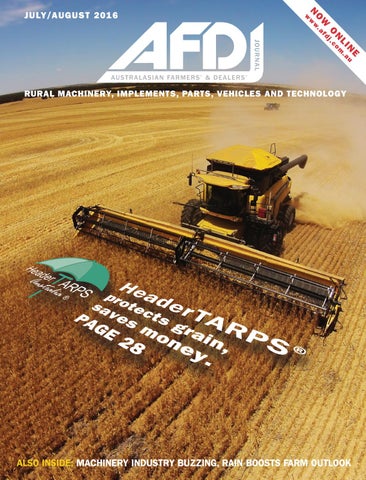
JULY /AUGUST 2016
RURAL MACHINERY, IMPLEMENTS, PARTS, VEHICLES AND TECHNOLOGY
ALSO INSIDE: MACHINERY INDUSTRY BUZZING, RAIN BOOSTS FARM OUTLOOK
CREATING VALUE AT EVERY POINT OF TRANSFER
When a new piece of agricultural equipment is delivered by WWL to the dealer, it’s not just another handover. It’s the last in a series of transfers designed to perfection. It’s about precision and efficiency at every step. And it’s about combining local expertise with a truly global network. Whether you need reliable shipping from A to B or solutions to optimise your outbound supply chain, we work with you to create value at every handover. Through this approach we help our customers reduce inventory costs and increase delivery precision from factory to dealer. Find out more about how we can create value together at bit.ly/WWLcases
JU LY /A U GU S T 2016 I N TH IS IS S U E Australasian Farmers’ & Dealers’ Journal Established 1984
4
TMA NEWS
24
FIELD DAY DIRECTORY
28
COMPANY PROFILE
30
FUTURE FARMING
32
CROPPING
36
WHAT'S NEW - MACHINERY
46
ADVERTISER INDEX
Publisher & Managing Editor Hartley Higgins General Manager Peter Muscet Editorial David Upton Email: edit.afdj@ryanmediapl.com.au
28
Advertising Manager Sue Craig Ph: 0407600282 Email: s.craig@ryanmediapl.com.au Creative Services Luke Westle Email: prod.afdj@ryanmediapl.com.au Circulation Email: admin.afdj@ryanmediapl.com.au
11
29
43
FRO M THE EDI T O R
Nats must lean even harder on new government On paper, the re-election of the Coalition looks like a good result for farmers. While the Liberal Party lost a swag of seats, the Nationals increased their number of elected members. Leader and deputy prime minister, Barnaby Joyce, has rammed home this advantage to secure the promotion of four Nationals in the Coalition ministry. The biggest winner was Queensland Nationals senator, Matt Canavan, who has been catapulted into cabinet as minister for resources and northern development. The Coalition went to the polls with a $240 million agricultural policy package, including implementation of a Regional Investment Corporation (RIC), an R&D for profit program with a focus on developing the rice industry in Queensland, and a clear direction for the Clean Energy Finance Corporation (CEFC) to focus on agribusiness investment. This was on top of $594 million in the budget to buy land in a 1,700-kilometre corridor for the much-anticipated Inland Rail,
as well as an additional $60 million for the mobile blackspot program. And if you include $130 million promised during the campaign for the new Rockwood Weir near Rockhampton, which will create opportunities for irrigators, the Coalition’s pledges to agriculture since May rise to more than $1 billion. But in reality, these commitments still fall well short of what Australian farmers need and deserve. The National Farmers Federation is making polite statements about looking forward to working with the new government, but it must be bitterly disappointed about the chasm between what’s needed to make agriculture our next $100 billion industry and what’s being delivered. In its pre-election push, the NFF identified woeful communication networks as the number one roadblock to developing agriculture, but we’re still getting only bandaid responses. For the sake of all farmers and our regions, the Nationals must lean even harder on their Coalition partner. We need a genuine revolution in the Federal government’s approach to supporting agriculture, and the 2016 election result is our best opportunity in a long time.
Subscription One year subscription within Australia: $33 (inc GST) for four issues, Overseas: $66 (inc GST) for four issues. Phone Cathy Johnson (03) 9888 4822 or email to subscribe: admin.afdj@ryanmediapl.com.au Printing Lane Print & Post Adelaide, South Australia Ryan Media Pty Ltd ABN 85 085 551 980 630 Regency Road, Broadview, South Australia 5083 Phone: (08) 8369 9500 Fax: (08) 8369 9501 Email: info@winetitles.com.au Melbourne Office Suite 103, 486 Whitehorse Road, Surrey Hills, Victoria 3127 Phone: (03) 9888 4822 Fax: (03) 9888 4840 Email: admin.afdj@ryanmediapl.com.au Website: www.afdj.com.au ISSN 1442-4983 Conditions The opinions expressed in Australasian Farmers' & Dealers' Journal are not necessarily the opinions of or endorsed by the editor or publisher unless otherwise stated. All articles submitted for publication become the property of the publisher. All material in Australasian Farmers' & Dealers' Journal is copyright © Ryan Media Pty Ltd. All rights reserved.No part may be reproduced or copied in any form or by any means (graphic, electronic, or mechanical including information and retrieval systems) without written permission of the publisher. While every effort has been made to ensure the accuracy of information, the published will not accept responsibility for errors or omissions, or for any consequences arising from reliance on information published.
TMA NEWS There’s a buzz in the machinery industry The Austra
TMA News
4
lian econom
Outlook
y is adjustin g shock to a massive terms of tra
de
With Richard Lewis, executive director TMA
The Tractor and Machinery Association of Australia held the industry’s only annual conference at the MCG on 19 July and the buzz in the industry is one of cautious optimism. In previous years, the farm machinery industry has been challenged by technology advancements in big data, the rise of digital communication and the need for young people in the sector. Overlaid with these issues is the need to sell more equipment, maintaining profits, servicing the ever-advancing technology on the machinery and all the while keeping one eye on the seasons to be favourable to the customers – the Australian farming community. Machinery sales are in good shape – the market has grown consistently over the past 5 years and dealers and suppliers are optimistic about the coming season ahead, hoping for a favourable spring harvest. Economist Justin Smirk of Westpac painted a picture of a growing economy in Australia and around the Asian region, and predicted a steady interest rate environment for the foreseeable future, perhaps even slightly lower with a rate cut anticipated in the coming months. He indicated a need to further depreciate the currency to ensure favourable markets for agricultural exports, and continuing demand from China and India as wealth in these countries moves from industry to the consumer looking for household spending increases.
Economic
By Justin Sm irk
July 2016
The issue of technology and big data was explored in a session with three young farmers – Tim Kooloos from Gippsland, Andy Tucker from the southwest, and Jonathon Dyer from the Wimmera. All agreed that they need data to improve the farming efficiencies and the information coming off their machinery is vital for that process. They all agreed that the more data the better, and that they are all willing to share as much data as the can in order to improve their knowledge and ultimately their profits. They rely on their supply chain including agronomists, consultants and machinery dealers to interpret the data and provide solutions and improvements to their current practices and are not adverse to changing their current practices if there is a better way. Many dealers and suppliers are using a multitude of social media platforms to communicate with their audience — the farmers — and this was seen as a vital mode of engaging the communities in which these businesses reside
The traditional newspaper and magazine pages of publications like AFDJ are still a very important method of marketing and communication and all agreed that these and online platforms are evolving and widely used among the farmers and customers of the sector. Pete McCann of Case IH made the comment that with the advent of self steering, many farmers are sitting in the tractor cab trawling the web for information in between row turns and we as an industry are getting a lot better at using video and media feeds to better provide that information. Dealers like Matthew East of South Australia are splitting their time between online and traditional print advertising as they are both important mediums in the sector and at this stage, equally used by customers along with email and television advertising. Justin Parrot of Swayn & McCabe in Victoria also believes radio is also an effective medium, however concedes that online is where the marketing is heading.
AUSTRALASIAN FARMERS’ & DEALERS’ JOURNAL - JULY/AUGUST 2016
TMA NEWS Our industry has struggled to attract young people as they head for more attractive parts of the ag sector such as agronomy and animal nutrition, but Nigel Crawley from Rimfire Resources sees that changing. More graduates than ever are attending ag based courses and over half of them are female. The interest in technology is increasing which is placing the farm machinery sector in the framework of the thinking of graduates as a possible career path upon completion of their studies. More and more young farmers
are emerging and Sam Tretheway of Sprout believes that once we take away the lifestyle and hobby farmers, the average age of an Australian farmer is now 47, not 58 as it used to be. The general feel at this years conference was one of confidence and optimism for the sector. As always there are some areas of the industry doing it harder than others and none more so than those impacted by the recent events of the dairy sector. Dealers in these areas are feeling the impact of reduced farmer incomes and many and concerned for their
communities and people. They all believe that they will get through and agree that the longer-term prospects of dairy will improve. Many have been through similar downturns and know how to weather the storm. The state of the industry presentation showed good growth in machinery sales, particularly in NSW and QLD and dealers are all reporting good demand for used equipment. Many order banks are full for machinery required for the coming harvest.
In good shape at the half-way mark by Richard Lewis, executive director TMA
New equipment sales continue to head upward as the market demands for horsepower around the country remain healthy. The overall market is up 3% in the first half of 2016, compared to last year’s numbers. Importantly, sales remain 8% above the most recent five-year average. NSW and WA have had excellent starts to the season and this is reflected in increases in tractor sales in those states by 17% and 6% respectively. Only Victoria is showing a downward trend as the impacts of the dairy market affects sales. Balers and combines are relatively normal for this time of year, with most of the action expected for these products in the latter parts of the year. We expect the baler and haytools market to hold steady, while combines should be e up around 10% by the time harvest is over. The small tractor and lifestyle market is yet to fire in Australian sales, as a dry summer and early autumn restrict demand to the under 40 hp market. However, with a very wet winter and hopefully and excellent spring, we expect this market to rapidly catch up as the grass on the hobby farms grows
Australian Tractor Sales 12000
10000
8000
6000
5557
5697
YTD June 2015
YTD June 2016
4000
2000
0
2011
Source: Agriview
2012
2013
and needs controlling. This is also good news for the slasher suppliers, and the extension of the under $20,000 accelerated depreciation concession will help all those smaller implement manufacturers and suppliers coming into the warmer months. Dealer are reporting excellent demand for used equipment out of their yards, and some dealers are looking far and wide to purchase used machinery in order to meet demand. Machinery is in demand across the board, whether new or used.
2014
2015
Quality and low-houred used gear is considered a very viable alternative to new machinery and they tend to track equally. At the recent TMA annual conference there was a sense of confidence in the air as all suppliers and dealers enjoy some rare prosperity and look forward to the coming season harvest. Of course there are some tough spots, namely the dairy areas of Victoria, however most believe that this is a natural downturn and that industry will recover as it resets itself.
JULY/AUGUST 2016 - AUSTRALASIAN FARMERS’ & DEALERS’ JOURNAL
5
COMPACT, VERSATILE & HARD WORKING OUR DEPENDABLE, COMPACT TRACTOR RANGE MAKES SMALL WORK OF EVEN THE BIGGEST JOBS
eMax 25 From
$
4025 4WD Series From
14,990
$
(RLP inc.GST)
19,990
(RLP inc.GST)
1533 4WD Shuttle From
$
23,490
“My Mahindra is there every step of the way”
C OMI NG SOON !
ALL TERRAIN. ALL TOUGH. ALL MAHINDRA.
(RLP inc.GST)
Matthew Hayden
Mahindra enters the 100HP+ market this Spring with the
ALL NEW mFORCE100P
C OMI NG SOON ! BIGGER. BADDER. BETTER.
For more information on our range of tractors please visit
WWW.MAHINDRAAG.COM.AU Photographs may show overseas models or illustrate non-standard equipment. Please read your Mahindra operators manual carefully prior to operation. #Mahindra & Mahindra Ltd is the No.1 Tractor company in the world by volume. ^3 year/2000 hour engine & powertrain warranty, whichever occurs first. *Pricing valid until 31 August 2016 or while stocks last. Prices are Ex Brisbane/Ex Perth and excludes spark arrestor (where applicable), excludes freight & pre-delivery charges. All prices are GST inclusive. See your dealer for details. DMM5356.
PARTICIPATING MAHINDRA DEALERS QLD ATHERTON – AVONDALE – AYR – BEENLEIGH – BOONAH KALBAR – GOONDIWINDI – GYMPIE – INNISFAIL – KINGAROY – MUNDUBBERA PROSERPINE – ROCKHAMPTON – TOWNSVILLE
NSW BATHURST – BELLINGEN – BOOROWA – BOMBALA – DUBBO – HAWKESBURY (TENNYSON) – KYOGLE – LISMORE – MINTO NARRABRI – ORANGE – RUTHERFORD – TAMWORTH – NABIAC – WAUCHOPE
VIC BALLARAT – CASTERTON – COLAC – ECHUCA – EUROA – GEELONG – MANSFIELD – PAKENHAM RIDDELLS CREEK – SHEPPARTON – WANGARATTA – WARRNAMBOOL
WA BAYSWATER – BUSSELTON – DONNYBROOK – GERALDTON – MUCHEA SA MACCLESFIELD – MOUNT BARKER
WE ARE CURRENTLY SEEKING DEALERS IN OPEN PMAs
NEWS Growers advised to think before spraying Russian wheat aphid The Russian wheat aphid (RWA) made an unwelcome arrival to Australia in May. Early hopes of eradication were dashed when reports of the new pest flooded in from growers across South Australia and Victoria. Grains Research and Development Council (GRDC) southern manager grower services, Craig Ruchs, said with RWA already established, the focus had moved from eradication to the development of a long-term management strategy. “Because this pest is new to Australia, there are still many unknowns in terms of basic population dynamics and triggers for long distance movement under local conditions,” Mr Ruchs said. “Growers can rest assured that GRDC, its research partners and other agencies are working hard to develop an improved understanding of how this pest behaves, its impact and suitable approaches to management under our environment and cropping systems. “The immediate priority is to generate an improved understanding of the relative effectiveness of those insecticides currently registered for control of other aphid species in Australian cereals. While an Australian Pesticides and Veterinary Medicines Authority (APVMA) permit currently exists for the use of chlorpyrifos and pirimicarb (APVMA 82792), we need to compare these active ingredients with other chemistry including neonicotinoid and synthetic pyrethroid insecticides.” Mr Ruchs also stressed that economic thresholds for control had not yet been validated in Australian conditions, and this was an urgent need in order to provide increased confidence in grower decision making around when to spray. “While we do have indicative thresholds to guide growers based on existing international literature, it is important to understand that the economic threshold for control will vary
by situation. Potential yield loss in our environment, crop yield potential and cost of the chosen control measure must always be considered.” Mr Ruchs said in the meantime it was important that growers and their advisers continued to scout crops and, where RWA was identified, to speak with their local adviser or district agronomist about the appropriate control strategy.
...Potential yield loss in our environment, crop yield potential and cost of the chosen control measure must always be considered. “It’s a similar situation to that of any other insect pest in crops; assess what the level of infestation is and determine if/what treatment is necessary.” GRDC has updated its popular Crop Aphids Back Pocket Guide to include RWA and developed a four-point “FITE” strategy to help growers manage the new pest in the short term. “Firstly, scout cereal crops and grasses and if you Find typical symptoms of damage such as leaf streaks and rolling of leaves, then the second step is to positively Identify the aphid species present – consult your local adviser if unsure. “The third step is to consider economic Thresholds for control before getting the sprayer filled and ready to go. International advice supports an economic threshold of 20% of plants infested up to the start of tillering and 10% of plants infested thereafter. It is important, however, to understand that
these thresholds have yet to be validated locally. The main point here is to avoid prophylactic sprays where the pest is either not present or is present in very low numbers within a field. “The fourth step is Enacting an appropriate management strategy; one that factors in the importance of encouraging beneficial insects which may act as natural predators, as well as the potential impact on honeybees.” Mr Ruchs said if assessments of crop damage and economic threshold levels determine that treatment is necessary, growers could consider applying chlorpyrifos 500 at 600ml/ha or pirimicarb 500 at 250g/ha under an APVMA emergency use permit. Victorian growers may also consider the application of omethoate or dimethoate at registered use rates in cereal crops. “Current information from overseas suggests that the effectiveness of synthetic pyrethroid insecticides may differ by product and more work is required to validate this locally. Key considerations when spraying are spray quality and volume, adjuvant selection and product choice. “The vapor activity of some insecticides is influenced by temperature, so it is important to consider the appropriate practice for each specific situation, weather conditions and product to be used. As the pest may harbour in rolled leaves or leaf axils, direct contact may be more challenging than for some other aphid species.” Growers and advisers will be kept informed as more information comes to hand but are reminded to always refer to the product label and adhere to local and state legislation relating to pesticide use. Growers and advisers are still encouraged to report suspected sightings of RWA to the Exotic Plant Pest Hotline (1800 084 881).
JULY/AUGUST 2016 - AUSTRALASIAN FARMERS’ & DEALERS’ JOURNAL
7
NEWS Rains, low dollar boost farm financial outlook: NAB
RURAL COMMODITIES WRA
JUNE 2016
P
in our dollar to provide support locally. By Phin Ziebell Our expectations for prices NAB Agribusiness Economist in the coming year are underpinned by our forecasts The outlook for agriculture has been for a generally lower dollar, boosted by good rain across much of tracking in the high 60s range eastern Australia and the Bureau of in late 2016 and 2017. This is likely to Meteorology’s forecast for a wetter support local prices somewhat through June Rural Commodities Wrap. than average winter with the chance of challenging international conditions. Cover photo: Mai Thai La Nina developing around 50%. Cattle prices are likely to come under Our initial outlook for the 2016some pressure in 2017 in response to 17 Australian wheat season places higher US supply and improved South The table below outlines our latest the crop at 26.1 million tonnes, with American access, although we note outlook for production, prices and further upside possible if rainfall is that favourable weather in Australia the value of exports. These estimates above average. is pushing restocker demand high are contingent on estimates for The lower Australian dollar pushed (and prices with it). Dairy is likely production and export volumes, most agricultural commodity prices to continue to feel the pressure on prevailing global prices and NAB’s higher in May, with the NAB Rural farmgate milk prices. Global wheat foreign exchange outlook. Commodities Index up 3.0% in prices are likely to remain subdued The direct effects of Brexit on the Australian dollar terms but off due to ample global supply. Australian economy are likely to 2.2% in US dollar terms. (NAB’s Our outlook for agricultural be minimal, and will largely flow Rural Commodities Index includes production is highly reliant on the through trade relationships, which 28 commodities and is weighted climate outlook. The Bureau of are relatively small between the UK annually according to the gross value Meteorology forecasts an around 50% and Australia. Indirect effects through of production of each industry in chance of La Niña developing in the financial markets are not quantifiable Australia). coming months, which is associated as yet, but do suggest some downside Our expectations for prices in the coming year are underpinned by Our outlook for agricultural production is highly reliant on the The good rainfalls flowedlower through with higher rainfall in eastern risks confidence, household our forecasts for a generally AUD, tracking in the high 60s climate outlook. The Bureau of to Meteorology forecasts an around late 2016 and higher 2017. This is likely to support local prices 50%that chance La Niña developing in the coming months,investment which is torange cattlein prices, with restocker Australia. We note that theofwheat consumption and business somewhat through challenging international conditions. associated with higher rainfall in eastern Australia. We note that demand pushing up the Eastern Young season has seen a good to very good and therefore GDP, and upside risk to that the wheat season has seen a good to very good start and that Cattle Indicator. prices are likely to comeprices under some pressure 2017 in livestock producers have Cattle Although start inand that unemployment. unless livestock producers have generally benefittedBut from recentfinancial rain response to higher US supply and improved South American access, (although flooding has been an issue in some areas). ofalthough major agricultural commodities generally benefitted from recent rain markets deteriorate significantly from we note that favourable weather in Australia is pushing restocker demand (and prices with is likely to flooding has Thebeen tablean below outlines our latest outlook for for production, prices remain mixed on high global markets, weit). Dairy(although issue here, implications the Australian continue to to feel the pressure on farmgate Global wheat and the value of exports. real Theseeconomy estimates will are contingent on continue expect a downward drift milk prices. in some areas). be limited. Author Phin Ziebel l, Agribusiness Econo mist | Photo Mai
Thai
PRICE, PRODUCTION AND EXPORT FORECASTS
prices are likely to remain subdued due to ample global supply.
estimates for production and export volumes, prevailing global prices and NAB’s foreign exchange outlook.
PRODUCTION, PRICE AND EXPORT FORECASTS (AUD) Production change 2015-16
2016-17
Wheat
▲ 4.8%
Beef
▼ 11.4%
Dairy
Price change
Export value change
2015-16
2016-17
2015-16
2016-17
▲ 8.0%
▼ 3.2%
▲ 5.1%
▼ 3.1%
▲ 14.0%
▼ 3.9%
▲ 43.3%
▼ 2.4%
▲ 3.7%
▼ 8.0%
▼ 1.0%
▼ 0.9%
▼ 6.2%
▲ 3.1%
▼ 7.2%
▲ 2.1%
Lamb and mutton
▼ 3.1%
▼ 5.2%
▲ 4.2%
▲ 0.6%
▼ 1.4%
▼ 7.2%
Wool
▼ 6.2%
▲ 0.5%
▲ 14.0%
▲ 7.2%
▲ 6.9%
▲ 8.9%
Sugar
▲ 5.0%
▲ 5.9%
▲ 9.2%
▲ 18.6%
▲ 14.3%
▲ 23.5%
Cotton
▲ 12.1%
▲ 41.0%
▲ 8.9%
▲ 1.6%
▼ 15.4%
▲ 24.1%
Source: NAB Group Economics, ABARES, Meat and Livestock Australia, Australian Bureau of Statistics, Bloomberg and Profarmer. 4
8
Rural Commodities Wrap
AUSTRALASIAN FARMERS’ & DEALERS’ JOURNAL - JULY/AUGUST 2016
Lowara has an extensive range of pumps and pressure systems suitable for the man on the land. Stock Water Supply
Boosting Water Supply
Irrigation Water Supply
Household Water Supply
Reliable, high performance, quality materials, and the widespread Lowara support network make these pumps an ideal selection for rural water supply systems.
R
eliability, flexibility and savings were paramount in our brief to find the correct pump set. Brown Brothers Engineers have a proven track record in all these areas, our decision was quite an easy one.
The system has proven to be all it promised and more with all areas now irrigated with consistent pressures and uniformity; our irrigation window has decreased also even with the Greens now on the same cycle as the tees, fairways and approaches. I have no hesitation in recommending Lowara or Hydrovar as your next pump set. - Mark Jennings, Box Hill Golf Club, Victoria
Contact your local Lowara dealer about supplying your next pump and water supply system.
04/15
Ph: 1300 4 BBENG www.brownbros.com.au DELIVERING PUMPING SOLUTIONS
t
NEWS Strong growth in farm values in 2015 Farmland has been a solid financial investment in most parts of Australia over the past decade, according to a major new report on farmland values released by Rural Bank. The report found farmland values had recorded average annual growth of more than 3% in most states in the decade to 2015, which exceeded the annual inflation rate of 2.8% over the same period. This indicated real growth in farmland values. Rural Bank said farmland values underpinned farming businesses and rural communities and it was therefore important to understand price and market trends. APM PriceFinder compiled the report for Rural Bank by tracking the median price of commercial farmland in dollars per hectare over the past decade. The findings are based on 220,000 transactions over the past decade with a combined value of $124 billion. “For many farmers a 10-year investment horizon is short. Extend the investment horizon to 20 years and the farmland value growth picture becomes better still, with the median price in most states recording average annual growth above 5.5%,” the report said. Price growth in the past year was also much stronger than the 10-year figure. The national median farmland price increased by 5.3% in 2015. compared to the previous year. This follows a 6.8% increase in 2014 and a 2.2% decrease in 2013. The performance of farmland prices in different states was mixed in 2015. The median farmland price increased in Tasmania (+12.8%), Queensland (+3.3%), New South Wales
6.0%
5.8%
QLD
• In NSW, the South East region of the state performed best in 2015 with a 14% increase in the median price compared to 2014. This area covers the Southern Highlands down to the South East Coast of New South Wales. Other top performing regions in 2015 were the Central region (+5%) and Southern region (+11%), which covers the Riverina and Murray sub-regions. • In WA, the median price of farmland increased by 10.6% in 2015. The South Coast region experienced the largest fluctuation in median price in 2015, increasing by 24%.
5.7%
WA 6.1%
SA
5.6%
NSW 6.1%
VIC
5.0%
TAS 5.8%
Average annual growth in farmland value over 20 years 10
volume 1 MAY 20 16
• In Victoria, the median price of farmland decreased by 2.3% in 2015. This comes after three consecutive years of positive growth. The South West region of the state performed best in 2015 with a 1.5% increase in median price compared to 2014.
NT
Australia
austral farmlanian Values d 2015
(+10.2%) and Western Australia (+10.6%), but fell in Victoria (-2.3%), South Australia (-1.9%) and the Northern Territory (-6.4%), compared to the previous year. In Tasmania, the Northern region was the best performing area, with values jumping by 33% in 2015, closely followed by the South (+25%), compared to 2014. In Queensland, the western region performed best in 2015 with an increase of 14.7% — the third consecutive year of growth. North Queensland achieved 10.1% growth and East Queensland 0.6%.
• In SA, farmland values have stagnated, with annual average growth of only 0.2% since 2008. However, there were sharp rises in median values in some regions in 2015, led by the Eyre Peninsula (+24.4%) and the Adelaide region and Fleurieu Peninsula (+8.5%). • Farmland in the NT falls into two distinct categories; small holdings in the Top End between Darwin and Katherine, and large cattle stations. The value of small holdings has grown strongly over the past decade, rising by an average of 13.6% per annum. Values of cattle stations have grown for four consecutive years, following a period of very rapid growth between 2003 and 2010.
AUSTRALASIAN FARMERS’ & DEALERS’ JOURNAL - JULY/AUGUST 2016
NEWS Dual-purpose crops can beef up returns Dual-purpose crops offer grain growers in the southern cropping region an opportunity to significantly boost their returns per hectare and whole-farm profitability, according to a new study funded by the Grains Research and Development Council (GRDC). More than a decade of experiments, simulation studies and on-farm validation across Australia have demonstrated that a wide range of cereal and canola varieties can be successfully grazed and later harvested to produce combined livestock and crop gross margins that exceed those for grain-only crops. The research showed that with good management, the introduction of dual-purpose cereal and canola crops
can boost returns by up to $100/farm hectare. CSIRO agriculture research scientist, Dr Susie Sprague, who has been outlining the benefits of dual-purpose crops at GRDC Grains Research Updates in the southern region, said grazed crops also produced other benefits, such as widened sowing windows and reduced crop height, and filled critical feed gaps and spelling of pastures. Dr Sprague said the higher profits on offer from dual-purpose crops relied on attention to detail with both crop and livestock management. “The opportunities are significant, but the crop and livestock requirements to capitalise on dual-purpose crops
RDC-funded research has shown that with good management, the G introduction of dual-purpose cereal and canola crops can boost returns by up to $100/farm hectare. Photo: GRDC
are considerable. Successful early establishment, weed control and withholding requirements, stock planning, management and logistics are not trivial to optimise the whole-farm benefits of the extra forage.” Dr Sprague said a range of winter and spring cereal and canola varieties can be used for dual purposes, depending on the region and seasonal sowing opportunities. “Early sowing with a suitable maturity type for the site and sowing date will maximise forage and yield potential.” Dr Sprague offered the following tips for success with grazed crops: If it is your first foray into dualpurpose cropping, get good agronomic advice and plan well ahead Sow early with the right crop and variety. Recommended are winter wheats in March, long-season spring wheats in mid-April and spring wheat in late April. Sow winter canola types in March and spring hybrid types from mid-April Aim for a good plant population for good early biomass production for grazing (150 plants/square metre for wheat and 40 plants/square metre for canola) Ensure sufficient nitrogen (N) upfront for good early biomass production (100-150 kilograms/ha for winter wheats and canola, and 50-100kg/ha for spring wheats and canola) Don’t graze too early as crops are building root mass Animal health issues – take precautions for bloat and nitrate poisoning as usual for palatable feed, and don’t fertilise with N close to grazing (apply upfront and postgrazing) Stocking rates around 1000 kg/ha liveweight work well, but adjust to the feed on offer. Animals take time to adjust to feeding on canola and do best if grazing periods are longer – avoid frequent change
JULY/AUGUST 2016 - AUSTRALASIAN FARMERS’ & DEALERS’ JOURNAL
11
NEWS Mahindra launches versatile side-by-side vehicle Mahindra Ag & Auto Australia has launched a new range of side-by-side vehicles called mPact. Designed and built in the US, the new Mahindra mPact range is based on a full width three-seater chassis design in numerous configurations to suit Australian conditions. The range starts with the 750 B Spec, featuring Kohler 747cc petrol engine, 56 kmh top speed, class-leading cargo box capacity of 544 kg with gas shock lift assist, and class-leading tow capacity of 952 kg. The 750 S adds alloy wheels, front hitch and electric-powered cargo box lift. All models feature standard true 4-wheel drive with auto-lock front differential and 27” ATV Tires on 14” wheels, 12” (304mm) of ground clearance and sturdy, fully-welded steel chassis with independent dual A-frame suspension on all four corners. Combined with CVT transmission with hi, lo, neutral, reverse and park
12
and handbrake applied to all 4 wheels, large 260mm brake rotors (also on all 4 wheels) the Mahindra mPact is designed to haul more, tow more and go more than the competition. The unique Flex Hauler with its electric-lift, aluminum drop side tray is the stand-out in the range and unique to Mahindra. Available in either Kohler 747cc petrol or 1000cc diesel configurations, the Flex Hauler offers a true work vehicle with decent range from its 34 litre fuel tank. The aluminum tray lends itself to numerous dirty work conditions, and makes for an easy to clean and hose out checker plate tray option, not seen in Australia factory fit before. Topping out the range are two crew cab models with six seats, available in petrol or diesel but still with decent cargo box capacity of 453kg. The all-new Mahindra mPact range will be available at local dealers from October, 2016. Pricing to be advised
closer to launch date. For more information, go to www.mahindraxtv. com.au The launch of the mPact is part of Mahindra’s rapid expansion in Australia in terms of both dealer network and new products. Other planned product launches for 2016 include the all-new 100 HP Premium Cab Tractor with Powershift 32x32 transmission; the replacement of the 6030 tractor; an all-new 6560 4WD with 15x15 transmission and 6560 2WD with 15x3 transmission. This follows the launch of the New Age XUV500 Automatic, the company’s first global SUV and an increasingly common sight in Australian roads. Mahindra’s Australian network recently expanded to 37 automotive dealers, with new dealers in Tamworth, Dubbo and Orange in NSW and Wagin in WA, while the agricultural network now spans 44 dealers nationwide.
AUSTRALASIAN FARMERS’ & DEALERS’ JOURNAL - JULY/AUGUST 2016
NEWS Farmers urged to rethink safety The National Farmers’ Federation has used National Farm Safety Week to call on all Australian farmers to rethink their daily activities to include safer ways of working. National Farm Safety Week, an initiative of Farmsafe Australia, ran from 18-22 July to promote practical steps that farmers can take to improve the safety and wellbeing of all people on farms. Agriculture, forestry and fishing can be dangerous industries to work and play. In 2015, there were 73 deaths from non-intentional injury on Australian farms. Farm deaths and injuries in 2015 alone cost the agricultural sector over $250 million. In the ten years leading to 2014, 75% of worker deaths involved a vehicle, while more than 8500 injury claims involved livestock handling (with over a third of those involving cattle). NFF President, Brent Finlay, said people sometimes put farm safety in the ‘too hard’ basket, because they don’t know where to start. “Anyone who tries to grapple with the sheer volume of laws, regulation, codes of practice, guidance materials and fact sheets knows just how complex it can seem.” “In practice though, the one thing we can all do is ask ourselves each and every time – are we doing this safely? A simple change in mindset will make all the difference and help make sure that we, our loved ones, our workers and our friends come home at the end of the day.” The NFF, with the support of Safe Work Australia (SWA), has recently developed two farm safety videos to help farmers implement the legal four step “risk assessment” process required when assessing safety risks on farm. One of the farmers featured in the videos, Peter O’Connor, is a broadacre farmer from Harden NSW. An incident involving a roof fall triggered a renewed safety focus on the 8,000 ha O’Connor family farm ‘Oxton Park’. For farmer and vet, Tom Graham, safe cattle yard design has a dual benefit of keeping people safe and saving money by avoiding costly injury to prize cattle who might otherwise go through a section of old rails and break a leg. “Stockyards and farm machinery both involve hazards and safety risks. These new videos help show how regular safety checks and keeping up-to-date records can improve safety on the farm,” said Safe Work Australia Acting CEO, Amanda Grey. To view the videos and follow National Farm Safety Week campaign, go to http://www.farmers.org.au/content/nff/ en/get-involved/campaigns/Farm-Safety-Week-2016.html
Replacement parts in OE quality
.au
JULY/AUGUST 2016 - AUSTRALASIAN FARMERS’ & DEALERS’ JOURNAL
13
NEWS LuK tractor clutches make inroads German-based parts giant Schaeffler Automotive Aftermarket is making inroads to the Australian and New Zealand markets with its LuK brand of tractor clutch repair solutions. As a global supplier, the Schaeffler Group moves millions of people every day in cars, trucks, buses and tractors. Its products are used in almost every new vehicle throughout the world. With its brands INA, FAG and LuK, Schaeffler is the innovation-leader in high quality original equipment manufacturing. Schaeffler Automotive Aftermarket has a global network of approximately 11,500 distribution partners and 30 sales and representative offices, and is known for its close proximity to customers and for delivering superior service. The LuK brand was founded in 1965 in Germany and has been a leader in its field in terms of engineering since the first innovative diaphragm spring clutch appeared on the market. Today, Schaeffler with its LuK brand is key manufacturer of clutch technology, supplying all major tractor manufacturers worldwide. The LuK Tractor aftermarket portfolio includes single clutch systems designed and manufactured for maximum strength and minimum space requirements in lower powered tractors. The company
also manufactures double clutch systems with two clutches in one unit with one driving the wheels and one for the power take off (PTO), with a single diaphragm spring providing load for both clutches. The LuK tractor aftermarket portfolio also includes dampers with rugged durable components designed to eliminate transmission noise and vibration, discs in a range of organic and sintered materials for high torque transmission and high operating temperatures. The company also provides lever kits containing all OE quality
parts required to carry out a full repair and LuK RepSet, a complete tractor clutch replacement solution with every component required for a professional repair. For the aftermarket, LuK clutches and components are available from leading automotive and agricultural equipment suppliers. For more information about the genuine LuK portfolio visit www. schaeffler-aftermarket.com.au or contact Schaeffler Australia Product Manager, Brett Sage 02 89771043.
Zoetis partners with beyondblue to support rural mental health In an effort to support good mental health and reduce suicide rates across rural Australia, leading animal health company Zoetis has become a Supporting Partner of beyondblue, and has launched a campaign to help raise awareness and much needed funds. For every Zoetis cattle or sheep vaccine or drench sold by Zoetis between 1 August and 30 October 2016, Zoetis will donate $5 to beyondblue, up to a total of $100,000. Australia loses around eight people a day to suicide, and over a year, suicide deaths are double that of the national road toll. Too many people who die by suicide are from farming communities across Australia. Zoetis general manager, Lance Williams, said the company’s staff travelled more than two million kilometres each year servicing all types of farms and households in
14
some of the most remote areas of Australia. “They recognise the highs and lows faced by resellers and producers in regional and remote Australia. With rural communities facing tough seasonal conditions, everchanging commodity prices and the tyranny of distance, the mental health of rural residents is of growing concern. Mr Williams said Zoetis was passionate about supporting hard-working regional Australians. “There is not one person in our organisation who hasn’t had some exposure to mental health issues and this drives our need to ensure this campaign with beyondblue is a success.”
AUSTRALASIAN FARMERS’ & DEALERS’ JOURNAL - JULY/AUGUST 2016
1
?
2
?
3
?
4
?
5
?
NEWS New precision area based contracts for growers Delta Agribusiness and GrainCorp have launched precision area contracts (PAC), a new grain contract that removes washout risk for growers. PACs combine the latest in precision agriculture technology with the experience and security of traditional marketing methods. Managing director of Delta Agribusiness, Gerard Hines said PACs were an example of the real and tangible value that could be created in the digital era. “These are one of the biggest steps forward in the application of precision agriculture to actually hit the market. While initially a pilot program, we are confident that the product will deliver real value to growers and we are excited to be launching this pilot program in partnership with GrainCorp across New South Wales. “We have seen a significant rise in the role of technology in the planting, in-crop management and harvest stages, and wanted to extend this advantage to grain marketing, delivering more value to growers,” Mr Hines said. PACs are based on on-the-ground agronomy and realtime data provided through Delta’s Farmers Edge precision software platform, and DAWWN (Discovery Ag Weather & Water Network). “This data is then used to create accurate and transparent yield forecasts which is important for growers to be able to better hedge their pricing and take advantage of higher
forward prices, without the risk of costly and adverse washouts,” Mr Hines said. GrainCorp’s domestic marketing manager, Michael Roche said GrainCorp was committed to exploring innovative farming solutions that added value for customers. “Giving growers the ability to commit a defined area to a forward contract - with no washout risk - is a gamechanger. As a result, we are already seeing significant interest from growers. “By partnering with Delta we have been able to create a unique product that manages risk and enhances value for growers on their dry land cropping production, including wheat and canola. This enables growers to commit to prices earlier in the growing season which is a big win for growers and provides security for our end customers,” Mr Roche said. To participate in the PAC contracts, growers need to be signed up to the Farmers Edge ‘Smart Solutions’ product via Delta Ag, and agree to share the crop health reports and production data with GrainCorp for the area that is contracted. Additionally, all production produced off the contracted area must be marketed to GrainCorp via Delta Grain Marketing. For further information about the Delta Ag & GrainCorp Precision Area Contracts, growers should contact a Delta Ag agronomist or Mick Parry, on 02 6772 0000
Sharp fall coming in chickpea prices: NAB Chickpea export prices will drop sharply form record levels of about $1200 a tonne to below $700 a tonne by September next year, according to a new report by NAB. NAB’s forecasts are based on the likelihood of a favourable monsoon in India this year, following two years of poor conditions that sent demand soaring for Australian chickpeas and lentils. A good season would cut demand for Australian chick peas, lentils and field peas and prices would respond accordingly. “Further, we expect Canadian lentil production to be strong on
16
enthusiastic planting. We see chick pea and lentil prices below $700 a tonne by the September quarter 2017. “While this represents a significant decline from the peaks earlier this year, prices are likely to remain well above wheat and other major grains. For pulses less dependent on the Indian market, such as faba beans and lupins, the price gains have been smaller. However, we expect prices for these to remain reasonably stable over the coming year.” While chickpea and lentil prices are expected to fall, the financial impact will be partly offset for many local
producers by soaring production. NAB says the outlook for Australian pulses production is strong, reflecting an exceedingly favourable season so far and greater plantings for some varieties. “Our forecasts point to 2016-17 harvests being substantially higher than the patchy 2015-16 season. We see production for chick peas up 33.0%, lupins up 18.6%, lentils up 69.9%, field peas up 52.8% and faba beans up 86.1%.”
AUSTRALASIAN FARMERS’ & DEALERS’ JOURNAL - JULY/AUGUST 2016
NEWS Case IH Farmall giving back to communities Case IH recently launched the Farmall Local Community Program, working with its dealer community to lend a helping hand to local charities and clubs in regional Australian towns. For each Farmall machine sold up until 31 October, Case IH will contribute $200 to the dealer’s nominated locaI cause - a charity, sporting club, community project or even assistance to local fundraising. The Case IH Farmall brand has been ingrained in the heart and soul of regional Australia since 1923 when its first legendary tractor was built, and is renowned for equipping farmers with its unified system of tractors and implements for plowing, cultivation and harvesting – all characterised by Farmall’s revolutionary light design. Today, it remains connected to rural Australia through the Case IH network of dealers – all of whom are part of, and strongly support, their local communities. Marian Wright, Communications Manager – Case IH Australia and New Zealand, said, “We have a saying, that ‘the heart of farming beats red’, which serves as an important reminder that it’s the farmers who are at the core of everything we do. We want to improve lives on the land and in local towns, and as part of our commitment to dealers and their communities are pleased to be working closely with dealers to provide support to local charities and clubs.” Firestone farm tyres are made to work, proven to perform and built to last. Discover why Firestone is the preferred original equipment radial farm tyre brand in USA & the best choice for Australian farms.
YEAR 8WARRANTY Distributed by
100% Australian owned & operated
Free Call Tyres4U 1800 788 688
firestonefarmtyres.com.au JULY/AUGUST 2016 - AUSTRALASIAN FARMERS’ & DEALERS’ JOURNAL
17
NEWS Case IH meets evolving precision ag demands It’s been over 10 years since WA farmer Phil Longmire completed his Nuffield Scholarship on increasing profitability through precision agriculture. The technology may have come a long way, but according to Phil, his motivations remain the same. “We continue to aim to increase the profitability of our own farming operation in an environment of tightening margins, and precision farming solutions help us to make a big impact,” he says. Phil runs a continuous cropping enterprise east of Esperance, and he relies on six Case IH AFS® Pro 700 displays and one FM 750 display on his fleet of Case IH machinery to manage herbicide resistance and improve the efficiency of his controlled traffic system. “One of the strongest features for us is the ability to switch between tramline and boundary guidance auto-steer,” says Phil, who relies on this accuracy as a key tool to manage weeds and herbicide resistance. “We sow paddocks 1.3 metres out from the boundary. This level of accuracy is really important as we slash around the paddock to remove two sown rows just before harvest. This reduces the chance of resistant boundary weed seeds moving into the header and being spread over the full 12 metre first lap, and ensures that we don’t increase the chance of resistance spreading quickly.” Phil switched to continuous cropping in 2011, growing wheat, barley, canola and peas. He acknowledges the
resistance issue is one drawback of the system but he’s also seen softer soils and increased yields as a result of the switch. Some might say the transition is not yet complete, and others would say it’s a case of continuous tweaking, as Phil also uses his Case IH precision farming technology to redefine his paddock boundaries every year. “Realignment of paddocks has been a big part of our program. We’re trying to improve the efficiency of our tramlining system by removing fences, realigning tree lines and making sure we can get the most out of it without too much overlap. With our variable rate boundary system it’s taken a while to get it right, so driving the headlands on autoguidance has certainly improved our efficiency,” Phil explains. “We were averaging a 12% overlap in 2013, ranging from 4% to 33%. In
We continue to aim to increase the profitability of our own farming operation in an environment of tightening margins, and precision farming solutions help us to make a big impact. 18
liquid nitrogen alone this requires an extra 26,000 litres over the program, which creates lodging and screenings. “On one paddock alone in 2016, with variable rate technology and paddock adjustments, our overlap has dropped by 14%, showing an area sown of one hectare increase but a seven hectare overlap reduction.” With seven displays across his fleet, which includes Axial-Flow® combines, MagnumTM and Steiger® tractors and a Patriot® sprayer, it’s important for Phil to keep a standard platform. “Having one platform across the farm makes it easy to help staff when there’s an issue,” says Phil, who also values the integrated nature of the Case IH AFS Advanced Farming Systems. “We don’t want to spend the time setting it up. They’re set up by the Case IH dealership and designed to fit the machinery. If the system’s up and running it’s good for the operator.” Farmers and contractors looking to upgrade their guidance systems should look no further than their local Case IH dealer. Case IH dealers are specially trained in Advanced Farming Systems, plus they have the local knowledge to support customers in the field.
AUSTRALASIAN FARMERS’ & DEALERS’ JOURNAL - JULY/AUGUST 2016
NEWS Used equipment sales top $500 million a year Specialist lender GoGetta Equipment Funding has released a report on the used agricultural equipment market that shows farmers are buying and selling secondhand machinery worth $500 million per year. The new report is based on 115,000 equipment listings in 138 user-defined equipment types for the period between August 2011 and July 2015 from farmmachinerysales.com.au. GoGetta’s National Sales and Marketing Manager Kevin Savvas said the report found a very large market for used
AVERAGE PRICE OF USED EQUIPMENT
ag equipment across all sectors of the industry. “That means there is a lot of opportunity for farmers to secure preowned equipment that could be ideal for their operation. Selecting the right equipment is critical to profitability in agribusiness. Our guide explores some of the factors potential buyers and sellers should consider and how they can impact price and value.” The guide includes insights from industry experts on how the market currently stands, key factors impacting
HARVESTERS ($127,800) TRACTORS ($48,300) SPRAYERS ($62,500) TILLAGE AND SEEDING ($30,900) HAY AND SILAGE ($16,500) Average costs of used equipment. Source: GoGetta W W W.GOGE T TA .COM. AU
NFF launches online farm community The National Farmers’ Federation (NFF) has launched Australian Farmers, a new online home for Australia’s farming community. The platform www.farmers.org.au offers localised weather data to improve decision-making, enables farmers to exchange ideas and advocate on the issues that matter most and provides the latest news about food, fibre and farming. Speaking at the launch at the NSW Farmers conference in Sydney on 19 July, NFF chief executive officer, Tony Mahar, said the platform is a major step in bringing the farming community together in the 21st century. “Australian Farmers will revolutionise
the way we engage with the community: delivering the latest news from agricultural organisations and empowering farmers to share their ideas and knowledge instantly. “Farmers live and work across the entire nation, including the most remote and isolated parts of Australia. The platform is a major step for Australian agriculture as it enables farmers to tell their story to a bigger audience than ever before. “Our vision, along with partners Accenture, Coles, Commonwealth Bank of Australia, Findex, Prime Super and Vodafone, is to provide farmers with innovative digital tools and technology to enhance the industry’s productivity.” Mr Mahar emphasised the importance
the price on used agri equipment and when may be the right time to buy or sell machinery. “Timing is a key factor that can greatly impact resale value. If it’s been a good season, farmers are more likely to upgrade equipment, while a tougher season can often mean slower machinery sales – and better prices for buyers,” Mr Savvas said. Mr Savvas also said it was important to find a flexible funding partner as not all lenders would fund used equipment purchases. “We work closely with machinery owners as their asset management partner, to help them take advantage of business growth opportunities such as upgrading equipment. “GoGetta provides a highly flexible, rent-to-own model that allows business owners to build equity in their equipment with each affordable payment. Unlike traditional hire options, at the end of the 12-month agreement, customers can choose to purchase with a generous rebate, or return the equipment it if is no longer needed or if their situation changes. All rental payments are 100% tax deductable.” 7
of arming the industry with online advocacy tools in today’s age. “The traditional model of farm advocacy has served us well in shaping political outcomes, but it hasn’t been as effective at bringing the broader community along with us,” Mr Mahar said. “Australian Farmers gives us a powerful tool to tell our story, living in the bush and looking after our animals, crops, land and wildlife. It helps us to connect better with farmers to understand their views on the big issues. “I encourage people to visit www. farmers.org.au, take a look around, sign up for free and get involved,” Mr Mahar said.
JULY/AUGUST 2016 - AUSTRALASIAN FARMERS’ & DEALERS’ JOURNAL
19
NEWS Crop trials data rounded up online Data from thousands of Australian onfarm grains research trials is being collated into a central, easy-to-access information resource for growers, agronomists, researchers and the wider grains industry. The Online Farms Trials (OFT) website www.farmtrials.com.au has been set up to allow users to view, analyse and export grains research information. Using innovative technology, the OFT portal has been developed by the Centre for eResearch and Digital Innovation (CeRDI) at Federation University Australia in Ballarat (Victoria) with funding from the Grains Research and Development Corporation (GRDC). Project leader, Robert Milne ,said around 3000 trial projects had so far been published on the OFT site, with data supplied by grower groups from across the nation. “The development and release of the OFT website provides an exciting new way to make findings and discover information from cropping trials conducted throughout Australia. “The principle objective of the OFT project is to help improve the productivity and sustainability of farming enterprises by improving access to on-farm trial research information. “Collation of this information in an online database will allow historical, geographical and crop-specific
comparisons to be made.” Published trial projects cover a wide range of crops and treatment types, and the portal includes a number of key features, such as: An interactive map of trial sites with layers of relevant information such as agroecological zones and average rainfall; Advanced search filters including treatment type, crop type and location; Search results with graphical display of measured results such as yield data and disease scores; Climate and soil information for each project; Original trial report documents linked to each trial project; and Links to other relevant information sources. Grower groups and researchers are continuing to enter data to the portal and the number of trials published on the site will increase over the next year. “The OFT website contains information on how to become involved in the project and how to submit research. Grower groups which have previously not submitted data are welcome to become involved,” Mr Milne said. “Greater involvement of grower groups is paramount for the long-term uptake of the trial data and the success of OFT.” Further expansion of the OFT database will improve access to previous and current
research findings and improve research, development and extension opportunities among grain growers and researchers. Grower groups and researchers retain all intellectual property rights and manage their own data, allowing them to update or remove trial information contributed to the OFT database. Mr Milne said a long-term research study into the impact of technological innovations, such as that provided by OFT, on enhanced decisionmaking and practice change is being conducted by CeRDI researchers. This research also guides the development of OFT technology based on a greater understanding of user and sector needs.
Farmers weighed down by regulations A report released last month by the Productivity Commission (PC) has confirmed that farm businesses are straining under heavy and unnecessary regulatory burden right across the supply chain. The National Farmers’ Federation said the PC draft report into the regulatory burden imposed on Australian agriculture reaffirms the need to reduce duplication and excessive red and green tape to maximise the opportunities for Australian agriculture. NFF chief executive officer, Tony Mahar, said the report highlighted the complex and often overlapping regulation across three levels of government. “The draft report correctly identifies
20
that reducing the regulatory burden and improving efficiency across all sectors is absolutely critical. Agriculture is particularly vulnerable due to its high dependence on international markets. “Farmers aren’t against regulation. In fact, certain regulations have positioned the industry very strongly – for example, our strong biosecurity regime has reduced our overall risk of pest and disease. “However, there are clear instances where regulation is unduly burdening farm businesses. In particular, transport, environment and employment are among the areas where regulation hits the hardest, ultimately reducing our competitiveness in the global market.”
AUSTRALASIAN FARMERS’ & DEALERS’ JOURNAL - JULY/AUGUST 2016
NEWS Poor infrastructure putting brakes on agriculture High transport costs stemming from inadequate road and rail infrastructure are placing increasing pressure on the agricultural supply chain and stifling growth across the sector, according to the National Farmers’ Federation. In a new policy paper released ahead of last month’s Federal election, the NFF said transport infrastructure had not received sufficient priority or investment. The paper also again strongly reiterated the need for the fast-tracking of the construction of the Inland Rail to provide an efficient pathway for the transportation of agricultural products. NFF vice president, and chair of the organisation’s infrastructure taskforce, Fiona Simson, said that, with unprecedented opportunity for the sale of premium quality Australian food and fibre across the globe, it was the time for government to act. “The agriculture industry has, for a very long time, been hindered by a lack of transport infrastructure, and poor
quality roads and rail services, which has substantially inflated the cost of doing business. “For example, supply chain costs routinely comprise 30% of the cost of production and, in some individual cases, amount to as much as 48.5%. This is clearly not sustainable and is stifling to an industry with such potential for growth.” Ms Simson also said the CSIRO’s agricultural supply chain modelling tool TRANSIT showed that improved investment in rural roads could deliver a 24% transport saving and this was indicative of the saving potential for all agricultural commodities. “We need more investment and we need our government to be much more strategic about how to best direct funds. In terms of the Inland Rail, there’s been enough rhetoric – it’s time to stop the talk and build it.”
JULY/AUGUST 2016 - AUSTRALASIAN FARMERS’ & DEALERS’ JOURNAL
21
NEWS - TECHNOLOGY Solar project gives ray of hope to grape growers A renewable energy project in Australia’s largest grape growing region is giving struggling vignerons a sunny alternative. An electrical services company in South Australia’s Riverland is looking to build dozens of community-owned solar farms and sell the energy on Australia’s volatile spot market. The project ultimately aims to work with landowners to set up 100 kw to 200kw solar farms and sell the energy to the national electricity grid through the spot market. In SA, producers generating 100 kw or more can register to trade Large Generation Certificates (LECs) and access the spot market. Renmark–based Yates Electrical Services recently began driving the initiative, known as the Red Mud project, and has been running a 180 kilowatt test site for about three months. Managing director, Mark Yates, said under the project, landowners had a number of options. They could lease their land to be used for a solar farm, or choose to own the entire solar farm outright or lease the land and buy into a portion of the solar farm. He said the test site had shown that a 10% return on investment per year was achievable. “Red Mud is something that we dreamt up to be a lot more scalable to people locally as opposed to big superannuation funds or merchant banks investing in massive projects,” Yates said. “Effectively with Red Mud everything the site generates in the form of energy and the LECs are retained locally in the community.”
Yates said a typical 200 kw solar farm would cover an acre (4000sq m), include 800 solar panels on ground-mounted racks, cost between $300,000 and $400,000 to set up and return about $40,000 a year. Originally a citrus and stone fruit growing region, the Riverland turned to wine grapes in the 1980s and ‘90s and now accounts for a quarter of Australia’s annual crush. But low prices in recent years have many growers considering their future in the industry. “There are a lot of growers in the Riverland who may have taken exit grants or who may be reconsidering the value of reinvesting back into vines or citrus because of high water prices and low fruit prices. This offers a new industry on a national market,” Yates said. “We do have very affordable land and a good solar resource and there are a lot of people questioning whether they should continue on with grapes.” The first commercial site, which will be a 50/50 partnership between the landowner and Red Mud, is on track to begin generating energy this month.
Growers warned over phosphine levels GrainCorp has issued a warning to growers about unacceptably high levels of phosphine in a number of recent deliveries. “When used correctly by growers, grain handlers and transporters, phosphine is a safe and effective method of controlling pests of stored grain. Incorrect use of phosphine is not only illegal, it can be dangerous. It poses a serious health, safety and potential export market risk and may lead to insect resistance,” Graincorp said. Phosphine should only be used strictly in accordance with the label and MSDS directions. All grain fumigated with phosphine must be correctly ventilated prior to transportation. “Your health can be seriously impaired through consistent exposure to phosphine gas at levels equal to or above 0.3
22
parts per million (ppm). Transporting grain fumigated with phosphine where the detectable level of gas is greater than or equal to 0.3 ppm is illegal. GrainCorp warned that if the level of phosphine in a load was equal to or above 0.3 ppm, the load could be classified as goods too dangerous to be transported, and all parties loading and transporting inappropriately fumigated grain may be fined or prosecuted. “In the event of a breach, GrainCorp will reject the load and follow established procedures which may include notifying the police, transportation departments, WorkCover and emergency services. GrainCorp will fully cooperate with the authorities which may result in fines and criminal prosecution.”
AUSTRALASIAN FARMERS’ & DEALERS’ JOURNAL - JULY/AUGUST 2016
TECHNOLOGY - NEWS Dow AgroScience’s new weapon against broadleaf weeds Australian broad-acre graziers are now able to effectively control broadleaf weeds with the release of Dow AgroScience’s ForageMax™ Arylex™ Active in a five litre package. Designed specifically for larger intensive grazing operations, ForageMax is registered for use on forage brassica crops (turnips and rape) that produce excellent livestock weight gains in lambs and cattle. With no registered alternative currently available on the Australian market, ForageMax increases profitability for graziers by increasing on-farm grazing productivity. Delta Agribusiness agronomist, Tim Condon, said ForageMax, providing an unparalleled solution for controlling many broadleaf weeds including shepherd’s-purse, Paterson’s curse, fumitory and many thistles. “Having the option to come in with ForageMax is a real game changer. The new five litre package will provide a great level of value to brassica growers across our region and will allow them to effectively clean up weeds, letting the crop fully utilize soil moisture and nutrients,” Tim said. He said forage crops were often over-run with broadleaf weeds, which reduced the number of grazing events, the overall feed value of the crop and caused ongoing weed problems in following years. Dow AgroSciences cereals marketing manager, Dan Dixon, said ForageMax was a robust product that allowed grazing operations, including fat lamb and beef producers, to successfully grow forage rape and turnips on their properties, often filling the feed gap and reducing the need to buy in additional feed for stock. “Winter grown forage brassicas are gaining more momentum each season and serve as an effective break crop, helping to reduce disease in subsequent wheat crops. Graziers who have trialled ForageMax have found it to be a real game changer as it removes the weeds, allowing the crop to fully utilize soil moisture and nutrients,” Dan said. ForageMax has a single low application rate and can be applied early (4-8 leaf stage) on forage brassicas. It works best on small, actively growing weeds. ForageMax is rain-fast within three hours, has a short grazing withholding period of only 14 days and can be tank-mixed with a number of insecticides, grass herbicides and other agricultural inputs. ForageMax will be available from local agents. Dow AgroSciences recommends to always apply ForageMax with Uptake Spraying Oil to provide the best possible weed control in brassica crops.
L eafmore Forage Brassica (from Heritage Seeds) treated with ForageMax. Photo taken 7 DAA after application.
PROTECT YOUR HARVEST
WITH...
FROM RAIN, STORMS AND SPILLS
Spill & Weather Protection for all modern Harvesters Don’t get caught in the rain – call us today Ph: 0407 390 010
JULY/AUGUST 2016 - AUSTRALASIAN FARMERS’ & DEALERS’ JOURNAL
headertarps.com.au
23
UPCOMING FIELD DAYS PULLUp-to-date comprehensive Field Days Events Calendar. Also available at www.afdj.com.au. To lodge your event contact Cathy Johnson Phone: (03) 9888 4822 or Email: admin.afdj@ryanmediapl.com.au AUGUST 2016
SEPTEMBER 2016
1-2 Sheepvention Peta Anderson Hamilton Showgrounds, Hamilton, Vic 03 5572 2563 info@hamiltonshowgrounds.com.au www.hamiltonshowagrounds.com.au
7-8 Newdegate Machinery Field Days Anne Bishop Newdegate, West Aust 08 9871 1655 0427 712 065 nfday@westnet.com.au www.nfday.com.au
3-4 Mallee Machinery Field Days Andrew McLean 2 km south of Speed on the Sunraysia Hwy Vic 03 5084 1320 mmfd@bigpond.com www.mmfd.com.au
2-11 Adelaide Royal Show Adelaide Showgrounds 08 8210 5211 info@adelaideshowground.com.au http://www.theshow.com.au/ Goodwood Rd, Wayville
9-11 Eyre Peninsula Field Days Renee Kelly Cleve - South Australia 08 8628 2219 secretary@eyrepeninsulafielddays.com.au www.eyrepeninsulafielddays.com.au
9-10 Berry Small Farm Field Day Paul Anderson Berry Showgrounds, Victoria Street, Berry NSW 02 4403 0300 berry rotary@gmail.com www.berryrotary.org.au
10-11 Mingenew Expo Kym McGlinn Midlands Rd, Mingenew, West Aust 08 9928 1138 secretary@mingenewexpo.com.au www.mingenewexpo.com.au
14 BCG Main Field Day Ciara Cullen In The Field - Location TBA 03 5492 2787 info@bcg.org.au www.bcg.org.au
16-18 Commonwealth Bank AGQUIP Field Days Barry Harley 8 kilometres west of Gunnedah on Blackjack Road, Gunnedah NSW 02 6768 5800 agquip@ruralpress.com.au www.agquip.com.au
16-17 Riverland Field Days Tim Grieger 52 Field DayDrive, Barmera, South Aust 08 8588 2311 0409 099 122 mail@riverlandfielddays.com.au www.riverlandfielddays.com.au
24-25 Dowerin GWN7 Machinery Field Days Jeanne Friend Dowerin, West Aust 08 9631 1021 info@dowerinfielddays.com.au www.dowerinfielddays.com.au
17.27 Royal Melbourne Show RASV Administrator Melbourne Show Grounds, Epsom Road, Melbourne, Vic 03 9281 7444 customerservice@rasv.com.au www.royalshow.com.au 20-22 Henty Field Days Belinda Anderson Cookardinia Road Henty, NSW 02 6929 3305 hmfd@telstra.com www.hmfd.com.au
28-29 South Gippsland Dairy Expo Deane Kennedy Korumburra Showgrounds, cnr South Gippsland Hway & Charles St, Korumburra. VIC 03 5659 4219 0419 878 055 deanne@jaydee.net.au www.dairyexpo.org.au 24-1 Oct Perth Royal Show Erin Farney Perth Showgrounds, Garlands Road, Claremont, WA 08 6263 3100 info@raswa.org.au www.perthroyalshow.com.au
OCTOBER 2016 4-6 Elmore Field Days Sam Shotton Few minutes drive east from Elmore along the Midland Highway, Vic . 03 5432 6176 info@elmorefielddays.com.au www.elmorefielddays.com.au 14-15 Wandin Silvan Field Days Nan Cleven Wandin East Recreation Reserve, Wandin, Vic 0429 428 537 info@wandinsilvanfielddays.com.au www.wandinsilvanfielddays.com.au 15-16 Murrumbateman Field Days Kim Williams Murrumbateman, NSW 02 6227 5895 admin@mfdays.com www.mfdays.com 19-22 Royal Hobart Show Scott Gadd Hobart Showgrounds, Howard St, Glenorchy 03 6272 6812 admin@hobartshowground.com.au www.hobartshowground.com.au/show/
Riverland Field Days – 16 & 17 September 2016 Barmera, South Australia – Farming, Horticulture & Business 0409 099 122 • admin@riverlandfielddays.com.au • www.riverlandfielddays.com.au
-OUT GUIDE 20-22 Australian National Field Days Including the Horse Exhibition Jayne West 563 Borenore Road, Borenore, NSW 02 6362 1588 info@anfd.com.au www.anfd.com.au
JANUARY 2017 TBC Dairy Farm & Machinery Field Days Robyn Barber 9 Hastie St.Tatura,Victoria 0418 656 082 info@internationaldairyweek.com.au www.internationaldairyweek.com.au
MAY 2017 24-26 Rotary FNQ Field Days Lesa Pershouse Mareeba District Rodeo Assoc, Kerribee Park, Mt Abbott, QLD 0427 998 203 info@fnqfielddays.org.au www.fnqfielddays.org.au
Pin me up and never miss an event OCTOBER 2017 26-28 Yorke Peninsula Field Days located at Paskerville Elaine Bussenschutt PO Box 162, Kadina SA 5554 08 8827 2040 ypfd@netyp.com.au www.ypfielddays.com.au Biennial
24 -25 AUGUST 2016
SEPTEMBER 2017 TBA "Kilfera" Field Day Clive Linnett "Kilfera" , Ivanhoe NSW 2878 02 6995 1315 0428 951 315 kilfera1@bigpond.com
Talk to us about how we can help grow your business Trusted and recognised – covering news, information and products from manufacturers, importers, suppliers and dealers, producers and contractors, plus their industry representative bodies for 32 years. Industry guide for Field Days, expos and rural conferences. Targeted distribution.
NEW Equestrian Exhibit!
Celebrating the
Face of
Farming
» Check out the latest in
farming and give your family the ultimate country experience!
» Access the latest products, best service and greatest advice. » Free entertainment and a huge range of lifestyle exhibits for the family. » Record machinery exhibits. » NEW Equestrian Exhibit!
Editorial Ph: 08 8369 9555 Email: edit.afdj@ryanmediapl.com.au Advertising Ph: 0407 600 282 Email: s.craig@ryanmediapl.com.au
For more information visit: www.dowerinfielddays.com.au
F I E L D D AY S E X P O G U I D E
Fibre awards boost Henty field days Student designers will have the chance to win a new sewing machine at this year’s 13th annual Henty Natural Fibre Fashion Awards. Fashion designers can also vie for the chance to win a Bernina B350PE sewing machine valued at $2,199 plus $1,000 cash prize money for the supreme garment made of natural fibres. Boasting total prizes valued at over $5000, the fashion awards have grown into a prestigious event attracting highprofile designers, with the 2016 entries to be paraded in the Country Lifestyle marquee at the Henty Machinery Field Days on September 20-22 at 1pm each day. Country Lifestyle co-ordinator Lyn Jacobsen said the first applications for this year’s awards have been received. Last year, the awards drew the first international entries, with award winning New Zealand fibre artist Laurel Judd setting the catwalk abuzz. “Since the field days are located within a major wool and fibre producing region, it was important an event be carried on to encourage designers to showcase their creativity using the fibres allowed,’’ Mrs Jacobsen said. “This competition is free and open to all designers, but the fabric in the garment must be at least 70% natural fibre, which can be wool, cotton, alpaca, silk, linen or combinations. “Garments are judged on visual appeal, creativity and innovation.’’ To be announced on the final day, the winner of the best garment made with natural fibres will receive $1,000 in prize money plus a Bernina B350PE sewing machine valued at $2199, with $500 each to the winners of the best knitted or crocheted garment, millinery and accessory. Bernina and Julia’s Fabric Boutique, Wodonga, are donating a Bernina 215 sewing machine as an encouragement award for the best garment by a student designer. The entry-level machine has a personal memory, built-in needle threader, a manual multi-step buttonhole and 11 of the most important stitch types. The LCD display provides a constant overview of the most important information such as presser foot, stitch width and length. Student designers are also eligible to win the major prize. “Designers may supply their own models, however, we do have Year 10 students from Billabong High School who are given modelling tuition leading up to this event,’’ Mrs Jacobsen said. People interested in entering the awards can contact Lyn Jacobsen on 0428 690 222, email naturalfibre@hmfd.com. au or phone the HMFD office on (02) 6929 3305.
26
athy Upton, Julia’s Fabric Boutique, Wodonga, is C donating a Bernina 215 sewing machine as an encouragement award for the best garment by a student designer.
GRDC at AgQuip The Grains Research and Development Corporation (GRDC) will be on hand at the Commonwealth Bank AgQuip Field Days from 16 to 18 August to meet growers and provide the latest research and information for use in the paddock. GRDC manager grower services, north, Sharon O’Keeffe, said field days were an excellent way for the organisation to tune into local conditions, problems and potential solutions. “It is the role of our panel and staff to feed that input back into our research space to ensure it remains relevant and useful. We will again team up with New South Wales Department of Primary Industries (NSW DPI) for an exclusive winter and summer crop update breakfast meeting which again, is a great opportunity for discussion.” The breakfast is complimentary and will run from 7:30am on Wednesday 17 August. AgQuip is Australia’s biggest agricultural industry field day event, staged over three days in August in Gunnedah, NSW. It attracts over 100,000 visitors, the largest number of visitors of any rural field day in the country.
AUSTRALASIAN FARMERS’ & DEALERS’ JOURNAL - JULY/AUGUST 2016
When there’s water to move, only the No.1* will do...
COMPANY PROFILE Locally-made HeaderTarp makes harvesting easier The HeaderTarp is an award-winning combine harvester spill and weather protection system that is manufactured by Tough-As Products from its home base in Mannum, South Australia. The ever-expanding range of HeaderTarps now fits more than 30 different harvesters, including John Deere, New Holland, CaseIH and now Gleaner and Massey Ferguson. Kevin Bond, a cereal farmer from South Australia is one of many satisfied customers. “We are very happy with our new HeaderTarp. It is a quality product, easy to fit and provides good visibility and accessibility. Once we received our HeaderTarp, we realised there were no disadvantages but plenty of benefits. The main one being that we can always leave the bin full without
28
fear of getting it wet. The word ‘full’ also takes on a new meaning as the bin can now be filled to capacity and there are no more spills! The tarp looks great and keeps the bin clean season to season. I reckon we will never have to remove it.” The HeaderTarp is made using the highest quality materials and comes with a lifetime manufacturing defect
warranty – it will not rot, fade, fall apart or degrade. The main canopy is fully welded to eliminate the weakness of sewn joints and seams, and is supported by a strong, yet lightweight aluminium domed frame to give the tarp its strength and shape. The design provides sufficient space for bubble augers and grain, and allows ample light for cameras to work effectively. Compared to alternative products, the HeaderTarp is Australian made, has no moving parts or electronics to breakdown, provides a complete weather and spill-proof seal and can be easily installed with just a cordless drill. If you want to find out more about HeaderTarps and see if there is a model to suit you,visit www.headertarps.com.au.
AUSTRALASIAN FARMERS’ & DEALERS’ JOURNAL - JULY/AUGUST 2016
COMPANY PROFILE Bill Saunders a contracting success story By Keith Smiley
Contract farming is going strong, and predicted to maintain its viability over the coming years. Bill Saunders of Irrewillipe in Western Victoria has spent 25 years specialising as a contractor on dairy farms and providing a first class service mainly through word of mouth. On a cold wintry day with the winds howling from the north, the former president of the Victorian chapter of the Australian Contractors Association, talks about contracting with a warm glow. From an early start as an office equipment salesman, Bill now serves the dairy industry by applying good contracting principles mainly in the Otway region and in northern Victoria. His passion to drive a baler led him into contracting back in 1991. “I always wanted to drive a baler so I went out and bought my own,” Bill mused. “The bulk of my work is in silage but nowadays I also use a Slurry Kat, for which I am the Australian distributor. We’ve had a lot of success, but it’s not our core business.” Arguments for and against contracting never change: some farmers obviously derive benefit from having someone else bale or spread effluent, without the hassle of employing staff, paying insurances and establishing safe industry practices. Bill says you can make a good economic case for both owners and those who employ contractors. There is also a built-in convenience factor. Bill’s firm, Saunders Ag Contracting, employs five people which may mean taking them to northern parts of the state for a few weeks each year. Essentially, Bill believes in tailoring work to a client’s need and will take small one-day jobs to large-scale ones. The future of contracting is not in doubt, according to Bill, who sees little
change in the next 10 years except where technology will lend a hand. “The industry will tick a long. Relatively speaking, the larger machines cost more so I can’t see costs coming down, but you will be able to cover more ground and quicker. Technology advances will include better GPS, with automation playing a stronger role - but for the dairy farmer, there won’t be much advantage to that.” Bill’s experience with the Australian Contractors Association Victorian proved invaluable with networking providing “the best part”. “You got to hear how others do things and you were promoting a solid, safe industry,” he said. The association fosters mutual ideas, machinery know-how and liaises with
government for the betterment of its members. Apart from his involvement in local cricket and football, Bill’s current joy arrived in an unexpected bundle seven years ago at the birth of his daughter Millicent, whom he had late in the lifecycle. “We were shocked at the news but she is the best thing in the world,” Bill said. He has since changed the way he goes about business, accommodating their only child, making the most of her swimming, dance classes and scurrying around the farm with her little motorbike. He and wife Carolina are giving their child the best opportunities the land and love can provide.
JULY/AUGUST 2016 - AUSTRALASIAN FARMERS’ & DEALERS’ JOURNAL
29
FUTURE FARMING Clapham family winning with corn and cotton By Keith Smiley
Philip Clapham of Clapham Ag Enterprises combines cotton and corn at an upbeat enterprise over three properties Glenyre, Lone Pine and Belldene in Queensland’s Darling Downs area. The Clapham pride is a family-based business spanning four generations, with wives and children involved at various stages of its development. For the past five years, they have produced high-yield corn under irrigation at their Brookstead farm, rotated from fields previously planted with cotton. Nowadays the farm is divided equally
between grain and cotton, along with about 400 beef cattle. The decision to move into corn was based on healthy long-term price forecasts. Today, however, cotton has outstripped its corn cousin, commanding a high price of $540 a bale due to the uncertainty in the northern hemisphere — a win-win all round for this innovative family. “We are flexible to lean whichever way we need to. Grain is not right up there now. Sorghum had several reductions and corn has also reduced in price,” said Phillip. The family has traditionally planted mung, soy beans and chick peas, all aided by a series of dams and with the assistance of some good rainfalls. An irrigated planting rate of 65,000 seeds per hectare is used into one metre
row spacings, applying nitrogen at 200 kilograms per hectare to the paddock prior to the crop being sown. It has proved successful over the years, and the rotation of grain and cotton has stabilised the soil and reduced the risk of disease in the cotton. The floods and tempest can take their toll, but some of the wet has been beneficial to the crop. Shifting of planting dates has also proved a boon. “Corn last summer was tough, but we’ve had big yields in the past five years and running pretty well. We are growing for processed corn chips, with some of it milled for cornflakes, and other breakfast cereals, but the bulk of our production is in corn chips,” explained Philip. Phillip looks at every ‘fine detail’
F our generations of the Clapham family at Brookstead: Philip, grandson Hamish, son Mitchell, and his dad, Colin 30
AUSTRALASIAN FARMERS’ & DEALERS’ JOURNAL - JULY/AUGUST 2016
FUTURE FARMING because he grows to specialist market needs in Korea and Asia more generally, where they sell whole grain. Their most famous brand would be the CCs label, munched by most Australians who like a corn chip. Harvested cotton is processed in Cecil Plains and then exported to China and other destinations, although Philip never gets to see where the cotton ends up in fabric. “There is no tracing ability in cotton because it is mixed and most spinning mills will blend different grades of cotton and perhaps add synthetics,” says Philip. The good rainfall and early corn harvest meant the majority of the corn
paddocks had a full profile of moisture going into winter. With 8,000 acres under till, there is scope for change and Philip is content to be a farmer. “We could easily switch crops. For instance, large-scale horticulture could be down the track. The whole point is about good land. We grow gluten-free corn chips without artificial colours and flavouring, moving to a new position where it is necessary.” The cattle are on their Cecil Plains property, home to 400 Santa Gertrude breeders and their offspring, running with Angus and Murray Grey bulls, fattening them up for sale. Most of them are pasture fed although opportunity feedlot is also used.
Son Mitchell helps out on the farm, while another son is in helicopter maintenance for offshore oil rigs in Western Australia, while a daughter is married and living closer in central Queensland. Philip’s love of the land and thirst for better and more innovative ways run close to the heart as does his family: “I’m farmer-like. I get a thrill of producing something off the land. I’ll keep going while my mind and health are there and you enjoy what you do,” Philip added. His pet passion is doing up old tractors, restoring them to their original state, just like the one his father owned in the early 1950s, his first L Case tractor now restored to pristine condition.
Rail plans could have big impact on regions Ambitious new rail plans could break down barriers between farming communities and Australia’s east coast capitals, although that might not be all good news. Consolidated Land and Rail Australia (CLARA) announced last month plans for a high-speed train that could travel from Melbourne to Sydney in less than two hours. The privately owned company claims it could build the project at a cost of $200 billion, and without drawing a cent of taxpayer funds. CLARA’s funding plan relies on making windfall profits on rezoned farmland along the planned route, which has been loosely outlined as running via Shepparton, Gundagai and Goulburn. To maximise its profits from land speculation, CLARA is proposing to build eight new “smart cities” that will be within daily commuting distance of the Sydney and Melbourne. While details are sketchy, CLARA is reported to plan on buying residential-sized lots in these new cities for about $1,000 and would sell them for $150,000. The company also revealed it had already bought four-year options to buy cheap farmland over almost half of the proposed route. The company’s headline numbers suggest it will need to sell about 1.3 million blocks to raise $200 billion. This would represent 130,000 hectares of agricultural land lost to housing development, with perhaps as much lost again to make space for city infrastructure and the 900-kilometre route itself.
CLARA is chaired by Nick Cleary, a former dairy farmer and NSW Nationals vice chairman. He has brought into some heavyweight political connections by appointing Barry O’Farrell and Steve Bracks to his board, and has also received some public support from Prime Minister Malcolm Turnbull. But many are sceptical the plan will ever be realised, including Garry Bowditch, head of the Better Infrastructure Initiative at Sydney University. He told The Australian Financial Review the plan could become a “financial trainwreck” very quickly. So far, farmer groups have had little to say about the plan, but they can be expected to voice a lot of concerns if the plan gains traction. Australia’s other great rail plan - Inland Rail - has been welcomed by farm groups and is gaining real momentum. In its 2016 Budget, the Federal Government allocated $594 million to buy land for the new project, which opens up a new 1,700-kilometre freight corridor between Melbourne and Brisbane via regional NSW. Inland Rail is expected to reduce rail freight costs by $10 per tonne and will improve farmers’ access to export markets. Construction work over the next decade will create up to 16,000 jobs in regional areas, with 600 ongoing jobs.
JULY/AUGUST 2016 - AUSTRALASIAN FARMERS’ & DEALERS’ JOURNAL
31
CROPPING Drought inspires overhaul of cropping strategy by Brad Collis
When Brady and Erin Green moved to the family farm at Yuna in the northern wheatbelt of Western Australia in 2006, their enthusiasm was quickly curbed. The 2006 season was a drought, and although he had already worked on the farm for 10 years, Brady’s first year of management was the first time in the family’s history that a crop was not planted. And 2007 was not much better. “It was a reality check,” says Erin,with understatement. “We had wanted to live here on the property, not travel out from Geraldton as Brady’s parents had done, and enjoy the lifestyle and local community, as well as grow a business. But that year everywhere you looked it was just dry and brown, even the sky. “The landscape was showing us just how fragile it was and we realised then that the conventional approach to cropping was not sustainable. We had to change.” The first thing the couple decided they needed was expert help. They were put in touch with Victorian no-till pioneer Rob Ruwoldt. It has become an enduring friendship and working relationship that has completely changed the way the Greens manage their land and their cropping. And from those first two drought years has come a fascinating case study in adaptation to a drying climate – the implementation of system changes that have allowed the couple to steadily, and with growing confidence, expand their operations to almost 9000 hectares despite a measurably drying, warming climate. Brady says that up to the time he and Erin took over the daily management from his father, Ray, the property comprised 75% cropping (wheat, lupins and barley) and the balance was devoted to merinos.
32
After 2007, the stock and fences went, they bought a disc seeder and began the transition to controlled-traffic farming (CTF). They had two immediate objectives: to farm in a manner that preserved soil moisture, and to rehabilitate soils that had become compacted and acidic. “Everything came down to retaining ground cover and making the most of the limited water available,” Brady says. “So inter-row sowing and stubble retention were our starting points.”
Everything came down to retaining ground cover and making the most of the limited water available Risk reduction Erin adds that they decided the goal was not to build a system for capitalising on the good years, “which look after themselves”, but to have in place a system that lessened the impact of poor years. “We also refocused on our production costs to increase profits by getting these down.” This meant soil testing to determine what the crop actually needed rather than what was simply applied as standard district practice. After the drought, it was the soil tests on the mostly yellow sandplain that delivered the next rude shock. “As soon as we started to dig below the surface we discovered compaction and really dire subsoil acidity, particularly at the 20 to 30-centimetre layer. It reinforced, again, the need for change. We had to make our soils a far less hostile environment for the plants,”
Brady says. The surface pH was 4 to 4.6 and worsened as they probed deeper. Working with Rob Ruwoldt, the couple began, slowly, to transform their system – initially subject to the scepticism of friends and neighbours, given their advice was coming from the other side of the country where conditions are quite different, but, as Brady points out, not the principles. “But we felt we needed to find someone who wasn’t local; someone who would take us out of our comfort zone, and that has proved really important.” Their main divergence from district practice has been the introduction of full stubble retention, no windrow burning and integrated weed management. Summer weed control has become an absolute priority. They also widened their row spacings from the district norm of 250 to 381mm. “People were, and are, obviously curious, but for us the slightly wider spacing helps us to better get through the prolonged dry spells we now experience. The wider row spacing reduces competition between plant roots, allowing them to search further for moisture; keeping in mind the ground between the rows is standing stubble, not bare ground,” Brady says. “There is potentially a slight yield penalty from wider rows, but we feel this is negated by all the other processes and efficiencies now in place. At the end of the day we are now sowing with confidence, knowing we have the techniques in place to make the most from whatever rain we get.” As part of this matrix, Brady and Erin also moved to smaller, lighter machinery. Most growers in the area, for example, use 18 or 24-metre seeders. The Greens went down to 12m. “It was to allow us to use smaller, more versatile tractors which use less fuel and can do all the jobs on the farm,” Brady says. “They are working 1000 hours a year doing everything from towing boom
AUSTRALASIAN FARMERS’ & DEALERS’ JOURNAL - JULY/AUGUST 2016
CROPPING sprays, chaser bins, seeders and the lime and urea spreaders, and get turned over every 5000 hours.” Soil rehab While all these changes were being introduced, Brady and Erin remained mindful of the need for a major assault on soil rehabilitation to address compaction and acidity. In 2011 a friend from their university days, Nigel Metz, a project officer with the South East Premium Wheat Growers Association (1100km away at Esperance), temporarily based himself on the property to oversee whole-farm pH testing down to half a metre. Like many growers in the district, Brady Green has fitted inclusion plates to his deep ripper – to direct loose topsoil and soil ameliorants such as lime deeper into the soil profile – although dry conditions excluded their use this year. They set up a soil-testing laboratory in the garage and, with the help of two Irish backpackers, ran hundreds of samples through the laboratory: “The results gave us a liming strategy to go forward with – spreading about 8000 tonnes of lime a year,” Brady says. The result to date is a surface pH back up to a healthy 6 to 6.2 and a manageable 5.5 at the 20 to 30cm level. The liming program has also been complemented by deep ripping down to 500mm. “We have reached a stage now where the heavy lifting has been done and it’s more about fine-tuning – combating non-wetting soils, reducing tillage because we have gone back to tynes until we can find the right disc machine, and generally just trying to keep getting better at everything we do,” Brady says. “Paddock hygiene is good: minimal weeds, and with reasonable rain our wheat yield now averages 2.2t/ha from a growing season rainfall of about 250mm.” Erin says the changing weather has led
to a shift in seeding times as part of a clear strategy for maximising whatever a season might deliver: “It begins with summer weed control, dry-sowing from 15 April, and staff inductions so that everyone knows the year’s goals. We can’t afford seeding mishaps that knock us off schedule so the annual induction is very important, especially for the part-timers and casuals,” she says.
Nine thousand hectares is a big seeding program, but everyone works well as a team and knows what to do. “Nine thousand hectares is a big seeding program, but everyone works well as a team and knows what to do. One year we actually took our core staff to Rob Ruwoldt’s farm in Victoria so they could see what we were trying to achieve here. Everyone returned very enthusiastic.” Professional mentors Driving the couple’s cropping strategy today is a farm advisory board comprising Rob Ruwoldt and two other advisers. “Rob has been through everything we are trying to do and his advice and support continues to be invaluable,” Brady says. “It’s a big commitment to come to our meetings: a four-hour drive from his farm to Melbourne, fly to Perth, fly to Geraldton for a day and then all the way back again.” Rob Ruwoldt is an acknowledged no-till pioneer who has helped growers across Australia and even in Canada. He says working with Brady and Erin has been extremely rewarding, seeing
“the power of residue” change their business. For him the same rules of engagement apply to growing a crop no matter where you are: “It’s fundamentally about soil health and weed control.” For him this means zero-till, CTF and residue conservation. “They go together,” Rob says. “But it’s a big shift and something most growers have to work towards as cashflows allow.” Rob is enthused by the yield responses that growers in WA’s northern wheatbelt, including the Greens, have been getting from deep ripping, saying the same production jumps are also being reported by growers in Canada. “That deep layer of compaction comes from our mechanical agriculture, but if you can move to CTF after deep ripping, you shouldn’t need to deep rip again,” Rob says. It has been a long, testing road for Brady and Erin since they took responsibility for the farm a decade ago, but they are quick to point out that every challenge they have taken on has been based on one very crucial factor – they love what they are doing. “At the start of every season, when you smell that first rain on the way it is exciting,” Erin says. “And you can see the farm improving; all the little things now making a big difference. Areas that used to let us down are now performing … it’s just rewarding, seeing a new story unfold every year,” Brady adds. They also love where they live and the camaraderie of other growers in the district. Most, like them, are a new generation building on the starts their parents or grandparents made in what 50 years ago was an unforgiving cropping frontier. Today it is rewarding the effort and lessons learned. “There is always something that will give you a kick in the guts, but then there are lots of little wins too and it’s these that keep you motivated … that drive that annual quest for perfection,” Brady says.
JULY/AUGUST 2016 - AUSTRALASIAN FARMERS’ & DEALERS’ JOURNAL
33
CROPPING 50% yield boost for wheat a step closer The International Wheat Yield Partnership (IWYP) has reported positive early findings in the ambitious project to raise wheat’s genetic yield potential by up to 50% over the next 20 years through improved photosynthesis. In 2015, eight projects got under way following the first round of IWYP funding, including five projects that are either led by Australian researchers or draw heavily on Australian input. These projects receive financial support from the GRDC. Early findings, along with operating arrangements, were the subject of the IWYP’s first annual conference, held in March at the Norman E. Borlaug Experiment Station near Ciudad Obregon, Mexico. About 35 specialists from nearly 20 public and private organisations in the Americas, Europe, Oceania and southern Asia took part. Participants reported evidence that increased photosynthesis – through high biomass, improvements in photosynthetic efficiency and improved plant architecture – can help make
wheat more productive. IWYP program director, Dr Jeff Gwyn, said the aim of the conference was for program participants to learn about everyone else’s work and to integrate efforts to realise and add value.
There is always something that will give you a kick in the guts, but then there are lots of little wins too and it’s these that keep you motivated … “Upgrading wheat productivity is a bit like building a race car. One person is working on the tyres and suspension, another team is putting together the motor, and someone else is designing and assembling the interiors. Instead of working in isolation, the idea is to help
everyone coordinate to make sure the pieces fit and function together at high performance when the car is finished.” Rather than car parts, the international teams are finding and using traits and genes that enhance photosynthesis and increase its efficiency, boost spike development, optimise wheat’s canopy architecture, and increase wheat’s biomass and harvest index (the ratio of grain to other plant parts). In addition, the International Maize and Wheat Improvement Center (CIMMYT) is partnering with the IWYP to lead the development hub that will deliver research findings and outputs to breeding programs. Dr Gwyn, who was previously vicepresident of breeding and genomics at Ceres Inc and head of soy trait integration at Syngenta, said privatesector experts provided valuable strategic guidance. “Their participation is helping to keep IWYP relevant and they gain early insights on results.” - GRDC Ground Cover
New trials to boost pasture production Producers will be able to maximise their pasture production in a variable climate following the results of a new project from the Barossa Improved Grazing Group (BIGG). Funded by Meat and Livestock Australia (MLA) and a collaboration between BIGG and Barossa businesses Coopers of Mount Pleasant and Farmer Johns, the project aims to develop a more reliable feed-base responsive to the changing climate. A range of pasture types have been sown including perennial and annual grasses, clovers and forage cereals at sites in Ebenezer, Eden Valley and Keyneton with seed donated by Pasture Genetics, Heritage Seeds, the University of Western Australia, SARDI Oat Breeding Program, SeedNet and Wrightson Seeds. These sites will be regularly monitored for a range of outputs including feed value and dry matter production over the next three years, allowing producers to learn about varieties that are suited to their environments.
34
Project facilitator and livestock producer, Georgie Keynes, said the challenge was to optimise pasture productivity while anticipating variable seasonal conditions. “As well as a feed-base that can handle different rainfall patterns, we are looking for options that increase flexibility. In recent years, climate change has been leading to variable rainfall patterns, late breaks, early finishes and more summer rainfall events. However, most pasture feed-bases are still optimised for the traditional weather cycle of reliable, winter dominant rain. “The advice we are receiving from climatologists is that rainfall is likely to be above-average in 2016 so we have included forage cereals that should run to head in a wet spring to be utilised for hay or silage,” Georgie said. Producers will be able to assess the trials at pasture walks to be held through the year including the BIGG spring pasture walk on Friday September 16. - GRDC Ground Cover
AUSTRALASIAN FARMERS’ & DEALERS’ JOURNAL - JULY/AUGUST 2016
Hydraulics & Control Systems
COMPLETE HYDRAULIC SOLUTIONS Southcott is an innovative, reputable solution provider and a market leader in the hydraulics industry. Our engineers have successfully designed, installed and commissioned various major projects throughout Australia in many diverse industries.
Whatever Your Project Industries today work under the harshest conditions 24/7, therefore reliable, consistent and efficient products are required for today’s machinery to minimise down time. With a distribution network of 10 offices, 3 manufacturing facilities, electronic division and over 150 distributors nationally gives Southcott the market advantage. Southcott are an Australian supplier and manufacturer of hydraulic components and fluid connectors. With an extensive range of Hydraulic components, Gates hydraulic hose, Child & Gates couplings to meet all your requirements.
SAFETY ✚ QUALITY ✚ RELIABILITY www.southcott.com.au Adelaide 08 8228 2411 • Sydney 02 9838 9033 • Newcastle 02 4964 2123 Brisbane 07 3375 4499 • Emerald 07 4988 1800 • Mackay 07 4952 4056 • Melbourne 03 8551 0500 Laverton 03 9371 9000 • Perth 08 9454 9311 • Tasmania 03 6427 0908
WHAT'S NEW - MACHINERY John Deere goes online Proxibid, an online platform connecting buyers and sellers of highly valued items, and John Deere have announced an agreement that allows John Deere dealers to syndicate equipment for sale to the Proxibid and eBay Marketplaces. John Deere dealers leveraging the M.A.X. (Multiple Advertising eXchange) to manage and list inventory across multiple platforms can now share listings to the Proxibid and eBay Marketplaces. This allows dealers to expose their inventory to more than 157 million buyers from 190 countries across the globe who regularly purchase farm and agriculture equipment. This will give John Deere dealers a competitive edge when selling used equipment. Proxibid’s online Marketplace offers flexible transaction
methods, making it easier for sellers to reach a broad buyer base. In February 2015, the company entered into a partnership with eBay whereby equipment listings in the Proxibid Marketplace are syndicated to the ecommerce giant’s marketplace, making that inventory accessible to its 157 million global buyers. “This partnership is significant for Proxibid, as it makes a substantial volume of high quality equipment available to our buyers,” said Proxibid chief, Ryan Downs. “We are delighted to be aligned with one of the world’s most trusted and recognised brands, and welcome all John Deere dealers to the Proxibid Marketplace.” More than 2500 pieces of John Deere equipment are now available for sale in the Proxibid Marketplace, with more added daily.
Flexi-Coil’s 80-foot air drill boosts productivity Flexi-Coil’s new 80-ft 5500 air drill gave New South Wales grower Chris Condon’s planting productivity a 33 percent boost during a trial on his broadacre farm this year. Chris owns an 8000-hectare farm near Griffith in partnership with his mother Jan Condon. This season he drilled 4,000 hectares with the new Flexi-Coil 5500 air drill in combination with a Flexi-Coil 60 series air cart. He sowed the remaining 2,000 hectares of the cropping programme with his existing Flexi-Coil ST820 precision cultivator. “We have had the ST820 for five years and we have been very happy with it,” Chris says.
“But we are in the market for a new machine to expand our operation and create greater efficiencies. I’ve looked at every brand that’s on the market. We trialed the 5500 air drill in April-May and did about 70 percent of our wheat, barley and oat programme with it.” The new 80-ft Flexi-Coil 5500 is a step up from Chris’s 60-ft ST820 machine, and gives him the ability to cover a third more ground in the same time frame. The 5500 is the largest air drill Flexi-Coil makes; previously seeding units were only available in 60-ft and 70-ft working widths. “The 80-ft air drill was really impressive and productive,” Chris says. “We were averaging about 22-23 hectares per hour, compared to about 18 hectares with our old machine, so we noticed a big difference. We need to be in 40-ft or 12m increments, so it works in well. “There are a lot of 80-ft machines on the market but this is the only one that is not a parallelogram. This is a straight tyne machine. We like it better as it has really good trash clearance, which is a big thing.” Single-point depth setting provides simple control of depth across the entire machine, and Flexi-Coil’s patented variable packing pressure system allows weight to be transferred between the front and rear sections. This adjusts packing pressure by as much as 30 percent as field conditions change. Flexi-Coil is now taking forward orders for the 2017 season. Flexi-Coil has 50 dealers Australia-wide. Customers can speak to their local dealer about demonstration days or visit SW grower Chris Condon with the 80-foot Flexi-Coil air drill. flexicoil.com.au for more information. N
36
AUSTRALASIAN FARMERS’ & DEALERS’ JOURNAL - JULY/AUGUST 2016
MACHINERY - WHAT'S NEW Farmers beating rain delays with Camso kits Camso has introduced a track conversion kit for ATVs and UTVs that is in high demand after the recent heavy rains across the southeast of the continent. Bruce Dashnaw, sales and marketing director – Powersports at Camso, said
the new UTV 4S1 track system reached new heights of performance, durability and sturdiness. “The Camso UTV 4S1 was specifically engineered for the toughest conditions to push the side-by-side riding experience. Our team designed it for ease of use and reliability without sacrificing performance and versatility on any terrain, be it hard, soft, wet, frozen or just plain difficult.” Glen Wolfenden, business development & marketing manager for local distributor Bearcat-Camso, said the new kit was already in high demand, particularly on the mid-east coast after heavy rains had caused huge delays. “Farmers are now adding the Camso track kits and getting out there through mud and obstacles. Many
are engineering new tow-behind equipment so they can get jobs done in the rain and wet without missing their window of opportunity.” The unique features of the new track system include mid-roller suspension to minimise vibration and increase ride comfort, light-weight solid steel frame for better weight distribution, sturdier and more adjustable tensioners and easier switch between tracks and tyres. The new Camso UTV 4S1 is now available in dealerships. Canadian-based Camso is a world leader in the design, manufacturing, and distribution of offroad tyres, wheels, rubber tracks and undercarriage systems to serve the material handling, construction, agricultural and powersports industries, with a staff of more than 7,500.
Case IH Farmall’s complete package ‘made for vineyards’ A “complete, solid package, designed particularly for vineyards” is how viticulture consultant and vigneron Paul Georgiadis describes his Case IH Farmall 95C. Paul and his wife Mara recently bought the tractor to replace a Case IH 4210 they purchased back in the late 1990s, having begun planting their 14-hectare Barossa Valley vineyard “Georgiadis Estate” at Marananga in 1995. They are also partners in a 25 hectare property “Paradigm Vineyards”, nestled in the heart of Maranaga, which has 8ha under 50-year-old vines. “Before we bought the new Farmall C, I certainly checked the market to see what was out there. A friend of mine even owns a franchise for another brand, but one of the main reasons we chose Farmall again is the complete package that’s offered in the size tractor you need for vineyards: it’s narrow enough to fit easily down our three-metre vine rows, yet has enough horsepower for any activity, including a front-end loader. “I think what Case IH have done really well is communicate with the operators and come up with a tractor that’s really suitable for vineyards. It’s got both the capabilities and the ease of functionality. Sometimes, I think a lot of new equipment is a little bit too electrical and computerised, which may cause problems when things go wrong. The Farmall C has moved with Continued page 38 the times, yet isn’t too technical.” JULY/AUGUST 2016 - AUSTRALASIAN FARMERS’ & DEALERS’ JOURNAL
37
WHAT'S NEW - MACHINERY Case IH Farmall’s complete package ‘made for vineyards
Continued from page 37 And that, says Paul, makes it exceptionally easy to use whether it’s himself or his workers driving. “I’ve seen a lot of narrow tractors where you feel like a sumo wrestler trying to get into the small cabin. It’s not a good thing, and I’m not a big guy! You still need to be relaxed in the cabin, because you’re going to be in it for hours, so you need room.” Consulting across the Barossa, McLaren Vale and South-East region, Paul sometimes uses the tractor as an outdoor office. “While the Farmall C is narrow, the cabin’s very comfortable. What’s also important to me is that it’s soundproof. I don’t do it all the time, but when I do need to take or make phone calls, I can actually drive and communicate with my clients at the same time.” For Paul, the other part of the equation is the relationship with the dealer, Lyndoch Motors, which has a branch at Lyndoch and at Angaston, both in the Barossa Valley. “Having that good relationship is very important. If something does go wrong, I need it repaired immediately, and I rely on the support of Lyndoch Motors to help get me back up and running quickly.”
JCB introduces compact loader JCB has introduced the 525-60 Agri Compact Loadall to Australia, which is ideal for general handling around farms and small enough to access smaller farm buildings. JCB Construction Equipment Australia’s Greg Sealey said Australian farmers were looking for smaller machines to work in their operations. “The 525-60 Agri Loadall is small enough to access older farm buildings with doorways under two-metres wide, but with the added benefit of greater reach capabilities usually found on larger telescopic handlers. “This machine is ideal for general handling in and around the farm. The six-metre lift height makes it very versatile and well suited to tasks like stacking bales. “It boasts all the features that are found on the larger JCB Agri Loadalls, but in a compact package,” he said. The 525-60 Agri has a 2500kg lift capacity, and is perfect for small to medium sized dairy, beef, pig and
38
poultry operations where machine size is an important consideration. With a height of only 1970mm and a narrow width of 1840mm, the 525-60 Agri can access very tight operating environments like poultry sheds and outbuildings. The 525-60 Agri Loadall also offers good engine performance for demanding applications with a widecore cooling package containing a hydraulic reversing fan that efficiently removes built up debris from the cooling pack. “The Loadall is equipped with a JCB diesel by Kohler T4 Final engine, which produces 300Nm of torque at just 1400rpm, and doesn’t need costly DPF or DEF after-treatments,” Mr Sealey said. “Loading performance is also improved, with a lift capacity of 800kg at 3.3m forward reach, and for improved load retention and operator comfort, the Loadall can be equipped with our optional Smoothride System
(SRS), which isolates the boom and load from chassis movements.” The machine is also fitted with JCB’s auto bucket control technology, allowing for rapid shaking of the bucket or muck fork with minimal joystick movement, ejecting material quickly and increasing productivity. “On-farm safety is of upmost importance, so the cab of the 52560 is also ROPS and FOPS certified, and fitted with JCB’s innovative Adaptive Load Control feature, which automatically prevents your machine from overturning forwards during heavy load handling,” Mr Sealey said. “JCB has a proven track record of 35 years of designing and manufacturing telescopic handlers, and the 525-60 Agri Loadall is the latest in this long line of machines built for versatility and maximum productivity on the farm.”
AUSTRALASIAN FARMERS’ & DEALERS’ JOURNAL - JULY/AUGUST 2016
Gleaner releases new combine harvesters Gleaner is making a pitch at the higher volume combine harvester market with the release of its Gleaner S9 series models. Designated the S97 and S98, the models are available in 2016, for farmers seeking Class 7 and 8 machines. According to distributor AGCO, both models boast a new Vision cab and a Tyton terminal, plus modifications to the feeder house, drive electronics and drive mechanics. “Today’s growers must harvest more crop from more acres in an increasingly narrow harvest window, which means they need a combine that can adapt to and perform in less than ideal harvest conditions,” Gleaner product manager Shane Jardine said. “We’ve incorporated the latest technology, comfort features and even more engineering advancements to ensure our combines provide operators the ability to handle whatever harvest conditions they face during long days in the field.” Gleaner’s Vision cab is a completely re-designed cab, being 15% larger than previous models and has a larger instructor seat with a fold-down back that doubles as laptop computer storage and workspace. The cab features a larger, deep-curved front windshield and six square metres of total glass area for a clearer view of
the cutter bar, header ends and harvested areas behind each side of the header. A solar-protectant laminate minimises sun exposure through the front glass and sound-deadening material throughout the cab keeps the operating environment to 75.5 decibels. The completely re-designed control console is located to the right of the operator seat with ergonomic placement and intuitive color-coding of the buttons and switches. Gleaner S9 Series combines offer growers the choice of a factory-installed FieldStar Live mapping system integrated through the Tyton terminal, which integrates data from yield and moisture sensors and global positioning to provide live mapping. Automatic header width control is included while available TaskDoc task management and record keeping solutions provide complete field documentation systems for wireless transfer of data between the machine and the office. Subsequently header lift cylinders have been redesigned and a proportional valve has been added to the headerlift hydraulic system, so operators can adjust header raise/ lower speed and sensitivity to their preference. New electronics and re-designed hydraulic systems eliminate all cables and linkage for the hydrostatic propel system. A 13,743-litre bushel grain bin is standard.
ONE POWERFUL MACHINE MANY VERSATILE TOOLS
BUILT FOR LIFE ON THE FARM. Whether you’re transporting bales of hay, cleaning up manure or tending to other jobs around the farm, the JLG® 3507H is your go-to machine. This versatile telehandler features a powerful yet economical side-mounted 100HP Deutz Tier III turbo diesel engine and a single joystick controller for precise control of all your handling tasks. Choose from a wide range of agricultural work tools and lift up to an impressive 6.9 m in air-conditioned comfort.
Learn more at www.jlg.com.au/3507H-3
JLG37816AU-Ad40P-D13.indd 1
131 JLG
JULY/AUGUST 2016 - AUSTRALASIAN FARMERS’ & DEALERS’ JOURNAL
10/19/15 10:15 AM
39
WHAT'S NEW - MACHINERY Claas rotating cabin turns heads A large-scale farming operation in central west NSW has taken delivery of one of the first CLAAS XERION 4500 tractors equipped with a variable cabin in Australia. Boasting permanent 4×4 drive, all-wheel steering and continuously variable transmission, the 483 hp tractor is one of the most advanced tractors available. However, it is the machine’s unique rotating cabin that has heads turning. With the cab mounted in its forwardfacing position, XERION can be used as a conventional tractor for cultivation, sowing and spraying. In less than 30 seconds, the cab can be rotated 180 degrees and locked in its rearfacing position above the back axle, transforming the tractor into a self-propelled mower, swather, mulcher or silage roller. Kebby & Watson, a fifth-generation family-owned company that operates a number of properties in the Tichborne, Gunningbland and Eugowra districts, took delivery of its first CLAAS tractor, a XERION 3800 (379 hp), in 2012. Jim and Janelle Watson manage the business with their son and daughter-in-law, Bruce and Karina Watson, and daughter and son-in-law, Katrina and Mark Swift. Mark, who manages the company’s machinery operations, began ‘eyeballing’ the
Deere adds Gator models John Deere has added three new models to its Gator crossover 4×4 utility vehicle range for 2016, including a more affordable mid-size machine. The Gator XUV 590i and 590i S4 four-passenger utility vehicles are designed for customers seeking a combination of performance and comfort, with a range of customisation and attachment options. Equipped with a powerful twin-cylinder 32hp, 586cc petrol engine and independent four-wheel suspension, the XUV 590i can accelerate quickly to a top speed of over 70
40
XERION 3800 soon after its commercial release in Europe in 2007. “We immediately saw its potential for use in controlled traffic and continuous cropping systems,” he said. “At the time, we were looking at buying another front wheel assist tractor and a windrower. Alternatively, we could buy a XERION and have a custom made windrowing front for a similar amount. “It’s never made sense to us to have so much capital tied up in a high horsepower tractor that you can only use for six weeks of the year, so we went for the XERION. Its versatility and manoeuvrability means you can use it for just about everything – sowing, spraying and windrowing.” Mark contacted Parkes-based, McPherson Parts & Service, Service Sales Representative, Dave Thompson. “Mark was quite serious, so we travelled to Melbourne and had a look at one of the very first XERION tractors imported into Australia,” said Mr Thompson. “It took 12 months to figure out exactly what we wanted and what we could actually get, but once we placed the order, it all happened pretty quickly. “A big part of this was seeing whether Midwest would come to the party in building a 12 metre Quad-Deck front so kmh. Both models are equipped as standard with power steering and an 875W/65A alternator to run auxiliary attachments such as lights, winches and sprayers without the risk of discharging the battery. Ground clearance is a minimum of 267mm on the 590i, which has a load capacity of 363kg and a towing capacity of 499kg. The S4 version has a ground clearance of 236mm, a load capacity of 544kg with the rear passenger seat folded down, and is also capable of towing up to 499kg. Drivers and passengers will appreciate the low noise and vibration levels of these new Gators, which are achieved by isolating the powertrain and utilising sound-
that it produced a windrow on either side of the tractor, in the timeframe required.” The 3800 was immediately put to use in Kebby & Watson’s continuous wintersummer cropping program, which sees about 3400 ha planted to wheat, barley, triticale, canola, lupins, faba beans, lentils, sorghum and mung beans each year. Impressed with its performance and reliability over three years of continuous use, Kebby & Watson elected to upgrade the 3800 to a new 4500 in March this year. “The manufacturing quality of these tractors is fantastic,” Mark said. “In three years, we replaced two alternators and fixed a leak in the air conditioner, which I don’t think you can complain about.” Compared with the 3800, the new model has an extra 104 hp, is three tonnes heavier has heavier axles and 710/70 R42 Michelin Machxbib tyres mounted on three metre wheel spacings. Mark also specified the tractor with eight, high capacity remote hydraulic circuits – two front and six rear. The unit is believed to be the only machine of its type operating in broadacre conditions in Australia. Unlike most tractors, XERION features a full chassis frame, with the engine and transmission mounted as non-load bearing modules. dampening material around the engine and continuously variable transmission (CVT) intakes. Other features on these two models include class-leading ergonomics and legroom, a large 28-litre fuel tank and a backlit instrument cluster that provides vehicle information such as speed, engine rpm, fuel level, coolant temperature and warning lights that include power steering plus seat belt and maintenance reminders. In addition to the two XUV 590i Gators, the new mid-size XUV 560 is aimed at those looking for a more affordable 4×4 utility vehicle but with the same levels of comfort and versatility expected of John Deere’s popular Gator range.
AUSTRALASIAN FARMERS’ & DEALERS’ JOURNAL - JULY/AUGUST 2016
MACHINERY - WHAT'S NEW Rip into it and slash costs Agrowplow’s new AP91 will save tractor fuel and time spent in the paddock, according to company principal, Shannon McNab. Mr McNab said the new features of the AP91 were a response to requests from farmers and contractors for a machine that could work at greater depths. The company began research work and trials last year with its own test rig in rocky country at the company’s headquarters at Molong in New South Wales. The company combined its findings on a new shank assembly design, shallow leading tines and wide wing points with studies on these tines by a team at the West Australian Department of Agriculture and Food. The department’s studies showed that the benefits of deep ripping, from 35cm to 50cm down, can last up to three seasons, and up to 10 seasons on farm operations
using controlled traffic systems in light sand. Mr McNab said the new stronger AP91 models made ripping simpler and smarter for the farmer. They were easier to tow and would generate time and fuel savings and an increase in crop yields. Deep ripping lifts and shatters hard-pan under the soil, allowing better moisture penetration and plant roots to access minerals, moisture and nutrients. The practice also benefits the soil’s microbiology. Research by the West Australian Department of Agriculture and Food found that “for every dollar farmers spend on ripping, they will get $6 to $16 back.” “With the AP91 we feel we have a product with a lot of modern features not available on other ploughs.” The machine features a single row of
shallow leading tines working in-line and ahead at depths of up to 450mm. This then reduces the draft force required by the following deep rip tines, set to penetrate up to 600 mm.The research shows this complementary in-line tine system reduces the tractor power needed to tow an implement by up to 18%. The first AP91 has gone to a West Australian grain farm, where it has been trialled against Agrowplow’s previous model machine. Shannon said the farm manager was happy to have traded up and was impressed with the innovative features and performance of the new unit. With 450ha already ripped, we were pleased to be reported back that our No.9 blades were “still looking as good as new”. For more information, contact Agrowplow on 1300 722 491 or visit www.agrowplow.com.au
JULY/AUGUST 2016 - AUSTRALASIAN FARMERS’ & DEALERS’ JOURNAL
41
WHAT'S NEW - MACHINERY Small workhorse a big help JLG’s 2505H Super Compact Telehandler is designed to take on the big jobs in extremely small spaces. Equipped with 72.3 litre/min of hydraulic flow, the 2505H delivers a maximum load capacity of 2500kg and a lift height of 5.6m. Pushed out to its full potential, load capacity at maximum lift height is 2400kg and at its maximum reach of 3.3m the load capacity is 750kg. Yet while it can take on a big load it doesn’t take up a big space, as Stephen Heffernan, JLG‘s Product Specialist for Telehandlers (Australia & New Zealand), explained. “The JLG 2505H was designed to work in the tight confines often experienced in greenhouses, feedlots, poultry sheds and busy distribution yards,” Stephen said. “With a confined body mass of just 1.8m wide and 1.9m high, plus a tight turning radius of 3.2m, it easily manoeuvres in such limited spaces.” The 2505H is powered by a Tier 4i, 2.9 litre Deutz turbo diesel engine producing 55kW (74hp) and delivering a maximum travel speed of 25kph. Fitted with a Rexroth hydrostatic transmission driving all four wheels, traction is enhanced by 4WD and a limited-slip differential on the front axle. Contributing to the 2505H’s outstanding manoeuvrability
are three steering modes: front-wheel steer for normal road driving, all-wheel steer for reduced turning radius in confined areas and crab-steer for sideways movement. Performance is also enhanced through design elements that improve ease of use and safety, such as front/rear cab worklights, road lighting, front screen/roof guarding and smooth control hydrostatic 4-wheel drive with proportional control of lift, telescope and fork tilt. For an even greater margin of control, JLG’s 2505H Super Compact Telehandler can be connected to the JLG Analyser, allowing technicians to diagnose and analyse key functions and quickly troubleshoot. And for peace of mind, JLG’s ongoing commitment to provide superior service and support ensures a number of beneficial ground support initiatives. These include a new national Spare Parts Call Centre available from 7.30am – 7.00pm AEST, JLG’s convenient 24/7 online parts ordering system - Online Express, plus a continued focus on providing specialist service vehicles fitted with JLG’s In-Vehicle Technology (IVT) and factory-trained service technicians in the field to provide better service and coverage for customers. For more information on JLG’s Compact Telehandler range call 131 JLG or go to www.jlg.com.au
H50 diesel engines small in size, big on power Hatz Diesel’s new H50 engine series was one of the highlights of CRT Farmfest, held recently at Kingsthorpe Park, 20 kilometres west of Toowoomba. The water-cooled H50 series offers the lightest and most compact engines on the market and now includes an all new three cylinder version. Hatz has taken a ground-breaking, downsizing approach to deliver a compact engine in the H50 series. The three cylinder, 1.5 litre 3H50TIC and its 3H50TI variant are now available for tests and trials after their global debut at Bauma and are set to join the recentlylaunched four cylinder, 2.0 litre 4H50 in the Australian market. Sami Almogawish, Managing Director of Hatz Diesel Australia, said the H50 series was ideally suited to a range of industrial applications; from running wood chippers to generators, water pump sets, hydraulic 42
power packs, compressor power packs and construction equipment. “The H50 series represents a new generation of water-cooled diesel engines. They are the world’s smallest in their power range, and are up to 90kg lighter than the nearest competitor,” Sami said. This leads to a very high power-to-weight ratio and unsurpassed fuel efficiency. The 4H50 is the most efficient engine in the 37-56/62 kW class, with fuel consumption a mere 210 g/kWh. Among the premium components is the off-highway Bosch Common Rail Technology with 1,800 bar injection pressure. The engine features Bosch parts – such as a high-pressure pump, injection controller and off-highway injectors – combining in a way that leads to minimal friction, smooth running, quiet operation, and low-exhaust emissions. Hatz believes in making life easier for
customers so they pre-deliver all engines before they sell them. This includes running the engine so it is ready for the customer to install and turn-key. “The 3H50 really wowed Bauma attendees and is sure to change the game completely when it enters production in 2018. The 4H50 is available right now,” Sami said.
AUSTRALASIAN FARMERS’ & DEALERS’ JOURNAL - JULY/AUGUST 2016
TILLAGE & CROPPING No-till farming not always the answer
SW grower Chris Condon with the 80-foot Flexi-Coil air drill. Darren Jensen sees Kyabrachickpeas emerge from N paddocks showing reduced weed pressure after strategic cultivation. PHOTO: Clarisa Collis
On-farm trials of strategic cultivation have boosted profitability on the Jensen family’s 1750-hectare grains operation at Biloela, Central Queensland. Overturning 15 years of no-till farming practices on their cropping country, Darren and Tanya Jensen revived tillage to help manage weeds on their property in 2015 and 2016. To date, they have found that ploughing their soil has lifted both the productivity and profitability of their summer and winter crops — sorghum, maize, chickpeas and wheat. This on-farm result matches the findings of GRDC-funded research from 2012 to 2014 on the structured vertosol soils across the farming couple’s property. The trials, led by Dr Yash Dang through the University of Queensland and the Queensland Department of Science, Information Technology and Innovation, showed that strategic tillage has the potential to lift both grain yields and gross margins, as well as maintaining soil health.
Darren, who was 2015 Grain Grower of the Year, said ploughing the soil had provided other benefits in addition to those demonstrated in the trials. Since using two passes of a chisel plough to cultivate 1400ha last year, and again tilling this area with one pass of a disc chain this year, the Jensens have eliminated three fallow herbicide applications from their spraying regime. Darren said this has delivered a herbicide cost-saving totalling about $84,000 based on the $20/ha price for chemicals alone. Plus, the reduced spraying had decreased their reliance on chemical weed control, mitigating herbicide-resistance risk. Strategic tillage targeting a suite of weeds – fleabane, sow thistle, African turnip and, in particular, feathertop Rhodes grass – has also enabled the Jensens cut seeding rates. Darren said less in-crop competition from weeds following tillage had meant they could reduce plant populations,
resulting in more robust plants and, ultimately, higher-yielding crops. For example, reducing their sorghum seeding density from 45,000 seeds/ha to 35,000 seeds/ha had provided a $12/ ha cost-saving. More importantly, in dry seasonal conditions, a low plant population could mean the difference between a harvestable yield and crop failure. “The effect of lower seeding rates on sorghum profitability can be huge,” Darren said. “In a very dry year it could rescue a crop from complete failure so it returns about $200/ha. Whereas in wetter seasons the yield gains tend to be smaller because there’s more moisture per plant.” Another benefit of cultivation on the Jensens’ property is that it has restored about 5% of their weed-infested country to cropping, further lifting overall farm business productivity and profitability. - Clarisa Collis, GRDC
JULY/AUGUST 2016 - AUSTRALASIAN FARMERS’ & DEALERS’ JOURNAL
43
IRRIGATION Heavy rains a gift for irrigators Heavy rains across Australia’s southeast have been a boon for irrigators. The South Australian government announced last month a boost in water allocations for the majority of River Murray irrigators from 36% to 52% for the 2016-17 water year. This was before the most recent series of cold fronts that swept across South Australia, Victoria and Tasmania in late July, which make further increases in allocations almost certain. SA’s River Murray Minister Ian Hunter said the weather outlook from the Bureau of Meteorology showed reasonable prospects for improved rainfall from now until September. “Given that catchments are already wet, the expectation is for increased run off into storage. This means there is an increasing likelihood that allocations will improve further in the coming months. “Water resource availability will continue to be closely monitored by DEWNR and water allocation updates
will be provided through the River Murray Flow Report. This will help water users to track improvements and make business decisions.” Recent above-average rainfalls are also helping farmers in the BarwonDarling system in NSW. The state government last month confirmed that flows currently making their way down the system would provide relief for Lower Darling irrigators. NSW Department of Primary Industries water deputy director general, Gavin Hanlon, said these flows represented the best inflows into the Menindee lakes system in about three years. “While we won’t know the precise volumes for a number of weeks, it is expected that at least 100,000 megalitres will reach Menindee,” Mr Hanlon said. “Flows will be restored to the parched Lower Darling River as soon as practicable, to provide urgent relief for landholders currently doing it tough.
“These flows will provide landholders with domestic and stock water supplies and will replenish the block banks downstream of Pooncarie to support permanent plantings. He expected the first water that releases to the Lower Darling could begin by mid July. “It is likely an initial pulse will be released followed by lower flows extending well into spring.” Mr Hanlon said the benefits of widespread rain are being felt right across NSW. “It is also good news for Broken Hill because it means that surface water supplies can be extended for another year,” Mr Hanlon said. The NSW government announced in June plans to build a 270-kilometre pipeline to Broken Hill from the Murray River. The $500 million project will take pressure off the Menindee Lakes and reduce the need for further buybacks of water allocations.
Adversity turned into advantage A fire that destroyed the pumping station at Nashy Produce avocado farm outside of Bundaberg provided a timely reason for a completely new JCB DieselMax powered pump installation. Two years after commissioning, the JCB DieselMax is delivering fuel savings of more than 30%, compared with the previous engine. Nashy Produce has a six-hectare plot of 6,500 avocado trees. Sunfam designed and installed the watering system four years ago before the first trees were planted, consisting of 6,000 metres of water lines plus the sprinkler system and pumping station. When the pumping station was destroyed by fire, Adam De Zotti, the horticulturist at Nashy Produce took the opportunity to work with Sunfam and design an even better pumping station. “Our watering needs vary enormously throughout the year depending on rainfall and the growth cycle of the avocado fruit,” Mr De Zotti said.
44
“Our new pumping station needed to be matched to our existing sprinkler system, our water allocation rights and the peak demand during summer. During the growing season the sprinklers run for up to 20 hours a day.” Integrated into the irrigation installation is a simple fertiliser injection system that allows Mr De Zotti to fertilise the avocado plantation as and when needed. The pump itself is driven by the JCB DieselMax via a belt and pulley system allowing the engine to operate at the 1,400 rpm while the pump turns over at the correct speed to deliver water at the rate of 90,000 litres per hour at 60psi pressure at the pump. “We have logged up 2,000 hours on the JCB DieselMax at an average of about 200 hours per month. While it was a bit more expensive to purchase, it has more than paid for itself with the fuel savings. At about 8 litres per hour, this is the best fuel consumption for a diesel engine that I have ever come across,” Mr De Zotti said.
AUSTRALASIAN FARMERS’ & DEALERS’ JOURNAL - JULY/AUGUST 2016
IRRIGATION Honda upgrades Aussie Pumps warranty Australian Pump, a ‘Honda Global Partner’, has announced an extra year’s engine warranty on Honda approved Aussie products. That extra year takes consumer protection to a new standard. The Honda GX series engines fitted on approved Aussie Pump products are now being covered with a 4 year warranty. “This is a victory for customers and an indication of Honda’s confidence in both Aussie Pumps and their own Honda engines,” said Aussie Pumps’ Operations Manager, John Hales. “We’ve worked hard to develop industrial high pressure cleaners and drain cleaning jetters that lead their field for design, quality and reliability,” he added. Their award winning Aussie Scud contractor pressure cleaner is a good example of the company’s design ethic. Tasked with producing a Honda powered
pressure cleaner that not only worked well but was easy to move around, the engineers came back with a new revolutionary frame design. Not just functional, but one that changed the game in terms of looks and practicality. The company standardised on Honda petrol engines for their locally manufactured pressure cleaners many years ago. It has not wavered in its policy of using only genuine Honda engines. “Honda Australia really understands what OEM’s like us want in an engine supplier,” said Hales. “They work overtime to produce the right products for our applications and match us for innovation, initiative and imagination,” he said. Honda works with Aussie Pumps on ensuring products are perfectly matched for maximum performance and longevity. Customers benefit from the huge national
and international aftermarket service support programs. “We know we can send Honda engine powered products to almost any corner of the globe and that they’ll be taken care of in a professional and reasonable way,” said Hales. “Honda has only the best service agents and trains them in technical support and customer relations” he added. Australian Pump is one of the biggest Honda engine users in the country and is highly regarded by Honda not just for its volume of production but for the close relationship and constant program of improvement of its engine powered products. Further information on Aussie Pump Honda powered products is available from Australian Pump Industries on 02 8865 3500, or check out the website www. aussiepumps.com.au.
SERAFIN MACHINERY PH: 02 6964 4777 | NICK: 0488 644 777 | ROD: 0459 757 881 | www.serafinmachinery.com.au
SPRAYERS
TILLAGE AND SEEDING
Goldacres Prairie
Semeato SHM
5000lt broadacre sprayer c/w 36m hydraulic lift and fold boom, electric over hydraulic controls, raven controller and hydraulic drive pump.
17 rows fitted with disc/tyne combination seed row, parallelogram spring system. Fantastic for pasture renovation.
$42,000
+ gst
$44,000 Serafin Offset Discs
From
$9,500 + gst
Serafin Ultisow Narrow Fold
$75,000
Serafin L60
+ gst
40ft folding frame, 48x SB2010 single disc units in 10” spacing, air kit and individual small seed tubes. Just traded.
TRACTORS & HEADERS
6m working width, 3m transport width, 200mm spacing. Gason bin, Farmscan 7500 controller, complete air kit, powder coated frame. Call for more information.
Case STX
105HP, PTO, 6570 hours, PowerQuad transmission, 480/70R38 tyres, fair condition.
550hp Iveco engine, full power shift transmission, full front weight kit, premium cab suspension and hydraulic case drain. Machine in excellent condition.
+ gst
$225,000
+ gst
$41,800
+ gst
Hardi Navigator 5028 5000lt, 28m boom with hydraulic lift & fold, 4 section controls, 500L flush tank, granni pot, handwash tank, axle suspension, 18.4 x 38 tyres, Hardi PTO driven pump.
$31,000
+ gst
$167,000 + gst
Massey Ferguson 8470
John Deere 6330
$38,000
Croplands Pegasus 28m Tilt boom, PTO drive compressor, foam marker, chemical induction hopper, air bag suspension, 5 section electric valve, 18.4 x 42 tyres, croplands spray controller.
235mm spacing, 26” discs, oil bath bearings, square shafts, mud scrapers, fully assembled. Available in 24, 28 and 32 plates models.
+ gst
260HP engine, Vario transmission, front axle & cab suspension, rear duals, rear PTO & remotes and front weight kit. Tractor in excellent condition with super low 2,400 hours.
$108,000
+ gst
New Holland 9282 Articulated 270HP tractor approx 5000 hours. Synchro shift transmission, air seeder hydraulics and LED lights. In good condition.
$54,000
JULY/AUGUST 2016 - AUSTRALASIAN FARMERS’ & DEALERS’ JOURNAL
Gleaner R52 Header with Front 230HP, approx 1650 rotor hours and 1950 engine hours. AGCO tin front with comb trailer - excellent condition. Fresh engine service, also comes with spare belts
$45,500
+ gst
45
ADVERTISER INDEX Aussie Pumps.............................................................................37
Mahindra....................................................................................... 6
www.aussiepumps.com.au
www.mahindraag.com.au
Brown Brothers Engineers Australia Pty. Ltd............................ 9
Power Equipment.......................................................................27
www.brownbros.com.au
www.powerequipment.com.au
Case IH........................................................................Back Cover www.caseih.com.au
Riverland Field Days...................................... Field Days Lift Out
Cummins.....................................................................................15
Schaeffler....................................................................................13
www.cummins.com.au
www.schaeffler-aftermarket.com.au
Dow AgroScience...........................................Inside Back Cover
Serafin Machinery......................................................................45
www.dowagrosciences.com.au
www.serafinmachinery.com.au
Dowerin Field Days....................................................................25
Southcott....................................................................................35
www.dowerinfielddays.com.au
www.southcott.com.au
Header Tarps..................................................... Front Cover & 23
Trailco..........................................................................................21
www.headertarps.com.au
www.trailco.com.au
IB International...........................................................................41
Tyres4U........................................................................................17
www.riverlandfielddays.com.au
www.ibinternational.com.au
www.firestonefarmtyres.com.au
JLG..............................................................................................39
Wallenius Wilhelmsen Logistics................... Inside Front Cover
www.jlg.com.au
bit.ly WWLcases
Essential farming and rural machinery online news
Get all the LATEST NEWS on farming & machinery delivered straight to your inbox every second Wednesday Brought to you by
Australian Farmers’ & Dealers’ Journal
To subscribe and for more information visit www.afdj.com.au 46
AUSTRALASIAN FARMERS’ & DEALERS’ JOURNAL - JULY/AUGUST 2016
WEEDS ARE OFF THE MENU NOW GUYS!
AT LAST!
ForageMax with Arylex active is designed specifically to increase the production of forage brassica crops. It provides unprecedented and selective control of the broadleaf weeds that can limit crop production. If you have struggled to grow Forage brassicas due to weed issues, ForageMax will give you big increases in on farm feed production. Maximise your grazing productivity like never before with ForageMax. Contact your local Dow AgroSciences representative on 1800 700 096 www.dowagrosciences.com.au
® ™ Trademark of The Dow Chemical Company (“Dow”) or an affiliated company of Dow
31.10.16 THE CUSTOM BUILD COUNTDOWN IS ON
FORWARD ORDER BY 31 OCTOBER FOR OUTSTANDING VALUE ON BIG RED TRACTORS
Get a great deal more when you forward order your Case IH Magnum, Steiger, Quadtrac or Rowtrac tractor. Not only will you get incredible value on a hard-working Case IH tractor built to your specs, you’ll also get trusted finance from 2.35%* through CNH Industrial Capital. When our factory builds your tractor just the way you want it, you can make big savings. Talk to your Case IH dealer today.
PTO LED LIGHTING AFS COMPLETE 6 REMOTES
INCREASED FLEXION TYRES SUSPENDED MFD AXLE CVT TRANSMISSION ENGINE COMPRESSION BRAKE
MAGNUM
STEIGER ROWTRAC
STEIGER
QUADTRAC
caseih.com.au FOR THE WARRANTY AND SUPPORT YOU DESERVE, ALWAYS PURCHASE NEW CASE IH MACHINERY FROM AN AUTHORISED DEALER. DON’T BE TEMPTED BY GREY IMPORTS! *Terms and conditions apply. Finance provided by CNH Industrial Capital Australia Pty Ltd (AFSL 286664) only to approved business applicants. 2.35% p.a. rate subject to deposit amount and repayment schedule, available on new Case IH Magnum, Steiger, Quadtrac and Rowtrac tractors ordered before 31st October 2016. 3 years/3000 hours REDCover Plus Protection Plan includes manufacturer’s base warranty period. Some exclusions may apply. Factory orders subject to availability; extended delivery time may apply. Talk to your Case IH dealer for more information.