YOUR GIFTS IN ACTION
Providence Cancer Institute Philanthropy Report
Providence recognized nationally for excellence Providence Cancer Institute is a principal provider of cancer care for patients across Oregon and a global leader in immuno-oncology.
Awards and Recognition Providence Cancer Institute U.S. News & World Report 2025-26 High-Performing Hospital Categories recognized: Colon cancer surgery; gynecological cancer surgery; leukemia, lymphoma and myeloma; lung cancer surgery; and prostate cancer surgery American College of Surgeons - Commission on Cancer Accreditation and National Accreditation Program for Rectal Cancer American Society for Radiation Oncology® - Accreditation Program for Excellence American Society of Clinical Oncology – Quality Oncology Practice Initiative Certification Foundation for the Accreditation of Cellular Therapy – Accredited International Cardio-Oncology Society - Center of Excellence Certification National Pancreas Foundation - Pancreatic Center of Excellence
Providence Portland Medical Center U.S. News & World Report 2025-26 High-Performing Hospital U.S. News & World Report 2025-26 Best Regional Hospital Magnet-designated Hospital – Highest honor for professional nursing excellence, awarded by the American Nurses Credentialing Center
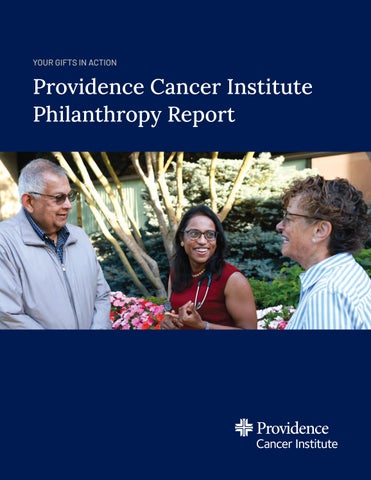
Cover image: Natasha Edwin, M.D., talks with patient Jumbo Fernando and his wife, Anne. More than two years after his multiple myeloma diagnosis, Jumbo’s cancer is nearly undetectable.
Dear Friends and Partners, It’s been a remarkable year. And, you’ve been an instrumental part of our success. Your generosity is helping Providence physician-researchers uncover the secrets of DNA’s dark matter, investigate new T-cell receptor therapies and develop innovative cancer medicines. Philanthropy is essential to the development of artificial intelligence tools that are already identifying disease and expanding access to personalized cancer therapies. Your investments are providing the latest imaging technologies and vital patient support services, too. Because of you, Providence patients have unparalleled access to clinical trials and leading-edge treatments, often before they are widely available. In fact, nearly 70% of the institute’s research is funded by donors. Each time researchers make a discovery in the lab that will provide better quality of life, a new treatment option or more time with loved ones, they bring it directly to patients like Brad, Marge and Del, who you will meet in this report. Your partnership is providing tomorrow’s treatments to Providence patients today. Thank you. With deep gratitude,
R. Bryan Bell, M.D., D.D.S., FACS, FRCS (Ed) Executive Medical Director, Providence Cancer Institute Director and Member, Earle A. Chiles Research Institute Walter J. Urba Endowed Chair for Cancer Research
“Your true impact is felt in the transformed lives of patients – real people with hopes, dreams and families. Because of you, so many have a better quality of life and more moments to hold dear.” — Dr. Bryan Bell 1
Dark genome research: Exposing the secrets of cancer’s dark matter New immunotherapies help the immune system find previously “invisible” cancer cells Providence Cancer Institute researchers are at the forefront of one of the most important biological discoveries in a generation: They are identifying groups of proteins produced by a portion of DNA in the human genome previously thought to be inactive – and using those protein groups to fight cancer.
“Numerous dark matter protein antigens are shared among various tumor tissues and cancer types,” said Bernard A. Fox, Ph.D., interim scientific director and the Harder Endowed Chair for Cancer Research, who leads the institute’s dark matter research. This means the dark matter vaccine may be applicable to a wide range of cancers.
Nearly all proteins vital for life are created by just 1.5% of our DNA. Scientists long believed the rest of our DNA had little function, but new research indicates otherwise. This largely unstudied portion of DNA is now referred to as the “dark genome” and, with donor support, scientists at Providence Cancer Institute are uncovering its true nature. They have learned that the dark genome generates unstable proteins, called “dark matter,” that are in some cases associated with cancer growth. But, the presence of dark matter proteins also offers hope: They break down into countless new antigens (protein fragments) that can be targeted by novel immunotherapies.
Dark matter vaccine delivers promising initial results Providence Cancer Institute researchers are using this new knowledge to evaluate a dark matter vaccine in clinical trials. It primes the immune system to “see” dark matter antigens previously invisible to it, thereby “revealing” cancer cells. This allows the patient’s body to begin fighting the disease. Rom Leidner, M.D., medical oncologist and the Michael Kelley Endowed Chair for Cancer Research, led a trial testing the vaccine – the world’s first dark matter immunization – in patients with metastatic head and neck cancers. The results were impressive: Patients in the trial experienced three times the rate of progression-free survival compared to historical outcomes achieved with standard immunotherapy. We have yet to fully grasp the scope of these outcomes; meticulous laboratory work lies ahead. Because clinical trial results have been so encouraging, Dr. Leidner believes patients may benefit to an even greater degree as the treatment is further refined.
2
Grit and an experimental vaccine help Del Abbott fight cancer twice When facing difficult times, Del Abbott, 74, draws on the well of self-reliance and resilience he cultivated both as a child and as a young Air Force police officer who guarded missiles during a brutal winter in North Dakota. It takes that kind of grit to survive cancer once. With help from Providence Cancer Institute, Del has done it twice. After retiring from a career in law enforcement, Del returned to his hometown of Springfield, Oregon, where he refereed youth sports and built a home by hand. In early 2020, he learned he had throat cancer. The treatments cost Del his sense of taste and ability to swallow easily. When scans identified metastasis in his lungs, his doctor pointed him toward a clinical trial at Providence Cancer Institute.
Trial offers a path forward and a way to give back Del met Rom Leidner, M.D., the medical oncologist leading a new, early-phase clinical trial testing a first-of-its-kind vaccine using groups of “dark matter” proteins. Designed to help patients’ immune systems recognize and target their cancer, the vaccine was developed at the institute. Del signed up. His regimen began with a biopsy, then weekly vaccine treatments, including one Dr. Leidner called “GITR done.” That’s a bit of immunology humor: GITR is a protein included in the vaccine that helps T cells work harder. And, it got to work fast. After three weeks, a biopsy showed Del’s tumor had already shrunk by more than 50%. By five weeks, the cancer was gone. That was in 2022: Del has been cancer-free since. Being part of the trial not only helped Del but also gave researchers valuable information that will benefit others. Participation in the trial reflected Del’s spirit of service, like his work in the Air Force, at the sheriff’s office and with youth sports. Del said, “If I helped one person avoid cancer, I’d be so tickled.”
“I remember being told, ‘There’s nothing left to biopsy. The tumor’s just gone.’”
(Top) Del Abbott’s tumor disappeared after receiving the trial vaccine. He said, “It was an honor to participate. My success gave researchers more tools to help others.” (Bottom) Dr. Rom Leidner celebrates with Del.
Get more details about Del’s story.
— Del Abbott, Providence patient and dark matter clinical trial participant 3
Developing more robust personalized treatments from patients’ immune cells When the immune system perceives a threat, including cancer cells, it sends T cells to attack. With your support, Providence researchers are harnessing these cells to develop a more effective immunotherapy treatment called T-cell receptor therapy (TCR-T). Scientists begin by gathering T cells from a patient’s blood and genetically engineering them to express a T-cell receptor, which redirects the T cells to recognize and fight cancer. They grow the engineered cells from a few million into billions, then return them to patients intravenously. The engineered T cells then circulate through the blood, seeking out cancer cells. Eric Tran, Ph.D., leader of the Adoptive Cell Therapy Laboratory, and Rom Leidner, M.D., pioneered TCR-T at Providence Cancer Institute, delivering the world’s first proof it could cause metastatic pancreatic cancer tumors to shrink. It was an extraordinary outcome. Unfortunately TCR-T didn’t work for everyone in the Hotspot 1.0 clinical trial. Now, the Providence research team has enhanced this promising therapy and received FDA approval to launch Hotspot 2.0, a clinical trial led by Binbin Zheng, M.D., a Providence physician-researcher.
A new protein mix creates more potent T cells
(Top) Dr. Eric Tran stands outside the Human Applications Laboratory. It is here that T-cell receptor therapies are manufactured. (Bottom) Dr. Tran works with team member Florisela Herrejon Chavez, Ph.D., to advance adoptive cell therapies.
Younger T cells fight tumors more effectively. So, Dr. Tran’s group worked for 2 1/2 years to develop younger T cells. First, they decreased the cell manufacturing time from 30 days to just 10. In addition, they developed a new protein mix containing four cytokines (proteins that stimulate T cells) that produced younger, more powerful T cells with increased targeting ability and staying power. Exposure to one of the cytokines, TGF-ß, had an added benefit. Dr. Tran said, “It programs the T cells so they have the best chance of ‘homing in on’ and sticking to the tumor once there.” Patients entering the Hotspot 2.0 trial will also undergo one cycle of chemotherapy before receiving the engineered T cells. This temporarily “clears out” existing immune cells, creating space for the newly transferred T cells to expand. The team is optimistic the new approach will be more effective and result in longer-lasting responses, particularly in patients with solid cancers of the gastrointestinal tract.
4
From survivor to volunteer: Translating gratitude into service Marge Rosson is a wife, mother, grandmother, great-grandmother and cancer survivor. When Marge learned she had cancer, her Providence surgeon, John M. Creasy, M.D., told her she was eligible for a clinical trial; she enrolled. During her treatment, Marge described how she experienced “sincere care and compassion as both a person and patient.” When it ended, she was elated to learn the therapy was successful. While on her cancer journey, Marge spent a lot of time in the hospital’s infusion center where she interacted with nurses and other caregivers. She noticed every individual who cared for her was highly dedicated, kind and knowledgeable. After her recovery, Marge decided that she, too, wanted to help people in such a positive way, so she became a weekly volunteer at the infusion center. During her shifts, Marge cleans chairs, delivers blankets and pillows, and spends time with patients. For those who are too sick to talk or prefer not to, Marge provides comfort in another way: She is a quiet reminder of what’s possible.
“Patients will say, ‘Your hair grew back,’ and that becomes a symbol of hope.”
Marge Rosson, a Providence patient and cancer survivor, gives back by volunteering at the infusion center where she received treatments. Describing caregivers at the center, she noted, “I just can’t get over the quality of care and the willingness to talk. They were never in a hurry.”
— Marge Rosson, Providence patient, cancer survivor and volunteer
The role of volunteer holds a great deal of purpose and meaning for Marge. “You receive so much more than you give,” she said.
Acknowledging the gifts that provide new hope Survivorship has deepened Marge’s understanding that care is never delivered by just one person. Instead, it’s made possible by caregivers, volunteers, donors, families and friends working together to ensure patients feel seen, safe and supported. In addition to the excellent care that inspired her, Marge is grateful for the philanthropy that makes research and clinical trials possible. She noted, “We’re all going to need intense healthcare at some point.”
5
Cancer exploits a protein to help it spread: Researchers are fighting back Providence researchers have been a driving force in the establishment of immunotherapy as an integral pillar of cancer care. This revolutionary advancement offers many patients more-durable, less-toxic cancer treatments. However, several types of cancer have been resistant to current immunotherapies and remain challenging to fight with any approach.
Matthew Taylor, M.D., is leading the development of M3T01 within Providence Cancer Institute’s groundbreaking immuno-oncology research program. The clinical trial exemplifies our ability to quickly move novel scientific discoveries from the laboratory bench to the patient’s bedside. As a result, Oregonians have unparalleled access to potentially game-changing treatments.
This may be about to change. Providence researchers, led by Matthew Taylor, M.D., are on the brink of unlocking a novel way to protect the immune system. They have developed a new drug, M3T01, that targets Fas ligand (FasL), a protein that cancer exploits to help it spread. Their goal? To give more patients – especially those with hard-to-treat cancers – a better quality of life, additional therapy options and more time with family. FasL normally rids the body of tired or used immune cells, called T cells, by causing them to die after they finish fighting an infection. This is usually a beneficial function. But cancer cells can hijack FasL’s “clean-up” mechanism and use it on healthy T cells, hindering the immune system’s response. This allows the disease to continue growing and spreading.
A new phase I investigator-initiated clinical trial launches Blocking FasL with M3T01 could significantly enhance the effectiveness of available immunotherapies. It may also diminish the invasive capability of tumor cells while increasing the quantity of T cells able to infiltrate tumors. The Food and Drug Administration approved the institute’s Investigational New Drug application for M3T01 in early 2025. The clinical trial, funded in part by donor gifts, launched and began enrolling patients in June 2025. The study is currently in the combination phase, where M3T01 is given in conjunction with other immunotherapies. While it will take some time to study, M3T01 could provide a much-needed option for advanced cancers, offering a more effective, less toxic therapy. The clinical trial is scheduled to continue through the end of 2027, giving Providence patients a potential breakthrough treatment now, before it’s available anywhere else.
6
A miracle of timing and treatment with a huge dose of compassion and hope Brad Pease was only a week from retirement in September 2022 when a physical revealed a lump in his neck. While waiting for biopsy and test results, he traveled to Israel to give an archaeological tour. While there, Brad’s wife, Heather, called with the diagnosis: medullary thyroid cancer. Heather was determined to find the best care team possible. She identified Kelvin C. Yu, M.D., a Providence oncology surgeon. Brad also met with Patricia A. Burford, M.D., a Providence endocrinologist, and Matthew Taylor, M.D., a Providence Cancer Institute physician-researcher. That December, Brad had surgery to remove the cancer, which had spread. Just three weeks later, he went to a follow-up appointment and found all three doctors in attendance. They informed him the tumor had roared back and was already golfball size. “That was probably the lowest moment,” said Brad.
Never a better time than right now Dr. Taylor then made an unusual declaration: “There’s never been a better day to be diagnosed with medullary thyroid cancer.” He shared that a clinical trial testing a drug for use with cancers like Brad’s had become available only the week before. Providence Cancer Institute was one of only four U.S. sites offering it. During the first year of the trial, Brad spent hours in the infusion center every two weeks getting blood tests; today his visits number just four per year. Brad’s treatment in the clinical trial? One daily pill. Imaging along the way showed the tumor shrinking so dramatically it’s nearly undetectable now. Reflecting on the proximity of Providence Cancer Institute, the drug being studied and the trial timing, Brad described his experience as “a big M moment”: a true miracle. He’s grateful for more time with his family and to do the things he loves. Brad knows the drug is experimental. “I have so much trust in Dr. Taylor,” he said. “If things go backwards, I’m in the best hands.”
Through a clinical trial offered at Providence and just three other sites in the U.S., Brad Pease received an experimental medication to treat metastatic thyroid cancer. It began four years ago. Today, his cancer is nearly undetectable.
Brad spoke at Creating Hope, Providence Cancer Institute’s annual fundraiser, which recently raised $775,000 for research. Scan to learn more about the 2027 event and to see highlight videos from 2026.
Brad emphasized the humanity and compassion of the institute’s care teams, as well as the vital role of donor generosity in bringing leading-edge research to patients. “Supporters are making a difference right now and paving the way for new treatments that will help thousands more,” he said. 7
Providence is home to leading-edge breast cancer screenings, diagnosis and care Kirsten Ulmer had fast-growing breast cancer that had spread to her lymph nodes. She’s now cancer free, thanks to her participation in a clinical trial at Providence. Kristen P. Massimino, M.D., a surgical oncologist specializing in breast cancer, regularly sees how patients like Kirsten benefit from innovative technologies. Leading-edge prevention and screening tools are part of Providence Cancer Institute’s dynamic system. Some patients already know they have a substantial risk for developing breast cancer. It’s recommended they have annual diagnostic testing, usually magnetic resonance imaging. Not everyone can undergo MRI; patients with certain allergies or severe claustrophobia need another option. Contrast-enhanced mammography technology is only available in Portland at Providence St. Vincent Medical Center.
Patient Support Services Your gifts provide cancer patients with access to numerous support programs, many of which insurance doesn’t cover. Services vary by location and include: Comfort care kits Financial support Integrative medicine Nurse navigation Nutrition services Resource library Scalp cooling Screening Sexual health services Support groups Temporary housing
What makes Providence special is that it offers a strong alternative, called contrast-enhanced mammography. Providence St. Vincent Medical Center is the only hospital in Portland – and one of few in the Pacific Northwest – that offers this state-of-the-art diagnostic technology. A tool funded by donors, CEM offers performance similar to breast MRI for high-risk patients, but in an exam format familiar to many patients. It is conducted much like a regular mammogram, with the addition of a contrast agent (contrast dye) injected into the bloodstream. It’s one of several new tools available. Patients now have access to more prevention and early detection tools. Our teams developed a digital risk questionnaire and assessment survey, Prevention4Me, which helps flag patients who may benefit from genetic testing. It has not only identified more than 8,000 highrisk patients across Providence hospitals but also increased patient follow-through on recommended testing.
“We are proud to offer the latest tools: They simplify processes, reduce barriers, expand access and can capture patients who might not be tested. We know that the quicker we identify cancer, the better the outcome.” — Kristen Massimino, M.D., director of surgical oncology, Providence
8
Exceptional cancer care and friendship with fellow patient inspire gift Ralph Carter initially dismissed his back pain, thinking he overdid it while setting up for a party. When the pain persisted, his doctor suggested he go to Providence Willamette Falls Medical Center’s emergency department. Both Ralph and his wife, Joyce, had previously received stellar care there, and the hospital was very close by. After extensive testing, he was devastated to learn he had cancer. “I turned my care over to the team, trusting them completely, and everyone treated me with such care and dignity,” Ralph said. Ralph spent considerable time receiving chemotherapy at the Suzuki Cancer Center infusion clinic at Providence Willamette Falls. There, he befriended a woman who cared for her son with disabilities in a very small home. She shared that her treatment schedule affected her income, making food increasingly unaffordable. Ralph also noticed that center caregivers collected food to help patients struggling to make ends meet during an already challenging time in their lives.
Ralph and Joyce Carter helped fund the food pantry and nurse navigation for patients with cancer at the Suzuki Cancer Center located within Providence Willamette Falls Medical Center.
An infusion of love and food for others in need These experiences inspired the Carters to fund another kind of infusion: an expansion of the center’s informal food pantry. “We wanted to help those having financial struggles while fighting cancer,” he said. Thanks to the Carters’ generosity and gratitude for Ralph’s care, a closet that once provided staples to a handful of patients now helps many more focus on healing rather than on where they will get their next meal.
Providence Cancer Institute has statewide reach: Read stories from across Oregon Small changes add up to big impact for patients at Seaside. Your generosity helped bring a light-filled, welcoming and spacious cancer center to north coast patients.
Thanks to your support, patients receiving high-dose-rate (HDR) brachytherapy now are guaranteed privacy, dignity and comfort at Providence Cancer Center – Southern Oregon.
9
Exceptional teams advancing research and care at Providence Cancer Institute Your support helps attract, retain and advance exceptional caregivers, clinicians and laboratory professionals. Providence Cancer Institute is a leading cancer center committed to transforming promising immunotherapy discoveries into treatments that reach patients in the communities where they live. Thanks to the dedication of our care teams, patients in Oregon have often gained access to groundbreaking therapies years before they became nationally available. Combined with your generous investment, this work has brought new hope to patients, advanced lifesaving research and strengthened families facing cancer. We’d like to recognize some of the talented individuals whose expertise, creativity and determination have made significant inroads in the development and delivery of innovative therapies.
Promotions, a retirement and a new appointment Natasha Edwin, M.D., and Evie Hobbs, M.D., were both elevated to assistant member* status and Matthew Taylor, M.D., to full member* status at the Earle A. Chiles Research Institute, the research arm of Providence Cancer Institute. Their promotions recognize significant scientific achievement, sustained contributions to research and growing national recognition in a specialized field. These individuals are helping shape the future of cancer treatment for patients today and for generations to come. Brendan Curti, M.D., the Robert W. Franz Endowed Chair for Clinical Research, is retiring after 25 years of outstanding service at Providence. Rom Leidner, M.D., has been named the new holder of the Michael Kelley Endowed Chair for Cancer Research, a well-deserved appointment. Both physicians have an unyielding commitment to finishing cancer. These individuals exemplify what it means to be a Providence caregiver: to know, care for and ease the way of every patient they encounter.
“These accomplishments reflect the incredible scientific rigor, creativity and perseverance of our investigators and researchers, each of whom is driven and sustained by a deep commitment to our patients.” — R. Bryan Bell, M.D., D.D.S., FACS, FRCS(Ed), executive medical director, Providence Cancer Institute
*The rank of full member or assistant member at Earle A. Chiles Research Institute at Providence Cancer Institute is comparable to that of tenured professor or assistant professor at a university.
10
Matthew Taylor, M.D. has demonstrated exceptional leadership in research, drug development and clinical care. His novel Fas ligand antibody recently received FDA authorization for a firstin-human clinical trial.
Natasha Edwin, M.D. has helped shape the strategic direction of the hematologic malignancies research portfolio. Her work spans cellular therapy, drug development and national leadership in the field of myeloma.
Evie Hobbs, M.D. has advanced breast oncology research through leadership in early-phase trials, principal investigator roles for investigator-initiated studies and contributions to translational research.
Brendan Curti, M.D., the Robert W. Franz Endowed Chair for Clinical Research, is retiring from Providence Cancer Institute at the end of 2026. A distinguished physician, pioneering researcher and mentor, Dr. Curti has played a defining role in advancing immuno-oncology through clinical trials that changed cancer treatment and expanded options for patients. Beyond his scientific achievements, he is admired for his generosity, humor and collaborative spirit. Patients and colleagues alike praise his expertise, warmth and unwavering commitment to compassionate care. Rom S. Leidner, M.D., was named the Michael Kelley Endowed Chair for Cancer Research. Specializing in head and neck, esophageal and stomach cancers, he works to translate scientific discoveries into innovative patient treatments. Dr. Leidner’s research focuses on DNA’s dark matter, T-cell receptor therapies and new immunotherapy drug development. He also serves as the primary clinical expert helping guide development of our AI initiatives. Dr. Leidner’s colleagues describe him as a someone who builds collaborations among people and institutions; patients he treats feel truly seen.
11
Researchers awarded prestigious grants Researchers across the U.S. have faced challenges due to disruptions in federal funding that has supported their work; Providence Cancer Institute is no exception. That’s one reason we are grateful for our philanthropic partners. Your support allows us to vigorously pursue new cancer immunotherapies even in the face of these changes. Our exceptional researchers also continue to garner major awards, which recognize the high caliber of their ideas, discoveries and contributions to the field. Bryan Bell, M.D., D.D.S., Thomas Duhen, Ph.D., and Brian Piening, Ph.D., have been awarded a National Institutes of Health R01 grant, the gold standard of NIH funding. They are examining why neoadjuvant (given prior to surgery) immunotherapy combined with focused radiation produces unusually strong results in head and neck cancers. Researchers will study lymph nodes, treatment response and causes of resistance with the goal of developing less-toxic and moreeffective treatments. Eric Tran, Ph.D., has received a Stand Up To Cancer grant to improve a personalized T-cell therapy for pancreatic cancer by combining it with an mRNA vaccine. The goal is to test whether a new mRNA vaccine can boost the ability of engineered T cells to kill pancreatic tumors driven by a specific KRAS mutation. He will collaborate with Di Liu, Ph.D., of Arizona State University. Thomas Duhen, Ph.D., has been given an R21 grant from NIH to investigate why some colorectal cancers do not respond well to immunotherapy. This study will focus on how immune cells that normally help fight tumors may be redirected within the tumor environment to support cancer growth. Dr. Duhen aims to identify new ways to improve treatments. Brian Piening, Ph.D., has secured a Conquer Cancer Award to fund deployment of Providence’s artificial intelligencepowered GigaPath pathology system, which can identify cancer-driving mutations directly from images. This project supports the clinical use of AI to predict actionable cancer mutations, helping patients access genomic testing and personalized treatments sooner.
12
From the top, Drs. Bryan Bell, Eric Tran, Thomas Duhen and Brian Piening.
Rachel Sanborn, M.D., medical director of clinical research at Providence Cancer Institute, including the phase I clinical trials program, meets with a community member.
Your gift makes a difference! There are many ways to support cancer research and cancer patient care at Providence Cancer Institute, including: • Cash and cryptocurrency • Appreciated securities • IRA qualified charitable distributions • Gifts from private foundations or donor advised funds
• Estate planning • Real estate • Business assets
Please reach out to a foundation philanthropy officer. See back cover for details. 13
Sadie Williams Senior Director of Philanthropy 503-703-8823 sadie.williams@providence.org
OUR MISSION As expressions of God’s healing love, witnessed through the ministry of Jesus, we are steadfast in serving all, especially those who are poor and vulnerable.
OUR VALUES
Compassion, Dignity, Justice, Excellence, Integrity
Jon Mohr Director of Philanthropy 971-378-6155 lawrence.mohr@providence.org Deriek Cruz Philanthropy Officer 253-330-2509 deriekscott.cruz@providence.org foundation.providence.org/oregon