From the Senior Pastor CONNECTIONS
With the unofficial start of summer only a few weeks away, I’m wondering: Do you have your summer reading list picked out yet?
Well, here are four books that I plan to read this summer: Matthew, Mark, Luke, and John. I’m hoping that you’ll join me so that, by Labor Day, we will have—together as a church—read through the Gospels for ourselves.
For some of us, this might be the first time we’ve read all four Gospels for ourselves. For some of us, this might be the umpteenth time we’ve read them. I am confident, though, that each of us will come away from this exercise knowing Jesus better than we did before.
And that’s the point.
One of our Vision of Ministry goals for 2026 at Providence is to develop greater love for, knowledge about, and application of Scripture. In other words, we want to become more familiar with the Bible—and then become more intentional about letting God’s Word guide our lives. I can’t overstress how crucial it is for us to be familiar with the Bible. It’s foundational for our lives as followers of Jesus. The Message translation of 2 Timothy 3:16-17 puts it well: “All Scripture is inspired by God,” we’re told, “showing us truth,
exposing our rebellion, correcting our mistakes, and training us to live God's way,” so that everyone who belongs to God might be equipped for every good work that God has for us to do.
When we don't read God’s Word, then we’re not only missing out on these positive, formative effects, but we’re also making ourselves vulnerable to distortions, misrepresentations, and flat-out lies about who God is, what God is like, and what God wants—both for us and from us. Misguided interpretations of Scripture are a lot less dangerous to us when we’re actually reading the Bible ourselves, rather than relying exclusively on others to tell us what it means.
So, it stands to reason: If we want to know Jesus better so that we can follow Jesus better, then let’s read together the Gospel accounts of his life, ministry, death, and resurrection. Let’s allow Scripture to tell us about the ways of Jesus: What he said, what he did, what he taught, and how he asked his followers to practice what he preached. Let’s take Jesus seriously this summer by giving the Gospels our focused attention.
You’re free, of course, to do this exercise however you want—or to not do it at all. But, if you do choose
to read the Gospels with me this summer, then I suggest that we do it slowly—one chapter a day—in order to give the word a chance to sink in. We’ll begin with the earliest gospel, Mark, then go on to Matthew, followed by Luke, and finish up with John, the last gospel to be written.
If we start Mark on June 1, then we’ll finish on June 16. We’ll start Matthew on June 17 and end on July 14. We’ll start Luke on July 15 and end on August 7. Finally, we’ll start John on August 8 and be done on August 28.
Let me know if you’re going to be reading the Gospels this summer— and, as you read, what you’re learning about Jesus along the way.
May the peace of Christ be with you!
Lee Canipe Senior Pastor
SERMON TEXTS THIS MONTH
May 3 John 14:1-14
May 10 Acts 17:22-31, Blake Kendrick
May 17 Acts 1:6-15
May 24 Numbers 11:24-30
May 31 Baccalaureate Sunday
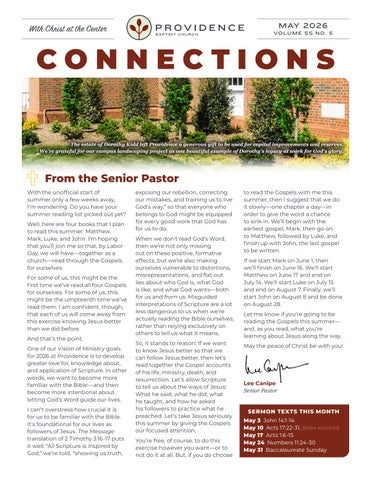
The estate of Dorothy Kidd left Providence a generous gift to be used for capital improvements and reserves. We’re grateful for our campus landscaping project as one beautiful example of Dorothy’s legacy at work for God’s glory.
Ministry at Providence
ADULT DISCIPLESHIP
Blake Kendrick, bkendrick@providencebc.org
Sacred Spaces Tour
May 6 | 6pm | Bahá’í Center of Charlotte
Join us for our Sacred Spaces Tour as we visit the Bahá’í Center of Charlotte! The Bahá’í community is a diverse, worldwide religious movement centered on unity (of God, religion, and humanity), peace, equality, and global cooperation. Sign up on Realm! The Providence van is available. Visit bahaicharlotte.com to learn more.
Hands-On Mission Project
May 20 | 9am | Second Harvest Food Bank
Join Blake Kenrick and Claire Revord for a hands-on service project for Second Harvest Food Bank! A group of 14 are needed to assist sorting and organizing food items. Sign up on Realm. The Providence van is available.
ACTIVITY CENTER
Michelle Hitselberger, mhitselberger@providencebc.org
Masterpiece Painting Class
May 4 | 12pm & 6:30pm | Activity Center Parlor
Experience a time of painting, laughing, having a fabulous experience with instructor, Sumi Burge! Cost is $45/session. Register on Realm for one or both sessions. All supplies included.
Upcoming in the Activity Center
Lots of exciting programming for all ages is coming soon! Stay tuned for more information!
CHILDREN
Elizabeth Maye Hudson, emaye@providencebc.org
VBS Training
May 13 | 5:30pm | Crouch Fellowship Hall
The VBS countdown has begun! All VBS volunteers will gather for training. Leaders will be sent a registration link.
VBS Registration Open
Closes May 31
VBS Snowball Mountain Challenge is June 15-19! Register by May 31! Visit www.providencebc.org/connect/vbs
CHILD DEVELOPMENT CENTER
Ursula Taylor, utaylor@providencebc.org
Staff Appreciation Week
May 4-8
We look forward to celebrating our incredible teachers and staff all week long! This is a special time to recognize their dedication, hard work, and love they pour into our children each day.
Muffins with Mom
May 8 | Child Development Center
A sweet morning for our moms (or special caregivers) to join their child at school for muffins and a time of connection before the day begins.
End of the Year Program
May 20 | 11am | Sanctuary
Our Fours classes will present their End of the Year Program in the Sanctuary, followed by a celebratory luncheon in the Fellowship Hall. We look forward to honoring our students and celebrating their growth.
MUSIC
Pete Leo, pleo@providencebc.org
Men's Chorus for Mother's Day
May 10 | During Worship
Gentlemen high-school-age and up are invited to sing in a special Men’s Chorus for Mother’s Day! Rehearsals are May 2 and 9 from 9-10am.
Summer Organ Sidekick
Sundays June - August
All students 3rd grade completed through high school are invited to come sit with Mr. Ed West at the organ bench on Sundays June - August! If your child is interested, contact Ed at ewest@providencebc.org
STUDENTS
Amy Brown, abrown@providencebc.org
College Graduation Dinner
May 30 | 5:30pm | Eddins Room College graduates and their families are invited to join us for a celebratory dinner! Come gather as we celebrate this milestone and a new season of life.
Baccalaureate Sunday and College Graduate Recognition
May 31 | During Worship
Join us as we celebrate our graduating seniors during Worship! This is a meaningful service meant for the entire Providence family. High school seniors and their families are invited to a special luncheon in the Fellowship Hall following Worship at 12pm!
Cookout and Kickball
May 31 | 5:30-7pm | Gazebo and Fields
It’s our “official” start to summer! Students and their friends are invited to a cookout and kickball game with our adult leaders. Join us at the gazebo and bring your kickball shoes!
SENIOR ADULTS
Wilna Eury, wilna.eury@att.net
PrimeTimers' Luncheon
May 21 | 12pm | Crouch Fellowship Hall
Mark your calendar for our next Luncheon! We welcome our guest speaker. Invite a friend to share our friendship with a delicious lunch. RSVP by May 15 on Realm or call Wilna at (704) 553-2615 . Cost is $7/person.
CHURCHWIDE
connections@providencebc.org
Women on Mission
May 12 | 10:30am | Nalley Missions Center
All are invited to join us for a time of fellowship, hands-on missions, prayer, and lunch. We will hear from Ellen Wingate about how the Logan Jett Research Foundation “helps improve the lives of everyone touched by epilepsy.” Our annual covered-dish luncheon and fellowship will follow. Come as you are! Invite a friend!
Anniversary Sunday
May 17
Join us as we celebrate the 72nd anniversary of Providence Baptist Church! Following Worship, join us for a luncheon on the Rotunda Lawn. Be sure to bring a dessert. In addition to your regular offering, make an Anniversary Sunday Birthday Gift!
Providence Closed
May 25 | Memorial Day
The Providence Campus, including the CDC, will close on May 25 in observance of Memorial Day.
Prayer Vigil
Last Saturday of the Month | Weekley Chapel
You are invited to come sit and pray quietly in the Chapel on May 30. Suggested prayer guides are available.
Providence Knight at the Ballpark
August 7 | Truist Field
Join us for an evening at a Charlotte Knights baseball game! Tickets are $35 per person and include a $20 food voucher. Tickets are limited, so register on Realm today to secure your spot! For questions and more information, please contact Michelle Hitselberger via text at (704) 989-3617

All Ages Retreat
October 9-11 | Quaker Lake (Climax, NC)
Get ready for our All Ages Retreat! Join us at Quaker Lake Camp this fall for an intentional, intergenerational weekend where we’ll worship, play, and strengthen our bonds as a faith community. Registration details are coming soon, so stay tuned!
Providence is excited to welcome the Cotswold Farmers Market back to our campus this year! In furthering our Providence Will priorities of Engaging Cotswold and Blessing Charlotte, the Cotswold Farmers Market will gather from 8am-12pm on Saturdays from May through October in our Sanctuary parking lot beginning May 2. Be sure to come out and support local farmers, vendors, musicians, artisans, entrepreneurs, and volunteers from all over the Queen City! We can't wait to see you there! To see a list of vendors, as well as a schedule, please visit www.cotswoldfarmersmarket.com or check out the Cotswold Farmers Market social media on Instagram and Facebook!
WANT TO VOLUNTEER?
Providence members are invited to volunteer to assist with the Market up to twice per month! This is a great way to offer support in a hands-on way and connect with neighbors and families. For more details, please contact Bob Zweier at bobzweier58@gmail.com. Come join the fun!
May Calendar
WEEKLY EVENTS
Sundays
9:15am Faith Formation
10:30am Worship
1-5pm Fitness Center Open
Mondays
6:30pm Carolina Shag Lessons
7-9pm Men's Pick-Up Basketball (ages 55+)
Monday-Friday
9am-8pm Fitness Center Open
Mon, Tue, Thu, & Sat
Times vary Jazzercise Class*
Tuesday-Sunday
Times vary Indoor Pickleball*
Thursdays
12-3pm Game ON! Social
Saturdays
8am-12pm Cotswold Farmers Market
9am-3pm Fitness Center Open
*Visit our website for full details
SATURDAY, MAY 2
8am-12pm Cotswold Farmers Market Resumes, Sanctuary Parking Lot
CHURCH OFFICE HOURS: Mon-Thu 9am-4pm; Fri 9am-1pm
MONDAY, MAY 4
Masterpiece Painting Classes, 12-2pm Sess. 1; 6:30-8:30pm Sess. 2
MAY 4-8
CDC's Staff Appreciation Week
WEDNESDAY, MAY 6
6pm Sacred Spaces Tour, Bahá’í Center of Charlotte
THURSDAY, MAY 7
11am Final Spring Adult Bible Study Session, Eddins Room
FRIDAY, MAY 8
CDC's Muffins with Mom
SUNDAY, MAY 10
Men's Chorus for Mother's Day, During Worship
TUESDAY, MAY 12
10:30am Women on Mission, Nalley Missions Center
WEDNESDAY, MAY 13
5:30pm VBS Training, Crouch Fellowship Hall
SUNDAY, MAY 17
72nd Anniversary Sunday
WEDNESDAY, MAY 20
9am-12pm Mission Project, Second Harvest Food Bank 11am CDC's End of the Year Program, Sanctuary
THURSDAY, MAY 21
12pm PrimeTimers' Luncheon, Crouch Fellowship Hall
MONDAY, MAY 25
Providence Closed (Memorial Day)
SATURDAY, MAY 30
8am-12pm Prayer Vigil, Gordon Weekley Chapel 5:30pm College Graduation Dinner, Eddins Room
SUNDAY, MAY 31
10:30am Baccalaureate Sunday, During Worship
12pm High School Senior Luncheon, Crouch Fellowship Hall
5:30-7pm Cookout and Kickball, Gazebo & Fields

The Record We Wrote
Save The Date
JUNE 15-19
Vacation Bible School
JUNE 25
PrimeTimers Visit Flat Rock Playhouse
JUNE 29 - JULY 3
PASSPORTmissions
JULY 16
PrimeTimers' Bingo
AUGUST 7
Providence Knight at the Ballpark
AUGUST 16
Rooted in Providence Night
OCTOBER 9-11
All Ages Retreat
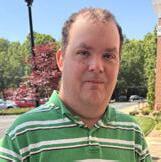
New Members
BRANDON LEMMON
April 12, 2026


ONLINE GIVING
Do you give online to Providence? On Sundays, pick up an online giving card as you enter the Narthex and place it in the offering plate during Worship!