
Domestic Abuse Policy
Version: V9
Ratified by: Strategic Safeguarding Group
Date ratified: 30/10/2025
Job Title of author:

Lead Professional for Safeguarding (Adults and Families) and Learning Disabilities/IDVA
Reviewed by Committee or Expert Group Strategic Safeguarding Group
Equality Impact Assessed by:
Related procedural documents
Review date:
Head of Safeguarding
SGPOL02 Safeguarding Children & Young People
SGPOL07 Safeguarding Adults at Risk of Abuse Policy
Domestic Abuse Act 2021
Domestic Abuse Statutory Guidance 22
Tackling Violence against Women and Girls, 2022
30 October 2028

It is the responsibility of users to ensure that you are using the most up to date document template – i.e. obtained via the intranet
In developing/reviewing this policy Provide Community has had regard to the principles of the NHS Constitution.
Version Date Author
Version Control Sheet
Status Comment
V1 CPRO32 August 2010 Specialist Practitioner Domestic Abuse Ratified New
V2 CPRO32 June 2012 Specialist Practitioner Domestic Abuse Approved Changed to allow attachment of DV1 to electronic record. Changed to include guidance including child protection
V3 CPRO32 April 2015 Head of Safeguarding Ratified CPRO32 Updated to include: SGPRO4
SGPRO5
SGPRO16
Honour based abuse, Forced Marriage
Female genital mutilation and Modern slavery
V4 SGPOL8 November 2015 Specialist Practitioner Domestic Abuse Ratified Replaces CPRO32
V5 SGPOL8 September 2016 Specialist Practitioner Domestic Abuse Ratified Policy updated following changes as documented at Strategic Safeguarding Forum May 2016 and Changes to Essex MARAC
V6 SGPOL8 June 18 Lead professional Safeguarding Adults & families & Learning disability Ratified Reviewed in Line with SET Safeguarding Adults Guidelines March 2017 and change of provider for 0-19 Children’s Public Health Service
V7 SGPOL08 August 2021 Head of Safeguarding Ratified Reviewed and updated in line with Domestic Abuse Act 21
V8 SGPOL08 September 2022 Named Nurse Safeguarding Adults and Children Reviewed to include Provide Community and Domestic Abuse Act Statutory Guidance 2022
V9 SGPOL08 October 2025 Lead professional Safeguarding Adults & families Learning disability/IDVA Full review of Policy.
Domestic Abuse Death Review (DHR) policy (SGSPO14) combined with Domestic Abuse Policy
Related SET guidelines for adults and children updated
This Policy must be read, understood and actively supported by all staff employed by Provide. It is consistent with, and should be read in conjunction with, other Policies and Guidance governing the management of specific incidents, including:
Provide Procedural Documents
• QSPOL03 Being Open and Duty of Candour Policy
• SGPOL02 Safeguarding Children & Young People
• SGPOL7 Safeguarding Adults at Risk of Abuse Policy
• QSPOL07 Consent to Examination or Treatment Policy
• HRPOL14 Disciplinary Policy
• IGPOL62 Information Governance Policy
• SGPOL18 Prevent Policy
• HSPOL16 Violence and Aggression Policy
• QSPOL09 Risk Management Strategy
• HRPOL01 Freedom to Speak Up (Whistleblowing) Policy
This list of Policies and Procedures is not exhaustive, and all Policies and Procedures must be consulted to minimise risks.
Other Documents:
• Domestic Abuse Act 2021, Domestic Abuse Act, Statutory Guidance, Home Office 2022
https://www.gov.uk/government/publications/domestic-abuse-act2021/domestic-abuse-statutory-guidance-accessible-version
• Serious Crime Act 2015
• Sexual Offences Act 2003
• Human Rights Act 1998
• Female Genital Mutilation Act 2003
https://www.legislation.gov.uk/ukpga/2003/31/contents
• The Anti-social Behaviour, Crime and Policing Act 2014 (Forced Marriage) https://www.gov.uk/guidance/forced-marriage
• Data Protection Act 2018 and General Data Protection Regulation
• Essex Safeguarding Children Board: www.escb.co.uk Southend, Essex and Thurrock guidelines for safeguarding children Part B3, page 342 ( June 2025)
https://www.escb.co.uk/media/3576/set-safeguarding-and-child-protectionprocedures-2025.pdf
https://www.escb.co.uk/media/3322/effective-support-october-2024-final.pdf page 38
• Essex Safeguarding Adults Board: https://www.essexsab.org.uk Southend, Essex and Thurrock guidelines for safeguarding adults page 46 section 4.3 (May 2024)
• https://www.essexsab.org.uk/sites/default/files/202407/set_safeguarding_adult_guidelines_-_v10_-_may24.pdf
• Southend, Essex and Thurrock Domestic Abuse Board (SETDAB) https://setdab.org
• Suffolk Safeguarding Partnership: https://www.suffolksp.org.uk/policiesprocedures-and-practice-guidance
• Suffolk Adults Framework page 8
https://static1.squarespace.com/static/62ea37b2f412d231ae2c2f35/t/68a32da f266fe21ff4c4615c/1755524527931/_Copy+of+Framework+18.8.2025.pdf
• Suffolk Children’s Framework level 2 onwards
https://static1.squarespace.com/static/62ea37b2f412d231ae2c2f35/t/6397478 b9bec9118ce5a039d/1670858635778/Suffolk-Threshold-Matrix-2022.pdf
Working Together to Safeguard Children (DfE, December 2023) https://assets.publishing.service.gov.uk/media/6849a7b67cba25f610c7db3f/ Working_together_to_safeguard_children_2023_-_statutory_guidance.pdf
• The Right to Choose: Multi-agency statutory guidance for dealing with forced Marriage, HM Government, 2022. https://www.gov.uk/government/publications/the-right-to-choose-governmentguidance-on-forced-marriage/multi-agency-statutory-guidance-for-dealingwith-forced-marriage-and-multi-agency-practice-guidelines-handling-cases-offorced-marriage-accessible
• Female Genital Mutilation Act 2003 https://www.legislation.gov.uk/ukpga/2003/31/contents
NICE Guidelines www.nice.org.uk
NICE Domestic Violence and Abuse: Multi Agency working (PH50) 2014 (reviewed July 2024) https://www.nice.org.uk/guidance/ph50
• NICE Clinical Guideline 89 – When to Suspect Child Maltreatment: When to suspect maltreatment in under 18s https://www.nice.org.uk/guidance/cg89#:~:text=The%20NICE%20guideline% 20CG89%2C%20*Clinical%20guideline%20on,Behavioral%20disorders%20o r%20abnormalities%20*%20Parent%2Dchild%20interactions
• NICE Domestic Violence and Abuse: Quality Standard (QS116) 2016 https://www.nice.org.uk/guidance/qs116
• NHS Employers Handbook 2022 https://www.nhsemployers.org/publications/supporting-nhs-staff-domesticviolence-and-abuse
• Domestic Violence and Abuse: supporting NHS staff. The NHS Staff Council November 2017 NICE Guidelines www.nice.org.uk
For services Provide deliver outside Essex
Refer to the Local Safeguarding Adults and Children’s’ Boards Safeguarding Procedures. Contact the Provide Community Safeguarding Team for advice.
Telephone: 0300 303 2642
Email: Provide.safeguarding@nhs.net
For local information: https://safeguarding-guide.nhs.uk/
1. Introduction
Domestic Abuse is an abhorrent crime perpetrated on victims and their families by those who should love and care for them. This can lead to debilitating long-term consequences for victims and includes forced marriage, honour-based abuse, and domestic homicide. Domestic Abuse can happen to anyone, regardless of age, social background, gender, religion, sexuality, or ethnicity. Most victims of domestic abuse are women, but it can happen to men too. The abuse can be physical, emotional, psychological, financial, or sexual. Everyone has arguments and may disagree with people they are personally connected to from time to time; however, anyone forced to alter their behaviour because they are frightened of the reaction by the person they are connected to is being abused. It can begin at any stage of the relationship. Domestic abuse is rarely a one-off. Incidents generally become more frequent and severe over time. This can have a devastating impact on the victim and their children and can lead to life-changing injuries and even death. Domestic Abuse Act 2021 Statutory Guidance 2022
There is significant evidence to show that older people are as likely to experience domestic abuse as younger people but are less likely to report it. An older person may have experienced coercive control for decades in an intimate relationship, significantly influencing their sense of self-identity and confidence in their ability to make decisions for themselves. They may also be suffering abuse from their adult children or family members.
The Care Act 2014 put safeguarding adults with care and support needs and at risk of abuse or neglect on a statutory basis, and people working with adults may regularly encounter situations of Domestic Abuse. People with disabilities are twice as likely to be abused as non-disabled adults and in a greater variety of ways, particularly if their abuser is also their carer.
Provide Community is required to fulfil their legal duty under Section 11 of the Children Act 2004 and statutory responsibilities set out in Working Together to Safeguard Children (DfE, December 2023). Therefore, safeguarding and promoting the welfare of children must be an integral part of the care offered to all children and their families by all professionals working within Provide Community, including a whole family approach and strengthened multi-agency working with partner agencies. This may be care offered to children, young people, families, or adults who are parents, grandparents or carers.
This policy also considers Modern slavery, Honour Based abuse, including Forced Marriage and female genital mutilation which can all be perpetrated by families against their relatives and are therefore included as forms of Domestic Abuse.
This Policy includes Provide Community’s duty to train staff in how to support victims of Domestic Abuse and considers that Provide Community staff may also be victims and looks at how the organisation can support them while also not tolerating any staff who are themselves the perpetrators of Domestic Abuse. It also includes referral and information sharing processes with the Multiagency Risk Assessment Conference (MARAC).
2. Duties
This Policy applies to all Provide Community staff across all sites, including agency staff and contractors.
This policy aims to provide a framework for Provide Community colleagues to confidently and competently identify and respond to domestic abuse in adults, young people, and children. It covers both victims/survivors and perpetrators and support for colleagues experiencing domestic abuse.
Provide Community recognises the gender bias of domestic abuse and that over 85% of survivors and victims of domestic abuse are women and the majority of perpetrators are men. Provide Community recognises that domestic abuse is also experienced by individuals in same sex relationships, by men with female partners, and by family members and will use gender neutral terms to reflect this. This Policy is applicable to whatever the nature of the personal connection, as outlined in the Domestic Abuse Act 2021.
Under the Health and Safety at Work Act (1974) and the Management of Health and Safety at Work Regulations (1992), the Community Group recognises its legal responsibilities in promoting the Health, Safety, and Welfare of persons at work, as well as protecting anyone within the premises, even if they are not working. A full equality impact assessment has been conducted.
The Organisation is committed to safeguarding adults and children in all areas for which Provide Community are commissioned to provide services, whilst also being mindful of the need to protect the confidentiality of staff and service user’s information
3. Definitions
The Domestic Abuse Act 2021 defines Domestic abuse as:
Behaviour of a person (“A”) towards another person (“B”) is “domestic abuse” if -
(a) A and B are each aged 16 or over and are personally connected to each other, and (b) the behaviour is abusive.
Behaviour is “abusive” if it consists of any of the following -
(a) physical or sexual abuse
(b) violent or threatening behaviour
(c) controlling or coercive behaviour
(d) economic abuse (see below)
(e) psychological, emotional, or other abuse
It does not matter whether the behaviour consists of a single incident or a course of conduct.
“Economic abuse” means any behaviour that has a substantial adverse effect on B’s ability to -
(a) acquire, use or maintain money or other property, or
(b) obtain goods or services.
For the purposes of this Act, A’s behaviour may be behaviour “towards” B despite the fact that it consists of conduct directed at another person (for example, B’s child).
Definition of “personally connected”.
For the purposes of the Act, two people are “personally connected” to each other if any of the following applies –
(a) they are, or have been, married to each other
(b) they are, or have been, civil partners of each other
(c) they have agreed to marry one another (whether or not the agreement has been terminated)
(d) they have entered into a civil partnership agreement (whether or not the agreement has been terminated)
(e) they are, or have been, in an intimate personal relationship with each other (f) they each have, or there has been a time when they each have had, a parental relationship in relation to the same child (see Below)
(g) they are relatives.
A person has a parental relationship in relation to a child if –(a) the person is a parent of the child, or (b) the person has parental responsibility for the child.
Physical abuse: one of the most visible forms of domestic abuse and is used to gain control and includes behaviours such as kicking, punching, burns, strangulation and violence against children and pets.
Sexual abuse: is any kind of sexual activity or act (including online) that is unwanted and non-consensual. If a person consents out of fear or under pressure, it is not considered valid consent. Sexual abuse can include rape, sexual assault, videoing/photographing sexual acts, unwanted touching, force, threats, deception (such as not using contraception)
Controlling and coercive behaviour is a pattern of actions and behaviours used to exert control over another person and make them feel inferior. Often, there will be no violence, making it harder to recognise and evidence. Behaviours such as isolation from family and friends, deprivation of basic needs, monitoring all aspects of a person’s life, taking control of everyday life such as what to wear, when they can sleep, access to health care, finances and threats to harm family members and children.
Economic abuse: Part of coercive control and relating to money and finances, such as controlling the household income, restricting access to essential items, refusing to allow someone to improve their economic status, taking out loans in their name, preventing access to work or education, not contributing to household bills and destroying items.
Psychological and emotional abuse: behaviours used to make someone feel worthless, low self-esteem and confidence. It is used to manipulate and cause fear and confusion, such as gaslighting, making threats, such as they will harm themselves or report the victim to the police or social care, threats to harm children, shouting, bullying and name-calling. Also, it makes the victim feel that the perpetrator's actions are their fault.
Tech abuse: As society becomes more reliant on technology, it can also be used to perpetrate abuse, such as using smart home devices to control and monitor,
monitoring social media, preventing access to phone and online accounts, using tracking devices, constantly contacting the victim through text, calls, via email and threatening to share intimate images online. This form of abuse can be perpetrated anywhere in the world and very often once the relationship has ended.
Stalking and Harassment: Behaviours used to create fear and distress, such as following someone, contacting them through social media, turning up at their place of work, tracking their location and the locations of children and other family members, and can be online or in person. Stalking is a high-risk behaviour and increases the risk of homicide three times.
4. Honour Based Abuse (HBA)
The term ‘crimes of honour’ encompasses a variety of manifestations of violence, mostly against women: including murder, termed ‘honour killings’, assault, confinement or imprisonment and interference with choice in marriage where the publicly articulated justification is attributed to a social order claimed to require the preservation of a concept of honour vested in male family and or conjugal control over women and women’s sexual conduct - actual, suspected or potential. Honour based abuse is typically carried out by a member or members of the family or extended family and is likely to involve behaviours specified in the statutory definition of domestic abuse in the Domestic Abuse Act 2021.
Often HBA and Forced Marriage are seen as synonymous, but there are differences, HBA which may include emotional psychological sexual and physical abuse, is a reaction to what is perceived as immoral behaviour that brings Shame/Izzat Namous/Sharaf on the family or community. Immoral behaviours include running away/coming home late, ideological differences between parents and children, westernisation, refusing an arranged marriage, and relationships outside of marriage. relationships outside of the approved group, causing gossip, wearing inappropriate make-up or dress, loss of virginity, pregnancy, homosexuality, reporting/fleeing abusive relationships or a forced marriage, and girls who ‘allow’ themselves to be raped. Sometimes a rumour about a family member doing one or more of the above is enough to elicit an abusive reaction.
Victims from such groups and communities may face additional barriers in reporting the abuse or accessing support services. Honour based abuse has been identified to
stem from traditional notions of patriarchy and gender roles. However, victims may be female or male and those at risk can include individuals who are LGBT. Conversion therapy and the so-called corrective rape of LGBT victims may be a form of ‘honour’based abuse.
Prevalence
In the UK, there are 12-15 murders in the name of honour per year:
• Statistics from Karma Nirvana from 2020/2021 show that 98 per cent of the 1895 Honour Based Abuse victims that called the helpline were personally connected to the perpetrator and 64 per cent of new callers were suffering Honour Based Abuse from multiple perpetrators.
• South Asian women in the UK are 3 times more likely to take their own life than white women.
• 17,000 reported incidents of HBA occur in the UK annually
• 2,755 HBA offences were recorded by Police in England and Wales in 2023/24 This included 111 FGM offences and 201 forced marriage offences. https://www.gov.uk/government/statistics/so-called-honour-based-abuse-offencesyear-ending-march-2024/statistics-on-so-called-honour-based-abuse-offencesengland-and-wales-year-ending-march-2024
One Chance Rule
If someone discloses that they are to be a Victim of Honour based abuse, FGM or Forced Marriage, you have one chance and one chance only to get them some help before they are either taken out of the UK, mutilated or possibly killed. Practitioners need to be aware of their responsibilities and obligations when they come across cases of Honour Based Abuse. If the Victim is allowed to walk away without any support being offered, that one chance could be lost.
When coming across cases of Honour Based Abuse, including Forced Marriage and FGM Practitioners should: -
• See the person immediately in a secure and private place where they cannot be overheard
• See the person alone and establish all the facts
• Explain all options, recognise and respect their wishes
• Contact the Police
• If under 18 years, follow your Local Child Protection Procedures
• If an adult, follow local Safeguarding Adults Procedures
• Give reassurance regarding confidentiality
• Offer to make a repeat appointment and give an appointment card, as this gives them a legitimate reason to remain in the locality
• Discuss actions if they do not attend the appointment.
• Record keeping is very important
• Always use accredited Interpreters
1. Contact 020 3974 1034
2. Provide Access Code 21394983#
3. Then email: Provide.customerservices@nhs.net
4. Contact Customer Services for support
Practitioners should not:
• Send the person away
• Ignore what they are told or dismiss the need for immediate protection
• Approach family members or the community
• Share information with anyone without their express consent
• Breach confidentiality
• Attempt to act as mediator
• Never use family members/members of the local community as interpreters
5. Forced Marriage
‘Marriage shall be entered into only with the free and full consent of the intending spouses (Universal Declaration of Human Rights Article 16(2).
Forced marriage is an offence under section 121 of the Anti-social Behaviour, Crime and Policing Act 2014. A forced marriage is a marriage in which one or both spouses do not consent to the marriage but are coerced into it. Force can include physical, psychological, financial, sexual and emotional pressure. In the cases of vulnerable adults who lack the capacity to consent to marriage, coercion is not required for a marriage to be forced.
Sections 121 and 122 of the Anti-social Behaviour, Crime and Policing Act 2014 state that a person commits an offence under the law in England and Wales if he or she “uses violence, threats or any other form of coercion for the purpose of causing another person to enter into a marriage and believes, or ought reasonably to believe, that the conduct may cause the other person to enter into the marriage without free and full consent.” It also states that forced marriage can be committed if a person lacks
capacity, whether or not coercion plays a part. If the person is found guilty on indictment, the maximum penalty is seven years’ imprisonment. The Act also makes it an offence to lure someone overseas for the purpose of forced marriage.
A forced marriage is not the same as an arranged marriage. There are clear distinctions between them. In an arranged marriage, the families of both spouses take a leading role in the arrangements, but the decision to proceed with the marriage remains with the prospective spouses. However, in a forced marriage, one or both spouses do not consent to the marriage but are coerced into it. An arranged marriage can, however, become a forced marriage if there is any form of coercion. Forcing someone to marry against their will can include, in some cases, physical violence and/or psychological, financial, sexual and emotional pressure. In cases of vulnerable adults who lack the capacity to consent, coercion is not required for a marriage to be forced. (HM Gov 2022)
Forced marriage typically occurs in the context of ‘honour’-based abuse, and involves the use of violence, threats or any other form of coercion against a person with the intention or belief that the conduct may cause a person to enter a marriage without consent. This includes non-binding traditional or unofficial marriages. Forced marriage is recognised as a form of domestic abuse - if carried out by someone with a personal connection to the victim and where both parties are at least 16 years old.
Legally, children in England and Wales cannot marry under the age of 18 (changed from 16 years in 2023). Forced marriage can happen to both males and females, although most cases involve girls and young women aged between 13 and 30. Forced Marriage is a form of child abuse and domestic abuse. Cases should be tackled using existing child protection structures if the Victim is under 18 years old, or Adult safeguarding procedures if they are over 18.
Young people may have an increased risk of Forced Marriage if they have disclosed sexual abuse, as families may feel that this has brought shame on the family and that marriage will restore the family honour and may also put a stop to the abuse. Young people who are lesbian, gay, bisexual, pansexual or transgender may also be at greater risk, as their parents may feel that by forcing them to marry, their sexuality will not be questioned, and parents may also feel that this will cure their child of what they perceive to be abnormal sexual practices.
Young people who are forced to marry are frequently withdrawn from education and their personal development is restricted. They may suffer emotionally and be threatened with disownment if they go against their parents’ wishes and suffer from depression or self-harm. Victims may be subjected to sexual and physical abuse and ongoing domestic abuse within the marriage. They may be subjected to repeated rape until pregnancy is confirmed. In some cases, they will suffer abuse from the extended family, often being forced to undertake all the household chores. Young people with a learning or physical disability or illness are at increased risk of forced marriage and their vulnerability may make it more difficult for them to report abuse or to leave an abusive situation.
Forced Marriage Protection Order (FMPO)
An FMPO is a civil law measure which can be sought under section 63 of the Family Law Act 1996. The aim of an FMPO is to protect and safeguard a person who has been, or is being, forced into marriage. FMPOs are issued by family courts and can be issued in emergency situations to provide immediate, enforceable protection. This is known as an ex parte (by or for one party) or without notice order, as the relevant documents will not have been served on the respondents. An FMPO is unique to each case and contains legally binding prohibitions, restrictions and/or requirements relating to and directions aimed at changing the behaviour of a person or persons who force or attempt to force someone into marriage that they have not consented to. Breach of an FMPO is a criminal offence with a maximum sentence of five years’ imprisonment. For children, an application for a care or supervision order can be made under the Children Act 1989. Adults can seek an order for protection from harassment or nonmolestation.
Forced Marriage Unit (FMU) is a joint Foreign and Commonwealth Office and Home Office unit that can offer support to British nationals who are facing forced marriage abroad by assisting them to a place of safety and helping them return to the UK. They also run a public helpline to provide confidential and support to Victims and Practitioners handling cases of forced marriage and will talk through with them their options.
Practitioners who come across cases of Forced Marriage should remember the One Chance Rule. Support for victims can be accessed by calling:
FMU 0207 008 0151 Monday to Friday 9 am to 5 pm
• (+44) (0) 207 008 1500 Global Response Centre (out of hours) Email: FMU@fco.gov.uk
Or email:
• fmu@fco.gov.uk
6. Female Genital Mutilation (FGM)
FGM is a criminal offence – it is child abuse and a form of violence against women and girls and therefore should be treated as such. Cases should be dealt with as part of existing structures, policies and procedures on child protection and adult safeguarding. There are, however, particular characteristics of FGM that front-line professionals should be aware of to ensure that they can provide appropriate protection and support to those affected.
The term Female Genital Mutilation (FGM) comprises all procedures involving the partial or total removal of the external genitalia or other injury to the female genital organs for non-medical reasons. FGM is recognised internationally as a violation of the human rights of girls and women. It reflects deep-rooted inequality between the sexes and constitutes an extreme form of discrimination against women. It is nearly always carried out on minors and is a violation of the rights of children. The practice also violates a person's rights to health, security and physical integrity, the right to be free from torture and cruel, inhuman or degrading treatment, and the right to life when the procedure results in death. Female genital mutilation has no health benefits, and it harms girls and women in many ways. It involves removing and damaging healthy and normal female genital tissue and interferes with the natural functions of girls' and women's bodies. Procedures are mostly carried out on young girls, sometimes between infancy and adolescence, and occasionally on adult women. Female genital mutilation has been a criminal offence in the UK since 1985. In 2003, it also became a criminal offence for UK nationals or permanent UK residents to take their child abroad to have female genital mutilation. Anyone found guilty of the offence faces a maximum penalty of 14 years in prison. In 2019, the Children Act 1989 (Amendment) (Female Genital Mutilation) Act 2019 received royal assent, enabling applications to the Family
Courts to make a Female Genital Mutilation Protection Order within Children Act proceedings. These orders can include restrictions such as surrendering the passport and breaching the order is a criminal offence.
The World Health Organisation has classified the different types of FGM as tabulated below:
World Health Organisation (WHO, 2020) Classification of Female Genital Mutilation www.who.int/news-room/fact-sheets/detail/female-genital-mutilation
Type I Clitoridectomy
Type II Excision
Type III Infibulation
Type IV
Partial or total removal of the Clitoral glans and or the prepuce/clitoral hood
partial or total removal of the clitoral glans and the labia minora, with or without excision of the labia majora
Narrowing of the vaginal orifice with the creation of a covering seal by cutting and a-positioning the labia minora and or labia majora with or without excision of the clitoris.
All other harmful procedures to the female genitalia for non-medical purposes, for example: pricking, piercing, scraping and cauterisation.
Female Genital mutilation is medically unnecessary as it interferes with the normal functioning of the external female genitalia and can give rise to a range of physical health complications, including severe pain (as this is often completed without anaesthetic) bleeding, shock, urinary retention, infections, injury to neighbouring organs and death. Death from uncontrolled bleeding from the clitoral artery has occurred even when performed by a skilled health professional.
The World Health Organisation (WHO, 2020) noted that women with FGM are significantly more likely to have adverse obstetric outcomes and psychological effects such as post-traumatic stress disorder and depression.
WHO estimates that 100-140 million girls and women worldwide are victims of FGM, with the highest prevalence (>90%) in Somalia, Sudan, Djibouti, Egypt, Guinea, and Sierra Leone. Due to increases in international migration, FGM is also practised among migrant communities in many countries, including the UK and Europe. While FGM is
most commonly performed on girls aged 5-14, it can take place at any age from birth to adulthood. For some women, FGM may be repeated after each pregnancy.
The Law
FGM is illegal in England and Wales under the Female Genital Mutilation Act 2003. As amended by the Serious Crime Act 2015, the Female Genital Mutilation Act 2003 now includes:
• An offence of failing to protect a girl from the risk of FGM
• Extra-territorial jurisdiction over offences of FGM committed abroad by UK nationals and those habitually (as well as permanently) resident in the UK
• Lifelong anonymity for victims of FGM; • FGM Protection Orders which can be used to protect girls at risk; and
• A mandatory reporting duty which requires specified professionals to report known cases of FGM in under 18s to the police.
All Provide Community staff have a statutory duty to report any cases of child maltreatment, including FGM. Any girls identified as having undergone FGM must be reported to the local Police and Children’s Social Care and will require monitoring until they are of an age when they can speak about FGM and are able to seek protection for themselves.
Mandatory reporting
From October 2015, regulated health and social care professionals and teachers in England and Wales are required to report cases of FGM in girls under 18 identified during their professional duties to the police. This is a personal obligation and must be reported by the professional who identifies FGM or receives the disclosure. See the flowchart in Appendix A.
In 2023/24, 111 cases of FGM were reported to the Police via the Mandatory reporting duty. Reporting to the Police on 101 must be completed by the end of the next working day. Failure to comply may be considered through existing Fitness to Practice proceedings with the relevant professional regulating body.
(https://www.gov.uk/government/publications/mandatory-reporting-of-femalegenital-mutilation-procedural-information)
Consideration must be given to the risk to any other female children within the household who would be considered as children in need of protection.
FGM is not a matter that can be left to be decided by personal preference- it is an extremely harmful practice and illegal in the UK. Professionals should not let fears of being branded racist or discriminatory weaken the protection required by vulnerable women and girls.
Provide Community Staff should not consider that FGM cases are historic but should ascertain the circumstances under which the FGM has taken place. Information sharing is a crucial part of early intervention and prevention.
When cases of FGM are identified, Staff should collect the following information:
• What type of FGM has been conducted
• Country of origin
• Ongoing cultural links to the country of origin
• When FGM was performed
• Where FGM was performed
• Any interventions undertaken
• Referrals to appropriate services.
Access to language interpretation services may be required and accredited Interpreters should always be used. Never use family or members of the local Community, as they may not interpret accurately and may have a vested interest in supporting this practice.
• Contact: 020 3974 1034
• Provide Access Code: 21394983#
• Then email: Provide.customerservices@nhs.net
• Contact Customer Services for support
All women and girls who have undergone FGM should be referred to support services for a medical and psychological assessment as appropriate. Practitioners visiting a mother known to have undergone FGM should ensure that the family is aware of its illegality in the UK and consider the needs of any future child, as well as any other female children who may already be born or resident in the household with the woman, who may need safeguarding.
High-quality information on the effects of FGM (health, psychological, and rightsbased) should be provided to all women identified as having FGM. Healthcare Practitioners must follow the “one chance” rule outlined above. This states that the attending professional may only have one chance to speak to the Victim and prevent future harm.
Professionals should identify girls at risk of FGM as early as possible. All suspected cases should be referred in accordance with existing child safeguarding obligations. Sustained information and support should be given to families to protect girls at risk.
A Multiagency approach is required, and all relevant staff involved with safeguarding the family should be aware, including the GP, the health visitor, the school nurse and safeguarding leads in schools, so that they can engage in continuous dialogue and provide information to parents about the illegality of FGM and monitor girls at risk.
Girls from FGM-practising communities who are put on child protection registers for other forms of abuse and those who encounter youth offending teams and Emotional Wellbeing and Mental Health Service (EWMHS) should be asked about their risk or experiences of FGM by trained professionals.
Provide Community staff have a key role in health promotion and may include helping and supporting families to break the cycle of FGM. Children’s practitioners may receive disclosures from girls that lead them to suspect that they are at risk.
All responsible agencies should promote and signpost at-risk girls and women to ageappropriate information and support services such as the NSPCC Helpline and Specialist FGM Clinics.
• NSPCC Helpline 0800 028 355
• fgmhelp@nspcc.org.uk
• www.fco.gov.uk/fgm FGM Specialist Services (See Appendix B).
7. Modern Slavery
Slavery is not an issue that is confined to history or that only exists in certain countries. It is still happening today globally, including the UK. Victims can be men, women, or children of all ages and across the population. It is usually more prevalent amongst the most vulnerable minority or socially excluded groups.
The link between modern slavery and domestic abuse is when Victims are trafficked or exploited by parents or family members for purposes such as sexual exploitation, criminal activity, including cannabis cultivation and street crime, informal care arrangements where young people may be given multiple identities and passed between different households to enable fraudulent benefits to be claimed, domestic servitude, forced marriage or illegal adoption.
Staff need to be aware that potential Victims personal circumstances, such as being a child of or relative of a known Victim or trafficker and any mental or physical illness which may make a person more vulnerable.
There are different types of modern slavery, including: Child Trafficking, Forced or compulsory labour with or without debt bondage, Sexual exploitation, removal of organs, domestic servitude and securing services by threats, force or deception.
The Signs:
• Physical appearance: Victims may show signs of physical abuse, may look malnourished, unkempt or appear withdrawn
• Isolation: Victims may rarely be allowed to travel on their own, seem under the control or influence of others, rarely interact or appear unfamiliar with the local neighbourhood or workplace
• Poor Living conditions: Victims may be living in dirty, cramped or overcrowded accommodation and may be living and working at the same address
• Few or no personal effects: Victims may have no identification papers/ passport, have few personal possessions and always wear the same clothes, which may be unsuitable for their work
• Restricted freedom of movement: Victims may have little opportunity to move freely and may have had their passports retained
• Unusual travel times: Victims may be dropped off or picked up for more work on a regular basis, either very early or late at night
• Reluctant to seek help: Victims may avoid eye contact, appear frightened or hesitant to talk to strangers and fear law enforcers for many reasons, such as not knowing who to trust or a way to get help, fear of deportation, or fear of violence to them or to their family
Victims of modern slavery who may need Healthcare are more likely to be seen at Hospital Emergency Departments or minor injury units. Staff need to be alert to inconsistencies in addresses, deliberate vagueness and children or carers being unable to give details of dates of birth, next of kin, telephone numbers, or addresses. Staff need to be alerted to holiday addresses and any emerging patterns that would suggest large numbers of children moving in and out of one address.
If any staff member becomes aware of any Victims of modern slavery, they should seek immediate advice and contact the local Police. Child Protection Procedures should always be applied where there is a suspicion that a Victim is under 18 years and the Police or Children’s Social Care should be alerted.
Help can be obtained from:
Police ring 999 or 101 non-emergency line.
Social Care
Modern Slavery Helpline; 0800 0121 700 www.modernslavery.co.uk/report-it
Anti-slavery International 0207 501 8920 www.antislavery.org
NSPCC 0808 800 5000
Barnardos 0208 550 8822
Childline 0800 11 11
8. Responding to a disclosure
Given that less than 1 in 5 victims report their abuse to the police, many victims of domestic abuse do not encounter the criminal justice system. It is therefore important that a wide range of agencies and bodies to identify victims and know how to provide the right response. Early intervention by the voluntary sector and statutory agencies working together can help to protect adults and children from further harm, as well as preventing escalation and recurrence of abuse. It is also important when acting on a disclosure to use the Think Family model to ensure the safety of others that may be
impacted, such as children, and to use a trauma-informed approach when asking questions or discussing with the victim to prevent traumatisation.
Routine/Safe Enquiry
All Provide Community staff in public-facing services should be trained to make enquiries into domestic abuse to ensure they are Making Every Contact Count. (https://www.meccgateway.co.uk/nenc/services/Domestic%20Abuse) To provide the best support to victims of domestic abuse, it is essential that health and care staff have the tools and confidence required to identify potential victims sensitively, intervene at an early stage where possible, and refer on as appropriate. It is critical that all health professionals understand the need to enquire about domestic abuse, and how to do this safely, if they are concerned that a patient may be experiencing or perpetrating it
Questions about Domestic Abuse should be part of all holistic assessments of patients and clients, when safe to do so and if enquiry is not possible this should be recorded for example a third part is present. Most Victims find it very difficult to make a disclosure to professionals, and Routine enquiry removes any stigma from Victims and opens up dialogue, which gives victims the opportunity to discuss any concerns. Domestic abuse services request that healthcare professionals ask, ask and ask again direct questioning has been found to lead to people being able to disclose what is happening for them and often do not disclose as they have not been directly asked.
Under NICE Quality Standards QS116, health and social care professionals are expected to be trained to recognise indicators of domestic violence and abuse and respond appropriately. When staff become aware of domestic abuse, the safety of the Victim and any children is paramount.
• When discussing domestic abuse with a Victim, it is imperative that they are alone. Health professionals should never raise the subject of domestic abuse if anybody else (including friends or family members) is present. The one exception would be an independent interpreter if required
• Staff should use straightforward direct questions re domestic abuse (see Appendix C). Routine enquiries should always be coupled with the provision of information, irrespective of disclosure. Therefore, helpline numbers, advice cards, etc. should still be given discreetly
• The Domestic Abuse, Stalking and Harassment, and Honour Based Violence, Risk Assessment (DASH, 2009) should be used to assess the level of risk that the Victim is at (https://safelives.org.uk/resources-library/dash-risk-checklist/) A MARAC referral can be completed by the Provide Safeguarding team, if the score is 14 ticks or more, however the DASH should be used as a framework and professional judgement is key during the assessment of risk. Importantly a referral can (and often should) be made on professional judgement, risk of escalation and repeat victimisation, not only on visible high risk or if in the professional judgement of the assessor the Victim is at imminent risk of homicide. It is important to assess what is not being said, the emotional response of the victim and consider they may not disclose the full extent of their experiences initially. The DASH should be used asa framework for assessment
The DASH Risk Assessment should only be completed by staff who have completed appropriate training and feel competent to use it. The Safeguarding Team can support staff members who are not confident in completing the DASH Risk assessment. There is a separate DASH risk assessment for young people designed to help identify specific considerations relating to young people aged 16 to 18 years. (https://safelives.org.uk/resources-library/dashrisk-checklist-young-people/)
Safety Planning
Check with the Victim what help they want and respect their decisions if it is safe to do so. Practitioners should respect the victim’s wishes and not insist that the victim leave the relationship. Statistically, the risk of more serious assaults, permanent injury or murder rises significantly when a victim tries to end a relationship. It is therefore important, when dealing with a disclosure, not to underestimate the danger or assume that a victim’s fear is exaggerated. Offer support and referrals to multi-agency teams.
Ascertain if any children are living in the house – obtain details: Name, Address, Date of Birth, School and if not living together, any Child contact arrangements with the abusive partner that are in place
Assess the immediate safety of the children – where are they, are they with the abusive partner or other family members?
Make a preliminary determination of the degree of exposure of the children to the incidents of violence and its consequent impact.
Ascertain if the Victim is pregnant.
Professionals who are trained to do so can use tools such as the Domestic Abuse, Stalking and Harassment (DASH) risk assessment to help identify the level of risk an individual faces and tailor their support accordingly. The DASH risk assessment is not a definitive assessment of risk but provides for the identification and assessment of risk based on structured professional judgment. Professionals using this or other risk assessment tools should be alert to the risks to children as well as adults. It is essential to identify changes, such as escalation in severity and/or frequency of abuse. Risk assessments should holistically encompass specialist professional judgement, survivor perceptions of risk, and additional indicators relevant to minority groups.
Discuss referral to Local Police, Domestic Abuse Services & Safeguarding Team, who will offer advice, protection and safety planning. If the Victim is considered high risk following a DASH risk assessment, you can share information with the Multiagency Risk Assessment Conference (MARAC) and Police without the Victim’s consent.
Consider referral to local MARAC. Victims should normally be informed ofthis decision. Completed referral forms should be forwarded to the local MARAC Coordinator with support from the Provide Safeguarding team.
Discuss with the Victim a referral to Social Care if there are indications that the children are at risk of significant harm; a referral must be made to Children’s Social Care even if the Victim does not consent. Social Care may offer additional support and advice and if necessary, a place of safety for the Victim and children. Remembering that children are victims in their own right and need to be safeguarded and protected.
For adults with a disability, including Learning Disability or Autism, or where the victim is elderly, consider a referral to Adult Social Care in line with Safeguarding Adults at Risk of Abuse Policy (SGPRO7).
Record the disclosure in the patient's electronic record, be clear, specific and factual and use the words as spoken by the Victim.
Consider contacting a local specialist IDVA (Independent Domestic Violence Advisor) for advice on legal issues, housing, benefits and access to a refuge.
(See Appendix D for support Agencies in your area)
Information Sharing
The response to domestic abuse is a complex one that spans several statutory and non-statutory agencies, including but not limited to local authorities, community-based agencies, children’s services, schools, housing, health (including mental health), drug and alcohol services, specialist domestic abuse agencies, the police and the criminal justice system. Wider organisations, such as employers and financial services institutions, also have a role to play. Agencies have a responsibility to work together effectively to provide support and protection to victims of domestic abuse. This can be through strategic planning, co-commissioning and creating joined-up services. Working together is essential to help with identifying domestic abuse at an early stage and with responding to domestic abuse in a manner that can reduce the risk of escalation. It is vital to appropriately safeguard victims, including children, regardless of the level of risk.
The Domestic Abuse Act 2021 reinforces that agencies must work together and share information to ensure they are able to draw on all the available information and experience held within each agency to build a full picture of the victims, including children, and perpetrators. This includes looking holistically at an individual’s case and circumstances to identify appropriate multi-agency support. All agencies have a duty to assess whether a safeguarding response is required before referring an incident to a multi-agency partnership.
It is important to understand and explain to Victims of abuse, if they have revealed or a health professional has good reason to believe domestic abuse is/has been experienced, that there are limits to confidentiality. For example, if there is reason to suspect children or vulnerable adults are at risk and would be under the auspices of the Children Act 1989, Care Act 2014, or under Section 29 of the Data Protection Act (the prevention and detection of crime and apprehension of offenders). Safeguarding and Child protection should always take precedence over confidentiality. Where necessary to prevent or detect crime or to protect children/adults at risk, information may be shared without consent under UK GDPR / DPA 2018 (incl. s29) and safeguarding statutes.
As with all safeguarding concerns, documentation should be in line with the Provide Community and national record-keeping guidelines and standards.
Ensure confidentiality is maintained in the place of safety. Reminders can be placed on electronic records ‘Address not to be disclosed without permission from….’ Insert name of victim (if child, then insert name of non-abusive carer).
The physical address for the refuges should not be used on any correspondence. Please ensure that the PO Box number is used. If records are requested by Perpetrators of abuse who are estranged from thefamily, the whereaboutsof the family should be redacted. This is especially important for those fleeing Honour Based Abuse.
If uncertain regarding sharing information, always seek advice from the Line Manager, the Safeguarding Team, or the Caldicott Guardian.
9. Managing Staff who may be Experiencing or Perpetrating Domestic Abuse
Provide Community recognises that our Employees may be affected by domestic abuse as either a survivor of domestic abuse, an individual who is currently living with domestic abuse, someone who has been impacted by a domestic homicide or as an individual who perpetrates domestic abuse.
Provide Community believes that everyone has the right to live free from abuse; that domestic abuse is unacceptable and is committed to developing a workplace culture in which there is zero tolerance for domestic abuse. Provide recognises that domestic abuse is an equality issue.
This Policy sets out the actions that will be taken in responding to Employees who are experiencing domestic abuse and where there is a concern that an Employee is a Perpetrator of domestic abuse.
Confidentiality and Privacy
Employees who disclose experiencing or perpetrating domestic abuse can be assured that the information they share is confidential and will not be shared with other members of staff.
There are circumstances in which confidentiality cannot be assured. These are situations where there are concerns about children or vulnerable adults, or where Provide needs to act to protect the safety of Employees or clients
Improper disclosures of information – breaches in confidentiality by any member of staff will be taken seriously and may be subject to disciplinary action. Employees experiencing domestic abuse may choose to be accompanied at any subsequent meeting with their manager by a colleague, trade union representative or a friend.
Provide Community respects the Employee’s right to privacy. While Provide strongly encourages Victims of domestic abuse to disclose abuse for the safety of themselves and all those in the workplace, it does not force Employees to share this information if they do not wish to.
The Provide Community requires Perpetrators of domestic abuse to declare any related prosecutions.
Provide will not discriminate against anyone who has been subject to domestic abuse both in terms of current employment and future development.
If an Employee discloses domestic abuse during disciplinary procedures or in relation to performance or absenteeism, this should be considered and dealt with sympathetically, following advice from Human Resources and Senior Managers. If it is felt that the issue can be resolved by addressing the support or safety needs of the Employee, the relevant process may be suspended.
Special or extended leave may be considered if employees need to go into refuge or to attend appointments with the Police, solicitors, or Specialist Domestic abuse services. Security measures may be required, such as restricting access to buildings, safer parking arrangements, a change of base and shift patterns.
Awareness Raising and Early Intervention
Provide Community will strive to create a workplace environment which is alert to signs and indicators of domestic abuse and one in which Employees feel supported to use
the established confidential mechanisms to disclose experiencing abuse or perpetrating abuse.
All Employees will be made aware of this Policy through a range of methods, including induction, training, Noticeboard, and MyCompliance.
Role of work colleagues
Provide Community encourages all Employees to refer to this Policy and seek advice from their line manager or the Safeguarding Team if they suspect a colleague is experiencing or perpetrating domestic abuse. In dealing with a disclosure from an Employee regarding a concern for another colleague, the manager should ensure that the Employee is made aware of this Policy and that there is internal and external support available. Provide will discuss appropriate cases with the Local Authority’s Designated Officer (LADO).
Provide acknowledges that developing a life free of domestic abuse is not a single event but a process that will take time and so Provide will provide ongoing support to the Employee.
Sources of internal and external support are identified in Appendix D of this Policy.
Safety Planning
When an Employee discloses domestic abuse, Provide will encourage the Employee to contact a specialist support agency and, if appropriate, undertake a DASH Risk Assessment (DASH, 2009)
Provide Community will work with the Employee (with their consent) and the specialist agency to identify actions that can be taken to increase their personal safety and address any risks posed to colleagues.
Managers dealing with incidents of violence and abuse against their Employees in the course of their duties may need to consider such behaviours from violent partners or ex-partners attending the workplace, making abusive calls, intimidating, harassing or stalking an Employee. Managers will have to consider operationally appropriate measures to ensure Employee and client safety.
Such behaviours can be addressed by:
• Improving security measures, such as changing keypad numbers, and ensuring secure access to buildings
• Reminding personnel not to divulge personal information about Employees, including shift patterns
• If possible, offering assistance to reduce risk both at work and travelling for work and Employees' working environment, such as changes to shift patterns, change of work base, or change of office layout so as not to be visible from the door or windows. It may be possible to offer change in duties or relocation
• Ensure robust systems for recording incidents of harassment against employees are in place
• Provide Community will need to consider the need to apply for an injunction if the actions of an alleged Perpetrator impinge on the health and safety of clients and Employees
• Managers should look sympathetically at reasonable requests for time off for Employees who have disclosed that they are experiencing domestic abuse, in order to attend appointments with support services, housing, Police, solicitors and court appearances
• Employees experiencing domestic abuse may have high levels of sickness absence and be more vulnerable to stress at work and may require referral to occupational health for support
Perpetrators of Domestic Abuse
Provide Community Employees should be aware that Domestic abuse is a serious matter that could lead to a criminal conviction and disciplinary procedures against an Employee who is perpetrating domestic abuse.
Provide Community recognises that failure to identify staff as Perpetrators and take appropriate action could put service users at risk, undermine confidence in the Organisation and damage Provide’s reputation.
Domestic abuse perpetrated by Employees will not be condoned under any circumstances, nor will it be treated as a private matter. Provide Community recognises that as an Organisation, it has a role in supporting Employees to address violent and abusive behaviour of all kinds.
If an Employee approaches the Provide Community about their abusive behaviour, Provide will offer information about the services and support available to them, including the Change Project (https://www.thechange-project.org/), which delivers a community-based domestic abuse perpetrator programme for those who want to stop being abusive towards intimate partners. This is currently being run across Essex, Bedford, Hertfordshire, Norfolk and Suffolk. Essex also has the ReSET programme facilitated by Cranstoun.(https://cranstoun.org/help-and-advice/domestic-abuse/resetessex/reset-referral-form/)
Provide Community will treat any allegation, disclosure, or conviction of domestic abuse on a case-by-case basis, with the aim of reducing the risk to Provide Community staff and clients. The safety of Provide staff and clients is paramount; however, Provide Community will, as far as is practicable, support the Employee in addressing the issue of domestic abuse and achieving a change in behaviour.
This Policy may be applied to domestic abuse situations involving a Provide Community Employee, including:
• Abusive behaviour that has harmed or threatened his/her partner
• Criminal offence committed against his/her partner
• Allegations made against him/her of domestic abuse
• Concerns relating to his/her behaviour within the context of an intimate relationship
Provide Community is committed to ensuring that allegations are dealt with fairly and that support is available to the subject of the allegation. All investigations will be dealt with quickly to avoid unnecessary delays.
The accused member of Provide Community staff must be assured that they will be treated fairly and honestly and assisted in understanding the concerns expressed and processes involved.
In considering an allegation, Provide Community will explore the following areas:
• Police investigation and possible criminal offence
• Disciplinary action against the Employee
• The need for specialist safety-focused counselling
• The risk to Provide clients and staff posed by the Perpetrator
Any Provide Community Manager and/or Employee giving advice to a Provide Community Employee relating to domestic abuse must be aware of the potential consequences should the Employee be found to be a Perpetrator of domestic abuse.
Should any Provide Community Employee be found to be assisting a Perpetrator of domestic abuse by giving access to telephones or emails will themselves be seen as having committed a disciplinary offence.
If it becomes evident that a Provide Community Employee has made a malicious allegation against another Employee relating to perpetrating domestic abuse, this will be treated as a serious disciplinary matter.
Any employee who has injunctions in place against them, such as a Non-Molestation Order, Restraining Order or Occupation Order, should declare this to the Provide Community. If their job involves working with or coming into contact with children or vulnerable adults, a change in role may be considered. Provide Community will take disciplinary action against any employee who uses the organisation's time, property, or resources to abuse a partner or family member.
Provide Community will take action, as appropriate, to minimise the potential for an alleged perpetrator to use their position or resources to obtain the whereabouts or other details of their partner/ex-partner or children.
Case where the Victim and Perpetrator Both Work within Provide
Allegations of harassment and intimidation by Employees against a partner or expartner who also works for Provide Community, even when they occur outside the workplace, should be handled with sensitivity, in light of the duty of care towards the complainant.
Action will be taken by the Provide Community to ensure the safety of the Victim and other Provide Community staff, as well as risks to the Provide clients.
In addition to the possibility of disciplinary action against the Perpetrator, Provide will seek to ensure the safety of the Victim by taking measures to prevent the Victim and Perpetrator from coming into contact in the workplace.
Provide Community will ensure that the Perpetrator of abuse does not use their position in Provide Community or Provide Community resources to continue the abuse in the workplace or to discover the location of the Victim.
10. Additional Considerations when assessing risk and complex relationships
Intersectionality
Intersectionality is concerned with recognising a person as having their own experiences of discrimination, oppression and inequality and how this needs to be recognised within domestic abuse, as factors can overlap and interlink, creating a very different experience for one person compared to another and creating barriers for people disclosing domestic abuse and people recognising domestic abuse. The overlapping aspects can include age, gender, race/ethnicity, disability, and sexuality and relate to the Equality Act 2010 protected characteristics For example, if 2 men or women are fighting, this may not be seen as potential domestic abuse. Or an older Asian woman who is experiencing domestic abuse may find it more difficult to recognise and seek support due to her age, ethnicity, and cultural expectations.
Older People
1:30 people aged 60 to 74 and approximately 1:50 people aged 75 plus have experienced domestic abuse within the last year (ONS 2023). 32% of victims over 60 are living with a perpetrator and 44% of victims over 60 are abused by a family member (Safe Lives 2016). The most common perpetrators of elder abuse are the victim’s adult children. Many of these people will have care and support needs, further increasing their risk and the likelihood they will encounter health services giving the opportunity to seek support and for safe enquiry questions to be asked. What we now consider to be domestic abuse is often not recognised by the person, people working with them and their family due to normalised social and cultural views from the past, such as men went out to work, women stayed at home, marital rape only became an offence in 1991. Signs of domestic abuse may be attributed to age, such as repeated urinary tract infections maybe sexual abuse rather than ageing. Domestic abuse in older people is poorly recognised, and colleagues may not recognise domestic abuse in older people, seeing abuse categories first, such as physical or financial abuse, rather than seeing this as domestic abuse between people who are personally connected, as defined in the Domestic Abuse Act 2021, and includes children, grandchildren, and other family members. This prevents further professional curiosity and asking safe enquiry questions to assess risk and next steps.
Many older people will have experienced abuse for a period of time and often do not have the ability to leave the relationship or disclose the abuse. Abuse may start or escalate when they retire, spending more time together. They could be reliant on their abuser, more isolated, fear losing their home and possessions, finances, and so on. There are also limited places for older people in safe accommodation and refuges. For some older people, they may not trigger a safeguarding response as they do not meet the criteria for care and support needs under the Care Act 2014, making it more difficult to access support.

Dewis-Choice-Dulu th-Wheel-1.pdf
Dementia
Dementia, a decline in mental ability affecting memory, thinking, problem solving, concentration and perception and can also cause physical impairments. Dementia impacts many people and families. 1:79 of the population is currently diagnosed with dementia, and this number is increasing and is estimated to reach 2 million by 2050. Symptoms can overlap with symptoms of depression and other mental illnesses. The person living with dementia could be a victim, perpetrator, their carers could be abusive, or they could be abusive to their carers, leading to a complex situation. Dementia can profoundly impact relationships between the person and their family. It can change the way people interact with each other, their ability to emotionally regulate themselves, how they communicate, lead to aggressive behaviours, and how they remember situations, creating frustration and tension within the family. This increases the vulnerability of the person as they will struggle to remember events, access support, and are dependent on caregivers who may also be the perpetrator. It can be complex to understand the situation for colleagues as the “perpetrator” may have dementia and is hitting out or being verbally abusive, but this is not about power and control unless the relationship was already abusive. This is why it is imperative that colleagues use professional curiosity to understand the relationship previously. A perpetrator with dementia may revert to previous behaviours as long-term memory becomes prominent. Similarly, a person may report domestic abuse from a current partner when this was from a previous relationship many years ago or may, through a lack of inhibition, share experiences that they have previously hidden. A fifth of domestic abuse cases among older adults involve dementia, and coercive control and
financial abuse are common forms of abuse against people living with dementia, making them very vulnerable to abuse. If a perpetrator of domestic abuse develops dementia, their behaviour may continue, get worse or stop, or behaviours may be attributed to dementia rather than domestic abuse. In these situations, it makes accessing support more difficult for both parties, and complex for practitioners to understand the situation, or they may overlook domestic abuse.
Adult Child to Parent
This is an under recognised form of domestic abuse and is often overlooked. Parents comprise of 25% of all domestic abuse homicide victims (ONS ) It represents a complex pattern of behaviours used to exert power and control over parents and can force the parents to change their lives to accommodate the child’s demands (Holt 2015) This can further be exacerbated by caring needs and dynamics between the parent and child and vice versa such as age related care needs, disability, mental health and substance mis-use. This form of abuse is further complicated by the relationship and parents and the emotional connection, a feeling of love and protection. They may not want their child to get into trouble, it is harder to acknowledge the abuse, they may blame themselves, feel guilty, will have loyalty to their child, feel ashamed and embarrassed, feel they are a bad parent or not want to make their child homeless if they are living with them.
Economic abuse is one of the most prevalent forms of abuse perpetrated by adult children and can include forging their signature on documents, creating and controlling their parents' internet identity and online banking, or taking money or property without permission and discouraging going to a care home or care packages as it will diminish inheritance. Some indicators would be not being able to pay bills, no food in the home, not wanting to spend money, a change in living conditions or lifestyle, the person disclosing that there is money leaving their bank account, and they are not sure why.
In the current climate, where many adult children are remaining in the family home for longer or returning home, this can add pressure and increase the risk of domestic abuse depending on relationships within the family and professional curiosity is important to understand the relationships within the family and the risk that may be posed by adult children to their parents.
Adults With Care and Support Needs
The Care Act 2014 identifies domestic abuse as a category of abuse in adult safeguarding. The Care Act 2014 requires that an assessment be conducted if someone has care and support needs, is at risk of, or is experiencing abuse or neglect and is unable to protect themselves. Therefore, someone experiencing domestic abuse should be considered for an adult safeguarding referral. Having care and support needs can change the dynamics of a relationship with a partner or family members. The person with care and support needs may be the victim or perpetrator and the changes can exacerbate the abuse experienced or perpetrated. Partners and family members may take on an informal caring role that they are unwilling or unprepared for, or may have needs of their own, adding to the complexity of the situation. For example, an informal carer could use the care, and support needs to mask the abuse, carer stress could cause frustration leading to abuse, a perpetrator is given a walking stick that they can now use as a weapon. It is important to have a wide view of the relationship, past and present, to ensure appropriate support.
Pregnancy
Domestic abuse may begin or escalate during pregnancy. Up to 30% of cases begin during pregnancy and 40 to 60% of women experiencing domestic abuse are abused during pregnancy (Safer Lives) Domestic abuse during pregnancy puts the unborn child and mother at risk. It increases the risk of premature birth, miscarriage, low birth weight, impact on brain development and injury or death to the baby.
Informal carers
The most recent census in 2021 indicated that there are at least 4.7 million informal carers in England and 1:3 informal carers reported experiencing domestic abuse. Informal carers can be the victim or the perpetrator of domestic abuse. Caring for someone with care and support needs can put additional pressure on a relationship and change its dynamics Including caregiver burnout, social isolation, financial strain, and impact on emotional well-being Factors related to caregiving can also increase the likelihood of abuse. For example, the person being cared for refuses to be left alone, rejects help and support from outside agencies, exerts control over finances, and can blame their behaviour on their condition, they are still exerting power and control. Similarly, if the person providing the care is abusive, the care and support needs of the victim will enable them to perpetrate further abuse, such as blaming the condition for their behaviour, can more easily control and coerce, step over someone
when they have fallen and not provide adequate care and put the blame on the victim. As perpetrators often have a different persona in private and public this can further isolate the victim as the perpetrator may say that they provide care and support when they are not making it more difficult for the victim to access support. In these situations, it can also be complex to understand who the perpetrator is and who is the victim. For example, if a person constantly belittles and demeans a person with care and support needs to the point that they lash out, who is the perpetrator?
In these situations, unless professional curiosity is used, practitioners may take everything at face value and not fully understand the relationship and risks and not see the potential for domestic abuse. A wide view of the relationship, both past and present, is needed, along with an understanding of the family dynamics.
Mental Health
The Safe Lives report into Domestic Abuse and Mental Health in May 2019 found that there is a strong association with having mental health issues and being a victim of domestic abuse, despite the strong association, domestic abuse is often not recognised by services and survivors withmental health needs and they are more likely to experience multiple disadvantages and are more likely to have additional needs. Victims of domestic abuse are much more likely to experience depression, anxiety and Post Traumatic Stress Disorder than the general population. Victims with mental health issues are more likely to be “labelled” as chaotic or complex and find it more difficult to engage with services. There is also a higher risk of suicide among people who have experienced domestic abuse. The SafeLives report “Cry for Help” in 2018 found that almost 30 women attempt suicide due to abuse, and Mankind (2012) found that 11% of male victims have considered taking their own life. Therefore, it is imperative that if a person accessing Provide services appears not to be engaging that professional curiosity is used to understand why and how they can be supported and if they are in contact with appropriate services and ensure that Provide services are traumainformed and empower and advocate for the service user and support the person to access appropriate support.
Disability/Learning Disability
Under the Equality Act 2010 disability is defined as a physical or mental impairment that has a substantial long term adverse effect on a person’s ability to do normal daily activities. In the year 2022/2023 the Department of work and pensions Family
Resources Survey indicated that 16.1 million people in the UK had a disability. This is 24% of the population and the likelihood of having a disability increases with age. Someone with a disability is twice as likely to experience abuse but can be marginalised due to a lack of services and representation, being isolated, unable to seek support, a lack of professionals' understanding, recognising abuse and finding it harder to protect themselves. They are also likely to experience more severe abuse for a longer period of time and may be reliant in their abuser. Someone with a disability or learning disability will need additional time and reasonable adjustments to help them access support and to be supported to share what is happening for them. (please see easy-read guide below)
People with neurodiverse needs, such as autism and attention deficit hyperactivity disorder or a learning disability, may also struggle to understand healthy relationships and are less able to recognise abuse. They may also communicate differently making it difficult to seek support and share what is happening for them and feel they are less likely to be believed. People who do not know them well may not recognise their distress signals so any changes in behaviour should be explored and understood. They will need additional support to keep themselves safe, delivered in a way they can easily access
https://assets.publishing.service.gov.uk/media/618aac80d3bf7f55fc099078/domesticabuse-how-get-helpv6-easy-read.pdf
https://signhealth.org.uk/with-deaf-people/domestic-abuse/ video and advice for deaf people.
LGBTQ+ Community
Gallop, a charity supporting LGBTQ+ victims of domestic abuse, suggests that domestic abuse is as prevalent in LGBTQ+ relationships as it is in heterosexual relationships and that domestic abuse is widely under-reported within the community. LGBTQ+ victims can experience unique types of coercive and controlling behaviours such as stating that the abuse is deserved as they are LGBTQ+, not allowing them to come “out” keeping them isolated or threatening to “out” them to family and friends, convincing their partner that support services are homophobic and if this is their first relationship convincing them that this behaviour is normal and deliberately using the wrong pronouns. SafeLives (2019) reported that LGBTQ+ victims are twice as likely to attempt to end their lives. LGBTQ+ victims face additional barriers when disclosing domestic abuse, such as concern that accessing services may “out” them, they may
be isolated and be dependent on their abuser, limited services, myths and stereotypes, and trying to navigate their sexuality and the abuse.
They are also at increased risk not just from partners but also from family members and to be victims of honour-based abuse, forced marriage and spiritual and ritual abuse. They are also at greater risk of conversion therapy, a practice that is legal in this country and includes any intervention used to change a person’s sexual orientation or gender identity. This practice is harmful and can cause significant harm to the victim. Maintaining confidentiality is very important and using the correct language. Not assuming someone’s sexuality/gender based on their appearance and name and that their partner will be the opposite sex. If you are not sure or do not understand, respectfully ask and document for other practitioners and use the terms used by the service user.
Young People
Young people, defined by the United Nations as people aged between 15 and 24 for statistical purposes, are at greater risk of being in an abusive relationship. This is a transitional time for them moving from childhood to adulthood and with brain development continuing until approximately 25 years. One in two young women has experienced coercive control in an intimate relationship (Define the Line 2017), and the Crime Survey for England and Wales (2022/23) found that a significantly higher proportion of young people aged 16 to 19 were victims of domestic abuse compared to older age groups. There are many reasons why this may be, such as the first relationship, social media, lack of understanding of consent, transitional time in their life, peer group norms, not recognising abuse and lack of education and understanding. The difference between adults and young people is that young people are less reliant, have less access to money, live at home, are more likely to minimise the severity and level of abuse, they are more risk-averse (think of non-fatal strangulation) and lack awareness of support services and what a heathy relationship is. They may also see bullying rather than abuse, such as cyberbullying in a relationship, as stalking. They may also see activities such as sending intimate photographs as part of a normal relationship, but this could be used to control and coerce them and if they are under 18 this is illegal. If the partner is older, there is also a risk of child abuse, child sexual abuse and exploitation if they are under 18 years; child safeguarding processes would need to be implemented.
Whilst young people under the age of 16 can experience abuse in a relationship, it would be considered child abuse as a matter of law. In responding to cases of abuse involving those under 18, child safeguarding procedures should be followed.
Young people can also perpetrate abuse towards family members, such as a parent. Parental Education and Growth Support (PEGS), an organisation that supports parents, says that child-to-parent abuse is happening in 3% of UK homes, but this figure could be much higher, as it is often under-reported. Young people may present with behaviours that challenge as part of growing up, but behaviours that cause parents or guardians to feel fearful, isolated, treading on eggshells, having to change lifestyles and routines, and physical attacks are abusive. Parents and guardians may not come forward as they do not recognise this as abuse, they may feel they are a “bad” parent, feel judged or not know where to access support. This can lead to complex relationships that require specialist support for both adult and child.
Ethnically Diverse Communities
Refers to all ethnic groups except the white British group and includes communities such as Gypsy, Roma and Irish traveller groups. Anyone can experience domestic abuse, but for some communities, the prevalence is higher due to attitudes and cultures within the community. They also face unique issues such as abuse being directed at their ethnicity, including immigration status, and may experience language barriers. They can experience abuse for longer and are more at risk of honour-based abuse, and the abuse can be perpetrated by a wider range of perpetrators, including family members.
If they seek help, they may be concerned about being rejected by their community, not able to share their experiences due to language barriers or feel no-one will understand. Immigration issues can be a barrier especially if they are reliant on their abuser for immigration status. They may also be less likely to recognise abuse as it can be attributed to their religion or culture, and practitioners should challenge the behaviour not the belief. They may also distrust services especially the Police preventing accessing support. Practitioners should be mindful of ensuring they understand and are respectful of a person’s views and beliefs but ensure they work within the laws of the UK and follow safeguarding procedures if required.
11. Children As Victims of Domestic Abuse
Domestic abuse has a significant impact on children and young people of all ages (up to 18 years old). Section 3 of the Domestic Abuse Act 2021 recognises children as victims of domestic abuse for the purposes of the Act if the child sees, hears, or experiences the effects of the abuse, and is related to, or falls under “parental responsibility” of, the victim and/or perpetrator of the domestic abuse. A child might therefore be considered a victim of domestic abuse under the 2021 Act where one parent is abusing another parent, or where a parent is abusing, or being abused by, a partner or relative.
In their 2020 annual report, the Child Safeguarding Practice Review Panel found that domestic abuse was featured in 43% of incidents involving serious harm and 41% of fatal incidents. For the most high-risk cases of domestic abuse that are referred locally to MARAC, there were an estimated 13 children for every ten cases (2019 to 2020), further highlighting the prevalence of children and young people affected by domestic abuse. Evidence suggests that many children who experience domestic abuse are not identified and may therefore miss out on support.
Non-physical forms of domestic abuse, like coercive control, have a significant impact on children, and professionals focused on physical acts of violence may fail to understand the daily experience of victims and children, how it is affecting them, and the level of risk posed by perpetrators.
No two children will experience domestic abuse in the same way. Children exposed to domestic abuse are more likely to struggle academically, have behavioural problems, be unable to regulate emotions, experience physical health issues, have trust and attachment issues, blame themselves and have emotional health problems such as depression and anxiety or become quiet and insular. Due to the abuse being experienced by the non-abusive parent, the child may not get the care and support they need, see their home damaged, and someone they love hurt, not be able to have friends’ homes and have limited access to food and clothing due to economic abuse. The non-abusive parent may also use unhealthy coping mechanisms such as drugs and alcohol and have mental health problems due to the abuse.
Children’s responses will depend on their age and stage of development; however, a child being exposed to domestic abuse is always a safeguarding issue and needs a
safeguarding response, ensuring the voice of the child is heard and acknowledged both in their verbal and nonverbal communication.
12. Non-Fatal Strangulation
Non- fatal strangulation is an offence under Section 70 of the Domestic Abuse Act 2021 (commenced June 2022). Section 71 of the Domestic Abuse Act 2021 clarifies that a person cannot rely on consent to serious harm for sexual gratification (“rough sex” is not a defence) . A person cannot consent as it is considered a form of assault and the act itself impairs a person’s ability to consent, if they are afraid or being forced or coerced Non-fatal strangulation (NFS) is often used in domestic abuse to exert power and control and intimidate the victim. NFS is any method used to intentionally restrict another person’s breathing, such as hands over the nose and mouth or applying pressure to the neck. Often there is no visible injury, but NFS can lead to hypoxia, increased cerebral pressure, damage to the spinal column and nerves and damage to blood vessels, leading to short- and long-term physical and psychological problems.
There has been an increase in people, especially young people, using NFS as part of their sexual relationships, partly driven by the normalisation of this behaviour and access to pornography. If a person under 18 presents with bruising to the neck and chest area, this must be reported to the police and the young person advised to attend A&E. If they disclose NFS with no injury, then this is a safeguarding issue and Child Protection procedures should be followed. For adults, a discussion about the consequences, the law and checking they are safe (consider routine enquiry regarding domestic abuse) and if they need any support should be undertaken.
Further advice can be found at:
https://ifas.org.uk/ Confidentiality-and -Information-Sharing-Document-IFAS-July-2025.pdf
Non-Fatal-Strangul ation-Guidelines_AcuteEmergency_Feb24.pdf
Southend, Essex and Thurrock Domestic Abuse Board (SETDAB) 7 minute- briefing:
7-minute-briefingNon-fatal-strangulation-May-2024.pdf
13. Domestic Abuse Related Death Reviews (Previously Domestic Homicide Reviews)
Domestic Homicide Reviews (DHR) were established on a statutory basis under section 9 of the Domestic Violence, Crime and Victims Act 2004, which came into force on 13 April 2011. They have been recently updated to the Domestic Abuse Related Death Review (DARDR) in 2024 as part of the Victims and Prisoners Act 2024 (s.19) to reflect the full scope of deaths associated with domestic abuse, including those that have died by suicide and other non-homicide fatalities.
DARDRs review the circumstances in which the death of a person aged 16 or over has, or appears to have, resulted from violence, abuse or neglect by a person to whom they were related or with whom they were in an intimate personal relationship, or by a member of the same household. Where a victim took their own life (suicide) and the circumstances give rise to concern, such as it emerging that there was coercive controlling behaviour in the relationship, a DARDR is carried out. Such reviews are carried out in local areas by Community Safety Partnerships (CSP) or local Domestic Abuse Boards and involve all relevant agencies. The reviews are undertaken with a view to identifying the lessons to be learnt from the death, particularly regarding the way in which professionals and organisations work together to safeguard victims. (Home Office 2016).
A DARDR looks at the circumstances in which the death of a person aged 16 or over has or appears to have resulted from violence, abuse or neglect by a person to whom they were related or have been in an intimate relationship with or a member of the same household, which looks at the lessons to be learnt from the death. Overall responsibility for establishing the review rests with the local Community Safety Partnership (CSP) or Domestic Abuse Board. When Victims are aged 16-18, there are separate requirements in statutory guidance for both a DARDR and a Child Safeguarding Practice Review (CSPR). These need to be managed in parallel and the LSCB and CSP will decide on the most effective way to jointly commission or coordinate the dual process to reduce duplication of work for the organisations
involved. There may also be occasions where a joint Safeguarding Adults Review (SAR) and DARDR is commissioned, and the overview report author will complete a combined report with both LSCB and DAB/CSP agreeing on the terms of reference. When running reviews in parallel, it will be important at the outset to establish all the relevant areas that need to be addressed, to reduce the potential for duplication for families and staff. Any review will need to take account of a coroner's enquiry, and/or criminal investigation related to the case, including disclosure issues, to ensure that relevant information can be shared without incurring significant delay in the review process.
Police will notify the Domestic Abuse Board (DAB) or Community Safety Partnership (CSP) when a domestic homicide occurs.
Initial scoping letters will be sent to all agencies in the locality who are required to check their records for any involvement with the family and to complete an initial chronology, or to send a nil return if not known to their service. If the family are known to Provide Community Services, then the Safeguarding Team secure the records and complete an initial chronology outlining any involvement with services which is then submitted for consideration by the appropriate panel. If the decision is made to proceed, then the reviewing panel will decide which agencies are required to complete an Internal Management Review (IMR).
On receipt of notification of a CSPR, SAR, or DARDR (Appendix E process map) from the Commissioning Board, the Group Chief Executive Officer appoints a reviewing officer/author, who is normally a member of the Provide Safeguarding team, or may commission an independent author. They, in turn, are responsible for completing the Individual Management Review (IMR) on behalf of the Provide Community. It will be expected that initial scoping information for a Review will be returned to the relevant Commissioning Board Review Panel within the requested timescales. The Panel will decide within one month whether to proceed with the review, and the process should be completed within six months. For all reviews, any criminal investigation takes precedence, and therefore, there may be a delay in proceeding with the review. All Provide Community Staff have a responsibility to cooperate with all aspects of any review and give information to the reviewing officer in a timely fashion.
Provide Community has a duty of care for employees. The emotional welfare of staff involved in CSPR, SAR & DARDR should be considered throughout the process.
Referral to appropriate supportive services, such as counselling, should be offered. Provide Community Group is required to ensure their reviewing officer, and that the reviewing officer has the time and support needed to complete the reviews.
Once all agencies have returned the initial scoping documents, the DAB/CSP chair will decide whether this meets the criteria to proceed with a DARDR. The decision to proceed or not should be communicated to the Home Office, and the victim’s family informed
The Group Chief Executive Officer will appoint the IMR author (usually from the Safeguarding Team). The findings and analysis from the Review will be brought together with other agencies and organisations’ reviews into an ‘Overview Report’. The Overview report is the amalgamation of all agencies IMRs, the health overview report and recommendations.
Those conducting IMRs should not have been directly involved with the family and should not have been the immediate line manager of any staff involved in the IMR, as this would be seen as a conflict of interest. The aim of the IMR is to:
• Work within the terms of reference set by the review panel.
• Look openly and critically at individual and organisational practice and the context within which people were working to see whether the incident indicates that changes could and should be made.
• To identify how those changes will be brought about.
• To identify examples of good practice
• Provide a sound analysis of what happened, why and what action needs to be taken to prevent a reoccurrence, if possible.
• Be written in plain English.
• Contain findings of practical value to organisations and professionals
Staff should be aware that reviews are not part of any disciplinary procedures, but information that emerges during a review may indicate that disciplinary action should be taken under established procedures. Other processes exist for this purpose, including criminal proceedings, coroners’ enquiries, disciplinary procedures, employment law and systems of service and professional regulation, such as CQC and the Nursing and Midwifery Council, the Health and Care Professions Council, and the General Medical Council. The IMR should begin as soon as a decision is taken to
proceed with a review and once the terms of reference have been set. Any specific documentation supplied for the review should be used in order to enable the use of the Chronolatry software by the Commissioning Organisation when amalgamating all the chronologies from different agencies.
The Reviewing Officer for Provide will review all health records held by Provide, pertaining to the family, including any adults identified, once consent from the adults is provided via the LSCB/LSAB. Consent is not required for a DARDR.
When staff or others are interviewed by those preparing IMRs, a questionnaire will be formulated in accordance with the terms of reference for the review. Interviewees should be given notice of the interview and informed that they can be supported by a colleague or a union representative if they choose. A written record of the interview should be made and then shared with each interviewee in order to verify accuracy before using in the IMR. A note taker or voice tracer which can be transcribed is recommended if agreed with the interviewee. Staff should be reminded that the review does not form part of a disciplinary investigation.
If the review finds that Provide policies and procedures have not been followed, relevant staff or managers should be interviewed to understand the reasons for this lack of compliance. The Reviewing Officer will ensure that appropriate support and supervision are offered to staff and interviewees. The Reviewing Officer will review all relevant case records in order to:
• Complete a comprehensive chronology of involvement by the professionals in contact with the family as set out in the terms of reference for the Review.
• Compile a report which critically analyses service involvement with the family, based on the terms of reference for the review.
The IMR reports should be quality assured by the Chief Executive Officer who commissioned them. The Completed IMR will then be forwarded to the relevant Board or ICB for inclusion in the Health Overview report. On completion of an IMR a feedback process and debriefing for staff involved will take place before the completion of the Overview Report. Once the overview report has been completed, there should be a follow-up session with staff involved prior to publication.
As part of the review process, the IMR author will be required to present their report to the review Panel and staff involved may be invited to Practitioner Learning Events held by the Commissioning Board. Staff who have been involved with the family subject to the review should be supported to attend these events and line managers are expected to find cover to enable this. Any IMR that highlights a concern regarding the conduct or capability of a member of staff will be referred to their line manager and the Human Resources Department/manager.
Police investigations will always take primacy in criminal investigations. The Review process should be completed within six months of initiation and therefore Provide Community should not wait for the outcome of the review. Outcomes from the initial investigation should be acted upon quickly as part of a risk management process. With Complex cases where there are parallel processes identified, the Commissioning Board may choose to jointly commission a lead overview writer for the case. All reviews are published once completed including:
• any actions already taken in response to the review findings
• The impact these actions have had on improving services
• And what more will be done
Published reviews are anonymised and the family are consulted on a pseudonym that will be used on publication. See Process map at section 10.
Information Sharing
A Statutory Duty to co-operate between agencies for the purpose of conducting reviews exists within the relevant legislation, which provides that local authorities must co-operate and collaborate with each of their relevant partners, and those partners must also cooperate with the local authority in order to share relevant information for the review. Information, when requested for a Review, should be provided by all relevant agencies involved with the family. Report Overview writers will liaise with families involved in the review throughout the process and especially prior to publication of the final reports.
The purpose of a DARDR:
• To establish whether there are lessons to be learned from the case about the way in which local professionals and agencies work individually and together to safeguard victims
• The LSCB Chair should be confident that such a review will thoroughly, independently and openly investigate the issues. The LSCB will also want to review instances of good practice and consider how these can be shared and embedded. Working Together to Safeguard Children (DfE, December 2023)
• To identify clearly what those lessons are both within and between agencies, how and within what timescales they will be acted on, and what is expected to change as a result. • To apply these lessons to service responses including changes to policies and procedures as appropriate and prevent domestic violence and abuse homicide and improve service responses for all domestic violence and abuse victims and their children through improved intra and interagency working.
• Highlight good practice
It is important to note that reviews should not simply examine the conduct of professionals and agencies. Reviews should illuminate the past to make the future safer and it follows therefore that reviews should be professionally curious, find the trail of abuse and identify which agencies had contact with the victim, abuser or family and which agencies were in contact with each other. From this position, appropriate solutions can be recommended to help recognise abuse and either signpost victims to suitable support or design safe interventions.
The Review's purpose is not to hold any individual or organisation to account. Other processes exist for this purpose, including criminal proceedings, Coroners enquiries, disciplinary procedures, employment law and systems of service and professional regulation, such as CQC and the Nursing and Midwifery Council, the Health and Care Professions Council and the General Medical Council.
Recommendations and Action Plans
The Chief Executive Officer will be responsible for ensuring that any recommendations from both the IMR and the Overview Report are implemented within the organisation. An action plan based on the recommendations from the IMR and published review will be developed by the IMR author.
Completion of any action plans or implementation of any recommendations is monitored through the Strategic Safeguarding Group, Quality Provide Leadership Team and the Quality and Safety Committee, which reports to the Board
Provide Community is required to produce a quarterly progress review on the implementation of the action plans to the relevant Commissioning Board
Dissemination of Learning
Provide is responsible for:
• disseminating the learning from all reviews to their staff.
• supervision and feedback to staff involved in the review process
Safeguarding Boards and Domestic Homicide Boards are responsible for disseminating learning via:
Appendix A: FGM Mandatory Reporting
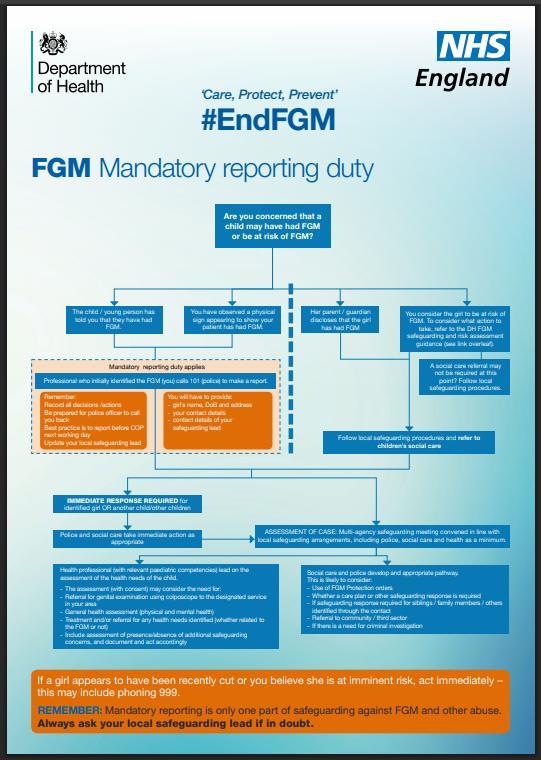
Appendix B: FGM Specialist Health Services and resources for staff
LONDON
African Well Women’s Clinic
Guys and St Thomas’s Hospital
Lambeth Palace Road
London SE1 7EH
0207 118 6872
African Well Women’s Clinic
Northwick Park & ST Mark’s Hospital
Watford Road, Harrow
Middlesex HA1 3UJ
0208 869 2880
Women’s and Young people’s Services
Sylvia Pankhurst Health Centre
Mile End Hospital
Bancroft Road
London E1 4DG
0207 377 7898
Gynaecology and Midwifery Department
Chelsea & Westminster Hospital
369 Fulham Road
London SW10 9NH
0203 315 8000
Waltham Forest African Well Women’s Services.
75 Oliver Road
Leyton
London E10 5LG
0208 430 8210
Resources for staff
Nurses and Midwives
African Well Women’s Clinic
Central Middlesex Hospital
Acton Lane Park Royal London NW10 7NS
0208 963 7180
African Well Women’s Clinic
Whittington Hospital
Highgate Hill
London N19 5NF
0207 288 3482
African Women’s Clinic
University College hospital
Elizabeth Garrett Anderson Wing London NW1 2BU
0845 155 500 ext 2531
Gynaecology Department
St Mary’s Hospital
Praed Street
London W2 1NY
0203 312 6907
Acton Health Centre
35-61 Church Road Acton
London W3 8QE
0208 383 8761
https://www.rcn.org.uk/professional-development/publications/pub-005447
Clinicians
https://www.rcog.org.uk/en/guidelines-research-services/guidelines/gtg53/
All staff
https://www.gov.uk/government/publications/multi-agency-statutory-guidance-onfemale-genital-mutilation
https://www.gov.uk/government/publications/safeguarding-women-and-girls-at-riskof-fgm
Appendix C: Routine Safe Enquiry Questions examples
Ask,
ask and ask again
Possible opening questions/statements:
Given the widespread nature of violence and abuse we routinely ask about risks at home is there anyone that makes you feel unsafe, scared or frightened?
Not everyone recognises they are in an abusive relationship does anyone control your everyday activities, put you down or make threats to you?
I’m sorry if someone has already asked you this and I don’t wish to cause you any offence, but because we know that violence at home is so common we ask everyone. Are you happy at home? Do you have any problems?
Since violence at home is common in many people’s lives, I ask all my clients about it and don’t wish to cause offence, do you feel safe and happy at home?
Do you ever change your behaviour because you are worried how someone at home might react
What is your home life/relationship like?
How are things at home?
Are you getting the support you need at home or how are you coping at home ?
Further possible questions
Have you been in a recent relationship where your partner threatened you with violence?
Have you been in a recent relationship where your partner has thrown, broken or punched things?
Are you currently in a relationship where this is happening to you?
Does your partner often lose their temper with you? If they do, what happens?
Does your partner often get jealous of you seeing you friends, talking to other people or going out? If so what happens?
Does your ex/partner or family member shout, swear or insult you?
Is your ex/partner or someone in your family very controlling or jealous of you?
Does your ex/partner or family member threaten you with harm?
Does your ex/partner or family member physically hurt you?
Do you ever feel frightened of your ex/partner or anyone else in your family?
Has your ex/partner or family member ever destroyed or broken things you care about? Threatened to hurt your children/pets/family?
Finally
What can I do for you? What support do you need? This is what I am going to do in response to what you have told me
Always
Consider any individual needs the service user may have and any specific needs that may require specialist support (e.g. cultural or language barriers, alcohol or drug dependency, disability, physical or mental illness)?
Remember your internal and organisational policies and procedures confidentiality and information sharing.
Be aware of local support services, consider DASH and MARAC.
Appendix D: Provide Point of Contact & External Support Agencies
If you require further support, please contact:
Provide Safeguarding Team
Provide Headquarters
900 The Crescent Colchester Essex, C04 9YQ
Tel: 0300 303 2642
Email: Provide.Safeguarding@nhs.net
External support agencies (details also on Provide Community Platform https://www.providecommunityplatform.co.uk/page/7553)
• Police ring 999 or 101 non-emergency line
• Compass (Essex Domestic Abuse Helpline 0330 333 7444 www.essexcompass.org.uk
• National Centre for Domestic Violence 0844 8044 999 www.ncdv.org.uk
• Women’s Aid 0808 2000 247 www.womensaid.org.uk
• Refuge. www.refuge.org.uk
• Police Domestic Abuse & Safeguarding Team 101 or emergency 999
• Stalking Helpline 0808 802 0300
• National Centre for Domestic Violence https://www.ncdv.org.uk/contact/
• Hourglass https://wearehourglass.org/hourglass-services (for older victims)
• Community Legal Advice. www.communitylegaladvice.org.uk
• Centre for Action on Rape and Abuse (CARA) 01206 367881 www.caraessex.org.uk
• Forced Marriage and Honour Based Violence
www.fco.gov.uk/forcedmarriage www.karmanirvana.org.uk www.hennafoundation.org www.southallblacksisters.org.uk
• LGBTQ+ Galop (Formerly Broken Rainbow) 0800 999 5428 Website https://galop.org.uk/
• Respect Male Victim Helpline 0808 801 0327
• Mankind (for male victims of abuse). www.mankind.org.uk
• https://www.pegsupport.co.uk/understanding-cpa (child to parent abuse)
• Perpetrator Programmes
The Change Project www.thechangeproject.org.uk
Respect Perpetrator Helpline 0808 802 4040 www.respect.uk.net
• FGM fgmhelp@nspcc.org.uk www.fco.gov.uk/fgm
• NSPCC 0808 800 5000
• Barnardos 0208 550 8822
• Childline 0800 11 11
Domestic abuse services in areas where Provide Community operate:
Cambridge and Peterborough Cambridge and Peterborough Domestic Abuse and Sexual Violence Partnership
https://www.cambsdasv.org.uk/web
Cambridge Women’s Aid 01223 361214
Peterborough Women’s Aid 01733 894964
Suffolk
Suffolk Domestic Abuse Helpline 0800 977 5690
https://www.suffolkdahelpline.org.uk/ Norfolk NIDAS freephone 0300 651 0555 Out of Hours 0808 2000 247 https://nidasnorfolk.co.uk/ Hertfordshire
Hertfordshire Domestic Abuse Helpline 0808 808 8088
https://www.hertsdomesticabusehelpline.org/ Dorset Paragon 0800 032 5204
https://paragonteam.org.uk/teams/dorset/
React Homecare areas
Scarborough North Yorkshire
Congleton Cheshire
Local domestic Abuse support
Independent Domestic Abuse services
https://idas.org.uk/contact/ helpline 03000 110 110
Scarborough office 01723 354 874
Cheshire Without Abuse https://www.mycwa.org.uk/professionals 24/7 helpline 0300 123 5101 Worksop Nottinghamshire Nottingham Women’s Aid https://nottswa.org 01909 533 610
24/7 freephone 0808 800 0340
Page 55 of 62
Doncaster Domestic Abuse Hub
https://www.doncaster.gov.uk/services/crime-antisocial-behaviour-nuisance/domestic-abuse-2 Link for self referral & practitioners referral form. 01302 737080
Brigg North Lincolnshire
Buxton Derbyshire
Buxton
Staffordshire
Loughborough Leicestershire
Blue Door helpline 0800 197 4787 Office 01724 841947
referral form: https://www.thebluedoor.org/
Safer Derbyshire
https://www.saferderbyshire.gov.uk/what-wedo/domestic-abuse/domestic-abuse.aspx 24/7 helpline 08000 198668
Staffordshire Women’s Aid: 0300 330 5959
https://www.staffordshirewomensaid.org/ ARCH 01782 205500
https://www.combined.nhs.uk/how-to-access-us-ina-crisis/patient-information/staffordshire-specialistdomestic-and-sexual-violence-resources/
Living Without Abuse
https://lwa.org.uk/professionals/ link for online referrals
office 01509 550317
Outreach service 0808 802 0028
Appendix E: DARDR Process
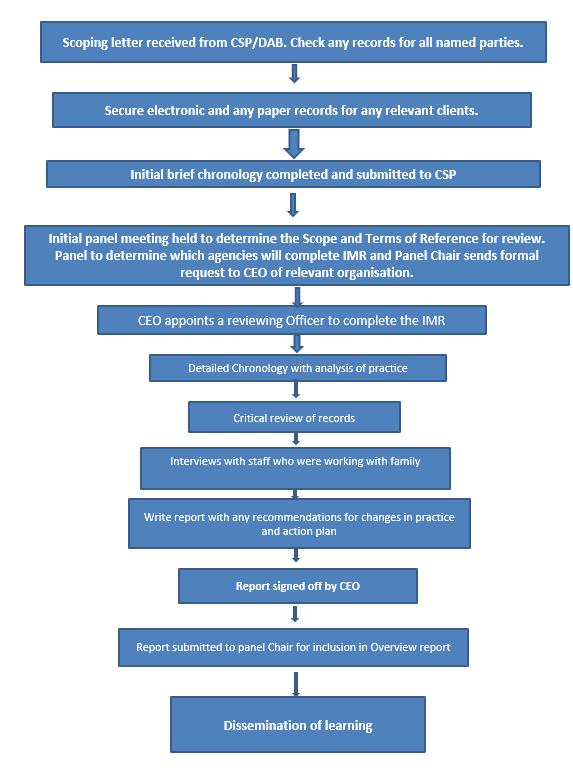
EQUALITY IMPACT ASSESSMENT TEMPLATE
Stage 1: ‘Screening’
The Equality Impact Assessment needs to be completed so that any decisions made are compliant with the aims of the Public Sector Equality Duty – and that any adverse impact for any protected characteristics are identified and resolved.
Policy Title
Domestic Abuse Policy
Provide a brief summary (bullet points) of the aims of the Policy
• To Improve staff awareness of how to recognise abuse or respond to a disclosure of Domestic Abuse, Including Forced Marriage, Honour Based Abuse and Female Genital Mutilation.
• To Safeguard Children and Adults with care and support needs who are Primary or secondary Victims of Domestic Violence or Abuse.
• To assist with managing cases of Domestic Abuse within the Provide Workforce
EQIA Assessor Name and Job Title Date of Assessment
Named Nurse Safeguarding Adults and Children 14/09/25
This stage establishes whether a proposed initiative will have an impact from an equality perspective on any particular group of people or community or whether it is “equality neutral” (i.e. have no effect either positive or negative)
Q1. Will this policy affect one of the following groups more or Less favourably than another?
Details
If more or less, explain impact and any valid legal and/or justifiable exception. Include the source of any evidence
Age
Consider impact and detail across age ranges on old and younger people. This can include safeguarding, consent and child welfare
Disability
Consider and detail impact on attitudinal, physical, and social barriers.
Sex
Consider and detail impact on men and women (potential to link to carers)
Gender reassignment (including transgender)
Consider and detail impact on transgender and transsexual people. This can include
issues such as privacy of data and harassment.
Pregnancy and maternity
Consider and detail impact on working arrangements, part-time working, infant caring responsibilities.
Race
Consider and detail impact on different ethnic groups, nationalities, Roma gypsies, Irish travellers, language and communication barriers.
Religion or belief
Consider and detail impact on people with different religions, beliefs or no belief.
Sexual orientation
Consider and detail impact on heterosexual people as well as lesbian, gay and bi-sexual people
Carers
Consider and detail impact on part-time working, shift-patterns, general caring responsibilities
Other identified groups
Consider and detail on different socioeconomic groups, area inequality, income, resident status (migrants) and other groups experiencing disadvantage and barriers to access.
Is the impact of the initiative – whether positive or negativesignificant enough to warrant a more detailed Stage 2 assessment? No
Guidelines: Things to consider
Equality impact assessments at Provide take account of relevant equality legislation and include age, (i.e. young and old,); race and ethnicity, gender, disability, religion and faith, and sexual orientation. The initiative may have a positive, negative or neutral impact, i.e. have no particular effect on the group/community.
Where a negative (i.e. adverse) impact is identified, it may be appropriate to make a more detailed EIA (see Stage 2), or, as important, take early action to redress this – e.g. by abandoning or modifying the initiative. NB: If the initiative contravenes equality legislation, it must be abandoned or modified.
Where an initiative has a positive impact on groups/community relations, the EIA should make this explicit, to enable the outcomes to be monitored over its lifespan.
Where there is a positive impact on particular groups does this mean there could be an adverse impact on others, and if so can this be justified? - e.g. are there other existing or planned initiatives which redress this?
It may not be possible to provide detailed answers to some of these questions at the start of the initiative. The EIA may identify a lack of relevant data, and that data-gathering is a specific action required to inform the initiative as it develops, and also to form part of a continuing evaluation and review process.
It is envisaged that it will be relatively rare for full impact assessments to be carried out at Provide. Usually, where there are particular problems identified in the screening stage, it is envisaged that the approach will be amended at this stage, and/or setting up a monitoring/evaluation system to review a policy’s impact over time.
QUALITY IMPACT ASSESSMENT TEMPLATE
Stage 2
To be used where the ‘screening phase has identified a substantial problem/concern)
This stage examines the initiative in more detail in order to obtain further information where required about its potential adverse or positive impact from an equality perspective. It will help inform whether any action needs to be taken and may form part of a continuing assessment framework as the initiative develops.
Policy/ Project Title
EIA Assessor Name and Job Title Date of Assessment
EIA Review by Chief Officer name and Job Title Date Of Review
Outcome of Chief Officer Review
Q1. What data/information is there on the target beneficiary groups/communities?
Are any of these groups under- or over-represented? Yes No
Do they have access to the same resources?
What are your sources of data and are there any gaps?
Yes
No
Q2. Is there a potential for this initiative to have a positive impact, such as tackling discrimination, promoting equality of opportunity and good community relations? Yes No
If yes, how? Which are the main groups it will have an impact on?
Q3. Will the initiative have an adverse impact on any particular group or community/community relations? Yes
No
If yes, in what way? Will the impact be different for different groups – e.g. men and women?
Q4. Has there been consultation/is consultation planned with stakeholders/ beneficiaries/ staff who will be affected by the initiative? Yes No
Summarise (bullet points) any important issues arising from the consultation
Q5. Given your answers to the previous questions, how will your plans be revised to reduce/eliminate negative impact or enhance positive impact?
Are there specific factors which need to be taken into account? Yes No
Q6. How will the initiative continue to be monitored and evaluated, including its impact on particular groups/ improving community relations? Where appropriate, identify any additional data that will be required
Guidelines: Things to consider
An initiative may have a positive impact on some sectors of the community but leave others excluded or feeling they are excluded. Consideration should be given to how this can be tackled or minimised.
It is important to ensure that relevant groups/communities are identified who should be consulted. This may require taking positive action to engage with those groups who are traditionally less likely to respond to consultations, and could form a specific part of the initiative.
The consultation process should form a meaningful part of the initiative as it develops, and help inform any future action.
If the EIA shows an adverse impact, is this because it contravenes any equality legislation? If so, the initiative must be modified or abandoned. There may be another way to meet the objective(s) of the initiative.