
Use of Restraint When Working Service Users
Version: V7
Ratified by: Strategic Safeguarding Group
Date ratified: 05/01/2026
Job Title of author: Safeguarding Adult Lead
Reviewed by Committee or Expert Group Strategic Safeguarding Group
Equality Impact Assessed by: Safeguarding Adult Lead
Related procedural documents

SGPOL02 Safeguarding Children and Young People Policy
QSPOL07 Consent to Examination and Treatment Policy
SGPOL09 Deprivation of Liberty Policy
SGPOL08 Domestic Abuse Policy
HSPOL08 Health & Safety at Work
IGPOL62 Information Governance Policy
SGPOL10 Mental Capacity Policy
HSPOL16 Violence and Aggression Policy
HSGUI01 Violent Patient Marker Guidelines
SGPOL18 Prevent Policy
QSPOL09 Risk Management Policy
HRPOL01 Speak Up or Whistle Blowing Policy
Mental Capacity Act 2005 Mental Capacity ActNHS (www.nhs.uk)
Review date: 06/01/2029
It is the responsibility of users to ensure that you are using the most up to date document template – i.e. obtained via the intranet.
In developing/reviewing this policy Provide Community has had regard to the principles of the NHS Constitution.
Version Control Sheet
Version Date Author Status Comment October2012 RobMilner Ratified New
V2 December 2014 Mohammmed Shofiuzzaman Ratified Review NotedatJan2015 Q&S
V2.1 April2016 Mohammed Shofiuzzaman Ratified Theguidancefrom NHSEnglandof ‘The Importance of vitalsignsduring andafterrestrictive interventions/manual restraint’ added as anappendices.
V3 July2018 Head of Safeguarding Ratified
V4 November 2018 Head of Safeguarding Amendment to ‘6. Rolesand Responsibilities’ para1-toreflecta specificrole.
V5 August2021 InterimHeadof Safeguarding Title changed to reflect all of our service users. Section added about restraint and capacity
V6 November 2022 Adult Safeguarding Lead Training process updated. Policy updated to reflect Provide Community Group.
V7 November 2025 Adult Safeguarding Lead Training process updated. Policy updated to reflect Provide Community Group.
Provide Group Safeguarding Assurance Oversight Structure

Provide Group Board Meets Bi -Monthly
• Receives escalations from QSC
• Discusses risks and areas for action where gaps in performance are identified with due regard to risk appetite and tolerance

Provide Group Quality and Safety Committee (QSC) Meets Monthly
• Receives escalations from SSG
• Identifies risks and areas for action where gaps in performance are identified
• Escalates exceptions to the Board


Provide Group Strategic Safeguarding Group (SSG) Meets Quarterly
• Reviews performance against safeguarding standards and statutory and regulatory compliance
• Devises and maintains oversight of safeguarding strategy for the Provide Group
• Agrees and Ratifies policies and training
• Produces a quarterly assurance report for QSC
1. Introduction
This policy sets out what Provide Community Group must do when working with other professionals and agencies to keep service users safe and prevent unnecessary restraint. We put service users’ welfare first and believe everyone has the right to feel safe and protected from harm. We aim to give people as much choice, control, and involvement in their care as possible, while respecting their human rights. Article 5 of the Human Rights Act protects the right to liberty, so no one should lose their freedom without a good reason. In healthcare, this matters most when a service user cannot consent to their care or treatment. In these situations, the Deprivation of Liberty Safeguards (DoLS) process may be needed to keep them safe. These safeguards make sure that depriving someone of their liberty is only used as a last resort, follows the law, and is checked by a court to prevent unfair treatment.
Provide Community Group believes these steps help meet each person’s needs and reduce the risk of abuse (CQC; Standard 7; 2010). Regulation 13 of the Health and Social Care Act 2008 (Regulated Activities) Regulations 2014 requires that service users are protected from abuse and improper treatment by having systems to prevent, investigate, and respond to any concerns or evidence of abuse. This means banning discrimination, unnecessary restraint, or degrading treatment, and making sure no one is deprived of their liberty without legal authority, as stated in the Mental Capacity Act 2005.
Provide Community Group supports the Restraint Reduction Network Training Standards (RRN Jan 2020). These standards make sure that all restraint training respects human rights and encourages a shift away from restrictive practices. The RRN says, “Importantly, a human rights approach also means involving the person in decision making and taking the least restrictive option (see Article 8, HRA (1998).” The RRN also states that restraint should only be used “as a last or emergency response,” and that we must avoid “blanket policies or standardised responses that [do] not allow consideration of the person’s situation.”
See Link to RRN standards The Restraint Reduction Network Training StandardsRestraint Reduction Network
2. Purpose
Provide Community Group are committed to:
• Ensuring the welfare of service users is always paramount
• Maximising people’s choice, control and inclusion and protecting their human rights.
• Promoting person centred, best interest and therapeutic approaches to supporting people when they are distressed.
• Increasing understanding of the causes of behaviour and recognition that a challenging behaviour is the result of an unmet need.
• Working in partnership to safeguard vulnerable adults and children
• Ensuring safe and effective working practices are in place
All staff should receive Human Rights-based Restraint Training, which does not endorse the use of restraint when withdrawal is a viable alternative.
3. Definitions
Restraint
‘Restraint’ is an act carried out with the purpose of restricting an individual’s movement, liberty and/or freedom to act independently. This may or may not involve the use of force, or resistance by the person being restrained, and may include indirect acts of interference for example removing someone’s walking frame to prevent them moving around. (Equality and Human Rights Commission 2019)
Restrictive interventions
are defined as a range of different approaches that limit an individual’s movement, liberty and/or freedom to act independently (Department of Health, 2014). Restrictive interventions include using the physical environment to stop a person from doing something i.e. bed rails, locking a door, using postural seating to contain someone, use of a harness in a wheelchair.
Reactive Strategies
Are strategies used to support a person when they behave in a way that challenges. NICE guidelines (NG11) 2020
Types of Restraint
Mechanical restraint involves ‘the use of a device (e.g. belt or cuff) to prevent, restrict or subdue movement of a person’s body, or part of the body, for the primary purpose of behavioural control’ (Clinical Quality Commissioner, 2015).
Clinical holding involves immobilisation, which may be by splinting, or by using limited force. It may be a method of helping children (and adults), with their permission, to manage a painful procedure quickly or effectively (Royal College of Nursing, 2010).
Chemical restraint refers to the use of medication which is prescribed and administered for the purpose of controlling or subduing disturbed/violent behaviour, where it is not prescribed for the treatment of a formally identified physical or mental illnesses (CQC, 2015).
Psychological restraint refers to practices that may be used covertly such as hiding medication in food or influencing a person’s choice e.g. ‘you don’t want to go out today do you?’
Challenging Behaviour any non-verbal, verbal, or physical behaviour exhibited by a person which makes it difficult to deliver good care safely. (NHS Protect, 2013)
Challenging Behaviour: Communication of an Unmet Need. (Alzheimer’s Society UK 2020)
4. Duties
The Provide Community Group Community, Group Chief Executive and wider Board members have key roles and responsibilities to ensure the Organisation meets requirements set out by Statutory and Regulatory Authorities such as the Department of Health & Social Care, Commissioners and the Care Quality Commission
The Provide Community Group, including the Chief Executive and Board members, does not endorse the use of Restrictive Physical Intervention (RPI) when withdrawal is a feasible alternative.
The Group Chief Executive has overall responsibility to have processes in place to:Ensure that staff are aware of this policy and adhere to its requirements and that appropriate resources exist to meet the requirements of this Policy. The Group Chief Executive may incur criminal liability if the specified requirements are not fulfilled.
The Group Chief Officers are responsible for ensuring that all operational managers in their area are aware of this policy, understand its requirements and support its implementation.
Team Managers are responsible for implementing the policy and ensuring that relevant assessment tools are readily available to allow staff to carry out the duties prescribed in this policy.
Ward/Department Managers and other senior ward staff are responsible for recognising any instance of possible Restraint/Deprivation of Liberty in the clinical area and ensuring that all Provide Community Group and Local authorities’ policies and procedures are followed.
All Staff have a responsibility to provide safe and effective care, while working within the law and respecting the human rights of individuals. Each person is accountable for the decisions they make and the consequences of those decisions.
All staff have a duty to follow the guidance in this policy and this includes:
• All Provide Community Group commissioned services (adult and children)
• Provide Community Group Specialist Learning Disability services.
• Services that work in partnership with Provide Community Group
• Temporary, voluntary, contracted, or self-employed staff working on behalf of Provide Community Group
• Bank/agency staff working on behalf of Provide Community Group
5. Legal Framework
All staff must ensure that any restraint or restrictive practice should only be carried out where it is legally and ethically justified.
The use of all forms of physical intervention and physical contact are governed by criminal and civil law. The unwarranted or inappropriate use of force may constitute an assault. (DOH 2018)
Restraint must be unavoidable to prevent serious harm to a person, and it must be the least restrictive option.
Staff must draw on several legislative frameworks and Provide Community Group Policies to work within, including:
Human Rights Act 1998 Protects individuals from inhumane or degrading treatment. Unlawful or excessive restraint may breach Article 3 (prohibition of torture) and Article 5 (right to liberty).
Mental Capacity Act 2005 Allows restraint only if:
• The person lacks capacity to consent.
• The restraint is in their best interests.
• It is necessary and proportionate to prevent harm.
Health and Social Care Act 2008 (Regulated Activities) Regulations 2014 Requires care providers to ensure safe, person-centred care. Regulation 13 specifically addresses safeguarding from abuse, including improper restraint.
Equality Act 2010 Ensures individuals are not discriminated against when restraint decisions are made.
Care Quality Commission (CQC) Guidance Emphasises that restraint must be the least restrictive option, used for the shortest time, and thoroughly documented. Providers must have a restraint reduction programme and staff must be trained.
NICE Guidelines NG11 and NG93 Offer best practice on managing challenging behaviour and promoting positive behaviour support.
Domiciliary Care Agencies Regulations 2002 Sets standards for care agency conduct, including safeguarding, staff fitness, and quality of service provision
Staff must always judge whether restrictive interventions are acceptable and legitimate based on all presenting circumstances. Therefore, restraint should not be used if a less restrictive alternative is available. Employing restraint in such circumstances may constitute assault. All use of restrictive interventions must be escalated to the management and safeguarding team; Datix must be completed; immediate action must be taken as per Provide Community Group safeguarding Policy.
6. Applying Restrictive Intervention
Restrictive intervention or Restraint may include physically preventing a service user from doing something (pulling them away from a situation), using the physical environmental to contain someone (use of bed sides, locking a door), threatening or taking an action to control someone’s behaviour (calling the police) or medication may be used as a restriction to manage the service user’s behaviour or restrict his/her freedom of movement.
Restrictive interventions should only be used where there is a real possibility of harm to the person or to staff, the public or others. All staff must have positive and proactive approaches to ensure physical interventions are only ever used as a last resort when all other alternatives have been attempted and only then for the shortest possible time.
To reduce the needs for restrictive intervention/restraint staff must understand that a person’s ‘challenging behaviour’ is the result of an unmet need. Emphasis must be placed on understanding causes of behaviour, meeting needs, prevention, and deescalation techniques. People who present with behaviour that challenges are at higher risk of being subjected to restrictive interventions. Staff who understand that a person’s ‘Challenging behaviour’ is communication of an unmet need; are more likely to investigate the underlying cause rather than attempting to control and restrict the behaviour. Restraint reduction network. (RRN)2020.
Care is needed that the behaviour is not because of an underlying illness or injury which needs urgent attention.
Identifying patterns to predict when challenging behaviour is more likely to occur can assist care planning, preventing, and preparing for it. Understanding how to respond to people with challenging behaviours with recognised strategies such as Positive Behaviour support plans (PBS) (see appendix B), promotes inclusion, choice, and equality.
Where there is a reasonable and foreseeable need for any physical intervention, a Personal Safety Support (PSP) will be developed by key staff and include the person supported, family, advocate, etc, where appropriate. A risk assessment can also be carried out to ensure the interventions deemed necessary, as a last resort, do not conflict with any known elevated risks presented by the individual.
It is important for staff to be able to recognise urgent situations where physical intervention and/or chemical interventions are required. Clinical staff need to be confident about when these short-term intervention strategies are required. immediate control of a dangerous situation and when they are not required, i.e. where deescalation, non- pharmacological means, or use of more routine medication (e.g. pain relief) should be attempted first also during care planning, ‘advance decisions’ may be considered.
To deliver Positive and Proactive care, all staff must follow six key principles as suggested by the Department of Health (2014):
• Staff actions must always comply with the relevant rights in the European Convention on Human Rights
• All staff must work towards understanding people’s unique behaviour and needs; service users’ aspirations, experiences and strengths must be recognised to enhance their quality of life
• Service users must be included in the decision-making process, even if they lack capacity, including their families, carers, and advocates (wherever practicable and subject to the person’s wishes and confidentiality obligations)
• Everybody must be treated with compassion, dignity, and kindness
• All staff must support service users to balance safety from harm and freedom of choice
• Therapeutic relationships must be maintained between staff and service users
In all situations, where any form of restraint is unavoidable, staff should only ever act within their competence/skills/training and according to their delegated responsibility. Risk assessment must be completed to consider the likelihood and consequences of challenging behaviour and implementing appropriate measures to avoid, mitigate or control the risks. Protective factors such as greater collaboration with other colleagues or services, and family involvement must be explored.
In all use of unplanned restraint staff should: The terminology in this context is complex. A restraint may be classified as planned if it has previously occurred
with the individual or is included in a care plan. Therefore, the restraint of an individual should only be considered unplanned on the first occurrence.
• inform and communicate with Safeguarding Team
• inform line manager and Head of Service
• complete a DATIX
• Refer to: Safeguarding Adults at risk of abuse Policy (SGPOL07); DOLs policy (SGPOLO9); Mental Capacity Act 2005 & Policy (SGPOL10); Safeguarding Children & Young People (SGPOL02)
In emergency situations:
The priority is to ensure that staff, the service user and others in the vicinity (including visitors) are cared for and safe
A senior member of staff should act as a single point of contact, coordinator, and decision maker during the incident, with an overall view of events
Continue to make constant attempts to calm and de-escalate
Consider physical intervention and/or pharmacological management within the overall context of the behavioural and medical management
If the situation becomes dangerous:
• Consider calling for help, activating an alarm, or leaving the area
• Request assistance from security staff (where available)
• Call the police
Physical restraint should only be used to manage an emergency of immediately apparent risk to the health, safety and wellbeing of the service user, staff or third parties. Dynamic risk assessment is needed to determine if the service user or service user’s challenging behaviour is due to an acute illness which could be potentially life threatening and must receive urgent attention. In this situation, emergency physical intervention and rapid tranquillisation may be essential to provide treatment. Not to act in these circumstances could constitute a breach of their duty of care under common law (NHS Protect 2013; RCN 2008). This situation will be led by medical staff.
Staff must be aware that where physical intervention involves what is perceived as minimum force (e.g. something as innocuous as holding a wrist), used against the vulnerable/older person may lead to injuries such as bruising, skin tears and fractures.
Face-down restraint-prone restraint is when someone is pinned on a surface usually the floor and is physically prevented from moving out of this position. This form of restraint is highly dangerous and can result in compression of the chest and airways, putting the person at high risk of harm or death. (www.gov.uk) New drive to end deliberate face down restraint. 2014)
Supine restraint, restraints on the side and standing restraints carry different risks which can also be life threatening. A misapplication of a seated restraint however will be significantly more impactive on lung function than a correctly applied prone restraint (Parkes 2011). This is of course exacerbated by a high BMI,
Many people think prone restraint is banned, but that is not true. When a policy says 'no prone,' staff may still use it in secret. It can happen if a standing restraint ends up on the ground, or if staff have used prone before and feel safer with it. The problem is that staff may not have been trained in this technique, which makes it much less safe.
There is also a risk that teams will report fewer incidents because they do not want to admit using prone restraint.
A strict 'no prone' rule can also stop us from giving person-centred care. For example, someone who has been sexually assaulted or abused might find the face-up position traumatic. Other health issues, like trouble swallowing or a curved spine, should be taken into account too.
Prone restraint is dangerous, but so are all restraint positions. We should avoid prone in the same way we try to avoid any restraint. If we single out one position as bad, it can make it seem like the others are safe, which is not true.
Any form of physical interventions must always be in line with NICE Guideline Violence and aggression: short term management in mental health, health and community settings NG10 (NICE 2015) and should be:
• Withdrawal is less restrictive.
• Necessary, justifiable, and proportionate
• Conducted by appropriately trained and competent staff
• Combined with Positive engagement and strategies to continuously deescalate
• Carried out using the least restrictive interventions
• Used for the minimum amount of time, with minimum amount of force
• Done to enable staff to continually monitor the service user for signs of medical or physical distress – (Appendix C)
• Formally recorded as soon as possible after the event
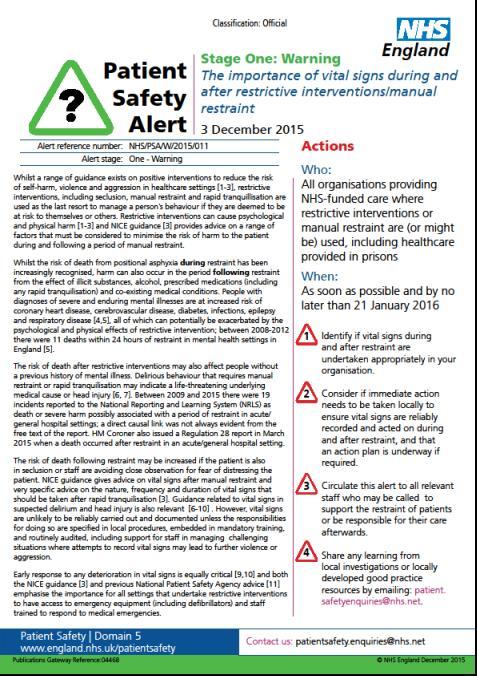
Vital signs must be checked during and following a period of restrictive intervention/manual restraint and recorded within the service user record, if National Early Warning Score (NEWS) is followed, clinical response to NEWS triggers must be outlined. If NEWS is not used the frequency of checking vital signs should be increased and abnormalities immediately escalated to a senior clinician. (Appendix C) NHS England Patient Safety Alert: NHS/PSA/W/2015/011 – The importance of vital signs during and after restrictive interventions/manual restraint.
7. Restraint and Mental Capacity
It is recognised that sometimes staff may have to consider reactive strategies to ensure a person who lacks capacity is safe and cared for when they behave in a way that challenges.
The Mental Capacity Act (2005) states that restrictions and restraint can be used in a person’s support, but only if they are in the best interests of a person who lacks capacity to make the decision themselves. The Act states that any such restrictions or restraint must be proportionate to the harm the care giver is seeking to prevent, and may include:
• the use of some medication, for example, to calm a person
• close supervision in the home.
• requiring a person to be supervised when out
• physically stopping a person from doing something which could cause them harm
• removing items from a person which could cause them harm
• holding a person so that they can be given personal care, support or treatment
• bedrails, wheelchair straps, restraints in a vehicle, and splints
Such restrictions or restraint can take away a person's freedom and so deprive them of their liberty. Therefore, robust risk assessment should include procedures for increasing personal space, disengagement from grabs or holds, prn medication or more restrictive intervention. Staff will ensure multidisciplinary/specialist approach to care planning, as well as continual involvement of the person and their family or carers. Regular review and re assessment must be carried out in line with NICE guidelines Challenging behaviour and learning disabilities: Prevention and interventions for people with Learning disabilities whose behaviour challenges. (NG11)
Staff must follow the guidance in Provide Community Group Mental Capacity (SGPOL10) policy and in Provide Community Group Deprivation of Liberty (SGPOL09) Policy.
8. Restrictive Physical Intervention and Therapeutic Holding for Children and Young People
Every child and young person have a right to be treated with respect and dignity, and deserves to have their needs recognised and be given the right support. Some children and young people with learning disabilities, autistic spectrum conditions or mental health difficulties may react to distressing or confusing situations by displaying behaviours which may be harmful to themselves and others and are at heightened risk of restrictive intervention to minimise the impact of their behaviour, on them and on other people. (Reducing the need for Restraint- Children and Young people with Learning disabilities and or Autism in health and social care settings. HM Government 2019)
In any situation staff must act in line with Working Together (HM Government 2015): ‘everyone who works with children has a responsibility to keep them safe.
Every child and young person have a right to be treated with respect and dignity, and deserves to have their needs recognised and be given the right support. Some children and young people with learning disabilities, autistic spectrum conditions or mental health difficulties may react to distressing or confusing situations by displaying behaviours which may be harmful to themselves and others and are at heightened risk of restrictive intervention to minimise the impact of their behaviour, on them and on other people. (Reducing the need for Restraint- Children and Young people with Learning disabilities and or Autism in health and social care settings. HM Government 2019)
In any situation staff must act in line with Working Together (HM Government 2015): ‘everyone who works with children has a responsibility to keep them safe.’
• A focus on the child or young person’s safety and welfare should underpin any use of restraint
• Children, young people, and staff, should be treated fairly and with dignity and respect
• Staff should implement a proactive approach to supporting children whose behaviour challenges using positive behaviour support and other alternatives which can de-escalate challenging behaviour and tackle the reasons for it at source.
• Minimising the risk of harm to children, young people and staff should be a key priority
• The needs and circumstances of individual children and young people should be considered and balanced with the needs and circumstances of others because decisions on whether to restrain or intervene with an individual may affect others, including staff
• Where possible, a decision to restrain a child or young person should be based on their best interests balanced against respecting the safety and dignity of all concerned, including other children, young people or adults present. (DOH, 2018)
• Children and young people with Learning Disabilities, Autism and or mental health problems may respond with behaviours that challenge when they are in pain or experiencing sensory overload or when they are in a situation they don’t understand. Staff should be able to identify triggers for the child by working closely with them and their families, to help prevent their distress. (Appendix D)
Sometimes staff may need to implement physical intervention in a non-urgent situation for a particular clinical procedure which is also known as therapeutic holding (RCN 2010), for example during immunisation, Blood tests, casting for Orthotics.
Even during the event of therapeutic holding staff must recognise that this is a form of restraint and they must:
- consider whether the procedure is necessary, and explore alternatives
- Ask the question what is in the best interest of the child and/or those around them in view of the risks presented?
- anticipate and prevent the need for holding by giving the child information, encouragement, distraction
- all but the very youngest children, obtain the child’s consent or assent, even if parental consent has been taken
- for any situation which is not a real emergency seek the parent/carer’s consent, or the consent of an independent advocate (the appropriate person with legal authority)
- make a written agreement beforehand with parents/guardians and the child about what methods will be used, when they will be used and for how long
- ensure parental presence and involvement. Parents/guardians should not be made to feel guilty if they do not wish to be present during procedures.
- Make skilled use of minimum pressure and other age-appropriate techniques
- Explain and prepare the child and parents beforehand
- Ensure robust documentation
Staff should be aware that Therapeutic holding is restraint; and that it is sometimes the only realistic response to a situation for example: if a child runs into a road, or if a child is attacking another child or staff member and refuses to stop.
The techniques used to restrain or restrict liberty of movement must be reasonable and proportionate to the circumstances, risk and seriousness of harm; and be applied with the minimum force necessary, for no longer than necessary, by appropriately trained staff. (DOH, 2018).
9. Post Incident Review
Post incident review requirements for all staff are outlined in NICE guidance NG10 and QS154 (NICE, 2015a, 2017b). All managers will ensure that staff involved in any restraint incident get an opportunity to take part in a post incident review; this has two purposes:
• Attention to physical and emotional well-being of the individuals involved
• Reflection and learning review
Every team must ensure that appropriate lessons are learned when incidents occur where restrictive interventions have had to be used.
Reviews must:
• Evaluate the physical and emotional impact on all individuals involved (including service user, staff, and any witnesses
• Identify if there is a need for counselling or support
• Help service users and staff to identify what led to the incident and what could have been done differently- what de-escalation techniques were used?
• Determine whether alternatives, including withdrawal or less restrictive interventions, were considered
When reviewing plans for restraint with children and young people, those with parental responsibility or, where appropriate, advocates should be involved
10.Training
All Restraint training must be provided with clear reference to supporting an overall human rights-based approach, focused on the minimisation of the use of restrictive interventions, and ensuring any use of restrictive interventions and other restrictive practices is rights-respecting. (RRN 2020).
All staff currently complete Conflict resolution training as part of induction. Staff who have contact with service users and service users should be trained so they are equipped to recognise, prevent and manage challenging behaviour. The level of training staff should attend depends on their specific roles and responsibilities and needs
Qualified and experienced staff may already have much of the core knowledge and skills required, but they may require further training due to their clinical role.
The Learning and Development lead and the Social Care Trainer are working with specialists’ providers to ensure Restraint training is in line with the Restraint Reduction Network (RRN) Training Standard. (January 2020).
It is proposed that all service user facing staff will receive Restraint training that meets Tier Two RRN requirements as required.
Specialist Learning Disability Services
Staff working in Provide Community Group Learning Disability services; which covers residential and supported living, will receive Tier Three training as specified by the RRN. (Appendix E) This training is based around positive and safer approaches to behaviour. A robust Training Needs Analysis (TNA) and Risk Assessment will be completed around the specific requirements of the service in terms of individual service user need.
11.References
Department of Health (2014), Positive and Proactive Care: reducing the need for restrictive interventions
Department of Health and Department for Education (2018) Draft: Reducing the Need for Restraint and Restrictive Intervention. Children and Young people with Learning Disabilities, Autistic Spectrum Disorder and Mental Health Difficulties.
HM Government (2015), Working together to Safeguard Children.
HMSO (1998) Human Rights Act. London
Mental Capacity Act (2005), Deprivation of Liberty Safeguards Code of Practice. London
Mental Capacity Act (2005), Code of Practice. London
NHS Protect (2013), Meeting needs and reducing distress. London
RCN (2008), Let’s talk about restraint. London
NICE Guidelines Challenging behaviour and Learning disabilities: prevention and interventions for people with learning Disabilities whose behaviour challenges. 2020 (NG11)
NICE Guidelines short term management of violence and aggression in adults’ young people and children. (NG10) 2015
Restraint Reduction Network (RRN)Training Standards (January 2020)
The Health and Social Care Act 2008 (Regulated Activities) Regulations 2014