
Being Open and Duty of Candour Policy
Version: V8
Ratified By: Quality & Safety Committee
Date ratified: 25/03/2025
Job Title of Author: Director Nursing & Allied Health Professions
Reviewed by Subgroup or Expert Group: Clinical Reference Group
Equality Impact Assessed by: Director Nursing & Allied Health Professions
Related Procedural Documents:

QSPOL09 Risk Management Policy
QSPOL01 Incident Reporting & Management Policy
CSPOL01 Complaints & Compliments Policy
CSSOP01 Procedure for Managing Complaints and Compliments
QSPOL07 Consent to Examination or Treatment Policy
Review Date: 25 March 2028

It is the responsibility of users to ensure that you are using the most up to date document template – i.e. obtained via the intranet.
In developing/reviewing this policy Provide Community has had regard to the principles of the NHS Constitution.
Version Control Sheet
Version Date
Author Status Comment
V1 Mid Essex PCT Ratified
V2 Feb 2010 Senior governance manager Ratified Adopted to CECS from MEPCT
V3 March 2011 Senior Governance Manager Ratified
V4 April 2013 Senior Quality & Safety Manager Approved
Revised in line with Transition to CECS CIC
Revised following publication of Francis Report 2013.
V4.1 May 2013 Senior Quality & Safety Manager Approved Inclusion of Appendix E: Being Open Letter
V4.2 Sept 2013 Safety & Quality Administrator No change to review date
Updated in line with organisational name change and re-structure
V5 March 2016 Head of quality and safety Ratified Amalgamation of being open and duty of candour policies and review
V6 April 2018 Head of Quality Assurance / Quality Performance Analyst Ratified
Change to reflect best practice in Duty of candour as reflected by CQC
V7 March 2021 Serious Incident Investigator Ratified Review
V8 Feb 2025 Director Nursing & Allied Health Professions
Redrafted to simply wording to align to CQC Regulation 20 rather than this being embedded as a link in the appendix. Updated references Updated to a Provide Group policy and to align to the updated Provide Group Incident Management Policy QSPOL01
1. Introduction
Provide is committed to supporting people when things go wrong with their care and understands the importance of being open and transparent in admitting mistakes and learning from them to improve the services being delivered.
It is important that all those affected by an incident receive appropriate support to manage the impact of the event including receiving a prompt explanation and a meaningful apology. While we cannot change what has happened, a caring and compassionate response is in our gift, and it is an important first step in responding to any incident
The Duty of Candour applies toeveryhealthandsocial careproviderthattheCareQuality Commission (CQC) regulates The statutory duty of candour is a general duty for providers of Health and Social care services to be open and transparent with people receiving care from them.
It is an offence for a CQC registered organisation to fail to comply with this duty. Failure to comply can result in enforcement activity ranging from Warning or Requirement Notices to criminal prosecutions and fines
2. Scope
The duty of candour requires all providers registered by the CQC and all CQC registered managers (known as ‘registered persons’) to act in an open and transparent way with people receiving care or treatment from them. The regulation also defines ‘notifiable safety incidents’ and specifies how registered providers and registered persons must apply the duty of candour if these incidents occur.
This policy has been developed to ensure that all staff across the Provide Group are aware of the requirement to be open and honest and the processes to follow to ensure they meet the requirements of the duty of candour.
3. Responsibilities
The Group Chief Executive Officer is accountable for ensuring the Duty of Candour is understood and enacted appropriately across the organisation in line with the legal and statutory requirements of the Health Care Act and CQC Regulation 20.
Group Chief Officers and Service Directors are responsible for are responsible for promoting an open, honest and fair culture within the organisation. They are also responsible for ensuring all incidents that occur are dealt with effectively, ensuring openness and honesty when things go wrong and ensuring the duty of candour requirements are fulfilled where appropriate.
All staff have a role to play in managing safety incidents. It is the responsibility of all staff to participate in the implementation of this policy when they become aware of a safety incident. Where staff have a professional registration, they must ensure they adhere to their professional codes and standards and the professional duty of candour.
4. Statutory and Professional Duties of Candour
There are two types of duty of candour, statutory and professional. Both the statutory duty of candour and professional duty of candour have similar aims – to make sure that those providing care are open and transparent with the people using their services, whether or not something has gone wrong.
The CQC regulate the statutory duty, while the professional duty is overseen by regulators of specific healthcare professions such as the General Medical Council (GMC), Nursing and Midwifery Council (NMC) and the General Dental Council (GDC).
Professional Duty of Candour
Every health or social care professional must be open and honest with service users’ when something that goes wrong with their treatment or care causes, or has the potential to cause, harm or distress.
Openness and honesty towards service users is a key element of the code of professional standards of Professional Bodies including the Nursing and Midwifery Council (NMC), the Health and Care Professions Council (HCPC) and the General Medical Council (GMC). In addition it is supported and encouraged by the Medical Protection Society (MPS), The Medical Defence Union (MDU), and NHS Resolution
The professional duty of candour requires registrants to:
• Tell the service user (or, where appropriate, the service user’s advocate, carer or family) when something has gone wrong
• Apologise to service user (or, where appropriate, the service user’s advocate, carer or family)
• Offer an appropriate remedy or support to put matters right (if possible)
• Explain fully to service user (or, where appropriate, the service user’s advocate, carer or family) the short and long term effects of what has happened
• Registrants must also beopen and honest with their colleagues, employersand relevant organisations, and take part in reviews and investigations when requested. They must also be open and honest with their regulators, raising concerns where appropriate. They must support and encourage each other to be open and honest and not stop someone from raising concerns
The Statutory Duty of Candour
Regulation 20 of the Health and Social Care Act 2008 (Regulated Activities)
Regulations 2014 sets out the requirement for health and social care providers to be to be open and transparent with people receiving care when things go wrong.
Note: if multiple providers contributed to the harm, they should liaise and work together in the investigation that follows as they would for any other incident. Each provider still has its own responsibilities under the duty of candour. They must assure themselves that they have met them.
Click here to enter text.
5. Being Open
Openness about what happened and discussing safety incidents promptly, fully and compassionately can help the people affected cope better with the after-effects. The Being Open process begins with the recognition that something unintended or unexpected has happened while delivering care which could have or did lead to harm.
Openness when things go wrong is fundamental to the partnership between service users and those who provide their care.
All staff are also encouraged to act in a similar manner with respect to complaints ensuring openness and transparency when responding to concerns raised.
6. The Statutory Duty of Candour Process
The following Definitions are used within the duty of candour regulations:
• Relevant person – this is either the person who was harmed or someone acting lawfully on their behalf
• Notifiable Safety Incident – this is a specific term defined in the duty of candour regulation. It should not be confused with other types of safety incidents or notifications
Criteria for a Notifiable Safety Incident
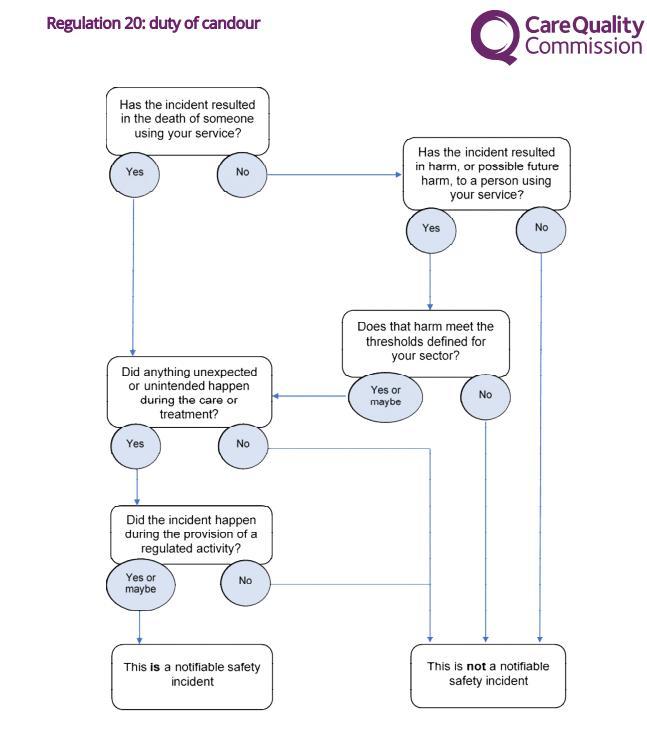
A notifiable safety incident must meet all 3 of the following criteria:
• It must have been unintended or unexpected.
• It must have occurred during the provision of an activity the CQC regulates
• In the reasonable opinion of a healthcare professional, it already has, or might, result in death, or severe or moderate harm to the person receiving care.
If any of these three criteria are not met, it is not a notifiable safety incident (but remember that the overarching duty of candour, to be open and transparent, always applies).
You should interpret "unexpected or unintended " in relation to an incident which arises in the course of providing care or treatment, not to the outcome (harm that occurred or could have occurred.) So, if the treatment or care provided went as intended, and as expected, an incident may not qualify as a Notifiable Safety Incident, even if harm occurred.
For Levels and definitions of harm see QSPOL01 Provide Group Incident Reporting and Management Policy
CQC Threshold for a Notifiable Safety Incident
In the reasonable opinion of a healthcare professional, the incident appears to have resulted in, or requires treatment to prevent:
• the death of the person - directly due to the incident, rather than the natural course of the person's illness or underlying condition
• the person experiencing a sensory, motor or intellectual impairment that has lasted, or is likely to last, for a continuous period of at least 28 days
• changes to the structure of the person's body
• the person experiencing prolonged pain or prolonged psychological harm, or
• a shorter life expectancy for the person using the service.
If a safety incident is identified you must start the duty of candour process as soon as reasonably practicable. Where no harm or low harm has occurred, the staff on duty
are best placed to inform the relevant person (in person) about what went wrong and to offer a meaningful apology and agree a plan of how they will put things right They should follow this up by reporting the incident to the service manager and recording the incident and the verbal apology given on the Datix or Access Incident Reporting System as appropriate
Where a notifiable safety incident has occurred you must start the duty of candour process as soon asreasonably practicable. If this occurs the staff on duty should inform the relevant person (in person) as soon as possible and should offer an initial apology and answer any immediate questions they may have. They should also report the incident to the service manager and Service Director without delay in hours or to the on-call manager out of hours and record the incident and initial apology on the Datix or Access Incident Reporting System as appropriate. Depending on the severity of the incident, the relevant Chief Officer will be informed by the Service Director /on-call Director
The Relevant Chief Officer and Service Director must consider the severity of the incident and the harm that has occurred to ensure an appropriately senior person/persons carries out the duty of candour. They must do this compassionately and with honesty and transparency. In all cases, the designated staff appointed to carry out the duty of candour must be appropriately qualified, well prepared and supported and they must keep a good record all meetings and communications with the relevant person. The Director of the service will be responsible for ensuring that the duty of candour as set out in Regulation 20 of the CQC and summarised below is completed.
As soonasreasonablypracticable after becoming awarethat anotifiable safety incident has occurred you must:
1. Act in an open and transparentway with the relevant person in relation to care and treatment provided
2. Notify the relevant person that the incident has occurred. This should be done in person by one or more representatives of the organisation
3. Include an Apology
4. Provide a true account of what happened, explaining whatever you know at that point to the best of your knowledge
5. Explain whatfurther enquiries or investigations intothe incident youbelieve to be appropriate.
6. Follow up in writing Provide the above information, along with details of any enquiries to be undertaken, the results of any further enquiries into the incident, and an apology It is important to ensure that the relevant person is given the name and contact details of someone in the organisation who will be responsible for keeping them up to date with any enquiries or who can respond to any queries they may have.
7. Keep a secure written record of all meetings and communications with the relevant person.
The purpose of these meetings and communications is to share whatever is known about the incident truthfully, openly and with compassion and support. The person who was harmed has a right to understand what has happened to them. The meeting is not about tryingtoapportionblame,andinanycase,itislikelythatinvestigationswillstillbeunderway at this point.
Throughout the process you must give ‘reasonable support’ to the relevant person, both in relation to the incident itself and when communicating with them about the incident. ‘Reasonable support’ will vary with every situation, but could include, for example:
• environmental adjustments for someone who has a physical disability
• an interpreter for someone who does not speak English well
• information in accessible formats
• signposting to mental health services
• the support of an advocate
• drawing their attention to other sources of independent help and advice such as AvMA (Action against Medical Accidents) or Cruse Bereavement Care.
• If the relevant person consents, family members and carers should be involved in anydiscussions.Itisabouttakingreasonablestepstomakesureyoucommunicate in a way that is as accessible and supportive as possible.
The duty of candour must be carried out with the relevant person in the first instance but may be conducted with someone acting on their behalf if the relevant person
• has died,
• or lacks capacity and is over 16
• or is under 16 and not competent to make decisions about their care or the consequences of the incident
Completing the process
All notifiable safety incidents should be investigated appropriately and proportionately to identify learning and improve quality and safety in line with the processes set out in the Provide Group Incident Management policy QSPOL01 The relevant person should be asked what information they want to share and what questions they would like to have answered by the investigation
The outcome of any investigation should be shared with the relevant person The outcome should be shared in a way that meets the communication needs and preferences of the relevant person and their wishes. Consideration should be given to the severity of the incident when sharing outcomes to ensure it is done compassionately and with care, helping people to understand the information being presented and giving them opportunities to ask questions and provide feedback.
For less severe incidents or if preferred by the relevant person, the outcomes may be shared in writing via a closure letter which includes a final meaningful apology and an offer to meet in person at a later date if they wish to discuss any questions they may have.
For a more significant event or where an investigation has been complex or may contain information about significant failings in care it would be more appropriate to arrange to meet face to face to share the outcomes in order that appropriate support and time for questions is created and a meaningful apology can be given verbally ahead of a final closure letter being sent which reiterates the final apology.
7. When Duty of Candour cannot be Achieved
Regulation 20(5)1 of the Health and Social Care Act 2008 (Regulated Activities) Regulations 2014 sets out that it is acceptable not to undertake duty of candour if the relevant person cannot be contacted in person or declines to speak to the representative of the organisation. In this case:
• The organisation must make every reasonable attempt to contact the relevant person through all available means of communication. All attempts to contact the relevant person must be documented.
• If the relevant person does not wish to communicate with the provider, their wishes must be respected and a record of this must be kept.
• If the relevant person has died and there is nobody who can lawfully act on their behalf, a record of this should be kept.
8. Saying Sorry
Saying sorry is not admitting fault
"Apology" means an expression of sorrow or regret in respect of a notifiable safety incident. People are sometimes uncertain about how to apologise when an incident is still being investigated. But from the start, simple straightforward expressions of sorrow and regret can and should be made for the harm the person has suffered.
A crucial part of the duty of candour is the apology. Apologising is not an admission of liability. This is the case, regardless of whether you are in the health or social care, or public or private sectors. In many cases it is the lack of timely apology that pushes people to take legal action. To fulfil the duty of candour, you must apologise for the harm caused, regardless of fault, as well as being open and transparent about what has happened. NHS Resolution is the organisation that manages clinical negligence claims against the NHS. Their ‘Saying Sorry’ leaflet confirms that apologising will not affect indemnity cover: “Saying sorry is:
• always the right thing to do
• not an admission of liability
• acknowledges that something could have gone better
• the first step to learning from what happened and preventing it recurring.”
Service users, their families and carers should receive a meaningful apology – one that is a sincere expression of sorrow or regret for the harm that has resulted from a safety incident. This should be in the form of an appropriately worded and agreed manner of apology as early as possible.
Verbal apologies are essential because they allow face-to-face contact between the service user, their family and carers and the healthcare team. This should be given as soon as staff become aware an incident has occurred. A written apology, which clearly states that Provide is sorry for the suffering and distress resulting from the incident, must also be given.
9. Truthfulness, Timeliness and Clarity of Communication
All information provided to the relevant person or someone acting on their behalf should always by truthful and provided in a way people understand and meets their communication needs and preferences.
It is also essential that any information given is based solely on the facts known at the time. Healthcare professionals should explain that new information may emerge as an incident investigation is undertaken, and that they will be kept up to date with the progress of any investigation.
People should be given a single point of contact for any questions or requests they may have. They should not receive conflicting information from different members of staff, and the use of medical jargon, which they may not understand, should be avoided.
It is important not to delay giving a meaningful apology for any reason as delays are likely to increase the anxiety, anger or frustration felt by the person affected and their family or carers. Patient and public focus groups reported that patients were more likely to seek medical legal advice if verbal and written apologies were not delivered promptly.
10. Continuity of Care
The relevant person is entitled to expect that they will continue to be treated with dignity, respect and compassion following an incident and that their care will not be impacted as a result. If the relevant person expresses a preference for their care needs to be taken over by another team, this should be considered and where possible the appropriate arrangements should be made for them to receive care or treatment elsewhere. If, exceptionally, this is not possible, the reasons should carefully be explained to the relevant person and documented.
11.Keeping Good Records
The duty of candour regulation requires that a secure written record of all meetings and communications with the relevant person are kept It is everyone’s responsibility to ensure thatgoodrecordkeepingismaintainedthroughoutcaredeliveryandwhenasafetyincident occurs it is essential that details of what has occurred and how the relevant person was supported isclearlydocumented including details of any explanationsand apologies given. In all cases where the incident occurred during the delivery of care the record should be within the service users care record and in addition a Datix or Access incident form should be recorded.
Clear and comprehensive records of subsequent meetings and correspondence with the relevant person should be shared with the Quality and Safety Team who will store them securely within the incident record on Datix or Access.
12.Professional Support
Provide has taken steps to create a patient safety focused environment in which all staff, contractors and volunteers are encouraged to report safety incidents. Staff involved in notifiable safety incidents will be supported by the organisation when an incident occurs.
13.Staff Involved in Errors
Where a registered professional or member of staff is involved in a safety incident where an error has occurred, they may wish to make a personal apology to the person affected. Where an incident occurs that caused no harm or low harm an immediate apology and explanation should be provided. Where significant harm has occurred, any apology to be given should be agreed by and coordinated by the Service Director or person designated to undertake the duty of candour as the relevant person or those acting on their behalf may not wish to have contact either in writing or face to face with the care staff involved and their preferences should be respected.
14.Confidentiality
The ‘Being Open’ and ‘Duty of Candour’ requirements should give full consideration of, and respect for, the patient’s and their family’s privacy and confidentiality, as such, details of patient safety incidents should be considered confidential.
15.Special Circumstances
When a Service User Dies
When a safety incident has resulted in a death it is crucial that communication is sensitive, compassionate and open. It is important to consider the emotional state of bereaved relatives or carers and to involve them in deciding when it is appropriate to discuss what has happened. The family and/or carers will need information on the processes that will be followed to identify the cause(s) of death. They will also need emotional support. Establishing open channels of communication may also allow the family and/or carers to indicate if they need bereavement counselling or assistance at any stage.
Usually, the Being Open discussion and any investigation should occur before the Coroner’s Inquest. The Coroner’s Report on post-mortem findings is a key source of information that will help to complete the picture of events leading up to the death. In any event an apology should be issued as soon as possible after the death, together with an explanation that the coroner’s process has been initiated and a realistic time frame of when the family and/or carers will be provided with more information.
Children
The legal age of maturity for giving consent to treatment is 16 Children are not legally permitted to refuse treatment until the age of 18.
The courts have stated that younger children who understand fully what is involved in the proposed procedure can also give consent. This is sometimes known as Gillick Competence or the Fraser Guidelines. Where a child is judged to have cognitive ability and the emotional maturity to understand the information provided, he/she should be involved directly in the Being Open process after a safety incident. The opportunity for parents to be involved should still be provided unless the child expresses a wish for them not to be present. Where children are deemed not to have sufficient maturity or ability to understand, consideration should be given to whether information is provided to the parents alone or in the presence of the child. In these instances, the parents’ views on the issue should be sought. More information can be found in Provides Consent Policy or on the NHS England website: www.nhs.uk
Patients with mental health issues
Being Open for people with mental health issues should follow normal procedures unless the person also has cognitive impairment (see below). The only circumstances in which it is appropriate to withhold incident information from a mentally ill patient is when advised to do so by a Consultant Psychiatrist who believes it would cause adverse psychological harm However, such circumstances are rare and a second opinion (by another Consultant Psychiatrist) may be needed to justify withholding information. Apart from exceptional circumstances, it is never appropriate to discuss safety incident information with a carer or relative without the express permission of the service user.
Patients with cognitive impairment
Some individuals have conditions that limit their ability to understand what is happening to them. They may have authorised a person to act on their behalf by a Lasting Power of Attorney. In these cases, steps must be taken to ensure this extends to decision making and to the medical care and treatment of the service user. The Being Open discussion would be held with the holder of the Power of Attorney (if an attorney has been appointed) or another person lawfully acting on the person’s behalf. However, the patient with cognitive impairment should, where possible, be involved directly in communications about what has happened. An advocate with appropriate skills should be available to the patient to assist in the communication process.
Patients with learning disabilities
Where a person has difficulties in expressing their opinion verbally, an assessment should be made about whether they are also cognitively impaired (see above). If the service user is not cognitively impaired, they should be supported in the Being Open process by alternative communication methods (i.e., given the opportunity to write questions down). An advocate, agreed on in consultation with the person, may be required. Appropriate advocates may include carers, family or friends. The advocate should assist during the Being Open process, focusing on ensuring that the service user’s views are considered and discussed.
Patients who do not agree with the information provided.
Sometimes, despite the best efforts of healthcare staff or others, the relationship between the service user and the healthcare professional breaks down. They may not accept the information provided and/or may not wish to participate in the Being Open process. In this case the following strategies may assist:
• Deal with the issue as soon as it emerges.
• Where the service user agrees, ensure their carers are involved in discussions from the beginning.
• Ensure there is access to support services.
• Offer the service user another contact person with whom they may feel more comfortable. This could be another member of the team or the individual with overall responsibility for clinical risk management.
• Use a mutually acceptable mediator to help identify the issues between the healthcare Organisation and the service user and to look for a mutually agreeable solution.
• Ensure the service user and/or their carers are fully aware of the formal complaints’ procedure.
Communication Needs and Cultural Considerations
The need for translation and advocacy services, and consideration of special cultural needs (such as for service users from cultures that make it difficult for a woman to talk to a male person about intimate issues), must be considered when planning to discuss safety incident information. It would be worthwhile to obtain advice from an advocate or translator before the meeting on the most sensitive way to discuss the information Avoid using ‘unofficial translators’ and/or the patient’s family or friends as they may distort information by editing what is communicated. Refer to the Intranet or contact Provide’s Customer Support Team to arrange a signing or language interpreter.
A number of service users will have particular communication difficulties due to being blind, having a hearing impairment, learning disability or autism for example People
should be asked at the first opportunity if they have any communication needs and these should be documented along with plans for how communication will be adapted to meet their needs.
Knowing how to enable or enhance communications with a person is essential to facilitating an effective Being Open process. There should be a focus on the needs of individuals and their families, with thoughtful and respectful communication.
16.Counter Fraud
Fraud is where any person who dishonestly makes a false representation to make a gain for himself or another or dishonestly fails to disclose to another person, information which he is under a legal duty to disclose, or commits fraud by abuse of position, including any offence as defined in the Fraud Act 2006.
If any member of staff has good reason to suspect a colleague, patient or other person of fraud, bribery and / or corruption, involving the Provide Group, they should report their genuine concerns to the Local Counter Fraud Specialists (LCFS) or Executive Finance Director immediately. The LCFS will then decide on the next course of action and advise the member of staff accordingly. All calls are dealt with in the strictest of confidence and callers may remain anonymous.
17.References
• NHS England (accessed February 2025) Patient Safety Incident Response Framework supporting guidance; Engaging and involving patients, families and staff following a patient safety incident, available at: https://www.england.nhs.uk/patient-safety/patientsafety-insight/incident-response-framework/engaging-and-involving-patients-families-andstaff-following-a-patient-safety-incident/
• Care Quality Commission (accessed February 2025 ) Duty of candour: Guidance for providers, available at: https://www.cqc.org.uk/guidance-providers/all-services/regulation20-duty-candour
• General Medical Council (accessed February 2025): “Openness and honesty when things go wrong: The professional duty of candour, available at: https://www.gmcuk.org/professional-standards/the-professional-standards/candour openness-andhonesty-when-things-go-wrong
• Nursing and Midwifery Council (accessed February 2025): The Code: Professional standards of practice and behaviour for nurses and midwives available section 14, available at: https://www.nmc.org.uk/standards/code/
• Nursing and Midwifery Council (accessed February 2025): Guide to the duty of candour, available at: https://www.nmc.org.uk/standards/guidance/the-professional-duty-ofcandour/
• Health care Professions Council (accessed February 2025): the duty of candour, available at: https://www.hcpc-uk.org/standards/meeting-our-standards/raising-concernsopenness-and-honesty/the-duty-of-candour/
• British Association of Social Workers (accessed February 2025): https://basw.co.uk/articles/response-duty-candour