
Version: V4
Ratified By: Medicines Governance & Safety Group
Date ratified: 27/06/2024
Job Title of Author: Assistant Clinical Director Pharmacy and Medicines
Reviewed by Subgroup or Expert Group: Medicines Governance & Safety Group
Equality Impact Assessed by: Assistant Clinical Director Pharmacy and Medicines
Related Procedural Documents:

IGPOL65 Transferring Confidential Information Policy and Procedures
MMPOL30 Medicines Management Policy
MMPOL33 Medicines Reconciliation Policy
MMPOL14 Medical Gas Policy
CSPOL01 Complaints and Compliments Policy
QSPOL07 Policy for Consent
MMSOP61 Standard Operating Procedure for Allergies and Sensitivities to Medicines
MMSOP32 Ordering, Storage, Transport and Disposal of Vaccines & Medicines Requiring Refrigerated Storage SOP (Cold Chain)
MMSOP28 Standard Operating Procedure for Patient Self-Administration of Medicines
MMGUI60 Guidelines for Managing and Supporting Staff following a Medication Error
MMPOL31 Controlled Drug Policy
MMSOP41Safer Management of Controlled Drugs Suite of SOPs
MMSOP67 Standard Operating Procedure for Administration of Medicines within Provides Care Home Services
MMGUI74 Self-Care Toolkit for Provide Group Care Services
MMSOP70 Standard Operating Procedures for Care Home
MMGUI 74 Self-care and Homely remedies
Toolkit for use in Provide Care Services
Review Date: 27/06/27

It is the responsibility of users to ensure that you are using the most up to date document template – i.e. obtained via the intranet.
In developing/reviewing this policy Provide Community has had regard to the principles of the NHS Constitution.
Version Control Sheet
Version Date
Author
V1 March 2021 Assistant Clinical Director Pharmacy and Medicines
V2 November 2023 Senior Medicines Management Technician / Supported Living Manager/ Care Home Manager/ Domiciliary care Manager
V3 January 2024 Community Health Service Pharmacist Review and update General update and Addition of section 19 and 20
V4 June 2024 Community Health Service Pharmacist Review and Update General update and Addition of section 3, 7,8,9,13,17,18,23
1. Introduction
This policy is intended for management of medicines within Provide Care Solutions: Care Home Services. This policy considers all aspects of managing medicines in Provide Care Homes, including handling and administering medicines to service users and the provision of care or services relating to medicines.
2. Purpose This policy:
• Provides guidance to ensure adults aged 18 years and over who receive social care in care homes get the support needed to manage their medicines safely and effectively.
• Provides guidance to support safe and consistent management of medicines by authorised staff in accordance with current legislation, national and local guidance which supports the Care Quality Commissions (CQC) Fundamental Standards and NICE Managing Medicines in Care Home (2014).
• Supports the provision of Health and Social Care services in relation to medicines for Provide and applies to assistance with medicines in the Care Home Services for adults aged 18 years and over.
• Aims to provide guidance on the safe and secure handling and management of medicines and details the minimum standards of medicines management expected in Provide Care Home Services.
Guidance is provided on the assessment of service user in relation to medicines adherence and support required to enable safe administration of medicines in the community.
3. Definitions
Employer Provide Care assessor
The person responsible for carrying out the assessment and review of care needs. This may, for example, be a health professional, social worker or provider representative.
Service user
Registered Healthcare Professional
Registered Manager
Care practitioner/Care Staff/Care worker
A patient, client or service user is the person receiving care in a care home setting.
A registered Healthcare Professional may be a nurse or other professional who has responsibility to provide nursing and/or clinical care to a service user.
A registered manager is a person responsible for the day-to-day running of a care service (care home). They are responsible for ensuring that the service meets all legal and regulatory requirements, and that it provides quality care for their service users.
A care practitioner/Care Staff/ Care worker provides support to service users who
require assistance with their daily living activities due to age, illness, or disability. They work in a care home setting. Responsibilities include personal care, medicines management and meal preparation.
In this policy document, care worker/ care practitioner will be referred to as care staff
4. Aims and Objectives
• Ensure that service users’ health, wellbeing and independence is promoted with regards to the management of their medicines, in a manner consistent with the CQC Fundamental Standards.
• To support the compliance against the Health and Social Care Act 2008 (Regulated Activities) regulations, which includes the proper and safe management of medicines, provide a framework for the consistent safe and secure management of medicines in the care home setting for Provide staff.
• To support the prescribing and use of psychotropic medication for the right reasons and in the right amount for service users and support the STOMP programme ‘Stopping the over medication of service users with a learning disability, autism or both’ .
• Facilitate collaboration with other agencies who provide care which includes support with medicines in the care home
• To provide clear guidance to Provide staff and managers on good practice for the safe management and administration of medicines to service user in their care
5. Responsibilities
Care Assessor
It is the care assessor’s responsibility to:
• Assess the service user’s care requirements. This includes assessing the level of support with medication the service user requires.
• Stipulate the level of support to be provided in the care plan and on the care assessment
• Take into consideration, when assessing care needs, any factors which may require more time to be completed safely
• Ensure that a review is conducted whenever there is a change in the service user’s circumstances which may affect the level of support required, or, as a minimum, every year
• Ensure that all providers of care, including Day Care, Respite, Domiciliary, Supported Living and Home and Community Support are aware of the service user’s care needs
• Liaise with family members and other informal carers
• Seek consent according to Provide consent policy (QSPOL07 Policy for Consent)
Service Managers (Registered manager/assistant manager)
The service manager is responsible to ensure that all staff have the knowledge of this policy and are trained in all aspects of medicines administration and safety relevant to their role
The service manager will be accountable to provide assurance to Provide Group Quality and Safety Committee of compliance with this policy.
The service manager is responsible to ensure that the necessary Standard Operating Procedures (SOPs) are in place, staff are trained in their use, monitored and reviewed.
Care Staff (Care Practitioners / Care Worker)
It is the responsibility of Care Staff to:
• Follow the care plan and this policy with meticulous care and attention
• Provide the level of support specified in the care plan and support service users to selfadminister where it is safe, and they are able to do so
• Meticulously follow the procedure contained in “SOP for use of Medicines Administration Record (MAR) chart” when administering medicines (Appendix 1).
• Record the medicines support given to a service user for each individual medicine on every occasion, in line with Regulation 17 of The Health and Social Care Act 2008 (Regulated Activities) Regulations 2014. This includes details of all support for prescribed and over-the-counter medicines, such as:
- reminding a person to take their medicine or helping them remove it from the packaging.
- giving the person their medicine
- recording whether the person has taken or declined their medicine.
• Be alert to any factors which may pose a risk to the service user, and to report any concerns to their manager or the care provider’s designated responsible person. This may include concerns about the availability or accuracy of the MAR chart
• Immediately report any refused doses or mistakes in the administration of medication to their manager, including omitted doses. If unable to contact the manager, the care staff should not delay seeking medical advice
• Act in a way which would not put themselves or the service user at risk
• Ensure they have received the necessary training and are competent and confident to provide the care required
• Provide Care Solutions staff are only accountable for medication they themselves administer or assist with
Registered Healthcare Professional
It is the responsibility of the registered healthcare professional when asked to support with a service user in Provide Care solutions to:
• Carry out a health assessment.
• Provide nursing or clinical care to the service users. This includes caring for wounds and pressure sores and carrying out invasive procedures such as injections and use of catheter maintenance solutions.
• Monitor the health status of the service user and report any changes to the service user’s GP as appropriate.
• Adhere to their professional practice guidelines.
6. Training and Competency
• All Provide staff assessing a service user’s medicines support needs must have the necessary knowledge, skills and experience to ensure safe medicines management.
• Training for Provide non-registered staff working for Care Homes is provided through Provide Learning and Development and must follow the NICE pathway: NICE Managing Medicines in Care Home [SC1].
• All staff for care homes will complete medicines training as directed by the Head of Talent and Learning for Social care.
• Robust processes must be in place for social care providers with responsibilities for medicines support to ensure staff are trained and competently assessed to ensure that they:
• Receive appropriate training and support
• Have the necessary knowledge and skills
• Are assessed as competent to give medicines support being asked of them, including assessment through direct observation
• Have an annual review of their knowledge, skills and competencies
In addition to having sufficient numbers of suitably trained care workers, Provide will demonstrate appropriate quality assurance systems to record and monitor the effectiveness of medicines management training.
These will include:
• Lists of all staff who have received training (and when).
• Records of the initials of staff who will record on medication administration record charts.
• A central system for recording medication incidents, including referrals to Safeguarding as needed (refer to sections 22 [Medication Incidents and Errors] and 23 [Safeguarding].
• Regular auditing of MAR charts.
7. Supporting Service Users to Make Informed Decisions
Care staff in every setting should ensure that service users should have the same opportunities to be involved in decisions about their treatment and care as people who are not receiving care, and that they get the support they need to help them to take a full part in making decisions.
Care staff should identify and record anything that may hinder a service user giving informed consent. Things to look out for include mental health problems, lack of (mental) capacity to make decisions, health problems (such as problems with vision and hearing), difficulties with reading, speaking or understanding English and cultural differences. These should be taken into account when seeking informed consent and should be regularly reviewed.
If there are any concerns about whether a service user is able to give informed consent, care staff should escalate to their supervisor or registered manager who can support or ensure they:
• Record any assessment of mental capacity in the service users care plan and records.
• Involve service users in best interest decisions, in line with the Mental Capacity Act
• Find out about their past and present views, wishes, feelings, beliefs and values
• Involve them, if possible, in meetings at which decisions are made about their medicines
• Talk to people who know them well, including family members or carers (informal or unpaid carers) and friends, as well as care staff.
• Deliver care and treatment in a way that empowers the service user to be involved in decisions and limits any restrictions to their care.
8. Sharing Information
Staff should ensure they follow process for sharing accurate information about a service user's medicines, including what is recorded and transferred when a service user moves from one care setting to another (including hospital).
The following information should be made available for medicines reconciliation on the day that a service user transfers into or from a care setting:
• Service users’ details, including full name, date of birth, NHS number, address and weight
• GP's details
• Details of other relevant contacts defined by the service user and/or their family members or carers (for example, regular community pharmacy)
• Known allergies and reactions to medicines or ingredients, and the type of reaction experienced
• Medicines the service user is currently taking, including name, strength, form, dose, timing and frequency, how the medicine is taken (route of administration) and what for (indication), if known (these should include over the counter medication and complimentary therapies)
• Changes to medicines, including medicines started, stopped or dosage changed, and reason for change
• Date and time the last dose of any 'when required' medicine was taken or any medicine given less often than once a day (weekly or monthly medicines).
• Other information, including when the medicine should be reviewed or monitored, and any support the service users’ needs to carry on taking the medicine (adherence support)
• What information has been given to the service user and/or family members or carers in relation to their medicines.
• Details of the person completing the medicines reconciliation (name, job title) and the date are recorded.
When new service users are received into the service, care staff should check that complete and accurate information about the service users’ medicines has been received and recorded and is acted upon in timely manner.
Where PROVIDE has responsibilities for medicines support for service users this would have been assessed and documented in their care plan. Care staff may be required to communicate and share information about medicines (take account of the service user's expectations for confidentiality)
This includes communication with:
• The service users and their family members or carers
• Care workers and other social care staff.
• Health professionals, for example, the service user's GP or supplying pharmacist.
• Other agencies, for example, when care is shared, or the service user moves between care settings.
If a service user has cognitive decline or fluctuating mental capacity, ensure that the service user and their family members or carers are actively involved in discussions and decision-making. Record the service user's views and preferences to help make decisions in the service user's best interest if they lack capacity to make decisions in the future.
9. Ensuring that records are accurate and up to date
The service user’s care plan should detail the level of assistance required with medication. The risk assessment will also give additional information. Both of these should be consulted by care staff prior to support or administration of medication. The care plan and MAR chart are a confidential record which should only be shared with others on a
professional basis and with permission from the service user, referring to the Mental Capacity Act when necessary.
Staff must record the medicines support given to a service user on every occasion, this includes details of all support for prescribed and over-the-counter medicines, such as:
• Reminding a service user to take their medicine.
• Giving the service user their medicine
• Recording whether the service user has taken or declined their medicine.
Recording of any medicines support that care staff give to a service user can be done on paper or electronically
Ensure that medicines administration records include:
• The service user's name, date of birth and any other available person-specific identifiers, such as the service user's NHS number
• The name, formulation and strength of the medicine(s)
• How often or the time the medicine should be taken.
• How the medicine is taken or used (route of administration)
• The name of the service user's GP practice
• Any stop or review date
• Any additional information, such as specific instructions for giving a medicine and any known drug allergies.
When a family member or carer gives a medicine (for example, during a day out), agree with the service user and/or their family member or carer how this will be recorded. Include this information in the care plan.
Information in the service user care plan and medicines administration record should be regularly reviewed and ensured that it is up to date and the most accurate version. Where changes have been made to a service user’s medication, these updates should be acted upon promptly and records of what was received, and action taken is kept in service user records.
10. Supply of Medicines (Ordering, Collecting and Storage)
Appropriate arrangements should be taken to ensure there is a supply of medication for the service user using the service. Ideally the same pharmacy/dispensing surgery should be used to ensure continuity of records which will assist in the event of a query. The choice of pharmacy should be the choice of the service user using the service, although this may also be determined by the services offered by the pharmacy or dispensing surgery.
Ordering of Medication
• Registered manager should ensure that care staff have protected time to order medicines and check medicines delivered to the home.
• Registered managers should ensure that at least two members of the care home staff have the training and skills to order medicines, although ordering can be done by one member of staff.
• Registered managers should ensure the home retains responsibility for ordering medicines from the GP practice and should not delegate this to the supplying pharmacy. Orders for regular repeat prescriptions must be placed with the GP practice on or before day 10 of the medication cycle.
• Prescription are sent electronically to the nominated community pharmacy or dispensing doctor but if staff receive prescriptions directly from the GP practice, staff should check them against what was ordered.
• Ensure there is an audit trail for all medicines ordered. Any discrepancies between the prescription and what has been ordered should be followed up with the GP.
• Care home services must ensure that medicines prescribed for one service user are not used by other service users.
Running Balance Check
Running balance checks allow care staff to audit the quantity of stock held on a daily basis. After each administration, the remaining stock for each medicine can be checked and recorded in the ‘count’ box on the MAR chart.
Collection and Receipt of Medication
• Care home staff should ensure that records are kept of medicines ordered. Medicines delivered to the care home should be checked against a record of the order to make sure that all medicines ordered have been prescribed and supplied correctly.
• All incoming medication should be recorded, and any shortages must be noted on the order and reported to the Registered Manager.
• Incoming medication without a clear label stating name of the service user, name of medication, expiry date, strength and dose should be referred back to the community pharmacist and the Registered Manager informed.
• Medication should always be kept in its original packaging with the service user’s name clearly visible on boxes or packages of medication.
Patient Pack Equipment and its Use in Care Homes
Each individual service user will have their medication stored in a locked storage cupboard to hold all of their medicines (except controlled drugs (see section 18) and items requiring refrigeration).
When Medication is recovered from the pharmacy, care staff must record on the outer package what date a box was opened, the amount inside the box and sign to say it has been done. This should be done on the day medication is booked in. If the medication has not been supplied by the pharmacy and does not have a MAR sheet and staff have to complete a blank MAR sheet or staff are writing homely remedies on to a MAR sheet, there must be two signatures on the appropriate box to confirm the details are correct (See MMGUI74 Homely Remedies and Self-care Medicines Guidelines for Provide Care Homes)
On the day medication is delivered Medication must be checked on arrival and signed in on the mar chart with the date received /quantity and staff initials. Any discrepancies with the medication should be reported to the pharmacy as soon as identified.
Storage of Medication
Medication stored in a service user’s room:
• A clear audit process must be recorded, and risk assessment carried out for receipt of medication into the home’s own storage and transfer to the service user’s individual storage
• One key must be given to the service user (if appropriate) and a spare key (which is labelled) must be kept securely in the medication room. Loss of a service user’s key must be reported to the Care Home Manager who will decide if a new lock is fitted for safety
• The senior carer must also make sure that the service user’s medication cupboard is cleaned on a four-weekly basis and recorded on the Daily Temperature/Cleaning Chart
Medication stored by the care home:
• All medication must be stored in lockable trolleys, cupboards or in a lockable drug fridge. When not in use, trolleys must be secured to a wall in the medication room, unless they are located in a room which is kept locked. Medication cupboards/trolleys/fridges must be kept locked if unattended
• Room temperatures must be between 15°C and 25°C (MMPOL30 Medicines Management Policy)
• Items that need to be kept in the fridge must be kept in the lockable drug fridge which is between 2°C to 8°C (MMSOP32 Ordering, Storage, Transport and Disposal of Vaccines & Medicines Requiring Refrigerated Storage SOP (Cold Chain)).
• All temperatures must be recorded daily on the Daily Temperature/Cleaning Chart by the designated staff member. The person in charge must be informed if the temperature is out of range and arrange any necessary action to regulate the room temperature or if necessary, arrange for the medication to be moved.
• Internal medications (those taken by mouth) and external preparations (medications not taken by mouth) must be stored separately. However, where this is not possible a risk assessment must be completed to ensure that external medication is not ingested
• Medication trolleys/cupboards/fridges must be cleaned four weekly and checked at least on a monthly basis. A record must be maintained on the Daily Temperature/Cleaning Chart
• Medication must be date-checked on a weekly basis
Keys to medication trolleys/cupboards must be:
• Held at all times by the nominated person
• Signed for on hand-over and recorded in the Handover Book.
• Spare keys must be kept in a secure place with ready access by the registered manager or an appropriately qualified nominated person in an emergency situation
11. Disposal of Medicines
Before disposing of a medicine that is still being prescribed for a service user, staff should find out if it is still within its expiry date and if it is still within its shelf-life if it has been opened (See Appendix 2 for further information on expiry date).
If a dose is refused, or if any medicines are dropped, spoiled or found on an individual’s clothes, a tablet bag should be used to dispose of the dose. Each bag should be labelled with the name of the individual, date, time and medicine. Two team members should sign the label.
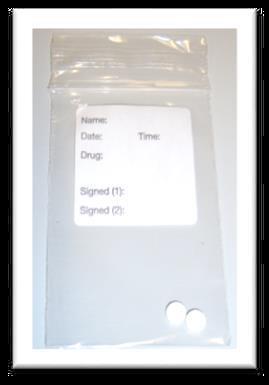
All unwanted or surplus medication (including loose dose in bags as above) should be returned to the community pharmacy for disposal and a signature obtained (see appendix 4). Medication belonging to recently deceased service users must be kept until any relevant investigations are completed if applicable. Police or courts require them as evidence as part of any investigation into the death of the Service User.
Medicines for disposal should be stored securely in a tamper-proof container within a locked cupboard until they are collected or taken to the pharmacy.
Staff should keep records of medicines (including controlled drugs) that are waiting for disposal. This will be documented in the returns book and must be reviewed by the Care Home Manager or Assistant Manager.
Records will be kept of all medicines received, administered and leaving; and that disposed of to ensure there is no mishandling.
12. Administration of Medicines
• Service users should self-administer their medicines whenever possible and appropriate.
• Medicines must only be administered in accordance with the prescriber’s specific instructions.
• Care staff may only assist with administration of medicines that are correctly labelled by a pharmacy or dispensary with the service user’s full name and date of dispensing. The medicine name, prescribed dose and frequency should also be included except where the dose is variable and given in accordance with separately written instructions e.g. warfarin
• Tablets must not be crushed or dissolved, or capsules opened unless this is stated on the dispensing label, or written instructions received from a healthcare professional
• Medicines must not be given after their expiry date. Note: many medicines have a reduced expiry date after opening (see appendix 2). Check pack for details. If in doubt, refer to pharmacist for advice.
• If oral liquid medicines need to be measured via a syringe, a designated oral syringe must be used
• Care staff must pay due regard to service user’s privacy, dignity and religious/ cultural beliefs at all times.
• Service users have the right to refuse their medicines and must never be coerced to take them
• Care staff must be mindful of medication which is time sensitive to avoid omitted/delayed dose e.g. Parkinson medication
• The procedure for administration of medicines is included in the “SOP for use of Medicine Administration Record (MAR) Chart” (Appendix 1)
13. Self-Administration
Care staff should assume that a service user can take and look after their medicines themselves (self-administer) unless a risk assessment has indicated otherwise.
All service users should be risk assessed to find out how much support they need to carry on taking and looking after their medicines themselves (self-administration).
Risk assessment should consider:
• Service users’ choice.
• If self-administration will be a risk to the service user or to other service users
• If the service user can take the correct dose of their own medicines at the right time and in the right way (for example, do they have the mental capacity and manual dexterity for self-administration?)
• How often the assessment will need to be repeated based upon individual need.
• How the medicines will be stored
• The responsibilities of the care home staff, which should be written in the resident's care plan.
The Care Home Manager should coordinate the risk assessment and should help to determine who should be involved. This should be done individually for each service user and should involve the service user (and their family members or carers if the service user wishes) and care home staff with the training and skills for assessment. Other health and social care practitioners (such as the GP and pharmacist) should be involved as appropriate to help identify whether the medicines regimen could be adjusted to enable the service user to self-administer.
The Care Home Manager should ensure that records are made and kept when service users are supplied with medicines for taking themselves, or when service users are reminded to take their medicines themselves.
The following information should be recorded on the MAR chart:
• That the service user is looking after and taking their medicines themselves
• Whether any monitoring is needed (for example, to assess ability to self-administer or willingness to take the medicines as prescribed [adherence])
• That medicine has been taken as prescribed (either by seeing this directly or by asking the service user)
• Who has recorded that the medicine has been taken.
The Care Home Manager should ensure that medicines for self-administration are stored as identified in the service user's risk assessment (for example, in a lockable cupboard or
drawer in the service user's room). Service users should be able to get any medicines that need special storage at a time when they need to take or use them.
The process for self-administration of controlled drugs must include information about:
• Individual risk assessment
• Obtaining or ordering controlled drugs
• Supplying controlled drugs
• Storing controlled drugs
• Recording supply of controlled drugs to service users
• Reminding service users to take their medicines (including controlled drugs)
• Disposal of unwanted controlled drugs
14. Medication Administration Record MAR
General principles
Medication must be administered in a person-centred way and respecting dignity, independence, privacy, cultural and religious beliefs of the service user at all times.
The 6 Rights of Administration must be applied at all times:







In order to have ‘capacity’ to manage medication, the service user must be able to:
• Understand how to take their medication and understand why the medication has been prescribed.
• Understand what will happen if they don’t take the medication or not following the GP’s instructions.
• Retain and use the information.
• Make choices and be able to tell people about them.
Staff need to ask for the service user’s consent each time medication is to be taken:
• Where possible, the service user must provide informed consent. If that is not possible, but there is a possibility that the service user can give consent, then the service user must be supported to make an informed decision
• If consent cannot be obtained or the service user lacks capacity, key people acting in the best interests of the service user can make a decision. This must include a full assessment from a healthcare professional. Documentation must be kept of how and why the decision was reached and their competence assessed before this task is undertaken and clearly recorded in the service user’s care plan.
Service users must be given the choice:
• To take or refuse medication. If refused, the circumstances/reason (if provided) must be recorded in the service user’s care plan and MAR, unless an agreed plan of action is already in place for when medication is refused, staff should follow information in the patient information leaflet (PIL) for any missed doses unless there are specific instructions from the GP. The GP must be contacted for advice after any three refusals, involving the service user where appropriate
• Where the medication is administered, e.g. if a service user who self-administers wants to have their medication in the lounge, the medication must be taken from their room and taken directly to the service user with no distractions going to/coming back from the service user’s room. Do not try to dispense more than one service user’s medication at any given time. Once administered, the MAR must be updated immediately
Purpose of the MAR chart
• The MAR chart is the confidential, formal record of administration of medicines and may be used as evidence in clinical investigations and court cases. It is therefore important that they are clear, accurate and up to date. MAR chart can be apaper record or an electronic record.
• Care staff must record the medicines support given to a service user for each individual medicine on every occasion. This includes details of all support for prescribed and over-the-counter medicines, such as:
• reminding a person to take their medicine or helping them remove it from the packaging.
• giving the person their medicine
• recording whether the person has taken or declined their medicine.
• The MAR chart must provide an accurate account of the medicines being administered to the service user by the care staff. It should document all prescribed medicines, including externally applied medicines.
Responsibilities of the Care Home Manager for MAR charts
It is the responsibility of the Care Home Manager to:
• Ensure a MAR chart is available by providing a paper MAR chart or an electronic MAR for staff to record all medicines support given to a service user for each individual medicine and on every occasion A new chart is required each month.
• Set up a system to assure the source and accuracy of information contained in the MAR chart, and any changes.
• Establish a system by which any changes made after production are evident, i.e. dated, signed and indicates who has made the change.
• Establish an effective system to ensure that any MAR charts which are no longer in use (e.g. from previous months) are securely archived and stored appropriately.
• Establish an effective system to ensure that the MAR chart is reviewed following discharge from hospital and is updated when changes are made to the service user’s medication, e.g. following an out-patient appointment.
Safe production of MAR charts
The procedure for producing MAR charts should ensure that:
• The MAR chart is individual to the service user and reflects the items which are still being currently prescribed and administered
• The MAR chart is clear, indelible, permanent and includes the product name, strength, dose and frequency.
• The MAR chart is constructed on the basis of currently prescribed medicines together with information about repeat prescriptions for as required (PRN) medicines
• The MAR chart includes all prescribed externally applied medicines to be administered by care staff
• The MAR chart incorporates a method to ensure that any changes made after production are evident (dated, signed and indicates who has made the change)
• There is a robust system in place to ensure timely removal from the MAR chart of items no longer prescribed or administered, following documented communication to this effect from the prescriber
• When medicine formulations are changed, for example from a tablet to a liquid version, that the original item is removed from the current and all future MAR charts for that service user
• When a medicine is included in a MAR chart as two or more differing strengths, these should be placed next to each other on the same MAR chart where appropriate and possible, to help minimise errors
• When a short course of medicine is prescribed, the MAR chart is clear that this is the case
• If an electronic MAR chart cannot be accessed that an accurate written MAR chart is made available.
Contents of MAR charts
The MAR chart must detail:
• The service user’s details
• Known allergies/ sensitivities.
• The name and form (e.g., tablets, capsules) of ALL medicines that are to be administered or applied by the care staff
• The time they must be given.
• The day of the week, if not daily
• The dose.
• The route, if not to be taken by mouth, e.g., “to be inhaled”.
• Any important special information
• The names of those preparing and checking the MAR chart and the date prepared.
• If more than one chart is in use, reference to the other charts, e.g. “chart 1 of 2”.
• This information must exactly match that on the dispensing label provided by the pharmacy or dispensary.
Use of MAR charts
See “SOP for use of Medicine Administration Record (MAR) Chart” (Appendix 1)
• Each time a dose is due, the care staff giving it must follow the instructions step by step.
• They must immediately record administration of a dose by signing the MAR chart in the correct place. The time of administration should be recorded in the care notes, if the actual time administered is not specified, or differs from that on the MAR chart
• Any prescribed medicine not given must be clearly recorded as set out in the instructions, and the reason documented
• The information on the MAR chart will be supplemented by the service user’s care plan
• It is important that any MAR charts which are no longer in use (e.g., from previous months) are removed /archived medication folder
As Required (PRN) Medication
PRN medication should be dispensed in its original container and NOT put into a Monitored Dosage System (MDS). This means that if there are any left unused at the end of the 28day cycle they can be carried forward to avoid wastage as long as the following procedure is followed.
Check that:
1. The medication is in good condition.
2. The medication is still within its expiry date.
3. The patient still requires the medication. To determine if the patient still requires the medication the GP should be asked to review them. The GP should be informed if the patient is refusing the PRN medication, and it is then up to the GP to decide if it needs to be discontinued. Regular review is particularly important for those service users that do not have the mental capacity to refuse PRN medication as it is then difficult to judge whether they still need it. PRN medicines should not be stopped without medical advice.
A PRN Medication Protocol Form must be filled out and the original must be kept in the MAR sheet folder and a copy placed in the service user’s keyworker folder This form should be reviewed each month when medication orders are done.
Staff should always be aware of the medication being taken by individual service users and should report any change in their condition that may be due to medication or side effects immediately to the Care Home Manager or On-Call Manager and discuss with the GP, or if unable to get hold of GP, NHS111 or with the community pharmacist.
Care home staff should ensure that PRN medicines are kept in their original packaging. PRN medication should continue to be offered to the service user at the appropriate time or at the service user’s request unless advised otherwise by a healthcare professional
Ordering PRN Medication
On the appropriate day the member of staff responsible for ordering medication will look at each item for each service user. They should determine whether there is enough PRN medication left to be used the following month. If the service user has been refusing the medication resulting in an overstock, then the medication should be carried over from one month to the next and not disposed of and a review requested from the GP to ascertain If it is still required. If this is the case, then the item should not be ordered that month from the GP (this can only happen if the medication is in its’ original container).
It is the responsibility of the staff member assigned to order medication to determine if there is enough PRN medication left to last the coming month. This can be done by looking back at the MAR chart to see how many times the medication has been required during the past month, they should then be able to calculate how much is likely to be required in the coming month.
It is good housekeeping to ensure that PRN medications do not run out in the middle of the month which would mean that a prescription would then have to be obtained for a new supply.
Receipt of PRN medication
New supplies of PRN medication should be handled in the same way as regular medication. It should be checked as soon as possible after receipt by a designated member of staff and the MAR sheet filled in as detailed above.
When dealing with PRN medication it is good practice to obtain the following information from the GP and for this information to be included on the MAR chart or in the care plan so that it is available to any member of staff who may need to administer medication.
1. What is the medicine used for?
2. How much to give?
3. How many times a day it can be given?
4. The maximum daily amount
5. The time interval between doses e.g. not more than every four hours for pain relief
Variable Doses
Patient/ Service User Choice
If a variable dose is prescribed (e.g. one or two tablets to be taken if required for pain) the decision regarding the dose to take rests with the service user and the prescriber. Care staff must:
• Ask the service user how many they wish to take. If the service user is unable to decide or respond the care provider should request specific written instructions from the prescriber
• Care staff are not permitted to assist with these medicines unless and until a decision has been made regarding the dose to be taken, by the service user or the prescriber.
• Clearly record on the MAR chart the number of tablets taken
Warfarin
• The dose of warfarin varies according to results of a blood test.
• It is important to take great care that the correct dose is given, according to the most recent instructions which should be available in the service user’s yellow book, or other anticoagulant record.
• The MAR chart must be initialled when dose given, as normal, but in addition the dose given in milligrams (mg) must be written below the carer’s initials. This should also be recorded in the care record.
• As part of the risk assessment, managers should ensure they know who to contact in case of queries regarding current dose, etc.
• If the yellow book or other anticoagulant record is not available or not up to date care staff should refer to their Care Home Manager who should urgently seek clarification. If unable to obtain clear instructions from a healthcare professional, the manager should instruct the member of staff to continue according to existing dosage instructions until clear information can be obtained, ideally within 24 hours.
• Care staff should be vigilant and aware of arrangements for individual service users.
Changes to Medication
• The Care Home Manager must ensure there is a system in place to check the source and accuracy of any changes. A cross reference to the care record is recommended.
• When a service user’s medication is altered, the manager is responsible for ensuring the MAR is amended as follows:
• The original direction is cancelled.
• The new directions are written legibly and in ink on a new line of the MAR chart.
• The entry is signed and dated (including a witness when possible).
• The date received from the pharmacy or dispensary is recorded in the Medication Audit section of the MAR.
• Alternatively, a new MAR chart may be produced with the correct ‘start date’ clearly stated.
Discharge from Hospital
• When service users leave hospital, even following a short stay, it is likely that changes will have been made to their medicines.
• The Care Home Manager must ensure there is a system in place to review and update the MAR chart following discharge from hospital.
• The labelled supply sent home with the service user is the authority to administer those medicines and supersedes any previous MAR chart. Therefore, if the MAR chart is not yet available, medicines should be administered according to the instructions on the label, and all doses given must be recorded in the care record, with full details of:
• Medicine name
• Strength
• Dose
• Time and date administered.
• The fact that the dose was administered.
• Signature of the care staff.
• The updated MAR chart must be made available as soon as possible.
Verbal Instructions to change medication or doses.
Care Staff may only assist with medication according to written instructions, except in the following cases:
• Under exceptional circumstances an individual care staff may accept verbal instructions to change, or stop, one day’s treatment only from a doctor or other healthcare professional caring for the service use.
• Only the individual receiving the instruction first hand from the doctor or other healthcare professional may act upon this instruction.
• Verbal instructions must not be passed on for action by any other care staff. Written confirmation must be received before others are permitted to carry out the new instructions.
• Under exceptional circumstances the Care Home Manager may pass on verbal instructions to change, or stop, one day’s treatment only to care staff, if the prescriber is unable to do so directly, provided.
• The manager receives the instruction first hand from the doctor or other healthcare professional and carefully records the details of the conversation, and only the individual care staff receiving the instruction directly from their manager may act on the instruction.
• Email evidence for changes in medication to GP to follow up on 111 advices
Care providers should:
• Request the prescriber/GP to follow up verbal instructions in writing as soon as possible.
• Ensure that verbal instructions are fully documented in the care record.
• Ensure that the person completing the record:
• Reads their instruction back to the authorising doctor or other healthcare professional as a double check, preferably in the presence of the service user.
• Sign and date the record and ask the witness to do the same.
• Records the time and date of the conversation.
• Records the name of the authorising doctor or other healthcare professional.
• Involves the service user as much as possible to ensure they are aware of and consent to the change and can check the actions of care staff.
• Records the dose given in the care record with a cross-reference in the MAR chart to the care record, (e.g. “see care record”)
• Ensure that the MAR chart is not amended, as this applies to a single day’s treatment only.
Retention of records, including MAR charts
• The MAR chart must be retained in the Care Home while in use.
• Any MAR charts which are no longer in use (e.g., from previous months) must be securely archived.
• Used MAR charts must be retained by the provider for a minimum of 8 years
15. Homely Remedies
Care Home
Before any homely remedy is administered there must first be an agreement with the service user’s GP that they are happy that the service user is to be treated with these remedies.
This agreement should state the type of minor ailments that may be treated and the remedies that may be used.
Examples of minor ailments include:
• Indigestion
• Mild pain/ fever
• Coughs
• Constipation
• Diarrhoea
• Skin conditions- although some skin conditions are considered minor ailments, since creams and ointments should not be shared between service users, they are not suitable to be used as homely remedies in the care home setting.
An agreement should be signed by the GP for each of service users under their care to ensure that the proposed remedies will not interfere with any medication they are already prescribed
Care staff who give non-prescription medicines or other over-the-counter products (homely remedies) to service users should be named in the homely remedies process. They should sign the process to confirm they have the skills to administer the homely remedy and acknowledge that they will be accountable for their actions.
As with all prescribed medication any medication that is given as a homely remedy must be recorded on the MAR chart. It should also be recorded in the service user’s notes.
The MAR chart entry should include:
• The name of the preparation
• The reason it is being used.
• The dose which has been administered
• The frequency and the maximum daily dose which should be administered
Administration should not exceed two days without medical advice being sought.
Any symptoms that do not respond to a homely remedy must be reported to the GP.
16. Covert Administration
The covert administration of medication is the practice of hiding medication in food or beverages so that it will be undetected by the service user receiving the medication. Medication may be crushed or medication in liquid form may be used. This practice exclusively applies to service users who are not capable of consenting to treatment. It is sometimes necessary and justified but should never be exercised with service users who are capable of deciding about their medical treatment.
Covert administration of medicines must only be considered in exceptional circumstances, following discussion with family members, health and social care professionals etc. as appropriate, taking into consideration the capacity of the service user to consent or refuse treatment, and documented in the ‘Medicines Risk Assessment’ and the care plan. Advice must be sought from a doctor pharmacist regarding the pharmaceutical suitability of the medicine for administration in this way.
Medication must never be crushed, broken or mixed with food and drink unless specifically directed to do so by the prescriber. Decisions to administer medicines covertly must not be taken by any individual in isolation. All decisions of this nature must clearly define who should be involved in, and responsible for, decision-making and in accordance with Department of Health guidance and the Mental Capacity Act (MCA). They must be fully documented as set out in the MCA code of practice.
17. Overt Administration
“Overt” administration is often confused with “Covert” administration (see section above for when covert administration applies).
“Overt” administration refers to when a medication manipulated to make it more palatable for the service user, the medication is added to food or drink and is done with the service user’s consent, this may be required when a service user is having difficulty swallowing. Care staff should only crush tablets or open capsules on the direction of the prescriber, following instructions in the service user’s MAR chart or care plan. Care staff should communicate and consent service user as you would any other process of their care. Let the service user know you are crushing their medication or opening a capsule and mixing it with food so it is easier for them to swallow, it is sometimes also easier to prepare them by letting them know it may alter the taste of the food and the importance of finishing the food, so they get the full dose. However, they have the right to refuse.
18. Administration of Medication via an Enteral Feeding Tube
Enteral feeding tubes provide access to the stomach or small intestine. They are used in cases where there is an obstruction or where a service user has difficulty in swallowing.
The main types of enteral feeding tubes are:
• Nasogastric (NG): a tube passed through the nose directly into the stomach.
• Percutaneous Endoscopic Gastrostomy (PEG) or radiologically inserted gastrostomy (RIG): a tube inserted through the abdominal wall directly into the stomach.
• Nasojejunal(NJ):atubepassedthroughthenosedirectlyintothejejunum(small intestine).
When a service user has an enteral feeding tube in place, it may be necessary to alter the form of a medication so it can be given down a tube. Crushing or opening capsules must not be a routine practice, and Staff must ensure that they have had adequate training and there is appropriate documentation in place before medication can be altered in this way. Verbal communication from a GP to open or crush medication is not sufficient. The care staff MUST be provided with written documentation from the GP – in practice this can be addition to the dosage instructions on the prescription form, which the pharmacy adds to the label and the MAR chart. The instructions should then be documented in the care plan.
Administration of medication via an enteral feeding tube will be classed as specialised activity. These types of medicines will normally be administered by a healthcare professional. However, if appropriate a healthcare professional may delegate these tasks to named care staff provided: they agree this with the Care Home Manager; the healthcare professional personally provides the required extra training; and is satisfied that the care staff are competent; oncetrained and assessed ascompetent willundertake the delegated task as per agreed process. Care staff should be given the opportunity to refuse to administer medications via specialist techniques if they do not feel confident in their own competence. If delegation is not possible, the onus is on the service to ensure continuity of care.
The care staff must not administer medication via an enteral feeding tube until they have been assessed as competent by the named registered healthcare professional and supervision has been recorded.
The healthcare professional delegating the task will remain accountable for the delegation of any aspects of the task and ensuring the individual is competent to carry out the task. This includes ongoing assessment and supervision of practice.
19. Controlled Drugs
Controlled Drugs(CDs) are prescribed and dispensed for individually named service users, in the same way as other prescription medicines. However, due to the special legal requirements extra time should be allowed for prescriptions to be written. Prescriptions that do not comply with the legal requirements may have to be sent back to the prescriber for altering before they can be dispensed. See Appendix 5 for list of CDs and their schedules.
Storage
• Care homes must ensure CDs comply with the Misuse of Drugs Regulations 2001and associated regulations when storing CDs.
• The CD safe or cabinet must comply with the requirements specified in the Safe Custody Regulations (British Standards BS2881)
• The CD cupboard should only be used for the storage of CDs. No other items such as money should be placed there.
• If the CD requires safe custody and it has been provided in a monitored dosage system (MDS) the MDS should be stored in a CD safe or cabinet
• Access to the CD cabinet should be restricted. The keys should be kept under the control of a designated person and there should be a clear audit trail of the holders of the key.
• All Schedule 2 andthoseSchedule 3 CDs that aresubject to safe custody requirements (i.e., Midazolam, Temazepam, Buprenorphine, and Phenobarbital) must be kept in a locked receptacle, which is constructed and maintained so as to prevent unauthorised access to CDs. Note: Gabapentin and Pregabalin are also exempt from safe custody requirements
Record Keeping
• All care homes should keep a record of service user’s own CDs in addition to the records maintained on MAR charts. This should be a controlled drug register.
• The register should be a bound book with numbered pages and a separatepage should be used for each service user’s medicines and should also have a column for recording running balances.
• The register should be used to record the receipt, administration and disposal of CDs held in the care home.
• There must not be any cancellations, obliterations or alterations. Corrections must be made by a signed and dated entry in the margin or at the bottom of the page.
• On receipt of a CD the date, quantity and source should be entered into the register and initialled by appropriately trained receiving healthcare professional or authorised member of staff with a second person as witness. The correct balance should be verified each time.
• Registers should be kept for a minimum of TWO years after the date of the last entry.
Administration
• Designated and appropriately trained staff only, must administer CDs. A second, appropriately trained designated member of staff must witness the administration. Administration should follow the same guidelines that are observed when administering any other medication however the following steps should also be taken:
• The service user’s name, date, time and dose given, should be recorded in the CD register after carefully checking the administration sheet.
• Before administering the medicine, the stock balance should be checked, and the dose measured and checked with a competent witness.
Disposal of Controlled Drugs
All CDs no longer needed must be returned to the community pharmacy as soon as possible. Staff should complete the service user’s medication return form. CDs should be put on their own page in the CD returns book. When CDs are returned to the pharmacy, staff will need to complete the CD register and will need to document how many have been returned and to which pharmacy they have been returned to. This will need to be signed and dated by two appropriately trained staff.
Discrepancies
Care homes are required to follow the below procedure when dealing with discrepancies, incidents and errors related to CDs. Any concerns should be reported immediately to the Registered Manager.
If a discrepancy is identified between what is expected and the supply received, then the following guidance is provided:
• Enter the stock into the CD register indicating what was obtained, not what was requested.
• Contact the suppling pharmacy as soon as possible to investigate and resolve the discrepancy.
• Store the CD separately in the CD cabinet awaiting collection.
• Arrange for the supplier to pick up the incorrect CD.
• When the stock is picked up, obtain a signed receipt from the person taking it away, and make an entry into the supplied section of the CD register.
• Datix discrepancy received from suppling pharmacy within 48 hours.
If the CD received is deemed ‘unfit’ for use the following guidance is provided:
• Enter the medication received into the appropriate section of the CD register.
• Store the CD in the CD cabinet in a sealed bag marked ‘Damaged Stock’ until it is taken away.
• Inform the pharmacy that the stock received is ‘unfit’ for use, explaining the reason and arrange for the pharmacy to pick up the stock.
• When the stock is taken away, obtain a signed receipt from the person taking it away, and an entry must be made into the supplied section of the CD register.
• A Datix should be logged of the wrong supply/stock discrepancy.
If a discrepancy is identified between calculated stock figures (running balances) and actual stock the following guidance is provided:
• Check back through the entries for that medicine and ensure that there has not been a recording or numerical error.
• Check the MAR chart and also any records of disposed medicines.
• If the discrepancy can be identified, record the outcome and make any corrections to the CD register with a signed and dated entry (this a retrospective entry) in the margin or at the bottom of the relevant page making reference any supporting documentation that was used to resolve the discrepancy There must be no cancellation, obliteration or alteration of any entry in the CD register.
• This needs to be signed and dated by an appropriate witness.
• If the discrepancy cannot be explained or rectified, then contact Provide’s CD Accountable Officer within 24 hours.
• If the discrepancy cannot be explained or rectified and the CD is a Schedule 2 CD then the police will need to be informed
• Datix will need to be raised within 48 hours.
Receipt
Pharmacy deliveries must be taken to the treatment room as soon as they are received within the care home. The CD should be checked upon receipt by two medication trained staff to make sure that it is fit for use, i.e., not damaged.
A trained staff must immediately check:
• That the correct items have been delivered, by checking the CDs received against the CD order.
• That the items received are the correct drug, strength, form, quantity and in date.
• That complete packs are sealed (not tampered with) and are in date.
Any discrepancies must be reported to pharmacy and the Care Home Manager immediately. The copy of the order in the CD order book must then be signed and dated by the trained staff receiving the CDs, on the “Received by” line.
Receipt of ALL schedules 2 and schedule 3 CDs must then be recorded in the CD register The entry must include the name of the service user, the name of the medication, dose of medication, quantity of medication, the date medication was received and specifically where the medication was dispensed. Each medication, form and strength will need to be recorded on a separate page, with the pages in use listed at the front of the CD Register.
The entry should be witnessed by a second suitably trained and competent member of staff.
When new stock is to be added to existing stock, the new stock balance must be counted and recorded. New supplies of sealed packs do not need to be opened when the stock is checked.
Documentation
• The total balance of stock should be checked and counted after each administration Staff will need to record the audit of medication in the CD register and the amount counted will need to be recorded and both members of staff need to sign to agree that this is correct.
• Administration of the CD should be documented on the MAR chart and the CD register.
• The care home staff responsible for administering the CD and an appropriately trained witness should sign the CD register. The staff member administering the CD should also sign the MAR chart (no signature is required on the MAR chart by the witness)
• The records should be completed immediately after the CD has been administered and not before.
Self-Administration of Controlled Drug Medication
If a service user manages their own medication and self-administers CDs, a risk assessment should be completed, and it should beassessed how thismedication is stored
Collecting Controlled Drugs from Pharmacy
Most community pharmacists can arrange delivery of medication but if staff are required to collect them, staff need to ensure they complete the following when collecting medication:
1. Show proof of identity; for example, Provide ID badge and professional registration number. It is a requirement for the pharmacist to establish in what capacity you are collecting the medication.
2. Provide their name and work address when collecting as the pharmacist will need this when completing entries.
3. Sign the box on the back of the prescription.
4. Ensure Service User Controlled Drug Collection Form (Appendix 3) from Community Pharmacy is filled in and retained in Care Home for 2 years.
Staff who are collecting medication from pharmacy and are transporting these in vehicles need to ensure they have the relevant car insurance to do so.
All medication must be transported out of sight in the locked boot of the car. Medicines must not be left in vehicles overnight.
After delivery to the care home, the CD must be promptly recorded into the CD register as described above.
20. Psychotropic Medication
Psychotropic substances alter brain function, resulting in temporary changes in perception, mood, consciousness and behaviour. These include groups of medicines such as antidepressants, antipsychotics, antiepileptics, mood stabilisers (including sodium valproate and carbamazepine), anxiolytics (benzodiazepines), and central nervous system stimulants. They may be used in service users with a learning disability and/or autism. These medicines
may need regular monitoring. They can cause side effects that affect service users’ physical health.
Psychotropic medicines are sometimes used to control how a service user behaves or to restrain them (where justified for purposes set out within the legal framework). This could be because staff do not know how to communicate with a service user or to meet their needs to maintain a good quality of life. Psychotropic medicines should only be used as the least restrictive option. They must be included in the service user’s care plan.
STOMP stands for stopping overmedication of people with a learning disability, autism or both. STOMP is a national project to reduce prescribing and administration of psychotropic medicines. It is about helping service user to stay well and have a good quality of life. Psychotropic medicines should only be considered if:
• psychologicalorotherinterventions,suchastreatmentforanycoexistingmentalorphysical health problem have not helped to improve the service user’s quality of life or
• the risk of harm to the service user or others is very severe.
PROVIDE will ensure it:
• Follows best practice recommendations and national guidelines. For example, NICE NG10 Violence and aggression: short-term management in mental health, health and community settings.
• Assess service users’ capacity to make decisions about their medicines.
• Act in a way that is proportionate, pragmatic and safe.
• Include when medicines might be used in person-centred behavioural care planning. Keep clear records of behaviour that staff find difficult to manage. Identify themes and triggers. Put environmental and psychological support in place to reduce distress, improve communication and quality of life. Using a medicine should be the least restrictive option.
• Provide accessible medicines information. Explain the risks and benefits of taking a psychotropic medicine. This supports shared decision making.
• Ifmedicinesareprescribedtobeadministered whenrequired,itmustbeclearwhenitmight be needed and the expected outcome. Evaluate and record the outcome of giving a when required medicine to make sure it is having the required effect.
• Managers should ensure staff are knowledgeable about psychotropic medicines. Staff should be able to identify potential side effects from taking a medicine. Healthcare advice should be sought if needed.
• Work collaboratively with healthcare staff and share information. Support service user to access medicines reviews, physical health checks and therapeutic medicine monitoring.
• Manger will need to report the numbers of service user who have had their behaviour controlledorrestrainedbymedicinestoCQC.Usethe adultsocialcareproviderinformation return
21. Cytotoxic medication
A cytotoxic or cytostatic medicine is defined as any medicinal product that possesses anyone, or more, of the following hazardous properties:
• Toxic
• Carcinogenic
• Toxic for reproduction
• Mutagenic
Service users on cytotoxic or cytostatic medication must have this documented in their care plan and appropriate training and personal protective equipment should be provided
for staff. (see MMSOP34 - Standard Operating Procedure for the Management of Pharmaceutical Waste for list of cytotoxic and cytostatic medication. )
Personal Protective Equipment (PPE)
• Always wear appropriate PPE (e.g., gloves [preferably nitrile] and a disposable apron) when administering cytotoxic/cytostatic medication and should be appropriate for its intended use.
• Always ensure personal protective equipment is disposed of safely to prevent potential harm to others. Discuss with your clinical waste contractor or community pharmacy.
• Staff must be trained in the use of PPE, and it must be adequately maintained and stored.
• Service users and care home staff should wash hands thoroughly following administration of cytotoxic/cytostatic medication.
Administration of cytotoxic/cytostatic medication
• The prescription should clearly state the dose and frequency for administration. Phrases such as ‘as directed’ must not be used and the prescriber should be consulted to change the directions.
• Cytotoxic/cytostatic medication should never be dispensed in a compliance aid or a monitored dosage system (MDS).
• Reduce handling to prevent unnecessary exposure to cytotoxic/cytostatic medication when administering to service user.
• Tablets should not be handled directly. Staff should wear gloves.
• Oral doses should be dispensed into a medicine pot. Doses can be unwrapped at the time of administration by the care home staff.
• Only remove cytotoxic/cytostatic medication from its container when in front of the service user
• Tablets should be swallowed whole with a glass of water whilst sitting or standing.
• NEVER crush, chew or break tablets.
• Transfer medication from bottle/foil to a single use medicine pot/spoon or oral syringe
• Medicine pots, spoons and syringes should be disposed of after each administration in the cytotoxic/cytostatic designated waste receptacle. Wear appropriate PPE for this process.
Safe disposal of cytotoxic/cytostatic medication
Waste contaminated with cytotoxic/cytostatic substances should be disposed of in suitable authorised facilities, normally incineration facilities. (see MMSOP34 - Standard Operating Procedure for the Management of Pharmaceutical Waste).
22. Oxygen
Oxygen will be prescribed for each individual service user if the prescriber considers it necessary. Advice on storage and administration may be obtained from the supplier but the following guidelines should also be followed:
• Cylinders must be stored under cover and not subject to extreme temperatures.
• The storage area must be clean, dry, well-ventilated and away from highly flammable liquids, combustibles and sources of heat and ignition.
• Cylinders must be stored upright and secured by way of a chain to the wall.
• Empty cylinders must be stored separately and easily distinguished from full cylinders.
• The statutory warning notices must be displayed in any room/area where oxygen is used or stored.
• Oxygen therapy must only be discontinued, or the flow rate altered by the direction of the prescriber.
• Equipment must be handled by trained staff or under the supervision of trained staff only.
• Regular stock checks will be carried out with particular attention paid to expiry dates.
A risk assessment must be completed by the supplier, a copy of this should be retained and kept for records. Staff must ensure they understand the risk assessment and when to notify the supplier if risk changes. Staff can also liaise with medicines management colleagues if they have any questions. Refer to MMPOL14 Medical Gas Policy.
23. Medication Incidents and Errors
• If a member of care staff is aware of having made a mistake in assisting withmedicines, or notices that an error has been made they should immediately notify the manager of senior staff in charge.
• Staff must be supported and able to raise concerns directly and in a timely manner. Refer to the Whistleblowing Policy and Procedure at Provide Care Solutions (Freedom to Speak Up (whistleblowing) Policy).
The Registered Manager should ensure the following action is taken:
• Seek advice from the GP, 111, nominated pharmacy or appropriate health professional immediately.
• Enter the details of the error in the care record, and on the MAR chart
• Make a note of any changes or deterioration in the service user’s health or behaviour.
• Ensure the error is fed into the care provider’s incident reporting system, through Datix /Access and is investigated in order to share learning and prevent recurrence.
• The manager will undertake an initial investigation of the incident on the same day, ensuring immediate remedial actions have been put into place which may include informing the GP.
• The manager will undertake a full comprehensive investigation within 14 days and conclude the report on Datix.
• If the error involves a controlled drug this will also need to be reported to the Provide Controlled Drug Accountable Officer (CDAO)
• Nisha Desai 07580 911601 Nisha.desai@nhs.net
Root causes and lessons learnt will be cascaded to all staff and any changes to policy or procedures will be acted upon immediately to ensure the safety of all service users and staff.
Duty of candour
The duty of candour requires registered providers and registered managers to act in an open and transparent way with service users receiving care or treatment from them (see QSPOL03 Being Open and Duty of Candour Policy).
All staff are required to follow QSPOL01 – Incident Reporting & Management Policy
24. Keeping service users safe (safeguarding)
The Registered Manager must ensure that all care staff are aware of local arrangements for notifying suspected or confirmed medicines-related safeguarding incidents. There must
be a clear process for reporting medicines-related safeguarding incidents under local safeguarding processes and to the Care Quality Commission (CQC) (or other appropriate regulator).
There is no requirement to notify CQC about all medicine’s errors, but a notification would be required if the cause or effect of a medicine error met the criteria to notify one of the following:
• A death
• An injury
• Abuse, or an allegation of abuse.
• An incident reported to or investigated by the police.
Where relevant, you should make it clear that a medicine error was a known or possible cause or effect of these incidents or events being notified. Care staff should contact the Registered Manager to ensure that action is taken to safeguard any service user involved in a medicines-related safeguarding incident.
25. Medication handling when service users go out
The most suitable option for service users taking their medication with them when they go out must be selected after consideration of the risks of the individual situation. Risks include:
• How long the service user is out for
• Who they are accompanied by and their competence.
• The nature of the medication they are taking.
• How much notice has been given of the intention to go out.
The following options must be considered:
• Missing the dose out altogether (after confirmation with the GP).
• Giving the dose early or late (after confirmation with the GP).
• Giving the original dispensed medicine to the relative/carer/service user (if competent to administer)
• Obtaining a separate labelled supply for ‘leave’ (advance warning required to obtain a prescription and get it dispensed)
A record of the option agreed must be made on the MAR chart
Medication handling for hospital admissions
Records must be kept of all medicines coming in and going out of the home with service users for the purposes of hospital admissions. A copy of this is included in the Transfer and Discharge from Hospital Pack. A copy must be retained in the service user’s notes
26. Medication Reconciliation
Staff must carry out a medication reconciliation process when a new service user moves in and brings their own medication with them and also when they return after a period of time away, e.g. hospital. This is to gather information about the service user’s medication and to ensure that the medication they are bringing with them is in date and is as stated on the pharmacy label.
Tablets in foil strips stored within boxes - check the medication name, batch number and expiry date on each foil strip must be identical to the information on the box.
Bottles of liquid medicine - unopened/sealed bottles only may be used; any bottles which have been opened or the seal broken must be disposed of unless there is a date of opening or disposal date noted on the bottle.
Containers of loose tablets - unopened/sealed containers only may be used; any containers which have been opened or the seal broken must be disposed of (see Provide MMPOL33 Medicines Reconciliation Policy)
27. Resources Available to Support Care Home Staff
Health and social care staff should be able to access reliable and up-to-date information about medicines. Resources may include the patient information leaflet supplied with the medicine and the following websites:
• Medicines and Healthcare products Regulatory Agency
• NHS choices
• NICE Evidence
• British National Formulary (BNF)
• Pharmacist advice and support
• Patient Information Leaflet
• Clinical Knowledge Summaries
• Electronic Medicines Compendium
28. Risk Management/Monitoring/Audit
Risks will be managed, monitored and mitigated by the following mechanisms:
• Provide’s medicines team will continue to support Provide Groups on medicines management training, updates and competencies.
• The content of this policy will be approved by Provide’s Medicines Governance & Safety Group
• Regular monitoring of incidents reported by Provide Group staff on the Datix /access incident reporting system.
• Feedback of learning from incident reports to relevant Provide Group staff and to independent providers of such care.
• As schedule of audit will be developed and reviewed annually to support safe, highquality care.

Appendix 1: SOP for Use of the Medicines Administration Record (MAR) Chart
Care staff who provide support with medicines to service-users should:
• Only carry out this service if you have received training and been assessed as competent by your manager.
• Only use a MAR chart that has had the medication details added by a responsible professional (this may be a pharmacist, registered manager or other responsible person of a social care service, a doctor or nurse)
• NEVER tamper with the instructions on the MAR chart
• Care staff working at this level will need to:
• check the instructions give all the information and do not say “As directed”.
• check the dosage timings are clearly indicated on the chart.
• ensure clear instructions are included for “when required” doses (e.g., maximum number of doses per day and minimum time between doses, and under what circumstances the medication should be given)
• At the end of each month, start a new MAR chart.
• Contact the responsible professional who has provided the chart with any queries regarding the instructions on the chart.
• Contact your manager if you have any concerns or problems.
• Add your name and initials to the “Who administers Medication?” section of the chart page 2.
• Check the date on the front of the chart to make sure that it’s in current use, and that it is the only MAR chart in use unless there are two which should be numbered
• Complete the “Medication count” section for any supplies received during the month.
Administer the medicines shown on the MAR chart, using the steps below for EACH MEDICINE, ONE BY ONE:
1. Check the record and make sure the medication has not already been given.
2. Wash your hands.
3. Select the medication required and confirm that it is still current by checking the date on the dispensing label.
4. Check that the name of the service user, the name of the medicine and the instructions on the bottle/box are the same as those on the MAR chart - IF NOT DO NOT GIVE IT
5. Check whether the medicine is to be given by mouth or by another route (e.g., to be inhaled, applied to the skin etc)
6. If oral, ensure the service user is standing or sitting as upright as possible, and has a glass of water available.
7. Give the medicine to the service user with a drink of water.
8. If applying a cream or medicated patch, or administering a hazardous medicine (see risk assessment) for a service user, ensure you are wearing appropriate disposable gloves.
9. Enter your initials clearly and appropriate code on the correct date and time to show you have seen the service user take the medicine
10. If the dose is variable (e.g. one or two tablets to be taken) record the actual amount given and initial.
11. If the medication is NOT GIVEN enter the appropriate code in the correct box and enter the reason in the service user’s care record. Report this to your manager immediately or seek immediate medical advice.
12. If the medicine is left out (this must be specified in the care plan) for the service user to take themselves at a later time, enter a large UW in the box, and record in the care record.
ALWAYS contact your manager should a new medicine appear that is not accounted for anywhere on the chart.
Always bring any concerns to the notice of Registered Manager.
IN AN EMERGENCY CONTACT THE SERVICE USER’S DOCTOR Or APPROPRIATE EMERGENCY SERVICE (111 or 999)