Non-Clinical Continuous Professional Development (CPD) Policy
Version: V1
Ratified by: People and Culture Committee
Date ratified: 11/11/2025
Job Title of author: Learning Manager - Health
Reviewed by Committee or Expert Group People and Culture Steering Group
Equality Impact Assessed by:
Related procedural documents
Learning Manager - Health
LDPOL2 - Policy for management of Corporate and Local Induction
LDPOL3 - Mandatory Training Policy
LDPOL4 Performance and Development
Review Policy
EPOL01 Anti-Crime Policy [Reference to be confirmed] Non-Clinical Professional Registration Policy
HRPOL14 Disciplinary Policy and Procedure
HRPOL15 Grievance Policy and Procedure
HRPOL16 Flexible Working Policy and Procedure
HRPOL17 Special Leave Policy
HRPOL42 Colleague Volunteer Policy
FPOL19 Gifts, Hospitality and Commercial Sponsorship Policy
Review date: 1 November 2029
It is the responsibility of users to ensure that you are using the most up to date document template – i.e. obtained via the intranet.
In developing/reviewing this policy Provide Community has had regard to the principles of the NHS Constitution.
Version Control Sheet
Version Date
Author Status Comment V1 September 2025 Learning Manager –Health Ratified NEW Policy separating clinical and non-clinical CPD
1. Introduction
Provide is committed to all its colleagues learning and development in order to improve patient/customer care and achieve its overall objectives. We view learning and development as beneficial to the individual and essential for ensuring the delivery of excellent customer service and safe, high-quality patient and client care across all our services.
This document describes how the Non-Clinical Continuous Professional Development of individuals in Provide Group will be managed. It includes prioritising learning and development needs within the Performance Development Review (PDR) process, and allocation of funding. The overall aim of the policy is to ensure that all colleagues have the necessary support and access to learning and development opportunities to achieve the overall business objectives of Provide, improve customer, patient and client care and fulfil colleague potential whilst aiding recruitment and retention
This policy also illustrates how the process and practice of personal and professional development by colleagues gives benefits to and improves service delivery through increased competency. Reference should also be made to the Provide PDR, Group Induction and Mandatory Training policies.
2. Purpose
This policy applies to all colleagues that wish to develop their Non-Clinical skills and are employed by Provide Group. For agency or locum employees, it is the responsibility of the agency to provide and support the individual’s personal and professional development
Non-Clinical Continuous Professional Development is defined as a range of learning activities through which individuals maintain and develop throughout their careers. Access to development opportunities assists in ensuring that all colleagues demonstrate capacity to deliver their job safely, effectively, and within the scope of their role. In terms of individuals employed in leadership and/or managerial jobs, development opportunities facilitate adequate preparation for the scope of their role. A culture of learning has been fostered within Provide, to ensure that colleague skills and competences are tested, challenged and reflected upon.
All Health and Social Care providers including Provide continually undergo development and redesign to meet service requirements and improvements in service provision. To enable a skilled workforce to meet increasingly complex demands, additional development requirements may be required. Non-Clinical Continuous Professional Development advances and modernises the workforce and enables Provide to assure itself that its workforce has the relevant skills and knowledge to be able to deliver modern, effective services. This development of colleagues also reduces corporate, clinical and care risk ensuring quality service delivery.
3. Duties
Responsibility for identifying development needs and recommending study support provision lies jointly with individuals and their managers.
Objective setting, Personal Development Reviews (PDR’s) and regular 1-2-1’s, will be the main systems within Provide to identify learning and development needs and the priorities for departments, teams and individuals.
Provide Board
• To ensure that Non-Clinical Continuous Professional Development is meeting the business and corporate objectives of the organisation
• To ensure that Provide colleagues are compliant and up to date with all Non-Clinical Continuous Professional Development and mandatory training requirements
• To allocate suitable and adequate resources to enable all mandatory training and Non-Clinical Continuous Professional Development to be delivered
• To consider allocation of further resources where new development needs are demonstrated
• To ensure that Provide have robust policies and procedures in place to support colleagues in continuing their Non-Clinical Continuous Professional Development
Organisational Directors
• Ensure annual PDRs are conducted within their division within the agreed timeframe
• Ensure that the PDR process is working across the division
• Ensure that all learning and development is evaluated and reviewed across all teams within their units
• Ensure that colleagues share knowledge and outcomes of learning and development received
• Ensure achievements are recognised and celebrated
• Take appropriate action to ensure equity and effectiveness of Non-Clinical Continuous Professional Development received by colleagues
• Monitor, through PDRs and reviews with direct reports, that all colleagues are fully compliant with their mandatory and Non-Clinical Continuous Professional Development and take appropriate action if not
Line Managers
• Ensure that all direct reports have an annual PDR and agreed PDP
• Be first level sign off for Non-Clinical Continuous Professional Development that enables colleagues to meet the organisations core objectives
• Participate in annual developmental planning processes for their service to identify essential Non-Clinical Continuous Professional Development to be developed/purchased annually
• Ensure that colleagues evaluate and feedback learning from their development with other team members
• Managers are accountable for the mandatory development of their colleagues in order to comply with this policy
• Provide protected time for colleagues to attend statutory and mandatory learning, including eLearning, to follow up with the individual to ensure attendance is documented and evaluated within their PDP
• In the event of colleagues not attending planned development, ensure this is followed up and rescheduled to attend
• In the event of repeated failure to attend mandatory training or Non-Clinical Continuous Professional Development without prior agreement, deal with, in accordance with the Provide Disciplinary Policy and Procedure, which is outside of the scope of this policy
• Report overall compliance for mandatory training and essential Non-Clinical Continuous Professional Development to Director through PDR and 1-2-1s
Individual Colleagues
• Participate in the annual PDR Process which includes an agreed Personal Development Plan (PDP). Seek to continually maintain and update skills and knowledge
• Are accountable for ensuring their mandatory and professional development requirements are up to date
• Booking and attending the identified development within their PDP as scheduled in agreement with their manager and following approval of any required funding via Talent and Learning Leadership team meeting
• Attend all approved Non-Clinical Continuous Professional Development as required
• Feedback to the organisation/Talent and Learning team using the Provide evaluation forms from any funded courses/events attended
• Share learning gained from attending personal or professional development with other team members and colleagues across the organisation and apply learning in their practice
• Participate in evaluation and audit exercises to monitor effectiveness of NonClinical Continuous Professional Development as required
Talent and Learning Leadership Team Meeting
• Monitor PDR activity across Provide and escalate concerns to the People and Culture Steering Group and the Provide Board
• Review and consider all applications for all Non-Clinical Continuous Professional Development opportunities
• Monitor access to Non-Clinical Continuous Professional Development opportunities and effectiveness of learning
• Take appropriate action to ensure equity and effectiveness of personal and professional development opportunities received by colleagues.
Talent and Learning Team
• Review and monitor quarterly reports from the Learning Management System (LMS) to assure compliance with mandatory training and essential personal and professional development programmes, discuss development opportunities and escalate concerns to the People and Culture Steering Group and the Provide Board
• Maintain and update the Provide Talent and Learning pages of the Community Platform with associated links to external resources
• Maintain the Talent and Learning LMS and facilitate and support the use of eLearning
• Process all applications for Non-Clinical Continuous Professional Development to be presented to the Talent and Learning Leadership Team meeting
• Provide monthly reports to the Talent and Learning Leadership team meeting on development activity across Provide including non-attendance at mandatory/statutory programmes and non-compliance of eLearning
4. Definitions
Development need
An identified opportunity to enhance performance through learning/training development or assessment activities
Essential development
Development that is essential to meet the requirements of the current role having been identified on the job description/person specification. This development is a must do determined by Provide Group and/or the relevant professional body.
Desirable development
Development that relates to the current role but is not an essential requirement either for the role itself or for the purposes of maintaining a professional registration through professional bodies such as CIPD, ACCA and/or Social Work England.
This is likely to be described as a desirable skill in the job description or person specification but may also be agreed with the line manager on the basis that it meets a skills gap within the role. This development may be identified through formal routes such as annual PDR’s and/or 1-2-1’s or may be as part of a development plan completed by the colleague.
Career development
Development that does not relate or only loosely relates to the current role and will enhance the future career prospects of the colleague.
Apprenticeship
Is a paid job which offers hands-on work experience alongside off-the-job training. The time spent on off-the-job training should be at least 20% and will be supported by Provide Apprenticeships are open to anyone over the age of 16 and there is no upper age limit. Apprenticeship opportunities are funded through the Provide levy account. Apprenticeships are out of scope for this policy.
Direct costs
Costs that are related to the provision of the training itself e.g. tuition fees.
Indirect costs
Costs that are associated with attending development opportunities e.g. travel and subsistence payments. Indirect costs also include replacement resource e.g. the cost of bank or agency staff where required. The cost for this expense will be taken from the approving line managers budget and/or directorate budget.
Clinical CPD
Continuing Professional Development (CPD) is requested by and dedicated to colleagues based in a clinical role and is subject to different funding streams. This policy does not relate to clinical CPD, and more information can be found in [insert new clinical CPD policy number here
Non-Clinical CPD
Continuing Professional Development (CPD) requested by and dedicated to colleagues based in a non-clinical role. This could include colleagues based outside of the Health Directorate or colleagues within the Health Directorate that do not operate in clinical roles such as administration and clerical, business coordinators and/or receptionists.
5. What is Development?
The process of offering Non-Clinical Continuous Professional Development provides evidence of a good employer and is supported via the annual Performance and Development Review (PDR) discussions between colleague and line manager
The process of Non-Clinical Continuous Professional Development is not just described as attending formal courses and conferences albeit that these have their place. It describes a range of activities undertaken by colleagues that support a culture of learning. `Shadowing' the work of others, visits to centres of excellence and having a `mentor' are amongst the strategies which can be used as part of this development. Examples of development activities are attached in Appendix 1
The learning culture in an organisation shows where colleague skills and competence are tested, challenged and reflected. Non-Clinical Continuous Professional Development as a process, therefore, ensures that the outcomes for customers, patients and clients are improved through the quality of competency.
The learning identified through Non-Clinical CPD links directly to organisational and service priority, delivery and improved service outcomes. Annual PDRs provide an essential tool that provides evidence for Provide to demonstrate maintenance of colleague competence and improving the quality-of-service delivery. This in turn, enables a comprehensive Training Needs Analysis (TNA) to be developed containing the requirements of colleagues across the organisation, which enables efficient and effective commissioning processes of learning to support needs.
6. Resourcing Development Activities
Provide supports the implementation of learning and development ensuring a consistent and safe framework for the planning, accessing and approval of development applications. Available resources will be used in the most cost-effective way to promote a culture of continuous professional development This will enable colleagues to achieve their potential in the workplace, make the best possible contribution to the business and strategic objectives of the organisation and to the delivery of safe and modern services
All colleagues have a responsibility to complete professional development. Provide views the resourcing of development activities as a shared responsibility and will support colleagues based on the essential development requirements identified and agreed in the colleagues Personal Development Plan.
In viewing continuous professional development as a shared responsibility, Provide expects each colleague to participate in the following:
• Promotion of development amongst other colleagues
• Support local facilitators and co-ordinators
• Maintenance of their own personal and professional development requirements
• In certain circumstances to financially contribute to their development activities
• Commitment of own time as well as that provided by Provide
• Sharing of knowledge with others through cascade training, coaching and/or mentoring
Protected Time for Development Activities
There is no set formula for a defined number of study or development days for colleagues as the amount of time required by colleagues to fulfil the priorities of their personal and professional development may vary.
Where colleagues have previously not attended or completed mandatory training within the required timescale without a legitimate reason, access to all other forms of development will be withheld until the mandatory training requirements are met.
Where it has been agreed by the colleague and manager that the individual will attend an essential course or programme of training as part of their PDP, the individual must get protected time for that period. This also applies to any eLearning activities which colleagues use to support either mandatory or essential personal and professional development requirements. It is important that the line manager takes action to ensure the colleague concerned is supported and free to attend the desired learning activity Whilst every effort should be made to accommodate agreed time, there may be occasions where service needs are such that this may not be possible In these instances, time should be provided at a later stage.
Formal Qualifications
In some circumstances managers may identify those specific modules of a formal qualification, for example: a Diploma/Degree is essential for an individual’s role within the service and may therefore provide protected time off and funding to attend the module. Should the individual wish to undertake the entire programme of qualification,
although not specific to their post, for their own personal and professional reasons, they will be asked to do so using their own time and finance Managers are advised to support colleagues by providing flexible working options where feasible to do so in these situations. Refer to the Provide Flexible Working Policy for further information on this process
Where a programme of accredited study has been agreed, time off to attend examinations should be granted, subject to the needs of the service
In releasing colleagues for development activities, it is essential that the services are able to continue with service delivery. It will not always be possible, particularly in small services, to accommodate requests from all colleagues to attend the same course or programme of study where this will impact on service delivery. In these situations, a selection or prioritisation process will need to take place, and the process should be agreed within the service through the annual PDR process.
If study leave has been granted to enable colleagues to attend programmes of study towards a formal qualification the colleague must continue to demonstrate full performance levels whilst at work. In the event of decreased performance at work, the organisation can request the postponement of study for a period of time until performance levels at work return to the agreed standards.
For courses which last more than 1 year, colleagues will be required to submit annual applications, and approval will be reviewed with each application. Evidence of progress and assessment will be required as part of annual resubmissions.
Departmental Development
Departments may consider providing departmental wide and inter-departmental development activities using protected time for example, organising a half day per month protected time for designated development activity in their various settings. This can be in the form of team meetings where the opportunity to gain experience from serious untoward incidents, guest speakers for other departments, sharing evidence based good practice, skills updates or changes to local policies/procedures, journal clubs and in-service development activities are all other examples of departmental development activities. Colleagues are encouraged to use the information from these sessions to provide evidence for their PDRs.
These events should be evaluated in the same way as all other development activity. Managers of team/units are responsible for monitoring the implementation of this initiative.
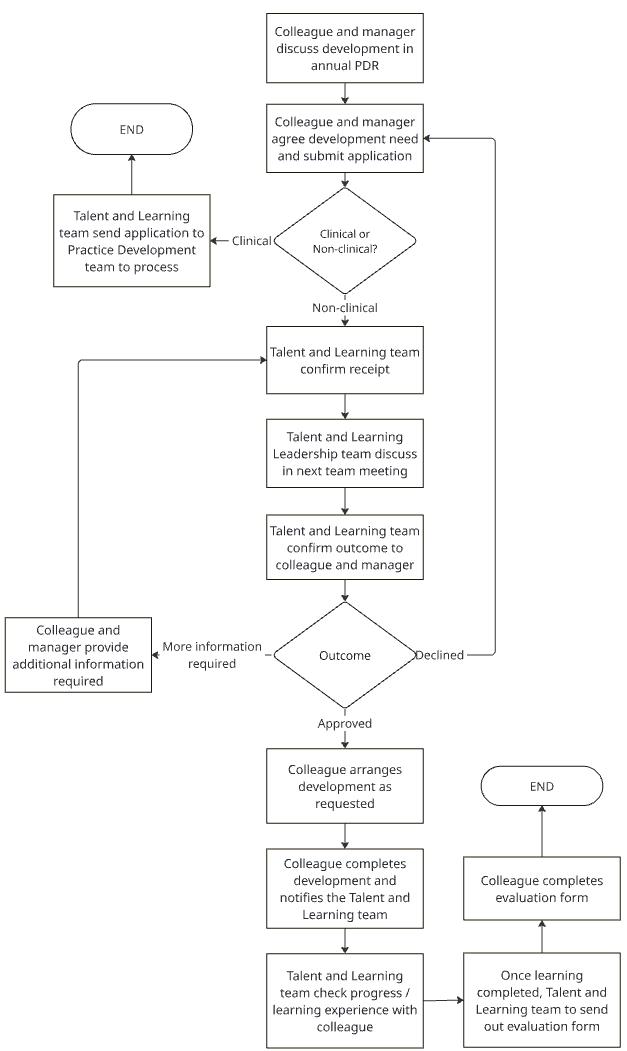
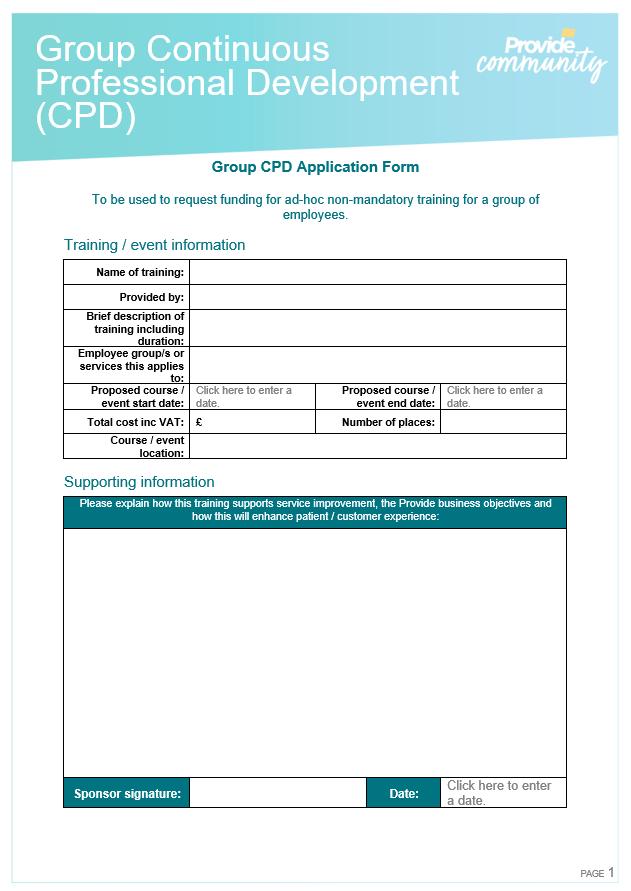
Where more formal development may be needed for a team or group, Non-Clinical CPD funding can be requested by completing a Group CPD Application Form found on the Community Platform. A copy of this application form can be seen in Appendix 4. Decisions on group CPD applications will follow the same process as individual non-clinical CPD requests outlined in Appendix 2
7. Applications for Non-Clinical CPD
Whilst the amount of monies available to support Non-Clinical Continuous Professional Development will vary from year to year, there is a centralised Provide budget for learning and talent development monies.
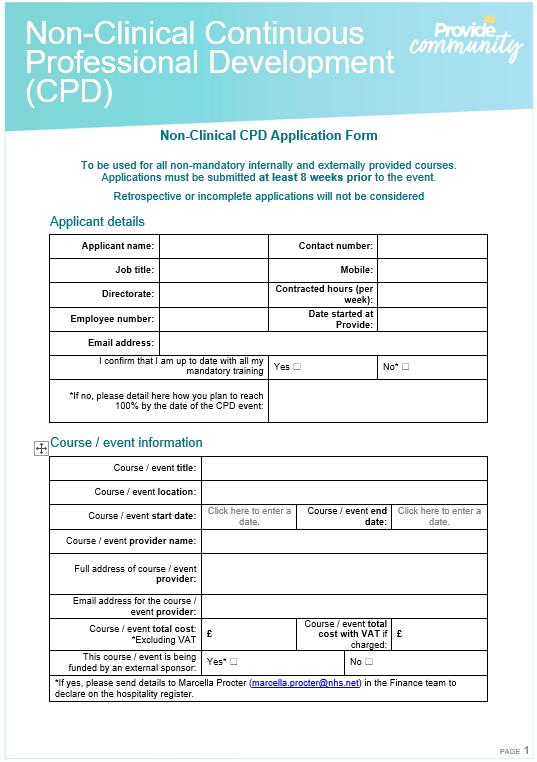
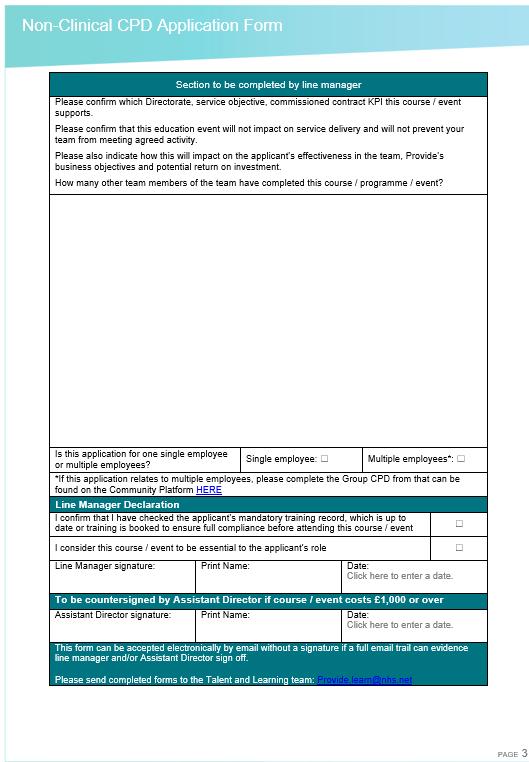
All applications for Non-Clinical personal and professional development funding are processed via the Talent and Learning team. Applications for clinical CPD funding are processed via the Practice Development team The Non-Clinical CPD application form is available on the Community Platform and is attached at Appendix 3. Incomplete applications or applications without approval of line managers will be returned to the applicant.
In deciding the level of funding support, consideration will be given to the relevance of the learning to organisational, business and corporate objectives and previous levels of funding and study leave given, mandatory training compliance, evaluation and sharing of previous learning, as well as the levels of funding currently available. The manager should always consider how it will improve the effectiveness of the role and the team. Priority will be given to those applications who meet essential organisational/service/efficiency objectives and where the development can be linked to enhancing the service delivery and there is evidence of return on investment. It may not always be possible to agree full support. Managers and colleagues should refer to the guidelines.
Equality of Access
Whilst there may be a selection criterion included for some programmes, Provide will ensure that decisions made about learning and development will be made irrespective of race, religion, gender, age, disability, sexual orientation or hours contracted to work. Colleagues and managers are asked to let training providers or the Talent and Learning team know of any specific requirements they have in order to complete the development. As part of their commitment to support colleagues at all levels in accessing development opportunities, Provide will ensure that as part of the learning and development portfolio there is the ability to improve key skills including literacy and numeracy. Managers should consider this as part of their annual PDR process and when reviewing learning and development needs in their service.
Equality and Diversity Monitoring is reported annually within the Talent and Learning reporting schedule.
To ensure equitable access to Non-Clinical Continuing Professional Development (CPD) opportunities and effective budget management, the following limitation applies Each colleague is entitled to submit one Non-Clinical CPD request per financial year (1st April to 31st March)
Any exceptions to this rule must be approved by Director, Talent and Learning and will be considered on a case-by-case basis, considering strategic priorities and individual development needs.
8. Repayment of
Development Investment
Provide is committed to developing colleagues and ensuring that they have the opportunity to maximise their skills and abilities. However, it is not in the interests of Provide to invest valuable resources to a significant level that are not subsequently reinvested in the organisation.
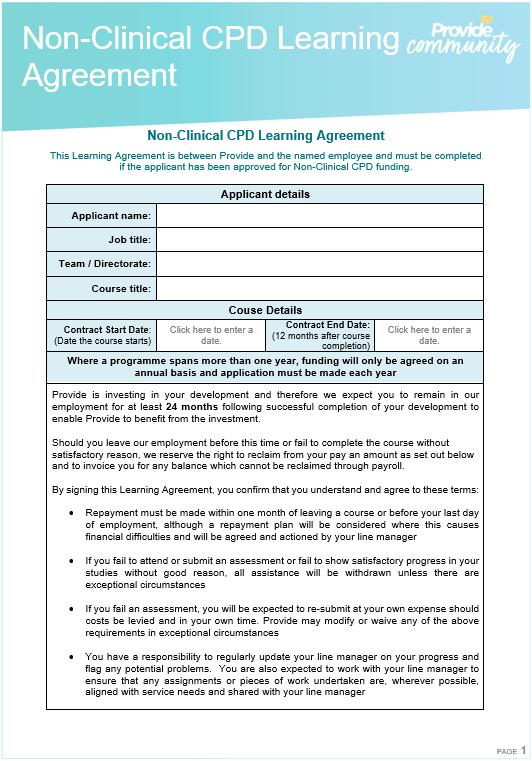
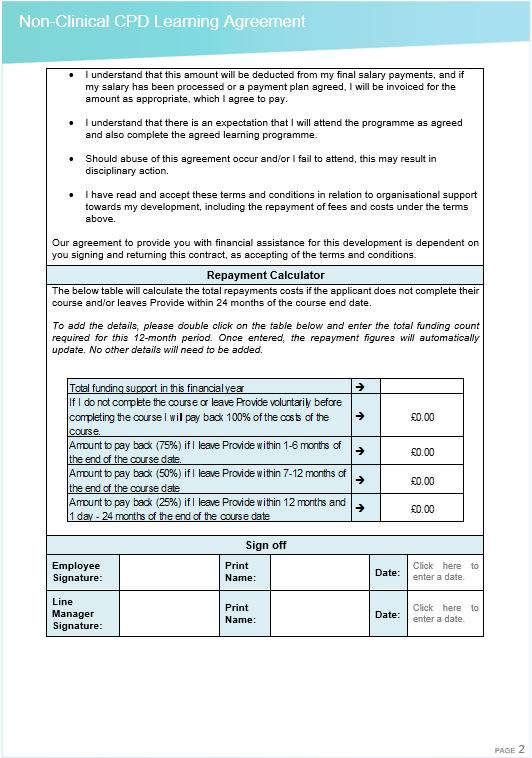
When funding for Non-Clinical Continuous Professional Development opportunities is approved for an individual to pursue a personal or professional training programme, the individual will be required to sign a Learning Agreement The Learning Agreement is attached at Appendix 6.
Appeals Process
Any appeals regarding study leave should follow normal organisational procedures, as outlined in the Grievance Policy
9. Monitoring
The Talent and Learning Leadership Team meeting will monitor the implementation of this policy every 4 years. Any colleague who feels that the guidelines are not being applied consistently should initially contact the Director - Talent and Learning. The abuse of this policy by any colleague obtaining study leave under false pretences will be considered serious. Individuals who knowingly provide false information or fail to disclose any information which may affect their employment with the organisation may be committing an offence under the Fraud Act 2006.
All suspicions of fraud and bribery must be reported to either the Counter Fraud team for Provide at enquiries@gatewayassure.com or 07940 589263, or to the Group Chief Finance Office and Company Secretary at the earliest opportunity.
Appendix 1: Examples of Development Activities
(This is not exhaustive and may not be relevant for ALL colleague groups)
Work Based Learning
Apprenticeships
Learning by doing Case studies
Clinical Audit
Coaching and mentoring
Discussions with colleagues
Peer review
Involvement in wider work of employer
(for example, being a representative on a committee or forum)
Being a link worker/link practitioner
Work shadowing
Secondments
Team Meetings
Journal clubs
Lunch and Learn sessions
Chairing a team meeting or discussion
In-service training
Supervising or mentoring colleagues
Visiting other departments/organisations and reporting back
Expanding your role
Analysing significant events/complaints
Project work or project management
Being a work-based assessor
Cascading and sharing learning back in workplace
Professional Activity
Involvement in a professional body
Membership of a specialist interest group
Lecturing or teaching
Mentoring a colleague from other departments
Being an examiner
Being a tutor
Organising journal clubs or other specialist groups
Courses – accredited/vocational
Return to Learn development
Maintaining or developing specialist skills
Being an expert witness
Membership of other professional bodies or groups
Giving presentation(s) at conferences
Organising accredited courses
Supervising research
Being a national assessor
Formal/Educational
Attending seminars/workshops
E learning
Diploma/Degree/Masters Programmes
Professional CPD Development Events
Further Education Research
Train the Trainer
Attending conferences/exhibitions
Presenting at conferences
Writing articles or papers
Reading journals/articles
Reviewing books or articles
Distance learning
Courses accredited by professional body
Planning or running a course/workshop
Self-directed Learning
Updating knowledge through the internet and/or by completing/e learning
Keeping a record/portfolio of your progress
Other
Voluntary work
Public service/charity work
Appendix 2: Non-Clinical CPD process
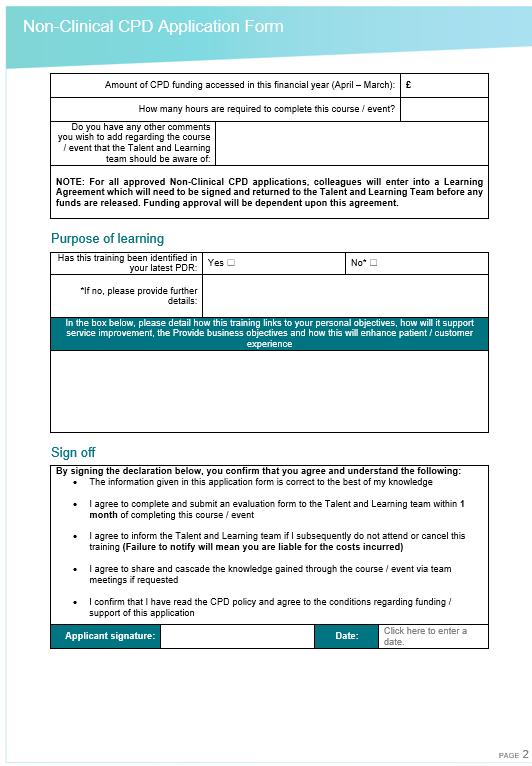
Appendix 3: Non-Clinical CPD Application Form
Appendix 4: Group CPD Application Form
Appendix 5: Guidance to Applying for Non-Clinical CPD Funding
1. Introduction
The purpose of these guidelines is to confirm the process for accessing study leave and funding to support Non-Clinical Continuous Professional Development.
Conditions of Approval:
It will be expected that all colleagues will have completed an annual Performance and Development Reviews (PDR) with their line manager prior to submitting a request for Non-Clinical Continuous Professional Development funding. All applications must have supporting evidence, signed and authorised by the manager that shows how the learning contributes to the organisational objectives and strategic vision and how it supports both Provide and Business Unit objectives. There must also be clear evidence how it will support the effectiveness of that role
The applicant must also be up to date with all required mandatory training
Applications for funding to attend or complete development opportunities, during the probationary period will not be considered. Individual managers can use their discretion to support funding, from their service budgets for any development which is considered to be essential, in order for colleagues to successfully complete their probationary period.
2. Funding Guidance
Agreement for Non-Clinical Continuous Professional Development funding is not guaranteed, and in some cases, colleagues will be expected to contribute to some or all of the cost of the learning activity.
Approval of any funding from Provide budgets to support Non-Clinical Continuous Professional Development is allocated according to the financial year in which the training takes place (1st April – 31st March).
Where the training has little or no relevance or impact on the current role or service and organisational objectives and has not been identified as needed for the effectiveness of the role or was part of their most recent PDR, funding will not be approved.
3. Application Process
Applications for all Non-Clinical Continuous Professional Development should be made at least eight weeks in advance via the Non-Clinical CPD application form which can be found on the Community Platform.
Retrospective applications will not be considered and either the individual will be required to pay for the course themselves or agree a financial contribution from their service budget with their line manager. There may be occasions where 8 weeks’ notice
cannot be given and, in these circumstances, applications can still be considered by the Talent and Learning Leadership Team meeting
This requirement applies to ALL colleagues employed by Provide (irrespective of grade or role). Applications should be emailed to the Talent and Learning team (provide.learn@nhs.net) for presentation at the next available Talent and Learning Leadership Team meeting
Applications for funding support from colleagues in Provide must be authorised and supported by the Line manager. Applications will not be considered if application forms are not completed fully. The manager and applicant should always check that there are no other funding/charitable source available to cover the course costs.
These application forms are then sent to the Talent and Learning Leadership team for submission and approval.
All applicants will be informed by email of the outcome of their application within 10 calendar days of the decision being ratified at the Talent and Learning Leadership Team meeting.
The level of funding support indicated on the application form must be the exact amount required, as there will be no opportunity to apply for extra funds. Incomplete forms will be returned to the applicant.
It is the applicant’s responsibility to book a place on their chosen course of study once confirmation that funding has been agreed. Booking a place prior to this is at the applicant’s own risk as funding cannot be guaranteed and they will be personally liable for all or part of the fee if they then later cancel or if the application is not approved.
Any invoices for courses received for development opportunities not previously approved will be sent to the service manager or Director to be considered for either payment from the service budget or by the individual applicant.
Where a deposit needs to be paid for courses, the colleague can either pay this themselves or claim back through payroll via Easy Pay with their receipt and personal details included for repayment. This must be approved by the line manager, confirmed with the Talent, and Learning team. The application must have been approved at the Talent and Learning Leadership Team meeting if claiming back from the central Talent and Learning budget.
Completion of training/courses
The funding approved is solely to fund the course and monies allocated are nontransferable i.e. between courses or individuals. Where the training provider cancels the course, or the individual was unsuccessful in obtaining a place the individual must inform the Talent and Learning team immediately. However, managers may use their discretion in substituting colleagues if a course has been paid for and Provide risks losing the money or learning opportunity e.g. when a colleague is unable to attend due to sickness.
Having agreed to fund the course, wholly or partly, and the individual obtains a place, Provide expects the colleague to complete all aspects of the training programme, which is funded, and this includes submission of assignments and/or completion of any
examinations. If any colleague wishes to withdraw from the course, they should first discuss this with their line manager and advise the Talent and Learning team Permission to withdraw will only be granted in terms of serious ill health or immediate family bereavement, maternity or any other substantial reasons as agreed by the manager. In all other circumstances, the individual will be required to refund the cost of the programme as per the learning agreement
Confirmation of attendance at the course is made to the Talent and Learning team by completing and submitting the evaluation form. This is essential so that the individual learner record can be updated and the CPD budget can also be confirmed and allocated.
5. Cancellations and non-attendance at training
Once an application for funding has been approved, colleagues are expected to attend. Failure to attend external courses where there is a cost, will require repayment of the full charge to Provide by the colleague. Consideration will be given for exceptional circumstances on an individual basis. Non-attendance at any training including workbased learning will need to be substantiated. Non-attendance at any training must be reported to the line manager. Failure to do so will result in the colleague being absent without leave and will be dealt with under the organisations disciplinary policy and also reported to the counter fraud team Non-completion or non-attendance must also be reported to the Talent and Learning team to update the learner record.
6. Learning Agreement
Where Provide has agreed to offer funding for a colleague to undertake a programme of learning, they will be asked to sign a Learning Agreement. This will specify that should the colleague voluntarily leave Provide within 24 months from completion of part or all the programme, that they will be asked to repay a proportion of the costs back to Provide.
This agreement will have formal status as part of the colleague’s contract of employment. The Learning Agreement will also cover ‘repayment’ of costs to attend a programme where the colleague voluntarily chooses not to complete the programme or to comply with the Learning Agreement. In these cases, it is the responsibility of the line manager to identify this either through the exit interview checklist or discussion with the colleague and agree to the appropriate proportion of costs to be repaid. This will apply to all programmes. The manager should then contact provide.learn@nhs.net. The Talent and Learning team will also check the monthly leavers report, to cross check if there are any monies due from leavers.
For all programmes that last more than one year, funding will only be allocated annually or per module and applications for funding must be re-submitted annually with evidence of progress. Approvals for these courses will be made on an annual basis, and it cannot be assumed that on-going funding will be available.
Colleagues not completing a programme etc. will be treated in the same way as for those colleagues leaving the organisation, except when the post holder leaves as a result of service redesign or organisational change Consideration, however, needs to be considered for any extenuating circumstances, i.e. illness or service pressures.
The following formula will be applied to calculate the financial contribution required from colleagues who either do not complete the approved programme or leave the organisation before fulfilling the agreed contractual obligation period:
Reason Within 1-6 months
Non completion of programme: leaves the organisation or leaves the programme for non-valid reason before completion
Completes the programme: leaves the organisation for non-valid reason before the 24-month obligatory contracted period
Within 7-12 months Within 12 months + 1 day – 24 months
The decision to activate this process lies with the line manager. Deductions will be made using a P4 form from the colleagues’ last salary payments or where the figure to be reimbursed exceeds the amount of pay, a repayment plan will be agreed between the individual and their line manager over a 3-month period.
7. Resources, Books and Stationery
Colleagues will be expected to purchase their own resources, books and stationery to support learning programmes. They can also make use of the electronic resources including a full library service contracted via Mid and South Essex Foundation Trust. Joining and access information is available via the Community Platform.
8. Examination Fees and Leave
If taking an examination is a requirement of completing the programme of study, then this must be included in the application form. Any examination fees must also be included as part of the application process as otherwise will not be considered for funding.
Approval for examination leave is at the discretion of the colleagues’ line manager but the allocation of study leave for examinations and leave to assist colleagues prior to examinations is desirable. However, managers must ensure they take a consistent approach to this. Good equality of opportunity practice should be applied. All agreements in relation to study leave and examination support must be made at the outset of the programme.
Support, for completing first time examination failures can be considered after taking account of the full circumstances. Second and subsequent failures will not be supported by Provide.
9. Conferences
For national conferences, normally only one person from any one department should attend, unless it is considered appropriate by the line manager/director for additional colleagues to attend (in which case the department budget may be required to support the additional delegates). As many conference organisers now post keynote speeches on the internet, the applicant would then be required to share learning with others in Provide. The normal application process also applies to attending all conferences.
Non-Clinical Continuous Professional Development will not normally be granted to attend programmes outside the UK where a similar programme is available in the UK. However, Provide recognises that colleagues may occasionally be required to travel overseas to attend conferences, to present papers promoting the work of Provide. In these cases, colleagues will need to discuss and agree with their line manager/director and agree any funding/time/travel arrangements and any other specific issues about overseas travel in advance.
If they are presenting a paper or promoting the work of Provide prior approval must be agreed with line managers and relevant directors. Any source of corporate or private sponsorship for attending conferences or any development event needs to be registered in accordance with the organisation’s Hospitality and Sponsorship Register maintained by the finance team. All presentations should be on the standard Provide presentation templates. Provide will not pay for or reimburse the cost of any additional expenses associated with a conference e.g. social events/trips/excursions/car hire etc. All of these costs would be met by the individual.
10. Travel costs
These may be reimbursed for travel to and from programmes that are defined as Mandatory or Essential to Role following negotiation and prior agreement with the colleague’s line manager. The cost for this expense will be taken from the approving line managers budget and/or directorate. For any development that is defined as Optional, travel expenses will not be claimed.
11. Subsistence Allowances
When a colleague requests funding for overnight accommodation, they will need to discuss with their line manager asthis could only be supported fromthe service budget or contribution from the colleague. Consideration should be given to finding the most cost-effective accommodation in the area.
No funding can be approved for alcoholic drinks, newspapers, videos, mini-bar, laundry, hotel club/leisure activities, or any other expense not incurred as a necessary business expense.
12. Claiming expenses
Claimants should claim all expenses associated with the development event including mileage and parking through the EASY PAY system. Colleagues must identify that the mileage is associated with a development event. These are claimed through the service budget via Easy Pay and must be authorised by the line manager.
Expense claims should be submitted promptly on a monthly basis At the end of the financial year, the claimant is responsible for ensuring that all expenditure is claimed in time to be paid in the April payroll run so that it can be accounted for in the appropriate financial year.
13. Evaluation/Feedback
Before claiming any expenses for development, the applicant must provide feedback to their manager/wider team and colleagues regarding the development attended and submit an evaluation form to the Talent and Learning team, within 1 month of completing the development. Line managers will therefore need to see a copy of the evaluation form and evidence of feedback to the team/service prior to authorising any travel and other expenses associated with the training.
Failure to complete evaluations or cascade/share learning with the team or service will adversely affect any future application for funding.
14. Monitor and Review
These guidelines will be subject to regular monitoring, coordinated by the Talent and Learning team to ensure systems and processes are fit for purpose and being adhered to.
Appendix 6: Learning Agreement
EQUALITY IMPACT ASSESSMENT
TEMPLATE: Stage 1: ‘Screening’
Name of project/policy/strategy (hereafter referred to as “initiative”):
Non-Clinical Personal and Professional Development Policy
Provide a brief summary (bullet points) of the aims of the initiative and main activities:
To ensure Provide colleagues are aware of the process and procedures to follow when requesting non-clinical CPD
To ensure managers know their responsibilities to ensure their direct reports are effectively trained and up to date on their development requirements
To ensure that all non-clinical CPD is discussed and a consistent process implemented for the approval of development activities
To signpost applicants and line managers to the correct documentation to use when applying for non-clinical CPD
Project/Policy Manager: Learning Manager - Health Date: 30/01/2025
This stage establishes whether a proposed initiative will have an impact from an equality perspective on any particular group of people or community – i.e. on the grounds of race (incl. religion/faith), gender (incl. sexual orientation), age, disability, or whether it is “equality neutral” (i.e. have no effect either positive or negative). In the case of gender, consider whether people are affected differently.
Q1. Who will benefit from this initiative? Is there likely to be a positive impact on specific groups/communities (whether or not they are the intended beneficiaries), and if so, how? Or is it clear at this stage that it will be equality “neutral”? i.e. will have no particular effect on any group.
This policy will support all managers and colleagues to understand their responsibilities in relation to personal and professional development. All development needs are identified through the PDR process which is equality neutral. The policy also includes references to part time colleagues and guidelines for managers to ensure equity of access to development opportunities
Q2. Is there likely to be an adverse impact on one or more minority/under-represented or community groups as a result of this initiative? If so, who may be affected and why? Or is it clear at this stage that it will be equality “neutral”?
The policy clearly sets out the requirements for all colleagues in undertaking and completing their personal and professional development needs and should therefore have a positive impact on all colleague groups in clarifying what is
required. It also outlines that non-clinical CPD for all colleagues and does not exclude any one group. It specifically mentions in this policy how opportunities will be fairly processed and that where applicable, colleagues can specify to the Talent and Learning team if there are any reasonable adjustments that need to be made.
In addition, equality and diversity monitoring is reported annually within the Talent and Learning reporting schedule.
Q3. Is the impact of the initiative – whether positive or negative - significant enough to warrant a more detailed assessment (Stage 2 – see guidance)? If not, will there be monitoring and review to assess the impact over a period time? Briefly (bullet points) give reasons for your answer and any steps you are taking to address particular issues, including any consultation with staff or external groups/agencies.
Managers are required to ensure that ALL colleagues have an annual PDR. This is also monitored by the Talent and Learning Team annually, resultant nonclinical CPD is monitored and presented via the Talent and Learning Team and escalated onto People and Culture Steering Group.
Guidelines: Things to consider
Equality impact assessments at Provide take account of relevant equality legislation and include age, (i.e. young and old,), race and ethnicity, gender, disability, religion and faith, and sexual orientation.
The initiative may have a positive, negative or neutral impact, i.e. have no particular effect on the group/community.
Where a negative (i.e. adverse) impact is identified, it may be appropriate to make a more detailed EIA (see Stage 2), or as important, take early action to redress this – e.g. by abandoning or modifying the initiative. NB: If the initiative contravenes equality legislation, it must be abandoned or modified.
Where an initiative has a positive impact on groups/community relations, the EIA should make this explicit, to enable the outcomes to be monitored over its lifespan.
Where there is a positive impact on particular groups does this mean there could be an adverse impact on others, and if so, can this be justified? - e.g. are there other existing or planned initiatives which redress this?
It may not be possible to provide detailed answers to some of these questions at the start of the initiative The EIA may identify a lack of relevant data, and that data-gathering is a specific action required to inform the initiative as it develops, and also to form part of a continuing evaluation and review process.
It is envisaged that it will be rare for full impact assessments to be conducted at Provide. Usually, where there are particular problems identified in the screening stage, it is envisaged that the approach will be amended at this stage, and/or setting up a monitoring/evaluation system to review a policy’s impact over time.
Guidelines: Things to consider
An initiative may have a positive impact on some sectors of the community but leave others excluded or feeling they are excluded. Consideration should be given to how this can be tackled or minimised.
It is important to ensure that relevant groups/communities are identified who should be consulted. This may require taking positive action to engage with those groups who are traditionally less likely to respond to consultations and could form a specific part of the initiative.
The consultation process should form a meaningful part of the initiative as it develops and help inform any future action.
If the EIA shows an adverse impact, is this because it contravenes any equality legislation? If so, the initiative must be modified or abandoned. There may be another way to meet the objective(s) of the initiative.
Further information:
Useful Websites www.equalityhumanrights.com Website for new Equality agency www.employers-forum.co.uk – Employers forum on disability www.efa.org.uk – Employers forum on age