
First Aid at Work Policy
Version: V7
Ratified by: Finance Investment Committee
Date ratified: 06/05/2025
Job Title of author: Head of Health, Safety and Compliance
Reviewed by Committee or Expert Group Property Health and Safety Steering Group
Equality Impact Assessed by: Head of Health, Safety and Compliance
Related procedural documents

Health & Safety at Work Policy – HSPOL08
Review date: 06/05/2028
• It is the responsibility of users to ensure that you are using the most up to date document – i.e. obtained via the intranet.
• In developing/reviewing this policy Provide Community has had regard to the principles of the NHS Constitution.
Version Control Sheet
Version Date
Author Status Comment
V1 July 2009 Director of Corporate Development & Governance Approved New
V2 April 2012 Health & Safety, Resilience and Security Manager Approved Reviewed in line with transition to CECS CIC
V2.1 September 2013 Safety & Quality Administrator No change to review date Updated in line with organisation name change and restructure
V 2.2 October 2014 Health & Safety, Resilience and Security Manager Ratified at Health and Safety Noted at Quality and Safety Updated in line with organisation name change and restructure
V3 October 2016 Head of Safety & Resilience Ratified Updated in line with organisation change. Formerly IGPOL28.
V4 November 2018 Head of Safety & Resilience
V5 May 2022 Health, Safety, Fire and Security Manager Reviewed Ratified FIC –25/05/2022
V7 July 2022 Health, Safety, Fire and Security Manager Updated to include remote working and RA for first aiders.
V7 April 2025 Head of Health Safety and Compliance Review, Mental health First aid section a risk assessments added
1. Introduction
Provide Community has a duty under the Health & Safety (First Aid) Regulations 1981 to provide adequate and appropriate equipment, facilities and personnel to enable first aid to be given to employees who are injured or become ill at work.
All employees employed by,or working for Provide Community are expected to cooperate with the requirements of this policy.
2. Purpose
The purpose of this policy is to detail the arrangements and organisation for the implementation of the Health & Safety (First Aid) Regulations within Provide Community
3. Definitions
First Aid is the immediate care given to an ill or injured person until more advanced care arrives or the person recovers. This includes the treatment of minor illness which would otherwise receive no treatment or which does not need treatment by a Doctor or Nurse.
First Aider is someone who:
• Has attended a recognised training course on First Aid at Work and/or
• Provided they can demonstrate current knowledge and skills in first aid, the training and experience of the following qualify them to administer first aid in the workplace without the needs for training:
o Doctors registered and licensed with the General Medical Council
o Nurses registered with the Nursing and Midwifery Council
o Paramedics registered with the Health and Care Professions Council
Appointed Person is where the assessment of first-aid need identifies that a designated first aider is not required, the minimum requirement is to appoint a person to take charge of the first-aid arrangements, including looking after the equipment and facilities, and calling the emergency services when required. Arrangements should be made for an appointed person to be available to undertake these duties at all times when people are at work.
To fulfil their role, appointed persons do not need first-aid training, though they may benefit from completion of a First Aid at Work course (or other suitable alternative).
Appointed persons must not give first aid unless trained to do so.
Medical Emergency is an injury or condition that if left untreated or without prompt assistance could lead to significant deteriorate or death for example
• Cardiac arrest
• Chest pain
• Stroke
• Difficulty breathing
First aid box is a storage container which must be made of suitable material and designed to protect the contents from damp/dust and is clearly identified as a first aid box by a white cross on a green background.
4. Duties
Group Chief Executive
The Group Chief Executive will have overall responsibility for ensuring that this First Aid policy is effectively implemented.
Group Chief Officers
Group Chief Officers are responsible for ensuring that arrangements are in place to ensure first-aid provision within their areas of responsibility
Directors, Divisional Leads, Managers and Team Leaders etc.
Directors, Managers, Divisional Leads and Team Leaders have delegated responsibility for implementing the policy within their departments. This includes:
• Bringing this policy to the attention of staff within their area of responsibility.
• Encouraging staff to report all incidents that involve the provision of first aid using the Trust’s incident reporting system.
• Ensuring that a first aid needs assessment is carried out, reviewed annually and updated if the work pattern and workplace environmental hazards alter.
• Communicating significant findings from assessments to staff within their area of responsibility – Appendix 1
• Ensuring that there are adequate first aid facilities in place, including adequate numbers of trained First Aiders (including cover for annual leave and any other foreseeable absence) and suitably stocked first aid kits.
• Ensuring that the designated staff appointed control and maintain first-aid and first aid facilities at all times. This includes carrying out monthly checks on first aid boxes to ensure adequate in date supplies are maintained (Guidance of First aid box contents – Appendix 3)
• Ensuring Datix/Access details entered after first aid administered
Health and Safety Team
To provide support, advice and guidance to the organisation, ensuring legal provision of first aid across the services. To ensure the Policy and method used to assess first aider provision is still relevant and applicable to current legislation
Shared Premises
In establishing the level of first aid required where a site is shared by more than one department or with another organisation/s, managers should liaise with colleagues from other departments, where practicable, to establish the overall level of cover required on a site basis and including in First aid needs risk assessment.
First Aiders
Where the risk assessment identifies that a First Aider or Emergency First Aider
must be appointed, duties include:
• Providing first-aid to any person injured or falling ill on Trust premises.
• Taking charge of the casualty until a satisfactory recovery is achieved or appropriate medical personnel have taken charge of the casualty.
• To record any treatments given on the approved Incident Reporting system (Datix)
• Looking after first aid equipment, such as maintaining the content of the first aid box, by carrying out checks on a monthly basis.
• Calling the emergency services, if needed.
Appointed Person
If it is not considered necessary to have a First Aider, then an Appointed Person is required. The role of the appointed person is to take charge of an incident which involves injury or illness. It would be beneficial if the appointed person underwent some first-aid training. The Appointed Person will check the condition and contents of each first-aid box, positioned within their area of control, to check that it is properly and promptly replenished on a monthly basis.
All Staff
All staff have a responsibility to:
• Report all accidents or near misses that occur via Provide Community’s Datix/Access incident reporting system
• To assist any person who is injured or ill in the best way they can, even if all they can do is summon a First Aider or appointed person or call an ambulance.
• Report to Estates helpdesk when an item rom the First Aid kit is used so it can be replenished.
5. Consultation and Communication
Under the Health and Safety (First Aid) Regulations 1981, the number of First Aiders, equipment and facilities required is based on carrying out a first aid needs assessment (see Appendices 1 and 2). Provision of first aid treatment for non-employees does not fall within the scope of the regulations but when carrying out a risk assessment managers need to consider the first-aid needs of non-employees
First aid provision is most efficiently and effectively dealt with on a workplace-byworkplace basis, so managers within shared premises such as leased properties, integrated teams, agile working areas etc. must liaise with one another and make decisions based on risk assessment when deciding upon the level of provision necessary
6. Monitoring
The effectiveness of the policy is monitored through the incident reporting process and reviewed by the Head of Health, Safety and Compliance
7. Mental Health First Aiders
Mental Health First Aid (MHFA) is an internationally recognised training course, designed to teach people how to spot the signs and symptoms of mental ill health and provide help on a first aid basis.
In the same way as learning physical first aid, MHFA teaches people how to recognise those crucial warning signs of mental ill health and feel confident to guide someone to appropriate support.
Provide Community have several Mental Health First Aiders (MHFAs) available in most areas. They can provide immediate support to staff and are able to guide colleagues to other support mechanisms. Details of contacts are available on the Provide Platform; this is managed via the Working Well and Essex Lifestyle Service.
8. Risk Assessment
The risk assessment must consider the workplace hazards and risk of injury and ill health such as: (Appendix 1)
• Specific hazards or risks e.g. working with hazardous substances, dangerous tools and or machinery or objects
• The nature of work, workplace hazards and different levels of associated risk
• The numbers and distribution of employees
• Annual leave and other absences from work of First Aiders
• The size and location of premises
• Areas of shared occupancy
• Shift or out of hours working, working alone or at remote locations
• Inexperienced workers or young persons on site
• Employees with disabilities, special health problems or speech, learning or language difficulties
• Distance from outside medical services
• Visits made by non-employees and/or members of the public
• History of accidents and cases of ill health
• General health and wellbeing of employees or specific health issues
Requirements for the provision of first aid following the risk assessments must be approved and implemented, these must be specific in the number of trained people and facilities.
Arrangements must include:
• Number of First Aiders.
• Provision of first aid rooms, where appropriate.
• Provision of first aid kits.
• Consideration of first aid kits and basic training for mobile and lone workers.
In determining the correct level of first aid provision, the risk assessment should also take into account the number of medical doctors and nurses on site.
The guidance under Regulation 3 of the Health & Safety (First Aid) Regulations 1981 states that “provided they (health professional ) can demonstrate current knowledge and skills in first aid, the training and experience of the following qualify them to administer first aid in the workplace without the need to hold a FAW or EFAW or equivalent qualification:
• Doctors registered and licensed with the General Medical Council;
• Nurses registered with the Nursing and Midwifery Council;
• Paramedics registered with the Health and Care Professions Council “
As part of their respective professional code these staff should only be considered where a trained first aider is unavailable and they are not engaged in seeing patients or when it is appropriate to interrupt a patient session.
The level of first aid provision must be reviewed on a regular basis, and whenever the organisation changes, to ensure they remain appropriate.
Information on first aid arrangements must be clear and easily understood by all employees. Additional attention should be paid to members of staff with reading, learning or language difficulties.
Details for arrangements must include as a minimum:
• Action to take when first aid treatment is required.
• Emergency contact numbers.
• Identity of First Aiders and Appointed Persons, and how they can be contacted.
• Location of first aid equipment.
Induction training must include the provision of first aid information to ensure that new employees are made aware of first aid arrangements.
Designated First Aiders will be covered by the NHS Public Liability Scheme for the provision of first aid that they may administer while on Provide premises.
All first aiders are advised to undertake a course of Hepatitis B vaccinations and should consult with the Occupational Health Department, who will advise on the immunity status.
Although there is no legal requirement for Provide to administer first aid to members of the public, Provide acknowledges its duty of care and will offer the provision where practicable.
Details of any injuries and first aid treatments given must be recorded and reference should be made to the Incident Reporting Policy.
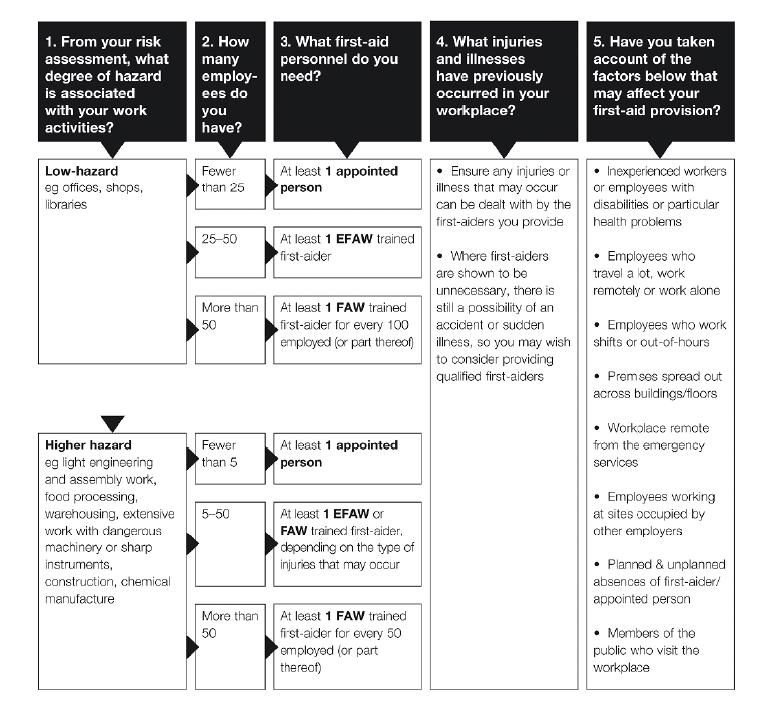
Suggested numbers of first-aid personnel to be available at all times people are at work:
References
• The Health & Safety at Work etc Act 1974
• The Reporting of Injuries, Diseases and Dangerous Occurrences Regulations 2013.
• The Health and Safety (First aid) Regulations 1981 Approved Code of Practice and guidance, 3rd Ed. 2013
• The Management of Health And Safety at Work Regulations 1999
• HSE Leaflet ‘First aid at work - Your questions answered - INDG214’ (Rev 1)
Appendix 1
FIRST AID NEEDS ASSESSMENT
Persons who undertake a First Aid Needs Assessment must have a level of competence and knowledge of the buildings/premises, staff demographic, likely hazards, and working arrangements within their department. It is the responsibility of each Manager to ensure that staff conducting such an assessment are competent to do so.
Where a multi occupied site Estates Team to complete with the Health and Safety Team
SECTION 1.
1.1 ACTIVITY
Title: Site Assessment of First Aid Needs
Department:
Location:
Additional notes:
1.2 PERSON(S) CONDUCTING THIS ASSESSMENT
Name(s):
Date assessment undertaken:
Signature(s):
1.3
ASSESSMENT REVIEW HISTORY
This assessment should be reviewed immediately if there is any reason to suppose that the original assessment is no longer valid. Otherwise, the assessment should be reviewed, at least every 3 years. The responsible competent person must ensure that this assessment remains valid. Review 1
Due date:
Date conducted:
Conducted by:
SECTION 2. DETERMINATION OF FIRST AID PROVISIONS
FACTORS TO CONSIDER NOTES
FIRST AID PROVISIONS
HAZARDS: Use general risk assessments to inform the First Aid requirements, consider types of activities/hazards and the levels of first-aid provision required
Does the workplace have low level hazards e.g. those found in an office?
Yes / No - Slips & trips, ill health, DSE, lone working (office)
Does the workplace have high level hazards e.g. those found in a lab or mechanical workshops? Consider hazards such as toxic substances, explosives, pathogens, high voltages, manual handling, machinery, fieldwork in remote areas.
Additional factors to consider:
Additional factors to consider:
Yes / No
Minimum provisions: An Appointed Person A First Aid box
Consider providing: First Aiders
Additional specialist First Aid training A First Aid box
Additional First Aid equipment A First Aid room
Staff: Consider the number of staff and those staff that may be higher at risk
How many people work in the department? FTE)
See Section 3
Are there staff on site that may be at higher risk? Consider inexperienced workers, those with existing health problems, young persons, new and expectant mothers, disability etc.
Additional factors to consider:
Yes / No - New & expectant mothers, disability, existing health problems
Consider providing: Additional specialist First Aid training Additional First Aid equipment
Additional factors to consider:
ACCIDENT HISTORY/RECORDS:
What types of accidents and injuries have previously occurred? Ill health, slips & falls
Ensure that First Aid provisions will cover the type of injuries that have occurred in the past in addition to those that are foreseeable.
Additional factors to consider:
Additional factors to consider:
WORKING ARRANGEMENTS:
Do staff work alone? Yes / No
Do any staff work shift or out of hours? Yes / No
Ensure access to First Aid kit
Ensure communications lines are accessible e.g. mobile phone
Ensure there is sufficient First Aid cover
Does the department occupy more than one building or operate on multiple floors?
Yes / No
Consider First Aid provisions in each building/floor
Are there times when the First Aider might be on holiday/absent?
Do any staff travel i.e. drive as part of work commitments?
Do any staff conduct work off site e.g. in the community. Workplaces where specialist First Aid may be required?
Additional factors to consider:
Yes / No
Additional factors to consider:
Yes / No
NON-EMPLOYEES:
Do members of the public, visitors, contractors, students, volunteers visit site?
Yes / No
Ensure sufficient First Aid provisions during holiday periods/unexpected staff absences
Ensure mobile First Aid kits are provided Consider providing additional specialist First Aid
Consider providing: Specialist First Aid kits Additional specialist First Aid training
Yes / No -
EMERGENCY SERVICES:
It is strongly advised that First Aid provisions are made for nonemployees that are on site
What is the proximity to closest hospital?
SECTION 3. Suggested number of First Aid personnel to be available at all times people are at work. Please refer to the First Aid Standard for Appointed Person (AP), Emergency First Aid at Work (EFAW) and First Aid at Work (FAW) syllabus. LEVEL OF RISK (Informed by general risk assessments)
OF PERSONNEL*
OF FIRST AIDERS REQUIRED (as suggested by the HSE)
Low risk <25 At least 1 Appointed person
At least 1 EFAW trained First Aider >50 At least 1 FAW trained First Aider for every 100 (or part thereof)
High risk <5 At least 1 Appointed person 5-50
At least 1 EFAW trained First Aider (consider the type of injuries that may occur)
>50 At least 1 FAW trained First Aider for every 50 (or part thereof)
*The HSE strongly advise that arrangements for First Aid provisions also take into account non-employees that may be on site.
SECTION 4. Utilise the guidance in Section 2 and the table in Section 3 to determine your First Aid requirements in the workplace. Where a building/floor is shared with another department with similar hazards consideration should be given to sharing First Aid resources.
REQUIRED
Appointed person Yes / No
EFAW First Aider Yes / No
FAW First Aider Yes / No
First Aider with additional training (please specify) Yes / No FIRST AID EQUIPMENT AND FACILITIES REQUIRED
Damp and dust proof First Aid container Yes / No
Contents of First Aid Box
First Aid room Yes / No
Shower Yes / No
Detail location, type of room, sole use or can the room be vacated easily and quickly
EQUALITY IMPACT ASSESSMENT TEMPLATE: Stage 1: ‘Screening’
Name of project/policy/strategy (hereafter referred to as “initiative”):
First Aid at Work Policy – HSPOL09
Provide a brief summary (bullet points) of the aims of the initiative and main activities:
This Policy describes the procedures which should be followed by all Provide employees when dealing with occasions when they may need emergency attention
Project/Policy Manager: Head of Health Safety and Compliance Date: April 2025
This stage establishes whether a proposed initiative will have an impact from an equality perspective on any particular group of people or community – i.e. on the grounds of race (incl. religion/faith), gender (incl. sexual orientation), age, disability, or whether it is “equality neutral” (i.e. have no effect either positive or negative). In the case of gender, consider whether men and women are affected differently.
Q1. Who will benefit from this initiative? Is there likely to be a positive impact on specific groups/communities (whether or not they are the intended beneficiaries), and if so, how? Or is it clear at this stage that it will be equality “neutral”? i.e. will have no particular effect on any group.
Neutral
Q2. Is there likely to be an adverse impact on one or more minority/under-represented or community groups as a result of this initiative? If so, who may be affected and why? Or is it clear at this stage that it will be equality “neutral”?
Neutral
Q3. Is the impact of the initiative – whether positive or negative - significant enough to warrant a more detailed assessment (Stage 2 – see guidance)? If not, will there be monitoring and review to assess the impact over a period time? Briefly (bullet points) give reasons for your answer and any steps you are taking to address particular issues, including any consultation with staff or external groups/agencies.
Neutral
Guidelines: Things to consider
• Equality impact assessments at Provide take account of relevant equality legislation and include age, (i.e. young and old,); race and ethnicity, gender, disability, religion and faith, and sexual orientation.
• The initiative may have a positive, negative or neutral impact, i.e. have no particular effect on the group/community.
• Where a negative (i.e. adverse) impact is identified, it may be appropriate to make a more detailed EIA (see Stage 2), or, as important, take early action to redress this – e.g. by abandoning or modifying the initiative. NB: If the initiative contravenes equality legislation, it must be abandoned or modified.
• Where an initiative has a positive impact on groups/community relations, the EIA should make this explicit, to enable the outcomes to be monitored over its lifespan.
• Where there is a positive impact on particular groups does this mean there could be an adverse impact on others, and if so can this be justified? - e.g. are there other existing or planned initiatives which redress this?
• It may not be possible to provide detailed answers to some of these questions at the start of the initiative. The EIA may identify a lack of relevant data, and that data-gathering is a specific action required to inform the initiative as it develops, and also to form part of a continuing evaluation and review process.
• It is envisaged that it will be relatively rare for full impact assessments to be carried out at Provide. Usually, where there are particular problems identified in the screening stage, it is envisaged that the approach will be amended at this stage, and/or setting up a monitoring/evaluation system to review a policy’s impact over time.
EQUALITY IMPACT ASSESSMENT TEMPLATE: Stage 2:
(To be used where the ‘screening phase has identified a substantial problem/concern)
This stage examines the initiative in more detail in order to obtain further information where required about its potential adverse or positive impact from an equality perspective. It will help inform whether any action needs to be taken and may form part of a continuing assessment framework as the initiative develops.
Q1. What data/information is there on the target beneficiary groups/communities? Are any of these groups under- or over-represented? Do they have access to the same resources? What are your sources of data and are there any gaps?
N/A
Q2. Is there a potential for this initiative to have a positive impact, such as tackling discrimination, promoting equality of opportunity and good community relations? If yes, how? Which are the main groups it will have an impact on?
N/A
Q3. Will the initiative have an adverse impact on any particular group or community/community relations? If yes, in what way? Will the impact be different for different groups – e.g. men and women?
N/A
Q4. Has there been consultation/is consultation planned with stakeholders/ beneficiaries/ staff who will be affected by the initiative? Summarise (bullet points) any important issues arising from the consultation.
N/A
Q5. Given your answers to the previous questions, how will your plans be revised to reduce/eliminate negative impact or enhance positive impact? Are there specific factors which need to be taken into account?
N/A
Q6. How will the initiative continue to be monitored and evaluated, including its impact on particular groups/ improving community relations? Where appropriate, identify any additional data that will be required.
N/A
Guidelines: Things to consider
• An initiative may have a positive impact on some sectors of the community but leave others excluded or feeling they are excluded. Consideration should be given to how this can be tackled or minimised.
• It is important to ensure that relevant groups/communities are identified who should be consulted. This may require taking positive action to engage with those groups who are traditionally less likely to respond to consultations, and could form a specific part of the initiative.
• The consultation process should form a meaningful part of the initiative as it develops, and help inform any future action.
• If the EIA shows an adverse impact, is this because it contravenes any equality legislation? If so, the initiative must be modified or abandoned. There may be another way to meet the objective(s) of the initiative.
Further information:
Useful Websites www.equalityhumanrights.com Website for new Equality agency www.employers-forum.co.uk – Employers forum on disability www.disabilitynow.org.uk – online disability related newspaper www.womenandequalityunit.gov.uk – Gender issues in more depth www.opportunitynow.org.uk - Employer member organisation (gender) www.efa.org.uk – Employers forum on age www.agepositive.gov.uk – Age issues in more depth
© MDA 2007
EQUALITY IMPACT ASSESSMENT TEMPLATE: Stage One: ‘Screening’