

Car Leasing Policy and Procedure
Version: V1
Ratified by: Finance Investment Committee
Date ratified: 02/07/2025
Job Title of author: Director Estates
Reviewed by Committee or Expert Group SLT, Finance Investment Committee
Equality Impact Assessed by: Director Estates
Related procedural documents

n/a
Review date: 02/07/2028
It is the responsibility of users to ensure that you are using the most up to date document template – i.e. obtained via the intranet
In developing/reviewing this policy Provide Community has had regard to the principles of the NHS Constitution.
Version Control Sheet
Version Date Author Status Comment V1 2 July 2025 Director, Estates New Ratified
1. Introduction
This policy outlines the procedures and eligibility requirements for employees of the Provide Group who wish to access a lease vehicle under the Lease Car Scheme.
2. Lease Car Eligibility and Approval Process
Eligibility Criteria
Employees must meet the following criteria to be eligible for a lease vehicle:
• Hold a permanent contract of employment
• Successfully completed their probationary period
Not eligible:
• Fixed-term employees
• Agency staff
• Casual workers via Workforce Solutions
• Colleagues whose salary will fall below the national living wage after deduction of lease car payments
Eligibility is limited to one lease vehicle per employee.
All applications require Group Chief Officer approval and final sign-off by the Group Chief Finance Officer.
Scheme Overview
Provide operates a “user-chooser” scheme with a choice of 2 car lease providers:
1. Essex Partnership University Trust (EPUT)
2. NHS FLEET.
Employees can obtain quotes through both providers and decide which scheme they wish to go with.
Through the quote process, employees can choose a vehicle, subject to specific insurance and cost criteria including:
• Vehicle Price Cap: £60,000
• Electric or hybrid vehicles only
• Lease term – 3 years
• Tracker Requirement: Vehicles over £50,000 must have a GPS tracker installed
The Car Lease scheme does not support petrol or diesel vehicles under this lease scheme. Provide supports the NHS Net Zero Travel and Transport Strategy.
Applications may be refused or terminated based on insurance risk, with any early termination fees payable by the employee.
Application Process
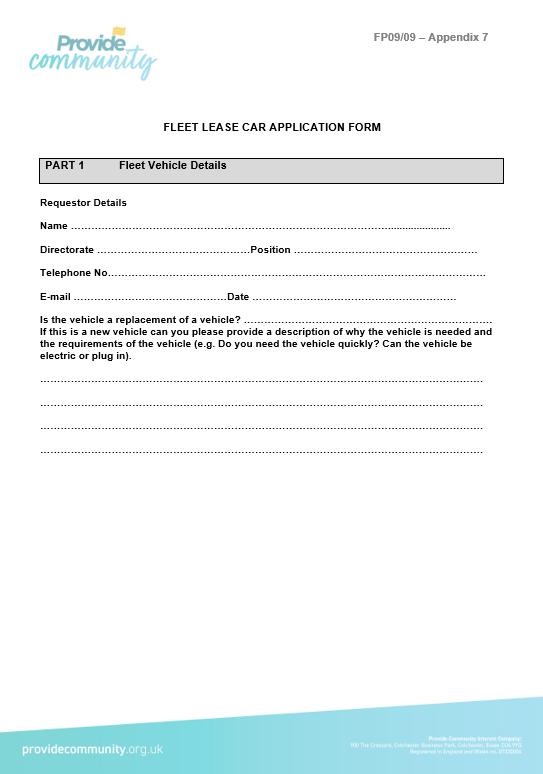
To apply through the EPUT scheme, employees must submit the following:
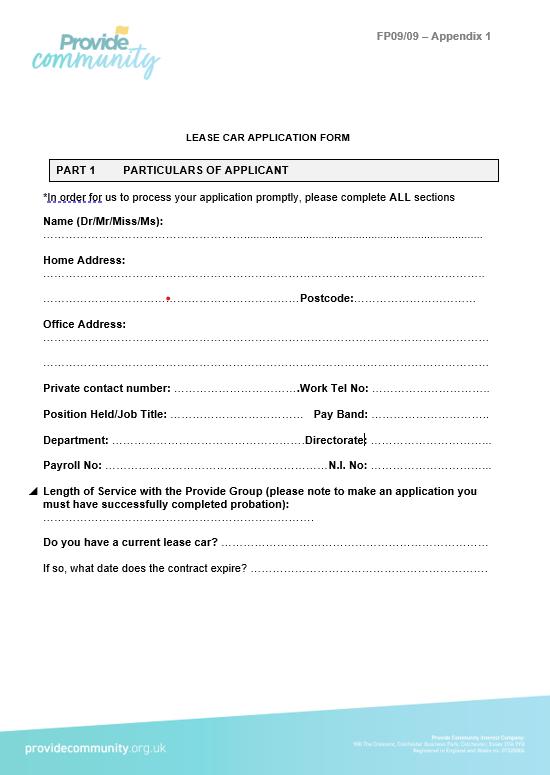
• Appendix 1: EPUT Lease Car Application Form
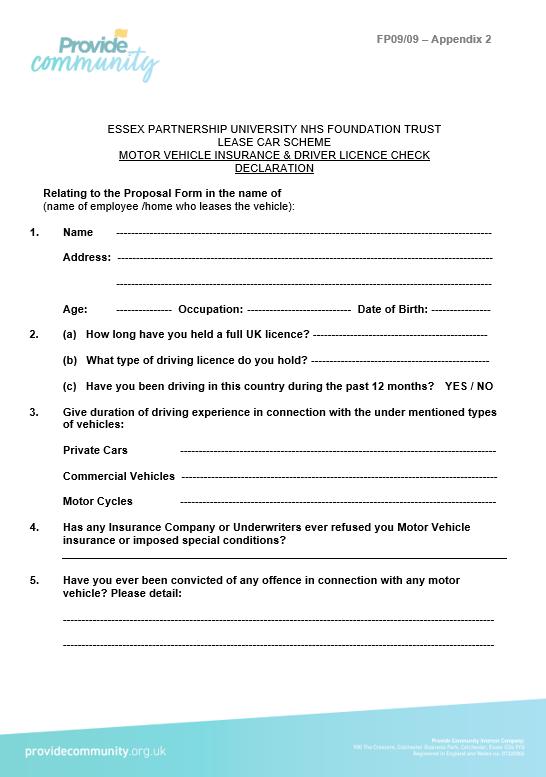
• Appendix 2: EPUT Insurance and Driving Licence Declaration
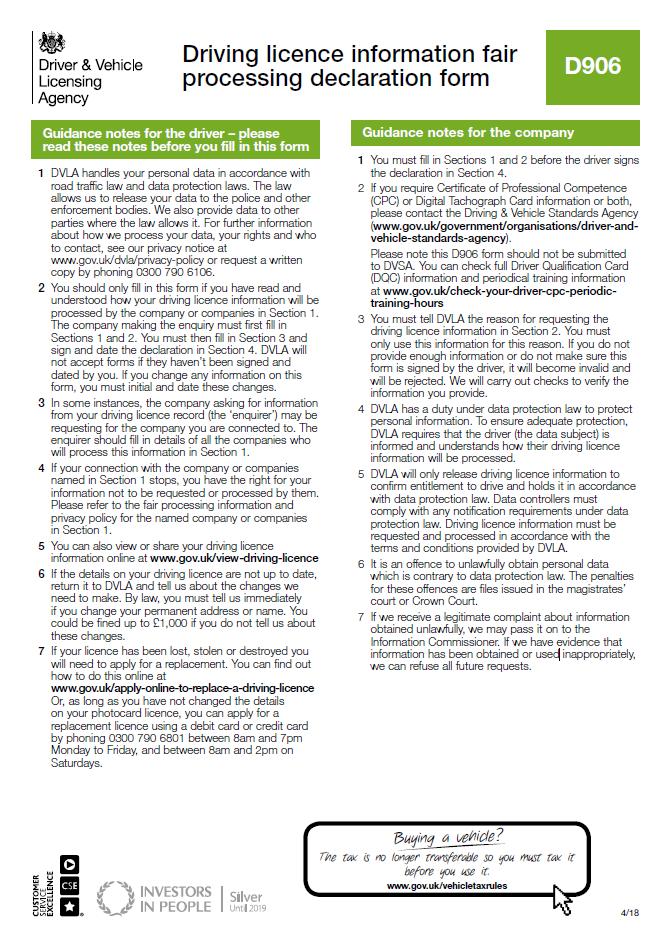
• Appendix 3: DVLA D906 Fair Processing Declaration
• Current payslip
• Driving licence copy
Once submitted, EPUT the Car Leasing Department will carry out a driving licence check before proceeding with a minimum of three quotations.
The employee selects one quote and signs the selection form.
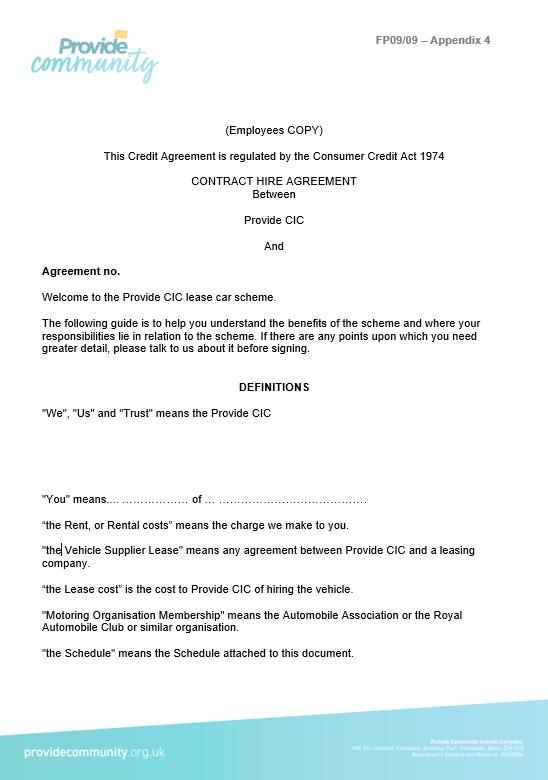
Appendix 4 Standard Lease User Scheme Contract to be signed.
To apply through the NHS FLEET scheme, employees must carry out the following:
• Set up a user account online with NHS FLEET, entering all relevant details requested
• Search and obtain quotes for suitable vehicles
• Progress the preferred vehicle through NHS FLEET online. Provide Chief Officer and Chief Finance Officer approval will be sought before an order of the vehicle is placed.
NHS FLEET will keep you updated through the application process of the driving licence checks to be undertaken, and the signing required of the relevant documentation.
Appendix 4 Standard Lease User Scheme Contract to be signed.
Order and Delivery
• An Eproc requisition will be raised internally
• Vehicles are either delivered to the Car Leasing Department or the employee’s home
• Vehicles must be checked upon delivery; any defects must be reported immediately
• A formal handover will be completed by the Car Leasing Team or the delivery driver
Lease Term
• Standard lease term: 3 years
• Early termination may incur charges (provided in the quotation)
Salary Deductions and HMRC
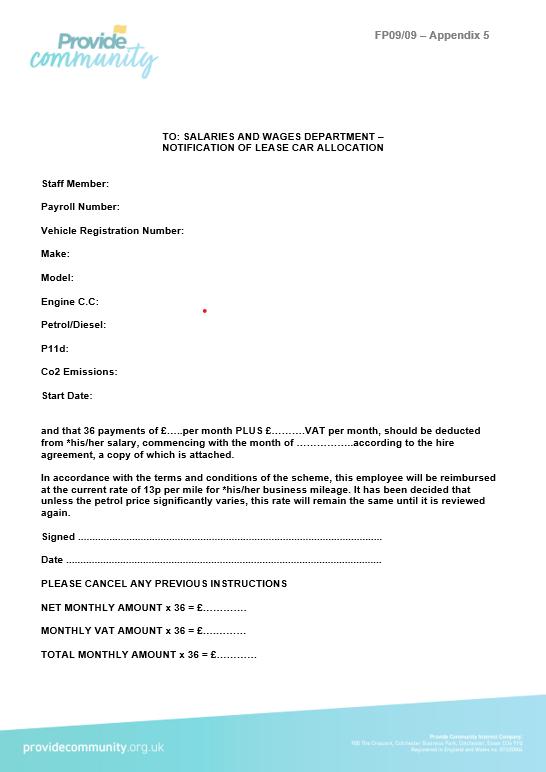
• A Notification of Salary Deduction (Appendix 5) will be sent to Payroll
• HMRC will be informed via P46(Car) form
• It is the employee’s responsibility to call HMRC to ensure their tax code reflects their Benefit-in-Kind (BIK)
3. Accident Procedure
• In the event of an accident, the employee must immediately notify the insurance provider
• Contact details are provided at vehicle handover and on the intranet
• Delays in reporting may result in claim denial
4. Mileage Claiming, Excess Mileage and Disruption Allowance
NHS Terms & Conditions Employees
Employees required to move work base (temporarily or permanently) will be reimbursed for excess mileage for up to 18 months.
• Provide lease vehicle rate: 15p per mile
• Claims submitted via EasyPay system
Important: HMRC treats this as private mileage, which may incur a Fuel Benefit tax.
• Use HMRC calculator: https://www.gov.uk/calculate-tax-on-company-cars
Business Mileage Claim Guidance
Mileage is reimbursed for travel beyond the return trip from home to the agreed work base.
Example (per NHS Agenda for Change):
Home to base
Home to first call
Home to first call
Eligible after 15 miles
15 miles
Last call to home <15 miles Not eligible
Last call to home >15 miles Eligible minus 15 miles
Lease Vehicle Mileage Monitoring
• Employees must submit monthly business mileage claims and odometer readings
• The Car Leasing Department reviews private mileage every 6 months
• Employees must notify the department of significant changes in usage
Appendix
1: EPUT Lease Car Application Form
3: DVLA Fair Processing Declaration (D906)
Appendix
Appendix
Appendix
EQUALITY IMPACT ASSESSMENT TEMPLATE: Stage 1: ‘Screening’
Name of project/policy/strategy (hereafter referred to as “initiative”):
EPOL05 Car Leasing Policy and Procedure
Provide a brief summary (bullet points) of the aims of the initiative and main activities:
To detail eligibility and process for requesting a Provide lease car.
Project/Policy Manager: Director Estates Date: 02/07/2025
This stage establishes whether a proposed initiative will have an impact from an equality perspective on any particular group of people or community – i.e. on the grounds of race (incl. religion/faith), gender (incl. sexual orientation), age, disability, or whether it is “equality neutral” (i.e. have no effect either positive or negative). In the case of gender, consider whether men and women are affected differently.
Q1. Who will benefit from this initiative? Is there likely to be a positive impact on specific groups/communities (whether or not they are the intended beneficiaries), and if so, how? Or is it clear at this stage that it will be equality “neutral”? i.e. will have no particular effect on any group.
Neutral
Q2. Is there likely to be an adverse impact on one or more minority/under-represented or community groups as a result of this initiative? If so, who may be affected and why? Or is it clear at this stage that it will be equality “neutral”?
Neutral
Q3. Is the impact of the initiative – whether positive or negative - significant enough to warrant a more detailed assessment (Stage 2 – see guidance)? If not, will there be monitoring and review to assess the impact over a period time? Briefly (bullet points) give reasons for your answer and any steps you are taking to address particular issues, including any consultation with staff or external groups/agencies.
Neutral
Guidelines: Things to consider
Equality impact assessments at Provide take account of relevant equality legislation and include age, (i.e. young and old,); race and ethnicity, gender, disability, religion and faith, and sexual orientation.
The initiative may have a positive, negative or neutral impact, i.e. have no particular effect on the group/community.
Where a negative (i.e. adverse) impact is identified, it may be appropriate to make a more detailed EIA (see Stage 2), or, as important, take early action to redress this – e.g. by abandoning or modifying the initiative. NB: If the initiative contravenes equality legislation, it must be abandoned or modified.
Where an initiative has a positive impact on groups/community relations, the EIA should make this explicit, to enable the outcomes to be monitored over its lifespan.
Where there is a positive impact on particular groups does this mean there could be an adverse impact on others, and if so can this be justified? - e.g. are there other existing or planned initiatives which redress this?
It may not be possible to provide detailed answers to some of these questions at the start of the initiative. The EIA may identify a lack of relevant data, and that data-gathering is a specific action required to inform the initiative as it develops, and also to form part of a continuing evaluation and review process.
It is envisaged that it will be relatively rare for full impact assessments to be carried out at Provide. Usually, where there are particular problems identified in the screening stage, it is envisaged that the approach will be amended at this stage, and/or setting up a monitoring/evaluation system to review a policy’s impact over time.
EQUALITY IMPACT ASSESSMENT TEMPLATE: Stage 2:
(To be used where the ‘screening phase has identified a substantial problem/concern)
This stage examines the initiative in more detail in order to obtain further information where required about its potential adverse or positive impact from an equality perspective. It will help inform whether any action needs to be taken and may form part of a continuing assessment framework as the initiative develops.
Q1. What data/information is there on the target beneficiary groups/communities? Are any of these groups under- or over-represented? Do they have access to the same resources? What are your sources of data and are there any gaps?
n/a
Q2. Is there a potential for this initiative to have a positive impact, such as tackling discrimination, promoting equality of opportunity and good community relations? If yes, how? Which are the main groups it will have an impact on?
n/a
Q3. Will the initiative have an adverse impact on any particular group or community/community relations? If yes, in what way? Will the impact be different for different groups – e.g. men and women?
n/a
Q4. Has there been consultation/is consultation planned with stakeholders/ beneficiaries/ staff who will be affected by the initiative? Summarise (bullet points) any important issues arising from the consultation.
n/a
Q5. Given your answers to the previous questions, how will your plans be revised to reduce/eliminate negative impact or enhance positive impact? Are there specific factors which need to be taken into account?
n/a
Q6. How will the initiative continue to be monitored and evaluated, including its impact on particular groups/ improving community relations? Where appropriate, identify any additional data that will be required.
n/a
Guidelines: Things to consider
An initiative may have a positive impact on some sectors of the community but leave others excluded or feeling they are excluded. Consideration should be given to how this can be tackled or minimised.
It is important to ensure that relevant groups/communities are identified who should be consulted. This may require taking positive action to engage with those groups who are traditionally less likely to respond to consultations, and could form a specific part of the initiative.
The consultation process should form a meaningful part of the initiative as it develops, and help inform any future action.
If the EIA shows an adverse impact, is this because it contravenes any equality legislation? If so, the initiative must be modified or abandoned. There may be another way to meet the objective(s) of the initiative.
Further information:
Useful Websites www.equalityhumanrights.com Website for new Equality agency www.employers-forum.co.uk – Employers forum on disability www.efa.org.uk – Employers forum on age
© MDA 2007 EQUALITY IMPACT ASSESSMENT TEMPLATE: Stage One: ‘Screening’