Reviewed by Committee or Expert Group Customer Engagement Team
Equality Impact Assessed by:
Related procedural documents
Review date:
Quality & Engagement Manager
HRPOL14 Disciplinary Policy & Procedure
31/03/2029
It is the responsibility of users to ensure that you are using the most up to date document template – i.e., obtained via the intranet
In developing/reviewing this policy Provide Community has had regard to the principles of the NHS Constitution
Version Control Sheet
Version Date Author Status Comment
V1
V2
V2.1
V3
V4
V5
V6
V7
V8
V9
January 2011 Customer Service Coordinator Approved New
July 2011 Head of Quality & Safety Approved Claims separated out from policy
March 2013 Head of Quality & Safety
Review date remains at July 2013 Reviewed for spelling and grammar as a result of a complaint
July 2013 Customer Service Coordinator Awaiting approval To be ratified at Integrated Governance Committee –August 22 2013
January 2014 Customer Service Coordinator Approved Ratified at Quality and Safety Committee 20 March 2014
July 2016 Customer Service Coordinator Approved Ratified at Quality and Safety Committee 21 July 201
July 2018 Customer Service Coordinator Approved
September 2018 Customer Service Coordinator Approved Minor amendment in line with the Auditors recommendation an insert has been made in relation to verbal complaints
September 2022 Customer Service Coordinator Approved Updated to CORE Group company document
March 2025 Customer Engagement Facilitator Approved Reviewed to ensure alignment with the new ISO27001:2022 standard –no changes
Yearly Review in line with requirements of ISO27001 – minor changes.
V10
December 2025
V11 February 2026
Quality & Engagement Manager
Quality & Engagement Manager
Approved Updated following auditor recommendations to include definitions of Formal Complaints, Informal Complaints, PALS enquiries, Upheld, partially upheld and not upheld complaints. Strengthening of 10-day timeframe awaiting consent
Yearly Review in line with requirements of ISO27001
1. Introduction
Provide Community Interest Company (Provide) aims to promote a culture in which all forms of feedback, compliments, comments, concerns or complaints are encouraged, listened to and acted upon. It is recognised such information is invaluable as a means of identifying areas of good practice and improvement.
2. Purpose
This policy outlines Provide’s approach to complaints about the services we deliver. It contains information about how we manage, respond to, and learn from the feedback about peoples’ experiences of our services. The policy and procedure align with The Local Authority, Social Services and National Health Service Complaints (England) Regulations 2009 which came into force on 01 April 2009.
3. Scope
This policy and associated procedure is intended for use by all those employed by and working on behalf of (e.g. agency, bank, contractors etc.) Provide to ensure best practice is applied when dealing with complaints.
This policy will be made available to staff, volunteers and contractors via the Provide MyCompliance and Access portals and for members of the public via the public website: www.providecommunity.org.uk.
4. Policy Statement & Definitions
Provide is committed to providing an accessible, fair and effective means for patients/service users/customers/residents or their representatives to express their views. We aim to create a positive experience for people making a complaint by ensuring that they are supported, listened to, heard and involved in how we resolve their concerns. It is also recognised that staff have the right to make a complaint to senior managers on behalf of, or in the interests of, a person receiving services.
Provide has a strong learning culture, we recognise the value of complaints for providing opportunities to develop and improve our services. Colleagues are encouraged and supported to routinely share learning from complaints, so that we can continuously build on insight and best practice.
Being open: our complaints process has been designed to provide open and honest responses, by investigating complaints thoroughly and fairly. Often, all that is required is a simple apology and/or explanation. This should, wherever possible, be given at the earliest opportunity by all frontline colleagues Patients/service users/customers/ residents have a right to expect openness when receiving a service or care from Provide.
No discrimination: patients/service users/customers/residents should always be reassured that making a complaint will not affect their eligibility for, or the nature of, current or future treatment. This is achieved through the complete separation of complaint documentation from the patient’s/service user’s/customer’s/resident’s care/medical records. Complainants and colleagues are asked to inform the Customer Engagement team if they have any concerns about this.
Dignity and respect: complaints about care that compromises the dignity of, or respect shown to, a person will be overtly reported to the Vicky Waldon, CEO Enterprise Division.
Mindful of people’s human rights: Provide respects and observes the Absolute, Limited, and Qualified Rights contained in legislation and applies these rights to all its business undertakings. The Rights are set out at Appendix 1
Mental Capacity Act 2005, revised 2007: Provide is also mindful of the statutory principles contained in this legislation, an overview of which is set out at Appendix 2
Legal Action: should a complainant explicitly indicate an intention to take any form of legal action the matter will be treated under the appropriate procedure. The Customer Engagement Team may investigate the complaint if it does not compromise or prejudice the concurrent investigation, but this can be discontinued at any time if circumstances change.
Formal Complaint:
A formal complaint is a verbal or written expression of dissatisfaction detailing a problem with a service, product, or conduct outlining specific issues, dates, and desired resolutions, creating a documented record for investigation and resolution.
Informal Complaint:
An informal complaint is a way to resolve an issue directly, this can be written, or verbally, without starting a full, official investigation, focusing on open communication with managers or relevant parties to find a quick, mutually agreeable solution for minor problems or misunderstandings, preserving relationships.
PALS (Provide Advice and Liaison Service):
An expression of dissatisfaction, a concern, or query that is typically handled through an informal and swift (5 working days) local resolution process, rather than the formal complaints procedure
Upheld Complaint:
An upheld complaint means an investigation found the care provider made mistakes or provided a poor service, causing harm or injustice, and the issue hasn't been fixed, leading to recommendations for apologies, changes, or compensation.
Partially Upheld Complaint:
A partially upheld complaint means an investigation found some, but not all, of the issues raised by the complainant were valid, indicating some organisational failings or service failures occurred, but not to the extent of the entire complaint. It signifies that the organisation accepts some wrongdoing, requires an apology or action to fix those specific points, and should take steps to rectify the upheld parts while addressing the unproven aspects.
Not Upheld Complaint:
Means an investigation found no fault or sufficient evidence of wrongdoing by the organisation, so the original decision stands, even if the complainant is still unhappy.
5. Complaints Handling Policy
Responsibilities
The Group Chief Executive and Directorate Chief Executive Officer are accountable for the quality of the service/care commissioned and will, therefore, have an overview of all recorded dissatisfaction expressed by patients/service users/customers/residents.
The Quality and Customer Engagement Manager is the senior person appointed by the Group Chief Executive to ensure the process for handling and reporting on complaints on behalf of Provide complies with this policy.
All Directors across Provide are appointed and responsible for the investigation into a complaint and formulate a response.
Who can make a Complaint?
We recognise that we cannot always resolve issues as they arise and that sometimes people want to make a complaint. The NHS complaint standards define a complaint as “an expression of dissatisfaction, either spoken or written, that requires a response”. It can be about:
• an act, omission or decision we have made or that a service we commission has made
• the standard of service we have provided or a service we commission has provided.
A complaint can be made under this policy by:
• A patient/service user/customer/resident or person affected or likely to be affected by the actions or decisions by Provide services
• Someone acting on behalf of the patient/service user/customer/resident with the consent from the person receiving service/care
• Someone acting on the behalf of a patient/service user/customer/resident where that individual has died.
• Someone who is unable by reasons of physical or mental incapacity to make the complaint themselves.
• A child, or in the case of a child, someone acting on their behalf, who must be a parent, legal guardian or other adult person who has care of the child.
• Where the child is in the care of a local authority or a voluntary organisation, the representative must be an authorised person identified by the local authority or voluntary organisation and must be making the complaint in the best interests of the child.
Local Resolution
The first stage of the complaint procedure is called ‘local resolution’, and concerns should be brought to the attention, in the first instance, to the service providing the care/service.
Local resolution aims to resolve complaints quickly and as close to the source of the complaint as possible, using the most appropriate means, for example, the use of
conciliation. Local resolution enables concerns to be raised immediately by speaking to a colleague who may be able to resolve issues without the need to make a formal complaint.
Colleagues, contractors or volunteers engaged in Provide services are expected to take any complaint raised seriously, act with compassion and ensure that any patient/service user/customer/resident, relative or carer who makes a complaint is treated with respect and without bias.
If local resolution cannot be achieved, it is required that the complaint is escalated to the Customer Engagement Team at Provide verbally or in writing.
All services are asked to escalate all forms of feedback to the Customer Engagement Team whether it be compliments, comments, concerns or complaints for capturing and recording.
How to make a Complaint
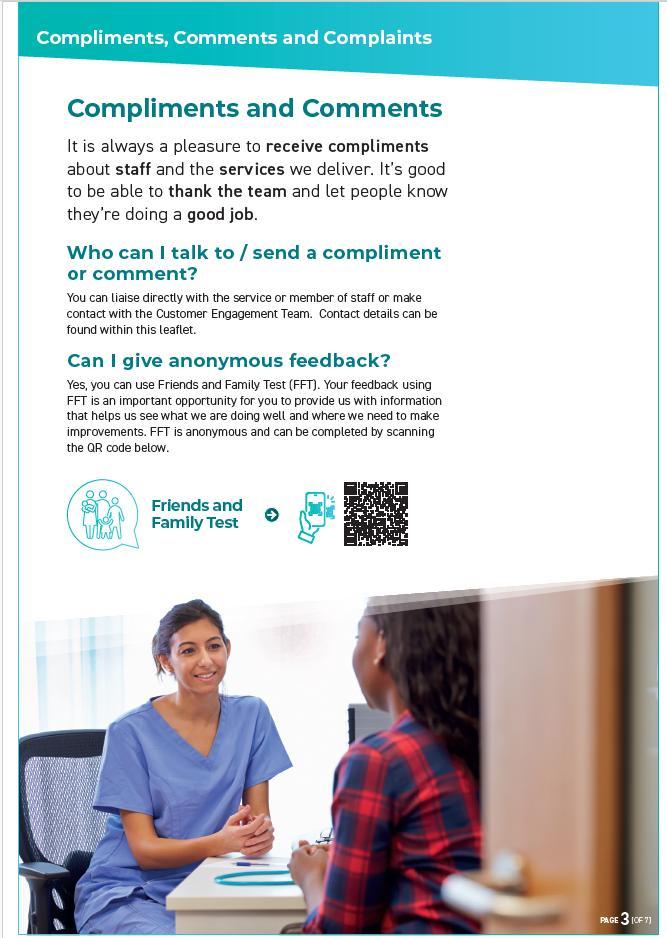
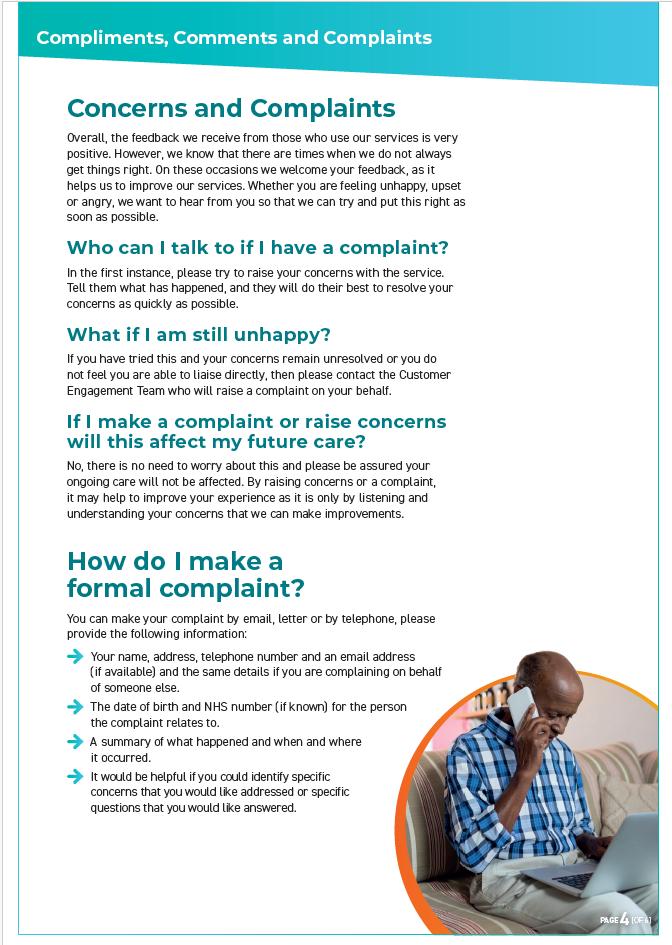
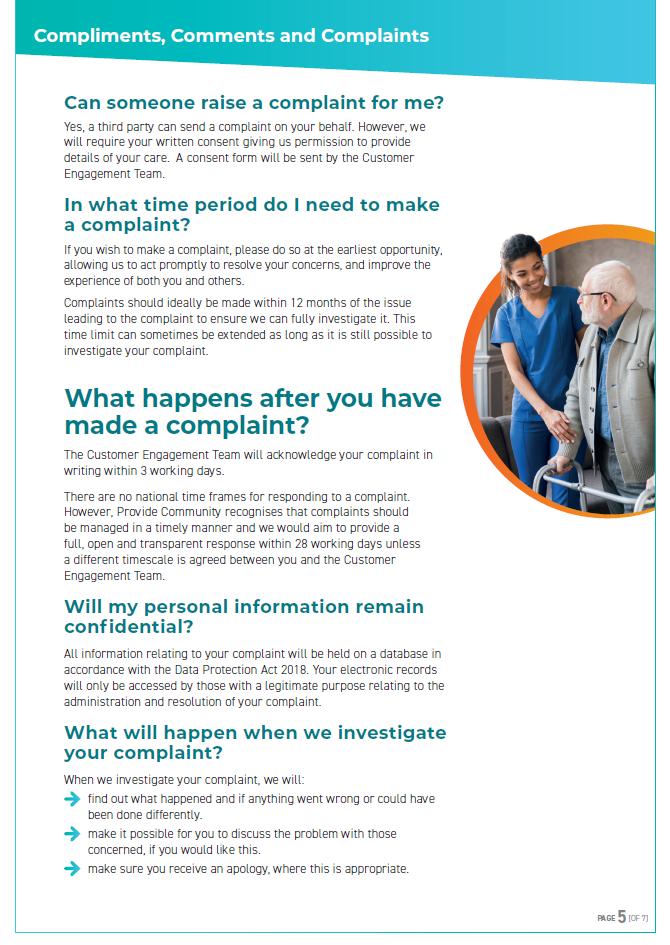
Provide is committed to ensuring easy access to information on how to raise a complaint. The Compliment and Complaint Leaflet will be made available at locations where Provide services are delivered, and a version of the leaflet can be found on the Provide’s website. See Appendix 3.
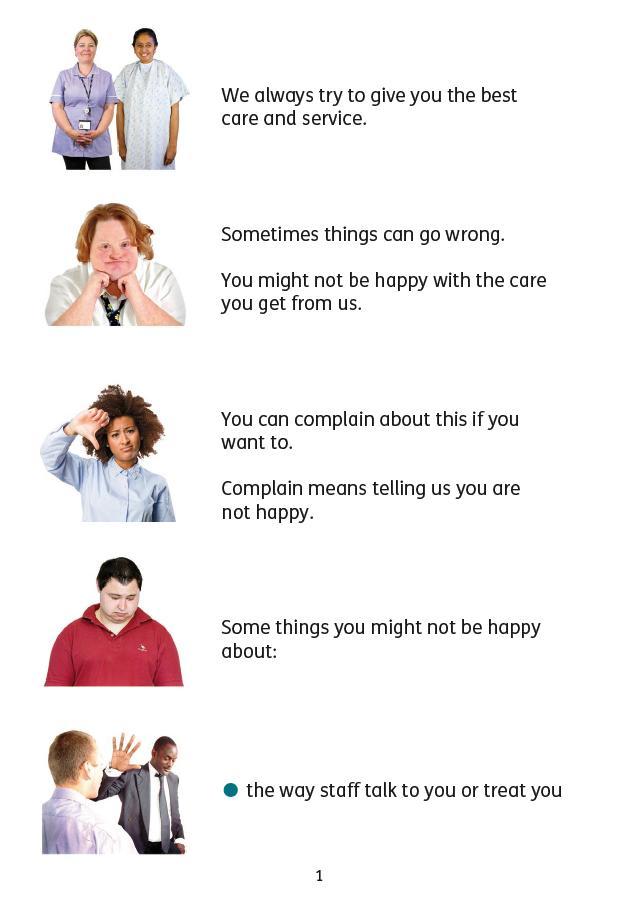
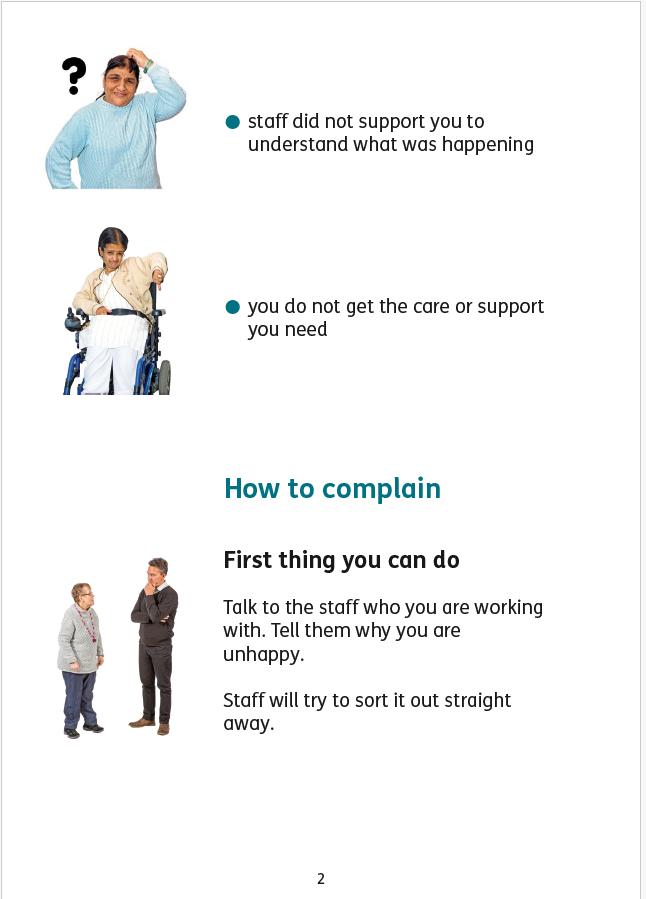
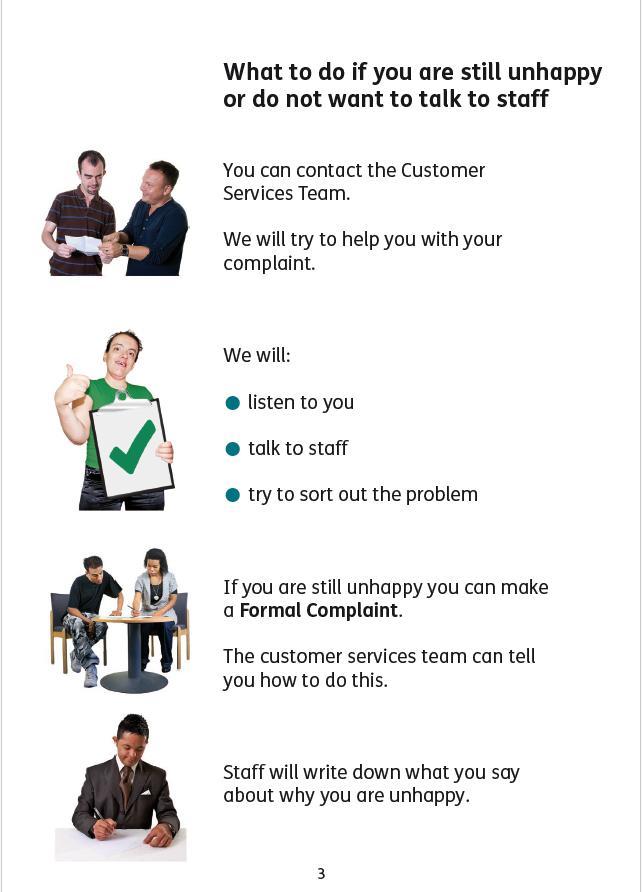
On request, every effort would be made to provide the leaflet in a format that is suitable for the recipient e.g. braille, easy read or a specific language.
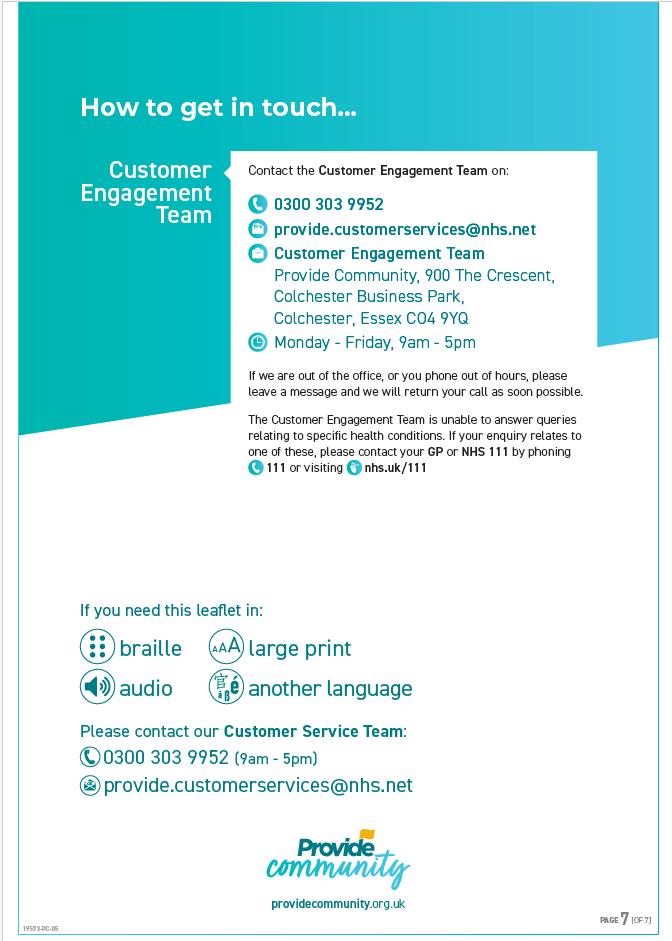
Complaints can be received by Provide’s Customer Engagement Team in the following ways:
Telephone: 0300 303 9952
Email:provide.customerservices@nhs.net
Post: Provide, Customer Engagement Team, 900 The Crescent, Colchester Business Park, Colchester, Essex, CO4 9YQ
Time limit for making a Complaint
A complaint should be made within 12 months of the event(s) concerned, or within 12 months of the date on which the matter came to the notice of the complainant. The Customer Engagement Team and Service Directors have the discretion to waive this time limit if there are good reasons for the complaint not having been made within that timeframe.
Consent
Consent is when someone gives permission for something to happen and has the ability to change their mind at any time. It is important to respect people's boundaries and only do things that they have agreed to.
Consent is given freely, e.g. the person understands that:
• they are authorising the representative to act on their behalf
• they are consenting for Provide to discuss their complaint and share their personal information with the representative.
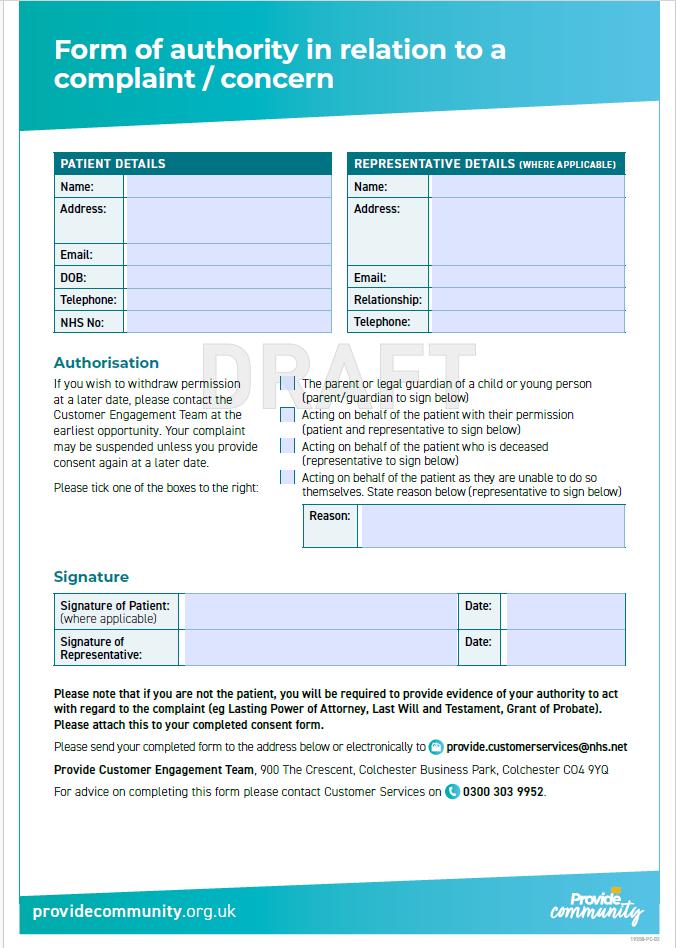
Best practice for capturing consent when a representative is raising a complaint is written. Consent can be written, verbal or received by email but the decision must be recorded on the Feedback module of Datix. A version of the consent form can be seen under Appendix 4.
When a complaint has been made on behalf of another person, written consent must be gained from the individual effected by the complaint or whoever has legal authority to make decisions on the person’s behalf and will be required to provide evidence of their authority to act with regard to the complaint (e.g. Lasting Power of Attorney, Last Will and Testament, Grant of Probate).
If the complaint raises elements of the representative’s experience rather than a patient/service user/customer/resident, we do not require their consent to respond to those elements.
If consent is not obtained within 10 working days (where required) from being requested from the complainant, the Customer Engagement team will make one attempt to follow up the consent with the complainant and then confirm in writing to the complainant that the complaint has been closed as consent was not returned. Consideration will be given to investigate any concerns raised to address any potential issues or safety concerns that are identified. The complaint may then be re-opened and escalated if consent is obtained at a later date.
There may be circumstances in which information disclosed as part of the complaint may need to be shared in the best interest of the person, or the protection, safety or wellbeing of a child or adult at risk. Safeguarding issues identified from a complaint must be reported and escalated by colleagues or the relevant persons/team receiving the complaint following their local safeguarding processes.
6. Complaints Handling Procedure
Any complaint received within Provide must be acknowledged in line with the overarching principles of complaints management as set out within this policy. The details of the complaint should be forwarded to the Customer Engagement Team for logging onto the Feedback module of the Datix system.
Acknowledgement and record of complaint
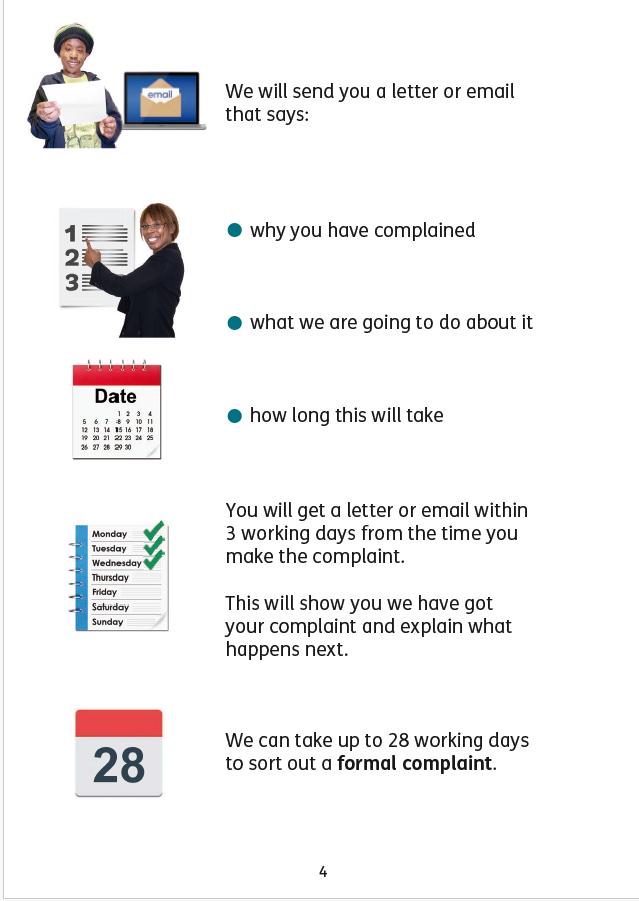
The Customer Engagement Team will send to the complainant a written acknowledgement of the complaint within three working days of the date on which the complaint was received.
This acknowledgement will include:
• A consent form if 3rd party/representative is acting on behalf of the patient/service user/customer/resident/client.
• A copy of the Compliments and Complaint Leaflet, including an easy read version.
• Details of how to access Advocacy services.
Complaints in Writing
The Customer Engagement team will review the complaint and identify the appropriate senior manager to investigate the matter. Where the complaint involves services or care commissioned from or provided by more than one organisation, the Customer Engagement team will liaise with the complaints manager(s) of the other organisation(s) to ensure all aspects of the complaint are appropriately investigated and responded to.
Verbal Complaints
When a verbal complaint is made to the Customer Engagement team, the acknowledgement must be accompanied by a written file note summarising the issues raised, with an invitation to the complainant to sign and return it. This will ensure all aspects of the complaint have been thoroughly understood.
Investigation
The Quality and Customer Engagement Manager will discuss the investigation of highrisk cases with Provide’s Directors of services and Directorate Chief Executive Officers. The investigation must be of sufficient rigour and detail to enable Provide to provide an open, honest and comprehensive response to the complainant. The investigating officer will request the review the individual’s records and statementsfrom the staff involved as necessary and provide a response to the complaint to the Customer Engagement Team.
The Customer Engagement Team will monitor the progress of the management of the complaint and review the final response prior to sharing with the complainant. A copy of any response will be shared with any person who was the subject of the complaint.
Complaint Response
The complainant should receive a full written response from senior management for the service as soon as reasonably practical following completion of the investigation and within a preferred timescale of 28 working days following receipt of the complaint and signed consent form (If complaint received from 3rd party representing the patient/service user/customer/resident/client).
It should be noted that instances where consent is required to proceed with the complaint, the 28 working day timescale will start on the date formal consent is received.
If it is not achievable to respond within the targeted timescale, the Customer Engagement team will write to the complainant explaining the reason, and an achievable date will be negotiated. A response must be sent within six months of the date of a complaint being received
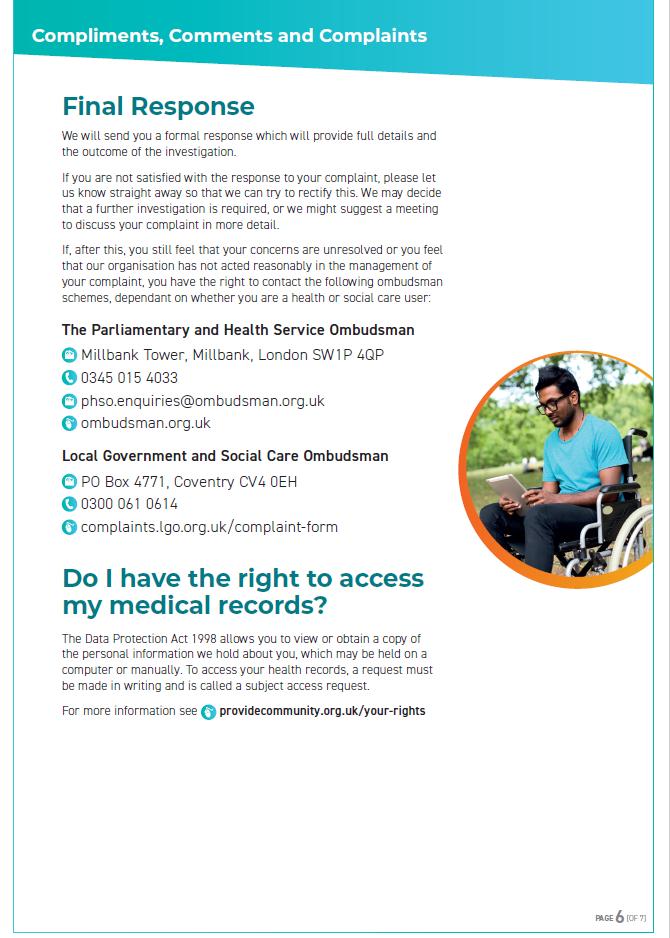
If a complainant is not happy with aspects of the response, they are encouraged to contact the Customer Engagement Team in the first instance, but they will also have the option of escalation to the Parliamentary and Health Service Ombudsman/Local Government and Social Care Ombudsman.
7. Parliamentary and Health Service Ombudsman/Local Government and Social Care Ombudsman
There may be occasions when the complainant does not accept the findings of the complaint investigation, and a complainant has the right to contact the Parliamentary and Health Services Ombudsman or Local Government and Social Care Ombudsman.
The Ombudsman is completely independent of the NHS and of Government and derives powers from the Health Service Commissioners Act 1993. The Ombudsman is the final arbiter in the complaints process where it has not been possible to resolve concerns locally. Provide will co-operate fully with any investigation undertaken by the Ombudsman.
The Ombudsman can be contacted as below, and information on how to contact the Ombudsman will be provided in ALL written complaint responses:
The Parliamentary and Health Service Ombudsman
Milbank Tower Milbank London, SW1P 4QP
Helpline: 0345 015 4033
Email: phso.enquiries@ombudsman.org.uk
Website: www.ombudsman.org.uk
Local Government and Social Care Ombudsman PO Box 4771
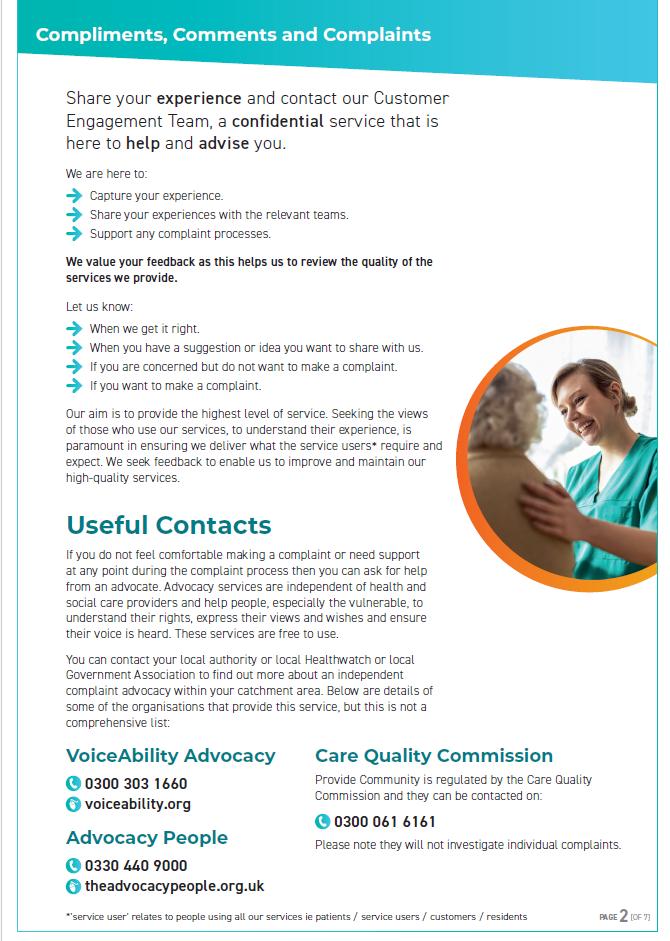
Advocacy services are independent of health and social care providers and help people, especially the vulnerable to understand their rights, express their views and wishes and ensure their voice is heard. These services are free to use
The local authority will arrange independent complaints advocacy within that local authority’s catchment area. Below are details to some of the organisations that provide this service, but this is not a comprehensive list It is advised that complainants check with their local authority, local Healthwatch or the Local Government Association website to find out the provider in their local area:
Advocacy People 0330 440 9000 / www.theadvocacypeople.org.uk
9. Complaints and Disciplinary Procedures
The complaints procedure is concerned only with resolving complaints and not with investigating disciplinary matters. Whether disciplinary action is warranted is a separate matter for management outside of the complaints procedure and there must be a separate process of investigation.
Habitual, unnecessarily aggressive or repetitive complainants are an increasing problem for colleagues, reflecting a pattern experienced throughout the health and social care settings. The difficulty in handling such complainants can place a strain on time and resources and cause undue stress for colleagues that may need support in difficult situations. Colleagues are trained to respond in a professional and helpful manner to the needs of all complainants. However, there are times where nothing further can reasonably be done to assist the complainant or to rectify a real or perceived problem. Where appropriate some or all of the following formal provisions will apply and will be communicated to the complainant by the complaint handler:
• The complaint will be managed by one named individual at senior level who will be the only contact for the complainant.
• Contact will be limited to one method only (e.g. in writing).
• A time limit will be placed on each contact.
• The number of contacts within a time period will be restricted.
• A witness will be present for all contacts.
• Repeated complaints about the same issue which have already been addressed/actioned will be refused.
• Correspondence regarding a closed matter will only be acknowledged and not responded to.
• Behaviour standards will be set.
• Irrelevant documentation will be returned.
11.Complaints about more than one Provider
When an organisation receives a complaint, which contains issues about more than one provider or organisation a discussion with the complainant about who is best placed to co-ordinate the investigation and provide the response will take place. Where it is agreed for Provide to co-ordinate and respond on behalf of the providers/organisations, consent will be obtained to share the complaint with all providers/organisations involved.
Where Provide is not the lead, we will fully co-operate to ensure the complaint can be comprehensively responded to
12.Staff Support
Provide acknowledges the importance of supporting those involved in complaints and recognises the need to ensure that all parties are provided with timely and appropriate support.
13. Review
The CSPOL01 Policy and Procedure will be reviewed every 3 years, or sooner, if changes occur in legislation. The effectiveness of the policy will be reviewed in the light of performance against response timeframes; numbers resolved and referred complaints as well as implementation of lessons learned.
The procedure will also be reviewed in the light of any audit recommendations, learning and developments cycles or changes to organisational structure that may impact on how the procedures operate.
Appendix 1: Articles Of Human Rights
The Human Rights Act 1998 gives further effect to the rights and freedoms contained in the European Convention on Human Rights. Article 1 of the European Convention is introductory and is not incorporated into the Human Rights Act.
Article 2: Right to Life
A person has the right to have their life protected by law. There are only certain very limited circumstances where it is acceptable for the state to take away someone’s life, e.g. if a police officer acts justifiably in self-defence.
Article 3: Prohibition of Torture
A person has the absolute right not to be tortured or subjected to treatment or punishment which is inhuman or degrading.
Article 4: Prohibition of Slavery and Forced Labour
A person has the absolute right not to be treated as a slave or to be required to perform forced or compulsory labour.
Article 5: Right to Liberty and Security
A person has the right not to be deprived of their liberty except in limited cases and provided there is a proper legal basis in UK law.
Article 6: Right to a Fair Trial
A person has the right to a fair and public hearing within a reasonable period of time.
Article 7: No Punishment without Law
A person normally has the right not to be found guilty of a crime arising out of actions which, at the time they committed them, were not criminal. Apart from the right to hold particular beliefs, the rights in Articles 8-11 may be limited where that is necessary to achieve an important objective.
Article 8: Right to Respect for Private and Family Life
A person has the right to respect for their private and family life, their home and their correspondence.
Article 9: Freedom of Thought, Conscience and Religion
A person is free to hold a broad range of views, beliefs and thoughts and to follow a religious faith.
Article 10: Freedom of Expression
A person has the right to hold opinions and express their views on their own or in a group. This applies even if those views are unpopular or disturbing.
Article 11: Freedom of Assembly and Association
A person has the right to assemble with other people in a peaceful way. They also have the right to associate with other people, including the right to form a trade union.
Article 12: Right to Marry
Men and women have the right to marry and start a family; however, national law will still govern how and at what age this can take place.
(Article 13 is not included in the Human Rights Act).
Article 14: Prohibition of Discrimination
A person has the right not to be treated differently because of their race, religion, sex, political views or any other personal status unless this can be justified objectively.
The Mental Capacity Act 2005 (the Act) provides the legal framework for acting and making decisions on behalf of individuals who lack the mental capacity to make particular decisions for themselves. Everyone working with and/or caring for an adult who may lack capacity to make specific decisions must comply with this Act when making decisions or acting for that person, when the person lacks the capacity to make a particular decision for themselves. The same rules apply whether the decisions are life-changing events or everyday matters.
The Act’s starting point is to confirm in legislation that it should be assumed that an adult (aged 16 or over) has full legal capacity to make decisions for themselves (the right to autonomy) unless it can be shown that they lack capacity to make a decision for themselves at the time the decision needs to be made. This is known as the presumption of capacity. The Act also states that people must be given all appropriate help and support to enable them to make their own decisions or to maximise their participation in any decision-making process.
The underlying philosophy of the Act is to ensure that any decision made, or action taken, on behalf of someone who lacks the capacity to make the decision or act for themselves is made in their best interests.
The Act is intended to assist and support people who may lack capacity and to discourage anyone who is involved in caring for someone who lacks capacity from being overly restrictive or controlling. But the Act also aims to balance an individual’s right to make decisions for themselves with their right to be protected from harm if they lack capacity to make decisions to protect themselves.
The Act sets out a legal framework of how to act and make decisions on behalf of people who lack capacity to make specific decisions for themselves. It sets out some core principles and methods for making decisions and carrying out actions in relation to personal welfare, healthcare and financial matters affecting people who may lack capacity to make specific decisions about these issues for themselves.
Many of the provisions in the Act are based upon existing common law principles (i.e. principles that have been established through decisions made by courts in individual cases). The Act clarifies and improves upon these principles and builds on current good practice which is based on the principles.
The five statutory principles, contained in Section 1 of The Act, are:
• A person must be assumed to have capacity unless it is established that they lack capacity.
• A person is not to be treated as unable to make a decision unless all practicable steps to help him to do so have been taken without success.
• A person is not to be treated as unable to make a decision merely because he makes an unwise decision.
• An act done or decision made, under this Act for or on behalf of a person who lacks capacity must be done, or made, in his best interests.
• Before the act is done, or the decision is made, regard must be had to whether the purpose for which it is needed can be as effectively achieved in a way that is less restrictive of the person’s rights and freedom of action.
Appendix 4: Consent Form
EQUALITY IMPACT ASSESSMENT TEMPLATE
Stage 1: ‘Screening’
The Equality Impact Assessment needs to be completed so that any decisions made are compliant with the aims of the Public Sector Equality Duty – and that any adverse impact for any protected characteristics are identified and resolved.
Policy Title
CSPOL01 Customer Services Complaints Policy
Provide a brief summary (bullet points) of the aims of the Policy
The Complaints Policy sets out Provide’s approach to managing concerns and complaints in a fair, timely and transparent manner. It outlines how complaints can be raised, the requirement to acknowledge complaints within three working days, and the expectation that written responses are provided within 28 days (or from receipt of consent where required). The policy emphasises early resolution where possible, appropriate consent when complaints are raised by third parties, director oversight of complaints, and the importance of identifying and sharing learning to support service improvement.
EQIA Assessor Name and Job Title Date of Assessment Quality & Engagement Manager February 2026
This stage establishes whether a proposed initiative will have an impact from an equality perspective on any particular group of people or community or whether it is “equality neutral” (i.e. have no effect either positive or negative)
Q1. Will this policy affect one of the following groups more or Less favourably than another?
Details If more or less, explain impact and any valid legal and/or justifiable exception. Include the source of any evidence
Age
Consider impact and detail across age ranges on old and younger people. This can include safeguarding, consent and child welfare
Disability
Consider and detail impact on attitudinal, physical, and social barriers.
Sex
Consider and detail impact on men and women (potential to link to carers)
Gender reassignment (including transgender)
Consider and detail impact on transgender and transsexual people. This can include issues such as privacy of data and harassment.
Pregnancy and maternity
Consider and detail impact on working arrangements, part-time working, infant caring responsibilities.
Race
Consider and detail impact on different ethnic groups, nationalities, Roma gypsies, Irish travellers, language and communication barriers.
Religion or belief
Consider and detail impact on people with different religions, beliefs or no belief.
Sexual orientation
Consider and detail impact on heterosexual people as well as lesbian, gay and bi-sexual people
Carers
Consider and detail impact on part-time working, shift-patterns, general caring responsibilities
Other identified groups
Consider and detail on different socioeconomic groups, area inequality, income, resident status (migrants) and other groups experiencing disadvantage and barriers to access.
Assessed Impact overall
Positive X Neutral Negative
Guidelines: Things to consider
Is the impact of the initiative – whether positive or negativesignificant enough to warrant a more detailed Stage 2 assessment? Yes X No
Equality impact assessments at Provide take account of relevant equality legislation and include age, (i.e. young and old,); race and ethnicity, gender, disability, religion and faith, and sexual orientation.
The initiative may have a positive, negative or neutral impact, i.e. have no particular effect on the group/community.
Where a negative (i.e. adverse) impact is identified, it may be appropriate to make a more detailed EIA (see Stage 2), or, as important, take early action to redress this – e.g. by abandoning or modifying the initiative. NB: If the initiative contravenes equality legislation, it must be abandoned or modified.
Where an initiative has a positive impact on groups/community relations, the EIA should make this explicit, to enable the outcomes to be monitored over its lifespan.
Where there is a positive impact on particular groups does this mean there could be an adverse impact on others, and if so can this be justified? - e.g. are there other existing or planned initiatives which redress this?
It may not be possible to provide detailed answers to some of these questions at the start of the initiative. The EIA may identify a lack of relevant data, and that data-gathering is a specific action required to inform the initiative as it develops, and also to form part of a continuing evaluation and review process.
It is envisaged that it will be relatively rare for full impact assessments to be carried out at Provide. Usually, where there are particular problems identified in the screening stage, it is envisaged that the approach will be amended at this stage, and/or setting up a monitoring/evaluation system to review a policy’s impact over time.
QUALITY IMPACT ASSESSMENT TEMPLATE
Stage 2
To be used where the ‘screening phase has identified a substantial problem/concern)
This stage examines the initiative in more detail in order to obtain further information where required about its potential adverse or positive impact from an equality perspective. It will help inform whether any action needs to be taken and may form part of a continuing assessment framework as the initiative develops. Policy/ Project Title
Q1. What data/information is there on the target beneficiary groups/communities?
Are any of these groups under- or over-represented?
Do they have access to the same resources?
What are your sources of data and are there any gaps?
Yes
No
Yes
No
Q2. Is there a potential for this initiative to have a positive impact, such as tackling discrimination, promoting equality of opportunity and good community relations? Yes
If yes, how? Which are the main groups it will have an impact on?
No
Q3. Will the initiative have an adverse impact on any particular group or community/community relations?
Yes
No
If yes, in what way? Will the impact be different for different groups – e.g. men and women?
Q4. Has there been consultation/is consultation planned with stakeholders/ beneficiaries/ staff who will be affected by the initiative?
Yes No
Summarise (bullet points) any important issues arising from the consultation
Q5. Given your answers to the previous questions, how will your plans be revised to reduce/eliminate negative impact or enhance positive impact?
Are there specific factors which need to be taken into account? Yes No
Q6. How will the initiative continue to be monitored and evaluated, including its impact on particular groups/ improving community relations? Where appropriate, identify any additional data that will be required
Guidelines: Things to consider
An initiative may have a positive impact on some sectors of the community but leave others excluded or feeling they are excluded. Consideration should be given to how this can be tackled or minimised.
It is important to ensure that relevant groups/communities are identified who should be consulted. This may require taking positive action to engage with those groups who are traditionally less likely to respond to consultations, and could form a specific part of the initiative.
The consultation process should form a meaningful part of the initiative as it develops, and help inform any future action.
If the EIA shows an adverse impact, is this because it contravenes any equality legislation? If so, the initiative must be modified or abandoned. There may be another way to meet the objective(s) of the initiative.