Adult Slips, Trips and Falls
Prevention and Management Policy
Version: V6
Ratified by:

Quality and Safety Committee
Date ratified: 14/10/2025
Job Title of author:
Reviewed by Committee or Expert Group
Operational Clinical Manager Frailty Virtual Ward
Operational Lead for Stroke and Early Supported Discharge
Divisional Operational Lead – Community Wards, Stroke and Speech and Language Therapy
Other Expert Group Falls Steering Group
Quality and Safety Committee
Equality Impact Assessed by: Falls Task and Finish Group
Related procedural documents
QSPOL01 Provide Group Incident Reporting and Management Policy
QSPOL09 Risk Management Policy
HSPOL08 Health and Safety at Work
HSPOL30 Bed Rail Policy
SGPOL10 Mental Capacity Act Policy
MMGUI45 Medicines and Falls in Community Services Guidance Sheet
Review date: 14/10/2028

It is the responsibility of users to ensure that you are using the most up to date document template – i.e. obtained via the intranet.
In developing/reviewing this policy Provide Community has had regard to the principles of the NHS Constitution.
Version Control Sheet
Version Date
Author Status Comment
V1 November 2009 Integrated Governance Manager Ratified
V2 March 2011 Integrated Governance Manager Ratified Updated in line with Organisational name change
V3 July 2011 Safer Services Manager Approved Updated to reflect MPSA Guidance
V4 May 2015 Ward Matrons Ratified 2 Yearly Review
V5 July 2017 Ward Matrons Therapy Staff Practice Development Nurse Ratified 2 Yearly Review
V6 October 2025 Divisional Operational Lead Operational Leads Full Review –to be updated post QSC Full Review completed 3 Yearly Review
1. Introduction
Service users slips, trips, and falls (STF) in hospital and the community have been described as a ‘seemingly intractable cause of harm’; they are the second most frequent cause of death. The prevailing clinical view has been that STF events indicate underlying frailty or illness and many of the interventions over the last 60 years have focussed on assessing and treating physiological factors (e.g., dizziness, illness, vision/hearing, polypharmacy). Service users should feel safe (less likely to fall) in hospital and the community, whereas the opposite can be true. Falls are one of the most common safety incidents across health and social care, representing a significant risk to service users; their families; and healthcare providers.
Within Provide Community, preventing falls is a key priority, as they can lead to avoidable harm; prolonged hospital stays; reduced quality of life; and increased care needs.
This policy sets out the Group’s commitment to minimising the risk of falls and fallrelated injuries through evidence-based practice; staff training; and proactive risk assessment. It provides a framework for identifying those at risk; implementing reduction strategies; and ensuring prompt; effective management when falls occur.
By embedding a culture of safety and shared responsibility, this policy aims to support staff in delivering high-quality, person-centred care while meeting national guidance and regulatory standards.
Falls represent a significant public health challenge in the United Kingdom, particularly among older adults. Approximately one in three people aged 65 and over experience at least one fall annually, a figure that rises to one in two among those aged 80 and above. These falls can lead to severe consequences:
• In the 2023–24 financial year, there were 219,155 emergency hospital admissions due to falls in adults aged 65+ - a rate of 1,984 per 100,000 population (Public Health England – Public Health Profiles)
• Specifically, during the 12 months to June 2022, more than 3,800 people aged 50+ in Mid and South Essex were admitted for fractures following a fall. Among these, 1,464 were hip fractures, and the average hospital stay was 14 days (Mid and South Essex ICS) These statistics underscore the urgent need for effective prevention measures.
This policy:
• Takes into account and is compliant with the recommendations and guidance issued by NICE, (NG249 Falls: assessment and prevention in older people and in people 50 and over at higher risks)
• Recognises the need to manage service users appropriately post fall and sets out what guidance staff should do following all service user falls
Throughout this policy Service Users encapsulates service users; patients; clients; etc.
2. Purpose
The purpose of this policy is to:
• Ensure that when assessing service users for falls risk the appropriate tools and pathways are incorporated
• Establish a multidisciplinary approach to falls prevention and management to ensure effective and timely, comprehensive falls assessment when necessary
• Reduce environmental risk factors where possible by using effective assessment, management, and intervention
• Support service users to remain independent, empowered and achieve their health and well-being goals as safely as possible
• Support person centred planning to reduce the risk of a slip, trip or fall
• Support staff in what to do after a service user fall
3. Definitions
Inpatients: Inpatients are all those occupying a bed where services are delivered by Provide Community.
Outpatient: Service users attending a clinic held by any Provide Community service or service users attending an outpatient clinic hosted by Provide staff.
Domiciliary Service user: A service user being cared for by a Provide Community service within their place of residence.
Bedrail: The term bedrails is used within this policy to describe rails attached to the sides of adult beds. Bedrails may also be referred to as ‘side rails’, ‘bed guards’ or ‘safety rails’.
Fall: An unexpected event in which a person comes to the ground or other lower level with or without loss of consciousness.
Slip: A slip is to slide accidentally causing the individual to lose their balance; this is either corrected or causes an individual to fall. May occur when liquid has been spilt or when the sole of the footwear and floor are unsuited.
Trip: A trip is to stumble accidentally often over an obstacle or uneven surfaces causing the individual to lose their balance, this is either corrected or causes an individual to fall.
Falls Alarms: An early alert device to notify staff a service user is leaving their bed, chair, toilet or commode; whereby there is a risk a service user may fall if unaccompanied or without use of specialist equipment. Restraint free, discreet placement monitor to promote dignity and privacy. These should be risk assessed prior to use to ensure appropriate for the service user and not likely to cause distress. The falls alarms can also be used with pagers to create a silent alert.
Raizer Chair: A portable, emergency lifting device designed to help a fallen person rise to a sitting or near-standing position, typically after a non-injury fall.
Hoist: A mechanical device that is used in healthcare to transfer individuals from one place or position to another.
4. Duties
Provide Community recognises its responsibilities to all service users and staff to provide harm-free care; and the importance of supporting a care environment that is safe. Provide Community aims to protect all service users with a proactive approach to the reduction of falls risk using a comprehensive and individual approach. Provide Community recognises the need for a coordinated approach to the assessment and treatment of service users following a fall. This policy sets out the pathway that all staff should follow to both reduce the risk of service user falls and the actions required following a fall.
Chief Executive Officer
The Chief Executive Officer is ultimately responsible for ensuring that Provide Community has systems to collect aggregate and analyse data in relation to falls and be able to respond to findings.
Provide Community Board
The Provide CommunityBoard are responsible overviewing of performance, significant issues and development plans.
Quality and Safety Committee
The Quality and Safety Committee is responsible for ensuring policy and procedure is followed; having oversight of data associated with falls; and to be satisfied that appropriate measures have been implemented to mitigate risk as far as is reasonably practicable from learning.
Quality Reference Group
The Quality Reference Group is responsible for reviewing and monitoring all themes and issues in relation to service user falls. This is assurance for the organisation, and this information is shared with the Quality and Safety Committee
Falls Steering Group
Are responsible for monitoring and updating services with regards to updates in national guidelines; review of the falls policy when it is due for revision; engaging with Falls Champions; supporting local and Provide-wide audits; and supporting innovative practices in relation to falls.
Head of Quality and Safety
The Head of Quality and Safety is responsible for reviewing all incident data and reporting to the Quality Reference Group.
Service Leads / Operational Leads / Registered Managers
Are responsible for the distribution of the policy and relevant guidance, as well as ensuring that risk assessments are updated and all relevant training is carried out in line with this policy.
Ward Managers / Matrons / Team Leads
Are responsible for implementing actions required following a service user fall, ensuring that risk assessments are updated and that all identified measures required are carried out in line with this policy.
Falls Champions
Are responsible for supporting implementation of initiatives at a local level; as well as promoting and sharing knowledge from the Falls Steering Group. They will be involved in local audit processes.
Employees
All staff working within Provide Community will ensure that they work within the standards as set out in this policy and that any training requirements are raised with their line manager.
5. Consultation and Communication
Consultation for review of this document was held with the Falls Task and Finish Group including members from areas across Provide Community.
This policy will be reviewed at least every three years or sooner if the evidence base requires it, e.g. new legislation is passed. The Falls Steering Group will nominate the appropriate colleagues to review this policy.
Any new statutory provisions affecting this document will automatically take precedence.
Once ratified, the policy and associated appendices will be placed and maintained within the governance process for procedural documents and made available to all staff.
6. Monitoring
The Slips, Trips and Falls Prevention and Management Policy will be reviewed every 3 years. Provide Community will monitor the operation of this Policy by audit and incident reporting in order to:
• Comply with Provide Community’s legal obligations
• Comply with best practice in line with National Guidance
• Highlight practical issues and seek solutions
The Falls Steering Group will monitor the evidence base for updates and have the ability to bring forward the review date of this policy to ensure best clinical practice.
Compliance of falls risk assessments for appropriate community settings is audited by the local teams and monitored by Service Managers and Quality Reference Group.
7. Procedure for Falls Prevention and Management - Inpatients
All service users admitted to Provide Community inpatient wards must be offered a comprehensive falls assessment as part of the initial assessment on admission within 6 hours. A comprehensive falls assessment ensures that interventions to reduce the risk of falls are tailored to the individual, so they promptly address any falls risk factors. This is found on SystmOne for inpatient wards.
The falls risk assessment will need to be reviewed every 7 days or sooner if the service user:
• Experiences a fall
• Condition deteriorates
• Condition improves
• Medication changes are made which could increase the likely hood of the service user falling
• If transferred to another clinical area within Provide
When assessing a service users risk of falls staff will consider the following:
• Taking into account whether the risk factors can be improved or managed during the service user's expected stay and
• Identifying risk factors related to the ward environment and
• Providing individually tailored education sessions that the person is able to engage with and participate in
Examples of risk factors (but not limited to):
• Age & frailty
• Cognitive impairment (e.g. delirium, dementia)
• Mobility or balance issues
• Medications (e.g. sedatives, antihypertensives)
• Sensory deficits (poor vision/hearing)
• Continence needs (urgency, nocturia)
• History of falls
• Environmental hazards (poor lighting, clutter, bed height)
• Staffing or communication issues
Also to consider:
• 1:1 Nursing - Where a service user is at very high risk of falling and all other interventions have been instigated but there is still a significant risk then 1:1 nursing should be considered and implemented if appropriate. If this is required discussions must be held with the Senior Nurse on duty
• Mental Capacity - If a service user lacks capacity and requires continuous supervision and control such as 1:1 nursing; alarm devices; cohort nursing, a decision specific Mental Capacity Assessment and Deprivation of Liberty Safeguards (DoLS) must be completed and the Safeguarding Team involved. Please refer to Mental Capacity Act Policy SGPOL10
In order to be able to carry out a full risk assessment for a service user at risk of falling, staff must be aware of the service user’s medications and the side effects of these. Please refer to Medicines and Fall in Community Services Guidance Sheet (MMGUI45). All medications should be reviewed by the clerking clinician on admission.
All service user handovers, Board Rounds and Multi-Disciplinary Team meetings (MDT’s) must include information around falls when appropriate, and any new strategies used for individual service users.
Use of Bed rails in Relation to Falls Prevention
The Medicines and Healthcare products Regulatory Agency (MHRA) made significant changes to their guidance with regards to the safe use of bed rails. For this reason, careful consideration is required if bed rails are appropriate due to the associated risk of entrapment. Please refer to Bed Rail Policy (HSPOL30) for further details on the safe use of bed rails.
8. Post Falls Actions – Inpatient
In the event of a service user sustaining a fall the following actions must be taken:
• It is important that staff safeguard their own health and wellbeing at all times when dealing with service users who have fallen by considering any potential hazards and using correct manual handling techniques and equipment within their scope of practice
• On finding the service user the member of staff should ensure that they are safe and not at risk of further harm
• Potential hazards should be removed and if there is any life-threatening concerns then the resuscitation protocol should be implemented
• The service users’ privacy and dignity should be maintained at all times. It may be necessary to ask other service users/relatives to leave the area whilst an assessment is made to determine the severity of the fall
• Complete post fall assessment as per the Inpatient Flow chart (Appendix 1) and below
• When completing a set of Neurological Observations you should always include a set of NEWS2 observations in addition to the Glasgow Coma Scale
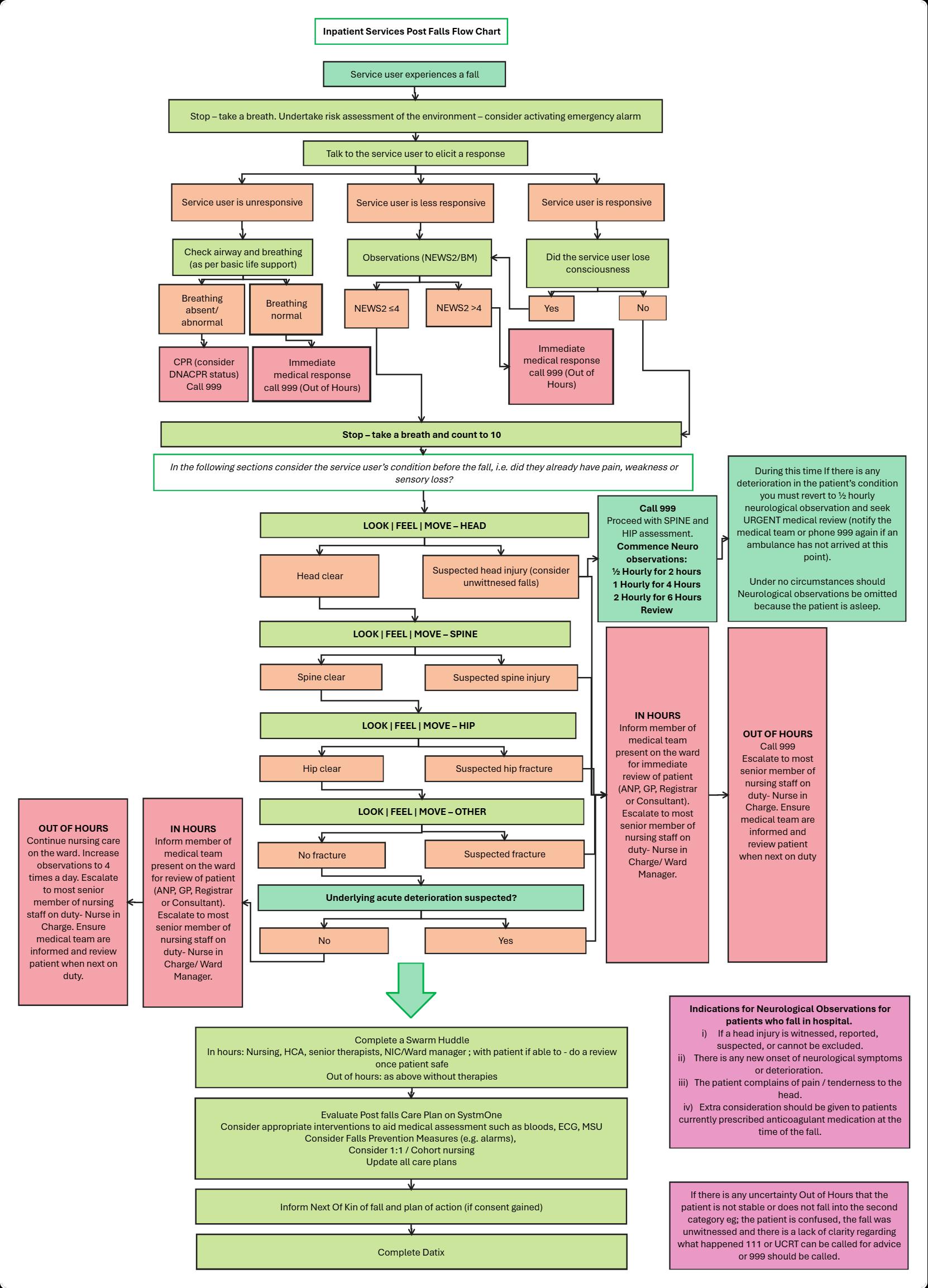
• In all cases following a service user fall a Datix must be completed The information gained from this process will help to develop falls protocols for the future and will inform the training and development needs across the organisation
• With the service user’s permission, the service user’s family should be informed about the fall, this is regardless of injury
• All information regarding a service user fall must be recorded in the service users notes and care plans reviewed
• All details about a service users fall must be shared with the whole team to protect service user’s safety. This will include all relevant health professionals involved in the service users care and, in some cases, may include professionals involved in discharge planning. This can be done via a Swarm Huddle
• The Urgent Community Response Team (UCRT) can be contacted via the single point of access 0344257395 between 08:00 – 20:00. The team can respond with the Raizer chair with the aim of assisting the service user up from the floor
9. Procedure for Falls Prevention and ManagementCommunity
Domiciliary and Social Care services, such as React and Fern Lodge, are to follow local county council processes such as immediate response to falls; contacting emergency services; completing risk notifications for any falls that service users incur; completing a falls risk assessment; referrals to healthcare professionals via local Single Point of Access.
In community settings, service users should be asked about the details of any previous falls. This can be done:
• When a person presents after a fall or
• By opportunistically asking people (for example at initial assessment when accessing community services) whether they have fallen in the last year
A comprehensive falls assessment and comprehensive falls management plan is indicated for people who have fallen in the last year and meet any of the following criteria:
• Are living with frailty
• Were injured in a fall and needed medical (including surgical) treatment.
• Have experienced a loss of consciousness related to a fall.
• Have been unable to get up independently after a fall
• Have had 2 or more falls in the last year.
All community colleagues should assess and consider a service users risk of falls and whether the risk factors can be improved or managed, within their scope of practice. An overview assessment would include (but not limited to)
• Completing a set of observations (E.g. Blood Pressure, Temperature, Pulse)
• Medication (Are they on multiple medications?)
• Footcare and footwear (Is their footwear appropriate)
• Hearing and vision
• Functional ability: (Ask the service user how do you manage activities of daily living? and if appropriate ask them to show you)
• Observation of mobility, balance and transfers
• Continence: (Do they need to get to the toilet quickly?)
• Cognition
• Environment: (Are there any obvious trip hazards, for example loose rugs or mats?)
• Coping strategies if a fall occurs – (Do they have any techniques for getting up)
All community colleagues should identify appropriate interventions and involve the service user and wherever possible their relatives / carers in the discussion regarding the prevention and management of falls.
Advice should be given to the service users on minimising risks and a plan of care formulated so the service user can make an informed choice.
To meet the service user’s identified needs, consideration should be made for referral or signposting to the following services, but not limited to: Internal via community platform or SystmOne:
• Frailty Multi-Disciplinary Team meetings (run by Integrated Care Teams) –See Appendix 4
• Frailty Virtual Ward
• Community Therapy for housebound service users. Physiotherapy & Occupational Therapy
• Musculoskeletal Physiotherapy outpatient services
• Essex Wellbeing Service
• Bladder and Bowel Service
• Alarm monitoring and telecare services – See Appendix 5 for Essex
External:
• Strength and Balance services provided by NELFT who deliver strength and balance exercise programmes via community classes or home-based programmes for those unable to attend a class. (Please see community platform for details on how to refer)
• Social Care for care provision and long-term equipment provision – local adult social care phone number/referral portals
• Liaising with the GP surgeries via SystmOne regarding any health concerns including medication review
• Opticians - for vision and hearing checks
• Appropriate equipment or telecare provision agencies such as Medequip or Livity Life
• Any other services within the providing teams locality Service users who require grab handles or bed rails to be provided/fitted on to their own bed or profiling bed will need to have a risk assessment undertaken in order for the equipment to be ordered. These forms are called ‘RiskAssessment ForBedGrabHandles(AlsoKnownAsBedLeversOrBedSticksForPersons Own Bed)’ and ‘Profiling Bed & Bed Rails & Grab handles & Lateral turning
devices Risk Assessment Template’ which can be found on SystmOne or on TCES (or local equipment service). Provide does not take responsibility for privately purchased and fitted equipment, however clinicians will document if further advice is given such as risks of using such equipment.
Service users who require bed rails to be fitted to their profiling bed, will need to have a risk assessment undertaken in order for equipment to be ordered (further details on how to do this can be found in the Bed Rail Policy HSPOL30).
It is also important when ordering equipment for service users who have fallen, that consideration is given to a wider range of equipment that can be provided to service users to help reduce the risk of falls, this may include the utilisation of a falls crash mat or sensor alarms. Details of these products can be requested via Livity Life and can be set up as either monitoring only or monitoring and response via Care Call 24/7. The service can be self-funded or funded via social care. Please see Appendix 5 for contact details and information on Livity Life and Care Call 24/7.
10.Post Falls Procedure - Community
Please follow the below flowchart within your scope of practice
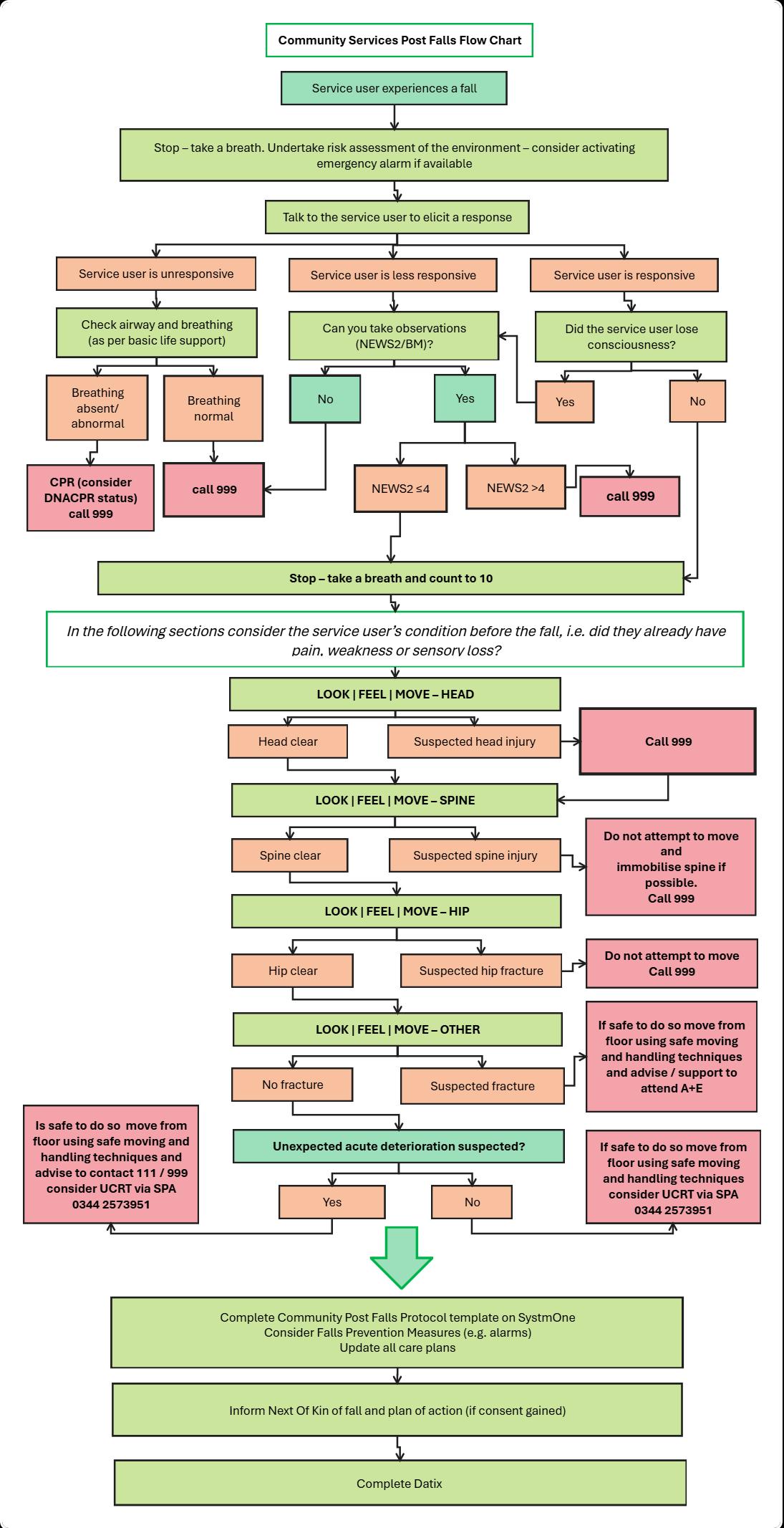
See Appendix 2 for printer friendly version.
Domiciliary and Social Care services, such as React and Fern Lodge, are to follow local county council processes such as immediate response to falls; contacting emergency services; completing risk notifications for any falls that service users incur; completing a falls risk assessment; referrals to healthcare professionals via local Single Point of Access.
In the event of a service user sustaining a fall in the community or is found on the floor, the following actions must be taken:
• Check the service user for signs of significant injury or need for urgent medical attention
• If injury is evident or suspected dial 999 to request an ambulance
• Follow the Community Post Fall Protocol including falls checklist to consider if appropriate to assist the service user from the floor and if emergency services need to be called
If the service user does not require the emergencyservices or urgent medical attention:
• A service user may be able to get up from the floor independently with some basic prompts and guidance
• If the service user is unable to assist themselves from the floor, community staff can utilise appropriate manual handling equipment if this is available in the property and if staff are competent and confident to do so
Alternatively, the Urgent Community Response Team (UCRT) can be contacted via the single point of access 0344257395 between 08:00m – 20:00. The team can respond with the Raizer chair with the aim of assisting the service user up from the floor.
If following checks after a fall by community staff or responder services, such as CareCall 24/7, there are further concerns over the service user’s ability to remain safely at home, a referral can be made to UCRT in the same way to prevent unnecessary admission to hospital. UCRT in turn can refer to the Frailty Virtual Ward if further intervention from a wider multidisciplinary team is required.
In all cases following a fall the Community Post Falls Protocol template on SystmOne and Datix must be completed Exception applies to CareCall 24/7 as their primary service is attending to service user falls. CareCall 24/7 staff to follow local procedure with regarding falls.
In the case of post-falls assessment, the need for bed rail / grab rail provision is identified, please refer to section 9. Procedure for Falls Prevention and Management – Community
11.Falls in Outpatient/Community Clinic Settings
If a service user/member of the public (person) falls whilst awaiting an appointment in an outpatient/community clinic setting or during their appointment a risk assessment of the situation should be made by clinic staff, including monitoring vital signs of the person if appropriate.
• The safety of both person and staff should be considered as part of the risk assessment and staff should utilise safe moving and handling techniques as required
• If the person has fallen to the floor, assess if the person has sustained injury. If the person appears to be uninjured and if safe to do so, staff can utilise appropriate manual handling equipment if this is available and if staff are competent and confident to do so to assist/encourage person into a chair or on to a couch as appropriate, within the member of staff’s scope of practice
• If the person appears to be injured or there is concern for the medical condition of the person, appropriate action should be taken. This may be advising the person to consult a G.P, or calling for an ambulance, according to the circumstances.
• If the person is well and is safe to leave the clinic, assist the person to arrange safe transport home, if required
• In some cases, persons may decline support or intervention. These choices must be respected. If any doubt regarding mental capacity, contact the Safeguarding Team or On-Call Manager
• Complete a Datix incident form
12.Incident Reporting and Reviewing of Falls Group
Incident investigation is important to identify why an incident happened and identify opportunities for learning to prevent a recurrence and improve quality. Provide’s approach to incident management is that it should be proportionate and appropriate to the incident that happened. For any incident that involves service users the principles of the NHS Patient Safety Incident Response Framework (PSIRF) and methodologies will inform the response and investigation across all Provide Community Health and Social Care Services as it is recognised the framework sets out processes that are not NHS centric and can be applied organisation wide.
Provide Community’s approach to incident management encompasses:
• Compassionate engagement and involvement of those affected by incidents
• Openness and honesty being at the heart of our incident response
• Considered and proportionate responses to incidents and safety issues
• Proactive as well as reactive review of incidents to promote safety and quality
• A safety culture which encourages staff to report and speak up about incidents and near misses
All instances of a service user/service user/customer/individual having an unintentional, unexpected descent of their body to the ground or lower level, whether or not an injury has occurred, it was witnessed, unwitnessed or assisted should always be incident reported via Provide Community Local Risk Management Systems (LRMS) DCIQ (Datix) or via Access dependent what is applicable to the service the fall occurred in.
Due to CareCall 24/7 service being centred on retrieving service users when safe to do so from the floor following a fall, they are not required to report every post fall incident they attend. CareCall 24/7 complete an in-house triage form, and the service user record is updated on their call handling system. CareCall 24/7 would complete incident reporting of a fall if the service user was injured by CareCall 24/7 equipment or responders.
Following the incident being reported on Datix the Quality & Safety team will undertake a review of the incident within the first 24 working hours. The incident reported will be moved by Quality & Safety team to be reviewed at the local level by a handler within the service reporting the fall and identify if the incident is to be reviewed at an Incident
Review Panel (IRP). An Incident Review Panel will consider the facts of the incident and will confirm and agree if the incident can be finalised and closed as local management and learning if appropriate; or they may recommend that the incident is further reviewed to achieve greater insight and learning from the incident.
An incident reporting a fall, that may be identified for review at IRP could be due to the reporter reporting the individual who suffered the fall sustaining moderate or greater actual harm (physical or psychological), there are reported gaps in care and treatment and or the incident has sparked clinical curiosity.
When reviewing an incident involving a fall it is good practice to capture if the individual had appropriate assessments on admission were completed, the environment in which the individual fell in, if appropriate floor retrieval methods were used, correct post falls procedures were followed and the outcome/impact following the fall i.e. any fractures, wounds, admission to an acute hospital.
The Quality and Safety team are responsible for monitoring and capturing any safety/incident reporting themes related to falls.
Please refer to Provide Group Incident Reporting and Management Policy - QSPOL01.
13.References
Ahmad, M., Nguyen, D., Khan, A., Patel, M. and Harvey, R., 2024. Improving the management of inpatientfalls: a quality improvement project. BMJOpenQuality, 14(2), e003219. Available at: https://bmjopenquality.bmj.com/content/14/2/e003219
Department of Health and Social Care, 2022. Falls: applying All Our Health. [online] GOV.UK. Available at: https://www.gov.uk/government/publications/falls-applying-allour-health/falls-applying-all-our-health
Macchiavello, D., Gimson, P., Ackermann-Lloyd, K., Bassett, S., Bevan, C., Brooks, A., Davies, M., Elias, N., Gapper, J., Gash, G., Hermolle, A., Hill, N., Humphreys, C., Kckhadka, B., Llewellyn, A., Marsh, B., Price, L., Rees, B., Richards, L., Sproston, A., Walker, L., Williams, S., Williams, Z., Wright, E. and Clark, P., 2025. Using a collaborative approach to reduce falls in older people’s adult mental health wards in a local health board in Wales. BMJOpenQuality, 14, e003219.
Hignett, S. and Wolf, L., 2016. Reducing inpatient falls: Human Factors & Ergonomics offers a novel solution by designing safety from the patients’ perspective (Editorial). International Journal of Nursing Studies, 59, pp.A1–A3. https://doi.org/10.1016/j.ijnurstu.2016.02.007
Mid and South Essex Integrated Care System, 2023. Newguidetoavoidingthemost common causes of falls in the home. [online] Available at: https://www.midandsouthessex.ics.nhs.uk/news/new-guide-to-avoiding-the-mostcommon-causes-of-falls-in-the-home
National Institute for Health and Care Excellence (NICE), 2023. Head injury: assessment and early management. [online] NICE. Available at: https://www.nice.org.uk/guidance/qs86
National Institute for Health and Care Excellence (NICE), 2025. Falls:assessmentand preventioninolderpeopleandinpeopleaged50andoverathigherrisk. [online] NICE. Available at: https://www.nice.org.uk/guidance/QS86
NHS Borders, n.d. ThePost-FallDecision-MakingFlowChart. [online] Right Decisions Service. Available at: https://rightdecisions.scot.nhs.uk/media/cfvmvthn/naif_the-postfall-decision-making-flow-chart-only-nhs-borders.pdf
Office for Health Improvement and Disparities, n.d. Falls – Public Health Profiles. [online] Fingertips. Available at: https://fingertips.phe.org.uk/search/falls
Royal College of Physicians, n.d. Supporting best and safe practice in post fall management in inpatient settings. [online] Available at: https://www.rcp.ac.uk/improving-care/resources/supporting-best-and-safe-practice-inpost-fall-management-in-inpatient-settings/
UK Research and Innovation (UKRI), 2024. Homeinterventionsreducefalladmissions for older people. [online] Available at: https://www.ukri.org/who-we-are/how-we-aredoing/research-outcomes-and-impact/mrc/home-interventions-reduce-falladmissions-for-older-people
Vivid Care, 2023. Inpatient Falls Report: Statistics and Prevention Tips. [online] Available at: https://www.vivid.care/insights/advice-tips/inpatient-falls-report
Appendix 1 – Inpatient Services Post Falls Flow Chart
Appendix 2 – Community Services Post Falls Flow Chart