Y B
A
YOUR MACHINE TOOL BANK AND MORE WHY CHOOSE BANTERRA BANK Banterra’s team, with more than a hundred years of experience, understands the challenges of running small to mid-size businesses. The things you do, day in and day out, is truly the backbone of America and as your lender, we are right there with you to support your capital needs and doing what it takes so you can compete with the world in your industry.
PRODUCT OFFERINGS
EQUIPMENT LOANS
BUILDING LOANS
Bank commitment to Made In USA and Made In Arizona values
LINES OF CREDIT
DEBT CONSOLIDATION
World-class deposit products including Treasury Management
BUSINESS CHECKING AND CASH MANAGEMENT
TREASURY MANAGEMENT
Industry-leading service with local decisions
Loan products designed specifically for machine shops and small businesses
ARIZONA LOCATIONS 355 E. Germann Road, Suite 101 I Gilbert, AZ 15100 N. 78TH Way I Scottsdale, AZ Banterramachinetool.com
866-BANTERRA (226-8377)
BANTERRA.BANK I MEMBER FDIC
CONTACT US FOR ALL YOUR BANKING NEEDS
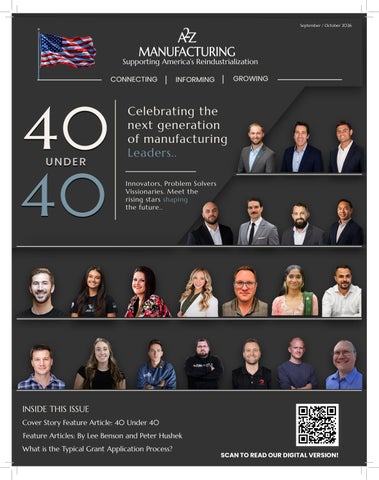
Editor’s Corner There is no single path into manufacturing. Some of the people featured in this year’s 40 Under 40 issue grew up in family shops, sweeping floors, riding along to job sites and learning the business before they were old enough to understand what a career was. Others found manufacturing almost by accident—through a first job, a college project, a supply-chain problem, a failed battery, or even the realization that professional skateboarding probably wasn’t going to work out. A few came from completely different worlds altogether. That variety is what makes this year’s class so compelling.Inside these pages, you’ll meet leaders who are building aerospace companies from the ground up, scaling multigenerational family businesses, developing new manufacturing software, introducing automation to the shop floor, strengthening domestic supply chains and creating pathways for the next generation of skilled workers. You’ll also meet people who are remarkably candid about what they still have left to learn.One leader talks about realizing he could no longer be “Superman” as his company grew. Another discovered he had become his own company’s biggest bottleneck. One learned that delivering bad news to a customer was rarely as frightening as the 1,000 pound gorilla in his imagination. Several spoke about the mentors who opened doors for them—and the responsibility they now feel to hold those doors open for someone else. There are stories here about fathers and daughters, fathers and sons, refugees building new lives in America, veterans finding their next mission, young entrepreneurs betting their savings on machines, and career changers learning an entirely new language.Yet across all those different paths, a few themes appear again and again: curiosity, humility, persistence, relationships and a willingness to keep showing up when the answer isn’t obvious.Perhaps most encouraging is how many of this year’s honorees are focused not simply on what they can accomplish, but on who they can bring with them.They are training apprentices, mentoring women, introducing students to modern factories, creating better careers for their employees and challenging outdated assumptions about what manufacturing looks like—and who belongs in it.These 40 individuals represent different companies, technologies, regions and disciplines. But collectively, they tell one story exceptionally well:American manufacturing is not standing still. And judging by the people helping lead it forward, its next chapter should be a fascinating one. God bless America and God bless our Troops.
Charlie & Alex Hushek | Managing Partners | Editor in Chief
A2Z MANUFACTURING •
4 • SEPT / OCT 2026
Table of Contents: Cover: A2Z manufacturing 40 UNDER 40 Press Release..........................................................................................................................................................6-7 Job Board................................................................................................................................................................8 News: Northeast News...........................................................................................................................................9-13 Mid-Atlantic News......................................................................................................................................13-18 South East News..........................................................................................................................................18-22 Midwest News............................................................................................................................................22-24 South Central News....................................................................................................................................24-25 Mountain West News.................................................................................................................................25-27 Southwest News..........................................................................................................................................27-30 West Coast News..........................................................................................................................................32-36 Economic Report...................................................................................................................................................39 Quality........................................................................................................................................................................40 Cover Story Feature Article: 40 Under 40......................................................................................................1,42-56 Feature Articles: By Lee Benson and Peter Hushek....................................................................................41, 57-58 What is the Typical Grant Application Process?............................................................................................59 Buyers Guide Equipment And Processes........................................................................................................60-66
Published by: A2Z Manufacturing PUBLISHER/EDITOR Charlie & Alex Hushek connect@a2zmanufacturing.com
Address: 24 W Camelback Rd. #A408 Phoenix, AZ 85013-2529 Telephone: (480) 395-3288 www.a2zmanufacturing.com
CONTRIBUTORS Peter Hushek Lee Benson Charlie Hushek Alex Hushek Micki Vandeloo
Published bi-monthly to keep precision manufacturers abreast of news and to supply a viable vendor source for the industry. Circulation: The A2Z MANUFACTURING has compiled and maintains a master list of approximately 56,000 people actively engaged in the precision manufacturing Industry. It has an estimated pass on readership of more than 123,200 people. Advertising Rates, deadlines and mechanical requirements furnished upon request or you can go to A2ZMANUFACTURING.com. The Publisher assumes no responsibility for the contents of any advertisement, and all representations are those of the advertiser and not that of the publisher. The Publisher is not liable to any advertiser for any misprints or errors not the fault of the publisher, and in such event, the limit of the publisher's liability shall only be the amount of the publishers charge for such advertising. A2Z MANUFACTURING •
5 • SEPT / OCT 2026
Press Releases MIDACO Corporation to Introduce AFS2200 Industrial Air Filtration System at IMTS 2026 Elk Grove Village, Illinois — MIDACO Corporation will introduce the AFS2200 Industrial Air Filtration System at IMTS 2026, the International Manufacturing Technology Show, taking place September 14–19, 2026 at McCormick Place in Chicago. Attendees can view the system at MIDACO Booth #339347 in the South Hall.
facilities, fabrication shops, grinding operations, welding departments, and industrial production plants where airborne particulate management and indoor air quality are operational considerations.
Designed for manufacturing and CNC machining environments, the AFS2200 is an industrial air filtration and circulation system intended to help reduce airborne dust, smoke, coolant mist, and particulate accumulation commonly generated during machining, grinding, welding, fabrication, and material processing operations.
Research published by organizations including the U.S. Environmental Protection Agency (EPA) and studies published through the National Institutes of Health have identified the role of air filtration and ventilation systems in reducing airborne particulate concentrations and supporting improved indoor air quality in occupational environments.
The AFS2200 features a 2200 CFM airflow capacity and utilizes a 2-stage filtration system consisting of a MERV 8 pleated pre-filter and a MERV 15 secondary bag filter. The system is designed to capture airborne particulates commonly found in manufacturing environments, including particles ranging approximately from 3.0 to 10.0 microns.
Established in 1969, MIDACO Corporation manufactures CNC productivity and automation equipment including Automatic and Manual Pallet Changers, Pallet Pool Systems, Robot Access Doors, AutoDoor Systems, Trunnion Systems, Industrial Vacuums, CNC Chip Management equipment, and additional manufacturing support products for machining and industrial facilities. MIDACO products are manufactured in the USA at the company’s headquarters in Elk Grove Village, Illinois.
Additional system features include: • ½ HP direct-drive blower motor • 115V single-phase electrical operation • Differential pressure monitoring • LED filter status indicators • Replaceable disposable filters • Heavy-duty 16-gauge steel cabinet construction • Made in the USA
For more information about the MIDACO AFS2200 Air Filtration System or MIDACO Corporation products, visit: MIDACO Corporation at www.midaco-corp.com or contact the MIDACO sales team at (855) 593-5668 / sales@midaco-corp.com
The system is available in both mobile and overheadmounted configurations. Standard units are mounted on four heavy-duty casters, including two locking casters for positioning stability. Optional ceiling mounting brackets are also available for permanent overhead installation in facilities where floor space optimization or elevated airflow positioning is preferred.
Advanced Gear Manufacturing, Grinding, Complete Machining, Automation, and Tooling Solutions on Display
According to MIDACO specifications, the AFS2200 is capable of providing approximately: •11 air changes per hour (ACH) in a 1,000 sq. ft. facility with 12-foot ceilings •5.5 air changes per hour (ACH) in a 2,000 sq. ft. facility with 12-foot ceilings The system is intended for use in a range of manufacturing environments including CNC machining A2Z MANUFACTURING •
6 • SEPT/ OCT 2026
DVS Technology America Showcases Complete Manufacturing Solutions at IMTS 2026
Plymouth, Michigan – DVS Technology America, the North American subsidiary of the DVS TECHNOLOGY GROUP, will showcase its comprehensive portfolio of precision manufacturing technologies at IMTS 2026, demonstrating how integrated machining solutions help manufacturers improve quality, increase productivity, and achieve greater process reliability. Visitors to the DVS Technology America booth will discover innovative technologies from across the DVS TECHNOLOGY GROUP, including gear honing, gear shaping, power skiving, precision grinding, complete machining, tooling, and intelligent automation. Together, these solutions provide manufacturers with a complete
approach to optimizing production, from individual processes to fully integrated manufacturing systems. At IMTS, we’re excited to demonstrate how DVS Technology America combines global engineering expertise with local application support to help customers achieve stable, efficient, and economically sustainable production.”
Technologies Featured at IMTS Visitors will have the opportunity to learn about solutions from several leading DVS brands, including: • PRÄWEMA – Industry-leading gear honing, gear shaping, and precision tooling technologies designed to improve gear quality, reduce noise, and increase process stability. • PITTLER – Multi-technology machining centers and power skiving solutions that combine multiple operations into a single setup, reducing cycle times and increasing manufacturing efficiency. • BUDERUS – High-precision grinding solutions engineered for superior dimensional accuracy, exceptional surface finishes, and repeatable hard fine machining. • DVS Tooling & NAXOS DISKUS – Advanced tooling and grinding technologies that maximize tool life, improve process consistency, and enhance overall production quality. • RBC Robotics – Flexible automation systems that streamline material handling, reduce downtime, and improve manufacturing productivity.
Integrated Solutions for Modern Manufacturing Rather than viewing machining processes individually, DVS Technology America helps manufacturers integrate machines, tooling, automation, and application expertise into complete production systems. This holistic approach enables customers to: • Improve component quality and repeatability • Reduce cycle times and non-productive operations • Increase process stability and machine utilization • Lower production costs through optimized workflows • Scale manufacturing with confidence Supporting customers throughout the United States, Canada, and Mexico, DVS Technology America provides local engineering expertise, technical service, applications support, and aftermarket solutions backed by the global resources of the DVS TECHNOLOGY GROUP.
tooling, and automation. Whether manufacturers are looking to improve an existing process or develop a new production strategy, the DVS team will be available to demonstrate how integrated manufacturing technologies can deliver measurable improvements in efficiency, quality, and long-term production reliability.
Visit DVS Technology America at IMTS 2026 to discover how integrated manufacturing solutions can help take your production to the next level. About DVS Technology America DVS Technology America is the North American sales, service, and applications organization for the DVS TECHNOLOGY GROUP, supporting manufacturers throughout the United States, Canada, and Mexico. The company provides advanced manufacturing solutions in gear machining, grinding, complete machining, tooling, and automation while delivering local engineering expertise and responsive customer support. As part of the global DVS TECHNOLOGY GROUP, DVS Technology America helps manufacturers optimize production through integrated technologies, application expertise, and long-term partnerships focused on precision, productivity, and process reliability.
Tim Pfister has joined KD Auctions as Vice President of Auctions & Appraisals. Tim Pfister has joined KD Auctions as Vice President of Auctions & Appraisals. He spent nearly two decades with several of the nation’s leading industrial liquidation firms, managing valuations and remarketing everything from single machine sales to multi-facility liquidations covering tens of millions of square feet across virtually every manufacturing sector. KD Auctions provides auction, appraisal, liquidation, and asset-recovery services for industrial machinery nationwide, working with manufacturers, lenders, trustees, receivers, and private equity firms.
Meet the Experts Throughout IMTS, attendees are invited to meet with DVS Technology America’s application engineers and manufacturing specialists to discuss their production challenges and discover customized solutions for gear manufacturing, precision grinding, complete machining, A2Z MANUFACTURING •
7 • SEPT / OCT 2026
Job Board OPENINGS - CNC Machinist / Programmer (3-Axis Mill & Surface Grinder) — All Experience Levels: Hutto, TX 78634 (Austin area / Round Rock / Georgetown / Pflugerville / Taylor) - CNC Machinist (All Levels, All Shifts) : Denver Colorado
AVAILABLE TALENT - Mechanical Design Engineer | 20+ Years in Automation, Manufacturing & Sustaining Engineering - Aerospace Operations & Program Management Leader with 20+ Years Experien
SCAN TO LEARN MORE
Y
A2Z MANUFACTURING •
8 • SEPT/ OCT 2026
Northeast News [ME] Bath Iron Works reaches another destroyer production milestone Bath Iron Works reached a visible milestone in Maine’s defense manufacturing pipeline at the end of July when the U.S. Navy announced the christening of the future USS William Charette, DDG 130, at the General Dynamics Bath Iron Works shipyard in Bath. The ceremony was scheduled for August 1, following the Navy’s July 31 announcement. The ship is an Arleigh Burke-class guided missile destroyer, a platform designed for missions across air, surface, and subsurface warfare. DDG 130 is named for William Charette, a Navy hospital corpsman who received the Medal of Honor for actions during the Korean War. For Maine manufacturers, the significance extends beyond the ceremony. A destroyer program of this scale depends on a broad network of skilled trades and specialized suppliers supporting steel fabrication, machining, piping, electrical systems, coatings, testing, and other high-specification work. The christening shows another major hull progressing through Bath Iron Works’ production pipeline and provides a concrete indicator of continuing Navy shipbuilding activity in the state.
Earlier in July, MaineBiz reported that BIW had seven Arleigh Burke-class destroyers under construction and about 6,800 employees, underscoring the size of the industrial base tied to the yard. The story is especially relevant to precision manufacturers that serve naval programs because long-duration shipbuilding work creates recurring demand for qualified suppliers, inspection capability, documentation, and tight process control. Maine remains one of the most important U.S. centers for surface-combatant construction, and DDG 130 is another example of the defense work sustaining that manufacturing ecosystem. precision manufacturers across Washington and the broader Pacific Northwest, a sustained increase in 737 output could translate into higher requirements for qualified components, special processes, tooling, maintenance support, and production equipment throughout the regional aerospace supply chain.
[NH] ePropelled quadruples New Hampshire drone propulsion manufacturing capacity New Hampshire’s drone and aerospace manufacturing base received a major capacity boost on August 11 when ePropelled announced that it is expanding its Laconia
www.superiorgrinding.com
245 West Crossroads Square, S Salt Lake, Utah 84115,
801-487-9700 Your Reputation Depends On Us! Our employees are efficiently skilled, pay attention to detail and take pride in high quality work.They set us apart from the competition by specializing in the ability to hold tight tolerances to .0001. CNC Universal Grinding up to 5 X 24”, We have 4 Swiss Turning Centers Machining up to 32mm. Long Bar Grinding for Screw Machines.
Swiss Machining & Close Tolerance Precision Grinding Celebrating 34Years In Business Swiss Screw Machining up to 1.5” OD, CNC ID/OD, ID, OD, Angled, Surface, Blanchard & Centerless Grinding, Circular Blade Grinding up to 20” Diameter, and all Types of Industrial Blades. Full Service Machine and Manufacturing with Lathe & Mill AS9100 rev D & ISO 9001:2015 Certified, WOSB, WBE and Government certified Cage Code: 3CXJ2, UEI CKBVLHJK8PS5, DUNS 609260427
Contact Us Today: 801-487-9700, wendief@superiorgrinding.com A2Z MANUFACTURING •
9 • SEPT / OCT 2026
Able Aerospace in 2006 54,000 sqft and approximately 130 employees
REAL LEADERSHIP DEVELOPMENT. From someone who's actually built a manufacturing business.
Able Aerospace in 2010 74,000 total sqft and approximately 225 employees
Lee Benson grew Able Aerospace from 3 people to 500+ and sold it for 9 figures.
Now he's making the same leadership system accessible to any manufacturer:
$30/month.
Less than one hour of shop labor.
Leadership assessment that shows where you need to focus Monthly live calls with Lee Tools and frameworks that work on the shop floor 24/7 access to practical resources
Join the Leadership Value Lab today! etw.com/leadership-value-lab A2Z MANUFACTURING SW •
10 Nov / Dec 2025
r.
ANNOUNCING! We are proud to announce QualityMTS has expanded sales and service to Arizona and New Mexico. For 20 years, QualityMTS has supported customers in the Midwest.
Quality Machine Tool Services, Inc.
Specializing in STAR CNC Swiss-type Machines (847) 776-0073 • qualitymts.com
Quality Machine Tool Services provides high-quality sales and service on Swiss-type CNC machines. Our customers need reliable high-precision machines which is why we exclusively distribute Star CNC Machine Tool Corp products.
Marc Stevens, Sales Manager 773-744-3830
mstevens@qualitymts.com
Dave Polito, President 847-302-32810
dave@qualitymts.com
At Quality Machine Tool Services, our goal is to provide the highest quality equipment and service available. We know Swiss machines, and you know your business. Together, we can determine what machine or part will fit your current needs and help propel you into the future.
Specializing in STAR CNC Swiss-type Machines
ARIZONA
MANUFACTURING EXTENSION PARTNERSHIP
Arizona MEP's mission is to make every Arizona manufacturer the most successful business it can be. As Arizona's Manufacturing Extension Partnership, Arizona MEP's manufacturing and business experts offer customized solutions and hands-on assistance to help your company achieve its goals. Whether you're looking for incremental improvements to your operation or a major transformation, Arizona MEP can provide a solution designed just for you.
602.845.1256
•
info@azmep.com
•
Contact us today to learn how we can strengthen your business.
www.azmep.org
Northeast News Continued
IMPROVE THE
FINISH, FIT & FUNCTION
OF CRITICAL METAL PARTS
YOUR PREMIER ELECTROPOLISHING PARTNER Largest Capacity in the World 24/5 Operations & Expedited Processing Available In-House Testing & Analytics Industry-Leading Innovation & Quality Control Since 1954 ISO 13485:2016, AS9100:2016 & ISO 9001:2015 Certified (888) 868-2900 A Z MANUFACTURING • 2
12 • SEPT/ OCT 2026
Request a Technical Part Review
www.AbleElectropolishing.com
manufacturing footprint from about 20,000 square feet to 80,000 square feet. The company said the project is supported by $60 million in U.S. government funding through the Industrial Base Analysis and Sustainment program. The expansion is expected to increase production capacity for electric propulsion systems by more than four times. The new space will add automated production lines, precision motor manufacturing, controller assembly, automated testing, and integrated quality assurance. ePropelled produces motors, electronic speed controllers, and complete propulsion systems used in unmanned aircraft and other aerospace and defense applications. The company framed the investment as part of a broader effort to strengthen the domestic supply chain for drone propulsion and reduce reliance on foreign sources for critical components. For New Hampshire’s precision manufacturing sector, the announcement is notable because it adds both physical capacity and more sophisticated production capability in a fast-growing defense category. Drone programs increasingly require high-volume output without giving up the traceability, repeatability, and performance standards expected in aerospace
Northeast News Continued work. That combination favors manufacturers with automation, test capability, controlled processes, and experience with tightly specified electromechanical assemblies. Propelled also said the expansion will support additional skilled manufacturing and engineering jobs in the region. If the company executes the ramp as planned, Laconia could become a more important domestic node for UAV propulsion, with potential opportunities for local suppliers in machining, electronics, tooling, testing, and related advanced manufacturing services.
Mid-Atlantic News [DE] Aternium selects Dover for $226 million heavy water and hydrogen manufacturing facility Aternium is moving ahead with plans for a $226 million advanced materials and energy manufacturing 7.75 x 5 inches project in Dover. On August 4, the company announced that it selected a site in Garrison Oak Technical Park for its first commercial heavy water
A2Z MANUFACTURING •
13 • SEPT / OCT 2026
7
FA
ISO 9001:2015/AS9100D CERTIFIED
PR
Precision grinding the tough stuff for more than 20 years!
L B A W F C R
CNC • Profiles • OD, ID, Centerless • Threads Exotic Materials • Aerospace Tolerances
Call us at 602-353-8088 Or visit our web page: www.bluestreakgrinding.com 2821 West Willetta Street • Phoenix, AZ 85009
La
714-393-3783 | info@landmarksolutionscorp.com | www.landmarksolutionscorp.com
Your Business, Boosted. FABRICATION SOLUTIONS TO MAXIMIZE PRODUCTIVITY & PROFIT. ByCut Fiber Fast, flexible, precise cutting Up to 30kW of power Customizable packages - every feature you need, none you don’t. Operator-friendly controls & software
Material Storage Trays load directly into automation Built-in Forklift slots for easy load / unload Increase organization & improve workflow
PROVIDING BEST-IN-CLASS: Laser Cutting Bending Automation Waterjet Cutting Finishing CNC Machining Roll Forming
Robotic Welding N2 Generation Material Storage Saws Plasma Cutting Structural Equip. Marketing
Peak Performer Precision Leveling Zero hydraulics Easy maintenance
MAXIEM X Series Powerful and accurate Made in the USA Industry leading software
Cutting area up to 20′ 6″ x 10′ 2″
A2Z MANUFACTURING SW •
15 Nov / Dec 2025
Landmark Solutions | Best Choice Parts & Service | 1230 N. Jefferson, Ste. H, Anaheim, CA 92807
MFG Month 2026 Join the Arizona Manufacturing Extension Partnership (AZ MEP), the Arizona Department of Education – Career & Technical Education (CTE), and Grand Canyon University/Lux Precision Manufacturing for MFG Month Celebration 2026—Arizona's premier manufacturing career exploration event. An exciting two-day event connecting manufacturers directly with hundreds of students eager to discover careers in modern manufacturing. This year we're bringing the event to the Grand Canyon University – Lux Precision Manufacturing Building! Manufacturing companies have the opportunity to set up both days and talk to high school students about manufacturing careers and demonstrate what they manufacture. Sponsorships available! For full details and to register to participate visit the AZ MEP Website at: https://www.azcommerce.com/programs/az-mep/events/mfg-month/
REGISTRATION DEADLINE IS OCTOBER 1ST!
602.845.1256
•
info@azmep.com
•
www.azmep.org
Mid-Atlantic News Continued and high purity hydrogen production facility. Aternium has entered into a definitive agreement to purchase the property and expects the transaction to close in the fourth quarter of 2026. The project is expected to create dozens of direct and support jobs, along with hundreds of construction jobs. The manufacturing story is important because the proposed plant would make deuterium oxide, commonly called heavy water, and high purity hydrogen for customers in several strategic industries. Deuterium has applications in semiconductor manufacturing, pharmaceuticals, advanced electronics, nuclear energy, defense programs, and emerging fusion technologies. Aternium says the United States currently lacks commercial scale domestic heavy water production, making the project part of a broader effort to rebuild domestic capacity for strategically important industrial materials. For precision manufacturers and specialty processors, the project could be relevant well beyond hydrogen production. Facilities handling high purity gases and specialty chemical products typically require extensive process
Precision Manufacturers Don’t Do “Cookie-Cutter”– Neither Do We Zero Templates 100% Certification Guarantee
Precision Manufacturing Demands a Precision ISO Management System Your Quality Management System should work as precisely as the parts you manufacture – efficient, streamlined, and built to last. At Cavendish Scott, we’ve spent over 40 years delivering custom ISO systems with measurable results – no bloated paperwork, no wasted motion, no templates.
Why Cavendish Scott 40+ Years in ISO Consulting 100% Certification Guarantee Simple, Streamlined Systems IRCA & Exemplar Global Certified Internal Auditing & Training
We guarantee your certification and ensure your system stays lean, effective, and easy to maintain.
Get Certified. Stay Certified. Improve. Succeed. Call (303) 480-0111 | www.CavendishScott.com/A2Z
A2Z MANUFACTURING •
18 • SEPT/ OCT 2026
Scan for a Free Consultation
equipment, pressure systems, valves, instrumentation, controls, specialty metals, fabricated assemblies, and rigorous quality and safety systems. Aternium is still advancing engineering, permitting, and stakeholder work, so the project remains in the development stage rather than active production. If completed as planned, the Dover facility would become the first site in a broader Mid-Atlantic production network the company says could eventually include additional operations in Delaware, Pennsylvania, and New Jersey. .
South East News [GA] American Aero secures investment to expand precision aerospace manufacturing in Brooklet Georgia aerospace manufacturer American Aero is expanding its precision manufacturing o p e r a t i o n i n B ro o k l e t a f t e r receiving a new investment from Kinderhook Industries. The funding will support construction and equipping of a 47,000-squarefoot manufacturing facility located across from American Aero’s existing headquarters. The company currently employs more than 100 people and provides precision machining, CNC manufacturing, routing, waterjet cutting, finishing, assembly, and inspection services for aviation customers. Financial terms of Kinderhook’s investment were not disclosed. The additional space is designed to increase production capacity while giving American Aero room to add equipment, improve manufacturing systems, and broaden the range of work it can perform. The company specializes in high-mix, timesensitive aerospace production, an area where customers often need relatively complex parts, shorter production runs, tight
[FL] Relativity Space plans major Terran R manufacturing expansion on Florida’s Space Coast Relativity Space is preparing a significant expansion of its manufacturing and launch operations on Florida’s Space Coast. Space Florida announced on July 21 that Relativity plans to build an additional Terran R production facility at Cape Canaveral Spaceport while also expanding testing and launchsupport infrastructure at Kennedy Space Center and Cape Canaveral Space Force Station. The broader project is expected to bring substantial capital investment and thousands of high-paying jobs to Florida by the end of 2034. Terran R is Relativity’s reusable launch vehicle program, designed to support commercial, scientific, and national security missions. Expanding production in Florida places additional rocket manufacturing capacity close to the infrastructure used for testing and launch operations.
Contact Us Today!
A2Z Manufacturing Rocky Mountain •
7 • Nov / Dec 2025
South East News Continued dimensional control, and dependable delivery schedules. Kinderhook said its investment will support increased throughput and additional manufacturing capabilities as customer demand grows. For precision manufacturers, the project is a useful indicator of continued supplier growth within Georgia’s aerospace industry. Expansions at companies such as American Aero can create secondary demand for heat treatment, coatings, grinding, specialty machining, tooling, inspection, raw materials, and other outsourced processes. Suppliers that already meet aerospace quality and traceability requirements may be especially well positioned as the company’s production volume increases. American Aero was founded in 2018 and will remain headquartered in Brooklet. The company’s existing management will remain involved while Kinderhook provides additional capital and operating resources. The combination of more floor space, new equipment, and added financial backing gives American Aero greater capacity to pursue larger and more complicated aerospace manufacturing programs.
That proximity could simplify logistics as Relativity moves toward higher production and launch rates. The project began under the code name “Project Forge,” according to Space Florida. Relativity could receive up to $134 million through the Florida Department of Transportation’s Spaceport Improvement Program to support associated infrastructure. The project should be closely watched by companies serving aerospace manufacturing. Launch vehicles require precisionmachined structures, propulsion components, valves, fluidhandling systems, electronics, tooling, fasteners, specialty coatings, testing equipment, and tightly controlled special processes. An additional production facility also increases the potential for Relativity to develop a larger regional supplier network. Florida already combines launch operations A2Z MANUFACTURING •
19 • SEPT / OCT 2026
SINCE 2011 AZ USA
A2Z MANUFACTURING •
20 • SEPT/ OCT 2026
SmartScope M-Series: The Next Evolution of SmartScope Your floor won’t wait. Neither should your metrology system. Tighter tolerances. Shrinking timelines. More parts, fewer operators. OGP® SmartScope® M-Series does the work of multiple systems – combining optics, tactile, and non-contact sensors in one platform. Powered by ZONE3® Metrology Software, setup is fast, programming is easy, and measurements are definitive. Less downtime. Lower costs. Zero guesswork. Trusted precision at the speed modern manufacturing demands. OGP SmartScope M-Series – Measure Fast. Manufacture Faster.
Your Authorized OGP Representative in Arizona innovativemeasuring.com (602) 527-5488
800.811.7466 909.887.6610 TG&P
BRONZE
STAINLESS ALUMINUM
FAX 909.887.5910
Website: www.coastalmetals.com
email: sales@coastalmetals.com
A2Z MANUFACTURING •
21 • SEPT / OCT 2026
South East News Continued
Your one stop shop for all Metal Fabrication.
623.847.4028 - NEW 10KW BYSTRONIC FIBER LASER - NEW CNC PRESS BREAK -
5-AXIS WATERJET CUTTING (table 13’10” x 6’7”) CERTIFIED MIG, STICK, & TIG WELDING LASER CUTTING SERVICES DEBURRING SERVICES PUNCH & SHEARING STAINLESS STEEL FABRICATION PRECISION SHEET METAL WORK GENERAL METAL FABRICATION & DESIGN SAW CUTTING TUBE BENDING SERVICES PRODUCT MANUFACTURING & ASSEMBLY PRODUCTION & PROTOTYPING MOBILE FABRICATION & WELDING
623.847.4028 Address : 5815 W McLellan Rd Glendale, AZ 85301 Our Phone : 623.847.4028 Email : sales@azwelder.com
QUICK TURNAROUND 1-2 Day Lead TIME A2Z MANUFACTURING •
22 • SEPT/ OCT 2026
with a rapidly expanding base of space hardware manufacturing. Relativity’s investment strengthens that connection by adding physical rocket production capacity alongside launch infrastructure. The long development timeline means supplier opportunities are likely to emerge in stages as facilities are designed, constructed, equipped, qualified, and eventually brought into higher-rate Terran R production.
Midwest News [OH] Beehive Industries invests $70 million to scale 3D-printed jet engine production Beehive Industries is planning a significant expansion of its Southwest Ohio manufacturing operation, committing $70 million and more than 200 new jobs as it increases production of additively manufactured jet engines for unmanned defense aircraft. The project was announced during the Farnborough International Airshow by Beehive, JobsOhio, REDI Cincinnati, and Ohio state officials. Beehive is taking a manufacturing approach that could be particularly relevant to companies serving the aerospace supply chain. Its engines are designed around metal additive manufacturing rather than adapting conventional engine designs to 3D printing later. The company has also developed more of its production capability internally, including precision machining. Beehive recently acquired Able Tool Corporation and Planet Products Corporation in Greater Cincinnati, establishing a regional Production Machining Center of Excellence. Its Frenzy engine is moving into full-rate production under a $29.7 million U.S. Air Force contract. The expansion is part of a broader effort to build a manufacturing system capable of producing more than 8,000 engines annually. Beehive has also announced plans to more than double its metal additive manufacturing capacity through a large purchase of EOS metal printing equipment. For precision manufacturers, this creates potential opportunities beyond additive manufacturing itself. High-volume propulsion production requires machining, heat treatment, coatings, inspection, tooling, raw materials, fixtures, balancing, and other specialized services. Southwest Ohio already has a deep turbineengine supply chain anchored by companies including GE Aerospace, giving Beehive access to workers and suppliers experienced with demanding aerospace requirements. The investment reinforces the Cincinnati region’s growing role in next-generation propulsion and defense production.
ISO/AS9100 Services From Do-It-Yourself With Our Templates To Full Consulting To Prepare You For Certification BMSC LLC, A Woman Owned Business • Contact Bretta Kelly Today!
You Have 3 Very Good Reasons To Call BMSC:
√ Are you certified and ready to simplify your ISO 9001, AS9100, AS9110 or AS9120 System?
√ Do you need Quality Management System Software? Bretta Kelly also President of CIS WWSG, is now offering $3,500 Templates FREE with purchase of CIS Software! √ Need Help Maintaining Your Internal Audits or Management Reviews? Visit www.businessmsc.com today and review the more than 220 company referrals! BMSC is now offering packages to come in and conduct Internal Process Audits and Facilitate Management Reviews to ensure you are effectively maintaining your ISO 9001 and/or AS9100 System.
We Can Help! We Have Helped Over 200 Manufacturing and Service Companies. Call to Learn About our Templates - From $3500. CIS Software visit www.cissoftware.com.
Contact us today BMSC, LLC bretta.bmsc@gmail.com 602-445-9400 Businessmsc.com who flew more than 10 times in the past year wanted to hop onto an air taxi, with business travelers being chief among them (65%). And for millennials, the interest was at 65%, compared to 58% of overall respondents.
Revobots to 23 • SEPT /aims OCT 2026 make that vision a reality with the company’s flagship AI-driven, 3D
A2Z MANUFACTURING •
We specialize in: • Custom Metal Stamping • Precision Sheet Metal • Laser Cutting • Press Brake Forming • Deep Draw Stamping • Mig & Tig Welding • CNC Machining • Wire EDM • Tube Bending • 5 Axis Laser Cutting • Wire Forming • Spot welding • Mechanical Assembly • Engineering Assistance MORE SATISFIED CUSTOMERS WORLDWIDE
A GRIFFITHS COMPANY
Locations in AZ, NC, TX, FL, WI, MN Arizona Facility: 1310 N. Hobson Street Gilbert, AZ 85233 (480) 892-7800 Email: wricoazsales@wrico-net.com
Midwest News Continued [MI] SAPA Transmission invests $163 million in new defense manufacturing facility Defense manufacturer SAPA Transmission is expanding in Shelby Township with a new 200,000-square-foot advanced manufacturing facility designed to increase production of high-performance transmissions for U.S. military ground vehicles. The company plans to invest at least $163 million and create at least 328 jobs. Michigan’s Strategic Fund approved a $5 million performance-based grant along with a tax exemption tied to eligible manufacturing equipment. The project centers on increasing SAPA’s advanced machining and production capabilities as demand grows from next-generation ground combat vehicle programs and broader Army modernization efforts. SAPA currently employs about 60 people in Shelby Township. The newly announced jobs are A2Z MANUFACTURING •
24 • SEPT/ OCT 2026
expected to begin at $28 per hour plus benefits, according to the Michigan Economic Development Corporation. SAPA’s expansion is particularly relevant to Michigan’s established military vehicle manufacturing network. The state has decades of experience supporting armored and tactical vehicle programs, with manufacturers, engineering operations, test facilities, machining companies, s p e c i a l t y p ro c e s s o r s , a n d other suppliers concentrated in Southeast Michigan. SAPA considered locations in Ohio, Alabama, Pennsylvania, and Texas before choosing to expand in Michigan. The company cited the state’s existing defense manufacturing ecosystem as part of its decision. The supplier implications could be meaningful. Transmission manufacturing requires precision gears, shafts, housings, bearings, complex machined components, specialty metals, heat treatment, coatings, grinding, dimensional inspection, and rigorous process d o c u m e n t a t i o n . P ro g r a m s tied to military vehicles can also extend over many years, c re a t i n g o p p o r t u n i t i e s f o r qualified suppliers that can maintain repeatability and traceability across recurring production. The project will also redevelop a brownfield site, adding significant new defense production capacity to Macomb County. For manufacturers interested in Army modernization programs, SAPA’s investment is a strong indicator that additional production work is moving into Michigan’s ground-vehicle industrial base.
South Central News [TX] SpaceX plans $16.8 billion semiconductor manufacturing campus in Grimes County
We s tWe e r ns t eSrtna tSet ast eMs eMt eatl as l s We pr ide ourselves on our ser vice and qualit y produc ts
We pr ide ourselves on our ser vice and qualit y produc ts
Copper Alloys
We s t e r n S t a t e s M e t a l s
C-46400 Naval Brass C-10100 OFHC C-51000 Phoshpor Bronze C-11000 (C110 CU-ETP) We pr ide ourselves on our ser vice and qualit y produc C-62400 Aluminum Bronze ts C-14500 Tellurium Copper C-63000 Nickle Aluminum Bronze C-17200 Beryllium Copper We pr ide ourselves on our ser vice and qualit yts produc ts Tubes • Solid • Wear Plate We pr ide ourselves on our Tubes ser vice y produc • Solid and • Wear qualit Plate C-18000 Copper Chromium Nickle Silicon C-63020 Nickle Aluminum Bronze C-64200 Silicon Aluminum Bronze C-18200 Chromium Copper C-10100 OFHC C-46400 Naval Brass C-46400 Naval BrassC-36000 Free Machining Brass C-65500 Silicon Bronze We pr ide ourselves on our ser vice and qualit y produc ts C-51000 Phoshpor Bronze C-11000 (C110 CU-ETP) C-67500 Manganese Bronze C-51000 Phoshpor Bronze
We s t eSrCast nWe Ststte ae srtne Bronze sM allesst a l s Bronze S t aM tBar eetsta M Cast Bar We s t e r n t a e Copper Alloys Copper Alloys pr ide y produc ts WeWe pride service and products Weourselves sourselves t e r nonSour tona tour e sserMvice e t quality aand l s qualit
0 OFHC 0 (C110 CU-ETP) C-62400 Aluminum Bronze C-14500 TelluriumC-62400 Copper Aluminum Bronze Tubes • Solid • Wear Plate 0 Tellurium Copper We pr ide ourselves on • our vicePlate and qualit y produc ts Tubes Solidser • Wear C-17200 Beryllium Copper ChromiumC-63000 Nickle Aluminum Bronze C-18000 Copper C-10100 OFHC C-63000 Nickle Aluminum Bronze Tubes • Solid • Wear Plate 0 Beryllium Copper C-18000 Copper Chromium C-46400 Naval Brass C-63020 Nickle Aluminum Bronze Tubes • Solid • Wear Plate C-10100 OFHC Nickle Silicon C-51000 Phoshpor Bronze C-11000 (C110 CU-ETP) C-63020 Nickle Aluminum Bronze Nickel Silicon C-63020 Nickel Bronze 0 Copper Chromium Nickle Silicon C-64200 Silicon Aluminum BronzeAluminum C-62400 Aluminum Bronze C-14500 Tellurium Copper C-10100 OFHC C-18200 Chromium CopperC-46400 Naval Brass Tubes • Solid • Wear Plate Nickle Aluminum Bronze C-46400 Naval Brass C-64200 Silicon Aluminum Bronze C-65500 Silicon Bronze C-63000 C-10100 OFHC 0 Chromium Copper CC-46400 C-17200 Beryllium Copper -36000 Free Machining Brass Naval Brass C-65500 Silicon Bronze C-51000 Phoshpor Bronze C-11000 (C110 CU-ETP) Tubes Solid • Wear C-63020• Nickle Aluminum Bronze Plate C-51000 Bronze C-18000Phoshpor Copper Chromium Nickle Silicon C-67500 Manganese Bronze C-11000 (C110 CU-ETP) C-65500 C-62400 Silicon Bronze 0 Free C-14500 Machining Brass Aluminum Bronze C-64200 Silicon Aluminum Bronze C-18200Aluminum Chromium Copper C-46400 Naval Brass Tellurium Copper C-10100 OFHC C-62400 BronzePhoshpor Bronze C-11000 (C110 CU -Phoshpor ETP) C-51000 Tubes • Solid • Wear Plate C-14500 Tellurium Copper C-65500 Silicon Bronze C-67500 Manganese Bronze C -36000 Free Machining Brass C-51000 Bronze C-11000 (C110 CU-ETP) C-63000 Nickle Aluminum Bronze C-17200 Beryllium Copper C-63000 Nickle Aluminum Bronze C-67500 Manganese Bronze C-17200 Beryllium Copper C-86300 Mangunese Bronze C-62400 Aluminum Bronze C-14500 Tellurium Copper Tellurium C-14500 Copper C-62400 Aluminum Bronze C-63020 Nickle Aluminum Bronze C-63020 Aluminum C-46400 Naval Brass C-46400 Naval Brass Bronze Nickle Silicon C-18000 Copper Chromium Nickle Silicon C-63000 Nickle Aluminum Bronze Nickle C-10100 OFHC OFHCC-18000 Copper C-17200Chromium Beryllium Copper C-89835 Lead Free Bronze C-86300 Mangunese Bronze C-51000 Phoshpor Bronze C-64200 Aluminum Bronze C-63020 NickleSilicon Aluminum Bronze Silicon C-11000 (C110Copper CU-ETP) C-64200 Aluminum Bronze C-86300 Mangunese C-17200 Beryllium C-63000 Nickle Aluminum Bronze C-18000 Copper Chromium Nickle Silicon C-18200 Chromium Copper C-86300 Mangunese Bronze C-18200 Chromium Copper C-51000 Phoshpor Bronze (C110 CU-ETP) C-18200 Chromium Copper C-89835 Lead FreeBronze Bronze C-93200 (SAE660) C-62400 Aluminum Bronze C-64200 Silicon AluminumCBronze C-14500 Tellurium Copper -65500 Silicon Bronze C-36000 FreeC-62400 Machining Brass C -65500 Silicon Bronze C-93200 (SAE660) Bronze C -36000 Free Machining Brass Bronze C-89835 Lead Free Bronze C-63000 Nickle Aluminum Bronze Bronze CAluminum -65500 Silicon Bronze C-17200 Beryllium Copper C-18200 Copper C-36000 Free Machining Brass C-95400 Aluminum Bronze Machining BrassChromium Tellurium CopperC-36000 Free C-67500 Manganese Bronze C-95400 Aluminum Bronze C-63020 Nickle Aluminum Bronze C-67500 Manganese Bronze C-67500 Manganese Bronze C-18000 Copper Chromium Nickle Silicon C-93200 Bronze C-63000 Nickle Aluminum Bronze C-95510 Nickle C-95510 Nickle AlumninumBronze Bronze C-89835 Lead(SAE660) FreeAlumninum Bronze Beryllium Copper C-64200 Silicon Aluminum Bronze C-18200Aluminum Chromium Copper C-64200 Silicon Bronze SAE841Oilite Oilite C-65500 Silicon Bronze SAE841 C-86300 Mangunese Bronze C-86300 Mangunese C-95400 AluminumBronze Bronze C-36000 Free Machining Brass Nickle Aluminum Bronze Copper Chromium Nickle Silicon C-63020 C-93200 (SAE660) Bronze C-86300 Mangunese Bronze C-67500 Manganese Bronze C-89835 Lead Free Bronze C-89835 Lead Free Bronze C-95510 Nickle Alumninum Bronze C-64200 Silicon Aluminum Bronze C-93200 (SAE660) Bronze Chromium Copper C-89835 Lead(SAE660) Free Bronze C-93200 Bronze C-95510 Nickel Aluminum C-86300 Mangunese Bronze SAE841 C-95400 Aluminum Bronze Oilite C-65500 Silicon Bronze Free Machining Brass C-93200 Bronze C-95400 Aluminum Bronze C-89835 Lead Free(SAE660) Bronze C-95510 Nickle Alumninum Bronze Bronze C-67500 Manganese Bronze C-93200 (SAE660) Bronze Service C-93200 Cast Bronze Your One Stop SAE841 Oilite C-95510 Nickle Alumninum Bronze Center C-95400 Aluminum Bronze
Cast s t e rCast n S t aBronze tes M eBar tBronze aBronze l s Bar Copper Alloys We CastBar Bar Copper Alloys Cast Bronze CopperCopper AlloysAlloys Cast Bronze Bar
Cast Bronze Bar
Copper Alloys Copper Alloys Copper Alloys
Cast Bronze Bar
Bronze Bronze Bushings Bronze Bronze
Bronze Bushings
Bronze Bushings
SAME DAY SHIPPING
SAME DAY SHIPPING SAE841 Oilite C-95400 Aluminum Bronze SAE841 Oilite C-95510 Nickle Alumninum Bronze C-95510 Nickle Alumninum Bronze SAE841 Oilite
Your One StopPlated Service Center Brushings Custom Machined Bushings SAE841 Oilite C-86300 Mangunese Bronze Chrome Bars SAME DAY SHIPPING Bushings BronzeSAME DAY SHIPPING Bushings SAE841 Powder Metal Bearings
Bronze SAME DAY C-89835 SHIPPING BronzeBushings Lead Free Bronze Your One Stop Service Center DAY SAME SHIPPING C-93200 (SAE660) Bronze Your SAME One Stop Service Center Bushings Your DAY SHIPPING One Stop Service Center Chrome Plated Bars C-95400 Aluminum Bronze C-93200 Cast BronzeBushings Your One Stop Service Center Your One Stop Service Center DAY SHIPPING Chrome Plated SAME Bars Pre-Honed Cylinder Tubing C-95510 Nickle Alumninum Bronze
C-93200 Cast Bronze SAE841 Powder Metal Bearings C-93200 Cast Bronze Custom Machined Bushings SAE841 Powder Metal Bearings Custom Machined Bushings Special Oil Grooves (in-house)
C-93200 Cast Bronze SAE841 Powder Metal Bearings Custom Machined Bushings Special Oil Grooves (in-house) Special Oil Grooves (in-house)
75K-100K - Induction Hardened Standard & Metric Sizes Cut to Length
75K-100K - Induction Hardened
SAE841 Powder Metal Bearings Cast Iron
Cast Bronze Bar
Tubes • Solid • Wear Plate “Retail sales are up, and sectors aswarehousing, a way to increase andproduction construction are speed while reducing its dadded. e p e n d e“Right n c e onow, n e xbusiness t e r n a l owner semiconductor firms. Augustcapacity. is typicallyFora slow mo p re c i s i o n m a n u f a c t u re r s , theproject case thiscould year.”create a the
substantial secondary supply C-86300 Mangunese Bronze chain. Semiconductor fabs C-89835 Lead Freerose Bronze a Business loan approval rates depend on ultra-h igh C-93200 (SAE660) Bronze purity andbanks fluid systems, C-95400 Aluminum Bronzepe well.gas Small granted 49.8 C-95510 Nickle Alumninum Bronze vacuum equipment, stainless SAE841 Oilite received inspecialty August, valves, up one-tenth assemblies, thermal-management systems, figure for small banks since Novem process chambers, automation, precision machining, metrology, Your One Stop Service Center cleanroom infrastructure, andpension Institutional lenders — extensive specialty processing. unchanged an Index re Aremained campus approaching Chrome Plated Barsatthe a n n o u n75K-100K c e d - Induction s c a l Hardened e would a percent from July’s figure. also requireStandard large& Metric quantities Sizes o f s u p p o r t i n g Cuti ntodLength ustrial equipment. Loan approval rates among altern
SAME DAY SHIPPING
Chrome Plated Standard & Metric Sizes Your One StopBars Service Center Pre-Honed Cylinder Tubing
75K-100K - Induction Hardened
Standard and Metric Sizes Cut To Length C-93200 Cast Bronze (in-house) C-93200 Cast Bronze Special Oil Grooves Standard & Metric Sizes C-93200 Cast Bronze SAE841 Oilite Custom Machined Bushings SAE841 Powder Metal Bearings Gray Iron Class 40 Chrome Plated Hardened Bars Cut to Length Cut to Length 75k-100k Induction Bearings SAE841 Powder Metal BearingsSAE841 Powder Metal Custom Machined BushingsDuctile Iron 75K-100K - Induction Hardened Special Oil Grooves (in-house) Custom Machined Bushings Stainless Steel 65-45-12 • 80-55-06 Special Oil Grooves (in-house) Standard &- Induction Sizes 75K-100K Hardened Standard &Metric Metric Sizes Custom Machined C-93200Bushings Cast Bronze NEW 75K-100K - Induction Hardened Pre-Honed Cylinder Solids • Tubes • Plates Gray Special Oil Grooves (in-house) Iron ClassTubing 40 Cut to Length Standard & Metric Sizes Tubes Centrifugally Cast Cut to Length Special Oil Grooves (in-house) SAE841 Powder Metal Bearings Standard and Metric Sizes Cut To Length Standard & Metric Sizes
Bronze Cast Iron Cast IronBushings Cast Iron
cuts” as the reason for the uptick in
Cast Iron Chrome Plated Bars Chrome Plated Bars
Standard and Metric Sizes Length one-tenth ofCutaTopercent higher than The project further connects Texas’ semiconductor and Pre-Honed Cylinder Tubing Chrome Plated Bars Ductile Iron Cut to Length space manufacturing sectors. Standard and Metric Sizes Cut To Length Custom Machined 75K-100K - Induction Gray Iron Class 40 Bushings Stainless Steel CutHardened to Length Pre-Honed Cylinder Tubing 65-45-12 • 80-55-06 Ductile Special OilIron Grooves (in-house) Cast Iron Alternative lenders have become a SpaceX already manufactures NEW Standard & Metric Sizes Standard and Metric Sizes Cut To Length Gray Iron Class 40 Gray Iron Class 40 Stainless Steel Pre-Honed Cylinder Tubing Solids • Tubes • Plates Aluminum 6061-T6511 65-45-12 • 80-55-06 Your One Stop Service Center Centrifugally Pre-Honed Cylinder Tubing ADDITIONAL Cast Tubes NEW Cut to Length Solids • Tubes • Plates Ductile Iron Iron Gray Iron Class 40 Ductile Starlink equipment in Bastrop Centrifugally Cast Tubes Standard & Metric Sizes Cut to Length Standard and Metric Sizes Cut To Length Cast Iron Stainless business owners, alternative lende 300 - 400 Series 65-45-12 • 80-55-06 Ductile Iron Pre-Honed Cylinder Tubing 300 - 400 Series MATERIALS Stainless SteelSteel 65-45-12 • 80-55-06 65-45-12• 80-55-06 NEW and develops and produces NEWStandard and Metric Sizes Cut To Length Gray Iron Class 40 Solids • Tubes • Plates • Tubes • Plates C-93200 Cast Bronze Solids Centrifugally Cast Tubes Centrifugally Cast Tubes Available Upon Request Pre-Honed Cylinder Tubing Solids Tubes • Plates Ductile •Iron Starship hardware in Texas. innovations in fintech, which give t SAE841 Powder Metal Bearings 300 - 400 Series AluminumStainless 6061-T6511 Steel Chrome Plated Bars Metal Steel 300 - 400Free SeriesAnti Seize 65-45-12 • 80-55-06 ADDITIONAL Standard and Metric Sizes CutDepac To Length Cast Iron Round Bar - Up To 12” on Class 40 NEW Aluminum 6061-T6511 Custom Machined Bushings 798 W 1700 S SLC, UT 84104 Te r a f a b w o u l d g i v e t he Solids • Tubes • Plates 75K-100K Induction Hardened Rectangles, Squares and Plates Centrifugally Cast Tubes Cast Tubes Toll-Free: Centrifugally (800) 378-0562Aluminum Iron Gray to adjust rates covenants on th Iron Class(in-house) 40 MATERIALS Special Oil Grooves 6061-T6511 Round Bar -and Up To 12” Standard & 300 Metric Sizes ADDITIONAL company direct semiconductor 400 Series ADDITIONAL Stainless Steel Round Bar - Up To 12”Series Local: (801) 978-0562 Ductile Iron 12 • 80-55-06 300-400 Rectangles, Squares and Plates Aluminum 6061-T6511 Available Upon Request NEW Cut to Length Rectangles, Squares and Plates Stainless Fax: (801) 978-0623 Steel capability for products usedsources o MATERIALS accept non-conventional Tubes65-45-12 • Plates • 80-55-06 Depac Metal Free Anti Seize Round Bar - Up To 12” NEW Centrifugally Cast Tubes MATERIALS www.westernstatesmetals.com Can be used at high pressures and temperatures Solids • Tubes • Plates 798 W 1700 S SLC, UT 84104 Aluminum 6061-T6511 Rectangles, Squares and Plates both on Earth and in space. Aluminum 6061-T6511 Available Upon Request Centrifugally Cast Tubes from -60°F up to 2500°F ADDITIONAL 300Round - 400 Series Available Upon Request Toll-Free: (800) 378-0562 Bar - Up To 12” outstanding invoices (h/t Forbes). Depac Metal Free Anti Seize Pre-Honed Cylinder Tubing Round Bar Up to 12” 300 - 400 Series If the first phase proceeds Available Upon Request Local: (801) 978-0562 Can be used atRectangles, high pressures and temperatures Squares and Plates 798 W 1700 S SLC, UT 84104 Depac Metal Free Anti Seize Standard and Metric Sizes Cut To Length MATERIALS Available Upon Request from -60°F up to 2500°F Rectangles, Squares and Plates Fax: (801) 978-0623 according to the announced Toll-Free: (800) 378-0562 Can be used at high pressures and temperatures 798Metal W 1700 SFree SLC, UT 84104 www.westernstatesmetals.com Local: (801) 978-0562 Depac Anti Seize Available Upon Request plans, Grimes County could Aluminum 6061-T6511 n Class 40 from -60°F up to 2500°F Aluminum 6061-T6511 Can be used at (800) high pressures and temperatures Fax: Toll-Free: 378-0562 798UT W 1700 S (801) SLC,978-0623 UT 84104 798 W 1700 S, SLC, 84104 Depac Metal Free Anti Seize Depac Metal Free Iron Round Bar -Up UpAnti To 12”Seize become a major new node in40.2 perc Round Bar To 12” Credit unions approved from -60°F up to 2500°F www.westernstatesmetals.com Stainless Steel Can be used atSquares high and 2 • 80-55-06 Toll-Free: (800) 378-0562 798 W 1700 S SLC, UT 84104 Local: (801) 978-0562 Rectangles, and Plates Rectangles, Squares and Plates Can bepressures used attemperatures high pressure and Toll-Free: (800) 378-0562 the domestic semiconductor from -60°F up to 2500°F NEW Tubes • Plates Toll-Free: (800) 378-0562 Local: (801) 978-0562 temps from -60o F up to 2500 oF a slight dropsupply of one-tenth of a pe Fax: (801) 978-0623 Centrifugally Cast Tubes manufacturing chain Local: (801) 978-0562 Local: (801) 978-0562
SAME DAY SHIPPING 300 - 400 Series
Round Bar - Up To 12” Rectangles, Squares and Plates
st Iron
ADDITIONAL MATERIALS
Can be used at high pressures and temperatures from -60°F up to 2500°F
ADDITIONAL MATERIALS
st Iron ADDITIONAL ADDITIONAL MATERIALS MATERIALS
Fax: (801) 978-0623 Available Request Available UponUpon Request Fax: (801) 978-0623 Fax: (801) 978-0623
300 - 400 Series www.westernstatesmetals.com
DepacMetal MetalFree Free Anti Depac AntiSeize Seize
www.westernstatesmetals.com
798 W 1700 S SLC, UTwww.westernstatesmetals.com 84104 Aluminum 6061-T6511 ADDITIONAL Toll-Free: (800) 378-0562 A Z Manufacturing Rocky Mountain • 38 • Sept / Oct 2018 Local: (801) 978-0562 MATERIALS www.westernstatesmetals.com
798 W 1700 S SLC, UT 84104 Toll-Free: (800) 378-0562
2
Local: (801) 978-0562 Fax: (801) 978-0623
Can be used at high pressures and temperatures Can be used at high pressures and temperatures from -60°F up to 2500°F
from -60°F up to 2500°F Round Bar - Up To 12” Rectangles, Squares and Plates
South Central News Continued Available www.westernstatesmetals.com Upon Request Depac Metal Free Anti Seize Fax: (801)www.westernstatesmetals.com 978-0623
798 W 1700 S SLC, UT 84104
October Rocky Mtn 2018.indd 38
Can be used at high pressures and temperatures from -60°F up to 2500°F
Toll-Free: (800) 378-0562 plans to build a vertically integrated semiconductor fabrication SpaceX announced Local: (801) 978-0562 complex in Grimes County, Texas, in one of the largest advanced manufacturing Fax: (801) 978-0623 projects announced in the state this year. The first phase of the Terafab project www.westernstatesmetals.com represents more than $16.8 billion in capital investment and is expected to create approximately 3,000 jobs. Texas has extended a $30 million Texas Enterprise Fund grant to SpaceX, and the project also qualifies for the state’s Jobs, Energy, Technology and Innovation incentive program. The planned facility is unusually large. State officials describe a 100-million-square-foot manufacturing campus designed to consolidate semiconductor fabrication, packaging and testing. SpaceX says the factory will produce advanced logic and memory devices, including chips intended for AI applications, Tesla vehicles and robotics, and future SpaceX computing infrastructure. The company is positioning vertical integration
from their all-time high of 57.9 p Mountain West Noto – Reporter, New York Busi
[MT] Janicki breaks ground on $800 million aerospace and defense manufacturing campus Janicki Industries moved its planned Great Falls aerospace manufacturing campus from announcement to construction on July 10, breaking ground on what the company describes as an $800 million investment. The new campus will occupy 180 acres in the AgriTech Park A2Z MANUFACTURING •
25 • SEPT / OCT 2026
INTEGRITY
SERVICE
Consolidated Resources Inc. Recycling for Industry Custom Scrap Metal Service Programs
Serving Arizona since 1990 ------------------------Machine Shops Fabricators Contractors Manufacturers ------------------------Contact us today!
623-931-5009
Aluminum Stainless Nickel / Cobalt Alloys Titanium Copper Brass E-Waste Carbide Steel / Iron
ConsolidatedResources.com
Mountain West News Continued and is planned to reach about 1.6 million square feet as it is built in phases over the next decade. Janicki expects the expansion to create roughly 1,000 jobs within five years and more than 2,000 jobs when the campus is fully developed. The project is directly tied to growing aerospace, defense and space demand. Janicki produces composite and metallic tooling, precisionmachined parts, prototypes and assembled structures for major programs. The Great Falls operation will expand capacity in advanced composites, precision machining and metal fabrication, giving the company additional room to support customers whose requirements have outgrown its existing footprint in Washington and Utah. For manufacturers and specialty processors, the scale of the project is particularly important. A campus supporting large aerospace and defense structures can create demand for aluminum, titanium and specialty alloys, machined hardware, tooling, heat treatment, A2Z MANUFACTURING •
26 • SEPT/ OCT 2026
coatings, nondestructive testing, inspection equipment, cutting tools, automation and industrial services. Janicki is a Tier 1 supplier, so increases in its production volume can create opportunities several levels down the supply chain. The groundbreaking provides a c l e a re r s i g n a l t h a n t h e original June site-selection announcement because physical construction is now underway. Janicki expects the first phase to open by the end of 2027. If the company reaches its planned buildout, Great Falls would gain one of the larger advanced manufacturing campuses in the Mountain West and Montana would establish a meaningful production position in the aerospace, defense and space supply chain.
[ID] Air Liquide invests more than $150 million in semiconductor manufacturing infrastructure Air Liquide announced on July 23 that it will invest more than $150 million to build, own and operate a new industrial gas production facility in Idaho for an expanding global memory-chip manufacturer. The plant is scheduled to begin operations in 2028 and will produce large volumes of ultrapure nitrogen, oxygen and argon, gases that are essential to advanced semiconductor fabrication. Although industrial gases can appear removed from chipmaking, they are a critical part of semiconductor manufacturing infrastructure. Modern fabs require extremely high purity materials because small contaminants can damage wafers and reduce manufacturing yields. Air Liquide said the investment is intended to support a significant increase in its customer’s production capacity as demand for advanced memory rises alongside artificial
Flexible Automation Components Locate • Clamp • Eject • Slide • Lift • Lockout • Position • Dimple • Ground Bearings & Friction Rollers • Switches
Lockouts
With a focus on durability and reliability, our Lockout Pins help maintain strict safety standards and operational efficiency in critical industrial settings.
Southwest News
New Linear Slides We specialize in providing Linear Actuator Slide products designed for precision, reliability, and resilience. Our new LP Series Slides, models LP1 - LP5, with low-profile actuators are compact, yet robust, and ready to operate in harsh environments.
Shot Pins
Welker’s Shot Pins are globally recognized as the top choice for retractable locating pins in automation systems. They also serve as part stops, probe slides, wedge locks, straight clamps and large part meters.
ISO 9001:2015 REGISTERED
Troy, MI
(800) 229-0890
and reliability requirements. Air Liquide said the Idaho project is part of a broader expansion across U.S. semiconductor hubs. For Idaho’s manufacturing economy, the investment adds another piece of specialized infrastructure needed to turn large semiconductor capital projects into functioning highvolume production operations.
welkerproducts.com
Mountain West News Continued intelligence and other compute-intensive applications. The project is particularly relevant to Idaho because the state is already becoming a major U.S. memory manufacturing center. Micron is building leading-edge memory fabrication capacity in Boise, supported in part by federal CHIPS Act funding. Air Liquide did not identify the customer in its July announcement, so the new investment should be treated on its own terms rather than automatically assigned to a specific fab. For precision manufacturing companies, semiconductor expansions generate opportunities far beyond the chips themselves. New facilities require high-purity stainless piping, precision valves, vacuum hardware, process equipment, gas cabinets, specialty weldments, thermal-management systems, automation, controls, metrology and contamination-controlled installation work. Many suppliers must meet unusually demanding cleanliness, documentation
[AZ] TSMC adds another $100 billion to Arizona semiconductor manufacturing expansion TSMC announced another major expansion of its Arizona semiconductor operations on July 16, committing an additional $100 billion to the state. The new plan calls for several more leading-edge logic fabs, with TSMC Chairman and CEO C.C. Wei indicating that four or more additional fabs could ultimately be built. The added investment raises TSMC’s total planned Arizona commitment to $265 billion, m a k i n g t h e P h o e n i x - a re a campus one of the largest semiconductor manufacturing projects in the world. The expansion builds on a rapidly advancing production base. TSMC’s first Arizona fab has been in high-volume production since late 2024 using N4 process t e c h n o l o g y. C o n s t r u c t i o n of the second fab has been completed, with 3-nanometer production expected in 2027, while the third fab is planned around 2-nanometer and A16 technologies. TSMC says additional Arizona investment will also include advanced packaging capacity, A2Z MANUFACTURING •
27 • SEPT / OCT 2026
July 7 to expand its laboratory operations and advance commercialization of a domestic graphite manufacturing process. The Albuquerquebased company is developing technology to synthesize highquality graphite from domestic hydrocarbon feedstocks, targeting battery and advanced nuclear applications. The award is part of a broader $7.5 million state program supporting nine advanced energy companies. The manufacturing angle is important because high-purity graphite is a strategic input for several advanced industries. Halo says its process is intended t o s u p p o r t p ro d u c t i o n a t industrially relevant volumes while reducing capital and operating costs compared with conventional supply routes. N e w M e x i c o ’s E c o n o m i c Development Department describes the company as working to onshore high-purity graphite production for battery, nuclear, and defense markets, all sectors where domestic material availability has become an increasingly important supplychain issue.
Southwest News Continued an increasingly important part of producing chips for artificial intelligence and high-performance computing. For Arizona manufacturers, the supplier implications are substantial. Leading-edge fabs require ultra-high-purity gas systems, precision valves, vacuum hardware, stainless assemblies, process tools, automation, metrology, thermal-management equipment, specialty chemicals, fabricated components, and extensive
[NM] Halo Materials receives $1 million to advance domestic high-purity graphite manufacturing Halo Materials received a $1 million New Mexico Advanced Energy Award on A2Z MANUFACTURING •
28 • SEPT/ OCT 2026
The new funding will support H a l o ’s l a b e x p a n s i o n a n d additional research and development work needed to move the process toward commercial deployment. Earlier state support helped the company develop process flow diagrams, conduct techno-economic analysis, file intellectual property, and complete third-party catalyst and battery testing. The July award gives Halo additional resources to refine the technology and prepare for a larger manufacturing footprint. For precision manufacturers, the project is relevant because scaling advanced-material production can create demand for reactors, pressure and process equipment, furnaces, specialty piping, instrumentation, controls,
ARIZONA MEP WORKSHOPS Arizona MEP offers workshops designed to meet the business needs of manufacturers. Check Out Our Current 2026 Line-Up: AZ MEP Manufacturing Excellence - July 7th AZ MEP Overview of Lean with Simulation- August 6th AZ MEP Lean Green Belt Certification Course - September 14th AZ MEP Leadership Development Program - October 14th Visit our website for complete details on all of our workshops.
602.845.1256
•
info@azmep.com
•
Register today!
www.azmep.org
A2Z MANUFACTURING •
29 • SEPT / OCT 2026
Southwest News Continued machined components, thermal systems, and contaminationcontrolled handling equipment. If Halo successfully transitions from laboratory work into commercial production, New Mexico could gain another domestic supplier serving battery, nuclear, and defense manufacturing chains while broadening the state’s advanced-energy industrial base.
[NV] Bitdeer breaks ground on $36 million advanced electronics factory in Sparks Bitdeer Technologies Group broke ground July 9 on a $36 million advanced electronics manufacturing facility in Sparks, Nevada, establishing the company’s first U.S. manufacturing and assembly operation. The 187,000-square-foot plant is scheduled for completion by the end of 2026 and is expected to create 70 local jobs across engineering, skilled technician, and support functions. The facility will manufacture Bitdeer’s SEALMINER c o m p u t i n g h a rd w a re , w h i c h the company uses in its digital infrastructure and Bitcoin mining operations. Bitdeer expects the Sparks plant to reach production capacity of approximately 10,000 units per month. The project covers the building, production equipment, and construction and is intended to move more of Bitdeer’s hardware production closer to its U.S. operations and customers. Although the end market differs f ro m a e ro s p a c e o r d e f e n s e , the project fits squarely within advanced electronics and precision manufacturing. High-volume computing hardware depends on printed circuit assemblies, power electronics, cooling systems, sheetmetal and machined enclosures, wiring, connectors, test equipment, A2Z MANUFACTURING •
30 • SEPT/ OCT 2026
automation, and rigorous quality control. A domestic plant operating at the announced production rate could also create opportunities for regional contract manufacturers and component suppliers. Northern Nevada has spent years developing a broader advanced manufacturing base around batteries, electric vehicles, electronics, and data infrastructure. Bitdeer’s project adds another category by bringing proprietary computing equipment production into the region. The company cited Nevada’s workforce, logistics network, and business environment as factors supporting the investment. For suppliers, the most useful aspect of the announcement is that construction has already begun and commercial output is targeted for the near term. That creates a clearer timeline for equipment purchases, supplier qualification, hiring, and production ramp activity than a long-range site-selection announcement.
Doosan Machine Tools is now
MILLS & THRILLS
The versatile VMC lineup at DN Solutions is enough to get anyone excited. The lineup of vertical machining centers at DN Solutions is versatile, compact and born to make incredible parts for as long as you need them to. Get your ideal VMC, then get ready for the vertical leap. Talk to your local DN distributor or visit dn-solutions.com.
DEM: entry-level part producer SVM: swift and strong
DNM: global bestseller
BVM: premium powerhouse
SALES (866) 567-2580 SERVICE (800) 994-0146 PARTS (888) 207-2787 www.ellisontechnologies.com |
CUT TIME. NOT CORNERS HIGHER SPINDLE UTILIZATION. UNATTENDED MACHINING. MORE TOOLS FOR MORE JOBS.
YASDA PX30i
KIWA KH-4100kai
OKK HM100S
Boston | Charlotte | Chicago | Detroit | Houston | Los Angeles | Pacific Northwest | Phoenix METHODSMACHINE.COM - 1-877-668-4262
YOUR PROJECT IS ONLY AS STRONG AS THE STEEL BEHIND IT.
At Arizona Iron Supply, our greatest strength is our people. Together, we do more than move metal—we help move the industry forward. With one unified team and a shared vision, we are committed to delivering reliability, quality, and results on every project. Arizona Iron Supply—built on strength, driven to deliver.
Call (602) 244-9649 today for a fast, competitive quote. or visit www.azironsupply.com
31 • SEPT / OCT 2026 A Davis Industries Company
A2Z MANUFACTURING •
West Coast News [CA] Kratos to manufacture Elroy Air autonomous cargo aircraft in Sacramento Kratos Defense & Security Solutions announced on July 20 that it will manufacture Elroy Air’s Chaparral autonomous cargo aircraft at its expanded production facility in Sacramento.
components, electrical and propulsion systems, tooling, assembly, quality assurance, and testing. Those requirements can create opportunities for aerospace suppliers that already operate within California’s extensive defense and aviation supply chain. The program also gives Sacramento a larger role in the emerging autonomous cargo aircraft market. Kratos plans to grow its local workforce beyond 500 employees as production ramps, including aircraft technicians, composite specialists, assemblers, engineers, quality personnel, and production staff. Actual production volumes will depend on customer orders and the program’s continued commercialization.
Kratos is the exclusive U.S. manufacturer for the aircraft and expects the first production units to be completed in late 2026. The company currently employs more than 450 people in the Sacramento area and expects to add more than 50 positions as Chaparral production increases. The Chaparral is a hybrid-electric vertical takeoff and landing aircraft designed to move more than 500 pounds of cargo over distances of up to 450 miles without relying on conventional airport infrastructure. Elroy Air is targeting commercial logistics, emergency response, and military resupply applications. The aircraft has also been involved in work with the U.S. Army, Marine Corps, and Air Force, giving the Sacramento production program direct exposure to defense demand as well as commercial aviation. F o r C a l i f o r n i a ’s p re c i s i o n manufacturing base, the project is significant because it moves another advanced unmanned aircraft from development into planned serial production. Kratos said its recent Sacramento facility expansion provides capacity for higher delivery volumes. Production will require composite structures, machined A2Z MANUFACTURING •
32 • SEPT/ OCT 2026
UTAH METAL WORKS
How Much Is My Metal Worth?
www.umw.com
CALL US
Tollfree: 866-434-5679 Local: 801-364-5679
now to find out!
At Utah Metal Works, recycling industrial-related scrap metal is one of the things we do best. You simply won’t find more knowledgeable, capable partners for your scrap handling and recycling efforts anywhere. We are known in the industry for our honesty and integrity, and you can be sure you are always getting a competitive return along with superior service. We make it easy for you to cash in on non-ferrous metals from:
Industrial/Manufacturing Scrap • Punchings • Solids of any metals • Turnings and borings
• Skeleton plate • Machine Shop/Fabricator • Solids of any size or type
Aircraft/High Temperature Alloy Scrap Stainless, titanium, Inconel, Hastelloy, Monel, cupronickel, aluminum;state-ofthe-art metal analysis conducted on site; Mixed or contaminated items are accepted and sorted
Easy Access To I80, I15, and I215 Detailed Directions On Our Website 805 West Everett Ave • Salt Lake City, UT 84116
UTAH NTMA
Your Local Manufacturing Community Access to Training, Recruitment & Funding Opportunities. Connections: It's not just who you know, but who knows you! Monthly Chapter Events Insights: Make datadriven decisions, reduce risk, and increase profits.
Increased revenue and control costs.
NOT A MEMBER? JOIN TODAY!
www.nuntma.org
Valley Machine Works One of Arizona’s Oldest Companies & Trusted Machine Shop for the last 115 years!
24 hour Emergency Services Available, with an Immediate Response
SERVICES OFFERED
CUSTOM MACHINED PARTS - ALUMINUM, STAINLESS, BRASS, PLASTIC & ALLOYS CNC MILLS & LATHES SWISS SCREW MACHINING CAD DESIGN POLISHING PACKAGING
INDUSTRIAL MACHINING & REPAIR EMERGENCY BREAKDOWN REPAIRS QUICK TURNAROUND REPAIRS PLASMA & LASER CUTTING STICK, MIG, TIG & PORTABLE WELDING METAL SPRAYING FORKLIFT FORK STRAIGHTENING INDUSTRIAL PAINTING
CALL TODAY FOR A FREE QUOTE ON YOUR NEXT JOB www.valleymachineworks.com 602-254-4173
1138 W Watkins St Phoenix, AZ 85007
A2Z MANUFACTURING •
33 • SEPT / OCT 2026
Our Services
Solving Problems Through Automation
General Manufacturing
2 Tried-and-True
Aerospace
Processes
3 Easy Transition
CUBEBOX® Tending Products
Material ¿andling
Custom C C Robotic Pallet Loade Robot/Cobot Mac¢ine Tending
Robotic Material Remo¯a¼ Soldering/Welding Packaging Testing
Full Turnkey
Inspection
Auto Doors
Assembly
C C Retro tting
Industries Served
1 High Quality
Components
InçustÛiaá Automation Systems
Optimize Operations • Reduce Error • Protect Workforce
Our Approach
CNC Automation Systems
Defense
Plastics Metals Medical
Phone (855)-755-4747 Website grisleyautomation.com Email sales@grisleyautomation.com A2Z MANUFACTURING •
34 • SEPT/ OCT 2026
Address 1485 S 300 W Salt Lake City, UT 84115
Let's Connect
DISCOVER ONE OF THE GREATEST PRECISION WELDING AND FABRICATION COMPANIES,
DIERSEN WELDING & FABRICATION
WWW.DIERSENWELDING.COM At Diersen we precision cut various materials with high-pressure water jets for accurate, clean cuts without thermal distortion. We expertly shape metal through bending, rolling, pressing, and skilled TIG, MIG, and arc welding to a complete metal finished assembly.
Contact Us Today: 480-387-3900, Chase@DiersenWelding.com
ct
A2Z MANUFACTURING •
35 • SEPT / OCT 2026
West Coast News Continued [OR] Lam Research plans up to $1.7 billion semiconductor equipment expansion in Tualatin Lam Research is preparing an investment of up to $1.7 billion in Tualatin, Oregon, through 2041 under a Strategic Investment Program agreement approved in August by Washington County and the City of Tualatin.
Expanding its Oregon operation strengthens the state’s Silicon Forest cluster and could increase demand for precision machining, vacuum systems, ultra-clean components, specialty metals, gas and fluid handling hardware, automation, metrology, and complex fabricated assemblies.For Oregon manufacturers, the project is important because semiconductor capital investment creates supply-chain demand well beyond the major chip fabs. Equipment companies need suppliers capable of extremely tight tolerances, clean manufacturing, sophisticated documentation, and consistent process control. Lam’s proposed expansion would add engineering and development capacity around that ecosystem and reinforce Washington County’s position as one of the country’s most established semiconductor manufacturing regions.
3RD GENERATION FAMILY OWNED & OPERATED
The project centers on a major expansion of Lam’s existing campus, including new construction and upgrades intended to strengthen the c o m p a n y ’s U . S . re s e a rc h , development, and engineering capabilities for advanced semiconductor manufacturing equipment. County documents describe a large, state-ofthe-art development spread across multiple buildings and equipped with high-value technology. An economic analysis cited by Washington County estimates that the project could support more than 1,400 construction jobs, about 670 jobs related to equipment installation, transportation, and technical services, and nearly 450 research and development positions involving laboratory work, engineering, and testing. The agreement still requires the remaining steps under Oregon’s Strategic Investment Program before its tax provisions take effect. Lam Research occupies a critical position in the semiconductor manufacturing supply chain because its equipment is used to fabricate chips rather than becoming part of the finished semiconductor itself. A2Z MANUFACTURING •
36 • SEPT/ OCT 2026
• Metal Recycling • Roll Off Services • Used Metal Supply • New Metal Supply • Ornamentals
• Wiping Rags • HVAC Equipment Recycling • Delivery Available • Corporate Accounts
/davismetalsandsalvage /company/davis-salvage-co.-l.l.c. /davismetalsandsalvage /davissalvage
YOUR ARIZONA METAL SUPPLIER & SCRAP METAL RECYCLING CENTER 602.267.7208
3322 E. WASHINGTON ST. PHOENIX, AZ 85034
OPEN: MON-FRI: 7:30AM-5PM / SAT: 7:30AM-NOON
davismetals.com
A2Z MANUFACTURING •
37 • SEPT / OCT 2026
Virtual Cert ™ No onsite audit required
What’s behind you doesn’t matter. — Enzo Ferrari But the success and growth of your business does. Virtual Cert™ ISO-9001 certification with American Global Standards can lower operational costs, improve your bottom line, and offer your business a competitive advantage. American Global Standards (AGS) is an American company a n d ISO registrar with nearly 30 years of experience assisting manufacturing and service industries in their quest to remain competitive in the global marketplace, for a competitive annual fee of $1875.
AGS: The Right Certification Company
• No on-site audit required • Save top management valuable time • Save your company thousands annually • Market your company as ISO-9001 certified • Eliminate “non-value added” NCR’s
Decades of Experience
15,000 Certificates Issued
Operating in 21 Countries
Complete NACE/IAF Scope
Contact AGS to virtually certify your business, or transfer your certification today. AmericanGlobal.org A2Z MANUFACTURING •
info@americanglobal.org
Steve Keneally, 617-838-4648
38 • SEPT/ OCT 2026
BOSTON • DETROIT • INDIANAPOLIS • LOS ANGELES • NASHVILLE • DENVER
A2Z Manufacturing Rocky Mountain •
27 • Nov / Dec 2025
ed
Economic Report Manufacturing’s 2026 Outlook: Growth Is Here, but It Is Not Everywhere The August 2026 Manufacturing US Economy At-aGlance report from ITR Economics paints a manufacturing landscape that is stronger than it was a year ago, but increasingly divided between high-growth sectors and markets facing a slower recovery. For manufacturers, the message is not simply that the economy is improving. The more important takeaway is where that improvement is concentrated and how carefully companies should respond with hiring, equipment purchases, and capacity expansion. ITR Economics upgraded all three forecasts it revised this month: heavy-duty truck production, metalworking machinery, and defense capital goods. That is an encouraging signal for the industrial economy. Heavyduty truck production, currently down sharply on a yearover-year basis, is forecast to rebound with 4.2% growth in 2026 and 16.7% growth in 2027 before pulling back modestly in 2028. ITR attributes the improved outlook to better shipping rates and demand for more efficient trucks, while also noting that regulatory and legal changes remain factors .Aerospace and defense remain two of the strongest areas in the report. Civilian aircraft equipment production is expected to grow through at least 2028, supported by unfilled orders. Defense capital goods new orders are even more striking, with ITR forecasting historically high levels through early 2028 as geopolitical risks support demand. For suppliers serving aerospace and defense, this suggests that backlog visibility and long-term demand remain favorable, even if growth rates eventually normalize.
projected to decline into early 2028 before turning upward, while chemical production is expected to remain relatively flat into 2027 before improving later that year.The most important strategic warning from ITR Economics is that capital goods growth is highly concentrated around AI infrastructure, power investment, and defense. In other words, strong headline numbers may not translate into equal strength for every manufacturer. ITR specifically advises businesses to understand their direct and indirect exposure to the AI buildout before adding significant capacity or overhead. For manufacturing leaders, that argues for disciplined optimism. There are clear reasons to invest, particularly in aerospace, defense, electrical equipment, automation, and metalworking capacity. But expansion decisions should be tied to customer mix, backlog quality, and market exposure rather than broad economic enthusiasm. The next two years may reward companies that can add capacity selectively, protect flexibility, and position themselves close to the sectors where demand is structurally strongest. *Source: ITR Economics, “The Manufacturing US Economy At-a-Glance,” published August 12, 2026. ©2026 ITR Economics. *
The machinery sector is also benefiting from a powerful combination of technology investment and labor constraints. U.S. machinery new orders are forecast to remain positive through 2028, while metalworking machinery demand is being supported by data centers, artificial intelligence, and labor shortages. Electrical equipment new orders are similarly expected WHY CHOOSE YOUR BEST CHOICE FOR to remain strong. Together, these trends point to HUNTER MACHINE MOVING? MACHINE RIGGING, MOVING Experience - 9 years in business with continued opportunities for machine shops, heat treaters, AND STORAGE crews that have decades of moving fabricators, automation providers, and other companies machines here in Arizona Reliability - We show up for our jobs positioned inside the capital-equipment supply chain. and are ready to work However, the report also makes clear that this is not a Communication - We answer the huntermachinemoving@gmail.com phone and emails broad-based manufacturing boom. North American www.huntermachinemoving.com Customer Service - We love our light vehicle production faces near-term pressure from customers and it shows 5707 W Buckeye Rd, Ste B, Phoenix, AZ 85043 Reputation - Our customers tell it rising inventories, increased loan delinquencies, and best - just look at our reviews Scan our QR Respect - We treat you right weak utilization rates. Construction machinery orders Code with your Business Practices - We regard our are expected to weaken through the second half of phone to add company as an extension of ourselves - honest, ethical and us to your 2027 before improving in 2028 as housing construction responsible contacts and recovers. Mining production excluding oil and gas is also
602-246-8783
A R I Z O N A F A M I L Y
F O U N D E D see our social O W N E AD2Z MANUFACTURING media links • 39 • SEPT / OCT 2026
Quality Starrett HDV250 Digital Comparator: The Next Evolution of Optical Inspection For decades, optical comparators have been a trusted tool for dimensional inspection in manufacturing environments. While traditional comparator technology remains effective for profile measurement, today’s quality departments demand greater flexibility, better visibility of part features, and improved productivity. The Starrett HDV250 Digital Comparator represents a progressive step forward—combining the familiar operation of a traditional optical comparator with the advantages of modern digital imaging technology. The HDV250 was specifically engineered to modernize comparator inspection without forcing operators to abandon established workflows. Built on the proven body and stage architecture of Starrett’s legacy comparator systems, the HDV250 retains familiar manual stage movement, handwheel positioning, and crosshair-based measurement techniques. However, instead of relying on projection optics, mirrors, lamps, and a mylar overlay on a glass screen, the system utilizes a high-resolution digital camera, monitor-based image display, and digital crosshair technology. This approach preserves operator confidence while delivering enhanced image quality and measurement consistency. One of the HDV250’s most significant advancements is its superior surface illumination capability. Traditional optical comparators excel at silhouette measurement using profile lighting, but often struggle when inspecting surface features, low-contrast details, etched markings, radii, threads, and other characteristics that cannot be effectively backlit. The HDV250 incorporates an integrated LED ring light system derived from Starrett’s HDV400 CNC vision platforms, providing bright, consistent surface illumination across a wide range of materials and finishes. This dramatically improves feature visibility, edge contrast, and overall image clarity during 2D non-contact inspection. Operators can clearly examine part features that would be difficult—or impossible—to evaluate using conventional comparator technology alone. The benefits of this enhanced illumination extend directly to measurement quality. Improved contrast and surface feature visibility allow operators to identify part edges more confidently, reducing uncertainty during point acquisition and helping improve inspection repeatability. Consistent LED lighting also eliminates many of the challenges associated with aging projection lamps and varying illumination quality, resulting in more reliable measurements and greater confidence in inspection results. A2Z MANUFACTURING •
40 • SEPT/ OCT 2026
In addition to better visibility, the HDV250 simplifies ownership and operation. By eliminating many of the optical components found in traditional comparator systems, users benefit from reduced concerns over optical alignment and maintenance while retaining precision measurement capability. The system’s highresolution video camera, MetLogix Mx200 digital readout, digital crosshair, and monitor-based display create a straightforward user experience that minimizes training requirements and enables a seamless transition from legacy comparator systems. The HDV250 is also designed for real-world manufacturing environments. Its robust construction, compact footprint, manual precision stage, 1-micron resolution glass encoder system, and 55-pound stage load capacity make it well suited for shop-floor inspection applications. Existing Starrett comparator users can further benefit from compatibility with many current stage accessories and fixturing solutions, protecting previous investments while upgrading inspection capability. Perhaps most importantly, the HDV250 delivers these advantages at a price point competitive with many conventional optical comparators. Manufacturers no longer need to choose between an affordable comparator and a more capable digital vision solution. The HDV250 bridges that gap by offering modern digital imaging, superior surface illumination, enhanced inspection flexibility, and a familiar operating experience at a cost that remains accessible to small, medium, and large manufacturing operations alike. Backed by more than 140 years of Starrett metrology expertise, the HDV250 Digital Comparator represents the natural evolution of optical inspection technology— preserving the simplicity and reliability users trust while delivering the image quality, surface inspection capability, and productivity advantages demanded by today’s manufacturing environment.
Q&A with Lee Benson A better approach to setting your strategy By Lee Benson Monday, March 2nd, 2026 Does your business hold annual strategy sessions? If so, is an annual cadence the right one? Before deciding, it’s important to clarify what strategy really means for your business. Most definitions describe strategy as a plan of action to achieve specific objectives. Here is my definition of strategy: Approaches to increasing the value of your business. In my experience, stating the purpose of setting a strategy in this way makes it easier for your leadership team to get their heads around it and to participate productively. Here are a few things that are not strategy: • Doing your job • Continually improving • Setting goals that aren’t realistic Every team member should do their job and strive for ongoing improvement as a baseline expectation. Setting ambitious goals, such as increasing growth by 20%, is only meaningful if there is a realistic plan to achieve it. Stretch goals are valuable, but they must be grounded in reality. I always say the CEO’s top job is to keep increasing the business’s value, responsibly and continually. But it’s not a solo act; it’s a team sport. When you gather your leaders for strategy sessions, make sure everyone knows the goal: walk away with just a handful of strategic initiatives that will really move the needle for your business. So, what exactly is a strategic initiative? It’s doing something different enough from your day-to-day that it results in a real step change in your business’s value. I’ve run hundreds of strategy sessions for all kinds of companies, and one thing I see all the time: way too many so-called “strategic” initiatives. I sort them into three buckets:
1. Please do your job statements. 2. Goals not based in reality 3. Real strategic initiatives For example, one large company I worked with had over 100 strategic initiatives listed for 2024. After review, we narrowed the list to four initiatives, each designed to drive substantial increases in cash flow within a year. When you prepare for your own strategy session, zoom out and look at your business from start to finish, what I call your “value creation flow.” Here’s what that can look like: 1. Awareness: How customers find out about you 2. Marketing: Generating marketing qualified leads (MQLs) 3. Sales: Generating and closing on sales- qualified leads (SQLs) 4. Delivering your products or services 5. Ongoing customer experience Look at each step. Do you spot any weak links? Your best strategic initiatives usually address the weakest links in your value-creation flow. And as your business grows, your weak link will change. That’s normal! For each initiative, estimate how it will increase business value if successfully executed. Focus on no more than three significant strategic initiatives at a time. As you complete one, add another after thoughtful review with your leadership team. This approach ensures strategic planning is a continual process, not a one-time per year event. By framing strategy in this way, your leadership team can focus on a few impactful initiatives to increase business value. Remember: Do less, but do it better.
A2Z MANUFACTURING •
41 • SEPT / OCT 2026
40 UNDER 40 Jessica Fry The smartest technology in the world does not accomplish much if the people expected to use it do not trust it. That idea sits at the center of Jessica Fry’s approach to manufacturing. As Director of Partnerships at Custom Controls of Arizona, Fry spends her days connecting industrial automation with the people and companies that rely on it. Her work stretches across manufacturing, mining, data centers, oil and gas, and other demanding industries where new technology can create enormous opportunities—but only when the people on the front lines are part of the conversation. “When you are introducing cutting-edge automation, you can’t just push technology for technology’s sake,” Fry says. “You have to focus on front-line buy-in and support the people making those improvements.” It is a perspective shaped by a career that began close to home. A proud Arizona native, Fry entered manufacturing shortly after high school, working for a company that operated art galleries and manufactured framing for its artwork. She remained with the organization for 15 years before eventually finding her way back to heavy manufacturing and Custom Controls of Arizona, which engineers and manufactures custom electrical control panels. Today, Fry is particularly energized by the challenge of expanding the company’s presence in mining and other complex markets throughout the Southwest. Much of that work involves helping established operations evaluate smart technologies and autonomous systems—and understanding what it takes for experienced crews to embrace them. For Fry, that human element matters as much as the technology itself. It also shapes how she thinks about leadership. She points to her father as the greatest influence on her career, describing parents who have supported her not only during periods of success but during the difficult stretches as well. That encouragement helped build a mindset she now tries to extend to others. Some of the work Fry is proudest of happens outside the traditional boundaries of her job description. She has made mentorship and advocacy for women in heavy industry a personal priority, including judging scholarship essays for Women in Mining and building relationships with women across the industrial community. “I’m incredibly proud of the work I do to mentor and build women up in our community,” she says. That mission is connected to one misconception about manufacturing she would particularly like to eliminate: that heavy industry belongs primarily to men. “This industry isn’t about gender,” Fry says. “It’s about intelligent people who A2Z MANUFACTURING • A2Z MANUFACTURING SW •
42 • SEPT/ OCT 2026 42 • SEPT / OCT 2026
want to contribute to and give back to one of the top industries in Arizona.” She hopes the next decade brings more women into leadership roles across manufacturing, mining and related sectors. At the same time, she wants companies investing heavily in automation to make an equally serious investment in the people responsible for putting those technologies to work. “As we dig deeper into smart technology, we have to make sure technology partners are empowering the crews operating the equipment,” she says. Her advice to people entering manufacturing follows the same people-first philosophy: get involved, volunteer, serve others and build genuine relationships. Just as importantly, she encourages newcomers not to sand away the interests and personality that make them different. Fry practices that advice herself. Away from industrial automation, she can often be found playing disc golf, painting, crafting or spending time outdoors. She is also an enthusiastic baker whose friends, family and Custom Controls coworkers frequently benefit from the hobby. It is a combination that fits someone whose coworkers might describe her as energetic, positive and driven. Whether she is building a partnership, advocating for women entering industrial careers or baking for her team, Fry seems most energized when she is connecting people. And that may be why manufacturing resonates so strongly with her. “Manufacturing matters because it is the backbone of the heavy-hitting industries that keep our world running,” Fry says, “and it is driven by some of the most dedicated, hardworking people you will ever meet.” Kylie Granno Long before Kylie Granno had a title in manufacturing, she had a front-row seat to the industry. Her father, Keith Granno, spent more than three decades on the sales side of manufacturing, and his work frequently followed him home in the form of phone calls, stories and conversations. One message stuck with her: the people in manufacturing, he told his family, were “the salt of the earth.” Years later, Granno understands exactly what he meant. Now 25, she serves as Head of Strategic Partnerships at TITANS of CNC in Flower Mound, Texas, where she works with leading manufacturing companies to develop partnerships, strengthen relationships and help tell their stories. Her path into the industry may have been influenced by her father, but building a career of her own has required something different: learning quickly, getting comfortable with responsibility and being willing to earn credibility one
interaction at a time. Granno has been in manufacturing for just three years, and she doesn’t shy away from the fact that stepping into a significant role at a young age has tested her. “There have been many moments where I’ve been called to take on responsibilities, conversations and decisions that most 25-year-olds may not encounter this early in their careers,” she says. Rather than view that as a disadvantage, she has treated it as an accelerated education. She has learned to listen, ask questions, trust her instincts and acknowledge when she still has more to learn. Perhaps most importantly, she says, she has learned to give herself some grace along the way. That willingness to keep learning fits naturally at TITANS of CNC, where education is central to the company’s mission. Granno speaks enthusiastically about helping strengthen manufacturing by giving machinists—from experienced professionals to complete beginners—access to knowledge and opportunities that can change the trajectory of their careers. She is currently helping plan and promote BOOMBASTIC 2026, a November event at the company’s Texas facility designed to put attendees directly into the action. Machines will run, parts will be cut and education will take place throughout the event. “The goal is for people to experience manufacturing rather than simply hear about it,” Granno says. For her, the most exciting outcome is simple: someone could arrive at the facility, learn from experienced people, see advanced manufacturing technology firsthand and leave more capable than when they walked in. It also connects to a larger issue Granno hopes the industry addresses over the next decade. Manufacturing talks frequently about attracting the next generation. Granno believes the industry must be equally serious about what happens after young people arrive. “We cannot expect the next generation to carry this trade forward if we are not willing to teach them, mentor them, trust them and give them opportunities to grow,” she says. It is a conviction shaped in part by her own experience. Granno credits her father as her greatest professional influence—not simply because he introduced her to manufacturing, but because he demonstrated the value of hard work, relationships and integrity. His confidence in her has also helped during moments when her own confidence was still catching up with the responsibility in front of her. “He has always encouraged me to believe that I am capable of stepping into any room and earning my place there through the work I put in,” she says. That phrase—earning my place—captures much of Granno’s story so far. She is part of the generation the industry says it desperately needs, but she isn’t asking manufacturing to lower the bar for younger professionals. She wants the industry to give them access to the bar: teach them, challenge them and then trust them with meaningful opportunities. Granno believes the reward for doing so extends well beyond filling open positions. “Manufacturing touches nearly every part of our lives,” she says. “There is something incredibly fulfilling about knowing that the work you do helps build the world around you.” And for someone who grew up hearing about the people who make that world, becoming one of them feels like a fitting place to be.
Marcus James In 2016, Marcus James had one CNC mill, a small shared workspace and a habit of spending his nights and weekends learning everything he could about machining. There was no guarantee it would become a company. At the time, James was still working full time, slowly building capability on the side and reinvesting in equipment whenever he could. Seven years later, he made the jump into full-time business ownership. Today, at 34, he leads Phenx Products, an AS9100-certified aerospace machine shop in Gilbert, Arizona, equipped for advanced 5-axis and mill-turn machining, in-house CMM inspection and complex aerospace work. The growth is impressive. But ask James what he is proudest of, and the machines only tell part of the story. “I’ve trained more than six individuals who started with little or no CNC experience and watched them progress into setup, programming, inspection and advanced machining roles,” he says. “Building a capable company is important, but helping people build meaningful careers is one of the accomplishments that matters most to me.” That focus on developing people has become increasingly central to the company James is building. Through Arizona SkillUp, Phenx is developing a structured four-to-five-year progression designed to take entry-level employees from beginning CNC operators to setup technicians and, eventually, experienced 3- and 5-axis programmers. Employees gain responsibility as their skills grow, learning inspection, troubleshooting, setup and advanced programming through a combination of apprenticeship training and hands-on mentorship. For James, it is both a workforce strategy and a response to one of manufacturing’s most persistent problems. “The skilled-workforce shortage will not be solved by waiting for qualified people to appear,” he says. “As an industry, we need to take responsibility for teaching, mentoring and creating opportunities for them to grow.” James knows firsthand what early exposure can do. Growing up near Los Angeles, he was the kid building whatever came to mind—stilts, ramps and even a beach cruiser bicycle outfitted with a 49cc motor. He didn’t initially realize there was a profession that combined that instinct to build with engineering and problem-solving. Then a friend working for a missile company introduced him to manufacturing engineering. James enrolled at Arizona State University Polytechnic and, at 19, landed an opportunity on Lockheed Martin’s F-35 production line in Fort Worth. The following summer brought experience on the F-22 program. Seeing sophisticated aerospace manufacturing up close transformed an interest into a career direction. While still in college, he began teaching himself CNC machining, putting nearly all of his savings into equipment and learning by making parts himself. That hands-on beginning still influences how he runs Phenx. Although his title is Founder and President, James remains involved in engineering, CNC programming, quality, operations, customer relationships and team development. He describes the company less as a traditional machine shop and more as an engineering-driven manufacturing partner, with customers communicating directly with the people programming, machining and inspecting their 43 • SEPT / OCT 2026 43 • SEPT / OCT 2026
A2Z MANUFACTURING • A2Z MANUFACTURING SW •
parts. Growth, however, has forced James to rethink what being hands-on actually means. “When I finally went full time, the challenge shifted from doing everything myself to building processes, developing people and creating a company that could grow beyond my individual capacity,” he says. That transition changed his view of leadership. The lesson was not to become the person with every answer, but to build a team capable of finding answers without him. Several mentors—engineers, executives and fellow shop owners—have helped him make that transition. James intentionally sought out people who had already navigated the technical, financial and leadership challenges he was encountering. Their willingness to share hard-earned lessons shaped advice he now gives freely: don’t wait for mentorship to find you. “Find a mentor who is an expert in the area where you want to grow and intentionally get time on their calendar,” he says. It is fitting advice from someone whose own career has been built through a combination of curiosity, calculated risk and an almost relentless desire to keep learning. James still lists CNC machining and 3D printing among his favorite hobbies. The interest that once consumed his college savings eventually became his profession. Now the challenge is bigger than learning how to make the next part. It is building a company—and a generation of skilled people—capable of making what comes next. Nick Goellner Nick Goellner was third-generation manufacturing long before he decided he wanted anything to do with manufacturing.Growing up near Rockford, Illinois, the family business was always there. His grandfather, Willy Goellner, had immigrated from Europe, built a life in American manufacturing and founded what would become a multigenerational industrial enterprise. But young Nick was not sketching machine designs or dreaming about running the company. He was painting. Playing sports. And, by his own admission, struggling with math. “I actually assumed I’d end up somewhere else entirely,” Goellner says. “I wasn’t an engineer. I was bad at math, and what I cared about was painting, fine art and being a dedicated athlete.” Then came an engagement ring. Needing to earn enough money to buy one helped nudge Goellner toward the family business. What he discovered there changed his assumptions about both manufacturing and himself. The industry, he realized, was much larger than engineers, machinists and technical specialists. It needed communicators, storytellers, salespeople and creative thinkers, too. “I realized manufacturing has room for every kind of personality and skill set,” he says. Goellner has tested that theory across nearly every level of the business. He has worked as a fabricator, traveling salesperson, CRM administrator, marketing manager and vice president of sales. Today, at 38, he serves as Chief Marketing Officer of Hennig, carrying top-line responsibility while remaining deeply involved in the family’s manufacturing enterprise. He A2Z MANUFACTURING • A2Z MANUFACTURING SW •
44 • SEPT/ OCT 2026 44 • SEPT / OCT 2026
is also a partner and host of the MakingChips podcast network, where manufacturing leadership, technology and culture become the subject matter. Hennig currently lists Goellner as its CMO, while MakingChips identifies him as a third-generation owner and host. That combination—industrial manufacturing and media—makes sense for someone who never fit the stereotype of what a manufacturer was supposed to look like. Building MakingChips into a platform for manufacturing leaders ranks among Goellner’s proudest professional accomplishments. But he is quicker to point toward the team around him at Hennig. “Galvanizing genuinely great people, with shared values, toward one shared mission is probably the best thing I’ve ever done,” he says. Getting there has required some self-awareness. Goellner describes himself as passionate and emotional, qualities that can energize a room but also make communication across personalities and generations more complicated. As his responsibilities grew, so did the need to translate that energy into clarity. His approach to difficult conversations has become straightforward: bring the discussion back to the shared goal and make certain the person across the table understands that the conversation is intended to help, not attack. “Nobody’s ever accused us of over-communicating,” he jokes. That emphasis on people runs through his description of Hennig, where the definition of “customer” extends beyond the company purchasing a product. Internally, the person receiving your work next is a customer, too. It is a philosophy Goellner believes helps preserve something valuable as a family manufacturing business grows: its humanity. He is equally interested in what comes next.Automation, manufacturing intelligence and advanced technology have become major areas of focus, including Hennig’s WorkFlow automation efforts and the Lights Out podcast Goellner co-hosts. He sees technology as part of the answer to manufacturers being asked to produce more with constrained resources—and believes North American manufacturing should think even bigger. If he could change one thing about the industry over the next decade, Goellner would like to see a resurgence of North American machine-tool builders. “There’s no reason we can’t build the world’s best machine tools at every tier,” he says. For younger people considering manufacturing, however, his message is less about equipment and more personal. Don’t decide you don’t belong before you arrive. “There’s a place here for creatives and gearheads, communicators and heads-down focused thinkers alike,” he says. “Imposter syndrome might be the biggest villain young people in this industry face, and it’s almost always a lie.” It is a lesson Goellner had to learn himself. The artist who thought manufacturing probably wasn’t for him eventually discovered that being different from the traditional image of a manufacturer wasn’t something to overcome. It was something he could contribute. Nushrat Ahmed Early in her manufacturing career, Nushrat Ahmed spent too much time trying to convince a handful of people that she belonged. She doesn’t anymore. “Competence is the only argument that actually lands,” Ahmed
says. “You don’t owe anyone a performance of confidence.” At 23, Ahmed has already moved through several corners of industry—automotive technology, machine shops, aerospace quality inspection, manufacturing software, marketing and community building. Today, she works in customer enablement and marketing at ProShop ERP, helping the same kinds of machine shops she once stood inside. But perhaps the clearest expression of what she has learned along the way exists outside her day job. Ahmed is co-founder and CEO of Sisterhood of Trades, a community of more than 1,200 tradeswomen created from a simple frustration: too many women were walking into shops and finding themselves alone. “Hands down, building Sisterhood of Trades” is the accomplishment she is proudest of, Ahmed says. “It started because a handful of us were tired of being the only ones in the shop, and now women are finding jobs, mentors and friends through it.” That emphasis on community has become a defining theme in a career she never originally planned. Ahmed grew up in Cambridge, Massachusetts, and is now based in Western New York. She initially pursued automotive technology at NASCAR Technical Institute, an experience that confirmed she loved working with her hands—just not necessarily underneath a car. Manufacturing came next, largely by necessity. Her first shop was an automotive machine shop, and as someone who already loved cars, seeing parts being made created an immediate connection. “I realized I can do much more than just buy parts,” she says. That realization eventually led Ahmed into aerospace quality inspection before her career shifted toward the customer engagement and marketing side of the industry. At ProShop ERP, she now works with manufacturers from a different vantage point, but one informed by experience on the floo. She describes ProShop as software that understands “what a Monday morning looks like on a shop floor”—a product built by people who experienced firsthand the complexity of running compliant, high-mix machine shops serving industries such as aerospace and medical. Ahmed’s perspective on manufacturing is similarly grounded in what actually happens inside modern facilities. One stereotype she would happily eliminate is that manufacturing is “dirty, dying and dumb.” “It’s none of those,” she says. “The shops I’ve worked at are running five-axis machines, tracking ITAR compliance and solving engineering problems daily.” The bigger challenge, in Ahmed’s view, is not convincing people to enter manufacturing. It is giving them reasons to stay. “We’ve gotten better at recruiting, and we’re still bad at retention, especially for women and young workers,” she says. “Safety, respect and an actual path forward would fix more of the labor shortage than any recruiting campaign.” Her own experience being underestimated helped shape that conviction. Early in her career, Ahmed responded by trying to outwork skepticism. Eventually, she realized cultural change could not depend on one person continually proving herself. “It takes a group of people who refuse to let each other quit,” she says. That lesson helps explain why Sisterhood of Trades matters so much to her—and why bringing a group of its members to IMTS this September is particularly meaningful. For some, it will be their first major industry show. For Ahmed, it fulfills a goal she has carried since attending IMTS in 2024: someday,
she wanted to walk McCormick Place with a group of women who understood the experience. The importance of mentorship is personal, too. Ahmed credits J Shia with recognizing potential in her before she fully recognized it herself and pushing her toward opportunities she did not yet believe she had earned. “She’s the reason I take mentorship seriously now,” Ahmed says, “because I know exactly what one person paying attention can change.” That idea extends to the Next Gen MFG podcast she hosts and to her advice for anyone wondering whether manufacturing might be right for them: stop wondering and get close enough to see it firsthand. “Tour a shop, take the entry-level job, sign up for the community college class,” she says. “You will learn more in six months on a floor than in two years of thinking about it.” And then, she adds, find your people. Because making things may have drawn Nushrat Ahmed into manufacturing. Finding people willing to make the industry better is what convinced her to stay. Reagan Tillman At 17, Reagan Tillman thought she was taking a temporary job. The plan was straightforward: work full time at BTM Industries, earn money for college, and eventually build a career around marketing and photography. Manufacturing was the family business, not necessarily her business. A few months later, she dropped out of college. “I haven’t looked back,” Tillman says. “Now, I truly can’t imagine myself anywhere else.” For someone who grew up as the fourth generation of a Northern Illinois manufacturing family, the realization was surprisingly unexpected. BTM Industries was founded by Tillman’s great-grandfather in 1963, and manufacturing had always been somewhere in the background of her life. But it wasn’t until she began working inside the company that she understood the range of careers hiding behind the word manufacturing. “I think my interest came from finally getting the opportunity to see it for myself instead of just knowing it as ‘the family business,’” she says. What she found was an industry unusually well suited to someone who resisted fitting neatly into a single box. Tillman is highly creative. She also loves math. She enjoys marketing, but she is equally drawn to quality. At BTM, where her role is listed as Image Ambassador and fourth-generation team member, she gets all of it. Working in a small family business means responsibilities rarely stay confined to one job description. That variety is precisely what pulled her in. “My interests always threw me for a loop because I felt like they didn’t fit into a standard job role,” she says. “I found a place in manufacturing where they work together perfectly.” Over the past four years, Tillman has helped strengthen BTM’s marketing and quality efforts, increase the company’s visibility, and introduce new systems while learning from decades of experience already inside the business. But some of the work she finds most meaningful is focused outside BTM’s walls. Tillman serves as a team lead with the Manufacturing Pathways Consortium, working with manufacturers, educators and community partners to introduce students 45 • SEPT / OCT 2026 45 • SEPT / OCT 2026
A2Z MANUFACTURING • A2Z MANUFACTURING SW •
to industrial careers. She has watched young people walk into a modern manufacturing facility with one idea of what the industry looks like and leave with an entirely different one. That transformation matters to her because she experienced it herself. “Give it a chance,” she says when asked what advice she would offer someone considering manufacturing. “You don’t have to know exactly where you fit before you walk through the door. I certainly didn’t.” Tillman believes manufacturing’s workforce challenge begins well before a company posts an open position. Students need opportunities to tour facilities, meet manufacturers, try hands-on activities and complete internships before they are expected to make major decisions about their futures. “If we want a strong manufacturing workforce ten years from now, we have to start building it today,” she says.
almost the opposite. He had to teach. Delegate. Trust. “Spending the time to teach guys so they can operate equipment allows me to give my attention and efforts to other challenges,” he says. “By delegating production, I’m able to focus on enhancing our workflow, bettering our processes and scaling our operation.” That transition—from doing the work to building an organization capable of doing more work—is defining the next stage of Reiter’s career. At 26, he is Chief Operating Officer of Reiter’s Custom Welding, overseeing a team of more than 25 skilled tradespeople while also handling sales and business development. In four years, the company has expanded its customer base, entered critical industries, added 40,000 square feet of manufacturing space, tripled equipment across much of the operation and added more than 20 people. Manufacturing, however, was part of Reiter’s life long before it became his career.
Her own development has also required getting comfortable with something that once bothered her: not knowing the answer. Starting a career at 17 meant being surrounded by people with decades more experience. Early on, Tillman sometimes viewed gaps in her knowledge as a weakness. Eventually, she began to see them differently. “Some of the most valuable things I can do are ask questions, listen to people with more experience than me, and be willing to say, ‘I don’t know, but I’ll figure it out,’” she says. Her mother, Kyra Tillman, BTM’s third-generation president and owner, has been the strongest influence on that evolving view of leadership. Tillman grew up watching her mother make difficult decisions, listen to employees and continue learning—while both parents reinforced that being a woman was never a reason to limit what she could attempt. That foundation now shapes the fourth generation.
Growing up in Phoenix, he spent weekends alongside his father and brother, tagging along to mobile welding jobs and watching components take shape in the shop. But athletics initially pulled him in another direction. Reiter attended Colorado State University, played football and later spent time with the New England Patriots and the Houston Gamblers of the USFL. When his football career ended, he came home.
Outside the shop, Tillman’s interests remain just as varied. She rides motorcycles and ATVs, collects rocks, and has a habit of finding restoration projects on Facebook Marketplace—particularly if a Ford is involved. It is hard to miss the connection. Whether she is restoring an old vehicle, developing a new marketing idea, solving a quality problem or introducing a student to manufacturing, Tillman seems happiest when something is still being figured out. At 17, she thought BTM was simply where she would work until she found the career she wanted. It turned out to be where she found one. Ross Reiter For eight months, Ross Reiter lived a schedule that was impossible to sustain. He would arrive at work around 10 in the morning and sometimes leave at 6 the next morning. He ran equipment, handled maintenance, troubleshot problems and tried to keep production moving—often six days a week. “I may tell myself I am Superman,” Reiter says. “I am not.” It was an exhausting lesson, but an important one. Reiter was helping scale Reiter’s Custom Welding, the Phoenix-area business his father had spent years building, and his instinct was to solve every problem himself. Eventually, he realized that growth would require A2Z MANUFACTURING • A2Z MANUFACTURING SW •
46 • SEPT/ OCT 2026 46 • SEPT / OCT 2026
He and his brother saw potential in pushing the family business deeper into advanced metal processing and pressed their father to invest in additional equipment. That bet became the foundation for the company’s rapid expansion. Reiter says what hooked him was not simply welding, but the entire process of turning raw material into something engineered and useful. “Once I learned how components were made, and the equipment that was being made to produce them, I fell in love with every aspect of the fabrication process,” he says. From the science of cutting metal to the skill involved in forming and welding, the variety keeps him engaged. “Every day is something new.” Now, his attention is increasingly focused on what happens around the machines. Reiter is working to strengthen the operational infrastructure needed for the company’s next stage— developing employees, improving quality systems, increasing automation, creating better production visibility and standardizing processes without losing the speed and responsiveness customers expect. For all the investment in equipment and capacity, Reiter repeatedly comes back to people. “As the company grows, they will grow with it,” he says of the team. He measures the company’s progress not only in revenue, machinery or square footage, but in whether growth creates better careers for the people responsible for making it happen. He wants employees to gain skills, advance professionally, earn a strong living and build stability for their families. That outlook comes directly from his father, whom Reiter describes as the greatest influence on his career. Long before Reiter understood leadership or business ownership, he watched his father work. He saw the importance of keeping your word, taking care of employees and continuing through difficult periods. Today, getting to build the company alongside him is something Reiter says he never takes for granted. Football may have taught Reiter something about competition, but manufacturing has taught him that winning at scale looks
different. It means the operation cannot depend on one person being Superman. It requires building a team strong enough that nobody has to be. Ryan Honeycutt In the metals business, the answer a customer wants is not always the answer they need. Prices move. Lead times stretch. Material disappears. Production schedules do not particularly care. For Ryan Honeycutt, those moments are where a supplier has the opportunity to become something more. “I learned that honesty, consistency and trust create stronger partnerships than price alone ever will,” he says. It is a lesson that has shaped his five years in manufacturing and his role today as Senior Territory Sales Manager for Industrial Metal Supply, where he works with manufacturers across Arizona to solve material and supplychain challenges. At 36, he measures success less by an individual transaction than by whether a customer picks up the phone when the next difficult problem arrives. Earning that trust has become the accomplishment he values most. Honeycutt’s path to manufacturing began far from a metals warehouse. Raised on the Gulf Coast in a military family, he grew up around expectations of discipline, accountability and service. He later served in the United States Marine Corps, an experience that reinforced many of those same values. When it came time to build a civilian career, manufacturing offered something familiar: work with a tangible mission and consequences that extended beyond the individual. He became fascinated with what happens before the finished product appears—the raw material, processes and people required to make it possible. “Every finished product starts with raw material and the people who transform it into something useful,” Honeycutt says. Today, he occupies an interesting position in that process. He may not be running the machines, but the manufacturers who do depend on having the right material at the right time. Over the past several years, volatile metals markets turned that responsibility into a crash course in communication. Rather than simply respond when shortages or price swings occurred, Honeycutt learned to help customers anticipate them. That meant candid conversations, strategic purchasing decisions and, at times, telling customers what the market was doing before it became the answer anyone wanted to hear. Reliability, fittingly, is also the word his coworkers would use to describe him. That mindset is increasingly important as Industrial Metal Supply expands beyond traditional material distribution. Honeycutt is particularly energized by the growth of the company’s Advanced Metal Processing operation, including investments in fiber laser cutting, tube processing, plate cutting and press brake capabilities. The objective is to move closer to delivering finished components, helping manufacturers eliminate processing steps and shorten the distance between raw stock and production-ready parts. For Honeycutt, that evolution represents a larger change
in the supplier-manufacturer relationship. “We’re becoming an increasingly valuable manufacturing partner,” he says, “helping customers improve efficiency from raw material to finished components.” His mentor, longtime metals-industry professional Debbie Whincup, helped reinforce that philosophy. What stands out most about her influence, he says, is not simply decades of industry knowledge but her willingness to share it. She pushed him to better understand customers and to prioritize relationships ahead of making the sale. It is an approach he hopes more young people will discover as they consider careers in manufacturing. Honeycutt would like to see closer partnerships between manufacturers, schools, trade programs and veterans organizations—not simply because industry needs workers, but because many people still do not understand the variety of careers available inside it. “Stay curious and never stop learning,” he advises. “If you’re willing to work hard, ask questions and solve problems, you’ll find a career that is both challenging and rewarding.” It sounds like career advice, but it also describes how Honeycutt approaches his customers. Listen. Learn. Solve the problem. Be there again tomorrow. Markets will move. Supply chains will tighten. The next challenge is inevitable. Being the person someone trusts when it arrives is what Ryan Honeycutt has built his career around. Scott Anderson Scott Anderson’s manufacturing career began with a failed attempt to become a professional skateboarder. That is his version of the story, anyway. “In 2007, I failed to become a pro skateboarder and had to get a job,” Anderson says. His father helped him land a position in the assembly department of a local aerospace company. What sounded like a practical Plan B quickly became something much bigger. Anderson had grown up around CNC machines. His father once ran a small machining operation from the family garage, and the machines occasionally became tools for making bike parts and other projects. But working in aerospace exposed Anderson to manufacturing at another level. By 2013, he had worked his way up to Level 3 machinist and, just as importantly, surrounded himself with people who knew far more than he did. One of them was Nathan Hall. Hall would eventually become Anderson’s business partner, but their company began with something much less ambitious: a side job. Around 2013, the two were offered a project for a local aerospace company and asked Anderson’s father if they could resurrect his old machines to complete it. For the next couple of years, nights and weekends were spent back in the garage. By 2015, they had leased industrial space. Today, Anderson is President of Anderson Precision Machining LLC, and the company they started after hours has grown into something capable of supporting an entire team. That, more than any machine, customer or revenue milestone, is what Anderson says makes him proudest. “We built a business that can support multiple people,” he says. “Giving people a good work environment and freedom in their schedules—that’s what I’m proud of.” Getting there required a quick education in how 47 • SEPT / OCT 2026 47 • SEPT / OCT 2026
A2Z MANUFACTURING • A2Z MANUFACTURING SW •
little two talented machinists actually knew about running a manufacturing company. “The initial startup was a reality check,” Anderson says. “You think you know enough to start and quickly learn you don’t know anything.” Early jobs forced Anderson and Hall to become better programmers and process engineers simply because there was nobody else to solve the problem. Each unfamiliar part brought another lesson. Over time, Anderson says, they became better at understanding not only what they did well, but what they didn’t. “You learn what you’re good at, you learn what you’re not good at, and you double down on what you do best.” He is still careful not to confuse experience with having everything figured out. “I’m sure in 10 years I’ll look back on this article and laugh at how much I didn’t know while writing this,” he says. That self-awareness carries into the way Anderson Precision operates. Anderson believes most capable machine shops can ultimately produce a good part. The difference often lies in everything surrounding it—especially communication. Customers need timely updates when an order is going well and, perhaps more importantly, honest communication when it isn’t. The company also protects its ability to deliver by doing something manufacturers are not always comfortable doing: saying no. “We manage our capacity closely and do not over-book the shop,” Anderson says. “We can be very nimble as a company, and customers appreciate that.” Recently, Anderson and Hall have taken their problem-solving instincts in another direction with the launch of PreCoil Fasteners. The new venture was created to address what they saw as a gap in readily available STI-sized screws used by machinists in fixturing and manufacturing. They began with five common sizes and are already investing in equipment and expanding the product catalog. It is a fitting next chapter for someone who describes manufacturing in the simplest possible terms. “Stuff needs to be made,” Anderson says. “Everything is just an idea until it gets manufactured.” Anderson still skateboards when he can. He rides mountain bikes, spends as much time as possible with his wife and young children, and has never entirely left behind the kid who liked making bike parts on machines in the garage. The professional skateboarding career may not have worked out. The backup plan did pretty well. Tommy Nguyen Long before Tommy Nguyen was advising manufacturers, he was watching them on television. Growing up in Colorado Springs, Nguyen loved How It’s Made, the documentary series that pulls back the curtain on how everyday products are manufactured. He would watch it with his parents, fascinated by the machinery, processes and people behind objects most of us rarely stop to think about. Today, his job gives him a much better view. “At Cavendish Scott, I get to visit clients and see that A2Z MANUFACTURING • A2Z MANUFACTURING SW •
48 • SEPT/ OCT 2026 48 • SEPT / OCT 2026
process firsthand,” Nguyen says. “It’s like living inside an episode of How It’s Made.” The view is broader now, too. As Managing Partner of Cavendish Scott, Nguyen works with manufacturers across aerospace, medical device and general industry, helping companies strengthen their quality systems and improve how they operate. But when Nguyen took over the firm in 2022, his first major improvement project was Cavendish Scott itself. Revenue had stagnated. The consulting team was stretched thin. Internally, Nguyen says, the company was dealing with a culture that needed significant work. He wanted to fix everything quickly. It didn’t work that way. “Patience is a lifelong skill,” Nguyen says. “As much as I wanted things to turn around overnight, real change took years.” Rebuilding the company required more than financial adjustments. Nguyen strengthened forecasting and financial controls, developed a recruiting pipeline and worked through the uncertainty that naturally accompanied new ownership. He also began shifting Cavendish Scott away from what he describes as a transactional “get certified” mentality toward longer-term partnerships with clients. The transformation taught him something about leadership that spreadsheets could not. There were employees skeptical of a new owner. Others needed support they had not been receiving. Changing the culture meant listening, making difficult decisions and accepting that progress would sometimes be measured in inches rather than leaps. Four years later, Nguyen points to taking over and rebuilding Cavendish Scott as the accomplishment he is proudest of. The consulting team has grown, the client base has expanded and the firm has entered its fifth decade in business with a clearer direction. Ask what makes the company special, though, and Nguyen doesn’t mention growth. “The people,” he says. Cavendish Scott hires deliberately, looking for people who are technically capable but also adaptable, client-focused and willing to solve problems. Nguyen believes getting the team right ultimately determines the quality of everything that follows. That perspective owes much to the people who shaped him first. Nguyen’s parents fled Vietnam after the war and eventually raised six children in the United States, putting all six through college. Their example gave him an early understanding of hard work, family and perseverance. “Whenever I’m having a tough day, I think about what they endured, and it puts everything in perspective,” he says. Before Cavendish Scott, Nguyen held leadership roles at Lockheed Martin and ASRC Federal supporting complex programs. His move into manufacturing consulting gave him the opportunity to apply that management experience in a setting where the results are tangible—and where quality can carry enormous consequences. If he could improve one thing across manufacturing during the next decade, quality would be his choice. Even strong manufacturers, he argues, can get better. In industries producing high-risk products, continuous improvement is more than operational discipline; it can directly affect the people who eventually depend on what gets made. That sense of responsibility is part of what keeps Nguyen enthusiastic about manufacturing. He rejects the idea that the industry has somehow lost its excitement. Visiting manufacturers gives him a front-row seat to new products, technologies and young entreprneurs approaching old problems differently.
Nearly everything people touch, use or rely upon exists because somebody figured out how to manufacture it. Nguyen spent part of his childhood wondering how those things got made. Now he gets to help the companies making them get better at it. Tyler Grover On the night most high school seniors were celebrating graduation, Tyler Grover went to work. His classmates boarded a bus for the senior party. Grover headed to the family manufacturing business, where a hot military order needed to be packaged and shipped. At the time, all-nighters at the end of the month were not unusual. Manufacturing had been part of his life for years by then—although not always in the most conventional way. Growing up in Oregon, his father managed a large manufacturing plant, and Grover spent plenty of weekends there. Sometimes he was helping clean. Other times, after getting sent home from school early, he simply sat in the corner and watched. What caught his attention were the people. He saw machinists and tradespeople solve complicated problems with a kind of practical intelligence that rarely showed up in a textbook. “Watching skilled people solve difficult problems with ‘street smarts’ or common sense fascinated me,” Grover says. At 16, manufacturing became even more personal. His father started GrovTec after deciding he did not want to relocate the family across the country. At the time, Grover was living in a boys’ home after what he describes simply as some bad decisions. During home visits, he helped his father haul tooling and equipment for the fledgling business. Soon he was running assembly fixtures, staging subassemblies and packaging orders after school and on weekends. After graduation came the Davenport screw machine department. “I shadowed some of the most brilliant people I have ever met to this day,” he says. “Society would probably say we were the crew of outcasts, but we made things happen and had fun doing it.” For years, Grover advanced through manufacturing operations, eventually becoming Davenport Supervisor. Then the company hit a difficult stretch. GrovTec needed to diversify its customer base, and the operations manager proposed an unlikely solution: move him into business development. Not everyone was convinced. “My own mother, love her to death, told me that I could not do sales,” Grover says. Fortunately, as he tells it, the company became desperate enough to give him the opportunity to prove her wrong. Today, at 35, Grover is Director of Business Development at GrovTec Machining, working with OEM manufacturers on production and supply-chain challenges. But he resists defining the job purely as sales. His objective is to solve the customer’s problem—even when GrovTec is not the company best positioned to solve it. “At the end of the day, I want to be an asset, not a liability,” he says. “I’m passionate about connecting people, building trust and helping American manufacturers grow together.” That mindset has
been tested as GrovTec itself has grown. Grover says one of his biggest lessons has been recognizing that effort alone cannot scale a company. Businesses need systems, trained people and cultures where employees can succeed without everything depending on a handful of individuals. “You have to work just as hard on the business as you do in the business,” he says. Recently, that work paid off when GrovTec onboarded a major program requiring a first article of more than 3 million pieces. Three departments had to coordinate to meet the requirement, and the team exceeded its own expectations, earning followon production orders. Yet when asked what accomplishment makes him proudest, Grover doesn’t point to a contract. He points to his family. They have disagreed, sometimes strongly, but he takes pride in their ability to “hang egos up on the wall” and remain there for one another. His father and fatherin-law have both shaped his approach to life and business, in very different ways. That ability to learn from unlikely places may be the thread running through his career. The student who struggled in school learned from machinists. The screwmachine supervisor learned sales. The son who was told he probably couldn’t do it built a career doing exactly that. And his definition of manufacturing reflects the journey. “Every piece of critical infrastructure exists because someone chose to build instead of consume.” For Tyler Grover, choosing to build has meant much more than making parts. It has meant building a business, relationships, a family legacy—and, in many ways, himself. Weston Smith Weston Smith did not set out to build an aerospace and defense manufacturing company. He was trying to keep electric longboards running. As a sophomore at Grand Canyon University, Smith launched Lux Longboard Rentals from his dorm room, renting electric boards to students looking for a quicker way around campus. Within nine months, nearly 90 percent of the batteries in his first rental fleet had failed. Rather than abandon the idea, Smith began engineering a better battery system himself. That willingness to solve the problem in front of him would eventually take the business somewhere completely unexpected. When COVID-19 disrupted overseas supply chains in 2020, Lux Longboards suddenly struggled to source components. Smith responded by purchasing his first CNC mill and bringing production in-house. He began machining trucks, motor mounts and brackets for the boards. Then a medicaldevice company called looking for machined components. Smith took the work. By 2022, electric longboards were gone entirely, and Lux Precision Manufacturing had taken their place. Today, Smith, 29, is founder and CEO of an AS9100D-certified aerospace and defense manufacturer operating on Grand Canyon University’s campus in Phoenix. “My interest in manufacturing began out of necessity,” Smith says. “I did not initially set out to start a precision-manufacturing company—I was trying to solve problems within my electric-longboard business.” What began as necessity quickly became fascination. Smith realized 49 • SEPT / OCT 2026 49 • SEPT / OCT 2026
A2Z MANUFACTURING • A2Z MANUFACTURING SW •
the CNC mill was no longer simply equipment supporting another product. Manufacturing itself was the opportunity. As other companies approached Lux during the pandemic because their suppliers had gone dark, Smith saw a broader problem: American companies needed stronger domestic manufacturing capacity. At the same time, manufacturers were struggling to find the next generation of skilled workers. Those two challenges now sit at the center of Lux’s mission. The company has grown from a dorm-room venture into an approximately 35,000-square-foot operation with roughly 35 CNC machines and a team of about 40 people. It has earned AS9100D and ISO 9001:2015 certifications, completed a major acquisition and expanded into aerospace, defense, medical, semiconductor and commercial markets. Yet Smith is particularly proud of what is happening between the shop floor and the university campus around it. Through Lux’s partnership with Grand Canyon University, students can gain hands-on exposure to CNC machining, quality systems, engineering and automation while pursuing their education. Smith is now working to expand that model with structured pathways in machining, quality and industrial maintenance. “The goal is to create a direct bridge between education and industry,” he says. “Students should be able to learn technical concepts in the classroom, apply them in a real manufacturing environment, and graduate with both an education and meaningful experience.” It is an approach influenced by GCU President Brian Mueller, whom Smith credits with helping create an environment where entrepreneurship, education and community development could intersect. When the pandemic changed Lux’s direction, Smith says GCU provided the space and opportunity needed to test whether the manufacturing model could work. Now Smith is thinking about the next constraint. Scaling Lux has taught him that growth can create problems almost as quickly as it creates opportunities. Cash flow, capacity, quality, delivery and people all come under pressure simultaneously. “Every new level of growth requires you to become a different kind of leader,” he says. “The skills that help you start a company are not necessarily the same skills required to build an organization that can succeed without depending on one person.” That may be the clearest pattern in Smith’s career so far. A failed battery demanded a better battery. A broken supply chain demanded a CNC machine. A machining capability became a manufacturing company. A workforce shortage became an opportunity to connect students directly with industry. Smith did not begin with a master plan for any of it. He simply kept encountering problems—and deciding to build the solution. Alex Huckstepp Alex Huckstepp thinks manufacturing has a marketing problem. Not a substance problem. Spend enough time inside a modern machine shop, he argues, and the old stereotypes fall apart quickly. Machinists A2Z MANUFACTURING • A2Z MANUFACTURING SW •
50 • SEPT/ OCT 2026 50 • SEPT / OCT 2026
are making decisions involving geometry, materials, tolerances and cost in real time. Sophisticated equipment is turning digital models into physical parts measured in thousandths of an inch. The work is technical, creative and demanding. “You can read about manufacturing all day,” Huckstepp says, “but nothing will correct the picture in your head as fast as watching a part get made from start to finish.” For nearly two decades, Huckstepp has been trying to understand—and improve— what happens between that first customer request and the finished part. Born in London and later raised in Boston, he eventually moved west to earn both a bachelor’s and master’s degree in engineering from the University of Southern California. His entry point into manufacturing technology was 3D printing, which he describes as a “gateway drug” to the larger world of making things. It opened his eyes to what happens when design, materials, engineering and production collide. From there, Huckstepp gravitated toward CNC machining, attracted by its unusual combination of precision, material versatility and digital control. Over the next decade, he helped build manufacturing technology startups focused on 3D printing and robotic automation, working with companies across aerospace, automotive, energy and industrial markets. Along the way, he noticed a disconnect. Some of the world’s most sophisticated products were being manufactured by companies whose critical business processes still relied heavily on spreadsheets, email and knowledge stored largely in the heads of experienced employees. That observation eventually helped lead Huckstepp to Uptool, where he is Co-Founder and Chief Commercial Officer. The company develops AI-powered quoting software for small, high-mix manufacturers. Huckstepp’s day can move from product development to sales, recruiting and fundraising, but some of his most valuable time is spent on shop floors talking with owners about how work is actually quoted, won and produced. Those conversations shaped a lesson that has stuck with him through multiple startups. “Organizations don’t buy technologies from other organizations,” he says. “People buy solutions to problems from people they trust.” It is one reason Uptool has focused heavily on smaller manufacturers—particularly shops with fewer than 50 employees that may lack the IT departments and resources associated with large enterprise systems. Huckstepp believes those companies have often been overlooked by technology providers even though they represent an important piece of American manufacturing. His goal is not technology for technology’s sake. It is giving smaller shops tools that help them quote faster, understand their workloads, compete for better work and get more productivity from limited teams. The next step for Uptool is expanding beyond quoting to help shops follow work as quotes become jobs, creating what Huckstepp describes as a single “pane of glass” through which owners can see customers, opportunities and production moving through the business. That focus on people and productivity also shapes how he thinks about manufacturing’s future. Asked what he would change over the next decade, Huckstepp offers three priorities: “Uptool, upskill and de-reg.” The first is greater adoption of digital and physical automation. The second is developing the workforce manufacturers continually say they cannot find. The third is making it easier to build manufacturing capacity domestically. The workforce piece may be the most personal. Huckstepp
believes the stereotype of manufacturing as low-skill work is costing the industry people who might thrive in it. His advice to them is simple: get onto a shop floor. “Make yourself useful,” he says. “Solve problems. Be creative. Learn.” For Huckstepp, that is where manufacturing becomes difficult to dismiss. Because behind nearly every product, technology or ambitious idea is an overlooked step that has to happen first. Someone has to make it. Andrew Albert Andrew Albert has a favorite way to describe the kind of leader he is. “I’m more of a trauma surgeon than a plastic surgeon,” he says. The analogy fits a career spent stepping into organizations that need more than maintenance. Albert gravitates toward situations that require urgency, difficult decisions and the willingness to rebuild under pressure. Stable companies have their challenges, but turnarounds are where he feels most at home. Today, at 38, Albert is CEO of Astro Machine Co., an aerospace manufacturer in Hawthorne, California. His nearly two decades in manufacturing began while he was still a student at California State University, Long Beach—and his college experience looked considerably different from that of many of his classmates. Albert worked for a Southern California aerospace tooling company supporting customers including Northrop, Boeing and Triumph Structures. His days could place him inside high bays and clean rooms, sometimes alongside multibillion-dollar national security satellite programs. Then he would leave work and head directly to an evening business class. “Many of my classmates were working retail or in coffee shops,” Albert says. “I was gaining firsthand exposure to some of the most advanced aerospace programs in the world, and an hour later we’d all be sitting shoulder to shoulder in the same classroom.” Growing up in Torrance, California, Albert had already been surrounded by Southern California’s aerospace ecosystem. What began as curiosity developed into an appreciation for the complexity of the industry and the way it matched his own analytical, detail-oriented nature. His career eventually became less about individual aerospace programs and more about organizations themselves—particularly companies navigating difficult transitions. That experience prepared him for Astro. Albert says the company’s growth in 2026 has been remarkable, but he is careful not to treat recent success as a finish line. “I see us in the first inning of what has the potential to be a decade-long trajectory of sustained growth, maturation and sophistication,” he says. The next phase includes expanding Astro’s advanced manufacturing capabilities, with increased investment in five-axis automation and EDM. The company currently operates five wire EDM machines, and Albert sees opportunities to expand that capacity while adding sinker EDM capabilities to meet growing customer demand. Technology, however, is not what Albert identifies as Astro’s strongest competitive advantage. Culture is. He often returns to the familiar management maxim that “culture eats
strategy for breakfast.” Strategy can determine a destination, he says, but the commitment, accountability and shared purpose of the people determine whether an organization actually gets there. Albert learned the value of strong teams through difficult periods as well. The pandemic, aerospace supply-chain disruptions, quality problems at the prime-contractor level and normal business cycles created what he describes as the most demanding period of both his professional and personal life. The experience reinforced a lesson that now informs his leadership: resilience matters, but so does surrounding yourself with people capable of executing when conditions deteriorate. His model for that kind of leadership began at home. Albert credits his father—a longtime turnaround executive and former public servant—as his greatest influence. He watched him navigate business changes over a four-decade career while also serving his community, including a term on the Lomita City Council and as mayor. “He taught me that leadership is measured not by titles, but by the ability to solve difficult problems and serve others,” Albert says. That perspective helps explain why Albert talks about manufacturing in terms larger than individual companies. He rejects the idea that America has forgotten how to build things. What the country needs, he argues, is continued investment in the people, technology and infrastructure required to remain globally competitive—and a regulatory environment that can protect safety and accountability without choking off speed and expansion. For Albert, the stakes are economic as much as industrial. “Manufacturing matters because these are the most important jobs in our economy,” he says. “These are the jobs that build the middle class, create class mobility and create national resilience.” His advice to anyone considering the industry is considerably less formal. “If you think you’re applying for a 9-to-5, it’s actually a 5-to-9,” Albert jokes. “There might be a typo on the job posting.” Then comes the real advice: “The water is warm. Jump in.” Brad Barbin Brad Barbin’s advice for someone considering a career in manufacturing is only three words long. “Go and see.” It is a fitting philosophy for someone whose own manufacturing education came less from textbooks than from getting close enough to understand the problem. Barbin grew up in Johnstown, Pennsylvania, attended Carnegie Mellon University, played football and captained the rugby team. After college, he helped launch a startup applying machine learning to emerging research. His background was technical, but manufacturing became personal when his family’s business, GapVax, began confronting a problem familiar to manufacturers across the country. The people who knew how everything worked were getting older. As experienced employees approached retirement, the company faced a difficult question: How do you continue growing when critical knowledge lives primarily inside the heads of a shrinking group of people? Barbin felt a responsibility to help answer it. Over the next decade, his career took him through manufacturing environments at GapVax, Westinghouse and National 51 • SEPT / OCT 2026 51 • SEPT / OCT 2026
A2Z MANUFACTURING • A2Z MANUFACTURING SW •
Resilience, where he worked on systems designed to connect people, information and processes across complex organizations. Today, at 35, Barbin is Co-Founder and Chief Technology Officer of Carbon Manufacturing Systems, where he is essentially building the software he wishes he had years earlier. The experience at his family’s company remains the accomplishment he is proudest of. “I am most proud of building a system that allowed my family’s manufacturing business to grow and continue,” Barbin says. “I’ve seen firsthand the difference these kinds of systems can make.” But that experience also taught him to be skeptical of easy answers—particularly when technology is presented as one. Barbin describes implementing enterprise resource planning systems as a “glass-eating challenge.” An ERP touches nearly every corner of a manufacturer, which means improving it requires understanding how many different people actually do their jobs, where information breaks down and what each department needs from the next. That understanding takes time. “Software isn’t a magic bullet in manufacturing,” Barbin says. “The real solution is to develop profound knowledge of the systems and make the best possible fix, using the best possible tool.” Sometimes that tool is software. Sometimes it isn’t. It is an important distinction for someone now building a software company. Carbon Manufacturing Systems is developing an ERP platform designed to be extended rather than treated as an untouchable off-the-shelf product. Barbin’s argument is straightforward: no standard system will perfectly fit every manufacturer, because no two manufacturing businesses operate exactly alike. Carbon gives customers access to the source code so they can adapt the system to their needs. The company is now working on an accounting platform intended to support businesses from their earliest startup stages through much larger-scale growth. Still, Barbin’s view of manufacturing technology begins with humility. He pushes back on the assumption that someone entering manufacturing from another industry automatically has more sophisticated ideas than the people already on the floor. Usually, he says, they don’t. The experienced machinist, operator or manufacturing leader may understand something about the process that cannot be captured in a presentation or software demo. Before trying to improve a system, Barbin believes you have to understand why it works the way it does. Go and see. Listen first. That same emphasis on humility shows up in the people Barbin turns to when larger decisions arise. He points to his faith and his wife, Brigette, as the strongest guides in his life. “When I have a big decision to make, I try to talk to God and my wife,” he says. “When I do, it tends to go well.” Outside work, Barbin keeps his priorities similarly uncomplicated. He spends his time with Brigette and their two daughters and exercises—often alongside his daughter Anne. “I’m already a rich man,” he says. “I have an incredible wife and two amazing daughters.” For someone whose career revolves around building increasingly sophisticated systems, Barbin’s central ideas are remarkably simple. Understand before you change. Respect the people doing the work. Use technology where it genuinely helps. And before deciding you know how manufacturing should work, go and see how it actually does. A2Z MANUFACTURING • A2Z MANUFACTURING SW •
52 • SEPT/ OCT 2026 52 • SEPT / OCT 2026
Chance Schreiber Chance Schreiber has learned to look upstream. When something slips in a manufacturing business— quality, delivery, staffing, utilization, margins—the obvious problem is not always the real one. The trick is finding the constraint that is actually driving everything else. “If one of your indicators is dropping in performance, you can usually find the bottleneck somewhere upstream,” Schreiber says. “Learning how to correctly identify the lever to pull has been one of the most valuable skills I’ve developed.” That way of thinking has shaped a career that began almost entirely by accident. Schreiber grew up in the Phoenix area and took a job at a machine shop after high school without knowing what a CNC machine was. His manufacturing education came quickly. He learned the trade around what he describes as a generation of old-school, hardnosed machinists—experienced people who have since retired, but who gave him an early look at the knowledge required to make complex parts correctly. What began as a job became a career. “I fell in love with manufacturing and the satisfaction that comes from a job where you make things,” he says. Schreiber moved from quality management into broader operational leadership and eventually executive responsibility. Along the way, his curiosity expanded from how a part was made to how the entire business worked around it. That broader view is where he found his stride. “Manufacturing is one of the hardest industries in the world,” Schreiber says. “But when it all comes together, it is also one of the most rewarding.” There is no shortage of problems to solve. Scheduling affects delivery. Quoting affects margins. Staffing affects capacity. Quality issues can ripple into customer relationships and financial performance. Technology can help—or simply create another layer of complexity if it is implemented poorly. Schreiber became increasingly interested in the systems connecting all of it. Over the past several years, he has helped lead a period of doube-digit growth while the company remodeled its facility and implemented new ERP, quoting and quality-management systems. At the same time, the business maintained customer satisfaction and earned supplier recognition from major customers. For Schreiber, that external validation matters most. The improvements are meaningful because customers noticed. His next focus is making the business even more responsive through better use of data, automation and artificial intelligence. He sees an opportunity to close the gap between what is happening on the shop floor and what leadership sees in the front office. Accurate, real-time information can help manufacturers make better decisions, uncover unused capacity and eliminate work that adds little value. The goal, however, is not simply to automate more. It is to give talented people more time to solve the problems that actually require talent. That balance reflects Schreiber’s view of the people who helped develop him. He was given meaningful responsibility early— sometimes, as he puts it, “thrown into the frying pan.” He spent nearly a decade working under a former director of operations before eventually taking over management of the shop floor
himself. Being allowed to make decisions, make mistakes and then live with the results accelerated his development. It also influences the advice he gives younger people. “Be curious about more than just your immediate job,” he says. Learn how the machine works, but also why the part is routed the way it is. Understand what it costs. Learn what the customer values. Know what your work does to the next person in the process. Schreiber believes the people who can combine technical ability with business understanding and communication skills will have enormous opportunities in manufacturing. He also believes the industry itself is approaching an important moment. Automation, AI and improved software can help American manufacturers create high-wage jobs while remaining globally competitive. In aerospace, defense, semiconductors and other strategically important sectors, Schreiber sees domestic manufacturing capability as something larger than an individual company’s success. “Everything starts with manufacturing,” he says. “If we want to build a better future, it starts with actually being able to build the stuff.” For Schreiber, building that future means continuing to improve the system. Find the bottleneck. Pull the right lever. Then look upstream again. Daniel Mitchell Daniel Mitchell has spent plenty of time around advanced technology. Tesla. Formlabs. Rivian. Nanomaterials research. Factory launches. Production ramps. But some of the most important lessons of his career have come from much smaller places: family-owned machine shops where an owner can diagnose a struggling piece of equipment by sound alone. That contrast is now central to Mitchell’s work. At 27, he is Co-Founder and CTO of Takton, a manufacturing technology company focused on practical tools for small and midsize manufacturers. Its first product, Sense MFG, gives shops real-time visibility into what machines on the floor are actually doing. The idea grew out of frustration. While working on Rivian’s Supply Chain Task Force, Mitchell spent nearly two years trying to bring technology developed inside a massive automotive factory into smaller suppliers. The results were disappointing. Eventually, he realized the problem was not simply scaling enterprise tools down. They needed to be rebuilt. “Those tools couldn’t just be scaled down,” Mitchell says. “They had to be rebuilt from scratch with small shops in mind—cheap enough, simple enough and low-risk enough that any owner could try them.” So before Takton began selling anything, Mitchell and his team did something deliberately inefficient. They visited 150 factories in 150 days. No sales pitch. No product demo. Mostly questions. Shop owners walked them through machines, workflows and years of technology disappointments. Those conversations became the foundation for a company value Takton calls “Go and See.” “We cannot learn what a manufacturer actually needs from behind our desks,” Mitchell says.
“So we go stand in front of the problem before we build anything.” That instinct traces back to Mitchell’s childhood. He grew up in Chantilly, Virginia, far removed from a traditional manufacturing town. His parents’ garage became his first workshop, where they gave him the freedom to tinker, experiment and develop what he describes as a lasting belief that “I can build anything.” Mechanical engineering in college led to nanomaterials research, materials engineering and ultimately advanced manufacturing. Then came Tesla’s Fremont factory. “There is nothing like standing in a building where raw material comes in one door and finished automobiles drive themselves out the other,” Mitchell says. More than 200 factory visits later, he says the fascination is still there. What has changed is where he looks for innovation. Mitchell believes small manufacturers are frequently mischaracterized as being resistant to new technology. His experience suggests something different. “They aren’t afraid of technology,” he says. “They’re afraid of bad technology vendors.” Many owners have lived through expensive implementations, escalating costs and vendors who disappeared after the purchase order was signed. Mitchell sees their skepticism not as reluctance, but experience. That philosophy influences how Takton operates. The company designs for its smallest customers, avoids long-term commitments and still handles its own installations so the team remains close to the people using the product. It also means being willing to abandon work. Mitchell says some of the hardest moments come when Takton builds something that solves a genuine problem beautifully—but only for one shop. If the solution cannot travel, the team may scrap it and start again. “Killing work we’re proud of” has become one of his most valuable lessons. The customer’s problem remains real. The challenge is finding the version of the solution that can help thousands of similar manufacturers rather than becoming another expensive one-off. That humility extends to Mitchell’s view of expertise. When asked who has influenced his career most, he does not name an executive or professor. He names the hundreds of shop owners who opened their doors. “They taught me to walk into a 60-year-old shop humble enough to admit I don’t actually know what’s going on,” he says, “and ask good questions until I do.” Mitchell believes manufacturing ultimately deserves that kind of attention because, as he puts it, “the real world runs on atoms, not just bits.” And many of the companies responsible for turning those atoms into something useful are shops most people will never know by name. Those are precisely the ones Mitchell wants technology to stop overlooking. Donald Reiter Jr. D o n a l d R e i t e r J r. o n c e had to explain to his father why he suddenly needed a check for about $45,000. The problem started with an auction. Reiter had spotted an 8-foot CNC press brake that he believed could open the door to higher-volume precision work at Reiter’s Custom Welding. He logged into his father’s auction account, placed a bid—and won. His father’s response was predictable: What made him think this machine was actu53 • SEPT / OCT 2026 53 • SEPT / OCT 2026
A2Z MANUFACTURING • A2Z MANUFACTURING SW •
ally going to make money? Reiter’s answer was considerably less polished than the business cases he would later learn to make. “Well, I hope so.” The machine worked out. So did the next one. And the next. At 28, Reiter is Vice President of Reiter’s Custom Welding Inc., the Arizona company his father, Donald Reiter Sr., spent years building through structural steel, architectural metals, repair work and custom fabrication. Reiter Jr. is careful about that distinction. His goal, he says, was never to replace what his father created. It was to build another generation on top of it. The next chapter started in 2020. After graduating from the University of Arizona, where he played four years of football, Reiter briefly tried finance. Roughly two months later, he walked into his father’s shop, surprised him while he was welding and announced a change of plans. “I’m here full time now,” he told him. “I’m going to give it everything I have. Let’s grow this thing.” Within months, he was pushing for a waterjet. The machine was installed in January 2021, but there was no backlog of customers waiting for it. When work slowed, Reiter printed flyers and walked into businesses asking if they had anything he could cut. Within six months, the waterjet had generated enough work to repay his father’s investment. Then came the press brake. Then a 10kW fiber laser. Then more forming equipment, additional lasers, automation and robotic welding. Today, Reiter’s operates roughly 50,000 square feet across two locations, with three fiber lasers, multiple CNC press brakes and automated material-handling capabilities that barely resemble the business Reiter joined full time six years ago. But Reiter’s favorite question has remained the same: What’s the next bottleneck? “What capability are we missing? What are we currently saying no to? What technology could make us better?” he says. Lately, the answer is less likely to be another machine. After years of rapid investment, Reiter believes the company’s next stage depends on strengthening the systems and people around the equipment—better training, clearer processes, stronger managers and more employees who can confidently make decisions without waiting for him. That requires Reiter to confront one of his own bottlenecks. Himself. “When I first started helping grow Reiter’s, I was involved in almost everything,” he says. As the company expanded, that instinct became a liability. “Eventually, I realized I was actually creating a bottleneck.” Learning to delegate has changed his definition of leadership. Instead of personally solving every problem, Reiter now sees his responsibility as developing people capable of solving problems without him. That shift also connects to what he considers his greatest accomplishment. It isn’t the lasers, buildings or production contracts. It’s watching employees build better lives. Reiter’s team includes people from widely different backgrounds, including veterans, former athletes and people who have experienced incarceration or homelessness. Reiter says the company tries to focus less on where someone has been and more on what they do with the opportunity in front of them. “When the company grows, our people can grow with it,” he says. It is an idea rooted in the example his father set decades A2Z MANUFACTURING • A2Z MANUFACTURING SW •
54 • SEPT/ OCT 2026 54 • SEPT / OCT 2026
earlier. Reiter remembers childhood Saturdays eating breakfast burritos with his dad before heading into the shop, asking questions and thinking he was helping much more than he probably was. His father built the foundation. Now Reiter is trying to make sure the next generation of the company is strong enough to stand on it—and eventually strong enough that it no longer needs everything to run through him. There will always be another bottleneck. For Donald Reiter Jr., that is part of the fun. Greg Maisch For Greg Maisch, one of the best moments in manufacturing happens long after the first sketch. It comes when a machine that once existed only in the imagination of an engineering team is finally sitting on a customer’s floor, doing exactly what it was designed to do. “Seeing machines that were imagined by our small engineering team become reality, and then seeing them at an end user solving problems for them, is the most satisfying feeling,” Maisch says. “Being involved from conception to deployment is about as cool as it gets for an engineer.” At 38, Maisch is Site Leader at Starrett Kinemetric Engineering, where he has spent the past decade working in automated vision metrology. His path there began with a different kind of discipline. Born in Colorado and raised primarily in Southern California, Maisch enlisted in the United States Marine Corps after high school and spent four years stationed at Camp Pendleton. After leaving the service, he used the GI Bill to earn a mechanical engineering degree from California State University, Fullerton. But the instinct to build had been there much earlier. Like more than a few engineers of his generation, Maisch remembers being captivated by How It’s Made. Add an endless supply of Lego bricks and other creative toys, and the fascination with turning ideas into physical objects was firmly established. After college, Starrett gave him the opportunity to do it professionally. Maisch began as a product development engineer designing automated vision metrology systems—equipment used to measure manufactured components accurately and consistently. Over time, his responsibilities expanded, but the technical problem-solving that first drew him in has never lost its appeal. Few projects tested that problem-solving more than the AVX550, the company’s large gantry vision metrology system. The system required new approaches to alignment, assembly and calibration. Assumptions that looked solid early in development repeatedly had to be reconsidered. “It seemed like all of our assumptions were wrong,” Maisch says. “We had to pivot multiple times in order to achieve the intended design goals.” The answer was not one breakthrough. It was persistence. Maisch credits critical thinking and teamwork with carrying the project forward when the easy options disappeared. The finished system became the company’s most complex and capable offering—and one of the projects that stretched him most as an engineer and leader. That experience helps explain what Maisch values most about Starrett Kinemetric Engineering today. Not the equipment. The team. Because the group is relatively small, individual ownership matters. Maisch says people care
deeply about both the systems they build and the customers using them, allowing the organization to “punch far above our weight class.” That culture was shaped in part by Mark Arenal, the company’s former general manager and founder, who became Maisch’s most important professional mentor. Arenal came through product development himself, sold the business to Starrett in 2008 and continued leading it until 2025. “He taught me virtually everything I know about this industry and leadership,” Maisch says. Now Maisch has the responsibility of leading the team Arenal helped build. That makes his advice to younger people considering manufacturing less about choosing the perfect technical discipline and more about choosing the right environment. “Find an industry that you are passionate about, and find a team that you are excited to spend a huge percentage of your life with,” he says. Maisch believes that next generation is urgently needed. Senior manufacturing professionals carry decades of hard-earned knowledge, and without younger employees entering the industry, much of it risks disappearing as experienced workers retire. He would like to see more high school and college graduates recognize manufacturing not as an industry of the past, but as one essential to the country’s future. “Manufacturing is what built the U.S. into a global power,” he says. “We need to continue to invest in the industry to secure our future.” Outside work, Maisch’s priorities are straightforward: his wife, two children, time in the mountains and Jiu Jitsu. But the engineer in him is never far away. For Maisch, manufacturing remains compelling because it closes the distance between imagination and reality. An idea becomes a design. A design becomes a machine. And eventually, somewhere on a factory floor, that machine begins solving a problem. James Schuler Early in his career, James Schuler occasionally stared at the phone like it weighed 1,000 pounds. A job was late. Something had gone wrong. A customer he respected needed to hear bad news, and Schuler dreaded making the call. Then he started making them anyway. “People were rarely upset,” he says. “They were just glad to be informed.” The lesson stuck. Manufacturing would never be perfect, but relationships did not require perfection. They required honesty. “Prompt communication builds trust faster than perfect outcomes ever could,” Schuler says. At 39, Schuler is Director of Manufacturing at World View, with 24 years in the industry behind him. His career began before he was old enough to legally operate the equipment he would eventually spend his life around. A military kid, Schuler landed in Arizona at age seven when his father was stationed at Davis-Monthan Air Force Base. He loved cars and imagined a future restoring classics. His father had another requirement: learn a trade. Through a family friend, Schuler got a job at a machine shop.
He had no idea what machining was. At 16, the company sponsored his driver’s license, and he began delivering machined and fabricated parts in a 20-foot truck while spending time in the shop deburring and cleaning components. He had to wait until 18 before he could legally run the machinery. By then, the hook was already set. “The moment I saw what machinists could do, I realized I could make anything,” Schuler says. Suddenly, limiting himself to restoring cars seemed narrow compared with what machining made possible. That fascination with making things has remained constant, but Schuler’s definition of accomplishment has changed. He has worked on projects he is proud of, but the parts and programs are not what come to mind first. It is the people. “The thing I’m most proud of has been the people I’ve been able to help grow and teach,” he says. “Building amazing teams that have done so many incredible things time and time again.” That philosophy was shaped in part by Jerry Goff, a mentor Schuler remembers as firm, fair and deeply invested in his employees. “He truly cared for the people he employed,” Schuler says. “He treated employees like family and took care of us.” Today, Schuler tries to carry some of that same mindset into his leadership at World View, where he describes a culture built around collaboration, people and the willingness to tackle difficult work together. His current focus reflects how far manufacturing has moved from the industry he entered as a teenager. Alongside work on balloons and payloads, Schuler is helping deploy connected software systems that integrate with factory operations, strengthen process control and introduce more automation through artificial intelligence. Still, he believes manufacturing’s biggest challenge is not technology. It is preserving and passing along knowledge. Schuler works with local trade programs to help align curriculum with what manufacturers actually need. He would also like to see education, industry and government work more closely to create consistent opportunities for graduates entering the trades. The danger, he says, is bigger than one difficult hiring year. If graduates cannot find work, enrollment falls. Programs lose funding. Eventually, an entire pipeline of skilled workers can disappear. “We are losing this knowledge rapidly,” Schuler says. That urgency also shapes his advice to younger people. Manufacturing is not easy, he says, and entry-level wages do not always reveal where a skilled trade can eventually lead. But for someone willing to keep learning, the ceiling can move dramatically. “You can make a great living if you’re willing to do the work on yourself,” he says. After more than two decades, Schuler still comes back to something simpler. “Making things matters.” And so do the people willing to teach the next person how. Jessica Eich Three years ago, Jessica Eich knew how to build relationships. She just didn’t know the language of manufacturing yet. After spending roughly 17 years in dentistry and orthodontics, Eich made a complete career change in 2023 and entered the metals industry through business devel55
A2Z MANUFACTURING • • SEPT / OCT 2026 A2Z MANUFACTURING SW • • SEPT / OCT 2026
55
opment. Suddenly, conversations were filled with unfamiliar processes, equipment, materials and terminology. “There is something very humbling about being an experienced professional and suddenly finding yourself asking very basic questions again,” Eich says. So she started asking them. A lot of them. Her new role took her across Texas, Oklahoma, Louisiana and Arkansas, visiting machine shops, heat treaters and large manufacturers. Between customer visits, she immersed herself in industry podcasts, manufacturing content and educational resources. More importantly, she learned from the people standing in front of her. “You can still bring value while admitting what you don’t know,” she says. “You have to be curious, willing to listen and willing to learn.” Today, at 39, Eich is Head of Strategic Accounts at Hill Manufacturing & Fabrication, where she develops relationships with OEM and Tier 1 customers and looks for ways Hill can become a stronger part of their supply chains. It turns out the skills she spent years developing in another industry traveled well. Communication mattered. Customer service mattered. Leadership mattered. And relationships mattered perhaps most of all. That last discovery is what surprised Eich about manufacturing. She entered the industry expecting companies with similar capabilities to view one another primarily as competitors. Instead, she found manufacturers referring work, introducing one another to customers, sharing knowledge and helping solve problems that might ultimately benefit someone else. “There is an understanding that no single company can do everything,” she says. “Strong relationships make the entire supply chain better.” That collaborative spirit became one of the reasons she stayed. It also became the accomplishment she values most. Rather than pointing to a particular account or sales milestone, Eich talks about the network of people who have invested in her growth—and the opportunity she now has to return some of that generosity. She has become particularly passionate about connecting people and helping more women recognize that manufacturing offers careers far beyond the traditional shop-floor roles many outsiders picture. “Modern manufacturing is incredibly diverse,” Eich says. “It involves automation, robotics, software, engineering, data, quality, sales, marketing, supply chain, design, leadership and some of the most advanced technology in the world.” Her own career is evidence of that range. Eich did not grow up machining parts or studying engineering. She grew up in East Texas and entered manufacturing after an established career elsewhere. Her path required starting over in some ways without discounting everything she had already learned. That perspective now shapes the advice she gives others considering the industry. “Don’t let what you don’t know intimidate you,” she says. “Be teachable, coachable, curious and willing to ask questions.” At Hill Manufacturing & Fabrication, which is celebrating its 50th year in business, Eich sees another version of that same idea: experience and reinvention do not have to compete. The company has decades of history across four locations, but Eich says there is still an appetite for new relationships, new ideas and new ways to tell the company’s story. She credits company president Mike Payne with encouraging her to build her own network and find the contribution she could make A2Z MANUFACTURING • A2Z MANUFACTURING SW •
56 • SEPT/ OCT 2026 56 • SEPT / OCT 2026
rather than simply follow an established path. That freedom matters as Eich looks toward what comes next. She wants to help more customers understand Hill’s capabilities, but she also wants more people outside manufacturing to understand the industry itself. For Eich, the future workforce problem is partly a storytelling problem. If younger people—and especially women—never see modern manufacturing up close, they may never realize there is a place for them inside it. Eich knows something about discovering that place later than expected. Three years ago, she entered an industry whose language she barely spoke. Now she is helping introduce it to others.
The Mystery of Metal By Peter Hushek
When Metal and Processing Become Abstract and Mysterious – Part 1 Over the years, countless mysteries have emerged in metal manufacturing regarding how and why metals behave the way they do. Metal often appears contradictory, and that is usually the point where machinists throw up their hands and stop trying to make sense of the anomalies they encounter. Let’s start with a challenging example: metal is crystalline, yet it is also malleable. Many people assume this is impossible because glass is also crystalline, but it is not malleable—it shatters instead. I use this example because it confounds our intuition and often stops people in their tracks. While a complete explanation would require pages of technical discussion, it serves to illustrate a simple truth: metal is a conundrum, and understanding it often requires us to think differently than our instincts suggest. Let’s move on to something less complex, but equally puzzling; case hardening. What is it, and why can it produce unpredictable size changes and distortion during processing? Most manufacturers have experienced the frustration of non-uniform dimensional change after case hardening. When a print specifies case hardening, it may refer to one of three common processes: carburizing and hardening, nitriding, or induction/flame hardening. All three methods produce a hardened surface layer of defined depth while maintaining different mechanical properties in the core of the part. The differences between these processes often create confusion, but understanding their fundamentals can help eliminate much of the mystery. The induction or flame hardening method is when heat is applied only to the surface of the part, and often only to selected areas. This allows a relatively small volume of metal to reach the required hardening temperature.
The heated area is then quenched, producing a martensitic structure, similar to that achieved through conventional heat treatment. A tempering cycle is typically required afterward to develop the desired mechanical properties. This method is used if the application requires wear resistance only on specific surfaces. Full hardening generally increases distortion and adds manufacturing cost. For this reason, many induction-hardened components can be machined close to final dimensions, selectively hardened, and then finish-ground to meet print requirements. The nitriding process represents a higher level of complexity because it requires us to accept something that seems counterintuitive. We must ignore what our eyes tell us and recognize that metal contains open spaces within its crystal structure, even though it appears completely solid and nonporous. These spaces allow diffusion to occur. As temperature increases, the crystal lattice expands, effectively opening the door wider for atoms to move through the structure. Most nitriding processes are performed between 900°F and 1,050°F, and this temperature range is extremely important. It allows the core properties of the part to remain unchanged, provided the previous hardening and tempering operations were performed at higher temperatures. This is particularly beneficial for machinists. The desired core properties can be established while the part is still in its raw or semi-finished condition. Much like induction hardening, distortion associated with developing core properties is removed from the final manufacturing stages. However, this advantage comes with a tradeoff. Surfaces that should not be nitrided must be protected from diffusion through masking. This masking is often accomplished with a chemical plating layer, although mechanical barriers can also be used to prevent the nitriding atmosphere from reaching selected areas. Nitrogen diffuses into the metal one atom at a time. There are several types A2Z MANUFACTURING •
57 • SEPT / OCT 2026
of nitriding: salt bath, gaseous, and ion nitriding. I will focus on gaseous nitriding to keep the discussion simple. In basic terms, gaseous nitriding takes place inside a sealed furnace or retort that contains no oxygen. This oxygen-free environment is critical because oxidation would interfere with uniform diffusion. Once temperature and atmosphere conditions have stabilized, dissociated ammonia gas is introduced into the furnace. This atmosphere contains hydrogen, which helps prevent oxidation and prepares the surface for diffusion. The real secret lies in what we call nascent nitrogen, individual nitrogen atoms that are highly reactive and looking for another atom with which to combine. When these nitrogen atoms encounter the metal surface, they find available openings within the crystal lattice and diffuse inward. Once inside, they seek out preferred partners such as iron, chromium, molybdenum, and aluminum. These combinations form nitrides, which are significantly harder than the individual alloying elements themselves. That is nitriding: a carefully controlled diffusion process that creates a highly wear-resistant surface and extends the functional life of a component. The process succeeds through proper sequencing, atmosphere control, and disciplined process management. When the basic mechanisms are understood, the mystery becomes much less intimidating. It also highlights why common sense alone cannot always dictate manufacturing sequences. Most importantly, understanding these principles reinforces the value of working closely with your heat treater. Good communication helps ensure that processing remains aligned with realistic expectations for dimensional control and final performance. There are many additional details that could be explored regarding induction hardening and nitriding, but with some of the mystery removed, you are better prepared to manage the manufacture of dimensionally critical components. However, the greatest mystery of all may be carburizing and hardening. In Part 2, we will examine how carbon diffusion, phase transformation, quenching, and residual stress combine to create one of the most effective, and often misunderstood, heat-treating processes in manufacturing. What appears to be a simple case-hardening operation is actually a complex interaction of metallurgy and process control, where small changes can produce dramatically different results. Understanding that mystery may be the key to finally explaining why some parts behave exactly as expected—and why others seem determined to write their own rules. Peter Hushek Chief Metallurgical Engineer Pete.Hushek@proton.me A2Z MANUFACTURING •
58 • SEPT/ OCT 2026
APPLY TODAY
What is the Typical Grant Application Process? Do you ever feel like you’re caught in a high-noon showdown It sometimes feels as though grant applications are as varied and different from one another as snowflakes vary and are different in size and shape! After all, each state has a different training program (or multiple programs) with a different application portal and a unique application form for each program. No wonder many companies find the grant application process daunting and overwhelming! While the team at Lakeview Consulting recognizes that every grant application is different, the process by which applications are completed can be standardized. In this article, we will discuss the approach we use to applying for grants in the hopes that the process doesn’t seem as difficult. Step 1: Establish a work plan to complete the proposal The first step of the grant application process is to establish a timeline for successful completion of the application prior to the application deadline. Ideally, the application should be submitted at least 2 business days prior to the application deadline to ensure there are no technical glitches that will cause the application to not be submitted in time for consideration.
Step 4: Begin drafting the application. As information requested in step 2 is received, application segments are developed. Once all the information is received, the application can be fully drafted and sent to the client for their review. If the application process is lengthy, either due to a deadline that is farther out or because the application is complex, there will likely be interim reviews during application development with our team and the client’s team. This allows the client to see the progress and catch errors or provide clarification as required. Step 5: Collect application attachments. Most applications require attachments to support the application narrative. These might be forms that the funder requires for successful submittal, or they might be required supporting documents such letters of support or commitment from partner organizations or from customers; quotes from external trainers or equipment providers; and project team bios or resumes.
A best practice is to work backward from the deadline and schedule in tasks such as application development, team meetings and information request and receipt for appropriate periods of time to meet the deadline. Our team at Lakeview Consulting prepares this timeline and sends it to the client for review and input.
Supporting documentation, particularly letters, should be accomplished early in the application process both to inform the narrative development and to ensure that all documentation is received according to the application development timeline. It is amazing how long it can take to get a letter of support or commitment! The Lakeview team will provide letter templates to clients to support the collection of this information and will request the information from partners or customers if the client approves, but outside of the letters, the client normally has the majority of the supporting documentation in their files.
Step 2: Review the request for proposal (twice is best).
Step 6: Finalize the application and submit.
When we start the grant application development process, one of our writers will review the request for proposal (RFP) very carefully. This review helps identify the information needed to complete the application.
Once the client has reviewed the application and approved the narrative as accurate and complete and all supporting documents have been provided, the application can be submitted. The submittal process normally includes uploading the application and required attachments to the funder’s application portal. The contact for the grant receives the notification of successful submittal (normally a client representative). I hope this article provides a clearer understanding of the grant application process. If you wish to discuss this or have any other questions on grants, please contact me. I am happy to answer any questions you have!
It is important that this review captures all information needed from the client to avoid having to go back to the client multiple times to request information. This is one step where federal applications differ from state applications. Federal application RFPs can be 40-60 pages long and the list of needed information is equally as lengthy and complex. Once the list is developed, it is sent to the client with a request to supply information. Step 3: Register in any application portals. Most applications must be submitted through a portal that is administered by the state or federal funder. As stated before, each portal requires a unique registration. We help our clients register on these portals as required in the RFP by the funder. Many portal registrations can be completed in a few minutes, particularly if we can have the client on the phone while registering.
Micki Vandeloo is President a Lakeview Consulting, Inc.. Micki Helps Businesses Secure Funding for Modernization, Workforce Development & Sustainability Projects. Contact Micki to learn more about Manufacturing grants. A2Z MANUFACTURING •
59 • SEPT / OCT 2026
Buyer’s Guide & Card Gallery EQUIPMENT , SERVICES & PROCESSES AMERICAN TOOLS & METALS INC. Cutting Tools, Lubricants & Abrasives MANNY LOPEZ O: 520-622-3082 • C: 520-975-3078 PO Box 26508 • Tucson, AZ 85726 manny@atmtucson.com 947 S. 48th St, #125 • Tempe, AZ 85281 AmericanToolsandMetals.com
NICK SHEPHERD MARKET EXECUTIVE P 602-610-1680 | C 480-486-6922 NSSHEPHERD@BANTERRA.BANK | BANTERRA.BANK 15100 NORTH 78TH WAY | SUITE 101 | SCOTTSDALE | ARIZONA | 85260
MEMBER FDIC
8622 N. 78th Avenue Peoria, Arizona 85345
A2Z MANUFACTURING •
Office (623) 773-1787 Fax (623) 773-9882 www.geigerelectric.com
60 • SEPT/ OCT 2026
Cody R. Berg
CHARLIE HUSHEK General Manager
Regional Sales Manager
615 West 24th Street • Tempe, AZ 85282 Cell: (480) 229-0002 • Tel: (602) 437-2220 cberg@methodsmachine.com www.methodsmachine.com
▲ SINCE 1963 ▲ Mailing Address: P.O. Box 18405, Phoenix, AZ 85005-8405 Shipping Address: 2405 West Mohave, Phoenix, AZ 85009-6413
Phone: (602) 258-7751
E-Mail: chushek@phxht.com www.phoenix-heat-treating.com
Buyer’s Guide & Card Gallery EQUIPMENT , SERVICES & PROCESSES
SETH PHILBIN COMMERCIAL BANKER C 602-617-3119 SGPHILBIN@BANTERRA.BANK | BANTERRA.BANK 15100 NORTH 78TH WAY | SUITE 101 | SCOTTSDALE | ARIZONA | 85260
MEMBER FDIC
Andy Martin The CNC Pros, Inc. 3329 W 2555 SWest Valley City, UT 84119 PHONE: 801-973-0800 CELL: 801-637-8806 andy.martin@cncprose. com www.thecncpros.com www.facebook.com
Cody R. Berg Regional Sales Manager
615 West 24th Street • Tempe, AZ 85282 Cell: (480) 229-0002 • Tel: (602) 437-2220 cberg@methodsmachine.com www.methodsmachine.com
Sales@CoastalMetals.com
Cutting Tools made in the U.S.A. since 1964
w w w. t h i n b i t . c o m
A2ZWCBG2019.indd 1
12/6/2018 10:33:33 AM
A2Z MANUFACTURING •
61 • SEPT / OCT 2026
Buyer’s Guide & Card Gallery EQUIPMENT , SERVICES & PROCESSES
PAUL LAVOIE
REGIONAL MANAGER
P 850-728-0908 PJLAVOIE@BANTERRA.BANK I BANTERRAMACHINETOOL.COM 3201 BANTERRA DRIVE I MARION I ILLINOIS I 62959
MEMBER FDIC
Kevin Randall
General Manager
15635 W Illini St Goodyear, AZ 85338
krandall@basicmetals.com Cell: 602-515-4341 www.basicmetals.com
MarZee Inc.
2345 N. 34th Drive Phoenix, AZ 85009
Robert DePrater Cell: 602-799-5545
Fax 602-269-5810 1-877-885-1059
ISO 9001:2008/AS9100C
Mike Sniegowski Precision Grinding for the Aerospace Industry since 1998 2821 W. Willetta Phone: (602) 353-8088
Phoenix, AZ 85009
Mike@BlueStreakGrinding.com
www.bluestreakgrinding.com
A2Z MANUFACTURING •
62 • SEPT/ OCT 2026
www.marzee.com marzee@marzee.com robertd@marzee.com
Buyer’s Guide & Card Gallery EQUIPMENT , SERVICES & PROCESSES
1639 E Miraloma Ave Placentia, CA 92870 P: 714-863-6019 F: 714-996-1812
Michael J. Sullivan, CMTSE President
mike@sullitool.com www. sullitool.com ww
602.246.8783
Wayne Costello HunterMachineMoving@gmail.com 5707 W. Buckeye Rd., Ste. B Phoenix, AZ 85043
www.huntermachinemoving.com
WESTERN CAST PARTS LLC Steve Whisel
Field Sales & Engineering 4024 E. Casitas Del Rio Dr. Phoenix, AZ 85050 Phone: (480) 284-6618 Cell: (480) 250-9764 Email: swcastings@cox.net
A2Z MANUFACTURING •
63 • SEPT / OCT 2026
Buyer’s Guide & Card Gallery EQUIPMENT , SERVICES & PROCESSES Scot Bigelow
Sales & Marketing Manager 1401 Piedmont Troy, MI 48083 welkerproducts.com
Precision Machining Sheet Metal Fabrication Tube Bending Heliarc Welding Resistance Welding Aluminum Heat Treat
Office: (800) 229-0890 Cell: (586) 404-1885 sbigelow@ewelker.com
Justin Brannan
Justin Brannan
President
President
4045 W. Washington Street Phoenix, AZ. 85009 (602) 267-7575 justinb@lynchbros.com
Precision Machining Sheet Metal Fabrication Tube Bending Heliarc Welding Resistance Welding Aluminum Heat Treat
Kaity Van Amersfort
Precision Machining Sheet Metal Fabrication Tube Bending Heliarc Welding Resistance Welding Aluminum Heat Treat
Justin Brannan
Justin Brannan
President
President
4045 W. Washington Street Phoenix, AZ. 85009 (602) 267-7575 justinb@lynchbros.com
Training & Recruiting NUNTMA Chapter Exec. 626-510-4085
Precision Machining Sheet Metal Fabrication Tube Bending Heliarc Welding Resistance Welding Aluminum Heat Treat
4045 W. Washington Street Phoenix, AZ. 85009 (602) 267-7575 justinb@lynchbros.com
Kelsey Walstrom
Precision Machining Sheet Metal Fabrication Tube Bending Heliarc Welding Resistance Welding Aluminum Heat Treat
Mental Performance Coach 4045 W.(602) Washington Street 751-6748 Phoenix, AZ. 85009 KelseyWalstrom@gmail.com (602) 267-7575 justinb@lynchbros.com
KelseyWalstrom.com
Justin Brannan
Justin Brannan
President
President
4045 W. Washington Street Phoenix, AZ. 85009 (602) 267-7575 justinb@lynchbros.com
Precision Machining Sheet Metal Fabrication Tube Bending Heliarc Welding Resistance Welding Aluminum Heat Treat
President
Praxis Precision LLC
Precision Machining Sheet Metal Fabrication Tube Bending Heliarc Welding Resistance Welding Aluminum Heat Treat
W. Washington Street Machining4045 Services Phoenix, AZ. 85009 (602) 267-7575 justinb@lynchbros.com
4045 W. Washington Street Phoenix, AZ. 85009 (602) 267-7575 justinb@lynchbros.com
Prescott Valley, AZ 928-772-9887 Justin Brannan 86314 928-772-6287 fax President Precision Machining Sheet Metal Fabrication Tube Bending Heliarc Welding Resistance Welding Aluminum Heat Treat
Exclusively representing the followin
T.J. Fisher Owner/ President
208-947tj@arizonaarchery.com2781 N Valley View Dr.
Justin Brannan
82640_BC_TMG_Horst:Layout 1 11/25/19 3:35 PM Page 1
• Quaser • Yama Seiki • CMS
THE MACHINE GROUP Josh Hansen Area Manager 1630 E. Miraloma Ave • Placentia, California 92870 714-778-4142 • Fax 714-778-1353 Cell: 480-465-9906 • Email: jhansen@tmgwest.com
4045 W. Washington Street Phoenix, AZ. 85009 (602) 267-7575 justinb@lynchbros.com
Adam Stevenson President
Call:480-833-1444 Sales@praxisprecision.com Justin Brannan
Justin Brannan
TURNING • 5 AXIS President• MILLING Swing up to 28” 41” Max Length
Precision Machining Sheet Metal Fabrication Tube Bending Heliarc Welding Resistance Welding Aluminum Heat Treat
President
43.3” X 26” X24” 50 TAPER
4045 W. Washington Street Phoenix, AZ. 85009 (602) 267-7575 justinb@lynchbros.com
Precision Machining Sheet Metal Fabrication Tube Bending Heliarc Welding Resistance Welding Aluminum Heat Treat
2550 Arthur Avenue Elk Grove Village, IL 60007 USA www.perfectionglobal.com
+1.847.427.3333 main office +1.630.857.6615 mobile +1.847.427.8884 fax adam@perfectionglobal.com
4045 W. Washington Street Phoenix, AZ. 85009 (602) 267-7575 justinb@lynchbros.com
Load Parts OUTSIDE the VMC While it’s Cutting Wire Springs ● Flat Springs ● Wire Products www.springworksutah.com sales@springworksutah.com (801) 298-0113 2261 S. 1560 W. ● Woods Cross ● UT 84087
A2Z MANUFACTURING •
64 • SEPT/ OCT 2026
(855) 593-5668 www.midaco-corp.com
Made in USA
• SNK • Toshiba
• Specializing in 5-Axis Mac We also buy and sell used equip
www.tmgwest.com
Buyer’s Guide & Card Gallery EQUIPMENT , SERVICES & PROCESSES
Paramount Machine
www.paramount-machine.com sales@paramount-machine.com Office: 801.886.2755 Fax: 801.886.2759
A2Z MANUFACTURING •
65 • SEPT / OCT 2026
Buyer’s Guide & Card Gallery EQUIPMENT , SERVICES & PROCESSES
VALLEY MACHINE WORKS
TYLER GROVER
DIRECTOR OF BUSINESS DEVELOPMENT
CUSTOM MACHINING & WELDING SINCE 1909 PORTABLE REPAIR & 24 HOUR EMERGENCY SERVICE
TYLERG @ GROVTEC.COM
P : 971.293.4269 C : 503.577.9353
602-254-4173
1138 W Watkins St, Phoenix, AZ 85007 vmw1909@valleymachineworks.com www.valleymachineworks.com
Certified to AS9100D ISO 9001:2015 ITAR Registered
GROVTECMACHINING.COM 23555 NE HALSEY ST WOOD VILLAGE, OR 97060
www.swwj.com
Mike Gudin O: 480.306.7748 C: 480.536.5639 Mike@swwj.com
788 W. Illini Street Phoenix, AZ 85041
Tube Cutting, Flat Sheet Laser & Waterjet Cutting Services
Patrick H. Stewart II President
21631 N. 3rd Avenue Phoenix, AZ 85027 p (623) 492 9400 x215 f (623) 492 9071 pstewart@stewartmfg.com www.stewartmfg.com
IMS Grey
Innovative Measuring Systems 521 S 48th St. Tempe, AZ 85281 www.innovativemeasuring.com
Helping You Find The Right Solutions For Your Measuring Needs
A2Z MANUFACTURING •
Ken Lambert (602)527-5488 ken@innovativemeasuring.com
66 • SEPT/ OCT 2026
IMS
Find us at booth #338919
DO MORE WITH THAT FOOTPRINT Nobody helps you max out profitability per sq ft like DN. Floor space is always a consideration in precision manufacturing, and at IMTS 2026, DN Solutions will devote that floor space to helping you maximize yours. See the automated DVF, the heavy duty DHF and much, much more at the DN booth this September.
DVF 5-AXIS with AWC • Compact automation for small components • Available from 4-40 pallets as needed • Multi-level configurations available
DHF 5500 • Reliable 5-axis for heavy duty cutting • Built-in spindle up to 30,000 r/min • Stable, high-rigidity machine structure
DN-SOLUTIONS.COM
Proudly representing DN Solutions for over 33 years.
Business: 480-968-3711
215 South Rockford Drive, #101 Tempe, Arizona 85281
Web: adamsmachineryaz.com
Fax: 480-968-5351
Email: info@adamsmachineryaz.com Instagram: @adamsmachinery A2Z MANUFACTURING •
67 • SEPT / OCT 2026
grovtecmachining.com 503-557-4689 A2Z MANUFACTURING •
68 • SEPT/ OCT 2026
AS
9100D
9001:2015