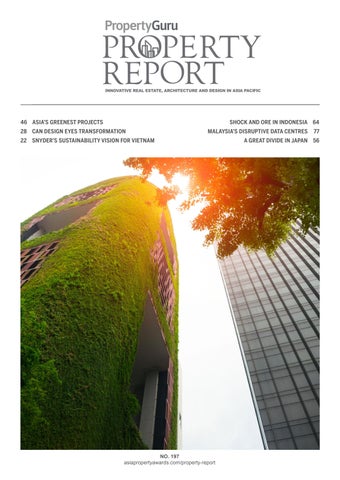
46 ASIA’S GREENEST PROJECTS
SHOCK AND ORE IN INDONESIA 64
28 CAN DESIGN EYES TRANSFORMATION
MALAYSIA’S DISRUPTIVE DATA CENTRES
22 SNYDER’S SUSTAINABILITY VISION FOR VIETNAM
NO. 197 asiapropertyawards.com/property-report
77
A GREAT DIVIDE IN JAPAN 56
1
Precision in Swiss. Each detail a mark of excellence.
Excellence Line Collection • CombiSteam oven 90cm Grand • CombiCooktop V4000
Supreme Line Collection • CombiCooler V6000 • Combair V6000, CombairSteam V6000
At V-ZUG, excellence is not a certification—it is a pedigree. While others claim origin, we practice obsession, manufacturing over 65% of our components within Switzerland to mirror the exacting standards of world’s most complex timepieces. From the architectural lustre of our mirror-glass finishes to the calibrated movements of our internal engineering, every element is a testament to vertical integration. Like a master watchmaker, we control the entire lifecycle of our appliance, ensuring a level of precision and quality control that transient, mass-premium brands simply cannot replicate. A V-ZUG appliance is not merely an acquisition; it is a legacy investment in Swiss intuition and reliability. We honour this devotion to durability and a promise of endurance with the support by a service standard that remains peerless in the industry, V-ZUG is the definitive choice for those who recognise that true luxury is not found in the trend, but in the uncompromising, timeless precision of the make.
2
www.vzug.com
Excellence Line Collection • CombiSteam oven V6000 • Combair oven V6000 • Vacuum Drawer V6000 • Warming Drawer V4000
Swiss Perfection for your home. Since 1913 3
ISSUE 197 PUBLISHING Publisher / General Manager Jules Kay Associate Publisher / Head of Brand & Marketing Richard Allan Aquino Publishing Assistant / Marketing Relations Manager Tanattha Saengmorakot EDITORIAL Editor Duncan Forgan Deputy Editor Al Gerard de la Cruz Editorial Contributors Liam Aran Barnes, Steve Finch, George Styllis, Jonathan Evans CREATIVE & MARKETING Head of Creative Ausanee Dejtanasoontorn (Jane) Senior Graphic Designer Poramin Leelasatjarana (Min) Digital Marketing Executive Anawat Intagosee (Fair) Senior Manager, Media & Marketing Services Nate Dacua Senior Product Lifecycle & Brand Manager Marco Bagna-Dulyachinda REGIONAL SALES Director of Sales Udomluk Suwan Watcharaphon Chaisuk (Australia) Wulan Putri (Indonesia) Tony Thirayut (Japan) Kai Lok Kwok (Mainland China, Hong Kong, and Macau) June Fong (Malaysia) Jess Lee (Malaysia) Priyamani Srimokla (Middle East) Marylourd Pique (Philippines) Sassy Bairan (Philippines) Chun Mun Pon (Singapore) Orathai Chirapornchai (Thailand) Dinh Van Tuan Anh (Vietnam) DISTRIBUTION Distribution Manager Rattanaphorn Pongprasert General Enquiries awards@propertyguru.com Advertising Enquiries may@propertyguru.com Distribution Enquiries ying@propertyguru.com Property Report by PropertyGuru is published six times a year by
© 2026 by PropertyGuru Pte. Ltd. All rights reserved. No part of this publication may be reproduced without prior permission of the publisher KDN PPS 1662/10/2012 (022863)
4
EDITOR’S NOTE Issue 197
Sustainability has moved well beyond aspiration. Across Asia, it is increasingly defining how projects are conceived, financed, and delivered, as developers respond to changing investor expectations, tighter regulations, and growing demand for buildings that perform better over the long term. This issue explores the projects and people driving that shift. Our roundup of Asia’s most compelling green developments showcases schemes proving that environmental responsibility and success are no longer competing ambitions, but increasingly go hand in hand. We also speak with Douglas Snyder of the Vietnam Green Building Council, who explains why green development is making stronger economic sense than ever, and why the financial case for sustainable buildings is only becoming more compelling. In the Philippines, we examine a landmark commercial development that is helping redefine the country’s sustainability standards. Elsewhere, we look at how South Korea is unlocking the potential of rooftop solar, while asking tougher questions about the environmental trade-offs accompanying Johor’s rapid data centre expansion. Our market updates from Japan and Indonesia explore the broader forces shaping investor confidence across the region, with sustainability continuing to emerge as a key consideration. Meanwhile, our neighbourhood guide visits Krungthep Kreetha, where abundant green space, evolving lifestyle amenities, and world-class sporting infrastructure are creating one of Bangkok’s most attractive emerging districts. The direction of travel is increasingly clear. Sustainability is no longer a niche conversation within real estate. It has become one of the defining forces shaping the industry’s future, and the pace of change is only accelerating.
Duncan Forgan Property Report duncan@propertyguru.com 5
CONTENTS | Issue 197
6
10
12
14
Gadgets
Trends
Style
Devices that better the planet
Befriend the earth with sustainable, ethically crafted furnishings
All the décor and homewares you need to carpet your space in green
16
22
28
Project Confidential: Jewels in the crown
Interview: The big payback
Design Focus: Road to evolution
GBF Centers 1 and 2 set a new benchmark for sustainable offices in the Philippines
The Vietnam Green Building Council’s Douglas Snyder lays out the benefits of mindful development
CAN Design is proving that the most successful developments happen through experience, not just aesthetics
44
46
56
Neighbourhood Watch: Krungthep Kreetha
Special Feature: Under the bonnet
Destination: Japan
One of Bangkok’s most desirable districts combines luxury housing, leading schools, and premium healthcare
Forward-thinking developments are defined as much by how they operate as how they look
Record prices in major cities contrast with a grim rural picture as Japan’s property market pulls in opposite directions
64
74
77
Destination: Indonesia
Dispatch: A higher power
Dispatch: Disrupted by data
A sell-off of sovereign debt has sent the rupiah reeling and the country’s property market is paying the price
New regulations are forcing South Korea’s apartment developers to turn to solar
Johor’s data centre boom is reshaping the state, testing the balance between investment and liveability
7
ADVERTORIAL
The Shift Towards LongIncome Housing – Market Analysis As leveraged property sectors face growing pressure, specialist supported housing is drawing increasing attention across UK real estate
In periods of economic uncertainty, investors have historically gravitated towards sectors built around essential demand, resilient income, and longterm infrastructure. That trend is becoming increasingly visible across global real estate markets today. As inflationary pressures continue to move through the global economy, fuelled by geopolitical instability, elevated energy prices, and disruption surrounding key trade routes including the Strait of Hormuz, central banks have been forced to maintain higher 8
interest rates for longer than many anticipated. The consequence has placed growing pressure upon highly leveraged areas of the global property market. Higher borrowing costs continue to impact refinancing, reduce acquisition capacity, and compress margins across debt-reliant real estate models. Whilst many traditional sectors have slowed, long-income real estate structures linked to essential housing demand are increasingly attracting attention from global investors and advisory firms.
Today, almost all real estate investments operate with some degree of leverage. Rising interest rates rarely favour leveraged models. This has created growing interest around sectors capable of producing long-duration, inflation-linked income without significant exposure to debt markets. One area increasingly being discussed is UK specialist supported housing. Within that market, Assisted Living Project, a UK property platform focused on specialist supported housing accommodation, has developed a
ADVERTORIAL portfolio centred around long-term housing demand, government-funded income structures, and debt-free acquisitions. The platform works alongside regulated housing providers and supported housing operators including organisations such as the YMCA, providing long-term accommodation for vulnerable individuals and those requiring specialist housing support. Unlike many traditional residential sectors exposed to discretionary demand cycles, specialist supported housing is underpinned by structural housing shortages and long-term social need. Government figures show more than 1.3 million households remain on local authority housing waiting lists across England, with many families waiting years for suitable accommodation. The current portfolio is structured to target almost double-digit gross yields through long-term specialist supported housing assets on inflationlinked lease arrangements. This is a target only and is not a guarantee of future performance. Actual returns may vary and are subject to market conditions, tenant performance, and other factors. Assisted Living Project has also positioned itself differently from many traditional property businesses by operating without external bank debt across acquisitions completed to date. As borrowing costs continue to pressure leveraged buyers, cashbacked acquisition platforms have increasingly been able to negotiate attractive terms directly with developers through bulk residential purchases. Recent acquisitions of newly built UK residential property have been completed through direct developer relationships and scale purchasing strategies.
Whilst specialist supported housing historically remained relatively overlooked by mainstream real estate markets, the combination of inflationlinked income, long-term housing demand, and operational resilience is now drawing increased institutional attention towards the sector. The wider UK market also continues to attract international interest due to the country’s transparent legal framework, institutional property market, and longstanding reputation for private property rights and rule of law. The platform’s board of directors includes entrepreneur Duncan Bannatyne. For enquiries relating to potential introducer relationships, experienced real estate professionals, licensed wealth managers, and financial advisory firms may contact Assisted Living Project. Any engagement involving the provision of financial advisory services must comply with applicable licensing and regulatory requirements in the relevant jurisdiction.
This article has been brought to you by Assisted Living Project. For further corporate information, please visit the Assisted Living Project website at https://news.alpv.co.uk. This article has not been reviewed by the Monetary Authority of Singapore. Important Notice: *This article is provided for general corporate and industry information purposes only. It is not intended to be, and should not be construed as, an offer, invitation or solicitation to invest in any security, financial product or collective investment scheme, nor as financial advice or a recommendation with respect to any investment product. This article does not constitute a prospectus or other offering document within the meaning of the Securities and Futures Act 2001 of Singapore, and
no securities may be offered or sold, nor may any invitation to subscribe for or purchase securities be made, in Singapore except pursuant to an exemption under the Securities and Futures Act 2001 or with a prospectus that has been registered with the Monetary Authority of Singapore. Any offer or intended offer of securities in Singapore will be made only to “accredited investors”, “institutional investors” or other persons specified under Section 275 of the Securities and Futures Act 2001. Any offer or sale of securities, or any invitation for subscription or purchase of securities, in any other jurisdiction is subject to the laws of that jurisdiction. Investors should seek independent legal, financial, tax or other professional advice before making any investment decisions. The information contained herein is subject to change without notice, and none of Assisted Living Project, its affiliates, representatives or advisers accepts any liability for any loss arising from the use of or reliance on any information contained herein. **No public offer of securities is being made in Singapore or any other jurisdiction. Any distribution of this article in jurisdictions where the publication or distribution would be contrary to applicable laws or regulations is prohibited. ***The contents of this article do not constitute investment, legal, business, tax or other advice. Readers should consult with their own professional advisers in the jurisdiction where they are resident before making any investment decision. Nothing in this article should be construed as a recommendation or endorsement of any investment product, and readers should not act or refrain from acting based on any information herein without seeking independent advice.
9
DETAILS | Gadgets
POWER TO T HE PEOPLE From putting renewable energy to work to simply just lasting long, these devices better the planet—and watt not
WICKER SWITCH The Camden wicker solar floor lantern houses LEDs inside a woven-effect frame and spends daylight hours banking sunshine. Come evening, it casts a warm white glow for up to six hours, completely free of cords, so you can move it wherever the gathering drifts.
GBP30, zimiye.com
10
DETAILS | Gadgets
FRIDGE BENEFIT The Vitesy Shelfy uses a photocatalytic ceramic filter and blue LED light to scrub ethylene gas and bacteria from the air inside your refrigerator, helping your produce last nearly two extra weeks. With the companion app, you can keep tabs on fridge air quality anytime, anywhere.
From EUR74, vitesy.com/shelfy
BREEZE PLEASER Avoid the grid with Pikasola’s wind turbine generator. Through its nylon carbon fibre blades, even a light gust can feed 400 watts into a 12-volt system, its tail fin swivelling automatically to face the strongest airflow. It can even pair with solar panels via a hybrid controller.
USD319, pikasola.com
FAIR IS FAIR In a world of planned obsolescence, the Fairphone 6 stands out with a flawless iFixit repairability rating and a USB-C port you can swap yourself. It promises software updates until 2033, packs a Snapdragon 7s Gen 3 processor, and takes expandable storage all the way to 2TB.
EUR549, fairphone.com
SCRAP HAPPY The iDOO Electric Composter cooks down kitchen leftovers into garden-ready fertiliser in just six hours by heated drying and grinding. A charcoal filter keeps smells locked inside the 3-litre chamber, warding off pests, while a safety lock stops small fingers from exploring when curiosity strikes.
From USD171, idooworld.com
11
DETAILS | Trends
GREEN PIECES Befriend the earth with sustainable, ethically crafted furnishings that lower your impact even as you elevate your style points
MOD SQUAD Silk & Snow’s Malaysian-made Aire Modular Couch morphs from armchair to U-shape sectional as your household evolves. The upholstery repels stains without relying on PFAS chemicals, carries an OEKO-TEX safety certification, and unzips for machine washing when life gets messy.
USD3,050, silkandsnow.com
12
SHELF MADE Thuma’s Nest Credenza is built entirely from upcycled timber, with natural knots and grain left proudly on display beneath an oil finish that deepens with age. Its Greenguard Gold badge confirms thorough screening for airborne chemicals, keeping your space as clean as it looks.
From USD940, thuma.co
GIVE AND TEAK Seating six to eight, the MasayaCo Miramar teak dining table stays sturdy outdoors with its sustainably harvested Nicaraguan hardwood finished with low-VOC oil. Every purchase funds the planting of 100 saplings, part of a decadeslong initiative that has already restored over a thousand acres of forest.
USD2,295, masayaco.com
BEAN THERE Pottery Barn’s Faux Leather Bean Bag Lounger and Pouf Set pairs a chunky cube shape with saddle-style upholstery that will have you down on the floor with the kids. The fill stays locked in place without sagging, and Greenguard Gold certification means the air in the room stays cleaner too.
USD448, pbteen.com
ROCK THE CROP Handcrafted from FSCcertified timber grown on reforested Nicaraguan land, the Arenal Outdoor Rocking Chair pairs a sealed teak frame with weather-shedding polyolefin cord. It lands on your doorstep fully assembled, ready to enhance lazy afternoons with a gentle back-and-forth rhythm.
USD1,695, masayaco.com
13
DETAILS | Style
LUSH LIFE All the décor and homewares you need to carpet your space in green
SCANDI-CAN Georg Jensen’s Terra Watering Can, dreamt up by Norwegian studio Snøhetta, gives the humble task of plant hydration a sculptural, ergonomic upgrade. Its mirror-polished stainless steel body holds just under a litre and feels as good in the hand as it looks on the shelf.
USD139, georgjensen.com
14
THE GOOD EARTH Grandin Road’s Devon raised garden planter sits on a solid cedar frame and hides a built-in water reservoir inside its double-walled resin shell. A rubber drainage plug prevents soggy roots while its elevated height keeps pests at ground level from helping themselves to your harvest.
USD599, grandinroad.com
CORNER THE MARKET The Bamworld corner shelf plant holder stacks multiple pots into a clever triangular nook. Made of carbonised eucalyptus that has been heat-treated rather than painted, each shelf bears substantial weight while the top bar welcomes hanging baskets. Plastic connectors lock everything together without a single screw.
From USD40, bamworld.store
CHIRP SHOW The Mumtop hanging bird bath dangles from a rust-resistant chain and S-hook, its glass bowl painted in a vibrant pattern best admired from above. It moonlights as a seed dish when feathered guests fancy a nibble instead of a soak.
USD22, amazon.com
STUDIO 54 The FGBNM Disco Ball Planter wraps a hanging sphere in stick-on mirrored tiles that toss flecks of sunlight around the room. A chain and hooks come included, along with spare mirror pieces, turning your space into a daytime dancefloor while your succulents soak up the rays.
From USD15.99, amazon.com
15
JEWELS IN THE CROWN The twin towers of GBF Centers 1 and 2 rethink the skyscraper while setting a new benchmark for sustainable offices in the Philippines BY AL GERARD DE LA CRUZ
16
17
GBF CENTERS 1 AND 2 INTEGRATE LUSH GREENERY AND BIOPHILIC DESIGN ELEMENTS THAT PURIFY THE AIR, CREATE A REFRESHING ENVIRONMENT FOR TENANTS, AND SUPPORT EMPLOYEE WELLBEING
N
o stranger to nature’s fury, the Philippines braces year after year for storms intensified by a warming climate. Yet even as it weathers this onslaught, the country’s built environment is trying to do its part to mitigate the climate crisis. In February 2025, Robinsons Land Corporation (RLC) secured Gold certification for GBF Centers 1 and 2 under the LEED v4 rating system. The twin towers are the largest office project in the Philippines to achieve this specific certification, one of the most exacting versions of the world’s leading green building standard. The development is the commercial centrepiece of Robinsons Land’s 30-hectare Bridgetowne Destination Estate along Metro Manila’s bustling C5 corridor. Named for its landmark four-lane, 200-metre bridge across the Marikina River, the township links Quezon City and Pasig City, placing the towers at the crossroads of metropolitan residential life.
Partner turned that convention on its head. Instead of the standard box-shaped plan, the architects gave GBF Centers 1 and 2 an inverted silhouette that followed the site’s natural contours. A carved, trilateral slope on each façade resembles the facet of a gemstone and was designed to accommodate a prominent LED billboard. This chamfered design allows the floorplates to expand with height, giving upper-floor offices panoramic views across the Ortigas skyline and towards the Sierra Madre mountain range. “We wanted to challenge traditional skyscraper forms,” says Go. “This progressive design reflects our belief that innovation begins with how we shape space.” The towers are wrapped in full-height glass curtain walls to maximise daylight and outward views, although this presented a significant engineering challenge. To mitigate heat gain, the design team adopted a series of passive and active cooling strategies.
The site had been earmarked for office development from the outset. “Because GBF Centers 1 and 2’s location is at the prominent gateway to the estate, we intended to introduce our most premium development in Robinsons Offices’ portfolio,” says Jericho P. Go, senior vice president and business unit general manager for Robinsons Offices.
A shared podium houses all parking indoors, while the roof deck is finished with a high-Solar Reflectance Index (SRI) TPO membrane to deflect heat. The ninth-floor podium garden provides an outdoor retreat for employees from both towers.
Skyscrapers typically taper as they rise above Philippine cities, but Manila-based architecture practice ASYA Design
Landscaped by EA Aurelio, the development is filled with native plants selected for their ability to thrive in Manila’s
18
DEFYING THE CONVENTIONAL FILIPINO HIGH-RISE TYPOLOGY, THE BUILDING’S FLOORPLATES EXPAND RATHER THAN CONTRACT AS YOU ASCEND
at-times searing climate. The planting palette prioritises air quality and visual appeal, creating an environment that supports workplace wellbeing. The towers are not identical. GBF Center 2’s floorplates are approximately 20% larger than those of its twin, allowing for different tenant requirements. The interiors, designed by OSP Design Studio, employ similar materials but distinct colour palettes to differentiate each building. “We wanted to make sure that our partners in design and construction had the same attention to detail and particular emphasis on excellence in execution,” says Go. “All the designers and contractors involved in the project already had proven and tested track records.” Because the site was relatively flat and had previously been developed, construction proceeded with minimal ecological disturbance. GBF Center 1 topped out in 2022, and both towers were completed by late 2025, offering flexible layouts with floorplates averaging between 2,500 and 2,800 square metres. Suppliers were required to submit technical documentation verifying recycled content, while waste leaving the site was carefully tracked and documented. To guard against noncompliant material substitutions, Robinsons Land engaged independent construction managers alongside its own project management professionals.
The development also incorporates touchless access systems, including facial recognition, linked to destinationcontrol lift systems that optimise passenger flow throughout the 30-storey towers. Achieving LEED v4 certification required substantial upfront investment, a hurdle that has discouraged many developers in emerging economies. Robinsons Offices acknowledged the additional cost but maintained that sustainability had been embedded in the project from the outset. “Ours is not just greenwashing,” says Go. “We are deliberate on our mission to save energy, water, minimise greenhouse gases, improve air quality, and create overall value for the environment.” Last year, the Gokongwei Group renewed its power contract with MPower, Meralco’s retail arm, for a 60% renewable energy mix across its major Luzon operations. Robinsons Offices subsequently moved several buildings, including GBF Centers 1 and 2, to 100% renewable energy. Of all the LEED v4 credits, optimised energy performance proved the most difficult to achieve. The VRF HVAC system, chosen over a chilled-water alternative, cost valuable points. Undeterred, the project team sourced a VRF system with superior EER ratings and installed LED lighting throughout to compensate, reducing overall energy demand.
19
We wanted to challenge traditional skyscraper forms. This progressive design reflects our belief that innovation begins with how we shape space
FROM FACIAL RECOGNITION ACCESS TO ENERGY-EFFICIENT LED LIGHTING, THE CENTRES ARE DESIGNED TO BE AS SUSTAINABLE AS THEY ARE SECURE
BREATHING ROOM As both a prerequisite and a consequence of their LEED certification, GBF Centers 1 and 2 are notable for their comprehensive indoor air quality strategy. Such measures are particularly important in tropical megacities such as Metro Manila, where pollution and humidity are constant concerns. The buildings employ a multi-layered approach to improving indoor air quality. At every regularly used ground-floor entrance, roll-out mats extend at least three metres in the primary direction of travel, trapping dirt and particulates before they enter the building. The mats are cleaned weekly to maintain their effectiveness. To prevent cross-contamination, areas where hazardous gases or chemicals may be present, including toilets and refuse rooms, are equipped with 20
exhaust systems rated at a minimum of 0.50 cubic feet per minute per square foot. These rooms also feature self-closing doors to contain pollutants. All ventilation systems supplying outdoor air to occupied spaces are fitted with MERV 13-rated particle filters capable of capturing microscopic airborne contaminants. Ventilation rates throughout occupied areas have also been increased by at least 30% above minimum requirements, helping to support cognitive performance, comfort, and overall wellbeing. In a city where airborne contaminants and excessive moisture are daily realities, the result is an indoor environment designed to be noticeably cleaner, healthier, and more comfortable for occupants.
To further curb energy use, the developer installed double-glazed windows that naturally moderate indoor temperatures, reducing demand on air-conditioning during the hottest months. The façade’s thermal performance was modelled using THERM 7.7 and WINDOW 7.7 software.
Green Commercial Development at the 13th PropertyGuru Philippines Property Awards. Eric Paguio, senior business development manager at Robinsons Offices, says the recognition reflects the company’s commitment to delivering accessible and sustainable workplaces.
Water efficiency credits further strengthened the project’s environmental credentials. The development incorporates water-saving technologies to reduce indoor and outdoor consumption, while harvested rainwater is used for irrigation and cleaning.
Recognition as the Philippines’ largest LEED v4-certified office development has already generated interest from Fortune 500 companies, including major players in the healthcare and technology sectors. The PEZA-accredited buildings offer more than 115,600 square metres of leasable space and N+1 redundant backup power, making them particularly attractive to IT-BPM firms and energy-intensive occupiers. In return, tenants must comply with LEED-specific construction guidelines to maintain the certification.
Indoor air quality also received particular attention. The buildings trap dirt at entrances, isolate contaminants through self-closing doors and dedicated exhaust systems, and filter incoming outdoor air through MERV 13-rated particle filters. With the certification, the project is helping raise the bar for sustainable office development in the Philippines, according to Rohith Ravula, associate director of Green Business Certification Inc. (GBCI), which administers LEED credentials. Alongside their LEED certification, GBF Centers 1 and 2 have collected several industry accolades, including Best
For an archipelago on the frontline of climate change, GBF Centers 1 and 2 demonstrate that ambitious environmental standards and commercial performance need not be at odds. The recognition has already attracted multinational occupiers, while the buildings’ long-term operating efficiencies are expected to strengthen their appeal further. “We trust these sustainable features will make the investment worth it,” says Go, “not just for the present but for future generations.”
AT WORK.ABLE, THE PREMIUM FLEXIBLE WORKSPACE WITHIN THE COMPLEX, LOCAL HERITAGE COMES ALIVE THROUGH VIGAN TILES, BAMBIKES, AND GLOWING SIGNAGE, DESIGNED TO SPARK MOTIVATION AND DEEPEN WORKER ENGAGEMENT
21
DOUGLAS SNYDER IS HELPING TO DRIVE A GREEN BUILDING AGENDA IN VIETNAM
22
The big payback The Vietnam Green Building Council’s Douglas Snyder argues that the real cost developers should fear isn’t building green. It’s failing to do so BY LIAM ARAN BARNES
23
GREEN CERTIFICATION FOR BUILDINGS IS GAINING GROUND IN CITIES LIKE HANOI
T
he question developers still ask all too often is how much more it costs to build green. Douglas Snyder believes the greater risk is what it may cost not to.
As finance, regulation, and tenant expectations become increasingly linked to building performance, assets that appear cheaper to deliver today could prove more expensive to own, lease, insure, or retrofit tomorrow. That warning carries weight in Vietnam, where rapid urbanisation is colliding with tougher carbon policies, expanding green finance frameworks, and growing pressure from occupiers and investors. As executive director of the Vietnam Green Building Council (VGBC), Snyder sits at the intersection of those forces. Vietnam’s green building market has expanded rapidly in recent years. The National Green Taxonomy has given banks and investors a framework for identifying green projects and supporting green credit and green bonds. A pilot emissions trading scheme is already underway, with later expansion expected to include commercial buildings. Green certification is also gaining ground. Ministry of Construction figures show that, by the end of the third quarter of 2025, Vietnam had more than 600 green buildings covering nearly 17 million square metres nationwide. The numbers point to a market gathering momentum, but one that will increasingly be judged on performance rather than certification alone. 24
The recent release of LOTUS New Construction V4 reflects that shift. Snyder discusses why the next phase of Vietnam’s green building market will depend not only on how many projects are certified, but whether those assets can hold their value as regulations tighten, capital becomes more selective, and occupier expectations evolve. How has Vietnam’s green building conversation changed over the past decade, and what still feels underdeveloped? Ten years ago, green buildings in Vietnam were being pursued by a select few developers. Now, most developers are at least considering adding green buildings to their portfolios. The government has helped through Vietnam’s zero-carbon commitments and follow-up policies. The 2025 Vietnam Green Finance Taxonomy defines green buildings for investment, while a 2% interest-rate subsidy for green lending has added to positive market sentiment. External pressure is also moving the market. The EU’s Carbon Border Adjustment Mechanism has influenced Vietnam’s manufacturing and export sectors, encouraging producers to build and operate more sustainable factories. We also see a lease premium of about 7.5-8% for high-end green offices in Ho Chi Minh City and Hanoi, so the green premium-brown discount idea is beginning to take hold.
GREEN BUILDING CAN HELP TO SHIELD OCCUPANTS FROM VIETNAM’S FREQUENT EXTREME WEATHER, SAYS SNYDER
Many developers now speak the language of ESG, net zero, and resilience. Where does the gap between ambition and delivery usually appear? It usually appears in two areas. The first is cost. These concerns are often unfounded, or the cost-benefit ratio is misunderstood. Typical cost premiums are around 2% to 3%, and some developers have refined their approach enough to bring those premiums to zero. The second issue is resistance within project teams. The technical difficulty is often manageable, but teams that believe they have been successful until now may question why they should change. As the market modernises, sustainability will increasingly be required to stay competitive. Where do developers often misunderstand the business case? With average green building cost premiums around 2%, and contingency fees typically in the 10% to 20% range, there is little real financial burden to building sustainably. Once operational savings are included, the typical payback period is two to five years. Developers should also consider the value of a more climate-resilient asset, higher net operating profit, and reduced regulatory alignment risk.
Zero-carbon buildings will carry higher premiums, likely closer to 10%, due to the technical inputs required. But they should also have strong payback because of nearzero energy costs. Other buildings may face expensive transition retrofits or even stranded-asset risk around 2030 as market preferences, corporate sustainability policies, and regulation become more demanding. What do certification systems do well, and where do green claims need stronger evidence? Certifications provide third-party assessments that banks and governments can use to verify the bankability of green assets. But not all systems are the same. Comprehensive green building is best covered by systems such as LOTUS and LEED, while narrower systems may focus on fewer areas. The level of certification also matters. There can be a big difference between a certified project and a platinumcertified project. Design-stage certification can indicate what might be achieved and support marketing efforts, but construction certification is closer to reality. Developers should share construction-phase certifications and achievements by category, because scoring shows how green a project really is. Physical inspection also helps verify that construction matches the planned design.
25
SNYDER SAYS THAT INVESTORS AND LENDERS IN VIETNAM CAN BE TOO NARROWLY FOCUSED ON CERTIFICATION
VGBC recently released LOTUS New Construction V4. What does the update say about Vietnam’s changing priorities? With the rise of ESG, LOTUS New Construction V4 reintroduces two categories from earlier versions: Resilience and Community & Equity. There was less market interest in those areas in the 2010s, but 2026 is the right time to bring them back in stronger form. Vietnam has experienced several years of destructive storms, so awareness of climate threats to property assets and business operations has grown. Carbon is now more deeply incorporated into LOTUS, with mandatory operational decarbonisation plans through 2050 and embodied-carbon assessments for construction materials. LOTUS has also expanded renewable energy capacity to support net-zero operations. The social dimension is addressed through health criteria such as biophilia, air quality, acoustics, and daylighting, as well as worker protections, outdoor communal spaces, and inclusive design. Is policy keeping pace with Vietnam’s green building ambitions? Vietnam has high-level green building requirements, including ambitions for zero-carbon and sustainable 26
buildings to 2030 and 2050. The recent green finance taxonomy is another strong step. To accelerate progress, financial and non-financial incentives would help, including tax benefits, expedited permit processing, and increased allowable gross floor area. Enforcement of the energy-efficiency building code would also help build market proficiency in basic efficiency, which can then support more advanced gains. For Vietnam to reach zero carbon by 2050 and conserve scarce resources, mandating certification for large buildings seems inevitable. Buildings can operate for 50 years or more, so we need to build correctly now. How much pressure is coming from investors, lenders, and occupiers? Pressure is increasing, but the market still has some way to go. Investors and lenders are not always clearly aware of the difference between comprehensive green building and narrower certifications. For now, there is often satisfaction with achieving any certification. As the market becomes more sophisticated, code compliance, climate adaptation, access to commercial insurance, and healthy buildings will become increasingly important, particularly as they are tied more closely to capital flows.
BIODIVERSITY, SAYS SNYDER, WILL BECOME INCREASINGLY IMPORTANT, WITH CONSERVATION AND REGENERATION ESSENTIAL TO MITIGATION
The benefits of advanced green buildings, including better performance, cost savings, and futureproofing, are still not being fully maximised by investors, lenders, or occupiers. How should emerging markets in Southeast Asia approach ESG differently from more mature markets? Emerging markets should consider what can realistically be achieved, while still making gains across accepted impact areas such as carbon, resilience, circularity, water, biodiversity, health, social value, and governance. Extremely complex ESG criteria are not always the best path. Focusing on core criteria and taking meaningful action can speak clearly to consumers, employees, partners, and communities. Southeast Asia should also consider what is relevant to a tropical and culturally diverse region. Simply importing standards from Europe or North America can be like trying to fit a square peg in a round hole. Localisation is part of real ESG impact. The region can also teach others, because emerging economies are flexible and fast enough to leapfrog.
What will separate future-ready commercial developments from projects that meet today’s minimum expectations? Future-ready commercial developments will need to be net-zero energy or net-zero ready. They will also need to be resilient to heat stress, flooding, high winds, power failure, and other shocks. Biodiversity will become increasingly important, with conservation and regeneration essential to mitigation. The social dimension can no longer be avoided, so operations, policy, and infrastructure must support inclusive, safe, and community-friendly spaces. Governance also matters. It works best when directed from the top, with the C-suite understanding sustainability and ensuring its implementation across portfolios.
Other buildings may face expensive transition retrofits or even stranded-asset risk around 2030
27
Road to evolution From rooftop gardens to urban parks, CAN Design is proving that the most successful developments happen through experience, not just aesthetics BY LIAM ARAN BARNES
28
A
s the sun drops over Hefei, crowds begin to gather on the sixth-floor rooftop of MixC, one of the Chinese city’s major retail complexes. Diners ascend from the mall below, moving through planted walkways towards the restaurants. A few of them stop at the railings for sunset selfies. Others settle around the open performance terrace, where stage lights and sound checks signal the start of the night’s entertainment. The space feels closer to a public square than the top of a shopping centre. Until recently, this was a drab, unused roof above the retail floors and cut off from the mall below. CAN Design has transformed it into Foodie Sky, a dining garden and events terrace where restaurants, planting, and evening performances bring the building’s upper level into public use. For Stephen Chow, the studio’s founder, this is where sustainability becomes part of how a project performs commercially. “For us, experience defines value,” he says. “When we create spaces that people love, and that can adapt over time, we are supporting environmental responsibility and the long-term viability of the asset.” He explains that years of work across Japan, the Philippines, Singapore, Vietnam, and India have shown him that the most memorable spaces are shaped by “the relationship between people, culture, emotion, and the natural environment.” Chow started the Hong Kong studio in 2020, as the pandemic halted the design industry and put most commercial projects on hold. He had spent nearly 15 years at the leading international firm Benoy, working on commercial and mixed-use projects across Asia.
That pause also made him question whether comfort had begun to dull the curiosity that had drawn him to design in the first place. “I realised that prolonged immersion in a comfortable environment can lead to creative stagnation,” he says. “As a designer, I felt the need to seek new challenges and rediscover a sense of exploration.” Chow wanted CAN to operate as a collective of specialists, with architects, interior designers, landscape designers, and branding teams involved from the start. He says that the process of co-creation is “intellectually rewarding” and “joyful,” a contrast to the standardised routines he had begun to outgrow. “We believe that people experience spaces as one continuous narrative,” he says. In CAN’s work, the architecture, interior design, and signage design are treated as connected parts of that narrative, rather than separate design exercises. Today, the Hong Kong-based firm has grown to more than 60 designers, with a regional portfolio that includes JLC in Nanjing, Landmark South in Hong Kong, Zhongguancun ART PARK in Beijing, and West Bund Financial Hub in Shanghai. CAN has also racked up accolades in its relatively short existence. It was named Best Emerging Architecture and Design Studio of the Year at Hong Kong’s Most Outstanding Business Awards 2023, took bronze at the Asia Pacific Interior Design Awards, and was listed by Archiposition among its emerging practices, giving Chow’s team a wider regional profile within a few years.
29
STEPHEN CHOW OF CAN DESIGN BELIEVES THAT SUSTAINABILITY IS INTEGRAL TO A PROJECT’S LONG-TERM VIABILITY AND ENDURING VALUE
30
Prolonged immersion in a comfortable environment can lead to creative stagnation. As a designer, I felt the need to seek new challenges and rediscover a sense of exploration
Still, the firm’s outlook remains rooted in Hong Kong. Chow grew up in the city, studied at the University of Hong Kong, and built much of his career around vertical urbanism, from earlier work on Langham Place and China Hong Kong City to CAN projects such as Landmark South and The Bay Hub. The city taught him to treat circulation as more than movement from A to B. In a place of tight sites, stacked uses, and vertical shortcuts, design must manage flow while still leaving room for pause, comfort, and connection. “Efficiency should never come at the expense of the human experience,” he says. “It is essential to bring nature into commercial environments, blurring the lines between indoor and outdoor spaces.” At JLC in Nanjing, that idea starts on the roof and moves down through the building. The rooftop garden follows the lines of the Qinhuai River, with winding paths, layered planting, and terraces that lift public life above the city. Below, the B1 sunken plaza draws daylight, greenery, and seating into the lower levels, giving the retail floor places to pause as well as pass through. WF CENTRAL B1 in Beijing turns a former drop-off area in Wangfujing into an art and event space, shifting a transitional part of the retail journey into somewhere people can stop and gather. In Addis Ababa, La Gare adds a layer of heritage to commercial renewal by reusing a historic cultural building. Zhongguancun ART PARK in Beijing expands the idea again, reworking
an isolated site into a park-style commercial complex centred on art, culture, technology, and public engagement. For Chow, this is where refurbishment moves beyond cosmetics. Many malls and offices still have good bones, but expectations have changed. A new façade will not fix that on its own. The work must get into the programming, movement, and purpose of the place. “Repositioning is about more than a facelift,” he says. “It is a strategic transformation that unlocks the hidden value of existing assets.” In CAN’s work, that value usually emerges through use. A roof can become part of the city’s social life, an arrival point can turn into a place to gather, and a historic building can gain a new public role. Each project extends the life of the existing structure by giving people a reason to spend time there. Chow’s decision to start CAN in 2020 came from the same impulse, to look again at familiar ground and find new possibilities within it. The studio has since built that approach into commercial spaces where circulation, nature, identity, and use are treated as parts of the same experience. Places endure when people have reason to return.
31
32
JLC, Nanjing, China JLC is rooted in Nanjing’s own cultural memory. CAN Design drew on the “Eight Scenic Scenes of Jinling” and Six Dynasties imagery, using these references to give a high-density urban site a stronger identity. The project works vertically as much as horizontally. A rooftop garden inspired by the Qinhuai River winds through layered planting, meandering paths, and cascading terraces, while the B1 sunken plaza pulls daylight and greenery into the lower levels. Seating areas and petfriendly pockets give the retail environment a more relaxed public character. Chow describes the rooftop as “a third place that extends the public realm upward,” turning the upper level into a social landscape above the city.
33
34
Zhongguancun ART PARK, Beijing, China The challenge at Zhongguancun ART PARK was renewal without erasure. The site carried the memory of earlier district landmarks, including Zhongguancun Shopping Plaza, Food Street, and the former Carrefour, while the brief called for a contemporary mixeduse destination linking retail, public space, and urban culture. Chow believes that repositioning begins with “respect for the urban fabric and knowing the history and identity of a site.” At Zhongguancun, CAN used a Park Oriented Development approach, linking the mall, street, and park spaces around a 20,000-square-metre urban park. This transformed an isolated commercial area into a more porous district, with art, culture, technology, and community life threaded through the park.
35
36
Chongqing The Ring Garden City, Chongqing, China Chongqing The Ring Garden City was conceived as the next evolution of The Ring, expanding the project’s nature-led retail language into a more interactive environment. The 15-metre Glitter Fall waterfall provides the main visual anchor, while the Fighting Lab introduces a more active, youthoriented layer. The project uses multisensory themed spaces to create a livelier dialogue between nature and city life, with flexible mixed-use areas that can host popups, cultural events, and community programming. For Chow, sustainable commercial design must create “spaces that people love, and that can adapt over time.” At The Ring Garden City, that idea plays out through a retail environment designed to shift with audiences, events, and changing patterns of urban leisure.
37
38
WF CENTRAL B1, Beijing, China At WF CENTRAL B1, the design starts with arrival. CAN was commissioned to upgrade the entrance façade, interiors, and signage for Level B1 of the premium Wangfujing destination, sharpening the experience of entering and moving through the development. The key move was to turn a purely transitional space into something more active. “We transformed a traditional drop-off area into an art and event space that encourages public engagement,” Chow says. The redesign also reworks the façade, layout, and signage, with creative arts and digital media giving the lower level a more immersive role in the wider retail journey. For CAN, the project demonstrates how targeted refurbishment can revive an existing asset while maintaining its connection to Wangfujing’s historic commercial fabric.
39
40
MixC Hefei Foodie Sky, Hefei, China Foodie Sky brings new energy to Hefei MixC above street level. On the sixth-floor rooftop, CAN turned unused space into a dining garden, event terrace, and urban leisure destination. Restaurants, plants, and open-air seating form the heart of this project. A flexible performance area lets the rooftop host live events, shows, and gatherings, keeping the mall lively into the evening. Chow says nature should be “part of the user journey rather than a visual backdrop.” Here, greenery redefines how people move, pause, eat, and socialise. The rooftop feels like a small urban escape in the city, adding new daily uses to the space.
41
42
Landmark South, Hong Kong, China Landmark South brings CAN’s thinking into the workplace. The brief called for a wellnessoriented sky garden and indoor green spaces to support a future-ready office environment in Hong Kong’s Southside. The design makes the workplace feel less compressed. Landscaped areas accommodate wellness programmes, events, performances, and informal interaction, while open layouts allow spaces to change use across the day. In a dense urban office setting, nature becomes part of how people meet, reset, and move through the building. Chow says sustainable design should support “social placemaking, wellbeing, and economic value.” Landmark South applies that idea at the workplace scale, creating a greener setting for collaboration and community.
43
Kreetha of Comfort BY JONATHAN EVANS
Krungthep Kreetha has evolved into one of Bangkok’s most desirable residential districts, combining luxury housing, leading schools, and healthcare facilities
1
2
3
Nantawan Pool Villa
VIVE New Krungthep Kreetha
Wellington College International School
Winner of Best Ultra Luxury Housing Architectural Design at the 20th PropertyGuru Thailand Property Awards, Nantawan Pool Villa is a collection of 30 twostorey residences by Land and Houses Public Company Ltd. Scheduled for completion in December 2027, the development draws inspiration from London’s Crystal Palace and classical French architecture. Set across 55,312 sqm, the homes feature openplan layouts that combine living, dining, and entertaining spaces with landscaped gardens and generous outdoor areas. Reflecting pools, fountains, and abundant greenery create a resort-like atmosphere, while private gyms, lounge areas, and carefully curated interiors reinforce the project’s focus on luxury family living. Large windows and thoughtfully planned communal areas encourage indoor-outdoor living, ensuring the residences feel both expansive and welcoming.
Developed by Land and Houses Public Company Ltd, with interiors by Norme and landscaping by Studio NDT, VIVE New Krungthep Kreetha comprises 73 threestorey residences scheduled for completion in January 2027. Designed around the concept of “Your Art Piece: 5 Spaces, 5 Lifestyles”, the homes feature 3.2-metrehigh glazing, adjustable façade louvres, and flexible layouts that accommodate work, leisure, and family life. A sculptural staircase serves as the focal point of each residence. Residents also enjoy access to the VIVE Club clubhouse, which includes a 50-metre swimming pool, jacuzzi, children’s pool, putting green, basketball court, football pitch, and communal gardens. The emphasis throughout is on adaptability, allowing homeowners to tailor spaces to changing family and lifestyle needs.
Modelled on its renowned British counterpart, Wellington College International School Bangkok has established itself as one of Krungthep Kreetha’s leading educational institutions. The school caters to students from early years through to Year 13 and offers personalised campus tours that introduce families to its facilities, admissions process, and British-based curriculum. Adapted for an international and Asian context, the programme places equal emphasis on academic achievement, character development, and participation in sport, music, and the arts. Extensive facilities and a strong co-curricular programme help foster confident, globally minded students prepared for higher education in Thailand and abroad.
44
If you’re seeking luxury living in eastern Bangkok, few neighbourhoods are as well-positioned as Krungthep Kreetha. Home to established expatriate communities such as Kritsana Village, the area combines convenient access to the city centre with leading schools, hospitals, and retail destinations. Strong transport links have helped transform what was once a golf-centred suburb into one of Bangkok’s most sought-after residential districts, with land values rising by around 150% over the past decade.
4
5
6
Samitivej Srinakarin Hospital
Dawn to Dusk
Unico Grande Golf Course
Samitivej Srinakarin is one of Thailand’s leading private healthcare institutions and is widely recognised for its paediatric expertise. In 2025, the hospital expanded its international children’s centre, adding specialised treatment capabilities in areas including cardiology and oncology. The eight-storey, 111-bed facility also positions itself as a centre for healthy ageing, offering specialist services for patients across different life stages. Having treated patients from 186 countries, Samitivej continues to strengthen its international reputation through advanced medical technology, including a hybrid operating theatre that supports highly precise newborn and paediatric procedures. Its combination of specialist care and international standards makes it a key healthcare resource for residents of eastern Bangkok.
Designed by award-winning practice TOUCH Architect, Dawn to Dusk is a striking café, restaurant, and lifestyle venue that has become a popular gathering place in Krungthep Kreetha. Housed within a distinctive reddish-brick structure, the venue combines a speciality coffee bar, restaurant, cocktail bar, event space, and outdoor garden. The design draws inspiration from the transition between day and night, with recurring solar and lunar motifs appearing throughout the property. Guests can move between the bright café spaces, atmospheric dining areas, and the glasshouse-style Varda Room, which hosts private events and creative workshops. The result is a venue that feels equally suited to morning coffee meetings, leisurely lunches, and evening socialising.
One of Bangkok’s oldest golf clubs, Unico Grande is a distinctive 18-hole, par-63 course located in neighbouring Saphan Sung, around 20 minutes from the city centre. Recent upgrades to the greens have enhanced a layout known for its tight fairways, strategic bunkering, and water hazards, rewarding accuracy over power. Mature tropical landscaping lends the course a tranquil atmosphere despite its urban location. Facilities include practice areas, locker rooms, massage services, and a clubhouse restaurant overlooking the fairways. For many residents, the course remains one of the defining lifestyle amenities that first established Krungthep Kreetha’s reputation as an upscale residential district.
45
UNDER THE BONNET
46
Asia’s most forward-looking developments are proving that better buildings are defined as much by how they operate as how they look BY LIAM ARAN BARNES
47
GREEN OFFICE ADOPTION IN SYDNEY EXCEEDS 80% AMONG GRADE A BUILDINGS
K
eppel Bay Tower is easy to miss. On Singapore’s HarbourFront, the 18-storey office building sits within a commercial skyline of glass, height, and spectacle that has long defined the city-state’s appetite for the new. Completed in 2002, it does not look especially futuristic from the street. But in 2020, Keppel Bay Tower became Singapore’s first commercial building to receive BCA Green Mark Platinum (Zero Energy) certification, turning an ordinary-looking older office tower into a national retrofit case study. Behind its inconspicuous façade was a careful overhaul of cooling, lighting, ventilation, sensors, data, and day-to-day operational control, with the retrofit delivering annual energy savings of more than 2.2 million kWh. It is a prime example of how much of Asia’s commercial real estate future will depend on reworking existing building stock. Older assets are being asked to work harder, last longer, and prove their relevance through performance as much as appearance. Location, design, and amenities now sit alongside a more demanding test of how buildings perform once occupied, measured by
48
how efficiently they use energy and water, how readily they adapt to changing occupier needs, how transparently they report performance, and how well they withstand rising costs, climate risk, and tenant expectations. “Energy efficiency has financial implications,” says Ada Choi, head of research for Asia Pacific at CBRE. “Occupiers are more focused on buildings with smart HVAC systems, energy optimisation technologies, and better insulation that can help lower utility consumption and reduce long-term operating expenses.” CBRE research shows green office adoption in Asia Pacific rose from 44% in 2023 to 51% in 2024, with gateway cities such as Singapore, Tokyo, and Sydney already exceeding 80% among Grade A buildings. Sustainability now feeds directly into decisions about rent, employee experience, and whether tenants stay or go. For landlords, the numbers are starting to bite. JLL’s 2026 Asia Pacific sustainability research finds that 87% of occupiers now put energy savings at the top of the agenda. Among investors, 61% see retrofitting as the main way to avoid being left with obsolete space.
Genuinely forward-looking developments embed sustainability into the full lifecycle of the asset, from design and construction to operations and tenant engagement
“Asia Pacific’s commercial real estate leaders are at a crossroads, where resilience is no longer optional, and energy efficiency is critical for long-term value,” says Kamya Miglani, head of research for work dynamics in Asia Pacific at JLL. “The urgency to upgrade ageing assets, optimise smart energy solutions, and translate climate adaptation plans into practical outcomes has never been higher.” Knight Frank’s Asia Pacific Real Estate 2026 outlook notes that top-tier Grade A offices in core regional cities command rental premiums of 15% to 20% over Grade B space, while older, less efficient buildings are becoming obsolete unless owners reposition them. Those pressures are being reinforced by regulation, corporate net-zero targets, and more demanding disclosure requirements. Energy use remains the most visible metric, but the ESG brief is expanding to include carbon, water, waste, materials, climate resilience, indoor air quality, tenant engagement, and long-term transparency. “Projects that treat sustainability primarily as a marketing tool often rely on one-off certifications, which are no longer a clear differentiator in Asia Pacific given widespread adoption,” Choi says.
For owners, that pushes the work beyond plant-room upgrades. Embodied carbon, construction waste, water use, indoor air quality, biodiversity, supply chains, and social value are becoming part of how projects are planned, financed, operated, and judged. “Genuinely forward-looking developments embed sustainability into the full lifecycle of the asset, from design and construction to operations and tenant engagement,” Choi says. The most advanced offices, retail spaces, logistics hubs, residential towers, and landed communities now combine measurable performance with lower resource use, healthier environments, and stronger longterm resilience. Across the region, the strongest projects are no longer treating sustainability as a separate technical layer. They are using it to extend asset life, reduce operating risk, and reshape the experience of homes, workplaces, logistics parks, and retail environments. The following award-winning projects show how that shift is playing out across Asia, from low-carbon renovation and green logistics to biodiversityled masterplanning, passive design, and healthier housing.
In mature markets such as Singapore, Australia, and Japan, brown-to-green upgrades, amenity improvements, and adaptive reuse are becoming part of the value-add playbook, with smart systems, automation, and cloud-based monitoring helping landlords control energy use, anticipate maintenance needs, analyse occupancy patterns, and provide tenants with clearer evidence of performance. 49
Elmina Ridge 1, City of Elmina, Malaysia
At Elmina Ridge 1, sustainability begins at home and extends throughout the entire township. This low-density neighbourhood is part of the City of Elmina, offering easy access to a forest reserve, parks, cycling paths, and an urban biodiversity corridor. Inside, the homes reflect this environmental focus with planter spaces, skylights, green-certified materials, EV charger points, and solar panels with battery storage. A key feature is how household performance connects with neighbourhood planning. Each home is designed to reduce reliance on grid electricity, while natural light, greenery, and indoor-outdoor spaces help lower energy demand without compromising liveability. Across the township, green spaces, paths, and outdoor facilities make wellness a shared benefit. Here, sustainability is embedded into the wider community rather than treated as a feature of individual homes alone.
50
One Central Macau Revamp, Macau
One Central Macau proves that sometimes the most sustainable choice in retail is to keep an existing building in use and improve how it works. The revamp reworks a mature mall through lowercarbon materials, healthier interiors, and tighter construction management. It is targeting BEAM Plus Platinum and has secured WELL Platinum, bringing human health into the same frame as energy and materials. Façade openings, improved circulation, smart lighting controls, low-VOC materials, recycledcontent gypsum boards, FSC timber, and lowerembodied-carbon finishes all help move the mall beyond a cosmetic refresh. Much of the project’s ESG value comes from how it was built. Modular construction, BIM, and a shared data system made the process more efficient. Reusing materials and managing waste led to a diversion rate of more than 89%, while embodied carbon was reduced by over 22%. For retail assets looking to remain competitive, the project demonstrates that refurbishment can be as meaningful as new construction. 51
River Green, Singapore
River Green pairs luxury high-rise living with unusually detailed sustainability credentials. Located near Kim Seng Linear Park and the Singapore River, the tower features a central water spine, a 100-metre pool, pocket decks, pavilions, pet facilities, fitness areas, and native planting. Its strongest ESG credentials, however, come from its construction methods and long-term operational performance. The development has achieved Green Mark Platinum Super Low Energy status with five sustainability badges. More than 80% of relevant architectural and landscape areas use sustainable materials, while embodied carbon has been reduced by over 30% relative to reference values. Nearly two-thirds of construction uses PPVC, reducing waste and improving build efficiency. Low heat gain, CFDguided natural ventilation, efficient air-conditioning, LED lighting, occupancy sensors, VVVF lift drives, and ceiling fans all help reduce energy demand. The result is a high-density residential development where environmental performance is engineered into the building rather than added as an afterthought.
52
SLP Park Bac Ninh, Bac Ninh, Vietnam
SLP Park Bac Ninh stands out through the details that matter to industrial users, from clear heights, wide grids, and truck courts to daylight, efficient cooling, and lower resource demand. This LEED Silver-certified development sits in Thuan Thanh II Industrial Park, about 32 kilometres from Hanoi. It is close to key transport routes and the electronics supply chain in northern Vietnam. The project’s ESG strengths are built into its operations. Features such as high ceilings, wide column spacing, truck courts, and generous parking areas support manufacturers and logistics companies, while insulated roofs, solar-control glass, and skylights improve comfort and reduce energy demand. The building systems are practical rather than decorative. LED lighting with motion sensors, solar-ready roofs, partial solar PV, EV charging stations, efficient cooling, water-saving fixtures, and smart irrigation all support day-to-day performance. The project brings natural daylight into around 95% of regularly occupied areas, reduces indoor tap water use by up to 45%, and cuts landscape water demand by about 70%. In a fastgrowing industrial corridor, sustainability has to deliver operational value as well as environmental gains. 53
Teras Lakon, Tangerang, Indonesia
Teras Lakon makes passive design part of the theatre of fashion, craft, and public life. LAKON Indonesia and Summarecon Serpong designed the building to combine an office, retail, gallery, café, and production spaces in one creative hub celebrating Indonesian fashion and heritage. Its lower-impact philosophy is reflected in the way the building functions. Open spaces, cross-ventilation, and skylights reduce reliance on air-conditioning and artificial lighting, while ramps connect different levels, improving accessibility and doubling as catwalks for fashion shows and events. There is a useful restraint to the architecture. Exposed structures, minimal finishes, visible services, paving, and glass railings give the interiors the feel of a workshop as much as a showroom. Outside, a planted roof, nearby lake, and indigenous trees and shrubs help cool the site and reinforce its cultural identity. Natural-dye planting, including tamarind, suji, galangal, lemongrass, and pandan, connects the landscape directly to traditional craft and production.
54
The Grand Riverfront Ratchapruek – Rama 5, Nonthaburi, Thailand
The Grand Riverfront Ratchapruek – Rama 5 treats clean air, lower energy use, and water savings as part of what luxury housing should now deliver. Frasers Property Thailand says this riverside project is one of the first single-detached housing developments in Thailand and Southeast Asia to earn LEED Gold certification for homes. The houses combine passive and active systems, including natural light and ventilation, low-carbon and low-VOC materials, AAC blocks, reflective exterior coatings, 22.5-centimetre roof insulation, LED lighting, EV chargers, and 4.6 kW solar panels. The numbers reinforce those ambitions. Each home can reduce energy use by up to 75% and carbon emissions by around 5,700 kilograms of carbon dioxide equivalent per year. Water-saving fixtures lower water consumption by up to 22%, while the Energy Recovery Ventilation system filters more than 99.7% of PM2.5 and continuously monitors CO₂, particulate matter, and humidity. Here, luxury is defined less by finishes than by cleaner air, lower operating costs, and long-term resilience. 55
THE GREAT DIVIDE Record prices in Tokyo and Osaka are colliding with a very different reality in the countryside, where millions of homes sit abandoned as the forces reshaping Japan’s property market pull in opposite directions BY GEORGE STYLLIS
56
57
MAJOR CITIES LIKE TOKYO ARE EXPERIENCING A SURGE IN CONDO PRICES
J
apan’s property market is becoming increasingly defined by two sharply contrasting realities. In Tokyo and Osaka, land values are climbing, condominium prices have reached record highs, and developers are grappling with soaring construction costs. Beyond the country’s major cities, however, entire neighbourhoods are slowly emptying, leaving millions of homes abandoned as Japan’s population continues to shrink. The contrast has rarely been starker. According to the latest official figures, Japan has nine million vacant homes, or 13.8% of its housing stock. Yet in the country’s largest cities, buyers face some of the highest property prices in a generation as redevelopment, foreign investment, labour shortages, and rising building costs continue to drive values higher.
58
The divergence is becoming one of the defining features of Japan’s real estate market. While policymakers struggle to revive declining rural communities, investors are increasingly focused on the country’s largest metropolitan centres, where major infrastructure projects, new tourism developments, and the rapid expansion of artificial intelligence are creating fresh growth opportunities. In March, Japan’s land ministry says land prices had risen for a fifth consecutive year, with gains widening in Tokyo and Osaka. Tokyo’s own data showed residential land prices in the capital’s 23 wards rose 9%, while commercial land increased 13.8%. In April, the Real Estate Economic Institute says the average price of a new condominium in Tokyo’s 23 wards reached a
OSAKA GAMBLES ON CASINO Osaka is set to become home to Japan’s first casino resort after construction on the longawaited USD9-billion development began in April. The MGM Osaka project, backed by MGM Resorts and Orix, is being built on Yumeshima, the artificial island in Osaka Bay. Scheduled to open in 2030, the resort will include hotels, restaurants, shops, entertainment venues, conference facilities, and a casino. Japanese politicians debated the merits of legalising casinos for years. In 2016, legislation paved the way for integrated resorts, and two years later, a law allowing up to three casino-led developments as part of wider tourism complexes was passed. Supporters believe the project will help transform Osaka into a destination in its own right rather than simply a gateway to Kyoto and Nara. “Projects such as the country’s first integrated resort on Yumeshima and Grand Green Osaka are enhancing the city’s landscape and strengthening its position as a regional economic and commercial hub, driving job creation, tourism, and connectivity,” says Christine Li, head of Asia Pacific Research at Knight Frank, referring to the city’s new 24-hectare public park.
record JPY137.84 million (USD861,000) in 2025, reflecting rising construction costs and a shortage of supply. “The defining trend in 2026 has been the continued rise in residential prices alongside a constrained supply environment, despite tighter financing conditions, driven by the yen’s depreciation that has reinforced inward investment,” says Christine Li, head of Asia Pacific research at Knight Frank.
more attractive to overseas investors holding stronger currencies. At the same time, labour shortages have increased construction costs and extended project timelines, adding further pressure to prices. “Foreign investment is coming from both institutional investors, who are yield-focused, and individuals, who buy for the lifestyle,” says Eddie Guillemette, CEO of Midori no Ki, a real estate company based in Niseko.
“Official land price data shows sustained nationwide increases, with particularly strong appreciation in major urban centres such as Tokyo and Osaka.”
“However, high prices are also being driven by soaring raw material and construction labour costs, and land price appreciation driven by redevelopments.”
The weak yen has pushed up the cost of imported materials and energy while making Japanese real estate
Those redevelopment projects are transforming major urban centres, particularly Osaka, where billions of dollars 59
JAPAN’S RURAL HEARTLANDS ARE DOTTED WITH GHOSTLY VACANT PROPERTIES
are being invested in new commercial districts and tourism infrastructure. At the same time, developers are racing to secure land for data centres as artificial intelligence drives demand for digital infrastructure, while major transport projects are expected to reshape residential demand in parts of Tokyo over the coming decade. But construction costs show little sign of easing. Japan’s construction inflation is forecast to remain high, at 5.6% in 2025 and 5.3% in 2026, driven by “persistent labour shortages, material cost volatility, and ongoing capacity constraints,” according to Turner & Townsend. Savills estimates reinforced-concrete condominium construction costs in Tokyo were about 35% higher in October 2025 than they were in October 2019. Reuters reported in June 2026 that Japan’s import prices had jumped 25.5% year-on-year, with wholesale inflation driven by petroleum products, chemicals, and non-ferrous metals. Recent geopolitical tensions have added further uncertainty to global supply chains.
60
“There are big delays for a lot of building materials because of the war,” says Anton Wormann, founder of Japandi Houses, which renovates abandoned homes. “You cannot find glue or wallpaper or a certain type of paint. A lot of big developers are now in big trouble because they cannot finalise their initial investments. “A lot of these big developers are dumping big projects they were about to take on. That’s the biggest change over the past few months.” Looking ahead, Guillemette believes policy could become the biggest risk to Japan’s urban property boom. Japan places few restrictions on foreign purchasers, but opposition parties have begun advocating tighter controls, including possible limits on foreign acquisitions and taxes on vacant foreign-owned homes. “If there is a sudden change in taxation, redevelopment rules, or limitations on who can purchase a property, market pricing will react negatively, and liquidity can dry up,” he says. “The more predictable risk factors to look at in both the short and long run are rising interest rates, causing a strengthening currency, and less liquidity.”
Yet while Tokyo, Osaka, other major cities, and centres such as Niseko in Hokkaido continue to attract capital, development, and new residents, a very different housing market exists beyond the metropolitan skyline.
“It requires a lot of footwork, boots on the ground, cultural knowledge, and language. You need to have a strong community of people who can execute on your ideas or have a lot of time.”
Across much of rural Japan, demand has evaporated altogether. Villages continue to lose population, younger residents leave for the cities, and millions of homes have been left standing empty, creating one of the developed world’s largest inventories of vacant housing.
Japan’s vacant-home problem dates back to the country’s post-war industrial boom, when millions of people migrated from rural communities to the factories, offices, and universities of the country’s expanding cities.
For some buyers, those abandoned homes represent an extraordinary opportunity. “I’ve purchased homes for about USD15,000, an hour away from Tokyo,” says Wormann. “That means you could rent a nice apartment in Tokyo for a few months for that price, or you could own a house in the countryside.” The bargains, however, come with significant challenges. “There are a lot of complications,” he says.
Japan’s rural population fell from around 50% in 1945 to less than 20% by 1970. The collapse of Japan’s asset bubble in the 1990s accelerated the trend. As property values tumbled and economic growth stalled, many rural homes became worth less than the cost and effort required to maintain them. To tackle the problem, the government has introduced legislation giving municipalities greater powers to identify dangerous vacant homes, order owners to repair or demolish them, and, in some cases, remove tax breaks
ON THE RIGHT TRACK Southern Tokyo’s residential market is expected to receive a further boost from JR East’s Haneda Airport Access Line, which will significantly reduce journey times to the capital’s international airport. The new line is expected to cut travel time between Tokyo Station and Haneda Airport from around 30 minutes to just 18 minutes while reducing the need for transfers. Although the railway will improve access from northern commuter routes, property advisers believe southern districts, including Shinagawa, Tamachi, Oimachi, and the waterfront, stand to benefit the most. “The opening of the Haneda Airport Access Line is expected to greatly improve the asset value of real estate in areas along the route,” says Tokyu Livable.
The defining trend has been the continued rise in residential prices alongside a constrained supply environment, despite tighter financing conditions, driven by the yen’s depreciation
The brokerage believes improved connectivity will increase demand for housing, supporting land values, rents, and apartment prices. JR East expects the line to open during the fiscal year ending March 2032. 61
REDEVELOPMENT PROJECTS ARE CHANGING THE FACE OF OSAKA
that had encouraged owners to leave ageing properties standing. Many local governments have also launched “akiya banks” to connect buyers with vacant homes, while others offer renovation subsidies or even free properties to people willing to relocate. The initiatives have helped attract a growing number of Japanese and overseas buyers drawn by traditional architecture, larger homes, and a slower pace of life. Some see business opportunities in restoring neglected properties into guesthouses, cafés, or holiday homes. Others are looking for an affordable place to settle. Even so, the scale of the challenge remains immense. Japan’s population has fallen to around 122 million, roughly four million fewer people than it had two decades ago, and many rural communities continue to age and shrink. “There is no real good solution to it,” says Wormann. 62
“It requires a lot of effort to solve this problem. It’s not only about the abandoned homes. It’s about the community and everything else that’s going on around.” The contrast between Japan’s booming cities and its struggling countryside is becoming increasingly pronounced. In Osaka, redevelopment projects are reshaping the city as preparations continue for the country’s first integrated casino resort, while artificial intelligence is fuelling a scramble for data centre sites around Tokyo, Osaka, and emerging regional hubs. In the capital, major transport investments, including the Haneda Airport Access Line, are expected to create new property hotspots over the next decade. Japan’s property story is therefore no longer defined by a single trend. Instead, it is becoming a tale of two markets: one driven by redevelopment, investment, and rising values, the other by depopulation, abandonment, and the difficult task of finding new life for millions of empty homes.
THE NEW HANEDA AIRPORT ACCESS LINE WILL GIVE A BOOST TO SOUTH TOKYO’S RESIDENTIAL MARKET
DATA CENTRE DIVIDEND Japan’s artificial intelligence boom is creating a new property race as technology companies compete for sites capable of supporting the next generation of data centres. Major operators, including AirTrunk, Equinix, and MC Digital Realty, have announced plans to launch or expand operations in Japan. Already the second-largest developed data centre market after the United States, Japan’s market is projected to reach JPY4.2 trillion by 2029.
JLL say a former industrial site in Greater Osaka sold at a 110% premium because the required power supply was already available. “Japan’s data centre market, the second-largest among developed nations after the United States, represents one of the real estate sectors currently attracting the greatest attention from developers, operators, and investors,” say JLL’s head of research Hiroshi Okubo and senior director Naoko Iwanaga.
Although demand remains concentrated around Tokyo and Osaka, regional prefectures are increasingly seeking to attract investment. Toyama Prefecture is among those positioning itself as a future data centre hub.
63
SHOCK AND ORE
64
As Jakarta tightens its grip on strategic minerals, investors are losing confidence, the rupiah is sliding, and Indonesia’s property market is paying the price BY AL GERARD DE LA CRUZ
65
INDONESIA’S INTENSIFYING HILIRISASI (RESOURCE NATIONALISM) COMPELS INTERNATIONAL MINERS TO MOVE DOWNSTREAM— OR LOSE THEIR ORE
I
t is an irony forged in metal: The world’s largest nickel exporter is experiencing a full-fledged currency crisis.
Now among the world’s worst-performing equity markets, Indonesia has seen international fixed-income funds dump IDR86 trillion (USD4.87 billion) of sovereign debt since August, a sell-off that has pushed the central bank’s holdings of local debt to a precarious 30%. The rupiah, as of press time, has cratered to around IDR18,000 against the US dollar.
66
Fingers are pointing at President Prabowo Subianto’s interventionist policy shifts for the crisis. And if history is any guide, a crashing rupiah is all it takes to bring a leader down with it. The sliding currency has done little to budge inflationadjusted home prices. Bank Indonesia’s Residential Property Price Index grew just 0.62% year-on-year in the first quarter of 2026, the slowest growth since records began in 2003. Transaction volumes have collapsed, with overall residential sales contracting by almost 26% year-on-year as buyers head for the exits.
YOUTH QUAKE Despite being the fourth most populous nation on earth, Indonesia is very youthful, with a median age of 30.7 years. Over half of its roughly 285 million citizens are under the age of 35, making it one of the youngest major economies in a swiftly greying Asia. Younger buyers have fundamentally shifted their propertyseeking behaviour relative to older cohorts. “They rely more heavily on technology, social media, ChatGPT, AI, and online property portals when pre-selecting houses, rather than visiting exhibitions or attending product launches,” says Hendra Hartono, chairperson of the PropertyGuru Indonesia Property Awards judging panel. This sense of caution dovetails with increasingly unaffordable housing prices and the wider availability of residential sites away from urban cores. Many now weigh buying an affordable house two hours from Jakarta against renting an apartment or co-living space near the city centre. This is especially true for unmarried property seekers, according to Hartono. Buoyed by hybrid working policies, newly married couples, on the other hand, are shifting demand toward affordable housing located near public transportation and reliable internet. However, infrastructure-driven hype has not always translated into real-world sentiment. “In our observation, infrastructure-driven projects such as the LRT or Commuter Line have not been fully absorbed by the market since they were launched,” notes Hartono. “Even some of them have been put on hold until now due to a lack of absorption, let alone increasing the price level.” Even areas alongside the country’s much-vaunted Whoosh high-speed rail are “still underdeveloped”, he reports. Only those with proximity to stations outside Halim, such as Padalarang and Tegalluar, have seen meaningful activity. To defend the rupiah, Bank Indonesia announced its first benchmark interest rate increase in two years in May before pushing it higher in June to 5.75%. The currency crash is attributed to a combination of a structural shortage of US dollars, rising import costs, and Indonesia’s resource nationalism.
Conversely, Hartono sees tailwinds from projects such as the Bogor Outer Ring Road. Set to be completed in 2028, the new thoroughfare will create easier access to and from the Jakarta CBD, lifting residential prices in a specific corridor within 36 months.
“The depreciation has been driven not only by continued global turmoil and strong domestic foreign exchange demand, but also by foreign portfolio investment outflows from Indonesia,” explains Bank Indonesia executive director Ramdan Denny Prakoso in a statement. 67
PRESIDENT PRABOWO SUBIANTO’S INTERVENTIONIST POLICY SHIFTS ARE BEING BLAMED FOR INDONESIA’S CURRENT ECONOMIC WOES
In May, the government issued Regulation No. 24/2026, mandating that strategic commodities such as coal and palm oil may only be exported by a state-owned enterprise, specifically PT Danantara Sumberdaya Indonesia, a new super-agency under the sovereign wealth fund. Prabowo was building on the hilirisasi policy introduced by his predecessor, Joko Widodo, including bans on raw nickel ore exports. This well-intentioned effort to move Indonesia’s nickel industry up the value chain has taken on a more assertive tilt under the current administration, inspired in part by China’s state-led industrial model and fortified by the country’s official entry into BRICS. Spooked institutional investors, from American and Swiss asset managers to Australian hedge funds, reacted strongly, joining a “Sell Indonesia” wave of capital flight that pulled the benchmark index down by more than 36% from its historical peak. This crisis of confidence also spooked Indonesian elites, who began panic-selling rupiah assets and moving capital offshore.
68
Investors also questioned the government’s fiscal discipline. Only a few months earlier, Danantara had issued low-yield Patriot Bonds to affluent Indonesian families in an effort to defray Prabowo’s state development and social initiatives. The most ambitious of these, the IDR130-trillion Three Million Homes initiative (Tiga Juta Rumah), aims to extend microcredit and mortgages to low-income families. The government also recently reinstated the PPN DTP (Pajak Pertambahan Nilai Ditanggung Pemerintah) incentive for property purchases, fully waiving VAT on eligible transactions to bolster homeownership. Worry is warranted. The crash carries faint echoes of the rupiah’s historic depreciation during the 1997-98 Asian financial crisis, a preamble to the ousting of President Suharto. “The most pressing challenge at the moment is the depreciation of the rupiah,” says Farazia Basarah, country head of JLL Indonesia. “A government-led solution to this problem would reduce uncertainty and boost investor activity.”
NEARLY 60% OF HOME BUYERS ARE NOW GEN Z OR MILLENNIALS, ACCORDING TO JLL INDONESIA
Looser foreign ownership rules should, in theory, offset some of the foreign exodus and domestic stagnation. The government now allows foreigners to own property using only a valid passport, without requiring a prior residency permit, though minimum price thresholds differ across regions. The National Land Agency can issue a hak pakai (right to use) title, a renewable leasehold that can extend up to 80 years. Together with a 10-year golden visa, these options provide pathways for long-term stays in Indonesia.
Against a sliding rupiah, even a seemingly cheap villa in Bali, when priced in dollars, now carries a currency-risk premium that might deter international buyers.
But the impact has been minimal. “We must admit that it is still a psychological nudge with limited take-up in Indonesia due to limited access to local financing, opaque bureaucracy, and different regulation interpretation in settling transaction documentations with local authorities,” says Hendra Hartono, chief executive officer of the consultancy PT Leads Property Services Indonesia.
Of 18 cities surveyed by Bank Indonesia, 10 saw slower annual price growth in Q1. Domestic home buyers are especially reticent in cities such as Surabaya, where prices contracted 0.27% year-on-year, while those in Yogyakarta and Pontianak posted quarterly declines of 0.68% and 0.74%, respectively.
“Investing in property in Indonesia is not about expecting capital appreciation or high rental yield, especially with the weakening of the rupiah, but rather for end-users who wish to stay and enjoy life in Indonesia.”
For Indonesian home buyers, the higher-for-longer rate environment could prove especially painful in the event of oil supply shocks stemming from the Iran war. Indonesia is now a net importer of petroleum products, having left OPEC in 2016.
“They are more cautious in buying ready-to-occupy homes than newly launched products because they have witnessed many properties halted or delayed during the pandemic up until now, especially if the products are offered by less reputable or new developers,” Hartono says. 69
HOME PRICES IN SURABAYA CONTRACTED YEAR-ON-YEAR DURING Q1
“There will be very limited activity in new high-rise developments due to oil price hikes, high costs of imported goods, construction materials, and elevated borrowing costs.” The industrial and logistics segment proved more resilient in the first quarter, buoyed by demand from data centres, logistics, and a shortage of developable land. According to Basarah, logistics and industrial will continue to attract investors in a market with some of the highest occupancy rates in the region. “Batam, for example, is on investors’ radar for data centres. Central Java’s industrial estates and special economic zones are attractive from an industrial and logistics perspective.” In a recent survey, Knight Frank Indonesia found that 61% of developers and property stakeholders identified the industrial and warehousing subsector as the one expected to grow most significantly in 2026. E-commerce expansion was cited as the property sector’s “growth engine.” Lower mortgage rates with zero down payments and longer tenors for first-time home buyers could unlock the 70
Against a sliding rupiah, even a seemingly cheap villa in Bali, when priced in dollars, now carries a currency-risk premium that might deter international buyers
THE WHOOSH HIGH-SPEED RAIL IS BOOSTING THE PROPERTY MARKET IN BANDUNG
ESCAPE FROM CHAOS Indonesia welcomed 4.68 million foreign tourists from January to April 2026, an 8.24% increase over the same period last year and the highest for the period since 2020, according to the Central Bureau of Statistics. Bali continued to drive the archipelago’s hospitality sector, with its star-rated hotels registering the nation’s highest occupancy rate at 57.94%. Bali’s real estate market has bifurcated into lifestyle-driven segments and commercial investment properties, with end-user demand for permanent or primary residences playing a secondary role, according to Hendra Hartono. Ubud, Uluwatu, and Canggu enjoy high rental yields ranging from 7% to 12%. However, total rental revenue slumped by approximately 7% year-on-year in Q1 2026, according to property intelligence platform REID, which attributed it to investors choosing occupancy volume over rate maximisation amid increased competition. Residential pricing also posted a median increase of just 0.7% year-on-year as sales activity softened, with buyers influenced by regulatory scrutiny and global economic uncertainty.
71
BALI REAL ESTATE MARKET HAS BIFURCATED INTO LIFESTYLEDRIVEN SEGMENTS RATHER THAN GENUINE END-USER DEMAND
oversupplied condominium markets in Jakarta and other major cities, according to Hartono. In March, the government officially extended the maximum tenor for subsidised housing loans to 30 years, benefitting the “sandwich generation.” Leveraging the consumption patterns of younger generational cohorts serves as a reasonable demand hedge in Indonesia, where nearly 60% of home buyers are now Gen Z or millennials, according to JLL Indonesia. Selling prices are consequently adjusting towards homes priced between IDR1 billion and IDR1.5 billion. Yet the preference for landed housing runs deep and cuts across generations. “It is worth remembering that it wasn’t really until the 1990s and later that high-rise condominiums became more prevalent in Jakarta, so landed housing was the only option until relatively recently,” says Basarah. “Things will change slowly, however, as the preferences of new generations evolve.”
72
In the interim, the rupiah’s collapse has allowed for a pregnant pause in Indonesia’s residential property market. As buyers hold out for a currency stabilisation that may not arrive soon, experts argue for standardised regulations, uniform legal interpretations, and faster dispute resolution mechanisms. Encouragingly, the new VAT waiver applies uniformly to both landed housing and condominiums. “Policies specifically targeting condominiums would be needed to boost high-rise residential demand,” adds Basarah. The crisis has laid bare the tenuousness of policy credibility among the country’s economic constituencies, from highnet-worth tycoons to institutional capital allocators and a young, housing-starved populace. “The single clearest pro is that, due to the rupiah weakening, property prices have become very competitive compared with neighbouring markets,” Hartono says. “The single clearest con is the frequent change in regulations and policies.”
INDONESIA’S NEW CAPITAL, NUSANTARA, IS TAKING SHAPE IN KALIMANTAN
NICKEL AND DIMED Indonesia has pursued one of Asia’s most assertive resource nationalism strategies, particularly with nickel, a mineral critical to EV batteries. Since 2014, the country has intermittently banned exports of unprocessed nickel ore, forcing foreign companies to build domestic smelters. Major Chinese firms, under the Belt and Road Initiative, invested heavily in nickel processing and battery precursor production. Former President Joko Widodo, who fully reinstated the ban in 2020 after a brief hiatus, framed the strategy as essential to ending a “colonial” model of raw mineral exports. His successor, President Prabowo Subianto, has only tightened supply chain controls. “Look for minerals somewhere else,” Finance Minister Purbaya Yudhi Sadewa recently told foreign business groups. This resource nationalism coincides with Prabowo’s ambitious infrastructure and social housing push, notably the Three Million Homes programme, bankrolled by Danantara, the sovereign wealth fund. Other projects include an IDR16-trillion apartment development in Cikarang for industrial workers and an emergency disaster relief housing initiative in Sumatra. But these ambitions face resistance amid a currency crisis and capital flight that have plunged the residential property market into its deepest slowdown in years.
73
Dispatch
A higher power New regulations are forcing South Korea’s apartment developers to generate their own energy, much of it from solar, marking a major shift in how the country’s residential buildings are designed and built By Steve Finch
W
hen Incheon announced the latest phase of its expanding residential district, Geomdan New Town, in early June, its energy self-sufficiency requirements were progressive, even by South Korean standards. Located 30 kilometres northwest of Incheon International Airport, the new town requires private developers to construct apartments with a Zero-Emission Building (ZEB) rating of at least Grade 4, meaning buildings must produce at least 20% of their own energy. Having first established Geomdan as an 74
DEVELOPERS IN SOUTH KOREA ARE TURNING TO SOLAR TO GENERATE ENERGY
energy-efficient satellite of Seoul in the late 2000s, this latest stage of the development is its most ambitious yet in terms of energy use. “Geomdan New Town is the fastest-growing area in Incheon in terms of population,” says Ryu Yun-ki, president of Incheon Metropolitan City Urban Development Corporation, the public housing arm of the city government. “We will create an ecofriendly residential complex that matches the concept of this special zone.”
Dispatch
IMPROVING THE ENERGY PERFORMANCE OF PRIVATE BUILDINGS, WHICH ACCOUNT FOR THE MAJORITY OF BUILDINGS, IS AN ESSENTIAL TASK TO ACHIEVE GREENHOUSE GAS REDUCTION TARGETS
After passing a series of new construction regulations, including new standards for apartment buildings in June and December of last year, South Korea now ranks among the most ambitious nations in Asia— alongside Japan—when it comes to energy efficiency standards for housing. In June last year, the Ministry of Land, Infrastructure and Transport (MOLIT) issued new rules requiring newly constructed, privately developed apartment buildings to produce at least 13% of their own energy. The regulation is considered an industry game-changer in South Korea because residential buildings were previously not required to produce any of their own energy. The ZEB ratings dictate that Grade 5 is the minimum requirement, while Grade 1 is the highest, with up to 100% energy selfsufficiency, as South Korea works towards net-zero greenhouse gas emissions by 2050. Rooftop solar is now viewed as the primary answer to changing energy codes, alongside increased insulation and other energysaving measures that reduce overall energy demand and, in turn, the amount of energy buildings need to generate.
energy performance of private buildings, which account for the majority of buildings, is an essential task to achieve greenhouse gas reduction targets,” says Hong Seongjun, head of the Green Building Division at MOLIT. However, in 2023, the industry became increasingly vocal about what the new requirements would mean for developers’ costs, and ultimately apartment prices, amid a surge in residential prices and a national debate over housing affordability. The Architectural Institute of Korea, among the industry groups pushing back against stricter ZEB rules, warned that mandatory Grade 5 requirements would raise construction costs by 35%. In response to industry pressure, when the new requirements were due to come into effect in early 2024, the government announced a one-year postponement before continuing consultations with the private sector into mid-2025.
South Korea had originally planned to phase in mandatory Grade 5 certification for new private apartment developments with more than 30 units—meaning 40% energy selfsufficiency—from the start of 2024. The government has argued that private sector developers have long lagged behind the public sector, which has been subject to Grade 5 ZEB requirements since 2023.
As a result, the new rules announced in June last year read like a compromise. Instead of requiring full Grade 5 certification, including 40% energy self-sufficiency, new private apartment developments must instead produce a minimum of 13% of their own energy. MOLIT claims this will translate into annual energy savings of KRW220,000 (USD145) per household, while increasing construction costs by KRW1.3 million (USD860) for an 84-square-metre unit, “estimated to be recovered in five or six years”.
“While the public sector has led zero-energy building initiatives so far, improving the
While the new rules primarily focused on increasing the energy production of 75
Dispatch
buildings, further regulations introduced in December imposed stricter requirements on energy demand. For developers, the new rules mean designs must include provisions for the installation of additional renewable energy systems and high-performance energy features, including insulation, during the building permit stage of a project, says Jimmy Park, head of ESG Solutions at CBRE South Korea. “Industry concerns around energy regulations do exist,” Park tells Property Report. “But they tend to be absorbed into the broader conversation about cumulative regulatory burdens rather than surfacing as pushback specifically against ZEB standards.” In a bid to reduce costs and demonstrate the benefits of energy savings, public-private sector collaborations have been launched alongside the introduction of the new regulations. Last year, a research and development consortium was formed that includes Ewha
76
NEW RULES MEAN DESIGNS MUST INCLUDE PROVISIONS FOR THE INSTALLATION OF ADDITIONAL RENEWABLE ENERGY SYSTEMS
Womans University in Seoul alongside Samsung, Posco E&C, Lotte E&C, and LH, to collaborate over five years. Among the first projects is a 27-storey housing complex in Gunpo, south of Seoul, with 60% energy self-sufficiency. Solar panels will be installed across the “entire exterior walls and rooftop of the main building”, LH says in a statement announcing the project in November. While the ZEB requirements have added to the cost burden for private developers in South Korea, the country’s Construction Cost Index, compiled by the Korea Institute of Civil Engineering and Building Technology, climbed 34% between 2020 and the start of this year. Reports in South Korea’s trade press have also pointed to similar increases in labour costs amid a shortage of construction workers since the pandemic. “Construction cost pressures in South Korea’s apartment sector are significant, but energy efficiency requirements are not the main driver,” says Park of CBRE. “The more acute pressures come from rising labour and material costs alongside tightening safety regulations.”
Dispatch
Disrupted by data Johor’s data centre boom is reshaping the state, testing the balance between investment and liveability By Liam Aran Barnes
I
n Iskandar Puteri, Malaysia’s data centre boom has reached the edge of daily life. Near Taman Nusa Bayu and Taman Nusantara Prima, residents have watched as cleared land, construction hoardings, cement trucks, and dust have replaced the green buffer that once stood behind their homes. The land rush is no longer a distant story about artificial intelligence or foreign capital. It now arrives as dust on parked cars, on traffic outside homes, and as a daily disruption for the communities living beside it. Just beyond the last row of houses, ZData and NTT Data sites mark the
JOHOR IS AT THE HEART OF MALAYSIA’S BID TO BECOME A REGIONAL DIGITAL INFRASTRUCTURE HUB
front line of a surge that has placed Johor under regional scrutiny. By February 2026, unease had escalated from complaints to public protest. Residents in Nusa Bayu staged a demonstration calling for greater transparency over Johor’s data centre plans, including their potential impact on local power and water supplies. In March, Kota Iskandar assemblyman Datuk Pandak Ahmad acknowledged the planning issue, telling the media it was “unfortunate” the project was “too close to four residential estates”.
77
Dispatch
IN MALAYSIA, AS IN MANY COUNTRIES, THE DISTINCTION BETWEEN MARKETED GREEN AND GENUINELY SUSTAINABLE DATA CENTRES LIES IN THE DEPTH AND SCOPE OF THEIR APPROACH Pandak said future data centres should be located away from homes, with planned industrial and technology hubs such as the Southern Industrial and Logistics Cluster and Nusajaya Tech Park considered more appropriate. Where centres are built near residential areas, he said, “ideally there should be some consultation or negotiations with us, so that data centres can exist without causing much trouble to the public.” He added that the controversy should serve as a lesson for future projects. Malaysia has spent recent years positioning itself as a regional digital infrastructure hub, benefitting from Singapore’s constraints, rising AI demand, and investment-friendly policies. The Malaysia Digital Economy Corporation said digital investments reached MYR163.6 billion in 2024, with data centres and cloud infrastructure accounting for 76.8% of approved digital investments. By late 2025, Johor had approved 51 data centre projects representing MYR182.96 billion in investment, according to figures from Johor housing and local government committee chairman Mohd Jafni Md Shukor. Recent JLL Malaysia research notes that the country’s data centre capacity is set to more than double to 2,055MW by the end of 2026, with Johor among Asia Pacific’s fastest-growing markets. For developers, the best sites are no longer simply large plots of land. They are sites that can be connected to power, fibre, water, and planning approvals quickly enough to build. The research also found Johor industrial land prices rose to an average of MYR86 per square foot in 2025, up 8.4% year-on-year, with data centres among the principal drivers of demand. Digital Edge’s April purchase of an industrial site in Kota Tinggi worked out at around MYR160
78
per square foot. The gap between those figures illustrates the premium now attached to land that can be matched with power, roads, drainage, fibre routes, and water infrastructure. Keith Eng, JLL Malaysia capital markets senior director, has warned of longer waits to connect to the grid, ranging from “about 24 months for some emerging markets” to “up to eight years in certain core markets”. The pressure is already visible in electricity demand. Consumption in Peninsular Malaysia rose 11.5% year-on-year in April and was largely met by a 50.5% surge in gas-fired generation, according to data from Malaysia’s Grid System Operator. Analysts also expect power demand to continue rising over the coming years, driven largely by data centres currently under construction. Power is only one part of the strain. As developers look beyond established technology parks, more projects are being proposed near residential areas, bringing construction traffic, drainage concerns, dust, and rising utility demand closer to existing communities. Complaints have centred on dust, noise, land clearing, traffic, and flooding. Water raises the longer-term question. Colin Timothy Santhakumar, senior assessor at Malaysian green building certification body GreenRE Sdn Bhd, estimates that a typical 100-megawatt facility can consume around 4.2 million litres of water a day, equivalent to the daily domestic use of roughly 18,000 to 20,000 Malaysian households. That scale of demand is why he is cautious about narrow sustainability claims. “In Malaysia, as in many countries, the distinction between marketed green and genuinely sustainable data centres lies in the depth and scope of their approach,” Santhakumar says. “Marketed-green facilities often highlight
Dispatch
isolated features, such as a competitive Power Usage Effectiveness (PUE) rating or rooftop solar installations, without addressing broader impacts.” Efficiency metrics matter, but they are not a complete environmental assessment. Power Usage Effectiveness, Water Usage Effectiveness (WUE), and Carbon Usage Effectiveness (CUE) help measure operational performance, but Malaysia’s electricity mix, water sourcing, and lifecycle emissions must also be taken into account. “Greater emphasis should be placed on the Renewable Energy Factor, or equivalent procurement of clean energy, to reduce reliance on carbon-intensive grid power,” Santhakumar says. “Additionally, the sourcing and type of water deserve equal attention alongside raw WUE optimisation.” In Johor, those concerns have moved beyond sustainability claims and into government decision-making. Johor chief minister Datuk Onn Hafiz Ghazi told the media that the state would “never approve any project, including data centre developments, if it brings hardship to the people” and would not “gamble with the people’s welfare merely to attract major investments”. Applications are assessed by a state coordinating
DATA CENTRE CONSTRUCTION IN JOHOR HAS CAUSED DISRUPTION TO NEARBY RESIDENTS
committee that reviews water and electricity requirements. “If a data centre demands a high intake of water, we will not approve it,” he added. At the federal level, Malaysia’s Guideline for Sustainable Development of Data Centres sets out key performance metrics and best practices, while the Data Centre Task Force coordinates policy. Santhakumar describes the framework as technically sound but says “voluntary adherence is no longer adequate” as the sector expands. Enforcement remains complicated by Malaysia’s federal-state structure. Digital investment policy may be shaped nationally, but land, water, and local planning largely remain the responsibility of state authorities. That leaves Malaysia trying to reconcile national investment ambitions with local infrastructure constraints. The country remains well positioned to attract regional data centre investment, but speed and scale alone will no longer be enough. Johor demonstrates that the next stage of growth will depend on the power that can be supplied, the water use that can be justified, the cooling systems that can be explained, and communities that are brought into the planning process before the costs arrive on their doorstep.
79
ADVERTISEMENT
Avia Estate
Sarangani, Philippines Avia Estate is a 121-hectare master-planned mixeduse development in Alabel, Sarangani, envisioned to be SOCCSKSARGEN’s emerging hub for modern living and enterprise. As the first major expansion of Alsons Development and Investment Corporation in South Central Mindanao, it represents the company’s commitment to building well-planned communities that enhance quality of life and drive regional growth. Nestled between Sarangani’s mountains and coastlines yet only 20 minutes from key urban destinations like General Santos City, Avia Estate offers a distinct balance of accessibility and scenic living. Its location within the Davao-General Santos growth corridor positions it as a strategic address for residents, institutions, and businesses seeking to grow in a dynamic, future-ready environment. Thoughtfully master-planned to serve a wide range of stakeholders, Avia Estate brings together residential,
80
institutional, and commercial components in a secure, well-integrated environment. Its residential enclaves are designed to offer a variety of living options set in walkable neighbourhoods with treelined streets, wide roads, and landscaped parks, as exemplified by Narra Park Residences Avia, its first residential development. Avia Estate integrates vital institutions into its design, including The Abba’s Orchard Montessori School, the first true Montessori school in SOCCSKSARGEN, and the Alabel Public Safety and Security Complex, the region’s first integrated emergency response facility. It also features a football field for sports and community activities, with commercial strips and expanded road networks underway to further enhance connectivity and convenience within the estate. Together, these elements form a dynamic, futureready estate—purposefully built for living, learning, working, and growing in the heart of Sarangani.
FACT BOX WINNER
FINALIST
BEST MIXED USE DEVELOPMENT
BEST MIXED USE DEVELOPMENT (ASIA)
Avia Estate by Alsons Development and Investment Corporation
Avia Estate by Alsons Development and Investment Corporation
2025
2025
Developer: Alsons Development and Investment Corporation Product type: Mixed-use development Architect: EGD Lopez and Partners Launch date: March 2023 Total land area: 121 hectares Facilities: Football field, safety and security complex, activity area, commercial strips, educational institution (The Abba’s Orchard) Contact: Phone number: (083) 887 4055 Email: info@alsonsdev.com Address: 2/F RLII Building, Santiago Boulevard, General Santos City, Philippines
81
ADVERTISEMENT
Narra Park Residences Avia Sarangani, Philippines Nestled within the 121-hectare master-planned Avia Estate in Alabel, Sarangani, Narra Park Residences Avia is a mid-cost residential community that combines the charm of countryside living with the advantages of being part of an emerging growth hub. Developed by Alsons Development and Investment Corporation (Alsons Dev) under its Nurtura brand, the project reflects the company’s commitment to building well-planned, nature-integrated communities. Narra Park Residences Avia offers bungalows, twostorey homes, and open lots, giving families, young professionals, and even retirees the flexibility to choose a home that matches their lifestyle and plans. The development is thoughtfully complemented by amenities that encourage leisure and connection. Adult and kiddie pools, a bathhouse, a cabana, and a multi-purpose covered court provide everyday opportunities for recreation. Two expansive 3,200-square-metre parks with a playground, mini football field, and designated pet-friendly
82
zones further enrich the community, supporting active lifestyles and fostering camaraderie among neighbours. Tree-lined roads and landscaped frontages make every walk through the community refreshing, while gated entrances, perimeter fencing, and 24-hour security give homeowners peace of mind. Conveniently located along the Sarangani-Davao del Sur Coastal Road, the community offers easy access to schools, shops, and nearby urban hubs like General Santos City. As part of the larger Avia Estate, residents can also look forward to future commercial areas and civic facilities, enhancing the community’s convenience, vibrancy, and long-term value. In March 2026, Narra Park Residences Avia reached an important milestone with the turnover of its first homes, marking the start of a growing community and a new chapter of modern suburban living in Sarangani.
FACT BOX WINNER BEST HOUSING DEVELOPMENT (MINDANAO) Narra Park Residences Avia by Alsons Development and Investment Corporation
2025
Developer: Alsons Development and Investment Corporation Product type: House and lot, Open lot Architect: EGD Lopez and Partners Launch date: March 2023 Completion date: December 2027 Total land area: 13 hectares Number of units: 518 units/lots Average unit size: 120-150 sqm Facilities: Community centre, swimming pool, cabana, multipurpose court, parks, playground Monthly maintenance fees: PHP500 (onetime membership fee, PHP4 per sqm) Price range: PHP4.3M (bungalow), PHP5.3M (two-storey), PHP15,246 per sqm (open lot) Contact: Phone number: (083) 887 4055 Email: info@alsonsdev.com Address: 2/F RLII Building, Santiago Boulevard, General Santos City, Philippines
83
ADVERTISEMENT
Thamrin Nine Jakarta, Indonesia Thamrin Nine redefines mixed-use developments in Indonesia’s largest metropolis. Developed by PT Putragaya Wahana, this first-of-its-kind world-class superblock includes luxury offices, F&B spaces, sports and entertainment facilities, and a range of hospitality options, including PARKROYAL Hotel & Serviced Suites, Pan Pacific Hotel, and the first Waldorf Astoria hotel in Indonesia. Situated on Jl. MH. Thamrin in the heart of Jakarta, Thamrin Nine enjoys excellent connectivity and proximity to the city’s central business district. The development features a retail podium, a low-density luxury residential property (LeParc Mansion and Leparc Townhouse & Terraces), and two mixed-use towers: Autograph and Luminary. Autograph Tower has reached unprecedented heights, becoming the tallest building in the Southern Hemisphere.
84
Lifestyle amenities are abundant, including a sky garden, concert hall, helipad, IMAX theatre, padel court, and sky pool. A direct MRT connecting tunnel ensures seamless access to public transportation. Thamrin Nine offers a compelling proposition within Jakarta’s premium property market, backed by world-class architecture, diverse product offerings, and a prime location that continues to attract both local and international interest.
WINNER BEST COMPLETED MIXED USE DEVELOPMENT (ASIA) Thamrin Nine by PT. Putragaya Wahana
2025
FACT BOX
Developer: PT. Putragaya Wahana Product type: Mixed-use Architect: KPF & PAI (Autograph Tower); KPF & Airmas Asri (Agora & Luminary); WATG & PAI (LeParc Mansion); WATG & Airmas (Leparc Townhouse & Terraces) Completion date: December 2024 Facilities: Sky garden, ballroom, concert hall, multi-purpose sports hall, event spaces, bar and dining, helipad, IMAX theatre, 24-hour gym, malls, hotels and serviced suites, padel court, sky pool, MRT connecting tunnel Contact: Phone number: +62 21 2993 7299 / +62 811-306-399 Email: marketingthamrinnine@thamrinnine.com Address: Chubb Square, P6 Floor Thamrin Nine Complex, Jl MH Thamrin No.10, Jakarta, Indonesia Website: thamrinnine.com
85
ADVERTISEMENT
Promenade Peak
Zion Promenade, Singapore Promenade Peak stands as a visionary architectural masterpiece, elevating urban luxury to new heights. Soaring 240 metres into the sky along the iconic Singapore River, this striking landmark is set to redefine the skyline and the way we experience luxury living. Rising 63 storeys, this sleek, monolithic structure is a testament to cutting-edge design, featuring a striking interplay of vertical fins and dissolving pixel patterns as it ascends towards the Sky Peak, its exclusive roof-level sanctuary. As Singapore’s tallest residential-only tower, Promenade Peak offers a rare living experience, where privacy, serenity, and sophistication converge. Thoughtfully designed to cater to the discerning few, it is a beacon of exclusive living that promises a sanctuary above the city’s hustle and bustle. The building is home to four meticulously crafted facility zones that cater to every aspect of residents’
86
lifestyle needs—communal, social, fitness, and wellness. From vibrant social spaces to quiet wellness retreats, every element of Promenade Peak is designed to provide an unparalleled living experience. For those with a focus on health and fitness, the Wellness Peak offers an entire dedicated level. Featuring state-of-the-art facilities for boxing, cross-training, outdoor exercise, and more, it provides a comprehensive wellness experience that goes beyond the typical gym, ensuring that residents have every opportunity to rejuvenate both mind and body. At Promenade Peak, luxury, convenience, and well-being are not just features—they’re a way of life.
WINNER BEST LUXURY CONDO ARCHITECTURAL DESIGN (ASIA) Promenade Peak by Allgreen Properties Limited
2025
FACT BOX
Developer: Allgreen Properties Limited Product type: Condominium Architect: DCA Architects Pte Ltd Launch date: August 2025 Date of vacant possession: February 2031 Date of completion notice: February 2034 Total land area: 99,952 sq ft Number of units: 596 Average unit size: 527-1,884 sq ft Facilities: 50m lap pool, Sky Peak Infinity Pool, Sky Vista, sky observatory, sky lounge, hydrospa bay, tree-top walk, clubhouse, alfresco dining, gymnasium, outdoor fitness facilities, gardens and terraces, social pods, floating hammock, cabana cove, bowling lawn, pickleball court, pavilions, playground, Serenity Cove, and more Contact: Phone number: 6683 8322 Email: promenadepeak@allgreen.com.sg Sales gallery address: 105 Ganges Ave Singapore 169695 Developer office address: 1 Kim Seng Promenade, #07-01 Great World, Singapore 237994 Website: promenadepeak.com.sg
87
88
89
90
91
92
93
WINNER
WINNER
BEST HIGH END CONDO DEVELOPMENT (HCMC)
BEST LIFESTYLE CONDO DEVELOPMENT
Arcadia at Lavila by PierreVal & Kien A Joint Venture
Arcadia at Lavila by PierreVal & Kien A Joint Venture
2025
2025
A French-Inspired Destination
FOR MODERN LIVING
Developed by the collaboration between Groupe PierreVal (France) and Kien A Group (Vietnam), Arcadia at Lavila brings together international expertise and deep local insight to create a new benchmark for contemporary living in South Saigon. As the first high-rise precinct within the 60-hectare Lavila Township, the development is guided by the 6A+ Living Philosophy, offering seamless accessibility, distinctive architecture, curated amenities, lush landscapes, vibrant atmosphere, and a thriving community. Together, these elements shape a living experience inspired by the French Art de Vivre, where everyday life is elevated through beauty, comfort, and meaningful connections. Experience Excellence, Embrace “La Belle Vie”.
Developed by 94
0899 100 800 info@arcadia.com.vn arcadia.com.vn
95
IN 2025, CHINA INSTALLED 315 GIGAWATTS OF SOLAR POWER, MORE THAN ANY OTHER COUNTRY’S ENTIRE HISTORICAL CAPACITY, BRINGING ITS CUMULATIVE TOTAL PAST 1.2 TERAWATTS AND MAKING IT THE FIRST NATION TO CROSS THE TERAWATT MILESTONE. ABCDSTOCK/SHUTTERSTOCK
96
97
SHAPING REAL ESTATE EXCELLENCE Success in real estate requires more than just market knowledge—it demands strategic insight and expert guidance. At HLB, we provide audit, tax, and advisory services tailored to developers, investors, and real estate professionals. From navigating market shifts to optimizing your investments, our specialists deliver solutions that drive growth and mitigate risk. As the Official Supervisor of the PropertyGuru Asia Property Awards 2026, we uphold the highest standards of integrity, transparency, and excellence—the same values we bring to every client partnership. Talk to us today to discover how HLB can support your growth.
www.hlb.global
98