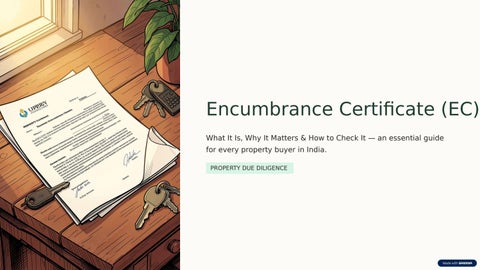
Encumbrance Certificate (EC) What It Is, Why It Matters & How to Check It — an essential guide for every property buyer in India. PROPERTY DUE DILIGENCE
What Is an Encumbrance Certificate? An EC is an official record of registered transactions affecting a property for a specified search period. In Karnataka, the Registration Department describes it specifically as a record of registered property transactions.
What Is an Encumbrance? A claim, liability, or interest that may affect rights over a property.
What It Does Helps buyers investigate registered transaction history before money changes hands.
What It Doesn't Do It does not replace a complete title search or legal verification.
Why Is an EC Important Before Buying?
An EC adds a critical layer of verification alongside the Sale Deed, Title Deed, and ownership records — helping identify issues that require further investigation. Key takeaway: Think of an EC as a risk-checking document, not a final "safe property" certificate.
🏠 Buying Property
⚖️Legal Verification
🏦 Financing
Residential or commercial
Reviewing registered transactions
Banks & NBFCs may require it
What Information Does an EC Show? Format and content vary by state. Always verify property identifiers and the search period when reviewing.
Property Description
Parties & Documents
Survey or property number matching the Sale Deed.
Names of parties and registration/document details.
Transaction Sequence
Search Period
Nature and order of recorded transactions.
Must cover the appropriate title-review period.
If the EC's survey number doesn't match the Sale Deed, investigate the mismatch — don't assume it's clerical.
How to Check an EC Online There is no single universal process for all of India. Always use the official government portal for the state where the property is registered such as PropertyCibil. 01
02
Visit the state's Registration Department portalLogin or create an account 03
04
Locate EC Search / Encumbrance CertificateEnter property details & select search period 05
06
Pay fee (if applicable) & submit
Download and compare with other documents
States like Karnataka, Kerala, and Tamil Nadu offer online EC services. Steps, fees, and terminology vary significantly.
How to Read an EC Cross-Check the EC Against: EC Information
Compare With
Property details
Sale Deed
Owner/party names
Title & ownership records
Survey/property number
Land/revenue records
Transaction sequence
Previous deeds
Search period
Required title-review period
Reading Tips Confirm the EC relates to the correct property and search period first, then review parties, document details, and transaction sequence. Any unexplained inconsistency with the Sale Deed or ownership history should be investigated before completing the purchase.
For complex or high-value transactions, professional legal review may be appropriate.
Does a Clean EC Mean the Property Is Safe? "The EC is clear, so the property must be safe." — This conclusion is too broad.
A clean EC should not be treated as proof that a property is legally safe. It only reflects records searched for a specified period.
❌ Wrong Approach "The EC is clear — the property is safe."
✅ Better Approach "The EC revealed no issue in the records searched; now I must complete remaining due-diligence checks."
EC vs. Title Search: What's the Difference?
Key Distinction An EC focuses on registered transactions for a specific period. A title search is a broader legal examination of ownership rights and the chain through which they were acquired. EC ≠ complete title search. Use the EC to support your title investigation, not replace it.
What to Check Along With an EC No single certificate captures every risk. A strong verification process combines multiple checks.
Ownership & Title
Government Records
Sale Deed, title history, seller identity, chain of title
Mutation records, revenue/land records, propertytax status, Khata records
Legal & Approvals
Physical Verification
Litigation checks, RERA registration, approved
Property boundaries, physical condition, and
plans, Occupancy & Completion Certificates
possession
Key Takeaways EC is one part of due diligence Records registered transactions for the searched period — not a substitute for full legal database verification.
Always verify identifiers & period Confirm property details and search period match before relying on the EC.
Cross-check with all documents Compare EC with Sale Deed, title history, revenue records, litigation, and approvals.
Seek professional advice for complex cases For inherited, disputed, or high-value properties, consult a qualified property lawyer. Verify Before You Buy. Make property decisions with greater confidence.