How to Evaluate Bacteriostatic Water Quality
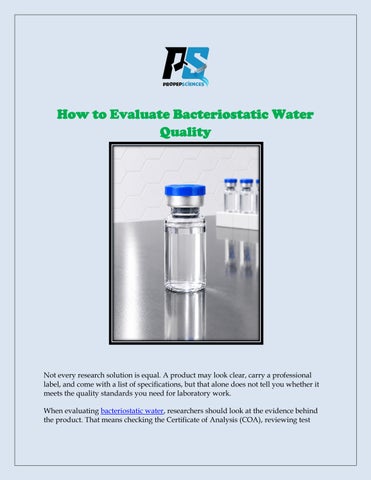
Not every research solution is equal. A product may look clear, carry a professional label, and come with a list of specifications, but that alone does not tell you whether it meets the quality standards you need for laboratory work. When evaluating bacteriostatic water, researchers should look at the evidence behind the product. That means checking the Certificate of Analysis (COA), reviewing test
results, confirming the lot number, and understanding what the manufacturer or testing laboratory actually measured. This matters because quality claims can vary widely between suppliers. One company may provide a detailed, lot-specific report, while another may simply state that its product is “laboratory tested” without showing the underlying results. So, what should you check? Below, we break down the main quality indicators and explain what researchers should look for before selecting a product for laboratory research.
1. Start With the Certificate of Analysis The Certificate of Analysis should be one of the first documents you check. A COA provides test information for a particular product or batch. It can tell you what the laboratory tested, which methods it used, what specifications applied, and whether the results met those specifications. However, not all certificates provide the same level of useful information. A strong COA should identify the product name, batch or lot number, testing date, laboratory, analytical methods, specifications, and actual results. Ideally, you should be able to match the lot number on the container directly to the certificate. That last point matters more than many buyers realize. A generic certificate may describe a product, but it does not necessarily demonstrate that the exact batch you received produced the same results. Batch-specific documentation gives researchers a much clearer record of traceability. When reviewing a COA, ask yourself:
Does the document identify the exact batch? Are actual test results shown? Does it identify the testing laboratory? Are the analytical methods listed? Does each result have a defined specification? Does the certificate correspond to the product you are considering?
If the answers are clear, you have a much stronger starting point for evaluating quality.
2. Check the Preservative Concentration The preservative is an important part of a bacteriostatic formulation.
Benzyl alcohol is commonly used for its antimicrobial preservative properties. However, seeing benzyl alcohol listed on a label does not tell you whether the finished solution contains the intended concentration. That is where analytical testing becomes useful. A detailed COA should ideally provide a measured preservative concentration alongside the product specification. Some laboratories use chromatographic techniques to quantify benzyl alcohol and report the measured result against the formulation target. This distinction is important. A label tells you what the product is supposed to contain. An analytical result tells you what the laboratory measured. Researchers should therefore look for measurable data rather than relying solely on wording such as “preserved,” “high purity,” or “quality tested.” It is also important to understand the role of the preservative. Benzyl alcohol helps inhibit microbial growth, but it should not be treated as a substitute for proper manufacturing controls or sterility testing.
3. Verify Sterility Testing A product's preservative system and its sterility status are separate considerations. For research materials where sterility is part of the product specification, researchers should look for evidence of finished-product sterility testing rather than assuming sterility from the manufacturing description alone. A COA may reference a recognized sterility method and provide a clear result. The report should make it reasonably easy to understand what was tested and whether the sample met the stated requirement. Why does this matter? Because statements such as “manufactured in a controlled environment” or “sterile filtered” describe part of a manufacturing process. They do not necessarily provide the same information as a documented test of the finished product. At the same time, sterility testing has a specific purpose. It looks for viable microorganisms under defined test conditions. It does not automatically answer questions about endotoxins, preservative concentration, pH, or other quality attributes. For that reason, researchers should consider sterility as one part of the overall quality assessment rather than treating it as a single pass-or-fail measure of everything that matters.
4. Look for Endotoxin Testing Endotoxin testing deserves separate attention. Endotoxins are components associated with the outer membrane of certain Gram-negative bacteria. Importantly, eliminating viable microorganisms and controlling endotoxins are not the same thing. A material
can meet a sterility requirement while still needing separate evaluation for bacterial endotoxins. Researchers should therefore check whether the COA includes an endotoxin test and, if so, whether it identifies the method, result, and specification. The LAL method is commonly used for bacterial endotoxin testing. Results may appear in units such as EU/mL. Don't stop at a simple “pass” statement if more information is available. A useful report should provide enough detail to understand the test and its result. Look for:
The test method The applicable specification The reported result The testing or reporting limit The batch number
This information gives you a better picture of the material's microbiological quality.
5. Review pH and Appearance pH provides another useful quality check. A manufacturer's specifications may establish an acceptable pH range, while laboratory testing can show the measured value for a specific batch. When both pieces of information appear on a COA, researchers can see whether the tested material falls within the stated range. Appearance also matters, although it should never replace analytical testing. A finished solution should generally have a consistent appearance that matches its product specifications. Visible particles, unusual discoloration, damaged packaging, or other unexpected changes deserve attention. Still, don't rely on your eyes alone. A clear solution can still require testing for microbial contamination, endotoxins, preservative concentration, or other characteristics. Visual inspection works best as an initial check, not as proof of overall quality.
6. Match the COA to the Exact Lot Here's a simple check that can prevent a lot of confusion: compare the lot number on the product with the lot number on the COA.
Suppliers may produce the same material across multiple batches. Each batch can have its own certificate and testing record. If the certificate belongs to another lot, you cannot automatically assume that it represents the product in front of you. The process should be straightforward: Check the product → find the lot number → locate the matching COA → review the results. This gives researchers a clear link between the physical product and its analytical documentation. Also check the relevant dates. Manufacturing date, testing date, certificate date, and expiration information can serve different purposes, so don't assume they all mean the same thing. Good documentation should make those details easy to understand.
7. Consider Who Performed the Testing The testing laboratory matters too. A COA should ideally identify the laboratory responsible for the analysis. Depending on the type of testing, researchers may also want to understand the laboratory's quality system, accreditation status, and analytical capabilities. For example, ISO/IEC 17025 relates to the competence of testing and calibration laboratories. A reference to a recognized quality framework can provide useful context, but it should not replace examination of the actual test results. Think about the complete picture. Who performed the test? What method did they use? What specification did they apply? What result did they obtain? Those questions are more useful than simply counting how many tests appear on a certificate. A short, clear report with relevant methods and traceable results can be more valuable than a long document filled with vague claims.
8. Inspect the Container and Packaging The container is part of product quality. Before using any research material, check the packaging for obvious issues such as cracks, leaks, damaged seals, unexpected particles, or labeling problems. The label should also provide enough information to identify the product and its batch. At a minimum, researchers should be able to connect the physical container with the corresponding documentation. Packaging integrity becomes especially important when the product requires controlled handling or storage.
If something looks damaged or inconsistent, don't ignore it simply because the COA looks good. The certificate describes the tested material under defined conditions; it does not excuse obvious problems with the individual container you received. When in doubt, contact the supplier and request clarification.
9. Review Storage and Handling Information Quality also depends on how a product is stored. Researchers should follow the manufacturer's stated storage conditions and pay attention to factors such as temperature, light exposure, container integrity, and handling requirements. It's tempting to assume that a general storage rule applies to every product. That's not always a safe assumption. Different formulations and packaging systems can have different stability characteristics. That's why product-specific documentation matters. Recent research-supply content has also placed more attention on stability data, particularly when discussing storage conditions and preservative concentration over time. Researchers should therefore distinguish between: Documented stability data and general storage assumptions. If a supplier makes a specific stability claim, check whether the company provides supporting information. The more specific the claim, the more useful the supporting evidence becomes.
10. Compare Suppliers Using Evidence Price matters. So does availability. But neither should be your only deciding factor. When comparing research suppliers, look at the quality documentation behind the product. Does the company provide lot-specific COAs? Can you identify the testing laboratory? Are relevant analytical results available? Does the supplier explain its specifications clearly? Transparency tells you a lot. A supplier that makes it easy to find technical documentation gives researchers more information to work with. On the other hand, vague statements about “premium quality” don't tell you much without supporting evidence. A useful supplier comparison can include:
Lot-specific documentation Preservative assay results
Sterility information Endotoxin testing pH specifications Testing methods Laboratory identification Storage information Product traceability
Don't assume that the supplier with the longest list of claims offers the best material. Focus on the quality and relevance of the evidence.
Quality Evaluation Checklist Before choosing a research diluent, run through this quick checklist. Product identification: Can you clearly identify the product and lot? COA: Is a matching certificate available? Testing: Does the report show actual analytical results? Preservative: Is the concentration measured rather than simply stated? Sterility: Is finished-product sterility addressed where relevant? Endotoxins: Does the documentation include an appropriate endotoxin assessment? pH: Is a specification or measured value provided? Packaging: Does the container appear intact and properly labeled? Storage: Are handling and storage requirements clearly documented? Supplier transparency: Can the supplier answer technical questions and provide supporting records? If several of these answers are unclear, take a closer look before making a purchasing decision.
Final Considerations
Good laboratory research starts with good-quality materials. Evaluating bacteriostatic water should therefore go beyond reading the product label or trusting a broad quality statement. Start with the COA. Check the lot number. Review the analytical methods and results. Then look at sterility, endotoxin testing, preservative concentration, pH, packaging, and storage information. Most importantly, look for evidence that connects the product in your hands to a specific, documented batch. That approach gives researchers a much clearer basis for comparing suppliers and selecting materials that meet their laboratory requirements. At Propep Sciences, research-focused quality and transparent product information can help researchers make informed decisions based on documentation rather than marketing claims.
Contact Now: Email Website Location
info@propepsciences.com www.propepsciences.com London