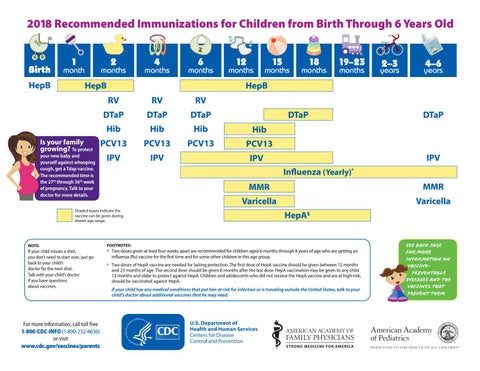
At 1 month of age, HepB (1-2 months), At 2 months of age, HepB (1-2 months), DTaP, PCV, Hib, Polio, and RV At 4 months of age, DTaP, PCV, Hib, Polio, and RV At 6 months of age, HepB (6-18 months), DTaP, PCV, Hib, Polio (6-18 months), RV, and Influenza (yearly, 6 months through 18 years)* At 12 months of age, MMR (12-15
2018 Recommended Immunizations for Children from Birth Through 6 Years Old
Birth
HepB
2
1
month
†
months), PCV (12-15 months) , Hib (12-15 months), Varicella (12-15 months), HepA (12-23 months)§, and Influenza (yearly, 6 months through 18 years)* At 4-6 years, DTaP, IPV, MMR, Varicella, and Influenza (yearly, 6
months
4
months
6
months
HepB
months through 18 years)*
Is your family growing? To protect
RV
RV
DTaP
DTaP
DTaP
Hib
Hib
Hib
Hib
PCV13
PCV13
PCV13
PCV13
IPV
18
months
19–23 months
DTaP
2–3
years
4–6
years
DTaP
IPV
IPV Influenza (Yearly)*
Shaded boxes indicate the vaccine can be given during shown age range.
For more information, call toll free 1-800-CDC-INFO (1-800-232-4636) or visit www.cdc.gov/vaccines/parents
months
RV
IPV
NOTE:
months
15
HepB
your new baby and yourself against whooping cough, get a Tdap vaccine. The recommended time is the 27th through 36th week of pregnancy. Talk to your doctor for more details.
If your child misses a shot, you don’t need to start over, just go back to your child’s doctor for the next shot. Talk with your child’s doctor if you have questions about vaccines.
12
MMR
MMR
Varicella
Varicella HepA§
FOOTNOTES:
* Two doses given at least four weeks apart are recommended for children aged 6 months through 8 years of age who are getting an influenza (flu) vaccine for the first time and for some other children in this age group. §
Two doses of HepA vaccine are needed for lasting protection. The first dose of HepA vaccine should be given between 12 months and 23 months of age. The second dose should be given 6 months after the last dose. HepA vaccination may be given to any child 12 months and older to protect against HepA. Children and adolescents who did not receive the HepA vaccine and are at high-risk, should be vaccinated against HepA.
See back page for more information on vaccinepreventable diseases and the vaccines that prevent them.
Vaccine-Preventable Diseases and the Vaccines that Prevent Them Disease
Vaccine
Chickenpox
Varicella vaccine protects against chickenpox. Air, direct contact
Rash, tiredness, headache, fever
Diphtheria
DTaP* vaccine protects against diphtheria.
Air, direct contact
Sore throat, mild fever, weakness, swollen glands in neck
Hib
Hib vaccine protects against Haemophilus influenzae type b.
Air, direct contact
May be no symptoms unless bacteria enter the blood
Hepatitis A
HepA vaccine protects against hepatitis A.
Direct contact, contaminated food or water
Hepatitis B
HepB vaccine protects against hepatitis B.
Contact with blood or body fluids
Influenza (Flu)
Flu vaccine protects against influenza.
Air, direct contact
Measles
MMR** vaccine protects against measles.
Air, direct contact
Mumps
MMR**vaccine protects against mumps.
Air, direct contact
Pertussis
DTaP* vaccine protects against pertussis (whooping cough).
Air, direct contact
Polio
IPV vaccine protects against polio.
Air, direct contact, through the mouth
Pneumococcal
PCV13 vaccine protects against pneumococcus. Air, direct contact
Rotavirus
RV vaccine protects against rotavirus.
Through the mouth
Rubella
MMR** vaccine protects against rubella.
Air, direct contact
Tetanus
DTaP* vaccine protects against tetanus.
Exposure through cuts in skin
* DTaP combines protection against diphtheria, tetanus, and pertussis. ** MMR combines protection against measles, mumps, and rubella.
Disease spread by Disease symptoms
May be no symptoms, fever, stomach pain, loss of appetite, fatigue, vomiting, jaundice (yellowing of skin and eyes), dark urine May be no symptoms, fever, headache, weakness, vomiting, jaundice (yellowing of skin and eyes), joint pain Fever, muscle pain, sore throat, cough, extreme fatigue
Disease complications Infected blisters, bleeding disorders, encephalitis (brain swelling), pneumonia (infection in the lungs) Swelling of the heart muscle, heart failure, coma, paralysis, death Meningitis (infection of the covering around the brain and spinal cord), intellectual disability, epiglottitis (life-threatening infection that can block the windpipe and lead to serious breathing problems), pneumonia (infection in the lungs), death Liver failure, arthralgia (joint pain), kidney, pancreatic, and blood disorders Chronic liver infection, liver failure, liver cancer Pneumonia (infection in the lungs)
Encephalitis (brain swelling), pneumonia (infection in the lungs), death Meningitis (infection of the covering around the brain Swollen salivary glands (under the jaw), fever, and spinal cord) , encephalitis (brain swelling), inflamheadache, tiredness, muscle pain mation of testicles or ovaries, deafness Severe cough, runny nose, apnea (a pause in Pneumonia (infection in the lungs), death breathing in infants) May be no symptoms, sore throat, fever, Paralysis, death nausea, headache May be no symptoms, pneumonia (infection Bacteremia (blood infection), meningitis (infection of in the lungs) the covering around the brain and spinal cord), death Rash, fever, cough, runny nose, pinkeye
Diarrhea, fever, vomiting
Severe diarrhea, dehydration
Children infected with rubella virus sometimes Very serious in pregnant women—can lead to miscarriage, stillbirth, premature delivery, birth defects have a rash, fever, swollen lymph nodes Stiffness in neck and abdominal muscles, Broken bones, breathing difficulty, death difficulty swallowing, muscle spasms, fever
Last updated August 2018 • CS295321-A