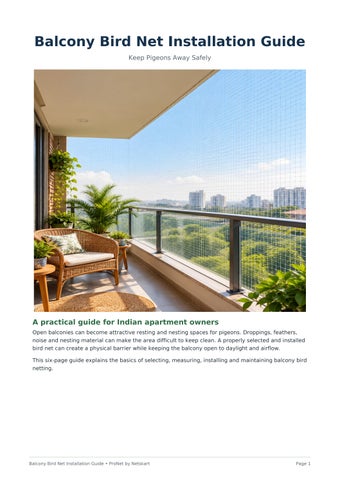
Balcony Bird Net Installation Guide Keep Pigeons Away Safely
A practical guide for Indian apartment owners Open balconies can become attractive resting and nesting spaces for pigeons. Droppings, feathers, noise and nesting material can make the area difficult to keep clean. A properly selected and installed bird net can create a physical barrier while keeping the balcony open to daylight and airflow. This six-page guide explains the basics of selecting, measuring, installing and maintaining balcony bird netting.
Balcony Bird Net Installation Guide • ProNet by Netskart
Page 1
2. Why Pigeons Can Be a Balcony Problem Pigeons may repeatedly return to balconies that provide sheltered ledges, food access or suitable nesting corners. A netting barrier can help restrict entry without permanently closing the balcony.
Droppings and cleaning Bird droppings can accumulate on floors, railings, air-conditioner units and furniture. Regular cleaning becomes harder when birds continue to access the same areas.
Noise and nesting Repeated cooing, wing movement and nesting activity can disturb residents. Nesting material may also collect around corners and fixtures.
Hygiene considerations Bird droppings and nesting debris can carry microorganisms. Use suitable protective measures when cleaning affected surfaces and wash hands after handling contaminated material.
Property and equipment Persistent nesting can leave debris around drains, vents, ledges and outdoor equipment. Restricting bird access can make routine balcony maintenance easier. A physical barrier can be more practical than relying only on temporary deterrents when the goal is to restrict balcony access.
Balcony Bird Net Installation Guide • ProNet by Netskart
Page 2
3. Types of Bird Nets & Mesh Selection Two common materials used for balcony bird-netting applications are HDPE and nylon. The best choice depends on the installation environment, appearance, exposure and required mesh specification. Material
General characteristics
HDPE
Strong, flexible polymer netting commonly used for outdoor bird-exclusion applications. UV-treated option
Nylon
Lightweight netting available in fine mesh options. It can provide a less visually prominent appearance dep
How to think about mesh size Mesh size should be selected according to the birds you want to exclude and the actual installation. A smaller opening generally provides a tighter barrier, while a larger opening may suit specific applications. Check the product specification and intended use rather than choosing from appearance alone.
Before buying, check: • Material and yarn/twine construction • Mesh opening and overall dimensions • UV treatment for outdoor exposure • Colour and visibility requirements • Edge reinforcement and fixing compatibility The phrases bird net for balcony and pigeon net for balcony are commonly used when searching for this type of solution.
Balcony Bird Net Installation Guide • ProNet by Netskart
Page 3
4. Step-by-Step Installation Overview A neat installation starts with accurate measurements and suitable fixing points. For larger or difficult installations, professional assistance may be appropriate.
Step 1 — Measure Measure the full opening: width, height and any side or ceiling sections that need coverage. Record the dimensions before ordering.
Step 2 — Plan the fixing points Identify suitable points around the balcony perimeter. The fixing method should suit the building surface and avoid important services, waterproofing or structural elements.
Step 3 — Install hooks or anchors Place suitable hooks, anchors or other fixing components at regular intervals. Spacing depends on the net and fixing system.
Step 4 — Fix the net Attach the net progressively around the perimeter. Keep the mesh aligned and check corners carefully so that no unnecessary openings remain.
Step 5 — Tighten and inspect Adjust the net so it sits neatly without excessive slack. Inspect the perimeter and corners, then check that doors, windows and drainage areas remain usable. Safety note: Do not work from an unsafe ledge or exterior position. Use appropriate access equipment or a qualified installer when the installation cannot be safely reached from inside the balcony.
Balcony Bird Net Installation Guide • ProNet by Netskart
Page 4
5. Common Mistakes & Maintenance Tips Common mistakes to avoid • Ordering before measuring the complete opening. • Leaving gaps around corners, pipes or balcony edges. • Using unsuitable fixing points. • Pulling the net excessively tight. • Ignoring damaged mesh or loose fixing points. • Blocking drainage, windows or maintenance access.
Maintenance tips Inspect the net periodically, especially after strong wind, heavy rain or building maintenance work. Check for cuts, frayed edges, loose hooks and areas where the net has become displaced. For routine cleaning, remove dust and loose debris using a gentle method appropriate for the material. Avoid harsh chemicals or aggressive scrubbing unless the product manufacturer permits them. If a section is damaged, repair or replace it before the opening becomes large enough for birds to enter. Also check that fixing points remain secure over time. ProNet by Netskart provides netting options for residential and other applications, with product specifications that can be reviewed before choosing a suitable setup.
Balcony Bird Net Installation Guide • ProNet by Netskart
Page 5
6. Frequently Asked Questions 1. Does a balcony bird net block sunlight? A properly selected net generally allows daylight and airflow to pass through. The visual effect depends on the material, colour, mesh and viewing angle.
2. Which material should I choose: HDPE or nylon? Both are used for bird-exclusion applications. Compare UV exposure, mesh specification, appearance, installation requirements and intended use before choosing.
3. How do I know which mesh size I need? Choose mesh according to the birds being excluded and the manufacturer's stated application. If unsure, confirm the specification with the supplier before ordering.
4. Can I install a balcony bird net myself? Simple, accessible installations may be suitable for DIY work when the fixing method is straightforward. Avoid unsafe exterior work and use professional help for difficult or high-access installations.
5. How often should the net be checked? A periodic visual inspection is useful. Check after severe weather, nearby construction or any event that may affect fixing points or mesh.
Ready to explore your options? For more information about bird-netting solutions, visit https://netskart.com/ and review the available products and specifications. Informational guide for apartment owners • ProNet by Netskart
Balcony Bird Net Installation Guide • ProNet by Netskart
Page 6