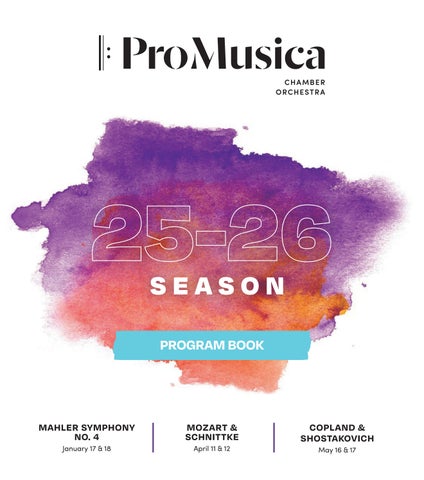
25-26 SEASON PROGRAM BOOK
MAHLER SYMPHONY NO. 4
MOZART & SCHNITTKE
January 17 & 18
April 11 & 12
COPLAND & SHOSTAKOVICH May 16 & 17
Excellence The CORE Group proudly supports ProMusica Chamber Orchestra Brent G. Coakley, CFP® Senior Vice President–Wealth Management Thomas P. Reusser, CFP® Senior Vice President–Wealth Management Jason Hull, CFP®, ChFC® Senior Vice President–Wealth Management
The CORE Investment Group UBS Financial Services Inc. 5007 Horizons Drive Upper Arlington, OH 43220 614-460-6554 advisors.ubs.com/coregroup
Jessica Penza, CFP® Financial Advisor
As a firm providing wealth management services to clients, UBS Financial Services Inc. offers investment advisory services in its capacity as an SEC-registered investment adviser and brokerage services in its capacity as an SEC-registered broker-dealer. Investment advisory services and brokerage services are separate and distinct, differ in material ways and are governed by different laws and separate arrangements. It is important that you understand the ways in which we conduct business, and that you carefully read the agreements and disclosures that we provide to you about the products or services we offer. For more information, please review the client relationship summary provided at ubs.com/relationshipsummary, or ask your UBS Financial Advisor for a copy. Certified Financial Planner Board of Standards, Inc. (CFP Board) owns the CFP® certification mark, the Certified finanCial PlannerTM certification mark, and the CFP® certification mark (with plaque design) logo in the United States, which it authorizes use of by individuals who successfully complete CFP Board’s initial and ongoing certification requirements. For designation disclosures, visit ubs.com/us/en/designation-disclosures. © UBS 2024. All rights reserved. UBS Financial Services Inc. is a subsidiary of UBS Group AG. Member FINRA/SIPC. CJ-UBS-1130435153 Exp.: 08/31/2025
CEO Welcome . . . . . . . . . . . . . . . . . . . . . . . . . . . . . . . . . . . . . . . . . . . . . . . . . . . . . . . . . . . . . . . . . . . . . . . . . 4 Music Director Biography . . . . . . . . . . . . . . . . . . . . . . . . . . . . . . . . . . . . . . . . . . . . . . . . . . . . . . . . . . . . . . 6 Creative Partner & Principal Guest Artist Biography. . . . . . . . . . . . . . . . . . . . . . . . . . . . . . . . . . . . . . 7 About the Orchestra . . . . . . . . . . . . . . . . . . . . . . . . . . . . . . . . . . . . . . . . . . . . . . . . . . . . . . . . . . . . . . . . . . . 8 Important Information . . . . . . . . . . . . . . . . . . . . . . . . . . . . . . . . . . . . . . . . . . . . . . . . . . . . . . . . . . . . . . . . . 10 Boards and Administration . . . . . . . . . . . . . . . . . . . . . . . . . . . . . . . . . . . . . . . . . . . . . . . . . . . . . . . . . . . . . 1 1 Mahler Symphony No. 4 Biography . . . . . . . . . . . . . . . . . . . . . . . . . . . . . . . . . . . . . . . . . . . . . . . . . . . . . . . . . . . . . . . . . . . . . . . . . . . 17 Musician Roster . . . . . . . . . . . . . . . . . . . . . . . . . . . . . . . . . . . . . . . . . . . . . . . . . . . . . . . . . . . . . . . . . . . . . . 18 Program . . . . . . . . . . . . . . . . . . . . . . . . . . . . . . . . . . . . . . . . . . . . . . . . . . . . . . . . . . . . . . . . . . . . . . . . . . . . 19 About the Music . . . . . . . . . . . . . . . . . . . . . . . . . . . . . . . . . . . . . . . . . . . . . . . . . . . . . . . . . . . . . . . . . . . . . . 20 Text Translation. . . . . . . . . . . . . . . . . . . . . . . . . . . . . . . . . . . . . . . . . . . . . . . . . . . . . . . . . . . . . . . . . . . . . . . 22
Mozart & Schnittke Biographies. . . . . . . . . . . . . . . . . . . . . . . . . . . . . . . . . . . . . . . . . . . . . . . . . . . . . . . . . . . . . . . . . . . . . . . . . . 24 Musician Roster . . . . . . . . . . . . . . . . . . . . . . . . . . . . . . . . . . . . . . . . . . . . . . . . . . . . . . . . . . . . . . . . . . . . . . 26 Program . . . . . . . . . . . . . . . . . . . . . . . . . . . . . . . . . . . . . . . . . . . . . . . . . . . . . . . . . . . . . . . . . . . . . . . . . . . . 27 About the Music . . . . . . . . . . . . . . . . . . . . . . . . . . . . . . . . . . . . . . . . . . . . . . . . . . . . . . . . . . . . . . . . . . . . . . 28
Copland & Shostakovich Musician Roster . . . . . . . . . . . . . . . . . . . . . . . . . . . . . . . . . . . . . . . . . . . . . . . . . . . . . . . . . . . . . . . . . . . . . . 34 Program . . . . . . . . . . . . . . . . . . . . . . . . . . . . . . . . . . . . . . . . . . . . . . . . . . . . . . . . . . . . . . . . . . . . . . . . . . . . 35 About the Music . . . . . . . . . . . . . . . . . . . . . . . . . . . . . . . . . . . . . . . . . . . . . . . . . . . . . . . . . . . . . . . . . . . . . . 36 Meet the Musicians . . . . . . . . . . . . . . . . . . . . . . . . . . . . . . . . . . . . . . . . . . . . . . . . . . . . . . . . . . . . . . . . . . . 40 Financial Support . . . . . . . . . . . . . . . . . . . . . . . . . . . . . . . . . . . . . . . . . . . . . . . . . . . . . . . . . . . . . . . . . . . . . 43
Season support Season partners ProMusica Chamber Orchestra
620 East Broad Street – Suite 300, Columbus, OH 43215 614.464.0066 • www.promusicacolumbus.org Orchestra & Musician photos:
Tom Battenberg & Helen Liebman Chair
Chief Executive Officer Welcome to our 2025-26 season!
This year, we reimagine tradition. Starting with GRAMMY-winning banjo virtuoso Béla Fleck performing his arrangement of Gershwin’s Rhapsody in Blue, we will keep you on the edge of your seat throughout the season. The orchestra shares the stage for exhilarating performances with acclaimed artists including pianist Terrence Wilson, The Cleveland Orchestra’s principal cellist Mark Kosower, soprano Camilla Tilling, and rising stars violinist Julian Rhee and pianist Janice Carissa both make their return to ProMusica. The orchestra will present Mahler’s Symphony No. 4, arranged and intimately scored for chamber orchestra. We reaffirm our strong commitment to promoting contemporary works with the world premiere of our 73rd commission: “FLOW: Variations Over Time” by our dear friend and composer Paul Rissmann. Paul will also host our popular NAKED CLASSICS, where we delve into the beloved and iconic Appalachian Spring. The season concludes with Music Director David Danzmayr and Creative Partner, renowned violinist Vadim Gluzman reunited on stage for Shostakovich's powerful Violin Concerto No. 1. You’ll want to hang on for the wild ride! This September, ProMusica was announced as the recipient of The 2025 Columbus Foundation Award — presented to a nonprofit organization that has significantly enhanced the quality of life in our community. On behalf of the organization, we are thrilled to share this honor with all of you – our supporters, patrons, and friends. Without an audience, there is no music, and we are grateful to The Columbus Foundation for recognizing not only the exceptional standard of playing by our orchestra, but also our commitment to serve our community. We are truly honored by this recognition, and look forward to our continued work to bend and push the boundaries of presenting great music in a great city. Thank you for joining us. It is a privilege to share our music with you, and we are thrilled you’ve chosen to be a part of it tonight. Sincerely,
Janet Chen Chief Executive Officer
Janet Chen has led an active and diverse career as a performing musician, arts administrator, and music educator. Born in America and raised in Taiwan, she combines her experiences from both cultures to enrich her work in the community. A classically trained flutist, Janet transitioned from performance to arts management, taking on the role as ProMusica’s Operations and Education Manager before becoming its CEO. Under her tenure, ProMusica has doubled its annual operating budget — introducing new artistic programs and outreach collaborations including its free outdoor Summer Music Series concerts; its “Play Us Forward” initiative putting instruments and music instruction into the hands of underserved students; its “Infant and Toddler Program” in partnership with area early childhood learning centers, and the commissioning of new works from America’s living composers with 73 new works created to-date. In close partnership with the ProMusica’s artistic leadership, the orchestra has achieved national and international acclaim as one of the top chamber orchestras of today. Janet has been recognized for her contributions to the arts, honored by Business First as one of the “Most Admired Executives in Central Ohio” and as a YWCA Woman of Achievement. Most recently, she was a finalist for “CEO of the Year” in the small non-profit category by Columbus CEO. She was selected as a 2021 honoree by the Women for Economic and Leadership Development (WELD). In 2018, she was one of ten members representing Columbus at the Young American Leaders Program at the Harvard Business School. Janet serves on the Boards of CreativeOhio, Experience Columbus, and Pink Ribbon Good, and is a member of the Columbus Cultural Leadership Consortium. Janet holds a bachelor's degree from the Oberlin Conservatory of Music, and a master's degree in flute performance from the University of Cincinnati College-Conservatory of Music. Prior to joining ProMusica, she was a member of the Taipei Symphony Orchestra in Taipei, Taiwan, and spent two summers as a flute instructor at the Interlochen Center for the Arts in Michigan.
Photo: Shellee Fisher Photography & Design for WELD
From the
Supporting ProMusica We know that the arts are an inseparable part of our human journey. Through the good works done at ProMusica, performance and celebration of the arts inspire and enrich all our lives. So, we say thank you for this precious asset in our wonderful community.
keglerbrown.com
Photo: Rick Buchanan Photography
The Wayne P. Lawson, PhD & William Mitchell, MD Music Director
David Danzmayr
David Danzmayr is in his fifth season as Music Director of the Oregon Symphony. His 2024/25 season culminated in a performance of Mahler’s Symphony No.3 described by Oregon ArtsWatch as “an emotionally rewarding experience…Led by Danzmayr, the orchestra created the sensation of timelessness, […] taking concertgoers to a heavenly dimension.” Alongside his position in Oregon, Danzmayr also serves as Music Director of the innovative ProMusica Chamber Orchestra, comprised of musicians from all over the USA who are building exciting projects towards their upcoming 50thanniversary season. He also works regularly with Zagreb Philharmonic Orchestra with whom he previously served as Chief Conductor – highlights of his tenure included several European tours with concerts in Vienna Musikverein as well as Salzburg Festival Hall, where together they performed the prestigious New Year’s concert.
In Europe, relationships include City of Birmingham Symphony Orchestra, Bamberger Symphoniker, Sinfonieorchester Basel, Mozarteum Orchester, Iceland Symphony Orchestra, and he has a regular relationship with Deutsche Kammerphilharmonie Bremen with whom he embarks on a summer festivals tour in 2026. Working with soloists at the highest level, Danzmayr has enjoyed collaborations with Yefim Bronfman, Emanuel Ax, Sir Stephen Hough, Renee Fleming and Yo-Yo Ma. The 2025/26 season includes regular partners Joshua Bell, Joyce Yang, Colin Currie and Gil Shaham. In the same season, he will make the world premiere of a new jazz piano concerto by David Schiff, commissioned by Oregon Symphony with pianist Darrell Grant. Danzmayr received his musical training at the University Mozarteum in Salzburg where, after initially studying piano, he went on to study conducting in the class of Dennis Russell Davies and his first post was in Scotland, as Assistant Conductor to the Royal Scottish National Orchestra. At the beginning of his career, he was awarded prizes at some of the world’s most prestigious conducting competitions including at the International Gustav Mahler Conducting Competition and the International Malko Conducting Competition. In recognition of his success, he has been awarded the Bernhard Paumgartner Medal by the Internationale Stiftung Mozarteum.
As a guest conductor, Danzmayr has worked extensively across North America, and recent and forthcoming engagements include Seattle, St. Louis, Atlanta, Vancouver and Dallas symphonies, as well as the orchestras of Detroit, Baltimore, Houston and San Diego.
6
2 5 - 2 6 S E A S O N | promusicacolumbus.org
Photo: Marco Borggreve
Creative Partner & Principal Guest Artist The Wilson Family Chair
Vadim Gluzman
Universally recognized among today’s top performing artists, Vadim Gluzman breathes new life and passion into the golden era of the 19th and 20th centuries’ violin tradition. Gluzman's wide repertoire embraces new music, and his performances are heard around the world through livestreams, broadcasts and a striking catalogue of award-winning recordings on BIS, Platoon and EuroArts labels. The Israeli violinist appears with world’s leading orchestras and conductors, including Tugan Sokhiev with the Berlin Philharmonic, Boston Symphony, Bavarian Radio Orchestra and Orchestre de Paris; Neeme Järvi with Chicago Symphony and London Philharmonic; Riccardo Chailly with the Royal Concertgebouw Orchestra and the Gewandhaus Orchestra, Santtu-Matias Rouvali with Gothenburg Symphony and Philharmonia Orchestra, as well as with the Cleveland Orchestra under the batons of Hannu Lintu and Michail Jurowski. He appears at Ravinia, Tanglewood, BBC Proms, Grant Park and the North Shore Chamber Music Festival, he founded in 2011. In the 2025/26 season Vadim Gluzman appears with the Deutsches Symphonie-Orchester Berlin, Israel Philharmonic, Seoul Philharmonic, NDR Elbphilharmonie and the NDR Radio Philharmonie, as well as with the Seattle, Utah and
North Carolina Symphony Orchestras. He tours with Gluzman, Moser, Korobeinikov Trio, and continues to lead performances with the ProMusica Chamber Orchestra in Columbus, Ohio, where he serves as Creative Partner & Principal Guest Artist. Mr. Gluzman has premiered works by Sofia Gubaidulina, Erkki-Sven Tüür, Moritz Eggert, Giya Kancheli, Elena Firsova, Pēteris Vasks, Michael Daugherty and Lera Auerbach. In 2025 he commences his role as Artistic Director of the Music in the Mountains Festival in Durango, Colorado. Accolades for Guzman’s extensive discography include the Diapason d’Or of the Year, Gramophone’s Editor’s Choice, Classica magazine’s Choc de Classica award, and Disc of the Month by The Strad, BBC Music Magazine and ClassicFM. Distinguished Artist in Residence at the Peabody Conservatory, where he teaches a selected group of young violinists, Gluzman performs on the legendary 1690 ‘exLeopold Auer’ Stradivari, on extended loan through the Stradivari Society of Chicago.
2 5 - 2 6 S E A S O N | promusicacolumbus.org
7
About the Orchestra We are a creative collective of 37 musicians united by our love for music and committed to sharing it with the world. Our concerts honor the classics and champion the contemporary, with 73 commissions to date and a verve for risk taking collaborations. Our music bends the boundaries of imagination, curiosity and discovery. We are committed to the next generation of music lovers, providing free programs to all ages— empowering young minds and ensuring access. Because music is for all. Founded in 1979, ProMusica is known for its exceptional artistry, audience intimacy, and community engagement. Led by Music Director David Danzmayr and Creative Partner, renowned violinist Vadim Gluzman, ProMusica reaches a broad audience across the city—as the resident orchestra at the intimate Southern Theatre in downtown Columbus, at notable venues beyond the city limits, and in non-traditional spaces such as Natalie’s Grandview and The Fives. With innovative initiatives such as our
8
“Composer/Performer Project,” “Naked Classics,” and “Neighborhood Series,” ProMusica aspires to present live music in reimagined and meaningful ways for people to connect and experience with each other. Committed to sharing a diverse array of musical eras and influences, ProMusica’s performances are time-tested and modern, presented in ways that few orchestras can. Dedicated to shaping the future of orchestral music, we are widely recognized as a national leader in promoting contemporary repertoire—with 73 commissions and more than 130 world and regional premieres by composers including Pulitzer Prize winners Kevin Puts and Aaron Jay Kernis, Gabriela Lena Frank, Andy Akiho, Gabriela Montero, Lera Auerbach, Conrad Tao, and Joshua Roman. In addition, ProMusica has an active recording program with 13 CDs released to date. This is a testament to the world-class musicians on stage who thrive on artistic exploration and risk-taking—performing with the highest skill, emotion, and humanity for our audiences. In 2017, ProMusica made its Chicago debut performing for a sold-out crowd at the North Shore Chamber Music Festival. Chicago Classical Review noted the ensemble’s “robust unified string timbre [was] most impressive, having an abundant Mozartean grace.” The orchestra has joined forces with crossover artists such as Sutton Foster, Rhiannon Giddens, and Leslie Odom, Jr. In May 2024, the orchestra collaborated with the award-winning artist, composer, multi-instrumentalist, and visionary Jon Batiste for a twoday musical residency, which included the world premiere of his first piano concerto. Beyond the stage, ProMusica is deeply rooted in our city’s cultural fabric, serving approximately 20,000 individuals each season through outreach and education programs, provided at no cost to the participants. Designed to reach people of all ages, our musicians travel to area schools, we invite senior citizens to attend live, working rehearsals, and we put string instruments and musical instruction directly into the hands of middle schoolers. Family-friendly concerts and pre-K Storytimes are presented city-wide, in partnership with the Columbus Metropolitan Library, and our “Play Us Forward” program offers urban charter schools an integrated, in-school music curriculum, inspiring self-confidence, creative expression, and overall academic achievement for each student involved. “Coda: Post-Concert Conversations” gives the opportunity for a direct dialogue between audiences and guest artists—deepening engagement with the music and performers. Our annual Summer Music Series welcomes
2 5 - 2 6 S E A S O N | promusicacolumbus.org
thousands of guests to Franklin Park Conservatory & Botanical Gardens—free and open to the public, demonstrating our unwavering commitment to provide accessible and transformative performances to all residents in our community. Consistently demonstrating forwardand future-thinking ways to serve Columbus, the orchestra continues to develop new initiatives such as its “Infant and Toddler Program.” Collaborating with Columbus Early Learning Centers, ProMusica is now playing a role in early childhood development by bringing music to the region’s youngest learners. ProMusica has won eight ASCAP awards for Adventurous Programming and has received additional honors, including from the Greater Columbus Arts Council and the Columbus Jewish Foundation. In 2015, 2016, and 2018, and 2024, the orchestra was selected as a recipient of The Columbus Performing Arts Prize, designated to celebrate and support
the exceptional artistic directors of Columbus’ performing arts organizations and their aspirations for creative growth. Most recently, ProMusica is honored to be the recipient of The 2025 Columbus Foundation Award, presented to a selected nonprofit organization that demonstrates a strong commitment to making a positive impact. ProMusica is intimate in size, but we are big in impact. We continue to bring you a truly personal arts experience, one that is full of surprise, delight, and belonging.
Our Mission: To deliver a world-class chamber orchestra experience through innovative programming, audience intimacy, exceptional talent, and artistic excellence.
2 5 - 2 6 S E A S O N | promusicacolumbus.org
9
Important Information Latecomers will not be seated until the first convenient pause in the program. Cell Phones and Signal Watches should be turned off or silenced prior to the performance. Cameras and recording devices may not be used in the theatre without prior authorization from ProMusica. Concessions are available inside the front doors to the left. An ATM machine is located in The Westin Great Southern Columbus hotel lobby, adjacent to the theatre. Restrooms are located at the top of the stairs, men’s on the left and women’s on the right. Handicap accessible restrooms are at the back of the main floor seating. Special Needs Services are available. Please ask an usher for assistance. Assisted Listening Devices for sound amplification are available upon request at the concession area. ProMusica can provide the following services with a minimum of four weeks notice prior to the concert date: • Concert guides in Braille or large print, an audio recording in program order, program notes and guest artists biographies. • A sign language interpreter to interpret any vocal music that might be part of the program.
TICKETS OR ADDITIONAL INFORMATION Ticket Exchanges are available to season subscribers. Returned tickets qualify as a tax-deductible gift to ProMusica but must be returned by phone, by calling ProMusica at 614.464.0066 ext. 101, no later than the Thursday prior to the concert. Discounted Group Rates are available. Call 614.464.0066 for pricing and additional information. Student Tickets are available for $15 through the ProMusica office. To purchase tickets or for additional information, call 614.464.0066 or visit www.promusicacolumbus.org.
Dare to be moved Orchestra photos: Rick Buchanan Photography
Board of Trustees and Administration OFFICERS
President Lavea Brachman, Brookings Institution Vice-President Nancy Falk, Civic Leader Vice-President Joan Herbers, The Ohio State University Vice-President Christine Kullberg, Cardinal Health Vice-President Susan Lubow, BakerHostetler Treasurer Elizabeth Turrell Farrar, Civic Leader Secretary Elizabeth Moyo, Porter, Wright, Morris & Arthur LLP
TRUSTEES
Nelson D. Cary, Vorys, Sater, Seymour and Pease LLP Donna Conaty, ProMusica Musician Representative Lynn Elliott, Columbus Window Cleaning William Faust, Ologie Jake Gibson, Bank of America Michael Gladman, Jones Day Kelsey Gregory, PNC Bank David Hedgecoth, The Ohio State University Laurie Hill, Civic Leader + Stephen Keyes, Abercrombie & Fitch Eric Kline, ProMusica Musician Representative Samuel H. Porter, III, Ice Miller LLP Susan Quintenz, Civic Leader Bob Redfield, Civic Leader Julie A. Rutter, American Electric Power + Peyman Salehi, Fifth Third Bank Laurie Schmidt-Moats, Park National Bank Lee Shackelford, Physician Caitlin Sherman, JewishColumbus Mark Sholl, Hilliard City Schools Lydia Smith-Lockwood, Upper Arlington City Schools + Todd Swatsler, Partner (retired), Jones Day + Executive Committee Member
EX-OFFICIO
Janet Chen, Chief Executive Officer The Tom Battenberg & Helen Liebman Chair David Danzmayr, Music Director The Wayne P. Lawson, PhD & William Mitchell, MD Music Director Marianne Mottley, ProMusica Sustaining Board President
ADMINISTRATION Janet Chen
David Danzmayr Vadim Gluzman Yvette Boyer Carolyn Caldwell Carlie Geyer Tyler Green Dave Humeston Daniel Jacobs Suzanne Jennison Kira Kadar Matthew Kurk Brittany Lockman Hannah Puckett Lydia Roth Sarah Short Austin Spillman Ashley Zarzabal
TRUSTEES CIRCLE Artie Isaac, Chair Deborah Anderson Tom Battenberg Milt Baughman Martin Campbell Mark Corna Peter Costanza Jim Elliott Beverley Ervine Jim Ginter Melissa Ingwersen
2 5 - 2 6 S E A S O N | promusicacolumbus.org
Chief Executive Officer T he Tom Battenberg & Helen Liebman Chair Music Director T he Wayne P. Lawson, PhD & William Mitchell, MD Music Director C reative Partner & Principal Guest Artist The Wilson Family Chair Finance Manager Grants Consultant Education Manager Education Programs Intern Data Services Manager Play Us Forward Teaching Artist Orchestra & Operations Manager Marketing Coordinator Director of Advancement & Engagement Director of Marketing Development Coordinator Music Librarian Ticketing & Audience Services Manager Operations & Education Assistant Administrative Coordinator
Katherine Borst Jones Suzanne Karpus Donna Laidlaw Boyce Lancaster Mary Lazarus Peggy Lazarus Nancy Marzella Dr. William Mitchell Kathryn Sullivan Bernie Yenkin
11
MUSIC IS LIVE
IN COLUMBUS!
Search ColumbusMakesArt.com/Events for upcoming shows
Design: Formation Studio
ColumbusMakesArt.com is a project of:
Sustaining Board Since 1988, members of the ProMusica Sustaining Board have volunteered to raise community awareness and funds for the orchestra. We’ve donated over $1 million. Our membership and events help sustain ProMusica’s artistic and education programs. Annual membership dues are $50 (Musician), $125 (Principal) and $200 (Concertmaster). Join us and be part of this legacy! EXECUTIVE COMMITTEE
MEMBERS-AT-LARGE
Marianne Mottley President Lee Shackelford Vice President Gwen Burt Secretary Michael Maggard and Dick Burry Co-Treasurers
PAST PRESIDENT ADVISORS
Yvonne Burry Betty Giammar Donna Laidlaw Mary Oellermann Bob Redfield Laurie Schmidt-Moats Mary Yerina
APPOINTMENTS
Sally Baughman and Mary Oellermann Culinary Capers 2025 Mark Butler Electronic Services Yvonne Burry Historian Donna Cavell and Jennifer Markovich Membership Jennifer Markovich Newsletter Mary Oellermann Nominating Marianne Mottley Special Events Betty Giammar Sunshine
Beverley Ervine Paul George Barbara Goettler Steven Hillyer Boyce Lancaster Barry Liss Thom O’Reilly Marquell Segelken Dyann Wesp
CONCERTMASTER MEMBERS
Jordan Andrews Anonymous Sally Baughman Meredith Bonham John Brownley Daniel Burry Richard Burry Yvonne Burry Mark Butler Donna Cavell Janet Chen Marilee Chinnici-Zuercher Harriet Donaldson Ellen Kay Douglas Keith Dufrane* Barbara Elliott Beverley Ervine Ellen George Paul George Betty Giammar Barbara Goettler Beth Grimes-Flood Laurie Hill Steven Hillyer Michael Jones Janet Kerekes Sharon Kokot Donna Laidlaw Angela LaMonte Boyce Lancaster Mary Lazarus Barry Liss Kathy Ludlam Lisa Maggard Michael Maggard
Jennifer Markovich Sally McDonald Marianne Mottley Brad Myers Peg Neal Mary Oellermann Thomas O’Reilly Richard Prystowsky* Dorothy Pritchard Susan Quintenz Deb Raita Bob Redfield Stephanie Riedmiller Robert Rutter Laurie Schmidt-Moats Lee Shackelford Sallie Sherman Patti Shorr Kitty Soldano Beth Stafa Stephanie Stephenson Nancy Turner* Cynthia Whitacre* Robert Wing Miriam Yenkin Mary Yerina
PRINCIPAL MEMBERS Claudia Abrams Susan Altan Peg Bainbridge Susan Berry Kim Bingle Nancy Brownell Gwen Burt Connie Cahill* Nancy Edwards Elizabeth Rossetti Ellis* Marion Fisher Ben Fuller* Rose Hume Deborah King Adele Lipari Andrew Maggard Susan McDonough Jan Quatman Clare Reter Jude Reter
Contact the Sustaining Board 2 5 - 2 6atSsustainingboard@promusicacolumbus.org. E A S O N | promusicacolumbus.org promusicacolumbus.org/sustainingboard
Hugh Schultz Marquell Segelken Pamela Turrell* Gail Walter Dyann Wesp Cynthia Whitacre* Margie Williams Becky Wright Serie Zimmerman
MUSICIAN MEMBERS Ellen Bowden Georgeann Corey Lindsey Dunleavy Lynn Elliott Nancy Falk Carolyn Fannon* Elizabeth Turrell Farrar Elayne Gunder Marie Michele Johnston Joan Kirschner Linda Kurtz Barbara Ludwig Cindy Mackin Rebecca McCullam* Marybeth MacDonald Judy Michaelson Rita Volpe* Erica Zimmerman* * New member Honorary Members: Mayra Aburto, Patt DeRousie, Judy Pishitelli For noteworthy contributions to the Sustaining Board A perpetual membership has been established for Jennifer M. Keefer (1969-2003), former Executive Director of the ProMusica Chamber Orchestra
13
For more than 45 years, ProMusica has enriched our community with its beautiful music, passion for creativity and dedication to education. We are honored to support ProMusica’s work and to play our part in sustaining the arts that bring us all together.
bakerlaw.com
Together, we build communities. With gratitude to our partner Sam Porter for his board service, Ice Miller is proud to support ProMusica Chamber Orchestra and its commitment to the Columbus community through the power of music. Our law firm supports more than 100 non-profit organizations throughout our region.
350+ lawyers in Columbus and beyond icemiller.com ATTORNEY ADVERTISING MATERIAL
EST. 1976
The Loft Violin Shop Old World Craftsmanship, Quality, & Service
PROVIDING QUALITY ORCHESTRAL STRING INSTRUMENT REPAIRS, RENTALS, AND SALES SINCE 1976 WWW.THELOFTVIOLINSHOP.COM 4604 N. HIGH ST COLUMBUS,OH 43214
614.267.7221
@THELOFTVIOLINSHOP
@LOFTVIOLINSHOP
Photo: Maria Östlin
January Guest Artist
Camilla Tilling Undoubtedly one of Sweden’s most accomplished vocal talents, Camilla Tilling’s beguiling soprano and unfailing musicality have earned her enduring admiration from conductors, audiences, and critics alike throughout a glowing international career at the highest level. As one of the world’s most sought-after concert performers, some of Tilling’s recent performances include Mahler Symphony No. 4 under Gustavo Dudamel with both Royal Concertgebouw Orchestra and Los Angeles Philharmonic Orchestra, Schoenberg Gurrelieder under Esa-Pekka Salonen with London Philharmonia Orchestra, Beethoven Symphony No. 9 with Gianandrea Noseda and Washington’s National Symphony Orchestra and Dutilleux Correspondances with Omer Meir Welber and Orchestre national de France. Tilling has toured extensively in Peter Sellar’s stagings of Bach’s St Matthew and St John Passions with Berliner Philharmoniker and Sir Simon Rattle and her artistic journey was profoundly shaped by a close musical bond with the late Sir Bernard Haitink. Testament to their enduring collaboration and mutual admiration, she was chosen as Strauss soloist for his historic final concerts with Radio Filharmonish Orkest at Amsterdam’s Concertgebouw in 2019. In the 2025/2026 season, Tilling joins Munich Philharmonic for Michael Haydn’s Requiem under Riccardo Minasi, Swedish Radio Symphony Orchestra in Ravel Scheherazade under Nicholas Collon, and Teatro Carlo Felice, Genova in Mendelssohn’s Elias under Diego Fasolis. In North America, she joins Cincinnati Symphony Orchestra and Tabita Berglund for Mahler’s Symphony No.4 and Rückert Lieder, Atlanta Symphony Orchestra for Bach’s Mass in B minor under Nathalie Stutzmann, and she reunites with David Danzmayr for a program combining Golijov’s Three Songs for soprano and orchestra and Mahler Symphony No. 4 with ProMusica Chamber Orchestra. Early standout roles such as Sophie (Der Rosenkavalier), Pamina (Die Zauberflöte), Ilia (Idomeneo), Susanna (Le nozze di Figaro) and Zerlina (Don Giovanni) marked pivotal debuts for Tilling at Royal Ballet & Opera, Covent Garden, Bayerische Staatsoper, Opéra national de Paris, Teatro alla Scala and The Metropolitan Opera. Her portrayal of Mélisande (Pelléas et Mélisande) brought her to stages such as Teatro Real Madrid, Semperoper Dresden, Finnish National Opera and to the Los Angeles Philharmonic Orchestra and she debuted as Donna Clara (Der Zwerg) at Bayerische Staatsoper and
as The Governess (Turn of the Screw) at Glyndebourne Festival. Most recently at Royal Swedish Opera, she has delivered powerful performances as Blanche de la Force (Dialogues des Carmélites), Suor Angelica and Contessa Almaviva (Le nozze di Figaro). With an already impressively varied repertoire, Tilling has in recent seasons embraced new works such as Irgen-Jensens' song cycle Japanischer Frühling with Christian Blex and KarajanAkademie of Berlin Philharmonic, Janáček’s Glagolitic Mass under the baton of Rafael Payare with Orchestre symphonique de Montréal, Mendelssohn’s Paulus with Orquesta y Coro Nacionales de España under Masaaki Suzuki, Golijov’s Three Songs for soprano and orchestra with David Danzmayr and the Oregon Symphony Orchestra, Debussy’s La Damoiselle élue with Donald Runnicles and Sydney Symphony Orchestra and she sang the world-premiere of Daniel Nelson’s Chaplin Songs with Swedish Radio Symphony Orchestra under Andrew Manze. Camilla Tilling is an accomplished recitalist and has recorded many Lieder collections by composers including Strauss, Schumann, Schubert and Grieg. She has toured widely with her acclaimed "Swedish Nightingale" program Jenny Lind: Love and Lieder, most recently in North America with renowned pianist Emanuel Ax, and is a regular guest at Bergen International Festival, Oxford Lieder Festival and London’s hallowed Wigmore Hall. Tilling’s impressive discography includes orchestral works by Haydn with Bernard Haitink, Handel and Purcell with Emmanuelle Haïm, Grieg with Paavo Järvi, Brahms with Marek Janowski, Cherubini with Riccardo Muti and a critically acclaimed solo collection of Mozart and Gluck arias, Loves me … loves me not, with Philipp von Steinaecker and Musica Saeculorum. Camilla Tilling is committed to supporting the next generation of singers and regularly gives Masterclasses and sits on Jury panels.
2 5 - 2 6 S E A S O N | promusicacolumbus.org
17
D AV I D D A N Z M AY R The Wayne P. Lawson, PhD & William Mitchell, MD Music Director VIOLINS
Katherine McLin, concertmaster The Michael Jones & Jody Croley Jones Chair Rebecca Willie, assistant concertmaster The Kathryn D. Sullivan Chair Jennifer Ross, principal second The Brachman Smith Family Chair **Amy Cave The Randy & Marilyn Miller Chair Kirstin Greenlaw+ Eric Kline The Jim & Ida Copenhaver Ginter Chair Solomon Liang The Laurie & Thomas W. Hill Chair William Manley The Fran Luckoff Chair Victoria Moreira The Dyann & E. Joel Wesp Chair Téa Prokes+ The Deborah Raita Chair Koko Watanabe The Sallie J. Sherman Chair
VIOLAS
Nadine Hur, principal The Dana Navin Schultz Chair Anthony Trionfo The Miriam & Bernard Yenkin Chair
OBOES
Donna Conaty, principal The Lee Shackelford Chair Jessica Smithorn The Artie & Alisa Isaac Chair
CLARINETS
Ilya Shterenberg, principal T he Beth Grimes-Flood & Tom Flood Chair Jennifer Magistrelli The Jack & Betsy Farrar Chair
BASSOONS
Ellen Connors, principal The ML Chair Rachael Young The Carolyn Merry & Bob Redfield Chair
Elias Goldstein, principal The Amy Thompson & Stephen Fechtor Chair **Mary Harris The Margaret & Jerome Cunningham Chair David Rose+ The Keith F. & Katherine B. Dufrane Trust Chair Michael Isaac Strauss The Anne Powell Riley Chair
HORNS
VIOLONCELLOS
TIMPANI & PERCUSSION
Marc Moskovitz, principal The Barbara Trueman Chair **Joel Becktell The Donna K. Laidlaw Chair Nat Chaitkin The William K. Laidlaw Trust Chair Cora Kuyvenhoven T he Yvonne & Richard Burry Chair
BASSES
John Pellegrino, principal The John F. Brownley Chair Boris Astafiev+
18
FLUTES
Stephanie Blaha, principal The Todd S. Swatsler Chair Matthew Oliphant+ The Burkey Family Chair
TRUMPETS
Justin Kohan, principal The Susan L. Quintenz Chair Timothy Leasure The Zunkiewicz Family Chair Renee Keller, principal The Susan C. Johnson Chair Rajesh Prasad The Bob Redfield & Mary Yerina Chair
HARP
Jeanne Norton, principal The Sustaining Board Chair
HARPSICHORD
Aya Hamada, principal The ProMusica Board Chair in memory of Ida Copenhaver
2 5 - 2 6 S E A S O N | promusicacolumbus.org
ASSISTING MUSICIANS
Brad Granville assistant horn Ryan Kilgore percussion Marcin Arendt violin Carlos Chacon violin Naomi Culp violin Vladimir Gebe violin Gregory Lewis violin Shannon Lock violin Julian Maddox violin Helen Nightengale violin Timothy Deighton viola Yael Senamaud viola Michael Molnau viola Brendon Phelps cello Kevin Jablonski bass Joshua Tripp bass Sidney King bass
ORCHESTRA MANAGER Suzanne Jennison
** Begins the alphabetical listing of string players who participate in a system of rotated seating. +One year appointment The Musicians of the ProMusica Chamber Orchestra are members of, and represented by, the Central Ohio Federation of Musicians, Local 103 of the American Federation of Musicians.
Mahler Symphony No. 4 Camilla Tilling, soprano David Danzmayr, conductor Southern Theatre // Saturday, January 17 // 7:00 PM Southern Theatre // Sunday, January 18 // 7:00 PM
GOLIJOV Three Songs for Soprano and Orchestra I. Night of the Flying Horses II. Lúa Descolorida III. How Slow the Wind Camilla Tilling, soprano
Intermission
Intermission lasts 15 minutes
MAHLER Symphony No. 4 in G Major I. Bedächtig, nicht eilen (Deliberately) (arr. Yoon Jae Lee) II. In gemächlicher Bewegung, ohne Hast (With leisurely motion) III. Ruhevoll, poco adagio (Peacefully) IV. Sehr behaglich (Very easily) Camilla Tilling, soprano In Partnership with: Sponsored by the Lee Shackelford Family Fund Stay for Coda: Post-Concert Conversation. Meet the featured artists and learn more about tonight’s program. 2 5 - 2 6 S E A S O N | promusicacolumbus.org
19
January About the Music Osvaldo Golijov (b. 1960): Three Songs for Soprano and Orchestra Instrumentation: Scored for solo soprano and string orchestra. Composed: 2001-02 Duration: 23 minutes Composer Osvaldo Golijov, the product of an Eastern European Jewish household in La Plata, Argentina, was raised among the eclectic sounds of classical chamber music, Klezmer, liturgical Jewish chant, and the new tango of Astor Piazzolla. After studying piano and composition at the local conservatory, Golijov furthered his formal musical studies in Israel and then Pennsylvania and Tanglewood, Massachusettes, where he worked respectively with avant-garde composers George Crumb and Oliver Knussen. Since then, he has gone on to work intensely with various ensembles and individuals, including the Kronos and St. Lawrence String Quartets, championing Golijov’s “volatile and category-defying style.” The songs performed here, each cast in a different language, were not originally composed as a set; Golijov later rearranged them as “Three Songs for Soprano and Orchestra.” Yet they make for a convincing group, united as they are by their achingly expressive vocal lines and impressively evocative orchestral settings, as evident, for example, in the alluring and expansive Night of the Flying Horses and the haunting, agitated rhythmic pulse that underpins How Slow the Wind. The klezmer-inspired Night of the Flying Horses opens with a Yiddish lullaby Golijov composed for the film The Man Who Cried, which, in the composer’s own words, “explores the fate of Jews and Gypsies in the tragic midyears of the 20th century, through a love story between a Jewish young woman and a Gypsy young man.” The lullaby metamorphoses into a dense and dark Doina [a slow, lyrical and improvised Romanian chant] featuring the solo viola and “ends in a fast gallop boasting a theme that I stole from my friends of the wild gypsy band Taraf de Haïdouks. The theme is presented here in a canonical chase between two orchestral groups."
20
Lúa descolorida, a hauntingly beautiful lament about the "colorless moon," is based on a poem by the great Galician poet Rosalia de Castro (1837-1885) and thus reflects the language of her native Spain. Though Golijov would subsequently incorporate the lament into his groundbreaking opera La Pasión Según San Marcos, the original was scored for voice and piano and championed by soprano Dawn Upshaw. As opposed to the outer songs of the set, the orchestra here functions largely in an accompanimental role, laying a static carpet for the soprano’s soaring lines. Based on two short poems of Emily Dickinson, How Slow the Wind was Golijov's response to the death of his friend Mariel Stubrin. As with the other songs of the group, this one is carried as much by the stunning vocal writing as the orchestral landscape. Said Golijov, "I had in mind one of those seconds in life that is frozen in the memory, forever— a sudden death, a single instant in which life turns upside down, different from the experience of death after a long agony.” Among the many noticeable facets of Golijov’s writing are the variety of his orchestral colors and the emotional potency of his vocal lines. All of this is couched within a landscape that moves in and out of a romantically tonal pallet, drawing a unique and satisfying musical life from Dickinson’s powerful poetry.
Gustav Mahler (1860-1911): Symphony No. 4 in G Major (arr. Yoon Jae Lee) Instrumentation: Scored for flute (plus piccolo), oboe (plus English horn), two clarinets, bassoon, two horns, trumpet, percussion, harp, and strings Composed: 1899-1900 / arr. 2002 Duration: 56 minutes Gustav Mahler encapsulated much of what it meant to be a conductor and composer in Vienna at the turn of the century. Jewish by birth, Mahler converted to Christianity to better his chances for professional advancement yet repeatedly faced derision by the anti-Semitic press. A towering figure in the conducting world, he built the Vienna Opera into a world-class institution, yet encountered constant friction among the staff, his singers, and his orchestra, on account of his tireless work ethic and the technical demands of his music. In the face of resistance, Mahler complained, “And it’s on this heap of dead wreckage that I must build a whole flourishing world!” Finally, his audiences and critics were often bewildered by what they encountered. Yet, time has had the final say, for Mahler’s music was soon to become among the most frequently performed and recorded.
2 5 - 2 6 S E A S O N | promusicacolumbus.org
Work on the Fourth Symphony lasted about a year, from 1899-1900, the majority of the composing done in the summer months, when Mahler's conducting duties were aside. The genesis of the Fourth, however, sprang from years earlier, during a period when Mahler had thrown himself into a set of songs, Das Knaben Wunderhorn (The Youth’s Magic Horn), based on German folk texts. Included in the collection was the song "Das himmlische Leben" ("Heavenly Life"), a song about a child’s vision of heaven. Mahler set the text for voice and piano in February of 1892 and orchestrated it the following month but chose not to include the song in the published collection. He then considered it for use in his Third Symphony, before rejecting that idea. It ultimately found its place in the finale of his Fourth Symphony, the work serving as the conclusion of the symphonic cycle that was his first four symphonies: the First, which moved from suffering to triumph, the Second, from death to resurrection, the Third, which contemplated the existence of God and finally the Fourth, which explored life in heaven. These are admittedly grandiose ideas, and communicating such ideas in sound required tremendous musical control, understanding, and logic. Mahler, who harbored these abilities in spades, believed that to write a symphony was to encapsulate the world—“It must contain everything”—and he gave his all with every symphonic work he composed. Consequently, when the Fourth was complete, he found himself “empty and depressed…life has lost all meaning.” Such was the act of composing for Gustav Mahler. Mahler’s initial plan for the Fourth was a leviathan that incorporated three autonomous orchestral movements and three songs, that is, a six-movement symphony that would take its place among the equally substantial Second and Third Symphonies. In the end, the composer whittled matters down to the traditional four movements and created a work of traditional length. The Fourth also proved the most “chamber-like” of them all. Thus, while Mahler envisioned the score being performed by an orchestra of perhaps 100 players (or more!), the Fourth has been successfully arranged for a chamber group on more than one occasion, such as that heard tonight by Yoon Jae Lee. With the iconic opening sleigh bells (which he never used again), the score ushers in a world unlike anything found in Mahler’s earlier symphonies, which run the gamut from funereal to apocalyptic. The Fourth, by contrast, is largely music of childlike wonder, though it is hardly untroubled. Note how Mahler’s tempo headings establish the score’s prevailing calm atmosphere. The music can be broken down as follows:
I. Bedächtig, nicht eilen (deliberate, unhurried): G major.
This sonata-form movement is about as Classical as Mahler gets, albeit his themes are lush and romantic, reflecting the height of musical sophistication that was Vienna at the end of the 19th century. As its heading suggests, this movement takes its time unfolding; even the opening violin theme relaxes after its first few notes. There are many glorious moments here, among them the horn solo toward the conclusion. The party now over, the orchestra quickly, albeit charmingly, scampers from the room.
II. In gemächlicher Bewegung, ohne Hast (in a leisurely
tempo, without hurry): C minor. Though relaxed, Mahler’s Scherzo nevertheless breathes a daemonic air, relying on frequent, grating half-steps and a mistuned violin for added effect. The movement features two Trios, in this case, Ländlers, Viennese dances, similarly in 3/4 time, common among the country folk. The movement, then, takes on the structure A-B-A-C-A.
III. Ruhevoll, poco adagio (calm, somewhat slowly):
G major. Constructed as an expansive, double set of variations, this sepulchral movement provides the perfect antidote to the preceding dance of death. Among the most beautiful of Mahler’s slow movements, it is thought to have been inspired by the composer’s mother, a “gentle Jewish girl…who suffered poverty, ill health, and neglect, yet whose loving, forgiving nature remained unaltered…” Only near the end does the orchestra momentarily rise up, full-throated, before calmly settling down once more.
IV. Sehr behaglich (very comfortably): G major, ending in
E major. This curious movement, the first of the four that Mahler composed, set the tone for those that followed. While Beethoven had first introduced chorus and vocal soloists in the symphonic finale of his 9th Symphony, Mahler’s use of a single voice here broke new ground. Matters end blissfully enough, but there are unsettling intermittent moments, including textural references to slaughter and the fact that the movement ends in the “wrong” key. Typically, Mahlerian, then, is the dichotomy contained within, no doubt a reflection of Mahler’s complex personality. The structure is strophic, that is, determined by the text, and though juxtaposed with brief recollections of former ideas (sleighbells, etc.), it ultimately comes to a fittingly celestial close.
2 5 - 2 6 S E A S O N | promusicacolumbus.org
© Marc Moskovitz marcmoskovitz.org
21
Golijov – Three Songs for Soprano and Orchestra Original Text and English Translation
22
1. Night of the Flying Horses
2. Lúa Descolorida
Lullaby
Lúa Descolorida
Colorless Moon
By Sally Potter Yiddish version by Barry Davis
By Rosalía de Castro
By Rosalía de Castro
Lúa descolorida como cor de ouro pálido, vesme i eu non quixera me vises de tan alto. Ó espaso que recorres, lévame, caladiña, nun teu raio.
Moon, colorless like the color of pale gold: You see me here and I wouldn’t like you to see me from the heights above. Take me, silently, in your ray to the space of your journey.
Astro das almas orfas, lúa descolorida, eu ben sei que n’alumas tristeza cal a miña. Vai contalo ó teu dono, e dille que me leve adonde habita.
Star of the orphan souls, Moon, colorless: I know that you don’t illuminate sadness as sad as mine. Go and tell it to your master and tell him to take me to his place.
Mach tsu di eigelech Un du vest koomen Tsu yenem zissn land Fun baley-khloymess
Close your eyes And you shall go To that sweet land All dreamers know
Avoo milch oon honik Flissn tomid Un dayn mameh Hit dir op.
Where milk and honey Always flow And mama watches over you.
Farshpray dein fligelech Faygele meins Mein tochter sertseh Mein klayn zingfaygele
Spread your wings My Fegele My darling girl My singing bird
Hayb oyf dein ponim Aroyf tsoom himmel Ich vel dich onkookn Vee doo fleegst.
Lift your face Towards the sky I will be watching As you fly.
Gedenkshe (teirinke) Az koomt der morgn vet zein der tatte Ahaym gefloygn
Remember dear When morning comes Your mama’s here: Fly home to me.
Dos land foon chloymess mooztoo aveklozn Dein eign zisser haym vaystoo iz doh.
The land of dreams Must let you go Your own sweet home Is here, you know.
3. H ow Slow the Wind
How Slow the Wind By Emily Dickinson
Mais non lle contes nada, descolorida lúa, pois nin neste nin noutros mundos teréis fertuna. Se sabe onde a morte ten a morada escura, dille que corpo e alma xuntamente me leve adonde non recorden nunca, nin no mundo en que estóu nin nas alturas.
How slow the wind How slow the sea How late their feathers be.
2 5 - 2 6 S E A S O N | promusicacolumbus.org
But don’t tell him anything, Moon, colorless, because my fate won’t change here or in other worlds. If you know where Death has her dark mansion, Tell her to take my body and soul together To a place where I won’t be remembered, Neither in this world, nor in the heights above.
Is it too late to touch you, dear? We this moment knew: Love marine and love terrene, love celestial too.
Mahler - Symphony No. 4 in G Major (Fourth Movement) Original Text and English Translation Das himmlische Leben (aus Des Knaben Wunderhorn)
The Heavenly Life (from The Boy's Magic Horn)
Wir genießen die himmlischen Freuden, D'rum tun wir das Irdische meiden. Kein weltlich' Getümmel Hört man nicht im Himmel! Lebt alles in sanftester Ruh'. Wir führen ein englisches Leben, Sind dennoch ganz lustig daneben; Wir tanzen und springen, Wir hüpfen und singen, Sankt Peter im Himmel sieht zu.
We enjoy heavenly pleasures, and therefore avoid the earthly stuff. No worldly tumult is to be heard in heaven. All live in greatest peace. We lead angelic lives, yet have a merry time of it besides. We dance and we spring, We skip and we sing. Saint Peter in heaven looks on. John lets the lambkin out, and Herod the Butcher lies in wait for it. We lead a patient, an innocent, patient, dear little lamb to its death. Saint Luke slaughters the ox without any thought or concern. Wine doesn't cost a penny in the heavenly cellars; The angels bake the bread. Good greens of every sort grow in the heavenly vegetable patch, good asparagus, string beans, and whatever we want. Whole dishfuls are set for us! Good apples, good pears and good grapes, and gardeners who allow everything! If you want roebuck or hare, on the public streets they come running right up. Should a fast day come along, all the fishes at once come swimming with joy. There goes Saint Peter running with his net and his bait to the heavenly pond. Saint Martha must be the cook.
Johannes das Lämmlein auslasset, Der Metzger Herodes d'rauf passet. Wir führen ein geduldig's, Unschuldig's, geduldig's, Ein liebliches Lämmlein zu Tod. Sanct Lucas den Ochsen tät schlachten, Ohn' einig's Bedenken und Achten, Der Wein kost' kein Heller Im himmlischen Keller! Die Englein, die backen das Brot. Gut' Kräuter von allerhand Arten, Die wachsen im himmlischen Garten, Gut' Spargel, Fisolen Und was wir nur wollen. Ganze Schüsseln voll sind uns bereit! Gut' Äpfel, gut' Birn' und gut' Trauben; Die Gärtner, die alles erlauben. Willst Rehbock, willst Hasen, Auf offener Straßen Sie laufen herbei! Sollt' ein Fasttag etwa kommen, Alle Fische gleich mit Freuden angeschwommen! Dort läuft schon Sanct Peter Mit Netz und mit Köder Zum himmlischen Weiher hinein. Sanct Martha die Köchin muß sein. Kein' Musik ist ja nicht auf Erden, Die unsrer verglichen kann werden. Elftausend Jungfrauen Zu tanzen sich trauen. Sanct Ursula selbst dazu lacht. Kein' Musik ist ja nicht auf Erden, Die unsrer verglichen kann werden. Cäcilia mit ihren Verwandten Sind treffliche Hofmusikanten! Die englischen Stimmen Ermuntern die Sinnen, Daß alles für Freuden erwacht.
There is just no music on earth that can compare to ours. Even the eleven thousand virgins venture to dance, and Saint Ursula herself has to laugh. There is just no music on earth that can compare to ours. Cecilia and all her relations make excellent court musicians. The angelic voices gladden our senses, so that all awaken for joy.
2 5 - 2 6 S E A S O N | promusicacolumbus.org
23
Janice Carissa A Gilmore Young Artist and winner of Salon de Virtuosi, Janice Carissa has “the multicolored highlights of a mature pianist” (Philadelphia Inquirer) and “strong, sure hands” (Voice of America) that “convey a vivid story rather than a mere showpiece” (Chicago Classical Review). Her artistry has been showcased at an array of renowned stages, including the Sydney Opera House, Carnegie Hall, the United Nations, the Kennedy Center, Jay Pritzker Pavilion in Millennium Park, and the Saratoga Performing Arts Center. Following her Philadelphia Orchestra debut at age sixteen, Janice has since performed with the Orpheus Chamber Orchestra and the Pittsburgh, San Diego, Nashville, Kansas City, Delaware, Amarillo, Des Moines, Knoxville and Jakarta symphonies, among others. Highlights of the 2025-2026 season include concerto appearances with the Minnesota Orchestra, Houston Symphony, ProMusica Chamber Orchestra, Jackson (MI) Symphony, and The Florida Orchestra, as well as a solo recital at Pepperdine University and a duo with cellist Sterling Elliott for Capital Region Classical. Janice’s passion for chamber music has led her to performances with Bravo! Vail where she was a piano fellow, the Brooklyn Chamber Music Society and Jupiter Chamber Concert Series; collaborations with Vadim Gluzman, Miriam Fried, Paul Neuebauer, Lucy Shelton, Marcy Rosen, David Shifrin, Jennifer Cano,
24
Peter Wiley, among other distinguished musicians; and appearances at Marlboro, North Shore, Ravinia, Caramoor, and Kneisel Hall festivals. Born on July 26, 1998, in Indonesia, Janice left Indonesia in 2013 to enter the Curtis Institute of Music with a full scholarship from Gerry and Marguerite Lenfest, where she was a pupil of Gary Graffman. She went on to earn a Master of Music at The Juilliard School where she studied with Robert McDonald. When away from the piano, Janice is an avid foodie and loves going on strolls with her camera.
2 5 - 2 6 S E A S O N | promusicacolumbus.org
Photo Credit: Lukas Atmaj
April Guest Artist
April Guest Artist
Julian Rhee Winner of the coveted 2024 Avery Fisher Career Grant, KoreanAmerican violinist Julian Rhee has been recognized for his refinement, beauty of sound, and “the kind of poise and showmanship that thrills audiences” (The Strad). Lauded for his soulful lyricism, magnetic charisma, and passion for collaboration, Rhee brings expressive depth, technical mastery, and interpretive insight to both familiar and contemporary works, establishing himself as one of today’s most captivating young artists. Rhee has appeared with leading orchestras across North America, Europe, and Asia, including the Calgary Philharmonic, Oregon Symphony, Belgian National Orchestra, Milwaukee Symphony, Indianapolis Symphony, Antwerp Symphony, Pittsburgh Symphony, Württemberg Chamber Orchestra of Heilbronn, and San Diego Symphony, among others. He has collaborated with distinguished conductors such as Alexander Shelley, Francesco Lecce-Chong, Nicolas McGegan, David Danzmayr, Rune Bergmann, Valentina Peleggi, Antony Hermus, and Leonard Slatkin. Recent and upcoming engagements include debuts with the European Orchestra Academy, Richmond Symphony, Gürzenich Orchestra, Pacific Symphony, Symphony in C, and Arkansas Symphony, with returns to the Eugene Symphony, ProMusica Chamber Orchestra, Madison Symphony, and Santa Rosa Symphony. Following his prize-winning performances at the 2024 Queen Elisabeth International Violin
Competition and his Silver Medal at the 11th Quadrennial International Violin Competition of Indianapolis, Rhee rose to international prominence as a soloist of remarkable artistry and maturity. He is also First Prize Winner of the Elmar Oliveira International Competition and Astral Artists’ National Auditions, and the recipient of numerous honors including the Aspen Festival’s Dorothy DeLay Fellowship, Arkady Fomin Scholarship Fund, and Manfred Grommek Prize from the Kronberg Academy. A U.S. Presidential Scholar, he received his medal at the White House and serves as a Young Strings of America Ambassador sponsored by SHAR Music. A dedicated chamber musician, Rhee is the newest member of the Chamber Music Society of Lincoln Center’s Bowers Program, appearing regularly at Alice Tully Hall and on tour. He has performed at leading festivals including Marlboro, Ravinia Steans Institute, Bridgehampton, Music@Menlo, Rockport Music, and North Shore Chamber Music Festivals, and this season makes debuts at the Kingston Chamber Music Festival and as Artist in Residence at the Durango Music Festival. Rhee received his bachelor’s and master’s degrees at the New England Conservatory, where he was teaching assistant to Miriam Fried, and currently studies with Christian Tetzlaff at the Kronberg Academy. He performs on the extraordinary 1699 “Lady Tennant” Antonio Stradivari violin and a Jean Pierre Marie Persoit bow, on extended loan through the generosity of the Mary B. Galvin Foundation and the Stradivari Society, a division of Bein & Fushi, Inc.
2 5 - 2 6 S E A S O N | promusicacolumbus.org
25
D AV I D D A N Z M AY R The Wayne P. Lawson, PhD & William Mitchell, MD Music Director
VIOLINS
Katherine McLin, concertmaster The Michael Jones & Jody Croley Jones Chair Rebecca Willie, assistant concertmaster The Kathryn D. Sullivan Chair Jennifer Ross, principal second The Brachman Smith Family Chair **Amy Cave The Randy & Marilyn Miller Chair Kirstin Greenlaw+ Eric Kline The Jim & Ida Copenhaver Ginter Chair Solomon Liang The Laurie & Thomas W. Hill Chair William Manley The Fran Luckoff Chair Victoria Moreira The Dyann & E. Joel Wesp Chair Téa Prokes+ The Deborah Raita Chair Koko Watanabe The Sallie J. Sherman Chair
VIOLAS
Elias Goldstein, principal The Amy Thompson & Stephen Fechtor Chair **Mary Harris The Margaret & Jerome Cunningham Chair David Rose+ The Keith F. & Katherine B. Dufrane Trust Chair Michael Isaac Strauss The Anne Powell Riley Chair
VIOLONCELLOS
Marc Moskovitz, principal The Barbara Trueman Chair **Joel Becktell The Donna K. Laidlaw Chair Nat Chaitkin The William K. Laidlaw Trust Chair Cora Kuyvenhoven T he Yvonne & Richard Burry Chair
26
BASSES
John Pellegrino, principal The John F. Brownley Chair Boris Astafiev+
FLUTES
Nadine Hur, principal The Dana Navin Schultz Chair Anthony Trionfo The Miriam & Bernard Yenkin Chair
OBOES
Donna Conaty, principal The Lee Shackelford Chair Jessica Smithorn The Artie & Alisa Isaac Chair
CLARINETS
Ilya Shterenberg, principal T he Beth Grimes-Flood & Tom Flood Chair Jennifer Magistrelli The Jack & Betsy Farrar Chair
BASSOONS
Ellen Connors, principal The ML Chair Rachael Young The Carolyn Merry & Bob Redfield Chair
HORNS
Stephanie Blaha, principal The Todd S. Swatsler Chair Matthew Oliphant+ The Burkey Family Chair
TRUMPETS
Justin Kohan, principal The Susan L. Quintenz Chair Timothy Leasure The Zunkiewicz Family Chair
TIMPANI & PERCUSSION
Renee Keller, principal The Susan C. Johnson Chair Rajesh Prasad The Bob Redfield & Mary Yerina Chair
2 5 - 2 6 S E A S O N | promusicacolumbus.org
HARP
Jeanne Norton, principal The Sustaining Board Chair
HARPSICHORD
Aya Hamada, principal The ProMusica Board Chair in memory of Ida Copenhaver
ASSISTING MUSICIANS
Bernhard Scully horn Julian Maddox violin Christopher Lowry viola Pei-An Chao cello Brendon Phelps cello
ORCHESTRA MANAGER Suzanne Jennison
** Begins the alphabetical listing of string players who participate in a system of rotated seating. +One year appointment The Musicians of the ProMusica Chamber Orchestra are members of, and represented by, the Central Ohio Federation of Musicians, Local 103 of the American Federation of Musicians.
Mozart & Schnittke Julian Rhee, violin & viola Janice Carissa, piano Vadim Gluzman, violin & leader Southern Theatre // Saturday, April 11 // 7:00 PM Southern Theatre // Sunday, April 12 // 7:00 PM SCHNITTKE
Moz-Art à la Haydn Vadim Gluzman and Julian Rhee, violins
MOZART Piano Concerto No. 17 in G Major, K. 453 I. Allegro II. Andante III. Allegretto – Presto Janice Carissa, piano
Intermission
Intermission lasts 15 minutes DAUGHERTY Diamond in the Rough I. Magic II. Fifty-Five Minutes Past Midnight III. Wig Dance Vadim Gluzman, violin Julian Rhee, viola Renee Keller, percussion MOZART Sinfonia Concertante in E-flat Major, K. 364 I. Allegro maestoso II. Andante III. Presto V adim Gluzman, violin Julian Rhee, viola Julian Rhee's appearance is made possible by the Marzella Family. Stay for Coda: Post-Concert Conversation. Meet the featured artists and learn more about tonight’s program. 2 5 - 2 6 S E A S O N | promusicacolumbus.org
27
April About the Music
Wolfgang Amadeus Mozart (1756-1791): Piano Concerto No. 17 in G Major, K. 453
Alfred Schnittke (1934-1998): Moz-Art à la Haydn
The circumstances surrounding Mozart’s G Major Concerto are unclear and historians do not even know for certain if Mozart performed the premiere or if that honor was given to one of his pupils. According to Mozart’s score, the work was completed on April 12,1784 and we know what Mozart’s life was like at the time of the work’s composition. He had been calling Vienna home for six years by this time, having resigned his post in his native Salzburg. As a pianist-composer, Mozart was firing on all cylinders, writing symphonies, church music, opera, and piano concertos for himself to play in public. He had yet to win full-time employment at court, a position he aspired to but would never be granted, but for the time being, he was earning well and had ingratiated himself with Vienna’s music-going public. It was also around this time that Mozart made the formal acquaintance of Joseph Haydn. The two hit it off so well that they soon began to play chamber music together, and Mozart eventually dedicated six string quartets to the elder composer. And in September of 1784, Mozart’s wife of two years, Constanze, gave birth to a second son, Karl Thomas. While their first child had died soon after being born, Karl would live to the ripe old age of 74.
Instrumentation: Scored for two violins and strings Composed: 1977 Duration: 13 minutes ProMusica audiences are no strangers to the sounds of Soviet-born Alfred Schnittke or his scores that give the impression of an earlier era. Moz-Art à la Haydn is, however, not among them. There are, to be sure, fragments of Mozart and Haydn you may recognize, though these are fleeting. And the act of darkening the stage, for instance, is a direct nod to Haydn’s Farewell Symphony, though in Haydn’s case, the event was intended as a political statement about his musicians’ need for rest. Ours, however, need none! Less familiar is an actual violin part Mozart left unfinished, ascribed the catalogue number K. 416d, which is played by the orchestra, in semi-darkness, at the start of this work. What follows may be hard to follow, and that was probably Schnittke’s point. Though born in the Volga-German Republic of the Soviet Union, Schnittke came of age musically in Vienna and its traditions left an indelible stamp on his development. The course of his studies took him through various styles, from Romanticism to Serialism, a progressive and often stringent 20th technique which strenuously avoided any connection to traditional harmony. Said Schnittke, “Having arrived at the final station, I decided to get off the already overcrowded train and proceed on foot.” Consequently, he often composed in a pastiche of styles and in the case of Moz-Art à la Haydn used historical fragments as building blocks for something else entirely. To the mix Schnittke relies on various extended techniques, including playing at the bridge, violent chordal clusters and even whistling, creating an intriguing and sometimes humorous theatrical work that comes off like a dreamworld or hallucination.
28
Instrumentation: Scored for piano, flute, two oboes, two bassoons, two horns, and strings Composed: 1784 Duration: 30 minutes
When Mozart began composing piano concertos at age 17, the form of the keyboard concerto was still in a state of flux, so he began tinkering with pre-existing models. By the last of his twenty-one piano concertos, written at the start of what would prove the final year of his life, he had almost single-handedly established the model of how a piano concerto—or any concerto for that matter—should function. Indeed, Beethoven included the master’s concertos in his repertoire some years later. The joyful Allegro opens with the expected orchestral introduction that establishes the movement’s two main themes: a buoyant first theme, distinguished by its trill and strongly marked rhythms and echoed in the
2 5 - 2 6 S E A S O N | promusicacolumbus.org
winds before being repeated with greater energy, and the second, a gentler, more impassioned melody. With this material, Mozart will spin out most of what follows, including the brief development at the movement’s center, which explores the fragments of various ideas. Listening to the breadth of Mozart’s ideas and the seamless ease of give and take between the soloist and the orchestra, we can begin to understand just how far above his contemporaries Mozart stood. Following a four-bar introduction, the Andante gets underway with the winds spooling out vintage Mozartean lyricism. Few composers at the time were using winds for much more than color within an orchestral setting, but Mozart’s exploration of their potential contributed greatly to his miraculous scoring. Listen to how he plays with his listeners' emotions in this serene landscape by constantly shifting between the major and minor mode. The operatic character of the spirited Allegretto foreshadows the bird catcher Papageno’s music from The Magic Flute. Curiously, not long after composing this music, Mozart purchased a starling, which became such a favorite pet that upon its death, he honored it with a funeral. Rather than the more typical rondo, this movement unfolds as a series of variations, further demonstrating Mozart’s unparalleled powers of invention. A Presto finale, with its call of the hunt (horns and winds), heralds the concerto’s stirring conclusion.
Michael Daugherty (b. 1954): Diamond in the Rough Instrumentation: Scored for violin, viola, and percussion Composed: 2006 Duration: 9 minutes Composed in celebration of Mozart’s 250th birthday, Diamond in the Rough is vintage Daugherty, with its flair and fizz, its expressive range and finally, its modernistic stamp. The scores by this Grammy-Award winning composer radiate wit, heat and expression, and have been championed by ensembles from the Detroit Symphony and Philadelphia Orchestra to the Kronos Quartet.
Daugherty’s three-movement Diamond in the Rough derives its essence from Mozart; the man and his music. The complex rhythms and gestures of the first movement, “Magic,” reflect the multi-dimensional Mozart, who has come down to us as much in fact as myth. In particular, Daugherty drew inspiration from Papageno's glockenspiel heard in The Magic Flute. “Fifty-Five Minutes Past Midnight” is a play on the time of Mozart’s death and relies on crystal, waterfilled glasses, a curiosity beloved by both Mozart and Benjamin Franklin. “Wig Dance,” says Daughterty, “mirrors the image of Mozart as an avid partygoer who once remarked he preferred ‘the art of dancing rather than music.’”
W. A. Mozart: Sinfonia Concertante in E-flat Major, K. 364 Instrumentation: Scored for solo violin and solo viola, two oboes, two horns, and strings Composed: 1779 Duration: 30 minutes In 1777, a twenty-one-year-old Mozart left the relative security of Salzburg, the city of his birth, in search of employment elsewhere. Traveling with his mother, the pair first visited Mannheim, and then moved on to Paris, but Mozart was unable to secure work anywhere and was soon forced to pawn his valuables. Matters soon turned from bad to worse when his mother suddenly became sick and died shortly thereafter of an undiagnosed illness. Although consumed with other matters, Mozart composed during the trip, including dispatching his Sinfonia Concertante for violin and viola. The sinfonia concertante—literally a combination of symphony and solo concerto—was popular both in Mannheim and Paris, since the orchestras of both boasted virtuoso performers. The precise conditions that gave rise to Mozart’s score remain unknown, as does information about its first performance, but certainly Mozart’s training as both a violinist and violist played into his conception. Indeed, given Mozart’s abilities, we can almost envision him having performed both parts at once, perhaps conducting the orchestra as well!
2 5 - 2 6 S E A S O N | promusicacolumbus.org
29
The beautifully crafted work is a gem, full of lyrical Mozartean themes and featuring a sophisticated balance between the soloists and the orchestra. Following the Allegro maestoso’s orchestral introduction (which sports a Mannheim-inspired orchestral crescendo, by our time hardly a surprising effect but which made a tremendous impression on audiences of the day), Mozart introduces his soloists in unison. The result, subtle yet effective, allows the curtain to rise on both players. It is really with the second theme group, a playful figure that thrice reaches upward, that the virtuoso element truly comes into play. Note the swing of the syncopated orchestral accompaniment that ushers in the development section; this idea was most certainly gleaned from one—or perhaps both—of the orchestras Mozart encountered while traveling. Mozart scored his 3/4 Andante in C minor, yielding a pathos far removed from what is otherwise a rather lighthearted work, and we are left to wonder if Mozart’s writing reflected his current struggles. The Presto finale returns us to a more playful vein, featuring spirited and often virtuosic exchanges between the soloists, a carefree style far more common to the concerto of Mozart’s day.
30
Two final thoughts about the Sinfonia Concertante are worth noting. First, the viola part was originally written in D major, a half step lower than the overall key of the work. In practice, the violist would tune the instrument up a half step (known as scordatura), giving it a far more brilliant tone than possible with normal tuning, though most violists today simply perform from a transcribed part. Second, Mozart wrote out the cadenzas at the close of the first two movements himself. While soloists in the eighteenth and nineteenth centuries would have been expected to extemporize cadenzas in performance, a work for two soloists created difficulties in this respect. And while talented soloists could certainly have “played off” each other’s ideas, much as jazz musicians do today, Mozart probably didn’t want to take any chances, evidently seeking to avoid compromising the integrity of his composition by filling in the “empty spaces” himself.
2 5 - 2 6 S E A S O N | promusicacolumbus.org
© Marc Moskovitz marcmoskovitz.org
Stories above all..
in the heart of the Short North Arts District
Hilton Columbus Downtown is the largest hotel in Ohio featuring 1,000 rooms across two towers. Our award-winning property offers a total of six food & beverage outlets, including signature live-fire restaurant FYR Short North and Stories on High, a rooftop lounge sitting 28 stories over High Street. Creating a welcoming place to connect and share your stories is at the heart of everything we do, and you are the focus of our generous and Midwest hospitality.
402 N. High Street | Columbus, OH 43215 | www.hiltoncolumbusdowntown.com | @hiltoncolumbus Hilton Columbus Downtown is a proud supporter of ProMusica Chamber Orchestra!
WISHING YOU A FANTASTIC SEASON, PROMUSICA!
D AV I D D A N Z M AY R The Wayne P. Lawson, PhD & William Mitchell, MD Music Director VIOLINS
Katherine McLin, concertmaster The Michael Jones & Jody Croley Jones Chair Rebecca Willie, assistant concertmaster The Kathryn D. Sullivan Chair Jennifer Ross, principal second The Brachman Smith Family Chair **Amy Cave The Randy & Marilyn Miller Chair Kirstin Greenlaw+ Eric Kline The Jim & Ida Copenhaver Ginter Chair Solomon Liang The Laurie & Thomas W. Hill Chair William Manley The Fran Luckoff Chair Victoria Moreira The Dyann & E. Joel Wesp Chair Téa Prokes+ The Deborah Raita Chair Koko Watanabe The Sallie J. Sherman Chair
VIOLAS
Nadine Hur, principal The Dana Navin Schultz Chair Anthony Trionfo The Miriam & Bernard Yenkin Chair
OBOES
Donna Conaty, principal The Lee Shackelford Chair Jessica Smithorn The Artie & Alisa Isaac Chair
CLARINETS
Ilya Shterenberg, principal T he Beth Grimes-Flood & Tom Flood Chair Jennifer Magistrelli The Jack & Betsy Farrar Chair
BASSOONS
Ellen Connors, principal The ML Chair Rachael Young The Carolyn Merry & Bob Redfield Chair
Elias Goldstein, principal The Amy Thompson & Stephen Fechtor Chair **Mary Harris The Margaret & Jerome Cunningham Chair David Rose+ The Keith F. & Katherine B. Dufrane Trust Chair Michael Isaac Strauss The Anne Powell Riley Chair
HORNS
VIOLONCELLOS
TIMPANI & PERCUSSION
Marc Moskovitz, principal The Barbara Trueman Chair **Joel Becktell The Donna K. Laidlaw Chair Nat Chaitkin The William K. Laidlaw Trust Chair Cora Kuyvenhoven T he Yvonne & Richard Burry Chair
BASSES
John Pellegrino, principal The John F. Brownley Chair Boris Astafiev+
34
FLUTES
Stephanie Blaha, principal The Todd S. Swatsler Chair Matthew Oliphant+ The Burkey Family Chair
TRUMPETS
Justin Kohan, principal The Susan L. Quintenz Chair Timothy Leasure The Zunkiewicz Family Chair Renee Keller, principal The Susan C. Johnson Chair Rajesh Prasad The Bob Redfield & Mary Yerina Chair
HARP
Jeanne Norton, principal The Sustaining Board Chair
HARPSICHORD
Aya Hamada, principal The ProMusica Board Chair in memory of Ida Copenhaver
2 5 - 2 6 S E A S O N | promusicacolumbus.org
ASSISTING MUSICIANS
Amy Guitry piccolo Hugo Souza oboe Evan Lynch bass clarinet Eric Louie contrabassoon Gail Williams horn Brad Granville horn John Gruber trombone Christopher Blaha tuba Paula Page harp Scott Cuellar piano Marjorie Bagley violin
ORCHESTRA MANAGER Suzanne Jennison
** Begins the alphabetical listing of string players who participate in a system of rotated seating. +One year appointment The Musicians of the ProMusica Chamber Orchestra are members of, and represented by, the Central Ohio Federation of Musicians, Local 103 of the American Federation of Musicians.
Copland & Shostakovich Vadim Gluzman, violin David Danzmayr, conductor Southern Theatre // Saturday, May 16 // 7:00 PM Southern Theatre // Sunday, May 17 // 7:00 PM SHOSTAKOVICH
Waltz II from Suite for Variety Orchestra
SHOSTAKOVICH Violin Concerto No. 1 I. Nocturne: Moderato II. Scherzo: Allegro III. Passacaglia: Andante – Cadenza VI. Burlesque: Allegro con brio – Presto Vadim Gluzman, violin Intermission
Intermission lasts 15 minutes
COPLAND
Appalachian Spring
J. STRAUSS
Blue Danube Waltz
Stay for Coda: Post-Concert Conversation. Meet the featured artists and learn more about tonight’s program.
2 5 - 2 6 S E A S O N | promusicacolumbus.org
35
May About the Music Dmitri Shostakovich (1906-1975): Waltz II from Suite for Variety Orchestra Instrumentation: Scored for pairs of flutes, oboes, clarinets, bassoons, horns, and trumpets, percussion, and strings Composed: After 1956 Duration: 3 minutes Shostakovich was among the few who found equal success in the worlds of opera, symphonic and chamber music, and even film music. Throughout his lifetime, he composed music for over two dozen films of various genres, including Soviet war propaganda and biopics. Sometime after 1956, the composer’s close friend, Levon Atovmyan, assembled and arranged various theater, film, and ballet scores by the composer, creating the Suite for Variety Orchestra, which is attributed to Shostakovich but also incorporates new material by the arranger. Waltz II, a straightforward, if charming little work, was compiled by cues from the movie The First Eschelon, a 1955 Soviet war romance, which were subsequently edited out of the film’s final version. The music later appeared in Stanley Kubrick’s Eyes Wide Shut.
D. Shostakovich: Violin Concerto No. 1 in A minor, Op. 77 (99) Instrumentation: Scored for 2 flutes and piccolo (doubling 3rd flute), 2 oboes and English horn (doubling 3rd oboe), 2 clarinets and bass clarinet (doubling 3rd clarinet), 2 bassoons and contrabassoon (doubling 3rd bassoon), 4 horns, tuba, timpani, tam-tam, tambourine, xylophone, celesta, 2 harps, and strings Composed: 1947 Duration: 37 minutes Shostakovich had both the fortune and the misfortune to be born in the Russian Empire. He inherited something of his grandfather’s revolutionary spirit—the latter took part in the January uprising of 1863-64, aimed at gaining Polish independence from Russia—a trait that years later would bring him into direct and nearly constant conflict with the Soviet authorities. But as a youth, Shostakovich came of age in the great Russian musical tradition of Tchaikovsky and Rimsky-Korsakov, and at the Petrograd Conservatory, he was taken under the wing of another Russian legend, Alexander Glazunov. Shostakovich did not have to wait long to find success. His First Symphony, written as a graduation exercise, was soon performed by the Leningrad Philharmonic and not long thereafter was performed and recorded by Stokowski and the Philadelphia Orchestra. Although simultaneously considering a career as a pianist, Shostakovich became more and more convinced that composition was his destiny. The composer’s stock rose quickly in the wake of this First Symphony. But along with his musical development was the need to somehow balance his modernist tendencies with the conservative environment fostered by the Stalinist Soviet machine. Though sporting a pro-Soviet choral finale, for instance, Shostakovich’s Second Symphony, of 1927, was found too progressive and failed to garner the support of his earlier symphony. With each successive substantial musical composition, Shostakovich faced increasing isolation and threat. The force of nature that is the First Violin Concerto of Shostakovich began life in a Finnish dacha, where the composer was spending the summer of 1947. From the start, Shostakovich heard in his mind the virtuosity and dark Russian warmth of violinist Igor Oistrakh,
36
2 5 - 2 6 S E A S O N | promusicacolumbus.org
with whom he had performed his Second Piano Trio just months earlier. Work went quickly, and by the end of the year, Shostakovich had completed two of the concerto’s four movements. But while working on the finale, the newspapers published the Communist Party Central Committee’s Zhdanov Doctrine, attacking a host of the country’s prominent composers, Shostakovich among them, for their formalist tendencies, i.e., music and art in general, which benefited the artist but alienated the working class. Given much of the music he had heretofore composed, which had repeatedly brought Shostakovich into the crosshairs of Stalin’s government, Shostakovich could hardly have been surprised by what he read. But now, worried that he might be arrested or worse—during the Great Terror a decade earlier, many of the composer’s friends and relatives had been imprisoned or killed— he requested official meetings to admit his guilt.
pitches D-Eb-C-B, heard at various times, starting about halfway through the movement and again in those that follow. The movement is also characterized by its Klezmer-inspired dances, harboring distinct echoes of the composer’s recently performed Second Piano Trio. The F minor Passacaglia, which occasionally features the sounds of romantic Russia from Shostakovich’s youth, unfurls with an oppressive ostinato motive in the lower strings, successively repeated (the essence of a passacaglia) and serving to underpin a variety of orchestral textures and melodies. The infamous cadenza that follows was so demanding that Oistrakh requested a break before the relentless finale, “so at least I can wipe the sweat from my brow.” And the last movement, which takes no prisoners, is a breathless, breakneck Burlesque that will leave the orchestra, conductor, and audience nearly as exhausted as our soloist.
Shostakovich would return from government meetings and resume work on the concerto, imbuing it with precisely the characteristics anathema to the regime: dissonant harmonies, particularly those of the grotesque, satirical nature of the Scherzo; challenging and unorthodox formal outlines (the concerto opens with a serene Nocturne and closes with a Baroqueinspired Passacaglia); and a pronounced Jewish flavor—Shostakovich was not Jewish but kept close company with any number of Jewish figures, including Oistrakh, and remained sympathetic to the Jewish ideal and musical aesthetic, at a time when anti-Semitism was on the rise in the USSR. In sum, there was much to object to. When the work was complete, Shostakovich slipped it into a drawer, keeping it out of the public eye until a better time. Then he went on writing “happier,” music to pacify the authorities and put bread on the table.
Aaron Copland (1900-1990): Appalachian Spring
Oistrakh finally gave the long overdue premiere of The First Violin Concerto in 1955. By the time he played it two months later with the New York Philharmonic at Carnegie Hall, the concerto’s destiny as a fixture of the repertoire was set. As with the life of Shostakovich, so are the challenges of the concerto. Whisperings of this are evident in the opening Nocturne, which rarely gives the soloist a bar’s rest. The relentlessly daemonic Scherzo, which places great demands on the soloist and the orchestra, features the composer’s first use of his personal motto, DSCH, expressed in German as the
Instrumentation: Scored for pairs of flutes, oboes, clarinets, bassoons, horns, trumpets, and trombones, timpani, harp, piano, and strings Composed: 1943-44, orchestral suite 1945 Duration: 27 minutes Though the Jewish son of an immigrant family living in Brooklyn, Aaron Copland grew to be regarded as the “Dean of American Music” and almost singlehandedly created the sound we now associate with the American West. His music requires little by way of introduction—it is familiar from the concert hall, TV commercials, adaptation by others (his anthem Fanfare for the Common Man, for instance, was subsequently appropriated by the band Emerson, Lake & Palmer) or even as the generic sound we now associate with the cowboy (the Marlboro Man, for instance). Although classically trained in the German and modernist traditions, Copland subsequently realized that to earn a living as a composer, he’d be most successful writing accessible, utilitarian music (precisely the type of music Shostakovich fought against). Among his most successful scores in this vein was Appalachian Spring, initially ballet music written for Martha Graham, but which Copland subsequently adapted into autonomous suites, for orchestra, and the version for chamber orchestra heard this evening.
2 5 - 2 6 S E A S O N | promusicacolumbus.org
37
Far removed from Appalachia, Copland had settled in Hollywood and had begun composing film scores by the time the ballet commission was forthcoming. Setting to work, he drew on American mythology, archetypes, history, and period music, bringing to life “a pioneer celebration in spring around a newly built farmhouse in the Pennsylvania hills in the early part of the last [19th] century.” For his suites, Copland replaced the ballet’s episode titles with tempo markings (see below). The music, which segues directly from one section to the next, might be described as follows: I.
ery slowly. Introduction of the characters. V The music opens serenely, painting a musical portrait of sunrise and illustrating Copland’s trademark “American” sound, with its unorthodox, wide-open voicing and casual pacing.
II. F ast. A sudden burst of energy in the unison strings. There is something almost religious in the music’s exalted energy. Themes heard here are predominant throughout the ballet. III. Moderate. Wedding Day or the Bride and Groom. The music radiates tenderness and strength. IV. F ast. The Revival Meeting. Folksy feelings and suggestions of square dances and fiddlers. V. S uddenly faster. Solo dance of the Bride. The music captures notes of motherhood, joy, fear, and general wonder. VI. Very slowly (as at first). Transition reminiscent of the opening. VII. Calm and flowing. Daily activity of the Bride and her Farmer-husband. Five variations on the Shaker hymn, The Gift to be Simple, which Copland quotes almost literally. VIII. Moderate (like a prayer). The Bride has taken her place among her neighbors, the couple left “quiet and strong in their new house.” Some of the most moving “American” music ever composed, Copland’s score closes gently, with a final echo of the principal theme.
38
Johann Strauss II (1825-1899): “The Blue Danube” Instrumentation: Scored for pairs of flutes, oboes, clarinets, and bassoons, four horns, two trumpets, trombone, timpani, percussion, harp, and strings Composed: 1866 Duration: 11 minutes Known affectionately as “The Waltz King,” Johann Baptist Strauss was himself the son of a waltz composer and band master, and for a time, the pair were in direct competition. Strauss Jr., known to his family as Schani (Johnny), a composer of over 500 waltzes in addition to other dance music and operettas, rose to become the darling of Vienna, eventually even besting his father’s impressive success. Indeed, Schani's music was so esteemed by Johannes Brahms that, when asked for an autograph by Strauss’s stepdaughter, Brahms penciled in “The Blue Danube’s” opening bars, then signed it affectionately, "Unfortunately not by Johannes Brahms.” “An der schönen blauen Donau" (“By the Beautiful Blue Danube”), its original title, was initially composed as a work with words for the Vienna Men’s Choral Association. Only mildly successful, Strauss subsequently dropped the words and added more music for an 1867 performance at the Paris World’s Fair. It was this version that became increasingly well-known and which has since become the composer’s most popular waltz, performed yearly at Vienna’s New Year’s Ball. The work begins with a shimmer, in the key of A major, with the horns foreshadowing the main waltz theme over tremolo strings, all suggestive of the glowing chandeliers and golden hue of a Viennese ballroom. Strauss now spins out a string of five independent waltzes, each highly distinct in flavor, which segue one into the next, keeping the dancers moving. After a brief reprise of the opening waltz, Strauss buttons up his dazzling score with a sparkling, celebratory finish.
2 5 - 2 6 S E A S O N | promusicacolumbus.org
© Marc Moskovitz marcmoskovitz.org
Proud to Play a Supporting Role in the ProMusica Chamber Orchestra
Ohio Washington, D.C. Texas Pennsylvania Orange County London Berlin vorys.com
About the Program Notes Author
Marc Moskovitz Marc Moskovitz maintains a varied career as both a professional cellist and author. In addition to serving as principal cellist of the ProMusica Chamber Orchestra, he performs regularly with the North Carolina Symphony. Marc has performed and toured with Boston’s Handel and Haydn Society and The Boston Pops, played at the Library of Congress, where he gave the North American premiere of Zemlinsky’s rediscovered Cello Sonata, and has performed as a guest of the Piatti Festival in Bergamo, Italy. His recordings include the music of cello virtuosi David Popper and Alfredo Piatti, both on the VAI label, and premiere recordings of music of Franz Reizenstein and Eric Zeisl (ASV). Marc holds a doctorate and master’s degree from Indiana University and was a Fulbright scholar. An award-winning author, Marc’s books include Beethoven’s Cello and MEASURE: In Pursuit of Musical Time, which traces the history of musical timekeeping. He has written program notes for orchestras and opera houses on several continents and is a contributor to The New Grove Dictionary of Music and Musicians. The Eyes of Bach, a work of historical fiction about the death of J.S. Bach, was published in the fall of 2024. 2 5 - 2 6 S E A S O N | promusicacolumbus.org
39
Meet the Musicians
Katherine McLin
Rebecca Willie
concertmaster, 26 years The Michael Jones & Jody Croley Jones Chair Current Residence: Phoenix, AZ
assistant concertmaster, 11 years The Kathryn D. Sullivan Chair Current Residence: Greensboro, NC
Amy Cave
Kirstin Greenlaw +
violin, 11 years The Randy & Marilyn Miller Chair Current Residence: Cleveland, OH
violin, 1st year Current Residence: Cincinnati, OH
Solomon Liang
William Manley
violin, 7 years The Laurie & Thomas W. Hill Chair Current Residence: Columbus, OH
violin, 20 years The Fran Luckoff Chair Current Residence: Columbus, OH
Jennifer Ross
principal second, 8 years The Brachman Smith Family Chair Current Residence: Jackson, WY
Eric Kline
violin, 14 years The Jim & Ida Copenhaver Ginter Chair Current Residence: Pickerington, OH
Victoria Moreira
violin, 11 years The Dyann & E. Joel Wesp Chair Current Residence: Chicago, IL
ProMusica is a collective of world-class musicians performing at the highest level who have chosen to make their musical home in Columbus. Learn more about our musicians online at www.promusicacolumbus.org. Téa Prokes +
40
violin, 1st year The Deborah Raita Chair 2 5 - 2 6 S E A S O N | promusicacolumbus.org Current Residence: Columbus, OH
Koko Watanabe
violin, 8 years The Sallie J. Sherman Chair Current Residence: Columbus, OH
Elias Goldstein
Mary Harris
David Rose +
Michael Isaac Strauss
viola, 2 years The Amy Thompson & Stephen Fechtor Chair Current Residence: Landenberg, PA
viola, 30 years The Margaret & Jerome Cunningham Chair Current Residence: Oxford, OH
viola, 1st year The Keith F. & Katherine B. Dufrane Trust Chair Current Residence: Fredonia, NY
viola, 10 years The Anne Powell Riley Chair Current Residence: San Diego, CA
Marc Moskovitz
Cora Kuyvenhoven
Nat Chaitkin
Joel Becktell
principal cello, 31 years The Barbara Trueman Chair Current Residence: Durham, NC
cello, 25 years The Yvonne & Richard Burry Chair Current Residence: Columbus, OH
John Pellegrino
Boris Astafiev +
principal double bass, 14 years The John F. Brownley Chair Current Residence: Columbus, OH
Donna Conaty
principal oboe, 36 years The Lee Shackelford Chair Current Residence: Santa Cruz, CA
cello, 18 years The William K. Laidlaw Trust Chair Current Residence: Cincinnati, OH
cello, 17 years The Donna K. Laidlaw Chair Current Residence: Albuquerque, NM
Nadine Hur
Anthony Trionfo
bass, 2 years Current Residence: Cincinnati, OH
principal flute, 5 years The Dana Navin Schultz Chair Current Residence: St. Louis, MO
flute, 5 years The Miriam & Bernard Yenkin Chair Current Residence: New York, NY
Jessica Smithorn
Ilya Shterenberg
Jennifer Magistrelli
oboe, 7 years principal clarinet, 8 years The Artie & Alisa Isaac Chair The Beth Grimes-Flood & Tom Flood Chair 2 5 Chattanooga, - 2 6 S E A S O NTN | promusicacolumbus.org Current Residence: Current Residence: Bangor, ME
clarinet, 14 years The Jack & Betsy Farrar Chair Current Residence: Richfield, OH
41
Ellen Connors
principal bassoon, 15 years The ML Chair Current Residence: St. Louis, MO
Rachael Young
bassoon, 10 years The Carolyn Merry & Bob Redfield Chair Current Residence: Cincinnati, OH
Justin Kohan
Timothy Leasure
principal trumpet, 1 year The Susan L. Quintenz Chair Current Residence: Pittsburgh, PA
Rajesh Prasad
Stephanie Blaha
principal horn, 8 years The Todd S. Swatsler Chair Current Residence: Wadsworth, OH
trumpet, 22 years The Zunkiewicz Family Chair Current Residence: Pickerington, OH
percussion, 12 years The Bob Redfield & Mary Yerina Chair Current Residence: Raleigh, NC
Jeanne Norton
principal harp, 46 years The Sustaining Board Chair Current Residence: Columbus, OH
Renee Keller
principal timpani and percussion, 12 years The Susan C. Johnson Chair Current Residence: Gahanna, OH
Aya Hamada
principal harpsichord/keyboard, 21 years The ProMusica Board Chair in memory of Ida Copenhaver Current Residence: New York, NY
+ one-year appointment
42
Matthew Oliphant +
horn, 3 years The Burkey Family Chair Current Residence: Chicago, IL
2 5 - 2 6 S E A S O N | promusicacolumbus.org
2024-2025 Annual Fund Contributors ProMusica Chamber Orchestra is grateful to the following donors who support our efforts to deliver a world-class and unique classical music experience. We invite you to join our circle of supporters online at promusicacolumbus.org, or by calling ProMusica’s Development Office at 614.464.0066 ext. 104. MAESTROS $10,000 AND ABOVE Gifts from Individuals Deborah Anderson Lavea Brachman and Andrew O. Smith The Michael and Paige Crane Fund of The Columbus Foundation Margaret Cunningham Nancy and Steve Falk Jim Ginter Joan Herbers Michael Jones and Jody Croley Jones Helen Liebman and Tom Battenberg Dr. William Mitchell Kathryn Sullivan Todd Swatsler Amy Thompson and Stephen Fechtor Barbara Trueman Miriam and Bernie Yenkin Mary Yerina and Bob Redfield Anonymous Support from Corporations, Foundations & Public Agency Funds American Electric Power Bank of America Kenneth L. Coe and Jack Barrow Fund of The Columbus Foundation The Columbus Foundation The CORE Group of UBS Financial Services The Crane Family Foundation DGD Group, Inc. The Fox Foundation Greater Columbus Arts Council Ingram-White Castle Foundation Nationwide Ohio Arts Council PNC
ProMusica Chamber Orchestra Sustaining Board The Reinberger Foundation The Shackelford Family Fund of The Columbus Foundation The Siemer Family Foundation
SPECIAL GIFTS In Memory of Pamela Romeo Elliott James Elliott
ENCORE $5,000 - $9,999 Gifts from Individuals George Barrett and Deborah Neimeth Fund of The Columbus Foundation John F. Brownley Dr. Richard and Yvonne Heather Burry Keith Dufrane Betsy and Jack Farrar Beth Grimes-Flood and Tom Flood Susan C. Johnson The Kridler Family Fund of The Columbus Foundation Donna Laidlaw The Mary and Robert Lazarus Fund of The Columbus Foundation Elliott S. Luckoff The Fran Luckoff Family Fund of The Columbus Foundation Malloure Family Foundation Nancy Marzella The Quintenz Family Mary Frances and Bob Restrepo Anne Powell Riley David R. Schooler Hugh Schultz Caitlin Sherman and Vineeth Sukrithan Kara Trott and Bob Philips The Zunkiewicz Family Anonymous
In Memory of Frances N. Lazarus Peggy Lazarus
2 5 - 2 6 S E A S O N | promusicacolumbus.org
In Memory of Allene N. Gilman The Allene N. Gilman Charitable Trust
Support from Corporations & Foundations BakerHostetler E. Nakamichi Foundation Ice Miller LLP Jones Day The Hattie and Robert Lazarus Fund of The Columbus Foundation Porter, Wright, Morris & Arthur LLP Vorys, Sater, Seymour and Pease LLP SYMPHONY $3,000 - $4,999 Gifts from Individuals Lauren Bonfield and Stephen Keyes Mary and Steve Burkey Lynn Elliott Dr. Dara A. and Mark H. Gillis Laurie and Thomas Hill Artie and Alisa Isaac – Yellow Springs Community Foundation Marilyn and Randy Miller Deborah Raita Sallie J. Sherman Jayne Wenner and Peter Costanza Dyann and Joel Wesp Becky Wright Anonymous
43
Support from Corporations & Public Agency Funds Cardinal Health City of Columbus Kegler, Brown, Hill + Ritter Ologie CONCERTO $2,000 -$2,999 Gifts from Individuals Robert Allen and Diane Weaver Catherine and John Brody Liz Bundy Trish and John Cadwallader Sylvia Fergus and Kent Rigsby Linda and Bill Habig Steven Hillyer The Josenhans Family Fund of The Columbus Foundation Suzanne Karpus George Knight and Ellen Berndt Susan and Barry Lubow Margaret A. Malone Mary Pat Martin and Rick Livingston Ann and Doug Teske Anonymous SPECIAL GIFTS In Honor of Chris Bruner Mary Rutherford RHAPSODY $1,000 - $1,999 Gifts from Individuals Julia and Milt Baughman Sally and Roger Baughman Pamela and John Beeler Evelyn Behm Katherine Borst Jones Ellen Bowden David Chan and Annjia Hsu Bob and Julie Connors Mary Jo Conte Mark and Mindy Corna Patt and Chuck DeRousie Charles and Edith Emery Ann and Jack Fowble Jack and Joan George Katie and Jake Gibson
44
Barbara and Gary Giller Michael Gladman David Hedgecoth Mark and Mary Howard Benita Kahn Gerald and Ann Newsom Annegreth T. Nill and Bruce C. Posey Angela and John Petro Julie and Bob Rutter William and Patricia Sadataki Kelly and Peyman Salehi Stacie and Mark Sholl Lydia Smith-Lockwood and Tim Lockwood Ed and Nancy Strause Fund of The Columbus Foundation The Oscar L. and Rita C. Thomas Fund of The Columbus Foundation Nancy and Raymond Traub Pam Hussen and Patrick Vincent Adam Wagenbach and Kathleen Murphy Gail Walter and Allen Proctor Lillian Webb Robert F. Wing John and Sherry Young Anonymous SPECIAL GIFTS In Honor of Lavea Brachman Judith and Merom Brachman In Memory of George Corey Georgeann Corey In Honor of Katie McLin Diane McLin SONATA $500 - $999 Gifts from Individuals George and Vanessa Arnold Paul and Tere Beck Lisa Becker Ronald Bell Robert Byrd David and Susan Carr Patricia Cash Isaacson
2 5 - 2 6 S E A S O N | promusicacolumbus.org
Cindy and John Deliman Lindsey and Kevin Dunleavy Cornelia Ferguson Bebe and John Finn Mabel Freeman Jerome Friedman Brian Fruchey Pat and Darla Garavito Patricia Hadler Joshua and Brandy Hill Rose Hume and Jim Dunn Ann and James A. Jones Debby and Ira Kane Deborah and Douglas King Syd and Debora Lifshin Warren and Dai-Wei Lo Susan C. Meiling Christine and Kirk Merritt Larry and Peg Neal Mariko Kaneda-Niwa and David A. Niwa The Noyes-Krippendorf Fund of The Columbus Foundation Mary and Charles Oellerman Sue Porter and Mike Sayre Nathan Riley Cordelia Robinson Patrick Ross Paulette Schmidt Lenore Schottenstein Carl and Connie Smallwood Kitty and Jim Soldano Judi and James Stillwell Charles and Betsy Warner Leslie Yenkin and Jonathan Petuchowski OVERTURE $250 - $499 Gifts from Individuals Jane and Stan Ackley Valerie Barth Stephen Bigley and Rebecca Roeder Connie Bodiker Jodi Bopp Greg Bryan Michael Burton Earl Busenburg Alan and Linda Carter
Stephanie and Nelson Cary Todd Clark Carol Hershey Durrel Laura and Pat Ecklar Michelle Gubola and Lee Fredette Ruth Guzner Vincent and Gayle Herried Charlie and Linda Kurtz Barbara and David Lambert Dr. and Mrs. Douglas Levin Yung-Chen & Katherine Lu Robert and Jennifer Lane Maier Mike McGovern and Susan Hart Mark L. Miller Dan and Kathy Moore Karen and Neil Moss Elizabeth and Kulu Moyo Brad Myers and Steve Rowlands Jane Mykrantz Robert Palmer and Susan Simms Cynthia Pfening Joe and Cortney Pickens Harry and Sue Pukay-Martin Subha Raman and Kumar Patel Maureen and Bill Severns Marcia Katz Slotnick Ronald L. Smith and Family Tom and Susan Szykowny Hamilton and Margaret Teaford Ronald and Ramona Whisler Ruth Whitehouse Kim and Matt Young Anonymous PRELUDE $100 - $249 Gifts from Individuals Mary Ann and Michael Abrams Dr. Miebi and Mrs. Jacqueline Akah Susan Altan Matthew Ando Randy Applegate Diane and Ted Armbruster Tim and Julia Armstrong Peter Auzers Michael Benedict Frank and Maureen Bittel Will and Elizabeth Blind Ann Brace
Susan Brown Donna Cavell Carol Chaitkin Peter Coccia Karen and David Cohn Robert Colby Dan and Christie Crane Joanne and Russell Crouse Mike and Susan Davala Karen Davis Betsy and Nick DeFusco Cindy and John Deliman Patrick Doss Erik Edwards Toba Feldman Judy and Ted Fisher Gary Flach Benjamin J. and Emily M. Fuller Carole and Nelson Genshaft David and Patricia Gold Mike and Harriet Hadra Anne and Wesley Harnish Brian Houts David Humeston and Amy Popp David Jeggle Ann Joyce Lawrence and Jane Keller Joel and Gerry Kent Gale and Steve Klayman Eric Kline Arnold and Carol Klukas Sharon Kokot Katie Kuvin Anne LaPidus Michael La Roe Jill Levy Barry Liss Timothy and Barbara Lloyd Philip Lortz Michael Loukas Angus McKay Judy Michaelson John and Sandra Moore
2 5 - 2 6 S E A S O N | promusicacolumbus.org
Thomas and Suzanne Moushey The Nekvasil Charitable Fund David and Dorothy Pritchard Sandra and Howard Pritz Ginny and Reinhold Roedig William L. Slutz and Linda A. Roomann Sharon Sachs and Donn Vickers Jonathan Sauer Lyle Saylor Gary and Ellen Schwarzmueller Patti Shorr The Smajlovic Family Marilyn R. Smith Molly and Brian Snell Deb Tongren Barbara and James Tudas Robin Vachon-Kraut Adrianne Vickers Sharon Walton James and Rosanne Weidaw Chuck White Margie and Thomas Williams Michael Young and Sandra Wolf Barb Wooldridge Sarah Ziegler This list includes contributions made to ProMusica for the period of July 1, 2024 to June 30, 2025. Every effort has been made to ensure accuracy. However, in listings of this length, errors and omissions may occur. If your name has been omitted, or listed incorrectly, we sincerely apologize. Please let us know so that we may correct our records and this listing. Thank you.
45
Gifts to the Endowment Fund Gifts contributed to the ProMusica Endowment Fund provide a lasting financial foundation for the future of our orchestra. ProMusica Chamber Orchestra deeply appreciates the following gifts received during the 2024-2025 giving year (July 1, 2024 – June 30, 2025). In Honor of John Behal DeeDee Glimcher In Honor of Isidore Burry Deborah Stype In Honor of Richard W. Burry Yvonne Burry and Family In Honor of Janet Chen Laurie and Thomas Hill Susan and Ken Quintenz In Memory of Ms. Hortie Cummings Alyssa Cummings In Honor of Ellen Kay Douglas Lee Paragas In Honor of Barbara K. Fergus Marilyn Harris In Honor of Joan Herbers Parkview Partners Capital Management In Memory of Susanne Jaffe Victoria Jaffe Susan and Ken Quintenz
46
In Memory of Jody Croley Jones Tom Battenberg and Helen Liebman Lin Bensen Yvonne and Richard W. Burry Elizabeth Kellogg Konecny Family Fund Emily and Francisco Martinez Roca Bill and Marybeth McDonald Lee Shackelford Mary Yerina and Bob Redfield
In Honor of Bob Redfield Yvonne and Richard W. Burry John Yerina
In Memory of Dr. Wayne Lawson Julia and Milt Baughman Sharon Cameron Peggy Lazarus
In Honor of Chuck White Tom Battenberg and Helen Liebman
In Honor of Jill Levy Ann Joyce In Memory of Elaine Lewin Carrie and Andy Madison In Honor of Ekaterina Malkin Clara Kliman-Silver In Memory of Lucy and Sam Porter Samuel H. Porter, III
2 5 - 2 6 S E A S O N | promusicacolumbus.org
In Memory of Joseph Rodriguez Bruce A. Jensen In Honor of Caitlin Sherman Elaine Luttrull In Memory of Gary Shildt Christopher Lohr
In Honor of Mary Yerina Lindsey and Kevin Dunleavy For more information on making a perpetual gift to the ProMusica Endowment Fund, please contact the ProMusica Development Office at 614.464.0066 ext. 104.
Play Us Forward Donors ProMusica thanks the following who have generously donated an instrument or contributed to help fund our “Play Us Forward” outreach program. Support for “Play Us Forward” helps provide musical instruments, instruction, and enrichment activities to more than 100 middle-schoolers at no cost to students or their families. If you wish to participate to ensure the program’s sustainability, please visit promusicacolumbus.org or contact 614.464.0066 for more information. Thank you for making musical opportunities possible for the youth in our community! Contributions listed were received for the 2024-2025 school year.
INDIVIDUALS Sabrina Bobrow Robert Byrd Georgeann Corey Ellen George Steven Hillyer Deborah Raita Nathan Riley Mary Beth Shirk
SUPPORT FROM CORPORATIONS & FOUNDATIONS: American Electric Power Bank of America Ingram-White Castle Foundation The Hattie and Robert Lazarus Fund of The Columbus Foundation Ohio Arts Council ProMusica Sustaining Board
In Honor of Barbara K. Fergus Susan and Ken Quintenz
2 5 - 2 6 S E A S O N | promusicacolumbus.org
47
2025 Soirée Sponsors and Patrons We thank the following corporations and individuals for their generous support of our 2025 Soirée Benefit and Concert. PRESENTING SPONOR The CORE Group of UBS Financial Services GOLD SPONSORS BakerHostetler Lavea Brachman and Andrew O. Smith Mimi Dane Jim Ginter Joan Herbers Ice Miller LLP Jones Day Ologie Porter, Wright, Morris & Arthur LLP Lee Shackelford Vorys, Sater, Seymour and Pease LLP The Westin Great Southern Columbus
Mary and Tom Katzenmeyer Steve Keyes and Lauren Bonfield Nancy Marzella, Amy Spiess, Brooke Stein, and Lily Stein The Roe Family Wells CPA
PLATINUM PATRONS Barbara Brandt John Brownley and Lynn Elliott Michael Burton Trish and John Cadwallader Marilyn and Marty Campbell Donna Cavell Katie and Geoff Chatas Mark and Mindy Corna Patricia Cunningham Dr. Ellen and Dr. Stephen Douglas Jim Elliott and John Behal Stephen Fechtor and Amy Thompson Kelly Fuller and Bob Thomas SILVER SPONSORS Kenneth Fultz Janet Chen and Rick Buchanan Courtney Gerlach and Stan Ferger Crane Group Barbara Goettler Kegler, Brown, Hill & Ritter Babette Gorman Christine and Meri Kullberg The Grimm Family PNC Bank Steven Hillyer Caitlin Sherman and Vineeth Michael E. Jones and Jody Sukrithan Croley Jones Keely Kurtas-Chapman BRONZE SPONSORS Mary Lazarus Doug and Monica Kridler Peggy Lazarus George Barrett Barry Liss Julia Backoff and Chip Burke Jerry Maloney and Bank of America Brenda Petruzzella Darci Congrove, Chris Hune, Susan and Bill McDonough Patti Orzano, and Sally McDonald Amy Milbourne Tom and Ann DiMarco Thom O’Reilly Bill and Wendy Faust Gina Olsen Ann and Tom Hoaglin Joe and Cortney Pickens Irvin Public Relations Susan and Ken Quintenz Suzanne Karpus Sue and Mark Real
48
Peyman and Kelly Salehi Laurie Schmidt-Moats and Tim Moats David Schooler Lenore Schottenstein Alex and Katelyn Stapleton Todd Swatsler Arlene and Michael Weiss Linda Wilson and Family Vivian Witkind Davis Miriam and Bernie Yenkin Mary Yerina and Bob Redfield Sarah Ziegler PATRONS Susan Altan Tom Battenberg and Helen Liebman Milt and Julia Baughman Sally and Roger Baughman Lynda Berge Disser Rikki Burleson Yvonne and Dick Burry Christopher and Anne Cole Jayne Wenner and Peter Costanza Kim and Joe Dascenzo Lindsey and Kevin Dunleavy Laura and Pat Ecklar Marilu and Tim Faber Nancy and Steve Falk Paul George Chris and Victoria Giller Marilyn Harris Jason and Jennifer Hurley Brad Myers and Steve Rowlands Mary and Charlie Oellermann Deborah Raita The Romig Family Rosanne and Mark Rosen Chris and Kristen Rusen Julie and Bob Rutter Mark and Stacie Sholl
2 5 - 2 6 S E A S O N | promusicacolumbus.org
Angie Lloyd and Ric Simmons Lydia Smith-Lockwood and Tim Lockwood Beth and Tom Stafa Sarah Townes Cynthia M. Whitacre Katelyn Wright Jarrod Wurm, Benjamin Buettner, and James Watson Greg Zunkiewicz Anonymous DONATIONS Julia Backoff and Christopher Burke John Brownley and Lynn Elliott Babette Gorman IN-KIND DONATIONS Rose Bredl Flowers & Gifts RAFFLE PRIZE DONATIONS American Electric Power Chouette Columbus Fury Donatos Betsy and Jack Farrar Jake Gibson Grant Park Music Festival Hank’s Low Country Seafood & Raw Bar PNC Bank Porter, Wright, Morris and Arthur LLP ProMusica Chamber Orchestra Board of Trustees Bob Redfield and Mary Yerina Lee Shackelford Tiffany & Co., NYC Together & Company Vorys, Sater, Seymour and Pease LLP Rachael Young
Say hello to a company that cares We make it a priority to help the communities where our associates, members and partners live and work. That’s why Nationwide is proud to support ProMusica Chamber Orchestra.
Learn more at: nationwide.com/corporatecitizenship
Nationwide, the Nationwide N and Eagle and Nationwide is on your side are service marks of Nationwide Mutual Insurance Company. © 2025 Nationwide CPO-2377AO (09/25)
Proud Supporter of the Arts. Proud Supporter of the Arts.
Since 1910, Central Ohio’s Source for the Since 1910, Central Ohio’s Source forRugs the Widest Selection of Quality Oriental Widest Selection of Quality Oriental Rugs and Custom Carpeting and Custom Carpeting
WE are a vibrant
SCHOOL OF MUSIC
community that explores the transformative nature of music — its past, present and future. Join us on campus for free concerts. Visit music.osu.edu.
Styles Ranging from Traditional to Styles Ranging Traditional Modern and from Formal to Casualto Modern and Formal to Casual Professional In-Plant Rug Cleaning, Professional In-Plant Rug Cleaning, Repair, Padding and Appraisal Repair, Padding and Appraisal
1090 Fifth Avenue Avenue at at Kenny KennyRoad Road 1090 West West Fifth www.karugs.com | 614-294-3345 www.karugs.com | 614-294-3345 Monday-Friday 10 a.m. a.m.--5:30 5:30p.m. p.m. Monday-Friday 10 Saturday 10 a.m. a.m. --44p.m. p.m. Saturday 10
The Columbus Foundation celebrates organizations like ProMusica that bring vibrancy and innovative shape to our community through the arts. columbusfoundation.org
Porter Wright is proud to support ProMusica’s vision of spreading the joy of music to audiences—in order to engage, inspire and connect them to the world around us. Congratulations on another successful season!
SEASON SUPPORT
614.464.0066 • www.promusicacolumbus.org