IN THIS ISSUE
“Your Ranch Insurance Specialists”
CALL FOR A QUOTE
1.800.523.6675 craig@stockmens.us mark@stockmens.us tom@stockmens.us 1664 Hwy 395 N #107 • Minden, NV 89423
3
NCA | President’s Perspective
25 USDA Confirms Screwworm in Elk
4
NCA | November Roundup
26 SRM | Cheatgrass Invasion & Wildlife
6
NBC | Checkoff News
7
NBC | Consumer Demand for Beef
8
USDA | News Updates
9
Beef. It’s What’s For Dinner | Recipe
10 Eye on the Outside | Elections 10 Rick Cronkhite appointed NDA DPH&C Deputy Administrator 11 Ron Cerri appointed PLC President 11 PLC | Meet Ron Cerri 14 UNR | Tools for Fire Management
UNR ARTICLE CREDIT CORRECTION The UNR article “Trading Summer Break for Hands-On Learning in Agriculture,” was featured in our last issue on page 37 without a proper author credit, for which we apologize. Please note the correct attribution for that article below:
Tatum Gogna
Agriculture Communications Specialist College of Agriculture, Biotechnology & Natural Resources; Desert Farming Initiative she/her Office: KRC 141 Office phone: (775) 682-9782 Mobile: (209) 294-9905 naes.unr.edu/dfi | https://unr.edu/cabnr
View all issues & additional articles at www.progressiverancher.com
16 NFB | Food Pricing System Lessons 17 NFB | Join Nevada Farm Bureau! 18 NFB | Grassroots News 20 NFB | New Ag Education Materials 25 Intermountain West Joint Venture
29 NDA | News from the Director’s Desk 30 UNR | Animal Science Program to develop workforce for animal-related industries and livestock production 32 PLC | The News Roundup 34 PLC | Captial Issues 36 2026 Elko County Fair Results 37 2026 Van Norman Sale Results 37 Van Norman Submission Remembering Our Roots 38 GBRRU News 39 BLM approves management plan to reduce wild horse overpopulation in Eagle Complex 39 Secretary Burgum Signs Order to Support American Ranchers, Expand Grazing and Cut Red Tape
Accepting Submissions: Articles, OpEd, Photos (208) 358-2487 progressiverancher@gmail.com
Owner/Editor/Publisher – Leana Litten Carey progressiverancher@gmail.com Graphic Design/Layout | athena@athenart.com
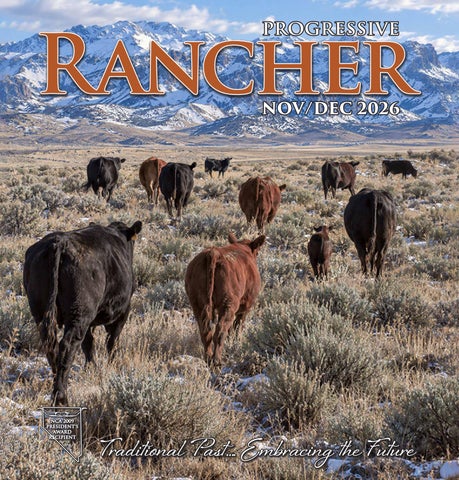
Cover: Nevada’s mountains are a beautiful backdrop to foraging herds in any season Published 8 times a year. View all issues at www.progressiverancher.com Readership reaches more than 20,000. The views and opinions expressed by writers of articles appearing in this publication are not necessarily those of the editor. Letters of opinion are welcome; submit via email. Advertising rates available upon request. Advertising does not imply editorial endorsement. Liability for errors or omissions in advertisements shall not exceed the cost of the space occupied by the error or omission.
© The Progressive Rancher Magazine. All rights reserved.
Leana Litten Carey, Owner/Editor
2040 Reno Hwy 432 • Fallon, Nevada 89406 (208) 358-2487 • progressiverancher@gmail.com Read the magazine and more articles online at
WWW.PROGRESSIVERANCHER.COM Ads sent to or built by The Progressive Rancher become property of this magazine.
2
NOVEMBER/DECEMBER 2026
The Progressive Rancher
www.progressiverancher.com
Consensus, Membership, and the Development of NCA Policy In a time when politics and public debate are increasingly shaped by division, competing agendas, and issues that can drive people apart, it is worth remembering the value of an organization built on a different principle: consensus. The Nevada Cattlemen’s Association (NCA) operates on the fundamental belief that organizational policy should reflect the collective will of its membership. As a consensus-driven organization, NCA recognizes that its strength, credibility, and effectiveness depend on meaningful discussion, member participation, and a shared commitment to the decisions reached through established processes. Unlike the wedge-issue campaigning often seen in politics, where differences can be emphasized to motivate supporters and strengthen opposing camps, NCA’s purpose is to bring people together around the shared interests of Nevada’s cattle industry. Our members may have different experiences, priorities, and opinions, but they share an interest in protecting the future of ranching and ensuring that our industry has a voice in the decisions that affect it. NCA policy is not created based on the preferences, beliefs, or individual opinions of any one member or leader. Instead, policies are developed through discussion and deliberation, giving members the opportunity to consider issues, express differing perspectives, and vote on matters that may affect the organization and those it represents. This process helps ensure that official positions reflect the collective judgment of the membership rather than the views of a select few. Consensus does not mean everyone must agree on everything. In fact, healthy discussion requires the willingness to listen to different perspectives, ask questions, and consider viewpoints that may differ from our own. The goal is not to win an argument or defeat an opposing viewpoint. It is to determine whether the membership can reach sufficient agreement to establish a position that NCA can responsibly represent. There will be times when that agreement cannot be achieved. Members may hold different opinions, priorities, and interpretations of complex issues. When significant consensus cannot be reached, NCA may choose not to establish an official position. This should not be interpreted as indifference, a lack of engagement, or an unwillingness to address important topics. Rather, it demonstrates respect for the membership and a commitment to representing the organization honestly. Taking no official position is sometimes the most responsible choice. It prevents NCA from presenting a divided membership as though it speaks with one voice. It also protects the credibility of the organization, ensuring www.progressiverancher.com
that when NCA does speak on an issue, its position has been established through the appropriate process. This principle is particularly important when considering the role of NCA leadership. Leaders, like all members, are entitled to their personal opinions and convictions. However, personal beliefs do not automatically become organizational policy simply because they are expressed by someone in a leadership position. When speaking in an official capacity, NCA leaders have a responsibility to distinguish their individual views from positions formally adopted by the organization. That distinction promotes transparency, accountability, and trust.
By Dave Baker, NCA President
At a time when public debate can reward confrontation more readily than cooperation, NCA’s consensus-driven approach serves an important purpose. Our industry’s challenges are complicated enough without allowing personal differences to overshadow the work that needs to be done. Protecting our ability to ranch, maintaining productive relationships with policymakers and agency representatives, and advocating for the future of Nevada agriculture require communication, cooperation, and a willingness to work with people who may not agree with us on every issue. Ultimately, NCA’s strength comes from its members. A consensus-driven structure ensures that official positions are grounded in collective agreement, respects the diversity of thought within the membership, and reinforces the importance of shared governance. It reminds us that representing an industry is not about advancing one person’s agenda; it is about working together toward goals that benefit the membership and the future of Nevada ranching. That is why your participation matters. The more members who take part in discussions, share their perspectives, and contribute to the policy process, the stronger our collective voice becomes. On that note, we hope to see you at this year’s Nevada Cattlemen’s Convention in Elko, November 12–14! Please join the conversation and help shape NCA policy. Enjoy the trade show, support local businesses, and learn about the latest trends and technology in the ranching industry. Thanks for your time.
The Progressive Rancher
NOVEMBER/DECEMBER 2026
3
by Martin Paris | NCA Executive Director | O: 775-738-9214
NCA November Roundup
By the time this reaches you, many have shipped calves and are moving cows toward winter ground, while others are still sorting and loading. It’s been just as busy at the NCA office. Between comment letters and convention planning, there hasn’t been a slow week since summer, but much of that work is now wrapped up.
The election is behind us, too. However you feel about the results, we now know who we’ll be working with in Carson City and Washington, and that work starts now. That’s especially true at the state level. The 84th Session of the Nevada Legislature convenes Feb 1, 2027, with some new faces in the building who need to hear from ranchers early.
It starts in Elko. The 91st Annual Convention and Tradeshow kicks off Thursday, November 12, and runs through Saturday the 14th at the Elko Convention Center, held jointly again with the Nevada Land Action Association, the Nevada CattleWomen’s Association, and the Nevada Wool Growers Association. If you haven’t registered, go to nevadacattlemen.org/eventsmeetings. The general sessions open with the federal agency update and work through the state agency update, the CattleFax market session, and an update on things to come from the National Cattlemen’s Beef Association and Public Lands Council.
Washington is in a holding pattern. Congress passed a stopgap funding government through Dec 11, so the lame duck session has spending bills to finish. The farm bill is in the same pile. The House passed its version in April. The Senate Ag Committee didn’t move its bill until mid-September, and then only on a 12-11 partyline vote. Neither one is law. Meanwhile, the last farm bill extension ran out September 30 and the stopgap didn’t renew it. Most of the programs ranchers rely on were funded through 2031 in last year’s budget law, so the lapse is more of a nuisance than a crisis for now, but it’s one more reason Congress needs to finish the job.
On the regulatory side, the two big rules we commented on this year are both still in agency hands. BLM is working through comments on its grazing regulation rewrite, and the Forest Service expects to finalize the Roadless Rule rescission late this year. The Forest Service also plans to start a grazing regulation rewrite of its own, which will matter just as much to permittees on the Humboldt-Toiyabe. NCA is locked and loaded on all three the moment the agencies make a move.
Closer to home, the weather is worth watching. NOAA’s Climate Prediction Center gives better than 80 percent odds that El Niño stays strong to very strong through March, and puts the chance it runs
stronger than any El Niño on record back to 1950 at 83 percent for October through December. Two of the three strongest in that record, 1982-83 and 1997-98, turned extremely wet across Nevada and California. The third, 2015-16, came in about normal. Northern Nevada sits between the storm tracks and doesn’t follow the El Niño script as faithfully as places farther south. People who know a lot more than me have been careful to say no two of these events play out alike. With about 88 percent of Nevada in drought as of late August, a wet winter would be welcome.
Finally, if you have steers and heifers to sell this winter, consider consigning them to the Silver State Classic Feeder Sale at Fallon Livestock, starting at 1 p.m. Tuesday, December 1. Fallon Livestock donates a portion of the sale commission to NCA, which helps fund our work on the issues that matter to you. We appreciate their support over the years and hope to see you there.
As always, if you have questions or need anything, call the office at 775-738-9214 or email us at this address: nca@nevadabeef.org.
Fallon: 8-5:30 M-F Gardnerville: 8-5 M-F Winnemucca: 8-5 M-F
800-513-4963 • www.pinenutlivestocksupply.com 4 NOVEMBER/DECEMBER 2026
The Progressive Rancher
www.progressiverancher.com
11” x 11”
The University of Nevada, Reno College of Agriculture, Biotechnology and Natural Resources with financial support from local sponsors P R E S E N T S
2027
Cattlemen’s Update THURSDAY
MONDAY
Jan. 4, 2027 Fallon, NV
Jan. 7, 2027 Elko, NV
5:30 p.m. 55 W Williams Ave Fallon, NV 89406 Dinner Provided
12:30 p.m. Great Basin College 1500 College Parkway Elko, NV 89801 Lunch & Dinner Provided
TUESDAY
Jan. 5, 2027 Smith Valley, NV
FRIDAY
Jan. 8, 2027 Winnnemucca, NV
10 a.m. 2783 NV-208, Wellington, NV 89444 Lunch Provided
10 a.m. Humbolt County Extension 1085 Fairgrounds Road Winnemucca, NV 89445 Lunch Provided
Main Program WEDNESDAY
Cattle economics, livestock health, & range management
Ely, NV
For additional information, contact: Emma Lemaire Staci Emm Kaley Chapin elemaire@unr.edu emms@unr.edu kaleys@unr.edu
Jan. 6, 2027
5:30 p.m. 805 Great Basin Blvd Ely, NV 89301 Dinner Provided
www.progressiverancher.com
The Progressive Rancher
For Program Information:
NOVEMBER/DECEMBER 2026
5
Nevada Consumers Included in Western States Summer Grilling Campaign By Annette Kassis—Director, Consumer & Brand Marketing Back in June at the start of the summer grilling season, the Nevada Beef Council reported on the launch of the Beef. It’s What’s For Dinner. (BIWFD) Western States campaign, an effort funded by voluntary contributions from State Beef Councils outside the region and targeting key urban populations across six western states: California, Oregon, Washington, Idaho, Nevada and Arizona The goal of the initiative was to use targeted media strategies to extend the national summer campaign with greater emphasis in the west, inspiring and encouraging summer grillers to choose Beef for their summer grilling meals, while also increasing brand awareness and positive perceptions of Beef. The campaign ran from June 15th through August 31st. With results now being reported, let’s take a look at the numbers.
How Each Platform Works With Connected TV advertising, a viewer in our target audience is watching a TV show on a popular channel like ESPN, HGTV, Discovery, or Food Network through their Smart/Connected TV. During the natural commercial breaks in the show, a viewer is shown a :15- or :30-second Beef Checkofffunded ad. These are non-skippable videos, and the viewer must watch the entire video to completion to continue their show.
• Oklahoma, with $16,500 • Iowa, with $35,000 • North Dakota, with $20,000
Campaign Spend by State So how does the media buy break out in terms of percentage of a state’s total population? A DSP company like The Trade Desk uses software to automate digital ad space purchased across websites, apps, and video networks in real time based on the target audience and maximum budget. In other words, the software sets the per state budget based on the urban targets. For this campaign, the $71,500 budget was allocated based on population size of those urban areas. In Nevada, 4.73% of the population was reached with the media buy. Population percentages in the other states were: Idaho, 2.73%; Arizona, 11.19%; Washington, 11.73%; Oregon, 6.53%; and CA, 61.44%.
Three states provided the funding for this campaign:
This provided a total campaign budget of $71,500.
Campaign Review Leveraging the digital media buying capabilities of demand-side platform (DSP) company The Trade Desk, the National Cattlemen’s Beef Association (NCBA), a contractor to the Beef Checkoff, ran ads across both Connected TV (CTV) and Online Audio, reaching consumers who were engaged with premium streaming content. During the campaign, ads across all platforms were shown in the Western States more than 4 million times. By working with The Trade Desk, NCBA was able to focus campaign budget dollars for cost efficiency, rather than specifying a budget for each state. The campaign was optimized to prioritize the most cost-efficient impressions, video views and audio listens across the six western states, with media spend following the relative population in each state. As a result, the campaign primarily targeted and reached consumers in more populated urban areas within each state: Seattle; Portland; Los Angeles; San Diego; San Francisco; Las Vegas; Phoenix; Boise; etc.
6 NOVEMBER/DECEMBER 2026
Online Audio advertising works in a similar manner. While listening to music on digital audio platforms like Pandora, iHeart or Spotify, the Beef. It’s What’s For Dinner. ad will appear during a break. These ads are non-skippable and give an option to learn more on the BeefItsWhatsForDinner.com website.
Average cost for a completed video view for this campaign was $0.023, which exceeds average national CTV performance and is very cost-efficient in light of the premium network placement for the ads. As a result, with a total spend of $29,999, this portion of the campaign achieved over 1.3 million completed video views. Online Audio Campaign Results This portion of the campaign reached consumers as they streamed favorite songs, stations and playlists across a variety of premium platforms like Spotify, Soundcloud, Pandora and iHeart Media, alongside smart speakers like the Amazon Alexa and the Bose Smart Speaker. Because consumers tend to consume audio through just one or two audio platforms, using an array of streaming outlets allowed the campaign to ensure reach of the widest possible audience. In addition to that reach, the campaign also leveraged dayparting and frequency controls to ensure media spend occurred during optimal times of day while also limiting excessive exposure to consumers. Average cost-per-listen for this campaign was $0.017, which is considered “highly aggressive” and exceeded pre-campaign expectations. As a result, with a total spend of $41,496, this segment of the campaign was able to achieve over 2.45 million Audio Listens, at a completion rate of 96.06%.
“These types of multi-state initiatives continue to prove the benefit of historically high cattle/low population states helping to fund consumer campaigns in states with high populations and large urban areas,” said Bill Dale, executive director of the Nevada and California CTV Campaign Results Connected TV ads featured two :30-second Beef. It’s Beef Councils. “As prices have risen, shoppers have What’s For Dinner. spots from the “Beef Does It All” become more deliberate with their food choices. With protein still a strong driver of food choice, campaigns (BDIA) campaign collection. With a campaign goal of like this one help keep beef top-of-mind, and remind reaching relevant, engaged consumers efficiently and consumers that beef delivers protein alongside taste, effectively as they streamed premium content across a satiety and overall meal satisfaction.” variety of networks and channels, the spots appeared across popular streaming services like Max (HBO), Hulu, Disney+, ABC, ESPN, Fox (Sports, News & Business), Warner Brothers, Peacock and more. In addition to selection of appropriate streaming network placements for the ads, emphasis was also placed on targeting consumers who are especially interested in cooking and outdoor grilling. The Progressive Rancher
www.progressiverancher.com
Consumer Demand for Beef Beef maintains a strong role in shoppers’ meal routines, driven by taste, familiarity, and intentions to continue consumption.1
80%
More than 80% of consumers plan to eat more or maintain their beef consumption levels. Consumers who plan to eat more beef are most motivated by taste.1
Beef is Part of the Weekly Routine: 71% of consumers are eating beef at least once a week. Among those consumers who eat meat alternatives weekly, 70% are also eating beef at least once a week.1
74% Reasons Consumers Want to Eat More Beef:1
Prepare or cook meals at home1
88+% Enjoy the taste of beef
Adding protein to diet
Grilling more often
Beef is quick and easy to prepare
Report a satisfying eating experience when they cook beef at home1 1. Consumer Beef Tracker January - December 2025
www.progressiverancher.com
The Progressive Rancher
NOVEMBER/DECEMBER 2026
7
Rollins Urges Federal Land Ranchers to Put June Grazing Directive to Work
On October 8, 2026, U.S. Secretary of Agriculture Brooke L. Rollins sent a letter to all livestock ranchers holding grazing permits on U.S. Forest Service allotments, outlining the Department’s June 12, 2026 Grazing Directive and inviting producers to put it to work on their allotments. The letter builds on the October 20, 2025 USDA Plan to Fortify the American Beef Industry and the March 31, 2026 Advancing Grazing on Forest Service and BLM Lands Memorandum of Understanding signed by Secretary Rollins and Secretary of the Interior Doug Burgum. Together with the Grazing Directive issued by Secretary Rollins and Under Secretary for Natural Resources and Environment Michael Boren, the three documents describe Administration policy to streamline and expand livestock grazing on federal lands, elevate grazing as a priority, and strengthen support for America’s ranchers within the framework of existing law and regulations.
“You embody the ethos of our nation’s founding 250 years ago,” said Secretary of Agriculture Brooke L. Rollins. “For the past 19 months, USDA has worked tirelessly to defend and promote our nation’s ranchers and give you the tools to help rebuild our Great American Cattle Herd. I encourage you to familiarize yourself with the Grazing Directive as we work together to accomplish shared goals on your respective allotments.” For more information, see the full letter here: www.usda.gov/sites/ default/files/documents/letter-allotment-holders-re-secretarydirective.pdf
Background: The U.S. Forest Service and the Bureau of Land Management administer approximately 240 million acres of rangelands across 28 states, supporting more than 23,000 permittees and lessees. Secretary Rollins noted that restoring the nation’s beef and sheep herds will, by necessity, include both Forest Service and BLM lands. The June Grazing Directive directs the Forest Service, consistent with applicable law and regulation, to: • Take appropriate measures to restore at least 500,000 head months across National Forest System lands within two years;
• • • • •
Implement a policy of no net loss of Animal Unit Months within allotments; Make vacant and closed allotments available for grazing;
Improve wildfire planning, coordination, and recovery, including the use of virtual fencing; Improve National Environmental Policy Act efficiencies; and Improve coordination and build positive relationships with ranchers.
The letter also points to the new USDA Ranchers First webpage at www.usda.gov/ranchers-first, which details actions taken under the Trump Administration to support grazing, processing, and the longterm strength of the American cattle herd.
Producers who believe they have been subjected to agricultural lawfare may submit information through the Farmer and Rancher Freedom Framework at www.usda.gov/lawfare. Grazing-specific concerns may be sent to grazing@usda.gov. 8 NOVEMBER/DECEMBER 2026
Secretary Rollins and NASA Administrator Isaacman Sign MOU to Advance USDA Data Modernization Plan
On October 24, 2026, U.S. Secretary of Agriculture Brooke L. Rollins and National Aeronautics and Space Administration (NASA) Administrator Jared Isaacman signed a Memorandum of Understanding (MOU) between the U.S. Department of Agriculture (USDA) and NASA that will strengthen USDA’s data quality and help ensure that American farmers and ranchers benefit from and have access to cutting-edge technologies. Effective immediately, both Departments will work together to guide cooperation on integrating Earth observation, geospatial analytics, and statistical methodologies in support of agricultural statistics and aligned with USDA’s ongoing data and technology modernization efforts.
“American farmers are the best in the world and deserve any solution we can leverage, even when it is out of this world. I am proud to announce that USDA will now work with Administrator Isaacman and NASA to utilize the full power of technology, research, and development to fortify U.S. agriculture,” said Secretary of Agriculture Brooke L. Rollins. “With this unprecedented partnership the Trump Administration is committing to a bright future of research and tech opportunities that will enhance USDA acreage and yield estimation and drive profitability for American agriculture.” The partnership between the two Departments is long-standing, but new opportunities to improve crop performance for Earth and space-based goals were initiated in December 2025, when President Trump issued Executive Order 14369, “Ensuring American Space Superiority.” At that time, NASA and USDA began to explore creative new ways to improve American and global agriculture, observe the environment, and contribute to better human health.
“NASA develops some of the most advanced sensing, computing, and analytical capabilities in the world, and we should put those tools to work wherever they can deliver meaningful outcomes for the American people,” said NASA Administrator Jared Isaacman. “By combining NASA’s Earth observation data and technical expertise with USDA’s knowledge of American agriculture, we can improve the information available to farmers and ranchers, strengthen our understanding of crop conditions and natural hazards, and pursue new highrisk, high-reward ideas that advance both science and American competitiveness.” The scope of cooperation under this MOU may include, but is not limited to, agricultural statistics, remote sensing science, modeling, geospatial data engineering, and super intelligence/machine learning (SI/ML) supported by the participants. As priorities evolve, additional areas of cooperation may be identified. Areas of cooperation include:
• Mission/Data Alignment: Regular technical exchanges to align USDA statistical requirements with NASA Earth science missions and data products (e.g., satellite observations, model outputs, and derived geophysical variables).
• Data Access & Infrastructure: Discussions on scalable access patterns to NASA archives, cloud‑native geospatial formats, application programming interfaces (APIs), and workflow orchestration that enable USDA production operations. • Methodology & Validation: Joint technical reviews of algorithms for crop condition indicators, yield models, planted/harvested area estimation, and disaster impact assessment, including approaches to bias correction, uncertainty quantification, and validation using statistically sound frames and ground data. This list is not intended to be exhaustive, and the participants intend to work together to investigate opportunities for collaboration under this MOU. This effort supports the USDA Data Modernization Plan (www.usda.gov/sites/default/files/documents/datamodernization.pdf ) launched by Secretary Rollins last month to put Farmers First, reduce unnecessary burdens on producers, and improve the timeliness, accuracy, and usefulness of the agricultural data that inform decisions across American agriculture. To learn more, please view the USDA and NASA Memorandum of Understanding: www.usda.gov/sites/default/ files/documents/usda-nasa-mou.pdf
The Progressive Rancher
www.progressiverancher.com
North Woods Hearty Pot Roast This hearty pot roast braised with chunky fresh vegetables in a savory gravy is easty to make and is a perfect dish to ward off the chill of colder weather.
Recipes & photos courtesy of
Ingredients:
Cooking:
1 beef Cross Rib Roast, Shoulder Roast or Arm Roast (2 to 2-1/2 lbs)
1. Combine seasoning ingredients; press evenly onto all surfaces beef Cross Rib Roast. Heat oil in stockpot over medium heat until hot. Brown pot roast on all sides. Pour off drippings and season beef with salt.
1 tablespoon vegetable oil 1/2 teaspoon salt 1 pound small red-skinned potatoes, cut in half, or into quarters if large 4 medium carrots, cut into 2-1/2 x 1/2- inch pieces 2 medium parsnips, cut into 2-1/2 x 1/2-inch pieces 1 small leek, (white and pale green parts only), cut in half lengthwise then crosswise into 1-1/2 inch pieces
2. Add broth to stockpot; bring to a boil. Reduce heat; cover tightly and simmer 2 hours. Add vegetables; continue cooking, covered, 30 to 45 minutes or until pot roast and vegetables are fork-tender. 3. Remove pot roast and vegetables; keep warm. Strain cooking liquid; skim fat, if necessary. Measure 2 cups cooking liquid (Add beef broth or water to cooking liquid to yield 2 cups, if necessary.); return to stockpot. Combine water and cornstarch; stir into cooking liquid. Bring to boil, stirring constantly; cook and stir 1 to 2 minutes or until mixture is thickened. 4. Carve pot roast into thin slices. Season with salt, as desired. Serve with vegetables and gravy.
1 cup beef broth 4 tablespoons water 2 tablespoons cornstarch Seasoning: 2 teaspoons seasoned pepper blend or garlic-pepper seasoning 1 tablespoon minced garlic
www.progressiverancher.com
beefitswhatsfordinner.com The Progressive Rancher
NOVEMBER/DECEMBER 2026
9
Election Season I always have the same thoughts each time a new election season rolls around. Past readers of this column have read my rants before about the necessity and responsibility of being a citizen to vote. As I age it just seems more important that we all exercise that responsibility and that each election is more important than the last.
The current election is in that category as we are to elect a Governor, Attorney General, Lieutenant Governor and other Constitutional officials and a replacement for retiring Member of Congress, Mark Amodei. Also, there are many municipal and county elections to be decided all across the state. There are candidates who forget the truth and others who forget that the people who vote are smart and intelligent who, once they find an interest in the various candidacies, delve into the information available and make decisions about who they will vote for.
Often, unlike many other states, Nevada voters split their votes and instead of voting straight party lines, choose people over strict allegiance to parties and vote for the person instead. I consider this a sign of independent analysis and inquiry which is the mark of an engaged, discerning voting public and should be applauded not criticized.
Of course, elections produce winners and losers. Disappointment with results should not be an excuse to avoid voting. Indeed, I wonder why we Americans
in general do not vote at a higher rate than other democratic nations around the world except when there is a presidential election.
This focus on presidential politics seems to fire the passions of voters more than in other elections. Perhaps one of the reasons for a lack of involvement is the false belief that their vote does not count for much or of anything for that matter. This thought is disproved by the many elections which are decided by just a few or dozens of votes instead of thousands.
Another thing about elections is the sometimessurprising results they produce. Take, for example, the most recent Presidential election. As expected, President Trump was heavily supported by the interior red states and their substantial rural populations. Farm belt America and livestock ranching parts of our country voted substantially for Trump. I don’t want to delve too deeply in some aspects of the Trump actions relative to agriculture with which most readers are familiar at the expense of forgetting my relatively obscure example. However, tariff backlash, loosening imported meat restrictions and the rising costs of inputs to agriculture such as fuel prices, have left a bad taste in the mouths of most ranchers I know. Surprisingly, in June 2026, the Secretary of Agriculture Brooke Rollins issued a document entitled “The June 2026 Grazing Directive” (usda.gov/sites/default/ files/documents/forest-service-grazing-memo.pdf ).
This directive is to provide the recommended policy direction to the BLM and the USFS to implement the 2025 Beef Plan and MOU signed by The Secretaries of Interior and Agriculture. These documents are the Trump Administration’s efforts to support and strengthen America’s livestock industry and recognize the important role grazing public lands plays to keep America food independent which certainly is all of our best interest. A goal of this effort is to improve coordination and build positive relationships between ranchers and the public land management agencies. Another goal of many in the Directive is to implement a policy of no net loss of AUMs within allotments. All of these goals must be implemented consistent with existing laws and regulations.
Will the change in attitude from the agencies work on the ground? In my own experience, the ranch I am affiliated with just finished our grazing season. We moved all of the pairs out of the forest allotment utilized by the ranch for close to 150 years. We had a good experience with some needed flexibility from the agency to achieve our purpose and that of the agency’s needs and goals. We’ll see if this nuanced change lasts. I will keep you posted. I’ll see you soon.
Rick Cronkhite appointed Deputy Administrator of NDA’s Division of Plant Health and Compliance The Nevada Department of Agriculture (NDA) has appointed Rick Cronkhite as Deputy Administrator of the Division of Plant Health and Compliance. “Rick knows our programs, understands our work and, just as importantly, knows the team that makes it happen,” said Ray Saliga, Administrator of the NDA’s Division of Plant Health and Compliance. “He brings a collaborative approach and will be a great resource for our division and the industry partners we work with every day.” Cronkhite joined the NDA in 2019 as an Agriculturist III, managing continuing education programs for licensed pest control operators and certified applicators, as well as conducting inspections across the pest control industry. Contact: Ciara Ressel PIO | cressel@agri.nv.gov 10 NOVEMBER/DECEMBER 2026
In 2024, he was promoted to Agriculturist IV, later reclassified as an Agriculturist Supervisor, overseeing the pest control team in the NDA’s Las Vegas office. His experience working with pest control programs and industry members will support his new responsibilities. Before joining the NDA, Cronkhite worked in the wine industry in California and New Zealand. He holds a bachelor’s degree in wine and viticulture from California Polytechnic State University, San Luis Obispo, and a master’s degree in hospitality administration from the University of Nevada, Las Vegas. Outside of work, Cronkhite enjoys cooking, road trips and spending time with his German shepherd, Koda. “I look forward to taking on this new responsibility and continuing to support the NDA,” said Cronkhite. “I’m excited to continue working alongside such a committed team, and I’m proud to help advance our efforts to protect Nevada’s plant health and agricultural resources.”
The Progressive Rancher
www.progressiverancher.com
Who We Are | Real Ranchers
RON CERRI
Ron Cerri’s ties to Nevada are deep – and not just because he is the 4th generation in Humboldt County, where he and his wife, Denise, own a family cow/calf ranch in Orovada.
Nevada Rancher Ron Cerri Takes Reins of Public Lands Council
A changing of the guard is underway at the Public Lands Council as Nevada rancher Ron Cerri takes over as president following PLC’s 58th Annual Meeting in Copper Mountain, Colorado. After nearly 30 years of involvement with PLC, Cerri says he’s ready to travel the West, listen to ranchers and tackle some of the biggest issues facing federal grazing permittees. Wildfire is personal for Cerri. He says the roughly 34,000-acre McConnell Fire burned his Nevada operation, costing him Forest Service grazing range and livestock. Now, he wants a closer look at how grazing allotments are managed following wildfire and whether extended rest is appropriate in every situation. Cerri also discusses proposed changes to BLM grazing regulations, federal land management and PLC’s efforts in Washington. BLM’s 2026 proposed grazing rule includes changes intended to provide permittees more flexibility in responding to changing range conditions. Hear what Cerri says his priorities will be as he begins his two-year term representing public lands ranchers across the West by watching the video here:
www.youtube.com/ watch?v=wk2GbC6jQHo
www.progressiverancher.com
Cerri is currently serving his third term as a Humboldt County Commissioner, all while ranching at Orovada and in nearby Eureka County. As PLC Secretary, Ron’s longstanding leadership in agriculture and resource organizations has come to a head. He has long served as a key leader in the Nevada State Grazing Board Central Committee, is a past president of the Nevada Cattlemen’s Association, and as one of the key voices for public lands ranching in the region. For Ron, his advocacy is as much a part of his operation as the work he and his family do when managing their Black Angus beef cattle operation that relies on private, BLM, and Forest Service permits. Sowing the Seeds of a Better Life | The Cerris hail from Italy. It was there, observing from afar, that Ron’s great grandfather became fascinated with agriculture. Originally, Ron’s great-grandfather was attracted to farming in the United States, but the draw of the iconic American cowboy led him on a different path. Ultimately, around the year 1800, he decided to emigrate to the United States and try his hand. Though not without some hardship, Ron’s great-grandfather ultimately fell in love with his new profession and never looked back. The love for ranching, the heritage associated with the profession, and the knowledge to raise high quality cattle in challenging conditions has been passed from generation to generation in the Cerri family. Ron is the first to tell you that he loves this life, despite the many hardships that come with the territory. Hardships Breed Hard Work | Like so much of the West, ranching in Nevada is heavily influenced by the ever-changing environmental and financial landscapes carry with them a variety of challenges. Over his lifetime, Ron has confronted prolonged and harsh drought which have threatened the health and prosperity of his herd. Bureaucratic inefficiencies from federal public lands managers further complicate matters, as efforts to build key infrastructure and range improvements are delayed for a variety of reasons. “Our costs have skyrocketed. With the price of diesel and the current drought impacts, we’ve had to adjust. We will have to supplement [feed] our livestock which will be very difficult with the current hay prices.” In order to build rangeland resiliency over time, the Cerris make adjustments to address immediate risks with the mindset that each step should contribute to long-term sustainability. Ron uses a deferred rotation system on both his private pasture and the public lands he manages, rotating and resting lands on a yearly basis. This allows for responsible stimulation for use and regrowth of the forage, especially in the dry years. The Progressive Rancher
The adoption of a deferred rotation system, according to Ron, has considerably improved the land. Ron also works closely with the BLM to address the risk of invasive species and other threats. The priority the Cerri family places on rangeland resiliency is perhaps best exemplified by the work they have done to address the explosion of wild horses and burros in the state that affects the land all around them. Nevada is home to more than 46,000 horses and burros managed by the BLM under the Wild and Free-Roaming Horse and Burro Act. The Appropriate Management Level for both species in Nevada is just 12,000, and land managers like Ron have had to confront some hard realities on the range: there are too many horses on the rangeland and not enough forage to feed them. Streams, creeks, and springs take a beating as horses compete for resources that are insufficient for the demand. Ranchers like Ron play a unique role in this issue. Ron is on the land, managing his livestock according to specific ecological conditions and goals. Often, he is the eyes and ears for the BLM when horses stray from their herd areas. He is at the front of the line to advocate for a better future for the landscape – a future which requires the expertise of ranchers to help the land and water recover. Ron knows that public lands in the west have to be healthy to work for a wide variety of purposes: for horses, for wildlife, for cattle, and for people. “It’s a system. When things are balanced, all multiple uses are working together, it works really well but when one use is allowed to run rampant, every other use suffers. This is one area where we have to make progress, otherwise these landscapes may be lost.” Maintaining the Longevity of the Cerri Ranching Legacy | Ron often tells a cautionary tale, warning that the worst thing for the future is inaction. Like his great-grandfather, Ron knows that tenacity is often rewarded with success, and this is what he hopes to share with the next generation. As Ron once again steps into leadership at a national level, the transfer of his business to his children is one of his largest priorities. Ron’s dedication, passion, and relentless drive to promote the sustainability of both his operation and land has inspired his leadership and in turn has inspired his family. NOVEMBER/DECEMBER 2026
11
Our Award Winning Bulls are consigned to...
8 bulls consigned to the
Great Basin Bull Sale February 13, 2027 UBIA
Utah Beef Improvement Association
March 20, 2027
5 bulls consigned to the
Midland Bull Test April 1 & 2, 2027
PROTECTING YOUR WATER RIGHTS MISSION STATEMENT | The mission of the Central Nevada Regional Water Authority is to prepare communities in central and eastern Nevada for sound water-resource decisions that promote prosperous economies and strong civic institutions in a healthy natural environment. The Central Nevada Regional Water Authority was established in 2005 to proactively address water issues in the Central Region, the largest of Nevada's 14 hydrographic regions. CNRWA formulates and presents a united position on water-related issues; monitors, assesses and responds to water projects that may adversely impact a member county; implements a groundwater monitoring program and encourages citizen participation in water-related issues. CNRWA’s nine member counties are: Churchill, Elko, Esmeralda, Eureka, Humboldt, Lander, Nye, Pershing, and White Pine.
For more information, please contact:
Jeff Fontaine, CNRWA Executive Director 775-443-7667 / ccjfontaine@gmail.com / cnrwa.com 12 NOVEMBER/DECEMBER 2026
The Progressive Rancher
www.progressiverancher.com
Nevada Water Solutions LLC Water Rights / Resource Permitting Expertise
Thomas K. Gallagher, PE 775•825•1653 / FAX 775•825•1683 333 Flint Street / Reno, NV 89501 tomg@nevadawatersolutions.com
THE PROGRESSIVE RANCHER is now accepting Articles, Stories & Op Ed Submissions
ADVERTISE WITH US! (208) 358-2487
progressiverancher@gmail.com
Your Trusted Representatives in
If you’re looking to sell a farm or ranch, give us call! SOLD Clover Valley Farm: 240 deeded with 160 acres water righted with home and outbuildings. $1,200,000 SOLD Wild Horse 214 Deeded with approx. 25 acres water righted with improvements. $475,000
New listing in Lamoille is 40 acres with surface water rights out of Thorpe Creek on County Road $375,000
Need more farm and ranch listings... give us a call if you’re interested in selling!
Livestock Marketing Since 1989
©Foster
Upcoming Sale Dates NOVEMBER 6
Deadline: October 29
Deadline: November 18
Embassy Suites Amarillo, TX
Atlantis Casino Reno, NV
Watch all of our Sales On WVMCATTLE.COM Follow Us!
Paul Bottari, Broker ALC NV Broker License No B015476
BottariRealty.com • 775-752-0952 www.progressiverancher.com
DECEMBER 2
The Progressive Rancher
Contact Us!
(530) 347-3793
wvm@wvmcattle.com NOVEMBER/DECEMBER 2026
13
Tools in the Toolbox: Different methods for fuels management in Nevada Megan Kay, Outreach & Content Coordinator, UNR Reno Ext Living With Fire Program; Maria Sorensen, Program Assistant, UNR Reno Ext Living With Fire Program; Christina M. Restaino, Assistant Professor and Natural Resources Specialist, UNR Reno Ext “Fuels management” involves reducing the amount of vegetation in an area to reduce the intensity and spread of potential wildfires. Understanding the different methods of fuels management is crucial for residents in high-firehazard areas that want to reduce their wildfire risk. A feller buncher havests trees. (Adobe stock)
Why do we do fuels management?
Mechanical Thinning
Periodic “low intensity” fire, which burns with less heat, can be good for the land. However, after decades of widespread fire suppression and the forced removal of indigenous people who used intentional fire on the land, many ecosystems have become unhealthy and vulnerable to fire. Forests are becoming overcrowded; dead vegetation has built up which can be hazardous due to its potential to become fuel for wildfire.
Wildfire fuel refers to dead and living vegetation that can burn, as well as homes and other structures that can ignite. This is particularly important in areas where urban development meets the natural environment, known as the wildland urban interface (WUI). Wildfires are becoming increasingly destructive across many ecosystems (forests, woodlands, rangelands). Climate change, human-caused ignitions, the encroachment of homes into the natural environment and the volume, density and health of fuel on the landscape all contribute to this escalating problem. In this fact sheet, we will explore some different “tools in the toolbox” for managing fuel in Nevada.
Fire crews hand thin and create burn piles at Spooner Lake & Backcountry State Park. (NDF)
Hand Thinning & Pruning
When we use tools such as chainsaws and axes to remove small-diameter trees and shrubs, we call it hand thinning. Pruning refers to the removal of lower tree branches and trimming back shrubs to minimize ladder fuels, which are low-growing vegetation that promote the movement of fire from the ground to the crowns or tops of trees. Hand thinning and pruning are great tools for someone who is working on a small scale to reduce their wildfire risk. Pruning, for example, can be done with tools that an average homeowner may already have, such as gardening shears and a simple saw. Advantages:
Dave Ruben
The role of community members in reducing the wildfire threat Community members play a crucial role in reducing wildfire risk by treating the areas around their homes. Many local fire departments and districts offer resources, such as curbside chipping and green waste collection days, to assist landowners in treating their properties. However, treating a single property has only a limited effect if neighboring properties remain untreated. Strong partnerships among communities, fire agencies, stakeholders and rightsholders increase the effectiveness of wildfire mitigation efforts, laying the groundwork for better fire-adapted communities. 14 NOVEMBER/DECEMBER 2026
• Inexpensive • Accessibility is higher than other fuel treatment methods (can get to harder to reach places in comparison to other fuels treatment methods) • Less environmental impact Disadvantages:
• Less efficient for larger-scale projects • Hand thinning requires more people in comparison to other methods such as mechanical thinning
Scan the QRC at right to view the Wildfire Home Retrofit Guide. The Progressive Rancher
Mechanical thinning involves using heavy machinery in various ways to cut and either remove or rearrange vegetation to reduce wildfire risk. These methods stand out for being efficient and productive, allowing crews to accomplish much more in less time compared to hand thinning. However, it’s important to consider the significant initial investment required for contracting a company or purchasing and maintaining the specialized equipment required for mechanical thinning, as well the environmental impact, as heavy equipment can cause considerable soil disturbance.
Common methods include mechanized harvesting of trees using heavy equipment such as feller bunchers to cut and remove trees or using masticators to grind woody vegetation into mulch that is deposited on site. With mechanized harvesting, large trees can be handled effectively, which is crucial for thinning dense forests. There’s also a potential financial benefit since the harvested trees can sometimes be sold to lumber mills to help offset costs. Mastication can be used as an alternative treatment when removal of vegetation is not feasible, there are concerns about disturbing soils, or prescribed fire is not an option. Mechanized Harvesting Advantages:
• Allows for precise control over tree spacing • Avoids negative impacts on air quality, since vegetation is removed rather than burned • Potential for revenue from sale of harvested trees Mechanized Harvesting Disadvantages
• Limited by steep terrain and weather conditions • Potential environmental impact from heavy machinery, particularly soil disturbance • May not fully replicate natural wildfire effects on ecosystems; could potentially increase surface fuels Mastication Advantages
• Leaving material on site helps soil retain nutrients • Suitable for areas where burning is not possible • Useful in areas with limited road access or steep slopes where other equipment cannot be used Mastication Disadvantages • May not fully replicate natural wildfire effects • Could potentially increase surface fuels and create fire hazard www.progressiverancher.com
and can carry a fire if ignited. Pile burning localizes fuel treatment in one spot rather than letting fire creep across a larger area. This can be useful when targeting specific areas around a property but may negatively impact soil directly beneath the pile.
Sheep graze on land near a neighborhood in south Reno. (Humboldt-Toiyabe National Forest)
A landowner burns piles on private land in Nevada. (Wendy Hanson-Mazet)
Targeted Grazing
Prescribed Burning
Targeted grazing is an approach where animals are used to graze on land, consuming vegetation to reduce fuel in an area. Grazing is most effective in areas with small diameter vegetation such as grasses, shrubs and low tree branches ,which makes this approach great for breaking up dense areas of vegetation that can increase wildfire spread, as for well as eliminating ladder fuels that promote the movement of fire from the ground to the canopy of trees. Targeted grazing involves careful planning, considering factors such as how many animals are needed, how long they should graze, which plant species to target, and which animals are right for the job. By harnessing the natural behaviors of animals such as goats, sheep or cows, targeted grazing can offer a cost-effective alternative to other management methods.
Fire plays a vital role in our environment. Historically, fire has been a tool for keeping ecosystems diverse and resilient to catastrophic wildfire. Many ecosystems experienced frequent low-intensity fires that consumed low-growing vegetation and dead vegetation on forest floors, promoting tree growth by reducing competition for water and recycling nutrients like nitrogen back into the soil. For millennia, Indigenous people have used fire for a variety of purposes: cooking, clearing land to promote certain crops and enhance game hunting, facilitating travel, and other important cultural and ecological reasons. Decades of suppressing natural fire and the displacement of Indigenous communities have had detrimental effects on the environment. Prescribed burning mimics these natural disturbances, fostering the creation of more ecologically diverse and fire-resilient landscapes.
Advantages:
Advantages:
• Help control invasive plant species, reducing the need for chemical herbicides • Can be more economical compared to other management methods such as herbicide treatments or prescribed burning • Targeting invasive plants, allows native vegetation to thrive, enhancing ecological diversity
• Reduces the risk of more dangerous fires
• Increases water availability for remaining plants
• Reduces tree competition (for drought resistance) • Improves plant diversity and wildlife habitat • Controls invasive species and pests
• Cost-effective compared to mechanized treatments
• Can help improve soil health by trampling plant material, adding nutrients and reducing erosion
Disadvantages:
Disadvantages
• Poses risks to people, property and animals
• Can be time-consuming and require careful planning regarding timing, intensity and duration of grazing • Animals need water, shelter and proper management to prevent environmental damage or harm to the animals themselves • May not be feasible or effective in all landscapes, depending on factors such as terrain, vegetation and the availability of grazing animals • Achieving desired results may require multiple grazing sessions over several years, necessitating ongoing commitment and resources www.progressiverancher.com
• Temporarily reduces air quality
• Can lead to increased cheatgrass invasion • Poses risk of escaped fires
Common methods of prescribed burning include pile burning and broadcast burning, each suited to specific vegetation types and management goals, with unique advantages and disadvantages. Pile burning involves burning piles of medium to large woody vegetation, which landowners can do by following safe practices and adhering to local laws. This may require obtaining a permit and burning only on specific days. This method is highly effective for disposing of larger debris, but doesn’t address smaller fine fuels and litter that accumulate on the ground The Progressive Rancher
Broadcast burning involves applying fire across a larger, designated area to reduce fine fuels such as grasses and shrubs that accumulate and increase fire risk. It also provides essential ecological benefits, such as improving soil health and promoting the regeneration of native vegetation, which cannot be achieved through pile burning alone. This method requires significant training to conduct safely and is subject to a much greater degree of oversight from officials and the public. In Nevada, prescribed fire is regulated by NRS 527.122-128, and broadcast burns on private and state lands must follow a written burn plan and be conducted by a qualified burn boss, making it difficult for most landowners and even some fire departments to carry out.
Herbicides Herbicides are chemical treatments that are used to control vegetation growth. They’re mainly used to control invasive species that grow fast and need retreatment often, such as cheatgrass. Used safely, they can help reduce the buildup of smaller fuels that dry out quickly and can easily ignite and help fires spread. As with many methods, this is most effective when used in combination with other techniques. Advantages:
• Can be a cost-effective solution compared to manual or mechanical weed control methods, especially for large-scale applications
• Can be highly effective at targeting specific weed species and can provide efficient control in the right conditions Disadvantages:
• Need to be applied during specific windows of time to effectively target the growth stage of the weed species, and failure to do so can result in reduced effectiveness
• Improper use of herbicides can lead to environmental harm, such as the leaching of chemicals into groundwater or runoff into nearby water bodies. Careful application and adherence to safety guidelines are essential to minimize these risks and ensure environmental protection
In conclusion These are all tools land managers, fire departments, residents, and communities can use to manage vegetation and reduce the buildup of hazardous wildland fuels near communities. Each tool offers advantages and disadvantages in reducing wildfire risk. By understanding and implementing these methods appropriately, communities can make significant progress in reducing the wildfire threat in their area. NOVEMBER/DECEMBER 2026
15
Nevada Farm Bureau
Lessons On Our Country’s Food Pricing System By Doug Busselman | NFB Executive Vice President Over the course of this year, there has been an overwhelming level of focus on “affordability.” The term was intended to generate emotion, even if it goes undefined by those attempting to use this as a political platform against those who currently have control of the bodies that they are campaigning against. It also goes unsaid that some of the prices they are complaining about might have been higher before. It needs to be understood that many factors fit together to cause the results that we see. For that, we want to bring to your attention an American Farm Bureau Federation (AFBF) Market Intel that was penned by Terri Moore, Vice President of Communications for the organization. This piece was entitled “The Farm Pressures You Can’t See at the Grocery Store.” Moore concentrated on the sticker shock in prices that consumers were certainly noting when visiting the meat section of their local food market. She brought attention to the fact that while consumers were focused on the increases in costs that they were paying, the farmers and ranchers who produced the food were experiencing the opposite shock, decreases in the prices they were receiving. She explained the phenomenon of these realities playing out as coming from the complex U.S. food supply chain. She cited the Bureau of Labor Statistics and the national average retail ground beef price, which was 7.4 percent higher in August 2026 than in August a year earlier. Meanwhile, those raising the beef were paid 10 percent less for their cattle. Farmers’ prices for fresh vegetables were 7.3 percent lower in August 2026, according to Moore’s research, while the prices consumers paid at grocery stores increased by 3.2 percent. Dairy farmers saw their milk prices fall 3.5 percent, but Moore noted that retail dairy prices slipped just 0.3 percent. It is said on a frequent basis that farmers are price-takers — not price-makers — and that has a lot to do with the difference between the price at the farm or ranch and the price at the store. When prices for their crops and livestock
fall, they have to deal with the situation right away. When input costs increase, there isn’t any way to pass along the increase through the sale of their products. There are also a number of in-between things that are necessary to be completed (and paid for) as food moves from the farm gate to the food shelf. Moore identifies things like transportation (as in the particular case of diesel), labor and packaging. An example illustrating Moore’s point comes from a United States Department of Agriculture (USDA) breakdown of the share of the industry food dollar that went to farmers in 2024. That share was only 5.8 cents of every dollar spent on domestically produced food. The rest of the dollar (94.2 cents) went to costs associated with food processing, transportation, retail and other costs. A major purpose of Moore’s information piece was geared toward addressing the knowledge gaps when it comes to the general public’s understanding of agriculture. She sees this improved understanding as important to maintaining trust. There are misunderstandings about U.S. agriculture — or maybe better explained as a lack of understanding of what farmers and ranchers do and why they do what they do. While a notion suggests that farms and ranches are no longer owned by families, Moore draws attention to the analysis by USDA that indicates 97 percent of U.S. farms are familyowned. More than 86 percent are not only family-owned but classified by USDA as small farms. As the American Farm Bureau Federation’s Vice President of Communications, Moore states, “At Farm Bureau, we work to ensure Americans know where their food comes from and who grows it — on farms of all sizes.”
16 NOVEMBER/DECEMBER 2026
The Progressive Rancher
“It’s important work, but equally important is the work needed to solve the structural issues creating generational headwinds in agriculture,” she added. While Moore asserts that there is no silver bullet that will set up U.S. agriculture for a vibrant future, she sees a set of bullets that each of us has an opportunity to contribute: • Shoppers should remember that food prices on the shelf tell you little about what farm families earn, and it’s important to seek out accurate information about agriculture. • As some of the most trusted people in America, every farmer and rancher can help supply that information, whether in conversations, presentations or interviews. • Congress and the administration can modernize policies and programs that support agriculture to lay the foundation for future farm success, which is a fundamental part of our country’s success.
www.progressiverancher.com
Rooted in Nevada Ag There’s Never Been a Better Time to Join NFB For more than 100 years, Nevada Farm Bureau has worked to give farmers, ranchers and rural Nevadans a strong voice while building connections that strengthen agriculture across our state. That mission continues today, but being a NFB member means more than ever. Whether you raise cattle, grow hay, operate a farm, run an ag business or simply believe in supporting Nevada agriculture, there is a place for you in the Nevada Farm Bureau!
A Voice for Nevada Ag | Agriculture faces challenges at the local, state and national levels every day. Water, public lands, taxes, regulations, labor, transportation and the cost of doing business are just a few of the issues that can directly affect Nevada’s farms and ranches. NFB works to make sure the people who are actually living and working in agriculture have a voice in those conversations. What makes Farm Bureau unique is that our policy begins with our members. Ideas and concerns start at the county level and work their way through a grassroots process that helps establish the policies and priorities of the organization. When you become a member, you aren’t simply joining an organization. You’re becoming part of a network of people working together for the future of Nevada agriculture. A Membership That Pays for Itself | We’re excited to give our members even more value with the addition of our new Access Perks member discount program. Members now have access to more than one million ways to save on purchases and experiences they already enjoy. From everyday savings close to home to vacations across the country, members can find discounts on dining, shopping, hotels, rental cars, entertainment and more. Planning a family vacation? Check your Farm Bureau discounts before booking your hotel or rental car.
Heading to a concert or sporting event? Look for savings on entertainment and tickets, including attractions and events such as Disney, NFL and NHL experiences. Looking for somewhere to eat or something to do this weekend? Members can find dining and entertainment discounts right from their phones.
With savings available locally and while traveling, just a few uses of the program could help offset the cost of your annual Nevada Farm Bureau membership. And Access Perks is only one part of the value of membership.
Supporting the Next Generation | Membership also helps NFB continue programs that connect people with ag and develop the next generation of agricultural leaders. Through programs such as Young Farmers & Ranchers, Women’s Leadership and Agriculture in the Classroom, Nevada Farm Bureau creates opportunities for leadership, education and involvement throughout the state. Our Ag Wagon alone brought hands-on agricultural learning and virtual-reality farming experiences to more than 8,000 children and adults last year.
Those programs matter because the future of agriculture depends not only on the people farming and ranching today, but also on whether the next generation understands where its food comes from and sees a future for themselves in agriculture.
There Is Strength in Membership | Every new member makes Nevada Farm Bureau stronger. Membership gives us a larger voice when advocating for agriculture, more people to bring ideas to the table and greater opportunities to strengthen our county Farm Bureaus and agricultural communities. www.progressiverancher.com
You don’t have to own thousands of acres or make your living from agriculture to belong. If agriculture matters to you, Nevada Farm Bureau has something to offer.
And now, with expanded member savings, we’re working to make sure your membership provides value not only for Nevada agriculture but for you and your family as well.
Ready to join us?
Scan the QR code at right to become a Nevada Farm Bureau member and start taking advantage of your membership benefits. Join today. Save throughout the year. Help the NFB keep Nevada agriculture strong!
The Progressive Rancher
NOVEMBER/DECEMBER 2026
17
Nevada Farm Bureau Secretary Of Interior Signs Order Seeking To Expand Livestock Grazing Opportunities On Public Lands On October 27, Doug Burgum, Secretary of the Interior, signed a Secretary’s Order to expand livestock grazing opportunities, improve the health of federal rangelands and provide critical support for America’s ranchers. The background news release provided an overview of what Order No. 3454 covered, that Burgum signed in Kansas. (read: https://files. constantcontact.com/ce74815a701/1a0e0422-1e364e20-89be-4df6a26f4dc0.pdf )
Nevada Farm Bureau Testimony At Water Resources Public Session The Division of Water Resources held a public input session on October 28th. The intended purpose for the public input session was for feedback on four regulations which cover various regulations that the Division is responsible to use in their authority: NAC 532, NAC 533, NAC 534, NAC 535 Nevada Farm Bureau has been following and involved in developing NAC 533 which were addressed with the adoption of this section of changes: www.leg.state. nv.us/Register/2026Register/R012-26AP.pdf However, instead of speaking to the item on the agenda, Nevada Farm Bureau offered these comments during the public comment process of the meeting: https://files.constantcontact.com/ce74815a701/ a578b593-7304-47e6-88b4-8d42e6da91b3.pdf
Foreign Ownership Of US Ag Lands Continues To Increase A report from AFBFs Deputy Chief Economist, Faith Parum, PdD, shows that in spite of the concerns of foreign countries gaining more control over agricultural lands, the numbers keep growing. The highlights of her report point out: • The share of foreign-owned U.S. land continues to increase. In 2024, foreign entities held approximately 47.24 million acres of U.S. agricultural land, up 91 percent since 2010, accounting for 3.6 percent of agricultural land in the United States. • Entities from Canada and Europe hold the most U.S. land. Canadian investors hold around 16.1 million acres while European countries combined hold more than 18 million acres of U.S. farmland. • Chinese investment in U.S. farmland has been a large topic of conversation. In 2024, Chinese investors held approximately 245,000 acres. This is less than 1 percent of foreign-owned agricultural land. • It is important to note that most of this land is not used in farming. In fact, nearly half is forestland and large amounts are used for renewable energy projects such as solar and wind. 18 NOVEMBER/DECEMBER 2026
Grassroots News Final Section Of Nevada Farm Bureau’s Policy Book – Lots On Water Topics
Labor A Critical Matter For The Current And Future Of U.S. Agriculture
Over the course of a number of weeks in this newsletter, we’ve shared section-by-section the current language which guides Nevada Farm Bureau policy. These policy positions are adopted by members.
Based on the last session of the Nevada Legislature and the ongoing importance of attempting to find a legislative solution in the U.S. House and Senate, understanding the reality of America’s agricultural situation is critical. This article (www.fb.org/farmbureau-news/who-harvests-americas-food-the-roleof-h-2a-in-u-s-agriculture) by Dr. Lorin Harvey, an assistant professor and Extension sweet potato specialist of Mississippi State University, shines a clear and bright light on how dependent our country is on H-2A workers. There are extremely valid reasons why pretending the myths about this important program need to be resolved. “Before receiving H-2A certification, an employer must recruit U.S. workers.” Dr. Lorin writes and continues with the other foundational requirements. “The Department of Labor requires employers to document those recruitment efforts, record U.S. applicants and, generally, hire qualified and eligible U.S. workers who apply. U.S. workers must also be offered wages and working conditions that are no less favorable than those offered to H-2A workers.”
When Farm Bureau lobbyists testify before legislative committees or in comments to regulatory proposals, the policy in the Nevada Farm Bureau policy book provide the direction that is given. This section, very focused on a broad set of water policy positions is the final section in the current book. (read more here: https:// files.constantcontact.com/ce74815a701/1ec645a9c75e-4e37-b569-c25970efd161.pdf )
The subtopics covered in this area include polices for: Conjunctive Water Issues, Groundwater Issues, Surface Water Issues, Irrigation Management Issues, Newlands Water Issues, Walker Water Issues, Water Right Transfer Issues
AFBF President Notes Appreciation For Further Assistance AFBF Pres. Zippy Duvall commented appreciation on Trump’s announcement to provide $8 billion in relief for farmers facing higher diesel prices this fall.
“Farmers and ranchers welcome the administration’s announcement of $8 billion in relief through the Harvest Fuel Relief program to help farmers struggling with high diesel prices. We appreciate President Trump and Secretary Rollins recognizing that higher diesel prices have squeezed farmers’ bottom lines. By building on the Farmer Bridge Assistance program, USDA will be able to deliver this relief to farm country. “We look forward to working with the president and USDA to ensure specialty crop growers, livestock producers, fishermen and others get the support they need so they can continue growing the food America’s families rely on. We also value the president’s continued support for Congress passing a modernized farm bill, allowing year-round E15 and addressing agriculture’s labor needs.” Based on recent meetings and discussion, there are still questions on how the program will operate and who will be eligible to receive the funds.
NV Native Seed Activity Postponed The Native Seed Harvest Demonstration Roadshow scheduled for October 24th at Walker Basin Conservancy’s Plant Nursery in Smith has been postponed until November 14th. This change, according to Stephen Kielius, the Nevada Department of Agriculture, is due to environmental conditions. The seed that was planned to be harvested in the demonstration will not be ready at this time and will be better suited for harvesting in mid-November. The Progressive Rancher
An Overview Of U.S. Farm Economic Activity AFBF John Newton, VP of Public Affair & Economic Analysis has recently released a piece which offers a state-by-state overview where each state ranks in the economic hierarchy. (https://www.fb.org/intel/ markets/reviewing-state-level-farm-income-andproduction-expenses) The info is based on each state’s gross farm income, production expenses and net income. Newson also points out what the top states are in terms of these measurements. The top 10 states, account for more than half the nation’s gross income and production expenses, while the top 10 states in the mix have over 60 percent of the top net farm income. Nevada agriculture, in 2025, had roughly $1.5 billion in gross farm revenue (a slight increase) – farm production expenses of $1.1 billion – leaving a state level Net Farm Income of $ 0.4 billion. If you don’t believe me – click on the link, open the article and look at what the maps say.
NFB’s General Policy Section What our members think about water is found in the largest section of the organization’s policy book. As we continue to the voting delegate session at the annual meeting, we work at wrapping up what we haven’t already covered in this weekly section on current policy positions. We look forward to hearing from you on how well you believe the current general water policies fit your current views and needs. (https://files. constantcontact.com/ce74815a701/05e16bec-48a84b0b-9cdb-0c4aa86f42d0.pdf ) www.progressiverancher.com
Mark Your Calendar: 2026 County Farm Bureau Annual Meetings County Farm Bureau Annual Meeting season is here! Annual Meetings are an important part of NFBs grassroots process. These meetings give members an opportunity to connect with other farmers, ranchers and community members, hear updates, discuss issues affecting agriculture locally, and help determine the priorities of their County Farm Bureau. Your voice matters. The conversations and policy ideas that begin at the county level help guide Nevada Farm Bureau and ensure our organization continues to represent the needs of Nevada agriculture. Mark your calendars for these upcoming 2026 County Farm Bureau Annual Meetings: Central Nevada Farm Bureau | Monday, October 26, 2026 Join Central Nevada Farm Bureau members to discuss issues affecting agriculture in the area, share ideas, connect with fellow members and help shape the county’s priorities for the coming year. Additional time and location details will be announced soon. Clark County Farm Bureau | Tuesday, October 27, 2026 Clark County Farm Bureau members and supporters are invited to come together for an evening of food, agricultural and Farm Bureau updates, and an opportunity to connect with the local Farm Bureau community. Additional details and registration information will be announced soon. Elko County Farm Bureau | Thursday, October 29 at 6:00 p.m. at the Birch Creek Angus Sale Barn, 8239 Ruby Valley Rd, Ruby Valley, NV 89833 Come enjoy a taco dinner, visit with fellow members, and take part in an evening focused on Elko County agriculture and Farm Bureau. Attendees are invited to bring a dessert to share and a baked good to donate to the auction. Proceeds from the auction will support the scholarships awarded by Elko County Farm Bureau, so come ready to bid and help support the next generation! Get Involved in Your County Farm Bureau
Your County Farm Bureau is where grassroots involvement begins. Whether you’ve been involved for years or have never attended a county meeting before, we encourage you to show up, bring your ideas and be part of the conversation. Have an agricultural issue affecting your farm, ranch or community? County meetings are also a great opportunity to bring those concerns forward and help determine whether Farm Bureau policy needs to be developed or updated.
Additional meeting information will be added as it becomes available. Visit the Nevada Farm Bureau Events Calendar for the latest dates, locations and details. www.progressiverancher.com
The Progressive Rancher
NOVEMBER/DECEMBER 2026
19
NFB NEVADA-GROWN LESSONS | Bringing Nevada agriculture into your classroom with free printable lessons created specifically
for Nevada students and educators. Explore topics including beef, dairy, specialty crops, bees, food, safety, farm animal safety, Nevada Rangelands, water issues and agricultural production. Each resource features engaging activities that connect students to the farmers, ranchers, food, animals, and natural resources that make Nevada’s agriculture unique. These classroom–ready materials align with Nevada Academic Content Standards and make it easy to teach agriculture through real world Nevada-focused learning.
www.nvfb.org/about/programs/ag-in-the-classroom/nevada-agriculture-education-resources/
Downloadable Workbooks
ALUE
which food group?
____________
mine how acreage.
attle.
Nevada Farm Bureau
25 acres.
mall?_________
cres.
e? ___________
ns of protein, ed by beef. Biuret test
ds, etc. 20 cattle; today it
As settlers traveled west along emigrant trails in the 1840s–50s, cattle were driven across Nevada as a source of food, hides, and tallow. The discovery of the Comstock Lode in Virginia City created huge demand for beef to feed growing mining towns. Cattle were driven in from California, Oregon, Utah, and even as far as Texas. Ranchers settled in valleys along rivers and meadows to raise cattle locally. Nevada’s vast rangelands, with natural forage, became prime cattle country. Large herds grazed freely on public lands. The arrival of railroads in the 1860s–80s connected Nevada beef to markets in California and beyond. Towns like Elko, Winnemucca, and Reno became ranching hubs. Harsh weather cycles periodically devastated cattle herds, shaping the resilience and breeding strategies of Nevada ranchers. Ranchers began focusing on improving breed diversity (like Hereford, Angus, and Charolais) for better beef quality and sustainability. Today, Nevada is a cow-calf state. Ranchers maintain a herd of cows to produce calves which are then sold when weaned. Ranchers now work on water conservation, habitat preservation, and rangeland health to maintain operations in Nevada’s arid climate. Ranches also combine cattle with hay production (alfalfa and grass hay) to support feed needs. Beef consistently ranks #1 as Nevada’s top agricultural industry.
Cattle Grazing Cattle need grass and water to live and grow. The land, or acres, is like their dinner plate. Each acre can only grow a certain amount of grass. If you put too many cattle on the same acre, they will eat the grass faster than it can grow back. Then the cattle won’t have enough food, and the land can get damaged. If you put the right number of cattle on the land, there is enough grass for them to eat, and the grass keeps growing. This creates a sustainable environment for raising the cattle. Ranchers have to balance how many cattle and how much land they use. This keeps the cows healthy and the land healthy, too. So, the number of cattle per acre depends on how much food the land can provide. It’s just like sharing pizza—if too many friends want to eat from one pizza, there won’t be enough for everyone! NOVEMBER/DECEMBER 2026
The Progressive Rancher
www.progressiverancher.com
Where’s the Beef? Beef By-Products
WHERE’S THE BEEF?
The word "beef" makes you think of meat like hamburgers and steak. But there are many other things made from beef animals that you use every day. By-products are items made from parts not used for meat. Very little of a beef animal is wasted. Some by-products are edible, like gelatin from hooves used in marshmallows. Others are inedible, like leather from hides used in baseballs. Some are used in medicine, like insulin from organs. You probably useword at least one makes beef by-product every day! The “beef” you think of meat like hamburgers and steak. But there are many other
www.nvfb.org/about/programs/ag-in-the-classroom/nevada-agriculture-education-resources/
Nevada Farm Bureau
Downloadable Workbooks
Cattle By-Products
things made from beef animals that you use every day. By-products are items made from parts not used for meat. Very little is wasted. Some by-products are edible, like gelatin from hooves used in marshmallows. Others are inedible, like leather from hides used in baseballs. Some are used in medicine, like insulin from organs. You probably use at least one beef by-product every day! Write down four things you use each day that come from cattle by-products:
1.
www.progressiverancher.com
2.
3.
4.
B C F
P
R S S
Wo C A T T
Everything but the MOO!
L E U P R
The beef industry strives to maximize sustainability. As you can see here, beef goes farther than the plate.
A N C
Cattle by-products contribute to many of the items you use in your home. We like to say we use “everything but the moo.” The Progressive Rancher
H E NOVEMBER/DECEMBER 2026
21
ducts
EF?
www.nvfb.org/about/programs/ag-in-the-classroom/nevada-agriculture-education-resources/
Downloadable Workbooks
But there are many cts are items made me by-products are ble, like leather from gans. You probably
cts:
4.
Nevada Farm Bureau
there are many other s made from parts not atin from hooves used alls. Some are used in oduct every day!
22
Brisket Chuck Flank Loin Plate Rib Round Shank Sirloin
Word Search | Cattle Terminology C
F
R
D
A
S
T
E
E
R
R
D
E
H
A
E
I
Y
B
Y
P
R
O
D
U
C
T
E
T
H
P
P
A
S
T
U
R
E
E
R
N
I
T
E
B
E
E
F
P
E
R
E
B
P
A
F
L
R
R
D
O
O
B
U
L
L
S
O
Y
E
E
E
E
E
A
P
S
C
R
N
E
L
E
R
U
F
R
P
C
M
S
H
A
D
T
L
A
E
P
O
R
F
A
E
L
A
O
E
U
E
R
H
R
R
B
E
L
B
I
R
A
N
C
D
L
I
A
D
O
E
F
E
N
L
N
R
O
R
I
D
N
D
V
D
C
A
R
A
G
O W
E
N
E
C
L
I
E
A
C
C
I
U
H
T
H
G
C
H
I
N
R
L
Y
U
S
S
B
R
A
N
D
E
S
E
C
F
O
R
A
G
E
E
E
A
O
NOVEMBER/DECEMBER 2026
The Progressive Rancher
DAM BEEF CALF FEEDER YEARLING HEIFER BULL STEER SIRE FORAGE HIDE RANCH POLLED BRAND COW HEREFORD ANGUS CHARLAIS HORNED PASTURE BOVINE CATTLE BYPRODUCT HERD
www.progressiverancher.com
www.nvfb.org/about/programs/ag-in-the-classroom/nevada-agriculture-education-resources/
Nevada Farm Bureau
Downloadable Workbooks
BEEF NUTRITION VALUE Start with Protein
As set 1840s– source Comst beef to from C Ranch to rais Nevad countr in the beyon
Beef gives our bodies protein which is like building blocks that help grow strong muscles, repairs our bodies, and gives us energy to play and learn. Beef also has important vitamins and minerals, like: • Iron: helps carry oxygen in your blood so you don’t feel tired. • Zinc: helps your brain think & your body fight germs.
Q: Beef belongs to which food group?
• B Vitamins: give you energy.
A:______________________
Complete the math problems below to determine how many cattle each rancher can put on their acreage.
Harsh breedi diversi
1. A rancher has 60 acres of land and grazes 120 cattle. How many cattle are there per acre? _____________ 2. A rancher has 75 cattle and wants to spread them evenly across 25 acres. How many cattle go on each acre? ______________
Today, which preser Ranch feed n
3. A Nevada rancher owns 1,000 acres. She wants to graze 2,500 cattle. • How many cattle per acre would that be? ________________ • If the land only supports 3 cattle per acre, is her herd too big or small?_________ 4. A rancher has 900 cattle and divides them equally among 300 acres. • How many cattle per acre? ______________ • If he buys 100 more cattle, how many cattle per acre will he have? ___________ 5. One rancher has 640 acres and grazes 2 cattle per acre. How many cattle does he have? ______________
STEM ACTIVITIES • Using real or paper foods, students create a healthy meal with proper portions of protein, fruits, vegetables, and whole grains. Then calculate the nutrient value provided by beef. • Measure protein content in different foods using simple experiments like the Biuret test (protein turns purple with chemical solution) in a safe classroom setting. • Create a timeline of beef ranching in Nevada. • Students plot key events on a map: early ranch locations, cattle trails, railroads, etc. • Calculate and graph changes over time: e.g., “In 1900, Nevada had 200,000 cattle; today it has 400,000. By what percent did the herd grow?” • Create a Byproduct Poster and present it to the class. These materials were developed by the Nevada Farm Bureau and align with Nevada Core Standards. Production of the materials was funded by the Nevada Department of Agriculture, Food and Nutrition Division. For more information, please contact Robin Futch at robin@nvfb.org
www.progressiverancher.com
The Progressive Rancher
NOVEMBER/DECEMBER 2026
23
Did you know 89% of the feed cattle ingest throughout their lifetime is not human edible? Follow us on Instagram @nevada_rangeland
24
NOVEMBER/DECEMBER 2026
The Progressive Rancher
www.progressiverancher.com
Find out more about our partnerships here: iwjv.org/ partnerships Read our compelling conservation stories here: iwjv.org/resources
USDA Confirms First Detection of New World Screwworm in Wildlife The elk was located on a game ranch and was reported after being harvested by a hunter
www.morningagclips.com/usda-confirms-first-detection-of-new-world-screwworm-in-wildlife/
Why Do Birds Need Active Forest Management? Using a suite of tools from logging to prescribed fire to actively manage forests is a great way to maximize forest health and resilience—and benefit migratory forest birds (and other wildlife too). Read more in this illustrated article here: https://iwjv.org/resource/for-the-birds
Saving Sagebrush from Conifer Expansion in SW Montana We lose over one million acres of sagebrush rangeland habitat every year—and a lot of that loss is due to young conifer trees growing up in new places. But networks of conservation partners are cooperating across the West to thin out and remove young conifer trees invading sagebrush ecosystems. Watch the here: iwjv.org/resource/video-saving-sagebrush-from-conifer-expansion/
How Information is Power in Managing Cheatgrass Landscapes across the West need help when it comes to invasives like cheatgrass. Before we can do restoration work, we need to understand the scale and nature of the problem. Learn what this looks like: iwjv.org/resource/ the-power-of-information-inventories-assessments-and-monitoring
This detection highlights the critical role hunters, landowners, outdoor enthusiasts, and wildlife professionals play in helping detect and stop the spread of NWS. Early reporting is one of the most important tools we have to protect wildlife, livestock, and pets in the United States. The Texas Animal Health Commission will modify a previously established infested zone, and USDA and the Texas Parks and Wildlife Department are conducting additional wildlife surveillance in the area.
Hunters Can Make a Difference Hunters and others who spend time outdoors near infested areas are often among the first people to encounter affected wildlife, making their observations especially valuable to surveillance and response efforts. As hunting seasons continue across Texas and other States, hunters are encouraged to stay alert for signs of NWS when observing, harvesting, or processing wildlife. Watch for:
• Visible maggots (larvae) in wounds or body openings • Open, draining, or enlarging wounds
Our Annual Operational Plan for FY 2027 This annual plan is a streamlined document that provides a summary of our operations for the upcoming fiscal year. This AOP highlights three areas of emphasis that are interwoven into each of our habitat programs. Learn more here: iwjv.org/resource/annual-operational-plan
NRCS Now Accepting Applications Across the West The USDA Natural Resources Conservation Service (NRCS) has open federal assistance opportunities for agricultural producers in multiple western states. In California, the application period for Environmental Quality Incentives Program (EQIP), the Conservation Stewardship Program (CSP), and the Agricultural Conservation Easement Program (ACEP) is coming to an end November 6. iwjv.org/resource/wre-keeping-wetlands-intact-in-california www.progressiverancher.com
The U.S. Department of Agriculture’s (USDA) Animal and Plant Health Inspection Service (APHIS) has confirmed the first detection of New World screwworm (NWS) in wildlife in the United States, in an elk in Pecos County, TX. The elk was located on a game ranch and was reported after being harvested by a hunter.
• Foul-smelling injuries
• Animals that appear weak, lethargic, isolated, or in distress
• Signs of infestation around the nose, mouth, ears, eyes, or genital areas If you see anything suspicious, report it immediately. Fast reporting helps animal health officials respond quickly and helps limit the pest’s spread. For information on identifying and reporting potential cases in wildlife, please see USDA’s wildlife resources at Screwworm.gov (visit: https://www.aphis.usda.gov/ animals/animal-health/livestock-and-poultry-disease/stop-screwworm/wildlife) The site includes signs to watch for, reporting guidance, and additional resources for hunters and outdoor enthusiasts. Together, we can help protect America’s wildlife, livestock, and natural resources from New World screwworm.
The Progressive Rancher
NOVEMBER/DECEMBER 2026
25
Cheatgrass Invasion and Wildlife By Charlie D. Clements and Dan Harmon Great Basin rangelands are some of the most at-risk ecosystems due to invasive species, particularly, cheatgrass which has successfully invaded millions of acres of rangelands throughout the Great Basin as well as the larger Intermountain West (Figure 1). Cheatgrass is a native to the cold deserts of central Asia where these native habitats are very similar to the big sagebrush/bunchgrass and salt desert ranges of the Great Basin and Intermountain Area of North America. Cheatgrass was first collected in Pennsylvania in 1861 and believed to be accidentally introduced in contaminated wheat and then dispersed from farm to farm through equipment and stock. By 1902 cheatgrass was identified in Nevada and reported to occur along railways, roadsides and croplands. By 1935, cheatgrass was abundant throughout the Wyoming big sagebrush/bunchgrass plant communities while it took until the 1980s for this abundance to be realized in the salt desert shrub plant communities of the Great Basin.
Cheatgrass has the inherent potential to outcompete native perennial grass seedlings for available soil moisture and nutrients, therefore truncating succession. Cheatgrass produces copious amounts of seed annually that not only sustain the current population but also provides for further expansion. Although cheatgrass germinates at a wide range of seedbed temperatures common in the Great Basin, cheatgrass also has the inherent ability to acquire dormancy which allows cheatgrass to build persistent seed banks and take further advantage of sites that experience disturbances such as fire and drought. We investigated the presence of cheatgrass in seed banks of 100 separate sites from northeastern California to eastern Nevada and recorded one site that did not have cheatgrass in the seed bank (arid winter fat site), while another site recorded more than 1,000 seeds/ft² (former big sagebrush/bunchgrass community now dominated by cheatgrass), with an average of more than 250 cheatgrass seeds/ft² over all these various sites. Cheatgrass is simply mining our habitats to take advantage of the next disturbance to further its’ invasion and dominance.
Figure 1. Conversion of a formerly big sagebrush/bunchgrass community annual grass dominance. This recurring scenario is not beneficial to livestock or wildlife.
With each passing wildfire season, many fueled by the fine-textured early-maturing fuel that cheatgrass provides, more and more habitats are being converted to annual grass dominance which negatively affect grazing and wildlife resources (Figure 1). Joel Peterson, a retired wildlife biologist with the Montana Fish and Game Department wrote in 1971, “A race of people once lived on an isolated island in the Pacific Ocean. The land was extremely fertile, providing the essentials of life. Their mainstay was cattle and grain crops for food, while trees provided wood to make shelter. One day the island began to sink in the ocean, causing an onslaught of water which covered the trees, grass and cropland. The island’s people were forced to move to the high barren mountains. Here there was little or no food or shelter, and no grass for cattle. Eventually they perished.” Peterson went on to note that this scenario occurs far too often, and that land management practices, or the lack of, as well as exotic and invasive species have made range and wildlife management a complex field. Resource managers do not agree on the vegetation characteristics of the western landscape prior to European settlement, but most authorities believe that perennial herbaceous vegetation was a dominant part of the landscape (Figure 2). There is also the viewpoint that Nevada had once been an ocean of sagebrush, while others point out that if western rangelands been dominated by shrubby species like sagebrush, that these western rangelands could not have been able to support the hundreds of thousands of sheep, cattle and horses that they suddenly were required to support in the late 19th century (Figure 2). The perception of the diversity and richness of wildlife before European contact varies as well. The journals of early explorers like Jedidiah Smith, John Work, and Peter Skene Ogden, who journeyed through the Great Basin during the 1820s and 1830s, describe the harsh conditions they encountered. They noted when wildlife was plentiful, and when game was so scarce that they would have to take drastic measure such as making blood pudding from horse blood,
26 NOVEMBER/DECEMBER 2026
The Progressive Rancher
www.progressiverancher.com
establishment of perennial grasses. When perennial grass densities decline through over-utilization, increased shrub densities, insect outbreaks, etc., cheatgrass has the ability to be a vacuum plant allowing its’ inherent potential to spread and increase in density which has resulted in the increase in the chance, rate, spread and season of wildfires. Habitats that historically burned every half century plus are now experiencing frequent wildfires, so frequent that browse species such as big sagebrush, antelope bitterbrush and mountain mahogany are not allowed enough time to return to their former productive states. Wildfires that historically occurred in late summer, July and August, are now common from May through October. Again, when cheatgrass moves in, wildfires that destroy shrubs follow. This scenario has played out throughout the Great Basin and the larger Intermountain West. Whether you are in Reno, Winnemucca, Battle Mountain, Elko or the other numerous towns in northern Nevada, the wildfire scars with the yellow cheatgrass tint are screaming of this devastation. The loss of shrubs has important consequences for wildlife.
Figure 2. Most authorities agree that the abundance of perennial grass was more prevalent at the time of European contact with Great Basin environments.
consume ants and small rodents, and even kill their own horses for food to survive. In November 1832 near the current town of Alturas, California, John Work noted “few tracks, but no sight of deer.” Another report from J. Goldsborough Bruff noted “crossing the road was a singular barrier, built by Indians, to pen in large hares when they hunt them, for there is no other game here” while he traveled near Soldiers Meadows north of Gerlach, Nevada in northwestern Nevada. Ogden wrote in 1826 during one of his many journal entries, “I may say without exaggeration, man in this country is deprived of every comfort that can tend to make existence desirable, if I escape this year I trust I shall not be doomed to endure another” as he traversed east-central Oregon near Malheur Lake. More than a century later these same habitats provided numerous game. Resource managers attempting to restore rangelands often focus their efforts on establishing plant species that represent pristine conditions. As the many journal entries of early explorers note, pristine and wildlife were not compatible, especially big game species such as mule deer. The 20th century brought conservation efforts to protect and enhance wildlife, especially game species like mule deer, sage grouse, pronghorn antelope, bighorn sheep and elk. Pronghorns are a good example of success in these efforts. Estimated pronghorn populations dropped from several million in the very early 1800s to 10,000 by 1900, by 1925 the population was estimated at around 25,000 and in the next 50 years pronghorn saw an increase on western rangelands of more than 1,500%. Rocky Mountain elk have also experienced significant population growth over the last 50+ years. Bighorn www.progressiverancher.com
sheep populations have experienced significant increases due to conservation efforts throughout the Great Basin and Intermountain West areas. Mule deer populations have experienced boom and bust cycles since Europeans first arrived. At the turn of the 20th century, mule deer were reported as very scarce, in fact it was front page news to harvest a mule deer near Reno, Nevada at that time, by the 1950s mule deer populations were exploding not only in western Nevada, but throughout the West. Mule deer experienced another boom in the 1980s but have not experienced that boom cycle since. As previously mentioned, the introduction of large numbers of domestic livestock onto Great Basin and other western rangelands along with unregulated grazing practices depleted perennial grass species and increased the dominance of shrub species such as big sagebrush. Inferring grass dominance compared to shrub dominance does not mean that an area that was a grassland became a shrubland, but rather that the relative densities of herbaceous and woody species changed. Great Basin plant communities that have sagebrush present today most likely had sagebrush prior to European contact time. Mule deer benefit when browse species such as sagebrush, antelope bitterbrush and mountain mahogany are productive components of their habitat as they provide desirable nutrition for mule deer and other ungulates, especially during fall, winter and early spring months (Figure 3, next page). Grasses and forbs also play an important role in the health of mule deer herds as they provide much needed protein and phosphorous. The best-known method at suppressing cheatgrass is through the The Progressive Rancher
Ken Gray, retired wildlife biologist with the Nevada Department of Wildlife, reported that the Independence mule deer herd of northeastern Nevada was estimated at around 35,000 animals in the late 1950s. Following recurrent wildfires, the Independence mule deer herd declined to less than 10,000 animals due to loss of important shrub species on winter and transitional ranges. Numerous mule deer herds are experiencing the same struggles. These wildfires have also been extremely detrimental to sensitive species like sage grouse. This conversion from big sagebrush/ bunchgrass habitats to cheatgrass dominance is a travesty to producers, resource managers and the general public. Just because you may witness animals consuming cheatgrass should you not infer preference for this annual grass. Preference has to do with availability, and the most arid state in the nation has a high dose of cheatgrass availability. Yes, cheatgrass provides nutritional qualities, but an argument can be made that cheatgrass provides many more empty plate scenarios (Figure 4, next page) compared to habitats dominated by perennial grasses, shrubs and forbs (Figure 5, next page). Wildlife managers must deal with cheatgrassinfested rangelands to protect and enhance shrub/ perennial grass communities. Perennial grasses are more effective at biologically suppressing cheatgrass, or other invasive annuals such as medusahead, than any other plant form. Retired Nevada Department of Wildlife biologist, Jim Jeffress, found that twothirds of the three million acres of Wyoming big sagebrush mapped in the BLM’s Winnemucca District in the mid-1980s had been converted to .... continued next page NOVEMBER/DECEMBER 2026
27
...continued from previous page cheatgrass dominance due to cheatgrass-fueled wildfires. He also reported that the majority of the wintering mule deer were located in habitats that had formerly been seeded to the introduced perennial grass crested wheatgrass where shrubs had returned. Currently, more than 4 million acres of Great Basin rangelands have been converted to cheatgrass domination. The diminishing sagebrush big sagebrush/bunchgrass habitat and increase of monotypic cheatgrass communities is an ecological disaster for wildlife throughout the Great Basin. Active and tested range improvement practices, including effective weed control and plant material testing, must be implemented to ensure better success of perennial grass establishment, decreased fire frequency and size, and the return of critical browse species back to these communities.
Figure 3. (right, top) Mule deer have experienced boom and bust cycles for decades. Nutritional browse species are critically important for healthy mule deer herds. Wildfires can convert these critical browse communities to annual grass dominance, resulting in further degradation of Great Basin rangelands. Figure 4. (right, middle) Cheatgrass provided the fine-textured early-maturing fuel that resulted in this catastrophic wildfire in northeastern California that resulted in the loss of critical browse and grazing resources, especially wintering habitat for mule deer. Figure 5. (right, bottom) Habitats containing vigorous perennial grasses, forbs an shrubs reduce the risk of cheatgrass conversion as well as the risk of wildfires that reduce sustainable grazing and wildlife resources.
28 NOVEMBER/DECEMBER 2026
The Progressive Rancher
www.progressiverancher.com
News from the desk of
NDA DIRECTOR GOICOECHEA
A Message from the Director Nevada’s farms and ranches do more than produce food. They help sustain rural communities, support local businesses and preserve knowledge passed down through generations. Wildfire can damage the rangelands producers depend on, while the retirement of experienced farmers and ranchers raises questions about who will carry their work forward. These challenges affect more than individual families. They also affect local economies, natural resources and communities connected to farming and ranching. Preparing future producers, supporting responsible land management and helping young people learn about the industry can keep these traditions thriving. In a recent episode of the Nevada Means Business podcast, I discussed these challenges with host Dr. Kristopher Sanchez, director of the Nevada Department of Business and Industry. Thank you to Nevada’s farmers, ranchers and communities for the work you do every day to support our state, preserve its agriculture heritage and help shape its future. Wishing you all a Happy Nevada Day!’ Watch on YouTube: www.youtube.com/ watch?v=MZQ_xgttJHk
Listen on Spotify: https://open.spotify.com/ show/03x0TVhS71P4CoNX4i3sGF
JJ Goicoechea JJ Goicoechea, Director Nevada Dept of Agriculture 405 South 21st Street Sparks, NV 89431
Southern Nevada Native Seed Forum Hosted by the NDA in partnership with the Desert Research Institute (DRI), this forum will highlight native seeds and plant resources specific to southern Nevada. When: Dec. 2, 2026, 9:00 a.m.
Where: Desert Research Institute Las Vegas Campus, 755 E. Flamingo Rd., Las Vegas, NV 89119 RSVP: Email seed@agri.nv.gov with your name and whether you plan to attend in person or virtually by Nov. 30. www.progressiverancher.com
RESCHEDULED: Walker Basin Conservancy Seed Harvesting Demo Roadshow The NDA, in partnership with the Walker Basin Conservancy, is hosting a Native Seed Roadshow event. This event is now taking place on Nov. 14 at the Walker Basin Conservancy farm in Smith Valley. Producers can learn about their equipment-sharing program and see specialized equipment in action during a live native seed harvesting demonstration. Light snacks and drinks will be provided. Space is limited, so RSVP by emailing seed@agri.nv.gov with the number of people attending and names. When: Nov. 14, 2026, 10:00 a.m.-1:00 p.m.
Join the Nevada Farm to School (F2S) Network The NDA, in partnership with the Walker Basin Established by the NDA in March 2024, the Nevada Farm to School (F2S) Network connects schools, farms, early care and education providers, and community partners to share resources, funding opportunities and successful projects. These partnerships help strengthen connections between students and locally grown food while creating opportunities for agricultural education and local food purchasing. If you would like to be a part of the NV F2S Network, please fill out this Interest Form: https://tinyurl.com/NDA-Interest-Form See how F2S projects are making a difference
Through the USDA Farm to School (F2S) State Formula Grant, the NDA has supported schools and organizations across Nevada with projects focused on agricultural education, local food purchasing and producer engagement. In northern Nevada, the Boys Apply for noxious weed and Girls Club of Truckee Meadows purchased management funding gardening tools and hydroponic equipment for its The NDA is accepting proposals for the Invasive FARMily Edible Education Program. Carson City Plant Cost Share Program, which supports projects School District improved greenhouse facilities and addressing noxious weeds in Nevada. Eligible provided teacher training, while Douglas County applicants include active Nevada Cooperative Weed School District equipped an existing greenhouse to Management Areas, conservation districts and county support student-grown food and collaboration with weed districts. Projects may include weed treatment, school nutrition services. These projects give students habitat restoration, early detection, biological control, opportunities to explore where food comes from and mapping, landowner assistance and public education. build practical agricultural skills. Applicants must provide a dollar-for-dollar match from nonfederal sources, and projects cannot take Learn about Conservation Reserve place on federal lands. Additional site eligibility, Program opportunities monitoring and reporting requirements apply. For more information, contact Jake Dick with the NDA The USDA’s Conservation Reserve Program (CRP) Noxious Weed Program at jdick@agri.nv.gov or (775) and grassland CRP help agricultural producers and 353-3640. private lands owners conserve natural resources while maintaining eligible land. The programs support Proposal deadline: Dec. 11, 2026, at 5:00 p.m practices that reduce soil erosion, protect water quality Learn more: https://agri.nv.gov/Administration/ and improve wildlife habitat. Grassland CRP also Grant_Opportunities allows participants to continue many grazing and haying activities while conserving grasslands. Learn more online or by visiting your local Farm Service Job opportunities Our most up-to-date job listings can be found at Agency county office. Visit: www.fsa.usda.gov/ resources/conservation/conservation-reserve-program www.governmentjobs.com/careers/nv Where: Walker Basin Conservancy Farm, 170 Smith Gage Road, Smith, NV 89430
We encourage you to apply or share with someone who may be interested in these positions: Agricultural Police Officer II – Elko Agricultural Police Officer I (Underfill) – Elko Brand Inspector Supervisor II – Elko Food Distribution Specialist II – Sparks The Progressive Rancher
Funding Opportunities: www.fsa.usda.gov/resources/programs/disasterassistance-programs | Disaster Assistance Programs, Farm Loans, Livestock Assistance, Farmland Damage, Crop Losses and more NOVEMBER/DECEMBER 2026
29
Animal Science Program to develop workforce for animal-related industries and livestock production UNR’s bachelor’s program to fill void in the state and attract students from the West
by Claudene Wharton
Cattle and calves are Nevada’s leading agricultural product, with about 450,000 head of cattle housed on Nevada ranches. Yet, Nevada students wanting to obtain a bachelor’s degree in animal science have had to leave the state to get the degree. That just changed. The University of Nevada, Reno is now offering a Bachelor of Science in Animal Science, and the degree covers a lot more than the name may imply.
“We have the expertise to offer a top-notch program that addresses today’s livestock and meat production challenges,” said Dr. Amilton de Mello, associate professor in the University’s College of Agriculture, Biotechnology & Natural Resources, who is heading up the new degree program and is a Doctor of Veterinary Medicine. “The basics will all be covered – breeding, genetics, physiology, nutrition, animal health and welfare, and meat production. But, we need professionals who can work on systems that are associated with sustainability and animal production. They need to help figure out and put into practice: How can we produce more meat, and more nutritious products, with less? How can we affect the ecosystem less? Our program will offer the research opportunities and classroom experiences to students so that they graduate ready to help answer those questions and put them into practice.”
A degree in demand that opens many doors, led by a national figure in the industry
According to Dr. Mike Teglas, who is also a Doctor of Veterinary Medicine and chair of the College’s Agriculture, Veterinary & Rangeland Sciences Department that will house the program, the degree will prepare students with the knowledge and applied skills needed to successfully compete for careers not only in ranching and animal agriculture, but also careers in veterinary medicine, biotechnology and related industries.
“This program prepares students to step confidently into careers that support animal well-being, food production and the future of the animal-related industries,” Teglas said. “Our research shows a demand for this degree here in Nevada and in neighboring states. We can meet that demand and provide students with a topquality program where they’ll receive one-on-one mentoring and have many opportunities for hands-on experiences.” Tracy Shane, left, wearing a cap, Extension livestock specialist in the College, teaches incoming freshman students how to collect temperature, heart rate and respiration data using the Univeristy’s Rafter 7 Merino sheep at the University’s Great Basin Research & Extension Center. Photo by Robert Moore.
Dr. Amilton de Mello engages with students at the University’s Wolf Pack Meats facility. He will lead the Bachelor of Science in Animal Science Program, preparing students for diverse careers in ranching, meat processing and food safety. Photo by Robert Moore. Teglas says that de Mello has really been the driving force behind putting the program together and is “the perfect person” to lead the program. De Mello has published more than 35 research articles, served on a USDA meat and poultry inspection committee and on the Nevada Food Safety Task Force, and been honored for his achievements by the American Meat Science Association. “Amilton’s expertise and passion for animal science is hard to beat,” Teglas said. “He works with other researchers internationally and is always thinking outside of the box. His research lab addresses important ‘farm to table’ stages, including animal nutrition, animal handling, harvest, fabrication and processing.”
Teglas says that for the past several years, the University has been offering classes and a “specialization” in animal science, but for a dedicated bachelor’s degree in animal science, students have had to look out of state, such as to California, Oregon or Utah. De Mello says he has heard this firsthand.
“As a professor constantly out working with rural communities and producers, I’ve travelled across the state. When I talked to local ranchers and people in the industry, they’ve asked if we have a bachelor’s program,” he said. “They’ve been sending our kids out of state. They had no other choice.”
The University’s broader investment in the program and industry, and emerging technologies
De Mello is exuberant to see that changing with the new degree offering and counters the idea that ranching may be coming an “obsolete” field, pointing to the technology the University is using to address today’s challenges – drone mapping of rangelands, virtual fencing for guiding livestock grazing, even AI-enabled robots that recognize individual sheep and help track their health conditions. He says the University is investing in facilities and technology to push animal science and the meat industry forward in the state, including the new Main Station Farm Science Center, part of the College’s Experiment Station, for which de Mello and other faculty in the College conduct research. The facility opened last fall and was designed to foster discovery, innovation and hands-on learning for students while supporting Nevada’s agricultural and meat industries. It features a modern smart classroom equipped with integrated 30 NOVEMBER/DECEMBER 2026
The Progressive Rancher
www.progressiverancher.com
for production. The facility provides students with the chance to not only see the commercial process in action, but also to receive hands-on training and experience with a real commercial business in a critical industry. Wolf Pack Meats also serves local producers as one of the only facilities in northern Nevada doing harvesting and processing services. The University also has a mobile harvesting unit for training purposes and for serving producers in the state.
Elsewhere, the College is working with 4-H youth, through its Extension unit’s 4-H Youth Development Program, providing them with basic knowledge of raising and caring for animals, as well as harvesting. The College also runs a cooperative program with Western Nevada College, where high school students can take classes related to the meat industry and earn college credit. The new degree program is also set up to easily allow students in Truckee Meadows Community College’s Associate of Science Agricultural Science Program to transfer into the University’s bachelor’s program. De Mello says that all these elements are coming together to establish an environment where students enrolling in the new Bachelor of Science in Animal Science Program can learn and become leaders in an industry the state needs to grow. The University’s Rafter 7 Merino lambs are known for thriving in arid conditions and producing superfine, premium wool. The flock was developed by the University and is a cornerstone of its long-running sheep research program, which most recently engaged in a project to use AI and robotics to recognize individual sheep and track their health. Photo by Fabrizio Cartagen. presentation technology, as well as the Wet Lab, which offers a specialized environment for animal science education, including a camera-equipped necropsy (animal autopsy) table, rail systems for safe specimen handling, coolers and freezers, and a load bay for efficient transport. The facility also features a conference room, kitchen and outdoor patio for meetings and demonstrations.
“In this state, we produce only about 8% of the meat that we eat, and 40-50% comes from the Midwest,” he said. “We have the ability to foster the industry by making these kinds of investments, working hand-in-hand with those in the industry and our state’s economic development leaders, and most of all, by conducting research and readying our next generation of ranchers and animal producers.” For more information, visit the program’s website, or email de Mello or call him at 775-784-6648. Wolf Pack Meats Packaging Specialist Carli Keller enjoys using a vacuum sealer to package local beef. The vacuum sealer was just one of many new pieces of equipment the College has invested in over the past couple of years for the facility. Photo by Claudene Wharton.
The College is also investing in a new feed lot at the Main Station facility, something that de Mello says the state is lacking overall.
“We have the ranges for raising and feeding our cattle and calves, but we don’t have many feedlots, which is where, much of the time, producers send cattle to ‘finish’ them for a short time just before harvesting them,” he said. “We don’t have many harvesting facilities either. So, we end up sending so many of our animals out of state for finishing and harvesting. We want to see if we can keep more of that here in our state, and in our state’s economy.” At the University’s Main Station Field Lab, where the new Farm Science Center is, Wolf Pack Meats harvests, processes and produces fresh meat from livestock, including cattle raised by the University as part of its educational programs and University President Brian Sandoval speaks at the opening of the Main Station Farm Science Center last fall. Photo by Robert Moore.
www.progressiverancher.com
The Progressive Rancher
NOVEMBER/DECEMBER 2026
31
THE ROUNDUP An analysis of western ranching politics.
IN THE NEWS ADMINISTRATION: DOI Launches Sweeping Public Lands Grazing Initiative That Expands Grazing Access; Post-Sackett Wetlands Rulemaking Continues to Evolve DOI Signs Order Expanding Public Lands Grazing: What Beef Producers Need to Know, Drovers - Aimed at bolstering the nation’s beef cattle herd and cutting administrative delays on federal rangelands, Secretary of the Interior Doug Burgum signed Secretarial Order (SO) 3454 on Tuesday, Oct. 27. Titled “Supporting America’s Ranchers Through Resilient Rangelands,” the order directs the Department of the Interior (DOI) and the Bureau of Land Management (BLM) to aggressively streamline livestock grazing permit renewals, expand access to vacant allotments, target invasive fuels that drive catastrophic wildfires and adopt a formal policy goal of “no net loss of Animal Unit Months (AUMs)” across department-managed rangelands. The order was swiftly welcomed by western cattlemen, the National Cattlemen’s Beef Association (NCBA) and the Public Lands Council (PLC), who view the directives as an essential upstream catalyst for rebuilding historically tight domestic cattle inventories. At the heart of SO 3454 is a direct response to longstanding livestock industry frustrations over permit backlogs and federal administrative barriers. The order establishes concrete, immediate timelines across all Interior bureaus with grazing authority — including the BLM, the U.S. Fish and Wildlife Service (FWS) and the Bureau of Reclamation: 30-Day Allotment Audit: Interior agencies have 30 days to review unallotted or vacant lands and identify areas suitable for renewed livestock grazing 60-Day Permit Backlog Elimination Plan: BLM Director Steve Pearce and agency leadership must deliver an actionable roadmap within 60 days to clear the agency’s persistent backlog of grazing permit renewals. Full 10-Year Permit Terms: The order mandates issuing grazing permit renewals for their full statutory 10-year duration, rather than short-term administrative extensions, to give ranches the multi-year certainty required to secure operating credit and invest in range infrastructure No Net Loss of AUMs: DOI directives establish that grazing capacity should be maintained or increased wherever 32
NOVEMBER/DECEMBER 2026
possible, establishing a benchmark of “no net loss of AUMs” and integrating technological tools to expedite environmental and permit reviews “Under the leadership of President Trump, we are committed to restoring the promise of our working landscapes and supporting the hardworking American families who depend on them,” Burgum says. “This order cuts through bureaucratic red tape to deliver certainty and flexibility for our nation’s ranchers. By promoting healthy rangelands and expanding grazing opportunities, we are strengthening our food supply, reinvigorating rural economies, and ensuring the legacy of American ranching continues for generations to come.” New Federal Initiative Expands Public Land Grazing Access, RFDTV - Cattle groups are welcoming a new federal initiative aimed at expanding grazing access on public lands. Interior Secretary Doug Burgum signed an order establishing the Rangeland Health Initiative, which identifies more public land for grazing, restores suspended grazing allotments, and speeds up the permitting process for ranchers. The order also requires federal agencies to review policies that limit ranchers’ ability to protect livestock from predators. The National Cattlemen’s Beef Association and Public Lands Council say the initiative will help ranchers rebuild their herds while reducing the risk of catastrophic wildfires. Firm to Farm: After Sackett, Federal Wetlands Rules Continue to Evolve, RFDTV - For decades, federal agencies have repeatedly attempted to expand their regulatory authority beyond the boundaries established by Congress. Few areas demonstrate this tendency more clearly than the Environmental Protection Agency’s (EPA) interpretation of the phrase “waters of the United States” (WOTUS) under the Clean Water Act (CWA). For farmers, ranchers, and rural landowners, the consequences have been substantial. Ordinary agricultural activities involving drainage, land clearing, construction, and improvements to farmland have sometimes triggered federal permitting requirements carrying significant compliance costs and potential civil and criminal penalties. The Supreme Court’s 2023 decision in Sackett v. Environmental Protection Agency,[1] substantially curtailed this regulatory expansion. But the litigation and regulatory maneuvering have continued. Recent developments in 2026 suggest that federal wetlands regulation may finally be moving toward a more predictable framework grounded in statutory text, the constitutional division of authority between the federal government and the states, and respect for private property rights. The Supreme Court’s Decision in Sackett Michael and Chantell Sackett purchased a residential lot near Priest Lake, Idaho, intending to construct a home. The EPA asserted that their property contained federally regulated wetlands and ordered them to stop construction and restore the property. The agency’s position rested on an expansive interpretation of federal jurisdiction that treated wetlands as regulated waters when they possessed a sufficiently significant ecological connection to traditional navigable waters. The Supreme Court rejected that approach. Writing for the Court, Justice Alito explained that the CWA’s reference to waters of the United States encompasses The Progressive Rancher
relatively permanent bodies of water, such as streams, rivers, lakes, and oceans. Wetlands fall within federal jurisdiction when they have a continuous surface connection to an otherwise covered water, making the wetland practically indistinguishable from that water. The Court rejected the controversial “significant nexus” test, which had permitted federal regulators to assert jurisdiction based on ecological or hydrological relationships that were not necessarily apparent to a property owner. The significance of Sackett extends beyond wetlands regulation. The decision reaffirmed an important principle of statutory interpretation that administrative agencies cannot enlarge their authority merely because doing so might advance a desirable regulatory objective. Congress writes the law. Administrative agencies implement it. That distinction is essential to the constitutional separation of powers. The November 2025 Regulatory Proposal On November 20, 2025, the EPA and the U.S. Army Corps of Engineers published a proposed rule intended to bring the regulatory definition of “waters of the United States” (WOTUS) into closer conformity with Sackett. [2] The proposal represented an effort to establish clearer jurisdictional boundaries and reduce uncertainty concerning the treatment of wetlands, tributaries, and other water features. It also attempts to distinguish federally regulated waters from features that should remain subject primarily to state and local authority. The position of the proposed rule is that the CWA does not establish a general federal land-use regulatory system. Nor does it authorize federal agencies to regulate every location where water occasionally accumulates or flows. Rather, the statute regulates particular categories of waters within the scope of Congress’s legislative authority.[3] September 2026 Supplemental Notice An important development occurred in early September when the EPA and the Department of the Army announced a supplemental notice of proposed rulemaking seeking comments on additional alternatives for defining jurisdictional waters and wetlands.[4] The proposal addresses three particularly important concepts: perennial waters, relatively permanent waters, and continuous surface connections as follows: Alternatives for defining “perennial” waters, including a definition requiring standing or continuously flowing water every day of the year under ordinary conditions; A consideration of defining “relatively permanent” waters by reference to perennial water bodies, while recognizing limited interruptions resulting from drought or other circumstances. One alternative would permit certain temporary interruptions lasting no more than 30 consecutive days during a year. A more specific interpretation of the continuous surface connection necessary for wetlands to qualify as federally jurisdictional. Under one alternative, the connection generally would require perennial surface water linking the wetland to an otherwise jurisdictional water, subject to limited exceptions for temporary interruptions. Another alternative would confine jurisdiction over adjacent wetlands to those that are practically indistinguishable from a jurisdictional water. These proposals are significant because they attempt to translate Sackett‘s judicial standards into administrable regulatory criteria. www.progressiverancher.com
INDUSTRY: AZ Confirms First Screwworm Detection; WY Survey Reveals Strong Opposition to Public Land Sales; Idaho Leaders Push for PLM Changes; SDSU Ext Launches Livestock & Rangeland Educ. Series Arizona confirms state’s first New World screwworm case, KTAR News - Arizona agricultural officials confirmed the state’s first case of New World screwworm on Wednesday, identifying the parasitic infestation in a dog in Cochise County. The infestation was discovered on Monday evening when a local veterinarian examined the dog and found a wound on its back “heavily infested” with maggots consistent with screwworm characteristics. Subsequent scientific testing conducted with federal partners confirmed the species, according to the Arizona Department of Agriculture (AZDA). The confirmation marks the state’s first case for the parasite, which is known for infesting livestock, pets and wildlife. AZDA is working alongside federal and regional partners to prevent the pest from spreading. The affected dog remains under veterinary care as state officials work with the attending veterinarian and the owner to gather details for an epidemiological investigation and local response strategy. The Arizona Department of Health Services later released a statement Wednesday saying there have not been any human cases in the United States, and that the risk to the general public is “very low.” “The Arizona Department of Health Services (ADHS) is working closely with partners at the Arizona Department of Agriculture, Cochise County Health and Social Services and Arizona Game and Fish Department to monitor the situation and coordinate preparedness efforts to protect the health of Arizona residents,” the public health department said in a statement. The screwworm — actually a fly larva that burrows into the flesh of livestock, pets and even humans — has threatened the $113 billion U.S. cattle industry. Containment efforts have cost jobs and trade in border communities, cutting off a source of cattle as the U.S. struggles to rebuild drought-depleted herds. Reopening crossings could help ease that squeeze, although experts caution that shoppers shouldn’t expect quick relief on beef prices. The parasite was an annual livestock scourge before being largely eradicated in the U.S. in the 1960s. It reappeared in Mexico in 2024, and the first confirmed U.S. case was in Texas in June. More than 60 cases have been confirmed in Texas and New Mexico, with infestations of cattle, sheep, goats, horses and dogs. Last week, the first case in U.S. wildlife was confirmed after a hunter found screwworm in an elk. “We have been preparing for this possibility for a long while and are acting swiftly,” Arizona veterinarian Dr. Ryan Wolker said in a news release. “Because of the extensive outreach, coordination and surveillance already in place, Arizona producers, veterinarians and pet owners know what to look for and how to report suspected cases. That preparation is allowing us to move quickly to protect animal health in the state.” How state, federal authorities are responding The United States Department of Agriculture (USDA) is initiating federal protocols, which include establishing an Infested Zone, expanding animal surveillance and conducting www.progressiverancher.com
local outreach. AZDA is coordinating its efforts with the USDA, neighboring states and Mexican officials to integrate the case into broader regional containment plans. State officials have also requested the release of sterile flies in Cochise County to suppress the fly population and prevent the parasite from establishing itself. Plans to build a Sterile Fly Dispersal Facility in Douglas, Arizona, remain on track. Over the past year, AZDA has monitored cases in Texas, New Mexico and Sonora, Mexico. In partnership with the University of Arizona’s Arizona Livestock Incident Response Team (ALIRT), the state has hosted more than 60 workshops, tabletop exercises and training sessions for livestock owners, animal shelters, tribal partners and health professionals. Nearly All WY Residents Oppose Selling Public Lands; Most Oppose Data Centers; University of Wyoming Wyoming residents are nearly unanimous in opposing the sale of public lands, and most oppose building more large data centers in the state to support artificial intelligence, according to the 2026 Wyoming Election Year Survey from the University of Wyoming. Public Lands Ninety-six percent oppose selling existing public lands in Wyoming -- such as areas used for hunting, fishing, hiking and other outdoor recreation -- to private buyers. Four percent support selling them, and only 6 percent of respondents were unsure. That opposition crosses party lines and age groups. More than nine in 10 Republicans, Democrats and independents oppose selling public lands, as do more than nine in 10 residents in every age group. “Opposition to selling public lands is about as close to unanimous as survey results get,” says Ryan Williamson, associate professor of political science in UW’s School of Politics, Public Affairs and International Studies. “It holds across party lines and across generations.” AI Data Centers Seventy percent oppose allowing more large data center projects in Wyoming to support artificial intelligence (AI) technology in the U.S., while 30 percent support them. Fifteen percent of respondents were unsure and are not included in those percentages. Opposition is the majority view among Republicans, 61 percent; independents, 76 percent; and Democrats, 90 percent. It also is the majority view in every age group and is highest among residents ages 18 to 34, 80 percent, compared with 65 percent of those 35 to 54 and 69 percent of those 55 and older. “As the state considers large, new data center projects, residents are signaling caution, and that caution crosses party lines,” Williamson says. About the Survey The 2026 Wyoming Election Year Survey was conducted Sept. 29-Oct. 25 and includes 660 responses from randomly selected Wyoming adults. The margin of error is plus or minus 4.7 percentage points for questions asked of all respondents, after accounting for weighting, and is larger for subgroups. Results are weighted by gender, age, county, party affiliation and education to reflect Wyoming’s adult population. Percentages exclude respondents who said they did not know or declined to answer. Respondents were drawn from a random sample of cellphone and landline numbers and invited by email, mail and phone. About half completed the survey online and half by live-interviewer telephone; 95 percent of phone interviews were with cellphone users. The Progressive Rancher
“This approach to the survey methodology gives every adult in Wyoming with a phone an equal probability of selection,” says Brian Harnisch, director of the Wyoming Survey and Analysis Center. “We then weight the results, so respondents reflect the state’s population on age, gender, county, party affiliation and education.” The survey is conducted every two years by UW’s School of Politics, Public Affairs and International Studies in partnership with the Wyoming Survey and Analysis Center. It measures attitudes toward government, elected officials, candidates and contemporary policy issues. Idaho County commissioners tell state officials they are seeking changes to public land management, NCW Life - Idaho County commissioners are asking the state’s governor and other elected officials to change public land classifications within their county, Commissioner Skip Brandy told state legislators Thursday. Brandt details his proposal during the Idaho Legislature’s Committee on Federalism’s meeting Thursday, which took place at a Super 8 motel in Grangeville and was livestreamed online. SDSU Extension is beginning Coffee at Cottonwood, a new educational series about livestock and rangeland management, Morning Ag Clips - South Dakota State University Extension and SDSU’s Cottonwood Field Station are excited to introduce Coffee at Cottonwood, a new educational series about livestock and rangeland management. Offered every other month, the series is designed to bring together livestock producers, land managers, industry professionals and researchers for practical conversations relevant to production in western South Dakota and the Great Plains. “Coffee at Cottonwood is designed to create an informal setting where producers can ask questions, see research and technology in action, and exchange ideas with SDSU Extension specialists, researchers and fellow producers,” said Jamie Brennan, associate professor and SDSU Extension Livestock Grazing Specialist. Each event starts at 9 a.m. MT and will last 2 to 3 hours, featuring a combination of presentations, discussion and hands-on demonstrations at the Cottonwood Field Station. Coffee and Wall doughnuts will be provided. Registration is not required for this free event. The first session is on Nov. 6, 2026, and is about virtual fencing. Attendees will learn how virtual fence systems work, see the equipment in action and have an opportunity to put collars on live animals and use virtual fencing software. Future planned sessions include: Jan. 22, 2027 – Digital record-keeping and electronic identification. Explore how digital record-keeping systems and radiofrequency identification tags can simplify livestock records and improve data collection. Participants will get hands-on experience with this technology and discuss practical ways to incorporate digital records into livestock operations. March 5, 2027 – The Other AI: Artificial Intelligence in Agriculture. This program will introduce practical applications of AI in livestock and rangeland management, including tools for analyzing data, supporting management decisions and improving efficiency. Participants will also have an opportunity to try AI tools themselves.
NOVEMBER/DECEMBER 2026
33
From the Desk of the Executive Director With under 50 hours until the first in-person polling places open on the East Coast, the whole of the country is on the edge of their seats for election results. Disposition of federal lands is at center stage for many local and state-wide races. After the significant Congressional debate over a proposal to identify public lands for potential disposal in 2025, many candidates are centering their campaigns around protecting federal lands from future disposal, while also grappling with new proposals that would change land use permanently.
The President’s Perspective As October brought cooler temperatures across much of the West, it also signaled the final stretch of a highly consequential election season. As voters headed to the polls, attention was increasingly focused on the balance of power in Congress and what the election results could mean for public lands ranchers and rural communities.
While presidential elections often dominate the headlines, control of the U.S. House and Senate plays a critical role in shaping the policies that directly affect livestock producers. The committees responsible for public lands, agriculture, natural resources, appropriations, and environmental policy derive their leadership and priorities from the party in control of each chamber. As a result, the outcome of congressional races can significantly influence the legislative agenda for the next two years.
For members of the Public Lands Council, the issues at stake are familiar. Grazing permit administration, multiple-use management, federal land agency oversight, wildfire prevention, conservation programs, endangered species policy, and rural economic development all remain central to our advocacy efforts. Changes in congressional leadership can affect how these issues are debated, funded, and ultimately addressed. Regardless of which party emerged with a majority, PLC’s mission remains constant. Our organization has long worked with lawmakers on both sides of the aisle to advance practical solutions that support ranching families while promoting responsible stewardship of our nation’s public lands, Effective advocacy is built on relationships, credibility, and a commitment to constructive dialogue, principles that transcend election cycles.
The coming months will bring new opportunities and new challenges. New members of Congress will arrive in Washington DC, committee assignments will be determined, and legislative priorities will begin to take shape. PLC will be engaged every step of the way, ensuring that public lands ranchers have a strong voice in those discussions and that policymakers understand the vital role ranching plays in maintaining healthy landscapes, producing food and fiber, and sustaining rural communities.
Below, Garrett gives you the big picture outlook for the races that are likely to define the majorities in House and Senate. With slim margins in both chambers from the 119th Congress, changes in the West could be pivotal in defining function of both the chambers, and the committees of jurisdiction that matter to public lands ranchers. We expect changes in leadership of both the Senate and House natural resources committees, both agriculture committees, appropriations subcommittees, and even in the committees that lead water resources planning. While we may not know the full composition of the Congress that will be sworn in on January 3 for several weeks, your engagement with Congressional candidates will be on full display as soon as each district is called. Over the next several weeks, you may have the opportunity to meet with newly-elected Members, and sharing resources about federal lands in your state will be helpful baseline information as they head to Washington. Need resources? Visit our Policy Resources page on the website or contact info@publiclandscouncil.org for public lands grazing resources in your state.
Kaitlynn Glover | kglover@beef.org | PLC Executive Director
Policy Update | PLC Director The October recess has come and gone, and with Election Day just around the corner, members of Congress have traded committee rooms for town halls, campaign stops, and county fairs as they make their final case to voters. While much of Washington has slowed in advance of the election, the decisions made over the coming weeks will shape not only the balance of power in Congress but also the policy debates that will define the next two years. For those in the West, the outcome of these races could have significant implications for public lands, permitting reform, energy development, and the future of rural communities.
The battle for the House remains highly competitive, with analysts rating 17 races as toss-ups, nine as leaning Republican, and 13 as leaning Democratic. Beyond the fight for control of the chamber, the West is poised to see significant turnover. Several western lawmakers are leaving the House, creating open-seat races that could reshape committees with jurisdiction over public lands, energy, agriculture, and natural resources. Members such as Arizona’s David Schweikert and Andy Biggs pursued statewide office, while longtime lawmakers in California, Colorado, Montana, and Nevada are also departing the chamber. These races will help determine not only who represents Western interests in Washington, but who becomes the next generation of congressional leaders on issues that directly affect ranchers, public lands permittees, and rural communities.
As we approach the changes dictated by Election Day, I hope everyone exercised the privilege of voting for your candidate of choice. I encourage every member to stay informed and become engaged. The decisions made at the ballot box will help shape the policy environment in which we operate for years to come.
The Senate map presents a similarly dynamic picture. Six races are currently considered tossups, while four lean Republican and two lean Democratic. The landscape is being shaped by two special elections, nine incumbent senators opting not to seek reelection, and two incumbent Republicans who were defeated in their primaries. The result is significant turnover in a chamber that traditionally changes slowly. Several House members are seeking promotion to the Senate, including Wyoming Representative Harriet Hageman, whose campaign for an open Senate seat has drawn considerable attention throughout the region. Regardless of which party emerges with a majority, a new class of senators will soon be weighing in on issues ranging from energy production and wildlife management to federal lands and regulatory policy.
Thank you for your continued commitment to stewardship, conservation, and the future of public lands ranching.
These elections are taking place at a pivotal moment as Congress continues to grapple with permitting reform. Over the past year, lawmakers from both parties have advanced proposals aimed at improving agency coordination, reducing duplicative reviews, increasing certainty for project sponsors, and shortening timelines for major infrastructure, energy, transmission, and natural resource projects. While disagreements remain over the scope of reform, there is growing bipartisan recognition that the current process often fails to deliver timely decisions and creates unnecessary uncertainty for communities, businesses, and land managers alike.
Whatever the outcome, PLC stands ready to work with the next Congress to advance policies that strengthen the livestock industry, support rural America, and preserve the long tradition of responsible grazing on our public lands.
Ron Cerri | President, Public Lands Council 34 NOVEMBER/DECEMBER 2026
The Progressive Rancher
www.progressiverancher.com
That conversation received another when Interior Secretary Doug Burgum signed a new Secretarial Order intended to streamline Department of the Interior processes and improve coordination on permitting decisions. While the practical effects will ultimately depend on agency implementation, the action underscores a broader effort to modernize bureaucracy and accelerate responsible decisions on federal lands. Combined with ongoing congressional efforts, it signals that permitting reform will remain a central policy discussion as Congress returns for the final two-month stretch. Once Congress returns following the election, attention will quickly shift from campaigning back to governing. Lawmakers will face a packed agenda that includes government funding, permitting reform, wildfire and forest management legislation. Regardless of who wins in November, one thing is clear: the West will welcome a new generation of elected leaders, and many of the policies that matter most to livestock producers will be shaped by their decisions. PLC continues engaging at every step to ensure the voices of ranching communities and federal grazing permittees remain front and center as these debates unfold.
IYRP Theme for November: “Pastoralist Youth”
Garrett Edmonds | gedmonds@beef.org | PLC Director
Operations Update | Associate Director While many of PLC’s activities are member-facing, there’s always plenty happening behind the scenes to keep the organization moving forward. Over the past month, I’ve been focused on several projects that will help set us up for a successful year ahead.
This month in the International Year of Rangelands and Pastoralists we recognize the importance of the younger generations in pastoralism. Get involved with these 12 monthly themes that offer meaningful opportunities for you to voice your stories and connect with others all around the globe. Tag us on socials: #IYRP2026 #PublicLands #GrazingIsGood #PLCRanching @plcranching
Real Rancher Spotlight: Neil Kayser For Neil Kayser, ranching is a family tradition that spans generations. Located in south central Washington, Kayser Cattle Company has been in his family since 1877. Today, Neil operates alongside his wife and grandsons, raising Angus and Hereford cattle in a cow-calf operation.
One exciting development is the hiring of our next intern class, who will join the PLC team shortly after the first of the year. We’re looking forward to welcoming these talented students and giving them the opportunity to learn more about public lands policy, advocacy, and the ranching industry while supporting PLC’s work.
Working with our interns is one of the most rewarding parts of my job. A few years ago, I was fortunate enough to be an intern in this very program, so being able to now help select and mentor the next class is a true full-circle moment. The internship helped shape my career and opened doors I never expected, and I am grateful for the opportunity to help provide that same experience for the students who follow. I look forward to watching them learn, grow, and contribute to the PLC team throughout the year. I’ve also been working on preparations for both the Legislative Conference and the 2027 Annual Meeting. While these events may seem far away, planning is already underway to ensure meaningful programs, productive discussions, and valuable opportunities for our members and partners.
In addition, we’ve been making ongoing updates to the PLC website, including new officer headshots, policy resources, and other content updates. If you haven’t visited the site recently, I encourage you to take a look and check back often as new information continues to be added.
And, of course, there are always plenty of administrative projects happening in the background that help keep PLC operating efficiently and support our members, officers, and affiliates. While not every project makes it into the newsletter, rest assured there’s never a shortage of work happening behind the scenes. As always, please don’t hesitate to reach out with questions, comments, or ideas. I appreciate the opportunity to work with and serve our members, and I look forward to seeing many of you in the months ahead.
For Neil, carrying on that legacy means more than maintaining the operation. It means leaving the land in better condition for the next generation. “All we’re here for on this land is to make it better than what we got it, and so I hope I can have the ground in better shape when I’m gone for my grandsons to take over and carry on the tradition,” Kayser says. To continue reading more about Neil and his operation, visit: publiclandscouncil. org/who-we-are/real-ranchers/neil-kayser | To read more Real Ranchers stories, visit: publiclandscouncil.org/who-we-are/real-ranchers
What We’re Watching Have you ever seen an image that perfectly captures a tragedy? A young Charlie Russell’s depiction of the cattle loss in the winter of 1886 is one of the most iconic images of hard western life on the open range and 140 years later, reminds all of us of the hardships Mother Nature can bring. Montana PBS’s documentary C. M. Russell and the American West “examines Russell’s arrival in Montana as a youth, his apprenticeship and work as a cowboy on the open Range, and his self-taught, almost explosive growth into an iconic American artist who affected generations.” Watch the first episode in the Montana PBS series: https://www.montanapbs.org/ programs/CMRussellAmericanWest/
Brodee McCormick | bmccormick@beef.org | PLC Associate Director www.progressiverancher.com
GRANTS & FUNDING: publiclandscouncil.org/get-involved/grants-funding
The Progressive Rancher
NOVEMBER/DECEMBER 2026
35
Congratulations! 2026 Elko County Fair Results
TEAM ROPING TOP STOCKHORSE 2026 Uno Im Wright owned by Michael Vipham and Shown by Alex Vipham TOP RIDER 2026 Flint Lee of Fallon, Nevada TEAM ROPING RESULTS #15 Team Roping Winners: Noah Williams & Brayden Evans #11 Team Roping Winners: Bradin Porter & Pete Mori DRAWPOT BRANDING RESULTS 1st Place: Gene Curtis, Tyler Wolf, Monte Cummins, and Jake Cromley 2nd Place: Audrey Wright, Curly Thomas, Chance Spainhower, and Alan Malotte 3rd Place: Ross Peters, Pat Wines, Riley Roderick, and Zack Kelley SENIOR BRANDING RESULTS (15 TEAMS) 1st Sim Malotte, Ira Walker 1.59.12 2nd Sam Malotte, Norbert Gibson 2.16.28 3rd Mark Eldridge, Ira Walker 2.25.62 4th Joe Debraga, Dave Boyles 2.27.31 5th Sharp Ranch 2.39.32 6th Rocky Joes 2.41.09 7th Wines / Debraga 2.43.97 8th North Souths 2.44.63 9th Ramone / Eldridge 3.25.04 10th Goemmer Livestock 3.47.85 11th 2-4 Ranch 4.07.28 12th Goemmer Ranches 4.22.16 13th Ramone / Walker 4.32.21 14th Ira / Jess 4.55.28 15th Old Rawhiders n/t OPEN BRANDING RESULTS (33 teams to the final 6) 1st Warr Land & Livestock-Mason Warr, Taylor Lloyd, Braden Evans, Quirt Boyles 4.56.34 2nd Cleves Boys-Quentin Anseth, Cleve Anseth, Jim Berrett, Jick Schutte 5.28.65 3rd Bar A-Alan Malotte, Junior Harney, Ira Walker, Gene Curtis 5.33.25 4th-Mori Range Bulls- Michael Mori, Quinn Mori, Barak Freeman, Asher Freeman 5.46.84 5th Maher Ranch- Tim Maher, Clay Norcutt, Vinnie Padilla, Isaac Mori 6.25.18 6th Carico Lake- John Filippini, Austin Iveson, Brady Black, Wes Osborne 7.15.62
CO-ED BRANDING FINALS RESULTS (42 teams down to 6) 1st- Goemmer Ranches- Riata Anseth, Quentin Anseth, Dally Goemmer, DJ Tecklenburg 4.08.78 2nd OE Bar Ranch- Asher Freeman, Delany Kunau, Jim Berrett, Bailey Berrett 4.26.50 3rd Osborn Ranch- Abby Jackson, Russ Jackson, Lexie Osborne, Wes Osborne 5.10.03 4th Kiel Livestock- Sandy Kiel, Tyler Miller, Ada Gorecki, Nate Thompson 5.13.31 5th Cowhead Cattle- Matt Clark, Kelli Haderlie, Kip Hunter, Brandi Hunter 5.35.06 6th Symonds Crew- Elizabeth Symonds, John Symonds, Trapper Rodgers, Heather Dufek 5.58.53 OPEN INCENTIVE RHOADS RANCH WINNERS 1st Carico Lake-John Filippini, Austin Iveson, Brady Black, Wes Osborne 2nd Trout Creek Ranch-Matt Oman, Tom Tanner, Kadin Waddell, Cody Hill 3rd Quarter Circle S-Malachi McLain, Wylin McLain, Tyler Wolf, Layton Oian RANCH HORSE CLASS RESULTS 1st Place: Jerry Berry Wine (shown by Payton Feyder) 2nd Place: Magnetic Zephyr Dx (shown by Lindy Norcutt) 3rd Place: Sharpie (shown by Anna Van Norman) 4th Place: Tru Pepto Cat (shown by Miranda Draper, owned by Janet Kubichek) STOCKHORSE OPEN SNAFFLE RESULTS 1st Amarillo Smooth shown by Flint Lee owned by Charmi Mitchell 2nd Clyde owned & shown by Range Martin 3rd Bonnie B Jonez shown by Flint Lee owned by Shelley Wirth 4th Justice Is Blind shown by Mesa Martin owned by Martin Ranch NON PRO SNAFFLE RESULTS 1st Sheza Lil Chili Pep & Marisa Julian 2nd Mis Metalic Jule & Ryan Carpenter 3rd Dun Spooked Ya & Gina Liberini 4th Ms Easy Pepto & Zack Kelley NON PRO COWHORSE RESULTS 1st Magic N London & Bea Lee 2nd Uno Im Wright & Alex Vipham 3rd Lacys Little Acorn & Hadley Denier 4th Stileto Tuff & Patty Julian
For full results and photos of all the winners, please visit facebook-square ElkoCountyFair 36 NOVEMBER/DECEMBER 2026
The Progressive Rancher
MINERS BRANDING SENIOR NON PRO COWHORSE RESULTS 1st Stileto Tuff & Patty Julian 2nd R Favorite Spice & Jess Reid (not pictured) 3rd Bet On Boz & Liz Younger (not pictured) 4th One Smart Tart & Kimberley Satterthwaite STOCKHORSE-NEVADA OPEN HACKAMORE 1st Guns N Royal Tee / Flint Lee Owned by Janet Kubichek 2nd Bet She Purrs / Casey Bieroth owned by Bieroth Ranches 3rd Dun in Hollywood / Flint Lee Owned by Janet Kubichek 4th Samba owned & shown by Jennifer Foster NON PRO HACKAMORE/TWO REIN RESULTS 1st Sliding Above Parr & Marisa Julian 215.5 2nd Rips Got Spark & Bea Lee 211.5 3rd R Shiney Jewel & Jess Reid 209 4th Socks By Boon & Bea Lee 205 STOCKHORSE JUNIORS 13-18 RESULTS 1st Crown Royal Knight/Quinn Shippy owner Kati Shippy 2nd Woodrow/Kaleb Donker owner Ellison Ranching 3rd SR Whiskey Last Cowboy/Wylin McLain owner Sharon Rhoads 4th JD Ultimate CD owned and shown by Ruby Jo Kelley 5th Modocs Crown Royal shown by Charisty Sorenso JUNIOR RIDERS 9-12 RESULTS 1st Cotton McKay riding Boomer 2nd Betty Wakley riding Rey Kicked Back 3rd Justine Shippy riding Tinker One Time 4th Asa Rianda riding Tiny Tim 5th Ira Lear riding Howdy Best Boy Rider- Kase DeBraga Best Girl Rider- Justine Shippy Winner of The Rosita Marvel: Sally Searle Educational Savings for high rein score: Cotton McKay YOUNG BUCKAROOS 8 & UNDER RESULTS1st Oliva Neff riding Dancer (owed by Tyrel Neff) 2nd Billie McLain riding Pepinics CD 3rd Kreece DeBraga riding Ziggy 4th Mesa Sorenson riding Pistols Jess Jet 5th Wacy DeBraga riding Phoebee Best Boy Rider- Carson Bieroth Best Girl Rider- Wacy DeBraga Winner of The Rosita Marvel, Sally Searle Educational Savings for high rein score is Oliva Neff HORSE RACING HIGHLIGHTS September 5, 2026 (Race 3 - Claiming): 1st: South Coast Route (Jockey: Ryan Morris) 2nd: Sueno Real (Jockey: Jayden R. Ironeyes) 3rd: Aux Arcs (Jockey: Jose Rodriguez) www.progressiverancher.com
2026 PRODUCTION SALE RESULTS The 30th Annual Van Norman & Friends Production Sale was held September 18-19 at the Elko County Fairgrounds in Elko, Nevada, with the legendary Colonel Steve Friskup of Muleshoe, Texas at the gavel.
In addition to the live auction, remote buyers bid via phone and liveauctions.tv. Interest was strong across all classes of horses, and for the first time in its history, the sale grossed over $1,000,000. Horses went to new homes in Nevada, Idaho, California, Montana, Utah, Texas, and Wyoming. The sale offers riding horses and prospects from a group of well-respected Great Basin ranch breeding programs, as well as from invited guest consignors whose horses meet the standard of quality for which the sale has become known. Consignors follow the vaquero tradition of horsemanship.
from Van Norman & Friends
The overall high seller was lot 45, CR Highway To Tuff, a 2021 sorrel stallion by Woody Be Tuff, consigned by Chad Alexander, bringing $42,000.
Full sale results can be viewed at liveauctions.tv/saleReport/5343
In our 30th year, yet another incredible selection of horses in our catalog evokes good reason to remember our roots and to thank the people who helped make our sale possible.
As we reflect upon the contributions of others, we pause to remember Charlie Van Norman, the man with a big heart and a firm handshake, who pioneered, along with his wife Della, the Van Norman horse program. They spent a great deal of time meticulously forging the dream of raising, riding and selling good horses, and thanks to them, many have benefited from their efforts through the years. Charlie is remembered for being a man of integrity and honor, a phenomenal businessman, a friend to many, and a genius of horse pedigrees while Della, with her friendly smile, quiet demeanor, and expertise in all aspects of ranch life, completed their life-long partnership.
Charles “Charlie” Van Norman was born in 1917 in Eagleville, California, to Otto and Hazel Van Norman. Charlie learned the value of hard work and a deep respect for livestock in his early years, working alongside his father, a sharp, savvy hand, who served as Foreman of the Gerlach Livestock Company for many years. At an early age, Charlie knew the difference between a horse that had what it takes to be your best mount and one that is just something to throw your saddle on, and Charlie wanted the best. Charlie was always looking to improve every situation, every relationship, and to make the most of every opportunity.
In the fall of 1938, Charlie set out for Elko County, Nevada, to visit his dad, who was then working for H. Moffat Company. Winter that year found Charlie pitching loose hay for Bill Drown (coincidentally, the father of Sale Manager Linda Bunch) and Graydon Drown in South Fork. By the next spring of 1939, when the H. Moffat buckaroo wagon was going out, Charlie was on it. It was during this time, among the high desert grass, sagebrush, and wild hay meadows of the Northern www.progressiverancher.com
The high selling yearling was lot 76, Drift N Rooster, a bay gelding consigned by Matt & Leah Mori, bringing $14,000. The high selling weanling was lot 5, JP Nicks Wine Bar, a bay colt consigned by Van Norman Quarter Horses, bringing $8500.
Nevada range, that Charlie met his wife-to-be, Della Pattani. She was raised in Independence Valley, near Tuscarora, on her father’s ranch, and was at home on the back of a horse. She often helped the local cowboys gather and sort and had earned a reputation as a top hand—her finely schooled bridle horses were part of the secret to her expert sorting skills. The story has it that she was at the rodear at the Meadows (in the upper end of Taylor Canyon) just outside of Independence Valley, repping for her dad Joe Pattani, when she and Charlie first met. Picture a dark-complexioned woman with a luminous smile, astride a big spade-bit horse, kicking up the dust as she made her cuts, and the effect all of this had on a young cowboy! Della’s trophy for winning the Nevada Bridle Class in1942 at the Elko County Fair is a lasting testimony to her horsemanship. The JP Bar brand seen on Van Norman raised horses, and at the beginning their AQHA registered names, belonged to Della’s family.
In 1940, Charlie was one of the first men drafted from Elko County. He served under General George Patton and endured the infamous Battle of the Bulge. In 1945, with the rank of captain and a bronze star, Charlie left the military, and with Della and their son, Robin, purchased the Henry Schmidt homestead in Independence Valley. Another son, Bill, joined the family during this time frame. From the very beginning, theirs was a family operation, with Robin and Bill eventually nurturing it in to what became Van Norman Ranches, Inc. Charlie and Della spent many winter evenings poring over western magazines and their prized set of AQHA “stud books” researching pedigrees and tracing names and earnings of quarter horses, memorizing family traits, names, and performance winners, then traveling to aquire prized bloodlines. Each year at the Reno Snaffle Bit Futurity, Charlie scoured the entries for bloodlines that matched his criteria, forming connections with breeders near and far, never hesitating to make a new friend. The Progressive Rancher
Over the years he and Della assembled an exceptional band of broodmares whose offspring became widely sought after. Son Bill was also influential, urging them to raise the bar. The careful choices made in sires and dams have rippled through generations. The foundation mares they retained became the nucleus of a herd that even today embodies the traits Charlie admired - sound conformation, keen minds, tireless work ethic, innate cow sense, athletic ability and many roans--something he particularly liked! Many a friend and neighbor joined in the passion and adopted some of the Van Norman bloodline recommendations to write a story of their own.
The integrity and quiet leadership of Charlie and Della left an imprint that has extended beyond their lifetimes. The Van Norman and Friends Production Sale was a brainchild that grew and thrived thanks to Charlie’s investment in the idea. Over dinner at the Dallas/ Fort Worth Airport, after attending a sale managed by friend and mentor, Susie Reed, Charlie and Linda Bunch, with Susie’s expertise and help, brainstormed ideas for a possible sale in Elko. Lacking any suitable paper, Linda scribbled on a napkin! Five years went by, during which time, Charlie passed away. The following summer, Linda and Bill, with Della’s encouragement and support, decided to start a sale. Linda took on the role of sale manager --under the guidance of Susie Reed--a position she has now filled for 30 years . Today, Van Norman and Friends Production Sale still carries Charlie and Della’s vision: horses with sound conformation, intelligence, easy temperaments, and the athleticism to do well in both ranch and arena as the foundation. When you select a horse from the Van Norman and Friends Production Sale, you extend the ripple effect of being Charlie’s friend, where a handshake still represents integrity, and good horses make the world go ‘round. NOVEMBER/DECEMBER 2026
37
Optimizing Forage The Great Basin Rangelands Research Unit has been testing weed control practices and plant materials for decades. The fruit of these research findings can be witnessed through the technology transfer efforts of this unit and collaborative work with the USDA-ARS Forage and Range Research Unit in Logan, Utah, and the use of plant materials they have developed. These technology transfer endeavors have resulted in numerous successful rangeland seedings throughout the Great Basin. At our recently burned long-term research site, Bedell Flat, seeding efforts resulted in a 76% increase on average of forage over a 10-year period.
Post-Fire Community Assistance Wildfires hit close to home in 2026 here at the Great Basin Rangelands Research Unit. Multiple fires burned nearly150,000 acres of wildlands and neighborhoods near Reno, Nevada where life and properties were tragically lost. GBRRU prides itself on stakeholder and community outreach. The unit has been assisting numerous property owners to restore their burned properties, providing science-based methods for restoration seeding efforts. GBRRU is also encouraging implementation of proactive measures to provide defensible space, seeding competitive perennial species to combat exotic invasives, like cheatgrass, that produce huge amounts of high-risk annual fuels.
Turning Loss Into Opportunity A long-term dedicated GBRRU research area at Bedell Flat burned in the Bug Fire. Seeing the aftermath of 10+ years of treatment plots consumed by fire can be We at GBRRU can only begin to imagine the feelings of community members who lost so much more in the fire.
Photo: News4 KRNV
And just as they must move forward and begin to heal, we also must find a way to learn from these devastating fires. GBRRU implemented post-fire research treatments at our burned research exclosure, including weed control and restoration seeding methods as well as plans to monitor post-fire erosion. Applying annual grass herbicides like Rejuvra or Plateau directly after a fire can provide valuable information for future post-fire treatments.
When and where to apply compost, with Dr. Nicole Havrilchak Three years ago, a collaboration between GBRRU, NRCS, UNR researchers and a local rancher in Yuba County CA, began. Since then, Nicole Havrilchak, a GBRRU ARS postdoc, joined the team in Fall 2024 after finishing her PhD in Ecology and Conservation Biology at Texas A&M University. She has enjoyed getting to know her colleagues and explore western rangelands and plant communities. With the compost project, she has assisted with field collection of soil and plant diversity samples, analyzed the wealth of data collected by the team, prepared manuscripts, and presented findings at various conferences. Preliminary results find that one-time compost applications can enhance important soil nutrients and plant productivity for more than a year. Data also suggests that nutrient leaching, which is an undesirable risk, may be dependent on where and when compost is applied. These findings can help guide recommendations for producers for organic amendments on rangelands. Photo above: Dr. Sarrah Dunham-Cheatham, Elizabeth Siewert, Dr. Beth Newingham, Dr. Nicole Havrilchak, Alan Bower, and Jacob Phillips
The Kids Are Alright!
Employee Highlight GBRRU research technician Jacob Phillips and his wife Emily welcomed their second child, Owen Wells Phillips, in March. After a brief paternity leave, he once again joins the unit working in the soils lab while helping numerous field projects. At left, Jacob operates a GBRRU range drill, applying seeding treatments after the devastating Bug Fire. 38 NOVEMBER/DECEMBER 2026
GBRRU attended the annual UNR Nevada Field Day & Ag Expo in September. This community event invites families to learn, see and do. At our GBRRU booth we have a seed guessing game where kids are asked to match a petri dish of seed to a picture of the plant and seedhead that they come from.
The youth especially seem to enjoy the challenge. At left, a group of kids work together to match the seeds to the plant photos. Seeds include common rangeland restoration grasses, native forbs and some of our worst local weeds like cheatgrass and the enemy of all bicycles, puncture vine! Just as the seeds represent future plant communities, these kids represent the future of agriculture and science. And GBRRU thinks that future looks very bright!
The Progressive Rancher
www.progressiverancher.com
Secretary Burgum Signs Order to Support American Ranchers, Expand Grazing and Cut Red Tape
BLM approves management plan to reduce wild horse overpopulation in Eagle Complex by The Ely Times The Bureau of Land Management announced the approval of a comprehensive herd management area plan designed to address severe wild horse overpopulation and restore deteriorating rangelands across the Eagle Complex in eastern Nevada and western Utah. The Eagle Complex encompasses three contiguous Herd Management Areas, consisting of the Eagle HMA in Nevada alongside the Mount Elinor and Choke Cherry HMAs in Utah. According to BLM population surveys conducted in March 2026, more than 2,000 wild horses reside within and surrounding the complex, representing approximately ten times the ecological carrying capacity the arid landscape can sustain. Federal land managers noted that without routine population control measures, wild horse and burro herds grow rapidly, often doubling every four to five years. The current excess population has placed acute pressure on limited desert forage, water sources and native wildlife habitats, contributing to rangeland degradation while increasing the risk of equine dehydration, malnutrition and long-distance travel in search of food. The approved plan authorizes targeted gathers and removals to bring the population down to a sustainable herd size between 145 and 265 wild horses. In addition to physical gathers, the agency will deploy fertility control vaccines to suppress herd reproduction rates, ensuring the remaining horses have sufficient forage, water and space to thrive year-round. Agency officials reiterated that federal operations adhere strictly to the Wild Free-Roaming Horses and Burros Act of 1971, which mandates the protection and humane management of herds on public lands. Federal law prohibits the commercial slaughter of wild horses and burros, while the BLM maintains strict policies against selling or transferring animals to slaughter operations. To ensure animal welfare following removals, the agency enforces strict adoption and private sale requirements, strengthened bill of sale provisions and regular collaboration with law enforcement to investigate potential violations. The agency completed its environmental review process prior to signing the decision, making the full environmental assessment, finding of no significant impact and official decision record available to the public on the BLM National NEPA Register. www.progressiverancher.com
In a significant move to bolster the nation’s livestock industry, Secretary of the Interior Doug Burgum signed a Secretary’s Order to expand grazing opportunities, improve the health of federal rangelands, and provide critical support for America’s ranchers. (www.doi.gov/document-library/secretaryorder/so-3454-supporting-americas-ranchers-through-resilient-rangelands) The order implements President Trump’s Executive Order on “Supporting America’s Ranchers” and takes aggressive steps to increase domestic meat production and lower costs for consumers. “We are committed to restoring the promise of our working landscapes and supporting the hardworking American families who depend on them,” said Secretary of the Interior Doug Burgum. “This order cuts through bureaucratic red tape to deliver certainty and flexibility for our nation’s ranchers. By promoting healthy rangelands and expanding grazing opportunities, we are strengthening our food supply, reinvigorating rural economies, and ensuring the legacy of American ranching continues for generations to come.” The order directs bureaus within the Department of the Interior to prioritize the needs of the domestic livestock industry at a time when the national cattle herd is at a 75-year low. It formalizes the Rangeland Health Initiative to further identify and open additional lands for grazing, reinstate suspended grazing allotments, and use new technologies like super intelligence to eliminate the backlog of grazing permit renewals Key provisions of the order include: • Expanding Grazing Opportunities: Directing the Bureau of Land Management, Fish and Wildlife Service, and Bureau of Reclamation to identify lands that can be made available for livestock grazing. • Streamlining Permitting: Requiring the renewal of grazing permits for the full 10-year term to provide ranchers with operational certainty and mandating the use of technology to expedite the approval process. • Improving Rangeland Health: Using well-managed grazing as a tool to reduce the risk of catastrophic wildfires and control invasive grasses. • Increasing Transparency: Creating a public, department-wide map of lands available for grazing and streamlining the application process. • Protecting Livestock: Reviewing and reforming policies that unnecessarily limit the ability of ranchers to protect their livestock from predators. • Improving Coordination with the United States Department of Agriculture Forest Service: Increasing communication and transparency between agencies to limit differences in management requirements. The order establishes an agency lead for the initiative, sets forth a series of deadlines for bureaus to report progress and implement these changes swiftly, and expands the initiative to all Interior bureaus with grazing lands. This includes a 30-day deadline to identify new lands for potential grazing and a 60-day deadline for the Bureau of Land Management to present a plan to eliminate its permit renewal backlog
The Progressive Rancher
NOVEMBER/DECEMBER 2026
39
Presort Standard U.S. Postage PAID Permit #40 Tooele, UT