IN THIS ISSUE 25 Cattlewomen’s Corner of the Corral 26 NDA | News from the Director 3 NCA | President’s Perspective 28 Elko County Fair Results 4 NCA | Year End Update 30 SRM | Exotic & Invasive Weeds 34 USDA | Regenerative Pilot Program 5 NCA | 90th Convention Update to lower farmer production costs 7 California Cattle Council Update 34 USDA | New Environmental Quality Incentives Program (EQIP) 12 NBC | Checkoff News 35 USDA | New Conservation 13 NBC | A Balanced Meal with Beef Stewardship Program (CSP) 35 USDA Mexico Agrees to Meet 14 Eye on the Outside (OpEd) Water Treaty Obligations 16 NFB | Ag in the Classroom Update 36 Capital Press | Public Lands Council Leader says ranchers benefited from 18 NFB | Reflections & Anticipation regulatory certainty 36 Brownfield News | NCBA sustains 19 NFB | Why NFB Matters cattle industry’s strong momentum 20 NFB | Grassroots News 37 Nevada Current | Nevada’s top water regulator abruptly leaves office 21 NFB | Year In Review 37 NDCNR | Proof of water rights due 22 PLC | The News Roundup 38 Nevada Today | Local food systems get help from UNR statewide 24 UNR | Virtual Fencing 2
“Your Ranch Insurance Specialists”
CALL FOR A QUOTE
1.800.523.6675 craig@stockmens.us mark@stockmens.us tom@stockmens.us 1664 Hwy 395 N #107 • Minden, NV 89423
Seasonal Christmas Tree Guidance & Safe Disposal Now that the holiday season has concluded, please take a moment to read this article addressing safe disposal of real Christmas trees, with a focus on fire safety, recycling options across Nevada, and environmental considerations. https://extension.unr.edu/publication.aspx?PubID=8279
UNR | Safe Tree Disposal
Now accepting Articles & Op Ed Submissions! (208) 358-2487 progressiverancher@gmail.com
Another must-read for this time of year is:
How to Manage and Protect Your High Tunnel During Winter Conditions https://extension.unr.edu/publication.aspx?PubID=8280 CONTACT: Andrew Waaswa, EdD, Extension Agriculture Educator & State Coordinator for the Western Sustainable Agriculture Research and Education (WSARE PDP) UNR Fallon Ag Service Center Building - 111 Sheckler Road, Fallon, NV 89406 775-423-5121 | awaaswa@unr.edu | extension.unr.edu/profile.aspx?ID=1980
View all issues & additional articles at www.progressiverancher.com
Owner/Editor/Publisher – Leana Litten Carey progressiverancher@gmail.com Graphic Design/Layout | athena@athenart.com
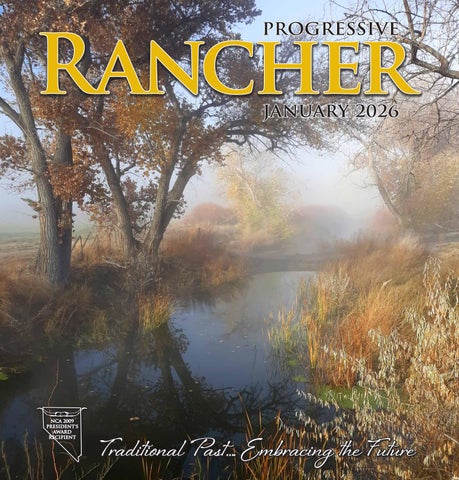
Cover photo by Nan Pennington “Morning stroll with my beloved dogs in Fallon, Nevada.” Published 8 times a year. View all issues at www.progressiverancher.com Readership reaches more than 20,000. The views and opinions expressed by writers of articles appearing in this publication are not necessarily those of the editor. Letters of opinion are welcome; submit via email. Advertising rates available upon request. Advertising does not imply editorial endorsement. Liability for errors or omissions in advertisements shall not exceed the cost of the space occupied by the error or omission.
© The Progressive Rancher Magazine. All rights reserved.
Leana Litten Carey, Owner/Editor
2040 Reno Hwy 432 • Fallon, Nevada 89406 (208) 358-2487 • progressiverancher@gmail.com Read the magazine and more articles online at
WWW.PROGRESSIVERANCHER.COM Ads sent to or built by The Progressive Rancher become property of this magazine.
2 JANUARY 2026
The Progressive Rancher
www.progressiverancher.com
Welcome to 2026! By Dave Baker, NCA President As of this writing, it is still dry in Snake Valley. This extreme drought has forced us to sell cows and our replacement heifers. We are adapting, but continue to hope that weather patterns will change. The Nevada Cattlemen’s Association (NCA) is a policy driven organization. These policies are developed through resolutions that are considered at our annual membership meeting, after the individual proposals are introduced and reviewed by the appropriate committees. Environments, business models, and needs throughout the state vary significantly. Because of the diverse range of operations in Nevada, some issues have proven difficult to form a cohesive policy position. As with any collaborative effort, unanimous support is not always attainable. While our members acknowledge this fact, we must recognize the importance of continued cooperation to support and protect our industry’s interests. Although we may disagree on individual issues, we understand that the NCA is important because of the numerous other industry issues that we face.
We depend on our membership to bring us knowledge and experience with issues, including marketing, labor, wildlife, trespassing, and everything in between - all of which are complicated and often intertwined. We have to advocate appropriately, and can only do so with the active participation of our members. Much akin to making difficult decisions when faced with environmental changes (for instance selling a significant number of cows during a severe drought), some of these difficult conversations regarding policy need to be revisited when political climates change as well. While we can agree to disagree for a time, it is vital that we leave these doors open to further discussion as things evolve. The NCA has the privilege of having a voice at local, state, and federal levels. As such, we must continue to be a respectful and knowledgeable resource or representative on any of these stages.
Nevada is a Purple State – while we currently have a Republican governor, the House and Senate are Democrat controlled, as they have been for nearly a decade. We must work to maintain relationships with both parties to the best of our ability. The political pendulum will continue to swing, and we need to be able to effectively communicate as power changes hands so we can keep a seat at the table. Additionally, the unfamiliarity of our industry and issues is abundant in our state. About 94% of Nevada’s population resides in urban areas. We need to understand this and view it as an opportunity to educate reasonable people with urban backgrounds. We can’t alienate people and expect to be effective in the long run as power shifts and times change. As President, I view myself more as a representative than anything else – not a dictator or policy creator. But with our membership actively engaged, I know we can continue to establish effective policies and, at the same time, respect other positions and perspectives within and outside of the NCA. That’s my rant for this month. Thanks for listening and have a very Happy New Year!
Fallon: 8-5:30 M-F Gardnerville: 8-5 M-F Winnemucca: 8-5 M-F
800-513-4963 • www.pinenutlivestocksupply.com The Progressive Rancher 2026 3 Complete selection of animal health products, feed and equipment for beef, dairy, equine, sheep, goatJANUARY and small animal.
www.progressiverancher.com
by Martin Paris | NCA Executive Director | O: 775-738-9214
Happy New Year! Happy New Year! I hope everyone had a great Christmas. Another year has come and gone in what seems like the blink of an eye. Before I turn the page on 2025, NCA was engaged in a wide range of issues throughout this past year, including our state legislative session, targeted grazing legislation, trespass and public land access issues, species management, grazing regulations, and so much more. In each case, NCA had a seat at the table, ensuring that our members’ voices were heard.
HUTCHINGS RANCH | CHURCHILL CO.
Turnkey horse property! 34+/- acres, water rights for 28. Indoor and outdoor arenas, pens and corrals. 6,500 sf 6 bed, 5 bath custom main home, two 3 bed, 2 bath manufactured homes. 3,000 sf greenhouse, orchard and grapevines. $3,950,000 MLS #3626953
NCA was successful on several measures during the Legislative Session, including stopping a proposal that would have allowed agricultural workers to collectively bargain and would have required employers to pay overtime to agricultural employees. NCA also helped stop a measure that would have doubled liability insurance minimums for trucks hauling more than 26,000 lbs. We successfully worked to introduce the Strategic Grazing to Reduce the Risk of Wildfire Act in the United States Senate with the help of Senator
ANTELOPE VALLEY FARM | LANDER CO.
640 acres / 500+ irrigated; 6 agricultural wells, 4 Zimmatic pivots , 50’x60’ shop with concrete floor; 3 bed, 2 bath 1,620 sf manufactured home, detached 680 sf garage. Strong production history of quality alfalfa, Game Mgmt Unit 156. $2,295,000 MLS # 3624921
Call Today!
ELLIE PERKINS
775-761-0451 NV Lic # S.198106
ellie@ranchnevada.com
For more information on these and other listings, visit
www.outdoorpropertiesofnevada.com 4 JANUARY 2026
Cortez-Masto, which would develop a strategy to graze vacant allotments and establish temporary permits to promote targeted fuel reduction using livestock grazing, among various other livestock grazing centric strategies. NCA and our partners continued to engage with the current Administration on the successful revocation of the BLM’s “Public Lands Rule”, which inappropriately placed conservation as a use on par with other multiple uses. NCA also helped fend off an attempt to designate several Areas of Critical Environmental Concern within Nevada, which were also tied to more stringent sage grouse management regulations across public lands. These items are just a small snapshot of the work NCA engages in. As we turn the calendar to 2026, there is no doubt that a lot more work will need to be done. NCA will continue engaging with the entire political spectrum to make sure livestock producers’ interests, concerns, and needs are known and addressed. NCA has our sights set on several high priority issues as the new year begins to take shape. These include getting new BLM grazing regulations out the door and in place, endangered species listings and amendments to the law itself, continued engagement on trespass on private land, and ensuring Nevada’s water law remains viable and intact, just to name a few. It’s important to hear from you should you feel something needs to be brought forward. Remember, NCA works for you.
The Progressive Rancher
Before I close, I want to thank everyone who consigned cattle to the Silver State Classic Feeder Sale last month at Fallon Livestock LLC. There were a lot of great cattle through the ring this year and prices remained strong. A big thank you to Fallon Livestock LLC for their support year after year. There are also a few noteworthy events taking place in the first part of 2026. The University of Nevada, Reno will again be hosting the annual Cattlemen’s Update in person and virtually from January 12 -16. The University has hosted these sessions across Nevada for more than 40 years to provide ranchers with current, research-based information about issues that may affect the efficiency, productivity, profitability, and sustainability of Nevada’s cattle industry. For additional information on session locations and times during the week of Jan 12-16, please be sure to check out their website, extension.unr.edu/ cattlemens Lastly, if you’re in need of bulls this upcoming season please mark February 14, 2026, on your calendars for the 4th Annual Great Basin Bull Sale in Fallon, NV at the Rafter 3C Event Center If you’re looking to improve the genetics of your operation, there’s no doubt you will be able to find what you’re looking for at the upcoming sale. For more info please check out their site www.greatbasinbullsale.com Until next time www.progressiverancher.com
90th Annual NCA Convention & Trade Show November 13-15, 2025 | The Elko, Nevada Conference Center NCA members around the state gathered in Elko to celebrate a lifetime of traditions, revise and review policies, receive industry updates, and enjoy our friends and neighbors. At the convention, members of the NCA, guest speakers, and vendors who provide services to the beef cattle industry joined together to provide a memorable and educational experience while celebrating the Nevada livestock industry. A big thank you to our sponsors, trade show exhibitors, and to all attendees! President’s Award: Wade Small
100,000 Mile Club: Jeanne King
www.progressiverancher.com
Teacher of the Year: Zach Hunter
Cattleman of the Year: Jon Griggs
The Progressive Rancher
Allied Industry Award: JE Productions
100,000 Mile Club: Harvey Barnes
JANUARY 2026
5
90th Annual NCA Convention
6 JANUARY 2026
The Progressive Rancher
www.progressiverancher.com
Keep involved with what the Council is doing! Follow @CattleCouncil on Facebook, Instagram and Twitter to stay engaged and visit our website to learn about other investments the Council has made: calcattlecouncil.org
A MESSAGE FROM THE EXECUTIVE DIRECTOR
RECENT INVESTMENTS Back to Session Event Highlighted the Role of Beef and Dairy in School Meals
“We’ve done much this year to remind stakeholders and the public at large that California would be a dramatically different place and would significantly feel the loss of our family ranchers, dairy farmers, and cattle feeders should we not be protected as the foundation of our local communities and economies.”
On August 18, we brought together California’s beef and dairy producers, school nutrition leaders, and policymakers to showcase how locally sourced foods fuel student health and success. From interactive booths to a school lunch–inspired meal, the event showed what’s possible when we connect farms to classrooms.
The California Cattle Council has been very busy in 2025, and we plan to close out another successful year advocating on your behalf at the end of this month. Cattle prices continue to remain at an all-time Justin Oldfield high, and even with the recent uncertainty in the futures market, producers have benefited from record-high cash prices throughout the year. High prices have been a relief to balance high input and labor costs, and the downward trend in milk prices we continue to experience. Nevertheless, there is a lot to be thankful for.
In 2025, the California Cattle Council supported and helped advance peerreviewed research examining the real-world impacts of wolves on California ranchers. A multi-year UC Davis study documented both direct and indirect losses associated with wolf presence, including reduced herd health, increased stress, and economic impacts to ranching operations. By investing in credible, science-based research, the Cattle Council worked to elevate ranchers’ experiences, inform policymakers, and ensure that livestock producers’ challenges were grounded in data as discussions around wolf management continued.
Research Provided Data on the Real-World Impacts of Wolves on Cattle Operations
The Cattle Council has continued to invest in impactful projects that seek to educate legislative and regulatory stakeholders about the social, economic, and environmental benefits you, your family, and your operation bring to California and our neighbors every day. We’ve done much this year to remind stakeholders and the public at large that California would be a dramatically different place and would significantly feel the loss of our family ranchers, dairy farmers, and cattle feeders should we not be protected as the foundation of our local communities and economies. I would like to highlight one specific project from 2025 that continues to receive excellent feedback from the public, our intended audience, and producers alike. The Cattle Council has invested in a series of billboards at the Sacramento, Burbank, and John Wayne International Airports. We’ve recently included Fresno International Airport on that list. Those who work in Sacramento’s Capitol community travel at least twice a week through Sacramento and Southern California airports. These billboards are highly effective in displaying a message that simply cannot be missed. For example, all travelers entering Terminal B in Sacramento immediately after leaving the TSA checkpoint are met with an enormous billboard sponsored by the Cattle Council. In 2024 and through part of 2025, this billboard discussed the benefits of grazing for wildfire prevention; however, we’ve recently changed it to highlight the environmental benefits of our dairy farmers and cattle feeders. Our newest version discusses the use of bakery waste and other byproducts that are used as healthy feed for cows that would otherwise go to the landfill. Upcycling has a direct benefit for all Californians by reducing waste in our landfills, and our dairies and feedlots should be credited for the work they do to make this happen. These billboards will continue throughout 2026. We are likely to change them from time to time, so be on the lookout for new advertisements if you travel through these airports. I’m excited for another productive year in 2026, and all of us at the Cattle Council send our hopes that you and your family had a wonderful holiday season and will enjoy a Happy New Year. www.progressiverancher.com
CalResilient Campaign Highlighted the Resilience of California Cattle Producers The California Cattle Council’s CalResilient campaign reached consumers across the state through a strategic mix of broadcast, digital, and outdoor advertising. Broadcast & Cable TV: The campaign ran across multiple California markets, including Sacramento, Fresno, Redding-Chico, Santa Barbara, Santa Maria, and San Luis Obispo, delivering widespread exposure to audiences throughout the state. Digital Platforms: Ads ran across Meta (Facebook and Instagram), Google platforms (YouTube and Google TV), and programmatic display channels, generating strong reach and frequency among California consumers. Outdoor Billboards: Travelers saw CalResilient messaging at major California airports, including Sacramento International, John Wayne International, Hollywood Burbank, and Fresno Yosemite International airports. Through this broad, multi-channel strategy, the campaign ensured that the resilience and value of California cattle producers remained front and center for consumers statewide.
The Progressive Rancher
JANUARY 2026
7
8 JANUARY 2026
The Progressive Rancher
www.progressiverancher.com
ONE EQUALS ONE SIMMENTAL AND ANGUS
performance-tested age-advantaged long-yearling bulls selling at the
Great Basin Bull Sale
Saturday February 14, 2026 at noon | Fallon, Nevada
Mr SR 71 Right Now
KBHR High Road
BCLR Cash Flow
Hook’s Eagle
Hook’s Yellowstone
S A V Cattlemaster
Connealy Legendary
BigK/WSC Iron Horse
EZAR Step Up
Poss Rawhide
Connealy Upscale
Raven Powerball
SIMMENTAL AND SIMANGUS™ LONG-YEARLING BULLS SIRE
ASA #
CE
BW
WW
YW
ADG
DMI
$GN
MCE
MILK
Mr SR 71 Right Now
4453340
KBHR High Road
4453341
BCLR Cash Flow
MWW
STAY
DOC
CW
15.6
-2.4
79.5
128.0
.30
.90
.082
11.0
17.2
-2.5
75.1
115.2
.25
.54
.072
9.9
26.0
64.7
16.5
15.3
24.3
26.6
64.5
14.7
16.1
31.2
4454804
11.6
.3
90.2
135.5
.28
.56
.092
5.9
16.1
60.6
18.0
9.8
42.8
Hook’s Eagle
4454815
11.2
1.0
100.0
151.1
.32
1.02
.082
4.5
23.0
71.8
15.1
11.0
Hook’s Eagle
4454816
12.9
-1.0
100.4
160.6
.38
1.38
.092
5.8
19.8
69.9
14.1
Hook’s Yellowstone
4454818
17.6
-1.6
69.3
101.5
.20
.48
.012
9.3
25.9
61.3
YG
MARB
BF
REA
SF
API
TI
-.34
.44
-.042
.92
-.42
151.9
89.1
-.35
.30
-.048
1.00
-.38
140.4
83.0
-.47
.16
-.091
1.19
-.35
145.8
88.6
43.1
-.37
.26
-.06
1.11
-.46
134.4
91.6
20.8
47.0
-.25
.54
-.038
.98
-.46
155.0
101.4
17.6
13.8
34.0
-.31
.35
-.063
.80
-.43
156.8
83.7
ANGUS LONG-YEARLING BULLS SIRE
AAA #
CED
BW
WW
YW
RADG
DMI
SC
HP
CEM
MILK
CW
MARB
RE
FAT
$M
$W
$F
$G
$B
$C
S A V Cattlemaster
21145337
7
2.5
76
129
.26
1.32
.50
10.9
8
30
59
1.09
.66
.033
68
78
99
73
172
291
Connealy Legendary
21145367
11
-.6
-.6
110
.26
.30
1.54
14.9
12
19
44
1.18
.83
-.014
71
61
95
83
178
302
BigK/WSC Iron Horse
21145403
12
-1.0
82
144
.28
1.52
.77
13.6
10
29
69
1.20
1.21
-.006
108
96
115
88
203
371
BigK/WSC Iron Horse
21145404
9
.9
72
135
.30
.97
.89
12.0
10
24
49
.61
1.18
-.088
78
67
93
65
159
284
EZAR Step Up
21145412
3
1.8
83
142
.29
1.43
1.44
8.8
10
29
65
1.34
.65
.047
82
89
110
84
195
335
EZAR Step Up
21145413
7
1.5
76
131
.28
1.11
.89
14.2
13
36
57
1.30
1.21
.018
106
90
97
91
189
351
Poss Rawhide
21145674
18
-2.8
68
114
.25
.72
.85
10.4
11
26
37
1.10
.44
.069
89
76
77
68
146
278
Connealy Upscale
21147223
4
1.8
77
141
.29
1.51
1.29
13.6
7
35
66
.80
.92
-.014
81
84
110
66
176
309
Raven Powerball
21154412
3
2.2
68
116
.23
1.03
.70
11.5
8
26
44
.44
.87
-.059
83
65
84
51
135
258
TOP 35%
View videos or request a sale book at greatbasinbullsale.com Ben Berthelson: ben@berthelsoncpa.com | (208) 731-0099 www.progressiverancher.com
The Progressive Rancher
JANUARY 2026
9
Hone Ranch Bulls To Great Basin Bull Sale RAFTER 3C ARENA || 12:00 PM
FEBRUARY 14, 2026 Tattoo 4107 4101 4096 4108 5053 5060 5010 5069 5024 5067 5048 5050 5031 5058 5032 5011 5046 5033 5044
Reg. 21135031 21135030 21135025 21135032 21260500 21260476 21260488 21260479 21260470 21260478 21260498 21260474 21260492 21260502 21260493 21260489 21260497 21260471 21260496
DOB 9/15/2024 9/12/2024 9/3/2024 9/20/2024 2/18/2025 2/21/2025 2/1/2025 2/25/2025 2/9/2025 2/25/2025 2/17/2025 2/15/2025 2/10/2025 2/20/2025 2/10/2025 2/1/2025 2/16/2025 2/10/2025 2/16/2025
Fallon, Nevada Sire GSAR Unique 11M GSAR Unique 11M GSAR Unique 11M GSAR Unique 11M MJB 131J of 789 522C Moore Resilient 115A GSAR Unique 11M Moore Resilient 115A Moore Resilient 115A Moore Resilient 115A MJB 131J of 789 522C Moore Resilient 115A MJB 131J of 789 522C MJB 131J of 789 522C MJB 131J of 789 522C MJB 131J of 789 522C MJB 131J of 789 522C Moore Resilient 115A MJB 131J of 789 522C
Charlie and Vicki Hone honeranch@gmail.com (775)691-1838 490 Mottsville Lane, Gardnerville, Nevada 89460
CED BW EPD WW EPD YW EPD $M $B $C 18 -1.6 79 143 $94 $139 $274 10 0.1 82 138 $96 $154 $296 3 2.5 83 133 $91 $137 $269 8 1.7 68 126 $87 $150 $282 4 2 64 119 $70 $179 $302 9 2.2 82 141 $66 $125 $228 11 0.7 67 127 $92 $172 $315 7 1.1 76 134 $101 $151 $297 10 -1.3 66 114 $82 $105 $218 10 0.6 77 131 $88 $112 $233 4 1.5 71 128 $43 $117 $195 7 1.3 86 144 $96 $143 $281 10 0.7 71 120 $79 $139 $259 0 2.7 65 115 $18 $194 $270 6 1.2 63 112 $60 $158 $265 7 2.8 65 121 $49 $169 $268 10 -1.4 55 91 $19 $137 $197 6 0.3 84 140 $75 $152 $272 1 3.3 70 122 $61 $160 $269
QUALITY IN VOLUME YEAR AFTER YEAR! CALVING-EASE, MATERNAL, LONGEVITY, FEED EFFICIENCY AND POWER ALL RAISED IN SAME ENVIRONMENT YOU ARE IN!
5010 SALE MANAGEMENT: Matt Macfarlane 916-803-3113
www.m3cattlemarketing.com M3cattlemarketing@gmail.com
Our Award Winning Bulls are consigned to...
Great Basin Bull Sale February 14, 2026 UBIA
Utah Beef Improvement Association
March 21, 2026
Midland Bull Test April 2 & 3, 2026 Private Treaty at the Ranch 10 JANUARY 2026
The Progressive Rancher
www.progressiverancher.com
Over 275 head entered EARLY FALL PERFORMANCE CONSIGNORS Cardey Ranches, CA Carter Cattle Company, NV Cope Cattle, CA Dixie Valley, CA Hamilton Angus, MT Hone Ranch, NV
One Equals One Simmental and Angus, ID Popovits Family Ranch, CA Riverbend Meadow Ranch, CA Westwind Ranch Angus, IL Wright Farms, OR
LATE FALL PERFORMANCE CONSIGNORS Bishop Cattle Company, ID Carter Cattle Company, NV Cope Cattle, CA Neal Cattle Company, CA One Equals One Simmental and Angus, ID
Popovits Family Ranch, CA Riverbend Meadow Ranch, CA Steve Smith Angus and Gelbviehs, UT Westwind Ranch Angus, IL Wright Farms, OR
FEBRUARY 14, 2026
SPRING YEARLING CONSIGNORS Bishop Cattle Company, ID Bullhead Ranch Carson Angus Ranch, UT Cunningham Land and Livestock, IL Diamond L, GA Dixie Valley, CA Gem State Angus Ranch, ID Hone Ranch, NV Jorgensen Charolais, CA
Rafter 9, NV Rafter Bar B, NV RC Cattle, CA Rio Segura, NV Riverbend Meadow Ranch, NV Steve Smith Angus, UT Wild West, OR Wright Farms, OR
RANGE BULL CONSIGNORS Brunson Cattle Company, NV One Equals One, ID Romans Angus and Brangus, OR Dixie Valley, CA Hone Ranch, NV Steve Smith Angus & Gelbviehs, UT Rafter 9 Ranch, NV Flying RJ , CA Wild West Angus , OR Mrnak Herefords West, NV
RAFTER 3C ARENA || 12:00 PM
Amador Angus, CA Easterly Romanov, CA WC Carpenter Red Angus Hertlein Cattle Company, CA Heluva Ranch, ID Wooden Shoe Farms, ID Gudel Cattle Co., CA Gem State Angus Ranch, ID Kern Cattle, CA
Exciting announcement
We’re thrilled to share that Joe Nichols will be headlining this year’s event — bringing hit songs like “Tequila Makes Her Clothes Fall Off” and “The Impossible.” Join us Thursday, February 12, from 7–9 PM at the Rafter 3C Arena for an unforgettable evening of live music. Tickets are $65 per person and go on sale December 1.
Fallon, Nevada 325 Sheckler Road, Fallon, Nevada 89406
• ANGUS • SIMANGUS • CHAROLAIS • SIMMENTAL • BALANCER • HEREFORD • ULTRABLACK
SCHEDULE OF EVENTS THURSDAY, FEBRUARY 12 5 - 9 PM - 3C Ranch Rodeo and Team Branding 7 - 9 PM Joe Nichols Concert FRIDAY, FEBRUARY 13 9 AM - 3 PM - Ranch Rodeo 4:30 PM - Doors Open 5 PM - Bull Sale Dinner 6 PM - Bulls and Broncs Buck SATURDAY, FEBRUARY 14 NOON - Bull Sale Lunch 1 PM - Great Basin Bull Sale THURSDAY - SUNDAY VENDOR TRADE SHOW OPEN TO THE PUBLIC. SALE HOSTS: HONE RANCH GUDEL CATTLE CO. WESTWIND RANCH Charlie Hone Kris Gudel ANGUS 775-691-1838 916-208-7258 David Holden honeranch@gmail.com gudelcattleco@gmail.com 530-736-0727 wstwind@hotmail.com
SALE MANAGEMENT:
AUCTIONEER:
Matt Macfarlane 916-803-3113 www.m3cattlemarketing.com M3cattlemarketing@gmail.com
Jake Parnell 916-662-1298
Performance-Tested and Range-Ready Bulls www.progressiverancher.com
The Progressive Rancher
JANUARY 2026
11
Unwrap the Value & Versatility of Beef for the Holidays By Christie Van Egmond, Director of Retail & Foodservice Marketing As we close out 2025, it’s exciting to know beef is on the table for the holidays. Food— and especially beef—is a central part of many holiday celebrations, traditions, and recipes. While many consumers are still planning to splurge this year to have roasts and steaks at the center of their holiday meals, some may be looking for other creative ways to incorporate beef into their celebrations to reduce their food costs and be budget conscious. Holiday traditions remain a steady force, offering familiarity even as consumers adjust other parts of their celebrations. For many households, beef is central to that story, with prime rib and steak continuing as popular holiday selections.1 These premium cuts reflect both tradition and a readiness to invest in meaningful occasions. Most (94%) consumers say they can be
12 JANUARY 2026
persuaded to spend more on meat when the occasion feels right, and over a third point to holidays like Thanksgiving and New Year’s as moments worth the splurge.2 Yet even as consumers show a willingness to invest in premium cuts, they are also balancing affordability and ease. Families want holiday meals that feel special but often need solutions that fit tighter budgets and limited prep time. That is why sauces, marinades, budget-friendly cuts, and appetizer ideas stand out—they serve as practical prep tools that stretch flavor and dollars while also functioning as versatile solutions, helping beef deliver both value and celebration.1 That adaptability also opens the door to occasions beyond the centerpiece holiday dinner. While beef anchors traditional celebrations, there is growing opportunity to extend its role in brunches, lunches, small bites, and casual gatherings.1 The holiday
The Progressive Rancher
season is not defined only by the main event, as it is filled with everyday moments and spontaneous get-togethers. Beef ’s versatility allows it to meet both emotional and practical needs, helping consumers create simple yet meaningful experiences throughout the season, even on a budget. SOURCES
Excerpts in this article are directly from Beef ’s Enduring Role in Holiday Celebrations, 2025 online at https://www.beefresearch. org/resources/market-research-planning/ white-papers/landing/beefs-enduring-rolein-holiday-celebrations2025 1. Holiday Consumer Survey, September 2024. Survey conducted by National Cattlemen’s Beef Association, a contractor to the Beef Checkoff 2. Annual Meat Conference, The Power of Meat 2025
www.progressiverancher.com
A Balanced Meal, Built Around Beef By Kori Dover, RD, Nevada Beef Council As the new year gets underway, many meals shift back toward cooking at home and building plates that include a variety of foods. This Beef and Kale Bolognese shows how beef can anchor a meal while other ingredients round out the plate. Ground beef provides protein along with nutrients like iron and zinc, while vegetables such as onions, carrots, celery, and kale add color, texture, and nutrients that fit naturally into a familiar dish. Kale may not be a traditional ingredient in pasta sauces, but it blends easily into recipes like this and helps contribute vitamins A and K and fiber to your diet. The tomato-based sauce provides vitamin C, which plays a role in helping the body absorb iron from beef. When beef, vegetables, and grains are served together, each component complements the others, creating a meal that delivers both flavor and nourishment in a way that feels practical and approachable. Source: U.S. D.A. Agricultural Research Service. FoodData Central. https://fdc.nal.usda.gov
www.beefitswhatsfordinner.com
Recipes & photos courtesy of
Ingredients:
Cooking:
1 pound Ground Beef (96% lean or leaner) 1 tablespoon olive oil 1 cup chopped onion 1 tablespoon minced garlic 1 cup chopped celery 1 cup chopped carrots 2 cups shredded kale 2 cans (6 ounces each) no-salt added tomato sauce 1/4 teaspoon salt, 1/2 teaspoon ground black pepper 1/4 teaspoon crushed red pepper 1 package (16 ounces) uncooked Pappardelle pasta 2 tablespoons reduced-fat grated Parmesan cheese 2 tablespoons thinly sliced fresh basil
1. Heat oil in stockpot over medium heat until hot. Add Ground Beef, onion and garlic; cook 8 to 10 minutes, breaking into 3/4-inch crumbles and stirring occasionally. Cook’s Tip: Cooking times are for fresh or thoroughly thawed Ground Beef. Ground beef should be cooked to an internal temperature of 160°F. Color is not a reliable indicator of ground beef doneness. 2. Stir in celery and carrots; cook 3 to 5 minutes. Add kale, tomato sauce, salt and peppers; simmer 10 minutes to develop flavors, stirring occasionally. Meanwhile, cook pasta according to package directions. 3. Serve over pasta; garnish with Parmesan cheese and basil.
Nutrition information per serving, 1 cup sauce and 4 ounces pasta: 462 Calories; 72 Calories from fat; 8g Total Fat (2.3 g Saturated Fat; 0 g Trans Fat; 0.5 g Polyunsaturated Fat; 3.2 g Monounsaturated Fat;) 52 mg Cholesterol; 216 mg Sodium; 73 g Total Carbohydrate; 6.2 g Dietary Fiber; 7.9 g Total Sugars; 28 g Protein; 0 g Added Sugars; 62 mg Calcium; 3.7 mg Iron; 755 mg Potassium; 0 mcg Vitamin D; 0.2 mg Riboflavin; 0.6 mg NE Niacin; 0.4 mg Vitamin B6; 1.6 mcg Vitamin B12; 188 mg Phosphorus; 4.3 mg Zinc; 12 mcg Selenium; 58.4 mg Choline. This recipe provides Dietary Fiber, Protein, Iron, Vitamin B6, Vitamin B12, Zinc, Selenium, Potassium, Riboflavin, Phosphorus, and Choline.
www.progressiverancher.com
The Progressive Rancher
JANUARY 2026
13
Not Much Change Coming Looking ahead, I do not see a lot of change in the coming year in terms of impacts to the livestock industry. Let’s start with an overarching quote that should get everyone’s attention. John Locke is widely regarded as one of the foundational and philosophical influencers of the American Revolution and the basis for our Declaration of Independence and Constitution. Here is one of the things he wrote: “The legislative cannot transfer the power of making laws to any other hands; for it being but a delegated power from the People, they who have it cannot pass it over to others.”
still about the same. There is an historic small supply of numbers even with relatively similar amounts of product being offered at retail. There are also greater cost inputs to get that product to market and thus even with historic high gross receipts cattle growers are facing much higher costs. Our customers in the cow/calf sector are also facing substantial increases in the prices of things they need to stay in business. There is nothing uncomplicated about these markets which means there are no easy fixes or one-time shots of silver bullets. The cattle industry has never depended on help from outside. The advice for the coming year-let these markets figure themselves out.
In fact, Article 1, Section 1 of the United States Constitution says: “All legislative Powers herein granted shall be vested in a Congress of the United States, which shall consist of a Senate and House of Representatives.”
Without a packing industry the entire cattle sector would fall apart. Speaking of complicated, I have never felt that the packers were united to harm their suppliers of the commodities they need to process to have their businesses survive.
Even though there have been well-meaning attempts to interfere with commodity markets (cattle is an example for instance) the market fundamentals are
Will drought persist through out the major livestock raising parts of the country with disruptions in “normal” weather patterns? This is an important
question because it is well accepted, in my belief, that this is a major cause in the reduction to the nation’s cow herd which is one of the factors in higher prices being paid for calves and therefore a delay to increase the cattle numbers across the country. Again, there are no easy answers to solving some of these market problems. There will not be much change in the dealings the industry has with the relevant agencies governing our businesses and resources. My experience this past year has been the agencies are more open for discussion and creative thinking all the while staying within the barriers created by the statutes. Nevertheless, some questions remain for answers such as what about wolf predation, repealing the public lands planning rule, the new definition of what constitutes a “water of the United States,” is fake meat finally set to take market share from real meat, new world screw worm incursions into Southern cattle growing areas etc.? By the way, when will public lands ranchers see a new National Director of the Bureau of Land Management? Will your grazing permit be renewed in a timely manner? Will the BLM get creative in its task of managing wild horses overwhelming the ranges where they live? So, I can only conclude that what we experienced last year will be in effect this coming year. However, there is an elephant in the room. I am referring to the mid-term congressional elections. Many pundits are issuing predictions citing recent elections for some mayors and a few members of congress. They think these are evidence big changes are in store from next year’s ballots.
MISSION STATEMENT | To prepare communities in central and eastern Nevada for sound water-resource decisions that promote prosperous economies and strong civic institutions in a healthy natural environment. For more information, please contact:
Jeff Fontaine, CNRWA Executive Director 775-443-7667 / ccjfontaine@gmail.com / CNRWA.COM 14 JANUARY 2026
The Progressive Rancher
What I have not heard is something in my experience that is obvious. From a politics standpoint nine months is an eternity. So many unpredictable things can happen and usually do that surprise everyone including so-called experts I would say therefore: stay tuned and remain informed enough to judge things for yourself. I’ll see you soon. www.progressiverancher.com
LB 2.95/
$
Market
Where you’re a
Name,
Not a Number
If you’re looking to sell a farm or ranch, give us call!
New Terms on Fish Creek Ranch in Eureka Co. Now Offering to sell 100% interest in the ranch. Lots of irrigation water from springs that arise on the ranch. Mine owner wants to reserve some water rights and Sage Grouse credits and 100 acres off the East side for a future Man Camp. Mine would pay for the Sage Grouse Credits at the new price: Over 2597 deeded with approx. 1000 acres water righted out of the Springs. 5 homes plus multiple other outbuildings. Price: $4,000,000.
©Doverspike
Humboldt River Acreage with Water Rights 650 acres on the Humbold River with over 300 acres of surface water rights. Just East of Elko approx. 13 miles. Has access onto the Ryndon Exit. With the new conjunctive management of water by the state, this should add future value to this property. Price reduced! $1,200,000 $950,000 Paul Bottari, Broker ALC 775-752-0952 NV Broker License No B015476
January 6
Consignment Deadline: December 29 North Platte Stockyards | North Platte, NE
January 29
Consignment Deadline: January 21 Tehama District Fairgrounds | Red Bluff, CA (530) 347-3793 wvm@wvmcattle.com www.wvmcattle.com
BottariRealty.com • 775-752-3040 www.progressiverancher.com
The Progressive Rancher
JANUARY 2026
15
Welcome to Nevada Farm Bureau’s Agriculture in the Classroom! Our mission is to promote, preserve, & protect Nevada agriculture through advocacy, education, & leadership. Ag in the Classroom connects educators with agricultural resources, support, & guidance to bring agricultural education into the classroom.
Silver State Ag Fact
In the early Nevada ranching days, cowboys often cooked campfire chili during long cattle drives. Ranch cooks, known as chuckwagon cooks, used dried chilies, beans, and available beef trimmings to make a hearty, flavorful chili to feed hungry ranch hands. Because chili ingredients stored well and added bold flavor to tough cuts of beef, it became a staple on Nevada ranches throughout the late 1800s and early 1900s.
Star Volunteers
Leana Carey of Fallon is an outstanding and ambitious volunteer for Nevada Ag in the Classroom. Her dedication continues to inspire students, educators, and community partners. Her leadership was instrumental in coordinating with Lahontan Elementary School administration and several local businesses to develop a thriving school garden at EC Best Elementary School. More than 450 students planted the garden during the school’s annual Ag Fest. Leana’s vision for agricultural education doesn’t stop there. She has recently initiated an exciting student-created agriculture mural project in partnership with Ag in the Classroom schools. Once completed, the mural will be proudly displayed at the local museum and later showcased at the Cantaloupe Festival of Fallon. Through her creativity and commitment, Leana is expanding the reach of the Ag in the Classroom program and strengthening the connection between students and the rich agricultural heritage of their community. Leana was recently recognized by the Nevada Agricultural Foundation as an outstanding Ag in the Classroom volunteer and awarded the Excellence in Education award with $1000 to use toward Ag in the Classroom projects. Congratulations Leana Carey and thank you for your commitment to Nevada Ag in the Classroom!
Exciting News for Nevada AITC
Robin Futch, the Nevada Farm Bureau Director of Agriculture Education, has been selected as a Western Regional Representative for the National Agriculture in the Classroom organization. Regional representatives serve as a mentor and liaison between their regions AITC coordinators and the national organization. Having Robin as a state representative shines spotlight on our state’s commitment and dedication to agricultural education.
Program Spotlight
E.C. Best Elementary School in Fallon shined during its historical literacy chili cookoff, a family-centered event that blended delicious food with rich local history. Families arrived with crockpots of their best chili recipes, filling the room with amazing aromas and friendly competition. The literacy theme highlighted significant historical events from Fallon’s past, and community partners set up engaging displays that shared fascinating stories—which connected to the region’s deep agricultural roots. Nevada Farm Bureau participated by representing Nevada Ag in the Classroom along with the state’s important corn and beef industries, helping students and families make meaningful connections between local history, literacy, and agriculture. What a cool concept for bringing agriculture knowledge to a community. Awesome job EC Best! 16 JANUARY 2026
Ag Wagon News
The Ag Wagon is busy serving southern Nevada, and Clark County schools are lining up for their chance to experience its hands-on Ag Day adventures. Traveling throughout Las Vegas, the Ag Wagon brings agriculture to life for students. Additional stations include: Moolissa the dairy cow, friendly poultry and goats, an engaging bee display, interactive STEMbotics activities, and a Sow & Grow seed planting station. Each visit offers students a fun and memorable way to explore agriculture, food systems, and science. With demand still growing, the Ag Wagon will continue making stops at Clark County schools into March, ensuring thousands of students have the opportunity to learn about Nevada agriculture in an exciting and meaningful way.
National AITC Conference
The National. AITC Conference is a premier professional development event for K-12 teachers, volunteers, and professionals in agricultural literacy. Mark your calendar now for next year’s National Conference: Illuminating Agriculture, to be held in Providence Rhode Island, June 22-25, 2026. Build your knowledge & get linked to Ag in the Classroom.
Safety Posters Have Arrived!
Our awesome Agriculture safety posters are now available to put up in your classrooms. The size is 11X14. A safety activity worksheet is available to accompany the poster. Email robin@nvfb.org if you are a teacher or know a teacher who would like to have one of these great posters.
Ag Day Calendar for Classroom Fun!
National Ag Day was started in 1973 to increase public awareness of agriculture’s role in society. Each year, National Ag Day recognizes and celebrates the abundance provided by farmers & ranchers across the United States. For cool info to teach on National Ag Days, visit www.agdaily. com/lifestyle/list-of-national-days-in-agriculture
Support Ag Education!
Donations directly support Ag in the Classroom, providing teachers with essential materials and hands-on learning opportunities for students. Every contribution makes a difference, so please consider donating today at https://members.nvfb. org/atlas/forms/donation/2
The Progressive Rancher
NOVEMBER 17th - National Butter Day 20th- National Rural Health Day DECEMBER 5th – World Soil Day 13th- National Day of the Horse 17th – National Maple Syrup Day JANUARY 6th – National Bean Day 9th – National Apricot Day 11th – National Milk Day 24th – National Peanut Butter Day FEBRUARY 4th – National Hemp Day 17th – National Cabbage Day
www.progressiverancher.com
Spring Cove Genetics Bull Sale
Over 75 Sons of Spring Cove Grant 200K REG 20669598 sell March 9th 2026 CED+6 BW +.4 WW+79 YW+141 SC+1.32 MILK +25 FL+1.19 CLAW+.34 ANGLE+.44 PAP+.55
Monday, March 9, 2026 Featuring sons & daughters of:
GRANT * WARBUCKS * ESSENTIAL * FEAT * RED STATE * BEDROCK
Progeny of Sitz Feat 729H sell March 9th, 2026 REG 19677962 CED+1 BW+2.9 WW+81 YW+138 SC+.92 MILK +19 FL+1.09 PAP-.94 CW+72 MARB+.53 RE+.91 $M+88 $C+306
Spring Cove Ranch Female Connection S, Nov. 23, 2025 Spring Cove Ranch Bull Sale, March 9, 2026 Over 75 Sons of Spring Cove Grant 200K REG 20669598 sell March 9th 2026 CED+6 BW +.4 WW+79 YW+141 SC+1.32 MILK +25 FL+1.19 PAP+.55 CW+67 MARB+1.10 RE+.57 $M+109 $C+339
Progeny of Sitz Essential 731J sell March 9th, 2026 REG 20003666 CED+14 BW-2.7 WW+70 YW+131 SC+1.31 MILK +22 FL+1.02 PAP-2.94 CW+57 MARB+1.12 RE+.23 $M+64 $C+288 Art Butler: 208-280-1026 Josh Mavencamp: 208-358-0057 Denise Mavencamp: 208-490-3126 Sarah Helmick: 208-490-0741 Randy Lancaster: 208-731-1947 M3, Matt Mcfarlane 916-803-3113
For sale books call or text:
Over 50 Sons of Pine View Warbucks L114 REG 20638633 sell March 9th 2026 CED+5 BW +2.6 WW+87 YW+158 SC+1.56 MILK +22 PAP+.23 CW+78 MARB+1.51 RE+1.39 $M+67 $G+106 $B+225 $C+359
www.progressiverancher.com
The Progressive Rancher
Stacy Butler at 208-320-8803 www.springcoveranch.com 269 Spring Cove Rd Bliss, Idaho 83314
JANUARY 2026
17
Nevada Farm Bureau
Reflections & Anticipation By Doug Busselman | NFB Executive Vice President As 2025 comes to a close and 2026 begins, we take time to reflect on the past and look ahead to the future. Because 2025 was a Nevada Legislative year a lot of our attention was focused on that. It turned out to be a mixed bag of a session with some pretty significant wins to celebrate, a few wins that came in the form of legislation that wasn’t passed and a few things that unfortunately passed that shouldn’t have. One bill that passed the Legislature and was signed by the Governor, but perhaps should have remained at the bottom of a desk drawer, was SB 260. As things stand it fits on the lists of both reflection and anticipation. We can look back at the Legislative Session and consider what might have been done differently to get across the message of just how unworkable this is going to be for most of Nevada. From what we are being told the next draft of the regulations will be coming out in early January. Following the final draft it will go to hearing and then move forward for consideration of adoption by the Legislative Commission. The bill dealt with directing the Administrator of the Division of Industrial Relations of the Department of Business and industry to develop regulations. The regulations are specifically aimed at smoke from wildfires and specifically direct the actions that are to be taken when air quality index exceed 150 and 300 or more. In the case where the index is higher than 150 and less than 200 the employer must make mask available. If the air quality index is at or above 300 the requirements are to not allow an employee to perform critical or non-critical task outdoors. First and foremost, most of Nevada is not covered by monitoring equipment to determine what the air quality index could be. It might be possible to obtain a color chart from the Nevada Division of Air Quality. This tool is based on various photographs taken in Carson City, where there are different levels of air quality index. You basically hold their color photo up against the sky and then by your assessment of where the match between the color photo levels and sky you are comparing. 18 JANUARY 2026
The regulation only applies to employers with 11 or more employees or an employer who employs a commercial truck driver (this is being interpreted to be an employee with a CDL license). We will be keeping an eye on how the regulations end up in the final proposal that goes to the Legislative Commission for approval. We will also be working to keep all agricultural producers and employers in rural Nevada to be on the watch for the Small Business Impact survey that the Division of Industrial Relations is required to send out. Reporting on this survey will be a very important step in communicating the consequences of having this misguided regulation adopted.
Water In The 2025 Session: There were a number of key wins in the 2025 Nevada Legislature. In a couple of bills (AB 104 and SB 36) the wins came in passage and moving forward with options for voluntary sale and retirement of water rights in over-appropriated and overpumped ground water basins. More work is needed in getting the new programs funded, but building a legislative framework was a key accomplishment. There was also success in preventing a bill from passing. SB 31 was an attempt to release federal agencies from the responsibility of having to turn in their claims to vested water rights by December 31, 2027. Nevadans with claims to vested water rights must have to turn their claims in to the State Engineer under this deadline or those rights will be determined abandoned. The argument that all should be treated the same carried the day and the Assembly Natural Resources Committee stopped the proposed legislation from going forward. It remains to be seen what might take place in the 2027 Legislature and the deadline of December 31, 2027. It also remains to be seen whether Nevada government will hold firm in requiring the federal agencies to follow the same requirements that they say they are going to require of the private sector. In all the water legislation that surfaced in the 2025 Legislative Session, the key was the collaboration that various groups, organizations and different water interests did together. The consensus was not quickly arrived at. Foundations of legislation was built over time by representatives who have worked The Progressive Rancher
hard to find common ground. The water buyout and retirement bills were nearly one-and-half years in the making. Where there wasn’t agreement, those concepts weren’t included in the successful versions of what become law.
Who Has Oversight Of Food: A couple of key bills have led to potentially some significant opportunities. AB 352 was introduced by Assemblymember Natha Anderson from Sparks. She was also the chair of the Assembly Natural Resources Committee. The bill dealt with expanding opportunities for cottage food and other cottage businesses, as well as farm-to-fork enterprises. Prior to the passage of the bill, cottage food businesses were limited to $35,000 of sales and needed several different licenses. There were also limitations and requirements for how you could sell your products. Farm-to-fork enterprises were also heavily limited and controlled by various health districts through the state. The health districts were intent on promoting their control and consistency was not a high priority. The rules were somewhat of whatever an inspector decided they wished them to be. Now there is only one required license and the limitation for revenue as been raised to $100,000. SB 466 fits together with AB 352 because the Senate bill moves authority to regulate and permit food establishments from the Division of Public and Behavioral Health to the Department of Agriculture. The Nevada Department of Agriculture gained additional authority over cottage food operations and farm-to-fork events Adoption of regulations within the Department of Agriculture’s Nevada Administration Code (NAC) will be dealt with over the course of 2026.
The Biggest Anticipation Of 2026: 2026 is an election year and what happens in November of 2026 will be extremely important. The election will establish the direction Nevada will take, not only with the 2027 Legislature but also government wide for the next four years. Best wishes to you and your families for 2026!
www.progressiverancher.com
The Importance of Nevada Farm Bureau: Strengthening Nevada Agriculture From the Ground Up By Brittney Money | NFB Director of Communications
Nevada agriculture is built on grit, resilience, and a deep commitment to feeding our communities. Behind the scenes and often on the front lines, NFB works every day to ensure that farmers and ranchers have the support, representation, and resources they need to thrive. From grassroots policy work to hands-on programs that strengthen rural communities, Nevada Farm Bureau continues to be one of the most influential voices for agriculture at both the state and national levels.
Valuable Benefits for Members
How to Join Nevada Farm Bureau
Membership in Nevada Farm Bureau is more than just supporting advocacy, it comes with a variety of practical, money-saving benefits designed specifically for farmers, ranchers, rural businesses, and families. Some key Member Benefits include:
Becoming a member is simple and open to anyone who supports agriculture. Whether you’re a producer, agribusiness professional, or someone who simply values Nevada’s rural heritage.
Nevada Farm Bureau is the unified voice of agriculture in the Silver State. Through memberdriven policy development and active engagement during the legislative session, Farm Bureau ensures that the needs and concerns of producers are front and center.
• Discounts on products, services, travel, equipment, and more
A Strong Voice in Nevada Legislation
Whether it’s advocating for reasonable water management policies, defending private property rights, improving rural infrastructure, or supporting programs that strengthen local food production, NFB works directly with lawmakers to protect the future of Nevada agriculture.
Influence at the National Level
Nevada Farm Bureau is part of a larger, powerful network through its affiliation with the American Farm Bureau Federation. This gives Nevada producers a seat at the table in Washington D.C., where decisions on taxes, trade, environmental regulations, and farm programs can shape the future of every operation, large or small.
• Advocacy Representation at the state and national levels
• Access to educational programs, ag-in-theclassroom resources, and leadership development
• Nevada Farm Bureau Buyers Guide to connect members with trusted ag services and partners
• Networking opportunities through county Farm Bureaus, events, and annual meetings
• Timely communication on legislation, regulatory updates, and issues affecting agriculture
NFB is ensuring agriculture remains strong, not just for today, but for the future. By joining, you become part of a powerful statewide network dedicated to preserving the values, integrity, and economic vitality of farming and ranching in Nevada.
Why Nevada Farm Bureau Matters Nevada is one of the most unique agricultural landscapes in the country. Our producers face challenges ranging from water scarcity to vast geographic distances to strict regulatory frameworks. Nevada Farm Bureau is dedicated to ensuring that agriculture remains sustainable, profitable, and respected.
Investing in Youth Ag Education
Nevada Water Solutions LLC
A strong future for agriculture begins with knowledge, and Nevada Farm Bureau is committed to helping the next generation understand where their food, fiber, and fuel come from. Through programs like Ag in the Classroom and the Nevada Ag Wagon, thousands of students each year get hands-on, engaging experiences that bring agriculture to life. These programs teach children about crops, livestock, conservation, and the role agriculture plays in their everyday lives. By helping students connect with the people who grow their food, Farm Bureau is planting seeds of curiosity, understanding, and respect for Nevada agriculture. www.progressiverancher.com
To join, visit www.nvfb.org and click “Join Now”. Then choose your membership type and complete the registration. Or you can scan the QR code below with your smart phone camera to easily join. If you have more questions or would like to join over the phone please call the Nevada Farm Bureau office at 775-674-4000.
Water Rights / Resource Permitting Expertise
Thomas K. Gallagher, PE 775•825•1653 / FAX 775•825•1683 333 Flint Street / Reno, NV 89501 tomg@nevadawatersolutions.com The Progressive Rancher
JANUARY 2026
19
Nevada Farm Bureau Department of Agriculture Update On Nevada’s Meat Program The Nevada Department of Agriculture (NDA) is now accepting applications for the Nevada State Meat and Poultry Inspection Program. The United States Department Of Agriculture (USDA), finalized their approval for this program earlier this year. Through the full launch of the new program it is believed that Nevada’s food system will be enhanced by allowing for meat to be processed and sold in Nevada.
“Nevada’s livestock industry plays a vital role in the state’s agricultural landscape, primarily made up of family-owned and mid-sized operations across rural Nevada,” said NDA Director J.J. Goicoechea. “The Nevada State Meat and Poultry Inspection Program will offer new opportunities to these producers, improve Nevada’s supply chain, and increase access to truly locally grown and raised food in the state.”
The NDA is committed to protecting public health and strengthening Nevada’s food system by enabling Nevadans to establish and operate meat and poultry processing facilities within the state. Through the State Meat and Poultry Inspection Program, the NDA ensures that all products meet the highest standards of safety, quality and regulatory compliance. With applications now open for new meat and poultry plant permits, this program plays a vital role in expanding local processing capacity, supporting Nevada’s agricultural economy, and increasing access to safe, locally produced food. Nevada Farm Bureau policy has pressed for this program for several years and we are pleased to see Nevada reach this point. Nevada’s State Meat and Poultry Inspection Program operates under all relevant state laws and meets or exceeds the standards of the USDA’s Food Safety and Inspection Service (FSIS). This ensures that all meat and poultry products sold in Nevada are safe for consumers and produced in accordance with health and safety regulations.
Grassroots News Facility Plan Review Fee: $750 (one-time, unless the facility is renovated or modified)
Once the application and fees are received, a plan review will be initiated. Applicants are encouraged to submit all required documentation with their application to avoid delays. Additional Documentation:
The scope of your operation will determine whether a state inspection or custom-exempt inspection is required. You may also need to provide letters of approval from other agencies. These may include, but are not limited to: • State and county business licenses • Water system approval
• Approved sewage removal
• Qualifying USDA exemptions • County zoning approval
• All materials should be submitted to: MeatInspection@agri.nv.gov. REGULATIONS & RESOURCES
For reference, the following links provide relevant state and federal regulations: State Regulations: www.leg.state.nv.us/ Register/2023Register/R003-23AP.pdf
Federal Regulations: https://www.ecfr.gov/current/ title-9/chapter-III
For questions, visit agri.nv.gov/meat or contact the Nevada Meat and Poultry team at MeatInspection@ agri.nv.gov or 775-710-1723.
Nevada Farm Bureau Actively Pursuing Assistance For Nevada Producers In Need
Nevada Farm Bureau President, Bevan Lister, while attending the American Farm Bureau Federation (AFBF) Annual Policy Resolutions Committee Under this program, NDA inspectors must be present meeting in Washington, D.C. had the opportunity to during the slaughter and processing of meat and meet with high level officials with the Department of poultry products in order to be eligible for sale within Interior (Director of the U.S. Fish and Wildlife Service the state. Inspectors verify the humane handling of and Assistant Deputy Director of the Dept. of Interior. animals, conduct pre- and post-mortem inspections, He is pictured here on the roof of the Department of and ensure that facilities maintain proper sanitation, Interior, overlooking Washington, D.C. recordkeeping and compliance with all applicable In addition to the various meetings with the officials regulations. of the Department of Interior, Lister also met with APPLICATION PROCESS staff of two of Nevada’s House Representatives and To obtain a Meat or Poultry Processing Permit, both of Nevada’s Senators and their staff. applicants must submit a completed application to the Resolutions adopted by the Resolutions Committee NDA. Please email MeatInspection@agri.nv.gov to will be acted on by AFBF voting delegates when they request the application form or for additional questions meet in Anaheim, CA, January 9-13, 2026. Farm related to the application or the process. Bureau’s 2026 National Policy will be finalized on Application Fee: $500 (renewed annually by 12/ 31) 20 JANUARY 2026
January 13th.
The Progressive Rancher
Retired Army Command Sgt. Maj. Matthew Rutter of South Carolina wins military award
AFBF Recognizes Veteran Farmer At 2026 Annual Convention The American Farm Bureau Federation announced the next recipient of an award that recognizes veterans or service members for excellence in farming or agriculture and positively impacting local communities. Retired Army Command Sgt. Maj. Matthew Rutter of South Carolina is the second recipient of the Veteran Farmer Award of Excellence presented by AFBF with support from Farm Credit. Rutter served 22 years in the Army, where his service included leading intelligence operations across Europe and the Middle East. Drawing on his extensive experience in strategic planning, personnel development and training operations, Rutter co-founded the nonprofit Project Victory Gardens to help veterans transition to civilian life with renewed purpose and hands-on agricultural skills. He also developed Farmer Bootcamp, a nationally recognized training program for veterans interested in learning about agriculture, in addition to serving as founding president of the South Carolina Farmer Veteran Coalition. “We’re honored to recognize Sgt. Maj. Matthew Rutter for his dedicated service to our nation and his continued leadership in agriculture and community engagement,” said AFBF President Zippy Duvall. “Veterans and active-duty service members make tremendous sacrifices to protect our freedoms. It’s a privilege to spotlight their vital contributions to American agriculture.” Rutter views agriculture as a platform for transforming lives and communities. Dozens of new veteran-led farms are scattered throughout South Carolina thanks to his support, encouragement and connections. “We want to give as much exposure to South Carolina farmer veterans as possible,” Rutter said. “Farmer veterans are thriving, supporting the community, feeding the community and helping people know where their food comes from.” He plans to use part of the $10,000 cash prize for the award to establish an educational weekly “coffee and chores” program for veterans across the state. AFBF will present Rutter with the Veteran Farmer Award of Excellence at the organization’s 2026 Convention in January, in Anaheim, California. www.progressiverancher.com
2025 in Review: How Ag Persevered Through Challenges This Year By Joby Young, NFB Executive VP It’s fair to say that 2025 has been a year of meaningful progress for agriculture, on top of some very big challenges. Farm Bureau helped farmers and ranchers across the country navigate the roller coaster ride. From policy wins that strengthen farm families to initiatives that support rural communities—our members, leaders and Farm Bureau staff rallied to ensure farmers and ranchers could hold on through the ups and downs. Here’s a look at some of the key victories and steps forward that shaped the year. Weathering an Economic Storm Congress took some big steps to provide certainty for farmers with the One Big Beautiful Bill Act. It extends critical tax provisions that farm and ranch families rely on to keep their businesses running. It also improves access to and affordability of critical risk management programs like crop insurance and commodity support programs, increases funding for conservation programs, and enhances risk management support for dairy farmers. However, the farm bill program changes don’t take effect until next year. That’s why the recently authorized $12 billion aid package was so important. It will help bridge the gap so farmers can pay bills, maintain their machinery and plan for the next season with greater certainty. But this is just one piece of what farmers and ranchers will need to turn the corner. They’ve been hard hit from every direction during an economic storm that includes higher operating costs and historically low prices for most major crops. Major crops combined will lose more than $34 billion this year—that’s on top of $55 billion in combined losses from the two previous years. How many of us could survive by losing money year after year in our jobs? A spike in farm bankruptcies is a warning flare for all of us who rely on farmers to feed our families.
Labor Reform and Fair Wages Farm Bureau has long advocated for changes to the antiquated wage rate formula, called the Adverse Effect Wage Rate, for agricultural guestworkers in the H-2A program. This year we achieved a new wage rate rule that brings wages into balance, so they are fair to both workers and farmers. Labor costs can be nearly half the cost of production, making it hard for farmers to break even and more expensive to grow food domestically. More labor reforms are needed to avoid increased dependence on imported foods. Earlier in the year, the Department of Labor also pulled back a far-reaching regulation after several successful lawsuits, one of which was co-led by AFBF. This marked a significant win for farmers and ranchers because elements of this egregious rule placed new regulatory burdens on farmers whom Congress had explicitly exempted. Farmers appreciate and depend upon the men and women who choose to work on their farms, so fair labor standards are important to them. Clarity on Clean Water Rules The proposed 2025 Waters of the United States rule, from the Environmental Protection Agency and Army Corps of Engineers, is welcome news for agriculture. Clean water is essential for farmers and ranchers: it’s the foundation of everything they do. The new rule strikes an important balance by protecting critical water sources while respecting the stewardship farmers practice every day to safeguard natural resources. Several years ago, the Supreme Court made it clear that the government had overreached in its interpretation of what fell under federal jurisdiction. This proposal finally addresses those concerns and takes steps toward providing much-needed clarity. AFBF will share feedback with EPA to ensure farmers can continue protecting the environment while growing the food America’s families rely on.
Expanding Mental Health Support Farmers and ranchers face economic uncertainty Thankfully, members of Congress are already unlike anything seen in a generation, putting working to fill in the gaps. Consider that many fruit, enormous pressure on them to support their families vegetable, tree nut and nursery growers are facing and make ends meet. This makes Farm Bureau’s the same sharp rise in costs and the same instability work to deliver mental health resources through our in the marketplace—yet received less than 10% of Farm State of Mind program critically important. the bridge support. Farm Bureau is committed to ensuring our elected leaders deliver additional aid In 2025, AFBF took a big step to expand its Farm State of Mind initiative by partnering with the to close the gap. Farm Family Wellness Alliance to launch the Farm Financial relief is an essential lifeline, but it’s just State of Mind Alliance. This collaboration brings one piece of the puzzle to help farmers and ranchers together resources and messaging to make an even navigate these challenging times. greater impact on rural mental health. www.progressiverancher.com
The Progressive Rancher
The Alliance builds on work started in 2020 and expanded in 2023 to offer tools like Togetherall and Personal Assistance Services to farm families nationwide. Now, under Farm State of Mind, these lifechanging efforts will be centralized and amplified. Looking Forward to 2026 With the 2025 roller coaster nearly in the books, I stand in awe of the women and men we serve. Farmers and ranchers are some of the most resilient, optimistic people I’ve ever met. They have to be in order to continue planting a crop every spring with no idea whether they’ll see a return on their investment in the fall. Their noble work makes it gratifying to be part of the Farm Bureau team helping to clear the hurdles in their way and open doors to new opportunities. Investing in the people who work every day to ensure a safe, healthy and affordable food supply is a win every time—the benefits of which are visible on every dinner table in America.
Have You Written Your Email To Congress? In a recent update from the American Farm Bureau Federation’s (AFBF) staff who operate the organization’s Action Request platform over 4,600 email messages have gone through the site to communicate with Congress. The purpose of these contacts is to stress the vital importance of providing financial assistance for farmers facing negative margins because of the extreme input costs and weak market prices.
We greatly appreciate the actions that Farm Bureau members in Nevada have done in their response to the request to send emails to their representative in Congress and the two U.S. Senators representing us in the Senate. Those who have not communicated their message on the need for action need to make their case as well. By visiting this link: https://tinyurl.com/ StabilizeFarmEconomy and using the Farm Bureau platform to add your comments in the email that is provided to you as a starting point for your message is necessary to get our elected representatives to understand that it isn’t just corn growers in the midwest who need help. Nevada alfalfa growers don’t even have a government assistance program in place, like the commodities highlighted in numerous articles which report on the dire situations around the country. This needs to be noted in your message to Congress. All agricultural producers who have been impacted by skyrocketing input cost and below break-even market prices need help too! JANUARY 2026
21
THE ROUNDUP An analysis of western ranching politics.
IN THE NEWS Congress: Congress has momentum for NEPA overhaul with SPEED Act; Despite congressional approval, USDA not committing to spending rural development grants. Offshore wind foes vow to block permitting bill, E&E News - A fast-moving bill to reduce wildfire risks in nationThe House’s big permitting bill cleared a key hurdle Monday night, but opposition from right-wing members and offshore wind antagonists portends trouble on the floor. The House Rules Committee teed up the “SPEED Act,” bipartisan legislation that would narrow the scope of environmental review for major energy and infrastructure projects, for floor debate. But the panel — which works closely with the chamber’s leadership — defied House Freedom Caucus Chair Andy Harris (R-Md.) on a key demand: the removal of language added in the Natural Resources Committee that would make it harder for an administration to revoke a project permit. That’s causing him and other offshore wind opponents — who want President Donald Trump to go after those projects — to threaten to block the legislation by voting against the “rule” for debate. As he walked into the Rules Committee hearing Monday evening, Harris claimed there were “enough” bill detractors to reject the rule resolution as soon as Tuesday. Rule votes are usually along party lines. “If it comes down with the ... amendment still attached, it’s going to have a bad day tomorrow,” Harris told POLITICO’s E&E News. Harris declined to reveal exactly how many Republicans were ready to block the “SPEED Act,” along with other bills covered by the same rule. Those include legislation on the grid, mining and gray wolves. When asked about the opposition’s strength, offshore wind foe Rep. Jeff Van Drew (R-N.J.) said, “We have enough.” Even though the Rules Committee didn’t strike the offending language outright, it’s allowing a floor vote on an amendment to the same effect. The panel also made in order an amendment that would exempt offshore wind from some of the bill’s permit streamlining provisions. But those amendments are likely to fail, and then the bill would likely pass with some Democratic votes. That’s why Harris and his allies want to prevent it from even getting on the floor. Rep. Chip Roy (R-Texas), a member of the Freedom Caucus who has railed against federal support for renewable energy, had also expressed concern 22 JANUARY 2026
about the “SPEED Act,” but he voted in Rules to let it move forward. The legislation, formally H.R. 4776, the “Standardizing Permitting and Expediting Economic Development Act,” from Natural Resources Chair Bruce Westerman (R-Ark.) and Rep. Jared Golden (D-Maine), would rewrite the National Environmental Policy Act and considerably reduce the statute of limitations for people and groups trying to block projects of all kinds. The bill is also central broader permitting talks with the Senate. The demise of the “SPEED Act” would seriously weaken the House’s leverage in bicameral talks. Proponents point out the legislation would prevent a Democratic administration from targeting projects approved under a GOP president. But Harris argued an administration should be able to review the actions of its predecessor. The legislation has been a priority for Westerman, who could be entering his final year leading the Natural Resources panel and has gone to great lengths to gin up support. During the Rules Committee hearing Monday, Westerman argued his bill aimed to fix NEPA’s “convoluted mess.” He called it a procedural law that needlessly delays public infrastructure projects. Natural Resources ranking member Jared Huffman (D-Calif.) said he wanted to work across the aisle on permitting but said the legislation should do more to stop Trump’s attacks on green energy. He said the “SPEED Act” was nothing more than a “Merry Christmas” to “Big Oil.” The U.S. Chamber of Commerce urged members Monday to vote for the bill, arguing it would cut red tape, reduce litigation, limit the scope of environmental reviews and foster investment certainty. Numerous other GOPaligned groups are also lobbying for the bill. “Permitting reform is not just a business issue,” the Chamber wrote. “It is a national priority.” Wright says Congress has momentum for permitting overhaul, Climatewire - Energy Secretary Chris Wright said Monday that congressional leaders may be closer to changing federal permitting laws than at any time in recent memory. Wright, speaking at a C3 Solutions energy summit in Washington, argued that there is some bipartisan support for making projects easier to get built. He also called for changes to the National Environmental Policy Act, which he said has been weaponized. “The chance of a real permitting reform bill is maybe higher than it’s ever been,” Wright said, referring to a slate of bills in Congress that could streamline requirements for energy infrastructure. Wright also hammered Democrats for efforts to replace fossil fuels with renewables, which he said has driven up energy prices and made the grid less reliable. Republican members of Congress echoed him at Monday’s event. “I think we’ve had a big paradigm shift,” said Rep. Celeste Maloy (R-Utah) at the summit. “We need to be able to build things in this country.” Jarrod Agen, executive director of the National Energy Dominance Council, said the White House talks about permitting changes every day. “There is more momentum for permitting reform from both sides of the aisle than I have experienced in a while,” Agen said at the summit. To be sure, the outlook for permitting bills — such as the “SPEED Act” — is uncertain, in part because a group of conservatives has threatened to block legislation over concerns that changes could benefit offshore wind projects. Wright also said his views on energy were not political. “I don’t want politics in energy, just common sense,” Wright said, adding that he thinks solar and wind cannot replace oil and gas as reliable energy sources. The Progressive Rancher
Producing power at peak demand is “when it matters,” he said. The Energy secretary slammed Democratic-led states, saying they have seen larger energy price increases and are producing less electricity than in prior years. Yet POLITICO has reported that data from the U.S. Energy Information Administration indicates that states that have moved to quickly adopt renewable energy — red and blue states together — have seen lower belowaverage electricity costs. Howard Crystal, legal director of the energy justice program at the Center for Biological Diversity, said Wright’s views were “farcical” and based on lies about clean energy. “The reality is that renewables are cheaper,” better for consumers and address climate change, Crystal said Monday. “What Chris Wright wants is more oil and gas, which just makes rich people richer and is destroying our planet,” he added. “Of course it’s political.” Wright and Interior Secretary Doug Burgum have been avid boosters of the Trump administration’s focus on “energy dominance.” That has involved cutting environmental regulations, pulling government subsidies and funding for renewable energy and opening new areas of the onshore and offshore U.S. to oil and gas drilling. The administration has also sought to use its influence to dissuade Europe from its efforts to decarbonize. U.S. officials have demanded a 10-year delay for U.S. oil and gas operators to comply with the European Union’s new methane monitoring and reporting requirements, Reuters reported Monday. Wright said Monday that Europe’s methane requirements would make it too “legally risky” to export oil and gas to the continent. “We want Europe to be able to receive natural gas, and we need to do it in a practical way that will benefit Europe,” he said. As competition over artificial intelligence pushes up electricity supply projections, Wright also said electricity connection regulations may need to change. The Department of Energy has proposed speeding up connecting data centers and other large loads to energy grids, and federal regulators are examining how to address potential hookups for power plants co-located with data centers. Agen said the White House is crafting planned executive orders to optimize and improve efficiency on the grid. “We have to move fast,” Wright said, adding that private investors will fund many of the expected projects rather than regulated utilities. The country needs to “figure out what structural changes we need to make,” he said. USDA may buck Congress on rural grants, E&E Daily Just as the fight over federal grants canceled in the last fiscal year is settling down, a new skirmish looks ready to unfold at the Department of Agriculture. The agency said Monday it’s not committing to spending money Congress just appropriated for rural development grants to assist minority producers, one of several small programs meant to help farms and other small businesses in rural areas. The $3 million line item is in the fine print of the joint explanatory statement accompanying the annual appropriations bill President Donald Trump recently signed into law for the fiscal year that started Oct. 1. It appears at odds with the administration’s opposition to grants that favor certain racial groups or “socially disadvantaged” populations, which officials consider divisive and discriminatory. A Democratic Senate Appropriations aide said the grants — which the USDA awards each year through competitive applications — are a carve-out for socially disadvantaged groups through rural cooperatives. Awardees can use the money to help www.progressiverancher.com
agricultural co-ops craft business plans, among other activities, as long as at least half of the cooperative’s board of directors belongs to a socially disadvantaged group. While reports accompanying spending bills aren’t themselves laws, they represent the intent of the Republican-led Congress, which chose to ignore the administration’s request to zero out the grants for the year. Asked if the USDA intends to spend the funds as lawmakers directed, a spokesperson said the department is awaiting advice from its lawyers. “The ability to distribute the grants is currently under review with the agency’s Office of General Counsel and the agency is waiting on official word on how we will proceed,” the department said in an email. For the current fiscal year, the administration had sought to eliminate funding for rural cooperative development grants including the “socially disadvantaged” funds, calling them duplicative and overlapping with similar programs in other agencies. Appropriators rebuffed the request. While the rural development programs are relatively small, they affect a constituency that’s been a strength for Trump. And with farmers now stretched economically by trade battles and other headwinds, the administration has been making extra efforts to retain support in rural strongholds. Grants to minority producers face a few complications in the Trump administration. For one, Agriculture Secretary Brooke Rollins has been outspoken against programs targeted at racial groups, including overseeing the cancellation of previously awarded contracts early in the new administration. A week ago, Rollins took on the state of California’s efforts to boost land ownership by minority and tribal farmers. In a letter to California Gov. Gavin Newsom, Rollins said the USDA has “substantial constitutional concerns” about California’s Agricultural Land Equity Task Force’s draft report promoting redistribution of farmland to “priority producers and land stewards.” Rollins said in her letter to the Democratic governor, “Hardworking farmers, ranchers, and agricultural producers all deserve a shot at the American dream and they should not be stigmatized, demeaned or shut out of opportunities because of their race, sex, ethnicity, or national origin.” Earlier this year, the USDA also announced it was ending the use of the term “socially disadvantaged” in many programs, following court rulings and the administration’s position that past discrimination in USDA programs has already been resolved. In canceling 145 USDA grants related to diversity, equity and inclusion in June, Rollins declared in a news release, “Putting American Farmers First means cutting the millions of dollars that are being wasted on woke DEI propaganda.” In addition to its resistance to programs geared toward DEI, the USDA has shown that it doesn’t necessarily see itself bound to all congressional directions on appropriations. In one of the more direct confrontations, the Forest Service earlier this year shifted funds away from grants to states in order to pay workers who took a deferred resignation offer. Organizations such as the National Cooperative Business Association and the National Sustainable Agriculture Coalition have advocated for the grants. The USDA didn’t publish a notice of availability for the socially disadvantaged grants in fiscal 2025 despite an appropriation from Congress. For the separate rural cooperative development grants, the USDA ultimately did announce the availability of funds 11 days before the Sept. 15 application deadline — then awarded the grants before the end of that month. The quick action resolved months of uncertainty, the www.progressiverancher.com
NCBA said on its website. The organization declined Monday to comment further but touted its members’ activism on its website. “Grassroots advocacy is critical to ensuring elected officials understand that cooperatives are a time-tested solution to the most pressing issues of our time,” the NCBA said. “There are no better advocates for better policies to support co-ops than the memberowners doing the work within their communities.”
Little indication of significant heifer retention for herd rebuilding; JBS facility closing; Nature Conservancy opening targeted grazing contracts. Little indication of heifer retention in 2025, Western Livestock Journal - As 2025 wraps up, there is still little indication of significant heifer retention for herd rebuilding though some retention may be beginning slowly. The July Cattle inventory report showed the smallest beef replacement heifer inventory in the history of the report back to 1973, although no comparison to last year was possible (the report was not available last year). The October Cattle on Feed report showed that the percentage of heifers in feedlots was unchanged from July and still above average as it has been since late 2018. It is true that heifer slaughter is down 6.6% so far this year and is falling faster than steer slaughter, which is down 4.4% for the year to date. Average heifer slaughter peaked most recently in January 2023 and has declined 9% percent as of October 2025. Heifer slaughter is quite variable and does decrease during periods of herd expansion. However, at this point the decrease in heifer slaughter is not enough to indicate significant heifer retention. The obvious spikes in the ratio (dotted circles) correspond to herd expansions in the years 1979-1982, 1990-1996, 2004-2006 and 2014-2019. The ratio increases when heifer slaughter drops relative to steer slaughter during herd rebuilding. The current steer to heifer ratio has begun to increase but appears to indicate only the slightest beginning of heifer retention. Additional heifer retention may build in 2026 but the pace appears to be slow. JBS Closing California Plant, American Ag Network JBS announced plans to close one of its facilities outside of LA, CA. The plant reportedly prepares beef for sale in U.S. grocery stores. The world’s largest meat company announced the closure late last week. JBS is closing down its Swift Beef Company facility in Riverside, California, on February 2, which will eliminate 374 jobs. This particular plant doesn’t actually slaughter cattle but instead processes beef for sale in grocers’ meat cases, which means the facility isn’t shutting down due to low cattle supplies driving up the costs of paying for cattle ready for slaughter. Bloomberg said the USDA lowered its estimates for cattle prices through 2026, citing reduced slaughter plant capacity into early next year. Tyson, the country’s biggest meatpacker, said it will end operations at a beef plant in Lexington, Nebraska and cut operations at a plant in Amarillo, Texas down to a single shift. The Nature Conservancy opens Point Reyes grazing contracts, Western Livestock Journal - The Nature Conservancy (TNC) announced in early December that the nonprofit is opening short-term contract applications for targeted cattle grazing at California’s Point Reyes National Seashore. The contracts are intended to address The Progressive Rancher
specific concerns, such as high levels of invasive grasses impacting native plant species. A separate, long-term targeted cattle grazing plan will be developed in 2026 in collaboration with the National Park Service (NPS) and others. Additional resource management plans will be created and shared for public review in mid-to-late 2026. Public input will be solicited through at least two other public meetings and collaboration with other local partners, TNC said. “The Conservancy intends to establish contract arrangements that are mutually beneficial and feature shared stewardship values for the Seashore,” the group said. For the short-term contracts, the nonprofit is inviting written proposals for targeted cattle grazing on a little more than 2,000 acres in the Point Reyes National Seashore located in Marin County, CA. The contracts will begin no earlier than March 1, 2026, and will conclude when forage utilization goals are met, no later than Oct. 15, 2026. There will be no opportunity for extension. Interested contractors are asked to contact Sasha Gennet at sgennet@tnc.org with their interest to be notified of updates to the process. Proposals must be submitted to Gennet by Jan. 9, 2026. Selections are expected to be made within three weeks of the proposal deadline. Earlier this year, TNC reached an agreement with a dozen livestock producers at the Point Reyes National Seashore to end their operations. Under the settlement terms, six beef ranches and six dairies agreed to stop business within 15 months in exchange for compensation from the nonprofit. TNC then Beef and dairy operations have operated at the seashore for generations, with the tradition stretching back to the 1850s. Environmentalists have long shared their ire about agricultural activity on the lands, claiming the needs of ranchers have been prioritized over the environment, tule elk population and public land use. In 2022, the Center for Biological Diversity, Western Watersheds Project and Resource Renewal Institute filed suit against the NPS, challenging its management plan that reauthorized longterm grazing leases at Point Reyes. The January 2025 settlement came in response to the lawsuit, with TNC joining at the request of all litigation parties and “seeing this as a once-in-a-generation opportunity to enhance the conservation of the unique habitats and species found in California’s vanishing coastal landscapes.” As part of the settlement, TNC planned to work with NPS to “mutually support and share resources to promote conservation activities on the vacated lease areas.” On TNC’s website, the group answers the question, “If cattle ranchers are leaving, why is TNC bringing cattle back?” by explaining that “future grazing will focus exclusively on ecological health.” The group says in the absence of fires and wildlife grazing, livestock are currently the “most practical option for emulating these historic dynamics, at scale.” On Dec. 8, The Nature Conservancy announced CDFW Director Chuck Bonham was stepping down from his role and joining the nonprofit as executive director of the group’s California business unit. “From his leadership restoring the Klamath to bringing salmon back to long-lost habitats, his belief that nature can rebound has shaped our state,” said California Gov. Gavin Newsom (D). “I’m grateful for his service and counsel, and I look forward to continuing to work with him at The Nature Conservancy.” Bonham was appointed by former California Gov. Jerry Brown (D) in 2011 and reappointed by Newsom in 2019 and is the longest-serving director in the department’s history. Before his role at CDFW, Bonham was the California director and a senior attorney at Trout Unlimited. JANUARY 2026
23
Nevada ranchers turn to virtual fencing to manage cattle and protect rangelands Backed by the University, the technology improves grazing management and protects rangelands Across Nevada’s rangelands, hauling barbed wire and setting fence posts remains a necessary, albeit labor-intensive, task for ranchers. Now, with help from University of Nevada, Reno researchers, some are testing “virtual fencing,” a GPS system that lets them guide cattle remotely in real time using handheld software – no physical barriers required. The technology allows ranch managers to design grazing rotations that experts from the University’s Extension and Experiment Station units, both part of the College of Agriculture, Biotechnology & Natural Resources, say benefit the ecosystem by protecting riparian areas, boosting forage for wildlife and reducing wildfire fuel, all critical benefits for Nevada’s fragile rangelands. “Virtual fencing technology isn’t brand new, but it’s emerging in a way that finally makes sense on working rangelands,” said Paul Meiman, an Extension state specialist who also conducts research as part of the Experiment Station. “It offers tremendous promise for both federal land management agencies and ranchers because it provides a level of flexibility in grazing management that we’ve never had before, especially when managing landscapes with sensitive riparian areas.” With support from the Bureau of Land Management, U.S. Fish & Wildlife Service, and the U.S. Forest Service, Meiman, also a professor of rangeland and ecology management in the College’s Department of Agriculture, Veterinary & Rangeland Sciences, has teamed up with ranches to test the technology across tens of thousands of acres of rugged Western terrain.
How does virtual fencing work to manage grazing in Nevada rangelands? At Maggie Creek Ranch, nearly a quarter-million acres of private and public land in Elko, Meiman collaborated with ranch manager Jon Griggs to “train” a herd of 200 yearling heifers. After a virtual fence company helped Meiman and his team install two tower-based receiver stations, which can each transmit signals up to 10 miles depending on terrain, the team outfitted each animal with a GPS-enabled collar and set digital grazing boundaries in the software.
“As a cow approaches the invisible boundaries, the collar emits a beep as a warning,” Meiman said. “If the animal persists into the restricted zone, it delivers a mild pulse along with another beep. Over time, the cattle learn the pattern and adjust their movements on their own.” In what resembles a Pavlovian feat, the herd was sufficiently conditioned within three days.
“Virtual fencing gave us a level of control that we don’t typically get on large, open rangeland,” Griggs said. “We were able to place cattle exactly where we wanted them and move them through the pasture more efficiently. For operations like ours, it shows real promise, especially in areas where traditional fencing or herding just isn’t practical.” After three years of participation, Griggs said the technology improved grazing efficiency while supporting ecological balance on the ranch, where mule deer, wild turkeys, waterfowl, porcupines and raccoons share habitat with cattle and horses. A conservation leader, Maggie Creek Ranch has earned the National Environmental Stewardship Award for its land management practices, while Cottonwood Ranch in Wells, Nevada, which has been instrumental in the virtual fencing project, received the 2025 Rangeland Stewardship Award from the Bureau of Land Management. 24 JANUARY 2026
Using virtual fencing to control cheatgrass, reduce wildfire risks and improve forage quality While Meiman, Griggs and a crew from Cottonwood Ranch evaluated virtual fencing from small to large working pastures, a separate University research team tested the technology at a participating ranch in Paradise, Nevada, to direct grazing on invasive cheatgrass species to protect native grasses, improve forage for livestock and reduce wildfire risks. The team included Tracy Shane, assistant professor in the College’s Department of Agriculture, Veterinary & Rangeland Sciences; her student Austin Lemons, a graduate student in the Department’s animal and range management sciences; and researchers from the U.S. Forest Service. “Cheatgrass is a persistent challenge for rangelands because it sprouts early, outcompetes native perennial grasses and quickly depletes soil moisture and nutrients,” said Lemons, who, in addition to his full-time studies, is an active officer in the Army National Guard and conservation manager at the Dayton Valley Conservation District. “Once established, it forms dense, dry stands that are highly flammable, increasing wildfire risk.” The project initially planned to use traditional barbed-wire fencing, but logistical constraints and archeological concerns prompted the shift to virtual fencing. “We started our collaboration with a brief training period to introduce the cattle to the virtual collars and help them learn and respond to the technology’s invisible boundaries,” Lemons said. “From there, ranchers managed the movements of their herds by adjusting grazing patterns and providing feedback to refine the system through an app.” Lemons and Shane deliberately grazed cattle on cheatgrass in the fall rather than the typical spring timing. “The advantage of this approach is that after summer, cheatgrass often greens up again while most native plants do not, directing cattle to focus primarily on the invasive species,” Lemons said. “This has the potential to reduce the seed bank from fall-germinated cheatgrass, remove dry litter that fuels wildfires and reduce quality of germination sites for cheatgrass reestablishment in the spring.”
Early results and what comes next The experiment showed promising early results. Across both research projects, ranchers contributed by tracking herd movements and collecting data. At one study site, the targeted grazing treatment reduced cheatgrass biomass from 400 pounds per acre to just over 100 pounds per acre, reducing the carry-over litter and fuels by 75%. Ranchers also reported practical advantages. Concentrating cattle in narrow grazing zones encouraged animals to eat a broader mix of plants rather than just their preferred species. The result was more uniform pasture use and healthier rangelands overall. “By guiding cattle to work through each grazing area before moving on to the next, we immediately saw reduced pressure on preferred grasses and better long-term sustainability of forage resources,” Griggs said. Because meaningful ecological changes typically take years to emerge, Lemons
The Progressive Rancher
www.progressiverancher.com
Cattlewomen’s Corner of the Corral Nevada Cattlewomen at the 90th Nevada Cattlemen’s Convention Nevada Cattlewomen were excited to welcome all members to our annual general membership meeting that was held on November 15, 2025, at the Elko Convention Center in Elko, Nevada. Brandee Mills, executive director of ANCW, joined us at the convention this year as our guest speaker to share general updates of ANCW. We also elected our new officer team and we are excited to welcome in some new faces: President - Charmi Mitchell President Elect - Rosealee Rieman Vice President - Kate Butler Secretary - Lacey Tom Treasurer - Paige Poulos Past President - Keri Pommerening
This year, we took our annual NVCW Silent Auction online. Items were posted on our Nevada CattleWomen’s Facebook page where participants had the opportunity to bid on items even if they were not able to be present at the Convention. Comments on each Facebook posted item were checked continually by the board members and left open for the duration of the Convention. At the end of the auction, people with winning bids were contacted via messenger and items were sent directly to them. Taking our fundraiser completely online this year resulted in one of the largest silent auctions we have had in a while and allowed more bidding to take place by a wider range of individuals. As the new Nevada CattleWomen’s President, I am excited to work with the 2026 officer board and am thrilled to have some new members join our team. We have officers from the North to the South and we hope to represent Nevada CattleWomen well. A little about me. I am a fifth generation Nevadan and a third generation cattle rancher. I am a teacher educator for Agriculture Education at the University of Nevada, Reno where I enjoy sharing my passion for agriculture education with the younger generation eager to get into classrooms and share their passion. My husband is a farrier and together we raise our beef cattle and cowhorse herd in Smith Valley, Nevada alongside my parents. I am a blessed mother to two little cowboys who love all aspects of the western lifestyle. You can usually find me in the show pen, the branding corral, an agriculture classroom or chasing two little boys around which means, I could be anywhere but I would not have it any other way. We’d like to thank everyone that participated in our annual fundraiser and look forward to a year of promoting the cattle industry.
Charmi Mitchell
nevadacattlewomen.com
Charmi Mitchell, NVCW President
and Shane track short-term indicators such as stubble height, streambank conditions and vegetation patterns that support native species. “Any range management research involving changes in grazing practices usually takes three to 10 years before we start seeing real, measurable changes in the vegetation,” Shane said. “That’s why we rely on short-term indicators to track progress, but the real ecological results come with time, patience and continued commitment.”
Cost challenges of widespread adoption of virtual fencing While virtual fencing offers many benefits, its cost and operational challenges may slow adoption at ranches such as Maggie Creek and Cottonwood. Each base station linking collars to the management app costs roughly $10,000, in addition to a service fee of $60 per animal per year. In addition, dense tree cover and rough topography can cause connectivity issues with the virtual fence system, occasionally limiting real-time monitoring of cattle locations and the ability to change virtual fence locations.
As part of a University of Nevada, Reno project, ranchers and researchers are testing use of virtual fencing to help preserve riparian areas and rangelands and decrease wildfire risk. The system uses GPS-enabled collars that communicate with a base station, allowing ranchers to set invisible boundaries via an app and guide cattle movement within designated zones. Photo by Austin Lemons. www.progressiverancher.com
Support from the Nevada Agricultural Foundation, Nevada Division of Forestry, Nevada Department of Wildlife, U.S. Forest Service and U.S. Bureau of Land Management has helped make virtual fencing accessible by providing collars and base stations for participating ranchers. Looking ahead, the University’s project teams aim to expand pilot testing of the technology for wider adoption across Nevada’s rangelands. CONTACT: Claudene Wharton Senior Marketing & Communications Specialist College of Agriculture, Biotechnology & Natural Resources University of Nevada, Reno / MS 0405 | Reno, Nevada 89557-0404 775-784-7072 | whartonc@unr.edu
The Progressive Rancher
JANUARY 2026
25
News from the desk of
NDA DIRECTOR GOICOECHEA
Happy Holidays!
Nevada agriculture represented at Capital tree post-lighting reception
This past year, we have been blessed with the continued support of our agricultural industry and the citizens of Nevada. I want to personally thank everyone that advocated for our efforts in the legislature and offered critical insight throughout the regulatory process.
Nevada agriculture will continue to prosper in the coming years because of the support of industry, our elected representatives, the governor and every one of the dedicated employees at the Nevada Department of Agriculture (NDA). Together we’ve laid the groundwork for meaningful progress, and we’re excited to build on this year’s accomplishments as we move toward even greater success. It takes a tremendous amount of work and dedication to launch new programs specific to Nevada. It takes ambition and grit to meet the daily challenges of agriculture and still seek progressive change.
I wouldn’t trade our Nevada producers and consumers for anything, and I look forward to working with you all on key items like cottage food, meat and poultry inspection, food safety, improved food distribution, expanded markets and the return of the State Fair. None of these would be possible without your support. Your dedication and partnership are the driving force behind every achievement, and we deeply appreciate the trust you’ve placed in us.
As you take time this holiday season to enjoy family and friends, I ask that you reflect on those that helped make our industry successes possible and offer help, when possible, to those in need. On behalf of everyone at the NDA, we hope that you enjoyed a happy and healthy holiday season!
JJ Goicoechea JJ Goicoechea, Director Nevada Dept of Agriculture 405 South 21st Street Sparks, NV 89431 To review past NDA News Releases from 2015 to 2025, visit https://agri.nv.gov/Outreach/News/ For a listing of upcoming agricultural meetings and events, visit https://agri.nv.gov/Outreach/ Agriculture_Events/ 26 JANUARY 2026
Governor Lombardo and NDA celebrate opening of Las Vegas food warehouse to strengthen food security in Nevada Governor Lombardo joined the NDA for a ribbon cutting ceremony celebrating a new food distribution warehouse in Las Vegas on Wednesday, Dec. 3, 2025. This new warehouse enables the NDA to receive and store all USDA food items in one location, including cold, frozen and dry foods, and will increase the efficiency and effectiveness of operations and staff. It also allows for the storage of additional food to meet the growing need in Nevada. Prior to the formal opening of the warehouse, the NDA opened use of the warehouse to Three Square Food Bank to support the need of additional food storage during the federal shutdown and impacts to SNAP benefits. While SNAP is not one of the programs run by the NDA, the NDA was one of the only agencies through which general funds could be reallocated to provide additional resources to support those Nevadans in need.
Applications for the Nevada State Meat Inspection Program now open The NDA is now accepting applications for the Nevada State Meat and Poultry Inspection Program. The NDA is committed to protecting public health and strengthening Nevada’s food system by enabling Nevadans to establish and operate meat and poultry processing facilities within the state. Through the State Meat and Poultry Inspection Program and approved by the USDA, the NDA ensures that all products meet the highest standards of safety, quality and regulatory compliance. With applications now open for new meat and poultry plant permits, this program plays a vital role in expanding local processing capacity, supporting Nevada’s agricultural economy, and increasing access to safe, locally produced food. The Progressive Rancher
In celebration of the first Capitol Christmas Tree from Nevada, the Society of American Foresters collaborated with the NDA to curate Nevada food and agriculture products for the post-lighting reception. “Silver Belle”, a 53-foot red fir harvested out of the Carson Ranger District of the Humboldt-Toiyabe National Forest in Nevada, was lit on Dec. 2, followed by a reception offering an array of Nevada products reflective of the Silver State. The reception included pretzels from Stellar Snacks out of Carson City, salsa from Four Stones Farm in Spring Creek, teff flour from Desert Oasis Teff & Grain in Fallon, sweet onions from Peri and Sons in Yerington, mushrooms from Desert Moon Mushrooms in Las Vegas, ribeye and beef flank from Perigo Hay and Cattle in Lund, and powdered sugar from Whipzi in Las Vegas.
Nevada Flavors Shine on the Global Stage at International Bakery Expo In another partnership opportunity with WUSATA, the NDA proudly welcomed more than 40 buyers from Taiwan, Korea, and the Association of Southeast Asian Nations (ASEAN) to Las Vegas during the International Bakery Industry Expo (IBIE). The IBIE Ingredient Seminar showcased the innovation and quality of western U.S. food ingredients, including three standout Nevada companies: Whipzi (flavored powdered sugar), RIBUS (rice-bran–based emulsifiers), and NPRI-O2P (powdered oil products). The program featured ingredient presentations followed by a curated tasting experience, prepared by chefs from the Oregon State University Food Innovation Center. Guests explored the technical and flavor applications of 11 western-sourced ingredients through expertly crafted bite-sized creations. Distinguished guests included leadership from the Las Vegas Asian Chamber of Commerce and the U.S. Department of Commerce’s Rural Export Center, who delivered opening remarks and recognized the growing role of Nevada-based suppliers in global food markets. Attendees departed with valuable insight into emerging ingredient innovation—and satisfied appetites. As a WUSATA member state, the NDA continues to support the international expansion of Nevada’s food and agriculture industry by helping producers build export capacity, connect with global buyers, and elevate Nevada ingredients on the world stage. www.progressiverancher.com
Changes to Producer Certificate Fees to take effect 2026
Sponsor the first NDA State Fair
The NDA is implementing an updated reinspection schedule for producer certificates with a goal of meeting food safety needs for growers and ensuring education, training and inspection. Previously, an inspection was only required at the time of initial application. The new reinspection schedule is based on product risk assessment, as follows:
The NDA is seeking sponsorships for the first NDA State Fair to be held June 10-13, 2026. We invite you to be part of this vibrant celebration of Nevada’s rich heritage and agricultural roots. Comprising educational programming, the annual Nevada 4-H Expo, the Nevada Junior Livestock Show and Sale (including a Governor’s Show and Sale Dinner), a carnival, youth bull riding, entertainment, vendors, and food grown and crafted right here in Nevada, the NDA State Fair promises something for every Nevadan.
• If an applicant has not been inspected within the past 5 years, they will require an inspection in 2026.
• If a producer is growing any of the seven FDA Priority List items (onions, leafy greens, cucumbers, tomatoes, peppers, cantaloupe & honeydew melon) they must be re-inspected every other year.
Learn more about the various levels of sponsorships and how to get involved at statefair.nv.gov/sponsorship.
• If a producer is not growing any of the seven (7) FDA Priority List items but still has produce listed on their certificate, reinspection must occur every three years from the date of initial inspection.
Horse owners! Take extra precautions against disease during event season
• If a producer has honey/bees only, reinspection must occur every three years from the date of initial inspection.
With the upcoming equine event season, the NDA is updating entry requirements and reminding horse owners to practice preventive biosecurity measures to reduce the risk of animal disease, such as Equine Herpesvirus (EHV). While there are no confirmed cases of EHV in Nevada at this time, horse owners are encouraged to remain vigilant as cases increase in surrounding regions. The NDA reminds everyone to check on current entry requirements and comply with those when traveling to and from Nevada and if you don’t need to travel with your horses, protect them by staying home.
• If a producer has eggs only, a self-reinspection must be performed every year.
Producers requiring an inspection will be notified during the 2026 Producer Certificate renewal period. Per Nevada Administrative Code (NAC) 576.371, the Department will be charging a fee for Producer Certificate Inspections. The NDA will be grouping inspections together to be as cost effective for the producer as possible, and fees will be calculated after each inspection. The cost for each certificate is $50 for the first year and $30 to renew. In addition, inspections cost $30 per hour, plus milage from the inspector’s assigned office. For more information, visit agri.nv.gov/producer_ certificate | or | https://agri.nv.gov/uploadedFiles/ agrinvgov/Content/Plant/Producer_Certification/ Docs/producer_certificate_faq_2017_r2.pdf
Nevada promotes potatoes and onions to Latin America The NDA, in partnership with WUSATA, Imalinx, and the Idaho State Department of Agriculture, hosted a trade mission for produce buyers from Mexico and Latin America. The NDA coordinated farm tours and business meetings to showcase export opportunities for Nevada-grown potatoes and onions. The delegation visited CSS Farms in Winnemucca and Strebin Farms in Yerington, where they met with growers and observed production, packing and storage operations. Buyers showed strong interest in sourcing potatoes and onions for Latin American markets, noting the high quality and professionalism of producers in Nevada and Idaho. The mission enhanced cross-border partnerships and reinforced both states’ reputations as reliable suppliers of premium agricultural products. www.progressiverancher.com
For questions/more info, call the Animal Disease Lab at 775-353-3709 or visit https://agri.nv.gov/News/2025/ Horse_owners_should_take_extra_precautions_ against_animal_disease_during_event_season/
Pest Control Applicator Trainee Registrations now open With the adoption of amendments to Nevada Administrative Code (NAC) 555 (R127-23), licensed pest control companies may now register their new employees with the NDA as “Applicator Trainees.” Registration enables these employees to apply pesticides for up to 90 days with pesticide safety and application training and a supervising licensed applicator while they complete the examination and licensing process. More information is available at agri.nv.gov/pest-control/applicator_trainee.
Recall notice: infant formula Please check your pantry for ByHeart Whole Nutrition infant formula that may be linked to an infant botulism outbreak. All formula products made by ByHeart Whole Nutrition have been recalled. The NDA and Nevada Division of Public and Behavioral Health are monitoring the situation in the state. The Progressive Rancher
Job Opportunities The most up-to-date job listings can be found at nvjobs.nv.gov. If you are interested in any of the positions below, we encourage you to apply or share with someone who may be interested. Management Analyst III – Division of Administrative Services (Sparks)
Driver Warehouse Worker 2 – Division of Food and Nutrition (Sparks) Agricultural Police Officer I (underfill) – Division of Animal Industry (Yerington, Fernley, Fallon, Elko, Carlin, or Wells) Agricultural Police Officer II – Division of Animal Industry (Yerington, Fernley, Fallon, Elko, Carlin, or Wells) Agriculturist 2 – Division of Plant Health and Compliance (Las Vegas)
Brand Inspector 1 – Division of Animal Industry (Elko and Battle Mountain area) JANUARY 2026
27
JM Capriolas Outstanding Stockhorse for 2025 JK Stevie CD owned by TJ Thompson shown by Hannah Kelley Champion Nevada Cowhorse Results 1st Belles Major Chex shown by Trapper Rodgers owned by Christina Hunter 2nd Suggs Brudder Light shown by Flint Lee owned by Janet Kubichek 3rd JK Stevie CD shown by Hannah Kelley owned by TJ Thompson 4th Rey shown by Anna Van Norman owned by Ty Van Norman
Top Earning Rider Award: Marisa Julian Champion Nevada Cowhorse 1st Place
Ranch Horse Class Results 1st Smokin Starship shown by Payton Feyder owned by Dustin Feyder 2nd GQ owned & shown by Marisa Julian 3rd Pistol Blue Velvet owned & shown by Cory Shelman 4th SJR Tom Cat Mist owned by shown by Range Martin Nevada Cattle Working Results 1st JK Stevie CD Shown by Hannah Kelley owned by TJ Thompson 2nd One Eyed Redneck owned & shown by Jacob McKay 3rd Amareylo owned & shown by Luke Logan 4th Socks by Boon shown by Bea Lee owned by Flint Lee
Co-Ed Branding 1st Place
Women’s Class Results: 1st Uno Im Wright shown by Alex Vipham owned by Michael Vipham 2nd Spooky N Smart shown by Marisa Julian owned by Patty Julian 3rd Half Cracked owned and shown by Rachel Toler 4th Jack Owned and shown by Carson Oney
28 JANUARY 2026
The Progressive Rancher
www.progressiverancher.com
2025 Results Young Buckaroos 8 & Under 1st Betty Wakley riding Kickback Cat owned by Wakley Livestock 2nd Asa Rianda riding Tiny Tim owned by Kyla Rianda 3rd Quincy Feyder riding Carson owned by Dustin Feyder 4th Olivia Neff riding Dancer owned by Neff Family 5th Miles Feyder riding Beau owned by Paige & Dakota Feyder Best Boy Rider: Miles Feyder Best Girl Rider: Asa Rianda
Non Pro Hackamore / Two Rein Results 1st Place Spooky Times, shown by Marisa Julian, owned by Patty Julian She recieved a buckle sponsored by Craig & Jean Spratling, with $1,000 added by Friends of the Fair Add’l sponsors - $300 in Memory of Billie Filippini, $150.00 Faulstitch & Rand In Memory of John Rand, $100.00 Lanny & Pam Morrison, $75.00 Winchell Ranch Nevada Hackamore / Two Rein Open Results1st Suggs Brudder Light - Shown by Flint Lee; owned by Janet Kubichek 2nd Dun In Hollywood - Shown by Flint Lee; owned by Janet Kubichek 3rd LS Diamond Ventage - Shown by Anthony McClimon; owner Janet Kubichek 4th Imsmarthollysugarcat - Shown by Quaid Spratling, owned by Milt Oman Non Pro Snaffle Results 1st Socks by Boon shown by Bea Lee, owned by Flint Lee 2nd Docs Snappy Spook owned & shown by Pat Wines 3rd Duel Del Cielo owned & shown by Jennifer Sanford 4th Starlight Gold Dust owned & shown by Tyler Mitchell
Junior Riders 9-12 Results 1st Leila Venturraci showing Playboys Pic Nic owned by Trenton McCuen 2nd Quincy Dahl showing and owner of Bop 3rd Zane Wakley showing Smoothie owned by Wakley Livestock 4th Vade Donker showing Spud owned by Ty Van Norman 5th Gabe Sorenson showing Tibado owned by Sorenson Livestock Best Boy Rider - Quincy Dahl Best Girl Rider - Lux Agee
Open Snaffle Bit Results 1st Jewel shown by Tate Carnahan owned by Jess & Vicky Reid 2nd Justice Is Blind owned & shown by Range Martin 3rd Gunns N Royal Tee shown by Flint Lee owned by Janet Kubichek 4th This Wrangler Rocks shown by Matt Mori owned by Louise Klarr
Junior Stockhorse 13-18 1st Hannah Kelley riding JK Stevie CD owned by TJ Thompson 2nd Quaid Spratling riding Imsmarthollysugarcat owned by Milt Oman/Quaid 3rd Wylin McLain riding Gee-Boy owned by Sharon Rhoads 4th Quirt McKay riding Spangler owned by Squaw Valley Ranch 5th Ruby Kelley riding Petunia owned by Katie DeLong
Non Pro Cowhorse Results 1st Socks By Boon, rider Bea Lee, owned by Flint Lee 2nd Metalsome Cat, rider Mandi Venturraci 3rd One Stitch of Diamond, rider Gail Kolbe 4th Bet On Box, rider Liz Younger
Team Roping Results #15 champions Brodi Jones & Logan Anseth #11 champions Walker Jones & Trenton Jones CO-ED Branding Results
Senior Rider Cowhorse Results 1st One Stitch of Diamond shown by Gail Kolbe 2nd Stileto Tuff shown by Patty Julian 3rd Nics Black Jax shown by Renee Jackson 4th Smooth N Shiny 45 shown by Liz Younger
1st - Floating E Cattle 3.38.31 Brayden Evans, Taylor Lloyd, Desi Dotson, Taylor Lloyd 2nd - Walker Ranch 3.50.43 Ira Walker, Tilly Walker , Alan Malotte, Katie Cavasin
Elko County Fair Invitational Ladies Steer Stopping 1st Place: Marinna Mori 2nd Place: Katie Cavasin
Thank you to all our wonderful sponsors, and thank you to everyone who entered, supported, and helped behind the scenes. We couldn’t have done it without this amazing community. Elko is truly something special! www.progressiverancher.com
The Progressive Rancher
3rd - Ward Livestock 4.11.52 Lane Johnson, Tess Johnson, Jake Ward, Mattie Ward
For more results, please visit
ElkoCountyFair
JANUARY 2026
29
Exotic and Invasive Rangeland Weeds By Charlie D. Clements and Dan Harmon There is a considerable body of terminology developed over the years concerning range weed control. This terminology was developed so individuals concerned with herbaceous range weeds could communicate. Nothing is more boring than terminology, but in the case of range weed control, if everyone gets on the same page in terminology, an artificially cloudy subject becomes much clearer. A weed is simply a plant growing in a site where it is not desired. You can make up your own standards for what constitutes desirability. Desirability may be forage production, nutritional quality, season of growth or have little to do with forage characteristics at all. Watershed protection, chance of ignition and rate of spread of wildfires, and wildlife habitat are all plant characterizations that influence individual perception of plant desirability. A weed may be a desirable plant in one location and a weed in another. For example, in the salt deserts of Nevada, desert salt grass is a desirable forage species in alkaline/
saline habitats surrounding playas. It is virtually the only herbaceous forage species adapted to grow in such environments. In the irrigated alfalfa fields of Nevada, it is considered a serious herbaceous weed. Big sagebrush is a critical shrub species on millions of acres of rangelands throughout the Intermountain west and provides critical habitat for numerous wildlife species. The invasion of big sagebrush into upland meadow systems becomes a weed as it is not desirable as it alters water cycling and fundamentally changes the structure and function of the meadow ecosystem (Fig. 1, below).
Herbaceous Weeds
e separation from woody range weeds is based on Th the persistence of woody cells in the stems or trunk of the plants. Obviously, woody species tend to be longer-lived perennials, but herbaceous species can also be perennials. Compare the annual cheatgrass
to a pinyon pine and the herbaceous versus woody separation is ridiculously simple. However, if you try to walk through an old-growth stand of the herbaceous perennial pepperweed (tall whitetop), the “woody” separation becomes somewhat nebulous (Fig. 2, bottom right next page). Herbaceous range weeds can be annuals, biennial, or perennial species. Perennial species are often subdivided into short- and long-lived species. This terminology and classification seem very straightforward, but some of our worst range weeds can be annuals, biennials, or at least short-lived perennials within the same species. Diffuse knapweed is a good example. It can flower and produce seed in one year as an annual, remain a rosette for its seedling year and flower the following year as a biennial or, more rarely, continue for at least a 3rd year as a short-lived perennial. Such species often have plant size (i.e. number of leaves in a rosette) and external environmental stimuli (winter chilling or vernalization) requirements
Figure 1. Basin big sagebrush has completely invaded this former mountain meadow. Mountain meadows are critical habitats throughout the Intermountain west and should be managed as such to improve sustainable agriculture practices and wildlife habitat.
30 JANUARY 2026
The Progressive Rancher
www.progressiverancher.com
to initiate flower production. The environmental quality of the site infested, density of the weed stand, and the amount and distribution of precipitation all interact to condition such weeds in their lifestyle. This variable life habit is surprisingly common among some of our worst herbaceous rangeland weeds (See Fig. 3, following page).
Invasive Weeds
eeds that move and invade new habitats are among W the most dangerous and destructive to the environment of the herbaceous range weed species. The common perception is that these weeds spread because of excessive or improperly managed grazing of domestic livestock. The invasive annual cheatgrass is often used for evidence of the validity of this presumption. Prominent range scientist, Dr. Rex Daubenmire, clearly showed in the 1940s that cheatgrass could successfully invade bluebunch wheatgrass communities that, because of topographical barriers, had never been grazed by domestic livestock and were in excellent ecological condition. Cheatgrass now dominates millions of acres of formerly big sagebrush/ bunchgrass rangelands throughout the Intermountain area (Fig 3.), but it is necessary to remember that invasion and dominance are separate aspects of the ecology of weeds. Cheatgrass dominates many areas because they were in poor ecological condition due in part to past excessive grazing practices. Cheatgrass has the inherent potential to invade communities no matter what their seral status. Why is such knowledge important in the management of herbaceous range
weeds? Many well-meaning individuals suggest, “Remove the domestic livestock from rangelands, and the invasive weed problem goes away.” Sorry, this oversimplification misses the invasive potential of cheatgrass and other exotic and invasive weeds. Also, there is clear evidence that diffuse and spotted knapweed can invade range sites in the Pacific Northwest that are in high ecological condition. This does not mean that diffuse and spotted knapweed do not do well on degraded sites, in fact, they can explode across disturbed communities. The important point is that these weeds will still have to be managed on rangelands that are in excellent condition due to their inherent potential to invade plant communities in good or excellent condition. n the opposite end of the spectrum are invasive O species such as Russian thistle and Halogeton (see Fig. 4, following page). These are herbaceous range weeds that produce huge numbers of seeds per plant and have excellent seed dispersal systems. They need these dispersal systems because these are not highly competitive species and must find bare ground for seedling establishment, growth, and flowering. These species are often referred to as ruderal species because of their omnipresence on roadsides, especially unsurfaced roads that are periodically graded to repair the road surface.
Often multiple adjectives such as “exotic invasive” weeds (more properly “exotic, invasive” or “exotic and invasive”) are used to describe herbaceous range weeds. You must be careful to define “exotic” in this usage. To
the best of our knowledge, there are no weeds that are exotic to Earth. There are a lot of herbaceous range weeds in western North America that are exotic to the Western Hemisphere. Gum weed is native to the Rocky Mountains but is considered an exotic and invasive species in California. There are many woody species that are highly invasive on western rangelands in North America. Rabbitbrush, broom snakeweed, pinyon, and juniper are common highly invasive species on rangelands.
Annual Herbaceous Range Weeds
is is the entry level for many exotic and invasive Th weeds. The previously mentioned Russian thistle, which was accidentally introduced to the Great Plains in the 19th century had spread to the West Coast of America before the beginning of the 20th century. Russian thistle was not the first exotic invasive annual weed to invade the western range. Filaree was established in southern California before the first Spanish settlers arrived with livestock. Apparently, it was introduced from Manilla galleons that stopped for water in an area that later became San Diego. Filaree had spread to the Great Basin at an early enough date to be the only exotic plant with a name in the Western Shoshone dialect. Another chenopod, previously mentioned Halogeton, was not identified in America until the 1930s followed by Russian thistle and barbwire Russian thistle in the1960s. These entry-level species with tremendous seed production and efficient dispersal systems thrive in areas that .... continued following page
Figure 2. This site has been severely invaded by perennial pepperweed, crowding out numerous desirable species and negatively affecting the function of this once desirable pasture.
www.progressiverancher.com
The Progressive Rancher
JANUARY 2026
31
...continued from previous page
have been disturbed to bare ground. They will persist on a given site as long as there is disturbance that perpetuates bare ground. This is well illustrated by the thousands of miles of roads that bisect rangelands in western North America. Road crews spend the winter and early spring scraping up the previous year’s accumulation of Russian thistle, and the resulting bare ground ensures their employment for the next year. Russian thistle also illustrates an aspect of exotic and invasive species that is often overlooked as a significant forage species on desert ranges. Certainly, there are much more desirable native or introduced forage species compared to Russian thistle, but its unique growth phenology provides green forage with digestible protein after annual and perennial grasses have matured and dried out in many cases. The abundant seeds of Russian thistle are a huge input in the diet of many native insects, birds, and mammal seed eaters (granivorous rodents). Weeds do not just interact with other plants, they become an integral part of the ecology of a site they invade as well. Even for the most primitive of the entry-level exotic and invasive species, their germination, seedling growth, maturity, and seed productions have vast ecological ramification both above and below the soil surface. Accumulations of wind-deposited soil particles, litter, and interactions with herbage consumers and a potential myriad of other unrecognized factors combine to change the nature of the seedbed so that species of the next
stage of succession become established. This is basic Clementsian ecology that was true in the 1890s and remains a cornerstone of plant science.
e second level of herbaceous annual succession is Th often dominated by species of the mustard family. Why species of this family? This is one of those obvious questions that slipped through the 20th century without being asked. Many of the exotic and invasive mustard species found on rangelands produce an abundance of small dense seeds that have mucilaginous seed coats. This mucilage appears to enhance the chances of seed germination on the surface of seedbeds, and this is a great advantage in semiarid and arid climates. Some of the mustards tumble at maturity like Russian thistle, and some have explosive capsules that enhance seed dispersal. Pioneer range scientist, R. L. Piemeisel, who conducted research on invasive and exotic annuals during the 1930s on Idaho rangelands, suggested that the introduced species that matures first wins the successional battle. His reasoning was based on Russian thistle maturing in late fall in the Intermountain area, tumble mustard in mid-summer, and cheatgrass in late spring to early summer. These were virtually the entire complex of species he had to deal with at that time. With the addition of more exotic and invasive annual species, the successional picture becomes much more complex. If you view secondary plant succession as a series of more or less distinguishable “steps,” the addition of more species can create new steps while at the same time
greatly extending the lateral amplitude and vertical magnitude of existing steps. Numerous mustard family species such as false flax, desert alyssum, hair’s ear mustard, shield cress, Wilson weed, or African mustard, are all weed species that rangeland managers are having to deal with. Some of these species were introduced over a century ago and have remained rare species up until the last decade of the 20th century when they dispersed over vast distances on rangelands.
ffective and efficient weed control efforts to control E the numerous weeds found throughout western rangelands are daunting. It is not uncommon to experience a level of control for one weed species, only to have another exotic and invasive weed become the new problem. Even in sites where we get near control of the exotic and invasive cheatgrass, we experience increases in mustards and thistles when seeding desirable perennial grasses in the fall (Fig. 5). Also, these weedy species also have the ability to invade areas with excellent perennial species under certain favorable conditions. The acknowledgement of the numerous weed species on rangelands and the ecology of these weed species will be critical for landowners and managers in their efforts to reduce further advancement of weedy species as well as reducing the level of rangeland degradation that occurs with the advancement of these exotic and invasive species.
Figure 3. The invasion of cheatgrass onto millions of acres of western rangelands has resulted in near complete conversion of former big sagebrush/bunchgrass communities to cheatgrass dominance.
32 JANUARY 2026
The Progressive Rancher
www.progressiverancher.com
Figure 4. Halogeton is a very troublesome rangeland weed. Although this species prefers bare ground to establish, once established Halogeton produces seeds that are viable for more than 10 years. Once established this species accumulates salt from the soil into its’ leaves and then deposits the salt on the soil surface which can be detrimental to desirable species which seeds do not have the osmotic potential to germinate with added salt concentrations on the upper levels of the seed bank.
Figure 5. Cheatgrass dominated site in northeastern Nevada that experienced excellent control of cheatgrass using pre-emergent herbicides, yet was taken over by Russian thistle following late summer precipitation prior to fall seeding applications.
www.progressiverancher.com
The Progressive Rancher
JANUARY 2026
33
USDA Launches New Regenerative Pilot Program to Lower Farmer Production Costs A $700 million Regenerative Pilot Program was announced to help farmers adopt practices that improve soil health, enhance water quality, and boost longterm productivity, all while strengthening America’s food and fiber supply. The U.S. Department of Health and Human Services (HHS) is also investing in research on the connection between regenerative agriculture and public health, as well as developing public health messaging explaining this connection.
In response to the Dust Bowl in the 1930s, Congress created the USDA Natural Resources Conservation Service (NRCS) to help people help the land and improve conservation of the nation’s soil and water resources. This action led to improved soil health and natural resources management which, in turn, has led to increased productivity. Between 1948 and 2021, total U.S. farm production increased 190% while total farm inputs (land, labor, and water) decreased 2% in the same period. However, current conservation programs at USDA have become overly burdensome and farmers are bogged down with red tape whenever they try to adopt soil health and regenerative agriculture practices. Even with the improved soil health since the creation of NRCS, USDA data shows farmers reported 25% of acres had waterdriven erosion concerns and 16% of acres had wind-driven erosion concerns. The Regenerative Pilot Program directly addresses these challenges by cutting administrative burdens for producers, expanding access to new and beginning farmers, and boosting yields and long-term soil resilience across operations. Administered by NRCS, this new Regenerative Pilot Program delivers a streamlined, outcome-based conservation model—empowering producers to plan and implement whole-farm regenerative practices through a single application. The initiative highlights USDA’s commitment to putting Farmers First and advancing the Make America Healthy Again (MAHA) agenda by building a healthier, more resilient food system.
In FY2026, the Regenerative Pilot Program will focus on whole-farm planning that addresses every major resource concern under a single conservation framework. USDA is dedicating $400 million through the Environmental Quality Incentives Program (EQIP) and $300 million through the Conservation Stewardship Program (CSP) to fund this first year of regenerative agriculture projects.
Producers can now bundle multiple regenerative practices into one application, streamlining the process and increasing flexibility for operations. The program is designed for both beginning and advanced producers, ensuring availability for all farmers ready to take the next step in regenerative agriculture. To keep the Regenerative Pilot Program grounded in practical, producer-led solutions, NRCS is establishing the Chief ’s Regenerative Agriculture Advisory Council. The Council will meet quarterly to advise the Chief of NRCS, review implementation progress, and help guide data and reporting improvements. Its recommendations will shape future USDA conservation delivery and strengthen coordination between the public and private sectors. There is a growing desire among private companies to fund conservation practices that improve natural resources management. This announcement unlocks new opportunities for USDA to leverage existing authorities to create public-private partnerships within NRCS conservation programs. These partnerships will allow USDA to match private funding, in turn stretching taxpayer dollars further, and bringing new capacity to producers interested in adopting regenerative practices. Companies interested in partnering with USDA NRCS in the Regenerative Pilot Program can email regenerative@usda.gov for more information.
How to Apply | Farmers and ranchers interested in regenerative agriculture are encouraged to apply through their local NRCS Service Center by their state’s ranking dates for consideration in FY2026 funding. Applications for both EQIP and CSP can now be submitted under the new single regenerative application process. www.nrcs.usda.gov/programs-initiatives/regenerative-pilot-program 34 JANUARY 2026
New Environmental Quality Incentives Program (EQIP) The Environmental Quality Incentives Program (EQIP) is NRCS’ flagship conservation program that helps farmers, ranchers and forest landowners integrate conservation into working lands. EQIP provides technical and financial assistance to agricultural producers and forest landowners to address natural resource concerns, such as: • Improved water and air quality; • Conserved ground and surface water; • Increased soil health ; • Reduced soil erosion and sedimentation; • Improved or created wildlife habitat; and • Mitigation against drought and increasing weather volatility.
How It Works | NRCS works one-on-one with producers to develop a conservation plan that outlines conservation practices and activities to help solve on-farm resource issues. Producers implement practices and activities in their conservation plan that can lead to cleaner water and air, healthier soil and better wildlife habitat, all while improving their agricultural operations. EQIP helps producers make conservation work for them. Financial assistance for practices may be available through EQIP. Some producers may also qualify for advance payment. Benefits | Some of these benefits include: • Reduced contamination from agricultural sources, such as animal feeding operations. • Efficient use of nutrients, reducing input costs and reduction in nonpoint source pollution. • Improved soil health, which mitigates against increasing weather volatility, improves drought resiliency. • Implementation of practices that improve carbon sequestration and reduce greenhouse gas emissions while building resilient landscapes.
Conservation at Work Videos | Watch how farmers and ranchers across the country are implementing EQIP practices and other conservation activities in our Conservation at Work video series. For example, see how producers are using the nutrient management conservation practice to improve water quality by more effectively using nutrients. View here: www.farmers.gov/conservation/ conservation-at-work EQIP Initiatives | Targeted EQIP financial assistance is available through several conservation initiatives. See which initiative is available in your state. High Tunnel Initiative: www.nrcs.usda.gov/programs-initiatives/eqip-hightunnel-initiative Organic Initiative: www.nrcs.usda.gov/programs-initiatives/eqip-organicinitiative
Air Quality Initiative: www.nrcs.usda.gov/programs-initiatives/eqip-air-qualityinitiative Landscape Conservation Initiative: www.nrcs.usda.gov/programs-initiatives/ landscape-conservation-initiatives
On-Farm Energy Initiative: www.nrcs.usda.gov/programs-initiatives/on-farmenergy-initiative Colorado River Basin Salinity Project: www.nrcs.usda.gov/programs-initiatives/ colorado-river-basin-salinity-project
EQIP offers grant opportunities through Conservation Innovation Grants, which awards competitive grants that stimulate the development and adoption of innovative approaches and technologies for conservation on agricultural lands. Technical Assistance | NRCS offers technical assistance at no cost. Producers can use our personalized advice and information, based on the latest science and research, to make informed decisions about their land.
The Progressive Rancher
www.progressiverancher.com
Technical Service Providers (TSP) can help producers plan, design and implement conservation practices or develop conservation activity plans to improve their agricultural operations. For more information on the Technical Service Provider program, visit the TSP page.
Mexico Agrees to Meet Water Treaty Obligations for SW Farmers
How To Get Started | The first step is to contact your local NRCS office. An NRCS conservation planner will schedule a visit to your property. They will walk the land with you to discuss your goals and review any resource concerns. Following the site visit, the conservation planner will develop a conservation plan that includes a variety of conservation practices or activities to address the resource concerns and management goals discussed.
The United States and Mexico reached an understanding to meet the current water obligations of American farmers and ranchers and for Mexico to repay the water deficit in Texas as part of the 1944 Water Treaty. This agreement extends to the current cycle and the previous cycle’s water deficit.
Technical assistance is offered through CTA program: www.nrcs.usda.gov/gettingassistance/conservation-technical-assistance
Applications for NRCS conservation programs are accepted on a continuous basis; however, customers should apply by state-specific ranking dates to be considered for the current funding cycle. To learn more about EQIP, contact your local NRCS office. To download facts sheets, visit: www.nrcs.usda.gov/programs-initiatives/environmental-qualityincentives-program (go to bottom of article for pdfs)
New Conservation Stewardship Program (CSP)
The Conservation Stewardship Program (CSP) helps you build on your existing conservation efforts while strengthening your operation. Whether you are looking to improve grazing conditions, increase crop resiliency, or develop wildlife habitat, we can custom design a CSP plan to help you meet those goals. We can help you identify natural resource problems in your operation and provide technical and financial assistance to solve those problems or attain higher stewardship levels in an environmentally beneficial and cost-effective manner. How It Works | If you are already taking steps to improve the condition of the land, chances are, CSP can help you find new ways to meet your goals.
NRCS works one-on-one with producers to develop a conservation plan that outlines and enhances existing efforts, using new conservation practices or activities, based on management objectives for your operation. Producers implement practices and activities in their conservation plan that expands on the benefits of cleaner water and air, healthier soil and better wildlife habitat, all while improving their agricultural operations. For example, if you have been planting a cover crop, you may decide to try an enhancement for a multi-species cover crop or implement a deep-rooted cover crop to break up soil compaction and further improve the health of your soil. CSP offers annual payments for implementing these practices on your land and operating and maintaining existing conservation efforts. Want to take it a step further? CSP also offers bundles where you can select a suite of enhancements and receive a higher payment rate. CSP Contracts | The program represents a genuine commitment to conservation – CSP contracts are for five years, with the opportunity to compete for a contract renewal if you successfully fulfill the initial contract and agree to achieve additional conservation objectives. An NRCS conservation planner will work closely with you, throughout the entire contract process. Most participants will be eligible for a $4000 minimum payment during any year that their total annual contract payment falls below the minimum payment amount.
How To Get Started | Notify NRCS of your interest in CSP. Then a conservation planner will schedule a visit to your property. During that visit, they will walk the land with you to discuss and review any resource concerns. Following the site visit, the conservation planner will develop a conservation plan that includes a variety of conservation practices, activities and enhancements to improve the level of conservation benefit and to address the resource concerns. Read more and download the fact sheet here: www.nrcs.usda.gov/programsinitiatives/conservation-stewardship-program www.progressiverancher.com
U.S. Secretary of Agriculture Brooke L. Rollins said, “Farmers across South Texas have been reeling from the uncertainty caused by the lack of water. Now they can expect the resources promised to them... I thank Mexico for their willingness to abide by the treaty and return to good standing with their past obligations. Mexico has delivered more water in the last year than in the previous four years combined. Although this is a step in the right direction, President Trump has been very clear: if Mexico continues to violate its commitments, the United States reserves the right and will impose 5% tariffs on Mexican products.”
“President Trump’s direct involvement and forceful leadership has once again led to tangible positive results for the American people—this time, the people of Texas, who for years have been deprived of their fair share of water under a treaty with Mexico,” said U.S. Deputy Secretary of State Christopher Landau. “It has been a pleasure to work closely with Secretary Rollins and her team at the Department of Agriculture to obtain this important win, and together we will continue to engage with our neighbors in Mexico to make sure that the United States obtains the water due under the treaty.” With today’s understanding, Mexico has agreed to release 202,000-acre feet of water to the United States with deliveries expected to begin the week of December 15, 2025. Timely repayment of the outstanding deficit from the previous water cycle is understood by Mexico. The United States and Mexico are in negotiations to finalize a plan by the end of January 2026.
As Mexico ramps up its water delivery, USDA stands ready to work with Congress, interagency partners, and farmers to ensure Texas producers receive certainty as they plan for the upcoming crop season. We also stand ready to provide better predictability for producers as they navigate challenges and make decisions during periods of water variability. Under the 1944 Water Treaty, Mexico is obligated to deliver 1.75 million acrefeet over five years to the United States from the Rio Grande River. The United States in turn delivers 1.5 million acre-feet of water to Mexico from the Colorado River. Mexico’s persistent shortfalls in deliveries have led to severe water shortages for Rio Grande Valley farmers and ranchers, devastating crops, costing jobs and threatening the local economy.
Mexico-US Joint Communiqué on Water Distribution
1. Mexico and the United States have reached an understanding on water management for the current cycle and the previous cycle’s water deficit under the 1944 Water Treaty.
2. Both countries acknowledge the critical importance of water sharing obligations under the 1944 Treaty and their impact on our citizens, and reaffirm the need to increase engagement to improve timely management of water.
3. Mexico intends to release 202,000 acre-feet of water to the United States with deliveries expected to commence the week of December 15, 2025. 4. A series of actions to meet the treaty obligations have been reviewed, including timely repayment of the outstanding deficit from the previous water cycle, in accordance to the 1944 Water Treaty. The two governments are in negotiations and intend to finalize the plan by January 31, 2026. 5. Both countries concur on the importance of continuing to work cooperatively within the framework of the 1944 Water Treaty and the CILA/IBWC. In the event of noncompliance, each country can act sovereignly, in accordance to its national interests, subject to its international treaty obligations.
The Progressive Rancher
JANUARY 2026
35
Kaitlynn Glover, executive director of the Public Lands Council, speaks during the 2025 convention of the Oregon Cattlemen’s Association and Oregon Cattlewomen.
Public Lands Council Leader: Ranchers benefited from regulatory certainty in 2025 By Kyle Odegard | capitalpress.com
Ranchers experienced strong prices in 2025 but also benefited from streamlined grazing and environmental guidelines, increased regulatory flexibility and higher confidence in federal rules, said the executive director of the Public Lands Council. More legislation is being introduced in the nation’s capital that will help ranchers, said Kaitlynn Glover. “All in all, it has been a really productive year in Washington, D.C. … Regulatory certainty abounds,” she said.
NCBA president-elect aims to sustain cattle industry’s strong momentum By Mark Dorenkamp
“The administration is doing really good work on the Endangered Species Act, permitting efficiency and communicating with livestock producers,” Glover added, in a brief interview. Glover spoke Dec. 5 during the 2025 convention for the Oregon Cattlemen’s Association and Oregon Cattlewomen. Buck Wehrbein, president of the National Cattlemen’s Beef Association, also talked to the audience that morning at the Pendleton Convention Center. Administration needs to listen to ranchers Glover and Wehrbein both praised overall outcomes from President Donald Trump’s administration while gently mocking the White House. Glover’s Christmas wish list included people staying off social media.
The president-elect of the National Cattlemen’s Beef Association is looking to maintain momentum in the cattle industry. Gene Copenhaver operates a stocker operation in southwest Virginia. “We’ve had a good run here in the industry the last two to three years, but we need to continue that run. And we need to develop more tools (and) maybe do some things on the expense side, and as far as regulatory roll back some regulatory things. I think WOTUS being rolled back a little bit is going to help “I would really love if we didn’t make policy on social media, but here we are,” she the industry.” added. He tells Brownfield supply and demand dynamics favor producers, but risk When Trump posts about high beef prices, consumers hear they’re paying too much management is still important. at grocery stores, but producers hear they’re making too much money — even if they’ve only been profitable once in the past five years, Glover said. Wehrbein said “The ups and downs of the industry and the market, the CME kind of controls Trump’s “very careless” comment on beef prices immediately impacted the market. that. With the high daily limits right now it can really put a logjam in what “Donald Trump is a change agent and change is needed,” Wehrbein said. But he we’re doing as far as the markets.” added that Trump and U.S. Agriculture Secretary Brooke Rollins needed to listen Copenhaver says NCBA would like to see a new farm bill passed and more to beef cattle ranchers. Wehrbein and Glover said that when the government tries certainty on trade policy in 2026. to step in and fix something, the results can be catastrophic. The Dust Bowl, Wehrbein said, happened in part due to wheat subsidies for growers to help Europe Brownfield interviewed Copenhaver at the Minnesota Cattle Industry in the aftermath of World War I. Mortgage and student loan crises also were Convention in St. Cloud over the weekend. influenced by well-intentioned government policy, he added. “I’m not blaming Full article and sound interview here: www.brownfieldagnews.com/news/ those things on the government, but you can see their fingerprints all over it,” ncba-president-elect-aims-to-sustain-cattle-industrys-strong-momentum/ Wehrbein said. New world screwworm will return to the U.S. Wehrbein said new world screwworm, once eradicated in the U.S., will return to the country. “We’ve got some tools we didn’t have back then. It will help us a lot,” he added. New world screwworm could have been stopped in the Yucatan Peninsula but Mexico wouldn’t allow U.S. plans to drop sterile flies over the area in the initial stages of the pest’s spread, Wehrbein said. Wehrbein also addressed several topics briefly. He said the Make America Healthy Again movement had been good for beef so far, but he didn’t trust U.S. Health Secretary Robert F. Kennedy Jr. Wehrbein worried about whether there would be enough hook space when the national cattle herd returns to full strength.
THE PROGRESSIVE RANCHER
is accepting Stories & Op Ed Submissions
ADVERTISE WITH US (208) 358-2487 progressiverancher@gmail.com
36 JANUARY 2026
The Progressive Rancher
www.progressiverancher.com
Nevada’s top water regulator abruptly leaves office
Proof of water rights due December 31, 2027
By Jeniffer Solis | nevadacurrent.com
State officials are offering no explanation for why Nevada State Engineer Adam Sullivan, who was appointed as the state’s top water regulator in 2021, is suddenly leaving his role at the Nevada Department of Conservation and Natural Resources (DCNR).
With the passage of Senate Bill 270 in the 79th Session (2017), the Nevada Division of Water Resources must require claimants of a pre-statutory vested water right to submit proof of their appropriation, which is the right to use the water, to the State Engineer on or before December 31, 2027. If a claimant fails to submit the required proof by that deadline, the law deems the water right claim as abandoned.
Sullivan, who also served as administrator of the Department’s Division of Water Resources, was responsible for managing Nevada’s limited water resources as the state engineer, including settling disputes over water claims and issuing permits for housing developments.
Pre-statutory vested water rights are those that predate the law requiring a permit from the State Engineer for the use of water. The relevant dates are: prior to March 1, 1905, for surface water; prior to March 22, 1913, for artesian groundwater; and prior to March 25, 1939, for percolating groundwater.
Former deputy administrator Chris Thorson will serve as the new acting administrator for the Division of Water Resources, according to a spokesperson for the DCNR. Spokesperson Jenny Jackson did not provide further details about the reason for Sullivan’s departure or clarify when exactly Sullivan left his role. “The Department is now focused on strengthening Nevada’s water management and ensuring a smooth leadership transition,” Jackson said. Gov. Joe Lombardo’s office did not respond to a request for comment. Sullivan was named Acting State Engineer in November 2020 under former Democratic Gov. Steve Sisolak, when the previous state engineer, Tim Wilson, retired after 25 years of state service. Sullivan has worked on water policy in Nevada for more than 20 years and served various roles within the Division of Water Resources since 2009. He played a pivotal role in a Nevada Supreme Court case last year that affirmed the state’s right to manage interconnected sources of water as a single source in order to protect senior water rights and wildlife. The consequential Nevada Supreme Court case – Sullivan v. Lincoln County – determined the state engineer had the statutory authority to merge multiple water basins into one superbasin, a decision that will likely have a profound impact on the way groundwater is managed in the state going forward. Sullivan said the case would have sweeping ramifications for Nevada, but that full implementation of the ruling may take some time. Lawmakers expressed concern about the implications of the case on the state economy. In 2023, state lawmakers introduced Assembly Bill 387, a bill that would have clarified the state’s authority to deny water permits based on the potential for conflict between surface water rights and groundwater rights. But large water users — including real estate developers and mining companies — pushed back on the bill, arguing the state was attempting to exceed its authority and curtail water rights. The Nevada Supreme Court ruling essentially does the same thing the bill would have accomplished, Sullivan told lawmakers in the months following the ruling. The new state engineer will have to face a slew of water rights issues beyond the Supreme Court ruling, including increasing demand for limited water resources as Nevada’s population rapidly grows and prolonged drought exacerbated by the impacts of climate change. www.progressiverancher.com
In order to effectively manage water in Nevada, the driest state in the nation, it is critical we know exactly how much water is committed to and being used either through the permitting process or through the adjudication of pre-statutory vested rights. To appropriately manage Nevada’s precious water resources, we must accurately match water usage with estimated water availability so that our shared water resource is sustainable now and into the future. That is why it is so important for everyone to officially file their valid claims of pre-statutory water use. With that knowledge, and by using the best available technology to measure annual water recharge and monitor the health of our aquifers, we are able to make smart, moreinformed decisions to best manage our water. The form for filing proof of a water right may be obtained at http://water.nv.gov or by contacting the Nevada Division of Water Resources at 775-684-2800.
REPORT VESTED WATER RIGHT CLAIMS Information below taken from an AI Google response .... The State of Nevada requires vested water rights holders to report their claims to the State Engineer by December 31, 2027, not 2026, under NRS 533.087 and Senate Bill 270 (2017), or risk losing their rights. This involves filing a “Proof of Appropriation” form with supporting evidence (maps, historical records) to prove beneficial use before the state water code, with details and forms available from the Nevada Division of Water Resources. Deadline: December 31, 2027 Requirement: Submit a “Proof of Appropriation” form (Form 101). Administering Body: Nevada Division of Water Resources (NDWR). Consequence of Non-Filing: The claim is considered abandoned. How to File: Obtain Forms: Get the “Proof of Appropriation” form from the NDWR website. Gather Evidence: Collect historical documents, maps, affidavits, or county records proving your water use before the state’s water code. Get a Map: A State Water Right Surveyor must prepare a map showing your diversion and use points. Submit: File the completed form, map, and fee with the State Engineer. Why it’s Happening: This effort, spurred by legislation like SB 270, aims to document and adjudicate old, pre-code water rights to bring them into the state’s overall water management system, crucial for Nevada’s dry climate and growing needs.
The Progressive Rancher
JANUARY 2026
37
Local food systems get help from University to put healthy food on the table, statewide Support helps Nevada’s farms adapt to arid conditions, expand local production and support rural economies Nevada’s farmers face steep challenges. Extreme temperatures, scarce water and limited access to markets test the 3,100 farms that help supply fresh foods to Nevadans.
Local farmers also struggle to compete with large out-of-state producers, who offset long-distance transportation costs through economies of scale, keeping prices low for consumers. Yet, having a local supply of produce is important for the state’s food security, and consumers and restaurants alike are seeking more fruits and vegetables produced locally. Thus, guided by its land-grant mission, University of Nevada, Reno is stepping up its research and outreach programs through its Experiment Station and Extension units to help the state’s farmers boost the supply of fresh fruits, vegetables and staples for our 3 million residents.
Tackling Nevada’s growing food insecurity The importance of the University’s efforts to support local producers became even clearer during the pandemic, which exposed the fragility of regional food systems and left many Nevadans vulnerable to hunger. At its peak, nearly 30% of households in the state were food insecure, compared with 21% nationally, with underserved communities hit hardest. However, food insecurity remains a pressing concern.
A May analysis by Three Square, southern Nevada’s only food bank and the region’s largest hunger-relief organization, found that about one in seven residents is food insecure, and child hunger in the region has risen to 22% in 2025, up from 18% the year before. The findings echo concerns voiced at the 2025 annual conference among Nevada county officials, where local leaders named food insecurity a top priority. The University has prioritized research that helps prepare producers for increasingly arid conditions and strengthens resilience and sustainability in Nevada’s agricultural systems, with support from its Experiment Station.
Advancing desert farming via advanced science and technology Researchers in the College’s Department of Biochemistry, Molecular Biology & Biotechnology, led by Professor John Cushman, have recently identified several varieties of cactus pear that thrive in arid conditions and use water efficiently. The team is currently developing these varieties as droughtresistant fodder for sheep, goats and cattle. In the Department of Agriculture, Veterinary & Rangeland Sciences, Associate Professor Melinda Yerka’s lab has recently unveiled 200 sorghum food and forage varieties that have been field-tested and 38 JANUARY 2026
are highly drought-tolerant, with some having record levels of protein and digestible starch. In the same department, Associate Professor Juan Solomon, working with Cushman and a multidisciplinary research team, has screened 368 teff varieties with promising traits, narrowing them to six that are highly adaptable to Nevada’s dry conditions and saline soils. These varieties could produce up to 60% more grain per acre than Dessi, the state’s typical commercial teff. Successful field trials could help farmers expand teff production as a water-efficient alternative to alfalfa, which consumes two to three times more water per season. Other researchers, such as Associate Professor Robert Washington-Allen, are applying advanced remote sensing and data science technologies to provide farmers with web-based maps of agricultural resources, supported by Experiment Station’s statewide network, NevadaView. These maps highlight the productivity of grazing land and farmland, as well as the location of groundwater. Information and innovations from the Experiment Station are shared with local farmers through Extension, as both units are part of the College. Together, they also collaborate to build a skilled agricultural workforce, addressing the decline of experienced producers and putting research into practice to strengthen Nevada’s food system.
Building a steady supply of farm workforce in Nevada Higher startup costs, lack of workforce and fluctuating market prices make it difficult for emerging Nevada farmers to stay the course. To help address these challenges, the Desert Farming Initiative, a program of the Experiment Station that supports small-to mid-sized farmers through training and outreach, launched learning and mentorship programs that build farmers’ capacity for sustainable production.
Nevada Farm Network is connecting farmers, sharing knowledge, reducing risk At the center of the Desert Farming Initiative’s efforts to strengthen Nevada’s agricultural workforce is the Nevada Farm Network, a grower-led initiative launched in 2024. More than 100 producers are already using its free online hub, which houses practical resources on soil health, water conservation and marketing, while fostering communication and mentorship among producers across the state. “This is about farmers helping farmers,” said Jill Moe, director of the Desert Farming Initiative. “The network allows producers, especially up-and-coming farmers, to reduce management and financial risks by learning from each other’s strengths.” The Progressive Rancher
By Emma Lande
www.unr.edu/nevada-today/news/2025/ roundup-food-systems That collaboration was on full display at the network’s third annual climate forum on water. Twenty-seven farmers and community members joined University faculty members, the state climatologist, and federal and private experts to trade ideas on production in one of the driest places in the country. Thanks to funding from the U.S. Department of Agriculture, the Desert Farming Initiative can continue to maintain its networking platform and expand its resource offerings.
Training the next generation: NV Farm Apprenticeship Program In 2023, the Desert Farming Initiative launched the Nevada Farm Apprenticeship Program, offering an intensive one-year training for Nevadans interested in operating small-scale farms.
Matt Catalano, who operates an urban mushroom farm in Reno, joined the program to learn how to expand his business. Alongside him, Jax Hart, an aspiring vegetable grower, sought hands-on experience and farm management skills. During its second year, the program hosted Monica Mori, an aspiring producer from Fallon, and Jesse Vazquez, a chef aiming to launch a farm-to-table restaurant.
By the end of the training, apprentices developed a wide range of skills and received certificates from the Nevada Labor Commissioner, making them eligible for programs and resources that provide startup funding for new agricultural businesses. The Desert Farming Initiative also offers apprentices the option to operate incubator farm space to further refine production practices and test markets. With USDA funding, the Desert Farming Initiative also oversees Grow Organic Nevada’s Transition to Organic Partnership Program, which pairs new and transitioning farmers with seasoned organic producers in paid mentorships. The program helps build expertise so participants can certify their farms and serve the growing demand for organic products in Nevada.
Empowering Nevada farmers and food entrepreneurs Building on the foundation of hands-on training, Extension’s Herds & Harvest Program, Meat Workforce Development Program and the Food Business Center continue to empower Nevada farmers and food entrepreneurs through specialized courses and certification tracks.
“Our program continues to evolve to help local producers integrate into Nevada’s food systems,” said Staci Emm, an Ext. professor directing statewide agricultural and Tribal programs. “We are committed to building strong support systems that enable NV producers to operate viable and sustainable businesses.” www.progressiverancher.com
In 2024–2025, these initiatives reached hundreds of participants. The Herds & Harvest Program, a farmer and rancher education and training initiative, welcomed 65 new producers. The Food Business Center, a federally funded program that builds business skills to help food entrepreneurs thrive, guided 171 participants in production, safety and market strategies. Meanwhile, the Meat Workforce Development Program, which provides training and certification in livestock harvesting and processing, certified 21 individuals in Poultry and Beef Hazard Analysis and Critical Control Points through handson training with the Extension Mobile Harvest Unit.
Managing risk: tools for Nevada farmers Extension continues to build agricultural resilience by equipping producers with risk management tools through statewide conferences. In 2024–2025, the Nevada Urban Farm Conference, Nevada Small Farms Conference, and Bee & Garden Conference, funded by the U.S. Department of Agriculture, engaged more than 350 participants. Each event focused on helping producers navigate key risks in production, markets, finances and personal well-being, providing practical strategies to strengthen decision-making, enhance business resilience and support sustainable growth across Nevada’s farming and food sectors.
Supporting Tribal agriculture: building capacity and resilience Centuries of relocation to marginal lands and complex land ownership have made farming a constant challenge for Nevada’s 21 recognized Native American tribes. In 2024, Extension’s Nevada Tribal Programs reorganized, hiring a lead coordinator and launching a statewide Tribal Programs website to better serve communities.
Through the Tribal Extension Program, farmers received training on constructing hoop houses, integrating greens into their diets, restoring soil health and managing farm risks. That same year, Extension rolled out the Tribal Emergency Management, Cultural Harvest, and Entrepreneurship and Trade programs across all 28 reservations, bands, colonies and community councils to strengthen preparedness.
Extension continues to play a critical role in Tribal communities by expanding opportunities for members to identify, harvest and use traditional and medicinal plants.
In early 2025, the first workshop held on the Duck Valley Reservation engaged 55 Tribal members in harvesting and processing Fernleaf biscuitroot (doza or toza), a medicinal plant historically used by Tribal communities in Nevada.
Providing a centralized hub for post-harvest handling Over the years, Extension has learned that supporting farmers begins with listening. When producers voiced concerns about the high costs of distribution, processing, marketing and packaging, Extension took note.
In 2024, through its Healthy Food Systems Program, the team partnered with local farmers and the Small Agriculture Roundtables, a coalition of farmers, producers and food system advocates. A series of roundtables led to a plan to build the region’s first food hub to provide logistical support and make Nevada farmers more competitive in the fresh food market. “Our farmers are mastering the art of growing produce in the area’s hot and dry weather,” said Sabina Malik, assistant professor and state specialist with Extension. “This initiative aims to ease the financial and time pressures small-scale growers face by helping with distribution, marketing and packaging, so they can focus on what they do best: farming.” A $150,000 federal grant is funding the planning phase, which will map collection points, develop a community-informed business model, locations and marketing strategies.
Mapping healthy food access in Nevada A common need recognized by the Southern Nevada Food Council meetings was the lack of awareness of the many food assistance programs in the region. For Nevadans, this lack of coordination meant missed opportunities to access a variety of healthy foods. To address the problem, Extension launched a Food Access Landscape Assessment that produced the Healthy Food Access Map, a tool now tracking 24 categories of food assistance programs to reveal overlaps, close gaps and improve coordination across Nevada’s food system.
Growing fresh food indoors in southern Nevada In a region where nearly 90% of leafy greens are imported, growing fresh produce locally requires ingenuity, technology and support.
University of Nevada, Reno Extension offers a U.S. Department of Agriculture-funded Meat Workforce Development Program that provides on-farm and on-ranch harvest services compliant with regulatory standards, helping producers reduce processing costs. Photo by Robert Moore. www.progressiverancher.com
As part of the solution, Extension launched the Urban Indoor Farm Project in 2024. The initiative grows nutrient-rich vegetables and culinary herbs for local food banks while training farmers to use indoor and high-tunnel systems as year-round solutions for the desert’s harsh conditions.
“Indoor farming offers a sustainable way to grow fresh vegetables in southern Nevada, especially as the population and demand for fresh food in the Las The Progressive Rancher
Bill Payne, dean of the University’s College of Agriculture, Biotechnology & Natural Resources, which encompasses the Experiment Station and Extension, has been a driving force in advancing smart-agriculture research and supporting aspiring farmers and ag entrepreneurs. Photo by Robert Moore. Vegas area continue to rise,” said Most Tahera Naznin, who leads the project. “With today’s agricultural technology, living in a desert shouldn’t limit access to a steady, year-round supply of locally grown produce.”
The project is also turning research into viable businesses. Laird Sanders and Brian Ward, founders of Predictable Produce in Henderson, relied on Extension’s guidance to build affordable hydroponic towers, control LED lighting and optimize plant nutrients, all while cutting energy costs by nearly 40%. Their 360-square-foot farm now produces about 200 pounds of leafy greens each month, supplying two local restaurants with specialty crops such as Japanese Mizuna mustard, spicy arugula and amaranth.
“Extension’s guidance has been a game-changer for us,” Sanders said. “We wouldn’t have been able to turn our idea into a working farm without their training and support. Next, we’re planning to expand our indoor towers and start supplying more local restaurants and food banks, bringing fresh greens to more people across southern Nevada.”
Funding is the limit to boosting NVs small & mid-sized farming With more state and federal funding, as well as support from friends of the University, the University intends to expand its research and outreach activities to support local food production.
“Small-scale farmers are at the forefront of conservation, biodiversity and rural economic growth,” said Bill Payne, dean of the University’s College of Agriculture, Biotechnology & Natural Resources. “They build more than farms, they build communities. The University will continue its mission to support these farmers and make Nevada greener, healthier and more resilient for all its residents.” JANUARY 2026
39
Presort Standard U.S. Postage PAID Permit #40 Tooele, UT