IN THIS ISSUE


Department of Agriculture (NDA) Division of Plant Health and Compliance is accepting applications from producers to grow native seed and enhance Nevada’s seed supply for restoration efforts.
Through the Foundation Seed Program, the NDA provides free quality native seeds to producers to cultivate and support seed production. In return, participants agree to return a portion of their yield to sustain the program, and may keep or sell the remainder of the seed. The goal of this program is to provide source-verified seeds that are in high demand across different markets and to help growers transition or diversify cultivation by providing free seed.
Deadline: May 1, 2026 at 5:00 p.m. Questions may be directed to seed@agri.nv.gov. For more information, including the application, please visit the NDA website.
www.usda.gov/about-usda/news/press-releases/2026/03/31/ usda-prioritizing-common-sense-forest-management-movesforest-service-headquarters-salt-lake-city
Published
times a
View all issues at www.progressiverancher.com Readership reaches more than 20,000. The views and opinions expressed by writers of articles appearing in this publication are not necessarily those of the editor. Letters of opinion are welcome; submit via email. Advertising rates available upon request. Advertising does not imply editorial endorsement. Liability for errors or omissions in advertisements shall not exceed the cost of the space occupied by the error or omission.

OPPORTUNITY
When times are good in the ranching business, they are very good. Calf prices are at a record high, input costs feel manageable, the grass is about to come on strong, and markets hum along without major disruption. In times like that, it can be hard to feel any urgency about protecting the ranching industry. After all, when there are no obvious fires to put out, why keep hauling water?
The National Cattlemen’s Beef Association and state groups notched numerous wins in 2025. Those didn’t happen by accident. They happened because ranchers like us kept the organizations funded, the relationships warm, and the voices loud – even on quiet days.
Ranching has always been cyclical. Markets rise and fall. Weather patterns shift. Policy winds change direction. A single legislative session, ballot initiative, trade dispute, or animal health issue can reshape the business landscape in a matter of months. History reminds us that industries rarely decline because of one dramatic event; more often, they erode slowly when stakeholders grow comfortable and disengaged.
When threats are immediate and visible, motivation comes naturally. If a restrictive regulation is proposed or a disease outbreak looms, producers rally. Meetings are packed. Associations grow overnight. But in quieter years, participation drops. Membership dues feel optional. Attending policy meetings competes with fencing, calving, and family time. It becomes easy to assume someone else will handle it.
The challenge is that effective industry protection is not reactive work – it is relationship work. It is the steady cultivation of trust with lawmakers, regulators, consumers, and neighboring landowners. Those relationships cannot be built overnight when a crisis appears. They are formed over years of showing up, engaging respectfully, and contributing expertise. If ranchers step back during calm periods, the industry’s voice weakens precisely when strength is needed most.
Maintaining organizations – whether local grazing boards, state cattlemen’s associations, or national advocacy groups – requires sustained commitment. Staff must be retained. Legal counsel must be accessible. Agency and research partnerships must be nurtured. Public education efforts must continue. These structures are like well-built corrals: they may sit quietly for years, but when pressure comes, they must hold.
There is also the matter of public perception. Many consumers today are generations removed from agriculture. Their understanding of land stewardship, animal care, and food production often comes from media narratives rather than lived experience. In the absence of consistent outreach from ranchers themselves, misconceptions can take root. When ranchers participate in industry organizations, they help shape messaging that reflects the realities of responsible production and environmental care.
Perhaps the hardest part is that this kind of engagement rarely delivers immediate, tangible returns. You do not see a direct line from attending a policy meeting to a higher weaning weight. You cannot measure relationship-
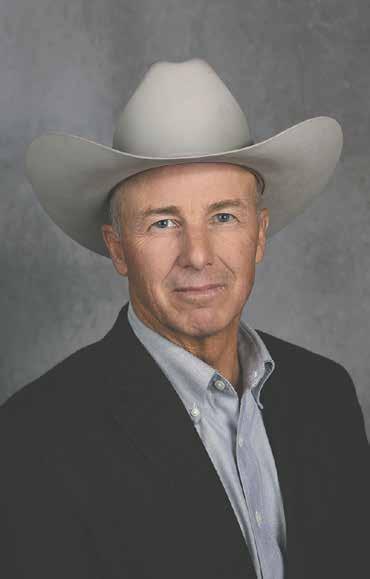
By Dave Baker, NCA President
building on a scale ticket. But over time, those efforts help preserve grazing rights, protect water access, sustain fair market structures, and defend the freedom to operate.
The ranching industry is built on generational thinking. Fences are built to last decades. Herd genetics are improved over years. Land stewardship plans span lifetimes. Protecting the industry itself deserves that same mindset. We need to ensure that the next generation inherits not just land and cattle, but the voice that protects them.
The absence of immediate threats should not lull us into complacency. Instead, it should be viewed as an opportunity – a season to strengthen organizations, deepen relationships, and prepare for whatever comes next. By staying engaged when times are quiet, ranchers ensure that when challenges inevitably arise, the industry stands ready, unified, and resilient.
PLOWDOWN ALFALFA
MIX 25%
“Plowdown” alfalfa with your regular alfalfa seed. Expect a hearty yield increase your “new seeding” first year!
“Plowdown” is #9 fall dormancy. It is supposed to winterkill, but has often been known to overwinter for a second growing season!
You could plant “Plowdown” as a one year only crop. Great for a bean crop, for example, next growing season.
by
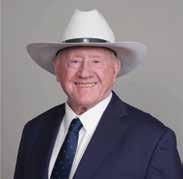
Martin Paris | NCA Executive Director
Happy Spring! I hope everyone has some shiny new calves and wet weather on the way. While the Nevada Legislature is not in session this year, there is still plenty going on at the Nevada Cattlemen’s Association. On the docket for April, NCA will be sending a contingent to Washington D.C. for the annual Public Lands Council/National Cattlemen’s Beef Association Legislative Conference. This is a good opportunity for NCA to meet face to face with our Congressional representatives as well as leadership at the U.S. Department of Agriculture, Department of the Interior, Environmental Protection Agency, and other agency officials.
We intend to discuss a laundry list of items including, but not limited to, the overpopulation of wild horses, maintaining our state’s sovereignty over its water, Endangered Species Act reform, flexible grazing practices, and how these government agencies and representatives can better support Nevada ranchers. As we head into election season, NCA intends to keep the foot on the gas to ensure progress is made regardless of whatever election outcomes may be.
NCA April Update
The responsibility of carrying your message from the countryside to Washington DC is not something that is taken lightly and NCA greatly appreciates the opportunity to represent you on the issues that matter.
This month I wanted to highlight something that likely flies a bit under the radar, but is a big deal for those operating on BLM or Forest Service allotments. A new memorandum of understanding (MOU) regarding cooperative monitoring has been agreed to between the Public Lands Council and the Bureau of Land Management. This agreement establishes a formal framework for cooperative monitoring on BLM grazing allotments and outlines mutually approved data collection methods. It also creates a clear pathway for permittee collected data to be incorporated into agency decision making with the same weight as agency collected information.
Much the same as a similar agreement with the U.S. Forest Service in 2022, this new MOU reinforces the shared commitment to recognizing permittee expertise and expanding rangeland monitoring capacity at a
time when federal agencies face significant resource constraints. I would highly recommend that BLM permittees take advantage. For those interested in learning more, please check out the MOU at tinyurl. com/2suv6dd4. For those interested in learning more about the U.S. Forest Service Cooperative Monitoring MOU, it can be found here: tinyurl.com/2yxpvxhk.
As a bit of housekeeping, NCA recently sent out member dues renewal notices. A big thanks to all those that have renewed their membership and your continued support. If you have not done so, please contact our office, or dues can be easily completed on our website at nevadacattlemen.org/membership. If you have neighbors, friends, or young folks that should be getting involved, please give them a nudge. NCA is your voice, and we want to hear from you. We strongly encourage participation in helping guide Nevada’s livestock industry forward. I cannot stress enough the importance of being engaged in the many issues that affect your livelihood- it matters. Till next time.


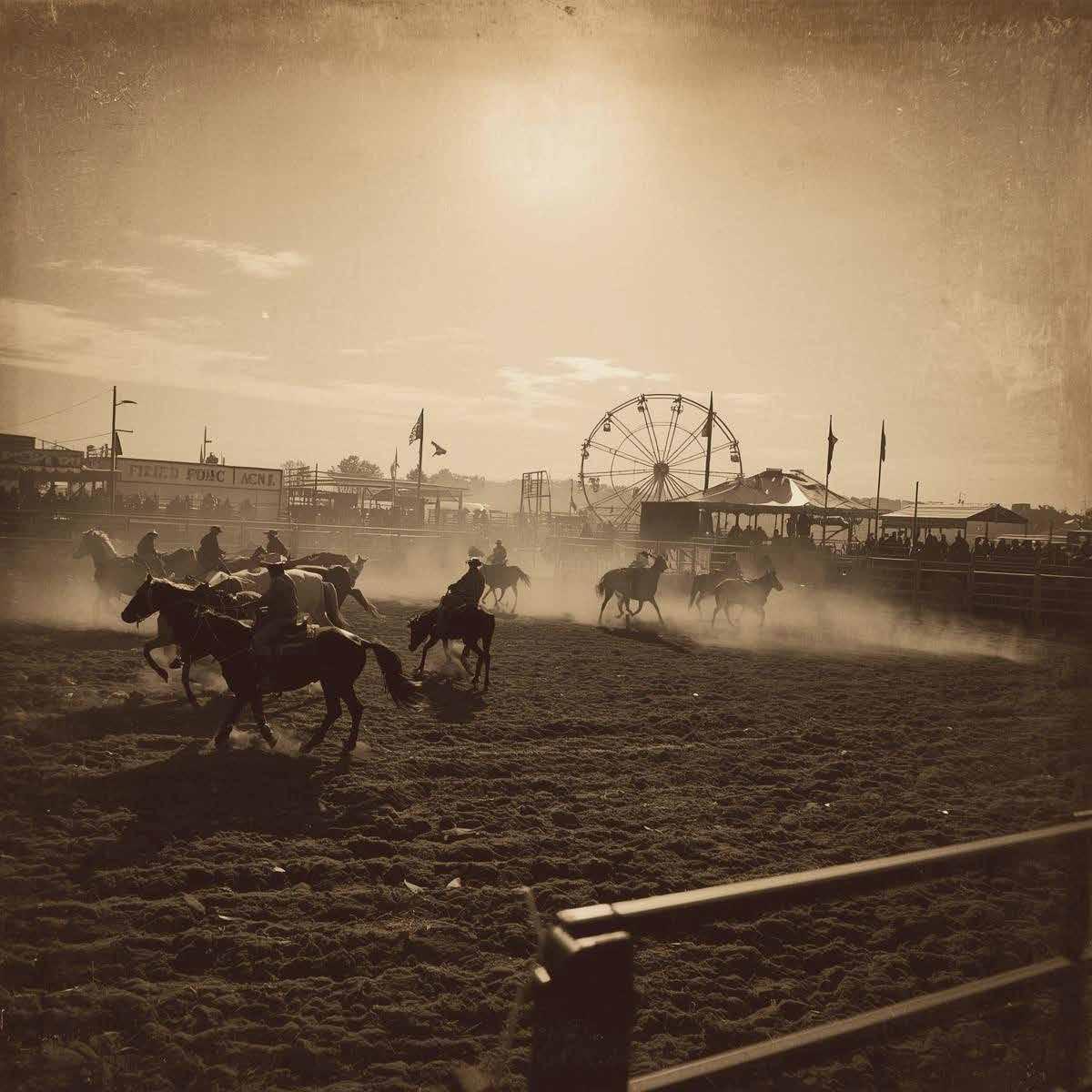
Joinusfor the revivalof
Dates
Thursday, June 11Saturday, June 13

FEATURING
Nevada State Fairgrounds 1350 N Wells Ave, Reno, NV 89512

Local


Nevada Beef Council Attends Annual Meat Conference
By Christie Van Egmond— Director, Retail & Foodservice Marketing
Every year, meat industry leaders from throughout the country come together for the Annual Meat Conference (AMC) by the Meat Institute and FMI — The Food Industry Association.
The annual conference, held March 2-4 in Maryland, brought retailers and industry partners together around the insight, strategy, and innovation needed to strengthen the meat department as a core driver of store performance, shopper loyalty, and competitive differentiation. For many years the Nevada Beef Council (NBC) staff has attended this conference to gain valuable insights on the meat industry, shopper behavior, and retail intelligence—this year was no different.
For NBC staff, AMC is a thought-provoking conference and great opportunity to network with experts within the retail meat industry space. NBC staff gain valuable insights on how consumers shop for and prepare beef, and innovative ideas on how to reach consumers as they prepare to shop and shop for beef at retail, which can be implemented in NBC’s marketing and promotional efforts.
One of the most sought-after highlights of the conference was the Power of Meat report. The report, conducted annually by 210 Analytics, helps retailers and suppliers understand how consumers think about meat and poultry. For over 20 years, the Power of Meat research reveals how shoppers plan, buy, and prepare their protein, giving the meat industry the insights needed to drive strategy and spark innovation.
Beyond the Power of Meat presentation, the conference includes an exhibit hall that showcased the latest innovations shaping meat retail, premium products, emerging brands, and technology-driven solutions amongst the 145 exhibitors; a Women’s Meat Industry Network (WMIN) luncheon driving discussions on how to advance women’s careers in the meat sector; and a surprise last-minute addition to the agenda of U.S. Department of Health and Human Services (HHS) Secretary Robert F. Kennedy, Jr. Additional insightful topics and sessions this year included:
Culinary Trends: Navigating Flavor, Innovation, and Retail Education
Meat: The Journey of the OG Protein – From Pasture to Basket
2026 Market Outlook for Meat and Poultry
Be the Hero of Protein: Positioning Meat as the Original, Complete Choice
The National Cattlemen’s Beef Association (NCBA), a contractor to the national Beef Checkoff, was well-represented on two different speaking panels during the conference as well. Shalene McNeil, PhD, RDN, and the Executive Director of Nutrition Science, Health and Wellness at NCBA spoke on the Protein Prescription: What Science Really Says about Meat and Health. NCBA’s Senior Executive Director of Scientific Affairs, Dr. Mandy Carr-Johnson provided her expertise to the panel presenting on Communicating Value: Best Practices in Educating Consumers and Driving Beef Sales.
Next year’s Annual Meat Conference will be held March 1-3, 2027 in Grapevine, Texas.
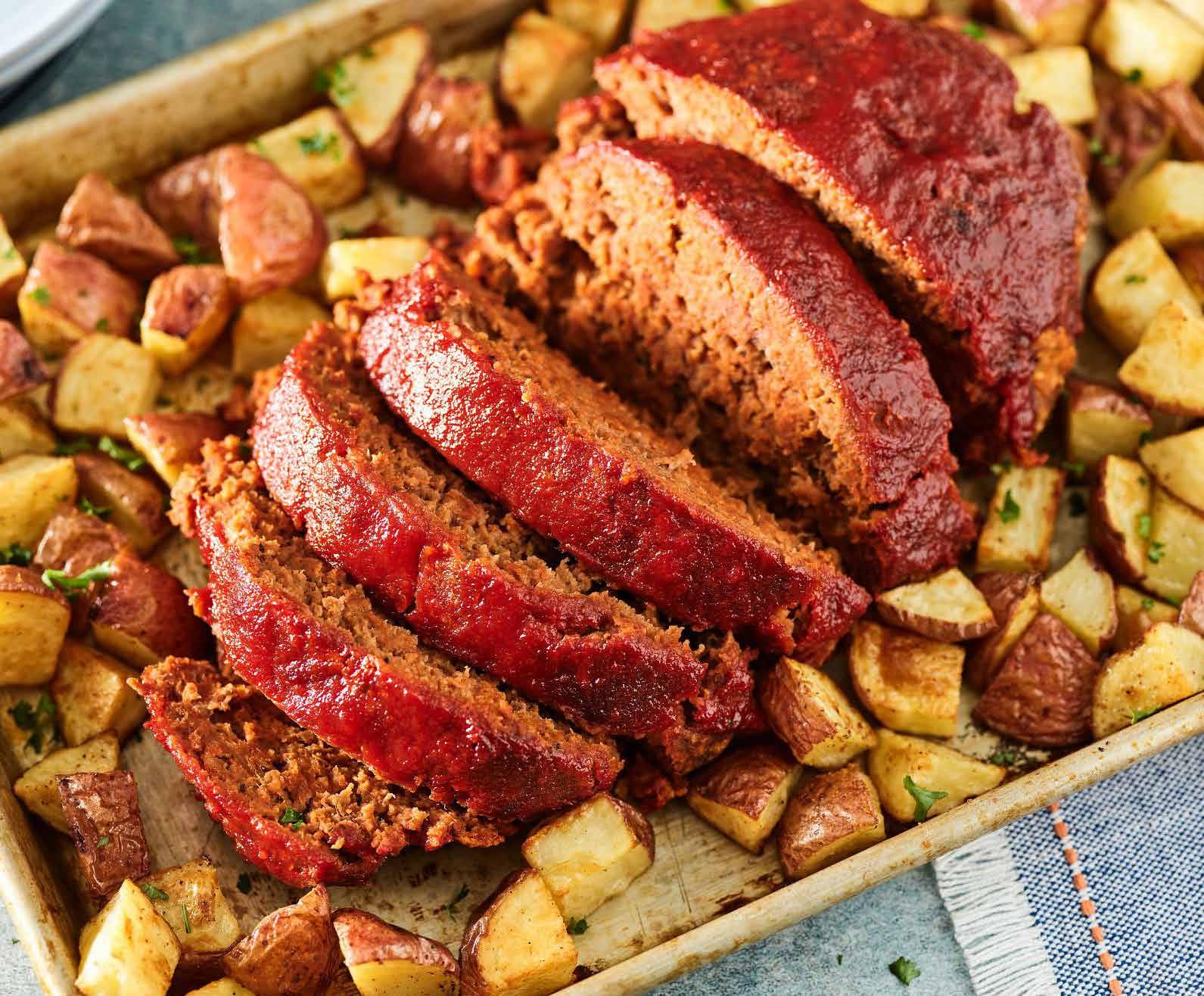
Easy Sheet Pan Meatloaf and Potatoes (3 ways)
1 hr 30 min | 6 servings | 380 cal | 29 grams protein
Make dinnertime less hectic with this easy sheet pan meatloaf and vegetable dish. A satisfying dinner on the table and clean up is a snap!
BUTCHER COUNTER
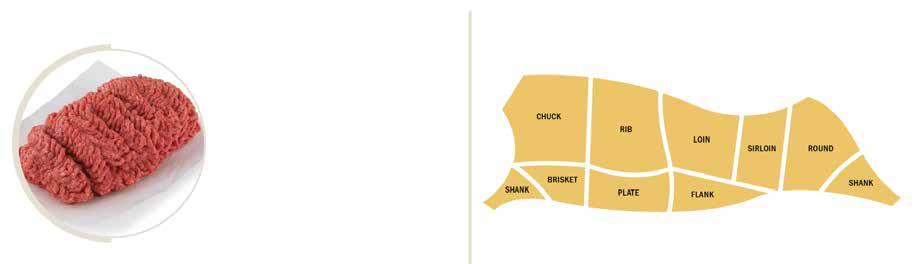
Ground Beef
Versatility and rich flavor make it ideal for burgers, tacos or wraps. Perfect for breakfast, lunch and everything in-between.
Ingredients:
1-1/2 pounds lean Ground Beef
1 can (8 oz) tomato sauce, divided
1 cup dry bread crumbs
1 small onion, finely chopped
1 egg
2 teaspoons Worcestershire sauce
1 teaspoon dried thyme
1/2 teaspoon salt
3/4 teaspoon pepper, divided
2 pounds red potatoes, cubed (3/4”)
1/2 teaspoon garlic salt
1 tablespoon packed brown sugar
1 teaspoon dry mustard
Version 1. Homestyle Meatloaf
1. Preheat oven to 400°F. Reserve 1/4 cup of tomato sauce; set aside.
2. Combine Ground Beef, remaining tomato sauce, bread crumbs, onion, egg, Worcestershire, thyme, salt and 1/4 teaspoon pepper in large bowl; mixing lightly but thoroughly. Shape beef mixture into 8 x 4 x 2-inch loaf on parchment-lined sheet pan.
3. Toss potatoes with cooking spray, garlic salt and remaining 1/2 teaspoon pepper. Spread potatoes evenly around the meatloaf on the sheet pan.
4. Place sheet pan on the center rack of oven, bake in preheated 400°F oven for 40 minutes. Meanwhile, combine reserved tomato sauce with brown sugar and mustard. Spread sauce evenly over top of meatloaf, stir potatoes and continue cooking another 20 minutes or until instant-read thermometer inserted into center of meatloaf registers 160°F. Cooking times are for fresh or thawed ground beef. Ground beef should be cooked to an internal temperature of 160°F. Color is not a reliable indicator of ground beef doneness.
5. Remove meatloaf; let stand 10 minutes. Test potatoes for doneness and return to oven if needed while meatloaf rests. Cut meatloaf into slices. Serve with potatoes.
Version 2. Four-Pepper Meatloaf: Prepare meatloaf as above, adding 1/3 cup finely chopped green bell pepper, 1/4 teaspoon ground red pepper and 1/4 teaspoon ground white pepper to ground beef mixture.
B12; 334 mg Phosphorus; 6.5 mg Zinc; 27.5 mcg Selenium; 130.5 mg Choline. This recipe is an excellent source of Protein, Iron, Potassium, Vitamin D, Riboflavin, Niacin, Vitamin B6, Vitamin B12, Phosphorus, Zinc, Selenium, and Choline; and a good source of Dietary Fiber.
Version 3. Picadillo-Style Meatloaf: Prepare meatloaf as above, omitting thyme and adding 1/3 cup finely chopped green bell pepper, 1/4 cup raisins, 1 teaspoon ground cumin and 1/2 teaspoon dried oregano to ground beef mixture.
Recipes & photos courtesy of
SHORT ON WATER ?
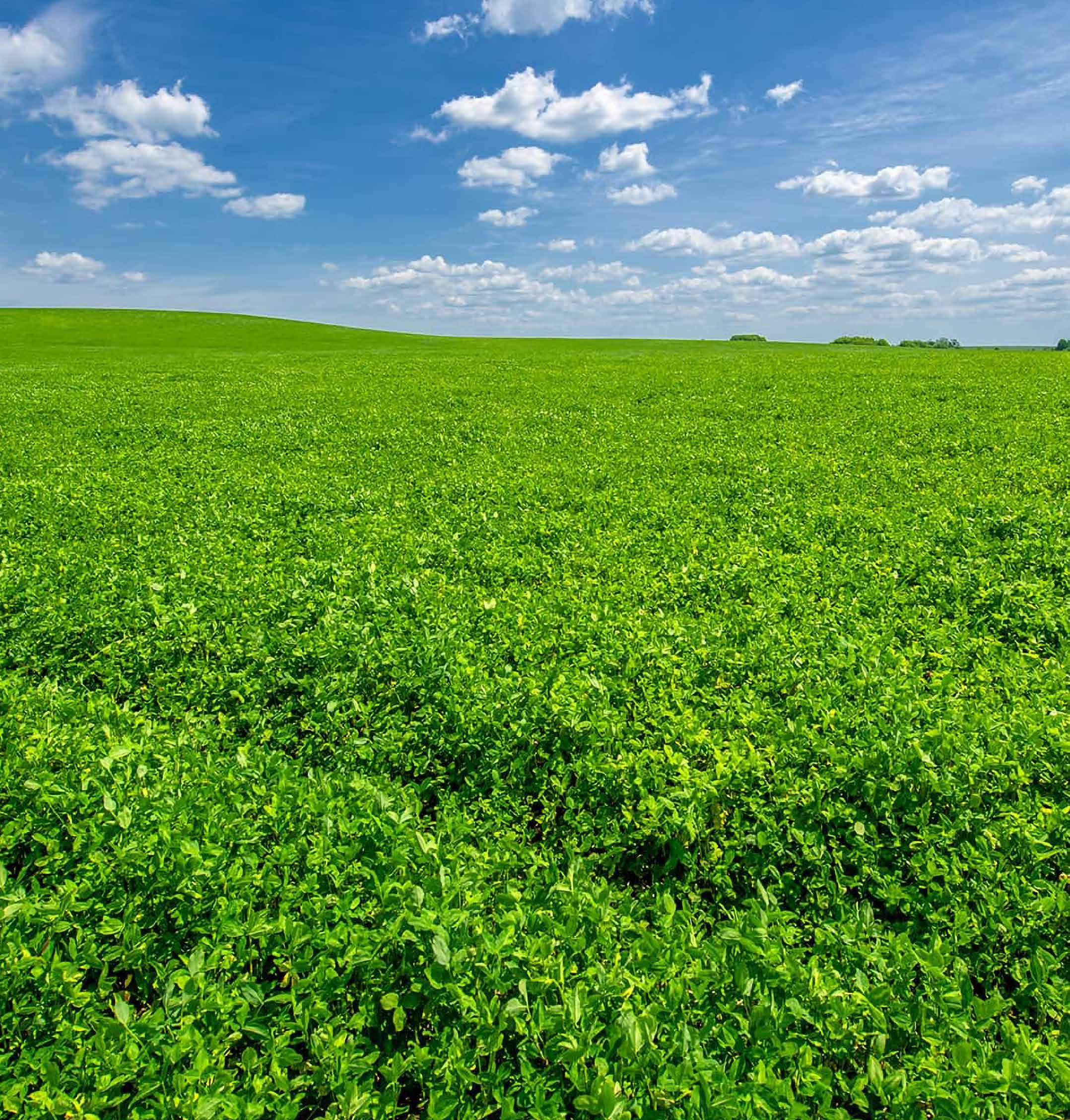
Two Alfalfas in One

Greenway Alfalfa

This Alfalfa has been called a tetraploid anomaly by alfalfa breeders. On the market since 1979, and being improved twice, It remains the highest yielding, low water alfalfa on the market!
HERE’S WHAT GROWERS ARE SAYING: (More testimonials available on our website)
“Ten years ago we planted 5lbs/per acre of 360-D mixed with some grasses. The pivot was so short on water, we had to plug some nozzles in order to water parts of the pivot. Over the years the grasses died out due to lack of water, but the 360-D kept increasing. Today, 10 years later, the pivot is solid 360-D and producing well, and still very short on water.”
Cade Davis Spring Valley Ranch - 30 miles east of Ely, NV
“We have 10 pivots of alfalfa in the Railroad Valley of Nevada. Tough ground with a high PH. 10 years ago we planted 30lbs/acre of 360-D. Today that pivot is the No. 1 pivot on our hay ranch, and testing well for dairy.”
Kennon Forester - 106 miles Southwest of Ely, NV
“First year, after seeding year, we harvested 3.4 ton on 1st cut and 1.7 ton on second with very little rain in the growing season. Over 5 ton on 2 cuts so far!” (Dryland)
Mosekian Farms - Cambridge, ID
“Our area has been in drought for several years. Everyone in the panhandle is short on water. We only pump 400 gallons on 120 acres. That's why we plant 360-D. Under that short water we still yield near normal and the quality is excellent because we plant 35 lbs/per acre. We planted 8500 pounds this year!”
Dan Sawyer - Clarendon, TX
Alan Greenway Seedsman
Over
Greenway Seeds
Caldwell, ID
208-250-0159 (cell)
208-454-8342 (message)
Alan Greenway
GREENWAY SEEDS www.greenwayseed.com
Warehouses in Caldwell, ID and Deer eld, WI
“Modern Forages Sold Nationwide and Canada”
√ Will produce AT LEAST 80% of crop with 50% of water
√ Will produce a subsequent cutting after water is gone
√ Plant on dryland/ guaranteed to out yield Ranger or Ladak
√ Plant under pivots that only pump 400 gal/
√ Plant on elds that have only early season creek water
√ Plant under end guns on pivots
√ Plant in the late fall with your dormant seeded grasses

Two Poems
BABY HORSE
Spindly legs searching for a base on the earth
like a thin table leg looking for purchase
On a slippery floor
These legs now uncertain will soon gallop and grab the dirt underneath the growing baby body
Searching for mother’s milk
Like so many before
The horses of the world since memorial time seeking to be nourished like the glass needs the wine
RAIN AND SAGE
Softly feeding the thirsty sage a rain, finally here since it seems like an age
Not a drought buster but welcome indeed helping to heal the land with such need
The brush has the fragrance of after a rain
But starting this morning it comes again and again like the perfume of the ranch
There still is no grass, there’s been no timely storm
But the brush is most grateful for this plateful of rain
PROTECTING YOUR WATER RIGHTS


775

A Seat At The Table
By Doug Busselman | NFB Executive Vice President
“If you’re not at the table – you’re on the menu,” is a saying that has been repeatedly said when discussing public policy, legislation or regulations. While taking time and sometimes requiring being in-person somewhere - it isn’t always easy to get plugged into brewing circumstances.
This is why some people join associations or groups, looking for the combined resources of people like themselves to acquire an advocate to represent all of their combined interests. This is not to say that it can all be left in the hands of an organization working to be your advocate.
Reaching desired outcomes might also require a combined effort of members working with their organization and fellow organizations working together to emphasis the importance of an issue and the reasons for pressing a preferred outcome.
As Nevada citizens recognize that early February 2027 draws near, the next Legislative session will begin. They should be getting themselves prepared.
First, there will be elections and from this process those who will be representing you in the state Assembly. Some will also determine who will represent them in the state Senate.
Statewide elections will determine who will be our Governor and fill other Constitutional offices. The elected Governor is especially important because of how their administration determines who will be placed in charge of State Departments and agencies. Through these entities, policy priorities will gain attention going forward over the term of that administration.
Nevada is currently in the “interim” of the Legislative process. Under the current system of operation, the “Joint Interim” committees means that members of a Nevada Senate and members of the Assembly are appointed to meet together in the even-year (interim) to study issues that would fit within their jurisdictions of law and determine if they can formulate a proposed bill or set of bills to bring to the next legislative session.
An example of this, is the eight-member “Joint Interim Committee on Natural Resources,” which will meet six times, ending their interim schedule, August 12th. Over the course of these sessions, the committee will be covering a number
of topics and wrapping up their August meeting, considering prospective subject areas for the 84th Legislative session. This preliminary preview of potential legislation, as well as behind the scenes discussions for what could be considered, offer the opportunity for preparing plans and positions to work in favor or in opposition of the concepts.
The Real Power To Make Things Happen
You - and others like you (when engaged) can get things done.
It begins with the election. Get to know who is seeking office and what their positions are. Through these connections the groundwork could be laid for a further working relationship in the future.
The Nevada Legislature website (https://www. leg.state.nv.us/) is a valuable tool in and out of the Legislative Session. The website serves as a connection to view and participate in Legislative Committee meetings, providing for pre-and-post meeting public comments from citizens.
Through the Legislative Website, you have access to email links that you can use to reach your elected representatives and you can follow the process of making laws - from introduction of bills through the process, hearings by the committees and see the language (with amendments) that are being constructed into law.
Beyond The Legislative Process
There are other branches of government you can play a role in working to influence. At the local, state and federal agencies of government we have opportunities for input to policies and regulations made and carried out.
It isn’t always easy to conclude that the agencies who are working to come up with policy or regulatory language which will fit your best interests, but it helps to try to see it that way in order to better understand the perspective of those who are in favor. Such a view might help you to seeing what you don’t.
Government agencies do have agendas, and they strive to achieve their objectives. In spite of whether you agree with their objectives or not you
still need to make your points and offer reasons for going in a different direction than they are proposing. Just because you aren’t gaining ground in persuading an outcome you wish to arrive at, it doesn’t mean that you can give up the work you are attempting to accomplish.
While there are several recent examples in dealing with regulatory bodies and having less than reasonable or preferred outcomes, we want to draw attention to the importance of staying involved throughout the process and establishing the public record for the points that were made. By embedding the points on the public record there is a benchmark for the consequences that can be referred to in the future.
In both examples, that we are thinking of, there were several other private persons and groups involved in making the same points and establishing the foundations that the agencies can be held accountable for the decisions they have made.
You Are The Key
In the opening sentence to this article, we offered a frequently quoted sentiment for getting involved with the issues you are facing. This suggests that through your engagement things could turn your way automatically. There is nothing further from the truth.
Developing a broad-based group of those who would be impacted by the outcome increases the possibility of obtaining a seat at the table but doesn’t guarantee it. You may have to work at getting that seat and prior experiences in working with you might be the difference maker. It isn’t good to burn bridges behind you because you might need those relations in the future.
The process of gaining a seat at the table in today’s policy arena isn’t always easy, but it is important in staying relevant going forward.
When you are asked to write an email, mail a letter or make a phone call don’t let this opportunity pass. Your help is needed and could be the difference.
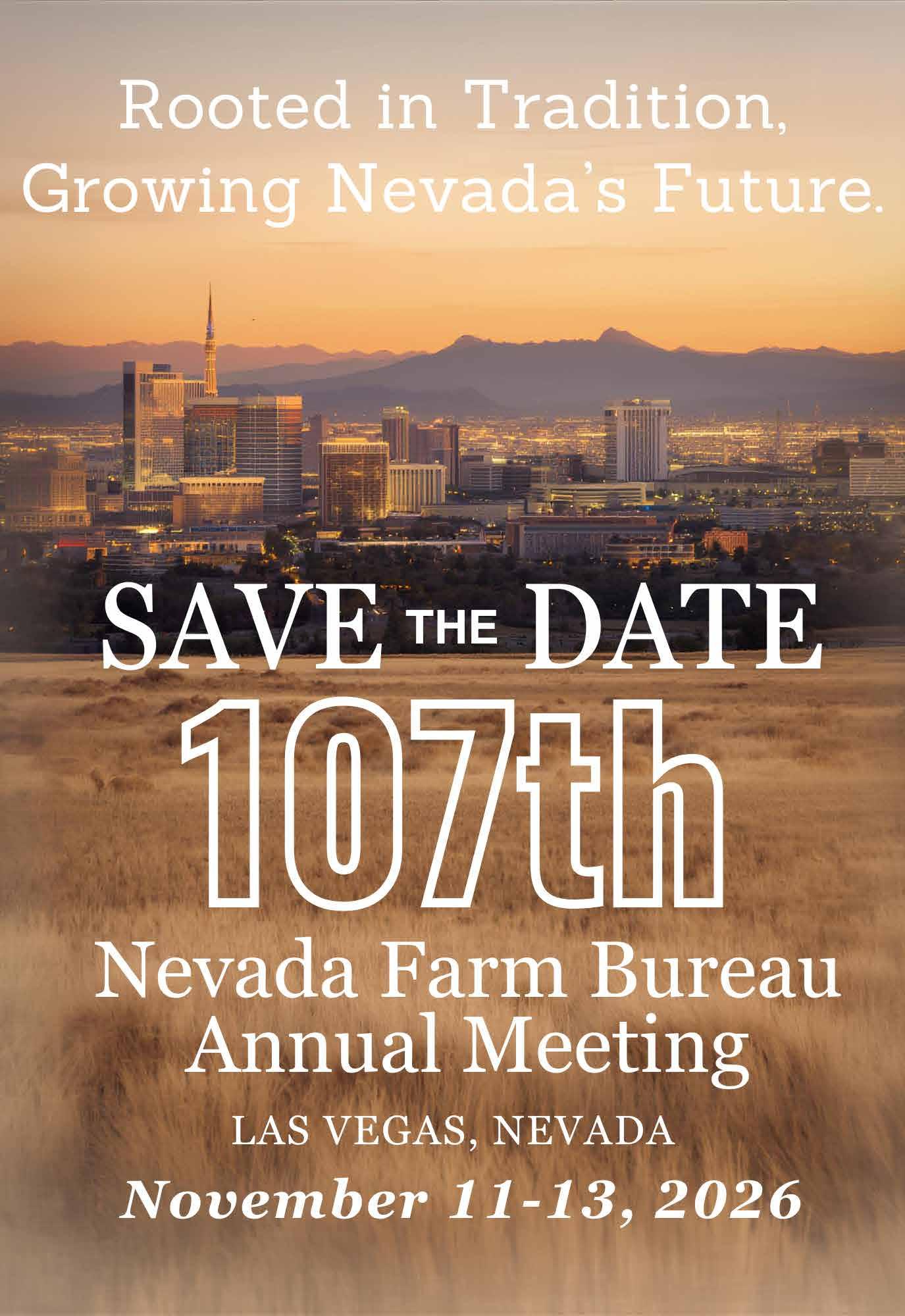
Save the Date: 107th Nevada Farm Bureau Annual Meeting
Mark your calendars and make plans to join us for one of Nevada agriculture’s most anticipated events of the year!
The Nevada Farm Bureau is excited to host the 107th Nevada Farm Bureau Annual Meeting, taking place November 11–13, 2026, at Santa Fe Station in Las Vegas.
This year’s theme, “Rooted in Tradition, Growing Nevada’s Future,” highlights the strength of our agricultural roots and the forward-thinking spirit that continues to move our industry ahead.
Farm Bureau members from across the state will gather to connect, collaborate, and help shape the future of agriculture in Nevada. The Annual Meeting provides a valuable opportunity to engage in important conversations, hear updates on key issues, and build relationships with fellow members and industry leaders.
Whether you’ve attended for years or are considering joining for the first time, this is an event you won’t want to miss.
More details, including registration information and event highlights, will be shared soon. Be sure to save the date and plan to join us this November in Las Vegas!
Nevada Farm Bureau Grassroots News
Celebrate Ag Day and Support Nevada Agriculture with the New Ag Plate
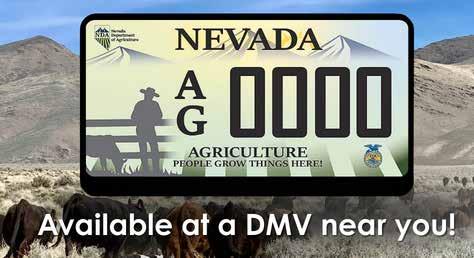
In celebration of agriculture and the vital role it plays in our state, a newly redesigned Nevada specialty agriculture license plate is now available, giving Nevadans a meaningful way to show their support for the industry every day.
The Nevada Department of Agriculture (NDA), in partnership with Nevada FFA and the Department of Motor Vehicles, has unveiled an updated Ag Plate design that reflects the beauty and heritage of Nevada agriculture. The new plate features iconic elements of the Silver State, including mountain ranges, field crops, and ranching scenes—serving as a proud tribute to the people and landscapes that make Nevada Ag unique.
“We hope this refreshed Ag Plate design inspires nostalgia of Nevada’s agricultural roots,” said NDA Director J.J. Goicoechea. “We want those with an Ag Plate to feel proud displaying it and know that they have contributed to vital agriculture education and workforce development through FFA while supporting Nevada’s agriculture industries.”
Beyond its eye-catching design, the Ag Plate provides real impact. Proceeds from each plate directly support agricultural education and help strengthen the future of the industry by benefiting Nevada FFA programs and promoting agriculture across the state.
Whether you’re a producer, supporter, or simply proud of Nevada’s agricultural heritage, the Ag Plate is a simple way to make a difference.
To order your Ag Plate, visit agri.nv.gov or dmv. nv.gov/plates.
Farmer’s Share Of Food Dollar Declines Again
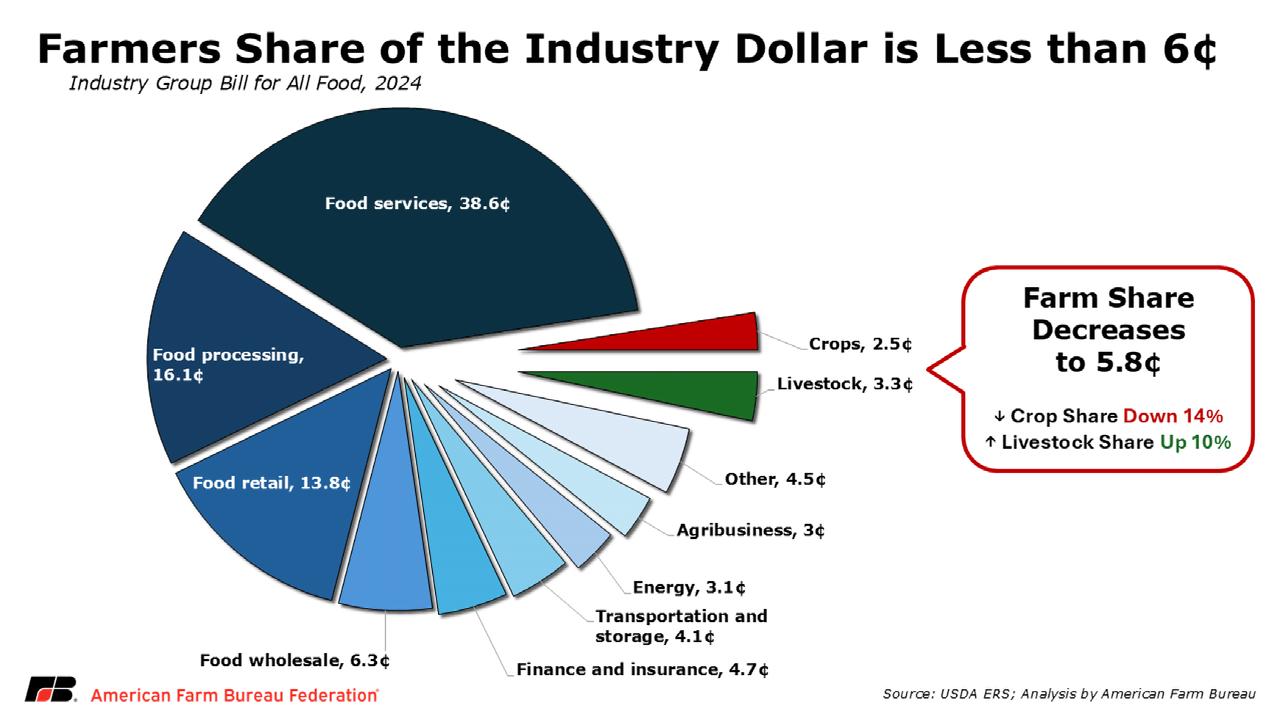
American Farm Bureau Federation (AFBF) economist Faith Parum, Ph.D. provided this update in her latest Farm Bureau Market Intel on the share farmers receive for the connection with the American Food Dollar: https://www.fb.org/market-intel/farmers-receive-less-than-6-cents-of-the-food-dollar Key Takeaways
• In 2024, USDA estimates that farmers and ranchers received a combined 5.8 cents of every food dollar, down slightly from 5.9 cents in 2023, meaning less than 6 cents reaches the farm after accounting for production expenses.
• Within that total, crop producers saw their share decline from 2.9 to 2.5 cents, while livestock producers experienced a modest increase from 3 to 3.3 cents, highlighting divergent trends across sectors.
• With farmers capturing only a small share of the food dollar, even modest swings in commodity prices or increases in input costs can quickly strain farm finances.
USDA Announces Action To Purchase
U.S. Secretary of Agriculture Brooke L. Rollins announced on February 19, 2025 the U.S. Department of Agriculture’s (USDA) intent to purchase up to $263 million in dairy and agricultural products from American farmers and producers to distribute to food banks and nutrition assistance programs across the country. These purchases are being made through USDA’s authority under Section 32 of the Agriculture Act of 1935 and will assist producers and communities in need. With this action, the Trump Administration is bolstering American prosperity by supporting American agriculture, rural communities, and those in need of nutrition assistance.
“From milk and dairy to fruits, legumes, and tree nuts, these staples are essential for feeding families and sustaining America’s agricultural economy,” said Secretary Brooke Rollins. “Through these Section 32 purchases, USDA is delivering wholesome, real food to Americans while injecting critical dollars into local economies. By turning harvests into meals, we are not only stabilizing farm income and protecting rural jobs—we are nourishing our nation and supporting the farmers who feed America. Under President Trump’s leadership, these investments strengthen the food supply, sustain rural communities, and reinforce agriculture as a cornerstone of economic resilience.”
AMS continuously purchases a variety of domestically produced and processed agricultural products. These “USDA Foods” are provided to USDA’s Food and Nutrition Service (FNS) nutrition assistance programs, including food banks that operate The Emergency Food Assistance Program (TEFAP), and are a vital component of the nation’s food safety net. USDA AMS will purchase up to $263 million in commodities. Nevada Farm Bureau Federation 2165 Green Vista Dr. Suite 205 Sparks, NV 89431 US

Joint Legislative Committee Hearing s Outline The Parameters For Data Center Debate
The Joint Interim Legislative Natural Resources Committee and the Joint Interim Legislative Committee on Growth and Infrastructure met on March 25 with the topic of data centers on the agenda. The day-long session covered these range of points:
• water usage
• electrical usage and demands for more
• protection of current electrical rate payers
• further environmental damage
• the necessary rail guards to provide appropriate accountability to agreements made and then followed through on.
The presenters included those who have and are continuing to be involved with date center matters throughout the nation. Legislation has been brought forward and passed in a number of states this year and based on the interest the legislators on these two committees exhibited, we can likely expect a group of legislative prospects in our 2027 session. Our current organizational policy for Data Center matches up well with the topics discussed in the hearing.
The one area where we don’t have policy but has been addressed very effectively in Clark County is the ban that they have put on a requirement that coolers must be dry (not allowing water coolers to be used). This action drives up the cost for cooling but reduces water use.
In previous newsletters, Nevada Farm Bureau (NFB) has stated....
The expansion of Data Centers in Nevada and throughout the country deals with the loss of productive agricultural lands, massive increases in the needs of electrical energy and the demands of water use for cooling.
Nevada Farm Bureau policy states on Data Centers (Policy 182): “Because of our strong support for continued productivity of agricultural lands including federally-managed lands for traditional uses, we are concerned over efforts to convert agricultural lands to uses such as data centers.”
Domestic Capacity Matters For U.S. Agriculture – The Why Covered Here
Key Takeaways:
Domestic processing capacity supports farm demand and rural economies. When commodities are processed in the United States, more of the food dollar stays in the domestic economy — supporting rural jobs, strengthening local markets for farmers and anchoring economic activity in agricultural communities.
Loss of capacity increases export reliance and vulnerability. As processing and manufacturing shift overseas, farmers become more dependent on global markets to absorb production, exposing both farm income and rural economies to trade disruptions, geopolitical risks and supply chain shocks.
Once capacity leaves, it is difficult to rebuild. Processing facilities require large capital investments, skilled labor and established supply chains. When plants close, rural communities lose major employers and rebuilding that infrastructure can take decades.
American Farm Bureau Federation’s (AFBF) Economist Faith Parum, Ph. D. covers with examples the importance in keeping processing close to home when it comes to relevant commodities. In her latest Market Intel Parum points out “Agricultural commodities must move through processors, manufacturers and retailers before they generate income for farmers.” She then went on to write, “Where that processing occurs determines where the economic value accumulates. Oilseeds become cooking oils and renewable fuels. Grains become ethanol and animal feed. Cotton becomes textiles and apparel. When these activities occur domestically, the value created supports American businesses, workers and rural communities. When processing moves overseas, that value moves with it.”
Read more here: https://www.fb.org/market-intel/ why-domestic-capacity-matters-for-u-s-agriculture
Ag’s Fit Into Over-all Economy
• Food and agriculture supports $10.4 trillion in total U.S. economic output, representing about 20 percent of all economic activity.
• The sector supports nearly 49 million jobs, or roughly 30 percent of total U.S. employment, even though on-farm jobs account for less than 2 percent.
• Food and agriculture generates more than $1.3 trillion in tax revenue, reinforcing its role as a foundation of local, state and federal economies.
• Maintaining domestic food and agriculture production helps anchor jobs, income and economic activity within the United States.
Economic Storm Hitting U.S. Agriculture Hard
Severe weather, high expenses and global uncertainty are hitting farmers from all sides, squeezing them to the breaking point. 54 agriculture groups laid out the challenges facing rural America in a letter to Trump, recognizing progress made last year in enhancing farm risk management tools and securing much-needed tax relief for farmers, but stating additional resources are needed. “As you consider a defense supplemental package in the coming weeks, we urge you to include much-needed market relief for America’s farmers.”
That relief should build on recent efforts to deliver Farmer Bridge Assistance Program payments, and should include meaningful support for all specialty crop, sugar and alfalfa growers, assistance for farmers and ranchers dealing with catastrophic weather events, and build longer-term demand stability for U.S. ag through year-round sales of E15 and tax incentives to increase use of domestic agricultural products, such as the Buying American Cotton Act and the Grown in America Act. The letter mentions admin actions, such as finalizing strong Renewable Volume Obligations in the Renewable Fuel Standard and supporting valueadded opportunities for farmers in the 45Z Clean Fuel Production Credit, that will also help support longerterm demand stability for U.S. agriculture.
The recent closure of the Strait of Hormuz and its impact on fertilizer and fuel prices only worsened the financial strain farmers face and poses significant consequences for the food supply chain in America and around the world.
“We appreciate your longstanding commitment to rural America. Now is the time to ensure that Ag can weather this period of extraordinary strain. Without timely assistance, continued losses risk accelerating farm closures, reducing domestic production capacity and weakening the ability of farmers and ranchers across this great nation to provide food, clothes and fuel for the American people.”
In his most recent Market Intel, American Farm Bureau Federation’s (AFBF) economist Daniel Munch carried his readers through the details of the annual Feeding the Economy. The maps provided offer great insight of the state-by-state roles that each state provides to their contribution to total overall picture of American agriculture’s place in our country’s economic picture.
Read more here: https://www.fb.org/market-intel/ more-than-food-agricultures-economic-footprint
Why Domestic Capacity Matters for U.S. Agriculture
By Faith Parum, Ph.D. Economist |
www.fb.org/market-intel/why-domestic-capacity-matters-for-u-s-agriculture
Key Takeaways
• Domestic processing capacity supports farm demand and rural economies. When commodities are processed in the U.S. more of the food dollar stays in the domestic economy, supporting rural jobs, strengthening local markets for farmers and anchoring economic activity in agricultural communities.
• Loss of capacity increases export reliance and vulnerability. As processing and manufacturing shift overseas, farmers become more dependent on global markets to absorb production, exposing both farm income and rural economies to trade disruptions, geopolitical risks and supply chain shocks.
• Once capacity leaves, it is difficult to rebuild. Processing facilities require large capital investments, skilled labor and established supply chains. When plants close, rural communities lose major employers and rebuilding that infrastructure can take decades.
American agriculture is among the most productive sectors in the world. Advances in plant and animal genetics, mechanization and precision agriculture have driven remarkable yield gains. Corn yields have risen from 38 bushels per acre in 1950 to about 187 today, nearly a fivefold increase, while soybean yields have more than doubled. Yet, productivity alone does not determine farm profitability.
Agricultural commodities must move through processors, manufacturers and retailers before they generate income for farmers. Where that processing occurs determines where the economic value accumulates. Oilseeds become cooking oils and renewable fuels. Grains become ethanol and animal feed. Cotton becomes textiles and apparel. When these activities occur domestically, the value created supports American businesses, workers and rural communities. When processing moves overseas, that value moves with it.
On March 10, AFBF President Zippy Duvall testified before the Senate Committee on Agriculture, Nutrition and Forestry on the importance of rebuilding domestic demand and maintaining a resilient agricultural supply chain. This Market Intel highlights several sectors where the erosion of domestic processing capacity has reshaped how farmers market their crops and where they absorb risk.
Cotton: Export Reliance Following the Loss of Domestic Textile Manufacturing
Cotton offers one of the clearest examples of how the loss of downstream manufacturing can reshape an agricultural market. U.S. textile mills were a reliable buyer of domestic cotton through much of the 20th century, with domestic mill use peaking at roughly 11.3 million bales in the 1997/98 marketing year. That relationship eroded as apparel manufacturing shifted to lower-cost regions abroad. Today, domestic mill use stands at roughly 1.6 million bales, the lowest level in recent history.
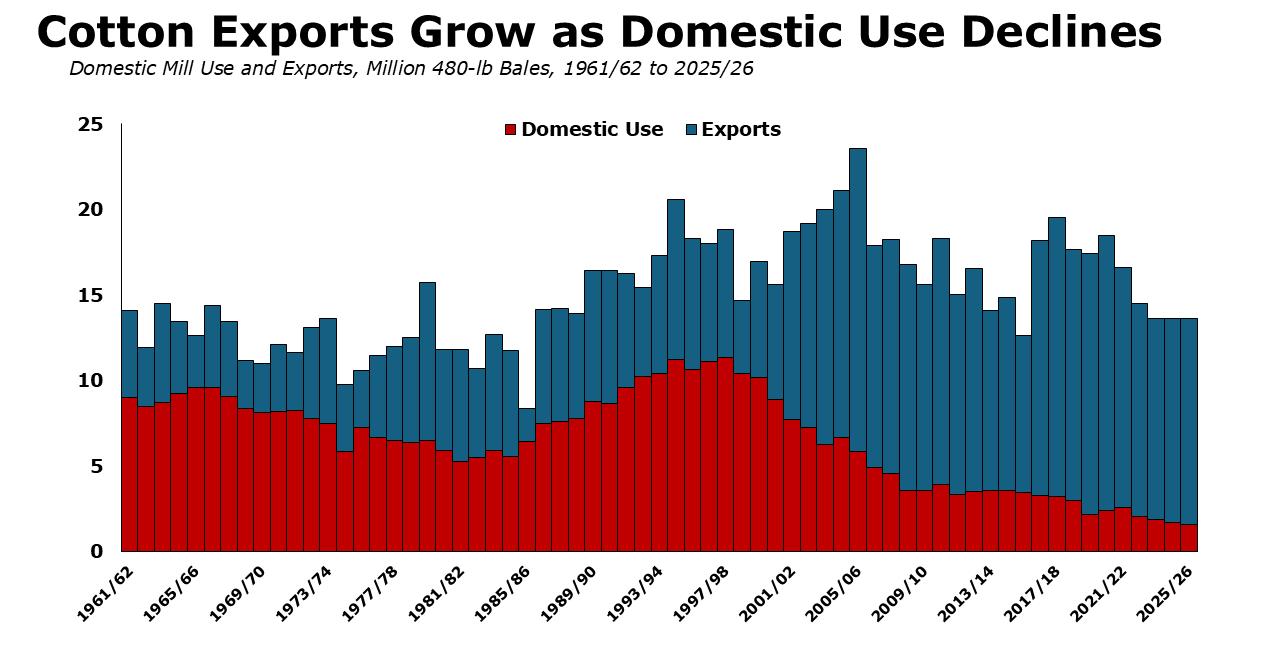
Exports now absorb the vast majority of U.S. production. Over the past decade, the United States exported about 85% of the cotton it produced, making cotton one of the most export-dependent major U.S. crops.
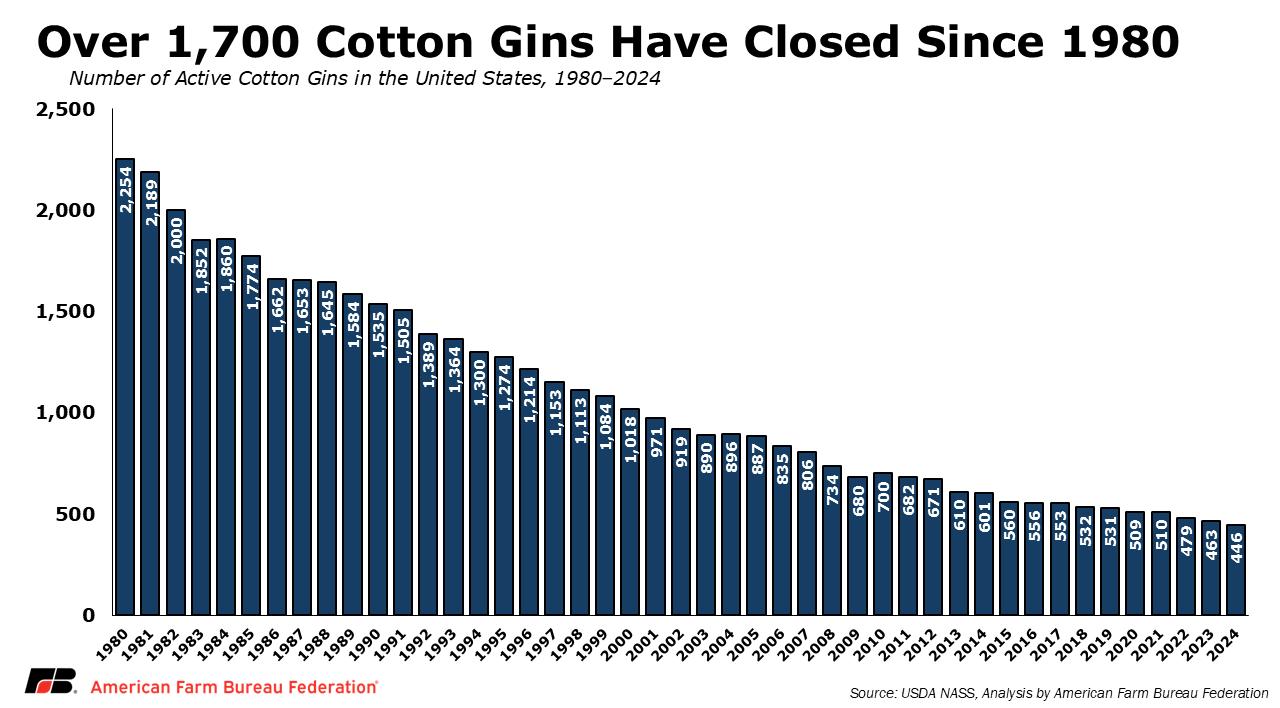
The infrastructure supporting cotton production has contracted alongside domestic demand. Active cotton gins numbered 2,254 in 1980 and have fallen to roughly 500 today. Some consolidation reflects efficiency gains, as remaining gins process far more bales, but the broader trend mirrors the erosion of domestic textile capacity.
The result is a familiar pattern: raw cotton is exported, manufactured abroad and imported back into the United States as clothing, fabric or household goods. Manufacturing value is created overseas rather than within domestic supply chains. For producers, this means export markets must absorb nearly all production. When global demand weakens or trade disruptions occur, there is little domestic cushion.
Sugar: Processing Infrastructure Shapes Production
The sugar industry illustrates how processing infrastructure can shape regional agricultural production. Sugarbeets and sugarcane must be processed quickly after harvest to maximize sugar extraction from the harvested plants, tying production closely to nearby processing facilities. Those facilities require large capital investments each year for maintenance and depend on consistent throughput to operate efficiently.
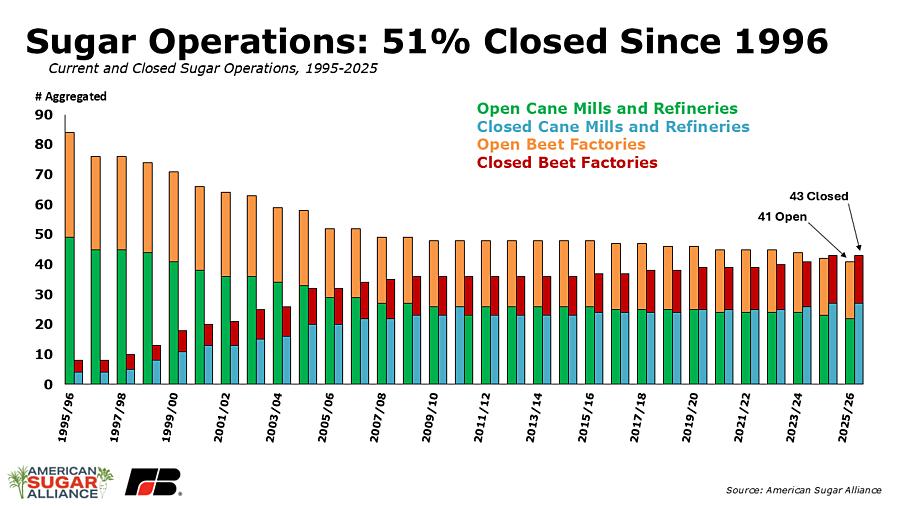
Over time, low prices and high costs have led to numerous processing facility closures, reducing the number of sugar processing plants. Due to the high risk and low returns to sugar processing, many investors exited and growers were forced, in many cases, to purchase facilities to keep them in operation. Nevertheless, from 1995 to 2026, 43 sugar processing facilities have closed, leaving 41 still open, and some regions have experienced particularly sharp contractions. California, for example, lost all of its beet sugar facilities over several decades. Its final remaining processing facility closed following the 2025 crop. This follows similar trends in other states; the last sugarcane mill in Hawaii closed in 2016 and in Texas in 2024.
Because sugarbeets and sugarcane cannot be transported long distances economically without loss of sugar content, growers depend heavily on nearby processing facilities. When a processing facility closes, production in that region disappears as well, eliminating an important economic engine for those communities. Once a processing hub shuts down, farmers must pivot to other crops as refurbishing a closed facility or building a new one is simply not supported by processing margins today.
Rice: Farm Consolidation and Export Dependence
Rice illustrates a different kind of structural pressure in U.S. agriculture: a growing dependence on export markets combined with intensifying global competition. The number of U.S. rice farms declined sharply from 9,627 in 1997 to just 3,824 in 2024, while average farm size expanded significantly as producers adopted new technologies and pursued economies of scale. This consolidation has not been optional, it has been essential for survival. Larger operations are better positioned to absorb volatile prices, rising input costs and global competition.
The U.S. exports roughly 40% to 50% of its rice crop in most years, making international demand a central driver of farm income. But that reliance leaves producers exposed to foreign government policies and shifting trade dynamics. One major source of pressure is India, which has become the world’s largest rice exporter in part due to extensive government support. India’s system of minimum support prices, input subsidies and public stockholding programs effectively lowers production costs and enables exporters to sell rice on global markets at artificially low prices — policies that the United States and others argue distort trade and violate World Trade Organization rules.
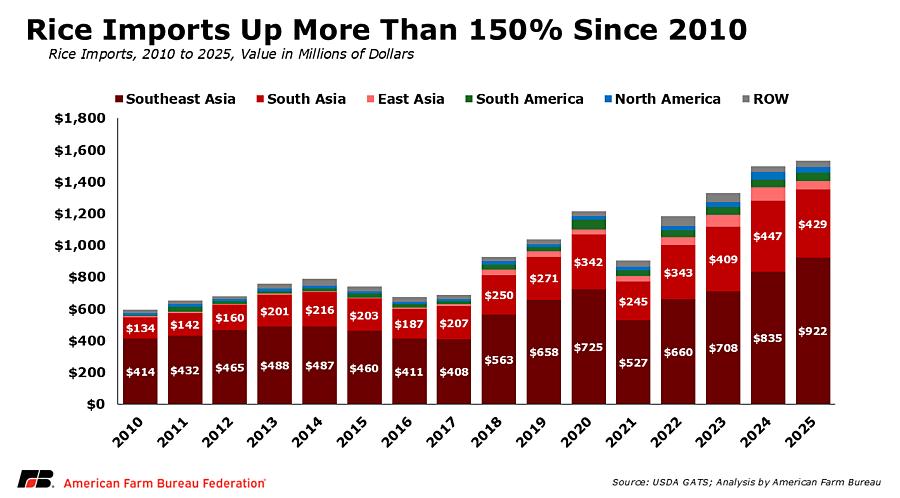
At the same time, U.S. rice imports have surged more than 150% since 2010, reaching about $1.5 billion in 2025. Much of this growth is driven by shipments from Southeast and South Asia, where lower labor costs and government support programs enhance competitiveness. Meanwhile, South American exporters — particularly Brazil and Uruguay — have expanded production and improved logistics, further intensifying competition in key export markets.
Taken together, these forces have reshaped the U.S. rice sector. Consolidation has helped maintain overall production, but it has also concentrated risk: fewer, larger farms are now more deeply tied to volatile global markets. As a result, U.S. rice farmers are increasingly dependent not just on yields and efficiency, but on trade policy, international subsidies and access to foreign markets to remain viable.
Corn and Soybeans: What Investment Looks Like When Demand Is Stable
The recent expansion in soybean crushing capacity shows how quickly processing investment can respond when domestic demand grows. According to the National Oilseed Processors Association feedstock study, oilseed processing capacity in the United States has increased by more than 25% since 2021, representing billions of dollars in new investment in crushing and processing facilities driven largely by growing biofuel demand.
Corn provides a similar example. Ethanol production now consumes roughly 5.6 billion bushels of corn annually, creating one of the largest domestic markets for U.S. farmers. Policies that expand biofuel use can strengthen this demand. Allowing year-round sales of E15 gasoline, for example, would provide a stable outlet for additional corn production while supporting domestic fuel supply. Year-round E15 could increase demand for corn by 2.4 billion bushels a year.
Further investment in domestic processing efficiencies and new crush facilities could support production of an additional 1.4 billion gallons of biofuels. However, continued growth in these
markets will depend on regulatory clarity. Strong Renewable Volume Obligations (RVOs) under the Renewable Fuel Standard and clear implementation guidance for the 45Z Clean Fuel Production Credit will determine how quickly these investments translate into expanded domestic demand for agricultural feedstocks.
Once Processing Capacity Leaves, it is Difficult to Rebuild
Processing infrastructure is difficult to recreate once it disappears. Agricultural processing systems depend on skilled labor, specialized equipment, regulatory approvals and established supply chains. When plants close, those networks often disperse.
Rebuilding that infrastructure can require years, or even decades, of sustained investment. The cotton sector illustrates this challenge clearly. Even though the United States remains one of the world’s largest cotton producers, the textile manufacturing ecosystem that once consumed large volumes of cotton has largely moved overseas. Reestablishing that capacity would require rebuilding an entire industrial network.
A Foundation for Rural Economies
Domestic agricultural processing does more than create demand for farm commodities. It anchors economic activity in rural communities. Processing plants provide jobs, support local supply chains and generate economic activity throughout the agricultural economy. When facilities close, rural communities often lose major employers and economic anchors.
American farmers continue to lead the world in agricultural productivity. Ensuring that this productivity translates into stable markets and resilient rural economies will require maintaining a balance between strong export opportunities and durable domestic demand.
The Nevada Wildlife Commission Make Their Decision On Elk Management For Coming Year
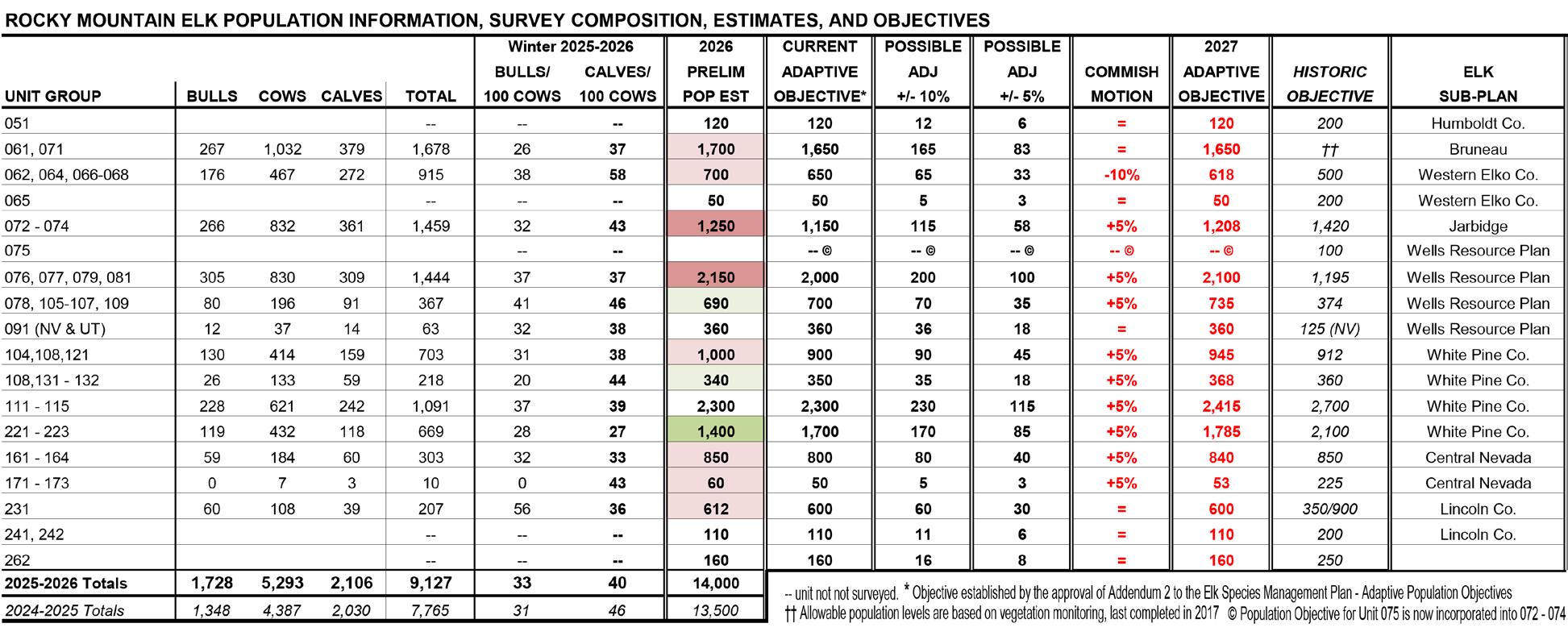
Following the Elk Management Committee meeting on this past March 12, 2026, the Nevada Wildlife Commission made their decision with the following allowances for increases as outlined in the above spreadsheet.
Download a pdf of the decision here:
https://tinyurl.com/NWC-ElkDecision
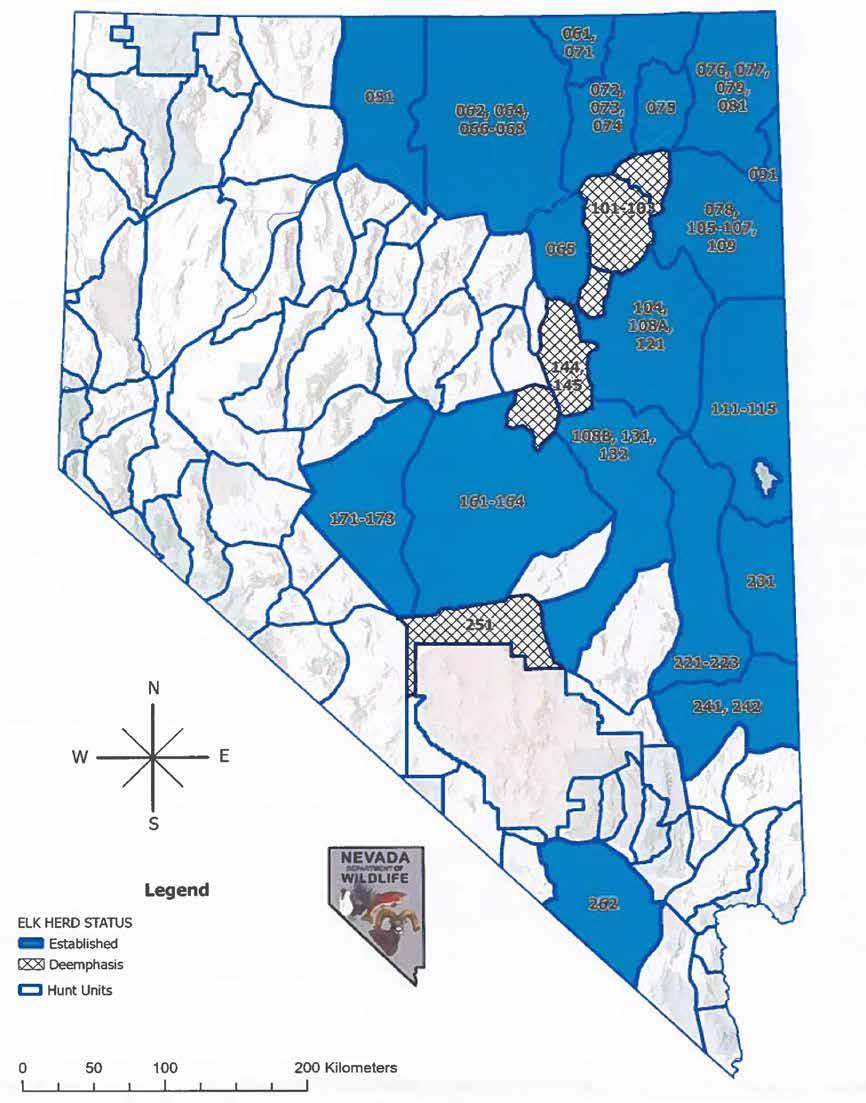
By way of reference for the statewide program, the basis for managing designated elk herds on a herd-by-herd basis (mostly connected to “Unit Groups”) here are the units presented on this Map at right.
Thank you to the two members of the Nevada Board of Agriculture who brought this matter to the attention of the Board of Agriculture at the Board’s March 19th meeting. While not an agenda item, each Board member of the Board of Agriculture is offered the opportunity to offer a report on their area of responsibility as well as the area of the state. Two of the Board members share either the experience they were dealing with elk on their private property or hearing from their constituents.
By Kylie Papson | March 10, 2026
Lake Tahoe, known for its incredible blue water, expansive forests and snowy peaks, is currently experiencing a dry spell with warm temperatures that are impacting local snowpacks.
Although early winter in the area brought recordlow snowfall, the area benefited from a very active pattern that resulted in a number of major storms in late December and early January, bringing the snowpack back to average. Baker Perry, Ph.D., State Climatologist, professor of climatology in the Department of Geography, and faculty at the Tahoe Institute for Global Sustainability, explained that these patterns of snowfall are typical for the area, but that lower-elevation regions are experiencing more rainfall than usual.
In an interview with the Hitchcock Project for Visualizing Science, Perry answered questions about weather patterns, snow science and climate forecasting across the Sierra.
Watch the video on YouTube here: www.youtube.com/watch?v=fKQySlkPa0s
What is a state climatologist, and what do you do in the role?
The job of state climatologist entails being very familiar with what’s happening across the state with weather and climate and specifically involves writing monthly drought reports and communicating this to key partners and stakeholders, as well as quarterly climate reports that provide a summary of what the climate has been over the most recent months and sometimes longer. We do quite a bit of research across the region and interface with partners at the National Weather Service, with the Nevada Snow Survey, and other water-related organizations. We have several surface-based instruments, rain gauges, weather stations and snow sensors that we are collecting a lot of data with. One major active area of research is to help improve forecasts for precipitation, which is a major forecasting challenge here in Reno and across western Nevada.
Why do we need good forecasts in this region?
We need good forecasts because the weather has a big impact on everyone. Certainly, in wintertime, we must think of the impacts of snow on the roads. It is also a consideration of if there will be snow or rain on the ski slope, which has a big impact on winter tourism. More broadly, the amount of precipitation
Ask the professor: what makes Tahoe snow so unique?
State Climatologist and Professor Baker Perry answers questions about the science of snow in the Sierras, and how different weather patterns affect local snowpacks
that spills over the Sierra crest has a huge impact on water resources, drought conditions, soil moisture, reservoirs and water resource availability.
Snow is important to predict for our snowpacks. Rain, when it falls, infiltrates into the ground and runs off relatively quickly. Snow, on the other hand, especially if it’s falling in the heart of the winter months, is going to build a snowpack, especially at higher elevations. In the spring and early summer months, the snowpack is a resource that melts slowly and sustains vegetation and communities and moves into those reservoirs to provide a much longer lasting benefit than just rain.
Please describe La Niña and El Niño weather patterns.
La Niña patterns refer to a large area of below normal water temperatures, what we call “sea surface temperatures,” across the tropical Pacific Ocean. That usually means storm tracks are favored into the Pacific Northwest. Here in Northern California and Western Nevada, it means that – although variable – we’re on the southward extent of those storms, even though the bulk of them go into the Pacific Northwest into southwestern Canada.
El Niño patterns, on the other hand, mean that the water temperatures in the tropical Pacific Ocean are much higher than normal. Normally, during an El Niño year, we have more active storms that move into Southern California and into the southwestern United States.
What are the different kinds of snow in this region, and what does it imply for snowpacks?
Here in our region, we tend to have snow that is a bit wetter and denser than other regions. That is because we’re very close to the Pacific, which is the primary moisture source for the region, and it means that a lot of our storms are relatively warm and provide water-heavy snow. This is not the classic powder that you might find in the Northern Rockies or colder locations, but it builds a great base that builds a strong snowpack that will melt slowly for more continuous water supply later in the season. From a water resource perspective, the amount of water that we have in an inch of snow here in the Sierra is typically much greater than in other places, which means that when it does eventually start to melt, it has a lot of value.
We can, however, get powdery snow in the Tahoe region, especially if one goes to higher elevations where it’s colder. When storm systems are colder, and especially if they’re coming in from the northwest or the north, it usually means that the snow will be less dense, providing the region with very nice powder. Having some powder on top of Sierra cement can be tremendous for skiing and tourism.
What is Sierra cement?
Sierra cement is a name given to the very dense snow and snowpack that develops here in the Sierra. It is a product of having super cooled liquid water that freezes on the outside of the snowflakes as they’re falling through the clouds, creating a denser snowpack. Because we have systems that produce so much snow in a single storm, that amount of snow ends up compacting itself and making the snowpack denser. It’s one of those characteristics of our region that helps build a fantastic snowpack that can last, especially at higher elevations, through the spring and even into the summer in many locations.
Watch the YouTube video about Sierra Cement here: www.youtube.com/watch?v=Lg8fJ9b0Jc0
What can we expect for the future of snow in this area?
As the climate has warmed, we have certainly seen some changes in snowpack and winter conditions in the Tahoe region. One of the most notable changes is increased rainfall and less snow, especially here in the Western Nevada valleys. Even in years with normal to above normal precipitation, those middle elevations at 6,000 to 7,000 feet experienced that precipitation as rain, which meant that there was not much of a snowpack that built up. We think this may be a harbinger of what’s to come. Especially as storms get warmer and the climate in general continues to warm, it’s going to be harder for those lower and middle elevation regions to enjoy as much snow as they have in the past.
If you go up high enough, the storms are going to continue to come, and it’s still going to be cold enough for snow to fall. Ultimately, there’s going to be a real dependence on elevation in terms of how the Sierras and Tahoe region see changes to snow with respect to a warming climate.
Read the full article here: www.unr.edu/nevadatoday/news/2026/ask-the-professor---baker-perry?
Support Nevada agriculture with a new Ag Plate
The Nevada Department of Agriculture (NDA) and Nevada FFA have released a newly redesigned specialty agriculture license plate (Ag Plate) with the Department of Motor Vehicles (DMV). The specialty Ag Plate features depictions of Nevada’s mountain ranges, field crops, and ranching, proudly representing the Silver State’s agricultural heritage. Proceeds from the Ag Plate go towards promoting Nevada’s agriculture industries and supporting Nevada FFA. Order an Ag Plate by visiting agri.nv.gov or dmv. nv.gov/plates.

SALTON SUPREME
SALT TOLERANT ALFALFA

Cattlewomen’s Corner of the Corral
By Charmi Mitchell, NCA President
The Nevada Cattlewomen have been busy planning our 3rd Annual Beef and Wine Pairing Event.
We invite you to join us on June 7th, 2026 at 3:00 pm at Park Home Ranch Venue in Gardnerville, Nevada. Please contact a NVCW board member to purchase your tickets.
Our Beef and Wine Pairing Event will provide you with six to eight different samples of marinated and cooked beef cuts from a local producer, Park Ranch Meats. These sample bites will be set up around the venue as different stations and paired with a wine that compliments the certain cut of beef, and a recipe card with how it was prepared.
Park Ranch Meats will have their trailer full of cuts available for purchase after the event. If you find a cut you enjoyed, you can purchase it before leaving the event.
Bring your friends and family to taste these delicious different cuts of beef, sip on some perfectly paired wine and then have the opportunity to purchase those specific cuts and marinade to take home and recreate it yourself.
For more information, please contact us at cwnv.inc@gmail.com or at nevadacattlewomen.com

Heat wave breaks March monthly high temperature records in Nevada
Double
whammy of low snowpack and record high temperatures may foreshadow drought conditions and elevated fire risk, climate and wildfire
Following the warmest recorded winter in Nevada, a heat wave broke numerous monthly temperature records for the state last week. The record temperatures were paired with an already low snowpack.
“To have these two unprecedented, exceptional events happening at once is a combination that is particularly concerning,” Nevada State Climatologist Baker Perry said.
The heat wave set a new Nevada statewide March monthly high temperature record of 106 F in Laughlin, south of Las Vegas, shattering the previous record of 100 F by 6 F. Perry said the temperatures across the state were exceptional for several reasons.
“It’s not just that we broke monthly records, but it’s by how much we broke the monthly records, and not just in one place,” Perry said.
Typically, monthly temperature records are broken incrementally, while daily temperature records can have larger margins. During the week of March 16 though, temperatures kept increasing throughout the week across the West. Monthly high temperature records were smashed by up to 8 degrees in some places in Nevada. Perry noted that the persistence of the heat has been remarkable, as Reno has already recorded seven days over 80 F in March, while the previous record was two days over 80 F.
Perry, who is also a professor in the Department of Geography at the University of Nevada, Reno, publishes climate and drought reports for the state regularly. His most recent quarterly climate outlook, published on March 11 with colleagues in the Nevada State Climate Office, warned that record temperatures exceeding 15 F above normal were possible.
Unprecedented statewide snow drought
Despite near normal winter precipitation and big snowstorms in mid-February, the state is facing an unprecedented snow drought. The lower elevation snowpack was largely obliterated by warm, moist air and wind just days after the winter storm, causing a melt event that resulted in the second highest daily snowmelt recorded in the eastern Sierra in winter, only after the 1997 flood. Instead of snowmelt taking place gradually in April and May, it took place quickly in late February and into March. Abnormally dry and drought conditions have expanded across the state in recent months and last week’s record heat will likely accelerate drought development.
“It depends on what the weather does the next couple months,” Perry said, “but it doesn’t bode well for summer.”
SNOwpackTelemetryNetwork (SNOTEL) sites are installed around the state and provide remote reports of snowpack. The Elko NWS representatives, Trent Davis and Jonathon Bongard, said that 70% of the SNOTEL sites in northern and central Nevada are currently reporting 0 inches of snowpack.
“The record-breaking heat compounds the problem of the low-to-nonexistent snowpack this historically dry season,” representatives from the National Weather Service (NWS) in Elko said.
However, reservoirs in the state, besides Lake Mead, are well-stocked, which will provide some relief should drought conditions expand.
experts agree
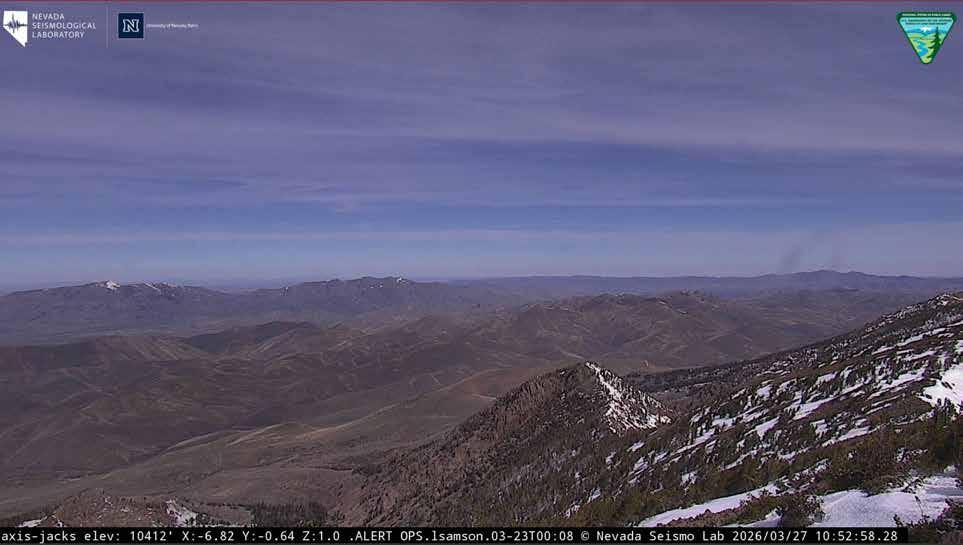
A screenshot of the view from the Jack’s Peak ALERTWildfire camera, where the nearby Jack Creek Upper SNOTEL station is reporting no snow on the ground and water year-to-date precipitation is 75% of normal. (Image courtesy of ALERTWildfire)
Summer wildfire concerns grow
“This stretch of daily high temperature records across Nevada is unprecedented,” Dan Berc, a Warning Coordination Meteorologist at the NWS in Las Vegas, said. “These hot temperatures coupled with low snowpack raise concerns for an early wildfire season across the area.”
Due to the melting snow and more rain, soil moisture has been high across much of the state, which may prompt vegetative growth.
“Record heat over the previous weeks has put us into early ‘green up’ for the year,” Truckee Meadows Fire Protection District Division Chief August Isernhagen said. “This, coupled with many other human impacts on the landscape, has created potential for unprecedented conditions this ‘fire season.’ It is worth reminding the public that the majority of our starts, and nearly all of our catastrophic fires are human caused. Regardless of the state of the landscape, a lot of how our fire season plays out this year is yet to be determined and will depend on our own actions as humans in the outdoors this summer.”
Dawn Johnson, a Warning Coordination Meteorologist at the NWS in Reno, agreed with Chief Isernhagen, explaining that the early green up results in a longer time frame for fine fuels to cure and become ready to burn.
“For the mountains, losing snowpack this early also means a longer time for the heavy timber to become drought stressed,” in absence of other weather systems, Johnson said, “so they can also become a fire concern earlier in the season.”
A glimmer of hope is on the horizon, however, with a cooler and stormier pattern expected to develop at the beginning of April. Johnson said that may be too little, too late.
Editor’s Note: The University of Nevada, Reno has experts who offer their expertise in a variety of wildfire-related topics.
Rafter 3C Arena Fallon, NV 2026 Results
2026 WINNING MEN’S TEAMS
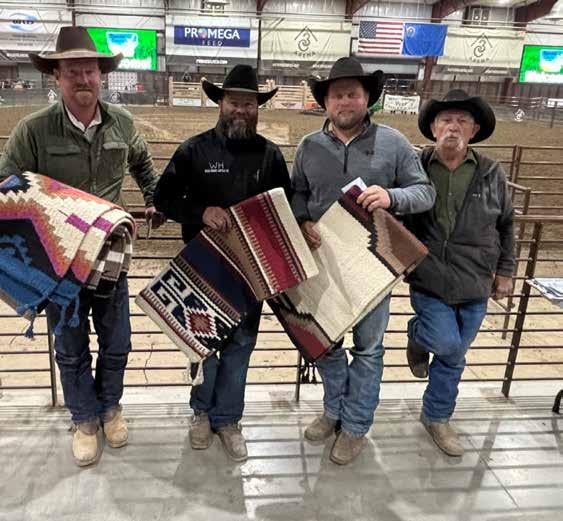
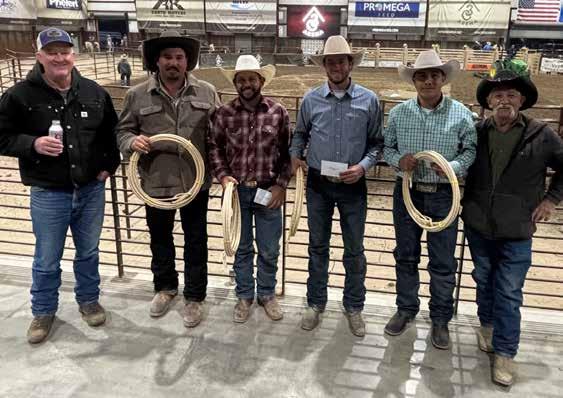
1ST PLACE
Salt and the Peppers: Dave Thacker, Denton Williams, Noah Williams, Jace Harry no picture
2ND PLACE
Wildhorse Cattle Co: Tyson Torvik, Sterling Lambert, Jessie Nuttall, Zalin Arritola
3RD PLACE
Hone Ranch: Justin Geney, Nick Nalder, Austin Carrasco, Gene Harry Jr.
U.S. DEPARTMENT OF THE INTERIOR
DOI, USDA Move to Boost Support for American Ranchers, Help Lower Consumer Pricing
Today, March 31, 2026, U.S. Secretary of the Interior Doug Burgum and U.S. Secretary of Agriculture Secretary Brooke L. Rollins announced new actions aimed at boosting the supply of American born, raised, and harvested beef by supporting American ranchers with the signing of a new Memorandum of Understanding that will strengthen coordination, cut bureaucratic red tape, and deliver immediate, tangible support for America’s farmers and ranchers who rely on public lands.
Building on the USDA’s recently released Grazing Action Plan, the agreement formalizes collaboration between the U.S. Department of Agriculture (USDA) Forest Service and the Bureau of Land Management to ensure more efficient, transparent and responsive grazing management across federal lands.
“The Grazing Action Plan is built on a collaborative partnership dedicated to strengthening ranching operations while safeguarding our public lands,” said Secretary of the Interior Doug Burgum. “By working closely with American ranchers, we are enhancing communication, investing in innovation, and modernizing our approach to land management practices to deliver real results for the people who feed and sustain this country. In coordination with the Department of Agriculture, the Trump administration is advancing actions designed to support farmers and ranchers - securing a more resilient future for grazing on public lands and protecting America’s ranching heritage for generations to come.”
“Today’s signing sends a clear message: the Trump administration is putting America’s farmers and ranchers first,” said Secretary of Agriculture Brooke Rollins. “Building on our action plan for American ranchers announced in the fall, the Forest Service and Bureau of Land Management are already delivering. This is another example of President Trump eliminating costly bureaucracy in order to lower consumer prices. Our public lands are there for the people, and this action demonstrates the commitment at USDA and the Department of the Interior (DOI) to improve our services so farmers and ranchers who use public lands can run more efficient operations.”
For generations, ranchers have played a vital role in feeding the nation, supporting rural economies, and stewarding public lands. The MOU recognizes permittees as essential partners and directs federal agencies to engage directly with those who live and work on the land.
Key actions under the agreement
• Cutting red tape and improving efficiency – The MOU streamlines permitting and processes and encourages agencies to use existing authorities more effectively – reducing delays for grazing permits, infrastructure improvements, and emergency response actions.
• Strengthening rancher partnerships – Agencies will expand collaboration with permittees through structured engagement, including learning roundtables and enhanced communication channels.
• Ranch immersion programs for federal employees – New initiatives will place agency staff on working ranches to build firsthand understanding of operational challenges and realities on the ground.
• Enhancing transparency and data access – Improved data systems will make grazing allotment information more accessible and predictable, giving producers greater certainty to plan and invest.
• Expanding practical land management tools – The agreement promotes targeted grazing to reduce wildfire risk, supports reopening vacant allotments, and encourages adoption of innovative technologies such as virtual fencing.
• Wildfire coordination and response – The creation of Grazing Permittee Wildfire Liaisons will ensure ranchers have clear points of contact and a voice during wildfire response and recovery efforts.
• Maintaining grazing capacity – The MOU affirms a goal of maintaining grazing capacity wherever possible, including no net loss of Animal Unit Months within allotments, consistent with applicable law.
Officials emphasized the agreement supports not only producers, but also American families by strengthening the domestic food supply chain. By lowering costs and improving efficiency for ranchers, the initiative helps keep food affordable and reduces reliance on foreign imports.
Today’s signing marks an important step forward in modernizing federal grazing management and reflects a broader commitment to rural prosperity by fortifying the American beef industry as directed by President Trump’s order Ensuring Affordable Beef for the American Consumer.
Additional background
More than 20,000 ranchers and farmers across 28 states graze on federal lands. The U.S. Forest Service and the U.S. Bureau of Land Management are responsible for a total of 240 million acres of federal rangelands. The two agencies together administer more than 23,000 permits and leases held by ranchers who graze their livestock on approximately 29,000 allotments. About 10% of grazing allotments, or roughly 24 million acres, are not under permit but are targeted as opportunities to allow more grazing on federal lands. The Forest Service collects an average of $6 million annually in grazing fees.
Livestock grazing on national forests and grasslands contributes about 14,200 jobs and $645 million to the nation’s gross domestic product annually, supporting agriculture-related sectors and private operations. Across Western rangelands, livestock grazing on BLM lands generate $2.7 billion in total economic output, supporting 35,000 jobs and $700 million in total labor income.
SEEDING NEVADA’S RANGELANDS: How does seeding rate affect establishment?
By Dan Harmon, Jacob Phillips, Kirk Tonkel, and Charlie Clements
USDA-ARS GBRRU Rangeland Rehabilitation Lab
Seeding efforts are among the most common range improvement treatments in the Great Basin. This practice is conducted annually, often after wildfires, to reduce soil erosion, suppress exotic weeds and provide natural resources for livestock and wildlife. Establishing perennial plants is the most effective way to mitigate the catastrophic habitat loss of over a million acres annually due to wildfires fueled by exotic annual grasses, such as cheatgrass.
What factors determine if a seeding effort is successful has been a conversation for nearly 80 years in the Great Basin. Kenneth Platt and E.R. Jackman, pioneer rangeland researchers, in their landmark 1946 Oregon State College Extension bulletin “The Cheatgrass Problem in Oregon” discussed many of the factors that affect seeding success. They emphasized that weed control, especially cheatgrass control, is critical prior to seeding to minimize competition with seeded perennial plants and maximize establishment.
Even with the early recognition that weed competition has a negative effect on seeding success, currently this is still one of the biggest reasons for seeding failures as seeding into cheatgrass-dominated landscapes continues to occur. Cheatgrass-fueled wildfires that do not burn hot enough for a long enough period of time from shrub or tree fuels almost always require a pre-emergent herbicide treatment to reduce cheatgrass competition before a seeding effort. Other ways to maximize seeding success is to seed at optimal times during fall months, drill seed whenever possible and seed plant species that can reliably establish and compete with cheatgrass in arid environments. Another common reason common for seeding failure, in the Great Basin, is seeding too late in the season. Seeding efforts in February, March and especially April are almost certain to fail. These two factors, “where” (not into cheatgrass) and “when” (during fall months) to seed, even though not commonly adhered
to, are generally agreed upon. Most land mangers agree that fall seeding on sites with less cheatgrass competition is best and is not practiced due to lengthy planning regulations or delayed funding. On the other hand, seed mix species composition and seeding rates are heavily debated topics.
The ongoing discussion of whether to use introduced species in rehabilitation efforts, like crested wheatgrass, or to use only native species for seeding efforts continues to be a contentious topic. Early land management efforts and observations, including those of Platt and Jackman, acknowledge that the most effective way to establish plants and compete with cheatgrass is seeding introduced desirable grasses, even though there often is a desire to make seeding native plants a priority. Research efforts on native plant seedings starting as early as the 1940s have yet to determine a method to compare with the effectiveness of seeding introduced perennial grasses.
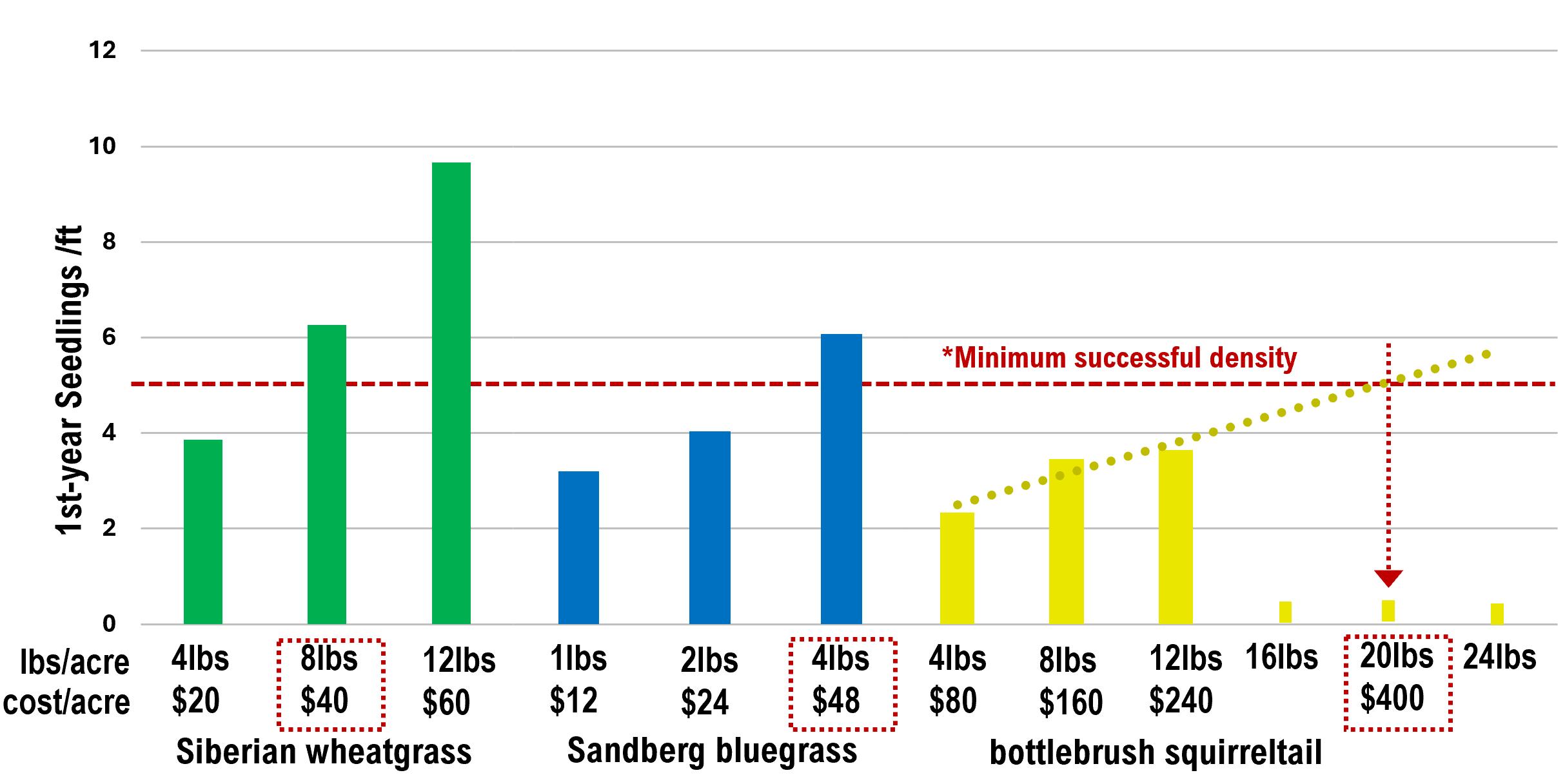
FIGURE 1. Predicted seeding rates and cost to achieve the minimum density required to competitively suppress cheatgrass. *Minimum density based on predicted 80% loss from first year seedlings to mature established plants (mature plant success = 1 plant/ft2. Cost based on typical average BLM seed purchases.
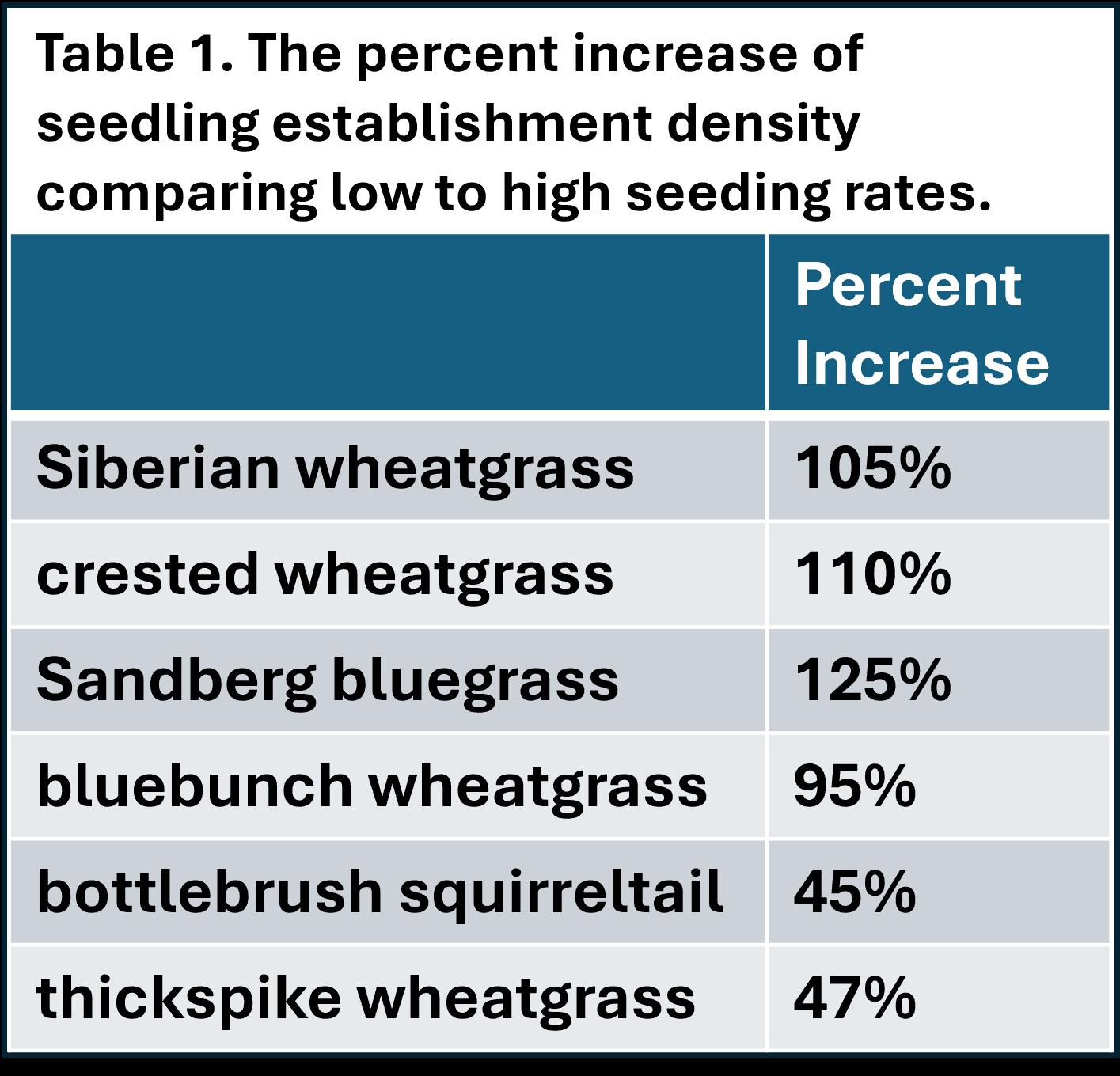
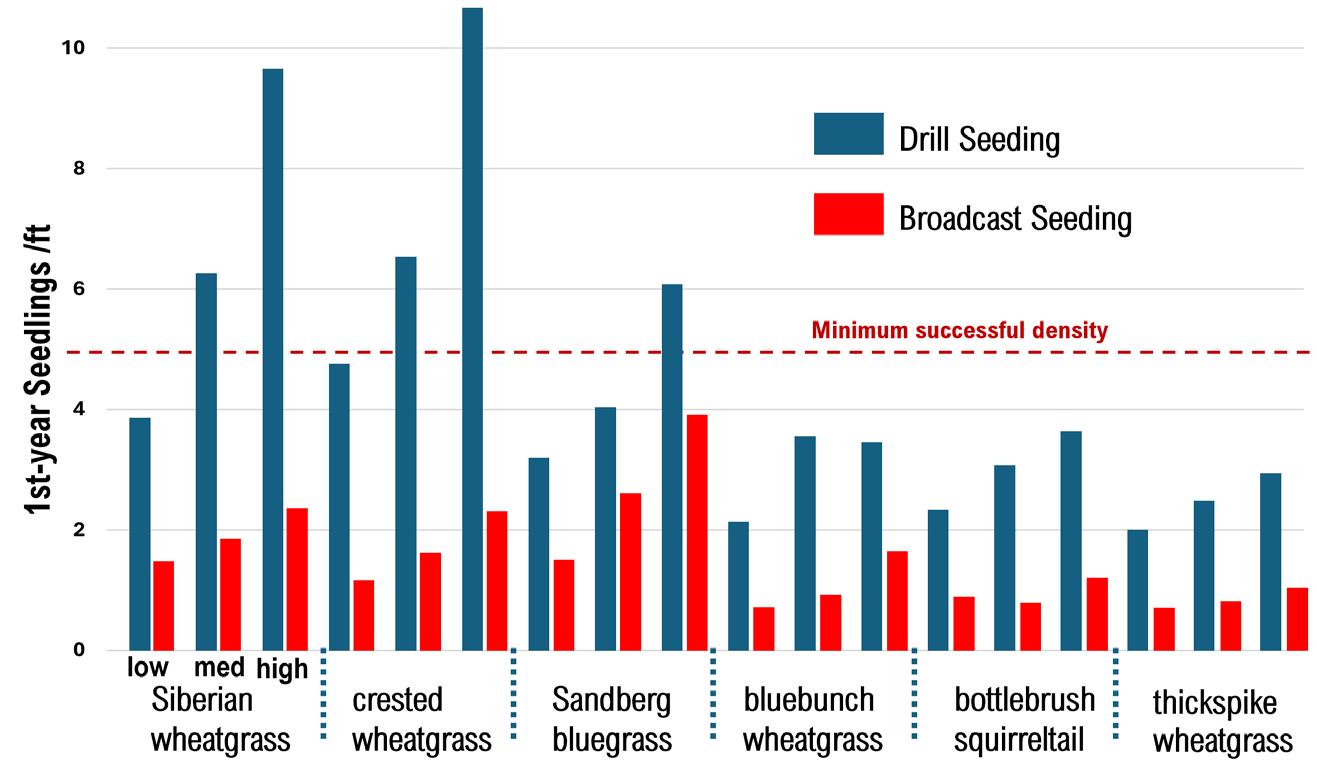
FIGURE 2 (below). Broadcast seeding 33% higher rates than drill seeding for each low, medium, high category (ex: high rate 12lb drill = 16lb broadcast). Sandberg bluegrass established best with broadcast seeding, likely because its smaller seeds provide more seeds per pound than larger seeded species (168 seeds Sandberg vs 32 seeds/ft2 Siberian wheat grass at 8lbs/acre). The smaller seeds are also more likely to find their way into the soil after broadcasting.
The USDA Agricultural Research Service, Great Basin Rangelands Research Unit (GBRRU), in Reno Nevada, has a long history of researching plant materials and methods for seeding efforts on Nevada’s rangelands. Researchers like James Young, Raymond Evans and Richard Eckert provided a foundational research program on range improvement practices that we build upon today. GBRRU continues to research the potential for native species to establish in comparison to the historically proven effective introduced grasses like crested wheatgrass or forage kochia. Ninety percent of what we test are native plants, but we always include the developed introduced rehabilitation species for study comparisons. If one’s goal is to provide a food resource and competitively suppress cheatgrass and associated fuels and wildfire threats, it should not matter where the plant originates from if it achieves those goals.
Beginning in 2023, GBRRU began a study examining the effect that seeding rate has on the establishment of two introduced grasses and four native grasses. The six grass species were seeded at three sites using three rates (low, medium, high) for three consecutive years. The seeding rates (low, medium and high) were implemented using a drill seeding and a broadcast seeding method. We focused this new study on seeding rates because, like the question of which species to seed, the question of which rates to use is also a matter of debate. Some managers prefer to use many species in a seed mix, all at low rates, to cover a large area. Others, including the authors, recommend seeding fewer species or less acreage with higher rates as opposed to seeding more acreage at lower rates, for the same cost.
Our intention with this study is to have a controlled multi-site, multi-year data set to better understand and predict establishment for the six perennial grass species using differing seeding rates and methods. Understanding what is the minimum seeding rate that will establish a perennial density great enough to suppress cheatgrass is a useful tool for cost versus benefit analysis of a seeding effort. Economics, or funding, is a primary limiting factor for restoration efforts and should always be considered. Platt and Jackman stated that the biggest issue with range seeding is knowing how to be successful for a reasonable cost, and that success is defined by establishment dense enough to dominate cheatgrass almost to the point of exclusion. The authors wholeheartedly agree with this statement from 1946.
Preliminary results from the first two years of our seeding rates experiment indicate some possible seeding guidelines. Looking at first year seedling establishment, we find that the grass species fall into two categories: (1) species that increasing seeding rate has a stronger effect on establishment (Siberian wheatgrass, crested wheatgrass, Sandberg bluegrass and bluebunch wheatgrass) and (2) species for which seeding rate has a weaker effect on establishment densities (bottlebrush squirreltail and thickspike wheatgrass) (Table 1). This information can be used in multiple ways. Species like bottlebrush squirreltail, where higher seeding rates don’t equate to significantly higher establishment densities, should be kept at lower rates in a seed mix if included at all. Using a lower rate for such species can provide seed cost savings which can be applied toward higher seeding rates (higher seed cost) for species where the rate more strongly affects establishment densities, like Siberian wheatgrass or Sandberg bluegrass.
We can also estimate the lowest rate that will achieve our minimum density establishment required to competitively suppress cheatgrass (Fig. 1). For some species, like squirreltail, if the predicted minimum rate (20 lbs/acre drill seeded) is accurate, it could mean a substantially high seed cost per acre which should be .... continued next page
avoided. The highest rate drill seeded for squirreltail with this study (12 lbs/acre) did not achieve the minimum successful density, so a trend line was used to predict what rate might achieve that establishment density. Actual on-the-ground seeding tests should be conducted using the predicted higher rate (20 lbs/acre) for the best understanding. Still, this data is useful for predicting effective rates and costs.
When we compare establishment densities from broadcast and drill seeding, we find broadcast seeding has significantly lower establishment, especially considering broadcast rates were 33% higher than drill rates (12 lb drill versus 16 lb broadcast high rate). Very few of the grass species would be economically feasible to seed at the higher broadcast rates (>16 lbs/ acre) required to establish at densities to competitively suppress cheatgrass (Fig. 2). This highlights what Platt and Jackman and many others since have emphasized, that drill seeding should be used whenever possible. Broadcast (aerial) seeding should be only a last resort when drill seeding cannot be utilized. The criticism that drill seeding causes excessive soil disturbance does not warrant avoiding drill seeding methods. Not seeding after most cheatgrass-fueled wildfires will lead to increased habitat degradation, repeat wildfires, and
weed dominance. Also, perennial grass establishment from broadcast seeding is significantly lower than drill seeding and perennial grasses are essential for sustainable cheatgrass control. Broadcast seeding should utilize species with smaller seeds like Sandberg bluegrass that provide more seeds per pound and can work their way into the soil easier than larger seeds.
Overall, our preliminary data suggests that not all species have an equal or significant effect from seeding rate on their establishment densities (Fig. 3) The three sites we conducted this research at are all post wildfire cheatgrass dominated arid Wyoming big sagebrush 8-10” precipitation zones. The results and inferences are based on these very difficult to restore habitats. Our recommendations, using these data for seed mixes, also depend on the goal of a seeding effort. If the goal is to establish a high density of perennial grasses to outcompete cheatgrass, then one should choose a seed mix with only a few species, where seeding rate has a strong effect on establishment, like drill seeding Siberian wheatgrass (12 lbs/acre) with Sandberg bluegrass (4 lbs/acre) for a seed cost of $100/acre. If the goal is to establish a greater diversity of plants, then include species where there is not a strong seeding rate effect at lower rates and put that
cost savings toward higher rates for species where establishment is affected by seeding rate. An example, drill seeding a mix with Siberian (6 lbs/acre), Sandberg (2 lbs/acre), bluebunch (3 lb/acre), squirreltail (0.5 lb/ acre) and thickspike (0.5 lb/acre) for a similar cost of $100/acre. Avoid lowering the rate (seed cost) of species like Siberian wheatgrass (less than 5 lbs/acre drill seed) or Sandberg bluegrass (less than 2lbs/acre) to offset the higher cost of increased rates for species like squirreltail, which likely won’t increase establishment from a higher seeding rate. For broadcast seeding, while success may be much more challenging and options limited, a simple mix of Siberian wheatgrass (16 lbs/acre) with Sandberg bluegrass (8 lbs/acre) at a cost of $175/acre provides the best chance of success while competing with cheatgrass.
While such research can help predict the chance for seeding success, ultimately the best management recommendations utilize on-the-ground experience and outcomes of past seedings in similar working areas. Acknowledging the past, such as Platt and Jackman as well as James A. Young and other foundational science, managers, producers and researchers can work together to restore a productive and resilient rangeland for the future.
FIGURE 3. Perennial grass seeding rates treatment block achieving the minimum establishment density (center). Plots seeded October 2023, photo May 2025. Rates and species treatment blocks to the right and left of center image failed to meet minimum establishment density goals. Izzenhood, Nevada.
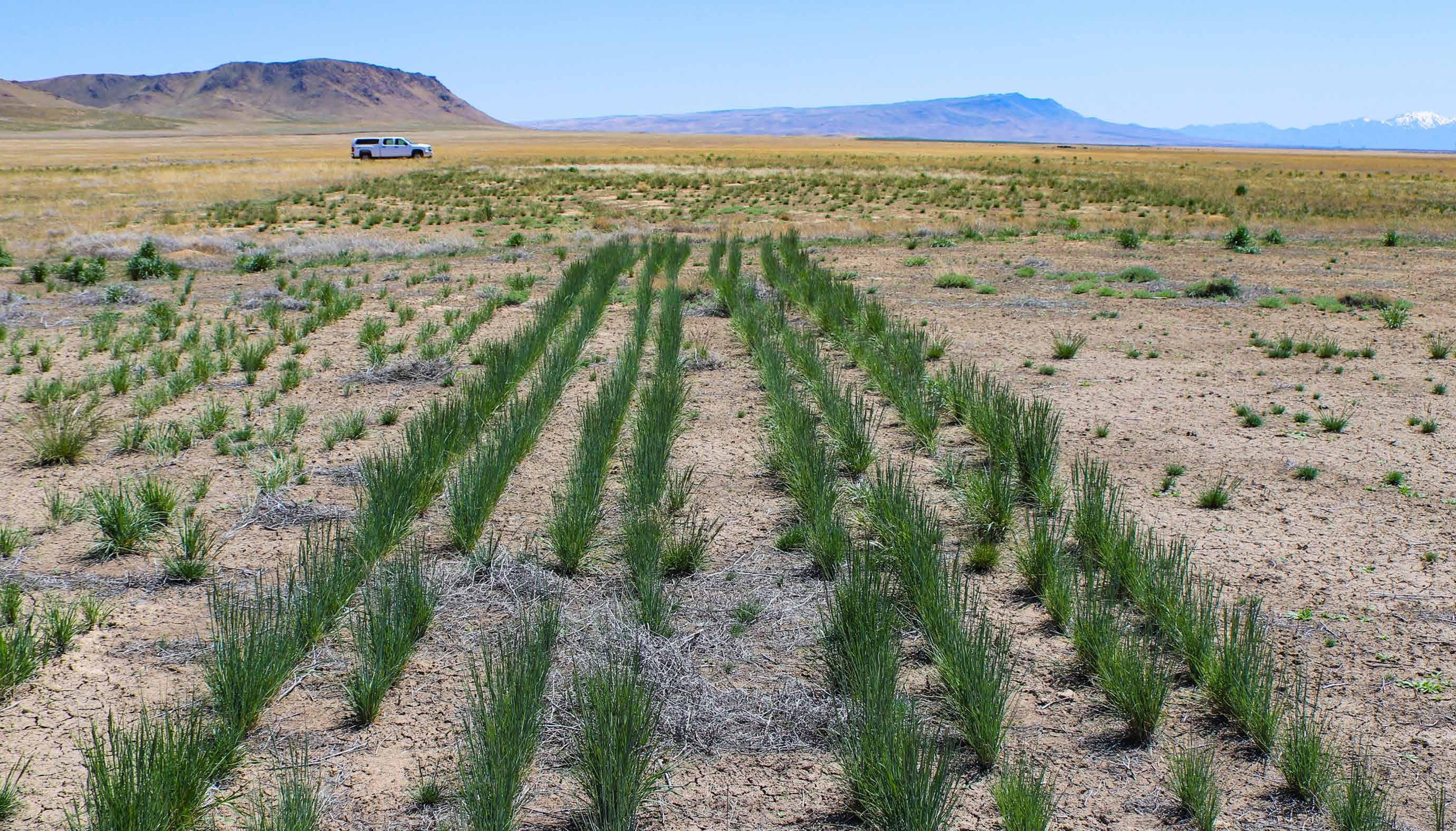
GREENWAY’S GRAZING CORN
Graze Yearlings1500 on a 130 Acre Pivot for 30 Days

28 Ton Silage Pasco, WA
3.5 lbs. of Gain Per Day (69% TDN) 5-7 wt. Cattle*
* Jesse Norcutt, Currant, NV
Greenway Seeds Grazing Corn (GX80) is the No. 1 grazing corn in the nation because it is 5-6 days earlier than the competition. This allows the rancher to plant 5-6 days later and still reach peak sugar content (pre tassel) before the frost shuts you down!
OVERSEED ALFALFA with Grazing Corn
Plant with a grain drill following second cutting on an older field alfalfa. Ready to graze in early September.
“We planted GX80 following second cut alfalfa. If we had to do that over we would follow third cut. We grazed 400 head for two weeks on 20 acres” Cory Veterre - Greenriver, Utah
HERE’S WHAT RANCHERS ARE SAYING
Casey Calvin - Monte Vista, CO
We grazed lambs on GX80. They ate it all the way to the ground. Unbelievable! (See website for photos)
Crawford Cattle - Winnemucca, NV
Planted mid July, it was way over our heads. We were surprised as to how long we were able to graze. We also baled some of it. We’re buying again.
Cory Miller - Grass Valley Farm, Missoula, MT
We planted our GX80 under wheel lines and watered heavily. This was key as the corn grew 7ft tall!
Tom Kerns for Mike Becker Ranch - Baker, OR
We were able to carry 14 A.U.M.’s per acre with our late season grazing of GX80.
Jesse Norcutt - Currant, NV
We cut and baled the GX80 at pre-tussel. It was fed to 5-7 wt. cattle, and they gained 31/2 lbs/day
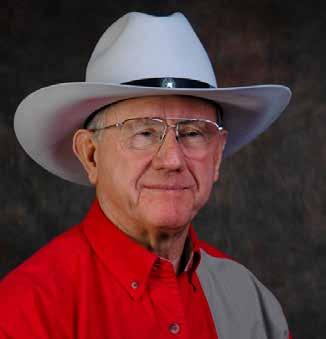
AFBF President Zippy Duvall’s Testimony Before Senate Agriculture Committee
Increasing Domestic Consumption of U.S. Grown Agricultural Products
Verbal Testimony as Prepared for Zippy Duvall, President, American Farm Bureau Federation to the United States Senate Committee on Agriculture, Nutrition, & Forestry
“Increasing
Domestic Consumption of U.S.-Grown Agricultural Products”
March 10, 2026
Chairman Boozman, Ranking Member Klobuchar, and Members of the Senate Agriculture Committee, thank you for the opportunity to testify before you on this important topic.
My name is Zippy Duvall. I am a third-generation farmer from Georgia. My family and I raise beef cattle, poultry and hay.
I am honored to serve as president of the American Farm Bureau Federation, representing more than five-million member families who grow every crop produced in the U.S.
Our members are the economic backbone of rural America, but they continue to face historic headwinds in the farm economy.
When adjusted for inflation, USDA projects farm income this year to be nearly $50 billion below the levels just a few years ago.
One of our young farmer leaders from Oklahoma pointed out to me recently that his prices have fallen to the lowest levels of his lifetime while input costs have increased at the fastest pace in history. The conflict in Iran is expected to make costs for fuel and fertilizer soar even further.
Congress and the president have delivered critical support, and we’re grateful for the investments in risk management, trade promotion, conservation and addressing animal diseases.
Bridge payments provided a lifeline to help farmers make it to this season. But farmers do not want to rely on government aid. And aid should not be needed year after year.
That’s not normal volatility, it’s structural imbalance. And that’s why this hearing is so important.
We must strengthen domestic demand for American agricultural products. We must reinforce our production capacity of critical ag supplies and restore domestic processing capacity.
We must ensure our safety nets are strong and expand fair and enforceable market access abroad.
More than 20% of total ag products are exported in a typical year. When that export engine slows, farm-level prices drop quickly.
Export markets must be strengthened through fair and enforceable trade agreements.
Global competitors have expanded acreage, improved yields, and invested heavily in ports and rail systems.
That competition is not going to back down. We must be competitive in export markets but also expand domestic demand and processing capacity to be truly resilient.
There are many ways to drive domestic demand.
Biofuels represent a clear example. Ethanol production now accounts for about 40% of total U.S. corn usage.
Renewable diesel and biodiesel markets continue to transform oilseed demand.
This shift has driven expansion in soybean crushing capacity, creating jobs and strengthening local communities.
Sustainable aviation fuel represents another opportunity.
Another aspect of domestic demand is federal purchasing.
Federal agencies purchased almost 7 billion dollars in U.S.-grown food and agricultural products last year.
‘Buy American’ policies are both patriotic and powerful, but oversight and enforcement can be strengthened.
For example, the National School Lunch Program provides nearly 5 billion meals annually that are supposed to be domestically sourced.
But the rules allow a substantial share of foreign products and many exceptions. Enabling schools and food banks to source directly from U.S. farms is another demand booster, especially for fruit and vegetable growers.
Incentives can also help. The Buying American Cotton Act of 2026 is a good example of legislation that builds demand through a tax credit for businesses using American-grown cotton.
A key pillar of a strong farm economy is an adequate farm workforce.
The current labor shortage is unacceptable and unnecessary.
We need modernized ag labor programs and improved guestworker programs. Otherwise, farm production and food processing will continue moving outside our borders.
American agriculture remains one of the most innovative and productive sectors in the world.
We must ensure that markets, infrastructure, and policy evolve alongside that productivity.
I look forward to working with this Committee to ensure that America’s farmers and ranchers can continue supplying food, fiber, and fuel to families across this great country and beyond.
Thank you for the opportunity to speak today.
For more in-depth analysis of the struggling farm economy, read President Duvall’s full written testimony here: www.fb.org/files/Final_AFBF_ PZDTestimony_Senate_AG.pdf
Nevada Agricultural Foundation Receives $500,000+ Donation
Creating The James R. Morgan Memoral Fund
The late James Morgan endowed the NAF with a gift of over $500,000. James’ son, Steven Morgan, facilitated this very generous gift.
This gift will provide significant ongoing support to Nevada students pursuing an agriculture-related degree as well as support agricultural research and development grants awarded by the NAF.
James Morgan lived and farmed in south Mason Valley. He was very involved in Northern Nevada agriculture and was an active member of the NAF. He was a board member and member of the NAF Scholarship Committee for over a decade.
The NAF’s mission is to “Promote and Strengthen Agriculture in Nevada by Providing Financial Assistance to Deserving Groups or Individuals Involved in Research or Education.” This very generous endowment will significantly enhance the Foundation’s ability to achieve its mission and goals. The Nevada Agricultural Foundation awarded over $100,000 in scholarships and grants in 2025.
Frank Bishop, President of NAF said, “We are thrilled and so appreciative of this gift provided by James Morgan. We look forward to helping Nevada students and providing funding for agricultural research long into the future.”

PUBLIC HEARING:
NAC 557 to be held on Tuesday, April 14
The Nevada Department of Agriculture (NDA) Division of Plant Health and Compliance is hosting a public hearing on Tuesday, April 14, at 10 a.m. at the NDA Sparks Headquarters with remote and virtual participation options to solicit comment on proposed regulation changes.
The proposed changes to NAC 557 seek to align state and federal definitions and regulations to maintain a federally compliant hemp program in Nevada. The proposed regulation change only impacts hemp production and preharvest testing, as it pertains to the acceptable level of THC in a hemp crop. These changes will not impact regulations pertaining to hemp products or postharvest uses of hemp. Additionally, this regulation does not change the current acceptable THC level of not more than 0.3 percent on a dry weight basis. This proposed regulation updates the definition of “Total THC” and “post- decarboxylation” in NAC 557 to align with existing federal regulations (7 C.F.R. § 990.1), and replaces references in existing state regulations regarding the amount of THC contained in hemp to “Total THC.”
Your voice is important to the NDA
This hearing is being held so the NDA can receive verbal and/or written feedback through public comment from all interested persons regarding the proposed amendments of regulations pertaining to NAC 557.
CONTACT: Cathy Guild Executive Director, NAF (775) 673-2468 info@nevadaagriculturalfoundation.org
Nevada Agricultural Foundation nevadaagriculturalfoundation.org
2165 Green Vista Dr. Ste 204 Sparks, NV 89431
The proposed regulation changes, meeting locations and virtual participation links, and business impact statement are available in the meeting notice on the NDA website or by visiting https://agri.nv.gov/ Plant/Workshop_and_Hearing_Meetings/Division_of_Plant_Health_ and_Compliance_Workshops_and_Hearings/
Submit comment
Anyone wishing to comment on the proposed regulations may appear at the scheduled workshop or send their comments, and/or information in writing to:
Nevada Department of Agriculture
405 S. 21st Street
Sparks, NV 89431
ATTN: Plant Health and Compliance
775-353-3670
d.reece@agri.nv.gov
THE ROUNDUP
An analysis of western ranching politics.
IN THE NEWS
Administration: USDA Promotes New, Voluntary “Product of USA” Label; FWS celebrates farmers and ranchers on National Ag Day.
USDA Promotes New, Voluntary “Product of USA” Label, USDA - On March 24, National Agriculture Day, U.S. Secretary of Agriculture Brooke L. Rollins announced the launch of a national public awareness campaign to inform meat, poultry, and egg producers of the “Product of USA” voluntary labeling standard which went into effect on January 1, 2026, and increases consumer understanding of what the label means. “Our great patriot ranchers and producers grow, raise, and harvest the world’s safest, most affordable, and abundant food supply. American consumers want to support America by buying American and this label will strengthen our food supply chain through transparency, fairness, and trust,” said USDA Secretary Rollins. “This new standard policy ensures producers who invest in a fully American supply chain can compete fairly, and it gives consumers the confidence they deserve about the food they bring home.” “When we choose to purchase from American producers, we get a superior product while supporting the hardworking family farms who put it all on the line every day to feed, clothe, and fuel our nation,” said SBA Administrator Loeffler. “Amid President Trump’s work to end years of unfair competition and eliminate the massive red tape that has crushed domestic agriculture, Made in America is finally making a comeback. Today, on National Agriculture Day, I urge all Americans to join me in support of the hardworking farmers and ranchers who anchor the U.S. food supply chain that is so vital to keeping our nation strong, safe, and healthy.” “Our farmers and ranchers are essential to putting real food back at the center of the American plate and delivering on the Dietary Guidelines for Americans,” said HHS Secretary Kennedy. “‘Product of the USA’ labeling puts American producers first, gives families clear, honest information, and empowers them to choose food raised right here at home.” “U.S. producers are the best in the world, and produce the highest-quality products,” said North Dakota Senator Hoeven.
“A ‘Product of USA’ label benefits our ranchers and provides transparency and confidence for consumers. We appreciate Secretary Rollins and the Trump administration for their efforts to support our farmers, ranchers and rural communities.”
National Agriculture Day, USFWS - Each year, we at the U.S. Fish and Wildlife Service celebrate the vital role agriculture plays in our daily lives and express our deep appreciation for the people whose work sustains the nation. We want to recognize the agricultural community as key partners in advancing our conservation mission, supporting rural livelihoods and strengthening local economies. Happy National Agriculture Day! Those who work the land know it best. American farmers, ranchers, growers, producers and private landowners are leading practical, on-theground efforts that keep soil healthy, protect water and support wildlife all while maintaining productive operations. Their stewardship keeps working lands productive and local economies strong. We deeply appreciate the hard work these land stewards invest in supporting both our shared livelihoods and our conservation mission. Across our agency, we work alongside agricultural producers to improve ecosystem health and keep working lands sustainable. Whether restoring native vegetation, improving water quality or creating habitat for pollinators and other wildlife, these partnerships show that conservation and agriculture go hand in hand. Our Center for Pollinator Conservation partners with producers and agriculture industry leaders to help reverse declines in pollinator populations while keeping crops productive. About 75% of fruit and seed producing crops depend on pollinators, something producers see firsthand every season. Across the country, farmers and ranchers are voluntarily adopting practical tools such as integrated pest management, targeted pesticides applications, adjusted mowing schedules and planting field borders with native flowering plants. The Center works with the Farmers for Monarchs coalition to boost monarch habitat on working farms and ranches through steps like planting milkweed, restoring native forbs and improving migratory corridors.
Congress: Chairman of Senate Ag intends on taking up a five-year farm bill.
Senate Agriculture chair vows action on farm bill soon, E&E News - Senate Agriculture Chair John Boozman said Monday he plans to soon take up a five-year farm bill, regardless of delays a similar bill may face in the House. Asked at an agriculture policy conference when he plans to move a measure through his committee, Boozman said, “Weeks, not months,” but did not offer specifics. Lawmakers on both sides of the Capitol have struggled for the better part of three years to make a new agriculture policy bill reality, hobbled by partisan troubles, an always-full legislative calendar and shifting priorities as the second Trump administration replaced the Biden administration. But Boozman, an Arkansas Republican, told agriculture groups not to mistake delays for inaction, as lawmakers
and congressional leadership are in discussions about advancing the bill. “There’s a path forward if each side is willing to take it,” Boozman said at the conference organized by the publication Agri-Pulse. “We want to get it done as soon as possible.” The last five-year farm bill, enacted in 2018, expired in 2023 and has been extended more than once. Congress also enacted parts of farm policy in last year’s One Big Beautiful Bill Act, but big pieces of conservation policy, forestry and agricultural research remain to be resolved. Boozman said that to advance in the Senate, any farm bill will require substantial agreement from Democrats. His counterpart, ranking Democrat Amy Klobuchar of Minnesota, told the conference she’s committed as well to moving a bipartisan bill. And she and Boozman both heaped praise on each other in separate addresses for cooperation on farm policy.
Industry: What to expect for supply and demand for summer beef cattle; 2025 report explores challenges.
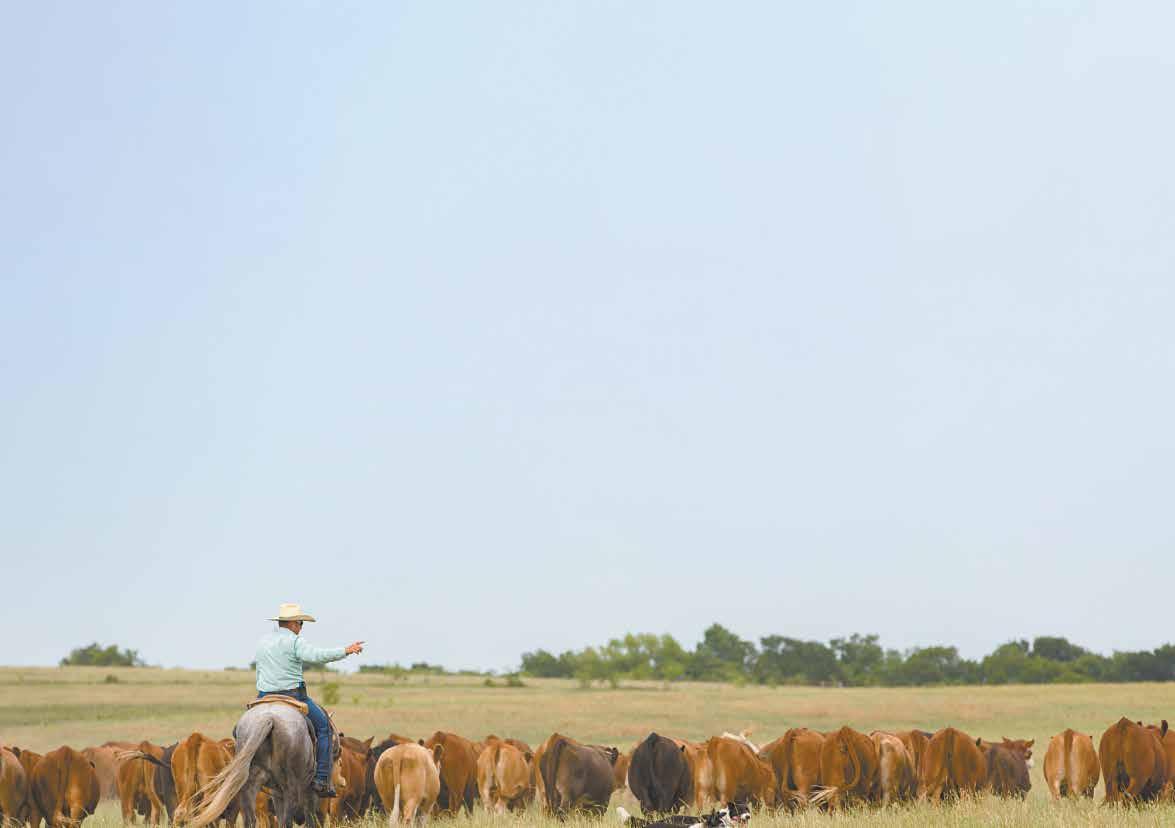
In the Cattle Markets: Supply and Demand for Summer Beef and Cattle Markets, Morning Ag Clips - Recent “In the Cattle Markets” articles have focused on trade, demand, and beef production. To continue the theme of the various links in the beef supply chain, this article will focus on cattle availability and where market conditions could be headed as we move into spring and eventually the summer grilling season when seasonal demand for beef typically peaks. The total number of cattle on feed on March 1, 2026, was estimated to be 11.55 million head, up slightly from last month and down slightly from the same time period as last year. Placements were 1.61 million head, up about 57,000 head, or 4%, from last year. Marketings of fed cattle were 1.52 million head, down about 7% from last year. While marketings have been consistently lower than last year, marking fewer numbers of fed cattle available, it’s important to note that placements have outpaced marketings of cattle in five of the last six months. This means more cattle are being placed on feed than are being marketed for beef. This should lead to more cattle being available for beef production during the next several months when grilling demand ramps up. Memorial Day is considered the unofficial start of grilling season, which typically brings peak seasonal demand for beef. March and April usually bring peak demand for other proteins such as ham and lamb, while beef demand slows. This year, demand for beef has risen over the last several weeks, pulling prices higher at a much faster pace than in past years. Since January, the choice beef cutout value has increased by $50.14/cwt or 13%, from $349.97/cwt on Jan. 2, 2026, to $400.11/cwt on March 20, 2026. This is 25% higher than 2025 and has many analysts questioning if the strong demand from grilling season will pull beef prices even higher this summer.
Carnivore conflicts: 2025 report explores challenges for special team, Powell Tribune - Bears continue to dominate Wyoming large carnivore conflict reports in 2025, accounting for nearly six times more wardenconfirmed conflicts than wolves and mountain lions
combined. Bears were involved in 412 conflict reports (220 grizzly bear, 192 black bear) last year, while mountain lions and wolves combined were only involved in 71 confirmed conflicts (36 mountain lion, 35 wolf), according to a report made in front of the Wyoming Game and Fish Commission this past week. “We have bears occupying all the suitable habitat and beyond,” said the state’s top large carnivore expert Dan Thompson. Thompson leads a crew of 10 large carnivore biologists who respond to conflict reports year round. Last year the first confirmed conflict was Jan. 3 and the final call of the year came Dec. 29. Confirmed conflicts are those requiring actionable responses, including injury and death of livestock and humans and property damage — not just complaint calls. “I don’t think (call) data is worth anything,” said Conflict Coordinator Brian DeBolt, adding that calls that are sometimes just sightings don’t fit the department’s definition of some sort of damage. The Cody Region had the most large carnivore conflicts in the state with nearly 160 confirmed conflicts, followed by Lander (about 125), Pinedale (about 110), and Jackson and Sheridan (about 25). Laramie, Casper and Green River regions all recorded 15 or fewer conflicts. “We have 10 to 12 people within the large carnivore section to handle [conflicts],” DeBolt said. “We do recruit help from wardens, and biologists, you know, when necessary. But the brunt of the work is about 10 people handling [conflicts] in Northwest Wyoming. The department is hardly new to responding to conflicts. Since 1982, team members, wardens and biologists have responded to 12,715 conflicts, including 6,089 for grizzly bears, 4,485 for black bears, 1,120 for mountain lions and 1,021 for wolves. “Grizzly bear conflicts dominate what we do, even though they have the lowest distribution in regards to these four species within the state, they constitute the highest volume of conflicts that we deal with.”
Congress: House set to vote on legislation concerning wildfire responses and water restoration projects this week; HNR Subcommittee set to review public lands bills in hearings this week.
House plans vote on wildfire response, water project bills, E&E Daily News - The House will vote on legislation this week to address issues concerning wildfire response and water restoration projects. The “American Water Stewardship Act,” H.R. 6422, from Rep. Pete Stauber (R-Minn.), would amend the Federal Water Pollution Control Act to continue restoration projects through 2031 around the Great Lakes, Columbia River Basin, Long Island Sound and San Francisco Bay, among others. The legislation, co-sponsored by New York Republican Rep. Nick Lalota (R-N.Y.) and Michigan Democratic Reps. Kristen McDonald Rivet and Hillary Scholten — includes coastal water quality monitoring programs. “The Great Lakes are not only national treasures, but economic powerhouses, and the Great Lakes Restoration Initiative helps keep these waters clean and safe for all Americans
to enjoy,” Stauber said when introducing the bill in December. The “Wildfire Aerial Response Safety Act,” H.R. 6618, from Rep. Janelle Bynum (D-Ore.), would require a federal study analyzing how errant civilian drones have interrupted firefighting aircraft over the past five years. It also explores prevention measures, including counter-drone technology and educational outreach. The bill has received widespread bipartisan support following numerous instances of aerial collisions during last year’s devastating wildfire season, including the Palisades Fire. Co-sponsors include Colorado Democratic Rep. Joe Neguse and Arizona Republican Reps. Elijah Crane and Juan Ciscomani. In January, when the measure passed the House Transportation and Infrastructure Committee, Rep. André Carson (D-Ind.) called the runaway drones a “costly nuisance” that risks the safety of first responders. There were at least 34 drone incursions into active wildfire areas in 2025 as of September, and 29 of those disrupted firefighting aircraft, according to the National Interagency Fire Center. Most occurred in California.
Hearing to weigh expanded forest management pacts, E&E Daily News - A House Natural Resources subcommittee will delve into an array of public lands bills this week, including an expansion of “Good Neighbor Authority.” The Subcommittee on Federal Lands met March 26 to review four bills, including H.R. 7951, the “Long-Term Good Neighbor Authority Act,” sponsored by California Reps. David Valadao (R) and Jimmy Panetta (D). The measure would allow states, tribal nations and local governments to enter into agreements of up to 20 years with the Forest Service and Bureau of Land Management to work on forest projects together. The current limit is 10 years. “By strengthening long-term collaboration between federal, state, tribal, and local partners, the LongTerm Good Neighbor Authority Act will take a more proactive approach to forest management and wildfire prevention,” Valado said in a statement last week. The subcommittee will also consider Colorado Republican Rep. Jeff Crank’s H.R. 7979, the “Public Lands Access Restoration Act,” which would mandate any road or trail on lands overseen by the Forest Service and Bureau of Land Management is open to motorized vehicles. The agencies would have only six months to review all the roads under their jurisdictions and would have to provide “clear and convincing evidence for resource protection or public safety” to close any routes. The secretaries of Interior and Agriculture would also be required to review proposals for reopening closed roads “at any time.” Lawmakers will take up Virginia Democratic Rep. Don Beyer’s H.R. 6778, the “Parkway Safety and Reinvestment Act.” The bill would allow the Interior Department to collect revenue from speed cameras on roads it operates, like the George Washington Memorial Parkway, and reinvest those funds into safety improvements, road maintenance and infrastructure. Reps. Jen Kiggans (RVa.) and Rep. Seth Magaziner (D-R.I.) will offer H.R. 7618, the “American Battlefield Protection Program Amendments Act,” to extend that program through 2035. The program would otherwise expire in 2028.
Administration:
BLM plans to remove 14,000 additional wild horses from across the West, including 1,111 from CO. Feds plan to remove 1,100 more wild horses from Colorado this summer, citing wildfires and drought, The Colorado Sun - Federal land managers plan to round up and remove 14,000 more wild horses from rangeland across the West this summer and fall, including 1,111 in Colorado. The U.S. Bureau of Land Management’s plans include three roundups in western Colorado two of them using helicopters to drive mustangs from above and push them into corrals. The recently released schedule is angering wild horse advocates who say the federal government is ignoring solutions worked out by a state-federal task force as well as requests by Gov. Jared Polis that the BLM stop using helicopters to capture horses. “Despite earnest efforts to bring stakeholders round the table with the formation of the Colorado Wild Horse Working Group, we are back where we were in 2022, with more than 1,000 horses being targeted for removals by helicopter,” said Scott Wilson, a photographer who has spent years documenting mustangs on the sagebrush rangelands of western Colorado. Removing 1,111 mustangs and putting them in holding pens for the rest of their lives would cost taxpayers $53 million, Wilson said, using a BLM estimate that it costs $48,000 per horse to round it up and care for it for life. The largest Colorado operation on the federal government’s schedule includes removing 911 mustangs by helicopter in August from the Piceance-East Douglas, a herd management area outside of Meeker in northwestern Colorado. The nearly 200,000 acres of public land, shared with wildlife, grazing cattle and oil pumps, should have 235 wild horses at maximum, according to the BLM. That makes 911 too many, federal land managers said. The federal agency is also planning to use a helicopter to round up 100 horses from West Douglas rangeland, and 100 more through a bait-and-trap operation at Sand Wash Basin, which is along the Wyoming border. “When herds grow faster than the land can support, it puts stress on public lands and on the horses,” Steven Hall, a spokesman for the federal agency, said via email. “Colorado is experiencing a record drought, and forage and water sources will be impacted, which will impact wild horses particularly hard.” The goal is to shrink the wild horse population in Colorado from its current 1,727 horses down to 616 horses. Going forward, the BLM in Colorado “aims to reduce the size and frequency” of future roundups by expanding fertility-control treatments, Hall said. Herds grow 15% to 20% each year without management, “making fertility control essential to long-term, humane and sustainable population management,” he said. The West Douglas area is “not suitable” at all for wild horses, Hall said. Most of the animals there were removed several years ago after wildfire gobbled up what was left of the forage that mustangs eat. In northwestern Colorado, where the terrain is rugged and filled with canyons and cliffs, helicopters “provide
one of the safest, most efficient means of gathering wild horses,” Hall said. “Northwest Colorado has an exceptional record of conducting wild horse gathers with minimal injuries to horses.” Federal officials and Colorado leaders have been in conflict for years over the management of wild horses.
Industry: Colorado River negotiations underway, prioritizing stopgap measures amid declining conditions; Farm Rescue looks to expand ‘Operation Hay Lift’ to ranchers affected by NE wildfires.
Colorado River negotiations resume with focus on stopgap measure in face of worsening hydrology, CPR News - Critical negotiations about the future of the Colorado River took a two-week hiatus last month after the seven states in the basin missed a key Valentine’s Day deadline for striking a deal, New Mexico’s water negotiator said Thursday. Estevan López said talks resumed March 2, and the upper and lower basin states are using a short-term pitch from Nevada as a starting point. “Right now, we’re in discussions with the lower basin about a potential short-term agreement,” Lopez told New Mexico’s Interstate Stream Commission. Nevada is proposing to increase water releases from upper basin reservoirs like Flaming Gorge by at least 500,000 acre feet to help prevent Lake Powell from dropping too low. The latest forecasts predict that Powell could drop enough to stop producing hydropower by December. In return, lower basin states would agree to cut their water use by 1.25 million acre feet “until system conditions have meaningfully improved.” López said upper basin states had a counter proposal and talks about it were scheduled on Thursday afternoon. “The hydrology right now is incredibly dire,” López said. “So we’re beginning for this year, for the remainder of this water year, we’re suggesting that there needs to be a release from the upper initial units, most likely Flaming Gorge, since that’s the reservoir that’s largest and has the most water. And we are anticipating that there will be a release of half a million acre feet from Flaming Gorge to prop up Lake Powell.” Meanwhile, the Interior Department is reviewing thousands of comments it received on a range of options for how to manage the vital waterway. The alternatives were published in January and could result in a variety of scenarios, ranging from significant water reductions in lower basin states to creating new incentives for states to conserve water. And after the states missed two deadlines to reach an agreement, it’s becoming increasingly likely the federal government will try to piece together its own plan before the current guidelines expire in the fall. Water negotiators are also facing a worsening water supply forecast with record low snowpack across the West. Cody Moser with the federal Colorado Basin River Forecast Center said last week just 2.3 million acre feet of Colorado River water is expected to reach Lake Powell through July. That’s about a third of what’s considered normal. “You’ll notice it’s not a pretty picture here with lots of reds,” he said
as he presented a color coded map of how much water is expected to reach certain locations in the river basin. “That’s 50 to 70% of normal April through July runoff. Those maroon colors are 30 to 50% and we even have some of those pinks, which indicates less than 30% normal seasonal spring runoff.” An attorney for New Mexico’s Interstate Stream Commission said Thursday the state expects the Interior Department to identify a preferred option for managing the dwindling river by July. The current operating guidelines for Lake Powell and Lake Mead expire in the fall.
Farm Rescue brings hay to ranchers impacted by wildfires, Farm Progress - Mark Calderwood has a routine of safely strapping down a semitrailer load of hay and checking his rig before hitting the road. But the reason behind this load, and his destination? Those are anything but routine. Calderwood is one of several volunteers with Farm Rescue using their commercial driver’s licenses and their time to haul donated hay to recent victims of wildfires in Kansas and Oklahoma — and soon, Nebraska. Farm Rescue’s “Operation Hay Lift” was activated to help ranchers who lost pasture and feed supplies in the Ranger Road Fire. It’s being supported by the Fellowship of Christian Farmers, providing fuel reimbursement to help offset transportation costs. With the recent historic wildfires burning more than 701,000 acres across Nebraska, Operation Hay Lift is likely to expand. The Ranger Road Fire burned more than 283,000 acres across Oklahoma and Kansas in late February. To date, 18 families in the two states have signed up for assistance. More than 1,000 hay bales have been offered by donors. Operation Hay Lift volunteer drivers include John Schnitzler, Wisconsin; Kenny Crites, Indiana; Mark Johnston, Illinois; David Endorf, Nebraska; Dean Issacs, Indiana; and Calderwood. Calderwood is a retired teacher living near Sterling, Kan., and working for a nearby farmer. Last fall, he filled out an information sheet with Farm Rescue that detailed what skills he had to share. “So, I filled out an information sheet, and they called me up, and the first thing they asked me was if I was a CDL driver,” Calderwood said. “I said ‘yes,’ and they were really happy about that because it’s still hard to get a volunteer with a CDL.” Farm Rescue has its own trucks and trailers, he said, so he and other volunteer drivers only have to go through safety training and keep their certification to drive. “We go to the collection points, load, and then the dispatcher for Farm Rescue looks through all the requests from ranchers, and we haul straight to the ranch and unload where they want it unloaded,” Calderwood said. He has been loading donated hay out of Woodward Livestock Auction Inc., Woodward, Okla., and a feedyard near Ashland, Kan., which were collection points for Farm Rescue.
Senate Subcommittee Discussed Endangered Species Act Reform
On March 18, 2026 at 10am, the Senate Environment and Public Works Subcommittee on Fisheries, Wildlife, and Water held a hearing to gather feedback on the need to reform and reauthorize the Endangered
Species Act (ESA). The discussion highlighted a broad range of perspectives on potential improvements to the bill. Overall, the hearing reflected a sense of optimism among lawmakers regarding the possibility of reaching a legislative compromise on the ESA reform. To watch the full ESA Reform Senate hearing, visit: www. epw.senate.gov/public/index.cfm/2026/3/hearingexamining-the-challenges-and-opportunities-withimplementing-the-endangered-species-act PLC continues to lead calls for ESA modernization. Whether it’s frivolous abuse of the petition process, inefficient use of resources in recovery plans, or opportunities to provide durability to delisting rules, the need for Congress to act on the Endangered Species Act Amendments Act of 2025 is clear.
Call your Senators and urge them to take up the ESA Amendments Act (H.R.1897) today!
New Grant Opportunity For U.S. Sheep Producers to Increase Productivity Now Open
On Thursday, the American Lamb Board received a grant through the United States Department of Agriculture Advancing Markets for Producers (AMP) Program. This initiative is designed to help producers by interjoining technology and sustainable management strategies to aid in the improvement in efficiency and increase productivity. The program also aims to expand market opportunities and support the next generation of sheep producers.
Producers accepted into the program may receive up to $23,000 to develop and implement improved sheep and land stewardship management plans. Additional benefits of enrollment include:
• Access to a Technical Service Provider
• Electronic livestock identification system
• Soil sampling services
• NSIP ultrasound and genetic consulting services
Applications are open now through May 1. Selected applicants will be notified by June 1, 2026. Once eligibility documentation is completed, individual producer programs will begin and run through September 30, 2028.
To read more information about this opportunity, visit https://lambboard.com/amp-grant

102 countries and 419 organisations now support the IYRP! To learn more, and to see a IYRP Calendar of Achievements & Upcoming Events please visit: https://iyrp.info/ or visit: https://www.fao.org/ rangelands-pastoralists-2026/
Sheep Heritage Foundation Scholarship Application Is Now Open!
Applications for the Sheep Heritage Foundation Scholarship is now open and is offered through the American Sheep Industry Association. This scholarship provides $3,000 in financial support for a graduate student that is pursuing a sheep-related study that will support the advancement of the U.S. sheep industry, lamb and wool. The application deadline is May 31st, 2026, and late applications will not be accepted.
Eligibility : Any graduate student involved in sheep and/or wool research in such areas as animal science, agriculture economics or veterinary medicine. Applicants must be enrolled in a graduate school in the U.S. Applicants must be a U.S. citizen
Application Requirements: Completed application; two letters of reference; proof of graduate school acceptance/enrollment
The link to the application can be found here: www.sheepusa.org/wp-content/uploads/2026/03/ ASI-memorial-scholarship-application-2026-2.pdf
Congress: New bipartisan bill to expand Permitting Council.
Bipartisan bill would expand Permitting Council, E&E News - A bipartisan pair of lawmakers introduced legislation with the support of environmentalists to expand a process for streamlining permitting of major projects. The “Expanding the Fast Track Act,” from Reps. Chris Deluzio (D-Pa.) and Jeff Crank (R-Colo.), would broaden the scope of projects that are eligible for accelerated environmental reviews via the federal Permitting Council. Currently covered projects, which include renewables, fossil fuels and mining, have a 23% shorter permitting timeline to others similar in scope, said the lawmakers. The Permitting Council, created in 2015, helps projects worth $200 million or more navigate an array of federal agencies. This bill would allow projects that cost $50 million or more to qualify. Lawmakers in both parties are working toward a broad bipartisan permitting agreement. Deluzio and Crank say their proposal would expand a process that has been shown to work. “There’s bipartisan agreement that the federal permitting and regulatory process is too often adding disruptive and costly delays to critical energy and infrastructure projects that would bring down energy costs and help power our communities,” said Deluzio. “The FAST-41 Program helps projects work toward permitting decisions faster and more efficiently.” Crank said the $200 million benchmark is too high for many companies. “Our current system delays too many critical projects, which in return drives up costs, stalls investment, and pushes jobs and industry overseas,” Crank said. Matthew Davis, the League of Conservation Voters’ vice president of federal policy, said the bill would “help rein in skyrocketing energy costs and air pollution by helping speed up grid and transmission improvements and clean energy projects we all need.”
Administration: DOI moves firefighters from agencies to new fire service.
Interior moves nearly 4,000 firefighters from agencies to new fire service, Greenwire - The Interior Dept has shifted thousands of federal firefighters from national parks and other land agencies into its newly created U.S. Wildland Fire Service, marking a major consolidation of fire response on public lands. Roughly 3,900 firefighters began the transition last month, according to Grant Beebe, former assistant director for fire and aviation at the BLM, who spoke during a Feb. 2 town hall with Interior firefighters. A transcript of the call was obtained by Politico’s E&E News.
“For those in the fire organizations, about 3,900 of us, we’ll be moving to the new organization over the weekend,” Beebe said, describing the shift as a period of uncertainty. “We’re all in the same spot, trying to get through this as best we can,” Beebe said.
It remains unclear whether the nearly 4,000 firefighters Beebe referred to represent the full size of the new workforce. The Interior Dept declined to say how many staff were moved to the new agency. In a statement, the Wildland Fire Service said “DOI is committed to a holistic approach to address the nation’s wildfire crisis by balancing effective wildfire response with proactive efforts to reduce wildfire risk.” The reorganization has raised concerns among current and former officials that land managers could lose influence over fire decisions and create unnecessary divisions. Tracy Stone-Manning, who served as the BLM director under Biden, warned the changes could undermine the agency’s core mission of ensuring that federal rangelands are resilient and healthy. “Land management is fire management,” she said. “That person who is literally closest to the land is going to lose their decision authority about how that land is managed.” She also criticized the administration for not releasing more details about staffing and structure. “The public doesn’t know, and that’s malfeasance.”
Industry: NCBA says tax code gives cattle producers needed tools; New grant opportunity for U.S. sheep producers to increase productivity; Beef quality soars higher.
NCBA says updated tax code gives cattle producers tools to expand operations and plan for the next generation, Brownfield - A lobbyist with the National Cattlemen’s Beef Association says recent changes to the tax code provides incentives for producers to invest back into their operations. Executive director, government affairs Kent Bacus says the One Big Beautiful Bill includes additional business deductions for producers. “If you look at the Section 199A, which allows a lot of small businesses to claim that 20% deduction,” he says. “That’s pretty significant.” He says there are other significant business deductions. “Capital improvements like Section 179, which allows you to invest and expand in different equipment purchases, but also software,”
he says. “And then when you look at that restoration of 100% bonus depreciation, this is a variety of tools that are now fully available for our producers.” He tells Brownfield the updates are designed to protect the future of the cattle industry by supporting the transfer of operations from one generation to the next. “We saw that death tax exemption increased to $15 million per individual, $30 million per couple, and made permanent,” he says. “That is significant. On top of that, Congress also protected the step up in basis.” Which Bacus says is one less capital gains tax that farmers and ranchers would be forced to pay during that transition. President Trump signed the One Big Beautiful Bill into law last July.
Beef Quality Soaring Higher, Morning Ag Clips - The 2025 U.S. annual average share for Prime carcasses set a new high watermark at 11.9% of fed cattle. While not a formidable percentage compared to USDA Choice at 72% of the mix, growing supplies in the Prime category have been transformational for the beef industry. With Prime historically relegated to just 2-3% of total fed cattle supply, it began it’s rise in 2013 with incremental annual increases. The contrast is starker by illustrating the change in Prime carcass tonnage over this short timeline. First, we must factor in carcass weights, which were 85 lb. heavier in 2025 than in 2012, the last year that Prime comprised a 3% or less share. The Prime production increase was not linear over this period, yet has made a convincing overall move, generating 263% increased carcass tonnage in 2025 compared to 2012. As if this weren’t enough, the Prime category has soared at a renewed pace since last September. Beef stakeholders rightly assumed that the Prime grade would continue to perform, given the current weather and feeding sector economics. Yet, the pace of the increase has likely outpaced most guesses, as the Prime grade has not charted below 14% of the grade mix so far in 2026.
March tends to be the month with the richest marbling, as both CAB and Prime percentages peak at this time. The month started with a highlight well outside the trend, with USDA reporting that Nebraska packers averaged 24.3% Prime across their harvest in the first week of the month. The nearly 7% increase over the prior week is staggering enough to raise questions. However, with carcass weights remaining record-heavy for this time of year (32 lb. heavier than a year ago), one must embrace new possibilities. Ultra-heavy carcasses and extended feeding days are a double-edged sword for the Certified Angus Beef ® brand. The richer marbling trend increases the share of eligible carcasses that meet the Modest 00 or higher requirement. Yet moderate slippage of carcasses above the 1,100 lb. maximum, plus a few with backfat above the 1-inch limit, are the most noted of the other specifications capping growth in brand acceptance rates currently. Increased Prime carcass production is a boon to sales growth in this category for both Certified Angus Beef and the industry as a whole. A smaller Prime cutout premium above Choice also means greater adoption of this premium product tier by grocers and restaurants. All of the above lead to a firmer foothold for beef as the protein of choice for consumers.
PLC NEWS continued...
2026 is the ‘International Year of the Woman Farmer’, PLC Executive Committee member, Robbie LeValley shares her story; NE Ag Committee advances brand inspection bill amendment unanimously.
A Seat at the Table: How Robbie LeValley Bridges the Gap Between Science and Stewardship, Drovers - As the world recognizes 2026 as the International Year of the Woman Farmer (IYWF), U.S. Roundtable for Sustainable Beef (USRSB) is turning the spotlight on the women shaping agriculture every day here in the U.S. From innovative land management strategies to raising livestock with care and precision, women are vital contributors to our food systems and communities. 4thgen rancher Robbie LeValley is a passionate advocate for public lands and sustainable beef production. LeValley operates a diversified cow-calf operation in western Colorado, where her work reflects a deep commitment to stewardship and the long-term viability of both land and livestock. Her story reflects resilience and a strong belief that agriculture can, and must, balance productivity with environmental care. LeValley’s connection to ranching began in northwest Wyoming, where she grew up on a cow-calf operation south of Cody. From an early age, she experienced firsthand the realities of working lands that blended private acreage with federal grazing allotments, a model that continues to shape her approach today. After attending junior college, she transferred to Colorado State University, where she earned both her bachelor’s and master’s degrees in animal science. Shortly after, in 1989, a career opportunity in livestock extension enabled her to remain in Colorado, the same year she became part of the LeValley Ranch through marriage. Since then, LeValley has helped build and sustain a multigenerational operation alongside her family, blending tradition with innovation to ensure the ranch’s long-term success. Today, the LeValley Ranch is a diverse and dynamic operation. In addition to running a cow-calf herd, the ranch integrates multiple business components, including grazing management across public and private lands, a USDA-inspected processing facility, retail beef sales, and recreational opportunities. Central to LeValley’s work is a commitment to conservation and land stewardship. Through years of rangeland monitoring, she has helped document improvements in both vegetation and overall ecosystem function. Her sciencebased approach allows her to demonstrate that wellmanaged grazing can support both livestock production and wildlife habitat. “It’s not about choosing one or the other,” LeValley explains. “It’s about the ‘and.’ It’s about livestock and wildlife, production and conservation.” This philosophy has not only guided the ranch’s management decisions but has also positioned it for collaboration. LeValley regularly welcomes producers, policymakers, environmental groups and members of the public onto the ranch to see the science in action and the outcomes firsthand. In 2023, the LeValley Ranch was recognized with the prestigious Leopold Conservation Award, honoring its dedication to sustainable land management and environmental stewardship.
Nebraska Ag Committee advances amendment, despite 321 opponents, 4 proponents for similar language, TriState Livestock News - The Nebraska Ag Committee unanimously approved an amendment to a brand inspection-related bill that, if approved, would make some big changes to the state’s brand law. The move appeared to show total disregard for the 321 Nebraskans who spoke or submitted online testimony in opposition to a similar amendment last week. Only four people testified in favor of that same amendment and two commented in a neutral manner. The actual amendment approved by the committee, AM 2886, did not receive a hearing. No public testimony was taken on the amendment. The original bill, LB 1187 increased the cap on the brand inspection fee and made no other major changes to the law. The cattle industry showed support for 1187 in its original form, with no amendments. The legislature heard or received online comments from seventeen proponents, four opponents and two neutral in the neutral capacity. A previous amendment, AM 2503, was similar to the current amendment and was overwhelmingly opposed by the cattle industry. With 321 opponents, four proponents and three neutral comments, the amendment did not advance. That amendment was similar to the amendment the committee approved, drastically reducing fees for Registered Feedlots, (RFLs), increasing the size of the brand committee and eliminating brand inspections on cattle the enter RFLs without a change of ownership. Although four proponents submitted testimony online, no proponents testified in person for 2503. The original bill, LB 1187 increased the cap on the brand inspection fee and made no other major changes to the law. Now, as amended, the bill changes the brand law in several ways including: Creating districts from which Nebraska Brand Committee (NBC) members will be selected. The NBC will grow from a five- member governor appointed board to a nine-member governor-appointed board with five cattle producing members coming from five different districts, two feeders from within the inspection area, one auction market owner from within the inspection area, one seedstock producer, and the Secretary of State and Director of Agriculture as ex official members. Giving the Governor approval authority over the NBC’s selection of a director for the brand program. Eliminating the requirement for inspection on dairy cattle moving from a qualified dairy to a qualified dairy heifer development facility. Decreasing the fee that RFLs are required to pay. They currently pay about $1.10 (the current brand inspection fee) per head of their one-time capacity. The amendment reduces their payment to 25 percent of the current rate.
Wolves: Wolf sighting reported in CO’s Jefferson and Douglas counties. Wolf wandered through parts of Jefferson, Douglas counties in March, The Denver Post - At least one wolf wandered into parts of southern Jefferson County and western Douglas County in the last month, according to the Colorado Department of Parks and Wildlife. None of the wolves living in Colorado have approached urban areas or attempted to cross Interstate 25, the department said. A map of the wolves’ movements since late February showed at least one passed through
watersheds as far west as the Utah state line and as far east as Teller County, ranging between the Wyoming state line and northern Gunnison County. A separate wolf or wolves wandered in the Durango area and the San Luis Valley. Some wolves have established territories, while others roam more broadly, the department said. Colorado has 18 wolves outfitted with collars, plus pups and others that wandered from neighboring states. Wolves typically establish their dens in April, limiting their movement. During that time, the females stay with the pups, while the males hunt in the surrounding area.
Administration: CA federal court rejects USFW changes to the ESA regulations; CO lawmakers urge USFS to expedite wildfire projects as snowpack hits historic lows.
Judge nixes Trump changes to Endangered Species Act regs, E&E Daily News - A coalition of environmental groups scored a win Monday in a long legal battle when a federal court in California tossed out a set of regulatory rollbacks that undercut Endangered Species Act protections. The ruling comes after nearly a decade of legal combat that began under the first Trump administration to challenge how the federal government evaluated the risks to vulnerable species before advancing new projects. The decision is also likely to hobble current efforts to further weaken the landmark species law, environmental groups said. “This is a great victory for endangered species across the country, from spotted owls to Florida panthers,” said Ryan Shannon, a senior attorney at the Center for Biological Diversity, in a statement following the ruling. “America’s endangered wildlife will see stronger protections for their critical habitat and federal agencies won’t be able to shirk their duties to ensure they don’t drive species to extinction,” Shannon said. The U.S. District Court for the Northern District of California rejected four amendments to regulations under ESA Section 7, which requires agencies to consult with the Fish and Wildlife Service and NOAA Fisheries to understand how an agency action might affect a listed species or its habitat. The amendments included changing the definition of when an action was an “adverse modification” that required protections for a species to go into effect. Another provision would have required FWS to accept agency mitigation measures, even if they did not include specific plans for how to protect a species affected by a project. “The agency’s errors are serious,” said Judge Jon Tigar, writing the opinion for the court. “Its regulations contradict the text of the Endangered Species Act and undercut the efficacy of Section 7 consultation in protecting threatened or endangered wildlife and marine life,” the judge wrote.
Colorado lawmakers call for USFS to ‘accelerate’ wildfire mitigation projects amid historically poor snowpack, The Fence Post - Colorado’s Democratic members of Congress are calling on the U.S. Forest Service to prioritize wildfire mitigation efforts as the West faces a historically low snowpack that is raising concerns about wildfire risk this summer. U.S. Sen. Michael Bennet and his colleagues sent a letter to Forest Service Chief Tom
Schultz on March 4, noting that Colorado’s snowpack is roughly 60% of median, its lowest level in decades. “Snowpack conditions in the Rocky Mountains, particularly in Colorado, are deeply concerning,” the letter states. “These levels point to an early and sustained drying of forests and rangelands, and could lead to a longer and more severe, and potentially catastrophic fire season.” The letter calls on the Forest Service to “accelerate strategic precommercial forest thinning, prescribed fire and insect/disease treatments, along with other appropriate science-informed fuel reduction projects, where they are safe and effective to reduce wildfire risk and improve forest health.” It was also signed by U.S. Sen. John Hickenlooper and Reps. Joe Neguse, Diana DeGette, Brittany Pettersen and Jason Crow. The Democratic lawmakers noted that staffing at the Forest Service has been reduced under President Donald Trump’s administration. Last year, the U.S. Department of Agriculture and Department of Interior fired nearly 8,700 employees and cut about 26% of Colorado’s public lands workforce, according to the letter. The lawmakers raised concern about an analysis of publicly available data published late last year, which found that wildland mitigation efforts in the West reduced 38% since Trump took office. “As the West heads into the 2026 fire season during potentially one of the worst droughts on record, this shortfall in critical mitigation work is unacceptable,” the letter states. “The agency must do everything to direct resources and personnel toward high-risk landscapes in the West.” The Department of Government Efficiency slashed staffing across the federal land management agencies last spring after Trump issued an executive order calling for the elimination of “waste, bloat, and insularity” across the federal government in an effort to “maximize efficiency and productivity.” Trump has also issued multiple executive orders related to wildfire response, including an executive order to increase timber production. The administration has also initiated plans to consolidate wildfire fighting forces from across the federal government into a unified firefighting force under the Department of Interior. In Colorado, the Forest Service cuts led to the closure of bathrooms and visitor centers and reduced the agency’s enforcement capabilities and trail maintenance. The Colorado State Forester and fire chiefs have also raised alarm about a slowdown in the federal government’s wildfire mitigation work. “Colorado faces escalating risk and elevated suppression and reconstruction costs, but decisive action could reduce harm to communities,” the Colorado lawmakers wrote. “(The Forest Service’s) lack of preparation last year puts communities across the West at risk. The agency must take every possible action now to reduce the extreme danger we face going into one of the driest summers on record.”
NCBA attend Farm celebration; EPA finalizes renewable fuel standards. NCBA Joins White House to Celebrate Working Farm and Ranch Families, NCBA - WA (March 27, 2026) –Today, leaders and members of the National Cattlemen’s Beef Association (NCBA) joined a White House event celebrating the Working Families Tax Cuts included in the One Big Beautiful Bill. NCBA played a key role in advancing this legislation, advocating for its
passage and building on years of effort to expand the estate tax exemption, also known as the Death Tax, to help preserve family-owned cattle operations. “One of NCBA’s longest standing priorities was expanding the Death Tax exemption and delivering much needed tax relief to rural America. Thanks to the Working Families Tax Cuts, American cattle producers are in much better shape this tax season than last year,”said NCBA President and Virginia cattle producer Gene Copenhaver. “This tax relief protects countless family farms and ranches from being sold off to pay tax debts and the money that producers are now saving can be reinvested in these cattle operations for future generations. NCBA thanks President Trump for supporting America’s farming and ranching families.” The White House event also highlighted the real-world impact of the Working Families Tax Cuts on cattle producers across the country. Several NCBA members in attendance shared how the provisions have strengthened their operations, including a first-generation ranching family from South Dakota who have benefited from small-business and Section 179 deductions that make critical ranching investments such as equipment and fencing, tax deductible. Those savings helped them expand their cow herd and launch a direct-to-consumer retail beef business. A ranching family from Pennsylvania also underscored the longterm benefits of the legislation, noting they are opening a Trump Account for their newborn child, an investment they say could kick-start opportunity for the next generation. Earlier in the day, NCBA participated in a tax roundtable with the Treasurer of the United States Brandon Beach discussing the opportunities created by the Working Families Tax Cuts.
EPA Finalizes Historic New Renewable Fuel Standards, Morning Ag Clips - At the 3.27 White House Great American Agriculture Celebration, President Trump announced the EPA finalized the historic Renewable Fuel Standard (RFS) “Set 2” final rule. The final rule realigns the program with Congress’ original intent— increasing the use of homegrown American biofuels— putting American farmers first and promoting American energy independence. In the 20th year of the RFS program, “Set 2” establishes the renewable fuel volume requirements for 2026 and 2027 at the highest levels in program history. EPA’s final rule demonstrates the Trump administration’s ongoing commitment to America’s farmers and unleashing American energy by reducing America’s reliance on foreign oil, delivering long-term certainty and stability for America’s farmers and biofuel producers, and ultimately creating a path for rural economies to boom. “President Trump promised a Golden Age of American agriculture. Once again, his administration is delivering. Overall, ‘Set 2’ creates a larger, more stable, and more reliable domestic market for U.S. crops, strengthening farm income and rural economies,” said EPA Administrator Lee Zeldin. “For 20 years, this program has diversified our nation’s energy supply and advanced American energy independence. EPA is proud to deliver on this mission and to do so at historic levels.” “Today’s announcement is truly historic for our nation’s farmers and energy producers. These numbers represent the highest levels of biofuels ever required to be blended into our fuel supply,” said U.S. Secretary of Agriculture Brooke L. Rollins.
Congress: Inclusion of permitting reform in ‘reconciliation 2.0’ faces pushback; Takeaways from ESA discussions in Congress.
Permitting negotiators reject the ‘reconciliation 2.0’ route, E&E News - Senators crafting a bipartisan deal on permitting threw cold water on House Republicans’ suggestion Wednesday that they will try to advance language as part of a GOP-only budget reconciliation bill. House Energy and Commerce Chair Brett Guthrie (R-Ky.) and other senior Republicans affirmed this week that they may try to streamline permit approvals for energy projects as part of their party’s forthcoming tax and spending package. But on Thursday, Senate Environment and Public Works Chair Shelley Moore Capito (R-W.Va.) said, “I don’t think that’s possible.” The lack of buy-in from some of the Senate’s leading permitting reform advocates could be a death knell for conservatives’ dream of enacting permitting language for fossil fuel projects and pipelines without needing to offer concessions to Democrats who favor faster approvals for renewables and transmission. Republicans already tried to pursue some partisan permitting policies in last year’s One Big Beautiful Bill Act, and some of those proposals were rejected by the Senate parliamentarian because they did not comply with the strict rules of budget reconciliation. The items that did stay in the bill were a far cry from the sweeping reforms members of both parties still want to enact. Reconciliation, which allows the majority party to bypass the filibuster to enact partisan legislation, requires that provisions have a budget nexus. The Senate parliamentarian can nix language that doesn’t meet that standard.
Lawmakers discuss ESA reforms, recovery goals, Western Livestock Journal - The Senate Environment and Public Works Subcommittee on Fisheries, Water, and Wildlife recently discussed the challenges and opportunities in implementing the Endangered Species Act (ESA), with lawmakers and witnesses largely agreeing that recovery should be the law’s main goal. Throughout the hearing, several common themes emerged: the need for greater transparency, improved use of statecollected data, stronger incentives for recovery, and adequate resources for agencies to carry out the law. Subcommittee Chairman Sen. Pete Ricketts (R-NE) opened the hearing by highlighting concerns about the ESA’s performance over its 50-year history, noting that only a small percentage of listed species have been delisted due to recovery. “The ultimate goal of the law is to recover species to the point that federal protections are no longer needed,” he said, adding that current outcomes raise questions about whether that goal is consistently being achieved. Ranking Member Sen. Adam Schiff (D-CA) countered that the ESA has been highly effective at preventing extinction, pointing to the survival of 99% of listed species. Schiff also acknowledged that there is bipartisan interest in improving recovery rates and updating how the law is carried out, including working more closely with states and cutting through some of the regulatory red tape. Much of the hearing centered on whether the ESA’s structure limits its effectiveness in driving recovery.
HERE’S WHAT GROWERS ARE SAYING: (More testimonials available on our website)
“I’m phasing out all my varieties, including 2 Nexgro, 2 croplan, and R.R. varieties in favor of 360-V. The regrowth speed is just right. Two years in a row we have cut 6.25 ton with four cuts. 1st cut is always 2.5 ton! The variety is somewhat shorter but stacked with leaves. Always makes dairy quality.”
Levi Umbel - Torrington, WY
“360-V is my favorite variety! Quick recovery, heavy producer and a heavy 3rd cut!”
Andy Dobson, past president - Natl. Hay Growers - Mud Lake, ID
“360-V has leaves at every inch of the stem and the stem is very ne. Best alfalfa we have ever planted!”
John Fierera - Stockton, CA
“360-V will take heavy tra c.” Greg Ball, Rexburg, ID