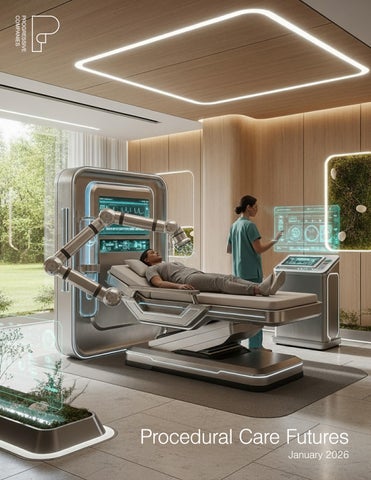
Procedural Care Futures January 2026
Procedural Care Futures Procedural care is entering a new era defined by convergence, intelligence, and decentralization. Technological integration is transforming how procedures are performed, coordinated, and experienced. Artificial intelligence, cognitive robotics, predictive analytics, and digital twins are beginning to merge into autonomous procedural ecosystems that enhance accuracy, speed, and safety while reshaping the clinician’s role from operator to orchestrator. At the same time, care delivery is expanding beyond the hospital through distributed networks of micro-facilities, virtual supervision, and datadriven logistics that bring advanced procedural Projected shortfall of health workers by the year 2030, capability closer to patients. Regenerative mostly in low- and lower-middle income countries (World Health Organization). medicine and biologic therapies are redefining intervention itself, moving from repair to restoration. Sustainable equity and ethical governance are becoming structural imperatives, embedding transparency, accountability, and environmental responsibility into the core of procedural design.
11M
Across these shifts, procedural environments are evolving from fixed, high-intensity operating rooms into adaptive, learning systems that connect human expertise with intelligent infrastructure. The future of procedural care will be characterized by precision, autonomy, and access, where predictive systems anticipate need, regenerative tools restore health naturally, and care networks operate seamlessly across physical and digital boundaries. Together, these forces point toward a future in which procedural design is not only technologically advanced but deeply human-centered, sustainable, and equitable.
3
Assumptions, Boundaries, and Orientation The limits and perspective of this analysis This section defines the scope of the analysis. Familiarity with this context is essential because strategic insight is only meaningful when its limits are understood. This analysis focuses on procedural care futures within the domestic United States under its current regulatory framework. While primarily focused on surgical care, the study has expanded to acknowledge that paradigm shifts within the surgical specialty will impact adjacent specialties (i.e., the tendency toward non-invasive or minimally-invasive procedures).
WHAT STRUCTURAL CHANGES ARE OCCURRING? Primary structural changes in procedural care include decentralization beyond hospitals, increasing automation and AI supervision, integration of predictive data systems, shifts toward regenerative therapies, and new governance models. Together, these changes redefine facilities, workforce roles, infrastructure investment, and accountability across interconnected care ecosystems.
WHAT CURRENT PRACTICES ARE LIKELY TO REMAIN? Despite technological change, procedural care will continue to rely on human clinical judgement, patient trust, safety standards, and ethical oversight. Sterility, accountability, team-based care, and the need for welldesigned physical environments will remain foundational, even as tools, locations, and workflows evolve.
WHY DOES THIS DOMAIN MATTER? The future of procedural care matters because technology, decentralization, and regenerative therapies are transforming how care is delivered. Foresight helps organizations anticipate change, manage ethical risk, and design safer, more equitable, resilient systems aligned with long-term human, clinical, and societal outcomes.
Preventative
Diagnostic
Clinical
Medical/Therapeutic
Palliative
Procedural/Interventional
Non-Invasive
4
Rehabilitative
Invasive
5
Definitions • Ambulatory: Care delivered without an overnight hospital stay, typically in outpatient clinics, ambulatory surgery centers, or diagnostic facilities.
• Genomics: The study of an individual’s genetic makeup and gene interactions to understand disease risk, treatment response, and opportunities for personalized medicine.
• Biometrics: Digital measurement and analysis of unique biological traits, such as facial patterns, fingerprints, or voice, for identification, authentication, monitoring, or health assessment.
• Human-in-the-Loop: A safety and design framework in which clinicians retain meaningful oversight of automated or AI-supported medical decisions, especially in high-risk or safety-critical workflows.
• Bioprinting: Additive manufacturing that uses living cells and biomaterials to create tissue-like structures for research, regenerative medicine, drug testing, and future organ fabrication.
• Interventional care: Targeted, often image-guided procedures such as interventional radiology or cardiac catheterization are used to diagnose or treat conditions with minimally invasive approaches.
• Carbon-indexed procurement: A procurement approach that evaluates healthcare products and services based on environmental impact, particularly carbon footprint, to support sustainability and resilience goals.
• Invasive surgery: Surgical procedures that involve incision or entry into the body, typically requiring anesthesia and a structured post-operative recovery period.
• Cellular therapies: Treatments that use living or engineered cells, such as immune cells, stem cells, or CAR-T cells, to repair, replace, or modify diseased tissue.
• Neuroadaptive surgical interfaces (NSI): Advanced systems that interpret neural signals to assist or augment a surgeon’s movements during complex or robotic-assisted procedures.
• Certificate of Need (CON): A state-level regulatory process that requires demonstration of community need before establishing or expanding healthcare services, facilities, or major capital equipment.
• Non-invasive surgery: Techniques that treat internal conditions without incisions or entry into body cavities, commonly using focused energy sources such as ultrasound, radiation, or lasers.
• Circular economies: Healthcare systems and supply chains designed to reduce waste, extend product life cycles, and optimize reuse and recycling of resources.
• Organ-on-a-chip: Micro-engineered devices containing living cells that replicate key functions of human organs to enable more accurate drug testing, toxicity screening, and disease modeling.
• Cognitive Automation: Artificial intelligence enabled systems that assist clinical or administrative decisionmaking by applying advanced pattern recognition, rules, and learning algorithms.
• Outpatient: A patient receiving medical care without being admitted to a hospital and without an overnight stay, or the care setting that provides such services.
• CRISPR (Clustered Regularly Interspaced Short Palindromic Repeats): A gene-editing technology that enables precise modification of DNA to study disease mechanisms, develop therapies, or correct certain genetic disorders.
• Predictive simulation: Use of models and synthetic scenarios built from historical and real-time data to forecast clinical outcomes, operational performance, and resource needs.
• Data ethics: Principles that guide the responsible collection, sharing, and use of healthcare data, emphasizing privacy, consent, transparency, governance, and equitable outcomes.
• Social Determinants of Health (SDoH) Integration: Systematically incorporating social, economic, and environmental factors such as housing stability, income, food security, and transportation into healthcare decision-making and population health strategies.
• Decision analytics: Application of predictive models, algorithms, and scenario analysis to support clinical, operational, and strategic decision-making in healthcare organizations.
• Sensor fusion: Integration of data from multiple sensors such as wearables, imaging systems, and bedside monitors to generate more accurate, reliable, and comprehensive clinical insights.
• Digital sovereignty: The ability of organizations or nations to retain control over healthcare data, digital infrastructure, and technology governance, including where and how data are stored and processed.
• Telehealth: Delivery of healthcare services through digital technologies, including video visits, secure messaging, remote monitoring, and other virtual modalities that connect patients and clinicians at a distance.
• Digital twins: Dynamic virtual models of patients, organs, clinical workflows, or facilities that integrate realworld data to simulate performance, predict outcomes, and support planning. • DLT (Distributed Ledger Technology): Decentralized digital systems such as blockchain that record and verify healthcare transactions and data across multiple nodes without a single central authority. • Edge computing: Processing data near the source such as sensors, wearables, medical devices to reduce latency, improve responsiveness, and support real-time clinical or operational decisions. • Emotional analytics: Use of biometric or behavioral signals such as facial expression, speech patterns, or heart rate variability to infer emotional states in support of patient experience, digital therapeutics, or humantechnology interaction.
6
Shared language aligns teams. Aligned teams deliver safe, scalable, high-value procedural care.
7
Global Mega-Trends The forces reshaping society, markets, and systems Global mega-trends are powerful, long-term forces reshaping societies and economies across technology, demographics, environment, and geopolitics. Understanding these trends enables organizations to anticipate change, seize opportunities, and mitigate risks. Mega-trends most related to the overall domain of procedural care have been highlighted.
Accelerating Technology & AI
Geopolitical Volatility
Energy & Electrification
Climate & Environmental Imperatives
Digitally Driven World
Rapid advances in AI and technology reshape work, industries, and daily life.
Rising geopolitical tension disrupts global stability, cooperation, and governance systems.
Electrification and renewables accelerate to decarbonize infrastructure and energy systems.
Climate pressures intensify, driving sustainability policy, innovation, and global coordination.
Digital technologies increasingly shape connectivity, automation, and decision-making.
Institutions face rising complexity, risk, and declining public trust.
Resource Scarcity
Equity in Health & Education
Evolving Workforce Dynamics
Consumer Centrism
Social Media & Fragmentation
Automation in Transportation
Persistent Inequality
Economic Prioritization
Strained natural and food resources heighten competition and global instability.
Access to quality healthcare and education remains uneven despite innovation.
Automation and remote work reshape skills, labor models, and talent demand.
Consumers expect personalization, convenience, and seamless experiences.
Social platforms amplify division while reshaping communication, trust, and privacy.
Transportation systems adopt automation, connectivity, and intelligent control technologies.
Economic and social inequality widen within and across global populations.
Growth remains central amid pressure for resilient and inclusive development.
Global Mobility
Trust in Systems & Infrastructure
Innovation vs. Regulation
Public trust erodes across political, corporate, and civic institutions.
Innovation outpaces regulation, creating ethical, safety, and governance gaps.
Virtualization of Life & Work Virtual environments transform how people work, learn, and socialize.
Climate, conflict, and opportunity drive increased cross-border human movement.
Governance & Institutional Strain
Demographic Shifts Aging populations and migration reshape economies, labor, and social systems.
Urbanization & Smart Cities Cities expand, integrating smart infrastructure to improve efficiency and livability.
Domain Map The elements and connections that define the domain The domain map identifies categories of exploration within the overall domain of procedural care. For the purpose of this study, procedural care is defined as a broad category of medical care that involves performing clinical procedures to diagnose, treat, or manage a patient’s condition. It includes both interventional care and surgical procedures.
MEDTECH
WORKFORCE EVOLUTION
• • • • • • • •
• • • • • • •
Patient privacy Data ethics Digital twins Biometrics and wearables Virtual care platforms Robotics DLT in heath records Simulated training
ADAPTIVE CARE MODELS • • • • • • •
Micro-hospital Outpatient/ambulatory Procedural tourism Credentialing Licensing reform Virtual/Hybrid Care models Care continuity
PATIENT EXPERIENCE
GOVERNANCE & ETHICS
• • • • • • • •
• • • • • • • •
Patient Choice Personalized services Pre-Op to Post-Op care Family integration Hospital-at-home Consumer trust Distributed v. centralized Urban v. rural
Data usage Deregulation (CON) Political cycle impacts Regulatory oversight Liability & risk Access inequities Public v. private Pay/reimbursement models
Human/AI integration Credential reform Upskilling Redefinition of caregiver role Labor shortages Clinical burnout Immersive/simulated training
INFRASTRUCTURE • • • • • • •
Modular/pre-fab Care suite design Disaster response Patient-centered design Universal v. specialized Tech integration Resource management
Undefined domains breed confident mistakes. Clear domains create shared understanding and resilient decisions. 10
11
Time Horizons How change might unfold over time Horizons 1 and 2 inform near-term decisions and design responsibilities, while horizons 3 and 4 serve as exploratory provocations that challenge assumptions, expand boundaries, and test long-term resilience.
01
02
2025-2030 Smart Integration
2030-2045 Distributed Precision
04
2035-2045 Autonomous Interventions
2045+ Visionary Concepts
KEY CONCEPTS
KEY CONCEPTS
KEY CONCEPTS
KEY CONCEPTS
• Smart ORs
• Networked procedural hubs and micro-facilities
• Cognitive robotic systems executing routine procedures.
• Regenerative and bio-integrated care replaces intervention
• Edge computing for real-time clinical decisions
• Human-in-the-loop oversight through neuroadaptive interfaces.
• Self-healing materials and nanorepair technologies
• Predictive scheduling and resource allocation
• Predictive maintenance for smart procedural environments.
• Fully sustainable, net-positive procedural ecosystems
• Standardized, interoperable patient data ecosystems
• Ethical frameworks embedded in autonomous systems.
• Predictive longevity and pre-disease modeling
PROBABLE TRENDS
• Continuous global AI learning networks.
POTENTIAL TRENDS
• AI-assisted decision support • Adaptable hybrid care suites • Data-driven QA and performance tracking • Modular out-patient infrastructure
PROBABLE TRENDS • Rapid adoption of robotic and image-guided tools • Increase in digital twin pilots • Integration of analytics into procedural workflows • AI–clinician collaboration training programs • Energy and carbon benchmarking for OR environments
• Growth of telesurgery and remote procedural networks
POTENTIAL TRENDS
• Major decline in traditional surgical volume
• Deployment of modular surgical pods in communities
• Surgeons evolve into procedural orchestrators
• Hospitals shift to regenerative and data command centers
• AI-optimized logistics
• Global regulation for AI and robotic medicine
• Universal adoption of ethical AI oversight standards
• Expansion of autonomous procedural pods
• Integration of clinician emotionalstate analytics
• Simulation-based training replaces traditional residencies
• Global democratization of regenerative healthcare access
• Expansion of digital patient identity systems • Broader procedural access across rural and under-served regions.
CONSEQUENTIAL | OPERATIONAL 12
03
EXPLORATORY | SPECULATIVE 13
This is the system as we understand it today. Which forces are actually shaping its behavior beneath the surface?
Drivers.
14
15
Impact & Application Shaping today’s design and planning decisions What is changing that affects your next project? The following shifts are influencing procedural care environments delivered in the next 5-10 years: • Procedural care is moving beyond centralized hospitals into distributed, networked environments • Automation and AI are altering staffing models, room utilization, and oversight requirements. • Clinical technology cycles are shortening faster than capital planning cycles. • Regulatory and ethical scrutiny of autonomous and data-driven systems is increasing. • Sustainability and equity expectations are expanding into high-acuity procedural spaces. Which current assumptions are most at risk? Many procedural care projects still rely on assumptions that may no longer hold:
What must change in how we design procedural environments? • Shift from fixed room counts to adaptable procedural capacity. • Program for multiple operational states, not single peak conditions. • Design for modular expansion, contraction, and redistribution of care. • Separate high-acuity cores from flexible procedural zones. • Treat technology as a primary driver of space, not a tenant improvement. • Design upgrade pathways for robotics, imaging, and data systems. • De-couple base building systems from fast-evolving clinical technologies. • Anticipate human-in-the-loop oversight through spatial planning.
• Procedures primarily occur in centralized, hospital-based environments.
• Design spaces that support supervision, auditing, and accountability.
• Room typologies and adjacencies remain stable over decades.
• Integrate ethical and regulatory considerations into layout, not policy alone.
• Clinical staff numbers scale linearly with procedural volume. • Technology can be integrated late without spatial consequence. • Oversight, accountability, and ethics are handled operationally, not spatially.
Who owns this inside our teams? Foresight without ownership becomes optional. Optional becomes ignored. • Practice Leadership owns tracking procedural care drivers.
What breaks first if we get this wrong? Early failures are not catastrophic. They are subtle, expensive, and reputational:
• SMEs owns translating drivers into planning guidance and updating assumptions. • All staff are empowered to challenge outdated project assumptions.
• Procedural rooms that cannot adapt to new equipment or workflows without renovation. • Infrastructure that cannot support data density, robotics, or future automation. • Facilities optimized for staffing models that no longer exist. • Centralized layouts that limit expansion into outpatient or distributed care models. • Projects that require costly retrofits to meet emerging regulatory or ethical requirements. What questions should we be asking our procedural care clients? These questions expose uncertainty without prescribing solutions: • How might this facility need to operate differently in five years? • Which systems would be hardest to change after occupancy? • Where do you expect staffing, automation, or oversight to shift?
This document provides relevance. The full futures report provides depth.
• What level of decentralization are you preparing for, even if not today? • Which assumptions would you regret locking in? 16
17
Forces How global mega-trends become built environment change This report uses a three-layer trend structure to support foresight literacy while remaining decision-relevant for the built environment. The purpose is not to catalog change, but to demonstrate how change becomes consequential.
Layer 1
Layer 2
Identifies long-term, global mega-trends reshaping societies and economies. Struck text indicates less immediate relevance to procedural care.
Establishes shared awareness and orientation of external forces shaping the procedural care landscape
• Accelerating Technology & AI
• Rapid advancement of automation, data analytics, and intelligent systems outpacing institutional adaptation. • Increasing climate volatility, resource constraints, and sustainability mandates. • Aging populations, workforce shortages, and uneven geographic access to care. • Rising regulatory complexity, liability concerns, and trust requirements. • Shortening capital cycles and increased financial scrutiny. • Blurring of physical and digital service delivery
• Automation in Transportation • Climate & Environmental Imperatives • Consumer-Centric Society • Demographic Shifts • Digitally Driven World • Economic Prioritization • Energy & Electrification • Equity in Health & Education • Geopolitical Volatility • Global Mobility • Governance & Institutional Strain • Innovation vs. Regulation • Persistent Inequality • Resource Scarcity
Layer 3 Translates those forces into trends that materially affect decisions regarding the planning, design, delivery, and operation of the procedural care environments. Adaptive Procedural Environments Replace Fixed OR Typologies • Procedural spaces are shifting from fixed, single-purpose operating rooms toward adaptable environments that can support varying acuity levels, technologies, and care models over time. This trend challenges longheld assumptions about room permanence and demands modular, reconfigurable planning strategies. Distributed and Networked Care Infrastructure • Procedural care is extending beyond centralized hospitals into ambulatory centers, micro-facilities, and remotely supervised environments. Facilities increasingly function as nodes within connected care networks rather than isolated destinations. Human–Machine Co-Agency Shapes Spatial Design • AI, robotics, and automation are redefining procedural workflows and staffing models. Spaces must support supervision, intervention, accountability, and human-in-the-loop oversight within hybrid human-machine systems. Technology Lifecycle Compression • Clinical technologies now evolve faster than traditional capital planning cycles. Procedural environments must be designed with explicit upgrade pathways and a clear separation between base building systems and rapidly changing clinical technologies. Governance, Ethics, and Trust Embedded in Space • As procedural systems become more autonomous and data-driven, governance and ethical oversight increasingly require spatial expression through transparency, monitoring zones, auditability, and clear lines of responsibility. Resilience and Equity as Core Performance Criteria • Procedural environments must remain operational under disruption while expanding access. Performance now includes resilience, sustainability, and equitable care delivery alongside traditional clinical outcomes.
• Social Media & Fragmentation • Trust in Systems & Institutions • Urbanization & Smart Cities • Virtualization of Life & Work • Evolving Workforce Dynamics
18
19
Drivers What is actively reshaping the system? The following drivers comprise the components, issues, and considerations of the current landscape that provide momentum for the future to continue to trend in a particular direction. Building our position and acumen relative to these drivers will build trust with our clients and expertise within our organization.
Procedural Autonomy
Predictive Precision
AI and robotics evolve from assistive tools to self-directed systems. Surgeons become system supervisors, requiring new training, credentialing, and trust frameworks. The OR becomes an intelligent ecosystem.
Regenerative Medicine
Biological, genetic, and nanotechnological therapies shift focus from removal and repair to regeneration. The body becomes its own site of restoration, redefining what a “procedure” means.
Distributed Care Networks
Procedural care migrates beyond hospitals into connected hubs, mobile platforms, and homebased settings. Networked robotics and ultra-fast connectivity enable expert interventions anywhere.
20
Digital twins, AI modeling, and continuous simulation transform how procedures are planned and executed. Every action becomes data-informed, reducing risk and enabling personalization.
Procedural Care Futures
Sustainable Equity
Pressure mounts to decarbonize high-intensity environments while expanding global access. Innovations in circular materials, modular facilities, and procedural accessibility define the new performance standard.
Ethical Governance
Rapid technological evolution forces new frameworks for oversight, liability, and moral boundaries. The legitimacy of future procedural systems depends on anticipatory ethics and public trust.
21
Driver Translation How drivers propagate through the system to shape design and risk This page translates each key driver into a clear chain of system change, spatial consequence, design implication, and risk. Teams can scan horizontally to understand risk, or vertically to compare pressure points across drivers.
22
DRIVER
SYSTEM SHIFT
SPATIAL CONSEQUENCE
DESIGN IMPLICATION
RISK IF IGNORED
Procedural Autonomy
AI and robotics shift clinicians from direct operators to supervisors and interveners
Procedural rooms require observation and supervision zones rather than single-point control
Design hybrid procedure environments with control, monitoring, and flexible intervention zones
Unsafe retrofits, regulatory friction, loss of clinical trust
Distributed Care Networks
Procedural care expands into ambulatory, micro, and remotely supervised sites
Centralized layouts limit scalability, access, and network integration
Plan modular, repeatable, and network-ready procedural environments
Stranded capital and constrained care delivery models
Predictive Precision
Simulation, analytics, and real-time data guide procedures before and during care
Increased data density, sensing, and feedback requirements within procedural spaces
Design for sensor integration, data infrastructure growth, and real-time visualization
Inability to support emerging clinical workflows
Regenerative Medicine
Shift from invasive intervention toward biologic repair and restoration
Reduced reliance on traditional surgical volume and fixed OR layouts
Plan adaptable spaces for hybrid suites, labs, and future reuse
Oversized facilities misaligned with evolving care delivery
Sustainable Equity
Pressure to decarbonize care while expanding procedural access
High-acuity environments face energy, resilience, and access stress
Embed low-carbon systems, decentralized access models, and resilience strategies
Rising operating costs and widening equity gaps
Ethical Governance
Increased scrutiny of autonomy, data use, accountability, and transparency
Governance and oversight require spatial visibility and auditability
Design transparent oversight zones and compliance-supporting environments
Regulatory exposure and erosion of public trust
23
These drivers explain how the system should behave. What if they are precisely what the system resists under pressure?
We test it.
24
25
Resilient Design Logic (RDL) A Repeatable Tool for Designing Under Uncertainty Resilient Design Logic (RDL) applies futures thinking to test today’s design decisions, rather than predict outcomes. This process is applied when planning long-life, capital-intensive environments expected to operate amid uncertainty.
Explore
Identify
Strategize
Test
Refine
Identify credible future conditions that could materially disrupt how the environment operates.
Determine what must perform well regardless of which future conditions emerge.
Propose a testable design approach shaped by resilience criteria, not optimization.
Evaluate how strategic design moves perform under different plausible future conditions.
Strengthen the strategy to perform acceptably across futures, not perfectly in one.
PURPOSE • Surface uncertainty beyond current assumptions
PURPOSE
PURPOSE
PURPOSE
PURPOSE
• Expose forces outside the project team’s control
• Distinguish variability from consistency
• Make assumptions explicit and visible
• Identify risk concentration and over-commitment
• Prevent premature convergence on solutions
• Challenge assumptions that fail repeatedly
• Delay irreversible commitments
• Create traceability between decisions and outcomes
OUTCOMES
OUTCOMES
OUTCOMES
OUTCOMES
• Shared understanding of key uncertainties
26
• Compare futures to find persistent pressures
• Clearly articulated resilience criteria
• Agreement on what is unstable versus assumed
• Identification of fragile assumptions
• Clear framing of the problem before design begins
• Guardrails for subsequent design decisions
• Translate resilience criteria into strategic intent
• A spatial or system strategy • Clear distinction between core and conditional moves • A design hypothesis ready for testing
• Reveal where strategies hold, strain, or fail
• Shared understanding of key uncertainties • Agreement on what is unstable versus assumed • Clear framing of the problem before design begins
• Reduce downside risk • Improve performance where strain recurs • Preserve flexibility and optionality
OUTCOMES
• A resilient design strategy • Reduced likelihood of stranded capital • Decisions that remain defensible as conditions change 27
Resilient Design Logic for Procedural Care PLAUSIBLE FUTURES
WHAT REMAINS TRUE
RESILIENCE CRITERIA
STRATEGIC MOVES
• Automation-Accelerated Care
• Fixed OR typologies become liabilities
• Procedural environments must support multiple delivery models
• Replace fixed OR counts with adaptable procedural zones
• Technology cycles outpace capital cycles
• Core infrastructure must be separable from fast-changing technology
• Design shared support, prep, and recovery spaces usable across settings
• Oversight and supervision must be spatially enabled
• Separate base building systems from clinical technology layers
• Capacity must flex without major renovation
• Embed observation and supervision zones into procedural environments
Robotics, AI, and image-guided procedures reduce hands-on staffing while increasing oversight and supervision needs. • Distributed Procedural Networks Procedures shift toward ambulatory centers and micro-facilities, with hospitals acting as hubs for complexity and escalation.
• Staffing models are unstable • Oversight and transparency increasingly require spatial support • Centralized layouts constrain adaptability
• Regulatory-Intensive Oversight Greater scrutiny of autonomous systems, outcomes, data use, and ethical governance shapes procedural operations. • Volume-Volatile Demand Procedure volumes fluctuate due to reimbursement shifts, staffing shortages, and demographic change.
• Phase development to delay irreversible commitments WHAT CONSISTENTLY BREAKS • Designs optimized for one care model
Distributed Procedural Networks
RegulatoryIntensive Oversight
Adaptable procedural zones instead of fixed OR typologies
Holds
Holds
Holds
Holds
Shared prep, support, and recovery spaces across care settings
Strains
Holds
Holds
Strains
Separation of base building systems from clinical technology
Holds
Holds
Holds
Holds
Embedded observation and supervision zones
Holds
Strains
Holds
Holds
Phased development to delay irreversible commitments
Holds
Holds
Holds
Holds
• Late-stage technology integration • Rigid recovery and support spaces
If a move cannot hold across multiple futures, it is not strategic. It is conditional, tactical, or speculative. 28
AutomationAccelerated Care
VolumeVolatile Demands
29
Spatial Narratives Imagined environments that test future assumptions Spatial narratives translate system change into experiential futures. Use them to explore how people, operations, and environments interact under different conditions, helping teams visualize implications, test assumptions, and discuss design consequences before committing to specific solutions.
THE SEAMLESS ARRIVAL
THE INTERACTIVE EXAM ROOM
THE WELLNESS WAITING OASIS
A patient walks into a hospital lobby that feels more like a boutique hotel. Sensors recognize their digital health ID, guiding them via dynamic floor lighting to their destination. No paper forms - just a calm, intuitive journey.
Instead of staring at beige walls, patients sit in exam rooms where wall displays project visual explanations of their condition in real time. Doctor and patient co-navigate 3D health models, making care feel transparent and participatory.
Waiting rooms double as restorative lounges with circadian lighting, indoor greenery, hydration stations, and biofeedback pods. Patients leave feeling healthier than when they arrived, even before care begins.
CAUTION: Spatial narratives can lead to premature fixation on form, a false sense of feasibility, and misuse as evidence. Be clear in describing intent and benefit of visuals.
30
*Images generated with AI for illustrative purposes only
31
Spatial Narratives Imagined environments that test future assumptions
THE COLLABORATIVE CARE HUB
THE POST-CARE DEPARTURE
THE PERSONALIZED PATIENT ROOM
Patients meet not just their physician, but an interdisciplinary care team that joins virtually via holographic display. The room is designed for dialogue, not hierarchy, with circular seating and interactive surfaces.
Discharge happens in a space designed like an airport lounge. Patients receive personalized recovery kits, digital instructions projected onto their phones, and on-site wellness coaching, making the end of care as thoughtful as the beginning.
Patient rooms adjust automatically - temperature, lighting, even wall projections - based on biometric feedback. A recovering patient might wake to soothing forest visuals and music tuned to their heart rate.
CAUTION: Spatial narratives can lead to premature fixation on form, a false sense of feasibility, and misuse as evidence. Be clear in describing intent and benefit of visuals.
32
*Images generated with AI for illustrative purposes only
33
Spatial Narratives Imagined environments that test future assumptions
THE FAMILY CONNECTION SUITE
THE MOVEMENT CORRIDOR
THE TRANSPARENCY ATRIUM
Spaces are designed for family presence, with private alcoves, fold-out sleep pods, and digital portals for remote loved ones to join in care conversations without crowding the room.
Instead of sterile hallways, recovery wings feature wide, light-filled walking tracks lined with supportive railings, embedded therapy prompts, and interactive art that encourages mobility as part of healing.
A central atrium acts as a “glass house” of care - patients can see research labs, wellness programs, and staff education in action, reinforcing trust and openness in the hospital’s mission.
CAUTION: Spatial narratives can lead to premature fixation on form, a false sense of feasibility, and misuse as evidence. Be clear in describing intent and benefit of visuals.
34
*Images generated with AI for illustrative purposes only
35
Guiding Questions What to ask before decisions harden
WHY DOES IT MATTER?
These questions help teams test assumptions, understand downstream implications, and identify where they have agency within the system. Questioning guides informed decisions, strategic interventions, and next steps before uncertainty hardens into irreversible commitments.
Rapid tech turnover risks obsolescence. Flexible design ensures long-term usability, reduced downtime, and resilience to innovation cycles.
WHAT CAN WE DO? Design reconfigurable infrastructure with modular utility spines, plug-and-play robotics, and digital redundancy to evolve continuously with technology.
What design strategies can ensure procedural facilities remain flexible and agile as robotics, AI, and digital-twin systems advance?
HOW MIGHT WE GET THERE?
01
Deploy modular service grids and flexible ceiling systems supporting frequent equipment and data upgrades.
02
Integrate digital twins that simulate performance and guide iterative facility adaptation and reconfiguration.
03
Enable self-optimizing procedural environments that autonomously adapt layouts and systems to emerging technologies.
OTHER QUESTIONS: • How might procedural environments evolve when surgeries can be performed anywhere, from hospitals to home, without compromising sterility, safety, or connectivity? • How might AEC systems integrate sustainability into high-intensity environments like ORs, balancing carbon reduction with infection control and performance? • How might procedural spaces accommodate hybrid human–machine teams, redefining ergonomics, spatial choreography, and accountability? • In a decentralized ecosystem, what role will physical hospitals play and how can their procedural cores remain relevant? • How might the architecture of procedural care embed digital twins, data visualization, and predictive modeling directly into the design of the space itself? • What infrastructure investments today will ensure equitable access to advanced procedural technologies across rural and underserved regions? • As regenerative and bio-integrated therapies replace invasive procedures, how will the physical requirements of procedural space shrink, merge, or dissolve altogether? 36
37
What might the future bring, and to what extent do we have agency over that future?
38
39