The complete market perspective for the rental housing industry
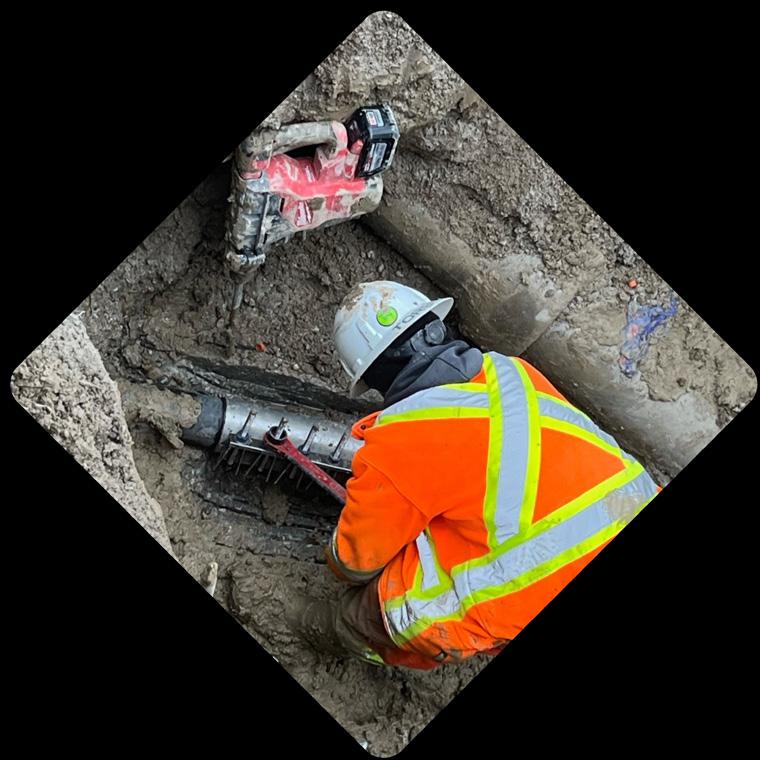
STRUCTURAL PEST CONTROL
ALIGNED WITH APARTMENT OPERATIONS
Proactive exterior rodent management
Targeted insect and bed bug remediation
Preventative monthly maintenance programs
Minimal-disruption treatment methodologies
Building-speci c planning and execution
Clear, board-ready reporting and documentation
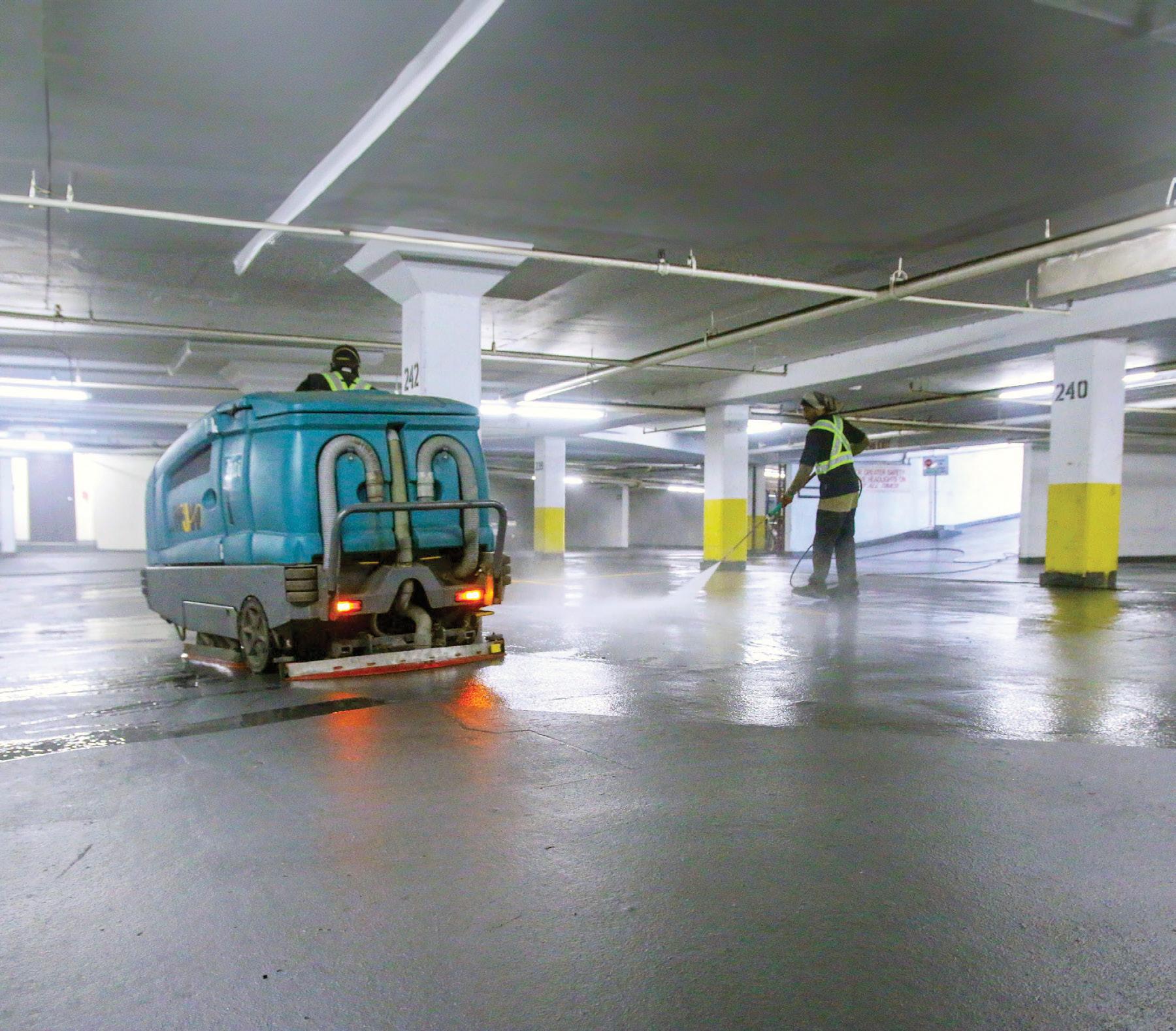
Pest B Gone , provides structural pest management programs developed exclusively for condominiums, apartments, and high-density residential properties, where operational discipline, compliance, and resident con dence are essential.
www.pbgcanad.ca
877.886.2847 / 289.597.2847 info@pbgcanada.ca
Welcome to the 2026 national edition of theANNUAL, an industry specific periodical that provides our readership with relevant, timely information and data based on a single-minded approach: “What does the apartment industry need to know?” With this basic philosophy as our focus, we turned to industry experts, association executives, government sources, and apartment owners & managers from coast to coast to provide you with the most complete and thorough industry resource.
Produced by RHB Inc – creators of RHB Magazine, RHBTV, RHB Newsreel, CREBTV, BoldTV, the video series - Real Estate Legends and Coast to Coast along with Perpetual Media Group (PMG), theANNUAL delivers a complete market perspective for the Canadian rental housing industry.
Producing a standalone resource guide with vital and practical industry information is an expansive undertaking. That’s why theANNUAL is the only resource of its kind that produces this level of in-depth analysis and forecasting for Canada’s rental housing industry. It takes a great deal of time, resources and industry knowledge to produce this type of comprehensive report that involves regional and national apartment owners and managers, and that also enables them to respond to market need, size and competition.
Here is some of what you’ll find in theANNUAL:
• CMHC’s State of the Industry Report, reviewing primary rental stock in 24 major centres, while outlining specific market conditions and performance markers.
• The Realty Check section gives us a look at realty transactions in Canada’s top primary markets, an analysis of 2025 and what to expect in 2026.
• Benjamin Tal’s economic update and forecast authored by John Dickie.
• An analyzation of in-place rents and what they mean to you. We also included the 2026 allowable rent increases from across Canada where applicable.
• You’ll also find data from Yardi’s quarterly Canadian Apartment Industry Report. It includes their insight and analysis on the Canadian rental housing market.
• A vetted report of Canada’s top owners, managers and REITs. Although this year there were no major shake ups we do see plenty of jockeying across all categories, including a new entry in the owner’s category. We’re always pleased to see the year over year growth of our amazing industry.
RHB Inc. is Canada’s National Voice for the apartment industry. We work diligently to deliver the latest news and information that help industry professionals maintain a competitive advantage. That’s why so much effort is place on ensuring theANNUAL is the best resource guide that it can be to our industry. Our success is based upon the same family principles that define our industry. Therefore, we would like to acknowledge the following people and companies for their help gathering the information and data which enabled us to deliver this comprehensive guide:
John Dickie, EOLO; Benjamin Tal, CIBC World Markets; Canada Mortgage and Housing Corporation (CMHC); Yardi Canada. Also, with Realty Check, a special thank you to Luke Simurda, National Director of Research, Canada at Marcus & Millichap and their 2026 Canada National Investment Forecast.
We accept full responsibility for accurately delivering the news for the apartment industry. Therefore, we want to hear from you, the people who make us the strongest industry in Canada. Let us know what you think about what you’ve read in this edition of theANNUAL. Tell us what you want to read in the 2027 edition of theANNUAL – what matters most to you, what information will help you better in your business and what data and resources are critical to your decision-making.
All the best,
Debbie Dollar-Seldon
Debbie Dollar-Seldon Publisher
Publisher Debbie Dollar-Seldon
Sales
Executive
Justin Kreslin
Art Director
Scott Clark
Office Manager
Geeta Lokhram
Principal Marc Côté
8,500+ SKUs
East Coast Statistics
New Brunswick: AVR: 2.9%; 2BR: $1,368
Prince Edward Island: AVR: 2.1%; 2BR: $1,293
Nova Scotia: AVR: 2.6%; 2BR: $1,711
Newfoundland and Labrador: AVR: 2.1%; 2BR: $1,208
Canada’s housing construction remained resilient in 2025
Rental construction drove new supply, pushing apartment construction to dominate overall housing activity across major markets. Rental starts hit record highs in Calgary, Edmonton, Ottawa, Halifax and Montréal, and reached their second-highest level ever in Toronto.
COMPARISON OF 2025 DATA AND 10-YEAR AVERAGE (2016-2025) BY CMA
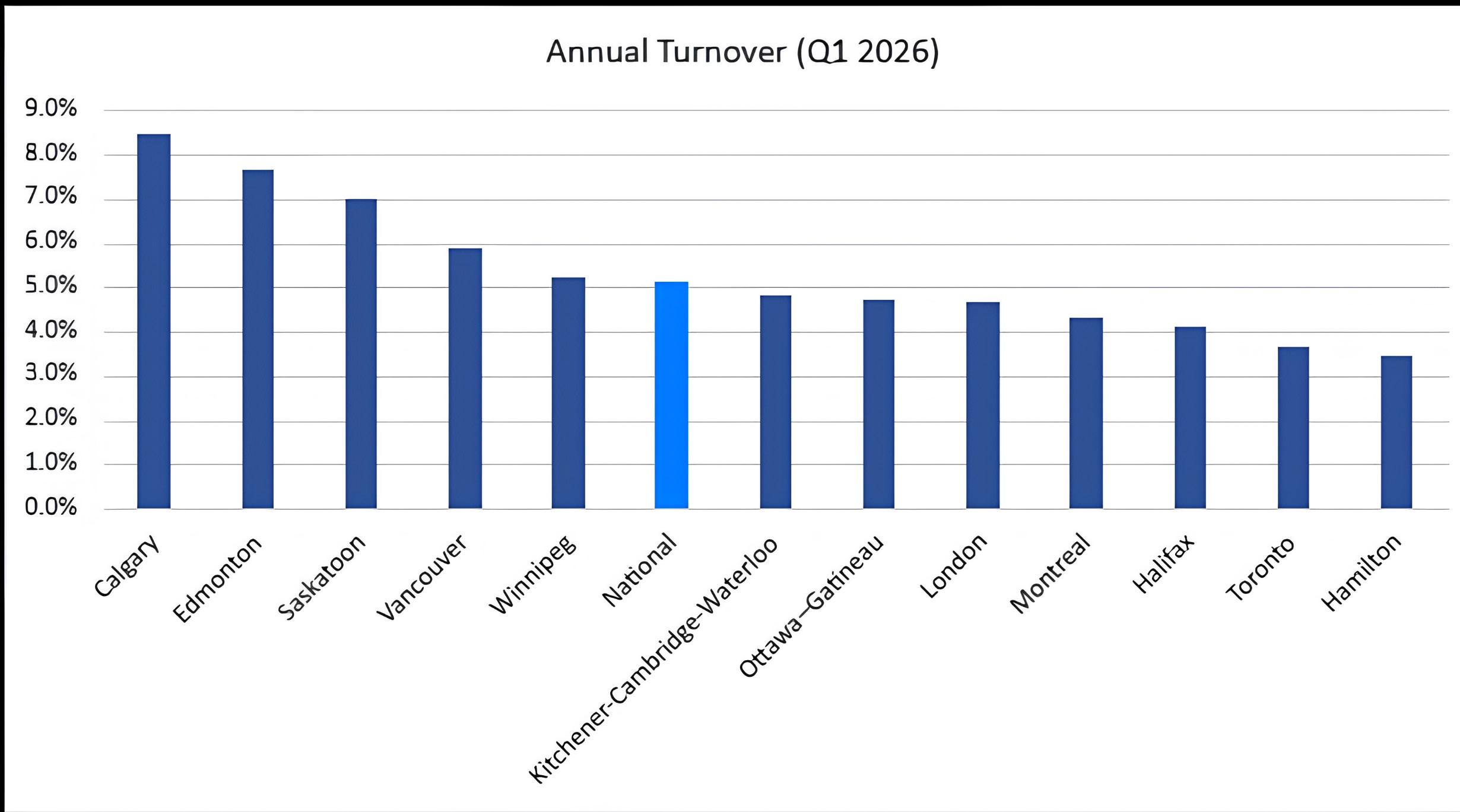
TURNOVER
Built for How You Work
RONAPRO provides trusted products, expert support, and streamlined solutions designed to save time, manage costs, and keep every project on track.
One Partner. Every Project.
From facility maintenance to major builds, find everything you need in one place—thousands of contractor-grade products and Pro-built solutions designed to keep every job moving, including:
• Appliances
• Building supplies and millwork
• Cabinets and flooring
• Electrical, lighting and HVAC
• Kitchen and bath
Additional Services We Offer
Specialized Project Support
Special Orders, construction take-off services and estimating support are just a call away.
Dedicated Pro Support
Expert support at every level—from external reps to Pro Desk experts, our teams understand commercial timelines, multi-site needs, and professional purchasing.
• Landscaping, interior and exterior maintenance supplies
• Paint and surface repair
• Plumbing
• Tools and hardware
Charge Account For Pros
Add authorized buyers and manage your account with ease. Upon credit approval*.
Reliable, On-Site Delivery
Reliable nationwide delivery, powered by specialized fleets and an extensive distribution network.
*Upon credit approval. Certain conditions apply. For businesses only. In participating stores only. **Certain conditions apply.
and complete your projects.
Eastern Canada
*The vacancy and rent figures are as of October 2025
State of the Industry
St. John’s, NL
Charlottetown
4,415
PRIMARY RENTAL HOUSEHOLDS
6,606
TOTAL PRIMARY RENTAL HOUSEHOLDS
62,411
1st
TOTAL PRIMARY RENTAL HOUSEHOLDS
16,321
2nd
St. John’s St. John’s
Moncton
State of the Industry
Saint John, NB
Fredericton
Central Canada
*The vacancy and rent figures are as of October 2025
State of the Industry
Quebec City
St. John’s
St. John’s
Gatineau
667,266
St. John’s
336,180
State of the Industry
78,463
St. John’s
John’s Hamilton K-C-W
Turnover Rate
State of the Industry
St. Catharines
16,296
RENTAL HOUSEHOLDS
19,042
Western Canada
*The vacancy and rent figures are as of October 2025
State of the Industry
Winnipeg
Saskatoon
75,154
St. John’s
St. John’s
State of the Industry
St. John’s
St. John’s
62,657
127,091
34,143
St. John’s Victoria
Kelowna
Coinamatic Commercial Laundry offers a complete line of washerextractors and tumblers as well as Ecotex laundry oxidation systems. Prevent the spread of bacteria and illness.
FULL TURNKEY SERVICE
TRAINING
Experience a revolution in laundry technology using ozone to cut laundry operational costs by up to 50%. Ecotex laundry oxidation systems enhance the performance of chemicals and shorten the traditional wash cycle. Using cold water instead of hot, a typical laundry facility can cut operational costs by up to 50% and significantly reduce the risk of MRSA and C-Difficile.
We handle delivery, installation, bolt down, final hook up and start up, and provide professional followup to ensure your ongoing satisfaction.
EFFICIENCY
A commercial laundry system provides extraordinary water extraction to minimize drying time, allowing you to keep operations running at full capacity, while saving utility costs, time and textile inventory.
We work closely with your laundry and management staff, maintenance engineers and chemical companies to ensure that cycles, procedures and products provide optimal results, at the lowest possible cost.
Extensive Parts Inventory available supported by a National Service Organization, multilingual call centre, and user friendly online service request portal.
Realty Check
Your tenants insured. Your compliance handled.
Canada’s leading digital tenant insurance - now with API integration and automated Confirmation of lnsurance (COI) verification.
Digital tenant insurance
Tenants get insured in minutes online - instant policy activation, 24/7, at lease signing.
API integration
Syncs with Yardi & HappyCo. Auto-enroll tenants, track compliance in real time - zero manual work.
COl verification via Bramble
Every lease clause read, every certificate verified - 12x faster than manual review, automatically.
Works with:
Become a partner today!
Yardi HappyCo Bramble
Foreword
Over the last 12 months Multifamily sustained its position as one of the most coveted sectors in Canadian commercial real estate.
Demand-Supply Realignment to Foster More Balanced Rental Conditions
A more tenant-friendly rental market emerged in 2025. Last year marked a period of adjustment for Canada’s multifamily sector. As Ottawa tightened immigration policies, rental demand growth moderated. Outside the pandemic years, Canada saw its temporary- resident population decline for the first time since 2015, while the intake of permanent residents also slowed. Amid this deceleration in demand growth, rental supply continued to expand at a rapid clip. Although completions did not set another record, they remained elevated by historical standards, surpassing 80,000 units nationwide last year. At the same time, secondary rental supply kept rising, as more financially stressed condo owners listed their units — often at discounted rates — to offset higher mortgage costs. These shifting demand-supply dynamics created a more balanced environment, pushing vacancy rates higher and slowing rent growth across Canada.
Further rebalancing expected in 2026. In the new year, the rental market is expected to continue softening amid persistent cyclical demand headwinds and another year of elevated completions. Population gains are projected to remain muted as the government intensifies efforts to reduce temporary residents to less than 5.0 per cent of the total population. While this will remain the main demand headwind, a sluggish for-sale housing recovery — held back by weak sentiment and affordability pressures — signals a slow shift to homeownership, offering some support to rental demand. On the supply side, completions are forecast to reach a record high, reflecting rising construction starts during the post-pandemic years. As starts accelerated last year, this supply pressure may persist beyond 2026.
Consequently, the vacancy rate is expected to continue its upward trajectory, approaching 4.0 per cent by year-end. Rising vacancies will offer relief for renters, particularly in high-rent markets, as apartment owners keep effective rents competitive amid longer lease-up periods.
2026 MULTIFAMILY OUTLOOK
• Metro-level variations drive shifts in 2026 outlook. While fundamentals are expected to soften nationwide, select regions are likely to outperform. Alberta will continue to benefit from strong domestic in-migration, helping to curb the rise in vacancy. In Toronto and Ottawa, more disciplined construction pipelines — in part due to project delays — will also help temper vacancy rate increases. In contrast, completions in Vancouver are projected to reach an all-time high following a significant jump in construction starts over the past few years. This will result in a steeper rise in vacancy and further downward pressure on effective rent growth.
• Multifamily positioned to draw growing buyer interest. Alongside the recent wave of new purpose-built rental projects, investment in multifamily assets has climbed steadily over the past three years, given their stability and defensive characteristic. By late 2025, apartment buildings accounted for roughly 30 per cent of all transactions, making multifamily the second most active property type among investors. While the sector is currently adjusting to cyclical headwinds, sentiment remains positive. Canada’s structural housing shortage, persistent affordability pressures, a supportive policy environment and the growing emphasis on build-to-rent all point to a favourable long-term investment backdrop.
We’ll keep your systems top of mind, so you don’t have to!
With over 65 years of industry experience, our team is dedicated to ensuring optimal performance, resident comfort, and budget control.
Work with Enercare for reliable home services tailored to your property’s unique needs, with dedicated support from your Client Success Manager. We offer energy-efficient upgrades for multiresidential properties, servicing low, mid, and high-rise dwellings to enhance comfort and sustainability. Our expert team ensures seamless installations that meet manufacturer standards, regulations and safety codes, along with comprehensive maintenance and repair services for all systems, including:
Why choose the Enercare Advantage® Program?
Enercare Advantage® offers a hassle-free, convenient solution for residents, eliminating concerns when it comes to upfront payments, costly repair service calls, and equipment replacement.* Below are additional benefits the Enercare Advantage® program provides to you and your residents:
Design & Install
Industry leading products.
NEW energy efficient equipment to offset your carbon footprint.
Quality installations done right the first time.
Service & Maintenance
HVAC maintenance to keep your equipment operating efficiently.*
Service performed by fully licensed and insured technicians.
Added Benefit
Potential utility rebates on eligible equipment.
Invest in other improvement projects.
Potential welcome incentive on eligible equipment.
Tenant direct billing.
Realty Check Montreal
Rebalancing Underway as Long-Term Tenancy Anchors Structural Strength
Rent growth to ease amid rising vacancy. Montreal’s apartment fundamentals held up well last year despite fewer residents moving in. Although vacancy rose for a second consecutive year, rent growth accelerated, driven by a significant increase in in-place rents. Even after those multiple rent hikes, the metro remains one of the most affordability-anchored rental markets in the country, supporting resilient demand from newcomers. Looking ahead, population growth is expected to cool further as Quebec’s new immigration restrictions take effect. In line with national trends, this will keep rental demand growth subdued while completions continue to rise steadily. As a result, vacancy is projected to drift higher again this year, slowing rent increases. Beyond short term fluctuations, Montreal’s deep renter culture — rooted in a long-standing preference for apartment living and a high share of renter households across all age groups — will continue to underpin market stability. With this tradition, the metro’s multifamily sector will remain a primary source of housing and a durable investment option over the long run.
INVESTMENT TRENDS
• Healthy fundamentals supported sales last year. Dollar volume rose despite macro headwinds, even outpacing the pull-forward of transactions in the second quarter of 2024.
• Amid investor optimism, the average sale price hit a record in the third quarter of last year. Lower financing costs may sustain investment activity and support continued price growth in 2026.
Protecting and extending the life of your assets.
Garage & Balcony Assessment & Restoration
Building Cladding Design, Assessment & Remediation
Roofing System Design, Assessment & Remediation
Building Condition Assessments
Capital Planning
Building Renewal
Energy Audits and Modelling
Experts in building science and structural restoration. Scan
334
per Suite: $479,021 99 - 101 Pl Charles-Le Moyne
Realty Check Ottawa
Ottawa
Crosscurrents in Jobs and Demographics Shaping Metro’s Rental Market
Operations to soften but remain healthy. The interplay of several opposing forces shapes Ottawa’s multifamily outlook for 2026. As part of Budget 2025, the federal government will shed nearly 30,000 jobs over the next two years, most of which will be concentrated in the capital region. Even so, ongoing expansion in the tech sector should help partially offset the drag from public-sector downsizing, supporting job growth in hubs like Kanata, where both established firms and new entrants continue to scale. Population growth is also expected to slow as fewer temporary residents arrive. Still, continued inflows from other provinces and higher-cost cities within Ontario will help backstop rental demand despite overall growth moderating. Taken together, these trends point to softer apartment demand through 2026, though the pullback is expected to be manageable given the city’s still-positive population inflows and ongoing tech-sector support. On the supply side, completions are set to tick slightly higher following last year’s pullback, supported by a mild increase in construction starts from their 2023 lows. As a result, vacancy is expected to rise only modestly, with limited new supply providing a stabilizing backstop.
INVESTMENT TRENDS
• Multifamily represented the largest share of total commercial property sales last year, reflecting investors’ confidence in the metro’s long-term demographic profile and economic stability.
• While private buyers remained the dominant investor group last year, public equity and REIT capital have gained traction more recently, likely encouraged by the sector’s solid fundamentals.
Location: Ottawa
Suites: 227
per Suite: $233,480
Location: Ottawa
Suites: 241
$69,000,000
Realty Check Toronto - GTA
Toronto - GTA
Public Measures to Support Supply Growth Despite Softening Conditions
Rental market in readjustment phase. Alongside a sharp deceleration in population growth last year, Toronto’s rental market saw a surge in secondary rental supply. As condo prices fell, an increasing number of financially stressed condo owners rented out their units at discounted rates to cover mortgage costs. This influx of options prompted many purpose-built operators to offer incentives to attract and retain tenants. In 2026, muted resident gains and ongoing competition from the condo market are expected to continue posing headwinds for the multifamily sector. Even so, with lower interest rates and a potential improvement in trade, Toronto’s economy could regain momentum in the second half of 2026. This should help firm rental demand, keeping the apartment vacancy rate low at approximately 3.4 per cent. Over the longer horizon,
Toronto’s rental supply is poised to increase meaningfully as various municipal, provincial and federal initiatives take effect. These measures range from building affordable homes on public land to improving infrastructure to address construction bottlenecks. This concerted effort will help address the metro’s structural housing shortage and, over time, could help restore housing affordability.
INVESTMENT TRENDS
• By the third quarter of last year, the average sale price had declined 19 per cent from its 2022 peak. However, prices appear to have bottomed out in 2024 as financing costs declined.
• Near-term multifamily fundamentals may ease, but Toronto’s scale and long-term demand support a resilient rental market, making it an appealing destination for investors.
Toronto
Suites: 210
$312,100,000
Realty Check Southwestern ON
Southwestern Ontario
Momentum Begins to Build Amid Better Monetary and Trade Conditions
Early signs of stabilization expected in new year. Southwestern Ontario’s multifamily sector entered 2026 after a challenging year. Slowing population gains and rising unemployment amid tighter immigration and trade disruptions weighed on rental demand. Meanwhile, completions reached an all-time high, pushing the vacancy rate to its highest level since 2012. Conditions are expected to improve modestly this year. The exceptional momentum in rental need driven by the post-pandemic population surge is unlikely to return. However, an industrial recovery — supported by lower interest rates, ongoing producer adaptation and a potential improvement in trade relations — should provide a backstop for leasing activity. Although the vacancy rate is still projected to rise as population growth cools further, stronger labour conditions and fewer deliveries will likely moderate the pace of increase. Beyond the near term, long-run fundamentals remain constructive. Affordability- driven resident inflows, a steadily diversifying economy and deeper integration with the greater Toronto area through expanding transit links will sustain long-term rental demand, reinforcing Southwestern Ontario’s appeal for apartment investors.
INVESTMENT TRENDS
• Investment activity improved last year despite demographic headwinds and trade risks. This reflects the impact of lower interest rates and confidence in the metro’s long-term outlook.
• Transit expansions, including the LRT to Cambridge and GO’s Hamilton and Kitchener expansion, will boost connectivity to the GTA and underpin the metro’s long-term investment appeal.
Location: Brantford
Suites: 208
per Suite: $384,615
per Suite: $517,606
$76,500,000
$40,100,000
Realty Check Calgary
Calgary
Waves of New Supply Push Rental Market Further in Tenants’ Favour
Vacancy to drift higher amid widening supply-demand gap. As completions remained elevated against a backdrop of slowing population growth, Calgary’s apartment vacancy rate rose for a second consecutive year in 2025. This supply-demand imbalance is expected to widen in 2026. Projects launched during the post-pandemic period of record in-migration will continue to reach completion. Apartment construction starts also showed few signs of easing by the end of last year, suggesting that supply pressures could extend well beyond 2026. At the same time, the downtown office-to-residential conversion program will add yet another source of new supply. On the demand side, population growth — while still one of the strongest in Canada amid affordability advantages — is set to decelerate further as Ottawa places tighter constraints on international migration. Premium buildings with modern amenities are expected to face longer lease-up timelines due to more competition from new supply, while older and more affordable stock should see comparatively firmer demand. Together, these forces will sustain a renter-friendly environment, characterized by another year of rising vacancy and continued downward pressure on rent growth.
INVESTMENT TRENDS
• Despite softening fundamentals, sales held up in 2025. Calgary’s above-average domestic migration continues to support population growth, bolstering buyer confidence in long-term prospects.
• In addition, the absence of rent control gives landlords greater flexibility amid Canada’s structural housing shortage. This also bodes well for long-term multifamily investment activity.
Suites: 224
per Suite: $332,589
Realty Check Edmonton
Edmonton
Young and Growing Population Drives Momentum in Short and Long Run
Manageable rise in vacancy expected for 2026. As people from other parts of Canada relocated to Edmonton for its lower cost of living in the post-pandemic years, domestic in-migration accounted for roughly one-third of the metro’s resident gains. This demographic advantage has supported population growth, despite the recent pullback in immigration. As a result, apartment demand softened more gradually than in most other metros in 2025. Coupled with a modest decline in completions, vacancy rose only 70 basis points last year. Looking ahead to 2026, population growth is expected to remain positive, in contrast to a decline projected nationally, which will continue to underpin rental demand. On the supply side, completions will rebound above 7,000 units following last year’s dip, likely resulting in another mild rise in vacancy. Over
the long term, Edmonton’s demographic advantage stands out. Beyond its more balanced population growth, it is one of Canada’s youngest metros, with a median age four years below the national figure. This youthful population — combined with a diversifying economy and steady public-sector employment — positions Edmonton’s multifamily sector for durable, long-run strength.
INVESTMENT TRENDS
• Investment data through September indicates total dollar volume likely hit a record in 2026. Solid fundamentals and ongoing population growth continued to support investor sentiment.
• Lower borrowing costs may continue to spur strong sales activity in 2025, which, in turn, will support construction and help
Realty Check Vancouver
Rising Construction and Immigration Cuts Help Usher in a More Balanced Market
Vacancy rate trending up amid demographic shift. Vancouver’s multifamily market is entering 2026 with clear signs of rebalancing. Population growth slowed last year under tighter immigration policies, just as apartment completions hit a record high. This pullback in demand growth, combined with a surge in new units, pushed the vacancy rate to 3.7 per cent in 2025 — providing much-needed relief for renters who had faced a near-full market for years. Looking ahead, construction starts data suggests that deliveries will ease gradually beyond 2026. With population growth expected to remain subdued as Ottawa doubles down on immigration reductions, vacancy rates are likely to continue rising through 2027. This should help return rent growth closer to the long-term average and improve affordability in Canada’s costliest rental market. Despite softening fundamentals, Vancouver remains one of the most soughtafter apartment markets in Canada, supported by high-quality job opportunities and exceptional lifestyle appeal. Long-term demographic drivers and structurally limited land supply will continue to make Vancouver a desirable investment destination for both domestic and global capital.
INVESTMENT TRENDS
• Sale prices peaked in 2022 and have since stabilized amid softening fundamentals. Cap rates have trended upward, with older properties often exceeding 4.0 per cent last year.
• While rising vacancy rates and rent declines have created a more cautious investment environment, lower financing costs should support transaction volumes through 2026.
Burnaby
Suites: 563
per Suite: $340,904 Vancouver
Realty Check Vancouver
Vancouver
92
$652,174
per Suite: $617,021 388 Kaslo St
per Suite: $550,459 444 Kootenay
Vancouver $58,000,000 Suites: 94
Suites: 471
per Suite: $115,074
Dollars & Cents
By John Dickie, based on an interview with Benjamin Tal, CIBC Deputy Chief Economist
Many features of the 2026 economy do not fit past norms.
US Energy intensity
Energy intensity of US economy (1000Btu/2015$ GDP)
The efficiency paradox
As technology increases energy efficiency, the total consumption of energy increases rather than decreases. In other words, improved efficiency lowers costs, encouraging higher usage.
Source: EIA, CIBC
Source: EIU, CIBC
Oil shock could add a half percent to inflation in coming months Food prices – already 20% higher than the trend
Source: BLS, CIBC
Source: BLS, CIBC
Hiring rate has plummeted (l), and is below what pre-Covid norms would imply given unemployment rate (r)
Source: BLS, CIBC
Source: BLS, CIBC
Source: Census Bureau, Haver Analytics, CIBC
Source: Census Bureau, Haver Analytics, CIBC
Source: Census Bureau, CIBC
Source: Census Bureau, CIBC
Source: BLS, CIBC
Source: HU, CIBC
Dollars & Cents
By John Dickie, based on an interview with Benjamin Tal, CIBC Deputy Chief Economist
Canada escaped broad US tariffs, but targeted sectors still hit hard
• Canada was largely protected by the Canada, US, Mexico Agreement (CUSMA)
• The CUSMA renegotiations will be crucial
• Can Canada solve the tariff problems in metals, autos, aircraft manufacturing and lumber, while keeping the broad CUSMA protections?
• What will Canada and the US agree concerning the dairy and poultry sector irritants?
• How will the choice of a new aircraft for the RCAF play in the CUSMA negotiations, if at all?
Source: Statistics Canada, CIBC
Source: Statistics Canada, CIBC
Underlying inflation back near 2% prior to this year’s oil shock… Easy come, easy go
Source: Statistics Canada, CIBC
Aspects of the housing markets
National benchmark home price close to preCovid trendline
Source: Statistics Canada, CIBC
Source: CREA, CIBC
Source: CREA, CIBC
Source: CREA, CIBC
ABOUT THE SOURCE
Source: Lauster and Bergmann, StatCan, CIBC
Benjamin Tal is the Deputy Chief Economist at CIBC World Markets. Well-known for his ground-breaking research on all major sectors of the real estate market, on credit markets, and on business economic conditions, Benjamin frequently sets key elements of the public policy agenda. He is also a big believer in the value of a strong residential rental sector. Last year CFAA changed its name to Rental Housing Canada (“RHC”). Benjamin is continuing to speak at the RHC national housing conference. RHC thanks Benjamin for his support.
Rents – Allowable & Actual
Rent Increases for 2026 per province:
BRITISH COLUMBIA
Residential Tenancies – 2.3% Manufactured Home Tenancies – 2.3% plus a proportional amount for the change in local government levies and regulated utility fees. Some increases above the guideline are available.
ONTARIO
Residential Tenancies – 2.1%
Exemptions apply to buildings and additions first occupied after November 15, 2018. Some increases above the guideline are available for both residential tenancies and manufactured home sites. Manufactured Home Tenancies – 2.1%
MANITOBA
– 1.8%
– 1.8%
MANITOBA
Some increases above the guideline are available. Exemptions apply for units renting for $1,640 or more per month (as of December 31,2024), and for buildings with an occupancy permit first issued after March 7, 2005, which are less than 20 years old.
PEI
Residential Tenancies – 2%
Manufactured Home Tenancies – 2.3%
NEW BRUNSWICK
Residential Tenancies – 3%
Manufactured Home Tenancies – 3%, and other restrictions apply.
NOVA SCOTIA
Residential Tenancies – 5% Manufactured Home Tenancies – 3.2%
In Quebec, there is no exact equivalent to the guideline as it is used in BC, Ontario, Manitoba, PEI, and now Nova Scotia. The Quebec government does not set a rent increase that a landlord can charge without any specific approval. Instead, if tenants challenge the rent increase notice that the landlord gives them, the Tribunal administratif du Logement (the Quebec Rental Board) applies a set of standard cost increases to the specifics of each rental building. The calculation is based on actual increases in municipal taxes and insurance, and inflationary percentage increases applied to other costs such as heating and services. Alberta, Saskatchewan, Newfoundland and Labrador, do not limit rent increases.
Rents – Allowable & Actual
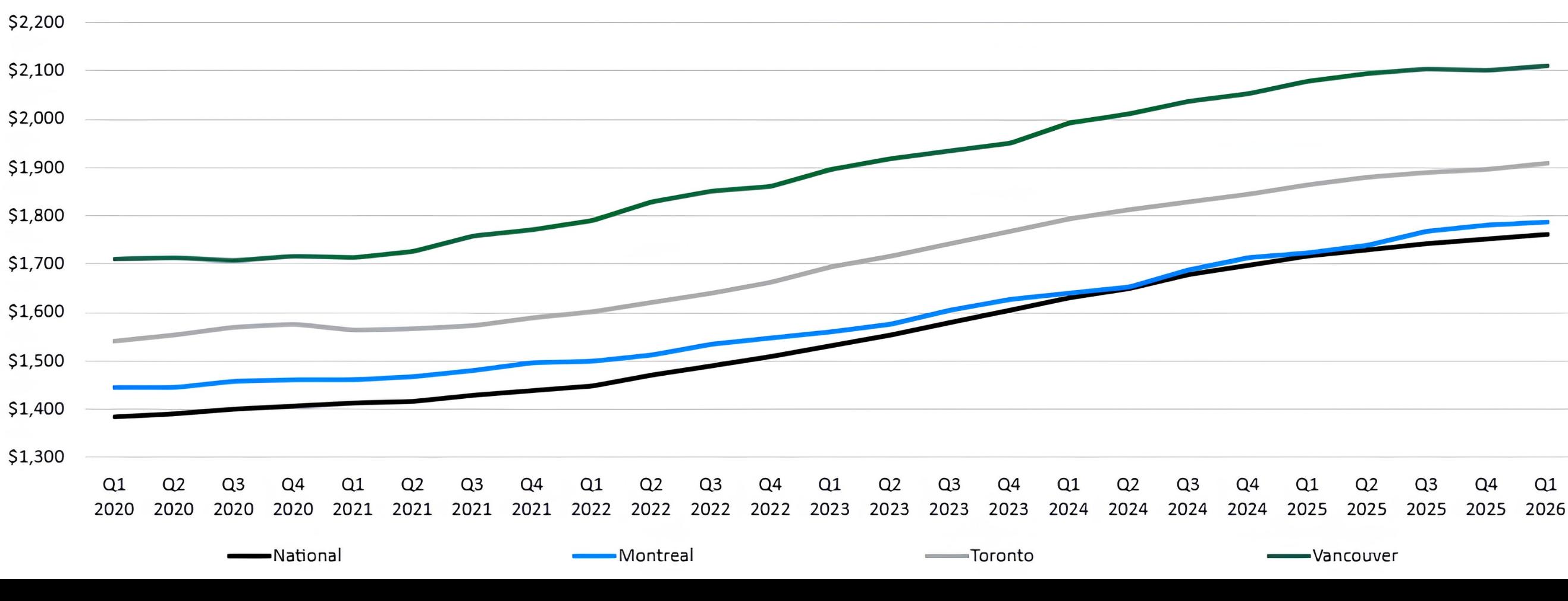
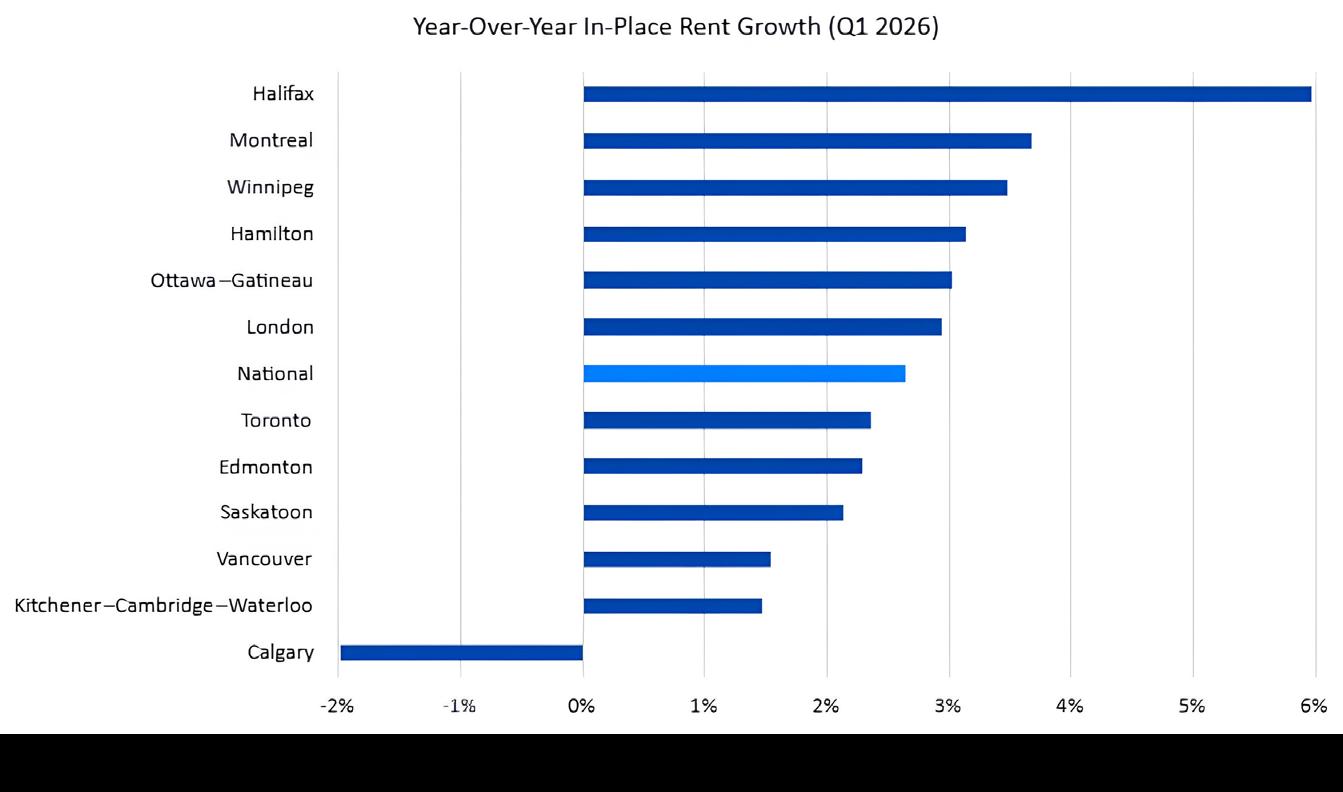
Multifamily rents in Canada continue to increase, but the growth rate is slowing significantly. The average national in-place rent increased $8 in Q1 2026 to $1,761, while annual growth declined to 2.7%, the lowest level in four years. In-place rents represent an aggregation of all rents in a given Census Metropolitan Area (CMA), including those for new leases, renewals and existing leases. With new lease rates turning negative in many markets, rent growth is increasingly being driven by renewal activity rather than new leasing.
Rents – Allowable & Actual
Rent Growth
Year-Over-Year In-Place Rent Growth
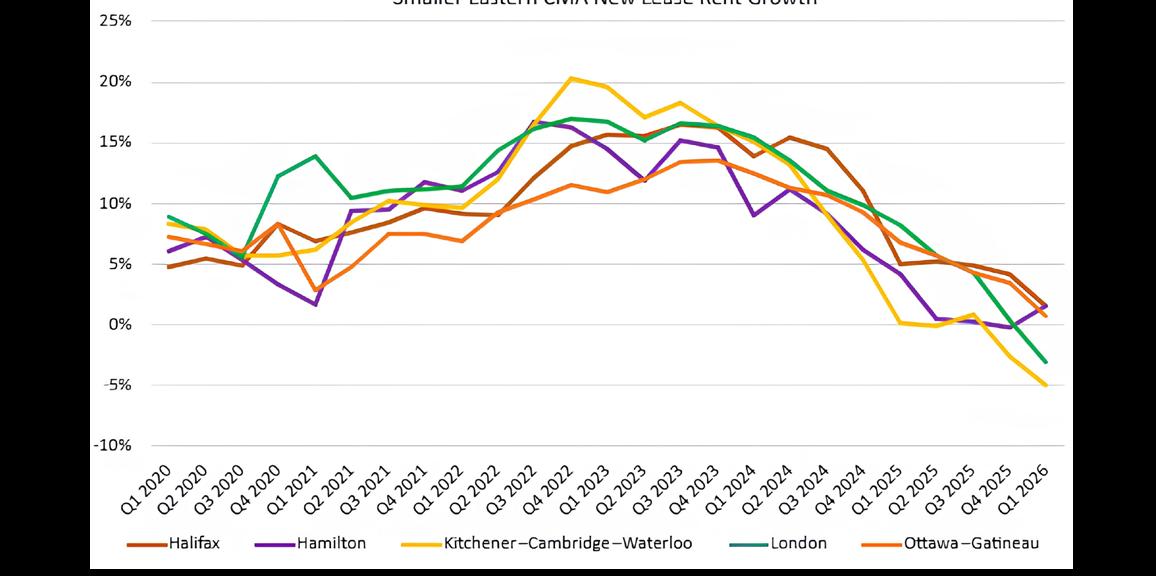
Smaller Eastern CMA Averages
Conclusion
National & Major Averages
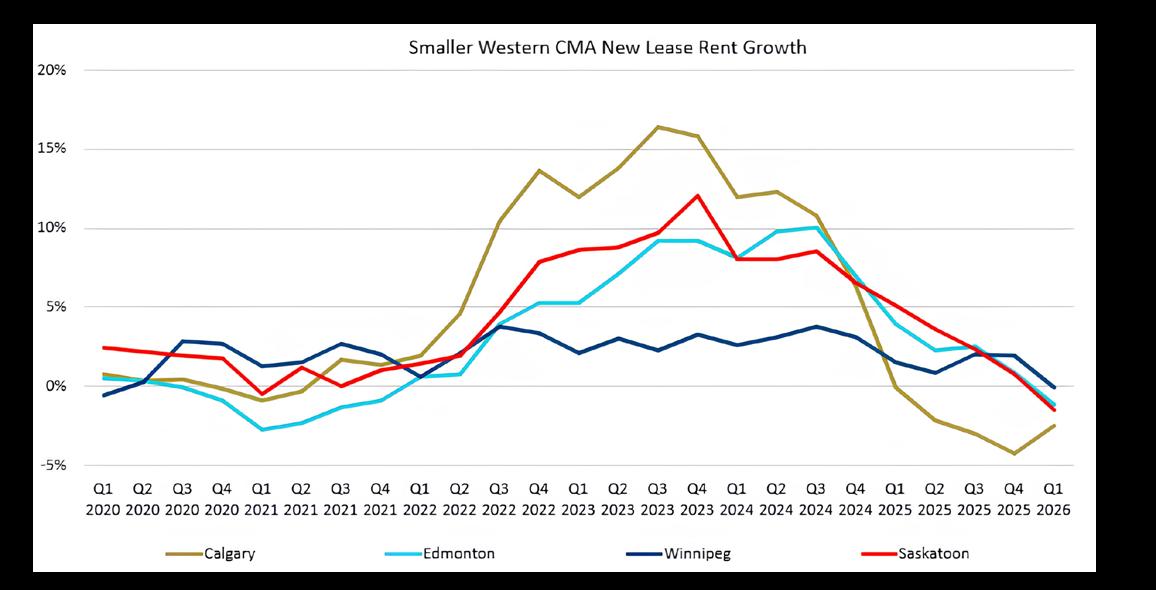
Smaller Western CMA Averages
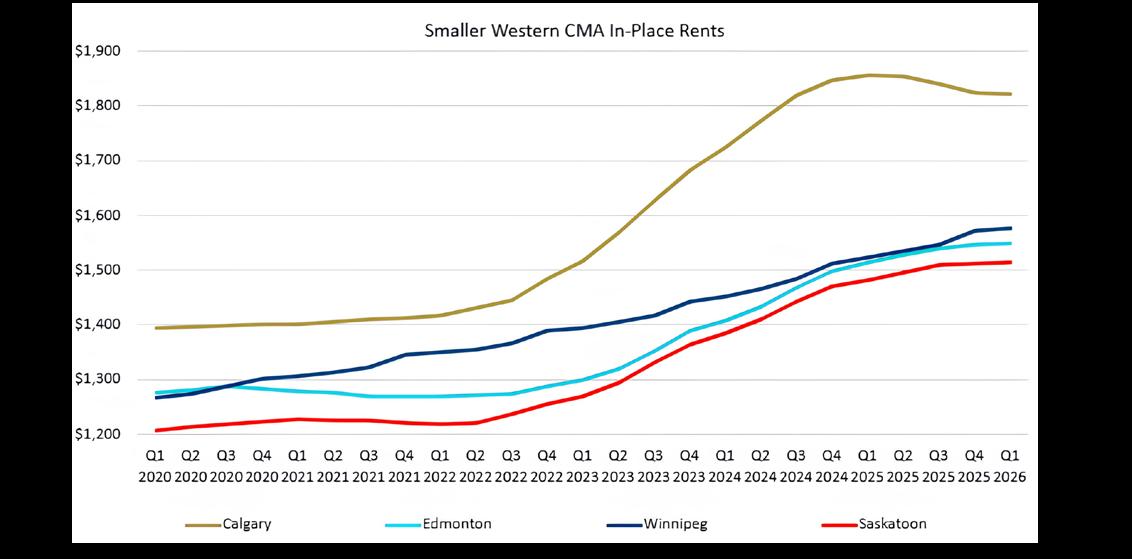
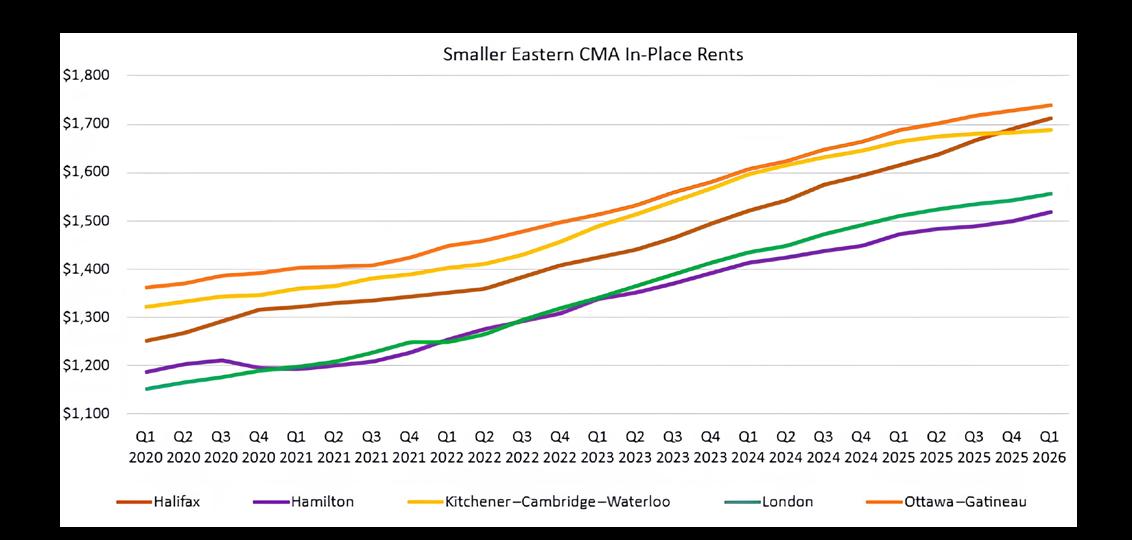
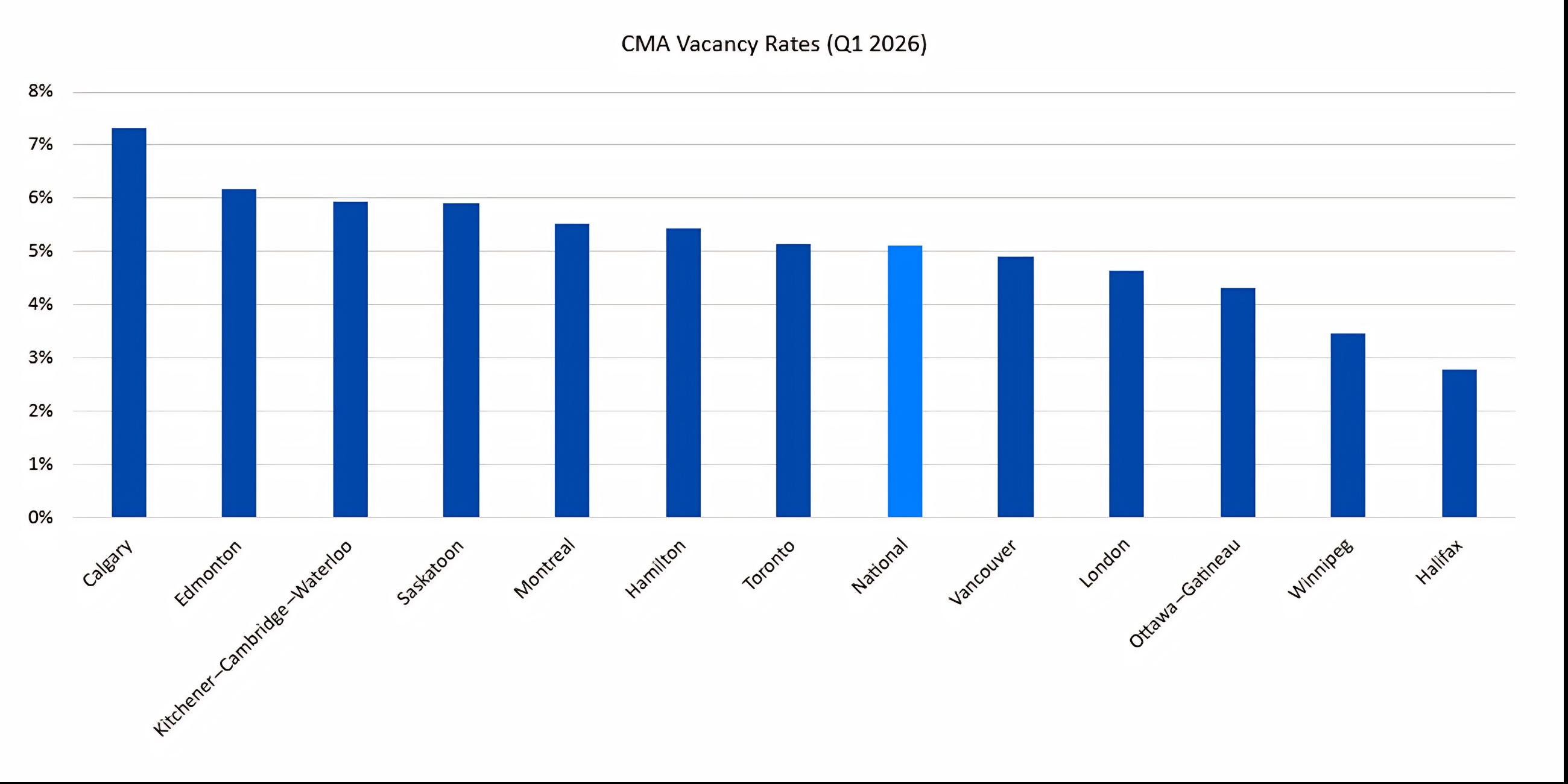
Canada’s rental market continues to expand, but growth is no longer uniform. In Q1 Halifax (6.0%), Montreal (3.7%) and Winnipeg (3.5%) led year-over-year in-place rent growth, while major markets such as Toronto (2.4%), Vancouver (1.6%) and Kitchener-Cambridge-Waterloo (1.5%) lagged. Calgary (-2.0%) was the only CMA to post negative growth. With national vacancy rising to 5.1% and new lease rates declining, the market is shifting into a more balanced phase. Rent growth is increasingly driven by renewals and localized demand conditions, reinforcing a clear trend: performance is diverging across regions rather than moving in lockstep.
Yardi Canadian Multifamily Report Quarterly insights on rent growth, vacancy, turnover and digital demand across major Canadian CMAs. info.yardi.com/multifamily-market-reports-for-canada/
High
Smart
Door
Leak
Canadian Apartment Industry Report
When the signals shift: Canada’s rental market finds a new normal
For years, Canada’s multifamily market ran hot. Now it’s cooling off, and the numbers make that clear. Vacancy has climbed past 5% nationally for the first time since Yardi began track-ing the market since 2020, new lease pricing has turned negative in most cities, and popula-tion growth has gone from a tailwind to a headwind. The era of near-automatic annual in-creases is over, replaced by a market where housing providers must work harder for every lease signed.
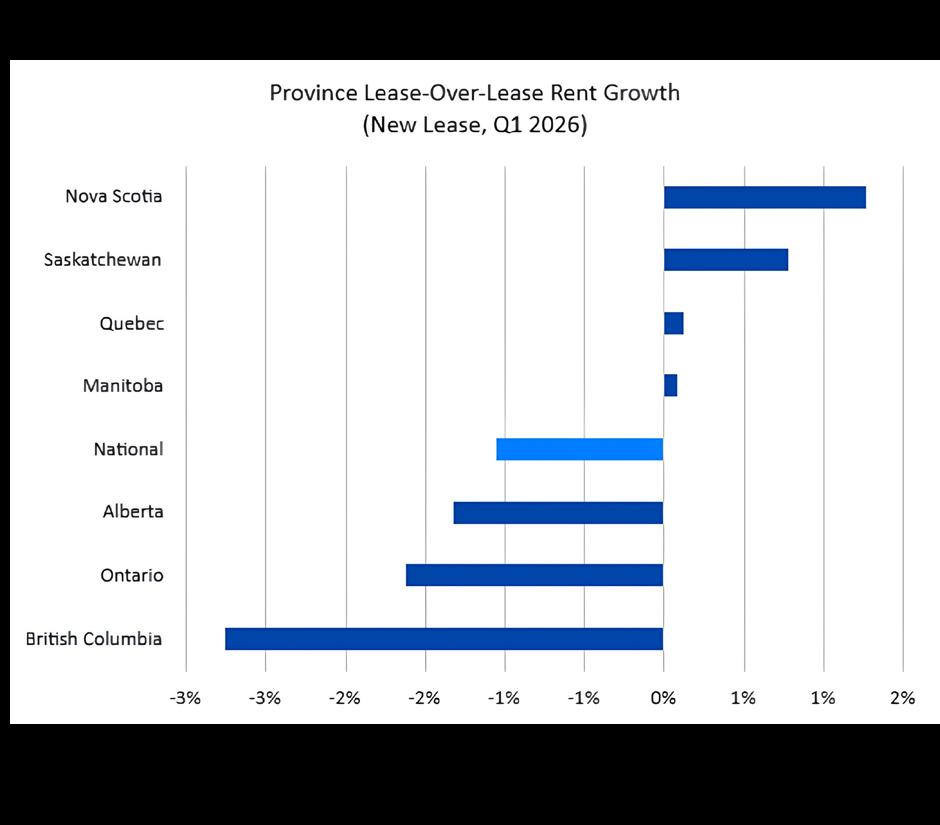
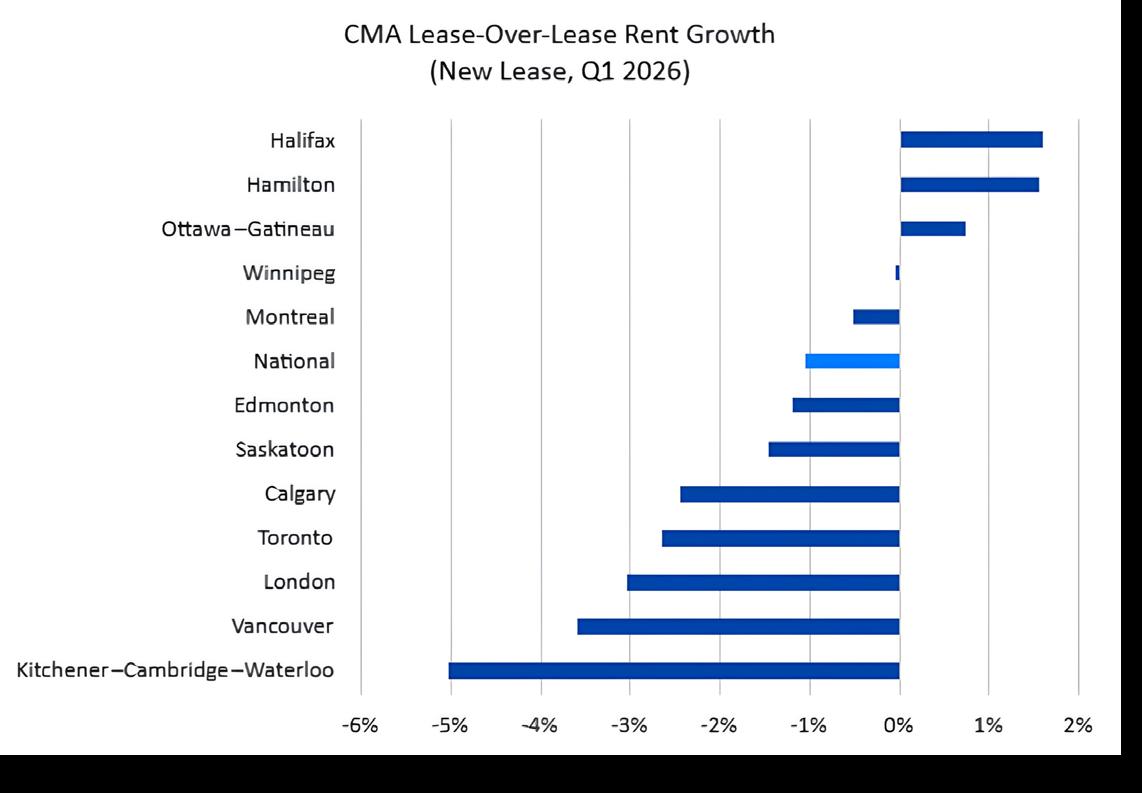
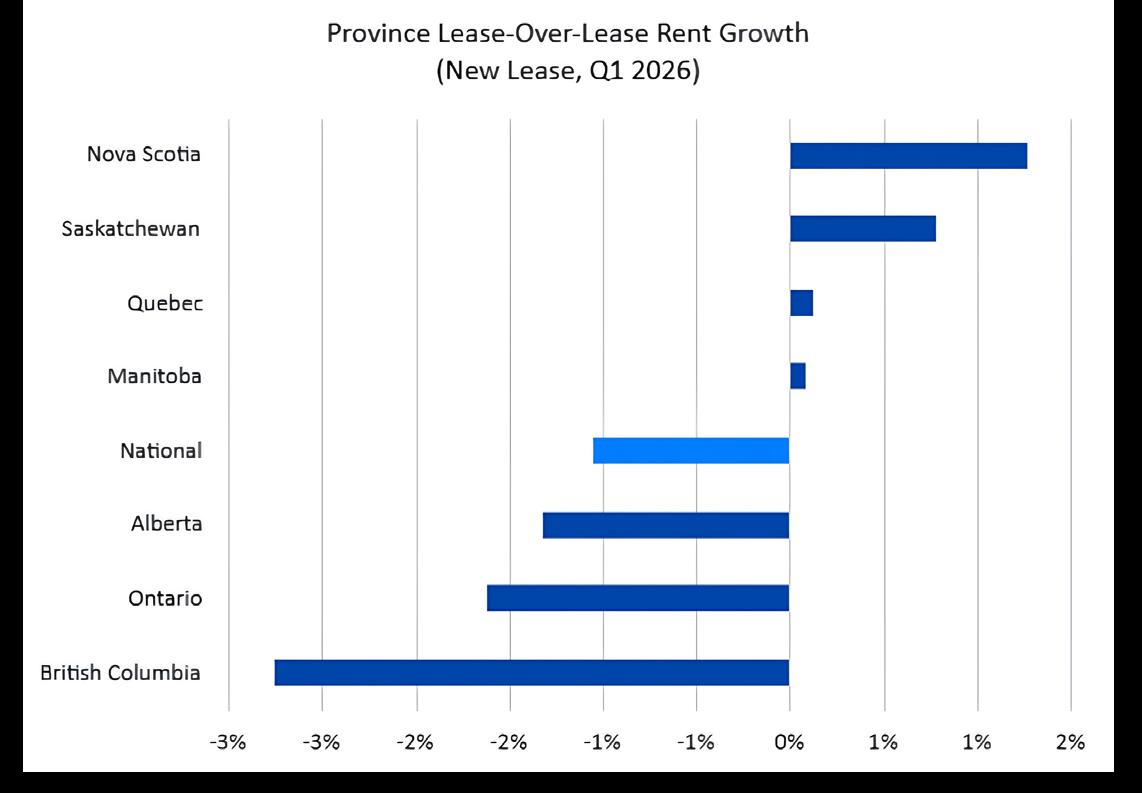
According to the latest Yardi Canadian National Multifamily Report, released in Q2 2026, the sector is adjusting to a fundamentally different environment, shaped by national averages of the vacancy rate at 5.1% (up 110 basis points year-over-year), new lease pricing at -1.0% nationally (down from a peak of 13.1% in Q3 2023) and in-place rate growth slowing to 2.7% year-over-year.
An economy still finding its footing
Trade disruption, geopolitical tension and rising energy prices have kept growth subdued. The labour market reflects the same pressure: Canada shed 84,000 jobs in February before recovering just 14,100 in March. Unemployment sits at 6.7%, with youth joblessness reach-ing 14.1%, a demographic that doubles up or moves home rather than signs leases.
Population growth, along the engine of rental demand, has reversed. Canada’s population shrank by more than 100,000 in 2025 as temporary permit holders departed. The same wave of immigration that drove vacancy to historic lows is now driving it back up, particularly in the GTA.
Canadian Apartment Industry Report
Regional standouts: where the gaps are widening
Markets are diverging sharply. Halifax leads all CMAs at 6.0% year-over-year in-place rent growth, supported by strong interprovincial inflows. Montreal (3.7%) and Winnipeg (3.5%) are also performing well, as are Alberta markets buoyed by domestic migration and energy activity. Calgary is the only market in negative territory at -2.0%, with Vancouver (1.6%) and KitchenerCambridge-Waterloo (1.5%) among the weakest.
Vacancy, turnover and renter behaviour
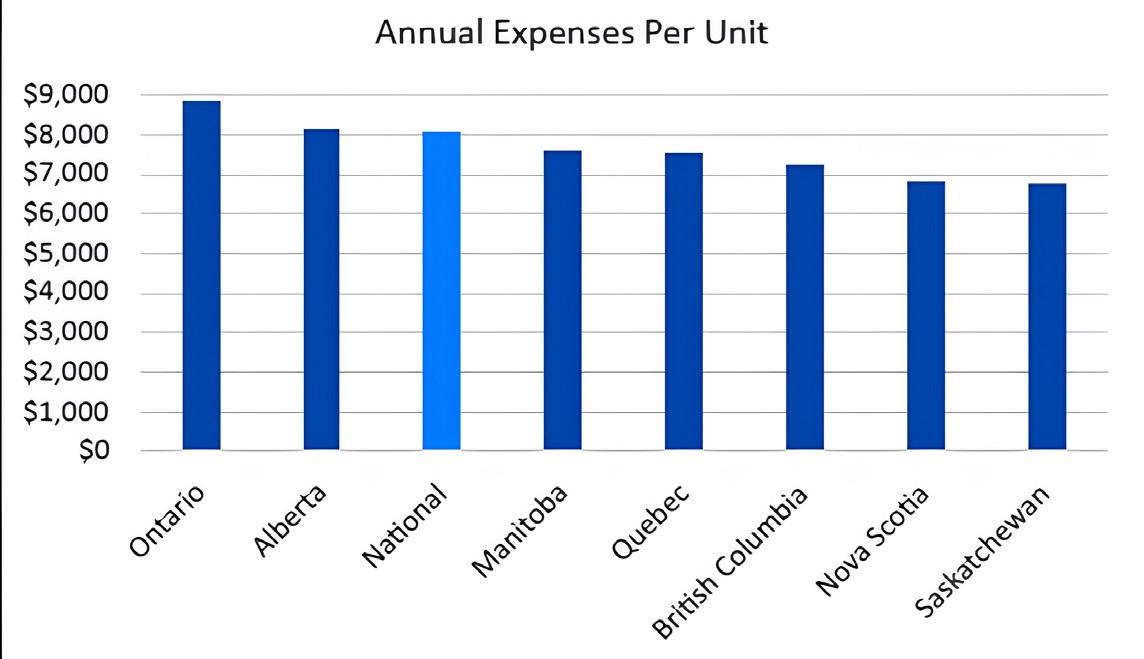
New lease pricing is negative in nine of the top 12 CMAs. Operating costs compound the divergence: Ontario providers averaged $8,858 per unit versus $8,122 in Alberta and a national average of $8,053, all figures represent trailing 12-month expenses.
Average length of stay has increased to 40 months as Canadian residents hold their posi-tions in a softening market. Yet annual turnover has risen to 25.8% nationally, meaning when residents do leave, it happens more frequently than before.
Vacancy climbing alongside turnover tells a consistent story: active movers are more selective, decision timelines are longer and competition between properties is intensifying. Higher vacancy is direct revenue loss. Higher turnover drives costs through unit prepara-tion, leasing overhead and downtime. In this environment, retaining a qualified resident is almost always more cost-effective than replacing one.
Canadian Apartment Industry Report
What this means for housing providers
The variables that drove recent performance are gone. What replaces them isn’t just disci-pline, it’s capability.
Operators with the right data infrastructure are making faster, better decisions on pricing, retention and capital. AI-powered tools are compressing the gap between a lead and signed lease, flagging at-risk residents before they give notice and surfacing inefficiencies that manual processes never catch.
This isn’t about surviving the current cycle. It’s about building a platform that makes the next one harder for everyone else to compete in.
Download the latest Canadian Multifamily Report: www.yardi.com/cndmultifamilyreport
Yardi Canadian Multifamily Report
Quarterly insights on rent growth, vacancy, turnover and digital demand across major Canadian CMAs. info.yardi.com/multifamily-market-reports-for-canada/
Canada's Largest
Top 10
Top 10 Owners
Starlight Investments
Self-Managed: NO -
Number of Employees: 360+
Operates in: BC, AB, ON, QC, NS
Website: www.starlightinvest.com
**Apt: 55,000
QuadReal Property Group
Self-Managed:
of suites owned
55,000
32,922
Homestead Land Holdings
27,372 Operates in:
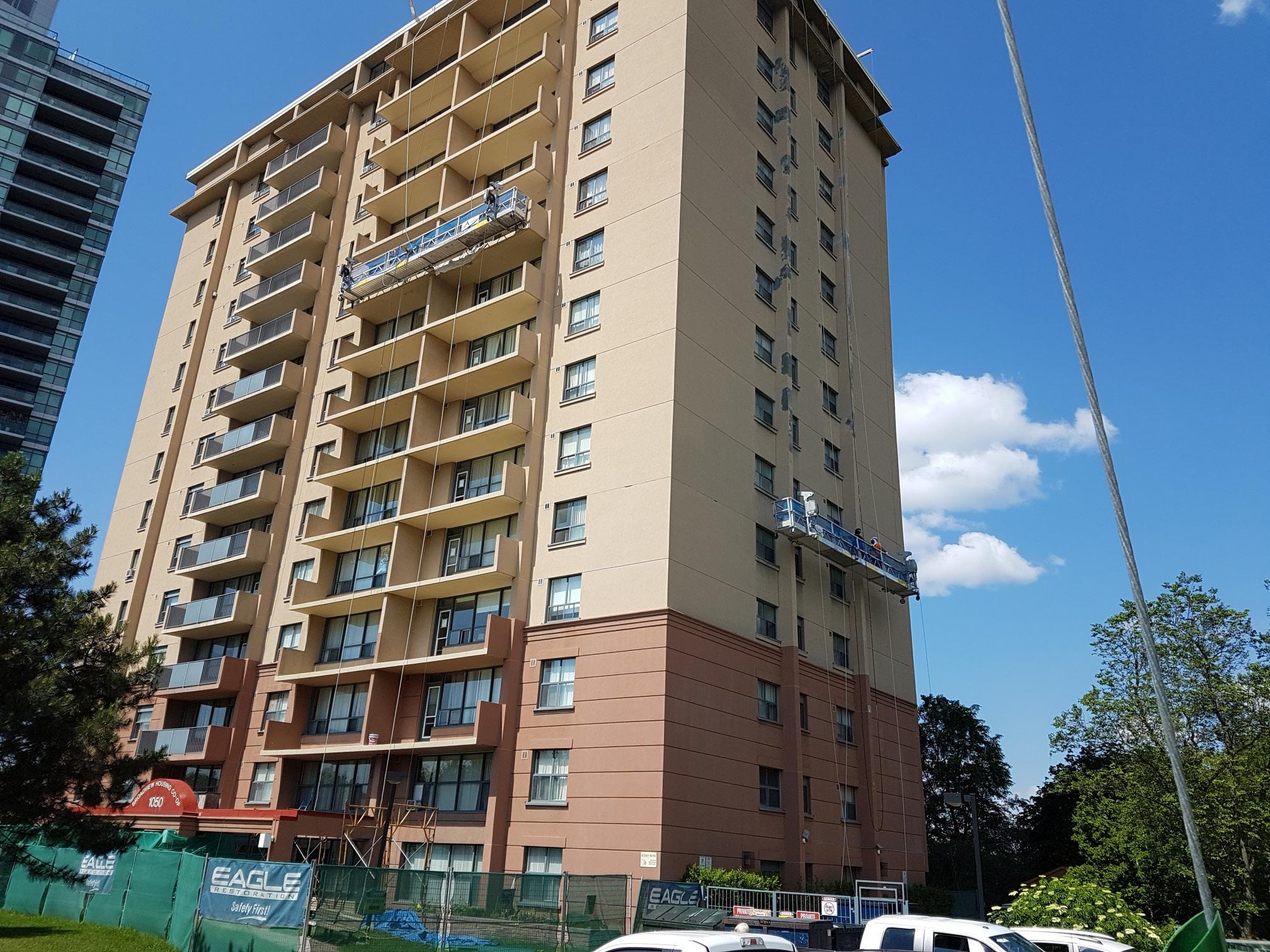
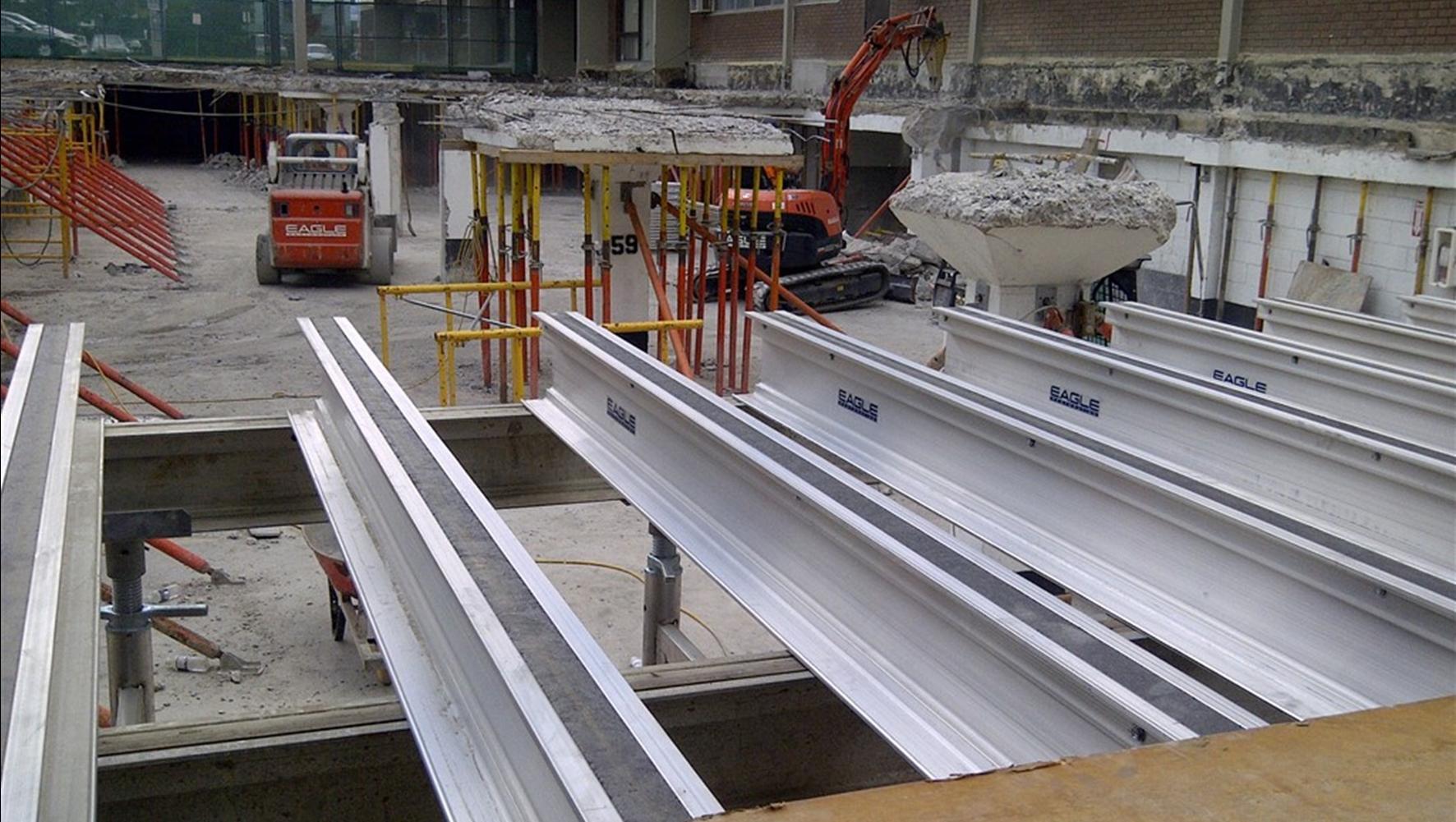
RESTORING THE PAST FOR A SOLID FUTURE
Expert restoration solutions that protect your building, your tenants and your investment. EXPERIENCED. RELIABLE. TRUSTED. + 25 YEARS
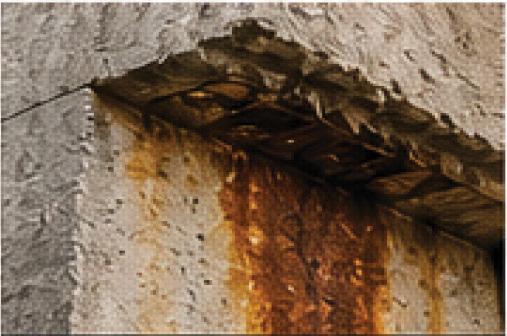
Cracked or Spalling Concrete
Facade and Sealant Failures
Masonry and Concrete Restoration
Realstar Management
Self-Managed: YES
Number of Employees: 750
Operates in: BC, AB, SK, ON, QC, NS
Website: www.realstar.ca
**Apt: 22,232
Number of suites owned
22,232
Hazelview Investments
Self-Managed: YES
Number of Employees: 650+
Operates in: AB, SK, ON, QC, NS
Website: www.hazelview.com
**Apt: 21,072
Number of suites owned
21,072
Mainstreet Equity Corp.
Self-Managed: YES
Number of Employees: 608
Operates in: BC, AB, SK, MB
Website: www.mainst.biz
**Apt: 17,588 | Condo: 50 | Sr: 241 | TH: 1,268
Number of suites owned
19,147
Yes, we can!
Since MetCap Living established itself as a leader in property management, we have routinely been asked one, simple question; “Can you help us run our property more effectively?” And, for well over thirty-eight years, the answer has remained — Yes, we can! Our managers are seasoned professionals, experienced in every detail of the day to day operations and maintenance of multi-unit rental properties. From marketing, leasing, finance and accounting, to actual physical, on-site management, we oversee everything.
We concentrate on revenue growth, controlling expenses, and strategic capital investment in your property to maximize your profitability over the long term — when you’re ready to discuss a better option; we’ll be there. You can count on it.
Kazi Shahnewaz Director, Business Development Office.
Save time and money with customizable e-Procurement solutions built for your business needs.
EXPERT CUSTOMER SERVICE
Whether it’s routine maintenance and repairs, property upgrades, or suite turn renovations, our dedicated team is committed to delivering a seamless experience every step of the way.
EXTENSIVE PRODUCT OFFERING
Thousands of products in stock every day, plus access to thousands more we can source on your behalf. Essential categories available, including:
• Appliances
• Hardware
• Plumbing
• Tools
• Flooring
• Paint & Sundries
• Cleaning & Janitorial
• Grounds Maintenance
• Fire Safety
• Electrical
• Cabinetry
• HVAC
• Lighting
• Personal Protective Equipment
• And MORE!
Plus, Exclusive Brands that deliver quality, style & value.
Industry Events Tradeshow & Expo
MOBILE APP DOWNLOAD THE APP
Do your Laundry from your Phone!
Experience laundry payment on your terms! Use our app and pay how you want!
Offering mobile payment options enhances convenience for residents, fostering loyalty, improving satisfaction, and potentially increasing overall service usage by making transactions simpler and more accessible.
One App Does It All
• Mobile payment
• Start a machine
• Check machine availability
• Monitor laundry cycles
• Service alerts & more
Enhanced User Experience
A modern, digital laundry room delivers unmatched convenience, putting control, flexibility, and choice directly at your residents’ fingertips. From mobile payments to real-time machine availability, it’s laundry made effortless.
For more information contact us at:
I N C.
Canada’s One-Stop Source for the Rental Housing Industry