Taryn Phillips Marketing and Communications Associate tphillips@pscouncil.org
Luke Shannon Research & Analysis Associate shannon@pscouncil.org
WCEO’S LETTER
e are excited to launch into spring with the PSC Annual Conference at The Greenbrier in White Sulphur Springs, West Virginia. Each year, this gathering brings together hundreds of leaders to examine the most important issues facing the federal contracting industry. The 2026 conference will continue the tradition of providing forums for thought-provoking discussions and building connections amongst Members.
We look forward to hearing from industry experts and government leaders from across government – including the White House, Congress, and federal agencies – on the evolving acquisition landscape; insights into the federal budget and changing policy; the Administration’s priorities, and on artificial intelligence’s growing role across government. The PSC Annual Conference also provides Members with important opportunities to connect with each other in more relaxed settings. I am looking forward to meeting with Members and hearing about the ways you are advancing federal missions.
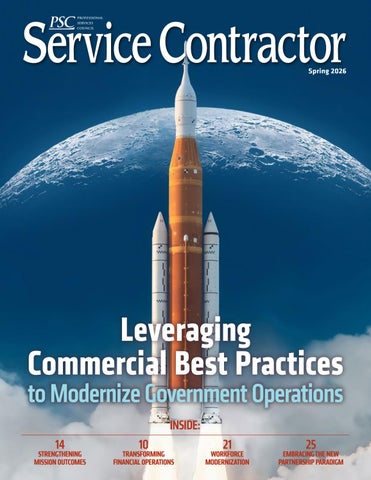
As we gather in West Virginia, I am always struck by the work our member companies are doing and the positive impact our industry has across the country and globe. The recent Artemis II space mission is just one example of the stellar achievements possible when industry and government collaborate.
The theme of this magazine’s edition, Leveraging Commercial Best Practices to Modernize Government Operations, comes at a fitting time. OMB’s recent memo, “Increasing the Acquisition of Commercial Products and Services,” highlights the administration is addressing “additional steps to promote aggressive leveraging of the commercial marketplace.” The articles featured in Service Contractor underscore our industry’s commitment to continue to provide the best services and solutions to government partners.
I also acknowledge that many of you have been navigating a challenging landscape for your businesses. As I write this letter in late April, the Department of Homeland Security remains unfunded by Congress, marking the fourth major government shutdown since 2019, and the second in the past year. As I underscored in a column for Government Executive last year, shutdowns not only halt essential services, but they weaken
national preparedness, undercut public trust in government offices, and hampers the ability of contractors working to carry out critical missions.
However, amidst these challenges, our Members are showing how essential their role is when funding shortfalls do occur. I was delighted to share with readers of Washington Technology how 20 airports participating in the Transportation Security Administration’s Screening Partnership Program allowed Americans to travel without waiting in the long lines caused by the Homeland Security shutdown. The program contracts private companies to handle security screening under full federal oversight. San Francisco International Airport—one of the busiest airports in the country—is among the participants in this program, and it had normal wait times throughout the shutdown. These airports also highlighted another benefit of the program: real savings for the taxpayer, with government contractors providing the same security and efficiency as TSA but for a lower cost.
I look forward to hearing more from our Members at this year’s conference. These experiences provide real-world examples that we use when meeting with Congress and the administration, whether in our day-to-day advocacy, or during events like PSC on the Hill.
I also hope to see you at one of our many other upcoming events. Whether it’s the FedHealth Conference on May 21, the Leadership Summit on June 7-8, the Acquisition Conference on June 25, or participating in one of our many councils or working groups, there are many ways to connect.
As always, please don’t hesitate to reach out to me or any of the PSC staff if we can ever be helpful—we are here for you!
Sincerely,
James Carroll, Chief Executive Officer Professional Services Council
WPRESIDENT’S LETTER
elcome to the Spring 2026 edition of Service Contractor magazine.
As the Trump Administration entered its second year, we saw how policy priorities, budget pressures, and a complex geopolitical environment continued to impact the federal marketplace. Following the historically long federal government shutdown in October and November 2025, this spring has seen a recalibration of certain expectations, as well as renewed momentum, across departments and agencies.
For example, the acquisition community is actively supporting the Revolutionary FAR Overhaul – from interactions involving key government interlocutors and their contracting partners to reviews of practitioner albums, companion guides, and potential training modules that reflect the next generation of regulatory requirements. How will government and contracting officials alike deal with legacy requirements in light of these revised FAR and supplement provisions? What will education efforts include, and who will benefit most from additional training resources? And how will these efforts align with departmentspecific reforms, such as the Acquisition Transformation Strategy at the Department of Defense (War)? PSC and its members are leading the charge in helping to streamline acquisition processes, accelerate procurement, and make operations more efficient across the federal enterprise.
In addition, the President continues to leverage executive orders and actions to advance his Administration’s policy agenda – including but not limited to the President’s Budget Request for fiscal year 2027. You can find PSC’s summary of this request on page 8.
On Capitol Hill, Congress is back in session, and PSC is closely monitoring activity. The latest information on key legislation is available on PSC’s Bill Tracker on page 42.
PSC Advocacy
PSC continues to actively engage with leaders across both the legislative and executive branches as decisions take shape. We encourage members to share their perspectives at policy@pscouncil. org so we can most effectively represent industry priorities.
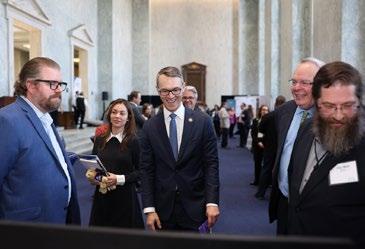
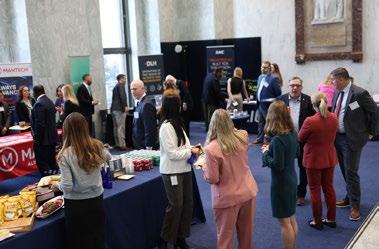
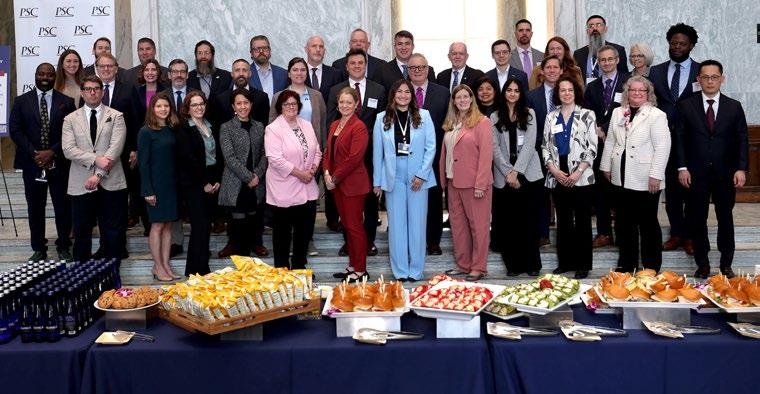
We continue to strengthen relationships with critical congressional officials. Read about our March PSC on the Hill event, during which 12 PSC member companies displayed their capabilities—and engaged directly with congressional members and staff—related to the rapidly evolving role of AI in national security; the article is on page 41.
With executive branch officials, PSC remains committed to focused participation in face-to-face meetings, involving senior leaders from PSC member companies wherever possible. These discussions strengthen critical relationships to advance government mission effectiveness and create two-way dialogue that supports capability development, acquisition, fielding, and sustainment. A list of recent meetings is on page 40.
Events
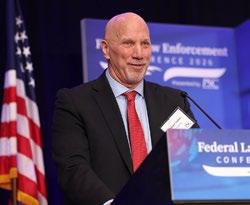
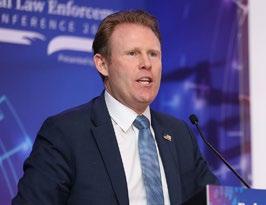
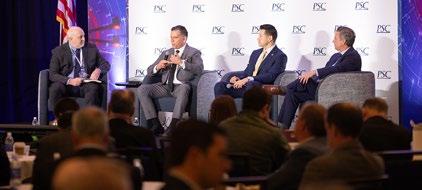
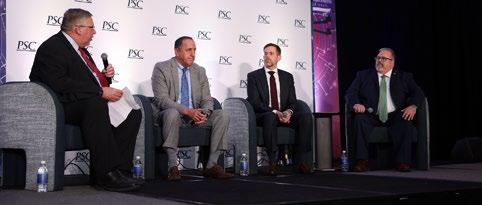
PSC had record-setting attendance at the 2026 Federal Law Enforcement Conference. You can read a recap of the event on page 35. Read PSC VP for Civilian Agencies Krista Sweet’s preview of the FedHealth Conference on page 36. Learn more about all our upcoming events and meetings at pscouncil.org/events.
Federal Contracting Spotlight
At our March PSC on the Hill event, we released an AI in National Security Compendium, highlighting how member companies leverage AI solutions to improve outcomes for the American people. PSC members Arc Aspicio, DLH, GDIT, Golden Key Group, iWorks, Leidos, MANTECH, Maximus, and Peraton are featured on page 38.
Featured Articles
The theme of this edition is Leveraging Commercial Best Practices to Modernize Government Operations. We have a variety of company perspectives across the civilian and defense landscape. Featured authors include: Jim O’ Farrell of Advanced Management Strategies Group; Ken Helgren of Andrew Morgan; Andrea Kiernan and Rick Landsman of Avyance; Sam Hussain of Capgemini; Karim Fadel of CGI; Christine Williamson and Lori Allen of CohnReznick; Mary Ellen Curto of Commanders LLC; and Dipit Bahl of TetraTech.
As the federal landscape continues to evolve, PSC remains committed to providing our members with actionable insights, focused tools, and targeted advocacy. We welcome your input and engagement, and as always, we appreciate your steadfast support of PSC and our work on behalf of the federal contractor.
Stephanie Sanok Kostro, President
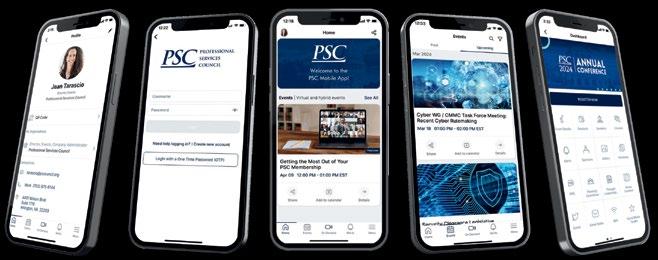
Single sign-in
Register for events
Update your profile
Conference-specific dashboards
Get PSC alerts
View member meetings
Scan the QR code to learn more about the app or visit pscouncil.org/app
Access PSC resources Renew membership Join PSC
For more information on PSC membership, contact membership@pscouncil.org. View all of PSC’s member companies at pscouncil.org/members
EThe FY27 President’s Budget Request
by Luke Shannon, Research and Analysis Associate, PSC
very year, the President’s Budget Request (PBR) to the U.S. Congress serves as a starting point for the fiscal year’s federal appropriations process. Released on April 3, the fiscal year 2027 PBR proposes a discretionary budget of $2.2 trillion for government agencies. Its boldest ask is in national security—specifically, the $1.5 trillion top line for the Department of Defense (War), which is split between the base budget request and a supplemental request—and it continues the Trump Administration’s preferred spending cuts for particular departments and agencies, such as Department of State and Department of Education.
To help visualize trends in this regard, the table below highlights FY27 PBR funding proposal for each major department and agency, as well as the enacted funding levels that emerged from the FY26 appropriations process, the FY26 PBR levels, and percentages to show comparison.
It is important to note that the FY26 PBR generally indicated whether departments would see boosts or cuts in enacted funding, though in some cases, Congress “restored” funding for certain programs that the PBR had proposed to trim or eliminate; as a result. When compared with FY27 PBR data, FY26 budget requests demonstrate changes in Administration priorities in some cases (e.g., requesting to cut Department of Justice FY26 funds but increasing those funds in FY27) or year-over-year consistency in others (e.g., proposed cuts to Environmental Protection Agency in both years).
Notable Changes Over Time
The Department of Defense (War) Budget lists Golden Dome as a key priority, but most of that program’s funding is dependent on reconciliation, according to the President’s current approach to the budget request. Approximately $17.1B of the $17.5B budgeted for associated missile defense systems would come from Congressionally approved reconciliation funding, rather than the regular FY27 appropriations process. It is important to note also that while the request proposes a 5-7 percent pay raise for servicemembers, there is no similar request for civil servants within the Department. Other listed priority areas include drones, shipbuilding, Space Force, critical minerals, and artificial intelligence.
For the Department of Health and Human Services, the FY27 budget in brief that accompanied the FY27 PBR reflects year-over-year cuts in most discretionary programs. If enacted as proposed, budget authorities for certain HHS operating divisions and offices—such as the Administration for Strategic Preparedness and Response; Administration for Children, Families and Communities; Centers for Medicare and Medicaid Services and National Institutes of Health—would each be cut between 8-25 percent from FY26 enacted levels. One notable exception from these proposed cuts is the Indian Health Service (IHS), whose budget authority would rise from $8.0B to 9.1B; this proposed increase reflects the Administration’s stated goal of “strengthening services to tribes.”
Although the request of $76.5B for Department of Education represents a cut from FY26 enacted levels of $79B, it is higher than last year’s PBR of $66.7B for the Department. According to a budget document released by the Office of Management and Budget (OMB), “The Budget puts the Department of Education (ED), which has failed the Nation’s children, teachers, and families, on a path to elimination.” K-12 programs received the largest cuts, while Federal Pell Grants, special education and charter schools would receive increased federal funding.
Although topline budget numbers do not reflect heavy change with Transportation Security Administration at the Department of Homeland Security, an OMB overview makes clear that a reallocation of funding and cutting many TSA jobs “begins the privatization of TSA’s airport screeners.” A recent opinion piece by PSC’s Jim Carroll expressed his support for greater collaboration between contractors and TSA.
A proposed 10% increase in Department of Energy discretionary funding obscures a key distinction within that Department: defense energy program funding—at the National Nuclear Security Administration (NNSA)—would increase 21 percent, while non-defense energy program funding would decrease 16 percent. The budget justification documents accompanying the PBR show intent to reallocate funds originally slated for clean energy projects toward fossil fuel, nuclear energy, and AI supercomputer programs. On the defense side, NNSA would receive $32.8B, which represents a 12% increase from its FY26 enacted level.
FY26 and FY27 Budget Data
^$1.5T topline request includes $1.15T in base discretionary funding and $350B in reconciliation funding *Reflects enacted dollars or president’s request after offsets. IIJA supplemental dollars contributed an additional $34.5B for FY26
Last year, the President requested $28.9B for Department of State and other international programs, which would have cut funding for this category by 44.1 percent. Congress provided $50.1B in funding for FY26, making for a still significant but less drastic cut of 3.1% from FY25. This year’s request is 35.6B, which would be a cut of 30%, but the impact to the function of State goes beyond that. The request would cut $11.1B from humanitarian aid, contributions to international cooperation bodies, and programs addressing climate change. A combined $36B is budgeted for foreign military financing, critical minerals, and the America First Opportunity Fund.
The President’s FY26 budget request outlined a five-year plan to allocate $18.8B to NASA each year from FY26-FY30. Although Congress provided more than requested in FY26, the FY27 PBR matches this number exactly and signals a potential willingness to continue with this requested figure into the future.
Going forward, PSC is expecting greater visibility on DOD’s request, including requests by service within the department. Committee estimates to budget committees typically come in about six weeks after the PBR, which would be May 15 this year. Midterm elections approach on November 3 and could influence the politics of this appropriations cycle. 3
Transforming Financial Operations: Commercial Solutions and Best Practices Modernizing the Military Health System
by Ken Helgren, Chief Strategy Officer, Andrew Morgan
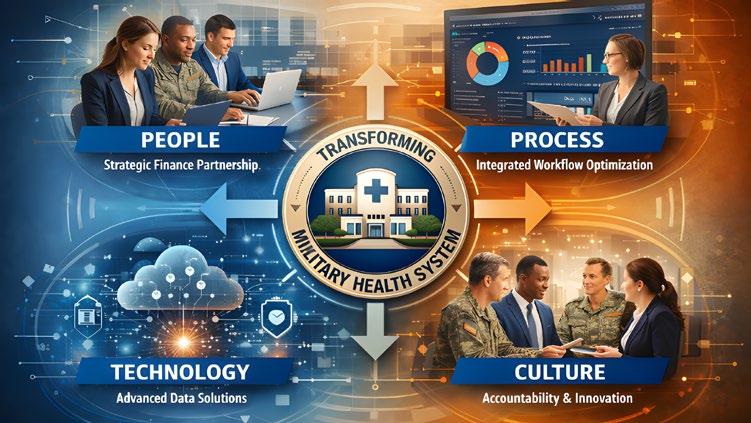
The Military Health System (MHS) is fusing commercial best practices with mission-critical objectives to create a futureready financial ecosystem that accelerates decisions, enhances accountability, and optimizes resources through two initiatives:
The MHS’ Planning, Programming, Budgeting, Execution Tool (MP2BET) on OneStream’s enterprise platform will manage billions of dollars in appropriations with precision,
enabling real-time visibility and data-driven planning across the entire lifecycle of Planning, Programming, Budgeting, and Execution (PPBE).
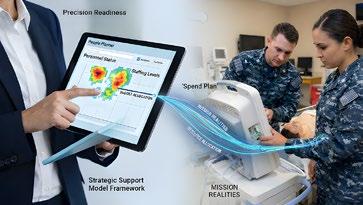
The MHS is transforming CFO operations within the Program Executive Office, Defense Health Management Systems (PEO DHMS) through a novel, strategic support model framework that redefines financial management by streamlining
The Military Health System integrates people, processes, technology, and culture to support modern financial operations. This framework supports standardized processes, improved coordination, and consistent financial management practices across organizations.
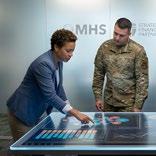
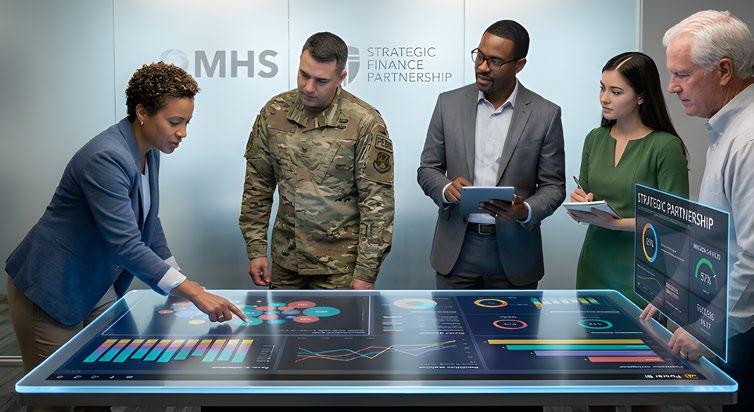
Financial teams collaborate using MP2BET dashboards to support planning, programming, budgeting, and execution activities across the Military Health System. Integrated financial data and shared visibility help support coordination between finance and program offices.
acquisition and program execution to ensure agility, compliance, clear communication, operational excellence, and efficiency.
These initiatives integrate people, processes, culture, and technology to deliver an innovative, sustainable, financial support model. The result is greater MHS efficiency, improved stewardship of taxpayer dollars, and enhanced mission readiness.
People: Building a Strategic Finance Partnership Through Talent Transformation
Talent Transformation redefines finance professionals as strategic partners embedded within acquisition and program offices. Financial leaders shape better outcomes and influence mission success.
Workforce Accelerator aligns individual growth with organizational capability. PEO staff pursue continuous learning, industry credentials, and critical certifications. Automated Cost Estimating Integrated Tools and advanced visualizations strengthen analysis and complement OneStream-powered intelligence.
MP2BET’s People Planner transforms workforce management into a readiness and operational advantage. By providing near real-time visibility into personnel status, leaders can make rapid, informed decisions on staffing, readiness, and mission alignment to ensure the right talent is in the right place at the right time.
Finance Integration coordinates Financial Planning and Analysis, Budget Execution, Audit and Compliance, Talent Management, Operations, and Communications. Promoting a learning culture turns training into measurable results through
Individual Development Plans (IDPs) and Learner Action Plans (LAPs) that target skill gains and productivity improvements. Integrating new business units demonstrates scalable growth modeled after private-sector expansion.
Processes: Embedding Commercial Rigor in Government Operations
Process transformation draws from commercial healthcare, emphasizing standardization, automation, and integration. Implementing MP2BET on OneStream replaces fragmented spreadsheets with a unified enterprise platform that consolidates planning, reporting, and analysis across the MHS.
support workforce
and
operational requirements. Personnel and financial information
be viewed together to support staffing decisions and mission planning activities.
MP2BET People Planner capabilities
visibility
resource planning aligned with
can
MP2BET provides end-to-end PPBE support, from Program Objective Memorandum development through real-time execution tracking, integrating financial planning, workforce management, and resource allocation across organizational levels. The flexible dimensional framework delivers simultaneous visibility into appropriations, cost centers, and mission hierarchies.
Adapted commercial revenue-cycle concepts focus on improving third-party collections, strengthening TRICARE coordination, and optimizing resource allocation. MP2BET’s engine enables spend-plan validation, automated unliquidatedobligation tracking, and advanced variance analysis once limited to commercial analytics suites.
The Strategic Process Transformation workstream adds further rigor to financial operations through benchmarking, restructuring, and product evaluation. Programs such as MHS GENESIS serve as test cases for scalable modernization.
Culture: Embedding Accountability and Performance
Through cultural transformation, MHS efforts shift from compliance to value creation, continuous improvement, and outcome ownership. Guided by Workforce Accelerator methodology, the MHS is building a performance-based culture where individuals act as catalysts for change.
Agile sprints bring commercial-style accountability to acquisition. Each initiative has a single owner, defined objectives, and measurable outcomes. Collaborative planning tools enhance
transparency while converting resistance into advocacy, producing teams that drive financial and acquisition excellence.
Power BI dashboards provide continuous visibility, replacing periodic static reports. Current-state assessments and stakeholder interviews ensure reforms align with mission realities. The Change Coalition advocates and champions adoption and mitigates resistance using proven methods adapted for federal operations.
This evolution replaces silos with collaboration, embeds learning into daily work, and makes accountability the standard for performance.
Technology: Accelerating Transformation Through Digital Innovation
Technology drives MHS financial transformation, with OneStream’s Corporate Performance Management platform at its core. Operating within Department data centers, MP2BET exemplifies how commercial cloud-ready architecture can meet strict security requirements while remaining agile and scalable.
OneStream’s Extensible Dimensionality and MarketPlace’s prebuilt solutions and utilities enable MP2BET to scale while supporting PEO needs. The platform seamlessly integrates disparate data into a unified view enabling streamlined analysis and decision-making. Workflow engines automate complex PPBE processes while the Cube architecture delivers instant consolidation and reporting.
Modern financial systems support secure data management and enterprise reporting across federal healthcare programs. Integrated platforms improve visibility into appropriations and financial execution while operating within secure government environments.
analytics
Integrated financial and workforce tools support coordination across teams and organizations. Shared access to financial and personnel information supports planning, communication, and operational alignment.
OneStream’s machine-learning capabilities add predictive analytics, anomaly detection, and forecasting to support federal requirements. Advanced visualizations and analytics provide rapid insight into spend plans, cost variances, and performance trends without external data manipulation to improve budget execution, cost estimation, automated compliance monitoring, and intelligent resource allocation.
By combining automation, AI, and analytics, the CFO Support Model and MP2BET form a unified digital ecosystem
that mirrors commercial innovation while serving MHS mission objectives.
Looking Forward: Sustaining Transformation Through Partnership
Through MP2BET and the CFO Support Model, the MHS achieves enterprise modernization and acquisition reform, establishing a blueprint for financial excellence while proving government can harness commercial innovation while maintaining mission focus.
Early results show stronger audit readiness, improved cost-estimation accuracy, and efficient budget execution. The Workforce Accelerator framework yields measurable ROI through higher retention and sustained improvement. Structured IDPs/ LAPs replace contractor dependence with internal capability, embedding skills for lasting success. When deployed to Military Treatment Facilities, MP2BET becomes a force multiplier, strengthening data integrity, optimizing mission planning, and driving readiness across the MHS.
MHS financial operations are becoming an agile, insightdriven enterprise that delivers lasting value to taxpayers and better service to warfighters and families. This transformation delivers “sticky, scalable, and self-sustaining improvement” that exemplifies a new public-sector performance standard where learning leaders, empowered teams, and intelligent systems achieve measurable mission success. 3
Financial
dashboards support reporting, analysis, and monitoring of budget execution activities. Consolidated data and visual reporting tools help organizations track spending and identify trends across programs.
Commercial Innovation and the Future of Government Modernization
Strengthening Mission Outcomes
Through a Resilient Defense Industrial Base
by Sam Hussain Head of the US Defense Sector, Capgemini Government Solutions
Federal modernization is entering a decisive phase in which technological innovation, cybersecurity, and geopolitical competition are no longer separate conversations. The pace of strategic competition is accelerating, and the ability of the United States to modernize government systems is increasingly tied to the resilience, trustworthiness, and capacity of its Defense Industrial Base (DIB). What was once described primarily as digital transformation has become inseparable from deterrence, operational readiness, and long-term strategic advantage.
For much of the past decade, modernization initiatives have emphasized adopting best commercial practices - agile delivery, platform engineering, cloud computing, artificial intelligence (AI), and DevSecOps - to improve efficiency and accelerate outcomes. Proven at scale in the private sector, these approaches are reshaping how federal agencies deliver mission results. Federal
agencies and their industry partners are increasingly leveraging continuous delivery, data-driven decision frameworks, and outcome-focused governance to move beyond compliance-driven execution and toward measurable impact.
Yet the modernization agenda is evolving. Cybersecurity enforcement, supply-chain vulnerabilities, workforce constraints, and intensifying global technology competition are reshaping how federal agencies approach transformation. The central question is no longer simply how to adopt commercial innovation. It is whether the United States can do so in ways that protect intellectual capital, strengthen mission assurance, and sustain decision advantage in contested environments.
Strategic competitors are pursuing sustained efforts to gain insight into emerging technologies, operational concepts, and critical infrastructure. These activities rarely rely on overt network intrusion alone. Instead, they often exploit distributed
environments, offshore technology ecosystems, and complex supply chains that obscure visibility into software provenance, data governance, and technical dependencies. Recent targeting of defense, space, and advanced manufacturing ecosystems demonstrates how adversaries leverage global technology networks and talent pipelines to gain asymmetric advantage. As digital architecture underpins logistics, sustainment, and command and control, vulnerabilities within the industrial base carry direct operational consequences.
In response, federal agencies are reassessing how modernization programs are structured and how partners are evaluated. Trust, transparency, and resilience are emerging as decisive considerations alongside cost and technical performance. This recalibration is reflected in the maturation of Cybersecurity Maturity Model Certification, strengthened protections for Controlled Unclassified Information (CUI), and evolving Defense Federal Acquisition
Regulation Supplement requirements related to incident reporting, continuous monitoring, and supply-chain integrity.
Recent legislative and regulatory reforms are reinforcing this shift. Portfolio-based acquisition models are gaining traction, preference for commercial solutions is expanding, and barriers for nontraditional technology companies are gradually being lowered. These developments reflect a broader effort to ensure that organizations entrusted with sensitive capabilities demonstrate sustained cybersecurity maturity, operational accountability, and the ability to deliver at mission speed.
Importantly, this evolution is not limited to the Department of Defense. Civilian agencies responsible for critical infrastructure, public safety, economic resilience, and financial stability are adopting comparable expectations. At the same time, efforts to simplify procurement frameworks and reduce non-statutory burdens reflect a growing recognition that excessive process can
slow capability delivery and discourage commercial participation. Trust, resilience, and measurable outcomes are therefore becoming enduring characteristics of federal procurement.
Commercial technology remains central to this transformation. Cloud-native architecture enables scalability and operational continuity. Automation and digital engineering accelerate delivery cycles and improve lifecycle management. AI and advanced analytics are reshaping logistics, predictive maintenance, and mission planning across both defense and civilian agencies.
Yet the strategic value of these capabilities depends fundamentally on the environments in which they are developed, trained, and deployed. Questions of data governance, model provenance, and secure training environments are becoming as important as the algorithms themselves. Efforts to better align innovative organizations, accelerate product transition, and
strengthen engagement with commercial technology ecosystems reflect a growing emphasis on delivering operational capability at speed.
As federal missions become increasingly data-centric, the protection of CUI has emerged as a defining boundary shaping participation in the industrial base. CUI is no longer simply a regulatory classification. It is a strategic control point governing collaboration, supply-chain participation, and advanced analytics. The expanding use of zero-trust architectures, data lineage tracking, and continuous monitoring reflects a broader shift toward data-centric security.
This evolution is particularly consequential for emerging technologies. The credibility of future AI capabilities will depend on confidence in training data, governance frameworks, and operational integrity. Ensuring that sensitive datasets and models remain protected from unauthorized access or manipulation is
therefore central to both cybersecurity and mission assurance.
Technology alone, however, will not determine success. The availability of a cleared, technically proficient workforce is becoming one of the most significant constraints on modernization and industrial capacity. Demand for expertise in cybersecurity, cloud engineering, advanced manufacturing, and AI continues to outpace supply.
This challenge extends well beyond software programs. Shipbuilding, defense manufacturing, space systems, satellite operations, and advanced hardware production all depend on cleared engineers, technicians, and operators. Program timelines in these sectors are directly affected by the ability to recruit, vet, and onboard qualified personnel.
Delays in security clearance investigations can translate into production bottlenecks, extended delivery schedules, and reduced readiness. Expediting clearance processes should therefore be treated as a strategic workforce enabler rather than an administrative task. Sustained investment in the clearance ecosystem - including funding for trained investigators, modernized adjudication tools, and improved investigative capacity - is essential to align workforce availability with national security priorities. Adequately resourcing the organizations
responsible for clearance investigations will directly influence the nation’s ability to meet manufacturing timelines, accelerate fielding, and sustain operational advantage.
At the same time, workforce development must extend beyond clearance reform. Education, certification, and continuous training in emerging technologies are increasingly viewed as strategic investments. Partnerships across government, industry, and academia will be essential to building sustainable talent pipelines capable of supporting advanced mission environments. Workforce mobility and knowledge transfer between sectors can further strengthen alignment between innovation and operational needs.
In contested environments, decision advantage will depend as much on people as on platforms.
The modernization agenda is also prompting a reassessment of global technology dependencies. Distributed development environments, offshore engineering models, and opaque component sourcing introduce risks that may not be immediately visible but can create persistent vulnerabilities. Federal programs are therefore placing greater emphasis on secure development environments, transparent software supply chains, and continuous monitoring.
These measures are not intended to constrain innovation. Rather, they are designed to ensure that mission-critical systems are developed and sustained within trusted ecosystems capable of withstanding sustained adversarial pressure.
These trends align closely with broader acquisition reform. Increased use of commercial solutions, rapid experimentation, and modular delivery models reflects a recognition that strategic advantage depends not only on technological superiority, but on the ability to field capabilities at operational tempo. Industrial resilience, secure supply chains, and trusted talent are becoming integral to acquisition strategy rather than secondary considerations.
Looking ahead, the DIB will continue evolving into a more distributed and innovative-driven ecosystem. Deep integration between commercial and defense innovation, stronger cybersecurity and supply-chain resilience, and sustained investment in workforce readiness will define the next phase. AI, autonomy, and human-machine teaming will accelerate decisionmaking and operational execution.
Maintaining advantage in this environment will require confidence not only in technology, but in the integrity of the ecosystems that develop and sustain it.
Modernizing government operations is no longer solely a matter of efficiency or digital adoption. It is a strategic endeavor tied to resilience, deterrence, and long-term competition. The next phase of modernization will be defined by the ability of government and industry to collaborate within trusted ecosystems that protect critical capabilities and enable decision advantage.
Organizations that invest now in secure development, trusted talent, and resilient supply chains will help shape the future structure of the DIB and ultimately the security and competitiveness of the United States. 3
Sam Hussain is Head of the US Defense Sector at Capgemini Government Solutions. He focuses on advancing digital transformation, cybersecurity, and emerging technology adoption across the Department of Defense, Intelligence Community, and broader national security ecosystem. His work centers on bridging commercial innovation with mission-critical environments, including cloud, artificial intelligence, secure data platforms, and acquisition modernization. Hussain regularly engages with government and industry leaders on workforce development, supply chain resilience, and the future of the Defense Industrial Base.
Workforce Modernization Starts with the Whole Person
Upskilling the Next Generation of Professional Services Contractors
by Jim O’Farrell, President and CEO, Advanced Management Strategies Group (AMSG)
Across government and industry, the phrase workforce modernization is often associated with artificial intelligence, digital transformation, and new acquisition tools. Federal agencies are investing heavily in technology, and contractors are racing to ensure their systems and technical skills keep pace in increasingly contested and disrupted global environments.
But an important reality receives far less attention: the success of federal missions still depends on people.
Professional services contractors may deploy advanced analytics, cloud platforms, and AI-enabled tools, but those capabilities only matter when skilled professionals know how to apply them in complex, high-stakes environments. The next generation of federal mission support will require more than technical certifications. It will require adaptable professionals who can think critically, communicate clearly, and stay grounded in the purpose behind the work they perform.
In other words, workforce modernization must focus not only on technology, but on developing the whole professional.
Modernization Is About People
Workforce modernization is often framed in terms of artificial intelligence, digital transformation, and new acquisition tools. Federal agencies are modernizing systems and processes at a rapid pace, and professional services contractors are expected to keep up. But modernization is not only about technology; it is also about people.
Professional services contractors support federal missions in complex environments. They manage programs, analyze data, support acquisition decisions, and help agencies navigate organizational change. To perform these roles effectively, professionals must continually strengthen their technical expertise.
Yet technical training alone does not fully prepare professionals for the realities of federal mission support. Modernization requires something broader: a workforce that is adaptable, communicates effectively, and maintains a strong sense of mission.
Across the professional services industry, many organizations are beginning to frame workforce development around core values such as competence, communication, and collaboration. These principles help shape how teams approach both professional growth and mission support.
For contractors, the implication is clear: workforce development must extend beyond certifications and compliance training to include development of the whole professional.
Why This Matters to Professional Services Contractors
Professional services contractors operate in environments where requirements shift, priorities evolve, and mission outcomes matter. Agencies depend on contractor teams not only for technical expertise but also for stability, judgment, and the ability to communicate clearly in complex situations. As the federal workforce evolves, contractors must ensure their teams are prepared to operate effectively in these environments. Preparation includes technical training, but it also requires development of critical skills such as collaboration, communication, and strategic thinking.
Organizations that invest in workforce development often see measurable benefits. Strong engagement programs can contribute to higher retention, improved morale, and stronger past performance outcomes. Employees who feel connected to the mission and supported by their organization are more likely to remain engaged and perform at a high level. In today’s competitive labor market, workforce engagement is no longer a “nice to have”; it is a strategic investment.
Competence and Communication in a Modern Workforce
Two capabilities consistently emerge as essential in professional services environments: competence and communication. Competence includes technical mastery, preparation, and accountability. Contractors must understand the regulatory and operational frameworks that govern federal work, including the Federal Acquisition Regulation (FAR). But competence also includes the ability to apply knowledge in dynamic environments and anticipate challenges before they escalate.
Communication is equally important. Modern federal programs involve multiple stakeholders, distributed teams, and evolving requirements. Professionals who can translate complex technical information into clear, actionable insights provide tremendous value to their agency partners.
Some organizations reinforce these capabilities through core values frameworks that emphasize behaviors such as competence, communication, collaboration, and community. These principles help guide how professionals approach both mission execution and professional development.
Organizations that reinforce competence and communication create teams that are better equipped to support mission outcomes and build lasting customer trust.
The Role of Engagement in Workforce Development
While training programs remain important, many organizations are recognizing that workforce development must extend beyond formal instruction. Engagement is increasingly viewed as a key component of workforce development. Employee engagement initiatives can help professionals connect with their work, their colleagues, and the mission they support. When thoughtfully designed, these programs create opportunities for learning, collaboration, and professional growth.
Many organizations now include a range of engagement initiatives that address different interests and needs across their workforce. These may include mentoring programs, leadership development opportunities, recognition initiatives, wellness efforts, and opportunities that support personal interests outside of work. Supporting interests outside the workplace may seem unrelated to workforce modernization. In practice, these initiatives can strengthen creativity, resilience, and long-term engagement.
If we want a modern workforce, we have to build organizations where people can thrive, not just as professionals, but as whole individuals.
Whether employees spend time training for endurance events, studying music, restoring classic cars, or pursuing other personal passions, these activities can foster discipline, curiosity, and adaptability. Those qualities often translate directly into professional environments where problem solving, focus, and collaboration are essential.
Employees who feel supported as whole individuals frequently demonstrate stronger engagement and greater resilience in demanding professional environments.
Developing the Whole Professional Technical courses remain essential in professional services contracting. Certifications, regulatory updates, and systems training are foundational to maintaining compliance and delivering value to federal customers.
However, the next generation of professionals often expects more than mandatory training. Many seek opportunities for broader personal and professional development.
Developing the whole professional may include:
• Exposure to different functions within an organization
• Leadership development and mentoring relationships
• Participation in professional conferences and industry forums
• Structured employee feedback mechanisms
• Programs that support personal growth and well-being
These types of initiatives reinforce a culture of continuous learning and help professionals understand how their individual contributions support broader mission outcomes.
Modernization as a Strategic Advantage
Workforce modernization is often framed as a technology challenge. For professional services contractors, it is also a strategic advantage.
Organizations that broaden their approach to workforce development—combining technical expertise with strong communication, engagement, and leadership development—build teams that are better prepared to support federal missions. These teams are more likely to anticipate customer needs, collaborate effectively across organizations, and maintain continuity during periods of transition; they are also more likely to stay.
Retention is one of the most significant long-term benefits of strong workforce engagement. Experienced professionals who remain with an organization build institutional knowledge, deepen customer relationships, and contribute to consistent program performance.
Ultimately, modernization is not only about adopting new tools or processes. It is about building organizations where professionals can grow, contribute, and remain connected to the mission they support.
If we want a modern workforce, we have to build organizations where people can thrive, not just as professionals, but as whole individuals. 3
Jim O’Farrell is President and CEO of Advanced Management Strategies Group (AMSG), a federal government contractor providing program management, acquisition support, knowledge management, and management consulting services to federal agencies nationwide.
June 25, 2026
Arlington, VA or Virtual
Attend the 2026 PSC Federal Acquisition Conference to stay ahead of rapid shifts reshaping federal acquisition. Hear directly from federal and industry leaders on evolving policies, innovative procurement strategies, and what they mean for growth in FY2026–2027 and beyond. From the Revolutionary FAR Overhaul to expanded use of Other Transactions and stronger industry-government partnerships, gain the insights needed to stay competitive.
OPEN PAGE
This is a must-attend event for company leaders, business development executives, and contracting professionals.
The Future of Federal Work: Embracing the New Partnership Paradigm Across Government,
Industry and Academia
by Karim Fadel, Vice-President, CGI
The future of government contracting belongs to those who understand that a true artificial intelligence (AI) transformation is an ecosystem effort. No single organization – whether government, federal contractor, tech company or university – has all the pieces. But together, they can accelerate innovation while reducing risk.
This partnership ecosystem enables the government to gain access to diverse expertise, emerging technologies and objective research insights. Further, it allows federal agencies to develop AI solutions that are more secure, more ethical and more mission-aligned than any single organization could produce alone.
AI, cloud, cybersecurity and datacentric operations are advancing at a rapid pace, demanding expertise from a wide range of perspectives that only the ecosystem approach can provide. Moreover, federal agencies are accelerating their adoption of advanced technologies, seeking to meet the administration’s prioritization of innovation, speed and efficiency.
To meet these expectations, federal contractors will need to evolve not only what they deliver but how they collaborate to deliver it. The future of doing business with the U.S. Government will depend on a company’s ability to collaborate deeply with the technology ecosystem.
A rapidly shifting landscape
The days of AI as an experimental concept have largely passed. It is becoming operational infrastructure within federal agencies. The Government Accountability Office recently documented that AI use cases across selected federal agencies nearly doubled in a single year, and generative AI use cases increased ninefold. That kind of growth reflects necessity, not novelty. Federal agencies need these tools to expand capacity, improve services and enhance mission performance.
At the same time, federal expectations for responsible AI are becoming more precise and enforceable:
• Executive Order (EO) 14110, Safe, Secure, and Trustworthy Development and Use of Artificial Intelligence, lays out
comprehensive requirements for AI safety, red-teaming, standardized evaluations and civil-rights protections.
• Office of Management and Budget Memorandum M-2521, Accelerating Federal Use of AI through Innovation, Governance, and Public Trust, translates those expectations into actionable steps, requiring federal agencies to appoint Chief AI Officers, create and maintain AI inventories, and develop risk mitigation practices for systems that impact rights or safety.
These frameworks go well past informing AI development. They fundamentally reshape government procurement. To meet these demands, federal agencies need partners who can demonstrate governance maturity, provide transparent testing methods and integrate with enterprise-scale tech platforms. No organization can satisfy these expectations in isolation.
The new business reality for federal contractors
Federal contractors have long-held deep mission knowledge, operational discipline and integration expertise. But in the era ahead, that is not enough. Federal agencies are seeking multifactor partnerships with forward-focused industry and academia. The key differentiators are shifting toward:
• Seamless access to enterprise-grade AI and cloud platforms. By partnering, government agencies benefit from the robust infrastructure and scalability offered by leading tech providers, while academia contributes innovative research and validation methods.
• Rapid and responsible integration of advanced AI models. Multisector collaboration enables swift adoption of advanced AI solutions, with government setting mission requirements, industry delivering proven technologies and academia ensuring ethical and scientific rigor.
• Expertise in open, multivendor architectures. Collaborations foster interoperability and flexibility, empowering public sector organizations to integrate diverse technologies without vendor lock-in, while drawing on academic research for best practices and industry for implementation expertise.
• Agility to move from prototype to production at commercial speed. By co-designing solutions, government, industry and academia can rapidly transition innovative ideas into operational capabilities, overcoming bureaucratic slowdowns and adapting quickly to changing mission needs. The power is in the partnership ecosystem. Industry, government and academia each bring unique strengths: innovative platforms, operational discipline and scientific assurance. When united, they accelerate progress, ensure responsible AI development and successfully navigate the disruption and complexity brought on by AI’s rapid advancement.
Where this model is already succeeding
We can observe the new partnership paradigm in action across several leading initiatives:
The Department of War’s stakeholder ecosystem
Through the Global Information Dominance Experiment (GIDE) series and the Open Data and Applications Governmentowned Interoperable Repositories (Open DAGIR) framework, the Department brings together government, industry and academia to align mission needs with advanced commercial capabilities, without sacrificing data ownership or interoperability.
Generative AI transforming health services
The Departments of Veterans Affairs and Health and Human Services are already realizing faster diagnostics and richer data
synthesis by combining mission expertise with commercial AI tools and academic research.
National Institute of Standards and Technology’s (NIST’s) assurance infrastructure
NIST’s Assessing Risks and Impacts of AI (ARIA), GenAI challenges, and test, evaluation, verification and validation (TEVV) frameworks create a shared ecosystem that includes universities and solution providers to improve AI robustness, transparency and repeatability.
The Department of Homeland Security (DHS) Science and Technology Directorate’s research strategy
DHS emphasizes collaborative research, development, testing and evaluation (RDT&E) to ensure emerging tools reflect frontline operational realities while leveraging breakthroughs in academia and industry.
So what’s next?
From an AI thought leader’s perspective, the evolution of federal contracting looks like this:
• Federal agencies will continue refining policy and governance, along with mission priorities and requirements.
• Tech companies will continue driving platform and model innovation.
• Academia will continue advancing assurance science and talent development.
• Federal contractors must evolve into ecosystem integrators, connecting all three.
The federal contractors who thrive will bring mission context, governance expertise and operational rigor. They will build architectures that accommodate multiple vendors and evolving technologies, rapidly integrating commercial advances into federal environments. They will embed responsible AI practices throughout the solution lifecycle, and they will help federal agencies operationalize the governance demands of EO 14110 and OMB Memo M-25-21. This is not a marginal shift. It is a transformation of the business model itself.
The winning strategy ahead is clear: success in the federal market will increasingly go to those who can fuse mission expertise with the capabilities of leading tech companies, academic research institutions and industry peers.
By embracing deeper partnerships with the organizations shaping the technological frontier, federal contractors can deliver:
• More secure and trustworthy systems;
• Faster deployment and scaling of capabilities;
• Stronger alignment to federal policy and oversight; and
• Better outcomes for the American people. 3
Karim Fadel leads CGI’s artificial intelligence (AI) go-to-market strategy and business development for the Regulatory Agencies Programs business unit. With a career spanning more than three decades in technology and government contracting, Karim has a proven track record of growth in both the public and private sectors.
Modernizing and Improving Frontline User Experience While Optimizing
Resources with Conversational AI
by Dipit Bahl, Solutions Architect, TetraTech
Federal agencies today face growing pressure to deliver services that are fast, intuitive, and responsive. The public increasingly expects the same kind of digital experiences from the federal government that they get from their banks and other private sector organizations: clear answers, immediate responses, and easy-to-use online tools. Meeting those expectations requires more than just modern technology; it requires consistent application of commercial best practices such as a product mindset, user-centered design, agile delivery, automation, and continuous improvement.
What commercial practices deliver
Commercial organizations have long relied on automation, data-driven decision making, and customer-centric design to improve how they interact with customers. In industries such as banking, retail, and healthcare, artificial intelligence (AI) powered assistants are now a standard frontline service tool. Commercial organizations organize around outcomes, not projects. A small, long-lived product team with product management, design, engineering, security, and operations is more effective than oneoff project teams. These teams use short delivery cycles to release incrementally, analyze user feedback, and improve the AI assistant over time. Automation and analytics help reduce wait times, ensure consistent responses, and provide feedback data for where the knowledge base must be clarified. These practices translate directly to the federal government’s priorities of improved user experience, more consistent service, and better use of limited staff capacity.
Choosing the right conversational approach
Not all AI architectural approaches are equally appropriate for every public-facing task. Information sensitivity of the knowledge base and the required guardrails are critical to selection of the solution. The following considerations help with the selection:
• Intent-based assistants: These are well suited for lowsensitivity, high-volume informational tasks such as office hours, form locations, and status checks. They provide deterministic responses from an approved knowledge base making validation and auditing simple.
• Retrieval-augmented hybrid assistants: These are appropriate when the public needs contextualized explanations, policy summaries, or procedural guidance. These retrieve authoritative documents or excerpts and generate constrained responses that cite sources and balance natural language clarity with traceability.
• Large Language Models (LLM) based assistants: This approach is optimum when information is low-to-moderate sensitivity and where conversational fluency improves the experience. Normally this is associated with general information, and requires strict oversight, output validation,
and human-in-the-loop reviews where outputs can impact decisions or convey regulated information.
Cloud-smart architecture and managed services
If the security and mission requirements are standard and common rather than specialized then prefer managed Software as a Service (SaaS) or cloud platform services for the solution. These services accelerate time to value by providing scalability, monitoring, and built-in controls. Prefer custom development in the cloud when the mission requires unique capabilities or when regulatory and data sensitivity constraints require specific controls. In addition, always align solution choices with the required security authorizations and risk tolerance.
Operational model: people and cadence
To implement the AI assistants, organize as a product team (product owner, engineers, designers, security, operations) with a clear mission, a prioritized backlog, and fixed-capacity sprints. Having a small cross-functional team helps to reduce handoffs and increase delivery speed. Using the concept of Most Viable Product helps prioritize the required assistant features and initial delivery. Once in operation, regular reviews of metrics and user feedback guides further backlog priorities.
Measure outcomes that matter
Once an AI assistant is in use, the success is measured by the outcomes that matter to the public and by operational gains the AI assistant helps achieve. Key indicators that measure these outcomes include faster response times, increased first-contact resolution, user satisfaction, reduced duplication of inquiries, and the reallocation of staff time to higher value tasks. These operational metrics are complemented with governance metrics that track data usage, privacy compliance, and security posture. Periodic review of all these metrics helps with continuous improvement by facilitating
feature prioritization, identifying content gaps, determining which knowledge base requires revision, and improving the responses the AI assistant provides.
Practical trade-offs and governance
To ensure appropriate handling of the AI assistant knowledge base and public interaction as per the information sensitivity requirements, embed privacy and governance from the start. Classify data, limit capture of sensitive inputs, and require FedRAMP compliant or authorized components in the implementation. For knowledge bases related to compliance, legal, or statutory requirements, it is important to integrate human-inthe-loop reviews to ensure responses provided are accurate and clear. In addition, the primary value these front-line assistants provide is improved user experience and faster responses, leading to re-allocation of staff time for higher value work versus immediate cost savings. Cost savings typically materialize after successful scaling and operational optimization over a period of time.
Modernizing the public experience is a continuous effort that blends people, process, and technology. By adopting a product mindset, delivering iteratively, using data to optimize services, and embedding governance from the start, the federal government can deploy AI assistants that improve public experience and enable staff to focus on higher-value work. When these elements align, AI assistants are not just a tool for modernization, but a catalyst for efficient public services. 3
Dipit Bahl is a solutions architect with Tetra Tech’s Federal IT Group, a leading provider of innovative technology and management consulting services supporting the U.S. federal government, military departments, branches, and commands, and commercial customers as they improve organizational efficiency, drive mission results, and transform their businesses to better service their missions.
Winning in Today’s Federal Marketplace Requires Strong Commercial Readiness and Strategy
by Christine Williamson, Partner, Government Contracting and Lori Allen, Director, Government Contracting, CohnReznick
For decades, government contractors have operated within a familiar framework: agencies define a requirement, contractors propose a solution, and compliance-heavy procurement structures govern the process from development through delivery.
That model is beginning to change.
Across the federal marketplace, agencies are pushing toward commercial acquisition strategies, purchasing solutions that already exist in the marketplace rather than funding their development through traditional contracting structures. This shift reflects a broader effort to accelerate procurement timelines, expand access to emerging technologies, and rely more heavily on market-driven pricing.
A Procurement Pendulum in Motion
At one end sits FAR Part 15 Cost Reimbursable Contracting, the framework traditionally used for complex, developmentoriented programs. Under this model, the government often works alongside contractors to develop new capabilities, reimbursing allowable, allocable, and reasonable costs as solutions are designed, engineered, and delivered.
At the other end is FAR Part 12, which governs the acquisition of commercial products and services. Rather than funding development, the government purchases solutions that already exist in the marketplace and are available to commercial customers.
Today, the procurement pendulum is swinging toward commercial acquisition.
Agencies are encouraged to evaluate whether a product or service can be treated as a commercial item before resorting to more traditional contracting structures. In some cases, government buyers must document why a requirement cannot be acquired commercially before pursuing cost-based contracting approaches.
For contractors accustomed to FAR Part 15 environments, this shift requires a different mindset, one that emphasizes commercial readiness, market validation, and pricing strategies that can withstand scrutiny without relying on traditional cost build-ups.
The Compliance–Risk Tradeoff
One of the most important distinctions between commercial and traditional negotiated contracting lies in how risk is allocated between the contractor and the government.
Cost-based contracts under FAR Part 15 typically involve extensive compliance requirements, including cost accounting practices, indirect cost rate structures, allowability rules, and additional government oversight. While these requirements can be operationally complex, they may also reduce financial risk because allowable costs are reimbursed within the structure of the contract.
Commercial contracting changes that equation.
Rather than waiting for government funding, some organizations are investing in capabilities independently, working closely with end users to understand operational needs, developing the solution internally, and returning to the government with a fully developed offering that can be sold commercially.
Under FAR Part 12, pricing is based on market conditions rather than detailed cost accounting structures. Compliance burdens are generally reduced, but contractors assume greater responsibility for delivering the solution at the price the market will bear, regardless of internal development costs.
In practical terms, the tradeoff becomes clear: less compliance oversight in exchange for greater financial risk. However, the commercial model may also allow contractors to protect stronger margins and maintain pricing flexibility when supported by credible market demand.
Rethinking the Development Model
Historically, many contractors relied on government-funded research and development to bring new technologies to market. Agencies would sponsor the development effort, and the resulting capability would eventually transition into production or followon contracts.
Increasingly, contractors are exploring a different path. Rather than waiting for government funding, some organizations are investing in capabilities independently, working closely with end users to understand operational needs, developing the solution internally, and returning to the government with a fully developed offering that can be sold commercially. In this model, the government becomes a customer rather than a co-developer.
For government agencies, this approach can accelerate access to cutting-edge technologies already proven in the marketplace. For contractors, it requires greater upfront investment and a willingness to assume development risk, but it also creates the potential to preserve commercial pricing and intellectual property advantages.
Commercial Status Must Be Demonstrated
As commercial acquisition expands, some contractors assume that being a commercial company automatically qualifies their offerings as commercial products or services.
In practice, the process is more nuanced. Contractors must demonstrate that their product or service meets the regulatory definition of commercial and support that determination with credible market evidence. This typically involves building a structured commercial item assertion supported by documentation such as:
• Established commercial customer bases
• Published price lists or catalog pricing with sales history
• Comparable market sales
• Documented discounting practices
In federal contracting environments, documentation plays a critical role. Even widely available products may require a wellsupported commercial assertion demonstrating how the offering aligns with market practice.
Market Evidence Drives Commercial Determinations
Successfully positioning an offering as commercial often depends on demonstrating how it compares to products or services already available in the marketplace. Even when solutions require modifications to meet federal requirements, they may still qualify as commercial if those modifications are minor and consistent with commercial practice.
The strength of the supporting narrative and the clarity of the market evidence behind it can significantly influence the outcome. Contractors who can clearly map their offerings to the regulatory definition of commercial products or services are far more likely to achieve successful determinations.
Why Agencies Are Leaning Commercial
The government’s increased focus on commercial acquisition is driven by several practical advantages.
Commercial procurement can enable:
• Faster acquisition timelines
• Simplified solicitations and evaluations
• Broader participation from commercial vendors
• Market-based pricing
• Faster access to emerging technologies
Perhaps most importantly, commercial acquisition allows agencies to tap into innovation happening across the broader economy. Rather than waiting for years for solutions to be developed through government-funded programs, agencies can adopt technologies that already exist and are evolving in the marketplace. For sectors where innovation cycles move quickly, that speed can be a decisive advantage.
Preparing for the Commercial Future
As the federal acquisition landscape continues to evolve, government contractors may benefit from reassessing how their offerings align with commercial procurement pathways.
Organizations can begin by evaluating their portfolios to identify:
• Products or services already sold commercially
• Existing government offerings that could transition to commercial models
• Opportunities to standardize solutions for broader market adoption
Developing internal frameworks for commercial assertions, strengthening market validation, and preparing documentation packages in advance can also help companies respond quickly when commercial opportunities arise.
In many cases, the most effective strategy is starting with offerings that clearly qualify as commercial before pursuing more complex cases. 3
From Installation to Impact: Lessons for Successful IT Modernization
by Andrea Kiernan, Vice President, Organizational Effectiveness and Rick Landsman, Officer, Strategic Programs, Avyance
1 Core truth: technology enables transformation, but people determine whether it sticks.
2 Key conditions for progress: consistent user support and process redesign.
3 Agency successes: National Gallery of Art, FAA, and OCC.
4 Lessons learned: moving from implementation to transformation.
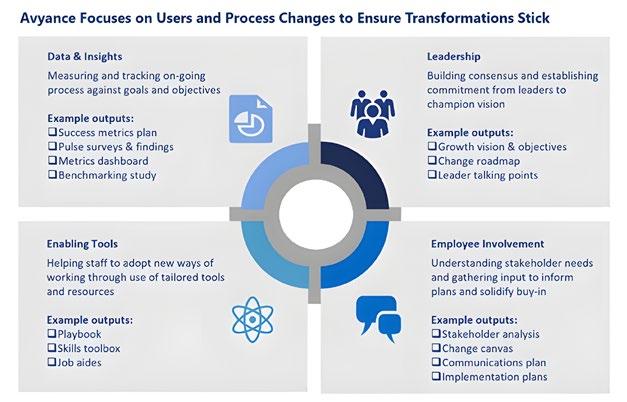
Federal agencies have invested heavily in new technologies to modernize operations, improve service delivery, and increase efficiency. Yet many modernization efforts fall short as systems are deployed: workflows remain unchanged; tools are installed, but operations change marginally. The problem isn’t technology: modernization sticks when people, process, and performance are treated as equal priorities.
“Technology enables transformation. People ultimately make it work.”
Successful modernization begins with a clear understanding of the full scope of problems agencies, and their workforces, are trying to solve. Lessons highlighted below are derived from Avyance’s work with the National Gallery of Art, the Federal Aviation Administration (FAA), and the Office of the Comptroller of the Currency (OCC).
LESSON 1: Technology is rarely the only problem.
New systems often get the most attention, while processes and workflows are treated as secondary considerations. In practice, these operational aspects often determine whether technologies are adopted and transformation succeeds. Agencies that analyze workflows and understand the operational realities benefit from a faster adoption cycle and see lasting results.
Effective modernization programs treat process change as a core effort alongside system implementation. A holistic approach helps users understand why processes are changing, provide feedback as systems evolve, and receive continued support during the transition. Leaders anticipate resistance, and resource teams adapt and monitor progress throughout.
Avyance’s Oracle Cloud Financial Management System modernization for the National Gallery of Art illustrates this approach. Avyance aligned people and process with the techni-
cal roadmap by engaging users early, building adoption pathways, delivering targeted training, distributing consistent communications, and conducting readiness assessments.
The difference between a failed rollout and a successful transformation comes down to whether an organization invests in helping people adopt and sustain change. When engagement, communication, and readiness are treated as core requirements, new systems strengthen mission performance instead of disrupting it.
LESSON 2: Engage the users to modernize the work.
Organizations routinely underestimate the importance of understanding the people doing the work. Technical requirements are documented in detail; but user realities rarely do. The gap between how a system is designed and how the work actually gets done is where adoption breaks down.
“Invest in understanding your users before you build for them.”
Avyance workflow improvements at OCC illustrate this approach. By listening to users, Avyance built a comprehensive understanding of operational realities. We identified opportunities to streamline processes to match how teams operate dayto-day. This user-centered approach engaged the workforce and demonstrated respect for user issues. The result was accelerated adoption and improved operational consistency.
For agencies pursuing modernization: user engagement is not a “supporting” activity, it is a proactive risk management tool. The cost of skipping it results in low adoption, workarounds, and the erosion of confidence in the new system.
LESSON 3: If the new way is harder, old habits will win.
Process changes rarely stick if the new approach feels harder than the old one. When system-supported workflows add steps, introduce coordination ambiguity, or lack adequate sup-
port, users may revert to familiar workarounds – spreadsheets, email threads, or informal tracking systems. The path of least resistance almost always wins.
Agencies implementing new technology should invest in the tools and support structures that enable people to use it effectively. At the National Gallery of Art, Avyance implemented a train-the-trainer model tailored to varied learning needs across the organization. Training was built around concerns heard directly from users and reinforced with instructor facilitation guides and modular quick reference guides, ensuring consistent delivery and accessible resources post-training. The result: reduced errors at go-live, minimal disruption, and faster realization of system benefits.
“When the process becomes easier, adoption follows.”
For an FAA research and development group, recurring data calls were losing momentum through email-based coordination. Avyance centralized and standardized the workflow using process automation tools and collaboration platforms. We deployed a pilot group, structured feedback loops, targeted training, and “ask-me-anything” open office hours to help users transition to the new process. The result was not just a new tool, but a 100 percent adoption rate, timelier responses, and less redundant data gathering. Employees began spending more time on their day-to-day tasks and less time navigating email requests.
LESSON 4: Measure what matters.
Modernization programs often track system deployment or completion milestones, but achievement of technical milestones is not proof of transformation. Avyance works with clients to baseline performance and establish metrics for success. We track
real improvement, such as reduced processing time, improved data accuracy, faster decision cycles, or increased workforce productivity. Linking modernization initiatives to measurable outcomes allows organizations to demonstrate value and make more informed decisions about future investments.
For the FAA Airports Division, Avyance implemented automated reporting and performance dashboards that consolidated data from multiple systems, enabling management to track workflow progress, identify delays, and make decisions based on realtime operational data. In another FAA engagement, Avyance developed data collection and analytics tools to monitor system usage and process compliance, helping leadership identify adoption gaps and address issues before they affected mission performance.
Measurement is not simply a reporting requirement. It serves as a steering mechanism that aligns teams around shared objectives and sustains progress.
Transformation that Sticks
Technology will continue to play a central role in helping federal agencies improve operations and deliver services more efficiently. But transformation is rarely achieved through technology deployment alone. The most successful programs aren’t the ones with the biggest budgets: they’re the ones that treat the people side of change as seriously as the technical side.
Sustainable modernization occurs when agencies combine technologies with user-centered analysis, process re-design, change management, and performance measurement that tracks outcomes, not just milestones.
When these elements work together, modernization efforts move beyond installation to deliver mission impact. 3
Avyance helps organizations move from installation to impact. We design and implement solutions that stick and deliver measurable value. Visit us at: www.avyance.com to see how we add momentum to IT modernization efforts.
EVision Federal Market Forecast: A Valuable Investment for Companies and Our Industry
by Mike Reilly, Vision Federal Market Forecast, PSC Foundation
very industry needs employees who are informed, connected, strategic, and prepared to harness change. In government contracting, where personnel, policies, budgets, priorities, technology, acquisition strategy, and customer expectations shift constantly, these qualities are essential and require a deliberate investment in their development.
That is why participation in the Professional Services Council’s (PSC) Vision Forecast study teams deserves to be seen for what it truly is: a serious professional development opportunity for employees and a wise talent investment for PSC member companies.
The most effective development experiences do more than provide knowledge and transmit information. They immerse employees in meaningful work, connect them with peers, introduce new ideas, and encourage them to think beyond daily routines. Vision Forecast study teams do this by bringing together professionals from across the industry to analyze trends, interpret signals, debate implications, and develop a forwardlooking market view. This process sharpens judgment, expands networks, and builds the high-value skills companies need.
The business case for employee development is strong. Gallup Workplace reported in 2020 that organizations that make a deliberate investment in employee development achieve 11% higher profitability and are twice as likely to retain employees. In the talent-driven services market, this should catch every leader’s attention. PSC member companies that encourage Vision Forecast participation advance—not sideline—their business priorities.
Serving on a Vision Forecast team helps employees stay current with important federal market trends. Too often, professionals address industry change only after it becomes a consensus. By then, the benefit of early identification and exploitation is lost. Study team members engage sooner. They work through emerging developments, discuss implications with people with different perspectives, and learn to recognize lasting change from the noise. This exposure ensures participants return with sharper strategic instincts and a clearer sense of coming opportunities and risks.
Vision participation also meets a real employee demand. A 2024 Gallup Workplace survey found that 58% of employees sought at least one learning and development experience beyond the formal training their employer offered. Employees want career growth and are willing to seek it outside conventional training channels. Vision Forecast participation offers member
PSC Foundation’s Vision Forecast Purpose:
• Provide a forum for the Federal marketplace to obtain a concise, quantifiable assessment of the budgets, programs, priorities, and issues;
• Provide government customers the opportunity to express their current and future needs;
• Encourage greater government/industry communication and interchange on issues, technology, programs and other areas of mutual interest.
The Vision Forecast Process:
• In April 300+ PSC member company employees participate in Vision and form 20+ agency and government-wide market study teams;
• During the year teams conduct research and hold 250+ discussions with government officials and subject-matter experts;
• In December teams present their findings at the Vision Forecast Conference.
companies a way to support this ambition in a visible, directly connected way, with the customers and markets they serve. Vision Forecast teams help participants build networks that matter. Government contracting is a relationship-driven business. By engaging with government officials, outside subjectmatter experts, and their peers in substantive discussions, the connections formed are deeper than passing introductions. Under the umbrella of the PSC Foundation’s 501(c)(3) status, Vision participants exchange ideas, identify issues and trends, weigh competing views, and create their market studies together. That kind of interaction builds more than familiarity. It builds professional respect.
Mid-career advancement often depends on perspective and credibility beyond technical skills. For employees, Vision Forecast team participation offers a practical stretch assignment that develops judgment and external awareness. For employers, it gives promising staff greater marketplace exposure and industry insight, preparing them for senior roles.
Vision Forecast study teams build the soft, human-centered skills that organizations and employees increasingly prize across the workforce. Deloitte’s 2024 Workplace Skills Survey found that “87% of workers see human skills like adaptability, leadership, and communications as integral to their career advancement”. The study also highlighted that, in addition to the investments companies make in employee tech skills, providing opportunities for human skills development is equally important and, in fact, symbiotic.
Study team participants develop these human-centered skills through practical experience. This hands-on skill development is grounded in a real deliverable. Formal training matters, but most learning happens through experience. The Association for Talent Development 2025 State of the Industry report noted that average formal learning hours per employee fell from 17.4 in 2023 to 13.7 in 2024. Meanwhile, informal learning, such
as mentoring and stretch assignments, became more significant. This shift recognizes that real issues provide the best learning. Vision Forecast teams embody this developmental approach.
For PSC member companies, Vision Forecast participation is a form of career training. Early-career professionals broaden market understanding, mid-levels build strategic skills, and senior employees gain visibility and credibility—benefiting both company and employees.
Encouraging Vision Forecast participation shows that growth and curiosity are valued, and that professional engagement beyond the company’s walls matters—helping shape a positive company culture.
Vision Forecast study teams are, at one level, a collaborative industry forecast. But at another level—and perhaps the more important one—they are the professional arena for growing and proving future leaders. They give employees a chance to learn through market research, help them gain government contacts, build the soft skills companies prize, and team with peers and thought leaders who are helping shape the future of the federal market. That’s good for the individual. That’s good for the company. And that’s good for the federal contractor services industry that PSC represents. 3
The Vision Forecast is more than a PSC member benefit—it is a strategic investment in our member companies’ talent and future success. Take action now: learn more about the Vision process and sign up to join a forecast study team today at vision.pscouncil.org.
Event Highlights
A record number of attendees participated in the 10th Annual PSC Federal Law Enforcement Conference. More than 350 federal leaders received the latest updates on the new law enforcement acquisition landscape, interagency collaboration in a “whole of government” approach, and how agencies are countering drone threats, particularly at major public events.
CEO
Federal Law Enforcement
Andrew Guiliani, Executive Director,
Rewriting the Playbook Panel: How the New Whole of Government Approach is Changing Law Enforcement, featuring Ron Appel, Vice President, Law Enforcement and Cyber SME, Harmonia (moderator); Jose Perez, Operations Director, Criminal and Cyber Branch, FBI; Marc Kuzmicki, Chief of Staff to the Associate Administrator, DEA; John Condon, Executive Associate Director, HSI
Inside the Drone Defense Network Panel: How Law Enforcement Agencies are Countering the UAS Threat, featuring John Woods, Vice President and DHS Client Executive, CACI (moderator); James Thom, Executive Director, Domain Awareness Security Operations, Air and Marine Operations, CBP; Micheal Torphy, Acting Assistant Section Chief, Unmanned Aircraft Systems Critical Incident Response Group, FBI; Tim Dodge, Deputy Director, UAS & Emerging Entrants Security, FAA
and
Scan the QR code or visit lawenforcement.pscouncil.org to view the conference thought leadership compendium, photos, and more.
Opening Keynote Remarks: Gary Owen, Associate Administrator, DEA
Keynote Remarks:
White House Task Force on the FIFA World Cup 2026
The New Rules of Federal Law Enforcement Procurement Panel: What Efficiency, Oversight,
the FAR Overhaul Mean for Contractors, featuring Andrea McCarthy, President, HARP (moderator); Jaclyn Rubino, Executive Director, One Big Beautiful Bill Principal Executive Office, DHS; Laura Over, Acting Deputy Assistant Administrator, Office of Acquisition, DEA; Nick Dimos, Assistant Director, Finance and Facilities Division, FBI
Opening Remarks featuring PSC’s
Jim Carroll; PSC’s President Stephanie Kostro; this year’s
Conference Planning Committee Chair, Mike Collett, Executive Director, Business Development (DOJ), ITC Federal
FPSC FedHealth Conference Preview: Understanding the Intersection of Data Readiness, Technology Adoption, Workforce, and Acquisition Changes
by Krista Sweet, Vice President, Civilian Agencies, PSC
ederal agencies have entered a period of rapid transition.
The Trump Administration has emphasized government efficiency and operational modernization, with a push for agencies to adopt automation, AI, and digital platforms to reduce costs and improve performance. This pressure is particularly visible in federal health agencies like the Department of Health and Human Services (HHS), Department of Veterans Affairs, and the Defense Health Agency (DHA), that manage large datasets and complex service delivery environments. With growing volumes of sensitive health and patient data, these health agencies must evaluate whether their data environments, infrastructure, policies, and governance frameworks are mature enough to support secure sharing, advanced analytics, and AI-driven decision-making. Contractors need to understand any readiness gaps to position scalable data, cloud, cyber, and analytics solutions.
Ongoing fiscal pressures have also increased expectations that federal agencies demonstrate clear mission impact and return on investment for technology programs. This is forcing health agencies to prioritize initiatives that can show measurable improvements in outcomes, whether in public health analytics, patient data interoperability, or healthcare delivery efficiency. But successful technology adoption requires thoughtful workforce planning, training/upskilling, risk management, and ongoing support. Agencies must carefully determine when to use technology to automate versus augment human decision-making; and how to balance potential cost savings with impacts on customer satisfaction. For industry partners, this may mean increased technology expectations in future contracts, more training requirements, and a need for different pricing models, particularly in the services sector.
At the same time, reforms such as procurement consolidation, evolving small-business policies, and broader acquisition modernization efforts like the FAR overhaul are reshaping how agencies plan, buy, and implement technology. For contractors, these shifts directly influence how agencies define requirements, structure procurements, evaluate technology and service solutions, and build the workforce needed to sustain them. Contractors must track how these changes affect acquisition strategies at agencies such as HHS, VA, and DHA, particularly for data, digital, and health IT programs.
Understanding where federal health agencies stand today on data maturity, preparing their workforce for technology adoption, and new approaches in acquisition strategy is essential for companies seeking to make informed investment decisions and align their capabilities with mission priorities. The 10th Annual PSC FedHealth Conference, scheduled for the afternoon of May 21, 2026 at the Bethesda North Marriot Hotel & Conference Center, will bring together federal health leaders to provide practical insights into these intersecting trends and what they mean for industry partners navigating the next phase of federal
health modernization. For more information on the agenda, speakers, and registration, see https://fedhealth.pscouncil.org.
Featured Panel Sessions:
Change Starts with People: Guiding Federal Health Through Tech Adoption
Federal health agencies are accelerating the use of automation, AI, and digital platforms to improve efficiency, reduce costs, and deliver enhanced services. But successful technology adoption demands thoughtful workforce planning, engagement, training/upskilling, and ongoing support. This panel will examine how agencies balance cost savings with customer satisfaction, determine when to automate versus augment human decision-making, and successfully manage the operational risks of transformation. Speakers will also discuss what increased technology means for contractors and future contracts. Learn more about the talent and implementation strategies shaping the future of federal health modernization.
Data Readiness in FedHealth: From Infrastructure to AI Federal health agencies are under pressure to modernize data ecosystems while expanding mission demands across public health, research, and health care delivery. Yet many continue to navigate legacy infrastructure, interoperability gaps, and evolving governance frameworks. What is the current state and what does true “data readiness” require? This panel brings together FedHealth leaders to discuss how agencies align infrastructure investments with intended use cases; address interoperability challenges; strengthen data governance; and responsibly scale and manage patient data. Panelists will also examine whether current data environments are structured, secure, and mature enough to support AI—and whether agencies have fully accounted for the long-term cost of storing, securing, and sustaining enterprise data. For industry partners, understanding agency data maturity is essential to delivering scalable, interoperable, and mission-aligned solutions. This session offers practical insight into the technical, policy, and financial realities shaping federal health data modernization.
FedHealth Acquisition: Realities & Opportunities
FedHealth acquisition is undergoing significant change driven by procurement consolidation, efficiency initiatives, the FAR overhaul, small business policy shifts, and continued budget uncertainty. These dynamics are reshaping acquisition processes and strategies as well as how opportunities at HHS, VA, and DHA are structured, competed, and awarded. Panelists will discuss emerging acquisition trends, agency specific drivers, common issues slowing procurements, and practical expectations for FY26 and beyond — helping contractors refine capture strategy, partnership decisions, and competitive positioning in the federal health market. Register for the FedHealth Conference at fedhealth.pscouncil.org.
the 10th Annual PSC FedHealth Conference to join senior executives from the government technology and professional services and solutions sector and
the latest technology, policy, and acquisition priorities in federal health. Hear from top government officials on the trends and most pressing issues impacting federal health agencies and the role of industry in supporting their missions.
FEDERAL CONTRACTING SPOTLIGHT: AI IN NATIONAL SECURITY
PSC recently hosted “PSC on the Hill: AI in National Security,” an interactive event designed to help policymakers and congressional staff better understand the rapidly evolving role of artificial intelligence in national security. Below are featured excepts from the AI in National Security Compendium, which was released at the event.
Opportunities to Support the Mission and Improve Citizen Services Through AI
AI is already changing how the federal government operates, serves the public, and manages risk. AI should be treated as a practical government issue, not just a technology debate.
The path forward starts with building a strong foundation: clear governance, better data, a workforce ready to use these tools well, and stronger protection against AI-enabled threats. From there, agencies need to accelerate delivery by cutting through old modernization problems, improving procurement, and preserving institutional knowledge before it disappears through retirement and turnover. Most importantly, AI investment should drive mission results by improving citizen services, supporting daily mission work, and building systems that reflect the realities of government.
Congress should invest in AI now, with discipline and urgency, so that trust, accountability, and real public value keep pace with adoption.
“Most importantly, AI investment should drive mission results by improving citizen services, supporting daily mission work, and building systems that reflect the realities of government.”
Data to Decisions
Federal civilian and military organizations generate extensive operational, logistical, surveillance, exposure, and medical data, yet datasets are often fragmented and misaligned with decision timelines. In large-scale operations, decision windows compress while uncertainty increases, requiring analytic systems that deliver insight at operational speed rather than retrospective reporting.
Unified analytic architectures, operational experimentation, and rigorous testing and evaluation can transform fragmented datasets into analysis ready environments that support decision speed. Emphasis will be placed on designing tools that fail predictably, degrade gracefully in bandwidth-limited environments, and avoid increasing cognitive burden for field personnel. By integrating scientific rigor with operatorinformed testing and modeling, fragmented data collection will shift to decision advantage under uncertainty.
“In large-scale operations, decision windows compress while uncertainty increases, requiring analytic systems that deliver insight at operational speed.”
Securing Tomorrow With Mission-Driven AI
As national security risks evolve, agencies face increasingly sophisticated threat environments, more complex cyber operations and growing volumes of data to interpret.
Meeting these challenges requires mission aligned innovation that strengthens decision advantage. GDIT delivers AI, cyber resilience and engineering designed to enhance human judgment, accelerate threat detection and support integration across domains.
Our approach enables mission partners to adopt emerging capabilities confidently and responsibly while maintaining trust and transparency. In a rapidly shifting battlespace, success relies on trusted technology, trusted processes, and an unwavering focus on the mission.
“Today’s national security challenges require more than modernization. We need AI that informs action, cyber resilience that holds under pressure, and engineering innovation that gives our teams a clear decision advantage when every second counts.”
Right Skills, Right Time — Accelerating Mission Staffing With Precision and Speed
Mission timelines across the Department of War and Intelligence Community are accelerating faster than legacy staffing processes can support. The challenge is not a lack of talent, but the heavy administrative burden required to identify, validate, and assemble qualified, available, and cleared personnel under urgent conditions. Manual workflows and slow operations consume expert time, introduce inconsistency, and make staffing decisions difficult to defend.
Golden Key Group’s (GKG) Mission Agile Talent and Competency Hub (MATCH) addresses this gap by transforming mission staffing into a fast, evidence-driven process. MATCH applies AI-powered skills mapping and constraint-aware matching to align validated personnel capabilities with mission needs while preserving human decision authority. By integrating authorized data, applying access and availability constraints, and generating audit-ready recommendations, MATCH delivers speed without sacrificing control or accountability. As GKG CEO G. McCracken states, “We ensure you have the right people, with the right skills, at the right time, to accomplish your mission.”
“By integrating authorized data, applying access and availability constraints, and generating audit-ready recommendations, MATCH delivers speed without sacrificing control or accountability.”
Unlocking the Insights Hidden in Data With AI-Driven Knowledge Discovery and Dynamic Case Management
Wingman is iWorks’ modular, cloud-native platform designed to transform complex mission data into actionable intelligence. By combining artificial intelligence, dynamic case management, and embedded analytics, Wingman enables organizations to accelerate decision-making, automate operational workflows, and improve visibility across mission environments.
This platform integrates securely across enterprise technology landscapes to unify data, workflows, and insights into a cohesive operational workspace. Wingman enables organizations to modernize operations without replacing existing systems, supporting phased adoption aligned with mission priorities and resource constraints. By integrating AI-enabled analytics, workflow automation, and performance visibility into a single platform, Wingman helps teams reduce manual effort, improve collaboration, and accelerate time to operational value.
Leadership gains real-time insight into operational performance through embedded analytics, while configurable AI autonomy ensures human decision-makers remain central to mission execution.
“By transforming mission data into actionable insight within a secure and scalable architecture, Wingman enables agencies and enterprises to achieve smarter, faster, and more resilient mission execution.”
AI-Powered Battle Management Takes Flight
Military operators need to make important decisions rapidly during combat but can struggle to process information fast enough.
AlphaMosaic, developed by Leidos, enables AI agents to provide operators with decision support in combat scenarios involving multiple aircraft, weapons systems and targets.
AlphaMosaic has successfully supported battle exercises, and there’s potential that the AI technology can be scaled to address decision making for warfighters in a variety of roles.
“We’re essentially building a virtual, augmenting workforce. And they work together under the supervision of the human operators to achieve these things.”
– Will Mahoney, VP, Airborne Systems CTO,
Leidos
Designing Data and AI Solutions That Meet Customers Where They Are
AI is revolutionizing mission-critical operations and empowering the government’s operations and decision-making.
MANTECH’s Data and AI Practice is at the forefront of delivering impactful AI solutions that drive mission success. Our technology-agnostic approach leverages a variety of partnerships to provide innovative, state-of-the-art solutions that ensure clients remain at the cutting edge.
Our comprehensive approach includes designing Data and AI solutions that meet clients where they are, building and integrating solutions for deployment, and sustaining those solutions while integrating them fully with broader operations for maximum impact.
“MANTECH’s Data and AI services accelerate mission critical decision-making and ensure leaders reach actionable outcomes faster, backed by highintegrity data and a mission-ready framework.”
Beyond the Pilot: Moving Responsible AI From Pilot to Mission Impact
Policymakers and congressional staff are under growing pressure to adopt AI responsibly, strengthen mission readiness, and improve operational performance, and demonstrate measurable results without increasing risk or waste.
Maximus addresses this challenge through Hackathon as a Service, a structured approach that brings mission owners, operators, industry, and governance stakeholders together to solve real operational problems. The model builds in responsible AI, human oversight, security, and implementation planning from the start, helping agencies test ideas, surface risks early, and clarify next steps before larger investments are made.
The result is a practical, lower-risk path to modernization that supports stronger oversight, better stewardship of resources, and more confident decision-making.
“The best outcome is not a stronger demo. It is a better decision.”
Cognitive Warfare and the Battlefield for American Influence
The United States military commands supremacy across land, sea, air, and space. Yet, in cognitive warfare to foreign audiences, we are outspent, outgunned, and out-maneuvered by adversaries aggressively using propaganda and information manipulation to undermine American global influence.
Effective, AI-accelerated cognitive warfare is crucial to U.S. military warfighting and strategy, and Combatant Commanders consistently request greater investment. Employing AI-boosted cognitive warfare as a primary tool can enhance the effects of diplomatic, military, and economic power.
“In an era where strategic competition is increasingly decided in the cognitive domain, these reforms aren’t supplemental — they are essential to maintaining America’s global leadership and securing our interests in the 21st century.”
Spring 2026 Key Events
CFO Panel with HHS, DEA, Commerce, and NRC
On February 26, 2026, PSC hosted Chief Financial Officers Gustav Chiarello of U.S. Department of Health and Human Services (HHS), Diane M. Parks of the Drug Enforcement Administration, Jeremy Pelter of the U.S. Department of Commerce, and Christopher Carroll of the U.S. Nuclear Regulatory Commission. Moderated by CGI’s Anish Joseph, panelists discussed how they are mitigating fraud, waste, and abuse; adopting technology; and opportunities and challenges involved with using data to better support financial and operational decision-making.
Office of White House Counsel Meeting
On March 5, 2026, PSC organized a meeting with industry leaders and the Office of White House Counsel to discuss key FinTech and Digital Asset policy and regulation and how companies can best support the White House’s agenda and serve federal government missions. Industry representatives joined PSC CEO James Carroll and President Stephanie Sanok Kostro for this discussion. Companies include LexisNexis Risk Solutions, Shift4, Sidley Austin LLP Austin, State Street Bank, and Universal Air Travel Plan (UATP).
PSC Leadership Meets With Congressional Members
Throughout the month of March, PSC had multiple meetings on Capitol Hill to advocate on key issues important to our members. Pictured to the right, PSC CEO Jim Carroll meets with Rep. Rob Wittman, who will be a featured speaker at the upcoming PSC Annual Conference.
Roundtable with Under Secretary Michael Duffey
Industry leaders met with The Honorable Michael Duffey, Under Secretary of War for Acquisition and Sustainment (USW(A&S)), on Friday, March 13 to discuss acquisition transformation priorities, including industrial base initiatives, supply chain resilience, and how industry can support ongoing reforms. The conversation also addressed key challenges and opportunities and explored how to better align government and industry roles to accelerate innovation in support of the warfighter.
PSC Brings Federal Contractors to Capitol Hill to Demonstrate How Industry is Outpacing Adversaries in National Security AI Technology
On March 24, 2026, PSC hosted “PSC on the Hill: AI in National Security,” a Capitol Hill showcase bringing together member companies to brief members of Congress and their staff on artificial intelligence capabilities being actively deployed in defense, intelligence, and homeland security missions. Rep. James Walkinshaw met with companies at the event, underscoring the growing recognition on Capitol Hill that AI-enabled federal contracting is central to America’s national security strategy.
Special thanks to the following companies for participating: Arc Aspicio, DLH Corp., Golden Key Group, GDIT, iWorks Corporation, Leidos, MANTECH, Maximus, Peraton, and SAIC
119th Congress Bill Tracker 2026
Information as of 4/20/2026
BECAME LAW:
H.R. 1968
Full-Year Continuing Appropriations and Extensions Act, 2025
Introduced 3/10/2025
Sponsor: Rep. Cole (R-OK-4)
Cosponsor: N/A
Summary: Full year continuing resolution for FY2025
Status: Became Law 3/15/2025
H.R. 1
One Big Beautiful Bill Act
Introduced: May 20, 2025
Sponsor: Rep. Jodey Arrington (TX-19)
Cosponsors: N/A
Summary: It is known as a reconciliation bill and includes legislation submitted by 11 House committees pursuant to provisions in the FY2025 congressional budget resolution (H Con. Res. 14) that directed the committees to submit legislation to the House Budget Committee that will increase or decrease the deficit and increase the statutory debt limit by specified amounts. (Reconciliation bills are considered by Congress using expedited legislative procedures that prevent a filibuster and restrict amendments in the Senate.)
Status: Became Law 7/4/2025
H.R. 3838
SPEED Act, Streamlining Program Efficiency & Expedited Defense
Introduced: June 9, 2025
Sponsor(s): Rep. Rogers (AL-3)
Cosponsor: Rep. Smith (WA-9)
Summary: To authorize appropriations for fiscal year 2026 for military activities of the Department of Defense, for military construction, and for defense activities of the Department of Energy, to prescribe military personnel strengths for such fiscal year, and for other purposes. SPEED is the base text for NDAA which handles acquisition reform across the Department of Defense
Status: Became Law on 12/18/2025 (PL No: 119-60)
S. 2296
National Defense Authorization Act for Fiscal Year 2026
Introduced: July 15, 2025
Sponsor(s): Sen. Wicker (MS)
Cosponsor: N/A
Summary: This bill sets forth policies and authorities for FY2026 for Department of Defense (DOD) programs and activities, military construction, and the national security programs of the Department of Energy (DOE). It also authorizes the Defense Nuclear Facilities Safety Board for FY2026. The bill authorizes appropriations but it does not provide budget authority, which is provided by appropriations legislation.
Status: Became Law on 12/18/2025 (PL No: 119-60)
119th Congress Bill Tracker 2026
Information as of 4/20/2026
PASSED THE HOUSE:
H.R. 818
SPUR Act, Small Business Procurement and Utilization Reform Act of 2025
Summary: Requires federal agencies to include on the annual scorecard for small business contracting the number of small businesses that receive a prime contract for the first time and are owned and controlled by service-disabled veterans, qualified HUBZone small business concerns, small business concerns owned and controlled by socially and economically disadvantaged individuals, or small business concerns owned and controlled by women.
Status: Passed House on February 24th, 2025; referred in the Senate to the Committee on Small Business and Entrepreneurship
H.R. 856
Safe and Smart Federal Purchasing Act
Introduced: January 31, 2025
Sponsor: Rep. Donalds (R-FL-19)
Cosponsor: Rep. Connolly (D-VA-11)
Summary: This bill requires the Office of Management and Budget (OMB) to evaluate the procurement activities of federal agencies to determine whether provisions of the Federal Acquisition Regulation related to the lowest price technically acceptable source selection process have created any national security risk and report to Congress.
Status: Passed House 3/4/2025
H.R. 1166
Decoupling from Foreign Adversarial Battery Dependence Act
Summary: Bill prohibits DHS from using funds to procure a battery produced by certain entities, particularly six specific companies owned and operated in China. Prohibition begins on October 1, 2027.
Status: Passed House 3/11/2025
H.R. 1692
PATHS Act
Introduced: January 31, 2025
Sponsor: Rep. Guest (R-MS-3)
Cosponsor: Rep. Thanedar (D-MI-13)
Summary: This bill extends through FY2028 the authority of the Department of Homeland Security (DHS) to use other transactions
(OT) to carry out research and prototype projects when the use of contracts, grants, and cooperative agreements is not feasible or appropriate. (OTs, in contrast to traditional procurement contracts, are exempt from many federal procurement laws and regulations.) DHS must notify Congress within 72 hours of using or extending this authority for research and development projects related to artificial intelligence technology and must offer to brief Congress on the rationale for such a decision.
The bill also lowers from $4 million to $1 million the minimum value of contract awards that DHS must publicly report on its website.
Summary: Referred in the Senate to the Committee on Small Business and Entrepreneurship
Status: Passed House 6/3/2025
PASSED THE SENATE:
S. 524
Coast Guard Authorization Act of 2025
Introduced: February 11, 2025
Sponsor: Sen. Cruz (R-TX)
Cosponsor: Sen. Cantwell (D-WA), Sen. Sullivan (R-AK), Sen. Baldwin (D-WI)
Summary:To authorize appropriations for the Coast Guard and for other purposes.
Status: Included as an amendment on the FY26 NDAA. Became Law on 12/18/2025 (PL No: 119-60)
S. 1591
ARCA Act of 2025, Acquisition Reform and Cost Assessment
Introduced: May 9, 2025
Sponsor(s): Sen. Moran (KS)
Cosponsor: N/A
Summary: To reorganize the acquisition structure of the Department of Veterans Affairs and to establish the Director of Cost Assessment and Program Evaluation in the Department.
Status: Passed Senate 12/11/2025
119th Congress Bill Tracker 2026
Information as of 4/20/2026
INTRODUCED IN HOUSE OR SENATE:
S. 79
Allowing Contractors to Choose Employees for Select Skills Act or “ACCESS Act”
Introduced January 13, 2025
Sponsor: Sen. Lankford (R-OK)
Cosponsor: Sen Peters (D-MI)
Summary: Prohibits solicitations from minimum education requirements for proposed contractor personnel.
Status: Referred to Committee on Homeland Security and Governmental Affairs
H.R. 519
Federal Subaward Reporting System Modernization and Expansion Act
Summary: 180 days after enactment inspector general of GSA shall submit a report containing a review of the FFATA subaward reporting system, with recommendations for improvement.
Status: Referred to House Committee on Oversight and Government Reform
H.R. 675
Domestic SUPPLY Act of 2025
Introduced: January 23, 2025
Sponsor: Rep. Morgan (R-VA-9)
Cosponsor: N/A
Summary: HHS Secretary in collaboration with Assistant Secretary for Preparedness and Response and CDC shall establish a program of entering into partnerships with eligible domestic manufacturers to ensure the availability of qualified personal protect equipment for preparing for and respond to public health emergencies.
Status: Referred to Committee on Energy and Commerce and Committee on Oversight and Government Reform
S. 202
Helping Small Businesses THRIVE Act
Introduced: January 23, 2025
Sponsor: Sen. Shaheen (D-NH)
Cosponsor: Sen. Cassidy (R-LA)
Summary: SBA administrator shall establish a pilot program to assist eligible entities in limiting the risk from rising input costs from commodities.
Status: Referred to Committee on Small Business and Entrepreneurship
H.R. 767
Fast-Track Logistics for Acquiring Supplies in a Hurry Act of 2025 or “FLASH Act of 2025”
Introduced: January 28, 2025
Sponsor: Rep. Garcia (D-CA-42)
Cosponsor: N/A
Summary: Amend the Public Health Service Act to authorize BARDA to award follow-on production contracts or transaction, procure supplies for experimental or test purposes, and acquire innovative commercial products and commercial services.
Status: Referred to House Committee on Energy and Commerce
H.R. 1036
Ensuring Accountability and Dignity in Federal Contracting
Summary: To provide for modifications to ending trafficking in government contracting and for other purposes.
Status: Pending committee review by House Committee on Foreign Affairs
S.1573
SBIR/STTR Reauthorization Act of 2025
Introduced: May 1, 2025
Sponsor: Sen. Markey (MA)
Cosponsor(s): N/A
Summary: To amend the Small Business Act to reauthorize and modify the Small Business Innovation Research and Small Business Technology Transfer Research programs.
Status: Referred to Committee on Small Business and Entrepreneurship
H.R. 3169
SBIR/STTR Reauthorization Act of 2025
Introduced: May 1, 2025
Sponsor: Rep. Velazquez (NY-07)
Cosponsor(s): N/A
Summary: To amend the Small Business Act to reauthorize and modify the Small Business Innovation Research and Small Business Technology Transfer Research programs.
Status: Referred to Committee on Small Business and Committee on Science, Space, and Technology
119th Congress Bill Tracker 2026
Information as of 4/20/2026
S. 1956
Strengthening Agency Management and Oversight of Software Assets Act
Introduced: May 9, 2025
Sponsor(s): Sen. Peters (MI)
Cosponsor: Sen. Cassidy (LA), Sen. Ernst (IA), Sen. Tillis (NC), Sen. Lankford (OK), Sen. Wyden (OR)
Summary: To improve the visibility, accountability, and oversight of agency software asset management practices.
Status:Referred to Committee on Homeland Security and Governmental Affairs
S. 1775
Protecting AI and Cloud Competition in Defense Act of 2025
Introduced: May 15, 2025
Sponsor: Sen. Warren (MA)
Cosponsor(s): Sen. Schmitt (MO)
Summary: To provide for certain requirements relating to cloud, data infrastructure, and foundation model procurement.
Status: Referred to Senate Committee on Armed Services
H.R. 3434
Protecting AI and Cloud Competition in Defense Act of 2025
Summary: To provide for certain requirements relating to cloud, data infrastructure, and foundation model procurement.
Status: Referred to House Committee on Armed Services
S. 1899
Federal Contractor Cybersecurity Vulnerability Reduction Act of 2025
Introduced: May 22, 2025
Sponsor: Sen. Warner (VA)
Cosponsor(s): Sen. Lankford (OK)
Summary: To require Federal contractors to implement a vulnerability disclosure policy consistent with NIST guidelines.
Status: Referred to Committee on Homeland Security and Governmental Affairs.
S. 1978
Defense Technology Hubs Act of 2025
Introduced: June 5, 2025
Sponsor(s): Sen. Schmitt (MO)
Cosponsor: Sen. Hickenlooper (CO)
Summary: To enhance national security and technological superiority by requiring the Secretary of Defense to establish a network of regional defense technology hubs to foster innovation, collaboration, and rapid development of defense-related technologies to attract talent from across the United States.
Status: Awaiting committee markup
H.R. 4123
FIT Procurement Act
Introduced: June 25, 2025
Sponsor: Rep. Burlison (MO-7)
Cosponsor(s): Rep. Subramanyam (VA-10), Rep. Luna (FL-13), Rep. Lynch (MA-8)
Summary: Bill provides improvements to IT acquisition in the Federal government.
Status: Passed Committee 42-0 and reported to the full House. (02/04/26)
PSC offers a variety of high-visibility opportunities for your company throughout the
Advertising options include:
Member Meetings
Service Contractor Magazine
The PSC Daily e-Newsletter Council Spotlight e-Newsletters specific to Acquisition and Business Policy, Civilian Agencies, Defense and Intelligence Agencies, Technology and Innovation Council
PSC offers sponsorships for key events at a variety of levels so they’re accessible for small, mid-sized, and large companies:
4401 Wilson Blvd., Suite 1110
Invite Only
2026 Key Events
FedHealth Conference
May 21, 2026 | N. Bethesda, MD & Virtual fedhealth.pscouncil.org
Leadership Summit
June 7-8, 2026 | Washington, D.C. summit.pscouncil.org
Federal Acquisition Conference
June 25, 2026 | Crystal City, VA & Virtual acquisition.pscouncil.org
Defense Conference
Oct. 30, 2026 | Crystal City, VA & Virtual defense.pscouncil.org
Vision Federal Market Forecast Conference
Dec. 8-9, 2026 | Crystal City, VA & Virtual vision.pscouncil.org