FACTS & FIGURES
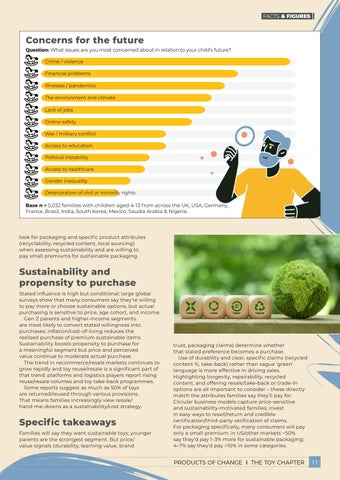
Concerns for the future Question: What issues are you most concerned about in relation to your child’s future? Crime / violence Financial problems Illnesses / pandemics The environment and climate Lack of jobs Online safety War / military conflict Access to education Political instability Access to healthcare Gender inequality Deterioration of civil or minority rights
Base n = 5,032 families with children aged 4-13 from across the UK, USA, Germany, France, Brazil, India, South Korea, Mexico, Saudia Arabia & Nigeria.
look for packaging and specific product attributes (recyclability, recycled content, local sourcing) when assessing sustainability and are willing to pay small premiums for sustainable packaging.
Sustainability and propensity to purchase Stated influence is high but conditional: large global surveys show that many consumers say they’re willing to pay more or choose sustainable options, but actual purchasing is sensitive to price, age cohort, and income. Gen Z parents and higher‑income segments are most likely to convert stated willingness into purchases; inflation/cost‑of‑living reduces the realised purchase of premium sustainable items. Sustainability boosts propensity to purchase for a meaningful segment but price and perceived value continue to moderate actual purchase. The trend in recommerce/resale markets continues to grow rapidly and toy reuse/resale is a significant part of that trend: platforms and logistics players report rising reuse/resale volumes and toy take‑back programmes. Some reports suggest as much as 50% of toys are returned/reused through various provisions. That means families increasingly view resale/ hand‑me‑downs as a sustainability/cost strategy.
Specific takeaways Families will say they want sustainable toys; younger parents are the strongest segment. But price/ value signals (durability, learning value, brand
trust, packaging claims) determine whether that stated preference becomes a purchase. Use of durability and clear, specific claims (recycled content %, take‑back) rather than vague ‘green’ language is more effective in driving sales. Highlighting longevity, repairability, recycled content, and offering resale/take‑back or trade‑in options are all important to consider – these directly match the attributes families say they’ll pay for. Circular business models capture price‑sensitive and sustainability‑motivated families; invest in easy ways to resell/return and credible certification/third‑party verification of claims. For packaging specifically, many consumers will pay only a small premium: in US/other markets ~50% say they’d pay 1–3% more for sustainable packaging; 4–7% say they’d pay >10% in some categories.
PRODUCTS OF CHANGE I THE TOY CHAPTER
11