P R O F E S S I O N A L
VOLUME 16 ISSUE 12 £4.95
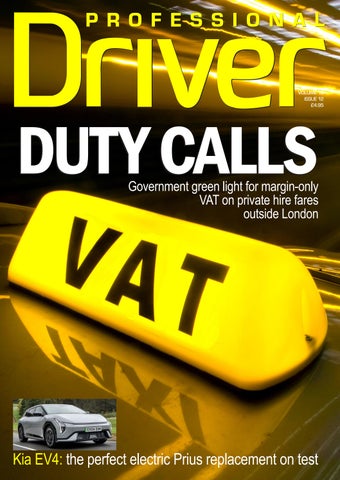
DUTY CALLS
Government green light for margin-only VAT on private hire fares outside London
Kia EV4: the perfect electric Prius replacement on test
Fuel economy figures and CO₂ results for the BMW i7 range: Mpg (l/100km): Not applicable. CO₂ emissions: 0 g/km. Electric range: 321.9 – 387.1 miles. The BMW i7 is a battery electric vehicle requiring mains electricity for charging. The electric range figures shown were achieved using the WLTP test procedure and provided for comparability purposes. Only compare with other cars tested to the same technical procedures. These figures may not reflect reallife driving results, which will depend upon a number of factors including the starting charge of the battery, accessories fitted (post registration), variations in weather, driving styles and vehicle load. Whilst we recommend the battery for these vehicles is normally charged to 80% to help optimise the health and life of your battery, these WLTP figures were obtained after the battery had been charged to 100%.
THE i7 BAYERISCHE MOTOREN WERKE
contents
20
16
18
16 6 7 8
14
10 12
24
14 18 20 24
Cover story: VAT issue receives Budget clarity News: Limolane acquires Driven Worldwide News: Take Me buys Associated Taxis News: EVs lose C-Charge exemption News: Heathrow parking in turmoil News: Gett builds new partnerships News Analysis: Plugging the fuel duty gap QSi Awards: 2026 Shortlists announced Road Test: Kia EV4 GT-Line First Drive: Mazda6e Takumi Plus
Regular features 28 30 31
EDITORIAL DIRECTOR
Mark Bursa 07813 320044 markbursa@prodrivermags.com
COMMERCIAL DIRECTOR
Paul Webb 07807 133527 paulwebb@prodrivermags.com
CONTRIBUTORS
Gary Jacobs, Kevin Willis, Tim Barnes-Clay, Phil Rule, Kwabena Dennot Nyack, Dr Mike Galvin, Tim Scrafton
The Advisor The Knowledge The Insider
COMPANY ADDRESS
50 Beechcroft Manor, Oatlands, Weybridge, KT13 9NZ
WEBSITE
Martin Coombes PageHub Design martin@pagehubdesign.co.uk
SUBSCRIPTIONS
Curwood CMS Ltd, The Barn, Abbey Mews, Robertsbridge, TN32 5AD 01580 883844 subs@prodrivermags.com
Registered in England No. 7086172 © 2025 All contents copyright of ProDriver Media Ltd
4
PROFESSIONAL DRIVER
opinion
Please, please, give us a break!
T
Mark Bursa
“
Rather than helpful decisions to boost the sector, we are in grave danger of being hit where it hurts by some badly conceived and poorly advised legislation
”
PROFESSIONAL DRIVER
he Private Hire industry has been to hell and back in the past five years. We survived the catastrophic and tragic events of the Covid pandemic, but it seems we still can't catch a break. Once again, the sector is under the spotlight of Government scrutiny, but rather than helpful decisions to boost the sector, we are in grave danger of being hit where it hurts by some badly conceived and poorly advised legislation. Whether it be cross-border hiring, VAT, electrification or autonomous taxis, we seem to be forever batting off bad ideas and concepts. Another consultation? Why not! Take the Chancellor’s decision regarding VAT. In the plus column, we’ve avoided the imposition of the full 20% on fares. But only if the operator runs an “agency” model, with truly self-employed drivers. And only, it seems, outside London. None of it makes many sense. And where does the nonsensical “worker” status fit into this? The court has deemed that the likes of Uber and Bolt are the “principal” in the contract with the customer. But if the driver is the principal for a provincial private hire operator, surely the same applies in Enfield or Hackney or Wimbledon? And why are we even talking about VAT on private hire at all. All along, we’ve maintained that private hire should be VATfree, just like buses, trams and trains. We are part of the public transport system. In fact private hire is the only genuinely 24-hour, 24/7 public transport mode. Need to get to the airport for a 5am checkin? How else are you going to do it? Oh, those lovely airports. Price-gouging away, hiking drop-off charges and leveraging unreasonable fines. They blamed Covid for bringing in the charges. Now it’s business rates. Sorry, but I can smell the BS from here. Don’t just pass it on to the companies that bring you your customers at times when nobody else can. Heathrow had the gall to say the latest hike in drop-offs from £6 to £7 was to “encourage public transport use”. FFS. Private hire IS public transport – and the only form available at 5am or midnight. The Business Travel Association has drawn up some very reasonable guidelines for airport charging – not a peep from the airports though. Funny, that. We don’t object to the government trying
to reclaim lost fuel duty revenue resulting from motorists switching from fossil fuels to EVs. But is a complicated pence-per-mile system really the best way to achieve this? For PHV drivers and chauffeurs, it’s not a fair system, as the higher mileages they carry out will mean more tax. Surely we want to encourage drivers out of their own dirty diesels and into a nice electric taxi? We believe licensed electric or plug-in PHVs should be exempt from any mileage charge. It’s very easy to manage that. And that’s if you go with the ppm system. Many in the auto industry believe adding an extra annual charge to VED, based on average mileages, would do the job a lot more efficiently than having to ask your MOT station to fill in more forms. Whichever system is chosen, PHVs should be exempt. While we’re at it, let’s take a long, hard look at the breathless rush to implement autonomous vehicles. Look at what happened in America last week. A power outage in San Francisco meant hundreds of Waymo “robotaxis” simply stopped working. Passengers were left stranded in the middle of busy intersections as the traffic lights failed and the cars just…stopped. Nobody thought of this, clearly. Surely there should be a failsafe where if a power outage happens, the cars move safely to the kerb and let the passengers out? This technology is not ready. Even though Waymo is probably the best of the robotaxi operators, it still failed on an epic scale. What would a professional driver have done? Coped with the lack of traffic signals and carefully got the passengers to their destination. Get back to me when Johnny Robocab can do that, and we’ll start the conversation again. Most of all, let’s not do anything precipitous about cross-border hiring. Let’s not tie it to “grooming gangs”. And let’s not, like Andy Burnham, assume that those Wolverhampton-plated cars running round Salford and Stockport are driving up from the Black Country every day to steal work from Mancunian cabbies. Instead, let’s look at how a proper, comprehensive set of national licensing standards can be implemented – so you won’t even need a license plate with a town or city on it. Merry Christmas, and let’s hope some better decision-making leads to a happy new year.
5
business news
Limolane fuels global expansion with Driven Worldwide takeover Mark Bursa
Italian-owned LimoLane Group has acquired London-based chauffeur operator Driven Worldwide. The acquisition means LimoLane has expanded its operational presence in the UK, US and Asia-Pacific, enhancing service continuity for global clients. “This marks a new milestone in our global expansion,” Limolane said in a statement. “Driven Worldwide’s 25 years of expertise in financial-sector mobility and international roadshows perfectly complements LimoLane’s technology-driven approach, creating a unified platform for premium corporate travel. The Driven Worldwide management, operations and customer relations team
remain unchanged, including CEO Mike Bell and head of global operations James Decarte. “The people who have made the business what it is today remain at the helm and are excited for the next chapter of growth,” Limolane said. Founded in 2021 by Fabio Nalucci and headquartered in Milan, LimoLane focuses on the industrial, fashion, travel, tourism, hospital-
ity, and financial services sectors. It serves more than 50 countries and 500 cities worldwide, and more than 6,000 operators are signed up to the service worldwide. The company turned over around €34 million in 2024, and it recently raised €35M through a number of private venture capital investors to fund expansion. LimoLane President Fabio Nalucci said in 2024: “This fundraising demon-
strates the possibility of achieving digital innovation in traditional sectors by combining industry and finance to create a global champion in a still highly local sector.” London-based Driven Worldwide is a multiple Professional Driver QSi Gold award-winning company that works with global banks, investors and international corporates to manage complex ground transport arrangements for VIPs. The most recent involved 600 bespoke transfers, not including station or airport transfers, 160 professional chauffeurs and six members of the Driven Worldwide team on site. As well as its London base, Driven Worldwide has hubs in New York and Hong Kong.
Uber to relaunch in Southend after seven-year absence Mark Bursa
Uber is returning to Southendon-Sea after a seven year absence following the council’s decision to grant the ride-hailing giant a five-year licence. The city council’s licensing sub-committee, unanimously approved Uber Britannia’s application for a license, marking the company’s formal return to the Essex town. The move has not been welcomed by local operators. Peter Richmond of Alpine Taxis said local firms were concerned Uber would try and squeeze everyone out to get “a complete and utter monopoly” in Southend. “The main people who lose at the end of this will be the customers,” he said. Southend council banned Uber from operating locally in 2018 over safety concerns and the impact on existing taxi firms. But
6
now the council said all Uber drivers operating in Southend must be licensed by the authority and meet the same requirements as other private hire drivers in the area. These requirements include passing the Southend knowledge test, completing safeguarding training, undergoing enhanced DBS checks and meeting medical fitness
standards. Licensed drivers will also be required to display Southend-issued private hire vehicle door stickers. Uber will also have to notify the council within 72 hours of any serious complaint, including allegations of misconduct or substance misuse. Cllr Donna Richardson, chair of the licensing sub-committee, said: “I would like to thank everyone involved for their professionalism and commitment throughout this process. The committee has worked through all the details carefully, and I am pleased we’ve reached a decision in a courteous and respectful manner.” Cllr Daniel Cowan, leader of the council, welcomed the move, saying: “I know this was especially important to business owners in the nightlife economy and I hope it supports the growth we all want to see.”
PROFESSIONAL DRIVER
business news
TfL proposes partial Oxford Street pedestrianisation Transport for London has released a detailed proposal to pedestrianise a major section of Oxford Street, which could cause major problems for taxi and private hire operators working in central London. An eight-week consultation on the proposal runs until January 16, 2026. The plan envisages closing off the stretch between Orchard Street and Great Portland Street. Under the plan, taxis, private hire vehicles, buses, cycles and scooters would all be excluded from the zone, with access limited to emergency services at all times and to servicing
vehicles only between midnight and 7am. TfL said the design aimed to maintain traffic crossing points at several junctions and introduce wider pedestrian crossings, but the core east to west flow for taxis would be removed
entirely. Drivers would have to use diversion routes already commonly used during daytime restrictions. For licensed taxis, TfL intends to position ranks and passenger drop off points as close as possible to the edge of the pedestrian zone. Discussions are underway with Westminster City Council about whether more kerbside space can be reassigned to ranks on surrounding streets. Bus routes currently using Oxford Street would be moved north to Wigmore Street and Henrietta Place. Cycling would also be excluded from the pedestrian zone, with TfL proposing to work with Westminster on alternative corridors.
Essex-based Associated Taxis joins up with Take Me Group
Mark Bursa
Bishop’s Stortford-based Associated Taxis is the latest large regional operator to join the growing Take Me Group network. Associated Taxis’ location near Stansted Airport also opens up strategic opportunities to consolidate work in the region, Take Me CEO David Hunter said. “We’re excited to keep growing together.” Associated Taxis is Bishop’s Stortford’s leading private hire and taxi provider, and the company is widely recognised for its adoption of cutting-edge technology and its advanced passenger app,
Hunter said: “By joining Take Me, Associated Taxis has secured a significant opportunity to strengthen and grow its position within both the local and wider community – ensuring continuity for its drivers and its customers for years to come.” With the technical support
PROFESSIONAL DRIVER
of Take Me's experienced team, Associated Taxis has successfully developed and now operates its own southeast regional operating platform, fully integrated under Take Me’s national iCabbi operating system, having moved from Cab 9. Hunter said: “We have
been working closely with them to transition from Cab 9 to iCabbi, which went extremely smoothly thanks to the professionalism of our team, led by Liam Brewster, our CITO. Already we have seen an uplift in job numbers, driver recruitment, and driver retention.” “We look forward to growing the business together with our wider team and supporting them through our marketing, accounts, and national accounts department via our newly launched Take Me One division. This will also help us aggregate work into this area, which is strategically positioned close to Stansted Airport.
7
business news
EVs face £13.50 C-Charge from January as TfL hikes fees Liberal Democrats have slammed Transport for London’s announcement that the London Congestion Charge will rise from £15 to £18 on January 2, while electric vehicle discounts will also be slashed. Hina Bokhari AM, leader of the London Assembly Liberal Democrat group, described the moves as a “total betrayal” of those who did the right thing and invested in going green, adding: “In a cost-of-living crisis, a stonking 20% price hike will be a hammer blow to already hard-pressed Londoners.” The Cleaner Vehicle Discount (CVD) was introduced in 2019 and was scheduled to run until December 25, 2025. It gave a 100% discount to zero-emissions vehicles. From January 2, it will be replaced by a tiered system, which will give a 50% discount for electric vans, HGVs and quadricycles registered for Auto Pay and a 25% discount for electric cars registered for Auto Pay – so a typical electric PHV will have to pay £13.50 per
day to operate within the central zone. From March 4, 2030, there will be a 50% cut in the discounts, so electric vans, HGVs and quadricycles registered for Auto Pay will receive a 25% discount, while EVs registered for Auto Pay will get a measly 12.5% discount.The Residents’ Discount of 90% will rremain, though new applicants after March 1, 2027 must drive an EV. TfL believes the higher charges will discourage motorists from entering the
zone. Mayor of London Sadiq Khan said: “While the congestion charge has been a huge success, we must ensure it stays fit for purpose, and sticking to the status quo would see around 2,200 more vehicles using the congestion charging zone on an average weekday next year.” But the LibDems said the move was little more than a cash grab. The move toward electric vehicles has slashed TfL’s revenue from C-charging. Since 2019, the number of EVs on London roads has risen almost six-fold from around 20,000 to more than 116,000 earlier this year, and they will account for close to 20 per cent of all vehicles in the Congestion Charging Zone by the end of the year. Bokhari said: “Businesses, traders and families invested huge sums to decarbonise their vehicles because the Mayor told them to – and now he’s moving the goalposts and hitting them with huge charges. It’s not only unfair, it’s environmentally and economically illiterate."
TfL urged to get to grips with GMB backs hire London PHV licensing backlog private license cap Mark Bursa
Transport for London is coming under mounting pressure to clear tha backlog of unprocessed driver licensing applications, which has left hundreds of drivers unable to work. Data published by TfL at the end of October showed that more than 5,000 renewal applications were still awaiting a decision, with 676 drivers currently holding expired licenses and legally unable to work. TfL has issued 1,601 temporary licenses to keep some drivers earning, but more than 2,200 applications remain stuck as a result of issues such as incomplete forms, outstanding SERU
8
or English requirements and medical checks. Drivers Representation & Advocacy (DRA), the advocacy group founded by Yaseen Aslam, is now calling on TfL to get to grips with the mounting licensing problem. Aslam is the former driver whose legal action brought about “worker” status for Uber drivers. TfL said it had taken on 40 new staff to try to clear the backlog. But drivers say
the move came too late for many who have already spent months without income. Earlier this year, driver Robert Dale died after suffering a heart attack during a period in which he was unable to work while waiting for his licence renewal. His family blamed the strain on his health on TfL’s inability to process his application. DRA is calling on TfL and to produce weekly public updates on processing times and outstanding cases. It also wants an assurance that no driver will lose earnings because of delays they did not cause. The group is seeking a formal consultation to put in place fairer relief measures for those affected.
The GMB Union has supported a call by London Assembly Member Elly Baker for a cap on the number of private hire vehicles in London. The City Hall Transport Chair recently wrote to Secretary of State for Transport Heidi Alexander calling for vehicle numbers to be limited, though Alexander replied that there were “no current plans” for a cap. However, GMB National Officer Eamon O’Hearn said: “GMB’s annual congress this year called for private hire vehicle numbers to be capped in order to deliver sustainable transport networks. Without adequate protections, private hire drivers will be left as the Cinderellas of the transport industry.” He added: “The Government’s attempts to implement cross-border controls, as recommended by the Casey report, will require transport authorities to implement caps too.”
PROFESSIONAL DRIVER
PROFESSIONAL DRIVER
9
business news
Heathrow cracks down on off-airport PHV parking while hiking drop-off fees Mark Bursa
Taxi and private hire drivers have been hit with more than 6,000 fines for illegally parking on residential streets while waiting for jobs. A major enforcement operation around Heathrow Airport started on February 1, 2025, when taxis, chauffeurs, and private hire vehicles were prohibited from waiting in residential streets in the wards of Pinkwell, West Drayton, and Heathrow Villages, unless they are collecting or dropping off passengers in those streets or are based or live there. This has so far resulted in more than 6,250 parking fines being issued. Heathrow stepped up enforcement after complaints from residents about drivers parking on pavements, blocking driveways, and causing congestion. Heathrow provides a parking zone for drivers
called the Authorised Vehicle Area (AVA) which charges £1 per hour waiting time. But some drivers want to avoid these charges so they park up on the street. Cllr Wayne Bridges, Hillingdon Council’s cabinet member for community and environment, said: “The drivers of these vehicles are already provided with official designated waiting areas within the airport perimeter, yet many continue to disregard this.” At the same time, Heathrow Airport has announced
changes to passenger drop‑offs at its terminals, making it more expensive and enforcing a time limit for the first time. From January, the terminal drop-off fee will rise from £6 to £7, and travellers will only be allowed to wait for 10 minutes in the drop-off areas before being issued with a Parking Charge Notice, which could result in an £80 fine. Users of the drop-off zones can pre-pay online or by phone and must do before midnight the following
day otherwise they could be charged an £80 fine. A Heathrow Airport spokesperson said the changes were aimed at “smoothing traffic flow and reducing congestion”, adding that it was designed to “encourage public transport use, and ensure our forecourts are used for their intended purpose”. Meanwhile, Gatwick Airport is increasing the price of its drop-off zones by £3, bringing the minimum charge to £10. The fee, which allows drivers to stop outside the terminal for 10 minutes, is to increase on January 6, 2026. The airport said the increase was “not a decision we have taken lightly” and blamed ” a more than doubling of our business rates”. Luton, Stansted and Southend airports already charge a minimum of £7 for passenger drop-off, while only London City airport offers this for free.
Newcastle Airport offers charge-free waiting area for cars In a rare move, a UK airport has opened a new free waiting zone that allows private hire vehicles to wait for up to 90 minutes before collecting passengers, removing the need to pay for short-stay parking or circulate airport roads. Newcastle International Airport has opened the waiting area, which also has a 12-bay ultra-rapid electric vehicle charging station. The zone is now live and available for drivers. The new system replaces the current 15-minute free drop-off period in the Short Stay 2 car park. Instead of dropping off or picking up passengers at the terminal, drivers will wait free of charge to collect their customers, who
10
reduce the number of vehicles parking on residential streets. A drive-thru coffee facility is also planned for the site, with construction expected to begin next year. This move is designed to remove the pressure to rush passengers through arrivals and takes away the risk of will have to take a free shuttle bus from overstaying paid drop-off limits, or havthe terminal to the waiting area, next to ing to stump up unnecessary waiting Callerton Parkway Metro station, about charges while flights are delayed or 1 mile from the terminal. luggage is slow. The airport said the service would It also reduces the need for drivers initially run every 30 minutes and would to circle the airport’s one-way system, be wheelchair- accessible. stop briefly in prohibited areas, or to John Littleton, of Woolsington Parish time pick-ups down to the minute to Council, said the new area would help avoid penalties.
PROFESSIONAL DRIVER
It pays to be a client of Howden We’re proud to have great relationships with some exceptional partners. Did you know that as a client of the Howden Chauffeur team, you can now get up to 10% off at Charles Tyrwhitt? So, if you’re not already insured with us, now might be a good time to get in touch. And if you are insured with us, contact your account handler to receive your discount code. We pride ourselves on building relationships that go beyond policies.
Get in touch today on 020 8633 8450 or email chauffeur@howdeninsurance.co.uk
howdeninsurance.co.uk/chauffeur
Howden UK Brokers Limited is authorised and regulated by the Financial Conduct Authority No. 307663. Registered in England and Wales under company registration number 02831010. Registered Office: One Creechurch Place, London, EC3A 5AF. Calls may be monitored and recorded for quality assurance purposes. HUBL-CS-CH-027-0225
PROFESSIONAL DRIVER
11
business news
Gett forges new partnerships with Take Me Group and Vert London Mark Bursa
Taxi app Gett is expanding its UK reach by setting up partnerships with two leading private hire operators. Gett – best known as a London black cab app – has announced new links with fast-growing national group Take Me and London-based eco-chauffeur Vert London. The moves follow Gatt’s recent takeover by a consortium of Israeli institutional financial investors from its previous owners, VNV, Access Industries and MCI Capital, for £139 million. Gett’s new owners have stated that they want to develop Gett as a leading global mobility platform. By teaming up with Vert, Gett is able to offer London corporate clients a premium electric chauffeur. Vert also has links with other travel aggregators including Jyrney and Ono. Meanwhile, Take Me Group has announced a strategic partnership with Gett, that marks a major step forward in the deliv-
ery of reliable and scalable transport for business customers across the UK. The partnership brings together Take Me’s extensive regional operating footprint and local expertise with Gett’s corporate travel technology, enabling businesses to benefit from seamless booking, consistent service standards, and enhanced reporting across multiple UK locations. Through the collaboration, Gett’s corporate clients will gain access to Take Me’s growing national network of licensed professional drivers, while
Take Me will integrate with Gett’s platform to support high-volume, time-critical and compliance-led journeys for enterprise, public sector and managed travel customers. Both organisations share a strong commitment to safety, governance and service quality. Take Me operates across multiple UK regions, while Gett’s platform is used by thousands of global businesses to manage ground travel efficiently, with full visibility, duty-of-care and centralised billing. The partnership supports
increasing demand from corporate and institutional customers for a single booking platform across multiple UK regions, consistent service levels and compliance standards, transparent reporting, invoicing and cost control and reliable local execution backed by national coverage. Chris Thalha, managing director of Take Me Group Ltd, said: “This partnership with Gett is a natural fit. Corporate clients are looking for simplicity, reliability and scale without losing the benefits of strong local operations.”
PHVs to be excluded from Edinburgh’s bus lanes A proposal to allow private hire vehicles to use Edinburgh’s bus lanes on a trial basis has been rejected by the city’s transport committee. However, the council has agreed to conduct a review of all existing and proposed “bus gates” to decide whether to allow access to both private hire vehicles and black cabs. Bus operators had expressed concern at the prospect of more vehicles being able to drive in bus lanes and how it could affect journey times. But private hire drivers claimed current rules which barred them from
12
bus lanes while allowing black cabs was “discrimination by badge”. The Scottish Private Hire Association said private hire vehicles were “essential to Edinburgh’s transport network” and voiced their “deep concern and frustration” at being excluded from bus lanes.
And the GMB union, which represents many private hire drivers, argued that many disabled passengers found PHVs easier to use than black taxis. The union said in a statement: “By excluding PHVs from bus lanes and bus gates, many passengers with disabilities are forced to walk longer distances, often in unsafe or poorly lit conditions, to reach their pre-booked vehicles.” But Edinburgh Bus Users Group said adding more vehicles caused delays and reduced
bus reliability. It said research showed journey times was one of the main factors which led to declining bus use. Tory group leader Iain Whyte proposed allowing PHVs to use bus lanes on a trial basis, saying app-based travel meant there had been a big increase in the use of private hire cars. “We have to be fair across the board,” he said. Committee convener Stephen Jenkinson said a bus gate review should be carried out following a review by the council’s licensing department on a possible cap on PHV numbers.
PROFESSIONAL DRIVER
Elevate your driving. Advance your career.
Belgraves of London Chauffeur Training Academy RoSPA Advanced driver training and qualification Guild of Professional Chauffeurs (GoPC) criteria qualification Master the art of chauffeur etiquette at Diplomatic/Royalty level Learn from former Met Police RaSP Instructors and industry leading professionals. Launches in February 2026 - Scan QR code for more information
Applications Open for February 2026 - Please contact us for more information
+44 20 3355 3333
Proud member of the ‘Society of the Golden Keys of Great Britain and the Commonwealth
Proud member of the
National Association of PROFESSIONAL DRIVER Jewellers
training@belgravesoflondon.com
‘Chauffeur company of the year’ for the last 6 consecutive years
Proud member of the National Limousine Association
Proud member of the Licenced Private Hire Car Association
13
news analysis: vat consult ation
PLUGGING THE E
lectrifying our vehicle fleet has been a policy goal of both the present government and the last, and with EV sales starting to gain traction, it was only a matter of time before Chancellor Rachel Reeves (pictured) had to address the elephant in the room – how to replace lost fuel duty revenue if increasing numbers of cars don’t rely on petrol or diesel. The solution – or rather, the proposed solution – is a mileage-based charge for electric and plug-in hybrid car drivers from 2028.The deal is structured so that the amount likely to be paid by a typical driver will still be less than the equivalent amount of fuel duty for a similar mileage – so the motorists making the switch to electric cars are still up on the deal compared to those still driving IC-engined cars. The Office for Budget Responsibility (OBR) estimates that an electric car
14
As motorists switch to EVs, the Government will lose revenue from fuel duty. Chancellor Rachel Reeves has announced a move to road pricing for EV users in order to address this problem. Mark Bursa reports
driver travelling 8,500 miles during this period will pay an additional £255 from the mileage-based charge – said to be roughly the equivalent of half the rate of fuel duty tax paid by petrol and diesel car drivers. The mileage-based tax will equal 3p per mile for battery electric cars and 1.5p per mile between the 2028 and 2029 financial year. Electric vans, trucks and motorcycles will initially be exempt from the charge. But questions remain as to how the tax will be implemented, and a consultation has been launched until next March to canvas opinions before a final system is implemented.
The mileage-based charge is forecast to raise £1.1 billion in tax income for the Treasury in the first year, rising to £1.9bn in 2030. This is a drop in the ocean compared to Fuel Duty revenue, which the OBR estimated at £24.4bn in 2025-26, a drop of £0.2bn year-on-year as more motorists switch to EVs. That represents 2% of all tax receipts and is equivalent to £850 per household. The Chancellor confirmed that fuel duty will remain frozen, but only until September 2026. After this point, the 5p cut first brought in back in 2022 will be reversed in a “staggered approach”. From April 2027, fuel duty
PROFESSIONAL DRIVER
Photo: Simon Walker / HM Treasury
E GAP
will be increased in line with the Retail Prices Index (RPI). Fuel duty has been frozen for 16 consecutive years, which the OBR estimates has cost the Government £120bn in lost income. When pressed on how the new mileage tax – dubbed “eVED” by some observers, including the SMMT and RAC, Chancellor Reeves outlined a proposal that drivers would be expected to self-declare their mileage by estimating the distance they will travel each year and either paying up front orpaying monthly via Direct Debit. This mileage would be checked annually, either via existing MOT tests, or for new cars that do not require an MOT, through an annual check procedure which is expected to be carried out at MOT stations. This rather cumbersome, “old-tech” solution has drawn criticism. Given the sophisticated telematics fitted to all modern cars, surely the mileage
PROFESSIONAL DRIVER
news analysis: budget 2025 could be accurately measured – and sales targets. The pressure of doing so, automatically charged – digitally, it while maintaining industry viability, was argued. is acute and relentless. With even the And there remains uncertainty about OBR warning that this new tax will whether mileage carried out abroad undermine demand, it is now essential would be liable for UK eVED. Given that government works with industry that some mileage was already subject to reduce the cost of compliance and to local road pricing, was it fair that protect the UK’s reputation as a locaEV users taking their cars abroad tion for investment.” should be double-charged? In a positive move, Reeves has in For high-mileage fleet users – and the 2025 statement upped the Expenprivate hire operators and chauffeurs sive Car Supplement threshhold for would certainly fall into that categoEVs from £40,000 to £50,000, which ry – a typical PHV driver might carry removes a £460 surcharge from many out 50,000 miles a year, equating to a more vehicles. £1,500 eVED charge – substantially The OBR estimates that eVED will more than the £255 average. reduce demand for EVs by around Even those running PHEVs would 440,000 vehicles in a five-year forebe hit with a £750 surcharge for an an- cast period as a result of the changes. nual mileage of 50,000 – the majority However, measures to incentivize EVs of which would be carried out under (such as increasing the Expensive Car petrol power – and subject to fuel Supplement threshold) will offset this duty. Given that PHVs are acknowlfigure by 320,000. edged to be playing a positive role in Chancellor Reeves also announced eco-friendly motoring, taking people that EV incentives would remain in out of private cars and into cleaner place until at least 2030. An extra PHVs, hitting them with punitive £1.5bn of funding was included in the charges is counter-productive, as it Budget, including £1.3bn to increase would most likely lead to higher fares. available funding and extend the Paul Philpott, managing director Electric Car Grant for a further year, of Kia UK, said the simplest solution alongside £200m to accelerate the would simply be to add a surcharge rollout of charge points. to the existing VED payment, based The ECG allows qualifying cars on the average mileage. “The VED to receive either £3,750 or £1,500 of system is in place and it works,” he grant funding depending on specifisaid. So rather than creating work for cation. So far only 8 cars – mainly MOT stations and extra paperwork for smaller vehicles – receive the full motorists, or an opportunity to fraudu- £3,750, though the number of cars lently underestimate, an EV surcharge qualifying for the £1,500 grant is (of, say, £300) would simply be added steadily growing. Kia’s new EV4 and to the annual VED charge for an EV, PV5 Passenger van have both been with a smaller amount for PHEVs. added to the list. Meanwhile Nissan The SMMT reacted cautiously to has announced that its new Leaf EV the announcements. Chief executive will qualify for the full £3,750. Mike Hawes said: “What these measures will not do, however, is offset the impact of imposing a new electric-Vehicle Excise Duty (eVED) on an already fragile EV market. Indeed, manufacturers have invested to bring consumers a choice of more than 150 EV models – and subsidised their sale at unprecedented levels – to try to deliver the world’s most ambitious EV drivers will have to declare annual mileages at an MOT zero emission vehicle station, according to the Governmennt's propsals
15
DUTY OF CA
news analysis: vat consult ation
T
he Government has used the recent budget to clarify its position regarding VAT on private hire journeys. According to new official guidance, the principal change is that private hire and taxi operators will no longer be able to use the Tour Operators’ Margin Scheme (TOMS) from January 1, 2026. TOMS was originally intended for holiday packages and travel services, not day-to-day taxi or private hire journeys. However, this will have a minimal impact on operators using an “agency” model, where drivers are effectively self-employed contractors who are not liable for VAT as their earnings fall below the threshhold £90,000 pa. When a customer books a cab from an operator using the agency model, the customer’s contract is deemed to be with the driver, not the operator – this was confirmed by the Supreme Court in the so-called “Sefton” case, where operators Veezu and Delta successfully argued against Uber’s claim
16
The Government has clarified the issue of VAT on fares, though discrepancies remain between London and elsewhere. Mark Bursa reports that all journeys should be subject to full 20% VAT. The ruling means operators using an agency model should not be treated as the supplier of the entire journey. For agency model operators VAT applies only to the operator’s commission, not the full fare. So while they will not be able to use TOMS, the outcome is effectively the same. For a £20 fare where the operator takes a 20% commission, VAT is only chargeable on the 20% - £4. This would mean the operator would have to account for 80p of VAT (20% of £4), and even if this was added to the fare, it is considerably less than the £4 of VAT that would be added to the full £20 fare. For most regional PHV operators, it
will be business as usual – they do not need to charge VAT on full fares, for the time being at least. However, operators that collect the full fare in their own name, set the price, handle customer payment and then pay the driver a commission will have to charge VAT from January 1, as they are treated as the “principal” of the contract, rather than the driver. This primarily affects large ride-hailing companies such as Uber and Bolt, as well as chauffeur platforms such as Blacklane. From January 1, 2026, these firms will not be able to use TOMS and must apply standard VAT on the full fare, not just the commission. For example, if a chauffeur or ridehail firm charges a customer £120,
PROFESSIONAL DRIVER
ARE keeps £30, and pays the driver £90, VAT is calculated on £120, not £30. Hackney carriage work, where taxis work off ranks or via street hires remain unaffected, as the self-employed drivers are almost all under the £90,000 earnings threshhold for VAT. HMRC’s update finally gives some clarity to an industry that has spent years debating VAT liabilities, business models and fairness between local firms and national platforms. For most PHV operators using the agency model, very little changes. Their VAT exposure remains limited to booking fees, and the TOMS removal has no practical impact. However, it’s crucial that airport transfer companies and chauffeur operators pay close attention to this guidance. Many of these businesses routinely take the full fare in their own name, then pay the driver afterwards after deducting commission. Under HMRC rules, this makes the company the principal supplier, not an agent — meaning the journey is supplied by the
PROFESSIONAL DRIVER
news analysis: vat on fares business, not the driver. This is likely to be less problematic for the businesses given that a large amount of this work is corporate, and therefore the impact of VAT is less problematic, as corporate clients can reclaim VAT via their own books. Operators will have to decide which model to adopt. Most should make sure they are operating a transparent agency model that aligns with HMRC guidance. As ride-hailing operators are unable to do this, they will have to adjust their pricing to include full 20% VAT in their fares. However, there is a further complication in that London operators may find themselves treated differently form those outside the jurisdiction of Transport for London. – and this is something that needs to be addressed, according to the LPHCA. The trade body welcomed the changes, stating that “most of the Chancellor's proposals were as we had envisaged would happen”. But the association added: “The situation in London remains extremely unclear Our view remains that fares paid directly to drivers by passengers in London should not be subject to VAT.” LPHCA undertook considerable dialogue with HMRC regarding its views on operators being the principal for bookings, and drivers not needing to add VAT to fares for legal and regulatory reasons.“Whether VAT will be mandated to be on fares paid directly to the driver is, in our view, very questionable, and therefore open to challenge,” the association said in a statement, adding it was urgently seeking another meeting with HMRC for clarification. The London rules are different as a result of the 2021 Supreme Court decision in Uber BV and others vs Aslam and others. This confirmed that under the Greater London regulatory regime, operators must act as a principal (rather than an agent) and buy in the taxi ride from the independent driver and supply it on to the traveller. Following that decision, many PHV operators (acting as principal) began accounting for VAT under TOMS on their supplies in the UK, and not just in Greater London. HMRC then challenged the use of TOMS and Bolt Services UK Ltd moved forward as the lead case. HMRC have now lost at both the First-tier Tribunal and the
Upper Tribunal, and an appeal hearing at the Court of Appeal is scheduled for May 2026. However, by making the changes in the 2025 Budget, the Government has pre-empted the outcome of this litigation for future periods, so the ongoing litigation will only have retrospective impact as TOMS will not be available after January 1, 2026. The complication comes from the outcome of the Delta/Veezu vs Uber Britannia case (the Sefton Supreme Court ruling), which found that outside London the operator has the choice of acting as principal or as “disclosed agent” – a choice that at present is not available in London. Analysts at KPMG believe that a fully implemented agency model outside of London, which is compliant from both a regulatory and VAT perspective, will be “the end of the road” for the VAT issue. However there are other forces at play. One is the growing calls for true national standards within the private hire sector- truly national licensing standards comparable to those for bus (PSV) or truck (HGV) licensing. Why should a London operator not be able to run its business as an agency, hiring self-employed drivers, just as Veezu and others do throughout England and Wales? The Government will need to address this as part of any full discussion of national standards. The other influence is EU Policy. While the UK currently sits outside the EU, there is a growing demand for closer alignment as Brexit’s demonstrable failures become clear. Demographic changes alone mean there would now be a sizeable majority in favour of rejoining, and most believe such a course of action is inevitable. This could bring the Government’s policy on private hire VAT into conflict with the EU’s ‘VAT in the Digital Age’ package, due to be implemented from January 2030. This will require platforms that facilitate ground passenger transport and shortterm accommodation to charge VAT on the full price paid by the customer where the underlying supplier is not VAT registered, regardless of agency status. While no similar rules have been announced in the UK, the UK Government may wish to align with these rules – or if a decision to rejoin is taken, it may have to.
17
news analysis: vat consult ation
P
rofessional Driver is proud to announce our shortlists for the 2026 QSi awards. This year’s entries were truly exceptional, and we’d like to offer our congratulations to every operator and driver that has made it through to the final judging. It just goes to show the high regard in which the awards are held within the taxi, chauffeur and private hire industry. The QSi trustmark awarded to
The Short
CHAMPIO all Gold, Silver and Bronze winners is a recognized symbol of excellence in the industry. The QSi Awards will be presented on Thursday, January 29, 2026 at a black tie celebration dinner at the Hilton Metropole Hotel in Brighton. We’ll also be presenting our 2026 Professional Driver Car of the Year awards on the night. To buy tickets or tables to attend the event, please visit the link below.
w w w.p rodr iver mag s.co m /q si - award s- ho m e / buy- t icket s/ Private Hire Operator (81+ vehicles)
Private Hire Operator (1-80 vehicles) Chauffeur Operator (1-10 vehicles)
001 Taxis Oxford 247 Transport Solutions St Leonards Cab My Ride Southampton City Cars Glasgow Glasgow Clocktower Car Epsom Parker Car Service London Royal Cars Oxford Tower Cabs Plymouth Your Local Car Camberley
Castle Cars SP Taxi Tick Taxi Travel In Style
18
Tonbridge Saffron Walden Bristol Stoke-on-Trent
Private Hire Group Addison Lee London DG Group Nottingham Take Me Group Leicester Blacklane London
1st Lady Chauffeur London Bristol & Weston Weston Door 2 Door Cirencester Glasgow Chauffeur Hire Glasgow Hilton Ames Exeter Limotax London MET Chauffeur Erskine Presla Poole Privev London Royale Chauffeur Bristol
PROFESSIONAL DRIVER
tlist
ONS IN WAITING! Chauffeur Operator (11+ vehicles)
Community Award
Professional Driver of the Year
Belgraves of London London Blacklane London Chabé London Davids of London London Imperial Ride London Little's Glasgow Parkers Chauffeurs Newcastle Privilege Executive Leeds SCS Wilmslow Vert London London
001 Taxis Oxford 247 Transport Solutions St Leonards Castle Cars Tonbridge Clocktower Cars Epsom GLH London Hilton Ames Exeter Royal Cars Oxford SP Taxi SaffronWalden Take Me Group Leicester Tick Taxi Bristol
Marketing Award
Environment Award
247 Transport Solutions St Leonards Addison Lee London Blacklane London Cab My Ride Southampton Clocktower Cars Epsom Fleet Cars Edgware Hilton Ames Exeter Limotak London Take Me Group Leicester WeDriveGlobal Uxbridge
001 Taxis Oxford Blacklane London Bristol & Weston Weston Odysse Croydon Presla Bournemouth Privev London Royal Cars Oxford Tick Taxi Bristol Vert London London
Graham ‘Orangee’ Ansell 247 Transport Solutions, St Leonards Wesley Antwi-Boasako Belgraves of London, London Stewart Clowes The Chauffeuring Group, Ely Gary Laking Privilege Executive, Leeds Godwin Omotobora Addison Lee. London Graeme ‘Big G’ Mcnab City Cars, Glasgow Graham Nealen Parkers Chauffeurs, Newcastle Stephen Philpot SP Taxi, Saffron Walden Emma Potts DG Cars/Think Pink, Nottingham Shirley Smitham DG Cars/Think Pink, Nottingham Jenny White DG Cars/Think Pink, Nottingham
New-Start Operator 1st Lady Chauffeur London Horizon Executive Bristol Odysse Croydon Privev London SP Taxi Saffron Walden Travel in Style Stoke
PROFESSIONAL DRIVER
Business Diversification Cab My Ride Southampton GLH London Limotak London Odysse Croydon Presla Bournemouth Tick Taxi Bristol WeDriveGlobal Uxbridge
The best of luck to all our shortlisted companies and drivers - See you in January! 19
THE FAB FO road test
Kia EV4 GT-Line
20
Mark Bursa
PROFESSIONAL DRIVER
OUR FOUR
road test
W
hat makes a perfect private hire vehicle? Inevitably, it’s a combination of factors – rear seat space, a decent boot, low running costs, reliability, good support. A prime example was the Toyota Prius – it wasn’t designed as a taxi, but boy, did it hit the spot. And there are still thousands in use today as PHVs. But time has moved on. The new Prius is a different beast, and there’s no electric version, which is increasingly what operators require. In London it’s now the only TfL-acceptable new minicab. The need for a Prius replacement has created a gap in the market. Of all the manufacturers, the one that has probably come closest to plugging that gap is Kia. Its 2018 e-Niro was the right size and offered decent range and reliability. On the downside, it was a bit too SUV-shaped. But Kia is one of the most active automakers in the EV space, and its latest launch looks right on the money for the private hire sector. EV4 is slightly bigger than the Niro, but also a bit lower and more car-like. Kia calls it a C-segment hatchback. And it’s a generation newer, so there are significant improvements in range. EV4 has a WLTP range of 362 miles, rising to 467 miles of city driving, which should be enough for a couple of days’ work in London before needing a recharge. There are two body variants of EV4 – we’re testing the hatchback, which is expected to be the best seller, and is the first electric Kia to be built in Europe, at Kia’s Slovakian plant. Additionally, there’s a “Fastback” saloon version, with an extended rear end and a traditional boot. This offers more luggage space – 490 litres compared to 435 litres in the hatch – though the space is long and quite shallow, and might not be as easy for quick loading. On the hatch version, there’s a choice of three trim levels and two battery packs – you need the larger 81.4kWh battery for the 362-mile range. This is the car we tested – in mid-range GT-Line trim. This battery can be recharged from 10% to 80% in 31 minutes, using a DC rapid charger that delivers at least. The 81.4kWh battery is the only one available on the Fastback version. The smaller 58.3kWh battery offers a range of 273 miles, and charges from 10-80% in 29 minutes. Both battery options power a front-mounted 150kW motor, allowing the EV4 to accelerate from 0-62mph in as little as 7.7 seconds (7.4 seconds for the standard battery) and reach a top speed of 105mph. An ultra-low drag coefficient of 0.27Cd on the hatchback maximises aerodynamic efficiency. The Fastback is even more slippery at just 0.23Cd. Interior-wise, it looks like a modern EV, with a big, wide horizontal screen (actually two 12.3in screens) for driver information and controls in the centre. The heater controls are well placed, and the car isn’t lacking in buttons or switches.
CONTINUED ON PAGE 22
PROFESSIONAL DRIVER
21
r o a d t e s t : K i a E V4 G T- L i n e
CONTINUED FROM PAGE 21
There are haptic buttons on the dash below the screen to control menu functions – these can be a little hard to see in bright conditions. There are plenty of controls on the steering wheel, but not too many to be overwhelming. There are central cupholders, plenty of storage cubbyholes, USB ports and a wireless charge pad on the central console. Gearshift is mounted on the right-hand side of the steering wheel. There are also some thoughtful features: for example, holding down the volume control turns off all the speed warnings, and pressing a small X button on the screen disables lane departure warnings. These features will reset as required by law, but once you know how, you can quickly turn them off again, which is handy. In the back, the cabin feels cozy and discreet. The roofline seems quite low at the door, but the seats are low too, and once inside, there’s plenty of headroom thanks to the domed roof design. The roofline stays straight for a fair way behind the driver, so you don’t lose space above your head. There’s lots of legroom, and the seats
22
are comfortable. Three people can fit in the back if they’re not too large. The boot is decent at 435 litres, with a nice, wide, flat floor. There’s also a large area below the floor where you can store cables and other items, freeing up more space for luggage. It’s a practical touch that shows well-considered design. The EV4 feels very stable to drive. Its handling has been tuned at parent company Hyundai’s technical centre in Germany, and it shows. You quickly forget you're in an electric car because it has genuine feel to it. The steering has feedback, and when you accelerate, you get a bit of rumble and grunt, almost like a hybrid. It’s quiet, but not in the whiny, soulless way some electric cars can be. The car is also easy to manoeuvre, with a good turning circle. EV4 is an electric car with character. The EV4 comes with a digital key system, which allows users to unlock the vehicle with a compatible smartphone or smartwatch instead of conventional keys. The Kia Digital Key also supports remote access sharing with others, such as family members or friends.
VERDICT
Is the Kia EV4 the car you’ve all been waiting for? The private hire market has been dominated by the Toyota Prius hybrid, which delivered 70mpg and rarely broke down. But the Prius, isn’t fully electric, so what can fill that gap? The EV4 ticks a lot of those boxes. It’s low, not SUV-shaped, and it's electric. With a £43,895 on the road price, it now comes within the government’s expanded exemption for luxury car VED surcharge, so you’ll avoid a hefty £600 bill in year two of ownership. And EV4 qualifies for the Government’s EV grant scheme, so you can knock £1,500 off the price. It’s a Kia, so it comes with an exceptional warranty. EV4 has a standard 7-year/100,000-mile warranty, with an additional 8-year/100,000mile warranty on battery pack and electric motors. You also get complimentary 12-month roadside assistance, plus access to discounts at charge points for a monthly fee, including Ionity and BP Pulse.
PROFESSIONAL DRIVER
r o a d t e s t : K i a E V4 G T- L i n e
DATA
Price as tested £43,895 OTR EV4 qualifies for £1,500 EV grant
SPECIFICATION
Powertrain Single EV motor Transmission Single-speed auto, front-wheel drive Battery pack 81.4kWh Li-Ion Power 201hp Torque 283Nm Top speed 105mph 0-62mph 7.9sec Electric range 362 miles (WLTP combined) Energy consump 3.9mi/kWh (combined) Charging time 7hr 15min AC (11kW 3-phase, 10-100%) 31min DC (350kWh rapid, 10-80%) Max charge rate 127kW CO2 emissions 0g/km (WLTP) Charge port CCS2 Length 4,450mm Width 1,860mm Height 1,485mm Wheelbase 2,820mm Loadspace 435 litres Turning circle 10.86m Vehicle warr'y 7 years /100,000 miles Battery warr'y 8 years / 100,000 miles Drive warranty 8 years / 100,000 miles Insurance Gp 36D VED Band A
PROFESSIONAL DRIVER
23
f irst drive
Mazda 6e Takumi Plus Mark Bursa
A
re we seeing the start of a saloon car revival? Automakers have spent the last two decades making everything SUV-shaped, and although there seems no sign of that trend coming to an end, it’s clear that the jacked-up 4x4 look isn’t
for everyone. In the private hire market, there’s a demand for luxury SUVs for chauffeuring – Range Rovers, big BMWs, Volvos and Mercs, for example. But for more workaday private hire activities, there’s a reluctance to move away from saloons and estates. Not all passengers want to clamber into a taller car. There seems to be good news from the market. The midsized saloon sector, all-but abandoned by volume brands, is making something of a comeback. Having axed its IC-engined saloons, Volvo is readying the new ES90 electric
24
saloon for launch in 2026. Lexus also has a new ES model in the pipeline, while Chinese automakers are certainly not overlooking the saloon sector – BYD’s Seal has proved popular, and there are more Chinese saloons on the way. Into this mini-revival comes Mazda, which stuck around with a saloon longer than most. UK sales of the Mazda6 only finished after a 20-year run in early 2023, by which time sales were low and Mazda, like many rivals, had switched its focus to SUVs. In its last full year (2022) just 721 Mazda6s were sold, a sharp drop from its peak years, such as 2014, when 4,439 were sold in the UK. Initial reports suggested Mazda might not return to the sector, but three years after the last Mazda6 left the showrooms, here comes a successor – and this one’s fully electric. Mazda has in the past seemed a little reluctant to go down the EV route. Indeed, its only EV to date, the MX-30 EV,
PROFESSIONAL DRIVER
f irst drive
JOY OF SIX! only offered a 120-mile range and has been axed in favour of a range-extender hybrid version. But thanks to its partnership with China’s Changan, it has conveniently been able to source a decent EV platform and access Chinese battery technology, which accounts for the relatively short development time. The Mazda6e doesn’t go on sale in the UK until next summer, but LHD versions have been launched on the Continent, so Mazda has brought over a few European-spec left-hookers for the press to try. And it’s an impressive bit of kit. We don’t yet know the full UK specification until a few more months yet, but Mazda said the cars on test were fundamentally very similar to what we’re going to get. We know there will be two powertrain options, with a choice of 68.8kWh or 80kWh battery. The 68.8kWh ver-
PROFESSIONAL DRIVER
sion offers a range of up to 300 miles, and with 200kW DC charging it charges from 10-80% in just 22 minutes, meaning a range of 145miles can be added in 15 minutes. Most private hire operators are going to want the longerrange 80kWh version, which offers a WLTP combined range of up to 345miles. On the downside, the 80kWh Mazda6e takes longer to charge – a DC recharge from 10-80% takes 45 minutes. Oddly, the shorter-range model has more power – 258PS for a 0-62mph time of 7.6sec, compared to 244PS and 0-62mph in 7.8secs on the 80kWh version. Both versions produce the same 320Nm of torque with a rear-wheel drive layout. There will be two available trim levels: Takumi and Takumi Plus. Takumi models will feature beige or black
CONTINUED ON PAGE 26
25
f i r s t d r i v e : M a z d a 6 e Ta k u m i P l u s
DATA Expected price
£45,000
SPECIFICATION Powertrain Single electric motor Transmission Single-speed, rear-wheel drive Battery 80kWh Li-ion Power 245PS Torque 320Nm Top speed 108mph 0-62mph 7.8sec Range 343 miles (WLTP combined) DC Charging time 47 min (150kW, 5-80%) AC Charging time 8hr 24min (11kW, 0-100%) CO2 emissions 0g/km Length 4,921mm Width 1,890mm Height 1,491mm Wheelbase 2,895mm Loadspace 466 litres Warranty 6 years/100,000 miles Battery warranty 8 years/100,000 miles Insurance Group TBA VED Band A
26
CONTINUED FROM PAGE 25
artificial leather, while Takumi Plus offers premium tan Nappa leather. Aside from rear sunshades, this appears to be the main difference between the two trim levels. Interior screens are the same size (14.6in for the main touchscreen; 10.2in for the dash panel) and all cars come with the same suite of safety features. It’s something of a culture shock to drive a Mazda without a manual data input device, but it’s not all touch screen – a lot of the functions can be controlled via the steering wheel, and there are programmable buttons below the screen so you can configure certain screens at a touch of a button. Inside, the Mazda6e’s cabin is light and airy thanks to a panoramic glass roof. There’s plenty of rear passenger space, while a 466-litre boot, and 70-litre front boot offer decent lug-
gage space. The car sits slightly taller than the previous 6, thanks to the battery pack below the floor, but it’s recognisably a continuation model, with the grille and roof line especially echoing its predecessor. Another nice feature is a floating electric rear spoiler, which is designed to help with aerodynamics and downforce. So when the car reaches a speed of 56mph, it opens automatically. It’s a cool trick, as is the light sequences that the LED lights make when you’re recharging the car, which actually tell you what state of charge you have reached just by looking at the car. On the road, the 6e feels like a large car. Its suspension copes well with rural roads, though the steering feels a little vague and disconnected, compared to large German competitors, notably the Volkswagen ID.7.
PROFESSIONAL DRIVER
f i r s t d r i v e : M a z d a 6 e Ta k u m i P l u s
VERDICT
Mazda has been cautious with regard to electric cars. Indeed, it’s been one of the few manufacturers to hedge its bets and keep developing diesels, when some manufacturers have dumped oil-burners altogether. Rather than reinventing the electric wheel, Mazda has leveraged EV tech from its partner in China, Changan, which has recently started UK sales. Changan’s EV technology is state-ofthe-art, so it makes sense for Mazda to cut out the basic development work and instead concentrate on making a distinctive design. It’s certainly achieved this, and you’d not guess from the look and feel of the car both inside and out that the Mazda6e didn’t really start off as a Mazda at all. Good use of strong colours such as a rich metallic red – always a Mazda6 staple – and a pleasant tan leather interior help with the “Mazdaness”. It perhaps needs a little more work on the driveability, but the Mazda6e certainly behaves like a very capable car for top-end, business-oriented private hire work. And in an environment where new brands are popping up on a regular basis, why shouldn’t Mazda have a slice of the cake? It’s roomy, with 963mm of rear headroom and 921mm of rear legroom. The boot is a good shape and the useful “frunk” can accommodate charge cables and cleaning products. The infotainment system is comprehensive and a little clunky, though we like the programmable ‘star’ buttons on the dash, that allow frequently-used functions to be accessed easily. What we do find unfathomable is the slower charge speed of the bigger battery. Range is everything, but the tech on the smaller battery is perhaps more advanced if it allows a charge in half the time. With a price tag expected to be around £45,000, the Mazda 6e will fall inside the Government’s new £50,000 threshhold for ‘expensive car VED’, which will save you £600 a year from the second year. It’s also good to see Mazda matching the Koreans in terms of vehicle warranty, which is 6 years or 100,000 miles, with a battery warranty of 8 years or 100,000 miles.
PROFESSIONAL DRIVER
27
the advisor
The tax man’s yellow card
H
ow does an argument between the tax man and football referees affect your business? The case of PGMOL Ltd vs HMRC is one of the more notable recent legal disputes in the UK concerning the relationship between self-employed contractors and employers, specifically regarding the obligation to deduct Income Tax and National Insurance Contributions. The case centred around whether the part-time referees who provide their services to Professional Game Match Officials Limited (PGMOL) should be classified as employees or self-employed contractors. The outcome of this case has significant implications for both PGMOL and for the self-employment landscape in the UK.
Background PGMOL is a non-profit organisation that provides referees for certain football matches in the UK, such as those in the Premier League and FA Cup fixtures. While some referees work for PGMOL on a full-time basis, a significant number only referee parttime and hold other jobs in addition to their officiating work. For their services, these part-time referees receive match fees, expenses, and bonuses based on performance. Importantly, they are paid on a permatch basis and do not work exclusively for PGMOL. The crux of the legal dispute was whether these part-time referees should be treated as employees for tax purposes. If they were found to be employees, PGMOL would be required to deduct Income Tax and NICs from the payments made to the referees. However, if the referees were deemed self-employed, PGMOL would have no such obligation, and the referees would instead be responsible for managing their own tax and NICs as independent contractors. At the heart of the case was the question of whether the referees’ work for PGMOL constituted an “employment relationship” or merely a “contract for services”. This distinction is critical, as it determines whether the company is obligated to act as an
28
Gary Jacobs Eazitax eazitax.com
employer for tax purposes. For tax purposes, contracts of employment typically imply a continuous and exclusive relationship between the employer and the employee. The employee provides labour in exchange for a fixed payment, often subject to terms that define control, working hours, and other conditions. An employment contract creates obligations on the employer to withhold tax and NICs on behalf of the employee. On the other hand, contracts for services characterise a relationship where an individual offers services as an independent contractor. They are responsible for their own tax affairs, including payment of Income Tax and NICs. Contractors generally retain more autonomy over how, when, and where they work. In the case of PGMOL and the parttime referees, the question hinged on whether the agreements between the referees and PGMOL—both for a full football season and on a per-match basis—met the legal criteria for contracts of employment.
Key factors considered In determining whether there was an employment relationship, the tribunal considered several key factors: Mutuality of Obligation: Employment contracts often require an ongoing obligation on the part of the employer to provide work and the employee to accept it. In contrast, the relationship between PGMOL and the referees was more flexible. The referees did not work full-time or exclusively for PGMOL, and they had no obligation to accept every match offered to them. Control: The degree of control exerted by an employer over how work is performed is a significant factor in determining employment status. While PGMOL had some influence over referees’ assignments and expected standards of performance, the referees retained a large degree of autonomy. Integration: The extent to which the
referees were integrated into PGMOL’s organisation was also considered. Referees worked part-time and had other occupations, suggesting that their refereeing work was not a core, integrated part of PGMOL’s day-today operations. Financial Risk: Independent contractors typically bear more financial risk in their work compared to employees. Referees were paid on a per-match basis and were eligible for bonuses, but there was no guarantee of future assignments or income, indicating a lack of financial security typically found in employment relationships.
Tribunal decision Ultimately, the tribunal ruled in favour of HMRC, concluding that the referees were not self-employed for tax purposes and that PGMOL should have been deducting Income Tax and NICs from their payments. The tribunal held that despite the part-time and flexible nature of the referees’ work, the relationship between the referees and PGMOL met the criteria for an employment relationship.The ruling has significant implications for the broader landscape of self-employment and contractor relationships in the UK. The case is part of a growing body of legal decisions that challenge the boundaries between self-employment and employment. It highlights the increased scrutiny of contractor relationships by HMRC, especially in industries such as private hire, where individuals are paid on a per-service basis but may still be seen as working under the direction and control of an organisation. For businesses like PGMOL, the ruling creates an additional administrative burden, as they must now ensure that they are correctly classifying individuals they engage with, especially where work is part-time or flexible. The decision also has tax implications for those who may have considered themselves self-employed but now fall under employment rules for tax purposes. The decision underlines the importance of correctly classifying workers and paying close attention to the nature of contracts, as the consequences of misclassification can lead to significant tax liabilities for businesses.
PROFESSIONAL DRIVER
Asset Finance Solutions for Business Ethos Asset Finance are the experts in your industry for finance solutions. We’re here to make the whole process seamless.
We provide funding and sourcing packages for the chauffeur and private hire network We have access to multiple panels of funders who also specialise in B2B vehicles finance We make the process easy - as we do all the paperwork and sign ups We provide ongoing support to secure credit lines for fleets and operators/owner drivers We have access to competitive rates of interest Efficient payouts to support delivery and target needs
01423 608666
sales@ethos-finance.co.uk
Regional Agricultural Centre, Railway Road, Harrogate, North Yorkshire HG2 8NZ. Registered in England and Wales Registered No: 09843819 Ethos Asset Finance Limited is Authorised and Regulated by the Financial Conduct Authority for Full Permission Credit Broking under FRN 723779. Ethos Asset Finance Limited is a Broker and not a Lender.
PROFESSIONAL DRIVER
#WhatCantWeFund
ethosfinance.co.uk 29
the knowledge
Something must be done!
T
here are few things as dangerous as a politician who decides that “something must be done!” In this case it’s cross-border hires, the curse of some and the making of others. The people who don’t moan about it are benefitting from it, and when things change, we will definitely start to hear from this group, believe me. Secretaries of State and Ministers have been busy showboating about how they will be taking action on cross-border hiring. Quite what that action will be is anyone’s guess as the most recent inquiry into taxi and private hire licensing by the Transport Select Committee has yet to complete its work. But worry not, there is a shelf full of previous reports so the policymakers can take their pick. The big concern is of course that the rush to ‘do something’ (being decisive is the ambition of every minister) results in our old friend ‘unexpected consequences’ appearing, enabling us to spend the next 10 years moaning about whatever cross border, courtesy of the Deregulation Act 2015, morphs into.
Goodbye to TOMS The Chancellor was certainly decisive when she excluded the taxi and private hire industry from the use of TOMS during her budget speech. But the whole question of agent/principal and VAT on fares was deftly sidestepped and placed very firmly in the too difficult box. So the nonsense of VAT divided more or less by the M25 was left for someone else on another day. We would scoff at any other country who presided over such nonsense but hey ho, on we go.
Backward-looking I watched the two evidence sessions of the Transport Select Committee and really felt that no one expressed any interest in the future. What is wrong now was the only real subject matter. Whether cross border should be changed and how, and the idiosyncra-
30
Dr Michael Galvin
Mobility Services Ltd mobilityserviceslimited.com
sies of different licensing authorities working to slightly different standards which only significantly impacts the very large operators who have to keep tabs on 60,70, 80 licensing policies. But what about the future? If the Transport Select Committee’s inquiry really does result in legislative change, surely the future needs much more consideration. The purpose of reviewing legislation cannot just be to tidy up some scruffy corners, right a few wrongs and leave it at that? What about technology? What about data? Why are they not featuring anywhere? When we look at taxi and private hire licensing, technology and data, despite being ubiquitous, are largely ignored. What else will change and develop? New vehicles, a 100% electric vehicle fleet? Cashless society? Autonomous cars were considered in the consultation but at a very high level. Midstream of the inquiry a minister announced that the 307 licensing authorities would be cut back to 70. Wow, this is all very dynamic if not very joined up. Even today’s problems never really got much of a mention. Reliability seems a key issue, aggravated by multi-apping and worker status. VAT was obviously not in the remit of the committee but possibly an airing of its impacts may have been useful.
Is it all about legislation? I’m all for learning the lessons of the past but it will be a missed opportunity not to look at the future and think about what is coming. Listening to the evidence sessions I did begin to wonder if everything that was being spoken about really needed
legislation. Some of the committee had an interest in data as an example. Yes, operators could be compelled to provide data, but is that the right approach? Isn’t the direction of travel in business and even in regulation that we all collaborate? Wouldn’t more be achieved by sitting around a table with a screen on it? The danger with policymakers compelling companies to do this or that is ‘this or that’ is often quite complex and the people who know that complexity best are operators. When I speak to my clients, I start with trying understand what their problem is. In this case surely we should start with trying to understand what it is that licensing authorities feel they need to know. We can then provide the best data to satisfy that understanding.
Broken baskets Simply requesting some proforma reports every week may be useful in some cases, for example which drivers and vehicles worked last week, but if the authorities wish to understand supply and demand, service delivery or call answering, these are broken baskets that won’t be easily achieved in a simple report. The most successful regulators, in my view, are those that take the time to sniff the air, spend time with operators, peel the onion to a level where they start to understand what goes on in the real world. I was going to say under the bonnet but that was a cliché too far. Clearly, we need regulation to ensure safety, and we need legislation on which to build regulation but we also need to talk to one another, to collaborate, to understand. Simply putting everything into law and/or regulation gets some boxes ticked but it doesn’t get the best out of people and doesn’t serve the public well.
PROFESSIONAL DRIVER
the insider
Aiming for the Gold standard
B
e honest, when was the last time you took the time to evaluate your business? It doesn’t matter if you are a one man band or Uber, we should constantly be planning and scheming to be better. For instance, most companies have a website. However, we at Chirton Grange do not, having taken a decision during Covid to spend money only on gin and tonic. Like my Facebook page, a ghost of me is out there, somewhere, among the ether of Google mist, sitting as redundant as Her Majesty Queen Elizabeth’s thirdborn child.
Stock photos Chauffeur websites are lazy. Correct me if I am wrong but yours will undoubtedly feature stock photos of S-Class and V-Class Mercedes-Benz vehicles (some showing left-hand drive cars from the German site you screen-grabbed them from). Then always, but always, there is a ubiquitous Rolls Phantom or Bentley Mulsanne proving you handle the odd wedding, as well as a picture of an aircraft taking off for your airport transfer “division”. Hang on, hear me out, I am also sure you’ve helpfully added a visual representation of how many people versus luggage each car holds. Optimisation is key to getting your site on to the Holy Grail of the FRONT PAGE. So you all, without exception have “gone the extra mile” with “discretion assured”, blah, blah, blah. The last thing a chauffeur/taxi company should ever do is go an extra mile! That puts the punter a mile from where they needed to be and the meter
PROFESSIONAL DRIVER
Kevin Willis
Chirton Grange contact@chirtongrange.co.uk
ticking longer. As for client discretion, surely this is as expected as your other boast(s) of offering complimentary mineral water and mobile phone charging points. You wouldn’t say “all cars fully fuelled’ because that, and all of the above, is just you doing your job!
Record-breaking entries Recently, I was honoured to be part of the judging panel for this magazine’s OSi nominations. The honour was tempered slightly when it became clear that I had been brought on as substitute. (Think of it like an England cap… a rare honour - Ed). However, I threw myself into the reams of record breaking entries with gusto, tapping my teeth with a Bic and drinking too much coffee because it was free. The QSi Awards look to reward everyone in our industry, from oneman bands to medium-sized businesses through to the big hitters in our game. The entries this year were (apparently, cos this was my first time) one of the best ever. It feels, finally, as though we are free of the Covid horror that blighted us all. These businesses appeared optimistic, innovative and ever-determined to progress and grow and while the standard of pitches differed, the standard within our industry was exceptional. Reading through some of these entries I learnt of improvements to fleet,
from both small and large companies. Acquisitions and mergers. State of the art, in-house training centres looking to improve standards, if not within the game, then in house, very commendable. Also there were some additional strings-to-bows that sit outside the traditional services offered, proving some businesses really are thinking outside the box. Of course we all provide a quality business? Second to none. Right? Accept, like myself, could we be doing better? In a world where driverless taxis are being prepared to launch in London next year, shouldn’t we be gearing up for yet more challenges to our livelihood? With Black Cab drivers nicking our clients for tours of the Metropolis and five-star hotels offering free airport transfers and local pick-and-drop services, we need to be better.
Silver and Gold Am I worried? Am I hell. We are bloody good at what we do. We supply the best vehicles with the best drivers, we go ‘the extra mile’. Blimey, I am a QSi Professional Driver of the Year Silver Award winner 2014, though do hold with the ‘second place is the first loser’ adage. (Kevin is the only person who makes more of the Gold he didn’t win rather than the Gold he did. Chirton Grange was Chauffeur Operator of the Year, 1-10 vehicles, in 2015. See photo for proof! – Ed) This years awards are in Brighton on January 29, 2026. I would urge you to get along there, have a few beers and some fun before being inspired by what is going on in your own backyard. Mix with your peers, make new contacts or catch up with old friends, the same ones you’ve been promising a coffee with most of the past two years. You aren’t trying if you don’t leave the event with new motivation and ideas, ideas that will thrust you and your business into the New Year with added jabbas and super-hydrocolonics. Why? Because you are worth it!! Oh, and take a look at your website would you, it’s boring.
31
BOOK YOUR PLACE TODAY Brighton Metropole Hotel, Thursday, January 29, 2026
T
he twelfth edition of the Professional Driver QSi Awards will be presented on Thursday, January 29, 2026 at a black tie celebration at the Hilton Metropole Hotel in Brighton. We received more entries than ever before, and the standard of entries this year has been exceptional. Turn to page 18 of the issue to find out who’s on the shortlists. The process of selecting Gold, Silver and Bronze winners from these eleven superb final selections has certainly been challenging. QSi stands for Quality, Service and Innovation, and those qualities are very much on display! We’ll also be presenting our 2026 Professional Driver Car of the Year awards on the night. Congratulations to all the companies and drivers that have made it on to the final shortlists, and we look forward to welcoming you all to Brighton in January. To book your tickets or tables for the QSi Awards, please click on the link below and follow the instructions on our website.
Sponsored by
www.prodrivermags.com/qsi-awards-home/buy-tickets/