P R O F E S S I O N A L
VOLUME 17 ISSUE 07 £4.95
ROAD TEST
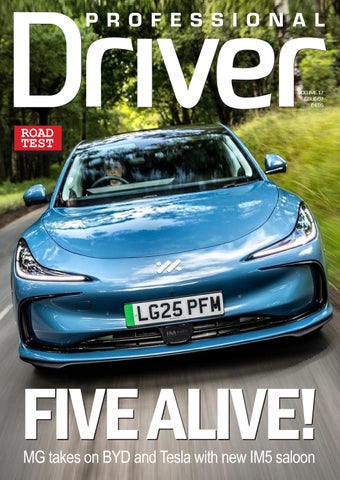
FIVE ALIVE! MG takes on BYD and Tesla with new IM5 saloon
contents
24 26
18
20 20 4 5 12 14 15
16
16 18 24 26
4 EDITORIAL DIRECTOR
Mark Bursa 07813 320044 markbursa@prodrivermags.com
COMMERCIAL DIRECTOR
Paul Webb 07807 133527 paulwebb@prodrivermags.com
CONTRIBUTORS
Gary Jacobs, Kevin Willis, Tim Barnes-Clay, Dr Mike Galvin, Kwabena Dennot Nyack
Cover Story: MG IM9 Long Range road test News: Wheely launches chauffeur academy News: Manchester launches green fund News: BMW launches new chauffeur programme News: PRA calls for fuel duty freeze How to win: Enter the 2027 QSi Awards today News Analysis: A fresh look at the EV mandate? Profile: Bal Notay of The Chauffeur Group First Look: Kia PV7 7-seater MPV First Look: Audi Q9 luxury SUV
Regular features 28 30 31
The Advisor The Knowledge The Insider
COMPANY ADDRESS
50 Beechcroft Manor, Oatlands, Weybridge, KT13 9NZ
WEBSITE
Martin Coombes PageHub Design martin@pagehubdesign.co.uk
SUBSCRIPTIONS
Curwood CMS Ltd, The Barn, Abbey Mews, Robertsbridge, TN32 5AD 01580 883844 subs@prodrivermags.com
Registered in England No. 7086172 © 2026 All contents copyright of ProDriver Media Ltd
2
PROFESSIONAL DRIVER
opinion
At last! Someone is paying attention
I
Mark Bursa
“
It became very clear from Ruth Cadbury’s responses to questions at the LPHCA conference that the Government is listening to our concerns
”
had the pleasure of MCing the LPHCA conference at the Heathrow Marriott Hotel last month. And there was quite a bit of good news from the event – and not just the return to the front line of LPHCA chair Steve Wright. The well-attended event included a good few governmental delegates, including Ruth Cadbury MP, chair of the Transport Committee, and someone very much charged with overseeing new legislation that will govern the private hire sector in future. And it was very clear from her responses to questions that the Government is listening to our concerns. I’ve stated in this column before that there is a very grave risk of bad legislation being inflicted on us unless the level of understanding of our sector within government improves substantially. And it does seem that we have come a long way from the dismal parliamentary debate in June 2024, described as was “poorly researched and presented”, and containing many “misleading and incorrect” statements. In a stinging rebuke, National Private Hire and Taxi Association director David Lawrie said the discussion highlighted “how little the MPs understand our plight, the legislation, enforcement powers and root causes of the problems”. Now it seems we have had some substantial progress. The efforts of the LPHCA and others mean it now looks like there will be true national standards, not just “minimum standards” that licensing offices can ignore. And it does seem we have headed off the threat of the dreaded “ABBA principle”. While there are likely to be some changes to out-of-area working (and licensing) rules, we won’t have to go back to base after every job, creating thousands of dead miles and leaving vulnerable passengers stranded. But this is not the only issue we are facing. The more we look at “robotaxis” the less benefit we can see. They are an existential threat to our industry and could cost thousands of drivers their jobs for what – a less safe form of transport, controlled by an American algorithm that is not suitable for British roads, that enriches only a few American “tech bros”. Because make no mistake – these vehicles will not be offered for sale to operators, as Dr Mike Galvin explains in his column on page 30. They will be run by the tech giants themselves – Waymo, Uber, and heaven for-
PROFESSIONAL DRIVER
fend, Tesla. Meanwhile professional drivers trade their dignified driving jobs for menial cleaning work, mopping discarded kebabs and pools of vomit out of the back of the “cybercab”. What a time to be alive. The government, TfL and other licensing bodies must not rush through inadequate licensing provisions for AV taxis. There are enormous, unanswered questions about insurance and liability, which need resolving before they coroner’s court has to adjudicate on the death of a robocab passenger. Pause, draw breath, and be prepared to say no. Then there’s the absolute shambles of VAT. Gary Jacobs explains the situation very succinctly in his column, and how we’ve ended up with a ridiculous two-speed VAT system where private hire operators in London should apparently pay VAT while those elsewhere don’t need to – even though there is no legislation to enforce this. It leads back to the issue of why we should be paying VAT at all. Earlier this year, the Department for Transport published a report called “Better Connected”, which outlines how taxis and private hire vehicles would play a key role offering “last mile” travel to complement bus and rail transport as part of an integrated public transport system. Within urban areas, the strategy identifies taxis and private hire vehicles as essential for also providing services during off-peak periods when traditional public transport is less available. Basically, the DfT is admitting that private hire is part of the public transport system, and should be included in wider transport planning. So why, then, is private hire the only mode of public transport that is subject to VAT? Buses, trams, trains, ferries, flights and hackney taxis pay no VAT. Yet private hire is stuck, arguing with HMRC over “principals” and “agents” and “margins”. HMRC wails it will lose millions of pounds if PHVs become zero-rated. But seeing as it’s not getting that money in the first place, it’s not really losing anything. Private hire should be zero-rated for VAT, like all other public transport. You could exempt business account work, paid on weekly or monthly invoice, as it’s of no concern to a PLC finance director – that VAT can be reclaimed. But for everyone else, let’s have a sensible solution. No VAT for private hire.
3
business news
Wheely launches chauffeur academy in west London Mark Bursa
Chauffeur platform Wheely has launched a purpose-built training academy in London. The Swiss-founded firm said the academy was designed to reinforce the brand’s commitment to five-star hospitality, discretion and service as demand for premium private travel accelerates. The Wheely Chauffeur Academy is located in Hammersmith, west London, and Wheely’s company headquarters is also moving on to the site. It becomes part of a global network of academies in Dubai, New York and Paris, with more expected to open soon as the business continues its North American expansion. The academy is designed to help every chauffeur deliver a level of service and consistency comparable to
that of a five-star hotel. Chauffeurs signing up to the Wheely platform must successfully complete a three-day training programme, which includes topics such as etiquette, situational awareness, privacy protocols, vehicle standards, driving style and communication. To graduate, every chauffeur must pass written and practical assessments, in-
Wheely launches singlepayment Family Accounts Mark Bursa
Chauffeur platform Wheely has launched a new Family Accounts scheme that allows eligible customers to extend their Wheely membership privileges to the people closest to them and share one single payment method to book journeys. Members can invite up to six people to join their account, giving them access to membership benefits while journeys are paid for centrally. Account owners can view journey history and spend, manage access
4
and keep track of activity directly through their Wheely app. Family Accounts can be used across families and partners, as well as household staff and family offices. For family offices in particular, a nominated admin or account holder, such as a chief of staff or head of family office, can manage the account centrally, with visibility over journeys and spend, including receipts and expenses, while enabling those across the family office to book journeys independently.
cluding a vehicle inspection and grooming test. Only around one in six applicants successfully graduate, the company claims. The programme is overseen globally by director of customer experience Laura Allen. It is led by former Royal Marines Warrant Officer and former private close protection officer Ricky Miller, alongside Wheely’s specialists around
the world, who deliver courses on a day-to-day basis. Laura Allen said: “Exceptional service is created through thousands of small details delivered consistently, journey after journey. Our Chauffeur Academy ensures every client experiences the same exceptional standards of hospitality, discretion and professionalism, no matter when and where they travel.” Ricky Miller, added: “Driving is only one part of being a Wheely chauffeur. The real skill lies in reading every situation, anticipating every detail and delivering exceptional service with absolute consistency.” Wheely, headquartered n London, has served business travellers and executives for 15 years through its black car Business service, with options including First, SUV and XL.
CHARGE POINT NUMBERS ON THE RISE AS INVESTMENTS CONTINUE There were 123,677 charge points in the UK as of the end of August 2026, at 47,810 locations, according to ZapMap. There are now more than 1,000 charging hubs, and chargers are being installed at a rate of almost 1,000 a month, with 953 new installations in August 2026 alone – 288 of which were ultra-fast chargers. Recent investments in infrastructure have included the Welsh government’s introduction of 100% non-domestic rates relief for EV charging bays and forecourts, set to run until March 2036 and designed to encourage operator investment and
expand infrastructure. Other initiatives include Devon and Torbay Councils announcement of a LEVI (Local Electric Vehicle Infrastructure) funded partnership with Believ to deliver 1,300 EV chargers across the region. The National Trust expanded EV charging across three of its sites in Devon through its partnership with RAW Charging, at Castle Drogo, Parke and Lydford Gorge. RAW Charging opened new charging hubs in Milton Keynes, Charlton Riverside SE London, W Sussex and RHS Garden Wisley. And BP Pulse opened a new hub at Tingley in West Yorkshire.
PROFESSIONAL DRIVER
business news
Stratford-on-Avon launches licensing consultation Stratford-on-Avon District Council has opened a 12-week consultation on its proposed taxi and private hire licensing policy covering the next five years (2027-2032). The consultation, which runs until December 21, 2026, covers proposed standards on vehicle age, safeguarding and card payments. Under the draft, petrol, diesel and LPG-powered taxis and PHVs would be limited to 12 years of age at license expiry. Hybrid hackney carriages could be licensed up to 15 years old at license expiry. Fully electric and hydrogen zero-emis-
sion private-hire vehicles would not have a vehicle-age limit under the draft. New hackney-carriage vehicle licenses would be limited to vehicles that are
manufacturer-built or adapted for wheelchair accessibility. The council identifies accessibility, vehicle suitability and emissions among the objectives of the proposed policy. The draft also proposes enhanced safeguarding requirements for driver applicants. Applicants would need an enhanced DBS certificate including adult and child barredlist checks, and would have to subscribe to the DBS Update Service. The council proposes to carry out online status checks for all drivers every six months.
hikes Manchester launches EMA drop-off £2m green drivers fund charges and cuts wait time
Mark Bursa
A new £2 million support fund has been launched to help private hire drivers in Greater Manchester upgrade to cleaner vehicles. The Private Hire Vehicle (PHV) Support Fund will give grants to drivers looking to upgrade to more environmentally friendly cars across the city. Bev Craig (pictured), Mayor of Greater Manchester, said: “Private hire drivers play a vital role helping to keep Greater Manchester moving every day. We’ve listened to the trade and we’re launching this fund to offer private hire taxi drivers practical financial support to help them move to cleaner, more modern vehicles.” The fund offers grants of up to £2,500 and is open to private hire drivers licensed by any of Greater Manchester’s 10 councils. It is not limited to electric vehicles, though any car purchased must comply with current Euro 6 emissions standards.
PROFESSIONAL DRIVER
The PHV Support Fund complements the existing Hackney Support Fund, which was launched in December 2025, and which offers similar support to black cab drivers. Funding has already been committed to more than 400 locally licensed black cab drivers. Kevin Flanagan, GMB Manchester Central branch secretary, said: “The GMB welcomes the new support fund launched for private hire drivers across Greater Manchester. We are pleased to have worked with TfGM and welcome the commitment shown by
East Midlands Airport has raised its drop-off charge, impacting taxi and private hire drivers who drop off passengers outside the terminal. The price for using the rapid drop-off area has increased from £5 for 15 minutes to £8 for 10 minutes. The airport said the the Greater Manchester increase was due to “signifiMayor’s office in respondcant inflationary pressures” ing to the issues raised and claimed the fee had and making this support remained unchanged for five available to drivers.” years and was one of the He continued: “Drivers lowest in the UK. have faced significant chalANPR is used and drivers lenges and costs in upgrading must pay online or by phone their vehicles in recent years. by midnight on the day after These grants will provide using the area. Failure to pay welcome assistance to those by this deadline results in a still making the transition to £100 parking charge, which newer vehicles.” is reduced to £60 if paid Applications for the new fund are now open and can within 14 days. Drivers seeking alternabe made online. Drivers can tives can use the long-stay find out more and apply by car park for free for up to an visiting: hour, though it is a 10-minwww.greatermanchester-ca. ute walk from the terminal. gov.uk/phv-support-fund
5
business news
Warwick Council to raise fares as drivers say they will lose customers Mark Bursa
Hackney carriage fares in Warwick are set to rise by 10% from October, but some local drivers are warning the increase could push more customers towards Uber. Warwick District Council said inflation had risen by 6% since the last fare review, though that previous adjustment was particularly contentious, having increased by 30% after going unreviewed for a decade. The new rates will see the daytime rate for the first 700 yards rise from £4.40 to £4.85, while the charge between 10pm and 6pm will increase from £6.65 to £7.30, with the evening rate for taxis carrying five or more passengers climbing from £8.85 to £9.75. Charges for each subsequent 100
yards travelled and waiting time tariffs remain unchanged from those established in 2024. Local taxi drivers were consulted on the proposals, with more than half responding. Of the respondents, nearly three quarters were in favour of an increase, citing soaring fuel costs as the primary reason. But some drivers were concerned that it would increase the price differential between hackney taxis
and private hire vehicles, especially Uber. According to one driver’s response, published by the council: “There’s already less work available. Higher fares will likely push even more customers towards Uber and similar services, making the situation worse for local drivers. If the council genuinely wants to support the taxi trade, they should be focusing on creating a level playing field such as reviewing how app-based
services operate rather than increasing fares that could drive passengers away.” Another driver’s response read: “The most important thing is no matter how much we change the fare, we keep losing our potential customers to Uber. There are nights where we make nothing, waiting at the taxi ranks for 10-12 hours. All our taxi ranks are busy with Uber drivers. The council should focus on how to get our taxi business back.” Nevertheless, drivers also pointed to “significantly higher” operating costs. One said: “Without a meaningful fare increase it is becoming difficult to maintain a sustainable income. Fuel costs continue rising every day. The diesel prices have increased by around 40% since January 2026.”
CMAC takes full ownership of Coach Hire Comparison Mark Bursa
CMAC Group has completed the acquisition of the remaining share of coach and minibus booking specialist, Coach Hire Comparison, following significant growth since CMAC first invested in the business in 2023. CMAC acquired a 51% stake in Coach Hire Comparison three years ago. Since then, the business has grown to £4.15m in revenue in 2025, up from £3.3m in 2024. Coach Hire Comparison has also almost doubled the number of passengers served during the last year and increased its headcount from two employees in 2023 to 10. The acquisition brings Coach Hire Comparison fully into CMAC Group. Full ownership further strengthens CMAC’s position as a leading provider of large vehicle transport solutions across disruption management, rail replacement, events, corporate mobili-
6
in a partnership that has gone from strength to strength since 2023. We’d like to thank James and Laura Stokes for the exceptional business they have built over the past 16 years and for the significant contribution they have made since joining forces with CMAC.We have seen first hand the power of the Coach Pete Slater, CEO, CMAC (left), with James Stokes, and Laura Stokes, co-founders and joint managing Hire Comparison platform, the value it delivers to customers directors of Coach Hire Comparison and the opportunities created ty, group travel and leisure transport in by bringing our expertise and capabilithe UK and beyond. Coach Hire Comties closer together.” parison already plays an important role James Stokes, joint managing direcin CMAC’s large vehicle offering and, tor of Coach Hire Comparison, added: together, the two businesses connect “I’m incredibly proud of the growth customers with more than 800 coach Coach Hire Comparison has achieved and minibus operators across the UK, in recent years, and of the talented providing nationwide coverage. team and operator network that have Pete Slater, CEO of CMAC Group, made that success possible.” James said: “Fully acquiring Coach Hire and Laura Stokes will remain with the Comparison is the natural next step business until the end of the year.
PROFESSIONAL DRIVER
Insurance protection that fits the way you drive With more chauffeurs working through app-based platforms like Blacklane and Wheely, we’ve expanded our offering to reflect how the industry is evolving. Our advice is built around understanding your world – giving you cover that supports the way you work today. At Howden, we get you. Speak to a specialist who understands your business.
Your contact for independent drivers and fleets under six vehicles:
Your contact for fleets of six or more vehicles:
Cameron Scott T: 020 8036 3968 E: cameron.scott@howdeninsurance.co.uk
Ricky Chivers T: 020 8256 4916 E: ricky.chivers@howdeninsurance.co.uk
howdengroup.com/uk-en/blacklane-wheely Howden UK Brokers Limited is authorised and regulated by the Financial Conduct Authority No. 307663. Registered in England and Wales under company registration number 02831010. Registered Office: One Creechurch Place, London, EC3A 5AF. Calls may be monitored and recorded for quality assurance purposes. HUBL-CS-CH-035-0326
PROFESSIONAL DRIVER
7
business news
BMW launches upgraded chauffeur programme for 7-series and i7 users Mark Bursa
BMW UK has launched a new dedicated BMW Chauffeur Programme developed specifically for chauffeurs and executive transport providers using the new BMW 7-Series and electric BMW i7. The programme has been designed to deliver a consistent, nationwide, specialist support service, tailored to the unique requirements of the chauffeur industry. It has been developed following extensive engagement with leading players in the sector. The programme is based on six integrated support pillars, designed to enhance ownership, reduce downtime and support business continuity. These include Service Inclusive, offering eligible vehicles a five-year service package which covers unlimited mileage for the BMW 7 Series and BMW i7, and a one-year subscription to BMW Security Pro, which equips programme vehicles with advanced vehicle tracking, real-time monitoring, driver tag functionality and direct access to a secure operating centre. Also offered as part of the programme is Mobility Support, where customers can access a licensed BMW 7-Series or BMW
i7 replacement, or support towards self-arranged hire solutions during warranty repairs, and BMW’s battery warranty of up to eight years or 100,000 miles. BMW UK has also collaborated with BMW Financial Services UK and Alphabet to introduce specialist funding solutions, designed specifically for Chauffeur Programme members. Eligible customers can access a range of finance products, including regulated hire purchase, unregulated hire purchase, business contract purchase and business contract hire, depending on customer type and business structure. These tailored funding solutions have been developed to provide greater flexibility for both individual operators and incorporated chauffeur businesses, while BMW also seeks to support
both retailer marketing activity and operator promotional campaigns with approved chauffeur-focused imagery. Customers placing an eligible BMW i7 Chauffeur Programme order before the end of 2026 additionally qualify for a complimentary Pod home charger, subject to installation completion by March 2027. Rachel McDermott, head of business development, luxury cars at BMW UK, said: “The BMW Chauffeur Programme has been shaped around the real needs of professional operators, bringing together the comfort and innovation of the BMW 7-Series and i7 with the specialist support required to keep their businesses moving. “By offering a consistent nationwide proposition, we are helping our custom-
ers an deliver exceptional passenger experience while supporting their long-term operational success.” Available through BMW Retailers across the UK, the programme is open to licensed private hire operators, chauffeur companies, executive transport providers, luxury hotel house-car fleets, corporate and VIP transport operators and self-employed chauffeurs. Taxi operators are excluded from the programme. The programme is administered through BMW UK’s Specialist Sales channel, ensuring a consistent customer experience and a streamlined process for both retailers and chauffeur operators. Fleet customers, or businesses with bespoke requirements, can also access additional support through the Specialist Sales team.
Charge point operater Be.EV offers monthly subscription scheme EV charging network Be.EV has introduced an EV charging pass scheme which could save high-mileage drivers hundreds of pounds a year. Drivers pay a fixed monthly fee for a charging allowance that can be used across the nationwide network, without needing to track peak, off-peak or per-kWh rates. There are two passes available: Go Pass,
8
at £49 a month for a 120kWh allowance – enough for around 400 miles – and Go Further Pass, at £89 a month for 250kWh, which gives around 800 miles. Drivers who use their full allowance roll on to Be.EV’s off-peak rate of 49p/kWh for the rest of the billing period, which is well below the standard pay-as-you-go rate. That makes the Go Pass 51% cheaper and
the Go Further Pass 57% cheaper than the UK average public ultra-rapid charging price of 83p/kWh for drivers who use their full allowance. “Subscription-based charging is becoming the norm in Europe’s most mature EV markets, and it’s the direction the UK is heading in too,” said Be.EV CEO Asif Ghafoor.
PROFESSIONAL DRIVER
Insure your fleet with the flexibility you need Taxi Commercial Self-Drive Hire Credit Hire Visit acorninsure.co.uk
Rated Excellent 16K+ reviews
January 2026
Acorn Insurance is a trading name of Acorn Insurance and Financial Services Ltd. who is authorised and regulated by the Financial Conduct Authority (FCA). Firm reference number 311873. Registered address: 98 Liverpool Road, Formby, Liverpool, L37 6BS, No. 01636368
PROFESSIONAL DRIVER
9
business news
Gallows Corner flyover reopens after major rebuild
A major transport bottleneck in London has been relieved with the reopening of the Gallows Corner flyover in Romford. Transport for London has confirmed that the flyover and roundabout have fully reopened to traffic following the completion of major strengthening and refurbishing work. All remaining traffic management and diversion routes have been removed. The renewal of the ageing Gallows Corner flyover has helped secure the long-term future of a key transport link in Havering and east London. Originally built in the 1970s as a temporary structure, all elements of the flyover except the foun-
dations have been completely renewed and replaced to ensure it can continue supporting London’s road network for decades to come. The new structure will enable the removal of speed and weight restrictions,
improving journey reliability for people travelling through the area and helping to support local bus services. The project has also delivered new pedestrian and cycle crossings around the roundabout alongside resurfacing and improved road markings. Stuart Harvey, TfL’s chief capital officer, said: "We’re pleased to confirm that Gallows Corner Flyover has fully reopened following the completion of this major programme of works. We’d like to apologise to local residents, businesses and road users for the delays to these works and thank them for their patience while this project has been carried out.”
Midlands operator to adopt Star Cars branding on Derby fleet Mark Bursa
JEM Group is bringing its two private hire fleets under a single brand. The company added Derby-based Chads Cars to its Birmingham Star Cars operation in 2022, but has continued to run the two fleets under separate brands. But now all the Derby Chads Cars vehicles will carry Star Cars branding – though the former Chads vehicles will carry a “previously known as Chads Cars” strapline for the time being. Operations Manager Martin Walker said: “Since Chads Cars was acquired by the JEM Group in 2022, our strategy has been to grow the business and deliver better services and benefits for customers and drivers alike. We are now taking the next important step by formally bringing Chads Cars together with our sister company, Star Cars Birmingham, under a single brand, website and passenger app.” He added: Throughout
10
that journey, the legacy of Chads Cars has always been appreciated, understood and respected—and it will never be forgotten.” Chads Cars founder John Matkin recently died, and Walker paid tribute to him: “The stories shared at his funeral reminded us all just how significant his contribution was to the taxi industry in Derby. John’s achievements also demonstrated the importance of adapting, evolving and embracing change.” The combined fleet of the two companies is more than 370 cars. At the time of the 2022 takeover, Star Cars, formed in 1962, had
around 200 vehicles serving Birmingham, Solihull, Sandwell, Walsall, Wolverhampton, Worcestershire and North Warwickshire. Chads Cars, which started operations in 1991, had a fleet of 170, making it one of Derby’s leading operators. Walker said the name change would allow Star Cars to offer a much broader range of services and opportunities, including local taxi services, airport transfers, executive business travel, minibus and coach hire, coach holidays and selected day excursions. There would also be more account work, including Amazon, with improved driver pricing. “For the first time, our complete Star Tours holiday programme will be availa-
ble to customers in Derby for the 2027 season,” Walker said. “Customers booking these holidays will receive a free door-to-door service, provided exclusively by Chads Cars drivers.” Walker said moving all drivers on to a single app will make the whole operation more efficient and create additional earning opportunities. “When Star Cars or Chads Cars cannot cover a booking in either direction, that work will no longer automatically be lost to a competitor. Instead, it can be offered to our growing fleet of driver-partners through the Job Pool.” He added: “We also want to expand our relationship with the wheelchair-accessible Hackney community. To achieve this growth, we must come together under one strong and recognisable brand. Chads Cars will continue to exist as a legal entity. Operationally however, we will move forward as: Star Cars – previously known as Chads Cars.”
PROFESSIONAL DRIVER
Elevate your driving. Advance your career.
Belgraves of London Chauffeur Training Academy RoSPA Advanced driver training and qualification Guild of Professional Chauffeurs (GoPC) criteria qualification & membership Master the art of chauffeur etiquette at Diplomatic/Royalty level Learn from former Met Police RaSP Instructors and industry leading professionals. Level 3 First Aid Qualification
Applications Open for October 2026 - Please contact us for more information +44 20 3355 3333
Member of the ‘Society of the Golden Keys of Great Britain and the Commonwealth
Member of the National Association of Jewellers
PROFESSIONAL DRIVER
training@belgravesoflondon.com
‘Chauffeur company of the year’ for the last 7 consecutive years
Member of the National Limousine Association
Proud founding member of the Ops Con
Member of the Licenced Private Hire Car Association
11
naws analysis
LEVC prepares new taxi launch in 2027 but won’t confirm if vehicle is EV-only Mark Bursa
LEVC has confirmed that its next-generation TX black cab will launch into the UK market in the second half of 2027. The new cab will be “fully engineered from the ground up”, the company says – though it has not confirmed earlier reports that the vehicle would be all-electric, unlike the current range-extender hybrid TX model, which launched in 2018. A spokesman said: “We remain fully committed to ensuring our purpose-built products make our cities a better, cleaner place. While we can’t provide any further information on pricing or specification just yet, rest assured that the new vehicle is being developed with the needs of drivers, passengers, fleet operators and cities firmly at its core.” In May 2023 LEVC revealed details of its new all-electric SOA platform, including a 120kW battery offering an all-electric range of 435 miles. This platform is used on the L380 MPV,
Disguised images of new TX show no upright grille, hinting at EV powertrain
a model that is available in China and is slated for UK launch in the future. It was hinted strongly in 2023 that this would be the next taxi platform – but an LEVC spokesman would neither confirm nor deny this now. However, the LEVC plant in Ansty is being shuttered until 2027 after the last current TX rolls off the line this month in order to retool for the new cab, which suggests a fairly major change is happening. And images of the new vehicle suggest it will not have an upright radiator like its predecessors, again hinting at an EV.
LEVC, owned by Chinese auto giant Geely, has sold more than 12,000 TX taxis worldwide to date – including more than half the London fleet of around 14,000 taxis. Thanks to its eCity powertrain, TX has saved more than 450 million kg of CO2 from entering the atmosphere and reduced NOx emissions of the London taxi fleet by 60%. “Environmental sustainability and air quality continues to be a key consideration in the development of LEVC’s next-generation taxi,” LEVC said in a statement. Since 2013, Geely Group
has invested more than £1 billion in the ongoing development of LEVC and remains firmly committed to the future of the UK taxi industry. LEVC said in a statement: “While full technical details and specifications remain under wraps, the next-generation taxi will leverage LEVC’s expertise in purpose-built taxi design, accessibility and durability, to deliver a vehicle that represents an advanced, purpose-built urban mobility solution.” LEVC’s new SOA EV platform (Space Oriented Architecture) has been co-developed with Geely. SOA is modular and scalable, and designed to optimise the interior space of vehicles built on the platform. SOA supports vehicle sizes from 4,860mm – 5,995mm in length and 1,945mm – 1,998mm in width, with wheelbases from 3,000mm – 3,800mm. SOA can also offer front-wheeldrive, rear-wheel-drive and all-wheel-drive layouts too.
BP Pulse to install EV charge hubs at 30 Roadchef sites
Motorway service area operator Roadchef is taking direct ownership of 12 BP petrol forecourts at its service areas, in return for BP Pulse installing rapid charging hubs at more than 30 Roadchef sites. The chargers will be available from 2027, and Roadchef is aiming to have more than 1,000 charging bays on its sites by 2030. The Roadchef-operated BP forecourts will all continue to carry BP branding, supply BP fuels and will retain the BP Wildbean cafes on each site. Tim Gittins, chief executive of Roadchef, said: “This agreement will enable bp to expand the rollout of bp pulse ultra-fast EV charging across our sites and support our commitment to deliver 1,000 charging bays by 2030. Under the UK’s transition to
12
zero-emission vehicles, motorway service areas will play a critical role in improving the availability of en-route charging points. BP brings the scale, experience and delivery capability needed to match our ambition.” “It will also bring bp-branded forecourts under Roadchef’s operation, strengthening our fuel and convenience food offer for leisure and HGV drivers. Together, these changes will help us serve more drivers and give the business the scale and capability to meet the growing demand for EV charging across the UK.” The forecourts that will be operated by Roadchef are at Strensham, Northampton, Watford Gap, Clacket Lane, Sandbach, Rownhams and Norton Canes.
PROFESSIONAL DRIVER
PROFESSIONAL DRIVER
13
business news
Petrol Retailers Association calls for Fuel Duty freeze as oil prices soar Mark Bursa
The Petrol Retailers Association (PRA) is calling on the Government to abandon a scheduled rise in fuel duty because of ongoing global fuel supply pressures as a result of the Iran War. Recent re-escalations of the conflict have seen Brent Crude futures go past $100 per barrel for the first time since May, and the price has continued to rise. As of September 28, the price was $106.97, and numerous media outlets reported that diesel prices had passed the £2 per litre barrier in some areas. Simon Williams, head of policy at the RAC, said the price of a 55-litre diesel fill-up for a family car had reached approximately £109. “The average price of diesel is teetering on the brink of a new all-time high at 198.32p,” he said. The RAC said petrol had risen by nearly 12p during September and by more than 40p since the end of February. Diesel has increased by 14.5p a litre during September and is
up 55p since February. Diesel has risen by 39.3% since the end of February, compared with a 30.7% increase for petrol. The PRA said it was impossible for forecourt operators to absorb these levels of wholesale price increases without putting their businesses at risk, so these increases will be reflected in prices paid at the pump. Gordon Balmer, Executive Director of the PRA, said: “Retailers understand the pressures motorists are facing, but they cannot absorb sustained increases in
wholesale fuel costs. With prices continuing to rise, we are urging the Chancellor to abandon the planned fuel duty increase [due at the start of 2027] and avoid adding further pressure at the pump.” The problem is hitting rural private hire operators particularly hard, as they typically have longer journeys and fuel tends to be more expensive in remote areas due to higher transport costs, lower sales volumes, and a lack of local competition. In the rural west country,
petrol was costing £1.96 per litre near Whaddon compared to £1.70 in Bristol. Pieter-Jon Allis, owner of Stroud Taxi in Gloucestershire, called the situation “a complete nightmare”. He said “It’s a concern because our chief business cost on a day-to-day basis is fuel. I think we’re headed for pretty tough times ahead.” He said at least half of the enquiries he receives are requests for quotes, as customers compare his company’s pricing with other services such as Uber. “We're under a continual pressure to lowball ourselves and do prices we were doing 15 years ago, even though fuel prices are at an all-time high,” Allis said. Some councils have authorized fare increases to help operators cope with the costs. Falkirk council in Scotland approved a new hackney tariff that will add 20p to every journey, and the running mile will increase by 7% from £2.06 to £2.20.
Source targets PHV drivers with new rewards scheme Mark Bursa EV charging network Source has launched a rewards scheme that will give private hire drivers points every time they charge. The Source Rewards programme uses a loyalty programme called PowerGoodies, which lets drivers turn charging into vouchers for Tesco, Costa, Asda, Sainsbury’s and other retailers. Under the scheme, every kWh charged at a Source hub earns two points, worth roughly a £5 voucher for every 15 charging sessions. For high-mileage fleet and private hire drivers, that could be a significant saving over 12 months. Fleets can link their existing charging card, a SourceConnect RFID card, a fleet card or a roaming partner card, into the free
14
PowerGoodies app, with no change to how drivers charge. Points build automatically and can be redeemed for vouchers. The launch marks PowerGoodies’ first partnership in the UK, following existing rewards schemes with EV charging networks in Europe. “Drivers in the Nether-
lands and Belgium have shown us that a public charge feels different when it gives something back,” said Jan van Ottele, CEO of PowerGoodies. “Source is building a fast, reliable network designed around the driver, and it’s the right partner to bring PowerGoodies to British roads.” Source is backed by SSE and TotalEnergies, and operates ultra-rapid hubs across the UK and Ireland, with a target of 300 ultra-rapid hubs by 2030. The network uses 150kW chargers as standard. The network is powered by renewable energy, backed by a 99%+ uptime target and continuous monitoring. Source Rewards is live at every Source hub in the UK from launch, with new hubs joining the programme automatically as they open.
PROFESSIONAL DRIVER
SMALL BUT MIGHTY ENTER THE QSi AWARDS NOW!
Closing date for entries: November 6 Enter via our website: https://www.prodrivermags.com/ qsi-awards-home/qsi-enter/
Your taxi or private hire business deserves to be recognised at the QSi Awards
T
he Professional Driver Awards return to the Hilton Metropole Hotel in Brighton on Friday, January 22, 2027. If you run an independent private hire or chauffeur business, don’t assume the awards are only for national brands and large fleets. Judges need strong evidence of service, improvement and impact - and smaller operators often have exactly that story to tell. Nominations are now open. You may nominate your own business. Nominations close on Friday, November 6, 2026 – so you’ve still got plenty of time to enter.
What makes a strong entry: Fleet size
is not the story. The story is what you have achieved with the people and resources available to you. A convincing nomination gives the judges specific examples rather than broad claims about being reliable, innovative or customer-focused. Your entry might show how you have: z helped vulnerable passengers or supported an essential local service z reduced cancellations, waiting times, complaints or empty mileage z supported drivers through a difficult period z introduced useful technology despite limited time or resources z created local employment or opportunities for new drivers z built trusted relationships with schools, hospitals, councils or community organisations
PROFESSIONAL DRIVER
By Rachel Dale QSi Gold Award Winner, 2022 QSi judging panellist
z grown the business while protecting service standards and values.
Independent operators can win: The
2026 winners demonstrate that there is no single formula for success. Just take the Private Hire Operator 1-80 vehicles category. Gold - Tick Taxi, Bristol. The airport-transfer specialist achieved 200% growth in 12 months. It impressed the judges with its technology and practical support for drivers. Silver - Castle Cars, Tonbridge. A familiar presence in its community for more than 30 years, Castle Cars combined safe and reliable service with investment in cleaner vehicles and a solar battery storage facility. Bronze - SP Taxi, Saffron Walden. The smallest and newest operator on the shortlist was established in 2025. It adapted the high customer-service standards of a London chauffeur to a personalised local private-hire service. These businesses succeeded for different reasons: rapid growth, driver support, community commitment, sustainability and exceptional service. What united them was clear evidence of the difference they had made. That is what judges want to see - not simply the number of vehicles in a fleet.
Make it easy for the judges: Assume
the judges know nothing about your business. Explain where you operate,
when the company began, who you serve and the size of your operation. Then focus on one or two achievements that best demonstrate why your team deserves recognition. For each achievement, answer four questions: 1 What was the challenge? Describe the problem or opportunity clearly. 2 What did you do? Explain the action taken and name the people involved. 3 What changed? Include numbers, customer feedback or another result wherever possible. 4 Why did it matter? Show benefits to passengers, drivers, staff and community. Do not imitate the language of a large corporate business. Direct, specific evidence is far more persuasive than marketing language. Your local knowledge is an advantage when you demonstrate the difference it makes.
Benefits of recognition:Reaching the
shortlist or winning can give your team something concrete to celebrate and provide credible material for recruitment, customer communications and conversations with local partners. It can help more people notice the work you are already doing well. Self-nomination is not boasting. It is an opportunity to recognise your team and document their success. Choose your strongest example, support it with evidence and tell the story plainly. We look forward to receiving your entry and welcoming you to the QSi Awards dinner in January. Good luck!
15
T
he Government’s consultation on possible changes to the zero-emissions mandate closes this month.The consultation came about as a result of sustained pressure from the auto industry, led by the SMMT, which has repeatedly expressed concerns that the scale and speed of the transition to a fully zero-emissions car market by 2035 is unachievable. Under the current arrangements, manufacturers have to steeply ramp up the proportion of EVs sold as part of their model mix from somewhere below 30% today to 80% by 2030, with the remaining 20% of vehicles with ICE or even hybrid powertrains declining over the next five years to a point where, in 2035, only pure electric or hydrogen cars will be able to be sold.
Background Under the previous Conservative government, the 2035 deadline was something of a political football. Originally launched in 2020 under the Boris Johnson government, the deadline for the phase-out of pure ICE vehicles was initially set at 2030. In 2023, under Rishi Sunak, this was wound back to 2035. At this point, the phased annual EV sales targets were introduced, starting at 22% in 2024, scaling incrementally toward an 80% share by 2030. This year the target is 33%, while EV sales in the first nine months of 2026 were some way short of that at 26.4% of the market. While EV sales are increasing, the rate of adoption is nowhere near the target, and this is likely to become increasingly difficult as time passes. The targets for the next few years are 38% (2027), 52% (2028) and 66% (2029), which look well out of reach at current growth rates. The Government admits as much in its consultation document, which states: “Together, DfT analysis and independent forecasts currently point to ZEV sales in 2030 that are below the headline 80% target for cars and 70% target for vans in the ZEV Mandate.” The Government consultation outlines a number of scenarios which introduce new scales from 2027 to 2030, setting lower targets for EV adoption
16
The Government needs to adjust the targets of the ZEV mandate, says Mark Bursa
HOW TO FIX ZEV MAND by that time. The consultation document displays models for 70%, 60% and 50% of EV sales by 2029 – but in each case, the 2035 deadline for the end of petrol and diesel sales remains in place. So while automakers would face a more consistent curve in terms of EV sales rather than the steep ramp-up to 2030 followed by a lower gradient up to 2035, they would still be forced to stop selling even the latest plug-in hybrids in just over nine years’ time. And this is the root of the problem.
Changing market The UK car market is going through one of the most dramatic periods of change in living memory. The move toward electrification is only part of that picture. The large-scale arrival of Chinese automakers has caused enormous disruption among legacy automakers, and that is continuing.
Chinese-owned brands now hold a combined UK market share of around 20% - staggering growth in very short timeframe. Chinese share was below 5% in 2022, and that was mainly accounted for by MG. Brands such as BYD, Jaecoo, Omoda, Geely and Chery were not yet on sale in 2022. In September 2026, those five brands alone took more than 15% market share. While all these manufacturers have strong experience in the EV market, their success is coming mainly from the sale of plug-in hybrids. This is where the market is strongest. PHEV sales in September 2026 surged by 55.7% to 59,563 from 38,261 in the corresponding month in 2025. This outstripped EV sales growth of 36.3% in September to 99,199 (72,775 in September 2025). So while EV sales are still above PHEV sales, at the current rate, PHEV sales could catch and pass EV sales in the next couple of years – and that
PROFESSIONAL DRIVER
news analysis: ZEV mandate
X THE DATE
is probably not what the Government wants to hear. The Government does acknowledge that PHEVs are growing in importance, stating: “While PHEVs were always expected to play a transitional role in the shift towards ZEVs, recent market developments suggest they are becoming a more prominent feature of manufacturers’ compliance strategies than expected.”
Growth of PHEVs Why are PHEVs growing? Mainly because they are improving. The electric capability of the latest Chinese PHEVs is significantly better than earlier generation PHEVs, for example the Mitsubishi Outlander PHEV, which sold strongly on account of a strong BIK rate, but offered a minimal EV range and was largely used as a petrol car by company car drivers. The latest PHEVs offer significant-
PROFESSIONAL DRIVER
ly more electric range than previous models. We recently drove a new MG S9 SUV, a PHEV with a 24.7kWh battery giving electric-only range of up to 62 miles (WLTP), which is plenty of electric range to cope with most daily driving needs as an EV. In a city environment, with access to overnight AC charging, we kept the car topped up to more than 60 miles of EV range every night, which was more than enough for local motoring. Over a four-day period, the petrol engine was never engaged, as the car was driven in “EV first” mode, which keeps it in EV mode until the battery is depleted. The EV range of PHEVs is getting bigger. The Omoda 9 offers an official electric-only range of 93 miles from its 34.46 kWh battery pack. And the Denza D9 MPV, launching later this year, offers 135 miles of EV range. This is considerably more than many early-generation pure EVs such as the Nissan Leaf. The PHEV technology has also changed in terms of the IC powerplant. Manufacturers such as BYD and Omoda Jaecoo use petrol engines specifically designed to be used with PHEV powertrains, not adaptations of regular petrol engines. The investment in PHEV technology is substantial and ongoing, and will not cease if the UK decides that only pure EVs can be sold.
European Policy differences The Government acknowledges that international attitudes to zero-emissions mandates have shifted since 2020. Several major car manufacturers had already committed to 100% of their UK sales being zero emission by 2030 – most have abandoned those plans. The EU had also implemented a 100% reduction target for new cars and vans by 2035. Since then, the EU has taken a more pragmatic approach, replacing the previous 100% ban on petrol and diesel car sales by 2035 with a 90% reduction in CO2 emissions for new cars and vans, introducing a 10% flexibility margin for efficient hybrids and alternative fuels. The interim 2030 target was eased to a more achievable 55% reduction for cars and 40-50% for vans. The Government’s tone towards PHEVs is negative, claiming the strong growth in PHEVs “risks
eroding the ZEV Mandate’s expected carbon savings and air-quality benefits”. In particular, there is concern that published WLTP emissions for PHEVs do not represent real-world emissions – which is certainly true. However, there is no reason why modern PHEVs with substantial EV range (60 miles or more) cannot be operated as EVs on a daily basis within low emissions zones. As long ago as 2020, we drove a Ford Tourneo MPV with a range-extender hybrid powertrain that had the capability to be switched automatically via geofencing to EV mode if it entered a restricted LEZ. There is no reason why this system could not be incorporated into the telematics system of all PHEVs. Indeed, this technology is in widespread use in Germany, although it is not mandated by law. Pragmatic solutions
If this system were to be adopted here, then why should PHEVs not be considered the equivalent of “urban EVs” while they are being used in towns and cities where air quality improvements are paramount? If the battery were to run out and the petrol engine kicks in, then the car would simply pay a charge, as if it were a non-compliant vehicle. Classing Geofence-equipped PHEVs with 60+ miles of EV range as “Equivalent EVs” would make a lot of sense. It would seem sensible to keep some degree of PHEV flexibility in the system, as PHEV technology will continue to develop in parallel to EV technology. This means customer demand for PHEVs is unlikely to decline. Far from it, given current market dynamics. Perhaps more importantly, it would make sense for the UK to fall into line with EU policy. There is now a clear movement under Andy Burnham to reverse the severe economic damage caused by Brexit. It is very possible that the UK will rejoin the EU within the timeframe of the ZEV Mandate framework. If we are back in the EU by 2035, we will have to fall in line anyway – so perhaps doing so voluntarily at this point would be the most sensible course of action. z To respond to the consultation visit: www.gov.uk/government/consultations/ zero-emission-vehicle-mandate-review
17
news analysis: national st andards
GROUP THINK 18
PROFESSIONAL DRIVER
H
p r o f i l e : B a l N o t a y, T h e C h a u f f e u r G r o u p
erts Executive has been a well-recognised name in the chauffeur world since 2012 – but now things are changing. A couple of acquisitions have broadened the company’s base, and have added a new brand that signifies greater ambition. Owner Bal Notay explains what drives the company: “Prior to 2012, when I entered the private hire sector, I worked in the corporate world. And I was a seasoned traveller. So I’ve had my fair share of hotel rooms, flights, and taxis.” In 2012, he bought a company in Welwyn Garden City called Airport Taxis. “My vision at the time was to create a market-leading, reliable, professional, car service company for corporate travel. As a corporate traveller I’d had my fair share of taxis where that hadn’t been provided.” “I came at it from the perspective that I’m not a driver, I don’t intend to be a driver, but I do know what the customer wants. And what they need is a consistent, reliable service that just is on point. So, that’s kind of how it all came about. The bland brand was ditched and Herts Executive was born. “Airport Taxis wasn’t a bad name, and it reflected what we do - 80% of our work is still airport transfers. But it just didn’t have that corporate appeal.” The Herts Executive name was designed to have local appeal in Hertfordshire. “At the time I just wanted to become the largest in Hertfordshire.” But over time, that has become something of a problem. As the company grew, the work came from a much wider area “We were having conversations with clients in Birmingham, or in the Midlands, who were confused that we were dispatching vehicles from Hertford and Stevenage,” Bal says. The company had even made two acquisitions – firstly in the Midlands, buying Rugby-based airport transfer operator Dash Target, which had significantly increased its geographical reach. And in 2025 it added Camberley-based JRA Chauffeur Drive, a small but highly respected chauffeur firm with a strong corporate client base. “We were becoming a UK-wide service provider. The vehicles and the drivers are all over the country,” says Bal. But the name did not reflect that.
PROFESSIONAL DRIVER
A major takeover has seen Herts Executive become The Chauffeur Group. Company founder Bal Notay explains the change to Mark Bursa The decision to rebrand came about through fortunate circumstances. “We’d been working for The Chauffeur Group. covering their overflow work,” says Bal. “So I knew the owner Graham Robb, and, of course, he’s of an age where he was looking to retire. The deal just came up in our discussions. It was like, ‘I’m looking to expand’, and he said, ‘well, actually, I’m looking to slow down a bit’.” It took about a year to 18 months to do the deal, and the takeover was signed where this interview took place – at the Oatlands Park Hotel in Weybridge. “We signed the deal just over there,” says Bal, pointing at a table on the other side of the room. “We agreed a value, and we’re paying that out in stages over a period of time. I said we’ll keep your identity, we’ll keep your brand, we’ll keep everything that you stand for. We’re going to take care of your customers, and, provide you with a gentlemanly way out.” So now The Chauffeur Group has become the main brand of the business. The Herts Executive name has not been ditched completely – the website still exists, and there are long-standing customers who still want to use the company. But it’s now a trading name of The Chauffeur Group. “ It was about creating the DNA of the business, really,” Bal says. Before the Chauffeur Group takeover Herts Executive was running around about 40-50 self-employed drivers and handling about 1,000 bookings a week. Now it has between 70 and 80 drivers – but that only tells part of the story. “The Chauffeur Group was a third of the size of us,” says Bal, “but they had extensive coverage in postcode areas that we didn’t have, such as RG, GU SP, PO, SO”. But only a handful of the Chauffeur Group drivers have come across to the new business. “That’s not because we didn’t try to keep them,” Bal says. “But a lot of them just don’t like change. The work is still the same. The customers are still the same. But we only kept about 10% of them, so
there’s about three or four drivers. “And I to this day, don’t know why. The company’s the same name, you know. I think they thought that we had some issues with standards as well. We don’t offer vehicles that are older than five years, while some of them were running older vehicles because they were outside London. A recruitment drive has replaced the lost drivers and actually increased the pool. “We’ve managed to recruit locally and also from the London markets,” says Bal. “And the more work that we put on our screen, the more opportunity we have to create fewer dead miles, more connecting jobs, which means that you can attract a driver that actually wants four jobs a day, rather than having to work for four different companies. More work attracts more drivers.” The strategy is to make the business “resilient by design”, meaning it will not be dependent on any one region, or one company, or one customer. Are further acqusitions on the table? Yes, but only if they are a good fit. “It’s about the right growth,” says Bal. “It’s not about just buying companies and making more and more money. In the past month there have been two companies that I’ve actually turned down. Good companies, making money, but not right for us,.” The market is changing too, and Bal is clear where The Chauffeur Group should fit. “Maybe 10 years ago, they were quite a lot of 50-car executive fleets in London. But they seem to have gone away now. Now, the big London operators such as Gerards and Crawfords run smaller fleets but with a higher value customer base. More private clients and foreign visitors. Very demanding clients.” That’s not the market Bal is aiming for. “We genuinely believe that there is a market for delivering a consistent level of service, at a price point that’s more than minicab price. A premium service for the corporate traveller. That is the gap that I want to fill. My purpose is to become the largest outside London, but with a strong London presence.”
19
MG’S IMAGE road test
M 20
G has been one of the automotive success stories of recent times. Sales are growing fast. Year-to-date sales are up nearly 20% and MG Motor UK achieved a record-breaking monthly market share of 5.26% in August, registering 4,960 vehicles to rank third in the UK monthly sales rankings. And last year, MG followed the likes of Toyota by launching an up-market executive brand called IM, with two all-electric models aimed directly at Tesla’s Model 3 saloon and Model Y
SUV. Although a little research reveals a more complicated picture within the SAIC Motor, China’s biggest car maker, It’s the IM5 saloon that we’re testing here (the IM6 SUV has similar styling and the same powertrain in a taller bodyshell) and it’s an impressive beast. Is it an MG? Not really. UK models carry perfunctory MG lettering on the tailgate, but there’s not an octagon logo to be seen anywhere on the car. Indeed, IM has its own logo, a kind of double percentage sign, which features on the bonnet and steering wheel boss.
Even if MG wanted to bung an octagon on the tailgate it would have problem, as one of the dots of the logo acts as the open button. In fact it’s made at a separate factory in China, and IM is really nothing to do with the MG business. IM Motors (IM apparently stands for Intelligent Mobility) is an EV JV between SAIC Motor and two Chinese technology companies, Alibaba Group and Zhangjiang Hi-Tech, with SAIC owning 54%. It’s an example of how Chinese manufacturers are matching what they make to their established distribution
PROFESSIONAL DRIVER
GE BOOSTER road test
MG IM5 Mark Bursa
networks in order to serve overseas market needs. The IM5 bears little relation to other MG models, but it says MG on the back, so it must be an MG! We’ve seen too with the rise of the Chinese brands that UK customers have very little brand loyalty these days. If something is good, they’ll buy it, seems to be the mantra of the 2020s car market. The performance is right up there The MG IM5 Long Range with 100kWh battery option has a quoted WLTP range of 441 miles on a single charge – one of the best EV ranges
PROFESSIONAL DRIVER
available. It uses 800V architecture which makes very fast charging practical. MG claims the IM5 is capable of delivering a 10-80% charge in just 17 minutes. Our experience on the road wasn’t quite that fast, but it was certainly impressive. Using an Ionity 400kW charger, it took 33 minutes to charge from 45% to 100%. No wasted time in that half hour – a trip to the loo and a bite to eat and the car was fully charged. IM5’s obvious targets are the Tesla 3 and BYD Seal, and given the performance-oriented drive of these
rivals, it’s no surprise to find the MG model has exhilarating acceleration and precise handling. Acceleration from 0-62mph takes 4.9 sec; there’s also a high-performance version that offers rather pointless supercar zip of just 3.2sec. This version has all-wheel drive and 751bhp against our rear-drive Long Range test car’s 400bhp. MG IM models are defined by technology-led, premium cabins. Innovative features such as Rainy Night Mode and 4 mode One Touch Park Assist, CONTINUED ON PAGE 22
21
road test: MG IM5
CONTINUED FROM PAGE 21
which utilises the car’s 360 degree cameras and autonomous driving capabilities to perform complex parking manoeuvres automatically. Pricing is competitive. Here’s an entry-level version at £39,450 with a smaller 75kW battery, but this doesn’t have the Long Range’s, er, long range, so you’re better off stumping up the extra five grand and buying the £44,995 version which claims 441 miles of range. However, after we'd fully charged it the dashboard said we had 367 miles of range, which is some way short of the claim.. On the road the car is very quiet – the windows are double-glazed and the IM5 is a smooth motorway cruiser. Bi-directional four-wheel steering is helpful on more twisty roads, and makes parking and urban manoeuvrability a lot better. The turning circle is a mere 9.98m with the front and rear
22
wheels turning in opposition. From the driver’s seat there’s a ultra-HD 26.3in infotainment display and a second 10.5in touchscreen mounted in front of the centre console. This acts as the input device, though is not recommended for use when driving for anything other than changing the temperature as you’d be taking your eyes off the road. It’s a well thought-out system, but it is annoying that simple tasks such as switching on headlights and mirror adjustments can only be performed through the screen, rather than via physical buttons. One drawback is the very narrow rear window which gives very poor rear visibility, so you’re reliant on cameras when reversing. However there is a blind spot camera system which shows view of anything that gets too close behind
you on your dashboard. As with any modern EV, you’re greeted with various bings and bongs, and annoying features such as lane-keeping assist and driver monitoring are ‘on’ by default. On the IM5 there is an ADAS menu within the MG Pilot system that allows you to set personal preferences so you only need to press one button on start-up to turn them all off. The cabin is light and airy thanks to a large panoramic roof and a flat floor in the rear means there’s plenty of legroom for three passengers. Even with a relatively low “fastback” roofline, headroom is good. The boot is an unusual shape, narrow and deep, with a pronounced lip. But it’s surprisingly roomy, with a total capacity of 457 litres. We didn’t try the full self-parking system (frankly, we shouldn’t need it!) though there is a very neat reversing aid that can retrace your previous 100m, so if you accidently drive down a tight cul-de-sac with no place to turn, the car can reverse itself back out.
PROFESSIONAL DRIVER
road test: MG IM5
VERDICT
The IM5 is a stylish car with a premium feel. It looks good, and its arrival has played a key role in elevating MG’s presence far away from the budget basement days of the early post-SAIC takeover models. MG is now a mainstream brand, and this is one of its flagships (along with the impressive S9 that we tested last month). We like the look of the car, the decent boot and the roomy interior. It’s well finished and a very comfortable cruiser. Range is excellent, though on test we didn’t get the indicated 441 miles that the company claims. But charging is rapid – one of the best we’ve tested. It’s certainly on point against key rivals such as Tesla 3 and BYD Seal, and it’s a lot cheaper than European rivals such as VW ID.7 and BMW i4, both of which start well over £50,000. We’re less keen on the overreliance on digital inputs. It’s no fun having to access touchscreen mirrors to adjust the mirrors or turn up the aircon. At least most of the annoying features can be set to a one-touch turn-off.
DATA Price
£44,995
SPECIFICATION
Powertrain Single electric motor Transmission Single-speed, rear drive Battery 100kWh NMC Li-ion Power 401bhp Torque 502Nm Top speed 137mph 0-62mph 4.9sec EV range 441 miles (WLTP) DC Charging time 17min (350kW, 10-80%) AC Charging time 10hr 30min (11kW, 0-100%) CO2 emissions 0g/km Length 4,931mm Width 1,960mm Height 1,474mm Wheelbase 2,950mm Loadspace 457 litres Turning circle 9.9m Warranty 7 years / 80,000 miles Insurance Group 50 VED Band A
PROFESSIONAL DRIVER
23
first look
K
ia has unveiled its second van model, the PV7, which aims to build on the success of the strong-selling PV5 when it goes on sale in the second half of 2027. Like the PV5, the PV7 is all-electric. It’s a larger vehicle built off the same platform. And this time, customers looking for a seven-seater passenger version will not have to wait 12 months – the passenger version is part of the PV7 range from the start, alongside cargo van versions. And with a longer body, the PV7 offers customers looking for an all-electric hotel transfer or shuttle vehicle a car that can easily accommodate seven people – and their luggage. The PV7 features a flat-floor design that maximises interior space and flexibility. The flat floor allows a wide range of body styles to be part of the range – further derivatives are due next year, including conversion models tailored to specialist needs. In total, Kia plans to expand the PV7 lineup to 23 variants following, and an even larger PV9 models is set to follow in 2029. The PV7 is offered with a choice of 71.5kWh and 96.2kWh nickel cobalt manganese (NCM) battery packs. Depending on market and configuration, the electric powertrain delivers up to 200kW and 420Nm of torque to the front wheels. Front-wheel drive is standard, with an all-wheel-drive variant planned as a future addition. The Long Range Cargo variant offers over 460km of all-electric range. The PV7 uses 800V electric architecture, which enables 10-80% charge in a claimed “mid-20 minute” range using a 350kW DC fast charger, helping reduce downtime. The PV7 also offers dual charging ports, including a front AC/DC charging port and an optional rear-side AC charging port, providing greater flexibility across a wider range of parking and charging locations. The PV7 Cargo van version prioritises capacity and accessibility, making it well suited to courier work. The Cargo Long model offers up to 6.1cu m of cargo space and a maximum payload capacity of 1,165kg, while the Cargo High Roof provides up to 8.0cu m. The PV7 Passenger can be configured to accommodate up to 9 occupants (with four rows of seats as an option). The main versions will have 7 seats, and they come with with Long-Rail Easy Remove Seats, enabling flexible interior configurations for different customer needs. The PV7 shares the family look of the PV5. At the front, the PV7 adopts the black hood treatment shared with the PV5. A range of paint finishes is available, including metallic blue and green and solid grey. Matt body finishes are also optional for passenger versions. Inside, the PV7 Passenger takes a modern, lounge-inspired approach, with a choice of all-black or two-tone interior schemes (black and grey or sand and taupe). Bio-based and recycled materials are incorporated throughout the vehicle.
24
SEVEN Kia PV7 Mark Bursa
PROFESSIONAL DRIVER
NSATIONAL
first look
PROFESSIONAL DRIVER
25
first look
Audi Q9
Mark Bursa
NINTH WOND
Y
ou might still be able to find a new Audi A8 in a dealer’s showroom – but the order book for the model was closed in February, ending 32 years of sales. But Audi is not abandoning the chauffeur sector – the effective A8 replacement is this large SUV, the Q9, which is positioned as a serious rival to Range-Rover and other top-end SUVs from BMW and MercedesBenz. The Audi Q9 – the first Audi to carry a ‘9’ badge – is on sale now priced from £103,900 for Edition 1 trim, with first deliveries due in November. It comes in two high-end specifications – Edition 1 and Vorsprung – delivering technical innovations and premium finishes, including an
26
optional six-seat Lounge Pack and automatic doors. Perhaps surprisingly, the Q9 is not an electric vehicle – or even a PHEV. Instead it uses a V6 turbodiesel with mild hybrid technology. The Audi Q9 SUV is the largest Audi ever made, measuring 5,310mm long, 2,210mm wide and 1.810mm tall, with a wheelbase of 3,140mm. At launch in the UK, a 3.0-litre V6 diesel engine delivering 299PS and 630Nm of torque is the sole engine option. It also features MHEV plus technology with an electric-powered compressor for direct throttle response. A fast-shifting eight-speed Tiptronic auto box and Quattro permanent all-wheel drive come as standard. The Q9 seats seven passengers as standard, all rows featuring electri-
cally adjustable and heated seats. On top spec Vorsprung trim, an optional £5,000 Lounge Pack introduces a sixseat configuration across three rows, with ventilated and massage seats and a heated leather centre console arm rest in the second row. Edition 1 trim uses 22in Audi Sport alloy wheels, S line styling, a black styling package and matrix LED headlights with customisable light signatures. Other features include adaptive air suspension, all-wheel steering and an opening panoramic roof with switchable transparency. Vorsprung trim adds 23in alloys, digital matrix LED headlights, the world’s first curved Digital OLED rear lights and illuminated exterior design elements. These take the price up to £113,250.
PROFESSIONAL DRIVER
first look
DER PROFESSIONAL DRIVER
27
the advisor
‘Taxi tax’ on London fares: where’s the legislation?
N
ine months after the socalled ‘taxi tax’ arrived, the private hire trade is still waiting for the one thing it actually needs: clear guidance. What we have instead is a consultation document, a lot of assumptions and a growing risk of chaos.The hardest questions are being asked in London, and nobody seems to have the answers.
What HMRC has actually said The change that took effect on January 2, 2026 was narrow. It stopped operators using the Tour Operators’ Margin Scheme (TOMS), which only a handful of big app platforms ever used. HMRC’s one new publication, Revenue and Customs Brief 8 (2025), deals with that scheme and very little else. The far bigger claim, that every London operator is a principal and owes VAT on the full fare, appeared
in a consultation document. It leans on the 2021 High Court ruling that London licensing law requires operators to contract with passengers as principal.
Where’s the legislation? That ruling was about licensing, not VAT. No VAT legislation has been changed to say that a traditional London minicab office supplies the journey. HMRC’s own guidance, VAT Notice 700/25, still describes the agency model and has not been
28
Gary Jacobs
Eazitax gary@eazitax.co.uk
updated. The only legislation passed, removing TOMS, says nothing about who supplies the journey. In my view, nothing has overridden that notice. HMRC will say that VAT follows the contract, and the court has decided who the contract is with. But a consultation document is not law, and a licensing judgment is not a VAT ruling. Taxing a whole sector on the strength of an interpretation, with no legislation or practical guidance behind it, is asking for a fight.
The cash problem This is where it falls apart in practice. Thousands of London passengers still pay their driver directly, often in cash. The operator never sees that money, never banks it, and often doesn’t know the final fare. So how is the operator supposed to harvest 20% VAT from money that went straight into the driver’s pocket? Does it invoice the driver, deduct it from the weekly rent, or estimate it? None of this has been answered. The result is that an operator could be asked to pay tax on income it never received, for transactions it never controlled. That isn’t a technical detail. It goes to the heart of whether HMRC’s position can work at all.
Who is going to enforce it? Enforcement needs people who understand how the trade works. In my experience, most HMRC officers
don’t know the difference between a dispatch fee and a fare, let alone between agent and principal. That’s not a criticism of individuals. This is a niche area, and they have no guidance to follow either. The likely result is inconsistency: some operators challenged, others left alone, and assessments built on guesswork.
Courtroom or closure? That leaves two likely outcomes. Either an operator is assessed, appeals, and the question finally goes before a tax tribunal. Or London's traditional agency firms decide they cannot carry the risk, and add 20% to fares, sell up or close. The big platforms, with central payment systems and their own tax teams, will cope. The family-run minicab office in suburban London may not. My position has not changed. Outside the TfL area, the agency model stands. Inside London, if HMRC wants operators treated as principals for VAT, it needs proper legislation and practical guidance before it can expect anyone to apply it.
What to do now Operators should make sure their paperwork and their practices tell the same story: driver agreements, passenger terms, and how fares and fees are recorded. Keep clear records of what you receive and what you don’t, especially cash. If HMRC gets in touch, take advice before you agree to anything. Drivers should be aware that if your operator is treated as principal, the way you are paid could change, and VAT-registered drivers may be treated differently from unregistered ones. The trade isn’t asking for special treatment. It’s simply asking for the law to be written down before it’s enforced. z Gary Jacobs is an industry consultant and a specialist adviser to the LPHCA and the NPHTA. This article is general guidance and not advice for your specific circumstances.
PROFESSIONAL DRIVER
EXPERTS IN CHAUFFEUR AND PRIVATE HIRE FINANCE
ASSET FINANCE SOLUTIONS FOR BUSINESS We provide bespoke packages funding and sourcing of vehicles for the chauffeur network. We have access to multiple funder options for vehicles finance. We provide support and guidance throughout the entire process
WHY CHOOSE ETHOS?
Here at Ethos Asset Finance, we understand the demands of the professional chauffeur services industry inside and out. We can provide you with specialised chauffeur finance solutions to support you with securing the vehicles you need.
Efficient payouts to support delivery and target needs.
With an extensive understanding of chauffeur specs and industry standards, we are more than equipped to finance vehicles that will help you make a lasting impression.
01423 608666
#WhatCantWeFund
We have access to competitive interest rates.
WWW.ETHOSFINANCE.CO.UK
Regional Agricultural Centre, Railway Road, Harrogate, North Yorkshire HG2 8NZ. Registered in England and Wales Registered No: 09843819 Ethos Asset Finance Limited is Authorised and Regulated by the Financial Conduct Authority for Full Permission Credit Broking under FRN 723779. Ethos PROFESSIONAL DRIVER Asset Finance Limited is a Broker and not a Lender.
29
the knowledge
When past and future collide
T
he recent shenanigans concerning purpose-built taxis highlights the problem of trying to decide what we really need, while heaving the millstone of the past around. We can argue about when production of the current LEVC taxi ceased but ceased it has (the last vehicle rolled off the line in September 2026 – Ed); we now have a date of the 3rd quarter of 2027 for the start of production of its replacement.
What are drivers supposed to drive? Great. So what happens in the meantime? In London, older taxis are being phased out to improve air quality, so what are drivers supposed to drive between now and when the new taxi arrives? Well, there are alternatives such as conversions, but they don’t comply with the turning circle requirements of the Metropolitan Conditions of Fitness (MCF), so they cannot currently be licensed. Meanwhile, drivers can’t get cabs,
Dr Michael Galvin
Mobility Services Ltd mobilityserviceslimited.com
and disabled passengers have less opportunity to access a wheelchair-accessible vehicle, and there are fewer cabs on the road. I don’t know the numbers, having not surveyed every driver, so forgive the approximations but let’s say 90% of drivers, presumably those who have a taxi, think the MCF should be retained. We can argue the pros and cons of the MCF until the proverbial cows come home but meanwhile there are no new taxis, the third quarter of 2027 is a long way off if you don’t have a cab, and dates set a year in advance have a habit of drifting. So what do you do? (TfL could simply let them keep their old cabs for another year, surely? -Ed) You could take a pragmatic view regarding the MCF and license one or more conversions. But then if no one
buys the vehicles because they value the MCF, then the only people with a problem would be the converters. At least if drivers are willing to sacrifice the MCF, they can get back to work if they wish, driving a conversion. All aspects of the legislation will next year go into the melting pot so why get hung up on the MCF? If the MCF is so vital to the health of the taxi industry why are the numbers falling away when it is still in place? What if the new taxi doesn’t arrive? Big enterprises have strategy changes? What if it is a year late, how often does that happen to big projects?
No cabs available to buy If the manufacturer of the purpose-built taxi, or indeed another purpose-built rocks up on time or even early, then presumably if the MCF is so important the converters won’t sell another vehicle and everyone will go back to a purpose-built cab. The problem is there are no cabs available to buy. The end point is providing the market with a taxi!
Tech bros want to run the robotaxis themselves The whimper that accompanied the launch of autonomous vevicles (AV) in London must have been disappointing for those who expected a whole hullabaloo. For the rest of us nothing has changed and life goes on. But conversations I’ve had recently with operators suggests that operators are worried about whether AVs will be the end of the industry as we know it. My response has been ‘possibly but unlikely’. There seems no ambition to repeat the mistakes of ride-hailers and just plough money into making AVs the cheapest form of transport available.
Lose the middle man What does seem to be happening is that developers of AV technology appear to want to get rid of the middleman, the operator, and go direct to the customer. As a spectator sport that is going to be fascinating. Back on the farm my suspicion is
30
that some people will prefer AVs, some will be interested to try them, and some won’t touch them with a borrowed bargepole. How big each group is remains to be seen but I suspect they won’t be making their choice based on price. The lofty ambition of the legislation to accommodate older people and disabled people hasn’t got off to a good start given the vehicles are not accessible. When does the crunch come that requires automated service providers to comply? Is there more concern about attracting US tech companies’ investment into the country than whether Mrs Miggins and her disabled and elderly friends can go shopping? Time will tell. What of the visions of tens of thousands of AVs being available on city streets, in the countryside and everywhere in-between? Will the authorities be willing to have the four-wheel version of e-bikes and e-scooters
strewn around their streets? Will the transport planners, emergency services and others who are to be consulted on every application be listened to and insist that services are professionally managed so they add value rather than nuisance? Will big tech have the choice of location rather than AVs being planned into the transport ecosystem? Again, time will tell.
A Paradox There’s an interesting paradox between the two pieces above. Age old requirements such as MCF are seen as immovable despite the adverse impact on the disabled community and an aging population, not to mention drivers being able to earn a living. But for new entrants, new tech and the latest shiny toy such as AVs, we will ignore legislation in order to be seen to be a modern thinking, forward-looking country. Pragmatism is clearly bounded.
PROFESSIONAL DRIVER
the insider
Bog off! Avoid getting hung out to dry when nature calls
A
ndy Townsend was a decent footballer albeit, Michael Owen aside, the most monotonal pundit on TV. But despite his limitations, he has forged a decent career for himself on the media circuit. Mr Townsend went viral this past week when complaining on Instagram (come on Andy, you’re 63 years old, mate) about a hiker who strolled into a pub he was in, availed himself of the toilet facility, then left without so much as a glance toward the bar staff, never mind a ‘thank you’.
Common courtesy
During his rant, our Andy asks his followers if the hiker should have at least purchased half of lager or other drink as redress to the landlord for use of his pub. Look, I agree the guy should have the good grace to first ask, then thank, his hosts when he entered or left the pub, as that’s just common courtesy and good manners. But to expect him to buy half a lager would have set the gentleman back the Kingly sum of around four quid to use the throne. We aren’t all on Premier League wages, Andy! Some of my devoted subscribers will know that having the opportunity to ‘take a leak’ or ‘drop the kids off at the pool’ has long been grinding my gears louder than my V-class under
PROFESSIONAL DRIVER
Kevin Willis
Chirton Grange contact@chirtongrange.co.uk
braking (see last issue). This most basic human right should be afforded to all, regardless of colour, creed, religious belief and sexual preference because failure to do so can result in serious physical harm, even death, much like fentanyl can. Coffee shops put the code for their hallowed door on the bottom of their receipts. Cunning. McDonalds put up signs saying ‘Patrons Only’ and now former footballers are calling us out in our hour of need. Public toilets are mostly a disgrace in most of our towns and cities if you can find one. The good ones we have to pay a fee to enter. I appreciate councils need to pay clean ers and maintenance staff to service the building but should take into account the fact that most of us are bringing punters to their town, to spend in the shops and hotels, bars and restaurants. We drivers are, ironically, hung out to dry. We have to resort to milk cartons or used Starbucks cups behind tinted windows to prevent
our bladders exploding on us. Recently I found myself peeing into a drain outside the Royal Albert Hall in sheer desperation. Unbecoming for a man of 61 years (plus VAT) to be, technically, guilty of committing an indecent act in a public area. Even though it was four-thirty in the morning, I risked humiliation as well as having my license revoked if caught. What you women drivers are meant to do is beyond me. If I do use a pub, I always explain that I am a driver waiting for clients, offer to put loose change into any charity box, and ask politely if I can use their facility. I have never been turned down. In a previous work life I worked with a guy who suffered colitis which had left him with half a stomach. Believe me, Kev would have kicked the door off its hinges to gain entry to the porcelain when all came on top. The hiker might have had a similar issue, admittedly this wouldn’t prevent him thanking the staff as he left, but my point is we do not know his full story.
Not convenient How many clients offer us use of their downstairs loo after we drop them off? None! The same applies to reception staff, security detail or hotel concierge. They do not care. Parking is not normally ‘convenient’ when we need to spend-a-penny. It is definitely expensive, costing far more than a penny. If you are a once over-paid footballer with nothing else to worry about when sitting in the boozer, think before you speak. If you are a driver who would appreciate the use of a pub’s facility, saying please and thank you will cost you nothing. Oh, and do wash your hands…
31
ENTER NOW! DEADLINE
Friday, November 6, 2026
Friday, January 22, 2027 Hilton Metropole Hotel, Brighton
M
ake sure you get your new year off to a bang by collecting a prestigious Professional Driver QSi Award! We’re back in again Brighton on Friday, January 22, 2027 to celebrate the best operators and drivers in the taxi, private hire and chauffeur sector. Same venue once again, the Hilton Metropole Hotel. Our winners will carry their Gold, Silver and Bronze titles throughout the year. And
because January is a quieter month in the taxi, private hire and chauffeur world, companies will be able to bring more staff members to celebrate their success. We’ll also be revealing our 2027 Cars of the Year at the event, which is renowned as being the best in the industry. So please get your entries in so you can have a chance of adding that prestigious QSi rosette to your brand. Follow the link below to enter.
AWARDS CATEGORIES Private Hire Group Private Hire Operator, 1-80 cars Private Hire Operator, 81+ cars New-Start Operator Award Community Award Marketing Award Environmental Award Chauffeur Operator, 1-10 cars Chauffeur Operator, 10+ cars Business Diversification Award Professional Driver of the Year
https://www.prodrivermags.com/qsi-awards-home/qsi-enter/ www.prodrivermags.com/qsi-awards-home/qsi-enter/